
Two Ways News
288 episodes — Page 5 of 6
The other kind of teaching
In last week’s follow-up post about community (‘Can we just hang out?’), I mentioned the advantages of doing the obvious—that is, actually teaching our people about the nature of membership and community. But how well do we do this kind of thing? I said this:I am often struck by how meagrely and haphazardly we teach about such subjects in our churches. We do the essential work of expounding the Scriptures week by week, and we also study Bible passages in our small groups (often the same ones). But the integrative work of applied theology—that is, the task of drawing the Bible’s teaching on a subject together, and showing what it means for our lives … this is something we do much less often, and less effectively.I promised some further thoughts, and here they are.Has it ever occurred to you (as it occurred to me recently) that when we preach an expository sermon on, say, 1 Corinthians 1:18-31, we are doing something different from what the passage itself is doing?What I mean is that our process starts with the biblical text—with understanding it, expounding it, and then applying its truths to our lives. The content of our preaching is initiated by the authoritative Scriptural text and flows from there to the minds, hearts and lives of our listeners.This is exactly how it should be, you say, and I entirely agree.But it is interesting that this is not how 1 Corinthians 1 itself proceeds. Its point of departure is not a text being expounded but a subject being addressed. In whatever way we describe the issue or problem Paul is tackling at Corinth—factionalism, divisiveness, arrogance, worldly wisdom—Paul crafts this chapter as a response to this. He draws on a theology of the cross in order to teach the Corinthians that their arrogance and factionalism is ridiculously wrong and out of place.I guess you could say that Paul is practising applied systematic theology. When we preach the passage, though, we are practising applied biblical theology—that is, we take the text as it is given to us in Scripture, expound and explain it in its own terms and according to its literary and biblical context, and apply its message to our hearers. The same is true for the small Bible study group that opens this passage, seeks to understand it together and apply it to one another’s lives. We start with the Bible, and let its message shape our discussion and mutual encouragement.Again (in case you’re worried) let me re-assert that this is just as it should be. In fact, as I look back on nearly four decades of Christian thinking and ministry, one of the features of the evangelical movement for which I am most thankful has been the consistent and vigorous effort to restore expository preaching and Bible study to the centre of our churches and ministries. God’s word is the lamp to our feet. We should humbly and contritely tremble before his speech in Scripture, and listen. This is what the ‘expository movement’ (if I can call it that) has sought to recover. And praise God that in many places it has succeeded.This is especially so when we consider the alternative that we’ve been working to overcome—the kind of topical preaching that starts with a biblical text and then springboards off into the topic that the preacher wants to speak about; or the therapeutic preaching that starts with the felt need in our lives and tries to solve it; or the moralistic or political preaching that is always taking its subject from the latest social issue or moral outrage; or even the systematic theology kind of preaching that preaches an important (or favourite) doctrine but never actually pauses to listen to and expound the text.Topicality is certainly dangerous. It not only runs the risk of replacing God’s agenda with ours, but frequently leads us to lift Bible verses and passages out of their context and apply them in ways that the authors (and Author) never intended.But topicality is also unavoidable and necessary. This is because the worthy Christian walk takes place in human time and space. To state the obvious, daily discipleship constantly confronts us with circumstances and situations in which we are called to be godly and faithful. But as soon as we ask, “What does the Bible say about how I should be godly in this situation?” we are asking the topical question. We’re starting with an issue and going back to the Bible, to draw together, integrate and apply what it says.So you might say that there are two ways in which God shapes and directs our thinking and our lives through the Scriptures. We start with the Bible, humbly reading and preaching and meditating upon it as it is given to us, having our minds and hearts transformed by the Spirit as we do so. And we also turn to it, and seek its truth and wisdom regarding the particular issue or challenge that we are facing today.Both are important, and they are complementary. The more we start with the Bible and have our minds shaped by it, the better we will understand our circumstances and situati
Can we just hang out?
“I think you are a purist”, a friend said to me after I’d just given a presentation on ‘community and belonging’ at last week’s Reach Australia conference.“Who me?” I lamely chuckled, but then immediately wished I’d said something more witty, like: “What would you prefer? An impurist?”My talk at Reach was an expanded version of last week’s post, and majored on the same point—that Christian ‘community’ and ‘membership’ and ‘belonging’ is created and built by one thing only: the presence of Jesus Christ in our midst through his word.It was a fun seminar, filled out very ably by Tim Clemens’s practical wisdom on what those theological themes mean for how churches can welcome and integrate new members, and disciple them to be part of a rich Christ-centred community.When my friend expanded on his ‘purist’ comment, it was really to explore a question that had been raised in the seminar, as follows: granted that Jesus is the centre of our community, and the head of the body of which we’re members; granted also that this makes the word of Christ ‘dwelling richly amongst us’ the vital factor—how then do we think about the place of our actions in building Christian community? What about just going out to dinner with people, or playing board games, or painting the front room together? Don’t these sorts of things do anything for our ‘sense of community’? Would it be okay with the purist if we just hung out?The first thing the purist would say is that human friendship, togetherness and relationship are good things in themselves. They don’t need any further justification or purpose. There’s no need to question our consciences about whether ‘hanging out’ is really okay if there are no Bible verses present.This is especially so because many people today, sadly, are starved of the joys of human friendship and togetherness, particularly in the dislocated, isolating life of the modern city. To provide those simple pleasures (by hosting that dinner party or games night) is an act of real kindness—on the same level as helping an elderly neighbour with their lawns. In itself, it doesn’t create Christian community as such or build the body of Christ (as we’ve defined it), but it’s still an act of goodness and love.However secondly, hanging out together in smaller informal settings creates a context in which Christian community can flourish. Tim Clemens fleshed this out very helpfully during our seminar. He pointed us to research that showed how people relate differently (and gain different things) in groupings of different size:* In ‘public’ contexts (100+) we normally gather to engage together with something outside ourselves, like at a sports game or a concert or a church meeting;* In ‘social’ contexts (20-70), we interact with an affinity group of some kind, sharing snapshots of ourselves—like at a party or at morning tea after church;* In ‘personal’ contexts (4-12), we reveal more of ourselves, and likewise get to know others at a deeper level—as at a dinner party or a small Bible study group;* In ‘transparent’ contexts (2-4), we can be open and vulnerable, and share our innermost thoughts and experiences—usually with our marriage partner or a close friend.We can build the community of Jesus Christ in different ways in each of these contexts or social spaces, because we can share his word in various ways with different benefits at each level—from the sermon that challenges us all, to the series of conversations afterwards which teases it out, to the more personal conversations where we grapple with our own personal weaknesses.So it’s not that hanging out with ten people automatically creates Christian community, and we shouldn’t confuse the joys of just being with other people with the unique thing that is Christian community. But unless we hang out with ten people, and create the trusting social space in which we can talk to each other, how can we have the opportunity to fellowship around the word of Jesus Christ at that more personal level? How can we have all the different kinds of conversations we need to have about understanding and believing the word, and living it out?As I mentioned in last week’s post, we can facilitate community-in-Christ by creating “the optimum number and variety of contexts where people can be together as those who share Jesus Christ”.Including just hanging out.This leads to a second insightful question that was asked at the seminar about our actions in community: What are the benefits of people actually serving each other for building Christian community? Surely loving service and action for the sake of others is a genuine expression of our ‘community’ and ‘membership’, and increases our personal experience of it?Hard to argue with that. In fact, on this basis, many churches work hard at getting as many people as possible involved in serving each other. The more people start to exercise the muscles of practical service, and take an active part in community life, the more they tend to experience a
The essence of belonging
Do you want your church to be a place where people feel like they belong? Where there is a close sense of mutual dependence and love, and where there is a genuine experience of Christian community?Who doesn’t?(Well, there are times when I don’t, and wish that everyone on the planet would just leave me alone, but let’s not get into my problems.)How could we pursue or promote this kind of community?The small contribution I want to make in this week’s post is to pause and ponder what we mean by ‘belonging’, ‘membership’ and ‘community’.Like me, you probably have a range of different memberships. There are overlapping families I belong to (immediate and extended, on my side and Ali’s side). I belong to the Christian communities at St Paul’s Carlingford and at Campus Bible Study. But I’d also say that some part of my heart will always belong to Matthias Media, and the team that still pursues that vision. I’m a member of Concord Golf Club and of the Qantas Frequent Flyer program—one of them of far more importance than the other. I guess I’d also say that I’m part of the little community in my street here in West Ryde, and of the broader communities of Sydney, New South Wales and Australia.So far I’ve been using the words ‘belong’ and ‘member’ and ‘community’ pretty much interchangeably, and in everyday speech we often do.But these three words are also subtly different. They describe the same kind of thing from different angles, with different metaphors. It’s worth teasing out their nuances, even if we have room to do so only briefly.MemberTo be a ‘member’ of something is to be a part of a body; to be an arm or a nose or a spleen that derives its identity and function from the interconnected organism of which it is a part. As Paul says in 1 Corinthians 12, being baptized into Christ means becoming one of his body parts, which should put an end to all arrogance, divisions, jealousy, partiality and selfishness in general. You make no sense and you’re of no use as a member of this body unless you realise that you’re part of an interconnected whole, with Christ as the head. Being a ‘member’ is about seeking the well-being and benefit of the whole body, according to the direction and rule of its head. The body strengthens and builds itself as all the individual parts speak the truth of Christ to one another in love (Eph 4:14-16).I guess being a member of the body of Christ looks kind of like this … CommunityTo be in a ‘community’ is a different metaphor. A community is a group of people who love or participate in a common object or person. A community is not one organic whole, like a body. It’s a group of people who share something, who are united by their ‘fellowship’ or ‘partnership’ in something. As Oliver O’Donovan puts it, a community has a “common object of love”. (He gets this from Augustine, who distinguished the City of God from the Earthly City by their different objects of love.)Now for Christians, that centre or common object of love is Jesus Christ. Our fellowship or communion is with God through Jesus Christ (1 John 1:1-4). Because we know him and love him and have him in common, we are a community or fellowship of Christ. This means that whatever else we might share—common demographics, language, interests, or even just a common desire for friendship and mutuality—Christian community is not about any of these. It is fellowship in Jesus Christ. He is what we have in common, and through him we love one another. To build our community, therefore, we need to encounter each other more often and more deeply through him (that is, through his word, which is how he is present with us).We might picture it like this …BelongingWhat about ‘belonging’? To belong to something means that we fit there, most often because some person or organization has a claim on us. My iPhone belongs in my pocket because I own it and it is mine—although I often absent-mindedly leave it on the kitchen counter on silent (so good luck trying to get through to me).In saying I belong to a family, I mean that I have responsibilities and ties of blood and affection that bind me to that group of people. It’s not just that they are mine; I am theirs. I can’t ever stop belonging to them.I belong to something because I am of it—in the sense of it being my source or origin or master or place. My belonging is defined not by me but by that Other person or group who identifies me and claims me as theirs.We see this in our English Bibles where they speak of us belonging to God or to Jesus Christ. There isn’t actually a word ‘belong’ in the Greek text. Instead, there’s a kind of relation set up in the grammar that is ‘of’ or ‘from’ or ‘unto’ God or Christ. For example, here are two verses that are often translated with ‘belong’, rendered very literally:And those who are of Christ Jesus have crucified the flesh with its passions and desires. Galatians 5:24)For if we live, we live to the Lord, and if we die, we die to the Lord. So then, whether we live or

Postcard from Australia
Well, I’m back in the land of vegemite, budgie-smugglers and drop-bears, after two busy but invigorating weeks in the US.I never quite managed that second ‘Postcard from America’, reality having collided viciously with my optimism. This week’s post is the next best thing: a postcard from a weary but happy returned traveller, with some brief reflections on his sojourn in a strange land.I don’t say ‘strange land’ in any pejorative sense. It’s just that America is different in so many ways, and sometimes disorienting for an Australian evangelical Christian. At one level, there’s so much that seems familiar and immediately recognizable—perhaps because of our shared British heritage or simply because we consume so much American culture (in its popular and Christian forms).And yet the differences also keep slapping you in the face.Some of them are negatives. They put sweet jam on chicken-and-salad sandwiches. The coffee is mostly terrible. They never put the handbrake on when they park the car. But let’s try to be American about this, which is to say grateful and positive.That’s the first thing that strikes me, every time I visit the US (which I’ve done perhaps 15 times over the past two decades). The positivity. American evangelical Christians have an easy thankfulness about them that I don’t tire of experiencing. There’s no embarrassment in thanking you for the good or helpful things you’ve done, nor any awkwardness about receiving such praise or affirmation with humility.In fact, my US colleague Marty Sweeney is sure that I keep coming back to the States each year just so as I can get my annual dose of positive affirmation, to keep me going for the next 12 months. He’s probably right. I think I get nearly as much warm and genuine thanks, encouragement and general affirmation during my two-week American trips than in the other 11½ Australian months.Now, any kind of thankful positivity (including the American variety) can become cloying or fake or unrealistic or even manipulative. But I think my Australian instinct is therefore to dial it down just in case.Insofar as walking and growing in the truth of Christ Jesus the Lord means ‘abounding in thanksgiving’ (Col 2:6-7), I’m always rebuked and encouraged by my American brothers to abound a bit more.The flipside of thankfulness is generosity. I’m grateful to have received; I’m glad to be able to give. Perhaps Americans and American churches are wealthier or better resourced than their Australian counterparts. I’m sure that’s true in some cases. But I’m always bowled over by the graciousness of their hosting, the thoughtful way they provide for guests, and the generosity of the honoraria that they give to visiting speakers. We’re not talking chocolates and $50 Coles vouchers. It has been common for me to have been given a thank you note with US$1000 enclosed, just for preaching one Sunday at a church, or for delivering a single talk at a conference. (And in case you think that’s the reason I keep going back to the US each year, the money all goes to defraying the costs of the trip!)It’s interesting to think why cultures are different; how they get to be the way they are — whether we’re thinking of churches, families, communities, or even nations. Culture is ‘the whole way we do things around here’, and it’s formed over time by a thousand words, habits, decisions, actions, structures, traditions, and so on. How did American Christian culture get to be (in general) more thankful and generous than our culture? Why for that matter did the culture of Sydney-based evangelicalism develop in the way that it did, such that a book that fairly plainly described its ministry culture (The Trellis and the Vine) should become such a fresh and powerful statement for American evangelicalism about some of its shortcomings? Who can say?But I’m sure that the gospel and the work of God’s Spirit over time in a particular place has a great deal to do with it. And so when I notice the strengths of other Christian cultures (as well as their weaknesses), it challenges me all over again to keep shifting our culture in a godly direction, through trusting and applying that same Word by that same Spirit.I guess that’s why God gives us each other.One final observation from this recent trip. One of the conference gatherings I attended met in a hotel. There was no overhead projection in the room; no piano or musical instruments; just a very plain, large, hotel conference room. On the basis of this, I assumed that there wouldn’t be any singing during our meetings.How wrong I was. What ensued was in fact the most edifying and heart-warming Christian singing I’ve experienced in a very long time.We pulled out some printed sheets containing music and words, and turned to a particular song. Someone at the front sang a note for us to start on and then off we went. Just voices, about 180 of us, raised together, singing to each other, singing with thankfulness and rejoicing to God.We sang some classic old

Postcard from America
Well, as promised, here is a little something from your roving correspondent. I’ve been here in Ohio for the last several days, working with Marty Sweeney (director of Matthias Media USA) and running a workshop for pastors on ‘Gospel Clarity and Growing the Vine’. The workshop was hugely worthwhile—certainly for me, and I think for those who attended (if their positivity and thoughtful contributions weren’t just all American politeness). The conversation you can listen to above has Marty and I reprising some of the main topics of the day. I hope you find it stimulating. Looking ahead at the program of the next week or so (another conference in New Mexico) I think it might be a case of my over-active optimism to think that I will have time to send another episode before I return home. But I’ll see what I can do … TP This is a public episode. If you'd like to discuss this with other subscribers or get access to bonus episodes, visit www.twoways.news/subscribe

Facilitating more thinking on small groups
Last week’s post on the nature of small group leading prompted some excellent responses and questions that are worth addressing. The first question was asked by a couple of different people. In summary: What are the implications of this ‘tour guide’ approach for complementarian leadership in small groups? How does ‘tour guide’ leading work in mixed groups with male and female leaders? Some big issues here! I’ll outline the assumptions I’m operating with, and then offer some wisdom in application.I’m assuming a complementarian approach to teaching—one which affirms both the partnership of men and women together in church and ministry life, and the differences in their roles and responsibilities. In other words: * There are many contexts and relationships in which men and women teach and edify and encourage each other without much distinction (e.g. the instruction for the whole congregation to teach and admonish one another in Col 3:16; or the time when both Priscilla and Aquila took Apollos aside and explained the word of God more accurately to him in Acts 18:26). * There are some contexts and relationships in which men have a particular role and responsibility to teach in a way that women don’t (e.g. 1 Tim 2:11-12). * This authoritative teaching is related to responsibility. Because a group of suitably qualified men are given the responsibility to guard and oversee and pastor a congregation, then they are the ones given the responsibility of teaching—that is, of guarding, explaining and expounding the whole framework of gospel doctrine in that congregation. Their particular teaching role is a key part of how they exercise pastoral responsibility. Where do small groups fit into this? The nature and occasion of the small group matters in answering that question. I could imagine coming up with different answers for:* all-female groups and all-male groups (obviously enough)* temporary breakout groups from a larger group or gathering* a mixed youth group Bible study led by 16 year olds* a group of uni students at a conference* a regular mixed adult small group at a church. I guess it’s really this last one that the question is being asked about. Is the tour guide of a mixed adult small group a sort of ‘teacher’ and a sort of ‘pastor’? Well yes, but of a small-t and small-p variety. (I think that was the point of my article). The tour guide aims to lead his group to the main points of a passage but it’s a more circuitous and less predictable journey. We arrive there (God willing) and discover those truths together, but the leader is not authoritatively teaching or hammering them home as an elder or pastor would when addressing the whole congregation. This means that mixed adult small groups should express complementarian principles in a small-c kind of way. The male leader of the group should still take final responsibility for what’s happening in the group, and for the faithfulness with which the group strives to get to the destination. But he doesn’t have a responsibility for the life and doctrine of the people in the group in the same way that congregational elders and overseers do. He is the tour guide of a discussion, not someone delivering an authoritative lesson. As we noted last time, this still means that he needs to have a good idea of where he’s going—what the ‘destination’ is in the passage. However, it also means that he can (and should) encourage all members of the group, men and women, to contribute to the journey—to ask questions, make suggestions, offer insights and in effect ‘lead the discussion’ in various directions at various points along the way. What does this mean for mixed leadership in practical terms? I’m loathe to get too detailed, but it could look something like this: * Let’s start by saying that the male leader can and should involve other group members in leading aspects of the small group time—whether that’s the prayer time, the discussion of applications, a background discussion into the OT context, an exercise in nutting out the difficult logic of a dense paragraph, the drawing together of the main points, and so on. Remember: the small group is an opportunity for mutual learning and growth—it’s the scene for one-another edification through the word in a Colossians 3:16 sort of way. Having different group members (men and women) taking the lead at various points in the discussion is healthy for small groups.* If this means that, on different occasions, a female co-leader does some more detailed preparation, and leads the group for much of their exegetical tour of the passage, that doesn’t mean she has taken over final responsibility for the group and its exploration of the word. The male leader remains responsible, and this can be made clear in the way things are framed and done. He’s the one who leads the discussion most often, and models what we’re doing together as a group. Even when he’s making room for others to lead, he’s the one who introduces the discussion, keeps an eye

Facilitators or teachers?
Before we get started, some news to share: you can now read The Payneful Truth in the new Substack app for iPhone.With the app, you’ll have a dedicated Inbox for my newsletter and any others you subscribe to. New posts will never get lost in your email filters, or stuck in spam. Longer posts will never be cut-off by your email app. Comments and rich media will all work seamlessly. Overall, it’s an upgrade to the reading experience I think. The Substack app is currently available for iOS. If you don’t have an Apple device, you can join the Android waitlist here.Anyway, on to this week’s subject.Facilitators or teachers?Is a small group leader a facilitator? Or more of a teacher?It’s funny how the answer to that question seems to go in cycles.In the 1980s, most people in my part of the world would have leaned towards ‘facilitator’. The job of the small group leader was not to deliver a mini-sermon or be a ‘teacher’, but to stimulate some discussion around a Bible passage. Get things moving, try to keep it vaguely on track, but don’t feel it’s your responsibility to impose a conclusion or ‘lesson’ on the group.In the 90s, there was a pendulum swing away from this thinking, as captured in Col Marshall’s classic book Growth Groups. Col argued explicitly against the concept of ‘facilitator’, and trained a generation of small group leaders to think of themselves more as teachers and leaders—as small-p ‘pastors’ who took a measure of responsibility for the spiritual health of the group members. The leader’s job was to help the group learn what the Bible was teaching, not just share opinions with each other. And this required the leader to do sufficient preparation to understand the passage, and to be able to lead a Bible discussion that revealed and applied the passage’s main points.In the heyday of Growth Groups, it was assumed that most leaders would prepare and write their own Bible studies most of the time.Was this a high bar for many leaders and churches? No doubt. And perhaps this is why the pendulum has swung back towards ‘facilitation’ in recent years.The increasingly common pattern today is for small groups either to do some version of the Swedish method together, or to use pre-written studies, often prepared by the church staff in line with the current sermon series. Leaders see themselves more as a chairperson than a teacher. And if there is a conclusion or landing point to get to, it’s the one that’s been given to them by the pre-written study. Small group leaders writing their own Bible studies from scratch now seems to be a rarity.I am tempted at this point to do a not-in-my-day rant about falling standards.But perhaps there is something more helpful to say. Let’s think afresh about the pros and cons of each swing of this pendulum.On the ‘teacher-leader’ side, the main weakness is simply the high expectations it places on the average group leader. This not only makes it harder to find suitable leaders willing and able to embrace the responsibility, but also means that their training takes longer, and that they are more likely to burn out after a few years. Many churches have found that trying to train all their leaders to this level is unrealistic, and places a cap on how many groups can actually be run. How many churches can find space in their program to run the full 10-week Growth Groups training course for their would-be leaders? Not very many.Then again, the strength of the ‘teacher-leader’ model is its realism about the ineffectiveness of loosey-goosey, facilitator-type discussions run by inadequately trained leaders. If sermonettes produce Christianettes (as the old saying goes) then meandering group discussions without a landing point produce meandering Christians without a landing point.The strength of the ‘teacher-leader’ approach is that it recognizes the weakness and potential danger of poorly led opinion sharing, and does something about it. The goal (after all) is not to have a discussion, but to ‘let the word dwell among us richly’ (as Col 3:16 says); to teach and encourage and edify one another in, with and by the Word. This is the goal of all Christian fellowship, of which the small group is one particular type. It’s hard to see why leadership and purposefulness wouldn’t be needed in this context as much as in any other. To think that it will all just happen without well-trained, good quality leadership is a touch naive.Then again, a well-intended swing towards ‘teaching’ can prompt a teacher-leader to exert too much control over the group, and to squelch or crowd out another theologically vital facet of small group life—the opportunity for members to speak the word to each other for mutual instruction and encouragement. This is the key strength of a ‘facilitated’ group. The facilitator’s whole aim is to stimulate one-another speech, to let the conversation flow freely and go where it will. There is maximum opportunity for mutual encouragement, even if there is also maximum opportunit

It's a revelation
It’s funny how the big puzzle in a Bible passage can often distract you from seeing the smaller enigma.For example, in 1 Cor 14, the question I immediately want answered is about prophecy. It’s the gift I should pursue, says Paul, because it is the best way to edify others in love. But what prophecy it exactly?This is a big question. (And for those who are interested, I came up with a big, long answer to it during my PhD research a few years ago. Just drop me a line if you’d like a copy to send you off to sleep at night.)But the big question of prophecy might lead us to miss the smaller but no less intriguing question in verse 26:What then, brothers? When you come together, each one has a hymn, a lesson, a revelation, a tongue, or an interpretation. Let all things be done for building up.People turn up at church with various things to contribute to others for their edification. ‘Hymns’ and ‘lessons’ I can understand. ‘Tongues’ is another can of worms. But pretty casually and in passing Paul says that you also might bring a revelation with you.This makes me kind of nervous.I can see that strange guy with the intense eyes turning up to church with a new book of the Bible under his arm that God has told him to write. Or I see that overly confident woman with the matronly manner rolling up to me and telling me with divine authority that God knows exactly what I’m up to and that I should knock it off.What are these ‘revelations’ that the Corinthians are having and bringing to church with them? It sounds a bit alarming.Like all words, it’s possible to confuse what ‘revelation’ means as a word with how it is used or what it refers to. The word literally means to make something fully known or clear; to uncover or disclose some person or truth or knowledge.In the NT, it can be the ‘making known’ of Jesus Christ when he comes again in glory (e.g. 1 Cor 1:7). He’ll be ‘revealed’ for all to see. Or it can be some special knowledge that is made to someone directly by God, such as when Paul says that he was not taught the gospel by any man but received it ‘through a revelation of Jesus Christ’ (referring probably to the Damascus road experience where Jesus confronted him personally as his Lord in Gal 1:12).So what is it that is becoming known or clear to someone here in 1 Cor 14, such that they can bring that ‘revelation’ with them to church to edify others? It doesn’t necessarily mean that they have had their own Damascus road vision, and it certainly doesn’t mean that they have received a whole new gospel because an angel has appeared and given it to them. (In fact, if that happens, we can be pretty sure it was certainly no angel of God! See Gal 1:8.)Earlier in 1 Cor 14, the possibility of having a ‘revelation’ to share is also mentioned, and again it’s one of a list of similarly edifying words:Now, brothers, if I come to you speaking in tongues, how will I benefit you unless I bring you some revelation or knowledge or prophecy or teaching? (1 Cor 14:6)How is a ‘revelation’ different from ‘teaching’ or ‘knowledge’ or ‘prophecy’?There’s some overlap no doubt, but it’s not hard to see differences between them. A ‘teaching’ might be a specific nugget of truth that has been passed on to us, and that we bring with us in order to teach others. ‘Knowledge’ is a broader category of understanding that we’ve acquired over time, and that we can also share with others. ‘Prophecy’ is a particular application of the gospel to a particular context (to give you the shorthand answer to that big question).But that again leaves ‘revelation’.I think the way it’s being used in both instances in 1 Cor 14 is rather like the way the same word is used in Phil 3:15:Let those of us who are mature think this way, and if in anything you think otherwise, God will reveal that also to you.When things are unclear or partially known or misunderstood completely, the problem often lies not in receiving a new teaching or new piece of knowledge, but in what is already partially or poorly known becoming fully known, by the work of God in our minds.This is a common Christian experience. For me, it often occurs over a number of days and conversations.I find myself reading something interesting one evening, which then connects with a conversation I have the next day, which then reminds me of a sermon I heard two weeks ago, which then prompts me to chat to Ali about it over dinner, which then casts a whole new light on the conversation I had earlier, and which then incredibly lines up with the Bible reading I happen to look at the next morning. It all percolates in my slow-witted brain for a few days, and then seemingly from nowhere comes the Aha! moment. The clouds part, the pieces lock into place, and all of a sudden some fresh aspect of the truth of Christ becomes clear to me.It might be something I once was taught but had forgotten, or never quite understood. It might be something I now understand in a new or clearer or fuller way.Whatever it is, even thoug

To love or to speak?
I was speaking at a church camp this last weekend on the familiar topic (for me at least) of why the one-another speech of the Christian community is so vital to our spiritual health, as individuals and as churches.I was warming to my theme, and explaining that as we speak the word to each other in love in a whole range of ways—encouraging, exhorting, teaching, admonishing, comforting, reminding, and so on—we “let the word of Christ dwell among us richly” to our immense benefit.And then in a delightful instance of one-another speech, someone asked an insightful question: How does speaking the truth in love to each other relate to all the other ways we can love and serve one another? Is speaking the only or even the prime way we love one another? Can we love one another without speaking the truth to each other?As I started to waffle out an answer, I realised that I had been dealing with this question in various forms for years.Is word ministry the only ministry or the best ministry? What about the place of compassion and good deeds? Is ‘trellis’ work less valuable or important than ‘vine’ work? Surely some of us are good at speaking and ‘ministry’ stuff, and some of us are good at getting in and loving others practically. Why don’t we just let people play to their strengths?Christian love and Christian words—how do they fit together?Perhaps the most obvious answer to the question is the one that I started to give on the weekend.The joyful obligation to love one another is surely bigger and broader than just speaking biblical words to each other. Love is expressed in a multitude of kind and beneficial actions. The many ‘one-another’ commands in the New Testament give numerous examples, such as serving, forgiving, accepting, bearing with, and generally ‘doing good’ to one another.In fact, it’s very possible to be so focused on words as to fail to love others.By this we know love, that he laid down his life for us, and we ought to lay down our lives for the brothers. But if anyone has the world’s goods and sees his brother in need, yet closes his heart against him, how does God’s love abide in him? Little children, let us not love in word or talk but in deed and in truth. (1 Jn 3:16-18)This is an important lesson. Words are sometimes easier than action (#IStandWithUkraine). Are kind words that don’t lead to loving action really love at all? No, says John.So perhaps ‘speaking the truth’ in love is a subset of loving action. There are lots of ways to love one another, and sharing a biblical word with someone is just one of them. To be sure, it’s an important one, and one we should all strive to practise—because it is a command for us to obey just like all the others. But it’s no more or less important than all the other ways to love.Is that the way to think about it?I don’t think so. And in the process of rambling around in my answer to the question I’d been asked, I managed to remember and express why.Christian love is love in the truth. Let us not love in words but in deed and in truth, says John. Love does not rejoice at wrongdoing, but rejoices with the truth, says Paul (1 Cor 13:6). And it is this truth that we are to speak to one another in love in Ephesians 4:15.Love is a kind of knowledge. Love is not a sentiment or a feeling, although it is often felt. Love is not just action, although it is often expressed in action. Love is a certain kind of knowledge of what is true and good—a knowledge that longs for and seeks that truth and goodness, not only for ourselves but for others. (If that sounds a familiar idea to some readers, it’s because I wrote about these ideas a few months ago in this article …) The question is: If love is a kind of knowledge, where does this knowledge come from? How do we get to know it? Some of it comes to us quite easily in everyday life. I know that you need food and warmth to survive—it’s a knowledge is that is acquired pretty quickly and instinctively by all of us. To wish you well but not give you those good things when you need them is a failure to love you in the truth. It may be a warm sentiment expressed with kind words, but it is not love, because it ignores the truth of your need.This may be an everyday, common knowledge, but it is still a God-given knowledge. We know this about each other, not only because God created us to have these needs as humans, but because he gave us the capacity to perceive and know this about his world and each other. All love comes from God, because all truth and goodness come from him.However, the ultimate truth that reveals the whole nature of the world and ourselves and where we’re going is found in only one place—in Jesus Christ, God’s final and complete revelation of himself and his purposes.All Christian love and service, therefore—in all its forms and in all its expressions—is based on the truth that is revealed to us in Christ. In him, we no longer think about anything as we did before (2 Cor 5:16-17). Faith in him and his gospel is the
The 2wtl Book: Chapter 4 (pt 2)
As promised, here is the next instalment in the gospel book you’re helping me write. I felt a bit excited and daunted at the same time working on this draft. There’s nothing more bracing than writing about the death of Jesus, but I also couldn’t escape the feeling of not wanting to muck this up. We’re getting to the heart of things; this has to be good!I’m not sure whether it is yet, but I’m sure you’ll help me figure that out.Just a quick recap: this chapter is based on Point 4 of the Two Ways to Live outline:Because of his love, God sent his Son into the world: the man Jesus Christ.Jesus always lived under God’s rule.But Jesus took our punishment by dying in our place.The first instalment dealt with the opening two statements, under headings of ‘His arrival’ and ‘His life’. This second part of the chapter is about ‘his death’.You can read the text below, or listen via the audio player above, or you can also download a PDF of the chapter, which is easier for printing and for referring to specific lines and paragraphs.His deathIf you’ve never really read one of the Gospels, you might assume that they are mainly about Jesus’ teaching and parables and miracles. That it’s all good Samaritans and prodigal sons and walking on water.There is certainly quite a bit of that.But as biographies the four Gospels are strangely lopsided. They say very little about Jesus’ birth and early life (Mark and John don’t mention these subjects at all). They ignore his adolescence and young adulthood entirely. They recount in snapshot fashion the key events of his public ministry that took place over an approximately three year period—his teachings and parables, his healings and mighty works, his clashes with the religious authorities.But then the narrative slows right down. Each of the Gospels spends chapter after chapter recounting in depth the final days of Jesus’ life, and in particular the details of his betrayal, trial and humiliating death. It’s as if the events of Jesus’ arrival and extraordinary life are an extended introduction. The real action of the story is the death of the hero.If this seems strange to you, then join the party. It was also very confusing for Jesus’ disciples.Throughout the Gospels, they become increasingly convinced that Jesus is the One—the Messiah-king or ‘Christ’ whom God had sent to save his people and rule the world. About half way through Mark’s Gospel, Jesus comes straight out and asks his disciples who they think he is.Peter answers with a directness that is typical of him, “You are the Christ” (Mark 8:29).You would think this might be the climax of the story. After seven chapters of following him around and watching everything, and not always covering themselves in glory, the disciples have finally done something right. They have realised who Jesus is, and said so. Bells pealing. Fireworks going off.But no.Jesus responds in an unexpected way. He starts by strictly commanding them not to tell anyone else what they’ve come to know about him—which seems odd. Doesn’t he want people to know that God has sent his Christ into the world?And then he explains to them that he must “suffer many things and be rejected by the elders and the chief priests and the scribes and be killed, and after three days rise again” (Mark 8:31).This is even stranger. Jesus not only wants to be an anonymous, under-the-radar sort of Christ, but he insists that the Christ is going to rejected and killed by the key religious leaders of the Jewish people—the very people you would expect to welcome the Christ with fanfare and festivals.Peter is incredulous and takes Jesus aside and starts telling him off. To which Jesus gives the famous reply, “Get behind me, Satan! For you are not setting your mind on the things of God, but on the things of man” (Mark 8:33).I can’t help feeling a bit sorry for Peter. He has, after all, just gotten something right for pretty much the first time in the Gospel story so far. He has recognized that Jesus is the long-promised Saviour-King. And understandably, he thinks that everything is on the up and up. All that remains is for Jesus to be anointed King, to defeat all Israel’s enemies (like the occupying Romans), to establish a new, glorious kingdom, and for everything generally to be hotsy-totsy.This is what any of us would have expected a glorious Christ-Saviour-King to do. What’s the point of waiting centuries for the Messiah to turn up, only for him to say, “Oh and by the way, they’re all going to hate me and kill me”? It seems crazy.And from a human point of view it is. This was Jesus’ rebuke to Peter: you’re thinking along human lines, not along God-type lines. God has a completely different plan for what his Christ will do, and how he will establish his kingdom.That plan unfolds over the following eight chapters of Mark’s Gospel. As Jesus heads towards Jerusalem and towards the final week of his life, two things increase in intensity—the angry opposition of the religious authorities, and Je

Why be a small group member?
As small groups get started for another year (in my part of the world) I thought it might be useful to write something on ‘How to be a small group member’. But then I thought better of it.I remembered something from a management book that I once read in a moment of weakness. It was called Start With Why, and I can save you the trouble of wading through its 250 padded-out pages of case studies, personal stories and general fluff by summarizing its one, short, helpful point. It’s wisest to start by asking why you’re doing something, before moving on to ask how you’re going to do it, and then in turn think about what you’re going to do next.An obvious but useful thought.So rather than asking how to be a better small group member, let’s start with why.Why belong to a small group at church?Three common answers spring to mind.* Because that’s what committed Christians do. Christians go to small groups like tradies go to the pub. It’s what we’ve always done—except that for most of the last two millennia of Christian history, we haven’t. Small groups (as we know them) weren’t really a thing before about 50 years ago.* Because that’s the expectation set by your church. In many churches, to be a true-blue member you’re supposed to come regularly on Sunday, give money and go to a small group. This is actually not a bad rule of thumb by which to recognize committed church involvement, but is it really an adequate reason for going to small groups? Because I kind of have to in order to belong to the club?* Because it’s a great way to get to know people and feel part of the church community. This feels better, and at least has a bit of relational zip to it. It is indeed hard in a church of even moderate size to really get to know people over a quick cuppa on Sunday morning. Small groups usually help with that.Even so, I’m not sure any of these reasons are going to motivate us consistently to drag ourselves out the door every week at 7:30pm at the end of a long day to engage in chit-chat with a bunch of other tired people. Not to mention the fact we still haven’t said anything related to … you know, God.Does God have a why for us to join a small group?He does as it turns out.The reason God gathers us together in Christian communities is not just so we get to know people or feel the warmth of being part of a group of like-minded people—it’s for a specific purpose.Of the many places we find this purpose in the Bible, one of the clearest is in Colossians 3. This extraordinary chapter starts by summarizing the foundation and essence of the Christian life: “For you have died and your life is hidden with Christ in God. When Christ who is your life appears, then you also will appear with him in glory” (vv. 3-4).Our new life is summed up in one word: ‘Christ’. We’re united with him in his death and resurrection. His life is our life.The rest of the chapter is about living in light of that stunning truth—that is, killing off every vestige of our old fleshly life (anger, lies, malice, that sort of thing) and clothing ourselves instead in the new Christ-like life that we’ve been given, “which is being renewed in knowledge after the image of its creator” (v. 10). The punchline is in verse 17. Since our life = Christ, then everything we do—every word and every deed—should be done in the name of the Lord Jesus, giving thanks to God the Father through him.What does this have to do with why God gathers us into Christian communities, including the little communities we call small groups?Everything, and it is spelled out in verses 12-16. This new life in Christ is essentially and unavoidably a team life. It’s something we do together as God’s chosen and beloved people:Put on then, as God’s chosen ones, holy and beloved, compassionate hearts, kindness, humility, meekness, and patience, bearing with one another and, if one has a complaint against another, forgiving each other; as the Lord has forgiven you, so you also must forgive. And above all these put on love, which binds everything together in perfect harmony. And let the peace of Christ rule in your hearts, to which indeed you were called in one body. And be thankful. Let the word of Christ dwell in you richly, teaching and admonishing one another in all wisdom, singing psalms and hymns and spiritual songs, with thankfulness in your hearts to God.Three things stand out in this paragraph:* Our team life is complicated by the ongoing sinful vestiges of our old selves. There’s a constant need for humility and kindness and forbearance. We all have growing to do.* The over-arching characteristic of our community life is love—which isn’t so surprising, given that it is a life lived in the name of Christ, who loved us and gave himself for us.* Our task—in love, and with much patience and kindness—is to increase the rich presence of the word of Christ amongst each other by speaking it to each other. The word of Christ is what grows and changes us to be like Christ. The more it permeates our liv
The 2wtl book: Chapter 4 (pt 1)
Here’s the next chapter of the evangelistic book you’re helping me write. It’s a bit longer than the earlier chapters—more like 3000 words than 2000—so I’m sending it out in two chunks (starting with the first half this week).The chapter is based on Point 4 of Two ways to live, which in the latest revised version says:Because of his love, God sent his Son into the world: the man Jesus Christ.Jesus always lived under God’s rule.But Jesus took our punishment by dying in our place.Massive ideas, all of them. You’ll see that this week’s instalment basically discusses the first two of the statements. As I’m always I’m keen to hear from you, with critiques, suggestions and ideas. Don’t hold back! In particular, because there is just SO much to say about who Jesus is, about his coming into the world, his life, his atoning death—I’m especially keen to hear about anything vital you think I’ve missed out so far, and whether anything I have included could be sacrificed if necessary. You can read the text below, or listen via the audio player above, or you can also download a PDF of the chapter, which is easier for printing and for referring to specific lines and paragraphs. TPChapter 4: The life and death of JesusThe backdrop is in place. The supporting actors are in position. The lights go up, and now the main act begins. The central character of the Christian message steps onto the stage of history.Jesus himself.The background we’ve traced so far—of God as creator and ruler of all, of human rebellion against God, and God’s justice against us—all of this prepares us for Jesus’ arrival.This is how the Bible itself is structured. The first half (the Old Testament) sets up the great problem of God and us and the world; the second half (the New Testament) tells us what God himself does to redeem the situation through Jesus.However, it would be wrong to think that the Old Testament is only about the doom and gloom of the human problem. Also running through the Old Testament like a scarlet thread is the patience and kindness and love of God for flawed, rebellious humans like us. God chooses a particular nation—Israel, the descendants of Abraham—to be his own special people. Time and again in the Old Testament, God kindly and lovingly rescues his people from the consequences of their own actions. He delivers them from their enemies, and provides for them in multiple ways, even though they continue to be stubborn and rebellious towards him.In fact, God repeatedly promises in the Old Testament that because of his love, he will one day step in personally to fix all the mess that has erupted and spread because of human rebellion against him. Sometimes God promises that he himself will come and bring mercy and salvation (for example in Isaiah 40). At other points, he promises that he will send his anointed king, or ‘Messiah’, to set people free and defeat evil and reign victorious over all.(A little footnote here that will be important later on. In the Old Testament, the way someone was made king was by anointing them with oil. So the Hebrew word for ‘anointed one’ came to mean essentially ‘the king God had appointed’. That word was ‘Messiah’. The word ‘Christ’ in the New Testament is the Greek language version of that same word. So a ‘Messiah’ or ‘Christ’ is a ‘king appointed by God’.)Here’s what the prophet Isaiah predicted would happen when God sent his anointed Messiah to bring relief to his people:The Spirit of the Lord GOD is upon me,because the LORD has anointed me (i.e. made me a ‘Messiah-king’)to bring good news to the poor;he has sent me to bind up the brokenhearted,to proclaim liberty to the captives,and the opening of the prison to those who are bound;to proclaim the year of the LORD’s favor,and the day of vengeance of our God. (Isaiah 61:1-2)At the time that Jesus was born, some 700 years after Isaiah’s prophecy, the Jewish people were still expecting this liberating Messiah-King to arrive.But when Jesus did come, he didn’t fit their expectations at all. He still doesn’t meet our expectations today.If God was going to send a ‘Messiah’ to fix everything up, to right all the wrongs, to bring restoration and liberty and salvation and all the rest, how would you write the script? What sort of person would he be? And what would he do to save the day and set everything straight?You probably wouldn’t have him being born to a young unmarried girl in an out of the way place in the humblest of circumstances, with his first cradle being a ‘manger’ (which was either a stable for sheltering animals, or perhaps an animal food trough).You probably wouldn’t have him live in obscurity as a tradesman until his 30th birthday, have a short three-year career as a teacher and wonder-worker, give him a support crew of nobodies and lowlifes, have the entire intellectual, religious and political establishment against him, and then cap it all off by having him executed in the most humiliating way possible.In so many ways, Jesus wasn’t and is

Conducting an exposé
For our first Q&A interview for 2022, I figured it was time to sit down with Phillip Jensen and have a chin wag. As is usually the case when we get together, the conversation bounced here and there, covering everything from why the resurrection is the climax of the gospel, to why our preaching should be more like an exposé than an apology. The audio version of the conversation goes for about 40 minutes. The edited text version below doesn’t cover the whole thing—but I figured that 3000 words of transcript was enough!Enjoy.TPTony: So there are all kinds of things I was going to talk you about today. But you just were mentioning before that you’ve started work on another book—on evangelism. Why do we need a book on evangelism?Phillip: Well, the book that's been a great help to people was Chapman's Know and Tell The Gospel. But a generation has risen up that has never heard of Chappo, and people read books that are current rather than what is really best. So I think we just need another book that is currently teaching people about evangelism, encouraging them to do it.TP: What’s the outline of it?PJ: Part 1 is on the who, why, what, when kind of thing—who evangelises, why do you evangelise? Part 2 then works through the gospel itself (I'm going to use Two ways to live as the summary) showing the kategorics of it rather than the apologetics of it. Because I think in our evangelism, we are too defensive and not... What's the alternate word for defensive that's nice?TP: Positive?PJ: Well … we're not telling the world that the world is wrong. But if the end point is that want to ask people to repent, you’ve got to point out what's wrong with your life that you need to repent from. And so, it's showing the implications of creation and rebellion and judgment in terms of how the world is operating in blindness and ignorance. So it's the accusing of the world by the gospel. And then, Part 3 of the book is about the spiritual nature of evangelism. Because it's about prayer. It's about the work of the Holy Spirit in changing people's lives. It's about our need to beg God for the mercy that is really required. We need to be more encouraged, I think, that this is not an impossible task because we have God doing the task. The Holy Spirit in the end is the evangelist.TP: In talking about ‘kategorics’ in Part 2, are you saying—if repentance is a turning from and a turning to, what are you turning from? Like turning from idols to the true and living God?PJ: Yes that’s right. Think how the Bible treats idolatry. It really says that it's foolishness; it's an absurdity. To worship things that are less than yourself as if they are God, is just an absurdity. And likewise, the fool says in his heart, there is no God. But we say, “All of the most educated, wise, sensible people in all the universe are saying there is no God. And so we've got to answer their accusations.” Now, the fool of Psalm 14 and Psalm 53 is a moral fool—but then that's the point.TP: So ‘positive’ is not the right word. We’re not trying to be positive about the world, but expose the folly of the world through shining the light of the gospel on it. But I was going to ask you: how do we do that in a way that doesn't come across as the Nasty Party or as a negative, unattractive kind of presentation?PJ: Well, personally, it’s simple. Because personally, it's so easy to love people. And in the context of your genuine care and concern and love for them, the negative things that you say are part of that expression of love. But media-wise and in a book, it's much harder to do.What I am trying to emphasize is that the thing that connects us with people in the world is not culture studies, and so on. The thing that connects us is creation. We're humans, we have babies, we're in love, we live in a magnificent creation. And so, try and say the positive things that are part of the way in which God has made us and which work and which we enjoy.But having said all that, no matter how hard you try, in a hyper-sensitive age, as soon as you say, "Yeah, but we're all liars" … It’s offensive.TP: Are you saying that if we get too apologetic or defensive about the gospel, we don't expose people to truth about themselves?PJ: Yes, absolutely. And in fact, I looked at apologia in the New Testament. It's never used of intellectual defence. It's always used of what you say when you're dragged in front of the court.TP: Like when Paul making his defence before...PJ: Festus or Agrippa or people like that. That's when you use the word. There is the reference in 1 Peter 3 about giving the defence for the hope that lies within you. But that's in the context of being accused of being immoral and then being dragged off and persecuted. So it always seems to be in the persecution context.And kategoria (to accuse, to convict) is used almost twice as often as apologia. But hardly anybody talks about that—about ‘kategorics’.The other good word, which we don't know how to translate, is the one in John
The justice of God
Well, we finished off last year with a merry little Christmas post about sin, and we start the New Year full of zip and optimism with 2000 words about judgement!Here’s the next chapter in the ‘Two ways to live’ evangelistic book. It’s based on box 3 of the outline, and tries to do that difficult thing of speaking plainly, persuasively and winsomely about the most awful subject—that we’re all facing death and judgement because of our rebellion against God.Three things I’ve been particularly aware of as I’ve been drafting:* I don’t want to write in a mealy-mouth, backpedalling fashion about the subject, as if I’m embarrassed about it;* And yet I’m aware it will be a topic that many readers will be unfamiliar with and potentially offended by—so no need to put them off unnecessarily by how I approach it;* But most significantly, unless the reader understands why death (and eternal destruction/death) is the punishment for our rebellion, it’s impossible to understand why the death of Christ takes our punishment for us.Looking forward to your feedback about it. (Send me an email at [email protected])A bit of housekeeping: some of you have been having difficulty downloading the PDF of the chapter. I’ve been back and forth with the substack platform about it, and we haven’t got a complete solution yet. In the meantime:* If you log in to the substack website itself, you’ll be able to download the pdf from the website. That seems to be working for everyone.* As a fall back, I’ve also pasted the text of the chapter below (something I maybe should have done from the outset).The justice of GodOne of the many strange decisions I have made in my life is to be an Arsenal supporter. I live on the other side of the world from England, and so could have really chosen any football team to go for. But Arsenal it is, and will remain.It’s a burden, of course, Arsenal’s form in recent years being what it is.But the worst of it is that Arsenal suffers the most blatant refereeing injustice in the entire Premier League. It’s unbelievable. I can’t remember ever seeing an Arsenal match in which the referee was not against us. When a referee arrives at Arsenal, a switch flips in what passes for his brain. Not only will he call every 50/50 decision against us, but he will perpetrate the most blatant howlers and inconsistencies. We are always getting robbed, and I am constantly left shouting at the TV about the injustice of it all.Strange thing, though. My brother, the Liverpool supporter, says exactly the same thing about how the refs treat his team. And so does my Spurs mate, and the poor sap I know who goes for Watford.Every football fan is a one-eyed judge. When a decision goes our way, it was absolutely reasonable and just. When a decision goes against us, it is an obvious injustice by a criminally biased referee.It’s not just in sport, of course. When some idiot roars past me driving dangerously fast, and then I come across him a few minutes later, parked on the side of the road getting a speeding ticket, I give a little satisfied grunt. Serves him right.When I am the idiot driving too fast in a hurry to get somewhere, and a police car looms up behind me and flashes its lights, I also make a noise, but not a satisfied grunt.We are like this as humans. We have a profound sense that there is such a thing as ‘justice’—that certain things should be the case, and that when they are not, it’s just not right or fair, and there should be some kind of reckoning. And yet we are self-centred and inconsistent about it. Sometimes we rush to judgement in our anger and get it wrong. Very often, we want justice to apply to thee, but not to me.It’s interesting, though, that we are so passionate about justice, and so outraged when something is ‘not fair’, especially when it is not fair to us. In a god-less, accidental world, with no created standards of right and wrong, where did we get the idea that there is some kind of universal court of rightness or justice that applies to everybody, and to which we can appeal when things don’t go our way? It is hard to see how this kind of ‘justice’ has any rational basis in a purely material, accidental universe. In fact, if evolutionary development entirely explains how things have come to be the way they are, then when Person A screws over Person B, what’s to complain about? Surely that’s just the survival of the fittest.The kind of ‘justice’ we take for granted in Western society is (once again) a very biblical idea. It has its roots in the justice of God.God is the perfectly just and good judge. The goodness with which he created the world is also the goodness with which he assesses and judges what he has made, including us. Unlike human judges, God is never corrupt or arbitrary or incompetent. He always administers justice rightly, patiently and impartially.We see this in God’s reaction to Adam and Eve’s rebellion against him. After the fateful events of the serpent and the eating of the fruit, the next par

Have yourself a merry little Christmas
I like Christmas, in a bittersweet kind of way. It’s beautiful and fun and full of hope, but also complex and difficult and sometimes sad. My mother died a few months ago, and I’m sure I’ll really miss her on Christmas morning. Christmas is a time of joy that reminds us that joy is elusive and surrounded by trouble.Like a baby laid in a manger, you might say.My favourite secular Christmas song captures this: “Have yourself a merry little Christmas”, originally sung by Judy Garland in Meet me in St Louis, and included on just about everyone’s Christmas album ever since.It captures the bittersweet nature of Christmas so wistfully and longingly. It speaks of Christmas as a time of gathering and friends and even hope. And yet our lives never live up to that dream. In fact, we can only hope that maybe next year “our troubles will be far away”. Maybe next year, we will actually be able to gather with all our old friends as we once did. “Until then, we’ll just have to muddle through somehow.”Here’s the James Taylor version:Of course, the best Christmas carols reflect this even better—that is, the joy of God becoming man because man is in such a desperate state. Hark, the Herald is famous for speaking of “Peace on earth and mercy mild; God and sinners reconciled”. Joy to the world has an often-omitted third verse that speaks of Jesus coming to lift the curse.But my favourite Christmas hymn, which is hardly ever sung these days, does it beautifully:Thou who wast rich beyond all splendour,All for love’s sake becamest poor;Thrones for a manger didst surrender,Sapphire paved courts for stable floor.Thou who wast rich beyond all splendour,All for love’s sake becamest poor.Thou who art God beyond all praising,All for love’s sake becamest man;Stooping so low, but sinners raising,Heavenward by Thine eternal plan.Thou who art God beyond all praising,All for love’s sake becamest man.(Here’s the King’s College Cambridge version:)The news of Jesus’ incarnation is good news, because of the lost and sinful world into which he was born, and which he came to save. He became poor to make the poor rich. I’ve spent the last few days of this last pre-Christmas week finishing a draft of chapter 2 of the Two ways to live evangelistic book (that a number of you are helping me write). It’s the chapter all about our rejection of God, and all the damage we do to ourselves and each other and the world. I’ve pasted the final section of the chapter below (this is the part that those of you who are partner/subscribers have been waiting on).It’s certainly not the happiest, tinsel-covered subject for an end of year meditation.But then again, maybe it’s the perfect pre-Christmas reading; a picture of the black night of Christmas eve into which the light of the world was born.The 2wtl Book: Chapter 2The Human ProblemThe first two thirds of the chapter sets out the nature of rebellion against God. This final part thinks about the consequences for our lives.…When we reject God, we attack the foundations of everything that is true and good and beautiful in the world. We embrace the first lie. And then all the other lies and follies and consequences start to compound.We see this played out in so many ways, in our own lives and in our broader culture.In our personal lives, perhaps the most significant consequence of our declaration of independence from God is how hard we find it to be interdependent with each other. Once I’ve decided that I’m the centre of my world (not God), that puts me in an odd position with respect to You. We’re no longer on the same level—both creatures of God, both in his image, both taking our cue from him as to how we are to treat each other as fellow creatures.Now I’m the little god in charge of my own self and my own world, and when I encounter You, I find another little god who also thinks they are the most important person in their world. And then I find that there isn’t room in our relationship for two little gods. One of us has to prevail.The self-interest that comes so naturally to us makes all relationships difficult. We’re alienated from each other.We’re also alienated from the world itself. Because Western society is no longer confident that the world is a created place, with a good and beautiful shape given to it by its Creator, we don’t know what to do with the world. There are multiple examples. We don’t seem able to manage and develop the world’s resources without exploiting and destroying them. We aren’t able to find political leaders who don’t end up disillusioning us with their lies or folly or corruption. We even don’t seem able to figure out something as basic as what it means to be a man or a woman—in fact, a growing number of Westerners are now nervous to say that there even are such things as ‘men’ and ‘women’ (which is a rebellion against reality if ever there was one).For me personally, one of the most interesting and striking consequences is simply how ugly the modern Western world is. We seem to have l
An intro to the intro
Well, as promised, I’ve written the first draft of an introduction to the Two Ways to Live evangelistic book I’m hoping we can write together. (There’s a link below to read it.)Three quick things before we dive in.First off, does the book have a title? It’s way too early to worry about that. Let’s see what floats to the surface as we go along. For the time being, I’m just going to call it The 2WTL book.Secondly, who are we writing for? We could simply say ‘the non-Christian reader’, but we have to be more specific. The gospel conversation we have will always be shaped by the person we are talking to—by how much they already know, by their hang-ups or questions, by the language they use, by the assumptions they bring to the table.Books are the same. Every book has to have a clear idea of its readership. Who do we envisage holding this book in their hands and (God willing) being interested to read the whole thing?As you’ll see from the introduction, my instinct is to aim this book at the largest category of non-Christian people we are likely come across among our friends and family: the person who has been raised in our culture (that is, Western culture) but who has little or no current interest or contact with Christianity. They may have varying degrees of hostility or apathy or interest or total ignorance towards the gospel, but what unites them is that they inhabit our post-Christian, Western society.Is this the right target? It will make the book less effective for people who are still enmeshed in non-Western cultures (like Buddhism or Islam), even though they live in our street. And it will make the book a bit less sharp for ‘nominal Christians’ who go to church but aren’t converted.But it does target the vast majority of people we come across day-to-day. I’m interested in what you think about this. For the kind of people you’d like to give a gospel book to, is this an introduction that motivates them to keep reading, with the right expectations as they do so?Thirdly, what sort of feedback do I want from you? I don’t need comments on typos, grammar or spelling mistakes at this point. That’s for later. For the introduction, and for every chapter, what I’d love to hear from you is any of the following:* Can you imagine your non-Christian friends and family reading this? Is there anything that would bore them, put them off or needlessly offend them?* Is there something you think I could add—an idea or illustration or argument that would strengthen the chapter?* Is there anything that could be cut, without making any real difference? Is the whole thing too long?* Is any sentence or phrase or word unclear or obscure?To make it easier for you to give this feedback, and for me to collate and integrate it, I’m going to send each chapter out as a PDF with line numbers. This will mean there’s a standard way for us all to refer to particular sentences or parts of the chapter, and it also makes it easy for those of you who’d prefer to print out the chapter for reading.If you follow this link, it will take you to the post where you can download the PDF or listen to the chapter read out. After this first intro chapter, the remaining chapters will get emailed out to subscribers as part of the normal weekly edition. This means that if you want to keep getting the chapters as they come out, you’ll have to subscribe to the The Payneful Truth. And you can do that via the 90-day free-trial I’m running at the moment: When you’ve read the chapter, just send an email with your general comments and specific feedback to [email protected]. (Use those line numbers to refer to particular paragraphs or sentences.)I hope all that makes sense. Thanks again for being willing to help out.Looking at my schedule over the next few days, and where I’m up to with the next chapter (Chapter 1), I’m pretty sure it’s going to be later next week (or even early the week after) before I send that one out. Anyway, let’s get started. Here again is the link for the intro chapter:TP This is a public episode. If you'd like to discuss this with other subscribers or get access to bonus episodes, visit www.twoways.news/subscribe

The 2wtl book: Introduction
Here’s the first draft of the introductory chapter to the new evangelistic book I’m writing, based on Two Ways to Live. (See the PDF below.) The book will be coming out each week (or so) over the next few months here at The Payneful Truth. For more info about this project, and why I’d like your help, see here and then here.To receive each draft chapter as I write it, and to comment and give feedback, you’ll need to be a regular subscriber. To help you do that, here’s a free 90-day trial. Each chapter (including this intro) will be in PDF form, with line numbers (see below). This is to make it easy for everyone to comment, and to be able to refer to particular sections or paragraphs or sentences. Send your comments and feedback to [email protected].(I’ll also record each chapter as a podcast, for those who prefer to listen.)Happy reading.TP This is a public episode. If you'd like to discuss this with other subscribers or get access to bonus episodes, visit www.twoways.news/subscribe

Let's write a book
More of an invitation than an article this week. (And if you’ve already read this invitation on the Matthias Media enews earlier this week, and signed up to The Payneful Truth, you don’t need to read this again!)I often catch myself when I come across a book with my name on the cover. I pick it up and read a paragraph and think, “Did I write this? Surely it was someone else. Me, write books? Ridiculous.”On the other hand, I also find myself regretting the books I never got around to writing.For example, somehow, in over three decades of producing Christian resources for Matthias Media, I didn’t ever think to write an evangelistic book based on Two Ways to Live. Don’t ask me why. Like most things I regret in life, I think I got distracted. For 35 years.It’s a book we undoubtedly need. We always need fresh evangelistic books, and one based on Two Ways to Live seems a blindingly obvious option. Perhaps that’s why I never thought to do it.Well I think it’s time.Over the next couple of months, I’m going to try to write a shortish, eight-part evangelistic book based around Two Ways to Live—an introduction, a conclusion, and a chapter for each of the six boxes.And if you’re willing, I’d like you to help me write it—in three ways.I’m going to send out each chapter as I write it here at The Payneful Truth, starting with the introduction later this week. That first one will go to everyone on the whole list, but after that I’ll keep sending out chapters most weeks as part of the regular weekly newsletter that partners/subscribers get. So your first job (if you’d like to help) is to become a partner and be part of the readership that forces me to write something every week and press ‘send’. You’ve no idea how valuable that is! (See below for how to sign up on a free trial.)Secondly, and most significantly, your task would be to give me honest feedback and ideas on each of the chapters. These will be first drafts, and the whole purpose of a first draft is to generate the much-better second draft. So I won’t be at all bothered when you tear my first draft to shreds—quite pleased in fact—and I’ll be delighted by the fresh ideas you generate that help make this book as good as it can be. It would be wonderful if, in our collective wisdom, we could come up with a resource that we’d be confident to give to our non-Christian friends and family.Thirdly, if in God’s kindness a good quality gospel book does emerge from this process, I’d love you to actually give it to all your non-Christian friends and family! (As I plan to do with mine.)To join in on this project, you’ll need to become a weekly subscriber. That usually costs $7 a month (or $70 a year). But since you’ll be doing me a favour and helping write this book, there’s a 90-day free trial available. You can hang around for the duration of this project, and drop back onto the free list after that if you’d like to. (Or stay on!)What do you think?Shall we write a book? This is a public episode. If you'd like to discuss this with other subscribers or get access to bonus episodes, visit www.twoways.news/subscribe

Did God tell me to write this?
I woke very early this morning, as I’ve been doing more often recently, but couldn’t muster the energy or wakefulness to get up and do something productive. It’s been a long year.So I lay there and listened to a chunk of the most recent episode of The Rise and Fall of Mars Hill, a podcast series from Christianity Today. It tells the story of the meteoric growth and tragic implosion of the ministry of Mark Driscoll at Mars Hill Church in Seattle.As a friend said to me, listening to this podcast series is like watching a slow-motion train wreck, and feeling a little guilty for wanting to see what happens next. And this penultimate episode, which runs for over two hours (!), is certainly like that. It lays out in well-documented detail the final awful unravelling between 2012 and 2014, featuring extended interviews with those involved, including heart-wrenching stories of people who had invested their lives in Mars Hill and were left strewn on the side of the road as collateral damage.The podcast series itself is by no means perfect. It’s overly long and digressive at points, and has an agenda that peeps through more than once. But it does succeed in telling the story of an outrageously gifted preacher and leader with major character flaws, and the dysfunctional and doomed leadership culture that resulted.Two things jumped out at me as I listened, along with a nagging question that still bothers me.The first is perhaps the most obvious. The stakes are high in Christian ministry, and for Christian leaders. It’s a ‘noble work’, as Paul describes it in 1 Timothy 3. It requires a certain kind of person—someone who not only has the ability to teach and lead, but who has the character and personal maturity to exemplify in his life (as far as we sinful humans can) the reality of the truth he teaches.It’s not as if this is obscure in the New Testament. The characteristics and qualifications for congregational leaders are laid out in multiple places (1 Timothy 3, Titus 1, 1 Peter 5).It’s worth noting, though, that not every Christian virtue is listed in these passages. There’s no mention of joy, for example, or hope, or prayerfulness, or patience, or even love.The ones that are mentioned seem to correlate to the demands and pressures that godly leaders have to face—their public demeanour and reputation, their family life, their ability to deal constructively and helpfully with others in the church (humble rather than domineering), their approach to conflict (not quarrelsome or arrogant but gentle), the lure of money, and the danger of getting into all of it too young and falling into the condemnation of the devil (of becoming puffed up and conceited).The tragedy of Mars Hill is that, from quite early on, it was apparent to numerous people that Mark Driscoll had deficiencies in several of these areas—particularly (it seems) in relation to quick temper, belligerence, arrogance and domineering behaviour. And he was young. He started Mars Hill on his own, at the age of 25, without formal theological education and without oversight.It took 15 years for it all to come unstuck, in a way that almost seemed inevitable, looking back.The podcast is an exploration of how and why this happened. In particular, how was Mark affirmed and supported in Christian ministry for so long—by his own congregation, by elders and fellow pastors, by other leaders he was in fellowship with—when according to the Bible he seemed patently unsuited to be a pastoral leader?The podcast suggests many of the reasons we might first think of. Success has a way of blinding us, and leading us to compromise for the ‘sake of growth’. As the movement and institution grows, the pressure to cut corners and overlook bad behaviour intensifies. We become caught up in the culture of celebrity, and in the charisma of a powerful and compelling leader. Allowances are made. No-one wants to speak up, and those who do are quickly side-lined or removed. And so on.However, it occurred to me, as I lay in bed this morning with a growing sense of sadness, that there was also a theological disaster burbling away underneath it all.It was a catastrophic failure to believe and act upon the word of God. We implicitly believe that great leaders ought to possess rhetorical power, personal dynamism, and the ability to cast a vision. And many do. But without the godly character required by an elder or overseer, a leader with these gifts is not just unsuitable, but dangerous.God’s word says this quite clearly. But as with many areas of church life and ministry, we don’t really believe it—or we don’t act upon it, which amounts to the same thing.In the case of Mars Hill, this failure was compounded by an alternative theological vision of how God speaks. Mark often told the story of how God personally spoke to him as a young man, and told him to do four things: to preach the Bible, train men, plant a church and marry Grace (his then girlfriend).This God-given calling was one of the theologic

Q&A with Phil
In this month’s Q&A chat, I spoke with Phil Colgan, the Senior Minister at St George North Anglican Church in Sydney, and one of Sydney’s most gifted preachers. Here’s an edited transcript of our conversation. I kicked things off by asking Phil what he was preaching on at the moment.Phil: As we're coming out of lockdown we thought we'd do something that's just really encouraging for people and it's proven that way. We’ve been preaching on the fruit of the Spirit in Galatians 5. And I've found it an incredible joy, because I've been moved to think how I’ve seen the fruit of the Spirit growing in people over the 18 years I’ve been at St George North—seeing the way people have grown in love, have grown in gentleness, have grown in showing kindness to one another.It’s been an incredible encouragement to reflect on the work of God's Spirit through the teaching of his word over the time of our ministry here. It's a challenge as well because Galatians 5 also has that verse 25 about walking in step with the Spirit or following the Spirit.Tony: Is there a fruit of the Spirit that you felt challenged about as you were doing your prep? I always find when I'm prepping to teach or preach something, God sometimes slips a dagger into my own heart and convicts me from the passage I'm reading. Have you found that?Phil: Well, it's funny. It has been the same couple of fruit of the Spirit that have challenged me every time I've read Galatians 5 since I've been a Christian, which is patience and gentleness. They are the two. And for some reason, whenever I think of patience, I can immediately have something I need to repent of within the last 24 hours.Tony: Oh Lord, give me patience and do it quickly! Phil, you are a solid and well known part of the fellowship of Sydney Anglican evangelicals here. In fact, I'd probably regard you as my friend who is probably the best connected amongst Sydney Anglicans. We're all part of this fellowship but you just seem to be one of those people who knows people. You’re part of the central diocesan structures a bit, you get involved in the committee work, but you're also out and about and you know lots of ministers and seem to have your finger on the pulse.And so I thought it would be a helpful question to ask for the sake not only of people who are listening here in Sydney and are interested, but many of our friends all around the world who know about Sydney and its Anglican evangelicalism—if you were going to do a little mini SWOT analysis of Sydney Anglicanism at the moment, what would you are our strengths and weaknesses and opportunities and threats?Phil: Well, when you look for those opportunities and threats and that sort of thing, that's a helpful thing to do—though with something as wide and complex as a diocese I sometimes wonder if it is that helpful. Sometimes I think every church should be thinking about that in their local area, which is actually a distinctive of Sydney Anglicanism, isn't it (our congregational nature)?But I think our opportunities, our threats—they tend to be the same at every point; they just vary by degrees. And for me at the moment, the opportunity in Sydney for ministry is the opportunity of evangelism. We have the most wonderful news in the world and millions of people that need saving. We have this incredible situation of an Anglican diocese with a couple of hundred churches that faithfully preach Jesus, thousands of lay people ready to serve.I think that is a peculiar thing about Sydney in the Anglican world and that is our opportunity. But although some say, "Oh, the fields are dry and the fields are hard”, I actually think we are at a point where people are more open to the gospel than at any point in my Christian lifetime. Some are more antagonistic, but I think they're a small number who are represented in the media and so forth. In my part of Sydney, which is incredibly multicultural, I think people are just open to talking about Christian things. We're seeing loads of people connecting with us at the moment through our evangelistic efforts. And I think it's a great time.Most Westerners now don't have the cultural baggage of cultural Anglicanism or cultural Roman Catholicism. They're not immune to the gospel. They haven't been vaccinated. And for me, that's a wonderful situation. I think we're entering a great time. So that's the opportunity and that's the challenge in Sydney I think—it’s not to lose sight of the main game. And to take that opportunity in the diocese of Sydney, the challenge is to mobilize our resources I think—to mobilize our lay people, be focused on training and equipping lay people, and challenge our lay people and our gospel workers to have the right view of this city: that it's a harvest field, and we are all missionaries and evangelists in the diocese in Sydney.The other issue is property. Can we better use our property to reach the city? Can we have churches to plant out in these massive growth areas of Sydney?But in the end,

Some more sentences about words
In the wake of my post a few weeks ago about the ‘blunder in our Bible reading’, some of you asked some thoughtful questions about the value of word studies and word searches. The questions were so helpful, in fact, that I thought a few more sentences about words were in order …I was suggesting, you may remember, that we have a habit of overusing and misusing word studies. Given that meaning is made in sentences (and only in sentences), we need to prioritise reading the sentences in front of us, and not chase words all over the Bible to see what connections we can make to our passage.Hang on, said some thoughtful correspondents, is that the crying of a baby I hear that has been thrown out with the bathwater? Surely word studies are of some use! Are you trying to make us feel guilty every time we chase up a cross reference, or look at how a word is used in other places, or do a word search on all the uses of that word in the Bible?In the comment thread, Callan asked whether it was reasonable (for example) to think that Paul’s use of the word ‘minister’ (diakonos) to describe himself in Eph 3:17 had some relation to the saints being equipped for the work of ‘ministry’ (diakonia) in Eph 4:12. Is it OK for us to see that connection and make something of it?Given it’s part of the same discourse, very likely yes. As I pointed out in the original post, the closer two repeated words are to one another in a discourse the more we are likely to notice the repetition as readers and ponder whether the author is referring to the same thing, or ‘saying’ something through the repetition. That’s the key point—whether or not there is a connection is determined by what the author is doing in the sentences and in the discourse that is made up of those sentences, not through the cleverness of our Bible software. In this case, Callan is right I think—the activity the saints are being equipped for in 4:12 is part of the same mission that Paul has been appointed to in 3:17, and the repetition of the root diakon– helps us to notice that, along with the unfolding logic of the whole discourse of which 3:17 and 4:12 are part.All the same, the mere fact of repetition doesn’t necessarily have any significance. I used the word ‘point’ twice in that last paragraph (‘pointed out’ and ‘key point’), without meaning anything by it.What about when words and connections are a little further apart? As a case study, Callan points out that the words ‘Lord’, ‘visitation’, ‘compassion’ and ‘death’ are used in Zechariah’s song in Luke 1. When we come to Luke 7, we find Jesus described as the ‘Lord’ acting from ‘compassion’ to rescue a boy from ‘death’, and the people declaring in response that ‘God is visiting his people’. Is Luke wanting us to remember the song of Zechariah as we come to Luke 7? And does the repetition of these words alert us to this?Again, it is pretty plausible to think that Luke is weaving this theme through his narrative, not only because we’ve noticed this striking repetition of words, but because that’s how narrative discourses work. Narratives usually make meaning not by presenting a logical argument but by stitching a story together in various ways—for example, by placing incidents in relation to each other, or by characters carrying forward a plot and developing or changing in the course of the narrative. One of the common devices of narrative is to raise themes and ideas in the opening incidents of the story, and then return to them repeatedly as the story unfolds (e.g. think of the way that the overture to John’s Gospel wheels out so many of the themes and ideas that John returns to as he unfolds his story).Is this happening in Luke 1 and 7? Very likely. And can word searches and word studies help us spot this? Of course. But so can thoughtful, alert reading. In fact, this is my litmus test as to whether I’m overusing word searches to draw connections between passages. Is this connection something that the author might expect a thoughtful, alert reader (without Bible software) to spot and appreciate? If not, then I’m almost certainly drawing too long a bow.Another good question came from my good mate (and boss) Carl, who asked me whether it’s useful to chase up how words are being used in other places in order to get a feel for what they might mean in this sentence.My answer to this is Yes, so long as we remember the difference between usage, modifiers and referents. (Oh of course, I hear you say. I’d never get those mixed up!) Here’s what I mean.The various ways a word is used in different sentences (it’s ‘usage’) shows us the range of its meaning or semantic field. This is what a dictionary does for us—it looks at all the ways in which a particular word is used in the language (at the time the dictionary is written), and summarizes the various meanings that the word can have. If you look up the word ‘love’ in the dictionary you’ll find a range of meanings like ‘deep affection, romantic attachment, a great interest or pl

Why I am a creationist
I can’t remember who first taught me this axiom of Bible reading, but I have been forever grateful. When you come across a knotty passage in Scripture, don’t glide past it—untie it.A confusing or confounding passage is an opportunity to learn. Sometimes knotty verses reveal our ignorance, or that we haven’t understood the passage—such as when we’re reading Hebrews 6 and the obscure figure of Melchizedek suddenly looms out of the mist and we wonder what’s he got to do with the price of fish.But sometimes we come across Bible verses that are knotty and confounding not because they are obscure but because we find them objectionable. They tie us in knots. They cut across our assumptions or expectations about what God is like or we are like or the world is like. They expose our deepest, baseline attitudes and beliefs, and where they have gone astray.We had one like this in church last Sunday. In Romans 9, after talking about how God will have mercy on some people and harden other people, and that it’s entirely up to him, Paul then asks the obvious rhetorical question:You will say to me then, “Why does he still find fault? For who can resist his will?” (v 18)Fair enough question, you might think. If God calls all the shots, then why are we to blame for finding ourselves on his bad side? And then comes this:But who are you, O man, to answer back to God? Will what is moulded say to its moulder, “Why have you made me like this?” Has the potter no right over the clay, to make out of the same lump one vessel for honourable use and another for dishonourable use? (vv 19-20)Perhaps there are more objectionable verses in the Bible than these ones, but surely not by much.Something deep within my Western soul rages against these ideas. Me, a lump of clay?! An object in the hands of a Supreme Being to do with what he wants? How utterly dehumanising and oppressive! Whatever happened to human dignity? Surely this is the poisonous spirit of primitive religion at its worst. “As flies to wanton boys are we to th' gods, They kill us for their sport” (King Lear, 4.1.36-37).As the preacher on Sunday pointed out, these verses in Romans 9 are difficult for us because we are profoundly convinced that we are at the centre of the universe, not God. We can’t cope with the idea that we might be bit players in someone else’s drama, rather than the star of our own story.This is old as Adam and Eve. But it’s a particularly virulent problem for modern, Western people like us. It’s part of what we used to call our ‘worldview’, and which some clever people these days call our ‘social imaginary’, and which (in the words of that philosophical treatise, The Castle) you could think of simply as ‘the Vibe’. It’s the complex, often unstated web of beliefs and assumptions about ourselves and the world, which our culture constantly reinforces and transmits to us, which we absorb and come to accept, and upon which we operate day by day.For nearly three centuries, our Western culture has been steadily constructing a Vibe in which God is excluded, and man is the centre and measure of all things. We don’t even notice or articulate this any more. We just live as if it’s the case. The debates we have with each other on any issue (political, social, ethical) proceed on this basis. The stories we tell each other—in movies and TV shows and books—assume it and reinforce it constantly. It’s hard to imagine any Hollywood movie in which God is the potter and we are the clay, unless of course we are the plucky heroic figures of clay, who come to life, follow our hearts, destroy the evil oppressive potter, and go on to realise all our dreams.It occurred to me again on Sunday how important the rejection of God as creator has been to our Vibe. The sovereignty of God over us is the sovereignty of a potter over his clay. To assert ourselves as the centre of all things, and to exclude him as sovereign, we must reject his claim over us as our Potter.And of course, this is what we have done. It started in the 17th century with the semi-polite rejection called Deism, in which we decided that God had made us, once upon a time, but had since lost interest, and no longer really cared very much what we do. He was there (most likely) but he was not a factor, and certainly not knowable in any reliable sense. If we were going to figure out how to be and how to live, we would have to do so on our own terms, starting from scratch. This was essentially the program of the Enlightenment—to construct a worldview-vibe from the ground up, in which we could understand morality, the world and ourselves, without reference to an external divine authority or source of knowledge. It was a program that in most respects assumed that the Christian morality and worldview of the time was correct, but that we should be able to demonstrate and explore and explain it without reference to God.And the sidelining of God as Creator was a critical aspect of this. This sidelining of course moved into overdrive

A Swiss Army knife for evangelism
A bit of occasional bored lurking is the most I do on Facebook these days. But my eyes and ears pricked up recently when one of the few organizations I follow (Matthias Media) started teasing the imminent release of the new Two Ways to Live (2WTL) giveaway tract.People were making various comments on MM’s Facebook post—about how they often add in this or that when they’re using 2WTL, or how they wished the wording was different on this or that point. And I did the almost unthinkable and typed a reply. Here’s (in part) what I said:2WTL is by no means perfect, but one of the best things about it is that it’s essentially a framework for gospel conversation or presentation, not a prescribed form of words. So if the transition between points 4 and 5 seems naff to you, David, by all means make it better as you use it. Ditto with the place of God's promises to Israel, Justin, if that’s helpful to include for the people you’re talking to.One of the quirky reasons I’m excited about the release of the new edition of 2WTL is that it gives me an excuse to make this important point all over again. The reason that 2WTL is so invaluable is that it provides something that no other resource currently does: a simple, clear, biblically faithful gospel framework for Christians to use in a multitude of ways. It reaffirms and teaches the one unchanging gospel announcement that we’ve been to proclaim and share; and then equips to talk about that gospel in million different ways. It’s not a form of words to be trotted out on cue. It’s a set of gospel bullet points to learn and take to heart, which we not only know and trust in, but are able to utilize and adapt in a multitude of different conversations and contexts.The forthcoming new 2WTL tract or ‘booklet edition’ is a good example. It’s just one of those possible uses. It contains the revised bullet-point outline, but its main purpose is to explain the gospel to a non-Christian reader. It’s a giveaway booklet. That’s why the classic 2WTL statements (the bullet points) are not very prominent in this new design. The focus is on the explanatory text that fleshes out the statements and on the graphic elements that illustrate them. (We use the actual 2WTL statements as a little inset summary at the end of each page.)The new booklet has a number of other design changes that I think really improve its appeal as a give-away resource—a ‘modern classic’ look-and-feel, new versions of the drawings in badge form, a reworking of how text and graphics interact on the page, and a revision of all the explanatory text.What of the updates to the 2WTL framework itself? Apart from numerous small tweaks to the language here and there, these are the three main changes to the outline itself.#1. Probably the most significant change is the shifting of the offer of forgiveness of sins from box 4 (the atonement) to box 5 (the resurrection). I think this is a genius move (and I wasn’t the one to think of it!), because it reinforces and strengthens the logic of the gospel.2WTL really builds towards box 5. That’s where we get to the essence of the gospel proclamation—that the crucified Jesus has risen to be the ruler and judge of the world, and now offers forgiveness of sins and new life to everyone, in advance of his return. That’s as close to a summary of the NT gospel announcement as you can get, and box 5 is where that is proclaimed. If you work backwards from Box 5, you get the logic of boxes 1-4. In other words:* How can the risen Lord Jesus bring forgiveness of sins and new life? By dying on the cross to take the punishment we deserve (atonement, box 4).* Why do we deserve punishment and from whom? We’re in line for God’s punishment because of our rebellion against him (judgement, box 3).* What rebellion? We all reject God as our ruler and rebel against him (sin, box 2). * Why is God our ruler? Because he is the Creator and Ruler of the world, including us (creation, box 1).It starts at box 1 and creation, because that’s the first piece of background knowledge you need in order to proceed through boxes 2-4 and eventually get to 5, where the nub of the gospel proclamation occurs (with box 6 as the response).#2. Speaking of box 1, the second significant content change to the outline happens there. We’ve added in the idea that God’s creation of us (and everything) calls for a response of thanks and honour towards him, in the way that Romans 1 and other places in Scripture suggest. This strengthens what then happens in box 2. Instead of responding to our Creator and Ruler as we should (in honour and thanksgiving), we reject him and ignore him and go our own way.#3. The final shift that many people will notice is a change in the Bible verses used to support boxes 2 and 4. In the past, 2WTL used New Testament verses only, mainly because in the old days people often carried little New Testaments around with them, and so could easily look up those verses and passages with someone they were speaking with.Give

Fear in a time of covid
This is one of the freebie editions of The Payneful Truth. To receive every edition, every week, plus various other goodies and the joy of partnership, here’s what to do … A lot of Christian pixels have been spilt over the past several weeks about vaccination, conscience, the weaker brother, civil obedience, the freedom to gather, the desirability of not excluding anyone, and more besides.I wasn’t really planning to spill any more. However, there is one facet that I haven’t seen anything much written on, and which I think is important.In dealing with differences opinion among Christians about how to handle various covid-related issues, the lens many people have used is conscience. Given that people have different views, we should be considerate with each other, not force people to go against their consciences, not cause one another to stumble, and so on. Bring on Romans 14 and 1 Corinthians 8-10.However, I don’t think conscience is the main issue, at least in most cases.Just to clarify—when I say ‘conscience’ I am talking about the inner grief or pain we experience when we transgress the moral standards that we hold. Those standards may be aligned with God’s standards or not (depending on how morally well-educated we are), but the experience of conscience is that awful sick feeling we get in our guts when our moral decisions part company with our moral compass. Conscience is like a moral geiger counter—it starts beeping louder and louder the closer we get to doing something morally toxic (according to whatever values we hold), and then administers a nasty shock if we go ahead and do it.Conscience, then, relates to what we view as morally right or wrong, or good or evil. And this is why it’s so important (as passages like Rom 14 tell us) not to force one another to go against our conscience—because the conscience is tied to what we genuinely believe to be sin.I know of some people on various sides of the covid debate, for whom there are questions of conscience—for example, who think that the covid vaccines were developed in morally reprehensible ways (e.g. by relying on stem-cell lines from aborted foetal tissue). If that is someone’s position, then ‘conscience’ may well be a primary category for talking about it.For most others, however, conscience is not the issue.The issue is more often fear, or its little brother, anxiety.Fear is different from conscience, although there are also some similarities. Like conscience, fear doesn’t come up with its own content. It’s a reaction we have to something we perceive—not a moral standard, but an approaching threat or danger. Even if we are ill-informed or mistaken about the nature of the threat, we will still feel the fear in our guts, and react accordingly.If conscience is a moral-hazard-meter, fear is a danger-meter. And just as some of us have more tender or sensitive conscience-meters than others, so some of us are more fearful than others. More anxious, more risk averse.It’s possible to be too fearful—that is, for the level of our fear to be disproportionate to the actual threat, perhaps because we have over-estimated the threat or are misinformed about it, or because our fear-meter is on the sensitive side. A hyperchondriac is someone with a malfunctioning fear-meter—who gets anxious over every tiny symptom because it could possibly indicate a life-threatening disease.And for the opposite reasons it is also possible to be too fearless—I’m thinking of you, adolescent boys, and of everyone who does not fear Him who can cast soul and body into hell (Matt 10:28).Most of the debates I see around covid-19 relate to fear and anxiety, not conscience.We are afraid of various things to differing degrees—that the vaccines aren’t really safe, that catching covid will be life-threatening for us or our children (or parents), that gathering with others increases our risk of catching it or passing it on, that mixing with the unvaccinated is a particular threat, that it would be a PR disaster if our church became a super-spreader, and so on.How we work through these fears with individuals and as a Christian community will be similar in some ways to how we talk about issues of conscience—we should be considerate and kind to each other, and recognize that we will react differently. But there will be differences too, because fear and conscience are different, and the gospel speaks to them in different ways.How does the work of God in the gospel transform our experience of fear and anxiety?Whole books could be written about this, and recently have! I know of two new titles about anxiety coming out from Matthias Media in the next couple of months. (See below in the PS for details).Time and space allow me only the briefest of summaries.Through the gospel of Jesus, God recalibrates our fear-meter by liberating us from our greatest fear—the fear of death and judgement (Heb 2:14-15; 1 Jn 4:17-19). Because we know that the sovereign God has loved us in his Son, and given us all things i

The blunder in our Bible reading
I’ve been talking to the trainees at CBS about how to read the Bible.Like most of you, they already have a decent idea of how to do this. They know about the reading process of COMA—Context, Observation, Meaning, Application. And (again like most of you) they have also learned to read the Bible by doing it over many years, and by hearing the Bible taught and preached well over many years.But I love a good clarifying definition, so I’ve put together this one to sharpen their understanding of what’s involved in reading the Bible (or ‘exegesis’, if we want to make it sound more impressive). I’m suggesting that:The aim of good Bible reading is to listen and respond to what God is doing in this text—through these sentences addressed to their implied original readers within the larger biblical context of God’s saving revelation of his SonThere are all sorts of interesting things we could explore in this definition.But the aspect I want to explore in today’s post is the seemingly innocuous phrase “through these sentences”. Our goal in Bible reading is to see and respond to what God is doing through the sentences and paragraphs that make up the passage that we’re reading.A statement of the bleedin’ obvious if ever there was one.But this obvious statement is necessary because of what it denies: we don’t say things or do things with words—only by arranging those words into sentences. Sentences are how we say something (or do something) through language.Why am I teaching you to suck eggs like this? Because I think we have a problem in this area. Perhaps it’s because we love the Bible and its words so much. But judging by the exegetical arguments I keep hearing us make, we sometimes seem to think that meaning is conveyed by words rather than sentences—as if words are little suitcases that carry around with them all kinds of meanings and concepts and ideas that can be unpacked into any given sentence. Or that what a word is doing in this sentence can be discovered by noting what it was doing in that sentence over there.This is the blunder I keep seeing us make in our Bible reading and exegesis and preaching. (And I have done it myself more than once!)Let me try to explain what I mean with a non-biblical example.Let’s say that when the Moore College scholars of the future are poring over the 18 leather-bound volumes of the collected works of Tony Payne, they read these two sentences about boys, one in volume 3:God blessed me with two boisterous, clever boys—Luke and Nick.And another in volume 7:I separated the two boys who were fighting, and told them to stop being so stupid.In these sentences, the lexical sense or meaning of the word ‘boy’ is the one we’d find in the dictionary: a male child or young person, or possibly a slave or servant. This is the semantic range or field of the word ‘boy’. We discern which part of the semantic range applies in any particular sentence by … reading the sentence in its context—that is, whether the boys in question were are someone’s male children (as in the first sentence) or just young males generally (more likely in the second) or slaves (unlikely in either).So far, so easy.However, various concepts are also associated with boys in these two sentences—boisterousness, cleverness, fighting, the fact that they come as blessings from God. But these concepts aren’t super-glued to the word ‘boy’, as if they follow it around wherever it goes. This is one of the key mistakes we make in Bible reading and exegesis. We take concepts that are associated with a word in one sentence, and transfer them into another sentence in a completely different place.We say things like this as we write our biblical commentary: “Payne often associates boys with cleverness (see vol. 3, p. 27). For Payne, ‘boy’ is cleverness language. It’s likely therefore that the two fighting boys in volume 7 were having an intellectual dispute, not merely a physical one, and that when Payne tells them not to be ‘stupid’ he is referring to a temporary lack of good sense, not impugning their innate cleverness.”This is linguistic balderdash.Boy is not ‘cleverness language’. Cleverness doesn’t ride around on the coat-tails of the word ‘boy’ waiting to jump into any given sentence that ‘boy’ appears in. ‘Boy’ means a ‘young male or male child’, and if you want to say that this or that boy is clever (or stupid), you do that by making a sentence. In everyday English, we know this, and would never make such a basic linguistic error. We know that you don’t say things by using a word and expecting your hearers or readers to know or remember how you might have used that word on some completely different occasion, and then read those associated concepts or referents into the sentence that is coming out of your mouth.But somehow, when we come to read the Bible, we find ourselves doing strange things like this quite often (and I confess I have done so myself).For example, have you ever read (or made) an argument like this one?Many opinions

The third wheel
Here’s the final instalment in the little series I’ve been running on faith, love and hope, as the essential nature of the Christian life. So far we’ve had:* why ‘these three’ are so important, and why we sometimes neglect them* ‘faith’ as the foundation of Christian living* the two kinds of love, and what Christian love really isAnd now we come to hope …Hope feels a bit like a third wheel in the Big Three Christian virtues.We all appreciate the foundational importance of faith as trust in God and his Son and his promise. The Christian life starts with us gratefully grabbing hold of God and his promise in Christ. Faith is our trusting, outstretched hand that grabs hold of the Lifesaver’s hand, and is drawn out of the waters of death into a new life.Love is the basic character of that new life. Faith sets free from the darkened mind of our inwardness and pride. The lights go on in our brain, and we see the goodness of God and through him the goodness of all that he’s given us to love—including most especially the people around us. Love summarizes not only our ongoing relationship with God, but our essential stance towards everyone and everything in our world.But what about hope? Would we miss it, if it wasn’t in the Big Three?I suspect many contemporary Christians wouldn’t particularly. And I suspect that this is because we under-appreciate just how future-focused the Christian gospel is. We tend to see the gospel as mainly about the forgiveness and salvation that we receive now by faith; and the blessed new life we start living now in love.Which of course is true.But it’s only half true—or should I say two-thirds true. What we receive by faith now and live out in love now is a guaranteed place in God’s future. It’s a faith and love that are exercised in hope.Many Christians don’t grasp this. Nor did everyone in New Testament times.When Paul wrote to the Ephesians, the thing he wanted them to really grasp—to have the eyes of their hearts opened up to see—was just how extraordinary their future was. He wanted them to understand the ‘hope’ that awaited them, and to live accordingly. If I can paraphrase the rather complicated paragraph in Eph 1:11-22, Paul says something like this:By being ‘in Christ’, we Jewish believers (who were the first to believe in Jesus) have become what God destined us to be—his very own possession, the people whom he will gather around his Son for all eternity. And it’s even more extraordinary, because it’s now become clear that his eternal plan was always to include you Gentiles in this as well. That age-old plan of God has now come to fruition—because when you heard the gospel that came to you, and trusted in Jesus Christ, you too became united with him, and therefore with all of us as well. You too are now redeemed. You too are now part of the fellowship of love that we ‘saints’ all share in Christ. And you too have received the Holy Spirit as the guarantee and downpayment of the inheritance that is to come, when God finally makes us his own for all eternity.But if there’s one thing that I would pray for you, it’s that you would come to appreciate just how massive and glorious and mind-blowing that future hope is—the one that you now share with all of us. I pray that God would open up your heart to see and know and grasp and long for what lies in store for all of us, because of our union with the majestic risen Lord of all, Jesus Christ.Or words to that effect. He wants them to lean into their future—to grasp it, and understand it, and long for it, because that’s what the gospel is about. It’s the guaranteed promise of having a place in the eternal kingdom of Jesus Christ.The logic of the first chapter of Colossians is much the same (it’s funny how often Colossians and Ephesians line up). Col 1:3-5 speaks of a gospel that came to them, that spoke of a hope laid up for them in heaven—a gospel that they trusted and that gave them a new love for all ‘the saints’ (probably, again, the original Jewish believers that they have now joined up with in Christ). In 1:9f., Paul then prays that their spiritual wisdom and understanding would grow so that (among other things) they would endure with patience and joy until they receive the glorious inheritance that they have been qualified for—that inheritance being a place (with all the saints) in the eternal kingdom of the risen supreme Son, Jesus Christ.Paul prays this way because the more they grasp and understand the glories of the coming kingdom of his beloved Son, and their place in it, the more they will endure now with patience, joy and godly living. When Paul gets down to what godly living means in chapter 3, he continues along the same line of thought. You’re already crucified and raised with Christ, he says. Your life is with him. Your future is with him, and that will one day be made clear to all. So set your hearts and minds there, on Jesus Christ and your eternal future with him, and as a consequence put to death everything that belo

Q&A with Marty
For those of who are new to The Payneful Truth, every month or so I have a Q&A style conversation with a friend. It’s usually one of the partner-only posts, but this month I thought I’d made it a freebie for everyone on the list. This month it’s with my good friend Marty Sweeney, director of Matthias Media in the USA, and a pastor at Old North Church in Canfield, Ohio. We talk about some new books in the pipeline from Matthias Media, about an extraordinary new book not published by Matthias Media, about whether reading is relevant anymore anyway, and about what Marty has learned about building a ‘discipling’ culture at his church over the last ten years.The text below is a shorter, edited transcript of our conversation. The attached audio version is considerably longer, with plenty of extra diversions and discussions.Tony: Let me start with a simple one: what are you reading at the moment?Marty: Well, my fun bedside book is the letters between two American founding fathers (as we call them): Thomas Jefferson, and our second president John Adams. They corresponded over the last 14 years of their life, and wrote these exquisite letters back and forth. Their dialogue is just amazing, and one of their big topics was analyzing what true Christianity is and where it’s been corrupted. Of course, they would say we’ve corrupted it! But anyway, that’s been a fun read.On the more overtly Christian side, one of my jobs at Matthias Media is to read a lot of manuscripts for publication. And I’ve recently been reading one by Peter Jensen. We don’t know what we’re going to call the book (perhaps The Life of Faith), but it is basically a systematic theology. And I just was really encouraged by it. Unlike many of you over there, I never had the opportunity to sit under Peter’s teaching, lecturing or sermons. Just to sit for a week and be saturated in the way he threads together doctrine—boy, that was really good. Lord willing, Peter’s book will be out sometime in 2022.I also just finished another manuscript—this one by our mutual friend, Ian Carmichael—on the topic of busyness. It’s based on some talks he did at his local church, and it’s a really helpful look at what busyness really is and how we should think about it in our lives.Today I started on a new book by Craig Hamilton that has just been released by Matthias Media (one of the few I haven’t read). It’s a follow-up to his really, really helpful book, Wisdom in Leadership. This one’s called Wisdom in Leadership Development. I’m only three chapters in, but finding it very stimulating so far.But Tony, let me turn it back on you on the subject of reading. I’m working with a young man at our church. He’s a lovely man of God, striving hard to grow, and he’s got a normal job that keeps him busy. He’s just had his first child.But he recently said to me: “I’m not a reader. I hardly ever read. And I do most of my learning through podcasts or documentaries.”So I’m curious: How much do we allow for that as we teach and train people? How much do we allow for the new technology, and the new way of people’s lives? Or should we insist on reading?Tony: I think my first reaction would be that the new technologies and possibilities are enriching and are a bonus, but that they can’t replace what happens and how you learn when you engage in long-form reading. And that’s because of the way reading works, the way it unfolds an argument. It can unfold an argument at a length and depth that a podcast or a video just can’t do (or a sermon for that matter!).They are complementary. Because if you think about it, that’s the way learning and growth works in our Christian lives.We hear the word coming to us on the lips of other people—in sermons, in Bible studies, in discussion. But then there’s the time when you sit, and read, and reflect, and chew over the word of the Biblein a way that you can’t do in a conversation, or by listening to a sermon or a podcast or YouTube clip.And so certainly with the guys and girls that we’re training at Campus Bible Study, we’re trying to help them learn to be readers and to learn by reading. I’m not a purist who thinks, “We’ve got to get back to books, and get rid of these ridiculous modern technologies”. It’s nothing like that. But to exclude reading, or to think that it can all be achieved without it, scrubs out a massive and irreplaceable medium for learning and growth.Marty: You wrote a resource a couple of years ago, a kind of book-course hybrid called The Generosity Project. It has a book with the content in it, but also videos you can play in your small group (which mirror the content of the book). And I tried a little experiment. I would read through a section in the book and highlight and note the key points. And then I would watch the video—and it was interesting how different things stuck out to me in the video. So yes, I think there’s something really healthy about using both forms of communication, and getting the best out of both.Tony: I think the

What love really is
What is love, when all is said and done? We finished the first part our exploration of this surprisingly tricky question with more questions than answers. Perhaps Don Carson’s little book on The Difficult Doctrine of the Love of God needs a counterpart: the difficult doctrine of the love of Christians.But we did make some progress. We figured out that love is deeply connected with goodness—with perceiving something to be good and reaching out to it, being inclined or attracted towards it, wanting to embrace it and enjoy it, and see it grow in its goodness or become the good thing it can be.Love draws us out of ourselves to focus on some good beyond ourselves—whether that’s the good of a beautiful piece of music, or the good of seeing someone healed or fed or saved, or the ultimate good of the God who made all these goods. This is why love is the opposite not just of hate, but of selfishness and pride. Love rejoices in the truly good that we see beyond ourselves, for its own sake.Good old St Augustine thought deeply about all this. He realised that love was really a kind of knowledge—an affective, heart-felt knowledge that not only understood intellectually that something was good but reached out towards it, yearned for it, and acted accordingly.Love is of two kinds, he suggested: a rational (or affectionate) love that perceives and reaches for something good; and a benevolent love that acts upon that affection, that seeks the good for others rather than ourselves.If this is the case, suggested Augustine, then true love depends on the true goodness of that which is loved. It depends on God’s own goodness, and on the good world that he has created, full of good things and good purposes. Love does not just arise within us as a sentiment or feeling; it relates to some real and good thing that we love. It requires an object or purpose that is truly good.At a practical level we know this to be true. To be loving towards a person—to do something good or gracious or kind for them—requires us to know them and what would be good for them. The intention or motive to love, on its own, is not enough. To throw myself off a cliff to demonstrate ‘love’ for my wife is folly, not love. It seeks or achieves no good thing—quite the opposite. To throw myself in front of a bullet for her is indeed love, because it seeks to protect and prolong that good thing that I love so very much, which is her life.For love to be real and true, it must constantly make judgements between good and evil. “Let love be genuine”, says Paul. “Abhor the evil, cleave to the good” (Rom 12:9). Without a true knowledge of what is good, it’s impossible to truly love.This is why our world is so lost and confused about love. Our world has rejected the idea of something or someone being objectively good. Goodness now resides entirely in the eye and heart of the beholder. Whatever I love is good by definition because I have decided to love it, and who are you to tell me otherwise? Love is love.But as Augustine famously pointed out, it’s impossible to truly love another person without understanding them as God’s creature, made in his image, made for his purposes, and made for fellowship with him.“He truly loves his friend”, he wrote, “who loves God in his friend, either because God is in his friend, or that he may be so.” (Confessions, 5.19)Perhaps we are starting to see why faith is the foundation of love in the New Testament.By faith, we receive in Jesus Christ a whole new understanding of reality. Our eyes are opened to comprehend what is truly good and evil, because we have left behind our nonsensical rejection of God, and the darkened mind that resulted from that. We come to see God and each other and the good (though fallen) order of the world all as they really are. We come to see God’s good purposes for the world in the kingdom of his Son, and to understand what we are for, and what other people are for, and what the world is for. We are released from our proud, selfish inwardness. We are set free to love—to love God and to love our neighbour.Faith wakes us up to a new Christ-centred life that works itself out in love (as Gal 5:6 says). In Christ, God spreads a new table of true goodness in front of us, and invites us to love it.Perhaps, after all this, we are getting closer to being able to say what love really is. How about this for a definition:Based on and energised by faith in God’s revelation, love is the knowledgeable affection or admiration for a God-given good beyond ourselves, leading us to enjoy or participate in that good, and to act benevolently for its fulfilment.You might want to chew over that definition at your leisure, and let me know how I could improve it. But here are some of its implications.At the most basic level, it shows us what is happening when we love. We see someone lacking in some good thing—food, clothing, shelter, warmth, fellowship, encouragement—and because it would be for their good to receive that good thing, we gla

The two loves
The French call it l’esprit d’escalier—which means something like ‘the wit of the staircase’. It’s that clever thing you wished you’d said but only thought of after the conversation was over. After last week’s post on faith, I had two of these moments—one I thought of myself and one pointed out by a friend. After a comment from a friend, I really wished I’d made more of the fact that ‘faith in a word of promise’ is the character of the Christian life because it is the character of the God we relate to. He is the covenant-making, promising, speaking God, and so the primary way we relate to him is by accepting and trusting his word. I kind of implied this at various points in last week’s post, but never actually came out and said it (which leaves me shaking my head on the staircase).Making the connection between God as a speaker and our response of faith is important because it helps us discern false versions of how the Christian life unfolds. It helps us see, for example, that Christian experience is not mystical (where we feel our way towards a wordless force or power); nor is the Christian life lived by sight (neither in the need to see miraculous signs, nor in representing God visually); nor is it a prosperity cult (where God is a capricious non-communicative power that you have to please in order to be blessed). The God of the Bible is personal and verbal, and that’s why the primary way we relate to him is by trusting what he says. And by talking to him. That’s the second thing I wish I’d included in last week’s post—and thought of almost immediately after I pressed ‘Publish Now’. Possibly the most important implication of ‘faith’ as the foundational virtue of the Christian life is prayer. Prayer is faith put into words. It’s our trust in God verbalized in the midst of life—as we call on him, make our requests to him, cast our cares on him, and generally express the fact that we depend upon him for everything. And so faith is strengthened as we hear the word of God and as we exercise our faith in prayer. (I’m hoping to turn these posts into a little book about the Christian life in due course, and so these staircase thoughts won’t be completely wasted.) But enough apologies about last week. Time to think about the second virtue of the three—love. And because love is more complicated than it first appears, it’s going to take two Payneful Truths to cover it even moderately well. Here’s part 1.The two lovesI’m lovin’ it. Love your work. Love what you’ve done to your hair. I love my wife. I love golf and lazy Saturday mornings. What’s love, but a second-hand emotion? If ‘faith’ is a saggy, middle-aged word that has put on too much weight around the middle, what are we going to say about ‘love’? It’s so bloated with meanings, associations and cliched usages, we hardly recognise it any more. Perhaps this is why we don’t talk as much these days about ‘love’ as the summary and capstone of Christian living—even though the Bible does repeatedly. Maybe it just feels too vague and soppy, like a soft-focus picture of puppies on a 1 Corinthians 13 poster. In fact, even if we do want to be biblical and talk more about love, 1 Corinthians 13 illustrates our problem. Just what is ‘love’ in this passage? We’re given lots of adjectives—that love is patient and kind, and not arrogant or rude or resentful. We’re told what love does (rejoices with the truth, bears all things, and so on) and what it doesn’t do (boast or insist on its own way). But what sort of thing is love itself? We’re fond of saying that love is an action, not a feeling—and given the general romanticisation of love in our culture, that’s a fair enough corrective. But love is not really reducible to an ‘action’ in 1 Corinthians 13. Love is certain things, and does certain things. It drives action, and is seen in action, but it is not simply an action.Then again, we also wouldn’t say from 1 Corinthians 13 that love was primarily a feeling or a sentiment, since feelings don’t act as such—they just are. So love seems to be something else. Perhaps it is a description of attitude or character. For example, when we say that someone is ‘laid back’, we’re describing something about that person that sums them up—their habitually relaxed way of acting, their easy-going orientation to life in general, their chilled way of responding to things. Is that what ‘love’ is—a cumulative description of someone’s habitual way of being and acting? Is it a description of ‘character’? That seems a bit closer, and to fit with 1 Corinthians 13 a bit better. But there are still problems. For example, a description of someone’s character is a summary seen from the outside and after the fact. It’s an evaluation of how we observe someone acting and behaving over time. I judge you to be laid-back because of certain things I’ve repeatedly seen you do. But what are those ‘certain things’ in relation to love? What sort of actions (repeated over time) would lead me to describe you as loving?

I believe in alien life
As flagged last week, the Bible often sees the Christian life as a matter of “faith, love and hope”. “These three”, as Paul describes them 1 Corinthians 13, seem to capture the essence of our response to the gospel and growth as a Christian. I made the point last time that we don’t tend to use this triad of virtues so much these days in talking about Christian living and maturity, and wondered what we were missing or neglecting by not doing so.Over the next few posts, I’m planning to answer that question by exploring faith and love and hope as the basic virtues of the Christian life—starting this week with faith. Words, like middle-aged men, tend to sag and expand with time. Perhaps that’s one reason ‘faith’, ‘love’ and ‘hope’ have fallen a little out of favour in recent times as descriptions of the Christian life. All three of these words have put on quite a bit of weight and are barely recognizable in comparison to what they looked like in their New Testament youth. We’ve no doubt all heard sermons that have pointed this out, especially about ‘faith’: faith does not mean a blind leap in the dark; faith is not a mystical substance that some people have or don’t have (“I wish I had your faith”); faith is not a sentimental willingness to overlook the claims of evidence and reason, and so on. All the same, ‘faith’ does retain an air of mystery to many people, and its nature continues to be debated, not just in conversation with the world, but within the Christian academy. Matthew Bates, for example, has recently written a book called Salvation by Allegiance Alone, in which he contends that the traditional definitions of faith (which revolve around conviction or trust in something being true and reliable) are inadequate. He says ‘allegiance’ or ‘embodied loyalty’ is a much bigger and better way of translating the Greek words we normally translate as ‘faith’ or ‘faithful’ or ‘to believe’—and moreover that this important discovery will allow us to solve all those pesky debates between Protestants and Catholics about justification by faith alone, to secure the place of good works in the Christian life, and generally to save the church from various catastrophes. I’m not going to waste too much time engaging with Mr Bates’s proposal, having a high degree of faith in Will Timmins’s polite scholarly demolition of the whole idea. My favourite line in Will’s essay: “When taken together, along with the other problems noted above, it becomes apparent that Bates’s lexical argument… consists of little more than a pastiche of citation, inference, and assertion” (p. 609). That’s about as brutal as genteel academic talk gets. I mention Will’s essay because in it he highlights the importance of Romans 4 for understanding what sort of faith the NT is talking about. Along with Hebrews 10-11, and parts of Galatians, Romans (and in particular chapter 4) is one of the key sections of the NT to apprentice ourselves to if we are going to understand what sort of faith the Bible speaks of. I say “what sort of faith” because the word ‘faith’ itself is not at all mysterious or difficult to understand. The noun ‘faith’ (according to the standard BDAG Greek lexicon) means three things: “that which evokes trust and faith (faithfulness, reliability)”; “the state of believing on the basis of the reliability of the one trusted (trust, confidence)”; “that which is believed (body of faith/belief/teaching)”. ‘Faith’ envisages the possibility that there is an object or statement or person that can be regarded as true or reliable. One becomes convinced that this is indeed the case. One trusts or relies on or has confidence in this person and their word. The Reformation had three Latin words for this: notitia (the matter or person worthy of trust); assensus (the mental conviction or belief that it or he is true); fiducia (the personal reliance or trust that follows from that conviction). In a sense, all faith is like this. It’s what the word means. But what sort faith is the NT talking about? Trust or reliance in whom or in what? And with what consequences?Here (as Will Timmins points out) is where Romans 4 is so important, and so emblematic of what the NT repeatedly says. Paul holds Abraham up as the classic exemplar and father of the faith that all of us now have—both believing Jews and Gentiles:In hope he believed against hope, that he should become the father of many nations, as he had been told, “So shall your offspring be”. He did not weaken in faith when he considered his own body, which was as good as dead (since he was about a hundred years old), or when he considered the barrenness of Sarah’s womb. No unbelief made him waver concerning the promise of God, but he grew strong in his faith as he gave glory to God, fully convinced that God was able to do what he had promised. (Romans 4:18-21)As Timmins says:… the phrase ‘hope against hope’, and the depiction of Abraham’s full conviction concerning God’s ability, implicitly reference the incapa

These three
Amidst the disorienting sadness of the last week following my mother’s death, gratitude keeps breaking through—not only for her life and faith, but for the messages of sympathy, encouragement and hope that many of you have sent in—so many in fact that I don’t think I will be able to answer them all individually. Thank you for being so thoughtful. The funeral has been delayed until next week (for covid/lockdown reasons), and so I have a few extra days to do the job I’ve been given—of drawing together the memories and thoughts of her family and friends into a eulogy. As people send me their ideas and memories and appreciations of Mum’s life, three common themes keep emerging: her deep Christian conviction; her warm and energetic practical care for other people; and her indefatigable positivity in the face of life’s sorrows and disappointments. Or to use the Bible’s language: faith, love and hope. As much as I might be tempted (and she might approve), I don’t think Mum’s eulogy will be quite the place to undertake a deep exploration of the Bible’s teaching on faith, love and hope as the essence of the Christian life. But it is a topic that I’ve had in my ideas file for a while now.It has often fascinated me that the New Testament’s most common and foundational language for Christian living doesn’t tend to be our most common language. We tend to speak of Christian growth in terms of ‘maturity’ or ‘godliness’ or ‘discipleship’ or perhaps even ‘personal holiness’. We talk quite a lot about the three C’s of conviction, character and competence. ‘Faith, love and hope’ aren’t nearly as prominent—certainly not in my fairly wide experience of evangelical thinking, writing and teaching over the past four decades. Which is strange, because faith, hope and love are very prominent in the New Testament, not only as foundational concepts in their own right, but in combination as a summary of the Christian life. To take some examples (quickly paraphrased): * By faith we wait for the hope of righteousness, for in Christ Jesus the thing that really matters is faith active in love (Gal 5:5-6);* Having heard of the Ephesians’ faith in the Lord Jesus and their love for all the saints, Paul prays that the eyes of their hearts would be opened to grasp the hope to which he has called them (Eph 1:15f);* Because they are called by the Spirit to one faith and one hope in one Lord, the Ephesians are to maintain that bond by walking in love and peace (Eph 4:1-6);* Paul is constantly grateful for the Colossians’ faith in Christ Jesus and their love for all the saints, because of their hope laid up in heaven (Col 1:3-5);* Paul is thankful for the work of faith and labour of love and steadfastness of hope that the Thessalonians have in our Lord Jesus Christ (1 Thes 1:2-3); * The shorter Thessalonian version of the armour of God is the breastplate of faith and love, and for a helmet the hope of salvation (1 Thes 5:8);* Paul thanks God for the abundant growth in the Thessalonians’ faith, and in their love for one another, and in their steadfastness amidst persecution as they look forward to Jesus’ return (i.e. hope) (2 Thes 1:3f.). To this can be added the many other places that speak of the central importance of either faith (e.g. Rom 3-4; Gal 2:15-3:29; Heb 11), or hope (e.g. Rom 8:18-25; 1 Pet 1:3-9), or love (e.g. Jn 13:34-35; 1 Jn 3:11-18) as the theological virtues that should characterize our response to the gospel. Then there are the passages that link together faith and love (e.g. 2 Tim 1:13; 1 Thes 3:6), and faith and hope (e.g. Col 1:23; Heb 11:1f; 1 Pet 1:21).Are there any more central or dominant concepts in the New Testament for characterising the Christian life than these three? (‘Repentance’ is the only other candidate that I think comes close.)And of course I still haven’t mentioned the most well-known passage in which the three are combined and put forward as the epitome of Christian experience—in 1 Corinthians 13. Particular actions or gifts or ministries or achievements will come and go, says Paul, but underneath them all, and outlasting them all, “faith, hope, and love abide, these three; but the greatest of these is love” (1 Cor 13:13). 1 Corinthians 13 is a particularly important summary because it presents itself as a summary—as the nutshell of what really matters when all is said and done. The failure of the Corinthian church is their failure to live out these foundational and abiding Christian virtues in response to the gospel of Christ crucified.What is it about ‘these three’ that encapsulates the response that the gospel calls forth? Why are they such an excellent summary not just of my mother’s life, but of every genuine Christian life?And perhaps most pointedly, what are we missing or neglecting by failing to teach the essence of the Christian life as faith, love and hope? This connects with a subject that I’ve banged on about before, namely the importance of being faithful and obedient apprentices to Scripture.

The lordless power of Sport
While keeping an eye on the women’s K1 slalom (“Jess is making a real statement here!”) and occasionally flicking across to see if the tall, lumpy determination of the Olyroos could hold off those nippy Spaniards in the group of dreams, I happened across a very good article by Stephen Liggins about not getting too carried away with the Olympics. ‘The Olympics Games: Good but not God’ was the title, and that pretty much sums up the message that Steve very capably got across. Sport is a good gift. Enjoy it. Glorify God in it. But don’t treat it as a god.All great stuff, and very much of a piece with the great stuff Steve wrote in his recent book on the subject (The Good Sporting Life: Loving and playing sport as a follower of Jesus). However, while not wanting to disagree with Steve, I’d like to push his idea a little further, and fly a theological kite. I wonder if we should think of Sport as a god, or at least as a lordly power that exerts control and authority in the world. I’ve been stewing on this and related ideas over the past little while.What does it mean, for example, for Mammon to be a ‘lord’ that people serve (Matt 6:4; Lk 16:13)? Money is a good gift of God to be received with thanksgiving. It is a creaturely gift that humanity has developed and used in the world, and through which all manner of good things can be done. And yet under the name ‘Mammon’ in the Gospels, it is clearly no longer a gift that we can choose to use or misuse. It has become something more. It is a kurios, a lord, a centre of power that people subordinate themselves to.This good gift, which is ours to utilise, which stems in part from our own powers and abilities, seems now to have an existence of its own outside of us. It is no longer a tool for us to use. It has become a rogue power, exerting influence and authority over us. It snaps its fingers, and we jump. In other words, it’s not just that we could mistakenly treat Money as a god or an idol. It’s worse than that. Mammon seems to really be a ‘lord’—a shadowy, non-material, inhuman power that we can’t control, and that in fact controls us. Those who come under its power “fall into a snare”, says Paul (1 Tim 6:9). I wonder if Mammon should be identified as being one of the impersonal ‘powers’ (dunameis Rom 8:38; Eph 1:21) or ‘authorities’ (exousiai 1 Cor 15:24; Col 2:10) or ‘lordships’ (kuriotetes Eph 1:21; Col 1:16) or ‘world-powers’ (kosmokratoras Eph 6:12) that exercise dominion in this present evil age. Like the devil himself, Mammon is a created thing that has cut loose from its created place, that has gathered power to itself, and that enslaves people in rebellion against God’s purposes. In fact, rebellion against God is the cause of it all. By cutting ourselves loose from God we also lose control of the good gifts and powers that were meant to belong to us; that we were meant to ‘subdue’ and ‘have dominion over’. They get away from us, and master us. Under God’s judgement we are handed into their power. In a brilliant and provocative discussion of all this, Karl Barth labels these forces as ‘lordless powers’, and suggests that Mammon is by no means the only one. We still live in a demon-possessed world, he writes, because our world is still …possessed by the existence of similar or, at times, obviously the same lordless forces which the people of the NT knew and which have plainly not been broken or even affected, but in many ways intensified and strengthened by the fact that our view of world has become a rational and scientific one. Into this clear picture of the world which is ours they thrust themselves, palpable for all their impalpability in every morning newspaper in every corner of the globe, the great impersonal absolutes in their astonishing wilfulness and autonomy, in their dynamic, which with such alien superiority dominates not only the masses but also human personalities, and not just the small ones but also the great.There are powers and authorities at work in our world, which are clearly above and beyond any human actor or actors, which no-one controls, but which shape human events and decisions. Barth points to ‘government’ or ‘the state’ or ‘political absolutism’ as one of these powers—the good gift of God in Romans 13 that becomes the inhuman power-hungry beast of Revelation 13, ever-growing in power and arrogance and authority, subjugating individuals and masses to its will and purposes. He adds other lordless forces to the list—such as the various -isms that come to have a powerful life of their own (e.g., Marxism, capitalism, socialism, liberalism, nationalism, feminism, etc.). These ideologies are usually based in some truth or human capacity, but they become distorted, domineering thought-patterns that ‘possess’ their devotees and require submission. Every thought must be subordinated to the ideology, and made to fit its dictates. Who is in charge at this point? The socialist (or capitalist) who cannot see any interpretation of the world ou

Take heed
This is one of the free public Payneful Truth posts that I put out once a month. If you’d like to get every edition, every week, see the info at the end of this post about how to get a free trial subscription. I’m training a bunch of would-be, could-be pastors at Campus Bible Study, and it occured to me that I should figure out what it is exactly that I’m training them to become.What does it mean to be a ‘pastor’ or an ‘overseer’ or a ‘gospel minister’? What is the purpose and nature of these roles? What makes for a good pastor?Over the next little while in The Payneful Truth, I’m going to dig into these questions from a few different angles and see what we might unearth. In doing so, I won’t pretend for a minute that it will be a comprehensive (or even adequate) total picture of pastoral ministry and leadership. But I hope to achieve two things:* to give pastors and pastors-to-be some fresh or clarified thoughts about the nature and purpose of their work;* to help non-pastors in a number of ways: to encourage you to support, pray for and appreciate the work of your leaders; to have better expectations of what pastors are and do; and to understand more clearly how your own gospel ministry (and the gospel work of all Christians) relates to the work of pastors (hint: very closely!).Where to begin?I guess one way to start would be to look at the various titles that are given to ‘ministry leaders’ in the Bible and ask what those labels say about the role. We could look at ‘overseer’, ‘elder’, ‘shepherd’ (which is what ‘pastor’ means), ‘worker’ or ‘fellow-worker’ (a very common Pauline term for himself and his ministry colleagues), ‘leader’ (in Heb 13:7, 17), and possibly ‘man of God’ (in 1 Tim 3:17 and 6:11).This word-study exercise would tell us something—for example that the role had something to do ‘watching over’ people (overseer), or that it related in some way to a shepherd looking after a ‘flock’ (pastor), or that it involved labour and toil (‘workman’), and so on. But as a way of understanding the nature of ‘pastoral leadership’ it would be a limiting and potentially misleading way to proceed. Which aspects of the ‘shepherd’ metaphor apply and which ones don’t and with what emphasis? Is ‘elder’ just about having authority as a mature person, or does the title require that the person is actually old?Understanding pastoral leadership by focusing on the titles or labels would be like trying to understand doctoring by focusing on the words used to describe doctors—medico, general practitioner, surgeon, physician, clinician, quack, sawbones—and constructing a model of medical practice from the meaning and derivation and usage of those words.In fact, I can see the journal article now:The word ‘clinician’ comes from the Greek ‘kline’ meaning ‘bed’, and there are multiple instances in the literature of the ‘clinic’ word-group being associated with the practice of medicine as a ‘bed-side’ or ‘bed-ward’ or ‘bed-oriented’ activity. ‘Clinic’ is bed language. Clinical medicine is thus unavoidably bed-centric. To practice medicine is to ‘visit the bed’, and doctors today who see their patients at impersonal so-called ‘clinics’, far removed from the beds of their patients, have lost touch with the essential character of doctoring.It would be funny if it wasn’t also a bit sad (because I have read many a theological article that argues in exactly this fashion).Words are the building blocks of meaning, but they don’t convey meaning until they are assembled into sentences and paragraphs. We discover what ministry leadership is like—its nature and function and purpose—by looking at the sentences and paragraphs of the New Testament that describe its nature and purpose and function.Like those in Acts 20, for example.In this passage, Paul is giving the pastoral leaders of the Ephesian church an emotional pep talk before he leaves them for the final time. As he reminds them about what he has done in their midst, and what he now wants them to keep doing in his absence, we learn quite a bit about the role of these ‘elders’ and ‘overseers’ (both labels are used, seemingly interchangeably, in the passage).In fact, one of the most famous books in Christian history about pastoring—Richard Baxter’s The Reformed Pastor (1656)—is based on an exposition of this passage, and in particular verse 28:Take heed therefore to yourselves, and to all the flock, over which the Holy Ghost has made you overseers, to feed the church of God, which he hath purchased with his own blood. (KJV)Baxter argues that the pastoral task basically consists of obeying the two commands in this verse: take heed to yourselves, and take heed to all the flock over which you have been made overseers.If you’ve never read Baxter, or it’s been too long, it’s really worth the time (or if you’re short of time, see below for a cheat-sheet summary). His challenges about the essential need for the pastor to watch and ‘take heed’ of his own soul and character are bracing to say
Seven types of 'apologetics': Part 2
In last week’s edition we began looking at seven types of ‘apologetics’ that are scattered across the spectrum of our interactions with the non-Christian world. Brief recap:* Persuasion: the reason and argument that takes place when we are actually presenting the gospel.* Answering objections: responding to the questions, objections and accusations that arise in response to the gospel. * Pre-emptive objections: clearing away obstacles or objections before we get to actually explaining the gospel. * Building confidence in Christians by fortifying them against the attacks and objections of the world. Let’s get onto the final three, and some feisty concluding thoughts. 5. God talkWay down the left end of the process, there’s a kind of engagement and interaction with our non-Christian friends that deserves to be named and recognized. We might call it ‘pre-evangelistic engagement’ or ‘relationship building’. Ever since I first learned the term in the Two ways to live training course (back in the day), I’ve tended to think of it as ‘God talk’.‘God talk’ is not really ‘apologetics’ in any meaningful sense, although it may be responsive to a particular question or idea that our friend raises in conversation. It’s simply the personal engagement and conversation that happens as we get to know non-Christian people, and begin to reveal our gospel beliefs in the course of everyday conversation:* when we express a gospel-based opinion about a particular current topic;* when our Monday morning office chat includes what we learned at church the previous day;* when we talk about our own Christian experience in some way;* when we explain our behaviour or choices or opinions in a Christian way;* when we offer to pray for someone.I think this is the kind of everyday opportunity that Colossians 4:5-6 assumes is taking place as Christians interact with the world, and of which we’re to make good use (by taking the conversation further ‘to the right’, towards the gracious, salty word of the gospel.) 6. Positive reasonsThis is another category of interaction which is difficult to label as ‘apologetics’, although it is often described in this way (as ‘positive apologetics’). It’s the process of offering positive reasons or arguments for Christianity and the gospel, based on the reasonableness or goodness of Christian belief. This kind of interaction commends the gospel as worthy of consideration on the basis of things like these: * the way that Christianity so satisfyingly explains the way the world is, and our experience of it (e.g. both the goodness and evil of man; the existence and nature of love, justice, hope, meaning, personhood, morality, and so on); * the famous ‘proofs’ of God’s existence, which seek to show that good logic demands we believe in the existence of an all-knowing, all-powerful personal God; * studies or examples showing that Christians live deeply satisfying lives; * how the Christian gospel actually answers the deepest questions and aspirations we have as humans;* historical studies that highlight the essential and positive contribution Christianity has made to our civilization. This is a best-foot-forward kind of approach. Let’s show the world how good and useful and reasonable and attractive Christian belief really can be (and therefore why they should give it a second look). I’m sure we’ve all employed this kind of argument in conversations or sermons, at least in passing (I certainly have). Some more thorough-going examples of this kind of engagement would be the work of The Centre for Public Christianity, or the argument of John Dickson’s book A Spectator’s Guide to World Religions (let’s think of the religions of the world as fine paintings in a gallery; let me show you why Christianity is the most beautiful). It’s much harder to find this kind of interaction in the New Testament. There’s the way that godly behaviour ‘adorns’ the gospel in Titus 2:10, and likewise the way that the mutual love of Christian disciples advertises that we are apprentices of Jesus (in Jn 13:34). But these are not attempts to argue for Christianity so much as the natural outcome or byproduct of godly living. Perhaps this is the place of this kind of interaction—to provide incidental confirmation or testimony to the gospel, as the good effects of repentance and faith are seen. In this sense, I’ve heard people speak of Christian community or church life as an ‘apologetic’ for the gospel—that is, as a positive testimony to the difference that the gospel makes. This seems fair enough. It’s quite common for people to become interested in hearing more about the gospel because they are impressed and intrigued by the life that Christians live.However, as an apologetic strategy or tactic, I worry deeply about ‘positive apologetics’. Of all the kinds of interaction we’re considering, it has the gravest risks attached. For example—for something to be good or attractive, there must be a basis for evaluating it as such. Good or attractive

Seven types of 'apologetics'
I did some training with the CBS staff recently on ‘apologetics’, and how it relates to ‘evangelism’. And as I did so, I realised that one of our problems is simply that the word ‘apologetics’ gets used today to refer to such a range of different things.And so to clear the ground a little and clarify understanding, I put forward the following ‘seven kinds of apologetics’. Or perhaps it would be more accurate to say, ‘Seven kinds of Christian speech or interaction that are sometimes called apologetics’. See what you think. Seven types of ‘apologetics’What is apologetics? Let’s start by saying that apologetics is not evangelism. Evangelism is the proclamation and explanation of the historical truth of the gospel—that God sent Jesus Christ to die for our sins, that he raised him from the dead to be the Lord and Judge of God’s eternal kingdom, and that he now calls on all people everywhere to submit to Christ in repentant faith (see Boxes 4-6 of Two ways to live!). But gospel proclamation, pure and simple, is not the only kind of interaction we have with people. There is also conversation and reasoning and debate—both pre- and post-evangelism—and we have come to label much of this ‘extra-evangelistic’ interaction as ‘apologetics’. I’m not sure how far the word ‘apologetics’ can actually stretch. In fact, strictly speaking, I think only two of the seven kinds of interaction I’m about to outline are really ‘apologetics’ per se. That doesn’t mean that the other five aren’t valid or useful. They mostly are. But some clarity will help—especially since a common tendency is for apologetics to expand and colonise the space where ‘evangelism’ should be. (But more on that below). To conceptualize these seven kinds of ‘apologetics’, I’m going to use the ‘moving to the right’ concept that we looked at a few editions ago—or at least the left half of that diagram which focuses on engaging and evangelizing non-Christian people to move them to the right, towards coming to know and trust and serve Christ. Like this: The different kinds of ‘apologetic’ interactions we’re looking at occupy different points along this spectrum. Types 1-3 are in the ‘evangelize’ zone, and types 5-7 are more down the ‘engage’ end of things, and type 4 is over in the ‘Christian’ zone. It’s never as neat as that in actual conversation, or in the sermons we preach. But categorizing them in this way can help us understand what we’re doing when and why.1. PersuasionWhen we’re right in the middle of evangelism—of actually explaining the meaning of the death and resurrection of Christ—we will provide various arguments and reasons to support our proclamation. Like Paul, in 1 Cor 15, we may argue that the meaning of Christ’s death and resurrection is grounded in God’s age-long plans as revealed in the Scriptures, or we may support the truth of the resurrection by pointing to the witnesses who saw him. (Interestingly, Peter’s sermon at Pentecost covers much the same ground.) Or we may spend time persuading people of the nature and reality of their sin, and their plight before God, as a means of explaining why the death and resurrection of Christ is such wonderful news. Reason, argument, persuasion—these are natural aspects of explaining and commending the gospel. We see the apostles and evangelists doing this often and in different ways in Acts (e.g. Paul’s ‘reasoning’ and ‘persuading’ in Acts 18:4 and 19:8). Is this ‘apologetics’? Well perhaps not as such, although sometimes it comes close. That’s because ‘apologetics’, strictly speaking, is a defence of something or someone. An ‘apologia’ is your answer to someone’s objection or accusation (this is what the word means). If you’re explaining to someone why your message is true and trustworthy, are you ‘defending’ it? Well, sort of. It’s interesting that Paul’s ‘defence’ (apologia) of himself and his ministry in Acts 26 ends up being a gospel sermon. In any case, even if we think it might be a stretch to give it the label ‘apologetics’, let us agree that persuasive, well-argued gospel proclamation is a good thing!2. Answering objectionsClassically speaking, this is where ‘apologetics’ really lives. You preach or put forward your explanation of the gospel, an objection or accusation comes back, and you respond. You make a defence. We see it in 1 Peter 3:15 where Christians are called to “to make a defence to anyone who asks you for a reason for the hope that is in you”. We see it in some of Paul’s speeches in Acts where he makes his defence against the accusations that have been levelled against him, and (by implication) against the gospel that he preaches (e.g. Acts 22:1f; 24:10f). Apologetics, in this sense, comes after evangelism. (This is why I’ve positioned it towards the right-hand side of the evangelism zone on the diagram.) It answers the questions, objections or accusations that are raised against the truth of the gospel—things like these:* How do you know that the historical events you’re proclaiming
How to grow left-lookers
A special welcome to the new partners who have signed up in the last week or two. Great to have you as part of the conversation.I suggested in last week’s post that perhaps the key moment in the growth of Christian disciples is when we start to look left:I lift my head up, and open my eyes, and see the multitudes all around me that need to move to the right—to take steps towards knowing Christ or growing in Christ. And I realise that God has called me, in my own weak and faltering way, with my own particular relationships and opportunities, to help those people take one step in that rightward direction.The more we move right, the more we look left, and long to see others take a step to the right. The question we left hanging was simple enough: How does this happen? How do I become that sort of ministry-hearted person?! And (as a leader) how do I see more of those sorts of left-looking people emerge in the congregation?The answer is simple but not easy. If this looking-leftness is a function of moving-rightness, then we already know how God moves people to the right—it’s through what the Reformers called the means of grace and what we in our love of alliteration call the four Ps (Presenting the Word, Prayerfully, in and through People, Persevering in Practice over time). These are the means God gives us for spiritual growth. There are no others. So to see more people become left-lookers, just prescribe the four Ps, twice daily after food, and all will be well. To which you might say, “Well we’ve been doing that already, and the patient isn’t showing much improvement! We preach the word and pray and so on, but there still seem to be lots of people who are stuck in a complacent, self-focused Christianity. Isn’t there a special pill for those people?!” Well, yes and no. Two important further points need to be made. Firstly, while the treatment is never anything other than the four Ps, the four Ps aren’t uniform or one-dimensional. The ‘whole counsel of God’ is rich and multi-faceted, and we apply different aspects and implications of it to different people at different times. That’s what ‘moving each person one step to the right’ really means—meeting each person where they are, and applying the word of God to them in their particular circumstance, with its particular implications and outworkings. There is an order to the teaching—basic principles followed by meatier instruction. And this also intersects with the different levels of maturity and understanding that each person has. As Richard Baxter puts it (riffing on Hebrews 5:11-14): The ministerial work must be carried on prudently and orderly. Milk must go before strong meat; the foundation must be laid before we attempt to raise the superstructure. Children must not be dealt with as men of full stature. Men must be brought into a state of grace before we can expect the works of grace from them. (The Reformed Pastor, II.2.3)At some point in the growth of every Christian it’s time to ‘move them to the right’ in this specific area—that is, to help them see that they are not just disciples but also disciple-makers; to teach them about the privilege and joy that every Christian has in seeking to move everyone around them to the right through the four Ps, within the amazing plan of God. How will Christians know and embrace this wonderful truth if they are not taught it?This teaching can and should happen within the course of regular Sunday preaching, as we teach people of God’s extraordinary purposes in Christ, and as we expound those passages that particularly speak of our part in that plan. However, occasional references in sermons won’t be sufficient. We need to bring this particular word to the people who need to hear it, and take the time to help them hear it, understand it, learn it and embrace it. This might happen in a number of ways:* at special seminars, weekends-away or teaching times that address this particular topic;* in small groups (either occasional groups formed for this purpose or as part of the regular small group diet); * in one-to-one meetings;* using books and other resources that bring together the Bible’s teaching on this subject. (Incidentally, this is why I wrote The Course of Your Life study material, and the little book that goes along with it, The Thing Is. I was struggling to find good study resources or material that taught about this particular area in a coherent and helpful way. See more on this in the PS below.)The framework or method or context will vary—what’s important is that we intentionally teach, apply and work through this aspect of God’s Word, to our own hearts and to others. Secondly, however, we become this sort of left-looking person as we put the word into practice—as we learn the practicalities of how to move others to the right, and begin to actually do so. Hebrews 5 says something about this as well. “Solid food is for the mature”, it says, “for those who have their powers of discernment trained by constant pract
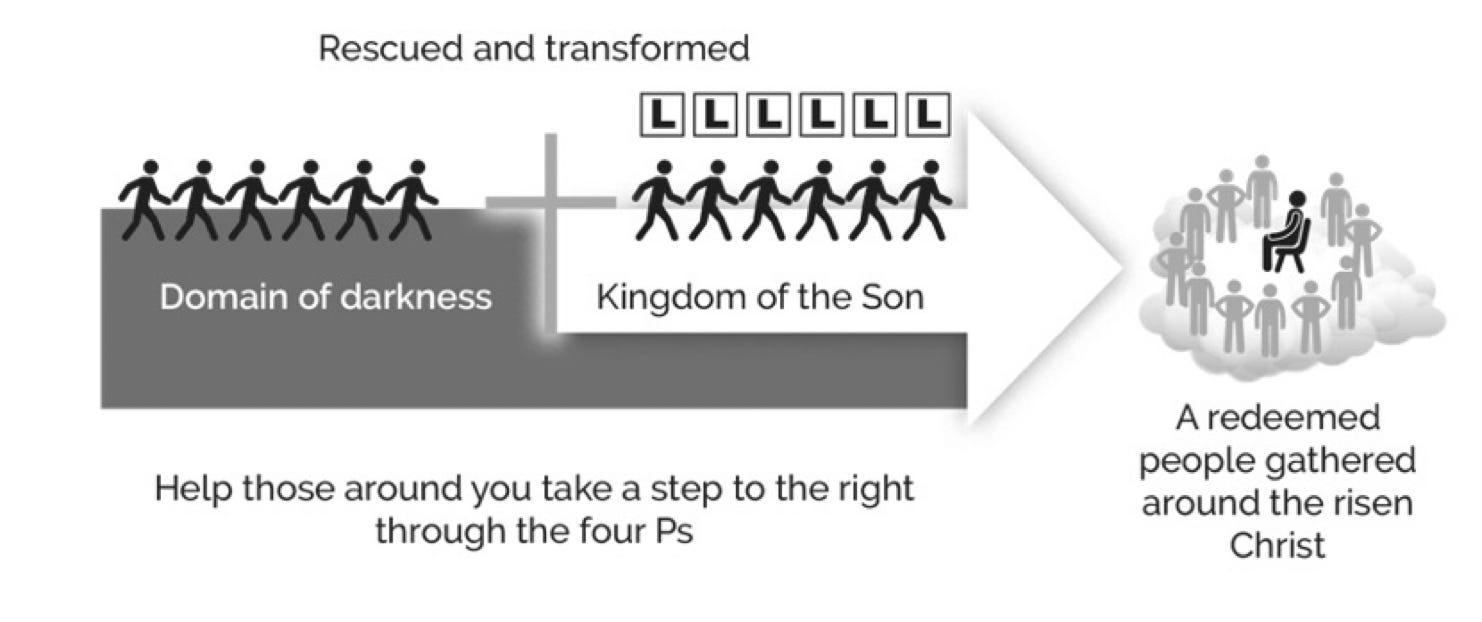
Move right, look left
Welcome to another free, public edition of The Payneful Truth. (I’m now sending these freebies out in the third week of each month.) Here’s what you might have missed over the past month:* 10,000 reasons our songs are changing: how should we think about the unmistakable trend towards slower, more emotionally intense congregational songs? * Singing and the affections: a follow-up post on emotions, affections and singing, including a re-reading of a well-known Jonathan Edwards quote. * You knitted me together: a fresh take on the value and personhood of unborn children, and how we might talk to our friends about this. * Is Christianity a locked room?: some thoughts on whether Christian truth is a circular argument. The good news is that you can access all these articles (and the whole archive) by coughing up a few measly dollars a month and becoming a paying member of The Payneful Truth. And that (as they say in the steak knives commercial) is not all. You also get:* every future edition every week (in both text and podcast form)* the monthly Q&A interview* regular work-in-progress reports from my other writing (including draft and sample chapters)* bonus book specials from Matthias Media * and the joy of supporting Christian writing!If this seems irresistible, then just …Or if you’d like to kick the tyres a little more first, then you can currently try all this out with a … Anyway, on to today’s post … Move right, look leftThere’s a moment in Trellis-and-Vine related ministry workshops or talks when the same joke always seems to show up. Like an old friend approaching on the street, I see him coming, and give him a warm slap on the back as he arrives and passes by.It’s when we get to discussing the ‘moving to the right’ diagram. I mean this one:For those not familiar: the basic idea is that becoming a disciple of Christ and growing as his disciple is like ‘moving to the right’ on this diagram—being rescued out of the domain of darkness into his kingdom, and then being transformed into the likeness of Christ our king. And all Christian ministry, therefore, has the same essential character, whether it’s more down the ‘evangelistic’ end of the diagram or at the ‘transformational’ end, and whether it’s being practised by the most experienced pastor or the newest Christian disciple. All Christian ministry simply seeks to move every single person around us—in church, at home, in our neighbourhood, in our small groups—one step to the right.The method for moving people to the right is also the same all across the diagram—it’s through the four Ps: Presenting or Proclaiming God’s gospel Word in some form; Praying in the Spirit that it would be effective; all this being done in and through God’s People; and continuing to Practice this, Perseveringly, with our lives serving as a lived example of the word we’re speaking.Many of you will have read or heard this. (If you do want to explore the ‘move to the right’ thing further, pages 43-152 of The Vine Project lay it all out in detail.)Anyway. The joke that always turns up in this discussion trades on the discomfort people feel about casting the Christian life as a relentless movement to the ‘right’.“Don’t worry, friends”, I say. “This is not a journey away from CNN and towards Fox News. You don’t have to turn off the ABC news and turn on Paul Murray Live. It’s not a transfer of allegiance from (current left-wing Politician) to (current right-wing Politician).”General tittering and laughter.“No, the left-right language is not about politics; it’s for entirely Scriptural reasons”, I say with a solemn expression, “Ecclesiastes 10:2—A wise man’s heart inclines him to the right, but a fool’s heart to the left.”More general tittering, and elbow-jabbing of each other.And then I reassure them that if they’re still a bit uncomfortable not to worry—the ‘left’ is about to get its revenge.That’s because one of the key moments—perhaps the key moment—in the growth of every Christian disciple is when he or she starts to look left.The growth that God works in the hearts of Christians (through the four Ps) is a transformation into the character of Christ, and the single word that best describes that character is ‘love’. As I move to the right as a Christian, my faith becomes more active in love (as Galatians 5:6 puts it). I begin to realise with a dawning horror just how self-focused my life has been, even my Christian life. I start to see that my life—the Christian life—is not about me. It’s about all the people God has given me to love.I begin, in other words, to look left.I lift my head up, and open my eyes, and see the multitudes all around me that need to move to the right—to take steps towards knowing Christ or growing in Christ. And I realise that God has called me, in my own weak and faltering way, with my own particular relationships and opportunities, to help those people take one step in that rightward direction.This penny-drop moment (and it can be a drawn-out moment for some)

You knitted me together
We have another grandson on the way. We’re still a few months away from meeting him, but his parents have already decided what he’ll be called, and have even let the rest of the family in on the choice. And so Little Nick has become a someone in our family already. We talk about how well-defined his leg muscles are in the ultrasound (‘bound to be a good rugby player!’), and we joke about whether his personality will end up being like his name-sake (another Nick in our family). In a very real way, Little Nick is already part of the crew. We know him and love him, even though we haven’t yet met him.This is perfectly normal, but also a bit strange when you think about it. Little Nick has none of the normal faculties or properties of a human being that we could relate to. Apart from the miracle of ultrasound he is entirely absent to us. We can’t see, hear, touch or speak to him. Nor he us. And yet we joke about him already, include him in the conversation, and make preparations for his arrival—as if he is a long-lost relative soon to arrive from overseas. God of course knows Little Nick far better than we do. He is knitting him together in his mother’s womb, in the famous words of Psalm 139. In fact, Psalm 139 goes quite some way further in its description of God’s knowledge of us before our birth. His eyes see us when we are hidden from everyone else, when our ‘substance’ is as yet ‘unformed’. Every one of our days is already written in his book, before any of them have to come to be. The conclusion that we often draw from Ps 139 is that the life of the unborn child is clearly a human life, and thus valuable, even sacred. It is hidden and still in formation, and yet it is a real life all the same—a life that God knows and loves, and that we should also love and protect.All the same, when we talk about abortion with non-Christian friends or in social debates, we feel that quoting Psalm 139 might not cut much ice. And it probably won’t. Accordingly, we often find ourselves drawn into arguments about what constitutes pre-natal human life, and whether the unborn baby has enough of the required characteristics or properties to qualify. Does his possession of the complete human DNA package render Little Nick definitely a human being? Or is more required before we treat him as an independent life in his own right (and not simply part of his mother’s body)? Is it the point at which his heart begins to beat? Or the development of his brain stem? Or his ability to feel pain? At 38 weeks, when Little Nick is fully grown in the womb and ready for the short agonising journey down the birth canal, it seems absurd and arbitrary to suggest that he is not a human life worthy of all our protection. But at the other end of the process, when he is just a microscopic clump of cells, he looks much less like a human life and more like a piece of tissue. And many everyday people find it easy to persuade themselves that this clump of cells is not enough of a ‘human being’ to be worthy of protection. Arguments about what properties or faculties need to be present in order for a life to be recognized as ‘human’ don’t tend to get very far. Who gets to set the standard or draw the line? We want to be able to say that there is something essentially human about unborn Little Nick, regardless of whether he does or doesn’t yet possess certain abilities or properties. But that only gets us to another conundrum. What is that human ‘essence’? How would you define it? Is it a ‘soul’? Psalm 139 may help us get past this, even if we don’t always feel able to quote it in conversation.When the psalmist refers to God’s knowledge of the unborn child, it is not unborn human life in general that he refers to, but his own. You knitted me together; you saw my frame when I was being made; your eyes saw my unformed substance; and so on. The unborn life in the womb is a Someone—the psalmist—whose identity and personal history stretches in an unbroken line from his hidden formation in the womb to the time many years later when he looks back, and reflects on God’s knowledge of him prior to birth (in Psalm 139). We discover that the life in the womb is a person—the same person who is writing the psalm. After Little Nick is born (God willing), we will one day say to him, “We used to talk about you, when you were still in your mummy’s tummy”. The ‘you’ that is Little Nick in that sentence is the same person that was in his mother’s womb. We all know this about ourselves, and each other. The ‘you’ that is ‘you’, and the ‘me’ that is ‘me’, started well before either of us were born. Our parents and relatives identified us and talked about us when we were in the womb; and we can look back and talk about our pre-birth selves now. The real question, then, is not whether unborn babies have sufficient human properties or not, but whether they are persons. Are they able to be identified and addressed as unique and irreplaceable Someones, who already are in personal relati
Singing and the affections
The implicit question I left hanging at the end of last week’s Payneful Truth has been taken up and asked by a number of people in the few days since. We can all agree that we don’t want theologically dodgy emotional manipulation in our singing. But what is the place of emotions in singing? The best form of the question came in an email from Jack:You say: “Singing for us is a form of speech—to one another and to God. It’s a more emotionally-charged form of speech, but it’s one facet of the word-based personal relationship we have with God and with one another.” Sure. But what then do we make of the ‘more emotionally-charged’ nature of singing? Clearly song is more than just speech (not wanting to detract from its intrinsic wordy-ness). I'd be keen to hear how you would give an account of the purpose of that emotional charge if ‘atmosphere’ is the wrong category.What is that ‘extra’, then, that singing or music adds? What’s the ‘charge’ in its ‘emotional charge’? The position that I’m arguing against sees singing as a way of creating an atmosphere or getting people into the right spiritual mood; of arousing certain feelings within them that open them up to experience God and his truth in a new way. But do I have Jonathan Edwards against me? In a famous paragraph (that I heard quoted again at the Reach Australia conference just last week), the great New England Puritan said this: And the duty of singing praises to God seems to be appointed wholly to excite and express religious affections. No other reason can be assigned why we should express ourselves to God in verse, rather than in prose, and do it with music but only, that such is our nature and frame, that these things have a tendency to move our affections. (Religious Affections, I.II.9) Is Edwards arguing in favour of what I’m opposing? Is he saying that God has given us singing to get us in the mood, as it were; to excite our affections and warm us up to a certain kind of Christian feeling that we don’t get just from the Word? Well, no—not if I understand him correctly (which is no easy thing). In fact, I think Edwards’s argument may help us to answer our question about the emotional nature of singing. A Treatise Concerning the Religious Affections was written in the context of the New England awakening, and the many dramatic and visible manifestations of emotion (or, as he would say, ‘affections’) that were evident at that time. Edwards wished to argue:* that these religious affections could be quite appropriate and genuine—and that, indeed, true religion very much consisted in the affections;* on the other hand, that the existence of ‘religious affections’, even high and intense ones, was no indication at all of true Christianity;* and that true religious affections had various distinguishing characteristics by which they could be recognized.The well-known quote (above) comes from the introductory section in which Edwards notes that a Christianity without the affections is hard to imagine or support. Why, he asks, did God give us singing if our affections have nothing to do it?However, it’s not only singing. Edwards also lists prayer, the sacraments, and preaching as God-given spiritual activities that involve the whole person; that affect our hearts and move us to grasp hold of God in love and faith. If Christianity was purely a matter of intellectual understanding, and not of the affections (Edwards argues) why not just give everyone a commentary to read on Sundays, rather than preaching a sermon to them? The sermon does more than just convey information: God hath appointed a particular and lively application of his word, in the preaching of it, as a fit means to affect sinners with the importance of religion, their own misery, the necessity of a remedy, and the glory and sufficiency of a remedy provided; to stir up the pure minds of the saints, quicken their affections by often bringing the great things of religion to their remembrance, and setting them in their proper colours, though they know them, and have been fully instructed in them already. (I.II.9)So it’s by no means just singing or music that God has given for this purpose, says Edwards. Much of what we do involves ‘the whole person’ (as we would say). It engages not just the intellect but the ‘affections’.It is at this point that we have to understand what Edwards means by the ‘affections’. He doesn’t mean just ‘feelings’ or ‘emotions’ (as we would use those words). He defines the affections as ‘the more vigorous and sensible exercises of the inclination and will of the soul’ (I.I.2). This needs some unpacking. An ‘affection’, Edwards says, occurs when my soul is inclined towards or attracted to something in a way that I feel (or am ‘sensible’ of). When I love or delight in or am ‘affectionate’ towards something, I’m not just agreeing intellectually that it is good or beautiful or right or morally excellent. My whole self or soul is attracted to it, leans towards it, and wants to choose

10,000 reasons our songs are changing
Oh, how the worm has turned. I remember a time—let’s call it 1985—when certain young music leaders (perhaps like me) could get a little frustrated with the tastes and sentiments of an older musical generation. Couldn’t they see that the rah-rah, British Empire vibe of ‘At the name of Jesus’ belonged to another time? Or that the ponderous, stately hymns of our heritage, with their neatly resolving cadences, and their third-rate Victorian poetry, were just not a suitable musical language for 1980s Australia?Couldn’t we have some music that at least nodded in the general direction of contemporary conventions, even if they were the musical conventions of ten years ago—since that was about as close to contemporary that we Christians ever managed to get?There was a gospel note to all of this. We wanted songs in church that weren’t musical stumbling blocks to the outsider and newcomer; songs that said to them, “We’re not an antiquated culture club; in fact, we quite like Culture Club”. In particular, we wanted to express our gospel joy in songs that had some drive and energy and tempo. Loud, enthusiastic Sunday nights come back to the memory. I can hear the rafters shaking as we belted out ‘Ancient of Days’, and ‘This, this is the day’ and a rocked-up version of ‘O for a thousand tongues’. It’s not as if we didn’t also sing slower, more contemplative songs, ones where the tempo notation on the sheet music said ‘Worshipfully’. But we were a generation raised on rock ’n’ roll, and for us joy and emotional authenticity in music almost always had a driving beat. Emotionally uplifting music was often fast.(In fact, I still have a compilation playlist called ‘Happy songs’ that I whack on when I’m needing some emotional pepping up at the end of a long week, and they are all like this: Mr Blue Sky and Livin’ Thing (ELO), The Boys are Back in Town (Thin Lizzy), What is Life? (George Harrison), No Secrets (The Angels), The Power of Love (Huey Lewis), and so on. All of them fast, with a driving beat.)But the worm has turned. The biter has been bit. Now I’m the older generation with the outdated musical tastes. For the generation coming up, the energetic, upbeat songs I love are cheesy and lame. Their songs are slower, more contemplative, more intense. A song you can build and build, a song to close your eyes to. The slow, earnest power ballad is now king. Why has this happened? Lots of reasons (10,000 of them possibly). Is it a broader musical culture thing? Has music slowed down more generally over the past 30 years? Perhaps, but not decisively. The last three decades have seen an incredible proliferation of musical genres and sub-cultures. (I remember having a deep conversation with one of my teenage son’s friends about the differences between death metal, doom metal and thrash metal, all of which he’d left behind in favour of prog metal.)In other words, it’s not as if the earnest power ballad is now the dominant musical genre of our society—because there is no one dominant genre. Certainly rock is not the factor that it once was. (“Rock is just not a thing”, says my very musically aware 26-year-old son.) And this could well have influenced a shift away from energetic, uptempo music. Perhaps it’s also a cultural mood thing. Is the generation coming through more bruised, more sensitive, more ironic, more emotionally expressive, or any or all of the above? Is life for them more in a minor key? Perhaps. (I find it hard to say, especially since I’m part of that generation that puts no trust in sweeping generational cliches.)Whatever complex cultural and musical reasons lie behind it, there’s no avoiding generational changes in sensibility and vibe. And for the sake of the gospel, music in church will need to adapt accordingly—just as we needed to do in the 80s, and in every decade since, including that time when we went all Coldplay. The time is no doubt coming when there will be four songs on Sunday morning—three of them slow and earnest, and one of them happy and upbeat for the old people. And so it must be. But I do want to sound a note of theological unease.The rise of the emotionally intense power ballad has also been driven by the slow invisible victory of a charismatic theology of music in many of our churches. It’s a victory won not by argument but by the music itself. This theology says, in essence, that the function of music (and it’s the music, not just the singing) is to help foster a certain experience, a heightened state of feeling and consciousness that serves as a connection point between God and us. Music can ‘tune my heart to sing thy praise’ as the old hymn goes; which we take to mean: ‘it warms me up emotionally, and gets me in the state of feeling where this all matters to me and feels authentic and real, and I can connect with God at a deeper level and worship him, which is one of the main reasons after all that I come to church’.And the earnest power ballad—slow, building, emotionally intense—is the genr

From Aisle 12 to Romans 13
I’ve been wanting to write a significant piece about politics and the Christian citizen for some time, but I very much doubt that this week’s Payneful Truth will be it. It will be a step or two down that road, but it’s unlikely I’ll get all the way to the destination in this short piece. All the same, I hope that it edges your own thinking along the path a little. We find ourselves at this point because I first observed that expressing opinions (especially in the way that many people do today on social media) can be a foolish and sinful thing to do (‘The Sin of Opinion’, Apr 28); and then I did my best to be more positive and lay some foundations about the nature of justice and judging and political authority (‘Doing Justice’, May 5). I’ll assume you’ve read those pieces. (include links)However, given that the role of political authority is to make judgements, do we have any role in respect to those judgements? When a dispute does break in aisle 12, and we find ourselves onlookers—when and how should we get involved? What are our positive obligations and opportunities as Christian citizens?Romans 13 is a good place to start, since it addresses this very question. It begins like this:1 Let every person be subject to the governing authorities. For there is no authority except from God, and those that exist have been instituted by God. 2 Therefore whoever resists the authorities resists what God has appointed, and those who resist will incur judgment.The key idea in these verses is conveyed in the recurring Greek word tassō, which means to bring about an order to things, to arrange or fix or institute things in a certain relation to one another. God has tassōed or instituted ‘authorities’, and these authorities are part of a larger order or arrangement of things that God has established. He has created a world in which there is right and wrong, and good and evil. It’s a morally ordered world in which there is such a thing called ‘justice’ (because of the existence of those standards of right and wrong), and in which there are ordered structures within human communities whereby justice can be done. God has ordered and established all this in place, including the authorities who administer that justice (ESV translates the tassō word in v. 1 as ‘instituted’; ‘established’ says NIV).Our right response is to submit or sit under this ordered structure of authority—to hupo-tassō ourselves to the authorities that God has established (v. 1). The wrong response is to anti-tassō (v. 2)—to fight against or resist the authority that God has set in place. In other words, to obey or submit to political authority is not just knuckling under to the big guy with the sword. It is humbly understanding ourselves and our actions within the whole order of rightness and justice that God has established. (There is a massive side-bar we could explore here regarding a foundational question of all political theory—namely, who gives the state its authority? Is it seized by the strong or the noble? Is it granted by divine right? Or is authority given by the people, and if so, how? In the absence of a God who created the world and us, with standards of righteousness and ordered structures of justice, and who delegates authority to human judges, these questions are difficult to anchor and to answer. But all this is too complicated for here and now.)So our first response is to submit or sit under political authority. This hardly sits well with us. We don’t like submitting to anyone or anything, and the internet gives us the illusion that perhaps we don’t have to. We can click our way to some snippets of knowledge, argue back and forth with intensity, and then declare judgement on our leaders’ policies or actions—thinking that we have done something significant. But (as I’ve already said perhaps too many times), this online simulation of doing justice is shallow and ineffective. And it expresses a posture not of submission to the structures and agents of justice, but a kind of vacuous, superior independence that derides and dismisses them. It’s almost a national sport to sneer at our political leaders, to ridicule them, to sit in judgement of them, and to do all we can to avoid paying them tax—all of which is the complete opposite of what Rom 13:7 commands us to do. It tells us to hupo-tasso to what God has tassōed, which means giving to those in authority what is theirs: taxes, revenue, respect and honour. But (you might say) do we not sit in judgement of our political rulers? Don’t we elect them, and then kick them out next time? Well, yes. But we elect them to be our representatives, to make judgements on our behalf as a society. Submitting to this arrangement certainly means seeking to make good elective choices, or even possibly seeking to become a representative ourselves. But it also means that we should recognize that it is our representatives’ job to get on with the judgement-making, and we should honour and submit to them in this com

Doing justice
Last week’s post on the ‘sin of opinion’ prompted a thoughtful email from Michael Payne (no relation), asking a good and obvious question. Granted that social media opinionating is often a folly, is there a wise alternative? Michael put it like this:Surely we are called to seek Justice and Mercy, while walking humbly with our God, and that may lead to expressing opinions to influence those we relate to and our local MPs? One example is that the PM’s Christianity seems amazingly unresponsive to the asylum seekers, Australian IS wives, however unwise they were, now stranded in Northern Syria with their children, and even the 10,000 Australians in India who are increasingly at risk yet cannot come home. I do hope my concerns are motivated by love for others as a child of God. They reveal themselves in my opinions. How then should I go ahead, with the possible sin of opinion?Is there a good or wise way to share opinions or influence others? Or in general to contribute in a constructive way to the to-and-fro of our democracy? Or should we just pipe down, and get on with something else more useful? This is not an easy question to answer, since it involves an understanding of ‘justice’, and of how Christians should be engaged in the political processes of our society. And sketching a theory of justice and political theology, and wise Christian involvement in these, in a breezy 1000 words … not so easy! Let me try to lay some building blocks, and see how far we get. A good foundation stone is the famous verse in Micah 6:8 that Michael alludes to. God tells disobedient Israel to stop seeking alternative ways to please him, and to focus on what he has already shown them is good: “to do justice, and to love kindness, and to walk humbly with your God”. Interestingly, the verse speaks of doing justice, and this tells us something very important about justice (and about our opinions). Justice is an action, not a viewpoint. It is something that is done when a legitimate right is honoured—that is, when someone gives or receives what is owed according to some righteous standard or law. Justice requires a judgement—that is, an assessment of what is ‘just’ (according to a standard or right or law) and a granting of that right to the relevant person. This can be relatively simple: if I sell a golf club on ebay (to reduce the growing stash of useless implements in the garage), the personal doing of justice requires an accurate description, a fair price, and a smooth exchange of golf club for cash with the buyer. But doing justice is often complicated. What if there is a dispute between the buyer and me about the sale? The facts of the situation would have to be established—and they are often contestable—and a decision must be made as to which rights or standards are relevant, and how they should be applied.‘Doing justice’ requires investigation and thinking. It involves ‘judging’. It begins with an interrogation of reality—with the careful establishing of what really happened here. It then requires a deliberation as to which rights or standards are relevant to this particular situation, and what implementing them would involve. And it concludes with a resolution to act, and the subsequent granting of what justice requires. And to make it even more complicated, justice doesn’t stand alone. It is to be practised, Micah 6 suggests, alongside a loving concern for others (not merely with the abstract interests of ‘right’ and ‘justice’ in mind), and with an ongoing recognition of our lowly status before God (‘to walk humbly’ with him). So ‘doing justice’ really takes some doing. Very importantly, it is always done by a particular person or persons—by those who have been given the responsibility or authority to do the ‘judging’ in a situation (the investigating, the deliberating, the resolving, the outcome). When I’m with the kids in aisle 12 at Woollies and a dispute breaks out, that ‘judge’ is me. And it’s a tough gig. How on earth am I supposed to know who hit whom, who started it, what punishment or restitution is fair, and how to administer it—all while enduring the pitying and judgmental stares of the other shoppers? But it is my responsibility. I may receive input from the other shoppers in the aisle. One of them may have seen who started it. Another may pipe in with a piece of homely or encouraging advice. But if the shoppers of aisle 12 were to gather in a circle and start a heated debate about what I could do, or should do, or haven’t done, and what these events say about the whole culture of my family—well I think I’d leave all my kids with them, and finish my shopping in peace. (And imagine if one of them filmed the whole thing and instagrammed it. Before long, ‘Aisle 12 Dad’ would be a thing, and half the world would have a view about it, and … see my previous column on the ‘sin of opinion’.)The point is: I’m the one who has to take responsibility for the ‘judging’ in aisle 12, not only because I actually know the kids an

The Sin of Opinion
Have you ever been part of a social media thread like this? Anyone seen the latest Star Wars? Nah. But I hear it stinks. That’s what they’re saying. I’ve seen the trailer. Terrible.Whole series jumped the shark long ago. Haha yes. Three words. Jar. Jar. Binks. Haven’t and won’t. It will be even more cringeworthy than the last. Whose genius idea was it to give the movie to the director of ‘Little Miss Sunshine’?I don’t understand how anyone in good conscience can even go to a Star Wars movie anymore. The way the Ewoks were exploited in the making of VI was disgusting. And no-one has ever apologised. And the racist way in which Darth Vader is dressed in ‘black’ is just one … (read more) I can’t even. #dontseeitSince they sold out to Disney, it’s been sell out all the way down. Yeah, they are no longer interested in the story arc. It’s only about one thing—profits. #dontseeitHey does anyone think we should wait until we see it? You are disgusting. Social media parodies are not hard to write. We’ve seen this kind of conversation play itself out multiple times, over multiple subjects, on facebook or twitter or wherever. In fact, we could change the subject of the conversation to almost anything and the level of analysis and passion would be approximately the same. For example, the news stories that we discuss are as carefully manufactured as any Star Wars movie, and we debate them with about as much real knowledge and insight. It typically starts with a compressed, constructed narrative being presented to us in some form (as a news item or video clip), like this:* X was promised to happen by the government, * But (says earnest reporter) some people say it’s not working, or has disadvantaged them;* Queue Jim the Battler with tragic story to tell;* Cut to reporter with ten seconds of selective factoids; * Cut to two-sentence grab from government spokesman looking awkward, saying that everything is on track;* Back to reporter saying, “But try telling that to Jim the Battler”;* Solemn-looking news anchor sums it up with rueful comment. The moral of the story, and what we’re supposed to think, is clear enough: the government is incompetent (as usual) and/or doesn’t care about the battlers (as usual).All this is as stylised and crafted as any fiction. It may or may not represent the truth of the situation—we have so little to go on that it’s impossible to tell. What exactly did the government promise and in what context? Does Jim the Battler represent a broad trend or an anomaly? Are there other complexities that help explain both the plight of Jim and the broader situation? What alternative forms of action were available for the government? Is this the best that could be retrieved from difficult circumstances?None of this can be conveyed in a short news story, nor is that the intention. What we get instead is a brief impressionistic narrative, usually based around the available footage, and presented to us as entertainment. And then we share it on social media and opinionate profusely about it, making value judgements, impugning motives, and generally joking and quipping and sniding with a kind of cool, gestural indignation. Most online discussion of contemporary issues is like this—whether it’s about George Floyd, the European Super League, climate change, the vaccine roll-out, or the latest political scandal. None of us knows much of anything; but this doesn’t stop us responding with our opinion. And frequently that response is an aesthetic judgement (of what we favour or like), or a tribal reflex (based on what other people like me believe and think). Only in the rarest of instances do we penetrate to a level of knowledge or insight that might lead to real understanding or responsible action. All of which is to say that while this kind of opinionating passes the time divertingly, and may even raise our cache among friends, it has about as much connection with reality as a bunch of Star Wars fans discussing a movie they haven’t seen. But is this really such a problem, you might ask? What’s wrong with friends occasionally shooting the breeze about trivia? Well, perhaps not much, if it is indeed ‘trivia’ (my cat’s diarrhoea) and it is ‘occasional’ (as opposed to the 2 ¼ hours that the average user now spends on social media channels every day). But social media discussion of current issues goes well beyond trivial and occasional. It enables and supercharges a problem that we might call the sin of opinion. Loving real people is hard. To do it well, we have to confront the reality of the fallen, complicated person standing before us, to prayerfully ponder what faith and love and wisdom require of us in the actual circumstances they are experiencing, and then to take the costly step of doing something, saying something, sharing something. This kind of gospel wisdom asks a lot of me. It draws me out of myself. It demands my time and attention. It calls on me to see the problems of the world through the lens of the gospel

Is it right to plan for conversions?
A few weeks ago, from out of a post-viral haze, I posted some thoughts about the mysterious nature of Christian ministry—that is, the counter-intuitive way that God in his wisdom deliberately uses weak and stupid people, preaching an apparently weak and stupid message, in order to save people in such a way that the credit is all his (to channel Paul’s vibe in 1 Cor 1-2). And I asked you to help me figure out how this truth fits with the concepts of planning and wisdom in ministry. Faithfulness requires us to examine ourselves, to observe when something ‘isn’t working’ in ministry, and to make some changes to try to improve things. That’s hardly controversial. In fact, it’s hardly avoidable if we’re going to be good stewards. But how does this responsibility (which involves working with cause and effect, as far as we can observe it) fit with the spiritually mysterious nature of ministry?Well, I was hardly inundated with responses (the always thoughtful John Lavender notwithstanding), which could mean that you’re a bit stumped about this (like I was) or not very interested, or both. Here’s one more bite at the question, by posing it in its possibly sharpest form. Is it right to plan for conversions? Under God, we’d love to plan and pray and work hard towards seeing 40 people become Christians over the next 12 months.Does that sort of statement make you a tad uneasy? It certainly sparked off a lively debate in our ‘Strategy Working Group’ at Campus Bible Study earlier this year. We were preparing a draft set of goals (or ‘Desired Outcomes’ as we’re calling them) for the ministry over the next few years. We’d talked about setting some goals for maturing the Christians that we ministered to; for growing the number of people involved in the ministry traineeship; for reaching more people on the campus with the gospel; and so on. Interestingly though, we found that setting an ‘outreach’ goal was one thing (“we’d like to present the gospel to X number of people on campus”). Setting a ‘conversions’ goal felt like another. Isn’t this expecting the Spirit to blow according to our will, rather than his own? Then again (as we talked), we noted that we were happy enough to work towards other goals that depended on the Spirit’s sovereign work—for example, working towards seeing more people give up their worldly ambitions and go into full-time ministry. We didn’t baulk at having that as an aim, and to prayerfully plan and prioritise and work hard towards achieving it, all the while acknowledging that God gives the growth by his Spirit. But planning towards 40 (or 400) people becoming Christians? How would you even know if they had become Christians? And if our evangelistic plans and methods and strategies helped us achieve that goal, how would we prevent ourselves boasting—even just a bit, even in our own minds—in the efficacy of our strategies rather than in the Lord? It’s a particularly sharp form of the question we’re considering. How can we be practical and wise in ministry planning and practice, without beginning to boast in the efficacy of our clever methods and systems? Without beginning to think that we’ve cracked the code, and can now reliably predict what it takes to get the Spirit to blow through people’s hearts and minds? Having pondered this further, I have four thoughts. First, I don’t think we’ll ever completely solve this question, any more than we will ever penetrate all the mysteries of how God’s will and human responsibility hold together exactly. It’s another case of holding two contrasting truths together. (See this earlier post on the frequent ‘two-ness’ of Christian truth.) Second, we can’t ever boast in our methods, because everything important in gospel methodology comes from outside. It’s been given to us. This was one of John Lavender’s main points in his thoughtful response to this issue: I think I get what you are saying about God working through our weakness and our stumbling and bumbling, through our imperfection and through unlikely people—that it is not through our ‘slick’ methods or even our planning or structures that we see people saved, lest in pride we think ‘look what I have done’.Yet, having said that, I think we can say that the NT does set a ‘macro’ pattern of ministry for us. So for example Acts 2:42ff where the disciples devote themselves to the word and prayer and fellowship. Or likewise in Acts 3:21ff where we see the disciples’ commitment to prayer and to boldly speaking the word of God …I'm also thinking of Paul in 1 Corinthians 10:33-11:1 where, so that many may be saved, he urges his readers to follow his example as he follows the example of Christ.I guess what I'm trying to say is that here, in the macro, we have the model, of doing all we can by following Jesus’ example of seeking and saving the lost.This is not ‘our’ model—it is humbly following Jesus, so we cannot boast.I think it is in the ‘micro’, in our local context where we need to consider what this will look like

What I did on my holiday
In the tradition of what we had to do in school when I was growing up, here’s my composition exercise on the first day back from holidays. (Plus some bonus thoughts on preaching at the end from Phil Wheeler and David Jackman.) Holidays are hardly the time for deep thought. A bit of quiet musing perhaps, as the miles drift by down the highway, with a favourites compilation playing on the car stereo, and your beloved snoozing in the seat next to you. But nothing too mentally taxing. No writing of Payneful Truths on the back of napkins. However, now that I’m back from two refreshing weeks, I’ve been reflecting on why holidays are so good and so important. Perhaps I’m feeling bullish about holidays because this one was so good. Unlike every previous attempt to take a break over the past two years, this one actually worked. No flood, fire or plague prevented us. The weather was glorious. The mountain trails we tramped were spectacular. The novels I read were diverting and profound. (I’ll share some of them below.)It was a special time. That’s what a holiday is I suppose. It’s a ‘holy-day’; a special or distinctive day (which is what the word ‘holy’ means). Originally, these were days for celebrating one of the special ‘holy’ days in the Christian calendar. But even more originally, the idea of setting apart certain special days to stop working goes back to the very beginning. God did it at the creation of the world, and he commanded Israel to do likewise—to have a special ‘stop’ day when no work was done (the word ‘sabbath’ means to cease or stop or rest from doing something). Interestingly, in the two versions of the Ten Commandments (in Exod 20 and Deut 5), a different rationale is given for observing the day of ‘stopping’. In Exodus 20, the reason is that “in six days, the LORD made heaven and earth, the sea, and all that is in them, and rested (or ‘stopped’) the seventh day. Therefore the LORD blessed the Sabbath and made it holy.” Stop working, says the commandment, and remember that everything comes to you from the hand of the mighty Creator. Every single thing you do and work towards, and everything you experience and enjoy as the result of your labours—all of these things come from the God who made everything and then stopped; who completed the entire creation, so that “without him was not any thing made that was made”, as John 1 very precisely puts it. We can only work and enjoy anything because God made everything. Don’t think for a minute (says the commandment) that you’re self-sufficient; don’t let a week go by without stopping and enacting truth that the majestic Creator made you and everything, and then stopped. It’s certainly true that pausing to enjoy the fruit of our work is good for us, and refreshing. But the main reason to stop is because God stopped. There’s nothing we can add to his creation, in that sense. It’s all from him. We’re always working gratefully and trustingly with his raw materials. We are inescapably finite andcontingent beings. We need rest. And we are utterly dependent on our Creator for life and breath and everything. Resting from work is a recognition of that, and a celebration of it.Exodus looks back to God’s finished work in creation, but Deuteronomy looks back to God’s powerful work in redeeming Israel from the slavery of Egypt. The rationale for keeping the ‘stopping day’ in Deuteronomy 5 is this: “You shall remember that you were a slave in the land of Egypt, and the LORD your God brought you out from there with a mighty hand and an outstretched arm. Therefore the LORD your God commanded you to keep the Sabbath day.”Don’t forget (says the commandment) that everything you are enjoying here in the land of milk and honey is an act of pure grace. It’s God alone who strong-armed you here (so to speak), despite all your weakness and rebelliousness. In other words, it’s important to stop the relentless round of working and achieving to remember that we don’t deserve any of it. On the contrary, we deserve something entirely different from God, and the fact that we enjoy so much goodness from his hand is because of his generosity and mercy, not our merit. I’d like to say that these profound theological underpinnings to the importance of ‘holidays’ were at the absolute forefront of my mind over the past two weeks. But to claim that would be to infringe another of the commandments. All the same, on this first day back at work, I can seeing why ceasing from work is so important—not just to respect my created limitations but to rely on and rejoice in the goodness of my Creator. So what I did on my holiday was to enjoy the blessing of God, creator and redeemer—the God who made a world so full of beauty and goodness to enjoy; who made us with the ability to create beautiful and good artefacts (like movies and novels); and who blesses us with these things, and gives us the ability to enjoy them, not because of our works but in spite of them. PSFor me, a good holiday involves not only

Same same but different
As foreshadowed in last week’s edition, I want to come back to a question that has been niggling away at me over the past few months, and that a number of you have asked about. The question goes like this: * let us agree that there is only one gospel (not many gospels); * and let us also agree that each person we tell the gospel to will have different questions, and come to the gospel with different cultural presuppositions; any particular conversation or presentation might start at a different ‘entry point’, touch on different presenting issues or questions, and utilise different language or metaphors along the way; * how, then, can each gospel conversation or presentation be the same and yet different? How can the gospel be one thing, and yet many things?This is a very important question, because it affects not only how we preach the gospel (in evangelistic talks or courses) but how we train everyday Christians to understand the gospel and chat about it with their friends. (I’ve been thinking about this a lot recently, as we revise and rewrite the Two ways to live training material.)It’s too big a question, in fact, to answer completely and satisfactorily in this little newsletter. But I do have an insight to offer that I hope might move the discussion forward. Let us imagine that our gospel conversation (or sermon) starts by talking about something good in the world that our friends want more of (like beauty or love or justice) or something bad in the world that our friends want less of (like suffering or injustice or the fact that I’m lonely and my job stinks and I feel desperate). One increasingly common approach to evangelism suggests that we should frame our presentation of the gospel around these common culturally-framed desires or frustrations in our hearers, by:* affirming what we can affirm that is good about these desires;* challenging the dysfunctional way that we (and our culture) understand them and seek to meet them; showing that our way of pursuing these things doesn’t work;* and then offering the gospel news that there is an answer or fulfilment of these desires, and it is found in what God has done through Jesus.This is sometimes called the Resonance-Dissonance-Gospel approach. There’s much to like about it—particularly in how it listens carefully to each person (or culture) and seeks to have a gracious, salty conversation that bounces off the questions and issues of everyday life (in a Colossians 4 kind of way). But there’s a significant weakness here as well—or at least there often is, depending on how the conversation unfolds. In Two ways to live terms, the problem happens when we glide too quickly from the second half of Point 2 to the second half of Point 5.Let me explain what I mean. For non-2wtl aficionados, Point 2 says: We all reject God as our ruler by running our own lives our own way. But by rebelling against God’s way, we damage ourselves, each other and the world. Coming as it does after Point 1 (God as creator and ruler), Point 2 presents a picture of a good world gone wrong because of our rebellion against the Creator. And so there is plenty of scope to open a conversation of the Resonance-Dissonance variety. God has made a good world—and so beauty and justice and meaning and freedom and a satisfying job are indeed good things that we want and experience. But our ability to experience them is drastically compromised because of our disconnection with the Creator and his ways. So far so good. But what frequently happens next is that Point 2 is not fully enough explored, and then Points 3-4 are skimmed over too quickly—if I can put it that way—in order to get to the happy ending of Point 5. Point 5 says: God raised Jesus to life again as the ruler and judge of the world. Jesus has conquered death, now brings forgiveness and new life, and will return in glory. The blessings of forgiveness and new life that Jesus brings are the answer to our frustrated desires and aspirations. In Jesus, the freedom or beauty or justice we’ve been longing for can actually be found. By having a right relationship with God through Jesus, a new life can be ours, both now and forever—the life we were kind of looking for without even knowing it. However, this too-easy move from Point 2 to Point 5 can be very misleading—because Point 2 not only describes a world gone wrong, and our lives gone wrong, but the fundamental disease of which our negative experience is the symptom. The underlying problem is the wilful fracturing of our relationship with God as Creator and Ruler. Call that ‘rebellion’ or ‘rejection’ or ‘turning away’ or ‘hostility’ or ‘suppressing the truth and embracing the lie’ or ‘sin’, or whatever phraseology is most suitable. But the key move in Point 2 is establishing the larger problem we have with God, of which our current experience is the byproduct—and the larger judgement of God against us, of which our current negative experiences are but a foretaste (Point 3). Only by getting to

Your comments and questions
Time to pause from the regular rhythm of Payneful episodes, and discuss some of the many excellent questions and comments that you keep sending in. About the gospelThe various Two ways to live related posts about the nature of the gospel (and our preaching of it) have prompted numerous insightful comments and questions. John, for example, posed this fascinating one: With regard to preaching the cross/preaching the resurrection—obviously Christ crucified is a BIG deal (e.g., 1 Corinthians 1:18-2:2). So it’s got to be there in our preaching. But in Acts there is so much on the resurrection and preaching the resurrection. It is the resurrection that gets Paul into trouble with the religious leaders and it is the resurrection that he preaches in Acts 17, especially 17:32. The questions that arise (at least for me) are how do we know when and where to focus on one or the other? And why the shift/change/difference in focus (in Paul’s preaching)?Interestingly, when Paul summarizes the gospel that he received and which he faithfully delivered to the Corinthians in 1 Cor 15, he straightforwardly includes both cross and resurrection. In fact, he also throws in the fact of the burial and the witnesses to the resurrection, just to make sure we appreciate that this was a real, historical death and resurrection: For I delivered to you as of first importance what I also received: that Christ died for our sins in accordance with the Scriptures, that he was buried, that he was raised on the third day in accordance with the Scriptures, and that he appeared to Cephas, then to the twelve. Then he appeared to more than five hundred brothers at one time, most of whom are still alive, though some have fallen asleep. (1 Cor 15:3-6)Cross and resurrection are inseparable. In one context, you might lean harder on the cross (as Paul does when beginning to address the problems of the Corinthian church in 1 Cor 1-2), but the resurrection is never far away. In that passage, the clue is in the word ‘Christ’. The resurrected, ruling Lord of all (the Christ) is the one who was crucified. And indeed—as Paul gets towards the end of the letter, he turns to the resurrection and thumps that pretty hard (in chapter 15). In Acts 17, he leads with the resurrection—but again, it’s a resurrection from the dead. I’ve no doubt that in discussing things further with Dionysius and Damaris and the others who ended up believing, the meaning of that death was fully explained!I think the different emphases at different points in the NT’s recording of how the gospel was preached show that every gospel presentation isn’t exactly the same. But if we don’t ‘deliver’ the full message of both cross and resurrection to our hearers (whether all at once, or over extended interaction with them), then I don’t think we’ve been faithful gospel couriers. In my observation of evangelical proclamation (over the past 30 years), by far the most common problem is a failure to integrate the resurrection into our message. It’s either not mentioned, or tacked on as an afterthought. The result is that while we often fully explore what it means for Jesus to offer forgiveness and salvation on the basis of his atoning death, we regularly fail to proclaim Jesus as the risen Christ, the Lord of all, before whom we must repent, and whom we joyfully obey and serve. Bad things follow. The second main gospel-related question that has been asked in various forms over the past few months has been in response to my piece about ‘one gospel, many forms’. I argued that although the people we meet and talk to will have a range of issues, questions and backgrounds—and so every conversation will be different, and often will start in a different place—nevertheless, the gospel we end up explaining should be the same gospel, the one gospel. It’s not a different gospel for each person, adapted to what is most likely to connect with their particular desires or cultural narratives. I’ve had a number of fascinating conversations about this, and a new thought that I’d like to share—but it’s worth a discussion all of its own, rather than a brief comment here. I will save it for next week’s edition.About livestreamingMy post a couple of weeks ago about the ongoing usefulness of livestreaming our church meetings, and the theological issues involved, sparked lots of helpful comments. Warwick spoke for quite a few when he commented:We find that increasingly that folk check us out online before they come in person. It used to be that they simply looked at our website. Now it is joining with online church.We only had 10 weeks of meeting in person before we were closed again. In those 10 weeks we had so many people come who'd never been to a physical church meeting with us before.It seems that the new ‘front door’ for many churches (over the past 12 months) has become the livestream—and if we have the resources to maintain that over time (and keep up the quality), then it seems like an opportunity worth taking up.
What is the preacher doing?
I’ve been chatting with the trainees at CBS about preaching recently, and have come up with a slightly different way to describe the preaching task. See what you think …I have a newish definition of preaching to run past you. Or at least, a newish angle from which to view what we’re trying to do when we preach. (And by ‘preach’ I mean what we normally mean in our circles—the public exposition of a passage of Scripture.)I ended up thinking about preaching more than I expected to while working on the PhD, between 2015 and 2018. My actual topic was all the other word ministry that happens in a Christian community apart from preaching—the ‘one-another edifying speech’ that we engage in as Christians, to edify, encourage, exhort, admonish and exhort one another. But this required me to think about preaching as well, in order to understand and differentiate these two broad kinds of speech—the one-to-many communication that teaches and applies the word to the congregation, and the one-another communication that spreads and applies and generally ministers that word to each other in multiple ways. In the course of all this, I found myself dabbling in ‘speech-act theory’. If you’re not familiar with it, ‘speech-act theory’ is a currently popular way of thinking about how language works. It rests on the insight that all language is a form of action. When we ‘say’ something we’re never just ‘saying’. We’re always doing something through the words that come out of our mouths. We might be explaining, answering, promising, commanding, warning, entertaining, exclaiming, interjecting, declaring, exhorting, comforting, and so on. Speech-act theory goes into some detail to analyse and describe this process. Putting it a bit simplistically, speech-act theory differentiates three main aspects of any utterance:* the action of the speech (the kind of thing you’re doing as you speak: promising, telling, asking, explaining, exhorting, and so on);* the propositional content of the speech (what it is you’re promising or explaining or asking); and * the hoped-for outcome of the speech (what you’re expecting to happen as a result of your speech-action: for your hearers to trust the promise, to understand the explanation, to heed the exhortation, and so on). A number of biblical scholars have picked up on this idea and applied it to Scripture. Perhaps most prominently, Kevin Vanhoozer has argued that the Bible is God’s communicative action. When God speaks in the text of Scripture, he is always doing something—declaring, explaining, teaching, urging, commanding, and so on—to fulfil his covenant purposes through the words of the human author. And like all speech, this speech-action that God is ‘doing’ has certain content, and certain expected outcomes. God’s speech is living and active and purposive. Now, the biblically alert among you might have already figured this out, even without the geniuses of speech-act theory to help you. You might have read and believed these famous verses, for example:For as the rain and the snow come down from heaven and do not return there but water the earth, making it bring forth and sprout, giving seed to the sower and bread to the eater, so shall my word be that goes out from my mouth; it shall not return to me empty, but it shall accomplish that which I purpose, and shall succeed in the thing for which I sent it. (Isa 55:10-11)God is intentionally doing something whenever he speaks. Speech-act theory highlights this, and in a basically helpful way it seems to me.What has this got to do with preaching? Well some other clever chaps (most notably the British evangelical scholar, Timothy Ward), have argued that if God’s word is an action, then what we are doing when we preach is re-enacting the word for our congregation. A sermon is a bit like re-performing a classic stage play in a new context, with updated language, and a different set, but with the same content and purpose as the original. This brings us to the newish definition of preaching I want to run past you: our goal when we preach is to do for our hearers what God was doing in the passage of Scripture we are expounding. I say ‘newish’, because this is just me summarizing the clever insights of others—but also newish because it is only a bit different from definitions you might already have in your mind. Take for example, this classic paragraph from Simeon: My endeavour is to bring out of Scripture what is there, and not to thrust in what I think might be there. I have a great jealousy on this head: never to speak more or less than I believe to be the mind of the Spirit in the passage I am expounding.Or to put this in terms we’re familiar with (thanks to Haddon Robinson): our goal when we preach is to let the Big Idea of the passage be the Big Idea of the sermon. All the same, the differences in my newish definition have some advantages, particularly over the ‘Big Idea’ approach. Perhaps it’s just me, but when I look for the Big Idea in a passage,

Making God bigger
This is the second in a little three-part series thinking about different aspects of our church meetings—now that many of us are back and almost approaching normal church again. This is also one of the free public editions of The Payneful Truth that comes out every three weeks or so—which means that if you’re on the free list, you will have missed the first post in the series (last week) on leading better church meetings (as well as a bonus post of ‘meeting templates’ that I sent out over the weekend). Don’t mean to rub it in or anything, but there is a way you can get every post every week if you’d like to … Just hit this button and sign up. (And by so doing you’ll also help me raise support for the writing work I do.)(And if you’d like to sign up to the every-week ‘partner’s list’, but aren’t in a position to chip in financially, just send me an email at [email protected] saying “Please put me on the every-week list”, and I’ll take care of it. I don’t want anyone to miss out for financial reasons.)This week we turn to the subject of singing and making God bigger. Making God biggerIs it possible for singing to make God bigger? The answer to that question begins back in the mists of time, when dudes with Sony Walkmen roamed the earth and I was at theological college. As part of my Old Testament studies in 1994, I was set the task of assessing the ‘content and function of “praise” in the Book of Psalms’. This was much more than an academic exercise for me. My years in the charismatic movement were only a bit more than decade in the rear-view mirror. And as with many aspects of my neo-pentecostal youth, I had a sneaking feeling that I might have some unlearning and re-learning to do about ‘praise’.And so it proved to be. I’d always thought of ‘praise’ as a personal (or corporate) expression of adoration or devotion to God. ‘I praise you, O God’ was a way of saying “I am in awe of you; I want to express just how much I love you” and so on.So when we all sang, “I will praise you, O God” (or “We praise your holy name”) then that’s what we were doing. We were ‘praising’. To sing it was to do it. And the more we did it, the more God was praised—hence the 40 minutes of pretty repetitive ‘I will praise you’ type songs that kicked off of the charismatic church meetings I went to in the 70s and early 80s. But my Moore College essay got me looking afresh at ‘praise’ in the Psalms—at what the word itself meant, and what its content and functions were. I found that it had a quite different meaning and purpose. I discovered that this definition by Mark Harding was completely accurate: … praise and commendation result from human assessment of another’s qualities, attributes, excellences or deeds. What is seen is advertised. It is the advertisement—the public acknowledgment and acclamation—of the attributes and excellences and deeds of another which is praise.This is what ‘praise’ is in the psalms (and in the Bible more generally). Praise is not an expression of our gratitude or awe or adoration in response to God’s mighty deeds; it’s the advertising of those deeds to others. When the psalmist says “I will praise you”, he is announcing what is about to come next, which is the actual ‘praise’—that is, a description or narrative or declaration of some aspect of God’s great character or his saving action in the life of the psalmist. This is what ‘praise’ is: it’s letting everyone know just how excellent and ‘praiseworthy’ God is by telling forth his mighty acts. And because God is indeed very, very praiseworthy, we’ll tend to advertise his greatness with everything we’ve got—with the lyre and the cymbals and all the other joyful-noise-makers we can throw at the situation. We’ll advertise with joy and celebration and to maximum effect. And we’ll feel gladness and appreciation and love in our hearts as we do so. But what we’re really doing when we praise God is advertising the details of his greatness to others. What has this got to do with making God bigger? I’ve recently been thinking about the other words that populate our Christian singing. Words like ‘magnify’, ‘exalt’ and ‘glorify’. Have you ever wondered what we are actually doing when we ‘magnify’ God? Or ‘exalt’ him? Or ‘glorify’ him? What was Mary doing when her soul ‘magnified the Lord’? What was Moses doing when when he led the Israelites to sing, “… and I will exalt him!”I think most of us think about these words largely how I used to think about ‘praise’. They are self-fulfilling words. When I say ‘I magnify you, O God’, then I’ve just ‘magnified’ him (especially if it’s set to music). Ditto with ‘I glorify you’ or ‘I exalt you’. They are words of Godward devotion, where we turn our attention and our souls towards him, and express our love for him. To say it (or sing it) is to do it. Except—as with ‘praise’—this is not what these words mean, either in English or in the Bible. Let’s take ‘magnify’. To magnify something is to increase it; to cause it to become bigger

Back to church … with better meetings
After nearly a year of somewhat dissatisfying, best-we-could-do substitutes, we’re getting back to the real churchiness of church, at least in my part of the world—by which I mean the actual gathering of God’s people around his saving word. It’s marvellous. All the same, whenever you return to something familiar after a break, you do see it with new eyes. It’s an excellent opportunity to pause and re-assess why and how we’re doing things as we do.In that spirit, over the next three Payneful editions, I’m going to offer some miscellaneous ideas about: * leading better church meetings;* why praise makes God bigger (sounds heretical!); and* the theology of livestreaming. This week: seven thoughts on leading better church meetings. Leading better church meetingsThe following ideas are by no means all that could be said about leading better church meetings. In fact, I wrote a meatier essay about this in The Briefing back in 2012 that you’re welcome to check out. In that longer piece, I dug more into the theology of the gathering, and why (also theologically) it’s important to be wise in how we construct them and lead them. But for now, here are seven punchy principles to provoke your thinking, and to use in discussion with your meeting leaders.1. Be clear on what your role is as a meeting leaderThe leader of a church gathering should be more than a peripheral MC or a warm-up act; but neither should they be the centre of attention. The role and purpose of a meeting leader relates to the purpose of the church gathering as a whole. Let’s stipulate (rather than debate at this point!) that the purpose of the Sunday gathering is to meet with God in Jesus Christ as his people, and to edify one another by his Spirit, as we speak God’s word and respond to him together. If that (or something very like it) is the case, then the role of the meeting leader is a bit like being the head of the household at a family dinner. He welcomes everyone, and oversees and facilitates all that happens, in order that the family gathering might function well and meet its goals. He doesn’t cook and serve every dish, or even the main course. But he is the one who takes responsibility to see that the whole thing goes well. You could summarise the purpose of a meeting leader as leading the household of God in God-ward edification by the word and prayer.This means that the role of the leader may not quite be an exercise in teaching, but that it is certainly a very important role requiring theologically discerning leadership.2. Aim for a conceptual flow that suits the purpose of the gathering 1 Cor 14 suggests that a meeting leader should marshal the various contributions from different members of the church household into a decent, orderly edifying whole. Those contributions will usually be some form of word ministry (Bible reading, preaching, testimony, singing) or some form of response to the word (prayer, thanksgiving, singing, confession, and so on). Just as a family dinner has a certain logic to it—nibblies then main course then dessert—so in a church meeting (or any meeting for that matter), there is a conceptual flow that makes sense of what the meeting is trying to achieve. This might be a general gospel-shaped conceptual trajectory (e.g. one that leads towards a repentant, faith-filled, listening to God’s word and then responds to that word in various ways). It also might be shaped by the particular message or theme of that particular meeting. Every church meeting will have a conceptual trajectory of some kind—it’s really a case of whether you take the time to think about what that flow is, whether it makes sense, and whether it contributes towards the goals of the gathering. Simply taking the time to think about how the different components of the meeting fit together, and which arrangement of them would flow best conceptually, would be a step forward for many meeting leaders. 3. Consider the emotional temperature or flowEverything that happens in a meeting will have an emotional or affective impact on those present. There will be a fluctuation of emotional temperature as the meeting goes on. We can’t avoid this (nor would we want to).Part of the meeting leader’s role is to reflect on this fluctuation, to respect it, and where possible to nudge it along in the most helpful way. For example, don’t program a rip-roaring song immediately before you want everyone to sit quietly and attentively to listen to a sermon. Don’t segue straight from a jaunty and hilarious announcement video into a prayer of confession. Don’t leave people sitting quietly for 30 continuous minutes and then expect them to sit quietly for another 30 minutes for the sermon. Don’t be afraid of either levity or gravity—both are beautiful in their season.4. Pay attention to the transitionsIt might actually be possible to segue from a jaunty video announcement to a time of prayer, if you allow for the appropriate transition—in this case, perhaps taking up the theme or even