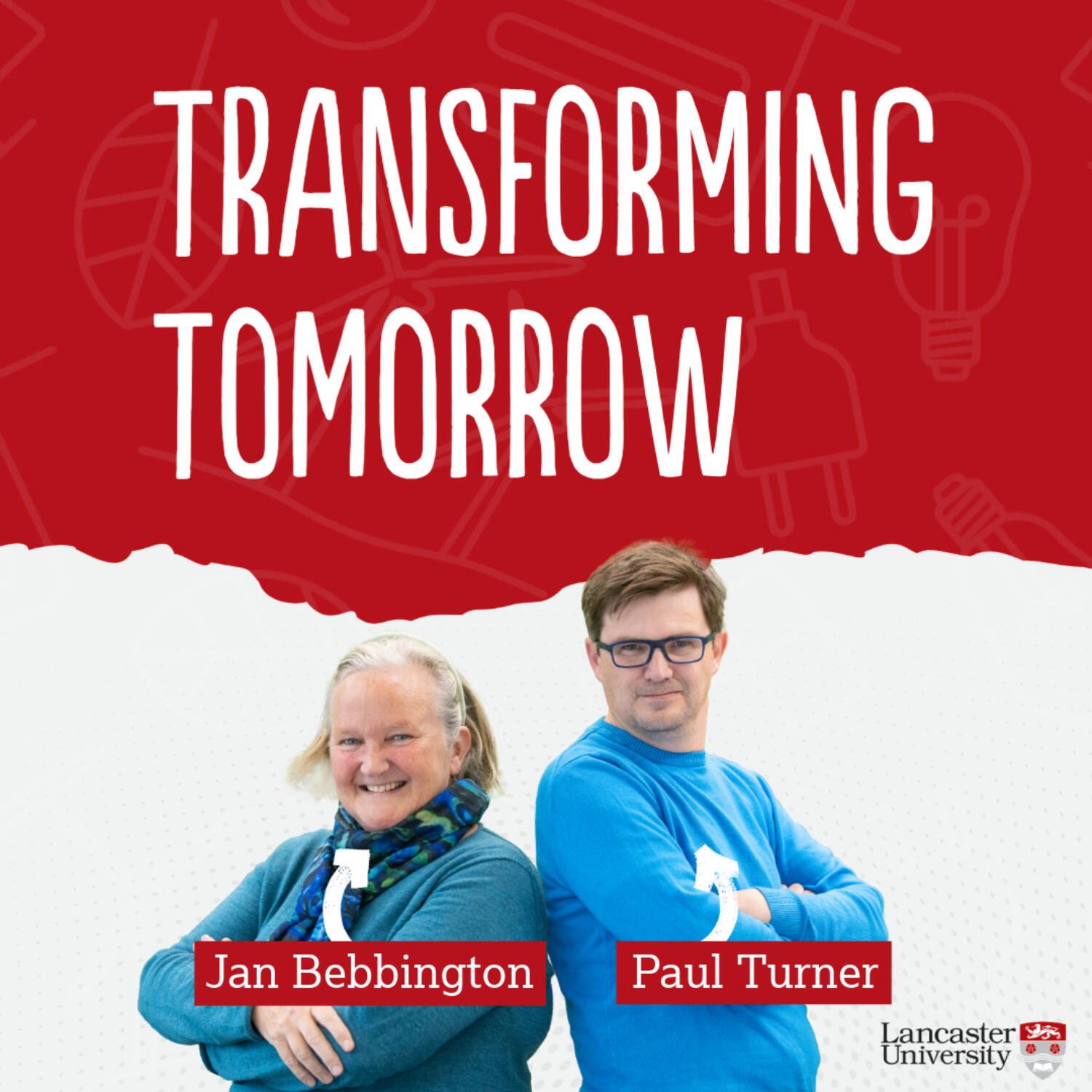
Transforming Tomorrow
132 episodes — Page 3 of 3
S1 Ep 32The Problem of Insecure Work
In 2023, around 6.8 million people in the UK were in severely insecure work – little over a firth of the working population. Work Foundation Director Ben Harrison dials in from London to discuss the issue. Ben tells Jan and Paul about how the Work Foundation works as it tries to influence policy across the UK. He covers issues of flexible working, how economic changes in recent years have affected working patterns, and the effects of the Covid 19 pandemic. What are decent and insecure work? How does the Work Foundation’s Insecure Work Index function, and what does it tell us? Are particular groups and parts of the country more affected by insecure work? What responsibilities do employers have towards their employees during times of financial hardship? Discover more about the Work Foundation’s research and activities on insecure work here: https://www.lancaster.ac.uk/work-foundation/our-work/insecure-work/
S1 Ep 31Inspiring Business Sustainability
Dr Joanne Larty joins Jan and Paul to enlighten them on her work with businesses in Cumbria on sharing best sustainability practice. Through Project INSPIRE, Joanne and her team are speaking to pioneering companies across Cumbria to discover how they are tackling sustainability challenges, how it ties into the history and landscape of the county, and how their practices can be spread. What issues do business face? How can they move to a new way of operating? And, most importantly to Paul, how do you really pronounce Furness, and why does everyone get it wrong? Discover more about Joanne’s work here: https://www.lancaster.ac.uk/lums/people/joanne-larty Read more about Project Inspire here: https://doc.your-brochure-online.co.uk/Lancaster-University_FiftyFourDegrees_Issue_19/14/
S1 Ep 30Connecting with Nature
Matt Healey talks Jan and Paul through his journey from an outdoor education professional to becoming a PhD researcher looking at our connections with nature. The UK has the lowest connection with nature in Europe, and Matt’s work encompasses how we each appreciate nature in our everyday lives, the importance of considering nature from a non-human-centric perspective, the value of nature, and the importance of connecting with nature from a young age. Plus, find out how connected to nature are Jan and Paul? Read more of Matt’s work on ‘Taming the Green Monster’ here: https://doc.your-brochure-online.co.uk/Lancaster-University_FiftyFourDegrees_Issue_17/47/
S1 Ep 29Lancaster Environment Centre
bonusProfessor Alona Armstrong returns to give Jan and Paul a whirlwind tour of the work that takes place across the Lancaster Environment Centre and the Energy Lancaster research centre. Discover the work of Energy Lancaster here: https://www.lancaster.ac.uk/energy-lancaster/ And find out about the research taking place in Lancaster Environment Centre here: https://www.lancaster.ac.uk/lec/research/
S1 Ep 28The Power of Solar
Energy Lancaster Director Professor Alona Armstrong takes Jan and Paul on a wonderful journey into the world of solar power, which continues to outperform predictions for its output and effectiveness. How many solar parks are there in the UK (clue, it’s not seven or 300)? How can solar parks affect biodiversity? How long do solar plants last? How do floating solar farms work? How many homes can a solar plant power? And did Paul really do the maths to answer that question so quickly in his head? All these questions and more will be answered – and we discuss if you could wear solar powered clothes? Discover the work of Energy Lancaster here: https://www.lancaster.ac.uk/energy-lancaster/ And find out more about Alona’s research here: https://www.lancaster.ac.uk/energy-lancaster/about-us/people/alona-armstrong
S1 Ep 27Data and Trust
Pentland Centre Research Associate Lauren Thornton wants to talk to us about trust. Specifically trust frameworks and trust affordances – explaining how and where people can trust data, and to what extent; why different people will trust different things – and the challenges of building trust with the right audience. How does this all fit with sustainability data – especially given the uncertainty over how sustainability can be achieved, and that some people will try to twist data for their own means; and what is translucent reporting, and why might it be better than transparency? Plus, Jan uses the word ‘groovy’ in a totally non-ironic sense. Discover more about Lauren’s work here: https://www.lancaster.ac.uk/lums/people/lauren-thornton
S1 Ep 26Don't Be A Greenwasher
Dr Di Wang dials in from Sydney, Australia, to talk to Jan and Paul about his work on sustainability reporting and materiality. Di talks about his experience of interviewing more than 200 businesses on their understanding of materiality – a concept that underpins reporting and which will be explained in the podcast. He explains why companies take part in greenhushing – and explains why he thinks the practice is only likely to increase. He also introduces us to the concept of brownwashing. And Paul's brainwashing is complete, as the word ‘benchmarking’ comes into his head unprompted. Find out more about Di’s work and research interests here: https://www.lancaster.ac.uk/lums/people/di-wang And you can see Di’s paper on Sustainability Reporting and Materiality here: https://papers.ssrn.com/sol3/papers.cfm?abstract_id=4687038
S1 Ep 25Stewardship and Responsible Leadership
What is leadership? And what makes a good leader? Dr Marian Iszatt-White heads to the studio to talk with Jan and Paul about her perspective on leadership and management – as well as her time working in the oil industry. Marian discusses what authentic leadership is – and why we should or should not be authentic; how leaders address sustainability issues; where stewardship and accountability fit in; and the importance of teaching on how future leaders can be shaped by programmes such as Lancaster’s MBA. Find out more about Marian’s work here: https://www.lancaster.ac.uk/lums/people/marian-iszatt-white
S1 Ep 24Wicked, Clumsy and Post-Normal
What are wicked problems? How about clumsy solutions? And where does post-normal science fit in? In tackling issues such as climate change, scientists and researchers face complicated scenarios that are not easily explicable, with problems that are not always solvable in a clean fashion. Jan explains the development of post-normal science as a way of addressing huge modern (wicked) problems such as climate change, how there is not always a definitive answer to every question, and why uncertain (clumsy) solutions are better than none at all. Why is being uncertain a good sign? Why do we all need to be open to changing our minds? If we don’t rely on facts for solutions, does this lead to a post-Truth future? Do we need to involve more people from beyond science in drafting solutions? Can a solution to a wicked problem ever be permanent? We cover all these questions, and more. Find out more about the Cynefin Framework here: https://thecynefin.co/about-us/about-cynefin-framework/
S1 Ep 23Going Glocal
bonusPaul’s head is going to explode as another new word to the English language is introduced to the podcast. Law PhD researcher Camilo Cornejo Martinez returns to talk to Jan and Paul about the importance of both local and global attitudes, actions and policies towards climate change. Discover more about Camilo’s work here: https://www.lancaster.ac.uk/law/people/camilo-cornejo-martinez
S1 Ep 22Environmental Law
The law won’t let Jan and Paul get away that easily! Another member of Lancaster University Law School, PhD researcher Camilo Cornejo Martinez, comes into the studio with the unprompted assurance that he is not an accountant. Camilo talks about his background as a practising lawyer in his home country of Chile; the different attitudes and approaches – legal and otherwise – to the environment and sustainability between Chile, the UK, and other countries; environmental courts; just transitions; and the rights of nature, and giving nature a voice. Discover more about Camilo’s work here: https://www.lancaster.ac.uk/law/people/camilo-cornejo-martinez
S1 Ep 21Corporate Responsibility
The law has caught up with Jan and Paul! Dr Rafael Savva, from Lancaster University’s Law School, promises he won’t sue us, but will recording the podcast turn him into a supervillain? Rafael talks to us about corporate governance legislation; the differences between hard and soft law – and how they apply to corporate responsibility; the potential conflicts between environmental regulation and seeking profit; the power of shareholders; socially responsible investing; and the importance of defining sustainable development in order to shape future legislation. Discover if Paul and Jan would make good Law students – and whether Jan has any memory of her prior education in contract law. Find out more about Rafael’s work here: https://www.lancaster.ac.uk/law/people/rafael-savva
S1 Ep 20The Blue Economy
It’s time to talk politics! And discover the Blue Economy – and how it varies around the world. Dr Celine Germond-Duret steps into the studio to speak with Jan and Paul to discuss how people and business connect to the coast and the sea (including fish and chip shops); why an exact definition of the blue economy is hard to find; the politics and resources of the oceans in different countries; and the balance between economics and the environment in sustainable development. Find out more about Celine’s work here: https://www.lancaster.ac.uk/ppr/people/celine-germond-duret
S1 Ep 19Sustainability in Scotland
bonusDr Lucy Wishart returns to tell Jan and Paul about the varied governance and structures within Scottish policy-making bodies when it comes to waste. She reveals the changes she has seen over recent years, how policy debate has evolved and moved away from Westminister, Scotland-specific patterns and approaches – and (almost) answers the perennial question of whether you can recycle a paper envelope with a clear plastic window, or if you have to take the window out first. Discover more about Lucy’s work here: https://www.st-andrews.ac.uk/management/people/la24
S1 Ep 18Waste and the Circular Economy
What is waste? It goes far beyond what we all might think. Dr Lucy Wishart joins Jan and Paul from the University of St Andrews Business School to discuss something that is there in every action we make, but which we rarely think about. We cover everything from discard studies to the circular economy and the difficulties in making it a reality, how we might extend the life of objects and encourage people to reuse, and the hidden labour and (physical and mental) effort needed in reusing and recycling. Plus, can there be sustainable waste? Discover more about Lucy’s work here: https://www.st-andrews.ac.uk/management/people/la24
S1 Ep 17Sustainability Fairy Tales
How can fairy tales be used help people more easily understand sustainability challenges and pitfalls? Where do mermaids, vampires and witches fit in? Dr Carolynne Lord talks to Jan and Paul about her work in making research more accessible to broader audiences; how green energy generation is like a mermaid luring businesses onto the rocks and distracting from other important issues; and why policymakers are waving garlic at vampire cars rather than brandishing stakes. They also discuss urban sustainability transitions, and how experts need to cross boundaries to share ideas and expertise with other people working in the same area. See more of Carolynne’s work on sustainability fairy tales, and the imagery that was created to go with the project here: https://doc.your-brochure-online.co.uk/Lancaster-University_FiftyFourDegrees_Issue_19/10/
S1 Ep 16Entrepreneurs and Sustainability
How do entrepreneurs approach sustainability? Brian Gregory and Salma Atcha, from the Lancaster University Entrepreneurs in Residence network, join Paul and Jan in the studio to share their experiences. They discuss differing attitudes towards sustainability; how the Sustainable Development Goals help shape business behaviours; when entrepreneurs are no longer entrepreneurs; Find out more about the Entrepreneurs in Residence network here: https://www.lancaster.ac.uk/lums/business/entrepreneurs-in-residence/ Read the article about degrowth and B-Corps by Entrepreneur in Residence Victor Giannandrea, the Pentland Centre’s Duncan Pollard, and B-Corp owner Celia Gaze here: https://doc.your-brochure-online.co.uk/Lancaster-University_FiftyFourDegrees_Issue_17/43/
S1 Ep 15Universities and Sustainability
What are universities doing to address sustainability challenges? Dr Georgiana Allison, Head of Sustainability at Lancaster University, joins Jan and Paul to discuss what the home of the Pentland Centre is doing to become more sustainable. They cover everything from Lancaster’s wind and solar farms, carbon impacts, changing attitudes and behaviours, how to make an impact in the classroom and where there is hope for the future. Plus, why are sustainability strategies like icing and cake? And has Paul found an ally against rankings and benchmarking? Find out more about sustainability at Lancaster University here: https://www.lancaster.ac.uk/sustainability/
S1 Ep 14The Wonders of Sand!
bonusJan and Paul are joined once more by Dr Jean-Baptiste Jouffray to discuss the fascinating world of sand. Without it, there would be no windows, no buildings, no electronics, no Transforming Tomorrow podcast! But what are the social and ecological impacts of sand extraction? And is our use of it sustainable?
S1 Ep 13An Ocean of Issues
You may have been taught the names of the world’s oceans as a child, but is there really only one? Dr Jean-Baptiste Jouffray, of the Stanford Center for Ocean Solutions, speaks to Jan and Paul from his home in Northern California. As well as busting myths on how many oceans we have on Earth, he discusses the many challenges it faces; his work across science, academia and business; the concepts of keystone actors and leverage points as a means to instigate change; and what it is really like working with Jan. See the One ocean map, JB talks about here: https://storymaps.arcgis.com/stories/756bcae18d304a1eac140f19f4d5cb3d Episode Transcript
S1 Ep 12Modern Slavery Reporting and Regulation
It has been too long since we had an accountant on the show, so it’s time to rectify that! Jan and Paul welcome Dr Mahmoud Gad to talk with them about his important work with the Financial Reporting Council and the UK’s Independent Anti-Slavery Commissioner on companies’ modern slavery reporting. What effects do regulations have? How can we encourage companies to treat modern slavery reporting as more than a tick-box exercise? How can AI be used to help tackle the larger problem? How can it be that only 15%of companies work with their suppliers to improve labour rights practices? Can Jan and Paul stop themselves going off on too many tangents? And does Jan really call statistics meaningless? Find out more about the work taking place on modern slavery in Lancaster University Management School here: https://www.lancaster.ac.uk/news/spotlight/modern-slavery/ Read the report Modern Slavery Reporting Practices in the UK, here: https://media.frc.org.uk/documents/FRC_Modern_Slavery_Reporting_Practices_in_the_UK_2022.pdf
S1 Ep 11COP28 and Business
In the aftermath of COP28 in the United Arab Emirates, Jan drags Paul back from his Christmas break for a special episode. They discuss the agreements made between nations, and the implications for business.
S1 Ep 10Sustainable Family Businesses
There are almost five million family businesses in the UK alone. They are all around us, and have been for thousands of years. But what do we mean when we talk about family businesses? Dr Allan Discua Cruz, Director of the Centre for Family Business at Lancaster University Management School, speaks to Jan and Paul about his personal experiences growing up in a family business, the issue of succession and longevity, how family firms address sustainability and consider the Sustainable Development Goals, and how faith and religion can impact their environmental behaviours. Find out more about the Centre for Family Business here: https://www.lancaster.ac.uk/lums/research/areas-of-expertise/centre-for-family-business/
S1 Ep 9Local Sustainability Policy
Global climate change has local impacts. So, how important is it that local government and the general public have an input into sustainability policies and actions? Dr Jekaterina Rindt joins Jan and Paul to discuss the I-Connect project, which is looking at the future of Lancaster and Morecambe when the Eden Project arrives. How can the journey to Eden be made Eden-like? With a focus on the Net-Zero agenda; sustainable, accessible and inclusive transport; and the need to consider communities, health and sustainability across all areas of policy, its design and impact, there is much for everyone to consider. Read more about the I-Connect project here: https://doc.your-brochure-online.co.uk/Lancaster-University_FiftyFourDegrees_Issue_20/14/ And here: https://wp.lancs.ac.uk/i-connect/
S1 Ep 8How do Sustainability and Accounting go together?
Jan and Paul welcome Richard Spencer, Director of Sustainability at the Institute of Chartered Accountants in England and Wales (ICAEW), to discuss how sustainability and accounting are interlinked, and why it is important for all accountants to embrace the connections. Discover more about Jan’s work with the ICAEW on educating the next generation of accountants on sustainability here: https://doc.your-brochure-online.co.uk/Lancaster-University_FiftyFourDegrees_Issue_18/14/ Episode Transcript
S1 Ep 7Sustainability Benchmarking
Jan and guest Dr Dasha Smirnow try to convince a sceptical Paul that sustainability benchmarks – rankings based on companies’ performances relating to certain criteria – are actually worthwhile. Find out whether benchmarks have any effect on companies’ actions, if poor performers care that they are not doing well, and whether the World Benchmarking Alliance really is an organisation set up just to benchmark benchmarks (hint: it’s not). Can Paul’s natural cynicism be overcome? Episode Transcript
S1 Ep 6ICT and Sustainability
Professor Adrian Friday joins Jan and Paul to talk about the many ways technology can influence sustainability efforts – both good and bad. We discover how he came to be a Professor of Computing and Sustainability – and just what that means – why having fewer people in offices does not always result in less energy being used, and why Adrian – to Jan’s shock – is not a big fan of the Sustainable Development Goals. Plus – is beer sustainable? The answer to this question will delight the drinkers of North West England. You can find out more about Adrian’s work here: https://www.lancaster.ac.uk/scc/about-us/people/adrian-friday Episode Transcript
S1 Ep 5Digital Inequalities
Jan and Paul are joined in the studio by Professor Katy Mason to discuss digital infrastructure and inequalities – and why naughty trees and inconsiderate weather affect planning large-scale projects in more isolated areas. Katy discusses two projects – Mobile Access North Yorkshire (MANY) and 5G Rural Integrated Testbed (5GRIT) – that brought digital technologies to rural areas in the North of England. She explains why isolated areas can miss out when new tech is rolled out, how these technologies can help in unexpected ways – from assisting mountain rescue teams to tracking sheep on the fells in heavy snow – and the importance of involving communities in the rollout. You can find out more about the MANY project here: https://www.lancaster.ac.uk/lums/research/innovation-in-place/#d.en.520893 and about Katy’s research projects here: https://www.lancaster.ac.uk/lums/people/katy-mason WARNING: This episode contains language that may upset some listeners, as ‘infrastructuring’ is used as a verb in defiance of all rules of English. Episode Transcript
S1 Ep 4Modern Slavery and Sustainability
Jan and Paul welcome Distinguished Professor Linda Hendry to talk about an area that affects tens of millions of people worldwide - modern slavery. Linda's work looks at modern slavery in company supply chains. It takes in the impacts - good and bad - of legislation, how companies are responding to issues, and how businesses work together to improve practice and modern slavery detection. There is also accounting, to Jan's delight. Read more about Linda's work here: https://www.lancaster.ac.uk/lums/people/linda-hendry Episode Transcript
S1 Ep 3Business and Biodiversity
Jan and Paul are joined in the studio by Duncan Pollard, whose career has taken him from Nestle to the WWF - not the wrestling version, to Paul's disappointment - forestry to Shell, and now to the Pentland Centre. Duncan has worked across NGOs and corporate sector on issues regarding biodiversity and sustainability, and explains the importance of companies understanding their impact on the climate and the biosphere, and how work at the Pentland Centre is looking at what good reporting on that impact would look like, and whether companies understand that. You can read Duncan's blogs on business and biodiversity here: https://www.lancaster.ac.uk/pentland/news-and-events/blog/ Reporting on Nature 2022: A Navigation Guide: Reporting on Nature 2022 - Lancaster University And find out more about the Pentland Centre's interest in the area here: https://doc.your-brochure-online.co.uk/Lancaster-University_Transforming-Tomorrow/13/ Episode Transcript
S1 Ep 2The Sustainable Development Goals
You will be hearing the term SDGs a lot in this podcast, but just what are the Sustainable Development Goals? Professor Jan Bebbington and Paul Turner examine what these 17 goals mean and how they tie into the research and activity that takes place across the Pentland Centre. Find out more about the Seafood Business for Ocean Stewardship (SeaBOS) project Jan is involved with here: https://seabos.org/ Episode Transcript
S1 Ep 1Introducing the Pentland Centre
What is the Pentland Centre for Sustainability in Business? What do we mean when we say sustainability? Professor Jan Bebbington and Paul Turner explain all. Episode Transcript