PLAY PODCASTS
Transforming Tomorrow

Transforming Tomorrow

The Pentland Centre for Sustainability in Business

120 episodesEN

Show overview

Transforming Tomorrow has been publishing since 2023, and across the 3 years since has built a catalogue of 120 episodes, alongside 6 trailers or bonus episodes. That works out to roughly 70 hours of audio in total. Releases follow a weekly cadence, with the show now in its 3rd season.

Episodes typically run thirty-five to sixty minutes — most land between 30 min and 42 min — and the run-time is fairly consistent across the catalogue. None of the episodes are flagged explicit by the publisher. It is catalogued as a EN-language Business show.

The show is actively publishing — the most recent episode landed 3 days ago, with 20 episodes already out so far this year. The busiest year was 2024, with 49 episodes published. Published by The Pentland Centre for Sustainability in Business.

Episodes
120
Running
2023–2026 · 3y
Median length
35 min
Cadence
Weekly

From the publisher

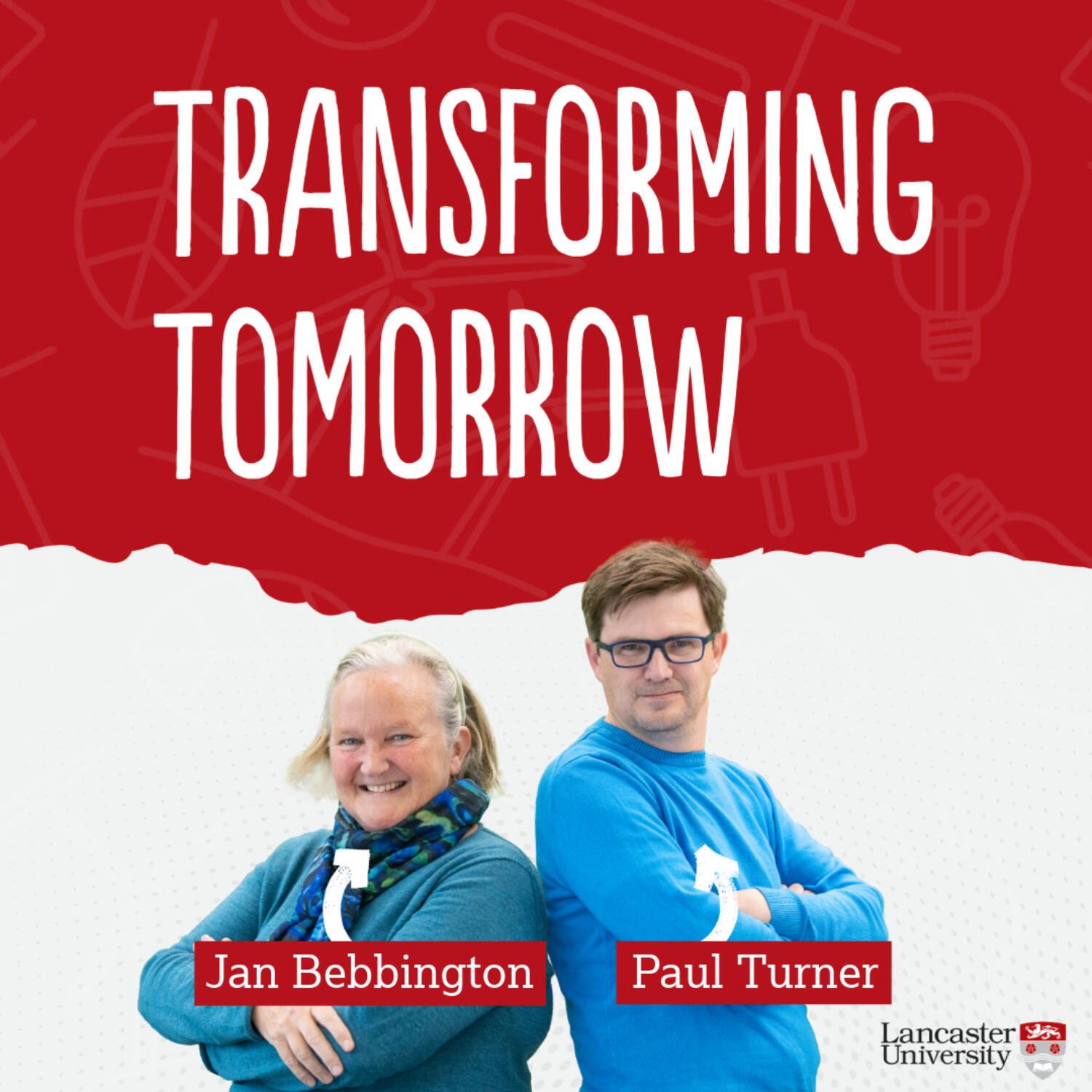
Sustainability is a key consideration for any contemporary business, from biodiversity to modern slavery, seabeds to factory floors. Transforming Tomorrow guides you through the complex, ever-changing and often exciting (yes, really!!) world of sustainability in business. Alongside members of the Pentland Centre, international research experts, and business leaders, we cover the theory and practice of mainstreaming sustainability into purposeful business strategy and performance. Whether you are leading change in your business, or just want to know more about how space weather, human trafficking or architecture may influence the future of sustainability, Transforming Tomorrow is the show for you. Taking you through it all, hosts Jan and Paul bring insight, perspective, and more than occasional disagreement to their topics. Professor Jan Bebbington is the Director of the Pentland Centre for Sustainability in Business at Lancaster University. Jan is an expert on accounting, benchmarking (to her co-host’s annoyance), and how business and sustainability intersect. She loves nature and wants to protect it – and hopes she can change the world (ideally for the better). She is also motivated to address inequality wherever it is found and especially to eliminate forced, bonded or child labour. Transforming Tomorrow is one small step on that quest. Paul Turner is a former sports journalist who now works promoting the research activities in Lancaster University Management School – a poacher turned gamekeeper as his former colleagues would have it. He has always been interested in nature and the natural environment – it comes from growing up in Cumbria – and has been a vocal proponent of the work of the Pentland Centre since joining Lancaster University. He does not like rankings and benchmarking, and is not afraid to say so. Join us every Monday to uncover new insights and become a little more inspired that you can make a difference in sustainability.

Latest Episodes

View all 120 episodes

Do You Know Your Employment Rights?

May 11, 202641 min

When Scientists Become Activists

May 4, 202638 min

Corporate Political Activism

Apr 27, 202645 min

Building a Sustainable Business

Apr 20, 202637 min

Hop on the (Electric) Bus

Apr 13, 202646 min

S3 Ep 26A More Accessible World

You might find accessing the commercial world straightforward. Not everyone does. One in five people in the UK have a disability, so how do we make the marketplace more accessible for them? Dr Leighanne Higgins and Dr Killian O’Leary are here to talk about their Marketplace & I project, which works with organisations to improve their accessibility for consumers through specialist training. We find out how they use art and artworks produced by people with a disability and their families at the heart of their project – and which artworks really stand out to the project leaders; and how their work goes beyond shops and cafes to charities, universities, and councils, taking a broad look at issues. Leighanne and Killian tell us why they are so passionate about ending exclusion from society, and how all of us might face accessibility issues as we enter old age. They show how things have evolved over the last decade when it comes to accessibility attitudes, and how organisations they worked with several years ago are now exemplars of change. We talk about the difference between visible and invisible disabilities, and how needs differ when entering the marketplace. And we discover how public exhibitions of the artworks led to direct business engagement with key issues. We look at the importance of creating a welcoming atmosphere, uncover myths surrounding the costs of accessibility, and see how employees can be inspired by training. Plus, why is Jan not a fan of shopping? And why are we talking about Monsters Inc’s Mike Wazowski? Find out more about the Marketplace and I project and some of the artworks here: The Marketplace and I And details of their accessibility training workshops are here: Accessibility training workshops - Lancaster University This is the website of the Jumbulance Trust, whom we mentioned in the show: Jumbulance Home And the NeuroChatin podcast can be found here: https://pod.co/neurochatin Episode Transcript

Apr 6, 202644 min

S3 Ep 25My Life in Forced Labour

There is a big difference between doing things we might not like, being assigned a task at work not to your particular liking, and being forced into a job by your government. And there is just a radical a difference between reading about forced labour in a textbook and speaking with someone who had experienced it first-hand. Farmon Asadov is now a PhD researcher at Lancaster University, but before that he spent time as a forced labourer within Uzbekistan’s cotton industry. Farmon is here to tell us about his experiences in a country that only moved away from widespread forced labour in the last decade. He also enlightens us the history of his country, why cotton has been such an important pillar of the Uzbek economy, and the intensive labour system that involved two million people being corralled by the government for each year’s harvest. But most importantly, Farmon tells us how as a student he was sent to remote camps to carry out the cotton harvest, receiving little to no reward, and all framed as being his patriotic duty. We hear about the long hours of hard labour in intense heat, the sometimes-impossible quota targets they were set, and the punishments for not meeting them. We discover the forces that brought about change to the state-imposed forced labour system, the influence of major corporations in the change, and how Uzbekistan tried to get around sanctions when the world clamped down on exports. We find out how the cotton industry works now; how new markets have been grown; how supply chains have been built with international support; and how quickly new generations have no memories of the old system. Plus, do your clothes have a label saying ‘Made in Uzbekistan’? Chances are you’ll be rooting around your wardrobes to find out. Meanwhile, Jan is already planning her next holiday on the old Silk Road to Samarkand – joining 10 million other annual tourists to the country. Find out more about Farmon and his work within the Pentland Centre here: https://www.lancaster.ac.uk/pentland/about/meet-the-team/farmon-asadov Discover the Better Cotton Initiative in Uzbekistan: https://bettercotton.org/where-is-better-cotton-grown/better-cotton-in-uzbekistan/ And learn about other groups here: Cotton Campaign Uzbekistan: https://www.cottoncampaign.org/uzbekistan Better Work Uzbekistan: https://www.betterwork.org/uzbekistan/ GIZ Uzbekistan: https://www.giz.de/en/downloads/giz2021_en_Factsheet_Cotton_Uzbekistan.pdf

Mar 30, 202637 min

S3 Ep 24Making A Career in Sustainability

Once you go sustainable, you never go back. Careers in sustainability may not always be obvious, but once you get involved in the sector, it has its claws in you. Richard Mason is Positive Business Director at Pentland Brands – who include Speedo, Canterbury, Berghaus, and many more brands under their umbrella – and is a two-times Lancaster University graduate. Richard talking us through how sustainability threaded through and was inspired by his studies at Lancaster and went on to influence his subsequent professional roles with the likes of AO and Burberry. And as we consider how we each end up in our careers, Jan reveals a boring teenage rebellion that revolved around accounting, Richard reveals how his mum sent him in the right direction. We find out how sustainability has grown over the last two decades, and how it no longer sits separately from the rest of a company but rather as part of everything. As we delve into how corporations consider sustainability in their operations, Richard talks about how businesses balance sustainability and innovation with considering consumers – while not being dragged down by unengaging jargon – and the influence of global politics on business operations. We look at the challenges of brands selling clothes they do not always manufacture in-house, how clothing brands collaborate when it comes to sustainability in their supply chains, the challenges that regulations present to corporations, and how companies can no longer make unfounded green claims. Plus, can you ski in Belgium? When is a journalist not a journalist? And did we really find some positives about AI?! Discover more about Pentland Brands: https://pentlandbrands.com/our-brands/ And you can see the six points to check when figuring out if a green claim is genuine, or take part in a quiz on green claims to see if you understand the rules, here: https://greenclaims.campaign.gov.uk/ Episode Transcript

Mar 23, 202647 min

S3 Ep 23The EU, Sustainability Regulations, and the Green Deal

We’re boarding the EU Omnibus to see how European corporate reporting regulations affect businesses – tens of thousands of them – within the EU and beyond. The EU has been a major innovator when it comes to sustainability regulation, but it has not come without controversy. Professor Andreas, from the Copenhagen Business School Centre for Sustainability, joins us to talk about the changes that we have seen in recent years, where they have worked – and where there have been issues. We talk about why the EU gets involved in sustainability directives and regulations in the first place; discover how they have been a pacesetter in the field; and show how regulations are more than just red tape, but also question how they could be improved. We touch on the ambitions of the Green Deal, the environmental taxonomy, Sustainable Finance Disclosure Regulations (SFDR), the attempts of the Corporate Sustainability Reporting Directive (CSRD) to standardise sustainability reporting, the European Sustainability Reporting Standards (ESRS), and try to understand the scope of the Corporate Sustainability Due Diligence Directive (CSDDD). All the while trying not to drown in acronym soup and looking at the whole as one big system. We see how thousands of companies have been affected – even if they don’t have to report themselves; how politics has pushed back against regulations, with the USA playing a role from outside; where the omnibus comes into everything (it’s not an actual bus); and the ever-changing nature of regulations, and why that can cause confusion. Plus, we send Goldilocks on the hunt for just the right level of regulation; come to understand the concept of smart compliance – companies following the rules even if they don’t have to; and we look at how other countries are following Europe’s lead, and may even overtake the EU when it comes to regulations. And we might even mention Brexit – however briefly. For an overview of the EU’s Green deal: https://commission.europa.eu/strategy-and-policy/priorities-2019-2024/european-green-deal_en Information about the Sustainable Finance Disclosure Regulation (SFDR) is here: https://finance.ec.europa.eu/sustainable-finance/disclosures/sustainability-related-disclosure-financial-services-sector_en And to understand the rationale for the Corporate Sustainability Due Diligence Directive: https://commission.europa.eu/business-economy-euro/doing-business-eu/sustainability-due-diligence-responsible-business/corporate-sustainability-due-diligence_en Episode Transcript

Mar 16, 202639 min

S3 Ep 22Do No Significant Harm: Taxonomies and Sustainability (AKA: The Stuffed Badger Episode)

What is a taxonomy? Why are they important? How do they touch upon sustainability? And why should anyone with an interest in financial markets pay them attention? Dr Charika Channuntapipat knows more about taxonomies than most people – certainly than Paul – and is perfectly placed to answer all these questions. Charika is a researcher and social scientist based in Bangkok, Thailand, where she works for the Thai Stock Exchange. She gives us insight into how taxonomies decide which economic activities are environmentally sustainable, what the key objectives are, and how these and their enforcement can vary from country to country, and region to region. We discuss the concepts of the objectives (to which taxonomies seek to channel funding); Do No Significant Harm (DNSH), and its importance when deciding if an action is considered ‘green’; and Minimum Social Safeguards (MSS), which relate to human rights and community impacts. Charika also tells us about the overall sustainability picture in Thailand – both environmentally and economically – and how the government has strengthened governance around sustainability and is pursuing ambitious climate change goals. We learn how the Thailand taxonomy is a living document, that can evolve as sustainable technologies and endeavours become obsolete. And we discuss the importance of varied and local expertise in shaping policies, the complications of involving so many voices in its creation, and how different taxonomies around the world can complement each other. And find out why Paul and Jan have gone down a road of confusion with stuffed badgers. Enjoy a taste of the fast-moving world of taxonomies around the world here: https://www.climatebonds.net/expertise/taxonomy/world-taxonomies And see more on the second phase of Thailand’s Taxonomy here: https://www.bot.or.th/en/news-and-media/news/news-20250527.html Episode Transcript

Mar 9, 202644 min

Transforming Tomorrow

trailer

Introducing Transforming Tomorrow, where we make the complex understandable, the theory practical, as we guide you through the ever-changing and often exciting world of sustainability in business.

Mar 5, 20262 min

S3 Ep 21Sustainability and Innovation

Are innovation and sustainability natural bedfellows? Can you have one without the other – and would you even want to? We’re talking to Barbara Salopek, an innovation strategist; the founder and CEO of Vinco Innovation in Bergen, Norway; a Lecturer at BI Norwegian Business School; and the author of Future-Fit Innovation. She knows her stuff when it comes to innovation and business! We look at how sustainability (across economic, environmental and social aspects) and innovation intertwine, how each can drive forward and reinforce the other, and how AI can be both a positive and negative force for them both. Barbara tells us about how innovation means more than just something new – it has to be useful as well – why sustainability and innovation are not one-size-fits all solutions, the importance of long-term innovation over short-term thinking, why we all have innovation inside us – and the problems of lionising certain individuals as innovators, and why it should not be exhausting. We discuss the problem of treating innovation as a buzzword, take lessons from companies who have failed to innovate in the past, and learn from those who have innovated successfully, and assess what elements can create an environment where innovation and sustainability can flourish – or fail (including politics). Plus, Jan questions Paul’s levels of innovation and waxes lyrical about Bergen, we try to rehabilitate the reputation of the Luddites, glueless chairs (!), and we dive into the concept of functional fixedness. You can see more about Barbara’s book Future-Fit Innovation here: https://practicalinspiration.com/book/future-fit-innovation Discover more about Barbara and the Norwegian Business School in Bergen: https://www.bi.no/en/about-bi/employees/department-of-leadership-and-organizational-behaviour/barbara-salopek/ Find out about the Luddites: https://www.nationalarchives.gov.uk/education/resources/why-did-the-luddites-protest/ And for everyone looking for 101 uses for Vaseline, look no further: https://www.vaseline.com/za/en/articles/ingredients/hundred-and-one-uses-for-vaseline-petroleum-jelly.html Episode Transcript

Mar 2, 202641 min

S3 Ep 20Sustainable Transitions and Leaders

You need individual accountability if you are going to be a good leader, but not everyone has it. Sanjay Rishi is a leadership coach with experience around the world, and the founder of @intersections. He is also an Entrepreneur in Residence in Lancaster University Management School, and he comes to us having seen how sustainability and leadership go together (or not). Sanjay talks us through his nomadic existence, a stint as a film student, and his life consulting on organisational change and coaching leaders – via his studies at Lancaster. We take a dive into transitions – where individuals and companies are moving from one reality to another, and where old tools and skillsets are no longer relevant. In this context, what are sustainable transitions, and how do you build an organisation and yourself to make it possible? We look at the conflicts between attitudes and behaviours, the importance of knowing your own role and story – not just what your organisation expects of you, and how intent among leaders plays a big role no matter where you are in the world. How do geography and generations play a role in approaches? Can younger leaders pull themselves away from the idea that success equals fast cars, big houses and private planes to move towards a more environmentally friendly approach? And how can organisations rewire themselves to consider the sustainability of their people? Plus, is Jan a good leader? Is Paul planning to start a dictatorship? And do we use the word joy enough? Find out more about Sanjay here: https://www.linkedin.com/in/sanjay-rishi-26-intersections And read about his thoughts on the interplay between families and business for leaders here: https://doc.your-brochure-online.co.uk/Lancaster-University_FiftyFourDegrees_Issue_20/38/ Episode Transcript

Feb 23, 202642 min

S3 Ep 19How We Care for the Elderly

How much will it cost to look after old people in the future? What can we do to help plan for this expense? And what will happen if we don’t prepare? More than 1.1 billion people on Earth are aged 60 and over – this is how old people are defined (whether you may like it or not), and at 65 you are seen as elderly. That number is only set to grow and grow. So, how do we manage social care and protection? Dr Qisha Quarina, from Universitas Gadjah Mada in Yogyakarta, Indonesia, is working with the International Labour Organization (ILO) on the costs of caring for older people in Indonesia, and returns to Lancaster to discuss her work. We look at how the demographic shifts in Indonesia, and the long-term social security situation in the country, including who pays for elderly care once people retire, and what happens in a nation where nursing and retirement home networks still need to be developed. Discover how the burden of elderly care often falls on daughters and daughters-in-law, the problems that arise when people work in informal sectors with no pension schemes, and what governments need to think about when planning for future societies. There is time to discuss pensions and retirement age, the relevance of Logan’s Run to modern-day society, the political implications of the issues, the role of the ILO in liaising with governments, and the stigma of putting parents and grandparents into care (including Paul’s cut-price plans for his dad). Plus, Jan gets touchy about her age, Paul ponders flossing, Qisha joins a disturbingly large group of people who miss the Lancaster weather when they move away, and we clarify for our listeners that Indonesia is more than just Bali (a whole 17,000 islands more). Find out more about Qisha’s university here: https://ugm.ac.id/en/ And if you want to remind yourself about Logan’s Run, look no further: https://en.wikipedia.org/wiki/Logan%27s_Run_(film) Episode Transcript

Feb 16, 202644 min

S3 Ep 18Building Greener Buildings

What can be done to make your building greener? How can centuries old castles and churches be sensitively adapted to the modern age – becoming more sustainable while retaining their historic character? Alfie Stephenson-Boyles is an architect with Donald Insall Associates, who specialise in conservation and heritage architecture. He brings his experience across working on ancient buildings and new builds to the show, and of working with clients to show them the impact sustainable actions can have. Alfie tells us how sustainability has grown as a key aspect for clients, and we look at the many ways sustainability and architecture go together; the key issue of decarbonisation in new constructions and renovations; and the importance of considering sustainability from the start of a project and not putting it in as a late-stage ‘eco-bling’ bolt-on. Discover the difficulties of working in heritage buildings – and the opportunities to make changes; the myths and reality of Passivhaus, and the concept’s application both around the world and in Jan’s home; and the problems with retrofitting UK homes to – in theory – make them more energy efficient and sustainable. Learn why you should never speak to strangers on a train; what architects actually do – it’s much more than drawing nice pictures with crayons (though Alfie is a self-professed colouring-in specialist); whether Paul rabbits on too much; and about the oil age of architecture. Plus, ask yourself if Windsor Castle has a podcast studio. You can find more information about the idea of ‘Passivhaus’ here: https://www.passivhaustrust.org.uk/what_is_passivhaus.php And the wonderfully named Association for Environmental Conscious Building can be found here: https://aecb.net/ Episode Transcript

Feb 9, 202646 min

S3 Ep 17Keeping Sustainability in the Family

It’s time to rethink how family businesses think about and act on sustainability issues. It’s not always about being willing to act – but being capable. Professor Alfredo De Massis, of Lancaster University Management School; the University of Chieti-Pescara, Italy; and IMD, in Switzerland, has worked on family businesses and entrepreneurship for decades – striving to produce knowledge that these firms can use to their advantage. He joins us to look at why family business decisions are not always rational, why the generation in control of a firm is key to sustainability, and the differences made by geography, company size, industry, and the involvement of external experts at board level. We look at why some family firms want to have a positive social impact and are more embedded in the community, the importance of transitions in leadership in affecting change in sustainability attitudes, and the differences between a business-first and a family-first family business. Plus, Alfredo reveals why he is the black sheep of his family, we consider what AI will mean for the future of sustainability in businesses, Paul gets muddled by Gen-Z, and Jan is mesmerised by an Italian accent. Read more about Alfredo’s work on environmental practices in family firms here: https://doc.your-brochure-online.co.uk/Lancaster-University_FiftyFourDegrees_Issue_23/50/ For more information about Lancaster University’s Centre for Family Business, see here: https://www.lancaster.ac.uk/lums/research/areas-of-expertise/centre-for-family-business/ And discover more about Alfredo here: https://www.lancaster.ac.uk/lums/people/alfredo-de-massis Episode Transcript

Feb 2, 202635 min

S3 Ep 16The Sustainable Game?

Step onto the terraces and discover how sustainable – or not – the global phenomenon that is football really is. Paul puts his decades of sports reporting experience to good use as we talk to Dr Idlan Zakaria, from the University of Birmingham. Idlan returns to her old Lancaster University stamping grounds and brings with her passions for both football and sustainability. She talks us through a love of football sparked by the 1982 World Cup and nurtured through years of supporting – to Paul’s annoyance firstly Manchester United, but now mainly Arsenal Women – watching, playing, and then coaching, and how sustainability ties into it all. From the greenhouse gas emissions of clubs, fans and major global and continental tournaments, to the ‘world’s greenest football club’ Forest Green Rovers and their vegan-only diets across staff and players, and the rationality (or lack thereof) of supporting Barrow AFC, we look at how the beautiful game affects the planet. We analyse the climate impact of constructing and maintaining stadiums – from carbon footprints to single-use plastic waste to water use to floodlight usage; become diverted by the Olympics; talk fast fashion football-style; consider the huge pay disparity between world-famous players and other club staff; and praise the power of grassroots organisations in instigating change among fans and clubs. Can footballers be sustainability influencers? Can more clubs follow the Forest Green model? Why do clubs have so many different shirts? Plus, Paul takes the chance to have a rant or two; Jan faces awkward questions about football; Dundee United, Aberdeen and Partick Thistle take some unwarranted abuse; the definition of a good Geordie comes into question; and Jan is bafflingly compared for the first – and probably last – time to pop megastar Taylor Swift! Read more about sports sustainability charity Pledgeball, who support fans and players to take meaningful climate action, here: https://pledgeball.org/about-us/ And you can discover more about Forest Green Rovers – minus why other teams don’t like them – here: https://www.fgr.co.uk/another-way/ Episode Transcript

Jan 26, 202655 min

S3 Ep 15Nature Corridors and Connectivity

Nature is naturally on the move. But how does wildlife move through and across urban environments that are not designed for it? And what can people and businesses do to support movement? This is where nature corridors come in. Duncan Pollard, Honorary Professorial Fellow with the Pentland Centre, joins us to expand on his previous discussion of business and biodiversity with a talk about helping species move. With a focus on agriculture, forestry, lineal infrastructure (such as power lines or railways cutting across landscapes), and asset owners, Duncan looks at the actions that companies have taken, and what they might do going forward. We talk about the dynamism of nature, what a nature corridor can be – both naturally and artificially – why governments and business have focused on protected areas rather than connectivity in the past, and the importance of neighbouring organisations working together to make a substantial difference. Discover how golf courses can encourage nature, whether there are any companies reporting well on their dependency on nature, and what might be coming next. Plus, is Jan’s garden a menace to her neighbours? How has this podcast aged its hosts? And what has Jan geeking out? For more information on the Pentland Centre’s Business and Biodiversity Knowledge and Action Hub, see here: https://www.lancaster.ac.uk/pentland/activities/knowledge-and-action-hubs/business-and-biodiversity/ And details of the free business briefings from the Pentland Centre can be found here: https://www.lancaster.ac.uk/pentland/activities/knowledge-and-action-hubs/business-and-biodiversity/biodiversity-literacy/ The Global Reporting’s standard on biodiversity can be found here: https://www.globalreporting.org/standards/standards-development/topic-standard-for-biodiversity/ For more detail on Suzano’s restoration in Brazil activities see here: https://www.suzano.com.br/news/suzano-will-restore-cerrado-atlantic-forest-and-amazon-biomes and see the funding model they have adopted here: https://www.suzano.com.br/en/sustainability/planet/environment-and-biodiversity/biomas Episode Transcript

Jan 19, 202649 min

S3 Ep 14Education and Sustainability in a Time of War

How do teachers, students and researchers carry on in a time of war. In February 2022, Russia invaded Ukraine, and life changed overnight. Dniprotech University, in Dnipro, is in an area that has experienced power outages, bombing, drones and jets flying over. Yet, they have maintained a full education programme – utilising blended learning – and continue to build relationships with business and with international partners. We spoke to Kseniia Tiukhmenova, Olena Krasovska and Tetiana Kuvaieva, from Dniprotech, in late 2025 about how they are operating in such a difficult situation. Lancaster is twinned with Dniprotech as part of Universities UK’s Twin for Hope initiative, supporting Ukrainian universities through the crisis in matters relating to the brain drain, resilience, research, skills and knowledge exchange. We learn how this works, and the benefits both sides are gaining from the new relationship – even if our guests are too polite to admit they had not heard of Lancaster before the partnership started! We find out about how a university in the industrial heart of Ukraine has grown and developed, how it has built expertise around sustainability, the enthusiasm of students for these topics, and the setting up a new rival (or partner) to the Pentland Centre. Kseniia, Olena and Tetiana tell us about the power of universities in uniting people in a time of war, the importance of relationships with business, and the strength they gain from their endeavours now as they plan for post-war recovery. Plus, Paul finds something positive to say about rankings, Jan smiles as the word benchmarking comes up unprompted, and there is talk of the legendary status of Ukrainian soil. Find out more about the Twin for Hope initiative here: https://www.universitiesuk.ac.uk/what-we-do/creating-voice-our-members/campaigns/twinforhope-uk-universities-standing Episode Transcript

Jan 12, 202639 min

S3 Ep 13What’s the Economy got to do with Me?

What do you think of the economy? What would you do if you couldn’t afford insurance? What does a thriving community look like? And how can economic policy help that flourishing? These are all key questions when it comes to addressing societal equality and resilience. Susan Murray is Director of the David Hume Institute, an Edinburgh-based economics-focused thinktank – despite not classing herself as an economist. She joins us to talk about the importance of diversity in economic thinking, how resources are allocated across society, the changing nature of migration over the last 40 years, and three major projects the David Hume Institute is involved in. We discuss the importance of local communities and place in contributing to shaping action and policy, how to reach and include ‘normal people’ in otherwise ignored places, the importance of recognising what we all have in common, and what it actually means to be thriving. Susan introduces us to the Great Risk Transfer, how people consider risk in their own lives, the importance of having resources to manage those risks, and why people don’t always trust organisations such as insurance providers. We look at public attitudes towards the economy and how they change; what people wanting to save rather than spend can tell us; and how economic and sustainability issues tie in with politics at a national level. Plus, we discover how sustainability became a part of Susan’s life when she was young – via the media of Blue Peter and Raymond Briggs, the cause of Save the Whales, and under the threat of nuclear war. And finally, we ask the important questions: When is an economist not an economist? What’s the difference between an accountant and an economist? Do accountants and economists ever walk into bars together? To hear if we ever get to the punchlines of these and other bad economics jokes, listen in. To find out more about the David Hume Institute, visit: https://davidhumeinstitute.org/ Episode Transcript

Jan 5, 202645 min
2023 Lancaster University Management School