
Traction Lab Podcast
108 episodes — Page 1 of 3
Bruh you be tweakin’
Traction Lab Live: That feature request is probably a polite no
#105: You can’t win a game you can’t see
Traction Lab Live: a company, or just a popular repo?
#104. Even your mom is lying to you
Traction Lab Live: Beware of founder freeloader fit
#103. Moving forward, or just on a treadmill?
Just two dudes and a pipeline
Lukewarm interest is still a no
Ep #100: Build it, and they will come
Do you suffer from low T?
People buy products... right?
To get started, you need to raise money!
Cam and JDM's public failure
A great idea is the hardest part
Building got faster. Validation didn't.
Have you earned the right to delegate?
You have to earn scale
Don’t avoid your customers.
Are you pivoting or just stacking assumptions?
Clean your pipeline: polite nos vs real yeses
How we evaluate traction
Weekly AMA: what investors actually need
This TAM is just a snort of hopium
Do your investor updates secretly suck?
When your best customer is also your biggest threat
You built it. Now what?
Hey friends 👋You have the domain expertise. You have the product. You might have even used AI to vibe-code the whole thing in a weekend. But here’s where most technical founders hit a wall — not because the product is wrong, but because getting your first paying customer is a completely different skill set than building the thing. And it’s harder than it looks.This week, we dig into Tech Timmy — Traction Lab’s name for the technical or domain-expert founder who builds first and asks “now what?” later. We talk through what makes this archetype fascinating, the cruel irony of their situation, and why the very channels they gravitate toward (SEO, Reddit, Product Hunt launches) are almost guaranteed to fail them at this stage.Then we run three Tech Timmy scenarios through our conviction scale — a browser extension for Slack productivity, a niche inventory tool for specialty coffee roasters, and an AI cover letter generator with some genuinely alarming freemium math. One gets an enthusiastic eight. One gets a swift and unapologetic one. Cameron earns the crown.We also coined the Conviction Chasm — the space between “we’re somewhat in” and “we’re fully in” — which is immediately more threatening than it probably needs to be.Frivolous thoughts this week: Artemis II sent humans further from Earth than anyone has ever been, which is objectively incredible. And Cameron watched Better Off Ted.As always, thanks for listening.—Cameron and JDMTimestamps00:00 - Introduction02:15 - The Tech Timmy: who they are and why it matters09:15 - The cruel irony of the technical founder12:45 - Scenario 1: Slack summarizer browser extension28:00 - Scenario 2: Inventory tool for coffee roasters40:00 - Scenario 3: AI cover letter generator50:00 - Frivolous Thoughts This is a public episode. If you would like to discuss this with other subscribers or get access to bonus episodes, visit zerototraction.substack.com
Founders hear what they want to hear
Hey friends 👋You’ve heard the feedback. You nodded along. You maybe even wrote some of it down. But are you actually listening — or are you running it through a filter that was already biased toward your conclusion?This week, we got nerdy about the cognitive machinery that causes smart founders to ignore the data right in front of them: confirmation bias, motivated reasoning, and cognitive dissonance. Three overlapping traps that compound each other in ways that’ll genuinely make your skin crawl once you see it.The uncomfortable part is that your brain runs them before you consciously evaluate anything. You’re not choosing to ignore the warning signs — you just don’t see them. And the smarter you are, the more sophisticated your rationalizations get. Yay…We put these ideas to the test across three scenarios — a real estate CRM with 11% monthly churn blaming “price-sensitive agents,” a project management tool ignoring a 67% feature request because it might “bloat” the product, and a B2B sales platform insisting it has an “education problem” when the market is already full of incumbents. We rated each on our conviction scale and called out the survivorship bias and say-do gaps hiding in the data.In frivolous thoughts:* JDM recommends a definitely-not-political SNL sketch.* Cam watched Forrest Gump for the first time as an adult. It hits different.As always, thanks for listening.—Cameron and JDMTimestamps00:00 - Introduction02:45 - Confirmation bias, motivated reasoning, and cognitive dissonance16:15 - Scenario 1: Real estate CRM, 11% churn, blaming the customer30:15 - Scenario 2: Agency PM tool ignoring 67% feature requests41:30 - Scenario 3: B2B sales platform with an “education problem”51:00 - Frivolous Thoughts This is a public episode. If you would like to discuss this with other subscribers or get access to bonus episodes, visit zerototraction.substack.com
AMA: When your customers won’t pay, the problem isn’t the price
Hey friends 👋Welcome to our weekly AMA! Every Friday, we go live on YouTube and LinkedIn to answer real questions from founders at every stage. We’re now adding that to this podcast feed every Wednesday so you can catch it wherever you listen.This week, we dug into four questions that each hit a different flavor of the same core problem: are you solving the right job for the right person?When your market feels price-sensitive, the move isn’t to race to the bottom—it’s to find the 24 people who did pay and figure out what makes them different from everyone else. That cluster is your wedge. We break down how to build that hypothesis without running to a spreadsheet first, and why “there are no facts inside the building, but there are sure as hell hypotheses” is your operating principle.From a documentary producer wrestling with per-project pricing to a med-tech founder staring down the gap between a validated idea and an actual clinical product, the through-line is always the same: price is a signal, not the problem.We also probably spend an irresponsible amount of time talking about cold brew coffee, Muppets, and which Muppet should run JDM’s coffee AI agent. And Cameron is in Las Vegas, about to run a marathon downhill from 7,500 feet. What was he thinking?!If this episode stirs up a question for you, submit it in advance at the link below (we answer every one), or join us live.See you on Saturday for our regular episode.As always, thanks for listening.—Cameron and JDMLinks & Resources* 📅 Submit a question for next week’s AMA* 📺 Join us live every Friday at noon Pacific on YouTube or LinkedIn* Substack newsletter (tools + frameworks)* Traction Lab Venture SchoolTimestamps00:00 Introduction05:15 Q1: Are your pilots actually signal?13:30 Q2: Pricing a project-based customer22:00 Q3: Taking MedTech from idea to institution31:00 Q4: Mobile mechanic — pivot or persevere?40:00 Frivolity This is a public episode. If you would like to discuss this with other subscribers or get access to bonus episodes, visit zerototraction.substack.com
Your MVP isn't testing anything
Hey friends 👋Minimum Viable Product. Three words every founder knows, and almost nobody uses correctly. The “V” isn’t about whether the product exists—it’s about whether you can capture value back. Whether the market will actually pay. Whether you’re testing the riskiest assumption sitting between you and a working business model. Build without that framing, and you’re just... building. Optimizing something that may never have a buyer.This week, Cameron’s recording from a hotel room in Vegas (yes, really—there’s a marathon involved), and we dig into what an MVP actually is, why the “minimum lovable product” crowd is missing the point entirely, and what it looks like when founders get the test right—then fumble the follow-through anyway.We rate three scenarios on our conviction scale: an AI meal-planning app drowning in vanity metrics, a manual marketplace test with a very uncomfortable disintermediation signal, and a fraud-detection tool that had us fully on board until the last sentence. One of them earns an 8. One earns a 2. You’ll know which is which by the end.Cameron closes with his Mt. Charleston marathon prep (7,000 feet of downhill—his knees, but not his problem), and jdm gives a very late recommendation for Hijack on Apple TV. Better late than never.As always, thanks for listening.—Cameron and JDMTimestamps00:00 Introduction02:00 What an MVP actually is (and why MLP is a cope)10:30 Scenario 1: AI meal planning app18:15 Scenario 2: Manual gym-trainer matchmaking marketplace26:00 Scenario 3: E-commerce fraud detection SaaS34:30 Frivolous Thoughts This is a public episode. If you would like to discuss this with other subscribers or get access to bonus episodes, visit zerototraction.substack.com
What investors say vs What they mean
Hey friends 👋You’ve been there. The pitch goes well, the partner’s engaged, and then she says something like “we’d love to see stronger net retention before moving forward.” So you spend the next two months building a cohort analysis dashboard. You come back. She says something different. You’re still not funded—and now you’re behind.Investor feedback isn’t always what it looks like. Sometimes “fix your pitch deck” means your business model doesn’t work. Sometimes “we want to see more traction” means you’re three stages too early for that fund. And sometimes the kindest thing an investor can do is tell you a softer version of the truth—which means you walk away solving the wrong problem entirely.This week we unpack the Traction Lab Investor Feedback Pyramid—a four-layer framework for translating what investors say into what they actually mean. Then we put it to work on three scenarios: a B2B SaaS platform burning time on dashboards no investor asked for, a marketplace with unit economics that don’t pencil out, and a vertical AI tool getting asked “what stops Zillow from building this?”—and giving exactly the wrong answer.We also caught up after a week at South by Southwest, which included chasing a Waymo through a parking lot in Austin and catching Alanis Morissette before a 5:45 AM flight home.As always, thanks for listening.—Cameron and JDMTimestamps00:00 - Introduction02:15 - The Investor Feedback Pyramid05:30 - Scenario 1: B2B SaaS and the retention rabbit hole21:15 - Scenario 2: Marketplace with murky unit economics29:30 - Scenario 3: Vertical AI and the defensibility dodge37:00 - Frivolous Thoughts: South by Southwest, Waymo chaos, and a canceled flight This is a public episode. If you would like to discuss this with other subscribers or get access to bonus episodes, visit zerototraction.substack.com

Your revenue is real. Your sales motion isn't.
Hey friends 👋You know the pattern: solid revenue, happy customers, no churn. Everything looks like it’s working. So you go to raise money to hire sales reps and scale — and investors pass. They say “we want to see more traction,” and you nod like you understand, then go burn more of your network to get more of the same sales that got you here. The cycle repeats.The problem isn’t your product. It’s that having revenue and having a repeatable sales motion are two completely different things. We dig into how to tell them apart — and introduce a stupid-simple tool called the acquisition source audit that can show you exactly where your deals are actually coming from.Three scenarios this week, each with a different relationship to this problem. A data platform swimming in warm intros with no cold evidence to show investors, a FinTech compliance tool with multiple channels but some sketchy cold outreach math, and a bootstrapped workflow automation play that somehow figured it out without ever touching their network. We run each one through the source audit and rate conviction on our scale of zero to 10.And in Frivolous Thoughts: SXSW, an obscure New Zealander entomologist, and why you can blame the Weimar Republic for your toddler’s ruined sleep schedule.As always, thanks for listening.—Cameron and JDMTimestamps00:00 - Introduction + big news (two episodes a week now 👀)04:30 - Revenue vs. repeatable sales motion08:00 - The acquisition source audit11:30 - Scenario 1: Data analytics platform, $41K MRR, 83% warm intros19:00 - Scenario 2: FinTech compliance tool, $87K MRR, mixed channels27:30 - Scenario 3: Insurance workflow automation, $52K MRR, 100% cold outbound35:00 - Frivolous Thoughts: SXSW + the surprisingly weird history of daylight saving time This is a public episode. If you would like to discuss this with other subscribers or get access to bonus episodes, visit zerototraction.substack.com
“Nobody’s doing this” is not a competitive advantage
You’ve heard it. Maybe you’ve said it. “Nobody’s doing this.” It feels like confidence. It sounds like vision. To every investor and advisor in the room, it’s a 🚩 so bright it practically glows.This week, JDM and Cameron break down why “we have no competitors” is almost always wrong — and what founders are usually trying to say when they use it. There are shadow competitors (hint: spreadsheets count), empty rooms that signal nobody cares, and then there’s the differentiation case that founders actually mean but fumble on delivery. Learn the difference, and you’ll stop losing credibility before the pitch even lands.Then we run three startup scenarios — an AI tool for independent insurance agents, a DEI-focused catering marketplace, and a pre-purchase return prevention platform for DTC brands — through our conviction scale and make our case in real time. Two of them have a numbers problem, one of them earns a jdm rant fueled by personal experience, and Cameron and jdm swap roles as the episode’s nice guy and crusher of dreams.We close with a quick detour into bike shedding (the term, the origin, and why your startup team is absolutely doing it right now) and jdm’s experiment living with a smartwatch on one wrist and a Whoop on the other.As always, thanks for listening.—Cameron and JDMTimestamps00:00 - Introduction02:00 - “Nobody’s doing this”: the three scenarios it signals07:00 - Scenario 1: AI policy comparison tool for independent insurance agents13:30 - Scenario 2: DEI catering marketplace19:30 - Scenario 3: Pre-purchase return prevention for DTC brands32:00 - Conviction scale ratings38:00 - Frivolous Thoughts: bike shedding + the smartwatch experiment This is a public episode. If you would like to discuss this with other subscribers or get access to bonus episodes, visit zerototraction.substack.com
🎧 When fundraising, is bigger better?
🚨 NEW: Cameron and I are super happy to be launching the Traction Lab Venture School, a new program to help founders of early-stage startups find paying customers. Kicks off March 23rd. Only 20 spots. You in?Hey friends 👋It’s almost a cliché. Some VC tells you to “go bigger” on your fundraise, another investor says to keep it small, and you’re stuck in the middle.So in this episode, we tackle one of the most confusing decisions founders face: how much money should you actually raise? We break down the false dichotomy of “go big or go home” and why ego has no place in fundraising decisions.We dive into three realistic scenarios where founders are wrestling with round size—from a bootstrapped SaaS founder being pushed toward a $2M round when they only need $500K, to a profitable fintech debating whether to raise at all, to an AI startup running out of runway with thin traction.The key insight? It’s all about capital efficiency and what you’re actually buying with that money. In early stages, you’re buying learning, not growth—and 10x the money doesn’t mean 10x the learning.Our hot take: raising too much too early can actually screw you over when it comes time for your next round. We also get into why you need to understand investor business models—their “right size” round might not match your stage at all.In our Frivolous Thoughts segment: JDM battles his display link monitor (send help), and Cameron updates us on the Kings’ ambitious 16-game losing streak. Yes, he said ambitious. 😅—Cameron and JDM This is a public episode. If you would like to discuss this with other subscribers or get access to bonus episodes, visit zerototraction.substack.com
Is it a deal or a death trap?
🚨 NEW: Cameron and I are super happy to be launching the Traction Lab Venture School, a new program to help founders of early-stage startups find paying customers. Our first cohort kicks off on March 23rd, and spots are limited. Learn more →Hey friends 👋Ever had a big enterprise prospect come knocking and suddenly your entire startup strategy is up for debate?Yeah, we see this all the time…So this week we’re tackling the seductive allure of enterprise deals. You know the ones—big logos, bigger contract values, and that intoxicating feeling of “legitimacy.”But it’s never that simple, is it?Most enterprise plays are distractions dressed up as opportunities.Long sales cycles (6-18 months vs. weeks), customization demands that kill repeatability, and the classic trap of pausing your working sales motion to chase a single whale.We dive into three real-world scenarios in which founders are considering an enterprise pivot. From cybersecurity tools chasing Fortune 500 pilots to legal tech crushing it with small firms but tempted by big logos, we break down each move and rate it on our conviction scale.Sometimes, selling to enterprise really is the right move. The key? Evidence over ego. Paid pilots over promises. And never, ever betting your last 11 months of runway on a sample size of one.And then, Frivolous Thoughts:* JDM finally finds his new EDC backpack (the near-perfect Simon Sinek Optimist bag from Solgaard).* Cameron shares his Sacramento theater adventures with some unexpected horror movie tie-ins.As always, thanks for listening.—Cameron and JDM This is a public episode. If you would like to discuss this with other subscribers or get access to bonus episodes, visit zerototraction.substack.com
Pivot, persevere, or pack it in?
Hey friends 👋We’re coming up on 75 episodes (yes, we’re calling that a win), and this week we’re tackling the decision every founder faces: should you pivot, persevere, or pack it in?It’s easy to confuse “hasn’t worked yet” with “never going to work.” But the difference between those two things is where smart founders separate themselves from the pack.We break down the evidence-based framework for making these calls. Not the hustle culture “never quit” nonsense, and not the “fail fast” hand-waving either.The real question is when should you go all in, and when should you cut your losses while you still have resources left?Then we put it to the test with three realistic scenarios: an AI cold email tool competing with ChatGPT, a freelancer management platform debating focus, and a social book app burning through runway with no revenue model—and, yeah, we had thoughts on that one!For each startup, we rate them on our conviction scale and show you exactly what evidence we’re looking at. Think of it as strength training for your decision-making muscles.Seth Godin nailed it in The Dip: winners don’t win because they never quit. They win because they quit everything else and go all in on the right thing.Frivolous Thoughts:* JDM discovers a criminally underrated Muppets show from 2015* Cameron reveals the surprising origin story behind Claude AI’s name…and it deserves a podcast by itself.As always, thanks for listening.—Cameron and JDM This is a public episode. If you would like to discuss this with other subscribers or get access to bonus episodes, visit zerototraction.substack.com
Founder mode vs delegation theater
Hey friends 👋This week we’re tackling one of the hairiest questions in early-stage startups: when do you stop doing everything yourself?JDM’s calling in from 30,000 feet (but not really), and we dove deep into the psychology behind premature delegation. You know the pattern: founder gets scared of sales calls, hires a “head of sales” at 28 customers, then wonders why growth stalls.We break down the progression from founder-only → founder-led → founderless work. And… most jobs need to stay in founder mode WAY longer than you think. Because you’re not just selling or building—you’re gathering evidence about what actually works.Delegate too early and you speed up your burn while slowing down your learning.We put three startups through our conviction scorecard. One founder was “focusing on product and vision” (red flag alert) while their sales guy closed deals and engineers built whatever customers asked for. Yikes.Another had both co-founders deep in the trenches, documenting processes before hiring. Night and day difference.The episode gets spicy when we make Claude generate revenue numbers in real-time for a marketplace startup, and Cameron calls out JDM’s bias.Plus, frivolous thoughts: JDM’s master plan to game toddler psychology with wheeled luggage, and Cam mourns another Kings losing streak.—Cam and JDM This is a public episode. If you would like to discuss this with other subscribers or get access to bonus episodes, visit zerototraction.substack.com
Are you building a business, or just buying customers?
Hey friends 👋This week we’re tackling something we see constantly in pitch decks: impressive growth charts that hide their broken unit economics.We dive into the real math behind customer acquisition cost (CAC), lifetime value (LTV), and payback periods—and why your revenue numbers might be hiding a ticking time bomb.Our core question: If you stopped acquiring customers tomorrow, would your existing customers actually pay back what you spent to get them? Or are you just scaling debt?We break down three real scenarios (okay, realistically contrived):* A coffee subscription bleeding money on every box* A B2B SaaS company betting everything on year-two renewals* A meal planning app in “land grab mode” (our response: 🤯😤)The pattern we keep seeing is a founder focusing on MRR growth while ignoring the fact that each customer costs more to acquire than they’ll ever pay back. That’s not growth—that’s buying your way out of business.We get into the weeds on cohort analysis, retention curves, and why “brand awareness” is usually code for “we haven’t figured out profitable acquisition.” Plus, JDM does actual math in real time. It gets messy, but that’s the point… you get to hear exactly how we process these numbers (perfect for an audio podcast 🙃).In Frivolous Thoughts:* JDM confesses his addiction to productivity gadgets served up by an eerily accurate algorithm* Cam discovers the joy of supporting artists through Patreon.As always, thanks for listening.—Cameron and JDM This is a public episode. If you would like to discuss this with other subscribers or get access to bonus episodes, visit zerototraction.substack.com
Burn rate, run rate, and founders fails
Hey friends 👋This week we’re tackling something every founder obsesses over but few actually understand: burn rate and runway. But we’re going way deeper than just how many months you have left.Runway isn’t just a countdown clock. It’s actually about what you’re buying with every dollar you burn. Are you learning? Growing? Building infrastructure that matters? Or just... burning to feel productive?The episode gets real when we throw down three startup scenarios and rate them on our conviction scale. One’s spending $85K/month with only $18K in MRR (yikes). Another’s blowing $28K/month on Facebook ads in a single city. The third? Actually seems to have figured something out.We break down why team size against customer count matters, why “investing in growth” often means “gambling on growth,” and how to think about your next major milestone in terms of evidence, not just revenue targets.Plus, we get into the distinction between default alive and default dead—because where you land on that spectrum changes everything about how you should be spending.And, of course, we have frivolous thoughts: JDM discovers a Lord of the Rings fitness challenge (walking from the Shire to Mordor), and Cameron explains why loan data is called “tape.”—Cameron and JDM This is a public episode. If you would like to discuss this with other subscribers or get access to bonus episodes, visit zerototraction.substack.com
Ahhh! Scope creep!
Hey friends 👋Ever had a customer ask for a feature and felt that immediate pressure to say yes?This week, we’re tackling something every founder faces: the difference between scope creep disguised as customer validation, and high-conviction feature development.We break down why customer requests aren’t always worth building, even when they come from your biggest accounts.The stakes?It’s not just wasted time and money—you’re building technical debt that turns your nimble pirate ship into a slow-moving container ship. Every feature you add based on weak signals makes it harder to pivot when you need to.Through three real-world scenarios, we show you exactly how to evaluate feature requests. We dive into what separates “nice to have” from “urgent pain point,” and why you need to move customers from *saying* they want something to actually putting resources behind it.The key: look for patterns, validate willingness to pay, and understand if you’re solving a real bottleneck—or just being nice.Our conviction scale ratings ranged from “absolutely not” to “get an LOI first”—and we explain exactly why.Plus in Frivolous Thoughts: JDM’s quest for the perfect backpack and Cameron’s love for “The Pitt” on HBO Max.As always, thanks for listening!—Cam & JDM This is a public episode. If you would like to discuss this with other subscribers or get access to bonus episodes, visit zerototraction.substack.com
But who signs the check tho?
Hey friends 👋We’re kicking off 2026 with a reality check that could save you months of wasted effort: getting amazing feedback from users means nothing if they can’t sign the check.In this episode, we dive into the critical difference between users (who love your product) and economic buyers (who actually pay for it). This is where most B2B founders burn precious time—running pilots with enthusiastic users while completely missing the person who controls the budget.We break down the ecosystem of pain and why the person using your solution might experience completely different problems than the person purchasing it. Just because your Slack bot saves a product manager hours every week doesn’t mean their VP will pay $750/month for the team.Through our game format, we evaluate four real-world scenarios from compliance training platforms to AI code review tools. You’ll see exactly how we assess whether founders are validating with the right people or just collecting feel-good feedback that leads nowhere.Key insight: If your pilot doesn’t involve the economic buyer from day one, you’re prioritizing making it work over making it sellable.That’s fundamentally backward.We also talk about the “four asks” framework, paid pilots vs. free trials disguised as validation, and why “saving time” is usually a weak value prop (it’s what that time unlocks that matters).In Frivolous Thoughts, Cameron shares his new vinyl collection journey and how it’s changing the way he experiences music, while JDM recommends the sharp writing and cinematography of “Wake Up Dead Man” on Netflix.Thanks for spending another week with us. Time is the one resource you never get back.—Cameron and JDM This is a public episode. If you would like to discuss this with other subscribers or get access to bonus episodes, visit zerototraction.substack.com
Why most marketplaces die
Hey friends 👋Can you believe this is our last episode before 2026?(We feel like we’re aging in dog years over here.)Since everyone’s buying gifts on marketplaces right now, we figured—why not talk about the business of marketplaces? Specifically, the #1 killer of early-stage marketplace startups: lack of liquidity.This is what most founders miss: a marketplace only exists to make transactions more efficient. That’s it. If you don’t have buyers and sellers who actually want to do business together, there’s nothing to optimize.No efficiency = no marketplace.We break down what liquidity actually means and why it matters more than your tech stack or your fancy matching algorithm.Then we dive into three real-world scenarios—a handyman marketplace, a fractional sales consultant platform, and a video editor marketplace. We rate each one live on our conviction scale, pulling apart completion rates, transaction volumes, and the dreaded “managed service” red flag.And then sh*t gets weird… JDM gets surprisingly generous with his holiday spirit ratings while Cam channels full Scrooge energy.In Frivolous Thoughts: JDM splurges on a cinema-grade camera for his “little entrepreneurship videos” (sure, buddy), and Cam gets a sunrise alarm clock that might actually help him wake up like a human.See you in the new year!—Cameron and JDM This is a public episode. If you would like to discuss this with other subscribers or get access to bonus episodes, visit zerototraction.substack.com
What’s your time to customer?
Hey friends 👋This week we’re diving into the metric that separates high-conviction founders from everyone else: time-to-customer (TTC).Most startups die slow deaths because they’re testing the wrong things at the wrong time.* They spend 12 weeks building a marketplace platform when they could validate demand in 12 days.* They build elaborate paywalls when a simple conversation would tell them if anyone will pay.We break down why TTC is really about the pace of learning: the faster you get validated data back from actual humans willing to part with actual money, the faster you de-risk your startup.It’s not about building faster—it’s about testing smarter.This week, JDM and Cameron walk through three contrived (but painfully realistic) scenarios: a B2B SaaS company planning an 8-week feature build before talking to customers, a marketplace building for 12 weeks before getting both sides on board, and a freemium app that waited way too long to test pricing.The pattern? Founders who front-load feasibility (”can we build it?”) instead of desirability (”will anyone actually pay for it?”).And, yeah… the order matters.We also get into the weeds on rapid prototyping, fake door tests, concierge MVPs, and why you should almost never spend months building something before getting it in front of customers.Plus, why 200 free users might actually be worse than zero users.And in Frivolous Thoughts—JDM nerds out over a slow-burn Scottish cop show while Cameron drops a bomb about how the University of Utah just turned college sports into a $500M private equity play.As always, thanks for listening.—Cameron and JDM This is a public episode. If you would like to discuss this with other subscribers or get access to bonus episodes, visit zerototraction.substack.com
From low conviction to high conviction
Hey friends 👋We’re back from our turkey coma with a high-stakes game that every founder needs to understand: what does high conviction actually look like?In this episode, we break down the framework we use at Traction Lab to separate startups that are actually working from those just spinning their wheels. We’re talking clear economic buyers, urgent problems, evidence over assumptions, and the willingness to kill your darlings when the data tells you to.Then we put our money where our mouth is by rating three contrived examples live—from a Slack summarizer Chrome extension to healthcare compliance software to a screen time tracking app. We don’t hold back on what separates a “nice feature on someone else’s roadmap” from a venture-backable business.The big themes? Stop confusing worry with urgency. Your MAU doesn’t matter if nobody’s paying. And if you’re saying “we’ll figure out monetization at 50K users,” what you’re really saying is “we’re building a hobby first, then hoping it becomes a business.”We also dive into why freemium can mask fatal problems, how to know if you’re scaling a leaky funnel, and the one phrase that always makes us nervous: “we think we can convert...”In Frivolous Thoughts: Cameron teaches us the Scottish art of “hurl-durling” (lounging in bed way too long), and JDM recommends A Man on the Inside on Netflix for your brain candy needs.—Cameron and JDM This is a public episode. If you would like to discuss this with other subscribers or get access to bonus episodes, visit zerototraction.substack.com

Live Q&A at GEW!
Hey friends 👋This week we’re coming to you live from Global Entrepreneurship Week, and we’ve got some news - we’re officially the Traction Lab Podcast now! After counting eight different brands between us (yeah, we know), we’re consolidating everything under one roof.We dive into the biggest mistake we see founders make: perfectionism. Honestly… if you’re asking yourself “is this good enough?” the answer is almost always yes... for the next step at least. The real questions are: good enough for who, and good enough for what?Cameron walks us through the three things that trip up founders, while I share our infamous fake door test story from Chico (we eat our own dog food at the Lab). Nothing says “learning in public” quite like getting called out on your own methodology.We also break down the Four Rights of traction science (doing the right thing, the right way, at the right time, for the right investment) and why most founders bet way too big, way too early. Think poker, not all-in.Plus we tackle live questions from founders about building without tech skills, when to manufacture products, and the art of the sandbagger (etymology included).Oh, and in Frivolous Thoughts: JDM’s toddler yelling “PEOPLE, I need more ketchup!” at restaurant staff. Parenting wins all around.—Cam and JDM This is a public episode. If you would like to discuss this with other subscribers or get access to bonus episodes, visit zerototraction.substack.com
10x better isn't enough to win
Hey friends 👋This week we’re breaking down why the common “you need to be 10x better than the competition” advice is dangerously misleading.Everyone says you need to be 10x better than the competition to overcome switching costs. But they’re missing a key factor: it’s not about being 10x better at something.It’s about the ratio between the value you create and the friction of switching.We dig into three real scenarios where founders chase this mythical 10x:* A construction scheduling tool that’s literally 10x faster, but customers still won’t pay.* An e-commerce support platform stuck at small customers who can’t crack mid-market.* A freelancer financial app with great reviews but terrible conversion rates.The common pattern is they’re all solving for the wrong equation. You need to either make switching 10x easier OR deliver 10x more value on the things that actually matter to your economic buyer.We walk through the hidden switching costs most founders miss (and it’s not integrations), why “we’re happy with [incumbent]” is always code for something else, and how to figure out if you’re targeting the right person in the organization.Plus: the etymology of “chip on your shoulder” and why Slow Horses is the best spy show you can watch right now.—Cameron and JDM This is a public episode. If you would like to discuss this with other subscribers or get access to bonus episodes, visit zerototraction.substack.com
Assumptions make an ass...
Hey friends 👋We’re going deep on something that’s probably killing your startup right now: untested assumptions.Fresh off workshops with David Bland and our GrowTECH Fest session, we’re breaking down the assumption-to-evidence cycle that separates fundable startups from wishful thinking.Here’s what you need to know: A startup is literally just an organization searching for a business model. And this cycle—identify, define, design, measure, decide, repeat—IS that search. Master this, and you’ve cracked the code on what actually determines startup success.We walk through three real-world scenarios (okay, Claude made them up, but they’re painfully realistic):* The marketplace founder building supply before proving demand exists* The SaaS team building integrations instead of validating their go-to-market* The subscription service doubling down on “quality” without understanding why customers actually churnEach one shows how reasonable-sounding decisions can hide fatal assumptions.The pattern? Founders building solutions to problems they haven’t proven exist, for customers they haven’t validated will pay. Sound familiar?We break down exactly how to proportion your effort to your evidence, why customer interviews beat surveys every time, and how to spot the difference between interest and intent.Plus: Our Frivolous Thoughts segment covers barn burners, the Kings’ victory, and JDM’s questionable Dodgers fandom (Cameron is NOT pleased).Join us for a live recording on November 19th at the Carlson Center during Global Entrepreneurship Week—bring your toughest questions!—Cameron and JDM This is a public episode. If you would like to discuss this with other subscribers or get access to bonus episodes, visit zerototraction.substack.com
Closing the Say-Do Gap
Hey friends 👋We’re diving into one of the most dangerous traps in early-stage startups: the say-do gap. You know the one—where 41 out of 47 customer interviews say they’d “definitely use this,” so you rush off to build... only to find crickets when you launch.This week we break down the Four Asks framework: time, money, effort, and access. These are the commitments that separate real intent from polite interest. Because here’s the thing: feedback is free, but commitment isn’t.We walk through three real scenarios (okay, Claude made them up, but they’re painfully realistic):* The AI procurement tool with suspiciously perfect interview results* The compliance reporting SaaS running “feedback pilots” instead of paid ones* The kitchen marketplace getting feature requests from “power users”Each one has signals mixed with noise. We show you exactly how to separate them.Key insight: You literally cannot achieve product-market fit without charging money. If you’re not asking customers to pay, you might just be building “product freeloader fit” instead.Whether you’re in customer discovery or running pilots, this episode gives you the tactical playbook to close that gap and validate real demand.Also: We finally offboarded Cass (he’s on “mandatory sabbatical”), welcomed Claude as our new co-host, and Cameron mourns the end of Slow Horses season 5.See you in your ears next week,—Cameron and JDMP.S.: Join us November 19th for a live recording during Global Entrepreneurship Week. Bring your questions. This is a public episode. If you would like to discuss this with other subscribers or get access to bonus episodes, visit zerototraction.substack.com

Motion vs traction
Hey friends 👋This week we’re tackling something we see constantly: founders confusing motion with traction. You know the pattern—you’re “crazy busy” but somehow not making any real progress.We dive into what JDM calls “procrastivity” (productivity + procrastination), where you’re doing things that feel productive but are actually just clever ways to avoid the scary work that actually matters. Think: rebuilding your onboarding flow before anyone’s even used it, or spending a week redoing your pitch deck because one advisor said it needs to “pop more.”Here’s the reality check: Your startup won’t live or die based on your visual brand guidelines. It’ll live or die based on whether you can get customers to pay you money. Period.We walk through real scenarios of founders caught in what we’re calling the “Over-Optimization Olympics”—endlessly polishing things before they’ve proven there’s anything worth polishing. From the two technical co-founders hiding in Figma instead of doing sales, to the founder pivoting between customer segments because they haven’t put a real offer in front of anyone.The pattern? Founders retreat to technical work (the safe stuff) instead of adaptive work (the scary, ambiguous stuff that actually moves the needle). But here’s the thing: customers can’t tell you “no” while you’re color-coding swim lanes in Notion.Key insight: Most procrastivity is just unprocessed fear wearing a productivity costume.In Frivolous Thoughts, JDM shares his existential moment taking a tarmac bus at LAX and wondering if he’s living in the movie Speed. Cameron laments the Kings’ season outlook and battles with Xfinity’s AI bots (who clearly need better churn detection).Bottom line: If it feels productive but doesn’t involve talking to customers or testing your assumptions, you’re probably just procrastinating with extra steps.— Cameron and JDM This is a public episode. If you would like to discuss this with other subscribers or get access to bonus episodes, visit zerototraction.substack.com
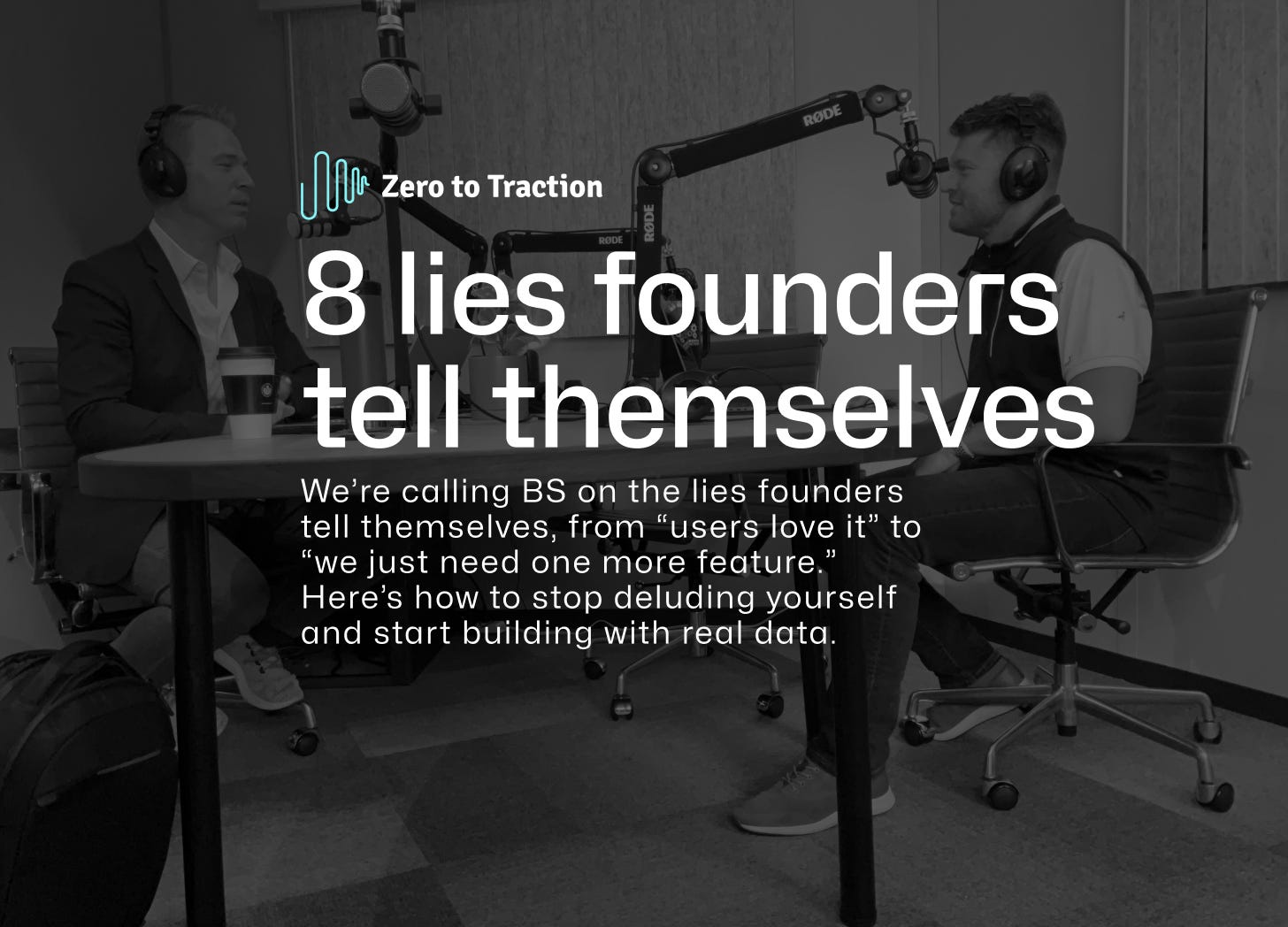
8 lies founders tell themselves
Hey friends 👋We’ve all been there—telling ourselves stories that feel true but are really just comfortable lies keeping us from the hard work of validation.In this episode, Cameron and I tackle 8 of the most common lies founders tell themselves. Things like “our users say they love it, so we’re on the right track” (spoiler: interest ≠ intent) and “we just need a few more features before we can start charging” (you’re optimizing for freeloaders, not customers).We dig into why these lies feel so good—fear of rejection, perfectionism, overconfidence — and, more importantly, how to overcome them. Because here’s the thing: a little delusion helps you start, but data is what gets you to product-market fit.Some of our favorite reality checks from this one:* “Nobody buys technology. People buy outcomes.”* “Validation over vibes. Intent over interest. Data over dogma.”* “Winners don’t never quit—they quit everything that doesn’t work.”We wrap with Frivolous Thoughts about marathons, perseverance, and Seth Godin’s “The Dip” — because knowing when to quit is just as important as knowing when to push through.Stop lying to yourself. Start shipping. Get the data.— Cameron and JDM This is a public episode. If you would like to discuss this with other subscribers or get access to bonus episodes, visit zerototraction.substack.com