📅 ThursdAI - Feb 8 - Google Gemini Ultra is here, Qwen 1.5 with Junyang and deep dive into ColBERT, RAGatouille and DSPy with Connor Shorten and Benjamin Clavie
ThursdAI - The top AI news from the past week · Alex Volkov, Connor Shorten, Benjamin Clavie, and Nisten
Audio is streamed directly from the publisher (api.substack.com) as published in their RSS feed. Play Podcasts does not host this file. Rights-holders can request removal through the copyright & takedown page.
Show Notes
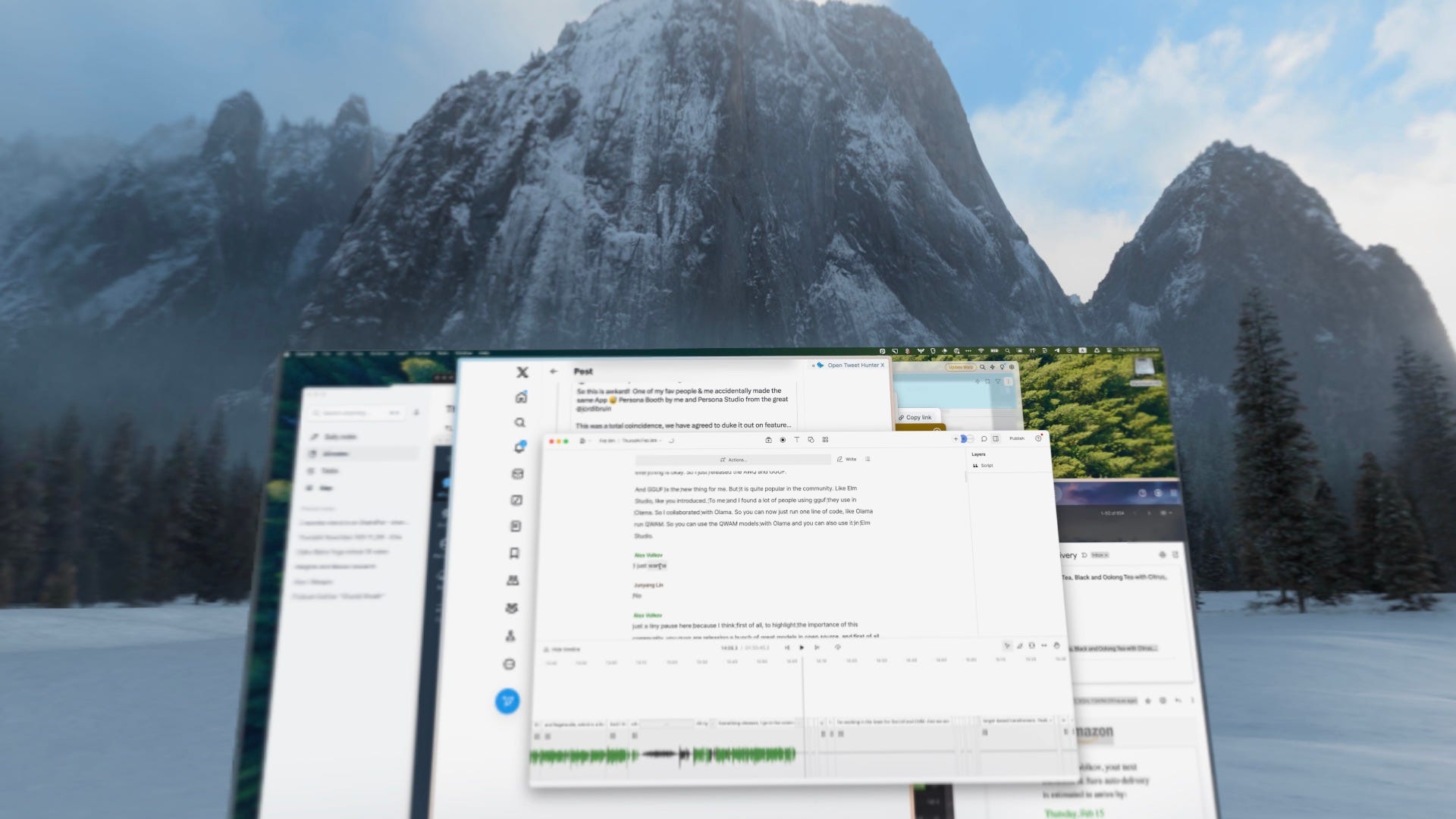
Hihi, this is Alex, from Weights & Biases, coming to you live, from Yosemite! Well, actually I’m writing these words from a fake virtual yosemite that appears above my kitchen counter as I’m not a Vision Pro user and I will force myself to work inside this thing and tell you if it’s worth it. I will also be on the lookout on anything AI related in this new spatial computing paradigm, like THIS for example!
But back to rfeality for a second, we had quite the show today! We had the awesome time to have Junyang Justin Lin, a dev lead in Alibaba, join us and talk about Qwen 1.5 and QwenVL and then we had a deep dive into quite a few Acronyms I’ve been seeing on my timeline lately, namely DSPy, ColBERT and (the funniest one) RAGatouille and we had a chat with Connor from Weaviate and Benjamin the author of RAGatouille about what it all means! Really really cool show today, hope you don’t only read the newsletter but listen on Spotify, Apple or right here on Substack.
TL;DR of all topics covered:
* Open Source LLMs
* Alibaba releases a BUNCH of new QWEN 1.5 models including a tiny .5B one (X announcement)
* Abacus fine-tunes Smaug, top of HF leaderboard based Qwen 72B (X)
* LMsys adds more open source models, sponsored by Together (X)
* Jina Embeddings fine tune for code
* Big CO LLMs + APIs
* Google rebranding Bard to Gemini and launching Gemini Ultra (Gemini)
* OpenAI adds image metadata (Announcement)
* OpenAI keys are now restricted per key (Announcement)
* Vision & Video
* Bria - RMBG 1.4 - Open Source BG removal that runs in your browser (X, DEMO)
* Voice & Audio
* Meta voice, a new apache2 licensed TTS - (Announcement)
* AI Art & Diffusion & 3D
* Microsoft added DALL-E editing with "designer" (X thread)
* Stability AI releases update to SVD - video 1.1 launches with a webUI, much nicer videos
* Deep Dive with Benjamin Clavie and Connor Shorten show notes:
* Benjamin's announcement of RAGatouille (X)
* Connor chat with Omar Khattab (author of DSPy and ColBERT) - Weaviate Podcast
* Very helpful intro to ColBert + RAGatouille - Notion
Open Source LLMs
Alibaba releases Qwen 1.5 - ranges from .5 to 72B (DEMO)
With 6 sizes, including 2 new novel ones, from as little as .5B parameter models to an interesting 4B, to all the way to a whopping 72B, Alibaba open sources additional QWEN checkpoints. We've had the honor to have friend of the pod Junyang Justin Lin again, and he talked to us about how these sizes were selected, that even thought this model beats Mistral Medium on some benchmarks, it remains to be seen how well this performs on human evaluations, and shared a bunch of details about open sourcing this.
The models were released with all the latest and greatest quantizations, significantly improved context length (32K) and support for both Ollama and Lm Studio (which I helped make happen and am very happy for the way ThursdAI community is growing and connecting!)
We also had a chat about QwenVL Plus and QwebVL Max, their API only examples for the best open source vision enabled models and had the awesome Piotr Skalski from Roborflow on stage to chat with Junyang about those models!
To me a success of ThursdAI, is when the authors of things we talk about are coming to the show, and this is Junyang second appearance, which he joined at midnight at the start of the chinese new year, so greately appreciated and def. give him a listen!
Abacus Smaug climbs to top of the hugging face leaderboard
Junyang also mentioned that Smaug is now at the top of the leaderboards, coming from Abacus, this is a finetune of the previous Qwen-72B, not even this new one. First model to achieve an average score of 80, this is an impressive appearance from Abacus, though they haven't released any new data, they said they are planning to!
They also said that they are planning to finetune Miqu, which we covered last time, the leak from Mistral that was acknowledged by Arthur Mensch the CEO of Mistral.
The techniques that Abacus used to finetune Smaug will be released an upcoming paper!
Big CO LLMs + APIs
Welcome Gemini Ultra (bye bye Bard)
Bard is no longer, get ready to meet Gemini. it's really funny because we keep getting cofusing naming from huge companies like Google and Microsoft. Just a week ago, Bard with Gemini Pro shot up to the LMSYS charts, after regular gemini pro API were not as close. and now we are suppose to forget that Bard even existed? 🤔
Anyhow, here we are, big G answer to GPT4, exactly 10 months 3 weeks 4 days 8 hours, but who's counting?
So what do we actually get? a $20/m advanced tier for Gemini Advanced (which will have Ultra 1.0) the naming confusion continues. We get a longer context (how much?) + IOS and android apps (though I couldn't find it in IOS, maybe it wasn't yet rolled out)
Gemini now also replaces google assistant for those with androids who opt in (MKBHD was somewhat impressed but not super impressed) but google is leaning into their advantage including home support!
* Looks like Gemini is ONLY optimized for English as well
We had quite the conversation on stage from folks who upgraded and started using, including noticing that Gemini is a better role player, and less bland, but also that they don't yet support uploading documents besides images, and that the context window is very limited, some said 8K and some 32K but definitely on the lower side.
Also from Google : a llama.cpp wrapper called localllm (Blog)
OpenAI watermarks DALL-E images and adds per key API limits (finally) (Blog)
OpenAI's using something calledC2PA for pictures made by DALL-E 3, whether you're chatting with ChatGPT or using their API. It's a way to show that DALL-E 3 actually created those images. But it's just for images right now, not for text or voice stuff. Adding this info can make the files up to 32% bigger, but it doesn't mess with the quality. The tags tell you if the source was DALL-E 3, ChatGPT, or the API by including special signatures and stuff. Just a heads up, though, this C2PA thing isn't perfect. The metadata could get wiped either on purpose or by mistake.
They also released an update to the developer experience that allows you to track usage but also restrict usage per API key! Very very needed and helpful!
This weeks Buzz (What I learned with WandB this week)
First part of the live series with the Growth ML team was live and AWESOME!
Vision
BRIA - Open-Source background removal (non commercial)
📷 Introducing Open-Source Background Removal by @BriaAI 📷 Now live on @huggingface, RMBG v1.4 excels in separating foreground from background across diverse categories, surpassing current open models. See demo [https://t.co/DDwncjkYqi] #BriaAI #OpenSource #AI @briaai https://t.co/BlhjMMNWxa
Voice
MetaVoice (hub)
1.2B parameter model.Trained on 100K hours of data.Supports zero-shot voice cloning.Short & long-form synthesis.Emotional speech.Best part: Apache 2.0 licensed. 🔥
Powered by a simple yet robust architecture: > Encodec (Multi-Band Diffusion) and GPT + Encoder Transformer LM. > DeepFilterNet to clear up MBD artefacts.
That's it for us this week, this time I bring you both the news segment AND the deepdive in one conversation, hope it's not super long, see you here next ThursdAI! 👏
Full Transcript:
[00:00:00] Intro and housekeeping
[00:00:00]
[00:00:00] Alex Volkov: You're on ThursdAI, and I think it's time for us to get started with the recording and the introduction.
[00:00:26] Alex Volkov: Happy, happy Thursday everyone! Today is February 8th, 2024. I don't know, This is the second calendar year the Thursday is happening in, so I don't know if I need to mention the year or not but we're well on our way into 2024 and you're here on Thursday, I, the Thursday I is the space, the newsletter, and the podcast to keep you up to date with all of the very interesting things that are happening in the very fast moving world of ai.
[00:00:58] Alex Volkov: Hopefully by now, all of you already have ThursdAI in your podcast, wherever you get a podcast, Spotify, recently YouTube as well, which is weird. But with this introduction, I will just say, hello myself, basically. Hey everyone. My name is Alex Volkov. I'm an AI evangelist with Weights & Biases.
[00:01:15] Alex Volkov: Weights & Biases is the reason why this comes to life to you. And there's going to be a little segment about Weights & Biases in the middle here as well, and I'm joined on stage. Often, and pretty much every week by great friends, experts in their fields. As we talk about everything AI related this week, especially we're going to have some interesting things.
[00:01:34] Alex Volkov: Those of you who come back week after week. Thank you, and we love that you're part of the community, and it's great to see how many people just return, and those of you who are new, we're here every week and The community doesn't stop after we finish the space. There's a bunch of spaces. I think our friend AlignmentLab had the space that went on for the full week, I think.
[00:01:55] Alex Volkov: I don't know if he ever slept. That's maybe why he's not here on stage. But we're here every week for the two hours to give you updates for the first hour and definitely some very interesting deep dives that has been happening, that have been happening for the past few Weeks, I want to say, so I just want to shout out some friends of ours that recently we were featured in the deep dives.
[00:02:16] Alex Volkov: We've talked with Maxime Lubon, who trained the Beagle series and then also gave a deep dive with us about model merging. That was really fun. And on the last deep dive, we talked with the Lilac folks and they're building an open source tool. That lets you peer into huge data sets, like imagine millions of rows, data sets, and they chunk and cluster this. And we've talked about the importance of data sets in creation of LLMs or large language models.
[00:02:46] Alex Volkov: And they've taken the huge data sets of the folks to usually come up on ThursdAI. Technium from Nous Research just released their Hermes dataset, for example. And the folks in Lilac talked to us about how that would be visualized and how you can see which parts of it is comprised of.
[00:03:03] Alex Volkov: It's quite an interesting conversation about how to approach the training and fine tuning area. And we haven't often talked about dataset curation and creation, so that conversation was a very nice one. So we have deep dives. I will say that last weekend, I also interviewed, and that's probably going to come up as a separate episode.
[00:03:24] Alex Volkov: I interviewed Sasha Zhadan from Moscow, and this was a first for me. And I just want to like, highlight where this weird thing takes me, because that's not ThursdAI, and that's not about the news. That was just literally about AI stuff. So this guy from Moscow, and this will be dropping on ThursdAI podcast soon.
[00:03:42] Alex Volkov: This guy from Moscow built a bot that auto swipes for him on Tinder. And that bot started using gpt instruct, and then moved to gpt chat, gpt etc, and then moved to gpt 4. And he talks about how this bot kept improving with the improvement of AI. And then he autoswiped a wife, basically. And then this was, this took over the Russian ex.
[00:04:08] Alex Volkov: I don't know if you guys are on the Russian side of ex, but I definitely noticed that everybody, that's all they could talk about. This guy Previously also did some shenanigans with OpenAI stuff. And so it was a very interesting conversation, unlike anything that I did previously on ThursdAI.
[00:04:21] Alex Volkov: And definitely that's coming more as a human interest story than anything else. But it's very interesting. And also his fiance also joined and we talked about the morality of this as well. And it was really fun. So if that kind of new type of content also interests you definitely check out.
[00:04:37] Alex Volkov: That's probably not going to end up on X.
[00:04:40] Alex Volkov: And I think with this, it's time to get started. , The usual way we get started here is I just run through everything that we have. Just so you know what we're going to talk about.
[00:04:52] Alex Volkov: And then we're going to start with segment by segment. So that's
[00:04:54] TL;DR and recap of the conversation
[00:04:54] Alex Volkov: Hey everyone, this is a recap of everything we talked about on ThursdAI for February 8th. 2024 and we had a bunch of breaking new stuff today, specifically around the fact that Google finally gave us something. But I'm gonna do this recap properly based on the categories. So let's go. So in the category of open source lms, we've talked about Alibaba releases a bunch of new Qwen models, specifically under the numbering 1.5.
[00:05:33] Alex Volkov: And we had the great pleasure again to talk with Justin J. Yang Lin. from Qwen team the guy who's a tech lead there and pushes for open source. And he came up and talked about why this is a 1. 5 model, not a 2 model. He also talked about the fact that they released a tiny 0.
[00:05:51] Alex Volkov: 5 billion one. This is like a very tiny. Large language model. I think it's really funny to say a tiny large language model, but this is the case. And he talked about multiple releases for Qwen. We also had, friend of the pod, Piotr Skalski from Roboflow, who's like a vision expert who comes up from time to time, and the author of I forget the name of the library.
[00:06:12] Alex Volkov: I will remember this and put this in the show notes as well. He came up and he had a bunch of plays with the visions part of the Qwen. ecosystem, and we've talked about QNVL plus and QNVL max with Justin as well, and we've talked about their potential for open sourcing these models. They also released a 72 billion parameter model that's now part of the top of the Hug Face leaderboard, which is super cool.
[00:06:34] Alex Volkov: So definitely a great conversation. And I love it when the authors of the things that we talk about come out and talk about the, in ThursdAI. We then smooth, smoothly move to the next topic where Abacus, the company Abacus AI, there is Finetune that's now top of the Hug Face leaderboard, and that's based on QN72B, and not even the new one, the previous one, so 1.
[00:06:54] Alex Volkov: 0, and that's now the top model on Hug Face leaderboard, and that has an average score of over 80. And I think it's the first open source model to do and they haven't fully released the process of what they what they used in order to make this much better in different leaderboards. But they have mentioned that they're going to train this model on top of the Mikulik over Mixtral.
[00:07:17] Alex Volkov: And it's very interesting. And they also They're building some other stuff in Abacus as well. Very interesting. And then we moved to talk about LMSYS Arena. LMSYS Arena is the place that we send you to see which models users prefer better versus just the benchmarks and evaluations hung in phase.
[00:07:35] Alex Volkov: LMSYS Arena added a bunch of open source models, so shout out OpenChat again. They added another Hermes the Finetune that Technium did for Hermes on top of Mixtral, and they also added a bunch of Qwen versions as well. LMSYS adds open source, so you continuously can see which models are better and don't have to judge for yourself, because sometimes it's not very easy.
[00:07:55] Alex Volkov: We also covered JINA embeddings that are fine tuned for code. JINA from the company JINA AI and the representative Bo Wang who came, and he's a friend of the pod. We talked about their embeddings for code. Bo didn't show up this time, but maybe next time as well. Then we moved to big companies, LLMs and API, and definitely the conversation turned interesting, where multiple folks here on stage paid the new 20 tax, let's say from AI [00:08:20] for for the rebranded Bard now called Gemini and the launch of Gemini Ultra.
[00:08:25] Alex Volkov: And we've talked about how long we've waited for Google to actually give us something like this. And now we're getting Gemini Ultra and Bard is no more, Bard is Essentially dead as a brand, and now we're getting the Gemini brand. So if you used to go to BART, now you go to Gemini, but also the brain behind this also improved.
[00:08:41] Alex Volkov: So you get Gemini Pro by default for free, I think, and Gemini Ultra is going to cost you 20 bucks a month. It's free for the next two months, so you can sign up for a trial, and then you'll get Gemini Ultra. And you'll get it not only in the web interface, you also get it in iOS and Android apps. And if you're on Android, it also integrates with the Android Assistant.
[00:09:00] Alex Volkov: That's pretty cool. It has a context length of not very much, I think we said 8 or 16 or so and some folks contested this in the comments, so we're still figuring out the context length, and it looks like the context length for that is Restricted with the UI, less on the API side, and Gemini Ultra did not release an API yet.
[00:09:17] Alex Volkov: So we've talked about Gemini Ultra and different things there. We also covered that OpenAI adds image metadata to all DALI generations, whether through the UI or through the API, this image metadata can be stripped. So it's not a watermark per se, but it's definitely helpful. And there also the OpenAI gives us a little bit of a developer experience thing where you can restrict.
[00:09:36] Alex Volkov: Per key on API keys different possibilities. So if one key gets stolen, you can lock only that one, or you can restrict it to only like a specific use as well. In the vision video category, we've talked about the new model for background removal called RMBG from Bria AI. It's not a fully commercial license, but you can play with this now.
[00:09:57] Alex Volkov: There's a demo I'm going to add to the show notes. And also it runs fully on your client via the efforts of friends of the pod Zenova from Transformers. js. And it's pretty cool to have a model that removes background super like with two clicks with no back with no servers. And in the voice and audio category, we talked about MetaVoice, a new.
[00:10:14] Alex Volkov: licensed Apache 2 licensed text to speech model, not from Meta, even though it's called MetaVoice, and it's funny it's pretty decent and has zero shot voice cloning which means that you can provide a piece of your voice and fairly quickly get a your voice speaking back to you generated. And we also talked about breaking news from NVIDIA AI, something called Nemo Canary 1B, which is a ASR model, Automatic Speech Recognition model, that's now top of the leaderboards on Hug Face, and it beats Whisper on everything, including specifically for four languages.
[00:10:48] Alex Volkov: It's trained on 8, 500 hours 85, 000 hours of annotated audio, and it's very fast conformer encoder as well. We barely covered this, but Microsoft added DALI editing with the designer. So if you remember, Microsoft also did a rebrand. It used to be called Bing Chat, and now it's called Copilot.
[00:11:07] Alex Volkov: And that Copilot now adds capabilities that don't exist in other places, like GPT, ChatGPT with DALI. So Microsoft's DALI now is involving the designer thing, and they have cool things where you can edit images. On the fly, you can click on different segmented objects from your generated image and say, Hey, redo this in a different style.
[00:11:27] Alex Volkov: The video for this is super cool. I'm going to add this in the show notes. And it's very interesting to see that Mali Microsoft with their co pilots is moving away from where the capabilities is for ChatGPT exist. We also barely, briefly mentioned and glanced through this, but Stability AI released an update to stable video diffusion, including a web UI that you can use now, and it's not only a model, it's a web UI as well, and that web UI is pretty cool, if you didn't get an access to it, I'll link to the show notes, I think it's now possible to register, much nicer videos, and obviously it's in the open source.
[00:11:59] Alex Volkov: as much as possible. So super cool. But the web UI shows you other people's video attempts. You can actually use their prompts to create videos of your own. They have some controls. It's very nice. Then I think we talked a little bit at the end there about Vision Pro and my experience with this as it comes to AI.
[00:12:15] Alex Volkov: We didn't dive in into Vision Pro, even though this is my new, this is my new toy in life. And I'm very happy to participate in the renaissance of spatial computing. And we covered like the intersection of AI and spatial computing. And I think the very interesting part of today's ThursdAI was thanks to two new guests, Benjamin Clavy and Connor from Weaviate, and we've talked about DSPy and Colbert, or Colbert, and Ragatouille, which is a library to use Colbert embeddings.
[00:12:43] Alex Volkov: And we talked about what they mean, and this was a great learning kind of experience for me. And if you see these concepts on your timeline and you have no idea what we talked about, I basically played the role of, hey, I'm the village dummy, let's say. I'm gonna re ask the question about what this means, why should we use this as well.
[00:13:01] Alex Volkov: And I think this is our show today, folks. This is the quick summary. If I missed anything super big and important, please let me know.
[00:13:08] Open source LLMs and AI news
[00:13:08] Alex Volkov: But otherwise, I think we'll start with open source. All right, welcome to the open source corner. And I guess because the tradition of ThursdAI is Something releases, I go in the comments and say, Hey, I'm going to talk about this on ThursdAI. Do you want to join? And sometimes people say yes. And this is how we met Justin or Junyang here on stage. Junyang is the dev lead for the Qwen team and welcome Junyang.
[00:13:50] Alex Volkov: It's very late where you are. So I really appreciate your time here. Please feel free to unmute and introduce yourself again. Some folks already know you, but if in case some new folks are listening to us, feel free to introduce yourself. And then let's talk about the stuff that you released.
[00:14:06] New Qwen models 1.4 from Alibaba
[00:14:06] Junyang Lin: Yeah. Thanks Alex. Nice to be at Thursday. ai it's a very great program for us to talk about ai. I am j Young and you can call me Justin. I'm working in the team for the LM and LMM. And we are now working for the new LLM, Qwen 1. 5, and we are also upgrading our vision language model, QwenBL, to QwenBL Plus and Max.
[00:14:33] Junyang Lin: Plus and Max are not open sourced yet, but we have demos, so you can try in our HuggingFace organization, and you can find our demos, and you can try with Plus and Max. And the max is the best one, and I am very confident with the max demo. And about our language model today actually this week we are open sourcing QWAM 1.
[00:14:58] Junyang Lin: 5. Maybe you previously you have noticed the QWAM 2 code inside Hugging Face target based transformers. Yeah, we are moving to new codes for you to use our QUANT models because in the past few months I have been interviewing our users and they found some problems with using our code, the original QUANT code, so I'm moving a step forward.
[00:15:23] Junyang Lin: So this is why we had the QUANT 2 model, but for the model themselves actually we are still we in our judgment, we are still at the 1. 5 not 2 yet. We're still training the real Qwen 2, so this time we have Qwen 1. 5. For Qwen 1. 5 we are actually fixing a lot of problems because there are some models like 7 billion and 14 billion, there are a lot of people using these models, but they are actually quite old.
[00:15:50] Junyang Lin: They were released months ago. They have some problems for Qwen 14 billion It is actually only supporting around 2 to 4K context length, which is far from enough for a lot of users. So for this time, we have upgraded all models to supporting 32, 000 tokens. And for the sizes, we have released more sizes.
[00:16:15] Junyang Lin: Previously, we had 1. 8, which is the smallest one. But this time, we have 0. 5. only 0. 5. I used to think this one is just for experimental usage but there are some users in Twitter they found still 0. 5 can used to be do something so if you have any comments on [00:16:40] 0. 5 you can share the comments to me. And we also have 4 billion which is between 1.
[00:16:46] Junyang Lin: 8 and 7 billion. The reason why we have 4 billion is that actually when we first released 1. 8 billion it is actually popular because they would like to deploy the small model to some devices like cell phones. but they found just 1. 8 is not good enough for them to for the applications.
[00:17:07] Junyang Lin: So they want something just smaller than 7 billion, but much better than 0. 8. So we have 4 billion. Yeah. We have a wide range of sizes. These are for you to choose. And,
[00:17:19] Alex Volkov: six, six models overall Junaid?
[00:17:22] Junyang Lin: Yeah. Six
[00:17:23] Alex Volkov: Six sizes overall, but definitely more models than this, because you also released, I think for the first time, you released quantized versions as well, correct?
[00:17:32] Junyang Lin: No, but previously we have released GPDQ,
[00:17:35] Alex Volkov: Oh yeah.
[00:17:35] Junyang Lin: our convention, but this time I also have AWQ and also GGUF maybe GGUF is the new one admittedly, previously I don't know too much about AWQ and GGUF. This time I tried and everything is okay. So I just released the AWQ and GGUF.
[00:17:52] Junyang Lin: And GGUF is the new thing for me. But it is quite popular in the community. Like Elm Studio, like you introduced. To me and I found a lot of people using gguf they use in Olama. So I collaborated with Olama. So you can now just run one line of code, like Olama run QWAM. So you can use the QWAM models with Olama and you can also use it in Elm Studio.
[00:18:15] Alex Volkov: I just wanna
[00:18:16] Junyang Lin: No
[00:18:16] Alex Volkov: just a tiny pause here because I think first of all, to highlight the importance of this community, you guys are releasing a bunch of great models in open source, and first of all, just a Great. At testament to the community because you're listening to what folks have been saying, how they're reacting to your models and part of the Thursday aid, I was able to just introduce you to, to LM Studio and you guys work together.
[00:18:37] Alex Volkov: And now the second year model drops, not only you guys already pro providing us quantized versions in four and GGF stuff. It's also very easy to start using and I think, just a shout out to you guys for thinking about this because a lot of models when they release they just release a waste file and then it's up in the community to figure out how to run them, when to run them, what's the problems.
[00:18:57] Alex Volkov: And this was the issue with Gwen before. It was like harder to use and maybe only on hug and face demos. And now you guys released it with support for the most popular open source runners out there. So Ollama, if folks haven't used Ollama by now, definitely there's a CLI, just like Ollama installed this.
[00:19:14] Alex Volkov: And LM Studio, which we've talked about a bunch, so shout out LM Studio. Shout out JAGS. And I'm, I was very happy to introduce both of you. So it's been great. And I've used the small model, the baby model as well. How was the reception from the community? What have you seen people do? Have there been any fine tunes already that you're excited about?
[00:19:33] Junyang Lin: yeah this is a very great comment for helping us to improve. Yeah, previously like us, a lot of people just drop open source models and they just let the community to use it. But this is maybe, this may be not right, because we can do more to the community, maybe we can do things. more easily than the community users.
[00:19:56] Junyang Lin: So this is why we are changing our style. We try to modify our code, try to adapt to the usages to make our models more popular. And recently I found them just gradually fine tuned our models. Previously fine tuned users are inside mainland China because they have chances to talk to us, so they will know more about our models so they, they can finally fine tune it.
[00:20:24] Junyang Lin: But with the support of Lama X Tree and especially Alto wing Winland helped me a lot. Technium just introduced wing land to me, and I found some people are using X lotto to do it. I dunno if Chen I don't know if I pronounced his name he's one of the users of Qwen and he he previously got the usage of our models and then he quickly fine tuned a lot of model its name is Q U Y
[00:20:54] Alex Volkov: Oh, Stable Quan. Yeah, I think I know what the guys are talking about. Stable Quan from also Nous Research
[00:20:59] Junyang Lin: yeah, stableQwen I'm quite familiar with him, I just talked to him very much, and he just directly used our models, very quickly finding a series of models, and I find them, the quality are quite good.
[00:21:12] Junyang Lin: So this is quite encouraging for me, because you can find people are interested in your models, they can find you in it, very fast speed, and I recently found Smog by Abacus AI, but I got no chance to talk to them because I don't know who actually built the model, but I found a small 72 billion is built on Qwen 72 billion
[00:21:37] Alex Volkov: Oh, really?
[00:21:39] Junyang Lin: Open open leaderboard.
[00:21:40] Alex Volkov: Smog is the next thing we're going to talk about, so you're taking us exactly there. I think, Nisten, you have a question just before, and then we're going to move to talk about smog. Just on the community part just the names you mentioned. You mentioned Stablequan, definitely friend of the pod.
[00:21:52] Alex Volkov: You mentioned Technium introduced you to Winglian, the guy from Axolotl. All of this happens in the ThursdAI community, and I love it. I'll just say that I see Robert in the audience here. Smog is from Abacus AI, and I think Robert has some connection to Bindu, so Robert, if you can introduce Junyang to Bindu, that would be great, and then we'll figure out, like, how they use the 72B model.
[00:22:12] Alex Volkov: 72B model that you guys released is one of the more performant ones. I think it's even outperforming Mistral Medium, is that correct?
[00:22:21] Junyang Lin: Yeah it's now this version QEM 1. 5 SIMD2 BDN is for the chat model for the base model, it is actually quite similar some users have found that I admit that, and, but for the chat models, we have some improvements because this time we are not only Actually, we not only SFD the model, but we also use DBO.
[00:22:40] Junyang Lin: We have some progress in DBO. So we've reached like 8. 67 in MTBench. This is a relatively high score and we just did simple DBO and just improved the model. And we also sent our model to Chatbot Arena in Elimsys. supported by Together AI, because we have some friends in Together AI. They just built API for us, and we have been in chatbot arena, so you can try it in chatbot arena to see how it really performs.
[00:23:18] Junyang Lin: Is it really perform just like the score of MTBench? I'm not quite sure, because I'm also dependent on the users feedback.
[00:23:27] Alex Volkov: it depends on human preference. I so first of all, Justin, you're taking over my job now because you're also reporting on the stuff that I wanted to mention, but definitely a shout out for getting added to LMSYS. That's not super easy. Not every model out there on the Hagenfest leaderboard gets added there.
[00:23:41] Alex Volkov: So definitely super cool. Yeah, please go ahead. If you have anything else to
[00:23:46] Junyang Lin: for as you have mentioned Mistral Medium, I'm not sure which one is better Mistral Medium or Qwen 72 Billion from some reviews they might be similar for the Qwen 1. 5 72 Billion similar to MiQ some of my friends like Blade just tested In EqBench, the scores are very similar, but I need some more reviews to let me really know that how the 72 billion model really perform, that how is it better or is it worse than MeeQ?
[00:24:20] Junyang Lin: They're all okay for me. I just want real reviews for me. Yeah,
[00:24:23] Alex Volkov: Yeah,
[00:24:24] Junyang Lin: it.
[00:24:25] Discussion about Qwen VL with Nisten and Piotr
[00:24:25] Alex Volkov: awesome. Junaid, thank you for joining us. And Nisten, go ahead. You have a few questions, I think, about the interesting things about VL.
[00:24:34] Nisten Tahiraj: Yeah, so one thing is that the 0.5 Bs and the small models, I know Denova in the audience was specifically looking for one around that size or like a 0.3 to run on web GBU, because then even at 32 bit, which older browsers will still support it, it will still only take two gigs. So that, that would run anywhere.
[00:24:58] Nisten Tahiraj: But my question. [00:25:00] So shout out to Feliz de Nova for all that. I know he's going to do something with it but my question for you was more about the Macs and the the larger Qwen QwenVL chats are those also based off of the 72B and did you find more improvements in going with a larger LLM, and I also wanted to know your opinion on Lava.
[00:25:27] Nisten Tahiraj: The Lava 1. 6 method where they mosaic together four clip models on top to get a larger image, even though it slows down inference because now it's got a output like 2000 embeddings. So yeah, what do you think of Lava and is there more stuff to share about the Clang,
[00:25:47] Junyang Lin: VL, Max. Yeah for Plus and Max it may be, sorry for me not ready to open source it.
[00:25:57] Junyang Lin: I cannot decide these things. Yeah actually it's built on larger language models much larger than the Plus, and you can guess whether it is 72 billion. It is not that important, and we have found that The scaling of the language model is really important for the understanding of the VR models.
[00:26:18] Junyang Lin: We have tested it on the MMMU benchmark and we have found that the Max model is highly more com competitive and performs much better than the Quin bi plus. Although previously many people have thought that Quin Bi Plus is strong enough, but we found that the max had. Much better reasoning capabilities, just understand some, something like some reasoning games like poker or these things like that, some complex things that people can understand through the vision information they can somehow understand it.
[00:26:52] Junyang Lin: I think the performance might be a bit slower. Approaching Gemini, Ultra, or GPE4B for the QEMDR MAX. We were just gathering some reviews. I'm not quite sure, but
[00:27:05] Alex Volkov: From the review perspective, I want to say hi to Petr, our friend here on stage, from Roboflow. Petr is one of the vision experts here on stage. Petr, welcome. Feel free to introduce yourself briefly, but I definitely know that you got excited about some of the GwenVL Plus stuff, so definitely feel free to share some of your insights here.
[00:27:30] Piotr Skalski: Okay. Yeah. And first of all, awesome to meet somebody from Qwentin. Yeah.
[00:27:36] Piotr Skalski: So yeah I'm from Roboflow, like you said and I'm responsible there for computer vision and growth. So it's like in between of being ML engineer and marketing something like this.
[00:27:49] Piotr Skalski: And yeah, I was experimenting with Qwen, Plas and Max last week. Super impressed in my opinion. I know that you tried to be humble, maybe, but. In my opinion it's, at least on things that
[00:28:04] Junyang Lin: I test, it performs like the best compared
[00:28:08] Piotr Skalski: to other
[00:28:09] Junyang Lin: models. Thank you very much. Thanks for the appreciation.
[00:28:14] Piotr Skalski: Yeah. And especially the fact, so the biggest game changer for me, and I know that there were models that were capable of that before, is the fact that you can ground those predictions and you can, for example, point to a specific element on the image. So it's not only that you can ask questions and get answers and do OCR, but you can straight up do zero shot detection if you would like.
[00:28:40] Piotr Skalski: Yeah. Which is which is awesome. And that's something that none of the. Other popular models can do to that extent, at least on the
[00:28:51] Piotr Skalski: things
[00:28:51] Piotr Skalski: that I
[00:28:51] Piotr Skalski: tested. My question is,
[00:28:55] Piotr Skalski: do you plan to open source it? Because it's awesome that you can try it out for the API and I highly appreciate the fact that you created the, HF space and you can go there and try it.
[00:29:07] Piotr Skalski: But is there a chance that you will open source it even with the meeting? License are not necessary.
[00:29:16] Junyang Lin: Yeah personally, I would like to open source some but I cannot decide these things, but I think there's a chance I'm still promoting these things inside the core, but I cannot say too many things about these stuff, but we will try because we have found out that we ourselves can also build very good LMM.
[00:29:37] Junyang Lin: I think the gap Just between the big corp between us and the big corp. In LMM, it's very small. And we have found that our techniques or our training is quite effective. So maybe one day we'll share to the community, but for now it is still APIs and demos and I would try to think about these things.
[00:29:59] Junyang Lin: And also question about. The comparison with us and Lava, and I have just tried Lava 1. 6 not quite freQwently. I just tried it. I think it's a very good model and it it has very good performance in the benchmark results but I think the limitations of these other open source models may be that It still lacks sufficient pre training for them Skullscape just said we can do Qwen can do OCR and you can find that Qwen's reasoning capability is quite strong because we have done a lot of pre training work on it.
[00:30:39] Junyang Lin: We have done a lot of data engineering on pre training because we have capabilities of handling different resolutions and different aspect ratios so that we can use the curated, the OCR data and put them in the pre training. And when the vision length model can understand a lot of textual like linguistic information inside the images, they may do something like like we said, reasoning, and you will find that really powerful, very impressive, or things like that.
[00:31:13] Junyang Lin: Yeah I think the gap between other models and us, or also Gemini Ultra and GPT 4b, maybe still the lack of large scale data. for training. Yeah, this is my opinion.
[00:31:27] Alex Volkov: we're waiting for more data, but we're also waiting for you guys too. I just want to thank you for being the champion for open source from within the organization, and really appreciate all your releases as well. I think Piotr and Nisten, like everybody here on stage, definitely. It feels that, and thank you for coming and talking about this.
[00:31:45] Alex Volkov: Justin, feel free to stick around because the next thing we're gonna talk about, you already mentioned, which is Smog 72 B which is the top of the leaderboard. And I just read through the thread from Bindu, ready from Abacus ai and it looks like they didn't even use 1.5. I think they used 70 the previous Quinn
[00:32:02] Junyang Lin: yeah, they used the previous QUANT72B. If they are really based on the base language model there might not be a lot of differences. Because 1. 5 for the base language model 72B is actually slightly better than the original 72B for the base language model. Yeah.
[00:32:22] Alex Volkov: for the base ones. And very interesting what they
[00:32:24] Junyang Lin: the base one.
[00:32:25] Alex Volkov: So they, they don't share any techniques, but they promised to open source their techniques. They're saying like, our next goal will be to publish these techniques as a research paper and apply them to some of the best Mistral models, including Miku.
[00:32:37] Alex Volkov: So I got confused. I thought that they already fine tuned Miku, but no, they just fine tuned on top of Qwen. And now the top Hug Face leaderboard model is based, is a fine tune of Qwen, which is like also super cool.
[00:32:50] Junyang Lin: Yeah, I'm very proud of it.
[00:32:52] Alex Volkov: Yeah, congrats.
[00:32:53] Junyang Lin: They are using our model to be the top of the model. I'm also really expecting their technical report to see how they reach the top of the benchmark. But I think it is not that It is not that kind of difficult because you have a lot of ways to improve your performance in the benchmark, so we'll still see how it really performs in the real scenarios, especially for their chat models, yeah.
[00:33:18] Alex Volkov: Yeah, that's true, [00:33:20] that's often the case. But I just want to shout out that the world is changing like super fast. We're definitely watching and monitoring the Hagenface leaderboard. And performing better than Mistral Medium is impressive. And this looks at least on the MMLU, this is 77. I think they said they broke The average score of 80, this is the first model that broke the average score of 80 on the open source leaderboard on hang and face, which is super cool based on Quinn as well, and definitely worth it.
[00:33:46] Alex Volkov: I'm gonna add this link to the show notes and hopefully we'll find a way to connect you guys with the Bindu team there at Abacus to see how else this can be improved even for, and whether or not these techniques can be put on smaller models as well. I think in the open source, the last thing.
[00:34:00] Junyang Lin: expecting the chat. Yeah, I'm really expecting to chat with them. Yeah, continue,
[00:34:05] Alex Volkov: So definitely hoping that some of our friends can connect between these awesome teams and learn from each other, which I think is the benefit of speaking in the public and putting things in open source. Now, moving on, the last thing that you definitely mentioned is the update from LMSys, which is quite a few of our friends of the pod are now also part of the chatbot arena.
[00:34:24] Alex Volkov: They just announced this yesterday. They've added Three of your versions, right? They added 1.572 B, 1.57 B, 1.5, four B, and they also added open chat. So shout out the folks from Open Chat Alai and the Alignment Lab and some other friends of ours who like release open chats latest release and they also added news imis fine tune.
[00:34:47] Alex Volkov: So if you guys remember we've talked about news fine tuning on mixed mixture and that improved on the mixture of expert model from. From Mistral a little bit based on DPO data sets. So now that's also in the LMCS arena and it's now powered by Together Compute. Which I have no affiliation with besides the fact that they're awesome.
[00:35:04] Alex Volkov: They're sponsoring a bunch of stuff. And we did a hackathon together together is great. Like you can easily fine tune stuff on their platform, but now they're also sponsoring the arena, at least to some extent, which is great because we get more models and arena keeps going. And if you guys remember, or you probably use it, LMC's arena is this another great way for us to feel what human preference is in models.
[00:35:27] Alex Volkov: And for many of these models. That's what's more important than actual performance on evaluations, on leaderboards, et cetera. So definitely great update from LMCs as well. And I think that, I'm gonna ask my folks here on stage, but Nisten, Far El, if this is like anything else in open source that's super interesting this week, I think that's mostly it.
[00:35:44] Alex Volkov: We can talk about Gemini.
[00:35:48]