
Thriller "A Bitcoin Zine"
378 episodes — Page 7 of 8
Thriller Coin Talk - S4EP7: Bitcoin and Ethereum Debate
<p>Today we discuss Bitcoin and Ethereum Debate </p> <p>What seems to be an never ending battle between Ethereum and Bitcoin followers, Peter McCormack had a chance to discuss the complex mechanisms of Ethereum 2.0 along with some other philosophical differences between ETH and BTC with two very important guests. Vitalik Buterin of the Ethereum Foundation and Samson Mow, CSO of Blockstream. Vitalik Buterin has openly admitted in the past and on this episode of the complexity of Ethereum 2.0 from a technical perspective. He said that the Ethereum team did not expect this level of complexity when he first envisioned the…</p>
Go to BitcoinAudioBook.com to listen to the rest.
<p>The release of Thriller Crypto's first audiobook is released. It is called, One Satoshi at a Time: How Bitcoin Will Change The World. Total runtime is just about 3hrs 54min. Please make sure to share with everyone you know. There are so many ways to get access to it SoundCloud, Bandcamp, IPFS, Torrent, Direct Download and even Skynet 🤓 </p> <p>Attached is the Preface & Introduction to the book. </p> <p>Thats right head over to BitcoinAudioBook.com to get your copy or listen to it there. </p> <p>This is so exciting and its sure been a long time coming…</p>
Thriller Insights - S4EP4: Bitcoin Retractions
<p>This week, MicroStrategy chose to invest $250 million in Bitcoin. </p> <p>coming from CoinDesk </p> <p>Publicly traded business intelligence firm MicroStrategy purchased 21,454 bitcoin on Tuesday, effectively pouring all $250 million of its planned inflation-hedging funds into the digital currency. </p> <p>Earlier this week, American software company MicroStrategy announced it was investing $250 million in Bitcoin to protect against inflation fears and a grim economic outlook. It was a major endorsement in the cryptocurrency space. </p> <p>But it wasn’t always destined to be this way. Back in 2013, MicroStrategy’s CEO Michael Saylor, who led the announcement, predicted the death…</p>
Thriller Coin Talk - S4EP5: Bitcoin in August
<p>Today we discuss Bitcoin in August. </p> <p>TradingShot Chart via Trading View </p> <p>Moving Average Convergence Divergence (MACD) is a trend-following momentum indicator that shows the relationship between two moving averages of a security's price. The MACD is calculated by subtracting the 26-period Exponential Moving Average (EMA) from the 12-period EMA. </p> <p>The expected aggressive break-out finally took place and Bitcoin touched today (even exceeded it marginally) the Higher High trend-line of this Channel Up. It is therefore no surprise that it got rejected as technically this is were most short-term traders would take profits. </p> <p>…</p>
Thriller Rundown - S4EP1: Bitcoin Upward Trajectory On Hold
<p>TradingShot Chart </p> <p>The recent volatility and inability to make a new high and break above the $10500 Resistance, have made me look again on the wider Bitcoin charts. On this study I look on the 1W chart in particular and compare the current spot we are on based on the Fibonacci time channel of the previous Cycle.** The Fibonacci framework **The framework I use is this. I measure each Fibonacci Timeline from the Bottom (Fib 0) of the each Cycle until its Top (Fib 1). The 1st Cycle on this chart is from October 2011 to December 2013. The 2nd Cycle is from…</p>
Thriller Coin Talk - S4EP1: Bitcoin in July
<p>Today we discuss Bitcoin in July. </p> <p>Bitcoin Market Health </p> <p>Bitcoin's price took a tumble over the past week after climbing on Monday and Tuesday in the last couple days in June. The weekend saw it briefly brush below the $9000 mark before settling back up just above $9200. </p> <p>Coin Metrics and where they are headed in July </p> <p>Whats ahead…Watch for Facebook release of Novi wallet and $LBR digital currency, look for this to show up on Coinbase shortly after. </p> <p>Important information from Ryze…Venmo and PayPal To Enable Bitcoin Buys and…</p>

Thriller Insider: The Importance of Bitcoin
<p>…</p>
Thriller Rundown - S3EP25: Bitcoin Dump
<p>Bitcoin Down to Lowest price since May </p> <p>Its low of $8,975 this week is the lowest Bitcoin’s been for just over a month; the last time Bitcoin’s price was this low was on May 27. </p> <p>TradingShot Chart </p> <p>The important of the 1D MA200 and MA1000 Back then, when the RSI broke 38.00, Bitcoin tested the 1D MA200 for the first time in 6 months. In fact, if it wasn't for President Xi's speech on China and Blockchain on October 25th 2019, BTC would follow a smooth Channel Down all the way to a bottom on the 1D…</p>
Thriller Rundown - S3EP24: DeFi Season
<p>Unlike Bitcoin, which has stalled in the low-$9,000s, Ethereum-based decentralized finance (DeFi) has seen exponential growth over the past few weeks. DeFi’s growth has seen an intense recovery in the months since, however, with the total value locked within collateralized loans reaching fresh all-time highs earlier this week. One of the hallmark examples of DeFi’s current popularity can be seen while looking towards the recent launch of Compound. The token associated with the platform – COMP – has seen a parabolic price rise, but many investors are speculating as to why this hasn’t created an upwards tailwind for…</p>
Thriller Insider: How The FED Exit Scammed America
<p>Act I</p> <p>The Creation of the Fed</p> <p>The Federal Reserve System, often referred to as the Federal Reserve or simply "the Fed," is the central bank of the United States. It was created by the Congress to provide the nation with a safer, more flexible, and more stable monetary and financial system. The Federal Reserve was created on December 23, 1913, when President Woodrow Wilson signed the Federal Reserve Act into law.</p> <p>Today, the Federal Reserve's responsibilities fall into four general areas.</p> <p>Conducting the nation's monetary policy by influencing money and credit conditions in the economy in pursuit of full employment and stable prices.</p> <p>Supervising and regulating banks and other important financial institutions to ensure the safety and soundness of the nation's banking and financial system and to protect the credit rights of consumers.</p> <p>Maintaining the stability of the financial system and containing systemic risk that may arise in financial markets.</p> <p>Providing certain financial services to the U.S. government, U.S. financial institutions, and foreign official institutions, and playing a major role in operating and overseeing the nation's payments systems.</p> <p>Upon its creation in 1913, twelve central banks all act as a lender of last resort for their regions. Federal Reserve Board is above these central banks that act as a regulatory agency. Originally FRB was only allowed to veto decisions not make them. This caused paralysis in the original system as they all couldn’t agree further fuel for the beginnings of the great depression.</p> <p>The Great Depression</p> <p>World War 1 had only ended 10 years after the start of the Great Depression in 1929. All of Europe bankrupted themselves after WW1 because they financed it by borrowing. Their Debt to GDP levels were something like 200-300%. They paid for it by inflating the debt away. The Allies demanded reparations to Germany because they owed the U.S. The U.S. refused to forgive these debts. The Germans thought this was completely unfair and never wanted to pay.</p> <p>Debt to GDP Ratio: Most countries around the world rely on sovereign debt to finance their government and economy. When this debt is used in moderation, it can position an economy to grow more quickly. This is much like using debt to finance a business.</p> <p>The debt-to-GDP ratio is a financial measurement for a country, similar to a business' debt to equity ratio. Both ratios are designed to help interested parties determine if a country has too much debt. It is a measurement of financial health.</p> <p>There is no set ideal ratio for a country to have to indicate it's financial health. However, when the ratio is used with other information, it can help you develop a working concept of a country's health. This can help you decide whether a country's economy is worth investing in.</p> <p>U.S.'s debt-to-GDP ratio is expected to eclipse 120% this year. To put these figures into perspective, the U.S.’s highest debt-to-GDP ratio was 121.7% at the end of World War II, in 1946. Debt levels gradually fell from their post-World War II peak, before plateauing between 31% and 40% in the 1970’s—ultimately hitting a historic 31.7% low, in 1974. Ratios have steadily risen since 1980 and then jumped sharply, following 2007’s subprime housing crisis and the subsequent financial meltdown.</p> <p>One of the consequences of WW1 was massive inflation which caused hyper inflation in the early 1920’s. Central Bankers spent most of the mid to late 1920’s trying save the British pound from collapsing. They actually went back to the Gold Standard because they thought it was the cure for hyper-inflation. They were wrong. The world suffered from the shortage of gold in the 1920’s as there was not enough to go around (2/3 of the Gold was with the U.S. because of WW1, capital flights, payments etc…) Main problem was Britain went back to the old exchange rate for XAU/GBP (Gold / British pound.) Which…</p>
Thriller Coin Talk - S3EP26: Bitcoin in June
<p>Today we discuss Bitcoin in June. </p> <p>TradingShot </p> <p>The May Triangle The price has been consolidating within a Triangle since the May 07 $10100 High. Typically when Triangles break, that is the direction to follow.- If the current Triangle breaks upwards, we still have the August 20, 2019 Lower Highs trend-line (dotted line) to consider as well as (and more importantly) the $10500 9-month Resistance.- If the Triangle breaks downwards, it will make contact with the 1D MA50 (blue line) and then have two important Support levels to consider: the $8400 Symmetrical Support 1 (from the March 01, 2020 low) and the $7750 Symmetrical Support 2…</p>
Thriller Insider: The Great Monetary Inflation
<p>As Quantitative Easing approaches infinity, it simply has to have an impact on things whose quantity can’t be eased.</p> <p>Quantitative easing is a tool that central banks, like us, can use to inject money directly into the economy.</p> <p>Money is either physical, like banknotes, or digital, like the money in your bank account. Quantitative easing involves us creating digital money. We then use it to buy things like government debt in the form of bonds. You may also hear it called ‘QE’ or ‘asset purchase’ – these are the same thing.</p> <p>The aim of QE is simple: by creating this ‘new’ money, we aim to boost spending and investment in the economy.</p> <p>But Why Quantitative Easing Infinity?</p> <p>When governments increase the quantity of paper money, it takes more pieces of paper money to buy things that have fixed quantities, like stocks and real estate. They settle above where they would absent an increase in the amount of money.</p> <p>The policy is already achieving its goal: the S&P500 is actually above its May 31, 2019 level. There is no chance that would be true without trillions of new dollars. Like hydrostatic pressure, that flood of new money will float all boats — inflating the price of other fixed-quantity assets like gold, bitcoin, and other cryptocurrencies.</p> <p>Bitcoin has its inflation curve transparently laid out for 100 years in advance. Nobody knows how many dollars will be printed this year or the next. If you plot inflation curves for Bitcoin and USD on a chart, Bitcoin’s curve will be going down, and dollar’s will be going up.</p> <p>Moreover, the rate of increase of USD supply changes abruptly: every ten years there’s a crisis and new dollars are printed. The main problem with dollars and other traditional currencies is that the inflation surges aren’t coordinated with the people who use the money.</p> <p>At the time of writing, more than $6Trillion has already been injected into the monetary and financial system that the Fed has decided to save whatever it costs to the American people.</p> <p>A Lone Wolf Speaks…</p> <p>Economists and analysts are paid and incentivized to operate within the existing Keynesian system of government based inflationary economics. To a certain degree we all are incentivized to support the current system since we all need to pay our rent (or mortgage) and our other bills. That is until the system breaks down, which when it does, the game of musical chairs will be over, and someone will be left with no chair to sit in. Paul Tudor Jones, the famous hedge fund manager, recently came to this conclusion in a very public way.</p> <p>Seeking Refuge from the Great Monetary Inflation</p> <p>- according to Paul Tudor Jones</p> <p>So with this type of monetary growth as a backdrop, here is one way to navigate these extraordinary times and policy actions.</p> <p>At the end of the day, the best profit-maximizing strategy is to own the fastest horse. Just own the best performer and not get wed to an intellectual side that might leave you weeping in the performance dust because you thought you were smarter than the market. If I am forced to forecast, my bet is it will be Bitcoin.</p> <p>A store of value is anything that holds its purchasing power in the future. It is completely a function of people’s perception of its worth.</p> <p>Bitcoin reminds me of gold when I first got in the business in 1976. Gold had just been productized as a futures instrument (like Bitcoin recently) and had enjoyed a heck of a bull market, almost tripling in price. It then corrected almost 50% in nearly two years similar to Bitcoin’s 28-month 80% correction! You can see the similarities in the two charts below.</p> <p>Citations:</p> <p><a href="https://www.scribd.com/document/460382154/May-2020-BVI-Letter-Macro-Outlook">Investor Letter, Paul Tudor Jones, May 2020</a> <a href="https://www.delphidigital.io">DelphiDigital</a> <a href="https://app.getpocket.com/read/2982121417">RealClearPolitics</a></p>
Thriller Coin Talk - S3EP26: Goldman Sachs & Bitcoin Meet Again
<p>Goldman Sachs’ latest client conference call will include a subject that Wall Street has either long derided or shrugged off: Bitcoin. </p> <p>Per an invitation to investors, the investment bank is holding a client call on “US Economic Outlook & “Implications of Current Policies for Inflation, Gold and Bitcoin.” The conference call, set for May 27 at 10:30am EST, is the fifteenth in a series on macro economic and financial trends. </p> <p>Sharmin Mossavar-Rhami, a Chief Investment Officer at Goldman, will host the call alongside Jason Furman, an economics professor at the Harvard Kennedy Business school and Jan Hatzius, a…</p>

Thriller Insights: Post Bitcoin Halving Analysis
<p>On May 11th, the block reward in the Bitcoin network was decreased from 12.5 to 6.25 BTC heralding the 3rd halving in Bitcoin history.</p> <p>Block #630000, was the first to bring a decreased reward, and it was mined by the AntPool mining pool group.</p> <p>On Chain Metrics</p> <p>The number of active addresses (and entities) has increased to levels not seen since the 2017 bull market - as has the number of new addresses - suggesting an increase not just in activity, but also in adoption.</p> <p>Not only are we seeing increased on-chain activity from new adopters, but also from longer-term investors; specifically, hodlers and whales.</p> <p>Miners</p> <p>No surprise that ASIC chip manufacturers have caught up to the cutting edge. Miners now have the smallest & most efficient nanometer chip architecture. This is interesting because in the past, if you purchased a miner, by the time it was shipped to you, there would be a better generation making yours almost obsolete. (ahem Bitmain) Now that miners have caught up to mainstream generalized chip fabrication, when you buy a mining rig, you know that there will not be one 2x as fast next month. This enables more predictability and the costs of miners will come down thanks to mass production. Miners will mine and hold, speculating, and covering power costs until they are forced to sell. The mining industry is simply going to look for cheaper & greener electricity like geothermal, hydroelectric, as well as to use up excess power that power-plants where going to the waste in the first place.</p> <p>Bitcoin Hash Rate as of Today.</p> <p>The hashrate will fall that is for certain. Most have made the move back to BCH and BSV. Also the weakest miners will have to shut down unless we see a huge increase in the price, around 15–30% will shut off. Now some miners will turn on again after the first difficulty adjustment takes place. The older machines will eventually shut off as new, many old mining machines, especially S9, will fade away from the market, better machines will come online (some mining farms may have access to free electricity, so they could still run S9.) These new machines will push the difficulty rate higher which will make older machines with less hash-power unprofitable. I foresee this happening in a span from June, July and part of August.</p> <p>Bullish Factors after the halving</p> <p>Facebook Calibra launch in October</p> <p>Ethereum 2.0 Launch in 3rd Quarter.</p> <p>Bakkt Phase 2 Roll-out sometime this summer.</p> <p>China’s Digital Yuan release rolling out now and the rest of the year.</p> <p>CBDC’s set to release to the public at some point in 2021. Possible Cryptocurrency Act as well.</p> <p>More Stimulus Checks? Later this summer.</p> <p>More Fed printing….brrr</p> <p>Bitcoin Upgrades; BIP 340 Schnorr Signatures, BIP 341 Taproot, BIP 342 Tapscript, Stratum V2 —all possible for implementation in 2021.</p> <p>Bitcoin</p> <p>Events impacting Bitcoin 2020 — the halving, proving itself as a safe haven asset, quantitative easing, businesses emerging from the crisis, regulation changes and technical upgrades — all individually have the potential to change its path forever, but all combined at once & no one is going to want to look away.</p> <p>This time, the price may be growing faster, since more people consider Bitcoin as a safe haven asset because of the crisis. There are chances we will never see prices like in the middle of March ever again. History is telling us that the Bitcoin price will typically begin to rise significantly within the 12 months following a halving — I think we will see the real rally in 2021. Now, Bitcoin is a full-fledged asset used by Wall Street companies and I think it’s ready to establish itself in some way.</p> <p>One potential framework for analyzing the impact of halvings is to study the change in the stock-to-flow ratio across each halving. The first halving reduced the supply by 15% of the total outstanding bitcoins. That’s a huge impac…</p>
Thriller Insider: Consensus Distributed 2020 - Day 2 Recap
<p>CoinDesk's annual conference on the future of the global financial system is happening this week. Consensus: Distributed features hundreds of hours of programming with more than 150 speakers over five days, from May 11th-15th.</p> <p>Highlights</p> <p>Chris Giancarlo and Martin Chorzempa talking with CoinDesk Asia about the Digital Dollar</p> <p>Giancarlo is a renowned blockchain technology advocate and key contributor to the global discourse on cryptocurrencies and digital assets. Mr. Giancarlo is the founder of the Digital Dollar Project, dedicated to catalyzing exploration of a US central bank digital currency. During his tenure as Chairman of the CFTC, the agency published primers on virtual currencies and smart contracts, the first bitcoin futures contracts were offered, and the CFTC launched LabCFTC as the agency’s stakeholder in the digital evolution of derivatives trading markets.</p> <p>Martin Chorzempa, research fellow, joined the Peterson Institute for International Economics in 2017. He gained expertise in financial innovation while in Germany as a Fulbright Scholar and researcher at the Association of German Banks. He conducted research on financial liberalization in Beijing, first as a Luce Scholar at Peking University’s China Center for Economic Research and then at the China Finance 40 Forum, China’s leading independent think tank.</p> <p>Kathleen Breitman discussing Blockchain Gaming</p> <p>Kathleen is the co-founder of Coase, a software company which aims to lower transaction costs online, and Tezos, a smart contract platform.</p> <p>Caitlin Long on Bitcoin and Crypto Custody.</p> <p>Caitlin Long is a 22-year Wall Street veteran who has been active in bitcoin and blockchain since 2012. She led the charge to make her native state of Wyoming an oasis for blockchain companies in the US, where she helped Wyoming enact 13 blockchain-enabling laws in 2018 and 2019. From 2016-18 she jointly spearheaded a blockchain project for delivering market index data to Vanguard as chairman and president of Symbiont, an enterprise blockchain start-up. Caitlin ran Morgan Stanley’s pension solutions business (2007-2016), held senior roles at Credit Suisse (1997-2007) and began her career at Salomon Brothers (1994-1997).</p> <p>QuadrigaCX Bankruptcy and Fallout</p> <p>QuadrigaCX, you know the story: CEO found missing, $190 million of customer's funds missing, mismanagement, conspiracy. It's been a little over a year since former CEO Gerald Cotten's death was reported, setting off a whirlwind investigation, and this panel will give you insight into where the case stands today. And if you're a frustrated creditor, just allow you to vent and be heard.</p> <p>Tong Zou (Speaker) - QuadrigaCX Affected User, a software engineer, used to be based in San Francisco, now based in Vancouver.</p> <p>Evan Thomas (Speaker) - Evan is a Canadian litigator focusing on cases involving technology, privacy and data. He advises clients in the crypto space on matters relating to regulatory enforcement, litigation and other risks.</p> <p>Magdalena Gronowska (Speaker) - Quadriga Bankruptcy Inspector; Partner • MetaMesh. Magdalena is active in Canada’s digital asset ecosystem – she recently supported the IPO launch of North America's first regulated, TSX-listed Bitcoin Fund, sits on the Board of Inspectors overseeing the CAD214 million bankruptcy of Quadriga, is a Partner at Metamesh – a blockchain and digital asset consultancy, and advises the Blockchain for Climate Foundation. Prior to joining the private sector, Magdalena managed multiple $million to $billion public sector initiatives that helped businesses start up, compete globally, and adopt technology.</p> <p>JPMorgan Extends Banking Services to Bitcoin Exchanges - JPMorgan is said to be now serving crypto exchanges. Coinbase and Gemini are reportedly the bank’s first clients. This is the first time JPMorgan has taken clients from the crypto space. Coinbase and Gemini's accounts were approved last month,…</p>
Thriller Rundown - S3EP23: Bitcoin Halving 2020
<p>Bitcoin’s long-anticipated halving event took place today. </p> <p>At the time it took place (19:23 UTC or 3:30 p.m. ET), bitcoin was trading below its 10-day and 50-day moving averages, bearish technical indicators after a huge 10% drop in price on May 10 at 00:00 UTC. This was triggered by an outage striking San Francisco-based exchange Coinbase. At press time, bitcoin (BTC) was trading down less than a percent over 24 hours at $8,677. </p> <p>The bitcoin halving, which reduced the new supply of bitcoin generated by cryptocurrency miners from 12.5 to 6.25 BTC per block (a reduction from roughly 1,800 BTC down to 900 BTC per…</p>
Thriller Insider: Consensus Distributed 2020 - Day 1 Recap
<p>CoinDesk's annual conference on the future of the global financial system is happening this week. Consensus: Distributed features hundreds of hours of programming with more than 150 speakers over five days, from May 11th-15th.</p> <p>Highlights</p> <p>Yves Mersch on Central Bank Digital Currencies</p> <p>Member of the Executive Board, Vice-Chair of the Supervisory Board • European Central Bank</p> <p>Yves Mersch was appointed to the Executive Board of the ECB in 2012 when serving his third term as Governor of the Banque centrale du Luxembourg, a position he had held since 1998. In 2019 he was appointed Vice-Chair of the ECB’s Supervisory Board.Before setting up his country’s central bank, he represented his country in the International Monetary Fund, World Bank, European Investment Bank and other multilateral organisations, as well as in private companies where he has been globally active in both financial and industrial areas.Mr Mersch holds postgraduate degrees in political science from Paris Sorbonne, and law from Paris Panthéon University. He is the longest-serving member on the ECB’s Governing Council.</p> <p>Former Treasury Secretary Lawrence Summers & fintech author and futurist Dave Birch </p> <p>Former Treasury Secretary Lawrence H. Summers is one of America’s leading economists. In addition to serving as 71st Secretary of the Treasury in the Clinton Administration, Dr. Summers served as Director of the White House National Economic Council in the Obama Administration, as President of Harvard University, and as the Chief Economist of the World Bank.Dr. Summers’ tenure at the U.S. Treasury coincided with the longest period of sustained economic growth in U.S. history. He is the only Treasury Secretary in the last half century to have left office with the national budget in surplus. Dr. Summers has played a key role in addressing every major financial crisis for the last two decades.</p> <p>David G.W. Birch is an author, advisor and commentator on digital financial services. He is Global Ambassador for Consult Hyperion (the secure electronic transactions consultancy that he helped to found), Technology Fellow at the Centre for the Study of Financial Innovation (the London-based think tank) and a Visiting Professor at the University of Surrey Business School.</p> <p>Chris Giancarlo and the Digital Dollar Project & Dante Disparte of Libra Association</p> <p>The Honorable J. Christopher (“Chris”) Giancarlo is an American attorney and former business executive who served as 13th Chairman of the United States Commodity Futures Trading Commission (CFTC).</p> <p>Dante Disparte is the vice chairman and Head of Policy and Communications for the Libra Association, a newly-formed organization that has brought together social impact organizations and a diverse group of leading businesses from around the world to create a low-friction, high-trust payment system that empowers billions of people.</p> <p>Gavin Wood on Chain Mergers and Acquisitions</p> <p>Gavin Wood, an original co-founder of Ethereum, took a few good swipes at the second-largest cryptocurrency he helped create, calling out its lack of “agency” when upgrading to its next version, Ethereum 2.0.</p> <p>Plan B discussion: Saifedean Ammous, Erik Voorhees</p> <p>Saifedean Ammous is the author of The Bitcoin Standard: The Decentralized Alternative to Central Banking, the first academic study of the economics of bitcoin. He also runs saifedean.com, a platform for online courses in economics.</p> <p>Erik Voorhees is among the top-recognized serial Bitcoin advocates and entrepreneurs, understanding Bitcoin as one of the most important inventions ever created by humanity.</p> <p>US Banking Regulator Suggests Federal Licensing Framework for Crypto Firms - Brian Brooks, chief operating officer of the U.S. Office of the Comptroller of the Currency (OCC), the nation's national bank overseer, said Monday he believes crypto companies could fall under a federal licensing regime…</p>
Thriller Coin Talk - S3EP25: Bitcoin in May
<p>Today we discuss Bitcoin in May. </p> <p>We have discussed, Bitcoin Halving in a recent episode but from that episode we have concluded bitcoin price action is a result of the halving as well as, “Have the miners priced in the halving?” </p> <p>We used historical market data and even went a step further to study market trends in order to predict potential future prices. It was a lot of fun to say the least. </p> <p>Based on our analysis, we can only speculate on the price at the time of the halving. </p> <p>Our analysis…</p>

Thriller Insights: Ultimate Bitcoin Halving Analysis
<p>The third halving event in Bitcoin’s history is approaching. A halving in Bitcoin is when the number of new bitcoin created roughly every ten minutes is cut in half. This change in the Bitcoin issuance rate is scheduled to take place every 210,000 blocks (around every four years).</p> <p>After hitting a 2020 high of over $10K in mid-February, the bitcoin price was lower than $5K a month later. Since then its been an uphill climb, the price of bitcoin has recovered somewhat to around $7.8K. Since ‘Black Thursday’ (March 12), bitcoin prices have gained 103% since then rising from $3.8K to $7.8K per bitcoin.</p> <p>Miners</p> <p>Hash Rate increasing 12 Days out…</p> <p>Miners, miners, miners…we have to remember the halving cleanses the removal of inefficient miners. We have to understand why this is important and related to bitcoin price. First the bitcoin rewards get allocated to the very efficient miners — the people that have deployed correctly relative to low [cost] electricity. Ultimately we want bitcoin in the hands of these types of miners because they do not have to sell as much bitcoin. Most if not all miners will operate at a loss after the halving, which creates even more sell pressure because everything they are mining is going to get sold. The very efficient miners have better margins, they don’t have to sell as much bitcoin, because they have prepared for this adjustment. This could take 2-4 months for inefficient miners to get removed from the network.</p> <p>The question to ask is. “Have the miners priced in the halving?” This is the most important question when predicating price going into the halving. Which is also related to the downward bitcoin price movement?</p> <p>Currency Wars</p> <p>Money Printer go burrrr…</p> <p>Adjusting the money supply in line with demand is one of the primary functions of FED and central banks. The most important rule of the game is to avoid a deflationary environment, most people expect tomorrow’s dollar to be very stable. We know Fiat currencies tend to be inflationary by their nature.</p> <p>The importance of dynamic money supply was learned the hard way in 1929 when the FED failed to tackle a deflationary dollar. As the dollar deflated, the purchasing power of each dollar increased. People chose to save rather than spend. The velocity of money dropped, the economy contracted and the worst recession of the century followed.</p> <p>It is safe to acknowledge that fiat currencies are great for day-to-day transactions for now. They are fine for short term savings for now. They are convenient for rainy-day funds…not anymore they have become terrible as savings instruments.</p> <p>Remember Bitcoin is not a fiat currency and it is certainly not responsible for keeping liquidity within an economy. Bitcoin is a disinflationary asset with a fixed and transparent supply schedule. Don’t save in fiat. Save in Bitcoin.</p> <p>Bullish Factors going into the halving</p> <p>The drop…to 6 bitcoin is far more vital this halving than most people understand.</p> <p>Consensus 2020, Ethereal 2020, Virtual Blockchain Week.</p> <p>More Stimulus Checks? Possibly and if so more will enter Bitcoin.</p> <p>Unforeseen Major FinTech Announcements.</p> <p>Buy-side pressure overtakes Sell-side pressure.</p> <p>Bearish Factors going into the halving</p> <p>Covid-19, Lock-down.</p> <p>Massive layoffs, Unemployment, No excess fiat.</p> <p>Signs of a Great Depression in play?</p> <p>The unexpectedness of 2020? We do not know what is around the corner economically especially this year.</p> <p>Bitcoin</p> <p>We need to discuss <a href="https://twitter.com/100trillionUSD">PlanB</a> because he is releasing a variation on the Bitcoin stock-to-flow model. This new model, known as the “S2FX”, model. PlanB’s S2FX model combines the valuation of Bitcoin with assets such as gold and silver.</p> <p>PlanB has come to the conclusion that bitcoin as an asset is going through a series of “phase transitions”. </p> <p>These BTC narratives seem very…</p>

Thriller Insider: Digital Yuan Bitcoin Analysis
<p>The People’s Bank of China is poised to become the first major central bank to issue a digital version of its currency, the yuan, seeking to keep up with -- and control of -- a rapidly digitizing economy. PBoC’s official website, the word “Bitcoin” is not mentioned even once, although China is one of the top players in the crypto industry. The principles and technologies on the basis of which it is planned to create a state digital currency are also not explained. Unlike cryptocurrencies such as Bitcoin, though, dealing in the digital yuan won’t have any presumption of total anonymity, and its value will be as stable as the physical yuan.</p> <p>The What…</p> <p>The People’s Bank of China (PBoC) has spoken about its commitment towards creating a digital version of the yuan.</p> <p>According to the People’s Bank of China’s (PBoC) deputy director Mu Changchun, head of the institution’s digital currency research institute, it will provide no scope for speculating on its value and it will not have the backing of a basket of currencies.</p> <p>Mu recently said that China’s new national digital currency would operate on a two-tier system, with the PBoC on top, and commercial banks allowed on the second tier of the centralized system.</p> <p>Mu made it clear that China is not launching a war on cash by introducing its own digital currency. Rather, Beijing intends for the new currency to complement the paper yuan.</p> <p>The How…</p> <p>In 2013 China invoked a prohibition of financial institutions from handling bitcoin transactions.</p> <p>In 2014 China creates a special group for cryptocurrency research.</p> <p>In 2015 China begins active studying of cryptocurrency-related regulatory experience from other countries.</p> <p>In 2016 China first official announcement that it will create a national cryptocurrency.</p> <p>In 2017 China creates a research institute setup to further facilitate the development of its national cryptocurrency. They also ban local cryptocurrency exchanges.</p> <p>In 2019 PBoC moves forward with the creation of its national cryptocurrency on the heels of Libra, currency wars, trading disagreements with U.S. sanctions.</p> <p>In 2020 - March The Bank of China was alleged to have completed the development of the currency’s basic functions and to have already moved on to drafting laws for its implementation. Screenshots of a purported pilot version of a wallet app for China’s forthcoming digital yuan are circulating on social media. According to Ling Zhang, the app is available for download in four cities selected for the initial trial — Shenzhen, Chengdu, Suzhou and Xiongan. She highlights the inclusion of Xiongan, a new metropolis located on the outskirts of Beijing, which has been the site of a so-dubbed “smart city brain project.” The Xiongan New Area will have enhanced intelligent infrastructure that spans satellite information services, sensor recognition, a 5G network, super-computing and big data facilities. The city has already attracted the country's tech giants Tencent, Alibaba, JD.com and Baidu, with President Xi Jinping visiting on more than one occasion. PBoC digital currency is likely to be tested in these four regions that these locations were likely chosen because they are considered “tier 1 or 2” cities and “are home to tech talent,” especially Shenzhen, deemed the Silicon Valley of China.</p> <p>BIS Bulletins are written by staff members of the Bank for International Settlements, and from time to time by other economists, and are published by the Bank. The papers are on subjects of topical interest and are technical in character. The views expressed in them are those of their authors and not necessarily the views of the BIS.</p> <p>In 2020 - April China appears to have been accelerating the development of the digital yuan, according to the <a href="https://www.bis.org/publ/bisbull03.pdf">BIS Bulletin</a> (shown above) notwithstanding the COVID-19 crisis. China is reportedly working with private industry…</p>
Thriller Coin Talk - S3EP24: The Road to 20K
<p>Today we discuss The Road to 20K </p> <p>As you see on the TradingShot chart there are two key trend-lines on each of the previous 3 bitcoin cycles:The one in red displays the resistance trend-line of lower highs that start from the peak (all time high) of each cycle and ends once bitcoin breaks above it with a sustainable series candle closings. This trend-line contains the bear cycle in it as well as part (or most) of the accumulation phase. </p> <p>The one in green displays the the support trend-line of higher lows that start from the time…</p>
Thriller Rundown - S3EP22: A Strong Signal
<p>According to Ross Ulbricht, best-known for creating & operating the darknet market website Silk Road, Bitcoin’s price is headed downward. Using the Elliot Wave Theory for his analysis, Ulbricht believes that there might be more loss ahead, taking the price significantly lower. </p> <p>Ross Ulbricht, the founder of the infamous Silk Road dark market, pointed out that Bitcoin’s price may be headed lower. </p> <p>According to the popular Elliot Wave Theory, the price for the primary cryptocurrency could decrease to as low as $1,200. However, it’s worth pointing out that this is the bottom range of his…</p>
Thriller Insider: Digital Dollar Bitcoin Analysis
<p>What a Digital Dollar looks like…</p> <p>We are on the cusp of a new monetary era. Central bankers around the world are increasingly worried that privately controlled digital currencies will relegate them to the sidelines of monetary affairs. To avoid this fate, central banks have been studying, and in some cases actively pursuing, issuing digital currencies of their own: so-called central bank digital currency (CBDC).</p> <p>Today’s tech giants have the scale and consumer reach, not to mention the incentive, to create their own digital moneys that threaten to compete with or even displace the public moneys that central banks issue and manage.</p> <p>The Peoples Bank of China is reportedly poised to launch its CBDC as soon as this year. If it succeeds, other major central banks are sure to follow. The stakes are especially high for the United States because a successful digital currency—whether controlled by a private company or by China—could imperil the U.S. dollar’s status as the dominant global currency, a source of “exorbitant privilege” for Americans.</p> <p>Congress should authorize the Federal Reserve to implement a broadly accessible, U.S. dollar-based CBDC by giving the general public—individuals, businesses, and institutions—the option to hold accounts at the central bank, which we call FedAccounts. FedAccounts would offer all the functionality of ordinary bank accounts with the exception of overdraft coverage. They would also have all the special features that banks currently enjoy on their central bank accounts, as well as some additional, complementary features. The FedAccount program would put government-issued digital or “account” money on par with government-issued physical currency, transforming digital dollars into a resource that anyone can use.</p> <p>The technology behind the digital dollar would be HyperLedger DLT, being designed to be fungible, meaning regardless of what central bank might end up minting its currency using the technology, every token will have the same value as the underlying asset, regardless of whether the token had been previously used for some nefarious purpose and will comply with the ERC-1155 token standard.</p> <p>When it comes to money and payments, integration and interoperability are demonstrably better than fragmentation and balkanization. On top of that, distributed ledger technology, however ingenious its conception, remains extremely slow and inefficient compared to centralized ledger systems. For central banks, these cryptocurrency design features are a needless distraction.</p> <p>The FedAccount system would be seamlessly interoperable with the existing system of money and payments and would rely on low-cost, reliable systems and technologies that the Federal Reserve has used successfully for decades. It would not charge interchange fees on debit card transactions, FedAccounts would reduce or eliminate an implicit tax on retailers and consumers.</p> <p>The Digital Dollar effects on Bitcoin</p> <p>Important to keep in mind. Bitcoin has the lead and will continue to have the lead in the digital currency space. The creation of the Digital Dollar at its core and infrastructure level isn’t really a challenge for Bitcoin. Bitcoin wins hands down.</p> <p>China’s digital yuan has been in the works since 2014. The launch date, however, still remains unknown but is expected later this year. Industry insiders told The Global Times that China should accelerate the launch of its digital currency amid the coronavirus pandemic and economic slowdown. This will be Bitcoin first major test.</p> <p>People’s Bank of China Digital Yuan, United States of America Digital Dollar, Bitcoin and other crypto currencies. Currency Wars are upon us.</p> <p>What happens to cash when the digital dollar is created, does it become worthless. Will we continue on using the same fiat money system that hyper inflates the digital dollar as well.</p> <p>Currency devaluation, or debasement, has always been synony…</p>
Thriller Coin Talk - S3EP23: Bitcoin in April
<p>Today we discuss Bitcoin in April. </p> <p>Charts by TradingShot </p> <p>Bitcoin is currently on its 3rd straight bullish 1 week candle. We are rising for 3 weeks in a row. This move is happening straight after the $3900 flash crash and is taking a lot of traders by surprise. But should it? Will get back to this in a second but first lets dive into Bitcoin Fractals and why they are more important now in an uncertain market. </p> <p>Fractals are not only abundant in nature, they are also the building blocks of trends. They are simple yet important…</p>
Thriller Insights - S3EP20: Bitcoin Mining Analysis
<p>This week, we have seen an unprecedented amount of liquidity of economic stimulus stabilize the economy, putting an end to weeks of free fall caused by the corona pandemic. </p> <p>All the major US equities were up by around 9% to 12% this week—on Tuesday, the Dow Jones had its best day since 1938. Bitcoin had its least volatile week since its price cut in half on March 13. Bitcoin’s market value rose from $3,867 to $7,000 in the 13 days to March 25, this week Bitcoin has consistently hovered around the $6,500 mark. But the major question is What are miners doing? </p> <p>Throughout…</p>
Thriller Rundown: CURRENC¥ WAR$ ₿EGIN...
<p>The Rundown - Digital Dollar</p> <p>People’s Bank of China Digital Yuan </p> <p>USD Held World Wide</p> <p>How many Satoshi’s are there in 21 Million? </p> <p>2,100,000,000,000,000</p> <p>After bitcoin becomes too expensive for the average person to deal with it in whole bitcoins (already the case for some people), we will begin dealing, speaking, and thinking in smaller units like millibitcoin and microbitcoin, but the most elemental bitcoin unit is the satoshi.</p> <p>How many satoshis are there (or at maximum)? This many:</p> <p>2,100,000,000,000,000</p> <p>Which is found by multiplying the maximum 21 million bitcoin by the number of satoshis per bitcoin, which is 100 million.</p> <p>How do you pronounce that huge number? Like this:</p> <p>"Two quadrillion one hundred trillion."</p> <p>5 Good Minutes</p> <p>QE Infinity</p> <p>The United States Federal Reserve has suggested it could print unlimited money. Here's what that means for Bitcoin. Traditional markets are in dire straits. The S&P 500 has dropped to levels not seen since 2017, and the Dow Jones has fallen to levels not seen since 2016. In response, the Fed is doing all it can to try to stop the carnage, promising $1 trillion in daily repo operations (loans to banks) and further quantitative easing—putting more money into the system. </p> <p>The Hard Truth</p> <p>What I think is really going on…</p> <p>Fed Enlists BlackRock In Its Massive Debt-Buying Programs</p> <p>The Federal Reserve tapped BlackRock Inc. to shepherd several debt-buying programs on behalf of the U.S. central bank as it works to revive an economy reeling from the spread of coronavirus.</p> <p>BlackRock, the world’s largest asset manager, will serve as an investment adviser and manage assets for three separate programs, the New York Fed said Tuesday. Those include two new facilities the central bank announced Monday to provide liquidity to corporate borrowers, as well as purchases of agency commercial mortgage-backed securities.</p> <p>The Fed’s move to tap BlackRock carries echoes of the last U.S. financial crisis. In the fallout from the 2008 meltdown and its subsequent bailouts, the central bank turned to the asset manager to run portfolios of mortgage assets from Bear Stearns Cos. and insurer American International Group Inc.</p>
Thriller Coin Talk - S3EP22: Bitcoin & The Next 72 Hours
<p>Bitcoin Hash Rate..turn on the fog lights. </p> <p>Bitcoin’s average block time spikes to 13 minutes for the first time since late 2018. Bitcoin has been consistently processing blocks more slowly as of late. For the past few days, the block time on the network has been more than 13 minutes. Blocks times are slowing down on Bitcoin’s network. Although block times have a tendency to stay stable, this is the first such spike since late 2018. The spike in late 2018 can be attributed to the drastic decline in Bitcoin’s price around that time. If you can recall, Bitcoin…</p>

Thriller Insights: The Bitcoin Crash Explained and Whats Ahead
<p>First we need to acknowledge that Bitcoin wasn't sold because it stopped working or because it was 51% attacked. It hasn't lost its market share either in speculative interest. People are still purchasing Bitcoin at its current price of $5K. Soon USD will be pumping again especially when lower interest rates and more stimulus kick-in this week from the FED. But make no mistake this is an orchestrated crash of all markets. The stops in supply chain and industries is creating this Recession possibly turning into a Depression especially with all the panic and hysteria going on in the mainstream news.</p> <p>So what happened…</p> <p>It just happened to be caught in a temporary selling frenzy that affected other assets as well. This is the both positive and negative affects of institutional investors entering the industry. Thus, the recent selling is really not due to any breakdown in Bitcoin fundamentals. When this ordeal is finally over, we can expect Bitcoin to get back to where it was before along with equities. But of course, due to Stock to Flow Bitcoin will continue climbing with greater impetus than equities over the longer term.</p> <p>Coin Analysis: Bitcoin</p> <p>What are the ramifications of the crash…</p> <p>Bitcoin & Crypto industry is going to go through a world of hurt. Look for Project layoffs soon to occur, mass liquidation of alt-coins is imminent. Now is not a time to buy alts for speculation. Also expect some companies in the industry not to make it out alive. Further drops in price will likely occur in the Bitcoin market pre and post halvening.</p> <p>Will need to watch the Miners the next few weeks as hash rates continue to increase and the price of Bitcoin drops. Profitable mining becomes a major problem very soon at these levels.</p> <p>$4800 becomes the key resistance level…heres why.</p> <p>If we break $4800 the next free fall is to $2800. This is still a possibility. The Energy Value model states that if all miners were to stop mining Bitcoin tomorrow, the power input would be zero and Bitcoin would be worthless.</p> <p>The power required to fuel Bitcoin mining is driven by two parts, the hash rate to solve the SHA-256 algorithm and the energy efficiency of the mining hardware itself. In its early years, Bitcoin was mined on very electrically inefficient CPUs and GPUs.</p> <p>The current era ASICs have energy efficiencies over 100,000 times greater than the average Bitcoin mining hardware of 2009. This means that a higher relative portion of the average miner’s electrical bill today is efficiently converted into hashing power.</p> <p>To estimate a historic profile of Bitcoin mining hardware Energy Efficiency, the efficiency rates for 150 Bitcoin hardware models from Cambridge (<a href="http://sha256.cbeci.org/">ASICs only</a>), BitcoinWiki (<a href="https://en.bitcoinwiki.org/wiki/FPGA#Technology">FPGAs</a>) and Bitcoin.it (<a href="https://en.bitcoin.it/wiki/Mining_hardware_comparison">ASICs</a>, <a href="https://en.bitcoin.it/wiki/Non-specialized_hardware_comparison">CPUs and GPUs</a>) were collated. All ASICs, FPGAs and Intel, AMD and Nvidia hardware were considered where Energy Efficiency (J/GH) was provided and where an estimated hardware release date was found. Common models were grouped and the average energy efficiency for that model calculated on an equal weight basis.</p> <p>The daily energy efficiency of the Bitcoin network was then calculated as the equally weighted average of all hardware which was within 2 years of its release for CPUs/GPUs/FPGAs and within 1.5 years of its release for ASICs. This difference in depreciable lifespan was chosen because:</p> <p>The hardware within model groups for CPUs and GPUs generally span several years</p> <p>Bitcoin mining was generally less competitive in its early years</p> <p>Other <a href="https://coinsharesgroup.com/assets/resources/Research/bitcoin-mining-network-june-2019-fidelity-foreword.pdf">research</a> also suggests a 1.5 year depreciation lifespa…</p>
Thriller Insider: The 57.13% Bitcoin Theory
<p>An Analysis on Bitcoin</p> <p>Above is Bitcoin's current 2018-2020 and former 2014-2016 bull run cycle before the two Halving events (2nd and 3rd). The main goal is to now determine Pre-Pump Halving price and what levels we will be at around at the Halving and after.</p> <p>Listen to the previous <a href="https://thrillercrypto.substack.com/p/thriller-insider-s3ep14-the-current">Thriller Insider for some more clarity on the Current Bull Cycle</a></p> <p>Lets look at the numbers and 57.13% Bitcoin Theory…</p> <p>Bitcoin always peaks at 57.13% higher than its last high in the same bull run give or take (+/- 5%).</p> <p>Looking just at the current first half of this bull run, the first peak was $5,642; increase that by 57.13% and you get $8,865 (actual was $9,008), increase that by 57.13% and you get $13,930 (actual was $13,796), increase that by 57.13% and you get $21,888.</p> <p>You can also confirm this theory from the last bull run. The first peak was at $314. If you apply 57.13% increase progressively, you get:</p> <p>Projected Price using 57.13% Theory: $495 - $778 - $1,223 - $1,922 - $3,020 - $4,746 - $7,458 - $11,719 - $18,414.</p> <p>Actual Price: $495 - $778 - $1,191 - $1,873 - $3,000 - $4,974 - $7,776 - $11,517 - $18,353.</p> <p>The last bull run one was an anomaly at $20,089. Thinking this was just a pop off the top because of rush of the retail market buying in after $18,353.</p> <p>Applying the 57.13% Bitcoin Theory to the rest of this run are as follows give or take (+/- 5%): </p> <p>Projected: $21,888 - $34,393 - $54,042 - $84,916 - $133,429 $209,657 - $329,434. </p> <p>But of course we may not make it through all those stages because buying will exhaust at some point (important to keep that in mind.)</p> <p>Using the 57.13% Bitcoin Theory my safest guess would be the following give or take (+/- 5%): </p> <p>$21,888 by December 2020 </p> <p>$34,393 by February 2021 </p> <p>$54,042 by May 2021 </p> <p>$84,916 by August 2021</p> <p>$133,429 by October - December 2021.</p> <p>This will go right inline with our previous research that Bitcoin will be jumping & dropping 10K levels after the halving.</p>
Thriller Coin Talk - S3EP21: Bitcoin in March
<p>Today we discuss Bitcoin in March. </p> <p>Yes we are down but this was expected. It is a technical and a short term correction that will help in the accumulation process in mid to late March. This is the exact place I said we would be in our previous Bitcoin in February </p> <p>Key Take Aways: </p> <p>We break $7800 all bets are off. 25% chance of happening. </p> <p>Possibility of a pre-pump already? Not likely. </p> <p>We will take major 1k jumps to the 10.4K range by the end of the month. 75% chance of happening.<br /> <…</p>
Thriller Insider: The Current Bull Cycle
<p>🚀The Golden Bull Cycle Repeats…</p> <p>Trading Shot has calculated the remaining days of the current Bull Cycle. 🤓</p> <p>We are in based on the Top, Bottom and Halving of each Cycle. These parameters are effectively used to distinguish the Bull from the Bear Cycles. Tops are obviously where the Bull phase ends and Bear starts, while the Bottoms are where the Bear phase ends and the Bull starts.The 51%-49% Ratio and the importance of the HalvingThe focus of this study is the Bull Cycle. As you see on the chart there is a striking similarity on each Cycle. The phase from the Bottom to the Halving is 51% of the whole Bull Cycle while the rest (Halving to Top) consists the 49%. Practically we can claim that the Halving seems to be the middle of each Bull Cycle.So where are we now?Based on the above ratio and with the 3rd Halving scheduled on May 12th, 2020, we can calculate that the first phase (51%) of the current Bull Cycle will last around 520 days (Bottom made on December 15th 2018). The 49% which based on the previous two cycles has been the second phase should therefore last around 505 days, placing the Top of the current Bull Cycle in early October 2021! This means that there are around 600 days of Bull Cycle left!!Of course there are and will be several other parameters that can influence the cycle (we saw that on the April-June 2019 parabolic explosion) but this is a good (and so far very accurate) pattern that long term Bitcoin investors can follow. </p> <p>It certainly answers the question "is it too late to buy?" though!</p> <p>10K Moves in Single Day….</p> <p>This one is for the believers. Not for the average person who said in 2010 "Bitcoin is at $0.05 it can't make a $1 move in a single day, are you crazy?" or in 2011 " Bitcoin at $2 and you think it can move $100 in ONE day??" or in 2015 "We are now at $200, which is 1000 below the $1200 All Time High and you are telling ME that Bitcoin can move $1000 in ONE day??". Or even those who will now rush to say "A $10000 single day move?? You must be nuts, do you now how high the market cap would be??".Do you guys see the pattern? Denial denial and denial since Day 1. So if you are this type of person (who obviously has uncanny skills at missing lifetime opportunities) you can skip this idea and move on to the next one.The previous moves</p> <p>Now what do we know about the previous single day moves of $1, $10, $100 and $1000 that have taken place thus far?</p> <p>The first +$1 move in a single day was in April 30, 2011 when Bitcoin rose from $2.75 to 4.05 (approximately). This was made on the High before the top of the Bull Cycle.</p> <p>The first +$10 move in a single day was in June 11, 2011 when Bitcoin declined from $23.90 to 13.25 (approximately). This was made at the Top of the Bull Cycle.</p> <p>The first +$100 move in a single day was in April 10, 2013 when Bitcoin declined from $270 to 120 (approximately). This was made on the High before the top of the Bull Cycle.</p> <p>The first +$1000 move in a single day was in November 29, 2017 when Bitcoin declined from $11400 to 9100 (approximately). This was made at the Top of the Bull Cycle.From the above info we realize that Bitcoin tends to make its first single day moves of such magnitude in declines.Also notice how the $1000 - $10000 zone didn't have a +$1000 move in a single day and interrupted the streak of the zones below which all gave a first day of X move.See also how every X move is made either on the last High before the top of the Bull Cycle or on (near) the Top of the Bull Cycle itself. Never in any other point of the Cycle. This is normal as such historic (at the time) moves tend to be created on large volume when the public in either in excessive euphoria or fear. Also notice how each X move takes turns between the High before and the Top of the Bull Cycle.So when will we see the $10000 move in one single day?Based on the above since the last move ($1000) was made at the Top of the (previous) Bull Cycle…</p>
Thriller Coin Talk - S3EP20: The Inevitability of Bitcoin
<p>What is Stock to Flow Again…? </p> <p>This stock-to-flow model treats Bitcoin as being comparable to commodities such as gold, silver or platinum. These are known as 'store of value' commodities because they retain value over long time frames due to their relative scarcity. It is difficult to significantly increase their supply i.e. the process of searching for gold and then mining it is expensive and takes time. Bitcoin is similar because it is also scarce. In fact, it is the first-ever scarce digital object to exist. There are a limited number of coins in existence and it…</p>
Thriller Insights - S3EP18: Bitcoin Fake Out
<p>Coin Analysis: Bitcoin </p> <p>Key Take Aways: </p> <p>Bitcoin in its history has never solidified 10K </p> <p>Bitcoin will re-test the 9300 level for certain. </p> <p>If Bitcoin breaks 9300 it will fall to 8600. </p> <p>Bitcoin will be back above 10K going into March. </p> <p>Future Predictions: </p> <p>The crash after the halvening </p> <p>Watch for 7K levels again </p> <p>Make sure you are not holding alts through the halvening. </p> <p>Time frame from end of June 2020 to September 2020 to re-buy back into alts. </p> <p>We will end the year above 10…</p>
Thriller Rundown - S3EP18: Bitcoin an $8 Trillion Economy By 2030
<p>The Rundown </p> <p>Lightning Labs Raises $10M Series A </p> <p>Lightning Labs has raised $10 million in Series A financing as it gears up to launch its first paid service for merchants looking to accept bitcoin payments. </p> <p>“If bitcoin is going to reach its potential as a viable global currency, it’s going to need to scale beyond the base layer,” Murray said. “Similar to how Visa relieves banks from handling all fiat currency traffic, Lightning relieves the base bitcoin chain from handing all transactions, thus bring more speed and fee efficiency to the network.” </p> <p>…</p>
Thriller Coin Talk - S3EP19: Bitcoin in February
<p>Today we discuss Bitcoin in February. </p> <p>Before each Halving (2nd and 3rd) each top has been on the 0.786 Fibonacci retracement level. </p> <p>In 2016 that was a few weeks before the Halving, while on the current cycle it was during the April-June aggressive expansion. On both phases the 0.382 Fibonacci held as Support. </p> <p>Long Term… </p> <p>This is the best time to start accumulating Bitcoin if you are a long term investor. </p> <p>“Thriller Crypto” podcast has been around since early 2017 with over 330 bitcoin & crypto episodes broadcasting to over 160 countries. You can listen to all…</p>
Thriller Insider - S3EP13: The Decade of Transformation
<p>Welcome to the Decade of Transformation. While the 2020’s looks to be more challenging than the last one, investors will still need to balance their short-term needs against their long-term goals. We'd all like to pay our bills in full, retire on time, and grow our wealth as much as possible, but these objectives are often in conflict. With this in mind, I've built this episode to help you evaluate how to navigate the decade ahead in Crypto and Bitcoin. </p> <p>Bitcoin in the 2010’s </p> <p>The first Bitcoin transaction occurred on Jan. 12, 2009, when Satoshi Nakamoto sent 10 BTC…</p>
Thriller Coin Talk - S3EP18: Bitcoin in January
<p>Today we discuss Bitcoin in January. </p> <p>Key Take Aways: </p> <p>Will not go lower than 5K Bitcoin in December *CHECK* </p> <p>Will not get higher than 8400 Bitcoin in December *CHECK* </p> <p>Do not expect Bitcoin to go to 3K or 4K. *CHECK* </p> <p>We are currently in a Pre-Flop to the Pre-Pump *CHECK* </p> <p>Expect a Pre-Pump to the halvening 5-6 Weeks before May 15th *STILL WAITING* </p> <p>“Thriller Crypto” podcast has been around since early 2017 with over 300 crypto episodes broadcasting to over 160 countries. You can listen to all the latest episodes…</p>
Thriller Coin Talk - S3EP17: Another Dark December
<p>Bitcoin’s precipitous drop to $6,600 seen earlier this month caught many people by surprise. We did predict the subsequent bounce to $7,800, where BTC got to over Thanksgiving. But where is it going in December. We discuss. </p> <p>Great Zoomed Out Chart to understand where we are headed. </p> <p>Great Zoomed In Chart to understand December clearly. </p> <p>Key Take Aways: </p> <p>Will not go lower than 5K Bitcoin in December </p> <p>Will not get higher than 8400 Bitcoin in December </p> <p>Do not expect Bitcoin to go to 3K or 4K. </p> <p>We are…</p>
Thriller Coin Talk - S3EP15: BitMEX Gets Breached
<p>With a leak of at least 23,000 emails, the recent BitMEX email leak was much heavier than expected. An inadvertent message that included lists of emails made the rounds last week, creating a security break for the largest crypto derivatives exchange. </p> <p>23,000+ Emails Leaked by BitMEX </p> <p>Details of the BitMEX email leak were shared a few hours ago by well-known industry researcher Larry Cermak in one of his tweets. Using BitMEX is not entirely illegal, though it has been banned for US citizens. </p> <p>BitMEX’s, perpetual BTC/USDT swap, is the most active contract linked to…</p>

Thriller Rundown: Currency Arms Race
<p>The Rundown</p> <p>Digital Industrial Revolution</p> <p>It is starting to look like China is going full blockchain with plans to issue a central bank stablecoin, presumably to regain power from which controls the vast majority of payments in the country.</p> <p>They’re going so far as to <a href="https://twitter.com/cnLedger/status/1188646805342322688">remove</a> articles that say blockchain tech is a scam. Freedom of speech so being a luxury in China.</p> <p>Like Russia before them, they too now claim they want to be at the forefront of blockchain implementations, with it unclear whether they can and/or what effect this might have.</p> <p>Russia, The Big Error of History</p> <p>Russia’s president Vladimir Putin has gone so far as to even <a href="https://www.trustnodes.com/2017/10/11/putin-asks-russias-central-bank-stand-cryptocurrency-ban">ordered</a> the central bank to step down when the latter hinted at a dislike towards this space.</p> <p>That they want to orchestrate a drive towards blockchain integration is clear, but whether they can is a different matter.</p> <p>China, The Open Markets Dilemma</p> <p>A a simple trajectory of the blockchain starts in London, then USA, Russia, France , Venezuela and Iran on one hand, Saudis on the other, and now to China.</p> <p>China has many very smart men and women who enjoyed and still enjoy fairly close relations or at least have interactions with western talent.</p> <p>The problem is China’s firewall, which in this case is an almost physical firewall in that they have banned crypto exchanges, and thus any western interest in the country where the crypto or blockchain aspects are concerned.</p> <p>It’s unlikely they’d be able to lead. It is perhaps even impossible realistically thinking because China might have surface knowledge but not the deep knowhow that comes from being at the forefront of the computer revolution during a period ranging from the 70s to the 90s when the latter went mainstream, and then at the forefront of the internet age thereafter.</p> <p>Bitcoin Jumps 12% as China’s Xi Embraces Blockchain, Boosting Crypto Sentiment</p> <p>Bitcoin prices are rebounding from a five-month low touched earlier this week.</p> <p>Chinese President Xi Jinping said his country should seize opportunities afforded by blockchain, the technology that underpins bitcoin.</p> <p>Despite China’s ban on cryptocurrency exchanges in 2017, the comments from the leader of the world’s second-largest economy could boost sentiment toward digital assets in general, providing a positive market backdrop for bitcoin, says eToro’s Mati Greenspan.</p> <p>Xi Jinping, President of the People’s Republic of China and General Secretary of the Communist Party of China, said the country needs to “seize the opportunity” afforded by blockchain technology.</p> <p>Speaking as part of the 18th collective study of the Political Bureau of the Central Committee on Thursday in Beijing, <a href="http://www.xinhuanet.com/2019-10/25/c_1125153665.htm">Xi said</a> blockchain technology has a wide array of applications within China, listing topics ranging from financing businesses to mass transit and poverty alleviation.</p> <p>“We must take the blockchain as an important breakthrough for independent innovation of core technologies,” Xi told committee members.</p> <p>“[We must] clarify the main direction, increase investment, focus on a number of key core technologies, and accelerate the development of blockchain technology and industrial innovation.”</p> <p>United States, The Complacent</p> <p>The United States has one very big problem. It is ruled by bankers. That’s a generalization and perhaps not a fully correct statement, but that banks have immense influence is far too clear.</p> <p>Banks of course are not a monolithic entity. In addition, there’s a generational divide. The older generation which thinks this blockchain stuff is complete nonsense, and the younger one that sees the need to adapt.</p> <p>This generational transition of powe…</p>
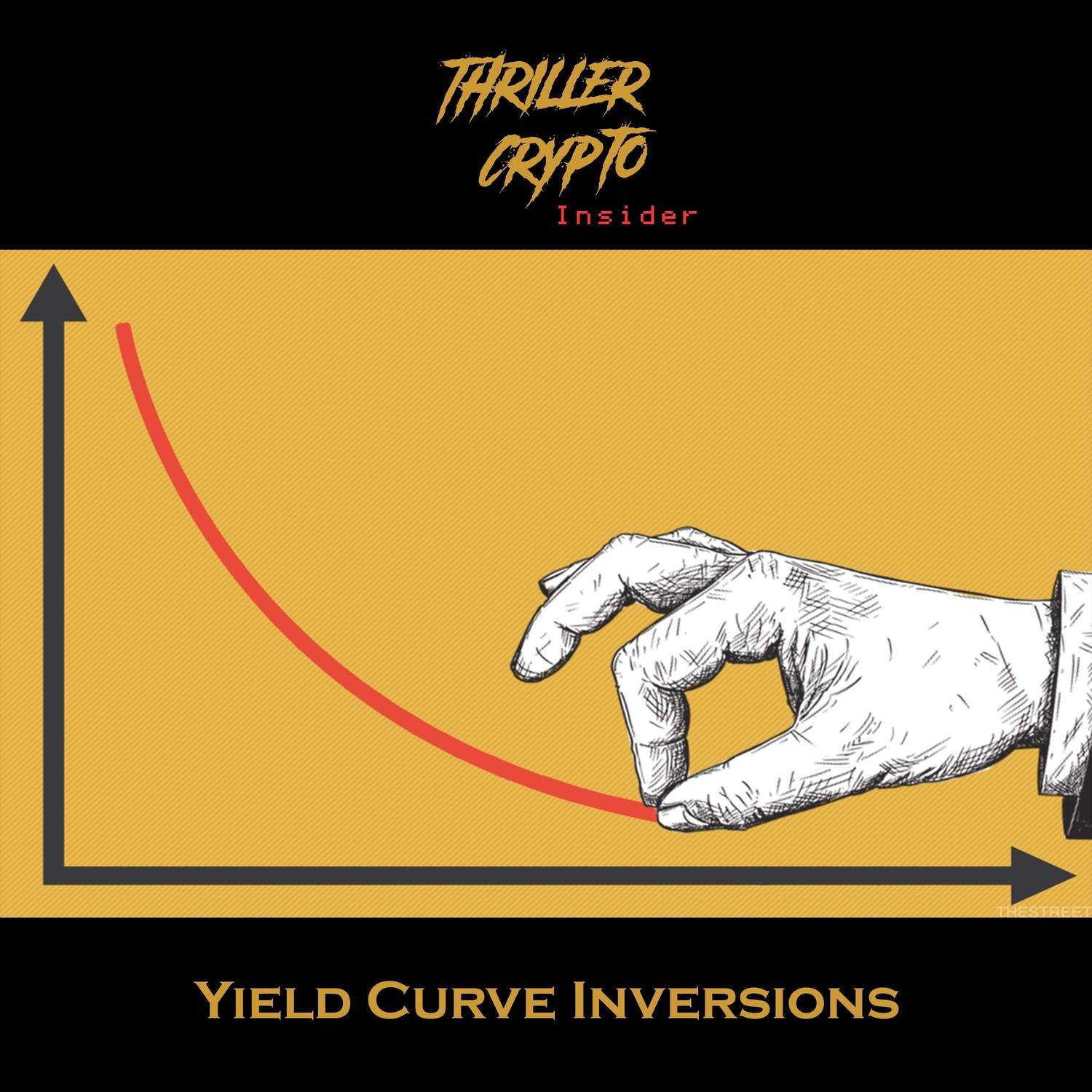
Thriller Insider: Yield Curve Inversions
<p>What is an inverted yield curve?</p> <p>To understand what an inverted yield curve is, you must first understand one of the most basic financial asset classes out there: Bonds.</p> <p>A bond is like an IOU given to you by a bank. When you lend the bank money, it’ll give you back that same amount at a later time along with a fixed amount of interest.</p> <p>For example, if you bought a two-year bond for $100 with a 2% annual return on it, that means you’ll get $104.04 back after two years (this accounts for compounding).</p> <p>Yes, that’s a low return rate. However, bonds have a number of benefits that justify the small rate of return:</p> <p>They’re an extremely stable investment. This is especially true when it comes to government bonds. The only way you can lose your money with them is if the government defaulted on its loans — which the U.S. government has never done.</p> <p>They’re guaranteed to have a return. This means that you’ll know exactly how much you’re getting on your ROI when you purchase a bond.</p> <p>Longer investments yield higher returns. The longer you’re willing to wait on your bond typically means that you’re going to have higher return rates. I say typically because there are exceptions to this (Hint: It has to do with what we’re talking about right now).</p> <p>And when people refer to inverted yield curves, they’re typically referring to the yields on U.S. Treasury bonds, or bonds guaranteed to investors by the U.S. government.</p> <p>The Fed Is Going to Buy Bonds Again. It’s Not a Stimulus Effort.</p> <p>The Federal Reserve will resume the expansion of its balance sheet soon. Just don’t call it quantitative easing.</p> <p>Following a sudden rise in overnight bank funding costs in September, Fed Chairman Jerome Powell said Tuesday that the central bank will begin increasing its securities holdings to “maintain an appropriate level of reserves.” This should be viewed as a technical adjustment and different from the large-scale asset purchases the central bank undertook to stimulate the economy following the financial crisis, <a href="https://www.federalreserve.gov/newsevents/speech/powell20191008a.htm?mod=article_inline">he said in a speech</a> to the National Association of Business Economists in Denver, according to the text.</p> <p>This move would be in keeping with the Fed’s “ample reserve” operating policy established in the wake of the financial crisis, in which the central bank controlled the federal-funds rate—its primary policy target—by establishing the interest it pays on bank reserves. Before the financial crisis, the Fed would control the fed-funds rate through open-market operations—the purchases and sales of securities—to maintain a scarcity of reserves.</p> <p>Some market observers are calling the Federal Reserve’s recent commitment to buy <a href="https://www.newyorkfed.org/markets/opolicy/operating_policy_191011?mod=article_inline">billions of dollars</a> of U.S. Treasury bills QE4—the start of a fourth round of so-called quantitative easing meant to boost a flagging economy.</p> <p>The underlying problem was a systemic shortage of money. <a href="https://www.newyorkfed.org/newsevents/speeches/2019/log190417?mod=article_inline">Fed officials wrongly believed</a> the banking system was flush with more reserves than it needed. In reality, the system was operating on a knife edge where small changes in the quantity of reserves generated large changes in price. </p> <p>Inverted Yield Curve Suggesting Recession Around The Corner?</p> <p>If we look at the data past yield curve inversions in the US. The difference between the 10-year and 2-year Treasury yield (10Y2Y) going back to 1976.</p> <p>Notice that before almost every recession, the yield curve inverted and then steepened.</p> <p>And how often did the yield curve invert and no recession followed within two years of the first inversion? </p> <p>Zero.</p>
Thriller Rundown: The 18 Millionth Bitcoin
<p>The Rundown</p> <p>The 18 Millionth Bitcoin</p> <p>The countdown begins to the 18 millionth Bitcoin (BTC) that was expected to be mined early Friday morning.</p> <p>The most popular cryptocurrency currently has 18,000,137.5 Bitcoin in existence. At a rate of 1,800 BTC mined daily.</p> <p>After this, there are just three million left to be mined from a total of 21 million Bitcoin. Notably, it is said that about 14 to 19 percent of BTC is gone or lost forever. There are also stolen coins, and some hundred thousand stashed away by Satoshi Nakamoto, the pseudonymous person believed to have created Bitcoin.</p> <p>Bitcoin HalvingIn May 2020, the scheduled "Bitcoin halving" will take place wherein the reward for Bitcoin miners for solving a block that connects transactions will be down to 6.25 from 12.5 Bitcoins. </p> <p>Then, there will be about 376,562.5 left to mine when the next halving occurs, which is due every four years. The code in BTC is designed in such a way that limits the production of the cryptocurrency homologizing it to gold, which opposes how the fiat money is easily printed.</p> <p>5 Good Minutes</p> <p>FATF Joins BIS in Calling Stablecoins “Global Risk”</p> <p>Stablecoins pose a money laundering and terrorist financing risk to the world, the Financial Action Task Force (FATF) said Friday.</p> <p>In documents released after its latest meeting, the intergovernmental organization referred to cryptocurrencies as a “major strategic initiative,” and said cryptos whose values are pegged to fiat currencies could have a particularly big impact.</p> <p>Some 800 representatives from 205 jurisdictions met from Oct. 16 to Oct. 18 to discuss various issues under the jurisdiction of FATF, led this year by Xiangmin Liu of China, <a href="http://www.fatf-gafi.org/publications/fatfgeneral/documents/outcomes-plenary-october-2019.html">according to the publication</a>. Crypto-related concerns were front and center.</p> <p>While the document addressed cryptocurrencies broadly, it singled out stablecoins on multiple occasions, writing:</p> <p>“Emerging assets such as so-called global ‘stablecoins’, and their proposed global networks and platforms, could potentially cause a shift in the virtual asset ecosystem and have implications for the money laundering and terrorist financing risks. There are two concerns: mass-market adoption of virtual assets and person-to-person transfers, without the need for a regulated intermediary. Together these changes could have serious consequences for our ability to detect and prevent money laundering and terrorist financing.”</p> <p><a href="http://www.fatf-gafi.org/publications/fatfgeneral/documents/statement-virtual-assets-global-stablecoins.html">A second document</a>, titled “Money laundering risks from ‘stablecoins’ and other emerging assets,” said the FATF will continue to examine the characteristics and perceived risks of stablecoins and may even clarify or update its virtual currency guidance to better address this class of cryptocurrency.</p> <p>“The FATF will continue to ensure its standards remain relevant and responsive and it will report to G20 Finance Ministers and Central Bank Governors in 2020 on the risks from global ‘stablecoins’ and other emerging assets,” the second document read.</p> <p>The FATF’s warning followed a report from the Group of Seven (G7) advanced economies and the and Bank of International Settlements (BIS) calling stablecoins a growing threat to monetary policy, financial stability and competition.</p> <p>The Hard Truth</p> <p>Circle to Spin Out Poloniex</p> <p>Crypto exchange Poloniex is spinning out from its parent firm Circle, the companies announced Friday.</p> <p>According to a pair of blog posts, Poloniex will now become Polo Digital Assets, Ltd., an “independent international company” backed by an unnamed Asian investment firm. The trading platform will not serve U.S. customers after this year.</p> <p>In Friday’s blog post, Circle co-founders Jeremy Allaire and Sean Neville…</p>
Thriller Rundown: The Certainty of Bitcoin
<p>The Rundown</p> <p>One of Germany’s biggest bank predicts bitcoin will reach $90,000 due to the halvening based on a stock to flow model that measures the hardness of a money.</p> <p>“The stock-to-flow approach originating in commodity-market analysis serves to quantify the ‘hardness’ of an asset. Applied to Bitcoin, an unusually strong correlation emerges between the market value of this cryptocurrency and the ratio between existing stockpiles of Bitcoin (‘stock’) and new supply (‘flow’),” they say.</p> <p>“Satoshi’s ‘stroke of genius’ was to decouple supply from price and from mining efforts (in Bitcoin’s case: computing power). It is worth noting that this ‘difficulty adjustment’ was absent in the case of all Bitcoin’s predecessors, e.g. Bit Gold…</p> <p>Historically, the Bitcoin Halving has proven to be an important catalyst that propels Bitcoin into a new Bull Market.</p> <p>In fact, Bitcoin tends to begin its new bull trend at least a year before its Halving.</p> <p>Bitcoin Halving #1 — November 2012</p> <p>Bitcoin Halving #2 — July 2016</p> <p>Bitcoin Halving #3 — May 2020</p> <p>1. Bitcoin has rallied 12,000%-13,300% in each of its Halvings to date</p> <p>The first Bitcoin Halving spurred 13,378% growth in Bitcoin’s price whereas the second Bitcoin Halving spurred a 12,160% rally.</p> <p>A 12,160% rally from Bitcoin’s mid-December 2018 bear market bottom of $3,150 would result in a ~$385,000 Bitcoin.</p> <p>By the same token a 13,378% rally would lead to a ~$425,000 Bitcoin.</p> <p>A $385,000 Bitcoin is very interesting because that would mean that Bitcoin’s Market Cap (i.e. $189 billion as of this writing) will have eclipsed the current Market Cap of Gold (i.e. $7.8 trillion).</p> <p>Bitcoin Halvings #1 and #2 — A Detailed Breakdown</p> <p>A new Market Cycle high tends to be made just before the Halving but it doesn’t eclipse the old All-Time High</p> <p>Since mid-December 2018, Bitcoin rallied over 340% which closely resembles the 383% rally that Bitcoin experienced leading up to its second Halving.</p> <p>If Bitcoin were to rally 383% like it did prior to Halving #2, it would reach a new Market Cycle high of ~$15,000 which is higher than the current Market Cycle local top of $13,900 as of this writing.</p> <p>This turn of events would satisfy the historical tendencies of setting a new Market Cycle prior to the Halving but not a new All-Time High.</p> <p>This in turn would also satisfy another key tendency: if Bitcoin rallies less pre-Halving, it will rally more post-Halving (and for a longer period of time).</p> <p>Should this tendency play out once again, this would mean that Bitcoin would have a higher likelihood of rallying over 13,000% compared to the 12,000% rally from Halving #2.</p> <p>On the other hand however, if Bitcoin were to rally similarly to its 663% uptrend prior to Halving #1, that would mean that Bitcoin would reach a price point of almost $24,000 prior to Halving #3.</p> <p>Of course, this would lead to a new All-Time High prior to the third Halving which is something that goes against the aforementioned historical tendency.</p> <p>It is for this reason that Bitcoin’s price action may continue to closely resemble its price action prior to Halving #2.</p> <p>Should this be the case, it would take Bitcoin a longer time to manage its typical post-Halving growth (after all, it took Bitcoin over 500 days post-Halving #2 to manage an over 12,000% rally to new ATHs).</p> <p>If Bitcoin’s post-Halving #3 growth resembles Bitcoin’s post-Halving #2 growth, then Bitcoin may see a new All-Time High over 500 days after the Halving (i.e. by Quarter 4, 2021).</p> <p>3. After a new Market Cycle high is set, a retrace will occur prior to the Halving</p> <p>A retrace may very well occur prior to the Halving which would figure as a financial opportunity for both traders and investors alike.</p> <p>4. New All-Time High in Bitcoin’s price will occur after the Halving</p> <p>Historically, Bitcoin has set a new All-Time High after every Halvi…</p>
Thriller Insider: The Looming Recession
<p>The United States is currently experiencing one of the longest periods of economic expansion in its history. However, the expansion has not reached all households and many are struggling to cover the costs of basic emergencies. At the same time, economic growth appears to be slowing, and there are warning signs that a recession is possible in the near future. While downturns are difficult to predict, policymakers have a responsibility both to assess whether the country is prepared for the next recession and to implement approaches to protect Americans from the worst outcomes. Although the economy has been growing since 2009, even those who have benefited from this growth are still feeling the effects of the Great Recession. While recessions are harmful in a variety of ways—most significantly because people lose their jobs—they also leave a permanent mark on people’s consciousness. For some, there is the pain of being forced to take a lower-level job. For others, jobs are not even available.</p> <p>Several generations have been adversely and permanently affected by the Great Recession. Millennials, many of whom had only recently entered the labor market at the time of the recession, have altered their behavior because of the downturn, delaying big purchases such as houses. Baby Boomers with nest eggs wrapped up in the stock market saw their savings nearly wiped out. Homeowners of all ages were and continue to be profoundly affected.</p> <p>Definition of Monetary Policy 3</p> <p>Though most of us haven’t seen it in our lifetimes, it has existed in other lifetimes and other places. MP3 is a continuum of coordinated monetary and fiscal policies that vary who gets the money (private sector versus public sector) and how directly that printed money is provided (directly providing “helicopter money” to spenders versus more indirect means of financing spending). The following diagram maps many of the possible types of MP3 onto that continuum. In general, the more direct policies would be more effective, but also more politically difficult to do. And some of the least direct policies (or variants of them) have recently been used, but not at the scale that would likely be needed in the next significant downturn.</p>
Thriller Coin Talk - S3EP13: Better The Devil You Know
<p>Cryptocurrency Exchanges Including Coinbase Create The Crypto Rating Council: </p> <p>Cryptocurrurrency exchange operators including Coinbase, Kraken and Circle have teamed up to create a system that rates digital tokens on how close they are to securities. </p> <p>The points-based rating system, unveiled by Coinbase in a blog post Monday, determines whether a digital asset falls under U.S. securities law using guidance from the Securities and Exchange Commission. </p> <p>“The result of the analysis is a score which makes it easy for members to synthesize the analysis across many tokens and make their own, independent business decisions…</p>
Thriller Rundown - S3EP9: SWIFT Recognize Crypto Financial Evolution
<p>The Rundown </p> <p>Bankers Start to Recognize Bitcoin’s & Crypto Role in Financial Evolution </p> <p>SWIFT Chairman of the Board, Yawar Shah </p> <p>Speaking during the Sibos 2019 conference held recently in one of the world’s financial capitals, London, “The financial industry is undergoing an extraordinary change, because of new entrants like Facebook’s Libra and the emergence of technologies like crypto assets,” said Yawar Shah, chairman of Swift, the global interbank financial telecommunication system used by banks around the world to send and receive information about financial transactions. </p> <p>Shah’s presentation concerned payments and…</p>
Thriller Insights: The Repo Market Meltdown
<p><a href="https://www.forbes.com/sites/caitlinlong/2019/09/25/the-real-story-of-the-repo-market-meltdown-and-what-it-means-for-bitcoin/#e6f3807caa22">The Real Story Of The Repo Market Meltdown, And What It Means For Bitcoin</a>:</p> <p>Last week the financial system ran out of cash. It was a modern version of a bank run, and it’s not over yet. Stepping back, it reveals two big things about financial markets: first, US Treasuries are not truly “risk-free” assets, as most consider them to be, and second, big banks are significantly under-capitalized. The event doesn’t mean another financial meltdown is necessarily imminent—just that the risk of one is heightened—since the brush fire can be doused either by the Fed, or by the banks raising more equity capital. However, it provides a “teachable moment” regarding systemic fragility and anti-fragility. </p> <p>What’s Happening, In Plain English?</p> <p>Somebody—probably a big bank—needs cash so badly that it has been willing to pay a shockingly high cost to obtain it. That’s the layman’s explanation of what’s happening. Interest rates have betrayed common sense—interest rates in the repo market should be lower than rates in unsecured markets, for example, because repos are secured by assets and thus supposedly lower-risk. But repo rates spiked way above unsecured lending rates last week, even for “risk-free” collateral such as US Treasuries. </p> <p>But US Treasuries are not risk-free. Far from it. (By this, I’m not referring to the US potentially defaulting on its debt obligations. Rather, I’m referring to the practice in the repo market that allows more people to believe they own US Treasuries than actually do. It’s called “rehypothecation.”) Why was someone willing to borrow cash at a 10% interest rate last Tuesday, in exchange for pledging US Treasury collateral that yields only 2% or less? That trade lost someone a whopping 8% (annualized) overnight, but presumably the trade allowed the bank to stay in business for another day. As risk premiums go, 8% is shockingly high—for a supposedly risk-free asset!</p> <p>At a systemic level, the traditional financial system is as fragile as Bitcoin is anti-fragile.</p> <p>An anti-fragile system is one that becomes stronger and more resilient as a result of shocks, not weaker. This describes Bitcoin, whose network security grows as the system’s processing power grows. Here I distinguish between price volatility and systemic volatility. Bitcoin’s price is highly volatile, but as a system it is more stable. In stark contrast to the traditional financial system, Bitcoin is not a debt-based system that periodically experiences bank run-like instability. In this regard, Bitcoin is an insurance policy against financial market instability. Bitcoin is no one’s IOU. It has no lender of last resort because it doesn’t need one. For me, Bitcoin is empowering because it provides a choice to opt out of the traditional financial system. In light of the traditional financial system’s instability, despite all of Bitcoin’s drawbacks, I find that a powerful concept.</p> <p>Coin Analysis: Bitcoin</p>
Thriller Insights - S3EP9: Bitcoin Becomes Mainstream
<p>Bakkt Launch Incoming…What to Expect: </p> <p>On September 22, a product designed to remake Bitcoin as a mainstream investment for the world's investment managers will go live. When ICE Futures U.S., one of the world's largest commodities markets, opens trading at 8 p.m. ET that day, it will offer Bakkt Daily and Monthly Bitcoin Futures, the first physically delivered crypto-currency contracts ever traded on a federally regulated exchange. </p> <p>If the exchange works as planned, it will give institutional investors a secure, well-monitored place to trade Bitcoin, the world's most widely used cryptocurrency. That in turn could…</p>
Thriller Rundown - S3EP8: Is This Why Bitcoin Matters?
<p>The Rundown </p> <p>The US Quietly Printed $75 Billion out of Thin Air (For the Banks). This Is Why Bitcoin Matters </p> <p>The United States Federal Reserve has suddenly injected $53 billion in short term lending markets by buying US Treasuries and other securities for the first time since 2008. They are to print another $75 billion today as money seemingly dries up with the culprit apparently being too much government debt offerings. </p> <p>“Banks get the overnight capital they need by pledging collateral, usually Treasury bonds, in exchange for cash. When the Fed provides the cash, they basically print the…</p>
Thriller Coin Talk - S3EP11: Bitcoin Stock to Flow Ratio
<p>Bitcoin, Stock-to-flow Model: </p> <p>Stock-to-flow Ratio: </p> <p>Stock-to-flow Ratio for a commodity is defined as it’s years of inventory relative to annual supply. While the economic utility of a consumable good is created when it is destroyed or used up, the utility of investment assets lies in their possession and later resale. Industrial commodities therefore have low stock-to-flow ratios, this is to say, inventories usually only cover consumption demand for a few months. If there were no inventories at all, supply would have to correspond exactly to production and demand exactly to consumption. However, if there are…</p>