The Trajectory Africa
45 episodes
S3 Ep 13Goodbye for now, Trajectory Africa
The Trajectory Africa, is a "pop-up" podcast designed to explore the first principles of VC and tech entrepreneurship in Africa, as they emerge in real time. After a nearly four year run, the journey has come to an end. This conversation with Andile Masuku, Co-Founder and Producer of African Tech Roundup (ATRU) and Tayo Akinyemi, Host and Producer of The Trajectory Africa tells the origin story of the pod, how and why ATRU was involved, how both media properties have evolved, and what's next for both creators.[07:15] – Revisiting early conversations about collaboration[13:55] – Unpacking tensions between openness, IP ownership and monetization models [23:00] – Being the “African Tech Guy”; how podcasting shifted toward community-led media[34:15] – Reflecting on podcasting as a community-builder [46:30] – Embracing the fear of launching something new[58:25] – Why The Trajectory Africa is going on hiatus and what's nextRecommendations:African Tech Roundup — Independent insights and analysis on technology, entrepreneurship and innovation in AfricaChasing Outliers: Why Context Matters for Early Stage Investing in Africa — A report I co-authored on VC investing in AfricaConnect on social media:Andile Masuku on LinkedIn and @MasukuAndile on XAfrican Tech Roundup on LinkedIn and @africanroundup on XTayo Akinyemi on LinkedIn, @Tayo_Akinyemi on X, and @TayoAkinyemi.bsky.social on BlueskyThe Trajectory Africa on LinkedIn and @trajectoryafrica.bsky.social on Bluesky
First Principles: Towards a Thesis on Digital Commerce & Logistics
bonusThis episode of The Trajectory Africa features Lydia Idem, Chief Operating Officer of LoftyInc Capital and Managing Director of FM Capital Group. We discuss what “point B” looks like for digital commerce on Africa’s S-curve, why asset-heavy models are more necessary than investors like to admit, why venture debt may be a missing ingredient in African VC, and how talent, timing, strategic partnerships and focus, shape outcomes in logistics and e-commerce. [00:00] – Introduction and context for Lydia’s role in the series roundup[04:55] – Africa’s S-curve, fund returns, and the need for longer-duration capital[10:34] – What “point B” looks like for LoftyInc in digital commerce[13:51] – The asset-light vs. asset-heavy dichotomy[22:21] – Talent as a constraint[26:39] – The absence of venture debt and its consequences for early-stage startups[36:02] – Forecasting human capital needs[41:21] – Value-added services diluting focus[47:02] – Embedded finance and digital commerce business models[52:22] – Value-added services vs. regional expansion[55:52] – Using capital, boards, and investor networks to scale[1:02:30] – The production and export opportunity[1:06:52] – First principlesRecommendations:Chasing Outliers: Why Context Matters for Early Stage Investing in Africa — A report I co-authored on VC investing in AfricaConnect on social media:Lydia Idem on LinkedIn and @fatithmight on XLoftyInc Capital on LinkedIn and @LoftyIncVC on XThe Trajectory Africa on LinkedIn and @trajectoryafrica.bsky.social on BlueskyTayo Akinyemi on LinkedIn, X, and @TayoAkinyemi.bsky.social on Bluesky
S3 Ep 12Leta: Why AI Compounds Logistics Efficiency at Scale
This episode of The Trajectory Africa features Nick Joshi, Founder and CEO of Leta, a startup that uses AI to optimize delivery routes, track shipments in real time, streamline payments, and provide businesses with shipping insights. We discussed how the first generation of logistics players paved the way for evolution in the space, how Leta optimizes trips and delivery routes at the last mile (otherwise known as the business model killer), how it plans to increase efficiency at the middle mile, and why efficiency gains compound at scale.[00:00] - Introduction/ Leta as a logistics OS for Africa [03:11] - 1st and 2nd waves of African logistics, market size,[08:47] - Leta’s value proposition and the role of AI[14:03] - Customers, products and services[17:04] - The first, middle and last mile in logistics/Leta’s approach to last mile[31:36] - Leta’s business model, embedded finance, cost structure and metrics [45:51] - Performance metrics, moat and growth[53:19] - First principleRecommendations:Google, Speedinvest back Kenya’s Leta, which uses AI to make logistics cheaper. TechCrunch article about Leta’s seed round.Chasing Outliers: Why Context Matters for Early Stage Investing in Africa. A report I co-authored on VC investing in Africa. Connect on social media:Nick Joshi on LinkedIn The Trajectory Africa on LinkedIn and @trajectoryafrica.bsky.social on BlueskyTayo Akinyemi on LinkedIn, X, and @TayoAkinyemi.bsky.social on Bluesky
S3 Ep 11Logistics for Trade: Why Paps is Building End-to-End Infrastructure
This episode of The Trajectory Africa features Bamba Lo, CEO and Co-founder of Paps, a technology-enabled logistics company operating across Francophone Africa. He explains how Paps delivers across the value chain— from freight and customs clearance to warehousing and last-mile delivery, while owning less than 1% of the vehicles in its network. Bamba also shares how Paps is building Africa’s critical logistics infrastructure domestically, in service of a broader mission to drive regional and international trade.[00:00] - Introduction and Paps’ accidental origin story [05:40] - Paps’ value proposition and the role of technology[07:14] - An asset-light approach to logistics infrastructure[14:44] - Paps’ customers and products[27:30] - Building a virtual regional market in francophone Africa[33:00] - Logistics value chain breakdown and a model for collaborative infrastructure[42:55] - Paps’ business model and growth[58:46] - The future of logistics and a first principle for building in logisticsRecommendations:Chasing Outliers: Why Context Matters for Early Stage Investing in Africa. A report I co-authored on VC investing in Africa. Connect on social media:Bamba Lo on LinkedIn and @Khadim_L on XPaps on LinkedIn and @Paps_app on XThe Trajectory Africa on LinkedIn and @trajectoryafrica.bsky.social on BlueskyTayo Akinyemi on LinkedIn, X, and @TayoAkinyemi.bsky.social on Bluesky
S3 Ep 10Inefficiency the Income Thief: Lori and the Financial Story of African Logistics
The cost of moving goods across Africa remains one of the continent's toughest economic challenges. With logistics accounting for up to 75% of the price of goods—compared to just 9% in the US—solving transport inefficiency could be key to boosting affordability for African consumers.In this episode of The Trajectory Africa, I'm chatting with Jean-Claude Homawoo, CEO of Lori, a company that matches cargo owners with transporters, to move cargo efficiently. We discuss how badly trucking businesses need working capital with better payment terms, how truck utilization can change the economics of a trip, and the potential for electric vehicles to reduce the cost of transporting cargo enough to reshape the economics entirely.[00:00] - Introduction and Jean-Claude’s journey into African logistics [08:07] - The problem Lori is solving[13:32] - Logistics value chain and market structure[16:52] - Lori’s value proposition and customers[32:28] - Selling digitalization and efficiency[36:16] - The “financial story” of logistics[45:41] - Lori’s business model and role in the value chain[1:00:30] - Growth, competition and the case for EVs in transport[1:07:37] - First principlesRecommendations:Chasing Outliers: Why Context Matters for Early Stage Investing in Africa. A report I co-authored on VC investing in Africa. Connect on social media:Jean-Claude Homawoo on LinkedIn and @JeanClaude_H on XLori on LinkedIn and @lorisystems on XThe Trajectory Africa on LinkedIn and @trajectoryafrica.bsky.social on BlueskyTayo Akinyemi on LinkedIn, X, and @TayoAkinyemi.bsky.social on Bluesky
S3 Ep 9Reflections on Sote: A Business Model for Freight Forwarding
On this episode of The Trajectory Africa, Samora Kariuki, CEO and Founder of Frontier Fintech and former Director at Sote, a digital logistics and supply chain infrastructure company, breaks down the fundamentals of logistics in Africa. He explains the relationship between the size of an economy and its trade volume, and the role of a freight forwarder in making trade more efficient, sustainable and easier to coordinate. He also explains the primary stakeholders in logistics value chains and their roles, the margin distribution between them, what key problems in logistics can (and can’t) be monetized, and what problems remain to be solved.[00:00] - Introduction[02:10] - Sote’s founding hypothesis and why freight forwarders are the linchpin of trade[09:12] - Mapping a logistics value chain [23:41] - The limits of “Uber for trucks” logistics tech and visibility platforms [36:11] - Sote’s business model[47:27] - The relationship between efficiency and margin availability in logistics[54:14] - Lessons learned from Sote[59:34] - First principle Recommendations:Frontier Fintech newsletter: Frontier Fintech is a premier newsletter covering the African fintech industry across the entire spectrum from start-ups to incumbent players.F-Squared podcast: Frontier Fintech is a podcast about the business of fintech in Africa.Chasing Outliers: Why Context Matters for Early Stage Investing in Africa. A report I co-authored on VC investing in Africa. Connect on social media:Samora Kariuki on LinkedIn and @SamoraKariuki on X Frontier Fintech on LinkedIn The Trajectory Africa on LinkedIn and @trajectoryafrica.bsky.social on BlueskyTayo Akinyemi on LinkedIn, X, and @TayoAkinyemi.bsky.social on Bluesky
S3 Ep 8Talking to Trade: How Chpter Helps Businesses Sell Socially
In this episode of The Trajectory Africa, Mark Kiarie, Co-founder and CEO of Chpter, explains conversational commerce and how his company uses AI to help businesses serve buyers where they already are, on social media platforms such as WhatsApp and Instagram. Chpter enables them to respond instantly to customers, transforming DMs into sales. Mark also shares how Chpter is building digital infrastructure for *Commerce 3.0*, where chat messages drive revenue for businesses that are selling online.[0:00] - Introduction, podcasting and a sneaker store success story[7:19] - Chpter’s value proposition and customers [12:14] - Defining conversational commerce [20:09] - Chpter’s origin story and product-market fit[35:00] - Chpter’s approach to customer acquisition[41:37] - How Chpter makes money[52:46] - Creating value to capture value[1:04:18] - The future of digital commerce and a first principle on building in the sectorRecommendations:Chpter podcast: Chpter brings together top experts and innovators in the business world to share their experiences, strategies, and lessons learned.Chasing Outliers: Why Context Matters for Early Stage Investing in Africa. A report I co-authored on VC investing in Africa. Connect on social media:Mark Kiarie on LinkedIn and @markkiaria_ on XChpter. on LinkedIn and @chpter_co on XThe Trajectory Africa on LinkedIn and @trajectoryafrica.bsky.social on BlueskyTayo Akinyemi on LinkedIn, X, and @TayoAkinyemi.bsky.social on Bluesky
S3 Ep 7All in One: How Bumpa Aggregates Digital Services for BizOpps
This episode of The Trajectory Africa features Kelvin Umechukwu, Founder and CEO of Bumpa, a company that provides sellers with the tools needed for digital commerce, inventory and sales management, and customer engagement. Kelvin explains how Bumpa helps businesses by aggregating and integrating functions like inventory and order management, payments, and messaging, so they can get what they need in one place. He also shares how Bumpa’s network of partnerships embeds it more deeply into customer workflows—solidifying retention and network effects without needing to "own" every piece of the stack. [00:00] - Introduction: the problems you choose define you[06:34] - Bumpa’s value proposition, products and customers[15:43] - Evolution of Bumpa’s customer segments and product roadmap[27:30] - Bumpa’s business model[42:26] - First principle for building in digital commerceRecommendations:Chasing Outliers: Why Context Matters for Early Stage Investing in Africa. A report I co-authored on VC investing in Africa. Connect on social media:Kelvin Umechukwu on LinkedIn and @tushgeek on XBumpa on LinkedIn and @getbumpa on XThe Trajectory Africa on LinkedIn and @trajectoryafrica.bsky.social on BlueskyTayo Akinyemi on LinkedIn, X, and @TayoAkinyemi.bsky.social on Bluesky
S3 Ep 6The Full Stack Experience: Dukka's BizOpps Ecosystem for Merchants
This episode of The Trajectory Africa features Keturah Ovio, CEO of Dukka, a company that’s changing how small businesses operate in Nigeria (and beyond). Dukka integrates payments, inventory management, sales tracking, and business intelligence into a single platform. Keturah explains how she built Dukka with merchants in mind, leaned into creating a full stack experience by introducing a custom-built POS, and aims to drive growth by creating an ecosystem that brings businesses closer to their customers. [00:00] - Introduction, Dukka’s value proposition and the business operations opportunity [8:35] - Dukka’s customers and acquisition strategy[18:32] - The Dukka Terminal[32:13] - Dukka’s ecosystem play: remittance-as-commerce [43:35] - Navigating macroeconomic headwinds[48:24] - Dukka’s business model[50:50] - First principleRecommendations:Chasing Outliers: Why Context Matters for Early Stage Investing in Africa. A report I co-authored on VC investing in Africa. Connect on social media:Keturah Ovio on LinkedInKeturah Ovio on X @KeturahovioDukka on LinkedIn The Trajectory Africa on LinkedIn and @trajectoryafrica.bsky.social on BlueskyTayo Akinyemi on LinkedIn, X, and @TayoAkinyemi.bsky.social on Bluesky
S3 Ep 5B2B E-Commerce to Fintech: How Chari is Charting a Path to Profitability
In this episode of The Trajectory Africa, Ismael Belkhayat, CEO and founder of Chari, a b2b e-commerce and fintech platform for traditional retailers in French-speaking Africa, explains how fintech and digital commerce came together inside his company. He shares Chari's journey supporting traditional shopkeepers in Morocco, the financial infrastructure they've built, and how they're creating a sustainable business model by turning mom-and-pop shops into neighborhood financial service providers. He also offers his perspective on how to pursue growth through strategic acquisitions and “going deep” in a single market while leveraging local talent to expand.[00:00] - Introduction[05:40] - The business case behind serving shopkeepers[07:57] - Pivoting to neobanking and Chari’s business model [11:20] - Building a fintech ecosystem for shopkeepers[35:14] - Super app strategy: e-commerce and fintech[31:39] - Strategic partnership with Orange Telecom[40:43] - Acquisition synergies, and scaling logic[43:43] - First principle of building in digital commerceRecommendations:Chari: Exploring Fintech in Morocco. A Harvard Business School Case on Chari. Chasing Outliers: Why Context Matters for Early Stage Investing in Africa. A report I co-authored on VC investing in Africa. Connect on social media:Ismael Belkhayat on LinkedIn and @ismaelbelkhayat on X The Trajectory Africa on LinkedIn and @trajectoryafrica.bsky.social on BlueskyTayo Akinyemi on LinkedIn, X, and @TayoAkinyemi.bsky.social on Bluesky
S3 Ep 4Asset Efficiency in B2B E-commerce: Maad’s Journey to Single Market Scale
In this episode of The Trajectory Africa’s series on digital commerce and logistics, Sidy Niang and Jessica Long, Co-founders of Maad, a retail platform connecting FMCG brands and retailers in Senegal, share how they think about asset efficiency as a way to own assets strategically, once demand is assured. Maad embraces the reality (and the challenges) of physical infrastructure, but uses technology to manage assets efficiently. Sidy and Jessica also talk about how to expand the thin margins common in b2b ecommerce, increase revenue opportunities for retailers, and scale by going deep in one market. [00:00] - Introduction[02:02] - Maad origins and evolution from SaaS provider to retail distribution[06:21] - Bits vs. atoms and the value of technology[12:07] - Distribution value chain, Maad’s value proposition, and market dynamics in Senegal[27:51] - Asset efficiency[37:43] - Maad’s business model[42:16] - Operational excellence and cost structure[54:54] - Digital commerce business models (asset-heavy vs. asset-light) [1:08:32] - Scaling deep in one market[1:14:12] - First principle of building in digital commerceRecommendations:Chasing Outliers: Why Context Matters for Early Stage Investing in Africa. A report I co-authored on VC investing in Africa. Connect on social media:Sidy Niang on LinkedIn Jessica Long on LinkedIn The Trajectory Africa on LinkedIn @trajectoryafrica.bsky.social on BlueskyTayo Akinyemi on LinkedIn, Twitter and @TayoAkinyemi.bsky.social on Bluesky

S3 Ep 3Premium "Informal" Retailers: How Sarafu Captures Value in B2B E-commerce
This episode of The Trajectory Africa features Firas Ahmad, CEO of Sarafu, a B2B e-commerce platform, and AzamPay, a payments platform, both in Tanzania. Firas shares his approach to running a digital commerce business—focusing on delivering premium service to customers who are willing to pay, running data-driven operations, and turning cost centers into revenue generators. He also explains why informal markets are more optimized than they appear, why making analog processes digital isn't enough to win, and how you balance value creation with value capture. [00:00] - Introduction[02:00] - Corporate intrapreneurship and digitizing last mile distribution[11:43] - Monetizing price transparency and efficiency and serving premium informal retailers[33:28] - Asset-heavy vs. asset-light strategies[41:23] - Viability of pure play B2B e-commerce businesses and Sarafu’s business model[53:05] - Sarafu’s ecosystem approach[59:00] - First principle (value creation vs. value capture)Recommendations:Chasing Outliers: Why Context Matters for Early Stage Investing in Africa. A report I co-authored on VC investing in Africa. Connect on social media:Firas Ahmad on LinkedIn and @ahmadfirask on XThe Trajectory Africa on LinkedIn @trajectoryafrica.bsky.social on BlueskyTayo Akinyemi on LinkedIn, X, and @TayoAkinyemi.bsky.social on Bluesky
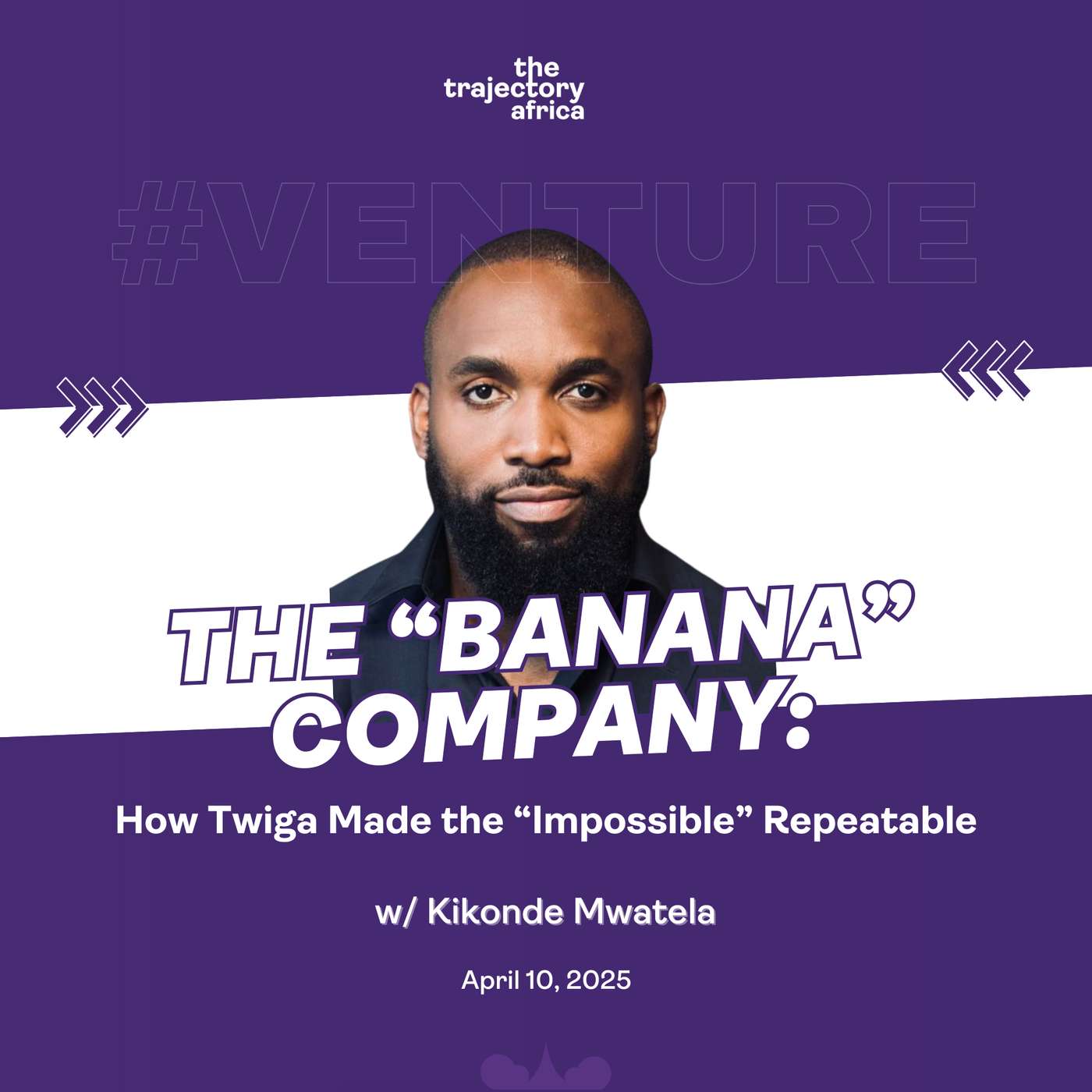
S3 Ep 2The “Banana” Company: How Twiga Made the "Impossible" Repeatable
On this episode of The Trajectory Africa, Kikonde Mwatela, former COO of Twiga, talks about how it tackled a fundamental problem in Kenya's banana supply chain—turning days of trapped working capital and high spoilage into ready-to-sell product. He also shares how Twiga balanced standardizing production while growing its retail universe, the critical relationship between revenue assurance and distribution costs, and perhaps most importantly, the right lessons to learn from Twiga's journey. 00:00 - Introduction to Twiga 01:41 - A first principle for building a profitable digital commerce business in Africa16:00 - A primer on banana (and pineapple) value chains in Kenya 32:22 - Twiga’s cost structure 45:10 - Value chain power dynamics 53:54 - Twiga's growth strategy1:06:38 - Key assumptions revisited1:19:50 - The impact of commercial investors 1:32:33 - The “right” lessons to learn from Twiga’s storyRecommendations:Twiga Foods: Revolutionizing African Retail. Harvard Business School Case on Twiga Foods. Chasing Outliers. Why Context Matters for Early Stage Investing in Africa. A report I co-authored on VC investing in Africa. Connect on social media:Kikonde Mwatela on LinkedIn and @KikondeMwatela on XThe Trajectory Africa on LinkedIn and @trajectoryafrica.bsky.social on BlueskyTayo Akinyemi on LinkedIn, X, and @TayoAkinyemi.bsky.social on Bluesky
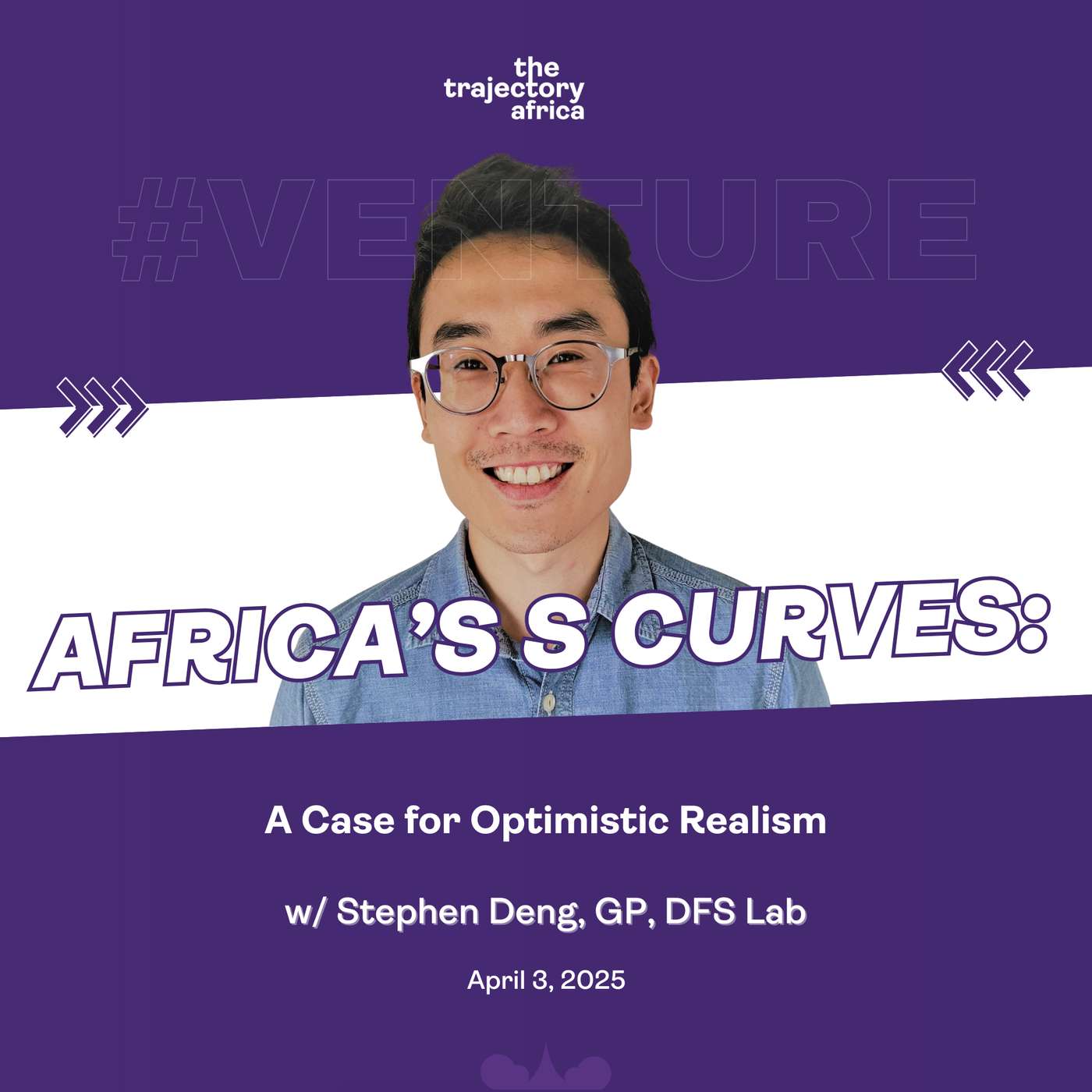
S3 Ep 1Africa's S Curves: A Case for Realistic Optimism
In this episode of The Trajectory Africa, DFS Lab General Partner Stephen Deng introduces "Africa's S-curves," a framework that explains why technology transitions on the continent take longer, but are also characterized by dramatic adoption and big impacts on informal markets due to improvements in productivity and cost structures. We talk through why the S-Curve logic points to a case for augmenting informal market structures with tech rather than trying to replace them entirely. We also talk about cybernetic commerce and how technology can interface with informal markets around money, by enabling digital transactions, energy, by boosting transparency in supply chains, and labor, by facilitating cross-border trade.[00:00] - Introduction[3:04] - An overview of Africa's S-Curves[13:31] - Augmentation vs. displacement in informal markets[20:45] - Points of inflection on Africa’s S-Curves[38:45] - Opportunities in cybernetic commerce[44:02] - Digital commerce business models[1:02:06] - First principles of S-Curves Recommendations:Africa’s S Curves. Stephen’s thesis on Africa’s tech opportunity.Chasing Outliers: Why Context Matters for Early Stage Investing in Africa. A report I co-authored on VC investing in Africa. Connect on social media:Stephen Deng on LinkedIn and @mrstephendeng on XDFS Lab on LinkedIn and @TheDFSLab on XThe Trajectory Africa on LinkedIn and @trajectoryafrica.bsky.social on BlueskyTayo Akinyemi on LinkedIn, X, and @TayoAkinyemi.bsky.social on Bluesky
S2 Ep 13The Engine of African Venture: A Return to First Principles (Digital Commerce & Logistics)
The Trajectory Africa’s second series, The Engine of African Venture: A Return to First Principles, is a two-part exploration of what powers fundamental value creation and investability in sectors that drive African VC opportunities. The eleven episodes of Part I were focused on fintech, exploring fintech’s subsectors—from market opportunities to business models—to tease out why they are (or aren’t) destinations for venture capital.Part II is focused on digital commerce and logistics and its foundations—infrastructure, business models, and core beliefs about how problems are solved and value is created.
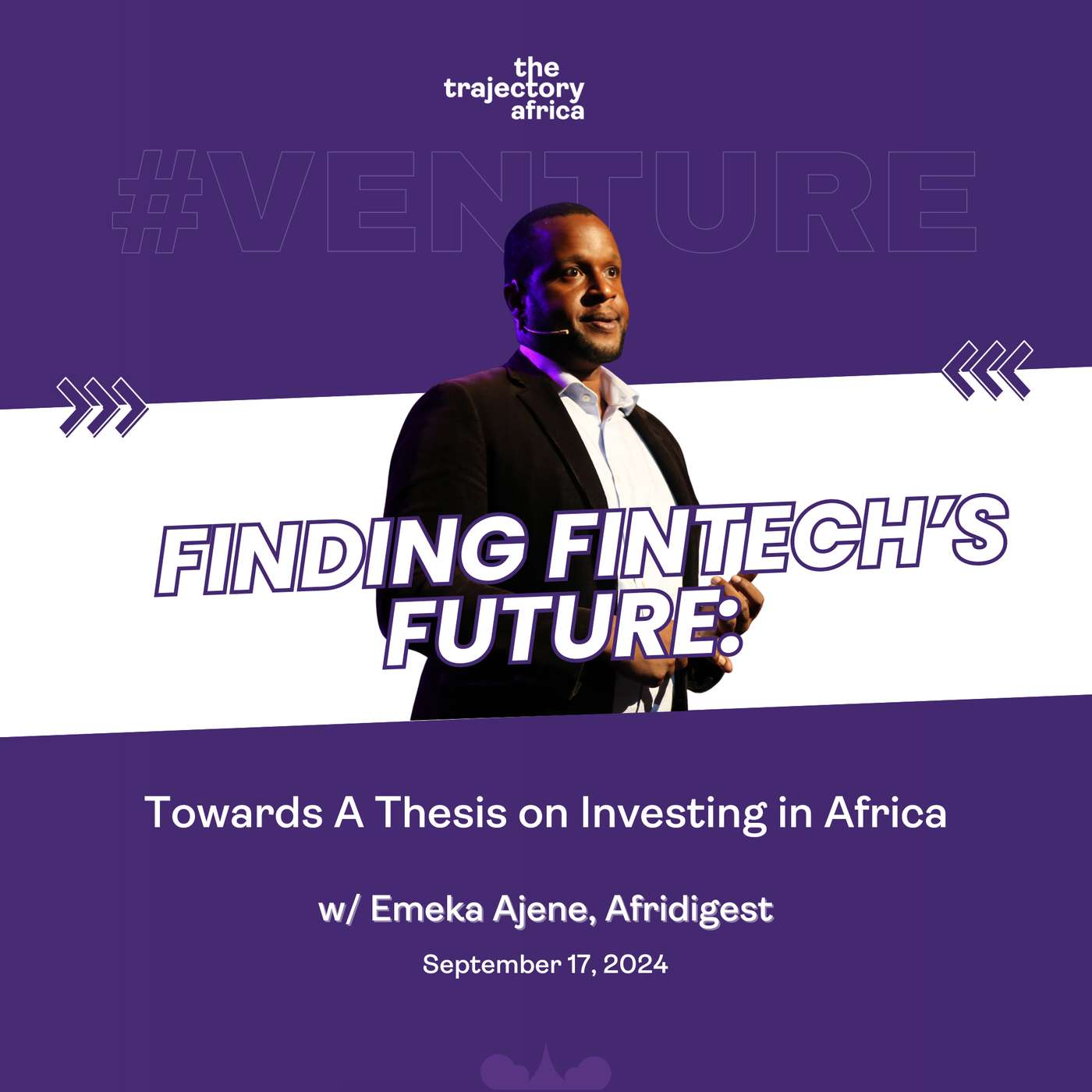
S2 Ep 12Finding Fintech's Future: Towards a Thesis on Investing in Africa
The Trajectory Africa’s first principles series was inspired by a desire to understand the drivers and assumptions underlying investable opportunities in key sectors hypothesized to be the engine of African VC, starting with fintech.Across 11 episodes, we explored the opportunities for, and limits of, ubiquitous digitalization and the role of fintech, the jobs to be done by, and characteristics of, a digitally enabled financial system, the case for infrastructure building in payments, partner-led neobanking, the logic of financial operations, community-based lending and savings-led embedded finance, and finally, boosting trade by facilitating b2b cross-border payments and connecting enabling infrastructure.But somehow, all those granular questions led to many big, hairy questions. So, to help sense-make on this final, fintech-focused episode, we have Emeka Ajene, Founder and Publisher of Afridigest, a business media brand with an editorial focus on ideas, analysis, & insights for business innovators across Africa and beyond; Afri.capital, an emerging investment firm focusing on early-stage, tech-enabled investments; and Africreate, a strategic thinking partner & trusted advisor to senior executives doing business in Africa. I hope you enjoy the conversation!Tune in to hear about:[2:58] - The infrastructure of trade — the chicken or the egg[5:58] - How to win in neobanking[19:38] - Superapp logic[23:39] - The role of banks in fintech — partners and competitors[37:32] - Financial products as cultural products[43:03] - Creating sources of lending data[56:05] - The remaining investable opportunities in African fintech[1:02:28] - The role and value proposition of fintech’s 1st gen infrastructure builders[1:22:52] - First principles for understanding Africa’s fintech opportunitiesRecommendations:Afridigest. A newsletter that delivers Africa-focused ideas, insights and analysis on business and innovation.Chasing Outliers: Why Context Matters for Early Stage Investing in Africa. A report I co-authored on VC investing in Africa. Connect on social media:Emeka Ajene on LinkedInEmeka Ajene on TwitterThe Trajectory Africa on LinkedInTayo Akinyemi on LinkedInTayo Akinyemi on Twitter
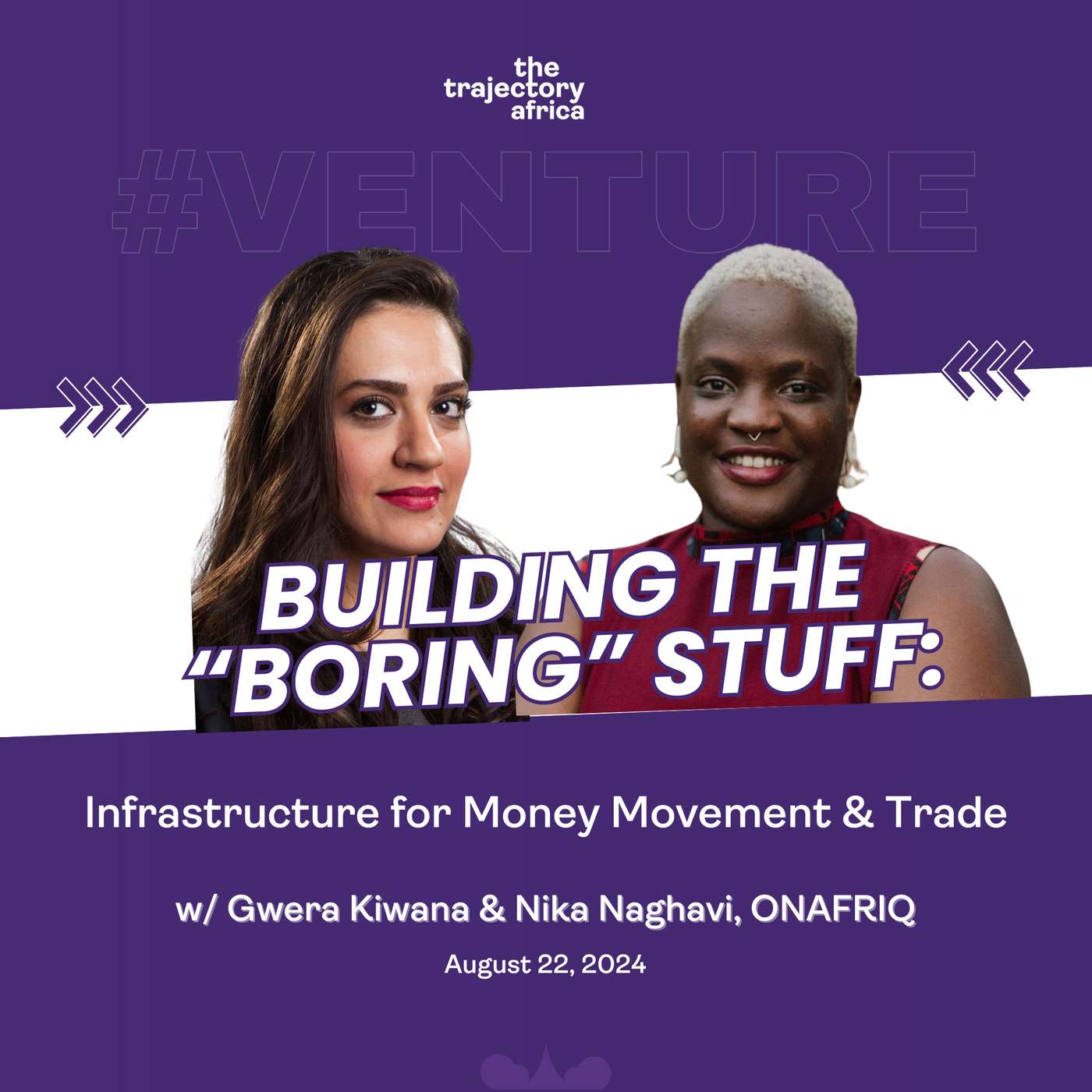
S2 Ep 11Building the "Boring" Stuff: Infrastructure for Money Movement & Trade
In Episode 1 of this series, Abraham Augustine, Research Partner of trendsAf and Comms and Programs Lead at Norrsken warned against “long arm, no mouth” syndrome and the risks of digitalizing one part of a system (distributed solar energy, for example) without considering where the barriers and effects might materialize (think missing payment rails). Infrastructure is great, but it can’t be half-baked, and those pipes need something to carry. That something is trade.Previous guests Samora Kariuki and Wiza Jalakasi both emphasized the power of interoperability—cross-continental (and international) money movement to catalyze the development of Africa’s digitally-enabled financial systems. And in the previous episode, ‘Tayo Bamiduro suggested that while physical infrastructure takes time to build, you can rapidly scale digital infrastructure to deliver inclusion, access, and inclusive growth. In this episode, I’m chatting with Gwera Kiwana, VP of Partnerships, Blockchain Payments for Onafriq and Nika Naghavi, Chief Network Officer, also of Onafriq, a “network of networks” that makes borders matter less. We dig into what it looks like to build infrastructure that connects mobile money networks, banks, fintechs and cash pick up points to support African trade. What role can crypto still play in fintech infrastructure? How does a cross-border payment work? And what are the implications of USD dominance in international trade? It’s all here. I hope you enjoy the conversation. Tune in to hear about:[2:25] - Role of crypto as enabling infrastructure for trade flows[9:40] - The role of USD in trade/Implications of USD dominance for international trade[13:16] - The evolution of Onafriq, market and channel expansion and acquisitions[27:55] - Anatomy of payment transactions and cross-border payments[39:01] - Distribution of infrastructure jobs to be done and the problems Onafriq solves[59:20] - Business model, competition vs. cooptition and future growth[1:08:00] - Counterintuitive first principleRecommendations:Chasing Outliers. Why Context Matters for Early Stage Investing in Africa, a report I co-authored on VC investing in Africa. Connect on social media:Gwera Kiwana on LinkedInGwera Kiwana on TwitterNika Naghavi on LinkedInNika Naghavi on TwitterThe Trajectory Africa on LinkedInTayo Akinyemi on LinkedInTayo Akinyemi on Twitter
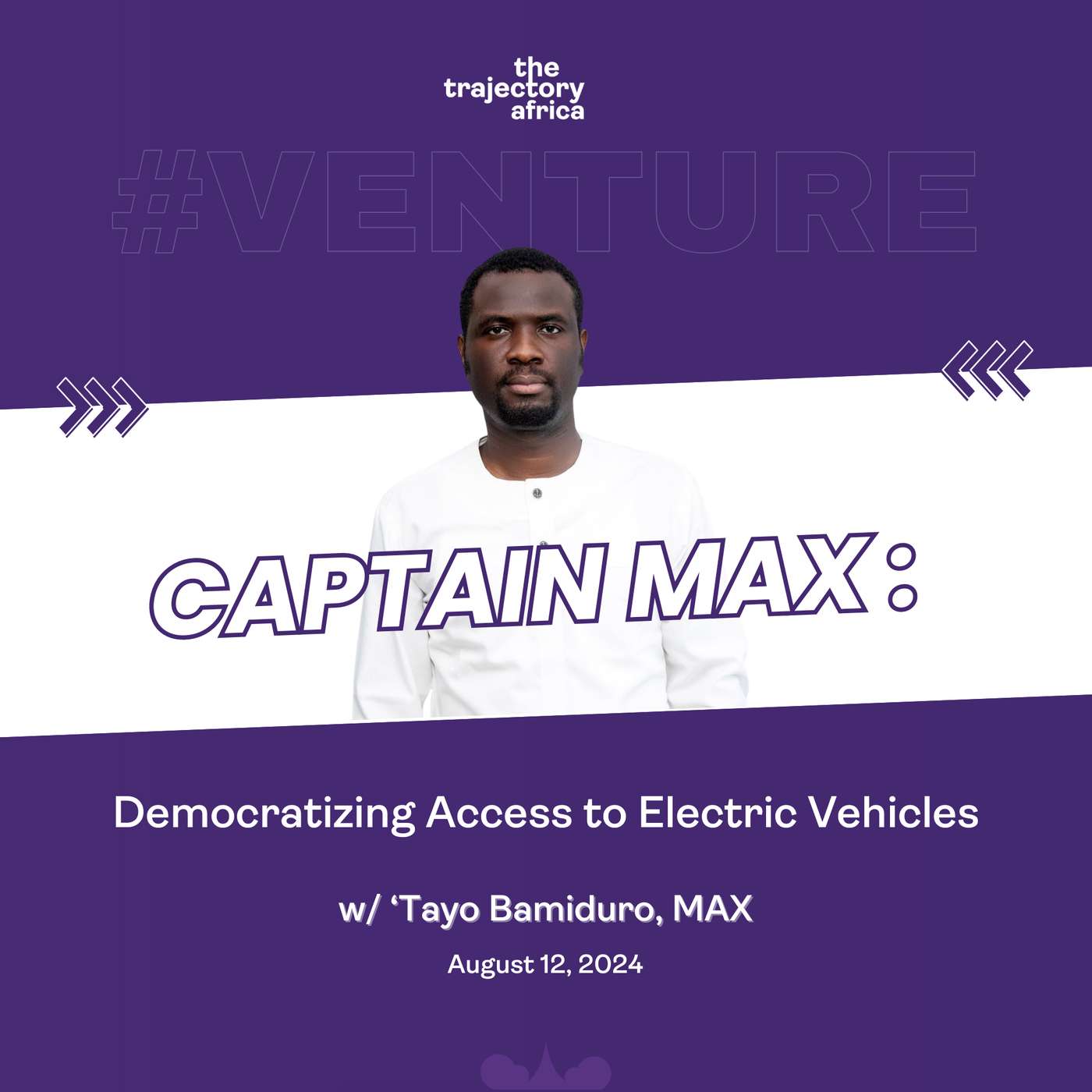
S2 Ep 10Captain MAX: Democratizing Access to Electric Vehicles
Back in Episode 7 of Trajectory Africa’s first series, Barbara Iyayi, CEO & Founding Partner of Unicorn Growth Capital made a strong statement about the ubiquity of financial services, arguing that every company should be a fintech company. Because as long as financial inclusion is a huge problem, every company should be able to offer financial services. This is the essence of embedded finance, which McKinsey defines as placing a financial product in a nonfinancial customer experience, journey, or platform. In the previous episode’s conversation with Tunzaa’s Ng’winula Kingamkono, we learned about how an embedded finance model called Save now, Buy later enables responsible consumption. In this episode, we’ll hear from 'Tayo Bamiduro, Co-Founder and CEO of MAX, a company that’s powering eco-friendly mobility through high performance electric vehicles. So, we’re keeping the assets, but shifting from consumption to production. And in this case the finance is in service of democratizing access to vehicles for mobility entrepreneurs. This flavor of embedded finance is called asset-based lending, or when a borrower's assets serve as collateral for a loan. But MAX isn’t just helping riders and drivers finance productive assets, it’s building the digital infrastructure needed to reimagine the mobility space with environmental sustainability at its core. Asset-based lending as an engine for EV-led mobility? Let’s dig in…Tune in to hear about:[2:08] - inspiration for MAX’s two-wheeler design[4:16] - the evolution of MAX’s business over time[9:12] - pillars for shepherding EV transition and market size [13:55] - MAX’s product offerings[18:44] - how credit decisions are made, sources of loan capital [23:00] - access to assets vs. ownership of assets and the best path to wealth creation [32:55] - integrating operator and vehicle productivity[55:00] - MAX’s business model, fleet financing, unit economics, and moat[1:13] - Collaboration vs. competition in nascent industries [1:21] - Counterintuitive first principle Recommendations:Chasing Outliers. Why Context Matters for Early Stage Investing in Africa, a report I co-authored on VC investing in Africa. Connect on social media:'Tayo Bamiduro on LinkedIn'Tayo Bamiduro on TwitterThe Trajectory Africa on LinkedInTayo Akinyemi on LinkedInTayo Akinyemi on Twitter
S2 Ep 9Save Now, Buy Later: A Culturally-relevant Approach to Consumption?
In the previous episode of The Trajectory Africa, we explored the art and science of community lending to microbusinesses. In this episode, we turn from business lending to consumer savings, but as an antidote to a consumer lending model called buy now, pay later, or BNPL. BNPL emerged as a global trend in the wake of COVID-19 and the tough macroeconomic environment that accompanied it. As inflation increased the cost of living, people started using these short term loans issued, after a quick credit check at the point of sale, to get by. According to Afridigest, these solutions also proliferated across the continent, delivered by companies like LipaLater, Klump and Float. But SNBL products, otherwise known as save now buy later, are being offered by innovators who believe that BNPL lacks a viable business model, promotes cyclical indebtedness in its users, and contradicts cultural norms that favor saving over lending. Ng’winula Kingamkono, Founder and CEO of Tunzaa is on a mission to transform the financial habits of everyday Africans (and improve the business operations of merchants while he’s at it). Tune in to hear about:[1:49] - Ng’winula’s “alter ego” [5:45] - Why save now buy later[8:15] - How Tunzaa works [16:28] - Building a two-sided marketplace, API first[25:06] - Savings vs. credit culture [30:50] - Product suite evolution and growth[47:27] Beliefs about consumption and the impact of the macroeconomic environment, consumer behavior [55:00] - Counterintuitive first principleRecommendations:Save now, buy later: an emerging fintech model. This episode is inspired by Afridigest’s reporting on the save now, buy later model. Chasing Outliers. Why Context Matters for Early Stage Investing in Africa, a report I co-authored on VC investing in Africa. Connect on social media:Ng’winula Kingamkono on LinkedInNg’winula Kingamkono on TwitterThe Trajectory Africa on LinkedInTayo Akinyemi on LinkedInTayo Akinyemi on Twitter
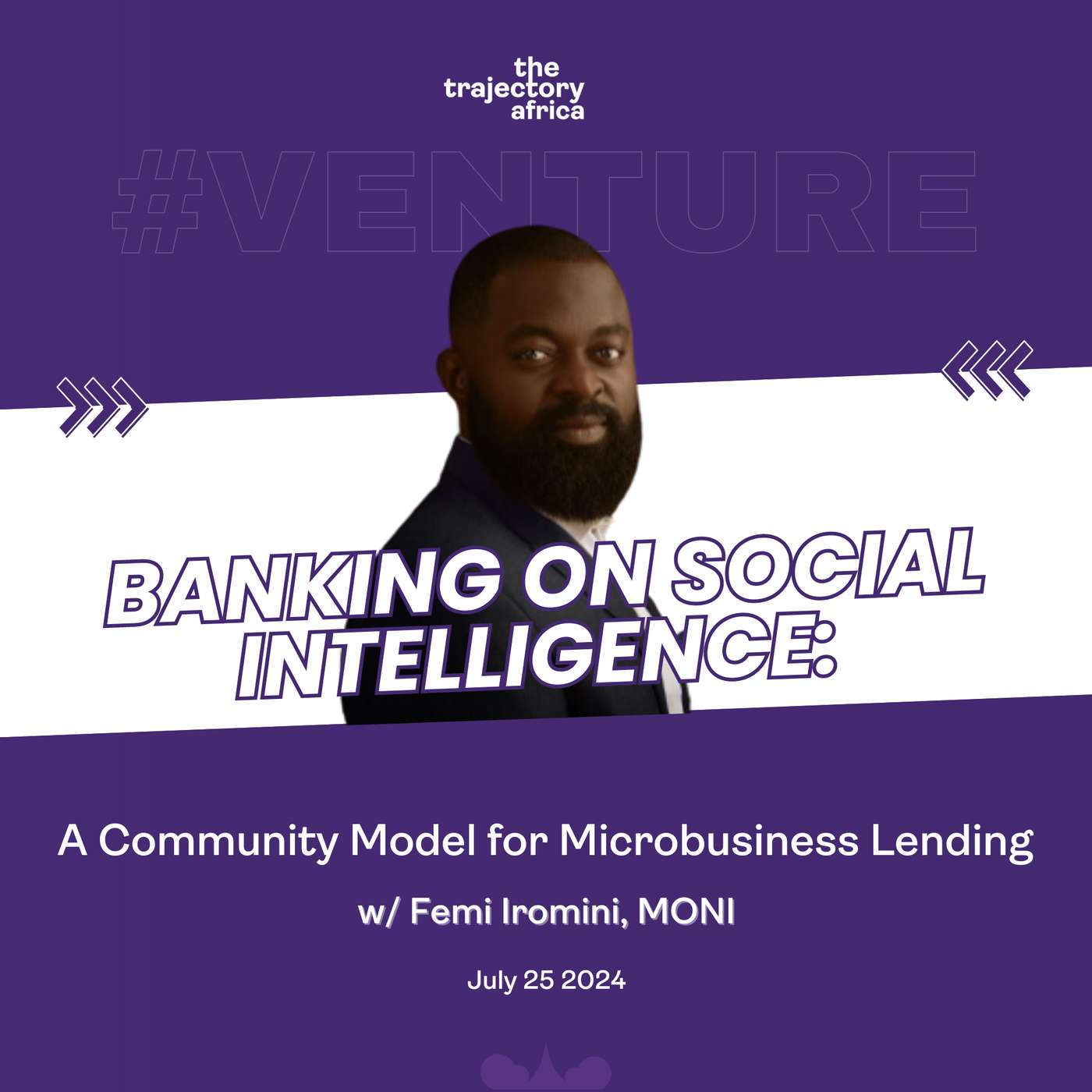
S2 Ep 8Banking on Social Intelligence: A Community Model for Microbusiness Lending
In the previous episode of the Trajectory Africa, we heard from Kiiru Muhoya and Judith Bogonko at Fingo about the importance of cultivating Africa’s youth as the next generation of retail consumers of financial services. In this episode, we’ll hear how Femi Iromini, Co-Founder and CEO of Moni, and his team, have created a community lending model for microbusinesses that has the DNA of a not completely neobank, if the "neo" in neobank, means digital only. The rule of thumb in lending is it’s easy to give money out, but difficult to get it back. But Moni’s approach suggests that if you use technology to make existing social structures like community savings groups (otherwise known as ajo or esusu in Nigeria, tontines in Francophone Africa, chamas in Kenya, stokvels in South Africa, sanduks in South Sudan, etc.) work better, you can leverage social intelligence to build trust, efficiently underwrite loans, and eventually create the foundations of a bank by and for the people. Tune in to hear about:[1:49] - Lessons learned from previous startup experience [6:44] - Definition of community banking and characteristics of a bank for Africa[12:00] - How community financing works at Moni[22:00] - How Moni’s community lending model impacts consumer acquisition and retention[25:45] - Loan terms and approach to recovery[35:33] - Moni’s business model and transition from community lending to retail (neo)banking[45:55] - Portability of trust and social intelligence underwriting as moat[51:47] - The importance of offline engagement and early signs of product market fit[59:39] - Counterintuitive first principleRecommendations:Chasing Outliers. Why Context Matters for Early Stage Investing in Africa, a report I co-authored on VC investing in Africa Frontier Fintech Newsletter. Mentioned in this episode, Frontier Fintech is an excellent primer on the fundamentals of fintech in Africa. Connect on social media:Femi Iromini on LinkedInFemi Iromini on TwitterThe Trajectory Africa on LinkedInTayo Akinyemi on LinkedInTayo Akinyemi on Twitter
S2 Ep 7Banking Africa's Ambitious: Anatomy of a Partner-Powered Neobank
According to research by global consultancy Simon-Kucher in 2022, fewer than 5% of neobanks were profitable. A recent update suggests that most are still loss-makers, although a path to profitability is emerging. Also in 2022, Tech Cabal’s reporting on Kuda Bank’s NPLs (non-performing loans) sparked a discussion about what levels make sense for companies doing instant loans. And in a brilliant series of episodes about African neobanks, Afrobility posed a fundamental question: how do you profitably sell financial services to customers traditional banks don’t want (because they’re unprofitable)? It’s an important question because many companies start by delivering a core service—p2p transfers, payments, saving, investment, lending. But as they fight to own the customer and increase market share, they migrate into other areas. We explored that dynamic in the last two episodes about cross-border payments and financial operations. After all, part of the high growth playbook is to dominate a beachhead market and expand into adjacent value added services. And what is the practical realization of that logic in fintech? A neobank, of course.In this episode with Kiiru Muhoya, Co-Founder and CEO of Fingo, “the bank for Africa’s ambitious” and Judith Bongoko, Fingo’s Chief Commercial Officer, we talked about two keys to solving this puzzle: 1) cultivating the next generation of financial services consumers; and 2) strategically partnering with banks. We also chatted about which starting point is the most strategic for a neobank and financial literacy as a workhorse ingredient in the secret sauce of customer retention. Tune in to hear about:[2:05] - Fingo’s mission and key functions of a banking system[7:16] - Fingo’s product journey[15:11] - Early signs of product market fit and best starting points for neobank building[26:42] - Growing the next generation of financial services consumers[33:00] - The yin and yang of partnering with Ecobank[49:14] - Regional dominance as a platform for partnership[57:36] - Fingo’s business model[1:01] - How a bank partnership aligns cost and revenue curves; CAC as a first mover [1:07] - Navigating competition when “winner takes all”[1:13] - Counterintuitive first principleRecommendations:Chasing Outliers. Why Context Matters for Early Stage Investing in Africa, a report I co-authored on VC investing in Africa Afrobility has done several excellent episodes on neobanks. They contributed greatly to background research for this episode:#24: Neobanks (African WealthTech Pt 2) - How TymeBank, Kuda & other digital banks are delivering banking services across Africa#34: Kuda Bank - How Nigeria’s most popular Neobank is scaling to offer financial services to “every African on the planet”#68: Branch - From Kiva to providing consumer loans and FinTech services across Africa and other developing markets#69: FairMoney - How the credit-led neobank is providing consumer loans and financial services across Nigeria, India and other developing markets#70: Carbon - How the credit-led neobank is providing loans, BNPL and financial services across Nigeria and Africa#71: TymeBank - How the South African Neobank is integrating digital and physical experiences to provide holistic financial services across emerging marketsConnect on social media:Kiiru Muhoya on LinkedInJudith Bongonko on LinkedInKiiru Muhoya on TwitterThe Trajectory Africa on LinkedInTayo Akinyemi on LinkedInTayo Akinyemi on Twitter
S2 Ep 6B2B Payments: Unseating Cash through Value Chain Integration
This episode of The Trajectory Africa features Yele Oyekola, Co-founder and CEO of Duplo, a company on a mission to streamline financial operations for African businesses. We’re diving deep into the world of digitizing financial operations, from payables and expense management to reconciliation and reporting. Africa’s $1.5T B2B payments market represents a massive opportunity in a space that’s ripe for innovation—think medium to large businesses in industries like FMCG, logistics and manufacturing. These companies have a lot of challenges like managing manual operations to navigating payment terms.But it’s not just about payments— it’s really about the unsexy business of digitizing financial operations. Digitizing payments bleeds into tackling financial operations as a whole—payments in the front, financial operations in the back. (Huge thanks to Gwera Kiwana for being first to apply the mullet metaphor to finance, specifically crypto.) And the dimensions of this opportunity, from money movement to workflow automation, are pretty interesting. In Episode 5, Verto’s CEO Ola Oyetayo made the connection between enabling cross-border payments and managing tasks like account receivables. With Yele, we dig into how to dislodge cash within a value chain by automating transactions across it.Tune in to hear about:[2:08] - The basics of b2b payments[15:50] - What Duplo does, how it started, and the size of the bizopps opportunity [22:55] - Acquiring customers’ customers [33:46] - Automating the key functions of a finance department[42:10] - Duplo’s tech stack and business model[56:21] - Value chain integration/infiltration as moat[1:02] - Counterintuitive first principleRecommendations:Chasing Outliers. Why Context Matters for Early Stage Investing in Africa, a report I co-authored on VC investing in Africa Connect on social media:Yele Oyekola on LinkedInDuplo on TwitterThe Trajectory Africa on LinkedInTayo Akinyemi on LinkedInTayo Akinyemi on Twitter
Thinking Differently: A Case for Venture Building in African VC
bonusOn this special episode of The Trajectory Africa, we’re featuring “someone you should know”—David Ogundeko, Founder and Chief Vision Officer for Funema, a last-mile, impact-focused, alternative investment company. David has spent the last 7 years creating a model to engineer and invest in problem solving, impact creating, high growth SMEs. In the process, he’s reimagining a VC model for Africa, and has built the operational muscle to back his claims. In this conversation, we’ll learn how David’s challenging experiences as a founder spurred him to create a model that protects founders and their impact potential while still building big, profitable businesses.The Trajectory Africa is helping David tell his story to support his bid to join the 11th cohort of VC Unlocked: Silicon Valley, 500 Global’s flagship investor education program. Help David get to Stanford in September by donating here.Tune in to hear about:[3:07] - The dangers of faux expertise[8:00] - Funema’s origin story[11:39] - How Funema confronts extractive capitalism[16:55] - Protecting founders’ equity in the context of a VC fund[32:06] - Funema’s impact on its portfolio[39:00] - Balancing mission and three paths to growth [49:56] - Thoughts on talent[1:00:27] - Finetuning how you communicate about your mission[1:09:57] - Counterintuitive 1st principleRecommendations:David's LinkedIn post on original thinking.Chasing Outliers. Why Context Matters for Early Stage Investing in Africa, a report I co-authored on VC investing in Africa Connect on social media:Funema on LinkedInDavid Ogundeko on LinkedInThe Trajectory Africa on LinkedInTayo Akinyemi on LinkedInTayo Akinyemi on Twitter
S2 Ep 5Cross Border Payments and the Alchemy of Price and Volatility
On this episode of The Trajectory Africa, we’re talking to Ola Oyetayo, Co-Founder and CEO of Verto, the first "all in one" cross-border payments platform for corporate treasuries in emerging markets. He’ll help us understand the mechanics of cross-border payments, why they're so expensive in Africa, how to improve price transparency and manage volatility, and how supporting cross-border payments evolves into accounts payable workflows. We're picking up a theme that emerged in Episode 2, when Samora Kariuki highlighted intercontinental money movement as an “unlock” for the rest of the (digital) financial system. Similarly, Wiza Jalakasi from Episode 3 argued that money should move the way Africans and their business activities do—across borders. Finally, in the last episode with Sassoum Niang on building payments infrastructure, she emphasized that the tech isn’t the hardest part. It’s the financial operations—reconciliation, accounting system integration, and currency settlement. So, we’re pulling on all those threads in this conversation with Ola.Tune in to hear about:[2:14] - Sharing Verto’s origin story during a product launch[7:08] - The problems in cross-border payments that Verto solves [11:53] - The role of price transparency and what causes volatility[28:49] - How cross border payment facilitation evolves into supporting business operations[49:37] - The business of moving money across borders [56:17] - Counterintuitive first principleRecommendations:Chasing Outliers. Why Context Matters for Early Stage Investing in Africa, a report I co-authored on VC investing in Africa. Connect on social media:Ola Oyetayo on LinkedInThe Trajectory Africa on LinkedInTayo Akinyemi on LinkedInTayo Akinyemi on Twitter
S2 Ep 4A Wordline Playbook for Africa: from Payments Infrastructure to Solutions
On the previous episode of The Trajectory Africa, Wiza Jalakasi, Africa Market Development Director at EBANX suggested that infrastructure-building consumer payments businesses create value because of the sheer number of payment methods available, from mobile money to bank transfers and cards. With all these options, businesses taking consumer payments need a neutral third party to provide a single point of aggregation. But what does it *actually* take to build this type of infrastructure? What are the mechanics behind aggregating and routing payments? Is tech the hardest part, or is it business, finance and operations? And how do you transition from aggregator to b2b super app? On this episode of The Trajectory Africa, we’re talking to Sassoum Niang, Director of Product & Marketing at InTouch about how you build pan-African “air traffic control” that allows businesses to collect payments in whatever form they come in. Tune in to hear about:[1:25] From film and e-commerce to payments at InTouch[5:34] About InTouch and the problems it solves[11:54] InTouch’s core infrastructure[30:36] How partnerships help adapt to market and distribute strategically[46:02] The business of infrastructure building[51:00] Pressing problems remaining to be solved for payments to be functional [1:05] Counterintuitive first principle for building a high growth payments infrastructure businessRecommendations:Chasing Outliers. Why Context Matters for Early Stage Investing in Africa, a report I co-authored on VC investing in Africa Connect on social media:Sassoum Niang on LinkedInSassoum Niang on TwitterThe Trajectory Africa on LinkedInTayo Akinyemi on LinkedInTayo Akinyemi on Twitter
S2 Ep 3The Hard Thing about (Consumer) Payments in Africa
On this episode of The Trajectory Africa, we’ll hear from Wiza Jalakasi, Director for Africa Market Development at EBanx, a payments processor headquartered in Brazil. He’ll shed some light on why building payment rails in Africa is deceptively hard work—from why some payment methods work better in some places than others to whether infrastructure-building or enabling payments through APIs is the best way to create value.Tune in to hear about:[5:41] Key milestones in payments infrastructure creation[11:53] Why certain payment methods gain traction in different areas[15:39] How consumer payments work and what the infrastructure looks like[26:11] Back end infrastructure builders vs. API players [33:30] VC leapfrogging logic vs. the path toward building a massive payments infrastructure business [46:34] Similarities in payments problems across emerging markets[52:50] Pressing problems remaining to be solved for payments to be functional [1:00] Counterintuitive first principleRecommendations:Wiza Jalakasi. Wiza’s website, including his writingFrontier Fintech, Samora Kariuki's newsletter, mentioned by WizaThe Hard Thing About Subscription Payments in Africa. The piece Wiza referenced in this episodeThe Subtext. A newsletter written by Osarumen Osamuyi, referenced by WizaChasing Outliers. Why Context Matters for Early Stage Investing in Africa, a report I co-authored on VC investing in Africa Connect on social media:Wiza Jalakasi on LinkedInWiza Jalakasi on TwitterThe Trajectory Africa on LinkedInTayo Akinyemi on LinkedInTayo Akinyemi on Twitter
S2 Ep 2Beyond Fintech? On building financial systems in Africa
On this episode of The Trajectory Africa’s current series, "The Engine of African Venture: A Return to First Principles", we’re laying the foundation for a deeper exploration of fintech by stepping back to understand the system(s) that fintech creates and operates in. For that, we’re chatting with Samora Kariuki, Founder of the Frontier Fintech newsletter and Director at Sote, a company that’s building African supply chain infrastructure, about the goals and characteristics of Africa’s financial system(s). Tune in to hear about:[3:03] Why Samora launched Frontier Fintech newsletter and the benefits of “writing out loud”[7:09] What problems fintech solves [17:58] Characteristics of a functional financial system and the value it should deliver [23:25] Why Africa's financial system needs technology and how it works in cash-driven, informal economies[36:00] How much of Africa’s financial systems remain to be built[47:05] What infrastructure layer will catalyze the rest of the system[51:56] Consolidation vs. integration in fintech[55:53] First principle for understanding what Africa’s digitally enabled financial system will look likeRecommendations:Frontier Fintech, Samora’s newsletterThe anatomy of a fintech stack: enterprise businesses in South Africa, a hypothetical fintech stack for an established enterprise business in South AfricaChasing Outliers: Why Context Matters for Early Stage Investing in Africa, a report I co-authored on VC investing in Africa Connect on social media:Samora Kariuki on LinkedInSamora Kariuki on TwitterThe Trajectory Africa on LinkedInTayo Akinyemi on LinkedInTayo Akinyemi on Twitter
S2 Ep 1Long arm with no mouth: The physical limits of Africa's digital economy
This is the first episode of Part 1 of a new series on The Trajectory Africa —The Engine of African Venture, A Return to First Principles. This series will explore what powers fundamental value creation and investability in sectors that drive the bulk of African VC opportunities.Part 1 is focused on fintech, and this episode with Abraham Augustine, Comms & Programs Lead for Norrsken, tackles the premise that digitalizing African economies is the African investment opportunity. Abraham shares his perspective on how digital Africa’s digital economy can actually be and how this impacts the way venture capital is invested. Tune in to hear about:[3:43] why Augustine authored a series on Africa's digital economy[6:05] how Africa’s digital economy can defined and the venture-backable opportunity in digitalization[18:40] the physical constraints of “digital” opportunities and investing for bytes vs. atoms[30:20] market knowledge as a key to anti-fragility[40:21] African unicorns hiding in the “crevices” of shifting markets [55:00] the systems effects of digitalization in digital economies[1:03] why momentum fails as a first principle for investing in Africa’s digital economyRecommendations:Read Abraham’s writing on Africa’s digital economy on Tech Cabal:Next Wave: The social questions around Africa’s digital economyThe Next Wave: A data centre roadmap for AfricaThe Next Wave: A digital economy is, above all, physicalThe Next Wave: How Africa’s digital infrastructure gap manifestsThe Next Wave: Africa’s power deficit is at odds with its digital economy goalsConnect on social media:Abraham Augustine on LinkedInAbraham Augustine on TwitterThe Trajectory Africa on LinkedInTayo Akinyemi on LinkedInTayo Akinyemi on Twitter
The Engine of African Venture: A Return to First Principles
trailerThe Trajectory Africa’s second series, The Engine of African Venture: A Return to First Principles, is a two-part exploration of what powers fundamental value creation and investability in sectors that drive African VC opportunities. The first part is focused on fintech, starting from the premise that digitizing African economies is the African investment opportunity. From this foundation, the series will explore fintech’s subsectors—from market opportunities to business models—to tease out why they are (or aren’t) destinations for venture capital. For a recap of the previous series, check out The Trajectory Africa Rewind: Principles for Understanding African Venture.
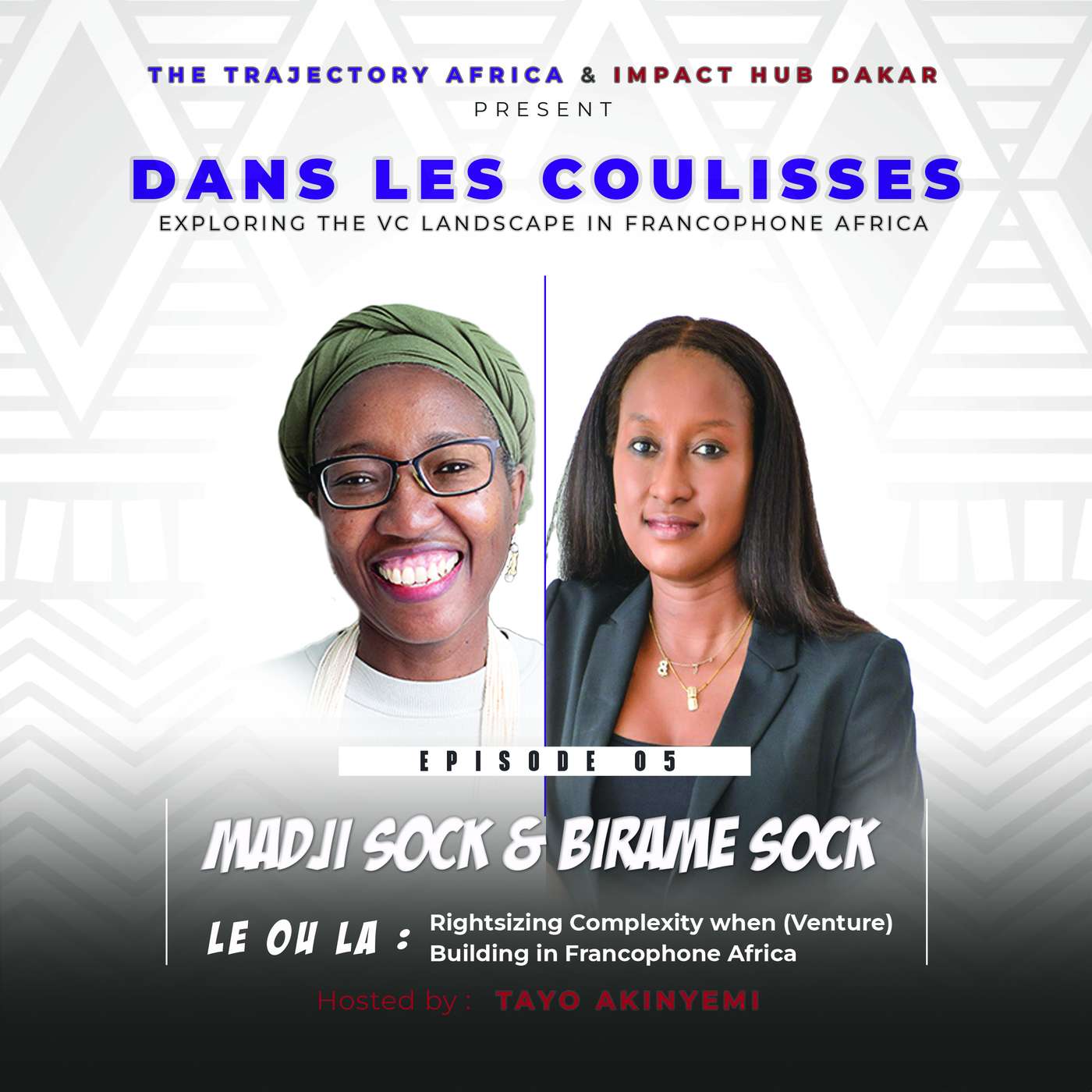
S1 Ep 15Le ou La: Rightsizing Complexity when (Venture) Building in Francophone Africa
Welcome to Episode 5, the next to last of Dans les Coulisses, a series exploring VC and tech entrepreneurship in Francophone Africa, brought to you by Impact Hub Dakar and The Trajectory Africa. For this episode, we have two guests: Birame Sock and Madji Sock. Birame Sock is a technology expert with over 20 years of experience as a tech entrepreneur and high-level executive in the digital space. She recently founded Kwely, a B2B wholesale sourcing marketplace that showcases products made in Africa. Birame is also a co-founder of Haskè Ventures, a venture-builder and investment fund focused on high potential Francophone companies. She has served on several boards, including a publicly traded company valued at over a billion dollars, where she helped develop digital strategies for major entertainment brands such as American Idol. Birame is the jury president of the Francophone Africa region for the Cartier Women’s Initiative Award; serves on the jury of the Jack Ma Foundation’s Africa Business Heroes competition; and is an ambassador representing Francophone Africa for the UNCTAD eTrade for Women program.Madji Sock is a seasoned entrepreneur and senior manager. She is a co-founder and President of Haskè Ventures, a venture-builder and investment fund focused on high potential Francophone companies. She launched a consulting firm in Senegal, which later expanded to three other West African countries. Madji has also co-founded the Women’s Investment Club Senegal, from which WIC Capital, a fund focused on women-owned businesses in Senegal and Côte d’Ivoire, emerged. In addition to co-founding an incubator in Dakar, she has launched, and currently manages, a chain of cafés. Madji has designed numerous programs and initiatives to strengthen the private sector, drive policy change, and build partnerships.In this episode, we discuss:Birame’s entrepreneurial crossroads and what motivated her to return to Senegal [2:02]Why Madji returned, her professional journey, and the launch of Haskè Ventures [4:45]What need Birame’s company Kweli was launched to to serve [9:00]Why venture building makes sense when startups have to build infrastructure [14:30]How to characterize the regional opportunity in Francophone Africa [33:00]The role of blended capital and M&A in funding and exiting African businesses [41:30]How African founders and investors should navigate “winter” in global VC [51:10]
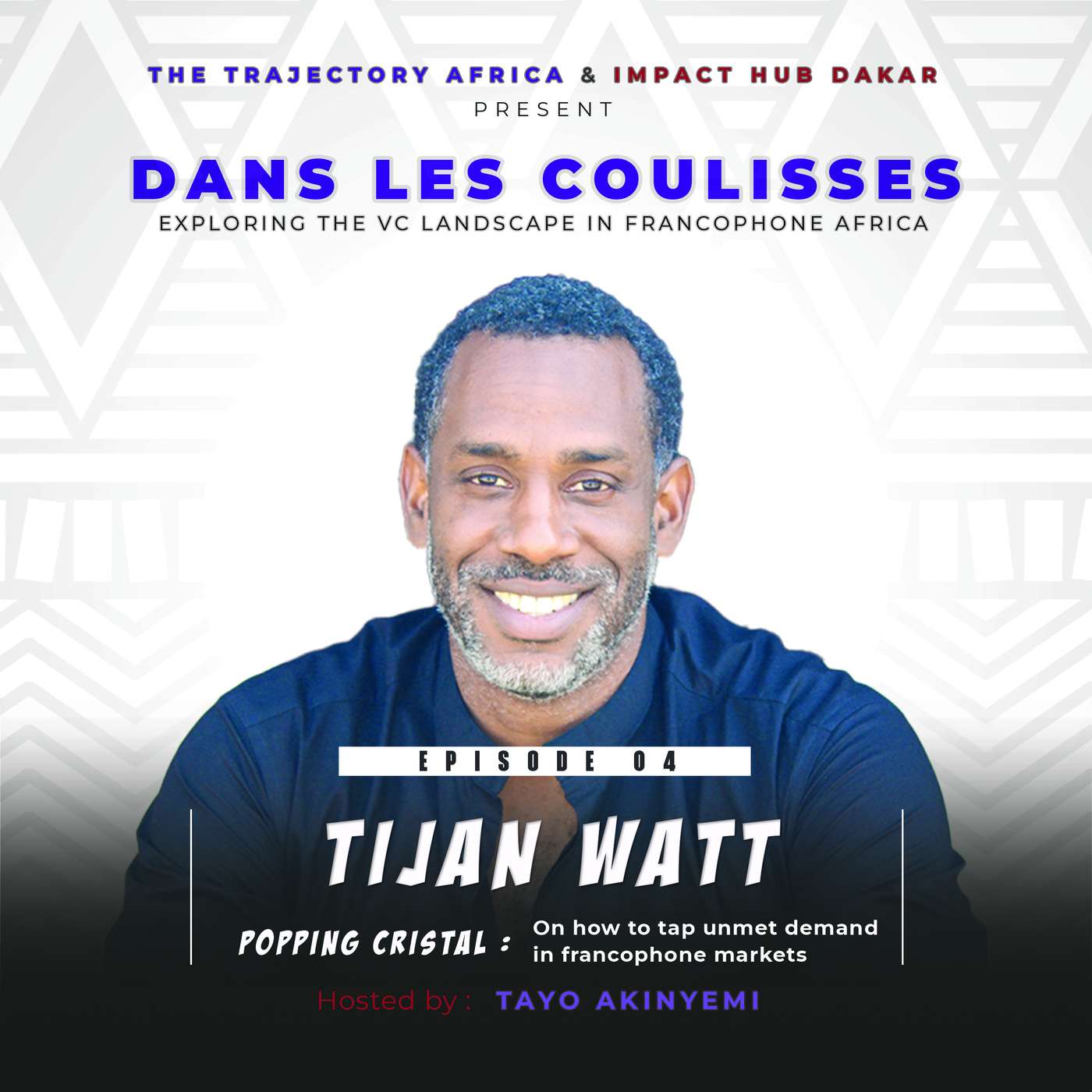
S1 Ep 14Popping Cristal: On How to Tap Unmet Need in Francophone Markets
Welcome to Episode 4 of Dans les Coulisses, a series exploring VC and tech entrepreneurship in Francophone Africa, brought to you by Impact Hub Dakar and The Trajectory Africa. This episode’s guest is Tijan Watt. Tijan is a Co-Founder and General Partner of Wuri Ventures, a pan-African venture capital fund focused on pre-seed and seed opportunities. Tijan has spent 20 years as an operator, building companies in Senegal and in the US, and as an investor, working in investment banking at Goldman Sachs, and private equity at Travant Capital Partners. Tijan graduated summa cum laude with a BA from Howard University in mathematics and computer science, and holds an MBA from Harvard University. Tijan writes about all things “business in Africa” at www.tijanwatt.com.In this episode, we discuss:Why demand is truly unlimited in Africa [1:54]Why rethinking a sector-centric thesis might be a good idea [9:02]Why the UEMOA zone has an underappreciated competitive advantage [13:43]How startups delivering public goods is a venture-scale opportunity [22:28]Why investing in the “real economy” unlocks $4 trillion in value [26:06]How to know if your investable trend has “legs” [28:22]Why affordability is the key to cracking “informal” markets [35:00]What drives capital flow into the UEMOA region [43:03] The bankability of soft power in Africa [51:32]
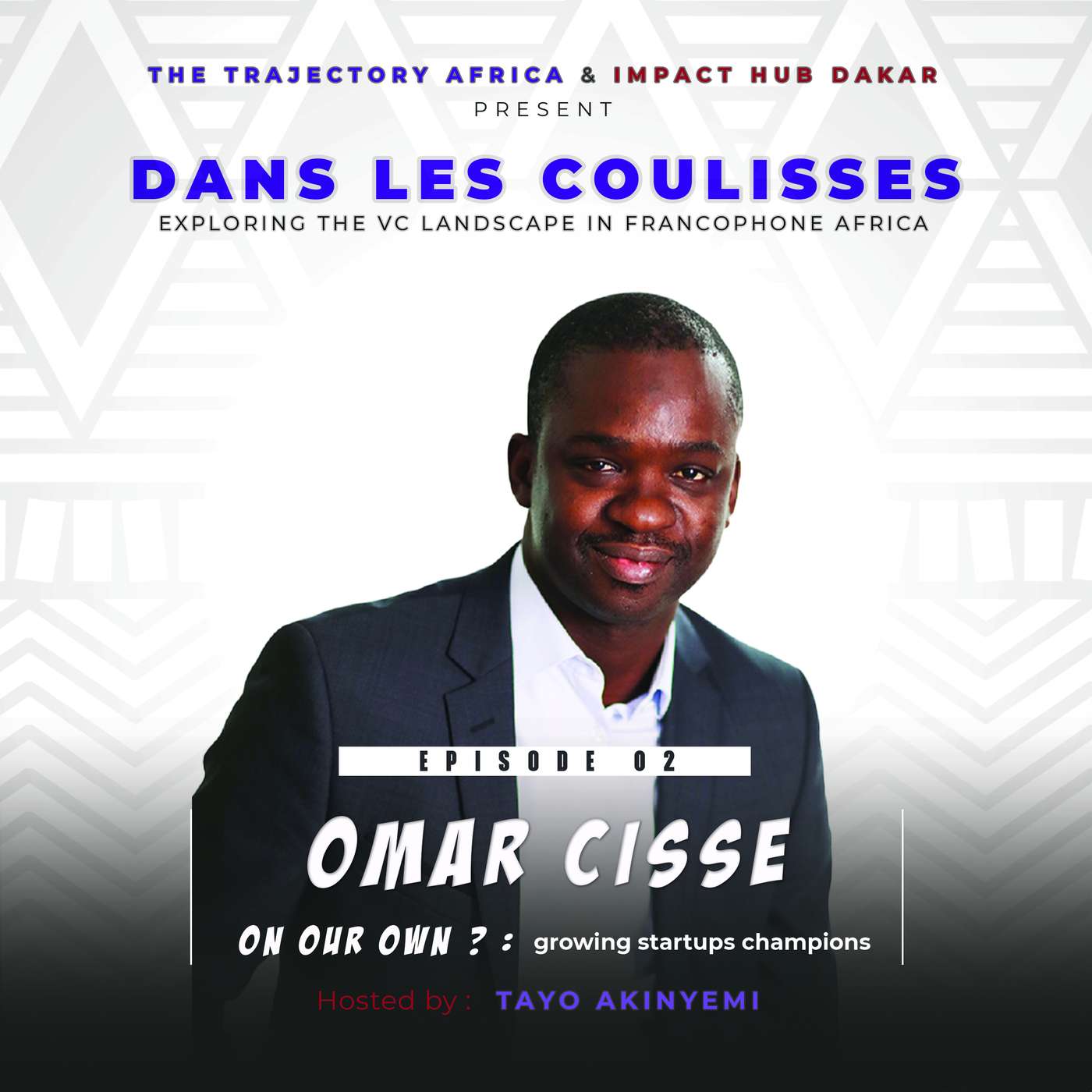
S1 Ep 13On Our Own?: Growing Francophone Startup Champions
Welcome to Episode 2 of Dans les Coulisses, a series exploring VC and tech entrepreneurship in Francophone Africa, brought to you by Impact Hub Dakar and The Trajectory Africa. Impact Hub Dakar is a Dakar-based incubator that supports early stage startups in Senegal, with a mission to help investors meet scalable, early stage startups in Francophone Africa. The Trajectory Africa is a “pop-up” podcast exploring the trajectory, or pathway, of venture capital and startup formation in Africa.This episode’s guest is Omar Cissé. Omar is the Founder and CEO of InTouch, a platform that is working to increase financial inclusion in Africa. The platform has 50,000+ TouchPoints across 14 countries, with more than 400 services available, generating more than 2 billion euros in transaction volume per year. In 2010, he launched CTIC Dakar, the first ICT incubator in Senegal, which he managed until 2013. Prior to CTIC, he co-founded 2SI, a company specializing in software engineering, which he led from 2005 to 2010. Omar is also the co-founder of Teranga Capital, an investment fund he launched in collaboration with Investisseurs & Partenaires, an impact investment group dedicated to SMEs based in Sub-Saharan Africa and the Indian Ocean. He is an engineer by training, with a degree from the École Supérieure Polytechnique of Dakar and an MBA from the Institut Supérieur de Management.In this episode, we discuss:InTouch’s scale and expansion journey [2:12]VC opportunities in Francophone Africa and the importance of talent [8:52]Structure, challenges, and means to improve the Senegelese startup ecosystem [10:55]Investing category leaders, or industry “champions” [16:50]Signs of progress in the Senegalese startup ecosystem [23:31]Size, characteristics and constraints of Francophone markets [29:10]Sub-market differences in terms of regulation and talent [38:25]Problematic stereotypes about Francophone Africa [47:00] NOTES:At 18:35, I meant to say “imported to domestically produced” instead of “domestically produced to imported”.At 24:40, CFA = FCFA.This episode was recorded in July of this year, which makes the comment at 46:08 about Sequoia Capital calling for sustainable growth, a bit ironic in the aftermath of FTX’s collapse. There’s also the question of whether African startups/to what extent African startups held to the profitability mentioned.
S1 Ep 12The Trajectory Africa Rewind: Principles for Understanding African Venture
Welcome to The Trajectory Africa: Rewind, the summary episode for the Trajectory Africa, a "pop-up" podcast series exploring the trajectory, or pathway, of venture capital and startup formation in Africa. Over the course of 11 episodes, the series has explored: the key characteristics of African markets; the opportunities presented by digital commerce, SME financing and fintech, and how they power the broader venture opportunity; what drives fund performance in terms of economics and structure; how funds raise money; and how LPs make investment decisions. The Rewind features key insights from the series, distilling them into six “principles” (or principles in training) that help explain the emerging logic behind VC opportunities in Africa. In this episode, we break down these principles:Now is the time for Africans to solve their own problems and build their own future.The future of African venture opportunities is digitizing African economies.African consumers may have limited purchasing power, but it’s possible to increase and enable consumption.Fintech is an important enabler for digitizing African economies because it provides foundational infrastructure. SMEs power tech startups by buying from them, and funding and supplying SMEs is a VC-scale opportunity.Africa-focused funds (as do most VCs), have an uphill battle to develop working business models.It also presents some thoughtful observations about the challenges faced by African (women) GPs as they raise funds, and what impact the impending global slowdown will have on African VC opportunities. "Guest Artists" Featured in this Episode:Abieyuwa Obaseki, Senior Associate, Stears DataAdenike Sheriff, Fund Operations, Future Africa | @AdenikeRaksBabacar Seck, Senior Investment Officer, Venture Capital & Private Equity, ProparcoBarbara Iyayi, CEO & Founding Partner, Unicorn Growth Capital | @barbara_iyayiDanai Musandu, Senior Investor Relations Associate, HPE Growth | @DanaiMusanduDotun Olowoporoku, Chief Commercial Officer, TeamApt | @DrDotunEghosa Omoigui, Managing General Partner, EchoVC | @EghosaOKuhle Mnisi Masilo, Associate, Transaction Management and Consulting, Roots of Impact Jake Kendall, Founder and Director, DFS Lab | @JakeKendall5Tony Chen, Partner, Verdant Frontiers | @tonyschenFeatured Resources and Recommended Track:Chasing Outliers: Why Context Matters for Early Stage Investing in Africa (report)https://kinyungu.com/chasing-outliers/Way Less Sad. AJRhttps://www.youtube.com/watch?v=VlVhUbGa2pgDJ Saphir’s Spotify Playlist:https://spoti.fi/2RS6hTc
S1 Ep 11Tracing Roots: The Role of LPs in African Venture Ecosystem(s)
Welcome to Track 11 of The Trajectory Africa, a podcast series exploring the trajectory, or pathway, of venture capital and startup formation in Africa. This episode’s guest artist is Babacar Seck. Babacar is an investor passionate about projects that drive inclusive development, from education to healthcare and financial services. As a senior investment professional at Proparco, he focuses on designing and deploying a €200M venture capital program to fund and support African entrepreneurs while also managing a global investment portfolio of banks, insurance, and fintech. Prior to Proparco, Babacar led key areas of strategy and development for AXA, a €1 trillion insurance firm, working under the Chairman and CEO. In his spare time, Babacar supports Africa-focused initiatives, as the Chair of the Sciences Po Alumni Africa Division, and as a member of Africultures and the Association of African Actuaries, respectively.In this episode, the final one of the series, we discuss:How Babacar started his career in venture capital and private equityProparco’s distinct characteristics as an LP and how it evaluates GPsHow DFIs’ ESG standards have benefitted African VCCommon mistakes that GPs make while fundraising and how the process works against themWhy African, women, and first-time GPs struggle to raise moneyWhat drives (African) fund underperformance and how LPs can helpWhat micro and macro factors will drive adjustments in the African VC spaceBabacar’s Recommendations & Featured Resources:Proparcohttps://www.proparco.fr/enSpiritual. Burna Boyhttps://www.youtube.com/watch?v=Coj0yQaItesChasing Outliers: Why Context Matters for Early Stage Investing in Africa (report)https://kinyungu.com/chasing-outliers/DJ Saphir’s Spotify Playlist:https://spoti.fi/2RS6hTc
S1 Ep 10Listening with Empathy: Fundraising beyond Spreadsheets
Welcome to Track 10 of The Trajectory Africa, a podcast series exploring the trajectory, or pathway, of venture capital and startup formation in Africa. This episode’s guest artist is Danai Musandu. Danai is a Senior Investor Relations Associate at HPE Growth, where she leads and supports the public and investor relations function, with a focus on fundraising and strategic communication. Prior to HPE, Danai was an Investment and Investor Relations Associate at Goodwell Investments, an early-stage technology private equity firm focused on emerging markets and impact investing. Danai is an advisory board member of Private Equity International and the Africa Trust Group, and holds a BCom. in politics, philosophy and economics, as well as a postgraduate honors degree in Economics from the University of Cape Town.In this episode, we discuss:How Danai launched her career in venture capitalWhy she pivoted from investing to investor relationsThe fundraising process in investor relations (IR), and how it differs by LP typeWhat LPs look for when they evaluate fundsThe do’s and don’ts of raising moneyWhy deep listening and cultural multi-linguality are super powers for IR professionalsDanai’s Recommendations & Featured Resources:HPE Growthhttps://hpegrowth.com/“It Is Not the Critic Who Counts”. Thomas Roosevelthttps://www.goodreads.com/quotes/7-it-is-not-the-critic-who-counts-not-the-manSummer YoMuthi. Black Diamondhttps://www.youtube.com/watch?v=AagjAUE8U8s&ab_channel=AmbitiouzEntertainmentChasing Outliers: Why Context Matters for Early Stage Investing in Africa (report)https://kinyungu.com/chasing-outliers/DJ Saphir’s Spotify Playlist:https://spoti.fi/2RS6hTc

S1 Ep 9Breaking Boundaries: Building Wealth & Community through African VC
Welcome to Track 9 of The Trajectory Africa, a podcast series exploring the trajectory, or pathway, of venture capital and startup formation in Africa. This episode’s guest artist is Adenike Sheriff. Adenike is the Co-founder of Future Africa, a fund manager that invests early in mission driven founders solving hard problems for large markets. Prior to Future Africa, Adenike focused on content strategy and storytelling for technology companies in Africa and beyond. Her work has appeared in various international publications including the Huffington Post.In this episode, we discuss:How Adenike plotted an “unlikely” path into VCHow Future Africa came to be and why Adenike’s “blank slate” thinking inspired the birth of Future Africa CollectiveWhy market-creating innovations constitute a significant investment opportunityWhat thorny challenges can emerge while you’re innovatingWhat opportunities lie ahead for Future AfricaNote: This conversation was recorded in September 2021.Adenike’s Recommendations & Featured Resources:Future Africahttps://future.africa/Future Africa podcasthttps://future.africa/blog/category/podcast/Christiansen, C., Ojomo, E., & Dillon, K. (2018). The Prosperity Paradox: How Innovations Can Lift Nations Out of Poverty. https://www.christenseninstitute.org/books/the-prosperity-paradox-how-innovation-can-lift-nations-out-of-poverty/Chimanada Ngozi Ndichiehttps://www.chimamanda.com/Chasing Outliers: Why Context Matters for Early Stage Investing in Africa (report)https://kinyungu.com/chasing-outliers/DJ Saphir’s Spotify Playlist:https://spoti.fi/2RS6hTc
S1 Ep 8Fun with VC Math: Designing Funds & Exits in Africa
Welcome to Track 8 of The Trajectory Africa, a podcast series exploring the trajectory, or pathway, of venture capital and startup formation in Africa. This episode’s guest artist is Eghosa Omoigui. Eghosa is the founder and Managing General Partner of EchoVC Partners, a seed and early-stage technology venture capital firm investing in underrepresented founders and underserved emerging markets. Prior to Echo, Eghosa worked for Intel, and in his last role served as the Director of Consumer Internet & Semantic Technologies for Intel Capital. A Kauffman Fellowship mentor, Eghosa is also engaged with organizations that support women founders and angel investors such as Astia, where he’s on the Venture Advisory Board, and Rising Tide Africa, where he’s a Board member. He attended law school at the University of Nigeria and University of Pennsylvania and business school at Babson College.CORRECTION: In the intro to this episode, I erroneously referred to Eghosa as a Kauffman Fellow. He is a mentor for theKauffman Fellowship. Also, EchoVC is always EchoVC, not Echo.NOTE: If you're struggling with the mental math featured in this episode, please see the FAQ with Eghosa at the bottom of the show notes. It should help to clarify the underlying logic. In this episode, we discuss:Why EchoVC aspires to be the Sequoia Capital of emerging marketsWhy consumer market opportunities are tough to crackWhat it *actually* takes to return a $50M fund (Spoiler alert: It’s harder than you think.)Why valuation and ownership impact fund outcomes so significantlyWhy investing in women (among other things) is a key element of portfolio constructionA mini case study on hypothetical fintech company Moolah Mountain to explore how investing decisions impact fund economicsEghosa’s Recommended Track & Featured Resources:Waiting to Exhale (Original Soundtrack Album)https://www.youtube.com/playlist?list=OLAK5uy_lLUDutopD_tC2JQt6m7FDQtoN6hXIFtp4EchoVC Partnershttps://www.echovc.com/The meeting that showed me the truth about VCs. Tomer DeanThis is an easy to follow primer for understanding how exits affect fund performance.https://techcrunch.com/2017/06/01/the-meeting-that-showed-me-the-truth-about-vcs/What Informs an Investor’s Valuation of a Startup? Kolade Aderelehttps://render.capital/blog/what-informs-an-investors-valuation-of-a-startup/Thoughts on Y Combinator’s New Deal. A Perspective from Emerging Markets. Oo Nwoyehttps://oonwoye.com/2022/01/12/thoughts-on-y-combinators-new-deal-a-perspective-from-emerging-markets/Chasing Outliers: Why Context Matters for Early Stage Investing in Africa (report)https://kinyungu.com/chasing-outliers/DJ Saphir’s Spotify Playlist:https://spoti.fi/2RS6hTcFAQ with Eghosa:Why does it take $500M to 1X a $50M fund and $1.35-1.4B to 3x a $50M fund? Portfolio construction is the short answer. If you assume you own 10% of a startup at exit, then $500m of enterprise value created returns $50m. So it's not solely a scenario where a company in the portfolio exits at $500m, but what percentage you own at the exit. By the time you assume dilution, it gets harder to own 10% at exit.2. Why does it take 10 Paystacks to return a $50M fund? With Paystack, assume the exit multiple was 14.4x and assume you invested $1m into it. That is a $14.4m return sans dilution. You'd need to do that 10 times to return ~3x the fund. This is not impossible but the assumptions about the entry price and the dilution that occur during the path to exit mean that the Paystack example is unusual. It raised just a Seed and a Series A prior to its $200m exit so the dilution was not material. Many companies may raise 3 or 4 times and that is where your starting ownership goes to die. I have seen quite a few Series Es and Fs. Series Gs and Hs exist.3. How do the outcomes change when you introduce failure rates?A ten-year $50m Africa fund with a 2.5% fee and expenses may leave you ~$38m to actually invest but let's use $35m of investable capital to illustrate. Let's say your strategy is to invest $1m checks, and assume you reserve $10m to defend your pro rata in certain deals. FWIW, a 20% reserve ratio is on the low side and it's more common to see 30-50% of the fund set aside for reserves.You make 25 investments (25 * $1m = $25m), and your avg postmoney entry valuation is $10m so you buy 10%. Then you apply your reserves to defend your pro rata at the A (which are usually $15m+ rounds) so your check size is say, $1.5m. That means you can do ~6 follow-ons to protect your initial 10% holding.If all 6 exit after that point so they don't raise again (almost statistically impossible), then you hold 10% of the aggregate exit value. You would have invested $2.5m ($1m initial check plus a $1.5m follow on) into each of the 6. Assuming they are all Paystack type exits at $200m (sure, everyone thinks they will be unicorns but actual exit data belies that) then your gross return from the 6 companies is $120m (10% * $200m per company * 6 companies). But r
S1 Ep 7Perception vs. Reality: How Fintech is Driving Africa's Digital Economy
Barbara Iyayi is an entrepreneur and investor with over 16 years of experience in venture capital, growth equity, and financial services. She has founded, invested in, scaled and advised, fintech and financial services companies globally. Currently, Barbara is the CEO & Founding Partner of Unicorn Growth Capital, an early-stage VC firm investing in the future of fintech. She also sits on the board of the World Wide Web Foundation. Prior to launching Unicorn, she was the Chief Growth Officer and Managing Director for Africa of Element, a pioneer of mobile deep learning, and served as the Board Chair of Appzone, a fintech infrastructure platform enabling the delivery of digital financial services in Africa. Barbara was a member of the founding team of Atlas Mara, Africa’s first SPAC, and conducted $15 billion in global transactions for JPMorgan and UBS. Barbara received a Bachelor of Science degree in Electrical Engineering and Computer Science from Columbia University, and an MBA from Harvard Business School.In this episode, we discuss:Why Barbara believes that African fintech is a lucrative investment opportunity How fintech will help digitize the transactions of Africa's consumers and businesses, and catalyze its digital economy How Barbara leveraged her understanding of the fintech opportunity to overcome bias and raise her first fundWhat LPs get wrong about investing in new fund managers and African venture Barbara’s Recommended Track & Featured Resources:My Life. Mary J. Bligehttps://www.youtube.com/watch?v=D0eF8P177fA&list=OLAK5uy_mUVX4_2ajHRsfFeTLdtWZd78OqUwLMzm8Unicorn Growth Capital https://www.unicorngrowthcap.com/Invest in African Investors: A long-term solution to funding underrepresented local African founders. Nacho Nwanahttps://nwanacho.medium.com/invest-in-african-investors-a-long-term-solution-to-funding-underrepresented-local-african-c9c8ca1a61ffBest Of: This Conversation Will Change How You Think About Thinking. Ezra Klein Show. (per the mention of intuition in investing)https://podcasts.apple.com/us/podcast/best-of-this-conversation-will-change-how-you-think/id1548604447?i=1000546869257Chasing Outliers: Why Context Matters for Early Stage Investing in Africa. Tayo Akinyemi, Osarumen Osamuyi, and Tony Chen. (report)https://kinyungu.com/chasing-outliers/DJ Saphir’s Spotify Playlist:https://spoti.fi/2RS6hTc

S1 Ep 6If You Build It, They Will Come: Creating a Lending Ecosystem for African SMEs
Welcome to Track 6 of The Trajectory Africa, a podcast series exploring the trajectory, or pathway, of venture capital and startup formation in Africa. This episode’s guest artist is Hilda Moraa. Hilda is the Founder & CEO of Pezesha, a holistic digital financial infrastructure powering embedded finance to SMEs and institutions across Africa. She is an award-winning entrepreneur and author, who has more than 10 years of experience in fintech, regulation, and working with supply chain-driven multinationals such as Coca-Cola. Prior to launching Pezesha, she founded WezaTele, a Kenyan fintech startup that was acquired in 2015. Hilda has been named a Top 30 African Innovator by Quartz Africa, and an Obama Foundation Leader. Picking up on the previous conversation with Kuhle Mnisi of Secha Capital about the interplay between tech-enabled SMEs and tech startups, I chat to Hilda about how she’s building a tech company that’s creating an (eco)system of tech products to connect SME borrowers to capital.In this episode, we discuss:Hilda’s entrepreneurial journey, and what problem she’s solving with PezeshaWhy providing credit to SMEs is important and presents a valuable opportunity What constitutes key elements of Pezesha’s lending infrastructure and business modelHow being a systems-builder impacts Pezesha’s trajectory, and what constitutes key enablers for systems-building businessesHilda’s Recommended Track & Featured Resources:Rain. Yemi Aladehttps://www.youtube.com/watch?v=ERMoAHnf2VwPezeshahttps://www.sechacapital.com/A Kenyan Startup Journey: My 10 Key Lessons. Hilda Moraahttps://hildamorara.com/index.php/buy-my-book/Chasing Outliers: Why Context Matters for Early Stage Investing in Africa (report)https://kinyungu.com/chasing-outliers/DJ Saphir’s Spotify Playlist:https://spoti.fi/2RS6hTc
S1 Ep 5No Enterprise Left Behind: The Role of SMEs in Africa's Venture Landscape
Welcome to Track 5 of The Trajectory Africa, a podcast series exploring the trajectory, or pathway, of venture capital and startup formation in Africa. This episode’s guest artist is Kuhle Mnisi. Kuhle is a Principal at Secha Capital, which she joined to marry her finance skill with a deep passion for impact. Prior to joining Secha, Kuhle worked as an Assistant Lecturer at the University of Cape Town, and interned with Act in Africa, a design thinking and entrepreneurship development program, as well as Goldman Sachs in investment banking and PwC in auditing. In this conversation, Kuhle and I explore the SME investment opportunity, how it’s similar to and different from tech, and the ways in which tech-enabled SMEs and tech ventures play complementary roles in the broader venture ecosystem in Africa. In this episode, we discuss:Why Kuhle joined Secha Capital, a patient capital holding company that invests in African SMEs looking to growSecha's mission and approach: how it defines SMEs and why they present robust investment opportunitiesWhy it’s important for SMEs to adopt technology How SMEs and tech startups are connected, and how SMEs fuel tech startup growthKuhle's Recommended Track & Featured Resources:Konke. (I Want It All.) Seba Kaapstadhttps://www.youtube.com/watch?v=DaHZSn8UgYgSecha Capitalhttps://www.sechacapital.com/An Arsenal of Operator-Investors for Africa (article)https://ssir.org/articles/entry/an_arsenal_of_operator_investors_for_africaChasing Outliers: Why Context Matters for Early Stage Investing in Africa (report)https://kinyungu.com/chasing-outliers/DJ Saphir’s Spotify Playlist:https://spoti.fi/2RS6hTc
S1 Ep 4One Step at a Time: Sizing Consumer Markets & Enabling Consumption in Nigeria
Welcome to Track 4 of The Trajectory Africa, a podcast series exploring the trajectory, or pathway, of venture capital and startup formation in Africa. This episode’s guest artist is Abieyuwa Obaseki, a consultant at Stears Data, a division of Stears Business. Stears’ mission is to make it easy for anyone anywhere in the world to access high quality information and data on Africa. Abieyuwa currently focuses on delivering insights to, for, and about Nigeria’s technology and innovation ecosystems. Prior to Stears, she was a strategy consultant, advising clients in the UK across multiple sectors such as banking, telecoms, and consumer goods. In this episode, we discuss:How Stears Nigeria came to be, and why it aspires to be the “Bloomberg of Africa”The “proper” size of consumer and b2b markets in Nigeria Key indicators of consumption readiness for Nigerian consumersWhat enables consumption in Nigeria How fintech enables business, consumption, and financial inclusion Abieyuwa’s Recommended Track & Featured Resources:One Step at a Time. Jordan Sparkshttps://www.youtube.com/watch?v=PIE5QtkxzvMStears Businesshttps://www.stearsng.com/Chasing Outliers: Why Context Matters for Early Stage Investing in Africa. https://kinyungu.com/chasing-outliers/DJ Saphir’s Spotify Playlist:https://spoti.fi/2RS6hTc

S1 Ep 3Hold the C.R.E.A.M.: Decoding Consumer Markets & Digital Commerce in Africa
Welcome to Track 3 of The Trajectory Africa, a podcast series exploring the trajectory, or pathway, of venture capital and startup formation in Africa. Jake is a Co-founder of the DFS Lab, an early-stage investor and accelerator that supports entrepreneurs to refine, grow, and launch digital commerce ventures in Africa. He is formerly a Deputy Director with the Financial Inclusion team at the Gates Foundation, where he funded and worked closely with M-Pesa and many other successful mobile money innovations that comprised the first and second waves of success across Africa and South Asia. Prior to joining the Foundation, he served as an economist with the Consultative Group to Assist the Poor (CGAP) at the World Bank. In this episode, we discuss:Jake’s journey from Peace Corps volunteer and academic to Africa-focused investorWhy digital commerce is a robust investment opportunityWhy digital economy development will look different on the continentHow to size African consumer markets and enable consumptionWhy the trajectory of capital inflows into Africa is on trackJake’s Recommended Track & Featured Resources:C.R.E.A.M. Wu-Tang Clanhttps://www.youtube.com/watch?v=PBwAxmrE194Sufficient Capital website (a community of investors exploring early-stage African startups together through DFS Lab and its network))https://www.sufficient.capital/Sufficient Capital launch announcement https://medium.com/dfs-lab/announcing-sufficient-capital-from-dfs-lab-f227ad4ff10eDFS Lab Series on frontier markets and consumption in AfricaFrontier Blindspots: https://medium.com/dfs-lab/the-frontier-blind-spot-de7a2f9abe98Fortune at the Middle of the Pyramid: https://medium.com/dfs-lab/fortune-at-the-middle-of-the-pyramid-3a6886eb97f3 Who is the African Consumer?: https://medium.com/dfs-lab/who-is-the-african-consumer-342fb32675a5Chasing Outliers: Why Context Matters for Early Stage Investing in Africa: https://kinyungu.com/chasing-outliers/
S1 Ep 2We Can Solve It Ourselves: The Case for African Startup Success
Welcome to Track 2 of The Trajectory Africa, a podcast series exploring the trajectory, or pathway, of venture capital and startup formation in Africa. It’s inspired by the concept of a mixtape, in which each episode, or “track” will feature a conversation with a “guest artist”. There is also a soundtrack for inspiration provided by (DJ) Saphir Esmail via his Spotify playlist (link below).Our guest artist is Dotun Olowoporoku. Most recently, Dotun was an Associate Director at Novastar Ventures, an early stage fund that invests in businesses addressing the biggest problems for the low income mass markets in Africa. Prior to joining Novastar, Dotun was the Managing Partner and co-founder at Growthlab (previously Starta) a startup advisory firm for high growth startups in Africa. Dotun started his career as a research fellow on air quality and climate change in Bristol, England. In 2012, he founded an on-demand food delivery platform, leading the startup to scale across 3 cities in the UK and facilitated a strategic partnership with Just-Eat UK Plc in 2015. Dotun has a PhD in environmental management. He is the host of Building the Future podcast which chronicles African growth narrative through one-on-one conversation entrepreneurs, thought leaders and innovators shaping the African future.In this episode, we discuss:Dotun’s journey from academic to operator to two-time VCWhy Africans have a unique opportunity to solve African problems and build unicornsHow investors use trend data to think through opportunities Why talent and access to capital are the keys to unlocking venture opportunities Why fintech is the future of enabling consumption in AfricaDotun’s Recommended Track & Featured Resources:Exodus. Bob Marley and the Wailers - Live at the Stanley Theatre (9/23/1980)https://open.spotify.com/track/3O7LY3NQXn7R12Ey6rlgmhDotun's most resent investment in TeamApthttps://techcrunch.com/2021/07/01/teamapt-will-use-its-new-funding-round-to-provide-digital-bank-services-for-the-unbanked/?guccounter=1Chasing Outliers: Why Context Matters for Early Stage Investing in Africa https://kinyungu.com/chasing-outliers/DJ Saphir’s Spotify Playlist:https://spoti.fi/2RS6hTc
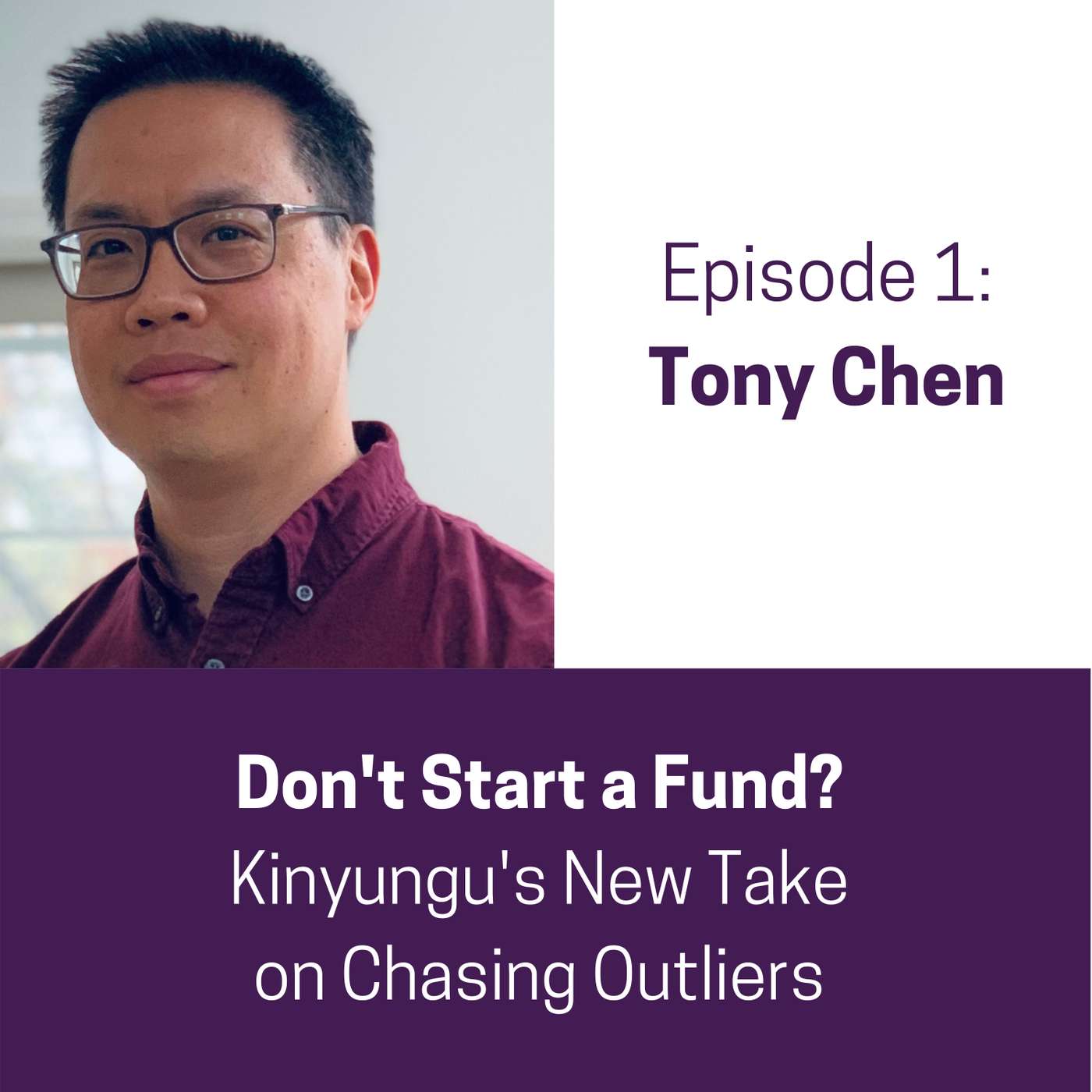
S1 Ep 1Don't Start a Fund? Kinyungu's New Take on Chasing Outliers
Welcome to Track 1, the inaugural episode of The Trajectory Africa, a podcast series exploring the trajectory, or pathway, of venture capital and startup formation in Africa. With the unique African landscape—market characteristics, business environment, goals, and culture—as a starting point, The Trajectory Africa aims to pinpoint a destination for African tech, and the signposts that signal direction of travel. It’s inspired by the concept of a mixtape, in which each episode, or “track” will feature a conversation with a “guest artist”. There is also a soundtrack for inspiration provided by (DJ) Saphir Esmail via his Spotify playlist (link below).My guest artist is Tony Chen. Tony is a Partner at Verdant Frontiers and Co-Founder of Kinyungu Ventures. Tony has enjoyed 24+ years creating new businesses, launching five companies with multiple exits. He co-founded Redica Systems (formerly Govzilla), a SaaS business he led as CEO for 8 years until 2017. Tony and his family lived in rural Kenya for three years, where he built a portfolio of 15 Kenyan companies. Tony is also on the Investment Committee for Triphammer Ventures. Tony earned a BS in Chemical Engineering from Cornell University and an MBA from Northwestern Kellogg School of Management.In this episode, we discuss:How and why Tony’s journey as an Africa-focused investor began in Kenya Why research was a key element of Kinyungu’s fund launch process What Tony learned from the research, and how his investing approach has changedHow Kinyungu Ventures has changed, and plans for the futureTony’s Recommended Track & Featured Resources:My Shot. Lin Manuel Miranda, Anthony Ramos, Davide Diggs, Okierete Onaodowan, Leslie Odom, Jr., original Broadway cast of Hamilton. Hamilton. https://spoti.fi/2Uq3IJ3Chasing Outliers: Why Context Matters for Early Stage Investing in Africa. https://kinyungu.com/chasing-outliers/DJ Saphir’s Spotify Playlist: https://spoti.fi/2RS6hTc
Welcome to The Trajectory: Africa!
trailerThis is a brief introduction to The Trajectory Africa, a podcast series exploring the trajectory, or pathway, of venture capital and startup formation in Africa. With the unique African landscape—market characteristics, business environment, goals, and culture—as a starting point, The Trajectory Africa aims to pinpoint a destination for African tech, and the signposts that signal direction of travel. It’s inspired by the concept of a mixtape, in which each episode, or “track” will feature a conversation with a “guest artist”. There is also a soundtrack for inspiration provided by (DJ) Saphir Esmail (bio below) via his Spotify playlist (link below). You can find more African tech and VC resources below as well. Enjoy!About Me:I've has spent several years working in African tech and entrepreneurship, with an emphasis on building enabling infrastructure such as tech hubs and accelerators. Recently, I have focused on conducting research, specifically on early stage investing in Africa with Kinyungu Ventures and thesubtext, the role of tech hubs in African startup ecosystems for the International Trade Centre, shared models of ownership for the Open Society Initiative for West Africa, and the future of work in Africa with the RSA. Prior to this I served as a Senior Consultant with infoDev/the World Bank Group for XL Africa, and as the first Executive Director of AfriLabs. About Saphir Esmail:Saphir is a dual degree MBA/MA candidate at The Wharton School and The Lauder Institute with a focus on Africa. He is from Kinshasa, Democratic Republic of Congo. Saphir graduated from Temple University with a degree in Finance. After graduating, Saphir went on to work for Deloitte as a consultant focused on the financial services industry. Saphir is passionate about entrepreneurship and venture capital in Africa. He has spent the past year working at Golden Palm Investments, an early-stage fund that invests exclusively in Africa across various industries. After Wharton, Saphir hopes to make his way back to the continent to work at an Africa-focused fund.Spotify Playlist:This playlist was originally used at the 2021 Lauder Institute Africa Symposium on the Future of Work.https://spoti.fi/2RS6hTcChasing Outliers:https://kinyungu.com/chasing-outliers/African Tech and VC Resources:PodcastsThe Africa Playbook: A podcast and newsletter series that builds a blueprint for what African success stories could look likehttps://open.spotify.com/show/7dHItKVK9QzNChFJZa75BbAfrican Tech Roundup: Independent, Africa-focused, technology, digital, and innovation, insight and analysishttps://www.africantechroundup.com/Building the Future: Conversations with innovators, entrepreneurs, investors, and thought leaders, who are shaping the African futurehttps://drdotun.com/The Flip: Contextually relevant insights from entrepreneurs and investors changing the status quohttps://theflip.africa/Invest in the Future:A live fireside chat series by Future Africa to learn from prolific angel investors who have invested in and built some of the world's most impactful technology companieshttps://anchor.fm/future-africa/Newsletters/SubstacksThe Africa Playbook:A podcast and newsletter series that builds a blueprint for what African success stories could look likehttps://theafricaplaybook.substack.com/Africa: The Big Deal:A weekly two-minute read on the African start-up ecosystem, based on a curated database of deals from across the continenthttps://thebigdeal.substack.com/BriterEYE: A monthly compilation of deal, sector, and research insight, focused on underserved marketshttps://briterbridges.com/Movemeback Pulse: A weekly roundup of happenings in Africa https://www.movemeback.com/pulse/insiderPR: Company news, events, and interesting Twitter conversations, focused on emerging marketshttps://beaninsider.com/TCDaily: daily African tech newsletter:A comprehensive roundup of technology news on the African continenthttps://techcabal.com/category/tc-daily/Tech Cabal, The Next Wave:A newsletter that provides a weekly in-depth analysis of tech and innovation in Africahttps://bit.ly/3fg8XSvThe Subtext: Essays examining the mobile internet's impact, the causes of adoption, and mental models showing how [not what] to think about markets across the African continenthttps://www.thesubtext.io/Unevenly Distributed: A bi-weekly newsletter that tracks the diffusion of technology, entrepreneurship, and venture capital, in emerging marketshttps://derin.substack.com/Live Sessions with RecordingsTech Cabal Live:A virtual event series that features experienced players in Africa's tech ecosystem sharing insights and experiences about topical issues https://www.youtube.com/user/TechCabalUntapped Global:A weekly show recorded live weekly, aiming to connect frontier market entrepreneurs with global angel investorshttps://www.youtube.com/channel/UCee7y-Ktn0NAYyn1v057o_w