The Think Wildlife Podcast
172 episodes — Page 2 of 4
S3|EP25 - Rethinking Conservation: Forest Rights & Community- Based Conservation | Meenal Tatpati
In this powerful episode of the Think Wildlife Podcast, we are joined by Meenal Tatpati, a leading researcher and advocate for forest rights, indigenous knowledge, and democratic conservation. Together, we explore the transformative impact of the Forest Rights Act 2006 (FRA 2006) and challenge the outdated logic of fortress conservation.Meenal explains how the forest rights act of 2006 recognizes the historical injustice faced by forest dwellers, including Adivasi communities, by legally securing their access to forests and resources. We also dive into how the Supreme Court and recent amendments to the Forest Conservation Act are reshaping debates around indigenous rights, climate change, and the governance of nature reserves.🔍 Key Themes:* What is the Forest Rights Act and why it matters* How fortress conservation displaces communities instead of empowering them* The role of community-based conservation and traditional knowledge in protecting biodiversity* The tension between protected areas and forest dweller rights* Voluntary vs. forced resettlement under the forest dwellers act 2006* Resilience, activism, and indigenous innovation* The challenges of implementing FRA 2006 and benefit-sharing mechanisms* The power of grassroots conservation and participatory forest governanceMeenal shares stories from Rajasthan, Odisha, and Maharashtra—where local communities have not only defended their lands but also pioneered community conservation efforts rooted in indigenous science. She also speaks about her work with pastoralist and adivasi groups and the cultural values that guide their relationship with forests.This episode unpacks how forest dwellers are not just passive victims of conservation—they are frontline protectors of India's ecosystems. We discuss how empowering them through fra 2006, respecting their traditional knowledge, and ensuring benefit sharing is essential for inclusive conservation and long-term sustainability.🌿 If you care about climate change, indigenous rights, and the future of our forests, this is an episode you can’t miss.📚 Recommended Reading:* Rewilding: The Radical New Science of Ecological Recovery – Jepson & Blythe* Rewilding Africa: The Restoration of Wilderness on a War-Ravaged Continent* Wilder: How Rewilding is Transforming Conservation and Changing the World👍 Like | 💬 Comment | 🔔 Subscribe for more weekly episodes on conservation, ecology, and environmental justice.🎧 Available on YouTube, Spotify, Apple Podcasts & all major platforms.Meet the HostAnish Banerjee: https://x.com/anishwildlifeThink Wildlife Foundation: https://thinkwildlifefoundation.com/Meet the GuestsMeenal Tatpati: https://www.linkedin.com/in/meenal-tatpati-7330b7240?originalSubdomain=inRecommended Wildlife Conservation BooksWildlife Conservation in India by HS Pabla: https://amzn.to/3Ypx9ZhIndian Mammals: A Field Guide by Vivek Menon: https://amzn.to/4fhMiCLAt the Feet of Living Things by Aparajita Datta: https://amzn.to/3BZmtsN#forestrightsact #forestrightsact2006 #forestrightsactof2006 #forestrights #forestrightact #forestrightact2006 #forestdwellers #supremecourt #adivasi #forestdwellersact2006 #fra2006 #communityconservation #grassrootsconservation #communitybasedconservation #forestdweller #traditionalknowledge #climatechange #indigenousrights #indigenousscience #benefitsharing #indigenousinnovation #fortressconservation #naturereserve Get full access to The Think Wildlife Podcast at anishbanerjee.substack.com/subscribe
S3|EP24 - Restoring Forests, Rebuilding Futures: Sadhana Forest’s Global Mission | Aviram Rozin
In this inspiring episode of the Think Wildlife Podcast, we welcome Aviram Rozin, founder of Sadhana Forest, a globally respected movement dedicated to reforestation, sustainable development, and nature-based solutions. What started in 2003 as a family’s dream to revive degraded land in Tamil Nadu has evolved into an international model for ecological restoration and community-led change.With over 70 acres of tropical dry evergreen forest restored in India, and active reforestation projects in Haiti, Kenya, Namibia, and Meghalaya, Sadhana Forest shows that large-scale transformation is possible—through people-powered action, smart land management, and a deep respect for nature.🌍 Highlights from this episode:* The story behind Sadhana Forest’s origin and growth* The power of natural regeneration and water conservation* Using “on-contour swales” to promote soil moisture and eliminate erosion* How reforestation can combat climate change and restore biodiversity* Food forestry in Haiti and Kenya: growing nourishment through native trees* Empowering youth through the Plant for India Fellowship* The importance of community-driven, vegan, and drug-free values* Engaging thousands through ecotourism, education, and volunteer programsAviram explains how simple but effective nature-based solutions—like restoring water flow, rewilding native forests, and building local capacity—can change landscapes and lives. By embracing sustainable development, the organization has helped create healthier ecosystems, improved nutrition for marginalized communities, and shown how thoughtful land management can bring long-term resilience.With over 1,500 volunteers annually and a network of dedicated fellows, Sadhana Forest is not just a nature conservatory—it’s a global community of environmental stewards. The episode also touches on their unique initiatives like the Children’s Land Project and their educational outreach to tribal communities in India and Africa.If you’re passionate about climate change, forest recovery, or ecological education, this conversation is a must-listen.🔗 Learn more about Sadhana Forest:🌐 www.sadhanaforest.org🌱 www.plantforindia.org📚 Recommended Reads on Rewilding and Ecological Restoration:* Rewilding: The Radical New Science of Ecological Recovery – Paul Jepson & Cain Blythe* Rewilding Africa: The Restoration of Wilderness on a War-Ravaged Continent* Wilder: How Rewilding is Transforming Conservation and Changing the World📅 New episodes every Monday. Don’t forget to like, share, and subscribe!🎧 Available on YouTube, Spotify, Apple Podcasts & more.#reforestation #reforestationprojects #climatechange #sustainabledevelopment #naturebasedsolutions #landmanagement #natureconservatory #ThinkWildlifePodcast #SadhanaForest #ecosystemrestoration #volunteerfornature #waterconservation #regenerativefarmingMeet the HostAnish Banerjee: https://x.com/anishwildlifeThink Wildlife Foundation: https://thinkwildlifefoundation.com/Meet the GuestsSadhana Forest: https://sadhanaforest.org/Aviram Rozin: https://www.linkedin.com/in/aviramrozin/?originalSubdomain=inRecommended Wildlife Conservation BooksWildlife Conservation in India by HS Pabla: https://amzn.to/3Ypx9ZhIndian Mammals: A Field Guide by Vivek Menon: https://amzn.to/4fhMiCLAt the Feet of Living Things by Aparajita Datta: https://amzn.to/3BZmtsN Get full access to The Think Wildlife Podcast at anishbanerjee.substack.com/subscribe
S3|EP23– How Bioacoustics is Powering Biodiversity Monitoring & Forest Restoration| Dr. Vijay Ramesh | Project Dhvani
In this fascinating episode of the Think Wildlife Podcast, we dive into the groundbreaking work of Project Dhvani, a pioneering conservation initiative using bioacoustics to revolutionize how we understand and manage biodiversity in India’s tropical landscapes. Host Anish sits down with Dr. Vijay Ramesh, co-founder of Project Dhvani, to discuss how animal vocalization and animal sounds captured through passive remote sensing can reveal vital insights into the state of ecosystems, land-use changes, and the success of forest restoration projects.Project Dhvani began as a research collaboration between Dr. Ramesh, Dr. Pooja Choksi, and Dr. Sarika Kanwikar during their PhD studies at Columbia University. Their shared mission? Remote sensing technology, particularly passive acoustic monitoring, must be used to track biodiversity and conservation patterns across human-dominated and natural landscapes. Today, their work has grown into a multi-regional network, spanning Central India and the Tropical Western Ghats, two critical biodiversity hotspots.Why Sound Matters in Conservation TechBioacoustics, the science of using sound to monitor and interpret ecological activity, has become a cornerstone of modern conservation technology. From birds and insects to amphibians and mammals, many animals communicate through vocalizations that provide clues about their presence, abundance, and behavior. By deploying audio recorders in various habitats—restored forests, degraded lands, and agricultural plots—Project Dhvani is building a rich archive of animal vocalizations that help scientists analyze ecosystem processes in unprecedented ways.This episode explores how bioacoustic monitoring not only reveals species diversity but also helps evaluate the effectiveness of reforestation and ecological balance strategies. For example, Dr. Ramesh and his team have discovered significantly higher bird diversity in restored areas compared to degraded or unrestored ones—a hopeful signal that habitat loss can be reversed through thoughtful ecosystem management.From AI to Acoustic Networks: The Next Generation of Conservation TechnologyDr. Ramesh highlights how advances in remote sensing and AI-powered acoustic analysis are transforming the field. Platforms like Merlin and BirdNET, developed by the Cornell Lab of Ornithology, are now enabling researchers and the general public alike to identify bird species by simply recording ambient sounds on their smartphones. This democratization of bioacoustic tools has major implications for sustainable land management and public engagement in conservation.Moreover, Project Dhvani isn’t just about research—it’s also about building a broader network of professionals committed to biodiversity conservation in India. The initiative is laying the groundwork for a national forum that brings together academics, civil society, and policymakers to scale up the use of conservation tech across India’s varied ecosystems.Acoustic Insights into Land-Use Change and Tropical EcologyOne of the most compelling aspects of this conversation is the application of bioacoustics to study land-use change in tropical regions. By comparing soundscapes in organic and traditionally managed coffee farms, Project Dhvani is uncovering how different agricultural practices impact biodiversity management. These insights can inform more environmentally friendly farming techniques that align economic livelihoods with ecological health.India's vast and diverse environments offer fertile ground for remote sensing technology. However, Dr. Ramesh points out that most acoustic monitoring has focused on terrestrial habitats, with marine ecosystems remaining largely unexplored. Expanding bioacoustic research into marine environments could open new frontiers for biodiversity and conservation efforts.Challenges and Opportunities in Bioacoustic MonitoringWhile the future is promising, Project Dhvani faces its share of challenges. Funding constraints remain a major hurdle for research and long-term monitoring efforts. Additionally, there's a pressing need for more locally produced hardware to make bioacoustic tools more accessible across the Global South. Despite these obstacles, the team remains optimistic, fueled by growing interest from interdisciplinary collaborators and private sector supporters committed to advancing conservation technology.Dr. Ramesh emphasizes the importance of collaboration—not only with fellow scientists but also with citizens, NGOs, and government agencies. By pooling resources and knowledge, the conservation community can scale up passive remote sensing initiatives to safeguard ecosystems under threat from climate change, urbanization, and deforestation.A Call to Action: Join the Soundscape RevolutionListeners interested in contributing to Project Dhvani's mission can do so in multiple ways. Whether you’re a student, a tech enthusiast, or a professional in the private sector, there's room to collaborate. As biodiversit
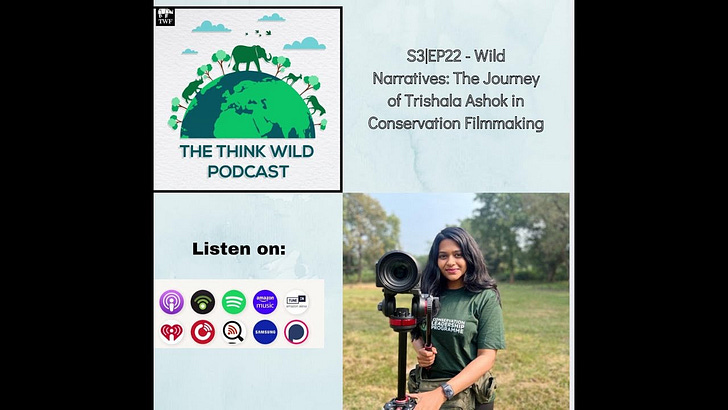
S3|EP22 - Wild Narratives: The Journey of Trishala Ashok in Conservation Filmmaking
In this deeply enriching episode of the Think Wildlife Podcast, we delve into the transformative journey of Trishala Ashok—an award-winning jewelry designer turned conservation filmmaker and founder of True Story Media Productions LLP. Through an inspiring and heartfelt conversation, Trishala takes us on a voyage that beautifully bridges creativity and science, forging a path that is not just about capturing wildlife through the lens, but about safeguarding it through purpose-driven narratives. From the forests of Karnataka to the banks of the Girwa River and the unseen corridors of airport security, Trishala’s commitment to ecological filmmaking has established her as a pioneer in the realm of biodiversity conservation.Her story begins in the world of shimmering gemstones and 3D-printed designs, but a fateful encounter with a tiger in Jim Corbett National Park changed everything. That single moment stirred something within—a deep calling that led her away from the glittering world of fashion to the raw, untamed wilderness of India’s biodiversity hotspots. What followed was a courageous decision to abandon a successful business in jewelry design, and leap into the unknown world of conservation without a roadmap—armed only with passion, empathy, and an unwavering desire to make a difference.In this episode, Trishala opens up about her early experiences with wildlife rescue in Bangalore, where she worked with monkeys, black kites, lorises, and snakes. She shares riveting accounts of her collaborations with the Wildlife Crime Control Bureau and Karnataka Forest Department, tackling wildlife trade and urban wildlife rescues. These foundational years, filled with on-ground exposure and grassroots outreach, eventually gave rise to the storyteller in her—a voice determined to counter deep-rooted misconceptions about wildlife, particularly snakes, through the power of conservation filmmaking.Trishala’s first film, DEFANG, born out of a need to debunk snake-related myths like the existence of the mythical "nagamani," marked her official entry into wildlife documentary filmmaking. Created in partnership with the Karnataka Forest Department and Kalinga Center for Rainforest Ecology, DEFANG not only garnered support from the highest forest authority but also signaled the beginning of her journey into biodiversity filmmaking. It’s not just the subject matter that makes this documentary unique—it’s the impact-driven storytelling that weaves science with empathy and curiosity with community action.From there, Trishala’s work continued to evolve. One of her most notable contributions is a public service announcement featuring Gauri Shankar, a renowned herpetologist, and a young boy from a rural village. This short film reached thousands across Karnataka and successfully altered local perceptions about snakes—encouraging empathy, curiosity, and coexistence. In a moving anecdote, Trishala recalls returning to the village a year later to find local children guarding a burrow of snake eggs, a testament to the behavioral shift her work helped inspire. This moment solidified her belief that wildlife filmmaking can do more than just document nature—it can mobilize communities, change narratives, and ultimately protect species.Trishala’s philosophy is rooted in the idea that storytelling should not end with the credits; instead, it should catalyze action. This belief inspired her to found True Story Media Productions LLP, a media platform focused not only on nature documentaries and sustainable filmmaking, but also on social change. At True Story, storytelling transcends screen time, extending into conservation outreach campaigns, policy change, and educational efforts. Whether working with schoolchildren or policy-makers, the mission remains the same: inspire action through compelling narratives grounded in truth.One of True Story’s recent standout projects is Girwa ke Gharial, a short film blending fiction with conservation messaging to spotlight the critically endangered gharial in Uttar Pradesh. Featuring local children and forest officers as actors, the film connects audiences with the riverine ecosystem in a relatable and accessible way. Through engaging storytelling and community inclusion, the project helped redefine public attitudes toward gharials—prompting viewers to see them not as obscure reptiles, but as proud icons of their region’s natural heritage.But Trishala's commitment to conservation extends beyond rivers and forests. In a groundbreaking new project titled Hidden Routes: Detecting Wildlife Crime Through Airports, she explores a darker, lesser-known side of conservation: wildlife trafficking. With a focus on training customs officers to detect illegal wildlife trade, this non-public film represents a pioneering step in biodiversity management. Drawing from nearly a decade of work with the Wildlife Crime Control Bureau and other enforcement agencies, Trishala’s investigative lens now serves as a vital tool in s
S3|EP21 - Tackling Human-Wildlife Conflict and Illegal Wildlife Trade in Africa | Maurice Schutgens | Space for Giants
Welcome to this insightful episode of Think Wildlife Podcast, where we delve deep into the pressing issues of human-wildlife conflict, illegal wildlife trade, and conservation efforts in Africa. In this episode, we speak with Maurice Schutgens, Managing Director of Conservation at Space for Giants, an organization dedicated to preserving Africa’s iconic megafauna and landscapes.We explore the complex dynamics of human-elephant conflict, the innovative strategies used to mitigate these conflicts, and how nature-based economies are reshaping conservation in Africa. Additionally, we discuss the illegal wildlife trade and the policies and enforcement mechanisms helping to curb it.1. Human-Wildlife Conflict in Africa: Causes and ConsequencesHuman-wildlife conflict is a growing concern across Africa as human settlements expand into wildlife habitats. In regions like Kenya, Uganda, and Gabon, elephants frequently encounter human communities, leading to crop destruction, property damage, and in some cases, fatalities. 2. Innovative Strategies: Smart Fencing and Conflict MitigationOne of the primary solutions discussed in this episode is electric fencing. Space for Giants has pioneered a strategy known as smart fencing, which combines:Solar-powered electric fencing to minimize environmental impact Outriggers and voltage optimization to effectively deter elephants Geospatial tracking and real-time monitoring to ensure fence effectiveness Data-driven decision-making to identify conflict hotspotsMaurice highlights case studies from Kenya and Gabon, where low-cost single-strand electric fences have demonstrated up to 95% effectiveness in preventing human-elephant conflict.3. Conservation Investments and Nature-Based EconomiesA major focus of this episode is the importance of long-term financial sustainability for conservation areas. Maurice explains how ecotourism, carbon credits, biodiversity credits, and sustainable wildlife economies play a role in maintaining Africa’s natural landscapes. 4. The Fight Against Illegal Wildlife TradeThe illegal wildlife trade has historically been a major threat to elephants, rhinos, and other endangered species. Maurice discusses the transformation of anti-poaching strategies over the past decade, including:The shift from poaching as the primary threat to human-wildlife conflict taking center stage. He also elaborated about how community-led conservation and legal reforms are strengthening wildlife protection. Furthermore, we discuss the role of technology (e.g., SMART monitoring, EarthRanger) in anti-poaching efforts. Finally, we talk about the need for strong wildlife laws and consistent prosecution to deter poachersMaurice explains how collaboration between conservation organizations, law enforcement, and governments has significantly reduced poaching rates and improved wildlife law enforcement in key regions.Do tune in to this exciting episode!Meet the HostAnish Banerjee: https://x.com/anishwildlifeThink Wildlife Foundation: https://thinkwildlifefoundation.com/Meet the GuestsMaurice Schutgens: https://www.linkedin.com/in/maurice-schutgens-93b2a078/?originalSubdomain=keSpace for Giants: https://www.spaceforgiants.org/Recommended Wildlife Conservation BooksWildlife Conservation in India by HS Pabla: https://amzn.to/3Ypx9ZhIndian Mammals: A Field Guide by Vivek Menon: https://amzn.to/4fhMiCLAt the Feet of Living Things by Aparajita Datta: https://amzn.to/3BZmtsN Get full access to The Think Wildlife Podcast at anishbanerjee.substack.com/subscribe
S3|EP20 - Carbon Credits & Conservation: How Wildlife Works is Saving Forests and Communities | Mike Korchinsky
In this episode of The Think Wildlife Podcast, we dive into the dynamic intersection of conservation, climate finance, and community-driven solutions with Mike Korchinsky, the founder and president of Wildlife Works. Our conversation explores how market-based mechanisms such as carbon credits and REDD+ (Reducing Emissions from Deforestation and Forest Degradation) are revolutionizing the way we approach wildlife conservation, forest protection, and sustainable development.Understanding the Role of Carbon Credits in ConservationOver the last few years, there has been a growing global interest in financing climate solutions through mechanisms like biodiversity credits and carbon credits. These financial instruments incentivize forest communities and landowners to preserve ecosystems by providing an economic value to keeping forests intact. Wildlife Works is at the forefront of this movement, pioneering economic models that directly benefit local communities while safeguarding biodiversity.But how do carbon credits work?Mike breaks down the fundamental principles of carbon credits, explaining how they are measured, issued, and traded in the voluntary carbon market. He highlights that one of Wildlife Works' major successes is its ability to convert conservation into a sustainable livelihood for communities that would otherwise be forced to engage in activities like logging or slash-and-burn agriculture.Wildlife Works: A Market-Based Conservation ModelMike takes us through his personal journey into conservation, tracing his early fascination with wildlife, particularly elephants, and how his first visit to Africa in the mid-1990s exposed him to the pressing conflict between human development and wildlife protection. Recognizing that traditional conservation models were insufficient, he founded Wildlife Works in 1998 with the belief that economic incentives could be a game-changer in protecting endangered ecosystems.One of the most remarkable aspects of Wildlife Works’ approach is its focus on empowering communities. Unlike conventional conservation projects that might impose restrictions on local populations, Wildlife Works ensures that indigenous and rural communities are active participants in shaping conservation solutions that also serve their long-term social and economic interests.The REDD+ Framework and Its ImpactThe REDD+ (Reducing Emissions from Deforestation and Degradation) framework, developed by the United Nations, is a key mechanism in global conservation efforts. REDD+ projects aim to reduce carbon emissions by offering financial incentives to governments, communities, and private sector actors who take action to preserve forests.Wildlife Works has been a pioneering force in REDD+ implementation, with projects spanning Africa, South America, and Asia. Their Kenyan project, launched in 2011, was the first of its kind to be issued carbon credits under the VERRA standard. From there, Wildlife Works expanded into the Democratic Republic of the Congo (DRC), Colombia, Brazil, India, Indonesia, and more—focusing on regions with high biodiversity and intense deforestation pressures.But what does a REDD+ project look like on the ground?According to Mike, a successful REDD+ project integrates:* Community consultation and governance, ensuring that local people benefit from conservation efforts.* Biodiversity monitoring, safeguarding endangered species.* Sustainable livelihoods, such as eco-businesses, agroforestry, and handicrafts that reduce dependence on forest destruction.* Infrastructure development, including schools, healthcare facilities, and renewable energy projects.Addressing Criticism of Carbon CreditsDespite their potential, carbon credits and REDD+ projects have faced criticism. Some argue that carbon markets allow corporations to "greenwash" their emissions rather than actively reducing them. Others worry about the transparency and legitimacy of carbon credit verification.Mike acknowledges these concerns and explains how Wildlife Works ensures high-integrity projects by:* Adhering to Free, Prior, and Informed Consent (FPIC) principles, ensuring that indigenous communities voluntarily agree to projects.* Implementing safeguards to prevent "leakage", where deforestation might simply shift to another location.* Prioritizing permanence, making sure that conservation gains last for decades, not just a few years.* Working with independent third-party verifiers to validate carbon reductions.He also highlights that while bad actors have existed in the carbon market, the majority of REDD+ projects—especially those focused on nature-based solutions—are genuine, impactful, and community-driven.Wildlife Works’ Global ImpactWith over two decades of experience, Wildlife Works has expanded its footprint across multiple continents, targeting some of the world’s most at-risk forests. Their projects are currently active in:* Kenya: The birthplace of Wildlife Works’ conservation model, protecting vital wildlife c
S3|EP19 - How Earthly is Revolutionizing Nature-Based Climate Solutions with Oliver Bolton
In this insightful and action-driven episode, we welcome Oliver Bolton, CEO and co-founder of Earthly, a pioneering startup dedicated to protecting and regenerating more than 1% of the planet by 2030. Earthly provides businesses with a trustworthy, high-impact way to invest in nature-based climate solutions that drive carbon reduction, biodiversity restoration, and social impact.Throughout the episode, Oliver explains how Earthly operates and the innovative methods they use to screen and verify nature-based projects. He discusses the company’s rigorous 106-data-point assessment system, which ensures businesses can de-risk their investments by selecting the highest integrity projects. He also delves into why enterprises are turning to nature-based solutions to combat climate change and how Earthly’s model is making it easier for corporations to invest in ecological restoration.A major topic covered in this episode is the role of voluntary carbon and biodiversity credits. Oliver explains the difference between voluntary and compliance markets and how Earthly’s biodiversity credit system is revolutionizing conservation finance. He also addresses the challenges and criticisms of carbon offsetting, highlighting how Earthly is setting new quality standards to enhance trust and transparency in the sector.Listeners will gain insight into some of Earthly’s most impactful projects around the world. In India’s Indo-Gangetic Plains, the company is working on regenerative farming practices that restore soil health, increase water retention, and promote biodiversity. In Madagascar and Pakistan, Earthly is focused on large-scale mangrove restoration to enhance coastal resilience and carbon sequestration. Oliver also discusses the company’s peatland protection initiatives in Indonesia, aimed at preventing carbon leakage and deforestation, as well as their efforts in conserving grasslands and tropical forests to maintain critical habitats, store carbon and provide alternative livelihoods.Earthly has achieved significant global recognition, winning prestigious awards such as the COP27 Climb Tech Prize and Uplink’s 2023 Nature Tech Prize. These accolades reinforce the company’s commitment to high-quality, science-backed climate solutions that drive real impact.This episode emphasizes the importance of nature-based solutions in addressing the climate crisis, highlighting that they can contribute up to one-third of the necessary carbon reduction efforts. Oliver underscores how businesses can decarbonize while also protecting and restoring ecosystems, and he stresses the need for clear standards in corporate investment to prevent greenwashing. He also sheds light on the emerging role of biodiversity credits, which offer companies a way to fund conservation initiatives with measurable, long-term benefits.For those passionate about climate action, sustainability, and corporate responsibility, this episode provides a practical roadmap for investing in high-quality, nature-based solutions. Whether you are a business leader, a sustainability manager, or an environmentally conscious individual, there are actionable ways to support Earthly’s mission. By visiting Earthly.org, you can explore impact-driven projects and learn how to contribute to a more sustainable future.Tune in now to discover how businesses and individuals can make a tangible impact in the fight against climate change. If you believe in a greener, healthier planet, be sure to subscribe, share, and leave a review to help spread the message of nature-based solutions!Meet the HostAnish Banerjee: https://x.com/anishwildlifeThink Wildlife Foundation: https://thinkwildlifefoundation.com/Meet the GuestsOliver Bolton: https://www.linkedin.com/in/oliver-bolton/Recommended Wildlife Conservation BooksWildlife Conservation in India by HS Pabla: https://amzn.to/3Ypx9ZhIndian Mammals: A Field Guide by Vivek Menon: https://amzn.to/4fhMiCLAt the Feet of Living Things by Aparajita Datta: https://amzn.to/3BZmtsN Get full access to The Think Wildlife Podcast at anishbanerjee.substack.com/subscribe
S3|EP18 - How to build a career in conservation? | Dr. Nick Askew, Director, Conservation Careers
Join host Anish in this insightful episode of The Think Wildlife Podcast as he sits down with Dr. Nick Askew, the founder of Conservation Careers. Discover how Dr. Askew’s passion for wildlife, from his early days as a teenage angler to his impactful global conservation career has led to helping over 700,000 conservationists worldwide.In this episode, we discuss the most in-demand conservation job skills. Dr. Askew also elaborates upon the key challenges facing aspiring conservationists, from securing experience to tackling inequality, diversity, and inclusion within the sector. We also discuss how careers in conservation go beyond traditional life sciences, with high demand for skills in project management, fundraising, marketing, and communications.Dr. Askew also shares how Conservation Careers empowers aspiring and mid-career conservationists through specialized training programs, career coaching, and a global job board listing over 15,000 opportunities annually.If you are passionate about making a difference for wildlife and want to explore a fulfilling conservation career, whether you are a wildlife biologist, ecologist, environmentalist, marketer, or fundraiser! With the ongoing biodiversity crisis, the world needs more green jobs with the aim of conserving the world’s remaining biodiversity.Meet the HostAnish Banerjee: https://x.com/anishwildlifeThink Wildlife Foundation: https://thinkwildlifefoundation.com/Meet the GuestsDr. Nick Askew: https://www.conservation-careers.com/conservation-careers-about-us/ The Conservation Career Podcast: https://www.conservation-careers.com/podcast/Recommended Wildlife Conservation BooksWildlife Conservation in India by HS Pabla: https://amzn.to/3Ypx9ZhIndian Mammals: A Field Guide by Vivek Menon: https://amzn.to/4fhMiCLAt the Feet of Living Things by Aparajita Datta: https://amzn.to/3BZmtsN Get full access to The Think Wildlife Podcast at anishbanerjee.substack.com/subscribe
S3|EP17 - Saving Our Oceans: The Blue Economy, Coral Reefs & Sustainable Fisheries | Dr. David Obura
Join us for an insightful deep dive into the world of marine conservation, coral reef resilience, and the blue economy with Dr. David Obura, one of the world’s leading marine ecologists and the founding director of CORDIO East Africa. CORDIO is a pioneering organization working to protect coral reefs and sustain marine ecosystems in the Western Indian Ocean.Dr. David Obura received a PhD from the University of Miami in 1995, focusing on coral bleaching and life history strategies. Throughout his career, he has worked extensively on participatory monitoring and research tools with artisanal fishers in East Africa, as well as conducting remote-reef surveys in locations such as the Phoenix Islands in the central Pacific and across the Indian Ocean.He currently serves as the Chair of IUCN’s Coral Specialist Group and the IPBES, is a member of the Earth Commission and a range of advisory groups on varied sustainability topicsIn this episode, the discussion explores the blue economy and its vital role in sustainable marine conservation, highlighting how economic activities can coexist with ocean health. The conversation delves into cutting-edge coral reef monitoring technologies, including AI-driven analysis, environmental DNA (eDNA) sampling, and underwater soundscapes, which are transforming marine research and conservation efforts. The episode also examines the critical role of fisheries in local economies, addressing their sustainability challenges and the need for responsible management to protect both livelihoods and marine biodiversity. Additionally, the discussion highlights the significance of Locally Managed Marine Areas (LMMAs), emphasizing how these community-led initiatives empower coastal populations to actively manage and protect their marine resources for long-term ecological and economic benefits.Meet the HostAnish Banerjee: https://x.com/anishwildlifeThink Wildlife Foundation: https://thinkwildlifefoundation.com/Meet the GuestsDr. David Obura: https://www.linkedin.com/in/david-obura-a6554547/Recommended Wildlife Conservation BooksWildlife Conservation in India by HS Pabla: https://amzn.to/3Ypx9ZhIndian Mammals: A Field Guide by Vivek Menon: https://amzn.to/4fhMiCLAt the Feet of Living Things by Aparajita Datta: https://amzn.to/3BZmtsN Get full access to The Think Wildlife Podcast at anishbanerjee.substack.com/subscribe
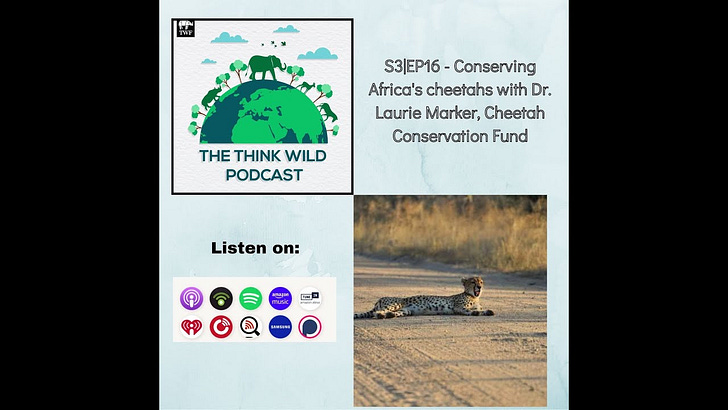
S3|EP16 - Conserving Africa's cheetahs with Dr. Laurie Marker, Executive Director of Cheetah Conservation Fund
In this Episode of The Think Wildlife Podcast, I am joined by Dr. Laurie Marker, the founder and Executive Director of the Cheetah Conservation Fund (CCF). Founded in Namibia in 1990, CCF has become the leading authority in cheetah conservation globally, with projects across Somaliland, Namibia, Tanzania, Kenya, South Africa and Botswana. Beyond Africa, CCF also has supported the conservation of the last remaining Asiatic cheetahs in Iran. Meanwhile, the CCF has assisted the Indian government and the Wildlife Trust of India with the reintroduction of cheetahs into Kuno National Park. Listed as “Vulnerable” by the IUCN Red List, the cheetah faces a plethora of threats, ranging from human-wildlife conflict, the illegal wildlife trade, habitat loss and a lack of genetic diversity. Dr. Marker and I discuss the measures CCF has taken to tackle these threats, which include cheetah rescue and rehabilitation, cheetah genetics research, alternative livelihood programs and livestock protection projects. Dr. Marker also elaborates in detail about CCF’s role in the reintroduction of cheetahs to India. Tune in to a highly informative episode!Meet the HostAnish Banerjee: https://x.com/anishwildlifeThink Wildlife Foundation: https://thinkwildlifefoundation.com/Meet the GuestsDr. Laurie Marker: https://cheetah.org/about/who-we-are/dr-laurie-marker/Recommended Wildlife Conservation BooksWildlife Conservation in India by HS Pabla: https://amzn.to/3Ypx9ZhIndian Mammals: A Field Guide by Vivek Menon: https://amzn.to/4fhMiCLAt the Feet of Living Things by Aparajita Datta: https://amzn.to/3BZmtsN Get full access to The Think Wildlife Podcast at anishbanerjee.substack.com/subscribe
S3|E15 - Exploring the Gharial Conservation Programme Katerniaghat with Dr. Gaurav Vashistha
The gharial, a Critically Endangered species, is an unmistakable crocodilian on the edge of extinction. Recognizable by its long, slender jaws adapted for catching fish, males have a distinctive bulbous growth on their snouts called a "ghara," which is named after a traditional Indian pot. This unique feature is also the basis for the species' common name, "gharial." Unlike other crocodiles, gharials exhibit a marked difference between males and females.Once widespread throughout the Indian subcontinent, the gharial now survives in only five small, isolated populations across India and Nepal. The IUCN Red List classifies the gharial as Critically Endangered due to drastic population declines—up to 98% since the 1940s—leaving fewer than 250 adult individuals in the wild. Major threats to the species include severe degradation of riverine habitats caused by dams, barrages, irrigation canals, and artificial embankments. Additionally, sand mining negatively impacts their habitat, disrupting the breeding ecology critical for their survival.Join Dr. Gaurav Vashistha, the founder of the Gharial Conservation Programme at Katerniaghat, one of the last strongholds of the gharials. We talk about the ecology and conservation of the gharials, covering the various reintroduction efforts around India!The Think Wildlife Podcast is also available on iTunes, Spotify and YouTube. Please do consider upgrading to an optional paid subscription on Substack. 30% of the revenue from this episode will be donated to Gharial Conservation Programme!Meet the HostAnish Banerjee: https://x.com/anishwildlifeThink Wildlife Foundation: https://thinkwildlifefoundation.com/Meet the GuestsDr. Gaurav Vashistha: https://x.com/gaurav_gharialRecommended Wildlife Conservation BooksWildlife Conservation in India by HS Pabla: https://amzn.to/3Ypx9ZhIndian Mammals: A Field Guide by Vivek Menon: https://amzn.to/4fhMiCLAt the Feet of Living Things by Aparajita Datta: https://amzn.to/3BZmtsN Get full access to The Think Wildlife Podcast at anishbanerjee.substack.com/subscribe
S3|EP14 - Understanding Conservation Filmmaking with Rita Banerji
In Episode 14, I am joined by one of India’s leading conservation filmmakers, Rita Banerji. She is the founder of Dusty Foot Productions and the Dusty Foot Foundation, through which Green Hub established in 2014. As An Ashoka Fellow, Rita is the winner of multiple Green Oscars for her films on wildlife and environment. Rita was inducted as an Ashoka Fellow for the Green Hub project in 2019. Through this project, she is supporting countless upcoming wildlife filmmakers and conservationists from North East India. I’m sure you will enjoy hearing about Rita’s amazing work. The Think Wildlife Podcast is also available on iTunes, Spotify and YouTube. Please do consider upgrading to an optional paid subscription on Substack. 30% of the revenue from this episode will be donated to Dusty Foot Foundation!Meet the HostAnish Banerjee: https://x.com/anishwildlifeThink Wildlife Foundation: https://thinkwildlifefoundation.com/Meet the GuestsRita Banerji: https://www.sanctuarynaturefoundation.org/award/rita-banerjiDustyFoot Productions: https://www.dustyfootindia.com/DustyFoot Foundation: https://www.dustyfootfoundation.org/about-dffGreenhub: https://www.greenhubindia.net/Recommended Wildlife Conservation BooksRewilding: The Radical New Science of Ecological Recovery: https://amzn.to/3NGF2V5Rewilding Africa: Restoring the Wilderness on a War-ravaged Continent by Grant Fowlds and Graham Spence: https://amzn.to/48rpX3dWilder: How Rewilding is Transforming Conservation and Changing the World: https://amzn.to/4hpHIEcRewilding the Sea by Charles Clover: https://amzn.to/3NGF2V5 Get full access to The Think Wildlife Podcast at anishbanerjee.substack.com/subscribe
S3|EP13 - Protecting Maharashtra's Indigenous Communities from the Climate Crisis with Dr. Sarika Kulkarni
Many of the world’s poorest communities are among tribal and indigenous populations. Trapped in a relentless cycle of extreme poverty, vulnerability, and deprivation, they face a complex web of challenges that are deeply interconnected. These communities are the most vulnerable to the onset of climate change and environmental degradation. Increased water scarcity, soil instability and deforestation threaten the livelihoods of the 300 million people who are reliant on India’s forest ecosystems.In Episode 13, I am joined by Dr. Sarika Kulkarni, the founder of the RAAH Foundation, an organization with the vision to make a better life for the tribal communities of Maharashtra. Operating in the northern Western Ghats, RAAH Foundation takes an integrated landscape management approach. This includes activities like creating water-positive villages, soil and moisture conservation, contour lining of farms, protecting grasses, designating fragile and critical areas, diverting grazing, converting barren land into biodiverse enriched carbon sinks through the plantation of native trees. To support biodiversity, RAAH is involved in the removal of invasive species, regenerative farming and agroforestry. Other than supporting tribal communities establish climate smart farming, RAAH Foundation aims to revive tribal art and establish micro businesses.The Think Wildlife Podcast is also available on iTunes, Spotify and YouTube. Please do consider upgrading to an optional paid subscription on Substack. 30% of the revenue from this episode will be donated to RAAH Foundation!Meet the HostAnish Banerjee: https://x.com/anishwildlifeThink Wildlife Foundation: https://thinkwildlifefoundation.com/Meet the GuestsDr. Sarika Kulkarni: https://www.linkedin.com/in/sarikakulkarni/Recommended Wildlife Conservation BooksRewilding: The Radical New Science of Ecological Recovery: https://amzn.to/3NGF2V5Rewilding Africa: Restoring the Wilderness on a War-ravaged Continent by Grant Fowlds and Graham Spence: https://amzn.to/48rpX3dWilder: How Rewilding is Transforming Conservation and Changing the World: https://amzn.to/4hpHIEcRewilding the Sea by Charles Clover: https://amzn.to/3NGF2V5 Get full access to The Think Wildlife Podcast at anishbanerjee.substack.com/subscribe
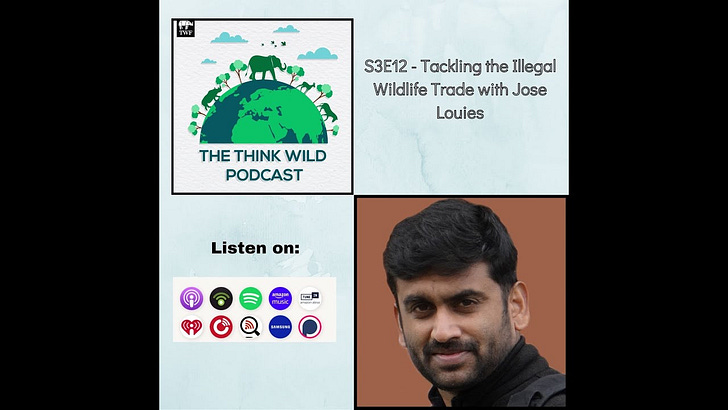
S3|E12 - Tackling the Illegal Wildlife Trade with Jose Louies
Earlier this year, Amazon Prime released the thrilling crime drama “Poacher” which revolved around the elephant poaching crisis and ivory trade in 2015. Based in Kerala, the series explores how the Forest Department, with support from NGOs and conservationists, risked their lives to investigate and tackle the lucrative illegal ivory trade. One of the protagonists of the webseries, Alan Joseph, is based on one of India’s most prominent conservationists, Jose Louies.Jose was recently appointed as the CEO of the Wildlife Trust of India (WTI), one of the largest and oldest conservation groups in the country. In this episode, Jose elaborates upon various initiatives undertaken by WTI to counter wildlife trafficking and aid law enforcement across India. Jose also talks about his love for beekeeping and snakes. We briefly talk about the highly pressing issue of snakebites and one of Jose’s key projects - IndiaSnakes. The Think Wildlife Podcast is also available on iTunes, Spotify and YouTube. Please do consider upgrading to an optional paid subscription on Substack. 30% of the revenue from this episode will be donated to Wildlife Trust of India!Meet the HostAnish Banerjee: https://x.com/anishwildlifeThink Wildlife Foundation: https://thinkwildlifefoundation.com/Meet the GuestsJose Louies: https://x.com/josethanniRecommended Wildlife Conservation BooksWildlife Conservation in India by HS Pabla: https://amzn.to/3Ypx9ZhIndian Mammals: A Field Guide by Vivek Menon: https://amzn.to/4fhMiCLAt the Feet of Living Things by Aparajita Datta: https://amzn.to/3BZmtsN Get full access to The Think Wildlife Podcast at anishbanerjee.substack.com/subscribe
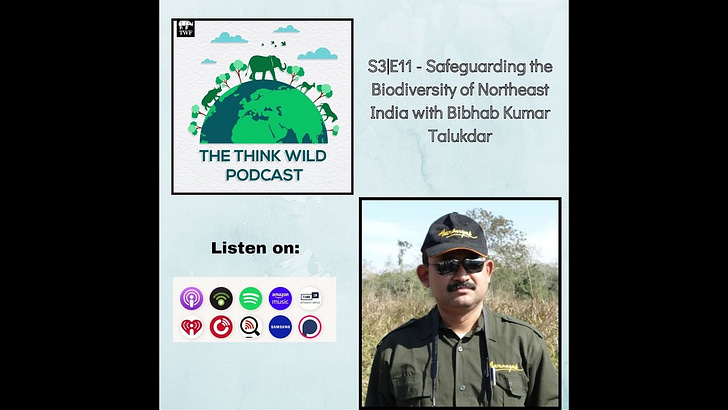
S3|E11 - Safeguarding the Biodiversity of Northeast India with Bibhab Kumar Talukdar
In Episode 11, I am joined by Bibhab Kumar Talukdar, a renowned rhino conservationist. He is the Secretary-General and Chief Executive Officer of Aaranyak, the leading conservation NGO in Northeast India, and a Senior Advisor at the International Rhino Foundation.We discuss the remarkable recovery of the Greater One-Horned Rhino in Assam. Bibab elaborates on how conservation efforts revived the species from the brink of extinction to a thriving population across the state. He also talks about how to tackle the threat of invasive species in the rhino habitat. We also discuss the state of rhino poaching in the region. Bibhab also shares his PhD research on the Critically Endangered White Winged Duck and the early days of Aaryanak. He also briefly discusses the work Aarayanak is doing across their various divisions, ranging from human-elephant conflict mitigation and alternative livelihood programs to avifauna research and conservation and wildlife genetics. Tune in to one of India’s most decorated wildlife biologists!The Think Wildlife Podcast is also available on iTunes, Spotify and YouTube. Please do consider upgrading to an optional paid subscription on Substack. 30% of the revenue from this episode will be donated to Aaranyak!Meet the HostAnish Banerjee: https://x.com/anishwildlifeThink Wildlife Foundation: https://thinkwildlifefoundation.com/Meet the GuestsBibab Kumar Talukdar: https://en.wikipedia.org/wiki/Bibhab_Kumar_TalukdarRecommended Wildlife Conservation BooksWildlife Conservation in India by HS Pabla: https://amzn.to/3Ypx9ZhIndian Mammals: A Field Guide by Vivek Menon: https://amzn.to/4fhMiCLAt the Feet of Living Things by Aparajita Datta: https://amzn.to/3BZmtsN Get full access to The Think Wildlife Podcast at anishbanerjee.substack.com/subscribe
S3|E10 - Understanding Forest Regeneration with Neha Singh
In Episode 10 of Season 3, I am joined by Neha Singh, the founder of Forest Regeneration and Sustainability Trust (FORREST). Neha elaborates upon the Trust’s work on ecosystem restoration in urban and agricultural landscapes. This includes habitat restoration in Sanjay Gandhi National Park in Mumbai, wetland restoration in Jamshedpur and the Farmers for Bird Conservation initiative. She also talks about the roles of wildlife passes across linear infrastructure as ecological corridors and the projects FORREST has undertaken in this regard. Tune into a highly informative episode on ecosystem restoration!The Think Wildlife Podcast is also available on iTunes, Spotify and YouTube. Please do consider upgrading to an optional paid subscription on Substack. 30% of the revenue from this episode will be donated to FORREST!Meet the HostAnish Banerjee: https://x.com/anishwildlifeThink Wildlife Foundation: https://thinkwildlifefoundation.com/Meet the GuestsNeha Singh: https://www.linkedin.com/in/neha-singh-662b0821Recommended Wildlife Conservation BooksWildlife Conservation in India by HS Pabla: https://amzn.to/3Ypx9ZhIndian Mammals: A Field Guide by Vivek Menon: https://amzn.to/4fhMiCLAt the Feet of Living Things by Aparajita Datta: https://amzn.to/3BZmtsN Get full access to The Think Wildlife Podcast at anishbanerjee.substack.com/subscribe
S3|E9 - Wildlife Content Creation with Kayden Anthony
In Episode 9 of this season, I am joined by Kayden Anthony, a wildlife biologist with a knack of digital marketing and content creation. Kayden is the founder of Nature’s Eye, which strives to bring informative and educational content, ranging from biomonitoring, ecological data analysis and remote sensing. In this episode, he talks about the role of digital media in wildlife conservation. Additionally, he talks about wildlife content creation as a career. Tune in to learn about Kayden’s unique conservation career!Meet the HostAnish Banerjee: https://x.com/anishwildlifeThink Wildlife Foundation: https://thinkwildlifefoundation.com/Meet the GuestsKayden Anthony: https://www.instagram.com/man_of_the_forest_/Recommended Wildlife Conservation BooksWildlife Conservation in India by HS Pabla: https://amzn.to/3Ypx9ZhIndian Mammals: A Field Guide by Vivek Menon: https://amzn.to/4fhMiCLAt the Feet of Living Things by Aparajita Datta: https://amzn.to/3BZmtsN Get full access to The Think Wildlife Podcast at anishbanerjee.substack.com/subscribe

S3|EP8- Saving the Elusive Red Panda with Moumita Chakraborty
In Episode 8, I am joined by Moumita Chakraborty, a Eastern Himalayas Consultant at the Global Tiger Forum, to discuss red panda conservation. During her PhD at the Wildlife Institute of India, Moumita studied the habitat suitability of Red Panda in the Sikkim to identify the priority areas for the conservation. She also studied the relationship between red panda and people in the habitat.Listed as Endangered by the IUCN Red List, the Red Panda face a plethora of threats including forest fragmentation, poaching and even free ranging dogs. Tune in to this episode to learn about the conservation of red panda in India!The Think Wildlife Podcast is also available on iTunes, Spotify and YouTube. Please do consider upgrading to an optional paid subscription on Substack. 30% of the revenue from this episode will be donated to the Red Panda Network!Meet the HostAnish Banerjee: https://x.com/anishwildlifeThink Wildlife Foundation: https://thinkwildlifefoundation.com/Meet the GuestsMoumita Chakraborty: https://www.edgeofexistence.org/fellow/moumita-chakraborty/Recommended Wildlife Conservation BooksWildlife Conservation in India by HS Pabla: https://amzn.to/3Ypx9ZhIndian Mammals: A Field Guide by Vivek Menon: https://amzn.to/4fhMiCLAt the Feet of Living Things by Aparajita Datta: https://amzn.to/3BZmtsN Get full access to The Think Wildlife Podcast at anishbanerjee.substack.com/subscribe
S3|E7 - On the Brink: Protecting India's last caracals with Shreyas Vijay
The Asiatic caracal is India’s rarest wild cat. In fact, with the population estimated to be less than 100, the caracal is on the verge of becoming the second extinct species of cat in India after the recently reintroduced cheetah.In Episode 7, I explore the ecology and conservation of this fascinating cat with Shreyas Vijay, the founder of the Caracal Conservation and Research Project (CCRP). We discuss his research on mapping the population and distribution of caracals in India. Shreyas talks about the threats of human-caracal conflict and the illegal pet trade to caracals across its range in Asia and Africa. Tune in to learn more about the future of caracals in India.The Think Wildlife Podcast is also available on iTunes, Spotify and YouTube. Please do consider upgrading to an optional paid subscription on Substack. 30% of the revenue from this episode will be donated to the CCRP!Meet the HostAnish Banerjee: https://x.com/anishwildlifeThink Wildlife Foundation: https://thinkwildlifefoundation.com/Meet the GuestsShreyas Vijay: https://shreyasvijay11.wixsite.com/indiaRecommended Wildlife Conservation BooksWildlife Conservation in India by HS Pabla: https://amzn.to/3Ypx9ZhIndian Mammals: A Field Guide by Vivek Menon: https://amzn.to/4fhMiCLAt the Feet of Living Things by Aparajita Datta: https://amzn.to/3BZmtsN Get full access to The Think Wildlife Podcast at anishbanerjee.substack.com/subscribe
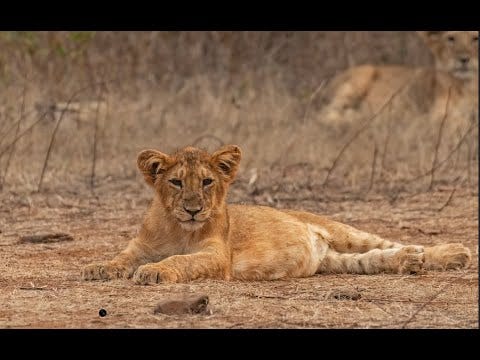
S3|E6 - Conserving the Asiatic Lion with Dr. Meena Venkataraman
The Asiatic Lion is probably India’s finest conservation miracles. With less than 100 individuals remaining in the wild in the 1960s, the population has skyrocketed with an estimated 600-800 lions roaming the forests of Saurashtra. In 2018, over 50 lions were lost due to an outbreak of the canine distemper disease. Moreover, the range of the Gir lion has spread well beyond the forests of Gir National Park, with prides often found wandering urban landscapes in Saurashtra. This poses a risk of human-lion conflict, which till now has been relatively limited.In Episode 6 of The Think Wildlife Podcast, I am joined by India’s leading lion biologist, Dr. Venkataraman, the founder of Carnivore Conservation and Research. She has over 20 years of experience as a wildlife biologists and studied the behavioural ecology of the Asiatic Lion. We talk about her intriguing work on lion ecology and conservation. We also talk about the state of lion translocation efforts in India and the potential impact of the cheetah reintroduction. Tune in to learn about this magnificent cat and their remarkable story in India!Meet the HostAnish Banerjee: https://x.com/anishwildlifeThink Wildlife Foundation: https://thinkwildlifefoundation.com/Meet the GuestsDr. Meena Venkatraman: https://corecarnivore.wordpress.com/about/ Recommended Wildlife Conservation BooksWildlife Conservation in India by HS Pabla: https://amzn.to/3Ypx9ZhIndian Mammals: A Field Guide by Vivek Menon: https://amzn.to/4fhMiCLAt the Feet of Living Things by Aparajita Datta: https://amzn.to/3BZmtsN Get full access to The Think Wildlife Podcast at anishbanerjee.substack.com/subscribe

S3|E5 - Charismatic Canids - Conserving India's Wild Dogs with The Dhole Project
In Episode 5 of The Think Wildlife Podcast, I am joined by Mayank Shukla, Anshita Das and Arjun Srivathsa from The Dhole Project. Launched in 2016, The Dhole Project aims to conduct research on Asiatic wild dogs or ‘dholes’ to better understand their ecological requirements and protect their populations in India.The dhole is one of India’s most charismatic predators, with their range spreading across southern, central India. Listed as Endangered by the IUCN Red List, the dhole faces numerous threats, including rampant habitat fragmentation, free ranging dogs and inbreeding. In this episode we cover the ecology and conservation of dhole in India, particularly in the agroforestry landscape of Valparai. We also talk about The Dhole Project’s research on dhole genetics and human-wild canid interactions! The Dhole Project is currently running a campaign to raise INR 200,000 (2 lakhs) to fund the next stage of their fieldwork. Additionally, 30% of the revenue from optional subscriptions to The Think Wildlife Podcast in this episode will be donated to the project.Meet the HostAnish Banerjee: https://www.linkedin.com/in/anish-banerjee-79ba63189/Think Wildlife Foundation: https://thinkwildlifefoundation.com/Meet the GuestsArjun Srivathsa: http://www.arjunsrivathsa.com/Arjun is a DST INSPIRE Fellow at the National Centre for Biological Sciences–TIFR, Bengaluru and Affiliate Scientist at Wildlife Conservation Society–India.Anshita Das: https://www.linkedin.com/in/anshita-das/Anshita is affiliated with The Dhole Project at Wildlife Conservation Society–India. Her current research is centred on two key areas: social media perceptions of dholes, and the role of human food subsidies on dhole packs in human-dominated areas.Mayank ShuklaMayank is associated with The Dhole Project at NCBS–TIFR. His work involves examining dhole population dynamics and dhole–human interactions in Kerala.Recommended Wildlife Conservation BooksWildlife Conservation in India by HS Pabla: https://amzn.to/3Ypx9ZhIndian Mammals: A Field Guide by Vivek Menon: https://amzn.to/4fhMiCLAt the Feet of Living Things by Aparajita Datta: https://amzn.to/3BZmtsNCanids of the World by Dr. José R. Castelló: https://amzn.to/3UnWGkl Get full access to The Think Wildlife Podcast at anishbanerjee.substack.com/subscribe

S3|EP4- Conserving the Mythical Himalayan Brown Bears of Kargil with Niaz Khan
In August 2022, I had the very good fortune to explore the mountains of Dras, Kargil in search of one of India’s rarest terrestrial mammals - the Himalayan Brown Bear. Listed as Critically Endangered by the IUCN Red List, there are less than 500 individuals remaining in the wild scattered across Western Himalayas and the Karakoram Mountains. Drass in the Kargil District of Ladakh and the neighbouring Deosai National Park in Pakistan remain their largest stronghold (tune in to this episode to learn why this region is so attractive for the bears!)The future of the Himalayan Brown Bear lies in the balance with climate change causing significant disruption across the Himalayas. Changing climate patterns is altering the flowering of berries and other plants, reducing the availability of food for these omnivorous bears. This has significant implications for the ecology of brown bear. In fact, studies have found that both, the hibernation patterns of the Himalayan Brown Bear and the Asiatic Black Bear have been altered due to rising temperatures and reduce snowfall. Additionally, the bears have become significantly more reliant on livestock as food, hence exacerbating human-bear conflict. The Himalayan Brown Bears also are threatened by severe habitat loss and degradation. Sadly, both the bears, and their habitat were collateral damage of the 1999 Kargil War. In the present scenario, haphazard development across the Himalayas has also further fragmented their habitats. The added pressure of free ranging dogs is a major threat to the biodiversity of Ladakh.In this episode of The Think Wildlife Podcast, I interview Niaz Hassan Khan, a PhD Scholar at the Wildlife Institute of India. We talk about his work on Himalayan Brown Bears in Kargil and the way forward for their conservation. The Think Wildlife Podcast is also available on iTunes, Spotify and YouTube. 30% of revenue from optional paid subscriptions on Substack from this episode will be donated to WWF to support their work on high altitude mammals in Ladakh.Meet the HostAnish Banerjee: https://www.linkedin.com/in/anish-banerjee-79ba63189/Think Wildlife Foundation: https://thinkwildlifefoundation.com/Meet the GuestNiaz Khan: Recommended Wildlife Conservation BooksWildlife Conservation in India by HS Pabla: https://amzn.to/3Ypx9ZhIndian Mammals: A Field Guide by Vivek Menon: https://amzn.to/4fhMiCLAt the Feet of Living Things by Aparajita Datta: https://amzn.to/3BZmtsN Get full access to The Think Wildlife Podcast at anishbanerjee.substack.com/subscribe

S3|E3- Protecting the European Hedgehog with Dr. Sophie Lund Rassmusen
In Episode 3 of this season, I am joined by Dr. Sophie Rassmusen, a Research Fellow at University of Oxford and Linacre College Research Associate at WildCRU. Popularly referred to as Dr. Hedgehog, Sophie is at the forefront of hedgehog conservation and research. Unfortunately, scientific research from several European countries indicate that the population of European hedgehogs is in decline all over Europe. In fact, the European Hedgehog was recently downgraded to “Near Threatened” on the IUCN Red List. It is therefore essential to investigate the causes for the decline and enhance the understanding of the challenges hedgehogs face in the wild in order to improve the conservation initiatives directed at this species. In this episode, we talk about Sophie’s PhD research which encompasses “The Danish Hedgehog Project” with the help of citizen science. We also discuss hedgehog health and the impacts of roads and lawns on hedgehog populations. The Think Wildlife Podcast is also available on iTunes, Spotify and YouTube. Please do consider upgrading to an optional paid subscription on Substack. 30% of the revenue from this episode will be donated to WildCRU for the conservation of hedgehogs!Meet the HostAnish Banerjee: https://www.linkedin.com/in/anish-banerjee-79ba63189/Think Wildlife Foundation: https://thinkwildlifefoundation.com/Meet the GuestDr. Sophie Lund Rasmussen: https://www.wildcru.org/members/dr-sophie-lund-rasmussen/Recommended Wildlife Conservation BooksWildlife Conservation in India by HS Pabla: https://amzn.to/3Ypx9ZhIndian Mammals: A Field Guide by Vivek Menon: https://amzn.to/4fhMiCLAt the Feet of Living Things by Aparajita Datta: https://amzn.to/3BZmtsN Get full access to The Think Wildlife Podcast at anishbanerjee.substack.com/subscribe

S3|E2- Exploring threats to urban owls in India with Debangini Ray
Owls are amongst the most ecologically and culturally important group of birds in India. They act as biocontrol agents due to their predation of rodent and insect pests in agricultural and urban landscapes. Not only does this reduce the dependence of pesticides in agricultural areas but also preventing the spread of zoonotic diseases. Owls, especially barn owls are often revered as a symbol of the Goddess of Wealth, Goddess Laxmi. However, in some parts of India, owls are often treated as a bad omen. Unfortunately, these superstitions make owls susceptible to to the illegal wildlife trade, especially around the time of Diwali when these bids are used for black magic rituals. With Diwali around the corner, tune in to this episode of The Think Wildlife Podcast, as I am joined by Debangini Ray to discuss the plight of India’s urban owls. Debangini is a PhD Scholar at the Chatur Ullu Lab of the MIT World Peace University. She is the founder of The Urban Owl Project, which aims to study owls across cityscapes in India through multispecies ethnography. Moreover, it aims at understanding how humans and owls coexist within shared urban spaces and the impacts one may have on the other. Additionally, the study also works towards dispelling cultural misbeliefs and animosity that humans may have towards these nocturnal raptors and informs citizens about current anthropogenic threats that seriously impact owl populations. Tune in to learn about why India’s owls are doomed for darkness.The Think Wildlife Platform is also available on iTunes, Spotify and YouTube.Meet the HostAnish Banerjee: https://www.linkedin.com/in/anish-banerjee-79ba63189/Think Wildlife Foundation: https://thinkwildlifefoundation.com/Meet the GuestDebangini Ray: https://www.dakshin.org/dt_team/debangini-ray/The Urban Owl Network: https://www.instagram.com/urbanowlnetwork/Recommended Wildlife Conservation BooksWildlife Conservation in India by HS Pabla: https://amzn.to/3Ypx9ZhIndian Mammals: A Field Guide by Vivek Menon: https://amzn.to/4fhMiCLAt the Feet of Living Things by Aparajita Datta: https://amzn.to/3BZmtsN Get full access to The Think Wildlife Podcast at anishbanerjee.substack.com/subscribe

Season 3, Episode 1: The State of Nature Tech with Gilad Goren
Welcome to Season 3 of The Think Wildlife Podcast. It has been almost two years since I began the Podcast and have had the good fortune of interviewing nearly 100 conservationists around the world. This season consists of another 50 episodes, with topics ranging from nature tech and bioacoustics to conservation filmmaking, the illegal wildlife trade, marine ecology and ecosystem restoration.In the first episode of Season 3, I am joined by Gilad Goren. Gilad, who is currently at COP16, is the Executive Director of the Nature Tech Collective. This is a non-profit member alliance, accelerator and intelligence unit that is advancing the uptake of nature-based solutions to integrate nature protection into all sectors of society.In this episode, we discuss the state of nature tech around the world ranging from nature fintech to artificial intelligence and remote sensing. We also discuss the role of NatureTech in addressing challenges around environmental disclosure frameworks. Tune in to this highly engaging episode.PS: This season I have provided the listeners with the option to upgrade to a paid subscription on The Think Wildlife Podcast. Don’t worry! The Podcast will still be accessible for everyone! The paid subscription will allow to expand the podcast in the next couple of years, potentially leading to a video podcast series. Additionally, I will be donating 30% of the revenues from each episode to conservation projects around the world. The paid subscription option is available on Substack and soon YouTube!For the first two episodes of the Season, I will host a poll at the end of October for my listeners to chose the conservation project!The Think Wildlife Platform is also available on iTunes, Spotify and YouTube. Anish BanerjeeWebsite: https://thinkwildlifefoundation.com/LinkedIn: https://www.linkedin.com/in/anish-banerjee-79ba63189/Twitter: AnishWildlifeGilad Goren: Website: http://giladgoren.comLinkedIn: https://www.linkedin.com/in/giladgoren1/Nature Tech CollectiveWebsite: https://www.naturetechcollective.org/LinkedIn: https://www.linkedin.com/company/nature-tech-collective/ Get full access to The Think Wildlife Podcast at anishbanerjee.substack.com/subscribe

Episode 71: She Changes Climate with Bianca Pitt
The Climate Crisis is imminent. However, despite the urgency of the crisis, there is still a severe lack of diversity and inclusivity in the climate and conservation sector. Women continue to be marginalized from the political sphere because of gender stereotypes, lack of access, and socio-economic-structural barriers. Tackling this is the organization “She Changes Climate”, with the aim of driving awareness of the crucial role of women in accelerating climate action.The organization is committed to ensuring women, in all their diversity, are included as active participants in climate leadership and policy-making processes. To achieve this, we are actively campaigning for inclusion and diversity by working closely with governments and collaborating with like-minded organizations to raise awareness of inequalities in climate leadership.In this episode, I interview the co-founder Bianca Pitt to talk about the challenges and successes she has experienced at She Changes Climate and her vision for the future.This interview was recorded in January 2023. Get full access to The Think Wildlife Podcast at anishbanerjee.substack.com/subscribe

Episode 77: Conserving Tasmania’s Biodiversity with James Hattam, CEO at Tasmanian Land Conservancy
Tasmania, the land of the endangered Tasmanian Devil and the extinct Tasmanian tiger, is one of Australia’s most biodiverse regions. Various species of possums, wallabies, seals, penguins, and platypus roam the island state. Unfortunately, the region’s rich ecosystem is under severe threat from habitat clearance and degradation, amplified by the spread of invasive plants and feral mammals.The Tasmanian Land Conservancy is at the forefront of conservation in Tasmania, with the vision of transforming Tasmania into a global leader in nature conservation. TLC is working extensively at the grassroots level to protect and expand conservation reserves in the region. In this episode, I interview James Hattam to discuss the projects TLC has undertaken to conserve the region’s precious biodiversity. Get full access to The Think Wildlife Podcast at anishbanerjee.substack.com/subscribe

Episode 76: Restoring and Protecting the Daintree Rainforest with Branden Barber, CEO of Rainforest Rescue
The Daintree Rainforest, located on the northeastern coast of Queensland, is amongst the most pristine rainforests globally. Over 10 million years older than the Amazon Rainforest, the Daintree is part of the Wet Tropics of Queensland. This forms the largest contiguous rainforest in Australia.Countless endemic species of avifauna are found in the Daintree, such as the golden bowerbirds, tooth-billed and lovely fairywrens. Moreover, the rainforest also has a relatively stable population of southern cassowary, for which it was listed as an Important Bird Area by BirdLife International. Unfortunately, climate change, habitat fragmentation, rural development, and the spread of invasive and feral species severely threaten the Daintree.In this episode, I speak to Branden Barber, the CEO of Rainforest Rescue on the conservation of the Daintree Rainforest. He elaborates upon the cultural importance of the Daintree, threats, and Rainforest Rescue’s conservation efforts. Get full access to The Think Wildlife Podcast at anishbanerjee.substack.com/subscribe

Episode 75: Understanding the Way forward for the Grevy’s Zebra with Dr. David Kimiti and Damaris Lekiluai
The Grevy’s Zebra is the largest extant species of equid in the world. Unfortunately, the species is listed as “Endangered” by the IUCN Red List. With less than 2,000 wild individuals found in pockets of Kenya and Ethiopia, the Grevy’s Zebra is the most threatened of the three zebra species. In the 20th Century, hunting for their skins was the primary threat to the species. However, the species is now heavily threatened by rampant habitat loss and fragmentation, driven primarily by livestock overgrazing and the spread of invasive plants. The development of linear infrastructure is further fragmenting the populations of Grevy’s Zebra. In this episode, I speak to Dr. David Kimiti and Damaris Lekiluai from Grevy’s Zebra Trust to discuss the conservation of this rare species. Get full access to The Think Wildlife Podcast at anishbanerjee.substack.com/subscribe

Episode 74: Understanding Coral Reefs with Dr Francoise Cavada-Blanco, Co-Chair, IUCN Coral Specalist Group
Coraf Reefs around the world are under severe threat. It is estimated that around 10% of the global coral reefs are dead while about 60% are under severe threat due to anthropogenic pressure. Climate change remains the primary threat to coral reefs around the world, with increasing sea temperatures catalyzing coral bleaching, which results in the death of reefs. Additionally, increased frequency and intensity of storms, induced by climate change, further damage coral reefs. Beyond climate change, corals are also threatened by rampant coral mining, ocean acidification, and pollution from wastewater and plastic debris.The destruction of coral reefs is particularly concerning. Other than fostering rich marine biodiversity, coral reefs are also critical for the economy of coastal communities. Corals provide a plethora of ecosystem services ranging from protecting coastlines from storms and erosions to supporting fisheries and providing job opportunities in the form of tourism. Over half a billion people rely on coral reefs for subsistence and protection. Get full access to The Think Wildlife Podcast at anishbanerjee.substack.com/subscribe

Episode 73: Understanding Nature Finance with Darren Mckenzie from Global Canopy
Nature forms the foundation of the world’s economy. Nature-based solutions focused on climate mitigation contribute about USD 170 billion worth of ecosystem services to the global economy. However, the dependencies of the nature of the global economy and the related risks and opportunities to the economy have not received much attention from corporations, investors, and lenders.In this episode, I interviewed Darren Mckenzie from Global Canopy, a data-driven not-for-profit that targets the market forces destroying nature. Intending to tackle the drivers of deforestation, Global Canopy is working towards improving the supply chain transparency of corporates while improving company sustainability and ESG Metrics. Furthermore, Global Canopy is working towards developing high-quality data to tackle nature-related risks and opportunities. In this episode, Darren elaborates on the work of Global Canopy and other concepts of nature finance. Get full access to The Think Wildlife Podcast at anishbanerjee.substack.com/subscribe

Episode 72: Exploring the Role of Remote Sensing in Forest Conservation with Professor Ed Mitchard, Co-Founder at Space Intelligence
In a previous episode of The Think Wildlife Podcast, we briefly touched upon the role of artificial intelligence and biacoustic monitoring in wildlife conservation. On a similar note, in this episode, I interview Professor Ed Mitchard, to discuss the role of remote sensing in forest conservation Through the use of satellites, remote Sensing allows for the observation and accurate imaging of the earth’s surface. This is particularly useful for forest research and monitoring as stakeholders can monitor land-use change, estimate a forest carbon stock, detect forest fires, and report upon other key forest indicators.Professor Mitchard is one of the leading remote sensing scientists, with over 60 peer-reviewed publications on the topic. He has also advised the governments of the UK, Cameroon, Columbia, and Gabon on land use monitoring techniques. He is also the co-founder and chief scientist of Space Intelligence. The start-up aims to utilize high-quality nature data and digital monitoring systems to achieve zero deforestation and mass restoration and tackle the climate emergency. Get full access to The Think Wildlife Podcast at anishbanerjee.substack.com/subscribe

Episode 71: Tackling the climate and biodiversity crisis with Nature-Based Solutions with Seth Thomas, University of Oxford
Over the last few decades, the world has witnessed a technological revolution to tackle the climate crisis. However, more recently, there has been a growing consensus about the role of nature and nature-based solutions in tackling, not only the Three Planetary Crisis but also various pressing societal issues, such as poverty. The goals of nature-based solutions are to restore, protect and sustainability manage both natural and modified ecosystems to benefit both society and nature. In fact, over a third of the climate mitigation required to achieve the goals of the Paris Agreement can be provided by nature-based solutions. Annually, flooding damages worth US $57 billion are averted by mangroves in India, China, the US, Mexico, and Vietnam. In this episode, I interview Seth Thomas, a research assistant at the University of Oxford’s Nature-based Solutions Initiative. With projects across Asia, South America, and the UK, the program aims to enhance understanding of the potential of nature-based solutions to address multiple global challenges whilst supporting the health of ecosystems. Additionally, the program aims to involve and respect the rights of indigenous peoples and local communities. In this episode, we discuss the concept of nature-based solutions, their challenges, and their potential. Seth also elaborates on his extensive research work which covers the socioeconomic benefits of the legal wildlife trade and a global review of the large carnivore reintroduction, rewilding, and translocation. Get full access to The Think Wildlife Podcast at anishbanerjee.substack.com/subscribe

Episode 70: Understanding Penguin Conservation with Dee Boersma, Co-Chair, IUCN Penguin Specalist Group
The Penguin is amongst the most unique taxa of birds in the world. These flightless, aquatic birds are highly adept swimmers, having adapted to spending half their lives underwater. Penguins, with the aid of flippers and their streamlined bodies are known to swim over 20 kilometres an hour in seas while hunting for prey.There are currently between 17 to 19 species of penguins globally, almost all of which are found exclusively in the Southern Hemisphere. The range of penguins extends across Antarctica, New Zealand, Australia, South Africa, and South America. The Galapagos Penguins are the only species naturally found north of the Equator. Larger penguin species tend to inhabit colder regions while their smaller counterparts prefer more temperate and tropical landscapes.Currently, according to the IUCN Red List, the conservation status of the numerous penguin species ranges from “Least Concern” to “Endangered”. Climate change, and the associated melting of ice caps, remain the primary threat to penguins, particularly for the species found in Antarctica. A WWF study estimated that a 2-degree increase in global temperature from pre-industrial levels will result in a 50% and 75% reduction in Emperor and Adelie penguins respectively. An additional threat to penguins is commercial fishing. The overexploitation of fish stocks in the Southern Ocean severely diminishes the prey base for penguins. Moreover, penguins regularly fall victim to bycatch. In this episode, I interview P. Dee Boersma to discuss the conservation of penguins. Dee is the co-chair of the IUCN Penguin Specialist Group and the founder of the Centre of Ecosystem Sentinels. She is also a professor at the University of Washington. She is the author of Penguins: Natural History and Conservation and Invasive Species in the Pacific Northwest In this conversation, Dee elaborates on her extensive career working with penguins, and in particular the Magellanic penguin. Get full access to The Think Wildlife Podcast at anishbanerjee.substack.com/subscribe

Episode 69: Preventing The Insect Crisis with Paul Hetherington, Buglife
‘If we and the rest of the back-boned animals were to disappear overnight, the rest of the world would get on pretty well. But if the invertebrates were to disappear, the world’s ecosystems would collapse.’ Sir David Attenborough.From pollination and seed dispersal to pest control and nutrient cycling, insects and other invertebrates provide humanity with a wide plethora of ecosystem services. Without them, nature and subsequently the global economy will collapse into ruin.Unfortunately, despite their significance, invertebrates are under immense threat. According to a study published in 2019, 40% of all insect species are declining. Threats ranging from climate change, light pollution, habitat loss, pesticides, and pharmaceutical waste are dimming the future of invertebrates globally.In this episode of the Think Wildlife Podcast, Paul Hetherington from Buglife and I, discuss the insectinction. Paul elaborates upon the projects that Buglife is spearheading to help halt and reverse the insectinction. Get full access to The Think Wildlife Podcast at anishbanerjee.substack.com/subscribe

Episode 68: Protecting Africa’s Biodiversity with Kaddu Sebuyna, CEO of the African Wildlife Foundation
Africa’s wilderness has captured the imagination of millions of people around the world. Despite its exploding population and rapidly growing economies, the continent has often been the flagbearer of conservation globally. This ranges from the conservation of elephants and rhinos in southern Africa to the creation of Kavango Zambezi, the second-largest nature conservation landscape globally. However, Africa’s wildlife is far from secure. The illegal wildlife trade still looms large with threatening lions, rhinos, and pangolins across the continent. Meanwhile, livestock overgrazing and the demand for charcoal and firewood are fostering the degradation of the habitats of giraffes, zebra, and other ungulates. Deadly diseases threaten the survival of gorillas and chimpanzees. In this episode of The Think Wildlife Podcast, I interview Kaddu Sebunya, the CEO of the African Wildlife Foundation (AWF). We discuss extensively about the impact of the illegal wildlife trade on Africa’s biodiversity, tackling habitat loss through alternative livelihoods and sustainable agriculture and the potential and issues of utilizing trophy hunting in African conservation. Kaddu also extensively elaborates upon some of the projects AWF is involved in to tackle the climate crisis, counter the illegal wildlife trade, and prevent habitat loss. Get full access to The Think Wildlife Podcast at anishbanerjee.substack.com/subscribe

Episode 66: Fostering Effective Conservation Partnerships for Africa’s Biodiversity with Fred Nelson, CEO at Maliasili
Collaboration is essential for conservation. The complexity of conservation challenges is often multifold and requires the involvement and cooperation of multiple stakeholders. Additionally, the sharing of resources, particularly funding, and technical expertise from a variety of sectors, immensely contribute to the success of conservation initiatives. It is for this reason that forming strategic alliances between NGOs, government agencies, local communities, and private landowners, is critical for conservation.However, conservation partnerships also produce unique challenges, particularly in terms of integrating the partners into a cohesive and effective entity. Conservation projects are often ineffective due to the contradictory visions between grassroots organizations and their international partners. It is therefore critical to incorporate the seven core principles for effective conservation partnerships.In this episode, I interview Fred Nelson, who is the CEO of Maliasili. This organization aims to support high-potential local African organizations to accelerate the benefits they bring to people, ecosystems, and climate change. Maliasili has increased the impact of these projects across their landscapes by enhancing leadership capacity and supporting fundraising efforts. Specifically, Maliasili has trained 115 African conservation leaders and raised and leveraged $15 million for partners since 2018 across Africa.Tune in to learn more about effective conservation partnerships as Fred also elaborates upon the work supported by Maliasili. Get full access to The Think Wildlife Podcast at anishbanerjee.substack.com/subscribe

Episode 65: Safeguarding Central Africa’s Crocodiles and Pangolins with Matthew Shirley
Meet the Pangolin. The world’s most trafficked mammal. Pangolins are also known as scaly anteaters due to the protective keratin scales covering their skins. Unfortunately, these protective keratin scales are leading to the pangolin’s downfall. Keratin is in high demand in China and Vietnam (the usual suspects) for traditional Chinese Medicine and as a luxury food. Moreover, pangolins are also often consumed as bushmeat and traditional medicine across Africa, though at a relatively smaller scale. It is for this reason, pangolins are the most trafficked mammal in the world, with over a million animals poached between 2004 and 2014. This is proving catastrophic, with the illegal trade of pangolins often associated with the emergence of the COVID-19 pandemic. However, there is still no global consensus regarding the origins of the deadly virus.Currently, there are eight extant species of pangolins, with four species being found in Africa and Asia each. Out of the eight species, three are listed as “Critically Endangered” and three are classified as “Endangered” by the IUCN Red List. Meanwhile, the remaining two species are considered “Threatened. As of September 2023, there have been nine reports of extinct species of pangolinIn this episode of The Think Wildlife Podcast, I interview Matthew Shirley, the co-chair of the IUCN Pangolin Specialist Group. We talk in-depth about the conservation of the pangolin and the works of the IUCN PSG. Matthew is also one of the leading conservationists working with crocodiles, having discovered the Central African slender-snouted crocodile. During the episode, Matthew elaborates upon his extensive work on these ancient reptiles in West and Central Africa. Get full access to The Think Wildlife Podcast at anishbanerjee.substack.com/subscribe

Episode 64: Conserving Amazon’s River Dolphins with Suzanne Smith
The Amazon River Dolphin, known locally as the “Boto”, is the largest species of river dolphin in the world. The species is also the most widespread river dolphin, covering six different countries in South America. Unfortunately, the Amazon River Dolphin is classified as “Endangered” by the IUCN Red List. Commercial fishing remains the primary threat to the species. The species is also severely affected by extreme drought due to climate change and water pollution from industrial mining.In this episode, I talk about the conservation of the Boto with Suzanne Smith, who is the founder of the Amazon River Dolphin Foundation. Get full access to The Think Wildlife Podcast at anishbanerjee.substack.com/subscribe

Episode 63: Protecting the World’s Cranes with Dr. Rich Beilfuss, President, International Crane Foundation
Globally, there are 15 species of cranes spread across all continents baring South America and Antarctica. With eight species, East Asia has the highest crane diversity. A few species of crane, such as the Siberian and Demosille crane, are known to migrate thousands of kilometers to avoid the harsh winter months of Siberia.Across their range, cranes are revered culturally. For example, Sarus cranes, the world’s tallest flying bird, is often associated with the Hindu God Lord Brahama across south and southeast Asia. Similarly, in Ladakh, the Black-necked Crane is a symbol of good luck amongst the local Buddhist population.Unfortunately, cranes are under severe threat. Across the world, cranes are rapidly losing their grassland and wetland habitats to agriculture and industrialization. Other than the conversion of natural habitat to agriculture, altered wetland hydrology due to irrigation and increased exposure to agricultural chemicals are also pressing threats. A few species of crane, especially the critically endangered Siberian Crane, have been driven to the brink of extinction by legal hunting in central and west Asian countries, such as Pakistan. In this episode, I interview Dr. Rich Beilfuss, who is the President of the International Crane Foundation. Founded in 1971 at Cornell University by two undergraduate ornithologists, the International Crane Foundation is working extensively on the conservation of all 15 crane species. Their work extends across Asia, Africa, and North America. In this conversation, Rich elaborates on the various conservation initiatives ICF leads. Get full access to The Think Wildlife Podcast at anishbanerjee.substack.com/subscribe

Episode 62: Protecting South America’s Jaguars from the Illegal Wildlife Trade with Melissa Arias, Jaguar and Priority Landscape Coordinator, WWF
After tigers and lions, the jaguar is the third largest species of wild felid and the only species of the Panthera genus (big cats) to be found in Americas. The current range of jaguars extends from southern USA, across Mexico and Central America to the Amazonian rainforest. In Central and South America, jaguars inhabit tropical rainforests, deciduous and cloud forests. In North America, however, jaguars have shown a preference for seasonally flooded wetlands and dry grasslands. The jaguar is currently listed as “Vulnerable” by the IUCN Red List following a population decline of 20–25% in about 30 years. Moreover, the jaguar has lost more than half its range since 1999. While deforestation and habitat fragmentation continue to threaten the species, the illegal wildlife trade remains a more pressing issue. Following the Second World War, the international trade of jaguar skis blossomed, with reports of up to 15,000 jaguars being poached annually for the trade from the Brazillian Amazon alone. The international trade of jaguar skins has reportedly plummeted following the enactment of the Convention on International Trade in Endangered Species in 1973. However, poaching and the illegal trade of jaguars still occur on a local scale. Seizure reports indicate that a minimum of 857 jaguars were lost between 2012 and 2018 to the illegal wildlife trade in South America. In this episode, I speak to Melissa Arias, who has worked extensively to understand and tackle the illegal trade of jaguars. During her PhD at the University of Oxford’s Wildlife Conservation Research Unit, Melissa, scientifically investigated the drives and prevalences of the illegal trade in jaguars in Latin America. Following her PhD, Melissa has worked with various prestigious wildlife organizations, such as the Wildlife Conservation Society, CITES, and the Convention on Migratory Species. She currently is the Coordinator of WWF’s Jaguar and Priority Landscape Project. Get full access to The Think Wildlife Podcast at anishbanerjee.substack.com/subscribe
Episode 61: Creating Landscapes of Lions with Alayne Oriol Cotterill, CEO at Lion Landscapes
Listed as “Vulnerable” by the IUCN Red List, The African Lion is one of the most threatened species in the world. The population of this regal carnivore has dropped drastically from over 200,000 individuals a century ago to approximately 24,000 today. Almost half of this population is found outside protected areas, often in human-dominated landscapes. Rampant habitat loss and fragmentation, coupled with a sharp decline in prey abundance across their range is a recipe for human-wildlife conflict. Lions are often persecuted in retaliation to livestock degradation by these big cats. This has unfortunate consequences for Africa’s vultures which often prey on livestock carcasses poisoned by farmers, intending to murder problematic lions. Additionally, lions are increasingly falling victim to the illegal wildlife trade to meet the demand for wildlife products in China and Vietnam, following the clamp down on tiger poaching in Asia. More specifically in southern Africa, lions are often captured for the horrific canned lion industry. In this episode, I interview Alayne Oriol Cotterill, the CEO of Lion Landscapes, which is one of the leading organizations working towards lion conservation. We cover their various projects, such as their Ruaha Carnivore Program, Community Co-Op, and Collaring for Coexistence programs. We also talk about the “controversial” role of trophy hunting in wildlife conservation in Africa. If you enjoyed this podcast, do not forget to share and subscribe! You can also listen to The Think Wildlife Podcast on other platforms, such as YouTube, Spotify, and iTunes. Get full access to The Think Wildlife Podcast at anishbanerjee.substack.com/subscribe

Episode 60: Conserving the Lesser Florican and Great Indian Bustard with Sujit Narwade, Assistant Director, Bombay Natural History Society
Once upon a time, the Great Indian Bustard was close to becoming India’s National Bird. However, the species is now considered Critically Endangered by the IUCN Red List, with less than 100 individuals remaining in the wild. The species is predominantly found in Rajasthan, though sightings do occur across the Deccan Plateau. Collisions with windmills, hunting of eggs by free-ranging dogs, and the loss of grassland habitat have decimated populations of the Great Indian Bustard. Unfortunately, the three remaining bustard species in India, have a similar storyline.In this episode, I interview Sujit Narwade, the Assistant Director of the Bombay Natural History Society to discuss bustard conservation in India. We predominantly focus on the conservation Great Indian Bustard and the Lesser Florican, the two species which BNHS has extensively worked with. Get full access to The Think Wildlife Podcast at anishbanerjee.substack.com/subscribe
Episode 59: The Future of Orangutan Conservation, Michelle Desilets, Executive Director, Orangutan Land Trust
One of the most charismatic species of the rainforests of south-east Asia is the orangutan. The orangutan is the only wild species of Great Ape found in Asia, with the remaining three, gorillas, chimpanzees, and bonobos, found in Africa. Until 1996, the orangutan was considered one individual species. However, since then the species has been divided into three subspecies, which include the Borneon, Sumatran, and Tapanuli Orangutan. Historically, the orangutan’s range spread across southeast Asia and south China. Now, the species is found in fragmented populations scattered across the Borneon and Sumatran rainforests. The species, unfortunately, is on the brink of extinction, with all three subspecies classified as Critically Endangered by the IUCN Red List. Habitat loss, driven by the rampant expansion of palm oil plantations, is the primary threat to these ecological engineers. The bushmeat trade also looms large on the species. In this episode of The Think Wildlife Podcast, I interview Michelle Desilets, the Executive Director of the Orangutan Land Trust to discuss the future and conservation of the charismatic Great Ape. Get full access to The Think Wildlife Podcast at anishbanerjee.substack.com/subscribe
Episode 58: Creating a Future for Clouded Leopards with Chrishen Gomez, DPhil Student, WildCRU, University of Oxford
One of Asia’s most elusive predators is the Clouded Leopard. Until 2006, the term clouded leopard referred to one ubiquitous species found across the Eastern Himalayas, mainland Southeast Asia, and the islands of Borneo and Sumatara. However, extensive genetic analysis of various populations revealed two sister species of clouded leopard. The first is the Mainland Clouded Leopard, distributed discontinuously across the foothills of the Eastern Himalayas, South China, and South East Asia. The second species, the Sunda Clouded Leopard, is restricted to rainforests of Borneo and Sumatra. Physically, the latter has a darker and smaller cloud pattern than the former. Studies suggest that both species diverged relatively recently (in evolutionary terms), approximately 2-0.9 million years ago. This has been attributed to the submergence of the land bridge connecting the Sumatran and Bornean rainforests to mainland Asia, hence resulting in extreme geographic isolation and hence speciation. The population of both species has declined significantly below 10,000 individual adults. None of the subpopulations of the two species have more than 1,000 individuals. Consequently, both species have been considered “Vulnerable” by the IUCN Red List for Threatened Species. Habitat fragmentation, due to unprecedented levels of deforestation, and commercial hunting for the illegal wildlife trade are the primary threats faced by clouded leopards.In this episode, I speak to Chrishen Gomez, a Ph.D. student at the University of Oxford’s Wildlife Conservation Research Unit. He is currently a part of WildCRU’s Clouded Leopard Programme. Established in 2010, the program has since conducted long-term ecological studies on both species of clouded leopards across their range, with the aim of improving the species conservation. Tune in to learn more about Chrishen’s and WildCRU’s research on Clouded Leopards. Get full access to The Think Wildlife Podcast at anishbanerjee.substack.com/subscribe
Episode 57: Exploring the Conservation of Borneo’s Primates and Felines with Susan Cheyne, Borneo Nature Foundation International
The highly biodiverse island Borneo forms one of the largest remaining intact forests of Southeast Asia. Also, the world’s third largest island, Borneo is a stronghold for various charismatic and endangered megafauna species, including orangutans, clouded leopards, elephants, proboscis monkeys and sunbear. Unfortunately, the rainforests of south-east Asia, and in particular Borneo, are under immense pressure. Around 85% of the world’s palm oil and half of the annual global tropical timber is sourced from the Borneon Rainforest, leading to rampant deforestation. Concerningly, the highly destructive “slash and burn” method is utilized extensively by corporations to clear rainforests and peatlands for palm oil plantations. This leads to uncontrollable forest fires, which not only threaten the region’s rich biodiversity but the health of millions of people in the region.In this episode of The Think Wildlife Podcast, I interview Dr. Susan Cheyne to discuss in depth the conservation of Borneo’s mammals. Since 1997, Susan has conducted extensive research on the region’s biodiversity, with a particular interest in gibbons and clouded leopards. She is also the co-director of Borneo Nature Foundation International, which is spearheading the conservation of the world’s third-largest rainforest. Get full access to The Think Wildlife Podcast at anishbanerjee.substack.com/subscribe
Episode 56: Safeguarding the Mammals of the Eastern Ghats with Dr. Vikram Aditya, Principal Scientist at the Centre for Wildlife Studies
The Eastern Ghats is amongst the most biodiverse regions in India. This discontinuous mountain range is spread predominantly across Tamil Nadu, Andhra Pradesh, Odisha and Karnataka. A study conducted by ATREE found over 200 species of birds in the Eastern Ghats, which includes the endemic Jerdon’s Courser. The region also has healthy populations of elephants, gaur, blackbuck, leopards and wolves, alongside various small mammal species. Around 400 tigers are found in the region. Unfortunately, only a very small portion of the Eastern Ghats landscape is classified as a protected area, making the region vulnerable to rapid land cover change. Other than rampant habitat loss, hunting and the illegal wildlife trade threatens the fauna of the region.In this episode, I interview Dr. Vikram Aditya who has worked extensively on the conservation of the mammals of the Eastern Ghats. He is currently a Principal Scientist at the Centre for Wildlife Studies and spearheads their Wildlife Hunting and Trade program. Currently, the program operates solely in the Eastern Ghats, to study how hunting pressure and illegal wildlife trade is impacting wildlife in the region. Get full access to The Think Wildlife Podcast at anishbanerjee.substack.com/subscribe
Episode 55: Reviving India’s Seagrass Meadows for Dugong Conservation with Elrika D’Souza from Nature Conservation Foundation
Dugongs are amongst Asia’s most charismatic marine mammals. The species is often referred to as "sea cows" as their diet predominantly consists of seagrass. The range of the dugongs is fragmented across the warm coastal waters of the western Pacific Ocean to the eastern coast of Africa. In India, their range extends across the Western and Southern coast and the Andaman and Nicobar Archipelago. Unfortunately, dugongs are listed as “Vulnerable” by the IUCN Red List, with their global population declining more than 20% in the last 90 years. Traditional and industrial hunting of dugongs for their meat and oil led to the plummeting of sea cow populations. However, currently, the primary threats faced by dugongs are habitat loss and environmental degradation. Deep-sea mining, trawling, and land reclamation degrade seagrass meadows by increasing sedimentation and hence reducing exposure to light. Pollution, in the form of sewage, heavy metals waste, and herbicides further destroys seagrass meadows. While not quantified, industrial fishing is also a massive threat as dugongs regularly succumb as bycatch following entanglement in fishing nets.In this episode, Elrika D’Souza, one of India’s leading marine biologists, elaborates on her dugong and seagrass conservation work at the Nature Conservation Foundation. Tune in to listen more! Get full access to The Think Wildlife Podcast at anishbanerjee.substack.com/subscribe
Episode 54: Creating an Encyclopedia of India’s Wildlife with RoundGlass Sustain
India is a wildlife paradise. Despite being the largest democracy and fastest-growing economy in the world, wildlife has recovered throughout the country. From tigers of Madhya Pradesh to hornbills and Amur falcons of Nagaland and the lions of Gujarat, India is home to conservation miracles. Capturing these stories is RoundGlass Sustain. With the aim of becoming an encyclopedia of India’s wildlife, RoundglassSustain utilized stories, videos, infographics, and humor to highlight India’s biodiversity, habitats, and conservation. RoundGlass Sustain captures some of the most inspiring conservation stories, from the Great Indian Bustard to the One Horned Rhino. They also aptly decipher complicated conservation issues, such as human-wildlife conflict and climate change. In this episode, I interview Sunny Gurpreet Singh, the founder of RoundGlass, and Neha Dara, the business head of RoundGlass Sustain. Get full access to The Think Wildlife Podcast at anishbanerjee.substack.com/subscribe
Episode 53: Bringing back the Markhor with Tanushree Srivastava from Wildlife Trust of India
The Markhor is one of Central and South Asia's most charismatic mountain ungulates. The species is scattered across the Karakoram Range, Afghanistan, and the western Himalayas. The Markhor, often called the “Screw-horned Goat” is the national animal of Pakistan. In Persian and Pahto languages, the word “mārkhor” translates as "snake-eater" highlighting the ancient belief that the markhor would actively kill and consume snakes.The Markhor is currently listed as “Near Threatened” by the IUCN Red List. Across its range, hunting is the primary threat to the Markhor. In Pakistan, the Markhor falls victim to the lucrative trophy hunting business. Meanwhile, the hunting of markhor for bushmeat and traditional beliefs is still prevalent in Afghanistan and India, despite such practices being banned. In India, habitat loss and fragmentation due to climate change and livestock overgazing remain a major threat. LIke most mountain ungulates in the Himalayas, the markhor is not spared from the free-ranging dog menace in India.In this episode of the Think Wildlife Podcast, Tanushree Srivastava and I discuss Markhor conservation in Kashmir. Tanushree, who is one of the leading scientists researching Himalaya’s ungulates, also spearheads Wildlife Trust of India’s “ Kashmir Markhor Recovery Project”. Get full access to The Think Wildlife Podcast at anishbanerjee.substack.com/subscribe