
Show overview
The Stockman Grassfarmer Podcast has been publishing since 2021, and across the 5 years since has built a catalogue of 114 episodes. That works out to roughly 50 hours of audio in total. Releases follow a fortnightly cadence.
Episodes typically run twenty to thirty-five minutes — most land between 10 min and 36 min — with run-times ranging widely across the catalogue. None of the episodes are flagged explicit by the publisher. It is catalogued as a EN-language Education show.
The show is actively publishing — the most recent episode landed 1 months ago, with 24 episodes already out so far this year. The busiest year was 2025, with 49 episodes published. Published by The Stockman Grassfarmer.
From the publisher
Our mission is to help create a healthy planet and people through profitable grass-based livestock production. Ready to take your regenerative ranching to new heights? Learn more here. https://www.stockmangrassfarmer.digital/profile Be sure to explore the links for our monthly magazine, upcoming live events, and latest specials. Grassfarming is a 24-7 job, and you can’t always get away. That’s why we’ve put together this podcast—so you can listen while you work (or whatever you’re doing), always on your schedule, whenever and wherever you want.
Latest Episodes
View all 114 episodesForage Chains Connect the Dots for Profit By Dan Glenn
Al’s Obs: Cultural Biases
What Is the Greatest Challenge to Being a Grass Farmer Today? | Jim Gerrish
Think Feed Is Your Biggest Cost? Jim Gerrish Says You're Looking at the Wrong Number
From Seven Cows to 14,000 Customers: Relationships, Regeneration & Resilience with Glenn Elzinga
Legumes in the Grazing System: Building Profit from the Soil Up by Russ Wilson
The Custom Grazing Client's Point of View by Allan Nation
Multi-Species Grazing Foundations with Greg Judy (Remastered) Part 2 of 3
Navigating USDA Programs with Confidence – Inside the Navigator with Doug McCarty
The Cornerstones of Direct Marketing with Joel Salatin Part 2 of 3 (remastered)
Breaking Tradition to Develop Sustainable Practices By Lydia Kyle
Trees as Tools — Grazing with Purpose with Austin Unruh
The Basis of Sound Genetics by Allen Williams Part 3 of 3 (remastered)
Ep 102Putting Yourself in Control of Your Ranch by Stan Parsons
In this episode, Stan Parsons delivers a hard-hitting analysis of the modern livestock business model, challenging producers to rethink how they measure success and profitability. The episode explores the difference between financial survival and true economic viability, emphasizing that many ranches operate with positive cash flow while failing to cover the real costs of land, labor, capital, and overhead. Stan reframes ranching as a business first, urging producers to move away from production-focused thinking and toward disciplined economic management. Through practical examples and clear benchmarks, this episode highlights the key drivers of profitability—and the costly habits that hold operations back. 🔑 Key Points Covered: Financial vs. Economic Reality:Many operations generate cash flow but fail to achieve true profitability when full costs are accounted for. The Fragility of the Livestock Industry:A large portion of producers rely on land appreciation, off-farm income, or inherited assets rather than cattle profits. Why “Produce More” Doesn’t Work:Increased production often leads to higher input costs, canceling out any financial gains. Understanding Gross Margin:Profitability hinges on gross margin per cow—not total production output. The True Cost of Overhead:Labor, machinery, and equipment are often treated as fixed—but are actually controllable expenses. Winter Calving Challenges:Calving during low-forage periods increases feed costs, labor demands, and operational stress. The Hidden Cost of Hay:Hay production and feeding significantly reduce profitability due to machinery, labor, and input expenses. Labor Efficiency and Scale:Low cows-per-person ratios reduce viability, with larger herd groupings offering a path to improved efficiency. 🌱 Actionable Insights: Conduct a full economic analysis including land, labor, capital, and overhead costs. Calculate gross margin per cow and identify key cost drivers. Evaluate calving season to better align with forage availability. Assess the true cost and necessity of hay production and feeding. Identify opportunities to reduce machinery and labor overhead. Increase cows-per-person productivity through simplified systems. Prioritize business planning, budgeting, and marketing decisions. Use a grazing chart to align labor, forage, and cash flow throughout the year. 📌 For more insights and resources, be sure to visit us here for our latest specials and exclusive offers 👉 Tune in with your favorite podcast app to The Stockman Grassfarmer Podcast and discover practical strategies to take control of your ranch and build a more profitable future.
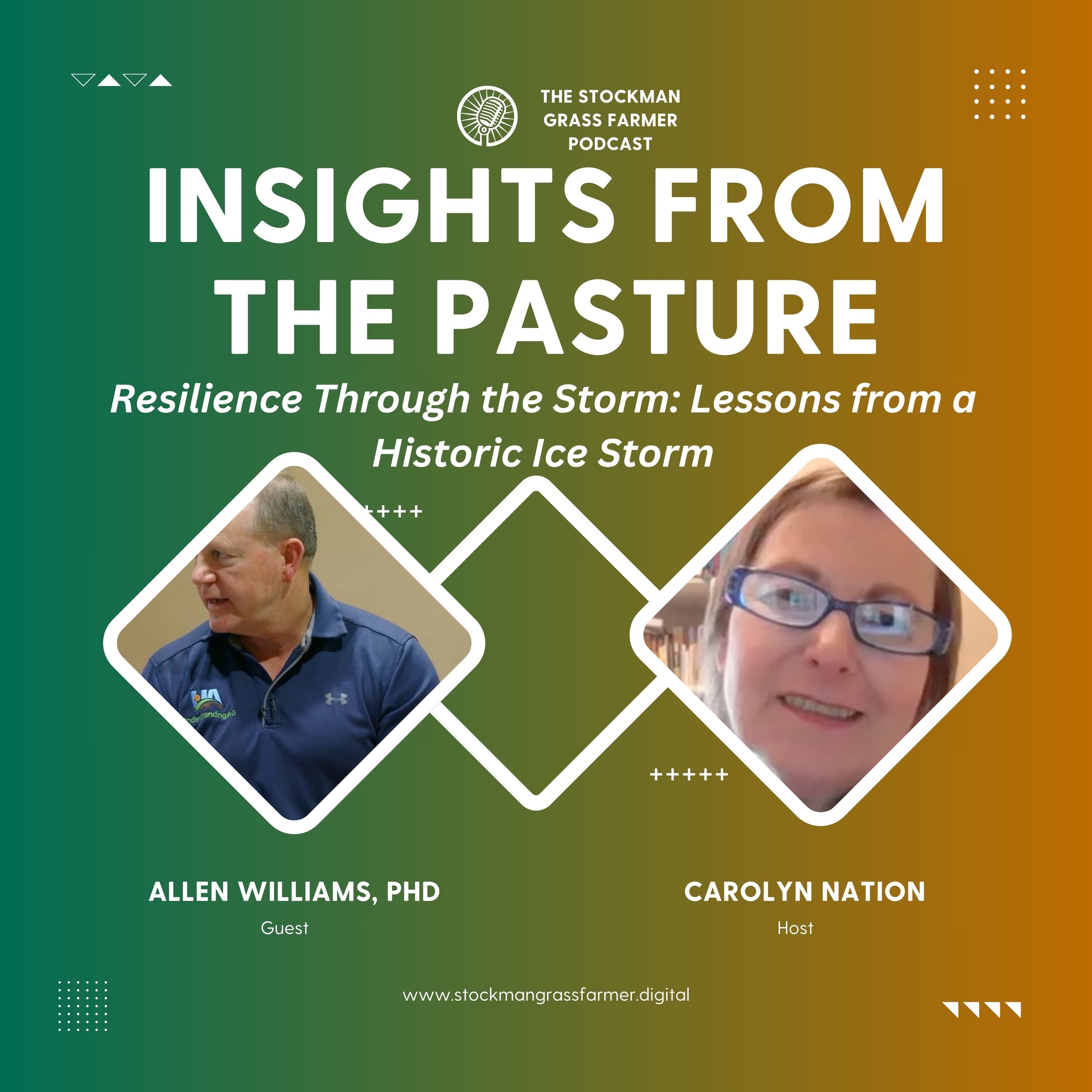
Ep 101Resilience Through the Storm: Lessons from a Historic Ice Storm with Allen Williams
In this episode, Allen Williams shares the powerful story of how a historic ice storm devastated his regenerative farm in Mississippi and the lessons that emerged from the experience. The conversation explores the realities of managing livestock through extreme weather, the importance of preparedness, and the resilience required to keep a farm operating when infrastructure fails. Allen also reflects on the deeper meaning of community support, faith, and the role regenerative agriculture can play in helping landscapes better withstand climate extremes. Through hardship and recovery, this episode highlights both the vulnerability and the strength of modern regenerative farming systems. 🔑 Key Points Covered: A Historic Ice StormOver three inches of ice accumulated across Allen’s farm, bringing down trees, power lines, and infrastructure while trapping the family on the farm for days. Caring for Livestock Without Power or WaterWith electricity and water systems down, livestock had to be watered manually by breaking ice on ponds and hauling water by hand. Protecting Pastured PoultryPortable poultry houses had to be constantly cleared of ice to prevent structural collapse and protect thousands of birds. Operating a Farm with Only Two PeopleWith roads blocked and employees unable to reach the farm, Allen and his son handled all daily livestock care and emergency response alone. Community Support in Times of CrisisFarmers, neighbors, and supporters from around the world offered help, supplies, and encouragement during the recovery. Preparing for the UnexpectedThe experience reinforced the importance of having more generators, fuel, equipment, and contingency plans than you think you’ll need. Why Regenerative Agriculture MattersAllen emphasizes that landscape-scale regenerative practices can help moderate extreme weather patterns and build long-term resilience. Training the Next GenerationInspired by the experience, Allen shares plans for launching a Regenerative University to train the next generation of regenerative farmers and educators. 🌱 Actionable Insights: Prepare for storms beyond what forecasts predict. Maintain backup power systems, fuel reserves, and emergency equipment. Evaluate infrastructure designs to withstand extreme weather events. Build strong relationships within your local agricultural community. Support education efforts that expand regenerative agriculture knowledge. 📌 For more insights and resources, be sure to visit us here for our latest specials and exclusive offers:👉 stockmangrassfarmer.digital 👉 Tune in with your favorite podcast app to The Stockman Grassfarmer Podcast and discover practical grazing and farm management lessons straight from the pasture.
Ep 100The Cornerstones of Direct Marketing with Joel Salatin Part 1 of 3
This special episode marks Episode 100 of The Stockman Grassfarmer Podcast, and to celebrate the milestone we’re launching a three-part series featuring one of the most influential voices in regenerative agriculture, Joel Salatin. In Part 1 of this series, Joel lays the foundation for understanding why direct marketing is such a powerful strategy for modern farm businesses. Drawing from decades of experience building a successful direct-market farm, he explains how farmers can stabilize income, capture more of the food dollar, and create resilient businesses by expanding beyond production into processing, marketing, and distribution. Joel also explores the mental barriers many farmers face when it comes to marketing — from fear of rejection to discomfort with self-promotion — and why separating marketing strategy from sales execution can help farms grow more effectively. This episode sets the stage for the rest of the series by introducing the key principles that guide successful direct-market farm enterprises. 🔑 Key Points Covered: Why Direct Marketing Creates StabilityMost farms earn income only from production, which is heavily influenced by weather, pests, disease, and market volatility. By capturing value in processing, marketing, and distribution, farms can build more stable revenue streams. Capturing the “Middleman” MarginInstead of complaining about middlemen, Joel argues that farmers should become the middleman by participating in more stages of the food chain. Rebuilding Local Food CommerceDirect marketing reconnects farmers and customers, reviving historically normal local food systems while strengthening community relationships. Marketing vs. SalesJoel explains the important difference between the two: marketing is the strategy, while sales is the execution that flows from that strategy. Overcoming Farmer Mindset BarriersMany farmers resist marketing due to fear of rejection, discomfort with self-promotion, or peer pressure. Recognizing these barriers is key to overcoming them. The Goal of Two IncomesJoel emphasizes that truly resilient farm businesses should aim to support at least two salaries, reducing risk and building long-term sustainability. Prototype Before You ScaleInstead of asking “How big can this be?”, Joel encourages farmers to ask “How small can it be?” when testing new ideas. Building a Strong Customer BaseIt’s often easier to grow a business by increasing spending from existing customers rather than constantly chasing new ones. 🌱 Actionable Insights: Expand your farm’s revenue beyond production whenever possible. Develop a clear marketing strategy before focusing on sales tactics. Start small when testing new business ideas or enterprises. Build strong relationships with loyal customers and increase their lifetime value. Focus on creating a farm business that can support more than one income. This episode is Part 1 of a three-part series, where Joel begins unpacking the principles behind successful direct marketing and farm business resilience. 📌 Episode 100 Special:To celebrate our 100th episode, we’re offering listeners a special opportunity to go deeper into the principles discussed in this series. Get the entire The Grazier's Marketing School for just $37. The three-part podcast series you’re hearing now makes up the first module of the full course, where Joel Salatin walks through the foundations of building a profitable direct-market farm. 👉 Click here to learn more. 👉 Tune in with your favorite podcast app to The Stockman Grassfarmer Podcast and discover practical insights from leaders in regenerative agriculture. 🌱 Here’s to the next 100 episodes!
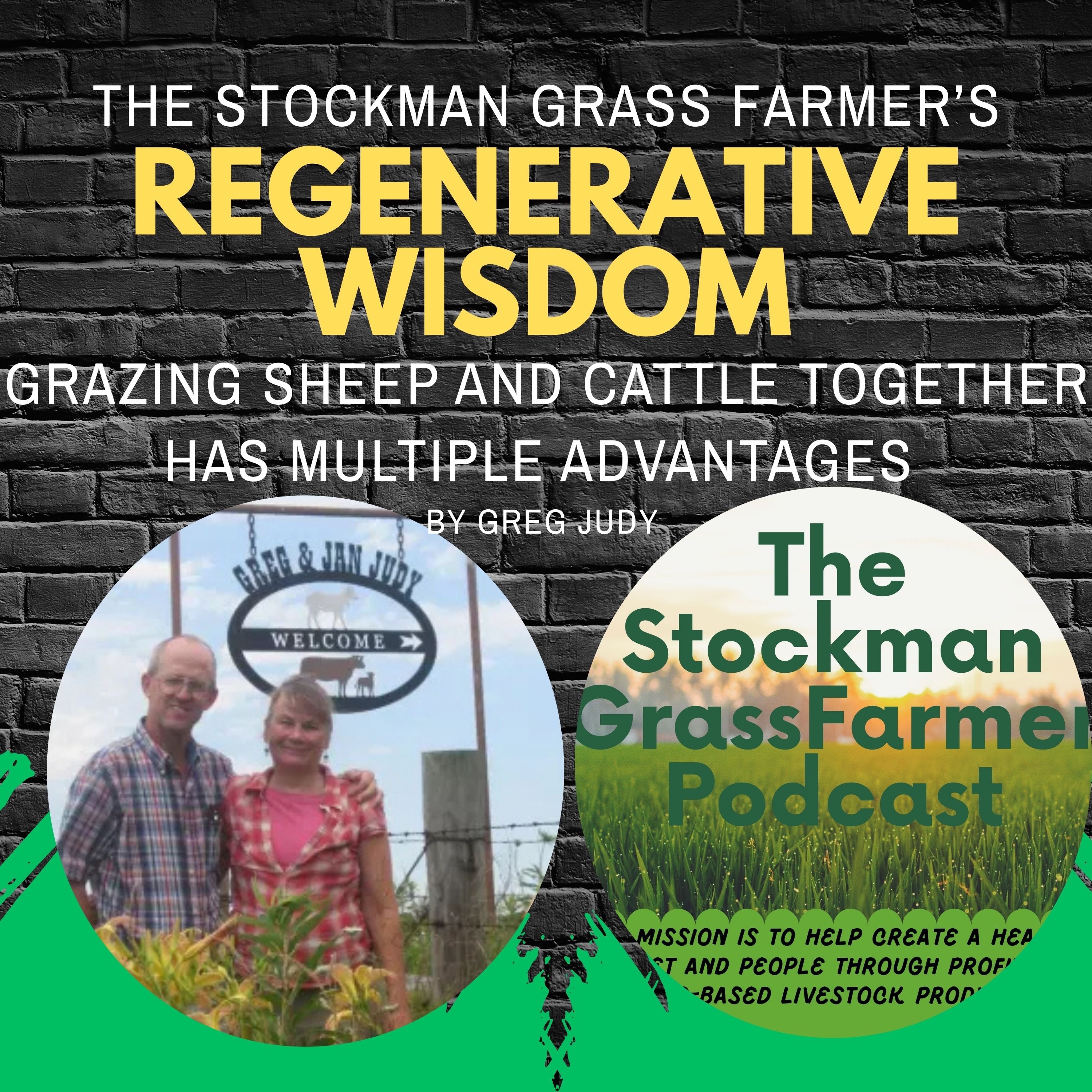
Ep 99Grazing Sheep and Cattle Together Has Multiple Advantages By Greg Judy
In this episode, Greg Judy shares practical, field-tested insight into successfully grazing sheep and cattle together. Drawing from his experience managing South Poll cattle and parasite-resistant hair sheep across owned and leased farms in Clark, Missouri, Greg explains how multi-species grazing increases profitability, improves pasture health, and simplifies parasite management. Rather than promoting sheep as a standalone enterprise, this episode demonstrates how integrating species creates biological synergy. Greg walks through sourcing adaptable breeding stock, training sheep to respect electric fence, rotational strategies, and even how combining bulls and sheep into a “flerd” can streamline winter management. This conversation is packed with actionable lessons for cattle producers considering adding sheep to diversify income and strengthen pasture performance. 🔑 Key Points Covered: Start with Adaptable, Hardy SheepAvoid sale barn shortcuts. Purchase forage-adapted, parasite-resistant breeding stock from reputable graziers. Breed your best, sell the rest, and cull sheep that fail to adapt. Fence Training Over Heavy InfrastructureInstead of overbuilding permanent paddocks, train sheep to respect a single poly-braid electric wire. Flexibility in paddock size improves grazing management and reduces labor and expense. Parasite Cycle DisruptionSheep parasites ingested by cattle are dead-end hosts — and vice versa. Each species helps “vacuum up” parasites, reducing overall pressure naturally. Weed Control as ProfitSheep prefer broadleaf plants and thorny species such as multiflora rose, honey locust, and autumn olive. They convert weeds cattle avoid into marketable lamb. Seasonal AdvantagesSheep require no hay and often no water below 32°F when grazing stockpiled forage, reducing winter inputs. Sequential Grazing SystemGreg typically grazes cattle first, followed by sheep. At certain times of year, bulls are combined with the sheep flock to simplify winter rotation and management. The “Flerd” ConceptCombining bulls and sheep reduces labor and improves efficiency during the non-breeding season. With proper training, even a single poly-wire can safely contain large bulls. 🌱 Actionable Insights: Start small — add 8–10 forage-adapted ewes and a ram before scaling up. Focus on parasite-resistant genetics suited to your region. Train livestock to respect electric fence early to avoid costly infrastructure. Use sheep to convert nuisance plants into revenue. Evaluate grazing order — cattle first, sheep second — to maximize forage utilization. Be patient. Selection and culling over time build a resilient, profitable flock. Greg emphasizes that the ultimate grazing system brings species together as many days of the year as possible. The biological benefits extend beyond livestock — pastures improve, weed pressure declines, and soil health builds. 📌 For more grazing insights, click here for books by Greg Judy, and access to the Multi-Species Grazing School, and much more 👉 Tune in with your favorite podcast app to The Stockman Grassfarmer Podcast for practical lessons straight from experienced graziers building profitable regenerative operations.
Ep 98Farming Without Owning Land – Building a Regenerative Operation from the Ground Up
In this episode,Greg Judy shares a practical and encouraging roadmap for building a profitable farm business without owning land. The conversation explores how access to land — not ownership — is often the real gateway to opportunity, and how strategic leasing, relationship building, and enterprise focus can help producers launch and grow successful operations. Rather than waiting to purchase property, this episode emphasizes controlling expenses, protecting capital, and building cash-flowing enterprises first. The discussion challenges the assumption that land ownership defines farming success and instead focuses on operational excellence, flexibility, and long-term resilience. The episode details practical strategies for finding leases, negotiating agreements, building trust with landowners, and designing enterprises that fit leased ground. It encourages producers to think entrepreneurially, operate professionally, and focus on profitability before asset accumulation. 🔑 Key Points Covered: Access Over Ownership: Farming is about managing land, not necessarily owning it. Leasing can accelerate growth while protecting working capital. Building Relationships for Land Access: Most farm leases never hit public listings — they change hands through trust and community connections. Keeping Capital Liquid: Purchasing land too early can starve the business of operating capital needed for livestock, fencing, water systems, and marketing. Choosing the Right Enterprises: Mobile, adaptable livestock systems often work best on leased land due to flexibility and lower infrastructure investment. Professionalism in Agreements: Clear communication, defined expectations, and written agreements protect both farmer and landowner. Operations Build Wealth; Land Secures Wealth: A strong operation generates cash flow. Land can later serve as a wealth-preservation tool. 🌱 Actionable Insights: Start with marketing and customer relationships before expanding production. Build local networks — attend meetings, connect with landowners, and maintain strong community ties. Design enterprises that require minimal permanent infrastructure. Keep expenses lean and focus on profitability before asset ownership. View farming as a business first — measure margins, manage risk, and protect capital. 📌 For more insights, practical grazing strategies, and business-building resources, visit us for our latest specials and exclusive offers 👉 Tune in with your favorite podcast app to The Stockman Grassfarmer Podcast and discover practical, real-world lessons to help you build a resilient farm business — whether you own the land or not.
Ep 97Mootopia: How Grazing Animals Heal Soil, Climate, and Human Health
In this episode, Ben Sargent and Mary Lin discuss their book Mootopia: How to Easily Fix Human Health and Heal the Planet, exploring the profound connections between grazing animals, ecosystem health, and human wellbeing. Their work examines how regenerative grazing restores soil fertility, supports microbiome diversity, and strengthens the natural feedback loops that sustain resilient landscapes. Drawing from their experience running a Colorado food co-op and extensive scientific research, Ben and Mary Lin highlight how grass-fed livestock influence everything from soil carbon and plant diversity to atmospheric biology and rainfall patterns. Their integrative approach challenges conventional thinking and offers a compelling case for restoring ecological balance through regenerative grazing systems. 🔑 Key Points Covered: The Microbiome Connection Between Animals, Land, and Humans: Diverse grassland ecosystems foster beneficial microbes that strengthen livestock, soil, and human health through interconnected biological relationships. How Grazing Animals Restore Soil and Ecosystem Function: Dense, moving herds contribute to fertility through the “chomp and stomp” effect—fertilizing soil, stimulating plant growth, and increasing biodiversity. The Role of Grazing in Climate and Water Cycles: Grasslands influence atmospheric processes through plant biology, soil microbes, and moisture cycling, helping restore rainfall patterns and ecosystem resilience. Why Diversity in Grazing Systems Matters: Integrating multiple species, including horses and cattle, strengthens soil fungal networks, enhances carbon storage, and accelerates regenerative outcomes. 🌱 Actionable Insights: Focus on building plant and microbial diversity in pastures to improve soil fertility and livestock health. Use adaptive grazing strategies that mimic natural herd movement to stimulate ecosystem recovery. Recognize livestock as essential partners in restoring ecological balance and long-term land productivity. 📌 For more insights and resources, be sure to visit us here for our latest specials and exclusive offers 👉 Tune in with your favorite podcast app to the Stockman Grassfarmer Podcast and discover how regenerative grazing can help rebuild healthy soil, strengthen livestock performance, and restore resilient ecosystems from the ground up.
Ep 96The Basis of Sound Genetics with Dr. Allen Williams (remastered)Part 2 of 3
In this remastered episode, Dr. Allen Williams challenges conventional thinking around livestock genetics by making a bold case: true genetic performance begins in the soil. Rather than focusing solely on EPDs, DNA markers, or breed selection, this episode dives deep into how regenerative agriculture and soil biology drive epigenetics, animal health, and productivity. Dr. Williams explains how functioning ecosystems—built on living soil, active microbes, and adaptive grazing—unlock the genetic potential already present in livestock. This episode connects soil health, forage quality, and animal performance in a practical, systems-based framework that producers can apply immediately. 🔑 Key Points Covered: Why Genetics Start With Soil Healthy soil biology determines whether livestock genetics can fully express themselves, regardless of how “elite” the genetics appear on paper. The Four Ecosystem Processes Energy flow, water cycle, mineral cycle, and community dynamics—and how damage to these processes leads to broken genetics and poor performance. The Soil Food Web & Microbial Balance Why 90% of soil function is mediated by microbes, and how fungi-to-bacteria and predator-to-prey ratios influence epigenetics. Targets for Healthy Soil Biology Specific benchmarks for bacteria, fungi, protozoa, nematodes, earthworms, and insects per acre—and what regenerative systems are achieving in real-world conditions. The Role of Mycorrhizal Fungi How glomalin improves aggregation, water infiltration, nutrient uptake, and carbon storage—while supporting stronger plant and animal performance. Shared Microbiomes Across Soil, Plants, and Livestock In healthy ecosystems, the microbiome beneath the soil mirrors the microbiome in animals and people above it. Hidden Costs of Chemical Interventions How dewormers and other inputs harm beneficial organisms like dung beetles and earthworms, weakening ecosystem function and long-term resilience. Indicator Species That Signal Soil Health Earthworms, dung beetles, insects, arthropods, and spider webs as visible signs of balanced predator–prey relationships. BRIX Levels & Livestock Performance Why higher BRIX equals greater nutrient density—and how every 1% increase above 3% can boost average daily gain by 0.1 lb. 🌱 Actionable Insights: Focus on rebuilding soil biology before investing heavily in genetics. Measure and improve fungi-to-bacteria and predator-to-prey ratios in your soil. Reduce reliance on chemical dewormers to protect beneficial insects and soil life. Use BRIX readings to evaluate forage quality and animal performance potential. Apply adaptive grazing to increase microbial diversity and nutrient cycling—without changing plant species. 📌 Important Note: This episode is the first module of the full course Grassroots of Grazing, available on DVD and streaming in our store. 👉 Be sure to check the show notes for a special sampler price if you’d like to go deeper. 👉 Tune in with your favorite podcast app to the Stockman Grassfarmer Podcast and continue building resilient soil, healthier livestock, and more profitable grazing systems—straight from the pasture. 🌾