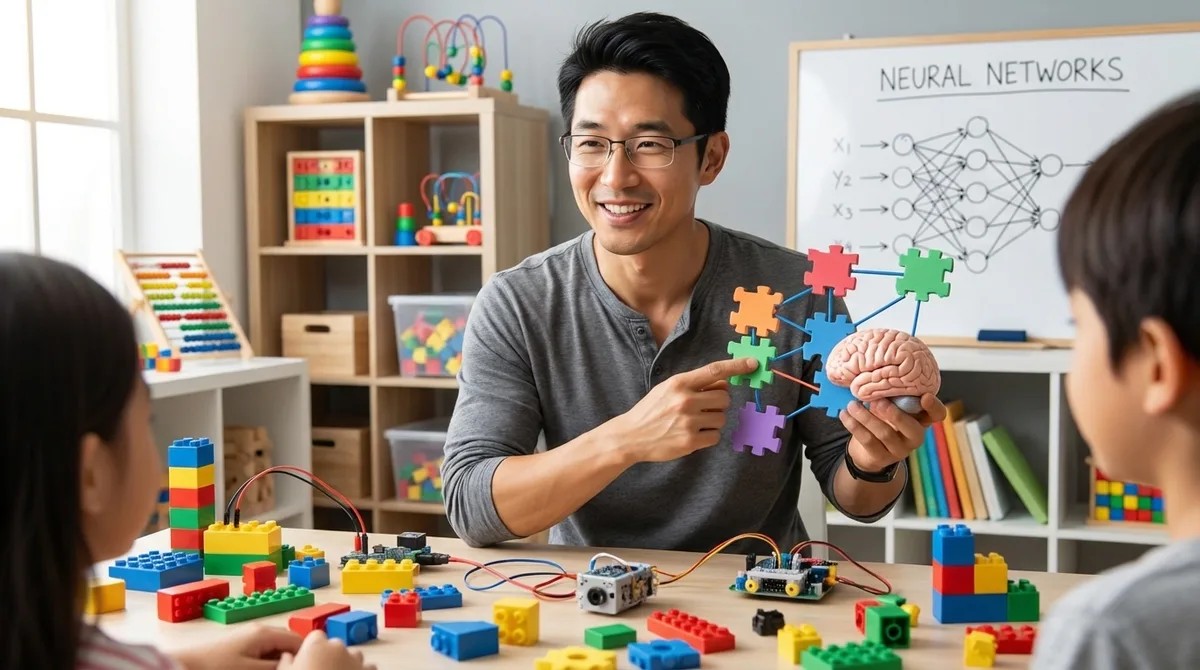
What Is Neural Networks for Kids: Simple Explanation with Activities
The STEM Lab · The Stem Lab
Audio is streamed directly from the publisher (content.rss.com) as published in their RSS feed. Play Podcasts does not host this file. Rights-holders can request removal through the copyright & takedown page.
Show Notes
Ever wondered how to explain the technology behind Siri or facial recognition to your kids without getting lost in jargon? This episode breaks down neural networks in a way that's accessible for families, revealing how these systems learn through practice and mistakes rather than following pre-written instructions. Kazuki Tanaka walks through exactly how neural networks process information, using handwritten digit recognition as a concrete example, and shares how kids can start experimenting with these concepts in a home STEM lab using affordable hardware like a Raspberry Pi.
- Neural networks don't follow rigid if-then rules like traditional programs—they learn patterns from examples by adjusting the strength of connections between artificial neurons, similar to how your brain recognizes a dog instantly without running through a mental checklist.
- The architecture consists of three main parts: an input layer that receives raw data (like 784 pixel values from a handwritten digit), hidden layers that process information through weighted connections, and an output layer that produces the final answer.
- Training happens through backpropagation, where the network makes guesses, measures how wrong they are, then works backward through layers to nudge weights bit by bit—kids can watch accuracy climb from 10% random guessing to 95% in just minutes.
- You don't need expensive hardware for educational neural network projects—a Raspberry Pi 4 with 4GB RAM running Python and TensorFlow Lite can handle digit recognition without requiring internet connectivity once libraries are installed.
- Key terms to know include epochs (complete passes through training data), learning rate (how much weights adjust each step), and overfitting (when a network memorizes examples instead of learning general patterns).
- The fundamental shift from traditional programming is that instead of writing explicit rules, you provide examples and let the system discover its own rules through weight adjustment—this is the core concept kids need to grasp.
Read the full article: https://stemlabguide.com/what-is-neural-networks-for-kids