How to Measure Solar Panel Efficiency in Science Projects
The STEM Lab · The Stem Lab
Audio is streamed directly from the publisher (content.rss.com) as published in their RSS feed. Play Podcasts does not host this file. Rights-holders can request removal through the copyright & takedown page.
Show Notes
Most science fair projects involving solar panels fail before they even begin—because students measure voltage alone and call it efficiency. In this episode, Lakshmi Venkataraman breaks down the complete process for accurately measuring solar panel efficiency, from understanding the real formula to setting up proper circuits and documenting results like a professional engineer. Whether you're a middle school student tackling an NGSS-aligned project or an educator guiding hands-on energy investigations, this guide transforms a simple demonstration into authentic scientific inquiry. You'll learn why you need both voltage and current, how to calculate light power input, and what efficiency percentages you should actually expect from educational panels.
- Voltage measurements alone tell you almost nothing about efficiency—you need both voltage and current under load conditions to calculate electrical power output using P = V × I.
- Solar panel efficiency is calculated by dividing electrical power output by light power input, then multiplying by 100; light power input requires knowing both light intensity (watts per square meter) and your panel's surface area.
- Always measure the active photovoltaic surface area, not the plastic or metal frame—and photograph your panel next to the ruler immediately to prevent measurement errors that propagate through all your calculations.
- Educational solar panels typically perform in the 5–15% efficiency range, while commercial silicon panels achieve 15–22%—this gap creates valuable discussion opportunities about real versus theoretical performance.
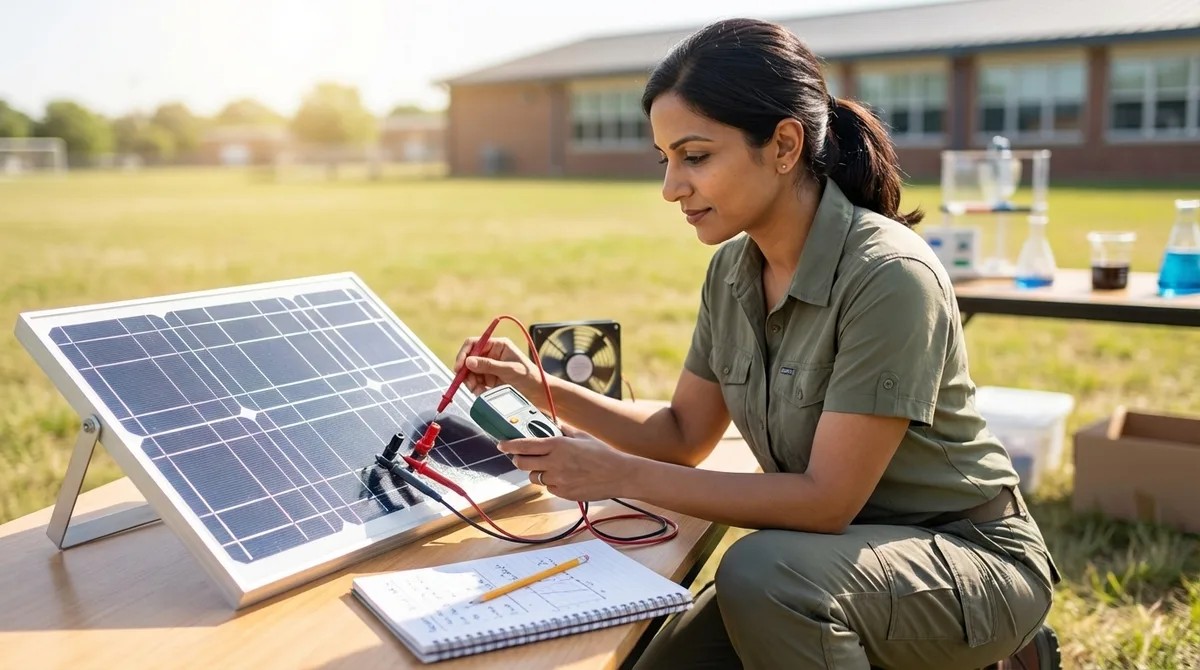
- Your equipment list should include a digital multimeter, a resistive load (10–100 ohm resistor, small DC motor, or LED), a light source with known wattage, and a lux meter or smartphone app to measure light intensity.
- Optional additions like a protractor for angle testing, neutral density filters to simulate clouds, or an infrared thermometer for temperature variables can elevate a basic project into a multi-variable engineering investigation.
Read the full article: https://stemlabguide.com/how-to-measure-solar-panel-efficiency-in-science-projects