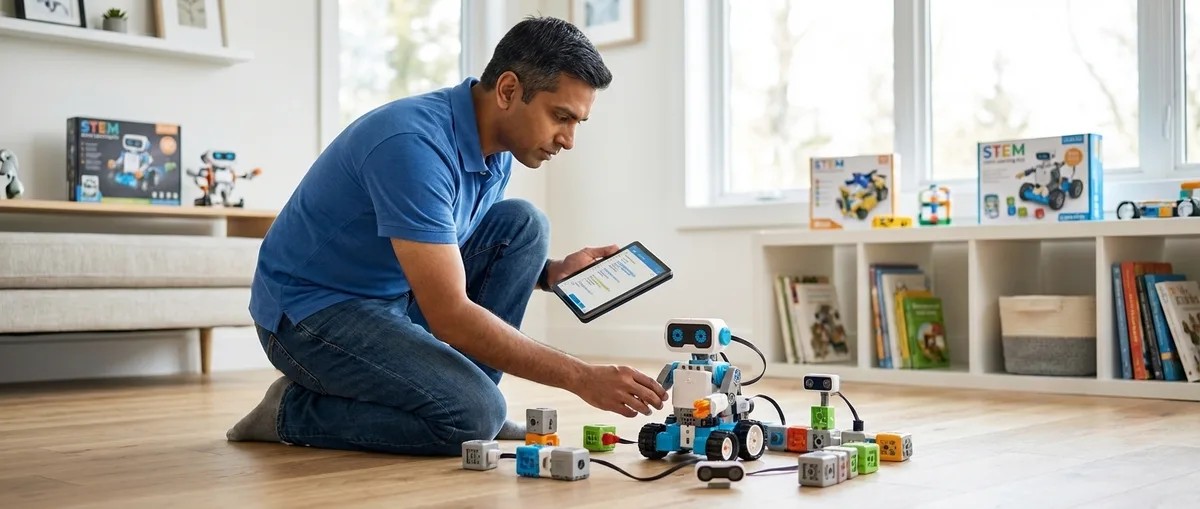
Best STEM Toys for 7 Year Olds: Advanced Logic and Coding Readiness
The STEM Lab · The Stem Lab
Audio is streamed directly from the publisher (content.rss.com) as published in their RSS feed. Play Podcasts does not host this file. Rights-holders can request removal through the copyright & takedown page.
Show Notes
Most "educational" toys keep kids entertained without building real skills—but the right STEM toys can actually prepare seven-year-olds for Python, circuit design, and CAD workflows they'll encounter in actual engineering careers. In this episode, Rajiv Patel breaks down which products genuinely bridge the gap between play and professional-grade logic structures. If you're looking for toys that develop computational thinking during the critical cognitive window when abstract logic and pattern recognition click into place, this analysis cuts through the marketing hype.
- The LEGO Boost Creative Toolbox teaches event-driven programming, conditional logic, and sensor integration through five buildable models—skills that transfer directly to Scratch and eventually Python, though the app can lag on pre-2020 iPads.
- Osmo Coding Starter Kit uses physical magnetic blocks that the iPad camera interprets, making algorithm construction tangible for kinesthetic learners—the "hand" block functions as a subroutine trigger, mirroring logic flow diagrams used in enterprise systems integration.
- ThinkFun Gravity Maze is completely unplugged and develops 3D spatial visualization through 60 progressive marble-path challenges—the same mental rotation and path optimization skills assessed in entry-level mechanical engineering interviews.
- Seven is a unique cognitive window where foundational programming concepts actually stick, making it the ideal time to introduce tools that build cause-effect relationships in code execution.
- The natural progression for robotics learning moves from LEGO WeDo 2.0 to Boost to Mindstorms (age 10+) to Arduino-based systems, with each stage building on icon-based programming that reduces cognitive load.
- Hardware limitations create real learning friction: Osmo's block recognition fails under poor lighting, which frustrates beginners but inadvertently teaches real-world hardware debugging mindsets.
Read the full article: https://stemlabguide.com/best-stem-toys-for-7-year-olds