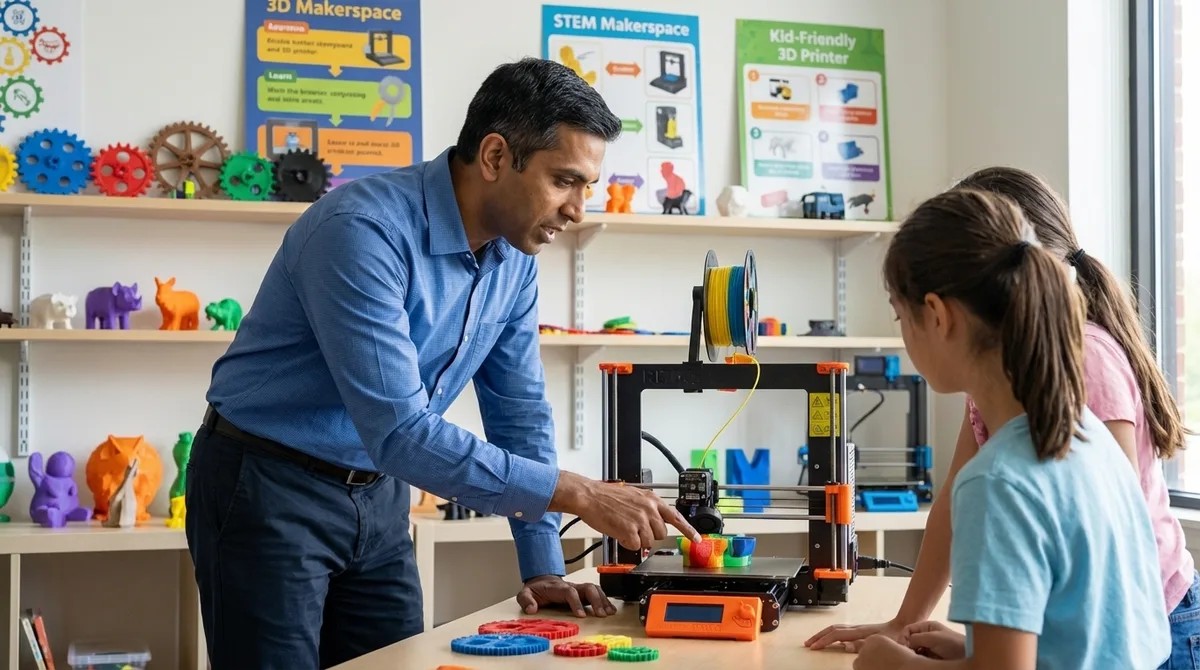
Best 3D Printers for Kids and Teens: Complete Buyer's Guide for Educational STEM Learning
The STEM Lab · The Stem Lab
Audio is streamed directly from the publisher (content.rss.com) as published in their RSS feed. Play Podcasts does not host this file. Rights-holders can request removal through the copyright & takedown page.
Show Notes
Most parents shopping for a kid-friendly 3D printer end up with an expensive paperweight that teaches nothing but frustration. In this episode, Rajiv Patel draws on eight years of experience watching which machines actually produce students who land engineering internships with real skills. He breaks down the critical differences between printers marketed to families and those that build genuinely employable competencies—covering everything from CAD workflows to the hands-on troubleshooting that mirrors professional product development.
- The best educational 3D printers share three traits: minimal troubleshooting that derails learning, compatibility with industry-standard CAD software, and durability to survive repeated failures during skill building.
- Open-frame printers frustrate beginners more than enclosed systems, but they teach root-cause analysis—a higher-value skill in today's hiring market than simply clicking "Print" on a black-box machine.
- The real learning objective isn't the printed object itself; it's the iterative cycle of modeling in CAD, optimizing slicer settings, diagnosing failures, and adjusting parameters—the same loop used in professional product development.
- First-layer adhesion determines print success more than any other variable, requiring bed leveling accurate to 0.05 millimeters—and manually adjusting this builds mechanical intuition that transfers to real engineering work.
- Understanding slicer parameters like layer height, infill density, and print speed teaches applied physics and manufacturing tradeoffs: strength versus material cost, speed versus surface quality, complexity versus failure risk.
- Common failure modes like warping, stringing, and clogging each have multiple potential causes, turning every failed print into a scientific method exercise of hypothesis testing and controlled variable experimentation.
Read the full article: https://stemlabguide.com/best-3d-printers-for-kids-and-teens