
The State Of Belief
207 episodes — Page 3 of 5
The Christian Movement That Is Threatening Our Democracy, with Matthew Taylor
In his new book, Dr. Matthew D. Taylor sheds light on the alarming rise of authoritarianism in Christian nationalist movements. In The Violent Take It By Force: The Christian Movement That Is Threatening Our Democracy, Matthew explores the rise of the New Apostolic Reformation, a radical movement within American evangelicalism that is mobilizing in support of Trump and other far-right leaders. This week, he joins host Rev. Paul Brandeis Raushenbush, host of The State of Belief, Interfaith Alliance's weekly radio program and podcast, to discuss how this movement intertwines charismatic faith with extreme politics, a dangerous combination that culminated in the January 6th attack on the Capitol – and continues to hang over democracy as a major threat. Emphasizing the need for a cohesive pro-democracy movement, Matthew and Paul review strategies for countering the impact of extremist groups through education and persuasion – highlighting the importance of reaching out to those who may have been misled but can still be engaged in constructive dialogue. “We need to try to find all the allies we can, all the fellow travelers we can, and try to build a coalition that is pro-democracy. And I see the edges of that. I see the glimpses of that, and it fills me with hope because I think there are people who are listening to the better angels of our nature right now. We need their voices to be louder. We need them to be amplified.” - Matthew D. Taylor, Ph.D., senior scholar and the Protestant scholar at the Institute for Islamic Jewish Christian Studies, specializing in Muslim-Christian dialogue, Evangelical and Pentecostal movements, religious politics in the U.S., and American Islam. Before coming to ICJS, Matt served on the Georgetown University and The George Washington University faculty. He is a member of the American Academy of Religion and the North American Association of Islamic and Muslim Studies. Dr. Taylor's literary and visual works include Scripture People: Salafi Muslims in Evangelical Christians’ America, the audio-documentary series “Charismatic Revival Fury: The New Apostolic Reformation,” and his latest book, The Violent Take It By Force: The Christian Movement That Is Threatening Our Democracy. Learn more about your ad choices. Visit megaphone.fm/adchoices

Interfaith Since 10/7/23: Challenges and Promise
October 7th marks the one-year anniversary of the Hamas attacks on Israel and the subsequent war in Gaza – a war that is still raging and even spreading, costing tens of thousands of lives and untold suffering and trauma for so many in the region. This week, The State of Belief, Interfaith Alliance's weekly radio program and podcast, focuses on marking this solemn occasion, and exploring the impact that it’s had on interfaith relations between diverse communities here in the US. The episode shares extended excerpts from a powerful recent panel discussion moderated by host Rev. Paul Brandeis Raushenbush, featuring expert guests from the Muslim, Jewish and Christian communities – Dr. Najeeba Syeed, Rabba Rori Picker Neiss, and Rev. Fred Davie. Alongside that panel, Paul is also joined this week by Rabbi Jill Jacobs, CEO of T’ruah, a heartfelt conversation on the emotional and spiritual weight of the Jewish High Holy Days as they intersect with the ongoing violence in the Middle East. These conversations delve into the complexities and conflicts faced by religious communities, offering strategies for fostering collaboration, empathy, and understanding in a divided society. They reflect on how global conflicts can have intense local impacts here in the US, underscoring the need for dedicated relationship-building to create a more inclusive future. Discussing the ongoing conflict in Israel/Palestine, Rabbi Jill Jacobs reflected, “Most people want to live their lives in peace. And various leaders are deciding to continue to escalate.” She added, “We’re sitting in this liminal moment where we see that things could get much worse, or God willing and the leaders willing, they could get better.” During the panel, Dr. Syeed emphasized the importance of facing challenges head-on: "We can't afford to disengage from the pain. We must show up, even in discomfort, and be ready to have the hard conversations that can lead to healing." Rabba Picker Neiss stressed the need for dialogue: “We need to ask questions and then we need to listen to the answers. We need to hold space, and we need to recognize that offering someone space doesn't mean giving up any of our own power.” Rev. Fred Davie offered a hopeful perspective, expressing that their collective efforts “serve as a bit of leaven, a bit of yeast, for this larger effort to build a kind of world…that we’d all like to see.” Rev. Fred Davie is the Senior Strategic Advisor to the President at Union Theological Seminary, where he previously served as Executive Vice President for a decade. In his current role, he advises on public programming, racial justice, and social justice initiatives. Rabbi Jill Jacobs is the CEO of T’ruah: The Rabbinic Call for Human Rights, leading over 2,300 rabbis and cantors in advocating for human rights in North America, Israel, and the occupied Palestinian territories. Rabba Rori Picker Neiss is the Senior Vice President for Community Relations at the Jewish Council for Public Affairs (JCPA). Previously, she was the Executive Director of the Jewish Community Relations Council of St. Louis and a member of the clergy at Bais Abraham Congregation. Dr. Najeeba Syeed is the El-Hibri endowed chair and executive director of the Interfaith Institute at Augsburg University. She is a recognized leader in peacebuilding, having twice received the Jon Anson Ford Award for reducing violence and being named Southern California Mediation Association’s “Peacemaker of the Year” in 2007. Learn more about your ad choices. Visit megaphone.fm/adchoices

Strong Women Speaking Truth to Power: Kristin Du Mez and Mary J. Novak
Mary J. Novak and Kristin Du Mez are two incredible women whose work at the intersection of activism and faith is driving critical change in our society. This week, they join host Rev. Paul Brandeis Raushenbush on The State of Belief, Interfaith Alliance's weekly radio program and podcast, to explore how faith can be used as a tool for tremendous social progress, or for abuse – and how people can work together to help foster inclusive communities and challenge the forces of oppression. Kristin's new film, For Our Daughters, explores the troubling culture of submission and sexual abuse within the evangelical church, and its connection to the Christian nationalist agenda aimed at undermining women's rights in the upcoming 2024 election. “I thought it was really important to put their stories, in all of their power, in front of the country. In front of Christian women in particular, in front of Christians, and just hear them and grapple with: how could this be allowed to happen? How could, even after these wrongs were exposed…How could this persist? And then, what are we doing as Christians, as church members, and as voters to perpetuate these systems that foster abuse?” - Kristin Kobes Du Mez, New York Times bestselling author and Professor of History and Gender Studies at Calvin University. She holds a PhD from the University of Notre Dame and her research focuses on the intersection of gender, religion, and politics. She has contributed to The New York Times, The Washington Post, and NBC News and has been featured on NPR, CBS, and the BBC. Her latest works include her book, Jesus and John Wayne and groundbreaking documentary, For Our Daughters: Stories of Abuse, Betrayal, and Resistance in the Evangelical Church. “People of all backgrounds and religious and cultural persuasions are working together to help build the common good through policy and politics…because we can all come together. And when we collaborate, we have the power to decide the future we will inhabit.” - Mary J. Novak, Executive Director of NETWORK Lobby for Catholic Social Justice, the first lay leader and the sixth woman to hold this role. With a background in organizing, activism, law, education, chaplaincy, and restorative justice, she introduced a shared leadership model to advance NETWORK's mission. Under her guidance, the organization is building stronger partnerships for the common good and positioning itself for future growth in pursuing justice. NETWORK organizes the incredible Nuns on the Bus & Friends Tour, traveling across the country starting September 29th to directly advocate for and pursue social justice through the lens of Catholic social teaching. Learn more about your ad choices. Visit megaphone.fm/adchoices
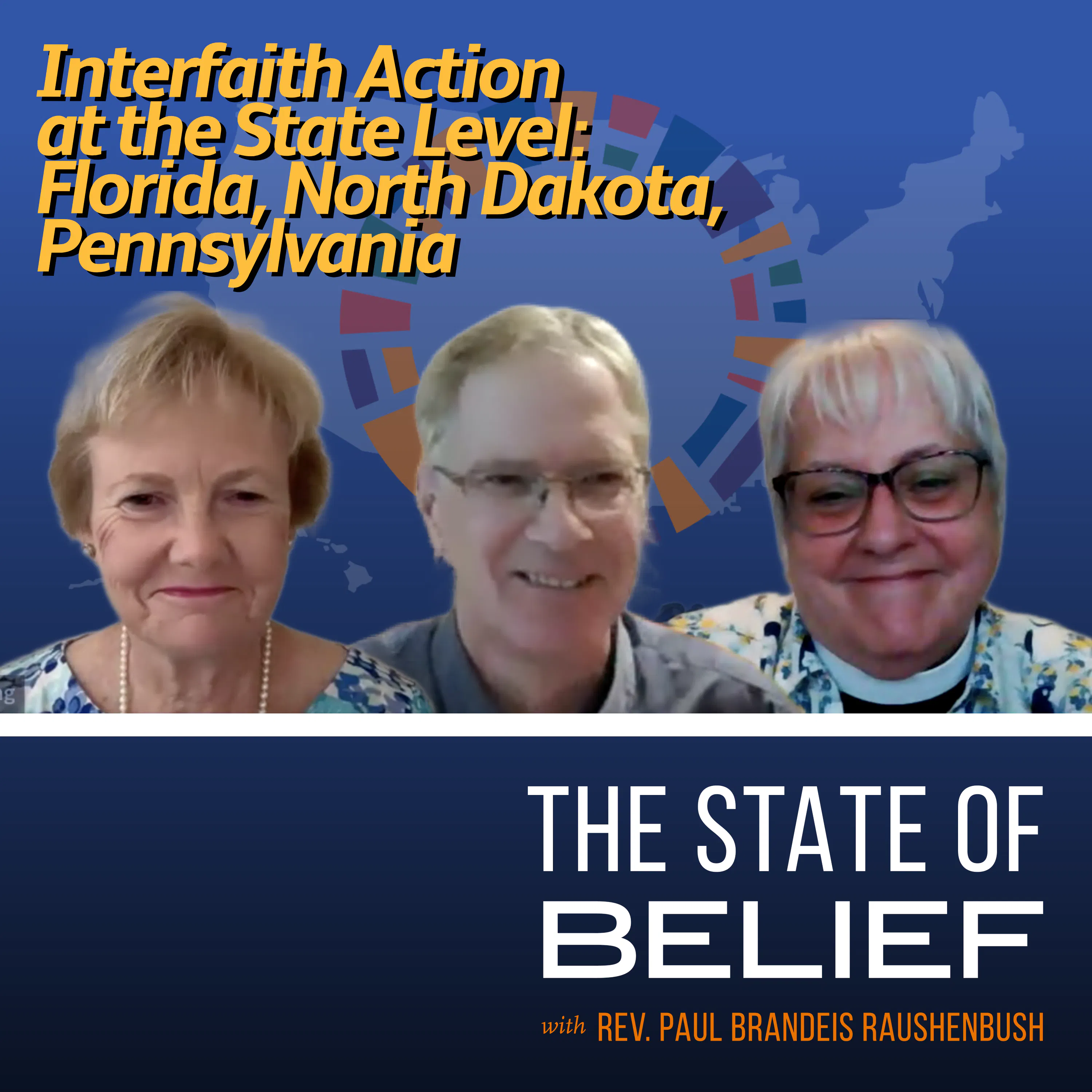
Interfaith Action at the State Level: Florida, North Dakota, Pennsylvania
In states and communities across the country, people of diverse religious and secular beliefs are coming together to fight for freedom of conscience for all. Many are doing it under the banner of Interfaith Alliance, organizing local affiliates to address pressing challenges to our constitutional liberties and pluralistic values. Rev. Dr. Sharon Harris Ewing, Rev. Anne Flynn, and Ross Keys are prime examples of how grassroots activism is shaping the future of religious freedom and equality. Their work leading Interfaith Alliance affiliates across the nation highlights the growing importance of combating discriminatory policies, fighting religious indoctrination, and fostering inclusive communities nationwide. For this week's episode of The State of Belief, Interfaith Alliance’s weekly radio show and podcast, all three join Rev. Paul Brandeis Raushenbush to discuss the critical role interfaith collaboration plays in addressing societal challenges. Together, they explore how political activism, local faith leaders, and grassroots movements shape communities in Southwest Florida, Pennsylvania, and North Dakota, all within the broader context of America’s evolving cultural and spiritual landscape. Together, they represent the strength and diversity of interfaith efforts around the country. "Understand the ramifications of the issues that you're facing. Understand that your vote counts. And, yes, you can be frustrated. And, yes, you don't have to like everybody or everything that someone else does, but you have to be informed, make a decision, and commit.” - Rev. Anne Flynn, a deacon in the Episcopal Church and a leader of Interfaith Alliance of Pennsylvania. “When folks come together, work together, communicate, and share messaging, you can have success even in places where it can get pretty dark at times.” - Ross Keys, a seasoned activist and organizer who currently leads Interfaith Alliance of North Dakota. “In this very conservative environment where I live, there is so much enthusiasm for our work. Our numbers keep growing. This is a huge beacon of hope among all the Christian nationalist and other views that are out there–that people are responding to our message.” - Rev. Dr. Sharon Harris Ewing, board president of Interfaith Alliance of Southwest Florida. She brings her rich experience as both an ordained minister and a longtime educator. Learn more about your ad choices. Visit megaphone.fm/adchoices
Demographics, Democracy, and Destiny: Dr. Robert P. Jones
As American society evolves, Dr. Robert P. Jones explores how rigid, traditional norms are losing their influence, leading to a growing need for greater religious and racial diversity and inclusion. His latest book, The Hidden Roots of White Supremacy and the Path to a Shared American Future, analyzes the historical and ongoing legacy of White supremacy, offering a comprehensive exploration of how colonialism, genocide, and racial violence are deeply woven into the fabric of America's history. For this week's episode of The State of Belief, Interfaith Alliance’s weekly radio show and podcast, Robby joins host Rev. Paul Brandeis Raushenbush to explore how political and religious landscapes are continuously altered by the growing cultural diversity within American society, driven by the rise of interfaith and interracial families, and the many who identify as religiously unaffiliated. “We had Barack Obama and Kamala Harris, who are mixed-race candidates. And that's also a reality in most of America. And I think this kind of blending of racial and religious identities…this is the way that most Americans are actually navigating their lives. It doesn't look like the hierarchical, patriarchal, homogeneous, white picket fence… neighborhood where all the people look like them, and all the people their kids go to school with look like them. That's not the reality that most Americans are living with today, whatever mythology is out there. So I think that we're just seeing it come in more public, symbolic ways that we're seeing at the top of these tickets, even on the Republican side.” - Dr. Robert P. Jones, president and founder of the Public Religion Research Institute and a prominent author whose recent book, The Hidden Roots of White Supremacy and the Path to a Shared American Future, became a New York Times bestseller and has just been released in paperback with a new and compelling afterword. His previous works include White Too Long: The Legacy of White Supremacy in American Christianity, which won a 2021 American Book Award, and The End of White Christian America, which was honored with the 2019 Grawemeyer Award in Religion. Robby's writing is regularly found in The Atlantic, TIME, and Religion News Service and is frequently featured in major media outlets, including CNN, MSNBC, NPR, and The New York Times. Robby also writes a weekly newsletter focused on confronting and healing from the legacy of White supremacy in American Christianity, found at www.whitetoolong.net. Learn more about your ad choices. Visit megaphone.fm/adchoices

Faith, Power, and Victimhood: the evolution of Christian Nationalism
As Christian nationalism and the far right’s influence on American politics grow, historian Randall Balmer offers a critical examination of evangelicalism and the surprising shifts within its ranks. In his book Bad Faith: Race and the Rise of the Religious Right, he reveals how far-right religious lobbying in the 1970s, fueled by efforts to defend racial segregation, evolved into the dangerous political force threatening democracy and religious freedoms today. For this week's episode of The State of Belief, Interfaith Alliance’s weekly radio show and podcast, Randall joins host Rev. Paul Brandeis Raushenbush to explore the evolution of evangelicalism, particularly how early evangelicals championed social reform, contrasting with the modern political alignment of those influenced by the far right. “I think religion certainly contributes to democracy. And some people have misinterpreted what I said, including my dogged defense of the First Amendment, which I believe is America's best idea. But people have misinterpreted me to say that voices of faith should not be part of our political discourse. And I couldn't disagree more strongly. I think people have every right to bring their religious or faith commitments into the arena of public discourse, and I think public discourse will be impoverished without those voices… I have every right to express my religiously informed convictions in the arena of public discourse. But I also have an obligation to listen to others, as well.” - Dr. Randall Balmer, prize-winning historian and Emmy Award nominee. He holds the John Phillips Chair in Religion at Dartmouth College, the institution's oldest endowed professorship. Randall's latest book is Saving Faith: How American Christianity Can Reclaim Its Prophetic Voice. Learn more about your ad choices. Visit megaphone.fm/adchoices
The Past Isn't Even Past: The Trial That Riveted A Nation With Brenda Wineapple
As book bans and religious censorship again become increasingly prevalent, America is witnessing an alarming repetition of patterns from our history. Brenda Wineapple's most recent book, Keeping the Faith: God, Democracy, and the Trial That Riveted a Nation, is a compelling account of censorship and successful far-right religious lobbying during the 1925 Scopes Monkey Trial that continues to influence America today. For this week's episode of The State of Belief, Interfaith Alliance’s weekly radio show and podcast, Brenda joins host Rev. Paul Brandeis Raushenbush to discuss the resurgent threat of censorship and extreme religious influence in America. Over a century after the 1925 trial, her book – recently featured on the front page of the NY Times Book Review – recounts a fascinating story mirrored by recent attempts to mandate Christian curriculum and indoctrination in public schools. "We know that books are being banned in libraries, and in schools themselves, by school boards that take upon themselves the idea of what children should read and they legislate that. There's also censorship more widely about what people can do in their private lives: who they can love, for example; whether or not women have rights to their own bodies. This is the kind of legislation and these are the kinds of issues that are still with us. And sometimes, they form in different ways. I'm not sure a woman's right to choose was on the boards at that particular time. Women had only just gotten the right to vote. But in point of fact, women were very much part of what was going on. Because suddenly in 1925, as now, the world seemed to be changing, and the question of who decides what the direction of the country should be was really what's at stake.” - Brenda Wineapple, distinguished author of seven books who is widely celebrated as a literary artist. The New York Times named her book The Impeachers: The Trial of Andrew Johnson one of the ten best nonfiction works of 2019, while Ecstatic Nation: Confidence, Crisis, and Compromise, 1848 to 1877 was recognized as a best book of the year by The New York Times and other publications in 2013. Brenda's literary works have been honored with numerous awards, including the Literature Award from the American Academy of Arts and Letters, a Pushcart Prize, a Guggenheim Fellowship, and an American Council of Learned Societies Fellowship. She has also received three National Endowment Fellowships, including its Public Scholarship Award. To expand our reach, The State of Belief is now being distributed via the Religion News Service family of podcasts. Be sure to subscribe to The State of Belief today at https://www.stateofbelief.com/subscribe. Learn more about your ad choices. Visit megaphone.fm/adchoices
Changemakers at the DNC
Throughout the week of the Democratic National Convention, Rev. Paul Brandeis Raushenbush and the Interfaith Alliance team were all over Chicago for events, discussions and meet-ups, representing the views of a powerful movement of people of diverse faiths and beliefs across the country. On this week’s State of Belief, Interfaith Alliance's weekly radio program and podcast, we’re excited to share audio from a wide range of conversations and speakers that Paul met up with in Chicago. In the first portion of the program, you'll hear Dr. Michael Eric Dyson, the venerable academic, author and minister who spoke alongside Paul at a panel discussion about the boundaries between religion and government. Next up, it's Paul’s conversations with two dynamic Members of Congress – Civil rights attorney Rep. Jasmine Crockett of Texas, and Rep. Becca Balint of Vermont, the first openly LGBTQ person and the first woman to represent her state in the House of Representatives. Journalist and writer Katherine Stewart, author of the essential book The Power Worshippers: Inside the Dangerous Rise of Religious Nationalism, spoke with Paul about the strategies Christian nationalists are poised to deploy in the 2024 election season. In the final portion of this special episode, you'll hear exclusive excerpts from “Promise 2025” – a meet-up of faith leaders attending the DNC, organized inpart by Interfaith Alliance and reported on in USA Today. At the event, leaders from across the religious spectrum joined together to claim religious diversity as an asset to the future of our democracy, and to discuss ways to organize the faith and interfaith community to support fair elections and the peaceful transfer of power. The excerpts include some thoughts from Paul, as well as Rev. Frederick Davie, Union Theological Seminary; Rev. Jen Butler, Faith Forward; Rabbi Jason Kimelman-Block, Bend the Arc; and Rev. Doug Pagitt, Vote Common Good. Learn more about your ad choices. Visit megaphone.fm/adchoices

Passion & Policy: Guthrie Graves-Fitzsimmons
Guthrie Graves-Fitzsimmons, one of the country’s top advocates and experts working at the intersection of religion, politics and policy, has just this week joined Interfaith Alliance as the organization’s new Senior Director of Policy and Advocacy. To start off his tenure, he joined host Rev. Paul Brandeis Raushenbush on The State of Belief, Interfaith Alliance's weekly radio program and podcast, to discuss the threat of the Christian nationalist right’s vision for America’s future – and how so many Christians and other Americans of diverse faiths and beliefs are collaborating to advance a compelling, competing vision of true religious freedom and mutual respect. “If authoritarianism comes to the United States, it will be done in the name of Christianity and restoring God to the public and putting God back in our schools. And it will be a Christian theocracy that is advanced. And you see that in Project 2025. A year ago, I was the first person to go through this 900-page document and identify the different theocratic elements of it. They talk about how they are going to put forth a religious definition of marriage… They talk about portraying the left as trying to advance a religion that would attack Christianity. And so throughout Project 2025, you see explicit and implicit appeals to Christian nationalism.” - Guthrie Graves-Fitzsimmons, who joins Interfaith Alliance with more than a decade of experience working with faith communities on some of the most important social justice issues of our time: religious freedom, democracy, LGBTQ rights, reproductive freedom, immigration, anti-Muslim bigotry, and more. He most recently worked at the Baptist Joint Committee for Religious Liberty, with an emphasis on its Christians Against Christian Nationalism campaign. Prior to BJC, he held positions at the Center for American Progress, ReThink Media, and the National Immigration Forum. An ordained Baptist deacon, he is the author of Just Faith: Reclaiming Progressive Christianity (Broadleaf Books, 2020). In 2019, the Center for American Progress (CAP) named him one of its annual list of Faith Leaders to Watch. Learn more about your ad choices. Visit megaphone.fm/adchoices

The VP Picks, Religious Diversity, and a Vision for Democracy
This week, we’ve pushed up the release of The State of Belief, Interfaith Alliance's weekly podcast, to get you the insightful expert commentary you need, when you need it. We're excited to share with you this week’s episode, which is so timely and insightful that we’re releasing it early. Host Rev. Paul Brandeis Raushenbush is joined by two brilliant commentators who share fascinating thoughts about Kamala Harris’s choice of running mate, as well as Donald Trump's pick, and some of the implications for different faith communities. “I think this country – we’re hungry for multiple iterations and emanations and embodiments of Christianity as well. So it's not just other faith traditions, but what are we going to learn from the Walzes’ commitment to their Christian faith and their understanding of what helped produce a state that has one of the highest per capita refugee and asylum seeker population in the United States?” - Dr. Najeeba Syeed, a prominent interfaith leader in Minneapolis, speaking about the Lutheranism of Minnesota’s governor Tim Walz, the Democratic VP nominee, and how he embodies part of Minnesota’s history as a welcoming multifaith state. “I think a lot of American Jews were feeling really ambivalent about this possible candidacy. On the one hand, naturally, there's a lot of pride…On the other hand, there's a lot of fear and dread.” - Rabbi Jay Michaelson, a contributing columnist for the Forward, on his mixed feelings about Pennsylvania’s Jewish governor Josh Shapiro ultimately not joining the ticket. He's also got plenty to say about the diverse family of Republican VP nominee JD Vance. At Interfaith Alliance, we’re proud that The State of Belief is one of the only national podcasts regularly diving in to key debates about the intersection of religion, politics and democracy. Later this month, Paul will be in Chicago covering the Democratic National Convention. And soon, you'll hear all about the 2024 Nuns on the Bus & Friends Tour with NETWORK Lobby Executive Director Mary Novak, the ongoing impact of Christian nationalism with Religion Historian Randall Balmer, and many other essential voices bringing clarity and inspiration to a tumultous election year. One thing that you could do today that would really help support The State of Belief would be to subscribe to receive it through your favorite podcasting platform. A strong subscriber base on the platforms helps with the algorithms to make sure that our important conversations reach more people. Visit stateofbelief.com/subscribe. Thank you for being part of the conversation! Learn more about your ad choices. Visit megaphone.fm/adchoices

E.J. Dionne: The Vice-Presidential Candidates and Religion
With a lot of attention on the second spot on the presidential ticket right now - whether it's JD Vance and childless cat ladies, or the range of contenders for Kamala Harris' pick - religion and beliefs are prominent in the converation. E.J. Dionne, a longtime analyst of the American political scene, often through a religion lens, brings his expertise to The State of Belief, Interfaith Alliance’s weekly radio show and podcast. E.J. joins Rev. Paul Brandeis Raushenbush to discuss the candidates, most of which he's interviewed, and the ever-more-vital need to preserve the constitutional separation of Church and State. “I think in this election, on issues related to religion, one of the fundamental divides is between people who are, directly or indirectly - sometimes they're called Christian nationalists, but they don't all have to be called Christian nationalists - but who really do seem to want to argue that the Christian faith is foundational to everything in the American republic, and they have the idea that we are, in some deep sense, a Christian nation. It's obviously true that Christianity was central to the thinking of many of the founders, but the founders were very conscious of not creating a religiously-based republic. The First Amendment was a pretty radical idea for its time, and it's still a powerful idea in the world.” - E.J. Dionne is a longtime Washington Post political columnist. He is also Distinguished University Professor in the Foundations of Democracy and Culture at Georgetown University's McCort School of Public Policy, a Senior Fellow in Governance Studies at the Brookings Institution, and a frequent commentator on politics for National Public Radio and MSNBC. His latest book is 100% Democracy: The Case for Universal Voting, co-authored with Miles Rapoport. Learn more about your ad choices. Visit megaphone.fm/adchoices

We're Going Forward: Wajahat Ali
With the threat of a right-wing anti-democratic impulse strengthened by conservative extremist policies, campaigns, and rhetoric on the rise, the preservation and protection of our democracy is more critical now than ever. Wajahat Ali is a leader in this fight, engaging the anti-democratic movement head-on and pushing back against Christian nationalism, racism, bigotry, and other dangers to American democracy. This week on The State of Belief, Interfaith Alliance’s weekly radio show and podcast, Waj joins Rev. Paul Brandeis Raushenbush to discuss the threat of right-wing extremism, misinformation, and the future of democracy in America. “Project 2025 is the blueprint for authoritarian rule. I'm not being hyperbolic when I say that. It is, in a pop culture analogy that I can use, a Bond villain in the first ten minutes of a Bond movie, finding James Bond, tapping on the shoulder, and saying, 'Hey, do you want to read my evil supervillain plot to take over the world? I have a slide show. You have five minutes?' This is what the Republicans have done… It is a blueprint for right-wing minoritarian rule. It is a blueprint for White Christian nationalism. It is a blueprint for power and a Trump dictatorship. And as we know, Trump said he will be dictator for a day. And what we know is dictators aren't just dictators for a day. They're dictators for life.” - Wajahat Ali, Daily Beast columnist, writer, commentator, and keen observer of politics. His first book is Go Back to Where You Came From and Other Helpful Recommendations on How to Become an American. Waj has a Substack titled “The Left Hook” and co-hosts the Democracy-ish Podcast. As a child of immigrants, he's an invaluable contributor to the conversation around patriotism, diversity, and democracy. Waj believes in sharing universal narratives through a culturally specific lens to entertain, educate, and bridge global divisions. Learn more about your ad choices. Visit megaphone.fm/adchoices
Amy Spitalnick: Antisemitism and Democracy
In a time when fundamental democratic norms are increasingly contested and targeted, religious identities and freedoms are threatened by increasing hate crimes, conspiracy theories, and misinformation. Amy Spitalnick of the Jewish Council for Public Affairs is working to put out these fires by fighting antisemitism and anti-democratic extremism, protecting religious freedom, and encouraging difficult conversations across lines of difference. For this week's episode of The State of Belief, Interfaith Alliance’s weekly radio show and podcast, Amy joins host Rev. Paul Brandeis Raushenbush to discuss antisemitic actions and tropes, and how they pose a grave threat to broader multi-faith liberal democracy. “We know that we're not alone in this, and we know that so many communities in the region and here in the United States are still very much sitting in that pain and that trauma because of the ongoing war; the ongoing, hostages that are being held; that the loss of innocent Palestinian lives; the horrific toll on Israel and the Israeli people. And again, the waves of hate here at home that we're continuing to grapple with. And we have no choice in this moment but to think about what this all means - not just to this question of allyship and helping people understand what it means to show up as an ally right now, which has been such a huge part of our work at JCPA - but also to not shy away from those hard and challenging conversations, even as some of the loudest voices tell us that the pain and the grief we're feeling mean we should just put up walls and walk away.” - Amy Spitalnick, CEO of the Jewish Council for Public Affairs, the national convener of Jewish coalitions working across communities to build a just and inclusive American democracy. Amy is the former executive director of Integrity First for America, which won its groundbreaking lawsuit against neo-Nazis, White supremacists, and hate groups responsible for the Charlottesville violence. An expert on extremism and building effective partnerships for good, Amy has worked for a number of federal, state, and local officials, as well as campaigns and advocacy organizations. Learn more about your ad choices. Visit megaphone.fm/adchoices

A Slow Civil War with Jeff Sharlet
The political climate in the last few weeks has left many feeling overwhelmed and scared, waiting for the next shoe to drop. The increasing collaboration of right-wing groups to rally around Project 2025 shows the threat of what the Christian nationalist right’s interpretation of the Bible - and of America - might look like in the future. For this week's episode of The State of Belief, Interfaith Alliance’s weekly radio show and podcast, host Rev. Paul Brandeis Raushenbush is joined by author and journalist Jeff Sharlet to discuss his most recent book, and how we can come together in the face of the White supremacist militarized vision presented by Project 2025. “Now the mainstream press is starting to pick up and report Project 2025. But they're still looking at it in traditional Washington terms, and not noticing what that project is, is really an attempt to merge Reaganism and Trumpism. But not so much to merge them, but to fully fold in the last vestiges of the right-wing Reaganite Republican Party into a full fascist Trumpist movement. And in that service, in terms of Christian nationalism, they lay out four pillars. [...] one is God and the family. Putting the family at the center of things. And it's astonishing and sad that in the United States, now, the word “family” has been claimed by the right. Everybody has one, but the right seems to think they own that word.” -Jeff Sharlet, best-selling author of eight books, including The Family and C Street, which focus on the Christian nationalist forces deeply embedded in the halls of American power. His latest book, The Undertow: Scenes from A Slow Civil War, surveys the national landscape in the aftermath of Joe Biden's ascent to the White House. Jeff is Frederick Sessions Beebe '35 Professor in the Art of Writing at Dartmouth College. You can follow his writing on Substack. Learn more about your ad choices. Visit megaphone.fm/adchoices

How July 4th and Juneteenth Can Bring America Together
Happy Independence Day Weekend! In this episode of The State of Belief, Interfaith Alliance's weekly podcast and radio program, host Rev. Paul Brandeis Raushenbush interviews Rev. Thomas L. Bowen, White House Senior Advisor for Faith Engagement. As the nation celebrates the Fourth of July, the conversation ranges to Juneteenth, an important holiday celebrating freedom and the end of enslavement in this country. Thomas discusses his upbringing in Elyria, Ohio, and the mentors who shaped his path, including Mary Wright Edelman and Gardner Taylor. The conversation explores the significance of religious freedom, interfaith unity, and the historical importance of Juneteenth. He highlights President Biden's commitment to social justice, influenced by his Catholic faith, and the role of faith in fostering community and resilience. The episode underscores the intersection of faith, social justice, and public engagement in promoting unity and understanding in a divisive and dangerous time. "We're not only a nation of immigrants. We are a nation of refugees. I think we need to examine that and look at that, because when you put that image in your mind, you see that people are leaving something. People are coming here for something. There's something that makes them leave their family and come. And I think that we need to look at that. These these are stories. These are our history as a nation. This is a problem we get in: we don't know our history, and we don't know our story. I mean, there's a certain aspects of it, but we're not just a nation of immigrants. We are a nation of refugees. - Rev. Thomas Bowen, White House Senior Advisor for Faith Engagement. He earned the nickname "DC's Pastor" during his service in the Washington Mayor's Office. An ordained Baptist minister, Thomas is the Earl L. Harrison Minister of Social Justice at Shiloh Baptist Church in Washington, D.C., where he has served since 2002. Learn more about your ad choices. Visit megaphone.fm/adchoices
Hate on the Rise? Exploring the SPLC's Annual Hate and Extremism Report
Just in time for the election season comes a surge in disinformation campaigns by far-right extremist organizations targeting marginalized communities. The Southern Poverty Law Center is doing vital work by researching and educating around fact-based reports of hate crimes, extremist organizations, and political fearmongering. For this week's episode of The State of Belief, Interfaith Alliance’s weekly radio show and podcast, host Rev. Paul Raushenbush is joined by SPLC Executive Director Margaret Huang and Intelligence Project Interim Director Rachel Carroll Rivas to discuss the organization's latest annual Report on Hate and Extremism. We are certainly at a moment of great threat, of great risk, but also at a real moment of reckoning, because [the rise in hate crimes] is happening, in large part, as we build up to elections, now, in 2024. And these groups have made very clear that their goal is to attack democracy itself, to try to stop people from believing in the institutions of government and in democracy. And they're hoping that that activism from last year and the year 2024 will really frighten and discourage a lot of people from joining in our elections process. - Margaret L. Huang, a human rights and racial justice advocate who has led the Southern Poverty Law Center since 2020 as president and executive director. Throughout her career, Margaret has championed social justice and human dignity, advocating against discrimination and oppression. Before joining the SPLC, she served as the executive director of Amnesty International USA. I've been in this work for a long time. We used to say that the work was kind of centered around “name and shame” - and that's not a really great strategy, particularly for me as a human rights believer. I think the better strategy is: how do we use this research to actually do good things? Friend of mine, Scott Nakagawa, calls it, “block and build.” And so I feel like a lot of times that's my role in this work: okay, block: make the space for my incredible colleagues and people in this movement, our partners, to be able to do this powerful work. - Rachel Carroll Rivas is the Interim Director of the Intelligence Project at the SPLC. She has been working to expose the anti-democratic, far-right forces and organize communities to respond to hate activities for the last 20 years. Rachel has supported rural community organizing and research across the Western U.S., training hundreds of advocates, academics, and community leaders in cross-issue movement building and using research analysis of the hard right to inform strategy. Learn more about your ad choices. Visit megaphone.fm/adchoices

Faith in Choice: Two Years After Dobbs
Often in the reproductive healthcare debate, the voice of the faithful gets portrayed only on one side - the side of those trying to restrict women’s autonomy and access to abortion. However, this does not portray the entire picture. There is a rich and storied history of people of faith coming together to collaborate to ensure access to healthcare, defend autonomy in the healthcare decision-making process, and protect abortion access. Rev. T.J. Fitzgerald and Smriti Krishnan are both working to build cross-faith partnerships to preserve access to reproductive health care, especially in hostile states. This week on State of Belief, Interfaith Alliance’s weekly radio show and podcast, they join host Rev. Paul Brandeis Raushenbush to discuss cross-faith collaborations and partnerships to advance human rights, specifically reproductive rights and the health care decision-making process. “Restricting anyone's right to share that information with someone is unconscionable. It's irreligious, in my opinion. It is not at the heart of Christianity. It is not at the heart of Islam. It is not at the heart of Hinduism, and it's not at the heart of any of the great faiths of the world, certainly not of Judaism. [...] And it's called Truth Pregnancy Resource Center because Sojourner Truth said the truth is powerful and prevails. And we believe that sharing the truth with people and trusting people to do what they need to do for their family and their own health is central to what it means to be human, what it means to be a person of faith in this world.“ - Rev. T.J. Fitzgerald is the Minister of Care and Community Engagement at First Unitarian Church of Dallas, with a Master of Divinity from Yale. T.J. also has a law degree and practiced law before pursuing ministry. With this background, he is well-equipped to stand at the intersection of faithful beliefs and partisan legal challenges to the fundamental values held by many in his home state of Texas around reproductive freedom. “So how do we make decisions? We make decisions by turning to the people we trust. We might talk to our parents. We might talk to our friends. We might consult our spouse. We might consult our children, other close relatives, and we might also consult our faith leader. So when that faith leader has a particular text or a particular faith background that allows that individual to provide guidance to a person seeking reproductive health care, including abortion access, we can really see how much of a strong role that faith plays in that decision-making process." - Smriti Krishnan, attorney and graduate of the University of Alabama School of Law. She has served as a law fellow at the US Senate and a legislative assistant in the House. She currently is Legislative Counsel at the National Council of Jewish Women, where reproductive justice is both a matter of religious freedom and a fundamental human right. Smriti works on an interfaith basis to emphasize the narrative that people of faith do believe in abortion access and, more broadly, reproductive healthcare access. With a Hindu background and two immigrant parents, she prized the perspective instilled in her to consider the similarities that various faith traditions had: empathy, kindness, compassion, doing good for others, service, and education. Learn more about your ad choices. Visit megaphone.fm/adchoices

Righteous Rage and Holy Hope: Rev. Don Abram, Pride in the Pews
During Pride month, we see a lot of rhetoric of exclusion in parts of the Christian community. LGBTQ+ people can often find themselves in a space between their religious and LGBTQ+ identities. Rev. Don Abram has long been called to preach liberating gospel and create inclusive spaces, especially in the Black Church. Don founded Pride in the Pews three years ago with only “righteous rage and holy hope.” He collected 66 Black LGBTQ+ Christian stories and lived experiences to create timely theoretical models and frameworks for churches nationwide. For this week's episode of The State of Belief, Interfaith Alliance’s weekly radio show and podcast, host Rev. Paul Raushenbush is joined by Rev. Abram to discuss his work bridging the LGBT community and the Black Church. He sees the growth of Christian nationalism having a direct impact on anti-LGBT bigotry and other forms of divisiveness. "I think the important thing to name and note is that you don't have to be White to practice White Christian nationalism... And it's the theology of otherization that fundamentally undergirds Christian nationalism, where there are quite clear and crystallize ideas of whose stories matter, whose lives matter, what communities matter. And if you fall outside of that narrow window - and it is narrow, let me be very clear - then you are a target. But the insidious thing about Christian nationalism is that it will use anyone willing to proclaim and project that ideology. And so you can be Black, you can be queer, you can be trans, you can be Hispanic, you can be White… I mean, anyone who's willing to preach that message, they will be elevated in Christian nationalist circles." - Rev. Don Abram, queer public theologian and social innovator operating at the intersections of gender, sexuality, faith, and social change. He holds an M.Div from Harvard Divinity School and answered the call to ministry at age 14. He has combined his rigorous theological training and a heart for justice to deconstruct homophobic and transphobic theologies from the perspective of Black liberation theology. Learn more about your ad choices. Visit megaphone.fm/adchoices
Faithful Pride: Rev. Kimble Sorrells and Lanie Cohen
Each year, Pride Month is a vital reminder to uplift and celebrate the inherent dignity of all people while honoring LGBTQ people and allies who bravely fought against hate and extremism before us. This year, we have seen a rise in anti-LGBTQ hate and know that extremist groups intend to target, disrupt, and intimidate Pride events this June. That’s why Interfaith Alliance and our partners help organize Faith for Pride every year, to let extremists know that faith will not be weaponized to oppress our LGBTQ siblings. This week on The State of Belief, Interfaith Alliance’s weekly radio show and podcast, Rev. Paul Brandeis Raushenbush is joined by two effective activists to discuss why this year, it’s more important than ever that faith communities play a leading role in defending LGBTQ communities and Pride celebrations. “We as people of faith have that responsibility to reclaim that faith voice. To say that this is not in my values, to say that we affirm trans and queer people, to try to protect the youth in particular that are, I think, being affected by this, and to engage in a way that gets involved in the process, the legislative processes that are happening.” - Rev. Kimble Sorrells is an ordained minister in the United Church of Christ, and is dedicated to integrating spirituality with social activism. Kimble is a trans-identifying pastor seeking to support transgender people's well-being through increasing access to wellness and resilience skills, while also organizing to counter anti-transgender legislation and other oppressive forces. In addition to a Master of Divinity from Candler School of Theology at Emory University, they hold a certification in cognitively based compassion training and is a registered yoga teacher. Kimble is also a member of Interfaith Alliance’s new Interfaith Leadership Network. “I think part of this is realizing that LGBTQ Jews have always existed and been a part of our history, of our stories, of our culture. it's not a new phenomenon,” they said. “And maybe we just have this new language to talk about ourselves and to talk about our experiences. But LGBTQ Jews have always been our people. and so it's only going to become more and more important to make sure our spaces are inclusive.” - Lanie Cohen, community mobilization manager at Keshet, an organization dedicated to LGBTQ equality in Jewish life. Lanie has a rich background in social justice and community building, from facilitating gender violence prevention trainings, to contributing to the passage of progressive policies such as the Reproductive Health Equity Act. She's a part of the Faith for Pride Coalition which includes Interfaith Alliance, Keshet, SPLC, Pride Peacebuilders, and other leading organizations working for the dignity and inclusion of everyone. Learn more about your ad choices. Visit megaphone.fm/adchoices

Daisy Khan: Rights and Power of Muslim Women
Sometimes it seems like there are two Americas. One that accepts, loves, and honors - and another that rejects, fears and hates - those who are different. To counter the latter face of America and the extremism it can breed, activists of diverse backgrounds and experience are building spaces for interfaith dialogue and reflection on our society’s most pressing questions. For this week's episode of State of Belief, Interfaith Alliance’s weekly radio show and podcast, Rev. Paul Brandeis Raushenbush welcomes Dr. Daisy Khan to discuss fighting the “good fight,” uniting people from different religious backgrounds, and her recently published book 30 Rights of Muslim Women: A Trusted Guide. “When there is a person that I completely disagree with and I don't agree with anything that they say or do, and we know there are people out there that we think of them that way - I can look at that divine breath in them and just say, okay, this person has that quality and the potential to transform. So my job is to transform them, to try and get them to see another point of view.” - Daisy Khan, speaker, author, activist, commentator, and the founder of Women's Islamic Initiative in Spirituality and Equality (WISE). WISE is the largest global network of Muslim women committed to peace-building, gender equality, and human dignity. Her other books include Wise Up: Knowledge Ends Extremism and Born with Wings: The Spiritual Journey of a Modern Muslim Woman. Learn more about your ad choices. Visit megaphone.fm/adchoices

Brian Kaylor: The Heresy of Christian Nationalism
How did phrases like "One nation under God" become part of the Pledge of Allegiance, and "In God We Trust" become America's national motto? As Christian Nationalism becomes more and more mainstream, experts like Brian Kaylor are examining the origins of these religious elements in American public life. Contrary to popular belief, much of this conflation of religion and national identity was not established by evangelicals, but were, instead, the work of mainline Protestant clergy and politicians. In this week's episode of The State of Belief, Interfaith Alliance’s weekly radio show and podcast, Rev. Paul Raushenbush is joined by Rev. Dr. Brian Kaylor to explore the findings in Brian's new book, Baptizing America: How Mainline Protestants Helped Build Christian Nationalism, co-authored with Rev. Beau Underwood. “Jesus doesn't love America more than any other nation. We're not specially blessed. Our soldiers are not God’s soldiers, right? We are called to be in communion with the believers, whether they're on this side of the border or on the other side of the border. And that's supposed to be our first allegiance. I mean, Jesus said very clearly, ‘You cannot serve two masters.’ And Christian nationalism challenges that assumption at best, and at worst puts the American kingdom as the true master - because we know that they will come into conflict. We know you will pick one kingdom over the other. So we're very concerned about the heresy of Christian nationalism.” - Dr. Brian Kaylor, award-winning author and journalist. He serves as the president and editor-in-chief of Word&Way and hosts the Baptist Without an Adjective podcast. Other books include Sacramental Politics: Religious Worship as Political Action, and For God's Sake, Shut Up! We wrap up this episode with some highlights from two years of Paul asking guests: "What gives you hope right now?" Hear inspiring thoughts from Rainn Wilson, Dr. AnneMarie Mingo, Rev. Susan Sparks and Dr. Eddie Glaude, Jr. To expand our reach, The State of Belief is now being distributed via the Religion News Service family of podcasts. Be sure to subscribe to The State of Belief today at https://www.stateofbelief.com/subscribe. Learn more about your ad choices. Visit megaphone.fm/adchoices

Eric Ward: What the Punk Scene Can Teach Us About White Supremacy
It's easy to look around the world, with rising hate and divisions, and feel fearful, isolated, and sometimes even defeated. Yet there’s plenty of reason for hope, as people across the country mobilize to confront bigotry and achieve democracy together. This week on The State of Belief, Interfaith Alliance’s weekly radio show and podcast, the Rev. Paul Brandeis Raushenbush speaks with Eric Ward, executive vice president at Race Forward, which works to advance racial justice. Eric and Paul discuss a new short documentary featuring Eric's experiences of community and conflict, titled, We've Been Here Before: What the Punk Scene Can Teach Us About White Supremacy Today from Emmy Award-winning director Jacob Kornbluth. “The one thing that I know about the White nationalist movement is that it wants to divide us, and it will do anything it can to divide communities. Because divided communities mean that we cannot build the power and the aspiration to stand against this kind of White nationalist onslaught on democracy. But I know a second thing, too. The second thing is, is that the White nationalist movement individually wants us to feel isolated, alienated and scared [...] that's what the White nationalist movement is doing now. The work that I do, whether it's We've Been Here Before or Race Forward or a host of other projects, is about finding ways for people to not be alienated.” - Eric Ward, civil rights strategist and executive vice president at Race Forward. Eric has held prominent positions at organizations such as Western States Center, Southern Poverty Law Center, and the Ford Foundation. He has deep expertise on hate movements and attacks on democracy and is an influential strategist for defending human rights and values and bridging connections to effective policy change. Learn more about your ad choices. Visit megaphone.fm/adchoices
Life After Doom With Brian McLaren
It's possible to lean into hope to such a degree that responsibility for action can seem either unneeded or futile. That's just one of the important observations this week's guest, Brian McLaren, makes to host Rev. Paul Brandeis Raushenbush on The State of Belief, Interfaith Alliance's weekly radio program and podcast. Brian's latest book is Life After Doom: Wisdom and Courage for a World Falling Apart. In an age of truly global crises such as climate change, Brian critiques religious attitudes that dismiss present-world concerns in favor of the afterlife, arguing that this mindset contributes to environmental neglect and social injustices. "Hope is a great psychological benefit. But like any good thing, it can become pathological, it can become unhelpful. And, when we face our current situation in all its complexity, I think what we need is a different kind of hope, a deeper hope." -Brian McLaren, author, speaker, activist, and public theologian. Paul also welcomes Interfaith Alliance Senior Director of Field and Organizing Maureen O'Leary and Pride Peacebuilders co-founder Frankie Leigh to discuss this year's Faith for Pride initiative, which focuses on safety for attendees and tracking incidents of threats and violence, as well as expert training on conflict de-escalation. "All of the times that I have successfully de-escalated someone who is angry or agitated has been because I've been willing to listen to them." -Frankie Leigh, Pride Peacebuilders co-founder and Utah Tech University instructor Learn more about your ad choices. Visit megaphone.fm/adchoices
Democracy & Religious Freedom: The Next Generation
"You can't wring your hands and roll up your sleeves at the same time." With that powerful quote from former US Rep. Pat Schroeder, host Rev. Paul Brandeis Raushenbush teed up an in-depth look at strategies for protecting the vote and religious freedom for all, as well as an introduction to a series of inclusive conversations around LGBTQI+ lives in Texas, The State of Belief, Interfaith Alliance’s weekly radio show and podcast, this week. Paul's with Adam Friedman, Interfaith Alliance organizing and elections strategist, getting into opportunities for all Americans to actively participate in safeguarding the election, from volunteering at polling sites to engaging in educational initiatives against Christian nationalism. The conversation also delves into the importance of supporting LGBTQ inclusion, reproductive freedom, and combating censorship in education. Adam and Paul call on individuals of all faiths and beliefs to use their voices, offering hope and actionable steps through resources from Interfaith Alliance like an election year issue primer and a Speakers Bureau program. The episode is a rallying cry for unity and action in a time of significant challenges to democratic values. “As a young person right now, there's certainly fear; but I think it is really important to recognize this message of hope more broadly. We see the polarization; people feel the stakes of the moment. And, ultimately, it's important to remember that people across the country feel the stakes, right? Even by acknowledging the statistic that folks are worried for our democracy asserts that while it's divided by politics, people care about our democracy. People want to live in a country where they feel like their voice is heard. And by holding that, we can acknowledge our shared humanity and the common place in which we are coming from, even if we might disagree on the issues that divide us.” -Adam Friedman, advocate and organizer, and a member of the Interfaith Alliance staff, serving as their organizing and elections strategist. Paul also welcomes Aubin Peterson, co-founder of Another Story, about how faith has informed her LGBTQ advocacy. “You know, someone's got to speak up, and call it courage or stupidity, it is me. I wear the cloak proudly, whatever it is. But if not me, who is it going to be? And hopefully, you encourage others to do the same. But when I see the kids, around our church or in the community or at Baylor [University], I'm there for them.” -Aubin Peterson, co-founder, with her husband Mark, of Another Story, a monthly gathering in the Dallas area that creates a space for dialogue on sexual orientation and gender identity, where traditional biblical perspectives on these issues can be questioned and discussed. Learn more about your ad choices. Visit megaphone.fm/adchoices

Jim Wallis: False White Gospel
The U.S. is now barely six months away from the 2024 election, and division and extremism seem to be at an all-time high. Race and religion play roles in much of the rhetoric surrounding the coming vote, and whether it’s imposing religion into public schools, dismantling reproductive freedom, or rolling back voting rights, Christian nationalists are stripping away freedoms at every turn. This week on The State of Belief, Interfaith Alliance’s weekly radio show and podcast, Rev. Paul Brandeis Raushenbush is joined by activist and theologian Jim Wallis to discuss the importance of using faith as a guide for seeking truth, and the promise of a multiracial democracy. "We could become the first genuine multiracial democracy in the world. It's a wonderful opportunity we have, but it will be answering this question, the one you raised: who is my neighbor? It will be treating people who are different than me as my neighbor. And the title of that chapter is: "Your Neighbor Probably Doesn't Live in Your Neighborhood. "So how do we reach out to those who are different than us, treat them like a neighbor? And that's exactly what Jesus did in this wonderful Good Samaritan parable. So the Good Samaritan could help lead us to a multiracial democracy.” -Jim Wallis, theologian, writer, teacher, political activist, and the founder of Sojourners Community and Magazine. Today he chairs the Georgetown University Center for Faith and Justice and the inaugural Archbishop Desmond Tutu Chair in Faith and Justice at Georgetown’s McCourt School of Public Policy. His latest book is titled, The False White Gospel: Rejecting Christian Nationalism, Reclaiming True Faith, and Refounding Democracy. Learn more about your ad choices. Visit megaphone.fm/adchoices
Reproductive Rights on Trial with Skye Perryman
In the coming days, the United States Supreme Court will hear a case on the Emergency Medical Treatment and Labor Act (EMTALA) – a federal law that guarantees all people treatment for emergency medical conditions. However, anti-abortion extremists are trying to exclude pregnant people from EMTALA’s long-standing protections. This has the potential to not only drastically impact access to life-saving reproductive care, but also religious freedom. The same goes for the recent SCOTUS oral arguments on access to mifepristone, the leading medical pregnancy termination drug. And of course, we're fast approaching the 2nd anniversary of the Dobbs decision, reversing Roe v. Wade. Infringing on people’s rights to make personal decisions based on their own moral beliefs is one way that religious extremists are seeking to chip away at our democracy and impose their Christian nationalist agenda. One way to push back is to stand together for the values most Americans actually hold. This week on The State of Belief, Interfaith Alliance’s weekly radio show and podcast, Rev. Paul Brandeis Raushenbush speaks with Skye Perryman of Democracy Forward to unpack the EMTALA and mifepristone cases and their impact on democracy. Paul also speaks with the Rev. Dr. Jacqui Lewis of Middle Church about the upcoming Freedom Rising Conference, which will convene community leaders, organizers, and educators to determine how the interfaith movement can work together to save democracy in this pivotal moment. “These are attacks on our democracy, plain and simple. They’re attacks on everything about the way of our life in America, about the ability to hold our freedoms, about the ability to raise our families, about the ability to be in communities with people. And so I think we need to see that for what it is. And one thing that people can do is just to make sure that they are engaged in their local communities, that they are registered to vote, that they are encouraging people to vote.” - Skye Perryman, president and CEO of Democracy Forward. An attorney, activist, and organizer, she is also a member of the board of Interfaith Alliance. “Whether our political party is Democrat or Republican or Independent, we know that our democracy is eroding, and if we want to stop the failure of democracy and the destruction of Mother Earth, we remember that God is for the healing of all the people and for the protection of the planet. And we, we are co-creators with God. We are co-stewards with God. We have a responsibility to load in at this time so that love can win in November. And that's what we're organizing for.” - The Rev. Dr. Jacqui Lewis, longtime senior pastor at Middle Church in New York City. Author of the book Fierce Love: A Bold Path to Frocious Courage and Rule-Breaking Kindness That Can Heal the World. Jacqui is an activist, preacher, writer, and teacher. She also hosts the Love, Period podcast. Learn more about your ad choices. Visit megaphone.fm/adchoices
Faith and LGBT Politics with R. G. Cravens
While some traditions and congregations may be more inclusive than others, LGBTQ+ people have always had a presence in faith communities. When faith communities are affirming of LGBTQ+ people, it creates opportunities for more welcoming spaces, challenges forces of division, and fosters a society that embraces pluralism and intersectionality. This affirmation and inclusion also expands religious freedom for all by promoting peaceful coexistence and challenging the exclusionary and discriminatory white Christian nationalist agenda. This week on The State of Belief, Interfaith Alliance’s weekly radio show and podcast, Rev. Paul Brandeis Raushenbush is joined by Dr. Royal G. Cravens III to explore the history of LGBTQ+ inclusion within faith communities. They discuss how faith and LGBTQ+ communities can empower each other to engage in positive political action and dismantle the barriers that often separate faith and acceptance. "I think the one thing that's so important for me to say now is that the idea that one person can't be both LGBTQ+ and religious, that's a false construction. It's a political construction, largely. It's something that was created to fuel political division. And so I think it's really important if you can understand that, then it makes sense that LGBTQ+ people are deeply influenced by faith; that faith, how we're socialized into it, because it's part of the world that we live in, especially in American politics, that it makes sense that it would influence how LGBTQ+ people engage.” -R. G. Cravens III, senior research analyst at the Southern Poverty Law Center. R.G.’s recent book is titled: Yes, Gawd! How Faith Shapes LGBT Identity and Politics in the United States. The author of several important recent SPLC reports, including CAPTAIN, which stands for Combating Anti-LGBTQ Pseudoscience Through Accessible Informative Narratives. he is the previous recipient of the Bailey and Cynthia Weber Award from the American Political Science Association and has held fellowships with the Social Science Research Council and Public Religion Research Institute. Learn more about your ad choices. Visit megaphone.fm/adchoices
Words On Fire With Fred Garcia
Language and the words we use possess the extraordinary ability to bridge divides and bring people together, fostering understanding and solidarity among diverse communities. However, when wielded maliciously, they can also serve as a dangerous tool for sowing discord and causing division. This week on The State of Belief, the weekly radio show and podcast by Interfaith Alliance, host Rev. Paul Brandeis Raushenbush talks with crisis communications expert Helio Fred Garcia. They delve into the power of language, its implications, and discuss available strategies for resistance, particularly in the context of the current election year marked by an alarming escalation of divisive and dehumanizing rhetoric on the campaign trail. “We can, at whatever level of society we happen to be at, we can be diligent and say, this demonization and dehumanization stops with me. I'm going to be the person who lives by the standard - and behavior that we walk past is behavior we condone. And so we need to call it out when we see it.” - Fred Garcia, founder and president of the crisis management firm Logos Consulting Group, and executive director of the Logos Institute for Crisis Management and Executive Leadership. A coach, counselor, teacher, and public speaker, Fred's books include Words on Fire: The Power of Incendiary Language and How to Confront It. He's on the faculty at New York University and Columbia University and is a past chair and long-time member of the board of directors of Interfaith Alliance. Learn more about your ad choices. Visit megaphone.fm/adchoices

Worth Fighting For: John Pavlovitz
As many faith traditions across the globe celebrate important Holy Days this weekend, it provides an opportunity for introspection and diving deeper into our personal relationships with faith. At a time in our history when an extremist religious minority seeks to weaponize faith in the service of an authoritarian political agenda, it’s important to build bridges and connections across traditions to lead with shared values of truth, justice, and love. This week on The State of Belief, Interfaith Alliance’s weekly radio show and podcast, Rev. John Pavlovitz joins host Rev. Paul Raushenbush to examine how faith can buoy us through challenging times. “But the parts about the fighting with and for my faith tradition, so the part about Christianity, is really important to me because it acknowledges that I have come through this tradition. I love it, many things that I have experienced as a part of it, but I also see its toxicity. And so there's the honesty about the tensions of saying, I have a deep spirituality and I have an incredibly complicated relationship with organized religion, and so how do I do that work? And how do I follow Jesus' command to love the least and love my enemies who may be oppressing the least?” - John Pavlovitz, an ordained pastor, writer, and activist from North Carolina. He is the best-selling author of numerous books including If God is Love, Don't Be a Jerk and A Bigger Table: Building Messy, Authentic, and Hopeful Spiritual Community. His new book, coming April 2, 2024, is titled Worth Fighting For: Finding Courage and Compassion When Cruelty is Trending. Learn more about your ad choices. Visit megaphone.fm/adchoices

Surviving God with Grace Ji-Sun Kim and Susan M. Shaw
Over the past several years, the global church has been grappling with sex abuse scandals and how to address and lift up the needs of survivors. In their new book, Surviving God: A New Vision of God Through the Eyes of Sexual Abuse Survivors, theologians Rev. Grace Ji-Sun Kim and Rev. Susan M. Shaw work to dismantle traditional theological constructs that perpetuate the grave issue of sexual abuse, shedding light on how these patriarchial beliefs diverge from the compassionate and just essence of the gospel. This week on The State of Belief, Interfaith Alliance’s weekly radio show and podcast, Rev. Paul Brandeis Raushenbush is joined by the authors to delve into the authors’ lived experiences and unveiling the intricate intersections of gender, race, sexuality, class, and religion. They discuss what can be done to offer a hopeful pathway to a reimagined church committed to healing and justice. As I think more theologically every day, I'm thinking that our image, our metaphors, our understanding, our language, our words about God actually really, really has a deep impact on our actions, our thinking, our modes of behavior...If we continue to use this language in the church, it really allows abuse, allows domination, allows colonialism, allows subjugation, allows genocide, all these things, they are intersecting forms and acts of violence perpetrated against other people. - Dr. Grace Ji-Sun Kim, professor of theology at Earlham School of Religion in Richmond, Indiana, and an ordained Presbyterian minister. She's the author or editor of more than 20 books, including Hope in Disarray: Piecing Our Lives Together in Faith and Healing Our Broken Humanity: Practices for Revitalizing the Church and Renewing the World. Grace and I went into this book as survivors ourselves, and so we want survivors to know that we are speaking as people who understand what they've gone through and what they continue to go through. And while the book has a lot of difficult material, and we're going to talk about that, but we also ended on a note of joy. And so we want survivors also to know that we're going to get to the joy as we talk about it. - Dr. Susan M. Shaw, professor of Women, Gender, and Sexuality Studies at Oregon State University. Her books include Reflective Faith: A Theological Toolbox for Women, and God Speaks to Us, Too: Southern Baptist Women on Church, Home, and Society. An ordained Baptist minister, Susan makes her congregational home in the United Church of Christ. Learn more about your ad choices. Visit megaphone.fm/adchoices

Black Women in the Civil Rights Movement: AnneMarie Mingo
The outsized, but often forgotten, role of women in the Civil Rights Movement has come up several times recently on The State of Belief, Interfaith Alliance's weekly radio program and podcast. Now, host Rev. Paul Brandeis Raushenbush welcomes an expert on the subject, Dr. AnneMarie Mingo. Her new book, out on March 26th, 2024, is titled Have You Got Good Religion? Black Women's Faith, Courage, and Moral Leadership in the Civil Rights Movement. "Unfortunately, we still see that today, where many of the women who are the strategists, the architects, those who are making it happen, are ignored. But one of the things that I've always appreciated that the women that I studied didn't get caught up in, was the fact that they were ignored. They still did the work anyway." - Dr. Anne Marie Mingo, associate professor of ethics, culture, and moral leadership, and director of the Metro Urban Institute at Pittsburgh Theological Seminary. An ordained itinerant elder in the African Methodist Episcopal Church, AnneMarie is the founder of Sister Scholars, an organization that supports Black women pursuing doctorate degrees. The compelling conversation raises up the everydayness of activists who never make headlines, but who ensure the words of prominent leaders are followed up with action. Learn more about your ad choices. Visit megaphone.fm/adchoices

Racism and the American Church with Jemar Tisby
Since long before the MAGA movement and the January 6 insurrection, white Christian nationalists have been pushing an agenda that marginalizes and discriminates against communities of color. We have seen how right-wing extremists have hidden behind Christianity as a cover for white supremacy, antithetical to Christian values of acceptance and justice. We can’t overcome Christian nationalism in the U.S. without having important conversations about the intersection of faith, race, and justice, and how white people must be involved in the work to desegregate religious spaces to make room for everyone. This week on The State of Belief, Interfaith Alliance’s weekly radio show and podcast, host Rev. Paul Brandeis Raushenbush is joined by Dr. Jemar Tisby to dissect and discuss the complexities of racism in white evangelicism and the crucial role of cross-cultural relationships in achieving racial justice. “I think this is really the beating heart of racial justice is that at the end of the day, it's all about people. It's all about love of neighbor. And so for white people, relationships means actually having meaningful relationships across racial and ethnic lines, which takes an incredible amount of intentionality because of the intentionality that went into segregating people from one another, white people from other people. For Black people and people of color, I think relationships mean solidarity with other people of color, forming coalitions. We're stronger together than apart.” - Dr. Jemar Tisby, professor of history at Simmons College in Louisville, Kentucky. He is also a best-selling author, national speaker, and public historian. Dr. Tisby is the author of three books: The Color of Compromise: The Truth About the American Church's Complicity in Racism, How to Fight Racism: Courageous Christianity and the Journey Towards Racial Justice, and coming in September, The Spirit of Justice: Stories of Faith, Race and Resistance. He also hosts the Pass the Mic podcast. Learn more about your ad choices. Visit megaphone.fm/adchoices
Building trust in divisive times: Najeeba Syeed and Manu Meel
On March 7, 2024, interfaith leaders from across the country will gather in Minneapolis for an Interfaith Symposium at Augsburg University. The symposium offers an opportunity for people to build community, collaboration, and trust by participating in vital interfaith dialogue. During a time when religiously motivated hate crimes are on the rise and Christian nationalists are hard at work attempting to overturn democracy, these interfaith conversations are more important than ever. This week on The State of Belief, Interfaith Alliance’s weekly radio show and podcast, host Rev. Paul Brandeis Raushenbush speaks with Manu Meel, CEO of BridgeUSA and keynote speaker at the symposium, and Prof. Najeeba Syeed, executive director of Interfaith at Augsburg University, about the importance of interfaith solidarity in building a stronger, inclusive society and resilient democracy. “There has to be a conversation about: what do we do when there is a community, an individual in our community, there's some dynamic where someone is being targeted for hate? What and how do we engage that interfaith space around that reality, that lived reality?” -Dr. Najeeba Syeed, executive director of Interfaith at Augsburg University in Minneapolis. For more than two decades, Najeeba has been a professor and practitioner in the fields of conflict resolution, mediation, and interfaith studies. An award-winning educator, she has taught extensively on interreligious education and restorative justice. “When you give people of radically different perspectives, the opportunity to hear each other in a constructive space, you realize that we very much overestimate the capacity of our differences to rip us apart, and we very much underestimate our capacity to actually see the commonality.” - Manu Meel, CEO of BridgeUSA, a student movement creating spaces for constructive political discussions on campuses across the country. He hosts The Hopeful Majority podcast and was included on the Forbes “30 Under 30” list in 2022. Learn more about your ad choices. Visit megaphone.fm/adchoices

Journalist Tim Alberta on American Evangelicals and Extremism
Religious extremism is hardly a new phenomenon in America – but now more than ever, buoyed by an emerging Christian nationalist movement, it threatens nearly every corner of American public life. This week’s Alabama Supreme Court decision that frozen embryos constitute human beings – a ruling steeped in religious doctrine – is another painful reminder of that reality. In order to confront the threats to faith and democracy today, it’s our responsibility to understand the deep historical roots of these trends and how they have manifested over decades. This week on The State of Belief, Interfaith Alliance’s weekly radio show and podcast, journalist and best-selling author Tim Alberta sits down with host Rev. Paul Brandeis Raushenbush to take us on both a personal and deeply reported journey of his experience with the evangelical church. “I think one of the thematic throughlines of the book is understanding the ways in which our faith identities have become wrapped up in, almost inextricable from, our political identities and our kind of cultural, social identities and our national identity and understanding how that has happened and how it's progressed. Some of it has happened very subconsciously, I think. In other ways, there's been a conscious, concerted, very well-organized, well-funded effort to effectively merge the evangelical church with the Republican Party.” - Tim Alberta, staff writer for The Atlantic and the best-selling author of the new book, The Kingdom, The Power, and the Glory: American Evangelicals in an Age of Extremism. It is a fitting follow-up to his other best-seller, American Carnage: On the Front Lines of the Republican Civil War and the Rise of President Trump. In his new work, Tim weaves together the expert observations of a skilled journalist with the insights of an American who grew up as a practicing Christian and the son of an evangelical pastor. Learn more about your ad choices. Visit megaphone.fm/adchoices

White Evangelical Racism: Anthea Butler
This weekend, movie-goers across the country are making their way to theaters for the new film “God & Country,” the latest project from Rob Reiner exploring the role of Christian nationalism in American society. Among the experts featured in that film is scholar and author Dr. Anthea Butler, who provides an important academic perspective on this anti-democratic ideology that is quickly permeating all corners of society. This week on The State of Belief, Interfaith Alliance’s weekly radio show and podcast, host Rev. Paul Brandeis Raushenbush is joined by Anthea Butler to dissect the intersections of white Christian nationalism in both religious and political spheres, so that we can work towards fostering a society that values religious diversity and upholds the principles of equality and justice for all. “I think the first thing people can do is to not say ‘vote,’ but to actually participate. What I mean by that is that it's important to vote. It's important to get people registered to vote. But if you think voting is the only thing that's going to do it, you are sorely mistaken.” - Dr. Anthea Butler, a leading scholar of African American religion and history, nationalism, race, politics, and popular culture. The author of White Evangelical Racism: The Politics of Morality in America, Dr. Butler sounds a warning in “God & Country” about the direction Christian nationalism is taking this country - and how hard it may be to ever come back. Dr. Butler is the Geraldine R. Siegel Professor in American Social Thought and Chair of the Department of Religious Studies at the University of Pennsylvania. Learn more about your ad choices. Visit megaphone.fm/adchoices

Rob Reiner and Dan Partland: "God & Country"
The intertwining of religious dogma with political power not only undermines the fundamental principles of separation of government and religion, but also poses a grave risk to American democracy. Recognizing the urgency to address this growing concern, legendary actor, director and producer Rob Reiner has teamed up with director Dan Partland to create “God & Country,” a groundbreaking new documentary film on the rise and dire threat of Christian nationalism to Christianity itself. This week on The State of Belief, Interfaith Alliance’s weekly radio program and podcast, host Rev. Paul Brandeis Raushenbush sits down with Rob and Dan for a special episode to discuss how the film can serve as a vital tool to safeguard democratic ideals in the face of evolving Christian nationalist threats. “I didn't really even know about the term ‘Christian nationalism.’ What I did know was that there was a movement, a political movement, designed to do whatever it took to get certain ideas and certain policies across, and I knew it was very powerful in the Christian community – but I didn't know the term Christian nationalism. I knew there was a strong political movement; I didn't realize how strong and how organized it was.” - Rob Reiner, Emmy award-winning actor and director; producer of “God & Country.”“I think the first challenge for the film is just for people to understand what Christian nationalism is, what those terms mean, because at first glance, they both sound like very nice things to be: to be a real patriot, you know, to believe in your country and to believe in your faith. Those don't seem like bad things. So the first goal of the film really has to be to define it.” - Dan Partland, Emmy award-winning director of “God & Country.” His other films include “#UNFIT. The Psychology of Donald Trump.” “God & Country” opens in theaters nationwide on Friday, February 16, 2024. Learn more about your ad choices. Visit megaphone.fm/adchoices
Begin Again with Eddie Glaude, Jr.
As we mark the beginning of Black History Month, it’s crucial we discuss issues that sit at the intersection of historic struggles for justice and equality, including protecting democracy. Black communities and thought leaders have long been at the forefront of movements advocating for civil rights and equal representation, striving to address systemic challenges that threaten the very foundation of democracy. By examining the importance of safeguarding democratic values during Black History Month, we acknowledge the pivotal role Black individuals and communities have played in shaping the fight for political and social justice. This week on The State of Belief, Interfaith Alliance’s weekly radio show and podcast, academic and author Dr. Eddie S. Glaude, Jr. joins Rev. Paul Brandeis Raushenbush to discuss how we can draw lessons from the past to build a more inclusive and equitable future for all. “What we need to do is to understand our power. And so what I do is I offer a pragmatic reading of the prophetic, of the heroic, and of the democratic. I argue that the prophetic is located in each of us, and it's located in our ability to exercise our imaginations: to see beyond the constraints of now, and to imagine what's possible, to engage in that dramatic rehearsal in pursuit of the good. And so these lectures are really about disrupting this idea that we can outsource our responsibility for democracy to others. That if we're going to save this fragile experiment in this moment, we're going to have to do it.” Dr. Glaude is a leading American scholar, a popular commentator, and the best-selling author of books including Democracy in Black: How Race Still Enslaves the American Soul, and Begin Again: James Baldwin's America and Its Urgent Lessons for Our Time, winner of the Harriet Beecher Stowe Book Prize. He is James S. McDonald Distinguished University Professor at Princeton University, and former chair of the Department of African American Studies there, as well as the former president of the American Academy of Religion. His next book, due out April 16, 2024, is titled We Are the Leaders We Have Been Looking For. Learn more about your ad choices. Visit megaphone.fm/adchoices

Building Jewish and Muslim Interfaith Solidarity
As we observe International Holocaust Remembrance Day this weekend, elevating interfaith solidarity is even more important, especially with the recent unparalleled rise in antisemitism and Islamophobia around the world and right here at home. This occasion, dedicated to commemorating the survivors and lives lost during one of the darkest periods in human history, serves as a poignant reminder of the consequences of hatred and discrimination. Amidst the ongoing devastating violence in the Middle East, fostering understanding and unity among diverse religious communities takes on added significance. By embracing interfaith dialogue and collaboration, we can contribute to breaking down barriers and building empathy. This week on The State of Belief, Interfaith Alliance’s weekly radio show and podcast, Rabbi Abby Jacobson and Imam Imad Enchassi join host Rev. Paul Brandeis Raushenbush to discuss recognizing the shared humanity among different religious groups as not only a gesture of solidarity but also a step toward finding common ground in the fight for justice. Rabbi Abby Jacobson is the rabbi at Emanuel Synagogue in Oklahoma City. She's the former president and a long-time board member of Interfaith Alliance of Oklahoma. “I refuse to allow us to be pitted against each other, because there is not a daily quota of compassion, because everybody's children need to be safe, and everybody needs to be happy sleeping in their own beds,” said Rabbi Jacobson. “It is not only possible, but I think mandatory to be pro-Palestinian health, human rights, dignity, sovereignty, and everything else, and at the same time also be pro-Israel. Those two shouldn’t be mutually exclusive. And we’re all just talking about what human beings need. We would be having fewer arguments, and there, I believe, would be less anger and hurt if we were not being further divided by a narrative of us versus them, because I don't think we should have to compete for compassion or news time, because everybody's children are important.” Dr. Imad Enchassi is the chairman of Islamic Studies, chaplain, and professor at Oklahoma City University. He serves as Imam at the Islamic Society of Greater Oklahoma City. “What gives me hope is the simple fact that throughout conflict and war, there's this human being, this is a spirit of humanity that is shining upon all of us,” said Imam Enchassi. “When I lose family in Gaza and the local rabbis and the local Jewish community send me condolences and send me a fruit basket and give me condolences, I have hope in humanity. I have hope in humanity when I see different countries coming together to bring humanitarian aid. I have hope in humanity when people are weeping, on one side of the world, for other people on the other side of the world, perhaps they have nothing in common except their humanity. There's always that human that's going to shine, and there's always that human that's going to prevail. And for that I have hope.” Hear from Rabbi Jacobson and Imam Enchassi on this and much more in this week’s episode. Learn more about your ad choices. Visit megaphone.fm/adchoices

Rabbi Sharon Brous and “The Amen Effect”
In times of conflict and division, we all look for inspiration in different places. And for so many, it’s faith and spirituality that sustains us, drawing us closer to community and helping us to find meaning even when the world around us feels hopeless. This week on The State of Belief, Interfaith Alliance’s weekly radio show and podcast, host Rev. Paul Brandeis Raushenbush speaks with Rabbi Sharon Brous about her timely new book, connection, and showing up for each other. “What I'm trying to do with this book is essentially say, in this time of the loneliness epidemic, social alienation, isolation, so much human cruelty, polarization, ideological extremism: can we see one another and say ‘amen’ to each other's experience, including not just in church and in synagogue and in the mosque, but when we see somebody who's weeping on the subway, can we go over and say, ‘hey, I see that you're not okay right now. Can I ask you, what happened to you? What's happening in your heart? Do you want to share?’” - Rabbi Sharon Brous Rabbi Brous is a leading voice in reanimating religious life in America. She’s the founding and senior rabbi at IKAR, a Jewish congregation in Los Angeles dedicated to invigorating Jewish practice and inspiring people of faith to reclaim a soulful, justice-driven voice, and senior fellow at Auburn Seminary. Rabbi Brous recently published a new book, The Amen Effect: Ancient Wisdom to Mend our Broken Hearts and World, which brings together Jewish wisdom and contemporary science to celebrate the fundamental human need for connection, and show how meeting this need can give us hope in a fragmented, isolated age. Learn more about your ad choices. Visit megaphone.fm/adchoices

Thank God We're Not A Christian Nation
A critical election year is already in full swing, and faith communities have an important role to play to help protect democracy. Yet some communities are suffering extreme polarization in the face of the Israel-Hamas conflict, while others struggle with the ongoing threat of Christian nationalist propaganda. This week on The State of Belief, Interfaith Alliance’s weekly radio show and podcast, Rev. Paul Brandeis Raushenbush speaks with Duke University Professor Imam Abdullah Antepli and scholar and author Warren Throckmorton about interfaith relations and the revisionist history that influences Christian nationalist propaganda. “We have to step back and ask: what made our American universities great in the first place? What made American universities better than most other higher education institutions around the globe? Where freedom of speech, the First Amendment, and this broad spectrum of ideas civilly and constructively engage - and clash. But again, not in a violent or toxic way. We have to sort of strengthen those foundational pillars and ideals.” - Imam Abdullah Antepli, Associate Professor of the Practice of Interfaith Relations at the Duke University Divinity School and the Sanford School of Public Policy. Abdullah is a globally acknowledged scholar and leader of cross-religious and cross-cultural dialogue in American higher education and the not-for-profit world. “We have a diverse nation. And there wasn’t nearly as much diversity at the time of the founding, but there was some. And you have to look at what the Founders did together when they crafted the Constitution. You have all these Founders from states with establishments and established religions, but what did they do? They didn’t establish a religion. They didn’t have a religious test. I mean, they did everything differently than what they had in their state. So what they did together and came together to do is what we should follow as our example, not what they did in their states.” - Warren Throckmorton, co-author, Getting Jefferson Right: Fact-Checking Claims About Our Third President and host of the new podcast “Telling Jefferson Lies.” Learn more about your ad choices. Visit megaphone.fm/adchoices

Rep. Don Beyer on Faith and Democracy
The new year presents a chance to reflect on significant issues for our society and democracy. In this election year, and on the anniversary of the January 6th insurrection, we reflect on democratic ideals and the challenges that still lie ahead, especially as threats like Christian nationalism put our democracy at risk. This week on The State of Belief, Interfaith Alliance’s weekly radio show and podcast, U.S. Representative Don Beyer joins host Rev. Paul Brandeis Raushenbush to discuss the importance of faith-inspired political action to bring about a more resilient and just society. “I've read recently that the old governor of Arkansas said, if Trump doesn't win the next election, all elections will be settled with bullets rather than ballots. I don't believe that. I still spend all the time in the community. I only meet good people across the political spectrum. I'm friends with many, many conservative Republicans in the House who I don't agree with how they would approach immigration or guns or abortion, but they're still good people. You know, they love their families. They wouldn't lie to me or try to hurt me. They have different ideas about how to make the world a better place. But I still have a deep faith that our country's best days lie ahead.” - Rep. Beyer shares why witnessing the January 6 insurrection didn't shake his hope for American democracy. Representative Don Beyer (VA-8) has served in Congress since 2015. He is a leader in the fight against hate and bias, including antisemitism and Islamophobia, and is a leader on issues regarding religious freedom, having introduced the Freedom of Religion Act in 2016. Additionally, his leadership on the Jabara Heyer NO HATE Act of 2021 created critical resources for the Department of Justice to support local law enforcement in fighting hate crimes. Rep. Beyer is the senior House Democrat on the Joint Economic Committee, serves on the House Ways and Means Committee, and is a member of the Congressional Freethought Caucus, which importantly works to keep religion out of government. To expand our reach, State of Belief is now being distributed via the Religion News Service family of podcasts. Be sure to subscribe to the next generation of State of Belief today via Apple, Spotify, Amazon, or at http://www.stateofbelief.com/newpodcast. Learn more about your ad choices. Visit megaphone.fm/adchoices

Ringing in the New With Rainn Wilson
It’s the final hours of 2023! As we prepare to turn the page to the New Year on The State of Belief, Interfaith Alliance’s weekly radio program and podcast, host Rev. Paul Brandeis Raushenbush is joined by a guest who uses skills honed as a successful entertainer to promote a deeply spiritual message. "We have to move spirituality from the church and the yoga class and move it into the world where we're using spiritual tools to relieve the suffering of others, to increase compassion and build community." – Rainn Wilson The last guest on The State of Belief this year is Emmy-award nominated actor, producer and author Rainn Wilson. Known to millions as Dwight on the hit series The Office, Rainn has gone on to roles in a long list of movies – but more relevant for us is the work he’s done in promoting open-hearted dialogue about what it means to be human, both with his media company and best-selling books like Soul Pancake: Chew on Life's Big Questions, and Soul Boom: Why We Need a Spiritual Revolution. Rainn also has a series on Peacock called The Geography of Bliss, and will soon be starting a podcast based on the ideas explored in Soul Boom. Paul thinks that few people in America have done more for spirituality in our country than Rainn has, and the conversation ranges from how Rainn’s Baha’i faith informs his work, to his years as an Atheist, to how we need more Star Trek expressions of religion to complement our tendency toward Kung Fu expressions of religion, to where he finds hope for today. Learn more about your ad choices. Visit megaphone.fm/adchoices
The Spiritual Power of Humor With Rev. Susan Sparks
It may feel like there's little to laugh about these days... But the fact is, seeking out joy and amusement is even more important when things seem grin. This key to emotional resilience is just one part of the ground we cover on this week’s The State of Belief, Interfaith Alliance’s weekly radio show and podcast, as host Rev. Paul Brandeis Raushenbush welcomes Rev. Susan Sparks, who says her mission is to change the world - one smile at a time. "It's all about just finding common ground, which is something we so desperately need. And humor helps us do that. Because if we laugh together, you and I share something right then - because we both understand the premise of the joke." - Rev. Susan Sparks, preacher, lawyer, and stand-up comedian. Susan is Senior Pastor at Madison Avenue Baptist Church in New York City, and the best-selling author of books like Laugh Your Way to Grace and Miracle On 31st Street. Also, Paul shares some personal thoughts for the holiday season. Learn more about your ad choices. Visit megaphone.fm/adchoices

2023 Freedom of Thought Report; The Year in Religion News
Religious freedom is measured by how free individuals are to pursue minority beliefs... And that measure is particularly noteworthy for the freedom to follow an entirely secular set of values. This week on The State of Belief, Interfaith Alliance’s weekly radio show and podcast, Rev. Paul Brandeis Raushenbush talks with Gary McLelland of Humanist International, and Nicole Carr of the American Humanist Association about the 2023 Freedom of Thought Report. We also hear from two award-winning religion journalists, Adelle Banks and Jack Jenkins of Religion News Service. Each brings their top five religion news stories from the past year, as well as thoughts on the themes most likely to make headlines in 2024. “Our vision is that freedom of religion and belief is a mainstream human right…The idea that religious rights can trump, for example, the rights of women, of LGBT folks, etc. If we can push forward the human rights of all, including religion and belief minorities and others, that really will benefit everybody.” – Gary McLelland, Chief Executive at Humanist International. “One of the things that gives me a lot of hope is the spectrum of people and groups who are joining arms to try to protect the country against Christian nationalism. And it's as much people of faith who are doing it as humanists and atheists.” - Nicole Carr, Interim Executive Director, American Humanist Association. “Clergy have to deal with people divided, not just about the direction of their denomination of their faith group, but just all of these cultural issues. And it's like it's an added job description for these clergy that they have to try to help people through.” - Adelle Banks, Religion News Service Project Editor and National Reporter. “Folks espousing forms of Christian nationalism are either yelling at school boards or being elected to school boards. And we're seeing various different groups revving up for this 2024 election in ways that kind of have sparked elements of Christian nationalism, various churches and candidates.” - Jack Jenkins, author and Religion News Service National Reporter; author, American Prophets: The Religious Roots of Progressive Politics and the Ongoing Fight for the Soul of the Country. To expand our reach, State of Belief is now being distributed via the Religion News Service family of podcasts. Be sure to subscribe to the next generation of State of Belief today via Apple, Spotify, Amazon, or at http://www.stateofbelief.com/newpodcast. Learn more about your ad choices. Visit megaphone.fm/adchoices

Speaker Mike "Moses" Johnson and the Christian Lawmakers
House Speaker Mike Johnson comparing himself to Moses while describing his divine call to the third most powerful office in the land stood out even as he accepted the National Association of Christian Lawmakers’ American Patriot Award for Christian Honor and Courage. How can leaders prioritize democracy for all when their overt fealty is to a fundamentalist vision of a Christian nation? That’s the question host Rev. Paul Brandeis Raushenbush explores this week on The State of Belief, Interfaith Alliance’s weekly radio show and podcast – along with strategies for organizing communities of resistance and resilience. “We believe that all citizens have the right and responsibility to advocate for in government, to the government – so you have the right and responsibility regardless of faith - we’re equal citizens. The problem is when you’re doing so in order to enact and privilege one particular faith in ways that are going to harm others and in ways that are at odds with that principle of equal citizenship and equal rights to bring your religion to the public square.” – Holly Hollman, General Counsel and Associate Executive Director of the Baptist Joint Committee for Religious Liberty. Holly is a leading expert on Church-State issues and how Congress, the courts, and administrative agencies address them. She is also the co-host of BJC’s Respecting Religion podcast series. “We are in a very polarized time, and people are very reactionary. And we need to remember our common bonds so that we can fight back against our common enemy - which, as we’ve discussed, is coming from this Christian nationalist playbook. So it’s just so important during this time for people of faith to come together and find common ground so that we can mobilize and speak out with a unified voice.” – Darcy Hirsh, Senior Director of Policy and Advocacy at Interfaith Alliance. Darcy is an attorney and a graduate of Harvard Divinity School. She is at the forefront of Interfaith Alliance’s work on Capitol Hill to combat Christian nationalism and the political leaders driven by its agenda. Paul also responded to Speaker Johnson's Moses moment with some comments in an Instagram video. You can watch that reel here. To expand our reach, State of Belief is now being distributed via the Religion News Service family of podcasts. Be sure to subscribe to the next generation of State of Belief today via Apple, Spotify, Amazon, or at http://www.stateofbelief.com/newpodcast. Learn more about your ad choices. Visit megaphone.fm/adchoices
Interfaith Alliance of Southwest Florida; Election '24
The 2024 election campaign is taking shape - and the way different tactics worked or didn't work to impact the 2023 vote can help us predict what's coming next November. In particular, understanding how religion shapes politics at the national and local levels is more important now than ever. This week on The State of Belief, Interfaith Alliance’s weekly radio show and podcast, Rev. Paul Brandeis Raushenbush is joined by Greg Lebel, our go-to voice for election analysis, and three members of the steering committee of Interfaith Alliance of Southwest Florida: Rev. Dr. Sharon Harris Ewing, Dr. Lisa Freund and Rev. Tony Fisher, to discuss the challenges in the year ahead. “I think that voters in this country see abortion as part of a larger agenda in the Republican Party to take away personal freedoms. We see them taking on the issue of books and libraries. We see them taking on the issues of LGBTQ, especially transgender members of our society.” - Greg Lebel, political management expert and director emeritus of George Washington University’s Native American Political Leadership Program and Semester in Washington Politics Program. “Ever since I’ve been in Naples, I have wanted to have some kind of interfaith group and network. I’ve been a part of that in other places, not exactly the same, but what keeps me going is the feeling that it is so important that we come together across faith traditions.” - Rev. Dr. Sharon Harris Ewing, a Naples resident since 2016, a United Church of Christ (UCC) minister and a former educational psychologist with Roberts Wesleyan College. “Treat your fellow person as you would want to be treated yourself: that is the whole Torah. There is nothing else. And that resonates with me all the time.” - Dr. Lisa Freund, who serves on the Jewish Community Relations Council and has a doctorate in special education and literacy. “What gives me hope is when I stand back at the end of some of our events and watch what’s going on in the room after the event, and the people who are continuing to have conversations, people of different backgrounds and different colors and just making connections - and all of a sudden feeling like there’s people they can talk to and people that they can work with.” - Rev. Tony Fisher, a Unitarian Universalist minister who has served for over ten years at the Unitarian Universalist Congregation of Greater Naples. Learn more about your ad choices. Visit megaphone.fm/adchoices

Thanksgiving with Father James Martin
During the holiday season we tend to reflect on the past year, remembering the difficult times and giving thanks for the courage to move forward into the next season with hopeful joy. In the story of the raising of Lazarus, we are confronted with what it means to leave behind what holds us back and embrace new life. This week on The State of Belief, Interfaith Alliance’s weekly radio show and podcast, Father James Martin and host Rev. Paul Raushenbush explore the relevance of the story of Lazarus, highlighting the universal message of grappling with grief, loss, and the invitation to embark on a journey of spiritual renewal. Jim also shares his experience from this year’s Synod and the path forward for LGBTQ Catholics in the Church. "I think without gratitude, you end up focusing only on the negative, you end up focusing only on places where your life is lacking, and you tend to compare yourself with other people's lives. "– Fr. James Martin, S.J., New York Times best-selling author and editor-at-large at America Magazine. Father Jim also serves as editor of Outreach, an LGBTQ Catholic resource. He was appointed to the Catholic Church Secretariat of Communication by Pope Francis and recently returned from Rome, where he attended the Church Synod. His latest book is titled Come Forth: The Promise of Jesus's Greatest Miracle. Learn more about your ad choices. Visit megaphone.fm/adchoices

Creating Change Through Film
In today’s digital age, people find themselves immersed in a vast ocean of media. From scrolling through social media feeds to streaming videos and engaging with the 24-hour news cycle, the consumption of media has become an integral aspect of daily life. Imagine a world where the majority of the content consumed is designed to foster empathy, challenge hate, and promote inclusivity. Media, when wielded responsibly, has the potential to be a motivational force for social transformation. This week on The State of Belief, Interfaith Alliance’s weekly radio show and podcast, we explore the power of responsible organizing through media to build inclusive societies free from hate. “A six-year-old Jewish boy placed a menorah in his window for Hanukkah. A brick was thrown through the window and it landed on his bed; and people knew that things were becoming more dangerous. What can we do? And they said, they can't possibly attack every Jewish home if we're all Jewish, so let's all put menorahs in our windows. And that year, 10,000 people put menorahs in their windows for Hanukkah. And the white supremacist organizing stopped.” - Patrice O'Neill, founder and co-director of Not in Our Town, a movement of people across the country working to build safe, inclusive communities. A filmmaker and CEO of the nonprofit strategic media company The Working Group, she works to galvanize community action against hate through film. Pardeep Singh Kaleka is the author of Gifts of Our Wounds: A Sikh and a Former White Supremacist Find Forgiveness After Hate. A tireless anti-hate and interfaith leader, he is the son of Satwant Singh Kaleka, the leader of the Oak Creek Gurdwara who was murdered, along with five others, at the Sikh temple in 2012. The tragedy of Oak Creek and its aftermath are examined in the 2013 Not in Our Town documentary Waking in Oak Creek, which is just one of the projects projects Patrice and Pardeep discuss with Rev. Paul Brandeis Raushenbush, host of The State of Belief, this week. NIOT films are available for free viewing on their website, along with educational materials for classroom and congregational use. “This is really the one movement we should have been dealing with from the beginning of the beginnings, because religion is the movement that touches all the movements.” - Mario Cader-Frech, a pioneering social impact media strategist who has worked for over 20 years in roles including senior vice president of public affairs and social responsibility at Viacom International. Mario is now a student at Harvard Divinity School and a media and entertainment fellow at Harvard Religion and Public Life, where he developed an organization dedicated to bringing religious literacy to Hollywood called DeeperDive.org. Learn more about your ad choices. Visit megaphone.fm/adchoices

Diwali with Sushma Dwivedi; Sharon Salzberg on Openness and Freedom
There are so many ways to lean into living authentically and celebrating the moments that bring us the most joy, especially in times when our world seems dark. And that can provide the resilience we all need to handle the dark part. This week on The State of Belief, Interfaith Alliance’s weekly radio show and podcast, Rev. Paul Brandeis Raushenbush celebrates Diwali, the Hindu Festival of Light, with Purple Pundit Project founder Sushma Dwivedi. And Sharon Salzberg is back with two new books illuminating the meditation practice and wisdom that she has spent three decades promoting and teaching. “If you trace Diwali back to its roots, it is often referred to as the Hindu festival of lights. And the light factor has both physical connotation in terms of lighting candles, as well as the more spiritual factor of a victory of light over darkness, good over evil.” - Sushma Dwivedi. Sushma is a Hindu pundit and a marriage equality pioneer. She is also the President of Ghetto Gastro, a culinary collective with a racial and social justice lens. Sushma and Paul talk Diwali, community-building, and building a life that reflects one’s deepest values. “I think we live in a time, in general, where there's a real degradation of an understanding of love. I've often wrestled with the saying of the Buddha, which was echoed, of course, in slightly different language formed by Dr. Martin Luther King Jr. When the Buddha said: ‘Hatred will never cease by hatred. Hatred will only cease by love. This is an eternal law.’ It's wrestling! You come to some situation, you think here? Here, too?” - Sharon Salzberg. A central figure in meditation and a New York Times bestselling author who brings Buddhist wisdom to contemporary challenges, Sharon co-founded the Insight Meditation Society in Massachusetts and is the author of numerous important books, most recently Real Life: The Journey From Isolation to Openness and Freedom and Finding Your Way: Meditations, Thoughts, and Wisdom for Living an Authentic Life. Sharon is back with us to talk about how her practice is helping her through the threats of the moment we live in, as well as the teachings that have sustained her through the decades. To expand our reach, State of Belief is now being distributed via the Religion News Service family of podcasts. Be sure to subscribe to the next generation of State of Belief today via Apple, Spotify, Amazon, or at http://www.stateofbelief.com/newpodcast. Learn more about your ad choices. Visit megaphone.fm/adchoices
American Values Survey with Robert P. Jones; Diane Winston and Reagan’s Evangelical Vision
The last several decades have seen the parallel rise of both evangelicalism and white nationalism in our mainstream media and politics. This week on The State of Belief, Interfaith Alliance’s weekly radio show and podcast, host Rev. Paul Brandeis Raushenbush looks at disturbing trends revealed in the annual Public Religion Research Institute American Values Survey, and delves into ways the religious right committed to reelect Ronald Reagan, presaging Donald Trump’s appeal to white evangelical Christians - right down to the Make America Great Again slogan. “This is a question I never thought I'd really write as a social scientist, but here's the question that we asked people, do they agree or disagree: ‘The government, media, and financial worlds in the US are controlled by a group of Satan-worshipping pedophiles who run a global child sex-trafficking operation.’” - Dr. Robert P. Jones, President and Founder of the Public Religion Research Institute and author of the New York Times best-selling book The Hidden Roots of White Supremacy and the Path to a Shared American Future. PRRI recently released its 2023 American Values Survey, examining the intersection of religion, culture, and politics. “Reagan’s biggest success, or one of his biggest successes, was mainstreaming this evangelical vision to the larger public. Now, when he said Shining City on a Hill, that meant one thing to religious conservatives. To many secular people, it was a harmless phrase. And in that way, the media helped circulate the message.” – Dr. Diane Winston, Associate Professor of Journalism and the Knight Chair of Media and Religion at the University of Southern California, and author of Righting the American Dream: How the Media Mainstreamed Reagan’s Evangelical Vision. The book examines how religion and media affect how we think about our leaders and ourselves as individuals and as citizens of the United States. To expand our reach, State of Belief is now being distributed via the Religion News Service family of podcasts. Be sure to subscribe to the next generation of State of Belief today via Apple, Spotify, Amazon, or at http://www.stateofbelief.com/newpodcast. Learn more about your ad choices. Visit megaphone.fm/adchoices