
The Sales Evangelist
2,030 episodes — Page 3 of 41
Ep 1942B2B Prospecting on LinkedIn (Part 1) — Stop Scrolling, Start Positioning | Donald Kelly - 1942
You have about ten seconds to grab a prospect's attention on LinkedIn. If you’re spending more time scrolling than positioning yourself as a thought leader, you’re not using your profile to its full potential. Here’s how to turn it into the perfect “first discovery call.”Profile Positioning· If you go back to episodes 1941 and 1088 with Brynne Tillman, you’ll hear her explain why it’s time to move past the resume mentality.· Your profile is prime real estate. Start with a compelling banner that clearly shows who you help and how. Use a professional, up-to-date photo, and try LinkedIn’s name pronunciation feature to add a personal touch.Headline & About Section· Craft a headline that’s punchy and credibility-building—skip the job title and highlight the value you deliver.· In your About section, speak directly to your ideal client’s pain points. Use storytelling and short testimonials to build trust and connection.Target and Engage· Create micro-lists for targeted outreach—CFOs, CEOs, COOs—so you can personalize your messaging around real problems.· Before pitching a meeting, engage thoughtfully with your prospects’ posts to build rapport and show genuine interest in their needs.Homework Challenge· Update your banner, headline, and profile photo. Rewrite your About section to focus on the problems you solve, and build a micro-list of prospects. · Also, don’t forget about using my LinkedIn Sales Navigator trial to jump-start your outreach.“Your profile needs to be a lead-generating tool. It needs to attract prospects; they need to see it. And within five seconds, know what you have to offer.” - Donald Kelly.ResourcesIf you want to try LinkedIn Sales Navigator, start your 60-day trial here. My LinkedIn Prospecting Course will show you exactly how to start attracting more prospects right away. And don’t forget to connect with me on LinkedIn!Sponsorship Offers1. This episode is brought to you in part by Hubspot.With HubSpot sales hubs, your data tools and teams join a single platform to close deals and turn prospects into pipelines. Try it for yourself at hubspot.com/sales.2. This episode is brought to you in part by LinkedIn.Are you tired of prospective clients not responding to your emails? Sign up for a free 60-day trial of LinkedIn Sales Navigator at linkedin.com/tse.3. This episode is brought to you in part by the TSE Sales Foundation.Improve your connection on LinkedIn and land three or five appointments with our LinkedIn prospecting course. Go to the salesevangelist.com/linkedin.CreditsAs one of our podcast listeners, we value your opinion and always want to improve the quality of our show. Complete our two-minute survey here: thesalesevangelist.com/survey. We’d love for you to join us for our next episodes by tuning in on Apple Podcast, Google Podcast, Stitcher, or Spotify. Audio provided by Free SFX, Soundstripe, and Bensound. Other songs used in the episodes are as follows: The Organ Grinder written by Bradley Jay Hill, performed by Bright Seed, and Produced by Brightseed and Hill.
Ep 19414 Pillars to Leveraging LinkedIn for Business Development | Brynne Tillman - 1941
I’m digging into The Sales Evangelist archive to bring you another gem! One of the best parts about this podcast is that so many episodes share timeless sales strategies you can use for years.This rerun features Brynne Tillman, CEO and “LinkedIn Whisperer” at Social Sales Link, and author of The LinkedIn Sales Playbook. If social selling feels like a mystery, you’ll want to hear Brynne break down her 4 LinkedIn Pillars for business development.The Value of a Great LinkedIn Profile· Your LinkedIn profile isn’t just an online résumé—it’s your first sales tool.· When prospects visit your page, they’re not looking for your mission statement or how long you’ve been in business. They want to know how *relevant* you are to them.· Head to getmyssicore.com for a personalized score that rates your social selling skills.· The higher your score, the more likely buyers are to see your value.· Write your summary like a mini blog post—something that instantly helps your reader.· Highlight the challenges your buyers face, and share three to five insights they can use right away.· When you lead with value, you build credibility faster and move through the sales cycle with less friction.Pillar 1: Establish Your Professional Brand· Your professional brand is your profile. By positioning your profile to offer insight and value, you build credibility and spark curiosity.· You’re getting prospects excited to take your call. If they can learn something just by visiting your profile, they’ll imagine a conversation with you will be even more valuable.· Position yourself as a subject matter expert and thought leader.Pillar 2: Find the Right People· How are you using LinkedIn to find your buyers and influencers? If it’s true that an average of 6.8 people are involved in every major buying decision, how are you identifying all the right people within an organization?· Instead of focusing only on the champion, who else should you reach out to or engage?· Prospecting and relationship-building go hand in hand. It’s about offering real value and leveraging your network to get introductions to your target prospects and buyers.· Create search strings using your buyers’ titles, tailored to your target location or industry.Pillar 3: Engage With Insights· How are you sharing, commenting on, and engaging with content? Are you using hashtags to find the right conversations? Are you feeding your network with valuable insights that move them closer to your solution?· It’s more than just liking or sharing. LinkedIn rewards consistent engagement—sharing, commenting, and contributing to conversations.· Avoid “random acts of social.” Anything done without intention or purpose rarely leads to success, especially on LinkedIn.Pillar 4: Build Relationships· “Connecting and forgetting” is like collecting business cards that just sit in a stack on your desk. How valuable is that? That’s not a network.· There’s more value in genuinely connecting with a few people at a networking event and having meaningful conversations than there is in collecting every business card in the room. Bring that same thoughtfulness online.“There’s no reason to network differently online than you do in person.” - Brynne Tillman.ResourcesYou can also check out episode 1088 to hear the rerun with Brynne Tillman. Connect with her on LinkedIn and grab a copy of her book, The LinkedIn Sales Playbook.Sponsorship Offers1. This episode is brought to you in part by Hubspot.With HubSpot sales hubs, your data tools and teams join a single platform to close deals and turn prospects into pipelines. Try it for yourself at hubspot.com/sales.2. This episode is brought to you in part by LinkedIn.Are you tired of prospective clients not responding to your emails? Sign up for a free 60-day trial of LinkedIn Sales Navigator at linkedin.com/tse.3. This episode is brought to you in part by the TSE Sales Foundation.Improve your connection on LinkedIn and land three or five appointments with our LinkedIn prospecting course. Go to the salesevangelist.com/linkedin.CreditsAs one of our podcast listeners, we value your opinion and always want to improve the quality of our show. Complete our two-minute survey here: thesalesevangelist.com/survey. We’d love for you to join us for our next episodes by tuning in on Apple Podcast, Google Podcast, Stitcher, or Spotify. Audio provided by Free SFX, Soundstripe, and Bensound. Other songs used in the episodes are as follows: The Organ Grinder written by Bradley Jay Hill, performed by Bright Seed, and Produced by Brightseed and Hill.
Ep 1940Stories That Crush 4th Quarter Objections | Matthew Pollard - 1940
The stories you tell your prospects can either win you deals or cost you money. And with the fourth quarter here, you don’t have time to get crushed by objections. That’s why I’m bringing back storytelling expert Matthew Pollard. He shares a practical framework and proven tactics to help you move deals forward faster, avoid the pitfalls of group decision-making, and position yourself as a trusted advisor to your clients.Meet Matthew Pollard· Known as the Rapid Growth guy, Matthew Pollard is responsible for five multimillion-dollar business success stories. · Today, Forbes calls him “the real deal,” Global Gurus lists him as a Top 30 Sales Professional, and Selling Power Magazine just named their 2023 Sales Kickoff Speaker of the Year. · He’s also the founder of Introvertu.com and the bestselling author of The Introvert’s Edge book series, which has sold over 100,000 copies and been translated into 15 languages.Why Deals Stall & How to Accelerate Them· We start off the episode about why so many deals stall out in today’s market. Since COVID, buyers have gotten way more cautious, which means more people are involved in every decision—and sales cycles keep dragging on. · Matthew breaks down the real problem: sellers overwhelm prospects with too much jargon and detail, and that just pushes them to bring more decision-makers into the mix.· He shows us how to flip the script by giving buyers a clear, personal reason to champion you and move forward now, instead of letting fear and red tape slow everything down.Storytelling: The Ultimate Sales Tool· Rather than relying on dry case studies or testimonials, Matthew emphasizes the power of emotive, client-centered storytelling. He breaks down his story framework:o Focus on a real individual (not just a company or title).o Highlight the emotional and opportunity costs of inaction.o Paint a vivid transformation, showing personal and professional wins.o Explicitly state the moral, inviting the listener to see themselves in the story’s success.Implementing the Framework· Matthew demonstrates how stories can turn hesitant prospects into proactive champions determined to advance their own careers—while making the organization look good. · He provides practical, memorable examples, and explains how even small details (like missing a family event) can make your narrative resonate.“Nobody cares what you do until they see that you care. And then they actually care far less about what you do. They just want you to do it.” - Matthew Pollard.Resources· Find Matthew’s storytelling framework in his books, downloadable PDFs, or connect via LinkedIn. He also shares a bonus tip: use LinkedIn voice notes to break through stalled deals with empathy and personalization.· Be sure to check out my past episodes with Matthew: ep 1426, ep 1246, and ep 193. · If you like more guidance with improving your sales skills, join my LinkedIn Prospecting Course.Sponsorship Offers1. This episode is brought to you in part by Hubspot.With HubSpot sales hubs, your data tools and teams join a single platform to close deals and turn prospects into pipelines. Try it for yourself at hubspot.com/sales.2. This episode is brought to you in part by LinkedIn.Are you tired of prospective clients not responding to your emails? Sign up for a free 60-day trial of LinkedIn Sales Navigator at linkedin.com/tse.3. This episode is brought to you in part by the TSE Sales Foundation.Improve your connection on LinkedIn and land three or five appointments with our LinkedIn prospecting course. Go to the salesevangelist.com/linkedin.CreditsAs one of our podcast listeners, we value your opinion and always want to improve the quality of our show. Complete our two-minute survey here: thesalesevangelist.com/survey. We’d love for you to join us for our next episodes by tuning in on Apple Podcast, Google Podcast, Stitcher, or Spotify. Audio provided by Free SFX, Soundstripe, and Bensound. Other songs used in the episodes are as follows: The Organ Grinder written by Bradley Jay Hill, performed by Bright Seed, and Produced by Brightseed and Hill.
Ep 1939A Top Performer Sales Mindset Explained | Alex Kremer - 1939
Most sellers tend to get caught up in the technical side—asking the “right” questions, handling objections, and checking all the boxes. But in the process, we often overlook something just as important: the emotional side of selling. That’s why I invited Alex Kremer, founder of Alluviance, to join me. He breaks down how the right mindset can help you close more deals and build lasting relationships.Meet Alex Kremer· Alex Kremer is the Founder of Alluviance, a community and organization dedicated to transforming sales and leadership through authenticity, purpose, and performance. · With over 15 years of experience, he has worked with top companies like Salesforce, AWS, and Gong, and played a key role in scaling Outreach from $25M to $250M. · He’s hired, trained, and led over 100 Account Executives and Sales Managers, earning President’s Club honors 7 years in a row.· Alex is known for helping leaders build high-performing teams and purpose-driven cultures that achieve lasting results.Beyond the Tactics: The Role of Mindset in Sales Success· Alex pulls back the curtain on his journey, opening up about the hidden struggles he faced even when he seemed most successful. · Despite hitting top quotas and leading major accounts at Microsoft, he battled depression, highlighting a key truth: salespeople can meet every external standard and still feel empty inside. · Alex explains how mental, emotional, and even spiritual health are often overlooked but absolutely crucial to sustainable, fulfilling sales success.Practical Strategies: Filling the Void and Mastering the Inner Game· Alex introduces the concept of “parts work,” a therapeutic approach to identifying and relating to various emotions without self-judgment. · He stresses the importance of self-awareness, inviting reps to treat their emotional states with the same curiosity as they would a sales prospect in discovery. · Simple practices like mindful breathing, walks without phones, and reflective journaling can create the internal space needed for clarity.Leadership in Action: Bringing Mindfulness Into Sales Teams· For sales leaders, Alex suggests starting meetings with grounding exercises such as box breathing or gratitude practices. · Investing a few minutes in presence and connection sets a more productive tone than jumping straight to numbers.“When you connect more deeply with yourself, it allows you to connect more deeply with other people, which is very interwoven with sales.” - Alex Kremer.ResourcesAlex’s company, Alluviance, hosts regular retreats blending sales tactics with inner game work. Reach out to Alex on LinkedIn or the Alluviance website for future retreat details.Sponsorship Offers1. This episode is brought to you in part by Hubspot.With HubSpot sales hubs, your data tools and teams join a single platform to close deals and turn prospects into pipelines. Try it for yourself at hubspot.com/sales.2. This episode is brought to you in part by LinkedIn.Are you tired of prospective clients not responding to your emails? Sign up for a free 60-day trial of LinkedIn Sales Navigator at linkedin.com/tse.3. This episode is brought to you in part by the TSE Sales Foundation.Improve your connection on LinkedIn and land three or five appointments with our LinkedIn prospecting course. Go to the salesevangelist.com/linkedin.CreditsAs one of our podcast listeners, we value your opinion and always want to improve the quality of our show. Complete our two-minute survey here: thesalesevangelist.com/survey. We’d love for you to join us for our next episodes by tuning in on Apple Podcast, Google Podcast, Stitcher, or Spotify. Audio provided by Free SFX, Soundstripe, and Bensound. Other songs used in the episodes are as follows: The Organ Grinder written by Bradley Jay Hill, performed by Bright Seed, and Produced by Brightseed and Hill.
Ep 1938The Science Behind Closing More Deals | Lorenzo Bizzi - 1938
Can research-backed data really help you sell better? My guest, Lorenzo Bizzi, author of Myth vs. Science of Selling, spent four years studying what actually drives sales success. In this episode, he uncovers the gap between popular sales advice and what the data reveals, sharing practical insights you can start applying right away to close more deals and lead more effectively.Meet Lorenzo Bizzi· Lorenzo Bizzi, Ph.D., is the author of Myths vs. Science of Selling: When Research Reveals the Opposite of Common Belief. · Professor of business at California State University, Fullerton, he has helped over one hundred businesses increase their sales, taught in programs in 18 countries, trained over 100 CEOs, has spoken as a distinguished speaker at major international events, and has been cited over 1,000 times, in academic and popular press, such as the Financial Times, Harvard Business Review, Inc. Magazine and many others.Debunking Popular Sales Myths· Lorenzo’s research highlights several common misconceptions in sales, such as the overemphasis on likability. · Contrary to what many gurus suggest, traits like agreeableness and warmth do not have a significant impact on sales performance—especially in B2B environments. · Instead, the data shows that buyers value organization and conscientiousness over charm. · Lorenzo emphasizes that being organized not only builds trust but also showcases reliability, which reassures buyers and helps close deals.The Right Kind of Excitement and Care· Another key finding: not all excitement is created equal. While feigned excitement falls flat, genuine enthusiasm shown when presenting real value or solving client problems can be powerful. · Also, customer orientation works best in moderation. Salespeople who focus too heavily on caring for each client can neglect crucial prospecting activities, which ultimately hampers performance.Tactical Insights: What to Say and How to Say It· Lorenzo shares research-backed advice on specific tactics:o Openings like "How are you?" are less effective than asking for permission or using more thoughtful, personalized introductions.o Personal disclosures help connection, but too much isn’t necessary.o Exaggerated adjectives or humor should match the buyer’s mood—scripted or forced approaches usually backfire.The Power of Self-Improvement and Mindset· Lorenzo explains that the most transformative advice isn’t about quick tactics, but about developing the right mindset. · Focusing on continual growth, reflecting on what works, and becoming a true master of problem-solving makes the greatest long-term impact. · Sales leaders should encourage team members to assess tactics, debate what works, and find intrinsic motivation.Practical Advice for Sales Leaders· For sales leaders, Lorenzo advises a blend of tactical training and deeper coaching.· Rather than dictating actions, foster a culture of questioning, reflection, and personal growth. This helps team members internalize new practices and truly elevate their game.“What will truly make an impact and allow you to succeed in sales is the way you approach problems and reduce uncertainty for your buyer.” - Lorenzo Bizzi.ResourcesFind his book, “Myth Versus Science of Selling,” on Amazon and visit his website, lorenzobizzi.com, for ongoing updates and additional tactics. He is also available on LinkedIn for connection and further discussion.Sponsorship Offers1. This episode is brought to you in part by Hubspot.With HubSpot sales hubs, your data tools and teams join a single platform to close deals and turn prospects into pipelines. Try it for yourself at hubspot.com/sales.2. This episode is brought to you in part by LinkedIn.Are you tired of prospective clients not responding to your emails? Sign up for a free 60-day trial of LinkedIn Sales Navigator at linkedin.com/tse.3. This episode is brought to you in part by the TSE Sales Foundation.Improve your connection on LinkedIn and land three or five appointments with our LinkedIn prospecting course. Go to the salesevangelist.com/linkedin.CreditsAs one of our podcast listeners, we value your opinion and always want to improve the quality of our show. Complete our two-minute survey here: thesalesevangelist.com/survey. We’d love for you to join us for our next episodes by tuning in on Apple Podcast, Google Podcast, Stitcher, or Spotify. Audio provided by Free SFX, Soundstripe, and Bensound. Other songs used in the episodes are as follows: The Organ Grinder written by Bradley Jay Hill, performed by Bright Seed, and Produced by Brightseed and Hill.
Ep 1937How to Create a Value Proposition That Works | Zoltan Vardy - 1937
Do you ever struggle to explain what you do in a way that clicks with prospects? My guest, Zoltan Vardy, is here to help. In this episode, he walks us through a live roleplay to demonstrate how you can clearly articulate your company’s value and get your message across with ease. Grab a pen and paper—you’ll want to jot down his simple, practical framework.Meet Zoltan Vardy· Zoltan Vardy is a B2B sales advisor, author, and speaker who helps founders accelerate their revenue growth by sharpening their focus and structuring their sales to scale faster.· He’s generated $2 billion in sales over his 30 years as a C-suite executive and entrepreneur and has helped 200+ startups in 26 countries close high-ticket deals using The Launch Code sales framework — also the foundation of his book on founder-led sales. · Zoltan has had successful exits as a founder and investor and is chairman of Antavo, an enterprise SaaS tech company.The Sales Messaging Problem· Salespeople and founders often list features and benefits when talking to customers, but this can overwhelm prospects with technical jargon, leaving them feeling confused.· With so much noise in today’s digital world, clarity and brevity are more important than ever.Zoltan’s Five-Step Value Proposition Framework· Zoltan shares his five-question framework to craft a powerful value proposition:o Identify the Problem: What is your target customer struggling with? What question are they asking themselves that your business answers?o Define the Target Customer: Who are you trying to help? What are the key traits of these companies or individuals?o Describe Your Product/Service: What is your offering in clear, simple terms?o Highlight the Key Benefit: What is the main advantage your customer gains from working with you?o Clarify Your Competitive Advantage: What makes your solution uniquely compelling and difficult for competitors to copy?Live Walkthrough: Crafting a Value Proposition for Blue Mango· I volunteer my own production company, Blue Mango, as a case study. Together, we dive into each step, discussing:o The challenges faced by traditional manufacturing companies in creating engaging contento The needs of marketing leaders at these firms for more lead generation and greater brand authorityo The importance of defining Blue Mango as a content production agency with a sales focuso The main benefits: saving clients time and generating qualified leadso Blue Mango’s competitive advantage: expertise in integrating sales strategy with content productionThe Final Value Proposition· Using Zoltan’s structure, they draft a clear, compelling value proposition for Blue Mango:o “Blue Mango is a content production agency that helps traditional manufacturers generate leads by building a turnkey service that delivers social media and podcast content focused on supporting sales.”· Zoltan emphasizes that this message is succinct, easily repeatable in any setting, and serves as a launchpad for deeper conversation.Tips for Refining Your Message· Keep the language natural—imagine explaining what you do to a bright 12-year-old.· Avoid cramming in too many details or buzzwords.· Test your value proposition in real conversations and refine it as you go.· Remember: the purpose is to spark curiosity and open the door to further discussion, not explain everything at once.“Oftentimes, in an initial conversation, I’ll ask people to tell me how they would describe their company. From there, I can gauge how serious the prospect is and what kind of approach they need.” - Zoltan Vardy.Resources· Zoltan offers a free 30-minute training video and downloadable worksheet to help you craft your own value proposition. Access it at zoltanvardy.com/podcast.· Connect with Zoltan on LinkedIn. · Thinking about starting a podcast yourself? Learn more about Blue Mango Studios. Sponsorship Offers1. This episode is brought to you in part by Hubspot.With HubSpot sales hubs, your data tools and teams join a single platform to close deals and turn prospects into pipelines. Try it for yourself at hubspot.com/sales.2. This episode is brought to you in part by LinkedIn.Are you tired of prospective clients not responding to your emails? Sign up for a free 60-day trial of LinkedIn Sales Navigator at linkedin.com/tse.3. This episode is brought to you in part by the TSE Sales Foundation.Improve your connection on LinkedIn and land three or five appointments with our LinkedIn prospecting course. Go to the salesevangelist.com/linkedin.CreditsAs one of our podcast listeners, we value your opinion and always want to improve the quality of our show. Complete our two-minute survey here: thesalesevangelist.com/survey. We’d love for you to join us f
Ep 1936My LinkedIn Influenced 50% of Chili Piper’s Open Pipeline | Alina Vandenberghe - 1936
Can LinkedIn really influence 50% of your company’s pipeline? The short answer: yes. My guest, Alina Vandenberghe, co-founder of Chili Piper, joins me to share exactly how she made it happen. You’ll hear how she leveraged LinkedIn to drive more deals—without needing a massive following or traditional influencer status.Meet Alina Vandenberghe· Alina Vandenberghe shares how her personal LinkedIn efforts drive an astonishing 50% of Chili Piper’s open pipeline. · She busts the myth that only people with massive followings can have impact—her 42,000 followers create over 6 million impressions thanks to targeted, authentic engagement.Influence vs. Influencer: Changing the Narrative· We discuss the difference between “influencing” and being an “influencer.” She shows how you don’t need to be a celebrity or content-creator archetype to influence potential customers and pipeline—focus instead on genuinely impacting your audience. Overcoming Hesitation: From Fear to Purposeful Posting· Alina opens up about her initial fears of posting online, shaped by a quiet childhood and introverted tendencies. · The turning point came during the Ukraine crisis, when her desire to help others outweighed her fear of attention, reframing the idea of influence as a force for good. The Core of Content: Authenticity and Helpfulness· The secret to Alina’s successful posts? She removes the pressure to generate leads, focusing instead on providing value and helping her audience. · Alina emphasizes starting with the right intention—if your “why” is to help, your content will naturally resonate.Inspiration for Any Industry· Even in “boring” industries, Alina encourages sales reps to post what they learn daily, insights from customer conversations, or improvements in their sales craft. · As you gain confidence, share customer stories and industry trends relevant to your audience.Posting Frequency and Building the Authenticity Muscle· Alina posts two to three times a week, ensuring she’s inspired and has time for real engagement. · She stresses that authenticity is a muscle built both online and in everyday interactions—accepting quirks and being real, with yourself and others. "It's not the number of followers that counts, is the right kind of follower." - Alina Vandenberghe.Resources· Want to reach Alina or learn more about Chili Piper? Connect with her on LinkedIn.· B2B Social Media GuideIf you’re trying to grow inbound and don’t know how to use LinkedIn for yourself or your team, this is for you. The most straightforward quick guide on how to turn B2B social into viral, buzz‑worthy content that builds brand and generates pipeline.Sponsorship Offers1. This episode is brought to you in part by Hubspot.With HubSpot sales hubs, your data tools and teams join a single platform to close deals and turn prospects into pipelines. Try it for yourself at hubspot.com/sales.2. This episode is brought to you in part by LinkedIn.Are you tired of prospective clients not responding to your emails? Sign up for a free 60-day trial of LinkedIn Sales Navigator at linkedin.com/tse.3. This episode is brought to you in part by the TSE Sales Foundation.Improve your connection on LinkedIn and land three or five appointments with our LinkedIn prospecting course. Go to the salesevangelist.com/linkedin.CreditsAs one of our podcast listeners, we value your opinion and always want to improve the quality of our show. Complete our two-minute survey here: thesalesevangelist.com/survey. We’d love for you to join us for our next episodes by tuning in on Apple Podcast, Google Podcast, Stitcher, or Spotify. Audio provided by Free SFX, Soundstripe, and Bensound. Other songs used in the episodes are as follows: The Organ Grinder written by Bradley Jay Hill, performed by Bright Seed, and Produced by Brightseed and Hill.
Ep 1935How Influencers Drive Sales Pipeline | Michael Manzur - 1935
Should salespeople become influencers? I’m a firm believer in this, and my guest, Michael Manzur, Founder & CEO of Flood Me Social, is back to discuss the importance of thought leadership and influencer marketing. He shares how building genuine influence and community online is the modern path to driving real results.From Audience to Community· You can’t just focus on your ideal audience as an influencer—you have to build a community. · Michael explains how sales professionals can use social media platforms like LinkedIn to create meaningful conversations, provide value, and position themselves as trusted thought leaders.· In today’s world of AI, influencer salespeople must do more than simply attract an audience—they need to create engagement that fosters stronger connections, leading to more opportunities and qualified leads.Common Mistakes Companies Make with Influencer Campaigns· Michael points out how many organizations jump into influencer campaigns without first aligning their business objectives with their social media and influencer marketing efforts. This often leads to confusion about goals and results.· Companies frequently delegate influencer marketing to already overloaded social media managers, causing burnout and a lack of focus on what’s truly driving results.· There’s often a disconnect among stakeholders, where campaigns are judged solely on surface-level metrics like impressions or comments, instead of tracking whether those efforts actually lead to sales or real business outcomes.The Impact of AI on Influencer Marketing· AI is beginning to disrupt influencer marketing by allowing brands to experiment with AI-generated creators, sometimes achieving results at a fraction of the traditional cost.· Despite technological changes, Michael noted that “the best practices don’t change”—AI influencers still need effective calls to action and strong community engagement to move the needle in sales.Steps for Sales Leaders and Executives· Start by understanding best practices in influencer marketing and ensure every campaign is tied back to clearly defined business objectives and sales targets.· Participate actively in the right communities, not just by broadcasting messages but by engaging—commenting on posts, sharing insights, and building thought leadership, particularly on platforms like LinkedIn.· When running influencer campaigns, carefully select the right creators, create detailed creative briefs, outline clear calls to action, and constantly monitor for results that matter—such as actual leads or conversions, not just likes or impressions."The best way you can access influencer marketing and sales is just by sharing your thoughts in the community that you participate in." - Michael Manzur.Resources· Take a few minutes to check out the Goldman Sachs creator economy article and see for yourself how this massive shift is reshaping marketing and sales. Let this be your motivation to explore influencer campaigns, engage your communities, and make sure you’re not left behind.· Revisit episode 644 of the podcast with Michael and learn more about what he had to say about getting social on social media. · Reach out to Michael on LinkedIn for insights and consulting in faith-based, wellness, or broader B2B influencer marketing strategies!Sponsorship Offers1. This episode is brought to you in part by Hubspot.With HubSpot sales hubs, your data tools and teams join a single platform to close deals and turn prospects into pipelines. Try it for yourself at hubspot.com/sales.2. This episode is brought to you in part by LinkedIn.Are you tired of prospective clients not responding to your emails? Sign up for a free 60-day trial of LinkedIn Sales Navigator at linkedin.com/tse.3. This episode is brought to you in part by the TSE Sales Foundation.Improve your connection on LinkedIn and land three or five appointments with our LinkedIn prospecting course. Go to the salesevangelist.com/linkedin.CreditsAs one of our podcast listeners, we value your opinion and always want to improve the quality of our show. Complete our two-minute survey here: thesalesevangelist.com/survey. We’d love for you to join us for our next episodes by tuning in on Apple Podcast, Google Podcast, Stitcher, or Spotify. Audio provided by Free SFX, Soundstripe, and Bensound. Other songs used in the episodes are as follows: The Organ Grinder written by Bradley Jay Hill, performed by Bright Seed, and Produced by Brightseed and Hill.
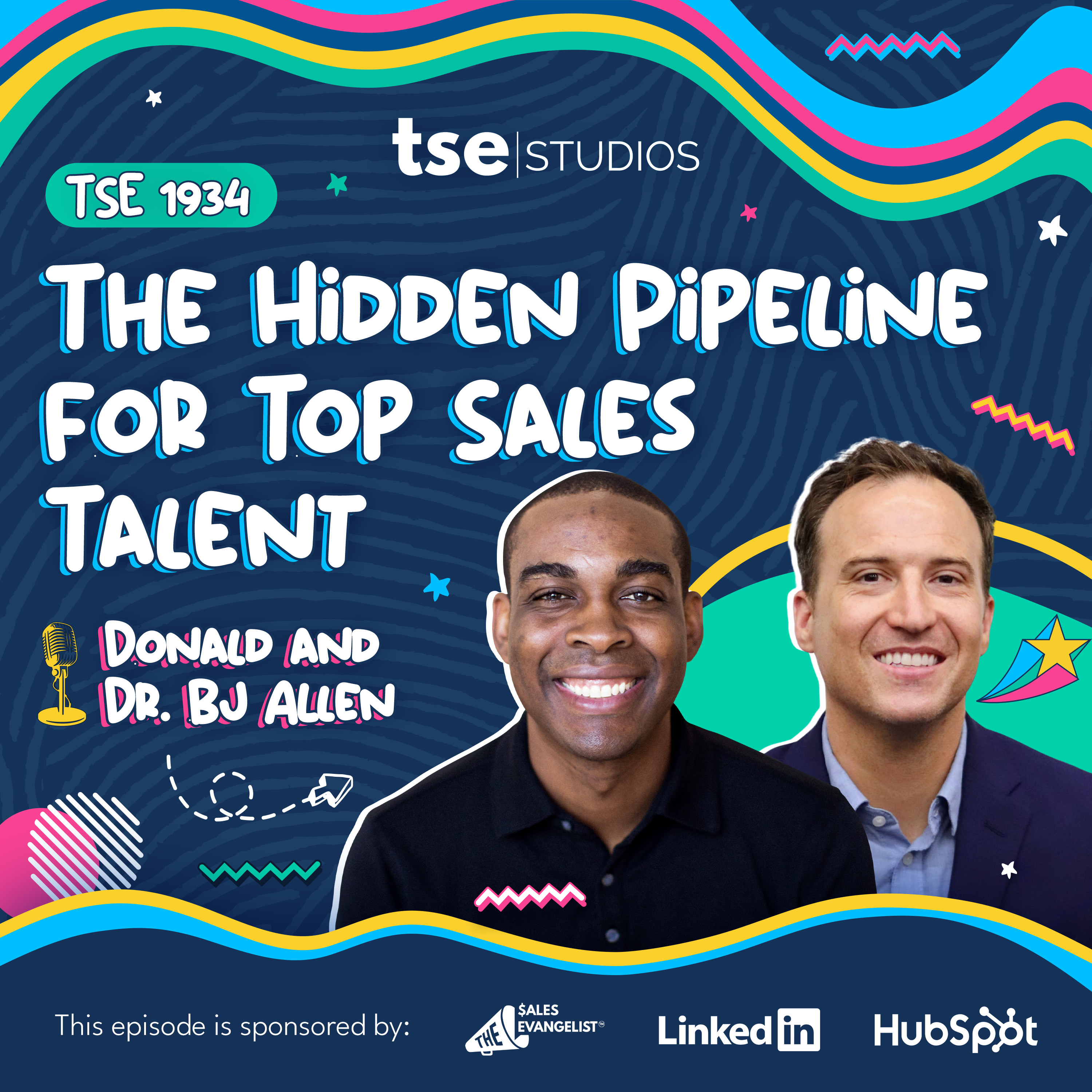
Ep 1934The Hidden Pipeline for Top Sales Talent | Donald Kelly and Dr. BJ Allen - 1934
I’m so excited about this episode. I have a good friend and co-host of our new podcast joining me. We’re here to introduce Sales 101: The B2B Classroom.It’s a podcast for sales professors on how you can help guide the next generation of sellers in our industry. Students and those already in the industry can still listen in — we share plenty of tips that can help you as well.Growth of College Sales Programs· BJ and I have taught sales at Brigham Young University for years. We’re starting to notice the growth of college sales programs compared to 20 years ago. BJ shares that there’s been a 50% increase in sales programs.· What’s so great about this is that students are able to gain sales skills before entering the field. It’s also an untapped recruiting source for modern B2B organizations.Hands-On Training in Academia· College sales programs allow students to gain real-life skills using frameworks like Challenger, SPIN,and MEDDIC, as well as industry tools (Salesforce, HubSpot).· They get time to role-play, use simulations, and gain practical hands-on experience.· For example, I shared a story about how students at BYU won sponsorship deals for their local theater.Integration of AI in Sales Education· I play a clip from Professor Barry on how he’s using AI tools to enhance role play, research, and call analysis while teaching his students.· This shows how college sales programs can help students learn to use AI-powered techniques for outreach, efficiency, and analytics.Why Listen to Sales 101: The B2B Classroom· Besides hearing our handsome voices, you’ll learn directly from sales college professionals and industry leaders about what’s working and what’s not. You’ll also hear firsthand from students about their real experiences in the field.· This podcast bridges thegap between academic sales programs and real-world B2B selling. · We spotlight the latest trends in sales education, share best practices from top university programs, and reveal how savvy companies are tapping into this talent pool to build their sales teams of the future.“We have one goal and that is to get our students jobs. We understand in order to get our students jobs, that theory doesn’t cut it alone.” - Dr. BJ Allen."They're not only getting the book smart. They're getting learning from industry leaders, from guest lecturers, and they're getting practice." - Donald Kelly. ResourcesSales 101: The B2B Classroom PodcastSponsorship Offers1. This episode is brought to you in part by Hubspot.With HubSpot sales hubs, your data tools and teams join a single platform to close deals and turn prospects into pipelines. Try it for yourself at hubspot.com/sales.2. This episode is brought to you in part by LinkedIn.Are you tired of prospective clients not responding to your emails? Sign up for a free 60-day trial of LinkedIn Sales Navigator at linkedin.com/tse.3. This episode is brought to you in part by the TSE Sales Foundation.Improve your connection on LinkedIn and land three or five appointments with our LinkedIn prospecting course. Go to the salesevangelist.com/linkedin.CreditsAs one of our podcast listeners, we value your opinion and always want to improve the quality of our show. Complete our two-minute survey here: thesalesevangelist.com/survey. We’d love for you to join us for our next episodes by tuning in on Apple Podcast, Google Podcast, Stitcher, or Spotify. Audio provided by Free SFX, Soundstripe, and Bensound. Other songs used in the episodes are as follows: The Organ Grinder written by Bradley Jay Hill, performed by Bright Seed, and Produced by Brightseed and Hill.
Ep 1933The Planning Hack That Prints Money | Donald Kelly - 1933
Planners, tablets, Google Calendar — you’d think with all these tools, you’d be able to stay on track with the tasks that bring in money. So why do silly distractions keep pulling your focus? Check out my strategy that will cut the noise and help you focus on what matters most.Every Monday Problem· You wake up feeling unbothered—until you remember everything you need to get done.· Suddenly, the pressure builds on your shoulders, and your mind may even jump to the worst-case scenario: freezing in the moment and not getting anything done.How to Shut the Noise· As a sales professional and business owner, I know how overwhelming it feels once you start thinking about all the tasks on your plate.· The best way I’ve found to avoid getting stressed is to start with the most critical tasks first. Tackling the hardest items right away gets them out of the way and sets you up for the best results throughout the day. Remember Kevin O’Leary’s 80/20 quote!· In this episode, I share my personal strategy for choosing which critical tasks to focus on and how to prioritize them so you can stay in control of your day.“You can have time in your day to breathe. Take a walk in the park, go to the gym, and focus on your physical health. You can’t do the work if you aren’t healthy.” – Donald KellyResources· If you like more guidance with improving your sales skills, join my Sales Mastermind Class.· Thinking about starting a podcast yourself? Learn more about Blue Mango Studios. Sponsorship Offers1. This episode is brought to you in part by Hubspot.With HubSpot sales hubs, your data tools and teams join a single platform to close deals and turn prospects into pipelines. Try it for yourself at hubspot.com/sales.2. This episode is brought to you in part by LinkedIn.Are you tired of prospective clients not responding to your emails? Sign up for a free 60-day trial of LinkedIn Sales Navigator at linkedin.com/tse.3. This episode is brought to you in part by the TSE Sales Foundation.Improve your connection on LinkedIn and land three or five appointments with our LinkedIn prospecting course. Go to the salesevangelist.com/linkedin.CreditsAs one of our podcast listeners, we value your opinion and always want to improve the quality of our show. Complete our two-minute survey here: thesalesevangelist.com/survey. We’d love for you to join us for our next episodes by tuning in on Apple Podcast, Google Podcast, Stitcher, or Spotify. Audio provided by Free SFX, Soundstripe, and Bensound. Other songs used in the episodes are as follows: The Organ Grinder written by Bradley Jay Hill, performed by Bright Seed, and Produced by Brightseed and Hill.

Ep 1932The Relationship Currency | Ravi Rajani - 1932
AI can do a lot, but it’s ineffective when it comes to building relationships with prospects. Even though creating connections is important, most sellers tend to struggle with this. I invited my guest, Ravi Rajani, a sales coach and author of Relationship Currency, to join me in this episode to discuss his newest book. He shares what inspired him to write this book and why sellers need to focus more on building relationships to create strong pipelines.The Origins of "Relationship Currency"· To start, Ravi discusses what inspired him to write his first book. He shares a funny story about talking to his mentor about the idea of writing a book while having a second baby on the way. · Looking back on his career and life, he noticed how much his relationships influenced his success. He learned that by building trust and communication skills, other sellers can achieve the same success.The Central Role of Trust· Would you be friends with your bestie if you didn't trust them? Your prospects feel the same way when it comes to doing business with you. · Trust is the glue that holds relationships together. In his book, Ravi talks about the "Three Cs" of trust:o Connection (the emotional bond)o Character (your invisible values)o Competence (showing expertise without being overbearing)· You need all three to establish lasting trust, whether with clients, colleagues, or partners.The Art of Listening and Empathetic Questions· Ravi explains how surface-level questions yield surface-level relationships, but conscious questions develops deep relationships. · A “conscious question” is rooted in positive intent and service. For example, instead of “How are you?” ask something you know the other person is emotionally invested in.Five Habits to Build Relationship Currency· Here are the five habits that help build the Three Cs:o Transform Your Internal Story: The relationship you have with yourself sets the tone for all others.o Ask Conscious Questions: Rooted in service and positive intent; paired with deep listening.o Unearth Your Charisma: True charisma makes others feel significant.o Tell Stories That Inspire Change: Especially social proof stories—show, don’t tell.o Become the Trusted Guide: Help others achieve their goals without self-interest, bringing all habits together.Ravi’s Advice for Leaders: Model the Change· If you want your team to be more passionate or authentic, you need to model that energy and intention yourself.· Reinforce these behaviors by acknowledging team members who practice them.· Genuine compliments go a long way—they activate the same brain areas as financial rewards!“I believe that the only currency that has mattered is relationships. And the only currency that will matter moving forward is relationships, especially in a world increasingly being shaped by AI.” - Ravi Rajani.ResourcesRavi RajaniBook | Speaker, Coach & Consultant | Ravi RajaniRavi Rajani’s mission is to help B2B tech sales teams ditch feature dumping for storytelling so they can get their prospect’s attention, become trusted advisors and win more relationships.Sponsorship Offers1. This episode is brought to you in part by Hubspot.With HubSpot sales hubs, your data tools and teams join a single platform to close deals and turn prospects into pipelines. Try it for yourself at hubspot.com/sales.2. This episode is brought to you in part by LinkedIn.Are you tired of prospective clients not responding to your emails? Sign up for a free 60-day trial of LinkedIn Sales Navigator at linkedin.com/tse.3. This episode is brought to you in part by the TSE Sales Foundation.Improve your connection on LinkedIn and land three or five appointments with our LinkedIn prospecting course. Go to the salesevangelist.com/linkedin.CreditsAs one of our podcast listeners, we value your opinion and always want to improve the quality of our show. Complete our two-minute survey here: thesalesevangelist.com/survey. We’d love for you to join us for our next episodes by tuning in on Apple Podcast, Google Podcast, Stitcher, or Spotify. Audio provided by Free SFX, Soundstripe, and Bensound. Other songs used in the episodes are as follows: The Organ Grinder written by Bradley Jay Hill, performed by Bright Seed, and Produced by Brightseed and Hill.
Ep 1931Three Unconventional Prospecting Methods That Are Making A Come Back | Donald Kelly - 1931
Old-school prospecting methods are making a comeback, and in this episode, I'm going to share three unconventional ones that you can take advantage of. Oh yeah, don't forget to check out my LinkedIn prospecting course at the bottom.Why Are These Prospecting Methods Coming Back?· These techniques are returning due to the world of AI. People want to connect, and it's getting harder to do that through technology alone. · Also, don't think methods like cold calling and email are dead. Instead, these methods are becoming the preferred ways to build trust and find a trusted source.1. Industry Events· One thing I've noticed about Reddit is that people love to connect with like-minded individuals to learn more about their industry. · Just about every industry has trade shows, which are ideal places for you to connect with trusted sources. · However, the key thing to remember is that you must become an insider of the trade show—not just a random attendee—to establish yourself as a trusted source.2. Referrals· I've said this over and over again: referrals work. People love to introduce others to each other; it gives them a sense of importance. · It also helps establish trust and increase client acquisition.3. Channel Partners· This method isn't as hard as you might think. The same amount of energy you spend finding one prospect, you can spend finding a channel partner. These are partners who have access to many prospects that you can work with."9 out of 10 prospects like to give referrals, and only 11 percent of sellers ask for them. Go back to LinkedIn and ask for an introduction." - Donald KellyResources· If you like more guidance with improving your prospecting skills, join my LinkedIn Prospecting Course.· Thinking about starting a podcast yourself? Learn more about Blue Mango Studios. Sponsorship Offers1. This episode is brought to you in part by Hubspot.With HubSpot sales hubs, your data tools and teams join a single platform to close deals and turn prospects into pipelines. Try it for yourself at hubspot.com/sales.2. This episode is brought to you in part by LinkedIn.Are you tired of prospective clients not responding to your emails? Sign up for a free 60-day trial of LinkedIn Sales Navigator at linkedin.com/tse.3. This episode is brought to you in part by the TSE Sales Foundation.Improve your connection on LinkedIn and land three or five appointments with our LinkedIn prospecting course. Go to the salesevangelist.com/linkedin.CreditsAs one of our podcast listeners, we value your opinion and always want to improve the quality of our show. Complete our two-minute survey here: thesalesevangelist.com/survey. We’d love for you to join us for our next episodes by tuning in on Apple Podcast, Google Podcast, Stitcher, or Spotify. Audio provided by Free SFX, Soundstripe, and Bensound. Other songs used in the episodes are as follows: The Organ Grinder written by Bradley Jay Hill, performed by Bright Seed, and Produced by Brightseed and Hill.
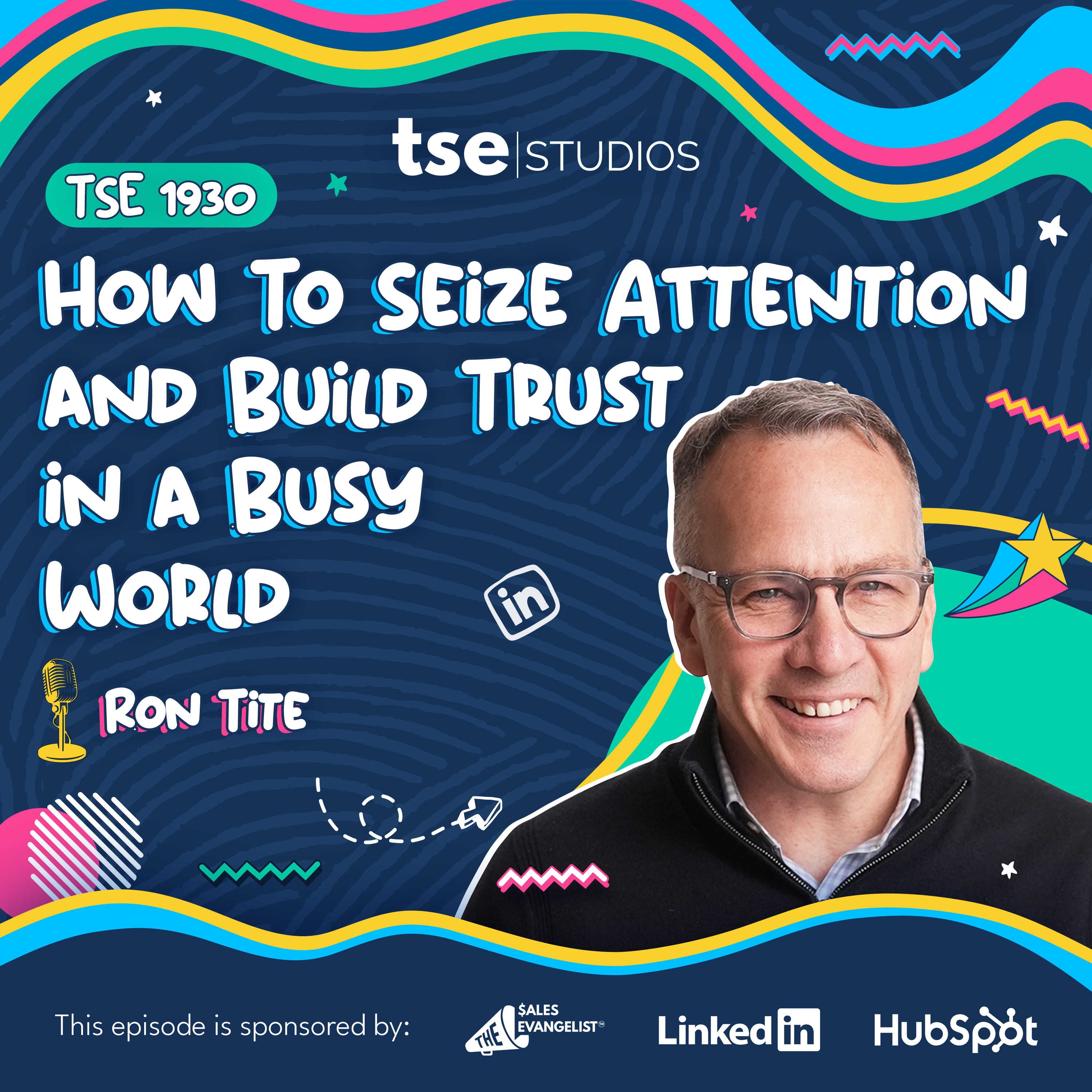
Ep 1930How To Seize Attention and Build Trust in a Busy World | Ron Tite - 1930
We’re bringing back one of our most popular episodes from the archive with Ron Tite, because the lessons are just as relevant today as when we first recorded it. As salespeople, we all know that grabbing attention and earning trust are two of the hardest (and most critical) parts of the job. Ron breaks down exactly how to do both without relying on gimmicks or old-school tactics.Meet Ron TiteRon Tite is the founder and keynote speaker of the Toronto-based agency Church+State, and the author of Think Do Say: How to Seize Attention and Build Trust in a Busy, Busy World. With a background as an executive creative director at a multinational ad agency and years of experience as a stand-up comedian, Ron brings a unique blend of creativity, storytelling, and practical business insight to the world of sales and marketing.Why Attention Alone Isn’t EnoughSalespeople are fighting for space in an overcrowded marketplace. From flashy billboards in Times Square to hyper-targeted street-level sellers, everyone’s competing for attention. But attention without trust won’t get you very far. Ron explains why chasing vanity metrics is a dead end and how to build credibility in a noisy world.The Three Anchors: Think, Do, SayRon shares a simple but powerful framework:· Think: What do you truly believe in as a salesperson?· Do: How are you reinforcing those beliefs through your actions?· Say: How are you communicating them authentically without falling into “pitch slap” mode? When you align these three, your outreach feels human, real, and trustworthy.Invest in Being GoodJust like comedians can’t fake being funny, salespeople can’t fake caring about their clients. Long-term success doesn’t come from gimmicks or platform-hopping, it comes from genuinely adding value and building relationships.Real-World Examples· Red Bull: Their entire brand is built on a belief (life with an adrenaline rush is better) and consistently reinforced through actions and messaging.· Ron’s own career: His first big client came not from tricks, but from trust he’d built over years.Lessons for Sales Leaders· Don’t hire someone hoping they’ll “save” the business—hire coachable people who are hungry to learn.· Give your team clear responsibilities so they can excel where they’re strongest.· Focus on humanity and credibility over hacks and short-term wins.“Looking for ways to seize attention and build trust may be difficult, but resist the desire to scheme. Do the hard work, be human, and focus on solving real problems.” – Ron TiteResources· Connect with Ron Tite on LinkedIn or follow him on Twitter and Instagram.· Check out his book: Think Do Say.· For more sales insights, connect with Donald on LinkedIn, Instagram, Twitter, or Facebook.Sponsorship Offers1. This episode is brought to you in part by Hubspot.With HubSpot sales hubs, your data tools and teams join a single platform to close deals and turn prospects into pipelines. Try it for yourself at hubspot.com/sales.2. This episode is brought to you in part by LinkedIn.Are you tired of prospective clients not responding to your emails? Sign up for a free 60-day trial of LinkedIn Sales Navigator at linkedin.com/tse.3. This episode is brought to you in part by the TSE Sales Foundation.Improve your connection on LinkedIn and land three or five appointments with our LinkedIn prospecting course. Go to the salesevangelist.com/linkedin.CreditsAs one of our podcast listeners, we value your opinion and always want to improve the quality of our show. Complete our two-minute survey here: thesalesevangelist.com/survey. We’d love for you to join us for our next episodes by tuning in on Apple Podcast, Google Podcast, Stitcher, or Spotify. Audio provided by Free SFX, Soundstripe, and Bensound. Other songs used in the episodes are as follows: The Organ Grinder written by Bradley Jay Hill, performed by Bright Seed, and Produced by Brightseed and Hill.
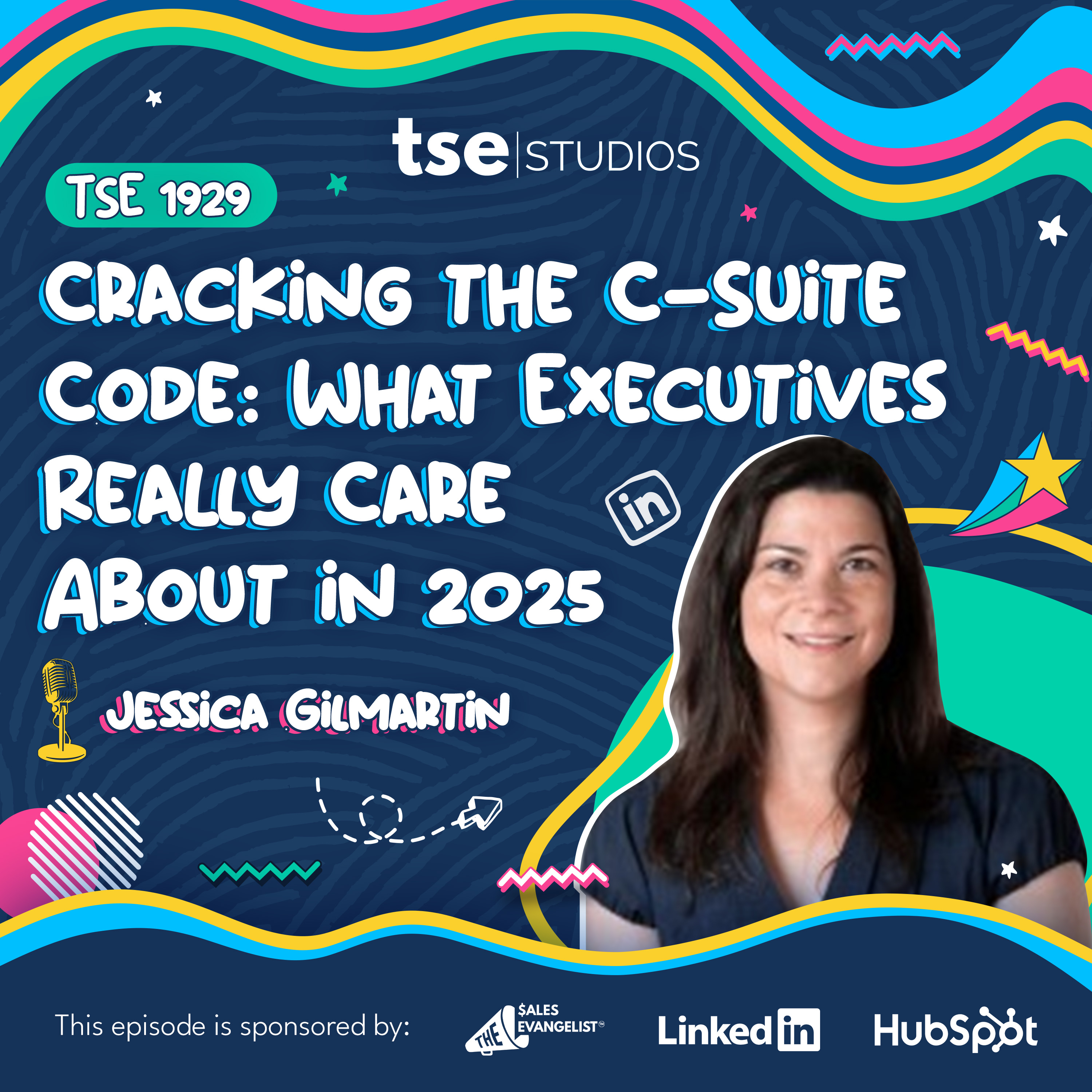
Ep 1929Cracking the C-Suite Code: What Executives Really Care About in 2025 | Jessica Gilmartin - 1929
For decades, sales trainers have preached the gospel of “get to the decision-maker” or “sell to VITO, the very important top officer.” But does selling to the C-suite really unlock deals the way we’ve been told? On today’s episode, I sit down with Jessica Gilmartin, former CMO and CRO, now board member and advisor, to uncover the truth about executive decision-making. Jessica shares what salespeople misunderstand about the C-suite, why skipping over her team is a huge mistake, and how sellers can actually win executive support the right way.Meet Jessica GilmartinJessica has led marketing and revenue functions at fast-growing tech companies like Asana and Calendly. With years of experience as a CMO, CRO, and now board member, she’s been on the receiving end of countless sales pitches. Today, she advises companies on go-to-market strategy and knows firsthand how buying decisions really get made at the executive level.Stop Believing the “C-Suite Myth”Most sellers think if they can just land a meeting with the C-suite, the deal is theirs. Jessica says that couldn’t be further from the truth.· Executives don’t manage the day-to-day tech stack or tools their teams use.· For purchases under ~$50K, the decision almost never makes it to her desk.· When sellers bypass her team and go directly to her, it creates friction, wastes time, and makes everyone look bad.Where Decisions Actually HappenJessica explains how most buying decisions flow:1. Team-driven research – Department leaders and managers identify priorities, evaluate vendors, and compare solutions.2. Executive oversight – CMOs, CROs, or CFOs step in only for large purchases, final budget approvals, or to present to the CEO/board.3. Headcount limits – Even with budget, implementation resources are scarce. Most companies can only onboard a few tools per quarter, regardless of ROI.Discovery With Executives? Don’t Do It.Executives don’t want to sit through basic discovery calls. By the time Jessica is looped in:· Sellers should already know the pain points and budget from her team.· Her role is to see a tailored demo, ask a few high-level questions, and give a final yes/no.“No executive likes to be disco’d. We hate it.” – Jessica GilmartinLessons for Sellers· Respect the chain of command. Build credibility with the people who will actually use the tool because they’re the ones who influence Jessica’s final decision.· Ask about budget and priorities early. If it’s not budgeted or prioritized, it’s unlikely to move forward, no matter how flashy your demo is.· Understand the headcount reality. Implementation capacity is often more limiting than money.· Tailor your message to priorities. Especially now, AI is top-of-mind for every executive team.Lessons for Sales Leaders· Train your team to identify the real decision-making process inside accounts.· Help reps build business acumen so they don’t embarrass themselves (or their prospects) by pushing too soon to the C-suite.· Coach reps to champion the “Darrens” inside organizations, the VPs and directors whose recommendations executives rely on.Resources· Connect with Jessica Gilmartin on LinkedIn· Learn more about executive decision-making by joining our Sales Mastermind Class· Thinking of starting a podcast? Check out Blue Mango StudiosSponsorship Offers1. This episode is brought to you in part by Hubspot.With HubSpot sales hubs, your data tools and teams join a single platform to close deals and turn prospects into pipelines. Try it for yourself at hubspot.com/sales.2. This episode is brought to you in part by LinkedIn.Are you tired of prospective clients not responding to your emails? Sign up for a free 60-day trial of LinkedIn Sales Navigator at linkedin.com/tse.3. This episode is brought to you in part by the TSE Sales Foundation.Improve your connection on LinkedIn and land three or five appointments with our LinkedIn prospecting course. Go to the salesevangelist.com/linkedin.CreditsAs one of our podcast listeners, we value your opinion and always want to improve the quality of our show. Complete our two-minute survey here: thesalesevangelist.com/survey. We’d love for you to join us for our next episodes by tuning in on Apple Podcast, Google Podcast, Stitcher, or Spotify. Audio provided by Free SFX, Soundstripe, and Bensound. Other songs used in the episodes are as follows: The Organ Grinder written by Bradley Jay Hill, performed by Bright Seed, and Produced by Brightseed and Hill.
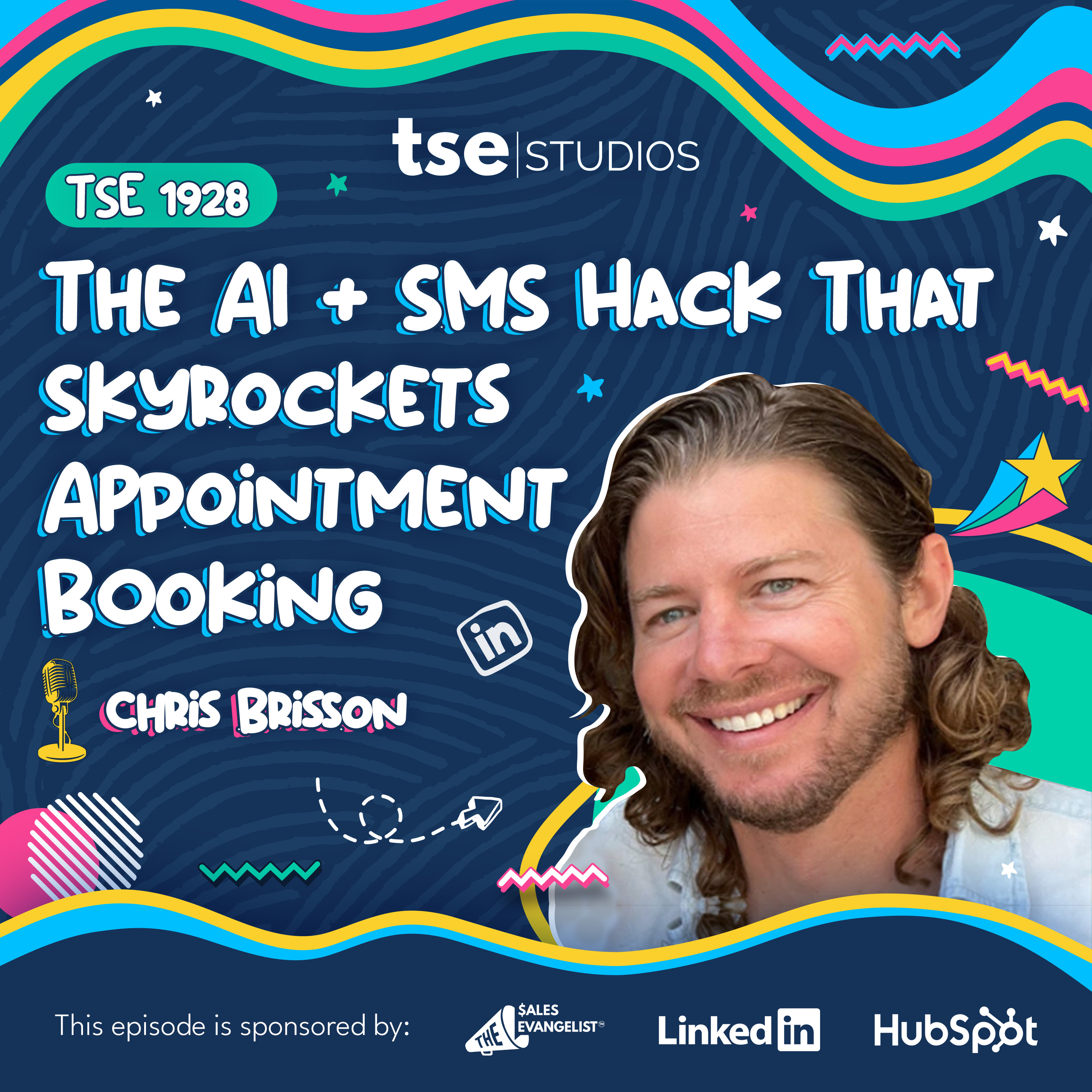
Ep 1928The AI + SMS Hack That Skyrockets Appointment Booking | Chris Brisson - 1928
How can you train your sales team to choose the right leads that bring in money and not waste the company’s time? This is where the power of AI tools lies. To show us how, I've invited Chris Brisson, a sales automation expert, to chat with me in this episode. He shares innovative strategies to streamline lead engagement, boost response rates, and fill your sales team’s calendar with more qualified prospects.Meet Chris Brisson· Chris Brisson is the founder of Sales Message and Call Loop, two innovative platforms that help businesses supercharge their communication and sales processes. · He is recognized for his forward-thinking approach in leveraging SMS messaging and artificial intelligence to automate the “messy middle” of sales, freeing sales reps to focus on building relationships and closing deals. · His solutions have been game changers for organizations of all sizes, transforming the way they connect with prospects and customers.The Lead Qualification Challenge· Sometimes the problem isn’t finding leads, it’s having too many unqualified leads that bog down valuable selling time. · Chris shares how, when agents start using AI-powered SMS to automate lead qualification, it frees your reps to focus on conversations that move the deal through the pipeline.Why SMS Still Matters· You might have noticed how people rarely answer calls from unknown numbers, but they’re still highly responsive to relevant, timely text messages.· However, context is everything: texts must be invited and sent at the right moment to avoid diminishing response rates.AI Agents: The New Sales Assistants· Chris explains how AI-driven text message agents can instantly respond, qualify leads, answer FAQs, and book meetings—operating 24/7 for consistent engagement. · He details how businesses can feed these agents their unique knowledge base and continuously fine-tune their performance.Practical Implementation Tips· To get started, Chris recommends auditing your forms for phone number capture, ensuring compliance (10DLC), and strategically adding opt-in opportunities. · He reassures that AI-enhanced SMS outreach isn’t an overhaul, but an enhancement to existing workflows."If you don't start today, you’re going to look back in a week, in a month, six months, or 12 months. Like man, I should have started sooner. This is the time to integrate messaging into your business, as it is how everybody is communicating, whether it’s through text or WhatsApp. All of these different messaging channels are in the pocket conversation." - Chris Brisson.Resources· To try out Sales Message or connect directly, visit salesmessage.com or reach Chris on LinkedIn.· If you like more guidance with improving your sales skills, join my Sales Mastermind Class.· Thinking about starting a podcast yourself? Learn more about Blue Mango Studios. Sponsorship Offers1. This episode is brought to you in part by Hubspot.With HubSpot sales hubs, your data tools and teams join a single platform to close deals and turn prospects into pipelines. Try it for yourself at hubspot.com/sales.2. This episode is brought to you in part by LinkedIn.Are you tired of prospective clients not responding to your emails? Sign up for a free 60-day trial of LinkedIn Sales Navigator at linkedin.com/tse.3. This episode is brought to you in part by the TSE Sales Foundation.Improve your connection on LinkedIn and land three or five appointments with our LinkedIn prospecting course. Go to the salesevangelist.com/linkedin.CreditsAs one of our podcast listeners, we value your opinion and always want to improve the quality of our show. Complete our two-minute survey here: thesalesevangelist.com/survey. We’d love for you to join us for our next episodes by tuning in on Apple Podcast, Google Podcast, Stitcher, or Spotify. Audio provided by Free SFX, Soundstripe, and Bensound. Other songs used in the episodes are as follows: The Organ Grinder written by Bradley Jay Hill, performed by Bright Seed, and Produced by Brightseed and Hill.
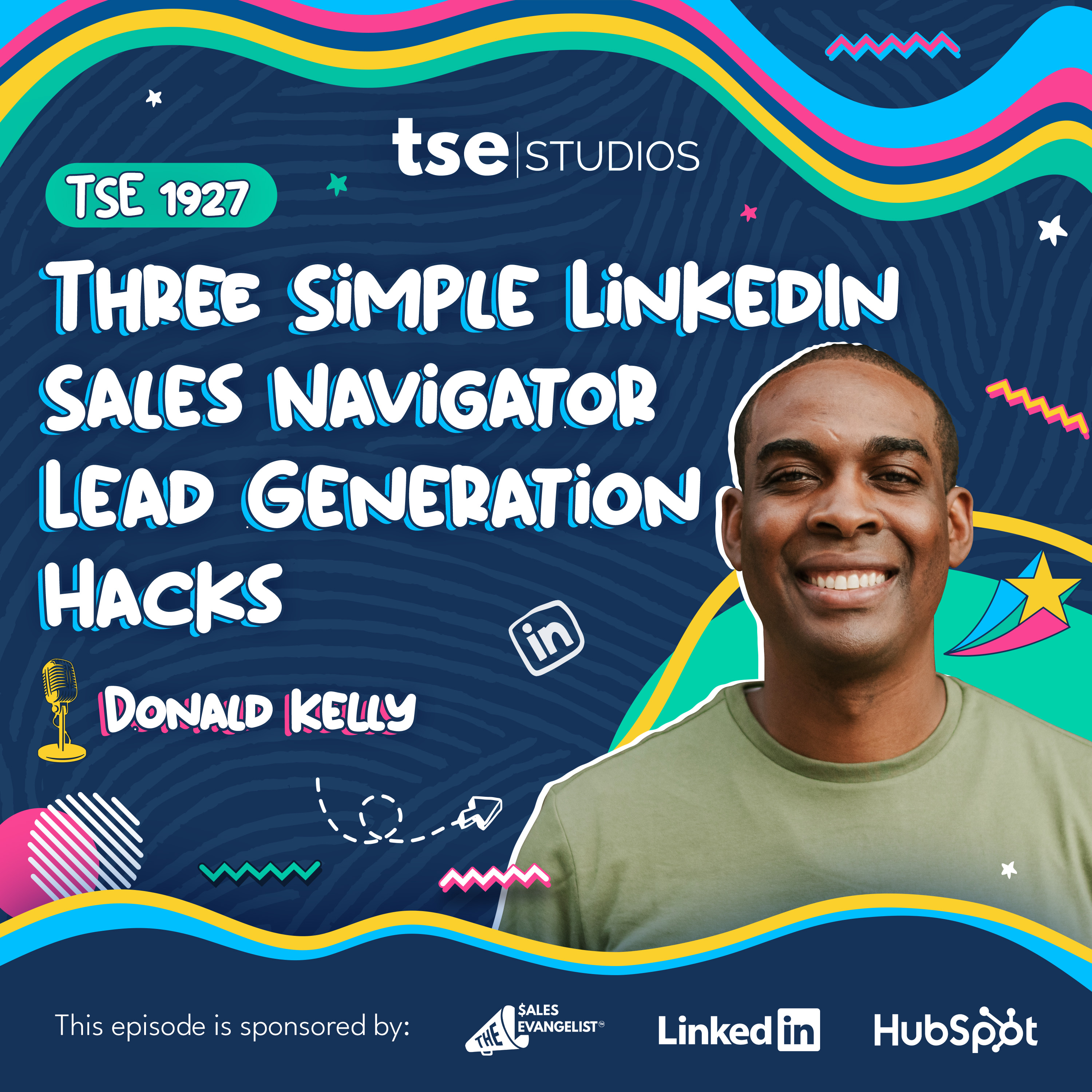
Ep 1927Three Simple LinkedIn Sales Navigator Lead Generation Hacks | Donald Kelly - 1927
LinkedIn Sales Navigator is one of the best ways to generate leads; however, the problem is that not many people know how to use it effectively. This is why I’m sharing three hacks to help you find prospects and build your pipeline. Also, it may be beneficial for you to watch this episode on YouTube, as this will allow you to fully grasp the concept behind the tips I’m sharing with you.Lead Generation Hack 1· My favorite feature of Sales Navigator is the ability to search for people who are new in their roles directly within the search bar. · People new to their roles are more likely to be open to new opportunities and to make changes. You can use this as a trigger for finding leads, and I show you how to do this in the episode.Lead Generation Hack 2· You want to find people who are active on LinkedIn. Once again, you can use the search engine to filter out leads that have recently been posted on the platform. This helps you become relevant and send messages that speak to them.Lead Generation Hack 3· Try looking to see who or what companies your friends are following on the platform. I provide several examples on how to do this the right way to generate leads.Bonus Lead Generation Hack· Piggybacking off of hack 1, I’m giving you an extra hack. When sending them a message, congratulate them and ask them what their first order of business is in their new role. They’ll give it to you on a silver platter, and your job is to transform it into a conversation.“Reach out to those on the lower end of a team, who can give you insights into the challenges their company is facing. You can use this information to your advantage when you reach out to the new manager.” - Donald Kelly.Resources· If you like more guidance with improving your sales skills, join my Sales Mastermind Class.· Thinking about starting a podcast yourself? Learn more about Blue Mango Studios. Sponsorship Offers1. This episode is brought to you in part by Hubspot.With HubSpot sales hubs, your data tools and teams join a single platform to close deals and turn prospects into pipelines. Try it for yourself at hubspot.com/sales.2. This episode is brought to you in part by LinkedIn.Are you tired of prospective clients not responding to your emails? Sign up for a free 60-day trial of LinkedIn Sales Navigator at linkedin.com/tse.3. This episode is brought to you in part by the TSE Sales Foundation.Improve your connection on LinkedIn and land three or five appointments with our LinkedIn prospecting course. Go to the salesevangelist.com/linkedin.CreditsAs one of our podcast listeners, we value your opinion and always want to improve the quality of our show. Complete our two-minute survey here: thesalesevangelist.com/survey. We’d love for you to join us for our next episodes by tuning in on Apple Podcast, Google Podcast, Stitcher, or Spotify. Audio provided by Free SFX, Soundstripe, and Bensound. Other songs used in the episodes are as follows: The Organ Grinder written by Bradley Jay Hill, performed by Bright Seed, and Produced by Brightseed and Hill.
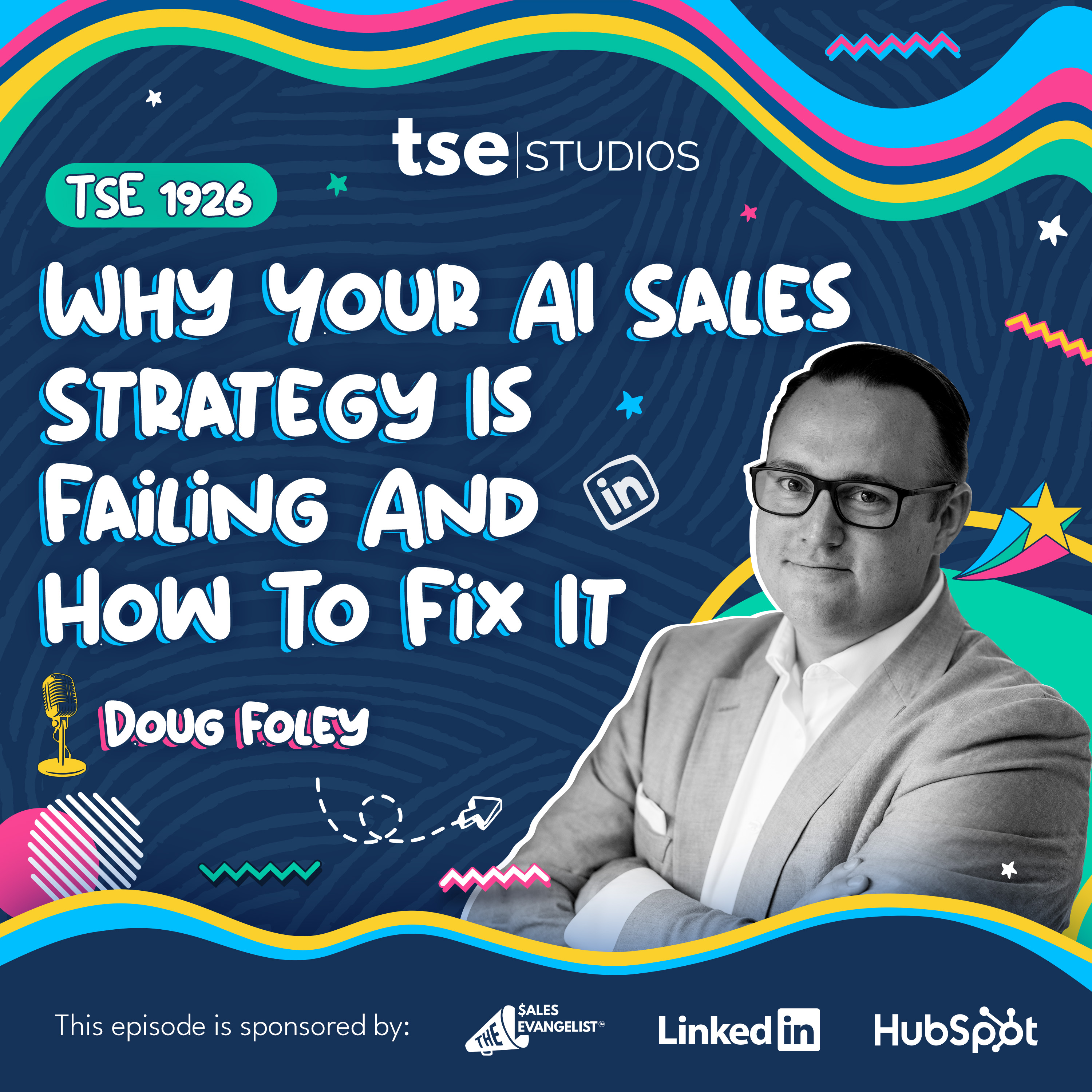
Ep 1926Why Your AI Sales Strategy Is Failing And How To Fix It | Doug Foley - 1926
Are you trying to use AI to speed up your sales cycle, only to find it's making your prospects' experience worse? The key is using technology to your advantage, not against you.In this episode, I'm joined by Doug Foley, an expert in sales enablement and AI integration. He shares his insights on leveraging AI tools to build more meaningful client relationships and enhance your sales process from start to finish.Meet Doug Foley· Douglas J. Foley is a strategic advisor, accomplished author, and the founder and CEO of Foley Media AI, where he architects AI-driven revenue engines for CEOs, high-growth companies, and Fortune 100 organizations. · Leveraging frameworks such as his Customer Loyalty Framework and AI Sales Engine™, Doug delivers predictable, measurable growth and transformative EBITDA results. · His practical, results-focused methodologies help senior leaders confidently scale and optimize their businesses.Why AI Matters in Enterprise Sales· Doug shares his journey, outlining the frequent gaps he’s seen in sales enablement and how AI, when implemented strategically, can fill those voids. · Many organizations only use AI for surface-level tasks like faster email writing or market research.· Doug urges sellers and business owners to expand beyond this "tunnel vision" and embrace AI as a tool for relationship-building and holistic sales strategy.Practical Steps for Implementing AI· When leaders are training sales teams on using AI tools, Doug suggests showing them how to map out the buyer’s journey and integrate AI at key touchpoints such as post-meeting follow-ups. · He stresses the importance of system-based thinking in deploying AI and highlights the significant gains in productivity and customer experience that even small changes can deliver.Tips for Sales Leaders and Reps· For busy sales managers, Doug suggests starting small: introduce an "AI-first" mentality in team meetings and encourage reps to share how AI helps overcome everyday roadblocks. · He emphasizes celebrating early AI wins to build momentum and foster an innovative culture.Advanced AI Strategies· Here’s actionable advice for reps targeting enterprise accounts: Use AI-powered research for deeper stakeholder mapping, create hyper-relevant outreach campaigns, and build a memorable, white-glove experience for clients. · Doug shares that impactful AI usage means slowing down to get ultra-targeted, which leads to better results and stronger deal pipelines.“The biggest mistake most people make is they look at it from strictly efficiency...but they don’t look at it more holistically as how can I build a bigger, better relationship and use AI.” - Doug Foley.Resources· Reach Doug Foley at Foley Media AI or on social platforms as @DouglasJFoley.· If you like more guidance with improving your sales skills, join my Sales Mastermind Class.· Thinking about starting a podcast yourself? Learn more about Blue Mango Studios. Sponsorship Offers1. This episode is brought to you in part by Hubspot.With HubSpot sales hubs, your data tools and teams join a single platform to close deals and turn prospects into pipelines. Try it for yourself at hubspot.com/sales.2. This episode is brought to you in part by LinkedIn.Are you tired of prospective clients not responding to your emails? Sign up for a free 60-day trial of LinkedIn Sales Navigator at linkedin.com/tse.3. This episode is brought to you in part by the TSE Sales Foundation.Improve your connection on LinkedIn and land three or five appointments with our LinkedIn prospecting course. Go to the salesevangelist.com/linkedin.CreditsAs one of our podcast listeners, we value your opinion and always want to improve the quality of our show. Complete our two-minute survey here: thesalesevangelist.com/survey. We’d love for you to join us for our next episodes by tuning in on Apple Podcast, Google Podcast, Stitcher, or Spotify. Audio provided by Free SFX, Soundstripe, and Bensound. Other songs used in the episodes are as follows: The Organ Grinder written by Bradley Jay Hill, performed by Bright Seed, and Produced by Brightseed and Hill.

Ep 1925The Easy 8-Step Framework to Win Enterprise Deals in the AI Era | Daren Fields - 1925
Today's buyers are more informed than ever, thanks to AI. Yet, they remain wary of sellers who rely on it too heavily, creating a unique challenge: How can you leverage technology to enhance your sales process without losing the authentic, personal connection that closes deals?To answer that question, I'm joined by Daren Fields, a sales expert and author of the Apex 8 framework. He shares his sales methodology to help you start winning enterprise deals in the AI era. Meet Daren Fields Darren Fields is an experienced sales leader, author, and innovator in the world of enterprise and edge software sales. Drawing from years of hands-on selling and sales leadership, Darren has developed practical frameworks to help sales professionals stand out in today’s AI-driven landscape. He is the creator of the Apex8 Framework, a methodology designed to help sellers build trust quickly, leverage AI effectively, and guide buyers through today’s complex decision-making processes.Current Challenge in Modern SalesAI has transformed the buying landscape, making prospects more informed about their product decisions. This has made it harder for sellers to move deals forward, as AI technology can now deliver basic information. Daren wants sellers to think of buyers like a media interviewer who’s filled with fast information. This allows them to match the buyer’s pace and depth by using the Apex8 sales framework and prevent losing deals. The Apex 8 Framework: The Eight StepsThe framework has a core idea of using conscious competence to help sellers remain deliberately skillful and self-aware. The goal of sellers is to help guide buyers' thinking into a mutual success by actively discovering their true problem and validating solutions in real time. Sellers follow these eight steps:o Discovery – Go beyond basic questioning. Research the prospect thoroughly using AI before the call so you can dive straight into real business problems.o Prototyping – Collaborate live (e.g., whiteboarding with AI tools), showing problem-solving skills and flexibility, turning the call into a collaborative session rather than a static demo.o Validation – Actively check if you’re on the right track with the buyer; confirm you’re addressing the real problem and adjust as needed.o Rehearsal – Practice and refine presentations/demos; this is emphasized as an “art form.”o Presentation/Demo – Deliver tailored solutions based on previous steps, not generic pitches.o Finalization – If prior steps were done right, closing the deal becomes more natural and less adversarial.o Debrief – Analyze every outcome (win or lose) in a safe, blame-free environment to identify improvements and share insights across teams.o Handoff – Ensure smooth transition to delivery/customer experience teams with thorough context so clients never feel lost after the sale.Embrace the Human-AI PartnershipAI is a leveler—it helps both you and your competition.Don’t try to replace human interaction with AI; find a balance where technology enables you to be a more innovative, trusted advisor.“Everybody wants to skip through the loss and move on to the next thing. The best teacher in life is failure. The losses teach you way more than the wins.” - Daren Fields. ResourcesTo learn more about Daren or get his book, go to apex8book.comIf you like more guidance with improving your sales skills, join my Sales Mastermind Class.Thinking about starting a podcast yourself? Learn more about Blue Mango Studios. Sponsorship Offers1. This episode is brought to you in part by Hubspot.With HubSpot sales hubs, your data tools and teams join a single platform to close deals and turn prospects into pipelines. Try it for yourself at hubspot.com/sales.2. This episode is brought to you in part by LinkedIn.Are you tired of prospective clients not responding to your emails? Sign up for a free 60-day trial of LinkedIn Sales Navigator at linkedin.com/tse.3. This episode is brought to you in part by the TSE Sales Foundation.Improve your connection on LinkedIn and land three or five appointments with our LinkedIn prospecting course. Go to the salesevangelist.com/linkedin.CreditsAs one of our podcast listeners, we value your opinion and always want to improve the quality of our show. Complete our two-minute survey here: thesalesevangelist.com/survey. We’d love for you to join us for our next episodes by tuning in on Apple Podcast, Google Podcast, Stitcher, or Spotify. Audio provided by Free SFX, Soundstripe, and Bensound. Other songs used in the episodes are as follows: The Organ Grinder written by Bradley Jay Hill, performed by Bright Seed, and Produced by Brightseed and Hill.
Ep 1924Stop Saying "Just Following"... Do This Instead! | Donald Kelly - 1924
After three to four follow-up emails, you start feeling like you're just an annoying fly to your prospects. Honestly, you're probably just buzzing their inboxes, especially if you're only sending simple "just checking in" messages. In this episode, I'll show you how to send follow-up emails that actually grab your prospects' attention.Quick StatHere's an interesting stat: It takes six to twelve interactions for prospects to respond and follow through on closing a deal. This doesn’t mean you have to send six to twelve cold calls or follow-up emails. You should probably stop sending those generic follow-up emails—they don't work. The act of reconnecting with a prospect is following up, so you don't have to tell them what you're doing.Use the MEDDIC Sales MethodologyGo back to your discovery call or your initial conversation to remember why your prospect needed a change in their business. When you talk to them again or send them a message, try something like this: "You mentioned you were using a product that wasn't working. Here's how my solution can help you."Check out episode 1923, and I share more details about the MEDDIC sales methodology. Other Ways to Follow UpInstead of writing a regular follow-up email, consider using data or information that isn’t directly tied to the deal you're trying to close. I tell a story of how I did this with an old prospect on a social media platform.Also, try to use more than one method of communication—this will help you stay in touch with them. I'll offer some creative ways to follow up on social media.Always bring something to the table that will help the prospect or identify an issue they may be having in their company. No matter what platform you’re using, this will help with engagement from them.“The fact that you reach out to them is following up. They are going to remember you, and you don’t have to tell them what you’re doing.” — Donald C. Kelly.ResourcesIf you like more guidance with improving your sales skills, join my Sales Mastermind Class.Thinking about starting a podcast yourself? Learn more about BlueMango Studios. Sponsorship OffersThis episode is brought to you in part by Hubspot.With HubSpot sales hubs, your data tools and teams join a single platform to close deals and turn prospects into pipelines. Try it for yourself at hubspot.com/sales.2. This episode is brought to you in part by LinkedIn.Are you tired of prospective clients not responding to your emails? Sign up for a free 60-day trial of LinkedIn Sales Navigator at linkedin.com/tse.3. This episode is brought to you in part by the TSE Sales Foundation.Improve your connection on LinkedIn and land three or five appointments with our LinkedIn prospecting course. Go to the salesevangelist.com/linkedin.CreditsAs one of our podcast listeners, we value your opinion and always want to improve the quality of our show. Complete our two-minute survey here: thesalesevangelist.com/survey. We’d love for you to join us for our next episodes by tuning in on Apple Podcast, Google Podcast, Stitcher, or Spotify. Audio provided by Free SFX, Soundstripe, and Bensound. Other songs used in the episodes are as follows: The Organ Grinder written by Bradley Jay Hill, performed by Bright Seed, and Produced by Brightseed and Hill.

Ep 1923The Ultimate Breakdown: MEDDIC vs BANT Sales Qualification | Donald Kelly - 1923
It’s in the data! Reps who used some form of sales methodology are 33% more likely to hit their quota than those who don’t.But which one is the best one to use? Join me in this episode where I break down MEDDIC vs. BANT sales methodologies to help you decide which one is the best option for you. I’ll tell you what they are and provide examples of when you should use them.What Is the BANT Sales Methodology? BANT is a simple sales process that most sales rep often learn early in their careers. It stands for:BudgetAuthorityNeedTimingWhen you use this sales methodology, you determine the client’s budget, if the person you’re talking to is a decision maker, what the need or pain you’re trying to solve, and how soon they’re trying to fix it.Also, I like to adapt this method to better suit the client's needs and make it more understandable throughout the process.What Is the MEDDIC Sales Methodology?This has nothing to do with medicine, even though sales reps in the medical field can use it to their advantage. Here’s what MEDDIC stands for:MetricsEconomic buyerDecision criteriaDecision processIdentifying a pain pointChampion I provide an example of selling a software product that’s competing with QuickBooks, and I’m trying to persuade you to use my services instead. This helps you understand each component of the MEDDIC sales methodology.Also, I share details on MEDDPICC (which adds Competition) and MEDDPIIC (which adds paper processing). Which Sales Methodology Is the Best One?Here’s the short answer: neither. It will all depend on your client and the type of deal you’re going for. For example, you’ll use BANT in a situation where the deal is less than $2,500. This is because it’s simple.Usually, it goes over this amount, then you may use the MEDDIC sales methodology. It will all depend on the situation. “There is no one way to do this. Some of you may be using different sales methods. The point is that you need to use something!” - Donald C. Kelly. ResourcesIf you like more guidance with improving your sales skills, join my Sales Mastermind Class.Thinking about starting a podcast yourself? Learn more about BlueMango Studios. Sponsorship OffersThis episode is brought to you in part by Hubspot.With HubSpot sales hubs, your data tools and teams join a single platform to close deals and turn prospects into pipelines. Try it for yourself at hubspot.com/sales.2. This episode is brought to you in part by LinkedIn.Are you tired of prospective clients not responding to your emails? Sign up for a free 60-day trial of LinkedIn Sales Navigator at linkedin.com/tse.3. This episode is brought to you in part by the TSE Sales Foundation.Improve your connection on LinkedIn and land three or five appointments with our LinkedIn prospecting course. Go to the salesevangelist.com/linkedin.CreditsAs one of our podcast listeners, we value your opinion and always want to improve the quality of our show. Complete our two-minute survey here: thesalesevangelist.com/survey. We’d love for you to join us for our next episodes by tuning in on Apple Podcast, Google Podcast, Stitcher, or Spotify. Audio provided by Free SFX, Soundstripe, and Bensound. Other songs used in the episodes are as follows: The Organ Grinder written by Bradley Jay Hill, performed by Bright Seed, and Produced by Brightseed and Hill.
Ep 1922The Mental Block That’s Costing You Deals | Dr. Noah St John - 1922
Today, Dr. Noah St. John is here to challenge everything you thought you knew about why some people thrive and others get stuck. If you want to level up your success in any area of your life, the first thing you must do is to change your mindset. Dr. Noah is going to show you how to conquer the "head trash" that holds us back, break through income plateaus, and unlock results.Meet Dr. Noah St. JohnDr. Noah has been teaching clients for 30 years and is credited with helping them add a collective $3 billion in revenue. He is known as the "Done with Head Trash" guy and is a leader of the movement to help people get past their self-imposed limitations. He has written 25 books on the subject and has helped individuals and organizations ranging from 100 to 10,000.Inner Game vs. Outer Game: The 80% RuleDr. Noah argues that success is at least 80% about your "inner game". The inner game is everything happening in your mind, including the beliefs and stories you tell yourself. While "outer game" activities like making calls and sending emails are important, Dr. Noah emphasizes that mindset is the true bottleneck for most people.Clearing Out the "Head Trash"Dr. Noah defines "head trash" as the internal voice that says, "I can't because...". This self-limiting dialogue is what prevents sales professionals and entrepreneurs from reaching their full potential. He explains that by identifying and clearing this mental clutter, you can stop proving your own limitations right.From $4 Million to $20 Million: A Real-Life ExampleDr. Noah shares a powerful case study about a client whose company was stuck at $4 million in revenue for four years. After hiring Dr. Noah, they focused on the inner game, and in less than 18 months, the company's revenue skyrocketed to over $20 million. This success was a direct result of addressing the team's mindset, not just their outer game tactics.Practical Steps to Break FreeWant to get off the "hamster wheel"? Dr. Noah gives steps to take right away.Get Clear on Your Goals: You must be specific about what you want to achieve, whether it's more money or a better relationship.Identify Your Limitations: Pinpoint the reasons you think you can't reach your goals, like not having enough time, money, or confidence.Take Action (Even Without Confidence): The myth that confidence comes first is dismantled here. Dr. Noah stresses that you build confidence by taking action, even if you don't feel ready.Advice for Sales LeadersFor those who lead teams, Dr. Noah suggests bringing in outside help to create a mindset shift. He offers resources, including his online course, and invites leaders to book him to train their teams. By focusing on mindset training and goal-setting exercises, leaders can unlock next-level results and help their teams become unstoppable.“If you take action even if you don’t believe, confidence will come. Most people wait for confidence, but it’s action that really unlocks it.” - Dr. Noah St. John.ResourcesDone With Head Trash Course: donewithheadtrash.com — Dr. Noah’s self-paced program to transform limiting beliefs.Main Website for Programs/Resources: noahstjohn.com — Books, courses, and tools for entrepreneurs and sales professionals.To Book Dr. Noah for Speaking/Training: booknoah.com.If you like more guidance with improving your sales skills, join my Sales Mastermind Class.Thinking about starting a podcast yourself? Learn more about Blue Mango Studios. Sponsorship OffersThis episode is brought to you in part by Hubspot.With HubSpot sales hubs, your data tools and teams join a single platform to close deals and turn prospects into pipelines. Try it for yourself at hubspot.com/sales.2. This episode is brought to you in part by LinkedIn.Are you tired of prospective clients not responding to your emails? Sign up for a free 60-day trial of LinkedIn Sales Navigator at linkedin.com/tse.3. This episode is brought to you in part by the TSE Sales Foundation.Improve your connection on LinkedIn and land three or five appointments with our LinkedIn prospecting course. Go to the salesevangelist.com/linkedin.CreditsAs one of our podcast listeners, we value your opinion and always want to improve the quality of our show. Complete our two-minute survey here: thesalesevangelist.com/survey. We’d love for you to join us for our next episodes by tuning in on Apple Podcast, Google Podcast, Stitcher, or Spotify. Audio provided by Free SFX, Soundstripe, and Bensound. Other songs used in the episodes are as follows: The Organ Grinder written by Bradley Jay Hill, performed by Bright Seed, and Produced by Brightseed and Hill.
Ep 1921Why Prospects Ignore You (And What to Do About It) | Jean-Philippe Schepens van Thiel - 1921
Is traditional sales outreach becoming less effective? And if so, what replaces it?In today's episode, I chat with Jean-Philippe Schepens van Thiel, founder of AxonJay, about how real-time data, predictive behavior, and AI-generated signals are fundamentally changing how we approach sales. If you’ve ever felt like your messaging is falling flat or that your timing is always off, this conversation is your blueprint for modernizing outreach.Meet Jean-Philippe Schepens van ThielJean-Philippe is the founder and CEO of AxonJay AI, a company helping B2B sellers harness the power of predictive signals to find the right opportunities at the right time. With over 15 years in data-driven sales and marketing, including a successful exit to Dun & Bradstreet, JP is now on a mission to help sales teams break through the noise and win deals with precision.Sales Outreach at an Inflection PointBuyers are bombarded by thousands of messages a week, most of which they delete without reading. Jean-Philippe believes we’ve hit a critical point in the evolution of sales, where volume no longer wins relevance and timing does. Instead of relying on old data and gut instinct, modern sales teams need to know when to reach out, what to say, and why it matters to the buyer right now.Build Your Sales CocktailJean-Philippe compares outreach success to making the perfect cocktail: timing, targeting, and content must all be in balance. One missing or outdated ingredient ruins the mix. Using AI, his company translates billions of daily data points into actionable signals then helps reps validate and fine-tune their approach using real-time context.Let AI Enhance, Not Replace, the Human ElementContrary to fear-mongering about AI replacing jobs, JP argues that AI will actually make sales more human. With technology handling research and signal aggregation, salespeople can focus on high-value conversations, empathy, and relationship-building.“It’s not about more data. It’s about the right data.”“Outreach isn’t dead—but it’s evolved.”“You need the right message at the right time.” “I want you to come to me with stuff proving.”Lessons from the FieldStop using last year’s data to make today’s decisions.Think beyond single signals and build context with a cocktail of signals.Use AI to filter your target list down to the 10% who are ready now.Personalize messaging with current, relevant activity not guesses.Combine automation with human feedback to improve results over time.ResourcesLearn more at Axonjay.aiConnect with Jean-Philippe via email ([email protected]) or through the websiteImprove your outreach and sales game join our Sales Mastermind ClassThinking of launching a podcast? Check out Blue Mango StudiosSponsorship OffersThis episode is brought to you in part by Hubspot.With HubSpot sales hubs, your data tools and teams join a single platform to close deals and turn prospects into pipelines. Try it for yourself at hubspot.com/sales.2. This episode is brought to you in part by LinkedIn.Are you tired of prospective clients not responding to your emails? Sign up for a free 60-day trial of LinkedIn Sales Navigator at linkedin.com/tse.3. This episode is brought to you in part by the TSE Sales Foundation.Improve your connection on LinkedIn and land three or five appointments with our LinkedIn prospecting course. Go to the salesevangelist.com/linkedin.CreditsAs one of our podcast listeners, we value your opinion and always want to improve the quality of our show. Complete our two-minute survey here: thesalesevangelist.com/survey. We’d love for you to join us for our next episodes by tuning in on Apple Podcast, Google Podcast, Stitcher, or Spotify. Audio provided by Free SFX, Soundstripe, and Bensound. Other songs used in the episodes are as follows: The Organ Grinder written by Bradley Jay Hill, performed by Bright Seed, and Produced by Brightseed and Hill.
Ep 1920From $0 to $3M in 90 Days: The 3 Sales Plays That Did It | Justin Balik - 1920
Is it possible to get your entire sales team to work together and crush goals one after another? Consider all the benefits your organization would gain if this were to actually happen.To make this dream a reality, listen to my chat with Justin Balik, co-founder of Wealth InsurED, in this episode. He shares three sales tactics that brought his company from half a million to three million in 90 days.Meet Justin Balik Justin has been a force in financial services since graduating from the University of Miami in 2012. He quickly rose from agent to a top 10 manager among 10,000+ peers. Now, he and his wife own a business revolutionizing IUL sales training, producing high-end agents with unparalleled speed and results in the industry. He has helped tens of thousands with insurance and retirement, specializing recently in tax minimization for high-net-worth clients.Specialize Your Sales Roles Most sales teams have reps doing everything: prospecting, appointment-setting, closing, and follow-up. Justin broke the process into specialized roles—so each person focused only on their highest-value work. This helped free up the top closers, who were freed from low-value, time-consuming tasks. The result: higher efficiency, faster pipeline movement, and more revenue. Ask yourself: where is your team doing $10/hour work instead of $10,000/hour work?Go After High-Ticket Clients Instead of focusing on high-volume, low-value sales, Justin’s team intentionally shifted to larger, more valuable deals. They targeted higher-level clients who not only respected the process, but were easier to work with—and produced exponentially greater revenue per deal. Justin’s advice: Identify and pursue the upper echelon of your market, and don’t let assumptions about “difficulty” of big deals hold you back. The truth? Sometimes, bigger clients are actually easier.Deliver Intensive, Practical Training Justin condensed over a decade’s worth of his sales knowledge into a proprietary, one-week, 40-hour training program for new reps. This training ensures each team member is truly equipped—not just motivated—with everything needed to sell at a high level. It’s practical, measured, and outcome-focused.Bonus Mindset Tip Justin emphasized the importance of personal growth alongside tactical skills. Your self-image must outpace the rejection that comes with aggressive activity, or you’ll burn out before you break through.“You can’t succeed in sales if you’re not constantly working on yourself.” Justin Balik.ResourcesGrab these books mentioned in the episode: 10x Is Easier Than 2x, Who Not How, and The Science of Scaling by Dan Sullivan & Dr. Benjamin Hardy. Follow Justin on Instagram. If you like more guidance with improving your sales skills, join my Sales Mastermind Class. Thinking about starting a podcast yourself? Learn more about Blue Mango Studios. Sponsorship OffersThis episode is brought to you in part by Hubspot.With HubSpot sales hubs, your data tools and teams join a single platform to close deals and turn prospects into pipelines. Try it for yourself at hubspot.com/sales.2. This episode is brought to you in part by LinkedIn.Are you tired of prospective clients not responding to your emails? Sign up for a free 60-day trial of LinkedIn Sales Navigator at linkedin.com/tse.3. This episode is brought to you in part by the TSE Sales Foundation.Improve your connection on LinkedIn and land three or five appointments with our LinkedIn prospecting course. Go to the salesevangelist.com/linkedin.CreditsAs one of our podcast listeners, we value your opinion and always want to improve the quality of our show. Complete our two-minute survey here: thesalesevangelist.com/survey. We’d love for you to join us for our next episodes by tuning in on Apple Podcast, Google Podcast, Stitcher, or Spotify. Audio provided by Free SFX, Soundstripe, and Bensound. Other songs used in the episodes are as follows: The Organ Grinder written by Bradley Jay Hill, performed by Bright Seed, and Produced by Brightseed and Hill.
Ep 1919Sell Like A Therapist | Jack Frimson & Zac Thompson - 1919
There’s a theory that if a seller focuses on a buyer’s inner feelings, then they’ll be more effective in closing a deal. This will require you to put your therapist cap on to tap into the customer’s emotions.My guests, Jack Frimson and Zac Thompson, sales professionals and co-authors of Selling Is Therapy, share their techniques from their latest book. Listen to learn more about how you can start selling like a therapist to close more deals.Meet Jack Frimson & Zac ThompsonJack and Zac are seasoned sales professionals and co-founders of an agency specializing in helping clients book more high-quality appointments. Together, they have worked with hundreds of clients, developing practical, actionable strategies to make sales conversations more empathetic, effective, and rewarding for everyone involved. Why the Therapist Approach?Salespeople often default to outdated, aggressive tactics that leave both parties feeling slimy.Drawing inspiration from therapy, Jack and Zac discovered that the best sellers act less like “persuaders” and more like thoughtful guides, catalyzing customer self-discovery.Permission-Based Questions & “Softening the Blow”Simply asking before posing tough or blunt questions disarms prospects, making conversations feel safer and more genuine.This approach helps navigate tough topics, such as budget or decision-making authority, without sounding confrontational.Levels of ListeningGreat salespeople distinguish themselves by noticing what isn’t said—body language, hesitations, or changes in tone.Calling out the “elephant in the room” (with empathy) opens space for honesty and trust.The “Test Close”Instead of forcing meetings or pushing agendas, the “test close” invites prospects to design the most valuable meeting for themselves (“What would make a call next week worthwhile for you?”).This boosts the chances of attended and effective appointments—and prospects are more invested because they helped build the agenda.The IKEA CurveWhen prospects participate in creating the solution (“If you could design your perfect platform/campaign/vendor, what would it look like?”), They feel a greater sense of ownership and buy-in.This technique is especially effective in competitive sales situations and discovery calls.Low-Stakes Practice & Continuous ExperimentationJack and Zac encourage sellers to experiment with these tactics in everyday settings, like at a coffee shop, to build confidence before using them in sales calls.Letting Go of AttachmentThe healthiest sales approach is one where you’re unattached to the outcome—focused instead on helping, not convincing.If you’re struggling with this, evaluate your alignment with the product, company, and your belief in the impact you deliver."Softening the blow is when we seek permission before we ask one of those big, big questions." - Jack Frimson."You always want to be calling out the elephant in the room. Another chapter of the book talks about the levels of listening. It shares how salespeople tend to miss the things that aren't being said." - Zac Thompson. ResourcesGrab a copy of their book on Amazon.Follow and reach out to Jack and Zac on LinkedIn. If you like more guidance with improving your sales skills, join my Sales Mastermind Class. Thinking about starting a podcast yourself? Learn more about Blue Mango Studios. Sponsorship OffersThis episode is brought to you in part by Hubspot.With HubSpot sales hubs, your data tools and teams join a single platform to close deals and turn prospects into pipelines. Try it for yourself at hubspot.com/sales.2. This episode is brought to you in part by LinkedIn.Are you tired of prospective clients not responding to your emails? Sign up for a free 60-day trial of LinkedIn Sales Navigator at linkedin.com/tse.3. This episode is brought to you in part by the TSE Sales Foundation.Improve your connection on LinkedIn and land three or five appointments with our LinkedIn prospecting course. Go to the salesevangelist.com/linkedin.CreditsAs one of our podcast listeners, we value your opinion and always want to improve the quality of our show. Complete our two-minute survey here: thesalesevangelist.com/survey. We’d love for you to join us for our next episodes by tuning in on Apple Podcast, Google Podcast, Stitcher, or Spotify. Audio provided by Free SFX, Soundstripe, and Bensound. Other songs used in the episodes are as follows: The Organ Grinder written by Bradley Jay Hill, performed by Bright Seed, and Produced by Brightseed and Hill.
Ep 1918LinkedIn Posts That Generate Sales Leads | [RERUN] Tom Abbott - 1918
You’re posting content on LinkedIn but is it actually bringing in sales leads? In this rerun episode, I sit down with Tom Abbott, LinkedIn strategist and international sales expert, to talk about how you can create content that doesn’t just get likes but fills your pipeline. If you’re tired of playing the social media game with no ROI, this episode is your blueprint.Meet Tom AbbottTom is the founder of SOCO Sales Training and one of the top voices when it comes to using LinkedIn for B2B sales. He’s trained thousands of sales professionals around the world, and in this conversation, he pulls back the curtain on what’s working on LinkedIn right now. Whether you're brand new to the platform or looking to sharpen your edge, Tom delivers actionable insights that can lead directly to revenue.Turn LinkedIn Into a Lead MachineTom explains why most sellers get LinkedIn wrong and what to do instead. It’s not about being overly polished or promotional. It’s about being intentional, authentic, and consistent.Speak to your audience’s pain pointsDon’t just talk about your product. Talk about the problems your prospects are actively trying to solve.Use a simple post structureTom breaks down the 3-part framework: hook, value, and CTA. Get attention, deliver insight, and give them something to do next.Stay visible without being spammyConsistency beats perfection. Tom shares how often to post, what formats are working best, and how to balance content types.Connect, don’t just broadcastThe magic happens in the comments and DMs. If you’re not engaging with your audience, you’re missing the point."LinkedIn is a sales tool not just a résumé. Use it that way, and it will change your business." – Tom AbbottResourcesFollow Tom Abbott on LinkedIn to see examples of his post structure in action. Check out SOCO Sales Training if you want to take your team’s LinkedIn strategy to the next level. Need help building your sales content strategy? Join my Sales Mastermind Class. Visit thesalesevangelist.com for templates, tools, and more episodes to sharpen your selling skillsSponsorship OffersThis episode is brought to you in part by Hubspot.With HubSpot sales hubs, your data tools and teams join a single platform to close deals and turn prospects into pipelines. Try it for yourself at hubspot.com/sales.2. This episode is brought to you in part by LinkedIn.Are you tired of prospective clients not responding to your emails? Sign up for a free 60-day trial of LinkedIn Sales Navigator at linkedin.com/tse.3. This episode is brought to you in part by the TSE Sales Foundation.Improve your connection on LinkedIn and land three or five appointments with our LinkedIn prospecting course. Go to the salesevangelist.com/linkedin.CreditsAs one of our podcast listeners, we value your opinion and always want to improve the quality of our show. Complete our two-minute survey here: thesalesevangelist.com/survey. We’d love for you to join us for our next episodes by tuning in on Apple Podcast, Google Podcast, Stitcher, or Spotify. Audio provided by Free SFX, Soundstripe, and Bensound. Other songs used in the episodes are as follows: The Organ Grinder written by Bradley Jay Hill, performed by Bright Seed, and Produced by Brightseed and Hill.
Ep 1917How to Instantly Increase the Perceived Value of Your Offer | [RERUN] Bob Britton - 1917
What if you could charge more without changing a single feature of your product or service? In this powerful rerun episode, I’m bringing back one of my favorite interviews with Bob Britton, a marketing expert who has helped thousands of entrepreneurs elevate their value, boost conversions, and command higher prices. If you’ve ever felt stuck competing on price, this episode is for you.Meet Bob BrittonBob Britton is a business growth strategist with a long track record of turning small businesses into seven-figure machines. He’s not just theory, Bob built and sold multiple companies using the same strategies he teaches today. One of the big secrets behind his success?Understanding perceived value. According to Bob, the way you frame and present your offer can make the difference between being seen as a commodity and being seen as a premium solution.It’s Not About Price, It’s About ValueIn this episode, Bob breaks down how to make your offer feel more valuable—without actually changing what you sell. It's all about presentation, psychology, and messaging.Simplify the decisionWhen prospects are confused, they don't buy. Bob explains how to structure your offer so it feels easy and obvious to say yes.Stack the valuePeople don’t buy features, they buy outcomes. Learn how to package and position your benefits so they stand out.Anchor your priceIf you’re not using strategic price anchoring, you’re leaving money on the table. Bob shares his favorite ways to do this without feeling manipulative.Add scarcity and urgencyA great offer is only as strong as the reason to act now. Discover the exact language Bob uses to ethically drive urgency."People will pay more when they believe your offer solves a meaningful problem, better than anything else." – Bob BrittonResourcesWant to dive deeper into pricing and packaging? Join my Sales Mastermind Class. If you’re working on messaging or need to create a premium offer, check out Blue Mango Studios. Follow me on LinkedIn for daily sales insights and strategies. Visit thesalesevangelist.com for more episodes and tools to help you sell more effectivelySponsorship OffersThis episode is brought to you in part by Hubspot.With HubSpot sales hubs, your data tools and teams join a single platform to close deals and turn prospects into pipelines. Try it for yourself at hubspot.com/sales.2. This episode is brought to you in part by LinkedIn.Are you tired of prospective clients not responding to your emails? Sign up for a free 60-day trial of LinkedIn Sales Navigator at linkedin.com/tse.3. This episode is brought to you in part by the TSE Sales Foundation.Improve your connection on LinkedIn and land three or five appointments with our LinkedIn prospecting course. Go to the salesevangelist.com/linkedin.CreditsAs one of our podcast listeners, we value your opinion and always want to improve the quality of our show. Complete our two-minute survey here: thesalesevangelist.com/survey. We’d love for you to join us for our next episodes by tuning in on Apple Podcast, Google Podcast, Stitcher, or Spotify. Audio provided by Free SFX, Soundstripe, and Bensound. Other songs used in the episodes are as follows: The Organ Grinder written by Bradley Jay Hill, performed by Bright Seed, and Produced by Brightseed and Hill.
Ep 1916What To Do When Everyone Tells You "No" | Alex Quin - 1916
What do you do when no one believes in your vision? When every door seems closed and you keep hearing the word “no”? In this powerful rerun episode, I sat down with my good friend Alex Quin to talk about rejection, resilience, and what it really takes to build something meaningful when the odds are stacked against you.Meet Alex QuinAlex Quin is the CEO of UADV, a full-stack marketing agency, and the host of the Hustle Inspires Hustle podcast. He's built a name for himself in the world of marketing and branding, working with top global brands like McLaren, Red Bull, and Puma. But his journey wasn’t easy. Alex didn’t start with connections or capital. He built his business from the ground up, and at every stage, people told him it wouldn’t work. They told him “no” but he didn’t stop.The Power of RejectionIn this conversation, Alex shares how rejection shaped his growth and why hearing “no” was one of the best things that ever happened to him. We talked about mindset, perseverance, and how to build momentum even when no one’s clapping for you yet.Create your own laneYou don’t need permission to start. Alex breaks down how he carved out his own path in marketing when the industry gatekeepers ignored him.Let the "no" fuel youEvery time someone doubts you, it adds fuel to your fire. Use rejection as a signal that you're on the right track, especially when you’re building something new or unconventional.Focus on value, not validationWhen you stop chasing approval and start solving real problems, the right people start paying attention.Stay true to your voiceDon’t let “no” change your identity. You’re not for everyone, and that’s okay. The people you’re meant to serve will get it."Rejection isn't the end. It's just feedback that you're breaking into something new." –Alex QuinResourcesListen to Alex’s podcast Hustle Inspires Hustle for more mindset and brand-building tips Connect with Alex Quin on Instagram or LinkedIn to learn from his journey Need help developing your brand or message? Join my Sales Mastermind Class Looking to launch your podcast? Check out Blue Mango StudiosSponsorship OffersThis episode is brought to you in part by Hubspot.With HubSpot sales hubs, your data tools and teams join a single platform to close deals and turn prospects into pipelines. Try it for yourself at hubspot.com/sales.2. This episode is brought to you in part by LinkedIn.Are you tired of prospective clients not responding to your emails? Sign up for a free 60-day trial of LinkedIn Sales Navigator at linkedin.com/tse.3. This episode is brought to you in part by the TSE Sales Foundation.Improve your connection on LinkedIn and land three or five appointments with our LinkedIn prospecting course. Go to the salesevangelist.com/linkedin.CreditsAs one of our podcast listeners, we value your opinion and always want to improve the quality of our show. Complete our two-minute survey here: thesalesevangelist.com/survey. We’d love for you to join us for our next episodes by tuning in on Apple Podcast, Google Podcast, Stitcher, or Spotify. Audio provided by Free SFX, Soundstripe, and Bensound. Other songs used in the episodes are as follows: The Organ Grinder written by Bradley Jay Hill, performed by Bright Seed, and Produced by Brightseed and Hill.
Ep 1915"Start The Day Off Right" | Donald Kelly - 1915
Are your mornings setting you up for success? Or are they throwing your whole day off track? In this rerun episode, I’m diving into one of the most requested topics from the archive, how to structure your morning routine for consistent sales success. Whether you're an individual contributor or leading a team, these habits will help you focus, prioritize, and perform better every single day.Start the Day Off RightWhen I first started selling, I struggled with mornings. I’d roll into the day reacting to emails, jumping on calls, and chasing activity but not results. Everything changed when I started being intentional about how I began my day. These are simple but powerful strategies that help me stay focused and in control. In this episode, I’ll share the exact routine I follow and why it works.The Morning FrameworkClarity is key. I start with 5 to 10 minutes of reflection, this could be prayer, journaling, or just quiet thinking. The goal is to reset and get my mind right. Then I review my pipeline so I know exactly which deals to prioritize. I write down one to three clear outcomes I want to accomplish that day. I also get moving whether it’s a workout or stretching, that physical energy helps jump start mental clarity. And finally, I stay out of email and Slack first. That’s reaction mode. I want to start in creation mode. These practices help me take control of my time, my mindset, and my performance. If you’re in sales, this will help you take control of your results."Control your morning and you’ll control your momentum." – Donald KellyResourcesWant to build a strong morning routine? Grab our free guide: Start Your Morning Like a Top 1% Seller Join my Sales Mastermind Class and level up your productivity and pipeline. Thinking about starting your own podcast? Get professional support from Blue Mango Studios.Sponsorship OffersThis episode is brought to you in part by Hubspot.With HubSpot sales hubs, your data tools and teams join a single platform to close deals and turn prospects into pipelines. Try it for yourself at hubspot.com/sales.2. This episode is brought to you in part by LinkedIn.Are you tired of prospective clients not responding to your emails? Sign up for a free 60-day trial of LinkedIn Sales Navigator at linkedin.com/tse.3. This episode is brought to you in part by the TSE Sales Foundation.Improve your connection on LinkedIn and land three or five appointments with our LinkedIn prospecting course. Go to the salesevangelist.com/linkedin.CreditsAs one of our podcast listeners, we value your opinion and always want to improve the quality of our show. Complete our two-minute survey here: thesalesevangelist.com/survey. We’d love for you to join us for our next episodes by tuning in on Apple Podcast, Google Podcast, Stitcher, or Spotify. Audio provided by Free SFX, Soundstripe, and Bensound. Other songs used in the episodes are as follows: The Organ Grinder written by Bradley Jay Hill, performed by Bright Seed, and Produced by Brightseed and Hill.
Ep 1914The 3 Moves That Got Us Enterprise Deals (Case Study) | Adam Block - 1914
How do you take a company that’s been winning in the SMB and mid-market world and help it thrive in the enterprise space? On today’s episode, I chat with Adam Block, Chief Revenue Officer at Motive. Adam shares the exact strategies his team used to move upstream without losing their core customers. If you're thinking about scaling your sales motion to land enterprise-level clients, this one is a must-listen.Meet Adam BlockAdam Block is the CRO of Motive, a company that offers an AI-powered operations platform for the physical economy. Their platform helps businesses in sectors like logistics, construction, and energy run safer and more efficient operations. Motive is used by massive organizations such as FedEx, Halliburton, and Centos and they didn’t get there by accident. Adam and his team made a strategic decision to go enterprise, but they made sure not to break what was already working.Going Enterprise Without Breaking Your FoundationAdam shares that Motive's journey upstream started with demand from the market. Their technology was attracting attention from larger organizations across a variety of industries. But rather than jump too fast, the team took a thoughtful approach focused on three major pillars:Do No HarmThe team made a commitment to keep serving existing customers while building out the infrastructure for enterprise. This meant careful segmentation, performance tracking, and redefining metrics to ensure success across the board.Rewire the Business for EnterpriseFrom the sales process to customer support, Adam's team rebuilt their entire operation to accommodate longer sales cycles and more complex buying processes. They also rebranded from KeepTruckin to Motive to reflect their broader market.Hire the Right PeopleTalent was key. Motive built a team of top-tier sellers and developed a farm system for internal promotion. With a focus on RAD, Resilience, Accountability, and Discipline, they created a high-performing culture that thrives under pressure.Lessons from the FieldAdam shared practical tactics for leaders looking to move upmarket:Don't chase enterprise at the cost of your base. Segment carefully and let each part of your business do what it does best.Rebranding isn't just about a name, it's about a new story. Make sure it matches your long-term vision.Build internal mobility. Create opportunities for junior talent to grow into enterprise roles, which lowers hiring risk and strengthens your culture.“You have to be bold. But you also have to be intentional.” – Adam BlockResourcesTo learn more about Motive, visit GoMotive.comConnect with Adam Block on LinkedIn Thinking about starting your own podcast? Check out Blue Mango Studios. Want help improving your sales skills? Join our Sales Mastermind Class.Sponsorship OffersThis episode is brought to you in part by Hubspot.With HubSpot sales hubs, your data tools and teams join a single platform to close deals and turn prospects into pipelines. Try it for yourself at hubspot.com/sales.2. This episode is brought to you in part by LinkedIn.Are you tired of prospective clients not responding to your emails? Sign up for a free 60-day trial of LinkedIn Sales Navigator at linkedin.com/tse.3. This episode is brought to you in part by the TSE Sales Foundation.Improve your connection on LinkedIn and land three or five appointments with our LinkedIn prospecting course. Go to the salesevangelist.com/linkedin.CreditsAs one of our podcast listeners, we value your opinion and always want to improve the quality of our show. Complete our two-minute survey here: thesalesevangelist.com/survey. We’d love for you to join us for our next episodes by tuning in on Apple Podcast, Google Podcast, Stitcher, or Spotify. Audio provided by Free SFX, Soundstripe, and Bensound. Other songs used in the episodes are as follows: The Organ Grinder written by Bradley Jay Hill, performed by Bright Seed, and Produced by Brightseed and Hill.
Ep 1913Cold Call vs. Cold Email: Which One Actually Works in 2025? | Matt Tharp - 1913
Should you email or call prospects? Which method is best for effectively reaching your clients? To find out, listen to my chat with Matt Tharp, the CEO of Hunter.io. He provides data and insights on why businesses should focus more on cold email than cold calling.Meet Matt TharpMatt might be perceived as biased towards email since he's the CEO of Hunter.io, but he was drawn to the company precisely because of its commitment to email.He enjoys working with fast-moving businesses that prioritize high velocity and product-led growth strategies. He believes this approach helps build a robust pipeline with marketing, while the sales motion supports and supplements that pipeline.Sales-driven models, heavily dependent on closing the next deal, can make it challenging for new sellers or businesses to find their footing. Relying solely on cold calling makes pipeline building particularly difficult, and the current business environment is only making cold calling harder.Matt shares his own experience as a decision-maker: if someone cold calls him unexpectedly, he's likely to get annoyed because it almost always interrupts something he's doing.Marketing Strategy for Email OutreachMatt and his team conducted research to determine which marketing strategy prospects prefer. The results showed that 61% prefer cold emails, while less than 10% prefer cold calling. He also found that individuals in the US prefer digital outreach 71% more than calling.To successfully begin email outreach, Matt suggests keeping two key things in mind:1. How you build and segment your email list.2. How you write your content.He advises against trying to reach everyone when building your list. Instead, personalize it and make it relevant to your target audience. Keep your audience segments under 100 contacts to help maintain message relevance.Subject Line TrendsTo create subject lines that generate clicks, Matt emphasizes the importance of addressing a problem the buyer is facing.It's better not to be overly playful. Instead, speak to a problem that prospects genuinely care about, and in the first one or two sentences, demonstrate that you are there to solve it. Then, explain how you will solve their problem. The final step involves adding a clear and easy call to action at the bottom of the email."Looking at current trends for business scaling investments, it's clear: phone calls are becoming less and less effective." - Matt Tharp.ResourcesIf you need help scaling your business with email outreach, consider Hunter.io (I highly recommend it). If you like more guidance with improving your sales skills, join my Sales Mastermind Class.Thinking about starting a podcast yourself? Learn more about Blue Mango Studios. Sponsorship OffersThis episode is brought to you in part by Hubspot.With HubSpot sales hubs, your data tools and teams join a single platform to close deals and turn prospects into pipelines. Try it for yourself at hubspot.com/sales.2. This episode is brought to you in part by LinkedIn.Are you tired of prospective clients not responding to your emails? Sign up for a free 60-day trial of LinkedIn Sales Navigator at linkedin.com/tse.3. This episode is brought to you in part by the TSE Sales Foundation.Improve your connection on LinkedIn and land three or five appointments with our LinkedIn prospecting course. Go to the salesevangelist.com/linkedin.CreditsAs one of our podcast listeners, we value your opinion and always want to improve the quality of our show. Complete our two-minute survey here: thesalesevangelist.com/survey. We’d love for you to join us for our next episodes by tuning in on Apple Podcast, Google Podcast, Stitcher, or Spotify. Audio provided by Free SFX, Soundstripe, and Bensound. Other songs used in the episodes are as follows: The Organ Grinder written by Bradley Jay Hill, performed by Bright Seed, and Produced by Brightseed and Hill.
Ep 19125 Simple Things Top Producers Do That Average Sellers Hate! | Andrew Barbuto - 1912
If you’re struggling to make it as a seller, you may be unknowingly doing things that a top performer would never do. To help you figure out what you may be doing wrong, I’m going back to episode 1831 with my chat with Andrew Barbuto, a seasoned sales professional and author. He shares five things that top-performing sellers always do to help them succeed in finding clients and closing deals. Andrew Barbuto’s BackgroundAndrew Barbuto is an accomplished sales professional and author with a deep understanding of the intricacies of top-performing sales strategies. He shares his sales methodologies in his insightful book, “Top Sales Producer: How To Crush Your Sales Quota.” Andrew’s commitment to excellence in sales makes him a valuable resource for anyone aspiring to elevate their sales performance and effectively manage their client interactions.Key Practices of Top PerformersAndrew shares the five things that top performers do differently than average performers. 1. Time Management: Top performers allocate their time to maximize revenue-generating activities. Start early on your work tasks and focus only on the ones that bring in money. Also, don’t forget to put the phone down to help avoid distractions.2. Research: You may find researching on a specific client to be long and boring, but it’s one of the most important tasks top performers do. Andrew explains that rather than adopting a broad approach, successful sellers conduct targeted research to identify and connect with the right prospects. 3. Meeting Preparation: You can avoid generic questions and tailor conversations to address specific needs by coming to a meeting prepared. This is why it’s important to research a prospect before contacting them. 4. Prospecting Activities: Andrew recommends employing a multi-channel approach with at least seven touch points, including phone calls, emails, and LinkedIn messages. This persistence helps in turning cold prospects into warm leads.5. Leveraging CRM: Creating detailed notes will allow you to maintain contact with prospects and provide personalized value to each one of them. You can do this by using a CRM system to help strengthen your client relationships. “Top producers typically will try to allocate as much time as they possibly can to revenue-generating activities.” – Andrew Barbuto.Resources Learn more sales tips from Andrew from his book,“Top Sales Producer: How To Crush Your Sales Quota.”Follow Andrew on LinkedIn and YouTube. Download Andrew’s cold outreach strategy to book more clients. If you like more guidance with improving your sales skills, join my Sales Mastermind Class.Thinking about starting a podcast yourself? Learn more about Blue Mango Studios. Sponsorship OffersThis episode is brought to you in part by Hubspot.With HubSpot sales hubs, your data tools and teams join a single platform to close deals and turn prospects into pipelines. Try it for yourself at hubspot.com/sales.2. This episode is brought to you in part by LinkedIn.Are you tired of prospective clients not responding to your emails? Sign up for a free 60-day trial of LinkedIn Sales Navigator at linkedin.com/tse.3. This episode is brought to you in part by the TSE Sales Foundation.Improve your connection on LinkedIn and land three or five appointments with our LinkedIn prospecting course. Go to the salesevangelist.com/linkedin.CreditsAs one of our podcast listeners, we value your opinion and always want to improve the quality of our show. Complete our two-minute survey here: thesalesevangelist.com/survey. We’d love for you to join us for our next episodes by tuning in on Apple Podcast, Google Podcast, Stitcher, or Spotify. Audio provided by Free SFX, Soundstripe, and Bensound. Other songs used in the episodes are as follows: The Organ Grinder written by Bradley Jay Hill, performed by Bright Seed, and Produced by Brightseed and Hill.
Ep 191180% of Prospect Wouldn’t Share Their Email — Until This Changed | Dan Novaes - 1911
You have thousands of prospects coming to your website daily, yet 80% of them don’t even sign up for your newsletter. What can you do to turn this around?My guest, Dan Novaes, the founder and CEO of Mode Mobile, is here to tell you how in this quick chat. His advice will make your prospects give away their emails as soon as they click on your website.Meet Dan NovaesDan Novaes is the CEO of Mode Mobile and creator of the EarnPhone. Mode Mobile is revolutionizing the mobile industry with its “Earn As You Go” software, enabling millions of users to turn daily smartphone habits into passive income.Under Dan’s leadership, Mode Mobile achieved 32,481% revenue growth (2019–2022), earned the #1 spot in software on Deloitte's2023 Technology Fast 500 List, and pioneered a fundraising model leveraging 30,000+ everyday investors. Now, they’re on a mission to reach1 million shareholders while tackling a $1 trillion market opportunity.Turning Around Investor Page TroublesEven though his company’s landing page was doing well, he saw that his investor page was struggling to retain prospects. Dan provides the steps he and his team took to make the changes.Knowing that he doesn’t really know what’s going on in a prospect's world when they’re looking at the page, he decided it would be best to send reminders to entice their return. He also found that offering an incentive for returning entices prospects even more.Dan achieved a 600% return by applying this method to his marketing efforts. He spent $ 15,000 to start the efforts, and in a short period, he ended up with a $ 750,000 return.The Most Important ComponentsWhile conducting the marketing research, he discovered that certain components were most effective in achieving his goals.One was targeting the older demographics aged 55 and above. He found that boomers were more receptive than the younger generation. He also found that it is important to put a name to the face within the email. The last component Dan shares is how truly important copywriting is, even in this AI-driven world we live in today. “People don’t invest enough in copywriting. The message has to hit just right. You don’t want to just have AI write generate copy.” - Dan Novaes. ResourcesWant to learn more about Dan? Visit Invest.ModeMobile.com Consider using these resources for your marketing efforts: Retention and Beehiiv. If you like more guidance with improving your sales skills, join my Sales Mastermind Class. Thinking about starting a podcast yourself? Learn more about Blue Mango Studios. Sponsorship OffersThis episode is brought to you in part by Hubspot.With HubSpot sales hubs, your data tools and teams join a single platform to close deals and turn prospects into pipelines. Try it for yourself at hubspot.com/sales.2. This episode is brought to you in part by LinkedIn.Are you tired of prospective clients not responding to your emails? Sign up for a free 60-day trial of LinkedIn Sales Navigator at linkedin.com/tse.3. This episode is brought to you in part by the TSE Sales Foundation.Improve your connection on LinkedIn and land three or five appointments with our LinkedIn prospecting course. Go to the salesevangelist.com/linkedin.CreditsAs one of our podcast listeners, we value your opinion and always want to improve the quality of our show. Complete our two-minute survey here: thesalesevangelist.com/survey. We’d love for you to join us for our next episodes by tuning in on Apple Podcast, Google Podcast, Stitcher, or Spotify. Audio provided by Free SFX, Soundstripe, and Bensound. Other songs used in the episodes are as follows: The Organ Grinder written by Bradley Jay Hill, performed by Bright Seed, and Produced by Brightseed and Hill.
Ep 1910Three Things Every BDR Must Master When Doing Cold Calls | Tanner Stewart - 1910
No matter what you’re doing right now, cold outreach should be a part of your game. I’m returning to episode 1605 with Tanner Stewart, Sr. BDR Manager at Activated Insights, where he shares three tips on how to handle every single cold call. Meet Tanner StewartAt the time of the interview, Tanner was an account executive at Home Care Plus. Previously, he worked as a BDR with the same company for approximately two years. In these roles, he gained experience in conducting cold outreach every day. Now he is a Sr. BDR Manager with a new company, Activated Insights. The Biggest Challenge Sellers Face When It ComesTo Cold OutreachTanner shares how most sellers don’t know which prospects they should call in the first place to close a deal. He shares that if you’re calling hundreds of the wrong people every day, you’ll have little success. It’s best to focus on the right people and the right message to reach your goals.3 Things Every BDR Must Master When Doing Cold CallsBe a human, treat your prospects like humans.· Be genuinely interested in your prospects. If they ask you how you are, be genuine and vulnerable. This helps them bring their guard down. · Instead of starting a call by saying, “Here’s what we are doing and how we can help you with,” start with, “I’ve been talking to some folks, and here are trends I am seeing in the industry. Are you seeing this as well?”· Be present when making calls, and when they do answer, don’t be afraid of the interaction or being genuine.2. Product selling vs. solution selling· Avoid the temptation to dive deep into your product. It’s not bad to want to give them information about your product, but think about relating what you tell them back to what they have told you about their challenges. Take the time to genuinely care about the prospect and alleviate their pain points.3. Ask questions and know when to ask them· Instead of diving into your product, ask them a question. You can ask them if what they are doing is working for them.· Little follow-up questions help you dig deeper. A great question is, “Can you tell me a little more about that?”· Once you’ve booked the demo, don’t be afraid to ask a few more questions to figure out what they are hoping for.“Don’t be afraid to be yourself. As scary as someone’s title may be, deep down, they are also human. Be yourself and enjoy it!” - Tanner Stewart. ResourcesFollow Tanner on LinkedIn. If you like more guidance with improving your sales skills, join my Sales Mastermind Class. Thinking about starting a podcast yourself? Learn more about Blue Mango Studios. Sponsorship OffersThis episode is brought to you in part by Hubspot.With HubSpot sales hubs, your data tools and teams join a single platform to close deals and turn prospects into pipelines. Try it for yourself at hubspot.com/sales.2. This episode is brought to you in part by LinkedIn.Are you tired of prospective clients not responding to your emails? Sign up for a free 60-day trial of LinkedIn Sales Navigator at linkedin.com/tse.3. This episode is brought to you in part by the TSE Sales Foundation.Improve your connection on LinkedIn and land three or five appointments with our LinkedIn prospecting course. Go to the salesevangelist.com/linkedin.CreditsAs one of our podcast listeners, we value your opinion and always want to improve the quality of our show. Complete our two-minute survey here: thesalesevangelist.com/survey. We’d love for you to join us for our next episodes by tuning in on Apple Podcast, Google Podcast, Stitcher, or Spotify. Audio provided by Free SFX, Soundstripe, and Bensound. Other songs used in the episodes are as follows: The Organ Grinder written by Bradley Jay Hill, performed by Bright Seed, and Produced by Brightseed and Hill.
Ep 1909Three Things BDRs Get Wrong When Structuring Their Day | Will Padilla - 1909
Sometimes, all it takes to have a strong pipeline is having a well-organized routine. Since it’s summer, you may be getting a bit hectic and find it hard to do this.I’m going back to episode 1600 with my guest, William Padilla, Mid-Market Account Executive, who shares how he structures his day to reach his goals. His advice will help you understand how being well-organized can be impactful to your work. Meet Will PadillaDuring the interview, Will shared how he started as a regular sales guy with the tech company, GRIN. He went on to become a top-performing sales agent and an account executive for the company within two years. Now, he is a mid-market account executive for the company, Aspire. Planning And Prepping Your DayDon’t go into your day winging what you plan to do. For example, Will realized he was too distracted and hit his metrics only by scrambling on a Friday afternoon.He decided to structure his day, achieving all his late-stage interactions in the morning to reserve his afternoons entirely for prospecting.Adapting Your Approach For More ClientsBDR roles are fairly science-based because they focus on meeting metrics and quotas. When Will needed to book eight demos per month, he quickly realized that not every cold call was a qualified demo. He would ensure that at least four cold calls were set up each week with qualified leads. Whatever demo number you need to hit, book double to ensure enough opportunities to reach your quota. Implement the 5×5 rule – don’t log off for the day unless you have five new companies to prospect and five contacts within each company.Be Like Batman And Robin: Work With Your AEAs a BDR, understand that your account executive is your teammate. So sometimes, it helps to be friends. By establishing a working relationship with your Account Executive (AE), you increase the likelihood of both of you succeeding, as your success largely depends on one another.“I wouldn’t say I’m more talented than the next seller; I’m just more structured.” - Will Padilla. ResourcesFollow Will on LinkedIn and TikTok. If you like more guidance with improving your sales skills, join my Sales Mastermind Class. Thinking about starting a podcast yourself? Learn more about Blue Mango Studios. Sponsorship OffersThis episode is brought to you in part by Hubspot.With HubSpot sales hubs, your data tools and teams join a single platform to close deals and turn prospects into pipelines. Try it for yourself at hubspot.com/sales.2. This episode is brought to you in part by LinkedIn.Are you tired of prospective clients not responding to your emails? Sign up for a free 60-day trial of LinkedIn Sales Navigator at linkedin.com/tse.3. This episode is brought to you in part by the TSE Sales Foundation.Improve your connection on LinkedIn and land three or five appointments with our LinkedIn prospecting course. Go to the salesevangelist.com/linkedin.CreditsAs one of our podcast listeners, we value your opinion and always want to improve the quality of our show. Complete our two-minute survey here: thesalesevangelist.com/survey. We’d love for you to join us for our next episodes by tuning in on Apple Podcast, Google Podcast, Stitcher, or Spotify. Audio provided by Free SFX, Soundstripe, and Bensound. Other songs used in the episodes are as follows: The Organ Grinder written by Bradley Jay Hill, performed by Bright Seed, and Produced by Brightseed and Hill.
Ep 1908Apple’s New Call Screening Is Cold Calling’s Worst Nightmare | Donald Kelly - 1908
t seems like every time you turn around, cold calling is being painted as the worst thing a seller can do. Now, Apple has created a new feature that's making this sales method even worse. Luckily, in this episode, I'm going to provide you with some ways to handle this situation and still close deals through cold calling.iOS 26: Call ScreeningIf you remember from the last episode, I told you what we'd be discussing today: Apple's newest feature, iOS 26: Call Screening.It's a feature that lets you ignore unwanted calls from numbers you don't know. Call Screening essentially helps you decide if a call is actually worth answering or if it's just an annoying telemarketer. The trick is that call screening lets you answer unknown callers in the background. Once they share their name and reason for calling, it appears on your screen. You can then decide whether to answer or ignore it.Apple’s New Feature Is Not Going To Stop Cold CallingYou might think this new feature will prevent you from hitting your quota, but honestly, I believe it will actually help sellers. With the rise of social media, we found a way to still reach out and connect with our prospects. We just have to evolve and figure out how to do it with Apple’s new feature. Just like with social media, we can adapt to this, too.How Will Most Sellers Feel About This Change?Here’s what I believe most sellers will do because of this change:Keep doing the same tasks they've been doingStart feeling down because no one is picking upPut more effort into cold calling to ensure they reach their quotaTake advantage of AI toolsI also believe that there will be a group of people who simply adjust to the changes. They might start doing parallel dialing, where they make three to four calls at the exact same time. Whenever one of them picks up, a seller will take that call.What Should Sellers Be Doing?Instead of taking the steps mentioned previously, try these instead:Be relevant:Remember, call screening will allow you to talk to an AI tool. Think outside the box on how you can connect with prospects on a personal level during this moment.Try to be funny: I recently played a short clip demonstrating how creative sellers used to be during the days of collect calls. My point is to be witty or make a joke that will make your prospect want to pick up the phone.Use a point of reference:Make the prospect feel as though they already know you. Try using LinkedIn to connect with them before you do cold outreach. But keep in mind, don't become another spammer. Look for ways to get engagement from others and be smart about your connection requests.The keyword is relevance. Try to be as relevant as possible to prospects during cold outreach, and I promise you that you will still be able to close deals despite any new changes coming out. "Human beings are like water. We’re going to find a way to get through or around a problem and come back another way. The way we go about Apple’s new feature has to evolve." - Donald Kelly. ResourcesIf you like more guidance with improving your sales skills, join my Sales Mastermind Class. Thinking about starting a podcast yourself? Learn more about Blue Mango Studios. Sponsorship OffersThis episode is brought to you in part by Hubspot.With HubSpot sales hubs, your data tools and teams join a single platform to close deals and turn prospects into pipelines. Try it for yourself at hubspot.com/sales.2. This episode is brought to you in part by LinkedIn.Are you tired of prospective clients not responding to your emails? Sign up for a free 60-day trial of LinkedIn Sales Navigator at linkedin.com/tse.3. This episode is brought to you in part by the TSE Sales Foundation.Improve your connection on LinkedIn and land three or five appointments with our LinkedIn prospecting course. Go to the salesevangelist.com/linkedin.CreditsAs one of our podcast listeners, we value your opinion and always want to improve the quality of our show. Complete our two-minute survey here: thesalesevangelist.com/survey. We’d love for you to join us for our next episodes by tuning in on Apple Podcast, Google Podcast, Stitcher, or Spotify. Audio provided by Free SFX, Soundstripe, and Bensound. Other songs used in the episodes are as follows: The Organ Grinder written by Bradley Jay Hill, performed by Bright Seed, and Produced by Brightseed and Hill.
Ep 1907Cold Calling's Not Dead...It's Just Harder! | Gabe Lullo - 1907
No matter what anyone says, cold calling isn’t dead. The digital world just made it harder than it used to be.This is why I’m revisiting episode 1730 with my guest, Gabe Lullo. He shares his expertise and insights on cold calling and sales strategies in this ever-evolving landscape. Is Cold Calling Dead?Addressing the prevalent debate, Gabe firmly asserts that cold calling is far from dead.Supported by data and real-life experience, he emphasizes the effectiveness of cold calling in qualification, call-to-action, and appointment setting, debunking the myths surrounding its relevance in the current sales environment.Modern Sales ApproachGabe stresses the importance of an omnichannel approach, integrating call, email, and social platforms to establish meaningful and relevant connections with prospects. He emphasizes the need for high-volume activity paired with a relevant message, highlighting the power of personalization and the human touch in driving engagement.Strategies for Relevant MessagingGabe delves into the nuances of crafting relevant messaging, emphasizing the importance of relevance over mere personalization. He shares insights on identifying and leveraging data providers to tailor messages according to the prospects’ specific verticals and ICPs, and the significance of using technology for optimizing communication channels.The Role of Human Touch and EmpathyWe explore how human touch, empathy, and personalized, relevant communication set sales professionals apart in the current market. Gabe emphasizes the need to sound like a human, not an AI bot, illustrating how to engage prospects effectively and foster genuine connections.Optimizing SequencingGabe challenges the traditional sequence approach, advocating for a burst of activities across multiple channels rather than drawn-out, segmented sequences. He highlights the significance of engagement and conversation to drive effective communication, emphasizing the need to adapt and modernize sales strategies.Mastering the Cold CallGabe shares valuable insights into mastering the art of cold calling, stressing the need for extensive training and knowledge of objection handling. Understanding and anticipating objections empowers sales professionals to navigate conversations effectively and win at cold calling."Relevance matters more now. That human touch is what sets individuals apart from the low-hanging fruit." - Gabe Lullo.ResourcesConnect with Gabe on LinkedIn.If you like more guidance with improving your sales skills, join my Sales Mastermind Class.Sponsorship OffersThis episode is brought to you in part by Hubspot.With HubSpot sales hubs, your data tools and teams join a single platform to close deals and turn prospects into pipelines. Try it for yourself at hubspot.com/sales.2. This episode is brought to you in part by LinkedIn.Are you tired of prospective clients not responding to your emails? Sign up for a free 60-day trial of LinkedIn Sales Navigator at linkedin.com/tse.3. This episode is brought to you in part by the TSE Sales Foundation.Improve your connection on LinkedIn and land three or five appointments with our LinkedIn prospecting course. Go to the salesevangelist.com/linkedin.CreditsAs one of our podcast listeners, we value your opinion and always want to improve the quality of our show. Complete our two-minute survey here: thesalesevangelist.com/survey. We’d love for you to join us for our next episodes by tuning in on Apple Podcast, Google Podcast, Stitcher, or Spotify. Audio provided by Free SFX, Soundstripe, and Bensound. Other songs used in the episodes are as follows: The Organ Grinder written by Bradley Jay Hill, performed by Bright Seed, and Produced by Brightseed and Hill.
Ep 1906How I Get Prospects to Show Up, Even When They Want to Ghost Me | Steven Schneider - 1906
I hope you enjoyed my funny intro, because it would be nice if you could call on Ghostbusters when prospects decide not to follow up with you. In the last few episodes, we've focused on strategies to ensure prospects attend scheduled meetings. I'm exploring this topic more with my guest, Steven Schneider, CEO & Co-founder of TrioSEO. He shares what he and his team are doing to keep clients from ghosting appointments.Meet Steven SchneideSteven Schneider collaborated with two fellow sales experts to help scale multiple businesses into 6- to 8-figure enterprises by optimizing their SEO keywords on their websites.Even though he runs a multimillion-dollar SEO agency, he still struggles with clients who frequently fail to show up for appointments. He's sharing tactics that you can use in your sales approach.How His Company Handles Ghosting ProspectsNo matter how much you prepare for the follow-up or how many reminders you send, sometimes prospects simply don't show up for the meeting. I asked Steven how his team is handling this common sales problem. He says that people often ghost sellers because they're actually too busy to respond, or they're shopping around to find the right product.Steven shares that he keeps this in mind and realizes that he is low on their priority list.So, he tackles their pain points and dives deep into them to show prospects why they need his assistance or product.He also shares how he views each client as a unique case study if they're not following up. He goes to their website, sees why their traffic has dipped, and sends a screenshot of it. Then, he shares his follow-up proposal with the prospect again. This is how he digs into the pain point and shows why working with him is valuable. Often, ghosting prospects will follow up with him after he sends this email.During the Follow-Up MeetingAfter he successfully gets a ghosting prospect to attend the meeting, he begins by asking questions to help them uncover what they already know. Then, he shows them the website mistakes that are causing them to lose potential leads and money.It's a strategy that works so well for him that he's able to close deals right then and there.Handling First-Time Leads with No Prior ContactSteven has a unique method to help keep first-time leads, who are in the very beginning stages of the sales funnel, from ghosting. He shares how his website provides a contact form with questions to filter out whether prospects are a good fit for his company's services. This lets him know who is serious and who isn't.Once they’re able to schedule a meeting, he sends an email sharing a little warning of why they must not forget to attend it. How Individual Sellers Can HelpThe first two examples focus on collaboration between the marketing and sales departments to tackle ghosting clients. But what can an individual seller do to help?Steven suggests it's a good idea to share a case study to illustrate what success will look like if prospects attend the meeting. He recommends including this in follow-up emails to confirm appointments and demonstrate the value of the service.“Treat every client as a unique case study to learn something new.” - Steven Schneider. ResourcesConnect with Steven on LinkedIn.Learn more about TrioSEO here.https://trioseo.com/b2b-seo-services/https://trioseo.com/Sponsorship OffersThis episode is brought to you in part by Hubspot.With HubSpot sales hubs, your data tools and teams join a single platform to close deals and turn prospects into pipelines. Try it for yourself at hubspot.com/sales.This episode is brought to you in part by LinkedIn.Are you tired of prospective clients not responding to your emails? Sign up for a free 60-day trial of LinkedIn Sales Navigator at linkedin.com/tse.This episode is brought to you in part by the TSE Sales Foundation.Improve your connection on LinkedIn and land three or five appointments with our LinkedIn prospecting course. Go to the salesevangelist.com/linkedin.CreditsAs one of our podcast listeners, we value your opinion and always want to improve the quality of our show. Complete our two-minute survey here: thesalesevangelist.com/survey. We’d love for you to join us for our next episodes by tuning in on Apple Podcast, Google Podcast, Stitcher, or Spotify. Audio provided by Free SFX, Soundstripe, and Bensound. Other songs used in the episodes are as follows: The Organ Grinder written by Bradley Jay Hill, performed by Bright Seed, and Produced by Brightseed and Hill.
Ep 1905You’re Closing Too Late, Here’s How to Fix It! | Benjamin Dennehy - 1905
You have a discovery call with a prospect, and they seem interested in your product—until it's time to follow up. After three attempts, you finally get the message: you waited too long to close the deal.What can you do differently to prevent this from happening again? Listen to my chat with Benjamin Dennehy, who explains why sellers often get stuck in a "matrix" and how it prevents them from closing deals at the right time.Meet Benjamin DennehyMeet Benjamin Dennehy, known as the UK’s most hated salesperson, all thanks to his amazing marketing campaign. He shares how sellers often make the mistake of closing when prospective buyers are expecting them to. Don’t forget that you’re the one with all the power when it comes to choosing the right time to close a deal.The Sales Matrix: Closing At The Wrong PlaceWhen first starting in the industry, Benjamin discovered that most sellers live in a system they don’t realize they’re part of. This is another reason why sellers tend to close deals at the wrong time.There are also two systems when sellers are out in the field: the buyer's system and the seller’s system. The problem arises when these two systems intertwine, making the buyer appear as the winner.Due to conditioning, buyers are aware that if they say no to a seller, the seller won't stop. So, they think of other ways to try to keep sellers from continuing without actually saying no. Benjamin delves into the list of reasons why prospective buyers give objections or deceive sellers to prevent a deal from moving forward. I'm sure you’ve heard plenty of these!He also explains how the matrix is designed to prevent sellers from exerting control in closing deals, and how their buying habits lead them to sympathize with prospective buyers when they express their objections.How to Get Out of the Sales MatrixTo get out of the sales matrix, Benjamin shares that sellers must start closing at the beginning of the first meeting. When you try to close at the end, you give the buyer complete control over what happens next.At the start of the meeting, Benjamin does three things to get a prospect to say no:Get permission from them to say no. If they believe the product is of no use, then there's no point in continuing the conversation. This will also let you know if the person you're speaking to is the decision-maker.When speaking with the CEO, he asks a series of questions to determine if he can actually assist their company with their problem. If there's no "no" in these answers, then he moves on to the third step. This is when he'll discuss how they can move forward together to close a deal.The method works because if prospects aren't logically saying no, then they have to agree to move forward.“We've been told a lie that the person with all the money has the power. But in reality, money only has power when someone wants it.” - Benjamin Dennehy. ResourcesFollow Benjamin on LinkedIn, YouTube, and Instagram. Don't forget to DM the code TSE for a link to his two free courses. You can also learn more about him on his website.Sponsorship OffersThis episode is brought to you in part by Hubspot.With HubSpot sales hubs, your data tools and teams join a single platform to close deals and turn prospects into pipelines. Try it for yourself at hubspot.com/sales.This episode is brought to you in part by LinkedIn.Are you tired of prospective clients not responding to your emails? Sign up for a free 60-day trial of LinkedIn Sales Navigator at linkedin.com/tse.This episode is brought to you in part by the TSE Sales Foundation.Improve your connection on LinkedIn and land three or five appointments with our LinkedIn prospecting course. Go to the salesevangelist.com/linkedin.CreditsAs one of our podcast listeners, we value your opinion and always want to improve the quality of our show. Complete our two-minute survey here: thesalesevangelist.com/survey. We’d love for you to join us for our next episodes by tuning in on Apple Podcast, Google Podcast, Stitcher, or Spotify. Audio provided by Free SFX, Soundstripe, and Bensound. Other songs used in the episodes are as follows: The Organ Grinder written by Bradley Jay Hill, performed by Bright Seed, and Produced by Brightseed and Hill.
Ep 1904From Cold to Connected: Why Great Sellers Build Audiences First | Benjamin Douablin - 1904
Did you know that having an engaged audience on LinkedIn can help you build your pipeline? Of course, you probably have no clue how to do this, but that's why I invited my guest, Benjamin Douablin, to the podcast. He's going to show you why this technique works for sellers and how to get started with building an audience on LinkedIn.Meet Benjamin DouablinBenjamin Douablin is the Co-Founder and CEO of FullEnrich, a company dedicated to enriching professional emails and mobile phone numbers for diverse teams. With a rich background in business development, sales management, and entrepreneurship, Benjamin has cultivated a strong expertise in sales and digital transformation. He previously founded Salesramp and served as a Sales and Partnership Manager at Jellyfish, where he honed his skills in driving growth and building strategic alliances.Benjamin's academic journey includes studies at the London School of Business and Finance (LSBF), and his earlier career in the military reflects his resilience, leadership, and adaptability.Leaders Helping Sellers Build LinkedIn PresenceBenjamin shares how his company helps their sellers build a social media presence on LinkedIn. The leaders identify different individuals within the company, beginning with those who actively use the product, and encourage them to discuss it on LinkedIn. This strategy helped them capture the attention of their ideal customer profile (ICP).Subsequently, they work with their top sellers, assisting them in developing content creation skills. This empowers the sellers to share their daily lives and experiences with the product on social media.Tracking Seller Success on LinkedInIt's relatively straightforward to track the success rates of cold calls for a sales team. However, measuring the effectiveness of video content on LinkedIn for each individual can be more challenging.Benjamin suggests that sales leaders should ensure their sellers are publishing content at least three times a week. This frequency is sufficient to guarantee content is being pushed out for engagement.It also allows you to identify what content is resonating and what isn't. The marketing director can then provide feedback to the sales team on their content creation efforts and offer support if they are struggling.Small Engagement Is Better Than Millions of FollowersWhen you're starting out, you might feel discouraged by only having one or two people engaging with your posts. Remember, not everyone can be Joe Rogan.Benjamin agrees that it's more valuable to have a smaller number of followers who actively engage with and appreciate your content than to have a million followers who simply ignore you. Give yourself grace and time; eventually, you'll be able to build a significant following on LinkedIn.“You need to go slow to start feeling comfortable to publish content.” - Benjamin Douablin.ResourcesReach out to Benjamin on LinkedIn. Visit FullEnrich to learn more about his company. Sponsorship OffersThis episode is brought to you in part by Hubspot.With HubSpot sales hubs, your data tools and teams join a single platform to close deals and turn prospects into pipelines. Try it for yourself at hubspot.com/sales.2. This episode is brought to you in part by LinkedIn.Are you tired of prospective clients not responding to your emails? Sign up for a free 60-day trial of LinkedIn Sales Navigator at linkedin.com/tse.3. This episode is brought to you in part by the TSE Sales Foundation.Improve your connection on LinkedIn and land three or five appointments with our LinkedIn prospecting course. Go to the salesevangelist.com/linkedin.CreditsAs one of our podcast listeners, we value your opinion and always want to improve the quality of our show. Complete our two-minute survey here: thesalesevangelist.com/survey. We’d love for you to join us for our next episodes by tuning in on Apple Podcast, Google Podcast, Stitcher, or Spotify. Audio provided by Free SFX, Soundstripe, and Bensound. Other songs used in the episodes are as follows: The Organ Grinder written by Bradley Jay Hill, performed by Bright Seed, and Produced by Brightseed and Hill.
Ep 1903Why Your Prospects Ghost You - And How to Fix It | Alisha Conlin-Hurd - 1903
Every time the marketing team sends you a new lead, they end up not showing up. Why do they keep sending prospects who won't even come to a meeting? When will they ever do their job right?Maybe we just need to help them out a bit. Join me in this episode with Alisha Conlin-Hurd, marketing and sales expert, where she shows us how to work with the marketing team to get the right leads to book appointments.Meet Alisha Conlin-HurdAlisha Conlin-Hurd is the Founder of Persuasion Experience, a 7-figure marketing agency helping 7- and 8-figure businesses turn paid ads into predictable lead machines.She’s launched over 600+ funnels across 120 niches, generating tens of millions in client revenue. Her proprietary frameworks—DNA Blueprint Method™ and Endless Leads Framework™—have helped countless businesses double their revenue in under 90 days. Alisha now runs her business remotely while traveling the world full-time.Why Do No Shows Happen?I've listed several reasons why prospects often ghost us:Not showing enough valueCreating bad contentForgetting to remind themAnd you know what? Alisha agrees with me. She shares that if prospects don't see the value in showing up, they simply won't. If we show them "what's in it for them" from the beginning, they'll be ready for the call. People show up for what they care about.Prepping The Call Before Prospects ComeTo get prospects excited about the sales call, Alisha says it starts with the marketing department doing these three steps:Building A Strong Landing Page: This is where you get lead magnets, and it must show authority, strong messaging, and uniqueness. She provides an example of how to establish authority through social proof.Touch Points During Becoming A Lead: This is when a lead clicks on the lead magnet to book an appointment. Alisha says there should be a series of questions that qualify and disqualify prospects. If they qualify, that's when they should be able to see the calendar; however, there's a stipulation.Making Sure They Show Up: Following up should happen between one and three days after a prospect books an appointment. Alisha says that marketing and sales should work together to ensure they attend the meeting.“The best time to get somebody to do an action is when they just did one.” - Alisha Conlin-Hurd.ResourcesFollow Alisha on these social media platforms: YouTube, Instagram, and LinkedIn. Sponsorship OffersThis episode is brought to you in part by Hubspot.With HubSpot sales hubs, your data tools and teams join a single platform to close deals and turn prospects into pipelines. Try it for yourself at hubspot.com/sales.This episode is brought to you in part by LinkedIn.Are you tired of prospective clients not responding to your emails? Sign up for a free 60-day trial of LinkedIn Sales Navigator at linkedin.com/tse.This episode is brought to you in part by the TSE Sales Foundation.Improve your connection on LinkedIn and land three or five appointments with our LinkedIn prospecting course. Go to the salesevangelist.com/linkedin.CreditsAs one of our podcast listeners, we value your opinion and always want to improve the quality of our show. Complete our two-minute survey here: thesalesevangelist.com/survey. We’d love for you to join us for our next episodes by tuning in on Apple Podcast, Google Podcast, Stitcher, or Spotify. Audio provided by Free SFX, Soundstripe, and Bensound. Other songs used in the episodes are as follows: The Organ Grinder written by Bradley Jay Hill, performed by Bright Seed, and Produced by Brightseed and Hill.
Ep 1902Our Inbound Leads Are Causing More Work Than Good Sales | Donald Kelly - 1902
Thank you, Martin, for going back in time with The Sales Evangelist podcast. Thanks to him, we're going back to episode 1177 where I deep-dived into why leads are creating more work for us.In this episode, I share why many small organizations struggle with their inbound sales and how to fix it. The challenge is always deciding who should follow up on them and how to do it effectively.The Sales TeamAssume that a sales team is composed of three people: the marketing person who does almost everything, the junior assistant who helps with content creation, and the outsourced person who does the marketing strategies. Among the three, who should follow-up the lead? Not all leads are created equal. This means that before deciding who will follow up the lead, the lead should be evaluated first.You don’t want your salesperson pitching to a lead that in the end would go to another competitor.Do a Pre-QualificationDo a pre-qualification in your organization to know if the people you are going to have the conversation with are ready to consider the deal. Set a benchmark and rules for what you consider a marketing quantifiable lead. Consider the following questions: What is considered a sales qualified lead?What is the KPI of your organization? How many new inbound leads do you want to get per quarter/per month?How much money do you want to generate from those leads?The answers to those questions will lead you to your ideal customer. It would also help you identify the triggers that qualify them to be a marketing quantifiable lead and a sales qualified lead. The work is far more efficient because when a lead comes in, your salespeople can vet them and follow the pre-qualification factors you’ve set to see if the lead can generate new business for the organization. This is also helpful in maintaining your current customers. Create a SystemCreate a system to efficiently manage the workload. The marketing team can do the pre-qualification to increase the odds of the lead being converted into something real. Whenever a lead comes in, let marketing take a look at it and check the website and the title of the person. Then let the intern or junior marketing rep take over the other tasks like looking into LinkedIn, HubSpot, Marketo, or other platforms you have to find the data that you can transfer into your CRM. Marketing can help fix the problem of having to go back to the beginning of the funnel and pre-qualify the leads again because they’re not yet ready at the moment. Website Leads MatterThe sales team sometimes takes for granted the leads that they didn’t hunt for. A good example is leads coming in from the websites. It is disheartening when a sales rep doesn’t take that into consideration when a lead comes in via the website. Whenever an inbound lead comes in, it is best to use your flow process to follow-up particular prospects. It should be written and put in your company’s playbook so that everyone can read it and use it with every inbound lead that comes in.Follow-up Right Away A stat from insidesales.com said that a lead that’s contacted within five minutes is 100 times more likely to convert than leads that are followed-up 90 minutes later.When a lead comes in, follow up right away. You’re more likely to convert than if you wait. The sales team can take a quick visit to the person’s website, check their LinkedIn profile, and the pages they’ve visited on your site. Focus On The People That MatterInclude in your flow process the phone call and email for the first time then do the same things a day later. Connect with them on LinkedIn and share some of their content for seven full business days. With the right system and by focusing on the people that matter, your work is going to be minimized but the return is going to be much higher. Filter your inbound leads and let the marketing do the review. Recognize the good ones and toss them over to the sales reps to reach out and convert."Evaluate the effectiveness of each lead, because not all leads are created equally." - Donald Kelly. ResourcesConnect with me on LinkedIn and send me a message for more help with cold outreach, or send me an email: [email protected] you need more help elevating your sales game, join my Sales Mastermind Class.Sponsorship OffersThis episode is brought to you in part by Hubspot.With HubSpot sales hubs, your data tools and teams join a single platform to close deals and turn prospects into pipelines. Try it for yourself at hubspot.com/sales.This episode is brought to you in part by LinkedIn.Are you tired of prospective clients not responding to your emails? Sign up for a free 60-day trial of LinkedIn Sales Navigator at linkedin.com/tse.This episode is brought to you in part by the TSE Sales Foundation.Improve your connection on LinkedIn and land three or five appointments with our LinkedIn prospecting course. Go to the salesevangelist.com/linkedin.Cre
Ep 1901Stop Your Voodoo Selling…It Does Not Work! | Robert Harper - 1901
Are you relying on crystal balls, bones and feathers, and teabags to know whether you will hit this month’s goals or not?Well, been there and done that and I’m telling you, “voodoo selling” just doesn’t work because you can’t quantify it.In today’s episode, I am talking with Robert Harper and together we will shed light on the repercussions of voodoo selling and what you can do to ultimately be HIGHLY effective in sales. I have talked about this over and over, and again, PROCESS is key. Rather, GREAT PROCESS is key.More About My Special GuestRobert is a serial entrepreneur who currently owns five companies, four of them are in the midwest that do B2B integration, like access controls and CCTV, making buildings safe and comfortable. His other business endeavor is a virtual company that provides virtual solutions to business owners.What Is “Voodoo Selling?”Voodoo selling is based on guessing and hope rather than on planning, implementing strategies, or using metrics.Salespeople forget that they’re creative thinkers which makes it harder to do proper planning when prospecting. It makes us less interested in the process of selling and thinking of sales as a science since we tend to think of it as more of an art.Robert shares how voodoo selling is a waste of time because you’re trying to sell to people who CAN’T say no to you.How to Better Gain Scientific Concepts in Your Sales PresentationsSell to somebody who can say no. If they say no, do it as quickly as possible so you stop wasting time. Break the theory and move on to the next.Determine your budget on how much you’re going to sell. Instead of targeting “X” amount of dollars a quarter, target how many phone calls or meetings it would take you to make that dollar amount.Start today. Start keeping track honestly of:How many phone calls you make?How many of those phone calls will get you a meeting?How many of those meetings will get you a proposal?How many of those proposals will get you a sale?Tracking your information allows you to introduce a change into your process and see how it affects those numbers.Have the process for the actual sale itself.Analytics and a great process are keys.Know your customer’s pain pointsBring out the numbers and give precise informationLook at the metricsProvide real data to the customerA Special Tips for Sales ManagersDon’t talk about the numbers. Don’t judge people based on how many phone calls they’re making. Otherwise, your people will lie on those forms. The numbers are for them and not for you to judge them.Don’t ever be afraid to ask every prospect if they have the ability and if they are willing to say no if this isn’t a good fit for their company. But, if it is a good fit, are they able to say yes?For every sales meeting, have an agenda and send it to your prospect at least 24 hours before the meeting. In the agenda, go over what you want to cover and leave room for them to edit it for what they want to cover. During the meeting, follow the agenda. Ex: budget, decision process, the decision maker.“There’s no way to improve if you’re using your crystal ball.” – Robert Harper. ResourcesConnect with me on LinkedIn and send me a message for more help with cold outreach, or send me an email: [email protected] you need more help elevating your sales game, join my Sales Mastermind Class.Sponsorship OffersThis episode is brought to you in part by Hubspot.With HubSpot sales hubs, your data tools and teams join a single platform to close deals and turn prospects into pipelines. Try it for yourself at hubspot.com/sales.This episode is brought to you in part by LinkedIn.Are you tired of prospective clients not responding to your emails? Sign up for a free 60-day trial of LinkedIn Sales Navigator at linkedin.com/tse.This episode is brought to you in part by the TSE Sales Foundation.Improve your connection on LinkedIn and land three or five appointments with our LinkedIn prospecting course. Go to the salesevangelist.com/linkedin.CreditsAs one of our podcast listeners, we value your opinion and always want to improve the quality of our show. Complete our two-minute survey here: thesalesevangelist.com/survey. We’d love for you to join us for our next episodes by tuning in on Apple Podcast, Google Podcast, Stitcher, or Spotify. Audio provided by Free SFX, Soundstripe, and Bensound. Other songs used in the episodes are as follows: The Organ Grinder written by Bradley Jay Hill, performed by Bright Seed, and Produced by Brightseed and Hill.
Ep 19009 Major Sales Lessons from 1,900 Episodes of The Sales Evangelist | Donald Kelly - 1900
I’ve made it 1,900 episodes of The Sales Evangelist podcast. Not quite at 2,000 yet, but I’m close.But since I’m still going strong, I thought it would be a good idea to share the nine biggest sales lessons I've learned from hosting this podcast. Hopefully, one of these lessons will help you grow your sales pipeline too.1. There's No One Way of SellingEveryone is always asking me, “What’s the number one method of selling?” If you want my honesty, there isn’t one.From all of my interviews, I've found that it’s best to focus on who you’re going to sell to and how to break through the noise to grab their attention.I also recommend just testing out the different sales methods we share on this podcast. If it works for you, great; if it doesn’t, then try another one.2. Always Be ProspectingI’m a firm believer that a seller should always be prospecting, even when you’re closing deals. If you have options in the sales pipeline, great. But you should also always be figuring out how you can do a better job at sales prospecting to keep prospects coming to you.3. Accountability Moves Sales ForwardI've heard this over and over again from my countless conversations: sales reps need that one-on-one time so they can stay accountable.I share a story about how an old manager of mine stopped her one-on-one time with me. This caused me to slip up and make little mistakes from not receiving coaching.4. Be on LinkedInLinkedIn will always be a powerful tool in helping you find and close deals. I've found that when sellers aren't using LinkedIn correctly, they tend to struggle with prospecting.Connect, share, and engage on LinkedIn and see how your sales pipeline starts building.5. Address Objections FirstIf you don’t handle the “nos” first, they’ll be an issue later. Going back to episode 446, Tom Gates shares how easing a customer’s objection can increase your win rate.Don’t be afraid to bring it up; doing so will let you circle back when the prospect is ready to close a deal or prevent having unnecessary clients in your pipeline.6. Little Things WorkBob Berg shares details on how to get endless referrals, and he does this by just going the extra mile. Make yourself memorable by simply sending handwritten notes. The little things actually do work when trying to build your network.7. Sales Is About RelationshipsThere’s so much information out there, and if you’re not making things personal, prospects aren’t going to connect with you.Go back to episode 1898; I share how relevancy and personalization give you a higher response rate. In the world of AI, no one wants robotic messages.8. Make Buying EasyTransparency is everything in sales, and people want to know what they’re getting before they buy. Marcus Sheridan shares how giving the price upfront provides a mutual action plan that helps make it easier for prospects to buy from you.9. Understand Your ICPWhen you know who you’re targeting, your message becomes clearer, and you have a higher closing rate. In episode 1625, I share why adapting to your ICP is important and how it helps you as a seller.“Accountability drives sales forward.” - Donald Kelly.ResourcesConnect with me on LinkedIn and send me a message for more help with cold outreach, or send me an email: [email protected] you need more help elevating your sales game, join my Sales Mastermind Class.Sponsorship OffersThis episode is brought to you in part by Hubspot.With HubSpot sales hubs, your data tools and teams join a single platform to close deals and turn prospects into pipelines. Try it for yourself at hubspot.com/sales.This episode is brought to you in part by LinkedIn.Are you tired of prospective clients not responding to your emails? Sign up for a free 60-day trial of LinkedIn Sales Navigator at linkedin.com/tse.This episode is brought to you in part by the TSE Sales Foundation.Improve your connection on LinkedIn and land three or five appointments with our LinkedIn prospecting course. Go to the salesevangelist.com/linkedin.CreditsAs one of our podcast listeners, we value your opinion and always want to improve the quality of our show. Complete our two-minute survey here: thesalesevangelist.com/survey. We’d love for you to join us for our next episodes by tuning in on Apple Podcast, Google Podcast, Stitcher, or Spotify. Audio provided by Free SFX, Soundstripe, and Bensound. Other songs used in the episodes are as follows: The Organ Grinder written by Bradley Jay Hill, performed by Bright Seed, and Produced by Brightseed and Hill.
Ep 1899The 3 Types of Cold Emails That Are Landing Meetings in 2025 | Donald Kelly - 1899
Someone recently asked me, “How can I send an email that prospects actually like and reply to?” I’m going to answer this question and share three types of emails that land appointments for sellers. Check it out and be sure to connect with me on LinkedIn.Level 1: Probing EmailsThis email shares that you’re unsure if the prospect is the exact fit for your company or if they even have a problem. You just know that they match your ICP, and asking them questions will let you know if they need your services or not.Despite what you think, there are benefits to sending probing emails. This is how you get an idea of what a company needs help with, at least from the ones who respond. Even though it’s the weakest cold outreach level, it’s still beneficial.Level 2: Relevant EmailsWhen probing emails become less effective, it’s time to switch to sending a relevant email. This is where you look for specific triggers that are causing a prospect to have issues.For example, maybe you start reaching out to people who have HubSpot and you know people who use this tool may have issues with customer service portals. You can reach out to prospects who use HubSpot and let them know that you have a solution that can help them out.Level 3: ReferralThere are two sides of referral emails: internal and external sources. An internal email may come from the person you spoke to from the relevant email, and you can let the next person know that you spoke with them and they told you to reach out to the next person.Try following these three levels of emails to get your next appointment.“Prospects get an average of 100 to 200 emails per day. There are three buckets of emails you need to send to get responses from these prospects.” - Donald Kelly.ResourcesConnect with me on LinkedIn and send me a message for more help with cold outreach, or send me an email: [email protected] you need more help elevating your sales game, join my Sales Mastermind Class.Sponsorship OffersThis episode is brought to you in part by Hubspot.With HubSpot sales hubs, your data tools and teams join a single platform to close deals and turn prospects into pipelines. Try it for yourself at hubspot.com/sales.This episode is brought to you in part by LinkedIn.Are you tired of prospective clients not responding to your emails? Sign up for a free 60-day trial of LinkedIn Sales Navigator at linkedin.com/tse.This episode is brought to you in part by the TSE Sales Foundation.Improve your connection on LinkedIn and land three or five appointments with our LinkedIn prospecting course. Go to the salesevangelist.com/linkedin.CreditsAs one of our podcast listeners, we value your opinion and always want to improve the quality of our show. Complete our two-minute survey here: thesalesevangelist.com/survey. We’d love for you to join us for our next episodes by tuning in on Apple Podcast, Google Podcast, Stitcher, or Spotify. Audio provided by Free SFX, Soundstripe, and Bensound. Other songs used in the episodes are as follows: The Organ Grinder written by Bradley Jay Hill, performed by Bright Seed, and Produced by Brightseed and Hill.
Ep 1898LinkedIn: How to Use LinkedIn Voice Message and Videos to Schedule More Appointments | Ollie Whitfield - 1898
For this episode, we’re going back to episode 1431, featuring my chat with Ollie Whitfield. He shares how you can use LinkedIn features to your advantage. Listen to learn how to use LinkedIn voice messages and videos to schedule more appointments.Using LinkedIn Voice Messages for Effective AppointmentsThe LinkedIn voice message is something new and not many people have seen it before. That’s why many are prompted to open it and listen to it.LinkedIn voice messages show that you’re giving effort; it’s a slightly elevated way of showing your desire to build a connection with others.Showing your face or letting other people hear your voice improves your outreach. A mere text cannot convey your body language or your tone.A video message allows the prospects to see your mannerisms and that helps in building trust between people and implores them to do business with you.Improving Your Video Messages or Voice Messages on LinkedInThink of it as a very targeted approach. You can’t send video messages or voice messages to everyone. Pick the right people to send the messages to.Instead of going through all the other channels, take it directly to the decision-makers and have a great chat with them.Make it a seamless conversation. Make sure not to send a voice message right off the bat. Set the expectation first. You can send a written message first, a heads up that you’re sending a voice note on a certain subject.Lay the foundation first before sending the voice or video message so that they know what’s coming their way.Ollie also curates content and posts it on LinkedIn. He takes note of the people who engage with his posts, lists the names of the people who engaged and fall under his ideal client profile, and then connects with them. Following up with these people with a video makes the outreach personalizedResearch the people you’re going to send videos to. Don’t jump into doing videos right away. Do your research and think of what you’re going to say before you make the video.“LinkedIn voice messages show more effort and wanting to make a human-to-human connection instead of just sending a regular message.” - Ollie Whitfield.ResourcesFollow Ollie Whitfield on LinkedIn. Sponsorship OffersThis episode is brought to you in part by Hubspot.With HubSpot sales hubs, your data tools and teams join a single platform to close deals and turn prospects into pipelines. Try it for yourself at hubspot.com/sales.This episode is brought to you in part by LinkedIn.Are you tired of prospective clients not responding to your emails? Sign up for a free 60-day trial of LinkedIn Sales Navigator at linkedin.com/tse.This episode is brought to you in part by the TSE Sales Foundation.Improve your connection on LinkedIn and land three or five appointments with our LinkedIn prospecting course. Go to the salesevangelist.com/linkedin.CreditsAs one of our podcast listeners, we value your opinion and always want to improve the quality of our show. Complete our two-minute survey here: thesalesevangelist.com/survey. We’d love for you to join us for our next episodes by tuning in on Apple Podcast, Google Podcast, Stitcher, or Spotify. Audio provided by Free SFX, Soundstripe, and Bensound. Other songs used in the episodes are as follows: The Organ Grinder written by Bradley Jay Hill, performed by Bright Seed, and Produced by Brightseed and Hill.
Ep 1897Email Is Easy. The Phone Gets Results | Donald Kelly - 1897
It may be easier for you to copy and paste a ChatGPT-generated email for your cold outreach, but it’s probably not landing the results you want from your prospects. Instead, get on the phone and dial your potential clients to close a deal. Before you tell me that you can’t do it, I’m telling you that it’s way easier than you think. Why I Think Phone Calls Are BetterAfter working with various organizations and sales reps, I've noticed how phone calls have been proving more effective for them.Following the pandemic, many of us grew tired of constant online interactions. Everyone is craving genuine human connection now, and this includes your prospects.Those hundreds of automated messages you’re sending? They're making your prospects feel disconnected from you and believe you’re not genuine. Phone calls allow you to build real trust, helping them feel connected to you and less like you’re just after their money.Also, when you take the time to actually converse with your prospects, building rapport becomes much easier. I'll even share an example from a client of mine who prefers phone calls over emails, perfectly illustrating this point.And even if you’re making phone calls and not immediately reaching clients, remember there are tools to help you out. For example, services like JustCall can help you reach more prospects effectively, without spamming them."If we can have ways to have more engaging conversations, you can have a higher chance of success.” - Donald Kelly.ResourcesTry JustCall to automate your outreachConnect with me on LinkedIn and send me a message for more help with cold outreach, or send me an email: [email protected] you need more help elevating your sales game, join my Sales Mastermind Class.Sponsorship OffersThis episode is brought to you in part by Hubspot.With HubSpot sales hubs, your data tools and teams join a single platform to close deals and turn prospects into pipelines. Try it for yourself at hubspot.com/sales.This episode is brought to you in part by LinkedIn.Are you tired of prospective clients not responding to your emails? Sign up for a free 60-day trial of LinkedIn Sales Navigator at linkedin.com/tse.This episode is brought to you in part by the TSE Sales Foundation.Improve your connection on LinkedIn and land three or five appointments with our LinkedIn prospecting course. Go to the salesevangelist.com/linkedin.CreditsAs one of our podcast listeners, we value your opinion and always want to improve the quality of our show. Complete our two-minute survey here: thesalesevangelist.com/survey. We’d love for you to join us for our next episodes by tuning in on Apple Podcast, Google Podcast, Stitcher, or Spotify. Audio provided by Free SFX, Soundstripe, and Bensound. Other songs used in the episodes are as follows: The Organ Grinder written by Bradley Jay Hill, performed by Bright Seed, and Produced by Brightseed and Hill.
Ep 1896Your B2B Buyers Want a B2C Experience—Here’s Why | Josh Koplin - 1896
I’m a strong believer that you should sell to B2B buyers the same way you sell to B2C prospects. If you don’t believe this, you should listen to this conversation with B2C expert, Josh Koplin. He’s here to share why B2B prospects want the same experience as B2C customers and how you can give it to them.Meet Josh KoplinAs Co-founder and CRO of EDEN, a home services SaaS startup, Joshua Koplin spearheads the company's mission to equip contractors with innovative technology, fostering business growth and exceptional customer experiences. His extensive experience in finance, innovation, and business development includes leading the IPO for Japan’s largest renewable energy developer, RENOVA Inc., and previous roles in investment banking and M&A at J.P. Morgan.Adopting a B2C Experience into the B2B WorldThe B2B prospects in the fancy offices are also the same ones doing B2C buying. They see what it takes to make someone buy, and they want that same experience when a B2B seller is offering them a service or product.Josh shares how his company is modernizing the sales process to provide instant gratification. He studies what consumers want and applies that knowledge to the HVAC and home services space.Overcoming Pricing ChallengesIn the B2C world, the price of a product or service is right there in your face. However, it’s often hidden in the B2B world. Josh shares that online pricing is often the first thing on a buyer’s priority list, and they will have this in mind when searching for a product. Adopting upfront pricing allows a B2B consumer to feel more comfortable about their buying decision.He also explains why it’s still essential for sellers to include the benefits of a product along with the pricing to provide a better experience for those in the B2B world.AI Search Changing Both WorldsIn the B2C and B2B worlds, AI has completely changed the way we look for information on Google. Before you can even scroll down, you see AI gathering the data you need.It makes old-school SEO methods obsolete, so how can you ensure your business still reaches the ranks?Josh shares that the best thing for B2B sellers to do is to put their "kitchen table conversations" online. This is where you act as the consultant and listen to your customers' pain points, needs, and wants. You provide everything they need to know to help them make informed decisions.Josh also goes into what zero-click searches are and how they are affecting the B2B world.“AI search and consumers are turning more towards the kitchen table conversations online. The more helpful you are, the greater the chance of conversation from consumers.” - Josh Koplin. ResourcesIf you want to connect with Josh, you can reach him by email at [email protected] can also connect with him on LinkedInSponsorship OffersThis episode is brought to you in part by Hubspot.With HubSpot sales hubs, your data tools and teams join a single platform to close deals and turn prospects into pipelines. Try it for yourself at hubspot.com/sales.This episode is brought to you in part by LinkedIn.Are you tired of prospective clients not responding to your emails? Sign up for a free 60-day trial of LinkedIn Sales Navigator at linkedin.com/tse.This episode is brought to you in part by the TSE Sales Foundation.Improve your connection on LinkedIn and land three or five appointments with our LinkedIn prospecting course. Go to the salesevangelist.com/linkedin.CreditsAs one of our podcast listeners, we value your opinion and always want to improve the quality of our show. Complete our two-minute survey here: thesalesevangelist.com/survey. We’d love for you to join us for our next episodes by tuning in on Apple Podcast, Google Podcast, Stitcher, or Spotify. Audio provided by Free SFX, Soundstripe, and Bensound. Other songs used in the episodes are as follows: The Organ Grinder written by Bradley Jay Hill, performed by Bright Seed, and Produced by Brightseed and Hill.
Ep 1895Why Your Prospects Aren’t Buying—And What to Do About It | Jake Stahl - 1895
It’s a gut-wrenching pain to work so hard to win a prospect over only for them to tell you no. If this often happens to you, you may be doing something that strikes a deep no in your prospects.To help you figure out what you’re doing wrong and influence prospect behaviors more positively, listen to this conversation with my guest, Jake Stahl. He's here to help you rewire how you lead and sell to achieve greater success.Meet Jake StahlJake Stahl is the creator of Neurostrategy, the CEO of Orchestraight, and a globally sought-after behavioral trainer. He has trained leaders in 47 states and six countries, focusing on replacing outdated tactics with high-conversion conversations grounded in psychology and performance.Often called "the man who can create the perfect conversation," Jake is renowned for his ability to decode resistance in real time and fundamentally change how individuals lead, sell, and achieve success.Why Prospects Aren’t BuyingYou may think prospects aren’t buying just because of how bad the economy is, but your unconscious actions may also be the reason.Jake shares how most sellers tend to make excuses, but the reality is that everyone buys based on perception and emotion. Sellers often use the wrong verbiage with prospects, failing to effectively convey that the product they offer is worth the money.He also details linguistic programming and future pacing, explaining how sellers can use these techniques to help prospects justify spending money on the offered product or service. Jake shares how it’s more than just telling customers about the features and benefits; it’s about painting a picture so the client can see how their life will be better with the product.Sales Leaders Helping Reps Paint PicturesIf you pay attention to the ads for cruise ships, you'll notice that they’re not selling the features of the boat. They’re selling the experience—laughter in the sun and fun in the water. Switching from selling features and benefits to selling an experience like this can be hard for some reps, so how can leaders help?Jake says it starts with how you present yourself to the prospect. Listen to how a sentence sounds when you’re using verb versus noun verbiage. For example, “I love dogs,” versus “I’m a dog lover.” He goes into detail on how the difference in verbiage can help sellers change the way they sell products to prospective buyers.Also, Jake shares an interesting study on the power of using the word “because.” It holds more weight in pushing a deal forward than you might think.How to Break ConditionsPeople are conditioned to respond in certain ways, and starting a conversation off with something like, "Hi, how are you doing?" may be triggering prospects to avoid talking to you.Jake says this kind of introduction preconditions prospects to see you as a sales rep, and mentally, other factors start to take place without you knowing it. To get a genuine conversation, you need a genuine opener. Coming up with different openers will break these conditions and help prospective buyers engage with you when you call them.“The reality is that if customers don’t see how those features and benefits will make their lives better, it’s not just going to work for them.” - Jake Stahl. ResourcesConnect with Jake on LinkedIn You can also reach out to him at [email protected] Sponsorship OffersThis episode is brought to you in part by Hubspot.With HubSpot sales hubs, your data tools and teams join a single platform to close deals and turn prospects into pipelines. Try it for yourself at hubspot.com/sales.This episode is brought to you in part by LinkedIn.Are you tired of prospective clients not responding to your emails? Sign up for a free 60-day trial of LinkedIn Sales Navigator at linkedin.com/tse.This episode is brought to you in part by the TSE Sales Foundation.Improve your connection on LinkedIn and land three or five appointments with our LinkedIn prospecting course. Go to the salesevangelist.com/linkedin.CreditsAs one of our podcast listeners, we value your opinion and always want to improve the quality of our show. Complete our two-minute survey here: thesalesevangelist.com/survey. We’d love for you to join us for our next episodes by tuning in on Apple Podcast, Google Podcast, Stitcher, or Spotify. Audio provided by Free SFX, Soundstripe, and Bensound. Other songs used in the episodes are as follows: The Organ Grinder written by Bradley Jay Hill, performed by Bright Seed, and Produced by Brightseed and Hill.
Ep 1894Prospecting Is Changing Fast, Here's What You Must Know! | Yoni Tserruya - 1894
It's undeniable that B2B prospecting has changed, and what used to work probably isn't working for you anymore.That's why I invited my guest, Yoni Tserruya, the CEO and co-founder of Lusha, to share insights on what's changing in the B2B prospecting world and what you can do to adapt to these changes to keep closing deals.Meet Yoni TserruyaAfter noticing how easy it was to connect with anyone in the world thanks to social media, Yoni also observed that customers were becoming more accustomed to generic outreach. He created the company Lusha to help sellers craft messages that prevent their customers from ignoring their outreach attempts.Personalization Matters in SalesA friend of mine shared how some of their reps are getting 50 booked appointments per month. However, they’re sending a crazy number of emails to get those appointments. Even though they’re closing deals, it’s happening at such a slow pace that it seems pointless.Yoni shares how more personalization in emails is important and how it helps sellers book more meaningful appointments. He also explains how the future of sales relies on relevance to help keep their pipeline filled.How to Become More PersonalThanks to AI technology, we are now able to cut down the time spent on finding data. But what you might not realize is how it can be used to make your outreach more personal.Yoni explains how AI tools are wonderful for all non-selling activities, while sellers should focus on building relationships and connecting with prospects. Separating the tasks between sellers and AI tools will allow outreach to stay personal.Yoni provides details on how his product, Lusha, helps sellers make their outreach more personal for customers. He explains how it prevents you from having to waste time switching between different products and how it makes the prospecting process easier.“We want to make salespeople human again. We want to bring back what they love to do, what they’re good at, and what they signed up to do.” - Yoni Tserruya. ResourcesFor more help personalizing your outreach, check out the AI sales tool Lusha. Sponsorship OffersThis episode is brought to you in part by Hubspot.With HubSpot sales hubs, your data tools and teams join a single platform to close deals and turn prospects into pipelines. Try it for yourself at hubspot.com/sales.This episode is brought to you in part by LinkedIn.Are you tired of prospective clients not responding to your emails? Sign up for a free 60-day trial of LinkedIn Sales Navigator at linkedin.com/tse.This episode is brought to you in part by the TSE Sales Foundation.Improve your connection on LinkedIn and land three or five appointments with our LinkedIn prospecting course. Go to the salesevangelist.com/linkedin.CreditsAs one of our podcast listeners, we value your opinion and always want to improve the quality of our show. Complete our two-minute survey here: thesalesevangelist.com/survey. We’d love for you to join us for our next episodes by tuning in on Apple Podcast, Google Podcast, Stitcher, or Spotify. Audio provided by Free SFX, Soundstripe, and Bensound. Other songs used in the episodes are as follows: The Organ Grinder written by Bradley Jay Hill, performed by Bright Seed, and Produced by Brightseed and Hill.
Ep 1893The Often Missed Internal Selling Your Prospects Are Failing At | Todd Rychecky - 1893
Selling a product to a single customer can be challenging, but what happens when they need to advocate for your product within their organization internally?Their internal selling efforts often fall short, causing deals to stall or fail. That's why I've brought in Todd Rychecky, General Manager and Head of Out-of-Band Management Solutions at Lantronix. In this episode, he'll share strategies for how sellers can empower their customers to effectively champion products to their teams, thereby keeping deals progressing through the pipeline.Meet Todd RycheckyAt Lantronix, Todd provides strategic leadership, financial management, operational oversight, cross-functional collaboration, and team development. Before Lantronix, he was VP Sales Americas for Opengear and was responsible for developing and executing sales strategies, business development initiatives, and hiring and developing an award-winning sales team. For 13 consecutive years, Rychecky and his Opengear sales teams experienced year-over-year sales growth. He has a wide range of experiences, including sales, marketing, channel development, strategic accounts, OEM partnerships, business development initiatives, and product management launch initiatives. Understanding Internal SellingWhile sellers typically focus on external sales and buyers handle internal advocacy within their organizations, sellers still have a crucial supporting role in helping their buyers convince their teams of the value proposition.Todd explains that internal selling is increasingly critical for success because it requires buy-in from internal stakeholders to support new ideas and initiatives within the company.If your own team isn't enthusiastic about a deal, it's unlikely your customers will be either. Consider implementing internal listening to understand the needs and desires of everyone on your team. This practice can significantly help build rapport, strengthen relationships, and foster trust.Todd shares how sellers should use the same effective tactics they employ in external selling when assisting their customers with internal selling. Ask questions to help discover internal objections and always lead with why the company should buy the product instead of the what. How Can Leaders Help Reps with Internal SellingIf you're concerned about your sales team's ability to support internal selling by their customers, Todd advises that a key strategy is to cultivate relationships with multiple contacts within the prospect organization.Selling to more than one individual and securing broader internal buy-in significantly increases the likelihood of successfully closing a deal. To facilitate this, sales leaders should coach their reps on identifying key internal stakeholders and developing tailored communication strategies for each.“Before you win outside the walls of your company, you’ve got to win inside them.” - Todd Rychecky.ResourcesConnect with Todd Rychecky on LinkedIn You can also reach him by email at [email protected] Sponsorship OffersThis episode is brought to you in part by Hubspot.With HubSpot sales hubs, your data tools and teams join a single platform to close deals and turn prospects into pipelines. Try it for yourself at hubspot.com/sales.This episode is brought to you in part by LinkedIn.Are you tired of prospective clients not responding to your emails? Sign up for a free 60-day trial of LinkedIn Sales Navigator at linkedin.com/tse.This episode is brought to you in part by the TSE Sales Foundation.Improve your connection on LinkedIn and land three or five appointments with our LinkedIn prospecting course. Go to the salesevangelist.com/linkedin.CreditsAs one of our podcast listeners, we value your opinion and always want to improve the quality of our show. Complete our two-minute survey here: thesalesevangelist.com/survey. We’d love for you to join us for our next episodes by tuning in on Apple Podcast, Google Podcast, Stitcher, or Spotify. Audio provided by Free SFX, Soundstripe, and Bensound. Other songs used in the episodes are as follows: The Organ Grinder written by Bradley Jay Hill, performed by Bright Seed, and Produced by Brightseed and Hill.