
The Road to Now
475 episodes — Page 3 of 10

The Epidemic Episode
It's flu season, so this week on the show, we're bringing you something seasonal: a history of epidemics in two parts. In part 1, we talk about the 1918 influenza outbreak with John Barry, author of the NY Times Best-seller Seller The Great Influenza: The Story of the Deadliest Pandemic in History (Penguin, 2005). And in part 2 we dig into the history of infectious disease with epidemiologist Erin Welsh, co-host of This Podcast Will Kill You. This episode is a supercut of #120 The History of Influenza w/ John Barry and #151 Live in Chicago w/ Pete Souza & Erin Welsh, both of which originally aired in 2019. This episode was edited by Ben Sawyer.

The Electoral College w/ Edward Foley
The Constitution empowers the electoral college to select the President, but the process for counting electors' votes remains in the hands of Congress. In this episode, Constitutional Law Professor Edward Foley explains the origins of the electoral college, how and why the 12th Amendment changed the process for electing Presidents, and the concerns that led Congress to codify the procedure for counting electors' votes in 1887. Edward also offers some specific ways that updating the Electoral Count Act of 1887 might help us avoid some of the potential problems that might arise in upcoming elections. Edward Foley holds the Ebersold Chair in Constitutional Law at The Ohio State University, where he also directs its election law program. He is a regular contributor to The Washington Post and the author of multiple books, including Ballot Battles: The History of Disputed Elections in the United States (Oxford University Press, 2016) and Presidential Elections and Majority Rule (Oxford University Press, 2020). You can follow him on twitter at @NedFoley. This is a rebroadcast of RTN #224 which originally aired on February 21, 2022. This version has been updated and abridged by Ben Sawyer. The original episode was edited by Gary Fletcher.

Ep 316#316 The Women Who Shaped the White House in the 20th Century w/ Melissa Estes Blair
Most accounts of women in mid-20th century American politics highlight trailblazers such as Frances Perkins or the handful of women elected to Congress in those years. But women's participation in politics- both as voters and as party activists- was far more significant than most Americans realize, elevating a group of white middle-class women into positions of influence over Presidents from Franklin Roosevelt to Dwight Eisenhower. Melissa Blair joins Ben & Bob to talk about how and why these women became cornerstones of party politics in these years and why they've largely been forgotten in our national memory. Melissa's book, Bringing Home the White House: The Hidden History of Women Who Shaped the Presidency in the Twentieth Century, chronicles the lives of five influential women whose work was critical in helping their party's candidate win the White House in this era. Melissa Estes Blair is a Professor of History at Auburn University whose research focuses on women and politics in the United States in the twentieth century. This episode was edited by Gary Fletcher.
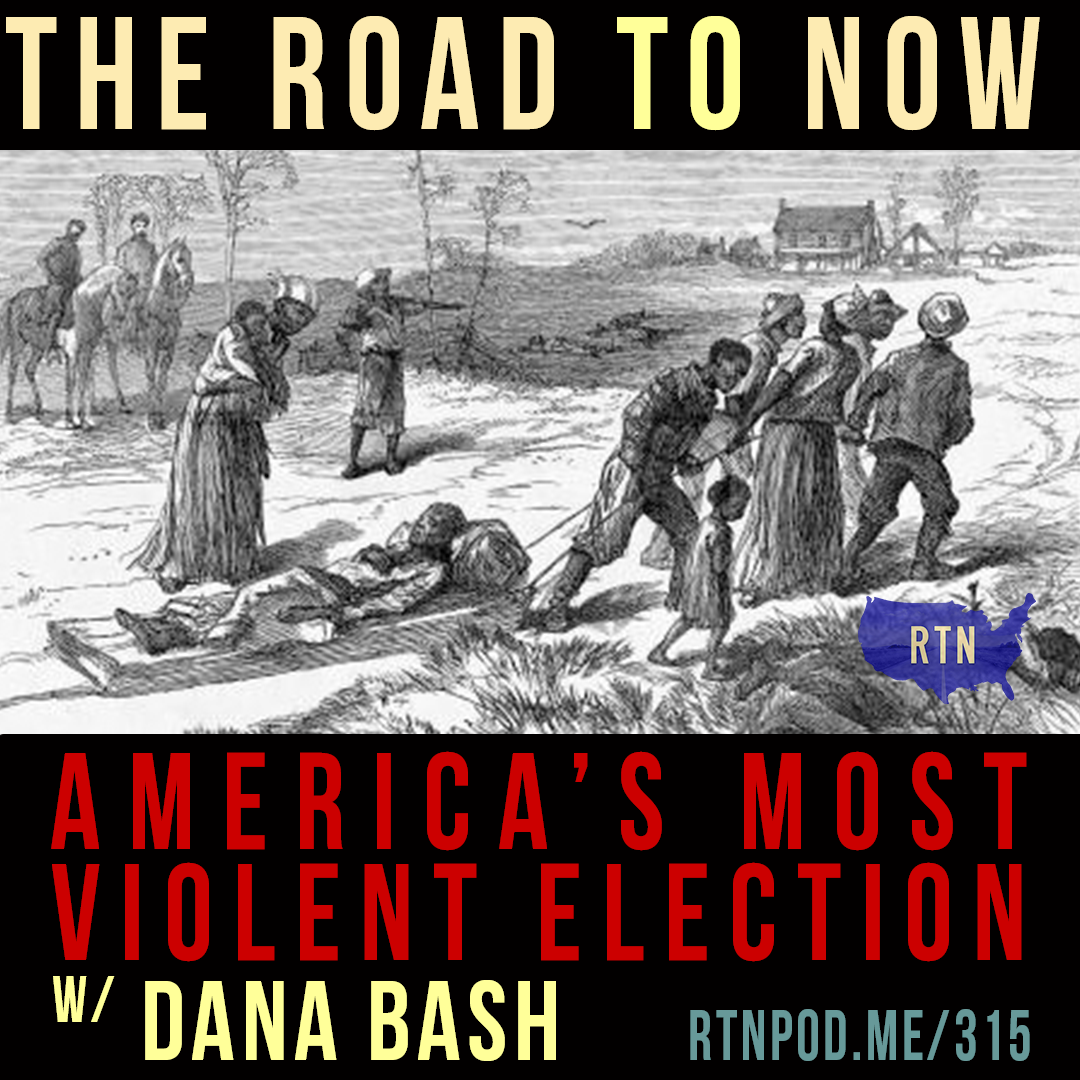
Ep 315#315 America's Most Violent Election w/ Dana Bash
On the surface, the election of 1872 might seem insignificant in US history; Ulysses Grant easily won reelection to the White House and his Republican Party maintained their dominance in both houses of Congress. In the south, however, the violence that followed the election at the state and local level was an ominous sign that the era of Reconstruction might soon be over. And, according to Dana Bash and her co-author David Fischer, nowhere saw more violence than Louisiana. In this episode, Dana joins Ben & Bob to discuss her new book America's Deadliest Election: The Cautionary Tale of the Most Violent Election in American History, and how the violence that followed the 1872 election in Louisiana – including the slaughter of 150 unarmed black Americans in the small town of Colfax – laid the foundation for the restoration of white supremacy in the south. Dana Bash is chief political correspondent at CNN, where she also anchors Inside Politics and co-anchors State of the Union alongside Jake Tapper. This episode was edited by Gary Fletcher.

American Ramble w/ Neil King Jr.
In 2021, Neil King Jr. threw a few basic items into a backpack and walked from his home in Washington, DC to New York City. Over the next 26 days/330 miles, he met new people, uncovered forgotten moments of history, and spent many days thinking about America. In this episode, Neil joins Ben and Bob to discuss his book, American Ramble: A Walk of Memory and Renewal, and the lessons he learned along the way. Before walking from his house in DC to New York City, Neil King Jr. worked as a journalist for outlets across the globe, including The Tampa Tribune, The Prague Post, and The Wall Street Journal. On Sept 17, 2024, Neil King Jr.. passed away at age 65 from complications caused by esophageal cancer. We are reairing this episode to celebrate the excellence of his work and as a reminder that we are surrounded by beauty. We hope that this conversation – which is just one tiny line in Neil's legacy- will help you to see the common ground we all share and the adventures that surround us if we just take the time to look. This episode originally aired as RTN #271 on May 1, 2023. The original episode was edited by Gary Fletcher. This reair was edited by Ben Sawyer.
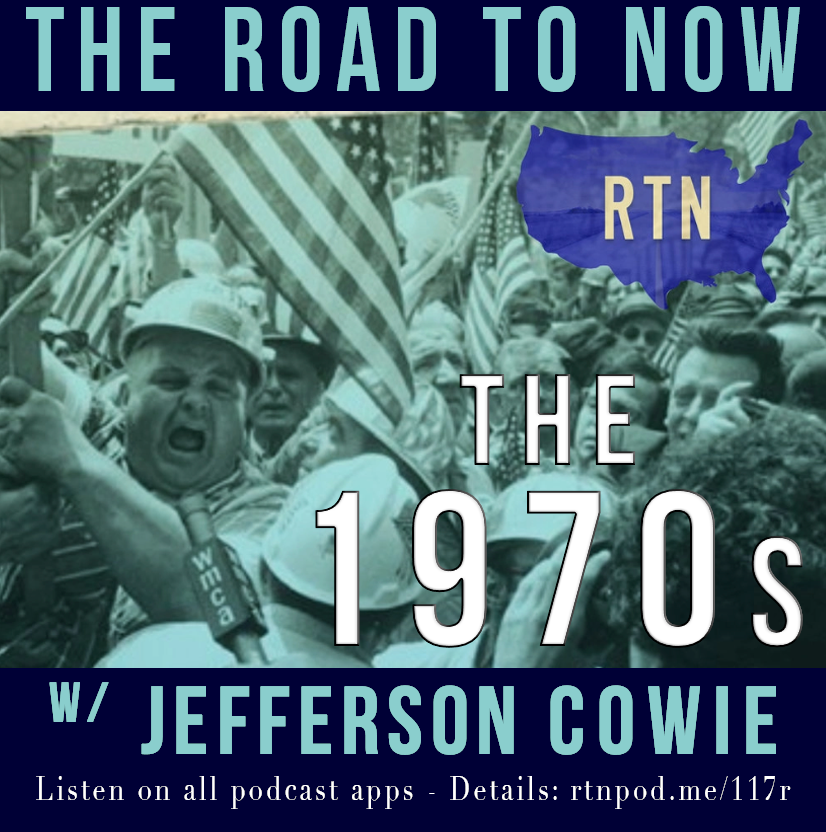
The 1970s w/ Jefferson Cowie
For a long time, it seemed like not much happened in the 1970s. Today it seems like so much of what's happening can be traced back to those same years. The 1970s was a pivotal decade in American history. In a ten-year span, the United States admitted defeat in Vietnam, saw a President (and Vice President) resign in shame, and came face to face with its leaders' abuse of power at home and abroad. At the same time, American citizens directly experienced a score of problems, including "stagflation," an energy crisis, and the consequences of environmental devastation. Yet in this era of deconstruction and disappointment, the political coalitions than defined the US from the 1980s until (today/recently?) were forged. In this episode, Jefferson Cowie joins us to talk about his book Stayin Alive: The 1970s and the Last Days of the Working and what happened in the decade in which everything now seems to have happened. Dr. Jefferson Cowie is James G. Stahlman Professor of History at Vanderbilt University and the author of multiple award-winning books, including Freedom's Dominion: A Saga of White Resistance to Federal Power, which was awarded the Pulitzer Prize in 2023. You can hear him discuss Freedom's Dominion in episode #255, and check out his multiple appearances on the show by searching You can find out more about Jefferson Cowie and his work at his website by clicking here. This is a rebroadcast of episode #115, which originally aired on December 18, 2017. This rebroadcast was edited by Ben Sawyer.

Ep 314#314 Reflections on Stalinism w/ Lewis Siegelbaum
The debates over school curricula, banned books, and what educators can teach in their classes have become increasingly polarizing in recent years, but they are nothing new in the US. For those who researched, wrote and taught about the Soviet Union under Stalin during the Cold War, following the evidence to a conclusion that challenged America's established narrative could lead to denunciations and accusations of disloyalty. Despite this challenge, a generation of scholars dedicated their professional life to the study of Soviet history, generating far more in-depth and humane accounts of the past than the black and white narratives offered up by most political scientists and others who presented Soviet society as atomized and powerless. As one of the most prolific Russian historians of his generation, Lewis Siegelbaum knows this story well. In this episode, he joins us to discuss his new book, Reflections on Stalinism, in which he, co-editor Arch Getty and ten of their peers share their own reflections on how they came to study Soviet history, how the political environment affected their own work, and what they got right (and wrong) in their career. Lewis also shares his story of witnessing the unexpected collapse of the USSR, what we learned when Soviet archives opened in the 1990s, and how current events remain haunted by the simplistic view of Russian history to which many Americans still adhere. Dr. Lewis Siegelbaum is Jack and Margaret Sweet Professor Emeritus of History at Michigan State University where he taught from 1983 until 2018. He has authored multiple award-winning books on Soviet history, including Cars for Comrades: The Life of the Soviet Automobile, and served as doctoral advisor to many aspiring scholars, including Ben Sawyer. If you're interested in learning more about Soviet history, we recommend that you check out the website Seventeen Moments in Soviet History, which Lewis cofounded and is the most widely-used online source for teaching and learning about Soviet history. This episode was edited by Gary Fletcher.
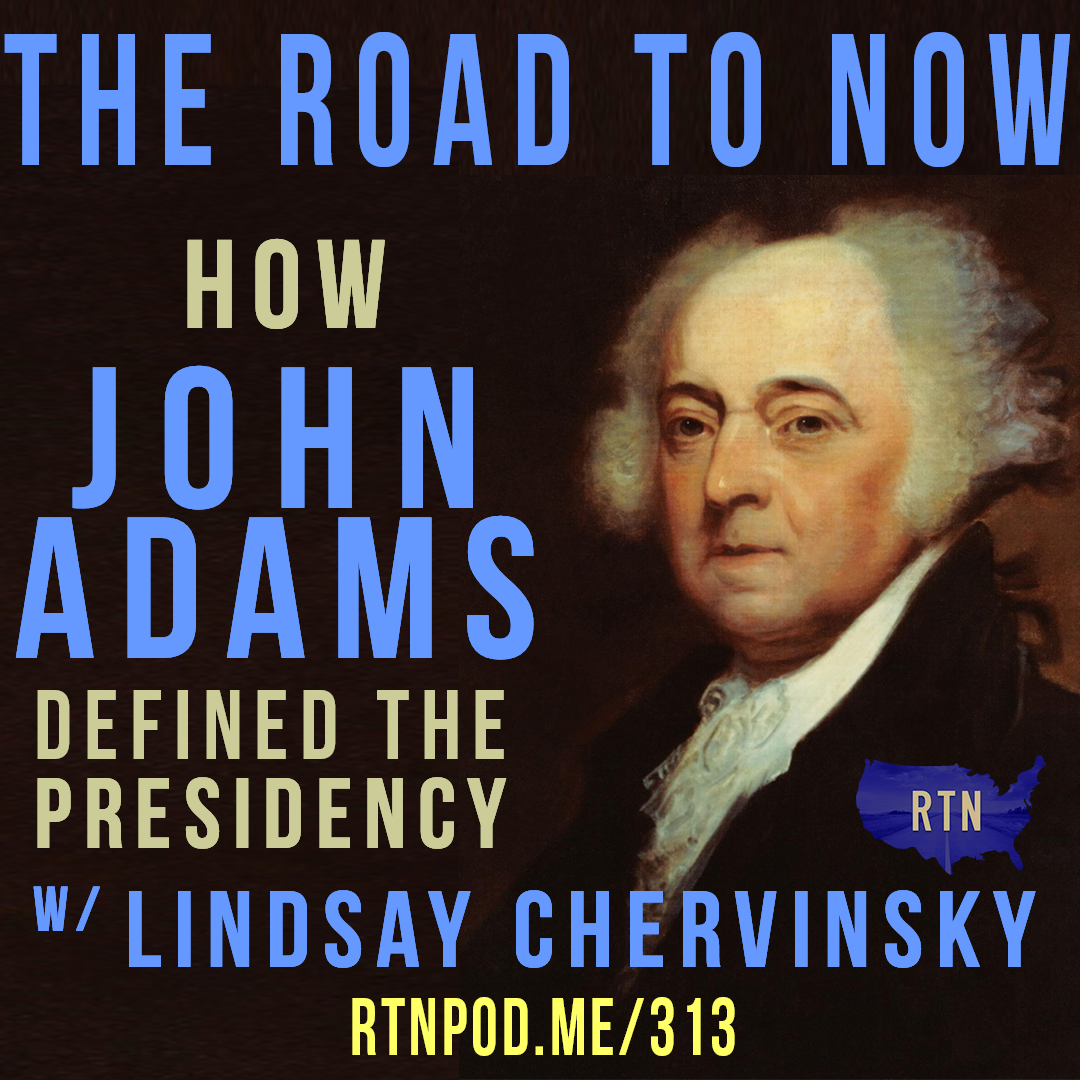
Ep 313#313 How John Adams Defined the Presidency w/ Lindsay Chervinsky
John Adams' single term as President has long been cast as a low point in his political career, but Lindsay Chervinsky sees it differently. "George Washington created the Presidency," she writes in her new book Making the Presidency, "but John Adams defined it." In this episode, Lindsay joins us to share why she sees Adams as a crucial figure in transforming an office that had been established for, and created by, George Washington, into a position with the customs and practices that could be passed down through generations. Along the way, Lindsay explains why she thinks we've gotten Adams so wrong (hint: both Jefferson and Hamilton disliked his politics), the crucial role he played in establishing a peaceful transition of power, and how the January 6th insurrection might help us all have a greater appreciation for President John Adams. Dr. Lindsay Chervinsky is the Executive Director of the George Washington Presidential Library and author of the new book Making the Presidency: John Adams and the Precedents That Forged the Republic, which is out September 5th, 2024 from Oxford University Press. You can find out more about her work at her website: lindsaychervinsky.com If you enjoyed this episode, make sure to check out Lindsay Chervinsky's previous RTN appearances on The Road to Now: · #184: The President's Cabinet · #263: Mourning the Presidents · #296: The Election of 1824 (Part 1 in our Third Party Elections Series) This episode was edited by Gary Fletcher

Ep 312#312 America's Worst Vice President w/ Niki Hemmer
The 2024 Presidential election is in full swing and so is the parade of personal attacks, appeals to emotion and (most important for us) grandiose and unsubstantiated claims about history. And of the many statements that fall in that last category, one stands out as both exceptionally ridiculous and a perfect setup to connect today's politics to the past: Donald Trump's claim that Kamala Harris is "considered the worst Vice President in history." Much like Trump himself, who followed by saying "I don't know who the hell did that, if they do polls…" we couldn't find any valid ranking of all 49 Vice Presidents, let alone one that ranked Harris in last place. So we decided to take the issue on ourselves and ask you to help us elect the candidate that you think deserves the title of "America's Worst Vice President." To help you make your choice, Vanderbilt historian and This Day in Esoteric Political History co-host Nicole Hemmer joins Ben to explain the power and responsibilities allocated to the Vice President under the Constitution, the history of the office itself, and the changes brought about by the 12th and 25th Amendments. Most importantly, however, Ben and Niki make their pitches for who they think is the worst Vice President and reach consensus on the VPs who should be in the Final Four. The rest is up to you- you just have to vote: Click here to vote in the Final Four (Voting Closes Sunday, Sept 1st at 3pm edt)* *We're using the polling function on our Patreon page, but you do not need to be a patron to vote in this poll- it just makes it easier for us to centralize the votes in one place! The Finals will open at 8pm on Monday, Sept 2nd and run until Sunday, Sept 8th. Click here to follow us on socials for links to vote when they become available. This episode was recorded in the podcast studio at Vanderbilt University's Curb Center. A special thanks to the Curb Center's David Wilson and Gina Yu for their help in arranging this recording. This episode was edited by Ben Sawyer.
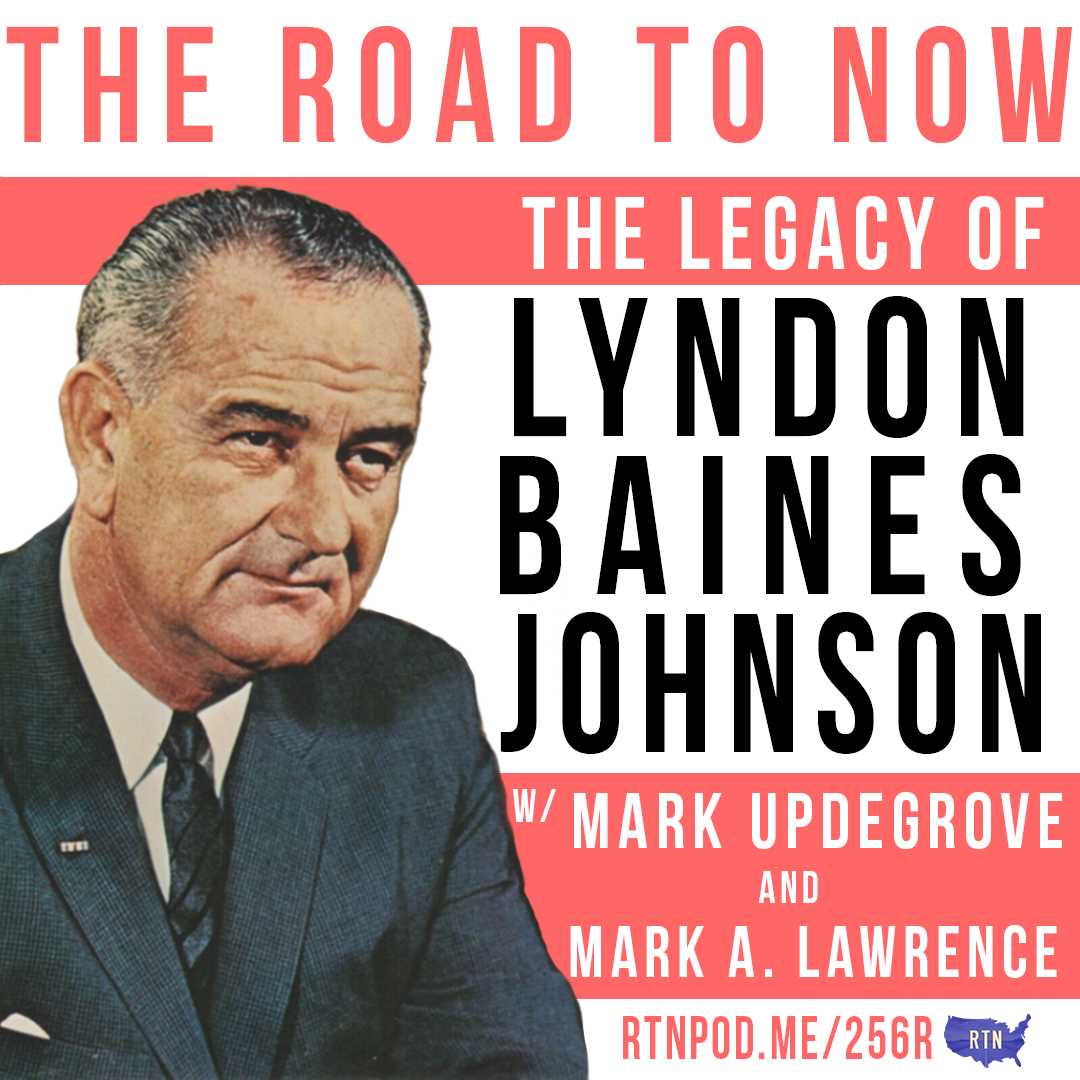
Lyndon Baines Johnson's Legacy w/ Mark Updegrove & Mark A. Lawrence
With a sitting VP running for President for the first time since Al Gore's failed bid for the White House in 2000, there's been a lot of talk about the role the VP plays in government, the impact a VP pick has on a Presidential campaign, and just how much Kamala Harris' record as VP/relationship to President Joe Biden can show us about her own agenda, should she win the White House. So today we begin a three-episode run focused on the Vice Presidency and those who have held the office with a conversation on Lyndon B. Johnson. Lyndon B. Johnson's Presidency is bookended by the tragedies of JFK's assassination and the escalation of the Vietnam war, but his career in politics and the policies he championed transcend his time in the Oval Office. In this episode, two of the foremost experts on LBJ, Mark Updegrove and Mark A. Lawrence, join Bob & Ben to discuss Johnson's life and legacy. Mark Updegrove is the President & CEO of the LBJ Foundation in Austin, TX, the presidential historian for ABC News, and the author of multiple books on Presidential History, including Indomitable Will: LBJ in the Presidency. Dr. Mark Atwood Lawrence is Director of the LBJ Presidential Library and Museum and Associate Professor of History at UT-Austin. He is the author of multiple books on US history including The Vietnam War: A Concise International History. This is a rebroadcast of RTN #256, which originally aired on December 12, 2022. This reair was edited by Ben Sawyer.

Ep 311#311 Lafayette's Farewell Tour: A 200 Year View w/ Mark Schneider
On August 15th, 1824, the Marquis de Lafayette returned to the United States for a grand farewell tour. It was his first visit since leaving the US in the late 1780s. The tour was a unifying moment for a deeply divided country. In the wake of a crippling economic downturn, and a fracturing over the Missouri question and the issue of slavery, the nation was in the midst of a bitter Presidential election. The first without a political or military hero of the American Revolution on the ballot. Lafayette's visit, if only for a moment, reminded the nation of the Spirit of 76 and their beloved adopted French son. Thanks to the organization, American Friends of Lafayette, for the next thirteen months, Lafayette 200 celebrations will retrace the steps of the Marquee de Lafayette's historic tour. On this episode of the Road to Now we welcome Historical Interpreter, Mark Schneider. Mark has embodied Lafayette for over 25 years. Along the way he has educated students of history young and old about Lafayette's life and the role he played in the American Revolution. If you enjoy this episode, make sure to check out our episode on The Lafayette Trail w/ Julian Ischer on Apple Podcasts, Spotify, and all major podcast apps. This episode was edited by Gary Fletcher.

The History of North Carolina Popular Music w/ David Menconi & Dolph Ramseur
Journalist David Menconi has documented the people and sounds of North Carolina's music scene for almost three decades. In this episode, Ben and guest co-host Dolph Ramseur speak with David about his book Step It Up and Go: The Story of North Carolina Popular Music, from Blind Boy Fuller and Doc Watson to Nina Simone and Superchunk, and how the music of "The Old North State" is both reflected in, and a reflection of, its people. David Menconi spent 28 years writing for the Raleigh News & Observer and was Piedmont Laureate in 2019. His other works include Ryan Adams: Losering, A Story of Whiskeytown" (University of Texas Press, 2012); "Comin' Right at Ya: How a Jewish Yankee Hippie Went Country, or, the Often Outrageous History of Asleep at the Wheel. (co-written with Ray Benson, University of Texas Press, 2015). You can follow him on twitter at @NCDavidMenconi. Guest co-host Dolph Ramseur is the founder of Ramseur Records and a member of the North Carolina Hall of Fame. If you enjoy this episode, make sure to check out David's second appearance on our show in episode #286 Rounder Records and the Transformation of American Roots Music. If you're enjoying The Road to Now, please consider joining us on Patreon, giving us a 5 star rating/review on Apple podcasts and sharing this episode with a friend who might also enjoy it. Thank you! This is a rebroadcast of RTN #182, which originally aired on October 19, 2020. This reair was edited by Ben Sawyer.

Ep 310#310 The Stone Pony: An Oral History w/ Nick Corasaniti
The Stone Pony and its hometown of Asbury Park, New Jersey are iconic settings in the story of some of America's greatest rock musicians, including Bruce Springsteen, Steven Van Zandt, and Southside Johnny Lyon. The Pony's path from high-risk passion project to iconic venue was, however, anything but direct; from its founding in 1974, the club was caught in the greater forces at work in late-20th century America. So how did the Stone Pony thrive when so many other venues closed? And what set Asbury Park apart from so many other American towns? In this episode, The New York Times' Nick Corasaniti joins us to talk about his new book I Don't Want To Go Home: The Oral History of the Stone Pony (Harpers, 2024) and what he learned from interviewing Bruce Springsteen and dozens of other musicians and industry professionals who helped make the club into what it is today. If you enjoy this episode, make sure to check out our episodes on The Kinks with Mark Doyle and The Allman Brothers' At Fillmore East with Bob Beatty. This episode was edited by Gary Fletcher.

The 2020 Election: A (Revisited) First Draft w/ Robert Costa
Joe Biden has decided to decline the Democratic nomination for the Presidency in 2024 so today we take a look back at Biden's path to seek the nomination in 2020 and Ben shares his thoughts on why July 21, 2024 might be the day that secures Biden's legacy in American history. Our conversation with Robert Costa on his book Peril, which he co-authored with Robert Woodward, originally aired as RTN episode 213 on November 15, 2021. This episode includes an edited version of that conversation with a new introduction by Ben. The original episode description is below: The 2020 Presidential election was one of the most tumultuous in American history, and while Joe Biden's victory over Donald Trump is settled, Trump's refusal to accept defeat has had implications that transcend his time in the oval office. In this episode, Bob and Ben speak with Robert Costa, whose new book Peril draws on his and co-author Bob Woodward's extensive investigation of the Biden and Trump campaigns and Trump's handling of executive power during his time in office. Robert explains how he finds and vets sources, his method of "deep background" interviews, and how he maintains journalistic disinterest in the face of intense partisan conflict. He also discusses what he learned about Trump and Biden as candidates and individuals and why he believes that the peril that characterized the Trump-Biden transition remains a source of concern more than a year after the 2020 election. Robert Costa is the chief election & campaign correspondent for CBS News, where he covers national politics and American democracy. You can follow him on twitter at @CostaReports. If you enjoyed this conversation, check out our previous conversation with Robert in RTN #130 Sources, Methods & Music w/ Robert Costa. "I think you've always been fair." -Donald Trump to Robert Woodward Full Audio of Trump's phone call with Bob Woodward about the publication of Fear, August 14, 2018. This episode was edited by Ben Sawyer.
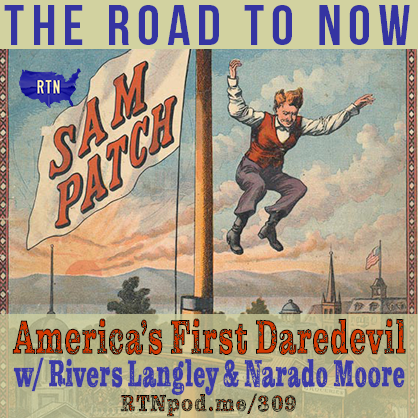
Ep 309#309 Sam Patch: America's First Daredevil w/ Rivers Langley & Narado Moore
EWhen the Erie Canal opened in the 1820s, it brought with it an industrial system that radically transformed the daily lives of the American farmers who lived in the region. Out of this disruption came some of America's earliest labor actions, the rise of new Christian sects, and America's first daredevil, Sam Patch, who dazzled the masses and offended the powers that be simply by jumping off higher and higher things into water. Why did Sam Patch become a national figure whose actions drew acclaim across the country? Why did those in power denounce Patch's exhibitions as "irrational fun" and seek to stop him from performing? And how does Patch's life tell the greater story of the Jacksonian Era and catch the attention of Jackson himself? The answers to all that and more are right here in Rivers Langley's expertly crafted story, as told to Ben and Narado Moore. Rivers Langley is a Los Angeles-based comic, host of The Goods from the Woods podcast, and a scriptwriter for The Dollop. Links to Ben's appearances on TGFTW below. Narado Moore is a Birmingham-based standup comic, host of the Uncle Rod's Story Corner podcast and co-host of Roy's Job Fair with Roy Wood Jr. The story of Sam Patch, as told to Ben and Narado Moore was recorded in December, 2021 and originally aired as part of Goods From the Woods #310 "Sam Patch: America's First Daredevil w/ Ben Sawyer & Narado Moore. This episode includes a new introduction/conversation with Rivers Langley about Patch's place in history and how we can see his story in American life today. This rebroadcast was edited by Ben Sawyer. Links: "Confederate Submarine HL Hunley: A Terrible Idea w/ Ben Sawyer" from Goods From the Woods #203. "The Destruction of the Georgia Guidestones w/ Ben Sawyer" clip from GFTW #337 "A Tour Guide's History of Los Angeles w/ Rivers Langley" RTN #202 – Spotify - Apple

Woodrow Wilson & Presidential Morality w/ Patricia O'Toole
Patricia O'Toole's The Moralist: Woodrow Wilson and the World He Made (Simon & Schuster, 2018) examines the life of a President whose policy was guided by his personal sense of morality. From today's perspective, Woodrow Wilson's time in the White House (1913-1921) seems full of contradictions. He supported a constitutional amendment to ensure women's suffrage, but oversaw the re-segregation of America's civil service. He championed national self-determination for the people of Europe, but readily deployed US soldiers to intervene in Latin America. And he won re-election with the slogan "He Kept Us Out Of War," yet called for America's entry into World War I just a little over a month after his second inauguration. In spite this, O'Toole says that a close examination of Wilson's thought and policy reveals a consistent world view that binds these seemingly contradictory actions together. Patricia O'Toole is the author of five books, including The Five of Hearts: An Intimate Portrait of Henry Adams (Simon & Schuster, 2006), which was a finalist for the Pulitzer Prize. She previously taught in the School of the Arts at Columbia University was a fellow of the Society of American Historians. This is a rebroadcast of RTN #93 which originally aired on April 30, 2018. This rebroadcast was edited by Ben Sawyer.

Securing the Revolution: Washington's Farewell Address w/ John Avlon
On July 4th, we celebrate American Independence. But, as Ben argues in his new intro to this episode, the real gift of the founding generation was more than that: it's the inheritance of the revolution. George Washington is one of the most revered figures in American history. As Commander-in-Chief of the Continental Army, Washington led his troops to one of the most unlikely and world-shaking victories in modern history, and his selection as President of both the Constitutional Convention and the new government designed that summer in Philadelphia, demonstrate the unmatched faith that the founders had in General Washington. Today, however, we tend to remember Washington more for the jobs he held than for the personal qualities that made him a remarkable member of the founding generation, but the wisdom left to us by our first President in his farewell address is perhaps more relevant today than ever before. In this episode of The Road to Now we explain why in our discussion with Daily Beast editor-in-chief John Avlon about his book Washington's Farewell: The Founding Father's Warning to Future Generations. Our conversation with John Avlon originally aired as RTN #48 which originally aired on March 13, 2017. This episode includes an updated intro reflecting on the American Revolution by Ben Sawyer, recorded July 1, 2024. This episode was edited by Ben Sawyer.
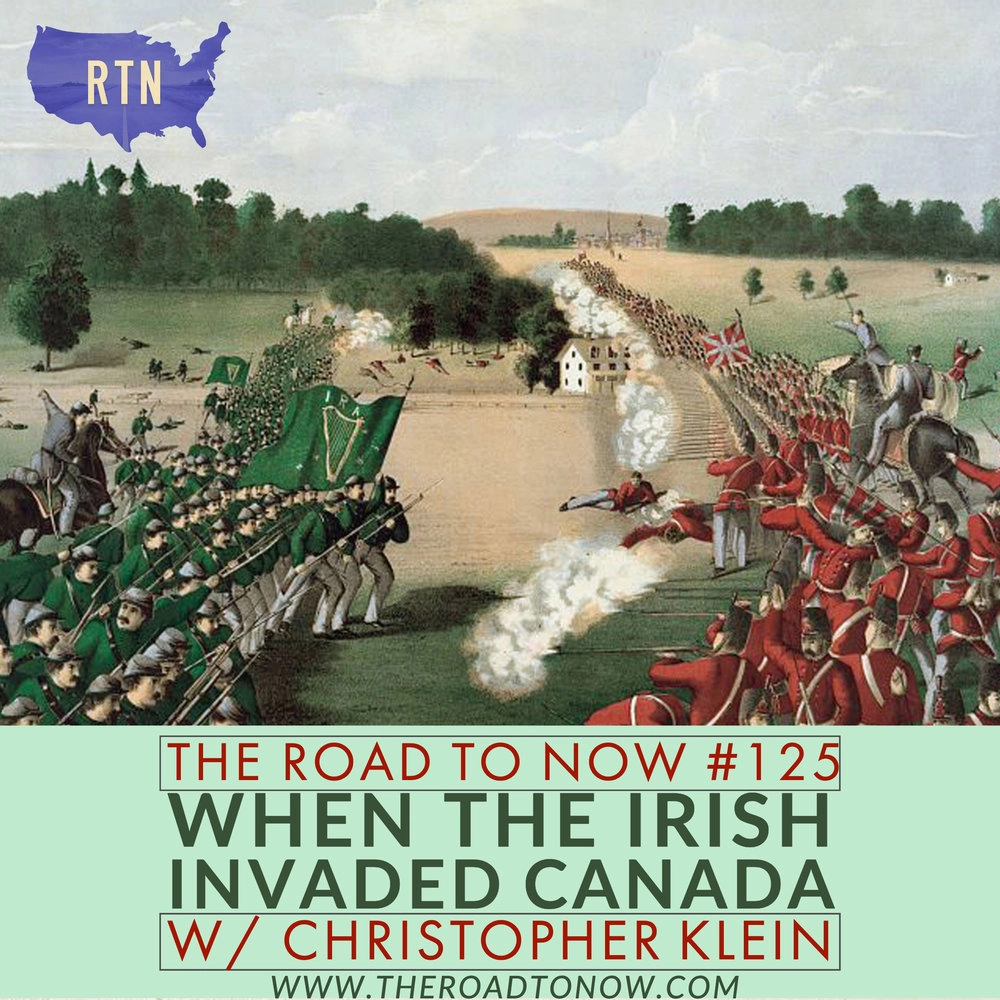
When the Irish Invaded Canada w/ Chris Klein
In 1866, the Fenian Brotherhood, comprised primarily of Irish Civil War veterans, led a series of attacks on Canadian provinces just across the border from the United States. Their goal: seize Canadian territory and exchange it for Irish independence. Similar raids continued until 1871, and although they were ultimately unsuccessful, they are part of a greater story of the American Civil War, Irish Independence, and trans-Atlantic immigration to the United States in the mid-19th Century. In this episode, Bob & Ben speak with Christopher Klein about his book When the Irish Invaded America: The Incredible True Story of the Civil War Veterans Who Fought for Ireland's Freedom (Doubleday, 2019). Christopher Klein is an author and freelance writer specializing in history. He writes stories about the past that inform us about the present and guide us to the future. He is the author of four books, including Strong Boy: The Life and Times of John L. Sullivan, America's First Sports Hero, and a frequent contributor to history.com and many other media outlets. This is a rebroadcast of RTN #125, which originally aired on March 18, 2019. This version was completely reedited using Adobe's Enhanced Speech software by Ben Sawyer.
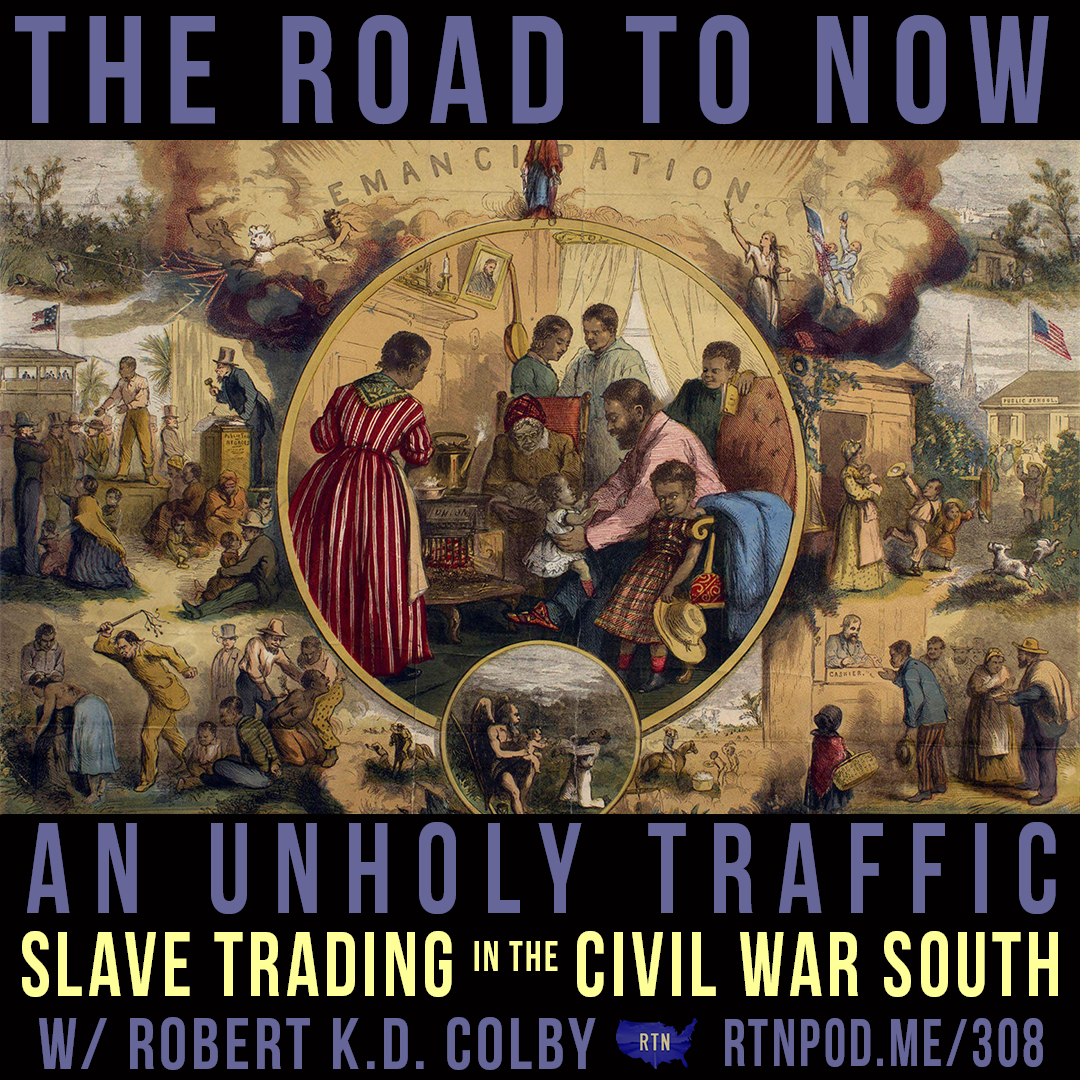
Ep 308#308 An Unholy Traffic: Slave Trading in the Civil War w/ Robert K.D. Colby
The American Civil War and the end of slavery in the US may seem like one and the same from our modern perspective, but for those living through the conflict, the abolition of human bondage was anything but certain. Even into the last days of the war, slave traders in Confederate-held cities continued to auction off human beings, realizing handsome profits as they imposed violence and family separation on their subjects. In his new book, An Unholy Traffic: Slave Trading in the Civil War South, Robert K.D. Colby brings together a wide variety of sources to offer up a never-before seen look into the slave trade during the American Civil War. In this episode, he joins Ben and guest co-host Tim Talbott to explain how the slave trade evolved, why slave traders remained confident in the future of slavery even during the Civil War, and how the combined trauma of slavery and war impacted enslaved Americans long after their freedom had been secured. Robert K.D. Colby is Assistant Professor of History at Ole Miss who specializes in the Civil War and the history of slavery. His newest book, An Unholy Traffic was published by Oxford University Press in April 2024 and is available in both print and audiobook. Tim Talbott is the Chief Administrative Officer for the Central Virginia Battlefields Trust in Fredericksburg, Virginia and founding member and President of the Battle of New Market Heights Memorial and Education Association. Tim holds a MA in Public History from Appalachian State University, where Ben had the great fortune to study alongside him. Relevant Links: · The Smithsonian Digital Volunteers Transcription Center website · RTN Episode 270: Women & American Slavery w/ Stephanie E. Jones Rogers · RTN Episode 117: Slavery and the Making of American Capitalism w/ Edward Baptist This episode was edited by Ben Sawyer.

Bonnaroo: The Story Behind the Festival w/ co-founder Ashley Capps
In 2002, Ashley Capps took a gamble- he rented hundreds of acres in rural Tennessee and put on a music festival. Coming on the heels of the infamous Lollapalooza '99 and an unsuccessful festival at the same site two years earlier, few thought Ashley could pull it off. As you (and the 80,000 people who attended the festival this year) know, Ashley and his partners proved the doubters wrong and created one of the most iconic festivals in modern America. Bob and Ben caught up with Ashley Capps back stage at Bonnaroo to talk about the history of the Bonnaroo Music Festival, how Ashley selected Manchester, TN, and the changes in the live music industry that have happened since he began working in live music decades ago. He also shares his insight on building the relationships that make a major festival sustainable. Bob also shares his experiences playing Bonnaroo with the Avett Brothers from the small stage in 2006 to the main stage in 2019. This episode was recorded live at Bonnaroo on Friday, June 14, 2019 and originally aired as episode #133. This rebroadcast was edited by Ben Sawyer.

1984: The Year that Changed Music Forever w/ Michaelangelo Matos
In this episode, music writer Michaelangelo Matos joins Bob and Ben to discuss why 1984 was a pivotal year in music history. Michaelangelo also shares why he loves books about a single year. Michaelangelos' book, Can't Slow Down: How 1984 Became Pop's Blockbuster Year (Hachette Books) was selected as a Rolling Stone-Kirkus Best Music Book of 2020. You can follow him on substack at @michaelangelomatos. Love a good trivia night? Want to support The Road to Now? You can do both at the same time by joining us for RTN Patreon Trivia! The next round will be in the last full week of June so let us know your availability by Fri. June 7 and then look for the schedule on our Patreon page on Monday, June 10. We look forward to seeing you there! This episode is a rebroadcast of RTN #230, which originally aired on April 11, 2022. This rebroadcast was edited by Ben Sawyer.
Ep 307#307 Music and Mind with Renée Fleming and Dan Levitin
We guarantee you will feel better after listening to the Road to Now this week. We are joined by world-renowned soprano and arts/health advocate Renée Fleming and neuroscientist, cognitive psychologist and the best sell author of This is Your Brain on Music, Dan Levitin. We are discussing Renée's new book Music and Mind about how to harness the arts to improve health and wellness. The book is a collection of essays from leading Doctors, scientists, researchers, as well as artists Yo-Yo-Ma, Rhiannon Giddens, and Rosanne Cash. Renée and Dan join Bob to discuss the history of the study of what happens to our brains when we are listening to or even thinking about music. Our guests also discuss how music and art are being used in therapy for certain illnesses and conditions and how they might effective treatments for other conditions. This is an episode you don't want to miss! This episode was edited by Gary Fletcher.

Swept Away w/ John Logan and John Gallagher
This fall, the musical Swept Away, which is based on the music of Bob Crawford's band The Avett Brothers is coming to broadway, and to celebrate, we're re-sharing our conversation with writer, John Logan, and lead actor, John Gallagher Jr. This conversation was recorded just after Swept Away premiered at the Berkeley Repertory Theater in Berkeley, CA in January 2022, and when you hear the passion from the folks who brought the musical to life, you'll understand why the show has been such a great success (and why you should go see it). John Logan is Swept Away's writer whose previous credits include Any Given Sunday, Skyfall, & Red. John Gallagher Jr. is Swept Away's lead actor who previously starred in American Idiot & The Newsroom. Learn more about the musical at sweptawaymusical.com and by following @sweptawaymusical on Instagram. Click here to hear John Gallagher Jr. performing "The Once and Future Carpenter" from Swept Away. This episode originally aired as RTN #219 on January 17, 2022. Original editing by Gary Fletcher. Rebroadcast editing by Ben Sawyer.

Ep 306#306 The Wide Awakes: The Forgotten Force that Elected Lincoln and Spurred the Civil War w/ Jon Grinspan
Jon Grinspan has done something remarkable: in his new book, Wide Awake, he tells a thoroughly researched and brilliantly crafted story that may change your understanding of the origins of the American Civil War. In this episode, Jon joins us for a conversation about the Wide Awakes, the anti-slavery youth movement that played an instrumental role in electing Abraham Lincoln in 1860 and took part in some of the first acts of violence between pro and anti-slavery Americans in 1861. Jon also discusses the ways that the past and present interact in powerful ways, and how politics can evolve, step-by-step, into violence. To quote Jon's recent article in The Smithsonian: "The most consequential political organization in American history….began when a few working-class kids designed a costume, which grew into a movement and ultimately an army. And it ended with a civil war." Dr. Jon Grinspan is a curator of political and military history at the National Museum of American History. His book Wide Awake: The Forgotten Force that Elected Lincoln and Spurred the Civil War is out May 14, 2024 from Bloomsbury Press. Click here to order your copy! You can hear Jon's previous appearance on The Road to Now in episode #220 Processing the Past w/ John Grinspan. This episode was edited by Gary Fletcher.

Why Bushwick Bill Matters w/ Charles Hughes
EYou might know Bushwick Bill as a member of the iconic Houston rap group The Geto Boys, but his contributions to rap music, his role in the debates over free speech in the 1990s, and his overall influence are far more substantial than you probably realize. In this episode, we welcome Charles Hughes back to the show to discuss his new book Why Bushwick Bill Matters (Univ. of Texas Press) and to get a better understanding of the challenges and triumphs that shaped one of rap history's most influential artists. Dr. Charles Hughes is the Director of the Lynne and Henry Turley Memphis Center at Rhodes College. His previous books include Country Soul: Making Music and Making Race in the American South which Rolling Stone named one of the Best Music Books of 2015. You can hear our previous conversation with Charles in episode #25 The History of Country and Soul Music in the American South w/ Charles Hughes. You can follow Charles on twitter at @CharlesLHughes2. This episode is a rebroadcast of RTN #242, which originally aired on July 25, 2022. This episode was edited by Gary Fletcher.
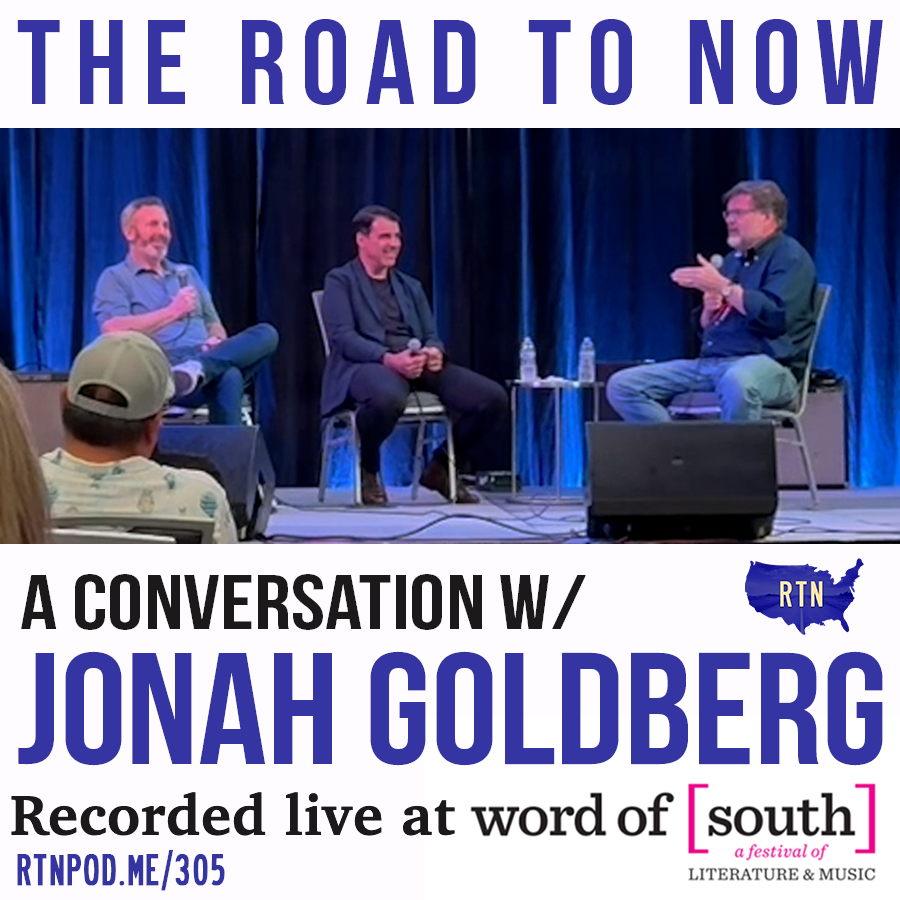
Ep 305#305 A Conversation w/ Jonah Goldberg – Recorded Live at Word of South Festival 2024
Jonah Goldberg is one of America's most well-known conservative intellectuals, with a resume that includes more than two decades at The National Review, twelve years as a commentator on Fox News, and two New York Times Bestsellers. In recent years, however, the changing definition of "conservative" in American politics has put Jonah at odds with the party that they once called home. In this episode, recorded live at Word of South Festival in Tallahassee, Florida, Jonah joins Ben & Bob for a discussion that ranges from the history and politics of the Supreme Court, to the Constitutional Convention, to the reasons that Jonah thinks that journalists should avoid becoming friends with politicians. We also discuss Jonah's reasons for leaving Fox News after more than a decade as a Fox contributor, as well as his decisions to co-found The Dispatch and join the team at CNN. To hear more from Jonah Goldberg, check out his podcast, The Remnant, or pick up a copy of Suicide of the West: How the Rebirth of Tribalism, Populism, Nationalism, and Identity Politics is Destroying American Democracy. You can also find out more about his work and speaking engagements at his website, JonahGoldberg.com. This episode was recorded live at Word of South Festival on April 27, 2024. Ben & Bob would like to give special thanks to WOS founder Mark Mustian and the other WOS organizers for the invitation, to Rick & Linda Hyson for the hospitality during our stay in Tallahassee, and to Florida State University for sponsoring the event! An extended version of this conversation, which includes more than 20 minutes of additional conversation is available to our supporters on Patreon. Click here to listen to the extended episode! Thanks to our Patrons for keeping the show going! This episode was edited by Gary Fletcher.
Ep 304#304 National History Day w/ Cathy Gorn & Don Wildman
Can learning the skills required to do good history serve as an antidote to conspiracy theory? Cathy Gorn & Don Wildman think so, and in this episode they join us to discuss their work to teach those skills in the 6th-12th grade classroom through National History Day, a program that reaches more than half a million students and tens of thousands of teachers each year. We agree with them and think National History Day is an American treasure, so we hope you enjoy this conversation about what goes into creating good history, how we can better teach that to the public, and how your kids can get involved in National History Day. Click here to learn more about National History Day programs for students & teachers. Dr. Cathy Gorn has spent more than four decades working with National History Day and currently serves as NHD's Executive Director. Don Wildman is a podcast & documentary host whose projects include Mysteries at the Museum (Travel Channel) & the podcast American History Hit. He currently serves as Co-Chair of National History Day's Development Committee. This episode was edited by Gary Fletcher.
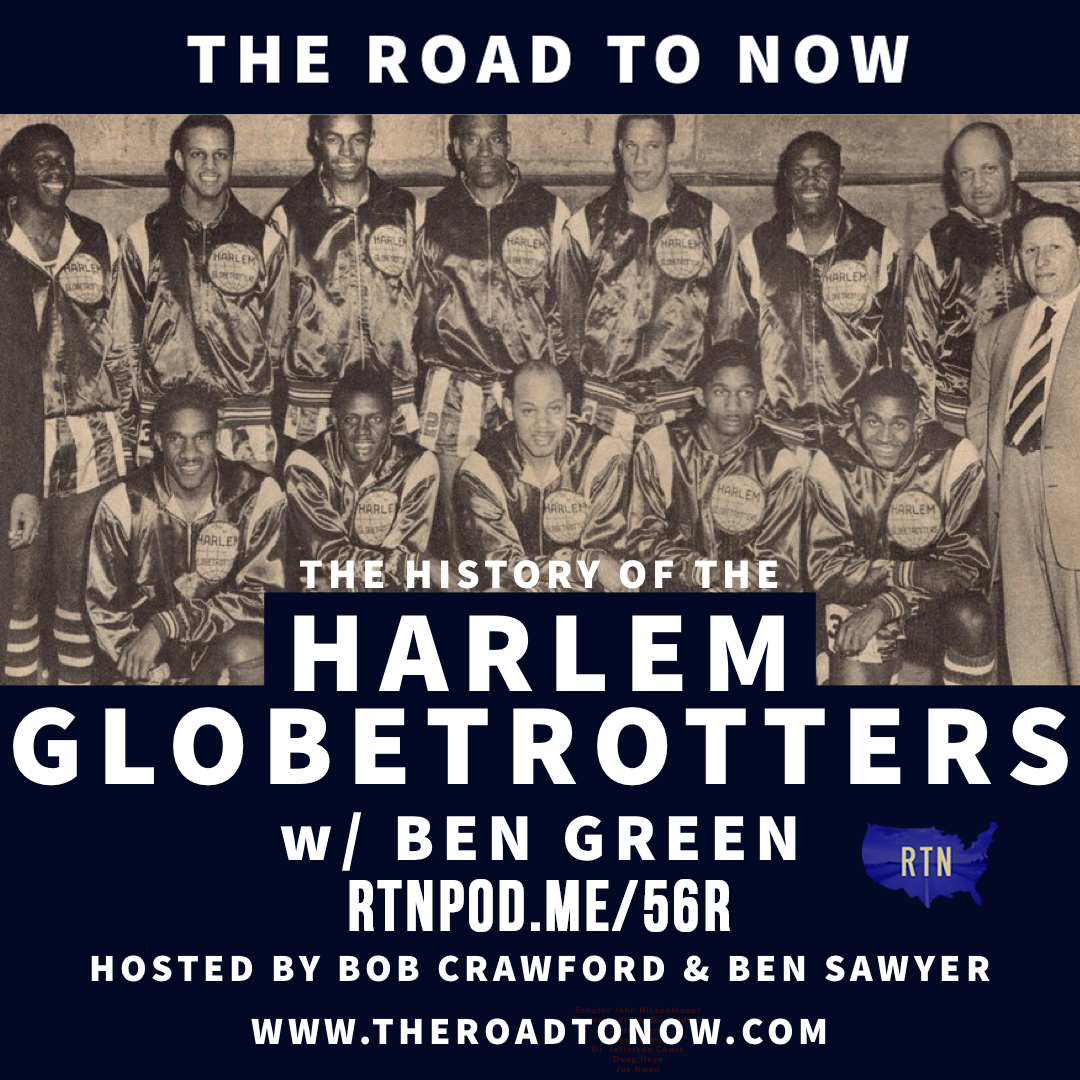
The Harlem Globetrotters w/ Ben Green
Ben and Bob are heading to Tallahassee on April 27 for a live recording at Word of South Festival and the show is free! Click here for details. The Harlem Globetrotters are one of those great parts of American culture that almost everyone knows and loves. For most of us today, the Globetrotters are outstanding entertainers. But did you know that in the mid-20th century the Globetrotters were probably the single best basketball team on the planet? Did you know that they did travel the globe as agents of the US Department of State during the Cold War, but that they are not, in fact, from Harlem? If you want to know how all of this happened (and how the Globetrotters saved the NBA), you're going to love this interview with historian Ben Green on the History of the Harlem Globetrotters. Ben Green is the author of Spinning the Globe: The Rise, Fall and Return to Greatness of the Harlem Globetrotters. This is a rebroadcast of RTN #56, which originally aired on May 1, 2017. This rebroadcast was edited by Ben Sawyer.
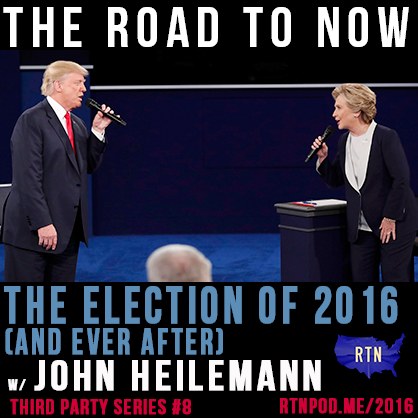
Ep 303#303 The Election of 2016 (and Ever After) w/ John Heilemann (Third Party Series #8)
EThe election of 2016 was a lot of things. It was a showdown between two candidates who had been household names for decades. It was the second time in five elections where the winning candidate lost the popular vote. And, most relevant here, it was eight years ago and one of the candidates in that election is running again in 2024, so we've still got a long time before we can see the full impact it had on US history. For now though, we can say that the narrow margin by which Donald Trump defeated Hillary Clinton has already cast third parties- both candidates and outside actors- as central characters in the narrative of 2016. Did Jill Stein's Green Party run hand the election to Donald Trump, as some Clinton supporters claim? Is it true that Russia "hacked the election?" Or did the Democratic National Committee's advocacy for Hillary Clinton deny the party a winning candidate. Let's try to find out. Welcome to the final installment of The Road to Now's Third Party Series. Today: the election of 2016 and ever after w/ John Heilemann. John Heileman is a journalist and national affairs analyst for NBC News & MSNBC. You can hear him weekly on his podcast Hell & High Water w/ John Heilemann. This episode was edited by Gary Fletcher.
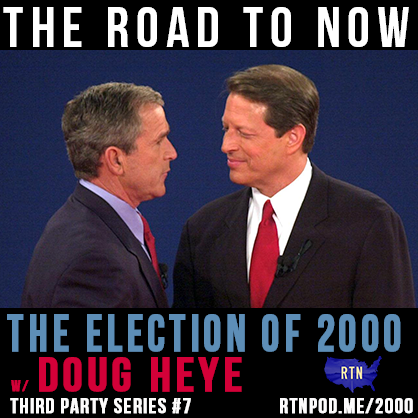
Ep 302#302 The Election of 2000 w/ Doug Heye (Third Party Series #7)
Hear the extended version of this episode by supporting The Road to Now on Patreon! Click here to join. On December 13, 2000, Democratic Candidate Al Gore conceded that year's Presidential Election to Republican George W. Bush. Gore's concession speech marked a dramatic conclusion to an election that had been contested for more than a month, with partisans from both major parties flocking to Florida to recount ballots in hopes that the few hundred votes that separated the candidates would fall in their favor. Ultimately, however, the final decision on the election came from the Supreme Court, which ruled 5-4 to stop the recount, handing Florida's 25 electoral votes, and thus the Presidency, to George W. Bush who carried the state with just 537 more votes than Gore. The election of 2000 was unusual in several ways. It was the first time an election was decided by a Supreme Court ruling. It was the first election since 1888 in which the winner of the popular vote lost the election. And despite the dramatic scenes that came out of those days between the election and Gore's concession, and the many passionate criticisms leveled by Democrats- that the electoral college was undemocratic, that the Supreme Court had usurped the election, that voters for Ralph Nader and other third party candidates had handed the election to Bush- few critics pointed to the fact that only 50.3% of eligible voters showed up to the polls- the second lowest turnout in American history. Why was the election of 2000 so uninteresting to so many voters? Why did the Supreme Court decide to intervene in the election, and was it a case of judicial overreach, as so many critics claimed? And in the end, is it fair to say that those who voted for Nader and other third party candidates were the deciding factor in the election? Let's find out. Welcome to the Road to Now's Third Party Election Series. Today, part 7: The election of 2000 w/ Doug Heye. Doug Heye is a political commentator who previously served as Communications Director for the Republican National Committee and Deputy Chief of Staff for House Majority Leader Eric Cantor. You can follow him on twitter at @DougHeye. This episode was edited by Gary Fletcher.

Ep 301#301 The Election of 1992 w/ Julian Zelizer (Third Party Series #6)
In 1992, President George Bush's bid for a second term did not go well. Despite taking 79% of the electoral vote in 1988, holding office during the collapse of communism in Europe, and serving as commander-in-chief during the US victory in the first Iraq War, Bush found himself flanked by a smooth talking former Arkansas governor and a Texas businessman armed with a personal fortune and a lot of charts. When it was all over, Bush had garnered about ten million fewer votes than he had four years earlier and a 12-year run of Republican Presidents was over. How did Bill Clinton manage to beat an incumbent President by so much? Was third-party contender Ross Perot responsible for Bush's catastrophic loss in 1992, or was it really, as Clinton's people claimed, "the economy, stupid?" And why did Perot, who at one point looked to be a viable contender, decide to drop out of the race, only to rejoin a few weeks before the election? Let's find out. Welcome to the Road to Now's Third Party Election Series. Today: The election of 1992 with Julian Zelizer. Julian Zelizer is Malcolm Stevenson Forbes, Class of 1941 Professor of History and Public Affairs, Princeton School of Public & International Affairs at Princeton University. He is the award-winning author and editor of 25 books including The Fierce Urgency of Now: Lyndon Johnson, Congress, and the Battle for the Great Society, the winner of the D.B. Hardeman Prize for the Best Book on Congress and Fault Lines: A History of the United States Since 1974, co-authored and Burning Down the House: Newt Gingrich, The Fall of a Speaker, and the Rise of the New Republican Party. This episode was edited by Gary Fletcher.
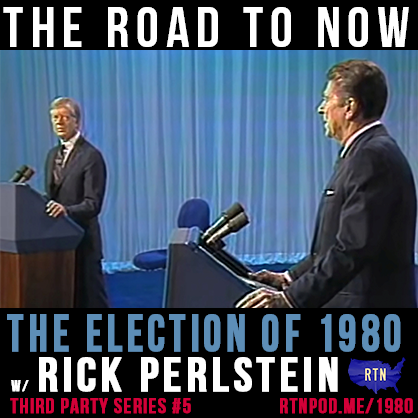
Ep 300#300 The Election of 1980 w/ Rick Perlstein (Third Party Series #5)
On November 4, 1980, California Republican Ronald Reagan trounced Jimmy Carter at the polls, beating the incumbent by almost 10 percentage points in the popular election and winning 489 of 538 electors. That type of victory combined with Reagan's larger than life place in modern political history might lead you to believe the 1980 campaign was never in doubt. But it was. And in early 1980, both men faced viable challengers within their own party, as well as a third party candidate whose 5.7 million popular votes could have changed the outcome of a closer election. The Presidential election of 1980 was not just a turning point- it was, in fact, far more interesting than most people give it credit for. Why did Ted Kennedy decide to challenge the sitting President in the Democratic Primary? How did George Bush win 3 of the first seven GOP primaries against the presumed nominee? And why, as his party's fortunes looked the best they had in years, did Republican hopeful John B. Anderson of Illinois decide to leave the GOP to run a third party campaign? Let's find out. Welcome to The Road to Now's Third Party Elections Series. Today: The election of 1980 with Rick Perlstein. Rick Perlstein is the author of multiple award-winning books, including Nixonland: The Rise of a President and the Fracturing of America (2009) and Reaganland: America's Right Turn, 1976-1980 (2021). You can hear Rick discussing Reaganland in his previous appearance on The Road to Now in episode #199 You can get an extended version of this conversation, extra episodes and more by supporting us on Patreon! Click here for the extended episode! This episode was edited by Gary Fletcher.

Ep 299#299 The Election of 1948 w/ Jefferson Cowie (Third Party Series #4)
The famous image of a victorious Harry Truman holding up a newspaper headlined "Dewey defeats Truman" is clear evidence that the 1948 Presidential election did not turn out the way many people had expected. That April, Truman's approval rating had sunk to 37%, causing even many in his party to consider dumping him from the ballot. That summer, a rebellion by southern Democrats led by South Carolina segregationist Strom Thurmond promised to deny Truman electoral votes that his Democratic predecessors could have counted on for a century. Yet, despite all this, Truman didn't just win, he won big- finishing 4.5 points and 114 electoral votes ahead of Dewey. How did Truman manage to turn it all around in six months? Who was Thomas E. Dewey and why couldn't he deliver a win with the wind blowing so hard at his back? And what did southern democrats hope they'd get by giving 39 electoral votes to Strom Thurmond even when he had no chance of winning the national election? Let's find out. In the fourth installment of our Third Party Elections Series, we talk the election of 1948 w/ Jefferson Cowie. Dr. Jefferson Cowie is James G. Stahlman Professor of History at Vanderbilt University. His most recent book, Freedom's Dominion, A Saga of White Resistance to Federal Power (Basic Books) was awarded the 20203 Pulitzer Prize in History. You can hear Jeff discussing Freedom's Dominion in RTN #255 and his other episodes on the 1970s (#115) and The New Deal and its Legacy (#24). This episode was edited by Gary Fletcher.

Ep 298#298 The Election of 1912 w/ Michael Patrick Cullinane (Third Party Series #3)
The Presidential election of 1912 was an unusual moment in American history. It featured an embattled incumbent President facing criticism from his former allies. It offered voters a choice between the sitting President and his predecessor. And when it was all done, the two men who had previously won the Presidency found themselves bested by a college professor with just a few years of experience in politics. So why did the predecessor, Teddy Roosevelt, become so critical of the incumbent, William Howard Taft, that he decided to break away from the Republican party to run against him? Why did the Democrats pick relative newcomer Woodrow Wilson to be their Presidential Candidate ? And is 1912 an example of how a third-party candidate can spoil an election? Let's find out. Welcome to The Road To Now's Third Party Elections Series. Today: Part 3- The Election of 1912 with Michael Cullinane. Dr. Michael Patrick Cullinane is Lowman Walton Chair of Theodore Roosevelt Studies at Dickinson State University and the author of multiple books, including Theodore Roosevelt's Ghost: The History and Memory of an American Icon (LSU Press, 2017). You can also hear him on his bi-weekly podcast The Gilded Age and Progressive Era, available anywhere you get The Road to Now. If you enjoyed this episode, make sure to check out our previous episodes in this series: -#1 The Election of 1824 w/ Lindsay Chervinsky -#2 The Election of 1860 w/ Michael Green This episode was edited by Gary Fletcher.

Ep 297#297 The Election of 1860 w/ Michael Green (Third Party Series #2)
The Presidential election of 1860 is one we Americans know well. That election sent Abraham Lincoln to the White House, southern enslavers to the exit door, and the United States into a bloody Civil War. Lincoln's leadership in those years and his tragic assassination in the last days of the war propelled the railsplitter into the pantheon of American Presidents. But sometimes we forget that just a few months before the election, Lincoln looked like a long shot. His experience at the federal level amounted to one term in the House of Representatives. His Republican Party, founded in 1854, was only running its second Presidential campaign. And even in victory, Lincoln's share of the popular vote fell just short of 40%. How did Abraham Lincoln win a resounding victory in the electoral college with a minority of the popular vote? Why did the Democratic Party, which had dominated politics in the previous decade, lose to an upstart rival? And why, in the midst of a fierce battle over American slavery that ultimately broke the country apart, did John Bell – a third party candidate that you've probably never heard of – have a reasonable chance of winning the Presidency by skirting the issue all together? Let's find out. Welcome to The Road To Now's Third Party Elections Series. Today: Part 2- The Election of 1860 with Michael Green. Dr. Michael Green is Associate Professor of History at UNLV and the author of multiple books on the politics of mid 19th century America, including Lincoln and the Election of 1860 (Southern Illinois University Press, 2011). This episode was edited by Gary Fletcher.
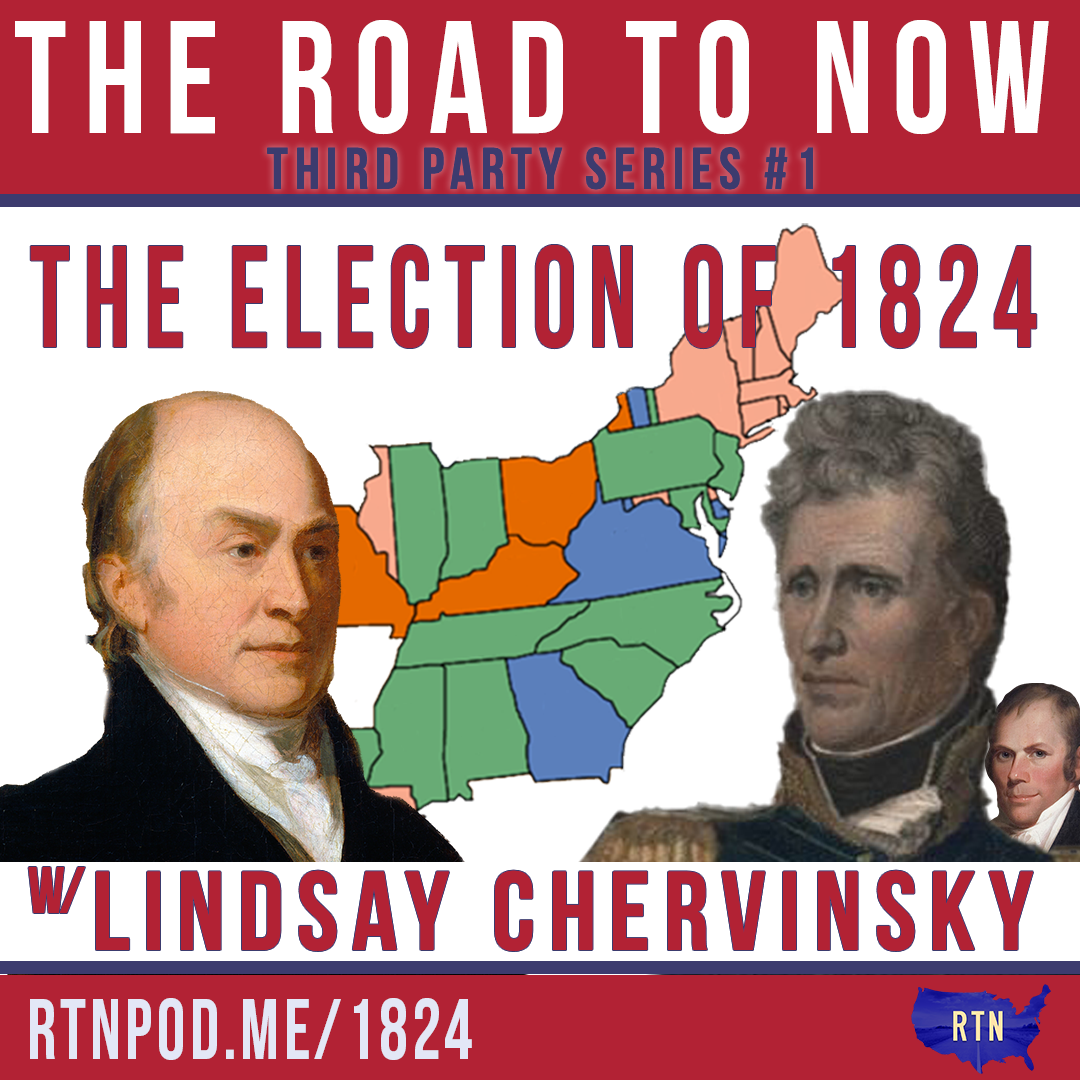
Ep 296#296 The Election of 1824 w/ Lindsay Chervinsky (Third Party Series #1)
The Election of 1824 was a turning point in American history. Long before the fall of 1824, Americans understood that the winner would be the first in America's second generation to hold the Presidency. When the election began, all four viable candidates were technically from the same party. By the time it was over, the election had generated the rivalries and passions that formed the groundwork for a new national party system. How did Andrew Jackson win the most votes in the electoral college and still lose the election? How did John Quincy Adams win the Presidency but ultimately lose the country? And was it all due to a "corrupt bargain" as some critics alleged, or is there more to the story? Let's find out. Welcome to The Road To Now's Third Party Elections Series. Today: Part 1- The Election of 1824 with Lindsay Chervinsky. Dr. Lindsay M. Chervinsky is author of The Cabinet: George Washington and the Creation of an American Institution (Harvard University Press, 2020). Check out her previous appearances on The Road to Now discussing the President's Cabinet (#184) and how Americans have mourned Presidents throughout history (#263). This episode was edited by Gary Fletcher.

Ep 295#295 The Pursuit of Happiness w/ Jeffrey Rosen
The inalienable right to "the pursuit of happiness" is enshrined in the Declaration of Independence, but what exactly does that phrase mean? While Americans today may associate it with the right to own land, opulence or some other act of acquisition, many prominent founders understood it to mean something quite different. In this episode National Constitution Center President & CEO Jeffrey Rosen returns to the show to give us the full story and discuss his new book The Pursuit of Happiness: How Classical Writers on Virtue Inspired the Lives of the Founders and Defined America. The Pursuit of Happiness will be available on February 13 via all major publishers. Click here to pre-order your copy, find out more about the book, and see Jeffrey Rosen's upcoming speaking engagements. If you enjoyed this episode, make sure to check out Jeffrey's previous appearance on our show in The Road to Now #211, The Constitution w/ Jeffrey Rosen. Highlighted Resources from the National Constitution Center –The Interactive Constitution (also available as an app in the apple and android app stores) –We The People with Jeffrey Rosen podcast (available anywhere you get The Road to Now) –Educational Video Series If you're in Philadelphia, you can visit the National Constitution Center, which is located just steps from Independence Hall and the Liberty Bell. Click here to plan your visit! This episode was edited by Gary Fletcher.

The Best Stories You've (Probably) Never Heard w/ Greg Jackson
One episode. Two historians/podcasters. Four stories from American history that you've probably never heard. And an unknown number of listeners that we hope will find these stories as fascinating and surprising as we do. Greg Jackson is the creator of History That Doesn't Suck and a Professor at Utah Valley University. Ben Sawyer hosts this podcast and has been teaching history at the university level for over a decade and a half. You might think that at this point they've heard it all, but when you keep digging into history, it just keeps surprising you. In this episode, Greg and Ben each share two stories that they discovered in the last year that they found to be the most fascinating. Enjoy! This is a rebroadcast of The Road to Now #239, which originally aired on June 27, 2022. This episode was edited by Gary Fletcher.

The FBI w/ Stephen Underhill
The FBI has been the subject of criticism and concern since it was founded in 1908, but it has nevertheless become one of the most powerful, stable, and mythologized branches of the Executive Branch of the US government. In this episode, Steve Underhill joins us to discuss the origins of the FBI, the role J. Edgar Hoover played in making the modern Brueau, and how that greater history of the FBI can help us understand how they've approached their seizure of documents from Mar-a-Lago and the subsequent attack from Donald Trump. Dr. Stephen M. Underhill is Professor and Chair of the Department of Communication Studies at Marshall University, where he studies the rhetoric of law enforcement. His book The Manufacture of Consent: J. Edgar Hoover and the Rhetorical Rise of the FBI was published in 2020. This is a rebroadcast of RTN #247, which originally aired on September 19, 2022. The original episode was edited by Gary Fletcher. This reair was edited by Ben Sawyer.

Ep 294#294 The Stephen Foster Story w/ Richard Blanton, Donna Phillips & Johnny Warren
Stephen Foster was America's first great published musician. He wrote some of America's great folk songs, including "Oh, Suzanna," "Camptown Races" and "Hard Times Come Again No More," and his music was the inspiration for Paul Green's play "The Stephen Foster Story," which is performed every summer in Bardstown, Kentucky. In this episode we speak with two of the artists involved in that play- Donna Phillips and Johnny Warren- as well as My Kentucky Old Kentucky Home State Park Mansion Supervisor, Richard Blanton, to learn more about Foster's life, their work in preserving his memory, and how it all can help us understand our past. If you're traveling through Kentucky, make sure to check out dates for "The Stephen Foster Story" and visit My Old Kentucky Home Mansion! This episode was edited by Gary Fletcher.

Ep 293#293 New Year, Old Us w/ Ben & Bob
Ben & Bob kick off the new year with a conversation over some current events, including the history of New Year's Resolutions (and why Bob doesn't make them) and the 14th Amendment, and Ben shares what he learned about North Carolina history during his holiday road trip from Nashville, TN to Concord, NC to visit his family. This episode was edited by Gary Fletcher. Relevant links: -"Swept Away w/ John Logan & John Gallagher Jr." The Road to Now #219 -on Apple podcasts -on Spotify -John Pierce, "The Reasons for Secession: A Documentary Study," from American Battlefield Trust (Battlefields.org), Updated October 3, 2023. -"The Disqualification Clause," What Roman Mars Can Learn About Con Law, episode 78, December 12, 2023. -Robert Harrell (the Fort Fisher Hermit) at Wikipedia.org.

Ep 292#292 It's a Wonderful Life: The Story Behind America's Favorite Christmas Film w/ Eric Smoodin
Dr. Eric Smoodin, film historian at the University of California- Davis and author of Regarding Frank Capra: Audience, Celebrity and American Film Studies, 1930-1960, joins Bob and Ben for the history of the people, the industry, and law that made Frank Capra's 1946 film It's A Wonderful Life into one of America's quintessential Christmas films. Ben & Bob are taking a few weeks off for the holidays- we'll be back with all new episodes on January 8! This episode was edited by Ben Sawyer.

Ep 291#291 A Forgotten History of American Suburbs w/ Tim Keogh
The suburbs have long been a symbol of American prosperity in the post-WWII era. Yet the contrast between suburban wealth and "inner city" poverty overlooks the stories of those living in suburbia who were unable to reach "the good life." In this episode Ben & Bob talk with Tim Keogh, whose new book In Levittown's Shadow: Poverty in America's Wealthiest Suburb (Univ. of Chicago Press, 2023), explores the history of suburbanization in Long Island, New York, and argues that post-WWII prosperity relied on those impoverished suburbanites who we've since forgotten. Dr. Tim Keogh is assistant professor of history at Queensborough Community College, part of the City University of New York. This episode was edited by Ben Sawyer.
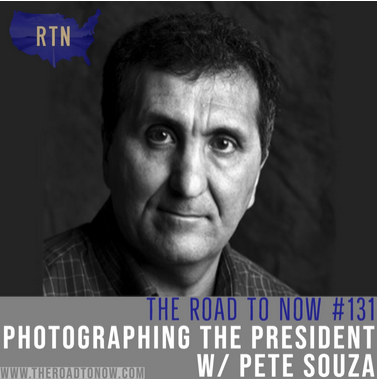
Photographing the President w/ Pete Souza
As the person responsible for documenting the Obama Administration, Pete Souza spent more time with Barack Obama than almost anyone else, which left him with some deep in sights on Obama and the office of the Presidency. In this episode, Pete joins Bob for a conversation about his work as Chief Official White House Photographer, the state of American politics, and the power of photography. Pete's most recent book, Shade: A Tale of Two Presidents (Little, Brown, & Co, 2018) uses photography to contrast the stark differences between the Presidency of Barack Obama and that of Donald Trump. If you enjoy this conversation, make sure to check out Pete's other appearances on the show in episodes #251 & #151. This is a rebroadcast of RTN #131, which originally aired on June 3, 2019. The original episode was edited by Gary Fletcher and Bob Crawford; this rebroadcast was edited by Ben Sawyer.

Faith in Freedom w/ Andrew Polk
Faith has played an important role in American history, but not always in the ways we'd expect. In this episode, Andy Polk joins Bob and Ben to explain how politicians, advertising executives and public relations experts bypassed America's religious leaders, ignored theological debates, and dismissed historical evidence to fabricate and sell a story of America's religious origins that served their own political needs. That story remains with us today so, to quote the title of Andy's op-ed in The Tennessean: "When you hear 'In God We Trust', pay attention to what comes next." Dr. Andrew R. Polk is Associate Professor of History at Middle Tennessee State University and the author of the new book, Faith In Freedom: Propaganda, Presidential Politics, and the Making of an American Religion (Cornell University Press, December 2021). This episode was edited by Gary Fletcher. This is a rebroadcast of RTN #216, which originally aired on December 13, 2021. This rebroadcast was edited by Ben Sawyer.
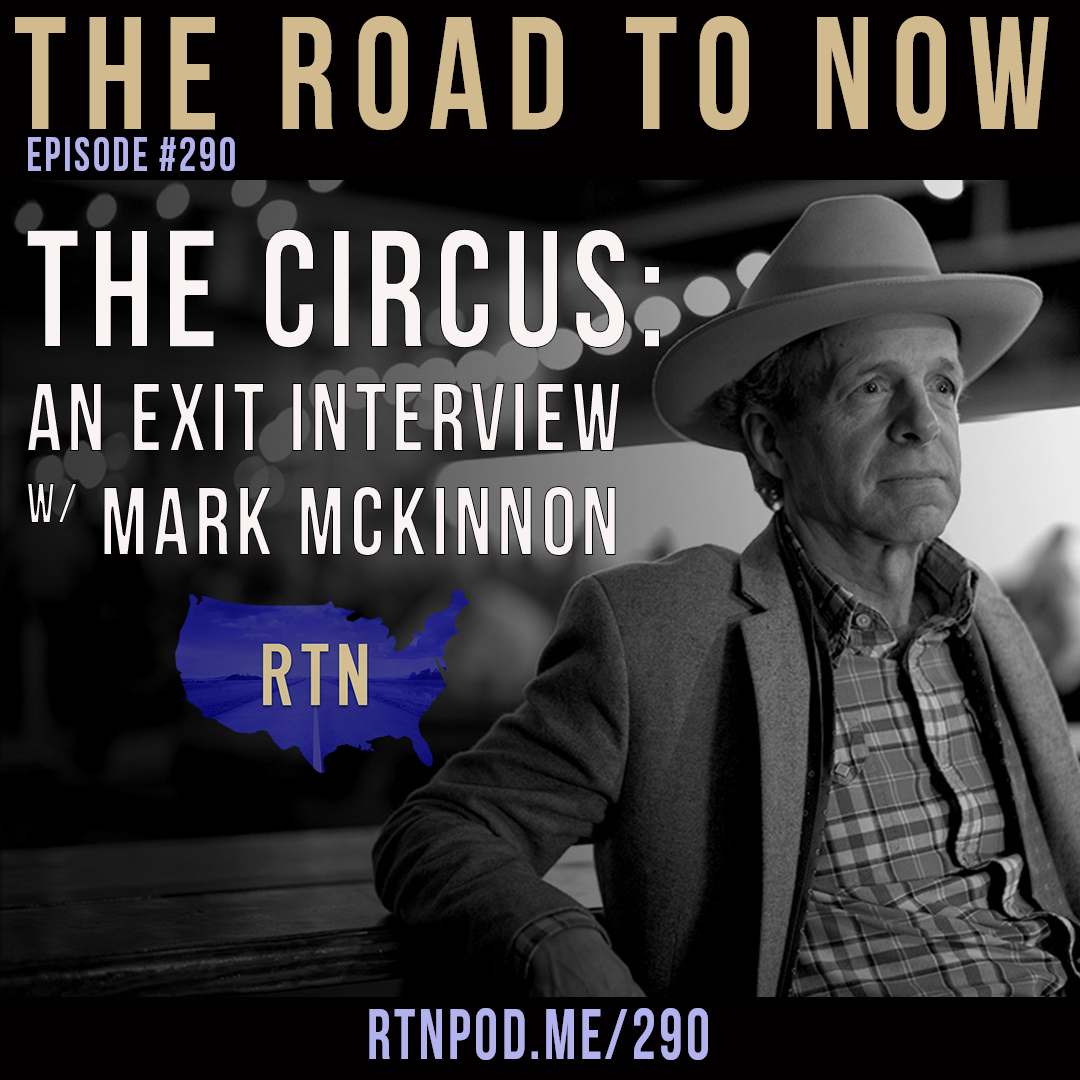
Ep 290#290 The Circus: An Exit Interview w/ Mark McKinnon
Bob welcomes Mark McKinnon for an exit interview about his work as co-producer and co-host of The Circus. Showtime announced last week that after eight seasons and 130 episodes this would be the final season of the political docuseries. Mark reflects on chronicling American political history as it happened from 2016 to 2023, during a turbulent period in American history that includes the rise of Donald Trump's MAGA movement, a once in a century pandemic, and the largest war in Europe since WWII. This episode was edited by Gary Fletcher.
Monsanto's Past, Our Future w/ Bart Elmore
Monsanto's Past, Our Future w/ Bart Elmore The Monsanto Company officially ceased to exist when it was acquired by Bayer in 2018, but its legacy lives on in courtrooms, factory towns and farms across the globe. Today the company's name is most associated with the herbicide Roundup and genetically modified seeds, but Monsanto also served as a leading producer of Agent Orange during the Vietnam War, an essential supplier of caffeine and saccharin to Coca-Cola in Coke's early years, and the sole US producer of Polychlorinated Biphenyls (PCBs). In short, Monsanto's history is one that will continue to shape the US well into the future. In this episode, Bart Elmore joins Bob and Ben to talk about his new book Seed Money: Monsanto's Past and Our Future (W.W. Norton, 2021), and how a small midwestern company founded in 1901 became an agricultural powerhouse by selling solutions to the problems it helped to create. Dr. Bartow Elmore is Associate Professor of History at The Ohio State University where he specializes in Global Environmental History and the History of Capitalism. He is also the author of the award-winning book Citizen Coke: The Making of Coca-Cola Capitalism (W. W. Norton, 2015). You can follow him on twitter at @BartElmore. You can hear Bart's other appearances on The Road To Now in episode #140: Citizen Coke: The History of Coca-Cola w/ Bartow Elmore and #277: Country Capitalism w/ Bartow Elmore. This is a fully re-edited and audio-enhanced rebroadcast of RTN Episode 208, which originally aired on September 27, 2021. This episode was edited by Ben Sawyer.

Ep 289#289 The Dead Bodies in Your Favorite Museum w/ Tanya Marsh
Two things you probably don't know: 1) your favorite museum probably holds human remains and 2) it's completely legal to sell human bones on the internet. Not surprisingly, those two things have caused a lot of controversy. In this episode, Tanya Marsh joins Ben for a conversation about recent developments in the legal-social-political nexus of dead bodies; the controversy surrounding the acquisition and treatment of human remains in American museums and what we'll simply call "the Harvard morgue case." Tanya Marsh is Professor of Law at Wake Forest University, where she specializes in the law of human remains. She is the author of The Law of Human Remains (2015) and co-author (with Daniel Gibson) of Cemetery Law: The Common Law of Burying Grounds in the United States (2015). This episode was edited by Ben Sawyer. Articles mentioned in this episode: Zachary Small, "Facing Scrutiny, a Museum That Holds 12,000 Human Remains Changes Course," New York Times, Oct. 15, 2023. Alyssa Shotwell, "Activists Took Over Museum After Victims' Bodies of the 1985 Philadelphia Bombing Found," The Mary Sue, Sept. 15, 2023. Abby Patkin, "Group indicted for allegedly stealing and selling body parts from Harvard morgue," Boston.com, June 15, 2023. Tanya Marsh, "Is it Illegal to Sell Human Remains," The Conversation, June 30, 2023.

Ep 288#288 Ukraine and Russia: The History Behind the War w/ Serhy Yekelchyk
When Vladimir Putin ordered Russia's invasion of Ukraine in February of 2022, he and many others assumed that Russia's "special operation" would end in a quick victory. Eighteen months later, an independent Ukraine stands strong, while Russia's position has grown so weak that Putin has begun working to develop closer ties with North Korea's Kim Jong Un. Why has Ukraine been so resilient, and why has Putin remained committed to a war that has done so much damage to Russia? The answer has everything to do with the ways those on both sides of the conflict understand history. In this episode, historian Serhy Yekelchyk joins Ben to discuss the history of Russia and Ukraine, and how understanding the war on the battlefield requires understanding the conflicting historical narratives embraced by those on both sides. Dr. Serhy Yekelchyk is Professor of History and Slavic Studies at the University of Victoria. A native of Kiev, Serhy has published extensively on Ukranian history, including The Conflict in Ukraine: What Everyone Needs to Know (Oxford University Press, 2nd ed., 2020) and Ukraine: Birth of a Modern Nation (Oxford University Press, 2007). We'd like to give a special thanks to the Strickland family for establishing the Strickland Distinguished Lecture Series at Middle Tennessee State University, which brought Dr. Yekelchyk to MTSU's campus, and to Emily Baran and Lynn Nelson for their help in arranging this recording. This episode was edited by Gary Fletcher.

Ep 287#287 Robert Hanssen: The FBI's Most Damaging Spy w/ Major Garrett
FBI agent Robert Hanssen was one of the most damaging spies in US history. From 1979 to 2001, Hanssen delivered some of the United States governments' most sensitive secrets to Soviet and Russian agents, who used them to not only undermine US national security, but to identify and execute individuals who were working with the FBI. And despite an awareness of spies working within the FBI, Hanssen managed to operate for more than two decades before finally getting caught. In this episode we speak with CBS News' Major Garrett, whose new podcast Agent of Betrayal: The Double Life of Robert Hanssen, explores Hanssen's decision to spy on the US and how he managed to operate for so long without being caught. A thoroughly researched history with all the turns of a great true crime podcast, we think you'll enjoy Agent of Betrayal, available on Apple podcasts, Spotify, or anywhere else you get your podcasts. This episode was edited by Gary Fletcher.