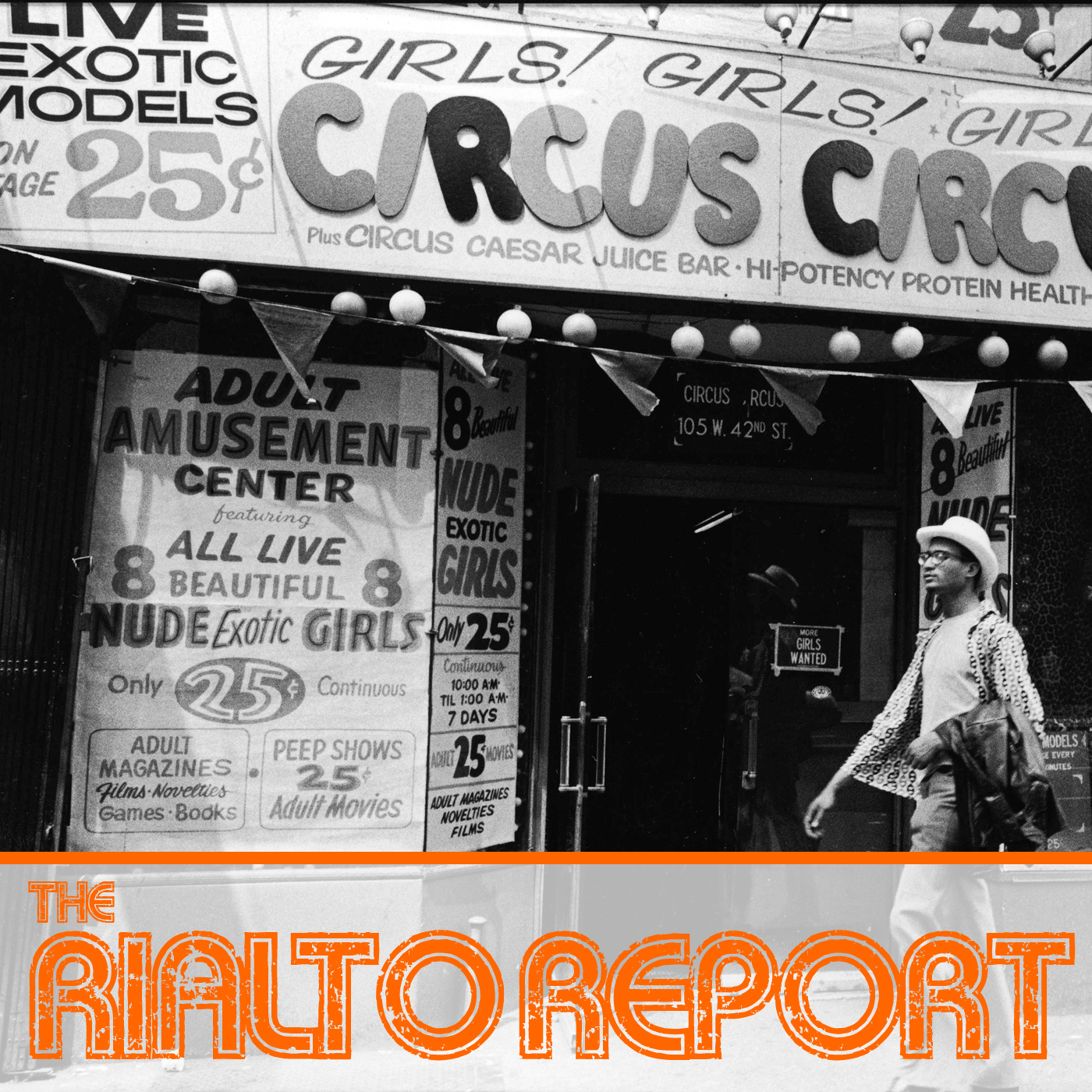
Avon Films: Journeys into the Dark Heart of XXX – Part 1, The Boss – Podcast 86
Audio is streamed directly from the publisher (traffic.libsyn.com) as published in their RSS feed. Play Podcasts does not host this file. Rights-holders can request removal through the copyright & takedown page.
Show Notes
The 1970s was the decade of adult films and theaters in New York City. It started out with cheap and crude black-and-white softcore films, enjoyed the breakthrough of porno-chic spearheaded by the landmark film Deep Throat (1973), and ended with big-budget films that looked like regular Hollywood films – with fully explicit sex.
At the one end of the spectrum were champagne directors like Radley Metzger, Chuck Vincent and Joe Sarno – experienced filmmakers who turned their skills to the new and commercially attractive market for pornography by making sparkling, sophisticated or humorous movies.
At the other end of the scale were the Avon films, a series associated with the chain of New York XXX theaters that included the Avon 42nd St, the Avon Love and the Avon 7. The Avon films form the sleaziest chapter of golden age adult films. These were not the mythical cross-over movies that would entice mainstream viewers into the theaters.
In fact when U.S. President Ronald Reagan ordered a comprehensive investigation into pornography in the mid 1980s, the resulting report held up examples of the most reprehensible films – and Avon films were top of the list.
So who was behind the theater chain? Where did they find people to appear in the movies? And who made these strange, violent films that still endure today?
Today The Rialto Report starts a multi-part look into the Avon empire, an untold history that stretches back almost a century.
This podcast is 62 minutes long, and is accompanied by the written article below.
With thanks to George Payne, Estelle Scheier, Elizabeth Trotta, N. Carroll Mallow, Mildred ‘Mickey’ Offen, Brian O’Hara, ‘Automats, Taxi Dances, and Vaudeville’ by David Freeland (NYU Press), byNWR.com and many others who contributed to this oral history.
The musical playlist for this episode can be found on Spotify.
_______________________________________________________________________________________________
Prologue: The Ghosts of George Payne
The phone rings with an insistent tone. It’s George Payne. The phone always rings more urgently when George calls. It matches his impatient manner.
His rasping movie-trailer-voiceover-ready tone is unmistakable and, as usual, he starts without preamble: “I’ve been thinking about the Avon films. We made them at Vince Benedetti’s Adventure Studios in Queens.”
George has perfected the art of stream-of-conscious questions, and they tend to emerge in reverse order.
“Why don’t we go over there and take a look? What happened to that place? What are you doing today?”
I point out that Vince died a few years ago, and that he’d sold Adventure Studios a few years before that. There’ll be nothing left there now, I say.
George continues obliviously: “So many films were shot there. All the Avon films. OK? All the crazy Phil Prince movies. And they were the wildest films I ever starred in. The wildest that anyone ever made.”
There’s a pause as if George has been swallowed by a wave of misty-eyed nostalgia, or perhaps it’s PTSD.
“The Story of Prunella. Tales of the Bizarre. The Taming of Rebecca. OK?” George lists film titles as if they’re cake ingredients. I’m concerned for anyone who may be overhearing his side of the conversation.
“Kneel Before Me. Forgive Me, I Have Sinned. Dr. Bizarro. Oriental Techniques in Pain and Pleasure. OK?”
Another pause.
“What time shall we meet there?” he asks.
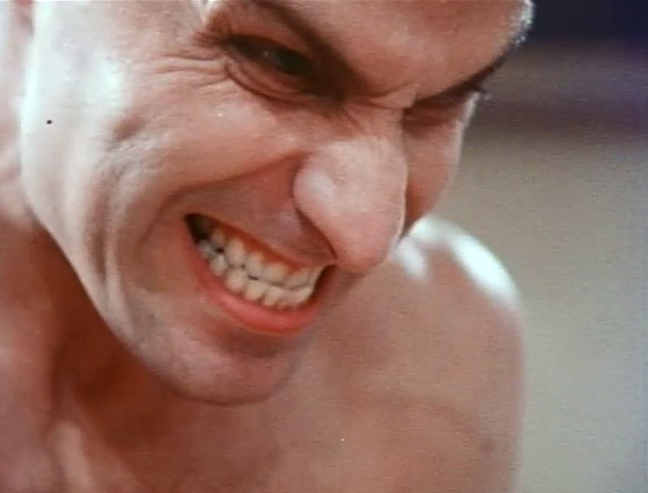 George Payne in his Avon heyday
George is right. The Avon films were wild. Over thirty years after they were made, they remain the most singular and controversial series of New York adult movies. Even today, they occupy a cult-like niche in porn film history, which is all the more remarkable given how they were made: budgets rarely exceeded $15,000, shoots seldom took more than 72 hours and most cast and crew members had little experience in the grammar of film. And then there was the sex: raw, violent, confrontational and jarring. Often it was as far from titillating as you could imagine. It was a dislocated, cracked vision of the power of sexual dominance.
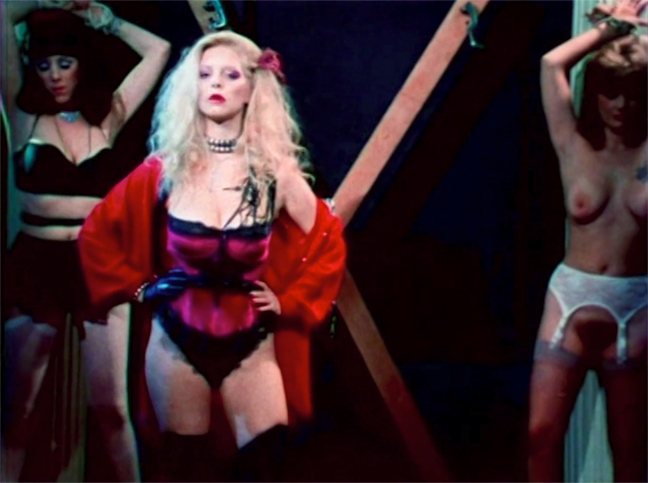
Avon films’ only success was at the box office: they weren’t just ignored at the industry award ceremonies that attempted to provide a façade of respectability to pornography, they were swept so quickly under the carpet that they were barely even noted. This wasn’t how XXX bigwigs wanted to present themselves to an already porn-skeptical public. The holy grail of mainstream crossover success would never materialize if Avon films were allowed to be the norm.
But these are also the reasons why Avon films have endured. In an era where any kink can be satisfied in some dark and forbidden corner of the internet, the Avon films still have the power to shock.
George Payne was Avon’s top dog in front of the camera. Not only the most ubiquitous presence, but also the most electric. No actor has committed more to his craft than George. No halfway measures, just a complete dedication to unhinged characters. In the Avon films he screamed at the actresses, casually dispatched violence and trembled on the knife-edge of insanity with an uncontrolled fever. He seemed to be having a meltdown before your eyes. And perhaps he was: for years, he was a speed freak without a home.
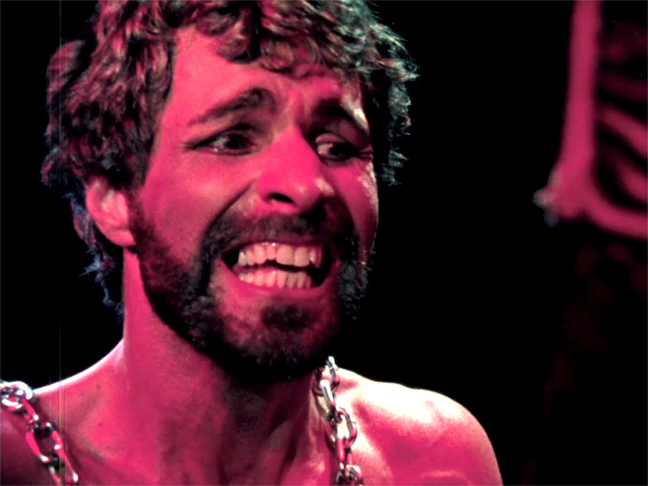 George Payne
Today the same intensity still resides within him, though it’s aggravated by a recurring paranoia about his past. We meet up a few hours after his call. As he walks towards me, he eschews small talk. He’s jittery, but no more than usual: “I just got recognized on the bus on my way here. A middle-aged lady. She knew who I was. It was instant. I could see it in her eyes. I don’t know where she’s gone, but I’ve gotta’ be careful around here. OK?”
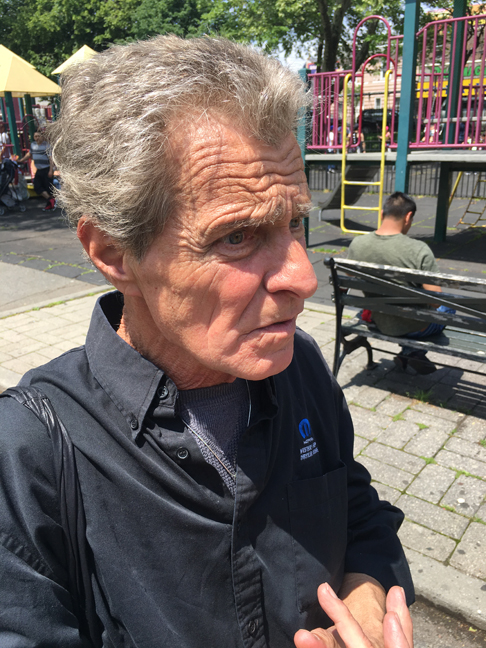 George brings his intensity back to the home of Adventure Studios
It’s a scorching hot day in Corona, Queens and the bodegas that make up the neighborhood spill their wares and customers onto the sidewalk. We find the old Adventure Studio straight away, even though it’s now masquerading as a furniture store. Its appearance is just as I expected – an anonymous space with no vestige of its former existence. We enter to find it filled with discounted wardrobes and vinyl recliners.
Just when I consider the trip to have been wasted, I turn to see George. He’s lost in a dream world, eyes glazed over, seeing events and objects that are no longer physically there. He touches the walls, caresses doorframes and provides a non-stop commentary: “I fucked Vanessa right here in this corner.” Or, “This is the room where the girls did their make-up. And their coke.” At one point, he tries to get behind an armoire to find the initials that he and Jerry Butler once carved into the wall. He then wanders out into the park that sits opposite the building and continues his stream-of-conscious description of the exterior scenes shot there.
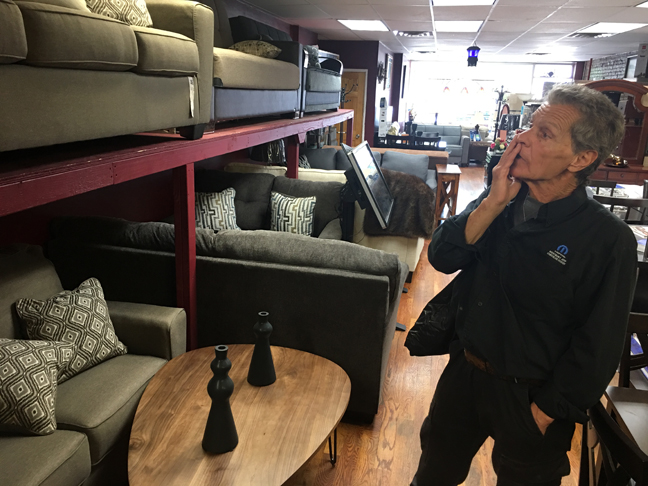 George lost in memory at what once was Vince Benedetti’s Adventure Studios
After an hour in the heat we need refreshments, so I suggest lunch at a nearby diner.
Whenever we meet for a meal, George always places the same order: hamburger, well-done. Toasted bun, dry. A side of bacon. Leave out anything green. And lots of sugar in his coffee. I mean, lots. He doesn’t measure it out by the spoon. He pours it straight into his cup for what seems like minutes on end. The effect jolts him into an even more highly-strung state. It can be difficult to clutch at the scattergun threads of his thoughts.
“I shot my first porn loop in the late 1960s with Aaron Kaplan. In the 1980s, Aaron was involved in some of the Avon pictures. And he dated Paula Ciccone, Madonna’s sister who was flat-out crazy. And she was on drugs. We used a blow-up doll. Only because the actress didn’t turn up for the shoot. I burst the doll when I came on its face. I wish I had a copy of that.”
Slow down a little, George, I say. Tell me more about the Avon films.
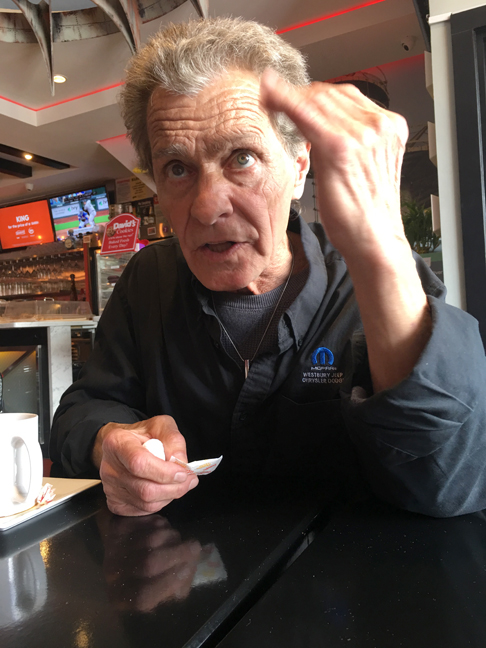 George reminisces about Avon Productions
George starts again: “You want to know about the money, the girls, or the films? Because different people were involved. OK?
“There was Murray the Jew. No one knew him, but he had the money and put everything together so it could all happen. Without him, there was no Avon.
“There was Billy. He was a biker who supplied the kinky girls that filled the Avon films. Girls like Velvet Summers. Ambrosia Fox. Cheri Champagne. They’d do anything for him.
“Then there was Phil Prince. The films were his twisted vision and each movie was more extreme than the last. Phil made us do things nobody believed possible.”
George sits back and looks around nervously: “The story of Avon is a jigsaw, OK? Guys like Murray the Jew. Billy the Biker. Phil, The Prince of Porn. And others too. Each has a different piece. There’s no single story, there’s just different threads.
“But begin with Murray the Jew. Because that’s where it all started.
He pauses.
“Now what does a guy have to do to get some more sugar around here?”
*
Murray’s story
In the summer of 1963, Elizabeth Trotta was bugging her boss at the Newsday offices. She was a gritty 26-year-old female reporter who was sick and tired of being given un-gritty female reporting assignments. She wanted something more challenging, perhaps even exciting.
Her boss waved her away. He told her she could get a job as a taxi dancer if she didn’t like it. So Trotta did just that.
Well, sort of. She went to work undercover as a taxi dancer in the murky nocturnal world of New York taxi palaces. She’d heard the rumors of illicit sexual shenanigans going on. Everyone had. Maybe she could use her femininity to find the truth and get a journalistic scoop.
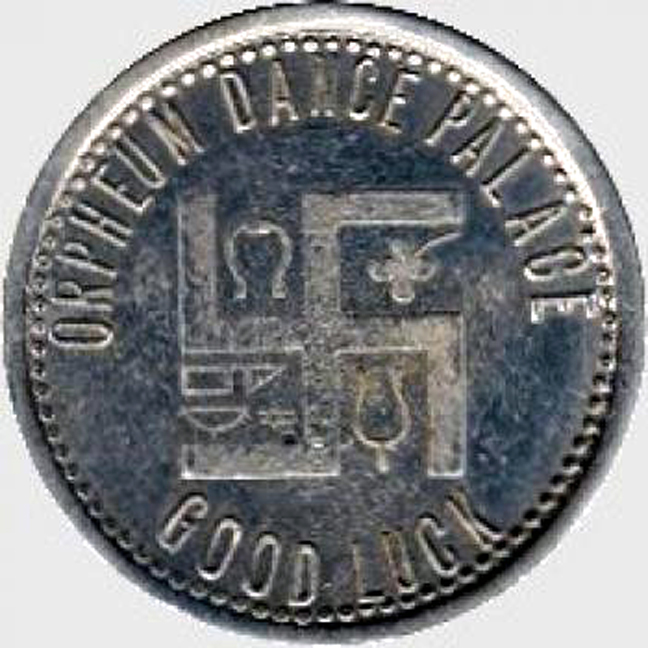 Taxi dancers were young women who danced with men for money, often in rooms of city-center brownstones. The name was derived from the ‘more time, more money’ model of a cab ride. The phenomenon had reached its peak during the 1920s and early 30s, when as many as 250 dance halls filled the city and became an alternative for women to the narrow set of professional opportunities prescribed them. Female dancers customarily earned 50% of each 10-cent dance ticket, and so energetic young women could easily take home up to $40 a week – significantly more than teaching or nursing was offering.
The most famous and venerable of taxi palaces was the Orpheum Dance Palace. The Orpheum sat at the corner of 46th and Broadway, in the same building that later hosted the anachronistic Howard Johnson’s restaurant and, much later, the Gaiety Theatre male strip club. It had opened in 1917 and was renowned for attracting the most beautiful dancers in the city. A sign on the wall in those days reminded patrons, ‘No Indecent Dancing.’ It was here at the Orpheum in 1923 that a 31-year-old aspiring writer named Henry Miller met and became obsessed with a beguiling young dancer named June Edith Smith (a.k.a. Mansfield). This meeting initiated what would become one of literature’s most famous love affairs, which Miller wrote passionately about in his semi-autobiographical Tropic of Capricorn.
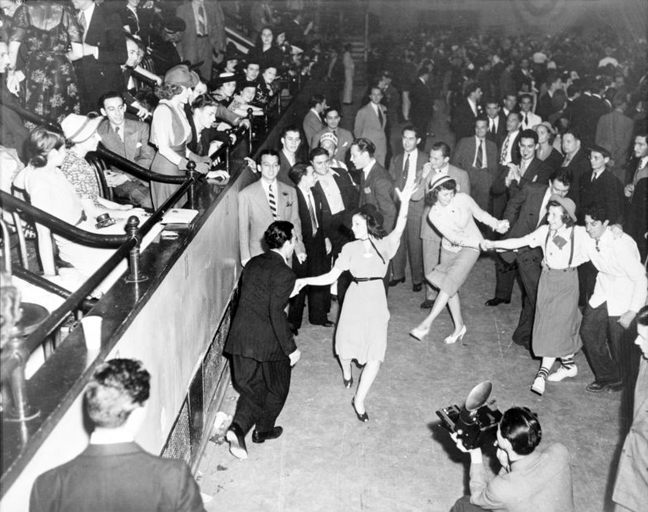 The early days of Taxi Dance Halls
In the book ‘Automats, Taxi Dances, and Vaudeville’, the Orpheum Dance Palace is described as follows:
Outside, at street level, the male patron was lured with enticing images of glamorous or busty pin-ups, accompanied by taglines such as ’50 Beautiful Lonely Hearts to Dance with You!’ After walking up a narrow flight of stairs, he would approach a small window – at the Orpheum it read ‘A Refined Place for Refined People’ – and purchase a roll of tickets, usually 10 for $1, or 10c per dance.
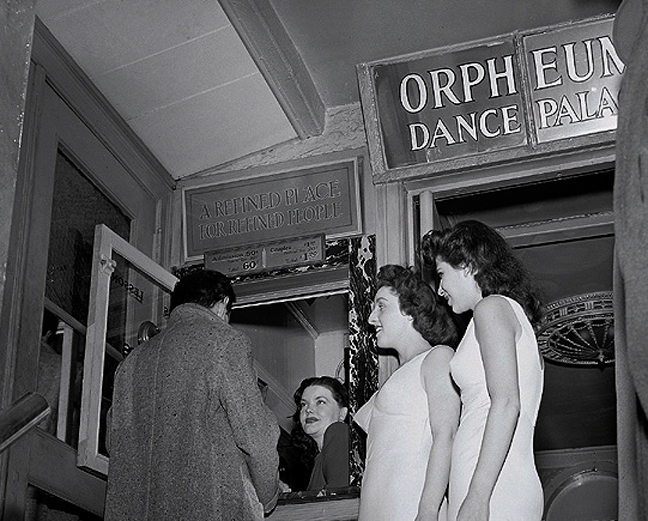 The women were ready to entertain at the Orpheum Dance Palace
By the 1950s, times had changed, and cheap dances with anonymous floozies no longer cut it for the lonely and horny thrill-seeker. The Orpheum had to adapt and offer men a whole lot more than just a suggestive Salsa if it wanted to survive. So what had once been New York’s most famous ‘dime-a-dance’ hall reinvented itself along more sexual lines – and the architect of the change was a small-time Jewish gangster from the Bronx named Murray Offen.
*
Murray Offen was born in 1916 to a Jewish working-class family. His father, Nathan, had toiled all his life in office jobs, barely scraping together enough money to raise his six kids. Murray, Nathan’s second eldest child, and his older brother Sam had no desire to follow in their father’s heartworn footsteps. The boys had two more pressing interests: hustling, and hanging out at night in the underworld nightspots of Times Square. And preferably, doing both at the same time.
Sometimes Murray tripped up and ran afoul of the law, like when he was caught in 1942 mailing illicit drugs through the U.S. postal system. He was arrested for the scheme, but claimed he was merely sending a drugstore prescription to a sick friend and was unaware that the package contained opium tablets. The judge didn’t buy it. Murray entered a guilty plea, waived his right to counsel and was fined $250 and sentenced to five years’ probation.
Murray and Sam bounced around jobs – Murray worked in bars and nightclubs, while Sam managed adult bookstores – and both became familiar with everyone who was anyone on the Deuce, from low-lifes to cops and all those in between. On the streets of the old Times Square, everyone knew Murray and Sam.
Murray particularly enjoyed the company of the girls at the taxi dances and befriended one in particular, a young woman from Kentucky, name Mildred Lee Wood. Mildred – who went by her middle name Michelle, or more often ‘Mickey’, at the dance hall – told Murray how the girls made money at the dances. Really made money, that is – and it wasn’t from dancing. As with many of the taxi dancers, she raked in cash by ‘propping’ customers: taking their money with a promise to meet for sex, and then never showing. Sure, the duped dudes knew exactly where to find the hustling hussies the following day to demand their money back, but few were inclined to raise a ruckus. The sexual shame and risk of exposure overwhelmed their mere financial loss.
Murray listened to Mickey, and smelled opportunity.
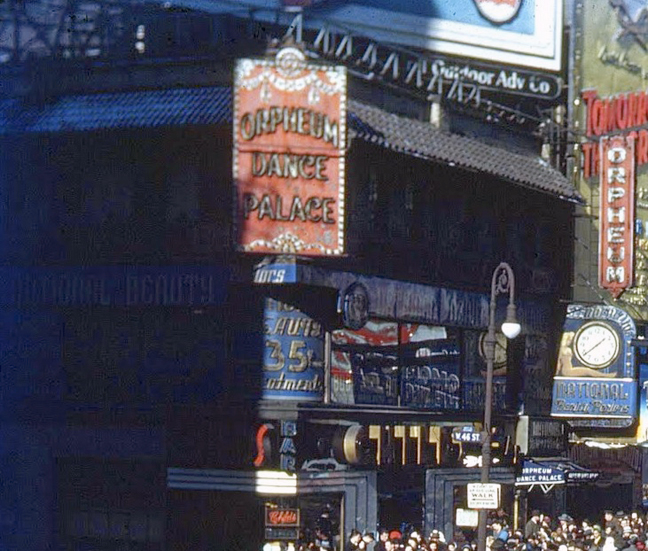 The Orpheum Dance Palace
Murray was sweet with the owners of the Orpheum and in the mid-1950s convinced them he could turn around the failing dance hall business. Privately, he wanted to expand the franchise into sex: dancing was dying, ‘propping’ was a short-term win, but prostitution would earn repeat business. That was a sustainable business model and he saw lucre in it. Sure, the Orpheum had weathered periodic crackdowns over the years as righteous committees and moral crusades were launched to clamp down on indecency and crime in places of entertainment. But Murray knew he could take it to the next level. He knew the streets and understood the fix.
Judging that a woman at the helm of the new business would cut a less suspicious profile, he persuaded Mickey to front the venture while he would make it all happen behind the scenes. It was a perfect fit: Mickey managed the dance girls; Murray took care of the rest. Together they were the Bonnie and Clyde of the sex-dance scene.
The new business model worked well: twenty-four girls worked their terpsichoric skills in two shifts – noon to 8pm, and 8pm to 4am – and sold on-site ‘intimacies’ for $15 to $25. If clients wanted more, they were directed to the nearby Forrest Hotel at 224 West 49th St – rooms 1111 and 1604 in particular – where the going rate for a dancer’s extra-curricular services was $100. And if patrons wanted anything else, Murray was happy to oblige: a stag party where three dancers serviced 15 men. An orgy for a group of visiting businessmen. The occasional S&M torture session. Murray took up permanent residence at The Forrest Hotel so that he could keep a close eye on the activity. (The same hotel was notable for housing other New York characters: Damon Runyon lived there in the 1930s, as did Jack Benny, and George Burns and Gracie Allen later. It is still operating today as The Time Hotel.)
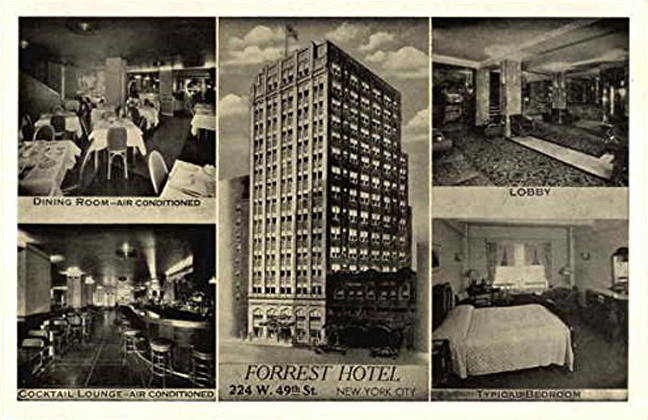 New York’s Forrest Hotel, where men paid women for more than just a taxi dance
From the get-go, Murray lived and breathed the new business. There was no limit to his job description: he applied to the city for the business licenses and permits. He decided who was let into the palace each night, turning away suspicious-looking men by claiming they were dressed inappropriately or by saying that he didn’t have enough dance partners working that night. He threw out unruly guests in a brawny manner, threatening them with bodily harm – or worse, public exposure – if they returned. And he patrolled the dark corners of the Orpheum to ensure that nothing more than hand or blow jobs were being provided.Most importantly, Murray brokered a deal with the cops. Starting in 1944, control over the city’s dance halls had been turned over to the Police Department from the License Bureau. Murray had lots of friends on the force and uniformed officers were a regular fixture at the venue, enjoying the company of the young dancers. Murray’s business operated under the radar thanks to strategic contributions to the euphemistic ‘Policeman’s Ball.’
As an added measure of protection, Murray also brought onboard a young undercover detective named Vincent Leonardo. Vincent had been sent to the Orpheum to investigate vice, but left as an Orpheum employee paid by Murray. He kept New York’s Finest at bay, and developed a feeder system, grooming new girls he found at the police precinct when they were dragged downtown for unrelated vice activity. Vincent provided a sleazy synergy: a vertically integrated business that was practiced horizontally.
To the outside world, Mickey was the queen bee, lording over the harem of harlots, knowing when to be tough and when to be tender. She was bossy, assertive and opinionated. She’d meet prospective girls at the Howard Johnson’s in the same building as the Orpheum, and decided which were reliable and could make money. She and Murray would procure fake IDs for underage girls and provide birth control (or arrange back-street abortions if the contraception failed). It was Mickey who made sure that the Orpheum’s reputation for having the prettiest and wittiest girls in the business thrived.
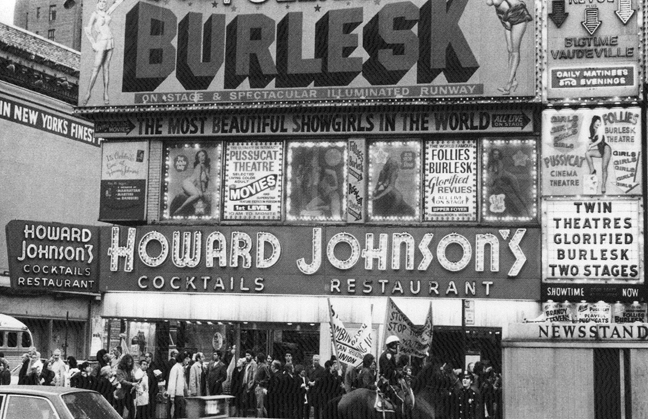 The Howard Johnson’s where Stella met her prospects
The scuttlebutt was that Mickey was a lesbian, living in a fancy Upper West Side apartment at 11 Riverside Drive with her girlfriend Rebecca, one of the Orpheum high-earners and twenty years Mickey’s junior. Another piece of tattle was that Mickey was sleeping with a police lieutenant to keep the boys in blue in check. Stories like these were dismissed by some as disparaging rumors spread by a malcontent dancer.
Whatever the truth, business was good. The Orpheum’s financials were simple: clients were charged an entry fee which covered the business overhead, but the real money came from the working girls. The girls had to pay the management team half of every dollar they made – whether from dancing the Rumba or performing the horizontal Mambo. This payment was split four ways between Mickey, Murray, Vincent Leonardo and another theater manager, Al Simon. The girls earned at least $800 a week, meaning that each of the four-strong management pocketed $100 per worker. With 24 girls beavering away, this added up to over $120,000 per year for each of the managers – or around $1,200,000 in today’s money. And this didn’t include some of Murray’s additional sideline activities.
The money flowed in for several years, and life was good. A tall, graying man whose pale, rice-paper complexion suggested an unfamiliarity with the midday sun, Murray always seemed older than he was. Murray was a taciturn man, given to communicating through complaints, but he was leading a charmed and lucrative existence. But with the new-found income, he now assumed the role of family provider. Murray even helped his brother Sam buy into a 42nd St. store that sold cheap tchotchke.
In 1952 Sam had had a son named Elliot, and Murray doted on the boy. Murray spent each morning before the Orpheum opened with Elliott, teaching him the ways of the world. Elliot’s mother, a chronic OCD-germaphobe, had instilled a fear of germs in him, so Murray taught the kid how to stay fit and healthy. In many ways Murray acted as a surrogate father to Elliot.
But the Orpheum business was built on secrets. And perhaps the biggest of all was that in the late 1950s, Murray had quietly married Mickey. What’s more, they’d had a baby girl, Melissa. She was known to everyone as Honey Bee.
*
In 1963, Murray and Mickey’s world was turned upside down and their gravy train derailed when upstart reporter Elizabeth Trotta went undercover to expose the dark side of the taxi dance palaces.
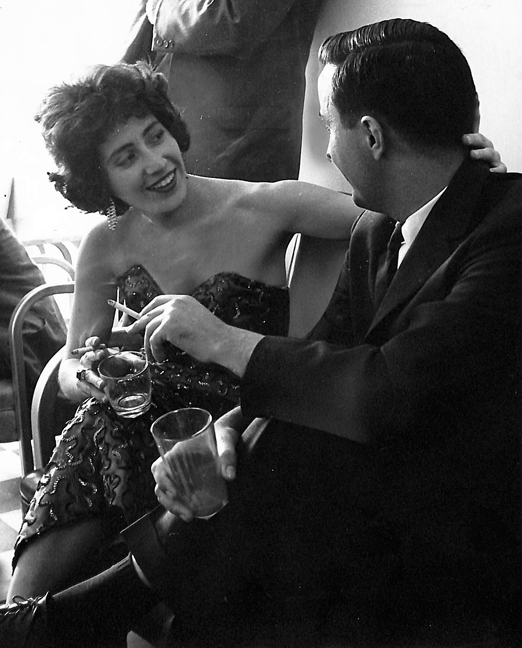 Reporter Elizabeth Trotta goes undercover to expose the darker side of taxi dancing
Ironically Trotta didn’t choose the Orpheum, instead infiltrating the Parisian Danceland – a smaller venue just one block away – but the result was the same. Her expose’ blew the lid off the taxi dance business. Her story, published in Newsday across three consecutive days in July 1963, revealed the sordid underbelly of the dance palaces for the first time. The series was a sensation, and Murray and Mickey were on the front line.
Trotta described working for “fifty-six hours of trampled toes, sweaty palms, whisky breath, smutty jokes, forced smiles, cheap hair tonic, and a fearful dread of making a slip – such as good grammar.” More critically, she explained ‘propping’, and indicated that she could have earned much more if she’d taken advantage of other opportunities open to her. Gay Talese, future pioneer of New Journalism, weighed in with an article in the New York Times. In that article, Mickey’s supposed-squeeze Rebecca offered a case for the defense: “I am helping people. New York is a cold, cold city, and men can talk to us.”
The New York authorities sat up and took notice. They had to: a network of whorehouses operating nightly in the heart of the City of Dreams was not just an embarrassment, it was unforgivable. Undercover officers were sent into the dance halls, and emerged confirming the news stories. Press statements were released revealing they found the hostesses “indecently exposed, immoral while dancing, and willing to proposition the male visitors.” Frank Hogan, New York District Attorney, described the girls as “lewd” and called the Orpheum a “den of prostitution.” On the bright side, he conceded that it catered to a “high-class clientele”.
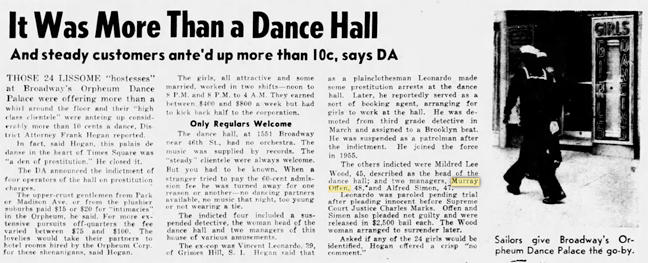 The media and law enforcement expose the true nature of Murray’s business
In January 1964, the Orpheum’s license – in place for almost 50 years – was revoked. Murray and Mickey kept the place limping along while they appealed to the State Supreme Court, but the writing was all over the wall. By March 1964, the City Commissioner effectively signed the death certificate for the Orpheum, and four other taxi-dance halls, by refusing to renew their licenses.
Shortly afterwards, the cops swooped in and arrested the entire Orpheum gang: Murray, Mickey, Leonardo and Al were all taken in. On April 24, 1964, all four defendants pled not guilty to multiple counts of prostitution and conspiracy. Unsurprisingly Vinnie Leonardo was suspended from the police force. As the group’s nominal front, Mickey took most of the heat from the newspapers fascinated with the madame with moxie. Murray was released on $2,500 bail and carefully slipped into the background, painting himself as a mere dance hall manager.

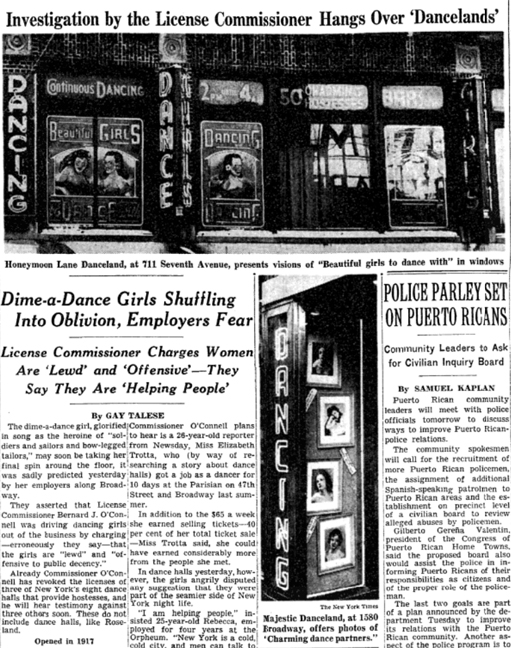 The jig was up when the licenses were denied
*
If this seemed like the end of the road for Murray, the opposite was true. The New York District Attorney stated that, “It is hoped that the individuals will have learned their lesson.” That was actually true: Murray had learned his lesson. He vowed that next time he would do it properly. He would do it by himself, operate on a bigger scale, avoid overt prostitution with its higher risks, and cover his own tracks to the point of enveloping himself in elusive anonymity.
Murray’s new vision was to buy into the market for small cash-cow grindhouse theaters that were cheap to run. He saw the growing success of Chelly Wilson, who exhibited exploitation films in a theater portfolio that would grow to encompass the Eros, Cameo, and Tivoli (later the Adonis). He wanted in on the action.
At first, Murray lay low. He bided his time, helping raise his daughter Honey Bee and nephew Elliot. Then in the late 1960s, he emerged as the new leaseholder for the old Orpheum space, which he turned into a theater he called the Paris. Murray soon added more locations, taking out long-term commercial leases, some of them lasting 20 years or more, on various shoebox theaters in the Times Square area. He gave many of them the ‘Avon’ name: there was the Avon Hudson, Avon Love, Avon 7, Avon 42nd St. He chose the ‘Avon’ moniker because he wanted a wholesome brand, one that belied the sordid activity inside, and the name of the door-to-door cosmetic salesforce company seemed as good as any.
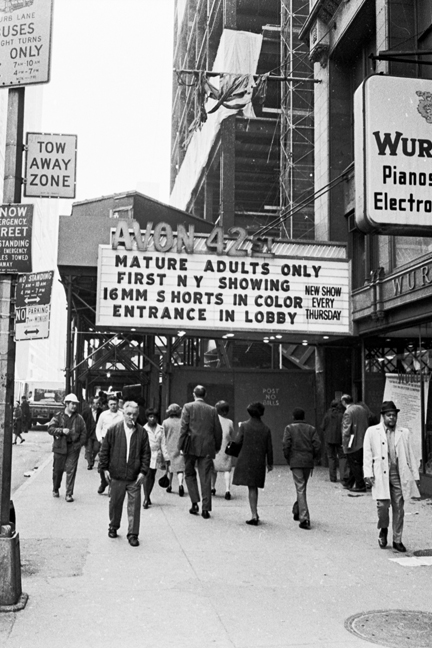 Murray begins building his Avon empire
But one of the first theaters in the portfolio was the grand Hudson Theater, a once-great theatrical venue that had enjoyed a multi-faceted life, serving as a CBS Radio studio in the 1930s, and then home to The Tonight Show under host Steve Allen and later Jack Paar, until 1959. By 1967, under Murray’s direction, it was a cinema experimenting with artsie-exploitation fare like Andy Warhol’s My Hustler (1965) before succumbing to showing roughies like the Findlay’s The Touch of her Flesh (1967). The theater was rebranded as the ‘Avon at the Hudson.’
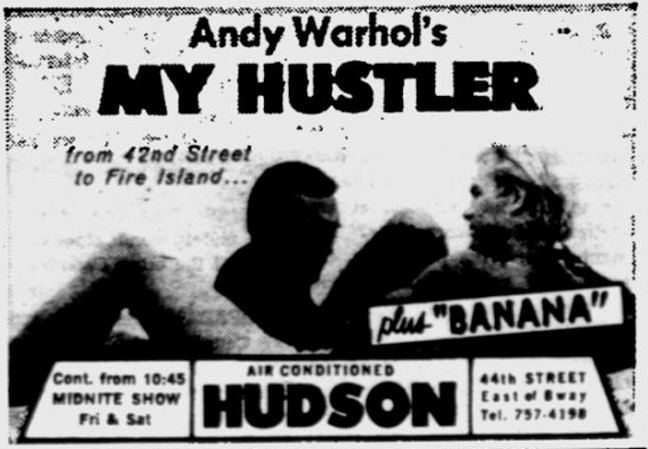 Murray tried his hand at arthouse fare before moving on to sexploitation
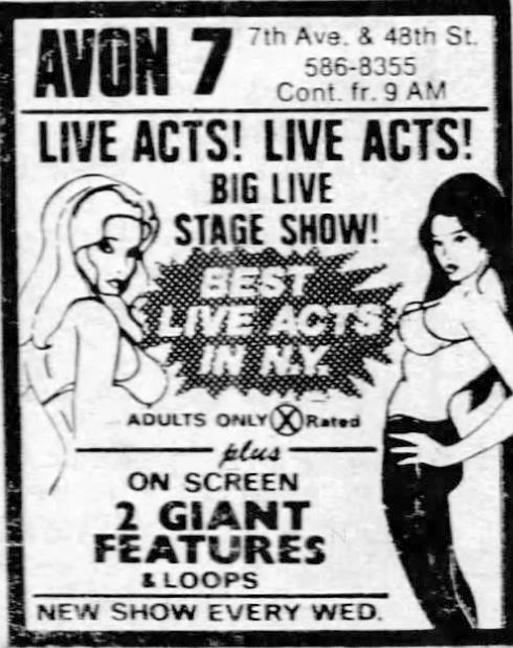
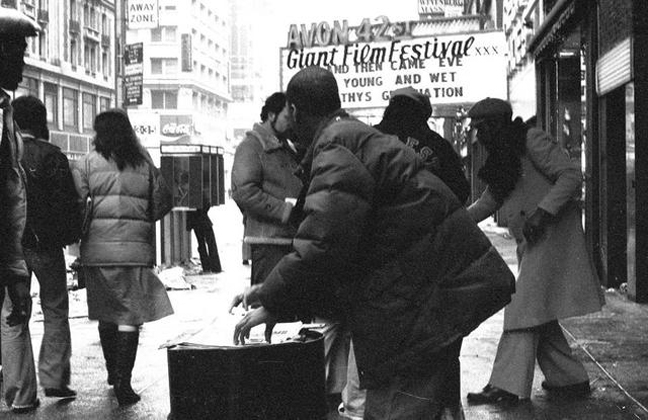
Next up was the Avon Love which exhibited the country’s first split beaver loops, many imported directly from Howard Ziehm in San Francisco. Avon Love’s gay counterpart was the Park-Miller with its focus on shorts, including the first New York exhibition of Pat Rocco’s beefcake films. The Avon 7, a 260-seat basement theater, opened in late 1970, followed by the Doll which also had a live sex show on stage in between features. Murray turned the Bryant into a hardcore venue called the ‘New Bryant’ (it had previously screened exploitation fare like Andy Milligan’s ‘Tricks of the Trade’ or Robert Downey Sr.’s ‘Sweet Smell of Sex’), and unleashed the 220-seat Avon 42 which sat at 133 West 42nd St.
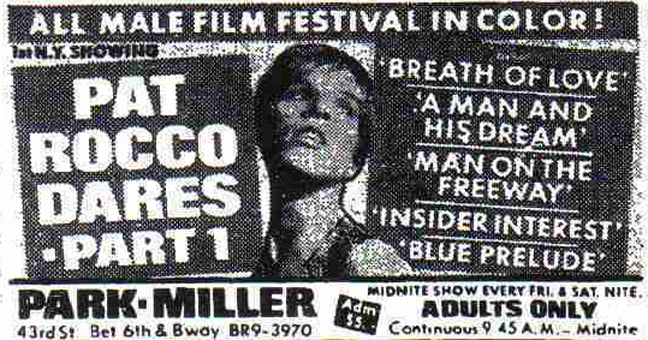 Murray is the first to screen Pat Rocco’s films in New York
Occupying the former Orpheum location, The Paris – sometimes known as the ‘New Paris’ – was a strange beast. It was less a conventional theater, more of an early live sex show space, a progenitor of Show World and its ilk. Adult film actors Jamie Gillis, Alex Mann, and Jason Russell with his wife Tina, all recalled working there at the start of their careers. Their description of the set-up was consistent: a single mattress (stained, springs exposed), fold-up chairs (metal, noisy as people shuffled to get a clearer view), and a buzzer system to warn the performers of any unwelcome visits from law enforcement. Jamie Gillis provided socially redeeming interludes, reciting Shakespeare and Joyce, just in case any undercover vice cops were present. In between the sex shows, 8mm loops were projected on a makeshift screen. Live sex shows soon spread to other Avon locations.
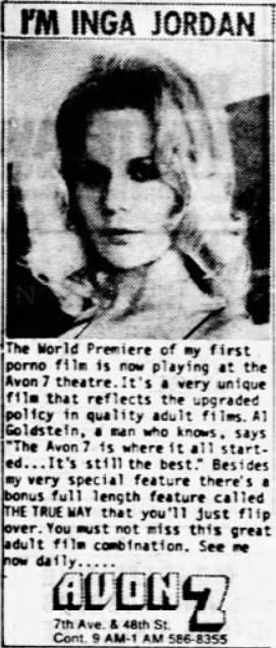
At times, Murray encountered credibility difficulties because of his long rap sheet dating back to the 1940s, but he fought back against these obstacles. In 1971 for example, he petitioned the district court to set aside his 1942 conviction for postal drug distribution, claiming he hadn’t understood the guilty plea he originally entered. That plea was denied, but Murray was undeterred, and continued accumulating properties and turning them into sex film theaters.
It was a turbulent time for adult theaters. If the operators weren’t being busted for obscenity or shut down by their landlords, they were under attack by you-name it: sometimes from the competition, sometimes from the mob, and sometimes from the competition that was the mob. Firebomb attacks were not uncommon, and alliances sometimes needed to be formed. In 1971, Murray joined forces with Nathan Mallow (aka N. Carroll Mallow), a fellow theater operator whose own portfolio included the San Francisco Theater on Broadway between 45th and 46th Streets and the Paree Adult Cinema and Live Show at 753‐9 Seventh Avenue near 49th St. Together they opened the Hollywood Twin Theater at 777 8th Avenue, which later became the 777 Theatre. Speaking years later, Mallow spoke to me about various massage parlors they opened as well – including one on Broadway and 47th St. where you could have all the sex you could handle in 24 hours for $30.
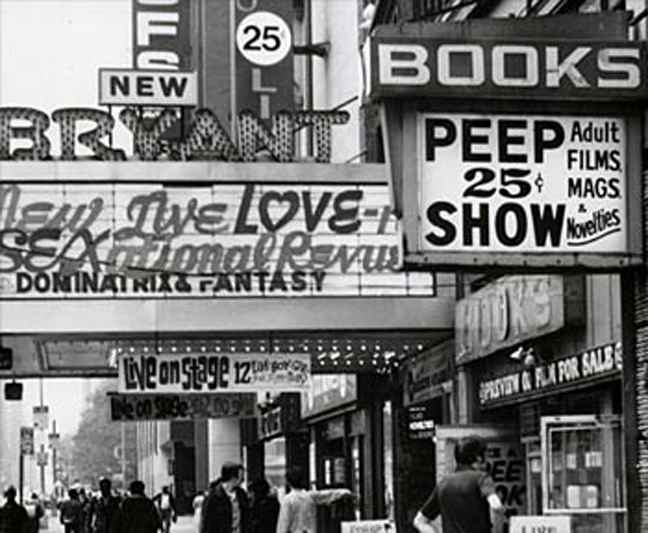 The (New) Bryant was among Murray’s stable of adult theaters
Mallow was less prudent than Murray, and had a habit of being arrested for obscenity, prostitution, and securities fraud, so Murray soon distanced himself from his partner. Murray’s years operating on the fringes of the law had taught him valuable lessons, and he wasn’t interested in exposing himself to needless risks. His growing empire wasn’t immune to legal issues, but he usually emerged largely unscathed – thanks in part to the regular payments to cops, the so-called contributions to ‘The Policeman’s Ball’, that had started when he managed the Orpheum.
Murray also recognized the importance of security at his theaters – so he invested in it. He hired people who would snuff out trouble before it got out of hand. It was a simple logic: fewer on-site disturbances, whether due to assaults or drugs, meant less bad publicity, not to mention a slightly more welcoming environment for the customer.
But Murray’s overriding golden rule was discretion. He made sure he stayed in the background, delegating management of the business to a trusted few. In fact very few even knew his real surname – on the street, he was simply ‘Murray the Jew.’ Up to this day, no one has identified his connection to Avon.
That would have pleased Murray the Jew.
*
Murray’s operating model was low maintenance by design and choice, but it soon grew to a size where he needed additional full-time management.
Estelle Scheier was Murray’s most trusted ally. Estelle had been Mickey’s best friend from back in the days when they were both fledgling taxi dancers at the Orpheum, and was a hardnosed Brooklynite who could be relied on. Murray brought her into the Avon organization, first as office manager, then as a more senior officer of his holding company, Avon Theaters. Murray’s intention was simple: just like at the Orpheum, he delegated the front-of-house day-to-day running of the business to a woman so he could disappear into the shadows and watch from the sidelines as he brokered the real deals.
Estelle was fine with that, but to cover her tracks she created a new identity, calling herself Stella Stevens after the Hollywood showgirl.
In 2009, I visited Stella at her retirement home in South Florida. She was still up to her eyeballs in administrative paperwork, but now it related to her voluntary role as treasurer of her living community’s condominium association.