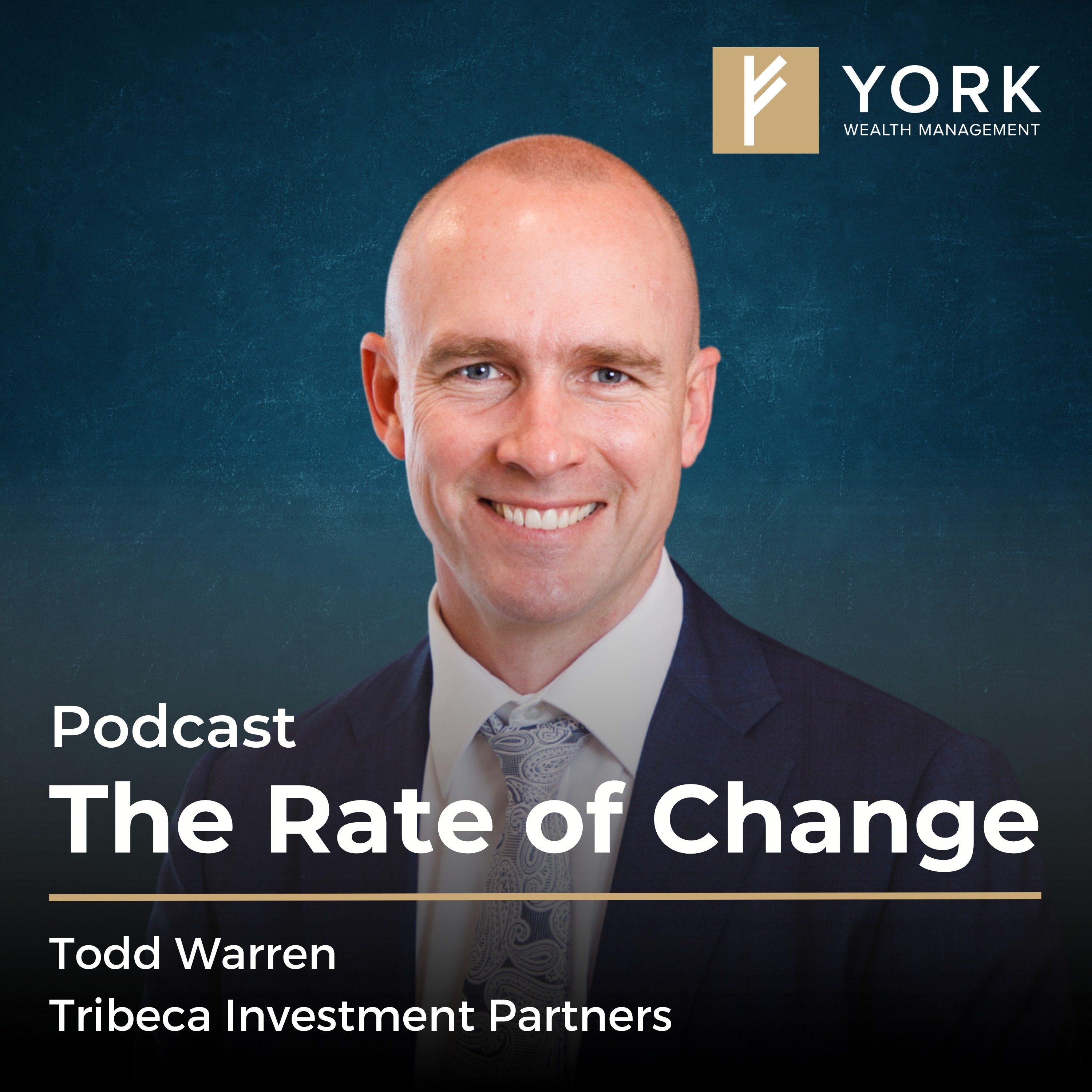
#51 Todd Warren | When the World Demands Energy: The Real Cost Is Supply — And It Runs Through the Strait of Hormuz
The Rate Of Change · Murdoch Gatti
Audio is streamed directly from the publisher (content.rss.com) as published in their RSS feed. Play Podcasts does not host this file. Rights-holders can request removal through the copyright & takedown page.
Show Notes
In this episode of The Rate of Change, Murdoch Gatti sits down with Todd Warren, Portfolio Manager & Head of Research at Tribeca Investment Partners, to unpack a critical shift taking place across global commodity markets — and why the real story isn’t demand, but supply.
If you are interested in uranium, oil, natural gas, LNG, copper, sulphur, lithium, rare earths, iron ore, coal, hydrogen, carbon markets, nuclear energy, titanium, advanced materials and broader strategic minerals, then you will enjoy this conversation.
Over the past decade, commodities have been under-owned, underinvested and largely ignored as capital flowed into growth assets. ESG constraints and weak pricing suppressed new supply across energy and mining.
That dynamic is now reversing.
As Todd explains, we are entering a structurally different macro regime — one defined by constrained supply, geopolitical fragmentation and persistent inflation. Unlike prior cycles, this is not simply about stronger demand. The system itself is tight.
A key insight from the conversation is the fragility of global supply chains.
Critical inputs — including sulphur, essential for copper processing — are heavily reliant on global chokepoints such as the Strait of Hormuz. Disruptions here don’t just impact oil, but cascade through copper, fertilisers and broader industrial supply chains. In copper specifically, it is not just the availability of ore that matters, but the availability of inputs required to process it — creating an additional layer of supply constraint that is often overlooked.
This is where the real risk — and opportunity — lies.
Across oil, LNG, copper, uranium and key transition metals, years of under investment mean supply cannot respond quickly enough, while demand is reinforced by electrification, energy security and the re-emergence of nuclear power.
Where commodities were once treated as tactical exposures, they are increasingly being viewed as strategic allocations — offering inflation protection and asymmetric upside.
Todd also outlines how Tribeca Investment Partners expresses these views through its Global Natural Resources Strategy, a flexible long/short approach across equities, credit and commodities. The strategy has historically targeted 15–20% p.a. returns, while its listed vehicle, Tribeca Global Natural Resources Limited, returned approximately 60% in calendar year 2025.
Companies Discussed:
- BHP.ASX – BHP Group
- BOE.ASX – Boss Energy
- BRE.ASX – Brazilian Rare Earths
- BTL.ASX – Beetaloo Energy Australia
- CCO.TSX – Cameco
- 1605.TYO – Inpex
- ILU.ASX – Iluka Resources
- IPX.ASX – IperionX
- LYC.ASX – Lynas Rare Earths
- MEI.ASX – Meteoric Resources
- MP.NYSE – MP Materials
- NXE.TSX – NexGen Energy
- OMA.ASX – Omega Oil & Gas
- PDN.ASX – Paladin Energy
- PLS.ASX – Pilbara Minerals
- RIO.ASX – Rio Tinto
- STO.ASX – Santos
- TBN.ASX – Tamboran Resources (CDI)TGF.ASX – Tribeca Global Natural Resources Limited
- VMM.ASX – Viridis Mining and Minerals
- WDS.ASX – Woodside Energy
- WPM.NYSE – Wheaton Precious Metals
- 6KA.ASX – 6K Additives (CDI)