Show overview
The Rate Of Change has been publishing since 2022, and across the 4 years since has built a catalogue of 55 episodes. That works out to roughly 190 hours of audio in total. Releases follow a monthly cadence.
Episodes typically run an hour to ninety minutes — most land between 58 min and 1h 25m — though episode length varies meaningfully from one episode to the next. None of the episodes are flagged explicit by the publisher. It is catalogued as a EN-language Business show.
The show is actively publishing — the most recent episode landed 6 days ago, with 8 episodes already out so far this year. The busiest year was 2024, with 20 episodes published. Published by Murdoch Gatti.
From the publisher
The Rate of Change is a podcast designed to help you in the pursuit of building long term wealth, through the insights of some of the brightest minds in asset management.Your host Murdoch Gatti is an advisor at York Wealth Management. We work with High Net Worth individuals, institutions & family offices to help grow & protect their wealth.If you like what you hear and wish to learn more about the York Wealth community, please visit us at www.yorkwealth.com.auDisclaimer: The Rate of Change podcast is presented by its speakers. The views and opinions expressed in this podcast are those of the speakers in their personal capacity and do not represent the views of York Wealth Management Pty Ltd, its shareholders, directors, or any other third party.Any discussion of financial products, investments, credit, or property opportunities in this podcast is provided strictly for general information and discussion purposes only. Nothing in this podcast constitutes general advice, personal advice, financial product advice, credit advice, or a recommendation. Before making any financial or investment decisions, you should seek advice from a licensed professional who will consider your objectives, financial situation, and needs.Australian listeners can obtain further information about choosing a financial adviser by visiting www.moneysmart.gov.au.For clarity, The Rate of Change podcast is a business owned and operated by Murdoch Venture Capital Pty Ltd. Any client, relationship, or referral that arises through The Rate of Change in connection with services outside the scope of financial services requiring an Australian Financial Services Licence — including, without limitation, private credit, property development, or other non-AFSL activities — shall remain the sole property of The Rate of Change. Where listeners wish to obtain advice in relation to their investments or other matters that fall within the scope of financial services requiring an AFSL, The Rate of Change may refer them to York Wealth Management Pty Ltd. York Wealth Management is referenced in this podcast solely in its capacity as sponsor. References in the introduction to “The Rate of Change with York Wealth Management” are sponsorship acknowledgments only and do not imply ownership or control of this podcast by York Wealth Management.To learn more about York Wealth Management as sponsor, please visit www.yorkwealth.com.au.
Latest Episodes
View all 55 episodes#55 Timothy Wilson | Where Can You Invest in Private Credit Beyond Just Property?
#54 James Rodda | Where to Find Value in the Bottleneck Businesses Enabling the AI, Energy & Tech Boom
#53 Kevin Bertoli | From Crisis to Opportunity: What Happens When a Crisis Changes an Industry?
#52 Jason Coggins | The AI & Energy War, Semiconductors, Private Credit & Geopolitical Shifts
S1 Ep 51#51 Todd Warren | When the World Demands Energy: The Real Cost Is Supply — And It Runs Through the Strait of Hormuz
In this episode of The Rate of Change, Murdoch Gatti sits down with Todd Warren, Portfolio Manager & Head of Research at Tribeca Investment Partners, to unpack a critical shift taking place across global commodity markets — and why the real story isn’t demand, but supply.If you are interested in uranium, oil, natural gas, LNG, copper, sulphur, lithium, rare earths, iron ore, coal, hydrogen, carbon markets, nuclear energy, titanium, advanced materials and broader strategic minerals, then you will enjoy this conversation.Over the past decade, commodities have been under-owned, underinvested and largely ignored as capital flowed into growth assets. ESG constraints and weak pricing suppressed new supply across energy and mining.That dynamic is now reversing.As Todd explains, we are entering a structurally different macro regime — one defined by constrained supply, geopolitical fragmentation and persistent inflation. Unlike prior cycles, this is not simply about stronger demand. The system itself is tight.A key insight from the conversation is the fragility of global supply chains.Critical inputs — including sulphur, essential for copper processing — are heavily reliant on global chokepoints such as the Strait of Hormuz. Disruptions here don’t just impact oil, but cascade through copper, fertilisers and broader industrial supply chains. In copper specifically, it is not just the availability of ore that matters, but the availability of inputs required to process it — creating an additional layer of supply constraint that is often overlooked.This is where the real risk — and opportunity — lies.Across oil, LNG, copper, uranium and key transition metals, years of under investment mean supply cannot respond quickly enough, while demand is reinforced by electrification, energy security and the re-emergence of nuclear power.Where commodities were once treated as tactical exposures, they are increasingly being viewed as strategic allocations — offering inflation protection and asymmetric upside.Todd also outlines how Tribeca Investment Partners expresses these views through its Global Natural Resources Strategy, a flexible long/short approach across equities, credit and commodities. The strategy has historically targeted 15–20% p.a. returns, while its listed vehicle, Tribeca Global Natural Resources Limited, returned approximately 60% in calendar year 2025.Companies Discussed:BHP.ASX – BHP GroupBOE.ASX – Boss EnergyBRE.ASX – Brazilian Rare EarthsBTL.ASX – Beetaloo Energy AustraliaCCO.TSX – Cameco1605.TYO – InpexILU.ASX – Iluka ResourcesIPX.ASX – IperionXLYC.ASX – Lynas Rare EarthsMEI.ASX – Meteoric ResourcesMP.NYSE – MP MaterialsNXE.TSX – NexGen EnergyOMA.ASX – Omega Oil & GasPDN.ASX – Paladin EnergyPLS.ASX – Pilbara MineralsRIO.ASX – Rio TintoSTO.ASX – SantosTBN.ASX – Tamboran Resources (CDI)TGF.ASX – Tribeca Global Natural Resources LimitedVMM.ASX – Viridis Mining and MineralsWDS.ASX – Woodside EnergyWPM.NYSE – Wheaton Precious Metals6KA.ASX – 6K Additives (CDI)
S1 Ep 50#50 Ryan Bass | The Repricing of Institutional Property: From Single Digits to Double-Digit Potential
In this episode of The Rate of Change, Murdoch Gatti sits down with Ryan Bass, Founder of PanGen Capital, to discuss the repricing of institutional property and how capital is being deployed in a higher rate, more fragmented market environment.If you are interested in institutional real estate, income-focused investing, and how professional investors are accessing property opportunities typically reserved for large institutions, then you will enjoy this conversation.Over the past two years, rising interest rates have reshaped the property landscape. Valuations have reset, capital has become more selective, and many investors have stepped back from the asset class.But while sentiment has weakened, the underlying income story has not.High-quality retail assets — particularly shopping centres — have proven more resilient than expected. Centres remain well occupied, tenant demand is strong, and trading conditions are healthy. At the same time, higher construction costs are limiting new supply, reinforcing the value of existing assets.These dynamics are feeding directly into income.Retail leases are often linked to CPI or turnover, allowing landlords to pass through rising costs while benefiting from tenant performance. In many cases, rental income has remained resilient and continues to grow despite broader market uncertainty.This is where the opportunity is emerging.Where institutional property once delivered mid- to high-single digit returns, parts of the market are now presenting the potential for double-digit return profiles — driven by improved entry pricing, durable cashflows and reduced competition.Ryan explains why capital is rotating into retail, how office assets are becoming increasingly selective, and how his fund-of-funds model provides access to institutional-grade opportunities — including exposure to the Dexus Wholesale Property Fund and leading institutional retail property vehicles such as GPT Wholesale Shopping Centre Fund, Lendlease APPF Retail Fund, Dexus Wholesale Shopping Centre Fund and ISPT Retail Australia Property Trust — that are typically inaccessible to most investors.He also reflects on how the strategy has evolved from a focus on defensive income to capturing a more compelling return profile without necessarily increasing risk.In this conversation Murdoch and Ryan discuss:• How rising interest rates have driven a repricing across institutional property markets • The shift to a higher cost of capital and its impact on valuations • Why returns are moving from mid-single digits to potential double-digit opportunities • The disconnect between sentiment and underlying income • Why retail property, particularly shopping centres, has proven resilient • How strong occupancy, tenant demand and trading conditions are supporting assets • The impact of rising construction costs in limiting new supply • How CPI-linked leases and turnover rents allow landlords to pass through inflation • The rotation of capital away from office into higher conviction opportunities • The bifurcation within office markets and focus on high-quality assets • Exposure to institutional managers, including the Dexus Wholesale Property Fund • The structure of PanGen Capital’s fund-of-funds model • Differences between core, core-plus and value-add strategies • How capital scarcity is creating better acquisition opportunities • The importance of manager selection and asset quality • Managing liquidity and portfolio construction in unlisted assets • The role of institutional property for income and diversification • How investors are positioning in a higher rate, uncertain environmentEnjoy!
S1 Ep 49#49 Michael Frazis | War Time Markets & Where Capital Is Flowing in a Fragmenting World
In this episode of The Rate of Change, Murdoch Gatti sits down with Michael Frazis, Founder and Portfolio Manager of Frazis Capital Partners, to discuss the shifting macro landscape and how capital is being deployed in an increasingly fragmented global market.If you are interested in war time markets, capital flows, artificial intelligence, and how professional investors are positioning portfolios in a changing world, then you will enjoy this conversation.Markets are no longer being driven by a single narrative. Geopolitics, energy shocks, inflation and technological disruption are colliding — creating a far more complex and uneven investment environment.In this environment, capital is not flowing evenly.It is concentrating into specific areas — AI infrastructure, semiconductors, defence, energy and large-scale platform businesses — while other parts of the market, particularly software and consumer-facing sectors, face increasing pressure.Frazis outlines how this shift is reshaping opportunity sets globally, and how his firm is navigating risk, volatility and changing market regimes through a combination of fundamental insight and quantitative risk management.In this conversation Murdoch and Michael discuss:• How war time dynamics and geopolitics are actively reshaping global markets and capital flows • The shift away from globalisation towards a more fragmented, multipolar world• Why capital is no longer flowing evenly — and instead concentrating into specific sectors and themes • Why energy, commodities and defence are emerging as structural beneficiaries in this environment • The pressure on consumers from higher fuel, labour and input costs — and how that flows through markets • Why Australia, as a commodity exporter, is relatively well positioned in this cycle • How currency movements, particularly the Australian dollar, impact offshore investing outcomes• The scale of AI capex and the infrastructure build-out required to support it • Why semiconductors and key bottlenecks (NVIDIA – NVDA, Broadcom – AVGO) are critical to the next phase of AI • The broader capex cycle spanning AI, energy, defence and industrial capacity• Why market returns are increasingly being driven by a small number of mega-cap companies (Alphabet – GOOGL, Microsoft – MSFT, Amazon – AMZN, Meta – META, Apple – AAPL) • How passive flows are reinforcing these winners and creating dispersion beneath the surface• The growing divergence between large platform businesses and traditional software companies • Why parts of software (Atlassian – TEAM, Adobe – ADBE, WiseTech – WTC.AX, Block – XYZ, Salesforce – CRM, GitLab – GTLB) may face structural pressure from AI • How AI is beginning to reshape business models, margins and competitive moats in real time• Lessons from companies like Costco (COST), Walmart (WMT), Tesla (TSLA), BlackBerry (BB) and DHL Group (DHL.DE) in understanding scale, disruption and durability• Why this is becoming a true stock picker’s market, with increasing dispersion in outcomes • The importance of risk management and portfolio construction in a volatile, late-cycle environment • How professional investors are positioning portfolios to navigate uncertainty and capture asymmetric opportunitiesFor investors and industry professionals, this episode provides a clear framework for understanding where capital is flowing, what is actually driving markets today, and how to position portfolios in a more fragmented and uncertain world.
S1 Ep 48#48 Michael Campbell | The Great Adviser Shortage & How Growth Advisers Are Building Firms Through Acquisition
In this episode of The Rate of Change, Murdoch Gatti sits down with Michael Campbell, Principal of McAlistair Capital, to discuss the structural changes reshaping the Australian financial advice profession.If you are interested in the future of financial advice, the economics of advisory firms, and how growth advisers are building larger businesses through acquisition, then you will enjoy this conversation.Over the past decade, adviser numbers have fallen dramatically as regulation, education requirements and compliance standards reshaped the industry. While the profession has become smaller, it has also become more professionalised — increasingly resembling other trusted professions such as law and medicine.At the same time, a new group of growth advisers is emerging.Rather than operating small lifestyle practices, these advisers are building scalable advisory firms through acquisitions, infrastructure and strategic capital. Campbell works directly with advisers navigating this transition, helping them source deals, structure transactions and grow their firms through mergers and acquisitions in the wealth management sector.In this conversation Murdoch and Michael discuss:• The dramatic decline in adviser numbers in Australia• Why financial advice is becoming a scarcity profession • The difference between lifestyle practices and growth advisory firms• How financial advice businesses are valued• Why scale changes valuation multiples• How advisers can grow by acquiring other practices• The mechanics of financing advisory firm acquisitions• Why consolidation is likely to reshape the advice industry over the next decadeFor advisers, investors and industry professionals, this episode offers a rare look inside the economics of financial advice businesses and the opportunities emerging as the industry evolves.
S1 Ep 47#47 Jason Coggins | AI Arms Race, SaaS Disruption, Private Credit & Global Macro Insights
In this episode of The Rate of Change, host Murdoch Gatti sits down with investment strategist Jason Coggins, former Joint Head of a major wealth management firm and consultant to leading private-market firms including Aura Group, Elliston Capital, and IBEX Investors. Jason also serves on the investment committees for Australian Philanthropic Services and Third Link Growth Fund, providing him with a uniquely broad view across public and private markets.Murdoch and Jason explore the major macro forces shaping wealth creation in 2025 — from the rapid acceleration of AI and large language models, to evolving trends in global private credit, to the shifting dynamics of U.S.–China competition in technology, energy, and infrastructure investment.Together, they examine questions such as:In what way is the Australian private credit market structurally different to the U.S., and how do differences in creditor rights, recovery processes and loan duration shape risk?How is AI reducing business-formation timelines, and what does that mean for early-stage investors, founders, and legacy SaaS businesses?Could some private equity and SaaS business models be more exposed to disruption than previously understood?Why might seed-stage technology investing offer the cleanest expression of AI-driven upside, compared with later-stage deals?Could the U.S. CapEx boom — driven by data centres, AI infrastructure and geopolitical competition — create the conditions for a market melt-up despite elevated valuations?What structural challenges does Australia face around productivity, government spending, energy reliability, and housing supply?And which regions — including Asia, India and select frontier markets — may play a larger role in driving global growth over the next decade?This episode brings together forward-looking ideas and frameworks relevant to high-net-worth investors, private credit specialists, family offices, and anyone navigating one of the most dynamic investment landscapes in decades.If you want to understand the trends driving the rate of change across markets, technology and global macro — please have a listen and enjoy!You can reach me at [email protected] and www.yorkwealth.com.au
S1 Ep 46#46 - Ben Harrison | Backing Growth Beyond Lending: How Altor & Prime Combine Debt, Equity & Strategy to Invest in Mid-Market Businesses
In today’s ROCast, Murdoch is joined by Ben Harrison, Co-Founder and Chief Investment Officer of Altor Capital, which as of February 2024 has been acquired by Prime Financial Group. Ben’s career began in engineering and project management on major infrastructure projects across Australia and Southeast Asia, before moving into finance with Wilsons — soon to be part of Canaccord — where he worked in equity research, ECM, and M&A. Nearly a decade ago, he co-founded Altor, building it into a specialist alternative asset manager with a focus on private credit and growth equity. What I find most interesting about Altor is that they’re not just lending to businesses. They want to get in alongside them, with both debt and equity, and work with founders to succeed. Their loans are senior secured, giving investors downside protection, but Altor often takes an equity stake too — putting them on the same side of the table as management and giving their investors a share in the potential upside. Their borrowers are typically operating companies with $20–100 million in revenue and $2–10 million in EBITDA, looking for capital to expand, make acquisitions, or invest in growth. Altor isn’t a property lender — they don’t fund land banking or development — but when a business owns property, or other hard assets, those assets are taken into account as part of the security package. In that sense, they use the full balance sheet to structure deals, but always through the lens of backing operating businesses. As of the time of recording, Altor’s flagship Private Credit Fund had delivered just under 12% per annum net of fees over its seven-year track record, paying quarterly distributions with a 10% cash yield target. That consistency comes from disciplined structuring, active involvement, and the additional upside created by equity positions. We also talk about Altor’s decision to join Prime Financial Group. The acquisition gave Altor the scale and infrastructure to accelerate growth, while opening up Prime’s sports and entertainment advisory business. Together, they’ve already completed several high-profile deals — most notably, the acquisition of the Tasmania Jack Jumpers NBL team — showing how sports franchises can be treated as platform assets with strong brands, loyal fans, and multiple streams of revenue. So, before we get into the conversation, please remember this ROCast is made for entertainment purposes only. I encourage you to listen to the disclaimer at the end of this ROCast and to keep your feedback coming. You can reach me at [email protected] that being said, I hope you enjoy this conversation as much as I did.So sit back, relax, and enjoy.
S1 Ep 45#45 - Eric Chan | Hunting Unicorns: The AI Opportunity in Asia-Pacific
In today’s ROCast, Murdoch Gatti is joined by Eric Chan, co-founder and Group MD of Aura Ventures & Aura Group. Eric shares what it takes to build a funds management business and their pursuit of backing Asia-Pacific’s next AI unicorn — through a disciplined process that blends private credit stability with high-conviction venture capital.We break down Aura’s two flagship strategies:Aura Private Credit Income Fund — an evergreen wholesale fund that has delivered ~9% p.a. since 2017 by financing SME-focused non-bank lenders. With short-duration loans, first-loss protection, and monthly liquidity, it offers stable income and strong risk controls.Aura Venture Fund — a seed-stage vehicle conditionally registered as an ESVCLP (Early Stage Venture Capital Limited Partnership), where investors commit capital via staged calls, gain tax benefits once fully registered, and back founders across Australia and Southeast Asia. A standout holding is Haast, an AI compliance platform already used by Telstra and Zurich. As Eric points out, the best measure of AI success is cost savings — and Haast has reduced compliance costs by ~60%, cut review times by 80%, and scaled rapidly from a $1.2m pre-seed in 2023 to a $6m raise in 2025 to drive international growth.Eric also explains why venture capital must be run as a portfolio, how to balance write-offs against fund-returners, the cyclical nature of venture markets, and where AI is already creating measurable business value — and where Aura is looking to invest next.So, before we get into the conversation, please remember this ROCast is made for entertainment purposes only. I encourage you to listen to the disclaimer at the end of this ROCast and to keep your feedback coming. You can reach me at [email protected] that being said, I hope you enjoy this conversation as much as I did, so sit back, relax, and enjoy.
S1 Ep 44#44 - Johan Kenny | Tapping Into Australia's Essential Water Infrastructure Pipeline
In today’s ROCast, Murdoch is joined by Johann Kenny, CFA, Investment Director at Allcap Securities. Johann’s background spans capital markets, structured credit, and private equity—having held senior roles at ANZ, ING, Fitch Ratings, Equifax and Arowana. But what struck me most in this conversation is just how risk-averse and methodical he is—shaped, in part, by his early career navigating capital markets during the Sri Lankan civil war.In this episode, Johann breaks down the macro environment for construction in Australia—highlighting the difference between private sector development and government-funded infrastructure, particularly essential water projects tied to long-term public service delivery.And today we’re doing something different. Instead of a managed fund, we’re looking at a special purpose vehicle (SPV)—structured to acquire a Tier 2 builder delivering sewage plants, pump stations, filtration facilities, and stormwater infrastructure for local councils across NSW and QLD. The deal is:backed by NAB, targeting a 10%+ annual cash yield dividend distribution and target 2.5x return over three years, $14.5 million FY25 EBITDA forecast and a 5.0x acquisition multiple.What I found fascinating is how this ties into those moments where governments announce infrastructure spending to stimulate the economy. Ever wonder where that money actually ends up? Well, it’s firms like this—quietly delivering critical projects that ensure sewage doesn’t flow into rivers and towns have the systems they need to grow.This conversation covers a lot—from deal structure and risk management, to how Allcap thinks about governance, cashflow timing, and exit pathways.As always, this ROCast is for entertainment purposes only. Feel free to reach me at [email protected] that being said, I hope you enjoy this conversation as much as I did, so sit back, relax, and enjoy.
S1 Ep 43#43 - Ryan Bass | Opening the Door to Australia’s Institutional-Grade Property Market
Ryan Bass, Founder and Managing Director of PanGen Capital joins Murdoch Gatti from York Wealth Management on The Rate Of Change. Ryan spent 16 years at UniSuper, where he was involved in more than $8 billion in property transactions across direct real estate, unlisted property funds, and listed A-REITs. After completing his articles at a commercial law firm, Ryan started his career at MCS Property—one of Australia’s original and largest syndicators—and was one of the founding six behind iSelect, before choosing to focus on funds management and institutional real assets.At The Rate of Change, we love conversations with entrepreneurs who have operated at the highest level—and are now stepping out to solve a real problem they’ve seen up close. Ryan’s new venture, PanGen Capital, is doing exactly that. After decades inside major super funds, he observed a key issue: some of the best-performing, most stable property assets in the country—like prime grade core shopping centres, CBD office towers, and logistics hubs—are largely inaccessible to wholesale investors. These institutional-grade opportunities are typically locked behind $10 million minimums, strict mandates, and relationship-based entry.Through PanGen’s new fund-of-funds, the PanGen Australian Real Estate Fund (PAREF), Ryan is now making those opportunities available to wholesale investors. With target returns of 8–10% p.a., exposure to diversified unlisted property funds managed by top tier managers such as Dexus, GPT, Charter Hall, Lendlease and Mirvac, and a structure designed for monthly unit pricing and quarterly income, PAREF aims to deliver quality, stability, and long-term performance—with the flexibility to expand across other high-calibre managers as opportunities arise. This is about bringing institutional-grade real estate to investors who have historically been shut out.In this conversation, Ryan breaks down how the strategy works, why now is such an attractive time in the real estate cycle, and how his fund is positioned to benefit from the repricing in property markets, surging population growth, and tightening supply of premium commercial assets. We also touch on fund mechanics, risk management, the importance of manager independence, and what Ryan learned deploying capital at scale inside one of Australia’s largest super funds.So, before we get into the conversation, please remember this ROCast is made for entertainment purposes only. I encourage you to listen to the disclaimer at the end of this ROCast and to keep your feedback coming. You can reach me at [email protected] that being said, I hope you enjoy this conversation as much as I did. So sit back, relax, and enjoy.
S1 Ep 42#42 – Jason Coggins | Macro Insights & Where to Strategically Allocate Your Assets
Quarterly Insights with Jason Coggins. In today’s ROCAST, we’re bringing you something a little different. For those unfamiliar with Jason, he is one of the industry's leading minds in strategic asset allocation, wealth management, and macroeconomics. He’s worked with some of the biggest names in the industry—ANZ, CBA, Koda Capital—and currently advises five major institutions and family offices. We’re fortunate to have him as the Investment Committee Chair at Initium Capital and the Hayson & Huang Family Office, with whom York Wealth Management is proud to be partnered and I think you’re really going to benefit from Jason’s perspectives.This Insights series focuses on strategic asset allocation and macroeconomic themes. If you're a York client and were lucky enough to join us live last week, I hope you found Jason’s insights as valuable as we did. If you're not a client and would like to attend future sessions as this current episode will always be a delayed release, feel free to reach out—we’d love to have you at our next quarterly live broadcast.We're also pleased to introduce our soon-to-be wholesale client adviser and associate, Anthony Adlam, who will be introducing and organising the Insights series going forward.Before we get into the conversation, please remember this ROCast is made for entertainment purposes only. Past performance is not a reliable indicator of future returns, and today’s discussion is intended to help you better understand Macro Insights & Where to Strategically Allocate Your Assets. It is not in any shape or form personal investment advice.I encourage you to listen to the disclaimer at the end of this ROCast and, as always, keep your feedback coming.You can reach me at [email protected] that being said, I hope you enjoy this conversation as much as I did so sit back, relax, and enjoy.
S1 Ep 41#41 - Nick Thomson | How to target equity style returns via asset backed private lending?
Welcome back to The Rate of Change with York Wealth Management. As advisors to some of the wealthiest families in the country, The Rate of Change is a podcast designed to help you in the pursuit of building long-term wealth through insights from some of the brightest minds in asset management. I’m your host, Murdoch Gatti, and in today’s ROCast, we sit down with Nick Thomson, Executive at Aquasia to exploring the world of private credit and structured finance. If you’re interested in how private credit funds are structured, how lending is approached outside of traditional banks, or simply want to better understand the alternatives sector, then I think you’ll really enjoy today's conversation with Nick. Nick brings over 25 years of experience across investment banking, property funds management, and broader funds management, having worked at institutions such as UBS, JP Morgan, and AMP before joining Aquasia almost a decade ago. His perspective offers a unique look into how capital flows, deal structuring, and investment access have evolved over the last two decades. In this conversation, we take a close look at the Aquasia Private Investment Fund — a wholesale fund that lends across sectors like real estate development, social infrastructure projects such as disability accommodation and childcare, hospitality, industrial and logistics facilities, as well as selective office and retail projects.Rather than looking at equity-style risk, the fund focuses on senior secured loans, mezzanine finance, and convertible notes, offering investors exposure to private market debt with a strong emphasis on capital protection. As of the time of recording — about two months ago — the fund was delivering robust returns. Based on the most recent data available as of March 2025, the Aquasia Private Investment Fund has produced a 1-year return of 10.38%, and a since-inception annualised return of 10.05%, net of fees.Throughout the discussion, Nick shares valuable insights into the dynamics driving private credit markets, the increased internationalisation of capital, and how private lending has evolved to become a mainstream allocation for many sophisticated investors.If you’ve been curious about how alternative debt structures work behind the scenes — and how funds like these manage borrower quality, deal flow, and credit risk — Nick’s commentary will give you a strong foundation. So, before we get into the conversation, please remember this ROCast is made for entertainment purposes only. It’s important to remember that past performance is not a reliable indicator of future returns, and today’s conversation is designed to help you learn more about the nature of private credit investing rather than provide investment advice. I encourage you to listen to the disclaimer at the end of this ROCast and to keep your feedback coming. You can reach me at [email protected]. With that being said, I hope you enjoy this conversation as much as I did.Sit back, relax, and enjoy!
S1 Ep 40#40 - Clint Maddock | Bitcoin, Ethereum – Income Through High-Yield Crypto Contracts
Clint Maddock, Founder and Director of Digital Asset Funds Management—or DAFM for short. DAFM operates multiple funds, including the Digital Income Class, an income-focused fund in digital assets that applies a trading strategy originally developed by a hedge fund partner for traditional fixed-income markets.If you're familiar with digital assets like Bitcoin and Ethereum—or if you’re still trying to figure out what exactly is a digital asset?—this conversation will be interesting for you. We explore broader questions about crypto markets, like: Where is the industry headed? Has it matured beyond its early volatility? What if another Sam Bankman-Fried FTX-style collapse happens? Can investors gain exposure to crypto in a way that avoids the extreme price swings of Bitcoin? And is there a structured, regulated approach to integrating digital assets into an SMSF?One of the interesting takeaways is how the Digital Income Class Fund, established in May 2021, has produced a three-year compound return of 48.21%, a 30.98% gain over the past year, and a 4.05% return last month. For context, since May 2021, Bitcoin has delivered an annualized return of 19.94%—but with substantial volatility, including deep drawdowns along the way. By contrast, the Digital Income Class has maintained consistent returns, with only one negative month in 44 months. It raises an interesting question: Is long-term success in digital assets purely about price appreciation, or is there merit in structured strategies that generate steady returns without relying on market direction?Another aspect worth unpacking is the strategy itself. Originally developed to identify inefficiencies in traditional fixed-income markets—bonds, term deposits, and bank bills—it has since been adapted and refined for digital assets. One of the key reasons it continues to generate returns is due to higher borrowing costs in crypto markets. When investors borrow BTC or Ethereum using futures and forward contracts, they often pay a premium—creating yield opportunities for those on the other side of the trade.Clint explains how this all works, the mechanics behind the strategy, and what it tells us about the broader evolution of digital asset markets. So, before we get into the conversation, please remember this ROCast is made for entertainment purposes only. I encourage you to listen to the disclaimer at the end of this ROCast and to keep your feedback coming. You can reach me at [email protected]. With that being said, I hope you enjoy this conversation as much as I did. So sit back, relax, and enjoy!
S1 Ep 39#39 - Simon Klimt | Resource Royalties & How They Can Outlive Miners Boom & Bust Cycles
In today’s ROCast, Murdoch's joined by Simon Klimt Portfolio Manager at Regal Resources Royalties Fund. The fund was established in 2019, available for wholesale investors only and as of time of recording has an Annualised return since inception of 25.5%. 5 year ave is 26.46%, 3yr ave 31.49%, 1 Year ave 26.69% and has most recently returned 4.89% last month. If your familiar with Royalties or you’re sitting there wondering what is a Royalty? How do royalties work? How do they work in regards to Mining Resources? Are they as volatile as investing directly in mining companies and why have the historical returns on these investment been so high? Then join us as Simon sheds light on all these areas and more. For me, one of the wildest things about royalties—and Simon breaks this down in detail—is how they can outlive the mining companies themselves. For many of us, unfortunately we may have experienced one or many mining companies fail. Although with Royalties. as long as another miner steps in, buys the license, and keeps production rolling, the royalty payments keep flowing. It doesn’t matter if the original company goes under; as long as someone’s digging and selling, the royalties live on. Absolutely fascinating. So, before we get into the conversation, please remember this ROCast is made for entertainment purposes only. I encourage you to listen to the disclaimer at the end of this ROCast and to keep your feedback coming. You can reach me at [email protected]. With that being said, I hope you enjoy this conversation as much as I did. So sit back, relax, and enjoy!
S1 Ep 38#38 - Andrew McVeigh | Where to for Private Credit Lending?
Andrew McVeigh is the Managing Director at Remara Investment Management. With over a decade of experience, Andrew has developed innovative lending strategies and has a deep understanding of private finance. His career offers unique insights into the evolving world of real estate and private credit markets.Andrew explains Remaras' integrated model, there investment philosophy and sheds light on Remaras' Private Credit Income Fund, which has returned 13.5% annual returns as of late last year, just before Christmas.Beyond finance, Andrew shared his experience as a former board member of the Cronulla Sharks and discussed Remara’s new sponsorship of the St. George Dragons. By focusing on tailored solutions for small businesses and developers, this model not only addresses borrower needs but also carefully manages risk to provide consistent stability and returns for investors. Through vertical integration, Andrew’s team oversees every step of the lending process—from loan origination to borrower performance—ensuring greater oversight, control allowing Remara to respond swiftly to economic changes and reduce potential risks.We also discuss major trends in finance, such as securitised credit’s rise, shifting borrower behavior, and how real estate adapts to higher interest rates. Andrew offers clear insights into navigating credit risk through vertical integration, emphasizing granular control over borrower quality and leveraging data for strategic decisions.So, before we get into the conversation, please remember this ROCast is made for entertainment purposes only. I encourage you to listen to the disclaimer at the end of this ROCast and to keep your feedback coming.You can reach me at [email protected] that being said, I hope you enjoy this conversation as much as I did. So sit back, relax, and enjoy!
S1 Ep 37#37 - Michael Goldberg | Unlocking Value Beyond Consensus in Gold, Energy & Aussie Markets
In today’s ROCast, Murdochs joined by Michael Goldberg, Co-Founder, Managing Director and Portfolio Manager of Collins Street Asset Management. Michael’s flagship fund, the Collins Street Value Fund, has returned 14.85% over the past 12 months and 13.5% per annum since its inception in 2016. His background, shaped by early lessons in his family’s business in the rag trade and his unconventional path into finance, brings a fresh perspective on identifying deep value opportunities in the Australian Share Market.In this episode, Michael dives into their core principles for value investing. We’ll explore how Collins Street Asset Management goes beyond conventional methods, refusing to rely solely on consensus data. Instead, they take a more hands-on approach—testing products themselves, asking family members if they’d use the product (like shopping at Myer), calling company representatives with his daughter to gain unique insights, and even hiring on-the-ground contractors to investigate factors like potential radioactive material fallout linked to a rumoured nuclear submarine incident nearby, which may have had a material impact one of there investments at the timeMichael also highlights their unique “Mentor and Buddy” system, where investment ideas are rigorously debated and stress-tested. These strategies, combined with a disciplined focus on long-term outcomes, have helped the fund uncover undervalued opportunities others often miss. We’ll dive into case studies, including past and current positions in Metcash, ResMed, and Ramelius Resources, while exploring opportunities across sectors like gold, energy, and consumer staples.So, before we get into the conversation, please remember this ROCast is made for entertainment purposes only. I encourage you to listen to the disclaimer at the end of this ROCast and keep your feedback coming.You can reach me at [email protected] that being said, I hope you enjoy this conversation as much as I did. So sit back, relax, and enjoy!
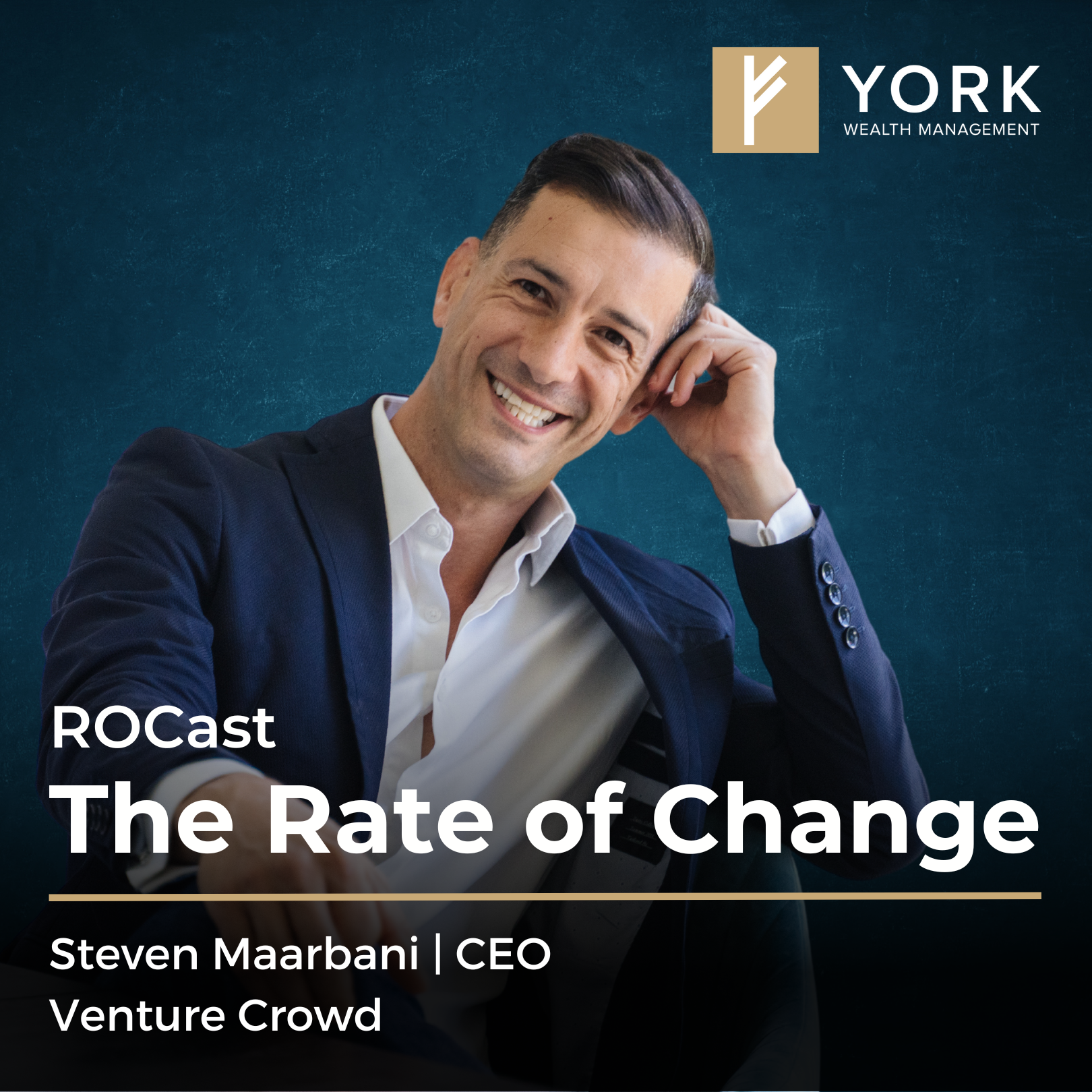
S1 Ep 36#36 - Steven Maarbani | How Crowdfunding is Reshaping VC & Real-Estate
Steven Maarbani is the CEO and Co-founder of VentureCrowd. Steven shares the story of VentureCrowd’s evolution, beginning in 2013 as a venture capital-focused tool and expanding into a multi-asset investment platform. This transformation, supported by the 2017 legalization of crowdfunding in Australia, has opened access to traditionally restrictive deals—an approach that, according to Forbes, aligns with the changing investment preferences of younger generations.Steven brings extensive experience as a corporate lawyer and former partner at PwC, where he guided founders, high-net-worth individuals, angel syndicates, and venture firms through the complex deal-making process.Steven shares the story of VentureCrowd’s evolution, beginning in 2013 as a venture capital-focused tool and expanding into a multi-asset investment platform. This transformation, supported by the 2017 legalization of crowdfunding in Australia, has opened access to traditionally restrictive deals—an approach that, according to Forbes, aligns with the changing investment preferences of younger generations.Throughout the ROCast, Steven provides insights into how VentureCrowd is democratizing investment opportunities and reshaping private markets. We discuss the evolution of crowdfunding, the digitization of private capital, and how platforms like VentureCrowd are influencing the future of investing. Steven also highlights the importance of syndication, the growing role of secondary markets, and his vision for a more accessible and efficient investment landscape—making private markets more attainable and appealing to younger generations.So, before we get into the conversation, please remember this podcast is made for entertainment purposes only. I encourage you to listen to the disclaimer at the end of this ROCast and to keep your feedback coming.You can reach me at [email protected] that being said, hope you enjoy this conversation as much as I did, so sit back relax and enjoy.