How the Plebeians Got Their Groove Back
No war to fight? No grumpy neighbours to quibble with? Whatever shall Rome do? One thing's for sure, it's a good time to be a plebeian!
The Partial Historians · The Partial Historians
Audio is streamed directly from the publisher (sphinx.acast.com) as published in their RSS feed. Play Podcasts does not host this file. Rights-holders can request removal through the copyright & takedown page.
Show Notes
In this episode we dig into the details (or lack thereof!) of 425 and 425 BCE. Good news for the plebeians is that when there's not much going on in Rome, they get a chance to just live life a little!
Episode 136 – How the Plebeians Got Their Groove Back
What's in a tribune?
What’s the deal with military tribunes with consular power? We consider the etymology of tribune (the Latin tribunus) to better understand this facet of the political structure. This also means tackling the big question of: who were the magistrates in this period of history and how much can we take from our later writers like Livy and Dionsysius of Halicarnassus?
Games, glorious games!
The time is ripe for Rome to hold games in honour of the gods. There's no battle to be had and diplomacy in the local region seems to be taking a turn for peace. What better time to invite everyone over for some sport and festivities?
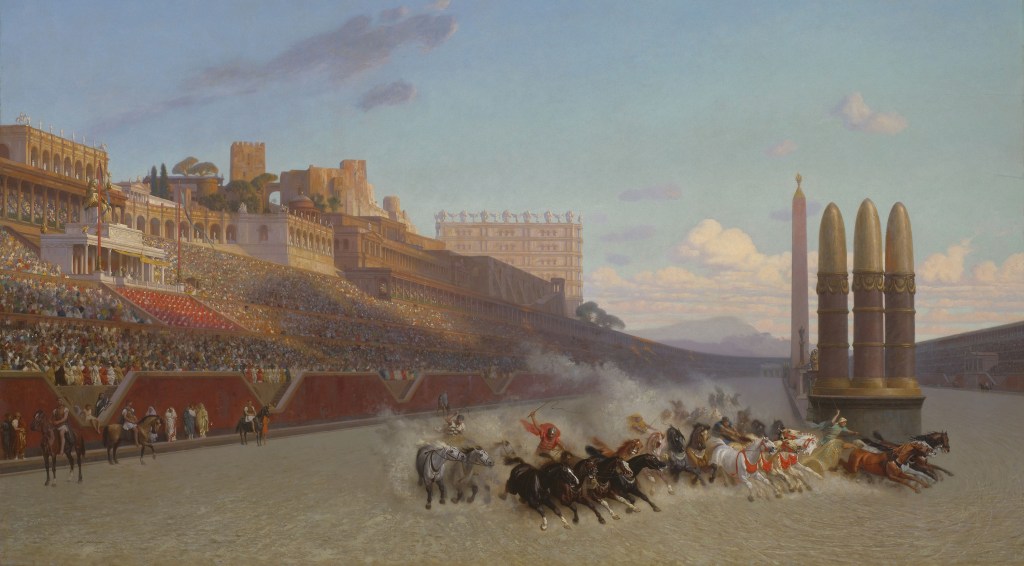
Jean-Léon Gérôme 1876. Chariot Race.
This is an imagined scene of a Roman chariot race at the Circus Maximus at the height of Rome's power (we're not up to that point in Rome's history in this episode!). The Circus itself is thought to be significantly old – dating back potentially as early as the kings.
Things to listen out for
- The horrifying lack of detail from the sources Dr G has to study
- Livy writing a history of peace rather than war
- Shocking revelations about Igor's (our resident eagle) paycheck
- The return of the Claudii.
Our Players 425 BCE
Military Tribunes with Consular Power
- Aulus Sempronius L. f. A. n. Atratinus (Pat) – Cos 428b
- Lucius Quinctius L. f. L. n. Cincinnatus (Pat) (Broughton Cin. *3) – Cos 428b, military tribune with consular power 438
- Lucius Furius Sp. f. – n. Medullinus (Pat), Military tribune with consular power in 432
- Lucius Horatius M. f. M. n. Barbatus (Pat)
Our Players 424 BCE
Military Tribunes with Consular Power
- Appius Claudius Ap. f. Ap. n. Crassus (Pat)
- Spurius Nautius Sp. f. – n. Rutilus (Pat)
- Lucius Sergius C. f. C. n. Fidenas (Pat) – previously cos. 437, 429; military tribune with consular power 433
- Sextus Julius – f. – n. Iullus (Pat)
Our Sources
- Dr G reads Diodorus Siculus 12.81.1, 12.82.1
- Dr Rad reads Livy ab Urbe Condita 4.35.
- Broughton, T. R. S., Patterson, M. L. 1951. The Magistrates of the Roman Republic Volume 1: 509 B.C. – 100 B.C. (The American Philological Association)
- Cornell, T. J. 1995. The Beginnings of Rome: Italy and Rome from the Bronze Age to the Punic Wars (c. 1000-264 BC) (Taylor & Francis)
- Drogula, F. K. 2017. ‘Plebeian Tribune and the Government of Early Rome‘ Antichthon 51: 101-123
Sound Effects
Thanks to the fabulous Bettina Joy de Guzman for our theme music. Additional sound effects from BBC Beta.

Greek black figure vase of a charioteer with four horses.
This Athenian vase is obviously not a Roman artefact, but it's thought to date to c. 410-400 BCE which is very close to the period we explore in this episode. Gathering together for games and chariot racing was common across the Mediterranean. The Roman were likely inspired or influenced by ideas for games and races from the Greeks and the Etruscans.
Automated Transcript
Dr Rad 0:16
Welcome to The Partial Historians.
Dr G 0:20
We explore all the details of ancient Rome.
Dr Rad 0:23
Everything from the political scandals, the love affairs, the battles waged, and when citizens turn against each other. I'm Dr. Rad.
Dr G 0:34
And I'm Dr. G. We consider Rome as the Romans saw it by reading different authors from the ancient past and comparing their stories.
Dr Rad 0:43
Join us as we trace the journey of Rome from the founding of the city.
Hello, and welcome to a brand new episode of The Partial Historians. I'm Dr. Rad and this intelligent, ravishing creature next to me is
Dr G 1:06
Dr. G. Yay, I feel very complimented. Is it my sequined dinosaur t shirt?
Dr Rad 1:12
I mean, if that doesn't scream, intelligent and ravishing, I don't know what
Dr G 1:16
Ah, you're so kind!
Dr Rad 1:19
So I'm thrilled to be back that back again, in the studio, talking about Ancient Rome with you.
Dr G 1:26
Yeah we've been exploring Ancient Rome from the foundation of the city. And we are well into what is the early republic at this point, it's a roundabout 425
Dr Rad 1:38
It is
Dr G 1:38
BCE
Dr Rad 1:39
I feel like we've really raced ahead suddenly, like for a while, it was just like moving through slow setting cement. So I didn't feel like we could get out of the middle of the fifth century BCE. And here we are, we are getting so close to a new century.
Dr G 1:55
Things are speeding up. And I think we have to thank our missing source material,
Dr Rad 2:00
I was gonna say, probably not a good thing. It's the fact that everything seems to be a little bit blancker.
Dr G 2:07
There are a lot of fragments. But before we get into 425, and maybe what we could possibly know about it, let's do a little bit of a recap of where we're up to. And just think a little bit about 426. And where the land lay at that point.
Dr Rad 2:23
Well, it's a difficult one, because to give a recap of 426, Dr G, is but to give a recap of a 437 as well.
Dr G 2:33
It's a tough time in our Roman source material. And it's centered around this guy, all this Cornelius Cossus, who is most famous in all of Roman history for being one of the three Roman generals to achieve taking the spoila optima.
Dr Rad 2:50
I feel like that should have been a sign to them that they were maybe making it too high.
Dr G 2:57
All of Rome, only three men, well, maybe. But it's really challenging because it has to be somebody who is in the military in a significant position, taking down the enemy leader directly. So it's a commander taking out a commander, basically in single combat in amongst a whole other battle going on around them.
Dr Rad 3:20
And it makes it even more difficult because technically, he may not be that person, because he doesn't seem to matter, potentially, when he did this.
Dr G 3:30
Awkward awkward, like 426 is one of the years. He also could have done it in 428 when he was actual consul that would make narrative sense to me. Yeah. And that's the that's the date I would hone in on. But it could also have been as early as you say 437 – 438 as well. Yeah, so everything's a little bit hazy.
Dr Rad 3:49
But the bigger context for who all is Cossus. Sorry. Aulus Cornelius Cossus was fighting is Veii.
Dr G 3:57
Yes. Yeah. He's fighting the Etruscans. Yeah. And Rome at this point in time, the big picture is that Rome is sort of finding its way with its neighbors, like, how does it sit within the broader Italian landscape? Where do they do their strength lies? Who are their allies? Who are they against, and they're now butting up really closely against the Etruscans. And the city of Veii is the southern most Etruscan city we know of, and it is a mere 15 or 20 kilometers from Rome itself. And, you know, a good day's march – hard and fast – and you'll get there and you'll be ready to fight them by the next breakfast.
Dr Rad 4:34
Absolutely. And it also that conflict was they seem to be pivoting on the question of Fidenae, I think in whatever you're talking about. But in this past decade, it seems to be a real sore spot that this colony of Fidenae really wants to be sided with the Etruscans and every time they decide they're going to make the switch to room conflict ensues.
Dr G 5:00
Yeah, it's a tragic time Rome has convinced that Fidenae is theirs
Dr Rad 5:04
Yup
Dr G 5:04
And Fidenae is apparently a Roman colony from way back, depending on how you look at it. And Fidenae has defected they've thrown their lot in with the Etruscans. And Rome is less than pleased.
Dr Rad 5:17
Absolutely, they're not gonna take that. So as a result, we had a lot of military action in 426 BCE, rightly or wrongly, this is how it's come across to us with the Romans after having a difficult start pulling through Yeah,
Dr G 5:35
Whoo.
Dr Rad 5:39
Yeah, so that's kind of weird. Sarcasm may not be detected. So that's kind of where I think we ended up at the end 426, which is actually refreshing. Because the early 420s BC were a little dull. I'm not gonna lie.
Dr G 6:01
They were but as as 426 concludes, it feels like we've maybe reached the conclusion of a certain level of the combat because if the king of Veii, Lars Tolumnius has not died up until now. We think he must be dead by this point in time. Yeah. So that brings us to
Dr Rad 6:23
The extended deadline. Sorry, that brings us to
Dr G 6:29
425 BCE.
Welcome one and all. Roll up, roll up for 425 BCE.
Dr Rad 7:18
Oh, yeah. Yeah.
Dr G 7:22
Dionysius of Halicarnassus is missing.
Dr Rad 7:25
Party on, Livy is not!
Dr G 7:28
The Fasti Capitolini are missing.
Dr Rad 7:31
Oh, really?
Dr G 7:32
They are. They've been missing for a little while now. And that?
Dr Rad 7:34
Well, you kept that quiet.
Dr G 7:37
I mean, there's there was no point to mention them. So this year, I have four military tribunes with consular power.
Dr Rad 7:44
Now, I would love for you to tell me their names, Dr G. But before you do that, I would like to pause because I was talking with a learned gentleman the other day, who asked me to explain where the title of tribune actually comes from.
Dr G 8:03
And it's a good question because it does have “tri-” in it. So a group of three, but we can already see with the plebeian tribunes that, maybe it depends.
Dr Rad 8:13
Sure. And I think it also has this link to the fact that Rome, that having at least according to their own history, Rome was organized into tribes. And so “tribune” was often a title given to someone who was the leader of some sort of group that had something to do with the tribal organization. And if we think about what you were saying in terms of the number and that idea of where does the word tribune comes from? Romulus originally divided the population of Rome up into three tribes, correct?
Dr G 8:42
Yes, correct. Yes.
Dr Rad 8:44
And so this is a title that a lot of people get in some form or another. So for example, obviously, we've got the tribune of the plebs. Now, we don't think that the tribune of the plebs have a particularly strong connection to the tribal structure to the ancient tribe. Yeah, no, we don't think so. But it makes sense, obviously, that they are presiding over a body where people are organized, it is a tribal assembly, essentially, that they presiding over as well. So there's a connection there. It's also just a say a word that the Romans start to use for these people who are leading some sort of tribal group. And I'd say it's also something that therefore, the more they get into the habit of using that for these people, the more that the practice of using that term, obviously, continues on. And then obviously, when we've got military tribunes and military tribunes refer to leaders, obviously, of a particular army group. Again, probably very early on in Rome's history, there was probably some sort of tribal organization to the group that they were commanding, but eventually it doesn't have anything to do with that, but the title stays.
Dr G 9:49
Yes, yeah, the meaning changes, but the would remain where it lives on.
Dr Rad 9:53
And so obviously military tribunes with consular power is, you know, apparently the Romans putting this idea of well plebeians they don't have the auspicium to be, you know, they can't be a consul like the patricians can, we have the auspicium we you know monopolizing all the auspicium that's out there, so you can't hold that position and therefore they give it they've used this position this military tribunes and given it the you know the authority or the power of the consul without giving it the actual consulship. So yeah, it's a very fine line isn't so complicated try and explain.
And yet for all of the explanations that are put forward for the idea that these military tribunes with consular power should open up the position to people who aren't necessarily patrician, what we tend to find is that they're largely patrician.
Yes. And see, I was really it's really interesting article the other day, which puts forward this argument that at this point in Rome's history, this idea of consuls, praetors, military tribunes with consular power, it's just nearly allies, because this person was saying that it seems as though Rome, obviously, is, as we've been talking about as much of the stuff that we've been talking about, I suppose, but taking it a little bit further, that Rome has this narrative that they got rid of the kings, and then they seamlessly transitioned into this Republican system, which is suspiciously similar to the late Republic.
Dr G 11:33
Yeah
Dr Rad 11:33
Yeah. And that, in this in this particular context, in early Rome, this person has suggested that actually, there are no senior magistrates, so consuls, praetors, military tribunes with consular power, it doesn't exist at this point in time. It's something that exists a bit later, probably about if we're at 425 right now, probably, what about 80 years, that's when we start to see the appearance of these sorts of things. And that really, we've just got patricians, which is much what we've seen monopolizing power. So because they are wealthy, they have resources, they have clients, they've been able to monopolize power in the countryside. And if we look at the names that the tribes have been given out in the countryside, like outside of the pomerium, outside of the city of Rome itself, they kind of reflect the power that these people hold. So like they might be named after a particular gentes. So like, Aemelia, or whatever. And then if we look at the tribes within the city, that's not the case. It's the tribal names are more reflective of like, where you live, you know, it's like the Palatina or something like,
Dr G 12:40
Yeah, look, I think it's pretty fair to take the position that the way that state structures form is slow. And it's a process. And things are not necessarily set in structures that make sense. And structures have to alter and change.
Dr Rad 13:01
Yup
Dr G 13:02
And adapt to situations. And part of the challenge for historians is that there is very few ways for us to get closer to what actually may have happened in the past than we already are.
Dr Rad 13:18
Yeah, for sure.
Dr G 13:19
And so these written sources that we're relying on, whether it's the fasti, whether it's Dionysius or Livy, these people are doing the best they can, I like to give them the benefit of the doubt – doing the best they can with the information that they have at hand. But the way that information is kept and conveyed over time is problematic. Yeah. And it's not rigorous in the same way like we live in this internet age where we have an overabundance, if you like of information, yeah, that doesn't mean that it's easy to access the information that is actually useful, and, and good and true. Yeah. And we know that truth is a multiplicity, depending on your subjectivity. So if we take all of those ideas that we understand into account, the complexity of what's at play here is far beyond what we're going to be able to discern from the source material. Yeah. And there's lots of things that we don't know. So the best that we can say in this sort of case is that, yes, you know, something like the name “tribune” has a couple of different sort of etymological connections that it could draw upon to make it make sense. But at the same time, it's clearly in use, and when language is in use, meanings change and adapt to the necessity of the moment.
Dr Rad 14:33
Absolutely.
Dr G 14:34
Not holding true to the etymology of how it originally came about.
Dr Rad 14:39
Yeah. And I think this is the thing I as you say, I don't believe I mean, I like to say “Liza Minnelli lies”, but I don't think that as you say that they're totally making this up, doesn't mean that these people that we're talking about didn't exist. It doesn't mean that the actions they took weren't taken, the events didn't happen and that sort of thing. I think it's kind of more the maybe the top titles that people held and that sort of thing, or the idea that maybe that the state was quite so formalized, which is something that we have been talking about for a really long time in this early Republican period. And I kind of I must admit, I was kind of convinced by the idea that when you look at the, even in the, in the periods where we're a bit more convinced of the fact that like the consulship, or the apprenticeship or whatever the title was given did exist, the kinds of things that those people would do are military. This idea that you might have a division of power between civilian and military positions, and therefore, these people that we're talking about, like, there's no doubt that there were people out there wielding military power. Definitely the patricians held that.
Dr G 15:45
I mean, it seems likely.
Dr Rad 15:46
It seems very likely. I mean, that makes total sense. And therefore this idea that, you know, these guys are the ones commanding the armies makes 100% sense. It's a good question, I suppose is, do they actually hold this formalized position? And are they quite as dominant inside the city as the sources sometimes make it sound? Because what this article was arguing was more the fact that it was probably more like minor officials who are doing the sort of day to day governance kind of stuff. So the people who are you know, like the neighborhood leaders, I think they're called like the things like the curio maximus or something like
Dr G 16:24
Oh, yeah, I love a good curio maximus.
Dr Rad 16:27
Yeah. So like, like neighborhood leaders and and people who hold slightly more localized positions, who are keeping things running on the inside of the city, because of course. Rome does have this really interesting ban on military power inside the pomerium. You know, the fact that the fact that military assemblies that generals, soldiers, they all have to say outside of the pomerium, and it means that whilst the patricians might be able to throw their weight around in terms of military matters, they need a different outlet for that inside the city. And that comes back to what we've talked about before in terms of them potentially dominating the priesthood. And therefore being able to keep control over things like war, and judicial matters through there, kind of just cutting of the knowledge around how things actually work. And so a lot of the stuff that we've said makes sense. It's just, it just maybe you take away the sort of official titles.
Oh yeah, we've got no guarantees on titles around here.
But I just I just thought that was interesting, because it's so hit the mark with so many of the things that we've been talking about, in terms of the fact that like, these ideas, and these structures probably come in later, but you can still see the events happening. And, you know, the patricians and plebeians potentially having issues of tension around who has power and the tribune of the plebs coming out of that, in terms of being able to provide protection, particularly the tribune of the plebs being connected to the city of Rome, where the patricians don't have that military power. It just, it was just really interesting to sort of see that all coming together. In one article, which I was like, Yeah, this makes this makes sense to me.
Dr G 18:12
Ah look, and I think this sort of thing is really important, because we're not sure how, how the Roman state really develops, like, you know, they they tell this history about themselves? Yeah. And that's fine. And we're going through it and sort of, you know, delving into it as we go along. But we're not sure about consuls at this point in time. We're not sure about tribunes at this point in time, we're not sure about the social division between the petitions and the plebeians as even being a plausible thing at this time. And so we're dealing with a murky history of Rome, where Rome, leader Romans are trying to interpret and understand themselves by sort of like retrojecting, like what would be the previous steps? Yeah. What would make sense for this thing to exist now? And they sort of they see it as a gradual sort of process. But it's open to interpretation.
Dr Rad 19:12
I think, I think the base story 100% make sense, which is you've got powerful, a powerful aristocracy, which is able to assert itself and remain dominant for some time once you no longer have a king. Yeah, because there's no, there's no one keeping them in check anymore. And then you have the people reacting against abuses of power and corruption. And that's where you get the birth of something like the tribune of the plebs. And luckily for them, the tribunes of the plebs. Well, luckily, I mean, that's not a coincidence, but with the development of the tribune of the plebs developing that power of or that oath being taken to protect them physically, you know, so making them in violet It offers them a level of protection, particularly because they are based in the city.
Dr G 20:06
You might not be able to have a sword in the city, but nobody can stop you getting beaten up unless we say so.
Dr Rad 20:11
Yeah exactly. But that idea of there being protection and the fact that the Romans, who are the elite, they can't just bring their soldiers in and kill these guys. I mean, if you think about this article, make the point. That's really annoying, because I want this guy. Well, they're making the point of like, how easily did they get rid of Spurius Maelius? Well, pretty easily, pretty much he wasn't attributing but I think they broke the state to do it. Well, sure. But like, at the end of the day, they got rid of him pretty easily. And he wasn't a tribune, he was just like a guy that that was making trouble for them. Why wouldn't they do that with the tribune unless they are respecting this?
Dr G 20:46
Yeah, but we also don't know when tribunes becomes inviolable,
Dr Rad 20:49
I know
Dr G 20:50
And we also don't really know when the pomerium becomes the be all and end all of entering or not with a sword.
Dr Rad 20:56
No, but it just it just made. It just made sense to me in the sense of like, the fact that there are more tribunes, it seems than there are, say consuls, like if we're going by the official
Dr G 21:06
Oh, yeah.
Dr Rad 21:07
Two consuls.
Dr G 21:07
And I think part of this and we will get on to those military tribunes. I'm not going to leave you hanging
Dr Rad 21:13
Pause for the longest digression known to man. Hi Herodotus!
Dr G 21:17
Hello, hello. We'll come back to those guys in a sec. But the thing with the military tribunes with consular power, is that it is clear that even from the like the long distance of looking back over like 300-400 years of history, yeah, that people in the late Republic understood Rome as not being an all powerful entity right off the bat, for sure. It is a city of struggle. Yeah. And it is not just a struggle, which results in having to exile kings and getting rid of the whole idea altogether. It's a struggle to build a workable idea of how a state looks if it's not run by one person.
Dr Rad 21:59
Yeah, absolutely.
Dr G 22:00
They really struggling to figure out how to do it. And they're being pressed at this point in time from all sides. Everybody around them wants nothing to do with them. It is a constant jostling. And it seems like every city state, essentially because you could think of them as sort of isolated states, that they're all struggling for their and jostling for their position in central Italy right now. And Rome is just another city trying to do its best.
Dr Rad 22:28
Oh, yeah, absolutely. And that's what's I mean, this, this kind of made sense to me. And also, I mean, also the idea that Rome will continue to be struggling to assert itself for quite some time. And the idea that consuls are a good idea that consuls and praetors don't really develop a strong connection to like civil administration and civil governance until quite some time later, because they're still dealing with all his military stuff. Like that's still their main point of existence and still there.
Dr G 23:02
Yeah, you gotta have that imperium. You know what I'm saying? You gotta have it.
Dr Rad 23:05
Yeah, yeah, exactly. And I was like, Yeah, you know that that is true. And the fact that tribune of the plebs obviously become, you know, so powerful, but again, over time,
Dr G 23:16
Yeah, very much over time, and we see them struggling here.
Dr Rad 23:22
Digression done, thank you for indulging me
Dr G 23:24
It was a pleasure. Always always interesting. So military tribunes with consular power it's 425 BCE. Yeah. Who have we got riding that wagon? Well, Aulus Sempronius Atratinus.
Dr Rad 23:39
A name I've heard before
Dr G 23:40
Yes, you might remember him as being part of the suffect consulship in 428. Lucius Quinctius Cincinnatus.
Dr Rad 23:51
Another name is very familiar, but not the guy that you're thinking of.
Dr G 23:54
Also suffect consul 428. Lucius Furius. Medullinus, military tribune with consular power in 432. And Lucius Horatius Barbatus nobody's ever heard of him before.
Dr Rad 24:13
But we have heard the name Horatii
Dr G 24:16
We have, but it's it's interesting to me that we've got three out of our four military tributes people who have either previously held the consulship or the military tribunate with consular power. Yeah, previously true. So which makes me think Rome is in dire straits this year, because they've only picked really experienced dudes to come back into the situation. interesting take on it. Yeah, except for Barbartus, the bready one who you know might be somebody's protege.
Dr Rad 24:45
Okay, well get ready to be blown away, Dr. G, by what am I about to tell you based on Livy's account?
Dr G 24:50
Oh, yeah.
Dr Rad 24:51
Are you ready for it?
Dr G 24:51
I am.
Dr Rad 24:52
Can you handle it?
Dr G 24:52
I don't know.
Dr Rad 24:54
Well, let's let's see. Alright, so 425. Livy tells me that Veii was granted a truce that was supposed to last for 20 years. And the Aequians were granted a truce of three years now. They had wanted more. But that is all there we're going to get from Rome. And that's it.
Dr G 25:17
That's it?
Dr Rad 25:18
That's it. Explicitly he says there were no foreign problems and no domestic problems. That is it.
Dr G 25:25
Wow. All of that experience in the military tribunate and for what?
Dr Rad 25:30
Well, this is why I was curious. I was like,
Dr G 25:35
Just you wait,
Dr Rad 25:37
Do they need all this experience? I don't know that they do.
Dr G 25:41
I mean, maybe I mean, I understand that, you know, the war with Fidenae has been concluded because you know, they they shoved a whole bunch of the troublemakers into Ostia, we populated Fidenae with some Romans, we like you to behave yourselves now.
Dr Rad 25:54
Yeah. And then there was slaughter, so much slaughter.
Dr G 25:58
But I didn't realize that the situation with Veii was coming about. So I did a bit of a timeline. A recap. Oh, okay. Yeah, cuz I've got nothing to talk about. I've no source material.
Dr Rad 26:08
Go for it.
Dr G 26:08
I mean, I've got Diodorus Siculus, who, you know, questionable, and
Dr Rad 26:11
You may as well have no sources.
Dr G 26:13
Oh, I like that man, but he's very focused on the Peloponnesian War. But to just do a bit of a backstory and Fidenae. And what's been going on in 438, Fidenae defects from Rome. That is the crucial moment. And apparently this is on the advice of the king of a Lars Tolumnius. Like, wow, you know, I saw… I saw this situation and I think you should defect. And it's at that point that Fidenae follows what appears to be a trust and advice and slaughters the Roman ambassadors.
Dr Rad 26:45
Yeah. Who could forget? Who could forget the headless men.
Dr G 26:48
The statue still stands. Yeah. When Dionysius and Livy are writing, yeah. 437: There is there is war, war begins. Rome is not having anything to do with this. And depending on which source you read, and where you are in the timeline, this is exactly when Cossus killed Lars Tolumnius and deals with that situation.
Dr Rad 27:07
Excellent.
Dr G 27:08
We think that might be not true. 435 – we have the dictator Quintus Servilius, who captures Fidenae by tunneling under the Citadel. Yep, thrilling stuff.
Dr Rad 27:20
I did like that. That was strategy. You know, that was real strategy.
Dr G 27:23
One year, one tunnel later. And it doesn't last though. So in 434, we've got Mamercus Aemelius appointed dictator, because of the threat from Veii. And this is, you know, the tension between the Fidenae and the Veii situation. All connected.
Dr Rad 27:43
It fizzles out ,right?
Dr G 27:44
There. It is a bit of a fizzer.
Dr Rad 27:45
Yeah.
Dr G 27:46
428: Cornelius Cossus consul. Yep. The Veii people are raiding Roman territory. I mean, they've got lots of ways of saying.
Dr Rad 27:57
It just sounds funny.
Dr G 27:59
The people of Veii. And Rome dispatches a triumviral commission to investigate Fidenae's participation in the raids. led by Veii. 427: yeah, Rome sends out the fetiales to demand redress from Veii,
Dr Rad 28:18
Ah who could forget?
Dr G 28:20
And then declares war, because they do not get redress
Dr Rad 28:23
Jupiter as my witness
Dr G 28:25
426: Cossus and three other military tribunes, Mamercus Aemelius, dictator for the third time; Cossus is master of the horse. It's all happening. They defeat Fidenae and Veii. Yeah, so that's like the previous year. And now it ends with a truce. And now it's truce time.
Dr Rad 28:43
Really long truce. 20 years?
Dr G 28:46
Well, I mean, at least a 10. And a bit.
Dr Rad 28:49
No, no, the truce is 20.
Dr G 28:51
Oh, it's much longer than the conflict.
Dr Rad 28:53
That's what I mean!
Dr G 28:55
We'll see if it lasts. Yeah, yeah. So apparently, there's three surviving monuments in Rome to this conflict with Fidenae. So we do think it has some historical basis beyond…
Dr Rad 29:05
The question is, did it last over this length of time? Or is it something that just happened at one of these points in time? And the Romans are confused?
Dr G 29:16
I think it would make sense for it to be a prolonged conflict.
Dr Rad 29:19
But this length, this length, or in this order, or in this order?
Dr G 29:23
Well, I don't know if Rome is a capable military force right now. I mean, they want to be but you know, sometimes it doesn't work out.
Dr Rad 29:29
They think that's why they get so annoyed when they don't do well like last episode.
Dr G 29:33
So there's the statue commemorating the four Roman ambassadors who
Dr Rad 29:38
Possibly headless, not sure.
Dr G 29:41
Yeah, we'd have to find the statue. Yeah, and then be like, Oh, no, that heedlessness is a deliberate artistic choice. We've got the spoila optima won by Cossus, which is attested in the time of Augustus. He says
Dr Rad 29:53
By Augustus himself
Dr G 29:54
He says he's seen it so I wouldn't want to disbelieve Augustus because risk of death is high.
Dr Rad 29:59
God knows he never lies.
Dr G 30:02
Don't be like that about my favorite. There is a golden crown that is also apparently dedicated in the Capitoline temple.
Dr Rad 30:09
Well, that's right, because the dictator was made to dedicate it, apparently in 437.
Dr G 30:14
Yeah. So all of these physical objects that attest to oh, look, the history,
Dr Rad 30:19
I have no doubt there was conflict with Veii. But it's just a question of, like, as I say, like did it all happen when they're saying how they're saying.
Dr G 30:27
Yeah, well, I mean, who can say but that's all I've got for this year.
Dr Rad 30:30
Fair enough. All right. Let me take you on to 424 then.
Neil – History Hound 30:40
Hello to listeners of the Partial Historians, and thank you to the Partial Historians. My name is Neil and I'm the host creator and pretty much everything of the Ancient History Hound Podcast. I'm all about ancient history, and this includes ancient Greece, Rome and other cultures from antiquity. I cover a wide range of topics. I'm sure there's something for you, but why not find out for yourself? Ancient History Hound is probably on the platform you're using right now. So come and find me and have a scroll through the episodes. I reckon there's something there for you. And it'd be great to have you join me.
Dr Rad 31:19
In 424, we once again have military tribunes with consular power. So who have we got Dr. G?
Dr G 31:27
We have Appius Claudius Crassus. Yes, Appius Claudius returns. This is the son of the infamous decemvir. Yeah, this family well, they don't know when to quit.
Dr Rad 31:41
I knew it wasn't the decemvir.
Dr G 31:43
No he's done.
Dr Rad 31:44
He died shady circumstances.
Dr G 31:46
But his son was allowed to survive and thus the line of Claudii is perpetuated.
Dr Rad 31:53
Look, I'll only be okay with that because eventually it'll give me my favorite topic to study: The Julio-Claudius
Dr G 32:00
Tiberius.
Dr Rad 32:02
There's a lot more to the Claudians than just Tiberius. Livia, huh? She marries into it but whatever.
Dr G 32:11
Spurius Nautious Rutilus, a patrician,
Dr Rad 32:15
Yep.
Dr G 32:15
Lucius Sergius Fidenas,
Dr Rad 32:15
Ah the hero Fidenae.
Dr G 32:19
Yeah. Previously consul in 437 and 429, military tribune with consular power in 433 – fancy. All right. And Sextus Julius Iullus.
Dr Rad 32:35
Still think that name should not be allowed to exist. Just sounds all shades of wrong.
Dr G 32:40
Iullus?
Dr Rad 32:40
Yeah. No just like the the Julius Iullus.
Dr G 32:44
Ah, yeah, it doesn't. Oh, it doesn't flow off the tongue.
Dr Rad 32:47
To be honest, it sounds like I'm making fun of him. And I'm not.
Dr G 32:51
It's his name.
Dr Rad 32:52
Yeah. All right. Well, you'll be relieved to hear I do have a little bit more detail from Livy in this year.
Dr G 32:58
Oh, that's exciting. So I mean, Dionysus is predictably missing.
Dr Rad 33:02
Okay. Yeah, I was prepared for that this time.
Dr G 33:05
As is the fasti Capitolini. I have some Diodorus Siculus.
Dr Rad 33:09
Okay. Tell me what it is. I'll tell you what's wrong.
Dr G 33:13
Well, there's some seems to be some question mark over the praenomen of Appius Claudius. Is it Appius? Or is it Titus? Hmm. Diadorus, says Titus. And as we know, Diodorus is often wrong.
Dr Rad 33:33
Look, if I know anything about the Romans is that they are very unimaginative within names.
Dr G 33:39
This is true. So I mean, time is is a possibility. It's within the remit of like well known Roman praenomens. But Appius Claudius makes sense as if he is the eldest son of Appius Claudius, the decemvir.
Dr Rad 33:53
Exactly.
Dr G 33:54
Yes. You always just call your kid your name, and hope for the best.
Dr Rad 33:58
And if we know anything about Appius Claudius the decemvir, it is that he is an egomaniac. So I think
Dr G 34:07
Maybe all of his sons are called Appius Claudius.
Dr Rad 34:10
I wouldn't put it past him, Dr G.
Dr G 34:11
Appius Claudius Secondo?
Dr Rad 34:14
Yeah, I think it makes sense. The name would be Appius.
Dr G 34:19
And that's pretty much it. Diodorus Siculus does an alright, job on a couple of other names. Okay, and also gets another one slightly wrong, so it doesn't really merit going into it.
Dr Rad 34:31
All right. Okay. Well, 424 begins with Livy telling me that once again, there are no issues within the city of Rome and no walls to be fought outside of the city. Which makes me wonder, Dr. G, is Rome losing its edge?
Dr G 34:50
Or is Dionysius not writing about things he's not missing? It's just that nothing happens. So he doesn't say anything.
Dr Rad 34:56
You know what? That's actually a very intelligent suggestion.
Dr G 35:01
Okay, wait a minute, I have a new topic I could write about
Dr Rad 35:04
You do. Alright, so the only thing that's really happening is a nice thing. It just goes to show how little this happens. I feel really uncomfortable talking about this because it's just so rare that we record something nice. History recording only the bad stuff since the BCEs.
Dr G 35:23
I'm really intrigued, what nice thing has been recorded?
Dr Rad 35:26
There are some games happening. Dr. G.
Dr G 35:28
Oh, well, they're not very nice once you delve into them. I mean…
Dr Rad 35:32
Well, I mean, for the Romans they're nice.
Dr G 35:34
I mean, yeah, but it's like killing animals. It's not my cup of tea watching people die.
Dr Rad 35:41
At this point in time, at this point in time, gladiators another thing? I don't think
Dr G 35:47
No, no. But the what kind of games are they playing?
Dr Rad 35:51
Well, he hasn't given me an itemized list. There's no ferris wheel if that's what you're wondering. Yeah. So basically,
Dr G 35:58
There's a boat show on the Tiber.
Dr Rad 36:00
It's a fulfillment of a promise, Dr G. There had previously been games vowed during the war and the military tribunes are just fulfilling that promise. So lots of neighboring people from the area are included. Okay. They've gotten over the whole, you know, Sabine abduction thing.
Dr G 36:20
It sounds to me like it's going to have some chariot racing. That would make sense.
Dr Rad 36:24
yeah. And look, the Romans are determined to go all out. They want to be the hosts with the most.
Dr G 36:29
I said that last time, and we all saw what happened to the Sabine women…
Dr Rad 36:33
But this time, they really mean it. They're really laying it on thick. They want to be the most courteous game givers in the whole of their little limited area.
Dr G 36:42
Everybody come?
Dr Rad 36:43
Yeah. Now, I'm going to say the T word. It's time to talk about some tribunes.
Dr G 36:49
Oh, dear.
Dr Rad 36:50
Yeah. That's right. So plebeian tribunes, they decide games. Perfect time to cause trouble.
Dr G 36:58
Something does happen in this year
Dr Rad 37:00
Well Livy says it starts out that way, which makes sense, because it's continuation from the previous year, which was really boring.
Dr G 37:06
Fair enough. Fair enough. Okay. All right. I'll strap myself back in again.
Dr Rad 37:09
And maybe the tribunes are also thinking the same thing I am, which is that Rome is losing its edge. You gotta like shake things up a little bit. We're gonna cause some chaos. Yeah. All right. So they start making some speeches, which are clearly designed to rile people up. Okay. They're saying they're really angry with the people of Rome, because it seems like they adore the men that the attributes of the plebs themselves despise. And I presume that they're meaning the patricians? Yeah, it would make sense.
Dr G 37:43
Yes. I hate those guys.
Dr Rad 37:45
Exactly. And they're like, people are not rising up against these aristocrats.
Dr G 37:52
But I love a good chariot race. Can I do this revolution later?
Dr Rad 37:56
No, we can't. Shut up, Timmy. They're basically saying, Why aren't you guys seizing opportunities? You aren't running for military tribune with the c