
Classical Reception in Lil Nas X with Yentl Love
We sit down with Yentl Love to take a deep dive in the layered symbolism of the classical allusions in Lil Nas X's music video for 'Call Me By Your Name'.
The Partial Historians · The Partial Historians
Audio is streamed directly from the publisher (sphinx.acast.com) as published in their RSS feed. Play Podcasts does not host this file. Rights-holders can request removal through the copyright & takedown page.
Show Notes
We sit down with Yentl Love to talk all about classical reception in Lil Nas X’s 2021 music video for ‘Call Me By Your Name'. Yentl Love is the famous Queer Classicist and we recommend checking out her blog for accessible analysis of the ancient world. We are thrilled to have Yentl return to the show – you may remember her from the insightful conversation we had about the reception of Cleopatra.
Lil Nas X has enjoyed great success with his debut album Montero and we were keen to learn more about how he utilised allusions to the ancient world to drive conversations about black identity and queerness as well as to complicate ideas about the heroic and how we might derive meaning when we analyse the past.
It's definitely worth watching the music video before getting into the episode itself!
The ancient world has a wealth of symbolism and allusion that has built up and developed over time through the use and reuse of imagery and ideas and this conversation really just touches some of the potentials.
Special Episode – Classical Reception in Lil Nas X with Yentl Love
The Ideal Man
What makes the ideal man? Lil Nas X poses the question with a visual allusion to Doryphoros, the famous sculpture by the Greek Polykleitos, which is thought to represent the physical ideal in ancient Greek culture. Doryphoros was a favoured subjected in later Roman sculpture as well.
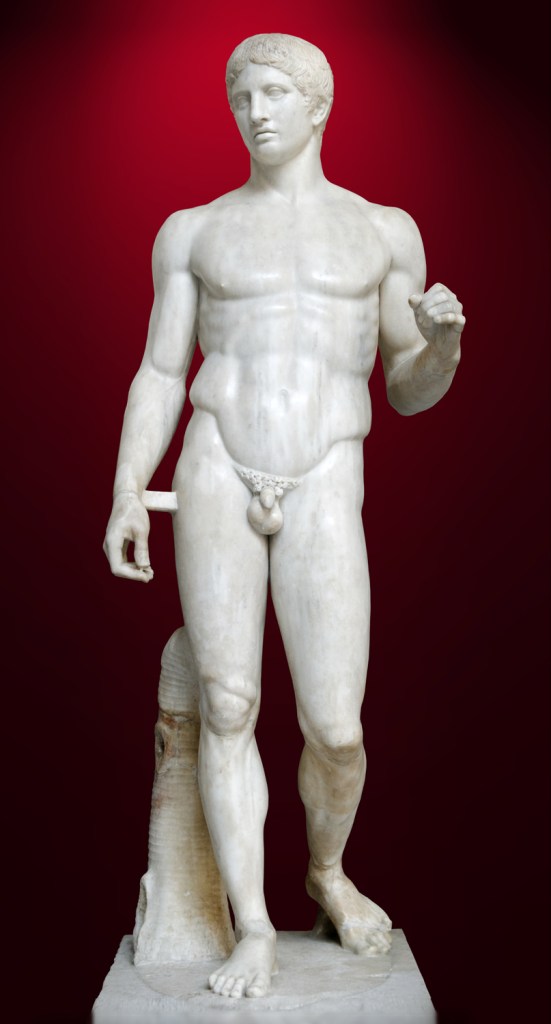
Doryphoros from Pompeii – A Roman marble reimagining of a Greek sculpture by Polykeitos.
Now in the MAN Napoli.
Architectural Influences
The opening of the music video provides a sweeping vista that on the surface has the appearance of paradise but is dotted with ruined buildings and structures. What could this mean? We ask Yentl's perspective.

Still from ‘Call Me By your Name' showing a Doric Temple in the foreground and an Aqueduct in the background
Just a regular symposium…
Famously, Plato's Symposium gets a shout out in ‘Call me By Your Name' with a quotation that roughly translates as “After the division the two parts of man, each desiring his other half…” We consider the significance of this phrase in context and enjoy the fact that every so often someone uses an ancient language in a modern setting!
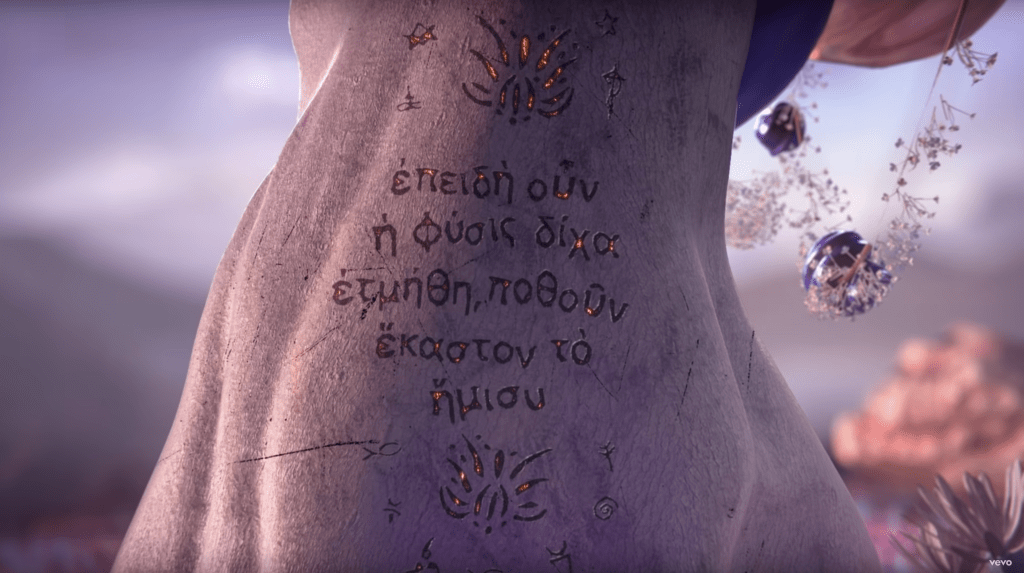
Still from ‘Call Me By Your Name' Ancient Greek from Plato's Symposium on the Tree of Knowledge
I like my hair like I like my Flavians!
As the music video progresses, we see Lil Nas X shift scenes to an arena. The hairstyles on display in this scene recall the gravity defying hair styles favoured by the Flavian dynasty.
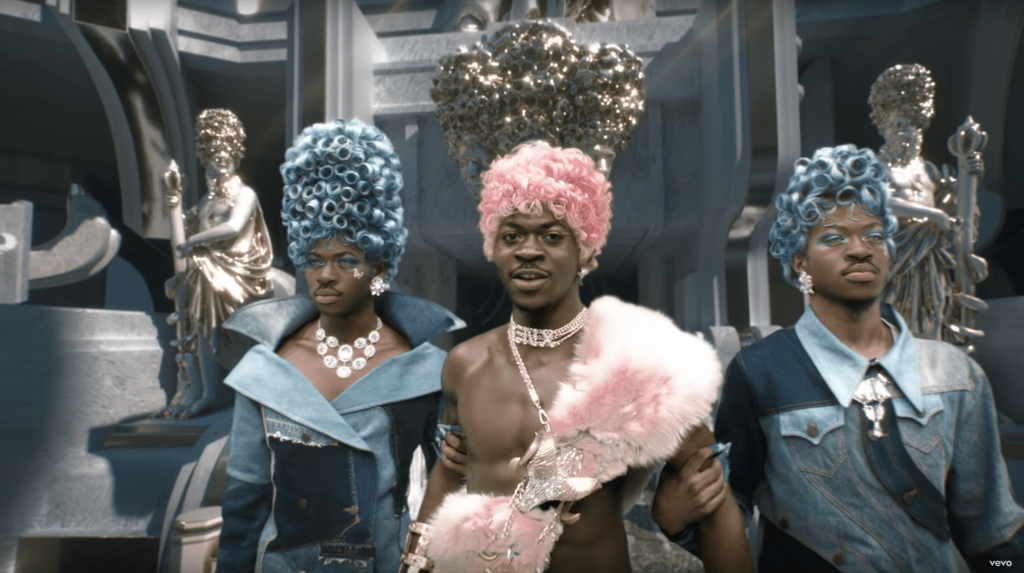
Still from ‘Call Me By Your Name' showing hairstyles echoing the Flavians
For comparison, consider the hair style of the portrait bust below. Although the identity of the subject is not certain, this piece is often identified as Julia Titi, the daughter of the Flavian emperor Titus. She was reputed to be a great beauty, but it's the very high ringlets that win the day here!
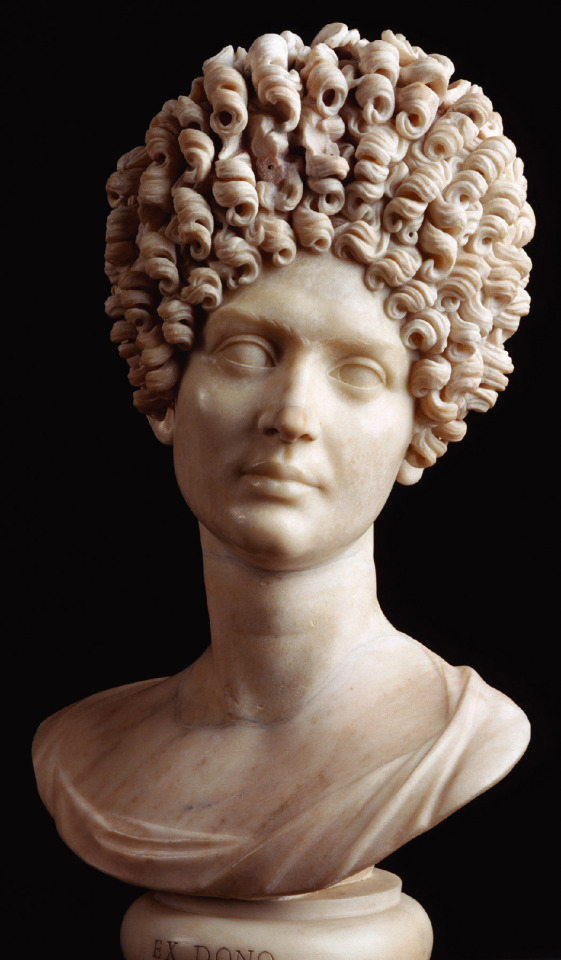
Portrait bust of a young woman with an extremely high hair style made of ringlets.
Capitoline Museum. Source: Tumblr
Things to listen out for
- Lizzo’s music video for ‘Rumors’
- Katabasis – a traditional heroic descent to the Underworld
- Nero taking a man as wife and also being a bride
- The sacred band of Thebes
- Hadrian and Antinous
- Correction – Dr G meant Patroklos not Paterculus when discussing Achilles!
Black women writers on Medusa
Interested in learning more about the writers mentioned in this episode? Consider the following:
- Dorothea Smartt on Medusa
- Listen to Dorothea perform poems from her catalogue here
- Shara McCallum’s “The Madwoman as Rasta Medusa”
Sound Credits
Our music was composed by Bettina Joy de Guzman.

Still from ‘Call Me By your Name' Music Video by Lil Nas X.
Notes that the video was directed by Tanu Muino and Lil Nas X, song produced by D. Baptiste, D. Biral, O. Fedi, R. Lenzo.
Automated Transcript
Lightly edited for clarity.
Dr Rad 0:12
Welcome to The Partial Historians.
Dr G 0:15
We explore all the details of ancient Rome.
Dr Rad 0:20
Everything from political scandals to love affairs, the battles waged, and when citizens turn against each other. I'm Dr. Rad.
Dr G 0:30
And I'm Dr. G. We consider Rome as the Roman saw it by reading different ancient authors and comparing their accounts.
Dr Rad 0:41
Join us as we trace the journey of Rome from the founding of the city.
Dr G 0:57
Hello and welcome to a brand new episode of The Partial Historians. I'm one of your hosts, Dr. G.
Dr Rad 1:06
And I am Dr. Rad.
Dr G 1:08
And we are thrilled to be joined today by Yentl Love, who is working on her PhD at Potsdam University and is universally famous for her blog as The Queer Classicist. Thank you so much for joining us.
Yentl 1:26
Thank you so much for having me. Yeah, I'm so glad to be back chatting to you more.
Dr Rad 1:31
So we're very excited because we're discussing something extremely cool. And actually, quite frankly, a little out of our comfort zone today.
Dr G 1:41
Yeah, look, I don't think we are known as paragons of popular music. Nevertheless, we were super fascinated to see the rise. And the continued rise, I think of Lil Nas X, and what he is doing with his musical journey. And it is a thrill to sit down today with anto to talk about one specific music video that has come through and his debut album, and that is Montero “Call Me By Your Name”.
Dr Rad 2:09
So let's kick it off with our first question. So let's think about maybe classical reception more broadly. Because of course, the video clip is kind of what's intrigued us all, I think with its imagery and whatnot. So classical reception can obviously take many forms. I personally like the film side of things, but can you talk us through what the phrase classical reception means to you?
Yentl 2:30
So yeah, I mean, as you said, this is a really, really broad field that we're talking about, and it encompasses so much within it. On its most basic level, I'd say that when we are talking about classical reception, we're kind of considering how the classical world so really looking at ancient Greece and Rome, and how it has been received and portrayed or represented across time. So this can be anything from an architecture, when we see buildings deliberately kind of evoking this ancient Greco Roman kind of period. Or in literature, like, famously Madeline Miller's “Song of Achilles”, or in music, like Lizzo's music video for “Rumors”, and we're going to talk about Lil Nas X's music video. And as well as like, where we see these parts of ancient history depicted. I think another big part of classical reception is thinking, why do we see these particular parts down? Why is there this use of like Greek and Roman material? What is the specific message that the work of reception is trying to put through? Through using it? But yeah, the field really is just massively wide. And what I really like about it is I think that all uses of classical reception are equally valid and equally worthy of study, like a piece of fanfiction about, like Mark Antony and Augustus, could be discussed in like just as much detail as like the architecture of the Brandenburg Gate in Berlin. All of this is just different types of classical reception.
Dr G 4:08
Yeah, there's really a wide array of uses and reuses of ancient imagery. And when we're talking about classical reception, hinting back at particularly Greece and Rome are though I imagine at some point, we're also going to see in our lifetimes, the interrogation of classical in a more robust way, and I'm looking forward to seeing how that goes. But taking off from where we're starting with, like this idea of classical reception in modern culture, for a little bit of context for our listeners out there who spend all ages and all interests, who is Lil Nas X?
Yentl 4:43
Okay, so Lil Nas X is a stage name for Montero Lamar Hill. He is a black, queer American rapper and singer songwriter, and I think probably he's most famous for his song “Old Town Road”, but then he released his first studio album “Montero” in 2021. And yeah, the music video we're going to be talking about is from one of the songs on that debut album.
Dr Rad 5:11
Absolutely. I mean, I had never heard of it before. I know everyone's gonna be really shocked that I don't follow rap. In any, you know, I really stopped listening after “Shoop”. And so I'm really glad that I had my attention directed towards his music video, because it is really fascinating. And we're not the only ones to be interested in it. Because there's some really intriguing representations and expressions of queerness. And the ways that the music video explores allusions to the ancient world. So what are some of the significant images and symbols that come through in the music video?
Yentl 5:47
So one of the things that's like, most interesting, I think about the video is the way it forms almost like a long heroic art are a long narrative around this central character. But we can really split the whole video into three sections. There's this kind of chasing at the start. And that's taking place in a landscape where we see like architectural ruins of Greek buildings and temples, we see Greek inscriptions. And then that continues as we move into the second thematic section, which is in this kind of arena, big quality and style venue. So again, we've got this repeated association with Greco Roman architecture, which kind of really grounded it and discussion of the video as a work of receptions. And what's really interesting with the second thing is that the figures are all depicted with these very, very tooled like elaborately cold wigs, which almost perfectly mirror the statues that we have of women from this period of Rome called Flavian. Rome. And in that period, we start to see a lot of concerns emerging about female independent about female sexuality. And so it's the start of this like real discussion about almost like changing gender roles and concerns about sexuality. So it's a really kind of niche insight into this ancient discussion of what was happening with gender and sexuality and then brought through into, you know, Lil Nas X's exploration of this kind of queerness. And we also then, in the same scene have known as a pairing and chain, which has both been read through this kind of biblical lens as a reflection of John the Baptist, or of Samson with like Samson and Delilah, but also seems similar to Herakles or Hercules in Rome, in his outfit the way he's portrayed, like in modern strongman, that's not my area. But we see that same pose when you're holding up columns with big chains, and that is referred to as the Hercules pose. So we get this kind of reflection of Hercules and no knights portraying himself as this kind of hero throughout the throughout the music video. And then again, when the venue changes, he descends into hell or Hades. And we see statues outside the gates which seem very, very Greek. They're looking like these depictions of Doryphoros, which was sculpture, Polykleitos says he was sculpting like the ideal man. And so it's like the spear bearer, and we see them standing outside the gate to hell. And then as he enters, we see statues of Medusa, which again, is a kind of image we've seen all throughout this music video. And that in itself has massive ties to both classical mythologies, classical receptions, and also to black culture. We have a lot of poems by black and diasporic women, where they kind of claim Medusa as a collective ancestor. Or they compare the way that Medusas hair is treated to the way that black women's hair has been historically shamed. And kind of reviled by white western culture. If you want to read up more on that poets like Dorothea Smartt, and Shara McCallum really talk about this and exemplify this in their work. But yeah, so we have these kind of repeated motifs of different eras, the heroic area, the Medusa kind of metaphor, and the Medusa symbols, and then also this repeated discussion of like the architecture, the ruined architecture, and throwback to specific period and Roman history.
Dr Rad 9:36
I have to say, I am blown away by how much has actually been packed into this video clip because it's like less than three minutes long.
Yentl 9:45
Yeah unbelievable. Literally, when I presented on this topic at a conference in April, I think, and when I was looking through the music video, it was almost like every two seconds just pausing it and being like taking note that oh, okay, and another thing on thing? So yeah, it's just massively like you said, it's really packed in.
Dr G 10:07
And I think it has this amazing capacity to draw on multiple sources at once and sort of enrich itself through its sort of intertextuality. So you're storing that sort of reference, not just to Roman history, not just to the Greek heroic mode, but also those connections between queerness and blackness, and how that representation might be filtered through these different types of lenses. I really love the Flavian hair, I have to say, I think that's amazing. And the Flavian is have this really tricky period where it's this sort of backlash against the jeweler chlorians and the excesses of that, and some of the perceived power plays of women within that former dynasty. And so it's like, how will Flavian women be perceived, and the way that this video sort of touches on that as well, and has that sort of call back to that sort of constraint in the feminine, that is happening through the way that hair is dressed is really interesting.
Yentl 11:09
Yeah, absolutely.
Dr G 11:10
So on that note, not only does Lil Nas X engage in classical illusion, visually, but we also get this direct intertextual reference to Plato's Symposium. So there is a tree of knowledge in this video. So there's no way to separate out the classical reception with the Christian reception that is going on here. But this tree of knowledge is a really prominent symbol in the video. And there is this moment where we get this close up of the tree trunk, and it's inscribed with ancient Greek. And we never get a translation for that in the video, it's just left there for the viewer to ponder on and enjoy. Or if you study ancient Greek to be like, Oh. My. God. Something is happening. So even though the phrase remains untranslated, it doesn't really take long for the collective world to come together and look at what is being considered here, which is this really particular idea of “the division of two parts of men, each desiring his other half.” And I'm interested in the significance you read in this intertextual illusion.
Yentl 12:20
Yeah, I completely agree with the excitement when I first saw it as like, this is why all of those like hard use of doing ancient Greek, they are worth it for this specific music video. But yeah, this quote is one of my favorite, I think aspects of the whole video. So it's referencing, as you said, Plato's Symposium. And the specific part has been quoted comes from this discussion by the character s Aristophanes, talking about how early humans were double formed by two bodies in one. And then when their bodies were split by Zeus, they will always like search for their original half. So if you're a woman that was in a female female body, you will search for another woman, if you are a man from a male male body, who search for another man, if you're from a male female body, you will be searching for the other gender. So obviously, this discussion is supposed to be taken literally, they're just swapping stories about ideas that they have about love in this passage. But it forms a really interesting kind of early discussion of the idea of soulmate, but also explaining why different people might be attracted to certain genders. So this quote, to me has this really important like dual meaning, not only the fact that it's untranslated ancient Greek, I think really, like we said before, kind of grounds this as a work of classical reception, and grounds the whole piece in this discussion of kind of Greco Roman antiquity. But it's also this deliberate reference to ancient discussions of sexuality. And the ways that ancient people were talking about same sex attraction, attraction, same sex love, which really establishes this video as, like beautiful queer performance. And also kind of brings up the idea of collective ancestors, or that queer desire has always existed, which I think is very important to be talking about now, especially when we're saying, you know, there's a lot of anti like homophobic, transphobic legislation going on in lots of different parts of the world, but particularly in America, where this video is being produced. And so yeah, I think it's a really important reference back to the ancient Greek tradition.
Dr G 14:39
Yeah, definitely. I think it's giving us an opportunity to think a little bit more deeply about where our attitudes first of all sprang from, and also just how embedded in the human experience queerness is and thinking about where people sit in terms of their identity and where they sit in terms of their sexuality, how has always been a conversation that people are having with each other, and sometimes in a much more structured, and dare I say polite way than is happening today?
Yentl 15:12
Oh, yeah, absolutely. I completely agree.
Dr Rad 15:15
And it's really interesting to consider because I, when I was doing a bit of research in preparation for this conversation, I believe that when you look at the lyrics and the the meaning of those that Lil Nas X was drawing on some of his own romantic experiences as the sort of story for this particular song. And I think I think it was about somebody who he was having a form of relationship with, and that person wasn't out yet. So it is kind of interesting, I think, to consider having that inscription in this video clip with that in mind as well, I guess.
Yentl 15:52
Yeah, absolutely. I mean, like, the kind of one of the repeated kind of refrains in the chorus is like, tell me you love me in private? And so yeah, I think it's a very interesting kind of divide between the discussion of love, which has been had to be kept private, because of, potentially someone's in the closet potentially worried about repercussions, versus this kind of very public discussion of all different types of love that they're having in Plato's Symposium at the dinner party where they are treating, you know, a different character at one point says, oh, there are two types of love. There's like the common love which men have for women, and then there's the Heavenly love which men have for other men. And so, you know, we're, we're even saying at times that like, this kind of same sex attraction, same sex love is like on the highest level here, this is what we should all aspire to, in the in this like, wider kind of piece by Plato. And then yeah, to then have that comparison there between this very public discussion. And then the, “tell me you love me in private”, like this very secretive kind of way that they're discussing that throughout the lyrics of the music video, I think is a very emotional and very interesting device that we have.
Dr G 17:11
Yeah, I think you're absolutely right. And while you were going into the detail about that, I was also put in mind of the fact that we've got this sort of like layering of this tree of knowledge with the ancient Greek philosophical outlook as well. And so there's this really sort of rich questioning that I think that is brought to the forefront by placing the ancient Greek within that context, because they were all for context. But there is a suggestion over time that symbolism around Christianity has really taken on its own kind of significance. And yet, something like this is bringing those two worlds back together and back in conversation with each other, which I think is absolutely fascinating as well.
Yentl 17:56
Yeah, I completely agree. I think, also, in my undergrad degree, that was the first time that I'd really got the opportunity to study kind of like early Christianity. And I think it's very interesting to consider, you know, that when we're talking about specifically kind of like coming into late antiquity, that these two worlds are happening at the same time. And so I think it's really interesting to discuss, you know, when we have when we talk about, you know, allusions to like John the Baptist, or different kinds of figures like that from, you know, celebrated in the Christian faith, we also see them then being talked about and the similarities to how, you know, we see other Christian persecutions in ancient history and ancient Rome specifically. And yeah, it's a really interesting kind of overlap, that I think is easily forgotten about, it's easy to just pin Christianity into like that this is a religion, we don't really need to study it, because it's just a belief. It's just, you know, that kind of religious practice. And so it's very interesting to them. Consider, especially in early Christianity, and that's happening in the same time as all this other kind of ancient history. And yeah, I think it's really interesting to see the two being brought together like that.
Dr Rad 19:13
Yeah, we definitely have a really interesting overlap in the opening sequence of the video, which you could potentially interpret to be taking place in the Garden of Eden. And yet, it's also littered with all these ruined buildings that are obviously meant to remind us of ancient Greece in ancient Rome. So the layered symbolism that we see here kind of offers the potential to read the garden as a place beyond Christian archetypes. Why do you think this might be important within the scope of Lil Nas X's work?
Yentl 19:42
So yeah, as we've talked about, we have like two equally interesting, I think interpretations of the music video here. Both are equally valid, both are equally important. And you can certainly see a lot of from the kind of references to Christianity there. As this kind of act of reclaiming that as a queer artists, obviously we have seen throughout history sees still see now there is potentially a lot of backlash against the queer community, from religious people from some Christian people, obviously not all that there has been historically some backlash. And so then this acts kind of as an act of reclaiming then to use these symbols associated with Christianity and to use them in this celebration of, you know, the queer experience. But on the other hand, bringing in this kind of more Greco Roman ancient history perspective, I think the depiction of the ruined building is very interesting if you do this kind of deep reading, arguably way too intense analysis that was completely unintentional, but it's very well within that kind of overall video and beam. So like the two main types of building that we see, there's this Doric Temple, which is just an artistic type of Temple, and this aqueduct or viaduct. Now, Doric temples, especially in Rome, were associated with masculinity and manhood by particular authors, and disco Vitruvius, who's like an architect and engineer, that he said, like Ionic tempos are feminine. Doric temples are masculine, direct temples, if you're going to have a male god has to be in a dark temple, because they're masculine, and all curvy, little architecture, they're just strikes narrow, that masculine and manly.
Dr Rad 21:33
Such nonsense! Never heard of it.
Yentl 21:40
So yeah, and then when we see viaducts, they're kind of a massive part of Roman propaganda, in the like, politics of their expansion there and the empire building, because through bringing water to areas that were previously like, arid, didn't have water, they thought they had conquered the quote, unquote, savageness of the natural world. And so these kind of massive buildings like acted as this like monument of the symbol of like their victory of civilization over the rest of the world. So through showing these kind of both of these buildings as ruined and destroyed, I think we get this, the start of this motif, or this theme of the destruction of traditional masculinity and manhood, as well as the queer potential for kind of disrupting civilization disrupting social order. And yeah, instead kind of challenging the like political, cultural, societal norms. And so, yeah, this theme of like queer disruption, and the challenge to like hetero masculinity really flows throughout the whole video. And so I think it's interesting that we see this depicted in the specific ruined buildings that are included within this kind of Garden of Eden, early scene.
Dr G 23:03
Yeah, we get the sense of the ways in which society can be challenged, how it can be overcome. And I think this actually, these ideas feed in really nicely to thinking about Lil Nas X and the intersection of his identities as both being black and queer as an artist, both of which have been historically marginalized. And I'm interested in how this context that he is bringing to the table as an artist is influencing how he might interpret this music video, and its significance.
Yentl 23:38
So to me, I think this is one of the most important parts of the whole music video. See, yeah, Lil Nas X is a black man. And unfortunately, when we see classics being used outside of scholarship, and also traditionally within classical scholarship, it's often associated with white supremacy or with racism. If you look at any reports of like the alt right or white supremacist rallies in America, you see people with “molon labe” signs, which is like ancient Greek term meaning come and take them, which by them, they mean weapons or in US politics, guns, which distributed to the Spartans. And I mean, speaking of Spartans, like man who did outright love they're literally everything, the 300 they've seen themselves as these kind of hyper masculine macho men fighting against like all effeminate Eastern culture that these like yeah, effeminate foreigners are coming to, like, destroy our culture, I think
Dr G 24:41
Nothing says manhood, like sprayed on abs.
Yentl 24:45
Know exactly, and a bunch of men are naked together holding spears.
Dr Rad 24:49
Yup, that is true masculinity.
Yentl 24:54
I mean, yeah, it's horrific, but they just love these ancient kind of heroic men. They see like Ancient Greece and Rome as all whites hypermasculine heroic ideal, which let's be clear, untrue, for so many reasons, every part of that is untrue. So for Lil Nas X to represent himself kind of as a territories figure or this ancient hero, he embodies this ancient heroism as a black man, while he simultaneously also embraces femininity. And I think this really challenges on multiple levels, this hateful, racist rhetoric that is massively associated specifically with ancient Greek warfare and heroes. And so we see Lil Nas kind of reclaim Herakles and these heroes from the hands of the alt right. And he turns this heroic narrative from this, like hyper masculine kind of white call to power into a celebration of Black excellence, femininity and beauty, which is just massively important and powerful. And then kind of on top of that, you have the constant constant references to his queer identity. And the historic presence of queer desires queer relationships, which are solidified by there's a Latin inscription right at the very end of the music video, which reads, “they condemn what they do not understand”, which is a very, very emotive reference that you can read to, towards, you know, LGBT experiences, LGBTQ plus lives, and this kind of discrimination against them, which is, sadly still kind of present at the moment.
Dr Rad 26:36
Yeah, and I think particularly if we think about the imagery of that potential Hercules/Herakles scene, we probably should mention for people who haven't seen the video clip yet, although I'm sure they will stop this episode and kind of watch to me that the coloring as well I think is really feminine. The fact that he's got like, almost like a fairy floss pink wig and yeah, accessories. Yeah.
Yentl 27:03
Yeah, absolutely. Yeah.
Dr Rad 27:05
I mean, if you didn't if you didn't know, it was a potential allusion to like the flavors to me. It almost gave like Sofia Coppola “Marie Antoinette” vibes.
Yentl 27:14
Yeah, absolutely. I completely agree with that. Yeah. With a massive tulle, over-the-top hairpieces? Yeah.
Dr Rad 27:22
And the color scheme being almost like candy.
Yentl 27:25
Yeah, yeah, for sure.
Dr Rad 27:30
So, so think about that Herakles scene in particular, obviously, like a key, it's a key scene in the video to show him under arrest and being led into this building, which, as you've noted, seems very sort of Colosseum like, or like an ancient arena of some kind. So I think we could definitely see this a number of ways you could see it as an allusion to Christian persecution under the Romans, particularly when the scene later reveals that Lil Nas X's in chains before our large crowd, which is seated really high above him, but what do you take away from this particular scene? And how do you see this particular classical illusion operating?
Yentl 28:06
Yeah, I think definitely, you can read this as that. Christians were largely persecuted within this period of Roman history, because they were seen as being kind of other not acting the way they should. Part of this strange almost like sound family vibe, which really threaten the way that society worked at the time, this kind of patriarchal, family-centered norms of society, the idea that Christians were being really threatened that. And so actually, a lot of that backlash really kind of parallels the experience of LGBTQ plus people in today's society. And so yeah, I think that definitely just acts as a mirror in itself right there. But then, from a classical perspective, we have this parallel to the figure of Herakles, Lil Nas enters wearing what looks like the skin of like a lion, albeit pink, which is how we see Herakles depicted in art. And he's also got chains similar to kind of the modern concepts that we talked about earlier. But a lot of Herakles' mythologies are actually very queer in nature. When he's with the queen of the Amazon to politics, they swap clothes and swap gender roles. So he's out there like almost in drag, you know, dressed as a woman. And then he also has a massive amount of boyfriends. Plutarch actually says that it will be impossible to name all of his male lovers. But most famously, one of his relationships with this guy called Iolaus. I actually have never said that out loud, I've only read that so apologies if I'm saying that wrong. But with this other hero, Plutarch actually says that pairs of male lovers would go to his tomb to pay their respects because of this kind of queer association. So yeah, I think his characterization is heritage is also really plays on this really interesting thing kind of balanced between masculinity and queerness. And all of these questions about traditional heteronormative ideas of manhood and how femininity and sexuality can influence and kind of play with these ideas.
Dr Rad 30:16
Yeah, so against our modern version of Hercules, I think because he is your strong man, Arnold Schwarzenegger type figure. It's yeah, I think it's bizarre to most people who haven't spent much time in sort of the classical world to see him as being queer.
Yentl 30:32
I mean, did The Rock play him at one point, I swear there's a film?
Dr Rad 30:35
Yes, he did.
Yentl 30:37
I would love to see that and take into account like these, when he goes to the Amazon see him in this little dress, just like doing all the women's jobs and like not not being annoyed. He doesn't seem fussed. He just gets on with it.
Dr Rad 30:50
I think The Rock would be up for that.
Yentl 30:52
I think he would be.
Dr Rad 30:53
Yeah, I think he's up for that.
Yentl 30:55
Yeah, if he listens to your podcast,
Dr Rad 30:58
He definitely does!
Yentl 31:00
I'm sure he does, yeah.
Dr Rad 31:02
That's where he got the idea for the movie naturally.
Dr G 31:07
I think this actually draws a parallel as well to the other really famous sort of heroic figure from the Greek side of things, which is Achilles, because he also has these moments where he hides at certain points amongst groups of women dresses, takes on the dress of women, and is also reputed to be very close with Patroclus. And that sense of that intense loving relationship between those two men is something that drives the Iliad in many respects. So it's fair to say, I think that Lil Nas X is drawing upon a really rich tradition of Greek masculinity. And the way that that intersects really clearly and boldly with queer identity.
Yentl 31:56
Yeah, absolutely. And I think in a way that doesn't necessarily translate to how people might view this kind of heroic, hyper masculine man in the modern day. And I think it's really important and interesting kind of drawback, because, yeah, all so many of these kinds of heroes have these queer storylines behind them? And yes, I think it's really powerful, and also a challenge to the idea that when we think of like, a super masculine man, we think are, must have like loads of women, or must be, you know, has to be straight. And so I think it's a really interesting challenge to be like wellness, like all of these, you know, heroes from Greek myths, that are really also held up as being like, oh, yeah, these are like the best, the strongest, most manly macho man. And so to say, actually, you know, there wasn't this supposed incompatibility between queerness and femininity, and also being a very strong, very powerful man. So yeah, I think it's a really important discussion.
Dr Rad 32:58
I mean, there's six guys, but they're six guys for all. It actually does make you think when you look at when you unpick all of these examples, and all of these, you know, ways of interpreting the classical world that the alt right throw around, it does make you sort of wonder like, have you studied the classical world at all? started using this so called evidence?
Yentl 33:25
Yeah, it's even like with the “molon labe” signs like “come and take them”. They seem to like conveniently forget that the Persians did indeed take those. The Persians very successfully defeated. It's like what you just, yeah. I mean, obviously, they've done little to no research whatsoever. No reason.
Dr G 33:45
I feel like they've just missed all of the good bits, guys. The Spartans lost, and you can love whoever you want. It's okay.
Yentl 33:55
Yeah, don't worry. It's fine.
Dr Rad 33:57
Look into Spartan marital practices. And you're like, Yeah, talk about complicated relationships.<