
PLAY PODCASTS
The Micromobility Podcast

The Micromobility Podcast

Welcome to Micromobility, a podcast exploring the disruption that comes from new lightweight utility vehicles.

Micromobility Industries

256 episodesEN

Show overview

The Micromobility Podcast has been publishing since 2018, and across the 8 years since has built a catalogue of 256 episodes. That works out to roughly 210 hours of audio in total. Releases follow a fortnightly cadence.

Episodes typically run thirty-five to sixty minutes — most land between 41 min and 57 min — and the run-time is fairly consistent across the catalogue. None of the episodes are flagged explicit by the publisher. It is catalogued as a EN-language Business show.

The show is actively publishing — the most recent episode landed 2 weeks ago, with 17 episodes already out so far this year. The busiest year was 2023, with 55 episodes published. Published by Micromobility Industries.

Episodes
256
Running
2018–2026 · 8y
Median length
50 min
Cadence
Fortnightly

From the publisher

Welcome to Micromobility, a podcast exploring the disruption that comes from new lightweight utility vehicles. Using the history of computing as a framework, we unpack what business models and impacts we’re likely to see in transport in cities.

Latest Episodes

View all 256 episodes

The Business of Shared Micromobility Is Finally Working - Tobias W. Balchen, CEO of RYDE

May 25, 202651 min

How LYFT Built One of the World’s Largest Bikeshare Networks - Caroline Samponaro, VP Lyft

May 18, 202654 min

Swiss Inventor Behind Today’s Scooter Boom Is Doing It Again With Microcars

May 11, 20261h 2m

Talking Everything Micromobility with Kevin Talbot - Managing Partner, Relay Ventures

May 4, 20261h 0m

What’s Driving Shared Micromobility Growth in Chicago? with David Powe, Asst. Commissioner - CDOT

Apr 27, 20261h 1m

Understanding Micromobility Insurance with Brandon Schuh, Senior VP & Head of Specialty Insurance, Christensen Group Insurance

Apr 20, 202656 min

Why Some Cities Win at Micromobility with Karen Vancluysen, Secretary General of POLIS

Apr 13, 20261h 6m

Charging As A Service with Marcus Adolfsson, CEO of Standab

Apr 6, 202644 min

Ep 248How Veo Built a Profitable Shared Micromobility Company with Candice Xie, Co-founder and CEO of Veo

In this episode of the Micromobility Podcast, Prabin Joel Jones sits down with Candice Xie, Co-founder and CEO of Veo, to explore how a company that raised just $16 million built one of the only genuinely EBIT-positive shared micromobility businesses in the United States.Candice walks through Veo's journey from a garage in Chicago to over $50 million in revenue, covering the decision to build their own hardware, why starting on university campuses was the right call, and what operational discipline actually looks like in a business this hard to make profitable. The conversation also covers Veo's expanding vehicle lineup, the thinking behind keeping field operations in-house, and how they won the largest exclusive micromobility contract in the United States with Denver this year.Topics covered:• Raising less and building more• Hardware, accessibility and the case for a broader vehicle lineup• The campus-first market entry strategy• How Veo reached EBIT profitability• Why in-house operations matter more than most operators admit• The Denver exclusive contract and long-term city partnerships• What comes next for Veo in North America and beyond
Mar 30, 202649 min

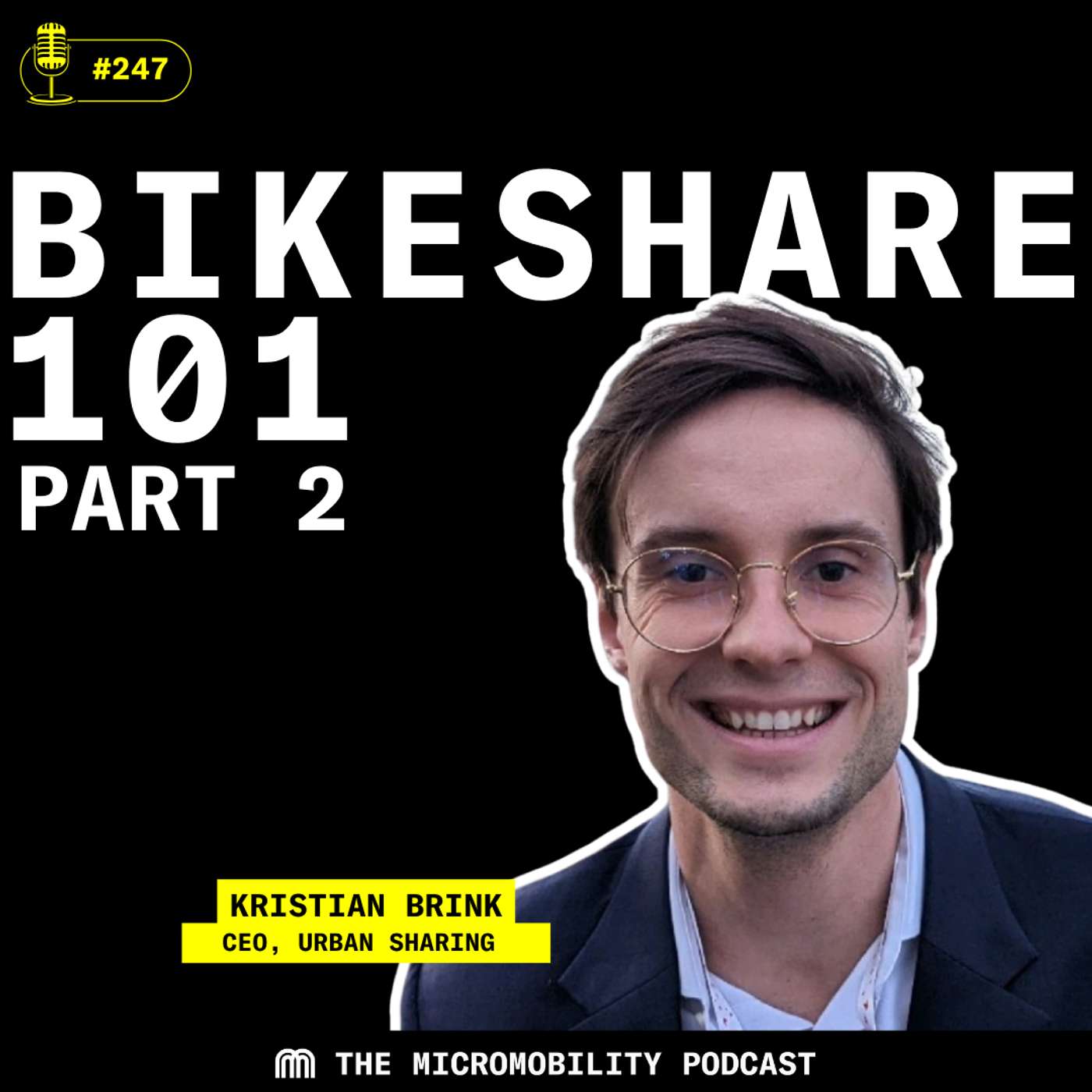
Ep 247Bikeshare 101 with Kristian Brink, CEO of Urban Sharing - Part 2

In this episode of the Micromobility Podcast, Prabin Joel Jones speaks with Kristian Brink, CEO of Urban Sharing about how bike share is evolving from rapid expansion to smarter, more sustainable operations.From rebuilding Urban Sharing after COVID to unpacking global trends across Europe and Latin America, this conversation explores what is actually driving the next phase of micromobility.In this episode:Why software is becoming the backbone of bike shareThe shift from growth to operational efficiencyMadrid vs Berlin and what policy means for operatorsWhere global bike share is really growingHow AI and better tools will shape the futureWhy hardware innovation still lagsListen now for a clear view of where the industry is headed.

Mar 25, 202651 min

Ep 246Building Zeus Scooters and Acquiring Superpedestrian with Damian Young, Founder & CEO

In this episode of the Micromobility Podcast, Damian Young, Founder and CEO of Zeus Scooters, joins the show to discuss the company’s journey from launching in smaller European cities to acquiring the assets of Superpedestrian.Zeus took a different path from many micromobility operators. Instead of chasing mega-cities and raising massive venture rounds, the company focused on smaller markets, built its own three-wheel scooter design, and maintained strict financial discipline.Now, with the acquisition of Superpedestrian’s assets, Zeus is entering a new phase of scale.The conversation covers the strategic thinking behind operating in tier-2 and tier-3 cities, how unit economics actually work in micromobility, why “rides per day” can be a misleading metric, and what the future of consolidation in the industry might look like.Damian also shares lessons from building through one of the toughest cycles the micromobility industry has seen.Topics covered• The founding story of Zeus Scooters• Why Zeus focused on smaller cities instead of mega markets• The strategy behind three-wheel shared scooters• Unit economics and price optimization in micromobility• EBITDA vs EBIT and profitability in the sector• Why many micromobility companies failed• The hidden impact of insurance costs• Acquiring Swings, Zipp, and Superpedestrian assets• What the next phase of consolidation could look like

Mar 16, 202659 min

Ep 245ALSO - Rivian's Big Bet on Micromobility with Chris Yu, Co-founder & President of ALSO

On this week’s Micromobility Podcast, Prabin Joel Jones sits down with Chris Yu, Co-Founder and President of ALSO, the Rivian spin-off bringing a fresh wave of ambition into micromobility.Chris explains why ALSO was created, why Rivian saw an opportunity beyond cars, and why the company believes smaller electric vehicles will play a central role in the future of transportation. They dive into ALSO’s new products, including the TMB e-bike and TMQ pedal quad, and unpack the thinking behind the company’s vertically integrated, software-defined approach.The conversation covers DreamRide pedal-by-wire technology, custom motors, battery safety, modular design, predictive maintenance, distribution strategy, and why Chris believes micromobility is far from a saturated market.They also discuss urban transformation, mode shift, quick commerce, and why Chris sees a massive global opportunity across both consumer and commercial vehicles.Topics covered:Why Rivian launched ALSOThe meaning behind the ALSO nameWhy “small is inevitable”The TMB e-bike and TMQ pedal quadDreamRide pedal-by-wire technologyWhy ALSO built its own motors, battery system, display, and software stackPredictive maintenance and EV-style diagnosticsDirect-to-consumer vs retail distributionEurope vs US market opportunityA message for founders still building in micromobility

Mar 9, 202652 min

Ep 244Micromobility in London with Will Norman

In this episode of the Micromobility Podcast, host Prabin Joel Jones (CEO, Micromobility Industries) sits down with Will Norman, London’s Walking and Cycling Commissioner, to unpack how one of the world’s biggest cities is reshaping its streets for people.Will explains why his job title exists in the first place, and why the real mission is bigger than bike lanes: making streets safer, integrating micromobility with the Tube and buses, and keeping London competitive as a global city.What you’ll hear in this conversation- How London went from ~90 km to 400+ km of cycleways and what it actually takes to deliver change at city scale- The “recipe” Will credits for progress: political courage, funding, technical expertise, campaigning communities, and data- Why the biggest barrier to mode shift is still safety and what London is doing under Vision Zero- The impact of 20 mph zones, safer street design, and London’s Direct Vision Standard for trucks- Why London still can’t properly regulate dockless shared bikes (and what’s changing with new legislation)- The truth about shared e-bikes in London: it’s not just the number of bikes, it’s where they are and how they’re managed- The governance challenge of London’s many boroughs, and why “border cut-offs” for shared bikes can be dangerous- Why shared e-scooters haven’t scaled like e-bikes (yet), and what needs to happen next- What’s coming in micromobility: cargo bikes, new form factors, and future-proof regulation- Will’s message to city officials worldwide trying to drive similar change: be brave, stay positive, prove it with data, and bring communities with youWe also get into why cities like Paris and Brussels are pushing London to move faster, and why that global competition is healthy.

Mar 2, 202652 min

Ep 243Past, Present, and Future of Micromobility with Kersten Heineke, McKinsey

In this episode of the Micromobility Podcast, Prabin Joel Jones, CEO of Micromobility Industries, sits down with Kersten Heineke, Partner and Co-Lead at the McKinsey Center for Future Mobility, to explore the past, present, and future of micromobility.The conversation traces the evolution of the industry from the early scooter boom years of 2018 and 2019 to today’s more disciplined, operations-focused market. They discuss how the shift from growth at all costs to profitability reshaped shared micromobility, including improvements in vehicle durability, total cost of ownership, battery swapping, and city collaboration through tenders and fleet caps.Kersten explains how McKinsey modeled the total addressable market for micromobility and what the projected 340 billion dollar opportunity by 2030 really represents. The discussion goes beyond scooters and bikes to include microcars, quadricycles, and new urban form factors that could unlock additional car trip replacement.The episode also explores why navigation remains a challenge for micromobility users, whether operators should rethink their business models, and how platforms like Uber, Bolt, and Lyft approach micromobility differently.Looking ahead, the conversation turns to autonomy. Will robotaxis lead to smaller, purpose-built urban vehicles? Could autonomous fleets reshape the role of micromobility in cities? And what does this mean for founders, investors, and policymakers building the next decade of urban mobility?Topics covered:• The shift from land-grab expansion to operational discipline• How vehicle design and TCO changed the economics of scooters• Fleet caps, tenders, and city regulation• The 340B micromobility market opportunity• Microcars and new vehicle categories• Platform strategy in mobility• The intersection of micromobility and autonomous vehiclesArticles referenced in the episode:1. https://www.mckinsey.com/featured-insights/mckinsey-explainers/what-is-micromobility2. https://www.mckinsey.com/industries/automotive-and-assembly/our-insights/spotlight-on-mobility-trends#section-header-53. https://www.mckinsey.com/industries/automotive-and-assembly/our-insights/the-two-wheeled-commute-micromobility-and-your-future

Feb 23, 202656 min

Ep 242Talking Tier, SPIN and Mobility with Philip Reinckens, ex-CEO of SPIN

What did the micromobility “gold rush” actually feel like from the inside—and what lessons still matter in 2026?In this episode of the Micromobility Podcast, host Prabin Joel Jones sits down with Philip Reinckens (ex-CEO of SPIN, early employee at TIER, involved in the Nextbike and SPIN deals, and part of the SPIN → Bird acquisition). Philip shares a candid, operator’s view of what went right, what went wrong, and what the industry still misunderstands.We unpack:- The early days of TIER and the 2019 expansion playbook (including launching multiple German cities on day one)- Why micromobility scaled so fast—and how much of it was execution vs hardware luck- COVID, in-house ops, and how operational decisions changed the trajectory- The “charging network” thesis (why it didn’t take off then, and why it might return now)- Why many investors cooled on the sector: hardware, ops intensity, vandalism, and city complexity- Europe vs the US: pricing vs utilization, seasonality, and the “joyrider” dynamic- The SPIN turnaround: cutting burn, upgrading fleets, and shifting culture to operations- The logic behind the Nextbike acquisition—and why integrations are harder than they look- Philip’s 2026 take: micromobility is an operations game, and “the right vehicle in the right place at the right time” beats everything else- What he’d do differently today with AI-lean org design🎟️ Micromobility Europe is coming to Berlin — 2–3 June. Early bird tickets are on sale now at micromobility.io.

Feb 16, 202651 min

Ep 241How Cities Can Make Shared Mobility Affordable with Erdem Ovacik

In this episode of the Micromobility Podcast, Prabin Joel Jones (CEO, Micromobility Industries) sits down with Erdem Ovacik, Co-founder of Donkey Republic (the iconic orange bikes across Copenhagen, Antwerp, and beyond) and now Co-founder of Impact Market / MIMA (Mobility Impact Market).Erdem’s thesis is simple and radical: cities already subsidize public transport heavily, but new mobility is expected to survive on user fees alone. The result is predictable - services become expensive, availability suffers, and mode shift stalls. Impact Market proposes a new model: impact procurement that pays operators per high-value trip, essentially a reverse congestion charge where the public rewards the trips it wants more of.We go deep on how this works in practice: where budgets can come from (transport, infrastructure avoidance, preventive health, climate funds), how “open house” contracting differs from traditional tenders, how to measure social ROI fast, and how to prevent fraud or price-gouging. We also explore autonomous vehicles, why Europe is cautious, and how smart incentives can push AVs toward pooling and first/last mile public transit integration rather than adding “empty miles” and more congestion.What you’ll learnWhy many city mobility tenders are failingHow trip incentives can unlock affordability + availabilityHow to measure mode shift and social ROI in a pilotHow to prevent abuse (competition + price conditions + audits)Why Paris is a leading example (bike lanes, leasing, carpool incentives)How AVs could help public transit (or create mayhem) depending on incentives

Feb 9, 202645 min

Ep 240Microcars and New Urban Form Factors with Horace Dediu

Click here to watch a video of this episode. In this episode of the Micromobility Podcast, Horace Dediu, Co-Founder of Micromobility Industries joins Prabin Joel Jones to explore the rise of new urban vehicle form factors and why microcars may be the next major shift in city mobility.The conversation starts with a simple question: why did cars never evolve into a true urban form factor the way trains did with trams and metros, or aviation did with short haul and long haul aircraft? Horace argues the modern car is an accident of history, shaped by rural origins, highway assumptions, and regulations that have reinforced size and weight over decades.From there, the episode dives into what is changing now. Microcars like the Citroen Ami, Microlino, and other light quadricycle style vehicles are gaining traction in European cities, helped by urban constraints, new parking models, and the economics of shorter trips. The discussion also covers how autonomy could accelerate smaller vehicles, why taxi fleets tend to push toward fit for purpose designs, and what Apple’s real ambition in autonomy may have been: owning the in-vehicle human machine interface.Finally, the episode zooms out to policy. Microcars often sit inside legacy categories that were never designed for electric, connected, software-defined vehicles. If cities and regulators want smaller vehicles to scale, infrastructure and classification need to evolve with them.Topics covered:Why the car is not an urban vehicle, and how history shaped today’s form factorMicrocars in Europe and the rise of quadricyclesWhy regulation and safety requirements pushed cars to growAutonomy, fleet economics, and why robotaxis may drive smaller vehiclesApple’s potential role in autonomous microcars and the in-vehicle interfaceWhy the phone may remain the dominant in-vehicle screenParking and infrastructure as the real lever for adoptionWhy cities need new categories for micro mobility and microcars🎟️ Micromobility Europe 2026Berlin | June 2–3🎟️ Micromobility America 2026San Francisco | November 11–12Tickets & speakers: www. micromobility.io

Jan 26, 202657 min

Ep 239Micromobility Founder Turned VC: Building, Scaling, and Investing in Europe - Thijn Van Helvoirt

Thijn built CHECK when everyone else in micromobility was chasing growth at any cost. While competitors burned capital, CHECK focused on unit economics, density, and operational discipline and reached profitability early.Now, as a VC at No Such Ventures, Thijn backs founders across mobility, energy, and European tech. In this episode, we talk about what he learned as an operator, what most founders still get wrong, and how he evaluates companies today.This episode covers:- Why most micromobility strategies fail in practice- What founders misunderstand about scale, density, and service areas- How CHECK made unpopular decisions that actually worked- Capital efficiency vs headcount inflation- The real state of micromobility funding going into 2026- What VCs actually mean when they say “traction”- Where the real opportunities are in micromobility today- How to build in Europe without pretending it’s the USIf you’re building, investing, or operating in micromobility, this episode is about reality, not decks.🎟️ Micromobility Europe 2026Berlin | June 2–3Tickets & speakers: micromobility.io

Dec 22, 202559 min

Ep 238100 Million Rides: Building Dott the Right Way - Henri Moissinac, Co-Founder & CEO Dott

In this episode of The Micromobility Podcast, Prabin Joel Jones sits down with Henri Moissinac, Co-Founder & CEO of Dott, to unpack how the company scaled into one of the world’s leading shared micromobility operators, now approaching 100 million rides per year and operating across 400+ cities.Henri shares lessons from Facebook, Uber, and eBay, and breaks down how timing, product-market fit, hardware cycles, machine learning, and relentless user focus shaped Dott’s trajectory.If you’re building in mobility, logistics, SaaS, hardware, or consumer apps, this is a masterclass in scaling a complex, operationally heavy business the right way.Key Takeaways:- Dott scaled by prioritizing survival and timing over hyper growth.- Product market fit and timing matter more than speed.- Micromobility is now a cash flow business, not just a VC story.- Hardware cycles are essential with about 20% of the fleet renewed each year.- New hardware improves margins through more rides per swap and lower costs.- Machine learning drives demand forecasting, fleet placement and operational efficiency.- Parking is the biggest user friction and a major unlock for the coming years.- Hardware innovation continues with improvements in batteries, tires, comfort and reliability.- Local operations require local models rather than a single global approach.- Increasing rides per user per month is a key growth driver.- Talking to users frequently is a superpower for product insight.- Do not overestimate the short term and do not underestimate the long term.- Consolidation will continue but the industry will not collapse into one global player.- Great founders stay obsessed, communicate clearly and focus on the user.🎧 Hosted by: Prabin Joel Jones📍 Presented by: Micromobility Industries🌐 Learn more: https://micromobility.io

Dec 15, 20251h 6m

Ep 237The Untold Story of SWING With San Kim

In this founder focused episode, Prabin sits down with San Kim, Founder and CEO of SWING, one of the few profitable micromobility companies in the world and one of the most underestimated operators in the industry.SWING scaled from a tiny team with less than 1 million dollars in initial capital to more than 100,000 vehicles, more than 64 million dollars in yearly revenue, and profitability from year one. San shares, in rare detail:How SWING became profitable from day oneWhy Korean culture helped them achieve five year vehicle lifespansThe hidden math behind franchise successHow SWING kept HQ costs extremely low while growing fastWhy shared scooters collapsed in KoreaHow SWING pivoted into subscription, motorcycle leasing, shuttle software, and roboticsWhy a global micromobility merger is extremely difficultHis long term vision: micromobility to roboticsThis is one of the most transparent and insightful founder conversations in mobility. It is packed with real numbers, failures, pivots, and future bets.🎧 Hosted by: Prabin Joel Jones📍 Presented by: Micromobility Industries🌐 Learn more: https://micromobility.io🎟️ Micromobility Europe 2026 will take place in Berlin - get your tickets at www.micromobility.io.

Nov 24, 202555 min
2025 Micromobility Industries