The ITSPmagazine Podcast
2,087 episodes — Page 4 of 42
Ep 2567Paoletti Custom Guitars at NAMM 2026: Handcrafted in Florence Italy from Wine Barrel Wood | A Brand Highlight Conversation with Filippo Martini, Managing Director at Paoletti Guitars | NAMM 2026 Coverage
Wine Barrels, Duomo Marble, and Florence: Paoletti Custom Guitars at NAMM 2026I've been away from Florence for 25 years. I didn't know there was a guitar company like this back home.At NAMM 2026, I found Filippo Martini from Paoletti Custom Guitars—a boutique manufacturer based in the heart of Tuscany, building instruments that are equal parts guitar and artwork.Paoletti does something no one else does: they build guitars from chestnut wood sourced from Italian wine barrels. The material offers a wide harmonic spectrum, but it's difficult to work with. You need to know how to handle it. Founder Fabrizio Paoletti figured it out, and now every guitar they produce shows the natural grain—no opaque finishes, no hiding the wood.The craftsmanship runs deep. Bridges, pickguards, pickups—all made in-house. Necks carved from Canadian maple, roasted on-site. 99% of the process happens in Tuscany. As Filippo put it, "Kilometer zero." Zero miles. Everything local except the screws.Their model is 100% custom. You don't buy a Paoletti off the rack. You tell them your style, your sound, the genre you play. They build around your vision while keeping the Italian essence intact—chestnut wood, Italian-made components, tailored to your idea.But what stopped me cold was the Duomo collection.Eight individual guitars, each hand-engraved by Fabrizio Paoletti himself. Three years of work. The subject: Florence's cathedral—the Duomo di Santa Maria del Fiore.This isn't just decoration. Paoletti secured an official partnership with the Opera del Duomo, the authority that oversees the cathedral. The back of each guitar reproduces the marble floor pattern from inside the Duomo. And when the collection is complete this October, every guitar will contain an actual piece of marble from the cathedral.I got shivers standing there.This is what happens when guitar making meets Italian heritage. It's not about specs or market positioning. It's about place, history, and craft passed down through generations.Filippo invited me to visit the workshop in Florence when I return in April. I'm going. I want to see where this happens—where wine barrel wood becomes an instrument, where cathedral marble gets embedded into a guitar body, where a team of artisans builds one-of-one pieces for players around the world.Florence is known for many things. Leather. Art. Architecture. The Renaissance itself. Now I know it's also home to some of the most distinctive guitars being made anywhere.Paoletti proves that boutique doesn't mean small ambitions. They're partnering with galleries in Dubai, working with the Duomo authorities, and bringing Florence to NAMM.Not bad for a company I didn't even know existed until I walked the show floor and heard an Italian accent.Sometimes you find home in unexpected places.Marco Ciappelli interviews Filippo Martini from Paoletti Custom Guitars at NAMM 2026 for ITSPmagazine.Part of ITSPmagazine's On Location Coverage at NAMM 2026.🌐 https://www.itspmagazine.com/the-namm-show-2026-namm-music-conference-music-technology-event-coverage-anaheim-california__________________________This is a Brand Highlight. A Brand Highlight is an introductory conversation designed to put a spotlight on the guest and their company. Learn more: https://www.studioc60.com/creation#highlightGUESTFilippo Martini Managing DIrector at Paoletti Guitars | Florence | Tuscany | ItalyRESOURCESLearn more about Paoletti Guitars: https://www.paolettiguitars.comAre you interested in telling your story?▶︎ Full Length Brand Story: https://www.studioc60.com/content-creation#full▶︎ Brand Spotlight Story: https://www.studioc60.com/content-creation#spotlight▶︎ Brand Highlight Story: https://www.studioc60.com/content-creation#highlight Hosted by Simplecast, an AdsWizz company. See pcm.adswizz.com for information about our collection and use of personal data for advertising.
Ep 2566Yamaha at NAMM 2026: Introducing Chris Buck Custom Revstar Guitar, Pacifica SC, and a deep dive into the BB735 Bass | A Brand Highlight Conversation with Andy Winston, Product Training Specialist at Yamaha | NAMM 2026
60 Years Forward: Yamaha at NAMM 2026Yamaha at NAMM 2026: Chris Buck Revstar, Pacifica SC & 60 Years of Guitar InnovationSome brands chase nostalgia. Yamaha builds forward.At NAMM 2026, I spoke with Andy Winston to talk about 60 years of Yamaha guitar design—and why this company keeps delivering instruments that punch way above their price point.The conversation started with the Chris Buck Signature Revstar. Buck is the guitarist for Cardinal Black, and he's earned his own model. The specs tell the story: overwound P90 pickups for a hotter sound, wraparound tailpiece with adjustable saddles, stainless steel frets, lightweight tuners, and those old-school inlays from the first-generation Revstar. No boost circuit. Buck wanted it stripped to essentials.Then Andy dropped a tease: Matteo Mancuso is getting his own Revstar this summer. The Italian virtuoso. That's a statement.We moved to the new Pacifica SC—Yamaha's answer for T-style players. Humbucker in the neck, single coil in the bridge, and pickups designed in partnership with Rupert Neve's team. The boost circuit under the bridge pickup gives you five sounds from two pickups. Made in Indonesia at $999 or Made in Japan with compound radius fretboard and IRA wood treatment at $2,199.I bought my nephew a Pacifica. Entry level, around $200. It works. That's Yamaha's philosophy—you can start at $200 and work your way up to a Mike Stern signature model without ever leaving the family.But here's what stuck with me.Andy said something that defines Yamaha's approach: "We don't do reissues. You're never gonna see us reissue a 1972."Sixty years of guitar history, and they're not looking backward. The Revstar draws inspiration from the 1970s Super Flight, sure—but it's chambered mahogany, tuned to eliminate harsh mid-range frequencies. Yamaha builds pianos, violins, marimbas. They know how to tune wood. They apply that knowledge to electric guitars in ways other companies don't.The BB Bass series came next. String-through body with 45-degree break angle. Extra bolts pulling the neck tight into the pocket. A maple stripe running through the center of the body for note response. Active/passive switching. Five-ply neck. Professional features at prices that don't require a car payment."We give people more instrument than what a price tag says," Andy told me.That's not marketing. That's mission.Before we wrapped, Andy shared a personal story. In 1977, hair down to his shoulders, bell bottoms on, his mom decided he was serious about guitar. She bought him a Yamaha FG-75. His first real acoustic. He doesn't have that one anymore, but he found a replacement. Had to.That's brand loyalty earned over decades. Not through heritage mythology—through instruments that work, that last, that give players what they need without emptying their wallets.Sixty years of guitar design. No reissues. Just forward.Yamaha keeps proving that innovation and accessibility aren't mutually exclusive.Marco Ciappelli interviews Andy Winston from Yamaha at NAMM 2026 for ITSPmagazine.Part of ITSPmagazine's On Location Coverage at NAMM 2026.🌐 https://www.itspmagazine.com/the-namm-show-2026-namm-music-conference-music-technology-event-coverage-anaheim-california__________________________This is a Brand Highlight. A Brand Highlight is an introductory conversation designed to put a spotlight on the guest and their company. Learn more: https://www.studioc60.com/creation#highlightGUESTAndy WinstonProduct Training Specialist at YamahaRESOURCESLearn more about Yamaha Guitars: https://www.yamaha.com/Are you interested in telling your story?▶︎ Full Length Brand Story: https://www.studioc60.com/content-creation#full▶︎ Brand Spotlight Story: https://www.studioc60.com/content-creation#spotlight▶︎ Brand Highlight Story: https://www.studioc60.com/content-creation#highlight Hosted by Simplecast, an AdsWizz company. See pcm.adswizz.com for information about our collection and use of personal data for advertising.

Ep 2565The Rise of the Bionic Hacker and AI-Driven Vulnerability Discovery | A Brand Highlight Conversation with Laurie Mercer, Senior Director of Solutions Engineering of HackerOne
What happens when artificial intelligence enters the arena of ethical hacking? Laurie Mercer, Senior Director of Solutions Engineering at HackerOne, joins Sean Martin for a look inside the ninth annual Hacker-Powered Security Report, where the headline is clear: the bionic hacker has arrived. HackerOne connects the global security research community with enterprises, open source projects, and major organizations, all working toward a shared mission of building a safer internet by finding, fixing, and rewarding the discovery of vulnerabilities.How is AI reshaping the bug bounty landscape? Mercer describes a dramatic shift unfolding on the HackerOne platform. For the first time, autonomous AI agents are operating alongside human researchers, growing from a single agent to more than ten competing on the leaderboard. At the same time, customers are driving change from the other side, with a 270% increase in organizations placing AI models within the scope of their bug bounty programs. The platform has paid out a record $81 million in bounty rewards over the past 12 months, with an average payout of roughly $1,000 per vulnerability, underscoring the sheer volume of valid findings flowing through the system.What makes these findings so significant? Of the reports submitted, 23,700 are rated critical or high severity, representing vulnerabilities capable of causing serious data breaches. HackerOne estimates these remediations have helped organizations avoid up to $3 billion in potential breach costs. The collectives participating on the platform range from venture-capital-backed startups building AI-powered offensive tools to informal groups of researchers pooling resources for greater efficiency. Mercer highlights three vulnerability categories that have surged over the past year: prompt injection, sensitive information exposure through large language models, and insecure plugin design. For any organization deploying AI-powered tools, these represent the most urgent areas to assess and secure.This is a Brand Highlight. A Brand Highlight is a ~5 minute introductory conversation designed to put a spotlight on the guest and their company. Learn more: https://www.studioc60.com/creation#highlightGUESTLaurie Mercer, Senior Director of Solutions Engineering at HackerOneOn LinkedIn: https://www.linkedin.com/in/lauriemercer/RESOURCESLearn more about HackerOne: https://www.hackerone.comAre you interested in telling your story?▶︎ Full Length Brand Story: https://www.studioc60.com/content-creation#full▶︎ Brand Spotlight Story: https://www.studioc60.com/content-creation#spotlight▶︎ Brand Highlight Story: https://www.studioc60.com/content-creation#highlightKEYWORDSLaurie Mercer, HackerOne, Sean Martin, brand story, brand marketing, marketing podcast, brand highlight, bug bounty, ethical hacking, bionic hacker, AI agents, autonomous hacking, vulnerability discovery, hacker-powered security, offensive security, prompt injection, insecure plugin design, LLM security, AI vulnerability, cybersecurity, breach avoidance, bug bounty platform, responsible disclosure Hosted by Simplecast, an AdsWizz company. See pcm.adswizz.com for information about our collection and use of personal data for advertising.

Ep 2564The Human Element That AI Can Never Replace | A Conversation with Chuck Tennin, President and CEO of Big Fish Music | The NAMM Show 2026 Event Coverage | Music Evolves with Sean Martin
Show NotesAt NAMM 2026, Sean Martin sits down with Chuck Tennin, the President and CEO of Big Fish Music and Big Fish Music Publishing Group, for a candid conversation about the role of AI in the music industry and why the human element remains irreplaceable. Known as "The Big Fish" and "The Alligator," Chuck has spent more than five decades working as an engineer, record producer, music publisher, and consultant, and he pulls no punches when it comes to the limits of technology in creative work.Chuck draws a sharp line between AI as a tool and AI as a replacement for human creativity. He points to organizations like ASCAP, BMI, and the Recording Academy as allies in the fight to protect the creative process, arguing that AI cannot replicate the feel, the instinct, and the emotional investment that go into producing a record. For Chuck, the difference between producing music and producing a record is everything: a record has to connect with an audience on a level that no algorithm can manufacture.The conversation takes listeners through Chuck's journey from two-track analog recording to the digital era of Pro Tools, exploring how each technological leap brought efficiency but never fully captured the warmth and authenticity of tape. He reflects on the critical distinction between an MP3 and a WAV file, between convenience and quality, and between what sounds good enough and what sounds like a record.Chuck also shares hard-earned wisdom about the business side of music: the perseverance required, the reality that 90% of aspiring artists fail, and the belief in oneself that separates survivors from those who walk away. Drawing on stories from legendary artists he has worked with over the decades, he reminds listeners that every big name started in the same place and climbed out of the same struggle.This is a conversation about what technology can assist with and what it can never touch: the soul of music and the humans who create it.HostSean Martin, Co-Founder at ITSPmagazine, Studio C60, and Host of Redefining CyberSecurity Podcast & Music Evolves Podcast | Website: https://www.seanmartin.com/GuestChuck Tennin, President and CEO of Big Fish Music and Big Fish Music Publishing Group | On LinkedIn: https://www.linkedin.com/in/chuck-tennin-3468b6105/ResourcesThe NAMM Show 2026 is taking place from January 20-24, 2026 | Anaheim Convention Center, Southern California — Follow our coverage: https://www.itspmagazine.com/the-namm-show-2026-namm-music-conference-music-technology-event-coverage-anaheim-californiaMusic Evolves: Sonic Frontiers Newsletter | https://www.linkedin.com/newsletters/7290890771828719616/Keywordschuck tennin, big fish music, sean martin, AI in music, analog vs digital recording, record producer, music publishing, Pro Tools, ASCAP, BMI, Recording Academy, NAMM 2026, music industry, human creativity, songwriting, music, creativity, art, artist, musician, music evolves, music podcast, music and technology podcastMore From Sean MartinMore from Music Evolves: https://www.seanmartin.com/music-evolves-podcastMusic Evolves on YouTube: https://www.youtube.com/playlist?list=PLnYu0psdcllTRJ5du7hFDXjiugu-uNPtWMusic Evolves: Sonic Frontiers Newsletter | https://www.linkedin.com/newsletters/7290890771828719616/On Location with Sean and Marco: https://www.itspmagazine.com/on-locationITSPmagazine YouTube Channel: https://www.youtube.com/@itspmagazineBe sure to share and subscribe! Hosted by Simplecast, an AdsWizz company. See pcm.adswizz.com for information about our collection and use of personal data for advertising.
Ep 2563Keeping Programs Alive, Supporting Musicians, and Building Community Through Action | A Conversation with Michelle Wolff, Guitar Center Foundation | The NAMM Show 2026 Event Coverage | On Location with Sean Martin and Marco Ciappelli
At the Guitar Center Foundation, music is treated as a shared resource rather than a luxury. During this conversation at the NAMM Show 2026, Michelle Wolff, representing the Foundation, explains how access to real instruments can change the trajectory of a student, a patient, or a veteran simply by making music possible in the first place.The Foundation’s work centers on donating thousands of instruments to schools, hospitals, and veteran centers, with a focus on communities where funding for music programs is often the first thing cut. Through a structured grant process, organizations apply for instruments quarterly, with roughly 150 requests reviewed each cycle. About 30 of those requests are fulfilled, helping sustain programs that might otherwise disappear.Beyond instrument donations, the Foundation is expanding how it shows up in communities. Plans include live donation events that bring instruments directly into schools and hospitals, often paired with artist participation to create meaningful, memorable moments. New donor and ambassador programs are also taking shape, designed to broaden awareness and bring more voices into the mission.Partnerships play a major role in that effort. The conversation highlights recent collaboration tied to the 100 Billion Meals initiative, where music, visual art, and social impact intersect to amplify multiple causes at once. These partnerships extend the Foundation’s reach while reinforcing the idea that music can support broader humanitarian goals.Wolff also shares a personal connection to the mission. As a former vocal performance major at the University of Texas Butler School of Music, she understands how deeply musicians identify with their craft. After experiencing vocal injury herself, she speaks to the importance of supporting musicians through change and helping them build identities that extend beyond a single instrument, without losing music as a core part of who they are.That perspective brings the Foundation’s work full circle. Access to instruments is not only about creating future professionals. It is about expression, resilience, and giving people the chance to discover what music can mean in their own lives.Part of ITSPmagazine's On Location Coverage at NAMM 2026.🌐 https://www.itspmagazine.com/the-namm-show-2026-namm-music-conference-music-technology-event-coverage-anaheim-california__________________________Guitar Center Foundation: https://www.guitarcenterfoundation.org100 Billion Meals initiative: https://100billionmeals.orgThe NAMM Show 2026: https://www.namm.org/thenammshow/attendMusic Evolves: Sonic Frontiers Newsletter | https://www.linkedin.com/newsletters/7290890771828719616/More from Marco Ciappelli on Redefining Society and Technology Podcast: https://redefiningsocietyandtechnologypodcast.com/Want to share an Event Briefing as part of our event coverage? Learn More 👉 https://www.studioc60.com/performance#briefingWant Sean and Marco to be part of your event or conference? Let Us Know 👉 https://www.studioc60.com/performance#ideasKEYWORDS: music charity, instrument donations, namm show 2026, music education access, supporting musicians, music nonprofit, guitar center foundation, music programs schools, music and community, philanthropy in music, guitar center, michelle wolff, marco ciappelli Hosted by Simplecast, an AdsWizz company. See pcm.adswizz.com for information about our collection and use of personal data for advertising.

Ep 2565From Cyber Energia to Centrii: Rebranding to Lead the Future of OT Security in Critical Energy Infrastructure | A Brand Story Conversation with Rafael Narezzi, Co-Founder and CEO of Centrii
The renewable energy sector faces a fundamental disconnect. Cybersecurity teams generate endless alerts and vulnerability reports, while operational managers focus on asset performance and site availability. Neither group speaks the other's language, leaving executives struggling to make informed decisions about where to invest limited resources. Rafael Narezzi, Co-Founder and CEO of Centrii, has built his company specifically to bridge this gap, translating technical cyber risks into the financial business outcomes that drive executive decision-making.Centrii, emerging from its predecessor Cyber Energia, represents a new approach to OT security in the energy sector. The name itself carries meaning: the sentinel of industrial intelligence, signified by the double I at the end. Rather than simply identifying vulnerabilities and presenting red alerts, the platform contextualizes risks in terms that matter to the business. How does a potential compromise affect your power purchase agreements? What happens to your revenue when energy prices fluctuate and your site goes offline? These are the questions that Centrii answers.The company prices its services per megawatt hour, demonstrating its commitment to speaking the language of energy rather than traditional IT security. This approach reflects a deeper understanding that renewable energy assets present vastly different risk profiles. A biomass facility with 24/7 personnel on site faces different challenges than an unmanned offshore wind installation. Solar farms, hydrogen facilities, and battery storage systems each require tailored risk assessments that account for their unique operational characteristics and regulatory requirements.Recent attacks on distributed energy resources, including the compromise of Poland's renewable grid, underscore the urgency of this work. With regulations like NERC CIP 15 in the United States, NIS 2.0 in Europe, and the UK Cyber Security Bill now holding asset owners personally accountable for cybersecurity failures, organizations can no longer afford to treat OT security as an afterthought. Narezzi observes that compliance has become the driving force pushing companies to take responsibility for their critical infrastructure assets.What sets Centrii apart is its ability to help executives identify which risks actually matter. When every cybersecurity tool reports critical alerts, organizations face paralysis. Which red is the red that demands immediate attention? Centrii provides clarity by mapping technical findings to financial impact, reputational damage, and operational consequences specific to each asset type and technology.The company's presentation at DistribuTECH 2026 focuses on battery energy storage systems, an area of explosive growth driven by data center demand and the expanding role of AI. Narezzi draws a parallel to Ocean's 11, where coordinated manipulation of power systems creates cascading failures. As batteries become essential for grid balancing, the risks of compromised dispatch commands affecting multiple installations simultaneously represent a scenario that demands serious attention from asset owners and regulators alike.Operating across 16 countries with diverse energy technologies, Centrii provides a unified platform for organizations managing hundreds of sites across different regions and regulatory environments. The goal is straightforward: give every stakeholder, from technical teams to the C-suite, a common language for understanding and acting on cyber risk in the energy sector.This is a Brand Story. A Brand Story is a ~35-40 minute in-depth conversation designed to tell the complete story of the guest, their company, and their vision. Learn more: https://www.studioc60.com/creation#fullGUESTRafael Narezzi, Co-Founder and CEO, Centriihttps://www.linkedin.com/in/narezzi/RESOURCESCentriihttps://centrii.comCyber Energiahttps://cyberenergia.comAre you interested in telling your story?▶︎ Full Length Brand Story: https://www.studioc60.com/content-creation#full▶︎ Brand Spotlight Story: https://www.studioc60.com/content-creation#spotlight▶︎ Brand Highlight Story: https://www.studioc60.com/content-creation#highlightKEYWORDSRafael Narezzi, Centrii, Sean Martin, brand story, brand marketing, marketing podcast, brand story, OT security, renewable energy cybersecurity, battery energy storage systems, BESS, critical infrastructure protection, energy sector cybersecurity, NERC CIP, NIS 2.0, power purchase agreements, distributed energy resources, industrial intelligence, cyber risk quantification Hosted by Simplecast, an AdsWizz company. See pcm.adswizz.com for information about our collection and use of personal data for advertising.
Ep 2564AI Art vs Human Creativity — The Real Difference and why AI Cannot Be An Artist | A Conversation with AI Expert Andrea Isoni, PhD, Chief AI Officer, AI speaker | Redefining Society and Technology with Marco Ciappelli
The Last Touch: Why AI Will Never Be an ArtistI had one of those conversations... the kind where you're nodding along, then suddenly stop because someone just articulated something you've been feeling but couldn't quite name.Andrea Isoni is a Chief AI Officer. He builds and delivers AI solutions for a living. And yet, sitting across from him (virtually, but still), I heard something I rarely hear from people deep in the AI industry: a clear, unromantic take on what this technology actually is — and what it isn't.His argument is elegant in its simplicity. Think about Michelangelo. We picture him alone with a chisel, carving David from marble. But that's not how it worked. Michelangelo ran a workshop. He had apprentices — skilled craftspeople who did the bulk of the work. The master would look at a semi-finished piece, decide what needed refinement, and add the final touch.That final touch is everything.Andrea draws the same line with chefs. A Michelin-starred kitchen isn't one person cooking. It's a team executing the chef's vision. But the chef decides what's on the menu. The chef check the dish before it leaves. The chef adds that last adjustment that transforms good into memorable.AI, in this framework, is the newest apprentice. It can do the bulk work. It can generate drafts, produce code, create images. But it cannot — and here's the key — provide that final touch. Because that touch comes from somewhere AI doesn't have access to: lived experience, suffering, joy, the accumulated weight of being human in a particular time and place.This matters beyond art. Andrea calls it the "hacker economy" — a future where AI handles the volume, but humans handle the value. Think about code generation. Yes, AI can write software. But code with a bug doesn't work. Period. Someone has to fix that last bug. And in a world where AI produces most of the code, the value of fixing that one critical bug increases exponentially. The work becomes rarer but more valuable. Less frequent, but essential.We went somewhere unexpected in our conversation — to electricity. What does AI "need"? Not food. Not warmth. Electricity. So if AI ever developed something like feelings, they wouldn't be tied to hunger or cold or human vulnerability. They'd be tied to power supply. The most important being to an AI wouldn't be a human — it would be whoever controls the electricity grid.That's not a being we can relate to. And that's the point.Andrea brought up Guernica. Picasso's masterpiece isn't just innovative in style — it captures something society was feeling in 1937, the horror of the Spanish Civil War. Great art does two things: it innovates, and it expresses something the collective needs expressed. AI might be able to generate the first. It cannot do the second. It doesn't know what we feel. It doesn't know what moment we're living through. It doesn't have that weight of context.The research community calls this "world models" — the attempt to give AI some built-in understanding of reality. A dog doesn't need to be taught to swim; it's born knowing. Humans have similar innate knowledge, layered with everything we learn from family, culture, experience. AI starts from zero. Every time.Andrea put it simply: AI contextualization today is close to zero.I left the conversation thinking about what we protect when we acknowledge AI's limits. Not anti-technology. Not fear. Just clarity. The "last touch" isn't a romantic notion — it's what makes something resonate. And that resonance comes from us.Stay curious. Subscribe to the podcast. And if you have thoughts, drop them in the comments — I actually read them.Marco CiappelliSubscribe to the Redefining Society and Technology podcast. Stay curious. Stay human.> https://www.linkedin.com/newsletters/7079849705156870144/Marco Ciappelli: https://www.marcociappelli.com/ Hosted by Simplecast, an AdsWizz company. See pcm.adswizz.com for information about our collection and use of personal data for advertising.
Ep 2563Gibson Guitars at NAMM 2026: 131 Years of Craftsmanship, Innovation & Functional Art | A Brand Highlight Conversation with Jeff Stempka, Global Brand & Marketing at Gibson | NAMM 2026
131 years. Still handcrafted in Nashville. Still changing music.At NAMM 2026, Sean Martin and Marco Ciappelli sat down with Jeff Stempka, Global Brand & Marketing at Gibson & Gibson Custom, to talk about what makes this brand untouchable—the craftsmanship, the artist connection, and why people will stretch their budget just to hold one.From the Les Paul Studio Double Trouble to the ES-335 Fifties and Sixties refresh, Gibson is honoring its legacy while pushing forward.Jeff said it best: "These are tools that enable incredible musicians to take the instruments and do something we never intended."🎸 Les Paul Studio Double Trouble – Modern collection, coil splits, pure bypass 🎸 ES-335 Fifties & Sixties – Neck profiles for every player 🎸 100 Years of Flat Tops – From Orville Gibson to todayThis isn't just gear. It's functional art. It's history. It's emotion.Part of ITSPmagazine's On Location Coverage at NAMM 2026.🌐 https://www.itspmagazine.com/the-namm-show-2026-namm-music-conference-music-technology-event-coverage-anaheim-california__________________________This is a Brand Highlight. A Brand Highlight is an introductory conversation designed to put a spotlight on the guest and their company. Learn more: https://www.studioc60.com/creation#highlightGUESTJeff StempkaGlobal Brand & Marketing at GibsonRESOURCESLearn more about Gibson Guitars: https://www.gibson.com/Are you interested in telling your story?▶︎ Full Length Brand Story: https://www.studioc60.com/content-creation#full▶︎ Brand Spotlight Story: https://www.studioc60.com/content-creation#spotlight▶︎ Brand Highlight Story: https://www.studioc60.com/content-creation#highlight Hosted by Simplecast, an AdsWizz company. See pcm.adswizz.com for information about our collection and use of personal data for advertising.
Ep 2562Burton And Circle Strings Guitars at NAMM 2026: Snowboards Meet Custom Guitars And It Is Awesome! | A Brand Highlight Conversation From NAAM 2026
Snowboards and Guitars: Circle Strings x Burton at NAMM 2026Some collaborations make you stop and ask how nobody thought of this before.At NAMM Media Day 2026, Sean Martin caught up with Adam Buchwald and William Hylton from Circle Strings, a Vermont-based guitar company, to talk about their partnership with Burton. The concept is deceptively simple: matching snowboards and custom guitars built from the same materials.But the execution is anything but simple.Buchwald owns a wood company in Vermont. He had an entire tree of figured mahogany set aside, waiting for the right project. When Burton agreed to collaborate, he knew exactly what to do with it. The wood became the centerpiece—the visual and sonic foundation of everything that followed.Then William Hylton got to work.Hylton, Circle Strings' designer and CNC specialist, is a backcountry snowboarder. He chose Burton's Alakazam powder board shape as his starting point, drawn to its distinctive tail curve. That curve, he realized, was already guitar-esque. So he wove it through the entire instrument—the fingerboard extension, the pickguard, the bridge tips. The snowboard's DNA lives in every contour.But here's where it gets interesting.The core of a Burton snowboard is wood. Lightweight, durable, designed for performance. Hylton took that same core material and built a guitar body from it. The result feels right in your hands—balanced, resonant, purposeful. It's not a gimmick. It's a genuine instrument built from materials engineered to perform.The acoustic model features a sound hole that mirrors the snowboard's design. Inlays are crafted from Burton's core material, tying everything together visually and conceptually. Both guitars showcase snowflake inlays inspired by Snowflake Bentley, the Vermont photographer who first captured snowflakes in their true crystalline form over a century ago.It's a detail that says everything about how Circle Strings approaches their work. History. Craft. Place.Vermont runs through this collaboration. Buchwald and Hylton are snowboarders. They source their wood locally. They build instruments that reflect where they come from. Burton, also rooted in Vermont's snow culture, was a natural partner.The Burton team, according to Hylton, is thrilled. Many of them are musicians. Some are fans of the artists Circle Strings builds for. The connection was already there—this project just made it tangible.What strikes me about this collaboration is the underlying philosophy. Snowboards and guitars aren't that different when you strip them down. Both are built from wood. Both demand precision. Both exist to help someone express themselves—whether carving powder or carving a melody.Circle Strings and Burton understand this. They didn't force a partnership. They found the common thread and followed it.The result is a set of instruments that belong in a museum and on a stage. Objects that tell a story about craft, place, and the people who refuse to separate their passions.Snowboards and guitars. Same wood. Same craft. Different ride.Sean Martin reports from NAMM 2026 for ITSPmagazine.__________________________This is a Brand Highlight. A Brand Highlight is an introductory conversation designed to put a spotlight on the guest and their company. Learn more: https://www.studioc60.com/creation#highlightGUESTSAdam Buchwald and William HyltonRESOURCESLearn more about Circle Strings Guitars: https://circlestrings.comLearn more about Burton Snowboards: https://www.burton.comAre you interested in telling your story?▶︎ Full Length Brand Story: https://www.studioc60.com/content-creation#full▶︎ Brand Spotlight Story: https://www.studioc60.com/content-creation#spotlight▶︎ Brand Highlight Story: https://www.studioc60.com/content-creation#highlightKEYWORDSNAMM 2026, Burton, Circle Strings, custom guitars, snowboard guitar, handmade guitars, Vermont, guitar collaboration, Burton snowboards, NAMM, luthier, unique guitars Hosted by Simplecast, an AdsWizz company. See pcm.adswizz.com for information about our collection and use of personal data for advertising.
Ep 2561Guitars, Gear, and the Heartbeat of NAMM 2026 — When Gear Meets Culture Inside The Creators Lounge | The NAMM Show 2026 Event Coverage — Day 2 Observations | On Location with Sean Martin and Marco Ciappelli
Show NotesDay two at NAMM 2026 reinforces why this show continues to matter. Not just for product launches or celebrity sightings, but for the culture that forms when creators, builders, and technologists share the same physical space. From the Creator Lounge to the show floor, the conversation stays grounded in making, playing, and experimenting.This episode captures that energy in real time. Sean Martin and Marco Ciappelli reflect on how NAMM functions as a crossroads where legacy craftsmanship, modern production, and creative curiosity intersect. Guitars, basses, drums, microphones, and software all coexist here, but the real story is how people interact with the tools and with each other.Creativity on the FloorThe discussion touches on conversations with brands and builders like Gibson, John Page Guitars, and others shaping instruments that balance tradition with modern design. These are not abstract ideas. They are physical objects that invite musicians to explore sound differently, whether through lighter builds, new electronics, or rethinking classic forms.Technology Without Losing the SoulA recurring theme is how technology shows up at NAMM without overshadowing the human element. From live sound testing that occasionally overwhelms a recording to quiet moments in shared spaces, the episode highlights how tools serve creativity, not the other way around. The hosts reflect on artists who embrace technology while staying rooted in raw expression and performance.The Meaning of Being On LocationBeing present matters. This conversation underscores why on location coverage adds context that studio conversations cannot replicate. Background noise, spontaneous encounters, and unexpected access all become part of the story. NAMM is not polished. It is alive.The episode closes with anticipation. Major award events, standout performances, and conversations still to come point to why day two feels less like a midpoint and more like momentum building.GuestMarco Ciappelli, Co-Founder, ITSPmagazine and Studio C60 | Website: https://www.marcociappelli.comHostSean Martin, Co-Founder at ITSPmagazine, Studio C60, and Host of Redefining CyberSecurity Podcast & Music Evolves Podcast | Website: https://www.seanmartin.com/ResourcesThe NAMM Show 2026 is taking place from January 20-24, 2026 | Anaheim Convention Center • Southern California — Coverage provided by ITSPmagazine — Follow our coverage: https://www.itspmagazine.com/cybersecurity-technology-society-events/the-namm-show-2026The NAMM Show 2026: https://www.namm.org/thenammshow/attendMusic Evolves: Sonic Frontiers Newsletter | https://www.linkedin.com/newsletters/7290890771828719616/Keywordssean martin, marco ciappelli, namm 2026, namm show day 2, music industry, guitar gear, bass guitars, music technology, creator lounge, live music culture, instrument design, behind the scenes nammMore From Sean MartinMore from Music Evolves: https://www.seanmartin.com/music-evolves-podcastMusic Evolves on YouTube: https://www.youtube.com/playlist?list=PLnYu0psdcllTRJ5du7hFDXjiugu-uNPtWMusic Evolves: Sonic Frontiers Newsletter | https://www.linkedin.com/newsletters/7290890771828719616/On Location with Sean and Marco: https://www.itspmagazine.com/on-locationITSPmagazine YouTube Channel: https://www.youtube.com/@itspmagazineBe sure to share and subscribe! Hosted by Simplecast, an AdsWizz company. See pcm.adswizz.com for information about our collection and use of personal data for advertising.
Ep 2560Music, Machines, and the Myth of Replacement — What NAMM 2026 Reveals About the Future of Music | The NAMM Show 2026 Event Coverage — Day 1 Observations | On Location with Sean Martin and Marco Ciappelli
Show NotesThe first day at NAMM 2026 opens in the only way it can: loud, imperfect, and unmistakably human. Forklifts roll by, sound systems compete for attention, and instruments are already being pushed to their limits. This episode captures that moment before the show floor officially opens, when ideas are raw and expectations are still forming.Sean Martin, host of Music Evolves, and Marco Ciappelli, host of Redefining Technology and Society, use this Day 1 conversation to ground the week in a bigger question: what role does technology actually play in music right now? Not as a replacement for creativity, but as a set of tools shaped by the people using them.The discussion cuts through familiar narratives about automation and generative systems by pointing directly at what is happening on the floor. New products are being introduced, but very little of it is framed as machines making music on their own. Instead, the focus is on musicians performing, experimenting, and expressing themselves through instruments that blend analog craft with digital capability.From acoustic guitars rooted in century-old designs to hybrid instruments that invite unconventional inputs like wood, metal, or physical objects, the message is consistent. Innovation does not erase musical tradition. It extends it. The instruments change, the interfaces evolve, but the act of creation remains human-driven.The conversation also reflects on how easily fear can creep into discussions about new tools. At NAMM, that fear feels misplaced. Artists are not stepping aside. They are leaning in, learning new techniques, and pushing boundaries in ways that still require skill, memory, timing, and emotional intent.This episode sets the tone for the rest of the week. NAMM is not about machines replacing musicians. It is about musicians deciding what they want to do next, using whatever tools help them say it more clearly.GuestMarco Ciappelli, Co-Founder, ITSPmagazine and Studio C60 | Website: https://www.marcociappelli.comHostSean Martin, Co-Founder at ITSPmagazine, Studio C60, and Host of Redefining CyberSecurity Podcast & Music Evolves Podcast | Website: https://www.seanmartin.com/ResourcesThe NAMM Show 2026 is taking place from January 20-24, 2026 | Anaheim Convention Center • Southern California — Coverage provided by ITSPmagazine — Follow our coverage: https://www.itspmagazine.com/cybersecurity-technology-society-events/the-namm-show-2026The NAMM Show 2026: https://www.namm.org/thenammshow/attendMusic Evolves: Sonic Frontiers Newsletter | https://www.linkedin.com/newsletters/7290890771828719616/Keywordssean martin, marco ciappelli, namm 2026, namm show, music, musicians, instruments, creativity, technology, innovation, event coverage, on location, conferenceMore From Sean MartinMore from Music Evolves: https://www.seanmartin.com/music-evolves-podcastMusic Evolves on YouTube: https://www.youtube.com/playlist?list=PLnYu0psdcllTRJ5du7hFDXjiugu-uNPtWMusic Evolves: Sonic Frontiers Newsletter | https://www.linkedin.com/newsletters/7290890771828719616/On Location with Sean and Marco: https://www.itspmagazine.com/on-locationITSPmagazine YouTube Channel: https://www.youtube.com/@itspmagazineBe sure to share and subscribe! Hosted by Simplecast, an AdsWizz company. See pcm.adswizz.com for information about our collection and use of personal data for advertising.
Ep 2559PRS Guitars at NAMM 2026: John Mayer Wild Blue Silver Sky & Ed Sheeran Baritone Revealed | A Brand Highlight Conversation with Alex Chadwhick from PRS Guitars | NAMM 2026
Vintage Dreams, Modern Hands: A Conversation with PRS Guitars at NAMM 2026They were literally closing down the show floor when I grabbed Alex Chadwick from PRS Guitars for a conversation I wasn't willing to miss.We'd been talking off-mic about something that kept nagging at me—this tension between technology and creativity that runs through everything in the music world right now. So I hit record, security guards circling, and asked him straight: Is technology helping musicians become better artists, or do you still need to learn the hard way?His answer was refreshingly honest. Technology isn't inherently good or bad. It's a tool. When it helps people be more expressive, more creative—that's the win. When it gets in the way of that expression? That's when we have a problem.It's the kind of nuance that gets lost in the usual gear coverage.PRS brought some beautiful new instruments to NAMM this year. The John Mayer Wild Blue Silver Sky stopped people in their tracks—a sharp turquoise finish with the first matching headstock ever produced from their Maryland factory on a Silver Sky. Limited to a thousand pieces worldwide. For Mayer fans and Silver Sky devotees alike, this one feels special.Then there's the Ed Sheeran Semi-Hollow Piezo Baritone. A 27.7-inch scale instrument tuned a fifth below standard, with discrete outputs for both magnetic and piezo elements. But here's what got me: each guitar ships with a signed print of Sheeran's original artwork that appears on the body. He's a visual artist too. The instrument becomes a canvas for multiple creative expressions at once.But the conversation that really stuck with me was about vintage guitars and why we romanticize them so much.Those 1950s and 60s instruments—the ones on posters, in documentaries, making the music that shaped entire generations—they've become holy relics. And the ones that actually sound magical? They cost as much as a house now. So how does anyone access that?Chadwick explained something about PRS's philosophy that I found genuinely compelling. They don't go back to the fifties. They go back to 1985. That gives them freedom—they can draw inspiration from those holy grail instruments without being trapped by their quirks, their inconsistent tolerances, their aged components. They can take what made those guitars legendary and build it into something repeatable, accessible, and comfortable.The goal, he said, is to create instruments that get out of the way. Guitars that let the person be more expressive instead of fighting against limitations.That phrase has been echoing in my head since I left Anaheim. Instruments that get out of the way.Because that's really what this is about, isn't it? All the gear, all the technology, all the innovation—it only matters if it helps someone find their voice. Make their own music. Tell their own story.PRS seems to understand that. In a world obsessed with vintage nostalgia and spec-sheet comparisons, they're building for expression.And that's worth a conversation, even when security is showing you the door.Marco Ciappelli reports from NAMM 2026 for ITSPmagazine, exploring the intersection of technology, creativity, and the humans who make music possible.__________________________This is a Brand Highlight. A Brand Highlight is an introductory conversation designed to put a spotlight on the guest and their company. Learn more: https://www.studioc60.com/creation#highlightGUESTAlexander ChadwickPRS GuitarsRESOURCESLearn more about PRS GUITARS: https://prsguitars.comAre you interested in telling your story?▶︎ Full Length Brand Story: https://www.studioc60.com/content-creation#full▶︎ Brand Spotlight Story: https://www.studioc60.com/content-creation#spotlight▶︎ Brand Highlight Story: https://www.studioc60.com/content-creation#highlightKEYWORDSNAMM 2026, PRS Guitars, John Mayer Silver Sky, Ed Sheeran guitar, PRS Wild Blue, baritone guitar, guitar gear, new guitars 2026, PRS limited edition, guitar innovation, NAMM Show, musician interviews Hosted by Simplecast, an AdsWizz company. See pcm.adswizz.com for information about our collection and use of personal data for advertising.

Ep 25582026 Security Predictions: Agentic SOC, China Threats, and Quantum Readiness | A Brand Highlight Conversation with Vincent Stoffer, Field Chief Technology Officer of Corelight
Vincent Stoffer, Field Chief Technology Officer at Corelight, shares his predictions for 2026 and what security teams should prepare for in the coming year. With nearly a decade at Corelight and a background in network and security engineering, Stoffer brings a unique perspective on where the industry is heading.The conversation explores the emergence of the agentic SOC, where AI agents work alongside human analysts to accelerate detection, response, and incident resolution. Stoffer explains that while the protocols and tools have been in development, 2026 is the year organizations will finally see these capabilities deliver real results. The key differentiator, he notes, is data quality. Tools that provide rich, detailed, and comprehensive network evidence will thrive in this AI-enabled environment.Stoffer also addresses the persistent threat from nation-state actors, particularly China's Typhoon campaigns targeting critical infrastructure. From energy and telecoms to international partners, these threats continue to expand with AI-powered acceleration. Understanding your environment and detecting anomalous behavior remains essential for organizations facing these sophisticated adversaries.The discussion concludes with a look at post-quantum readiness. While quantum computing threats may be 10 to 20 years away, Stoffer emphasizes the importance of understanding cryptographic assets now. Corelight has published a white paper detailing how NDR provides the network visibility needed to locate cryptographic assets and plan migration to quantum-ready cipher suites.This is a Brand Highlight. A Brand Highlight is an introductory conversation designed to put a spotlight on the guest and their company. Learn more: https://www.studioc60.com/creation#highlightGUESTVincent Stoffer, Field Chief Technology Officer at CorelightOn LinkedIn: https://www.linkedin.com/in/vincent-stoffer-07057827/RESOURCESLearn more about Corelight: https://corelight.comAre you interested in telling your story?▶︎ Full Length Brand Story: https://www.studioc60.com/content-creation#full▶︎ Brand Spotlight Story: https://www.studioc60.com/content-creation#spotlight▶︎ Brand Highlight Story: https://www.studioc60.com/content-creation#highlightKEYWORDSVincent Stoffer, Corelight, Sean Martin, brand story, brand marketing, marketing podcast, brand highlight, agentic SOC, network detection and response, NDR, critical infrastructure security, nation-state threats, China Typhoon campaigns, Salt Typhoon, Volt Typhoon, post-quantum cryptography, quantum readiness, AI in cybersecurity, security operations, incident response, network visibility, Zeek Hosted by Simplecast, an AdsWizz company. See pcm.adswizz.com for information about our collection and use of personal data for advertising.

Ep 2557Securing the Decentralized Energy Grid | A Brand Story Conversation with Rafael Narezzi of Cyber Energia
The renewable energy sector faces a critical cybersecurity gap. As wind farms, solar installations, and battery energy storage systems proliferate across the globe, they create a decentralized network of digitally controlled assets that remain largely unprotected. Rafael Narezzi, Co-Founder and CEO of Cyber Energia, brings more than two decades of technology leadership experience to address this growing vulnerability in critical infrastructure.Cyber Energia takes a fundamentally different approach to OT security. While most cybersecurity companies stop at identifying risks through CVE scores and vulnerability assessments, Cyber Energia starts from the risk and translates it into financial terms that executives can act upon. The platform connects technical findings to compliance frameworks including NIS 2.0, IEC 62443, and NERC CIP, providing asset owners with a clear maturity landscape and actionable intelligence.Rafael Narezzi explains that asset owners in the renewable sector operate differently than traditional IT environments. Financial companies often acquire energy assets as investments without maintaining technical staff on-site. When compliance regulations now hold these owners personally liable for cybersecurity failures, they need tools that speak their language: dollars, risk, and return on investment. Cyber Energia prices its services per megawatt, demonstrating its commitment to speaking the language of energy.The decentralization of energy generation presents unique challenges. Rafael Narezzi points to recent cyber attacks on Poland's distributed grid as evidence that threat actors understand how to manipulate multiple remote locations simultaneously to destabilize power networks. Battery energy storage systems present particular risks, as compromised dispatch commands could create grid imbalances similar to the fictional scenario depicted in Ocean's 11. Yet many sites lack even basic cyber hygiene protections.Cyber Energia helps customers understand the financial impact of potential attacks. A 98-megawatt wind turbine site, for example, could lose 1.9 million dollars from just one week of downtime. This quantification enables executives to make informed decisions about relatively modest security investments that significantly reduce their risk exposure. The platform provides a single-view dashboard for organizations managing hundreds of sites across different regions, technologies, and regulatory environments.Rafael Narezzi observes that a CEO before a cyber attack is fundamentally different from a CEO after one. Organizations often underestimate digital risks compared to physical ones, despite living in an increasingly connected world. Regulations like NIS 2.0 now impose personal liability on directors and can revoke operating licenses, removing any excuse for neglecting cybersecurity. The awareness is changing, but Cyber Energia continues working to close the gap between compliance requirements and actual security posture across the renewable energy sector.This is a Brand Story. A Brand Story is a ~35-40 minute in-depth conversation designed to tell the complete story of the guest, their company, and their vision. Learn more: https://www.studioc60.com/creation#fullGUESTRafael Narezzi, Co-Founder and CEO of Cyber Energiahttps://www.linkedin.com/in/narezzi/RESOURCESCyber Energiahttps://cyberenergia.com/Are you interested in telling your story?▶︎ Full Length Brand Story: https://www.studioc60.com/content-creation#full▶︎ Brand Spotlight Story: https://www.studioc60.com/content-creation#spotlight▶︎ Brand Highlight Story: https://www.studioc60.com/content-creation#highlightKEYWORDSRafael Narezzi, Cyber Energia, Sean Martin, brand story, brand marketing, marketing podcast, brand story, OT cybersecurity, renewable energy security, critical infrastructure protection, NIS 2.0 compliance, IEC 62443, wind farm cybersecurity, solar energy security, battery energy storage systems, BESS security, decentralized energy grid, cyber risk quantification, energy sector compliance, NERC CIP, operational technology security Hosted by Simplecast, an AdsWizz company. See pcm.adswizz.com for information about our collection and use of personal data for advertising.
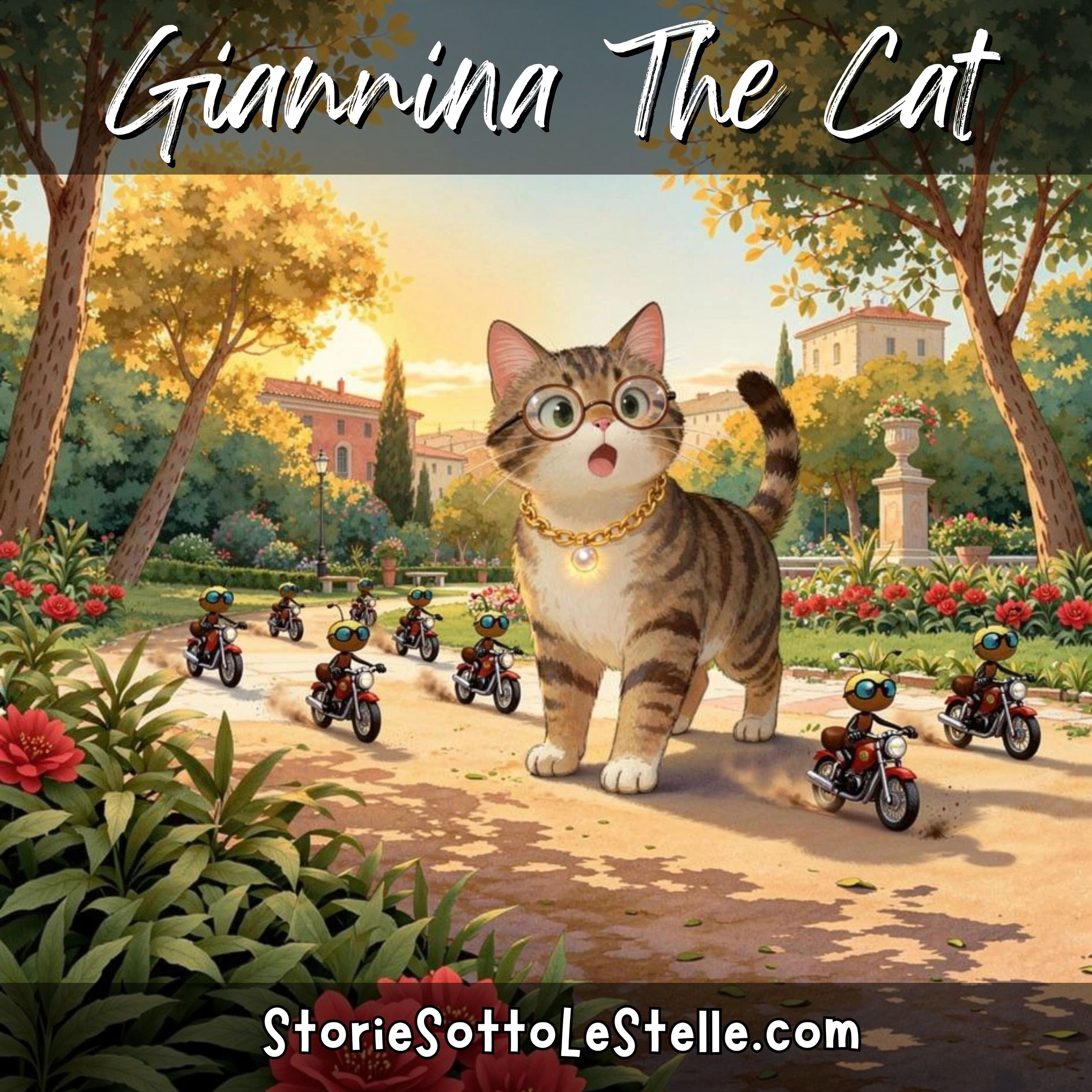
Ep 2556Giannina The Cat | Written By Lucia & Marco Ciappelli (English Version) | Stories Sotto Le Stelle Podcast | Short Stories For Children And Dreamers Of All Ages
Giannina the Cat Giannina the cat lived in a house with a garden. The garden wall bordered a park where children gathered to play. The town was small but charming — from the windowsills of the houses, pots of geraniums and petunias tumbled down like colorful cascades. Her owner, Signora Mafalda, often took her around the town center. All the children knew her, and whenever they spotted her, they would run over and shower her with affection. Giannina was quite the little rascal. During the day she loved chasing lizards, hunting insects, butterflies, and anything that moved. To rest, she would stretch out in the sun on the warm stones, then cool off among the blades of grass. In the garden, among the pomegranate tree, the lemon tree, and the olive with its silvery leaves, she and Mafalda spent their afternoons playing together. But one day, Mafalda began to notice something strange. Giannina would leap to catch her prey, but she kept missing and ending up in the rose bushes. "Ow, ow, ow! I've pricked myself and my tail is tangled in the branches!" she meowed. She barely managed to dodge trees she used to climb with ease. She reached her food and water bowls with an uncertain gait. Worried, Mafalda took her to the Veterinarian. After listening to the little cat's strange adventures, the Doctor smiled and delivered his verdict with a wise air: "This little kitty can't see well. She needs glasses." No sooner said than done — in the blink of an eye, the veterinarian searched through a display case full of frames for pets and, finding the perfect one, exclaimed: "Here we are — a pair of glasses fit for an elegant lady!" As soon as they were placed on Giannina's sweet little snout, the cat looked around in wonder. She could see everything so clearly! She rubbed against the Veterinarian's legs and leaped into Mafalda's arms as if to thank her. The Doctor, touched by her sweetness, gave her a special gift: a golden chain with a small pearl at its center that glowed with its own light. Whispering, he told her: "If you close your eyes and touch this pearl with your little nose, you will gain magical powers that only you will have. They will help you help others." Giannina thought that perhaps this Veterinarian was also a Wizard, but she said nothing to Mafalda. It was a secret between her and the strange Doctor. On the way home, people turned to look at her, thinking: that cat seems mysterious — there's something glimmering around her. At home, Giannina's first wish was to climb onto a chair and gaze out the window. The flowers shone in their colors, and even the grass was a brilliant green, as if covered in dew. She smiled, happier than ever. Mafalda, sharing in her joy, decided to take her to the park. They arrived in no time. Squirrels scampered through the trees, birds sang as they flew from branch to branch. Small creatures popped out everywhere, and the children followed them with curiosity — they ran alongside the lizards, leaped with the butterflies dancing in the air, while red ladybugs landed on their skin like good luck charms. After chases, slides, and ring-around-the-rosy, the children sat down on the grass for their snack. From their colorful backpacks came tasty treats. That's when they arrived. "Vriiip! Vriiip! Vriiip!" At full speed, a platoon of ants zoomed in on rumbling mini-motorcycles. They wore shiny little helmets on their heads, round goggles over their eyes, and tiny boots on their feet. They braked sharply in front of the children, raising little clouds of dust. "Make way! We're here too!" shouted the lead ant, lifting her visor. "Can we collect the crumbs?" The children burst out laughing. "Yes, yes! Munch all the crumbs you want!" The ants parked their mini-motorcycles in a neat row, removed their helmets with theatrical gestures, and got to work carrying crumbs twice their size, singing a little marching song. In this joyful atmosphere, Giannina and Mafalda strolled along the pathways. And suddenly, as they passed, the trees bent their branches in a bow and their leaves rustled in greeting. The roses in the flower beds opened their petals and began to sing. The lizards beat their tails on the ground like drums: "Rattatatà! Rattatatà!" And the millipedes started tap dancing to the lively rhythm. "Oh my, what a wonderful commotion!" exclaimed Giannina, who was beginning to feel a mysterious aura around her. She couldn't help but think of the Wizard Veterinarian. What could these magical powers be? And what would happen if she touched the pearl with her little nose? She told Mafalda, who was carrying a book of fairy tales under her arm. They looked at each other and, understanding instantly, seized the moment. Giannina gathered the children in a circle. Some came quickly, others more shy joined in slowly. The ants too, their bellies full, put on their mini helmets again, did one last rumbling lap on their motorcycles, then climbed off and approached the group. It was the right moment. Giannin
Ep 2555CES 2026 Recap | AI, Robotics, Quantum, And Renewable Energy: The Future Is More Practical Than You Think | A Conversation with CTA Senior Director and Futurist Brian Comiskey | Redefining Society and Technology with Marco Ciappelli
CES 2026 Just Showed Us the Future. It's More Practical Than You Think.CES has always been part crystal ball, part carnival. But something shifted this year.I caught up with Brian Comiskey—Senior Director of Innovation and Trends at CTA and a futurist by trade—days after 148,000 people walked the Las Vegas floor. What he described wasn't the usual parade of flashy prototypes destined for tech graveyards. This was different. This was technology getting serious about actually being useful.Three mega trends defined the show: intelligent transformation, longevity, and engineering tomorrow. Fancy terms, but they translate to something concrete: AI that works, health tech that extends lives, and innovations that move us, power us, and feed us. Not technology for its own sake. Technology with a job to do.The AI conversation has matured. A year ago, generative AI was the headline—impressive demos, uncertain applications. Now the use cases are landing. Industrial AI is optimizing factory operations through digital twins. Agentic AI is handling enterprise workflows autonomously. And physical AI—robotics—is getting genuinely capable. Brian pointed to robotic vacuums that now have arms, wash floors, and mop. Not revolutionary in isolation, but symbolic of something larger: AI escaping the screen and entering the physical world.Humanoid robots took a visible leap. Companies like Sharpa and Real Hand showcased machines folding laundry, picking up papers, playing ping pong. The movement is becoming fluid, dexterous, human-like. LG even introduced a consumer-facing humanoid. We're past the novelty phase. The question now is integration—how these machines will collaborate, cowork, and coexist with humans.Then there's energy—the quiet enabler hiding behind the AI headlines.Korea Hydro Nuclear Power demonstrated small modular reactors. Next-generation nuclear that could cleanly power cities with minimal waste. A company called Flint Paper Battery showcased recyclable batteries using zinc instead of lithium and cobalt. These aren't sexy announcements. They're foundational.Brian framed it well: AI demands energy. Quantum computing demands energy. The future demands energy. Without solving that equation, everything else stalls. The good news? AI itself is being deployed for grid modernization, load balancing, and optimizing renewable cycles. The technologies aren't competing—they're converging.Quantum made the leap from theory to presence. CES launched a new area called Foundry this year, featuring innovations from D-Wave and Quantum Computing Inc. Brian still sees quantum as a 2030s defining technology, but we're in the back half of the 2020s now. The runway is shorter than we thought.His predictions for 2026: quantum goes more mainstream, humanoid robotics moves beyond enterprise into consumer markets, and space technologies start playing a bigger role in connectivity and research. The threads are weaving together.Technology conversations often drift toward dystopia—job displacement, surveillance, environmental cost. Brian sees it differently. The convergence of AI, quantum, and clean energy could push things toward something better. The pieces exist. The question is whether we assemble them wisely.CES is a snapshot. One moment in the relentless march. But this year's snapshot suggests technology is entering a phase where substance wins over spectacle.That's a future worth watching.This episode is part of the Redefining Society and Technology podcast's CES 2026 coverage. Subscribe to stay informed as technology and humanity continue to intersect.Subscribe to the Redefining Society and Technology podcast. Stay curious. Stay human.> https://www.linkedin.com/newsletters/7079849705156870144/Marco Ciappelli: https://www.marcociappelli.com/ Hosted by Simplecast, an AdsWizz company. See pcm.adswizz.com for information about our collection and use of personal data for advertising.
Ep 2554Craft, Lineage, and Making Music That Holds | A Conversation with Singer, Songwriter, Guitarist, and She Rocks Awards 2026 Honoree, Margaret Glaspy | The NAMM Show 2026 Event Coverage | Music Evolves with Sean Martin
Show NotesSinger, songwriter, and guitarist Margaret Glaspy joins Sean Martin and Marco Ciappelli for a Music Evolves conversation recorded in the context of the NAMM Show and the She Rocks Awards, where Glaspy is recognized as a 2026 honoree. The discussion centers on how artists develop a voice, how creative practice sustains a career, and why music functions as a form of public service rather than a commodity alone. Glaspy shares how growing up in a musically active household normalized creativity and removed the idea that music must be exceptional to be meaningful. Early immersion in Texas-style fiddle competitions, alongside exposure to jazz, songwriter traditions, and alternative rock, shapes a foundation rooted in lineage rather than trend. That sense of lineage continues to guide her current work, where influence is acknowledged openly rather than hidden.Songwriting, as Glaspy describes it, is a daily practice rather than an output-driven process. Writing consistently, sometimes a song a day, becomes a way to maintain agency in a career shaped by touring cycles, releases, and expectations. Albums emerge from accumulation and reflection, not from pre-defined concepts. This approach reframes productivity as presence, with creativity tied to well-being and continuity.The conversation also explores how artists navigate maturity. Early attempts to emulate heroes eventually give way to self-recognition. Glaspy speaks to the value of being a student of music, letting imitation serve as a bridge to personal expression rather than a destination. That perspective resists the myth of originality in isolation and places artists within an ongoing cultural thread.Recognition at the She Rocks Awards introduces another dimension. Glaspy views the honor with humility, emphasizing the importance of creating space to acknowledge women’s contributions in music without turning the work itself into a competition. In that context, the NAMM Show represents the maker side of music, instrument builders, technologists, and craftspeople whose work enables creative expression.This episode positions music not as a product to be optimized, but as a practice to be protected, cultivated, and shared.GuestMargaret Glaspy, Singer, Songwriter, and Guitarist | Website: https://margaretglaspy.com/HostSean Martin, Co-Founder at ITSPmagazine, Studio C60, and Host of Redefining CyberSecurity Podcast & Music Evolves Podcast | Website: https://www.seanmartin.com/Marco Ciappelli, Co-Founder, ITSPmagazine and Studio C60 | Website: https://www.marcociappelli.comResources2026 She Rocks Awards: https://sherocksawards.com/The NAMM Show 2026 is taking place from January 20-24, 2026 | Anaheim Convention Center • Southern California — Coverage provided by ITSPmagazine — Follow our coverage: https://www.itspmagazine.com/cybersecurity-technology-society-events/the-namm-show-2026The NAMM Show 2026: https://www.namm.org/thenammshow/attendMusic Evolves: Sonic Frontiers Newsletter | https://www.linkedin.com/newsletters/7290890771828719616/Keywordsmargaret glaspy, sean martin, marco ciappelli, namm, she rocks awards, music, creativity, art, artist, musician, music evolves, music podcast, music and technology podcast, singer, songwriter, guitarist, guitar playingMore From Sean MartinMore from Music Evolves: https://www.seanmartin.com/music-evolves-podcastMusic Evolves on YouTube: https://www.youtube.com/playlist?list=PLnYu0psdcllTRJ5du7hFDXjiugu-uNPtWMusic Evolves: Sonic Frontiers Newsletter | https://www.linkedin.com/newsletters/7290890771828719616/On Location with Sean and Marco: https://www.itspmagazine.com/on-locationITSPmagazine YouTube Channel: https://www.youtube.com/@itspmagazineBe sure to share and subscribe! Hosted by Simplecast, an AdsWizz company. See pcm.adswizz.com for information about our collection and use of personal data for advertising.
Ep 2553Bass Is the Backbone of Music | A Conversation with Bass Magazine Editor in Chief, Jon D’Auria | The NAMM Show 2026 Event Coverage — Bass Magazine Awards | Music Evolves with Sean Martin
Show NotesBass rarely leads the conversation about music innovation, yet it quietly shapes how songs move, how bands connect, and how audiences feel rhythm in their bodies. In this episode of Music Evolves, hosts Sean Martin and Marco Ciappelli explore that idea with Jon D’Auria, Editor in Chief of Bass Magazine, through the lens of community, technology, and cultural relevance.D’Auria describes bass not as a background instrument, but as a stabilizing force. It anchors songs while allowing others to shine, a role mirrored by bass players themselves. That identity informs how the bass community operates: collaborative, inclusive, and deeply connected across generations. Events like the Bass Magazine Awards, held alongside the NAMM Show, are not about spectacle alone. They are about recognition, continuity, and shared lineage.Technology plays a central role in how this community grows. Digital publishing allowed Bass Magazine to expand reach beyond the limits of print, creating immediate access to news, gear releases, artist stories, and cultural moments. Social platforms now surface bass players from bedrooms and rehearsal spaces worldwide, creating opportunity while also reshaping how success is measured.Innovation, however, is not framed as progress for its own sake. The conversation questions where technology supports creativity and where it distracts from it. Lightweight amps, compact gear, and modeling tools solve real problems for working musicians. AI, on the other hand, introduces unresolved tension. While it lowers barriers to creation, it also challenges authorship, labor, and artistic value.Through it all, the episode reinforces a simple truth: music remains human at its core. Technology can amplify access, speed, and scale, but it does not replace intention, emotion, or community. Bass, often overlooked, becomes the perfect metaphor for that balance. Present, essential, and powerful without demanding the spotlight.This episode positions bass not just as an instrument, but as a signal of how music culture adapts while staying grounded in human connection.GuestJon D’Auria, Editor in Chief of Bass Magazine | On LinkedIn: https://www.linkedin.com/in/jon-d-auria-2a7b5089/HostSean Martin, Co-Founder at ITSPmagazine, Studio C60, and Host of Redefining CyberSecurity Podcast & Music Evolves Podcast | Website: https://www.seanmartin.com/Marco Ciappelli, Co-Founder, ITSPmagazine and Studio C60 | Website: https://www.marcociappelli.comResourcesBass Magazine: https://bassmagazine.comBass Magazine Awards: https://bassmagazineawards.com/The NAMM Show 2026 is taking place from January 20-24, 2026 | Anaheim Convention Center • Southern California — Coverage provided by ITSPmagazine — Follow our coverage: https://www.itspmagazine.com/cybersecurity-technology-society-events/the-namm-show-2026The NAMM Show 2026: https://www.namm.org/thenammshow/attendMusic Evolves: Sonic Frontiers Newsletter | https://www.linkedin.com/newsletters/7290890771828719616/Keywordssean martin, marco ciappelli, jon dauria, bass magazine, namm, bass, music, technology, community, creativity, music, creativity, art, artist, musician, music evolves, music podcast, music and technology podcastMore From Sean MartinMore from Music Evolves: https://www.seanmartin.com/music-evolves-podcastMusic Evolves on YouTube: https://www.youtube.com/playlist?list=PLnYu0psdcllTRJ5du7hFDXjiugu-uNPtWMusic Evolves: Sonic Frontiers Newsletter | https://www.linkedin.com/newsletters/7290890771828719616/On Location with Sean and Marco: https://www.itspmagazine.com/on-locationITSPmagazine YouTube Channel: https://www.youtube.com/@itspmagazineBe sure to share and subscribe! Hosted by Simplecast, an AdsWizz company. See pcm.adswizz.com for information about our collection and use of personal data for advertising.
Ep 2552From Department of No to Department of Know: The CISO Evolution | A Brand Highlight Conversation with Ivan Milenkovic, Vice President, Cyber Risk Technology of Qualys
In this Brand Highlight, Ivan Milenkovic, Vice President, Cyber Risk Technology at Qualys, joins host Sean Martin to discuss how security leaders can break free from the whack-a-mole cycle of vulnerability management.With more than 48,000 vulnerabilities disclosed in 2025 alone and the average enterprise juggling 76 different security consoles, Milenkovic argues that the old methods of counting patches and chasing alerts are no longer sustainable. Instead, Qualys helps organizations prioritize threats based on business context through what the company calls TruRisk.Milenkovic describes a fundamental shift he sees taking place in boardroom conversations: moving from risk appetite to risk tolerance. Boards and executives now want to know what specific losses mean to the business rather than simply asking whether the organization is secure.For CISOs, this means evolving from the department of "No" to the department of "Know," where security leaders understand where problems exist, how to fix them, and what architecture supports business objectives. The key is demonstrating return on investment through resilience metrics rather than vulnerability counts.Qualys addresses this challenge through its Enterprise TruRisk Management platform, which facilitates what Milenkovic calls the Risk Operations Center. Unlike a traditional SOC that focuses on incidents that have already occurred, the ROC takes a proactive stance, helping organizations prevent threats and optimize security spending before damage occurs.This is a Brand Highlight. A Brand Highlight is a ~5 minute introductory conversation designed to put a spotlight on the guest and their company. Learn more: https://www.studioc60.com/creation#highlightGUESTIvan Milenkovic, Vice President, Cyber Risk Technology, QualysOn LinkedIn | https://www.linkedin.com/in/ivanmilenkovic/RESOURCESLearn more about Qualys | https://www.qualys.comAre you interested in telling your story?▶︎ Full Length Brand Story: https://www.studioc60.com/content-creation#full▶︎ Brand Spotlight Story: https://www.studioc60.com/content-creation#spotlight▶︎ Brand Highlight Story: https://www.studioc60.com/content-creation#highlightKEYWORDSIvan Milenkovic, Qualys, Sean Martin, brand story, brand marketing, marketing podcast, brand highlight, Enterprise TruRisk Management, Risk Operations Center, ROC, vulnerability management, CISO, cyber risk, risk tolerance, security leadership, proactive security Hosted by Simplecast, an AdsWizz company. See pcm.adswizz.com for information about our collection and use of personal data for advertising.

Ep 2551Leopoldo's Secret Library | Written By Marco Ciappelli (English Version) | Stories Sotto Le Stelle Podcast | Short Stories For Children And Dreamers Of All Ages
LEOPOLDO'S SECRET LIBRARYSome people are strange — they like to spend their evenings reading books.Others are even stranger — they believe in the magic found between pages, in fantastical adventures, in stories of impossible love, in ghosts that walk among the living, and they think that everything that doesn't exist — maybe does after all.In short, this story is for those who are a little strange, like you and me — you know, for those who.So… listen.If you take the road up the hill from the center of town, you'll find an old and noble villa, one that has been there for a very long time. It must be about 350 years now that it has stood there in silence, watching and breathing softly beneath the Tuscan sky.Enormous rooms filled with history, endless corridors, and windows as large as dreams — but now, instead of porcelain plates and figurines, it gives us stories on paper for those who wish to read them.Yes, now it's the town library — a bit out of the way, but so beautiful. Well, you can't have everything.Now, on a summer night, wrapped in a blanket of stars and the soft glow of delicate lanterns, the villa had filled with voices, music, smiles, and so many stories told and heard, spoken aloud or whispered, intertwining in the embrace of the celebration.A special evening already, no doubt, but pay attention, because something even more unusual was about to happen.Yes, because Elisa was there too. Eyes as wide as the sky, hair as dark as the night, and a book in her hand — as always.Despite everything happening around her, Elisa preferred to read.She was there, in the main corridor: between the garden and the inner courtyard, halfway between the certain and the perhaps, sitting in an armchair a little too big for her, lost in a mysterious and captivating story — in a world all her own.She turns a page, then another, adjusts her yellow glasses, and turns another page…When slowly, the echo of piano music reached her ears.She didn't pay much attention. Thinking it came from the courtyard, she turned another page — and then another.But before long she realized that the notes she heard were not coming from the villa's courtyard but from one of its corridors — carried by a gentle breeze, from faraway places outside of time.Without thinking too much, Elisa rose silently, tucked her book under her arm, and followed the music.She crossed ancient corridors and rooms with shelves full of volumes of every size and color imaginable — rainbows of thoughts and words lined up one by one that seemed to never end.As the music grew stronger, the light faded, the rooms she passed through began to appear forgotten, the stone stairs she climbed and descended worn by time, the side corridors were now dark passages lit only by torches on the walls, appearing and disappearing in the darkness like breaths.A staircase, a wooden door left ajar, another passage, another staircase, and still more rooms and shelves and books without end.Then, suddenly, a mist covered the floor like a gentle tide, and there, before her, a heavy curtain — half open.A little light showed through, and a few small wooden steps.She climbed them, those little stairs, and the music wrapped around her like an embrace.On the stage, candles floated in the air like fireflies on a timeless night. And there, at the center, seated before a tiny piano, was a mouse.But not just any mouse.Leopoldo wore a dark green tweed jacket, brown trousers pressed with care, and on his little snout, golden spectacles that gleamed with ancient and gentle wisdom.His fingers danced on the keys as if they were telling a secret."Welcome, Elisa," he said, without stopping his playing. "I've been waiting for you."Elisa blinked, enchanted. "How do you know my name?""Ah," Leopoldo smiled, letting the last note fade softly into the air, "those who love stories always recognize those who seek them."He stood, adjusted his jacket with an elegant gesture, and looked at her with eyes full of stars."Do you know where you are?""In the town library," Elisa answered, but her voice trembled a little, as if she knew the answer was something else."That one everyone knows," said Leopoldo, stepping down slowly from the stage. "Every town has one that everyone knows. But every town also has another — one that almost no one finds."He paused, his eyes gleaming."You have found the second."Leopoldo led her toward a large wooden door that Elisa could have sworn wasn't there a moment before. It opened slowly, without a sound, like a sigh held too long.And what she saw took her breath away.Endless shelves climbed upward, descended downward, stretched in every direction like spirals of galaxies made of paper and dreams. Candles floated everywhere, illuminating books that seemed to breathe, to pulse softly, like sleeping hearts."What is this place?" Elisa whispered."This," said Leopoldo, walking among the shelves, "is the library of books never written."Elisa followed, confused. "Books never written? But how can they e
Ep 2550Dave Tourjé on Art, Music, Skateboarding, Los Angeles and Never Selling Out | Stories, Storytelling & Storytellers | Audio Signals Podcast With Marco Ciappelli
Dave Tourjé: You Have to Destroy What You Create to Become FreeWhen Dave Tourjé was two years old, he had a box of wooden blocks. Every day he'd dump them on the floor, stack them into towers of color, admire what he built—then destroy it and start over.That ritual never stopped.Tourjé is a painter, a punk rock musician, a skateboarder, and a founding member of the California Locos—a collective of LA artists who represent the city's raw, multicultural energy. When he sat down with me for Audio Signals Podcast, we talked about survival, rebellion, and what it really takes to stay free as an artist."You have to learn to destroy what you're creating to really become free," Tourjé told me. "Otherwise you're gonna be trapped by your own creation."He calls himself a lucky survivor of the eighties. Born in 1960, raised in Los Angeles, he hit the punk rock scene at 19, got his first skateboard at 7, and was riding swimming pools by the time urethane wheels made it possible. He studied art on scholarship but quit when they asked him to do papier-mâché in college. "That was third grade for me," he said. "I just said, fuck this. I'm outta here."He's the only practicing artist from that program.When galleries started selling his concrete and steel furniture around the world, Tourjé thought they'd embrace his paintings too. Instead, they told him to stick with what was selling. When collectors wanted commissioned work in different colors, he walked away. "I was not built to do it," he said. "So I bowed out."Instead of finding a patron, he built one. A construction company that runs without him—a machine that pays him without requiring him to owe anything to anyone. "It's going to be my patron," he explained. "It's a similar model, but without all the social implications."That freedom let him focus on the California Locos, a collective he assembled around 2011 with friends who were all leaders in their own corners of LA culture—surf, skate, street art, tattoo, photography. "We are basically Los Angeles," he said. "A very honest reflection."Their book, Renaissance and Rebellion, tells the story from the sixties to now. It's published by Drago in Rome and distributed internationally. They're currently showing at the California Surf Museum in Oceanside, with museum shows lined up for 2027 and Spain on the horizon.But the moment that stuck with me came at the end of our conversation. We talked about how musicians destroy as they create—every live performance disappears the moment it's played. "It's like painting a painting that as soon as you put it down and you go to get the next paint, the paint is gone."And when someone looks at his paintings and sees something he never intended? He doesn't correct them. "The story is the painting," he said. "As soon as the artist says what it's about, everybody has to abide by the rules."He refuses to impose meaning. Once he's done, he becomes an observer. The work is no longer his—it's an object from the past. He's already onto the next thing.That's what freedom looks like after a lifetime of rebellion.Stay tuned. Subscribe. And remember—we are all made of stories.-- Marco_______________________________________________________________________________________Audio Signals Podcast 🌐 https://www.audiosignalspodcast.comDave Tourjé 🌐 https://davetourje.com/Marco Ciappelli 🌐 https://www.marcociappelli.com Hosted by Simplecast, an AdsWizz company. See pcm.adswizz.com for information about our collection and use of personal data for advertising.
Ep 2549Real-Time Protection Against AI-Driven Account Takeover Fraud | A Brand Highlight Conversation with Israel Mazin, Co-Founder and CEO of Memcyco
As AI makes it easier for attackers to launch account takeover campaigns at scale, organizations face mounting pressure to protect their customers and their brand. Israel Mazin, Co-Founder and CEO of Memcyco, joins the conversation to discuss how real-time detection and protection capabilities are changing the game.Memcyco is built on four products within a unified platform, each designed to detect and block both traditional and AI-driven attacks in real time. Unlike reactive threat intelligence solutions, Memcyco identifies victims as they interact with fake sites, provides detailed attacker data, and even deploys credential deception to neutralize stolen information before it can be used.With an agentless deployment that takes just minutes to implement, Memcyco delivers more than 10x ROI for customers across financial services, retail, airlines, logistics, and hospitality. The company has achieved nearly 300% year-over-year growth, serving organizations across North America, Latin America, Europe, and beyond.This is a Brand Highlight. A Brand Highlight is a ~5 minute introductory conversation designed to put a spotlight on the guest and their company. Learn more: https://www.studioc60.com/creation#highlightGUESTIsrael Mazin, Co-Founder and CEO of MemcycoOn LinkedIn: https://www.linkedin.com/in/israel-mazin-62215b/RESOURCESMemcyco: https://www.memcyco.com/Are you interested in telling your story?▶︎ Full Length Brand Story: https://www.studioc60.com/content-creation#full▶︎ Brand Spotlight Story: https://www.studioc60.com/content-creation#spotlight▶︎ Brand Highlight Story: https://www.studioc60.com/content-creation#highlightKEYWORDSIsrael Mazin, Memcyco, Sean Martin, brand story, brand marketing, marketing podcast, brand highlight, account takeover, ATO fraud, digital impersonation, phishing protection, real-time fraud detection, credential deception, website spoofing, AI-driven attacks, fraud prevention platform, agentless security Hosted by Simplecast, an AdsWizz company. See pcm.adswizz.com for information about our collection and use of personal data for advertising.
Ep 2548CES 2026: Why NVIDIA's Jensen Huang Won IEEE Medal of Honor | A Conversation with Mary Ellen Randall, IEEE's 2026 President and CEO | Redefining Society and Technology with Marco Ciappelli
Jensen Huang Just Won IEEE's Highest Honor. The Reason Tells Us Everything About Where Tech Is Headed.IEEE announced Jensen Huang as its 2026 Medal of Honor recipient at CES this week. The NVIDIA founder joins a lineage stretching back to 1917—over a century of recognizing people who didn't just advance technology, but advanced humanity through technology.That distinction matters more than ever.I spoke with Mary Ellen Randall, IEEE's 2026 President and CEO, from the floor of CES Las Vegas. The timing felt significant. Here we are, surrounded by the latest gadgets and AI demonstrations, having a conversation about something deeper: what all this technology is actually for.IEEE isn't a small operation. It's the world's largest technical professional society—500,000 members across 190 countries, 38 technical societies, and 142 years of history that traces back to when the telegraph was connecting continents and electricity was the revolutionary new thing. Back then, engineers gathered to exchange ideas, challenge each other's thinking, and push innovation forward responsibly.The methods have evolved. The mission hasn't."We're dedicated to advancing technology for the benefit of humanity," Randall told me. Not advancing technology for its own sake. Not for quarterly earnings. For humanity. It sounds like a slogan until you realize it's been their operating principle since before radio existed.What struck me was her framing of this moment. Randall sees parallels to the Renaissance—painters working with sculptors, sharing ideas with scientists, cross-pollinating across disciplines to create explosive growth. "I believe we're in another time like that," she said. "And IEEE plays a crucial role because we are the way to get together and exchange ideas on a very rapid scale."The Jensen Huang selection reflects this philosophy. Yes, NVIDIA built the hardware that powers AI. But the Medal of Honor citation focuses on something broader—the entire ecosystem NVIDIA created that enables AI advancement across healthcare, autonomous systems, drug discovery, and beyond. It's not just about chips. It's about what the chips make possible.That ecosystem thinking matters when AI is moving faster than our ethical frameworks can keep pace. IEEE is developing standards to address bias in AI models. They've created certification programs for ethical AI development. They even have standards for protecting young people online—work that doesn't make headlines but shapes the digital environment we all inhabit."Technology is a double-edged sword," Randall acknowledged. "But we've worked very hard to move it forward in a very responsible and ethical way."What does responsible look like when everything is accelerating? IEEE's answer involves convening experts to challenge each other, peer-reviewing research to maintain trust, and developing standards that create guardrails without killing innovation. It's the slow, unglamorous work that lets the exciting breakthroughs happen safely.The organization includes 189,000 student members—the next generation of engineers who will inherit both the tools and the responsibilities we're creating now. "Engineering with purpose" is the phrase Randall kept returning to. People don't join IEEE just for career advancement. They join because they want to do good.I asked about the future. Her answer circled back to history: the Renaissance happened when different disciplines intersected and people exchanged ideas freely. We have better tools for that now—virtual conferences, global collaboration, instant communication. The question is whether we use them wisely.We live in a Hybrid Analog Digital Society where the choices engineers make today ripple through everything tomorrow. Organizations like IEEE exist to ensure those choices serve humanity, not just shareholder returns.Jensen Huang's Medal of Honor isn't just recognition of past achievement. It's a statement about what kind of innovation matters.Subscribe to the Redefining Society and Technology podcast. Stay curious. Stay human.My Newsletter? Yes, of course, it is here: https://www.linkedin.com/newsletters/7079849705156870144/Marco Ciappelli: https://www.marcociappelli.com/ Hosted by Simplecast, an AdsWizz company. See pcm.adswizz.com for information about our collection and use of personal data for advertising.
Ep 2547Identity, Access, and the Rise of Synthetic Identities | A Brand Highlight Conversation with Denny LeCompte, CEO and Co-Founder of Portnox
In this Brand Highlight, we talk with Denny LeCompte, CEO and Co-Founder of Portnox, about how identity and access control are changing as AI-driven agents and synthetic identities become active participants inside enterprise environments.Passwords still sit at the root of many security failures, which is why the conversation starts with the fundamentals: controlling who can access data, from where, and under what device and policy conditions. Certificate-based authentication emerges as a practical way to reduce password dependency while keeping enforcement tied to managed devices and policy compliance.The discussion then shifts to what is changing for security leaders. CISOs may feel more confident managing traditional cyber threats, but uncertainty rises quickly when AI-generated and non-human identities enter the picture. Agentic AI turns automation into an entity that touches networks and applications, making access control a first-order requirement rather than an afterthought.A clear theme emerges throughout the conversation: synthetic identities are not hypothetical. They appear anywhere autonomous agents require permissions to act, from software development to workflow automation. Applying the same discipline used for human identities, including least privilege, scope limitation, and policy enforcement, becomes essential to maintaining control as AI adoption accelerates.Note: This story contains promotional content. Learn more.GuestDenny LeCompte, CEO and Co-Founder of Portnoxhttps://www.linkedin.com/in/dennylecompte/ResourcesLearn more about Portnox: https://www.portnox.com/Are you interested in telling your story?Full Length Brand Story: https://www.studioc60.com/content-creation#fullBrand Spotlight Story: https://www.studioc60.com/content-creation#spotlightBrand Highlight Story: https://www.studioc60.com/content-creation#highlightKeywords: sean martin, denny lecompte, portnox, identity, access, zero trust, passwordless, certificates, agentic ai, synthetic identities, brand story, brand marketing, marketing podcast Hosted by Simplecast, an AdsWizz company. See pcm.adswizz.com for information about our collection and use of personal data for advertising.
Ep 2546It Fractured, Then Rebuilt Itself: The CISO Role Changed More in Five Years Than Ever Before, Setting the Stage for 2026 | A Musing On the Future of Cybersecurity with Sean Martin and TAPE9 | Read by TAPE9
Across dozens of conversations centered on the CISO experience, one reality keeps surfacing: the role no longer exists to protect systems in isolation. It exists to protect the business itself.Today’s CISO operates at the intersection of operational risk, executive decision-making, and organizational trust. The responsibility is not just to identify threats, but to help leadership understand which risks matter, when they matter, and why they deserve attention. This shift changes what success looks like. It also changes how pressure is felt.During the early years of this transition, CISOs carry accountability without authority. They are expected to influence outcomes without always having control over budgets, priorities, or timelines. That tension forces a new skill set to the forefront. Technical knowledge is assumed. The differentiator becomes communication, translation, and relationship-building across the business.As organizations mature, the conversation evolves again. Security stops being framed around individual threats and starts being framed as an operational discipline. CISOs focus on prioritization, tradeoffs, and clarity rather than coverage for everything. This requires judgment more than tooling.The role also becomes deeply human. Fear shows up quietly. Fear of pushing too hard. Fear of slowing the business. Fear of being seen as the blocker. CISOs who succeed do not eliminate that fear. They learn how to manage it while building credibility with executive peers.AI enters the picture not as a replacement, but as a force multiplier. Automation supports scale, but judgment remains human. Security programs increasingly deny by default and permit intentionally, which demands a deep understanding of how the business actually works. That understanding cannot be automated.What emerges is a clearer definition of modern security leadership. The CISO is no longer a gatekeeper. This is a risk advisor, a translator, and a strategist who helps the organization focus its limited resources where they matter most.The role has not become easier. It has become more meaningful.Read the full article: TBA________This story represents the results of an interactive collaboration between Human Cognition and Artificial Intelligence.Enjoy, think, share with others, and subscribe to "The Future of Cybersecurity" newsletter on LinkedIn: https://itspm.ag/future-of-cybersecuritySincerely, Sean Martin and TAPE9________Sean Martin is a life-long musician and the host of the Music Evolves Podcast; a career technologist, cybersecurity professional, and host of the Redefining CyberSecurity Podcast; and is also the co-host of the On Location Event Coverage Podcast. These shows are all part of ITSPmagazine—which he co-founded with his good friend Marco Ciappelli, to explore and discuss topics at The Intersection of Technology, Cybersecurity, and Society.™️Would you like Sean to work with you on a topic/series to help you tell your story? Visit his services page to learn more: https://www.seanmartin.com/servicesWant to connect with Sean and Marco On Location at an event or conference near you? See where they will be next: https://www.itspmagazine.com/on-locationTo learn more about Sean, visit his personal website.Keywords: sean martin, marco ciappelli, steve katz, tim brown, jessica robinson, rob allen, rohit ghai, rich seiersen, steven j speer, chris pierson, mark lambert, jim manico, robin bylenga, redefining cybersecurity, cybersecurity podcast, redefining cybersecurity podcast, ciso, risk, leadership, ai, resilience, strategy Hosted by Simplecast, an AdsWizz company. See pcm.adswizz.com for information about our collection and use of personal data for advertising.
Ep 2545Music, Meaning, and the Business of Being Heard: Why Authentic Music Travels Further Than Trends | A Conversation with Chris SD | Music Evolves with Sean Martin
Show NotesMusic placement has quietly become one of the most powerful engines shaping how audiences discover new artists. In this episode of Music Evolves, host Sean Martin speaks with Chris SD, music producer and founder focused on connecting independent songwriters with film, television, and media opportunities, about how music moves from personal creation into shared cultural moments.The conversation centers on sync licensing not as a shortcut, but as a parallel creative economy. Chris SD explains that music supervisors, the professionals responsible for sourcing music for screen, are not looking for imitation or trend chasing. They are listening for authenticity. Songs that already exist, written without a brief or a pitch in mind, often resonate more deeply because they carry emotional truth rather than calculated intent.Why Indie Music Wins Screen TimeIndependent artists play a critical role in modern film and television. Budget realities often make major label catalogs impractical, while independent creators offer flexibility, ownership clarity, and creative alignment. This shifts the opportunity structure. Artists who control their masters and publishing are easier to work with and faster to license, which matters in production schedules driven by speed.Exposure matters as much as payment. A single placement can introduce an artist to millions of viewers in a context that builds emotional association rather than passive listening. That connection often leads to discovery, touring opportunities, and long-term audience growth.Technology as a Tool, Not the AuthorThe episode also addresses the growing conversation around AI in music creation. Chris SD draws a clear distinction between technology as a production aid and technology as a replacement for human authorship. Current legal frameworks and copyright realities prevent fully AI-generated music from being licensed for film and television. More importantly, the emotional nuance required for storytelling still depends on human experience.The message is consistent throughout the discussion. Music that endures is not built on novelty or automation alone. It survives because it reflects something real. Sync licensing rewards that honesty rather than undermines it.For artists navigating visibility, rights, and sustainability, this conversation reframes placement not as selling out, but as participation in a larger storytelling ecosystem.GuestChris SD, Musician, Producer, and Founder of Sync Songwriter | On LinkedIn: https://www.linkedin.com/in/chris-sd/HostSean Martin, Co-Founder at ITSPmagazine, Studio C60, and Host of Redefining CyberSecurity Podcast & Music Evolves Podcast | Website: https://www.seanmartin.com/ResourcesAttend The Sync Songwriter Music Supervisor Panel: https://www.syncsongwriterprograms.com/a/2148209544/Z3BHNXLzMore From Sean MartinMore from Music Evolves: https://www.seanmartin.com/music-evolves-podcastMusic Evolves on YouTube: https://www.youtube.com/playlist?list=PLnYu0psdcllTRJ5du7hFDXjiugu-uNPtWMusic Evolves: Sonic Frontiers Newsletter | https://www.linkedin.com/newsletters/7290890771828719616/Line of Sight Newsletter | https://www.linkedin.com/newsletters/7400591548452667392/ITSPmagazine YouTube Channel: https://www.youtube.com/@itspmagazineBe sure to share and subscribe!Keywordssean martin, chris sd, sync, licensing, music, film, television, independent, supervisors, creativity, art, artist, musician, music evolves, music podcast, music and technology podcast Hosted by Simplecast, an AdsWizz company. See pcm.adswizz.com for information about our collection and use of personal data for advertising.
Ep 2544Five Patterns From 152 Episodes That Reshaped How I Think About Security, Technology, and Work Heading into 2026 | A Musing On the Future of Cybersecurity with Sean Martin and TAPE9 | Read by TAPE9
Across 152 conversations this year, a set of recurring patterns kept surfacing, regardless of whether the discussion focused on application security, software supply chain risk, AI systems, or creative work. The industries varied. The roles varied. The challenges did not.One theme rises above the rest: visibility remains the foundation of everything else, yet organizations continue to accept blind spots as normal. Asset inventories are incomplete. Build systems are poorly understood. Dependencies change faster than teams can track them. The issue is not a lack of tools. It is a willingness to tolerate uncertainty because discovery feels hard or disruptive.Another pattern is equally consistent. Integration matters more than novelty. New features, including AI-driven ones, sound compelling until they fail to connect with what teams already rely on. Security programs fracture when tools operate in isolation. Coverage looks strong on paper while gaps quietly expand in practice. When tools fail to integrate into existing environments, they create complexity instead of reducing risk.Security also continues to struggle with how it shows up in daily work. Programs succeed when security is embedded into workflows, automated where possible, and invisible until it matters. They fail when security acts as a gate that arrives after decisions are already made. Teams either adopt security naturally or route around it entirely. There is no neutral middle ground.Context repeatedly separates effective leadership from noise. Risk only becomes meaningful when it is framed in terms of business operations, delivery speed, and real tradeoffs. Leaders who understand how the business actually functions communicate risk clearly and make better decisions under pressure.Finally, creativity remains undervalued in security conversations. Automation should remove repetitive tasks so people can focus on judgment, problem solving, and design. The same mindset that produces elegant guitars, photographs, or products applies directly to building resilient security programs.These five patterns are not independent ideas. Together, they describe a shift toward security that is visible, integrated, contextual, workflow-driven, and human-centered.Read the full article: https://www.linkedin.com/pulse/five-patterns-from-152-podcast-episodes-2025-changed-i-martin-cissp-st1ge________This story represents the results of an interactive collaboration between Human Cognition and Artificial Intelligence.Enjoy, think, share with others, and subscribe to "The Future of Cybersecurity" newsletter on LinkedIn: https://itspm.ag/future-of-cybersecuritySincerely, Sean Martin and TAPE9________Sean Martin is a life-long musician and the host of the Music Evolves Podcast; a career technologist, cybersecurity professional, and host of the Redefining CyberSecurity Podcast; and is also the co-host of the On Location Event Coverage Podcast. These shows are all part of ITSPmagazine—which he co-founded with his good friend Marco Ciappelli, to explore and discuss topics at The Intersection of Technology, Cybersecurity, and Society.™️Would you like Sean to work with you on a topic/series to help you tell your story? Visit his services page to learn more: https://www.seanmartin.com/servicesWant to connect with Sean and Marco On Location at an event or conference near you? See where they will be next: https://www.itspmagazine.com/on-locationTo learn more about Sean, visit his personal website. Hosted by Simplecast, an AdsWizz company. See pcm.adswizz.com for information about our collection and use of personal data for advertising.
Ep 2543Building Visibility, Community, and Momentum for Women in Music | A Conversation with Laura Whitmore, Founder of The Women’s International Music Network | The NAMM Show 2026 Event Coverage | Music Evolves with Sean Martin
Show NotesMusic careers are often discussed through the lens of performance, technology, or commercial success. Less visible is the connective tissue that sustains those careers: community, advocacy, and long-term support systems. In this episode of Music Evolves: Sonic Frontiers, the conversation centers on how structured networks and intentional recognition shape opportunity across the music industry.Laura Whitmore, Founder of The Women’s International Music Network and Senior Vice President of Marketing at Positive Grid, shares how the organization was created to address a simple but persistent issue: women working across music often operate in parallel, rarely connected despite facing similar challenges. The network focuses on bridging that gap by creating shared spaces for visibility, mentorship, and collaboration across roles including artists, executives, engineers, marketers, and legal professionals.A central anchor of that effort is the She Rocks Awards, now in its fourteenth year. The awards, taking place during The NAMM Show 2026, highlight women contributing across all layers of the industry, not only those on stage. The emphasis is on storytelling and presence, giving space for honorees to speak openly about career paths, obstacles, and resilience. That visibility has a ripple effect, normalizing leadership diversity and encouraging others to see themselves as part of the industry’s future.The discussion also addresses how technology fits into this ecosystem. From AI-assisted music tools to digital platforms that broaden access, innovation plays a role when it amplifies creativity rather than replacing it. The focus remains on preserving human expression while using technology to remove friction and expand reach.Another recurring theme is generational continuity. Younger creators and professionals bring new perspectives on consumption, creation, and community. Engaging them early, listening closely, and building inclusive pathways ensures the industry remains relevant and sustainable.This episode frames music not only as art or business, but as a shared cultural system. Networks like this one reinforce that progress does not happen automatically. It is built through intentional connection, recognition, and sustained effort.GuestLaura Whitmore, Founder of The Women’s International Music Network and Senior Vice President of Marketing at Positive Grid | On LinkedIn: https://www.linkedin.com/in/laurabwhitmore/HostSean Martin, Co-Founder at ITSPmagazine, Studio C60, and Host of Redefining CyberSecurity Podcast & Music Evolves Podcast | Website: https://www.seanmartin.com/ResourcesThe Women's International Music Network: https://thewimn.com/2026 She Rocks Awards: https://sherocksawards.com/The NAMM Show 2026 is taking place from January 20-24, 2026 | Anaheim Convention Center • Southern California — Coverage provided by ITSPmagazine — Follow our coverage: https://www.itspmagazine.com/cybersecurity-technology-society-events/the-namm-show-2026The NAMM Show 2026: https://www.namm.org/thenammshow/attendMusic Evolves: Sonic Frontiers Newsletter | https://www.linkedin.com/newsletters/7290890771828719616/Keywordssean martin, laura whitmore, women’s international music network, she rocks awards, positive grid, namm, music advocacy, music marketing, women in music, music leadership, music, creativity, art, artist, musician, music evolves, music podcast, music and technology podcastMore From Sean MartinMore from Music Evolves: https://www.seanmartin.com/music-evolves-podcastMusic Evolves on YouTube: https://www.youtube.com/playlist?list=PLnYu0psdcllTRJ5du7hFDXjiugu-uNPtWMusic Evolves: Sonic Frontiers Newsletter | https://www.linkedin.com/newsletters/7290890771828719616/On Location with Sean and Marco: https://www.itspmagazine.com/on-locationITSPmagazine YouTube Channel: https://www.youtube.com/@itspmagazineBe sure to share and subscribe! Hosted by Simplecast, an AdsWizz company. See pcm.adswizz.com for information about our collection and use of personal data for advertising.
Ep 2542When AI Guesses and Security Pays: Choosing the Right Model for the Right Security Decision | A Brand Story Highlight Conversation with Michael Roytman, CTO of Empirical Security
Title: The Right Model for the Right Security Task | A Brand Highlight Conversation with Michael Roytman, Co-Founder and CTO of Empirical SecurityIn this Brand Highlight conversation, Michael Roytman, Co-Founder and CTO of Empirical Security, joins Sean Martin to discuss why choosing the right AI model for the right task is essential for effective cybersecurity.Michael Roytman explains how Empirical Security takes a data-driven, Moneyball-style approach to preventative security. The company builds and maintains an ensemble of models, including the open EPSS model used by over 100 vendors, global models for vulnerability exploitation forecasting, and local models tailored to each customer's unique environment.The conversation explores a critical finding: LLMs perform poorly at predictive security tasks. Michael Roytman shares research he published in Forbes comparing EPSS to LLMs from Google, OpenAI, and Anthropic. While LLMs excel at summarization and classification, they struggle to predict future exploitation events. Purpose-built models like XGBoost consistently outperform LLMs for probability forecasting.Empirical Security positions itself as a data science company operating on security data rather than a traditional security vendor. With two-thirds of the founding team holding data science backgrounds, the company trains models from scratch and continuously retrains them as environments and threat landscapes evolve.This is a Brand Highlight. A Brand Highlight is a ~5 minute introductory conversation designed to put a spotlight on the guest and their company. Learn more: https://www.studioc60.com/creation#highlightGUESTMichael Roytman, Co-Founder and CTO of Empirical SecurityOn LinkedIn | https://www.linkedin.com/in/michael-roytman/RESOURCESLearn more about Empirical Security | https://www.empiricalsecurity.comAre you interested in telling your story?▶︎ Full Length Brand Story: https://www.studioc60.com/content-creation#full▶︎ Brand Spotlight Story: https://www.studioc60.com/content-creation#spotlight▶︎ Brand Highlight Story: https://www.studioc60.com/content-creation#highlightKEYWORDSEmpirical Security, Michael Roytman, data-driven security, vulnerability management, EPSS, risk-based vulnerability management, AI in cybersecurity, machine learning security, LLM limitations, predictive security models, XGBoost, local models, global models, preventative security, Moneyball security, cybersecurity AI, threat intelligence, security data science, model retraining, ITSPmagazine, Brand Highlight, Studio C60 Hosted by Simplecast, an AdsWizz company. See pcm.adswizz.com for information about our collection and use of personal data for advertising.

Ep 2541Where Has Santa Claus Gone? | A Short Christmas Story Written By Marco e Lucia Ciappelli (English Version) | Stories Sotto Le Stelle Podcast | Short Stories For Children And The Young At Heart
Where has Santa Claus gone?Once upon a time there was Santa Claus's Village — but Santa Claus wasn't there. He had been missing for days and days… actually for months. Who would prepare and deliver gifts to the children as they did every year?That part of the North Pole which was usually very busy had become strangely silent — not an Elf could be seen around, no sounds of bells, the sleighs were covered in snow and all the reindeer dozed about confused.If you looked into his house you couldn't see a trace of life. The fireplace cold, the rocking chair covered in cobwebs, an empty cup on the wooden table and a candle stub burnt out long ago.Many were the rumours that had spread about Santa Claus's absence. Some said he was on another planet in a far, far away galaxy, some on the Moon, some on the vast oceans — and someone even said he had opened a bakery in Buenos Aires.The mystery was thick. Nobody could make sense of it and everything was silent and still.Meanwhile, many miles away, in the Southern Seas, a group of seagulls who spent their days fluttering above the bay spotted a small sailing boat in the distance. There was only one sailor on board who was hoisting the main sail up the creaking mast.The eldest seagull couldn't believe his eyes. He did a couple of acrobatics in the air, pulled out his spyglass, looked more carefully and said: "But I know him! That sailor comes from distant lands!"Turning to the other seagulls he told them: "One day, during one of my long journeys, I lost my way and found myself on the frozen rooftops of a village at the North Pole. I landed right on the house of that long-bearded man you see on the boat. He heard me calling for help, came to fetch me, fed me and told me about his work. I think this meeting has something magical about it. Our next adventure is about to begin."Gliding down, they headed towards the boat and all landed on the bow. The seagull and the sailor greeted each other like old friends.Shortly after, a group of dolphins arrived near the sailing boat, curious. They swam in circles around the boat, jumping out of the water.The youngest dolphin noticed something strange. "Look! Wood shavings are coming out of the hold and floating! And you can see little lights below deck."The long-bearded sailor smiled. "Come," he said in a warm voice, "I'll show you what I've done all these months."He opened the hatch to the hold and inside, by the light of two swaying lanterns, you could see a floating workshop full of wonders. With a sharp plane he had worked pieces of wood recovered from the sea, transforming them into toys — and he had done the same with shells, coconuts, cork stoppers, glass bottles, starfish and golden threads that had arrived from who knows where."I travelled to learn new ways of bringing joy," the sailor explained. "But there's so much work to do and Christmas is coming. Would you help me finish?"And so they all set to work together. The dolphins brought special shells from the bottom of the sea. The seagulls gathered coloured feathers. The objects transformed into gifts were placed in large canvas sacks.The days passed quickly.On the first of December the captain, wearing his red warm hat with his pipe in his mouth, looked at the starry sky and said: "It's time to leave."The dolphins lifted the sailing boat until it rose above the waves. The sails filled with wind and it took flight, whilst the flock of seagulls guided it through the clouds following dreams. Together they continued the journey heading north, flying through the endless blue.Night fell quickly and in the sky full of stars one shone brighter than all the others. It was the North Star which with its light accompanied the sailing boat's descent to earth.By magic, as it approached the village, the sailing boat transformed into a sleigh loaded with gifts. The presents built in the hold arrived in the workshop to be delivered together with all the other parcels.When it landed on the roof of his house, a tinkling of bells was heard in the distance. The Elves looked out of their doors and shouted: "It's him! It's him! It's Santa Claus! He's back!"The red-nosed reindeer woke up suddenly and began polishing the sleighs, decorating them with bows and coloured pine cones.Life in the village awakened all at once. The tree branches shook as if they were being tickled. A group of penguins, who had arrived at the North Pole to lend a hand, sliding on the ice sheets at great speed, ended up inside snowdrifts and came out like bouncing balls.“You are so funny! We'll hang you on the Christmas tree as decorations!" the village animals shouted.But the penguins, freeing themselves from the snow, ran towards Santa Claus's house to help with the preparations.In the village absolutely everyone got moving. The reindeer rushed to the Post Office and filled the sacks with letters, then carried them to the workshop. The Elves with the help of the penguins were ready for work.That morning, when the bells rang o
Ep 2540AI Adoption Without Readiness: When AI Ambition Collides With Data Reality | A TrustedTech Brand Story Conversation with Julian Hamood, Founder and Chief Visionary Officer at TrustedTech
As organizations race to adopt AI, many discover an uncomfortable truth: ambition often outpaces readiness. In this episode of the ITSPmagazine Brand Story Podcast, host Sean Martin speaks with Julian Hamood, Founder and Chief Visionary Officer at TrustedTech, about what it really takes to operationalize AI without amplifying risk, chaos, or misinformation.Julian shares that most organizations are eager to activate tools like AI agents and copilots, yet few have addressed the underlying condition of their environments. Unstructured data sprawl, fragmented cloud architectures, and legacy systems create blind spots that AI does not fix. Instead, AI accelerates whatever already exists, good or bad.A central theme of the conversation is readiness. Julian explains that AI success depends on disciplined data classification, permission hygiene, and governance before automation begins. Without that groundwork, organizations risk exposing sensitive financial, HR, or executive data to unintended audiences simply because an AI system can surface it.The discussion also explores the operational reality beneath the surface. Most environments are a patchwork of Azure, AWS, on-prem infrastructure, SaaS platforms, and custom applications, often shaped by multiple IT leaders over time. When AI is layered onto this complexity without architectural clarity, inaccurate outputs and flawed business decisions quickly follow.Sean and Julian also examine how AI initiatives often emerge from unexpected places. Legal teams, business units, and individual contributors now build their own AI workflows using low-code and no-code tools, frequently outside formal IT oversight. At the same time, founders and CFOs push for rapid AI adoption while resisting the investment required to clean and secure the foundation.The episode highlights why AI programs are never one-and-done projects. Ongoing maintenance, data validation, and security oversight are essential as inputs change and systems evolve. Julian emphasizes that organizations must treat AI as a permanent capability on the roadmap, not a short-term experiment.Ultimately, the conversation frames AI not as a shortcut, but as a force multiplier. When paired with disciplined architecture and trusted guidance, AI enables scale, speed, and confidence. Without that discipline, it simply magnifies existing problems.Note: This story contains promotional content. Learn more.GUESTJulian Hamood, Founder and Chief Visionary Officer at TrustedTech | On LinkedIn: https://www.linkedin.com/in/julian-hamood/Are you interested in telling your story?▶︎ Full Length Brand Story: https://www.studioc60.com/content-creation#full▶︎ Spotlight Brand Story: https://www.studioc60.com/content-creation#spotlight▶︎ Highlight Brand Story: https://www.studioc60.com/content-creation#highlightKeywords: sean martin, julian hamood, trusted tech, ai readiness, data governance, ai security, enterprise ai, brand story, brand marketing, marketing podcast, brand story podcast, brand spotlight Hosted by Simplecast, an AdsWizz company. See pcm.adswizz.com for information about our collection and use of personal data for advertising.
Ep 2539Music, People, and the Energy That Moves an Industry | The NAMM Show 2026 Event Coverage with John Mlynczak, President and CEO at NAMM | On Location with Sean Martin and Marco Ciappelli
As NAMM approaches its 125th year, the conversation around The NAMM Show 2026 centers less on products alone and more on the people, relationships, and creative energy that sustain the music industry. In this episode, John Mlynczak, President and CEO of NAMM, joins Sean Martin and Marco Ciappelli to frame the upcoming show as a moment shaped by resilience, adaptation, and shared purpose.Mlynczak positions NAMM’s history as a long record of responding to disruption. Musical genres shift. Technologies rise and fall. Companies appear and disappear. Music itself remains. That continuity shapes how NAMM views its role today, particularly amid global trade pressures and ongoing debates around AI in music creation. These pressures are not framed as endpoints, but as forces the industry has encountered many times before, each eventually reshaped into opportunity.A major theme is the renewed emphasis on human connection. While innovation remains central, differentiation increasingly comes through artists, creators, and authentic storytelling. Product launches are no longer just technical showcases. They are expressions of identity, collaboration, and trust between musicians and the tools they choose. According to Mlynczak, this shift is driving a larger presence of artists and creators at The NAMM Show 2026, reinforcing the idea that brands are ultimately represented by people, not specifications.Education also plays a defining role. With more than 200 sessions planned, alongside new half-day and full-day summits, The NAMM Show 2026 expands its commitment to learning across experience levels and professional communities. Retailers, educators, engineers, marketers, and performers each have distinct paths through the show, designed intentionally rather than left to chance. Data-driven planning allows NAMM to understand how attendees engage, enabling more tailored experiences now and in the years ahead.Underlying it all is energy. Not hype, but momentum built through in-person connection. The NAMM Show is described as a space where competitors share ideas, musicians find inspiration, and creativity compounds simply by being present. For those who attend, The NAMM Show 2026 serves as a springboard into the year ahead, shaped by music’s enduring ability to connect, adapt, and move people forward.The NAMM Show 2026 is taking place from January 20-24, 2026 | Anaheim Convention Center • Southern California — Coverage provided by ITSPmagazine — Follow our coverage: https://www.itspmagazine.com/cybersecurity-technology-society-events/the-namm-show-2026GUEST:Guest: John Mlynczak, President and CEO of NAMM | View Website | Visit NAMMHOSTS:Sean Martin, Co-Founder, ITSPmagazine and Studio C60 | Website: https://www.seanmartin.comMarco Ciappelli, Co-Founder, ITSPmagazine and Studio C60 | Website: https://www.marcociappelli.comNAMM Organization: https://www.namm.org/The NAMM Show 2026: https://www.namm.org/thenammshow/attendCatch more stories from NAMM Show 2026 coverage: https://www.itspmagazine.com/cybersecurity-technology-society-events/the-namm-show-2026Music Evolves: Sonic Frontiers Newsletter | https://www.linkedin.com/newsletters/7290890771828719616/More from Marco Ciappelli on Redefining Society and Technology Podcast: https://redefiningsocietyandtechnologypodcast.com/Want to share an Event Briefing as part of our event coverage? Learn More 👉 https://www.studioc60.com/performance#briefingWant Sean and Marco to be part of your event or conference? Let Us Know 👉 https://www.studioc60.com/performance#ideasKEYWORDS: sean martin, marco ciappelli, john mlynczak, the namm show, the namm show 2026, namm 2026, music industry, music technology, music education, artist collaborations, event coverage, on location, conference Hosted by Simplecast, an AdsWizz company. See pcm.adswizz.com for information about our collection and use of personal data for advertising.
Ep 2538The Hidden Risk Inside Your Build Pipeline: When Open Source Becomes an Attack Vector | A Conversation with Paul McCarty | Redefining CyberSecurity with Sean Martin
⬥EPISODE NOTES⬥Modern application development depends on open source packages moving at extraordinary speed. Paul McCarty, Offensive Security Specialist focused on software supply chain threats, explains why that speed has quietly reshaped risk across development pipelines, developer laptops, and CI environments.JavaScript dominates modern software delivery, and the npm registry has become the largest package ecosystem in the world. Millions of packages, thousands of daily updates, and deeply nested dependency chainsഴ് often exceeding a thousand indirect dependencies per application. That scale creates opportunity, not only for innovation, but for adversaries who understand how developers actually build software.This conversation focuses on a shift that security leaders can no longer ignore. Malicious packages are not exploiting accidental coding errors. They are intentionally engineered to steal credentials, exfiltrate secrets, and compromise environments long before traditional security tools see anything wrong. Attacks increasingly begin on developer machines through social engineering and poisoned repositories, then propagate into CI pipelines where access density and sensitive credentials converge.Paul outlines why many existing security approaches fall short. Vulnerability databases were built for mistakes, not hostile code. AppSec teams are overloaded burning down backlogs. Security operations teams rarely receive meaningful telemetry from build systems. The result is a visibility gap where malicious code can run, disappear, and leave organizations unsure what was touched or stolen.The episode also explores why simple advice like “only use vetted packages” fails in practice. Open source ecosystems move too fast for manual approval models, and internal package repositories often collapse under friction. Meanwhile, attackers exploit maintainer accounts, typosquatting domains, and ecosystem trust to reach billions of downstream installations in a single event.This discussion challenges security leaders to rethink how software supply chain risk is defined, detected, and owned. The problem is no longer theoretical, and it no longer lives only in development teams. It sits at the intersection of intellectual property, identity, and delivery velocity, demanding attention from anyone responsible for protecting modern software-driven organizations.⬥GUEST⬥Paul McCarty, NPM Hacker and Software Supply Chain Researcher | On LinkedIn: https://www.linkedin.com/in/mccartypaul/⬥HOST⬥Sean Martin, Co-Founder at ITSPmagazine and Host of Redefining CyberSecurity Podcast | On LinkedIn: https://www.linkedin.com/in/imsmartin/ | Website: https://www.seanmartin.com⬥RESOURCES⬥LinkedIn Post: https://www.linkedin.com/posts/mccartypaul_i-want-to-introduce-you-to-my-latest-project-activity-7396297753196363776-1N-TOpen Source Malware Database: https://opensourcemalware.comOpenSSF Scorecard Project: https://securityscorecards.dev⬥ADDITIONAL INFORMATION⬥✨ More Redefining CyberSecurity Podcast: 🎧 https://www.seanmartin.com/redefining-cybersecurity-podcastRedefining CyberSecurity Podcast on YouTube:📺 https://www.youtube.com/playlist?list=PLnYu0psdcllS9aVGdiakVss9u7xgYDKYq📝 The Future of Cybersecurity Newsletter: https://www.linkedin.com/newsletters/7108625890296614912/Contact Sean Martin to request to be a guest on an episode of Redefining CyberSecurity: https://www.seanmartin.com/contact⬥KEYWORDS⬥paul mccarty, sean martin, software, supplychain, appsec, npm, javascript, ci, malware, opensource, redefining cybersecurity, cybersecurity podcast, redefining cybersecurity podcast Hosted by Simplecast, an AdsWizz company. See pcm.adswizz.com for information about our collection and use of personal data for advertising.
Ep 2537Mastering The Art of Risk Management Without Losing Your Mind | A CyXcel Brand Story Conversation with Megha Kumar, Partner, Chief Product Officer & Head of Geopolitical Risk
Risk has always been part of doing business. What has changed is its scale, speed, and interconnected nature. In this episode, Sean Martin and Marco Ciappelli are joined by Megha Kumar, Chief Product Officer and Head of Geopolitical Risk at CyXcel, to explore how organizations can think more clearly about digital risk without becoming paralyzed by complexity.Kumar shares how digital resilience is no longer a technical problem alone. Regulations, infrastructure dependencies, geopolitical tensions, supply chain exposure, and emerging technologies such as AI now converge into a single operational reality. Organizations that treat these as isolated issues often miss the real picture, where one decision quietly amplifies risk across multiple domains.A central theme of the conversation is proportion. Kumar emphasizes that risk management is not about eliminating uncertainty, but aligning effort with value. Not every threat matters equally to every organization. Understanding who you are, where you operate, and where you are going determines which signals deserve attention and which are simply noise.The discussion also reframes geopolitics as a daily business concern rather than a distant policy issue. Companies operate inside global power dynamics whether they acknowledge it or not. Technology choices, supplier relationships, and market expansion decisions increasingly carry political and regulatory consequences that surface quickly and without warning.Rather than advocating for massive new departments or rigid frameworks, Kumar outlines a practical approach. Organizations can decide whether to avoid, mitigate, transfer, or tolerate risk, then revisit those decisions as conditions change. This mindset supports growth and innovation while avoiding the false comfort of static checklists.The episode closes on culture. Effective risk management depends on listening across roles, disciplines, and seniority. Internal dissent, diverse viewpoints, and external validation are presented as assets, not obstacles. In a world where uncertainty is constant, resilience comes from clarity, not control.Learn more about CyXcel: https://itspm.ag/cyxcel-922331Note: This story contains promotional content. Learn more.GUESTMegha Kumar, Partner, Chief Product Officer & Head of Geopolitical Risk at CyXcel | On LinkedIn: https://www.linkedin.com/in/drmeghakumarcyxcel/RESOURCESLearn more and catch more stories from CyXcel: https://www.itspmagazine.com/directory/cyxcelAre you interested in telling your story?▶︎ Full Length Brand Story: https://www.studioc60.com/content-creation#full▶︎ Spotlight Brand Story: https://www.studioc60.com/content-creation#spotlight▶︎ Highlight Brand Story: https://www.studioc60.com/content-creation#highlight Hosted by Simplecast, an AdsWizz company. See pcm.adswizz.com for information about our collection and use of personal data for advertising.
Ep 2536Black Hat Europe 2025 Wrap-Up: Suzy Pallett on Global Expansion, AI Threats, and Defending Together | On Location Coverage With Sean Martin & Marco Ciappelli
____________Guests:Suzy PallettPresident, Black Hat. Cybersecurity.On LinkedIn: https://www.linkedin.com/in/suzy-pallett-60710132/The Cybersecurity Community Finds Its Footing in Uncertain TimesThere is something almost paradoxical about the cybersecurity industry. It exists because of threats, yet it thrives on trust. It deals in technical complexity, yet its beating heart is fundamentally human: people gathering, sharing knowledge, and collectively deciding that defending each other matters more than protecting proprietary advantage.This tension—and this hope—was on full display at Black Hat Europe 2025 in London, which just wrapped up at the ExCel Centre with attendance growing more than 25 percent over last year. For Suzy Pallett, the newly appointed President of Black Hat, the numbers tell only part of the story."What I've found from this week is the knowledge sharing, the insights, the open source tools that we've shared, the demonstrations that have happened—they've been so instrumental," Pallett shared in a conversation with ITSPmagazine. "Cybersecurity is unlike any other industry I've ever been close to in the strength of that collaboration."Pallett took the helm in September after Steve Wylie stepped down following eleven years leading the brand through significant growth. Her background spans over two decades in global events, most recently with Money20/20, the fintech conference series. But she speaks of Black Hat not as a business to be managed but as a community to be served.The event itself reflected the year's dominant concerns. AI agents and supply chain vulnerabilities emerged as central themes, continuing conversations that dominated Black Hat USA in Las Vegas just months earlier. But Europe brought its own character. Keynotes ranged from Max Meets examining whether ransomware can actually be stopped, to Linus Neumann questioning whether compliance checklists might actually expose organizations to greater risk rather than protecting them."He was saying that the compliance checklists that we're all being stressed with are actually where the vulnerabilities lie," Pallett explained. "How can we work more collaboratively together so that it's not just a compliance checklist that we get?"This is the kind of question that sits at the intersection of technology and policy, technical reality and bureaucratic aspiration. It is also the kind of question that rarely gets asked in vendor halls but deserves space in our collective thinking.Joe Tidy, the BBC journalist behind the EvilCorp podcast, delivered a record-breaking keynote attendance on day two, signaling the growing appetite for cybersecurity stories that reach beyond the practitioner community into broader public consciousness. Louise Marie Harrell spoke on technical capacity and international accountability—a reminder that cyber threats respect no borders and neither can our responses.What makes Black Hat distinct, Pallett noted, is that the conversations happening on the business hall floor are not typical expo fare. "You have the product teams, you have the engineers, you have the developers on those stands, and it's still product conversations and technical conversations."Looking ahead, Pallett's priorities center on listening. Review boards, advisory boards, pastoral programs, scholarships—these are the mechanisms through which she intends to ensure Black Hat remains, in her words, "a platform for them and by them."The cybersecurity industry faces a peculiar burden. What used to happen in twelve years now happens in two days, as Pallett put it. The pace is exhausting. The threats keep evolving. The cat-and-mouse game shows no signs of ending.But perhaps that is precisely why events like this matter. Not because they offer solutions to every problem, but because they remind an industry under constant pressure that it is not alone in the fight. That collaboration is not weakness. That sharing knowledge freely is not naïve—it is strategic.Black Hat Europe 2025 may have ended, but the conversations it sparked will carry forward into 2026 and beyond.____________HOSTS:Sean Martin, Co-Founder, ITSPmagazine and Studio C60 | Website: https://www.seanmartin.comMarco Ciappelli, Co-Founder, ITSPmagazine and Studio C60 | Website: https://www.marcociappelli.comCatch all of our event coverage: https://www.itspmagazine.com/technology-and-cybersecurity-conference-coverageWant to share an Event Briefing as part of our event coverage? Learn More 👉 https://itspm.ag/evtcovbrfWant Sean and Marco to be part of your event or conference? Let Us Know 👉 https://www.itspmagazine.com/contact-us Hosted by Simplecast, an AdsWizz company. See pcm.adswizz.com for information about our collection and use of personal data for advertising.
Ep 2535Oscar-Nominated Filmmaker Pen Densham on Writing, Cinematography, Photography, Creativity and the Freedom of Breaking the Rules | Audio Signals Podcast With Marco Ciappelli
Oscar-Nominated Filmmaker Pen Densham on Writing, Cinematography, Photography, Creativity and the Freedom of Breaking the Rules There's a particular kind of magic that happens when a storyteller stops trying to please the market and starts listening to their soul. Pen Densham knows this better than most—he's lived it across three different mediums, each time learning to let go a little more. Densham's creative journey spans decades and disciplines: from screenwriting to cinematography to, now, impressionist photography. When I sat down with him for Audio Signals Podcast, we didn't dwell on credits or awards. We talked about the vulnerability of creativity, the courage it takes to break the rules, and the freedom that comes when you stop asking for permission. "Those scripts that I wrote out of passion, even though they didn't seem necessary to fit the market, got made more frequently than the ones I wrote when I was architecting to hit goals for a studio," Densham told me. It's a paradox he's discovered over and over: the work born from genuine emotional need resonates in ways that calculated formulas never can. His thinking has been shaped by extraordinary influences. He studied with Marshall McLuhan, who opened his eyes to the biology of storytelling—how audiences enter a trance state, mirroring the characters on screen, processing strategies through their neurons. He found resonance in Joseph Campbell's work on myth. "We're the shamans of our age," Densham reflects. "We're trying to interpret society in ways that people can learn and change." But what struck me most was how Densham, after mastering the craft of writing and the machinery of cinematography, has circled back to the simplest tool: a camera. Not to capture perfect images, but to create what he calls "visual music." He moves his camera deliberately during long exposures. He shoots koi through blinding sunlight. He photographs waves at dusk until they fragment into impressionistic dances of light and motion. "The biggest effort was letting go of self-criticism," he admitted. "Thinking 'this is stupid, these aren't real photographs.' But I'm making images that blow my mind." This is the thread that runs through Densham's entire creative life: the willingness to unlearn. In writing, he learned to trust his instincts over studio formulas. In cinematography, he learned that visual storytelling could carry emotional weight beyond dialogue. And now, in photography, he's learned that breaking every rule he ever absorbed—holding the camera still, getting the exposure right, capturing a "correct" image—has unlocked something entirely new. There's a lesson here for anyone who creates. We absorb rules unconsciously—what a proper screenplay looks like, how a film should be shot, what makes a "real" photograph. And sometimes those rules serve us. But sometimes they become cages. Densham's journey is proof that the most profound creative freedom comes not from mastering the rules, but from having the courage to abandon them. "I'm not smarter than anybody else," he said. "But like Einstein said, I stay at things longer." We left the door open for more—AI, the creator economy, the future of storytelling. But for now, there's something powerful in Densham's path across writing, cinematography, and photography: a reminder that creativity is not a destination but a continuous act of letting go.Stay tuned. Subscribe. And remember—we are all made of stories. Learn more about Pen Densham: https://pendenshamphotography.comLearn more about my work and podcasts at marcociappelli.com and audiosignalspodcast.com Hosted by Simplecast, an AdsWizz company. See pcm.adswizz.com for information about our collection and use of personal data for advertising.
Ep 2534Rethinking Public Health Workflows Through Automation and Governance: Why Data Modernization May Be The Key | A Conversation with Jim St. Clair | Redefining CyberSecurity with Sean Martin
⬥EPISODE NOTES⬥Artificial intelligence is reshaping how public health organizations manage data, interpret trends, and support decision-making. In this episode, Sean Martin talks with Jim St. Clair, Vice President of Public Health Systems at a major public health research institute, Altarum, about what AI adoption really looks like across federal, state, and local agencies.Public health continues to face pressure from shifting budgets, aging infrastructure, and growing expectations around timely reporting. Jim highlights how initiatives launched after the pandemic pushed agencies toward modernized systems, new interoperability standards, and a stronger foundation for automated reporting. Interoperability and data accessibility remain central themes, especially as agencies work to retire manual processes and unify fragmented registries, surveillance systems, and reporting pipelines.AI enters the picture as a multiplier rather than a replacement. Jim outlines practical use cases that public health agencies can act on now, from community health communication tools and emergency response coordination to predictive analytics for population health. These approaches support faster interpretation of data, targeted outreach to communities, and improved visibility into ongoing health activity.At the same time, CISOs and security leaders are navigating a new risk environment as agencies explore generative AI, open models, and multi-agent systems. Sean and Jim discuss the importance of applying disciplined data governance, aligning AI with FedRAMP and state-level controls, and ensuring that any model running inside an organization’s environment is treated with the same rigor as traditional systems.The conversation closes with a look at where AI is headed. Jim notes that multi-agent frameworks and smaller, purpose-built models will shape the next wave of public health technology. These systems introduce new opportunities for automation and decision support, but also require thoughtful implementation to ensure trust, reliability, and safety.This episode presents a realistic, forward-looking view of how AI can strengthen the future of public health and the cybersecurity responsibilities that follow.⬥GUEST⬥Jim St. Clair, Vice President, Public Health Systems, Altarum | On LinkedIn: https://www.linkedin.com/in/jimstclair/⬥HOST⬥Sean Martin, Co-Founder at ITSPmagazine and Host of Redefining CyberSecurity Podcast | On LinkedIn: https://www.linkedin.com/in/imsmartin/ | Website: https://www.seanmartin.com⬥RESOURCES⬥N/A⬥ADDITIONAL INFORMATION⬥✨ More Redefining CyberSecurity Podcast: 🎧 https://www.seanmartin.com/redefining-cybersecurity-podcastRedefining CyberSecurity Podcast on YouTube:📺 https://www.youtube.com/playlist?list=PLnYu0psdcllS9aVGdiakVss9u7xgYDKYq📝 The Future of Cybersecurity Newsletter: https://www.linkedin.com/newsletters/7108625890296614912/Contact Sean Martin to request to be a guest on an episode of Redefining CyberSecurity: https://www.seanmartin.com/contact⬥KEYWORDS⬥sean martin, jim st. clair, ai, interoperability, public health, data governance, population health, cybersecurity, ciso, automation, redefining cybersecurity, cybersecurity podcast, redefining cybersecurity podcast Hosted by Simplecast, an AdsWizz company. See pcm.adswizz.com for information about our collection and use of personal data for advertising.
Ep 2533Nothing Has Changed in Cybersecurity Since the 80s — And That's the Real Problem | A Conversation with Steve Mancini | Redefining Society and Technology with Marco Ciappelli
Dr. Steve Mancini: https://www.linkedin.com/in/dr-steve-m-b59a525/Marco Ciappelli: https://www.marcociappelli.com/Nothing Has Changed in Cybersecurity Since War Games — And That's Why We're in Trouble"Nothing has changed."That's not what you expect to hear from someone with four decades in cybersecurity. The industry thrives on selling the next revolution, the newest threat, the latest solution. But Dr. Steve Mancini—cybersecurity professor, Homeland Security veteran, and Italy's Honorary Consul in Pittsburgh—wasn't buying any of it. And honestly? Neither was I.He took me back to his Commodore 64 days, writing basic war dialers after watching War Games. The method? Dial numbers, find an open line, try passwords until one works. Translate that to today: run an Nmap scan, find an open port, brute force your way in. The principle is identical. Only the speed has changed.This resonated deeply with how I think about our Hybrid Analog Digital Society. We're so consumed with the digital evolution—the folding screens, the AI assistants, the cloud computing—that we forget the human vulnerabilities underneath remain stubbornly analog. Social engineering worked in the 1930s, it worked when I was a kid in Florence, and it works today in your inbox.Steve shared a story about a family member who received a scam call. The caller asked if their social security number "had a six in it." A one-in-nine guess. Yet that simple psychological trick led to remote software being installed on their computer. Technology gets smarter; human psychology stays the same.What struck me most was his observation about his students—a generation so immersed in technology that they've become numb to breaches. "So what?" has become the default response. The data sells, the breaches happen, you get two years of free credit monitoring, and life goes on. Groundhog Day.But the deeper concern isn't the breaches. It's what this technological immersion is doing to our capacity for critical thinking, for human instinct. Steve pointed out something that should unsettle us: the algorithms feeding content to young minds are designed for addiction, manipulating brain chemistry with endorphin kicks from endless scrolling. We won't know the full effects of a generation raised on smartphones until they're forty, having scrolled through social media for thirty years.I asked what we can do. His answer was simple but profound: humans need to decide how much they want technology in their lives. Parents putting smartphones in six-year-olds' hands might want to reconsider. Schools clinging to the idea that they're "teaching technology" miss the point—students already know the apps better than their professors. What they don't know is how to think without them.He's gone back to paper and pencil tests. Old school. Because when the power goes out—literally or metaphorically—you need a brain that works independently.Ancient cultures, Steve reminded me, built civilizations with nothing but their minds, parchment, and each other. They were, in many ways, a thousand times smarter than us because they had no crutches. Now we call our smartphones "smart" while they make us incrementally dumber.This isn't anti-technology doom-saying. Neither Steve nor I oppose technological progress. The conversation acknowledged AI's genuine benefits in medicine, in solving specific problems. But this relentless push for the "easy button"—the promise that you don't have to think, just click—that's where we lose something essential.The ultimate breach, we concluded, isn't someone stealing your data. It's breaching the mind itself. When we can no longer think, reason, or function without the device in our pocket, the hackers have already won—and they didn't need to write a single line of code.Subscribe to the Redefining Society and Technology podcast. Stay curious. Stay human.My Newsletter? Yes, of course, it is here: https://www.linkedin.com/newsletters/7079849705156870144/ Hosted by Simplecast, an AdsWizz company. See pcm.adswizz.com for information about our collection and use of personal data for advertising.
Ep 2532AI, Quantum, and the Changing Role of Cybersecurity | ISC2 Security Congress 2025 Coverage with Jon France, Chief Information Security Officer at ISC2 | On Location with Sean Martin and Marco Ciappelli
What Security Congress Reveals About the State of CybersecurityThis discussion focuses on what ISC2 Security Congress represents for practitioners, leaders, and organizations navigating constant technological change. Jon France, Chief Information Security Officer at ISC2, shares how the event brings together thousands of cybersecurity practitioners, certification holders, chapter leaders, and future professionals to exchange ideas on the issues shaping the field today. Themes That Stand OutAI remains a central point of attention. France notes that organizations are grappling not only with adoption but with the shift in speed it introduces. Sessions highlight how analysts are beginning to work alongside automated systems that sift through massive data sets and surface early indicators of compromise. Rather than replacing entry-level roles, AI changes how they operate and accelerates the decision-making path. Quantum computing receives a growing share of focus as well. Attendees hear about timelines, standards emerging from NIST, and what preparedness looks like as cryptographic models shift. Identity-based attacks and authorization failures also surface throughout the program. With machine-driven compromises becoming easier to scale, the community explores new defenses, stronger controls, and the practical realities of machine-to-machine trust. Operational technology, zero trust, and machine-speed threats create additional urgency around modernizing security operations centers and rethinking human-to-machine workflows. A Place for Every Stage of the CareerFrance describes Security Congress as a cross-section of the profession: entry-level newcomers, certification candidates, hands-on practitioners, and CISOs who attend for leadership development. Workshops explore communication, business alignment, and critical thinking skills that help professionals grow beyond technical execution and into more strategic responsibilities. Looking Ahead to the Next CongressThe next ISC2 Security Congress will be held in October in the Denver/Aurora area. France expects AI and quantum to remain key themes, along with contributions shaped by the call-for-papers process. What keeps the event relevant each year is the mix of education, networking, community stories, and real-world problem-solving that attendees bring with them.The ISC2 Security Congress 2025 is a hybrid event taking place from October 28 to 30, 2025 Coverage provided by ITSPmagazineGUEST:Jon France, Chief Information Security Officer at ISC2 | On LinkedIn: https://www.linkedin.com/in/jonfrance/HOST:Sean Martin, Co-Founder, ITSPmagazine and Studio C60 | Website: https://www.seanmartin.comFollow our ISC2 Security Congress coverage: https://www.itspmagazine.com/cybersecurity-technology-society-events/isc2-security-congress-2025Catch all of our event coverage: https://www.itspmagazine.com/technology-and-cybersecurity-conference-coverageISC2 Security Congress: https://www.isc2.orgNIST Post-Quantum Cryptography Standards: https://csrc.nist.gov/projects/post-quantum-cryptographyISC2 Chapters: https://www.isc2.org/chaptersWant to share an Event Briefing as part of our event coverage? Learn More 👉 https://itspm.ag/evtcovbrfWant Sean and Marco to be part of your event or conference? Let Us Know 👉 https://www.studioc60.com/performance#ideasKEYWORDS: cybersecurity, ai security, isc2 congress, quantum computing, identity attacks, zero trust, soc automation, cyber jobs, cyber careers, cyber leadership, security operations, threat intelligence, machine speed, authentication, authorization, sean martin, jon france, identity, soc, certification, leadership, event coverage, on location, conference Hosted by Simplecast, an AdsWizz company. See pcm.adswizz.com for information about our collection and use of personal data for advertising.
Ep 2531Book: Spy's Mate | A Conversation with Bradley W. Buchanan About Chess, Cold War Espionage, and His Journey Into Writing This Story | Audio Signals Podcast With Marco Ciappelli
Spy's Mate: A Conversation with Bradley W. Buchanan About Chess, Cold War Intrigue, and the Stories That Save UsAfter a few months away, I couldn't stay silent. Audio Signals is back, and I'm thrilled that this conversation marks the official return.The truth is, I tried to let it go. I thought maybe I'd hang up the mic and focus solely on my work exploring technology and society. But my passion for storytellers and storytelling—it cannot be tamed. We are made of stories, after all, and some of us choose to write them, sing them, photograph them, or bring them to life on screen. Brad Buchanan writes them, and his story brought me back.I'll admit something upfront: I'm not particularly good at chess. I love the game—the strategy, the mythology, the beautiful complexity of it all—but I'm no grandmaster. That's what made this conversation so fascinating. Brad has created an entire fictional world where chess isn't just a game; it's a matter of life and death, set against the backdrop of Cold War espionage and Soviet propaganda.His debut novel, Spy's Mate, weaves together two worlds I find endlessly intriguing: the intellectual battlefield of competitive chess and the shadow games of international espionage. But what makes this book truly compelling isn't just the plot—it's the man behind it.Brad is a retired English professor from Sacramento State, a two-time blood cancer survivor, and what he calls a "chimera"—someone whose DNA was literally altered by a stem cell transplant from his brother. He was blind for a year and a half. He nearly died multiple times. And through it all, he held onto this story, this passion for chess that manifested in literal dreams where the pieces hunted him across the board.When we spoke, what struck me most was how deeply personal this novel is beneath its spy thriller exterior. The protagonist, Yasha, is an Armenian chess prodigy whose mother teaches him the game before falling gravely ill. In a moment that breaks your heart, young Yasha asks his mother to promise she'll live long enough to see him become world chess champion—an impossible promise that drives the entire narrative.Brad wrote Spy's Mate after his own mother's death from blood cancer in 2021. When he told me he was crying while writing the final pages, I understood something essential about storytelling: we write to process what life won't let us finish. He gave Yasha the closure he wished he'd had with his own mother.But this isn't just a meditation on loss. Brad brings genuine chess expertise and meticulous historical research to create a world where the KGB manipulates tournaments, computers calculate moves at the glacial pace of one per hour, and Soviet chess dominance serves as proof of communist superiority. He recreates famous chess games with diagrams so readers can follow the battlefield. He fictionalizes Soviet leaders (his Gorbachev character is named "Ogar," his Putin figure has "the nose of a proboscis monkey") but keeps the oppressive atmosphere authentic.What I love about Brad's approach is that he wrote this novel almost like a screenplay—action and dialogue, visual and kinematic, built for the screen. Having taught Virginia Woolf while secretly wanting to write page-turning thrillers tells you everything about the tension between academic life and creative passion. Now, finally free to write full-time after early retirement due to his medical challenges, he's doing what he always wanted.We talked about the hero's journey, about Joseph Campbell's mythical structure that still works because it mirrors how our minds work. We reminisced about the 1982 World Cup and Marco Tardelli's iconic scream (we're the same generation, watching from different continents). We discussed whether characters should plot their own paths or whether writers should map everything from the beginning.As someone who writes short, magical stories with my mother, I understand the pull toward something bigger, something that requires more than 1,200 words can contain. Brad waited 55 years to publish his first novel. I'm 56 and still working up to it. There's hope for all of us yet.Spy's Mate is available now, with an audiobook coming after Thanksgiving. And yes, I can absolutely see this as a Netflix series—chess looks incredibly sexy on screen when the stakes are high and the lighting is good.Welcome back to Audio Signals. Let's keep telling stories.Learn more about Bradley and get his book: https://www.bradthechimera.comLearn more about my work and podcasts at marcociappelli.com and audiosignalspodcast.com Hosted by Simplecast, an AdsWizz company. See pcm.adswizz.com for information about our collection and use of personal data for advertising.
Ep 2530A Practical Look at Incident Handling: How a Sunday Night Bug Bounty Email Triggered a Full Investigation | A Screenly Brand Spotlight Conversation with Co-founder of Screenly, Viktor Petersson
This episode focuses on a security incident that prompts an honest discussion about transparency, preparedness, and the importance of strong processes. Sean Martin speaks with Viktor Petersson, Founder and CEO of Screenly, who shares how his team approaches digital signage security and how a recent alert from their bug bounty program helped validate the strength of their culture and workflows.Screenly provides a secure digital signage platform used by organizations that care deeply about device integrity, uptime, and lifecycle management. Healthcare facilities, financial services, and even NASA rely on these displays, which makes the security posture supporting them a priority. Viktor outlines why security functions best when embedded into culture rather than treated as a compliance checkbox. His team actively invests in continuous testing, including a structured bug bounty program that generates a steady flow of findings.The conversation centers on a real event: a report claiming that more than a thousand user accounts appeared in a public leak repository. Instead of assuming the worst or dismissing the claim, the team mobilized within hours. They validated the dataset, built correlation tooling, analyzed how many records were legitimate, and immediately reset affected accounts. Once they ruled out a breach of their systems, they traced the issue to compromised end user devices associated with previously known credential harvesting incidents.This scenario demonstrates how a strong internal process helps guide the team through verification, containment, and communication. Viktor emphasizes that optional security features only work when customers use them, which is why Screenly is moving to passwordless authentication using magic links. Removing passwords eliminates the attack vector entirely, improving security for customers without adding friction.For listeners, this episode offers a clear look at what rapid response discipline looks like, how bug bounty reports can add meaningful value, and why passwordless authentication is becoming a practical way forward for SaaS platforms. It is a timely reminder that transparency builds trust, and security culture determines how confidently a team can navigate unexpected events.Learn more about Screenly: https://itspm.ag/screenly1oNote: This story contains promotional content. Learn more.GUESTViktor Petersson, Co-founder of Screenly | On LinkedIn: https://www.linkedin.com/in/vpetersson/RESOURCESLearn more and catch more stories from Screenly: https://www.itspmagazine.com/directory/screenlyLinkedIn Post: https://www.linkedin.com/posts/vpetersson_screenly-security-incident-response-how-activity-7393741638918971392-otkkBlog: Security Incident Response: How We Investigated a Data Leak and What We're Doing Next: https://www.screenly.io/blog/2025/11/10/security-incident-response-magic-links/Are you interested in telling your story?▶︎ Full Length Brand Story: https://www.studioc60.com/content-creation#full▶︎ Spotlight Brand Story: https://www.studioc60.com/content-creation#spotlightKeywords: sean martin, marco ciappelli, viktor petersson, security, authentication, bugbounty, signage, incidentresponse, breaches, cybersecurity, brand story, brand marketing, marketing podcast, brand story podcast, brand spotlight Hosted by Simplecast, an AdsWizz company. See pcm.adswizz.com for information about our collection and use of personal data for advertising.
Ep 2529Inside the Economics That Shape Modern Cybersecurity Innovations: How the Cybersecurity Startup Engine Really Works | A Conversation with Investor and Author, Ross Haleliuk | Redefining CyberSecurity with Sean Martin
⬥EPISODE NOTES⬥Understanding the Startup Engine Behind CybersecurityThis episode brings Sean Martin together with Ross Haleliuk, author, investor, product leader, and creator of Venture Insecurity, for a candid look at the forces shaping cybersecurity startups today. Ross shares how his decade of product leadership and long involvement in the security community give him a unique perspective on what drives founders, what creates market gaps, and why new companies keep entering a space already full of tools.Why Security Produces So Many ProductsRoss explains that the large number of security tools is not evidence of an industry losing control. Instead, it reflects a technology ecosystem where entrepreneurship has become easier and where attackers, not practitioners, define what defenders need. Because threats shift constantly, security leaders must always look for clues on what could fail next. That constant uncertainty fuels innovation.What Motivates FoundersDespite outside assumptions, Ross observes that most founders are motivated by the problems they have lived themselves. Some come from enterprise teams. Others come from military backgrounds. Many find traction with early open source work. Few come into cybersecurity to chase quick wins, and most do not survive long enough to chase profits even if they wanted to.Security as Business EnablementSean and Ross discuss the role of security as a business driver. In regulated sectors, companies invest because they must. In technology companies, strong security is a sales enabler that gives customers confidence to use their products. Outside of tech, the priority is more about resilience and operational continuity.How Buyers Should Think About StartupsRoss outlines the tradeoffs. Startups deliver speed, responsiveness, fresh architecture, and modern user experience. Large vendors provide stability, predictability, and broad coverage. Neither is perfect. Security leaders should decide based on the importance of the capability, the level of influence they want, and the outcomes they need.This conversation highlights the practical realities behind the security products organizations choose and the people who build them. Listeners will hear both the optimism and the honesty that define today’s cybersecurity innovation economy.⬥GUEST⬥Ross Haleliuk, Security product leader, author, advisor, board member and investor | On LinkedIn: https://www.linkedin.com/in/rosshaleliuk/⬥HOST⬥Sean Martin, Co-Founder at ITSPmagazine and Host of Redefining CyberSecurity Podcast | On LinkedIn: https://www.linkedin.com/in/imsmartin/ | Website: https://www.seanmartin.com⬥RESOURCES⬥Inspiring Blog: https://ventureinsecurity.net/p/not-every-security-leader-works-at⬥ADDITIONAL INFORMATION⬥✨ More Redefining CyberSecurity Podcast: 🎧 https://www.seanmartin.com/redefining-cybersecurity-podcastRedefining CyberSecurity Podcast on YouTube:📺 https://www.youtube.com/playlist?list=PLnYu0psdcllS9aVGdiakVss9u7xgYDKYq📝 The Future of Cybersecurity Newsletter: https://www.linkedin.com/newsletters/7108625890296614912/Contact Sean Martin to request to be a guest on an episode of Redefining CyberSecurity: https://www.seanmartin.com/contact⬥KEYWORDS⬥sean martin, ross haleliuk, cybersecurity, startups, venture security, founders, innovation, risk, resilience, product strategy, redefining cybersecurity, cybersecurity podcast, redefining cybersecurity podcast Hosted by Simplecast, an AdsWizz company. See pcm.adswizz.com for information about our collection and use of personal data for advertising.
Ep 2528Author Kate O'Neill's Book "What Matters Next": AI, Meaning, and Why We Can't Delegate Creativity | Redefining Society and Technology with Marco Ciappelli
Author Kate O'Neill's Book "What Matters Next": AI, Meaning, and Why We Can't Delegate Creativity | Redefining Society and Technology with Marco CiappelliKate O'Neill: https://www.koinsights.com/books/what-matters-next-book/Marco Ciappelli: https://www.marcociappelli.com/ When Kate O'Neill tells me that AI's most statistically probable outcome is actually its least meaningful one, I realize we're talking about something information theory has known for decades - but nobody's applying to the way we're using ChatGPT.She's a linguist who became a tech pioneer, one of Netflix's first hundred employees, someone who saw the first graphical web browser and got chills knowing everything was about to change. Her new book "What Matters Next" isn't another panic piece about AI or a blind celebration of automation. It's asking the question nobody seems to want to answer: what happens when we optimize for probability instead of meaning?I've been wrestling with this myself. The more I use AI tools for content, analysis, brainstorming - the more I notice something's missing. The creativity isn't there. It's brilliant for summarization, execution, repetitive tasks. But there's a flatness to it, a regression to the mean that strips away the very thing that makes human communication worth having.Kate puts it plainly: "There is nothing more human than meaning-making. From semantic meaning all the way out to the philosophical, cosmic worldview - what matters and why we're here."Every time we hit "generate" and just accept what the algorithm produces, we're choosing efficiency over meaning. We're delegating the creative process to a system optimized for statistical likelihood, not significance.She laughs when I tell her about my own paradox - that AI sometimes takes MORE time, not less. There's this old developer concept called "yak shaving," where you spend ten times longer writing a program to automate five steps instead of just doing them. But the real insight isn't about time management. It's about understanding the relationship between our thoughts and the tools we use to express them.In her book "What Matters Next," Kate's message is that we need to stay in the loop. Use AI for ugly first drafts, sure. Let it expedite workflow. But keep going back and forth, inserting yourself, bringing meaning and purpose back into the process. Otherwise, we create what she calls "garbage that none of us want to exist in the world with."I wrote recently about the paradox of learning when we rely entirely on machines. If AI only knows what we've done in the past, and we don't inject new meaning into that loop, it becomes closed. It's like doomscrolling through algorithms that only feed you what you already like - you never discover anything new, never grow, never challenge yourself.We're living in a Hybrid Analog Digital Society where these tools are unavoidable and genuinely powerful. The question isn't whether to use them. It's how to use them in ways that amplify human creativity rather than flatten it, that enhance meaning rather than optimize it away.The dominant narrative right now is efficiency, productivity, automation. But what if the real value isn't doing things faster - it's doing things that actually matter? Technology should serve humanity's purpose. Not the other way around. And that purpose can't be dictated by algorithms trained on statistical likelihood. It has to come from us, from the messy, unpredictable, meaningful work of being human.My Newsletter? Yes, of course, it is here: https://www.linkedin.com/newsletters/7079849705156870144/ Hosted by Simplecast, an AdsWizz company. See pcm.adswizz.com for information about our collection and use of personal data for advertising.
Ep 2527Solar EV That Never Needs Charging w/ Robert Hoevers (Squad Mobility) | Brand Highlight Story
The Solar Car That Charges Itself While You Live Your LifeGrowing up, I always wondered: why can't cars just recharge themselves as we drive? Turns out, someone finally built exactly that.Robert Hoevers and his team at Squad Mobility created a solar-powered city car that does something brilliantly simple—it charges itself. There's a solar panel on the roof that continuously feeds the battery whether you're parked at the grocery store, sitting in your driveway, or cruising around town.The engineering is impressive, but the user experience is even better. For most people living in sunny climates—anywhere between 45 degrees north and 45 degrees south latitude (roughly Spain to South Africa)—you'll never need to find a charging station. Ever.Here's the reality: the average person drives about 12 kilometers a day for daily errands. School runs, grocery shopping, meeting friends. The Squad solar car has a 150-kilometer maximum range, and the sun replenishes what you use. You just drive it, park it, and forget about charging infrastructure entirely.This is what smart urban mobility looks like. It's street legal with proper crash structures, seat belts, and rollover protection. It tops out at 45 or 70 kilometers per hour depending on which model you choose—fast enough for city streets, not built for highways. In Europe, you only need a moped license for the slower version.The design sits somewhere between a golf cart and a Smart car, which makes perfect sense. Squad isn't trying to replace your family vehicle. They're solving the "second car" problem—those short daily trips where driving a massive SUV feels ridiculous.The market is responding. Squad Mobility has over 5,300 pre-orders and secured 1.5 million euros in European subsidies. They're currently crowdfunding on Republic to bridge the final gap before production starts in about a year.What surprised me most? Ten percent of their pre-orders come from American gated communities and golf cart neighborhoods. These communities already understand the value of compact, efficient vehicles for daily errands. Squad just made them solar-powered and street legal.Yes, you need consistent sunlight. If you live in perpetually cloudy climates, you'll still need to plug in occasionally. But for millions of people in sunny regions tired of hunting for charging stations or paying electricity bills to charge their second car, Squad Mobility built the obvious solution that somehow nobody else did.Sometimes innovation isn't about reinventing the wheel. It's about putting a solar panel on the roof and letting the sun do the work.This is the future of urban mobility, and it's arriving next year. Hosted by Simplecast, an AdsWizz company. See pcm.adswizz.com for information about our collection and use of personal data for advertising.
Ep 2526Beg Bounty: The New Wave of Unrequested Bug Claims and What They Mean | A Conversation with Casey Ellis | Redefining CyberSecurity with Sean Martin
⬥EPISODE NOTES⬥Understanding Beg Bounties and Their Growing ImpactThis episode examines an issue that many organizations have begun to notice, yet often do not know how to interpret. Sean Martin is joined by Casey Ellis, Founder of Bugcrowd and Co-Founder of disclose.io, to break down what a “beg bounty” is, why it is increasing, and how security leaders should think about it in the context of responsible vulnerability handling.Bug Bounty vs. Beg BountyCasey explains the core principles of a traditional bug bounty program. At its core, a bug bounty is a structured engagement in which an organization invites security researchers to identify vulnerabilities and pays rewards based on severity and impact. It is scoped, governed, and linked to an established policy. The process is predictable, defensible, and aligned with responsible disclosure norms.A beg bounty is something entirely different. It occurs when an unsolicited researcher claims to have found a vulnerability and immediately asks whether the organization offers incentives or rewards. In many cases, the claim is vague or unsupported and is often based on automated scanner output rather than meaningful research. Casey notes that these interactions can feel like unsolicited street windshield washing, where the person provides an unrequested service and then asks for payment.Why It Matters for CISOs and Security TeamsSecurity leaders face a difficult challenge. These messages appear serious on the surface, yet most offer no actionable details. Responding to each one triggers incident response workflows, consumes time, and raises unnecessary internal concern. Casey warns that these interactions can create confusion about legality, expectations, and even the risk of extortion.At the same time, ignoring every inbound message is not a realistic long-term strategy. Some communications may contain legitimate findings from well-intentioned researchers who lack guidance. Casey emphasizes the importance of process, clarity, and policy.How Organizations Can PrepareAccording to Casey, the most effective approach is to establish a clear vulnerability disclosure policy. This becomes a lightning rod for inbound security information. By directing researchers to a defined path, organizations reduce noise, set boundaries, and reinforce safe communication practices.The episode highlights the need for community norms, internal readiness, and a shared understanding between researchers and defenders. Casey stresses that good-faith researchers should never introduce payment into the first contact. Organizations should likewise be prepared to distinguish between noise and meaningful security input.This conversation offers valuable context for CISOs, security leaders, and business owners navigating the growing wave of unsolicited bug claims and seeking practical ways to address them.⬥GUEST⬥Casey Ellis, Founder and Advisor at Bugcrowd | On LinkedIn: https://www.linkedin.com/in/caseyjohnellis/⬥HOST⬥Host: Sean Martin, Co-Founder at ITSPmagazine and Host of Redefining CyberSecurity Podcast | On LinkedIn: https://www.linkedin.com/in/imsmartin/ | Website: https://www.seanmartin.com⬥RESOURCES⬥Inspiring Post: https://www.linkedin.com/posts/caseyjohnellis_im-thinking-we-should-start-charging-bug-activity-7383974061464453120-caEWDisclose.io: https://disclose.io/⬥ADDITIONAL INFORMATION⬥✨ More Redefining CyberSecurity Podcast: 🎧 https://www.seanmartin.com/redefining-cybersecurity-podcastRedefining CyberSecurity Podcast on YouTube:📺 https://www.youtube.com/playlist?list=PLnYu0psdcllS9aVGdiakVss9u7xgYDKYq📝 The Future of Cybersecurity Newsletter: https://www.linkedin.com/newsletters/7108625890296614912/Contact Sean Martin to request to be a guest on an episode of Redefining CyberSecurity: https://www.seanmartin.com/contact⬥KEYWORDS⬥cybersecurity, bug bounty, vulnerability disclosure, beg bounty, hacking, researcher, ciso, security teams, risk management, web security, security policy, vulnerability reporting, cyber risk, bugcrowd, discloseio Hosted by Simplecast, an AdsWizz company. See pcm.adswizz.com for information about our collection and use of personal data for advertising.
Ep 2525AI in Healthcare: Who Benefits, Who Pays, and Who's at Risk in Our Hybrid Analog Digital Society | Expert Panel Discussions With Marco Ciappelli & Sean Martin
AI in Healthcare: Who Benefits, Who Pays, and Who's at Risk in Our Hybrid Analog Digital Society🎙️ EXPERT PANEL Hosted By Marco Ciappelli & Sean MartinDr. Robert Pearl - Former CEO, Permanente Medical Group; Author, "ChatGPT, MD"Rob Havasy - Senior Director of Connected Health, HIMSSJohn Sapp Jr. - VP & CSO, Texas Mutual InsuranceJim StClair - VP of Public Health Systems, AltarumRobert Booker - Chief Strategy Officer, HITRUSTI had one of those conversations recently that reminded me why we do what we do at ITSPmagazine. Not the kind of polite, surface-level exchange you get at most industry events, but a real grappling with the contradictions and complexities that define our Hybrid Analog Digital Society.This wasn't just another panel discussion about AI in healthcare. This was a philosophical interrogation of who benefits, who pays, and who's at risk when we hand over diagnostic decisions, treatment protocols, and even the sacred physician-patient relationship to algorithms.The panel brought together some of the most thoughtful voices in healthcare technology: Dr. Robert Pearl, former CEO of the Permanente Medical Group and author of "ChatGPT, MD"; Rob Havasy from HIMSS; John Sapp from Texas Mutual Insurance; Jim StClair from Altarum; and Robert Booker from HITRUST. What emerged wasn't a simple narrative of technological progress or dystopian warning, but something far more nuanced—a recognition that we're navigating uncharted territory where the stakes couldn't be higher.Dr. Pearl opened with a stark reality: 400,000 people die annually from misdiagnoses in America. Another half million die because we fail to adequately control chronic diseases like hypertension and diabetes. These aren't abstract statistics—they're lives lost to human error, system failures, and the limitations of our current healthcare model. His argument was compelling: AI isn't replacing human judgment; it's filling gaps that human cognition simply cannot bridge alone.But here's where the conversation became truly fascinating. Rob Havasy described a phenomenon I've noticed across every technology adoption curve we've covered—the disconnect between leadership enthusiasm and frontline reality. Healthcare executives believe AI is revolutionizing their operations, while nurses and physicians on the floor are quietly subscribing to ChatGPT on their own because the "official" tools aren't ready yet. It's a microcosm of how innovation actually happens: messy, unauthorized, and driven by necessity rather than policy.The ethical dimensions run deeper than most people realize. When Marco—my co-host Sean Martin and I—asked about liability, the panel's answer was refreshingly honest: we don't know. The courts will eventually decide who's responsible when an AI diagnostic tool leads to harm. Is it the developer? The hospital? The physician who relied on the recommendation? Right now, everyone wants control over AI deployment but minimal liability for its failures. Sound familiar? It's the classic American pattern of innovation outpacing regulation.John Sapp introduced a phrase that crystallized the challenge: "enable the secure adoption and responsible use of AI." Not prevent. Not rush recklessly forward. But enable—with guardrails, governance, and a clear-eyed assessment of both benefits and risks. He emphasized that AI governance isn't fundamentally different from other technology risk management; it's just another category requiring visibility, validation, and informed decision-making.Yet Robert Booker raised a question that haunts me: what do we really mean when we talk about AI in healthcare? Are we discussing tools that empower physicians to provide better care? Or are we talking about operational efficiency mechanisms designed to reduce costs, potentially at the expense of the human relationship that defines good medicine?This is where our Hybrid Analog Digital Society reveals its fundamental tensions. We want the personalization that AI promises—real-time analysis of wearable health data, pharmacogenetic insights tailored to individual patients, early detection of deteriorating conditions before they become crises. But we're also profoundly uncomfortable with the idea of an algorithm replacing the human judgment, intuition, and empathy that we associate with healing.Jim StClair made a provocative observation: AI forces us to confront the uncomfortable truth about how much of medical practice is actually procedure, protocol, and process rather than art. How many ER diagnoses follow predictable decision trees? How many prescriptions are essentially formulaic responses to common presentations? Perhaps AI isn't threatening the humanity of medicine—it's revealing how much of medicine has always been mechanical, freeing clinicians to focus on the parts that genuinely require human connection.The panel consensus, if there was one, centered on governance. Not as bureaucratic obstruction, but as the framework that allows us to experiment responsib
Ep 2524The New Copyright and Rights Battle: Who Owns the Sound of AI When Machines Make Music? | A Panel Conversation with Chandler Lawn, Michael Sheldrick, Drew Thurlow, Puya Partow-Navid, and Marco Ciappelli | Music Evolves with Sean Martin
Show NotesAs artificial intelligence begins generating music from vast datasets of human art, a fundamental question emerges: who truly owns the sound of AI? This episode of Music Evolves brings together a law student and former musician Chandler Lawn, music industry executive and professor Drew Thurlow, Michael Sheldrick, Co-Founder of Global Citizen, and intellectual property attorney Puya Partow-Navid, alongside hosts Sean Martin and Marco Ciappelli, to examine how AI is reshaping authorship, licensing, and the meaning of originality.The panel explores how AI democratizes creation while exposing deep ethical and economic gaps. Lawn raises the issue of whether artists whose works trained AI models deserve compensation, asking if innovation can be ethical when built on uncompensated labor. Thurlow highlights how, despite fears of automation, generative AI music accounts for less than 1% of streaming royalties—suggesting opportunity, not replacement.Sheldrick connects the conversation to a broader global context, describing how music’s economic potential could drive sustainable development if nations modernize copyright frameworks. He views this shift as a rare chance to position creative industries as engines for jobs and growth.Partow-Navid grounds the discussion in legal precedent, pointing to landmark cases—from Two Live Crew to George R. R. Martin—as markers of how courts may interpret fair use, causality, and global jurisdiction in AI-driven creation.Together, the guests agree that the debate extends beyond legality. It’s about the emotional authenticity that makes music human. As Chandler notes, “We connect through imperfection.” Marco adds that live performance may ultimately anchor value in a world saturated by digital replication.This conversation captures the tension—and promise—of a future where music, technology, and law must learn to play in harmony.GuestsChandler Lawn, AI Innovation and Law Fellow at The University of Texas School of Law | On LinkedIn: https://www.linkedin.com/in/chandlerlawn/Drew Thurlow, Adjunct Professor at Berklee College of Music | On LinkedIn: https://www.linkedin.com/in/drewthurlow/Michael Sheldrick, Co-Founder and Chief Policy, Impact and Government Affairs Officer at Global Citizen | On LinkedIn: https://www.linkedin.com/in/michael-sheldrick-30364051/Puya Partow-Navid, Partner at Seyfarth Shaw LLP | On LinkedIn: https://www.linkedin.com/in/puyapartow/Marco Ciappelli, Co-Founder, ITSPmagazine and Studio C60 | Website: https://www.marcociappelli.comHostSean Martin, Co-Founder at ITSPmagazine, Studio C60, and Host of Redefining CyberSecurity Podcast & Music Evolves Podcast | Website: https://www.seanmartin.com/ResourcesLegal Publication: You Can’t Alway Get What You Want: A Survey of AI-related Copyright Considerations for the Music Industry published in Vol. 32, No. 3 of the Texas State Bar Entertainment and Sports Law Journal.BOOK: Machine Music: How AI Is Transforming Music’s Next Act by Drew Thurlow: https://www.routledge.com/Machine-Music-How-AI-is-Transforming-Musics-Next-Act/Thurlow/p/book/9781032425242BOOK: From Ideas to Impact: A Playbook for Influencing and Implementing Change in a Divided World by Michael Sheldrick: https://www.fromideastoimpact.com/AI and Copyright Blogs:https://www.gadgetsgigabytesandgoodwill.com/category/ai/https://www.gadgetsgigabytesandgoodwill.com/2025/11/dr-thaler-is-right-in-part/https://www.gadgetsgigabytesandgoodwill.com/2025/07/californias-ai-law-has-set-rules-for-generative-ai-are-you-ready/https://www.gadgetsgigabytesandgoodwill.com/2025/06/copyright-office-firings-spark-constitutional-concerns-amid-ai-policy-tensions/Newsletter (Article, Video, Podcast): The Human Touch in a Synthetic Age: Why AI-Created Music Raises More Than Just Eyebrows: https://www.linkedin.com/pulse/human-touch-synthetic-age-why-ai-created-music-raises-martin-cissp-s9m7e/Article — Universal and Sony Music partner with new platform to detect AI music copyright theft using ‘groundbreaking neural fingerprinting’ technology: https://www.musicbusinessworldwide.com/universal-and-sony-music-partner-with-new-platform-to-detect-ai-music-copyright-theft-using-groundbreaking-neural-fingerprinting-technology/Article: When Virtual Reality Is A Commodity, Will True Reality Come At A Premium: https://sean-martin.medium.com/when-virtual-reality-is-a-commodity-will-true-reality-come-at-a-premium-4a97bccb4d72Global Citizen: https://www.globalcitizen.org/Gallo Music (Gallo Records, South Africa): https://www.gallo.co.za/Global Citizen Festival: https://www.globalcitizen.org/en/festival/Andy Warhol Foundation v. Goldsmith (Shepard Fairey / “Hope” poster context): https://supreme.justia.com/cases/federal/us/598/21-869/case.pdfGeorge R. R. Martin / Authors Guild v. OpenAI (current AI training lawsuit): https://authorsguild.org/news/ag-and-authors-file-class-action-suit-against-openai/Campbell v. Acuff-Rose Music, Inc. (2 Live Crew “Pretty Woman”): https://supreme.justia.com/cas

Ep 2523THE SEASONS IN A BREATH | A Short Bedtime Story Written By Marco e Lucia Ciappelli (English Version) | Stories Sotto Le Stelle Podcast | Short Stories For Children And The Young At Heart
THE SEASONS IN A BREATHAutumn appeared at the window and looked around— it was November."The leaves are yellow and red.The swallows fly away in flocks over the rooftops.The crisp air smells of roasted chestnuts and burning wood.I like it this way,"Autumn exclaimed.Winter opened the door and looked around— it was January."The snow and the freezing wind.In the woods, mistletoe on branches beneath a blanket of ice.The marmot sleeps in her covered den, dreaming of the stars.How lovely it is to be warm and cozy!"Winter exclaimed.Spring stepped out onto the terrace and looked around— it was April."The flowers bloom and the birds chirp, returning to their nests.With the mild temperature, joyful life vibrates in the air.How wonderful!"Spring exclaimed.Summer went into the garden and looked around— it was July.A cat rests in the shade of a pine tree.The air smells of cut grass and ripe fruit.The butterflies dance carefree to the song of the cicadas.The sun makes me smile!"Summer exclaimed.The months pass and the year spins at great speed,but they will always bring something beautiful. Hosted by Simplecast, an AdsWizz company. See pcm.adswizz.com for information about our collection and use of personal data for advertising.
Ep 2522New Event | Global Space Awards 2025 Honors Captain James Lovell Legacy at Natural History Museum London | A conversation with Sanjeev Gordhan | Redefining Society And Technology Podcast With Marco Ciappelli
____________Podcast Redefining Society and Technology Podcast With Marco Ciappellihttps://redefiningsocietyandtechnologypodcast.com ____________Host Marco CiappelliCo-Founder & CMO @ITSPmagazine | Master Degree in Political Science - Sociology of Communication l Branding & Marketing Advisor | Journalist | Writer | Podcast Host | #Technology #Cybersecurity #Society 🌎 LAX 🛸 FLR 🌍WebSite: https://marcociappelli.comOn LinkedIn: https://www.linkedin.com/in/marco-ciappelli/____________This Episode’s SponsorsBlackCloak provides concierge cybersecurity protection to corporate executives and high-net-worth individuals to protect against hacking, reputational loss, financial loss, and the impacts of a corporate data breach.BlackCloak: https://itspm.ag/itspbcweb____________TitleNew Event | Global Space Awards 2025 Honors Captain James Lovell Legacy at Natural History Museum London | A conversation with Sanjeev Gordhan | Redefining Society And Technology Podcast With Marco Ciappelli____________Guests:Sanjeev GordhanGeneral Partner @ Type One Ventures | Space, Deep-Tech, StrategyOn LinkedIn: https://www.linkedin.com/in/sanjeev-gordhan-3714b327/____________Short Introduction The inaugural Global Space Awards celebrates the Golden Era of Space on December 5, 2025, at London's Natural History Museum. Hosted by physicist Brian Greene, the event honors Captain James Lovell's legacy and recognizes innovators transforming space from government domain to commercial frontier in our Hybrid Analog Digital Society.____________Article "There are people who make things happen, there are people who watch things happen, and there are people who wonder what happened. To be successful, you need to be a person who makes things happen."Those words from Captain James Lovell defined his life—from commanding Apollo 13's near-disastrous mission to inspiring generations of space explorers. This December, London's Natural History Museum will host the inaugural Global Space Awards, an event dedicating its first evening to Lovell's extraordinary legacy while celebrating those making things happen in space today.Sanjeev Gordhan, General Partner at Type One Ventures and part of the Global Space Awards organizing team, joined me to discuss why this moment matters. Not just for space enthusiasts, but for everyone whose lives are being transformed by technologies developed beyond Earth's atmosphere."Space is not a sector," Sanj explained. "It's a domain that overrides many sectors—agriculture, pharmaceuticals, defense, telecommunications, connectivity. Things we engage with daily."The timing couldn't be more significant. We're witnessing what Sanj calls a fundamental shift in space economics. In the 1970s and 80s, launching a kilogram into space cost $70,000-$80,000. Today? Around $3,000. That 20x reduction has transformed space from an exclusive government playground into a commercially viable domain where startups can reach orbit on seed funding.This democratization of space access is precisely why the Global Space Awards emerged. The industry needed something beyond its echo chambers—a red-carpet moment celebrating excellence across the entire spectrum, from research laboratories to scaling businesses, from breakthrough science to sustainable investments.The response exceeded all expectations. The first-year event received 516 nominations from 38 countries. Sanj and his team were "gobsmacked"—they'd hoped for maybe 150-200. The overwhelming engagement proved what they suspected: the space community was hungry for recognition that spans the complete journey from laboratory to commercial impact.What makes this particularly fascinating is how space technology circles back to solve Earth's problems. Consider pharmaceuticals: crystallization processes in microgravity create flawless crystal structures impossible to achieve on Earth. The impact? Chemotherapy treatments that currently require hours-long hospital visits could become subcutaneous injections patients self-administer at home. That's not science fiction—that's research happening now on the International Space Station, waiting for commercial space infrastructure to scale production.Or agriculture: Earth observation satellites help farmers optimize crop yields, manage water resources, and predict harvests with unprecedented accuracy. Space technology feeding humanity—literally.The investment mathematics are compelling. For every dollar invested in space innovation, the return to humanity measures around 20x. Not in stock market terms, but in solving problems like food security, medical treatments, climate monitoring, and global connectivity. These aren't abstract future benefits—they're happening now, accelerating as launch costs plummet and commercial operations expand.The Global Space Awards recognizes this multifaceted reality through eight distinct categories: Playmaker of the Year, Super Scaler, Space Investor, Partnership of the Year, Innovation Breakthrough, Science Breakthrough, Sustai
Ep 2521How to Make One SOC Analyst Work Like Ten: Stop Normalizing Everything—Start Solving Something | A Crogl Brand Story Conversation with CEO, Monzy Merza
When “Normal” Doesn’t Work: Rethinking Data and the Role of the SOC AnalystMonzy Merza, Co-Founder and CEO of Crogl, joins Sean Martin and Marco Ciappelli to discuss how cybersecurity teams can finally move beyond the treadmill of normalization, alert fatigue, and brittle playbooks that keep analysts from doing what they signed up to do—find and stop bad actors.Merza draws from his experience across research, security operations, and leadership roles at Splunk, Databricks, and one of the world’s largest banks. His message is clear: the industry’s long-standing approach of forcing all data into one format before analysis has reached its limit. Organizations are spending millions trying to normalize data that constantly changes, and analysts are paying the price—buried under alerts they can’t meaningfully investigate.The conversation highlights the human side of this issue. Analysts often join the field to protect their organizations, but instead find themselves working on repetitive tickets with little context, limited feedback loops, and an impossible expectation to know everything—from email headers to endpoint logs. They are firefighters answering endless 911 calls, most of which turn out to be false alarms.Crogl’s approach replaces that normalization-first mindset with an analyst-first model. By operating directly on data where it lives—without requiring migration or schema alignment—it allows every analyst to investigate deeper, faster, and more consistently. Each action taken by one team member becomes shared knowledge for the next, creating an adaptive, AI-driven system that evolves with the organization.For CISOs, this means measurable consistency, auditability, and trust in outcomes. For analysts, it means rediscovering purpose—focusing on meaningful investigations instead of administrative noise.The result is a more capable, connected SOC where AI augments human reasoning rather than replacing it. As Merza puts it, the new normal is no normalization—just real work, done better.Watch the full interview and product demo: https://youtu.be/7C4zOvF9sdkLearn more about CROGL: https://itspm.ag/crogl-103909Note: This story contains promotional content. Learn more.GUESTMonzy Merza, Founder and CEO of CROGL | On LinkedIn: https://www.linkedin.com/in/monzymerza/RESOURCESLearn more and catch more stories from CROGL: https://www.itspmagazine.com/directory/croglBrand Spotlight: The Schema Strikes Back: Killing the Normalization Tax on the SOC: https://brand-stories-podcast.simplecast.com/episodes/the-schema-strikes-back-killing-the-normalization-tax-on-the-soc-a-corgl-spotlight-brand-story-conversation-with-cory-wallace [Video: https://youtu.be/Kx2JEE_tYq0]Are you interested in telling your story?▶︎ Full Length Brand Story: https://www.studioc60.com/content-creation#full▶︎ Spotlight Brand Story: https://www.studioc60.com/content-creation#spotlight Hosted by Simplecast, an AdsWizz company. See pcm.adswizz.com for information about our collection and use of personal data for advertising.