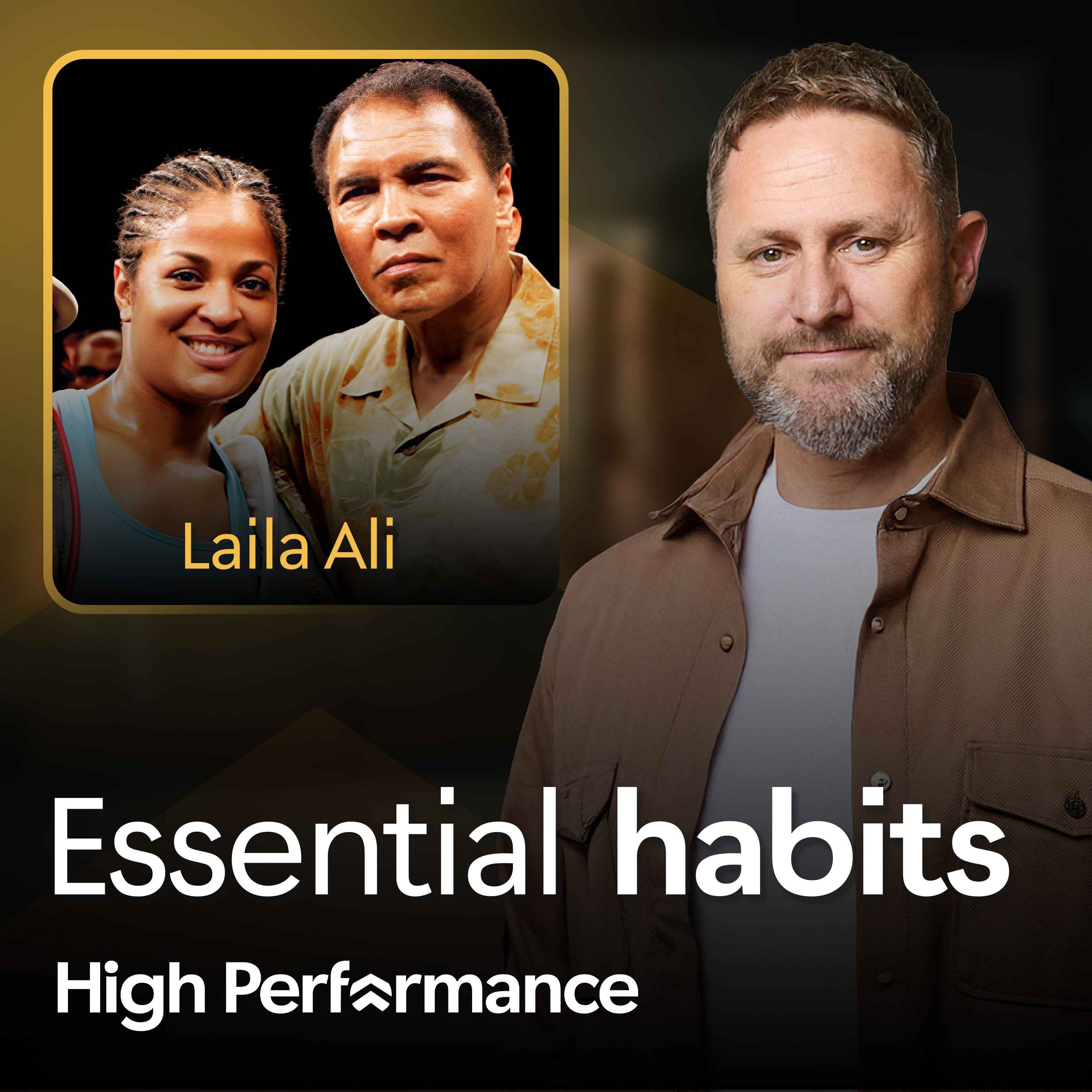
Muhammad Ali’s Leadership Habit That Set Him Apart
The High Performance Podcast · High Performance
June 11, 202536m 59s
Audio is streamed directly from the publisher (sphinx.acast.com) as published in their RSS feed. Play Podcasts does not host this file. Rights-holders can request removal through the copyright & takedown page.
Show Notes
<p>Undefeated boxing champion and entrepreneur Laila Ali takes us ringside, then into the heart of what it means to belong. </p><br><p>In this episode of Essential Habits, we uncover the deceptively simple practice her father, Muhammad Ali, modeled again and again: looking after the person no one else notices.</p><br><p>Through Laila’s stories, from waiting in queues of adoring fans to earning her father’s reluctant blessing to box, we learn how true leadership is less about spotlight and more about presence. By tuning into the quiet moments and the people at the back of the line, we tap into a habit that transforms culture, boosts trust, and fuels high performance.</p><br><p>In this episode, we explore:</p><br><p>- Why 'the last person in line' matters more than the loudest voice</p><p>- The neurobiology of inclusion and how exclusion literally hurts</p><p>- Three simple shifts to build social awareness every day</p><p>- How Laila earned her father’s respect and claimed her own greatness</p><p>- What high-performing teams gain when everyone feels seen</p><p>Whether you lead a team, a family, or just want to notice people more fully, this episode shows why the smallest acts of attention can have the biggest impact.</p><br><p>Listen to the full episode with Laila Ali: <a href="https://pod.fo/e/265de7" rel="noopener noreferrer" target="_blank">https://pod.fo/e/265de7</a></p><br><p>Here is a link to more information on the studies referenced: </p><p>1.<a href="https://sparq.stanford.edu/solutions/take-time-be-good-samaritan#:~:text=Darley%20and%20Batson%20found%20that,ignore%20a%20person%20in%20distress." rel="noopener noreferrer" target="_blank"> The Good Samaritan Study</a> (Darley & Batson, 1973)</p><p>2. <a href="https://pmc.ncbi.nlm.nih.gov/articles/PMC6174241/" rel="noopener noreferrer" target="_blank">Ingroup Bias and Empathy</a> (fMRI Study, 2006)</p><p>3. <a href="https://thedecisionlab.com/biases/spotlight-effect" rel="noopener noreferrer" target="_blank">The Spotlight Effect</a> (Gilovich, Medvec, & Savitsky, 2000)</p><p>4. <a href="https://www.verywellmind.com/the-bystander-effect-2795899" rel="noopener noreferrer" target="_blank">The Bystander Effect </a>(Darley & Latané, 1968)</p>
<hr><p style='color:grey; font-size:0.75em;'> Hosted on Acast. See <a style='color:grey;' target='_blank' rel='noopener noreferrer' href='https://acast.com/privacy'>acast.com/privacy</a> for more information.</p>