The Hanania Show
140 episodes — Page 1 of 3
Gloria Steinem and the Satanic Panic
Censured for Simping?
Debating Housing and More with Steve Hilton
Hanania & Tracey Reading Communion, by JD Vance
US-Iran Peace Talks Break Down. What's Next?
Impromptu Interview with James Fishback
Something very strange just happened. I was doing a livestream on James Fishback, and the man himself joined us midway through. This began as a stream with Nikos Mohammadi (X, Substack), a student at Columbia University whose work has appeared in UnHerd, The Spectator, and elsewhere.As everyone knows, I’ve been fascinated by the Fishback phenomenon. Nikos wrote one of the articles I cited as a sign he was getting a respectful hearing in the right-wing press. My argument has been that those inclined toward populism on the right who are not Groypers have proved too eager to claim Fishback as their own, given his many scandals and shortcomings. About forty minutes in, someone with the profile name James Fishback showed up in the chat. I was skeptical that this was the real thing, but then I saw one of his campaign staff vouch that it was actually him. Before long, Fishback, sitting in Starbucks, was taking questions on the stream!I didn’t know exactly what to do with this, and it’s always awkward facing someone you’ve criticized harshly. There were a lot of angles that I could take, but I decided to focus on policy questions. I asked him about school choice, taxes, and crime. Fishback sounded more like a conventional Republican than I expected. On housing, I pushed back on his lack of enthusiasm for removing supply-side constraints, the one thing we really clashed over. I thought this would be more fruitful than fighting him on immigration, where he was less likely to budge. My view is that anti-immigration sentiment is too fundamental to populism to shift people on, but nearly everything else is more incidental, so I could maybe move him and his followers toward YIMBYism. I gathered that racism-related questions would be pointless, as I rarely find it informative when journalists focus on bigoted statements in interviews. Still, I felt the need to ask about By’rone. I was surprised by the candidness of his response. Having now personally experienced Fishback’s charm, I can confirm he’s very good at this. He said my name a lot, claimed to have read my book, and complimented me as a keen scholar of the conservative movement — particularly amusing since I have been arguing that his rise is a sign of its decline. After Fishback left, Nikos said he sounded more pro-market with me than he did during the discussions for UnHerd, which gets back to the idea that he is a talented politician. Fishback talked about learning economics from Mankiw’s textbook, which I have mentioned reading before. Maybe it was all coincidental, but the whole thing felt eerily micro-targeted. Fishback ended up inviting me to come cover his campaign in Florida. I hope to take him up on the offer. Even in the likely case that he loses, I’m quite confident this guy is not going away, and we’re seeing the rise of someone who is going to be a major force in Republican politics for years to come. Note: If you would like to get this podcast through a regular podcast app, go to richardhanania.com on a browser on your device (it doesn’t work in the app), log in to Substack, and click on the tab for either the Hanania Show or the H&H Podcast. Select the episode you want, and then choose one of Apple, Spotify, etc. under “Listen on” to your right. You’ll be able to add the show through an RSS feed, after which you will get new episodes, either free or paid depending on what kind of subscriber you are, through whichever platform you use. This is a public episode. If you'd like to discuss this with other subscribers or get access to bonus episodes, visit www.richardhanania.com/subscribe
Lauren Southern as the Original Egirl
This is a free preview of a paid episode. To hear more, visit www.richardhanania.comI’ve always seen Lauren Southern (X, Substack) as the original right-wing egirl. While they are a dime a dozen today, and the act has grown pathetically stale, a decade ago it was a fresh thrill to be an online rightoid and see a pretty young girl telling you what you wanted to hear about feminism and Muslim immigration. There had been Ann Coulter and Michelle Malkin, but they were a bit older and more established, and their relationships with the conservative audience were mediated by TV networks and book publishers. The egirl was directly yours. You could like her posts, leave comments, and, if so inclined, even harass her with non-stop DMs. The audience’s reaction was embedded in the creation of her work. Lauren eventually dropped off my radar, though I would occasionally see right-wingers seethe about something she said or did. When her memoir This Is Not Real Life was released, I heard good things and decided to check it out. Though I was involved with a more intellectual crowd, I ended up seeing parallels between her story and mine. If you’re a thoughtful person with a conscience, you eventually realize that conservative politics and media are corrupt to their core. Lauren writes about low journalistic and fundraising ethics, how English street thugs framed their activities as “defending Western civilization,” and even how her old friends didn’t seem to care when she was allegedly raped by Andrew Tate. Her story is a reminder that they were like this before Trump, though he has obviously made it much worse.Today, Lauren joined me for a livestream where we discussed all that and more. I ask how she’s holding up now, how much what is said online bothers her, the fears she had of going to jail during the Tenet media investigation, and whether her realization about the flaws of right-wingers has made her question the wisdom of right-wing political views. I was particularly entertained hearing her describe the story of Tommy Robinson. Here is an English hoodlum who once sold cocaine out of his tanning salon, and by making up things about local Muslims, including an underage boy, he would be championed by Elon Musk and other prominent right-wing figures as a persecuted dissident. After Lauren’s experience with Tate, she became the target of attacks, including by Milo Yiannopoulos, who was paid by Tate to go after her and say that she was sleeping with men so they would write articles for her. I enjoyed the part of our conversation where I asked Lauren whether her experiences made her more sympathetic to feminism. Everywhere she appears to go, men in right-wing spaces are either trying to sleep with her or engaging in attacks related to her sexual behavior. She mentions growing up in an Evangelical background, amidst a high-trust community where she felt safe around men. I reflected on how different this sounds from the way that leftists portray the culture of conservative Christians, where they assume abuse and hypocrisy are rampant but hidden. I also bring up the story of Roger Ailes, as reported on in The Loudest Voice in the Room (review here). It almost seems as if the entire conservative movement at the top is just predators and grifters sucking up and victimizing the most naive members of the public. It was a fun discussion, and, despite the setbacks she has faced, I hope that Lauren’s time as a public figure isn’t over yet. Note: If you would like to get this podcast through a regular podcast app, go to richardhanania.com on a browser on your device (it doesn’t work in the app), log in to Substack, and click on the tab for either the Hanania Show or the H&H Podcast. Select the episode you want, and then choose one of Apple, Spotify, etc. under “Listen on” to your right. You’ll be able to add the show through an RSS feed, after which you will get new episodes, either free or paid depending on what kind of subscriber you are, through whichever platform you use.
What's Next in Iran? w/Graeme Wood of The Atlantic
This is a free preview of a paid episode. To hear more, visit www.richardhanania.comGraeme Wood (X account), a staff writer for The Atlantic who has reported extensively on the Middle East, joins me on the livestream to discuss the bombing of Iran and what comes next. This is a busy day for him, so I appreciate Graeme making time and fighting through his cough. Just yesterday, he published a well-timed profile of former regime official Jaber Rajabi, who argues that all you need to do is eliminate around ten people for the government to crumble. Well, as of this recording, reports are that the US and Israel may have taken out the top 5-10 members of the regime, with Khamenei confirmed dead. So it appears that we are testing that theory in real time. We discuss Rajabi’s theory of the regime, and whether it is plausible. The conversation also covers Trump’s decision-making, whether the Iranians could have done anything to avoid this outcome, the logic of attacking the Gulf Arabs, the state of Hezbollah and other Iranian proxies, and the roles of the Europeans and Russians. At the end, I ask Graeme who else to follow to be informed on the situation, and he recommends Karim Sadjapour and Arash Azizi. I wonder whether, if this intervention works out well, as Venezuela has so far, there may start to be some sense among foreign policy elites in Washington that perhaps Trump has a point in his approach to hostile regimes. I think that while Iraq and Afghanistan were understood to discredit interventionism, it’s anti-interventionism that has had a bad last few years. I lay out some thoughts here on a proper synthesis incorporating all the lessons learned over previous decades, which converges on the view that while trying to do social engineering through force has failed, simply killing bad people and being pragmatic about what comes next makes sense as an approach to American foreign policy.
Wild Teen or "Survivor"?
This is a free preview of a paid episode. To hear more, visit www.richardhanania.comZoë Booth (X, Substack) is the Content Director for Quillette and host of the Quillette Cetera podcast. Amid all the talk about Epstein, she mentioned to me that when she was 15–16, she had sexual relationships with older men, yet did not consider herself to have experienced pedophilia. I wanted to talk about it, so I invited her on to stream. Funnily enough, the guys got mad at her when she stopped being woke. Yet despite the financial and cultural incentives to do so, she refuses to identify as a “victim” or “survivor.” We also discuss age gap relationships, gooning, safetyism, neuroticism, the evils of locking up female teachers for having relationships with male students, and the causes of actual pedophilia. As you can hear, the Squatty Potty guy is on my mind today. I argue that society is pushing to make heterosexuality resemble lesbianism. This is what ties together pedo hysteria and opposition to age gaps and power disparities within couples. Near the end, we move on to other topics like immigration to Australia, Zoë’s upcoming marriage, testosterone and hormone replacement therapy, Bryan Johnson and how he makes me root for death, and having kids. A fun conversation, and obviously an enjoyable viewing experience too.
The Judiciary as the Last Bastion of Intellectual Conservatism
This is a free preview of a paid episode. To hear more, visit www.richardhanania.comI just did a livestream during which I read through the decision in Learning Resources, Inc. v. Trump. To get the full benefit of this stream, you should watch the video, as I highlight text as I read. I share some thoughts about reading judicial decisions as a general matter, and Supreme Court justices functioning as philosopher kings. Topics addressed throughout the video include the logic of the IEEPA, the major questions doctrine, how much you should read into these opinions the justices’ views of the underlying policy, and the extent to which Trump can achieve the same results through different statutory authority. I argue that by changing the status quo, the Supreme Court has made the lives of Trump officials much more difficult. I also explain why the judiciary is the one part of conservatism beyond the president’s ability to shape at will. In the first administration, Trump regretted most of his major appointments. Right-wing media has also been remade in his image, as has Heritage. This time around, he can have all new people in the executive branch, but he’s still stuck with those he put on the courts in the first administration. Moreover, judges go through more of an academic process to get where they are. This leads to some thoughts on the wisdom of lifetime appointments under the Constitution, as we are never one election away from a crazy person getting into power and dismantling norms and institutions. Even if Trump wants judges now who will pledge unending loyalty, there’s no way for him to enforce any promises that are implicitly or explicitly made.I reflect on whether and how the existence of an individual as flawed as Trump changes the entire process of statutory interpretation. It seems possible to me that Kavanaugh’s dissent is correct that Congress in 1977 meant to give the president some power to implement tariffs. But they never imagined unlimited tariffs for an unlimited period of time without any procedural safeguards, enacted by a president this emotionally immature and economically illiterate. If they had foreseen someone like Trump, they probably would have explicitly limited the power to place tariffs in the IEEPA. If this is true, what does statutory intent actually mean? A lot of things are probably like this, where our laws, norms, and institutions assume a certain amount of good faith that no longer exists in the Trump era. This raises deep questions about the nature of democracy and how to protect the parts of our system that need to be preserved.Note: If you would like to get this podcast through a regular podcast app, go to richardhanania.com on a browser on your device (it doesn’t work in the app), log in to Substack, and click on the tab for either the Hanania Show or the H&H Podcast. Select the episode you want, and then choose one of Apple, Spotify, etc. under “Listen on” to your right. You’ll be able to add the show through an RSS feed, after which you will get new episodes, either free or paid depending on what kind of subscriber you are, through whichever platform you use.
Michael Tracey Returns to Slay the Latest Epstein Idiocy
This is a free preview of a paid episode. To hear more, visit www.richardhanania.comMichael Tracey joins me after his brief hiatus offline to talk about the latest in the Epstein saga. As time goes on, we get more and more documentation and insight into who the man was and what he was doing, and believing in any of the conspiracy theories becomes ever more ridiculous. Yet the level of obsession with this story remains high. We talk a little bit about whether interest is increasing or decreasing among figures on the right and left. Beyond Epstein, Michael and I go off in various directions, as we also discuss the Trump ape-gate controversy, Chuck Johnson getting out of jail, and more. Michael describes the connection between Epstein and Noam Chomsky, who bonded over neuroscience and the help the famed linguist received in a family financial dispute. In the second half of the conversation, we watch a bit of Tucker Carlson’s interview with Ian Carroll, which practically gives Michael a heart attack. I tried to explain to him that if he wanted to fact check every statement Tucker made, we wouldn’t be able to get through any of the conversation. But the lying was too much to take. I ask Michael whether he has hatred for people who lie like this, and he says no, showing that he is a better man than me. An overall very fun conversation. This was my first stream from the new house, by the way, so as you can hopefully tell, production quality on these things will be higher than it was before going forward.
Debate with Jeff Maurer about Venezuela
This is a free preview of a paid episode. To hear more, visit www.richardhanania.comLast week, Jeff Maurer, who publishes the I Might Be Wrong Substack, invited me on his podcast to talk about the recent overthrow of Maduro. Jeff used to write for John Oliver, and his Substack is a unique combination of comedy and serious analysis of current events. So kind of like Oliver’s show, but much less dogmatically leftist and more willing to engage with alternative viewpoints.As Jeff mentions, we are perfectly positioned to have a fruitful conversation, as we have disagreements about a policy while sharing a similar underlying model of the world. This is the sweet spot — there’s not much point in talking to someone you agree with on everything, but when people are living in completely different realities, there’s often not enough common ground for a real exchange of ideas.If you yourself are unsure about how to think about Venezuela, this is a good place to hear arguments on both sides. I’m rereleasing the podcast here on my own feed. As it is on Jeff’s Substack, here the first approximately twenty-four minutes are free, and you have to be a paid subscriber to get the whole thing. I end up agreeing with Jeff that from an “America First” perspective, the gains to the US are uncertain and likely to be small. But I do believe in US foreign policy as a tool for spreading freedom abroad. In fact, this could be part of a new basis for national identity, as the inward-looking attempts to build one have in my view been a disaster. Developments since this podcast was recorded have strengthened my belief in my position. There is now polling data showing that Venezuelans generally support what the US has done. There was a lot of talk in this conversation about a potential backlash in Venezuela or the region. We just do not see that in the data. Venezuelans know that they are poor, that their living standards have fallen in recent memory, and the socialists who run their country are responsible for their problems. They want hope for a better future, and this is something they care more about than abstract concepts like when it is appropriate to use force under international law or even nationalism, or at least the kind of nationalism that would spur them to rally around their failed government. Unfortunately, amidst this new optimism, political repression is increasing even as the regime seeks to comply with the US on oil and economic issues. This won’t be a straight line towards a better future, but I’m confident there is more hope for Venezuela today than there was a few weeks ago. For the Persuasion article cited in the discussion, see here. I would also recommend this profile of Delcy Rodríguez for some context regarding the type of person we are now dealing with. And in case you missed them, my two previous articles on the Maduro operation are here and here.Note: If you would like to get this podcast through a regular podcast app, go to richardhanania.com on a browser on your device (it doesn’t work in the app), log in to Substack, and click on the tab for either the Hanania Show or the H&H Podcast. Select the episode you want, and then choose one of Apple, Spotify, etc. under “Listen on” to your right. You’ll be able to add the show through an RSS feed, after which you will get new episodes, either free or paid depending on what kind of subscriber you are, through whichever platform you use.
Maduro in Jail. Is America Back?
This is a free preview of a paid episode. To hear more, visit www.richardhanania.comI just did a livestream with Daniel Di Martino (X) of the Manhattan Institute. He immigrated to the US from Venezuela ten years ago and has a PhD in economics from Columbia University. I temporarily pulled him away from TV appearances and getting protein drinks to talk about what just happened in his home country. We go into the history of Venezuela, its relationship with Cuba, where Chavismo comes from, who actually is going to run the country now, what Maduro’s former vice president is up to, why Trump seems not to like María Corina Machado, and more. The conversation also touches on the conservative wave that seems to be spreading across Latin America. There are a lot of ways Venezuela can go bad. But I’m sick of pessimism. There are also a lot of ways this can go right, and certainly at least be better than the government that was there before. We remember all the regime changes that led to disaster and forget Grenada and Panama because we’re so overwhelmingly biased towards negativity these days. Whatever happens tomorrow, today is about congratulating the administration and the people of Venezuela. In case you missed it, see my article from this morning on why Trump made the right call. Note: If you would like to get this podcast through a regular podcast app, go to richardhanania.com on a browser on your device (it doesn’t work in the app), log in to Substack, and click on the tab for either the Hanania Show or the H&H Podcast. Select the episode you want, and then choose one of Apple, Spotify, etc. under “Listen on” to your right. You’ll be able to add the show through an RSS feed, after which you will get new episodes, either free or paid depending on what kind of subscriber you are, through whichever platform you use.
Merry Epstein Christmas
This is a free preview of a paid episode. To hear more, visit www.richardhanania.comMichael Tracey joins me on the livestream to discuss the latest Epstein file drop. He reminds me of how I thought this thing couldn’t keep going on forever during the summer, and yet we are still here. I acknowledge Michael’s prescience on this. We go through various reveals making their way on social media and he explains why they don’t actually show anything. Near the end we get distracted and start chatting for some time about video games, which people may enjoy. He wants to know why there aren’t more games he likes on the Switch 2. I’m still getting through Donkey Kong Bananza, which we both recommend. Michael has been tweeting about the big “reveals” in the latest documents. See, in particular, the hoax Epstein letter to Larry Nassar and the document on the crazy person claiming to have been Trump’s driver.
What Really Caused the Great Depression
In the last few years, I have started to teach myself monetary policy. While I always had opinions on other related issues like the fundamental causes of growth and labor policy, I had never done a deep dive into topics such as the money supply and how exactly the Fed shapes the economy. Almost a year ago, I heard Scott Sumner discuss these issues on Conversations with Tyler, and it finally motivated me to start looking into them. Part of that process has been reading Scott’s two books: The Money Illusion and The Midas Paradox. I had known Scott mostly for his excellent Substack, which everyone should subscribe to. I’ve found him to have a sharp mind, whether he is talking about politics, culture, economics, or movies. As the podcast with Tyler reminded me, however, his field of expertise is monetary policy, and I thought after reading his books I would invite him on for an in-person discussion. He just wrote an article that summarizes the arguments about the Great Depression from The Midas Paradox, which you can read as preparation for this conversation. We begin with a question I’ve always had, which is how free market economists – like Milton Friedman and Scott himself – square their other views with the idea that the monetary system needs to be centrally planned. Scott makes a convincing case for government solving a coordination problem. Then we get to the business cycle, which is another issue I’ve always had questions about. I felt dumb asking, but I wanted to know how exactly a society with a set amount of human capital and other fundamental factors temporarily produces more. Do people just work more hours? Yes, in fact, that is to a large extent the answer!I harp a bit on how much sticky wages and sticky prices are doing to hold up the entire theory of the business cycle. It seems odd to me that so much can rest on a psychological quirk. But again, Scott explained it in a way that made sense by bringing up an analogy to plate tectonics. I also like the thought experiment of what the world would look like if everything was priced according to apples. This shows that demand for money is a real thing that must be accounted for in any economic model. I had read a lot on monetary policy, but having an expert walk me through the questions and confusions I still had – which won’t necessarily be those of anyone else studying the same topic – was extremely useful. Score one for in-person learning, which I am still able to benefit from long after finishing my official education thanks to working as a podcast host. After a while, we digress into cultural issues, how life has gotten better but in some limited ways worse, and what is responsible for the fertility crisis. On this last point, we talk about the expansion of and improvement in entertainment options, and why social desirability bias stops us from being open about why this makes people have fewer children. The conversation closes by returning to monetary policy, as Scott explains his preference for central banks targeting nominal GDP rather than inflation. Once again, Scott’s Substack is highly recommended. Rarely have I intellectually benefited so much from a conversation, and I hope others find it valuable too. Note: If you would like to get this podcast through a regular podcast app, go to richardhanania.com on a browser on your device (it doesn’t work in the app), log in to Substack, and click on the tab for either the Hanania Show or the H&H Podcast. Select the episode you want, and then choose one of Apple, Spotify, etc. under “Listen on” to your right. You’ll be able to add the show through an RSS feed, after which you will get new episodes, either free or paid depending on what kind of subscriber you are, through whichever platform you use. This is a public episode. If you'd like to discuss this with other subscribers or get access to bonus episodes, visit www.richardhanania.com/subscribe
Why Trump Finally Went too Far
This is a free preview of a paid episode. To hear more, visit www.richardhanania.comJust did a livestream discussing my recent article, “JD Vance Is the White Kendi.” I elaborate on the essay a bit, and explain why I think that Vance is overwhelmingly likely to be the Republican nominee in 2028. I also give some advice on how to attack Vance from either the left or right. People are yet to fully dig into the disconnect between the author of Hillbilly Elegy and what he has become. No one is paying close enough attention to this, but I’m going to keep harping on it as we get closer to 2028 and the spotlight shifts more and more to Trump’s presumptive heir. I go on to discuss anti–Erika Kirk Twitter, a rabbit hole I just fell into. I explain why she triggers a certain kind of person. Finally, someone asks me why Trump’s Rob Reiner “Truth” caused such a backlash, and I explain the divide between MAGA influencers who have some shame and those who have none. Note: If you would like to get this podcast through a regular podcast app, go to richardhanania.com on a browser on your device (it doesn’t work in the app), log in to Substack, and click on the tab for either the Hanania Show or the H&H Podcast. Select the episode you want, and then choose one of Apple, Spotify, etc. under “Listen on” to your right. You’ll be able to add the show through an RSS feed, after which you will get new episodes, either free or paid depending on what kind of subscriber you are, through whichever platform you use.
Epstein BOMBSHELL!!!
This is a free preview of a paid episode. To hear more, visit www.richardhanania.comMichael Tracey joins me to discuss the latest Epstein revelations.Watch me show him how to open the documents that were just released. We begin by talking about my discussion with Tara Palmeri. He has a beef with her, but I found her lovely. You can watch that conversation on the MAGA Civil War here. I wonder how long this can go on. It’s Groundhog Day. The Epstein birthday book came out, there was a press conference, people in Congress made noises. Now some emails that mention Trump come out, and we’ll have press conferences and members of Congress making noises? At some point this must get old, right?
Humor, the Causes of War, and Everything in Between with Steven Pinker
There are few (if any!) people alive whose work I think more highly of than Steven Pinker, or whose books have done more to shape my worldview. As he was in Los Angeles as part of his latest book tour, I took the opportunity to invite him on the show for an in-person interview. I did a podcast with him on Rationality, his last book, and wrote the following at the time: “One of the best parts of becoming (sort of) famous in the last year has been getting to meet and form relationships with some of my intellectual heroes. Seeing those I’ve looked up to for years not only become friends but in many cases return the admiration has been extremely rewarding.”That remains true, and although we’ve corresponded over the years, this discussion was the first time we met in person. The topic was his new book When Everyone Knows That Everyone Knows...: Common Knowledge and the Mysteries of Money, Power, and Everyday Life.We begin by discussing the Aumann Agreement Theorem, which I thought sounded trite from the book but came around to believing was endlessly fascinating after hearing Steve explain it. We spend a bit of time on humor, which is such an important part of social relations but rarely given the scholarly attention it deserves, or else we might say the theories that do exist are usually unsatisfying. I liked our discussion of how presidents and leaders engage in self-deprecating humor, and different public figures that either poke fun at themselves or the other side. I feel like the topic of politics and humor could make a fascinating PhD dissertation. If I had time, I would listen to podcasts and classify when people laughed and according to what criteria, and try to theorize about differences between groups like conservatives and liberals, or centrists and extremists. I think AI could probably help with that at this point. As I told Steve, perhaps we should all decide to support political movements that engage in more self-deprecating humor on the grounds that they are less likely to violate the rights of others! If you’re a graduate student or professor who is interested in doing such work, please reach out, as I would like to help find ways to make it happen. Moving on from the new book, I got to ask Steve something I’ve been wondering about for a few years, which is whether recent events, particularly the war in Ukraine, have shifted his views on what maintains peace in the international system. As it turns out, we were both surprised that under contemporary conditions you could see two European countries kill each other in such large numbers. Maybe the great run of peace we’ve had since 1945 isn’t a result of, as John Mueller has argued, people realizing that war is stupid, but rather has depended on Western military, economic, and diplomatic power. Were the dreaded neocons perhaps correct? As international norms look a lot more fragile than they did fifteen years ago, this is a question we probably should be asking.We close with some discussion about the Trump administration’s war on the universities, particularly Harvard. I loved the essay Pinker published in the NYT on “Harvard Derangement Syndrome.” The key passage is here. Why does this matter? For all its foibles, Harvard (together with other universities) has made the world a better place, significantly so. Fifty-two faculty members have won Nobel Prizes, and more than 5,800 patents are held by Harvard. Its researchers invented baking powder, the first organ transplant, the programmable computer, the defibrillator, the syphilis test and oral rehydration therapy (a cheap treatment that has saved tens of millions of lives). They developed the theory of nuclear stability that has saved the world from Armageddon (Arguable! – RH). They invented the golf tee and the catcher’s mask. Harvard spawned “Sesame Street,” The National Lampoon, “The Simpsons,” Microsoft and Facebook.Ongoing research at Harvard includes methane-tracking satellites, robotic catheters, next-generation batteries and wearable robotics for stroke victims. Federal grants are supporting research on metastasis, tumor suppression, radiation and chemotherapy in children, multidrug-resistant infections, pandemic prevention, dementia, anesthesia, toxin reduction in firefighting and the military, the physiological effects of spaceflight and battlefield wound care. Harvard’s technologists are pushing innovations in quantum computing, A.I., nanomaterials, biomechanics, foldable bridges for the military, hack-resistant computer networks and smart living environments for the elderly. One lab has developed what may be a cure for Type 1 diabetes.This was published only ten days after my own piece in The Economist touching on many of the same themes. Given the range and depth of the conversation, I walked away from it wondering how I would summarize Pinker’s career, or how to make sense of my intuition that there’s a line that extends through his books on psychology, linguistics, interpersonal commu
Open Borders, the Lessons of UAE, DEI at GMU, and More with Bryan Caplan
Bryan Caplan joined me on the livestream today to discuss my recent article, “Economists Should Do More to Fight Misinformation.” We begin by splitting some hairs about whether the misinformation label misleads us about the ultimate origins of false beliefs, and also the difference between something being emotionally unappealing and intuitively incorrect. He ends up agreeing with me though on the major points of the article. We both encourage economists out there to take more pride in their work as intellectuals and fight false beliefs regardless of where on the ideological spectrum they come from. We then go into his experiences traveling to the Gulf Arab states and Japan. Bryan’s article on the UAE as utopia has stuck with me since I read it almost a year ago as demonstrating how well humans could be living if we simply were able to move beyond commonly held beliefs about markets and nationhood. Arabs built something this amazing! All it took was them believing in freedom. Or maybe just being rational. Bryan mentions to me that when you talk to their government ministers off the record, they believe the story that they’re exploiting the workers, which I found very amusing. There can sometimes be an incredible divergence between intentions and consequences that most people find difficult to fathom. I also bring up Laurenz Guenther’s recent article on immigration explaining the rise of populism and ask Bryan how he would address its findings in the context of his commitment to open borders. I bring up global demographic trends and ask if they frighten him, which leads to a discussion of South Africa. Somewhere in there we talk about the theories of Daron Acemoglu on why nations become rich or poor. Finally, the conversation closes with me asking Bryan for an update on what’s going on at GMU and his lonely struggle against attempts to make it woke.Overall, a very stimulating conversation, as always with Bryan. I encourage everyone to follow him on X and subscribe to his Substack. This is a public episode. If you'd like to discuss this with other subscribers or get access to bonus episodes, visit www.richardhanania.com/subscribe
Christian Nationalism Rising
This is a free preview of a paid episode. To hear more, visit www.richardhanania.comMichael Tracey joins me to talk about the Charlie Kirk memorial service. The conversation somehow devolves into us disagreeing strongly on which parts of the Christian Nationalist spectacle on display were strangest. Michael’s inner new atheist comes out, as we play clips from Erika Kirk, RFK, Pete Hegseth, and others. He notes how out of place this kind of overt sectarianism would have been in any previous administration. I argue that this is one of the signifiers of the right leaning into identitarianism, of which strict restrictionism and all the talk we’re getting about “Heritage Americans” are a part. One doesn’t have to be a Christian or even believe in God to be a member of the movement in good standing; it’s just about fighting the left. But fighting them on what? Consider how the second Trump administration has completely lost interest in abortion, which has traditionally been the main issue for the Christian Right. Is trans in women’s sports worth all this apocalyptic rhetoric? The dangers of crime in inner cities most Republicans don’t live anywhere near? The conversation also touches on the future of the conservative movement, and whether conspiracy theories about Charlie Kirk’s death are going to be a fixture on the right going forward.
What Is "the Left"?
This is a free preview of a paid episode. To hear more, visit www.richardhanania.comI just did a livestream on the latest in the Charlie Kirk investigation, my article yesterday on the killing, and my piece on anti-Indian hate. As soon as I got off, I saw that a Congressman had just tweeted that he will try to permanently ban from social media anyone who “belittles” the Charlie Kirk assassination. He also says such people should not have business or driver’s licenses or be allowed to attend schools. This is by far the most authoritarian thing I can ever remember hearing an elected official say. People who complained that I shouldn’t have had a take so soon after the assassination should look at the kinds of rhetoric that Republican officials and conservative influencers are engaging in. One cannot cede the floor to these people. It would be different if there were a broad norm to not express political opinions on the news of the day in times like this. But that’s not where we are. I discuss the two-step conservatives engage in, where they:* Point to crazy things said by online leftists on Bluesky and TikTok who have no positions of power or influence* Use that as an excuse to call for repression of mainstream Democrats, even though literally 0% of them talk or act like the leftists the right complains aboutThis is completely dishonest, and facilitates hysteria by telling conservatives that deranged leftists are half the country rather than a small and isolated minority. You can’t make some mentally ill communist the avatar for an entire side of the political spectrum. The trick is to start by calling something bad “the Left”, and then declaring half the country responsible for anything they say or do. From the perspective of judging the Democratic Party and mainstream liberals it’s actually impressive that a movement can, among influential figures, be 100% in lockstep in terms of not celebrating the death of a political opponent. Again, that is much more than can be said for conservatives when they face similar circumstances. This is the human capital difference, which applies not just to intelligence, but also ethical norms.
The Real Epstein Conspiracy?
This is a free preview of a paid episode. To hear more, visit www.richardhanania.comGhislaine speaks! And as it turns out, there is still nothing to the Epstein conspiracies. Michael Tracey has a nice breakdown of how it went, pointing out that there is no indication she is lying, even when you might expect to see signs of her doing so. He joins me to discuss. I went into this conversation thinking I had learned almost everything important about the Epstein saga. I was wrong. There are so many threads to pull here. But they’re not the ones people expect. The whole case against Ghislaine appears to have been drummed up by trial lawyers who recruited the “victims,” conducted the PR campaign, got journalists on board, and, according to Ghislaine and evidence presented by Alan Dershowitz, were engaging in a blackmail ring that involved threatening to drag more people into the story.It’s all rotten from top to bottom. It’s always easy to see a moral panic in retrospect. A hallmark of moral panics is that groups normally at odds unite to condemn a target. As Michael alludes to, podcast bros, CNN, and Fox are all on the same side here, making him a rare beacon of truth. They’re still wrong. We also talk about the role that taking high doses of testosterone might have played in Epstein’s behavior, something that came out during the Ghislaine interviews. He was clearly acting recklessly, which led to his downfall, and we now finally have an explanation of why.There are some video and audio problems near the middle of the conversation, and Michael disconnects at one point, but he comes back on and we finish the discussion.Note: I’ve heard from some of you who are paid subscribers that you don’t know how to get the full episodes via your podcast apps. It’s very simple. Just go to the episode page on the newsletter website on your phone or desktop. Don’t do it through the Substack app; it must be a browser. At the top, there will be a tab that says “Listen via…” Choose that, and then pick from Apple Podcasts, Spotify, etc. It should then allow you to add the show to your feeds, where you’ll automatically get the full versions of all episodes when they come out. Note that you need to do it separately for both shows associated with this newsletter: The Hanania Show and The H&H Podcast.
The End of Prostitution
This is a free preview of a paid episode. To hear more, visit www.richardhanania.comMichael Tracey joins me to talk about the latest saga in the moral panic over pedophilia and its intersection with antisemitic conspiracy theories. The most interesting part of the conversation is when we discuss how the concept of “prostitution” has disappeared from the culture. Everything is “trafficking” or must involve minors. I note that, with the collapse of social conservatism, we no longer have any basis not to allow legalized prostitution. To justify the current state of the law, then, in addition to the grant money involved, we need a new angle, which exaggerates or invents the coercive aspects of most sex work. Michael brings up the point that if Elliot Spitzer were arrested today, the women involved would unquestionably be treated as helpless victims.
What Really Happened in the 2016 Election
This is a free preview of a paid episode. To hear more, visit www.richardhanania.comLast month, Tulsi Gabbard in her capacity as the head of DNI released a number of documents pertaining to Russiagate. On the right, an entire mythology has grown around the idea that the Obama administration, Hillary, and Deep State actors fabricated the idea that Russia helped get Trump elected, along with the narrative surrounding ties between his campaign and the Putin regime. Even as someone who hasn’t followed all the twists and turns of this saga, I knew enough to understand that some of Gabbard’s most sensationalist claims were laughable. With great fanfare, she informed the world that the Obama administration knew that Russia had never hacked the voting machines to deliver a Trump victory. Under the headline “New Evidence of Obama Administration Conspiracy to Subvert President Trump’s 2016 Victory and Presidency,” the DNI press release lists the following bullet points* In the months leading up to the November 2016 election, the Intelligence Community (IC) consistently assessed that Russia is “probably not trying … to influence the election by using cyber means.”* On December 7, 2016, after the election, talking points were prepared for DNI James Clapper stating, “Foreign adversaries did not use cyberattacks on election infrastructure to alter the US Presidential election outcome.”* On December 9, 2016, President Obama’s White House gathered top National Security Council Principals for a meeting that included James Clapper, John Brennan, Susan Rice, John Kerry, Loretta Lynch, Andrew McCabe and others, to discuss Russia.* After the meeting, DNI Clapper’s Executive Assistant sent an email to IC leaders tasking them with creating a new IC assessment “per the President’s request” that details the “tools Moscow used and actions it took to influence the 2016 election.” It went on to say, “ODNI will lead this effort with participation from CIA, FBI, NSA, and DHS.”* Obama officials leaked false statements to media outlets, including The Washington Post, claiming, “Russia has attempted through cyber means to interfere in, if not actively influence, the outcome of an election.”* On January 6, 2017, a new Intelligence Community Assessment was released that directly contradicted the IC assessments that were made throughout the previous six months.The problem of course is that the administration never claimed that Russia manipulated the vote tally! Everyone who is familiar with the most basic facts surrounding Russiagate knew this already. Go back to the first bullet point, with the quote that Russia was “probably not trying … to influence the election by using cyber means.” Now look at the complete passage here, on page 2, taken first from the email of an unnamed Obama administration official:Russia probably is not trying to going to be able to? (sic) influence the election by using cyber means to manipulate computer-enabled election infrastructure. Russia probably is using cyber means primarily to influence the election by stealing campaign party data and leaking select items, and it is also using public propaganda. [emphasis added]Another email in response concurs with this judgment and repeats the phrase. The dishonesty is staggering. Put aside all other claims that Gabbard makes, this is so blatantly in bad faith that it’s immediately discrediting, and should make you skeptical of everything else these people say. Especially when this lie is combined with calls for Obama to be prosecuted. The Trump administration is speaking to an audience that it knows is misinformed, or unable to understand the distinction between “Russia tried to influence the election” and “Russia tried to change the election outcome by manipulating voting machines.”This recent news renewed my interest in the Russiagate story, so I invited my friend Renée DiResta (X, Substack, personal website) on a livestream to talk about it. She is a professor at the McCourt School of Public Policy at Georgetown University, and the former research manager at the Stanford Internet Observatory. She also did work on the Senate Select Committee on Intelligence investigating Russian interference in the 2016 election. I used to take a very dim view of the misinformation crowd, and there are many researchers out there who give the field a bad name. I once saw institutions like the Stanford Internet Observatory as being at the center of a vast censorship complex that sought to simply stamp out all dissent from leftist orthodoxy. As someone who was repeatedly suspended under the old Twitter regime, I joined many on the right in seeing these people as a personal threat to my right to speak.If only the world could have stayed so simple! I could be a free speech absolutist, and never take any position that risks giving power to people who might eventually censor me. Yet recent years have shown that we need something like a community of responsible academics, intellectuals, and cu
The Latest on Jeffrey Epstein and Sydney Sweeney
This is a free preview of a paid episode. To hear more, visit www.richardhanania.comMichael Tracey joins me on the stream this afternoon to talk about the latest in the Epstein saga and additional things he has learned about the accusers. It seems like every time Michael looks into one of the accusers or one of the journalists who has taken up the Epstein cause, he uncovers new problems. His last article is on one Nick Bryant, who responded to Michael asking a simple question about his source for a sensationalist claim about human trafficking by calling him a pedophile. We also talk about Ghislaine being moved to a minimum security prison, and whether Trump has a plan regarding what to do with her. It looks like she may have worked out some kind of understanding with the administration, and in the coming weeks and months we’ll be finding out exactly what the terms are. Finally, we close with a few Sydney Sweeney takes, and respond to the revelation that she registered as a Republican a few months after my big article last year. The stream ends with me getting stabbed in the eye by my own eyelash, so become a paid subscriber if you want to see that.
The Mentally Unstable Epstein Accusers
This is a free preview of a paid episode. To hear more, visit www.richardhanania.comMichael is back for yet another Epstein podcast. In this one, we spend a lot of time going over Ross Douthat’s recent interview with Julie K. Brown, who has been the most important journalist covering the Epstein story. Michael shows how she glosses over the credibility problems of the alleged victims who were supposedly trafficked to men other than Epstein, even implying that one of them was killed. We talk about Michael’s article on what Bannon is hiding. I encourage him to send it to Democratic members of Congress, and he follows my advice by DMing Ro Khanna as we’re speaking. If Democrats start discussing the need to subpoena Bannon in the coming days and weeks, you’ll know why.We also take some questions from the audience.
Trump’s Love Letter to Epstein
This is a free preview of a paid episode. To hear more, visit www.richardhanania.comAlright, I really thought we were done, but with the revelation that Trump wrote a love letter to Epstein about their shared secret interest, I guess not. As I tell him, I was in the gym and had to go outside and record in my car. For something this funny, one finds a way to post.
The Epstein Files: A Democrat Plot?
This is a free preview of a paid episode. To hear more, visit www.richardhanania.comI thought we might be done with Epstein, but Trump decided to start calling his supporters morons for ever believing in the conspiracy, which means the scandal is not going away. Michael is therefore back to discuss. See our first conversation here, where we go over the background and basics of everything Epstein. Michael and I are both of the opinion that there is probably something here that Trump doesn’t want the world to see. The Bannon angle in particular seems underexplored. I encourage Michael to write something on the topic, and he says he’s going to take my advice.Later in the discussion we talk about the specifics of the Ghislaine Maxwell conviction, and whether it might get overturned by the Supreme Court. See Michael’s thread on the topic here. This strikes me as a terrible miscarriage of justice, given that there was practically no evidence against her other than the decades-old recollections of supposed victims who had a financial incentive to lie. Something we forgot to mention is that there’s now a discharge petition that might force a vote on the Epstein files on the House floor. I’m excited to see where this goes politically. The substantive truth of what Epstein was doing doesn’t seem that interesting, but this has become a fascinating political football, having more of a divisive effect on MAGA than perhaps any other issue since the movement began, or at least since it has entered its more cultish phase.
Can Sex with Rightists Solve Polarization?
I am not big into the art scene. But when a Dutch girl reached out to me to be part of one of her projects, I saw who she was with, noticed that they were within a twelve-minute drive, and decided that this could be fun. As it turned out, Christiane is part of Keeping It Real Art Critics (KIRAC), which is perhaps best known for its project getting Michel Houellebecq to agree to have sex with two of its members on camera. This led to him writing a short book denouncing his former collaborators and filing a lawsuit to try to stop the film from being released. You can read about the feud in the New York Times here, and watch the trailer here.While engaging in their latest project, I got to talking with members of KIRAC, and they described another movie that director Stefan Ruitenbeek had made called Honeypot (2021). The premise is that Jini Jane, one of the girls who was set up with Houellebecq, publishes on a conservative Dutch website a call for right-wing men to have sex with her. She ends up settling on a far-right voter from the working class and a philosopher named Sid Lukkassen, and the film centers on her meeting up with them as part of her quest to solve political polarization. Upon watching the movie, I decided to return to the house where I first met members of KIRAC and interview Stefan and Jini about Honeypot. To mark the occasion of the release of this interview, Stefan has today posted the entire movie on X. You can watch it here, and I would recommend doing so before listening to this conversation. As promised in the interview, here is the safe-for-work version, though it only has the first twenty-one minutes.What I ended up being fascinated by was the contrast between the two kinds of rightists and how they interact with the same woman under vulnerable conditions. The film ended up telling us something important about the differences between those who land on the conservative side for organic reasons, working-class men who this kind of politics naturally suits, and the thinker who is as distant from members of his own coalition as he is from his fellow intellectuals. The foreplay, the sex scenes, and the aftermath of the second encounter brought home the depth of the pain and sense of cognitive dissonance felt by some right-wing intellectuals. While we often see incels and trads as hateful misogynists, their views are in many cases an outgrowth of extreme sensitivity. They seem to be less equipped than other men to deal with being rejected by a woman. I simply could not relate to the emotional neediness Lukkassen displayed, and him accepting his role as the supplicant in the meet-up. The working-class guy did not have this problem! The insecurity that such rightists feel ironically makes them behave in ways that repel women, turning their fears into a self-fulfilling prophecy. I don’t believe that Jini went in expecting this or manipulating the situation so she would accept the first man and reject the second. I felt that these were organic interactions that showed how a romantic situation can go one way or another depending on what the man reveals about his soul. You see Jini getting progressively angrier, and, like most women, unable or unwilling to put into words exactly what is turning her off, she latches on to these various excuses, which Lukkassen is not sophisticated enough to see for the pretexts that they are. Stefan explains to me what about the man he finds offensive. It’s not that he’s clueless, but rather the lack of curiosity. I speculate that this is what right-wing politics often is – retreating from complexity into a rigid inner life that creates a vision one uses to try to mold the rest of the world.In the interview, I question the two guests on different scenes in the movie, including the parts that blur reality and fiction. I express some confusion about why a trad or incel-adjacent right-wing philosopher would agree to have sex on camera in the first place, as this would be unthinkable in the American context. Another cultural difference: in the Netherlands, feminists took the side of the right-wing philosopher. I enjoyed having the opportunity to question Jini regarding what exactly about Lukkassen’s behavior turned her off, and how he was unable to redeem himself in her eyes, even screwing up his attempt to give her a spanking. Don’t be this guy! Lukkassen ends up humiliated here, so much so that it made me feel some unease about watching and promoting the movie. That said, he was an adult who consented to being in that situation. My mind was fully put at ease upon hearing from Stefan that Lukkassen was once again friendly with him and had come to accept what had happened, despite the film turning into a major scandal in the Netherlands.Viewer discretion is advised regarding this interview, and especially the film, which has sex scenes that we discuss in detail.You can follow Stefan, Jini, and Christiane on X, subscribe to KIRAC’s YouTube channel, or support them on Pat
The Inverted Reality of Epstein Conspiracy Theorists
This is a free preview of a paid episode. To hear more, visit www.richardhanania.comI never paid much attention to the Jeffrey Epstein thing. The idea that he was some kind of spy obtaining blackmail material on powerful figures by trafficking young girls to them has for years been pushed by figures like Tucker Carlson, Jack Posobiec, and Eric Weinstein, which convinced me that there wasn’t much to look into, since I can’t recall a situation where this crowd has ever been correct about anything.But until I read Michael Tracey’s recent article on the topic in Compact, I didn’t realize how flimsy the conspiracy theories surrounding Epstein actually are. He joins me to discuss. If anything, it appears that the establishment took sensationalist claims surrounding Epstein’s behavior way too seriously, which led to large payouts for alleged victims while stoking conspiracy theories. As it turned out, our society does not go out of its way to cover for sexual abusers. Especially since the MeToo era began, we’re too credulous about these things. So we have globs of money going to Epstein accusers and their lawyers, while nothing has ever been proved by the standards of the criminal justice system.Meanwhile, the Trump administration’s handling of the issue has caused a major headache for the MAGA movement. As someone who has constantly harped on the misinformed and conspiratorial nature of modern conservatism, I’m enjoying the poetic justice of seeing the chickens coming home to roost. Figures like Kash Patel, Dan Bongino, and Trump himself have gained power by playing to the paranoia of their gullible supporters, and now that they’re running the government they have nothing to offer them. I’ve often gone back and forth on whether the problems I point out with the Republican Party will get better or worse after Trump is gone, and this entire episode has convinced me that the next iteration of the right is probably going to be even stupider than the one we have now. The Trump Cult is the relatively non-conspiratorial wing of conservatism!The left seems to see an opening. In an era where more voters appear inclined to prioritize a conspiratorial worldview, it is probably naive to expect Democrats to completely refrain from swimming in these waters. One wonders if we’ll see them continue to harp on Epstein’s connections to Trump, which are more well-sourced than almost everything MAGAs believe about him. Just as liberals have had to inch away from woke in order to be better positioned to win future elections, becoming slightly more conspiratorial might be another way to meet voters where they’re at. After going through the nonsense behind the Epstein story, Michael and I discuss the wider culture of hysteria over pedophilia and sexual abuse. I bring up the online “pedo hunters,” QAnon, Epstein’s role in the cosmology of Rogansphere types, and how all of these things fit together. We also debate how much this will actually hurt the MAGA coalition. On the mood at the Turning Point USA conference, see this story. Also, I speculate a bit on whether there was anything in the Epstein materials that was embarrassing to Trump, based in part on this claim by Michael Wolff that he saw pictures of him with topless girls that were in Epstein’s safe.
Scott Wiener on the YIMBY Victory in California
This is a free preview of a paid episode. To hear more, visit www.richardhanania.comToday, I’m excited to welcome on the podcast State Senator Scott Wiener. He serves as Assistant Majority Whip and chairs the Senate Budget Committee and the Senate Housing Committee.Senator Wiener joins me to discuss AB 130 and SB 131, the newly passed reforms to the California Environmental Quality Act (CEQA).We explore what these laws do, including how they affect single-family and multifamily housing, what density and affordability standards apply, and what else remains to be done. The conversation gets deep into the weeds, as Senator Wiener explains why these reforms passed as part of the budget process and discusses the crucial role played by Governor Newsom, as well as the broader political and activist ecosystem — including YIMBYs, environmental groups, and the influence of public narratives like the debate set off by Abundance. I ask how much of the housing affordability issue could be blamed on CEQA, and he gives me a ballpark estimate. I never cease being amazed at how dysfunctional housing policy has become. Senator Wiener provided me with a surprising new tidbit, explaining that if your porch is rotting in San Francisco, you need to jump through hoops to make sure you do not cause too much damage to the environment when fixing it. Beyond housing, we talk about other abundance issues. He brings up energy and childcare, and I, more excited about the libertarian aspects of the philosophy, ask where occupational licensing and immigration fit into his thinking.This conversation also gave me an opportunity to ask about the nature of power. How exactly do environmental groups influence legislators? Is it persuasion, intimidation, or some combination of the two? And why have environmental organizations been so bad on housing, as seen in the “NASCAR letter”? Given that the abundance movement has prominent spokesmen like Senator Wiener, and the arguments on its behalf are being made in the most prestigious, well-read outlets in the country, where are attempts at persuasion coming up short?Finally, I ask Senator Wiener whether the time he got his cell phone snatched in San Francisco, before he bought it back from the thief, influenced his views on criminal justice issues. As someone who lives in California and is raising three children here, I’m glad to see legislators taking the issues facing the state seriously. I hope you find the conversation as useful and informative as I did. LinksMy interview with Derek ThompsonInstitute for Justice on occupational licensingStory on the cell phone robberyThe “NASCAR letter” from environmental groups

Is Israel Waging Forever War?
This is a free preview of a paid episode. To hear more, visit www.richardhanania.comMurtaza Hussain (X, Substack) is a journalist who reports on the Middle East and foreign conflicts more generally. He joins me to discuss Israel, Gaza, his travel to Syria, the future of the Muslim world, and immigration to the West. I disagree with Murtaza on most things related to American and Israeli policy, but have always found that his work provides an interesting perspective. We discuss a few of his articles here, including “Did Al Qaeda Win the War on Terror?” and “The Iran War and What Comes Next.” See also his reflections on his time recently spent in Syria. Note that Trump’s ceasefire announcement broke as we were recording this episode.
EMERGENCY: US Bombs Iran
This is a free preview of a paid episode. To hear more, visit www.richardhanania.comTrump just bombed Iran. Here are my initial thoughts. I begin by talking about how “Bombing Iran” has been a meme in the culture over the last two decades. After serving as a nightmare scenario for noninterventionists all these years, it has finally happened. The results are unlikely to be as dire as they’ve always claimed. I discuss why there won’t be American ground troops, why we won’t see World War III, and what the real potential risks are. I also talk about the history of regime change, and what lessons the collapse of the Soviet Union have for today.
Waiting for War, and a Debate on Regime Change
This is a free preview of a paid episode. To hear more, visit www.richardhanania.comMichael Tracey is back for a discussion of whether we will soon be at war with Iran. Some of you have complained about Michael, but he’s very knowledgeable and the perfect interlocutor for when I haven’t had enough time to follow geopolitical events as closely as I would like. Here, he helps clarify Steve Witkoff’s role in Trump administration policy. When you understand Witkoff as a pro-Israel partisan, the approach to negotiating with Iran begins to make a lot more sense. Michael informed me about his “red line” comment on enrichment, which made all the pieces click. We go into Witkoff’s different postures on Russia and Iran, and how they reflect Trump’s own instincts. We’ve been hearing about Iranian nuclear proliferation and the threat of war for over two decades. Right now, an American strike seems much closer than ever. By the time you listen to this podcast, it may have happened already. Polymarket as I type these words gives a 63% chance of an American attack by July.Near the end, we discuss what American policy should be towards Iran. I lay out my case for regime change, and Michael is unsurprisingly skeptical. My position is based in part on the belief that there is a very small chance that the US would send in ground troops. People keep going back to Iraq and Afghanistan, but I think the way these interventions were conducted should be seen as a historical aberration. Since Vietnam, we’ve never tried to do large-scale nation building in a foreign country under dangerous conditions, except for Iraq and Afghanistan, which were both launched within a year and a half of 9/11. There is simply no appetite for doing anything similar again, anywhere on the right or left. A policy of regime change towards Iran therefore wouldn’t mean American soldiers walking the streets of Tehran, but the attempted toppling of a government from a distance and hoping something better emerges afterwards. Michael and I discuss other times states have fallen, and what the outcomes have been for the nations involved. He surprises me by expressing a bit of skepticism over whether the collapse of the Soviet Union was in the end a good thing, though it seems like I may have been able to convince him that it was.
LA Riots, and Why Immigrants Are Going MAGA
This is a free preview of a paid episode. To hear more, visit www.richardhanania.comNew livestream on the LA Riots, if you can even call them that. I discuss how this is another instance of MAGA desperately trying to create a narrative in which Americans are threatened by foreigners, while reality refuses to cooperate. I go on to talk about how attitudes toward immigration have changed over the last two decades. Immigrants themselves have become much more MAGA since 2016, and I explain why. A lot of new arrivals are simple people not too interested in left-wing status games. The first generation runs a store or works in engineering, the second goes to college, and tries to be a journalist or TikTok influencer. The vibes that the two parties give off matter much more than actual positions on immigration, which are malleable based on which side people feel more attachment towards. There’s an irony here in that all of this tears down yet another nativist argument. Finally, I go into the latest on the Trump-Elon feud, what it tells us about the myth of oligarchy, and take a few questions.
The Incel Election
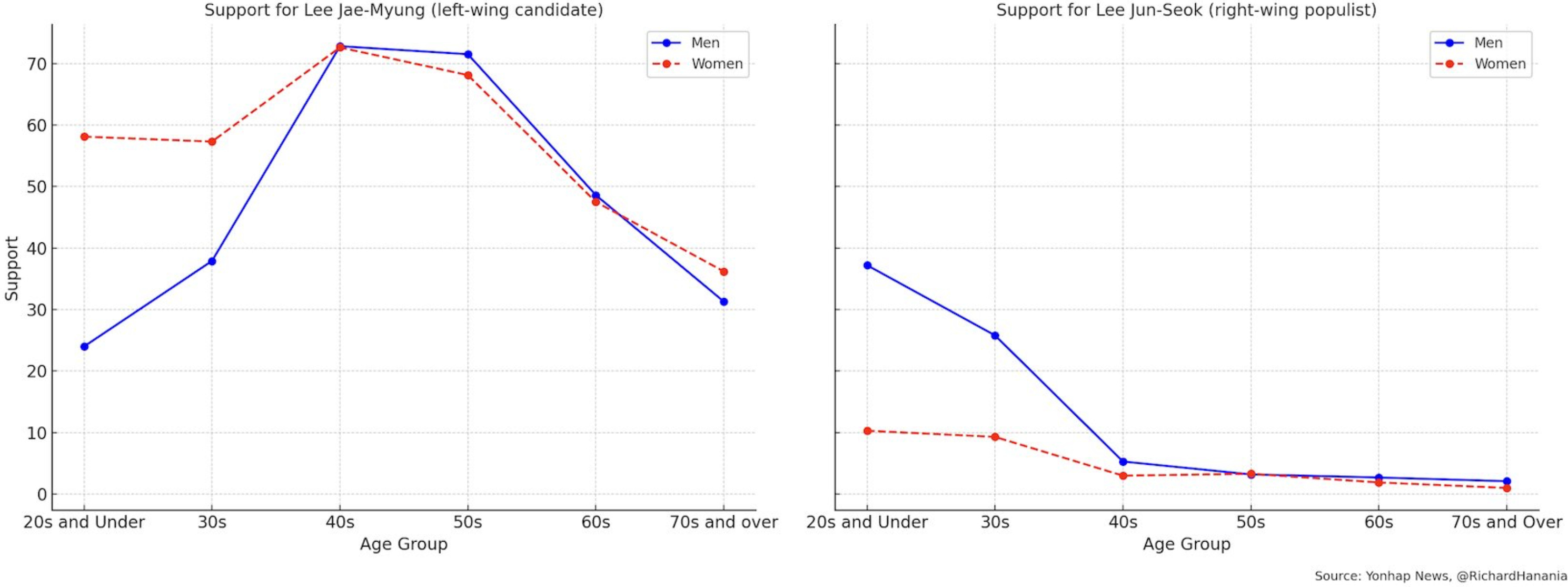
This is a free preview of a paid episode. To hear more, visit www.richardhanania.comI just did a livestream where I talked about Yarvin’s bizarre thread on German WWII POWs, the Korean incel election, Trump’s war on Elite Human Capital, and what I think about the Big Beautiful Bill. Korea might be a warning of where we are all headed. Check out these age and gender gaps. Right now, Korea has societal traits that we are observing across the developed world but in a more extreme form due to specific characteristics of the population. See my previous articles “The East Asian Package” and “Why Asia Stopped Having Kids.”I finally got access to a magical new technology called an ethernet cable, so look forward to no more choppy video like in previous weeks. I have no idea why this happened. Nothing changed with my internet. There just started to be problems with Substack Live and nothing else. Anyway, I’m glad that we solved the issue.
The Facedoxx: Radfem Hitler Is Prettier Than You
This is a free preview of a paid episode. To hear more, visit www.richardhanania.comJust did a fun livestream with friend of the show Radical Feminist Hitler (X, Substack). I looked back at our last podcast and realized that it was all the way back in 2023. I’m glad that so much of my life is documented online because I have no sense of time at all. Sorry about the video quality on my end. I don’t know what it is, but the last two livestreams have been really bad, even though I’m using the same internet and nothing has changed. I’ll hopefully figure this out. RFH recently facedoxxed herself, and so I thought it would be a good time for us to talk again. Contrary to the wishes of the haters, she’s actually gorgeous, which makes me happy because watching her terrorize the chuds is one of my great pleasures in life, and this only further humiliates them.There are a lot of people who receive hate on Twitter and you can see that it gets to them. With RFH, I never feel that she’s just pretending it doesn’t bother her. She actually has faced much less personal harassment than I would have thought, which drives home the point that internet trolls really do go after the weak. They don’t sense they can hurt her, and they’re right. We reflect on our alt right days near the beginning, talking about what the mood was like back in the mid-2010s. Over time, the racist part of the movement became deemphasized as the sexism and inceldom took over. A handful of us with higher intelligence, openness, and honesty than the norm became disillusioned with the whole thing, while the vast majority of that old crowd slipped seamlessly into their roles as MAGAs in good standing. RFH and I veer off into discussing drugs, dental health, nutrition, her skincare routine, her hatred of JD Vance, and why Mitt Romney is our ideal politician. Finally, we open things up to the audience at the end, which leads to us answering questions about whether men should ask women to kiss them, the benefits and limitations of evolutionary psychology, and whether it’s even theoretically possible for women to have “grape fantasies.”If you listen to this conversation, I think you’ll see why I consider RFH one of the coolest people I’ve met online. Most accounts with a schtick are predictable. There’s the alt right guy, the “based trad,” the ditzy egirl, and so forth. RFH brings a unique perspective, as a former alt righter who hasn’t gone completely woke but at the same time has seen the truth about the misogynists and the chuds. And she trolls them without any fear, shaming the pro-masculinity types who, in a delightful irony, prove daily that they’re less capable than she is of thinking rationally or controlling their emotions. Ok fine, I know what you’re thinking, and yes it’s true. I like her because she reminds me of myself, just more Asian looking. Articles and podcasts mentioned:Me on Mitt Romney, women’s tears, the autism horseshoe, and overcoming anxietyRob Henderson and I on play-by-play pick up artistry, and on dating more generallyRFH, “The Lazy Man’s Guide to Skincare.”
Trump of Arabia, FP Report on Qatar, and More
Just did a livestream discussing Trump’s trip to the Middle East, and a new Free Press piece on the influence of Qatar. I go over the differences between campaigns by foreign governments targeting Elite Human Capital and Low Human Capital. Later, I discuss some further thoughts on my article on Yarvin’s case for populism, and whether we can build a decent case for the idea that something like MAGA is needed to check the power of American elites. I note how Yarvin, at this point perhaps the most prominent independent figure still actively defending Trump on broad intellectual grounds, starts from the premise that his movement is made up of people who are stupid and crazy. I played that role a bit before the election, but I think the difference is I had a plausible case of how the stupidity gets us to better outcomes, while now it’s much harder to see the path. Moreover, I didn’t defend authoritarian populism itself; I thought it was a cancer that could be minimized, and we would otherwise get many sensible right-wing policies in a second Trump administration. Yarvin, in contrast, defends MAGA as preferable to normal conservatism. There was a connection problem here unfortunately and the video quality is not very good. The audio appears unaffected. This is a public episode. If you'd like to discuss this with other subscribers or get access to bonus episodes, visit www.richardhanania.com/subscribe
A Unified Theory of the Far Right
This is a free preview of a paid episode. To hear more, visit www.richardhanania.comInspired by Scott Alexander’s piece today on how Moldbug sold out, I discuss my Unified Theory of the Far Right. It explains the transition from Moldbug the Monarchist to Yarvin the Right-Wing Populist, and also why Bronze Age Pervert under all his eccentricities always ends up supporting immigration restrictionist politicians and parties. JD Vance can be seen as someone steeped in this world, who fused white identitarianism with electoral politics by taking the white victimization narrative, dropping the human biodiversity component, and leaning more heavily on anti-capitalist messaging. This really should be an article, but articles are something that takes time away from the book, so I’m trying to write fewer of them.There’s a glitch in the Substack system where I could not see the chat, so there was no ability to interact with the audience. Near the end, I discuss the thumbs up/thumbs down feature that they appear to be rolling out on X, and why that could be what finally drives me off the site. LinksDebate with Jared TaylorMe, “Defeat Racism by Hightening the Contradictions.”Me on Nietzschean Chuddery

Play-by-Play Pick-Up Artistry
This is a free preview of a paid episode. To hear more, visit www.richardhanania.comLast week I shared a five-minute video on X of a woman hitting on various men around a university campus that has now received nearly four million views. It’s such a beautiful social experiment because you see a series of young men put in the exact same situation and watch their reactions. You can observe the gradations in how confident men are and their readiness to capitalize on opportunities that come before them. We see everything from a guy freezing to one treating the situation as something that happens all the time. I thought the video was so interesting that I suggested to Rob that we watch it and do a play-by-play. Watch the video here rather than listen to the audio alone in order to get the full experience. We critique what the men say, their facial expressions, and body language. What I love about the video is you get at least one of each of various types of guys you see in the world: confident black guys, the completely frozen guy, the nervous guy who just wants the situation to end, the boring guy, and even the guy who seems to be doing most things right but has something about himself that’s just off. Men should watch this while asking themselves which prototype they’re closest to. I made the mistake of looking at the comments to my original post and saw a stream of incels making excuses for failure, which I then responded to. I don’t begrudge the men who lacked confidence or were unprepared. What I hate is the twitter guys who don’t see anything wrong with it. This culture of inceldom needs to be destroyed. Back in my day we had guys who couldn’t find women to have sex with them. What was less common was this sense of dejection, which is reflected in misogyny and the belief that looks matter for women anywhere near as much as they do for men. I noticed that a lot of them were MAGAs and one elsewhere complained about Hunter’s laptop. To be an incel is Low Human Capital. The pieces all fit together. I don’t think being shy around women, or most people really, is something any man should accept. It’s fundamentally a reflection of a feeling of inferiority. You don’t become nervous around those you see yourself as above or equal to. I dislike people brushing aside shyness like it’s some harmless trait that is nothing to be ashamed of. It’s a failure and should be treated as such. Knowing exactly what to do in social situations is less important than having the right attitude. Every interaction with others – from the direction of one’s eyes to the speed and cadence of speech to how one smiles or walks – speaks volumes about an individual’s beliefs about himself and the situation he finds himself in. Understanding the subtleties and nuances that create one frame or another is the first step towards building better relationships with other people. After we’re done watching the video, Rob and I share some general thoughts on self-improvement and meeting women, and why we disagree with Bryan’s advice that you should ask a girl to hold hands. I explain why it’s not a coincidence that the two best performing men in the video were black, which you would have expected if you read my article “Black Guy Hitting on Girls.” Finally, I put forward a view that I think might be an unpopular position, which is that developing social skills is one of those things where someone may be able to go from the 10th percentile to the 90th percentile. Most other areas of life, like athletics or intelligence, don’t work like this. If you want more on these topics, see the previous conversation between Rob and me under the title “The Sexual Marketplace as the Last Vestige of Our Darwinian Past”, and me on “How I Overcame Anxiety,” and “The Autism Horseshoe.”

The Future of the American Right
This is a free preview of a paid episode. To hear more, visit www.richardhanania.comMichael Tracey wasn’t around today, so I went solo. I start by discussing this video of Pam Bondi claiming that Trump has saved 258 million lives, a day after she put the number at 119 million. We can chalk this up to stupidity, but there’s actually something more complex going on. The nation is now living under a regime that operates in a space where it knows that it’s completely unrestrained regarding what it can say and still hold on to its base of support. I discuss how there is no incentive for anyone in the administration like Vance to push back on the craziness. If I were advising him in terms of his political future, I’d say he should just glue his lips to Trump’s ass for the next four years. This serves as a launching pad to discuss the future of the conservative movement. I explain why Vance will likely be the 2028 nominee, why Trump won’t go away, and why we’re in a terrible equilibrium where there isn’t anyone with the tools or motivation to fix things. The problem at its core is the Republican base, by which I partly mean the voters, but much more so the influencer class – the Loomers and Posobiecs of the world with massive followings and their audiences, which are simply insane people who will demand Trump-like qualities from any politician they might support. In the second half of the podcast, I take some questions from the audience, including on whether I’m worried about a left-wing populist faction hijacking the Democratic Party in the same way that MAGA took over the right.

My Life in a Mexican Troubled Teen Camp
This is a free preview of a paid episode. To hear more, visit www.richardhanania.comThis morning I noticed that Christina Buttons of the Manhattan Institute posted about the troubled teen industry, and so I happened to mention I had been sent to a rehabilitation center when I was 15. I always considered it a beneficial experience, but had noticed that Paris Hilton was leading a crusade against such facilities. After asking my X followers for help, I got on the Notable Alumni section of the Wikipedia page of the now shuttered Casa by the Sea in Baja California. So far, it’s just me and a guy who was executed for a triple murder in Texas. It looks like we might have been there around the same time. As it turns out, Christina is also a veteran of these programs, and has done some reporting on the topic. She asked if I wanted to do a livestream today, so here it is. One thing I have to note is that in earlier tweets today I said that Casa by the Sea was in Tijuana, but I misremembered and it was actually in Ensenada.Anyway, all of this made me realize that I’ve had an interesting life, and I should write more about experiences like this. I’ll publish an article on my stay at Casa by the Sea at some point. For now, enjoy this conversation with Christina.

Breakthrough in Ukraine Negotiations?
This is a free preview of a paid episode. To hear more, visit www.richardhanania.comMichael Tracey and I discuss the reported peace plan the Trump administration has been selling to Russia and Ukraine. If you take what Putin and Zelensky say publicly at face value, there really isn’t much hope of settling this conflict any time soon. If, on the other hand, they are just putting forward maximalist demands as negotiating ploys or for political reasons, there may be some hope. The Trump plan is basically trying to recreate the process that ended the Korean War. The idea is for everyone to go, look, the line is stuck, let’s just all stay where we are and call it a day, as both sides get to claim that they gained something. We discuss the indicators regarding whether either Zelensky or Putin is willing to bend for the sake of achieving peace, along with ambiguities in the agreement and what happens to US support to Ukraine if negotiations don’t go anywhere. I come up with an optimistic best case scenario of how the current proposal could lead to an outcome that is acceptable for both sides.We then go on to talk about the chaos at the Pentagon. This Politico article and this Tucker interview both come up. I find Hegseth to be an extremely disturbing figure. See here and here for some previous takes. Michael and I agree that this seems to be a clash of personalities within the Pentagon that Tucker and others are trying to spin as being about ideology.

How to Get a Visit from the Secret Service
This is a free preview of a paid episode. To hear more, visit www.richardhanania.comI just did a livestream with Nicholas Decker (X, Substack), a PhD student at George Mason University. I met Nick last year at Manifest, and encouraged him to write more, as I thought he had a lot of interesting ideas. I believe I might’ve also told him to not be afraid of being provocative. He apparently took that advice to heart! For the last few days, he’s become a major villain among MAGAs for his article “When Must We Kill Them?” His tweet promoting the essay has as of this writing gotten over 10 million views. Nick has been receiving nonstop threats through email and twitter, and even had a visit from the Secret Service. I ask him what that’s been like, and also how he thinks the recent controversy will affect his future job prospects. Surprisingly, he thinks it will actually help. I disagree with Nick that this is something we should even be discussing at this point. See my article on why political assassinations are bad. But I do have to admit that there’s nothing wrong with saying that there can be a time when government crosses a line, at which point violence is acceptable. And he’s been extremely brave throughout this whole thing, even posting the address he was living at before his landlord kicked him out. Prior to this incident, his biggest brush with attention was over his argument that he wants to have children that are not genetically his own. I ask Nick whether he’s found the people whose offspring he would like to raise, how he selected them, and what his timeline is for becoming a parent. You’ll find that Nick isn’t exactly what you might expect. He is a kind of über nerd whose eyes light up when discussing dense economics papers. We talk about one of my favorite articles he has written, on how consulting can make firms more efficient. Nick is someone I have been reading and would’ve been happy to stream with at some point anyway, so this controversy mostly just provided an excuse to chat. I don’t think we should be talking about political violence at this point, but I am an admirer of intellect and courage, and Nick has unquestionably shown a high degree of both. Admittedly, I also love a good anti-MAGA troll, probably to a fault. It seems likely that Nick has the same weakness.
MAGAs to the Physics Department, Anti-MAGAs to El Salvador
This is a free preview of a paid episode. To hear more, visit www.richardhanania.comMichael joins me for a spirited conversation about recent events. We start with the case of Kilmar Abrego Garcia, which I think is the most important thing going on in government right now for its civil liberties and rule of law implications. We discuss the Orwellian nature of the way the administration lies about everything, including things like JD Vance posting a long tweet about the case and not even mentioning the main issue, which is that Abrego Garcia was sent to a labor camp, as have been others who appear to have no criminal record or known gang ties. There is at least good news in the case involving the Venezuelans shipped to El Salvador, which is that Judge Boasberg has found probable cause to declare the administration in contempt. Note that in the podcast we say that it has already been held in contempt, which is wrong, as we found out after we were done. While we’re discussing all this, I read a tweet from a DHS spokeswoman claiming that Abrego Garcia was arrested “wearing what is effectively MS-13’s uniform.” You can judge for yourself I guess. See here and here for the kind of slop Fox News is going with to justify what is happening.We also talked about how the Based Ritual that I recently wrote about explains Trump administration policy. I do think that it is possible that some officials are considering the deterrent effects of shipping migrants off to a labor camp, but honestly that probably gives the administration too much credit for forward thinking. Michael wonders whether Trump is trying to ally with Bukele to form a “based empire” and if this fits into his obsession with expansion and President McKinley.I joke to Michael that I’m becoming a civil libertarian crank like he is, having been radicalized by the claims that the Trump administration is making and its nonstop lies.Michael brings up the recent NYT article that features me and others as regretful Trump supporters, and we discuss whether it is documenting a real trend or trying to create one. We also talk about the Trump administration cutting off funds to Harvard. See these NYT pieces for reference. I explain my views on the Harvard situation here. I’ve always advocated pushing back on civil rights law as traditionally practiced and using it to go after DEI, but instead of doing that we’ve got an administration that is demanding affirmative action for MAGAs and the establishment of a regime for monitoring the thoughts of international students. Serves me right for making smart arguments to a Low Human Capital movement. Best case scenario, the attack on DEI does lasting damage to race and sex preferences while the other crazy stuff Trump is trying to do gets rolled back by the courts and a future Democratic administration.We answer some questions from the audience at the end, including on whether Republicans moving in this direction was inevitable. I take the opportunity to plug my recent review of a biography of the life of Roger Ailes for some thoughts on the long-standing culture of the American right and how it opened the door to the Trump cult.
Sexual Harassment and the Making of Modern Conservative Media
This is a free preview of a paid episode. To hear more, visit www.richardhanania.comThis is a podcast review of the book The Loudest Voice in the Room by Gabriel Sherman (2014), a biography of Roger Ailes, and the miniseries based on the book, The Loudest Voice (2019). Ailes’ life story brings together many of my main interests. He created Fox News in 1996, and ran the network until 2016, the year before his death. Fox can be considered the beginning of modern conservative media. There had long been talk radio, magazines like National Review, and conservative newspapers, but nothing on the scale of a cable TV news network that would shoot to number one in the ratings just six years after its founding.The story of Fox is also part of the story of the decline of American institutions. From the beginning, there was a tension between people who wanted to do straight news, and Ailes, who sought to create an entertaining product that played to the audience. The latter tendency would win out, and be rewarded by the market. By the time of the Obama administration, Fox was reacting to conservative grassroots energy rather than shaping it. Through looking at what were considered scandals in the first decade and a half of the network, we can understand how far standards have fallen. I discuss the aftermath of the 2020 election, when Fox started hemorrhaging viewers because it would not go along with Trump’s stolen election narrative. The market competition to Fox comes from outlets that are even more biased and sloppier with the facts. Conservative media had an audience problem, and although Fox could shape and harness that energy for a while, the culture the network created led to the rise of Trump and total victory for the angry ignorant masses over more refined sectors of the conservative movement.Ailes’ predatory behavior towards women is also an important part of the story, and what eventually brought him down. I argue that what he was doing and the fact that he could get away with it for so long tell us something about rightist culture divorced from religious norms. Ailes had a cult of personality at Fox that was similar to the one that Trump would establish on a larger scale over the entirety of the conservative movement. I explain why I don’t think sexual harassment in the workforce is something government usually needs to get involved in, but in this case in particular because it occurred in a major journalistic institution it had negative societal consequences. Sherman’s book was published in 2014, just before the rise of Trump, Ailes’ resignation from Fox News, and his death a year later. So the miniseries covered a lot of things that weren’t in the book, though the edition I read did have an afterword based on an article about how Ailes was brought down, which can be found online here. The miniseries, which was nine episodes and ran on Showtime, has a star-studded cast, including Russell Crowe as Ailes and Seth MacFarlane as Fox head of media relations Brian Lewis. Unlike the book, which is a full biography, the show only covers the founding of Fox News until Ailes leaves the network.The miniseries does a good job of stringing the viewer along through the morbidly fascinating spectacle of the elderly and obese Ailes preying on his young dolled-up employees. I described the show as porn for smug libs, but I guess I’m a smug lib now so I enjoyed it. I talk about where the miniseries diverged from real life events as recounted in the book and where the producers took some creative license with the story. For all the talk of TV being dead, Fox News just posted record ratings for the first quarter of 2025. Based on the clips I’ve seen, the network seems to be getting even dumber and more sycophantic towards Trump, so this is a depressing development. As with social media and the podcast circuit, low-quality content is winning in the marketplace of ideas.If you’re interested in the history of conservative media, or simply want to learn about a dark character who revolutionized American politics, I strongly recommend both Sherman’s book and its TV adaptation.

The Mad King Announces a 90-Day Pause
This is a free preview of a paid episode. To hear more, visit www.richardhanania.comMichael Tracey is at a Senate hearing today like a real journalist, so I’m flying solo.My mood is becoming pretty dark, as reflected in my article on how Trump’s plan is to maintain a North Korea of the right. I discuss why things have gotten this bad, and the necessity of acknowledging where people who supported Trump went wrong. Someone asks about the difference between me today and me on November 5. The big mistake is that I didn’t take my own ideas seriously enough! My opinion of Trump sycophants and assorted rightoids was already extremely low. But it’s sunk even lower, which I didn’t think was possible. There just weren’t any more guardrails. They lasted throughout the first term, but a lot has changed since then. I wrote about this extensively, but thought we’d somehow get lucky. As I was streaming, we learned that Trump is putting a 90-day pause on tariffs, for now placing 125% on Chinese goods and 10% on other countries. This is still an insane policy, but much better than the previous plan. Maybe focusing all of his hatred on China can help spare the rest of the world. I discuss how I’m annoyed by China-bashing. I’m not a fan of the CCP, but I take issue with the belief that the problem with them is the fact that we trade with one another. This idea has taken hold as a form of bipartisan demagoguery, and I expect a lot of the anti-China policies Trump has implemented to stick, even if other tariffs get rolled back.
Wisconsin Slaps Down Elon
This is a free preview of a paid episode. To hear more, visit www.richardhanania.comMichael joins me again to talk about last night’s election results and Trump’s coming tariff announcement. Democrats won the Supreme Court race in Wisconsin, and over performed in other races. Florida’s First District went from R+32 to R+15 according to the current count, while the Sixth District shifted from R+33 to R+14. We debate whether Elon was rational to put so much money and effort into the Wisconsin Supreme Court race. My argument is that Republicans need to do something about the fact that the other side is more energized, along with the fact that Democratic voters are more educated, which makes current trends worse. Elon did not help them win in Wisconsin, but giving away giant checks is at least a strategy. The alternative right now seems to be to just accept that Republicans are going to get crushed in every election from now until 2028. Michael and I do our best to speculate on what might happen with tariffs based on current reporting. We recorded this beginning at 1ET, while Trump’s big announcement is at 4ET, so by the time you listen to this there may be more information. We go on to talk about a blockbuster report in The New York Times from over the weekend: “The Secret History of the War in Ukraine.” Michael and I go over what we learned that is new here, and how the story changed our perspective on the conflict. As for the future of the war in Ukraine, I wonder whether Trump seems to be just getting bored with the conflict. The most likely scenario now looks to me to be a petering out of American support as the Europeans assume more responsibility and the fight continues. Michael, in contrast, seems to find it easier to imagine Trump escalating support to Ukraine.

Sending War Plans over Groupchat
This is a free preview of a paid episode. To hear more, visit www.richardhanania.comMichael Tracey joins me to talk about the crazy groupchat story. We discuss why this has caught on, and whether it tells us anything new about the administration and how it operates. See here for the full release. I argue that the reason that this is such a big story is that it’s the kind of awkward situation people can relate to in their personal lives, except in this case it happened to top administration officials while planning a military strike. Michael and I then debate the logic that was used to justify the attack on Yemen. We go back and forth on the question of whether “deterrence” or “credibility” can be a good reason to do something. Michael says no, but I disagree.I play this hilarious video of Steve Witkoff talking about the special relationship between Trump and Putin. See these articles on Putin’s religious beliefs. Finally, we close with what has been going on with immigration enforcement. Of all the things that the Trump administration is doing, this might be the most disturbing. ICE has apparently been hunting down a Columbia student who is a legal permanent resident and has been in the US since she was 7. Venezuelans are getting sent to a Salvadoran prison camp based on allegations that they have gang ties. We’re not talking about people convicted of crimes, or even arrested for crimes. Simple speculation about who they are means that they get locked up indefinitely! Michael notes that this goes well beyond anything that Bush and Cheney did back when they were criticized for violating civil rights. See here for the latest legal news on this that broke as I was typing these show notes. For the thumbnail, see here.

A Holistic Policy of Anti-Antisemitism
This is a free preview of a paid episode. To hear more, visit www.richardhanania.comMichael Tracey joins me on the livestream to discuss the latest foreign policy news, including on the Ukraine war and Gaza. Late in the conversation we talk about how the Trump administration has gone beyond being pro-Israel, and is more implementing a policy of fighting anti-Semitism across the board, which has reached into education and immigration policy. I note the parallels I see between woke hysteria on college campuses and the narrative that universities are hotbeds of Jewish hatred, namely exaggerated and subjective claims of persecution, along with alleged anecdotes only weakly supported by evidence.Some links that come up in the conversation or are related to its themes:Mikhail Zygar, “Putin Won’t End the War. He Can’t Afford to.” (NYT)Michael with a clip of Laura Ingraham asking Trump about the Putin call, and the seeming contradiction between his account and that of PutinMe, “Too Gay to Rebel.”Wall Street Journal on Israel sending troops back into GazaWall Street Journal, “Columbia Is Nearing Agreement to Give Trump What He Wants.”