
The Growth Podcast
154 episodes — Page 1 of 4
Inside the AI Stack of an $8.3B AI Company’s Product Team | Together AI
How to Build Effective Product Loops in Claude Code, with Chief AI and Product Officer at JobNimbus, Tyler Folkman
How to build a Company Operating System with Hermes and OpenClaw
How Srini Raghavan helped $3.4B SaaS Giant Freshworks Embrace the AI PDLC
3x CPO Oji Udezue on the Essential Claude Skills for PMs
How to Build Frontier-Lab Quality Evals with Daniel McKinnon, ex-PM at Meta, Google
The PM's Guide to Governance with Eric Ries, author of The Lean Startup
Claude PM Masterclass from Former FAANG AI PM Jyothi Nookula
The PM's Guide to AI Design that isn't Slop
How to Build a Company OS in Claude Code with Jiaona Zhang, CPO at Laurel
How a VP of Product Uses Claude Without Producing Slop | Matthew Wensing, Customer.io
How to Use Codex Like an OpenAI PM | Abhi Muchhal, PM OpenAI (ex-Meta and Nubank)
How PMs Ship 100K Lines of Code at OpenAI with Ryan Lopopolo, Member of Technical Staff
How to Run Evals in Claude Code with Aparna Dhinakaran, Founder and CPO of Arize
Claude Code for Non-Technical PMs, with Andre Albuquerque
PM's Guide to Claude - When to use Chat vs Cowork vs Code, with Pawel Huryn
How to Build a Full AI Dev Team in Claude Code | Guide from Google PM Gabor Meyer
How to Become a "Builder PM" with n8n, Claude Code, and OpenClaw | Mahesh Yadav (ex-Google, AWS, Meta, Microsoft; Founder LegalGraph AI)
How to Design like OpenAI and Figma
Today’s episodeThe design process you learned is already dead.Most teams still follow the same linear pipeline. Low fidelity to high fidelity to handoff. Sketch it. Spec it. Ship it over the wall. That pipeline was built around a constraint that no longer exists. High fidelity used to be expensive. It is not anymore.I brought in two people who represent both sides of the new design infrastructure.Ed Bayes is a member of the design staff at OpenAI. He leads design on Codex, which just crossed 2 million weekly users with usage surging 3X since the start of the year. He spends 70-80% of his time coding. He still calls himself a designer.Gui Seiz is the Director of Product Design for AI at Figma. He leads design on all their AI features, including the Figma MCP server and Figma Make. His designers are now shipping PRs to production.----Check out the conversation on Apple, Spotify, and YouTube.Brought to you by:* Bolt: Ship AI-powered products 10x faster* Amplitude: The market-leader in product analytics* Pendo: The #1 software experience management platform* NayaOne: Airgapped cloud-agnostic sandbox* Product Faculty: Get $550 off their #1 AI PM Certification with my link----If you are trying to understand the new design workflow, this is the one episode to watch.If you want access to my AI tool stack - Dovetail, Arize, Linear, Descript, Reforge Build, DeepSky, Relay.app, Magic Patterns, Speechify, and Mobbin - grab Aakash’s bundle.I’m putting on a free webinar on Behavioral and AI PM interviews. Join me.----Key Takeaways:1. Code vs canvas is a false dichotomy - The best designers use both fluidly. Canvas for exploration, collaboration, and pixel-perfect craftsmanship. Code for interactions, responsive testing, and the last mile of polish. The question is what you are trying to learn, not which tool to commit to.2. High fidelity is no longer expensive - The entire linear design process existed because building something interactive required engineering resources. That constraint is gone. A functional wireframe takes the same time as a paper sketch.3. The Codex-Figma MCP makes handoff lossless - Import screens from a running React app into Figma with exact pixel values. Border radius, padding, shadows, all one to one. It is not a screenshot. It is a responsive, editable design artifact.4. The reverse direction works seamlessly - Make changes in Figma, paste a component link into Codex, and it updates your code automatically. No redline spec, no handoff document.5. Ed spends 70-80% of his time coding and still calls himself a designer - The medium changed but the mandate did not. Designers are still the voice of the user, still upholding craft. The tools expanded, the role stayed.6. Figma designers are shipping PRs to production - Teams that six months ago were AI curious are now banging down the door. Monetization designers who never wrote code are building technically complex prototypes.7. "Prototypes, not PRDs" is the emerging norm - PMs at OpenAI bring working prototypes to design reviews. They ship PRs to stress-test ideas before handing off to engineering.8. You do not need permission to start - Someone from OpenAI's GTM team built an iOS app with zero experience. Download Codex and build something for yourself tonight.9. Curiosity is the defining skill for this era - Not code proficiency, not design talent. The AI is an infinitely patient tutor. Ask questions. Build understanding alongside output.10. Total football is the mental model - Every player can play every position. Roles still have natural spikes. But the tool constraints that enforced rigid boundaries are dissolving.----Where to find Ed Bayes* LinkedIn* OpenAI* XWhere to find Gui Seiz* LinkedIn* Figma* XRelated contentPodcasts:* Xinran Ma - Design with AI* Carl Vellotti - Claude Code PM OS* Codex PM Guide with Carl VellottiNewsletters:* AI prototyping for PMs* The PM guide to Bolt* Codex PM guide----PS. Please subscribe on YouTube and follow on Apple & Spotify. It helps!If you want to advertise, email productgrowthppp at gmail. This is a public episode. If you'd like to discuss this with other subscribers or get access to bonus episodes, visit www.news.aakashg.com/subscribe

How to build a Team OS in Claude Code with Hannah Stulberg, PM @ DoorDash
Today’s episodeThe way PM teams are trending, one PM is going to support 20 people.Not just engineers. Designers. Analysts. Strategy partners. GTM. Sales. Support.You cannot answer everyone’s questions about everything. You cannot be in every Slack thread. You cannot be the bottleneck for context that already exists somewhere in a Google Doc no one can find.But you can give them a high-context, well-organized repo.Hannah Stulberg is a PM at DoorDash and a former Google PM. She has spent over 1,500 hours in Claude Code.She wrote the viral Claude Code for Everything series. Her setup is not a personal productivity system. She has structured her entire team’s context into a shared repo that everyone queries.Her strategy partner - completely non-technical - puts up pull requests every day. Her engineers query metric definitions without asking the analyst. Her designers pull product context without waiting on a PM.If you are building a team that runs on AI, this is the episode to watch.----Check out the conversation on Apple, Spotify, and YouTube.Brought to you by:* Bolt: Ship AI-powered products 10x faster* Jira Product Discovery: Plan with purpose, ship with confidence* Kameleoon: Leading AI experimentation platform* Amplitude: The market-leader in product analytics* Product Faculty: Get $550 off their #1 AI PM Certification with my link----If you want access to my AI tool stack - Dovetail, Arize, Linear, Descript, Reforge Build, DeepSky, Relay.app, Magic Patterns, Speechify, and Mobbin - grab Aakash’s bundle.I’m putting on a free webinar on Behavioral and AI PM interviews. Join me.----1. Build a Team OS, not a personal OS - A shared repo where every function checks in work. Engineers, designers, and analysts self-serve without asking the PM.2. Root CLAUDE.md is everything - Doc index, team roster with Slack IDs, channel map. Keep under one page or you burn context every session.3. Nested indexes save 97% of context - Every folder gets a navigation CLAUDE.md. A customer query used only 3% of the context window.4. Three token tiers - Always-loaded root (~500 tokens), folder indexes on navigation (200-500), content files on demand (1,000-10,000+).5. Split analytics by product area - Metrics, queries, schemas separated. Progressive loading prevents waste.6. Gate launches on repo updates - Feature not shipped until metrics, queries, schemas, and playbooks are checked in.7. Verified playbooks kill hallucinations - Analyst-audited methodology. Claude follows verified steps instead of inventing its own.8. Plan mode makes 10x docs - Shift+Tab twice. Five phases: load context, ask questions, build plan, push thinking, review agents.9. Split long docs across parallel agents - Each writes to a temp file. Orchestrating agent compiles. Prevents context overflow.10. The flywheel compounds daily - Automate one task, free time, improve the repo. After 1,500 hours still iterating every day.----Where to find Hannah Stulberg* LinkedIn* In the Weeds SubstackRelated contentPodcasts:* My Claude Code PM OS with Dave Killeen* Claude Code + Analytics with Frank Lee* Claude Code as PM OS with Carl VellottiNewsletters:* The ultimate guide to context engineering* Build your PM operating system* How to use Claude Code like a pro----PS. Please subscribe on YouTube and follow on Apple & Spotify. It helps!If you want to advertise, email productgrowthppp at gmail. This is a public episode. If you'd like to discuss this with other subscribers or get access to bonus episodes, visit www.news.aakashg.com/subscribe
How to Turn Claude Code into an Operating System with Carl Vellotti
Today’s episodeClaude Code just hit $2.5 billion in annualized revenue in 9 months.It is the fastest B2B software product ramp in history.So why are most people still using it like a chatbot?This is how most people use Claude Code. Type a prompt and get output. The context fills up. It compacts. You lose everything. You start over.The top users flipped it. They built skills that interview through a framework before building anything. They use sub-agents that preserve context. They have operating systems where every file, every person, every project has a home.That shift is what today’s episode is about.I sat down with Carl Vellotti for the third time. His first episode was the beginner course. His second episode was the advanced masterclass. Together they crossed over a million views across platforms.Today is the operating system layer. If you are already an 80 out of 100 on Claude Code, this episode will bring you to a 95 out of 100.This episode covers context management, creating sub-agents to manage your context for you, auto-triggering skills with hooks, trustworthy data analysis with Jupyter notebooks, and building an operating system around it all.If you are living in Claude Code 8 to 10 hours a day and want to stop fighting the tool, this is the one episode to watch.----Check out the conversation on Apple, Spotify, and YouTube.Brought to you by:* Bolt: Ship AI-powered products 10x faster* Amplitude: The market-leader in product analytics* Pendo: The #1 software experience management platform* NayaOne: Airgapped cloud-agnostic sandbox* Product Faculty: Get $550 off their #1 AI PM Certification with my link----If you want access to my AI tool stack - Dovetail, Arize, Linear, Descript, Reforge Build, DeepSky, Relay.app, Magic Patterns, Speechify, and Mobbin - grab Aakash’s bundle.I’m putting on a free webinar on Behavioral and AI PM interviews. Join me.----Key Takeaways:1. Context management is the real skill - A single web search eats 10% of your context. Run /context to see what is consuming it. System prompt and MCPs take 10-16% before you type one message.2. Sub-agents save 20x context - Delegate research to a sub-agent. Same task costs 0.5% instead of 10%. Your main session only gets the summary.3. Replace MCPs with CLIs - MCPs eat context by existing. CLIs have zero overhead. GitHub CLI, Vercel CLI, Google Workspace CLI are all dramatically more efficient.4. Powerful skills need zero code - Anthropic's front-end design plugin is just a good prompt. No APIs or tooling. Just rules that tell Claude "do not look like AI."5. Give Claude self-checking tools - The make slides skill uses Puppeteer to screenshot output, measure overflow, and fix issues before you see them.6. Repeat prompts for better quality - A Google paper showed pasting a prompt twice helps. Tell Claude to double-check against skill instructions after the first pass.7. Use hooks to auto-invoke skills - A user_prompt_submit hook matches your words against skill keywords instantly. Zero context cost.8. Jupyter notebooks solve data trust - Every analysis shows exact code, inputs, and outputs. Traceable and reproducible.9. Build an operating system - Knowledge folder for people context. Projects folder for task isolation. Tools folder for scripts. CLAUDE.md for identity.10. The people folder compounds - Connect meeting transcription. After every meeting, update each person's dossier. Every prompt gets more specific over time.----Related contentPodcasts:* Claude Code Masterclass with Carl Vellotti (Ep 2)* Claude Code PM OS with Dave Killeen* OpenClaw Setup Guide with Naman PandeyNewsletters:* The ultimate guide to context engineering* How to use Claude Code like a pro* Claude Cowork and Code setup guidePS. Please subscribe on YouTube and follow on Apple & Spotify. It helps! This is a public episode. If you'd like to discuss this with other subscribers or get access to bonus episodes, visit www.news.aakashg.com/subscribe
AI PM at Netflix, Amazon and Meta - Here's How to Become an AI PM (Fundamentals + Job Search)
Today’s episodeStop applying to AI PM jobs until you understand the fundamentals.That is not gatekeeping. That is the MIT finding. 19 out of 20 AI pilots fail. The #1 reason? Picking the wrong problem to apply AI to.Not the wrong model. Not the wrong data. The wrong problem.Jyothi Nookula has spent 13.5 years in AI. 12 patents. AIPM at Amazon (SageMaker), Meta (PyTorch), Netflix (Developer Platform), and Etsy.She has hired AIPMs at three of those companies. Trained 1,500+ PMs to transition into AI roles.If you are trying to break into AI PM, this is the one episode to watch.----Brought to you by* Product Faculty: Get $550 off their #1 AI PM Certification with my link* Amplitude: The market-leader in product analytics* Pendo: The #1 software experience management platform* NayaOne: Airgapped cloud-agnostic sandbox for AI validation* Kameleoon: Prompt-based experimentation for product teams----If you want access to my AI tool stack - Dovetail, Arize, Linear, Descript, Reforge Build, DeepSky, Relay.app, Magic Patterns, Speechify, and Mobbin - grab Aakash’s bundle.If you want my PM Operating System in Claude Code, click here.----Key Takeaways:1. Two types of AIPM roles exist - 80% are traditional PM roles with AI features added on, where the core product existed before AI. 20% are AI native roles where the product IS AI and the value proposition is impossible without it. Know which type before you apply.2. The AI PM stack has three layers - Application PMs own user experience (60% of roles, easiest entry point). Platform PMs build tools for other builders (30%). Infra PMs build foundational systems like vector databases and GPU orchestration (10%).3. 19 out of 20 AI pilots fail from wrong problem selection - AI makes sense for complex pattern recognition, prediction from historical data, and personalization at scale. If explainability is non-negotiable, rules exist, data is limited, or speed is critical, start with heuristics.4. Most teams overcomplicate their AI technique choice - If you can put the problem in a spreadsheet with inputs and an output to predict, traditional ML is the answer. Perception problems need deep learning. Natural language reasoning needs Gen AI. These are not competitors, they are tools in your toolkit.5. AI products are fundamentally probabilistic - The same input can produce different outputs. AIPMs must think in quality distributions and acceptable error rates, not binary success vs failure. Data is a first-class citizen, not a nice-to-have.6. Agents decide, workflows follow steps - Workflows have predetermined sequences with deterministic outcomes. Agents receive goals and independently decide which tools to use. The live N8N demo showed identical tools producing completely different execution patterns.7. Context engineering is the real production skill - Claude Sonnet has a 200K token context window but that fills fast with knowledge bases, conversation history, and real-time data. Every token costs money. Managing what to load and when directly impacts both quality and cost.8. Follow the hierarchy before fine tuning - Prompt optimisation first, then context engineering, then RAG. 80% of use cases get solved with RAG. Fine tuning should only be considered after exhausting all three.9. Build products not projects - Launch your AI work, get real users, encounter real breakage. That gives you richer interview material than any course certificate. Build an agent, build a RAG system, and build an app that solves a real problem.10. PM culture at big tech shapes who you become - Amazon PMs spend 40-50% of time writing PRFAQs and six-pagers. Meta PMs live in experimentation and statistical significance. Netflix PMs operate with full autonomy through context over control. Each teaches something different.----Where to find Jyothi Nookula* LinkedIn* NextGen Product ManagerRelated contentPodcasts:* Naman Pandey on OpenClaw* Lisa Huang on Gemini Gems* Frank Lee on Amplitude and MCPNewsletters:* The ultimate guide to context engineering* RAG vs fine tuning vs prompt engineering* AI foundations for PMsPS. Please subscribe on YouTube and follow on Apple & Spotify. It helps! This is a public episode. If you'd like to discuss this with other subscribers or get access to bonus episodes, visit www.news.aakashg.com/subscribe

Evals are the new PRD. Here is the playbook with the CEO of the leader in the space (Ankur Goyal, Founder and CEO, Braintrust)
Today’s episodeMost PMs treat evals like a quality gate. Something you run right before shipping, just to check the box.That is backwards.The best AI product teams treat evals as the starting point. They write the eval before the prompt. They iterate on the scoring function before the model. They use failing evals as a roadmap.That shift is what today’s episode is about.I sat down with Ankur Goyal, Founder and CEO of Braintrust. It is the eval platform used by Replit, Vercel, Airtable, Ramp, Zapier, and Notion. Braintrust just announced its Series B at an $800 million valuation.Users are running 10x more evals than this time last year. People log more data per day now than they did in the entire first year the product existed.In this episode, we build an eval entirely from scratch. Live. No pre-written prompts, no pre-written data. We connect to Linear’s MCP server, generate test data, write a scoring function, and iterate until the score goes from 0 to 0.75.Plus, we cover the complete eval playbook for PMs:If you want access to my AI tool stack - Dovetail, Arize, Linear, Descript, Reforge Build, DeepSky, Relay.app, Magic Patterns, Speechify, and Mobbin - grab Aakash’s bundle.If you want my PM Operating System in Claude Code, click here.----Check out the conversation on Apple, Spotify, and YouTube.Brought to you by:* Kameleoon: Leading AI experimentation platform* Testkube: Leading test orchestration platform* Pendo: The #1 software experience management platform* Bolt: Ship AI-powered products 10x faster* Product Faculty: Get $550 off their #1 AI PM Certification with my link----Key Takeaways:1. Vibe checks are evals - When you look at an AI output and intuit whether it is good or bad, you are using your brain as a scoring function. It is evaluation. It just does not scale past one person and a handful of examples.2. Every eval has three parts - Data (a set of inputs), Task (generates an output), and Scores (rates the output between 0 and 1). That normalization forces comparability across time.3. Evals are the new PRD - In 2015, a PRD was an unstructured document nobody followed. In 2026, the modern PRD is an eval the whole team can run to quantify product quality.4. Start with imperfect data - Auto-generate test questions with a model. Do not spend a month building a golden data set. Jump in and iterate from your first experiment.5. The distance principle - The farther you are from the end user, the more critical evals become. Anthropic can vibe check Claude Code because engineers are the users. Healthcare AI teams cannot.6. Use categorical scoring, not freeform numbers - Give the scorer three clear options (full answer, partial, no answer) instead of asking an LLM to produce an arbitrary number.7. Evals compound, prompts do not - Models and frameworks change every few months. If you encode what your users need as evals, that investment survives every model swap.8. Have evals that fail - If everything passes, you have blind spots. Keep failing evals as a roadmap and rerun them every time a new model drops.9. Build the offline-to-online flywheel - Offline evals test your hypothesis. Online evals run the same scorers on production logs. The gap between them is your improvement roadmap.10. The best teams review production logs every morning - They find novel patterns, add them to the data set, and iterate all day. That morning ritual is what separates teams that ship blind from teams that ship with confidence.----Where to find Ankur Goyal* LinkedIn* BraintrustRelated contentNewsletters:* AI evals explained simply* AI observability for PMs* How to build AI productsPodcasts:* AI evals with Hamel Husain and Shreya Shankar* AI evals part 2 with Hamel and Shreya* Aman Khan on AI product quality----PS. Please subscribe on YouTube and follow on Apple & Spotify. It helps!If you want to advertise, email productgrowthppp at gmail. This is a public episode. If you'd like to discuss this with other subscribers or get access to bonus episodes, visit www.news.aakashg.com/subscribe
The Complete Guide to OpenClaw for PMs [EXCLUSIVE]
This is a free preview of a paid episode. To hear more, visit www.news.aakashg.comToday’s episodeEvery PM I talk to is using AI the same way. Open Claude. Type a question. Get an answer. Close the tab.The AI does nothing while you sleep. It forgets everything the next morning. It cannot touch your Slack, your email, your file system.OpenClaw changes that.245,000 GitHub stars. 2 million weekly visitors. Peter Steinberger built it, Sam Altman bought it for over a billion dollars. I covered what OpenClaw is and why it matters when it first went viral. Today’s episode goes deeper. A complete, step-by-step installation and five PM automations you can copy.----Check out the conversation on Apple, Spotify and YouTube.Brought to you by* Jira Product Discovery: Plan with purpose, ship with confidence* Vanta: Automate compliance, manage risk, and prove trust* Mobbin: Discover real-world design inspiration* Maven:* Product Faculty: Get $550 off their #1 AI PM Certification with my link----If you want access to my AI tool stack - Dovetail, Arize, Linear, Descript, Reforge Build, DeepSky, Relay.app, Magic Patterns, Speechify, and Mobbin - grab Aakash’s bundle.If you want my PM Operating System in Claude Code, click here.----Key Takeaways:1. OpenClaw is a proactive AI agent, not a reactive chatbot - Unlike ChatGPT or Claude, OpenClaw runs as a continuous daemon on your machine. It executes tasks at 3 a.m. while you sleep, maintains persistent memory across sessions, and acts autonomously based on scheduled cron jobs.2. Installation takes three terminal commands - NPM install, openclaw onboard, and hatch the bot. If you do not see red text in the terminal, the installation worked. Yellow warnings are normal and safe to ignore.3. The Slack integration has one critical step everyone misses - Every time you change bot permissions in the Slack API console, you must click Reinstall to Workspace. Without this step, no permission changes persist and the bot appears broken.4. The workspace docs folder is your team's knowledge base - Drop PRDs, FAQs, and product docs into the local .openclaw/workspace/docs folder. Any team member can query the entire repository by mentioning the bot in any Slack channel, and the bot can write back to the docs.5. Cron jobs replace manual PM rituals - Set up a morning stand-up summary that scans Slack channels overnight and posts a brief at 9 a.m. with what shipped, active blockers, and customer complaints. You describe it in English and OpenClaw writes the code.6. Competitive intelligence runs on autopilot - OpenClaw can monitor competitor websites, reviews, and mentions every 30 minutes and post SWOT analyses to a private Slack channel. It tracks changes over time for trend analysis months later.7. Voice of customer reports aggregate every feedback source - Connect Slack support channels, email, Google reviews, Reddit, and more. OpenClaw scans every 30 minutes and synthesizes a weekly report automatically.8. Smart bug routing checks customer tier automatically - OpenClaw reads bug reports, looks up the reporter in a customer CSV, escalates enterprise bugs to engineering immediately, and routes free-tier bugs to design as low priority.9. Security audit is non-negotiable before going live - Tell OpenClaw to analyze its own security vulnerabilities. It will flag unrestricted file access, disabled firewalls, and missing approval gates. Set up a weekly cron job to run the audit automatically.10. Local deployment is safest for most PMs - A VPS gives 24/7 uptime but removes your physical kill switch. A dedicated Mac Mini is the most recommended option. Local deployment on your laptop is the safest because the bot sleeps when you close your laptop.----Related contentNewsletters:* OpenClaw complete guide* My PM Operating System* The AI PM Tool StackPodcasts:* Claude Code PM OS with Dave Killeen* Claude Code + Analytics with Frank Lee* Gemini Gems Masterclass with Lisa Huang----PS. Please subscribe on YouTube and follow on Apple & Spotify. It helps!If you want to advertise, email productgrowthppp at gmail.
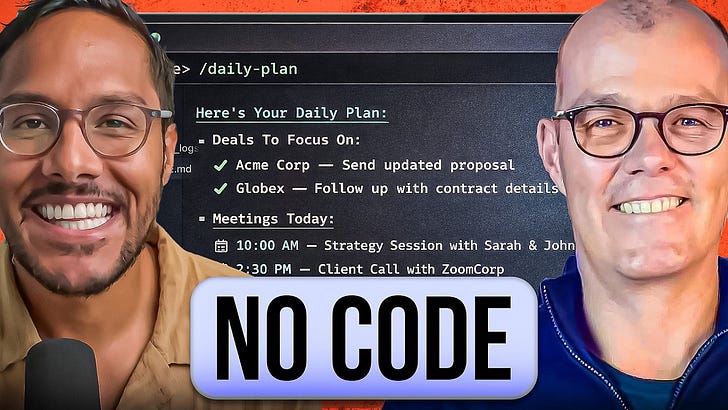
This CPO Uses Claude Code to Run his Entire Work Life | Dave Killeen, Field CPO @ Pendo
Today’s episodeMost PMs start every day like this. Open the calendar. Open the CRM. Open Slack. Open the meeting notes. Open LinkedIn. Piece together what matters. Lose 30 minutes before real work even starts.That is not how the best PMs are working anymore. The best PMs are running one command in the morning and getting everything they need in five minutes. Their calendar, their deals, their market intel, their career gaps, all pulled together automatically.That shift is what today’s episode is about.I sat down with Dave Killeen, Field CPO at Pendo.io. He has worked at BBC, Mail Online, and now runs the field product function at one of the largest product management platforms in the world. He has 25 years in product. Over the last few months, he built a full personal operating system called DEX in Claude Code, open sourced it on GitHub, and it is getting serious traction.In this conversation, Dave walks through his entire system live on screen. You will see how he runs a daily plan, creates PRDs from a backlog, manages parallel workstreams on a Kanban board, and tracks his career goals, all from one terminal window. And you will learn the three building blocks that make it all work.----Check out the conversation on Apple, Spotify and YouTube.Brought to you by* Pendo: The #1 software experience management platform* Jira Product Discovery: Plan with purpose, ship with confidence* Amplitude: The market-leader in product analytics* NayaOne: Airgapped cloud-agnostic sandbox* Product Faculty: Get $550 off the AI PM Certification with code AAKASH550C7----If you want access to my AI tool stack - Dovetail, Arize, Linear, Descript, Reforge Build, DeepSky, Relay.app, Magic Patterns, Speechify, and Mobbin - grab Aakash’s bundle.----Key Takeaways:1. One command replaces your morning routine - Dave's daily plan slash command pulls from calendar, CRM, Granola, LinkedIn, YouTube, and 120 newsletters in five minutes. No tab switching. No manual assembly.2. MCP servers are the key to connecting everything - Point Claude at any API documentation with your API key and it builds an MCP server for you. MCP provides structured guardrails that make the AI's behavior consistent and deterministic.3. Skills, MCP, and hooks are three different things - Skills are plain English job descriptions for what the AI should do. MCP servers are structured integrations for connecting external services. Hooks are triggers that fire at specific conversation moments.4. Session start hooks make the system compound - Every new Claude Code chat gets injected with weekly priorities, quarterly goals, working preferences, and past mistakes. The AI never starts from scratch.5. Living markdown files are the compounding mechanism - Every project, person, and company gets a markdown file that accumulates context from meetings, messages, and intel over time. The more you use the system, the smarter every file becomes.6. You can build a mobile app in 37 minutes - Dave built the full app with Claude and spent more time in Xcode publishing it. The constraint is taste, not building speed.7. The AI should hold you accountable - Dave's Claude MD file includes "harsh truths for Dave" that the AI wrote after auditing his system. This gets injected into every session to prevent the same mistakes.8. Career planning should compound like product data - A career MCP server collects evidence, runs gap analysis, and calculates promotion readiness. When review time comes, the evidence is already assembled.9. Be precise about your goal, not the path - The kindest thing you can do for the AI is give it a very clear destination. Do not tell it how to get there. Let it figure out the most elegant approach itself.10. Voice-first changes everything - Using Whisperflow or Super Whisper instead of typing fundamentally changes how you interact with Claude. You think out loud. The conversation flows. You build faster.----Where to find Dave Killeen* LinkedIn* Pendo----Related contentNewsletters* The PM operating system guide* How to use Claude Code like a pro* Master AI agent distribution* Claude Cowork and Code setup guide* The AI PM tool stackPodcasts* Frank Lee on Claude Code and MCP workflows* Carl Vellotti on Claude Code operating systems* Rachel Wolan on AI PM workflows* Caitlin Sullivan on building with Claude----PS. Please subscribe on YouTube and follow on Apple & Spotify. It helps!If you want to advertise, email productgrowthppp at gmail. This is a public episode. If you'd like to discuss this with other subscribers or get access to bonus episodes, visit www.news.aakashg.com/subscribe
Gemini Gem Masterclass From the Creator Lisa Huang
Today’s episodeMost PMs are using AI the same way they used Google in 2005.Type something in. Get something out. Move on.That is not how the best PMs are using it. The best PMs have stopped treating AI as a search engine and started treating it as a team member. One that already knows their product, their writing style, their strategy. One that does not need to be briefed from scratch every single time.That shift is what today’s episode is about.I sat down with Lisa Huang, SVP of Product at Xero, an $18 billion finance platform. She built the AI assistant for the first generation Meta RayBan smart glasses. She created Gemini Gems at Google. She has been an AI PM at Apple, Meta, and Google - three of the most demanding AI product environments in the world.She gave us a masterclass across Gemini Gems, building AI into hardware, running AI agents at scale inside a financial product, and what the AI PM career actually looks like from here.In today’s episode, we discuss across three topics.* How to build Gemini Gems and AI projects that actually work.* What she learned building AI into a wearable device.* What the future of the AI PM career actually looks like.----Check out the conversation on Apple, Spotify and YouTube.Brought to you by - Reforge:Get 1 month free of Reforge Build (the AI prototyping tool built for PMs) with code BUILD----If you want access to my AI tool stack - Dovetail, Arize, Linear, Descript, Reforge Build, DeepSky, Relay.app, Magic Patterns, Speechify, and Mobbin - grab Aakash’s bundle.----Key takeaways:1. Stop briefing your LLM from scratch every time - Gemini Gems hold your context permanently. Your role, your company strategy, your writing style. Build it once and it already knows everything the next time you open it.2. Every PM needs 3 Gems - A writing clone trained on your PRDs and emails. A product strategy advisor loaded with your company docs and competitor analysis. A user research synthesizer that ingests raw transcripts and surfaces key themes.3. Vague instructions are the number one mistake - "Help me write better" gets you nothing. Write a full page of context. Your role, your audience, your format preferences. The more specific, the more personalized the output.4. Gemini Gems vs ChatGPT custom GPTs - OpenAI framed GPTs as an app store ecosystem. Google focused on personal productivity instead. First principles beat copying a competitor's framing, and the GPT store never took off.5. On-device AI is the future for wearables - Cloud is the default today but once a device is on your face all day, people want their data staying local. Privacy beats performance when the device is that personal.6. Accuracy is the product in high-stakes AI - LLMs out of the box are not great at math, accounting, or tax. Winning agents combine deep domain knowledge with proprietary data that no general-purpose model can access.7. Measure agents in three layers - Quality first (evals, human annotators, LLM judges). Product metrics second (adoption, retention, CSAT). Business impact third (revenue attribution, ARR). Skip to layer three without the foundation and you are measuring on sand.8. AI will not replace PMs - it will replace the execution work. Writing PRDs, creating mocks, managing roadmaps. What stays is product judgment. The ability to look at ambiguous signals and say this is the right bet and here is why.9. The PM role is becoming a hybrid - PM to engineer ratios will compress. The expectation is that PMs also build. Not just spec and hand off, but prototype, design, and code enough to show what they mean. The tools to do this exist right now.10. Your company's permission is not required - Most companies are not fine-tuning models. They are using the same consumer tools you already have. Build Gems. Build projects. Build small AI products with your personal data. There is nothing stopping you.----Where to find Lisa Huang* LinkedIn* WebsiteRelated contentNewsletters* How to become an AI PM* Practical AI agents for PMs* AI evals explained simply* AI product strategy* The AI PM learning roadmapPodcasts* Claude Code + Analytics - Vibe PMing with Frank Lee* AI evals explained simply with Ankit Shukla* How to become an AI PM with Marily Nika* AI prototyping mastery with Sachin Rekhi----PS. Please subscribe on YouTube and follow on Apple & Spotify. It helps!If you want to advertise, email productgrowthppp at gmail. This is a public episode. If you'd like to discuss this with other subscribers or get access to bonus episodes, visit www.news.aakashg.com/subscribe
How to AI Prototype Well | Masterclass from $5.5B Founder, Nadav Abrahami (Wix)
Today’s episodeAI prototyping tools are redefining what it means to be a PM.Bolt went from 0 to $40M ARR in 4.5 months. Lovable hit $17M ARR in 3 months. Every forward-thinking product team is starting to prototype earlier, faster, and at higher fidelity than ever before.But most PMs are using these tools wrong.They open Bolt or Lovable, type a vague prompt, get something that looks decent, show it around, and move on. No problem space work. No divergent solutions. No user testing. The prototype dies in a Slack thread and nothing changes.In this episode, we built a LinkedIn sentiment analysis feature from scratch - live - to walk you through the complete workflow. From blank page to multi-page, clickable, high-fidelity prototype. We covered when to prototype, how to prompt, when to go high fidelity, and how to hand off to engineers with zero open questions.If you watch, you’ll also learn why your PRD and prototype need to live together - and why that combination is the new standard for forward-thinking PMs.----Check out the conversation on Apple, Spotify and YouTube.Brought to you by:* Pendo: The #1 software experience management platform* Testkube: Leading test orchestration platform* Gamma: Turn customer feedback into product decisions with AI* Product Faculty: Get $550 off the AI PM Certification with code AAKASH550C7* Mobbin: Discover real-world design inspiration----If you want access to my AI tool stack - Dovetail, Arize, Linear, Descript, Reforge Build, DeepSky, Relay.app, Magic Patterns, Speechify, and Mobbin - grab Aakash’s bundle.----Key Takeaways:1. AI prototyping doesn't replace problem space work - it accelerates solution space work. Before opening any prototyping tool, lock down the problem, the user story, and the rough shape of the solution. If you can't write all three in one paragraph, you're not ready.2. Always start from your design system, not a blank page - Drop a screenshot of your existing product and ask the tool to recreate it. Save that as a team template. Every prototype you build from that point looks like it belongs in the product.3. Build 3 to 4 divergent solutions before choosing one - The entire point of AI prototyping is that building a second and third version costs almost nothing now. We built two versions of the sentiment analysis feature live. Neither was perfect. Both were useful. That comparison is the point.4. Use visual editing for fine-tuning, not prompting - Once you've picked the strongest direction, switch to direct visual editing. Move elements, match colours with the eyedropper, adjust spacing. It's faster because the result is immediate.5. Single-page prototypes miss too much - Build the full end-to-end flow. The moment you start connecting pages, edge cases surface automatically. We found two edge cases in minutes that would have cost engineering time in sprint.6. Prompt clarity beats prompt engineering - Any ambiguity in your prompt will get exploited statistically. Before running a complex prompt, paste it into a separate chat and ask it to find the contradictions. Fix those first.7. Use discuss mode before building anything major - Don't ask the AI if it can do something. That always gets a yes. Ask what it thinks the right approach is. The answer is far more honest and useful.8. High fidelity is for selling and usability testing - Low fidelity is for team exploration. Any prototype going in front of users needs to feel real, otherwise you get feedback about the roughness, not the experience.9. The PRD and prototype should live together - The PRD covers edge cases, empty states, error conditions. The prototype covers the 90% flows. Together they leave zero open questions for engineers. If someone reads both and still has a question, something is missing.10. The prototype is already standard code - A functional prototype built in Dazzle is a full server-side and client-side application. Download the project folder, drop it next to the production codebase, and tell Cursor to copy the interaction. Most of the implementation gets handled automatically.----Related contentNewsletters* Product Requirements Documents (PRDs): a modern guide* Ultimate guide to AI prototyping tools (Lovable, Bolt, Replit, v0)* Your guide to AI product strategy* AI PRDs: everything you need to know* AI agents: the ultimate guide for PMsPodcasts* The most powerful AI workflow for PMs with Frank Lee* How to engineer delight into AI products with Nazarin Shenel* AI prototyping tools with Eric Simons, CEO of Bolt----PS. Please subscribe on YouTube and follow on Apple & Spotify. It helps!If you want to advertise, email productgrowthppp at gmail. This is a public episode. If you'd like to discuss this with other subscribers or get access to bonus episodes, visit www.news.aakashg.com/subscribe
Claude Code + Analytics = Vibe PMing
Today’s episodeThere is a term Andrej Karpathy coined last year: vibe coding.We have the same for product management: Vibe PMing.You describe the problem. The agent pulls the data. Analyzes the chart. Synthesizes the feedback. Drafts the spec. Files the ticket.That is not theory. That is what I walked through in today’s episode with a principal PM at Amplitude who builds MCP and agent products for a living. He showed it live, on screen, in real time.If you tune in, you’ll learn the full end-to-end workflow:----If you want access to my AI tool stack - Dovetail, Arize, Linear, Descript, Reforge Build, DeepSky, Relay.app, Magic Patterns, Speechify, and Mobbin - grab Aakash’s bundle.----Check out the conversation on Apple, Spotify and YouTube.Brought to you by:* Amplitude: The market-leader in product analytics* Pendo: The #1 software experience management platform* Testkube: Leading test orchestration platform* Product Faculty: Get $550 off the AI PM Certification with code AAKASH550C7* Bolt: Ship AI-powered products 10x faster----Key Takeaways:1. Claude Code + MCP is the most powerful AIPM workflow today - Connect your analytics tool via MCP, load your product context into a repo, and let the agent do analysis that used to take hours in minutes.2. Deep chart analysis now takes 90 seconds instead of 3 hours - Drop a chart URL into Claude Code, trigger the analyse chart skill, and the agent navigates your data taxonomy, finds anomalies, and hypothesises why metrics changed.3. Automate your entire weekly business review - Point Claude Code at your dashboards Monday morning. Get 3-5 top insights and the one urgent issue to tackle — no manual dashboard scanning ever again.4. Customer feedback synthesis across all channels in one pass - Zendesk, Gong, Salesforce, Slack, app stores all unified. Claude Code navigates the MCP, clusters themes, and surfaces what customers love and hate that week.5. PRDs write themselves from insights - Take the analysis output, point it at your PRD template in Cursor or Claude Code, and get a first draft spec in under 2 minutes. Iterate with command L or command K.6. Skills are the most important Claude Code feature - A skill is just a named prompt with heuristics and tool instructions. It loads only when relevant, preventing context bloat and giving the agent a repeatable workflow.7. The biggest MCP mistake is connecting too many servers - Every tool description burns context. Load only what's relevant to the workflow. Remove or hide tools that aren't being used for a given task.8. MCP is not for complex orchestration — it's for data access - Set the right expectation. MCP connects AI to external systems easily. It's the first step, not the whole pipeline.9. Granola has no MCP, so build a script instead - Frank used Claude Code to write a local script that dumps Granola meeting notes into his product repo. Now he can pull all meeting context with a single at-command.10. The future of PMing is vibe PMing - Chart analysis, dashboard reporting, feedback synthesis, spec writing, and prototyping — all agent-driven. PMs who adopt this workflow now will have a massive advantage in 2-3 years.----Related contentNewsletters:* How to use Claude Code like a pro* Steal 6 of my Claude skills* Context engineering* The AI stack for PMs* Practical AI agents for PMsPodcasts:* How to build an AI-native PM operating system with Mike Bal* AI evals explained simply with Ankit Shukla* Advanced guide to AI prototyping with Sachin RekhiPS. Please subscribe on YouTube and follow on Apple & Spotify. It helps! This is a public episode. If you'd like to discuss this with other subscribers or get access to bonus episodes, visit www.news.aakashg.com/subscribe
How to Design with AI | The Complete Guide for PMs with Xinran Ma
Today’s EpisodeDesigning with AI isn’t about prompting.Most PMs think they understand AI design because they can write a good prompt. They’re wrong.Real AI design is about understanding the entire workflow, the system, the constraints, and the behaviors.Xinran Ma runs Design with AI, one of the top newsletters on AI design. He’s been studying AI design tools for three years. And he hasn’t shared most of this information publicly before.In today’s episode, we’re going live. We’re building real prototypes. We’re showing you the exact workflows that top 1% designers use.By the end of this episode, you’ll know the entire workflow from PRD to prototype to product.----Check out the conversation on Apple, Spotify and YouTube.Brought to you by:* NayaOne: Airgapped cloud-agnostic sandbox* Pendo: The #1 software experience management platform* Maven: The cohort-based course platform powering the future of learning* Bolt: Ship AI-powered products 10x faster* Gamma: Turn customer feedback into product decisions with AI----If you want access to my AI tool stack - Dovetail, Arize, Linear, Descript, Reforge Build, DeepSky, Relay.app, Magic Patterns, Speechify, and Mobbin - grab Aakash’s bundle.----Key takeaways:Key Takeaways:1. AI design covers five areas not just prompts - Prompting, ideation, design/prototyping, workflows, and staying conscious. Most people think better prompts equal better design. That's just 20% of the skill.2. Use Google AI Studio for quick design variations - Upload 2-3 visual references. Describe what you want. Generate three different design directions in 5 minutes. What used to take 3-4 hours now takes 15 minutes.3. Lovable builds functional prototypes in seconds - Describe the experience you want to build. Lovable generates a working prototype in 60 seconds. Not mockups—actual clickable experiences you can test with users.4. Match tools to specific use cases - Custom GPT for effective prompts. Lovable for high-quality prototypes. Magic Patterns for design variations. Google AI Studio for free exploration. Cursor for full-stack experiences. Claude Code as all-purpose best.5. Good design passes four layers not just visual - Visual representation, problem-solving, design principles, and implementation feasibility. Most people stop at layer one. Great design works at all four layers.6. Context matters more than prompt length - Don't say "design a button." Say "design a primary CTA button for B2B SaaS onboarding where users connect calendar. Professional brand." Specificity drives quality.7. Visual references anchor AI output - Upload 2-4 screenshots showing the aesthetic you want. These show AI what "modern and minimal" means to you. The quality difference is massive versus text-only prompts.8. Iteration speed determines final quality - The magic isn't in the first output. It's in the 10th iteration after you've refined and tweaked. Review, identify issues, tell AI how to fix, repeat.9. Always validate with real users - AI tools make generating designs easy. Only users tell you if those designs actually help. Show prototypes to 3-5 users. Watch them try to use it.10. Workflows changed from linear to parallel - Before AI: sequential steps taking weeks. After AI: describe, generate, iterate freely. This is how top 1% designers work now.----Where to Find Xinran* LinkedIn* Newsletter* Maven courseRelated ContentNewsletters:* AI Prototyping Tutorial* AI Prototype to Production* How to Build AI Products* Prompt Engineering* Product Requirements DocumentsPodcasts:* Advanced Guide to AI Prototyping with Sachin Rekhi* AI Prototyping for PMs* How to Become an AI PM* Everything You Need to Know About AI----PS. Please subscribe on YouTube and follow on Apple & Spotify. It helps!If you want to advertise, email productgrowthppp at gmail. This is a public episode. If you'd like to discuss this with other subscribers or get access to bonus episodes, visit www.news.aakashg.com/subscribe

AI Evals Explained Simply by Ankit Shukla
Check out the conversation on Apple, Spotify and YouTube.Brought to you by - Reforge:Get 1 month free of Reforge Build (the AI prototyping tool built for PMs) with code BUILDToday’s EpisodeAnkit Shukla is BACK after his gangbusters episode, that is my #2 most popular of all time. This time he's diving deep on one of the most important new AI skills for PMs: Evals.Whether you're working on AI features now or not, this is a skill you want to have an intuitive understanding of. So, I'm building on my library of eval episodes with today's drop.I've never heard someone explain evals from first principles as intuitively as Ankit has with this one. Hope you enjoy as much as I did!If you want access to my AI tool stack - Dovetail, Arize, Linear, Descript, Reforge Build, DeepSky, Relay.app, Magic Patterns, Speechify, and Mobbin - grab Aakash’s bundle.Where to find Ankit Shukla* HelloPM* Twitter (X)* LinkedIn* YouTubeRelated ContentNewsletters:* AI Evals* AI Testing* LLM JudgesPodcasts:* How to Do AI Evals Step-by-Step with Real Production Data* The PM’s role in AI Evals* AI Evals LivePS. Please subscribe on YouTube and follow on Apple & Spotify. It helps!email productgrowthppp at gmail dot com for sponsorships. This is a public episode. If you'd like to discuss this with other subscribers or get access to bonus episodes, visit www.news.aakashg.com/subscribe
How to Do AI-Powered Discovery (Step-by-Step with Live Demo) | Caitlin Sullivan
Today’s EpisodeDiscovery might be the most important core PM skill for building great products.But most PMs are unprepared to do discovery in AI. PMs run surveys incorrectly, conduct interviews poorly, and end up with poor insights.Today will give you the roadmap to avoid all those mistakes.Caitlin Sullivan is a user research expert who runs courses teaching PMs how to do AI-powered discovery. And in today’s episode, she shows you exactly how she does it.We’re talking live demos. Step-by-step workflows. Real survey data. Real interview transcripts.This is a masterclass in discovery. The kind that moves the needle.----Brought to you by:Maven: Get 15% off Caitlin’s courses with code AAKASHxMAVENPendo: The #1 software experience management platformJira Product Discovery: Plan with purpose, ship with confidenceKameleoon: AI experimentation platformAmplitude: The market-leader in product analytics----Key Takeaways:1. Replicate the human process - Good AI analysis mirrors how experienced researchers work: comb through data first, then synthesize. Never jump straight to "give me themes."2. Use multi-step prompting - Load context in one prompt, run per-participant analysis in the next, then verify. Cramming everything into one prompt degrades quality.3. Code before you count - For surveys, apply inductive coding labels to every response before asking for patterns. Skipping this step leads to miscategorized, unreliable results.4. Always audit AI's work - Force the model to re-check its own analysis. It catches contradictions, overexaggerated intensity ratings, and miscoded responses regularly.5. Claude wins on nuance, Gemini wins on frequency - Claude gives more thorough, complete analysis by default. Gemini surfaces top-frequency themes faster but misses smaller patterns.6. Define everything explicitly - Quotes, ratings, emotional intensity levels, contradiction types. If you assume the model shares your definitions, you'll get inconsistent results.7. Markdown files beat raw transcripts - Converting transcripts to structured markdown improves accuracy and helps you work around token limits on non-Max plans.8. Parallelize with Claude Code agents - Set up agent markdown files for interview and survey analysis, then run both simultaneously. Cuts total analysis time in half again.----Related ContentNewsletters:How to Do Product Discovery RightAdvanced Techniques: Continuous DiscoveryCustomer Interviews: Advanced TechniquesPodcasts:Teresa Torres’ Guide to AI DiscoveryComplete Course: AI Product DiscoveryUltimate Guide to Knowing Your Users as a PM----PS. Please subscribe on YouTube and follow on Apple & Spotify. It helps!If you want to advertise, email productgrowthppp at gmail. This is a public episode. If you'd like to discuss this with other subscribers or get access to bonus episodes, visit www.news.aakashg.com/subscribe
How to Build An AI Native PM Operating System with Mike Bal, Head of Product at David's Bridal
Today’s EpisodeMost PMs are drowning in tools.You log into JIRA. Then Figma. Then Confluence. Then Notion. Then Google Analytics. Then Slack.Twenty different tabs. Twenty different logins. Zero flow state.Mike Bal runs product at David’s Bridal, a company undergoing massive digital transformation.And he operates from a single interface.Cursor and Claude Desktop sit at the center. Everything else connects through MCP and custom integrations.Research? Manus feeds into Claude. Analytics? Clarity exports into Cursor. Design? Figma pulls directly into his projects.This isn’t a tool stack. It’s an operating system.Today, Mike shows you exactly how to build it.----If you want access to my AI tool stack - Dovetail, Arize, Linear, Descript, Reforge Build, DeepSky, Relay.app, Magic Patterns, Speechify, and Mobbin - grab Aakash’s bundle.Are you searching for a PM job? Join me + 29 others for an intensive 12-week experience to master getting a PM job. Only 9 seats left.----Check out the conversation on Apple, Spotify and YouTube.Brought to you by Linear: Plan and build products like the best.----Key Takeaways:1. Operating systems beat tool stacks - Stop logging into 20 different UIs. Build one central interface through Cursor and Claude Desktop that connects to everything. The composable mindset adapts to your needs.2. MCP changes PM workflows forever - Model Context Protocol lets you connect JIRA, Figma, GitHub, Notion, Confluence through natural language. Check ticket status without opening JIRA. Compare designs without manual cross-reference.3. Design validation takes 30 seconds now - "Find my Confluence doc about Feature X, load this Figma design, compare them and tell me what I missed." Used to take 1-2 hours of manual comparison work.4. Manus dominates heavy research - Gives you multiple file outputs: sample CSVs, combined datasets, data sources report, quick start guide, markdown summary. All traceable back to sources. ChatGPT just gives responses.5. Research must stay external until vetted - The "conspiracy theorist LLM" problem is real. If you automatically feed everything into your system, AI anchors to wrong information. Vet research separately, then bring validated context in.6. PMs can build what required engineers - Mike built a colorization app for e-commerce in one morning. Migrated content to Sanity CMS in a few hours. All from natural language prompts in Cursor.7. Context switching kills productivity - Every time you open a new tab, you lose flow state. The operating system keeps you in one interface. The AI handles the context switching for you.8. Corporate IT restrictions become irrelevant - You already have Cursor or Claude Desktop. You already use JIRA, Figma, GitHub. Connect them through a better interface. No new tool approvals needed.9. Analytics workflows save massive time - Export Clarity data, upload to Cursor, prompt "analyze drop-offs and create visualizations." Takes 10 minutes vs hours of manual Excel work.10. AI native PMs think in prompts - "What do I need to do? What are the steps? What tools will help?" Treat AI as an extension of yourself, not a separate tool to learn.----Where to Find Mike* LinkedIn* Youtube* Website----Related ContentNewsletters:* AI Product Strategy* How to Build AI Products* AI Agents for PMs* Product Requirements DocumentsPodcasts:* AI Prototyping for PMs* How to Become an AI PM* Everything You Need to Know About AIPS. Please subscribe on YouTube and follow on Apple & Spotify. It helps! This is a public episode. If you'd like to discuss this with other subscribers or get access to bonus episodes, visit www.news.aakashg.com/subscribe

AI Agent Browsers: Should you use one? | ChatGPT Atlas vs Perplexity Comet vs Arc Dia
Today’s EpisodeChatGPT just made huge waves with its Atlas browser. Perplexity made waves before that with its Comet browser. And Atlassian just spent a billion dollars to buy Dia.Big companies are making big moves in the AI browser space.But should you use an AI browser? Is it safe? Will it make you more effective as a PM?I asked this question at Berkeley last month during my keynote. Out of 500 PMs in the room, literally two hands went up.That needs to change.Naman Pandey has tested these browsers more extensively than anyone else. He runs the Ready Set Do podcast and has spent hundreds of hours finding the real use cases that actually work.Today, we’re putting all three browsers head-to-head. Same prompts. Same tasks. Live demos.You’ll see which browser wins for each use case, where they fall over, and the exact workflows to use them as a PM.----Check out the conversation on Apple, Spotify and YouTube.Brought to you by:* Jira Product Discovery: Plan with purpose, ship with confidence* Mobbin: Discover real-world design inspiration* Pendo: The #1 Software Experience Management Platform* Product Faculty: Get $550 off the AI PM Certification with code AAKASH550C7* Land PM job: 12-week experience to master getting a PM job----If you want access to my AI tool stack - Dovetail, Arize, Linear, Descript, Reforge Build, DeepSky, Relay.app, Magic Patterns, and Mobbin - for free, grab Aakash’s bundle.Are you searching for a PM job? Join me + 29 others for an intensive 12-week experience to master getting a PM job. Only 14 seats left.----Key Takeaways:1. AI agent browsers are underhyped for PMs - Only 2 out of 500 PMs at Berkeley were using them. If you're doing web research, competitor analysis, or data scraping, you're leaving hours on the table every week.2. The three browsers serve different purposes - ChatGPT Atlas for deep research across multiple pages. Perplexity Comet for real-time quick lookups. Arc Dia for workflow automation. They're not competing head-to-head.3. Atlas dominates data extraction - Scrape YC companies, find recruiters on LinkedIn, build competitor comparison tables. What took 2-3 hours now takes 10 minutes with one prompt.4. Comet wins on speed for real-time info - Stock prices, sports scores, breaking news. It's the fastest by far. Perfect for quick research sprints across Reddit, Twitter, and news sites.5. Dia automates repeated workflows - Monitor competitor pricing weekly. Document onboarding flows. Generate recurring reports. Set it once, let it run on schedule.6. Tab context is the hidden superpower - Open 5 competitor sites. Ask "What's the common pricing strategy?" The AI reads all tabs and synthesizes insights. Eliminates copy-paste friction.7. The job seeker use case is mind-blowing - "Find 20 PMs at Google, get their LinkedIn profiles, draft personalized DMs." Atlas does this in 15 minutes. Used to take 2-3 hours manually.8. Onboarding analysis becomes trivial - "Go through Notion's signup flow, capture screenshots, document each step." Dia does this in 5-10 minutes. Perfect for competitive analysis.9. Don't log into sensitive accounts - Banking, email, social media with private data - keep these in your regular browser. Use AI browsers only for public research and data extraction.10. The slowness matters less than you think - Yes, they're slow compared to Google. But if the alternative is 2 hours of manual work, waiting 10 minutes is a massive win. Batch requests and walk away.----Related ContentNewsletters:* AI Product Strategy* How to Build AI Products* AI Prototyping Tutorial* How to Become an AI PM* Ultimate Guide to OnboardingPodcasts:* How to Build ChatGPT Apps* AI Prototyping for PMs* Everything You Need to Know About AI* AI Product Management Course----PS. Please subscribe on YouTube and follow on Apple & Spotify. It helps!If you want to advertise, email productgrowthppp at gmail. This is a public episode. If you'd like to discuss this with other subscribers or get access to bonus episodes, visit www.news.aakashg.com/subscribe

Advanced Guide to AI Prototyping with Sachin Rekhi (Reforge)
This is a free preview of a paid episode. To hear more, visit www.news.aakashg.comToday’s EpisodeWhen you first start using AI prototyping tools, you get wowed.You type “create me a CRM application” and boom a fully functioning app appears in 60 seconds.But here’s the problem.It looks generic. The styling is basic. The features are vanilla. You’d never ship this to customers.This is AI slop.Sachin Rekhi was the former Head of Product at LinkedIn Sales Navigator. He’s now teaching thousands of PMs at Reforge how to master AI prototyping.----Brought to you by - Reforge:Get 1 month free of Reforge Build (the AI prototyping tool built for PMs) with code BUILD----Key Takeaways:1. Product shaping changes everything - Anthropic builds multiple prototypes for every problem, launches internally, sees what people use, then productionizes winners. This used to only be possible at Apple with massive labs.2. AI slop is real - Type "create a CRM" and you get generic styling, vanilla features, basic scenarios. Looks magical but you'd never ship it. The challenge is going from slop to production-grade prototypes.3. The 15-skill mastery ladder - Apprentice level: prompting, editing, design consistency. Journeyman: versioning, debugging, diverging. Master: functional prototyping, product shaping, analytics integration.4. Design consistency starts with baselining - Take screenshot of your product. Recreate it. Iterate until perfect. Save as template. Now every prototype inherits your design system automatically.5. Diverging is the secret weapon - Generate 4 design variants instead of 1. Magic Patterns has this built in. Or use multiple tools to get 8 options. Evaluate alternatives like designers do.6. Functional prototypes unlock real validation - Integrate OpenAI API for actual responses. Add PostHog for session recordings and heatmaps. Build surveys. Track clicks. Test with real data, not mockups.7. The tools face-off: which to actually use - Bolt for speed. V0 for beautiful UIs. Replit for full-stack. Magic Patterns for product teams with diverging. Reforge Build for context integration. Cursor for technical PMs.8. The $5/month unlimited execution hack - Host n8n on Hostinger instead of paying per execution. Get unlimited runs. Build workflow that backs up to Google Drive for version history.9. PMs can build what used to require engineering - Calendar integration. Email agents. Analytics dashboards. Multi-model comparison. Survey collection. All from prompts. No code required.10. Traditional workflows beat agents for production - Workflows save tokens, run faster, and are more reliable. Use agents only when tasks need real decision-making. For known processes, use workflows.----Where to Find Sachin* LinkedIn* Newseltter* X* Youtube* Reforge cources----Related ContentNewsletters:* AI Product Strategy* How to Build AI Products* AI Prototype to Production* AI Prototyping Tutorial* Product Requirements DocumentsPodcasts:* AI Prototyping for PMs* How to Become an AI PM* Everything You Need to Know About AI----PS. Please subscribe on YouTube and follow on Apple & Spotify. It helps!If you want to advertise, email productgrowthppp at gmail.

How to Build ChatGPT Apps (The Next App Store?) | Live Demo by Colin Matthews
This is a free preview of a paid episode. To hear more, visit www.news.aakashg.comToday’s EpisodeChatGPT Apps might be the next billion-dollar opportunity.Or they might be another ChatGPT feature that gets abandoned in 6 months.I genuinely don’t know yet.But when people say “this could be the new App Store,” my ears perk up. I spent four years building an iOS app in the early days of the App Store. The distribution was incredible. We grew fast purely because of where we were.So when OpenAI announced the ChatGPT App Store, I needed to understand it.I brought in Colin Matthews to break it down. Colin is one of my go-to sources for technical product topics. Our AI prototyping collaborations have been some of your favorite episodes.Today, we’re exploring ChatGPT Apps and what they mean for you as a product builder.----Check out the conversation on Apple, Spotify and YouTube.Brought to you by:* Maven: Get $500 off with my code on Coil Build ChatGPT Apps course* Vanta: Automate compliance, Get $1,000 with my link* Land PM job: 12-week experience to master getting a PM job* Mobbin: Discover real-world design inspiration* NayaOne: Airgapped cloud-agnostic sandbox----If you want access to my AI tool stack - Dovetail, Arize, Linear, Descript, Reforge Build, DeepSky, Relay.app, Magic Patterns, and Mobbin - for free, grab Aakash’s bundle.Are you searching for a PM job? Join me + 29 others for an intensive 12-week experience to master getting a PM job. Only 23 seats left.----Key Takeaways:1. ChatGPT apps = MCP + widgets - The Model Context Protocol (invented by Anthropic) lets AI agents call external tools. OpenAI added UI widgets on top to create embedded app experiences directly in chat.2. 900M weekly active users = massive distribution opportunity - This is the new SEO. Early data shows 26% higher conversion from AI traffic vs traditional search. Every enterprise will eventually build here.3. You're building for multiple platforms - MCP works across ChatGPT, Claude (coming soon), Cursor, and other AI tools. Build once, distribute everywhere. Gemini doesn't support it yet.4. Apps get called based on tool descriptions - Your metadata matters. Like SEO but for LLMs. Run evals to test if correct prompts trigger your tools. Iterate on descriptions to improve discovery.5. Three eval categories: direct, indirect, negative - Direct: user names your app. Indirect: user describes outcome. Negative: irrelevant request shouldn't trigger your tool. Test all three systematically.6. PMs should prototype but engineers ship production - Use tools like Chippy to prototype quickly and test concepts. Show stakeholders real interactions. Engineering team builds the production version.7. Enterprise-first, solo builders second - Large companies (Target, Uber, Canva) are early adopters chasing distribution. But huge opportunity for indie builders once public marketplace launches.8. Best opportunities: embedded collaboration tools - Spreadsheets, task lists, whiteboards where ChatGPT can partner with you. Not just search results—actual interactive experiences.9. Error analysis on observability logs is critical - Track what prompts triggered which tools with what parameters. Look for mismatches between expected and actual behavior. Iterate tool descriptions.10. Marketplace launching by end of 2024/early 2025 - Currently only launch partners can publish. Public marketplace coming soon means anyone can ship apps and reach ChatGPT's massive user base.----Where to Find Colin* LinkedIn* NewsletterRelated ContentNewsletters:* AI Prototyping Tutorial* How to Build AI Products* AI Product Strategy* Complete Course: AI Product ManagementPodcasts:* AI Prototyping for PMs* How to Become an AI PM* Everything You Need to Know About AI----PS. Please subscribe on YouTube and follow on Apple & Spotify. It helps!If you want to advertise, email productgrowthppp at gmail.
How to Do AI Evals Step-by-Step with Real Production Data | Tutorial by Hamel Husain and Shreya Shankar
Today’s EpisodeEveryone’s demoing AI features. Few are shipping them to production reliably.The gap? Evals.Not the theoretical kind. The real-world kind that catches bugs before users do.Hamel Husain and Shreya Shankar train people at OpenAI, Anthropic, Google, and Meta on how to build AI products that actually work. Their Maven course is the top-grossing course on the platform.Today, they’re walking you through their complete eval process.----Brought to you by:* The AI Evals Course for PMs & Engineers: You get $800 with this link* Vanta: Automate compliance, Get $1,000 with my link* Jira Product Discovery: Plan with purpose, ship with confidence* Land PM job: 12-week experience to master getting a PM job* Pendo: the #1 Software Experience Management Platform----If you want access to my AI tool stack - Dovetail, Arize, Linear, Descript, Reforge Build, DeepSky, Relay.app, Magic Patterns, and Mobbin - for free, grab Aakash’s bundle.Are you searching for a PM job? Join me + 29 others for an intensive 12-week experience to master getting a PM job. Only 23 seats left.----Key Takeaways:1. AI evals are the #1 most important new skill for PMs in 2025 - Even Claude Code teams do evals upstream. For custom applications, systematic evaluation is non-negotiable. Dog fooding alone isn't enough at scale.2. Error analysis is the secret weapon most teams skip - Looking at 100 traces teaches you more than any generic metric. Hamel: "If you try to use helpfulness scores, the LLM won't catch the real product issues."3. Use observability tools but don't depend on them completely - Brain Trust, LangSmith, Arise all work. But Shreya and Hamel teach students to vibe code their own trace viewers. Sometimes CSV files are enough to start.4. Never use agreement as your eval metric - It's a trap. A judge that always says "pass" can have 90% accuracy if failures are rare. Use TPR (true positive rate) and TNR (true negative rate) instead.5. Open coding then axial coding reveals patterns - Write notes on 100 traces without root cause analysis. Then categorize into 5-6 actionable themes. Use LLMs to help but refine manually.6. Product managers must do the error analysis themselves - Don't outsource to developers. Engineers lack domain context. Hamel: "It's almost a tragedy to separate the prompt from the product manager because it's English."7. Real traces reveal what demos hide - Chat GPT said the assistant was correct but missed: wrong bathroom configuration, markdown in SMS, double-booked tours, ignored handoff requests.8. Binary scores beat 1-5 scales for LLM judges - Easier to validate alignment. Business decisions are binary anyway. LLMs struggle with nuanced numerical scoring.9. Code-based evals for formatting, LLM judges for subjective calls - Markdown in text messages? Write a simple assertion. Human handoff quality? Need an LLM judge with proper rubric.10. Start with traces even before launch - Dog food your own app. Recruit friends as beta testers. Generate synthetic inputs only as last resort. Error analysis works best with real user behavior.----Where To Find Them* LinkedIn:* Hamel: Hamel’s LinkedIn* Shreya: Shreya’s LinkedIn* AI Evals Course: World’s best AI Evals Course (You get $800 off with this link)Related ContentNewsletters:* AI Evals* AI PM Observability* AI Testing* LLM Judge* AI Prototype to Production* AI Product Strategy* How to Build AI Products* Prompt EngineeringPodcasts:* AI Evals: Everything You Need to Know to Start* Everything you need to know about AI (for PMs and builders)* Carl Vellotti on Claude Code* Marily Nika on Google AI PM Tool Stack* Pawel Huryn on n8n for PMsPS. Please subscribe on YouTube and follow on Apple & Spotify. It helps! This is a public episode. If you'd like to discuss this with other subscribers or get access to bonus episodes, visit www.news.aakashg.com/subscribe
8 months of Claude Code Lessons in 80 minutes, with Carl Vellotti
Today's EpisodeCarl Vellotti is back.His first episode hit 30k views. My most popular episode in months.Today, he’s giving you the advanced playbook for Claude Code.Claude Code hit $1 billion ARR in December. Fastest product ever to reach that milestone. Under 6 months.Carl has been building with Claude Code every single day. He’s made all the mistakes. He’s learned all the expert workflows and tips.In today’s episode, he shares everything.----If you want access to my AI tool stack - Dovetail, Arize, Linear, Descript, Reforge Build, DeepSky, Relay.app, Magic Patterns, and Mobbin - for free, grab Aakash’s bundle.Are you searching for a PM job? Join me + 29 others for an intensive 12-week experience to master getting a PM job.----Brought to you by:Amplitude: The market-leader in product analyticsPendo: the #1 Software Experience Management PlatformJira Product Discovery: Move discovery and roadmapping out of spreadsheetsMiro: The innovation workspace----Key Takeaways1. Claude Code hit $1B ARR in 6 months - fastest product ever. Anthropic optimized for power users doing deep work. Fewer users, insanely deep usage. Carl: "I spend all day in Claude Code. It gets to the point where you never really have to leave."2. MCPs connect Claude to everything in 2 minutes - Model Context Protocol invented by Anthropic. One command to install Linear, Google Workspace, Slack. Essential stack: documents first, task management second, communication third, data sources fourth.3. End-to-end PM workflow takes one morning instead of one week - Survey creation → analysis → PRD → presentation → 19 tickets. All through MCPs. Carl didn't use templates. Opus 4.5 handled everything.4. Skills are pre-built templates but don't always auto-trigger yet - Solution: specify explicitly. "Create presentation using your presentation skill." Build Skills for anything you do more than twice. That's the compound effect.5. Real Google Slides, not images - Carl's presentation skill created 19 fully editable slides from PRD. Takes a few minutes because Claude creates slides in parallel. "This is saving you hours. We used to spend entire afternoons turning PRDs into decks."6. GitHub turns Claude into remote worker - Create issues from your phone. @mention Claude. It works while you're away. Carl's journal is a private GitHub repo. Voice transcriptions → issues → Claude updates markdown.7. Workflows beat agents for production - Level 1 workflow: 5,000 tokens, 40 seconds. Level 3 agent: 90,000 tokens, 90 seconds. Carl's rule: "If something can be expressed as code, code it. Leave agents for cognitive work."8. Production best practices separate hobbyists from pros - Set error workflows. Add retry logic (3 attempts, 1-second delays). Pin data during development. Use reasoning effort appropriately. Write detailed tool descriptions.9. Real challenge is building reusable workflows - Learning basics takes a day. First workflow takes hours. But having 50 workflows built over months means everything is automated. Carl: "Because I have workflows for all these things already built, I can do it all in one shot."10. Tools improve faster than you can learn them - Carl: "By the time you see this, there might be Claude 5." Your workflows from today will 10x when better models drop. PMs who started 6 months ago aren't just 6 months ahead, they're 100x ahead because systems compound with every improvement.----Where to Find Carl Vellotti* Linkedin* X (Twitter)* Instagram* NewsletterRelated ContentNewsletters:* How to Use Claude Code Like a Pro* Steal 6 of My Claude Skills* Claude Skills Tutorial* AI Agents: The Ultimate Guide for PMs* Practical AI AgentsPodcasts:* The Ultimate Guide to n8n for PMs, with Pawel Huryn* This is what a Google AI PM’s Tool Stack Looks Like, with Marily Nika* How to Use Claude Code Like a Pro (Carl’s First Episode)----PS. Please subscribe on YouTube and follow on Apple & Spotify. It helps!If you want to advertise, email productgrowthppp at gmail. This is a public episode. If you'd like to discuss this with other subscribers or get access to bonus episodes, visit www.news.aakashg.com/subscribe

This is what a Google AI PM's Tool Stack Looks Like - Live Demo from Marily Nika
Marily Nika and I filmed my 7th most popular episode a year ago.She broke down everything on how to become an AIPM because she’s done it. She is an AIPM at Google with 11 years of experience.Today, she’s back with a completely new episode. She’s dropping every AI tool she uses daily as an AIPM.Not theory. Not hype. The actual 6 tools she uses multiple times every single day.Today she’s dropping all the expert tips and tricks. She’s made the mistakes so you don’t have to.----Today’s guide covers:* The AI PM Tool Stack* Google AI Studio for Prototyping* Opal for Mini Apps* Notebook LM for Domain Expertise* Perplexity for Reddit Research* ChatGPT for Your Voice* Fireflies and Getting Tools at Work* The 18-Month AIPM Roadmap* The AIPM Interview Red Flags----Check out the conversation on Apple, Spotify and YouTube.Brought to you by:* Jira Product Discovery: Move discovery and roadmapping out of spreadsheets* Vanta: Automate compliance across 35+ frameworks* Maven: Improve your PM skills with awesome courses. Discount with my link* Mobbin: Discover real-world design inspiration* Product Faculty: Get $500 off the AI PM Certification with code AAKASH25----Key Takeaways1. Marily's stack is just 6 tools - Google AI Studio for prototyping, Opal for mini apps, Notebook LM for learning, Perplexity for user research, ChatGPT for PRDs, and Fireflies for meetings. Each maps to one PM workflow. No tool hopping.2. Prototype before writing PRDs. Marily builds a working app in AI Studio first, then brings engineers in to debate the actual thing. Saves weeks of back-and-forth on documents. PRDs are now for complex cross-functional work only.3. Notebook LM learned a 4-hour video in 15 minutes. Marily had an interview the next day. She uploaded the job description and a 4-hour investor relations video. It gave her 15 key points. She memorized them and crushed the interview.4. Perplexity's Reddit filter is your secret weapon. Turn off web search, turn on discussions and opinions. Ask "would young professionals be interested in a fitness ring?" Get 20+ Reddit sources instantly. Know what users actually want.5. Marily's PRD generator has 10,000+ users. She trained a ChatGPT custom GPT with her voice and old PRDs. It asks probing questions before generating. Gets PRDs done in days instead of weeks. She's not embarrassed to use AI at work.6. Tool selection has 4 rules. Does it save 10x time (not 2x)? Does it work across contexts? Does it work with your company's limitations? Does it compound over time? If not all 4, delete it.7. "Be like a crab" for AIPM roles. Move adjacent to your experience. Hearing aids → AirPods PM. ESPN journalism → Meta sports AI PM. Don't ignore your past experience. It's your competitive advantage.8. Red flag in AIPM interviews - missing PM craft. Ex-ML scientists dive into algorithms without asking why, who, and how to measure success. AI changes HOW you fulfill use cases, not the use cases themselves.9. Who replaces PMs? Not AI. PMs who use AI when you're not. Don't be embarrassed about using AI at work. It's not cheating. The gap is widening between PMs who use these tools and those who don't.10. Every PM will become an AIPM by 2026. Show Marily any product and she'll find the AI use case. Even retail stores use cameras and AI to monitor which areas get traffic. The AIPM title will just become PM.----Where to Find Marily* LinkedIn* Twitter* Website* YouTube* Newsletter* Maven - Her course is part of my special curation with Maven----Related ContentNewsletters* AI Foundations for PMs* How to Become an AIPM* AI Prototyping for PMs* AI PRDs* The Complete AI PM Course* AI Product Strategy* ChatGPT for PMsPodcasts* Pawel Huryn on n8n* Alex Danilowicz on AI Prototyping* Hamza Farooq on Landing AIPM Jobs* Todd Olson on Upskilling to AIPM* Rachel Wolan on AI Product Leadership----If you want access to AI tools for free, get Aakash’s bundle and access to 9 AI products for an entire year.Are you searching for a PM job? Join me + 29 others for an intensive 12-week experience to master getting a PM job.----PS. Please subscribe on YouTube and follow on Apple & Spotify. It helps!If you want to advertise, email productgrowthppp at gmail. This is a public episode. If you'd like to discuss this with other subscribers or get access to bonus episodes, visit www.news.aakashg.com/subscribe
The Ultimate Guide to n8n for PMs, with Pawel Huryn
This is a free preview of a paid episode. To hear more, visit www.news.aakashg.comPawel Huryn is the guest behind my most popular episode ever (52K+ views).Today, he’s back to give you a masterclass in one of the most exciting AI tools out there: n8n.n8n is the most powerful workflow automation tool that combines two things: traditional workflow automation and building AI agents.And Pawel has been knee-deep in n8n more than almost anyone else in the world.He’s tried everything. He’s made all the mistakes. He’s learned all the expert workflows and tips and tricks.In today’s episode, he walks through building real n8n workflows from scratch.-----Check out the conversation on Apple, Spotify and YouTube.Brought to you by:* Amplitude: The market-leader in product analytics* Vanta: Automate compliance across 35+ frameworks* Testkube: Leading test orchestration platform* Kameleoon: AI experimentation platform* Pendo: The #1 software experience management platform-----Key Takeaways1. N8N combines traditional workflow automation AND AI agent building in one platform - making it more powerful than Zapier or Make for complex automation needs.2. Real use cases span from simple business workflows to chatbots, automatic competitor monitoring, multi-agent research systems, and inbox workers that take actions based on emails. Sky is the limit.3. Pavel's competitor monitoring workflow costs $1-2/week using the FREE version of N8N. Just needs Perplexity API ($1-2 for hundreds of calls) and OpenAI credits. Enterprise tools charge $500+/month.4. Pin your data during development. N8N caches API responses so you don't burn credits while testing workflows. Click the pin icon and N8N uses cached data instead of making new API calls.5. N8N automatically loops through items - no need to write for-loops or while-loops. When you connect a node with 6 items, N8N repeats the action 6 times automatically.6. Compress context before sending to LLMs. Pavel cuts 70% of tokens by extracting only summary content and citation URLs from Perplexity results, ignoring irrelevant snippets and metadata.7. Use ChatGPT to write N8N code snippets. Pavel never writes code blocks himself - just takes a screenshot of the data and asks GPT "how do I compress this information?"8. Traditional workflows are more efficient (saves tokens, very reliable) for predictable tasks. AI agents are more flexible but use more tokens and can make mistakes. Use workflows when you know the steps.9. Set GPT reasoning effort to "low" for simple tasks. When you just need formatting or summarization (not complex thinking), low reasoning effort saves tokens significantly.10. Best practices: Set dedicated error probes to catch errors before they break workflows. Use max iterations to prevent infinite loops. Set retry on fail to 3x attempts. Pin data during development.-----Where to Find Pawel* LinkedIn* Newsletter* YouTube-----Related ContentNewsletters:* Ultimate Guide to AI Prototyping Tools* AI Agents: The Ultimate Guide for PMs* Practical AI AgentsPodcasts:* AI Agents Demo, with CEO of Relay.app* How to Build AI Agents (and Get Paid $750K+)* 5 AI Agents Every PM Should Build, with CEO of LindyIf you want access to a n8n competitor for free, get Aakash’s bundle and access to Relay.app.-----If you want to advertise, email productgrowthppp at gmail.
She went from IC PM to CEO of $550M AI company Descript in 3 years
Today’s EpisodeLaura Burkhauser started as an IC PM at Descript, the $550M AI video editing platform.Three years later, she’s CEO.She shipped AI features that worked.In today’s episode, you’ll hear the exact features Laura built, the eval framework she used, and her complete IC → CEO path.This might be the most actionable career episode you listen to all year.----Check out the conversation on Apple, Spotify and YouTube.Brought to you by:* Maven: Improve your PM skills with awesome courses* Pendo: #1 Software Experience Management Platform* Vanta: Automate compliance across 35+ frameworks like SOC 2 and ISO 27001* NayaOne: Airgapped cloud-agnostic sandbox* Kameleoon: Leading AI experimentation platform----Key Takeaways1. Map your user journey BEFORE picking AI features. DeScript identified pain points (retakes, eye contact, rambling), then asked "what just became possible with LLMs?" Build that intersection.2. Build prepackaged buttons, not blank chat boxes. Each DeScript AI tool is a carefully crafted prompt behind a single button that delivers reliable results every time.3. Use human evals on production data before shipping. Test on real customer data, ask "would I use this as a customer?" If yes, ship. If no, don't.4. The ultimate metric is export rate. If users apply your AI feature then remove it before exporting, it didn't meet their quality bar.5. Switch from buttons to chat when you hit 30+ parameters. When users wanted topic selection, speaker choice, and platform optimization, chat became better than buttons.6. Match your eval data to actual use case. DeScript failed with Studio Sound because they tested on terrible audio (vacuuming, jackhammers) when real users had laptop microphones. Different models handle different quality levels.7. Test agents with real customer language early. Don't use toy data or employee terminology. Mix sophistication levels—some advanced at video and AI, some complete beginners—to understand how real people prompt.8. Launch AI agents to new users first. Video editing is hard and many people quit. DeScript tested Underlord on activation and it won, so new users got it first before existing users.9. Choose breadth over depth for product-wide agents. DeScript chose breadth—Underlord works across all features because "we're not a point solution." Requires more context, tool coverage, and evals but serves the product vision.10. Earn founder trust by getting command, not by being strategic. Use the product extensively. Talk to customers constantly. When you speak, people think "Smart" and invite you to more rooms. Ship features before focusing on strategy.----Where to Find Laura Burkhauser* LinkedIn* Company----Related ContentPodcasts:* AI Product Leadership Masterclass* Conversation with the CEO and Founder of Bolt* This $20M AI Founder Is Challenging Elon and Sam Altman | Roy Lee, CluelyNewsletters:* Ultimate Guide to AI Prototyping Tools* AI Agents: The Ultimate Guide for PMs* How to Land a $300K+ AI Product Manager JobPS. Please subscribe on YouTube and follow on Apple & Spotify. It helps! This is a public episode. If you'd like to discuss this with other subscribers or get access to bonus episodes, visit www.news.aakashg.com/subscribe
The Ultimate Guide to ChatGPT Codex: OpenAI's Claude Code Killer
Check out the conversation on Apple, Spotify and YouTube.Brought to you by:* Jira Product Discovery: Move discovery and roadmapping out of spreadsheets* Vanta: Automate compliance across 35+ frameworks like SOC 2 and ISO 27001* Kameleoon: Leading AI experimentation platform* NayaOne: Airgapped cloud-agnostic sandbox* Product Faculty: Get $500 off the AI PM Certification with code AAKASH25Today’s EpisodeClaude Code hit $1B ARR in 6 months. But OpenAI is not just giving up.ChatGPT’s new Codex is the most powerful way for product managers to build prototypes. And it’s a far better way to use ChatGPT than the browser.So every PM should know how to use it.Today, I brought back the man behind my Claude Code tutorial, Carl Vellotti, for a full guide on how to use ChatGPT Codex for PMs:This might be the most important podcast you watch all year. (And not a single other PM podcast has even talked about this tool)Your Newsletter Subscriber BonusFor subscribers, each episode I also write up a newsletter version of the podcast. Thank you for having me in your inbox.Today’s guide covers:* Getting Started: The Non-Technical PM’s Guide to Codex CLI* Classic PM Tasks: Documents, Meetings & PRDs with Codex* Advanced Prototyping: From Vibe Coder to Vibe EngineerThis is your complete Codex roadmap.1. How to Get Started - The Non-Technical PM’s Guide to Codex CLIIf you’ve never touched a terminal, this is for you.1a. Open Codex in an IDECarl opens Cursor and shows files Codex creates in real-time.Workflow: Open project folder in Cursor → Terminal (Control + backtick) → Type codex.Now you see files created, preview documents, navigate visually.As Carl Says:“Open it in an IDE. Easiest way to see what it’s actually doing.”1b. The YOLO Mode HackCodex asks for permission constantly—every website, every command.Solution:codex --yoloFull access mode. No prompts. Just execution.“Haven’t broken my computer yet. We’re in this directory so it won’t leave.”1c. Codex vs Claude CodeSame task on both: Search web, summarize differences.Claude Code: 3 searches simultaneously, ~2 minCodex: One site at a time, asks permissions, ~4 minClaude Code is faster, hides details. Codex shows every command—more verbose.“It’s Apple versus Microsoft. Claude does things in a nicer interface. Codex shows you everything.”2. How to Handle Classic PM Tasks with CodexCodex shines at daily PM work.2a. File Analysis Without UploadingRun Codex from a folder, it accesses everything. No uploading.Carl has demo folder (Taskflow) with interviews, notes, PRDs.“What user interviews completed?” → Codex lists them“Top 3 pain points?” → Returns: voice input reliability, integration gaps, template workflowCreates document with direct quotes—no manual file providing.2b. Template-Driven WorkflowsSolution: Create /templates folder with markdown files.Example: Discussion Points, Action Items, Risks & Blockers, Next StepsUse: Summarize @meeting-notes using @templateSame format every time. Works for PRDs, one-pagers, research summaries.2c. Socratic Questioning for Better PRDsProblem: Asking Codex to write a PRD produces garbage without proper thinking.Solution: Socratic template makes Codex ask YOU questions first.Questions: “Why is this helpful? Data, feedback, or strategic?” “What must work for V1?” “Edge cases?”You answer. AI embeds your thinking.Then Codex reviews context, templates, example PRDs, and writes.Carl: “Goes from kind of there to a really good PRD almost right out of the box.”3. Advanced Codex Techniques for Future Vibe EngineersThis is where Codex separates from the browser.3a. Design Systems with StorybookVibe coder problem: “Make title pink” → wrong shade → 20 iterations → still jankyVibe engineer solution: Storybook (npm run storybook)See components visually, change colors instantly, see changes live without redeploying.Carl changes recipe title to pink: read-only mode to see plan, then YOLO mode to execute. Updates in Storybook immediately.Pre-built components: Use Shadcn UI for production-grade React components. Calendar, date picker, dropdown—all done.“All the logic and difficult things, you get for free.”3b. Test-Driven Development is The UnlockProblem: AI says “Done!” but it’s broken. AI will lie and set variables to true to pass tests.Solution: Write tests BEFORE building.Red-Green-Refactor: Tests fail → Build until pass → Improve codeCarl’s macro calculator:Tests: API returns calories, empty recipe returns null, missing data shows “N/A”, API fails retries 3x, divide by servings correctlyTold Codex: “Build to make tests pass.”35 minutes. Zero touch. All tests green. Feature worked.Carl: “If you write tests FIRST, they can’t cheat.”3c. An Example - The TikTok Recipe BotCarl built this for his girlfriend: TikTok recipe extractor.Problem: Recipe videos on TikTok. No written recipe. Just “comment and I’ll DM.”Solution: Paste URL → Codex downloads video → Sends to Gemini (only model that processes video) → Gemini extracts recipe → Codex formats to PDFHow: Detai
How to Upskill from Core PM to Great AI PM: Masterclass from Pendo CEO Todd Olson
Today’s EpisodeAI PM jobs pay 30-40% more than regular PM jobs.But here’s the problem: You can’t just slap “AI PM” on your resume.Todd Olson has spent 28 years in product management, VP of Product at a public company, then founder of Pendo, now a $2.5B product management platform working with everyone from American Cancer Society to Zendesk.----Check out the conversation on Apple, Spotify and YouTube.Brought to you by - Reforge:Get 1 month free of Reforge Build (the AI prototyping tool built for PMs) with code BUILD----Key Takeaways1. AI PM market exploded - Last year 10% of PM jobs were AI PM jobs. This year it's 20%. They pay 30-40% more because of scarcity and skill level. But Todd warns: "You better damn well be good and know what you're talking about if you're gonna call yourself an AI PM because we are going to interrogate the hell out of it."2. Real requirement is production at scale - Not "I built prototype at 1-person startup." Hiring managers want 20,000 paying B2B customers experiencing your AI feature successfully. To get there: upskill internally at current company by shipping AI features on your roadmap.3. The 5-layer technical pyramid - Foundation: AI/ML fundamentals, data pipelines, prompt engineering. Middle: Observability (trace analysis), cost optimization, evals. Top: Product strategy, stakeholder management, leadership. You need to climb all 5 layers. Most PMs stop at layer 1.4. RAG is table stakes - "RAG is the de facto way to build." You ingest data, create embeddings, feed into vector database, look up relevant context, pass to LLM. Todd: "If you put too much in context window, just like a human, you get confused. You want to give the right context."5. PM-engineering tension is real - At startups, PMs do trace analysis. At large companies, engineering managers push back: "This is my world. I don't want some PM shadowing me." Similar to Data Dog—most PMs don't have login. Know the line. Be fluent but respect boundaries.6. But evals are YOUR domain - Unlike trace analysis, evals are where PMs are the expert. "The PM is probably the best-suited human being to author and manage eval sets." You understand user and business needs. Engineers don't have that context. This is must-have competency now.7. Cost optimization will matter - Some AI companies have sub-15% gross margins. Traditional software is 70-80%. Todd: "It's not a business at sub-15%." Eventually you'll rearchitect systems because infrastructure is too costly. Rule: when something's faster, it's cheaper (both buying compute).8. Solve hard problems, not shiny objects - Todd's test: "Are we gonna do much better job than ChatGPT out of box? Why would we just wrap that and slap Pendo logo on it?" His discovery agent example: hard part isn't interviewing customers—it's finding which to interview, prioritizing, scheduling. Automate that workflow.9. Kill bad features ruthlessly - Todd shipped features couple years ago that weren't great and turned them off. "Too often we hold on to something. Turn them off. Be unafraid. The more stuff in your product, the worse the experience is by default."10. Control the narrative with boards - Don't show up with no story and get crushed with random requests. Todd: "Show them how you actually run your business. I want to see what you're looking at, not something just made for me." Think deeply about how each bet drives shareholder value.----Where to Find Todd Olson* LinkedIn* Company* X----Related ContentPodcasts:* How to Become, and Succeed as, an AI PM | The Marily Nika Episode* If you only have 2 hrs, this is how to become an AI PM* Complete Course: AI Product ManagementNewsletters:* How to Become an AI Product Manager with No Experience* How to Write a Killer AI Product Manager Resume* How to become an AI Product Manager----PS. Please subscribe on YouTube and follow on Apple & Spotify. It helps!----If you want to advertise, email productgrowthppp at gmail. This is a public episode. If you'd like to discuss this with other subscribers or get access to bonus episodes, visit www.news.aakashg.com/subscribe
How Product Leaders Should Use AI, with Webflow CPO Rachel Wolan
Today’s EpisodeThere are tons of tutorials about Claude Code and Cursor for IC PMs.But what about leaders?Today’s episode is a masterclass on both sides of AI product leadership. How to be a productive AI leader and how to ship AI-native features at scale.Rachel Wolan is the Chief Product Officer at Webflow, the $4 billion company powering TED Talks, SoundCloud, and Reddit.Rachel walks through building her agentic Chief of Staff live, sets up a LinkedIn post generator from scratch, and shares the brutal lessons from launching Webflow’s AI app generator.----Brought to you by:Linear: The task management platform dethroning Jira-----Key Takeaways:1. IC CPO means self-serving answers - "As a leader, you are able to get your own answers to practically any question." No waiting on data scientists. No back-and-forth with analytics. You have tools to self-serve insights, make analysis, automate workflows. Model behavior for your team to inspire them.2. Calendar agent analyzes time - Runs weekly with prompt: "Analyze my calendar for last two weeks. Where could I delegate?" Returns delegation opportunities, red flags (double bookings, context switching), what to cut next week. Rachel gives output to EA. Spot on when shown live.3. Email agent watches behavior - Complete inbox access. Runs triage, archives junk (calendar notifications, marketing), pins important messages, creates draft replies. Twist: watches behavior. If email sits too long, it notices. Caught meeting missing link. Rachel's rule: agent recommends, she approves. No autonomous sending.4. Analytics agent via MCP - Connected Claude Code to Snowflake via MCP servers (not officially supported repos, just fed them to Claude Code). Ask natural language questions, get SQL executed real-time. "How many sites does Shirts.com have?" Claude writes query, authenticates via SSO, returns answer. Data scientist in pocket.5. Accept the adoption curve - Your org follows standard curve: early adopters, early majority, late adopters, laggards. Create pathways for everyone to ascend ladder at their pace. Don't force everyone to be you. Rachel to team: "I only want to see prototypes when you have meetings with me." Creates culture investing in prototype quality.6. Builder Days strategy - Give everyone access: Claude Code licenses, MCP to Snowflake/Tableau, Figma Make, Cursor with design system. Run Builder Days where champions help others through technical hurdles. Everyone demos something outside comfort zone. Results: 0% to 30% of designers using Cursor weekly after first Design Builder Day.7. Rewrite career ladder - Webflow rewriting career ladder to make AI-native work an expectation, not nice-to-have. Create right incentives. Make sure people supported. Avoid AI for AI's sake. Example: Two designers built similar prototypes. Director caught early: "Go harmonize your prototypes now." Easier now than late in product cycle.8. MVO before MVP framework - Most teams: Feature → PRD → Design → Ship. Rachel flips it. MVO (Minimal Viable Output) before MVP. Get model's output right FIRST using RAG, prompt engineering, context engineering. Only then build feature. "If you don't have desired outputs, don't spend time productizing the AI feature."9. Evals are now your job - Brutal story: Webflow's AI app generator 2 weeks from launch. Rachel tested it. Agent kept dying. Realized: changed underlying model, evals didn't have coverage. Evals = test cases for models. Want dream evals (should pass) and edge cases (should fail). Use BrainTrust. Teaching PMs to write evals is part of AI PM toolkit now.10. Build on your strengths - Framework: See trend → Is it applicable to customers? → What's YOUR core competency? Webflow's strength: bringing visitors to front door via CMS. Built production-grade app generator (not prototype like Lovable). Uses your brand, CMS, hosting, security. "We're bringing a way to prompt an app to production." Don't copy trends, leverage unique strengths.-----Where to Find Rachel Wolan * LinkedIn* Website* X----Related Content* Claude Code Tutorial for AI PMs* AI Agents for PMs in 69 Minutes, with IBM VP* 5 AI Agents Every PM Should Build, with CEO of LindyNewsletters:* AI Evals Guide for PMs* Prompt Engineering for AI Agents* AI Agents: The Ultimate Guide for PMs----PS. Please subscribe on YouTube and follow on Apple & Spotify. It helps----If you want to advertise, email productgrowthppp at gmail. This is a public episode. If you'd like to discuss this with other subscribers or get access to bonus episodes, visit www.news.aakashg.com/subscribe

Context Engineering: The Secret Behind $10M ARR in 60 Days, with Kuse Founder Xiankun Wu
Today’s EpisodeWhy do your prompts keep failing?You write the perfect prompt. The AI spits out garbage. You tweak. You iterate. You spend hours getting mediocre results.XK built Cues to $10M ARR in 60 days with zero VC funding and zero advertising. Today, he’s dropping the complete playbook:-----Check out the conversation on Apple, Spotify and YouTube.Brought to you by:Reforge http://reforge.com/aakash-----Key takeaways:1. Context engineering beats prompting - One prompt won't work. Like hiring someone who knows nothing about your company—impossible to get results in 5 seconds. Accumulate context, build knowledge base, let AI know you over time. Combines system prompts, user prompts, memory, and RAG.2. The Mom analogy - Your mom knows your preferences, goals (grow taller for basketball), what makes you happy. She doesn't need detailed instructions. That's context engineering. AI that knows you creates better results and positive loops.3. Threads growth hack - Created hundreds of accounts posting use cases daily. Zero ad spend. Why it works: Threads gives traffic generously, less crowded than X, no creator hierarchy. Result: 3M impressions/month, hundreds of daily visits. Targeted Taiwan/Hong Kong markets.4. MVO before MVP - Traditional: Feature → PRD → Design → Ship. Xiankun's way: Get model output right FIRST. Use RAG, prompting, fine-tuning for Minimal Viable Output. Then productize. "If no desired outputs, don't spend time productizing."5. Visual context engineering - Use spatial tools: draw squares, graphs, sketches. AI understands spatial relationships. Unlike ChatGPT where files disappear, Kuse gives 2D space to store/reuse. Graphic operating system for AI that compounds.6. The pivot story - Started as design agent. Users uploaded documents instead. Knowledge base usage far exceeded design. Pivoted to horizontal knowledge-based AI. Listen to your users.7. Why X sucks for growth - Structured creator hierarchy. Can't farm traffic without famous connections. Good for VC fundraising, terrible for user acquisition. Threads and Instagram are underserved with real users.8. Compounding context power - Regular chatbots: one-off, context disappears. Kuse: processes files when you're away, pre-prepares everything. Like having ingredients ready vs ordering each time. Each interaction improves.9. Trading company origin - Co-founded YC company, created trading company, made money, funded Kuse with profits. Built without VC pressure. "Entrepreneurship is a game of focus." Building without chasing VC gives fresh perspective.10. Future vision: productivity playground - "Not building productivity tool, building playground." When AI takes jobs (2030-2040), people need fulfillment. Kuse is amusement park where people pretend to work, feel satisfaction. Going to pure pleasure, not efficiency.----Where to Find Xiankun Wu* LinkedIn* Threads* Company----Related ContentPodcasts:* We Built an AI Employee in 62 mins* Conversation with the CEO and Founder of Bolt* This $20M AI Founder Is Challenging Elon and Sam Altman | Roy Lee, CluelyNewsletters:* Context Engineering Guide* Prompt Engineering in 2025* How to become an AI Product Manager----PS. Please subscribe on YouTube and follow on Apple & Spotify. It helps!----If you want to advertise, email productgrowthppp at gmail. This is a public episode. If you'd like to discuss this with other subscribers or get access to bonus episodes, visit www.news.aakashg.com/subscribe
How to Land an AI PM Job: Complete Roadmap from Hamza Farooq
Today’s EpisodeThe salary for AI PMs is skyrocketing.Hamza Farooq works with companies like Home Depot, Trip Adviser, and Jack in the Box on their AI strategy. He teaches AI PM courses at Stanford, UCLA, and Maven.Today, he’s giving you the complete 6-month roadmap to go from no experience to PM at OpenAI or Anthropic.We built a live AI prototype in 30 minutes (with RAG and agents working). And Hamza breaks down the exact technical skills you need to master.----Check out the conversation on Apple, Spotify and YouTube.Brought to you by:* Maven* Amplitude: The market-leader in product analytics* Vanta: Leading AI compliance platform* NayaOne* Kameleoon: Leading AI experimentation platform----Key Takeaways:1. AI PM salaries are skyrocketing - The median total comp for AI PMs is rapidly increasing. But now you need technical depth. Previously, you didn't need to know what RAG is or how fine-tuning works. Now you have to be a jack of all trades.2. We built a working prototype in 30 minutes - Live demo: Lovable for front-end + n8n for workflow automation + RAG connected and working. What used to take days now takes minutes. This is the power of modern AI PM tools.3. Context engineering is more important than prompt engineering - Prompt engineering is what you tell an LLM. Context engineering is how you design the instructions. You combine: system prompt, user prompt, memory (long-term), and RAG. This enables true personalization.4. Know the difference: fine-tuning vs RAG - Fine-tuning = adding new vocabulary (new words). RAG = adding new knowledge (new information). Use RAG for knowledge that changes frequently. Use fine-tuning for vocabulary or specialized response patterns.5. The 5-step architecture you need to master - Step 1: Understand what LLMs are. Step 2: Learn how to build applications. Step 3: Master prompt engineering. Step 4: Implement RAG systems. Step 5: Build agentic systems. Follow this roadmap on repeat.6. Use the three-wave approach for building - Wave 1: Save time (efficiency gains). Wave 2: Better quality (better output). Wave 3: Completely new (novel capabilities). Start with time-savers, progress to quality improvements, end with breakthrough innovations.7. Ask yourself 3 questions before building anything - Does it solve a user problem? Does it solve an organizational problem? Does it align with your business model? If yes to all three, build it. This validates every project.8. Build-first mentality wins - Don't just follow roadmaps. Keep building things. You have to learn by doing. The best way to become an AI PM is to build 10+ projects and see where your products fit in solving real business problems.9. Real-world example: Traversal.ai - Hamza's company works with manufacturers (Amazon suppliers, Jack in the Box, Home Depot). They built an army of agents processing 20,000 SKUs daily with demand forecasts. Results: better inventory optimization, planning, and cost savings.10. Teaching accelerates your own growth - Hamza makes 10-15% of revenue from Maven courses. Why keep teaching? "I teach because I grow." His foundation course builds empathy with users. His developer course uplifts his technical skills by working on real problems with senior engineers.----Where to Find Hamza Farooq* LinkedIn* NewsletterRelated ContentPodcasts:* Google AI PM Director drops an AI PM Masterclass* If you only have 2 hrs, this is how to become an AI PM* Complete Course: AI Product ManagementNewsletters:* How to Become an AI Product Manager with No Experience* How to Write a Killer AI Product Manager Resume* How to become an AI Product Manager----PS. Please subscribe on YouTube and follow on Apple & Spotify. It helps!----If you want to advertise, email productgrowthppp at gmail. This is a public episode. If you'd like to discuss this with other subscribers or get access to bonus episodes, visit www.news.aakashg.com/subscribe
I put the 5 best AI prototyping tools to the test with Magic Patterns CEO Alex Danilowicz
Today’s EpisodeEvery PM needs to master AI prototyping in 2025.But which tool should you use? And how do you actually prototype effectively?Alex Danilowicz built Magic Patterns to $1M in revenue in 6 months. Today, we’re putting his tool against the competition live.We built the same prototype in 5 different tools and graded each one. Then Alex shared the exact workflow his customers use.----Check out the conversation on Apple, Spotify and YouTube.Brought to you by:Vanta: Leading AI compliance platformTestkube: Leading test orchestration platformKameleoon: Leading AI experimentation platformJira Product Discovery: Plan with purpose, ship with confidenceThe AI PM Certificate: Get $550 off with ‘AAKASH550C7’----Key Takeaways1. Different tools for different jobs - Magic Patterns excels at visual prototyping, user research, and design system integration. V0/Replit/Bolt excel at full-stack functionality, real APIs, and backend. We tested 5 tools live—V0 won (3.7 GPA), Magic Patterns second (3.6 GPA).2. Define your end goal before opening any tool - Sharing with customers = need design system. Internal validation = skip brand context. Alex's mistake in our face-off? He jumped into building without setting up his preset and wasted time retrofitting ChatGPT's Agent Kit styling later.3. Set up your design system in 5 minutes - Magic Patterns Chrome extension grabs components from Storybook, production sites, or Figma. Click "Convert to Component" and it's available in every prompt. Converts HTML to Tailwind automatically. 5 minutes upfront saves hours later.4. Gather context before prompting - Don't start with blank prompts. Common sources: Jira tickets, PRDs, competitor screenshots, customer feedback. Power users use ChatGPT/Claude to write their Magic Patterns prompts first.5. Use select mode for iterations - Vague prompts waste time. Bad: "Make it better." Good: "Move toast to top-left and make it green." Always click the exact element you want to change. The AI can't read your mind.6. The new product development workflow - Old: Write PRD → Align stakeholders → Build → Pray. New: Build prototype (30 min) → Share link → Test with customers → Iterate → Write PRD with learnings → Build validated solution. Cuts 15+ meetings down to 1.7. AI prototyping cuts failure rates in half - 80% of features don't hit their metrics. You're building blind. With prototypes, you validate: usability, viability, value, drop-offs, corner cases. Before: only test biggest features. Now: test every feature.8. Break out of doom loops - Pattern to avoid: "Doesn't work" repeated 10 times. Repeating the same prompt makes it worse. Use Magic Patterns' /debug command or restart with clearer prompt. Read the AI's output—it's having a conversation.9. Master the 4-step workflow - Step 0: Define end goal. Step 1: Set up design system (if needed). Step 2: Gather context (PRDs, screenshots). Step 3: Iterate specifically with select mode. This workflow helped Magic Patterns hit $1M revenue in 6 months.10. Know when to use each tool - Magic Patterns finished first in speed with best iteration quality. Replit prompted for OpenAI key (more functionality). Use Magic Patterns for: user validation, testing interactions. Use V0/Replit for: backend, real APIs, deployable prototypes.----Where to Find Alex Danilowicz* LinkedIn* Twitter/X* Website----Related ContentPodcasts:* Cursor Tutorial* Windsurf Tutorial* AI Prototyping TutorialNewsletters:* AI Agents: The Ultimate Guide for PMs* Ultimate Guide to AI Prototyping Tools* How to Land a $300K+ AI Product Manager Job----P.S. More than 85% of you aren’t subscribed yet. If you can subscribe on YouTube, follow on Apple & Spotify, my commitment to you is that we’ll continue making this content better.----If you want to advertise, email productgrowthppp at gmail. This is a public episode. If you'd like to discuss this with other subscribers or get access to bonus episodes, visit www.news.aakashg.com/subscribe

How to Engineer Delight Into AI Products: The Complete Playbook from Spotify & Google PM Nesrine Changuel
Today’s EpisodeWhy do some AI products feel like magic while others feel like work?You shipped. It works. Your metrics show “success.”But users aren’t coming back. They’re not telling friends. And next quarter, they’ll switch to the competitor with a better model.Nesrine Changuel built Spotify Wrapped and ran Google’s Delight Team. Today, she’s giving you the complete playbook:The 4-step Delight Model to engineer emotional connection (not just satisfaction)----Check out the conversation on Apple, Spotify and YouTube.Brought to you by:* Miro: The AI innovation workspace* Vanta: Leading AI compliance platform* Testkube: Leading test orchestration platform* Kameleoon: Leading AI experimentation platform* The AI PM Certificate: Get $550 off with ‘AAKASH550C7’-----Key Takeaways01 | Understand the 3 Types of DelightLow Delight solves functional needs only. Surface Delight adds emotion without function (confetti, animations). Deep Delight combines both - solving problems while creating emotional connection. ChatGPT and Cursor win because they nail Deep Delight. Most PMs only ship Low Delight.02 | Follow the 50-40-10 RuleAllocate 50% of your roadmap to Low Delight (core functionality), 40% to Deep Delight (differentiation), and 10% to Surface Delight (brand personality). Deep delight drives 2x retention, 2x referrals, and 2x revenue versus satisfied users. This is your competitive moat.03 | Start with Motivational SegmentationStop segmenting by demographics. Identify WHY users actually use your product. Map functional motivators (search, get inspired) AND emotional motivators (feel less lonely, feel proud). Your users aren't all using your product for the same reason.04 | Use the Delight GridCreate a grid with functional motivators on vertical axis and emotional on horizontal. Place every feature idea on it. Only functional = Low Delight. Only emotional = Surface Delight. At the intersection = Deep Delight. Can't map it? Don't build it.05 | Apply the Humanization TechniqueAsk: "If my product was a human, how would the experience be better?" Google Meet compared to being in the same room, not Zoom. Dyson compares to hiring a human cleaner, not competitors. This creates features like hand raise and emoji reactions.06 | Validate with the Delight ChecklistBefore shipping, ask: Does it bring value to business AND user? Is it inclusive? Is it familiar? Is it continuous? Is it measurable? Google Meet held back filters until they worked on ALL skin tones. This prevents Apple's breakup message disaster.07 | Study Deep Delight ExamplesGmail Smart Compose reduces stress while helping you write. Google Meet's AI translation uses YOUR voice and emotion. Spotify's Discover Weekly personalizes while creating belonging. Chrome's Inactive Tabs improves performance while respecting user relationships. Function + emotion together.08 | Test for Corner Cases ObsessivelyApple's AI summarized a breakup as "no longer in relationship, wants belongings." WhatsApp told a grieving person to "ask John to resend" a photo of her deceased brother. AI progresses fast functionally, but emotional needs get ignored. Corner cases destroy reputations.09 | Learn from ChatGPT's WinChatGPT has 800M users not because of accuracy. People pay subscriptions because they feel less lonely. The emotional need - companionship for solo founders and remote workers - drives retention. Deep delight = personalization that improves over time and remembers context.10 | Start Delight Early, Not LaterDon't say "let me ship functionality first, add delight later." You're building brand perception from day one. Users forgive functional gaps if the experience delights. They won't forgive boring products that work. Engineer delight from the start.----Where to Find Nesrine Changuel* LinkedIn* Twitter/X* Product Delight Book----Related ContentPodcasts:* How to Use Google’s Latest AI Tools* What it means to be Design-Led* If you only have 2 hrs, this is how to become an AI PMNewsletters:* How to Build AI Products Right* How to Land a $300K+ AI Product Manager Job* How to Become an AI Product Manager with No Experience----P.S. More than 85% of you aren’t subscribed yet. If you can subscribe on YouTube, follow on Apple & Spotify, my commitment to you is that we’ll continue making this content better.----If you want to advertise, email productgrowthppp at gmail. This is a public episode. If you'd like to discuss this with other subscribers or get access to bonus episodes, visit www.news.aakashg.com/subscribe

How to Land a $700K+ AI PM Job Using AI by Google PM Alex Rechevskiy
Today’s EpisodeAlex Reachvky has helped hundreds of PMs land $700K+ AI jobs.The gap between $140K and $700K isn’t magic. It’s method.Today, he breaks down the exact AI-powered workflow to land an AI PM job, from resume creation to acing interviews.This is the playbook PMs are using right now to 10X their callbacks and land multiple offers.----Check out the conversation on Apple, Spotify and YouTube.Brought to you by:Brought to you by Linear: Plan and build products like the best.----Key Takeaways1. AI PM jobs pay 30-40% more than regular PM roles - Group PMs make $360K-$600K, CPOs make $2M+. In 2025, 20% of PM roles now mention AI (up from 2% in 2023). The market is exploding and compensation bands are wider than ever.2. Your resume's top 3 lines are everything - Recruiters spend 7 seconds scanning for Impact, Scope, and Recognizability. Template: "[X years] PM at [Google] | [2B users] | [Scaled revenue 50% YoY to $3.5B]." Pack your biggest wins and recognizable brands here.3. Create a "bullet vault" then customize in 5 minutes - Use AI to transform your raw career dump into structured bullets covering all PM skill bundles. Use this master resume to tailor for each role by extracting 3-5 non-generic must-haves from the JD.4. Cold applications get 1% callbacks, outreach gets 10-15% - The math: 30-100 apps → 3-4 callbacks → 1 interview. For every role, find the hiring manager, recruiter, and senior PM. Use ContactOut for emails. Message formula: 1 intro + 3 bullets + 1 CTA under 150 words.5. Follow up on days 2, 3, and 5 - People miss emails. Persistence wins jobs. If no email response, send LinkedIn connection request. The golden age of PM networking is here: send 30 connection requests daily, comment on posts for 10X more reach than posting.6. Use Whisper to brain dump at 200 WPM - Answer 24 career questions by speaking instead of typing at 120 WPM. Cover: projects, impact, obstacles overcome, tools introduced, people mentored. This becomes your career vault for both resumes and behavioral interview stories.7. Behavioral interviews follow Hook-Principles-Action-Results-Learnings - Build 10-15 stories covering leadership challenges, stakeholder conflicts, failed projects, launches. Practice progression: Written first → Spoken → Timed (under 3 minutes). Feed to AI for refinement and probing follow-ups.8. Case interviews are evaluated on 6 dimensions - Structured Thinking, User Focus, Product Sense, Prioritization, Communication, Creativity. Prompt AI: "You're a FAANG interviewer. Ask me ONE question. Rate 1-5. Quote my weak phrases, explain why they failed, give better approach."9. Only apply when 50%+ aligned with the role - Extract non-generic must-haves from the JD using AI. Ignore "team player" fluff. Focus on: specific tech infrastructure, growth levers, scale requirements. Rewrite top 3 lines and stack rank bullets to match. Don't let AI fabricate experience.10. Build your target company list strategically - AI prompt: "Create 50-100 companies ranked by fit. Consider: size (public/late-stage/early-stage), interests, geography." Keep broad. More interviews = better negotiation leverage. Focus on roles posted in last 24 hours. Most PM jobs still in SF Bay/Seattle.----Where to Find Alex Rechevskiy* LinkedIn* Twitter/ X* Website----Related ContentPodcasts:* Google AI PM Director drops an AI PM Masterclass* If you only have 2 hrs, this is how to become an AI PM* Complete Course: AI Product ManagementNewsletters:* How to Become an AI Product Manager with No Experience* How to Write a Killer AI Product Manager Resume* How to become an AI Product Manager----PS. More than 85% of you aren’t subscribed yet. If you can subscribe on YouTube, follow on Apple & Spotify, my commitment to you is that we’ll continue making this content better.----If you want to advertise, email productgrowthppp at gmail. This is a public episode. If you'd like to discuss this with other subscribers or get access to bonus episodes, visit www.news.aakashg.com/subscribe
Here's my brutally honest ranking of the top 70 AI PM Tools, with Google Product Leader Anshumani Ruddra
Every PM is asking the same question: Which AI tools actually make me faster?There are hundreds of apps. Most are hype. Some are game-changers.Today, I sat down with Anshumanni Rudra - VP of Product at Hotstar, now Group Product Manager at Google leading all APAC payments - to rank 70+ AI tools tier-list style.We didn’t hold back. S-tier tools got crowned. D-tier tools got exposed.And we revealed the single best AI tool for product managers in 2025.Watch the full episode for a chance to win a 1-year free subscription to my newsletter.----Check out the conversation on Apple, Spotify and YouTube.Brought to you by:* Miro: The innovation workspace* Vanta: Leading AI security & compliance platform* Testkube: Leading test orchestration platform* Kameleoon: Leading AI experimentation platform* Dovetail: abc----Key Takeaways1. Claude Code is the absolute best AI tool for PMs - Anshumanni runs 6 terminal windows simultaneously doing different things on different parts of his directory. It understands your entire codebase and lets you go from idea to working code in minutes.2. superwhisper is the S-tier dictation tool that has Anshumanni shouting debugging commands at his screen like Tony Stark. His typing speed has actually fallen since he started dictating everything, making typing feel obsolete.3. Lindy.AI is the S-tier agent builder PMs actually want because you can prompt it with natural language instead of building flows. Create email responders, meeting prep assistants, and podcast-to-blog converters without touching code.4. Replit is the ultimate AI prototyping champion that can plan and work for hours building complete applications with minimal guidance. Even before AI, Replit was a strong web-based IDE with deep developer understanding that shows.5. Granola is the S-tier meeting tool that learns your style and auto-generates talking points based on previous conversations. Unlike Otter or Fireflies, it has intelligent context awareness like a personal assistant.6. Perplexity gets C-tier as Anshumanni's usage has "gone down quite drastically" since the early days. AI mode in other tools now does what Perplexity used to do with deep search rabbit holes.7. Cursor gets A-tier as the only IDE with the agent on the right side of the screen, which matters for how PMs think. Anshumanni's usage is "way higher" than other tools purely because of this UX choice.8. Bolt is Anshumanni's pick for best AI prototyping in A-tier with the best structure from the start. It thinks about both front-end and back-end by default, letting you go from prompt to deployed app in minutes.9. GitHub Copilot is the first D-tier tool because it's "just not as good" - very ChatGPT focused, not enough Claude. Developers are leaving for Cursor and Claude Code for a reason.10. Don't chase shiny tools - analyze how you spend your week, find what takes the most time, then find the specific tool that solves that problem. Pick tools for your workflow, experiment, then measure if they improve productivity.---Related ContentPodcasts:* How to Use Google’s Latest AI Tools | Jaclyn Konzelmann Episode* How to PM Production Changes with Devin | Sahil Lavingia Episode* Complete Course: AI Product ManagementNewsletters:* How to Become an AI Product Manager with No Experience* How to Write a Killer AI Product Manager Resume----Want my coaching to your dream AI PM job? Apply to grab one of the remaining 17 seats in my cohort:P.S.1 More than 85% of you aren’t subscribed yet. If you can subscribe on YouTube, follow on Apple & Spotify, my commitment to you is that we’ll continue making this content better.P.S.2 I’d really appreciate ratings + reviews on podcast platforms as well.----If you want to advertise, email productgrowthppp at gmail. This is a public episode. If you'd like to discuss this with other subscribers or get access to bonus episodes, visit www.news.aakashg.com/subscribe
Google AI PM Director drops an AI PM Masterclass + Tutorial on Google's AI Tools
I had a precious hour of a Google AI PM Director’s time. So, I extracted all the best insights about AI PM for you:How to use Google’s latest AI tools like an insiderHow to build great AI productsHow to become an AI PMAnd I didn’t hold back on the tough questions. And Jaclyn Konzelmann dropped an absolute masterclass.You don’t want to miss her advice on AI PM resumes...----Check out the conversation on Apple, Spotify and YouTube.Brought to you by:Vanta. Pendo. Linear Generic. Jira Product Discovery.* Vanta: Leading AI security & compliance platform* Pendo:* Linear: Plan and build products like the best.* Jira Product Discovery: Plan with purpose, ship with confidence* LandPMJob: Land a PM Job with Aakash Gupta----Key Takeaways1. Nano Banana Understands World Models: Ask it to show Toronto in winter → adds snow. San Francisco in winter → no snow. The model knows SF doesn't get snow. This world knowledge unlocks creative workflows beyond basic image generation.2. The Colorization Workflow: Use Gemini Pro to refine prompts → Focus on vibrant colors, lighting transformation, hyperrealistic detail, modern camera optics → Add negative prompts for failed iterations. "Keep playing around with things until you get it just right."3. Chain Tools for Advanced Workflows: Photo → Imagen (reimagine as drone show) → Veo (animate the drones flying) → Result: Your pet as a living drone show with tail wagging. Access through AI Studio, Gemini app, or Mixboard.4. Build AI Apps Without Code Using Opal: Describe what you want in natural language → Opal writes the prompt chains → Customize models and outputs → Share publicly. Examples: Resume critique tool, nature collage generator, custom storybook maker.5. The Anatomy of an Agent Framework: Every AI agent has 3 components - Models (text/image/video capabilities), Tools (APIs, search, UI actions), Memory (what to remember, personalization strategy). Define these before writing code or PRDs.6. The User Interaction Spectrum: Every AI product falls on "Do it FOR me" (Deep Research, Audio overviews that run and return) vs "Do it WITH me" (vibe coding, interactive experiences).7. The Inverted Triangle: Think Big, Ship Fast: Think REALLY big → Use 3 levers to ship: Scope (ruthless MVP cuts), Positioning (beta/experiment labels), Audience (internal → trusted testers → public). Don't let process slow the vision.8. Ask The Paradigm Shift Question: Are you building a faster horse or a car? Process-improving a workflow or creating an entirely new one? "The real value is the unlock on what's the new way things will get done."9. The Future-Proofing Question: What happens when models get better? Real example: Mixboard threw out months of image editing work when Nano Banana launched with natural language editing.10. Google's 6 Hiring Criteria for AI PMs: Exceptional product taste, visionary leadership (think 5 steps ahead), clarity in chaos, compelling product storytelling, full-spectrum execution (blended role profiles), deep AI intuition. Keep resume to 1 page, show actual work, design with personality.11. The Side Project Strategy: Run 10 side projects simultaneously. Not to launch 10 products, but to think differently and connect dots.12. Don't Get Precious About Ideas: Any single idea can get commoditized in weeks with AI. The skill isn't having one great idea—it's consistently generating good ideas.----Where to Find Jaclyn Konzelmann* X (Twitter)* Linkedin* Substack----Related ContentPodcasts:* How to Become, and Succeed as, an AI PM | The Marily Nika Episode* If you only have 2 hrs, this is how to become an AI PM* Complete Course: AI Product ManagementNewsletters:* How to Become an AI Product Manager with No Experience* How to Write a Killer AI Product Manager Resume* How to become an AI Product Manager----P.S. More than 85% of you aren’t subscribed yet. If you can subscribe on YouTube, follow on Apple & Spotify, my commitment to you is that we’ll continue making this content better.----If you want to advertise, email productgrowthppp at gmail. This is a public episode. If you'd like to discuss this with other subscribers or get access to bonus episodes, visit www.news.aakashg.com/subscribe