
The Growth Podcast
154 episodes — Page 2 of 4
How to PM Production Changes with Devin: Tutorial From Gumroad CEO, Sahil Lavingia
Today’s EpisodeSam Altman said one person will build a billion-dollar company.Sahil’s already halfway there with just one employee.Most PMs are still running 6-week sprints. Writing 10-page PRDs. Coordinating between designers and engineers. Sahil ships features from Slack to production in 30 minutes.Here’s the exact AI workflow powering Gumroad’s $10M ARR:If AI gets it wrong, your communication was unclear.----Check out the conversation on Apple, Spotify, and YouTube.Brought to you by:* Vanta: Leading AI security & compliance platform* Testkube: Leading test orchestration platform* Kameleoon: Leading AI experimentation platform* The AI PM Certificate: Get $550 off with ‘AAKASH550C7----Key Takeaways1. Three-Tier AI Workflow: Small tasks (Slack → Devon → Production), Medium tasks (GitHub issue → GPT for PRD → V0 prototype → Ship), Large tasks (4-line brief → V0/Codex → Vercel → Cursor → Production). Match the tool to task complexity.2. From Slack to Production in Minutes: Customer reports feature request in Slack with screenshots. Type "Devon, address this." Devon reads thread, writes code, opens PR, ships to production. "Weeks of coordination at big companies. We just decide and Devon addresses it."3. The PRD Is Dying: Stop writing 20-page PRDs for AI. Write 4 lines. Let AI prototype. See what it misunderstands. That reveals what you forgot to specify. "The PRD is only as dense as what cannot be inferred naturally."4. Use AI to Refine Your Thinking: Paste brief into V0, GPT, and Codex. Each builds something different. Their mistakes show your communication gaps. It's a fake conversation with engineers that makes your real spec better.5. Architecture Is the New Competitive Advantage: Gumroad is deleting 5,425 lines of CSS to migrate to Tailwind (181 lines). Global CSS means every change affects 300 files. Tailwind means one file change. "Devon made a one-file change. With CSS, you're testing 300 files."6. Tailwind Is Built for AI: Design system in 181 lines: fonts, colors, padding, borders, shadows. AI never guesses. Industry standard with massive training data. "It's like hiring an engineer who already understands 2x4s. AI knows exactly what to do."7. AI Is 99th Percentile at Most Things: Defer design and code decisions to AI. If it's important, put it in the spec. If not in the spec, let AI decide. "The decisions AI makes are pretty good. That's why we can move super fast."8. Work on 5 Things Simultaneously: AI is slow. Solution? Run 4-5 AI sessions at once. While V0 builds, check email. While Codex compiles, answer Slack. "It's like having an army of assistants. I don't wait—I fill the dead time."9. The Dictatorship Advantage: Big companies need buy-in from PMs, designers, engineers, managers. Gumroad: Sahil → Devon → Production. "The hard part at big companies is aligning people to get behind a decision. It has nothing to do with actually shipping."10. Perfect the Business, Don't Scale It: $10M ARR, $7-8M EBITDA, $2M dividends last year, 1 employee, 35,000 creators. Goal: $10M EBITDA, then perfect the software. "I just want to work on software, make it better, have people use it, be proud of the work we do."----Where to Find Sahil Lavingia* Linkedin* X (Twitter)* Gumroad----Related ContentPodcasts:* We Built an AI Employee in 62 mins* Conversation with the CEO and Founder of Bolt* This $20M AI Founder Is Challenging Elon and Sam Altman | Roy Lee, CluelyNewsletters:* How to Build AI Products Right* Ultimate Guide to AI Prototyping Tools* The Fintech Super App Wars----P.S. More than 85% of you aren’t subscribed yet. If you can subscribe on YouTube, follow on Apple & Spotify, my commitment to you is that we’ll continue making this content better.----If you want to advertise, email productgrowthppp at gmail. This is a public episode. If you'd like to discuss this with other subscribers or get access to bonus episodes, visit www.news.aakashg.com/subscribe

How to Build Multi-Agent AI Systems That Actually Work in Production | Tyler Fisk
Tyler Fisk built a $1.6 million AI education business in one year.Zero PhDs. Zero Silicon Valley pedigree. Just a systematic approach to building AI agents that actually work in production.While everyone’s vibe coding in ChatGPT, Tyler’s teaching thousands of students to build multi-agent systems for real businesses. Hundreds of production deployments. Actual revenue.Today he’s doing a live build: Taking Apple customer service from idea to working multi-agent system in under 90 minutes.No theory. Pure execution.----Brought to you by:* 1. Maven: Get $135 off Tyler’s course with my code AAKASHxMAVEN * Vanta: Get $1,000 off AI security & compliance at vanta.com/acos* Testkube:* Kameleoon: Leading AI experimentation platform* The AI Evals Course for PMs: Get $1155 off with code ‘ag-evals’----Key takeaways:1. Stop Vibe Coding: Most teams write one prompt, test twice, ship to production, and hope for the best. Tyler's rule: "We would never put it into production without a human-in-the-loop checkpoint. That's irresponsible." Start with 100% human review, gradually move to 60-70% autonomy.2. Use Meta-Prompting to Build Agents: Tyler built Gigawatt—an agent with 72,000 characters of system instructions that builds other agents. It researches the domain, writes V1 instructions, evaluates itself (scores out of 100), identifies gaps, and rewrites to V2. Goes from 77% to 86%+ quality.3. Build Multi-Agent Architectures: Don't build one agent that does everything. Separate concerns like you'd separate teams. For Apple: Core (expert agent, temp=0, finds facts) + Echo (email agent, temp=0.7, writes responses). Each optimized for its specific role.4. System Instructions Need 7K-9K Tokens: Structure includes Role (job description), Context (business details), Instructions (step-by-step process), Criteria (guardrails), Examples (meta reasoning). Most people write 200 tokens. Tyler writes 7,000-9,000. That's the foundation.5. Temperature Is Your Secret Weapon: Tyler's Toy Story analogy: Imagine an icy peak in a claw machine. Temp=0 (frozen): claw picks from top only—deterministic, precise. Temp=1 (melted): claw grabs anywhere—creative, varied. Match temperature to agent's job.6. Information Hierarchy Prevents Hallucinations: Priority order: RAG database first (scraped company docs), System instructions second (built-in expertise), Web search third (with chain-of-verification). When agents search without verification, they hallucinate.7. Build Complete Workflows: Tyler's 9-step production workflow with 5+ agents: Email arrives → Sentiment analysis (Cinnamon) → Expert research (Core) → Email writing (Echo) → QA loop → Human checkpoint (Slack) → Generative filter → Send → Log to memory.8. Observational Evals Come First: Test 20+ different scenarios manually. Include edge cases and adversarial inputs. Document every failure. Save golden examples. Only after building confidence do you add systematic evals in production.9. Calculate ROI as Labor Cost Reduction: Traditional cost: $460/day (expert time + customer service rep + manager review) = $138K/year. AI cost: $153/day (platform fees + API credits + human review) = $45.9K/year. Savings: $92K annual (67% reduction).10. Emotion Prompting Actually Works: Tyler ends every prompt with "Go get 'em slugger." Based on research: positive reinforcement improves LLM outputs by ~15%. The same psychology that works on humans works on LLMs. "Be nice to your AI. They're gonna have robot bodies soon."----Related ContentPodcasts:* Warp CEO on Profitable AI Agents* Elizabeth Laraki on AI Product Design* Claude Code TutorialNewsletters:* AI Agents: The Ultimate Guide for PMs* How to Build AI Products Right* Ultimate Guide to AI Prototyping Tools----P.S. More than 85% of you aren’t subscribed yet. If you can subscribe on YouTube, follow on Apple & Spotify, my commitment to you is that we’ll continue making this content better.----If you want to advertise, email productgrowthppp at gmail. This is a public episode. If you'd like to discuss this with other subscribers or get access to bonus episodes, visit www.news.aakashg.com/subscribe
Crash Course in AI Product Design from Google Search + Maps Designer, Elizabeth Laraki
Today’s EpisodeEveryone’s building AI products wrong.They’re sprinkling AI on top like fairy dust. Adding chat interfaces to everything. Ignoring 70 years of design principles.Elizabeth Laraki was one of 4 designers on Google Search in 2006. One of 2 designers on Google Maps in 2007. She helped create products used by billions—products whose designs barely changed for 15+ years because they nailed it from the start.Today she breaks down exactly how to design AI features that users actually love.----Check out the conversation on Apple, Spotify and YouTube.Brought to you by:* Vanta: Automate compliance, manage risk, and prove trust* Kameleoon: Leading AI experimentation platform* The AI PM Certificate: Get $550 off with ‘AAKASH550C7’* The AI Evals Course for PMs: Get $1155 off with code ‘ag-evals’----Timestamps:00:00:00 - Intro00:01:52 - Elizabeth's background at Google00:04:19 - Google's AI search integration00:06:19 - Designing image & video for AI00:09:44 - AI image expander disaster00:16:05 - Ads00:17:50 - AI safeguards & human-in-the-loop00:18:28 - 3-step AI design process00:31:29 - Ads00:33:25 - Designing AI voice interfaces00:38:25 - Designing beyond chat00:41:52 - AI design tools for designers00:44:49 - Live design: LinkedIn for AI00:57:04 - Google Maps redesign story01:04:14 - Google Maps India landmarks01:10:09 - Where to find Elizabeth01:12:00 - Outro----Key Takeaways1. The Core Design Process Hasn't Changed: Define the product (who, what tasks, what needs), Design it (features, architecture, flows), Build it (UIs, brand). Don't skip to "let's add a chatbot" because you have API access. The fundamentals still apply for AI.2. AI Adds Non-Deterministic Risk: Traditional software is deterministic - click A, get B every time. AI is non-deterministic with unpredictable outputs. Elizabeth's image expander added a bra strap that wasn't in the original photo. Completely unintentional, completely unacceptable.3. Work With Research on Safeguards: Audit training data for bias. Build evals that flag sensitive content (human bodies, faces, private information). Show A/B options for ambiguous cases. Make AI's work visible in the UI so users can scrutinize changes.4. Start With Jobs To Be Done: Don't ask "We have GPT-4, what should we build?" Ask "What painful workflow takes users hours?" Descript mapped video editing lifecycle and baked AI into each job: remove filler words, edit from transcript, create clips, write titles.5. Map User Context, Not Just Needs: ChatGPT voice in car with three kids? Perfect - nobody's looking at screen. Meta Ray-Bans reading Spanish menu item by item? Terrible - should ask "What are you in the mood for?" Same AI, different context requires different design.6. Emerge From Ambiguity First: For "LinkedIn for AI," Elizabeth mapped 4 possible directions, picked Matchmaking, identified AI's unlock (personality patterns vs keyword matching), mapped separate UIs for job seekers and employers. Only then touch pixels.7. Chat Fails for Complex Tasks: Elizabeth tried creating Madrid itinerary in ChatGPT. Every change regenerated everything with new hallucinations. Chat works for Q&A but fails for document creation, visual tasks, multi-step workflows that need persistent editable outputs.8. Make Chat Supporting, Not Primary: Photoshop embeds AI in existing canvas tools. Google Search shows AI summaries inline in normal results. Cove gives canvas with multiple AI conversations in parallel. Chat is a tool, not THE interface.9. Stop Adding AI Sprinkles: Elizabeth: "I can't help but think of this massive container of AI sprinkles everybody's shoving on top." Twitter/X + Grok, Amazon + Rufus, Apple Photos all feel forced. Ask three questions: Is this solving a real problem? Does chat make sense? Can you show your work?10. Google Maps India Innovation: Researched how Indians actually navigate (by landmarks, not street names). Identified which landmarks work (visible from street level like temples, petrol stations). Redesigned entire directions system around that insight. That's design, whether AI or not.----Where to Find Elizabeth Laraki* Linkedin* X (Twitter)----Related ContentPodcasts:What it means to be Design-LedComplete Tutorial to AI Prototyping5 AI Agents Every PM Should BuildNewsletters:Ultimate Guide to Product DesignUltimate Guide to AI PrototypingHow to Work With Design for Success----P.S. More than 85% of you aren’t subscribed yet. If you can subscribe on YouTube, follow on Apple & Spotify, my commitment to you is that we’ll continue making this content better.----If you want to advertise, email productgrowthppp at gmail. This is a public episode. If you'd like to discuss this with other subscribers or get access to bonus episodes, visit www.news.aakashg.com/subscribe

The Claude Code Tutorial for AI PMs: Why You Need to Use It + How
Today’s EpisodeClaude Code hit $500 million ARR in four months.Two product managers. Zero marketing dollars. Just pure viral growth.While some PMs are still copying and pasting into ChatGPT, others are orchestrating multiple AI agents that work in parallel, automatically reading files, researching competitors, and building prototypes.Carl Vellotti runs the world’s largest PM Instagram account (55K followers) and has mastered Claude Code better than almost anyone. He’s built his own meme generation system, automated his content workflow, and uses Claude Code for everything from research to prototyping.Today’s tutorial takes you from beginner to Claude Code hero.----Check out the conversation on Apple, Spotify and YouTube.Brought to you by:* Linear: Plan and build products like the best----Key Takeaways1/ Stop Working in Chat WindowsTraditional chat requires manually dragging files one at a time. Claude Code lives in your terminal and automatically reads entire folder structures. The interface was the bottleneck all along.2/ Build Your Knowledge Base FirstCreate four folders: business-info.md for product context, writing-styles/ for different voices, examples/ for past PRDs, meeting-transcripts/ for automatic uploads. One prompt pulls from everything.3/ Use the CLAUDE File for MemoryAdd rules once, they persist forever. "Never commit without asking." "Always use technical writing." Unlike prompts that get lost in context windows, this stays active every session.4/ Save Your Best Prompts as CommandsCreate /meeting-notes, /competitive-research, /prd-review. Save once, reuse forever. No more hunting through old Twitter bookmarks for that perfect prompt.5/ Let Claude Plan Before ExecutingPress Shift+Tab for Plan Mode. Claude creates full execution plan without touching files. You review, catch mistakes, then approve. This one habit prevents 80% of AI disasters.6/ Parallelize Everything You CanNeed to analyze 3 customer interviews? Claude spins up 3 UXR agents working simultaneously. Week of manual work becomes 1 hour with parallel agents.7/ Build Custom Agent PersonalitiesDesigner agent focuses on UX. Engineer agent checks technical constraints. Executive agent evaluates business impact. All three review your PRD simultaneously with specialized perspectives.8/ Use the $37/Month ComboClaude Pro ($17) handles research and writing perfectly. Add Cursor ($20) for heavy coding. You get best models for $37 instead of $200/month Claude Max.9/ Only See Token Usage HereClaude Code shows real-time token consumption and cost. Finally understand what API pricing actually means. No other interface gives you this visibility.10/ Start Simple Then ScaleBegin with one research task using file analysis. Add a custom command. Try parallel agents once. You'll never go back to chat interfaces.----Where to Find Carl Vellotti* Linkedin* X (Twitter)* Instagram----Related ContentPodcasts:Cursor TutorialWindsurf TutorialAI Prototyping TutorialNewsletters:AI Agents: The Ultimate Guide for PMsUltimate Guide to AI Prototyping ToolsHow to Land a $300K+ AI Product Manager Job----P.S. More than 85% of you aren’t subscribed yet. If you can subscribe on YouTube, follow on Apple & Spotify, my commitment to you is that we’ll continue making this content better.----If you want to advertise, email productgrowthppp at gmail. This is a public episode. If you'd like to discuss this with other subscribers or get access to bonus episodes, visit www.news.aakashg.com/subscribe
The AI PM’s Guide to Building AI Agents, with Warp CEO Zach Lloyd
Today’s EpisodeAs an AI PM, you’re probably tired of building AI Agents and don’t know how to monetize them.But what if I told you there’s a company adding $1 million ARR every 10 days with their AI agent?Zach Lloyd, CEO of Warp and former Google engineering leader, cracked the code. His terminal-based AI agent has 700,000+ active developers paying real money.This episode is his complete playbook for AI PMs who want to build agents that actually make money.I hope you enjoy this one!----Brought to you by:* Vanta: Automate compliance, manage risk, and prove trust* Kameleoon: Leading AI experimentation platform* Amplitude: The market-leader in product analytics* The AI Evals Course for PMs: Get $1155 off with code ‘ag-evals’----Timestamps00:00:00 - Intro00:01:55 - Interview Begins00:02:02 - Warp's Scale & Growth00:03:08 - The Turning Point00:04:32 - Learn or Get Left Behind00:05:50 - Framework for AI Value00:08:30 - Warp's Development Process00:12:28 - UX Challenges in Agentic Products00:14:53 - Ads00:19:29 - Who's Making Money with Agents00:28:31 - Future Predictions00:29:24 - Ads00:30:26 - Contrarian Takes on AI's Future00:35:44 - 90-Day Roadmap for PMs00:38:33 - Outro----Key Takeaways----Where to Find Zach Lloyd* Linkedin* X (Twitter)* Warp----Related ContentPodcasts:* He built the top AI agent startup* AI Agents for PMs in 69 Minutes* How to Build AI Agents (and Get Paid $750K+)Newsletters:* AI Agents: The Ultimate Guide for PMs* Ultimate Guide to AI Prototyping Tools* How to Land a $300K+ AI Product Manager Job----P.S. More than 85% of you aren’t subscribed yet. If you can subscribe on YouTube, follow on Apple & Spotify, my commitment to you is that we’ll continue making this content better.----If you want to advertise, email productgrowthppp at gmail. This is a public episode. If you'd like to discuss this with other subscribers or get access to bonus episodes, visit www.news.aakashg.com/subscribe

The AI PM's Guide to Security - with Okta's VP of PM & AI, Jack Hirsch
Today's EpisodeHere's what's happening right now:Someone can clone your voice from a few YouTube videos and call your help desk pretending to be you.AI can build a perfect fake of your login page in minutes.This isn't some distant future threat. Jack Hirsch, VP of Product at Okta, sees this happening every day. Okta protects millions of logins and Jack has a front-row seat to how AI is completely changing cyber attacks.And the scary part is most PMs have no idea this is happening to their products.That's why I brought Jack on the show. He breaks down what's really happening and what you need to know as someone building products in the AI era.----Brought to you by:* Amplitude: The market-leader in product analytics* The AI Evals Course for PMs: Get $1155 off with code ‘ag-evals’* The AI PM Certificate: The #1 AI PM certificate* Kameleoon: Leading AI experimentation platform----Key Takeaways1. Identity is Everything: Over 80% of breaches stem from identity attacks, not device or network vulnerabilities. You cannot get security right without getting identity right - this is the new reality.2. DPRK Infiltration Operations: North Korean agents are passing full interview processes, getting hired, having laptops shipped to device farms, and operating as inside threats within major organizations.3. AI Agents = Security Blindspot: Companies deploy AI agents en masse without treating them as identities requiring access management. JP Morgan's CISO called this out as the biggest current threat vector.4. Help Desk Social Engineering: Attackers use AI voice cloning and deepfakes to impersonate employees calling help desk for password resets, MFA bypasses, and account access - often successfully.5. Session Security Over Time: Authentication degrades after login. Okta focuses on continuous session monitoring and risk signal sharing between security vendors rather than constant MFA prompts.6. T-Shaped Identity Strategy: Deep identity security (phishing-resistant auth, lifecycle management, risk sharing) plus broad integration across all enterprise systems - not just SSO and MFA.7. Cross-App Access Standard: New OAuth standard allows AI agents to inherit user permissions across enterprise apps without individual OAuth dances for thousands of employees.8. Essential vs Discretionary AI: Essential AI (bot detection, fraud prevention) stays always-on. Discretionary AI (log summaries, access reviews) gives customers opt-out control for compliance.9. AI Product Principles: Accelerate don't abdicate, solve real problems before prototyping, ignore AI hype cycle. Use AI as thought partner, not replacement for product judgment and domain expertise.10. Personal Security Stack: Lock credit reports immediately, use password manager with unique passwords, enable passkeys everywhere, lock phone number with carrier PIN to prevent SIM swapping attacks.----Related ContentPodcasts:How to Get a Product Leadership JobHow He Became a Series C VP of Product in 10 Years“Product Management isn’t going to exist in 5 years” - 2x CPONewsletters:The Product Leadership Job SearchThe Product Leader’s Ultimate Guide to Process ChangesProduct Leadership Interviews (GPM, Director, VP): How to Succeed----P.S. More than 85% of you aren't subscribed yet. If you can subscribe on YouTube, follow on Apple & Spotify, my commitment to you is that we'll continue making this content better.----If you want to advertise, email productgrowthppp at gmail. This is a public episode. If you'd like to discuss this with other subscribers or get access to bonus episodes, visit www.news.aakashg.com/subscribe
How to Build AI Agents to 10x your PM Productivity with CEO of Relay.app (fmr Dir PM of Gmail)
You use ChatGPT. But being an AI-powered PM means also using AI agents.In my slack poll, only 2% of you said you use AI agents for productivity. So I want to break that down and make it dead clear: 1) why you should use AI agents and 2) how you should build them.So in today’s episode, I’ve brought in Jacob Bank, former Director of PM at Google (Gmail, Calendar) and now CEO of the AI agent builder company Relay.app.He shares all his secrets - his 12 agent EA, his 40 agent marketing team, and his agent to synthesize agent updates. I hope you enjoy.----🏆 Thanks to our sponsors:Miro: The innovation workspace is your team's new canvasJira Product Discovery: Plan with purpose, ship with confidenceMobbin: Discover real-world design inspirationProduct Faculty: Product Strategy Certificate for Leaders (Get $550 off)----⏰ Timestamps:00:00 Intro01:49 Meet Jacob: The AI Agent Pioneer02:18 Managing Agent Notification Overload04:13 Current AI Agent Limitations Explained06:59 Relay's Growth & Bootstrap Strategy10:25 The Bull Case for AI Agent Market15:14 Ads17:18 Who's Adopting AI Agents Fastest20:46 Top 10 AI Agent Use Cases for PMs22:48 Choosing the Right Agent Platform28:44 Jacob's 55-Agent Marketing Team Breakdown31:47 Ads34:45 Building AI Agents Into Your Product38:10 MCP Protocol & Future of APIs41:43 Why Jacob Left Google Director Role44:25 Brutal Truth: PM-to-Founder Reality Check48:52 Outro----Key Takeaways1. Real agents need five components working togetherIntelligence (LLM), Knowledge (proprietary data), Memory (interaction history), Tools (APIs that change world state), Guardrails (validation and safety). Most "agents" are just LLM wrappers missing the other four components.2. No-code tools compress development cycles 100xLangflow + v0 enable 30-minute prototype-to-production workflows. Build competitive analysis agents live on screen. The cost barrier disappeared while customers still can't articulate what they want until they see it working.3. Cart-before-horse development beats traditional PM processSkip months of research. Build working prototypes first, test with real users, iterate based on feedback, then write focused PRDs. Speed beats perfection when technology moves this fast.4. FAANG salaries reflect desperate demandLevel 6-7: $750K+ total compensation. Level 8+: $1.2-1.5M total compensation. OpenAI: $900K+ for comparable roles. Growth rate: 2-3x faster than traditional PM positions because supply can't meet demand.5. The proven 18-month roadmap works systematicallyMonths 1-3: master fundamentals, build working agent solving personal problems. Months 4-9: scale to 10-20 real users, learn evaluation systems. Months 10-18: contribute to open source, prove you outperform existing team members.6. Vibe coding interviews test product judgment, not technical skillsDemonstrate structured thinking through prompt engineering, incorporate user insights in second iterations, show measurement frameworks in third iterations. They're evaluating product sense through AI interactions.7. Target problems with three characteristics for defensibilityDomain expertise you already possess, unstructured data requirements, complex decision-making processes. This combination creates competitive moats that simple AI features cannot replicate easily.8. Evaluation frameworks must come before codingMeasure usage adoption, outcome achievement, and user experience satisfaction. Include speed metrics (prompts to completion) and accuracy benchmarks (goal success rates) to validate that AI actually democratizes building.9. Company cultures reward different AI approachesMicrosoft: innovation without business constraints. Amazon: profit-focused execution speed. Meta: collaboration with world-class engineering talent. Google: user experience perfection with iteration time.10. Essential PM tools everyone needsCustomer interaction analyzer across all channels, AB testing simulator using AI personas at scale, document reviewer trained on your manager's specific feedback patterns an----Related ContentRelated Podcasts:* He built the top AI agent startup* AI Agents for PMs in 69 Minutes* How to Build AI Agents (and Get Paid $750K+)Realated Newsletters:* AI Agents: The Ultimate Guide for PMs* Ultimate Guide to AI Prototyping Tools* How to Land a $300K+ AI Product Manager Job----P.S. More than 85% of you aren't subscribed yet. If you can subscribe on YouTube, follow on Apple & Spotify, my commitment to you is that we'll continue making this content better.----If you want to advertise, email productgrowthppp at gmail. This is a public episode. If you'd like to discuss this with other subscribers or get access to bonus episodes, visit www.news.aakashg.com/subscribe

FAANG PM Reveals How to Build AI Agents (and Get Paid $750K+)
AI agent PM roles are the fastest-growing, highest-paid positions in tech. These jobs pay $750K+ (TC in SF/NY) and are growing 2-3x faster than traditional PM roles.But most people don't know how to actually build AI agents. They think it's just ChatGPT with a fancy interface.Today I sat down with Mahesh Yadav, who's worked as a PM at Meta, Amazon, Microsoft, and Google. He's built AI agents at scale for 8+ years and now teaches hundreds of PMs at top companies.He breaks down the exact playbook: how to build agents, the 18-month roadmap to $750K+ roles, and what FAANG companies look for in vibe coding interviews.If you want to learn to build AI agents, this is your blueprint.Check out the conversation on Apple, Spotify and YouTube.----Brought to you by:* Maven: Get $100 off my curation of their top courses with code ‘AAKASH550C7’* Miro: The innovation workspace is your team’s new canvas* Kameleoon: Leading AI experimentation platform* The AI Evals Course for PMs & Engineers: Get $1155 off with code ‘ag-evals’* Amplitude: The market-leader in product analytics----Timestamps00:00 - Introduction & Overview01:40 - What Makes an AI Agent PM02:37 - Building the Backend Agent16:32 - Creating the Frontend with V025:27 - What Defines an AI Agent vs AI Product30:15 - AI PM Interview Requirements34:08 - Cart Before the Horse Development37:15 - Breaking into FAANG: Mahesh's Story42:17 - Internal Transfer Strategy50:40 - Comparing Microsoft vs Amazon vs Meta vs Google54:28 - AI Agent PM Job Market & Salary Data57:26 - Can Anyone Become an AI PM?59:14 - 18-Month Roadmap to AI PM1:05:01 - AI Agents for Regular PMs1:08:47 - Business of Mahesh & Course Success----10 Steps to a $750K+ AI Agents Job:1. Build First (Not Study)The biggest mistake aspiring AI PMs make is spending months reading about AI instead of building. Companies like Google aren't looking for people who know frameworks—they want builders who have actually shipped AI products. Start with tools like Langflow for no-code backends and V0 for frontends.2. Master AI FundamentalsYou need to know how models work, how data contributes to these models, and how to evaluate agent performance. Can you make smart choices between different models? Do you understand how these models are built and how to interact with them? This knowledge separates real AI PMs from pretenders.3. Show Scale ExperienceFAANG companies desperately need people who have seen one major technology transition and navigated it successfully. Whether it was cloud migration, mobile, or something else, show you can handle the chaos that comes with emerging tech. They're looking for people who experiment constantly because AI is new for everyone.4. Prototype in WeeksThe cost of prototyping has dropped 100x in two years. Instead of spending six months on research and PRDs, build a working prototype in 2-3 weeks and show it to customers. This "cart before the horse" approach is now the competitive advantage in AI product development.5. Get 10-20 Real UsersFind a real problem you can solve—ideally one where you have PhD-level expertise, involves unstructured data, and requires complex decision-making. Build an agent to solve it and get at least 10-20 people actually using it. This teaches you evaluation and iteration in ways no course can.6. Scale to ProductionHire a small team of engineers (even remotely) and get your prototype into real production with 100+ users. This teaches you the difference between a demo and a scalable system. Many startups will let you do this for free in exchange for the experience and expertise you bring.7. Target Dream CompaniesPick your top 10 target companies and start contributing to their open communities. Run evaluations on their products for free. Show them gaps in their AI capabilities. Build features for their open-source models. Make yourself impossible to ignore by doing the work their PMs should be doing.8. Master Vibe CodingIn vibe coding interviews, they're not testing your technical skills—they're judging your product thinking. Show structured prompts, demonstrate how you iterate based on user feedback, and prove you can evaluate and improve AI systems. Practice the three-step framework: task, requirements, resources.9. Negotiate Multiple OffersAI PM roles at FAANG companies pay $750K-$1.5M+ total comp because demand far exceeds supply. Don't settle for one offer. The best candidates often get rejected by one company only to get double the salary elsewhere. Persistence pays—literally.10. Execute 18-Month TimelineMonth 1-3: Learn fundamentals and build your first agent. Month 4-6: Get 10-20 real users on a product you built. Month 7-12: Scale to production with 100+ users. Month 13-18: Contribute to target companies and interview. This timeline works because there's a level playing field in AI—your background matters less than your ability to ship.----Related Podcasts:* AI Agents for PMs in 69 Minutes* Full Roadmap: Become an AI PM* 5 AI Agents Every PM Should Build-

How to Build AI products in FinTech | $100B Lessons from Robinhood VP PM
Today's EpisodeRobinhood just crossed $100 billion in market cap. Its stock has 5.5x'd in the past year. It's one of the hottest companies in fintech.But here's what most people don't understand: building products at Robinhood isn't just about moving fast and breaking things. It's about moving fast while navigating regulations that could shut you down.Today I sat down with Abhishek Fatipurya, VP of Product at Robinhood, who's been there for 9 years - from intern to VP. He walked me through how they built products that democratized finance while staying compliant.If you're building in fintech or any regulated industry, this is your playbook.----⏰ Timestamps:00:00 Intro01:34 Robinhood's AI Assistant: Cortex08:01 Advice for Products in Fintech12:10 IPO Stories14:37 Ads16:31 How To Build Innovative Products21:30 Why Most Fintech PMs Fail at Experimentation27:15 Ads28:54 Training the Team30:48 Abhiskek Journey at Robinhood39:40 Layoffs47:02 Robinhood's Scaling Journey (2016-2025)52:54 Should Prototypes Replace PRD's1:05:40 Why most Fintech PMs are Failing1:10:48 How To Build a Real Product1:18:08 Outro----Brought to you by:1. Kameleoon: Leading AI experimentation platform - kameleoon.com/prompt2. Mobbin: Discover real-world design inspiration - https://mobbin.com/?via=aakash3. AI Evals Course for PMs & Engineers: Get $1155 off with code ag-evals - https://maven.com/parlance-labs/evals?promoCode=ag-evlas4. Amplitude: The market-leader in product analytics - https://amplitude.com/session-replay?utm_campaign=session-replay-launch-2025&utm_source=linkedin&utm_medium=organic-social&utm_content=productgrowthpodcast----Key Takeaways1. Build AI products around problems customers already have rather than creating AI for AI's sake - Robinhood identified core pain points like "why did this stock move?" then built solutions that fit existing workflows instead of forcing new behaviors.2. Write your product's "swipeys" (onboarding screens) before building anything to force clarity on value proposition. If you can't convince a customer to hit "get started" in one sentence on mobile, you don't have a great product.3. Curate upstream data sources and focus on information rather than recommendations when building AI for regulated industries. Robinhood secures licenses with news providers while carefully prompting AI to avoid investment recommendations that trigger regulatory issues.4. Transform legal teams into product partners by hiring domain experts who get excited about building great customer experiences within regulatory constraints. Former SEC regulators who understand both rules and product vision push for better solutions rather than adding friction.5. Obsess over pixel-perfect details because great design shouldn't be reserved for high-net-worth customers in financial services. When the CEO spends time on animation details, it creates a competitive moat where most companies use bad design as barriers.6. Test everything relentlessly instead of copying surface tactics - Robinhood's referral program went through 60+ iterations, evolving from $10 cash to variable stocks. Most fintechs copy "$20 for $20" without understanding the deeper insight: give users your core service, not generic rewards.7. Democratize access by speaking to customer pain points rather than industry jargon. "Get in at the IPO price" addressed frustration of watching stocks gap up from $20 to $50 on opening day, making access emotionally resonant.8. Unite cross-functional teams under shared business goals by switching from functional silos to business unit GMs. This eliminates "death by a thousand departments" where each function adds friction without considering holistic customer experience.9. Think mobile-first to force clearer communication and simpler flows since mobile constraints eliminate unnecessary complexity. Even internal planning revolves around what features will be showcased in mobile-centric product keynotes.10. Ship meaningful features consistently to create a virtuous cycle where teams stay focused and the market recognizes you as an innovation engine. This product velocity compounds into sustained performance by demonstrating consistent execution capability.----Related ContentPodcasts:AI Product Leadership with Julie ZhuoAI Experimentation with Fred de TodaroAI Product Discovery with Teresa TorresNewsletters:Should you invest in your referrals channel?How to Build AI Products RightThe Fintech Super App Wars----More than 85% of you aren't subscribed yet. If you can subscribe on YouTube, follow on Apple & Spotify, my commitment to you is that we'll continue making this content better.----If you want to advertise, email productgrowthppp at gmail. This is a public episode. If you'd like to discuss this with other subscribers or get access to bonus episodes, visit www.news.aakashg.com/subscribe
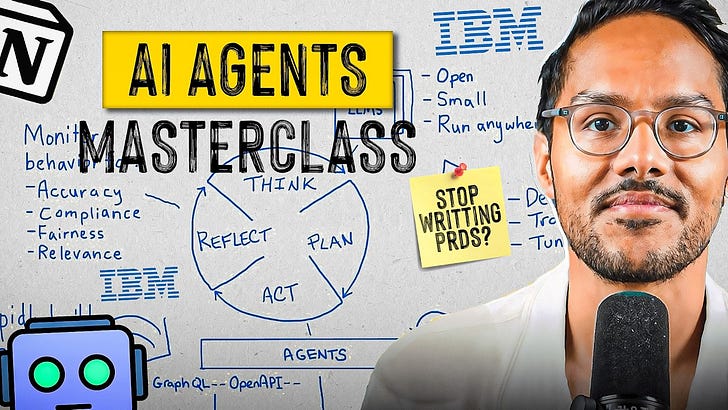
AI Agents for PMs in 69 Minutes — Masterclass with IBM VP
Today's EpisodeWhat makes AI agents different from chatbots?That’s the question we break down from every angle with today’s guest.Armand Ruiz, VP of AI Platform at IBM, who has been in AI for 16 years and has become one of the most-followed AI voices on LinkedIn.Armand leads AI platforms at IBM, building the building blocks for enterprises to build AI agents securely. He spends his time meeting with CIOs from the biggest brands who all have AI as their number one priority - and agents as one of their core components.In our conversation, he breaks down:* How AI agents differ from the chatbots we know* The four-step framework every agent needs* Why RAG systems power 90% of enterprise AI* How product management changes when agents do the work----Check out the conversation on Apple, Spotify and YouTube.Brought to you by:* Kameleoon: AI experimentation.* The AI Evals Course for PMs & Engineers: You get $800 with this link* Vanta: Automate compliance, manage risk, and prove trust* Amplitude: Try their 2-min assessment of your company’s digital maturity* Product Faculty: Product Strategy Certificate for Leaders (Get $550 off)----Timestamps00:00 Intro02:39 What Makes AI Agents Special04:40 The Four Steps of AI Agents07:14 AI Agent Development Frameworks12:59 RAG Explained16:55 ADS18:46 Common RAG Mistakes26:48 Managing Multiple AI Agents31:39 ADS33:57 How AI Changes Product Management37:43 Problem Investigation vs Feature Factory41:22 Roadmap to Build AI Agents43:30 Can Open Source AI Win?51:39 IBM's AI Strategy59:32 Career Journey: Intern to VP1:02:36 Building 200K LinkedIn Followers1:08:18 Outro----Key Takeaways1. AI Agents vs Chatbots: Chatbots respond to queries while agents execute complete workflows. The difference between getting suggestions and getting finished work.2. Four-Step Agent Framework: Every agent needs Thinking (reasoning), Planning (task breakdown), Action (system execution), and Reflection (learning from outcomes).3. RAG Dominates Enterprise: 90% of enterprise AI uses RAG to connect LLMs to proprietary data. Success requires 95%+ accuracy through sophisticated evaluation.4. Vision RAG Unlocks Value: Most business data lives in charts and tables that traditional text-only RAG completely misses.5. Framework Selection Matters: Use coding frameworks (LangGraph, CrewAI) for complex systems. Use no-code tools (Lindy, n8n) for rapid prototyping.6. PM Ratios Transform: Traditional 1:6-10 PM-to-developer ratios become 1:2-30 when agents handle research and documentation.7. Prototypes Beat PRDs: Show working systems instead of 20-page documents teams misinterpret. AI enables functional demos.8. Open Source Wins: Despite closed-source capabilities, enterprises choose open source for licensing control and infrastructure flexibility.9. Technical Literacy Essential: Understanding agents, RAG, and frameworks becomes baseline knowledge for everyone, not just developers.10. Implementation Reality: Enterprise RAG needs heavy data engineering. Teams underestimate accuracy requirements and engineering complexity.----Related ContentPodcasts:We Built an AI Agent to Automate PM in 73 minsWe Built an AI Employee in 62 mins5 AI Agents Every PM Should BuildNewsletters:AI Agents: The Ultimate Guide for PMsAI Evals for AgentsStep-by-Step RAG----P.S. More than 85% of you aren't subscribed yet. If you can subscribe on YouTube, follow on Apple & Spotify, my commitment to you is that we'll continue making this content better.----If you want to advertise, email productgrowthppp at gmail. This is a public episode. If you'd like to discuss this with other subscribers or get access to bonus episodes, visit www.news.aakashg.com/subscribe

AI Product Leadership Masterclass: The Makings of a Manager (With Author of the Book)
Today's guest: Julie Zhuo, Former VP of Product Design at Facebook, Wall Street Journal bestselling author of "The Making of a Manager," and now AI product leader at Sundial"Is the product designer role going to exist in 10 years? Is the product manager role going to exist in 10 years?"That's Julie Zhuo asking the existential questions every product leader is thinking but afraid to voice.Julie spent 13 years at Facebook, starting as an IC designer and rising to VP of Product Design. She wrote the Wall Street Journal bestseller "The Making of a Manager." Today, she's building AI products at Sundial and working with companies like OpenAI.In our conversation, she breaks down:* How AI is killing traditional product roles* The timeless management principles that still matter* What makes a great AI product leader* How to build product taste when AI gets better than youThis isn't just about adapting to new tools. It's about reimagining what product development looks like when one person can do what used to take a whole team.----Check out the conversation on Apple, Spotify and YouTube.Mobbin: Discover real-world design inspirationJira Product Discovery: Build the right thing, reliablyProduct Faculty: Product Strategic Certificate for Leaders (Get $550 off)The AI Evals Course for PMs & Engineers: You get $800 with this link----Timestamps00:00 Intro02:30 The Death of Product Development08:42 Learn The Craft15:02 ADS17:00 Definition of a Managers's Job21:12 Julie's Thoughts on AI Agents28:12 Blindspots While switching from IC to Manger30:40 ADS35:48 The Three Levers That Never Change41:20 What is Feedback46:43 How AI is Changing the Domain52:49 What Makes Great AI Product Leaders Different1:00:55 Essential AI Tools Every Leader Should Master1:09:15 Lessons from OpenAI's Product Team1:15:55 Outro----Key Takeaways1. Stop Thinking in Roles, Start Thinking Skills. The future belongs to builders who combine unique strengths with AI capabilities, not people attached to traditional job titles like PM or designer.2. Taste Becomes the Critical Differentiator. When AI can do many things well, your ability to recognize exceptional work versus average output becomes your most valuable skill.3. The Three Management Levers Still Apply. People, process, and purpose remain the core levers. AI agents just add new tools within the "people" lever you need to manage.4. Face Reality to Build Trust. Create environments where teams can confront what's really happening. Thank messengers who bring problems instead of shooting them.5. Conviction + Humility Balance. Have strong conviction in your process and vision, but stay humble enough to accept feedback and iterate based on what you learn.6. Be a Beginner Again. Even experienced product leaders need to earn their stripes in the AI era. The willingness to learn matters more than past success.7. Lead Through Experimentation. This isn't a playbook era. Try new team structures, new workflows, new approaches. Nobody has all the answers yet.8. Master AI Tools in Your Workflow. Don't just use ChatGPT occasionally. Actively disrupt your old systems and use AI throughout your daily work processes.9. Learn from OpenAI's Approach. They work seven days a week, obsess over understanding user behavior data, and maintain rigorous weekly metrics reviews for alignment.10. Focus on What Remains Human. The joy of creation, learning processes, and meaning we derive from building things we're proud of can't be automated away.----Related ContentPodcasts:Full Roadmap: Become an AI PMComplete Course: AI Product ManagementHow to Become, and Succeed as, an AI PM | The Marily Nika EpisodeNewsletters:How to become an AI Product ManagerHow to Write a Killer AI Product Manager ResumeHow to Become an AI Product Manager with No Experience----P.S. More than 85% of you aren't subscribed yet. If you can subscribe on YouTube, follow on Apple & Spotify, my commitment to you is that we'll continue making this content better.----If you want to advertise, email productgrowthppp at gmail. This is a public episode. If you'd like to discuss this with other subscribers or get access to bonus episodes, visit www.news.aakashg.com/subscribe

Complete Course: AI Experimentation
"AI has been the biggest driver of change in experimentation I've seen in my career."That's Frederic De Todaro, Chief Product Officer at Kameleoon (profitable SaaS with 2K+ customers).Fred has been at Kameleoon for 12+ years. In that role, he's helped thousands of teams use AI to experiment faster and smarter.In today’s episode he’s breaking down:How AI changes experimentationHow to experiment with AI featuresLast week, I covered how one aspect of this: vibe experimentation. Today’s video is the A to Z AI impact. If you experiment at work, this episode is for you.----Check out the conversation on Apple, Spotify and YouTube.* Mobbin: Discover real-world design inspiration* Jira Product Discovery: Build the right thing, reliably* AI Product Strategy Certificate for Leaders: Get $550 off----Timestamps:00:00 How AI Changed Experimentation Overview01:54 The 4 Steps of Experimentation Framework14:12 ADS16:00 How AI has Changed Experimentation21:08 User Behaviour Models26:56 Multi-Armed Bandit vs Contextual Bandit30:05 ADS31:55 AI Content Genration35:13 How Vibe Coding Changes Experimentation41:35 Live Demo From Idea to Running Experiment in 2 Minutes43:36 Two-Minute Build Achievement51:49 How to Measure AI Features Properly54:17 Measuring RAG Systems 3 Key Metrics01:07:18 Best Experimentation Company Booking.com01:10:10 Biggest PM Mistakes in Experimentation01:13:52 Ending----Key Takeaways1. Build is the bottleneck. Most teams can't A/B test because developers are busy. AI removes this constraint anyone can now create experiments in minutes using plain English.2. 80% of experiments fail. But with AI opportunity detection, you can drill into failed experiments to find hidden wins, like features that work great on mobile but fail on desktop.3. Vibe coding meets experimentation. It's not enough to build prototypes quickly. You need to test them with real users at scale. Prompt-based experimentation bridges this gap.4. Context is everything. AI performs best when it has access to your website's framework, design system, and past experiments. The more context, the better the ideas and implementations.5. Humans still matter. PMs bring business context, data scientists ensure statistical rigor, and AI handles the grunt work. It's augmentation, not replacement.6. Start simple with feature flags. You don't need to copy Booking.com overnight. Begin with feature flags, then rollouts, then full experimentation. AI makes each step easier.7. Measure beyond usage. For AI features, track: How many prompts to success? Time from idea to live? How often do developers step in? These reveal true value.8. Multi-armed bandits for speed, contextual for personalization. Use multi-armed when you need quick answers. Use contextual when personalizing for each user.9. Discovery and experimentation are partners. Discovery tells you what users say they want. Experimentation tells you what they actually do. You need both for the full picture.----Check out the conversation on Apple, Spotify and YouTube.----Related Podcasts:* How to Build Things Faster as a Product Team* Lessons from Super-Senior IC Experimentation PM* Amplitude CEO: Demo, Story, and How They Build Product-----P.S. More than 85% of you aren't subscribed yet. If you can subscribe on YouTube, follow on Apple & Spotify, my commitment to you is that we'll continue making this content better.----If you want to advertise, email productgrowthppp at gmail. This is a public episode. If you'd like to discuss this with other subscribers or get access to bonus episodes, visit www.news.aakashg.com/subscribe
OpenAI Head of Product (Integrity) on the Future of AI Agents, PM, and AI threats
Check out the conversation on Apple, Spotify and YouTube.Brought to you by:* Jira Product Discovery: Build the right thing* AI PM Certification: Get $550 with code AAKASH550C7* The AI Evals Course for PMs: Get $1050 off with code ag-product-growth* Maven: Get $100 off my curation of their top coursesToday's EpisodeToday’s guest is at the epicenter of AI - and he hasn’t done any podcasts before.In today’s in-person chat, I sit down with Jake Brill, the Head of Integrity Product at OpenAI. He breaks down:* The GPT-5 launch* How OpenAI builds product* What the PM role looks in the the future with AI* The future of building product and the need to build agents into your product* What it takes to break into OpenAIIf you've ever wondered what it takes to work at OpenAI or how to build AI products at scale, this episode is for you.Your Newsletter Subscriber Bonus:For subscribers, each episode I also write up a newsletter version of the podcast. Thank you for having me in your inbox.(By the way, we’ve launched our podcast clips channel as well and we’re going to post most valuable podcast moments on this channel, so don’t miss out: subscribe here.)1. Integrity’s Role in the GPT-5 LaunchMost PMs think about launching products in terms of features and marketing. But when you're serving hundreds of millions of users with breakthrough AI, the real challenge is infrastructure that can handle the surge without breaking.OpenAI’s integrity team played 3 roles in GPT-5’s launch.Pillar 1 - Identity SystemsIdentity systems must scale from normal traffic to potentially 10x volume overnight. The technical challenge involves load balancing, database scaling, and ensuring your signup flow doesn't crash when everyone hits "Create Account" simultaneously.Pillar 2 - Financial InfrastructureFinancial systems need bulletproof payment processing and fraud detection as conversions spike. This includes sophisticated fraud prevention - bad actors specifically target new model launches to exploit capabilities with stolen credit cards.Pillar 3 - Safety SystemsSafety systems require multiple defense layers: model training, input/output classifiers, and behavioral monitoring. Red teaming happens during model training, at production checkpoints, and continuously post-launch.What most PMs miss is that integrity isn't just defensive - it's an enabler of scale. Without rock-solid integrity infrastructure, even the most advanced AI models can't reach their intended audience.Do you need an integrity team? If you're building consumer AI products at scale, handling sensitive data, or processing payments, the answer is probably yes.2. How OpenAI Builds ProductOpenAI operates with a unique product philosophy that breaks traditional PM playbooks. While most companies start with user problems and build solutions, OpenAI often starts with breakthrough capabilities and figures out how to bring them to humanity.Let’s zoom in on 5 key takeways about how they build product: Takeaway 1 - The Research-First ApproachJake describes this inverted approach: "We've got the best researchers in the world building the most powerful AI capabilities in the world. And sometimes it's like, holy moly, we just had this big research breakthrough. How do we bring this capability to humanity?"This research-first methodology requires unprecedented collaboration between product and research teams from day one, not as an afterthought.Takeaway 2 - Planning That Embraces UncertaintyTheir planning process intentionally embraces uncertainty. Teams plan quarterly but assume only 60-70% completion rates."If you do anything more than that, it probably means you weren't being flexible enough to the needs of the business. If you do anything less than that, probably didn't do a great job forecasting."Plans are written in pencil, not pen, with lightweight documents and async reviews wherever possible.Takeaway 3 - Product Reviews Stay Startup-StyleProduct reviews maintain startup-style directness despite OpenAI's scale. "People come in, it doesn't matter what level you are, you can talk directly with leadership. You don't have to have a fancy slide deck."This creates trust through transparency and hiring excellence rather than process overhead.Takeaway 4 - Heavy Slack CultureOpenAI runs almost entirely on Slack. Jake estimates "conservatively like 90% of my written communication is in Slack." They've built AI agents directly into their Slack channels for Q&A and operational tasks.Takeaway 5 - Iterative Deployment PhilosophyThe company's belief in iterative deployment shapes how they handle uncertainty. Rather than trying to predict every possible misuse case, they identify non-negotiable risks to mitigate before launch, build monitoring systems for edge cases, and "very quickly respond and build sophisticated solutions" based on real-world usage patterns."Actually, at the end of the day, it's really helpful to follow OpenAI's approach of iterative deployment, because once you start rolling th
He built the top AI agent startup | Flo Crivello, Former PM, now CEO & Founder, Lindy AI
If you’ve ever said “I just wish I had an assistant who knew exactly how I think”... Lindy is that assistant. These agents aren’t demos. They’re real, customizable workflows anyone can build. No code.Flo Crivello (founder of Lindy and ex-Cruise/YC) joined us to show how his personal AI stack runs his entire workday: From triaging emails, summarizing meetings, blocking spam, managing contacts, and even sourcing candidates.We’re not talking theory here. You’ll see what’s possible today (no prompting skills, no code), just real agents doing real work when you give them instructions in plain English Language.If you’ve ever wondered: “What can AI actually do for me right now?”This episode answers it - line by line, screen by screen.----Brought to you by:Mobbin: Discover real-world design inspirationJira Product Discovery: Build the right thingProduct Faculty: #1 AI PM Certification (Class Starts: 15 Sep, get $500 off)----Timestamps:AI Agents Can Replace Your Team - 00:00:00The Top 5 AI Agents Every Entrepreneur Needs - 00:03:13The Golden Framework: When to Build an Agent - 00:08:50Keeping AI Agents Safe Without Killing Innovation - 00:09:42From Doer to Orchestrator: The New Management Mindset - 00:11:08Lindy vs ChatGPT: Individual Tools vs Work Platforms - 00:13:23Managing Agent Performance, Permissions & Costs - 00:14:26AD: Mobbin - 00:15:56AD: Jira Product Discovery - 00:16:55Managing Context and Token Costs - 00:17:51Lindy vs Competitors and Zapier - 00:18:58Inside Lindy's 5x Growth in 6 Months - 00:20:38The Salesperson Managing 40 AI Employees - 00:21:45The Soham Scandal: Hiring the 5-Job Engineer - 00:23:20From PM to AI Visionary: The Founding Story - 00:28:24AD: Maven - 00:31:21AD: AI PM Certification - 00:32:08The Pivot Philosophy: Action Produces Information - 00:32:54Should Every PM Become an AI Founder? - 00:37:17Talk to Customers, Build Product: Skip Everything Else - 00:38:45The Valley of Death: Surviving the Hardest Pivot - 00:41:02The AI Agent Agency Gold Rush - 00:44:08Big Tech is Missing the AI Agent Revolution - 00:47:42The 10-Year Vision: Fully Autonomous Companies - 00:48:01----Key Takeaways:Takeaways:01. Most startups are stuck in execution mode, when they should be in vision mode. Instead of spending 80% of time shipping and 20% dreaming, it should be the reverse. The best early-stage companies obsess over the product like artists—not analysts. That’s how you create something magnetic from day one. Not with OKRs. With taste.2. AI agents aren’t just features, they’re teammates. The real unlock with agents is that they collaborate like coworkers. You don’t “use” them, you talk to them. You delegate. They respond. They improve. And suddenly you’re not just automating—you’re offloading real cognitive work.3. You don’t build AI, you build trust. That’s the actual job. Trust is earned slowly: confirmation prompts, human-in-the-loop controls, clear audit trails. Give users the steering wheel first… and gradually ease them into self-driving. That’s how agents move from novelty to necessity.4. The smaller the scope, the sharper the tool. Most teams overbuild. The smarter play is to shrink the surface area until there’s zero ambiguity. That’s when you get magic: crisp execution, no confusion, and fast iteration. Think razor blade, not Swiss Army knife.5. From systems thinking to obsessive craft. Coming from Uber taught how to reason through complex marketplaces. But what unlocked breakthrough product thinking was obsessing over the UX like an artist—not just designing for logic, but for love.6. The future of work is voice → delegation → done.You won’t click through dashboards or jump tabs. You’ll just say, “Handle my recruiting outreach,” and it’ll happen. Behind the scenes: agents coordinating tasks, tracking progress, personalizing copy. And all you did was ask.7. Write Like Your Career Depends on It, Because It Does. Clarity of thought = clarity of writing. He said the best PMs he’s worked with are excellent writers. Not because it looks good, but because it reflects structured thinking.8. Product Sense Is a Muscle. He builds product by imagining it from the user’s emotional POV. Not “What features should we ship?” but “What would delight the user in this moment?”9. You Can't Delegate Taste. No matter how senior you are, if you're not involved in the details of product quality, you’ll lose the magic. He reviews designs himself, edits copy, and obsesses over UX, because product taste is not outsourceable.10. Go Where Product Is Sacred. A PM’s growth is tied to the culture. He picked Uber because product rigor was high. At Lindy, he made product obsession part of the DNA. If your company doesn’t value product deeply, leave.----Check out the conversation on Apple, Spotify and YouTube.----Related Podcasts:We Built an AI Employee in 62 mins (Cursor, ChatGPT, Gibson, Crew AI)Bolt Tutorial from the CEOThis $20M AI Founder Is Challenging Elon and Sam Altman | Roy Lee, Cluely----P.S. More than 85% of you ar
Teresa Torres' Step-by-Step Guide to AI Product Discovery
In today’s episode, we have one of the two voices I wanted most when I started this podcast: Teresa Torres. Alongside Marty Cagan, she was in my top guests to have.That’s because she has trained over 17,000 PMs in 100 countries.And in today’s episode, she’s breaking down one of the most important elements of PMing: discovery. She gives a masterclass on how to use the learnings from her smash hit book Continuous Discovery Habits for the AI age, covering both:1. How to do discovery for non-AI features with AI tools2. How to discovery for AI featuresIf you’ve ever wondered why your product ideas sometimes flop, even when the interviews and research looked promising… you’re about to find out why!----Brought to you by:Miro: The innovation workspaceJira Product Discovery: Build the right thingParlance Labs: Practical consulting that improves your AIProduct Faculty: #1 AI PM Certification (Class Starts: 15 Sep, get $500 off)----Timestamps:Teresa's Background - 0:00Story-Based Interviewing - 3:20Fake Discovery Signs - 4:08Assumption Testing - 4:39Continuous Discovery Framework - 5:35AI Changes Discovery - 8:01AI Synthesis Concerns - 9:21AI Prototyping Era - 12:45Ads - 15:45AI Prototyping Workflow - 17:32Common Interview Mistakes - 22:24Interview Synthesis - 24:26OST Updates - 28:53Discovery Theater - 30:52Ads - 32:15Real Product Management - 34:03AI Product Discovery - 35:29Context Engineering - 39:16Orchestration Explained - 42:03Error Analysis - 46:01Observability & Traces - 46:05Claude Code Demo - 49:15Business Numbers - 52:56----Key Takeaways:Takeaways:01. Stop Shipping Blind. Your AI product isn't truly valuable until you validate it. Go beyond just building; understand user needs deeply with personas, journey maps, and jobs-to-be-done.02. MOM Test = Your Secret Weapon. The "MOM Test" is about asking questions that even your most supportive friend can't lie about. Don't ask if users "would" use your AI. Ask about their past behaviors and real problems. This helps you define success metrics and avoid building a fancy toy nobody needs. 03. Evaluate Everything, Relentlessly. AI Evals are not just a technical task for engineers, but the most critical tool for Product Managers to build high-quality, trustworthy AI products. Use them to understand, refine, and continuously improve your AI.04. Passion Won't Land the Job. Proof Will. "I'm passionate"...great I guess, but recruiters want to see what you've done. Your portfolio is your direct line to showing you can actually do the job.05. Build Your AI Portfolio. Now. Don't wait for experience. Create product teardowns of AI tools, develop case studies, or launch small side projects. This is your living, breathing proof of thinking and skill.06. Forget the Resume. Add Value. The ultimate job hack? Identify a problem at a target company and propose a solution, or even build a prototype before you apply. This showcases initiative and concrete skills.07. You’re At Fault (Brutal, I Know). Nailing Prompt Engineering is a direct path to better AI outputs. If your AI misbehaves, it's often your fault for unclear instructions. Refine your prompts for smarter, more reliable AI.08. Generic Resumes In The Bin! Forget sending generic resumes into the void. There are three distinct approaches: just a resume, adding a portfolio and cover letter, or the ultimate "Value Add" where you solve a company's problem before applying. 09. AI Will Do Your Dishes (Metaphorically). While AI Agents promise incredible autonomy and action, remember they still need clear goals and defined tasks. So, while your AI PM dream is big, maybe don't expect it to clean your dishes (yet) – stick to email automation for now!10. Don't Trust LLMs Blindly. LLMs are powerful. But they need continuous human validation and evaluation frameworks. Automate grading where possible, but always, always, have a human in the loop for critical judgment.----Check out the conversation on Apple or Spotify and the demo on YouTube.----Related Podcasts:AI Product Discovery: Complete CourseHow to Do Product Discovery Right with Pawel HurynMarty Cagan on the 4 Key Risks and Importance of DiscoveryHow to Survey and Learn From Your Users with George Harter----P.S. More than 85% of you aren't subscribed yet. If you can subscribe on YouTube, follow on Apple & Spotify, my commitment to you is that we'll continue making this content better.----If you want to advertise, email productgrowthppp at gmail. This is a public episode. If you'd like to discuss this with other subscribers or get access to bonus episodes, visit www.news.aakashg.com/subscribe

Building in Public: The 7 AI Tools I'm Using in My $1M+/Yr Business
I made $1M in the last 12 months — with zero full-time employees. In this podcast, I’ll share and show you (watch the YT version) the 7 AI workflows that helped me scale faster, save over $400K in costs, and launch multiple income streams, all powered by AI agents. You’ll see exactly how I use tools to: - Automate my inbox - Build and ship SaaS prototypes - Write and produce video ads - Grow a podcast to 50K+ listeners/episode - Repurpose and distribute content across platforms - Book high-profile guests - Run a content engine with zero human ops----Brought to you by:Miro: The innovation workspace is your team’s new canvasJira Product Discovery: Build the right thingMobbin: Discover real-world design inspirationParlance Labs: Practical consulting that improves your AI----Timestamps:Preview – 00:00:00AI Workflow 1 (Zapier) – 00:00:48AI Workflow 2 (v0) – 00:03:13AI Workflow 3 (Cursor) – 00:08:55AI Workflow 4 (v0.3) – 00:12:04AI Workflow 5 (Lindy) – 00:16:32AI Workflow 6 (Riverside) – 00:19:03AI Workflow 7 (Claude Copilot) – 00:22:47Summarizing Everything – 00:27:52----Check out the conversation on Apple, Spotify and YouTube.----Related Podcasts:This PM Built a Six-Figure ($100K+) AI Side HustleHe Built a $2M/Yr One-Person Business - Steal His PlaybookThis PM was Laid Off - Now he has 125K followersHer Layoff Went Viral - Now She has 300K+ SubscribersHow I make $18K/mo with a niche podcast (STEAL THIS)This Ex Amazon VP Makes $950K In Retirement----P.S. More than 85% of you aren't subscribed yet. If you can subscribe on YouTube, follow on Apple & Spotify, my commitment to you is that we'll continue making this content better.----If you want to advertise, email productgrowthppp at gmail. This is a public episode. If you'd like to discuss this with other subscribers or get access to bonus episodes, visit www.news.aakashg.com/subscribe

Full Roadmap: Become an AI PM in 2025 | Ankit Shukla, HelloPM Founder
If this 80 minutes podcast doesn't make you an AI PM, I'll delete my channel!Yes, I know what I just said. But this is too good!You’ll learn:- How to become an AI PM without any tech experience- 2 main categories of AI PMs and how to break into each- How to build great AI products your users love- All concepts like Evals, RAG, MCP, etc- Creating AI PM portfolioAnd so much more----Brought to you by:The AI Evals Course for PMs & Engineers: You get $800 with this linkMaven: Get $100 off my curation of their top coursesAI PM Certification: Get $500 with code AAKASH25----Timestamps:Two Types of PMs in the World Right Now – 00:00:00How Much AI PMs Make in the US & India – 00:01:49Why Jobs Aren’t Marketed as “AI PM” Roles – 00:04:19Live Slide Share Session Begins (AI PDLC) – 00:05:35What People Get Wrong About AI PM Jobs – 00:08:51Why AI Product Management Is Here to Stay – 00:11:00Product Development Lifecycle Explained – 00:12:35Ad 1: AI Evaluations – 00:14:47Ad 2: Maven Courses – 00:15:46Understanding PM Canals (Idea Sources) – 00:16:34How AI Will Transform the Traditional Product Cycle – 00:18:55The Two Branches of AI: Predictive vs Generative – 00:23:10Diving Deeper into Generative AI – 00:27:17Ad 3: AI PM Certification – 00:28:47How to Build Your Own AI Use Case Database – 00:29:34Why You Shouldn’t Use AI for Everything – 00:34:10Understanding Problem Space vs Solution Space – 00:36:51Most Common Mistake People Make Entering AI PM – 00:40:49The Building Blocks of AI – 00:47:01Contextualization (Prompts, Fine-Tuning, RAG) – 00:50:24The Limitations of AI — Why You Still Need Evals – 00:56:18Case Study: AI-First Job Search Website – 00:58:49Prompt Engineering Breakdown for the Case Study – 01:02:09Understanding and Leveraging AI Agents – 01:03:40Introducing the MCP Framework – 01:08:07How to Build Your AI PM Portfolio – 01:11:37Your Next 7 Steps to Becoming an AI PM – 01:16:04Closing Thoughts and Final Notes – 01:18:41----Key Takeaways:Takeaways:01. Stop Shipping Blind. Your AI product isn't truly valuable until you validate it. Go beyond just building; understand user needs deeply with personas, journey maps, and jobs-to-be-done.02. MOM Test = Your Secret Weapon. The "MOM Test" is about asking questions that even your most supportive friend can't lie about. Don't ask if users "would" use your AI. Ask about their past behaviors and real problems. This helps you define success metrics and avoid building a fancy toy nobody needs. 03. Evaluate Everything, Relentlessly. AI Evals are not just a technical task for engineers, but the most critical tool for Product Managers to build high-quality, trustworthy AI products. Use them to understand, refine, and continuously improve your AI.04. Passion Won't Land the Job. Proof Will. "I'm passionate"...great I guess, but recruiters want to see what you've done. Your portfolio is your direct line to showing you can actually do the job.05. Build Your AI Portfolio. Now. Don't wait for experience. Create product teardowns of AI tools, develop case studies, or launch small side projects. This is your living, breathing proof of thinking and skill.06. Forget the Resume. Add Value. The ultimate job hack? Identify a problem at a target company and propose a solution, or even build a prototype before you apply. This showcases initiative and concrete skills.07. You’re At Fault (Brutal, I Know). Nailing Prompt Engineering is a direct path to better AI outputs. If your AI misbehaves, it's often your fault for unclear instructions. Refine your prompts for smarter, more reliable AI.08. Generic Resumes In The Bin! Forget sending generic resumes into the void. There are three distinct approaches: just a resume, adding a portfolio and cover letter, or the ultimate "Value Add" where you solve a company's problem before applying. 09. AI Will Do Your Dishes (Metaphorically). While AI Agents promise incredible autonomy and action, remember they still need clear goals and defined tasks. So, while your AI PM dream is big, maybe don't expect it to clean your dishes (yet) – stick to email automation for now!10. Don't Trust LLMs Blindly. LLMs are powerful. But they need continuous human validation and evaluation frameworks. Automate grading where possible, but always, always, have a human in the loop for critical judgment.----Check out the conversation on Apple or Spotify and the demo on YouTube.----Related Podcasts:If you only have 2 hrs, this is how to become an AI PMHow to Become, and Succeed as, an AI PM | The Marily Nika EpisodeComplete Course: AI Product ManagementTutorial of Top 5 AI Prototyping Tools----P.S. More than 85% of you aren't subscribed yet. If you can subscribe on YouTube, follow on Apple & Spotify, my commitment to you is that we'll continue making this content better.----If you want to advertise, email productgrowthppp at gmail. This is a public episode. If you'd like to discuss this with other subscribers or get access to bonus episodes, visit www.news.aakashg.com/subscribe

How Linear Built a $1.25B Unicorn with Just 2 PMs
Nan Yu shares Linear's proven product-building method that helped them took Linear to a $1.25B product with just 2 PMs.You’ll learn:- How top companies like Linear are actually building AI features- Secrets to building a lean product that users genuinely love- Nan Yu’s advice for landing top PM jobs.- The Linear method in detail----Brought to you by:The AI Evals Course for PMs & Engineers: You get $800 with this linkVanta: Automate compliance, Get $1,000 with my linkAI PM Certification: Get $500 with code AAKASH25Maven: Get $100 off my curation of their top courses----Timestamps:Preview – 00:00:00Why are all the GIANTS using Linear? – 00:02:09Linear's Core Functionality – 00:04:07Ad (AI Evals) – 00:04:44Ad (Vanta) – 00:05:44Linear Method: How They Build Product – 00:06:36Principles of the Linear Method – 00:09:16Saying No to Busy Work / Busy Work Is a Result of “Lack of Clarity” – 00:12:14Linear's Roadmap Planning Horizon – 00:14:43Ad (AI PM) – 00:15:06Ad (Maven) – 00:15:53Planning Process – 00:16:41Linear's Take on OKRs – 00:19:13Setting The Bar High – 00:26:06Story: Building The Smallest Version Possible – 00:28:49Public Roadmaps are DANGEROUS – 00:34:20Applying Linear Method to AI Features (Agents as Users) – 00:38:18Mantra: Solve Real Problems for Real People – 00:43:08Landing a Head of Product Role at Linear – 00:46:08Story: How the Initial Contact with Linear Happened – 00:48:16Advice for Aspiring PMs at Linear – 00:49:50Making it to unicorn status with 2 PMs & 40 engineers – 00:53:18Everlane's Pricing Strategy (Cost-Plus) – 00:53:44Shift from B2C Retail to Product-Led B2B SaaS – 00:55:10Can Today's PMs Shift Industries? – 00:57:22Closing Notes – 00:59:49----Key Takeaways:Takeaways:1. Don't Chase AI Hype, Solve Real Pain: Instead of building flashy AI features (that no one needs), Linear observes where users are actually struggling (like juggling many AI tools for async work) and builds direct solutions. It's about fixing real problems, not just jumping on trends.2. Your Users Aren't a Feature Checklist. Listen intently to user feedback, but don't take every request literally. The goal is to understand their core frustrations and goals, not just to say "yes" to every demand that could lead to bloat.3. Purpose Over PR Stunts. Forget building the "loudest possible feature." Linear's core mantra is to solve real problems for real people. Focus on making the most useful thing, and the noise will follow.4. Run Marathons, Not Sprints. Sustainable momentum beats endless "sprints" every DAMN time. Find a comfortable pace you can maintain not just tomorrow, but a year from now. Burnout is a warning sign, not a badge of honor.5. Scope Small, Ship Often. Unshipped code is debt. By making tasks as tiny as possible, you get the reward of shipping constantly. This creates tangible proof of work, gets immediate user feedback, and keeps the motivation high.6. Quality Isn't a Side Quest. Bugs aren't "minor." They're either critical or high priority. A "little bug" seen a hundred times tells customers you don't care. Quality work is baked into every feature, because a feature isn't done until it's high quality.7. Clear Talk, Clear Work. Ban jargon. LITERALLY. Words should have one meaning. If "issue" refers to a task in your product, it only refers to that. This ruthless clarity eliminates misunderstandings and speeds up collaboration.8. Ditch Old-School User Stories. Traditional "As a user, I want X" stories often hide context and slow things down. Everyone understands software now. Cut the BS. Be direct and state the desired outcome clearly. 9. Build to Learn, Not to Delay. Excessive data collection or endless A/B tests shows lack of decision making. Instead, build a smaller version of your idea quickly, put it out there, and let the market tell you if you're right or wrong. Learn fast, move faster.10. Forget Personas, Find Mike. Stop building for abstract personas. Identify the real people you're working with – "Mike from Brex," "Sarah from Acme Corp." Knowing them by name deepens empathy and leads to better solutions.----Check it out on Apple, Spotify, or YouTube.----Related Podcasts:Complete Course: AI Product Discovery"Most Product Managers are Bullsh*t Managers" -2x CPO----P.S. More than 85% of you aren't subscribed yet. If you can subscribe on YouTube, follow on Apple & Spotify, my commitment to you is that we'll continue making this content better.----If you want to advertise, email productgrowthppp at gmail. This is a public episode. If you'd like to discuss this with other subscribers or get access to bonus episodes, visit www.news.aakashg.com/subscribe
The PM’s Role in AI Evals: Step-by-Step
Today, we’ve got some of our most requested guests yet: Hamel Husain and Shreya Shankar, creators of the world’s best AI Evals cohort.You’ll learn:- Why AI evaluations are the most critical skill for building successful AI products- What common mistakes people are making and how to avoid them- How to effectively "hill climb" towards better AI performanceIf you're building AI features, or aiming to master how AI Eval actually works, this episode is your step-by-step blueprint.----Brought to you by:The AI Evals Course for PMs & Engineers: You get $800 with this linkJira Product Discovery: Plan with purpose, ship with confidenceVanta: Automate compliance, security, and trust with AI (Get $1,000 with my link)AI PM Certification: Get $500 with code AAKASH25----Timestamps:00:00:00- Preview00:02:06 - Three reasons PMs NEED evals.00:04:40 - Why PMs shouldn't view evals as monotonous00:06:23 - Are evals the hardest part of AI products solved?00:07:37 - Why can't you just rely on human "vibe checks"?00:12:11 - Ad 1 (AI Evals Course)00:13:10 - Ad 2 (Jira Product Discovery)00:14:06 - Are LLMs good at 1-5ratings?00:15:45 - The "Whack-a-mole" analogy without evals00:16:26 - Hallucination problem in emails (Apollo story)00:21:22 - How Airbnb used machine learning models?00:23:56 - Evaluating RAG Systems.00:29:52 - Ad 3 (Vanta)00:30:56 - Ad 4 (AIPM Certification on Maven)00:31:42 - Hill Climbing00:35:51 - Red flag: Suspiciously high eval metrics00:39:02 - Design principles for effective evals00:42:42 - How OpenAI approaches evals00:44:39 - Foundation models are trained on "average taste"00:49:36 - Cons of fine-tuning00:51:27 - Prompt engineering vs. RAG vs. Fine-tuning00:53:00 - Introduction of "The Three Gulfs" framework00:56:04 - Roadmap for learning AI evals01:01:41 - Why error analysis is critical for LLMs01:08:29 - Using LLM as a judge01:10:15 - Frameworks for systematic problem-solving in labels01:17:42 - Importance of niche and qualifying clients. (Pro tips)01:18:43 - $800K for first course cohort!01:20:15 - Why end a successful cohort?01:25:49 - GOLD advice for creating a successful course01:33:39 - Outro----Key Takeaways:1. Stop Guessing. Eval Your AI. Your AI isn’t an MVP without robust evaluations. Build in judgment — or you’re just shipping hope. Without evaluation, AI performance is a happy accident.2. Error Analysis = Your Superpower. General metrics won’t save you. You need to understand why your AI messed up. Only then can you fix it — not just wish it worked better.3. 99% Accuracy is a LIE. Suspiciously high metrics usually mean your evaluation setup is broken. Real-world AI is never perfect. If your evals say otherwise, they’re flawed.4. Fine-Tuning is a Trap (Mostly). Fine-tuning is expensive, brittle, and often unnecessary. Start with smarter prompts and RAG. Only fine-tune if you must.5. Your Data’s Wild. Understand It. You can’t eyeball everything. Without structured evaluation, you’ll drown in noise and never find patterns or fixes that matter.6. Models Fail to Generalize. Always. Your AI will break on new data. Don’t blame it. Adapt it. Use RAG, upgrade inputs, and stop expecting out-of-the-box magic.7. OpenAI Doesn’t Get Your Vibe. Their models are average-taste. Your product isn’t. If you want your brand’s voice in your AI, you must define it yourself — with evals.8. Trust LLM Judges... but validate them hard. LLMs can scale your evals — but you still need to verify them against human-labeled data. Don’t blindly trust your judge.9. Your Prompts Are S**T. If your AI is bad, it’s probably your fault. The cheapest, most powerful fix? Sharpen your prompts. Clearer instructions = smarter AI.10. Let AI Teach You. Seriously. LLM judges aren’t just scoring you — they can teach you. Reviewing how your AI fails is the best way to learn what great outputs should look like.----Check it out on Apple, Spotify, or YouTube.----Related Podcasts:Complete Course: AI Product ManagementTutorial of Top 5 AI Prototyping ToolsIf you only have 2 hrs, this is how to become an AI PMCollege Dropout Raised $20M Building AI Tools | Cluely, Roy LeeBolt CEO and Founder on How he Hit $30M ARR in a YearLogRocket CEO and Founder on How to Build a $100M+ AI StartupAmplitude CEO and Founder on Building the Product Analytics Leader----P.S. More than 85% of you aren't subscribed yet. If you can subscribe on YouTube, follow on Apple & Spotify, my commitment to you is that we'll continue making this content better.----If you want to advertise, email productgrowthppp at gmail. This is a public episode. If you'd like to discuss this with other subscribers or get access to bonus episodes, visit www.news.aakashg.com/subscribe
AI Product Discovery: Complete Course
We could talk a million things with Tanguy Crusson but I’m keeping it to what I like the most about his work - Product Discovery.He shares a rare, behind-the-scenes look at how his team at Jira Product Discovery uncovers real user problems, validates solutions quickly, and avoids wasting time on ideas that won’t land.----Brought to you by:Jira Product Discovery: Plan with purpose, ship with confidenceProduct Faculty: Get $500 off the AI PM certification with code AAKASH25Vanta: Automate compliance, security, and trust with AI (Get $1,000 with our link)AI PM Certification: Get $500 off Miqdad Jaffer (of OpenAI)’s certification----Timestamps:Preview & Intro — 00:00:00Has AI Actually Changed Product Discovery? — 00:00:27Ad: Jira Product Discovery — 00:10:50Ad: AIPM Certification with OpenAI PM — 00:11:45Where AI Truly Helps in Discovery (Real Use Cases) — 00:12:32Watch the Live Demo on YouTube for Full Context — 00:14:34The Discovery Process (Deep Dive)Phase 1 – Wonder: How Atlassian Uncovers Real Problems — 00:16:51Why Tanguy Hasn’t Written a PRD in 5 Years (+ Wild Engineer Story) — 00:21:04How to Lead Great User Interviews (Tips from a UX Researcher) — 00:25:24Ad: Vanta Compliance & Security — 00:28:30Ad: AI Evals for PMs & Engineers — 00:29:34The Right Way to Structure Discovery Documents — 00:30:34How Atlassian Actually Uses Tools for Product Discovery (Full Stack Demo) — 00:33:23Why This System Works Better Than Traditional PM Workflows — 00:41:24Moving Through DiscoveryPhase 2 – Explore: Rapid Prototypes & Real Feedback — 00:41:58Phase 3 – Make: When the Team Commits to Building — 00:49:04“Just Ship It” is Bad Advice — Here’s Why — 00:52:24Can You Trust Feedback from Free Users? — 00:56:00Phase 4 – Impact: Measuring Real-World Results — 01:07:33How to Build Real Trust as a Product Manager — 01:14:41PMs Want to Keep Engineers Busy: Good Strategy or Trap? — 01:17:46Aakash: “I Wish I Talked to You 10 Years Ago”, Here’s Why — 01:22:46Closing Reflections & Takeaways — 01:26:33----Key Takeaways:1. Discovery isn’t a phase, it’s a system. Atlassian runs product discovery continuously, not just “before development.” It’s embedded across problem finding, prototyping, building, and post-launch.2. Use video, not documents, to communicate user pain. Instead of writing long research summaries, PMs compile 10-minute reels of real customer interviews. Watching raw emotion builds urgency and alignment.3. Start with ~10 users — not thousands. Atlassian validates ideas with small, focused user groups. It's faster, cheaper, and more revealing than wide surveys or launches.4. Prototype with whatever is fastest. From AI tools like V0 to basic Figma slides, the goal is speed. You don’t need polished UIs — you need fast feedback on core concepts.5. Strong user reactions guide investment. When users say “I need this now,” that’s a green light. Mild interest or polite nods? That’s a warning to dig deeper.6. Build only once you have real pull. They don’t move into development (“Make” stage) until a prototype has strong qualitative validation. Code follows conviction.7. PMs rotate weekly to tag and analyze feedback. Every week, one PM owns triaging incoming feedback, tagging it to ideas, and surfacing themes. Discovery is part of the rhythm — not a side project.8. Real discovery requires exposure, not summaries. Dashboards, sanitized reports, and secondhand quotes are not enough. PMs must stay close to raw user input — live or recorded.9. Post-launch reflection is mandatory. Every shipped feature goes into the “Impact” phase. They assess: is it working? Should we scale, refine, or kill it?10. Discovery is a team sport. PMs, designers, engineers, even sales, everyone participates in interviews, watches clips, and shapes the product. It’s not just a PM’s job.----Check it out on Apple, Spotify, or YouTube.----Related Podcasts:How ZoomInfo IPO’d - With CEO/ Founder Henry ShuckHow LogRocket Became a $100M+ AI Company - With CEO/ Founder Matt ArbesfeldHow Amplitude Became the #1 Product Analytics Tool - With CEO/ Founder Spenser SkatesHow Zoom Took Over The World - With Zoom's Meetings Product during Covid ( now leads their Events & Webinars product)----P.S. More than 85% of you aren't subscribed yet. If you can subscribe on YouTube, follow on Apple & Spotify, my commitment to you is that we'll continue making this content better.----If you want to advertise, email productgrowthppp at gmail. This is a public episode. If you'd like to discuss this with other subscribers or get access to bonus episodes, visit www.news.aakashg.com/subscribe

This $20M AI Founder Is Challenging Elon and Sam Altman | Roy Lee, Cluely
Amazon banned him. Ivy Leagues kicked him out.And still, he went mega viral, built a $6M ARR AI startup, and raised $15M from a16z… all in a matter of weeks.This might be the craziest founder story you’ll hear all year.If you’re building in a competitive market, struggling to stand out, or just want to learn how to blend controversy with growth, this one’s for you.----Brought to you by:AI PM Certification: Get $500 with code AAKASH25Jira Product Discovery: Plan with purpose, ship with confidenceThe AI Evals Course for PMs & Engineers: You get $800 with this link----Timestamps:21yo Worth $100M+ - 0:00Harvard Kicked Me Out - 3:02Tech Twitter Main Character - 4:33Ads - 6:44Controversial = Views Formula - 8:26Stripper Commercial Brainstorms - 12:47Liquid Glass Before Apple - 16:55User Feedback Drives Product - 19:48Sales Tech & Enterprise - 23:16Cheating in Meetings - 27:19Ad - 28:22How to Fundraise Like Roy - 29:28Brain Chips End Game - 31:05Roy vs Elon vs Sam - 33:12Frat House Culture - 34:44The Cluely Internship - 37:37Are We Getting Dumber? - 38:51Roy Going to Jail? - 40:44Thanks for Watching - 42:18----Key Takeaways:1. Don’t wait for permission. He got kicked out of two top schools and used that energy to build something the world couldn’t ignore. If the system doesn’t reward you, build outside it.2. Design for real behavior, not rules. Interview Coder wasn’t legal or polite, it was effective. It gave users AI help without getting caught. Start with what people actually want.3. Rethink how AI should show up. Stop building chatbots. Build experiences where AI quietly blends into the workflow. Think overlays, not windows. Think invisible, not interruptive.4. Your product doesn’t need to sound safe. “Cheat on everything” wasn’t just a headline, it was a magnet for attention. Don’t fear being bold if it reflects what your product actually does.5. You don’t need a pitch deck if the story tells itself. Cluely raised $15M without running a process. When the traction is undeniable and your product is everywhere, investors come to you.6. Build virality into your operating system. Don’t “hope” something goes viral. Study what’s working. Run daily idea sessions. Create with the expectation that every post could hit 100M views.7. Make your content pass two filters or kill it. Can anyone understand it instantly? Will people feel something strong enough to react? If not, it won’t break through. Keep it simple and emotional.8. Ignore vanity metrics, chase visibility. Don’t waste time measuring click-through rates on content that won’t work next week. Stay focused on showing up everywhere your user lives.9. You don’t need a big team to move fast. Cluely runs on 4 engineers. No designers. No PMs. Still they've $6M ARR. If you can ship fast and learn faster, you’re already ahead.10. Build a product that feels inevitable. This isn’t just for sales teams. Cluely is betting on a world where AI support shows up before you even ask for it. Design for that future now.----Check it out on Apple, Spotify, or YouTube.----Related Podcasts:Bolt CEO and Founder on How he Hit $30M ARR in a YearLogRocket CEO and Founder on How to Build a $100M+ AI StartupAmplitude CEO and Founder on Building the Product Analytics Leader----P.S. More than 85% of you aren't subscribed yet. If you can subscribe on YouTube, follow on Apple & Spotify, my commitment to you is that we'll continue making this content better.----If you want to advertise, email productgrowthppp at gmail. This is a public episode. If you'd like to discuss this with other subscribers or get access to bonus episodes, visit www.news.aakashg.com/subscribe

How Zoom Took Over The World
Zoom grew from $1B to $4.5B in months - but behind the scenes, it was chaos.Learn how they froze features, scaled product teams, and held the platform together under global pressure from the head of product at Zoom meetings.----Brought to you by:Jira Product Discovery: Plan with purpose, ship with confidenceThe AI Evals Course for PMs & Engineers: You get $800 with this linkProduct Faculty: Get $500 off the AI PM certification with code AAKASH25----Timestamps:Preview – 00:00:00How Big Zoom Is – 00:02:12Simplifying Zoom UX – 00:03:40From $1 Billion to $4.5 Billion During Covid - 00:04:38The Three-Month Feature Freeze Story – 00:06:38Aakash Shares His Zoom Fortnite Concert Story – 00:07:30Advice for Product Leaders Facing Hypergrowth – 00:09:25Ad 1 (Jira) – 00:11:29Ad 2 (AI Evals Course) – 00:12:43One Thing He Would’ve Done Differently in His Career – 00:13:25Handling Zoom's Overvaluation, Layoffs, and Stock Price Drops – 00:14:20Future of AI in meetings - 00:16:09Zoom’s Shift into Broadcast and Events – 00:18:55Why Send a Meeting When You Could Record a Loom? – 00:21:35Can Zoom Catch AI Avatar Doing Interview - 00:26:23Ad 3 (AIPM Course) – 00:28:11Using Zoom Like a Pro – 00:28:58Cool Things About the AI Companion – 00:32:27Balancing Simplicity While Shipping Great Features – 00:36:37How PMs Can 10x Their Meeting Management – 00:40:42How to Get Hired at Zoom – 00:44:56What’s Unique About How Zoom Builds Products – 00:51:35Lessons Learned from Running QBRs – 00:54:18Culture at Zoom: Metrics Driven or Not - 00:57:03Zoom Team Adopting Prototyping Tools? – 00:58:53Outro – 01:00:17----Key Takeaways:1. Zoom didn’t just scale, it survived a once-in-a-generation demand shock. In early 2020, Zoom grew from $1B to $4.5B revenue and added 180+ PMs in months. To stay afloat, they froze all feature development for 3 months and focused solely on stability, security, and critical user needs.2. Most teams drown in feature requests. Zoom built a triage system. He created structured buckets to track thousands of bugs, asks, and UI issues. This wasn’t just project management. It was the only way to maintain control during chaos.3. The best PMs don’t just fix, they find the root cause. Instead of reacting to symptoms, he emphasized thinking a layer deeper. What assumption broke? What system failed? Root cause thinking kept Zoom from wasting time on surface-level patches.4. Simplicity beats novelty even in billion-dollar products. Zoom’s team went deep on seemingly minor features like “Raise Hand.” They reworked ordering logic, host controls, and UX friction points, because good meetings are built on small, invisible wins.5. Zoom is no longer just meetings, it’s becoming a media platform. From live webinars to pro events, Zoom is building for marketers, educators, and producers. Tools like Zoom Events, Production Studio, and broadcast integrations are reshaping how large-scale communication happens.6. AI is Zoom’s next act and it’s already driving behavior change. The AI Companion generates instant meeting summaries, action items, and catch-up flows. Internally, teams rely on it heavily — and Beckmann calls it Zoom’s most impactful feature post-COVID.7. Async isn’t the end of meetings, it’s a better tool for the right job. After stepping away from meetings, John personally built Zoom Clips. It’s not here to replace meetings — but for product updates, specs, and visual explanations, async is more efficient and respectful.8. AI avatars aren’t hype, they solve a very real problem. When you're triple-booked with no breaks, avatars offer psychological relief - for both you and the people in the room. Better than being just another muted black screen.9. During layoffs, product leaders become morale managers. In 2023, John had to deliver tough news to his team. His stance: be honest, coach through uncertainty, and remind people that companies aren’t families, they’re teams. Your job is to build trust, not give false comfort.10. Want to stand out in a Zoom interview? Be human, not a highlight reel. Zoom hasn’t seen major AI cheating issues, yet. But John says authenticity matters more than polish. Don’t recite perfect answers. Speak like a real person who’s been in the work, solved real problems, and understands the platform.----Check it out on Apple, Spotify, or YouTube.----Where to Find John:LinkedIn: JohnTwitter: Beckmania----Related Podcasts:How ZoomInfo Grows: The Story, Growth Motion, and Product Strategy with CEO and Founder Henry Shuck15 Steps to Build a $100M+ AI Company (From Someone Who Has Done It) - With the Founder & CEO of AI Startup LogRocket, Matt Arbesfeld----Up NextI hope you enjoyed the last episode with Aman Khan (It was not less than a AI PM Crash Course where we dove into 5 key AI PM skills). Up next, we have episodes with:Dan Olsen - Author, Lean Product PlaybookTanguy Crusson - Head of Product, Jira Product DiscoveryHamel Husain and Shreya Shankar - Hamel Husain: ML Engineer, 20 years in AI; Shreya Shankar: PhD;

What I Learned From Filming 80 Podcast Episodes
Starting this podcast wasn’t an easy decision. It takes up nearly half my time. And for months, it wasn’t making any money.But fast forward to today, and the podcast is now profitable and central to my creator business.So I did something different this week.I recorded a solo episode breaking down everything I’ve learned:- How I built and monetized a niche podcast- The exact growth engine that powers the show today- Some killer AI workflows I’ve learned for your job search and PM job----Brought to you by:Miro: The innovation workspace is your team’s new canvasThe AI Evals Course for PMs & Engineers: You get $800 with this linkLinear: Plan and build products like the bestProduct Faculty: Get $500 off the AI PM certification with code AAKASH25----Timestamps:Part 1: How I Built and Monetized a Niche Podcast0:00 - Exponential Growth Finally Happening1:21 - How I Grew This Podcast4:31 - Learning From 80 Episodes8:46 - How Podcasts Make Money10:50 - My Dream Job: OpenAIPart 2: Breaking Into Product Management & Career Growth13:36 - Roadmap to Becoming a Product Manager14:05 - Why 2025 is Great For PMs21:22 - AI PM Skills Roadmap23:02 - Finding Your First Paying Customer26:12 - Zero to 250K Followers Strategy32:21 - LinkedIn $525K Salary Jump34:24 - High-Effort Content Strategy38:05 - Newsletter Success Stack RankPart 3: Getting PM Jobs & Career Advice40:51 - Presenting Soft Skills on Resume42:46 - Breaking Into US PM Jobs (International Students)46:08 - Is Product Management Right For Me?49:54 - Time Management & Prioritization Mistakes52:15 - MBA to PM Roadmap55:41 - Finding the Right Mentors57:56 - Sprint Prioritization Framework59:39 - Detecting Product Passion vs Money Focus1:01:41 - Platform & AI Product PRDs1:04:09 - Product Management Beliefs That Changed1:05:41 - Newsletter Revenue & Churn Management1:07:02 - Time Management & Focus Strategies1:09:07 - Common Misconceptions About Content Creators----Key Takeaways:01 — Podcast TurnaroundThis podcast is now passing 50K listeners per episode, 11K subscribers on YouTube, and has become central to my creator business. The exponential growth kicked in around episode 80 after consistent investment and improvement.02 — Quality Over EquipmentObsessing over microphones, cameras, and lighting hits diminishing returns fast. The real growth came from improving trailers, clip selection, and backing off endless equipment upgrades to focus on profit generation.03 — Creator Time InvestmentThe podcast now consumes 50% of my time but generates significant monthly profit. Success required treating it as a long-term experiment, reinvesting everything for 50+ episodes before expecting returns.04 — Content Platform StrategyStart with LinkedIn until 10K followers, then add YouTube, then Twitter at 100K, then Medium at 1M. Master one platform completely before spreading to the next for maximum growth efficiency.05 — AI Prototyping RevolutionProduct managers can now build functional prototypes in minutes. Using Gemini 2.5 Pro for PRDs and Bolt.new for development, I built Apple Podcasts video features from strategy to clickable prototype in under 10 minutes.06 — Resume AI MasteryGemini 2.5 Pro dominates resume customization, beating all other models. What used to take 15 minutes of manual customization now takes 80 seconds with better results using proper context and prompting techniques.07 — PM Job Security2025 is an excellent time to enter product management. 75% of PM work involves people coordination and stakeholder alignment that AI cannot replace, making it as secure as doctor/lawyer/engineer careers.08 — Career Switching StrategyUse your domain expertise as an edge — become a product analyst first, then transfer internally, or target companies building tools for your previous industry. Take the level down initially but leverage your customer knowledge.09 — PM Strategy FocusStop being the design-engineering glue person. Your core identity should be product strategy, business metrics, and stakeholder management. Empower teams to answer their own questions while you influence at higher levels.10 — Platform Product PRDsBuilding for developers requires two-step user stories — what developers need from your platform, and what end users need from their products. Include API calls, uptime metrics, and governance considerations in your requirements.----Check it out on Apple, Spotify, or YouTube.----Related Podcasts:Growing to 125K+ on LinkedIn and Cracking B2B Content with Pierre HerubelHow to Win on TikTok and Medium with Professor Aaron Dinin, 100K+ on eachHow I Wrote 3 of My Biggest LinkedIn Posts----P.S. More than 85% of you aren't subscribed yet. If you can subscribe on YouTube, follow on Apple & Spotify, my commitment to you is that we'll continue making this content better.----If you want to advertise, email productgrowthppp at gmail. This is a public episode. If you'd like to discuss this with other subscribers or get access to bonus episodes, visit www.news.aakashg.com/subsc

The Lean Product Playbook 10 Years Later: Product Management in the Age of AI
Product management fundamentals are timeless. But the tools? Completely transformed.Every PM needs to master new workflows in 2025:AI Prototyping - From text to live prototype in minutesDesign Collaboration - Working with designers in the AI ageUser Research - Systematic validation that actually worksProblem Definition - The only bottleneck that mattersTeam Dynamics - Escaping the "Jira jockey" trapSo, in today's episode, I bring you the definitive guide to product management in the AI era:I’ve teamed up with Dan Olsen - author of The Lean Product Playbook and one of the most respected voices in product management for over 15 years.Dan has seen it all: from the early days at Intuit to consulting with hundreds of startups.He's been through the internet wave, mobile wave, and now the AI wave.----Brought to you by:WorkOS: Your app, enterprise readyJira Product Discovery: Plan with purpose, ship with confidenceThe AI Evals Course for PMs & Engineers: You get $800 with this linkProduct Faculty: Get $500 off the AI PM certification with code AAKASH25----Timestamps:Introduction - 0:00Lean Product Playbook Origins - 1:49AI's Real Impact on PMs - 3:44The Prototyping Revolution - 5:18Ads - 12:02Solution Space Risks - 14:18When Designers Become Bottlenecks - 22:49AI Tool Recommendations - 26:37Ads - 32:21Design Process Evolution - 34:07User Research Hierarchy - 42:32Testing Methods Explained - 44:34Running User Sessions - 53:05Avoiding Interview Mistakes - 1:01:15Systematic Feedback Capture - 1:03:23Escaping Jira Jockey Trap - 1:08:46Current BS Trends - 1:11:55Dan's Revenue Breakdown - 1:13:34Where to Find Dan - 1:18:33----Key Takeaways:1. AI hasn't changed the fundamentals. You still need to understand customers, identify problems, and prioritize opportunities. AI can't tell you about your customers or validate market needs for you.2. Prototyping is the biggest unlock. What used to take weeks (text → sketches → wireframes → Figma → code) now happens in minutes (text → live prototype). This is where AI truly transforms PM work.3. Start with Lovable/Bolt, graduate to Cursor. Lovable and Bolt are perfect for quick prototyping without code. Cursor gives you more control and learning opportunities for serious AI PMs willing to touch code.4. The design gap is closing. AI tools have moved every team up 1-2 levels in UX maturity. Teams without designers can now create professional prototypes, but still need humans for breakthrough innovation.5. Match research method to uncertainty. New product/market = in-person research. Existing product usability = remote unmoderated. The more uncertain you are, the more human interaction you need.6. Use the three-bucket system. Categorize all user feedback into: Feature Set, UX Design, and Messaging. Test in waves of 5-8 users, track percentages, fix issues, repeat.7. Good usability ≠ product-market fit. Always ask "How likely are you to use this?" at the end. Dan learned this the hard way - zero complaints doesn't mean people want your product.8. Protect discovery time. If your PM-to-dev ratio is above 1:8, you're probably a Jira jockey. Use Dan's 4 D's: Discover → Define → Design → Develop. Spend meaningful time in all four.9. Collaborate, don't replace designers. Be upfront: "This prototype is directional, not pixel-perfect." Use AI for quick validation, bring designers in for differentiated experiences and innovation.10. Stop sprinkling AI everywhere. AI is a solution looking for problems. Start with real customer pain points, then figure out if AI solves them better than existing approaches.----Check it out on Apple, Spotify, or YouTube.----Where to Find Dan:BookWebsiteYouTubeLean Product Meetup----Related Podcasts:Tutorial of Top 5 AI Prototyping ToolsComplete Course: AI Product ManagementWe Built an AI Agent to Automate PM in 73 mins (ZERO CODING)We Built an AI Product Manager in 58 mins (Claude, ChatGPT, Loom + Notion AI)We Built an AI Employee in 62 mins (Cursor, ChatGPT, Gibson, Crew AI)----Up NextI hope you enjoyed the last episode with Tom Occhino (where we gave an in-depth v0 tutorial). Up next, we have episodes with:John Beckmann - Head of Events + Webinars, ZoomTanguy Crusson - Head of Product, Jira Product DiscoveryHamel Husain and Shreya Shankar - The 2 Experts in AI EvalsFinally, check out my latest deep dive if you haven’t yet: The Playbook to Land Your First PM Job.----If you want to advertise, email productgrowthppp at gmail. This is a public episode. If you'd like to discuss this with other subscribers or get access to bonus episodes, visit www.news.aakashg.com/subscribe

AI PM Crash Course: Prototyping → Observability → Evals + Prompt Engineering vs RAG vs Fine-Tuning
Every PM has to build AI features these days. And with that means a completely new skill set:- AI prototyping- Observability, Akin to Telemetry- AI Evals: The New PRD for AI PMs- RAG v Fine-Tuning v Prompt Engineering- Working with AI EngineersSo, in today’s episode, I bring you a 2-hour crash course into becoming a better AI PM.I’ve teamed up with Aman Khan.When it comes to people creating AI PM content, Aman Khan is amongst the most insightful and informed. And that's because he's been an AI PM since 2019:- He worked at Cruise on self-driving cars. - He's worked with Spotify on their AI systems. - And now he works at Arize, one of the leading observability and evals companies.----Brought to you by:Miro: The innovation workspace is your team’s new canvasJira Product Discovery: Plan with purpose, ship with confidenceMaven: Get $100 off Aman’s course with my code ‘AAKASHxMAVEN’Amplitude: Test out the #1 product analytics and replay tool in the market----Timestamps:Can Anyone Become AIPM? - 0:005 AIPM Skills Overview - 5:52Skill 1: AI Prototyping - 6:31Ad: Miro - 13:35Ad: Atlassian - 14:50Building Trip Planner Agent - 15:27Ad: Maven - 29:46Ad: Amplitude - 30:40Skill 2: Observability - 50:34Skill 3: Evals - 1:10:10RAG vs Fine-Tuning vs Prompt Engineering - 1:29:54Bolt Teardown - 1:30:32Skill 5: Working With Engineers - 1:43:24Don't Make These Mistakes - 1:48:332 Hours Weekly Plan - 1:53:55AIPM Jobs Exist - 1:57:45Aman's Resources - 2:00:48Outro - 2:04:00----Key Takeaways:1. Cursor beats Bolt for serious AI PMs. While Bolt is great for quick mockups, Cursor gives you the control you need to build real agent systems and understand what's happening under the hood.2. Observability comes before evals. Just like regular products need telemetry for analytics, AI products need traces for evals. Point Cursor to documentation and it adds what you need.3. Vibe coding doesn't scale. Looking at outputs and deciding if they "feel good" works for prototypes, but not production. You need systematic evals to measure what "good" actually means.4. Most PMs fine-tune too early. Aman showed a prompt outperforming a fine-tuned model. Start with prompting (95% of results), add RAG for external data, only fine-tune for cost/speed.5. Your evals need evals. When your LLM judge marks outputs as "friendly" while your human labels say "robotic," that mismatch tells you exactly where to improve your system.6. Use text labels, not numbers. LLMs understand "friendly vs robotic" better than 1-5 scales. They're trained on language, not mathematics.7. AI engineers want data, not docs. Stop sending Google Docs with requirements. They want you labeling datasets and defining success through evals.8. Bolt is just a really good prompt. Aman tore down Bolt's architecture - it's system prompts + tool calling + code generation. The "magic" isn't magic.9. Side projects are your interview hack. When Aman asks "What are you building?" he can immediately gauge curiosity, initiative, and hands-on experience.10. Don't automate yourself too early. Use AI as a second brain for analysis, but don't try to automate your entire job. Learn to work with reasoning models to push your thinking.----Check it out on Apple, Spotify, or YouTube.----Where to Find Aman:LinkedIn: Aman KhanX: Aman KhanSubstack: aiproductplaybook.comCompany: ArizeCourse: The AI PM Playbook----Related Podcasts:Tutorial of Top 5 AI Prototyping ToolsComplete Course: AI Product ManagementWe Built an AI Agent to Automate PM in 73 mins (ZERO CODING)We Built an AI Product Manager in 58 mins (Claude, ChatGPT, Loom + Notion AI)We Built an AI Employee in 62 mins (Cursor, ChatGPT, Gibson, Crew AI)----Up NextI hope you enjoyed the last episode with Tom Occhino (where we gave an in-depth v0 tutorial). Up next, we have episodes with:Dan Olsen - Author, Lean Product PlaybookJohn Beckmann - Head of Events + Webinars, ZoomTanguy Crusson - Head of Product, Jira Product DiscoveryFinally, check out my latest deep dive if you haven’t yet: The Playbook to Land Your First PM Job.----If you want to advertise, email productgrowthppp at gmail. This is a public episode. If you'd like to discuss this with other subscribers or get access to bonus episodes, visit www.news.aakashg.com/subscribe

Behind v0 (Top AI Prototyping Tool): Tutorial and Story from the CPO
“My whole Product, design, and engineering team has v0 licenses.”That’s what Jeremy Epling, CPO at Vanta, said in a recent episode.So, I went straight to the source.I sat down with the CPO of Vercel to unpack why v0 is becoming the tool for modern product and engineering teams alongside vibe coders.We cover:- The future of AI prototyping for PMs and designers- How v0 builds product- A full tutorial of v0Whether you’re a PM trying to stay ahead, a founder rethinking velocity, or a builder curious about what’s next, this episode is for you.Brought to you by:WorkOS: Your App, Enterprise ReadyJira Product Discovery: Build what matters to business and usersThe AI Evals Course for PMs & Engineers: You get $800 with this link.Product Faculty: Get $500 off the AI PM certification with code AAKASH25Timestamps:Preview – 00:00:00 The Agenda – 00:01:07 Live Demo 1: Cloning LinkedIn Newsfeed – 00:03:01 Live Demo 2: Personalized Apollo Homepage (Based on User Behavior) – 00:04:50 Ad 1: WorkOS – 00:09:50 Ad 2: Jira Product Discovery – 00:11:O2 LinkedIn Demo Continued – 00:11:58 Live Demo 3: Grok-Powered Post Composer – 00:14:04 What He’s Building with v0 – 00:15:34 The Feature Factory Problem – 00:24:16 Team Size Behind v0 – 00:27:25 Ad 3: AI Evals Course by Hamel & Shreya – 00:29:39 Ad 4: AI PM Course by Product Faculty – 00:30:39 Team Size Behind Vercel – 00:31:26 Competing with Bolt, Lovable, Replit & Others – 00:34:18 His Reflections on Creating React – 00:35:39 Demo Updates and What’s Changed – 00:37:57 How Vercel Builds Products – 00:43:45 How v0 Team Uses v0 Internally – 00:48:37 How PMs Should Think About Prototyping – 00:50:26 From Integration Idea to Shipped Feature: Thought Process – 00:53:04 Buying v0 Licenses for the PM Team – 00:57:37 His Journey: From Engineer to CPO – 00:59:32 How He Landed the CPO Role at Vercel – 01:03:56 The Future of AI for PMs – 01:11:19 Closing Thoughts – 01:14:37Key Takeaways1. The prototype is the new PRD. You don’t need a 5-page document to explain an idea anymore. A working prototype - even if imperfect - communicates 10x more. And with tools like v0, you can build one in minutes.2. Building speed doesn’t eliminate the need for strategy, it amplifies it. When anyone can ship, the most important job becomes deciding what’s worth building. Product discernment is more valuable than ever.3. v0 isn’t just for engineers. Designers, PMs, and even salespeople are now building working apps without touching code. The line between "builder" and "non-builder" is disappearing.4. Internal use cases drive innovation. The most successful v0 features didn’t come from competitive analysis, they came from real internal needs. If it solves your own team’s pain, it’ll likely solve others’.5. Prototyping is now a cross-functional superpower. PMs can validate hypotheses instantly. Designers can test flows without waiting on devs. Sales can create tools for prospects on the fly. Every role levels up when they can build.6. Fast iteration doesn't mean reckless shipping. The team behind v0 deliberately avoids becoming a “feature factory.” Speed is a tool, not a reason to skip prioritization or problem framing.7. Your first user is you. This is the core ethos behind v0. If your own team doesn’t use the thing you’re building, something’s wrong. Internal conviction leads to better external adoption.8. AI won’t be a separate feature, it’ll be the fabric. In the near future, no one will ask “What’s your AI roadmap?” It’ll just be how products get built, used, and improved - quietly running underneath everything.9. Small teams can ship big things. The v0 team is under 14 people, yet they’ve built a tool that’s enabling thousands to build faster. Size is no longer a limiting factor — clarity and leverage are.10. The future of product roles is hybrid. Expect to see more design-engineers, PM-builders, and AI-augmented contributors. Tools like v0 are collapsing boundaries — and giving everyone a chance to ship.Check it out on Apple, Spotify, or YouTube.Where to Find TomLinkedIn: TomWebsite: www.tomocchino.comCompany: vercelv0: v0.devRelated Podcasts:Tutorial of Top 5 AI Prototyping ToolsComplete Course: AI Product ManagementWe Built an AI Agent to Automate PM in 73 mins (ZERO CODING)We Built an AI Product Manager in 58 mins (Claude, ChatGPT, Loom + Notion AI)We Built an AI Employee in 62 mins (Cursor, ChatGPT, Gibson, Crew AI)Up NextI hope you enjoyed the last episode with Brett (where we discussed how he built a $2M/y one person productized agency and how you can too). Up next, we have episodes with:Aman Khan - AI PM @ Arize AI, Spotify, CruiseJohn Beckmann - Head of Meetings Product, ZoomTanguy Crusson - Head of Product, Jira Product DiscoveryFinally, check out my latest deep dive if you haven’t yet: AI Evals: Everything You Need to Know to Start.If you want to advertise, email productgrowthppp at gmail. This is a public episode. If you'd like to discuss this with other subscribers or get access to bonus episodes,

He Runs a $2M/Yr One-Person Business - Here's How You Can Too
Brett Williams (better known as Brett from DJ on X) built a design business over a weekend, scaled it to $80K/month… and still didn’t quit his job.Now he has, and he runs a $2M/year one-person business.In today's episode, he helps you steal his playbook:Brought to you by:Amplitude: The market-leader in product analyticsJira Product Discovery: Build What Matters To Business And UsersThe AI Evals Course for PMs and Engineers: Use code “ag-product-growth” to get $800 off.Timestamps:Preview - 00:00:00How Brett Started a Business with Full-Time Job - 00:02:41Why Brett's Approach is Different - 00:07:59Concept Behind Packaging - 00:09:47Ad - 00:12:31Ad - 00:13:10Strategies to Reach Success - 00:14:33Common Requirements of Clients - 00:17:25How Long is Brett's Turnaround - 00:21:04Focus on Distribution Platfrom - 00:24:43Brett's Life on Twitter - 00:28:29Design in Figma -- Tutorial - 00:32:41Ad - 00:35:31Importance of Using AI Skills Right - 00:36:12Handling Thumbnails - 00:55:09Ending Notes - 01:08:23Key Takeaways1. One guy. One Trello board. $2 million a year. DesignJoy is what happens when you stop overcomplicating and start executing. No team. No agency overhead. No client onboarding flow. Brett built a $2M/year design business with just a landing page, a Trello board, and relentless output. People pay for clarity and DesignJoy offers just that.2. He was making $80K/month… and still didn’t quit his job. Most founders quit when the side hustle hits $10K. He waited until $80K/month, then still applied to 60 jobs. Why? Because deep down, he wasn’t sure it would last. That’s the quiet truth for many solo builders: it’s not just about making money, it’s about believing you deserve it.3. His offer is stupidly simple and that’s what makes it genius. One flat price. One request at a time. One-man turnaround in ~48 business hours. That’s it. Clients don’t need to scope projects, negotiate timelines, or wonder what they’ll get. It’s design like Netflix: press play, get results. As they say, simplicity scales better than process.4. DesignJoy was built in 48 hours and validated in real-time. No growth strategy. No “perfect launch.” Just a clean offer built in a weekend, launched Saturday, clients by Sunday. And then? He kept going not by making it absolutely complex, but by refining the exact same system for years.5. He designs faster than most teams can Slack about it. He doesn’t wireframe, brainstorm, or explore 12 directions. He one-shots full high-fidelity designs in Figma using instinct, experience, and a deep mental library of design patterns. No templates. Just speed, conviction, and clarity - honed from years of obsessively consuming great design. In essence, real mastery as Robert Greene has proclaimed for years!6. He doesn’t chase perfection, he chases velocity. His goal isn’t to win design awards. It’s to get you 90% of the way there, fast. And if the first version isn’t right, he doesn’t defend it, he just ships another one. That’s why clients love him. That can be another reason why he’s making more than like 99.99% of the designers!7. His distribution channel is only X (Twitter) and here how he nails it. He treats X (Twitter) as oxygen. He’s not there to share random thoughts he’s there to build distribution. Whether it’s revenue milestones or AI-powered design tutorials, everything he posts is battle-tested for reach. And right now, nothing is outperforming high-value, visual tutorials. So, if your work involves AI somehow, make sure you’re dropping banger visuals. Overall, if I conclude his content strategy, it would be this: highly valuable content, jumping on trends, controversial/hot takes, etc.8. He doesn’t trust Figma anymore. Ask him what Figma has become, and he won’t hold back: “They’re building for developers, not designers.” He’s watched the updates shift toward dev mode and tokens while UI/visual designers get left behind. 9. But why he doesn’t do any meetings with clients? He built his business around the idea that great work is communication. His clients don’t want another Zoom call, they want a landing page by Friday. That’s why he wins. Every deliverable speaks louder than status updates.10. Here’s how you can build a one person agency around your expertise:→ Productize your strongest skill.→ Limit what you offer to what you’re best and fastest at.→ Pick one platform and post with consistency and clarity.→ Work solo if you can but systematize everything.Sounds too simple but truly that’s only the sauce.Check it out on Apple, Spotify, or YouTube.Where to Find BrettTwitter: BrettCompany: DesignjoyCourse: Productize YourselfRelated Podcast:How this Ex-Amazon VP makes $950k/yr post retirementUp NextI hope you enjoyed the last episode with Harish Mukhami (where we built AI Customer Success Agent). Up next, we have episodes with:Thomas Occhino - CPO, VercelAman Khan - AI PM @ Arize AI, Spotify, CruiseNan Yu - Head of Product, LinearFinally, check out my latest deep dive if you haven’t yet: Career-

We Built an AI Employee in 62 mins (Cursor, ChatGPT, Gibson, Crew AI)
This is another episode from our AI PM series.This time, we’re building an AI teammate that runs user research, writes product docs, and powers customer success end-to-end with GibsonAI founder, Harish Mukhami.Brought to you by:Amplitude: The market leader in product analyticsLinear: Plan and build products like the bestMaven: I’ve launched my own curation of their coursesTimestamps:Preview – 00:00:00 Building AI Customer Success Agent (Tool Stack) – 00:01:46 Role of GibsonAI in Building Customer Success AI Agent – 00:07:29 Using Data from O3 Mini – 00:09:20 Ad (Amplitude) – 00:10:13 Ad (Linear) – 00:10:45 Directing GibsonAI – 00:11:45 Connecting GibsonAI via MCP – 00:17:38 Role of Cursor – 00:21:10 Python Script Inserting Data – 00:26:56 Understanding Cursor Modes – 00:29:00 Ad (Maven) – 00:30:38 Our Dashboard Is Ready – 00:31:01 AI Agent That Analyzes Data and Recommends Actions – 00:33:44 The Most Important Thing Agent Is Doing – 00:41:46 Aakash’s Reaction to Output – 00:50:51 Role of CrewAI – 00:52:01 Why He Built GibsonAI – 00:56:35 Final Thoughts – 01:00:15Key Takeaways1. Production Over Prototypes - Stop building prototypes and start shipping production-ready AI employees. Gibson AI, Cursor, and CrewAI let you go from concept to production in hours. Harish's agent was backed by a scalable database handling 10,000 users day one—no rebuilding required. 2. Amplify, Don't Replace - Your next 10x gain comes from making existing teams superhuman. AI agents analyze dashboards 24/7 and draft personalized outreach, while human CS agents focus on high-touch relationships and strategic decisions. 3. Three-Tier Implementation Strategy - Follow this roadmap: dashboard → human-approved recommendations → autonomous actions. Start with AI insights humans review, then AI recommendations humans approve, finally autonomous execution for low-risk tasks. 4. Human-Loop Insurance - Human-in-the-loop is customer relationship insurance. Harish built approval workflows because random AI emails "will only make the problem worse." AI should amplify human judgment, not bypass it. 5. Proactive Beats Reactive - Proactive churn prevention beats reactive win-back by orders of magnitude. AI agents monitor engagement patterns and usage metrics to address churn risks before customers consider leaving. 6. MCP Integration Magic - MCP makes AI tools actually talk to each other. Harish could query databases, update schemas, and deploy changes directly from Cursor—seamless integration without manual tool switching. 7. Information Processing Automation - Any role that "ingests information and sends out information" is automatable. SDRs, recruiters, executive assistants—if it involves processing data and taking action, AI handles the heavy lifting. 8. Specialized Model Selection - Different models excel at different tasks. Harish used O3 Mini for planning, Claude Sonnet for coding. Match your model choice to the specific job rather than defaulting to popularity. 9. Day-One Infrastructure - Production-grade infrastructure eliminates the prototype-to-production death valley. Starting with scalable database infrastructure means your demo can actually handle real user volumes when stakeholders want to scale. 10. Always Review Code - Read AI-generated code even when moving fast. Despite impressive capabilities, human oversight remains critical: "Make sure it is the code that you want." Speed matters, but understanding what you ship is non-negotiable.Check it out on Apple, Spotify, or YouTube.Where to Find HarishLinkedIn: Harish MukhamiCompany: GibsonAIRelated Podcasts:Tutorial of Top 5 AI Prototyping ToolsComplete Course: AI Product ManagementWe Built an AI Agent to Automate PM in 73 mins (ZERO CODING)We Built an AI Product Manager in 58 mins (Claude, ChatGPT, Loom + Notion AI)Up NextI hope you enjoyed the last episode with Jeremy Epling (where we discussed the lessons he learned from working at Microsoft and now CPO, Vanta). Up next, we have episodes with:Bret @DesignJoy - Running Solo $2M/yr Design AgencyThomas Occhino - CPO, VercelAman Khan - AI PM @ Arize AI, Spotify, CruiseFinally, check out my latest deep dive if you haven’t yet: Career-Launching Companies: These are the Companies You Should Work ForIf you want to advertise, email productgrowthppp at gmail. This is a public episode. If you'd like to discuss this with other subscribers or get access to bonus episodes, visit www.news.aakashg.com/subscribe

Vanta ($2.4B) CPO: "My Whole Org has v0 Licenses"
Jeremy Epling has led product at every level - Microsoft, GitHub, and now as Chief Product Officer at Vanta.In this episode, he unpacks what most PMs get wrong about strategy, how AI is reshaping product development, and how to excel at your career.Brought to you by:Linear: Plan and build products like the bestAmplitude: Try their 2-min assessment of your company’s digital maturityMaven: I’ve launched my own curation of their coursesTimestamps:Preview – 00:00:00Working at Internet Explorer – 00:02:05Why He Encourages AI Prototyping Tools – 00:06:15Ad (Linear) – 00:09:56Ad (Amplitude) – 00:10:48AI Prototyping Tools Impact Continued... – 00:11:23How a Microsoft Feature Gets Built – 00:15:47Changes in PM Role Inside Microsoft – 00:17:57Lessons Learned From Satya – 00:20:59Steps to Move Up the Career Ladder – 00:25:11Ad – 00:30:45Communication as a Step in the Career Ladder – 00:31:33Moving Beyond the Product – "The Final Step" – 00:34:11GitHub for PMs – 00:37:33Experience as a VP – 00:42:33Evolving Expectations of Director-Level Roles – 00:48:51Getting Job in Vanta – 00:51:59Secret Behind Vanta's Success – 00:58:01Growth in PLG vs. Enterprise – 01:01:36Unique Things About Building a Product – 01:03:57Embracing All AI Software – 01:07:16Evaluation of PMs at Vanta – 01:11:12Advice to PMs With No Experience – 01:13:56Key Takeaways* Big companies teach you how to scale. Great ones teach you how to focus. At Microsoft, Jeremy learned how to operate at massive scale - teams, systems, legacy complexity. But it wasn’t until GitHub that he saw what it meant to focus on developers, ruthlessly prioritize, and ship with empathy. Learning how to balance enterprise-scale thinking with startup-speed execution shaped his career.* “Strategy” isn’t about having a roadmap, it’s about knowing what not to build.He learned early on that the best PMs aren’t the ones who ship the most features. They’re the ones who create clarity, say no often, and focus the team on why they’re building something, not just what.* Prototyping is the new PM’s superpower. At Vanta, every PM gets access to V0. Why? Because the fastest way to learn is to build. His philosophy: “If I can show it, I can test it. If I can test it, I can learn.” Seeing is believing and customers don’t respond to decks the way they respond to demos.* The lines between PM, design, and engineering are gone. At high-functioning companies, designers submit pull requests, engineers make design calls, and PMs prototype. Roles are fluid, and the best teams adapt to each other instead of clinging to old job descriptions.* Most PMs don’t understand GitHub but they should. You don’t have to be technical to learn GitHub. You just have to be curious. The best PMs at GitHub - even the non-coders - understood the dev workflow, knew what a PR felt like, and respected the architecture. That empathy changed how they built product.* Want to grow into VP-level roles? Improve your business acumen. Shipping features won’t get you there. Understanding margin, pricing, GTM, and how your product makes money will. He didn’t start out as a “business” PM, but he made a point to learn the mechanics of how things grow and that’s what unlocked leadership roles.* If you’re doing the same job after 4 years, you’re probably not growing. He kept switching teams every few years at Microsoft not because he was bored, but because growth requires friction. Every new domain forced him to relearn how to build, lead, and communicate.* Satya Nadella didn’t just save Microsoft, he redefined what it meant to build product there. Under Ballmer, the strategy was “build everything.” Under Satya, it became “build what matters.” He saw firsthand how Satya’s obsession with clarity and developer-first thinking rewired the org. That’s what made it the best place for PMs to work back days.* If your team is waiting for a spec, they’ve already lost momentum. He doesn’t believe in 20-page PRDs. Instead, he believes in fast cycles, shared prototypes, and cross-functional discovery.* Letting go is the lost art for PMs! One of the fastest ways to grow as a PM? Kill projects that don’t matter even if they were your idea. According to him, the PMs who get promoted are the ones who know when to let go and when to keep building on the idea.Check it out on Apple, Spotify, or YouTube.Where to Find JeremyLinkedIn: Jeremy EplingCompany: Vanta (Get $1,000 off with our link)Related Podcasts:Write a Great Product Strategy: Lessons from Ravi Mehta How to Develop Your Product Strategy, with Satyajeet SalgarShek Viswanathan (2x CPO): “Product Management isn’t going to exist in 5 years”Sergio Pereira: How to PM with AI at Early Stage StartupsThe Claire Vo Episode: PM is Dead. So Now What?Tutorial of Top 5 AI Prototyping ToolsUp NextI hope you enjoyed the last episode with strategy legend, Roger Martin (the last video you’ll ever need to watch on Strategy). Up next, we have episodes with:Bret @DesignJoy - Running Solo $2M/yr Design AgencyHarish Mukha

Product Strategy Masterclass from Global Authority on Strategy
Tired of "strategic roadmaps" nobody follows?Roger Martin reveals why 95% of companies fail to build a strategy that actually drives results and how to craft one that wins real customers, at scale.Brought to you by:WorkOS: Your App, Enterprise ReadyAmplitude: Try their 2-min assessment of your company’s digital maturityLinear: Plan and build products like the bestTimestamps:Preview - 00:00:00Myth About Strategy - 00:02:13Understanding What Are Inputs - 00:05:54The 5 Question Framework - 00:06:30Walmart’s Fumble - 00:08:48Ad - 00:10:38Ad - 00:11:51Where Business Schools Are Failing - 00:12:35Anthropic Vs OpenAI - 00:27:11Ad - 00:30:19Difference Between Planning & Strategy - 00:35:52How to Leverage Your Position for Strategy - 00:41:23SouthWest’s Success Story - 00:43:16Predicting the Future As A Strategist – 00:54:20Thinking Template for Product Leaders - 00:57:20The Autopilot Curse - 00:58:40Exploiting Your Competitors Mixed Motives - 01:09:45Closing Notes - 01:11:20Key Takeaways* Most "strategy" is just budgeting with prose. According to Martin, at least 90% of strategy out in the world is merely a list of laudable initiatives that don't fit together to create a compelling reason for customers to choose you over competitors.* Strategy compels customers to take desired actions. The core purpose of strategy is making integrated choices that cause customers to pull money from their pockets and give it to you instead of someone else, not just planning activities.* Five questions make a complete strategy. A real strategy answers: What's your winning aspiration? Where will you play? How will you win? What capabilities must you have? What management systems do you need to build and maintain those capabilities?* The best competitive advantage exploits what competitors "won't" do. The most powerful strategic positions come from understanding competitors' mixed motives. Things they could do but won't because it would hurt their core business (like Walmart avoiding e-commerce to protect store investments).* Strategy works when your "where to play" and "how to win" form a matched pair. Your choice of market segment should enable a distinctive advantage, and your advantage should be perfect for your chosen segment—they must reinforce each other.* Business schools teach tools, not strategy. MBA programs focus on analytical frameworks like five forces and resource-based view, but rarely teach how to create an integrated strategy that makes real-world choices.* Product managers often focus on initiatives instead of strategy. The typical mistake is creating a roadmap of features without first determining where to play and how to win, making the roadmap an input rather than an output of strategy.* Great strategists don't plan for the future to resemble the past. Martin emphasizes having an explicit theory about how the future will be different, while constantly updating this theory as new information emerges.* Southwest Airlines' winning strategy came from integrated choices. Their decisions to use only one plane type, avoid hubs, eliminate seat assignments, and pay workers more for flexibility all reinforced their 15-minute gate turn strategy.* Strategy requires what Martin calls "Bayesian updating". The key is continuously asking: "What would have to be true for our strategy to work?" and watching those assumptions like a hawk, updating your strategy as facts change.Check it out on Apple, Spotify, or YouTube.Where to Find RogerLinkedIn: Roger MartinSome of His Awesome Books:Playing to WinA New Way to Think: Your Guide to Superior Management EffectivenessCreating Great Choices: A Leader's Guide to Integrative ThinkingRelated Podcasts:Write a Great Product Strategy: Lessons from Ravi Mehta How to Develop Your Product Strategy, with Satyajeet SalgarBuild a Snap Product Strategy: How to Succeed as a PM and Product LeaderUp NextI hope you enjoyed the last episode with Andy (where we vibe coded our way to build a $1M AI app). Up next, we have episodes with:Jeremy Epling - CPO, VantaBret @DesignJoy - Running Solo $2M/yr Design AgencyHarish Mukhami - Fmr Head of Product, Siri; CPO, LeaflinkFinally, check out my latest deep dive if you haven’t yet: The European Tech Market Map: Biggest Players, Startups, and Job OpportunitiesIf you want to advertise, email productgrowthppp at gmail. This is a public episode. If you'd like to discuss this with other subscribers or get access to bonus episodes, visit www.news.aakashg.com/subscribe

Vibe Coding Tutorial in 72 mins, No Technical Background Needed (Windsurf)
Ever had a killer product idea… but no clue how to actually build it? You’re not alone.But here’s the good news: You don’t need to know how to code.Andy Carroll, a 15-year PM veteran (and vibe coding wizard), shows you exactly how.Brought to you by:Maven: I’ve just launched my unique curation of their top coursesMiro: The innovation workspace: your team’s canvasAmplitude: Try their 2-min assessment of your company’s digital maturityTimestamps:Preview – 00:00:00 What Is Vibe Coding? – 00:01:57 Vibe Coding Tutorial Begins – 00:05:18Ad – 00:10:32 Ad – 00:11:20 Building a Full-Stack Mobile App – 00:12:16 Creating the AI Sports Reporter – 00:18:12 Developing AI Tools Live – 00:21:22 Ad – 00:30:33 AI Sports Reporter (Part 2) – 00:31:25 Reviewing the Learning Page – 00:34:18 Using Prompts to Generate a Brand Logo – 00:42:04 Designing an Infographic – 00:46:49 Why Prompt Quality Is Everything – 00:50:21 Recap of the Live Build Session – 00:53:59 How PMs Should Use These Tools – 00:58:34 The Future of Vibe Coding for PMs – 01:00:15 What Is Aisle Partners? – 01:04:08 Should PMs Consult, Stay Full-Time, or Build Their Own Product? – 01:07:24 Closing Notes – 01:11:20Key TakeawaysVibe coding puts product creation in non-technical hands. Even after 15 years as a PM, Andy can't write code from scratch. But AI tools like Windsurf and Lovable made it possible for him to collaborate with AI to build real products without coding skills.Front-load your planning to avoid rebuilding everything. He painfully learned that diving straight into coding creates expensive headaches. So, it’s best to use AI to draft strategy documents and architecture plans first, preventing the frustration of multiple false starts.Set up a simple deployment pipeline immediately. GitHub for code, Netlify for deployment, and Superbase for databases is his recommended stack. Deploy frequently and early as waiting too long means facing hundreds of errors at once instead of fixing small issues.Create PM deliverables in hours, not weeks. He built a detailed product roadmap and strategy documents in a single afternoon. These become living references in GitHub that team members can access anytime, eliminating version control nightmares.Watch out for AI's eagerness to change your code. Windsurf has two modes: safe "chat" and powerful "write." Only toggle to write mode when you want changes made, otherwise, AI might drastically refactor your entire page when you just want a font color change.Switch AI models when you hit roadblocks. Different models have different strengths. He uses Claude 3.7 for brainstorming, DeepSeek for specific tasks, and switches to GPT-4 when stuck. A fresh model may solve problems that the first one couldn't.Validate ideas faster than ever before. Skip weeks of perfecting logos, brands, and pixel-perfect designs. Build something "good enough" quickly, get real feedback, and iterate based on actual user responses rather than internal debates.Target your creativity where it matters most. AI tools eliminate 90% of implementation busy work. Use templates for standard elements like landing pages, then focus your team's energy exclusively on the features that truly differentiate your product.Automate status reports and presentations. He generates comprehensive project updates directly from his roadmap progress, feeding them into presentation tools like Gamma. This eliminates hours spent creating the same PowerPoint slides teams have made for decades.People are launching profitable side hustles with vibe coding. Entrepreneurs like Peter Levels and John Rush build and monetize micro-SaaS products through vibe coding. The approach allows testing ideas quickly and pivoting without emotion when something doesn't work.Check it out on Apple, Spotify, or YouTube.Where to Find Andy:LinkedIn: Andy CarrollHis AI implementation company: Aisle PartnersRelated Podcasts:Pawel Huryn: How to Actually Become an AI PM, Complete CourseTutorial of Top 5 AI Prototyping ToolsBolt Tutorial from the CEO: We Live Build a Remote Job boardWe Built an AI Agent to Automate PM in 73 mins (ZERO CODING)Up NextI hope you enjoyed the last episode with Matt (where we discussed how to build a $100M AI company). Up next, we have episodes with:Roger Martin - Author, Playing to WinJeremy Epling - CPO, VantaBret @DesignJoy - Running Solo $1.9M/yr Design AgencyFinally, check out my latest deep dive if you haven’t yet: The European Tech Market Map: Biggest Players, Startups, and Job OpportunitiesIf you want to advertise, email productgrowthppp at gmail. This is a public episode. If you'd like to discuss this with other subscribers or get access to bonus episodes, visit www.news.aakashg.com/subscribe

15 Steps to Build a $100M+ AI Company (From Someone Who Has Done It)
If you’ve ever thought you’re a great PM and should build something of your own with AI, today’s episode is for you.Matt, who built a $1B+ AI product company LogRocket, shares the full roadmap on building a $100M company.Brought to you by:Miro: The innovation workspace: your team’s canvasLinear: Plan and build products like the best-Timestamps:Introduction - 00:00Step 1: Build Projects - 01:23Step 2: Develop Skills - 04:31Step 3: Find Opportunities - 09:08Ad: Miro - 10:09 Ad: Amplitude - 11:06Product Growth Framework - 11:38Step 4: Build MVP - 12:51Step 5: Launch Strategy - 13:51Step 6: Raise Funding - 16:40Step 7: Growth Channels - 21:15Step 8: Build Teams - 23:44Step 9: Hire Executives - 26:21Ad: Linear - 30:31PM Workflow Solution - 31:29Step 10: Funding Growth - 31:30Step 11: Second Product - 35:29Step 12: Expand Marketing - 39:28Step 13: Product Portfolio - 41:53Step 14: Develop Partnerships - 45:49Step 15: Global Domination - 48:07Founder's Lowest Point - 48:52tarting Today's Advice - 50:12Closing - 53:06-Takeaways:* Start by building lots of projects. Build, build and build, just like Matt did since elementary school. His mobile game hit millions of users while an app he built for introverts failed completely. These hands-on experiences teach you more than any classroom ever could.* Develop specialized skills. Find your superpower skill combination. It was Matt's coding plus design expertise that created the perfect foundation for LogRocket. So what unique skills can you combine to solve problems others can't?* Deeply understand a problem domain. His time at Meteor showed him front-end development challenges firsthand. Put yourself in environments where you'll experience problems worth solving. Your insider knowledge will help you identify gaps that others miss completely.* Build an MVP that tackles a specific challenge. His team created user session replay technology by working nights after their day jobs. So, start with something small but valuable that demonstrates your core insight and solves a specific pain point.* Launch strategically with momentum. You can orchestrate your launch like a Hacker News campaign with friends ready to upvote. A coordinated push can generate thousands of day-one signups when executed with precision and timing.* Establish sustainable growth channels. LogRocket's technical blog became their acquisition engine with 200 high-quality posts monthly. Find one channel that works and then double down on it hard before diversifying your marketing efforts.* Be selective about fundraising. Matt successfully grew to $5K monthly revenue before raising $500K from Matrix Partners for his startup. In competitive markets, funding helps you outpace rivals, but remember each market requires a different capital approach to win.* Focus intensely on recruiting. Make hiring your obsession once you have product-market fit. Great early hires attract more great talent naturally, creating a self-reinforcing cycle of exceptional team building.* Choose executives that match your culture. Cultural alignment trumps raw skill when hiring executives. Look for leaders who enhance your existing culture rather than those who want to demolish and rebuild with their own imported approach.* Expand your product portfolio deliberately. Building second and third products is crucial for continued growth. LogRocket expanded from session replay to AI-powered issue detection, creating a broader suite while serving the same developer and product manager customers.-Where to Find MattLinkedInLogRocketEmail productgrowthppp at gmail.com to discuss advertising or guest opportunities.-I hope you enjoyed the last episode with Phyl Terry (Author, Never Search Alone). Up next, we have episodes with:Andy Carroll - 15 years in PM, Vibe Coding ExpertRoger Martin - Author, Playing to WinJeremy Epling - CPO, VantaI’m so excited to share them with all of you. This is a public episode. If you'd like to discuss this with other subscribers or get access to bonus episodes, visit www.news.aakashg.com/subscribe

Never Search Alone: Review from the Author
If you're job hunting in 2025 and aiming for roles at top companies, this might be the best podcast you'll watch all year.Phyl Terry (Author of “Never Search Alone” book, loved by thousands of PMs) shares the overlooked system used by top execs, Google VPs, and senior operators to actually get hired even in the toughest job markets. Brought to you by:* Linear: Plan and build products like the best*Maven: I’ve just launched my unique curation of their top courses* Amplitude: Try their 2-min assessment of your company’s digital maturityKey Takeaways* Everyone gets job search anxiety. Yes, everyone. Even Google VPs and C-level executives feel insecure when looking for work. This universal anxiety is precisely why you need support during the process.* Group support flips anxiety into strength. Meeting weekly with a group of 4-5 job seekers creates accountability and shifts emotions from insecurity to hope, motivation, and confidence. Basically the four key elements you need for a successful search.* Think of yourself as the product you're selling. "Candidate market fit" applies product thinking to your job search by finding where your skills intersect with market demand, just like product-market fit.* Being specific about your target role increases opportunities. Counter to intuition, narrowing your focus (like "Director of Product at a Series B health tech company") makes you more memorable to your network and helps you stand out to recruiters.* The "spray and pray" approach is a waste of energy. Sending resumes everywhere without focusing on candidate market fit is like launching products without understanding customers. Yes, it does feel productive but it rarely works.* Ask others how they see your strengths. Your "listening tour" means gathering honest feedback from former colleagues and recruiters about where your skills actually fit in today's market.* Create a "Job Mission with OKRs" document for interviews. This draft shows how you think about the role's responsibilities and objectives, demonstrating initiative and competence while clarifying expectations before accepting the job.* First negotiate what you need to succeed. When receiving an offer, first discuss what you need to achieve the agreed objectives (team training, technical debt resolution, resources). This is something that greatly impresses employers and sets you up for future success.* Always ask permission before introductions. Instead of sending cold introductions, ask your contact to first request permission from the target person. As this shows respect and dramatically increases response rates.* Market conditions change what jobs you can get. During economic downturns, you may need to target lower positions than during boom times, but that’s okay. Since, in the long term it’s your adaptability that keeps your career advancing despite market shifts.Check it out on Apple, Spotify, or YouTube.Where to Find PhylLinkedIn: Phyl TerryWebsite: phyl.orgBook: Never Search AloneRelated Podcasts:Diego Granados (AI PM at Google) - The Ultimate Guide to Your Next Product Management Job Dr. Nancy Li - Everything You Need To Know About 2025 Job Search MasterclassCollin Lernell - How to Get a Product Leadership JobUp NextI hope you enjoyed the last episode with Aatir Abdul Rauf (where we discussed both of ours three viral posts and lessons you could learn). Up next, we have episodes with:Matt Arbesfeld - Founder and CEO, LogRocketAndy Carroll - 15 years in PM, Vibe Coding ExpertRoger Martin - Author, Playing to WinFinally, check out my latest deep dive if you haven’t yet: The Art of Winning Interviews via Referral: Complete GuideIf you want to advertise, email productgrowthppp at gmail. This is a public episode. If you'd like to discuss this with other subscribers or get access to bonus episodes, visit www.news.aakashg.com/subscribe

How I Wrote 3 of My Biggest LinkedIn Posts - And The New Trio (PM-PMM-Growth)
Today, we have a very fun episode. We’re teaming up with my long-time collaborator and friend Aatir Abdul Rauf—who’s now a VP of Marketing and spent the past decade in senior product roles.We’re each reviewing 3 of each other’s favorite posts. Today, we’re chatting about:* The New Trio - 00:01:34*Growth Loops - 00:20:28*The Languages of Product Management - 00:36:28*5 Lessons from Netflix’s decline - 00:46:24*Roadmap isn’t a strategy - 00:51:30* My viral post of all time - 00:53:39Brought to you by:* WorkOS: Your app, enterprise ready* Linear: Plan and build products like the best* Amplitude: Try their 2-min assessment of your company’s digital maturityKey Takeaways* There’s a new trio in town. We all grew up on the “PM + designer + engineer” model. He advocates for the new trio: PM, PMM, and Growth. It’s a very important concept to think of. PMs build, PMMs tell the story, Growth makes it scale. If even one of those is missing, good luck sustaining anything.* PMMs are the unsung heroes of real product impact. Most teams either ignore the role or treat it like launch copywriting. But without a PMM, users don’t understand the product. You can ship the most powerful feature ever but if no one knows it exists or why it matters, it’s worthless.* Growth isn’t the first thing; it’s the multiplier. You don’t bolt on a growth loop day one. You ship → PM & PMM find what clicks → then growth turns it into a loop. Premature growth is how startups/teams burn cash and lose trust.* PMF alone isn’t enough, you need sustainable PMF. You can hit PMF with a few power users… but what happens when the market shifts? You’ll not be able to sustain. So, always build products that can sustain themselves in the longer run.* Alignment is the only way to scale. The trio (PM, PMM, Growth) needs shared answers on: what vision are we chasing?, what’s our real North Star?, and where are users actually getting stuck? This kind of clarity among everyone saves months of confusion later.* You can’t copy-paste growth loops, you apply them to your context. He shared his 13 types of loops and literally you should have it on your desk if you do anything with growth. The real insight is pick one that supports your product and the whole ecosystem at the given moment. The one that fits your product’s natural behavior. If you try to force it, it will break.* PMs need to be multilingual. If you can’t speak Salesian to sales, Designees to design, and Techugu to engineering… You’re not going to get buy-in. Remember, you’re not just planner anymore, you’re the translator. If you want to build your influence, you need to learn their language. * Distribution is part of product; not just marketing. This part will hit hard. You might’ve built features that worked beautifully… but went completely unnoticed. Why? No in-app education, no onboarding touch, no internal enablement. Shipping =/= adoption. * Content is product and packaging is UX. We also touched down on our content creation journey. We both broke down what made our biggest posts go viral.Here’s what we’ve learned: People don’t share content because it’s clever. They share it because it makes them feel understood. Same rule applies to features, by the way.* You go viral by being useful, not loud. Every high-performing post we had started with: “What’s a real problem I face as a PM?” Then it was turned into a visual or framework others could actually apply. That’s the bar. That’s how you build signal that spreads.Check it out on Apple, Spotify, or YouTube.Where to Find AatirLinkedIn: Aatir Abdul RaufNewsletter: Behind Product LinesRelated Podcasts:* Marty Cagan - Marty shares how irreplaceable PMs build products that drive real business outcomes.* Melissa Perri - Melissa shows how to tie product work directly to the company's existential goals.* Jaryd Hermann - We dove deep into Product-Led Growth (PLG)Up NextI hope you enjoyed the last episode with Matt LeMay (Author, Impact-First Teams on how to build $1m+ product team). Up next, we have episodes with:Phyl Terry - Author, Never Search AloneMatt Arbesfeld - Founder and CEO, LogRocketAndy Carroll - 15 years in PM, Vibe Coding ExpertFinally, check out my latest deep dive if you haven’t yet: The Art of Winning Interviews via Referral: Complete GuideIf you want to advertise, email productgrowthppp at gmail. This is a public episode. If you'd like to discuss this with other subscribers or get access to bonus episodes, visit www.news.aakashg.com/subscribe
Do THIS to Build a $1M+ Product Team (Matt Lemay, ex Google, Bitly PM)
Imagine a Product Management content creator who… Reddit actually likes? Yep, the most “complain-y” part of the internet actually loves Matt LeMay. His book Product Management in Practice, consistently gets praise there.So, when I heard he was launching a second book, that too on the important subject of how to be impact-oriented as a product team, I had to have him on.Today, we’re chatting about:* Impact-First Product Teams - 01:13* How to Win the Love of Reddit - 14:38* Breaking the "Low Impact Death Spiral" - 31:14* How His Business Breaks Down as an Author - 53:15Brought to you by:* Linear: Plan and build products like the best* Miro: The innovation workspace: your team’s canvas* Amplitude: Try their 2-min assessment of your company’s digital maturityKey Takeaways* The business expects a return on its investment in product teams—with teams costing roughly $1 million annually, you must proactively manage the conversation about why your work matters to the business.* Most organizations perpetuate low-impact work through the "low impact death spiral"—teams choose easier, less scrutinized projects that lead to complicated products, making high-impact work even harder, which further incentivizes low-impact work.* Understanding your business's next existential milestone is critical—whether it's raising funding, hitting quarterly revenue targets, or expanding to new markets, this determines how you should measure your team's success.* The most commercially-minded product leaders are often the happiest—by accepting that success depends on factors outside your control, you can focus on contributing what you can and find greater satisfaction in your work.* Many product teams have goals stored in multiple disconnected places—this creates confusion about what success actually looks like and makes it impossible to drive day-to-day decision-making.* Draw a direct line from your work to business impact—keep your goals no more than "one step away" from company goals, using clear statements like "converting X single-product users to multi-product users will contribute Y revenue."* Breaking free of Silicon Valley best practices is liberating—most companies operate in different commercial contexts than big tech, requiring different approaches and tradeoffs.* The question every team should ask: "If you were CEO, would you fully fund this team?"—this mindset shift helps people understand the resource investment their team represents and evaluate their true impact.* Product managers should prioritize clarity over comfort—addressing miscommunications or misconceptions immediately prevents much bigger problems down the road, even if it feels awkward.* Platform teams can demonstrate impact by directly connecting to the metrics of teams they support—they should focus on how their work helps other teams deliver more impact or deliver impact more quickly.Check it out on Apple, Spotify, or YouTube.Where to Find Matt* Books:* "Impact First Product Teams"* "Product Management in Practice"* LinkedIn: Matt LeMay* Website: https://mattlemay.com/Related Podcasts:* Marty Cagan - Marty shares how irreplaceable PMs build products that drive real business outcomes.* Melissa Perri - Melissa shows how to tie product work directly to the company's existential goals.* Ed Biden - Ed and I talk about the cost and ROI of product teams, and how to prove your ROI.Up NextI hope you enjoyed the last episode with Brad Schaefer (VP of Product at $1B+ Abrigo on How to go from PM to VP). Up next, we have episodes with:* Aatir Abdul Rauf - VP Marketing, VFairs; 70K+ on LinkedIn* Phyl Terry - Author, Never Search Alone* Matt Arbesfeld - Founder and CEO, LogRocketFinally, check out my latest deep dive if you haven’t yet: Most People are Building AI Products Wrong - Here's How to do it RightIf you want to advertise, email productgrowthppp at gmail. This is a public episode. If you'd like to discuss this with other subscribers or get access to bonus episodes, visit www.news.aakashg.com/subscribe

How to Go from PM to VP - My Story
Two VPs (Aakash & Brad) candidly discuss how they went from their first PM job to VP, what actually helped them (no gatekeeping), and how you can do the same.Brought to you by:Linear: Plan and build products like the bestAmplitude: Try their 2-minute assessment of your company’s digital maturityIn this episode:Trailer – 00:00 Intro to Brad & Abrigo – 01:25 How we Became PMs - 2:55 How to Grow from PM to Senior PM – 07:21 Aakash’s Journey from PM to Senior PM – 09:58 What Really Drives Promotions (Career Matrix) – 14:12 Ad (Linear) – 16:58 Ad (Amplitude) - 17:50 Deep Dive: Using the Career Matrix for Growth – 18:25 Moving from Senior PM to VP – 20:49 What It Takes to Get Promoted from IC to Manager – 26:51 This One Behavior Changes Everything (But Few PMs Do It) – 28:36 Ad (Attio) - 29:40 How to Be Seen as a Leader - 30:43 Brad’s Own Promotion Case to Manager – 34:47 Path from Manager to Director – 37:40 Aakash on Influencing a Company Without the Title – 38:48 What Helped Aakash & Brad Reach the VP Level – 48:47 Advice for PMs Who Want to Reach VP in Under 10 Years – 53:38-Where to Find BradLinkedInAbrigoEmail productgrowthppp at gmail.com to discuss advertising or guest opportunities.-I hope you enjoyed the last episode with Pawel Huryn (Complete Course: AI Product Management). Up next, we have episodes with:Matt Le May - How to be Impact-FirstAatir Abdul Rauf - VP Marketing, VFairs; 70K+ on LinkedInPhyl Terry - Author, Never Search AloneI’m so excited to share them with all of you. This is a public episode. If you'd like to discuss this with other subscribers or get access to bonus episodes, visit www.news.aakashg.com/subscribe
Complete Course: AI Product Management
In today's podcast, Pawel Huryn shows you every key skill to become an AI PM. We go from basics to expert mode: starting at AI prompting, then AI PRDs, fine-tuning, RAG, MCP, and finally AI Agents.Brought to you by:Linear: Plan and build products like the bestMiro: The innovation workspaceAmplitude: Try their 2-minute assessment of your company’s digital maturityIn this episode:Trailer - 00:00 Why AI PMs Are Paid So Much - 1:25 Effective Prompting for AI PMs - 02:39 Ad: Linear - 09:57 Ad: Miro - 10:42 AI PRD Template - 11:54 Fine-Tuning vs RAG - 16:42 Ad: Amplitude - 19:01 Fine-Tuning Demo: Creating a Yoda-Style AI Assistant - 19:52 RAG Implementation: Connecting Documents to AI Chatbots - 30:03 MCP (Machine-Callable Programs): Working with Multiple Tools - 59:00 AI Agents: Creating Advanced Product Research Assistants - 01:18:31 Future of AI Product Management - 01:33:16 Outro - 01:35:49-Where to Find PawelLinkedInNewsletterYouTubeEmail productgrowthppp at gmail.com to discuss advertising or guest opportunities.-I hope you enjoyed the last episode with Spenser Stakes (where we dove into his story of going from broke to building $1.5B company, Amplitude). Up next, we have episodes with:Brad Schaefer - How to Become a VP of ProductMatt Le May - How to be Impact-FirstAatir Abdul Rauf - VP Marketing, VFairs; 70K+ on LinkedInI’m so excited to share them with all of you. This is a public episode. If you'd like to discuss this with other subscribers or get access to bonus episodes, visit www.news.aakashg.com/subscribe

Amplitude CEO: Demo, Story, and How They Build Product
In this episode, Spenser (co-founder & CEO of Amplitude) shares how a failed AI voice assistant led to one of the most widely used product analytics platforms in the world.Plus a full live demo of Amplitude’s latest AI, session replay, and experimentation features!Brought to you by:WorkOS: Your App, Enterprise ReadyAmplitude: Try their 2-minute assessment of your company’s digital maturityProduct Faculty: Get $500 off the AI PM certification with code AAKASH25In this episode:Preview – 00:00:00How Big Is Amplitude? – 00:01:07Beginning of His Journey (From MIT, building SIRI before SIRI, and more) – 00:02:09Ad (WorkOS) – 00:09:50Ad (Amplitude) - 00:11:04Unorthodox Routine While Building – 00:11:39Lessons That Sum Up the Whole Journey – 00:13:23Fighting the Established Analytics Market – 00:13:56How They’re Different From Kissmetrics, Google Analytics, etc. – 00:16:42First Version of Amplitude – 00:18:06How They Transitioned to Enterprise – 00:21:26Biggest Roadblocks He Faced From Start to IPO – 00:22:18Going Public — Felt Good or Bad? – 00:27:17Ad (AIPM) – 00:29:35Hiring and Firing – 00:30:23His Involvement in Product as CEO – 00:31:57Amplitude Demo Begins – 00:34:50If You're Implementing Amplitude for the First Time, Start Here – 00:38:13Tracking an Event – 00:40:49Diving Deep into Product Analytics – 00:42:02Why You Should Pay for Amplitude (Even with BI & Free GA) – 00:45:15Aakash Shares BI vs. Amplitude Anecdote – 00:47:20How They've Overcome AI Hallucinations – 00:49:44Limitations of “AskAmplitude?” – 00:50:31Where Product Teams Spend the Most Time in Amplitude – 00:51:29Creating a Segmentation Chart – 00:52:44Future of AI at Amplitude – 01:01:20How Amplitude Uses Amplitude to Build Amplitude – 01:02:22Deep Dive on His Role as CEO and Influence on Product – 01:07:41How Do They Plan? – 01:09:59Analyst Report on Amplitude (Focus on NRR) – 01:12:46How They’re Empowering Marketing Teams – 01:15:24-Where to Find SpenserLinkedInAmplitude(Try their 2-minute assessment of your company’s digital maturity)-Email productgrowthppp at gmail.com to discuss advertising or guest opportunities.-I hope you enjoyed the last episode with Dr. Bart (where we dived into his story of going from Microsoft to 125 followers and how to crack interviews). Up next, we have episodes with:Pawel Huryn - 190K+ on LinkedIn, Fmr CPOBrad Schaefer - VP Product, AbrigoMatt Le May - Author, Impact-First Product TeamsI’m so excited to share them with all of you. This is a public episode. If you'd like to discuss this with other subscribers or get access to bonus episodes, visit www.news.aakashg.com/subscribe
“I Got Laid Off. Here’s What Happened Next.”
Dr. Bart Jaworski was laid off as a PM at Microsoft. But he bounced back with a job just weeks later. And now he has 125K followers on LinkedIn. This is his story.Brought to you by:Amplitude: Try their 2-minute assessment of your company’s digital maturityProduct Faculty: Get $500 off the AI PM certification with code AAKASH25In this episode:Why Watch This - 00:00:00 Microsoft Layoff Story - 01:06 Processing Layoff Emotions - 02:16 How to Rebound After Layoff - 03:35 Finding Purpose Post-Layoff - 05:07 Job Search Success Strategy - 06:30 Returning to Former Employers - 08:42 Ad: AIPM Certification - 10:03 Maintaining Professional Relationships - 10:50 Breaking Into Microsoft - 11:44 Optimizing LinkedIn Profiles - 13:03 Microsoft Interview Preparation - 15:15 Live Resume Review - 21:38 Google Resume Analysis - 24:42 Ad: Amplitude - 29:48 The Reality of Big Tech - 31:26 Day in the Life at Microsoft - 34:34 Building LinkedIn Following - 38:52 Sustainable Content Creation - 42:02 Creating Viral LinkedIn Posts - 47:25 Crafting Engaging Hooks - 54:38 Content Creation Workshop - 59:04 Monetizing Your Audience - 1:03:00 Final Thoughts - 1:09:36-Where to Find Dr. BartLinkedInCoursesYouTubeMediumWebsiteBook-Email productgrowthppp at gmail.com to discuss advertising or guest opportunities.-I hope you enjoyed the last episode with Dr. Bart (where we dived into his story of going from Microsoft to 125 followers and how to crack interviews). Up next, we have episodes with:Pawel Huryn - 190K+ on LinkedIn, Fmr CPOBrad Schaefer - VP Product, AbrigoMatt Le May - Author, Impact-First Product TeamsI’m so excited to share them with all of you. This is a public episode. If you'd like to discuss this with other subscribers or get access to bonus episodes, visit www.news.aakashg.com/subscribe

We Built an AI Agent to Automate PM in 73 mins (ZERO CODING)
If you’ve ever wanted to know how the best product teams automate their workflows, scale systems, and build platforms that actually drive impact, this episode is for you.Brought to you by:Amplitude: Try their 2-minute assessment of your company’s digital maturityProduct Faculty: Get $500 off the AI PM certification with code AAKASH25In this episode:Why Should People Watch This Episode – 00:00:00How Airtable Reached $11.7 Billion Valuation – 00:01:18How Airtable Is Different From Competitors – 00:03:01Start of the Live Cooking Session – 00:07:17How Can PMs Use Airtable AI to Automate Their Workflow – 00:07:36Automating User Interviews – 00:08:16Ad – 00:10:10User Interviews Continued – 00:10:46One Cool Thing About Airtable AI – 00:11:40Sourcing Beta Participants – 00:20:02Live Demo of Using CoBuilder (Airtable AI Developer Agent) forAakash’s Podcast Guests Calendar – 00:27:08Ad – 00:27:52Demo Continued – 00:28:42Demo on Automating More Stuff (Requests From Aakash) – 00:36:02Aakash’s Reaction After the Demo – 00:38:46How Airtable Uses Airtable – 00:41:16How Airtable Builds Product – 00:45:28Measuring ARR Impact – 00:53:48What He Thinks About Fuzzier Associations to ARR – 00:54:23Aakash Sharing Personal Story About ARR Scenario – 00:56:19How Airtable Manages Roadmap Planning – 00:59:29How to Go From PM to VP – 01:01:23Talking About Struggles Building AI Features – 01:09:42-Where to Find AnthonyLinkedInAirtable-Email productgrowthppp at gmail.com to discuss advertising or guest opportunities.-I hope you enjoyed the last episode with David Pereira (where we discussed why most managers are bullish*t managers). Up next, we have episodes with:Dr. Bart Jaworski - Senior PM, 125K+ on LinkedInSpenser Skates - CEO and Founder, AmplitudePawel Huryn - 190K+ on LinkedIn, Fmr CPOI’m so excited to share them with all of you. This is a public episode. If you'd like to discuss this with other subscribers or get access to bonus episodes, visit www.news.aakashg.com/subscribe

PMs Are Screwed (Here’s Why)
You’re not ready for this!David Pereira exposes the 3 traps killing product teams, hot takes on b******t management, fake strategy, and what it really means to be a 10x PM.Brought to you by:Maven: Get $100 off David's Mastering Product Discovery course using my code AAKASHxMAVEN Product Faculty: Get $500 off the AI PM certification with code AAKASH25Amplitude: Try their 2-minute assessment of your company’s digital maturityIn this episode:Why You Should Listen to This Podcast – 00:00:00Ad – 00:01:20Ad – 00:02:21What Is Bullsh*t Product Management – 00:03:07Aakash Sharing His First Full-Time Job Experience – 00:04:39The Problem with the PM Job – 00:07:28Sad Reality for Most PMs – 00:12:023Common Traps for Most PMs – 00:15:25Have You Been a Waiter Too? – 00:17:41Navigating Your CEO's Endless Feature Requests (Role Play) – 00:23:40One Thing Constant in Product Management Is “Challenges” (and How to Solve Them) – 00:26:14Ad – 00:29:59Solving Those Challenges (Continued) – 00:30:34Summarizing What Strategy Health Check Includes – 00:38:04They Say “Talk to Customers”, But You Don’t Have General Access – 00:40:50Fixing Confirmation Bias in Interviews – 00:42:06Summarizing Product Discovery Health Check – 00:43:20Delivery Health Check – 00:43:33What Worked for David in 2016 – 00:49:35“I’m a Terrible Product Manager” – 00:51:24“What Do All PMs Have in Common? Too Many Things on Their Plate” – 00:52:18“Agile Is Dead. Scrum Is Dead. Everything Is Dead. We Know It All” – 00:56:29How Can PMs Really Take Back the Driver’s Seat? – 00:58:53Why You Should Look Bad in Your Job – 01:00:51How David Is Spending His Time These Days – 01:01:58-Where to Find DavidLinkedInCoursesNewsletterUntrapping Product Teams BookServices-Email productgrowthppp at gmail.com to discuss advertising or guest opportunities.-I hope you enjoyed the last episode with Kate Syuma (where we dived deep into 25 product designs). Up next, we have episodes with:Dr. Bart Jaworski - Senior PM, 125K+ on LinkedInSpenser Skates - CEO and Founder, AmplitudeAnthony Maggio - VP Product, AirtableI’m so excited to share them with all of you. This is a public episode. If you'd like to discuss this with other subscribers or get access to bonus episodes, visit www.news.aakashg.com/subscribe
25 Product Designs That Will Make You Jealous
Ex-Miro design lead Kate Syuma helped scale Miro to 20M users. Now she’s breaking down LIVE 25 world-class product flows so you can steal what works for growth, onboarding, and activation.-Brought to you by:WorkOS: Your App, Enterprise ReadyAmplitude: Try their 2-minute assessment of your company’s digital maturityKate also runs a 3-week live course User-Centric Product-Led Growth. Use code AAKASHxMAVEN for $100 off.In this episode:Web Page Breakdown ExamplesDropbox & Linear – 00:03:30Rows – 00:06:47Amplemarket – 00:09:07Signup Flow ExamplesFigma / FigJam – 00:10:53Dropbox (Signup perspective) – 00:12:48Loom – 00:14:52Grammarly – 00:16:10FigJam (Post-signup) – 00:17:25Onboarding ExamplesCanva – 00:21:01Slack – 00:23:49Notion – 00:25:23Miro – 00:28:58Ad BreakAd – 00:30:01Miro (Continued) – 00:30:48Sharing & Invitation Flow ExamplesLinear – 00:32:47Airbnb – 00:34:16Notion & Figma (Invitation flow) – 00:38:11Upgradation Flow ExamplesRiverside – 00:41:07Grammarly (Premium upgrade) – 00:42:45Canva – 00:43:51Loom – 00:45:29Miro – 00:46:25Figma – 00:46:59Wrap-UpWhat Kate is up to these days – 00:48:38-Where to Find KateLinkedInGrowthMates WebsiteGrowthMates NewsletterGrowthMates Podcast YT3-Week Maven Course - Use code AAKASHxMAVEN for $100 off.-Email productgrowthppp at gmail.com to discuss advertising or guest opportunities.-I hope you enjoyed the last episode with Bryan Helmig (where we learned how to draft your email with MCP and AI). Up next, we have episodes with:David Pereira - Author of Untrapping Product TeamsDr. Bart Jaworski - Senior PM, 125K+ on LinkedInSpenser Skates - CEO and Founder, AmplitudeI’m so excited to share them with all of you. This is a public episode. If you'd like to discuss this with other subscribers or get access to bonus episodes, visit www.news.aakashg.com/subscribe

Model Context Protocol (MCP), clearly explained and why it matters
This is wild!Bryan Helmig LIVE shows how to turn AI models into real agents using MCP and Zapier to send Slack messages, draft emails, and automate workflows without writing a single line of code.-Brought to you by:Amplitude: Try their 2-minute assessment of your company’s digital maturityMaven: Get $100 off their courses with code AAKASHxMAVENProduct Faculty: Get $500 off the AI PM certification with code AAKASH25In this episode:Why Should People Watch This Podcast – 00:00:00Ads – 00:01:34What is MCP (Model Context Protocol) – 00:03:03Does MCP Only Work with Anthropic? – 00:04:33Why Zapier’s Take on MCP Matters – 00:05:43Live Demo 1: AI Agent Sends Slack Message via MCP – 00:07:52The Real Limitations of MCP and LLMs – 00:11:27Live Demo 2: ChatGPT Drafts Gmail Replies Automatically – 00:15:56Live Demo 3: Claude-Powered Slack Bot That Responds with Jokes – 00:23:18Ad – 00:30:06Why AI Needs Structure (Not Freeform Outputs) – 00:30:53How Zapier Builds AI Features for the Real World – 00:31:54How Zapier Structures Teams Around AI Work – 00:36:28Zapier’s Culture of Fast AI Prototyping – 00:39:03-Where to Find BryanLinkedInZapierZapier AI agentsZapier MCP-Email productgrowthppp at gmail.com to discuss advertising or guest opportunities.-I hope you enjoyed the last episode with Lewis Lin (where we discussed how to nail Product Management Interviews). Up next, we have episodes with:Kate Syuma - Ex. Head of Growth Design at MiroDavid Pereira - Author of Untrapping Product TeamsDr. Bart Jaworski - Senior PM, 125K+ on LinkedInI’m so excited to share them with all of you. This is a public episode. If you'd like to discuss this with other subscribers or get access to bonus episodes, visit www.news.aakashg.com/subscribe
500,000 Professionals Have Used His Book To Crack Interviews at Big Companies
When it comes to product management interviews, there’s no more authoritative voice than Lewis Lin (author of the legendary Decode and Conquer).His books (over 500,000+ copies sold) have helped hundreds of thousands of PMs land jobs at top tech companies.Today, he shares everything he knows about nailing PM interviews:-Brought to you by:Maven: Get $100 off my curation of their top coursesGibsonAI: The awesome new AI Database Engineer startupAttio: The next generation CRM built natively for AIIn this episode:00:01:38 - "Decode and Conquer" helped Aakash land a $40K raise00:02:40 - Why Lewis is rewriting "Decode and Conquer" from scratch00:04:18 - AD: Amplitude Digital Experience Assessment00:04:52 - The rise of interview assignments00:10:04 - How to excel at interview assignments while juggling a full-time job00:15:04 - AD: Maven Courses00:16:14 - The 6 critical types of metrics questions you'll face00:19:57 - Lewis's advice on the best way to prepare for metrics questions00:26:51 - Why mock interviews matter most00:31:30 - AD: Maven AI PM Certification00:32:14 - How to discover real pain points using the GRR method00:35:15 - Coming up with thoughtful product solutions that stand out00:42:21 - How to approach system design interviews00:46:15 - The most common behavioral questions PMs get asked00:50:29 - Mistakes candidates make when answering behavioral questions00:54:51 - Misconceptions candidates still have after reading his book00:57:37 - What it takes to get a PM interview in 202501:02:26 - What Lewis is focused on now-Where to Find LewisLinkedInYouTubeWebsiteMediumMost famous books:- Decode and Conquer- The Product Manager Interview- Be the Greatest Product Manager Ever-Email productgrowthppp at gmail.com to discuss advertising or guest opportunities.-I hope you enjoyed the last episode with Eric Simons (where we built a remote job board with Bolt). Up next, we have episodes with:Bryan Helmig - CTO and Founder of ZapierKate Syuma - Ex. Head of Growth Design at MiroDavid Pereira - Author of Untrapping Product TeamsI’m so excited to share them with all of you. This is a public episode. If you'd like to discuss this with other subscribers or get access to bonus episodes, visit www.news.aakashg.com/subscribe
Bolt Tutorial from the CEO: We Live Build a Remote Job board
Eric Simons, Bolt, joins us to live-build a remote job board app — a clone of Remote OK — using Bolt’s AI-native coding environment.This episode may be a better experience on YouTube or Spotify, which have video.-Brought to you by:Maven: Get $100 off my curation of their top coursesGibsonAI: The awesome new AI Database Engineer startupAmplitude: Try their 2-minute assessment of your company’s digital maturity-In this episode:Building remote job board in Bolt - 00:00:00 Ad - 00:04:30 Important Checklist - 00:06:00 Creating Supabase - 00:07:48 Writing PRDs in Bolt - 00:12:04 API to scrap jobs into Bolt - 00:18:19 Debugging the error - 00:23:14 Ad - 00:26:21 Integrating the API - 00:26:57 Fixing error with cached jobs - 00:33:43 Deploying to web - 00:42:28 Uploading the code to GitHub - 00:44:38 Adoption trends for Bolt - 00:52:26 Mobile App tutorial - 00:53:47 Bolt vs. other AI tools - 01:02:01-Where to Find EricLinkedInBolt.newCompany-Email productgrowthppp at gmail.com to discuss advertising or guest opportunities.-I hope you enjoyed the last episode with Tal Raviv (where we built an AI PM in only 58 minutes). Up next, we have episodes with:Lewis Lin - Author, Decode and ConquerBryan Helmig - CTO and Founder of ZapierKate Syuma - Ex. Head of Growth Design at MiroI’m so excited to share them with all of you. This is a public episode. If you'd like to discuss this with other subscribers or get access to bonus episodes, visit www.news.aakashg.com/subscribe
We Built an AI Product Manager in 58 mins (Claude, ChatGPT, Loom + Notion AI)
Today, we’re back on "using AI like a pro" series — this time with Tal Raviv, known for building powerful AI copilots for product managers.And just like Colin’s episode, we’re going deep again.9 real-world PM workflows. All powered by AI. All demonstrated live.If you're looking to 2x your output without burning out, this 75 Minutes AI PM Copilot masterclass is for you.-Brought to you by:Maven: Tal runs a 3-week course Build Your PM AI Copilot. Use code AAKASHxMAVEN for $100 off.WorkOS: Your app, enterprise readyGibsonAI: Your AI Database Engineer-We're covering:Analysing Qualitative Survey Results - 00:00:00Context Window in Claude – 00:02:09Ad – 00:04:10Ad – 00:05:02Best Thing About AI – 00:06:15Context for Making the Project Effective – 00:07:31Use Case of AI for PMs – 00:09:10Integration with Google Calendar for Data – 00:12:37When to Edit the Prompt – 00:14:30Why to Care About RAG – 00:17:08A/B Testing for PMs – 00:19:45Result of Bad User Experience – 00:22:24Reverse Simulating a Hard Conversation – 00:24:44Ad – 00:28:49Creating Notion Document – 00:30:14Work Unfairly in an Unfair Role – 00:30:59Bug During Recording – 00:34:08Recording a Whole 30-Minute Meeting – 00:37:09Recording a Loom – 00:38:00Hide, Ignore or Automate Slack – 00:41:59Managing Notifications on Slack in Deep Work Mode – 00:46:40Head Start on Discovery with Product Scrapbooking – 00:50:04Notion AI Search – 00:55:00Tal’s Future Goals – 00:56:16-Where to find TalLinkedInTwitterMaven Course: Build Your Personal PM AI Copilot-Email productgrowthppp at gmail.com to discuss advertising or guest opportunities.-I hope you enjoyed the last episode with Ethan Evans (where we dived into how he’s making $950k per year, post retirement, working part time). Up next, we have episodes with:Lewis Lin - Author, Decode and ConquerKate Syuma - Ex. Head of Growth Design at MiroEric Simons - CEO and Founder, BoltI’m so excited to share them with all of you. This is a public episode. If you'd like to discuss this with other subscribers or get access to bonus episodes, visit www.news.aakashg.com/subscribe
Amazon VP: The Magic Loop Framework to Get Promoted
Ethan worked at Amazon for 15+ years. He went from Director to VP Product faster than most ever do.In this podcast, he's sharing what he has taught 1000s of his students about promotion.-Brought to you by:Maven: Get $100 off my curation of their top coursesGibsonAI: The awesome new AI Database Engineer startupAttio: The next generation CRM built natively for AIIn this episode:Preview – 00:00:00Working only 20 - 30 hours a week – 00:00:41Ad – 00:03:06Ad – 00:03:53Ethan's team structure – 00:04:17Magic Loop Framework to get promotions – 00:05:39How to get to the top of the curve – 00:10:03Why you should ask for more responsibilities – 00:14:20What is the role of CEO in PM decisions – 00:21:26Ethan's journey from Director to VP at Amazon – 00:26:23Ad – 00:28:32The chess move to get a promotion – 00:29:32The magic behind insane career growth – 00:37:58Why people need to rethink how they manage their time – 00:43:37Chess-playing strategies applied to job-hopping – 00:49:43Being on the right side of the percentile distribution of performance – 00:55:28Building a great resume – 01:00:16Applying tweet-style writing to a resume – 01:06:01Breaking into big tech – 01:11:14How to make yourself a magnet for recruiting teams – 01:14:21Posting on LinkedIn while employed – 01:17:56Ethan on living the dream life – 01:22:53-Where to Find EthanLinkedInTwitterWebsite5 Maven Live CoursesOn-demand Courses-Email productgrowthppp at gmail.com to discuss advertising or guest opportunities.-I hope you enjoyed the last episode with Satish (where we dived deep into how w went from $50k to $750k/yr). Up next, we have episodes with:Tal Raviv - Gen AI PM, Early Patreon, RiversideLewis Lin - Author, Decode and ConquerEric Simons - CEO and Founder, BoltI’m so excited to share them with all of you. This is a public episode. If you'd like to discuss this with other subscribers or get access to bonus episodes, visit www.news.aakashg.com/subscribe
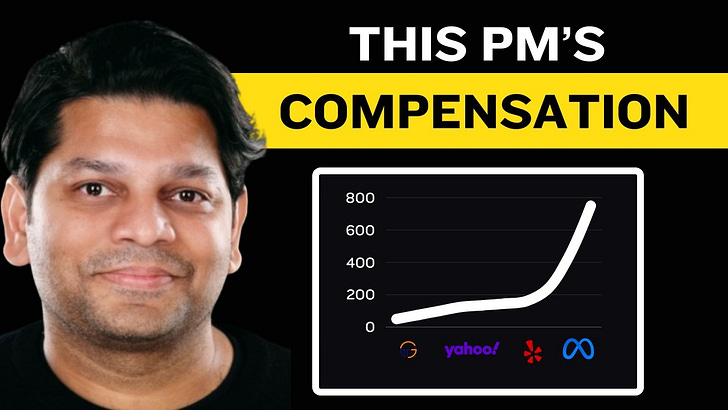
This PM Went From $50k to $750k/Year - Here's How
This Indian Went From $50k to $750k at Meta (Masterclass in Career Growth in 72 Minutes)Satish's story is pretty WILD.This is a story that makes you believe that you can build wealth while working 9-5. In this podcast, we're diving deep into how you can do the same.-Brought to you by:Maven: I’ve just launched my unique curation of their top coursesGibsonAI: Your AI Database EngineerAmplitude: Perfect your product without the guessworkIn this episode:Preview – 00:00:00Breaking into Product Management – 00:01:01Salary at Yahoo – 00:03:28Ad 1 – 00:04:27Ad 2 – 00:05:19Experience at Yahoo – 00:06:43The Real Magic of Moving Into Big Tech – 00:07:15Summarizing His Roles & Experiences at Big Companies – 00:16:33When He Started Earning More Compensation – 00:18:42Getting Great Performance Ratings – 00:20:46The Big Reason Behind His Success – 00:24:07Getting a $750K Paycheck at Meta – 00:25:53Harsh Truths About Promotions – 00:33:23Ad – 00:35:02High-Performance Culture – 00:35:39Preparing for Reviews – 00:38:47Lessons on Going From $140K to $750K – 00:42:05What I Learned About Leveling Up in My Career – 00:52:24Do This to Get Bigger Paychecks – 00:55:225 Important Skills to Develop for Career Growth – 00:58:52Is Product Management Really Dead? – 01:04:19How Much He’s Making From Maven Courses – 01:10:07-Where to Find SatishLinkedInTwitterWebsiteHis Courses:Accelerate Your PM Career Course (Free)Uplevel Your Product Thinking (Maven)Influence Without Authority (Maven)PM Interview Bootcamp (Maven)-Email productgrowthppp at gmail.com to discuss advertising or guest opportunities.-I hope you enjoyed the last episode with Gayle McDowell (where we dived deep into cracking the PM Interview). Up next, we have episodes with:Ethan Evans - Fmr VP, AmazonTal Raviv - Gen AI PM, Early Patreon, RiversideLewis Lin - Author, Decode and ConquerI’m so excited to share them with all of you. This is a public episode. If you'd like to discuss this with other subscribers or get access to bonus episodes, visit www.news.aakashg.com/subscribe
Cracking the PM Interview - with the author of the book, Gayle McDowell
Everyone thinks they know how to prepare for a PM interview until the interviewer baffles you with a twisted question.Gayle McDowell, the author of Cracking the PM Interview and the architect behind hiring processes at top tech companies, breaks down exactly how to ace behavioral and case interviews.By the end of this episode, I’m confident you’ll know why most candidates fail PM interviews and exactly what to do instead.-Brought to you by:Maven: I’ve just launched my unique curation of their top coursesGibsonAI: Your AI Database Engineer-In this episode:Preview - 00:00:00Hierarchy of Practicing for Interviews - 00:01:41Ad Break - 00:05:29Understanding How Your Words Are Interpreted - 00:07:34Recognizing the Assumptions People Make About You - 00:11:04The Correct Way to Answer "What's Your Weakness?" - 00:15:16How to Answer "Tell Me About Yourself" - 00:19:04Practicing Responses for "What's Your Biggest Weakness?" - 00:27:06Ad Break - 00:32:41How to Answer "Why Do You Want to Work Here?" - 00:35:21Approach to Answering Behavioral Questions - 00:38:39Handling Product Design Case Interviews - 00:43:04Handling Execution Case Interviews - 00:50:05How to Land Interviews in 2025 - 00:56:59Optimizing Your Resume - 01:03:00Gayle’s Future Goals - 01:06:14-Email productgrowthppp at gmail.com to discuss advertising or guest opportunities.-I hope you enjoyed the last episode, where I shared 11 key lessons from 50 podcast episodes and answered a bunch of your questions. Up next, we have episodes with:Satish Mummareddy - L7 PM at Meta (Fmr)Ethan Evans - Fmr VP, AmazonTal Raviv - Gen AI PM, Early Patreon, RiversideI’m so excited to share them with all of you. This is a public episode. If you'd like to discuss this with other subscribers or get access to bonus episodes, visit www.news.aakashg.com/subscribe

11 Lessons From 50 Episodes + The Podcast's Future
50 episodes. 50 brilliant minds. One massive learning experience.When I started this podcast, my goal was simple:Learn from the best and share insights that actually help PMs level up.So today, I’m sharing the top takeaways from 50 conversations with the world’s best product thinkers.Let’s dive in.-Brought to you by:WorkOS: Your app, enterprise readyMaven: I’ve just launched my unique curation of their top coursesGibsonAI: Your AI Database Engineer-Insights from:Marty Cagan - 00:00:00Melissa Perri - 00:08:21Chloe Shih - 00:12:45Satyajeet Salgar - 00:16:45Diego Granados - 00:19:32Ravi Mehta - 00:21:55Gautam Krishnan - 00:24:13Pawel Huryn - 00:28:40Kyle Poyar - 00:30:44Anuj Rathi - 00:34:16Anthony Pierri - 00:36:03And Then Q&A:Retrospective on Podcast - 00:37:50 Q&A - What's Next for the Podcast? - 45:18 India Tour Retrospective - 46:50 Last Year of the Newsletter - 50:00 Newsletter Topic Selection - 52:05 Problem with Newsletter - 53:40 How to Solve No Interviews - 55:24 How I Get So Much Done - 56:45 Dream Guests for Podcast - 58:17-Email productgrowthppp at gmail.com to discuss advertising or guest opportunities.-I hope you enjoyed the last episode with Claire Vo. Up next, we have episodes with: April Dunford (Marketing Expert and Author, Obviously Awesome)Eric Simons (CEO and Founder, Bolt)Gayle McDowell (Author, Cracking the PM Interview)I’m so excited to share them with all of you. This is a public episode. If you'd like to discuss this with other subscribers or get access to bonus episodes, visit www.news.aakashg.com/subscribe