Show overview
The Eric Normand Podcast has been publishing since 2018, and across the 5 years since has built a catalogue of 242 episodes. That works out to roughly 85 hours of audio in total. Releases follow a weekly cadence.
Episodes typically run ten to twenty minutes — most land between 11 min and 21 min — though episode length varies meaningfully from one episode to the next. It is catalogued as a EN-US-language Education show.
The catalogue appears to be on hiatus or wound down — the most recent episode landed 3 years ago, with no new episodes in over a year. The busiest year was 2019, with 86 episodes published. Published by Eric Normand.
From the publisher
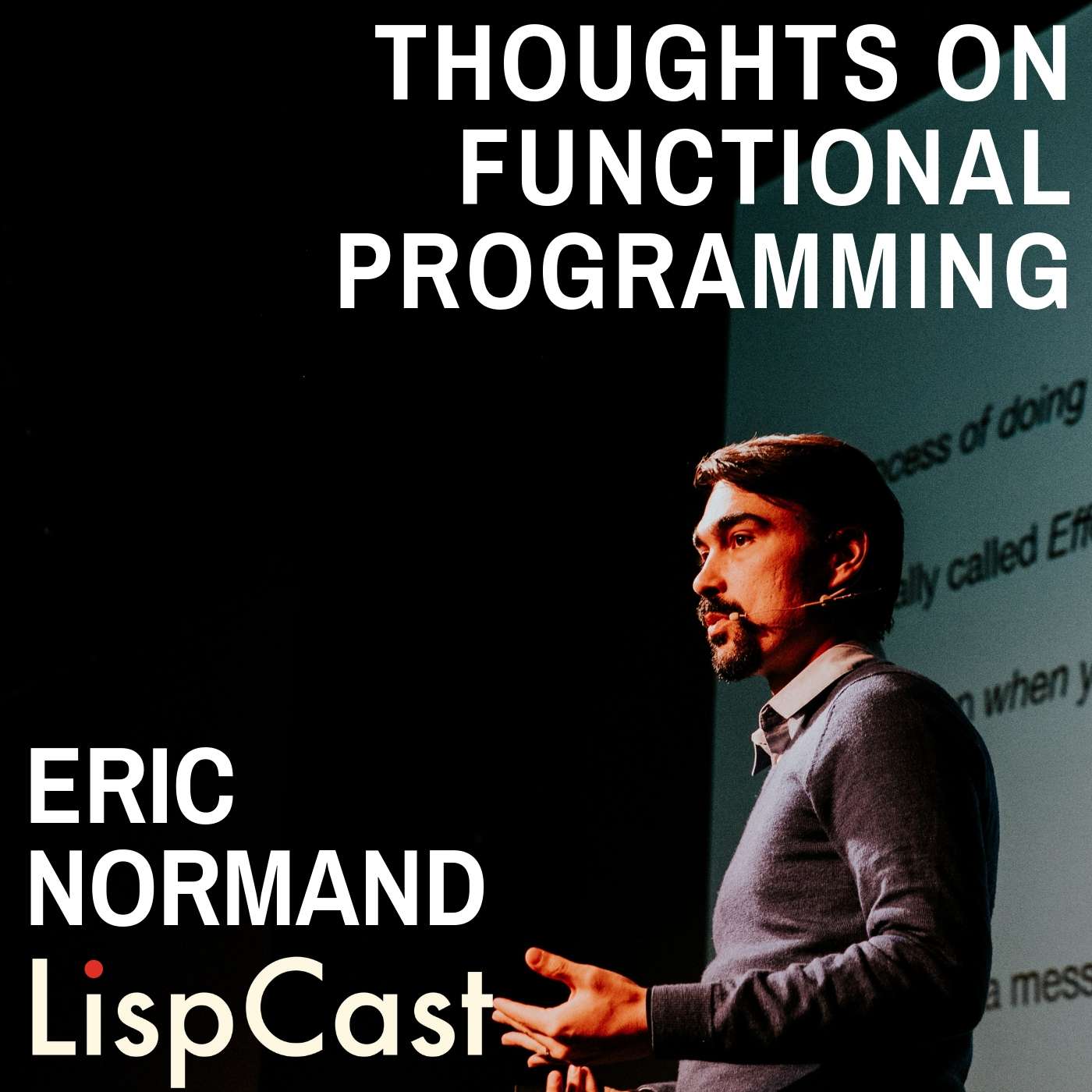
An off-the-cuff stream of Functional Programming ideas, skills, patterns, and news from Functional Programming expert Eric Normand of LispCast. Formerly known as Thoughts on Functional Programming.
Latest Episodes
View all 242 episodesAll about the stratified design lens
In this episode, I introduce the stratified design lens, which talks about how and why we split things into layers.
All about the time lens
In this episode, I introduce the time lens, and I posit a law about representing time in complex domains.
All about the volatility lens
In this episode, I introduce the volatility lens, which seeks to help us write code that deals with a changing world.
All about the architecture lens
In this episode, I introduce the architecture lens, its questions, and its goal of modeling architectural domains to manage complexity.
All about the executable specification lens
In this episode, I introduce the executable specification lens, its questions, and its goal of getting to runnable, testable code as quickly as possible.
All about the composition lens
In this episode, I introduce the composition lens, its questions, and its goal of figuring what's true when you perform multiple operations in a row.
All about the operation lens
In this episode, I introduce the operation lens, its questions, and its goal of capturing the use cases of your software.
Data lens
In this episode, I introduce the data lens, its questions, and its goals of capturing relationships among data values in data.
All about the domain lens
In this episode, I introduce the domain lens, its questions, and its goal.
How does executable specifications compare with other modeling paradigms?
In this episode, I compare executable specifications to UML, DDD, and software design.
What is the title of my new book?
I've found a better title for my book: Executable Specifications. Listen to find out why it's better.
What are the domain modeling lenses?
I'm organizing my new book in terms of lenses. Each lens focuses our attention on one important aspect of software design. In this episode, I briefly introduce each lens.
How is domain modeling evolving these days?
I talk about the progress I've made on my book and why I'm throwing it away and starting over.
Why don't I encounter more type errors when programming in Clojure?
I give another reason why I don't encounter so many type errors in Clojure.
What is the "reify to an interpreter" refactoring?
Watch the creation of a simple refactoring to turn functions into data.
How to teach an essential skill in domain modeling?
One important skill in domain modeling is learning to see the semantics of your language, past the habits you've developed. To do that, it helps to see the same example in multiple languages. So how do I show examples in multiple languages without expanding the size of my book?
What is an isomorphism?
An isomorphism is a one-to-one mapping from two sets, and encoding your domain model involves finding a mapping between the real world and your code. So does domain modeling involve isomorphism?
Applying domain modeling to an existing data structure
Domain modeling also works after you've already got lots of code. How can we apply domain modeling analysis to existing data structures?
What is the commutative property?
We discuss the commutative property, why we use it, and three different possible meanings.
Why is the associative property important?
We look at several examples where the associative property gives us expressive power.