
The Deep-Sea Podcast
151 episodes — Page 3 of 4
The Deep-Sea Podcast - Trailer
trailerJoin world-leading deep-sea scientists Professor Alan Jamieson and Dr Thom Linley, as they talk about everything deep sea! Interesting facts, recent news, myth-busting and interviews with the most interesting people they know. Plus, legendary tales from the high seas, from the first person to reach the bottom of the Mariana Trench: Don Walsh. With new episodes released every month, they show you the deep sea as it really is, without removing any of the wonder. Keep updated with our latest releases by subscribing to our newsletter here Check out our podcast merch here! Which now includes Alan’s beloved apron and a much anticipated new design... Feel free to get in touch with us with questions or your own tales from the high seas on: [email protected] We’d love to actually play your voice so feel free to record a short audio note! We are also on Twitter: @DeepSeaPod, @ArmatusO Facebook: DeepSeaPodcast, ArmatusOceanic Instagram: @deepsea_podcast, @armatusoceanic Keep up with the team on social media Twitter: Alan - @Hadalbloke Thom - @ThomLinley Georgia - @geeinthesea Instagram: Georgia - @geeinthesea Read the show notes and find out more about us at: www.armatusoceanic.com/podcast
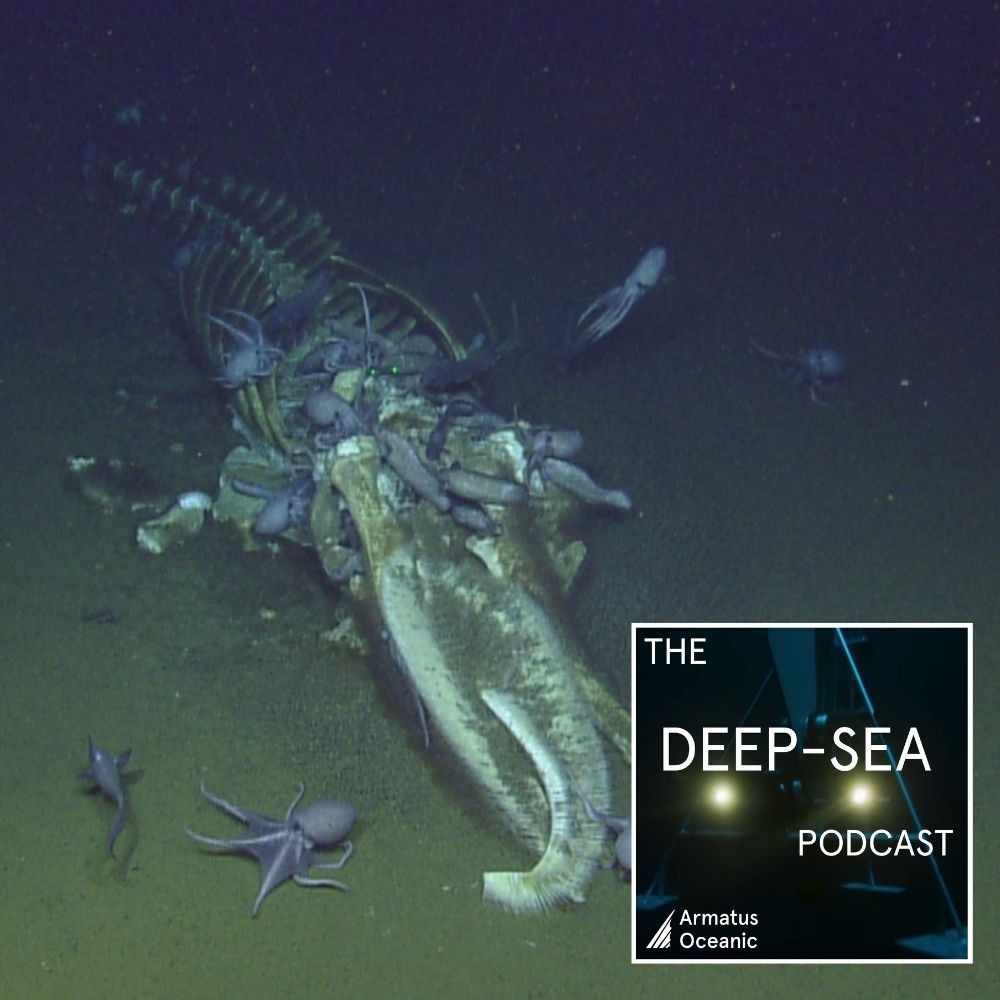
Ep 32032 - Whale falls with Craig Smith
This month is a fun one (maybe not if you love cetaceans) as we’re covering whale falls! That’s right, dead whales and the ecosystems they create on the seafloor. Professor Craig Smith joins us to talk all about the stages of decomposition, the key species that whale falls support, and some truly wild tales from the high seas. We finally answer the big question, what smells worse: a dead whale or a dead deep-sea sponge? The answer might not be what you expect. We also hear from a couple friends of the show, including Shelly, who may have found one of the earliest comparisons of the moon and the deep sea, and Otis, who talks us through his research on the back of our last episode on hydrothermal vents. In other news, consuming deep-sea water lowers cholesterol (this one is definitely, absolutely, 100% true), there’s a new deep-sea documentary premiering at Sundance and we made our first 30p (and a pint)! This newfound success has pushed us to release another Deco-Stop episode on neurodiversity in science, coming to you next month! Keep updated with our latest releases by subscribing to our newsletter here Check out our podcast merch here! Which now includes Alan’s beloved apron and a much anticipated new design... Feel free to get in touch with us with questions or your own tales from the high seas on: [email protected] We’d love to actually play your voice so feel free to record a short audio note! We are also on Twitter: @DeepSeaPod, @ArmatusO Facebook: DeepSeaPodcast, ArmatusOceanic Instagram: @deepsea_podcast, @armatusoceanic Keep up with the team on social media Twitter: Alan - @Hadalbloke Thom - @ThomLinley Georgia - @geeinthesea Instagram: Georgia - @geeinthesea Read the show notes and find out more about us at: www.armatusoceanic.com Glossary Blubber - The fat of sea mammals. Cadaverine - A compound formed in the decay of animal proteins after death. Cetacean - The scientific name for whales, dolphins and porpoises. Chemoautotrophic - Obtains energy through chemical reactions rather than light. Hagfish - An eel-shaped, slime-producing fish. Hydroxyapatite - A mineral which makes up whale bones. Osedax - A family of “bone-eating” worms which are often found feasting on whale bones. Putracene - A compound formed in the decay of animal proteins after death. Purse seine netting - A vertical net ‘curtain’ which can be drawn together to enclose the whale. Sleeper sharks - Family: Somniosidae. Slow-moving sharks which can be seen feeding on whale falls. Stoneley waves - A boundary wave (or interface wave) that typically propagates along a solid-solid interface. Links Craig’s research group Craig's article on whale fall ecology (2003) ‘Rare’ deep-sea fish turns out to not be rare at all A news article and published paper on how glass sponges could provide treatment against Covid-19 A new deep-sea video game has just been released called “Surviving the Abyss” Deep Rising, the film featuring and produced by Aquaman himself, Jason Momoa, has had its premiere at Sundance Film Festival We released a piece in The Conversation on the Moon Analogy Otis Brunner’s twitter Parade of the Wooden Soldiers - New York Percussion Trio Youtube Spotify Credits Theme – Hadal Zone Express by Märvel Logo image Image courtesy of NOAA #whalefalls #whalefall #whalefallecosystems #osedax #Podcast #SciComm #Science #MarineBiology #DeepSea #DeepOcean #AlanJamieson #Donwalsh #ThomasLinley #craigsmith #discovery #scicomm #submarine # #biodiversity #deepseacreatures #boneeatingworms #zombieworms #fossils #sundance #deepseamining #jasonmomoa
PRESSURISED: 005 - Storytelling with Susan Casey
bonusOur short and to the point PRESSURISED version of episode 5. If you don't have time for the full episode and want to get right to the science without any of our waffle, this is the place to be! Read the show notes and find the full episode here: www.armatusoceanic.com/podcast/005-storytelling-with-author-susan-case In this episode we explore the power of storytelling and complete the arc of our first five episodes: science communication and perception of the deep sea. We talk with multiple New York Times bestseller Susan Casey about telling a good story and engaging people with a narrative, while still being scientifically accurate. Plus, Don Walsh is kind enough to record his thoughts on the importance of good storytellers. Check out our podcast merch here! Which now includes Alan’s beloved apron and a much anticipated new design... Feel free to get in touch with us with questions or your own tales from the high seas on: [email protected] We’d love to actually play your voice so feel free to record a short audio note! We are also on Twitter: @DeepSeaPod, @ArmatusO Facebook: DeepSeaPodcast, ArmatusOceanic Instagram: @deepsea_podcast, @armatusoceanic Keep up with the team on social media Twitter: Alan - @Hadalbloke (https://twitter.com/Hadalbloke) Thom - @ThomLinley (https://twitter.com/ThomLinley) Georgia - @geeinthesea (https://twitter.com/geeinthesea) Instagram: Georgia - @geeinthesea (https://www.instagram.com/geeinthesea/) Read the show notes and find out more about us at: www.armatusoceanic.com Credits Theme – Hadal Zone Express by Märvel Logo image - The Deep-Sea Podcast: PRESSURISED
PRESSURISED: 031 - Hydrothermal vents with Charles ”Chuck” Fisher
bonusOur short and to the point PRESSURISED version of episode 31. If you don't have time for the full episode and want to get right to the science without any of our waffle, this is the place to be! Read the show notes and find the full episode here: www.armatusoceanic.com/podcast/031-hydrothermal-vents We’re continuing on our iconic deep-sea habitat trilogy with the episode you’ve all been waiting for… HYDROTHERMAL VENTS! We speak to the incredible Charles “Chuck” Fisher, a pivotal biologist in hydrothermal vent research, about these fascinating habitats and the organisms which exist there. We learn about the iconic tube-worms and their specialised adaptations to life in these extreme environments. Plus, Chuck does some of his own myth-busting and sets the record straight on a common tubeworm trope. Don shares his own experiences of these impressive habitats (and the not-so-impressive lunches that came alongside them). Buckle-up for a big one! Check out our podcast merch here! Which now includes Alan’s beloved apron and a much anticipated new design... Feel free to get in touch with us with questions or your own tales from the high seas on: [email protected] We’d love to actually play your voice so feel free to record a short audio note! We are also on Twitter: @DeepSeaPod, @ArmatusO Facebook: DeepSeaPodcast, ArmatusOceanic Instagram: @deepsea_podcast, @armatusoceanic Keep up with the team on social media Twitter: Alan - @Hadalbloke (https://twitter.com/Hadalbloke) Thom - @ThomLinley (https://twitter.com/ThomLinley) Georgia - @geeinthesea (https://twitter.com/geeinthesea) Instagram: Georgia - @geeinthesea (https://www.instagram.com/geeinthesea/) Read the show notes and find out more about us at: www.armatusoceanic.com Glossary Annelid - The name for segmented worms. Biogeography - The study of the present and past distribution patterns of biological diversity and their underlying environmental and historical causes. Calcareous - Containing calcium carbonate. Escarpia - A genus of tube worm found at cold seeps. Invasive species - An organism that typically causes ecological or economic harm in a new environment where it is not native. Lamellibrachia - A type of cold seep tubeworm related to the giant tube worm, Riftia pachyptila Larvae - A juvenile form before transforming into adults. Osedax - Bone-eating worms which live in the deep sea, typically on whale carcasses. Riftia pachyptila - The giant tubeworm found at hydrothermal vents in the deep-sea. Symbiotic - A mutually beneficial relationship between different organisms. Trophosome - specialised sac in tube worms where chemosynthetic bacteria are housed Vestimentiferan tubeworm - A taxon of marine deep-sea worm-like animals living in chitinous tubes and lack a digestive tract. Links Chuck’s research group Chuck’s article on hydrothermal vent communities Chuck’s article on cold seeps in the Gulf of Mexico Credits Theme – Hadal Zone Express by Märvel Logo image - The Deep-Sea Podcast: PRESSURISED
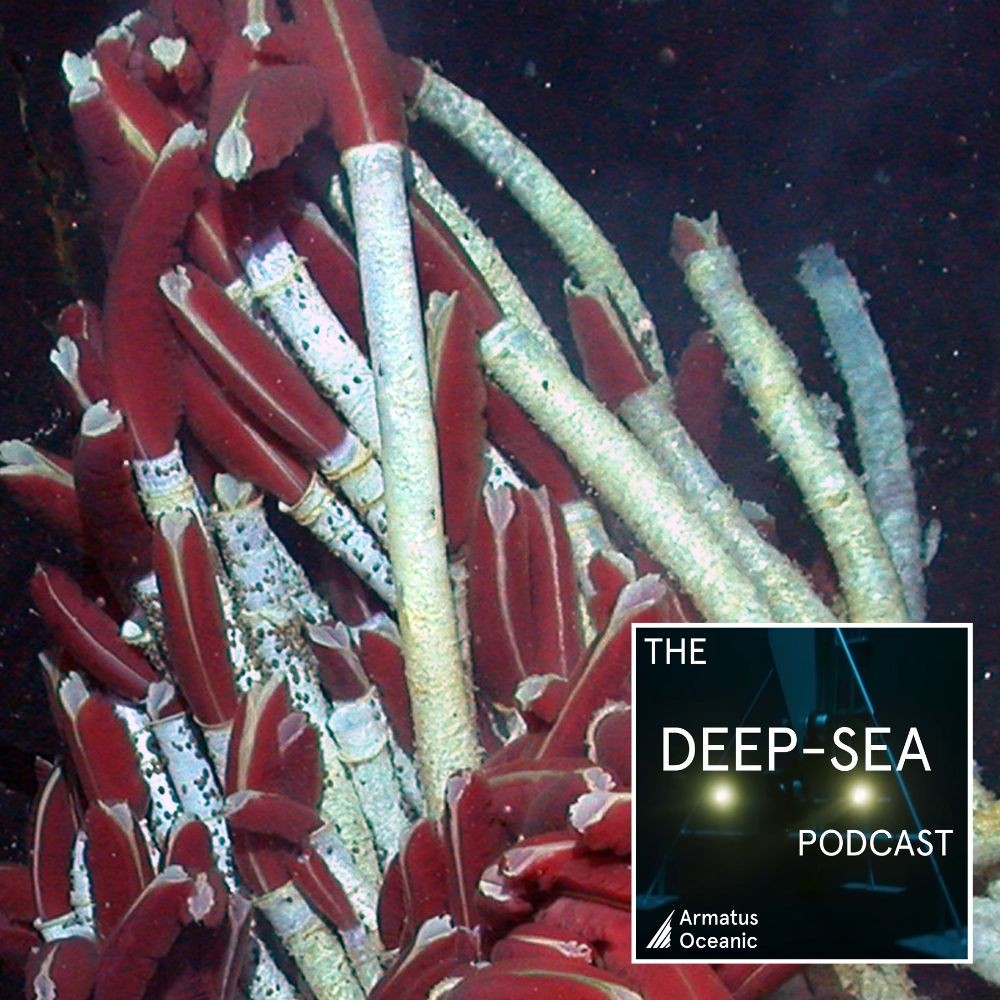
Ep 31031 - Hydrothermal vents with Charles ”Chuck” Fisher
We’re continuing on our iconic deep-sea habitat trilogy with the episode you’ve all been waiting for… HYDROTHERMAL VENTS! In this jam-packed episode we cover forgotten Christmas specials, lebensspuren, deep-sea sandwiches and climate crisis sea-shanties (and that’s only in the first 20 minutes)! We speak to the incredible Charles “Chuck” Fisher, a pivotal biologist in hydrothermal vent research, about these fascinating habitats and the organisms which exist there. We learn about the iconic tube-worms and their specialised adaptations to life in these extreme environments. Plus, Chuck does some of his own myth-busting and sets the record straight on a common tube worm trope. Don shares his own experiences of these impressive habitats (and the not-so-impressive lunches that came alongside them). Plus, we hear from you in the form of listener questions, children’s books and (another?!) deep-sea conspiracy theory. Buckle-up for a big one! Check out our podcast merch here! Which now includes Alan’s beloved apron and a much anticipated new design... Feel free to get in touch with us with questions or your own tales from the high seas on: [email protected] We’d love to actually play your voice so feel free to record a short audio note! We are also on Twitter: @DeepSeaPod, @ArmatusO Facebook: DeepSeaPodcast, ArmatusOceanic Instagram: @deepsea_podcast, @armatusoceanic Keep up with the team on social media We’ve been off-piste for a while now so we thought we’d jump straight back into the deep sea with a series of episodes on deep-sea habitats. We’re starting off strong with a huge episode on seamounts! We speak to a friend of the show, Ashley Rowden who’s an expert in all-things benthic and we find out why seamounts are just so cool. We also get a little distracted and reminisce about the ultimate offshore championship: sausage-fest. We get to hear from the scientists on board the RRS Discovery who are currently on an expedition to discover the life that exists on the seamounts surrounding St Helena and the Ascension Islands. A couple of our friends on board also recall their ‘crossing the line’ experience, and how they’re finding working on board a research vessel. We have huge news! You’ll be very excited to hear that we have released a new design for our merch, featuring our favourite parasite - the tongue-eating isopod, Cymothoa exigua! A perfect gift this holiday season for the whole family. Check out our podcast merch here! Which now includes Alan’s beloved apron and a much anticipated new design... Feel free to get in touch with us with questions or your own tales from the high seas on: [email protected] We’d love to actually play your voice so feel free to record a short audio note! We are also on Twitter: @DeepSeaPod, @ArmatusO Facebook: DeepSeaPodcast, ArmatusOceanic Instagram: @deepsea_podcast, @armatusoceanic Keep up with the team on social media Twitter: Alan - @Hadalbloke Thom - @ThomLinley Georgia - @geeinthesea Instagram: Georgia - @geeinthesea Read the show notes and find out more about us at: www.armatusoceanic.com Glossary Annelid - The name for segmented worms. Biogeography - The study of the present and past distribution patterns of biological diversity and their underlying environmental and historical causes. Calcareous - Containing calcium carbonate. Escarpia - A genus of tube worm found at cold seeps. Invasive species - An organism that typically causes ecological or economic harm in a new environment where it is not native. Lamellibrachia - A type of cold seep tubeworm related to the giant tube worm, Riftia pachyptila Larvae - A juvenile form before transforming into adults. Lebensspuren - Meaning “life-traces”, an ecological term referring to the tracks made by benthic organisms. Müllspuren - “Meaning “bag-traces”, referring to the unnatural traces plastic bags leave behind on the seafloor. Osedax - Bone-eating worms which live in the deep sea, typically on whale carcasses. Riftia pachyptila - The giant tubeworm found at hydrothermal vents in the deep-sea. Symbiotic - A mutually beneficial relationship between different organisms. Trophosome - specialised sac in tube worms where chemosynthetic bacteria are housed Vestimentiferan tubeworm - A taxon of marine deep-sea worm-like animals living in chitinous tubes and lack a digestive tract. Links Chuck’s research group Chuck’s article on hydrothermal vent communities Chuck’s article on cold seeps in the Gulf of Mexico Deep sea species on Australian coins Alan’s new paper on müllspuren. Deep sea sandwiches, in the news and the original published article Most deep-sea microbes are inactive, in the news and the original published article James Cameron comes on the podcast Top 10 Deep sea Creatures 2022 Oly and Opi: The curious octopus twins children’s story Jake Hewitt photography Oli Frost - The Pirate Emergency Youtube Spotify Credits Theme – Hadal Zone Express by Märvel Logo image Image courtesy of Chuck Fisher and WHOI
PRESSURISED: 030 - Seamounts with Ashley Rowden
bonusOur short and to the point PRESSURISED version of episode 30. If you don't have time for the full episode and want to get right to the science without any of our waffle, this is the place to be! Read the show notes and find the full episode here: www.armatusoceanic.com/podcast/030-seamounts We’ve been off-piste for a while now so we thought we’d jump straight back into the deep sea with a series of episodes on deep-sea habitats. We’re starting off strong with a huge episode on seamounts! We speak to a friend of the show, Ashley Rowden who’s an expert in all-things benthic and we find out why seamounts are just so cool. We get to hear from Don as he recalls his experiences of "crossing the line", a tradition deep-rooted in the maritime industry. We have huge news! You’ll be very excited to hear that we have released a new design for our merch, featuring our favourite parasite - the tongue-eating isopod, Cymothoa exigua! A perfect gift this holiday season for the whole family. Check out our podcast merch here! Which now includes Alan’s beloved apron. Feel free to get in touch with us with questions or your own tales from the high seas on: [email protected] We’d love to actually play your voice so feel free to record a short audio note! We are also on Twitter: @DeepSeaPod, @ArmatusO Facebook: DeepSeaPodcast, ArmatusOceanic Instagram: @deepsea_podcast, @armatusoceanic Glossary Albatross - a very large white oceanic bird Baikal - The world's deepest lake (1642 m deep), based in Siberia Guyots - Flat-topped underwater mountains Knoll - Less than 1000m underwater mountain Manganese nodules - Potato-sized clumps of metals (mostly manganese and iron) found on the sea floor. These metals are used in the production of batteries Orange roughy - (Hoplostethus atlanticus) A deep-sea fish which was famously historically overfished Productivity - The rate of growth of a habitat, usually referring to biomass Satellite altimeters - equipment which measures altitude or surface topography via satellite Seamount - An underwater mountain which ascends more than 1000m Sedimentation - The process of sediment sinking and then building up at the bottom of the water column Seismic - Activity related to volcanoes or earthquakes Links Deep-sea mining is mentioned at COP27 3000 tonnes of polymetallic nodules are taken from the deep by deep-sea mining company Ashley’s research and recommended reading Ashley’s paper on seamount ecology Clarke & Dunn (2012) paper on the sustainable management of seamount fisheries Clark et al (2013) article on future priorities for seamount research. Dunn & Forman (2011) orange roughy distribution Hubbs’ 1959 iconic article on seamounts. Global seamounts project - an initiative that’s exploring seamounts Credits Theme – Hadal Zone Express by Märvel Logo image - The Deep-Sea Podcast: PRESSURISED
PRESSURISED: 008 – Deep-Sea Technology with James Cameron
bonusOur short and to the point PRESSURISED version of episode 8. If you don't have time for the full episode and want to get right to the science without any of our waffle, this is the place to be! Read the show notes and find the full episode here Working in the deep sea is entirely dependent on technology and the incredible forces push engineering to its limit. If you are doing something that no one has done before, chances are you are going to have to make some of your own tools. Unfortunately, we must spend a lot more on our equipment for the same data as shallower science. This makes funding difficult but also makes the deep sea quite an exclusive club. We are joined by James Cameron (yes, that one) to talk about solving the problems of working deep with new technology. He shares how he went about illuminating the Titanic and confesses that his films are often an outlet for the technology he wishes he could build. Some of the concepts coming in Avatar 2 are an example of this. Don Walsh joins us as ever to give his take on the importance of the engineering that allows us to do the things we do. Check out our podcast merch! Which now includes Alan’s beloved apron. Feel free to get in touch with us with questions or you own tales from the high seas on: [email protected] We’d love to actually play your voice so feel free to record a short audio note! We are also on Twitter: @DeepSeaPod, @ArmatusO Facebook: DeepSeaPodcast, ArmatusOceanic Instagram: @deepsea_podcast, @armatusoceanic Links Crabsuit Credits Theme – Hadal Zone Express by Märvel Logo image - The Deep-Sea Podcast: PRESSURISED
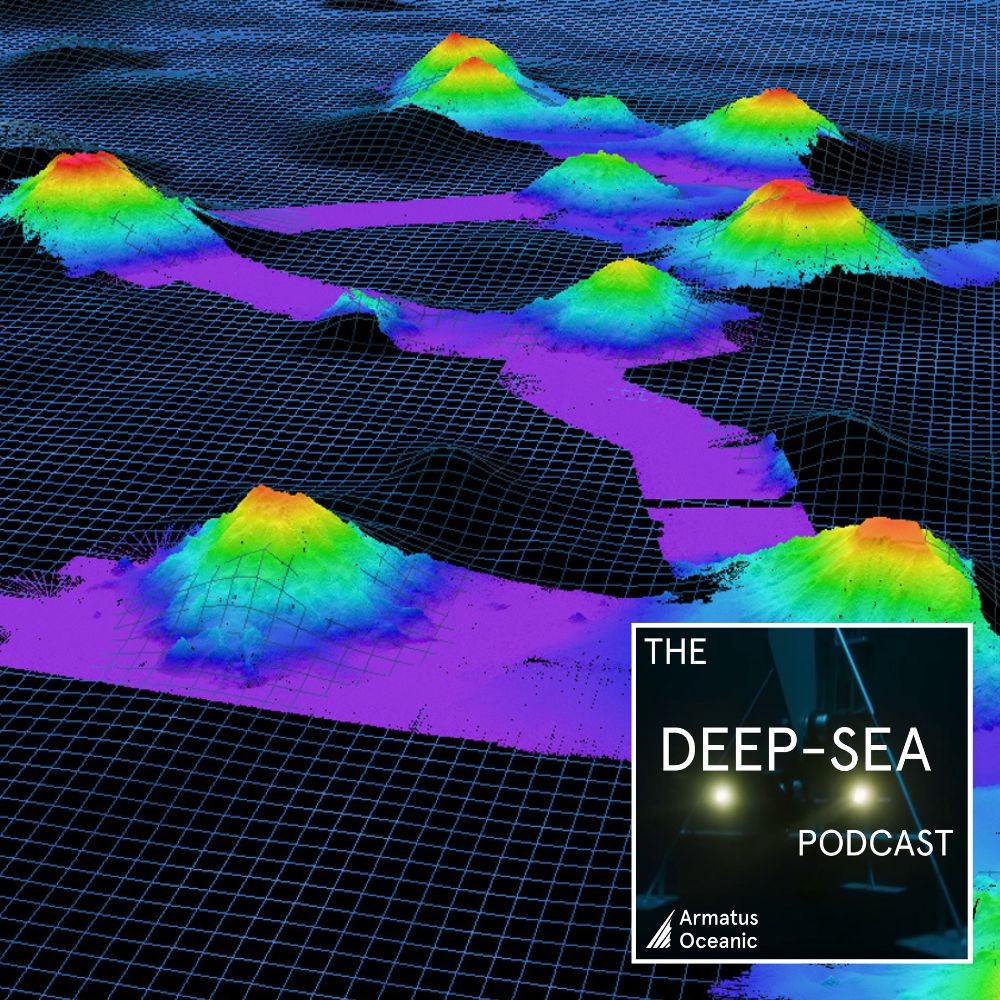
Ep 30030 – Seamounts with Ashley Rowden
We’ve been off-piste for a while now so we thought we’d jump straight back into the deep sea with a series of episodes on deep-sea habitats. We’re starting off strong with a huge episode on seamounts! We speak to a friend of the show, Ashley Rowden who’s an expert in all-things benthic and we find out why seamounts are just so cool. We also get a little distracted and reminisce about the ultimate offshore championship: sausage-fest. We get to hear from the scientists on board the RRS Discovery who are currently on an expedition to discover the life that exists on the seamounts surrounding St Helena and the Ascension Islands. A couple of our friends on board also recall their ‘crossing the line’ experience, and how they’re finding working on board a research vessel. We have huge news! You’ll be very excited to hear that we have released a new design for our merch, featuring our favourite parasite - the tongue-eating isopod, Cymothoa exigua! A perfect gift this holiday season for the whole family. Check out our podcast merch here! Which now includes Alan’s beloved apron and a much anticipated new design... Feel free to get in touch with us with questions or your own tales from the high seas on: [email protected] We’d love to actually play your voice so feel free to record a short audio note! We are also on Twitter: @DeepSeaPod, @ArmatusO Facebook: DeepSeaPodcast, ArmatusOceanic Instagram: @deepsea_podcast, @armatusoceanic Keep up with the team on social media Twitter: Alan - @Hadalbloke Thom - @ThomLinley Georgia - @geeinthesea Instagram: Georgia - @geeinthesea Read the show notes and find out more about us at: www.armatusoceanic.com Glossary Albatross - a very large white oceanic bird Baikal - The world's deepest lake (1642 m deep), based in Siberia Guyots - Flat-topped underwater mountains Knoll - Less than 1000m underwater mountain Manganese nodules - Potato-sized clumps of metals (mostly manganese and iron) found on the sea floor. These metals are used in the production of batteries Orange roughy - (Hoplostethus atlanticus) A deep-sea fish which was famously historically overfished Productivity - The rate of growth of a habitat, usually referring to biomass Satellite altimeters - equipment which measures altitude or surface topography via satellite Seamount - An underwater mountain which ascends more than 1000m Sedimentation - The process of sediment sinking and then building up at the bottom of the water column Seismic - Activity related to volcanoes or earthquakes Links Bottled deep-sea water helps with physical fatigue Deep-sea mining is mentioned at COP27 A recent expedition to the Cocos islands in the Indian Ocean has revealed an array of deep-sea species, and previously undiscovered geological features. The UK Government’s Blue Belt Programme has launched the DY159 expedition where scientists are exploring the deep ocean around St Helena and Ascension Island. 3000 tonnes of polymetallic nodules are taken from the deep by deep-sea mining company Ashley’s research and recommended reading Ashley’s paper on the sustainable management of seamount fisheries Global seamounts project - an initiative that’s exploring seamounts Hubbs’ 1959 iconic article on seamounts. Clark et al (2013) article on future priorities for seamount research. Dun & Forman (2011) orange roughy distribution No doubt - Oi to the world Youtube Spotify Credits Theme – Hadal Zone Express by Märvel Logo image Image courtesy of NOAA
PRESSURISED: 004 – Fear of the deep sea with Glenn Singleman
bonusOur short and to the point PRESSURISED version of episode 4. If you don't have time for the full episode and want to get right to the science without any of our waffle, this is the place to be! Read the show notes and find the full episode here: https://www.armatusoceanic.com/podcast/004-fear-of-the-deep-sea-with-glenn-singleman We turn the spotlight on ourselves and wonder why humanity seems to have an intrinsic fear of the deep sea. Glenn Singleman joins us to give a psychological explanation for why we feel differently about the deep sea and we take a deep dive into deep-sea tropes we see in the media. Check out our podcast merch! Which now includes Alan’s beloved apron. Feel free to get in touch with us with questions or you own tales from the high seas on: [email protected] We’d love to actually play your voice so feel free to record a short audio note! We are also on Twitter: @DeepSeaPod, @ArmatusO Facebook: DeepSeaPodcast, ArmatusOceanic Instagram: @deepsea_podcast, @armatusoceanic Links Glenn Singleman’s bio Alan, Thom and Glenn’s paper on Fear of the Deep Sea Credits Theme – Hadal Zone Express by Märvel Logo image - The Deep-Sea Podcast: PRESSURISED
PRESSURISED: 029 – Deep se... river?! ecosystems with Melanie Stiassny
bonusOur short and to the point PRESSURISED version of episode 29. If you don't have time for the full episode and want to get right to the science without any of our waffle, this is the place to be! Read the show notes and find the full episode here: www.armatusoceanic.com/podcast/029-deep-rivers Everyone has been very busy this month with Thom and the Professor officially describing a new species of blue snailfish, alongside their adventures in Singapore. We hear from one of our old students about the work he’s been doing in deep freshwater ecosystems, which got us thinking about these unique environments and the kind of species that live there. We decided to throw one last curveball away from the deep sea and speak with Dr Melanie Stiassny, an ichthyologist who’s focused her research on the deep water fish of the Congo river. We couldn’t go an episode without discussing the latest deep-sea related conspiracy theories. And of course, we hear from Don about how freshwater affects sub manoeuvres. Check out our podcast merch! Which now includes Alan’s beloved apron and a much anticipated new design... Feel free to get in touch with us with questions or your own tales from the high seas on: [email protected] We’d love to actually play your voice so feel free to record a short audio note! We are also on Twitter: @DeepSeaPod, @ArmatusO Facebook: DeepSeaPodcast, ArmatusOceanic Instagram: @deepsea_podcast, @armatusoceanic Glossary Acoustic doppler current profiler - a device that uses sound waves to measure the speed and direction of currents throughout the water column. Delta - a landform shaped like a triangle, where the mouth of a river flows into an ocean. Halocline - a vertical zone in the water column in which salinity changes rapidly with depth. Giant Isopod - (Scientific genus: Bathynomus) carnivorous crustaceans which are abundant in the deep-sea. Giger - H.R. Giger an award-winning Swiss artist who designed the creature from the 1979 sci-fi horror film ‘Alien’. Rapids - sections of a river where the river bed has a relatively steep gradient, causing an increase in water velocity and turbulence. Sargasso sea - a region of the Atlantic Ocean bounded by four currents forming an ocean gyre. Links Dr Thom’s new paper on the blue hadal snailfish Alans paper on hadal connectivity Eel love Melanie’s work and recent research: Melanie’s recent paper on the discovery of a new species of air-breathing catfish Melanie’s article on her work in the lower Congo Melanie’s NY times article on her research on the deep river Congo Credits Theme – Hadal Zone Express by Märvel Logo image - The Deep-Sea Podcast: PRESSURISED

Ep 29029 – Deep se…river?! ecosystems with Melanie Stiassny
https://www.armatusoceanic.com/podcast/029-deep-rivers Everyone has been very busy this month with Thom and the Professor officially describing a new species of blue snailfish, alongside their adventures in Singapore. We hear from one of our old students about the work he’s been doing in deep freshwater ecosystems, which got us thinking about these unique environments and the kind of species that live there. We decided to throw one more curveball away from the deep sea and speak with Dr Melanie Stiassny, an ichthyologist who’s focused her research on the deep-water fish of the Congo River. We couldn’t go an episode without discussing the latest deep-sea related conspiracy theories. And of course, we hear from Don about how freshwater affects sub manoeuvres. Check out our podcast merch! Which now includes Alan’s beloved apron and a much-anticipated new design... Feel free to get in touch with us with questions or your own tales from the high seas on: [email protected] We’d love to actually play your voice so feel free to record a short audio note! We are also on Twitter: @DeepSeaPod, @ArmatusO Facebook: DeepSeaPodcast, ArmatusOceanic Instagram: @deepsea_podcast, @armatusoceanic Keep up with the team on social media Twitter: Alan - @Hadalbloke Thom - @ThomLinley Georgia - @geeinthesea Instagram: Georgia - @geeinthesea Read the show notes and find out more about us at: www.armatusoceanic.com Glossary Acoustic doppler current profiler (ADCP) - a device that uses sound waves to measure the speed and direction of currents throughout the water column. Delta - a landform shaped like a triangle, where the mouth of a river flows into an ocean. Halocline - a vertical zone in the water column in which salinity changes rapidly with depth. Giant Isopod - (Scientific genus: Bathynomus) carnivorous crustaceans which are abundant in the deep-sea. Giger - H.R. Giger an award-winning Swiss artist who designed the creature from the 1979 sci-fi horror film ‘Alien’. Rapids - sections of a river where the river bed has a relatively steep gradient, causing an increase in water velocity and turbulence. Sargasso Sea - a region of the Atlantic Ocean bounded by four currents forming an ocean gyre. Links Alans TEDx talk The art exhibition that Alan and Thom visited in Singapore John Quentin’s new deep-sea sci-fi novel, The Verdansky Ultimatum Alans paper on hadal connectivity Dr Thom’s new paper on the blue hadal snailfish Eel love, Macduff aquarium releasing their eels Lake Baikal sculpins! Crocs on Helium story and video Melanie’s work and recent research Melanie’s recent paper on the discovery of a new species of air-breathing catfish Melanie’s article on her work in the lower Congo Melanie’s research on the deep river Congo Fishes in the lower Congo River. An extreme case of species divergence and convergent evolution Dying Fish Revealed Congo Is World's Deepest River Videos: https://vimeo.com/channels/nsf/24733777 http://www.youtube.com/watch?v=tObYa9KQb8w&feature=relmfu Melanie’s TEDx talk Credits Oceanchild - Spidergawd Youtube Spotify Selti - Skatatacama Youtube Spotify Theme – Hadal Zone Express by Märvel Logo image Image courtesy of the American Museum of Natural History/Melanie Stiassny
PRESSURISED: 003 – Aesthetics of the deep sea with artist Alex Gould
bonusOur short and to the point PRESSURISED version of episode 3. If you don't have time for the full episode and want to get right to the science without any of our waffle, this is the place to be! Read the show notes and find the full episode here: https://www.armatusoceanic.com/podcast/003-aesthetics-of-thedeep-sea-with-artist-alex-gould Can we use art to help people engage with the deep sea? We stop trying to explain things and let artist Alex Gould help us see deep-sea animals for the first time all over again. We talk about the aesthetics of deep-sea fish, is it distorted by our expectations? Can we save the blobfish from bullying? Can art help us with the horror of tongue eating parasites and fish absorbing their boyfriends? Check out our podcast merch! Which now includes Alan’s beloved apron. Feel free to get in touch with us with questions or you own tales from the high seas on: [email protected] We’d love to actually play your voice so feel free to record a short audio note! We are also on Twitter: @DeepSeaPod, @ArmatusO Facebook: DeepSeaPodcast, ArmatusOceanic Instagram: @deepsea_podcast, @armatusoceanic Links Alex Gould’s Website Anglerfish immune system Pressure tolerant sea lice The Ugly Animal Preservation Society Credits Theme – Hadal Zone Express by Märvel Logo image - The Deep-Sea Podcast: PRESSURISED
PRESSURISED: 028 – Masters of the sea with Stuart Buckle
bonusOur short and to the point PRESSURISED version of episode 28. If you don't have time for the full episode and want to get right to the science without any of our waffle, this is the place to be! Read the show notes and find the full episode here: https://www.armatusoceanic.com/podcast/028-being-captain The Professor is back from his adventures at sea with lots of exciting new updates. He talks us through some of his key findings from this already iconic deep-sea expedition. We also get to hear from an often overlooked figure in these expeditions: the ship's captain. Alan and Captain Stuart Buckle have a shared history of seagoing. Travelling the world together onboard the DSSV Pressure Drop during the Five Deeps expedition and during the Professor's recent venture to the Japanese trenches. Captain Stu talks us through his journey into becoming a captain and how he managed to bag the role of captain during James Cameron's legendary Mariana Trench dive. We also hear from one of our favourite captains and long-time guest of the show, Don Walsh. Don recalls how he sharpened his skills in ship handling and his methods of teaching these skills to the next generation of sailors. Deep-sea news is a mixture of policy and goo this month. Deep-sea mining tests get the go-ahead, and Alan and Thom try and figure out what a certain spiky blue goo found at the bottom of the sea might be. Check out our podcast merch! Which now includes Alan’s beloved apron. Feel free to get in touch with us with questions or you own tales from the high seas on: [email protected] We’d love to actually play your voice so feel free to record a short audio note! We are also on Twitter: @DeepSeaPod, @ArmatusO Facebook: DeepSeaPodcast, ArmatusOceanic Instagram: @deepsea_podcast, @armatusoceanic Glossary Benthic - Associated with the seafloor Captain - The commanding officer of a ship. Crinoids - Sea lilies are marine animals that are closely related to sea stars, sea cucumbers and sea urchins. Ctenophores - Comb jellies are gelatinous marine invertebrates that use cilia for swimming. ECDIS - An Electronic Chart Display and Information System shows the navigational charts and information about the position, heading and speed of a vessel. Knots - The unit of speed equal to one nautical mile per hour. The Deep Sea Challenger ascended at 6 knots or approx 7mph. Thrusters - The propellers on an underwater vehicle that allow it to move. ROV - Remotely Operated Vehicles are underwater robots that collect data such as video/images. They are attached to a vessel by an umbilical cord. Xenophyophore - A unicellular marine organism with lots of nuclei found on abyssal plains. Links Vulnerable deep-sea ecosystems get further protection from bottom fishing in EU waters Deep-sea mining test given green light UN Ocean Treaty fails to reach an agreement Unidentified spiky blue goo seen in the deep Australian fisherman catches kitefin shark Megamouth shark filmed off the coast of San Diego 230 pilot whales stranded on beach in Tasmania Credits Theme – Hadal Zone Express by Märvel Logo image - The Deep-Sea Podcast: PRESSURISED
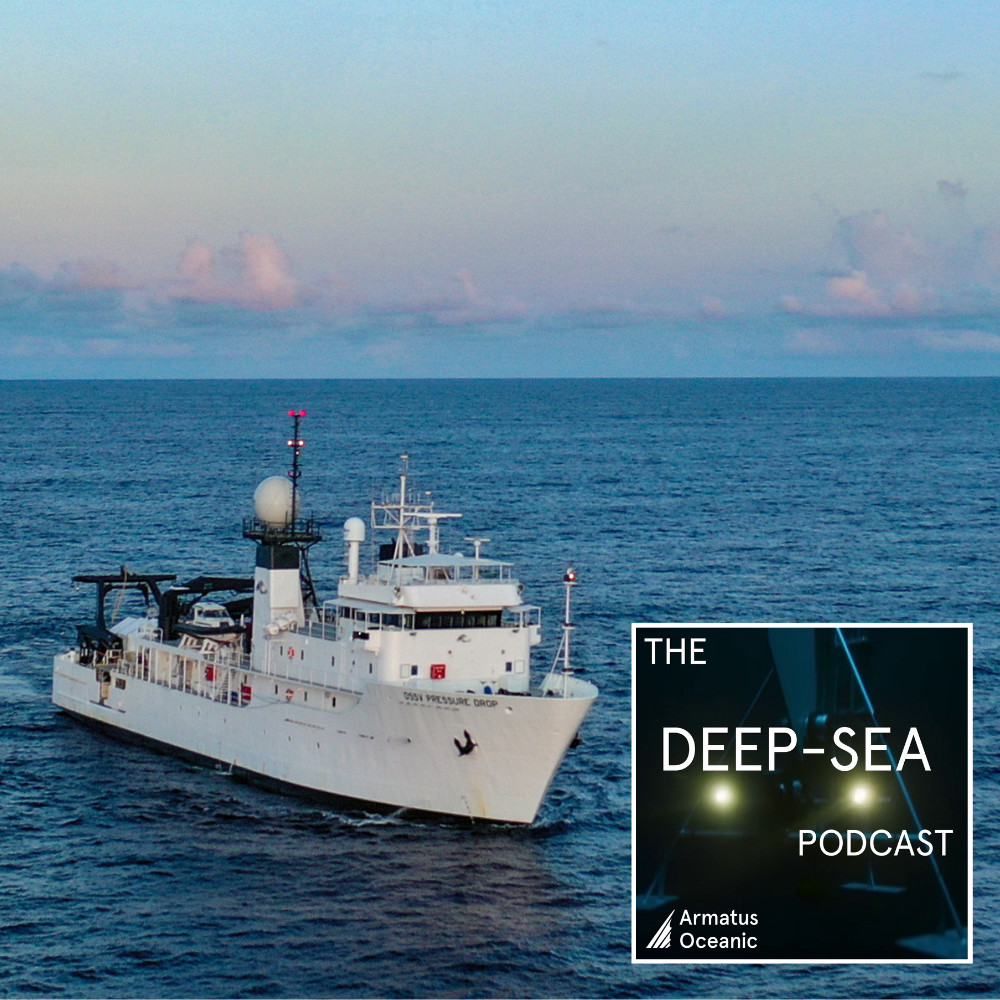
Ep 28028 – Masters of the sea with Stuart Buckle
The Professor is back from his adventures at sea with lots of exciting new updates. He talks us through some of his key findings from this already iconic deep-sea expedition. We also get to hear from an often overlooked figure in these expeditions: the ship's captain. Alan and Captain Stuart Buckle have a shared history of seagoing. Travelling the world together onboard the DSSV Pressure Drop during the Five Deeps expedition and during the Professor's recent venture to the Japanese trenches. Captain Stu talks us through his journey into becoming a captain and how he managed to bag the role of captain during James Cameron's legendary Mariana Trench dive. We also hear from one of our favourite captains and long-time guest of the show, Don Walsh. Don recalls how he sharpened his skills in ship handling and his methods of teaching these skills to the next generation of sailors. Check out our podcast merch! Which now includes Alan’s beloved apron. Feel free to get in touch with us with questions or you own tales from the high seas on: [email protected] We’d love to actually play your voice so feel free to record a short audio note! We are also on Twitter: @DeepSeaPod, @ArmatusO Facebook: DeepSeaPodcast, ArmatusOceanic Instagram: @deepsea_podcast, @armatusoceanic Keep up with the team on social media Twitter: Alan - @Hadalbloke Thom - @ThomLinley Georgia - @geeinthesea Instagram: Georgia - @geeinthesea Read the show notes and find out more about us at: www.armatusoceanic.com Glossary Benthic - Associated with the seafloor Captain - The commanding officer of a ship. Crinoids - Sea lilies are marine animals that are closely related to sea stars, sea cucumbers and sea urchins. Ctenophores - Comb jellies are gelatinous marine invertebrates that use cilia for swimming. ECDIS - An Electronic Chart Display and Information System shows the navigational charts and information about the position, heading and speed of a vessel. Knots - The unit of speed equal to one nautical mile per hour. The Deep Sea Challenger ascended at 6 knots or approx 7mph. Thrusters - The propellers on an underwater vehicle that allow it to move. ROV - Remotely Operated Vehicles are underwater robots that collect data such as video/images. They are attached to a vessel by an umbilical cord. Xenophyophore - A unicellular marine organism with lots of nuclei found on abyssal plains. Links Vulnerable deep-sea ecosystems get further protection from bottom fishing in EU waters Deep-sea mining test given green light UN Ocean Treaty fails to reach an agreement Unidentified spiky blue goo seen in the deep Australian fisherman catches kitefin shark Megamouth shark filmed off the coast of San Diego 230 pilot whales stranded on beach in Tasmania Nice Boys (Live) - Guns N’ Roses Youtube Spotify Credits Theme – Hadal Zone Express by Märvel Logo image Image courtesy of the DSSV Pressure Drop

The Deco-Stop – 001: Parents at sea with Kat Bolstad, deepest lactating human
bonusHere’s our first ever episode of The Deco-Stop; a deeper look into the humans behind deep sea science and technology. We’ve done our science dive, and now it’s time to decompress, and discuss tales at sea, career paths and the social & political aspects of deep sea science. Read the show notes and find the full episode here: https://www.armatusoceanic.com/podcast/deco-stop-001 In our first ever episode, we talk to Kat Bolstad, the leader of the AUT lab for cephalopod ecology and systematics (ALCES) at Auckland University in New Zealand. We talk about squid Christmas, chasing the colossal squid, Kat’s career journey and her truly incredible record of being the deepest lactating human (we think). She also tells us how she once made a liar out of Sir David Attenborough. We’re so excited about creating this space to talk more about the human aspects of deep-sea science, and would love to hear from you about your deep-sea journey! Check out our podcast merch! Which now includes Alan’s beloved apron. Feel free to get in touch with us with questions or your own tales from the high seas on: [email protected] We’d love to actually play your voice so feel free to record a short audio note! We are also on Twitter: @DeepSeaPod, @ArmatusO Facebook: DeepSeaPodcast, ArmatusOceanic Instagram: @deepsea_podcast, @armatusoceanic Glossary Architeuthis - The latin name for the giant squid. Cephalopod - A class of molluscs which contains squids, octopus, nautilus and vampire squid. Colossal squid - Mesonychoteuthis hamiltoni, a species of deep-sea squid believed to be the largest squid species in terms of mass. Genetic Taxonomy - The classification and gathering of organisms into groups based on genetic similarity. Giant squid - A species of gigantic deep sea squid which can grow to 10-12m long at maximum size. Kondakovia - A species of deep-sea squid, which has now been reclassified as Moroteuthopsis. Morphological Taxonomy - The classification and gathering of organisms into groups based on morphological similarities (similar physical features). Moroteuthopsis - A species of deep-sea squid which was previously known as Kondakovia. Octonauts - A children's TV programme which follows a group of underwater explorers. Ommastrephes bartramii - The ‘neon flying squid’, a species of squid commonly fished in the North Pacific. Links Kat’s Research Lab - AUT Lab for Cephalopod Ecology and Systematics (ALCES) Website Twitter Kat’s appearance in the NHK documentary series: Deep Ocean S1. E4: Giants of the Antarctic Deep Kat’s paper on the renaming of Kondakovia to Moroteuthopsis. Kat’s paper on the distribution and biology of the colossal squid Kat’s book chapter on The Study of Deep Sea Cephalopods Kat’s paper on Moroteuthopsis diet—the one that ate a Bathyteuthis ‘Squid cube’ Credits Theme – Hometime by Harvey Jones Logo image - The Deco-Stop
PRESSURISED: 002 – Exploring the Mariana Trench with Don Walsh
bonusOur short and to the point PRESSURISED version of episode 2. If you don't have time for the full episode and want to get right to the science without any of our waffle, this is the place to be! Read the show notes and find the full episode here: https://www.armatusoceanic.com/podcast/002-exploring-the-mariana-trench-guest-don-walsh In this episode we have an amazing interview with legendary oceanographer, Don Walsh. In 1960, Don and Jacques Piccard were the first people ever to reach the ocean’s deepest point – Challenger Deep in the Mariana Trench in the bathyscaphe Trieste. Since then, Don tends to get asked the same questions about the dive but he is full of other stories at least as interesting. Some include getting a tour of the heavens from his old dive buddy Arthur C. Clark, almost joining the Apollo Program and being involved in the first remote sensing of our oceans from space. He is still passionate about science communication and we discuss how important storytelling is when sharing science. Check out our podcast merch! Which now includes Alan’s beloved apron. Feel free to get in touch with us with questions or you own tales from the high seas on: [email protected] We’d love to actually play your voice so feel free to record a short audio note! We are also on Twitter: @DeepSeaPod, @ArmatusO Facebook: DeepSeaPodcast, ArmatusOceanic Instagram: @deepsea_podcast, @armatusoceanic Glossary Apollo programme - A USA space program carried out from 1961 to 1972 by NASA which landed the first astronauts on the Moon Arthur C. Clarke - An English science-fiction writer, inventor and undersea explorer. He co-wrote the screenplay for the 1968 film 2001: A Space Odyssey, widely regarded as one of the most influential films of all time. Bathyscaphe - A bathyscaphe is a self-propelled vehicle used for deep-sea dives. Challenger Deep - The deepest known point on Earth (10,935m / 35,876 ft deep). Mariana Trench - The deepest known underwater trench on Earth, located in the Pacific Ocean. Credits Theme – Hadal Zone Express by Märvel Logo image - The Deep-Sea Podcast: PRESSURISED
PRESSURISED: 027 – Cave biology with Thomas Iliffe
bonusOur short and to the point PRESSURISED version of episode 27. If you don't have time for the full episode and want to get right to the science without any of our waffle, this is the place to be! Read the show notes and find the full episode here: https://www.armatusoceanic.com/podcast/027-caves With the Professor out at sea, Thom goes off the rails and finally gets his answers on cave biology. What are the similarities and differences between the deep-sea and cave ecosystems? How are they linked? Do we know more about the moon than cave biolo…. just kidding! We speak to the legendary Professor Thomas Iliffe, who has shaped the field of biospeleology (cave biology); discovering over 250 species, and 3 new orders (now you don’t hear that every day)! He talks us through the formation of these habitats, what dive surveys are really like, and how to discover the most fascinating of organisms. We also hear from Martin Pollizotto, a listener (and expert cave diver) on bioluminescence in cave systems (or a lack thereof). We had a lot of deep-sea news this month! New species are being discovered, Alvin is back in the water breaking previous depth records, we have new tech AND some interstellar news! Check out our podcast merch! Which now includes Alan’s beloved apron. Feel free to get in touch with us with questions or you own tales from the high seas on: [email protected] We’d love to actually play your voice so feel free to record a short audio note! We are also on Twitter: @DeepSeaPod, @ArmatusO Facebook: DeepSeaPodcast, ArmatusOceanic Instagram: @deepsea_podcast, @armatusoceanic Glossary Anchialine - Meaning “near the sea” in Greek, an anchialine pool is a landlocked body of water connected to the ocean via underground caves. Blind cave fish - fish found living in deep caves with no eyes and usually no pigment. Cenote - An underground cave system in Mexico. Epigenetics - the study of how your behaviours and environment can affect the way your genes work. Halocline - A vertical zone in the water column where the salinity changes rapidly from less saline to more saline (in caves this means the more dense salt water sits below the less dense fresher water). Hermaphroditic - Possessing both male and female reproductive organs. Order - (taxonomy) a way of giving organising species with other closely related species. Remipede - A class of blind crustaceans found in marine caves. Yucatan – A region of Mexico famous for its cenotes. Links Tom’s work in TV Netflix Alien Worlds, Episode 1 (Atlas) National Geographic Drain the Bermuda Triangle (starting @ 19:40) Christmas Island Cave Diving Expedition Tom’s Published Research Bermuda’s Walsingham Caves: A Global Hotspot for Anchialine Stygobionts, Diversity 13(8), 352; https://doi.org/10.3390/d13080352 Monsters in the dark: systematics and biogeography of the stygobitic genus Godzillius (Crustacea: Remipedia) from the Lucayan Archipelago, European Journal of Taxonomy, 751(1), 115-139; https://doi.org/10.5852/ejt.2021.751.1383 Anchialine biodiversity in the Turks and Caicos Islands: New discoveries and current faunal composition, International Journal of Speleology, 49(2):71-86; https://digitalcommons.usf.edu/ijs/vol49/iss2/1/ Development of anchialine cave habitats and karst subterranean estuaries since the last ice age, Scientific Reports 9:11907; https://www.nature.com/articles/s41598-019-48058-8 California Dreamin’ - The Mamas & The Papas Youtube Spotify Calcified deep sea infauna can be imaged with 3D acoustic coring system It turns out sponges sneeze! New species of deep sea isopod discovered Paper Researchers discover up to 39 new species Paper Equipment rescue reveals the biggest avalanche ever recorded on earth. Alvin is back in the water after its refit New area of hydrothermal vents found off of the coast of mexico Scientists start the search for an interstellar meteor at the bottom of the ocean Credits Theme – Hadal Zone Express by Märvel Logo image - The Deep-Sea Podcast: PRESSURISED
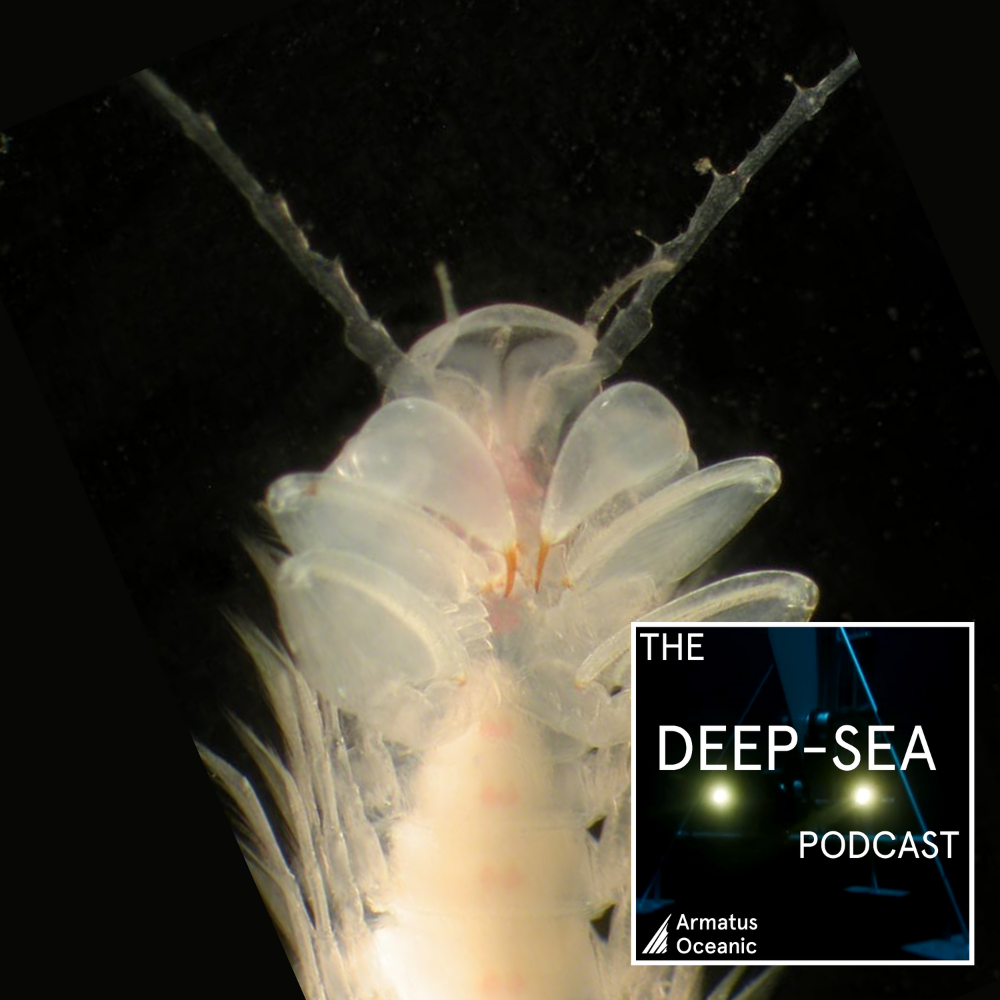
Ep 27027 – Cave biology with Thomas Iliffe
Full episode notes With the Professor out at sea, Thom goes off the rails and finally gets his answers on cave biology. What are the similarities and differences between the deep-sea and cave ecosystems? How are they linked? Do we know more about the moon than cave biolo…. just kidding! We speak to the legendary Professor Thomas Iliffe, who has shaped the field of biospeleology (cave biology); discovering over 250 species, and 3 new orders (now you don’t hear that every day)! He talks us through the formation of these habitats, what dive surveys are really like, and how to discover the most fascinating of organisms. We also hear from Martin Pollizotto, a listener (and expert cave diver) on bioluminescence in cave systems (or a lack thereof). We had a lot of deep-sea news this month! New species are being discovered, Alvin is back in the water breaking previous depth records, we have new tech AND some interstellar news! We announce yet another exciting spin-off, The Deco-Stop, where we plan on chatting to guests about the more human side of science. We heard from listeners that they are fascinated by scientists as people and the stories they have to tell, so we’re excited to open up the space to talk about scientists as individuals, and the topics where science interacts with human issues. Check out our podcast merch! Which now includes Alan’s beloved apron. Feel free to get in touch with us with questions or you own tales from the high seas on: [email protected] We’d love to actually play your voice so feel free to record a short audio note! We are also on Twitter: @DeepSeaPod, @ArmatusO Facebook: DeepSeaPodcast, ArmatusOceanic Instagram: @deepsea_podcast, @armatusoceanic Read the show notes and find out more about us at: www.armatusoceanic.com Glossary Anchialine - Meaning “near the sea” in Greek, an anchialine pool is a landlocked body of water connected to the ocean via underground caves. Blind cave fish - fish found living in deep caves with no eyes and usually no pigment. Cenote - An underground cave system in Mexico. Epigenetics - the study of how your behaviours and environment can affect the way your genes work. Halocline - A vertical zone in the water column where the salinity changes rapidly from less saline to more saline (in caves this means the more dense salt water sits below the less dense fresher water). Hermaphroditic - Possessing both male and female reproductive organs. Order - (taxonomy) a way of giving organising species with other closely related species. Remipede - A class of blind crustaceans found in marine caves. Yucatan – A region of Mexico famous for its cenotes. Links Tom’s work in TV Netflix Alien Worlds, Episode 1 (Atlas) National Geographic Drain the Bermuda Triangle (starting @ 19:40) Christmas Island Cave Diving Expedition Tom’s Published Research Bermuda’s Walsingham Caves: A Global Hotspot for Anchialine Stygobionts, Diversity 13(8), 352; https://doi.org/10.3390/d13080352 Monsters in the dark: systematics and biogeography of the stygobitic genus Godzillius (Crustacea: Remipedia) from the Lucayan Archipelago, European Journal of Taxonomy, 751(1), 115-139; https://doi.org/10.5852/ejt.2021.751.1383 Anchialine biodiversity in the Turks and Caicos Islands: New discoveries and current faunal composition, International Journal of Speleology, 49(2):71-86; https://digitalcommons.usf.edu/ijs/vol49/iss2/1/ Development of anchialine cave habitats and karst subterranean estuaries since the last ice age, Scientific Reports 9:11907; https://www.nature.com/articles/s41598-019-48058-8 California Dreamin’ - The Mamas & The Papas Youtube https://youtu.be/oU6uUEwZ8FM Spotify https://open.spotify.com/track/4s6LhHAV5SEsOV0lC2tjvJ Calcified deep sea infauna can be imaged with 3D acoustic coring system It turns out sponges sneeze! New species of deep sea isopod discovered Paper Researchers discover up to 39 new species Paper Equipment rescue reveals the biggest avalanche ever recorded on earth. Alvin is back in the water after its refit New area of hydrothermal vents found off of the coast of Mexico Scientists start the search for an interstellar meteor at the bottom of the ocean Credits Theme – Hadal Zone Express by Märvel Logo image Image courtesy of Thomas Iliffe
PRESSURISED: 001 –The moon analogy
bonusOur short and to the point PRESSURISED version of episode 1. If you don't have time for the full episode and want to get right to the science without any of our waffle, this is the place to be! Read the show notes and find the full episode here: https://www.armatusoceanic.com/podcast/episode1 In the very first episode of The Deep-Sea Podcast we let you know who we are and why we felt the world really needed a podcast about the deep sea. Alan rants about how the statement ‘we know more about the moon than the deep sea’ is not just a bad analogy, it’s plain wrong. Thom talks about how the quality of scientific writing is maintained. And our guest, Prof. Monty Priede, Editor-in-Chief of the scientific journal Deep-Sea Research Part I, talks about why there are no sharks in the abyssal zone. Check out our podcast merch! Which now includes Alan’s beloved apron. Feel free to get in touch with us with questions or your own tales from the high seas on: [email protected] We’d love to actually play your voice so feel free to record a short audio note! We are also on Twitter: @DeepSeaPod, @ArmatusO Facebook: DeepSeaPodcast, ArmatusOceanic Instagram: @deepsea_podcast, @armatusoceanic Read the show notes and find out more about us at: www.armatusoceanic.com Links Here are Monty’s open-access paper on the absence of sharks from the deeper ocean And his book, Deep-Sea Fishes: Biology, Diversity, Ecology and Fisheries. Credits Theme – Hadal Zone Express by Märvel
PRESSURISED: 026 – Vision in the deep sea with Justin Marshall
bonusOur short and to the point PRESSURISED version of episode 26. If you don't have time for the full episode and want to get right to the science without any of our waffle, this is the place to be! Read the show notes and find the full episode here: https://www.armatusoceanic.com/podcast/026-vision After recovering from you-know-what last episode, we’re excited to complete our open-water/pelagic trilogy with this week’s guest Professor Justin Marshall. Justin is an expert on all things vision, and talks us through all of the intricacies and oddities of vision in the deep sea. We discuss how fish eyes have evolved in order to adapt to the darkness of the deep, and how exactly they are able to see bioluminescence. Justin’s research has been highly influential, so we ask him more about his discoveries of mantis shrimp vision, and how he found out that cephalopods were colour-blind! We also couldn’t let him leave without getting some of the stories from his time living in the underwater habitat for weeks, and how this led to somewhat horrifying fungal consequences. The deep sea has seen a flurry of activity this month with lots of news to cover! MBARI has released a fascinating new video of a deep-sea squid brooding eggs. We cover some more paleo-news with surprising historical deep-sea temperatures and the discovery of new brine pools in the Red Sea. It wouldn’t be the Deep-Sea Podcast without checking in with Don Walsh as he talks us through the history of submarine windows. And we also hear from a listener and find out how snailfish got their name. Check out our podcast merch! Which now includes Alan’s beloved apron. Feel free to get in touch with us with questions or your own tales from the high seas on: [email protected] We’d love to actually play your voice so feel free to record a short audio note! We are also on Twitter: @DeepSeaPod, @ArmatusO Facebook: DeepSeaPodcast, ArmatusOceanic Instagram: @deepsea_podcast, @armatusoceanic Glossary Abyssopelagic – open water 4-6 km (13,000 to 20,000 ft) deep Bathypelagic – also known as the midnight zone, open water roughly 1-4 km (3,300-13,000 ft) deep Bathytheuthis berryi – A deep sea squid which has been observed brooding eggs Euphotic zone – the surface and well-illuminated zone Hadalpelagic – open water >6 km deep Mesopelagic – also called the twilight zone, starts where 1% of light reaches and ends where there is none, roughly 200-1,000 m (656-3,280 ft) deep Pelagic – open ocean, away from the shore and the bottom Photic zone – the depth that light penetrates Rod/Cone cells – two types of photoreceptors which are used by animals to detect light to be able to ‘see’. Underwater habitat – A structure created to allow people to live underwater for extended periods. Often used for research by aquatic biologists. Links Justin's Research Group News article on the historical temperatures of the deep Atlantic ocean as warm as the Mediterranean Original article published in Science on the historical Mediterranean-like temps of the deep sea MBARI capture incredible video of a brooding squid, Bathytheuthis berryi New brine pool discovered in the Red Sea https://www.sciencedaily.com/releases/2022/07/220712102631.htm Scientists discover the reason why deep-sea corals fluoresce The ‘milky’ Java sea is caught on camera Justin’s article on cephalopod colouration and sensitivity to light Credits Theme – Hadal Zone Express by Märvel Logo image Justin's Research Group
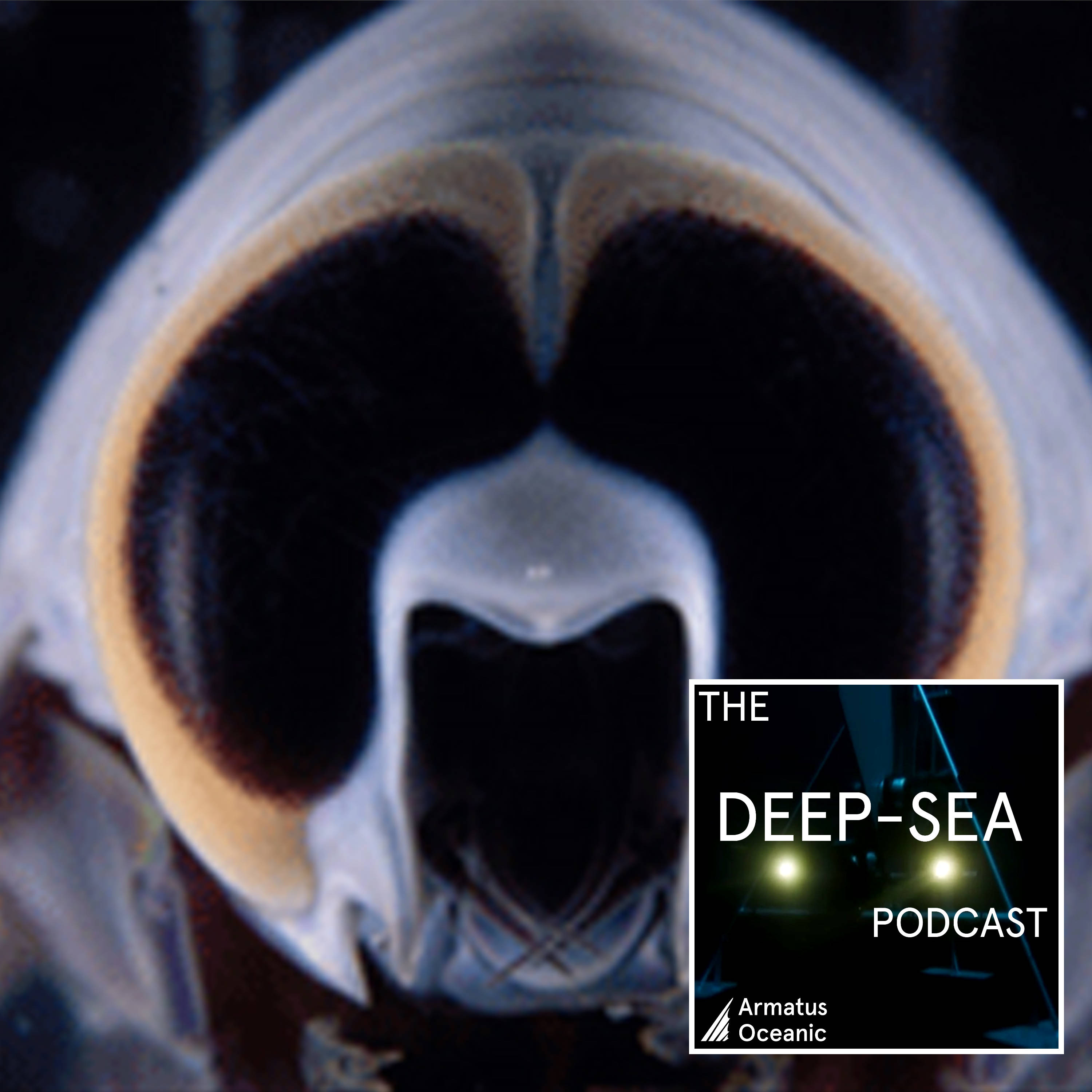
Ep 26026 – Vision in the deep sea with Justin Marshall
Read the show notes and find out more about us at: https://www.armatusoceanic.com/podcast/026-vision After recovering from you-know-what last episode, we’re excited to complete our open-water/pelagic trilogy with this week’s guest Professor Justin Marshall. Justin is an expert on all things vision, and talks us through all of the intricacies and oddities of vision in the deep sea. We discuss how fish eyes have evolved in order to adapt to the darkness of the deep, and how exactly they are able to see bioluminescence. Justin’s research has been highly influential, so we ask him more about his discoveries of mantis shrimp vision, and how he found out that cephalopods were colour-blind! We also couldn’t let him leave without getting some of the stories from his time living in the Atlantis underwater habitat for weeks, and how this led to somewhat horrifying fungal consequences. The deep sea has seen a flurry of activity this month with lots of news to cover! Our favourite cryptozoologist, Tyler Greenfield is at the epicentre of a monster-misunderstanding. Thom’s upset as yet another innocent fish is labelled the ‘ugliest creature ever seen’ by fishermen, but this time it’s a more familiar face. We also cover some more paleo-news with surprising historical deep-sea temperatures and the discovery of new brine pools in the Red Sea. Alan gives us an insight into his upcoming adventures at sea and we find out why he isn’t the biggest fan of documentarians. It wouldn’t be the Deep-Sea Podcast without checking in with Don Walsh as he talks us through the history of submarine windows. And we also hear from a listener and find out what snailfish and The Kardashians have in common… Check out our podcast merch! Which now includes Alan’s beloved apron. Feel free to get in touch with us with questions or your own tales from the high seas on: [email protected] We’d love to actually play your voice so feel free to record a short audio note! We are also on Twitter: @DeepSeaPod, @ArmatusO Facebook: DeepSeaPodcast, ArmatusOceanic Instagram: @deepsea_podcast, @armatusoceanic Glossary Abyssopelagic – open water 4-6 km (13,000 to 20,000 ft) deep Bathypelagic – also known as the midnight zone, open water roughly 1-4 km (3,300-13,000 ft) deep Bathytheuthis berryi – A deep sea squid which has been observed brooding eggs Coprophage – An animal that eats poop Cryptozoology – The study of species whose existence is rumoured or disputed. Euphotic zone – the surface and well-illuminated zone Hadalpelagic – open water >6 km deep Loch Ness – A loch (large freshwater lake) in the Scottish Highlands which is best known for the alleged sightings of the ‘Loch Ness Monster’ since 1933. Mesopelagic – also called the twilight zone, starts where 1% of light reaches and ends where there is none, roughly 200-1,000 m (656-3,280 ft) deep Monkfish – A wide-mouthed commonly-found fish who perhaps isn’t the most beautiful, but definitely could be considered tasty. Pelagic – open ocean, away from the shore and the bottom Photic zone – the depth that light penetrates Rod/Cone cells – two types of photoreceptors which are used by animals to detect light to be able to ‘see’. Underwater habitat – A structure created to allow people to live underwater for extended periods. Often used for research by aquatic biologists. Links We Build Spaceships Spotify YouTube Justin's Research Group Justin also has a citizen science program called Coral Watch which allows divers to report on coral health Tyler’s blog on cryptozoology and his Twitter @TylerGreenfieId News article dubbing yet another innocent fish as ‘the ugliest thing fisherman has ever seen’. News article on the historical temperatures of the deep Atlantic ocean as warm as the Mediterranean Original article published in Science on the historical Mediterranean-like temps of the deep sea MBARI capture incredible video of a brooding squid, Bathytheuthis berryi A paper on this squid New brine pool discovered in the Red Sea The ‘milky’ Java sea is caught on camera Justin’s article on cephalopod colouration and sensitivity to light Credits Theme – Hadal Zone Express by Märvel Logo image Justin's Research Group
PRESSURISED: 025 – Bioluminescence with Edie Widder
bonusOur short and to the point PRESSURISED version of episode 25. If you don't have time for the full episode and want to get right to the science without any of our waffle, this is the place to be! Read the show notes and find the full episode here: https://www.armatusoceanic.com/podcast/025-biolum Last episode we learned about the pelagic zone, the largest habitat on earth, a boundless 3D space where enormous migrations take place. We learned that this isn’t a world of darkness but rather one of biological light, where bioluminescence is used to attack, to defend and to communicate. While producing your own light may seem alien to us, it is likely the most common form of communication on the planet. To learn more about this world we speak with Edie Widder, who has studied bioluminescence for her whole career and used the same adaptations found in the animals to design her own equipment. She developed the Eye in the Sea, a camera system invisible to most deep-sea animals, and a lure which emulated a bioluminescent jellyfish, the e-jelly. The gear worked extremely well and along with a lot of behaviours observed for the first time this also captured the first footage of the giant squid, Architeuthis dux. In recent news we talk about how plate tectonics impact our climate, what we can learn from the evolution of cave animals and generating power from the thermocline. Don Walsh tells us why these bioluminescent creatures are a nuisance to submarines. Check out our podcast merch! Feel free to get in touch with us with questions or you own tales from the high seas on: [email protected] We’d love to actually play your voice so feel free to record a short audio note! We are also on Twitter: @DeepSeaPod, @ArmatusO Facebook: DeepSeaPodcast, ArmatusOceanic Instagram: @deepsea_podcast, @armatusoceanic Links Alien species invasion of deep-sea bacteria into mouse gut microbiota Plate tectonics and climate Paper Blind cave animal evolution Power generation from deep, cold water Edith (Edie) Widder Wikipedia ORCA Cookie-cutter shark paper Below the Edge of Darkness Credits Theme – Hadal Zone Express by Märvel Glossary Bioluminescence – Biologically generated light Cenozoic era – 50 million years ago when the earth started cooling Cretaceous hothouse – 145-66 million years ago where temperatures were 10°C Deep Worker – a small, single person sub Electronic jellyfish – A bioluminescent bait Esca – The lure on anglerfish Eye in the sea – A red light illuminated camera with a electronic jellyfish as bait Fermi bubbles – Listen to the end Magnapinna – The genus of the bigfin squid Marine snow – The biological material (bodies, poop and shells) singing into the deep sea Moribund – Something that is dying and cannot be saved Olm – A type of blind cave salamander Photomultiplier – Tech that boosts very weak sources of light Promachoteuthis – The genus of squid that was seen on Edie’s camera system Squid jig – A lure used to fish for squid Stoplight fish - Deep-sea dragonfishes of the genus Malacosteus that can both see and produce red light Thermocline – layer of sudden temperature change in the sea Tubeshoulder – Deep-sea fish with a specialised organ that squirts bioluminescent material Wasp suit – A deep-sea diving suit
PRESSURISED: 024 – The pelagic deep sea with Tracey Sutton
bonusOur short and to the point PRESSURISED version of episode 24. If you don't have time for the full episode and want to get right to the science without any of our waffle, this is the place to be! Read the show notes and find the full episode here: https://www.armatusoceanic.com/podcast/024-pelagic We have a confession to make. We talk a big game about how we are busting myths, tackling deep-sea tropes and showing the deep ocean as it really is… but we have been guilty of one of the big ones. The deep sea is not just the bottom! Most of the deep sea, in fact, most of the habitat of this planet is the huge open 3D environment of open water or ‘pelagic’ water. In this staggering volume the planets largest migration takes place twice a day. Animals are locked in an evolutionary arms race, using their own light to deceive and trick. Finding a meal is rare, finding a mate is rare and life is without boundaries. These factors have led to some truly wild evolution. We hear from Don about hunting for the 'deep scattering layer' (DSL) before we even knew what it was. In recent news we cover Edith Widder and her new book Below the Edge of Darkness, underwater GPS through the power of a pong, following the yellow brick road to meet the deep-sea wizard and some lovely new footage of a highfin dragonfish. Check out our podcast merch! Which now includes Alan’s beloved apron. Feel free to get in touch with us with questions or you own tales from the high seas on: [email protected] We’d love to actually play your voice so feel free to record a short audio note! We are also on Twitter: @DeepSeaPod, @ArmatusO Facebook: ArmatusOceanic Instagram: @deepsea_podcast, @armatusoceanic Read the show notes and find out more about us at: www.armatusoceanic.com Glossary Abyssopelagic – open water 4-6 km (13,000 to 20,000 ft) deep Aphotic zone – depths deeper than life penetrates Bathypelagic – also known as the midnight zone, open water roughly 1-4 km (3,300-13,000 ft) deep Benthic – associated with the bottom, how we usually think about the deep sea Deep Scattering Layer (DSL) – a ‘false bottom’ created on sonar by huge numbers of open water animals Dragonfish – deep-sea predators of the family Stomiidae Dysphotic zone – the depth that light still penetrates but photosynthesis is becoming unviable Euphotic zone – the surface and well illuminated zone Hadalpelagic – open water >6 km deep Mesopelagic – also called the twilight zone, starts where 1% of light reaches and ends where there is none, roughly 200-1,000 m (656-3,280 ft) deep Myctophids – Lanternfish, fish responsible for the biggest carbon movements on the planet Nictoepipelagic – The wink on the open sea. Great word for these vertical migrators Pelagic – open ocean, away from the shore and the bottom Photic zone – the depth that light penetrates Vertical migration – the twice daily migration of deep-sea animals up to the surface to feed Links Tracey’s lab website The synthesis paper of a decade of research into the Deepwater Horizon disaster. Open access Carbon export model for mesopelagic fishes in the Gulf of Mexico Edith Widder Eye in the ocean Edith’s new book Vox podcast Underwater GPS Yellow-brick Road Credits Theme – Hadal Zone Express by Märvel
Ep 25025 – Bioluminescence with Edie Widder
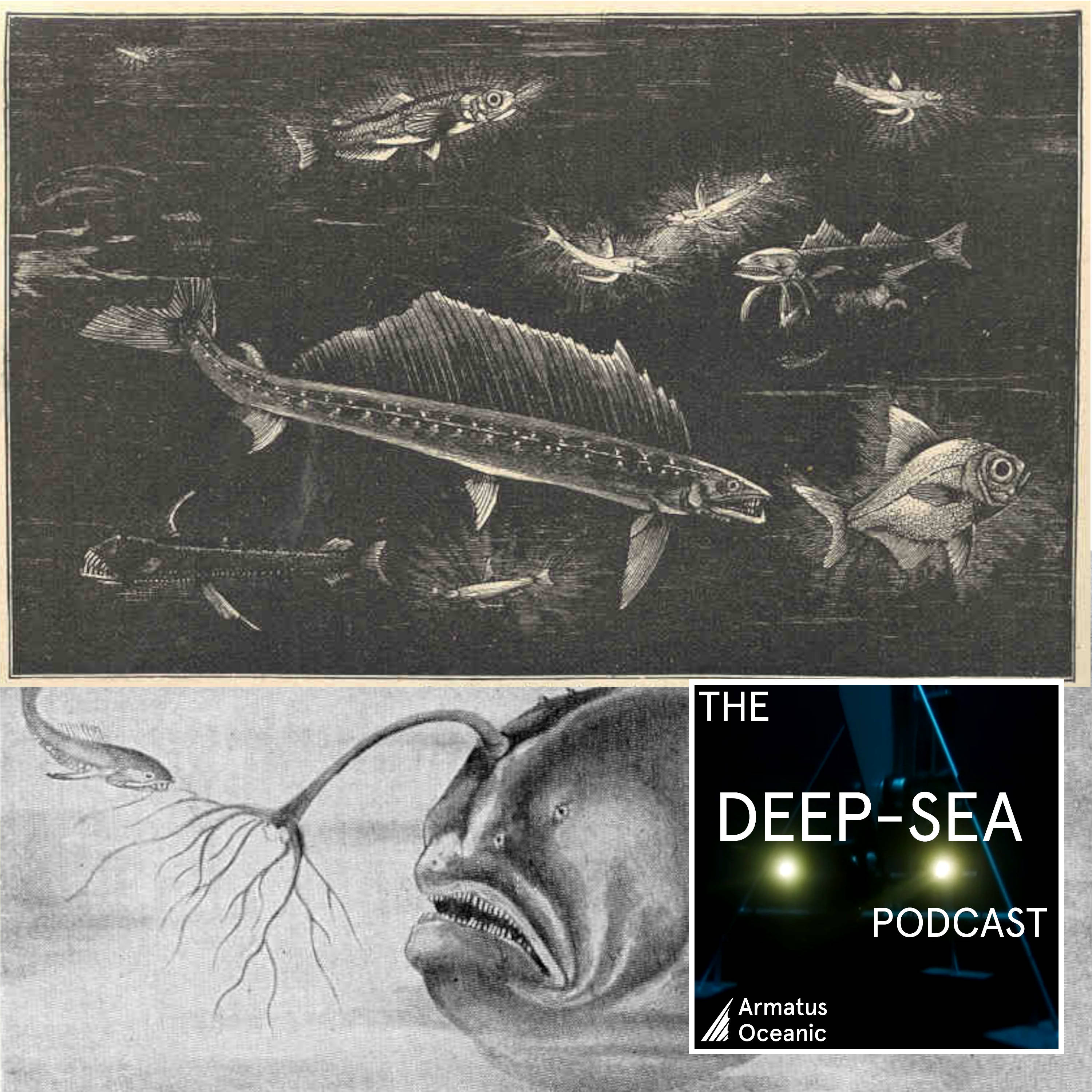
https://www.armatusoceanic.com/podcast/025-biolum Sorry that this episode isn’t the perfectly polished jewel that this show usually is. Thom’s family got a visit from both COVID and chickenpox so there hasn’t been the time or energy to edit as well as he usually does. But we couldn’t abandon you without an episode this month as some great stuff is still covered. Last episode we leaned about the pelagic zone, the largest habitat on earth, a boundless 3D space where enormous migrations take place. We learned that this isn’t a world of darkness but rather one of biological light, where bioluminescence is used to attack, to defend and to communicate. While producing your own light may seem alien to us, it is likely the most common form of communication on the planet. To learn more about this world we speak with Edie Widder, who has studied bioluminescence for her whole career and used the same adaptations found in the animals to design her own equipment. She developed the Eye in the Sea, a camera system invisible to most deep-sea animals, and a lure which emulated a bioluminescent jellyfish, the e-jelly. The gear worked extremely well and along with a lot of behaviours observed for the first time this also captured the first footage of the giant squid, Architeuthis dux. In recent news we talk about how plate tectonics impact our climate, what we can learn from the evolution of cave animals and generating power from the thermocline. We hear from a listener about their bigfin squid archive. Larkin drops by to tell us what a ‘Tron Dolphin’ and Don Walsh tells us why those same Tron Dolphins are a nuisance to submarines. Feel free to get in touch with us with questions or you own comments on: [email protected] We’d love to actually play your voice so feel free to record a short audio note! We are also on Twitter: @DeepSeaPod, @ArmatusO Facebook: ArmatusOceanic Instagram: @deepsea_podcast, @armatusoceanic Read the show notes and find out more about us at: www.armatusoceanic.com Check out our podcast merch! Glossary Bioluminescence – Biologically generated light Cenozoic era – 50 million years ago when the earth started cooling Cretaceous hothouse – 145-66 million years ago where temperatures were 10°C Deep Worker – a small, single person sub Electronic jellyfish – A bioluminescent bait Esca – The lure on anglerfish Eye in the sea – A red light illuminated camera with a electronic jellyfish as bait Fermi bubbles – Listen to the end Magnapinna – The genus of the bigfin squid Marine snow – The biological material (bodies, poop and shells) singing into the deep sea Moribund – Something that is dying and cannot be saved Olm – A type of blind cave salamander Photomultiplier – Tech that boosts very weak sources of light Promachoteuthis – The genus of squid that was seen on Edie’s camera system Squid jig – A lure used to fish for squid Stoplight fish - Deep-sea dragonfishes of the genus Malacosteus that can both see and produce red light Thermocline – layer of sudden temperature change in the sea Tubeshoulder – Deep-sea fish with a specialised organ that squirts bioluminescent material Wasp suit – A deep-sea diving suit Links Mötley Crüe - Hooligan's Holiday Video Spotify Finding the Samule B Roberts, deepest wreck. Tyler Greenfield on Twitter Alien species invasion of deep-sea bacteria into mouse gut microbiota Plate tectonics and climate Paper Blind cave animal evolution Power generation from deep, cold water Magnapinna Archive Edith (Edie) Widder Wikipedia ORCA Ted Talk Cookie-cutter shark paper Below the Edge of Darkness Larkin’s YouTube channel, Instagram and TicTok Credits Theme – Hadal Zone Express by Märvel Logo image Public domain images Holder, Charles Frederick (1892) Along the Florida Reef, New York City, NY: D. Appleton and Company, p. 263 Jordan, David Starr (1907) Fishes, New York City, NY: Henry Holt and Company
Ep 24024 – The pelagic deep sea with Tracey Sutton
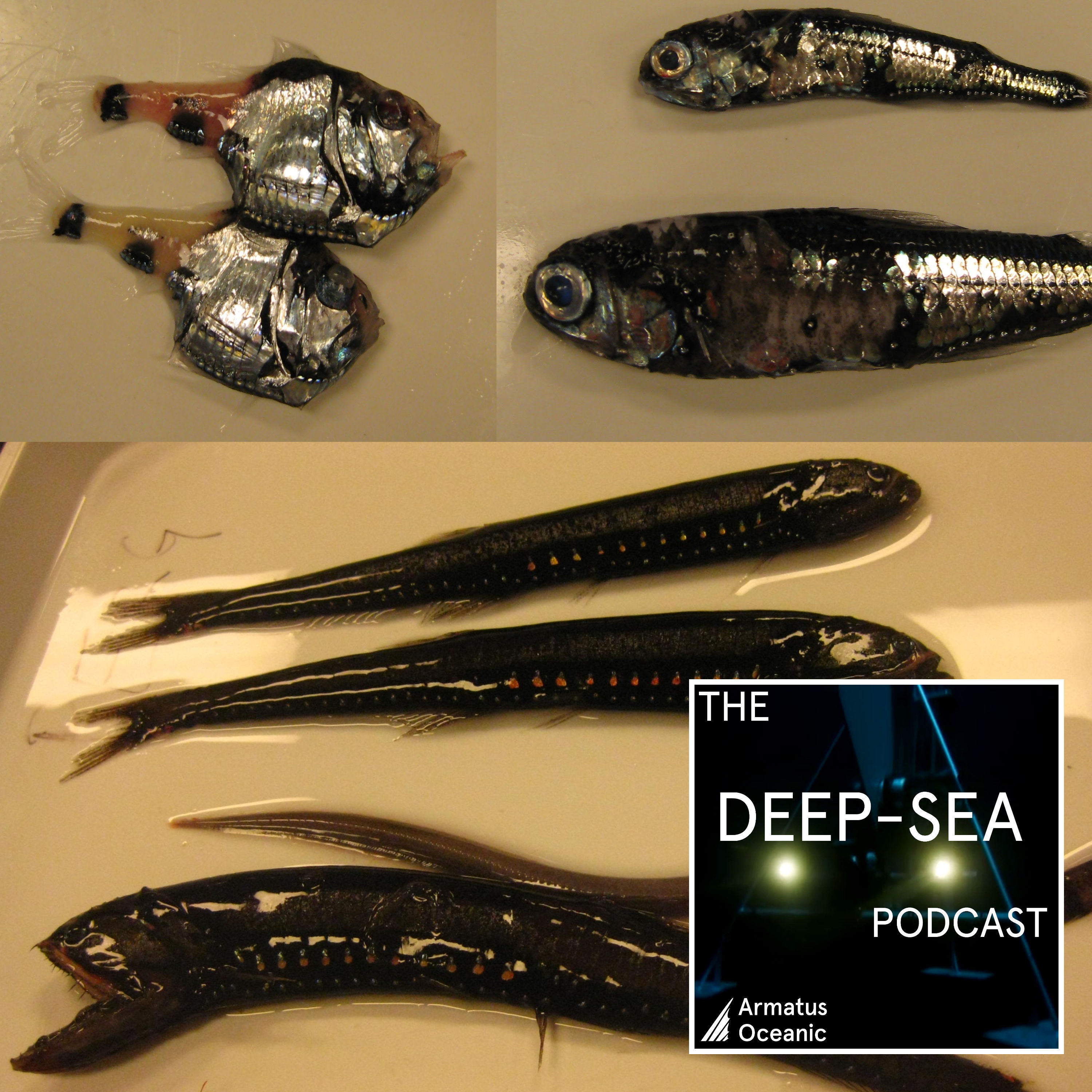
https://www.armatusoceanic.com/podcast/024-pelagic We have a confession to make. We talk a big game about how we are busting myths, tackling deep-sea tropes and showing the deep ocean as it really is… but we have been guilty of one of the big ones. The deep sea is not just the bottom! Most of the deep sea, in fact, most of the habitat of this planet is the huge open 3D environment of open water or ‘pelagic’ water. In this staggering volume the planets largest migration takes place twice a day. Animals are locked in an evolutionary arms race, using their own light to deceive and trick. Finding a meal is rare, finding a mate is rare and life is without boundaries. These factors have led to some truly wild evolution. We also tackle a couple of listener questions: Whatever happened to the word ‘nictoepipelagic’ which seems to have vanished from scientific writing? We also discuss parasites in the deep sea, how can they find a specific host when the animals are so spread out? We hear from Don about hunting for the 'deep scattering layer' (DSL) before we even knew what it was and find out where Larkin has been from her new vessel on the Gulf of Mexico. In recent news we cover Edith Widder and her new book Below the Edge of Darkness, underwater GPS through the power of a pong, following the yellow brick road to meet the deep-sea wizard and some lovely new footage of a highfin dragonfish. We also find ourselves talking about how the deep sea is portrayed in children’s books and learn that apparently zesty citrus and floral smells are associated with the deep ocean… who knew?! Feel free to get in touch with us with questions or you own tales from the high seas on: [email protected] We’d love to actually play your voice so feel free to record a short audio note! We are also on Twitter: @DeepSeaPod, @ArmatusO Facebook: ArmatusOceanic Instagram: @deepsea_podcast, @armatusoceanic Read the show notes and find out more about us at: www.armatusoceanic.com Glossary Abyssopelagic – open water 4-6 km (13,000 to 20,000 ft) deep Aphotic zone – depths deeper than life penetrates Bathypelagic – also known as the midnight zone, open water roughly 1-4 km (3,300-13,000 ft) deep Benthic – associated with the bottom, how we usually think about the deep sea Deep Scattering Layer (DSL) – a ‘false bottom’ created on sonar by huge numbers of open water animals Dragonfish – deep-sea predators of the family Stomiidae Dysphotic zone – the depth that light still penetrates but photosynthesis is becoming unviable Euphotic zone – the surface and well illuminated zone Hadalpelagic – open water >6 km deep Mesopelagic – also called the twilight zone, starts where 1% of light reaches and ends where there is none, roughly 200-1,000 m (656-3,280 ft) deep Myctophids – Lanternfish, fish responsible for the biggest carbon movements on the planet Nictoepipelagic – The wink on the open sea. Great word for these vertical migrators Pelagic – open ocean, away from the shore and the bottom Photic zone – the depth that light penetrates Vertical migration – the twice daily migration of deep-sea animals up to the surface to feed Links Tracey’s lab website The synthesis paper of a decade of research into the Deepwater Horizon disaster. Open access Carbon export model for mesopelagic fishes in the Gulf of Mexico Rosetta stoned by TOOL Youtube Spotify Edith Widder Eye in the ocean Edith’s new book Vox podcast Underwater GPS Yellow-brick Road Live stream Best-of reel Dragonfish and the Video Rainbowfish discovers the deep sea Deep Dive into Deep Sea Larkin’s YouTube channel and Instagram Credits Theme – Hadal Zone Express by Märvel Logo image Some of Thom’s pics from the Mid-Atlantic
Ep 23023 – Keeping deep-sea animals with The Monterey Bay Aquarium
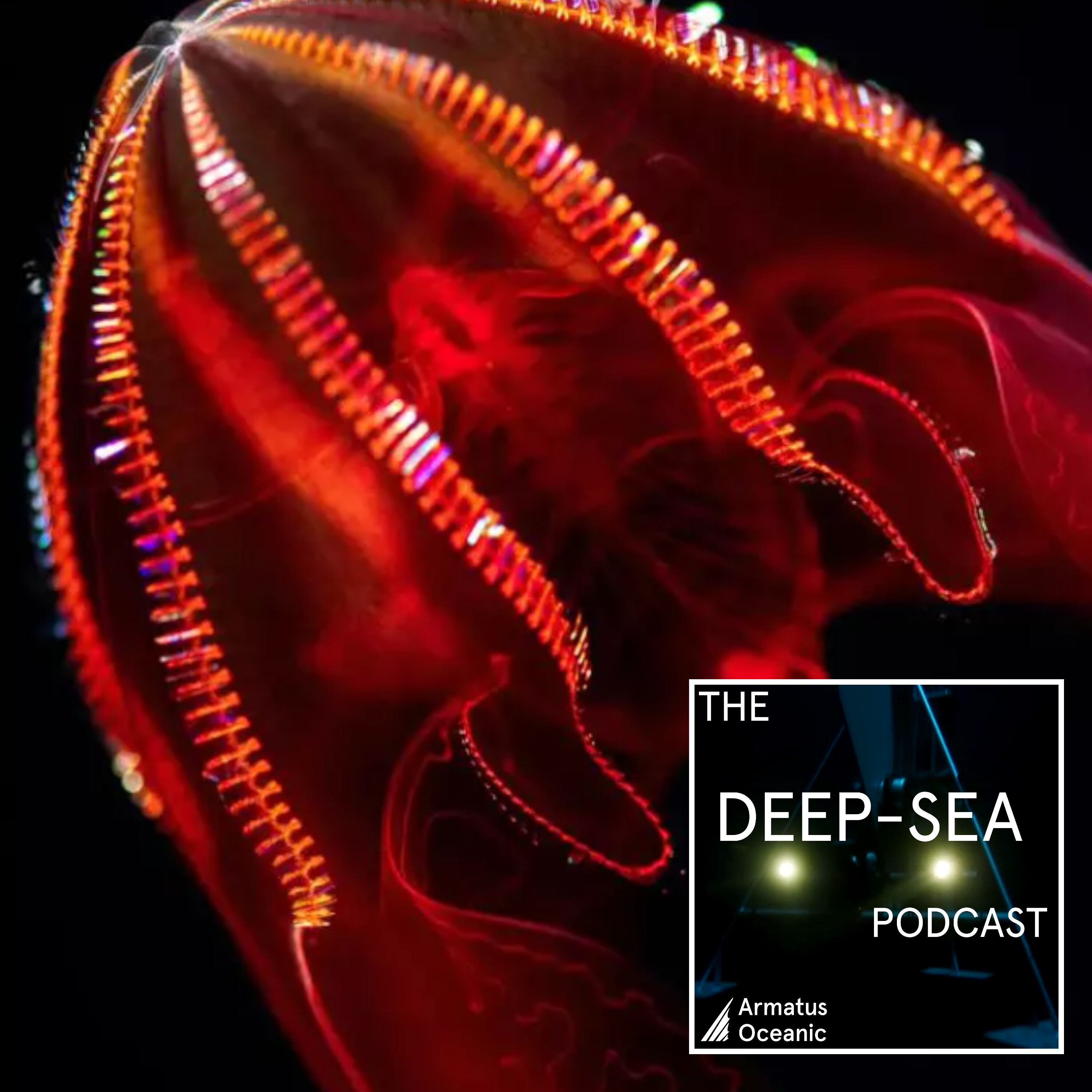
https://www.armatusoceanic.com/podcast/023-deep-aquaria Can we safely bring deep-sea organisms to the surface and keep them alive? Certain species, such as the giant isopods and giant Japanese spider crabs have been kept in aquaria in the past but the number of animals we can maintain long-term is quite small. The Monterey Bay Aquarium’s new Into the Deep exhibition has succeeded in keeping animals never before put on public display, some are even new to science. Not only that, but they have even had some success in getting them to reproduce! Figuring out what conditions these animals need and observing them over long periods will allow us to learn huge amounts about animals we usually only get a glimpse of. We talk with aquarists Ellen Umeda and Michelle Kaiser and life-support engineer Brian Maurer about the years of work that went into keeping these animals and giving the public a very personal deep-sea experience. In the rest of the episode, Alan is back in the UK and we get to record in ‘the very quiet room’. We discuss data sharing and the complexities of charging for data that may otherwise not be taken, visiting the Explorers Club in New York and language barriers within science. I also call Alan’s bluff and present him with a lovely Deep-Sea Podcast apron which he then proceeds to wear in Hell’s Kitchen in New York. We hear from a listener about how the podcast helped them through a difficult time and answer a listener question about the danger of entanglement for undersea vehicles. If you’d like to record a question or comment please do and send it to the email below. We would love to include you on the show. Check out our podcast merch! Which now includes Alan’s beloved apron. Feel free to get in touch with us with questions or you own tales from the high seas on: [email protected] We are also on Twitter: @DeepSeaPod, @ArmatusO Facebook: ArmatusOceanic Instagram: @deepsea_podcast, @armatusoceanic Glossary AUV – Autonomous Underwater Vehicle Gravid – the animal is full of eggs and getting close to spawning Laminar flow – a simple water flow, no eddies ROV – Remotely Operated Vehicle Spawning – release of eggs and sperm Vertical migrator – animals that rise up from the deep sea at night to feed at the surface Links Our new merch! Let ‘Em Go by The Wildhearts Spotify Video The Explorers Club TMAO in molecular machines Mapping the ocean floor Scientific Tower of Babel Into the Deep: Aquarium YouTube Channel Online exhibition Deep-sea adaptation story with video Bioluminescence story with video Animal information story Exhibition development with life support diagram Credits Theme – Hadal Zone Express by Märvel Logo image Bloody-belly comb jelly – Monterey Bay Aquarium

Ep 22022 – Live-streaming the deep with Kasey Cantwell
https://www.armatusoceanic.com/podcast/022-dive-streaming One of the most exciting parts of our job is going to places that no one has ever been before and seeing things that no one has ever seen. It turns out, we were making that far harder than it needs to be, we can do all this from home! Several of the big names in deep-sea exploration live-stream (or dive-stream if we’re being cute). With just a few seconds delay, you can see deep-sea exploration as it happens and may be present for very significant finds. You never know what you’re going to find down there. The big players in this space are the Schmidt Ocean Institute, Nautilus Live from the Ocean Exploration Trust and Ocean Exploration/Okeanos Explorer from NOAA. We are lucky enough to chat with Kasey Cantwell, the Operations Chief of the NOAA Ocean Exploration Expeditions and Exploration Division. We talk about the amazing opportunities this new way of doing science presents. From allowing 300 experts to take part, to swapping out your expert team when you find something unexpected and even the physical and societal barriers that can be removed. But it’s not just about getting science done, it’s about sharing these experiences with everyone. Online communities are forming around these streams and illustrations, poetry and memes are just as valid outputs. In recent news we hear how preparations are going for Alan’s upcoming cruise. We talk about the octopus garden providing a nice warm spot to brood eggs, living underwater for long periods of time and the evolution of early vamperoids. No episode would be complete without our regular check-in with Don Walsh to hear about his involvement with the early days of ROV and AUV research. Check out our podcast merch! Please do send in any pics of you wearing the merch. We find the idea of real people in the actual world wearing this so surreal! We also have a UK-based job advertised. Why not come and help us with the podcast and some other fun stuff. More details here. Feel free to get in touch with us with questions or you own tales from the high seas on: [email protected] We are also on Twitter: @ArmatusO Facebook: ArmatusOceanic Instagram: @armatusoceanic Read the show notes and find out more about us at: www.armatusoceanic.com Glossary AUV – Autonomous Underwater Vehicle Berth – Beds available onboard a ship basically Manganese nodule – potato shaped balls of metal that form on the seabed, the focus of deep-sea mining ROV – Remotely Operated Vehicle Taxonomist – A specialist in categorising a specific group of species. Telepresence – Live-streaming what you’re doing on the internet Links Our new merch! Tangaroa by Alien Weaponry YouTube Spotify Octopus brooding in warm water Article Conference abstract Living under the sea Fabien Cousteau (Jacques Cousteau’s grandson) undersea live-in labs Aquarious undersea lab Two weeks under the sea Earliest vampire squid Article Paper Discovery of Shackleton’s ship, the Endurance Paper that predicted that it would be intact The Galathea Legacy - book - JohnQuentin.com Start dive-streaming yourself! NOAA Ocean Exploration Schmidt Ocean Institute Nautilus Live Become part of the online community! Livestream Oceanographic Discord Look out for expedition names as hashtags on Twitter Credits Theme – Hadal Zone Express by Märvel Logo image Alan’s new lander systems being loaded aboard “We found a deep sea fish and told it it was beautiful” - Live-stream inspired art by C. B. Sorge - cbsorgeartworks.tumblr.com

Ep 21021 – Collaborative data repositories and AI with Kakani Katija
We have often talked about how difficult it is the get data from the deep sea… but would you believe that the bottleneck to our understanding of the deep ocean, at least as far as visual data, is processing those images? Turning a picture of the deep sea into a list of species, habitat type, sediment type etc. is a time-consuming process that requires a wide range of skilled people. Due to time/funding constrains a lot of valuable information is lost. A team looking at a specific question will have lots of information in their data that other teams could use. A picture is worth a thousand data points. We chat with Dr Kakani Katija, the co-founder of FathomNet, an open-source repository for labelled deep-sea imaging data. The platform is still in beta but it is hoped that it will allow scientists to easily and usefully share their amassed data in a single and easily searchable place. But what about that processing bottleneck? The tech-savvy listener may have noticed that a massive collection of labelled image data is exactly the sort of thing you need to train a Machine Learning or Deep Learning algorithm. Can we automate a lot of the time-consuming image processing and let the experts focus on the new and unusual stuff? It’s at this cutting edge that things get exciting and we may be at the cusp of a marine science renaissance. We have all our usual nonsense. Alan continues to find things in Australia that want to kill him. We answer some listener questions on deep-sea fish memory and Thom and Alan’s origin story. We also hear from Don about his time on the cruise ships. A decidedly un-deep-sea segment but it could be considered ‘adventure’ on the high seas. We also launch our podcast merch! Please do send in any pics of you wearing the merch. We find the idea of real people in the actual world wearing this so surreal! Feel free to get in touch with us with questions or you own tales from the high seas on: [email protected] We are also on Twitter: @ArmatusO Facebook: ArmatusOceanic Instagram: @armatusoceanic Read the show notes and find out more about us at: www.armatusoceanic.com Glossary Artificial Intelligence (AI) – A science dedicated to making machines think in an intelligent way, mirroring a biological brain. Data pipeline – A path that raw data follows to become useful information. Deep Learning – a more complex subset of ML that mirrors the way a brain works Machine Learning (ML) – computers learning to perform a task without being explicitly programmed to do so ML/AI model or algorithm – A model that has been trained on real data and can now process new data itself. Online Repository – A database stored online so that people can access it from anywhere Open Source – A publicly accessible design that people can freely repurpose and adapt. Visual data – photos or video as a form of scientific data Links Our new merch! Abyssal EDNA article and Paper Our Angola fish paper and the Open access version Kakani’s Twitter FathomNet goodies The FathomNet website – have an explore of the labelled deep-sea critter data FathomNet GitHub – take a peek under the hood or even get involved FathomNet articles with tutorials/explanations Helpful video tutorials Paper NOAA Science Seminar, 8 March 2022 1200-1300 PST (UTC-8) Register now! FathomNet Workshop, 31 March & 1 April 2022 0800-1100 PST (UTC-8) Register now! Internet of Elephants (gamifying processing camera-trap data) Beyond Blue (game) Credits Theme – Hadal Zone Express by Märvel Logo image An image of the small-eyed rabbitfish (Hydrolagus affinis) we took off West Africa Some of our new merch!
Ep 20020 – Love in the deep sea with Craig Young
It’s February, the month of love and there’s love in the deep ocean too. We talk reproductive strategies in the deep sea with Professor Craig Young, Dr Autun Purser and Dr Mike Vecchione. How do you find a mate in the sparsely populated deep ocean? How can egg and sperm meet when you are fixed growing on a rock? How can your babies disperse and find a suitable habitat, especially if you live in a rare habitat like a hydrothermal vent? We find the solutions to all these problems and more. We also have our regular contributors. Dr Don Walsh shares how a dolphin entourage isn’t a good thing if you’re trying to be a quiet and sneaky sub. Larkin also shares how it’s difficult to keep romance on the DL when you live in the tight confines of a ship, people do love to gossip. In recent news, we announce the launch of Alan’s Deep-Sea Research centre but get distracted by the retired yob of a bird, the Kookaburra. We also consider starting a side-hustle selling dirty deep-sea bottled water and discuss a massive icefish nesting ground found in Antarctica. We answer Maya’s listener question, ‘are there deep-sea-sons?’ Do they even know it is the month of romance? Feel free to get in touch with questions or you own tales from the high seas on: [email protected] We are also on Twitter: @ArmatusO Facebook: ArmatusOceanic Instagram: @armatusoceanic Read the show notes and find out more about us at: www.armatusoceanic.com Glossary Abyssal plain – the wide-open spaces of the deep sea, most of the planet Filter feeder – animal that feeds by filtering the water e.g., sponge Gametes – the reproductive cells, eggs and sperm Gonad – the organ that produces the gametes Hadal trench – the deep-sea trenches more than 6 km deep Hermaphrodite – both male and female simultaneously Sessile – animals that cannot move (opposite of mobile) Links Launch of Minderoo-UWA Deep-Sea Research Centre Deep-Ocean bottled water First humans to the bottom of the Atacama Trench Massive icefish breeding ground paper Seasons in the Abyss by Slayer Ecosystems of the World – Craig has a great chapter on reproduction in this book Paper - Estimating dispersal distance in the deep sea: challenges and applications to marine reserves Paper - Reproduction, Larval Biology, and Recruitment of the Deep-Sea Benthos Paper - Hadal snailfish reproduction Larkin’s YouTube channel My Salty Sea Life Credits Theme – Hadal Zone Express by Märvel Logo image Deep-sea Lizardfish, Bathysaurus ferox Icefish nests

Ep 19019 - We call Mike Vecchione on the squid-phone
As promised in the Christmas special, we call the ‘squid-phone’ – a special line used by scientists globally when they seem something strange and squiddy. On the other end of that line is Mike Vecchione, the expert on cephalopods. We talk giant and colossal squid (to audible groans from Mike); the bigfin squid (Magnapinna), most famous for being the squid with the long trailing arms that’s often used as an example of terrifying deep-sea creatures, but also a species, genus and Family that Mike described and would love more sightings of. In recent news, we worry about deep-ocean circulation and its impact on climate. Reflect on a year of amazing sightings from Monterey Bay Aquarium Research Institute (MBARI) including the giant phantom jelly (Stygiomedusa gigantea) and barreleye fish (Macropinna microstoma). We also address a snailfish imposter. The world’s deepest fish, the Mariana snailfish is more often than not represented by an image of a totally different species that happens to have a more attractive headshot. Prema Arasu presents her poem; An Ode to the Blobfish, in honour of another species dominated by one misleading photo. Our regular contributors drop by too: Larkin – our resident deckhand tells the tale of an impromptu squid dissection and Don Walsh reflects on piloting the super-deep diving bathyscaphe Trieste in a time when giant squid attack was still a worry. An Ode to the Blobfish by Prema Arasu O Psychrolutes marcidus! O gelatinous shape! Thou art the ravish’d bride of deep-sea trawlers— Unassuming foster child of the timeless abyss Untimely ripp’d from thy diatomaceous womb Fearful fishermen rejoice at thy sacrifice An Antipodean altar attended by inchoate priest— Then once by man and angels to be seen, In roaring thou shall rise and on the surface die. Were I anointed and dragged to your Hadal habitus Flayed and deconsecrated at thy mucilaginous prow— Were I to partake in salt’d communion With thou, we would be one and the same. Hideousness is a lie, lies hideousness, that is all We know on land, and all we need to know. Feel free to get in touch with us with questions or you own tales from the high seas on: [email protected] We are also on Twitter: @ArmatusO Facebook: ArmatusOceanic Instagram: @armatusoceanic Read the show notes and find out more about us at: www.armatusoceanic.com Correction The Permian-Triassic extinction was not 98% of marine life, 96% of often cited but 81% seems the most accurate current estimate. Links Check out this fantastic book that Mike co-authored if you would like to learn more about cephalopods Larkin’s YouTube channel My Salty Sea Life More info about Prema Arasu Deep-ocean circulation paper The piezothermal effect The polar see-saw MBARI have had a great year for filming deep-sea critters and have a great best-of reel on YouTube. Pink hand fish Football fish Falkor mural Soft robotic snailfish Blue Planet II poster Nautilus Magazine Alan's interview Global assessment of hadal fishes – our big paper Abyssobrotula galatheae – previous deepest fish from a single report Bony-eared assfish Top 5% of podcasts Lonesome marine biologist Nando Recent bigfin squid video Zappa jellyfish Observational articles: a tool to reconstruct ecological history based on chronicling unusual events by Ferdinando "Nando" Boero Deepest squid paper Deepest octopi paper The Pteropods – swimming snails Oegopsida or Oceanic squids, the true squid Myopsids or coastal squids, could be considered true squid Sepiolida the Bobtail squids Vampyroteuthis infernalis the vampire squid, more closely related to octopods Magnapinna sp. The bigfin squid, a charismatic and recently discovered family (the one's that creep everyone out!) My Octopus Teacher on Netflix Ramshorn squid (Spirula) The Serpent Project Credits Theme – Hadal Zone Express by Märvel Logo image The Atacama snailfish which is often published as the Mariana snailfish The long-arm squid filmed by DSV Alvin, possibly an adult Magnapinna sp. Public Domain NOAA

Christmas Special 2 – We interview each other
bonusWe like to let our hair down a little for the Christmas episode and do something a little different. We recorded video this episode! You can find the video version of this podcast on our YouTube page. Me and Alan crack out some mulled wine and decide to interview each other for this episode. Things get a little off the topic of deep sea but it’s all in good fun (if a little dark at times). We won’t leave you totally without some deep-sea updates though. We still have our news section which includes new research into how sponges may be able to think, a deep-sea crawler that has been tirelessly surveying Station-M for seven years, a new species of deep-diving beaked whale, a new and really nice video of the creepy bigfin squid, can rockfish help us live longer and it turns out that Terry the fat shark is real. No episode would be complete without checking in with Don Walsh, who tells a story of a Christmas in the Western Antarctic… the far side, and Larkin who has her Christmas plans suddenly change while trying to leave her ship in Mexico. Whatever you celebrate at this time of year, we hope you have a wonderful time. See you all again in the new year. Feel free to get in touch with us with questions or you own tales from the high seas on: [email protected] We are also on Twitter: @ArmatusO https://twitter.com/ArmatusO Facebook: ArmatusOceanic https://www.facebook.com/ArmatusOceanic Instagram: @armatusoceanic https://www.instagram.com/armatusoceanic/ Read the show notes and find out more about us at: www.armatusoceanic.com Glossary Box core: A large sediment sampling device that takes one huge sample Grimpoteuthis: the dumbo octopuses Hadal: Deeper than 6000 m Holotype: a single specimen expressly designated as the name-bearing “type” Lander: a freefalling vehicle which sinks to the seabed and returns to the surface by dropping ballast MBARI: Monterey Bay Aquarium Research Institute Multi core: A large sediment sampling device that takes multiple smaller samples Paratype: A specimen cited along with the type collection in the original description of a taxon ROV: Remotely Operated Vehicle Sunk Cost Fallacy: Sticking with a bad idea because you have already invested so much in it. Links Sponge neurons Benthic Rover II New beaked whale Paper New bigfin squid video Chunky shark Deep-sea rockfish longevity Paper Mammoth tusk Garfield phone beach Ray Troll Paleo Nerds Podcast Burial at sea Iron Maiden - Live After Death Larkin’s YouTube channel My Salty Sea Life Credits Theme – Hadal Zone Express by Märvel Sound effects from the BBC archive Logo image Terry the fat shark Our countdown timer at sea

Ep 18018 – Sound in the deep ocean with David Barclay
https://www.armatusoceanic.com/podcast/018-sound We think of the deep sea as an eerily quiet and spooky place but that isn’t completely true, animal communication, seismic activity, human noise and even the sound of rain and waves from 10 km above. We chat with undersea audio expert Dr David Barclay about the fascinating audio properties of the deep ocean. As we are talking audio data on an audio medium, lets have some fun with a game of ‘what can we grenad-hear’ where Thom tries to guess the deep-sea sound. We also have deep-sea news: India are developing their own 6 km rated human occupied vehicle (Samudrayaan); genetics links deep-sea shrimp with their planktonic juvenile stages; the HACON project explores the Aurora black smoker field at 4000 m/13,000 ft under the Arctic; we also reveal that a mysterious squid-like creature, was, in fact, a squid. We also discuss communication (through the medium of famous quotes). Are we losing the ability to actually engage and learn things from each other? Are we all just yelling at each other online from our respective teams? Not willing to really listen to the other side but rather ‘own them’ and drop the mic. In a pandemic of misinformation where a catchy meme can ruin, or even end, peoples lives do we have a duty to try to engage with people? What about the tole that takes on our own mental health? Don Walsh drops by with some amazing stories from his sub commander days. A life entirely dependent on listening and being quiet. We then have a ‘tale from the high seas’ from Larkin to finish things up. Feel free to get in touch with us with questions or you own tales from the high seas on: [email protected] We are also on Twitter: @ArmatusO https://twitter.com/ArmatusO Facebook: ArmatusOceanic https://www.facebook.com/ArmatusOceanic Instagram: @armatusoceanic https://www.instagram.com/armatusoceanic/ Read the show notes and find out more about us at: www.armatusoceanic.com Glossary CTD: Conductivity, temperature and depth sensor Gametes: sex or germ cells. Eggs and sperm Grenadier: another name for a rattail fish Hydrothermal vent: seawater heated by the earth flows out of the seabed Lander: Free-falling or pop-up vehicle. Sinks from the surface and comes up again by dropping ballast Refraction: the change in direction of a wave passing from one medium to another Sound channel: Also called the SOFAR channel, a horizontal layer of water in the ocean at which depth the speed of sound is at its minimum Links Alan’s new hadal centre: https://www.minderoo.org/deep-sea-research/ India’s deep sub: https://www.wionews.com/india-news/samudrayaan-indias-first-manned-deep-sea-probe-to-travel-6-km-under-water-425414 Matching deep-sea shrimp with their pelagic larva: https://www.mdpi.com/1424-2818/13/10/457/htm Giant squid like creature: https://www.timesnownews.com/the-buzz/article/viral-news-massive-squid-like-creature-larger-than-human-spotted-by-scientists-while-exploring-red-sea/822261 COP26 – Deep Sea World: https://youtu.be/0oSpk1eSWMs HACON project: https://mashable.com/article/deep-sea-science-arctic Forbes’ azotic theory: https://en.wikipedia.org/wiki/Azoic_hypothesis David’s other podcast: Sciographie: https://www.dal.ca/news/2020/09/11/scientists-tell-their-own-stories-on-third-season-of-sciographie.html David’s research website: https://noise.phys.ocean.dal.ca/deepoceannoise.html Implosion in the Challenger Deep paper: https://tos.org/oceanography/assets/docs/34-2_loranger.pdf Underwater noise during COVID-19: https://asa.scitation.org/doi/full/10.1121/10.0001271 KM3Net: hunting for neutrinos in the deep sea: https://www.km3net.org/ Credits Theme – Hadal Zone Express by Märvel Logo image David's lander in action

Ep 17017 – Going to sea with Larkin
https://www.armatusoceanic.com/podcast/017-going-to-sea We love going to sea, it is probably the best part of the job. That’s where most of our adventures happen, that’s where most of the exciting discoveries and firsts happen and it’s where we meet some of the most interesting people. We want you to have a great time at sea too and not be put off by a bad first experience. Poor packing or a faux pas could spoil the whole experience and we don’t want that. We put together some advice for your first trip. Forgive us if parts seem patronising, they are all things we have seen spoil someone’s trip and with everything else to worry about, it’s easy to forget the simple stuff. We chat with Larkin, a deck-hand turned youtuber about life at sea and sharing that experience through her videos. What is her average day like at sea and how’s the morning commute when your office is a small response vessel chasing a submarine 10,000 m below you? How can you get a celebratory tattoo offshore from an unqualified scientist? “Don’t worry, he’s a doctor, not that sort of doctor but don’t worry about that!” Larkin represents the growing proportion of women at sea, a situation which has rapidly changed over the last few years. Did you know that there was a time when she would have been considered bad luck? Don Walsh tells us about the gradual changes to offshore culture that has allowed this and the female pioneers who blazed that trail for the current generation. There is still much to do, but things are accelerating. Finally, we hear from listeners what their tips are for your first trip offshore. Feel free to get in touch with us with questions or you own tales from the high seas on: [email protected] We are also on Twitter: @ArmatusO Facebook: ArmatusOceanic Instagram: @armatusoceanic Read the show notes and find out more about us at: www.armatusoceanic.com Glossary AB – Able Bodied seamen or deck hands A-frame – type of lifting equipment, usually at the stern Aft – towards the front of the boat Bow – the front of the boat Bridge – Usually at the top of the boat, where it is steered from Bulkhead – the thick metal internal walls of a boat Cabin – where you sleep offshore Deck – the floors on a boat Fore – towards the front of the boat Head – the toilet Mates – Officers under the captain (1st and 2nd mate) Mess – the dining hall on a boat Port – left side of the boat (regardless of which way you are facing), colour coded red Rigger boots – steel toe capped safety shoes Starboard - right side of the boat (regardless of which way you are facing), colour coded green Zodiac – a small and fast inflatable boat Links Vote for a moratorium on deep-sea mining Pig-faced shark found in Mediterranean Sea More info on Oxynotus centrina (Linnaeus, 1758) Big-eye grenadier on Reddit Not too sure about the identification as the pic is quite distorted. Here’s info in the bigeye grenadier My Salty Sea Life Website Instagram YouTube Facebook Larkin’s ‘a day in the life of a sailor’ video. Great prep for your first time at sea. Larkin’s morning commute (a keen eye may spot Alan pottering about in the background) Credits Theme – Hadal Zone Express by Märvel Offshore advice sound clips Nikki – lecturer of marine biology Andy - marine biologist Nic – marine surveyor James – marine geotechnical engineer Giuseppe – marine scientists, EuroMarine early career scientist group OYSTER Natalia – marine scientist, OYSTER communications manager Logo image The symbol of Hades Alan giving Larkin the tattoo Hidden track Additional sound effects from https://www.zapsplat.com BBC sound archive

Ep 16016 – Biodiscovery/Bioprospecting with Marcel Jaspars
https://www.armatusoceanic.com/podcast/016-biodiscovery We are in desperate need for new bioactive compounds. Superbugs are on the rise as evolution finds a way of thwarting our antibiotics. We are also continually on the hunt for compounds that can fight disease, ease suffering or get your teeth super white. The natural world has been experimenting for millions of years and has come up with solutions far more elegant than we could come up with. Don pops by to make us aware of bioprospecting. The ocean, and in particular the deep ocean, may be the best place to look for new compounds but is this a threat to the ocean? It is often mentioned alongside seabed trawling, climate change and mining as a threat to the deep ocean. Should we call it bioprospecting or biodiscovery and what’s the difference? If most of the world’s ocean belongs to everyone, who owns a discovery? How do we ensure that developed nations, who are better equipped to benefit from a discovery, don’t leave developing nations out? Are companies really patenting naturally occurring compounds? If we find something exciting, what is the process for it becoming the next wonder drug? While they both agree that looking for new compounds in the deep sea sounds good, Alan and Thom are soon stumped by the complexities of actually making that happen in a fair and sustainable way. Luckily, they can call on Professor Marcel Jaspars, head of the Marine Biodiscovery Centre to help us through the practicalities of biodiscovery but also its political and ethical complexities. As ever there will be a roundup of current news. The sex-lives of giant squid, are they monogamous? India launches its Deep Ocean Mission with the intention of starting deep-sea mining and we ponder why large surface predators would dive very deep. Feel free to get in touch with us with questions or you own tales from the high seas on: [email protected] We are also on Twitter: @ArmatusO Facebook: ArmatusOceanic Instagram: @armatusoceanic Read the show notes and find out more about us at: www.armatusoceanic.com Glossary Benthopelagic - Living and feeding near the bottom as well as in midwaters or near the surface but also the depth zone about 100 metres off the bottom at all depths below the edge of the continental shelf. Endothermy – Animals that regulate their body temperature (we used to call this ‘warm blooded’) Geomagnetic – The Earth’s magnetic field e.g., magnetic north. Mantle – The muscular tube that makes up a squids body. Mesopelagic – Open water fish between about 200 and 1,000 metres (approximately 650 and 3,300 ft) down. SoFAR channel - sound fixing and ranging channel. The SOFAR channel acts as a waveguide for sound, and low frequency sound waves within the channel may travel thousands of miles before dissipating. Vertical migration – Every night, mesopelagic fish come shallower to feed. This is the largest migration on Earth and it happens every day. Links Giant squid could be monogamous Article: Paper (paywall): Bone and wood eating worms of the Antarctic India’s Deep-Ocean Mission approved Deep diving large marine predators Are whales making these depressions in the deep seabed? Take two clams and call me in the morning (paywall) United Nations Convention on the Law of the Sea The Convention on Biological Diversity The Nagoya Protocol The Deepest of Ironies (paywall) Evolving Perspectives On The International Seabed Area’s Genetic Resources: Fifteen Years After The ‘Deepest Of Ironies’ (paywall) Who owns marine biodiversity? Contesting the world order through the ‘common heritage of humankind’ principle Corporate control and global governance of marine genetic resources Polymers: Secrets from the deep sea Ocean Biodiversity Information System (OBIS) Ocean Tool for Public Understanding and Science (OcToPUS) Deep sea at the Chelsea Flower Show Song of the Ocean – Global Virtual Performance 2021 Sharing the Benefits of the Ocean (loads of wider reading here) Credits Theme – Hadal Zone Express by Märvel Logo image Far Below the Sea Blooms – Chelsea Flower Show, Marcel Jaspars One of Thom and Alan’s cultures Hidden track Someone To Watch Over Me by Ira and George Gershwin; Linda Keene; Henry Levine and his Strictly from Dixie Jazz Band Humpback Whale (Megaptera Novaeangliae) – BBC sound archive

Ep 15015 - Space pt2 - Design and management of extreme tech with Evan Hilgemann
https://www.armatusoceanic.com/podcast/015-space-pt2 We hunker down behind the blast doors and quickly record part 2 of our space episode before 426 manages to get through. That’ll make more sense once you hear the episode, or maybe it won’t! I may have gotten carried away on the sound design on this one. We are still exploring the parallels between space and deep-ocean exploration. It feels like technology and access is really accelerating in both spheres. Don calls in to teach us about the amount of water in our solar system and the potential new job title – Planetary Oceanographer. When an incredible piece of tech grants us access to an exciting new frontier, it can be hard to manage all the different things we would like to do. Alan relays how, on his expeditions, data is first shared with the host nations and then access is requested. When samples or access to a vehicle is limited, how can we ensure that resources are shared fairly? We have seen it lead to disagreements on ships. With something as singular and precious as a Mars rover, how are its objectives planned? Evan Hilgemann, mechanical engineer and Curiosity Rover driver with NASA’s Jet Propulsion Lab (JLP) joins us to share how a rover is managed. We chat about the parallels between exploring mars and exploring the deep sea, the similar issues we face, what we can learn from each other and most excitingly, where is technology heading on both fronts! It turns out fleets of distributed intelligence rovers on the moon or a steam-punk rover on Venus aren’t all that farfetched. These are exciting times. Feel free to get in touch with questions or you own tales from the high seas on: [email protected] We are also on Twitter: @ArmatusO Facebook: ArmatusOceanic Instagram: @armatusoceanic Read the show notes and find out more about us at: www.armatusoceanic.com Glossary Autonomous - Something which can get on with things without human control AUV - Autonomous Underwater Vehicle Distributed intelligence – a very fuzzy term but basically multiple ‘stupid’ elements working together to do complex processing or make complex decisions. Hadal - Areas more than 6000 m deep, mainly the deep-ocean trenches JPL - NASA Jet Propulsion Laboratory ROV - Remotely Operated Vehicle Transect - A quantitative survey of an area. You fly a set path and quantify everything on it. Links Evan’s Twitter: @evanhilgemann Evan’s Newsletter Steampunk rover article Steampunk rover video Credits Theme – Hadal Zone Express by Märvel Logo image Curiosity rover – NASA World's Largest Ball of Twine, Darwin, Minnesota - postcard

Ep 14014 - Space pt1 - The deep sea of other worlds with Kevin Hand and Casey Machado
Sorry for the lateness of the episode, we were rather ambitious with this one. Thom and Alan get access to a sound stage and get to actually record the podcast in the same room for the first time. In recent news there seems to be some pop-culture discoveries, the Eye of Sauron and Spongebob and Patrick have been found in the deep sea. Finally, we try not to get too depressed about ocean warming and deep-sea mining buy considering our own energy budgets. The topic for this double episode is, as ever, the deep sea. But this time we are talking about the deep sea… Innnnnn Spaaaaaaaace! It turns out there is deep sea outside of earth, even in our solar system. The ice-covered moons of the gas giants likely contain liquid water. How likely are they to contain deep-sea life completely independent from the life that originated on earth? What are the best candidates for alien life in our solar system? What could that life be like and why does our own deep ocean provide a perfect test bed? Thom chats with astrobiologist Kevin Peter Hand, author of Alien Oceans: The search for life in the depths of space, and director of NASA’s Ocean Worlds Lab. How will we explore these alien deep seas? It turns out that the early versions of the vehicles which may some day explore these ocean worlds are already in development. Thom chats with Casey Machado, Research Engineer at Woods Hole Oceanographic Institution about the Orpheus AUV, the first generation of such vehicle and a new asset for the exploration of our own deep ocean. It turns out space is big, too big for a single podcast. Look out for episode 2 next week. Feel free to get in touch with us with questions or you own tales from the high seas on: [email protected] We are also on Twitter: @ArmatusO Facebook: ArmatusOceanic Instagram: @armatusoceanic Read the show notes and find out more about us at: www.armatusoceanic.com Glossary Astronomical unit - the distance between the Earth and the Sun AUV: Autonomous Underwater Vehicle Hadal - Areas more than 6000 m deep, mainly the deep-ocean trenches K strategist - an organism that has few offspring but invests a lot of resources and energy into them, e.g. whale Molar concentration - one mole (6.02214076×10²³ particles) of substance in a litre of solution. R strategist - an organism that has many 'cheap' offspring, e.g. salmon ROV – Remotely Operated Vehicle Links Undersea volcano looks like the Eye of Sauron Spongebob and Patrick at almost 2000 m Temperature impact on deep-sea biodiversity Sign up for the DOSI newsletter The Ocean Worlds Lab The buoyant rover for under ice exploration Alien Oceans: The Search for Life in the Depths of Space The very bad day, the loss of Nereus WHOI Hadex website Orpheus
Ep 13013 - Submarine Special
https://www.armatusoceanic.com/podcast/013-submarine-special Thom thought he had the podcast to himself, but it turns out the professor is back after 88 days at sea. It’s time for our submarine, or human occupied vehicle (HOV) if you’re posh, special. First we reunite ‘Vegemite and Haggis’ and talk to submarine pilot Tim Macdonald about his and Alan’s undersea adventures around Australia. Manganese nodule fields, gothic cathedrals, and an undersea UFO. Life starts to imitate art. We chat with sci-fi author John Quentin who Alan has been consulting with while he writes his next book: The Galathea Legacy, about deep-ocean plastic pollution taking place at the site of the Galathea Expedition trawls in the Philippine Trench. A site which Alan and Tim recently dived… forcing John to tweak the draft as he strives for realism. We then speak with Patrick Lahey and Frank Lombardo of Triton Submarines, a bespoke submarine manufacturer, about privately owned submersibles. Initially as luxury pleasure craft but we soon find out that there is a wide range of reasons why someone would want their own sub. Throughout their careers they have had many incredible experiences, like seeing a sixgill shark give birth and communicating with bioluminescent organisms. The podcast wouldn’t be complete without checking in with Don Walsh. He tells us about the large commercial tourist submarines which have now produced more tourist submariners than the US navy. It’s a packed episode but we sneak some news in there too. Deep-sea fishes have more variation in body shape than shallow-water fishes. A new species, genus, and family of brittle star from a lineage dating back to the Jurassic. Coelacanth can live up to a century and Mesobot, a new method for studying open water animals. Glossary Autonomous vehicle: A vehicle that doesn’t need a human pilot Brittle star: Related to sea stars, they have very flexible whip-like arms. Echinoderms of the class Ophiuroidea Globular: Globe-like, spherical Human Occupied Vehicle (HOV): Another term for a submarine Hypoxic: Insufficient oxygen Thrusters: the propellers on an underwater vehicle that allow it to move Links Deep-sea fish have a lot more body shape variation than shallow fish Deep-sea fish are confused by complex structures New family of brittle star Coelacanth can live to a century John’s upcoming book The Galathea Legacy Triton submersibles Atlantis tourist subs The hidden track is real, Thom did say ‘anus’ on TV. You can see us and a lot of our guests, and experience the Five Deeps Expedition, in Expedition Deep Ocean on Discovery+

Ep 12012 - Natural history collections with James Maclaine and Andrew Stewart
Natural history collections, huge archives of carefully curated specimens, are an invaluable tool for the scientific community. They are also a place where the public get to interact with active research and meet scientists. Forget what you’d imagine working in a museum to be like, no two days are the same and both the collections and the talented people who work with them are in constant demand. One day your helping design new swimwear based on shark skin, the next settling an argument at a fishing competition. If you’re wondering what jobs are out there in science or just curious to know what goes on behind the scenes at a museum, this episode has some surprises for you. Alan is still away at sea, so Thom is joined again by Dr Heather Ritchie to tacked some deep-sea news, seabed mapping, secrets revealed by snailfish genes and wandering sponges are all hot off the presses. Don also drops in with an example of when you don’t want to collect biology, on the hull of your vessel as biofouling. Feel free to get in touch with us with questions or you own tales from the high seas on: [email protected] Read the show notes and find out more about us at: www.armatusoceanic.com Links 𝐸𝑢𝑟𝑦𝑡ℎ𝑒𝑛𝑒𝑠 𝑎𝑡𝑎𝑐𝑎𝑚𝑒𝑛𝑠𝑖𝑠 description Bathymetry from The Five Deeps Published The Yap Trench snailfish Wandering sponges James taking care of the beetles during lockdown Microplastics in deep-sea fish James talking about deep-sea fish. CT scanning reveals anglerfish meal Shark nostril research Cookie-cutter shark bites Museum of New Zealand Te Papa Tongarewa – deep sea video The Fishes of New Zealand Glossary Authority – The scientist who describes a species Snailfish – Members of the Liparidae, the deepest living fishes TMAO - Trimethylamine N-oxide, a molecule that is involved in pressure adaptation Taxonomy – The science of classifying living things Type – A specimen that is formally associated with the scientific name Holotype – The singular definitive example of a species CT scanning – Computerised Tomography Scanning. Basically, a 3D x-ray Sequence – A part of the genetic code that we can compare between samples Isotopes – When atoms of the same element vary in their mass Otolith – The ear bones of fishes

Ep 11011 - Genetics with Heather Ritchie and Johanna Weston
Alan is stranded out in the Pacific and Thom is left to present a show on genetics, a topic so confusing to him it may as well be magic. Luckily, friends of the show are on hand. Dr Heather Ritchie is tricked into co-hosting and we talk to Dr Johanna Weston about the things we can learn about the deep sea from genetic analysis. Alan has found a way to get audio logs to us (pretty sure a Holtzman Wave isn’t a thing) and shares what he has been up to out at sea – it turns out, a lot! Listen in for lots of exclusives. This includes an interview with sub-pilot Tim Macdonald from inside the Limiting Factor at over 10,000 m depth. We are pretty sure this is the world deepest interview. The Deep-Sea Podcast lives up to its name, the deepest podcast around. In recent news we discuss how our immune system doesn’t recognise deep-sea bacteria (and how that may be a good thing) and Thom gushes about his new favourite thing… blackwater photography. Don Walsh tells us about inspecting ex-soviet reactors and discovering he is standing on top of a running one and Thom and Heather tell the tale of acquiring a -80 ℃ freezer in New Caledonia. Feel free to get in touch with us with questions or you own tales from the high seas on: [email protected] Read the show notes and find out more about us at: www.armatusoceanic.com Links Deep-sea bacterial invisible to human immune system Blackwater photography article Blackwater photography paper ‘The Code’ - INTERNATIONAL CODE OF ZOOLOGICAL NOMENCLATURE The genetic code database – GenBank You can track where Alan currently is here Glossary Morphology – the shape of somethings body Molecular – Sometimes we say ‘molecular data’ when talking about DNA and RNA genetic data Taxonomy – The science of classifying living things

Ep 10010 - Here be monsters with Tyler Greenfield
Tales of monsters persist to this day and there’s no better place to hide them than in the deep sea. We are joined by paleontology student and cryptozoology blogger Tyler Greenfield to look at some of the most famous sea monsters and see if there is any truth to the stories. We discuss megalodon, globsters, plesiosaurs/Nessie and all manner of strange carcasses that wash up from time to time. We have a good hard listen to The Bloop and I call upon an expert in the undersea calls of marine animals, Nicky Harris. She also has a tale from the high seas for us… a rather grizzly bit of nature in action. People in the front row will get wet. Also in this episode, we talk about glowing sharks, the largest bioluminescent vertebrate. Soft robotics to the planets deepest places and Alan picks a fight with a polar bear, taking on The Octonauts’ very own Captain Barnacles. Finally, we hear from Don Walsh, who shares some ocean myths that went on to have a grain of truth. Feel free to get in touch with us with questions or you own tales from the high seas on: [email protected] Read the show notes and find out more about us at: www.armatusoceanic.com Links Bioluminescence of the Largest Luminous Vertebrate, the Kitefin Shark, Dalatias licha: First Insights and Comparative Aspects Self-powered soft robot in the Mariana Trench 10 Bizarre Deep Sea Creatures (treehugger.com) Tyler’s fantastic blog Tyler’s cryptozoology paper archive A link to Beebe’s book, Half A Mile Down You can find Tyler on Twitter @TylerGreenfieId Papers on Helicoprion Jaws for a spiral-tooth whorl: CT images reveal novel adaptation and phylogeny in fossil Helicoprion Eating with a saw for a jaw: Functional morphology of the jaws and tooth-whorl in Helicoprion davisii On the Giant Octopus (Octopus giganteus) and the Bermuda Blob: Homage to A. E. Verrill How to tell a sea monster: molecular discrimination of large marine animals of the North Atlantic NOAA’s response to the Mermaids: A body found Fish tales: Combating fake science in popular media Credits Theme – Hadal Zone Express by Märvel (http://marvel.nu/) Additional music - Lost In The Forest - Doug Maxwell, Media Right Productions
Ep 9009 – Geology with Heather Stewart
We are both biologists and a little bias toward the deep-sea critters, but the deep ocean contains a wealth of geological discoveries, after all, it is the geology which creates the deep sea. We catch up the latest news, including life discovered 100s of km under the ice, slowing water currents, vampire squid history and the rules of naming something new, be it a species or an undersea feature. We then have a chat with geologist and explorer (and friend of the show) Heather Stewart about the geology of the deep sea and how we produce maps of the ocean floor. Why do people talk about how little of the ocean has been mapped when we can clearly see it is all mapped on google earth? What about some of the more unusual features that we see on the deep seabed in Google Earth, are those roads and pyramids? I have a chat with ‘my mate Dave™’, David Howell, about marine archaeology and looking for sunken human settlements. Finally, we hear from Don Walsh, who recollects the time he used the bathyscaph Trieste to deploy devices to listen out for nuclear tests. Feel free to get in touch with us with questions or you own tales from the high seas on: [email protected] Read the show notes and find out more about us at: www.armatusoceanic.com Links Life under the ice Gulf Stream weakening Fossil evidence of vampire squid Plastic waste as biodiversity hotspots New species without holotype (of the many papers you can read on this): https://www.ncbi.nlm.nih.gov/pmc/articles/PMC5672740/ https://www.frontiersin.org/articles/10.3389/fmars.2021.620702/full A proposal for modesty Here is a great tool where you can see the direct and satellite global data Credits Theme – Hadal Zone Express by Märvel
Ep 8008 - Technology with James Cameron
Working in the deep sea is entirely dependent on technology and the incredible forces push engineering to its limit. If you are doing something that no one has done before, chances are you are going to have to make some of your own tools. Unfortunately, we must spend a lot more on our equipment for the same data as shallower science. This makes funding difficult but also makes the deep sea quite an exclusive club. We are joined by James Cameron (yes, that one) to talk about solving the problems of working deep with new technology. He shares how he went about illuminating the Titanic and confesses that his films are often an outlet for the technology he wishes he could build. Some of the concepts coming in Avatar 2 are an example of this. Don Walsh joins us as ever to give his take on the importance of the engineering that allows us to do the things we do. In recent news, we have a new deep-sea fish, and it’s a beast with a very cool name. In honour of the Valentine’s day we talk about love in the deep sea with some different reproductive strategies. We take some listener questions and it Tails from the High Seas my old colleague Izzy talks about a wild storm and getting superstitious with your equipment. Links New giant slickhead Vampire squid reproduction Rattails spawning The Crabsuit Credits Theme – Hadal Zone Express by Märvel Sound effects obtained from https://www.zapsplat.com
Ep 7007 - Human impact with Albert II, Prince of Monaco
We impact the deep sea in many ways we don’t realise. Some are deliberate, some are accidental, some we didn’t even notice at the time. We talk about ways we have impacted the deep sea and touch on the huge problem that is marine plastic, a particular problem in the isolated Mediterranean Sea. His serene highness Prince Albert II of Monaco tells us about his experience diving to the deepest point in the Mediterranean, the Calypso Deep (https://en.wikipedia.org/wiki/Calypso_Deep) and his Beyond Plastic Med (https://www.beyondplasticmed.org/en/) initiative. To solve these problems sometimes we have to ask ourselves difficult questions. There often isn’t right and wrong but shades of grey and nothing is ever as simple as it seems. How much of the deep sea would you sacrifice if it solved climate change? This may not be as hypothetical as it sounds. You can submit your own ‘tails from the high seas’ about an experience you have had offshore or pose us a question/comment on: [email protected] Theme – Hadal Zone Express by Märvel (http://marvel.nu/) Links Mercury paper: https://www.pnas.org/content/117/47/29292 Sam’s work and his podcast: https://www.samillingworth.com/ Eurythenes plasticus video: https://youtu.be/phAFW05eKI8 Eurythenes plasticus educational resources: https://www.plasticus.school/en/ 2020 Grand Prix for Good: https://www2.eurobest.com/winners/2020/gp4g/ Carbon storage paper: https://www.sciencedirect.com/science/article/pii/S1876610217318878 Mesozoic Ocean: https://repository.si.edu/bitstream/handle/10088/11283/paleo_TAKASHIMA_et_al-2006.pdf Deep-Sea observatories: http://www.poseidon.hcmr.gr/eurosites/about.php Deep Mediterranean paper: https://link.springer.com/article/10.1007/s00227-018-3413-0 Beyond Plastic Med: https://www.beyondplasticmed.org/en/
Bonus episode – The Christmas Party
bonusIt’s the holidays so we decided to get together, have a few drinks and tell some stories from life at sea. We even get Märvel – the barons of high-energy rock and roll on the line for a festive chat. This is a silly/gross episode, even by our standards. There are stories of seasickness and competitive food fungus… you have been warned. [email protected] Theme – Hadal Zone Express by Märvel (http://marvel.nu/)
Ep 6006 -Deep-sea mining special
Our world is rapidly changing. As we move away from fossil fuels and our use of electronics increases, demand is climbing for a handful of metals key to the manufacture of modern technology. Mining the deep sea may meet these demands but is probably the most contentious issue the community is facing right now. Is there a net benefit for the deep sea; funding research and understanding, addressing climate change, and encouraging developing nations? Or is the deep sea too fragile and too unknown to be responsibly exploited? We bite off far more than we can chew by taking on this issue in a deep-sea mining special episode. Luckily, we have some guests we can call on to help us understand the issue. Professor Jeffrey Drazen of University of Hawai`i at Manoa explains just what deep-sea mining is and its ecological impacts. We then speak with Michael Lodge, secretary-general of the International Seabed Authority (ISA). The ISA, comprised of 167 member states and the European Union, regulates and controls all mineral-related activities in the open ocean – that’s the majority of the planet! We also have current news and a chat with Don Walsh, who of course it turns out, has first-hand experience with the complexities of mining in the ocean. You can submit your own ‘tails from the high seas’ about an experience you have had offshore or pose us a question on: [email protected] Theme – Hadal Zone Express by Märvel (http://marvel.nu/) Links ECO Magazine Deep-Sea Heroes: http://digital.ecomagazine.com/publication/?i=683954&ver=html5&p=22 Scary bigfin squid video: https://youtu.be/L8xXnVkOGsA Bigfin squid paper: https://journals.plos.org/plosone/article?id=10.1371/journal.pone.0241066 Eel swarm: https://www.sciencedirect.com/science/article/pii/S0967063720302107 ISA website: https://www.isa.org.jm/ DeepData: https://www.isa.org.jm/deepdata UNESCO report: http://whc.unesco.org/en/news/1535/ #deepseamining #deepsea #mining #ManganeseNodules #manganese #PolymetallicNodules #Polymetallic #ISA #InternationalSeabedAuthority #MichaelLodge #LawOfTheSea #HighSea #InternationalLaw #conservation #EnvironmentalImpact #seamount #HydrothermalVent #ProtectedArea #ProtectedHabitat
Ep 5005 - Storytelling with author Susan Casey
In this episode we explore the power of storytelling and complete the arc of our first five episodes: science communication and perception of the deep sea. We talk with multiple New York Times bestseller Susan Casey (https://susancasey.com/) about telling a good story and engaging people with a narrative, while still being scientifically accurate. Don Walsh (https://en.wikipedia.org/wiki/Don_Walsh) is kind enough to record his thoughts on the importance of good storytellers, which of course also contains a story we never knew about Don. Storytelling is an incredibly powerful tool, but it can be a difficult one to wield. Alan talks of some experiences where the public perception of a story was not what was expected but also the risk of not telling the story at all and of assumptions being made. We have our regular returning segments: Recent news, which seems very squiddy this episode; tails from the high seas, where Alan is imprisoned in a seaman’s mission; and Thom tries out a new segment about the history of some deep-sea animal names. You can submit your own ‘tails from the high seas’ about an experience you have had offshore or pose us a question on: [email protected] Theme – Hadal Zone Express by Märvel (http://marvel.nu/) Links The description of the roundnose grenadier from 1765: https://www.ntnu.no/ojs/index.php/DKNVS_skrifter/article/download/710/642 An image of the Grenadier cap: https://en.wikipedia.org/wiki/File:Prussian_Grenadier_Cap.jpg An image of the grenadier fish: https://en.wikipedia.org/wiki/Abyssal_grenadier#/media/File:Coryphaenoides_armatus.jpg Frankie Fulleda’s podcast, Hard Candy & Fruit Snacks: https://podcasts.apple.com/us/podcast/hard-candy-fruit-snacks/id1532914761
Ep 4004 - Fear of the deep sea with Glenn Singleman
It’s the October episode and that means it’s our Halloween Spooktacular, what better time to turn the spotlight on ourselves and wonder why humanity seems to have an intrinsic fear of the deep sea. Glenn Singleman (https://en.wikipedia.org/wiki/Glenn_Singleman) joins us to give a psychological explanation for why we feel differently about the deep sea and seem to have an aversion to it. Even some of the best documentaries seem to change their wording when talking about the deep sea. We give Don a quick call to get his thoughts on fear, as that’s something he’s always asked when talking about the first dive to the deepest point. Finally, we have a Tails from the High Seas from Heather Stewart who, after running from some bad weather, found herself in the middle of a military exercise. Theme – Hadal Zone Express by Märvel (http://marvel.nu/) Additional music by Harvey Jones (http://www.harvjones.com/) Links Blackest black: https://www.newscientist.com/article/dn28363-super-dark-chameleon-material-shifts-colour-to-boost-solar-power/ Guinness Book of World Records Deepest fish: https://www.guinnessworldrecords.com/world-records/deepest-fish Deepest octopus: https://www.guinnessworldrecords.com/world-records/83167-deepest-octopus Deepest eel: https://www.guinnessworldrecords.com/world-records/626705-deepest-eel Deepest decapod: https://www.guinnessworldrecords.com/world-records/626036-deepest-decapod First new species contaminated with plastic: https://www.guinnessworldrecords.com/world-records/626040-first-new-species-contaminated-with-plastic Thanks to the people who recorded monsters in their native tongue: Rusalka (Slavic) - Christina Nikolova Afanc (Welsh) - Thomas Hughes Iku-Turso (Finnish) - Anni Mäkelä Kappa (Japan) - Kazumasa Oguri Uile-Bheist Doimhneachd na Mara (Scottish Gaelic) - Andrew Henderson Cetus, Charybdis, Scylla and Hydra (Greek) - Georgios Kazanidis
Ep 3003 - Aesthetics of the deep sea with artist Alex Gould
Can we use art to help people engage with the deep sea? We stop trying to explain things and let artist Alex Gould (alexandragould.co.uk) help us see deep-sea animals for the first time all over again. We talk about the aesthetic of deep-sea fish, is it shaped by our expectations? Can we save the blobfish from bullying? Can art help us with the horror of tongue eating parasites and fish absorbing their boyfriends? Sponsor Armatus Oceanic
Ep 2002 - Exploring the Mariana Trench. Guest: Don Walsh
On January 23, 1960 Don Walsh and Jacques Piccard were the first people to dive to the deepest point in the ocean, Challenger Deep. Would you believe that Don's full of other stories at least as interesting as that? We talk science communication and exploration with Don, realise that actually we do know a lot about the Mariana Trench, and we cross the equator. [email protected] Music by Harvey Jones
S1 Ep 1001 - The moon analogy. Guest: Monty Priede
‘We know more about the moon than the deep sea’ isn't just a bad analogy, it’s wrong. We talk scientific writing and Alan confesses why, after becoming the world’s deepest Brit, he was hunched emerging from the sub. [email protected] Absence of sharks Music Harvey Jones