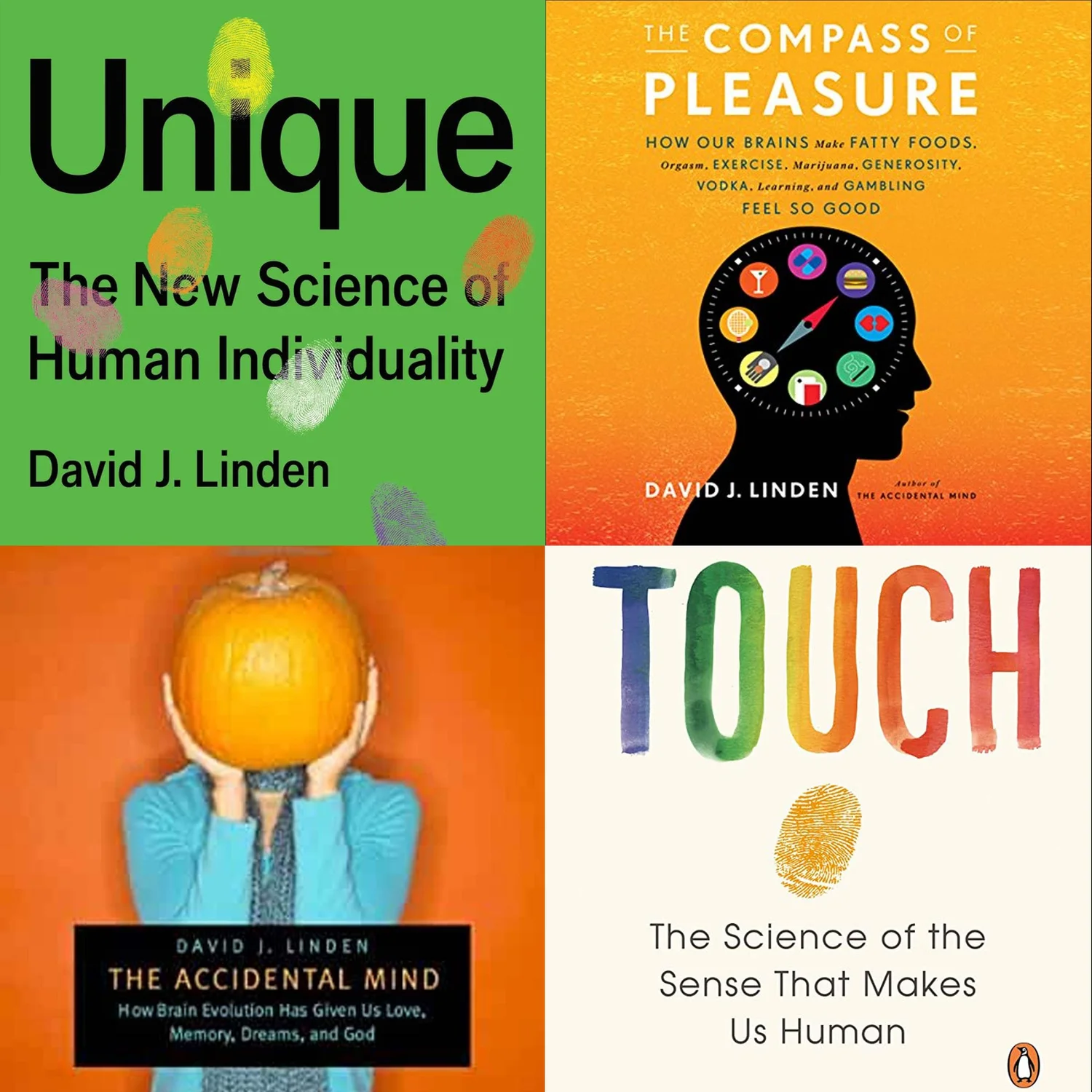
DAVID J. LINDEN - Author of “Unique:The New Science of Human Individuality” “The Accidental Mind” “The Compass of Pleasure” “Touch”
Conversation about Science of Human Individuality, Accidental Mind, Pleasure, Touch, neuroscience, genetics, brain, mind, Orgasm, Exercise, Marijuana, Generosity, Learning, and Gambling, Johns Hopkins University School of Medicine, nature vs nurture
The Creative Process in 10 minutes or less · Arts, Culture & Society: Books, Film, Music, TV, Art, Writing, Creativity, Education, Environment, Theatre, Dance, LGBTQ, Climate Change, Sustainability, Social Justice, Spirituality, Feminism, Technology · The Creative Process Podcast - Arts, Culture and Society
Audio is streamed directly from the publisher (static1.squarespace.com) as published in their RSS feed. Play Podcasts does not host this file. Rights-holders can request removal through the copyright & takedown page.
Show Notes
"I think you could certainly make the case that creativity has been useful for a long time in human evolution and probably in our pre-human ancestors as well. So it's not surprising that that creativity is manifest in all kinds of ways from building a trap to catch a critter, to musical improvisation, to making a sculpture.
If I were to look at a brain scan and someone said, 'Point to me the region that has the sense of self.' I don't know that I could actually do that. So in other words, I accept this notion as a higher-level explanation that can be really useful. I would say our ability to reduce that to brain regions and brain activities now is still really not there. I'm not saying it will never be there. It may emerge, but it hasn't emerged yet. Sense of self is a really, really interesting idea and it's something that fascinates me because it is used both kind of at a very high level, in a cognitive way, but neuroscientists think of sense of self more in terms of our senses that literally point inward. So when we think about the senses, we usually think about things like touch or vision or taste or smell or hearing that are designed to tell us, not about our own bodies, but about the external world. But we also have all these senses that are interoceptive rather than exteroceptive. And they're telling me things like, how is my head oriented relative to gravity? That's my balanced vestibular system. Where are my limbs in space at this moment that I can do, even with my eyes closed? I know where my arm is even with my eyes closed because I'm getting information from my muscles that is being sent to my brain. I know how distended my bladder is and whether I'm going to need to go to the bathroom soon. I know my immune state, my breathing, my blood chemistry, my digestion. All of these things are senses of self and the degree to which they influence higher cognitive processes is to me one of the really fascinating questions of neuroscience right now and one that we're just really starting to understand."
David J. Linden is a Professor in the Department of Neuroscience at the Johns Hopkins University School of Medicine. He is the author of Unique: The New Science of Human Individuality, The Accidental Mind: How Brain Evolution Has Given Us Love, Memory, Dreams, and God, The Compass of Pleasure: How Our Brains Make Fatty Foods, Orgasm, Exercise, Marijuana, Generosity, Vodka, Learning, and Gambling Feel So Good, and Touch: The Science of the Hand, Heart, and Mind. His laboratory has worked for many years on the cellular substrates of memory storage, recovery of function following brain injury and a few other topics.
www.creativeprocess.info
www.oneplanetpodcast.org
IG www.instagram.com/creativeprocesspodcast