
Audio is streamed directly from the publisher (media.blubrry.com) as published in their RSS feed. Play Podcasts does not host this file. Rights-holders can request removal through the copyright & takedown page.
Show Notes
On the 347th episode of The Copywriter Club Podcast, Linda Perry makes her FOURTH appearance on the show. This episode acts as a friendly reminder to take care of your mindset especially in times of financial uncertainty and business (and life) plateaus. Linda shares how we can continue to grow our mindset toolbelt, so we can stop getting in our own way.
Here’s how the episode goes:
- How Linda’s work has changed over the last few years.
- Her dream of moving to Europe and how she made it happen.
- What’s the challenge with selling something like mindset?
- The real reason you keep coming back to your mindset struggles.
- How finding your why will help you craft messaging and communicate better.
- What tools should copywriters add to their business?
- Here’s the real problem with continually purchasing courses and programs.
- The 5 traps keeping you from business confidence.
- What’s the difference between worth base and value base?
- Are we telling ourselves a story that keeps us stuck?
- How to focus on what we can control.
- Can you be the solution AND the problem in your business?
- Why Linda paused her podcast and grew her client roster.
- The importance of having a sounding board.
- The simple shift that’ll help you save time and energy in your business.
- Why you shouldn’t be afraid to do something because someone else is doing it.
- How defining success will keep you from feelings of shame.
- Is the Think Tank the right program for you?
Tune into the episode by hitting play or reading the transcript below.
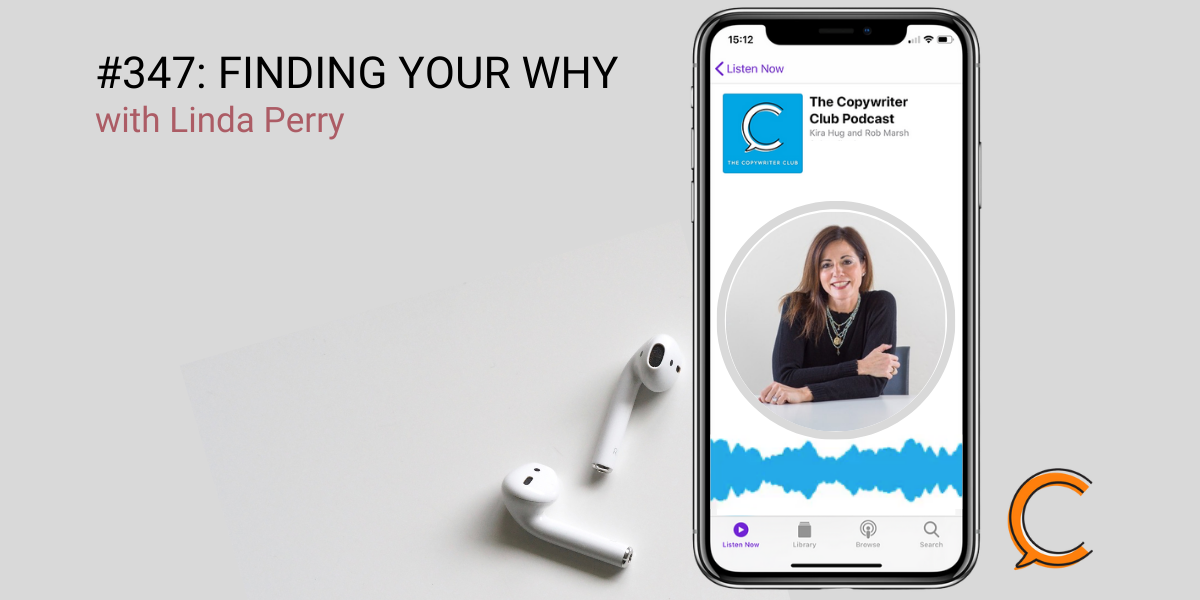
The people and stuff we mentioned on the show:
The Copywriter Think Tank
Kira’s website
Rob’s website
Linda’s website
The Copywriter Club Facebook Group
The Copywriter Underground
Free month of Brain.FM
AI for Creative Entrepreneurs Podcast
Full Transcript:
Rob Marsh: Longtime listeners to this podcast will recognize a recurring topic that we revisit from time to time, and that’s mindset. Your mindset as a copywriter, as a business owner, as a problem solver impacts everything that you do in your work. It often determines whether you land that client that you’ve been dreaming of or hit the goals that you’ve set. And when it comes to mindset, our go-to expert is Linda Perry. She’s the guest for this episode of The Copywriter Club Podcast. Linda is a mindset coach who has helped hundreds of copywriters deal with the head trash that gets in the way of all of our success. She’s a coach inside the Copywriter Think Tank, and we invited her to talk with us about the challenges facing copywriters, content writers, and other marketers today.
Kira Hug: But first, this podcast episode is sponsored by the Copywriter Think Tank. And I’m not going to share a whole lot about the Think Tank because we talk about it with Linda in depth and we talk about a lot of the struggles and wins Copywriter Think Tank members have experienced. Linda is a Think Tank alumni member. So we dive pretty deep into what’s possible with the Think Tank in this episode. So stay tuned and if you like what you’re hearing about the Think Tank and what’s possible, you can learn more at copywriterthinktank.com and jump in there with us. Okay, let’s get into our episode with Linda.
All right, so let’s just catch up real quick because you’ve had some big life changes that we were just chatting about. I’m very jealous of these life changes that you’ve made and excited for you. So why don’t we just start with how your life and business has changed over the last year.
Linda Perry: Yeah, I could actually just listen to your podcast to track all my changes in life. This would be great. So in the last year, I decided somewhere along the way to pick up and move and leave the States. We now are living in Portugal. I think I’ve expanded my business as well in terms of who I work with. I still really work with copywriters. I work with a lot of marketers. I’ve expanded to work with agencies actually to help them really in some of their team building leadership communications aspects and helping them all play a better role. So that’s been kind of fun. I also do another sort of assessment with people that’s been really fun to do. Lately, as you know, I work on the Enneagram, but I also have been doing this Why Certification that I got, this Why assessment that helps people really understand their why and how they show up and what they do. It’s been really cool because it can be validating. It can show me where people’s blocks are going to be, but it also gives them a really cool marketing message right away.
For example, my why is better ways, so I’m always looking for a better way to do things. If you’ve hung out with me, you know that’s probably true. And how I do that is challenging the system. And what I do is build trusting relationships. And so I’ve been working with people on that and it just opens up their mind to think about what their strengths are. I think there’s such a shortage of our ability to see strengths. So it’s been kind of fun because I get to focus a little bit more on how do we create something practical out of mindset, which we know I really like adding that practical aspect.
Rob Marsh: So I’m coming back to the why thing for sure. But before we move on from Portugal and moving over, let’s just talk just a little bit more about the mindset around that because it’s a big move. You pretty much boxed up everything that you had in the States, it’s in a storage unit somewhere and a couple of suitcases and that’s it. And now you’re in Portugal for a couple of years. Just tell us about the thought process, why you decided that kind of a change, what you’re hoping to get personally, maybe even with your business.
Linda Perry: Sure.
Rob Marsh: Yeah, with all of that.
Linda Perry: I also don’t want to forget that the other change I made is as I started working with Think Tank.
Kira Hug: Oh, we’re going to talk.
Rob Marsh: We’ll definitely get to that, yeah.
Kira Hug: Don’t worry.
Linda Perry: I don’t want to forget that because that’s kind of important. Okay, so the mindset around that is, I’ll be honest Rob, this is the example of don’t let your dreams go. I think when I was 20 I wanted to actually move to Italy. It just sort of was in the back of my head. And then you have children and then you have… I was a lawyer and so all these things happened. And then last summer we went to Croatia as a family. My husband looked at me, he is like, “I could do this.” And I was like, “Wait, are you serious? Because I can make this happen,” within minutes. I was ready for a change. I missed living in a city. I’ve always wanted to experience Europe, you know I am. But I always say culturally liminal. There’s that big part of me that’s so American, but that part of me that’s also pretty European.
And so what this originally started as is like, “We’ll just rent out our house. We’ll just start off.” And then we started to think, “Well, why? Why rent it out? That’s a lot to manage from overseas.” So we put our house in the market. We ended up having a lot of headaches around selling our house, but we did it. We were going to go to Portugal, Spain, and Croatia. And then we realized we want to have some routes somewhere and we want to have the ability to travel on weekends and really live that dream life, like Kira you always talk about how I walk my walk. I wanted some place where I could work Monday through Thursday, which I do. And they’re a little bit longer hours even here. Friday, I don’t touch the computer. I don’t look at a computer. We head out somewhere, we do something.
When we looked at Portugal, it was weather, it was people. We hadn’t stepped foot in it. And we said, “Well…” And I think this is a lot building a business or doing anything, it’s like, “Well, I’m going to try it. And if it doesn’t work, I can shift.” ‘I think so much of what I’ve learned from growing a business, from being an entrepreneur is if it doesn’t work, I’ll find a different route. And so we just kind of decided. And we had our children’s blessing. I mean that was really key. My kids are old enough, they’re like, “Can we come with you?”
“No, y’all have to work in your own lives.” But we had their blessing essentially. And Lisbon isn’t that far to come back to the US. So that’s the whole mindset.
Kira Hug: So how do you think about your business as you were preparing to make this move? Were there any changes you’ve had to make to the way you’re running the business?
Linda Perry: Yeah, for sure. I mean, I had to go overcome my resistance to working at 8:00 PM at night sometimes, which I do once a week that I teach something at 8:00 at night. There’s a lot of resistance to that. I had to think about how do I expand my business in the sense that now I’m in Europe and if I want to work with companies or agencies, I have to start to think about how do I network here and how do I start to really get a foothold into the door of American companies even here to start to work on mindset or entrepreneurs here. The funny thing is I’ve gotten a bunch of new clients and they’re all Europe based. I’m like, “Have y’all been waiting for me to show?” And it’s been really nice. So I think I just had to start to expand thinking about how I was going to do it and am I going to fly back to the US, like how am I juggling some of that and realized it would all figure itself out. But I definitely had some resistance around working late, but I get my mornings.
Kira Hug: Well, can you just speak to how you got your clients, your European clients? I mean, it sounds like it kind of magically happened. You moved and you found these new clients, but-
Rob Marsh: No effort whatsoever on your part, I’m sure, yeah.
Kira Hug: Right.
Linda Perry: You all know me well enough to know that… Look, I always actually think being a coach is much harder than being a copywriter in terms of generating business. I’m usually the last person that people think they need, but I often think I’m the person that shifts their entire business. So I’ve really, over the years, worked very hard to think about what is the funnel that I bring people through? How do I really generate business? One of the things I actually talk a lot to copywriters, to business owners in general about is how do we think about visibility. And so I shifted a little bit about how I think about visibility. I’m showing up more and more places that my clients hang out. I’m writing more articles, I’m doing more video, I have new lead magnets. I’m getting on phone calls with people. I think that’s something we critically forget. We think, “Oh my God, I don’t want to be bothered. We got to run everything through some sort of electronic medium.”
But I went back old school, which I know you guys have done it before too. And I’ve been getting on the phone with people and letting them know, “I’m actually available for you to work through some things.” I actually found my podcast, and this is interesting, was a detriment. I think people thought they were getting enough. And that’s really tricky with mindset because one day you’ll be like, “I’m fine.” And the next day I’ll come crashing and you’re like, “Oh my God, I need help.” And then the next day you’re fine. But the problem is, is everything that got you to the plateau is going to bring you back to the plateau. Even if you climb a few steps, you’re going to come back down if you haven’t dealt with the underlying root cause.
And so I’ve just really gone back to showing up higher ground, which Kira did, is a labor of love and it is getting people into a room to talk about mindset. And that’s actually helped too because people get to see, “Wow, we all have this mindset thing, but how you work through it is really critical.” So it wasn’t overnight. You know me, I spent half my day marketing actually. I think about everything I put out there.
Rob Marsh: You got to be there to get the clients, which yeah, good lesson. Okay, so let’s come back to the Why certification just a little bit. Let’s talk through this. So there’s some stuff out there about Find Your WHY, Simon Sinek, that kind of stuff. I don’t know if that’s related to the certification that you did. I have to admit, I really dislike that book. I mean, I can talk about why I don’t like it. I don’t disagree with the premise, but the book itself, I really dislike. I think he cherry-picks a lot of examples or whatever. But I think a lot of what he does say about the why is really important. Anyway, will you talk through that and what you’re doing with why and how important it is for us to have a why. Maybe the why is providing for my family, but sometimes, or oftentimes, there’s a bigger why than that as well.
Linda Perry: Yeah. So the certification I got is somebody who worked with Simon Sinek actually. What had happened is I actually talked to a coach about how she generates business with companies and things, and she said, “Well, I have this certification” and there’s nine whys that this guy’s come up with. You take this assessment. The assessment’s literally five minutes. I’m like, “Okay, how impressive is that?” But apparently, I mean it is spot on. He took years of his own work with clients to figure out what motivates it and filtered it down to nine different ways. They include better way, right way, mastery. You know those people who really go deep, contribute, trust, challenge. And I’m missing a couple. Simplify, clarify, makes sense. There we go.
Basically, it’s funny because Kira can actually get people’s Enneagram from their why because it does track similarly. But what I found attractive about this is that why is the way your limbic brain makes decisions. So the why ultimately is what taps into the way you show up, what motivates you, what gets you going. How you do it is really like what Kolbe and StrengthsFinder really assess. So how and what essentially. And knowing your why is helpful because for a few reasons I’ve found. And I’ll be honest, when I heard this, I’m like, “Great tool for getting in the door. Don’t know how rich it’s going to be.” But it’s turned out because I already have such a rich toolbox, it’s allowed me a bunch of really cool things.
So for the whys have been pretty accurate. It’s been amazing to see because I’ve done them with people I know, people I don’t. But what it does is it taps into how do you show up in the world? What really drives you? When I heard of the whys, I’m like, “Oh, I’m clearly a better way. I will take things apart that I think can be fixed and I’ll find the better way for them.” I challenge everything. I’m a rock the boat kind of girl, so I knew that that had to be up there.
What it’s done for me is allowed me to better understand myself, not waste time on things that don’t matter and come up with a messaging and how do I communicate. So if you have a right way, I’m going to talk to you in language about right way. It now becomes a sales tool. It has helped the people I’ve worked with really understand themselves become more aware and I can tell them where they’re going to get stuck. So for example, a right way person is going to get stuck because they’re going to be perfectionists, they’re more like Enneagram ones. They need to have everything a certain way. And so it’s been a really cool tool for me to use everything I’ve got in my toolbox to help people see what are your strengths where are you going to get stuck, what do you need to work on. “Here’s some messaging tools and here’s how you can communicate for better sales.” It’s really helped as a way to help people move forward in their business. And that’s always my goal. So it’s been cool.
Kira Hug: I feel like you have so many tools in your toolbox, which makes you an expert and so great at what you do as a mindset coach and as a copywriter. And so I guess the question is just how do you approach your own learning and tool development so that it continues to grow? I know part of it’s just who you are and you’re a growth focused person. But I feel like as copywriters, we really can strengthen our business if we have multiple tools we can pull from at any moment.
Linda Perry: Yeah, it’s interesting. I heard somewhere this morning when we talked about it because there’s always the question of, “Am I doing this because I’m afraid to put myself out?” A lot of copywriters will collect courses and be like, “Hey, I need one more thing before I put myself out.” Or, “Is this something that’s going to enrich the toolbox that I have?” I actually haven’t done any certifications in years and this really just appealed to me as a way to open a door, turned out to be something more interesting, which is great, but it is who I am. I mean, I read books on mindset daily, on marketing, on all of those things because I am a consistent learner. I do want to be mindful of how I’m using my time. This certification was pretty quick. It allowed me to just add another layer to my tools.
I think when copywriters are really considering what to add, it shouldn’t be necessarily about FOMO, should, all of those kinds of things. I think it’s a moment to stop and ask, “What is the next thing that’s going to help me grow in my business? What’s the next thing that’s going to help enrich it? What is going to help me reach my financial goals?” I think that’s something that we have to consider. You may like working with a certain group of people and you need the skills to be able to work with them, but you also need the skills that are going to help you put yourself out there more, rise up, actually be seen, make more money. And I think there’s got to be a balance of all of those things.
Rob Marsh: So as you’re talking about that, this feels like a pretty good way to get specific. You have been working as a coach in the Think Tank for the last year or so, helping members of the Think Tank to fix their mindset, or if not fix it, make adjustments as time goes on, lean into that exact thing that you were just talking about. Can we get specific about some of the places where good copywriters who have decent businesses, making money, maybe it’s not always consistent, but making pretty decent money most of the time? Where are we getting stuck? And I know we could probably go on for seven or eight hours here, but let’s just hit some of these big things that people get stuck with that you are helping members of the Think Tank and also your own clients get over.
Linda Perry: Yeah. So I started to label these things, the plateaus we all get stuck on, right? Because there are certain plateaus and they all fall into different categories. The great thing about Think Tank is first of all, I’ve been really lucky, it’s such a wonderful community. Everybody comes openly sharing what’s going on for them. There’s no hiding, right? It’s a safe place for people to show up. And it’s actually been super rewarding. And what we do is once a month we have a group coaching call and then once a month we have a targeted mindset training so that they can move past certain plateaus. So a lot of the things that I see will start out with… Let’s start out with a big one. The money mindset piece. We recently just had a training on money mindset. I think it’s a trap that shows up in myriad different ways.
I think people think money mindset is, “I’m bad with money or I worry about money or I need money.” In fact, money mindset ultimately comes down to a lot of self-worth. So what happens is we’ll see pricing that kind of goes up and down, a lot of caring about, “Can my client pay?” It’s a lot of, “Is it worth it?” Right? And so we’ve done on some shifts in the Think Tank for them to think differently about how to show up, how to think differently about their own pricing. What are some of the traps that are actually happening because of money mindset? It could be visibility, it could be perfectionism, it can be taking feedback to the heart because we then worry about, “Oh my God, is the next client then going to feel the same way?” And, “Oh my God, I got to over give.” And then, “Oh my gosh…” You know. It’s a slippery slope.
So we see a lot of those kinds of things come up and it’s this release that happens once you realize that money is your barometer. And how do you anchor yourself into your self-worth things start to shift. So many mindset’s one thing we work on.
The other thing I’ve seen a lot of is, “Am I an expert? Can I go talking about this? Do I need more skills?” This happens for a lot of us, right? “Who am I to go talk about this? Who am I to show up with this? Who am I to go seek a client that is sort of my next level client?” And so a lot of people will maybe call it imposter complex or fear of failure or finding out that they’re fraud. So we work on those kinds of mindsets that build confidence, that allow people to recognize what they already have. Most of the people in Think Tank have some pretty amazing skillsets already. And it’s really coming in going, “What are some of those things that you are hiding behind and not really letting come to the surface?” So I see a lot of that kind of stuff going on.
There’s also the thought process that, “If I’m having a hard month, is this going to continue?” And it’s really been there that we do a lot of really good work, because look, being an entrepreneur, being a copywriter, being whatever you call yourself, a freelancer, whatever it may be takes a lot of faith that the work is coming. There are months that are tougher than others. Every one of us can say that who’s been in the copywriting business.
Rob Marsh: Sometimes quarters. Yeah, sometimes it’s not just a month.
Linda Perry: Yeah. And it’s real. And so we don’t pretend it’s not. I think that’s super important is that your feelings are real, this money problems are actually real. Where are you acting from? So one of the things that’s super detrimental where quarters become years of bad luck, if you will, is when we get stuck in activities that are just designed to bring cash. We’re pivoting too much. Our audience doesn’t know what’s happening, we’re desperate. All of those kinds of things are going to impact long term. So we talk about how do you find relief from the worry and how do you create intentional action?
So I kind of am partnering with you guys because… And we don’t do this necessarily spoken, but what I’m piggybacking off of is where you’re finding the strengths of individuals where they should be working on in their plans, I’m saying, “Okay, what’s the head trash that’s getting in the way of you following the trajectory that you’ve discussed with Rob and Kira?” And that’s what we’re working on so they can show up so they don’t procrastinate. I’m big on visibility. So one of the things that I think is we can’t get seen, we can find you. So we really are working through all of those kinds of things. And it’s really cool because everybody gets their turn and everyone’s really supportive. It’s a place where people will apologize, “I just took up so much time.” There’s no apologies. It’s an actual space to take up for solutions. So these are just some of the things that are really coming up right away for me. But it’s been really rewarding being able to work with the Think Tankers. They’re amazing.
Kira Hug: Yeah. And that’s such a great point about how we can work together. And this is where partnerships can play such a big role in any type of business. And Rob and I can sit down with a Think Tank member and we can do a SWOT analysis. We can create a really clear aspiration, a measurable outcome. We can create a focus map and a concrete plan someone could follow for six months and it’s like a bulletproof plan, but we’re humans, so we get in our own way. And once the head trash pops up, all of a sudden the plan stalls, we’re feeling really awful about it, we stopped showing up. Maybe we even stop to show up to Think Tank events anymore. Maybe we’re not booking calls with Rob to talk through it because we’re embarrassed. And so you come in and you can really work through those thoughts and those stories that people tell themselves and pick up those pieces so they can either readjust the plan or just get back on track. I think that’s the piece that’s missing in so many different programs that are focused on goals and achievement.
So I do think that’s the power of the Think Tank, is it’s putting all the pieces together in a way that I don’t found that in many other masterminds or other programs.
Linda Perry: Yeah, I mean we haven’t really even touched base on this, part of me wants to be like, “Have you noticed the difference?” Since I’ve been working with some of the group members, what are you seeing from your end? Because we have such a trust, the three of us, we don’t even need to really talk about this. You’re like, “Go do your thing, Linda.”
Kira Hug: I guess we should. Yeah, yeah.
Linda Perry: Yeah, and it’s great. And so I’m curious, what have you noticed that changes as a result of us being a team?
Rob Marsh: Yeah, it’s a good question. So one of the things that I think happens less, there are still struggles around clients coming, but honestly, confidence questions come up far less for us lately than they did a year ago.
Linda Perry: That’s true. That’s true.
Rob Marsh: A year ago, half of our conversations would be around, “I can’t do that. I’m not ready to do that.” And I see that a ton less. There’s some basics around confidence. Confidence isn’t really easy to get before doing the thing. You have to lean in and you have to start. I think you’ve helped a ton with that just as a baseline that people feel like the goals that we set… And we set some pretty significant goals. People will come in and we’ll say, “12 months from now, where should you be on a monthly basis? What kind of income do you want?” They’ll be like, “Well, 8,000, 10,000.” And we’re like, “Well, why not 20,000? Why not 30,000? Let’s think higher.” They may not hit 30,000. They may not hit 20,000. But when you think about your business differently like that, you do different things and you have to show up differently.
When we would set big goals like that, people are immediately, “How in the world can I do that? I’m not the person that can make $20,000 or more.” And so confidence is a big thing that I think most of the Think Tank over time have made that adjustment. So that’s just one that’s really obvious to me.
Linda Perry: Yeah, that’s a big one.
Kira Hug: The visibility. I think that so many of our Think Tank members are actively focused on their own marketing. They’re speaking. I think it’s happening faster and earlier for them because of what you’re doing with them, so that stands out. And Rob’s right. Our conversations have shifted where we’re more focused on helping Think Tank members focus and be more strategic, but it’s less of talking through the confidence and the piece that you cover. And I think overall, it just strengthens a group. In a mastermind, it’s so important for people to trust each other. It’s hard to create that dynamic in groups. I mean, I’ve been in many mastermind groups, it doesn’t happen organically in most of them. And so having that deeper conversation that you host via Slack and through the monthly calls allows the group to feel more connected so we can just do more and they can get more out of those relationships than they would have otherwise.
Linda Perry: Yeah, they’re great. I will say that is one thing that I see working in the Think Tank, is they come to the groups ready to support one another and have each other’s backs. Like I said, that’s really hard. You can’t manufacture that, right? And so I think that’s been a gift to watch because every single person shows up going, “Yeah, that’s me.” If somebody’s struggling with something, they’re like, “Hey, you’re not alone. I’m feeling that.” Right?
Rob Marsh: Or, “I have felt it in the past and this is some of the stuff that I went through.” Yeah, there’s a lot of that.
Linda Perry: Yeah. So that’s been really cool. Yeah, I like that.
Kira Hug: Okay, let’s break in here and add a couple thoughts to what Linda’s been sharing. Rob, why don’t you start?
Rob Marsh: Okay. Well, one or two things. Maybe I should clarify because at one point I said to Linda that I have some issues with Simon Sinek’s book Find Your WHY. While I do not disagree at all with the importance of the why and the way that Linda talks about the certification that she has and how she leads people through discovering their purpose, I just kind of feel like, “Okay, what problem, Rob, do you have with that book?’ And if you’ve read the book, you know that it’s full of… It’s got a bunch of examples of companies that Simon Sinek talks about their why. My biggest takeaway is I think something that Linda actually fixes in her approach to it, and that is nobody really cares about our why in business. It’s really our client’s why.
And so yeah, I have why that I do the things that I do providing for my family, helping copywriters get better, what they do. Those kinds of things are important to me. But clients that come to me for copywriting work, they care about their why and what they’re trying to accomplish. Or copywriters who come to you and me, Kira, to get better at their business, they care about their business and their why. And so there’s definitely a bridge that we need to cross there. And I think Linda in the way that she talks about helping people get to their why does that really well.
Kira Hug: So do you think you are too harsh with Simon Sinek?
Rob Marsh: Not necessarily. Because like I said, I’m not really a fan of that particular book. I mean, lots of business books cherry-pick the examples that they use. And so you’ll always see examples like Apple computer as if Apple computer is relevant to anything that any of us as single business owners, or even if we’re running our own agencies, as if we have anything in common with those and we don’t. And so sometimes those lessons when authors will take them and say, “Hey, yeah, apply this lesson to your business” and it just doesn’t fit.
And then of course the others side of that is that when we cherry-pick examples like that, big billion, trillion dollar businesses were only taking a very small set of the total number of businesses that were started. And who’s to say that there weren’t a million businesses out there with a really definite why that still failed? And because we are only looking at those winners because we have that small set, I’m not sure that they teach us the same.
This isn’t just Simon’s book, by the way. Lots of books do this, lots of business books. And so I think we just need to be really careful. We can pull lessons out of them, but oftentimes we need to look at those lessons and say, “Okay, wait. Is this truly a lesson applies to everybody? Is this something that I can use in my business? Is it something that isn’t necessarily true but I think it’s true because a few big businesses have done it successfully while other businesses have failed doing the same thing?” We just have to ask those kinds of questions to be really smart about it.
Kira Hug: Yeah. And we can have both. I want to have my own why, and then I can have a why that’s more client facing in my messaging to my clients. So one could guide my internal business making decisions and the other can help with attraction marketing and attracting the right people. So I want both, all of it.
Rob Marsh: And Linda, I think, like I said, she crosses that bridge really well because she’s all about helping her clients figure out their why. I think she’s really good at seeing when their why maybe doesn’t match their prospects’ why. And sometimes that’s a disconnect that leads to struggles in our business.
Kira Hug: So we talk a lot about mindset as we should with Linda Perry. She’s such a great resource. I am curious how you invest in your own mindset, Rob.
Rob Marsh: Yeah, well, I mean obviously I pay attention to a lot of the stuff that Linda talks about. She is my go-to expert when it comes to mindset. But then it’s also really about diving into books. Whether they’re self-help or business books, I try to read or listen to a lot of those and question my approach to different things. We’ve talked about this endlessly, but we belong to a mastermind that I think oftentimes challenges us to think differently about our business, whether it’s different ideas for doing things or approaches to our team, all of those kinds of things. So that tends to be where I in invest in those kinds of things. How about you, Kira?
Kira Hug: Yeah, in a similar way. I mean, when I think about the time I put into my mindset and even the money I invest in it and I’ve invested for a while, it’s a lot for something like mindset that isn’t always attached to an immediate ROI, but it’s because I know it makes such a huge difference. And so yes, Linda has been a mindset coach of mine. I learned from her in the Think Tank. I work with another mindset coach who we’re going to feature on the podcast soon. I mean, I have a therapist for mental health which we overlap because I forced her to talk about mindset and help me make business decisions too.
And then retreats is a big one. I mean, when you and I go to those retreats, we are one of the smaller businesses in our mastermind group. And just being in a room surrounded by people who are five steps ahead of you, 10 steps ahead of you, that is what will shift my mindset the most. And sometimes even being in a room where maybe you’re the biggest business, whether that’s based on size or impact or revenue, that’s up to you, but it’s also helpful to be in that situation because then you can realize how many people you can help and teach and how you have grown and you’re in a different position. So all of that together, it’s a lot like because I know I’m the only person in my way, I get in my own way frequently. So I know this is the area where I want to invest the most at this stage in my business.
Rob Marsh: Yeah. Well, we’re talking about investing in your business too. I think Linda said something that was really insightful and it’s my approach also to investing in my business, and that is you don’t need everything now. You don’t need to know everything about copywriting. You don’t need every single course or every single program that’s out there. You just need what is the next thing for your business. What’s the next skill that you need in order to grow or in order to serve this particular kind of client or in order to do this kind of… And being really deliberate in thinking through that approach helps narrow down so many decisions around, “Oh, I just saw this great product. Do I need it? Should I buy it? It’s on sale right now. Maybe I can use it in a few years.” Those kinds of things. It’s to look and say, “Okay, where are we in our business?”
Right now, a lot of copywriters are asking questions about AI, so maybe there’s a place to invest in. Or they’re asking questions about, “How do I really grow my business?’ Maybe there’s an investment opportunity there, but we don’t need everything all the time now. It’s best to say, “Okay, what’s my next step and how do I get there?” Maybe it’s a tool, maybe it’s a coach, maybe it’s some other kind of a program and investing really smartly in your business.
Kira Hug: Yeah. It goes back to the goals that you set, whether you set them a month ago or January 1st. But I look at my goals and I look at the ones I’m struggling with. And the ones I’m struggling with, I invest in supporting the fulfillment of those goals because, one, I mean you and I have talked about it a lot, but writing a book has been really important. You and I talk about it all the time, but I am struggling to do that. So an investment I could make would be in some type of course, or maybe it would be a coach who can help me to split the accountability. So I’m looking at those areas where I’ve clearly set a goal, it’s important to me, but something is missing and there’s something getting in the way. And so that’s where I would make the next investment rather than almost creating a new goal by investing in something else.
Rob Marsh: Yeah, exactly. I also appreciated that Linda emphasized three really big areas that we focus on in the Think Tank, but she does in her coaching as well, that is money mindset, visibility and expertise. Those three play… They’re almost like they fit together like a puzzle in the way that we build our businesses and in the importance they have for our businesses if we want to have businesses where people come to us as opposed to us needing to always be out there pitching. We have a course that teaches people how to pitch, but wow, it’s so much better when you get through that period in your business where you don’t have to pitch anymore and you do show up as an expert and you do have the visibility that you need and that money mindset stuff doesn’t get in your way anymore and your business just… It’s almost like an on-off switch in some ways where you just permanently… Or it’s maybe more of a flywheel where you’ve now got the momentum and things just keep going.
Kira Hug: Yeah. And visibility is such a