
The Behavioral Observations Podcast with Matt Cicoria
340 episodes — Page 3 of 7

Ep 238Eye Contact, Joint Attention, and Autism: Session 238 with Francesca Degli Espinosa
What exactly is Joint Attention? How does Joint Attention interact with Eye Contact? What does the literature say about these repertoires, and how does that coincide with self-reports of the aversive nature of eye contact from Autistic people? These have been a few of the questions rolling around in my head for some time. A few years ago, we briefly touched on this subject with my guest today, Dr. Francesca Degli Espinosa, but it was in the backdrop of a larger panel discussion at the 2022 Verbal Behavior Conference. Fast forward to 2023, I recently heard Francesca on Dr. Mary Barbera's show talk about Joint Attention in great detail, so I asked her to join me to extend the conversation. In this show, we cover: What people mean when they use the term Joint Attention How JA typically develops in infancy and beyond Why 'attention' may not be an especially helpful term Some of the neuroscience and eye tracking studies that have examined the development of eye contact in typically developing and Autistic populations How to increase the value of looking at peoples' faces Why eye contact should be thought of as a reinforcing consequence Some strategies to foster JA in the context of learner assent The difficulty of integrating the findings of different literatures that publish research in the area of Autism What she's talking about at this year's Stone Soup Conference (spoiler alert: She's going to go deep into this topic, and remember, save on your registration by using the promo code PODCAST) The problem associated with teaching eye contact via the 'look at me' method Here are some of the links to the many resources we discussed: 2022 Verbal Behavior Conference Panel Discussion Francesca on Mary Barbera's podcast Francesca's available online courses Dube et al. (2004). Toward a Behavioral Analysis of Joint Attention Silva and Fiske (2020). Evaluating the Effects of Establishing Eye Contact on the Skill Acquisition of Individuals with Autism Nuske et al. (2015). No Evidence of Emotional Dysregulation or Aversion to Mutual Gaze in Preschoolers with Autism Spectrum Disorder: An Eye-Tracking Pupillometry Study Clin and Kissine (2023). Neurotypical, but not autistic, adults might experience distress when looking at someone avoiding eye contact: A live face-to-face paradigm A sample of the many eye tracking studies conducted by Dr. Ami Klin and colleagues This podcast is brought to you by: The Stone Soup Conference, which is taking place on October 20th. Use code PODCAST to save on your registration as well. The University of Cincinnati Online. UC Online designed a Master of Education in Behavior Analysis program that is 100% online and asynchronous, meaning you log on when it works for you. Want to learn more? Go to online.uc.edu and click the "request info" button. Behavior University. Their mission is to provide university quality professional development for the busy Behavior Analyst. Learn about their CEU offerings, including their brand new 8-hour Supervision Course, as well as their RBT offerings over at behavioruniversity.com/observations.

Ep 237Does TikTok Provide Accurate Information about Autism? Session 237 with Elisabeth Sheridan and Giacomo Vivanti
While I don't personally use TikTok, I am aware of the considerable influence it has across a range of topics. As many listeners can imagine, Autism is one of those topics that generates unfathomable amounts of content on the platform. Unlike other forms of medical and scientific dissemination, there are really no barriers to saying whatever one wants, not only on TikTok, but on any other internet-based media platforms, podcasts included of course. And as you might imagine, this brings with it lots of variability in terms of information accuracy. Today's guests, Drs. Elisabeth Sheridan and Giacomo Vivanti, along with their colleagues Diego Aragon-Guevara and Grace Castle, took up the challenge of analyzing the accuracy of Autism-related content on TikTok. They published their results in a recent issue of the Journal of Autism and Developmental Disorders in a paper titled: The Reach and Accuracy of Information on Autism on TikTok. In this interview, we discuss the audience scope on TikTok - spoiler alert: it's massive, why they decided to undertake this study, how they categorized the veracity of the TikTok videos they reviewed, what type of content creators had more and less accurate videos, what were some commonalities to the inaccurate videos they surveyed, and lots more. We also spent some time talking about the reaction to this paper, which has been considerable. Here are the links: The paper itself: Aragon-Guevara, et al. (2023). A popular press write up of this paper in Psychology Today. Another interview of these authors on the Autism Science Foundation's podcast. The Parenting Translator on TikTok. Drs. Sheridan and Vivanti on LinkedIn. The A.J. Drexel Autism Institute at Drexel University. Thanks so much for supporting the BOP on Patreon! If you have friends and colleagues who'd also enjoy getting these ad-free episodes, let them know how they can join too! This podcast is brought to you by: The Michigan Autism Conference, which is taking place on October 11-13 in Kalamazoo, and online as well. We'll hear more about this event later on in the show, but if you're impatient like me, to go michiganautismconference.org, and use the code MAC10 to save $10 at checkout. The Stone Soup Conference, which is taking place on October 20th. This is an amazing event, benefitting a great cause, all for a very reasonable price. Use code PODCAST to save on your registration as well. Behavior University. Their mission is to provide university quality professional development for the busy Behavior Analyst. Learn about their CEU offerings, including their 8-hour Supervision Course, as well as their RBT offerings over at behavioruniversity.com/observations.

Ep 236What is Motivational Interviewing? Session 236 with Callie Plattner
Dr. Callie Plattner joins me in Session 236 to talk about her work in the area of Motivational Interviewing. Callie is the Vice President of Clinical Operations at Mosaic Pediatric Therapy, and happens to be a fellow Auburn grad (War Eagle!). Now longtime listeners will know that we've covered MI on the podcast before. Back in Session 158, my friend Dr. Jim Murphy, who incidentally also happens to be an Auburn grad, discussed MI in the context of helping young adults reduce binge drinking and other substance-related problems. Also, my good friend and colleague, Dr. Paulie Gavoni, has been talking about MI for years. In fact, he's in the process of developing a course on this topic for the project that Paulie and I, along with our colleague Anika Costa, have been working on called The Behavioral Toolbox (brace yourselves for hearing a lot more about this coming up ;-). This background aside, in this episode, Callie gives an overview of what exactly Motivational Interviewing is, and defines the four "micro-skills" of asking Open-Ended questions, providing Affirmations, Reflecting, and Summarizing... the so-called "OARS" skills. Callie then discusses the research she's conducted with Dr. Cynthia Anderson, which will be coming out soon in Behavior Analysis in Practice, and more generally talks about how MI can be an effective tool to build rapport with stakeholders and possibly improve things like staff and parent adherence to behavior plans, therapy attendance, and so on. Links from this episode: A brief history of ABA with Jim Johnston. Mosaic Pediatric Therapy. The Behavioral Toolbox. A Behavior-Analytic Account of Motivational Interviewing (Christopher and Dougher, 2009). Not discussed in this episode, but still relevant, and worth checking out: Taking a Motivational Interviewing Approach to Prevention Science: Progress and Extensions (Shaw and Wilson, 2021). If you get anything from these shownotes, watch these videos: The Ineffective Physician and the Effective Physician (huge shout out to Dr. Carolynn Kohn for sharing these with me!). The Helpful Response Questionnaire. This podcast is brought to you by: The Michigan Autism Conference, which is taking place on October 11-13 in Kalamazoo, and online as well. We'll hear more about this event later on in the show, but if you're impatient like me, to go michiganautismconference.org, and use the code MAC10 to save $10 at checkout. The Stone Soup Conference, which is taking place on October 20th. Use code PODCAST to save on your registration as well. The University of Cincinnati Online. UC Online designed a Master of Education in Behavior Analysis program that is 100% online and asynchronous, meaning you log on when it works for you. Want to learn more? Go to online.uc.edu and click the "request info" button. Behavior University. Their mission is to provide university quality professional development for the busy Behavior Analyst. Learn about their CEU offerings, including their brand new 8-hour Supervision Course, as well as their RBT offerings over at behavioruniversity.com/observations.

Ep 235The Evidence Base for ABA Interventions: Session 235 with Jane Howard and Gina Green
Drs. Jane Howard and Gina Green join me today in a podcast that could've spanned several hours. In the time we had, we did manage to cover quite a bit of territory, including the following: What Gina has been up to since retiring from the Association for Professional Behavior Analysts (spoiler alert: she's not hanging out at the beach reading mystery novels). We talk about Jane's career in behavior analysis, including how she got into the field, some of her many, many accomplishments (including being recently honored as a Fellow of the Association for Behavior Analysis International), and what she is working on these days. The basics of research design, including why some experimental questions lend themselves to certain designs over others. In this segment, we also cover group or between-subjects designs and meta analyses, which are relevant to understand when looking at the ABA outcome literature. The distinction of criterion vs. norm referenced assessments. We discussed a number of initiatives and resources in the general realm of ABA treatment, including the current state of licensure, The ABA Coding Coalition, The Autism Commission on Quality, & CASP. We talked at length about critical thinking, healthy skepticism, and epistemology in Behavior Analysis. In addition to these topics, we probably spent the most time talking about the empirical support for ABA interventions for individuals with Autism. In doing so, we discussed the large research projects that Jane and Gina led, what to make of some of the criticisms of this literature that is starting to gain some notoriety, and what research questions we still need answers to. Jane and Gina mentioned numerous studies and resources, and I've done my best to catalog them below: Session 21 (my first interview with Gina in 2017). Howard, J., Sparkman, C., Cohen, H., Green, G, & Stanislaw, H. (2005). A comparison of intensive behavior analytic and eclectic treatments for young children with autism. doi.org/10.1016/j.ridd.2004.09.005 Howard, J. S., Stanislaw, H., Green, G., Sparkman, C. R., & Cohen, H. G. (2014). Comparison of behavior analytic and eclectic early interventions for young children with autism after three years. Stanislaw, H., Howard, J., & Martin, C. (2020). Helping parents choose treatments for young children with autism: A comparison of applied behavior analysis and eclectic treatments. Eldevik, S., Hastings, R. P., Hughes, J. C., Jahr, E., Eikeseth, S., & Cross, S. (2010). Using participant data to extend the evidence base for intensive behavioral intervention for children with autism. Klintwall, L., Eldevik, S., & Eikeseth, S. (2015). Narrowing the gap: Effects of intervention on developmental trajectories in autism. Padilla, K.L., Weston, R., Morgan, G.B., Lively, P., & O'Guinn, N. (2023). Validity and reliability evidence for assessments based in applied behavior analysis: A systematic review. Steinbrenner, J. R., Hume, K., Odom, S. L., Morin, K. L., Nowell, S. W., Tomaszewski, B., Szendrey, S., McIntyre, N. S., Yücesoy-Özkan, S., & Savage, M. N. (2020). Evidence-Based Practices for Children, Youth, and Young Adults with Autism. The University of North Carolina at Chapel Hill, Frank Porter Graham Child Development Institute, National Clearinghouse on Autism Evidence and Practice Review Team. ABA Coding Coalition (2022). Model Coverage Policy for Adaptive Behavior Services. https://abacodes.org/wp-content/uploads/2022/01/Model-Coverage-Policy-for-ABA-01.25.2022.pdf American Educational Research Association, American Psychological Association, & National Council on Measurement in Education (2014) Standards for Educational and Psychological Testing. Washington, DC: American Educational Research Association. https://www.testingstandards.net/uploads/7/6/6/4/76643089/standards_2014edition.pdf Behavior Analyst Certification Board & Association of Professional Behavior Analysts (February 2019). Clarifications Regarding Applied Behavior Analysis Treatment of Autism Spectrum Disorder: Practice Guidelines for Healthcare Funders and Managers (2nded). https://cdn.ymaws.com/www.apbahome.net/resource/collection/1FDDBDD2-5CAF-4B2A-AB3F-DAE5E72111BF/Clarifications.ASDPracticeGuidelines.pdf Johnston, Pennypacker, and Green (2019). Strategies and Tactics for Behavioral Research and Practice. This podcast is brought to you by: The Michigan Autism Conference, which is taking place on October 11-13 in Kalamazoo, and online as well. We'll hear more about this event later on in the show, but if you're impatient like me, to go michiganautismconference.org, and use the code MAC10 to save $10 at checkout. The Stone Soup Conference, which is taking place on October 20th. Use code PODCAST to save on your registration as well. HRIC Recruiting. Barb Voss has been placing BCBAs in permanent positions throughout the US for just about a decade, and has been in the business more generally for 30 years. When you work with HRIC, you work directly with Barb, thereby accessing

Ep 234Do Breaks Contribute to Productivity? Inside JABA Series 16
And we're back with another installment in the Inside JABA Series. In this episode, Dr. John Borrero and I are joined by Drs. Jessica Nastasi and Nicole Gravina. We discuss their recent JABA publication, Breaks and Productivity: An Exploratory Analysis (see Nastasi, Tassistro, and Gravina, 2023; and subscribe to JABA here if you want). Although this is a shorter episode by Inside JABA standards, we cover quite a bit of territory, including what motivated this research, the broader literature on breaks and productivity, the novel research design that was employed, and how the authors analyzed the data. And because this an Inside JABA Series podcast, we spent some time talking about why this study was published in JABA when other alternatives were available. In the coming days, this episode will be available for BACB CEU credit, so if you are interested in fulfilling your professional development needs while listening to the podcast, click here to learn more. The Wages and Fair Labor Standards Act. How to Get Better Results with John Austin. How to Take Better Breaks at Work, HBR. The Pomodoro Technique. Dr. Gravina's page at U. of Florida. Dr. Gravina's lab on Facebook and Instagram. Drs. Nastasi and Gravina on LinkedIn. Inside JABA Series 9: Applied and Translational Research in Healthcare (Ethics CEU). Skinner (1955): A Case History of the Scientific Method. What I forgot to mention: Sidman's discussion of what constitutes a "Pilot Study."

Ep 233La Perspectiva de la Circunstancia con Carola Scolari: BOP en Español 5
Sea desde el sur de Sudamérica o desde Norte América, desde el Medio Oriente o desde una isla exótica, Carola Scolari porta en grande la bandera de la Perspectiva de las Circunstancias. Este episodio se centra en el artículo de Dr. Patrick Friman publicado en el 2021 titulado No existe tal cosa como un niño malo: la Perspectiva de las Circunstancias de la conducta problemática. Carola se tomó el trabajo de traducir el artículo con el permiso de Dr Friman y estará disponible a partir del momento que este episodio sea publicado. Les recomiendo encarecidamente que lo lean y por supuesto que se tomen el tiempo de escuchar este episodio de casi 2 horas donde hacemos una detallada revisión y Carola nos enriquece con sus ejemplos e interpretaciones. Estoy muy orgulloso de este episodio y de Carola. Espero que lo disfruten. --------------------------------------------------------------------------- Whether from the south of South America or from North America, from the Middle East or from an exotic island, Carola Scolari carries the banner of the Circumstances View. This episode focuses on Dr. Patrick Friman's 2021 article titled There's no such thing as a bad boy: The Circumstances View of problem Behavior. Carola took the trouble to translate the article with the permission of Dr. Friman and it will be available from the moment this episode is published. I strongly recommend that you read it and of course that you take the time to listen to this episode of almost 2 hours where we do a detailed review and Carola enriches us with her examples and interpretations. I am very proud of this episode and of Carola. I hope you enjoy it.

Ep 232ABA in Non-Profit Settings: with Aaron Blocher-Rubin
Dr. Aaron Blocher-Rubin joins me in Session 232 to talk providing ABA services as a non-profit agency. Aaron is the President and Chief Executive Officer of Arizona Autism United, a multi-site provider of ABA and other therapeutic services. In this conversation, we talk about how Aaron got into Behavior Analysis, what led him to found the agency he now runs, supporting the family along with the client, and the importance of offering a variety of services. We also spent a considerable amount of time discussing what it's like to work in a non-profit setting. From funding, to governance, to staffing, we get into the nitty-gritty details, and one can't help but to contrast these settings with private equity funded nation-wide providers. And Aaron and his colleagues must be doing something right because they were recently voted the 2023 Arizona Top Workplace (and for the second time at that!). We also talked about some of Aaron's essays on what he calls ABA Red Flags that he's posted on LinkedIn, as well as some of the reactions to them. Here are the links: Jobs at AZA. The Autism Investor Summit. Aaron's podcast, SR Plus. The Autism Impact Fund. Aaron's LinkedIn. Donate to AZA. This episode is brought to you by: The University of Cincinnati Online. UC Online designed a Master of Education in Behavior Analysis program that is 100% online and asynchronous, meaning you log on when it works for you. Want to learn more? Go to online.uc.edu and click the "request info" button. HRIC Recruiting. Barb Voss has been placing BCBAs in permanent positions throughout the US for just about a decade, and has been in the business more generally for 30 years. When you work with HRIC, you work directly with Barb, thereby accessing highly personalized service. So if you're about to graduate, you're looking for a change of pace, or you just want to know if the grass really is greener on the other side, head over to HRIColorado.com to schedule a confidential chat right away. ACE Approved CEUs from .... Behavioral Observations. That's right, get your CEUs while driving, walking your dog, doing the dishes, or whatever else you might have going on, all while learning from your favorite podcast guests! Behavior University. Their mission is to provide university quality professional development for the busy Behavior Analyst. Learn about their CEU offerings, including their brand new 8-hour Supervision Course, as well as their RBT offerings over at behavioruniversity.com/observations.

Ep 231Effective BCBA Mentorship Experiences: ACSS 9
In the 9th installment of the Apollo Case Study Series, I'm joined by Jim Moore, Valencia Harper, Chesley Herring, and Lauren Elliott. And in this show, we discuss all things mentorship, both at Apollo, as well as the guests' other professional experiences. In particular, we got into: Defining mentorship The importance of saying, "I don't know" The importance of asking questions Common needs of mentees Apollo's BAT program Why BCBAs need communities And the idea that, "closed mouths don't get fed" Some resources we discussed include: Apollo CSS 8 My recent podcast with John Austin The movie, Whiplash Recommended Practices for Individual Supervision of Aspiring Behavior Analysts (Sellers, Valentino, and LeBlanc, 2016) While you're here, click here to follow Apollo on LinkedIn and Instagram.

Ep 230How to Get Better Results: Session 230 with John Austin
Today's guest is Dr. John Austin, who has been in the OBM trenches as a student, professor, and frontline consultant for over 20 years. Before continuing with the usual opening remarks, I'm going to make a rare ask of you. Two asks actually. This is perhaps one of the most actionable podcasts I've published. If you listen to this show and act on some of the suggestions, you can improve your practice right away. And that's not hyperbole. So the first ask is to make sure you listen to the show in its entirety, and go to reachingresults.com/results-toolkit for additional support. The second ask is that you take a few minutes and share this episode with friends and colleagues. In your workplace, you might even consider discussing this episode, and more importantly, John's book Results: The Science-Based Approach to Better Productivity, Profitability, and Safety, in your staff meetings. In this episode, we cover: The evolution of OBM practice over the last few decades. Why OBM consulting in ABA organizations can be more difficult than other settings. How to form better relationships with the people you work with. Ways to pinpoint and measure your interactions with colleagues and supervisees. The importance of asking questions. Agreeing on, instead of setting expectations. Why the book Atomic Habits irks me. John's conceptualization of Burnout and Psychological Safety. What is a Mastermind, and why might you consider joining one. Other resources mentioned include: The Fearless Organization by Amy Edmonson. Building a Psychologically Safe Workplace, a TedTalk by Amy Edmonson. Teaching Employees How to Receive Feedback: A Preliminary Investigation (Ehrlich et al., 2020). ABA on Reddit here and here. Radical Candor: Fully Revised & Updated Edition: Be a Kick-Ass Boss Without Losing Your Humanity by Kim Scott. HBR article: Good Leadership Is About Asking Good Questions. John's interview with Dr. Paulie Gavoni. My interview with Dr. Aubrey Daniels. Rapid Change: Immediate Action for the Impatient Leader, by Joe Laipple. This podcast is brought to you by: Behavior University. Their mission is to provide university quality professional development for the busy Behavior Analyst. Learn about their CEU offerings, including their 8-hour Supervision Course, as well as their RBT offerings over at behavioruniversity.com/observations. And check out the Leadership CEU I mentioned here. ACE Approved CEUs from .... Behavioral Observations. That's right, get your CEUs while driving, walking your dog, doing the dishes, or whatever else you might have going on, all while learning from your favorite podcast guests!

Ep 229Fifty Years in Behavior Analysis: Session 229 with Jose Rios
This is a conversation I've really been looking forward to sharing with you. Jose Rios is a legend in our field, particularly if you're a behavior analyst in California, where he's based out of. In this conversation, Jose recounts his more than 50 year career in providing ABA services to individuals with developmental disabilities. We cover the following: How he got started in the field at the tender age of 17. What the field of ABA was like in the early 70s. What it takes to provide amazing experiences for group home residents and staff. The founding of the Latino Association for Behavior Analysis. The evolution of behavior support plans over the years. Jose's intense mentoring program. What makes for good presentations. Jose is an avid reader, and we spent almost a half hour talking about our favorite fiction authors before hitting the record button. In the interview itself however, we do mention a few books and other resources that are more pertinent to the topic of Behavior Analysis, including: The various works of Dr. Gary LaVigna. The various works of Dr. John Lutzker. Teaching dating skills to individuals with disabilities (Cuvo et al., 1985). Vollmer et al. (1992). A content analysis of written behavior management programs. Resonate, by Nancy Duarte. Presentation Zen: Simple Ideas on Presentation Design and Delivery (Voices That Matter) 3rd Edition, by Garr Reynolds. The Last Lecture, by Randy Pausch. The Supervisor's Guidebook: Evidence-Based Strategies for Promoting Work Quality and Enjoyment Among Human Service Staff, Reid & Parsons. This conversation is like a lesson in the history of Applied Behavior Analysis, and I hope you enjoy it as much as I did. This podcast is brought to you by: ACE Approved CEUs from .... Behavioral Observations. That's right, get your CEUs while driving, walking your dog, doing the dishes, or whatever else you might have going on, all while learning from your favorite podcast guests! HRIC Recruiting. Barb Voss has been placing BCBAs in permanent positions throughout the US for just about a decade, and has been in the business more generally for 30 years. When you work with HRIC, you work directly with Barb, thereby accessing highly personalized service. So if you're about to graduate, you're looking for a change of pace, or you just want to know if the grass really is greener on the other side, head over to HRIColorado.com to schedule a confidential chat right away.

Ep 228From Clinician to Leader: Apollo CSS 8 with Kristen Vaughn
The Apollo Case Study Series returns with a conversation that many Behavior Analysts will likely resonate with. In this episode, I speak with Kristen Vaughn, Vice President of Clinical Operations of Apollo Behavior. We discuss her career arc, and focus on her transition from providing mainly clinical services to her current role in executive management. We cover her early clinical experiences, what it's like to get direct and perhaps difficult to hear feedback, the challenges of letting go of clinical duties, and what it's like to work with a leadership coach. If you're a BCBA, or an aspiring one, chances are, you'll have to supervise the work of others in some capacity, so there are many great lessons in this episode for you. Related to this, we talked about the book, Motivating human service staff: Supervisory strategies for maximizing work effort and work enjoyment, by Reid and Parsons. It, along with The Supervisor's Guidebook: Evidence-Based Strategies for Promoting Work Quality and Enjoyment Among Human Service Staff, should be considered must-reads for those in supervisory positions. Click here to check out previous Apollo Case Study Series podcasts, and to learn about all the fun employee engagement activities they're up to, follow them on Instagram.

Ep 227Decreasing Social Media Use with Contingency Management: Inside JABA 15
In the 15th installment of the Inside JABA Series, Editor and Chief Dr. John Borrero and I chat with Drs. Lesleigh Stinson and Jesse Dallery about their novel application of a Contingency Management intervention. In this case, they used CM procedures to reduce excessive social media use. Lesleigh is a Postdoctoral Researcher at the University of Florida's Center for Behavioral Economic Health Research, and Jesse is a Professor of Psychology, also at UF. If you're not sure what Contingency Management is, don't worry, Lesleigh and Jesse cover the basics of it in this show. For additional information, you can also check out Jesse's previous appearance on the Inside JABA Series, where he and his colleagues used smartphone mediated technologies in conjunction with CM to reduce cigarette smoking. This is a truly "Under the Dome" paper, and in our discussion of it, we touch on topics that include Internet Addiction, the recent APA Health Advisory on social media use, motivational interviewing, stages of change, and the benefits of single-case designs. This podcast, as with all other Inside JABA Series shows, is available for continuing education. To learn more about that, click here. If you want to subscribe to JABA, click here. We mentioned many resources and studies during this podcast. I've done my best to list them all below: Center for Behavioral Economic Health Research Jesse Dallery's lab: BHaT Lab Reducing problematic social media use via a package intervention (Stinson and Dallery, 2023) APA Health advisory on social media use in adolescence N of 1 collaborative Screen Sanity (great resources for families) A behavior-analytic account of motivational interviewing (Christopher and Dougher, 2009) "I's" on the prize: A systematic review of individual differences in Contingency Management treatment response (Forster et al., 2020) Toward an era of impact of digital contingency management in the treatment of substance use disorders (Dallery et al., 2023) A Preliminary Evaluation of the Effects of a Contingency Management + Deposit Contract Intervention on Problematic Smartphone Use With College Students (Williams-Buttari et al., 2023) Contingency management for smartphone and social media use: a feasibility study (Stanley et al., 2021) The association between social media use and sleep disturbance among young adults (Levenson et al., 2016) How Motivational Interviewing Helps Reduce Alcohol Use Problems in Young Adults: Session 158 with Jim Murphy

Ep 226Problemas Pediátricos de la Alimentación: BOP en Español 4 con la Dra Varsovia Hernández Eslava
Problemas Pediátricos de la Alimentación con la Dra Varsovia Hernández Eslava Aunque el tema de este episodio se centra en problemas pediátricos de la alimentación, la Dra Varsovia Hernandez Eslava nos comparte una muy interesante trayectoria profesional y un panorama e historia del análisis de la conducta en México. De aquella mirada inicial pasamos a una nueva panorámica muy detallada de los problemas pediátricos de la alimentación empezando por describir qué son y de ahí a conocer los procesos de evaluación y sus subsecuentes intervenciones. Son importantes los detalles y aclaraciones que la Dra Varsovia nos ofrece acerca del proceso evaluativo como también los varios componentes y etapas durante la intervención (los dejamos con intriga para que lo escuchen con detenimiento). Fue fascinante apreciar todas las sutilezas que un profesional competente considera a nivel clínico y de validez social. Esa importancia de las experiencias supervisadas, el obtener y mantener competencias fue claramente enfatizado. Dado el profesionalismo y responsabilidad que describe la Dra Varsovia para con las partes interesadas, no fue sorpresa escuchar de los altos niveles de adherencia, participación y satisfacción para aquellos que han interactuado con ella en estos contextos. Un modelo para nosotros seguir. Nos deja con la reflexión de buscar mentores y una búsqueda constante por nuevos y más profundos aprendizajes; de ser éticos y humildes. Pediatric Feeding Issues with Dr. Varsovia Hernández Eslava Although the theme of this episode focuses on pediatric feeding problems, Dr. Varsovia Hernandez Eslava shares with us a very interesting professional career and an overview and history of behavior analysis in Mexico. From that initial look, we move on to a new, very detailed overview of pediatric feeding problems, beginning by describing what they are and from there, learning about the evaluation processes and their subsequent interventions. The details and clarifications that Dr. Varsovia suggests that the evaluation process is important, as are the various components and stages during the intervention (we leave you intrigued so that you are prompted to listen carefully). It was fascinating to appreciate all the subtleties that a competent professional considers at a clinical and socially validity level. The importance of supervised experiences, obtaining and maintaining competencies was clearly emphasized. Given the professionalism and responsibility that Dr. Varsovia describes with regard to the relationship with stakeholders, it was not surprising to hear of the high levels of adherence, participation, and satisfaction for those who have interacted with her in these contexts. A model for us to follow. It leaves us with the reflection of looking for mentors and a constant search for new and deeper learning; to be ethical and humble.

Ep 225Recognizing Your Personal Biases: Session 225 with How To ABA
In Session 225, Shira Karpel and Shayna Gaunt from How To ABA return to the show to discuss a recent webinar that they provided for their online community (note: see here for their first appearance on the podcast). Their talk discussed code element 1.10, from the Behavior Analysis Certification Board's Ethics Codes for Behavior Analysts. For a quick recap, it reads as follows: 1.10 Awareness of Personal Biases and Challenges • Behavior analysts maintain awareness that their personal biases or challenges (e.g., mental or physical health conditions; legal, financial, marital/relationship challenges) may interfere with the effectiveness of their professional work. • Behavior analysts take appropriate steps to resolve interference, ensure that their professional work is not compromised, and document all actions taken in this circumstance and the eventual outcomes. In the spirit of this code element, Shira and Shayna discuss how they define these biases, and how they can potentially occur in practice. More importantly, they discuss steps for detecting and responding to such biases when they do surface. This podcast will be available for BACB Continuing Education (1.0 Ethics Credits). To learn more about how to obtain, click here. If you want to learn more about the great community that Shira and Shayna are leading, click here. In the meantime, be sure to check out their blog, free resources, and podcast. If you decide to join their community, use the promo code, BOP, when signing up to save on your membership!

Ep 224Myths and Misconceptions About Verbal Behavior: Session 224 with Andy Bondy
Many-time guest Dr. Andy Bondy returns to the podcast for a fun chat. Our conversation centered around a recent talk he gave which was titled, "Verbal Behavior: Myths and Misconceptions." What myths and misconceptions are we talking about here? Well, I certainly don't want to spoil the podcast, but we did manage to cover a wide variety of topics, including: PECS' Certified Classroom process. The conceptual rather than data-based nature of the Verbal Behavior book itself. Recall versus recognition. Aided versus unaided communication systems. Selection versus topography-based communication systems. The more subtle aspects of the autoclitic. Whether PECS limits improvised communication. The topic of Matching-to-sample vs. Tacting in PECS. The nature of prompts. Constructional aspects of learning. As many of my chats with Andy have gone, this is a podcast that could've been twice as long. Good news though: we've already scheduled a follow up interview for later on in the summer. If you have questions based on this podcast, perhaps we can feature an "Ask Andy Anything," segment. Keep an eye on the BOP emails for future announcements. Andy grounded his points in many empirical studies (and of course the OG text, Verbal Behavior). I've done my best to capture all of them below: Kuhn's, The Structure of Scientific Revolutions. Potter and Brown (1997). A review of studies examining the nature of selection-based and topography-based verbal behavior. Tincani (2004). Comparing the Picture Exchange Communication System and Sign Language Training for Children with Autism. Tincani et al. (2006). The Picture Exchange Communication System: Effects on Manding and Speech Development for School-Aged Children with Autism. Marckel et al. (2006). A preliminary analysis of teaching improvisation with the picture exchange communication system to children with autism. Chaabane et al. (2009). The effects of parent-implemented PECS training on improvisation of mands by children with autism. Schreibman and Stahmer (2014). A randomized trial comparison of the effects of verbal and pictorial naturalistic communication strategies on spoken language for young children with autism. See here for Andy's previous appearances on the BOP. Find out more about PECS' services, products, and trainings here. The University of Cincinnati Online. UC Online designed a Master of Education in Behavior Analysis program that is 100% online and asynchronous, meaning you log on when it works for you. Want to learn more? Go to online.uc.edu and click the "request info" button. Behavior University. Their mission is to provide university quality professional development for the busy Behavior Analyst. Learn about their CEU offerings, including their 8-hour Supervision Course, as well as their RBT offerings over at behavioruniversity.com/observations. ACE Approved CEUs from .... Behavioral Observations. That's right, get your CEUs while driving, walking your dog, doing the dishes, or whatever else you might have going on, all while learning from your favorite podcast guests!

Ep 223ABA in the Juvenile Justice System: Session 223
This is a fun conversation to share, not only because it involves chatting with three very smart grad students from my alma mater, Auburn University, but also because the topic tackles an issue that is outside of what we might consider the "mainstream" of Applied Behavior Analysis. A few months ago, Ashley Anderson, Daniel Sheridan, and Anna Kate Edgemon reached out to me, and informed me of the great work they're doing supporting justice-involved youth in a juvenile detention setting. As I learned, there is some history of behavior analysts practicing in this area, and these grad students, led by Dr. John Rapp and colleagues, have been developing effective interventions in these settings. And when I say effective, I'm talking about incredibly low recidivism rates... But I'm getting ahead of myself. If this is unfamiliar territory for you, don't worry. We go over enough introductory terms and definitions to get you up to speed straight away. Also, there are some great meta-lessons embedded in this conversation about rapport building, staff training, cultural competence, teaching real-life skills, and more. So even if this specific topic is not your thing, there are parts of this interview that I think will apply to your practice. I left this conversation really inspired by the somewhat untapped potential for our field, and I hope the intervention strategies these guests and their colleagues are publishing become adopted at a much wider scale! This research group has been prolific, and here are some of not only their papers, but others in this space that you might find helpful: Related to Juvenile Justice (History & Review): Morris (1980) Apel & Diller (2017) Children/Persons in Need of Supervision (CHINS). Mack (1909). The Juvenile Court. Auburn's Partnership & Related Research: Luna et al. (2022) Brogan et al. (2018). Sheridan et al. (2023). Bush et al. (in press). Coon et al. (2022). Brogan et al. (2020). Edgemon et al. (2020). What does "War Eagle!" mean? This session of Behavioral Observations is brought to you by the following: How to ABA - their goal is to make you feel supported and confident while helping your clients make real progress! In their membership community, you will find all the assessments, programs, data sheets, and materials you need so that your job is just a little easier. To learn more about their thriving and supportive online community, CEU events, support materials, and more, go to howtoaba.com/join, and use code BOP at checkout to get 10% off a yearly subscription. ACE Approved CEUs from .... Behavioral Observations. That's right, get your CEUs while driving, walking your dog, doing the dishes, or whatever else you might have going on, all while learning from your favorite podcast guests! The University of Cincinnati Online. UC Online designed a Master of Education in Behavior Analysis program that is 100% online and asynchronous, meaning you log on when it works for you. Want to learn more? Go to online.uc.edu and click the "request info" button. Behavior University. Their mission is to provide university quality professional development for the busy Behavior Analyst. Learn about their CEU offerings, including their brand new 8-hour Supervision Course, as well as their RBT offerings over at behavioruniversity.com/observations.
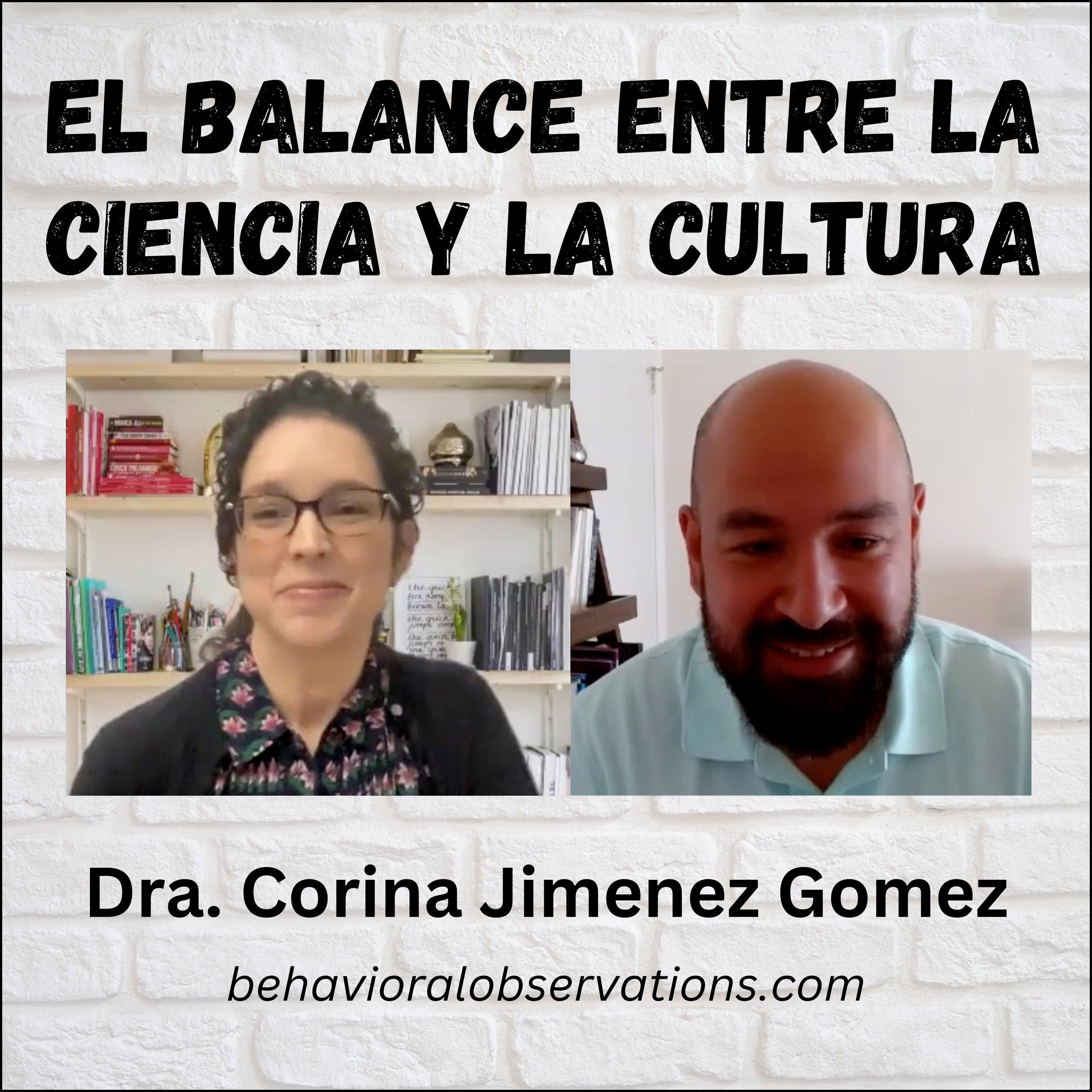
Ep 222El Balance entre la Ciencia y la Cultura
El Balance entre la Ciencia y la Cultura con la Dra. Corina Jimenez Gomez A la Dra Corina Jimenez Gomez le gusta "echar cuentos". Ella lo atribuye a como fue criada y a su amor a la literatura. En otras palabras, lo atribuye "al reforzamiento diferencial de su conducta verbal". Tengo que admitir que como Venezolano tenía un gran interés de hablar con una paisana con quien comparto algunas nostalgias y experiencias de emigrante pero también un orgullo y admiración por alguien que puede navegar en océanos académicos, experimentales y aplicados. Como tal, sus adaptaciones a varios lenguajes, culturas y conocimientos le han dado una gran sensibilidad en su comunicación y el abordaje a sus distintas audiencias. Si ella puede construir puentes entre el realismo mágico y el lenguaje científico, quién mejor para examinar nuestras culturas y subculturas dentro de nuestra profesión y para observar cómo interactuamos con quienes colaboramos. Espero que disfruten y aprendan de esta conversación tanto como yo. Nota: el uso de lenguaje metafórico en las notas del show es intencional :) ------------------------------------------------------------------------------------ The Balance between Science and Culture with Dr. Corina Jimenez Gomez Dr. Corina Jimenez Gomez likes to "tell stories." She attributes it to how she was raised and her love of literature. In other words, she attributes it "to differential reinforcement of her verbal behavior." I have to admit that as a Venezuelan I was very interested in talking with a compatriot with whom I share some nostalgia and experiences as an emigrant, but also a pride and admiration for someone who can navigate academic, experimental and applied oceans. As such, her adaptations to various languages, cultures, and knowledge have given her great sensitivity in her communication and approach to different audiences. If you can build bridges between magical realism and scientific language, who better to examine our cultures and subcultures within our profession and to observe our interactions with those we collaborate with. I hope you enjoy and learn from this conversation as much as I did. Note: The use of metaphorical language in the show notes is intentional :) *Interview and shownotes by Miguel Avila **previous appearances by Dr. Jimenez-Gomez on the BOP

Ep 221How Many Hours of ABA are Actually Necessary? Session 221 with Melissa Willa and Colin Davitian
In Session 221, I had the opportunity to talk with Melissa Willa and Colin Davitian. These guys are a husband and wife team who founded the ABA provider, Kyo, formerly known as the Gateway Learning Group. Our conversation focused on two hot-button topics when it comes to providing services to individuals with Autism: Treatment Dosage and Value Based Care. With regard to the former, Melissa and Colin, along with their colleagues, conducted a retrospective analysis of treatment outcomes for learners in under their care. In doing so, they looked at the role that treatment dosage had on their overall progress, as measured by standardized assessments. You may already be wondering what they found, so don't worry, we get into that and lots more in this episode. We also try to place their findings in the context of existing studies that examined the relationship between treatment dosage and treatment outcomes. As I mention during the interview, there's lots of discussion of this topic that's happening, particularly in the various ABA social media groups, and as is true with so many other things, it's refreshing to elevate the discourse by looking at empirical analyses as opposed to anecdotal observations and hunches. If you're a clinical director or practice owner who's also interested in this topic, Melissa and Colin suggest strategies for mining the data you probably already have access to via client electronic health records. Towards the end of the podcast, we turned our attention to Value Based Care. Colin and Melissa define what that is, and contrast it with the more traditional fee-for-service approach for health care reimbursement. Not to spoil the punchline here, but these guys seemed pretty bullish on the potential for shifting Autism services to a Value Based Care model. As a sidetone, for a longer discussion on the topic of VBC, check out Session 194 with Amanda Ralston. I have other guests that I've been meaning to bring on to talk about this as well. Lastly, I want to thank Melissa and Colin for patiently responding to all of my "yeah, but…" questions. Even though I don't personally provide services in an insurance funded model, I am old enough to remember the days when accessing ABA services was next to impossible due to the lack of both funding and providers, so I'm fairly reluctant to cede ground as it relates to how many hours individuals can receive authorization for, and my line of questioning most likely revealed this. I've also seen cases where learners have received very intensive early intervention, and made so much progress that they entered kindergarten with little to no supports. As such, I think it's fair to say that I had some level of bias heading into this conversation. Long story short, these are complicated topics, and whether you agree or disagree with the findings we discuss in this episode, I think you'll find the conversation thought provoking. Lastly, if you want to read up on this topic in more detail, I have several of the articles we referenced in this episode's show notes. I also have Melissa and Colin's LinkedIn profiles, so I'd encourage you to connect with them if you have questions or thoughts about these topics. To learn more about Kyo or to connect with Colin and Melissa: www.kyocare.com Melissa Willa - LinkedIn Colin Davitian - LinkedIn Here are some links to studies we directly or indirectly referred to in this episode: Ostrovsky, A., Willa, M., Cho, T. et al. Data-driven, client-centric applied behavior analysis treatment-dose optimization improves functional outcomes. World J Pediatr (2022). Rogers SJ, Yoder P, Estes A, Warren Z, McEachin J, Munson J, et al. A Multisite Randomized Controlled Trial Comparing the Effects of Intervention Intensity and Intervention Style on Outcomes for Young Children With Autism. J Am Acad Child Adolesc Psychiatry. 2021;60(6):710-22. Virués-Ortega, J. (2010). Applied behavior analytic intervention for autism in early childhood: Meta-analysis, meta-regression and dose–response meta-analysis of multiple outcomes. Clinical Psychology Review, 30, 387-399. Cohen, H., Amerine-Dickens, M., & Smith, T. (2006). Early intensive behavioral treatment: Replication of the UCLA model in a community setting. Developmental and Behavioral Pediatrics, 27, S145-S155. Eikeseth, S., Smith, T., Jahr, E., & Eldevik, S. (2002). Intensive behavioral treatment at school for 4- to 7-year-old children with autism: A 1-year comparison controlled study. Behavior Modification, 26, 46-68. Howard, J. S., Sparkman, C. R., Cohen, H. G., Green, G., & Stanislaw, H. (2005). A comparison of intensive behavior analytic and eclectic treatments for young children with autism. Research in Developmental Disabilities, 26, 359-383 This podcast is brought to you by the following sponsors: How to ABA - their goal is to make you feel supported and confident while helping your clients make real progress! In their membership community, you will find all the assessments, programs, data

Ep 220Safe Sleeping Practices for Infants: Session 220
Drs. Jason Vladescu, Lauren Schnell, and Jessica Day-Watkins join me in Session 220 to talk about their research in training parents and caregivers on safe sleeping habits for infants. As you'll learn, there are sleeping practices that are recommended by Pediatric groups that reduce the likelihood of Sudden Unexpected Infant Deaths (SUIDs) in general, and Accidental Suffocation and Strangulation in Bed (ASSB) incidents. If those are new terms to you, don't worry, we get into what they mean, how frequently they occur, and lots more. And while this may seem like a depressing or morbid topic, and I've known people who've had children succumb to this, I also see this as a story of hope in that studies like these will lead to a wider adoption of sleeping practices that, over time, should reduce unnecessary infant deaths. Jason is a Professor in the Applied Behavior Analysis Department at Caldwell University, Lauren is an Assistant Professor at Hunter College, and Jessica is an Assistant Professor at the AJ Drexel Autism Institute. Together they worked on several projects in the area of infant safe sleeping, which culminated in some publications in the Journal of Applied Behavior Analysis, which we discuss in this podcast. What I found fascinating about this topic is that it allowed us to discuss a wider range of issues that transcend safe sleeping practices. These include staff training, cultural humility, public health and policy, contingency management, video modeling, dissemination... the list goes on. There's an angle here for everyone. Here are some links to what we discussed: Vladescu et al. (2020). Mery et al. (2022). Mery et al. (2023). Inside JABA 14. Inside JABA 6. American Association of SIDS Prevention Physicians. AAP Safe Sleep Recommendations. This podcast is brought to you by the following sponsors: How to ABA - their goal is to make you feel supported and confident while helping your clients make real progress! In their membership community, you will find all the assessments, programs, data sheets, and materials you need so that your job is just a little easier. As a member, you'll also be invited each month to join a live CEU and a live mentorship session in their private community group. You'll also have access to their extensive CEU library of recorded on-demand CEU's on relevant, practical topics to BCBA's in the field. Go to https://members.howtoaba.com/join. When you join today and use code BOP, you'll receive 10% off a yearly subscription (includes CEU's!). ACE Approved CEUs from .... Behavioral Observations. That's right, get your CEUs while driving, walking your dog, doing the dishes, or whatever else you might have going on, all while learning from your favorite podcast guests! HRIC Recruiting. Barb Voss has been placing BCBAs in permanent positions throughout the US for just about a decade, and has been in the business more generally for 30 years. When you work with HRIC, you work directly with Barb, thereby accessing highly personalized service. So if you're about to graduate, you're looking for a change of pace, or you just want to know if the grass really is greener on the other side, head over to HRIColorado.com to schedule a confidential chat right away.

Ep 219Catching up with Greg Hanley
Dr. Greg Hanley returns to Behavioral Observations for another round of fun conversation on the assessment and treatment of severe problem behavior. This show gets into the weeds of the Practical Functional Assessment/Skills-Based Treatment Process right away, so if you have nuanc-ey questions or concerns about PFA/SBT, this is the show for you. In this segment of the show, we discuss the changes his company, FTF, had to roll with over the last few years, what he and his colleagues are up to now. We spend a considerably amount of time discussing what they've learned about functional assessment and treatment, and how their process has evolved over the years, especially in terms of the types of individuals who benefit from these interventions, as well as those who do not. Perhaps my favorite part of the conversation was when we discussed the complex nature of Skills-Based Treatment. To this end, Greg talked about the kind of training one ideally needs to be able to implement an SBT session successfully. Long story short, it's more than teaching someone to say, "My Way." Speaking of training, FTF offers a variety of on-demand virtual trainings, in-person live workshops, and short and long-term consultation engagements. Greg also mentioned numerous papers, most of which you can find here. If there are others not represented on this page, let me know and I'll add those to the show notes. What we didn't get into is the outreach FTF is making with using this process in public school settings. We also didn't get a chance to get into the SBT data collection app that his colleagues at Hi-Rasmus has created, but you can check out here. OK, back to the interview... after a lengthy nuts and bolts discussion of the what makes for successful SBT interventions, we broadened the lens to discuss many of the so-called 'hot topics,' in Behavior Analysis these days. This included: The influence of social media groups. Overly rigid rule adherence, in which we spend a fair bit of time talking about token systems. Greg's perspective on Trauma-informed and Trauma-assumed ABA. Other aspects of "Hyphenated-ABA" that are being discussed. Practical perspectives on assent... and if you're like me, and often think about the limitations of assent-based models of treatment, this will be helpful (and by the way, check out this article by Dr. Paulie Gavoni and Steve Ward), and, The use of extinction. Greg also opened up a bit about how he almost left the field of ABA. You read that correctly. You'll have to listen to the show to hear about this in his own words. Greg was extremely generous with his time, and even stuck around to answer questions that I solicited from Patreon members. As you might imagine, there were a lot of great questions, and the answers were punctuated with a few really funny stories that you won't want to miss. All of this to say that I enjoyed this conversation immensely, and I hope you do too :-) This podcast is brought to you by How to ABA - their goal is to make you feel supported and confident while helping your clients make real progress! In their membership community, you will find all the assessments, programs, data sheets, and materials you need so that your job is just a little easier. As a member, you'll also be invited each month to join a live CEU and a live mentorship session in their private community group. You'll also have access to their extensive CEU library of recorded on-demand CEU's on relevant, practical topics to BCBA's in the field. Go to howtoaba.com/join. When you join today and use code BOP, you'll receive 10% off a yearly subscription (includes CEU's!). ACE Approved CEUs from .... Behavioral Observations. That's right, get your CEUs while driving, walking your dog, doing the dishes, or whatever else you might have going on, all while learning from your favorite podcast guests! The aforementioned Verbal Behavior Conference. This is conference is as equally fun as it is informative, and BehaviorLive makes it available virtually as well, so I hope to see you there! Behavior University. Their mission is to provide university quality professional development for the busy Behavior Analyst. Learn about their CEU offerings, including their brand new 8-hour Supervision Course, as well as their RBT offerings over at behavioruniversity.com/observations.

Ep 218Teaching Skills that Improve Quality of Life with Troy Fry
In Session 218 of Behavioral Observations, Troy Fry joins me to talk about his long career in Behavior Analysis helping individuals with disabilities improve their quality of life by learning meaningful skills. In particular, we discussed: How he found his way to Behavior Analysis at a time when it wasn't nearly as seemingly ubiquitous as it is today. What it was like to be mentored by Ray Miltenberger, Don Baer, Barbara Etzel, Montrose Wolf, and more. How Troy became colleagues with Pat McGreevy. A brief history of the treatment of adults with severe developmental challenges in the United States. Troy's extensive international work in France and Italy, and what it's like to provide services in large, congregate-care facilities. We also spend a bit of time talking about his talk at the upcoming Verbal Behavior Conference. As he describes in our conversation, EFL is rolling out the Performance Analysis Tool, and his talk at the Verbal Behavior Conference will elaborate on that in more detail. If you're interested in what Troy has to say, consider attending the Verbal Behavior Conference on March 30th and 31st. The on-site event will be held in Austin, TX, but if you can't make it there, the virtual event is a fantastic option. The cool thing about the VBC, especially in-person, is that attendees really have lots of opportunities to interact with the speakers. In fact, at the end of the first day, I have the honor of moderating a panel with all the speakers. A panel, in this case, is really just an opportunity for you to ask the speakers questions directly. And audience Q and A is open to both virtual and in-person attendees. In fact, in last year's conference, we had more questions from our virtual audience! This podcast is brought to you by • How to ABA - their goal is to make you feel supported and confident while helping your clients make real progress! In their membership community, you will find all the assessments, programs, data sheets, and materials you need so that your job is just a little easier. As a member, you'll also be invited each month to join a live CEU and a live mentorship session in their private community group. You'll also have access to their extensive CEU library of recorded on-demand CEU's on relevant, practical topics to BCBA's in the field. Go to howtoaba.com/join. When you join today and use code BOP, you'll receive 10% off a yearly subscription (includes CEU's!). • The University of Cincinnati Online. UC Online designed a Master of Education in Behavior Analysis program that is 100% online and asynchronous, meaning you log on when it works for you. Want to learn more? Go to online.uc.edu and click the "request info" button. • ACE Approved CEUs from .... Behavioral Observations. That's right, get your CEUs while driving, walking your dog, doing the dishes, or whatever else you might have going on, all while learning from your favorite podcast guests! • The aforementioned Verbal Behavior Conference. This is conference is as equally fun as it is informative, and BehaviorLive makes it available virtually as well, so I hope to see you there!

Ep 218Psicoterapia Analítico-Funcional, ACT y Telemedicina con el Dr. Luis Morales Knight
En esta segunda sesión de la serie de Behavioral Observations para Hispanohablantes, el Dr. Luis Morales Knight vuelve a compartir su experiencia como Psicólogo Clínico. Esta vez centra su historia de origen en resaltar sus experiencias en el análisis de comportamiento tradicional que lo llevaron a su práctica utilizando ACT y Psicoterapia Analítico-Funcional. El Dr. Knight enfatiza la importancia de una base teórica sólida para mejorar la práctica. Comparte su transición a la telemedicina impulsada por la pandemia y los desafíos comunes de sus clientes después de la pandemia, incluida la "adultez", los efectos del consumo de las redes sociales y la medicalización de la experiencia humana. También comenta acerca de las diversas dinámicas de las sesiones terapéuticas con niños, adolescentes y adultos. Por último, nos deja con una gran nota sobre alejarnos de la perspectiva de la culpa y pasar a una visión a las circunstancias que nos lleva a tener más compasión (¿te suena familiar?). ------------------------------------------------------- Si te sientes estancado con algunos de tus aprendices que tienen grandes desafios en el desarrollo, y aunque inviertas horas y horas en enseñarle, no estás mejorando su vida significativamente. Si estás confundida y no sabes por dónde empezar o sabes que las herramientas que has utilizado no son adecuadas para ellos Queremos decirte algo, ¡puedes mejorar su calidad de vida significativamente si re piensas qué estás enseñando y cómo lo estás enseñando! El jueves 2 de marzo realizaremos un evento en línea y gratuito llamado Re-Pensando el Rumbo, donde enseñaremos a profesionales como tú a utilizar el currículum Essential for Living (Esenciales para la Vida) para identificar qué habilidades son imprescindibles enseñar a niños y adultos con grandes desafíos en el desarrollo para mejorar su calidad de vida. Para Participar, haz click en este enlace www.diversitad.com/re-pensando-el-rumbo e inscríbete. ¡Aun No es tarde para repensar el rumbo! ------------------------------------------------------- Functional Analytic Psychotherapy, ACT and Telemedicine with Dr. Luis Morales Knight In this second session of the series Behavioral Observations for Spanish Speakers, Dr. Luis Morales Knight comes back to share his experience as a Clinical Psychologist. This time he focuses his origin story on highlighting his experiences in traditional behavior analysis leading to his practice using ACT and Functional Analytic Psychotherapy. Dr. Knight emphasizes the importance of strong theoretical foundations to enhance better practice. He shares his transition to telemedicine prompted by the pandemic and the common struggles of his clients post pandemic including "adulting", effects of social media consumption, and the medicalization of the human experience. He also discusses the various dynamics of the therapeutic sessions with children, adolescents and adults. Lastly, he leaves us with a great note about moving away from the blame perspective and into a circumstantial view that leads us to have more compassion (sound familiar?)

Ep 217Detecting Your Personal Biases: Session 217 with Lina Slim
Dr. Lina Slim joins me in Session 217 for a wide-ranging conversation that is almost impossible to describe in a list of bullet points. But I will try... In this show we discussed: Her pivot from studying animal behavior and language to teaching children with Autism. Her unease with seeing lackluster applications of ABA. Starting her own school while earning her Ph.D., while raising two children. Providing services all over the world. Detecting your own biases when providing services (please check this part out if you listen to nothing else in this podcast!!!). Developing trust through asking questions. What it's like to practice ABA in three different languages. What she plans on talking about at this year's Verbal Behavior Conference (and please consider attending, it's a great time!). Great advice for the newly-minted BCBA. I hope you enjoy this conversation as much as I did! This podcast is brought to you by: · Rose Griffin's FREE masterclass, The Power of Joint Attention. This 30-minute course will show you how to use books in therapy so your students are running over to listen to you read. The course also covers how to use songs in therapy so that your students are eager to participate and play and are ready to engage with you every session. Rose shares actionable tips that you can use in your next therapy session and provides BONUS pintables that you can practice right away. To learn more, go to abaspeech.org, and click the Free Masterclass tab at the top! · Being a behavior professional is hard. At How to ABA their goal is to make you feel supported and confident while helping your clients make real progress! In their membership community, you will find all the assessments, programs, data sheets, and materials you need so that your job is just a little easier. As a member, you'll also be invited each month to join a live CEU and a live mentorship in our private community group. You'll also have access to their extensive CEU library of recorded on-demand CEU's on relevant, practical topics to BCBA's in the field. It's more than enough for recertification! With a Bx Resource membership, you'll save time, feel confident, and master what you love! Go to howtoaba.com/join. When you join today and use code BOP, you'll receive 10% off a yearly subscription (includes CEU's!). · The aforementioned Verbal Behavior Conference. This is conference is as equally fun as it is informative, and BehaviorLive makes it available virtually as well, so I hope to see you there!

Ep 216How to Optimize Learning with Guided Notes, SAFMEDs, and Instructional Design: Session 216 with Sal Ruiz
Dr. Sal Ruiz and I recorded a long overdue podcast where we went over all things SAFMEDS, Instructional Design, best practices for online learning, and much more. In this podcast we covered a lot of ground, but I think one of the most interesting things I took from the conversation are the procedural variations that have been explored. It turns out that there are some ways to do SAFMEDS that lead to better results depending on what outcomes you're looking for. We also explore instructional design, and in that, we talk about starting with the end in mind, tailoring lessons for in-person, synchronous, and asynchronous modalities, how guided notes fit into all of this, and much more. Long story short, whether you're a student, a university instructor, or even if you're responsible for training people outside of the university context, there are many lessons to be learned from this podcast. Lastly, Sal's parting advice to BCBAs is really good. The advice involves choosing continuing education topics. I'm not going to spoil the details of this advice here, so definitely listen all the way through and check out what he has to say on the topic! Here are the links to the resources we discussed: Ruiz ABA on Facebook Quigley 2014 dissertation, Evaluations of Various SAFMEDS Procedures Ward-Horner and Sturmey 2013, Component Analysis of Single Subject Experimental Designs: A Review Ruiz et al. 2021, Impact of Guided Notes on Graduate Student Retention of Facts Riden et al., 2020, The Nature and Extent of Component Analyses for Improving or Mitigating Behavior: A Systematic Review Since you're going to ask, you can find Jen Farris here and here, and ask her about the SSC for Practical Functional Assessment (and find training opportunities here) Wu 2015, Online learning in postsecondary education: a review of the empirical literature (2013-2014) Hunter College ABA Program Sal's Mock exams (very reasonably priced IMHO!!!) Sal's social media: Twitter, Facebook, Instagram This session of the BOP was brought to you by: The University of Cincinnati Online. UC Online designed a Master of Education in Behavior Analysis program that is 100% online and asynchronous, meaning you log on when it works for you. Want to learn more? Go to online.uc.edu and click the "request info" button. HRIC Recruiting. Barb Voss has been placing BCBAs in permanent positions throughout the US for just about a decade, and has been in the business more generally for 30 years. When you work with HRIC, you work directly with Barb, thereby accessing highly personalized service. So if you're about to graduate, you're looking for a change of pace, or you just want to know if the grass really is greener on the other side, head over to HRIColorado.com to schedule a confidential chat right away. ACE Approved CEUs from .... Behavioral Observations. That's right, get your CEUs while driving, walking your dog, doing the dishes, or whatever else you might have going on, all while learning from your favorite podcast guests! Behavior University. Their mission is to provide university quality professional development for the busy Behavior Analyst. Learn about their CEU offerings, including their brand new 8-hour Supervision Course, as well as their RBT offerings over at behavioruniversity.com/observations.

Ep 215Certificación, acreditación y regulación internacional de analistas de conducta. Iniciativas para hispanohablantes con el Dr. Javier Virues Ortega
Editor's note: A few months ago, my friend Miguel Avila and I thought it would be fun to offer some Behavioral Observations content to Spanish speaking ABA professionals, parents, and other folks who would enjoy it. Thanks to Miguel's hard work, we have a few shows recorded, and more in the works. Our plan is to release about one episode a month for a few months. If you know folks who would be interested in these episodes, please consider sharing it with them. Lastly, we'd like to thank Essential for Living, which is now available in Spanish, for giving Miguel the time to record these thought-provoking conversations! Hace unos meses, mi amigo Miguel Avila y yo pensamos que sería divertido ofrecer contenido de Behavioral Observations (Observaciones Conductuales) a profesionales de ABA de habla hispana, padres y otras personas que podrían disfrutarlo. Gracias al arduo trabajo de Miguel, tenemos algunos programas grabados y más en proceso. Nuestro plan es lanzar alrededor de un episodio al mes durante algunos meses. Si conocen a personas que estarían interesadas en estos episodios, consideren compartirlo con ellos. Por último, nos gustaría agradecer a Essential for Living (Esenciales para la Vida), que ahora está disponible en español, por darle a Miguel el tiempo para grabar estas conversaciones que invitan a la reflexión. En esta sesión, el Dr. Javier Virues Ortega se une a Miguel para examinar el estado de la práctica del análisis de la conducta en los países de habla hispana. El Dr. Virues Ortega ofrece sus observaciones sobre la historia del análisis de la conducta en España y América Latina. A raíz de la salida de la BACB como una certificación internacional, revela algunas de las complejidades del desarrollo y las operaciones de los organismos de certificación y acreditación. El Dr. Virues Ortega y Miguel destacan las iniciativas modestas pero importantes que han observado de profesionales dedicados en Iberoamérica que quieren que la profesión del análisis de comportamiento prospere. También menciona algunos de los recursos y programas que se han puesto a disposición en español hasta el momento. Nos deja un valiosísimo consejo y una gran anécdota sobre la perseverancia. International certification, accreditation, and regulation of behavior analysts. Initiatives for Spanish speakers with Dr. Javier Virues Ortega In this session, Dr. Javier Virues Ortega joins Miguel to examine the state of the practice of behavior analysis in Spanish-speaking countries. Dr. Virues Ortega offers his observations on the history of behavior analysis in Spain and Latin America. In light of the departure of the BACB as an international certification, he unpacks some of the complexities of the development and operations of certification and accreditation bodies. Dr. Virues Ortega and Miguel note the modest, but important initiatives they have observed from dedicated professionals in Iberoamerica that want the behavior analysis profession to prosper. He also mentions some of the resources and programs that have been made available in Spanish thus far. He leaves us with invaluable advice and a great anecdote about perseverance.

Ep 214How to Develop a Skilled RBT Workforce: Apollo Case Study Series 7
I've been asked many times to highlight the work of Registered Behavioral Technicians, and in this installment of the Apollo Case Study Series, we do just that. Dr. Jim Moore, Rachel Packiam (Director of Clinical Excellence), Christina Halverson (RBT Training Coordinator), and Emily Jackson (Lead RBT) joined me to discuss Apollo's unique organizational strategies for onboarding and training their RBTs. As you'll learn in this episode, by the time an RBT works 1:1 with a child, they have had the training and confidence necessary to implement programming successfully. It is important to emphasize that this just doesn't happen by accident. There are many additional hours of supervising and mentoring that happen - hours that go far beyond the basic requirements. And as an outsider looking in, it's impressive to me just how much non-billable time they invest in ensuring their staff are as prepared as possible. If you're a practice owner, or if you have some administrative role, you're going to want to grab a pen and paper to take some notes, because there are a lot of ideas for staff development and support in this podcast. We go over topics including rapport-building with trainees, soft-skills, staff morale, professionalism, teaching and upholding core organizational values, common struggles of trainees, and lots more! If you're an RBT or BCBA, and this model of training and service delivery appeals to you, connect with Jim, or contact the folks at Apollo directly to learn more about potential job opportunities in their Atlanta-area clinics.

Ep 213Using Behavior Analysis for Policy Development and Analysis: Inside JABA 14
Thanks so much for checking out installment number 14 in the Inside JABA Series on Behavioral Observations. Dr. John Borrero, JABA's Editor in Chief, and I are joined by Drs. Brett Gelino and Derek Reed to discuss a novel study that they and their colleagues conducted on the University of Kansas campus. The study, which culminated in the paper, "Tobacco-free policy reduces combustible tobacco byproduct," shows how a group Behavior Analysts teamed up with university policy-makers to craft and evaluate a campus-wide tobacco-free initiative. On the one hand, policy evaluation may sound like a dry topic. But if you step back and think about this for a minute, this is an example of how we can use Behavior Analytic concepts and principles to solve relevant problems at scale. How many times have you seen well-intended policies produce the dreaded "unintended consequences," because the people who made the policy did not have sufficient expertise in behavioral concepts and principles? So to my mind, this piece of research is a very exciting and promising development. Long story short, this one is for all my fellow policy-wonks out there, and there are many cool elements to this study when it comes to data collection and analysis. And here are some links that we discussed: Gelino et al., (2023). Tobacco-free policy reduces combustible tobacco byproduct. Critchfield and Reed (2017). The fuzzy concept of Applied Behavior Analysis research. Fawcett et al., (1988). Behavior Analysis and public policy. Chapman and Risley (1974). Anti-litter procedures in an urban high-density area. You've subscribed to JABA, right? Huitema (2011). Simple interrupted time-series designs. This podcast will eventually be available for BACB CEUs, and to learn more about how to get continuing education credits for listening to this show, click here.

Ep 212Token Economy 101: Considerations for research and practice, w/Tim Hackenberg
This was a really fun episode. Dr. Tim Hackenberg joined me to discuss both what we know, and what we don't know about token economies. This conversation was inspired by my interview with Dr. Matt Brodhead in Session 205, where in listening to that show, Tim picked up on a misstatement of mine. We get into the specifics of this in our interview, but in brief, I made an off-the-cuff comment about token economy research. Thankfully, Tim reached out to me and offered to discuss this issue in more detail, and more importantly, correct my point of view on this matter. And I'm so glad he did just that. I really learned a lot in this episode. In it, we discuss the basics of what constitutes a token economy, the importance of generalized reinforcers, early research in this area, troubleshooting ineffective token economies, and perhaps most interestingly, directions for future research. Our discussion centered around Tim's 2018 JABA paper, Token Reinforcement: Translational Research and Application. As I mention in the interview, it's simply an impressive work of scholarship, and I highly recommend taking the time to read through it. So whether you're a newly-minted BCBA, or a seasoned pro, I think there's something here for everyone. Tim also shared that he, along with Dr. Francesca Delgi Espinosa, created two token economy courses. One is a brief overview course that's free, and there's an advanced course titled, "Token economies: Bridging the gap from research to practice." You can find out more about them here. Session 212 is brought to you by: The University of Cincinnati Online. UC Online designed a Master of Education in Behavior Analysis program that is 100% online and asynchronous, meaning you log on when it works for you. Want to learn more? Go to online.uc.edu and click the "request info" button. Rose Griffin's FREE masterclass, The Power of Joint Attention. This 30 minute will show you how to use books in therapy so your students are running over to listen to you read. The course also covers how to use songs in therapy so that your students are eager to participate and play, and are ready to engage with you every session. Rose shares actionable tips that you can use in your next therapy session, and provides BONUS printiables that you can practice right away. To learn more, go to abaspeech.org, and click the Free Masterclass tab at the top! Behavior University. Their mission is to provide university quality professional development for the busy Behavior Analyst. Learn about their CEU offerings, including their 8-hour Supervision Course, as well as their RBT offerings over at behavioruniversity.com/observations.

Ep 2112022 Year in Review with ABA Inside Track
It's that time of year again folks. If you're new to the show, every year, I get together with my friends from ABA Inside Track for a Year in Review show, and this year was no different. In this podcast, we went over a handful of happenings in the world of Applied Behavior Analysis. In this episode, we covered: The changes in leadership of the Journal of Applied Behavior Analysis and the Association for Professional Behavior Analysis. What shows from each of our pods resonated with our respective audiences. Whether West Coast or New England IPAs are best (c'mon, is this even worth talking about?), including an impromptu short history of American Craft Beer. Other questions from the audience. The passings of Tameka Meadows, Beth Sulzer-Azaroff, David Jarmolowicz, and Dale Bretthower. With regard to the latter, I would like to say that I wish we had more time to elaborate on the contributions of these behavior analysts. We were pressed for time, not only for recording, but also in terms of show preparation, and I apologize if that segment of the show fails to live up to the standards you've come to expect from Behavioral Observations. We also fielded a great question from long time listener, Penny Holloway. Again, time did not allow us to do her question justice, but if you listen to the very end of the show, I do my best to address it, and I hope you get a chance to check that out. Huge thanks again for the ABA Inside Track crew, along with Alan Haberman for being such great conversational partners. I look forward to sharing more fun discussions with you in 2023 and beyond!!! Here are the links to some of the things we discussed: Inside JABA 13 (John Borrero and Linda LeBlanc). Inside JABA 2 (Big Idea Papers). Session 205 (Matt Brodhead/Ethics and the use of Punishment). Session 201 (Holly Gover/Preference for Contingent Reinforcement). Session 180 (Merrill Winston/Why Your Behavior Plan Stinks). Inside JABA 10 (Rajaraman/Austin/Trauma Informed Behavior Analysis). Apollo Case Study Series. For Kids With Severe Behaviors, Hospital ERs Increasingly Becoming De Facto Homes. ABA Inside Track - Facilitated Communication. ABA Inside Track - A Call to Action re: Rekers and Lovaas. Session 122 (Justin Leaf/The Case Against Social Stories).

Ep 210Eye Contact, Core vs Fringe Vocab, State Testing, and Other Non-Controversial Topics: The 2022 VBC Panel
If you're a long-time listener, you've likely heard me talk about the Verbal Behavior Conference at various points over the last few years. If you're not familiar with the event, it's a two-day workshop that my friends at the Central Texas Autism Center have been putting on for years. What you're about to hear is the panel discussion from the 2022 event, which was the first post-pandemic live event for the conference, which took place, as always, in Austin, Texas. This panel discussion included Kevin Luczynski, Sarah Lechago, Francesca Delgi Espinosa, Tamara Kasper, Mark Sundberg, David Palmer, David Roth, and Pat McGreevy. This particular panel discussion started off with going over some granular details about Joint Attention and Joint Control, but as panels often do, this one got a little more freewheeling as it went on. For example, there were some great discussions regarding assessing bilingual clients, the role of eye contact, core vs. fringe vocabulary, rule-governed behavior, and much more! I had the honor to be invited to moderate this amazing lineup. These duties included asking my own questions, taking questions from the in-person crowd (and huge thanks to Kelle Rich for sprinting around the mic!), and monitoring the on-line chat to take questions from those participating at home. As such, there are some occasional long pauses here and there throughout the discussion, so please bear with that, as I think it will be worth your time. If an event like this sounds fun to you, you're in luck because the 2023 Verbal Behavior Conference is just around the corner. It's taking place on March 30th and 31st, as always, in Austin, Texas. However, if you can't be there in person, the Verbal Behavior Conference will be presented online via Behavior Live, and for what it's worth, they do a fantastic job doing this. Whether virtually or in person, I'd love to see you there. This year's event includes talks from Pat McGreevy, Troy Fry, Lina Slim, Andresa De Souza, Sarah Frampton, Einar Ingvarsson, and Samantha Bergman. Once again, I will be moderating the panel at the end of the first day. All in all, it's a really fun time. If you're listening to this and it's still 2022, early-bird pricing is still in effect, so if this all sounds fun to you, grab your ticket today and save some cash in the process. This podcast is brought to you by: The University of Cincinnati Online. UC Online designed a Master of Education in Behavior Analysis program that is 100% online and asynchronous, meaning you log on when it works for you. Want to learn more? Go to online.uc.edu and click the "request info" button. Session 204 guest Rose Griffin's FREE masterclass, The Power of Joint Attention. In this 30 minute training you will learn how to use books in therapy so your students are running over to listen to you read. The course then moves onto using songs in therapy so that your students are eager to participate and play, so that your students are ready to engage with you every session. Rose shares 3 actionable tips that you can use in your next therapy session, and shares BONUS printiables that you can use and share with parents. Behavior University. Their mission is to provide university quality professional development for the busy Behavior Analyst. Learn about their CEU offerings, including their brand new 8-hour Supervision Course, as well as their RBT offerings over at behavioruniversity.com/observations.

Ep 209An Analysis of Bad Leadership Practices: Session 208 with Paulie Gavoni
I'm really excited to chat with Dr. Paulie Gavoni again on the podcast. As long time listeners know, he's been on the show many times, and always brings a down-to-earth, practical point of view to what we do as Behavior Analysts. In preparation for a talk at the recent Hoosier Association for Behavior Analysis event, Paulie did a deep dive on characteristics of bad leadership. It went over very well, and we thought it would make for an informative podcast episode. And Paulie presents his findings in his own unique and fun manner. I won't spoil it here, so be sure to hear him go through it all. I should also note that Paulie and I talk all the time and our banter may have drifted into what I'll refer to here as 'middle school language.' Nothing terribly profane mind you, but I did want to give a heads up because I know many of you listen to the podcast while ferrying your kids around. On a different note, Paulie and I, along with our colleague Anika Costa, are working on a really fun project for behavioral professionals in public school settings. We are hoping to have it out in the first quarter of 2023, so stay tuned for that. Here are the links: Follow Paulie on LinkedIn; he's always posting thought provoking-articles. Check out Paulie's Podcast. Paulie's first appearance on BOP. Hoosier ABA. The Magic Relationship Ratio. Quick Responses for Reducing Misbehavior and Suspensions. Quick Wins! Accelerating School Transformation through Science, Engagement, and Leadership. Deliberate Coaching: A Toolbox for Accelerating Teacher Performance. Downloadable Performance Diagnostic Checklist. This podcast is brought to you by: The Empowering Parents with ACT course, from Praxis Continuing Education and Training. Taught by Dr. Lisa Coyne and Dr. Evelyn Gould, this course presents a powerful acceptance and commitment training-based approach to supporting parents and caregivers with evidenced-based interventions. Designed for anyone who works with caregivers and their families, including children with mental health issues, autism, physical or developmental differences, chronic health issues, and other challenges, this self-paced training will help you work with caregivers to help their families grow and thrive. To watch a free video lesson from Empowering Parents with ACT, go to: praxiscet.com/parents. Session 204 guest Rose Griffin's FREE masterclass, The Power of Joint Attention. In this 30 minute training you will learn how to use books in therapy so your students are running over to listen to you read. The course then moves onto using songs in therapy so that your students are eager to participate and play, so that your students are ready to engage with you every session. Rose shares 3 actionable tips that you can use in your next therapy session, and shares BONUS printiables that you can use and share with parents. The University of Cincinnati Online. UC Online designed a Master of Education in Behavior Analysis program that is 100% online and asynchronous, meaning you log on when it works for you. Want to learn more? Go to online.uc.edu and click the "request info" button.

Ep 207Session 10 Rewind with Pat Friman: Your Road Trip Companion
Editor's Note: I generally publish three episodes a month, but I wanted to share this bonus, fourth episode with you as I know there will be a lot of people embarking on road trips in the coming days. As such, I've chosen one of my earliest interviews to re-release, and it's my first interview with Dr. Pat Friman (originally released in August of 2016!?!?), who as many of you know, went on to appear in several more Behavioral Observations Episodes. What I will say though is that if you're listening to this re-release of Session 10 shortly after it is published, that there is a huge CEU sale going on right now. These huge discounts that are available now through November 27th. And if you're catching this show after the sale is over, I usually have a few different discounts going so it's worth checking out no matter when you hear this. And speaking of Pat Friman, three of his later appearances on the show are indeed eligible for CEUs, so if you enjoy his message and want to hear more of it, and earn CEUs along the way, then this sounds like a win-win. In Session 10 of The Behavioral Observations Podcast, I speak with none other than Dr. Pat Friman. Pat is the Vice President of Behavioral Health Services at Boys Town as well as a Clinical Professor of Medicine in the Department of Pediatrics at the University of Nebraska School of Medicine. In today's show, Pat tells the story of how he literally wandered into a career in Behavior Analysis as well as the remarkable story of how Boys Town was started and how it serves children and families today. We then talk about his point of view on functional assessment practices, how he interviews parents, his take on what we refer to as, "kids these days," and Behavior Analysts as parents. With regard to the latter, I accidentally broach some of my own parenting struggles, so you might have some fun at my expense (your welcome). If you enjoyed the show, please share it with friends and colleagues!

Ep 207From Newly-Minted to Confident Practitioner: ACSS 6
In the 6th installment of the Apollo Case Study Series, I'm joined by my regular conversation partner, Dr. Jim Moore, along with Christina Nylander. Christina is a BCBA who works at Apollo's Lawrenceville, GA clinic. In this episode, Christina opens up quite a bit and describes how she encountered Applied Behavior Analysis, her early experiences as an RBT, the mentoring and supervision she's received as a BCBA in the early stages of her career, the value of learning about typical child development, the successes she's had as a clinician, learning the PEAK curriculum, and much more. Christina quite vulnerably discussed juggling the immense challenges of being a working mother in our field as well. From sleep deprivation to feeling like one is never fully caught up... she candidly describes how she navigated that process. Throughout the podcast, Jim related Christina's points to Apollo's unique clinical and supervision models. If you are interested in learning more about what they do, you can find more information here. Here are some of the resources we discussed: Prior Apollo Case Study podcasts. Making the Science Part of Your Practice, Session 167. Rapport Building and Instructional Fading Prior to Discrete Trial Instruction: Moving From Child-Led Play to Intensive Teaching (Shillingsburg, et al., 2019). Last year's Verbal Behavior Conference. For those who are interested, the 2023 VBC (disclosure: VBC is a podcast sponsor). In parting, I have two requests: First, if you have any questions about this episode or any other ACSS podcasts, I encourage you to hit Jim up on LinkedIn.... even if it is just to say hello. Second, please share this show with friends and colleagues. I think Christina's story is highly representative of many people in the field right now, and this podcast may be helpful to quite a few BCBAs out there.

Ep 206An Intro to Feeding Challenges: Session 206 with Melissa Gonzalez
In Session 206, I spoke with Dr. Melissa Gonzalez, BCBA-D, about Pediatric Feeding Disorders, and what Applied Behavior Analysis can offer in this area. Melissa is the Clinical Therapy Director at the Siskin Children's Institute in Chattanooga, Tennessee, arriving there by way of Louisiana State University's Clinical Psychology program and the Kennedy Krieger Institute, amongst other waypoints. In this episode, we discussed how she got into working with individuals with Pediatric Feeding Disorders, what are the diagnostic criteria for this repertoire, what we know what works for PDFs, the difference between picky eaters and individuals with PFDs, the importance of taking a multidisciplinary approach to treatment, and much more! This is a topic I'm not terribly familiar with, so I learned a ton. If you have the same reaction to this podcast, please share it with friends and colleagues! Here are some of the resources we discussed: Feedingmatters.org Pediatric Feeding Disorders Fact Sheet S3E7: Ethical Considerations of Behavioral Feeding Interventions with Lisa Tereshko and Mary Jane Weiss Ethical Considerations of Behavioral Feeding Interventions (the paper... Tereshko, et al., 2021). Pediatric Feeding Disorder: A Nationwide Prevalence Study (Kovacic, et al., 2020). Pediatric Feeding Disorder: Consensus Definition and Conceptual Framework (Goday, et al., 2019). This podcast is brought to you buy: Abaspeech.org - the brainchild of Session 203 guest, Rose Griffin, is giving listeners a 30% discount on all of her courses which include, The Advanced Language Learner, Help Me Find My Voice, and Start Communicating Today. The offer is valid through December 1st, 2022. Go to abaspeech.org, check out the 'courses' link, and use the promo code, aba30, at checkout. The University of Cincinnati Online. UC Online designed a Master of Education in Behavior Analysis program that is 100% online and asynchronous, meaning you log on when it works for you. Want to learn more? Go to online.uc.edu and click the "request info" button. HRIC Recruiting. Barb Voss has been placing BCBAs in permanent positions throughout the US for just about a decade, and has been in the business more generally for 30 years. When you work with HRIC, you work directly with Barb, thereby accessing highly personalized service. So if you're about to graduate, you're looking for a change of pace, or you just want to know if the grass really is greener on the other side, head over to HRIColorado.com to schedule a confidential chat right away.

Ep 205Ethics Regarding the Use of Punishment, Amongst Other Things: Session 205 with Matt Brodhead
After a long hiatus, Dr. Matt Brodhead returns to Behavioral Observations. In this episode, we discuss the use of punishment in the context of creating effective, ethical behavioral interventions. Of course, pursuant to the Behavior Analysis Certification Board's Ethics Code for Behavior Analysts, punishment should only be considered, "only after demonstrating that desired results have not been obtained using less intrusive means, or when it is determined by an existing intervention team that the risk of harm to the client outweighs the risk associated with the behavior-change intervention" (Code Element 2.15, page 12). So Matt and I talked about what this means in practice, the role of coercive or aversive events in everyday life, weighing the pros and cons of treatment choices, and much more. As we state in the first few minutes of the show, we made the editorial decision not to discuss the ABAI Task Force report on Contingent Electric Skin Shock. It's not that we don't have opinions on this topic; rest assured, we certainly do. But we felt like it would be more helpful for practitioners to hear Matt's thoughts on things like response cost, time-out, and so forth, as these are procedures that are more likely to be used by "everyday" practitioners. We also meandered into a few other topics, like the necessity of teaching cooperation and compliance under certain stimulus conditions, the utility or role of descriptive assessments vs. analog functional analyses, as well as other digressions. On a stylistic note, because Matt and I have gotten to know each other pretty well, this is an even more conversational episode that usual (versus one that is a series of questions and answers), with the attendant joking around that we usually engage in. If you're interested in Matt's work, go over to his website, betteraba.com, and pick up a copy of his excellent workbook, Behavioral Systems Analysis and Ethical Behavior. It's a bargain at $25 bucks... and remember, the holidays are right around the corner Matt is also available for workshops and consultations, and you can reach him through the same website. And while I'm plugging Matt's stuff, the popular text book he co-authored with Drs. David Cox and Shawn Quigley, is out in its second edition (disclosure: Amazon Associates Link). Other resources we discussed: Brodhead and Oteto (2022): Ethics and Ethical Problem Solving. Thomas and Brodhead (2022): Bringing Challenge to Coercion and the Status Quo. Matt's earlier appearances on the BOP. Musical references: "I Love this Bar" and "Check Yo Self" Hanley et al. (2005). On the Effectiveness of and Preference for Punishment and Extinction-Based Components of Function-Based Interventions. Hanley (2012): Functional assessment of problem behavior: dispelling myths, overcoming implementation obstacles, and developing new lore. Congenital Insensitivity to Pain. Perone (2003): The Negative Effects of Positive Reinforcement. The Importance of Red Teams, Peter Attia, MD. Michael (1975): Positive and Negative Reinforcement, a Distinction That Is No Longer Necessary; Or a Better Way to Talk about Bad Things. MacKenzie (2021): Caring by Lying. Fisher et al. (1996): On the reinforcing effects of the content of verbal attention. CBIT for Tic Disorders. Inside JABA #3 with Iser DeLeon on Accumulated vs. Distributed Reinforcement. This podcast is brought to you with the generous support of: Behavior University. Their mission is to provide university quality professional development for the busy Behavior Analyst. Learn about their CEU offerings, including their brand new 8-hour Supervision Course, as well as their RBT offerings over at behavioruniversity.com/observations. Abaspeech.org - the brainchild of Session 203 guest, Rose Griffin, is giving listeners a 30% discount on all of her courses which include, The Advanced Language Learner, Help Me Find My Voice, and Start Communicating Today. The offer is valid through December 1st, 2022. Go to abaspeech.org, check out the 'courses' link, and use the promo code, aba30, at checkout. Behavior Development Solutions For BCBA and BCaBA candidates, they report a 98.5% pass rate for first-time exam takers… plus a money-back guarantee! They also have solutions for RBT aspirants, plus CE courses, and live webinars (most of which are free for anyone to attend). To learn more, head over to bds.com/bop for a special offer for podcast listeners!

Ep 204Looking back, Looking forward: Inside JABA 13
On November 26th, 2019, the first Inside JABA Series podcast was published. This series was the brainchild of Dr. Linda LeBlanc, who at the time was the incoming Editor in Chief, and I have to say, doing these shows has been a highlight of producing this podcast. As I remind people often, I'm not involved in the production or publication of Behavior Analytic research, so you can imagine how much I've learned about this process in making what is now 13 Inside JABA Series podcast episodes. At the same time, it's been an incredible privilege to share these shows - including the papers we've hi-lighted therein - with you. At the time of this recording, Linda recently transitioned out of the role of Editor in Chief. This position is now filled by Dr. John Borrero, from the University of Maryland Baltimore County. As such, for the 13th installment in this series, the three of us got together to discuss a range of nerdy JABA topics, including how editors-in-chief are selected, what repertoires make for successful editors-in-chief, how to manage the review process, and more. We also talked about what makes a paper a "JABA paper." I think you might find some of Linda and John's thoughts on this surprising. Linda also shared a story on how she solved a specific clinical problem she encountered early on in her career by getting inspiration from the pages of JABA. Finally, we closed the show by looking back on some of Linda's accomplishments and discussed where John sees JABA moving forward. I won't spoil it here, but let's just say he has some really cool ideas, so please be sure to tune in for that segment. Even if you're not involved in conducting and publishing research, I think you'll find the discussion of how our flagship journal works very interesting. Lastly, as I have expressed numerous times, I am profoundly grateful for this opportunity to work with the JABA team, and I look forward to working with John on future installments of the Inside JABA Series. References mentioned in this episode: Previous JABA Podcasts. Treatment of Self-Injury and Hand-Mouthing Following Inconclusive Functional Analyses. (Vollmer, Marcus, and LeBlanc, 1994). Editor's note: The Power of Big Ideas (LeBlanc, 2020). Dr. Claire St. Peters' research on treatment integrity. Sign up for the Newsletter. Grab some Inside JABA (and other) CEUs!

Ep 203Speech Therapy and ABA: Session 203 with Rose Griffin
In the world of Behavior Analysis, Rose Griffin is a unicorn of sorts, which is the unofficial mascot of those select few who hold both Speech Language Pathologist and Board Certified Behavior Analyst credentials. For 20 years, Rose supported students in public school settings, but these days, she is concentrating on taking all the knowledge she's acquired and sharing it in the form of podcasts, online trainings and courses, and much more. In this interview, Rose and I discuss how she got into speech therapy and then behavior analysis, the challenges and benefits of collaboration, the subtleties of joint attention that many behavior analysts miss in our training programs, her awesome podcast, the Autism Outreach Podcast, and advice for newly-minted BCBAs. Rose and I also spend a few minutes nerding out over our mutual podcasting hero, Pat Flynn. Here are the links to the things we discussed: Rose's website. The Autism Outreach Podcast. Free Joint Attention Training for Parents and Staff. Rose's solo show on Joint Attention. Rose's interview with Jared Stewart. Language Development: An Introduction, by Robert Owens (note: Amazon Associates link). American Speech-Language-Hearing Association. Univ. of New Hampshire Cooperative Extension child development newsletter. Rose's Advanced Language Learner Course. Pat Friman's Public Speaking Tutorial (also available as a CEU). Rose on Pat Flynn's podcast. ABA Speech on TikTok. The Verbal Behavior Conference/Central Texas Autism Center. Rose was kind enough to provide listeners with a 30% discount on her courses through December 1st, 2022. These courses include: The Advanced Language Learner, Help Me Find My Voice, and Start Communicating Today. Just use the promo code, aba30, at checkout, and you'll be good to go. Two footnotes to add: First, I mistakenly noted in this interview that Rose was the first SLP/BCBA on the show. That honor goes to Dr. Barbara Esch, who appeared on a panel discussion for the Verbal Behavior Conference. Second, in the spirit of transparency, I want to note that ABASpeech.org will be sponsoring several upcoming podcast episodes. Speaking of sponsors, Session 203 is brought to you by the following: The University of Cincinnati Online. UC Online designed a Master of Education in Behavior Analysis program that is 100% online and asynchronous, meaning you log on when it works for you. Want to learn more? Go to online.uc.edu and click the "request info" button. HRIC Recruiting. Barb Voss has been placing BCBAs in permanent positions throughout the US for just about a decade, and has been in the business more generally for 30 years. When you work with HRIC, you work directly with Barb, thereby accessing highly personalized service. So if you're about to graduate, you're looking for a change of pace, or you just want to know if the grass really is greener on the other side, head over to HRIColorado.com to schedule a confidential chat right away. Behavior University. Their mission is to provide university quality professional development for the busy Behavior Analyst. Learn about their CEU offerings, including their brand new 8-hour Supervision Course, as well as their RBT offerings over at behavioruniversity.com/observations.

Ep 202How to Think About Program Modification: Apollo Case Study Series #5 with Jim Moore
After a brief hiatus, the Apollo Case Study Series returns to Behavioral Observations for its fifth installment. In this episode, Dr. Jim Moore shares his approach to modifying existing clinical programs that aren't making progress. More specifically, we talk about the temptation to go out and purchase the 'new shiny thing' (as in curriculum, assessment protocol, data collection systems, etc...), and what things to consider before deciding whether making such changes is an appropriate course of action. If you're a clinical director or supervisor, I'd say this is a must-listen episode. At one point, our internet connection phases out. Thankfully it passes quickly and the remaining conversation is pretty stable. If you're digging these conversations with Jim, hit him up on LinkedIn, or email him (jim.moore at apollobehavior dot com). Also, many of you have reached out to see if Apollo is a good fit as an employer, and if you're wondering the same thing, you can talk to Jim about that too, or check out their openings in the Atlanta Metro area. Here are the links to what we discussed: Previous ACSS shows. Session 167 with Jim, "Making Science Part of Your Practice." Fisher et al. (2014). Increasing the saliency of behavior-consequence relations for children with autism who exhibit persistent errors. Fisher, Kodak, and Moore (2007). Embedding an identity-matching task within a prompting hierarchy to facilitate acquisition of conditional discriminations in children with autism. Cariveau et al. (2019). A Review of Error Correction Procedures during Instruction for Children with Developmental Disabilities. Hayes et al. (1999). The Scientist Practitioner: Research and Accountability in the Age of Managed Care (2nd Edition) 2nd Edition (note: Amazon Associates link). EFL Methods of Alternative Speaking (Pat, you're welcome ;-). I hope you enjoy this ad and intro-free episode, brought to you courtesy of Apollo Behavior! If you enjoy it, please share it with friends and colleagues!

Ep 201Is Contingent Reinforcement Really Preferred? Session 201 with Holly Gover
Would you rather earn preferred items or get them for free? More technically stated, would you prefer response-contingent reinforcers over response-independent ones (and to further split hairs, if the preferred items are provided response-independently, are they really reinforcers?)? It turns out that there has been some basic and applied research in this area, and some studies demonstrated participants' general preference for earning reinforcers as opposed to simply getting them for "free." My guest for Session 201, Dr. Holly Gover, published a review and meta-analysis on this topic in a recent issue of The Journal of Applied Behavior Analysis, called, "On the generality of preference for contingent reinforcement." In this episode, we discuss how she became interested in this topic, what motivated her to review this literature, what she learned from this process, and perhaps of most interest to you, what implications these findings have for practice. Towards the end of the conversation, we changed gears a bit and discussed Holly's work in the area of feeding challenges. She quickly reviewed what is currently known about the assessment and treatment of these problems, as well as the unique approach to resolving feeding issues that she has outlined. Holly will be presenting on this topic at the upcoming Stone Soup Conference on October 21st (disclosure: the Lake Ridge Community Support Services, host of the conference, is a BOP sponsor, and they are providing listeners with discounted registration when using the promo code, PODCAST). Lastly, I'd be remiss if I didn't ask - no, I mean beg you to to listen to Holly's advice for newly-minted BCBAs. I'm not kidding you that this has to be one of the best pieces of advice offered on this podcast. Please do yourself a favor and check it out and let me know if you agree. OK, here are some links: Holly's Vanderbilt University page. Holly's Google Scholar page. TRIAD - Treatment and Research Institute for Autism Spectrum Disorders. Session 186: Enhanced Choice Model, Adithyan Rajaraman. Luczynski and Hanley (2013). Do Children Prefer Contingencies? An evaluation of the efficacy and preference for contingent versus non-contingent social reinforcement during play. Luczynski and Hanley (2010). Examining the Generality of Children's Preference for Contingent Reinforcement via Extension to Different Reinforcers, Responses, and Schedules. QCABA - Quebec Association for Behaviour Analysis. Koffer and Coulson (1971). Feline indolence: Cats prefer free to response-produced food. Osborne (1977). The free food (contrafreeloading) phenomenon: A review and analysis. Honig & Staddon: Handbook of Operant Behavior (disclosure: Amazon Associates link). In addition to the Stone Soup Conference, if you're interested in learning more about addressing feeding challenges, my colleague, Jen Farris, is putting together a 10-week mentoring cohort on this topic called Happy, Relaxed, and Eating. This is for a 10-week cohort consisting of 6, 2-hour LIVE virtual meetings and includes 12 CEs. There is also an option for no CEs at a discounted rate. And she is giving podcast listeners a 10% discount. So use the code BOP at checkout, or just tell Jen you heard about it on the podcast. If you're looking for continuing education on a wide variety of topics, don't forget that many of your favorite Behavioral Observations shows are available for approved continuing education.

Ep 200Behavioral Observations Session 200 Special!
I've always maintained that this is a show that is all about the listeners and the guests, and so it is with that in mind that I'm thrilled to share the following interview segments that were nominated by so many of you. We did have many entries, so I couldn't fit all of them in, but I genuinely appreciate all of you who took the time to write in and share your thoughts. While I'm expressing gratitude here, I'd be remiss to not mention the support that I've received from podcast sponsors, especially the OG's like Barb Voss at HRIC Recruiting and Behavior University. I'm also very thankful to all of you who have supported the show through Continuing Education sales, and Patreon memberships. Together, we've created this medium that has been downloaded almost 3.6 million times in over 100 countries. As I've told many friends and colleagues, back when I was conceptualizing this show, I always knew there would be an audience for this type of content, but I had no idea that it would develop into what it is these days. All of this to say that I'm extraordinarily thankful for all of you who have tuned in over the years. Thanks so much for letting Behavioral Observations into your commutes, your workouts, your laundry folding, your dog walking… or when or wherever else you take in the show. It's been a privilege to be able to share these conversations with you, and I look forward to the next 200 episodes! Here's what we have in store for you: Session 87: Merrill Winston Session 31: Pat McGreevy Session 181: Francesca Delgi Espinosa Session 51: Ashley Rose Session 193: Claire St. Peter Inside JABA 7: Pat Friman Session 41: Russ Harris Session 160: Greg Hanley Session 63/91: Chuck Merbitz Lastly, huge thanks to Miguel Avila, Celia Heyman, Natalie Todd, Rob Harvey, Sarah DiGioia, Alesia Patterson, Alexa, as well as my colleague, Jen Farris (who also nominated some of the same segments from Session 63, which I forgot to mention in the broadcast).

Ep 199What is Facilitated Communication? Session 199 with Jason Travers
If your social media consumption is anything like mine, you've likely seen some feel-good stories in the media as of late that report on non-speaking students - generally students with Autism - who are graduating from college, giving valedictorian speeches, and so forth. Unfortunately, what's often underpinning many of these cases is a form of Facilitated Communication, or FC for short. What is FC? Glad you asked! In today's episode, Dr. Jason Travers, Associate Professor at Temple University, joins me today to answer this very question (follow him on Twitter here). We covered the history of Facilitated Communication, the early scientific investigations that discredited this practice, FC's variants like the Rapid Prompting Method and Spelling to Communicate, where the practice of FC stands today, the harms that Facilitated Communication causes both users and caregivers, and how Behavior Analysts should both view and talk about these practices. Jason also provides the audience with a treasure trove of additional resources: Jason's Research Gate and Google Scholar pages. Facilitatedcommunication.org ASHA Policy Statements on Facilitated Communication and Rapid Prompting Method. Facilitated Communication—what harm it can do: Confessions of a former facilitator (Boynton, 2012). An Examination of the Role of the Facilitator in "Facilitated Communication" (Shane and Kearns, 1994). Ideomotor Effect explained. The Demon Haunted World: Science as a Candle in the Dark (note: Amazon Associated link). Skeptic Magazine (Amazon Associate Link); The Skeptical Inquirer. The Reading Wars. Facilitated Communication: The Clinical and Social Phenomenon (Shane 1994; Amazon Associate Link). This podcast is brought to you by the following sponsors: Supervision Sidekick. Supervision Sidekick is not only a comprehensive curriculum that helps you mentor the next generation of Behavior Analysts, it's also a community of like-minded supervisors. Check out their easy to use digital platform and comprehensive instructional materials at www.sidekicklearning.net. Also, if you sign up for a monthly or yearly program, use coupon code behavioralobservations and save 10% at checkout. Behavior Development Solutions (aka "BDS") is back to sponsor Behavioral Observations! I know BDS, because their modules were part of my own exam prep strategy when I took the BCBA exam back in 2002. Their modules are so thorough, you'll feel confident at the Board Exam and, you'll be well prepared for your career. For BCBA and BCaBA candidates, they report a 98.5% pass rate for first-time exam takers… plus a money-back guarantee! They also have solutions for RBT aspirants, plus CE courses, and live webinars (most of which are free for anyone to attend). To learn more, head over to bds.com/bop for a special offer for podcast listeners! The 2022 Stone Soup Conference! Great speakers, great cause, all for a great price. October 22nd (or later if you're busy that day). Come hear from Kirk Kirby, Drs. Camille Kolu, Nasiah Cirincione-Ulezi, Merrill Winston, Holly Gover, Tom Higbee, and Florence DiGennaro-Reed. Be sure to save at registration by using the promo code, PODCAST. The University of Cincinnati Online. UC Online designed a Master of Education in Behavior Analysis program that is 100% online and asynchronous, meaning you log on when it works for you. Want to learn more? Go to online.uc.edu and click the "request info" button.

Ep 198Back to School with PBIS: Session 198 with Elissa Johnson
If you're anywhere in the upper part of the northern hemisphere, you already know that fall is in the air. And with that comes the annual return of students to their community schools. As such, I thought it would be fun to bring on fellow New Hampshire behavior analyst, Elissa Johnson, to talk about the work she's doing in school settings. Elissa is the Director of Behavioral Health for Constellations Behavioral Services, which was founded right here in the Granite State. As an aside, long time listeners might remember my interview with Kim and Tim Heald, the founders of Constellations way back in Session 35. So in the episode, Elissa and I discuss how she got into the field, some common mentors we worked with, and how Constellations has transitioned into an ESOP or employee-owned company (a topic perhaps worthy of its own podcast for sure). However, we spent the bulk of our time discussing how to do good behavior analytic work in school settings, including implementing multi-tiered systems of support, such as PBIS. If you're new to these terms, don't worry, because we do go through and define all the acronyms that are so common in this type of work. As always, we end with some great advice for the newly-minted. And Elissa had some special words for those of you who are still in your coursework or otherwise working on becoming a newly-minted BCBA, so you'll want to stick around for that. I hope you enjoy this conversation as much as I did! Stuff we mentioned in the show: Session 35 with the CBS founders. The Behavioral Health Improvement Institute. Session 67, Deliberate Coaching with Paulie Gavoni. Session 171: How to Play the Good Behavior Game with Jeanne Donaldson. What is an ESOP (employee owned company)? How to use Choral Responding in classroom settings. New Hampshire Ed MTSS-B Technical Assistance Center. Session 173: Quick Responses for Problem Behaviors in School Settings. SAEBRS Social-Emotional Universal Screening Tool. Session 78: PBIS, Mental Health, and Supporting Students with Trauma Histories, with Barry McCurdy. This session of Behavioral Observations is brought to you by the following: Behavior Development Solutions (aka "BDS") is back to sponsor Behavioral Observations! I know BDS, because their modules were part of my own exam prep strategy when I took the BCBA exam back in 2002. Their modules are so thorough, you'll feel confident at the Board Exam and, you'll be well prepared for your career. For BCBA and BCaBA candidates, they report a 98.5% pass rate for first-time exam takers… plus a money-back guarantee! They also have solutions for RBT aspirants, plus CE courses, and live webinars (most of which are free for anyone to attend). To learn more, head over to bds.com/bop for a special offer for podcast listeners! The 2022 Stone Soup Conference! Great speakers, great cause, all for a great price. October 22nd (or later if you're busy that day). Come hear from Kirk Kirby, Drs. Camille Kolu, Nasiah Cirincione-Ulezi, Merrill Winston, Holly Gover, Tom Higbee, and Florence DiGennaro-Reed. Be sure to save at registration by using the promo code, PODCAST. Want to get a data-based picture of your physical activity, sleep habits, and more? I've been wearing the Whoop Strap for over two years now, and I can't tell you how much I've enjoyed getting quantitative information on all aspects of my health, including sleep analytics, heart rate, heart rate variability, calorie burn, exercise intensity, and Whoop's proprietary "strain" score. I could extol this neat device's virtues indefinitely to you, but instead, you can go check it out for yourself. To get your first month free, head over to behavioralobservations.com/whoop!

Ep 197The Roles of Bias Formation and Disproportionality in the Context of Racism: Session 197 with Bruce Tinor and Merrill Winston
The full title of Merrill's talk is, "Whitesplaining Racism: Part Deux! Logic, Disproportionality, Avatars, Hate Crimes, and Uncomfortable Feelings." As you'll learn in this episode, Bruce was in the audience for most of Merrill's talk, and was so enthused with it, he wanted him to review its main points here on Behavioral Observations. So we did just that, and Bruce was kind enough to join us as a discussant. But in the first segment of the show, we get to know a little about Bruce and his background. It turns out that he's had quite a bit of success reducing the overall rates of restraint in the school he worked in, so we spend a some time discussing how he was able to create that change. Bruce also closed out the show with some great advice for BCBAs, so you'll definitely want to stick around for that. This episode is quite long, even by Behavioral Observations' standards, so I'm going to keep these opening comments short. For your convenience, I tracked down most of the links and references we discussed below: Black Applied Behavior Analysts. 2023 Conference Info. Donate to BABA. Winston Behavioral Solutions. Pennsylvania Training and Technical Assistance Network. The movie, Highlander (not to be confused with Outlander). All-things Merrill on BOP. Adam Ruins Everything. Daryl Davis' Ted Talk. Session 197 is brought to you by the following: Supervision Sidekick. Supervision Sidekick is not only a comprehensive curriculum that helps you mentor the next generation of Behavior Analysts, it's also a community of like-minded supervisors. Check out their easy to use digital platform and comprehensive instructional materials at www.sidekicklearning.net. Also, if you sign up for a monthly or yearly program, use coupon code behavioralobservations and save 10% at checkout. Behavior Development Solutions (aka "BDS") is back to sponsor Behavioral Observations! I know BDS, because their modules were part of my own exam prep strategy when I took the BCBA exam back in 2002. Their modules are so thorough, you'll feel confident at the Board Exam and, you'll be well prepared for your career. For BCBA and BCaBA candidates, they report a 98.5% pass rate for first-time exam takers… plus a money-back guarantee! They also have solutions for RBT aspirants, plus CE courses, and live webinars (most of which are free for anyone to attend). To learn more, head over to bds.com/bop for a special offer for podcast listeners! The 2022 Stone Soup Conference! Great speakers, great cause, all for a great price. October 22nd (or later if you're busy that day). Come hear from Kirk Kirby, Drs. Camille Kolu, Nasiah Cirincione-Ulezi, Merrill Winston, Holly Gover, Tom Higbee, and Florence DiGennaro-Reed. Be sure to save at registration by using the promo code, PODCAST.

Ep 196Value-Based Care in ABA: Session 196 with Amanda Ralston
If you care about the future of ABA, it's important to understand not only its strengths, but also the myriad challenges the field faces. And to that end, I can't think of a more difficult challenge the field of Applied Behavior Analysis has right now than figuring out how to adequately measure outcome quality, and how this relates to funding ABA services. My guest for Session 196 is Amanda Ralston, and she's been thinking a lot about these issues for quite some time, and she was kind enough to spend some an hour with me to share her thoughts. As you'll learn in this episode, Mandy has been in the ABA field for over 20 years, and has experience founding and operating a large, statewide ABA provider, consulting with large multi-state ABA organizations, and much more. Mandy most recently founded NonBinary Solutions, which she talks about briefly. We discuss the current model of insurance reimbursement, and contrast that with what's referred to as Value-Based Pay or Value-Based Care. These payment models differ considerably from the current Fee-For-Service arrangements that most listeners are likely familiar with. While Behavioral Observations is not a health-care policy podcast, I was encouraged to explore this topic by some friends and confidants, largely because this treatment model may be coming our way at some point. Given that Behavior Analysis is not a mature field as of 2022 - especially when it comes to funding our services - I thought it would be a good idea to explore the topic. If you experience this conversation the same way I did, I think you'll come to the realization that there are more questions than answers when it comes to Value-Based Care (many of which are articulated in this short video), so I may return to this topic from time to time as things develop. Here are some links to resources we discussed: NonBinary Solutions website, Instagram. Mandy's personal website, with links to related topics of interest. Council of Autism Service Providers (CASP). Behavioral Health Center of Excellence, plus Session 163 with Sara Litvak and Dr. Ellie Kazemi (discussion of standards, etc... in ABA Practice). The International Consortium for Health Outcomes Measurement (ICHOM). A series of Forbes articles on VBC. Session 196 is brought to you by the following: The 2022 Stone Soup Conference! Great speakers, great cause, all for a great price. October 22nd (or later if you're busy that day). Come hear from Kirk Kirby, Drs. Camille Kolu, Nasiah Cirincione-Ulezi, Merrill Winston, Holly Gover, Tom Higbee, and Florence DiGennaro-Reed. HRIC Recruiting. Barb Voss has been placing BCBAs in permanent positions throughout the US for just about a decade, and has been in the business more generally for 30 years. When you work with HRIC, you work directly with Barb, thereby accessing highly personalized service. So if you're about to graduate, you're looking for a change of pace, or you just want to know if the grass really is greener on the other side, head over to HRIColorado.com to schedule a confidential chat right away. Behavior University. Their mission is to provide university quality professional development for the busy Behavior Analyst. Learn about their CEU offerings, including their brand new 8-hour Supervision Course, as well as their RBT offerings over at behavioruniversity.com/observations. The University of Cincinnati Online. UC Online designed a Master of Education in Behavior Analysis program that is 100% online and asynchronous, meaning you log on when it works for you. Want to learn more? Go to online.uc.edu and click the "request info" button.

Ep 195A Unique Approach for Staff Development: Apollo Case Study Series 4
In the fourth installment of the Apollo Case Study Series, Dr. Jim Moore and I are joined by his fellow Apollo clinician, Jennifer Freedman. Jen is a newer BCBA, and we spent most of this episode talking about the advanced training and professional development she's received while working in Apollo's unique clinical model. Apple Podcasts | Spotify | Google Podcasts | YouTube In particular, here are just a few of the topics we covered in this wide-ranging conversation: How Jennifer learned advanced skills in the staff development practices at Apollo A review of the case of Jennifer's biggest success at Apollo The importance and utility of using universal behavior management protocols How Jennifer learned to use Relational Frame Theory concepts in her practice How to help learners who hit seemingly have hit developmental plateaus The role that various assessment and curricula have at Apollo (PEAK, EFL, VB-MAPP, etc...) How to communicate successful outcomes to funding sources How Jennifer learned to incorporate ACTraining in clinical practice Ways in which the clinical approach at Apollo is responsive to many current critiques of ABA Jim's critique of current social skills training approaches, and how he looks at it differentlyA Unique Approach for Staff Development As always, huge thanks to Kim Dean, Jim Moore, and everyone else at Apollo Behavior for bringing this case study series to you commercial free. Please take a minute to check Apollo out, either at their website, or on social media. Resources mentioned in this podcast: Apollo Behavior (Facebook, Instagram, LinkedIn) PEAK Materials (FYI: no sponsored relationship... Mark, you're welcome Emergent Learning Academy (PEAK and AIM Training Resources) A handful of ACT CEUs here (see Sessions 6, 14, 50, and 92) Get Out of Your Mind and Into Your Life (note: Amazon affiliate link)

Ep 194Cultural Responsiveness in Applied Behavior Analysis: Inside JABA Series 12
According to the Ethics Code for Behavior Analysts, Code Element 1.07 states: "Behavior analysts actively engage in professional development activities to acquire knowledge and skills related to cultural responsiveness and diversity," and that "they evaluate their own biases and ability to address the needs of individuals with diverse needs/ backgrounds..." In order to provide some direction in this effort, the guests for the 12th installment of the Inside JABA Series, Drs. Corina Jiminez-Gomez and Lauren Beaulieu have written a pair of well-researched and thoughtful papers that have been published in the spring and summer issues of JABA. These papers are: Cultural responsiveness in applied behavior analysis: Self-assessment (Beaulieu and Jimenez-Gomez, 2022), and, Cultural responsiveness in applied behavior analysis: Research and practice (Jimenez-Gomez and Beaulieu, 2022). And they were kind enough to join Dr. Jeff Tiger and me to discuss their scholarship in this area. In particular, we talked about how Lauren and Corina became interested in this topic, some basic terms - as well as misconceptions - in this area, the importance of self-assessment, what it's like to venture into unfamiliar literatures, the role of culturally responsive functional assessment practices, "western science" as a culture, mistakes we sometimes make as practitioners, social validity, and much more. This episode will be available for 1.5 Credits (Ethics) of BACB Continuing Education, and you can find out how to access this it here. Also, if you want to support the mission of JABA, please consider subscribing. As we mention in the episode, each JABA issue is about the size of a small textbook, and to my way of thinking, it represents an incredible value. If you have limited space on your bookshelf, you can purchase an online-access subscription too. As noted above, these papers are extremely well-researched, and Lauren and Corina mentioned tons of work in the literature during the podcast. I've done my best to capture as many of those references as possible below. But for more information, I recommend simply going to the reference sections of the papers themselves, as they represent a treasure-trove of additional reading for those who are interested. Editor's Note: The Power of Big Ideas (LeBlanc, 2020) Multicultural alliance of behavior analysis standards for cultural competence in behavior analysis (Fong and Tanaka, 2013) Cultural Humility in the Practice of Applied Behavior Analysis (Wright, 2019) A Race Is a Nice Thing to Have: A Guide to Being a White Person or Understanding the White Persons in Your Life 3rd ed. Edition (Helms, 2019) Cultural Humility vs Cultural Competence (Tervalon and Murray-Garcia, 1998) Racial-cultural competence: Awareness, knowledge, and skills (Sue & Torino, 2005) Using Behavior Analysis to Examine the Outcomes of Unproven Therapies: An Evaluation of Hyperbaric Oxygen Therapy for Children with Autism (Lerman et al., 2008) An experimental analysis of gender-biased verbal behavior and self-editing using an online chat analog (Oda et al., 2022) Reporting Demographic Variables in JOBM and JAP: A Comparison and Call to Action (Natasi, Crowe, and Gravina, 2022) On the Standardization of the Functional Analysis (Jessel et al., 2020) Humble Behaviorism Redux (Kirby et al., 2022) Dr. Melanie Domenech Rodriguez Google Scholar Page Assessment of social validity trends in the journal of applied behavior analysis (Ferguson et al., 2019)

Ep 193A Constructional Approach for Solving Behavioral Challenges: Session 193 with Claire St. Peter
If you've been tuning into one of the many Inside JABA Series I've done over the last few years, you're undoubtedly familiar with today's guest, Dr. Claire St. Peter. Claire is a Professor as well as the Director of Graduate Training at West Virginia University. According to her university bio, Claire's "primary research interest is the assessment and intervention of challenging behavior. She is particularly interested in the development of effective interventions for challenging behavior displayed in school contexts (including the effects of degraded integrity on intervention efficacy) and with the dissemination of behavioral approaches to caregivers (teachers, parents, etc.)." And we do get to this very important topic of supporting typically developing individuals with behavior problems in school settings... but we get there in a roundabout way. Before getting there, we talk about how she got into behavior analysis, and we spent a little more time on this than usual, because as it happens, Claire was doing her graduate training at The University of Florida at a time when many other prominent researchers and practitioners in Behavior Analysis were going through that program. I won't spoil the story here, but it's worth checking out because in my opinion it provides an interesting window into the development of an incredibly productive cohort of people. We then transition into a primer of sorts in what's known as the "Constructional Approach" to behavioral treatment, intervention, and so forth. This approach was first described by Dr. Israel Goldiamond, and I highly recommend reading his seminal paper on this topic that was published in 1974. This topic has been getting a lot of attention in our field as of late, and I was thrilled to have Claire walk us through the basics of this perspective. Towards the end of the podcast, Claire shares a fascinating case study in which she and her colleagues used this constructional approach to develop a novel behavioral intervention for a child who was exhibiting behavior problems in a school setting. Again, if you're familiar with Claire's contributions to the Inside JABA Series, you know she loves a good soapbox, and in keeping with that, she offers some great advice for the newly minted at the close of the show. Lastly, I don't want to forget to mention that Claire is the Editor in Chief of the journal, Education and Treatment of Children, which I think we mention briefly. There's a lot of good work being published there, so check it out if you get a chance. Also, Claire has made significant contributions in the area of treatment integrity (aka procedural fidelity), and I look forward to having her back on the show for a deep dive into that important topic. Here are links to some of the resources we mentioned: Claire's lab website Claire's Google Scholar Page Goldiamond (1974): Toward a constructional approach to social problems: ethical and constitutional issues raised by applied behavior analysis More Goldiamond: A Programming Contingency Analysis of Mental Health Layng (2009). The Search for an Effective Clinical Behavior Analysis: The Nonlinear Thinking of Israel Goldiamond Romano, St. Peter, Milyko, Mesches, and Foreman (2021). Incorporating Curricular Revision to Treat Escape-Maintained Behavior for Children with ADHD Mammacare Word of the Podcast Inside JABA 7: There's No Such Thing as a Bad Boy, with Pat Friman Friman (2021). There is no such thing as a bad boy: The Circumstances View of problem behavior Johnston, Pennypacker, and Green: Strategies and Tactics for Behavioral Research and Practice (note: Amazon Associates link). Session 193 is brought to you by the following: Supervision Sidekick. Supervision Sidekick is not only a comprehensive curriculum that helps you mentor the next generation of Behavior Analysts, it's also a community of like-minded supervisors. Check out their easy to use digital platform and comprehensive instructional materials at www.sidekicklearning.net. Also, if you sign up for a monthly or yearly program, use coupon code behavioralobservations and save 10% at checkout. HRIC Recruiting. Barb Voss has been placing BCBAs in permanent positions throughout the US for just about a decade, and has been in the business more generally for 30 years. When you work with HRIC, you work directly with Barb, thereby accessing highly personalized service. So if you're about to graduate, you're looking for a change of pace, or you just want to know if the grass really is greener on the other side, head over to HRIColorado.com to schedule a confidential chat right away. Behavior University. Their mission is to provide university quality professional development for the busy Behavior Analyst. Learn about their CEU offerings, including their brand new 8-hour Supervision Course, as well as their RBT offerings over at behavioruniversity.com/observations. The University of Cincinnati Online. UC Online designed a Master of Education in Behavior Analysis

Ep 192Practical Approaches for Language Development: Apollo Case Study Series 3
Dr. Jim Moore returns in the third installment of the increasingly popular Apollo Case Study Series (which by the way, is also Session 192). In this episode, we cover quite a lot of ground, such as: Jim and his team's practical approach for language intervention How Jim encountered Relational Frame Theory by accident How rigid language repertoires can contribute to problem behavior How one does not need to be dogmatic as it relates to specific camps (i.e., Verbal Behavior vs. RFT; Isolated FA's vs. Synthesized ones, etc...) The "heaviness" of Megadeath and Metallica Deriving or Bi-Directional Naming? Multiple Exemplar Training Is PEAK synonymous with RFT? When Jim uses the VB-MAPP and/or the Essential for Living The Verbal Behavior Conference Apollo CSS 2, CSS 1 I hope you enjoy this conversation as much as I did! And by the way, this episode is presented to you ad-free by Apollo Behavior. To learn more about them, check out their website, Facebook page, and LinkedIn profile.

Ep 191A Behavioral Analysis of Lying: Session 191 with Corey Stocco
Why do people lie? It's an age-old question that's been asked for perhaps as long as our species has had verbal capabilities. In this episode, Dr. Corey Stocco from The University of The Pacific joins me to discuss the existing scholarship in this area, as more specifically, the work that he and his colleagues have done in this area. Specifically, we walk through a recent paper that was published in Behavioral Interventions, Further Evaluation of Contingencies on Lying About Homework Completion. Regarding this paper, we got way into the weeds in terms of how he recruited participants, the data that they had to leave out for space considerations, what they learned from this work, and where they want to go next in looking into the lying/truth-telling dynamic. We even talked about how Kevin Luczynski's kid earned reinforcement for peeing on his floor. As always, Corey closes out the show with some great advice for the newly minted! Lastly, on a housekeeping note, if I sounded more nasally than usual, your ears are working correctly. I was battling a cold during the interview, and I hope it wasn't too distracting for the purposes of this interview. Bon Iver Matt Norman's appearance in Session 65 of the BOP Prisoners of Silence film Rollins College speech (see the likely incomplete Editor's note at the bottom of the article) UW Eau Claire Behavior Analysis Undergraduate Program Pat Friman's Under the Dome article A Behavior Analytic View of Human Development by Hank Schlinger (note: Amazon associates link) Stocco et al. (2021). Further evaluation of contingencies on lying about homework completion. Resources for Corey's lab (website, IG) Say-Do Correspondence review paper Parsons (1989). Lying Victoria Talwar's Google Scholar page Nurtureshock: New thinking about children (Amazon associates link) Bergstrom et al. (2016). Teaching children with Autism to tell socially appropriate lies This episode of Behavioral Observations is brought to you by: Behavior Development Solutions (aka "BDS") is back to sponsor Behavioral Observations! I know BDS, because their modules were part of my own exam prep strategy when I took the BCBA exam back in 2002. Their modules are so thorough, you'll feel confident at the Board Exam and, you'll be well prepared for your career. For BCBA and BCaBA candidates, they report a 98.5% pass rate for first-time exam takers… plus a money-back guarantee! They also have solutions for RBT aspirants, plus CE courses, and live webinars (most of which are free for anyone to attend). To learn more, head over to bds.com/bop for a special offer for podcast listeners! The University of Cincinnati Online. UC Online designed a Master of Education in Behavior Analysis program that is 100% online and asynchronous, meaning you log on when it works for you. Want to learn more? Go to online.uc.edu and click the "request info" button. Do you need CEUs? Do you want to learn while you're on the go? Check out the podcasts that are available for BACB Continuing Education. Learn about Functional Assessment, Ethics, Supervision, and lots more from your favorite Behavioral Observations guests!

Ep 190How to Teach Social Skills with Role Playing Games: Session 190 with Rob Harvey
Have you ever felt the thrill of rolling a 20-sided die? If you're in the general demographic of a Behavioral Observations listener, I'd guess probably not. However, it may not surprise you to learn that being the cosmically uncoordinated and socially challenged kid of the 80s, I certainly have. Which is why I jumped at the chance to speak with Session 190 guest, Rob Harvey, about how he uses role-playing games, like Dungeons and Dragons (D&D for short), to teach social skills to his clients. If you're not familiar with D&D, don't worry. We go over what that is in this podcast. Rob also goes on to explain that by playing these games, clients get to practice skills like speech prosody, turn taking, teamwork, conflict resolution, perspective taking, and so much more. So even if you are not interested in role-playing games in principle, you might want to check this show out nonetheless because of the benefits it may have for the people you work with. I would also offer that this type of activity seems like an unexplored area for research. Rob shared some of the anecdotal outcomes he's seen in this podcast, and it just made me think of how great it would be to see if these findings could be scientifically investigated. As far as numbers go, Rob has some data that suggest over 90% of his clients go on to play these games with peers outside of therapeutic hours, so it definitely seems like something is there. Here links to things we discussed: Rob's grad program and BOP Sponsor (and no, we didn't plan this), University of Cincinnati Online. Rob's band, Vose. D & D stuff on Amazon (disclosure: affiliate link). Famous people who play D & D. Dungeons & Dragons Reddit. Dungeons & Dragons Wikipedia page. D & D Discord. What is an Alignment? Here's a quiz to find out your alignment. Game To Grow organization. Geek Therapeutics organization. Link to the Stranger Things D&D scene from the picture above. Session 190 is brought to you with support from: HRIC Recruiting. Barb Voss has been placing BCBAs in permanent positions throughout the US for just about a decade, and has been in the business more generally for 30 years. When you work with HRIC, you work directly with Barb, thereby accessing highly personalized service. So if you're about to graduate, you're looking for a change of pace, or you just want to know if the grass really is greener on the other side, head over to HRIColorado.com to schedule a confidential chat right away. Behavior University. Their mission is to provide university quality professional development for the busy Behavior Analyst. Learn about their CEU offerings, including their brand new 8-hour Supervision Course, as well as their RBT offerings over at behavioruniversity.com/observations. The University of Cincinnati Online. UC Online designed a Master of Education in Behavior Analysis program that is 100% online and asynchronous, meaning you log on when it works for you. Want to learn more? Go to online.uc.edu and click the "request info" button. Lastly, need CEUs on the go? Check out the podcasts that are available for BACB Continuing Education.