
The Behavioral Observations Podcast with Matt Cicoria
340 episodes — Page 2 of 7

Self-Management with Self and Match: Session 288 with Jamie Salter and Katie Croce
I'm not sure about you, but I did not get a lot of training in self-management when I was a graduate student (but cut me some slack... I was in an EAB program!). If you're in the same boat as I am, then you're in luck. In Session 288, I'm joined by Katie Croce and Jamie Salter, and in our conversation, they provided their unique strategies for fostering self-management using the Self and Match system. We get in to how they developed their unique approach to self-management, how they've refined it over time, the relationship between self-monitoring and accountability, research supporting these practices, and lots more. If you want to learn more about this approach to supporting individuals to become more independent, sign up for their mailing list, or consider picking up a copy of the Self and Match manual. All things Self and Match. Research supporting self-management/self-monitoring. Katie's dissertation. Bulla, A. J., & Frieder, J. E. (2017): Self and Match applied to Vocal Stereotypy. The Self and Match Manual (use discount code BOP2024; valid until the end of the 24/25 school year). Self-management resources at Intervention Central (along with tons of other great stuff!). Dr. Ed Shapiro. Dr. Saul Axelrod (one of my personal heroes FWIW). Croce and Salter (2022). Beyond the Walls: Establishing Classroom Expectations in a Virtual Classroom. Join the Self and Match mailing list to get more free resources!

Ep 287Bidirectional Naming: Session 287 with Caio Miguel
As Juliet asks, "what's in a name?" in that Shakespeare play every 9th grader reads, I too ask the put the same question to today's guest, Dr. Caio Miguel. Welcome to Session 287 of the Behavioral Observations Podcast! Literary allusions aside, in this episode, Caio walks us through the concept of Bidirectional Naming, and its implications for research and practice. In this conversation, we use his 2016 paper, Common and Intraverbal Bidirectional Naming, from the Analysis of Verbal Behavior, as a springboard for this discussion. One of the things that I took away from this conversation is to be more careful using terms like tacting, naming, and labeling interchangeably. In this podcast, you'll learn why these distinctions are important. We also talk about why terms like receptive and expressive labeling aren't conceptually systematic, and should be avoided in the Behavior Analytic literature. If that sounds like a hot take to you, please tune in to hear the rationale. Caio is also presenting at this year's Verbal Behavior Conference, which is taking place March 27-28, 2025, both in Austin, TX, as well as virtually through BehaviorLive. If you like to nerd out on all things verbal behavior, this is your event. And during our conversation, Caio provides a preview of what he plans to talk about at the VBC. Here are some links to resources that came up during this episode: Verbale - Consult with Drs. Miguel and LaFrance. Miguel (2016). Common and Intraverbal Bidirectional Naming. Miguel (2018). Problem-Solving, Bidirectional Naming, and the Development of Verbal Repertoires. Miguel (2021). Jack and Me. The Verbal Behavior Research Lab. Sacramento State's ABA Ma Inside JABA Series #2: Big Idea Papers and Their Impact (CEU available). Horne and Lowe (1996). On the origins of naming and other symbolic behavior. Preventative Systems, Assent, and The Naming Experience: Session 278 with Jim Moore. Sivaraman et al. (2023). Verbal behavior development theory and relational frame theory: Reflecting on similarities and differences. Session 282: A Behavioral Analysis of Problem Solving (CEU available). Carbone et al. (2010). The Role of the Reflexive-Conditioned Motivating Operation (CMO-R) During Discrete Trial Instruction of Children With Autism. Palmer (2016). On Intraverbal Control and the Definition of the Intraverbal. Schlinger (1995). A Behavior Analytic View of Child Development. Endicott's Ph.D. in ABA Program. Sacramento State's MS in ABA Program. This podcast is brought to you with the support of: HRIC Recruting. Cut out the middleman and speak directly with Barbara Voss, who's been placing BCBAs in great jobs all across the US for 15 years. CEUs from Behavioral Observations. Learn from your favorite podcast guests while you're commuting, walking the dog, or whatever else you do while listening to podcasts. New events are being added all the time, so check them out here. The Behavioral Toolbox. Check out our courses for school-based and other behavioral professionals, including our newest one, Motivational Interviewing: Getting Educator Buy-In. The Verbal Behavior Conference. Whether you attend in-person in Austin, TX, or online via BehaviorLive, you're going to love this year's Verbal Behavior Conference! Click here to get all the details! If you'd like to get BOP episodes a little earlier than everyone else, with no ads... just the interview itself, consider supporting the show with a Patreon subscription.

Ep 286Getting Staff Buy In: Session 286 with Anika Costa and Paulie Gavoni
Do you ever struggle getting your message across to co-workers, parents, or teachers? I sure have. And when it comes down to implementing behavioral interventions of any kind, the consequences of not being understood can be quite high for the learners in our care. Think about it for a minute, if someone doesn't implement a behavior plan correctly, people can get hurt. If someone doesn't implement learning programs correctly, individuals will fail to acquire critical skills that could allow them more independence and freedom later on. At the same time, we know that just telling staff what we want them to do is not very effective. And that's why I've invited Dr. Paulie Gavoni and Anika Costa to join me again on the podcast. In this episode, we discuss Motivational Interviewing. MI involves facilitating conversations with stakeholders in such a way that they are more likely to overcome barriers to implementing what you'd like them to do. That's the extreme short-version, so you're going to want to listen to the show to learn the in and outs of MI in more detail. Motivational Interviewing may be a familair term to podcast listeners. A few years ago, I hosted Dr. Callie Plattner in Session 236 to discuss this topic in depth. Long time listeners might recall my conversation with Dr. Jim Murphy way back in Session 158, where we discussed the application of Motivational Interviewing to help individuals with Substance Use Disorders. In this episode, we discuss MI in the context of school consultation. Now if you don't work in schools, don't worry, you'll still get a lot out of this episode. Here's a fun example of how this might be: As you might know, the three of us have been working on a new educational platform called The Behavioral Toolbox, and we recently published our third course on the site called: Motivational Interviewing: Getting Educator Buy-In. I learned that one of the first customers for this course is someone who is a professional dog trainer. I reached out to her to ask why she bought the course, and she noted that in her line of work, it's not about working directly with the dogs, it's about getting owners to change their behavior, and she saw MI as one tool she could use to help owners follow through with the things she was teaching them. I think that's pretty cool. Our latest course, Motivational Interviewing: Getting Educator Buy-In. Their book, Quick Wins: Using Behavior Science to Accelerate and Sustain School. Other books by Dr. Paulie and colleagues, including his latest, Classroom Management Leadership: Unlocking Behavior to Unleash Student Potential Through Behavioral Science. Previous Behavioral Toolbox courses: Ready, Set, Consult! and When Not to FBA. Prior episodes with Paulie, Anika, and colleagues. This podcast is brought to you by: ACE Approved CEUs from .... Behavioral Observations. That's right, get your CEUs while driving (maybe even this episode!), walking your dog, doing the dishes, or whatever else you might have going on, all while learning from your favorite podcast guests! The Behavioral Toolbox. thebehavioraltoolbox.com is a new education and training site that my colleagues Anika Costa and Dr. Paulie Gavoni and I have been working on for over two years. Check out our latest course, Motivational Interviewing: Getting Educator Buy-In as well as the hugely popular When Not to FBA: 5 Quick Strategies for Improving Behavior in Classrooms. The Verbal Behavior Conference. Whether you attend in-person in Austin, TX, or online via BehaviorLive, you're going to love this year's Verbal Behavior Conference! Click here to get all the details! If you'd like to get BOP episodes a little earlier than everyone else, with no ads... just the interview itself, consider supporting the show with a Patreon subscription.

Ep 285La Evaluación Práctica Funcional y el Tratamiento Basado en Habilidades: BOP en Español 12 con Beatriz Urcuyo y Rafael Argueta
La Evaluación Práctica Funcional y el Tratamiento Basado en Habilidades Con Beatriz Urcuyo y Rafael Argueta La evaluación y el tratamiento de problemas severos de conducta han sido prácticas fundamentales dentro del análisis conductual aplicado, proporcionando un apoyo esencial para las personas con desafíos en el desarrollo y sus familias. Los análisis funcionales han marcado una gran diferencia al informar y enfocar nuestros tratamientos. Entre las variaciones y refinamientos de estas evaluaciones, se encuentra la evaluación práctica funcional, que ha sido muy bien recibida por numerosos profesionales debido a su efectividad, sistematicidad, y por los valores y prioridades que promueve. Este enfoque también ofrece una continuidad hacia una secuencia de enseñanza muy detallada de habilidades imprescindibles, que son esenciales para empoderar a estos aprendices y permitirles continuar su desarrollo sin enfrentarse a desafíos conductuales. Beatriz, Rafael y su equipo en Nicaragua han sido de los primeros profesionales en Centroamérica en recibir capacitación y asesoramiento directamente de los responsables de la conceptualización, investigación y desarrollo de estos procedimientos. Esta conversación les ofrecerá una introducción a la evaluación práctica funcional y al tratamiento basado en habilidades, además de dar a conocer las experiencias de estos líderes del análisis conductual en Nicaragua. Practical Functional Assessment and Skill-based Treatment Funcional with Beatriz Urcuyo y Rafael Argueta The assessment and treatment of severe problem behavior have been fundamental practices within applied behavior analysis, providing essential support for individuals with developmental challenges and their families. Functional analyses have made a great difference in informing and focusing our treatments. Among the variations and refinements of these assessments is the practical functional assessment, which has been very well received by numerous professionals due to its effectiveness, systematicity, and the values and priorities it promotes. This approach also offers continuity towards a very detailed teaching sequence of skills, which are essential to empower these learners and allow them to continue their development without facing behavioral challenges. Beatriz, Rafael and their team in Nicaragua have been among the first professionals in Central America to receive training and advice directly from those responsible for the conceptualization, research and development of these procedures. This conversation will provide an introduction to the practical functional assessment and skill-based treatment, as well as share the experiences of these leaders in behavioral analysis in Nicaragua.

Ep 284Session 284: 2024 Year in Review
As we do every year at this time, my friends at ABA Inside Track joined me to review the year that was. This is a fun tradition, and this year, we did something a little different: We looked at the 10 most downloaded episodes from both of our shows, and counted them down. Along the way, we added some commentary as to why these shows might have resonated with you, the listener. If you're a consistent listener to both of our shows, try to see how these episodes matched up with the ones you liked the best! If you want to cheat, you can check out how the shows ranked here, along with links to the episode pages themselves. As always, this is the raw audio feed, direct from ABA Inside Track (so you'll have their intro music). That said, in the publicly available feed, I talk at length about how much I appreciate each and every listener, and that goes especially for you, the Patreon subscriber! Your support helps to keep the lights on at the BOP, so thank you so much! This podcast is brought to you with the support of: HRIC Recruting. Cut out the middleman and speak directly with Barbara Voss, who's been placing BCBAs in great jobs all across the US for 15 years. CEUs from Behavioral Observations. Learn from your favorite podcast guests while you're commuting, walking the dog, or whatever else you do while listening to podcasts. New events are being added all the time, so check them out here. The Behavioral Toolbox. Check out our courses for school-based and other behavioral professionals, including our newest one, Motivational Interviewing: Getting Educator Buy-In. The Verbal Behavior Conference. Whether you attend in-person in Austin, TX, or online via BehaviorLive, you're going to love this year's Verbal Behavior Conference! Click here to get all the details! If you'd like to get BOP episodes a little earlier than everyone else, with no ads... just the interview itself, consider supporting the show with a Patreon subscription.

Ep 283Deconstructing Compassionate ABA: Session 283 with Greg Hanley
A few weeks ago I was fortunate enough to find a few hours to catch up with many-time guest and all-around podcast fave, Dr. Greg Hanley. We had what turned out to be a lengthy conversation that included the following: His recent professional association with Action Behavior Centers. Available jobs at Action Behavior Centers. The evolution of FTF Behavioral Consulting. The term, Compassionate ABA, including some of my misgivings on whether terms like these are necessary. The nuanced role of extinction in Skills Based Treatment. Distinguishing between the immediate and long-term effects of reinforcement. Efficacy vs. effectiveness. Some historical perspectives on Functional Analysis, including the unexpected topic in which the term 'automatic reinforcement' was used. Questioning the role of descriptive functional assessment. Greg's recent thoughts on head-directed self-injury. The role of tics in self-injury. Skills-based treatment's intersection with constructional approaches to behavioral intervention. If you think that's a lot, it's just a sample of what we talk about. Here are the links to what we discussed: Session 276 with Dr. Anthony Cammilleri. Ghaemmaghami et al. (2024). Toward Compassion in the Assessment and Treatment of Severe Problem Behavior. Slaton et al. (2024). Long-term effectiveness and generality of practical functional assessment and skill-based treatment. Carr et al. (1976). Stimulus control of self-destructive behavior in a psychotic child. Dr. Jessel's ResearchGate page. van Haaren (2015). Automatic negative reinforcement: Its possible role in problem behavior with treatment implications. This podcast is brought to you by: ACE Approved CEUs from .... Behavioral Observations. That's right, get your CEUs while driving (maybe even this episode!), walking your dog, doing the dishes, or whatever else you might have going on, all while learning from your favorite podcast guests! The Behavioral Toolbox. thebehavioraltoolbox.com is a new education and training site that my colleagues Anika Costa and Dr. Paulie Gavoni and I have been working on for over two years. Check out our latest course, Motivational Interviewing: Getting Educator Buy-In as well as the hugely popular When Not to FBA: 5 Quick Strategies for Improving Behavior in Classrooms. Behavior University. Their mission is to provide university quality professional development for the busy Behavior Analyst. Learn about their CEU offerings, including their 8-hour Supervision Course, as well as their RBT offerings over at behavioruniversity.com/observations. Don't forget to use the coupon code, PODCAST to save at checkout! If you'd like to get BOP episodes a little earlier than everyone else, with no ads... just the interview itself, consider supporting the show with a Patreon subscription.

Ep 282A Behavioral Analysis of Problem Solving: Session 282 with Judah Axe
Quick, what's 47 minus 12? What did you have for breakfast the day before yesterday? When is the next leap year? Hit pause real quick and try to answer these. Don't worry, I'm not going to hold you to your answers. What's more important is the processes you went through derive them. If you find this sort of thing interesting, then this is the podcast for you! Dr. Judah Axe joins me in Session 282 to discuss a behavioral interpretation of problem solving. Judah is a Professor in the Department of Behavior Analysis at Simmons University, and along with Drs. Paul Alberto and Anne Troutman, he is the author of Applied Behavior Analysis for Teachers. Here are just some of the topics we hit on: What, in behavioral terms, constitutes a problem? How Skinner first conceptualized problems and problem solving. How self-talk, visualization, and other private events play a role in problem solving. How we both wished we had stronger backgrounds in Developmental Psychology. A quick review of Blooms Taxonomy. Current educational practices that potentially impede the development of higher order problem solving. Some topics that Judah may discuss at the upcoming Verbal Behavior Conference. How to determine if or when to teach problem solving skills. How improvisation might be fostered. The role of developing rules. The challenges of studying problem solving. Here are some resources we discussed: The Verbal Behavior Conference. Marckel, Neef, and Ferreri (2013). A PRELIMINARY ANALYSIS OF TEACHING IMPROVISATION WITH THE PICTURE EXCHANGE COMMUNICATION SYSTEM TO CHILDREN WITH AUTISM. Park and Gaylord-Ross (1989). A problem-solving approach to social skills training in employment settings with mentally retarded youth. Mann and Karsten (2020). Efficacy and social validity of procedures for improving conversational skills of college students with autism. Axe, Phelan, and Irwin (2019). Empirical Evaluations of Skinner's Analysis of Problem Solving. Talk Aloud Problem Solving. A sampling of LeBlanc and Carr's work in the area of problem solving. Michael (2017). What Every Student of Behavior Analysis Ought to Learn: A System for Classifying the Multiple Effects of Behavioral Variables. Spiral bound atlases. This podcast is brought to you by: ACE Approved CEUs from .... Behavioral Observations. That's right, get your CEUs while driving (maybe even this episode!), walking your dog, doing the dishes, or whatever else you might have going on, all while learning from your favorite podcast guests! The Behavioral Toolbox. thebehavioraltoolbox.com is a new education and training site that my colleagues Anika Costa and Dr. Paulie Gavoni and I have been working on for over two years. Check out our latest course, Motivational Interviewing: Getting Educator Buy-In as well as the hugely popular When Not to FBA: 5 Quick Strategies for Improving Behavior in Classrooms. Behavior University. Their mission is to provide university quality professional development for the busy Behavior Analyst. Learn about their CEU offerings, including their 8-hour Supervision Course, as well as their RBT offerings over at behavioruniversity.com/observations. Don't forget to use the coupon code, PODCAST to save at checkout! If you'd like to get BOP episodes a little earlier than everyone else, with no ads... just the interview itself, consider supporting the show with a Patreon subscription.

Ep 281What are Open Science Practices and Why do they Matter? Inside JABA 21
Dr. Matt Tincani joins Dr. John Borrero and me for the 21st (can you believe it!?!?) installment of the Inside JABA Series on Behavioral Observations. From a research perspective, this Inside JABA episode is by far our most wonkiest one to date. By that I mean we take a deep dive into the area of Open Science Practices. If you're not familiar with the Open Science movement, Matt walks us through the basics. In doing so, we review the lead paper in the fall 2024 issue of JABA that he co-wrote with Drs. Shawn Gilroy and Art Dowdy (see Tincani, Gilroy, and Dowdy, 2024). Of the several Open Science Practices, this paper - and by extension, this episode - focuses on Preregistration. According to Tincani and colleagues, "preregistration entails outlining a research protocol and specifying the study methods and plans for analysis, which are then archived publicly in a repository before conducting the study" (see p. 4). The point of doing this, amongst others, is to increase transparency and reduce criticisms of questionable research practices in Behavior-Analytic research, such as the file drawer effect, dropping participants from analyses, and so on. While these aims sound laudable, when reading this paper, my inner skeptic began formulating a handful of objections to preregistration, such as increasing barriers to conducting research by adding additional steps, "boxing in" the work of researchers to the point if inflexibility, and so on. Both in the paper and on this podcast, Matt walks through these common objections, so if you too are skeptical, give this episode a listen and see if Matt's treatment of these resonate with you. Here are a few resources mentioned in the episode: Tincani, Gilroy, and Dowdy (2024). Extensions of open science for applied behavior analysis: Preregistration for single-case experimental designs. Tincani and Travers (2019). Replication Research, Publication Bias, and Applied Behavior Analysis. Subscribe to JABA here. Open Science Collaboration (2015). Estimating the reproducibility of psychological science. Retraction Watch. Rick Kubina, Session 39. Kubina et al. (2017). A Critical Review of Line Graphs in Behavior Analytic Journals.

Ep 280Using Behavior Analysis for Health and Fitness Coaching: Session 280 with Sarah Burby

Ep 279Meaningful Programming for Adults with Autism: Session 279 with Peter Gerhardt and Shanna Bahry
Drs. Peter Gerhardt and Shanna Bahry join me to talk about a range of topics centering around supporting adults with ASD and related disabilities. They are the authors of the new book, Make it Meaningful: Creating Programs that Matter into Adulthood for Learners with Autism Spectrum and Related Disorders. In this conversation, we talk about how ABA services are skewed towards younger populations, how programming for younger learners might look different if practitioners knew more about the unique needs of adult service recipients, risk aversion and other barriers to promoting independence, their 'wishlist' of skills that they'd like to see all adults with disabilities learn, having difficult conversations with parents, and lots more. Of course we discuss their book, the resources their book provides, and how these resources relate to other functional skills curricula that are out there... such as Essential for Living. You're also going to want to stay tuned for the entire conversation, because we close with some fantastic advice for just about everyone in this field. Here are links to some of the resources discussed in this episode: Where to get more info on the book, Make it Meaningful. Meaningful Hope ABA. The Epic School. Dr. Bahry on LinkedIn. Dr. Gerhardt on LinkedIn. Essential for Living. Bannerman et al. (1990). Balancing the right to habilitation with the right to personal liberties: The rights of people with Developmental Disabilities to eat too many doughnuts and take a nap. Rubin (2018). The Happiness Project, Tenth Anniversary Edition: Or, Why I Spent a Year Trying to Sing in the Morning, Clean My Closets, Fight Right, Read Aristotle, and Generally Have More Fun. This podcast is brought to you by the following: ACE Approved CEUs from .... Behavioral Observations. That's right, get your CEUs while driving (maybe even this episode!), walking your dog, doing the dishes, or whatever else you might have going on, all while learning from your favorite podcast guests! The 2024 Stone Soup Conference! Behavior Analysis' premier online event is taking place on October 25th. Come hear from pod faves including Drs. John Austin, Lina Slim, Jim Moore, and many others! 8.5 Learning CEUs are available, and when you use the promo code PODCAST24, that comes out to less than 8 bucks per credit. Learn more here! The Behavioral Toolbox. thebehavioraltoolbox.com is a new education and training site that my colleagues Anika Costa and Dr. Paulie Gavoni and I have been working on for over two years. We have two courses available: our first course, Ready, Set, Consult! and our newly released course, When Not to FBA: 5 Quick Strategies for Improving Behavior in Classrooms. Behavior University. Their mission is to provide university quality professional development for the busy Behavior Analyst. Learn about their CEU offerings, including their 8-hour Supervision Course, as well as their RBT offerings over at behavioruniversity.com/observations. Don't forget to use the coupon code, PODCAST to save at checkout!

Ep 278Preventative Systems, Assent, and The Naming Experience: Session 278 with Jim Moore
Many-time guest Dr. Jim Moore stopped by the podcast to talk about a range of topics that he's been working on since we last spoke. In particular, we discussed his recent move to Arizona and his new job at Therapy Matters, what he's learned as a C-Suite executive who maintains an active client caseload, the value of implementing universal behavioral protocols clinic-wide, practical approaches to thinking about the concept of assent, and what he's learned as of late implementing concepts and practices in the area of naming, and the associated benefits he's seen in his clients from these strategies. If you like what you hear, come hear Jim expand on all of these topics at the 2024 Stone Soup Conference. It's happening on October 25th, but it will also be available afterwards via Behavior Live. If you are interested in attending this fantastic conference, please be sure to use the promo code, PODCAST24 to save on your registration! Here are some helpful links: Jim's LinkedIn page. TherapyMatters.org The 2024 Stone Soup Conference (use promo code PODCAST24 to save!). Schramm and Miller: The Seven Steps to Earning Instructional Control. Session 257 with Dr. Tim Vollmer (CEU available). Morris et al. (2024): Toward a Further Understanding of Assent. Shillingsburg et al. (2019). Rapport Building and Instructional Fading Prior to Discrete Trial Instruction: Moving From Child-Led Play to Intensive Teaching. Jim's previous BOP episodes. Today's podcast is brought to you by: ACE Approved CEUs from .... Behavioral Observations. That's right, get your CEUs while driving (maybe even this episode!), walking your dog, doing the dishes, or whatever else you might have going on, all while learning from your favorite podcast guests! The 2024 Stone Soup Conference! Behavior Analysis' premier online event is taking place on October 25th. Come hear from pod faves including Drs. John Austin, Lina Slim, Jim Moore, and many others! 8.5 Learning CEUs are available, and when you use the promo code PODCAST24, that comes out to less than 8 bucks per credit. Learn more here! The Behavioral Toolbox. thebehavioraltoolbox.com is a new education and training site that my colleagues Anika Costa and Dr. Paulie Gavoni and I have been working on for over two years. We have two courses available: our first course, Ready, Set, Consult! and our newly released course, When Not to FBA: 5 Quick Strategies for Improving Behavior in Classrooms. The University of Cincinnati Online. UC Online designed a Master of Education in Behavior Analysis program that is 100% online and asynchronous, meaning you log on when it works for you. Want to learn more? Go to online.uc.edu and click the "request info" button.

Ep 277Una exploración acerca de la Latinidad en el análisis de conducta: BOP en Español 11
Una exploración acerca de la Latinidad en el análisis de conducta con la Dra. Corina Jimenez-Gomez y la Dra Sarah Lechago En este episodio nos acompaña nuestra contribuidora frecuente, la Dra. Corina Jimenez, junto con la Dra. Sarah Lechago, una de las co-autoras de un nuevo artículo publicado en Behavior Analysis in Practice acerca de la Latinidad. En esta conversación se hace evidente que definir Latinidad no es una tarea fácil. Estas investigadoras identificaron, a través de varias fuentes en la literatura, que es común agrupar a los Latinos a partir de valores compartidos como el familismo, el machismo/marianismo, y la religiosidad/espiritualidad que subyacen en las tradiciones de las culturas Latinas. El artículo busca explorar a partir de una encuesta, como se identifican los analistas de conducta latinos con respecto a estos valores. A pesar de la complejidad de estos temas, queda claro que para ser proveedores de servicios de análisis de conducta más efectivos y culturalmente adeptos, nos incumbe informarnos y auto-evaluarnos con respecto a nuestros sesgos culturales como también tener mejores sensibilidades con respecto a los valores y prácticas culturales de las personas que apoyamos. An exploration of Latinidad in behavior analysis with Dr. Corina Jimenez-Gomez and Dr. Sarah Lechago In this episode we are joined by our frequent contributor, Dr. Corina Jimenez, along with Dr. Sarah Lechago, one of the co-authors of a new article published in Behavior Analysis in Practice about Latinidad. In this conversation it becomes evident that defining Latinidad is not an easy task. These researchers identified, through various sources in the literature, that it is common to group Latinos based on shared values such as familismo, machismo/marianismo, and religiosity/spirituality that underlie the traditions of Latino cultures. The article seeks to explore, through a survey, how Latino behavior analysts identify themselves with respect to these values. Despite the complexity of these issues, it is clear that to be more effective and culturally adept providers of behavior analysis services, it is incumbent upon us to educate and self-assess regarding our cultural biases, as well as to have greater sensibilities regarding the cultural values and practices of the people we support.

Ep 276Lessons from Implementing PFA/SBT: Session 276 with Tony Cammilleri
Dr. Anthony Cammilleri - better known as Tony to friends and colleagues - joins me in Session 276. In this episode, we talked about his early experiences in Behavior Analyst, his experiences working in Greg Hanley's lab as a grad student, of course his work collaborating with Greg and other colleagues in the founding and development of the FTF consultancy, the recent news of his migration over to Action Behavior Centers, and what opportunities lie ahead in this partnership. We then talk more generally about what's new in the world of the IISCA or Practical Functional Assessment, along with Skills-Based Treatment, and how those processes have evolved over the years, common mistakes people make when implementing these procedures, and more. We also talked about my semi-misgivings about terms like Compassionate-ABA, Trauma-Informed-ABA, Trauma-Assumed-ABA, and the like, as well as Tony's upcoming talk at the 2024 Stone Soup Conference. Here are links to some of the resources we mentioned: Free State Brewing (Lawrence, KS). All thing FTF. FTF's credentialing options. Action Behavior Center's big announcement! Action Behavior Center's homepage. The 2024 Stone Soup Conference (use PODCAST24 to save at checkout!). Hanley (2012). Functional Assessment of Problem Behavior: Dispelling Myths, Overcoming Implementation Obstacles, and Developing New Lore. Anderson and St. Peter (2013). Functional Analysis With Typically Developing Children: Best Practice or Too Early to Tell?: In Response to Hanley (2012). Hanley et al. (2014). Producing meaningful improvements in problem behavior of children with autism via synthesized analyses and treatments. Rajaraman and Hanley (2020). Mand compliance as a contingency controlling problem behavior: A systematic review. Fisher et al. (1996). On the reinforcing effects of the content of verbal attention. Dr. Tim Vollmer's appearance on the podcast in Session 257. Session 176: Towards Trauma-Informed Applications of Behavior Analysis. This podcast is brought to you by: ACE Approved CEUs from .... Behavioral Observations. That's right, get your CEUs while driving (maybe even this episode!), walking your dog, doing the dishes, or whatever else you might have going on, all while learning from your favorite podcast guests! The 2024 Stone Soup Conference! Behavior Analysis' premier online event is taking place on October 25th. Come hear from pod faves including Drs. John Austin, Lina Slim, Jim Moore, and many others! 8.5 Learning CEUs are available, and when you use the promo code PODCAST24, that comes out to less than 8 bucks per credit. Learn more here! The Behavioral Toolbox. thebehavioraltoolbox.com is a new education and training site that my colleagues Anika Costa and Dr. Paulie Gavoni and I have been working on for over two years. We have two courses available: our first course, Ready, Set, Consult! and our newly released course, When Not to FBA: 5 Quick Strategies for Improving Behavior in Classrooms.

Ep 275ABA in the Spanish Speaking World: Session 275 with Miguel Avila
My partner in crime and host of the BOP en Español Series, Miguel Avila, joins me to talk about Behavior Analysis in Spanish-speaking cultures. In addition to his day job with Essential for Living, Miguel has been hard at work, and recorded over 10 Spanish language podcasts for Behavioral Observations listeners. So in this episode, which we of course conduct in English because my Spanish did not progress past my Freshman year of college, I turn the tables and interview Miguel for a change. We talk about his experience as an immigrant to the US, what constitutes "Spanglish," how he encountered Behavior Analysis, and how he ended up at Essential for Living, leading the efforts to translate those materials into Spanish. We then broaden the discussion to talk about where Behavior Analysis stands in various Spanish-speaking countries. As you'll hear in the podcast, Miguel has spent time in many of these places in Latin America and Europe, so while he humbly claims to not be the ultimate authority on these matters, he certainly has gained lots of hands-on experience in these settings. A conversation like this would not be complete if we didn't talk about efforts to provide training and consumer protections via regulatory institutions in these countries. In doing so, we touch on organizations including QABA, IBAO, LABA, ABA España, ABAI SIG Español, OMPAC, and more. Long story short, there's a lot to do in terms of supporting the profession of Behavior Analysis in these international contexts. In fact, Miguel will be speaking at the upcoming Puerto Rico ABA 2024 conference coming up in October. Here are some links to the topics we discussed: Essential for Living PCMA Winston Behavioral Solutions Session 200 of the BOP (Miguel wrote and read the intro) Elcoro, at al (2024). Behavior Analysis in Venezuela: An Unrecognized Legacy This podcast is brought to you with the support of: ACE Approved CEUs from .... Behavioral Observations. That's right, get your CEUs while driving (maybe even this episode!), walking your dog, doing the dishes, or whatever else you might have going on, all while learning from your favorite podcast guests! The 2024 Stone Soup Conference! Behavior Analysis' premier online event is taking place on October 25th. Come hear from pod faves including Drs. John Austin, Lina Slim, Jim Moore, and many others! 8.5 Learning CEUs are available, and when you use the promo code PODCAST24, that comes out to less than 8 bucks per credit. Learn more here! The Behavioral Toolbox. thebehavioraltoolbox.com is a new education and training site that my colleagues Anika Costa and Dr. Paulie Gavoni and I have been working on for over two years. We have two courses available: our first course, Ready, Set, Consult! and our newly released course, When Not to FBA: 5 Quick Strategies for Improving Behavior in Classrooms. Behavior University. Their mission is to provide university quality professional development for the busy Behavior Analyst. Learn about their CEU offerings, including their 8-hour Supervision Course, as well as their RBT offerings over at behavioruniversity.com/observations. Don't forget to use the coupon code, PODCAST to save at checkout!

Ep 274Psychological Safety in the Workplace: Session 274 with John Austin
Dr. John Austin returns to the show to discuss a topic that we touched on briefly back in Session 230: Psychological Safety. While the idea of Psychological Safety might seem overly conceptual in nature, John breaks down what he thinks about it in very easily understood and measurable terms. More importantly, he talks about why Psychological Safety matters in the workplace. Here are some of the aspects of this topic that we got into: The example of Google's Project Aristotle, where this term became popularized. Ways to measure Psychological Safety. Setting the occasion for employees saying what's on their minds. Creating conditions where feedback is accepted, and even desired. How employees might find meaning in their work. The concept of Behavioral Integrity. Leaders being surprised when employees quit unexpectedly. Other factors relating to employee retention. How to foster connections with coworkers and employees. What John will be talking about at the upcoming Stone Soup Conference (note: use promo code PODCAST24 to save $$$ at checkout!). Pivotal leadership behaviors, and lots more! If you like John's content, you're in luck, because he's agreed to come back and do an episode on having difficult conversations, which as you'll hear, is a topic that many leaders struggle with. Here are the resources we discussed in this episode: Free access to the audio version of John's book, Results: The Science-Based Approach to Better Productivity, Profitability, and Safety. Sleiman, et al. (2020). A Quantitative Review of Performance Feedback in Organizational Settings (1998-2018). John's website, drjohnaustin.com. Edmondson (2018). The Fearless Organization: Creating Psychological Safety in the Workplace for Learning, Innovation, and Growth (note: Amazon Associates Link). Google Project Aristotle - 5 Keys to Team Success. Other podcasts mentioned: Session 262 (Pat Friman) and Session 266 (Chris McGinnis). This podcast is brought to you by: How to ABA…The Bx Resource Membership saves you time, lends you support, and helps you keep up with your CEUs. It's a growing library of resources, materials, programs, datasheets, assessments, and how-to videos to help you tackle any ABA program with ease. It also includes live CEUs each month, live mentorship sessions, a full library of CEUs (60+, enough for recertification), and a community of fellow behavior professionals where you can ask questions when you need support. Join us at howtoaba.com/join. ACE Approved CEUs from .... Behavioral Observations. That's right, get your CEUs while driving (maybe even this episode!), walking your dog, doing the dishes, or whatever else you might have going on, all while learning from your favorite podcast guests! The 2024 Stone Soup Conference! Behavior Analysis' premier online event is taking place on October 25th. Come hear from pod faves including Drs. John Austin, Lina Slim, Jim Moore, and many others! 8.5 Learning CEUs are available, and when you use the promo code PODCAST24, that comes out to less than 8 bucks per credit. Learn more here! The University of Cincinnati Online. UC Online designed a Master of Education in Behavior Analysis program that is 100% online and asynchronous, meaning you log on when it works for you. Want to learn more? Go to online.uc.edu and click the "request info" button. HRIC Recruiting. Barb Voss has been placing BCBAs in permanent positions throughout the US for just about a decade, and has been in the business more generally for 30 years. When you work with HRIC, you work directly with Barb, thereby accessing highly personalized service. So if you're about to graduate, you're looking for a change of pace, or you just want to know if the grass really is greener on the other side, head over to HRIColorado.com to schedule a confidential chat right away.

Ep 273The Importance of Theory and Philosophy: Session 273 with Carol Pilgrim and Tim Hackenberg
I'm very much honored to be joined by Drs. Carol Pilgrim and Tim Hackenberg! Listeners will recognize Tim from his very informative and popular episode on Token Economies. If you haven't heard that one, I highly recommend that you go back and check out Session 205, as well as read Tim's review paper in JABA on the same topic. Dr. Carol Pilgrim is professor of psychology at the University of North Carolina Wilmington. It would take me several minutes to get through all of her contributions and accomplishments that she's imparted to the field. Here are just a few: Dr. Pilgrim has served as president of its major organizations, including ABAI (as well as its Southeastern ABA chapter), the Society for the Advancement of Behavior Analysis, and Division 25 (Behavior Analysis) of the American Psychological Association. She also served as secretary of the Society for the Experimental Analysis of Behavior, and as a board member of that organization (note: for more background, please see here). As you'll hear, Tim and Carol reached out to me to talk about the upcoming conference that they are co-chairing. It's ABAI's 2024 Theory and Philosophy Conference. It's happening on October 28th and 29th. The onsite location is Chicago, and it will be available virtually too. While we did spend some time talking about the conference, we spent the majority of the episode discussing the importance of understanding Behavior Analysis the theoretical and philosophical underpinnings of Behavior Analysis at a deep level. Specifically, we touched on: Why these topics are essential to graduate training in Behavior Analysis. Distinguishing Theory and Philosophy from Concepts and Principles. The distinctions between Theory and Meta-theory. What assumptions guide the science of behavior (and science more generally). Some examples of findings in the basic laboratory that have made their way into everyday practice. In this discussion, we also talk about this process happening in reverse too. And of course we do get in to the details about the conference itself, including how it's organized, what role this conference serves amongst the many training opportunities that exist, and much more. In short, they make their pitch for folks to come check it out. Lastly, one of the topics we touched on that I'd like to return to down the road is the epistemology of Behavior Analysis, and how that how knowing both how and why we know what we know, and distinguishing this from other disciplines, can help us interact more successfully with practitioners from other fields. Lastly, for disclosure's sake, ABAI is not sponsoring this content. However, in furthering the goal of being a transparent media outlet, I am very much open to this 😉 All kidding aside, while this might seem like an, "eat your vegetables first," or, "I swear you'll use algebra someday," type of show, I hope you come away with a broader appreciation of this topic. And I'm grateful that we have folks like Carol and Tim who can organize events like these to showcase them. This podcast is brought to you by: How to ABA…The Bx Resource Membership saves you time, lends you support, and helps you keep up with your CEUs. It's a growing library of resources, materials, programs, datasheets, assessments, and how-to videos to help you tackle any ABA program with ease. It also includes live CEUs each month, live mentorship sessions, a full library of CEUs (60+, enough for recertification), and a community of fellow behavior professionals where you can ask questions when you need support. Join us at howtoaba.com/join. ACE Approved CEUs from .... Behavioral Observations. That's right, get your CEUs while driving (maybe even this episode!), walking your dog, doing the dishes, or whatever else you might have going on, all while learning from your favorite podcast guests! The 2024 Stone Soup Conference! Behavior Analysis' premier online event is taking place on October 25th. Come hear from pod faves including Drs. John Austin, Lina Slim, Jim Moore, and many others! 8.5 Learning CEUs are available, and when you use the promo code PODCAST24, that comes out to less than 8 bucks per credit. Learn more here! The Behavioral Toolbox. thebehavioraltoolbox.com is a new education and training site that my colleagues Anika Costa and Dr. Paulie Gavoni and I have been working on for over two years. We have two courses available: our first course, Ready, Set, Consult! and our newly released course, When Not to FBA: 5 Quick Strategies for Improving Behavior in Classrooms.
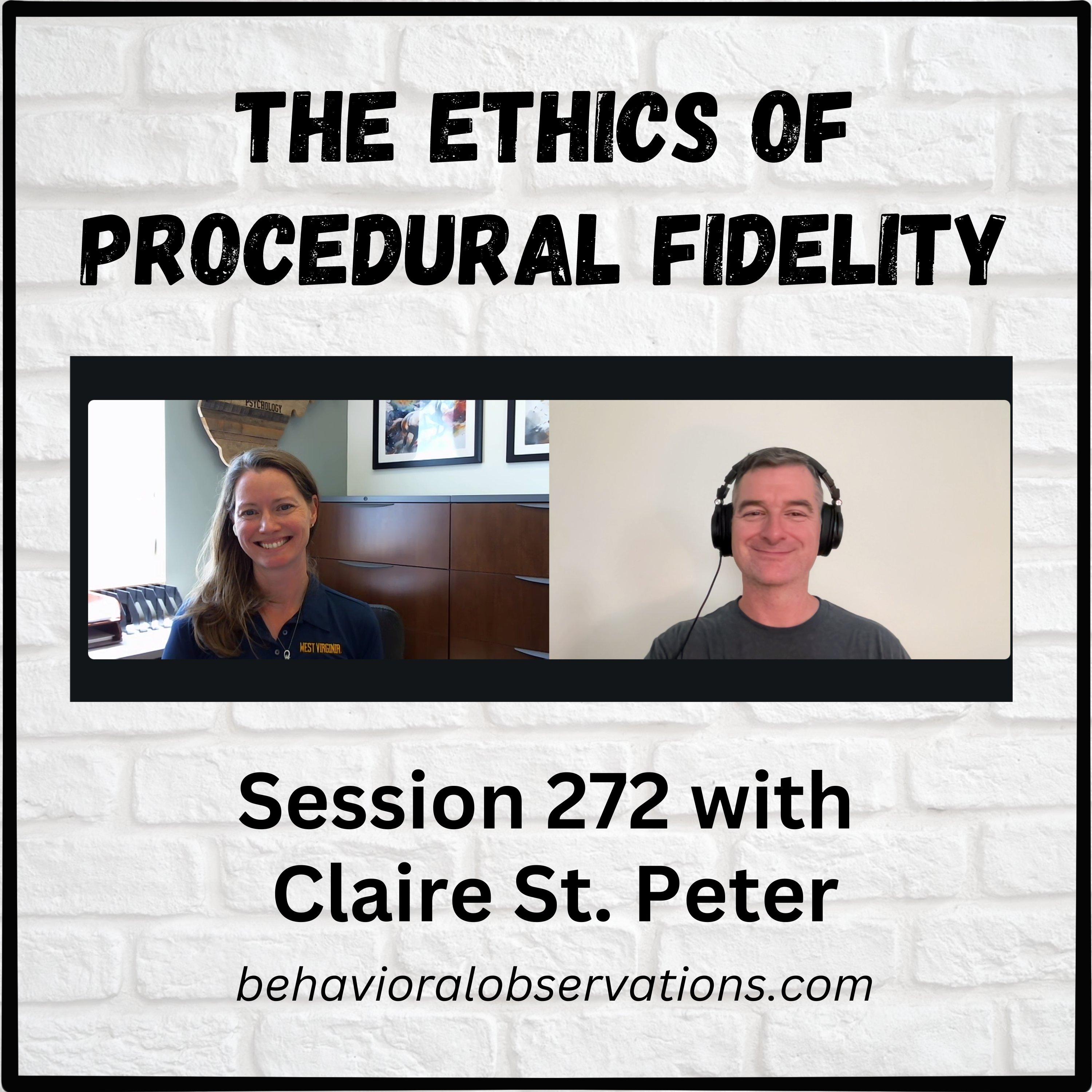
Ep 272The Ethics of Procedural Fidelity: Session 272 with Claire St. Peter
Whether one calls it Procedural Fidelity, Treatment Integrity, or any combination of those, and/or many other related terms, this is an important and often overlooked issue when it comes to implementing behavior analytic interventions. Think about it for a minute: as practitioners, we spend all this time obsessing about what assessment strategy to use and what interventions we think are the best fit for the individuals we serve. As you'll come to find out, we spend comparatively less time on ensuring that the programs we write are being implemented correctly. So it is with this in mind that I'm grateful that Dr. Claire St. Peter returned to the podcast to discuss her research in this area of procedural Fidelity. In this episode, we talk about why she prefers the term "Procedural Fidelity," the types of behavior plans that are difficult for teachers to implement, the different types of procedural errors one can make, the impact these different errors have, what types of intervention plans are more vs. less resistant to reductions in procedural fidelity, why this is a topic that practitioners should care about, whether to measure procedural fidelity via rate or percent correct, and regardless of method, how behavior analysts can start tracking procedural fidelity right away. We also talk about Claire's research in this area, going back to the work she did as part of her dissertation. We also talk about the state of reporting procedural fidelity in the behavior-analytic research literature. Lastly, I think it's important to point out that this topic is replete with ethical implications, which is why I titled this episode the way I did. When I listened to the show, I kept track of the various code elements that were indirectly outlined or addressed. For the mentors in the audience, this might be a fun exercise to do with your supervisees. Here are the resources discussed in this episode: Session 269/193: Claire's episode on Constructional Approaches to behavioral intervention. A link to Claire's multiple BOP appearances. Claire's lab website. On Claire's site, a section where you can download examples of Procedural Fidelity checklists and related resources. Bergmann et al., (2023). A detailed examination of reporting procedural fidelity in the Journal of Applied Behavior Analysis. Han et al., (2022). Trends in Reporting Procedural Integrity: A Comparison. Jones et al., (2023). Effects of Commission and Omission Errors on the Efficacy of Noncontingent Reinforcement. Jones and St. Peter (2022). Nominally acceptable integrity failures negatively affect interventions involving intermittent reinforcement. St. Peter et al. (2023). On a persisting curious double standard in behavior analysis: Behavioral scholars' perspectives on procedural fidelity. Kranak and Falligant (2023). Treatment Integrity, Commission Errors, and Reinstatement: A Primer. Campbell and Skinner (2008). Combining Explicit Timing with an Interdependent Group Contingency Program to Decrease Transition Times. This episode was brought to you with support from: The 2024 Stone Soup Conference! Behavior Analysis' premier online event is taking place on October 25th. Come hear from pod faves including Drs. John Austin, Lina Slim, Jim Moore, and many others! 8.5 Learning CEUs are available, and when you use the promo code PODCAST24, that comes out to less than 8 bucks per credit. Learn more here! How to ABA…The Bx Resource Membership saves you time, lends you support, and helps you keep up with your CEUs. It's a growing library of resources, materials, programs, datasheets, assessments, and how-to videos to help you tackle any ABA program with ease. It also includes live CEUs each month, live mentorship sessions, a full library of CEUs (60+, enough for recertification), and a community of fellow behavior professionals where you can ask questions when you need support. Join us at howtoaba.com/join. The New England Center for Children! In previous podcasts, you've heard me talk about NECC's career opportunities, but later in this episode, you'll hear about their Autism Curriculum Encyclopedia, or ACE for short. It's an evidence-based teaching technology for educators and BCBAs who teach learners with autism and related disabilities. If you must know more right now however, you can go to acenecc.org. HRIC Recruiting. Barb Voss has been placing BCBAs in permanent positions throughout the US for just about a decade, and has been in the business more generally for 30 years. When you work with HRIC, you work directly with Barb, thereby accessing highly personalized service. So if you're about to graduate, you're looking for a change of pace, or you just want to know if the grass really is greener on the other side, head over to HRIColorado.com to schedule a confidential chat right away. ACE Approved CEUs from .... Behavioral Observations. That's right, get your CEUs while driving (maybe even this episode!), walking your dog, doing the dishes, or whatever else you

Ep 271Restraint and Seclusion in Public Schools: Session 271 with Matt Brodhead
Listen on: Apple Podcasts | Spotify | YouTube Dr. Matt Brodhead returns to the podcast to talk about a topic he's dedicated the better part of nearly completed sabbatical trying to understand: restraint and seclusion practices in public school settings. In this episode, we talk about why he chose this topic to study, the difficulty in defining what constitutes a restraint, the challenges with documenting events, the terrible state of systematic, nation-wide data collection on restraint and seclusion events - particularly those that result in injuries and deaths, the pros and cons of banning these practices, potential legislation regarding these practices, and lots more. Clearly this is an issue that generates controversy, and I hope you'll find that we did our best to talk about the subject with the appropriate amount of nuance and sensitivity. In addition to his teaching and research duties at Michigan State University, Matt also provides consultation to schools and agencies, and specializes in developing systems that promote ethical decision making. If you'd like to work with Matt, you can contact him at either mattbrodhead.com or betteraba.com. At the latter website, you can purchase his excellent guide, A Workbook in Behavioral Systems Analysis and Ethical Behavior (by the way, these make for great gifts). Resources discussed in this podcast: Scheuermann et al. (2016). Professional Practice and Ethical Issues Related to Physical Restraint and Seclusion in Schools. Kern et al. (2022). A Review of U.S. Policy Guidance and Legislation on Restraint and Seclusion in Schools: Considerations for Improvement. Nunno et al. (2021). A 26-Year Study of Restraint Fatalities Among Children and Adolescents in the United States: A Failure of Organizational Structures and Processes. Merrill Winston's earlier podcast on this topic (and CEU opportunity as well). This podcast is brought to you by the following: How to ABA…The Bx Resource Membership saves you time, lends you support, and helps you keep up with your CEUs. It's a growing library of resources, materials, programs, datasheets, assessments, and how-to videos to help you tackle any ABA program with ease. It also includes live CEUs each month, live mentorship sessions, a full library of CEUs (60+, enough for recertification), and a community of fellow behavior professionals where you can ask questions when you need support. Join us at howtoaba.com/join. The New England Center for Children! In previous podcasts, you've heard me talk about NECC's career opportunities, but later in this episode, you'll hear about their Autism Curriculum Encyclopedia, or ACE for short. It's an evidence-based teaching technology for educators and BCBAs who teach learners with autism and related disabilities. If you must know more right now however, you can go to acenecc.org. The University of Cincinnati Online. UC Online designed a Master of Education in Behavior Analysis program that is 100% online and asynchronous, meaning you log on when it works for you. Want to learn more? Go to online.uc.edu and click the "request info" button. Behavior University. Their mission is to provide university quality professional development for the busy Behavior Analyst. Learn about their CEU offerings and their newly updated RBT Course, which as been getting amazing reviews over at behavioruniversity.com/observations.

Ep 270Improving knee surgery outcomes with positive reinforcement: Inside JABA Series 20
In the 20th installment of the Inside JABA Series, I'm joined by Drs. Brennan Armshaw, Manish Vaidya, and Sachen Mehta. As always, I'm also joined by JABA Editor in Chief, Dr. John Borerro. In this episode we discuss a fantastic paper that is out in the summer issue of JABA titled, "Surface electromyography-based biofeedback can facilitate recovery from total knee arthroplasty." In brief, this study that examined a novel treatment approach for rehabilitating patients following knee replacement surgery. And guess what, they used simple behavioral techniques to radically improve physical therapy outcomes! Orthopedics is something that's been on my mind lately as I am recovering from a broken metacarpal bone in my hand. It's probably something of interest to others who have either had orthopedic problems themselves, or who have taken care of hose who have. However, even if you're not interested in orthopedics, I encourage you to really dig into this episode because it's just a great case study of applying our science to a novel problem that affects millions of people . As always, there are no advertisements in the Inside JABA Series shows, but I will mention that if you would like to get a CEU for listening to this episode an answering series of questions related to its content, you can find out how to do just that by clicking here. So if you would like to learn from your favorite podcast guests, especially while you're on the go, check out what we have to offer over. I should also mention that there are discounts available for multiple event purchases. I recently crunched some numbers and found out that CEU customers, on average, save almost $100 when they leverage these discount codes. Here are the links to resources mentioned in the podcast: Armshaw, Vaidya, and Mehta (2024). Surface electromyography-based biofeedback can facilitate recovery from total knee arthroplasty. Vaidya and Armshaw (2021). Surface electromyography and gamification: Translational research to advance physical rehabilitation. Inside JABA 9: Applied and Translational Research in Healthcare. The Institute for Behavior Science and Technology in Rehabilitation. Comprehensive Orthopedics and Rehabilitation. Brennan's WVU faculty page and LinkedIn. Manish's LinkedIn page.

Ep 269BOP REWIND: A Constructional Approach for Solving Behavioral Challenges, with Claire St. Peter
Hey everybody I hope you're having a great summer so far, or whatever season it happens to be whenever you listen to this episode. Some of the things I've been doing recently is going back through the behavioral observations archives and giving episodes a second or third listen. One of those episodes was Session 193 that I published in July 2022, and my guest was Dr. Claire Saint Peter. In that episode we talked about the constructional approach, as it were, and how it relates to solving behavior problems. This topic has been getting a lot of attention lately. When I was at ABAI in Philadelphia a few weeks ago, I attended several talks on the constructional approach, which prompted me to listen to this episode again. And when I did listen to this episode for a second time I felt that there were so many really helpful pieces of information that I wanted to republish it. What I did with this episode is essentially started after the part in which Claire talked about her background and getting into behavior analysis. Now if you want to go back and listen to that story, and I think it is a good story by the way as it's a bit of a microcosm of the history of applied behavior analysis, you can certainly do so. However, for the purposes of brevity, I decided just cut out that introductory section so the overall experience is a bit more focused, especially for those of us who are listening to this for a second, third, or fourth time. With that said, I really hope you listen to this episode and it's entirety there are so many great nuggets have information. Although we talk about the application of the constructional approach to a student in a school setting, I am sure that you will make connections to all sorts of applications. I will also make this episode eligible for a continuing education unit, as I have been doing with many older episodes as well. So if you are looking to get caught up on your continuing education, go to behavioralobservations.com to see the nearly 60 episodes we have available for your continuing education. The last thing I'll say about this episode is that this is not the last thing I'll say about the constructional approach. I guess I'm saying that out loud for some accountability, because of said this before, but I want to have some other guests on to talk about this because I think it's an interesting way to look at behavior analysis and it's ability to address problems of social importance. Here are links to some of the resources we mentioned: The original Session 193 Claire's lab website Claire's Google Scholar Page Goldiamond (1974): Toward a constructional approach to social problems: ethical and constitutional issues raised by applied behavior analysis More Goldiamond: A Programming Contingency Analysis of Mental Health Layng (2009). The Search for an Effective Clinical Behavior Analysis: The Nonlinear Thinking of Israel Goldiamond Romano, St. Peter, Milyko, Mesches, and Foreman (2021). Incorporating Curricular Revision to Treat Escape-Maintained Behavior for Children with ADHD Mammacare Word of the Podcast Inside JABA 7: There's No Such Thing as a Bad Boy, with Pat Friman Session 158: Motivational Interviewing with Dr. Jim Murphy Friman (2021). There is no such thing as a bad boy: The Circumstances View of problem behavior Johnston, Pennypacker, and Green: Strategies and Tactics for Behavioral Research and Practice (note: Amazon Associates link). This podcast is brought to you by: How to ABA…The Bx Resource Membership saves you time, lends you support, and helps you keep up with your CEUs. It's a growing library of resources, materials, programs, datasheets, assessments, and how-to videos to help you tackle any ABA program with ease. It also includes live CEUs each month, live mentorship sessions, a full library of CEUs (60+, enough for recertification), and a community of fellow behavior professionals where you can ask questions when you need support. Join us at howtoaba.com/join. The New England Center for Children! I am beyond thrilled to partner with one of the oldest and well-respected ABA institutions to help them find staff to continue their mission of supporting individuals with Autism. Learn more about careers at NECC over at necc.org/jobs. The Behavioral Toolbox. thebehavioraltoolbox.com is a new education and training site that my colleagues Anika Costa and Dr. Paulie Gavoni and I have been working on for over two years. We have two courses available: our first course, Ready, Set, Consult! and our newly released course, When Not to FBA: 5 Quick Strategies for Improving Behavior in Classrooms. HRIC Recruiting. Barb Voss has been placing BCBAs in permanent positions throughout the US for just about a decade, and has been in the business more generally for 30 years. When you work with HRIC, you work directly with Barb, thereby accessing highly personalized service. So if you're about to graduate, you're looking for a change of pace, or you just want to know if the grass reall

Ep 268BOP en Español 10: Los altos y bajos al establecer el análisis de conducta en Guatemala con Jessie Arroyave
En este episodio tenemos la oportunidad de conocer la trayectoria de Jessie Arroyave, la primera BCBA de Guatemala. Jessie publicó un artículo en la revista Behavior Analysis in Practice, en el que habla de los altos y bajos al tratar de dar los primeros pasos para el establecimiento del análisis de conducta en Guatemala. Ella decidió tomar el camino difícil de regresar a su país después de formarse en Estados Unidos a pesar de los múltiples obstáculos. ¿Qué estamos haciendo para apoyar a profesionales como Jessie? Lo que sé es que con nuestra ayuda o sin ella, su compromiso y dedicación están intactos. Tenemos mucho que aprender de su ejemplo. The ups and downs of establishing behavior analysis in Guatemala with Jessie Arroyave In this episode we have the opportunity to learn about the career of Jessie Arroyave, the first BCBA in Guatemala. Jessie published an article in the journal Behavior Analysis in Practice, in which she talks about the ups and downs of trying to take the first steps toward establishing behavior analysis in Guatemala. She decided to take the difficult path of returning to her country after training in the United States despite multiple obstacles. What are we doing to support professionals like Jessie? What I know is that with or without our help, her commitment and dedication are intact. We have much to learn from her example.

Ep 267Leadership in Alternative Education Settings: Session 267 with Bruce Tinor
Dr. Bruce Tinor returns to the podcast for an informative conversation about his work as a principal at The Child and Career Developmental Center of Chester County, Pennsylvania. Long-time listeners will recall that Bruce originally joined me in Session 197. In this podcast, we talk all things alternative ed. Specifically, Bruce gives a quick review of how students find their way to his school, and in doing so, provides a mini-seminar in FAPE (and if you're not familiar with that acronym, you will be shortly). We talk about working in a multidisciplinary setting, how those related services are provided, improving academic skills as a behavioral intervention, and in general, what it's like to be a BCBA and a school principal. In many ways, this is a podcast about culture and leadership too. Bruce talks about his interview practices and how he supports teachers and staff throughout the day. We also talk about some of the unique Tier 1 and Tier 2 behavioral practices, how he makes new students feel welcome, his behavioral approach to social-emotional learning, and lots more. We close the podcast with what I thought was a really special discussion about Bruce being a role model. I don't want to spoil that part of the podcast here. You'll definitely want to listen to it for yourself, so I hope you check that part of the show out. Say 'hi' to Bruce on LinkedIn. Whole Group Responding (Interview with Dr. Bill Heward). Using Behavioral Contracts (Interview with Drs. Jill Dardig and Bill Heward). Back to School with PBIS (Interview with Elissa Johnson). How to Get Better Results (Interview with Dr. John Austin). Improving Classroom Management (Interview with Dr. Jeannie Donaldson). When Not to FBA: 5 Quick Strategies for Improving Behavior in Classrooms (asynchronous course from thebehavioraltoolbox.com). This podcast is brought to you by the following: How to ABA…The Bx Resource Membership saves you time, lends you support, and helps you keep up with your CEUs. It's a growing library of resources, materials, programs, datasheets, assessments, and how-to videos to help you tackle any ABA program with ease. It also includes live CEUs each month, live mentorship sessions, a full library of CEUs (60+, enough for recertification), and a community of fellow behavior professionals where you can ask questions when you need support. Join us at howtoaba.com/join. The New England Center for Children! I am beyond thrilled to partner with one of the oldest and well-respected ABA institutions to help them find staff to continue their mission of supporting individuals with Autism. Learn more about careers at NECC over at necc.org/jobs. ACE Approved CEUs from .... Behavioral Observations. That's right, get your CEUs while driving, walking your dog, doing the dishes, or whatever else you might have going on, all while learning from your favorite podcast guests! The Behavioral Toolbox. thebehavioraltoolbox.com is a new education and training site that my colleagues Anika Costa and Dr. Paulie Gavoni and I have been working on for over two years. We have two courses available: our first course, Ready, Set, Consult! and our newly released course, When Not to FBA: 5 Quick Strategies for Improving Behavior in Classrooms.

Ep 266What is Primary Care Behavioral Pediatrics? Session 266 with Chris McGinnis
Dr. Chris McGinnis joins me in Session 266 to talk about his work in Primary Care Behavioral Pediatrics. If you're not sure what that is, don't worry. We go over that right away and learn that this area of work sits in an important and underserved niche: The niche between the general behavioral advice dispensed by pediatricians, and intensive treatment for serious mental health challenges. In a way, this conversation expands on something that Pat Friman brought up in our most recent interview: The idea that BCBAs are uniquely suited to provide families with this type of care. In order to provide direction to those who are interested in doing just this, Chris recently published Introduction to Primary Care Behavioral Pediatrics: A Guide for Behavior Analysts. In our conversation, we covered: · His background in Behavioral Pediatrics, including his work at BoysTown (and meeting Pat Friman for the first time). · The motivation for writing his book. · The reification of psychological terms (see Skinner '45). · The myth of the Chemical Imbalance Hypothesis. · The range of behavior challenges he sees in his practice. · Thoughts on caregiver adherence. · The pros and cons of reimbursement practices, including the concierge model he has currently adopted. · Chris' study of Trauma-Informed Care. · Permissive vs. Authoritative, and how those related to adolescent mental health.... In other words, why parenting is like The Marshmallow Test. · Advice for the newly-minted BCBA. This podcast is brought to you by the following: Please welcome our newest sponsor, The New England Center for Children! I am beyond thrilled to partner with one of the oldest and well-respected ABA institutions to help them find staff to continue their mission of supporting individuals with Autism. Learn more about careers at NECC over at necc.org/jobs. ACE Approved CEUs from .... Behavioral Observations. That's right, get your CEUs while driving, walking your dog, doing the dishes, or whatever else you might have going on, all while learning from your favorite podcast guests! HRIC Recruiting. Barb Voss has been placing BCBAs in permanent positions throughout the US for just about a decade, and has been in the business more generally for 30 years. When you work with HRIC, you work directly with Barb, thereby accessing highly personalized service. So if you're about to graduate, you're looking for a change of pace, or you just want to know if the grass really is greener on the other side, head over to HRIColorado.com to schedule a confidential chat right away. The Behavioral Toolbox. thebehavioraltoolbox.com is a new education and training site that my colleagues Anika Costa and Dr. Paulie Gavoni and I have been working on for over two years. We have two courses available: our first course, Ready, Set, Consult! and our newly released course, When Not to FBA: 5 Quick Strategies for Improving Behavior in Classrooms.

Ep 265Buffers That Protect Against Adverse Childhood Experiences: Session 265 with Camille Kolu
Dr. Camille Kolu joins me again on the podcast, and let's just say that she came back loaded with great insights like these to share with you. If you're not familiar with Camille, she's been on the show before (see here), and is one of the predominant voices discussing the impact of trauma, and how it interacts with what we do as Behavior Analysts. In this episode, we discuss her recent paper in Behavior Analysis in Practice, Providing Buffers, Solving Barriers: Value‐Driven Policies and Actions that Protect Clients Today and Increase the Chances of Thriving Tomorrow. This article is not about trauma, but instead, it's about practices and repertoires that can protect individuals from the harmful health impacts of adverse childhood experiences. We also discuss Camille's article in Operants Magazine, called, Understanding Choice, which is where that audio segment was clipped from. If you like the work that Camille does and want more training from her, she has generously provided listeners with a discount on her training materials over at Cusp Emergence University. If you want to go deeper into this topic of Buffers and Barriers, she has not one, but two courses on it, providing both Ethics and Supervision CEUs. If you want take her other courses in the area of Trauma, you can do that too (just click here to check it out). When you do so, be sure to use the promo code summerofBOP24 to save 24% off at checkout. Camille also created a free, 15-minute course called, The Buffers Story: Simple, Important Things We Almost Forgot, and she'll be doing a workshop later this month with Connections-Behavior. Lastly, if you like Camille's content, perhaps the easiest way to keep up with it is to sign up for her mailing list. Burke-Harris (2018). The Deepest Well: Healing the Long-Term Effects of Childhood Adversity (note: Amazon Associates link). Kaiser ACES studies information. Ala'i-Rosales et al. (2019). The Big Four: Functional Assessment Research Informs Preventative Behavior Analysis. Ratey (2008). Spark: The Revolutionary New Science of Exercise and the Brain (note: Amazon Associates link). Inside JABA 10: Towards Trauma-Informed Applications of Behavior Analysis. Session 179: Behavioral Relaxation Training. Maier and Seligman (2016). Learned helplessness at fifty: Insights from neuroscience. In full disclosure, these are not sponsored products and events; I'm just trying to get the word out there. However, the sponsors that are responsible for bringing this episode to you include: Please welcome our newest sponsor, The New England Center for Children! I am beyond thrilled to partner with one of the oldest and well-respected ABA institutions to help them find staff to continue their mission of supporting individuals with Autism. Learn more about careers at NECC over at necc.org/jobs. ACE Approved CEUs from .... Behavioral Observations. That's right, get your CEUs while driving, walking your dog, doing the dishes, or whatever else you might have going on, all while learning from your favorite podcast guests! The Behavioral Toolbox. thebehavioraltoolbox.com is a new education and training site that my colleagues Anika Costa and Dr. Paulie Gavoni and I have been working on for over two years. We have two courses available: our first course, Ready, Set, Consult! and our newly released course, When Not to FBA: 5 Quick Strategies for Improving Behavior in Classrooms. Behavior University. Their mission is to provide university quality professional development for the busy Behavior Analyst. Learn about their CEU offerings, including their 8-hour Supervision Course, as well as their RBT offerings over at behavioruniversity.com/observations. Don't forget to use the coupon code, PODCAST to save at checkout!

Ep 264How Does Interviewer Behavior Influence Children's Responses? Inside JABA 19
Did you rate and review Behavioral Observations on Apple Podcasts? You rated and reviewed Behavioral Observations on Apple Podcasts, right? John Borrero told me that you rated and reviewed Behavioral Observations on Apple Podcasts. Is that true? Did you rate and review Behavioral Observations on Apple Podcasts? Again, did you rate and review Behavioral Observations on Apple Podcasts? If you've ever watched a police procedural show on television, you're probably noticed that there are different ways to phrase questions to people. I've just given you a few examples that will be salient to the forthcoming discussion. And, all kidding aside, if you haven't done so already, if you enjoy what we do here, head over to Apple Podcasts and kindly leave a rating and review of the show. In the 19th installment of Behavioral Observations' Inside JABA Series, Dr. John Borrero and I discuss a paper in the most recent issue called, Idiosyncratic effects of interviewer behavior on the accuracy of children's responses, with its authors: Milad Najafichaghabouri, Dr. Ray Joslyn, and Emma Preston. Here's some additional background on our guests: Dr. Ray Joslyn is currently an assistant professor in the psychology department at West Virginia University. He has research interests in group contingencies, behavior analysis in education, and crime and delinquency. Milad Najafichaghabouri is a doctoral student in the Disability Disciplines program at Utah State University specializing in ABA. His primary research interests include group contingency-based intervention in the classroom, and social validity practices in research Emma Preston is currently a graduate student in the Disabilities Disciplines program at Utah State University specializing in ABA. Her research and practice interests include the Good Behavior Game, manipulating parameters of reinforcement to improve intervention outcomes, and Tier 3 school-based interventions. I'll refrain from spoiling the discussion here, but there are a few things to note. First, this is the first time we've discussed a replication in the Inside JABA Series, and John dons his Editor in Chief hat for a few minutes at the end and discusses the importance of replication studies in general, and what makes for good replication more specifically. Second, this topic - describing the conditions in which children do and do not report incidents accurately - has huge implications. From schools, to child services, to law enforcement, understanding the potential influences of phrasing questions and acknowledging responses could be crucial contributions in these areas. Third, this study featured a clever assent procedure that again, I won't spoil here, but it's worth tuning into. And lastly, we get into all sorts of nitty-gritty details, including some of the participants' unexpected responses to the experimental procedure... and these are the things that generally do not make the printed page that you can only get in these types of conversations. This podcast, along with all of the Inside JABA Series ones, is eligible for continuing education. If you've never gotten CEUs from Behavioral Observations before, it's really easy. Just listen to the episode, go to behavioralobservations.com/get-ceus, make purchase... and fun fact: there are great discounts available if you need to snap up many CEUs, take a quiz, and you're good to go.

Ep 263El Análisis de Conducta en Venezuela: BOP en Español 9, con Corina Jimenez-Gomez, Mirari Elcoro y Amalix Flores
El Análisis de Conducta en Venezuela: Un legado finalmente reconocido con Corina Jimenez-Gomez, Mirari Elcoro y Amalix Flores No una, ni dos, sino 3 venezolanas rindiendo tributo al legado de Venezolanos en nuestra ciencia del análisis de conducta. Un legado del cual (siendo Venezolano) desconocía y que gracias a ellas tengo ahora el privilegio y orgullo de conocer y que será reconocido en nuestra comunidad a través del artículo que publicaron en la revista Behavior Analysis in Practice (Análisis de Conducta en la Práctica). Una conversación de 2 horas que les recomiendo sean Venezolanos, Iberoamericanos y/o simplemente, como nuestras invitadas y coautores de este artículo, estudiantes de nuestra historia. Mirar atrás trajo muchas reflexiones, no solo acerca de un legado importante, sino también del estado actual del análisis de conducta y su posible futuro. Importante reconocimiento a las mujeres fundadoras y líderes del análisis de conducta en Venezuela, a las idiosincrasias de los Venezolanos 'echados pa'lante', recursivos y pluralistas; a la dedicación y vocación de tantas personas, finalmente publicado en un producto permanente. Gracias Corina, Mirari y Amalix, 'se me agua el guarapo'. Behavior Analysis in Venezuela: A legacy finally recognized with Corina Jimenez-Gomez, Mirari Elcoro and Amalix Flores Not one, not two, but 3 Venezuelans paying tribute to the legacy of Venezuelans in our science of behavior analysis. A legacy that (being Venezuelan) I was unaware of and that thanks to them I now have the privilege and pride of knowing and that will be recognized in our community through the article they published in Behavior Analysis in Practice. A 2-hour conversation that I recommend wether you are Venezuelans, Ibero-Americans and/or simply, like our guests and co-authors of this article, students of our history. Looking back brought many reflections, not only about an important legacy, but also about the current state of behavior analysis and its possible future. Important recognition to the founding women and leaders of behavioral analysis in Venezuela, to the idiosyncrasies of Venezuelans 'echados pa'lante', recursive and pluralistic; to the dedication and vocation of so many people, finally published in a permanent product. Thanks Corina, Mirari and Amalix, 'se me agua el guarapo'.

Ep 262Behavior Analytic Approaches to Counseling and Therapy: Session 262 with Pat Friman
Dr. Pat Friman returns to discuss the Behavior Analytic approaches he uses with patients. In this episode, we harken way back to Session 16, and review some of what we know about Anxiety and Depression, which are the most common forms of mental health distress. Pat talks about how he conceptualizes these challenges, what he does in the first session with patients, his general approach to treatment, the role of medications, his view on when to begin or cease therapy, important therapist characteristics like kindness, compassion, and acceptance, and lots more! Here are links to the references we spoke about: Pat's earlier appearances on the BOP. Pat's CEU previous CEU events: Session 16 (ethics) and Session 42. Friman, Hayes, and Wilson (1998). Why Behavior Analysts Should Study Emotion: The example of Anxiety. Hayes and Smith (2005). Get Out of Your Mind and Into Your Life (disclosure: Amazon Associate link). Haidt (2024). The Anxious Generation: How the Great Rewiring of Childhood Is Causing an Epidemic of Mental Illness (disclosure: Amazon Associate link). Session 227: Decreasing Social Media Use with Contingency Management, Inside JABA 15. This podcast is brought to you by: ACE Approved CEUs from .... Behavioral Observations. That's right, get your CEUs while driving (even this episode!), walking your dog, doing the dishes, or whatever else you might have going on, all while learning from your favorite podcast guests! The Behavioral Toolbox. thebehavioraltoolbox.com is a new education and training site that my colleagues Anika Costa and Dr. Paulie Gavoni and I have been working on for over two years. We have two courses available: our first course, Ready, Set, Consult! and our newly released course, When Not to FBA: 5 Quick Strategies for Improving Behavior in Classrooms. Behavior University. Their mission is to provide university quality professional development for the busy Behavior Analyst. Learn about their CEU offerings, including their brand new 8-hour Supervision Course, as well as their RBT offerings over at behavioruniversity.com/observations. Love the podcast, but would l

Ep 261Entrevistas Motivacionales: BOP en Español 8 con la Dra. Monica Gilbert
Entrevistas Motivacionales con la Dra. Monica Gilbert Aunque la entrevista motivacional nació del contexto psicoterapéutico y de rehabilitación en relación a dependencias y abuso de sustancias, hoy en día se utiliza como un estilo de comunicación para establecer relaciones terapéuticas y profesionales en varios contextos con un espíritu de colaboración y empoderamiento en dirección al cambio. Los analistas de conducta estamos reconociendo que, sin ser esa nuestra intención, nuestra comunicación al brindar nuestros servicios en algunos casos puede ser coercitiva. Esto resulta en respuestas defensivas y resistencia a nuestras recomendaciones. Espero que este enfoque y las recomendaciones prácticas de la Dra Gilbert no solo llamen a la reflexión acerca de nuestra propia conducta sino que despierten curiosidad acerca de un área de competencia que a muchos de nosotros nos hace falta desarrollar. Motivational Interviewing with Dr. Monica Gilbert Although motivational interviewing was born from the psychotherapeutic and rehabilitation context in relation to dependencies and substance abuse, today it is used as a communication style to establish therapeutic and professional relationships in various contexts with a spirit of collaboration and empowerment in the direction of change. Behavior analysts are recognizing that, without this being our intention, our communication when providing our services can in some cases be coercive. This results in defensive responses and resistance to our recommendations. I hope that this approach and Dr. Gilbert's practical recommendations not only call for reflection on our own behavior but also spark curiosity about an area of competence that many of us need to develop. https://motivationalinterviewing.org www.drmonicagilbert.com

Ep 260How to Use Whole Group Responding: Session 260 with Bill Heward
Dr. Bill Heward was gracious enough to return to the podcast in Session 260. In this episode, we talked about a handful of different topics, including how to respond to criticisms of reinforcement practices, and the international dissemination of the excellent book, Let's Make a Contract, which he coauthored with Dr. Jill Dardig. However, we spent the majority of the time discussing Bill's extensive knowledge of whole-group responding practices in classroom settings. Specifically, we talk about how he first learned about this practice, why he wanted to study it, how he and his colleagues carried out one of his better known studies on the topic (Lambert et al., 2006), and lots more. Along the way, Bill offered lots of great advice for practitioners who are interested in trying out these low-tech/high-impact strategies. During the conversation, Bill mentioned a talk that I gave at the 2023 BABAT conference, and in the podcast I mentioned that my colleagues and I created an online course based on that presentation. At the time of the interview with Bill, the course was not yet available. However, I'm happy to report that it is out now. The course is called, "When Not to FBA: Five Quick Strategies for Improving Behavior in the Classroom." So if you're working in school settings and you're supporting teachers in classrooms, please consider checking this out. Back to the interview, one of the things that makes Bill such an awesome podcast guest is that he comes with lots of resources. In fact in this case, he sent me an Google Drive Folder chock full of articles, studies, and many other resources. So instead of listing each resource individually here in the shownotes, I'll go ahead and link the folder and cut out the middleman (click here to get access to it). While we're on the topic of Bill's generosity, he wanted me to remind you that the website, contractingwithkids.com has several free downloadable contract templates. Click here to check them out. This podcast is brought to you by: HRIC Recruiting. Barb Voss has been placing BCBAs in permanent positions throughout the US for just about a decade, and has been in the business more generally for 30 years. When you work with HRIC, you work directly with Barb, thereby accessing highly personalized service. So if you're about to graduate, you're looking for a change of pace, or you just want to know if the grass really is greener on the other side, head over to HRIColorado.com to schedule a confidential chat right away. ACE Approved CEUs from .... Behavioral Observations. That's right, get your CEUs while driving, walking your dog, doing the dishes, or whatever else you might have going on, all while learning from your favorite podcast guests! The Behavioral Toolbox. thebehavioraltoolbox.com is a new education and training site that my colleagues Anika Costa and Dr. Paulie Gavoni and I have been working on for over two years. We have two courses available: our first course, Ready, Set, Consult! and our newly released course, When Not to FBA: 5 Quick Strategies for Improving Behavior in Classrooms.

Ep 259Practical Strategies for Passing the Exam: Session 259 with Dana Meller and Steve Eversole
If you're a student, supervisor, or university instructor, this is an episode for you. In Session 259, I speak with Dana Meller and Dr. Steve Eversole, of Pass The Big ABA Exam and Behavior Development Solutions, respectively. In this conversation, they reflect on what they've learned about helping thousands of people pass the BCBA exam over many years. In this conversation, we covered why they got into the test prep business, the state of BCBA testing today, re-taking the exam, interpreting the board's re-take data, barriers to passing the exam - including things like test anxiety and specific topics of difficulty, their counterintuitive opinions on SAFMEDS and mock exams, the role of social media, and how both of them became friends despite being competitors. Here are the links we discussed: Pass The Big ABA Exam main site. Behavior Development Solutions main site. Center for Behavior and Climate. Dana and Steve on LinkedIn. Honig and Staddon, Handbook of Operant Behavior. Bloom's Taxonomy. The University of American Samoa. The BDS Podcast. This podcast is brought to you by: ACE Approved CEUs from .... Behavioral Observations. That's right, get your CEUs while driving, walking your dog, doing the dishes, or whatever else you might have going on, all while learning from your favorite podcast guests! The University of Cincinnati Online. UC Online designed a Master of Education in Behavior Analysis program that is 100% online and asynchronous, meaning you log on when it works for you. Want to learn more? Go to online.uc.edu and click the "request info" button. TheBehavioralToolbox.com. If you're a BCBA working in public schools, or if you are a special educator, teacher, school pscyhologist, administrtor, or school counselor... basically anyone who is in the business of student behavior, check out The Behavioral Toolbox's asynchronous professional development courses, including our new course, "When Not to FBA: 5 Quick Strategies for Improving Behavior in the Classroom."

Ep 258What is Profound Autism, and Why is it Important? Session 258 with Alycia Halladay Session 258
Dr. Alycia Halladay joins we to discuss the topic of Profound Autism. If you're not familiar with Alycia's work, she is the Chief Science Officer for The Autism Science Foundation, and host of the excellent show, The ASF Weekly Science Podcast. In this episode, we discuss the changes in Autism diagnosis from the DSM IV to V, the Lancet Commission paper on Profound Autism, why there is a need for this distinction in the Autism spectrum, the conditions under which an individual would be classified as having Profound Autism, the estimated proportion of Autistics who have Profound Autism, the differences in the distribution of sex-based differences in Profound and Non-profound populations, person vs. identity-first language, the importance of reducing stigma for everyone with Autism, criticisms of the proposal of this category, and responses to those criticisms. Even though we packed a lot into this interview, there is way more to this conversation than we had time for, so I'd like to revisit this again sometime in the future. In the meantime, if you're in the New England area, consider attending The Profound Autism Summit, which is taking place on April 5th, 2024 in Burlington, Massachusetts. Alycia will be speaking at that event, and will go into even more detail than we did in this podcast. It's a multi track conference that, according to the PAS site, aims to "bring together leaders from the areas of research, medicine, treatment, advocacy, education, and human services to discuss the needs of those with Profound Autism across disciplines and throughout the lifespan." Even though the Profound Autism Summit features talks from notable Behavior Analysts like Drs. Greg Hanley, Shanna Bahry, Peter Gerhardt, Jessica Slaton and others, it's not just an ABA conference. There will be speakers and panelists representing advocacy groups, emergency services personnel, service providers, and more (check out the entire speakers roster here). The PAS is right around the corner and is almost sold out, so if you're on the fence and are looking for some motivation, here it is (register your spot here!). If you can't make it, consider signing up for their mailing list, as I believe they'll be making the talks available asynchronously some time down the road. Did you know that if you use Apple Podcasts as your player, you can get transcripts to this show? See this for a tutorial. Register for the Profound Autism Summit! Hop on their 100% non-spammy email list for updates on Profound Autism. Session 248: A review of Autism diagnostic practices. Lord et al. (2021). The Lancet Commission on the future of care and clinical research in autism. ASF's post on the Lancet Commission paper. ASF Weekly Science Podcast homepage. ASF Weekly Science Podcast recommendation 1: Nobody ever talks about catatonia. ASF Weekly Science Podcast recommendation 2: "Emergent and Transactional," with Dr. Andrew Whitehouse. This podcast is brought to you by: ACE Approved CEUs from .... Behavioral Observations. That's right, get your CEUs while driving, walking your dog, doing the dishes, or whatever else you might have going on, all while learning from your favorite podcast guests! The University of Cincinnati Online. UC Online designed a Master of Education in Behavior Analysis program that is 100% online and asynchronous, meaning you log on when it works for you. Want to learn more? Go to online.uc.edu and click the "request info" button. Behavior University. Their mission is to provide university quality professional development for the busy Behavior Analyst. Learn about their CEU offerings, including their brand new 8-hour Supervision Course, as well as their RBT offerings over at behavioruniversity.com/observations.

Ep 257Mentoring Students, the Future of ABA, and the Problem with Ignoring: Session 257 with Tim Vollmer
I'm thrilled to be joined by none other than Dr. Tim Vollmer. In this podcast, we talk about a wide variety of research and practice topics, as well as some funny stories from his long and prolific career. Specifically, talk about how his dog ate his copy of Strategies and Tactics, how he and his colleagues analyzed 2 and 3-point shot patterns in basketball games, his line of research that examined The Good Behavior Game, Behavior Analysis and the game of Poker, and his take on why he and his students have such an affinity for one another. That's not all. We probably spent the most amount of time discussing the topic of ignoring in the context of Behavioral Intervention Plans, and its potential problems. I really hope you stick around until the end of the podcast, because we close the show in a slightly different format. Instead of asking Tim my normal closing question (advice for the newly minted), I ask him to share his thoughts on the future direction of Behavior Analysis, including both risks and opportunities. Here are the links to the resources we mentioned: Beyond Freedom and Dignity (note: Amazon Associates Link). Vollmer and Bourret (2013). An application of the Matching Law to evaluate two and three-point shots by college basketball players. Football Behavior (BA-driven sports analytics from Brett Yarris). Chris Bosh on the Tim Ferriss show (wherein Chris discusses the evolution 3-point shooting strategy in the NBA). Strategies and Tactics for Behavioral Research and Practice, 4th edition (note: Amazon Associates Link). (Lloveras et al., 2023). Recommendations Regarding Use of the Term "Ignore" in Applied Behavior Analysis. Good Behavior Game episode with Dr. Jeanne Donaldson. Lambert et al., (2006). Effects of response cards on disruptive behavior and academic responding during math lessons by fourth-grade urban students. (this is the paper I mentioned from Bill Heward's research group, and I mistakenly noted that it was published in 1996, when in fact it was published in 2006). Follow Tim's lab on Instagram! This podcast is brought to you by: HRIC Recruiting. Barb Voss has been placing BCBAs in permanent positions throughout the US for just about a decade, and has been in the business more generally for 30 years. When you work with HRIC, you work directly with Barb, thereby accessing highly personalized service. So if you're about to graduate, you're looking for a change of pace, or you just want to know if the grass really is greener on the other side, head over to HRIColorado.com to schedule a confidential chat right away. ACE Approved CEUs from .... Behavioral Observations. That's right, get your CEUs while driving, walking your dog, doing the dishes, or whatever else you might have going on, all while learning from your favorite podcast guests! The Behavioral Toolbox. thebehavioraltoolbox.com is a new education and training site that my colleagues Anika Costa and Dr. Paulie Gavoni and I have been working on for over two years. If you're a Behavior Analyst working in public schools, please check out our first course, Ready, Set, Consult! Our second course, When Not to FBA: 5 Strategies to Implement before Conducting a Functional Assessment, will also be out soon, and more trainings are on the way!

Ep 256La intersección entre la fonoaudiología y el análisis de conducta: BOP en Español 7 con Estefania Alarcón Moya
Las conversaciones acerca del alcance de nuestra práctica y de nuestras competencias son muy comunes hoy en día en nuestra profesión. Los fonoaudiólogos y los analistas de conducta coinciden frecuentemente en los apoyos e intervenciones para el desarrollo de habilidades comunicativas. Coinciden en la práctica y en algunos casos en competencias desde un mismo enfoque o en otros desde un ángulo distinto. En una efectiva colaboración entre estas disciplinas es importante reconocer los marcos conceptuales y las tecnologías que ambas disciplinas proponen para así maximizar las maneras en que las mismas se complementan y se superponen. En otras palabras, donde las disciplinas se encuentran. Existen 'unicornios' capacitados en ambas disciplinas que nos demuestran el potencial de esta amalgama. Estefania Alarcón Moya es una de estas personas y en este episodio nos comparte sus perspectivas como analista de conducta/fonoaudióloga. Referencias Esch, B. E., LaLonde, K. B., & Esch, J. W. (2010). Speech and language assessment: A verbal behavior analysis. The Journal of Speech and Language Pathology – Applied Behavior Analysis, 5(2), 166–191.https://doi.org/10.1037/h0100270 Koenig, M., & Gerenser, J. (2006). SLP-ABA: Collaborating to support individuals with communication impairments. The Journal of Speech and Language Pathology – Applied Behavior Analysis, 1(1), 2–10. https://doi.org/10.1037/h0100180 Spencer, T. D., Slim, L., Cardon, T., & Morgan, L. (2020). Interprofessional collaborative practice between behavior analysts and speech-language pathologists. Association for Behavior Analysis.https://www.abainternational.org/constituents/practitioners/interprofessional-collaborative-practice.aspx The intersection between speech and language therapy and behavior analysis with Estefania Alarcón Moya Conversations about our scope of practice and competencies are very common in our profession today. Speech therapists and behavior analysts frequently overlap on supports and interventions for the development of communication skills. They coincide in practice and in some cases in competencies from the same approach or in others from a different angle. In effective collaboration between these disciplines, it is important to recognize the conceptual frameworks and technologies that both disciplines propose in order to maximize the ways in which they complement and overlap. In other words, where the disciplines meet. There are 'unicorns' trained in both disciplines who show us the potential of this amalgam. Estefania Alarcón Moya is one of these people and in this episode she shares her perspectives as a behavior analyst/speech therapist.

Ep 255How to Disseminate Behavior-Analytic Technologies: Inside JABA 18
In the 18th installment of the Inside JABA Series, Dr. Dorothea Lerman joins Editor-in-Chief John Borrero and I to talk about her dissemination efforts, which are described in the Winter 2024 issue of the journal. Specifically, we talk about her discussion paper, "Putting the power of behavior analysis in the hands of nonbehavioral professionals: Toward a blueprint for dissemination." This paper is definitely worth checking out. In it, Dorothy describes some common barriers to disseminating behavioral strategies and how to overcome them. We then talk about the blueprint she offers for dissemination, which is broken down into seven steps. These dissemination efforts are described in the context of Dorothy's outreach to public school educators, law enforcement personnel, and health care providers, settings where Dorothy and her colleagues have made successful inroads. Not to spoil the show's content too much, but we touch on the alarming stats regarding the percentage of individuals with disabilities who are either sedated or restrained during dental procedures, and what can be done to improve them. Even if you don't have a desire to bring behavior-analytic strategies to a novel setting, upon listening to the conversation a second time, I think there are lessons from this podcast that you can use in your daily practice. Things like gathering information about a particular culture or setting, describing concepts and principles in plain language, conducting experiments to see if what you're doing is working... you get the idea. We also spend a decent amount of time talking about sustaining behavioral practices once they've been implemented in new settings. One of the things that I forgot to mention during the podcast is that if you're really into dissemination, check out the new edited work, "Disseminating Behavioral Research," in which, coincidentally, the ABA Inside Track crew and I contributed a chapter called, "Non Traditional Options for Dissemination." I'll leave it to you to guess what medium we focused on. Lastly, the Winter 2024 issue of JABA features several moving tributes to Drs. Brian Iwata, Hank Pennypacker, and Ronnie Detrich. Dorothy and Dr. Jennifer Fritz contributed a memoriam to Brian Iwata, and it's well worth checking out. In the first few minutes of the show, Dorothy shared some poignant stories about how Brian influenced her career, and John discussed the responsibility associated with curating the various tributes for this edition of JABA. Relatedly, for the next three months, all of these In Memoriam articles will be freely available, so in the unlikely event you're not a JABA subscriber, you can still check them out. Here are the resources we discussed: Putting the power of behavior analysis in the hands of nonbehavioral professionals: Toward a blueprint for dissemination. Brian A. Iwata, PhD: A Life Well Lived. Dorothy's previous Inside JABA appearance (correction: in the podcast, I incorrectly noted that she appeared in the first Inside JABA episode. She appeared in the fourth episode of the Inside JABA Series). Southwell et al. (2005). Strategies for effective dissemination of the outcomes of teaching and learning projects. Houston, TX Police Department 2019 Annual Report (check out p. 18!). Main JABA site where you can subscribe and access selected free articles. Griffith and Ré (2023): Disseminating Behavioral Research (note: Amazon Associates link). Critchfield et al. (2017). On the social validity of behavior analytic communication: A call for research and description of one method. Previous BOP episodes covering law enforcement interventions. Kramer Davis Healthcare (company I mentioned that specializes in providing medical services to individuals with IDD). Allgood and Gravina (2021). Branching Out: Finding Success in New Areas of Practice. Normand and Kohn (2013). Don't wag the dog: extending the reach of applied behavior analysis. (hands down, the article I have shared the most in my eight years of publishing this podcast). LeBlanc et al., (2012). Expanding the Consumer Base for Behavior-Analytic Services: Meeting the Needs of Consumers in the 21st Century. As with other Inside JABA Series podcasts, this show will be eligible for continuing education. You can learn more about this one, and the nearly 50 other CEU events over at behavioralobservations.com.

Ep 254AAC Use with adolescents and adults with ASD: Session 254 with Andy Bondy
Fan-favorite Dr. Andy Bondy joins me again to talk about... you guessed it... AAC! In this episode, we discuss a paper he published last year in the journal, Advances in Neurodevelopmental Disorders, that is titled, "Issues Related to AAC and SGD Use by Adolescents and Adults with Autism Spectrum Disorder." We get into why he felt this paper was necessary to write, how he chose to communicate his thoughts to an audience beyond those of us in behavior analysis, why he likes the term, "under what conditions" so much, what does and does not constitute a "robust" communication repertoire, the role of teaching words like "please" and Andy's nuanced view of this practice, whether the sound from Speech Generation Devices matter, and lots more. We also got into a really interesting discussion on the distinction between pointing to pictures vs. exchanging them with communicative partners, and how that difference impacts Joint Attention. We closed the show by talking about two topics that have been receiving lots of discussion as of late: Spelling to Communicate and Gestalt Language Processing. Lastly, ended the show by taking a question from a Patreon member about Andy's thoughts regarding the use of activity schedules, and whether they qualify as prompts, or something else. Andy's previous episodes (the shownotes to these shows also have many links to great studies germane to this episode). Jason Traver's episode. All things PECS. A critical review of Natural Language Acquisition. GLP is a Fad IG page. SLPs against pseudoscience IG page. This episode is brought to you by: The University of Cincinnati Online. UC Online designed a Master of Education in Behavior Analysis program that is 100% online and asynchronous, meaning you log on when it works for you. Want to learn more? Go to online.uc.edu and click the "request info" button. HRIC Recruiting. Barb Voss has been placing BCBAs in permanent positions throughout the US for just about a decade, and has been in the business more generally for 30 years. When you work with HRIC, you work directly with Barb, thereby accessing highly personalized service. So if you're about to graduate, you're looking for a change of pace, or you just want to know if the grass really is greener on the other side, head over to HRIColorado.com to schedule a confidential chat right away. ACE Approved CEUs from .... Behavioral Observations. That's right, get your CEUs while driving, walking your dog, doing the dishes, or whatever else you might have going on, all while learning from your favorite podcast guests! Behavior University. Their mission is to provide university quality professional development for the busy Behavior Analyst. Learn about their CEU offerings, including their brand new 8-hour Supervision Course, as well as their RBT offerings over at behavioruniversity.com/observations.

Ep 253How to Assess Early Echoic Skills: Session 253 with Barbara Esch
If you've completed a VB-MAPP at some point in your career, you're familiar with the EESA component of the assessment protocol. In today's podcast, I had the chance to talk with Dr. Barbara Esch, who created the Early Echoic Skills Assessment, which has evolved into the stand-alone product called the Early Echoic Skills Assessment and Program Planner. In this conversation, we talk about how Barb got into Behavior Analysis, she shared some humorous stories from being mentored by Drs. Jack Michael and Jim Carr, why she created the original EESA, who the EESAPP is for and who it's not for, and some fantastic advice for newly-minted BCBAs. In addition to these topics, we spent a decent amount of time talking about some speech therapy concepts that were definitely new to me, especially the idea of co-articulation. We also talked about the order in which one should target specific skills. To me, this highlights the importance of collaboration, especially if you don't have a strong background in typical speech development. As a side note, I inadvertently used the acronyms, EESA and EESAPP, interchangeably throughout the conversation, and apologize if this confused anyone. Barb is giving not one, but two talks at this year's Verbal Behavior Conference. Are you coming? I sure hope so. If you can't make it to Austin on February 29th and March 1st, please consider joining us virtually through the magic of BehaviorLive.com. There's also an amazing conference workshop being taught by the incomparable Dr. Lina Slim on the 28th. There will be many other amazing speakers and talks at the VBC, so whether you join in person or virtually, I hope to see you there! Here are some helpful resources from our conversation: barbaraesch.com. Where to buy the EESAPP. The VBC event schedule. Barb's other podcast appearances, research publications, and more. Other events where Barb is speaking. This show is brought to you by: Behavior University. Their mission is to provide university quality professional development for the busy Behavior Analyst. Learn about their CEU offerings, including their brand new 8-hour Supervision Course, as well as their RBT offerings over at behavioruniversity.com/observations. HRIC Recruiting. Barb Voss has been placing BCBAs in permanent positions throughout the US for just about a decade, and has been in the business more generally for 30 years. When you work with HRIC, you work directly with Barb, thereby accessing highly personalized service. So if you're about to graduate, you're looking for a change of pace, or you just want to know if the grass really is greener on the other side, head over to HRIColorado.com to schedule a confidential chat right away. ACE Approved CEUs from .... Behavioral Observations. That's right, get your CEUs while driving, walking your dog, doing the dishes, or whatever else you might have going on, all while learning from your favorite podcast guests!

Ep 252AAC, Science-Based Treatment, Clinical Judgement, and More: The 2023 Verbal Behavior Conference Panel Discussion
Session 252 is the recording from the 2023 Verbal Behavior Conference Panel discussion. The participants were Troy Fry, Drs. Lina Slim, Sam Bergmann, Sarah Frampton, Einar Ingvarsson, Pat McGreevy, and Andresa de Sousa; and the voice at the beginning and end of the panel is Kelle Rich, who founded and currently leads these great conferences. In this Q and A segment, the panel addressed the following topics: Considerations moving from vocal-verbal speech to AAC. Focusing one's clinical resources given limited therapy times. The high abandonment rate of AAC devices. The role of clinical judgement. Adapting clinical strategies to varying cultural contexts. The nuances associated with encouraging caregivers to adopt research-based treatments. The role of singing versus speaking... that was a fascinating part of the panel that comes towards the end. As you'll hear in this podcast, when you attend the Verbal Behavior Conference, you'll have numerous opportunities to ask the speakers questions. And not just in the panel itself. If you're there in person in Austin, Texas, you'll very likely have the opportunity to have direct interactions with the speakers between talks, while grabbing coffee, and so on. What strikes me as unique about these events is that they are purposely small and intimate so that one can have these types of experiences. What's in store for the 2024 VBC? First, the conference itself takes place on February 29th and March 1st, and it's preceded by a full day workshop from the incomparable Dr. Lina Slim on February 28th. This year's conference speakers include Drs. Barbara Esch, Eb Blakely, Mirela Cengher, fan-favorite Patrick McGreevy, Alice Shillingsburg, and Hank Schlinger, whom we heard from a few episodes ago. If you can't make it in person, don't worry. BehaviorLive has you covered. Nobody does virtual events like BehaviorLive, and they will broadcast the entire conference with best-in-class audio and video. Papers, resources, etc... The event list for the 2024 VBC. How to register for the VBC. Valentino et al. (2018). Using a Prerequisite Skills Assessment to Identify Optimal Modalities for Mand Training. Thompson et al. (2013). Enhancing Early Communication Through Infant Sign Training. Sigafoos et al. (2000). Identifying Potential Communicative Acts in Children with Developmental and Physical Disabilities. Essential for Living. "Big Mac" buttons. Allen and Warzak (2013). The problem of parental nonadherence in clinical behavior analysis: Effective treatment is not enough. Grow et al. (2017). An Evaluation of Instructive Feedback to Teach Play Behavior to a Child with Autism Spectrum Disorder. Before we get to this episode, I want to let you know that we're brought to you today by the University of Cincinnati's Masters in ABA program. This program is 100% online and asynchronous, so that means you log on when it works for you. Want to learn more? Go to online.uc.edu and click the "request info" button. Also, if you want to earn BACB Approved Continuing Education Units while listening to your favorite Behavioral Observations episodes, go to behavioralobservations.com/get-ceus to see the shows that are available for continuing education. Whether its supervision, ethics, functional assessment, or other topics, there's something there for just about everyone.

Ep 251How to Make Career Decisions as a BCBA: Apollo Case Study Series 12
In this 12th and final installment in the Apollo Case Study Series, Dr. Jim Moore joins me along with Lauren Elliott, Jeanne Ambrose, and Dr. Lyndsy Macri. In the first few minutes of the podcast, Lauren fields some follow up questions from our episode on DRO interventions. Huge thanks to Jenna Mazzillo for sending in these great questions (and by the way, be sure to follow her in Instagram at @abanaturally). We then moved into a more free flowing discussion of how to make good career decisions as a BCBA. Specifically, when looking for job opportunities, what things should candidates prioritize? From pay to caseloads to benefits and culture, there's no shortage of things to consider. Also, what about supporting career progression? Work/life balance? We talk about all of these things and more, and discuss how each of the panelists have navigated these topics in their careers at Apollo. If you are interested in learning more about Apollo or want to connect with the Founder & CEO, Kim Dean, or Chief Clinical Officer, Jim Moore, you can find them on LinkedIn here and here. To follow Apollo on Instagram, click here, and to learn more about Apollo's locations and services, click here.

Ep 2502023 Year in Review: Session 250 with ABA Inside Track
Shhh! I'm not supposed to be working this week... However, I am somewhat of a traditionalist, and as such obligated to publish the annual Year in Review show with my friends at ABA Inside Track. So here's a really quick rundown. As usual, we reviewed the passings of several behavior analysts in 2023. This is always sad, but at the same time, we tried to highlight the achievements and contributions of the behavior analysts we talked about. We also recognize that Behavior Analysis, with over 60 thousand BCBAs and BCBA-Ds, is a rapidly growing field, and with these larger numbers comes the increased probability of us missing someone in this process, and we apologize if we left anyone out as a consequence of this. But the Year in Review is not just for remembering the passing of fellow Behavior Analysts. We discussed a few things happening in the field, some updates to our podcasts that we've made and are continuing to make, and talked about the book chapter we collaborated on in the edited text, Disseminating Behavioral Research (note: Amazon Associate link). Other personal highlights of mine this year include starting a new endeavor with my colleagues Paulie Gavoni and Anika Costa that we've named The Behavioral Toolbox, thanks to the huge contribution from Miguel Avila, providing BOP episodes to Spanish speaking members of the community with the BOP en Español series, invitations to speak at the Florida Association for Behavior Analysis and BABAT, revamping behavioralobservations.com, and probably many more things I'm forgetting right now. In closing, it's been a great 2023 for me, despite its occasional challenges. The podcast is coming up on its 8th birthday, with almost 5 million downloads, and it nonetheless continues amaze me that people want to tune in. All of this to say that I'm incredibly grateful for your listenership, and I hope you have a happy and healthy 2024! Resources, etc... mentioned in this episode: Disseminating Behavioral Research (2023). Check out the new BOP site (grab some CEUs while you're there!). The Behavioral Toolbox. Iwata, B.A., Dorsey, M.F., Slifer, K.J., Bauman, K.E., & Richman, G.S. (1982/1994). Toward a functional analysis of self-injury. Journal of Applied Behavior Analysis, 27, 197-209. doi: 10.1901/jaba.1994.27-197. Johnston, J.M., Pennypacker, H.S., & Green, G. (2020). Strategies and tactics of behavioral research and practice. (4th ed.). Routledge. Twyman, J., Pinkelman, S., Kenyon, S., Heward, W.L., Lattal, K.A., & Critchfield, T.S. (2023). Ronnie Detrich (1946-2023): A versatile behavior analyst who demanded more of behavior analysis and education. Behavior Analysis in Practice. doi: 10.1002/jaba.1043. Griffith, A.K. & Ré, T.C. (Ed.) (2024). Disseminating Behavioral Research. Springer. doi: 10.1007/978-3-031-47343-2. Hartley, B.K., Courtney, W.T., Rosswurm, M., & LaMarca, V.J. (2016). The apprentice: An innovative approach to meet the behavior analysis certification board's supervision standards. Behavior Analysis in Practice, 9, 329-338. doi: 10.1007/s40617-016-0136-x. Gingles, D., Watson-Thompson, J., Anderson-Carpenter, K.D., Tarbox, J., & Peterson, S.M. (2022). Leading the charge: A look inside the Behavior Analysis in Practice emergency series of publications on systemic racism and police brutality. Behavior Analysis in Practice, 15, 1015-1022. doi: 10.1007/s40617-022-00759-9.

Ep 249Critical Thinking About Psychological Concepts: Session 249 with Hank Schlinger
It's kind of a podcast cliche - one that I'm certainly guilty of - to refer to an interview as, "wide-ranging." However, in this case, that description certainly fits. I had the pleasure of chatting with Dr. Hank Schlinger, who, amongst other pursuits, teaches in the Department of Psychology at Cal State Los Angeles. During this conversation we talked about the state of ABA when he entered the field; his behavioral interpretations of psychological concepts like intelligence, consciousness, object permanence, and others; books he's written on parenting and developmental psychology; Skinner 1945 and the idea of explanatory fictions; why it's easy to be a skeptic about some things and harder with others; and, as the title of this podcasts suggests, how to foster critical thinking skills. We also spent a bit of time previewing what he and Dr. Eb Blakely will be presenting on at the 2024 Verbal Behavior Conference. As always, we conclude the show with advice for the newly-minted BCBA. Lastly, Hank is an accomplished musician, and we spent a few minutes on how being a Behavior Analyst influences his approach to songwriting. In fact, Hank has given me permission to play a portion of the song, One More Invention, that was inspired by, you guessed it, behavior analytic principles. As such, you'll hear that instead of the normal outro music as the show concludes. Here are the links to some of the things we talked about. The Verbal Behavior Conference speakers' list. Malott's Principles of Behavior, 8th edition.* Skinner (1945). The Operational Analysis of Psychological Terms. Hank's Skeptic Magazine article, Consciousness is nothing but a word. Hank's Instagram. Hank's book, How to build good behavior and self esteem in children.* A Behavior Analytic View of Child Development, also by Hank.* Hank's 1998 album, One More Invention. This show is brought to you by: HRIC Recruiting. Barb Voss has been placing BCBAs in permanent positions throughout the US for just about a decade, and has been in the business more generally for 30 years. When you work with HRIC, you work directly with Barb, thereby accessing highly personalized service. So if you're about to graduate, you're looking for a change of pace, or you just want to know if the grass really is greener on the other side, head over to HRIColorado.com to schedule a confidential chat right away. ACE Approved CEUs from .... Behavioral Observations. That's right, get your CEUs while driving, walking your dog, doing the dishes, or whatever else you might have going on, all while learning from your favorite podcast guests! Behavior University. Their mission is to provide university quality professional development for the busy Behavior Analyst. Learn about their CEU offerings, including their brand new 8-hour Supervision Course, as well as their RBT offerings over at behavioruniversity.com/observations.

Ep 248A Review of Autism Diagnostic Practices: Session 248: Whitney Ence and Elisabeth Sheridan
Drs. Whitney Ence and Elisabeth Sheridan joined me to talk about the diagnosis of Autism. You might be thinking that this sounds like an impossibly broad topic... and you're right. But in this show, we tried to narrow it down a bit to discuss the various routes in which people can acquire an Autism diagnosis, which of these routes represent best practice, the critical diagnostic features of Autism, severity levels in Autism (and the extent to which these terms are useful), the role of intense interests, specific assessment instruments and techniques, and the importance of working with interdisciplinary teams. We also talk about how the diagnosis has changed over the years, including the retirement of terms such as Pervasive Developmental Disorder and Asperger's Syndrome. During this part of the conversation, we also discussed self-diagnosis of Autism, and how clinics sometimes triage screening for individuals seeking diagnoses. Towards the end of the podcast, we did touch on a few terms and topics that are relatively new to the Autism discourse. Specifically, we discussed the term Neurodiversity, the social model of disability, "Severe Autism" as a separate diagnosis, and Pathological Demand Avoidance. It's important to note that his part of the podcast should not be construed as a deep exploration of these topics, as I really wanted to initially focus on what the current state of the science has to say about the diagnosis of Autism as a condition requiring medically-necessary treatment. I also want to draw your attention to what could be considered a companion podcast about the diagnostic characteristics of Autism. I'm in the middle of listening to a long episode from the Huberman Lab Podcast, in which Dr. Andrew Huberman interviews Dr. Karen Parker from Stanford University about the causes of, and treatments for Autism. This is from a more neuro-biological perspective, and thus far, quite interesting. Here are links to the topics we discussed: Does TikTok Provide Accurate Information about Autism? Dr. Whitney Ence's About Page. Dr. Elisabeth Sheridan's About Page. CEU's from The Behavioral Observations Podcast (thanks for the impromptu review Whitney!). Diagnostic Criteria for 299.00 Autism Spectrum Disorder. Autism and Developmental Disabilities Monitoring (ADDM) Network. Therapeutic Assessment Institute. If you'd like to support the show or its sponsors, check out the following: To receive Behavioral Observations episodes ad and commentary-free, that is, just the interviews themselves, consider supporting the show with a Patreon subscription. Consider Behavioral Observations as a source for your continuing education. I have almost 50 events that span a variety of topics, all from your favorite podcast guests. So if you want catch up on your professional development while walking the dog, commuting to work, making dinner, or whatever else you do while listening to podcasts, go to behavioralobservations.com/get-ceus to learn more. The Verbal Behavior Conference is right around the corner. If you haven't heard me talk about it before, the VBC is a 2 day event that is available both virtually and in-person in Austin, Texas. It's happening on February 29th and 30th, and will feature speakers like Drs. Pat McGreevy, Alice Shillingsburg, Barbara Esch, and more. There's even a full-day pre conference workshop by Dr. Lina Slim. This is a really fun event that provides many opportunities for individual interactions with the speakers, and there's even a panel discussion moderated by yours truly. To learn more, go to behaviorlive.com/vbc, or simply hit the shownotes for this episode to learn more. The University of Cincinnati Online. UC Online designed a Master of Education in Behavior Analysis program that is 100% online and asynchronous, meaning you log on when it works for you. Want to learn more? Go to online.uc.edu and click the "request info" button.

Ep 247How to Understand Problems with Sleep: Session 247 with Emily Varon
Behavior Analyst and sleep educator extraordinaire Emily Varon joins me in Session 247 to talk about how to understand sleep problems in children. In this episode, we cover how she first got interested in the area of sleep intervention, what research and resources she used to expand her scope of competence in this area, how sleep challenges can be met without using extinction, sleep problems specific to individuals with Autism, the impact of screentime on sleep disruption, cultural considerations for practices like co-sleeping, the importance of bedtime routines, and whether wearable devices are actually helpful. You can learn more about Emily's work in this area, get free "sleep kit," and participate in continuing education events at Emily's website, Ready Set Sleep. We mentioned numerous resources in this episode, and I have links for them below: Jin, Hanley, and Beaulieu (2013). An individualized and comprehensive approach to treating sleep problems in young children. JOMO: The Joy of Missing Out. Sleep Better!: A Guide to Improving Sleep for Children with Special Needs, Revised Edition (note: Amazon Associates link). Whoop Strap sleep and fitness device (note: this is an affiliate link). This episode is brought to you by: The University of Cincinnati Online. UC Online designed a Master of Education in Behavior Analysis program that is 100% online and asynchronous, meaning you log on when it works for you. Want to learn more? Go to online.uc.edu and click the "request info" button. HRIC Recruiting. Barb Voss has been placing BCBAs in permanent positions throughout the US for just about a decade, and has been in the business more generally for 30 years. When you work with HRIC, you work directly with Barb, thereby accessing highly personalized service. So if you're about to graduate, you're looking for a change of pace, or you just want to know if the grass really is greener on the other side, head over to HRIColorado.com to schedule a confidential chat right away. ACE Approved CEUs from .... Behavioral Observations. That's right, get your CEUs while driving, walking your dog, doing the dishes, or whatever else you might have going on, all while learning from your favorite podcast guests! Behavior University. Their mission is to provide university quality professional development for the busy Behavior Analyst. Learn about their CEU offerings, including their brand new 8-hour Supervision Course, as well as their RBT offerings over at behavioruniversity.com/observations.

Ep 246Using DRO Procedures in Clinical Settings: Apollo Case Study Series 11
Dr. Jim Moore, Chief Clinical Officer of Apollo Behavior, joins me in the 11th installment of the Apollo Case Study Series. In this podcast, Jim also brought three of his Apollo colleagues into the discussion: Lydia Lindsey, Christina Nylander, and Lauren Elliott. We started off the show with Lydia providing some background on her ABA career and how it brought her to Apollo. Spoiler alert: we managed to fit in a shout-out to Auburn University's ABA program (insert the obligatory "War Eagle" chant! (note: Christina and Lauren were guests in ACSS episodes Six and Nine, respectively). This conversation centered around the use of Differential Reinforcement of Other (DRO) behavior procedures that the Apollo team implemented with two clients. As such, we discuss the following From a conceptual perspective, is DRO a reinforcement or punishment-based intervention? Why they chose this procedure over a more specific FCT intervention. The importance of determining a precise Inter-Response Time. How to avoid ratio strain. How to successfully fade DRO schedules. Balancing the effectiveness and efficiency of behavioral interventions. The importance of accurately re-setting the DRO interval. Coaching behavioral technicians to implement this procedure correctly, even when it is challenging to do so (see Dr. Claire St. Peter's excellent work in the general area of Treatment Integrity too). The Seven Steps to Instructional Control (disclosure: Amazon Associates link). The "London Cabbies Test." The importance of conducting client-oriented research in clinical settings. If you are interested in learning more about Apollo Behavior, you can follow them on Instagram, LinkedIn, or visit their website here.

Ep 245BOP en Español 6: Atención integrada, apoyo a adultos con desafíos en el desarrollo, sexualidad, ABA en Brasil, certificación QABA y más con Valeria Parejo
Si no queda claro con el título, este episodio está lleno de temas que son algo esotéricos para la corriente dominante de practicantes de análisis de conducta. Sin embargo, la conversación con Valeria nos aterriza varias veces en la relevancia de la atención integrada para optimizar la colaboración e integración de esfuerzos por parte de profesionales de la salud y equipos multidisciplinarios; la necesidad de la educación proactiva de habilidades relacionadas a la sexualidad y las oportunidades para darles más y mejores apoyos a adultos con desafíos en el desarrollo. Una vez más los temas abundan pero espero que despierten curiosidad y finalmente los inspiren a recorrer caminos menos convencionales pero importantes como lo ha sido para la multifacética carrera de Valeria.

Ep 244How to improve interdisciplinary meetings with Behavior Skills Training: Inside JABA 17
Frank Bird and Dr. Jill Harper join me, along with JABA Editor in Chief, Dr. John Borrero, in the 17th installment of Behavioral Observations' Inside JABA Series. Both of our guests hail from Melmark. Jill is their Senior Director of Professional Development and Training, and Frank is the Executive Vice President of Clinical Services of this storied institution. As an aside, if you're not familiar with Melmark, we spend a few minutes talking about its history, mission, current services, and more. However, we spent the majority of this podcast discussing the paper Jill and Frank published with their colleagues that you can find in the Fall 2023 issue of JABA. The paper is called, Teaching clinicians and nurses to prepare for and present at interdisciplinary meetings through behavioral skills training. If this sounds like a familiar topic, you're correct. We covered how to improve the and productivity of meetings in my first conversation with Dr. Florence DiGennaro-Reed almost two years ago. While there's something Dilbert-esque about examining the precision and efficiency of meetings, like so many things we talk about on this podcast, my guests make the case as to why this is important in their context. At the same time, reading this paper made me reflect on the various "processes" I have in place for a number of tasks that I have to do. I use quotes to underscore that fact that for so many of these activities, I don't have written procedures for, and probably should put some thought to this. Maybe you're in the same boat? Let me know either way by going to the newly revamped behavioralobservations.com and leaving a comment on the shownotes page for this episode. While you're there, consider signing up for the email list. By doing so, you'll get episode show notes delivered straight to your inbox. Also, this episode, along with many, many others, is eligible for BACB Continuing Education. In fact, it's eligible for highly sought-after supervision CEUs, second only the the even-more-highly-sought-after ethics CEUs! To learn more, head to the CEUs page of the site. If you don't see this one right away, check back in a couple of days and it will be there. Thank you so much for supporting the show with your Patreon membership!

Ep 243School Psychology, Social-Emotional Learning, and More: Session 243 with Casey Dupart
In Session 243, Dr. Casey Dupart joins me to talk about School Psychology, and in doing so, we touched on a range of related topics including the challenges of military families, multi-tiered systems of supports, socio-emotional learning, school refusal, educational policy, and so much more. As you'll hear in the interview, Casey has been a School Psychologist in various roles across several states. She also provides consultation and training through her company, Embracing Resilience. And while we're on that topic, she has a few webinars and workshops coming up on topics like Multidisciplinary Collaboration and Improving School Climate and Culture. You can find links to these events at the shownotes for this episode, or simply go to Embracingresiliance.org and click the services tab here. I believe BCBAs serving in public school settings may be an increasing area of practice. According to the BACB, about 12% of the BCBA and BCBA-D certificants work in educational settings. Also, I was invited to speak about low-tech interventions for disruptive classroom behavior at the recent BABAT conference, and I was honestly shocked to how many attendees were interested in this topic, particularly given the many other excellent talks that were going on in the same time slot. As some of you may already know, I've been working with Anika Costa and Dr. Paulie Gavoni on a project called thebehavioraltoolbox.com to provide BCBAs and other school-based professionals trainings and tools to help them perform more successfully in these settings. Our first course, Ready, Set, Consult! is now available, and we've been really pleased with the feedback that we've gotten from our initial participants. We're also hard at work on getting our second course ready. This one is based off of the talk I gave at the recent BABAT conference. Our working title currently is, When NOT to FBA: 5 Quick Strategies for Improving Behavior in Classroom. I mention all of this to perhaps underscore the importance of being able to work both collaboratively and effectively in school settings. And I think this conversation with Casey will be helpful for BCBAs who are new to school settings, or who simply want to be more successful with the students they serve. Here are some links to resources, etc... we discussed during the podcast: Back to School with PBIS, Session 198. PBIS, School Mental Health, and Supporting Students with Trauma: Session 78. Other school-related BOP shows. CASEL: Fundamentals of Social Emotional Learning. Sold a Story Podcast. Chronic absenteeism article. More school refusal literature. ABA Inside Track episode on chronic absenteeism.

Ep 242Is Self-Reinforcement a Thing? Session 242 with Merrill Winston
Merrill Winston returns to the podcast for what seems to be the umpteenth time (and if you didn't catch the SNL reference we discussed, see here). In this episode, we discuss a presentation he recently gave that dove into the seminal Catania paper, The Myth of Self-Reinforcement. In this episode Merrill distinguishes between procedures and processes, why what we think of as self-reinforcement is likely more attributable to negative reinforcement, and the age-old problem of the term "non-contingent reinforcement." Merrill also spends a few minutes discussing the contributions of Dr. Henry "Hank" Pennypacker, what he intends to talk about at this year's Stone Soup Conference (shameless plug: save at checkout using promo code PODCAST), and rounds out the episode with some more constructive ways to think about self-management. This was a fun episode, and if you enjoyed it, please consider sharing with friends and colleagues. This podcast is brought to you by: The Stone Soup Conference, which is taking place on October 20th. Use code PODCAST to save on your registration as well. Behavior University. Their mission is to provide university quality professional development for the busy Behavior Analyst. Learn about their CEU offerings, including their brand new 8-hour Supervision Course, as well as their RBT offerings over at behavioruniversity.com/observations. HRIC Recruiting. Barb Voss has been placing BCBAs in permanent positions throughout the US for just about a decade, and has been in the business more generally for 30 years. When you work with HRIC, you work directly with Barb, thereby accessing highly personalized service. So if you're about to graduate, you're looking for a change of pace, or you just want to know if the grass really is greener on the other side, head over to HRIColorado.com to schedule a confidential chat right away.

Ep 241Apollo Case Study Series 10: A review of two client outcomes
Dr. Jim Moore and I get back together to talk about a few specific client outcomes that we thought would be helpful for the audience to learn about. In this podcast, we talked about: The general profile of learners across the Apollo clinics. They pace at which learners make progress in their programs. Skinner's Attitudes of Science. Universal Behavioral Protocols. The Seven Steps to Instructional Control. Rapport Building and Instructional Fading Prior to Discrete Trial Instruction: Moving From Child-Led Play to Intensive Teaching (Shillingsburg, et al., 2018). How Apollo's unique training approach contributes to increasing staff flexibility. PEAK training curricula implementation. The Gulf Coast ABA Conference, where Jim is talking more about RFT outcomes. Who is heavier, James Hetfield or Dave Mustaine? What are the P.R.I.D.E. skills Jim talked about? Some stories about insurance authorizations (towards the end). Whether our children are interested in Behavior Analysis. Jim closes the show by sharing that he has other cases he could discuss. Please let us know if you want more of these stories!

Ep 240Personal Growth and Leadership: Session 240 with Rich Brooks
Rich Brooks returns to the podcast to talk about how he's grown as a business owner. And while he's in a different industry, there are tons of parallels to what we do in the world of Applied Behavior Analysis. Rich has historically discussed all things digital marketing (see here and here), but this is a more personal story of how he had to step out of his role as a website designer and marketer in order to effectively lead and grow his business, Flyte New Media. Also, I've finally taken my own advice and had his team tear down Behavioralobservations.com and rebuild it from the ground up. Yes, I finally had to invest in myself, just like Rich has done, and I couldn't be happier with the outcome! If you want to learn more about digital marketing, check out Rich's upcoming conference, The Agents of Change Digital Marketing Conference, which is going down in Portland, Maine on October 4th and 5th, and will be available virtually for those who aren't in striking distance of one of the coolest cities in the country. He also has a great podcast, which you can find at that site as well. If you have questions for Rich about anything digital marketing, or even restaurant recommendations in the greater Portland area, hit him up on LinkedIn.

Ep 239Quick Wins in Public School Settings: Session 239 with Anika Costa and Paulie Gavoni
Anika Costa and Dr. Paulie Gavoni joined me in Session 239 to discuss their latest book, Quick Wins: Using Behavior Science to Accelerate and Sustain School Improvement. In our conversation we talk about why they felt this book was necessary, who represents their ideal reader, and whether we ask too much of school leaders. That last point is something I've been thinking about a lot recently, as we oftentimes ask people with no background in behavior analysis to engage in complex activities like pinpointing performance indicators, diagnosing performance problems, and so on. We also talk about the distinction between leading and lagging indicators, viewing relationships as accomplishments, their Quick Walk protocol, and what things leaders should do before providing corrective feedback to staff members. Paulie and Anika are presenting what sounds like a great talk at this year's Stone Soup Conference, which by the way, if you decide to attend, you can save on your registration by using the promo code, PODCAST. Lastly, the three of us engaged in a little shameless self-promotion by talking about the project we've been working on called The Behavioral Toolbox, which is essentially an e-learning site we built for school-based professionals who are interested in learning how to improve student behavior in educational settings. We just launched our first course, Ready, Set, Consult! and we have many more in various stages of development. If you work in these types of settings, please check it out. I should also note that the courses we're designing aren't just for Behavior Analysts. We've done our best to communicate in plain English rather than behavioral jargon so that the content is as accessible as possible. To stay up to date on all things toolbox related, be sure to sign up for The Behavioral Toolbox's newsletter on LinkedIn.