
The a16z Show
1,152 episodes — Page 11 of 24
Ep 713Marketing web3: Audience, Community, More
with @amandacassatt @kimbatronic @smc90All about marketing, and web3 -- not just for marketers already in or seeking to enter web3, but also anyone doing community marketing/ community management, devrel (developer relations); or simply doing marketing in web2 or classic growth marketing, seeking to understand the latest trends and tactics.With the author of the new book, Web3 Marketing: A Handbook for the Next Internet Revolution, Amanda Cassatt (who was also the first CMO at ConsenSys, helping bring Ethereum to market; and also founded and leads the pioneering, native web3-marketing agency Serotonin). Also joining this episode to share insights on marketing web3 -- in conversation with host and editor in chief Sonal Chokshi -- is Kim Milosevich, CMO at a16z crypto, where she oversees brand, marketing, events, and communications (and before that was VP of communications at Coinbase, where she took the company through its direct listing while leading internal, policy, product, and corporate communications internationally). The episode also covers key top of mind questions for web3 builders and others, including how to do community marketing, manage "profiles" in decentralized and open source, and finding your audience... including feedback for product-market fit. And much. much more! Stay Updated:Find a16z on YouTube: YouTubeFind a16z on XFind a16z on LinkedInListen to the a16z Show on SpotifyListen to the a16z Show on Apple PodcastsFollow our host: https://twitter.com/eriktorenberg Please note that the content here is for informational purposes only; should NOT be taken as legal, business, tax, or investment advice or be used to evaluate any investment or security; and is not directed at any investors or potential investors in any a16z fund. a16z and its affiliates may maintain investments in the companies discussed. For more details please see a16z.com/disclosures. Hosted by Simplecast, an AdsWizz company. See pcm.adswizz.com for information about our collection and use of personal data for advertising.

Ep 712Building Hardware and Taking on the Phone Giants
People often say that building a hardware company is like “playing on hard mode”. Building a hardware company during a global pandemic, with the unpredictability of supply chains and markets, is harder than hard. Trying to penetrate the phone market in particular – where only a few players own almost all the market share – is REALLY hard.In today’s episode we chat with Carl Pei, founder of Nothing. Between Nothing and previously co-founding OnePlus, Carl has twice managed to do what many others have failed to do. Nothing has sold over 1m units and built a team of over 400. In this episode, Carl chats with us about why he’s at it again, what it takes to successfully build hardware, and how he thinks about making technology fun again.Timestamps:02:11 - The hardware market02:53 - Breaking into the phone market05:19 - Securing factories and stakeholders07:39 - Differentiating products10:32 - Hardware design11:53 - Strengthening software proposition16:04 - Table stakes17:49 - Marketing and Youtube19:34 - Underestimating the value chain21:50 - Manufacturing23:27 - Supply chain26:05 - Remote work27:36 - The future of hardware30:45 - Breakthrough hardware32:35 - Making tech fun againResources:Nothing website: https://us.nothing.tech/Nothing’s Youtube channel: https://www.youtube.com/@NothingTechnologyFind Carl on Twitter: https://twitter.com/getpeidFind Nothing on Twitter: https://twitter.com/nothingNothing’s recently launched Ear (2): https://us.nothing.tech/products/ear-2Stay Updated: Find a16z on Twitter: https://twitter.com/a16zFind a16z on LinkedIn: https://www.linkedin.com/company/a16zSubscribe on your favorite podcast app: https://a16z.simplecast.com/Follow our host: https://twitter.com/stephsmithioPlease note that the content here is for informational purposes only; should NOT be taken as legal, business, tax, or investment advice or be used to evaluate any investment or security; and is not directed at any investors or potential investors in any a16z fund. For more details please see a16z.com/disclosures. Stay Updated:Find a16z on YouTube: YouTubeFind a16z on XFind a16z on LinkedInListen to the a16z Show on SpotifyListen to the a16z Show on Apple PodcastsFollow our host: https://twitter.com/eriktorenberg Please note that the content here is for informational purposes only; should NOT be taken as legal, business, tax, or investment advice or be used to evaluate any investment or security; and is not directed at any investors or potential investors in any a16z fund. a16z and its affiliates may maintain investments in the companies discussed. For more details please see a16z.com/disclosures. Hosted by Simplecast, an AdsWizz company. See pcm.adswizz.com for information about our collection and use of personal data for advertising.

Ep 711Digital Humans and the Story Behind Lil Miquela
You’ve probably heard of ‘Lil Miquela. The 19 year-old Brazilian-American influencer has millions of followers and has partnered with the likes of Samsung and Prada. But despite capturing the hearts of many, she’s not real. But you probably haven’t heard her origin story. In this episode we take a trip back to 2016, to a world that looked much different to today, together with two of Miquela’s creators – Trevor McFedries and Isaac Bratzel – cofounder and Chief Design and Innovation Officer of Brud at the time.We learn what inspired the experiment and what early signs indicated that Miquela was not just a novel idea. In a world where spinning up an influencer, we learn what it took to capture mindshare, the pushback they’ve received, what a “scalable influencer” means, and what they think is to come. Resources:‘Lil Miquela on Instagram: https://www.instagram.com/lilmiquela/‘Lil Miquela on Youtube: https://www.youtube.com/channel/UCWeHb_SrtJbrT8VD-_QQpRAFind Trevor on Twitter: https://twitter.com/whatdotcd?lang=enFind Isaac on Twitter: https://twitter.com/izykbenjaminFind Brud on Instagram: https://www.instagram.com/brud.fyiIsaac’s new avatar company: https://www.avataros.com/ Timestamps:00:00 - Introduction02:18 - The key insight04:05 - A new breed of influencers06:25 - Miquela’s aesthetic09:30 - Early signs of success13:01 - Narrative and fan engagement16:45 - The technology18:14 - Expanding past Miquela22:34 - Traction and generative AI26:45 - A new reality31:55 - Early pushback33:38 - Misunderstanding reality36:23 - Fear of new technologies37:47 - New technological unlocks41:13 - Scalable influencersStay Updated: Find a16z on Twitter: https://twitter.com/a16zFind a16z on LinkedIn: https://www.linkedin.com/company/a16zSubscribe on your favorite podcast app: https://a16z.simplecast.com/Follow our host: https://twitter.com/stephsmithioPlease note that the content here is for informational purposes only; should NOT be taken as legal, business, tax, or investment advice or be used to evaluate any investment or security; and is not directed at any investors or potential investors in any a16z fund. For more details please see a16z.com/disclosures. Stay Updated:Find a16z on YouTube: YouTubeFind a16z on XFind a16z on LinkedInListen to the a16z Show on SpotifyListen to the a16z Show on Apple PodcastsFollow our host: https://twitter.com/eriktorenberg Please note that the content here is for informational purposes only; should NOT be taken as legal, business, tax, or investment advice or be used to evaluate any investment or security; and is not directed at any investors or potential investors in any a16z fund. a16z and its affiliates may maintain investments in the companies discussed. For more details please see a16z.com/disclosures. Hosted by Simplecast, an AdsWizz company. See pcm.adswizz.com for information about our collection and use of personal data for advertising.

Ep 710The Marketplace 100: A Glimpse Into the Future of Commerce
Over the last decade, we’ve seen the marketplace model evolve and grow, and this year a16z is back with our fourth edition of the Marketplace100 – a ranking of the top private marketplaces by GMV – giving a unique window into what may be to come.This year’s list features nearly three dozen newcomers, including marketplaces for refurbished electronics, precious metals, and sustainably raised meat. And in this episode, we break down key trends from the report together with a16z’s Consumer partners Connie Chan, Olivia Moore, and Zach Cohen.If you’d like to see the full ranking of the largest consumer-facing marketplace startups and private companies, you can find the full report at https://a16z.com/marketplace-100.Resources:Find the full Marketplace 100 report: https://a16z.com/marketplace-100Find Connie on Twitter: https://twitter.com/conniechanFind Olivia on Twitter: https://twitter.com/omooretweetsFind Zach on Twitter: https://twitter.com/zachcohen25Topics Covered:00:00- Introduction02:28 - Why marketplaces? 05:18 - What metrics matter07:55 - Newcomers on the list09:49 - Entertainment and personalization13:46 - Curated marketplaces14:47 - Trust and safety21:23 - Mental health trends22:42 - Untapped supply24:40 - Disintermediation27:42 - Transient vs foundational trends31:33 - Companies entering the category36:52 - Sleeper categories for 2024 Stay Updated: Find a16z on Twitter: https://twitter.com/a16zFind a16z on LinkedIn: https://www.linkedin.com/company/a16zSubscribe on your favorite podcast app: https://a16z.simplecast.com/Follow our host: https://twitter.com/stephsmithioPlease note that the content here is for informational purposes only; should NOT be taken as legal, business, tax, or investment advice or be used to evaluate any investment or security; and is not directed at any investors or potential investors in any a16z fund. For more details please see a16z.com/disclosures. Stay Updated:Find a16z on YouTube: YouTubeFind a16z on XFind a16z on LinkedInListen to the a16z Show on SpotifyListen to the a16z Show on Apple PodcastsFollow our host: https://twitter.com/eriktorenberg Please note that the content here is for informational purposes only; should NOT be taken as legal, business, tax, or investment advice or be used to evaluate any investment or security; and is not directed at any investors or potential investors in any a16z fund. a16z and its affiliates may maintain investments in the companies discussed. For more details please see a16z.com/disclosures. Hosted by Simplecast, an AdsWizz company. See pcm.adswizz.com for information about our collection and use of personal data for advertising.

Ep 709The Art and Science of Podcasting
It’s both easier and harder than ever to build a successful podcast. In this episode, we chat with Sriram and Aarthi from the Good Time Show, who ventured into the world of audio peak pandemic and have since interviewed the likes of Elon Musk, Calvin Harris, and Naomi Osaka.We get their perspective on how to succeed in this competitive landscape, differentiation and the sliding scale of entertainment and information, the difference between an audience and a community, podcast analytics and how they’re changing, and even what Sriram has learned from his frontrow experience at Twitter recently.Topics Covered:00:00 - Intro02:20 - Podcast trivia06:07 - Starting a podcast08:45 - Differentiating13:10 - Information vs entertainment18:08 - Getting off the talk track20:40 - Growth and metrics22:31 - Authenticity27:10 - Secret sauce of podcasting28:10 - Advice for new podcasters29:58 - In-person events32:06 - Tech as a force for good34:50 - The next wave of social37:23 - Creator middle class41:16 - Podcast infrastructure42:55 - ChatGPT45:10 - Swapping lives with a celebrity52:26 - Your personal monopoly Resources:Find Sriram on Twitter: https://twitter.com/sriramkFind Aarthi on Twitter: https://twitter.com/aarthirFind Aarthi and Sriram on Youtube: https://www.youtube.com/@AarthiAndSriramCheck out the Good Time Show: https://www.aarthiandsriram.com/ Stay Updated: Find us on Twitter: https://twitter.com/a16zFind us on LinkedIn: https://www.linkedin.com/company/a16zSubscribe on your favorite podcast app: https://a16z.simplecast.com/Follow our host: https://twitter.com/stephsmithioPlease note that the content here is for informational purposes only; should NOT be taken as legal, business, tax, or investment advice or be used to evaluate any investment or security; and is not directed at any investors or potential investors in any a16z fund. For more details please see a16z.com/disclosures. Stay Updated:Find a16z on YouTube: YouTubeFind a16z on XFind a16z on LinkedInListen to the a16z Show on SpotifyListen to the a16z Show on Apple PodcastsFollow our host: https://twitter.com/eriktorenberg Please note that the content here is for informational purposes only; should NOT be taken as legal, business, tax, or investment advice or be used to evaluate any investment or security; and is not directed at any investors or potential investors in any a16z fund. a16z and its affiliates may maintain investments in the companies discussed. For more details please see a16z.com/disclosures. Hosted by Simplecast, an AdsWizz company. See pcm.adswizz.com for information about our collection and use of personal data for advertising.

Ep 708Unlocking Creativity with Prompt Engineering
With every new technology, some jobs are lost while others are gained. People often focus on the former, but in this episode we chose to highlight the latter – a highly creative role that emerges alongside AI: the prompt engineer.Until AI can close the loop of its own, each tool still requires a set of prompts. Just like a composer feeds an instrument the notes to play, a prompt engineer feeds an AI a map of what to produce. And if we know anything from music it’s that composing great music takes great skill!In this episode we explore the emerging importance of prompting with Guy Parsons, the early learnings of how to do it effectively, and where this field might be going.Will the prompt engineer be more like the highly sought after DevOps engineer, or a proficiency like Excel that you find on every resume? Listen in to hear Guy’s take.Interested in the prompt competition? Email us at [email protected]:DALL-E 2 Prompt Book: https://dallery.gallery/the-dalle-2-prompt-book/Find Guy on Twitter: https://twitter.com/GuyPGuy’s combining image experiment: https://twitter.com/GuyP/status/1612880405207580672Guy’s amorphous prompt experiment: https://twitter.com/GuyP/status/1608475973300948993Guy’s space duck: https://twitter.com/GuyP/status/1601342688225525761Prompt base: https://promptbase.com/Lexica: https://lexica.art/ Topics Covered: 0:00 - Introduction01:49 - DALL-E 2 Prompt Book05:29 - Parallel skills06:51 - 80/20 prompting10:16 - New ways of prompting13:44 - Pulling the AI slot machine18:09 - Comparing models21:04 - Requested features26:34 - Learning with AI27:58 - Practical use cases32:08 - A top 1% prompt engineer36:17 - The most popular images Stay Updated: Find us on Twitter: https://twitter.com/a16zFind us on LinkedIn: https://www.linkedin.com/company/a16zSubscribe on your favorite podcast app: https://a16z.simplecast.com/Follow our host: https://twitter.com/stephsmithioPlease note that the content here is for informational purposes only; should NOT be taken as legal, business, tax, or investment advice or be used to evaluate any investment or security; and is not directed at any investors or potential investors in any a16z fund. For more details please see a16z.com/disclosures. Stay Updated:Find a16z on YouTube: YouTubeFind a16z on XFind a16z on LinkedInListen to the a16z Show on SpotifyListen to the a16z Show on Apple PodcastsFollow our host: https://twitter.com/eriktorenberg Please note that the content here is for informational purposes only; should NOT be taken as legal, business, tax, or investment advice or be used to evaluate any investment or security; and is not directed at any investors or potential investors in any a16z fund. a16z and its affiliates may maintain investments in the companies discussed. For more details please see a16z.com/disclosures. Hosted by Simplecast, an AdsWizz company. See pcm.adswizz.com for information about our collection and use of personal data for advertising.
Ep 707Rebooting the Arsenal of Democracy with Palmer Luckey
Starting in the 1960s, technology companies, funded by the U.S. Department of Defense, were essential for creating the processors that would eventually launch satellites and guide missiles. Half a century later, today’s tech companies can — and need — to move even faster and smarter, as international adversaries scale up their aggressions. In this episode, Anduril Industries Founder Palmer Luckey will discuss how Silicon Valley is using new technologies to build new tools, systems, and companies to defend our nation and its interests. Resources:American Dynamism Summit: https://a16z.com/AD-summit/Anduril’s website: https://www.anduril.com/Find Palmer on Twitter: https://twitter.com/PalmerLuckey Stay Updated: Find a16z on Twitter: https://twitter.com/a16zFind a16z on LinkedIn: https://www.linkedin.com/company/a16zSubscribe on your favorite podcast app: https://a16z.simplecast.com/Follow our host: https://twitter.com/stephsmithioPlease note that the content here is for informational purposes only; should NOT be taken as legal, business, tax, or investment advice or be used to evaluate any investment or security; and is not directed at any investors or potential investors in any a16z fund. For more details please see a16z.com/disclosures. Stay Updated:Find a16z on YouTube: YouTubeFind a16z on XFind a16z on LinkedInListen to the a16z Show on SpotifyListen to the a16z Show on Apple PodcastsFollow our host: https://twitter.com/eriktorenberg Please note that the content here is for informational purposes only; should NOT be taken as legal, business, tax, or investment advice or be used to evaluate any investment or security; and is not directed at any investors or potential investors in any a16z fund. a16z and its affiliates may maintain investments in the companies discussed. For more details please see a16z.com/disclosures. Hosted by Simplecast, an AdsWizz company. See pcm.adswizz.com for information about our collection and use of personal data for advertising.

Ep 706The Robot Lawyer Resistance
What happens when you don’t have the resources to fight for your rights? Whether it’s a major medical bill or a more minor parking ticket… even if you were in the right, is it easier to just… pay?Well, Joshua Browder's answer is Do Not Pay! He’s built a thriving company of the same name, that helps consumers “fight corporations, beat bureaucracy, and sue anyone at the press of a button.” Through the power of technology, DoNotPay has resolved over 2m cases successfully and in this interview we get to hear where Browder hopes to take the organization, including his first-hand account of his recent plan to bring the robot lawyer into the physical courtroom. Topics Covered:00:00 - Introduction01:51 - DoNotPay’s origin03:09 - Surprising laws05:49 - General counsel for consumers06:54 - The role of AI and technology09:26 - Ensuring quality counsel13:19 - Prioritizing features14:43 - Corporate pushback17:11 - Reshaping the legal system20:28 - Entering the physical courtroom 24:50 - Cross border possibilities26:14 - Looping humans into modeling29:01 - Deflationary impacts30:05 - Recent pushback33:13 - Is AI already writing law?35:15 - Why is law so complex?37:54 - Entering the Supreme Court38:38 - Lawyer support39:47 - Looking forward43:07 - Building horizontal vs vertical45:28 - Does this law exist? Resources: DoNotPay: https://donotpay.com/Find Josh on Twitter: https://twitter.com/jbrowder1 Stay Updated: Find a16z on Twitter: https://twitter.com/a16zFind a16z on LinkedIn: https://www.linkedin.com/company/a16zSubscribe on your favorite podcast app: https://a16z.simplecast.com/Follow our host: https://twitter.com/stephsmithioPlease note that the content here is for informational purposes only; should NOT be taken as legal, business, tax, or investment advice or be used to evaluate any investment or security; and is not directed at any investors or potential investors in any a16z fund. For more details please see a16z.com/disclosures. Stay Updated:Find a16z on YouTube: YouTubeFind a16z on XFind a16z on LinkedInListen to the a16z Show on SpotifyListen to the a16z Show on Apple PodcastsFollow our host: https://twitter.com/eriktorenberg Please note that the content here is for informational purposes only; should NOT be taken as legal, business, tax, or investment advice or be used to evaluate any investment or security; and is not directed at any investors or potential investors in any a16z fund. a16z and its affiliates may maintain investments in the companies discussed. For more details please see a16z.com/disclosures. Hosted by Simplecast, an AdsWizz company. See pcm.adswizz.com for information about our collection and use of personal data for advertising.

Ep 705The Challenge of Replicating Reality
What would you do if you believed in an idea but everyone said it would fail, nobody would fund you, and the industry was experiencing a nuclear winter?Despite experiencing exactly that, Sandbox VR founder Steve Zhao doubled down and invested all of his personal savings into the unproven business. 7 years and 1 bankruptcy later, Steve has built the world’s leading full-body VR experience with over 30 locations across the globe. In this interview, we get to chat with Steve about the many challenges he faced, how Sandbox made it through the pandemic, the future of VR, and the difficult task of tackling hardware, software, a new computing platform, and real estate. Resources:Check out Sandbox VR: https://sandboxvr.comFind Steve Zhao on Twitter: https://twitter.com/zhaosaurusLearn more about the Squid Game partnership: https://venturebeat.com/games/squid-game-is-coming-to-sandbox-vr-immersive-experience-locations/Watch Steph’s highlight video: https://sandboxvr.com/event/b0b22aad-7c73-475d-ab43-281a456ff590 Stay Updated: Find us on Twitter: https://twitter.com/a16zFind us on LinkedIn: https://www.linkedin.com/company/a16zSubscribe on your favorite podcast app: https://a16z.simplecast.com/Follow our host: https://twitter.com/stephsmithioPlease note that the content here is for informational purposes only; should NOT be taken as legal, business, tax, or investment advice or be used to evaluate any investment or security; and is not directed at any investors or potential investors in any a16z fund. For more details please see a16z.com/disclosures. Stay Updated:Find a16z on YouTube: YouTubeFind a16z on XFind a16z on LinkedInListen to the a16z Show on SpotifyListen to the a16z Show on Apple PodcastsFollow our host: https://twitter.com/eriktorenberg Please note that the content here is for informational purposes only; should NOT be taken as legal, business, tax, or investment advice or be used to evaluate any investment or security; and is not directed at any investors or potential investors in any a16z fund. a16z and its affiliates may maintain investments in the companies discussed. For more details please see a16z.com/disclosures. Hosted by Simplecast, an AdsWizz company. See pcm.adswizz.com for information about our collection and use of personal data for advertising.

Ep 704The 1000x Developer
A small minority – likely less than 1% – of the world can code. Yet also widely known that the skillset tends to yield outsized returns, with developers generating some of the highest paying salaries out there.But the field is quickly shifting, especially with the advent of wide-scale AI. In this podcast, we get to chat with Amjad Masad, founder of Replit, about these foundational shifts.We cover how Replit has integrated AI into its platform and the implications on both current and future developers. It’s easier than ever to learn to code, but is it still worthwhile? Listen in to find out.Timestamps:00:00 - Introduction02:04 - What is Replit?04:15 - Stories behind Replit11:10 - The software hero’s journey13:09 - Making coding fun15:58 - AI powering software19:37 - Training your own models22:36 - Building UX around AI24:16 - The developer landscape26:23 - The 1000x engineer30:40 - Should you still learn to code?34:41 - What does AI enable?40:54 - Developing on mobile43:24 - A software labor market45:53 - Differentiating a marketplace48:23 - Building new market dynamics50:45 - Looking aheadResources: Replit: https://replit.com/Replit Ghostwriter: https://replit.com/site/ghostwriterReplit Bounties: https://replit.com/bountiesFind Amjad on Twitter: https://twitter.com/amasad Stay Updated: Find us on Twitter: https://twitter.com/a16zFind us on LinkedIn: https://www.linkedin.com/company/a16zSubscribe on your favorite podcast app: https://a16z.simplecast.com/Follow our host: https://twitter.com/stephsmithioPlease note that the content here is for informational purposes only; should NOT be taken as legal, business, tax, or investment advice or be used to evaluate any investment or security; and is not directed at any investors or potential investors in any a16z fund. For more details please see a16z.com/disclosures. Stay Updated:Find a16z on YouTube: YouTubeFind a16z on XFind a16z on LinkedInListen to the a16z Show on SpotifyListen to the a16z Show on Apple PodcastsFollow our host: https://twitter.com/eriktorenberg Please note that the content here is for informational purposes only; should NOT be taken as legal, business, tax, or investment advice or be used to evaluate any investment or security; and is not directed at any investors or potential investors in any a16z fund. a16z and its affiliates may maintain investments in the companies discussed. For more details please see a16z.com/disclosures. Hosted by Simplecast, an AdsWizz company. See pcm.adswizz.com for information about our collection and use of personal data for advertising.

Ep 703The State of Apps
A few weeks ago, Apple released a stunning statistic: they’ve paid developers over $320B — yes, billion! — since the launch of the App Store in 2008, highlighting the cast opportunity in the marketplace.And around the same time, a16z Consumer Partner, Olivia Moore, compiled a list of the top apps across the US app store throughout 2022.In this episode, you’ll get to hear which apps made it to the top and what they have in common. Hint: the big winners were in social, but perhaps a new wave of social apps!We also get the scoop on what it really takes to not just hit #1, but stay there. This episode highlights numerous surprising examples ranging from a new-age Beanie Baby app, a viral talking dog, an app from 2012 that finally broke the top 10, and the Chinese app that’s been at #1 for a majority of 2023, and it’s not TIkTok!There are endless learnings about how new founders can take advantage of these opportunities.Timestamps:01:51 - Top apps in 202203:32 - A new era of social?07:22 - Hitting #109:30 - Staying on top11:20 - Building a sticky product13:46 - Growing an app in 202315:35 - User-generated growth17:48 - 2022 category winners20:39 - Anonymous social22:24 - Early monetization26:30 - Monetization trends31:07 - Leveraging platform shifts35:26 - Surprising hits37:50 - Looking toward 202339:38 - Invisible AI products41:46 - Limiting virality45:13 - Vertical social networks48:37 - When digital goes physical51:44 - TikTok growth53:27 - Geographic trends56:18 - A decade old app1:00:25 - App challengeResources: Follow Olivia on Twitter: https://twitter.com/omooretweetsOlivia's 2022 analysis: https://twitter.com/omooretweets/status/1605983056682045440Olivia's 2021 analysis: https://twitter.com/omooretweets/status/1483482099562602500Justine’s Boating app commentary: https://twitter.com/venturetwins/status/1616121691830390784Olivia’s Tinder subscription commentary: https://twitter.com/omooretweets/status/1616480480546942976Apps mentioned: BeReal: https://apps.apple.com/us/app/bereal-your-friends-for-real/id1459645446TikTok: https://apps.apple.com/us/app/tiktok/id835599320Gas App: https://apps.apple.com/us/app/gas/id1641791746Talking Ben the Dog: https://apps.apple.com/us/app/talking-ben-the-dog/id416345319Argo Boating Navigation: https://apps.apple.com/us/app/argo-boating-navigation/id1463869636NoteIt: https://apps.apple.com/us/app/noteit-widget-get-it-now/id1570369625Locket Widget: https://apps.apple.com/us/app/locket-widget/id1600525061LiveIn: https://apps.apple.com/us/app/livein-share-your-moment/id1606780589Slay: https://apps.apple.com/de/app/slay-komplimente-umfragen/id1645858841Lensa AI: https://apps.apple.com/us/app/lensa-photo-editing/id1436732536Starlink: https://apps.apple.com/us/app/starlink/id1537177988NOAA Weather: https://apps.apple.com/us/app/noaa-weather/id436760574Stardust Period Tracker: https://apps.apple.com/us/app/stardust-period-tracker/id1495829322Temu: https://apps.apple.com/us/app/temu-team-up-price-down/id1641486558SquadApp: https://apps.apple.com/us/app/squadapp-collection-database/id1623120952TravelBoast: https://apps.apple.com/us/app/travelboast-my-journey-routes/id1476504378Subway Surfers: https://apps.apple.com/us/app/subway-surfers/id512939461Stay Updated: Find us on Twitter: https://twitter.com/a16zFind us on LinkedIn: https://www.linkedin.com/company/a16zSubscribe on your favorite podcast app: https://a16z.simplecast.com/Follow our host: https://twitter.com/stephsmithioPlease note that the content here is for informational purposes only; should NOT be taken as legal, business, tax, or investment advice or be used to evaluate any investment or security; and is not directed at any investors or potential investors in any a16z fund. For more details please see a16z.com/disclosures. Stay Updated:Find a16z on YouTube: YouTubeFind a16z on XFind a16z on LinkedInListen to the a16z Show on SpotifyListen to the a16z Show on Apple PodcastsFollow our host: https://twitter.com/eriktorenberg Please note that the content here is for informational purposes only; should NOT be taken as legal, business, tax, or investment advice or be used to evaluate any investment or security; and is not directed at any investors or potential investors in any a16z fund. a16z and its affiliates may maintain investments in the companies discussed. For more details please see a16z.com/disclosures. Hosted by Simplecast, an AdsWizz company. See pcm.adswizz.com for information about our collection and use of personal data for advertising.

Ep 701Disrupting the World’s Largest Asset Class with Adam Neumann
Back in August, after a16z announced our investment into Adam Neumann’s new company, Flow, it felt like almost everyone – whether it was other VCs, founders, or journalists – had something to say.But the one person that you didn’t hear from was Adam himself.In this never-before shared footage from a16z’s American Dynamism Summit in Washington DC, Adam Neumann sits down with Marc Andreessen and David Ulevitch, to discuss the opportunities that have emerged from post-pandemic shifts in both work and home, and what Flow is doing to capitalize.Find the full library of American Dynamism Summit recordings at a16z.com/ad-summit.Timestamps:00:00 - Introduction01:40 - Getting back in the arena 09:03 - The opportunity in housing 16:19 - Lessons from WeWork 19:13 - Work & home post-pandemic 27:34 - Moving to the cloud 34:23 - Office serendipity 37:51 - Building Flow 43:51 - Cities as startupsResources:Flow’s website: https://www.flow.life/American Dynamism recordings: https://a16z.com/ad-summit Stay Updated: Find us on Twitter: https://twitter.com/a16zFind us on LinkedIn: https://www.linkedin.com/company/a16zSubscribe on your favorite podcast app: https://a16z.simplecast.com/Follow our host: https://twitter.com/stephsmithioPlease note that the content here is for informational purposes only; should NOT be taken as legal, business, tax, or investment advice or be used to evaluate any investment or security; and is not directed at any investors or potential investors in any a16z fund. For more details please see a16z.com/disclosures. Stay Updated:Find a16z on YouTube: YouTubeFind a16z on XFind a16z on LinkedInListen to the a16z Show on SpotifyListen to the a16z Show on Apple PodcastsFollow our host: https://twitter.com/eriktorenberg Please note that the content here is for informational purposes only; should NOT be taken as legal, business, tax, or investment advice or be used to evaluate any investment or security; and is not directed at any investors or potential investors in any a16z fund. a16z and its affiliates may maintain investments in the companies discussed. For more details please see a16z.com/disclosures. Hosted by Simplecast, an AdsWizz company. See pcm.adswizz.com for information about our collection and use of personal data for advertising.
Ep 702Healthspan, Lifespan, and the Biology of Aging
In this cross-over episode from Bio Eats World, Kristen Fortney, cofounder and CEO of BioAge, joins Vijay Pande, founding partner of a16z Bio + Health, and Olivia Webb, editorial lead, to discuss the biology of aging, how she started a company, and some fun things — like how long a hypothetical venture capitalist can expect to live. Resources:Greg Egan, whose writing inspired Kristen, has a list of his books on his website Stay Updated: Find us on Twitter: https://twitter.com/a16zFind us on LinkedIn: https://www.linkedin.com/company/a16zSubscribe on your favorite podcast app: https://a16z.simplecast.com/Follow our host: https://twitter.com/stephsmithioPlease note that the content here is for informational purposes only; should NOT be taken as legal, business, tax, or investment advice or be used to evaluate any investment or security; and is not directed at any investors or potential investors in any a16z fund. For more details please see a16z.com/disclosures. Stay Updated:Find a16z on YouTube: YouTubeFind a16z on XFind a16z on LinkedInListen to the a16z Show on SpotifyListen to the a16z Show on Apple PodcastsFollow our host: https://twitter.com/eriktorenberg Please note that the content here is for informational purposes only; should NOT be taken as legal, business, tax, or investment advice or be used to evaluate any investment or security; and is not directed at any investors or potential investors in any a16z fund. a16z and its affiliates may maintain investments in the companies discussed. For more details please see a16z.com/disclosures. Hosted by Simplecast, an AdsWizz company. See pcm.adswizz.com for information about our collection and use of personal data for advertising.

Ep 7002023 Big Ideas in Technology (Part 2)
At the end of 2022, our team at a16z asked dozens of partners across the firm to spotlight one big idea that startups in their fields could tackle in 2023.Emerging from this exercise came 40+ builder-worthy pursuits for the year, ranging from entertainment franchise games to precision delivery of medicine to small modular reactors, and of course loads of AI applications.In our 2-part series, we’ll be covering 12 of these big ideas with the partners that shared them.Here in part 2, we’ll cover Fintech, American Dynamism, and Bio & Health. Listen in as we chat with Anish Acharya, Angela Strange, Michelle Volz, Ryan McEntush, Vijay Pande, and Julie Yoo.And for the full list of 40+ ideas, check out the full article: https://a16z.com/2022/12/15/big-ideas-in-tech-2023/Topics Covered:(0:59) GPT Unlocks Credit Counseling - Anish Acharya(9:53) Compliance as a Competitive Advantage - Angela Strange(23:31) Small Modular Reactors Advance the Nuclear Renaissance - Michelle Volz(33:48) Overhauling the Space Supply Chain - Ryan McEntush(44:40) The Biggest Company in the World - Vijay Pande(51:17) The Value-Based Care Stack - Julie YooResources:https://a16z.com/2022/11/02/america-space-age/https://a16z.com/2022/11/11/the-biggest-company-in-the-world/https://a16z.com/2021/01/08/the-new-tech-stack-for-virtual-first-care/ Stay Updated: Find us on Twitter: https://twitter.com/a16zFind us on LinkedIn: https://www.linkedin.com/company/a16zSubscribe on your favorite podcast app: https://a16z.simplecast.com/Follow our host: https://twitter.com/stephsmithioPlease note that the content here is for informational purposes only; should NOT be taken as legal, business, tax, or investment advice or be used to evaluate any investment or security; and is not directed at any investors or potential investors in any a16z fund. For more details please see a16z.com/disclosures. Stay Updated:Find a16z on YouTube: YouTubeFind a16z on XFind a16z on LinkedInListen to the a16z Show on SpotifyListen to the a16z Show on Apple PodcastsFollow our host: https://twitter.com/eriktorenberg Please note that the content here is for informational purposes only; should NOT be taken as legal, business, tax, or investment advice or be used to evaluate any investment or security; and is not directed at any investors or potential investors in any a16z fund. a16z and its affiliates may maintain investments in the companies discussed. For more details please see a16z.com/disclosures. Hosted by Simplecast, an AdsWizz company. See pcm.adswizz.com for information about our collection and use of personal data for advertising.

Ep 6992023 Big Ideas in Technology (Part 1)
At the end of 2022, our team at a16z asked dozens of partners across the firm to spotlight one big idea that startups in their fields could tackle in 2023.Emerging from this exercise came 40+ builder-worthy pursuits for the year, ranging from entertainment franchise games to precision delivery of medicine to small modular reactors, and of course loads of AI applications.In our 2-part series, we’ll be covering 12 of these big ideas with the partners that shared them.Here in part 1, we’ll cover Consumer, Games, and Enterprise, with a little Fintech sprinkled in. Listen in as we chat with Connie Chan, Anne Lee Skates, Jack Soslow, Doug McCracken, Sarah Wang, and Sumeet Singh.And look out for part 2 dropping soon, covering Fintech, American Dynamism, and Bio & Health!For the full list of 40+ ideas, check out the full article: https://a16z.com/2022/12/15/big-ideas-in-tech-2023/Topics Covered:(1:30) Breakthroughs in Buying (Finally!) - Connie Chan(16:40) Unlocking the “Third Place” - Anne Lee Skates(30:14) Games as a Neverending Turing Test - Jack Soslow(46:09) The Metaverse Goes Fashion Forward - Doug McCracken(59:24) Generative AI Advances Beyond “Text to Image” to Complex Workflows - Sarah Wang(1:12:23) Embracing Large Language Models and Maintaining Trust - Sumeet SinghStay Updated: Find us on Twitter: https://twitter.com/a16zFind us on LinkedIn: https://www.linkedin.com/company/a16zSubscribe on your favorite podcast app: https://a16z.simplecast.com/Follow our host: https://twitter.com/stephsmithioPlease note that the content here is for informational purposes only; should NOT be taken as legal, business, tax, or investment advice or be used to evaluate any investment or security; and is not directed at any investors or potential investors in any a16z fund. For more details please see a16z.com/disclosures. Stay Updated:Find a16z on YouTube: YouTubeFind a16z on XFind a16z on LinkedInListen to the a16z Show on SpotifyListen to the a16z Show on Apple PodcastsFollow our host: https://twitter.com/eriktorenberg Please note that the content here is for informational purposes only; should NOT be taken as legal, business, tax, or investment advice or be used to evaluate any investment or security; and is not directed at any investors or potential investors in any a16z fund. a16z and its affiliates may maintain investments in the companies discussed. For more details please see a16z.com/disclosures. Hosted by Simplecast, an AdsWizz company. See pcm.adswizz.com for information about our collection and use of personal data for advertising.

Ep 698The Human Behind the Genius
In this special episode, we share never heard before footage from Steve Wozniak alongside his cofounder and best man, Alex Fielding. Listeners get an inside look into what drove Woz to building a computer, but also how Steve’s zest for life was applied beyond computers – from the rare opportunity to play Tetris on the side of a building or throw a concert across borders. Full Privateer episode: https://a16z.simplecast.com/episodes/new-the-data-highway-above-with-privateers-steve-wozniak-alex-fielding-and-dr-moriba-jahFull Privateer episode on Youtube: https://youtu.be/ZZbrwxOs0y4 Stay Updated: Find us on Twitter: https://twitter.com/a16zFind us on LinkedIn: https://www.linkedin.com/company/a16zSubscribe on your favorite podcast app: https://a16z.simplecast.com/Follow our host: https://twitter.com/stephsmithioPlease note that the content here is for informational purposes only; should NOT be taken as legal, business, tax, or investment advice or be used to evaluate any investment or security; and is not directed at any investors or potential investors in any a16z fund. For more details please see a16z.com/disclosures. Stay Updated:Find a16z on YouTube: YouTubeFind a16z on XFind a16z on LinkedInListen to the a16z Show on SpotifyListen to the a16z Show on Apple PodcastsFollow our host: https://twitter.com/eriktorenberg Please note that the content here is for informational purposes only; should NOT be taken as legal, business, tax, or investment advice or be used to evaluate any investment or security; and is not directed at any investors or potential investors in any a16z fund. a16z and its affiliates may maintain investments in the companies discussed. For more details please see a16z.com/disclosures. Hosted by Simplecast, an AdsWizz company. See pcm.adswizz.com for information about our collection and use of personal data for advertising.

Ep 697Building for Tomorrow
New year, new you! Right?Well, as much as we’d all like to believe that we embrace the new… the reality is that we often resist change.That’s why we’ve brought in someone who has studied how humans respond to and adapt to change – or sometimes how we fail to. That person is Jason Feifer – long-time editor in chief at Entrepreneur Magazine, host of two popular podcasts, and recent author of his book Build for Tomorrow. Today, Jason shares 6 specific frameworks around the very natural human responses to change, which he’s developed through interviewing and studying some of the most influential people in the world – past and present. We also play a fun game at the end, where Jason comments on current technologies encountering pushback, and assesses where they might fit into his framework. Jason’s website: https://www.jasonfeifer.com/Jason on Twitter: https://twitter.com/heyfeiferJason’s book Build for Tomorrow: https://www.jasonfeifer.com/book/ Stay Updated: Find us on Twitter: https://twitter.com/a16zFind us on LinkedIn: https://www.linkedin.com/company/a16zSubscribe on your favorite podcast app: https://a16z.simplecast.com/Follow our host: https://twitter.com/stephsmithioPlease note that the content here is for informational purposes only; should NOT be taken as legal, business, tax, or investment advice or be used to evaluate any investment or security; and is not directed at any investors or potential investors in any a16z fund. For more details please see a16z.com/disclosures. Stay Updated:Find a16z on YouTube: YouTubeFind a16z on XFind a16z on LinkedInListen to the a16z Show on SpotifyListen to the a16z Show on Apple PodcastsFollow our host: https://twitter.com/eriktorenberg Please note that the content here is for informational purposes only; should NOT be taken as legal, business, tax, or investment advice or be used to evaluate any investment or security; and is not directed at any investors or potential investors in any a16z fund. a16z and its affiliates may maintain investments in the companies discussed. For more details please see a16z.com/disclosures. Hosted by Simplecast, an AdsWizz company. See pcm.adswizz.com for information about our collection and use of personal data for advertising.

Ep 696Expert AI as a Healthcare Superpower
In this episode, Marc Andreessen and Vijay Pande discuss expert AI and its role in healthcare, bio, and more. Watch on Youtube: https://youtu.be/c7ScUDYSRYoSubscribe to Bio Eats World: https://podcasts.apple.com/us/podcast/bio-eats-world/id1529318900 Stay Updated: Find us on Twitter: https://twitter.com/a16zFind us on LinkedIn: https://www.linkedin.com/company/a16zSubscribe on your favorite podcast app: https://a16z.simplecast.com/Follow our host: https://twitter.com/stephsmithioPlease note that the content here is for informational purposes only; should NOT be taken as legal, business, tax, or investment advice or be used to evaluate any investment or security; and is not directed at any investors or potential investors in any a16z fund. For more details please see a16z.com/disclosures. Stay Updated:Find a16z on YouTube: YouTubeFind a16z on XFind a16z on LinkedInListen to the a16z Show on SpotifyListen to the a16z Show on Apple PodcastsFollow our host: https://twitter.com/eriktorenberg Please note that the content here is for informational purposes only; should NOT be taken as legal, business, tax, or investment advice or be used to evaluate any investment or security; and is not directed at any investors or potential investors in any a16z fund. a16z and its affiliates may maintain investments in the companies discussed. For more details please see a16z.com/disclosures. Hosted by Simplecast, an AdsWizz company. See pcm.adswizz.com for information about our collection and use of personal data for advertising.

Ep 695Creators, Creativity, and Technology with Bob Iger
with @robertiger @cdixon @smc90A wide-ranging conversation with Bob Iger on the interplay between technology, content, and distribution; as well as Bob’s journey -- and that of various creators! -- especially as the industry evolved from TV and cable to the advent of the internet/ web 1.0 to 2.0 to briefly touching on web3 and other emerging technologies. As well as topics top of mind for all company and community builders: from build vs. buy and the innovator's dilemma, to managing creativity, decentralization, remote work, and much more. Subscribe to web3 with a16z: https://podcasts.apple.com/us/podcast/web3-with-a16z-crypto/id1622312549 Stay Updated: Find us on Twitter: https://twitter.com/a16zFind us on LinkedIn: https://www.linkedin.com/company/a16zSubscribe on your favorite podcast app: https://a16z.simplecast.com/Follow our host: https://twitter.com/stephsmithioPlease note that the content here is for informational purposes only; should NOT be taken as legal, business, tax, or investment advice or be used to evaluate any investment or security; and is not directed at any investors or potential investors in any a16z fund. For more details please see a16z.com/disclosures. Stay Updated:Find a16z on YouTube: YouTubeFind a16z on XFind a16z on LinkedInListen to the a16z Show on SpotifyListen to the a16z Show on Apple PodcastsFollow our host: https://twitter.com/eriktorenberg Please note that the content here is for informational purposes only; should NOT be taken as legal, business, tax, or investment advice or be used to evaluate any investment or security; and is not directed at any investors or potential investors in any a16z fund. a16z and its affiliates may maintain investments in the companies discussed. For more details please see a16z.com/disclosures. Hosted by Simplecast, an AdsWizz company. See pcm.adswizz.com for information about our collection and use of personal data for advertising.

Ep 694Best Clips of 2022
We’ve had some incredible guests join us on the a16z podcast this year, ranging from moonshot entrepreneurs, to top creators, to some of the most forward thinking technologists – all of which are busy shaping the future right before our eyes…We have so much more in store for 2023 and cannot wait for you to see who we bring on as guests. But before we turn the page, we wanted to recap some of the most interesting, thought-provoking segments from our 2022 roster. Here are 8 of our favorite clips, covering topics from AI to space to the metaverse… and beyond.Catch the full playlist here. Stay Updated: Find us on Twitter: https://twitter.com/a16zFind us on LinkedIn: https://www.linkedin.com/company/a16zSubscribe on your favorite podcast app: https://a16z.simplecast.com/Follow our host: https://twitter.com/stephsmithioPlease note that the content here is for informational purposes only; should NOT be taken as legal, business, tax, or investment advice or be used to evaluate any investment or security; and is not directed at any investors or potential investors in any a16z fund. For more details please see a16z.com/disclosures. Stay Updated:Find a16z on YouTube: YouTubeFind a16z on XFind a16z on LinkedInListen to the a16z Show on SpotifyListen to the a16z Show on Apple PodcastsFollow our host: https://twitter.com/eriktorenberg Please note that the content here is for informational purposes only; should NOT be taken as legal, business, tax, or investment advice or be used to evaluate any investment or security; and is not directed at any investors or potential investors in any a16z fund. a16z and its affiliates may maintain investments in the companies discussed. For more details please see a16z.com/disclosures. Hosted by Simplecast, an AdsWizz company. See pcm.adswizz.com for information about our collection and use of personal data for advertising.
Ep 693Pay Without Borders with Deel, GitLab, and Safetywing
The predecessor to the office was Florence’s Uffizi Gallery – an admin building to the Medici mercantile empire. That was in… 1560. In the centuries to come, work was revolutionized, with perhaps the most well-known inflection of Ford Motors adopting the 40-hour work week in 1926. The cubicle? We have Robert Propst to thank for that, entering the picture in 1968. It wasn’t until the 80s when the Internet appeared on the scene and wifi released in 1997, forever changing the way people live and work. Since then, companies have continued to adopt many of the practices from the 20th century, despite the possibilities being fundamentally different.COVID sent a shock into that system, forcing many people to adopt a distributed model and despite much debate about what the future holds, this episode will highlight the many ways that companies are continuing to adapt.Will companies shift toward more asynchronous work? How will a distributed model shift the way we hire? How will companies attract top talent, and is remote the only benefit that matters? What workers and companies will come out on top of this sea change?And of course… is the office dead? We’ll address these questions, and much more!Topics covered:00:00 - History of remote work3:27 - Is the office dead?7:05 - Async vs sync16:18 - Building culture remotely27:15 - Attracting top talent31:16 - The evolution of benefits36:04 - Remote work vs work39:29 - Location-based pay46:36 - Open salaries51:23 - Vetting top talent55:32 - The need to adapt58:39 - Rewriting the rules1:03:09 - Infrastructure gapsResources: GitLab’s Remote Handbook: https://about.gitlab.com/handbook/Deel’s Salary Insights Tool: https://www.deel.com/salary-insightsDeel’s State of Global Hiring report: https://www.deel.com/state-of-global-hiring-2022Deel:Deel’s website: https://www.deel.com/Deel on Twitter: https://twitter.com/deelAlex on Twitter: https://twitter.com/BouazizalexSafetyWingSafetyWing’s website: https://safetywing.com/SafetyWing on Twitter: https://twitter.com/safetywingSondre on Twitter: https://twitter.com/SRaschGitLab: GitLab’s website: https://about.gitlab.com/GitLab on Twitter: https://twitter.com/gitlabDarren on Twitter: https://twitter.com/darrenmurph Stay Updated: Find us on Twitter: https://twitter.com/a16zFind us on LinkedIn: https://www.linkedin.com/company/a16zSubscribe on your favorite podcast app: https://a16z.simplecast.com/Follow our host: https://twitter.com/stephsmithioPlease note that the content here is for informational purposes only; should NOT be taken as legal, business, tax, or investment advice or be used to evaluate any investment or security; and is not directed at any investors or potential investors in any a16z fund. For more details please see a16z.com/disclosures. Stay Updated:Find a16z on YouTube: YouTubeFind a16z on XFind a16z on LinkedInListen to the a16z Show on SpotifyListen to the a16z Show on Apple PodcastsFollow our host: https://twitter.com/eriktorenberg Please note that the content here is for informational purposes only; should NOT be taken as legal, business, tax, or investment advice or be used to evaluate any investment or security; and is not directed at any investors or potential investors in any a16z fund. a16z and its affiliates may maintain investments in the companies discussed. For more details please see a16z.com/disclosures. Hosted by Simplecast, an AdsWizz company. See pcm.adswizz.com for information about our collection and use of personal data for advertising.
Ep 692Carbon Solutions Now and Next: From Biomass to Mineralization
In this episode, we tackle three carbon removal projects of varying scale, business models, and technical challenges.Biomass pyrolysis via Charm IndustrialAn electrochemical process via TravertineMineralization via 44.01We cover these companies through the lens of their founders – Peter Reinhardt (CEO of Charm Industrial), Laura Lammers (CEO of Travertine), and Karan Khimji (COO of 44.01) – who share the fascinating stories of how they stumbled into this industry, how their processes work, whether they can economically scale, and ultimately why each of them is dedicating their time and energy to this field.This episode also closes out our carbon removal mini series, where we’ve seen a unique convergence of attention, capital, policy, and creativity being applied. With that combination, it's rare that humans don't surprise one another in progress. Resources: Charm Industrial:Charm Industrial’s website: https://charmindustrial.com/Charm Industrial on Twitter: https://twitter.com/CharmIndustrialPeter on Twitter: https://twitter.com/reinpkTravertine:Travertine’s website: https://www.travertinetech.com/Laura on Twitter: https://twitter.com/limestonedr44.01:44.01’s website: https://4401.earth/44.01 on Twitter: https://twitter.com/4401earthKaran on Twitter: https://twitter.com/kdkhimji Stay Updated: Find us on Twitter: https://twitter.com/a16zFind us on LinkedIn: https://www.linkedin.com/company/a16zSubscribe on your favorite podcast app: https://a16z.simplecast.com/Follow our host: https://twitter.com/stephsmithioPlease note that the content here is for informational purposes only; should NOT be taken as legal, business, tax, or investment advice or be used to evaluate any investment or security; and is not directed at any investors or potential investors in any a16z fund. For more details please see a16z.com/disclosures. Stay Updated:Find a16z on YouTube: YouTubeFind a16z on XFind a16z on LinkedInListen to the a16z Show on SpotifyListen to the a16z Show on Apple PodcastsFollow our host: https://twitter.com/eriktorenberg Please note that the content here is for informational purposes only; should NOT be taken as legal, business, tax, or investment advice or be used to evaluate any investment or security; and is not directed at any investors or potential investors in any a16z fund. a16z and its affiliates may maintain investments in the companies discussed. For more details please see a16z.com/disclosures. Hosted by Simplecast, an AdsWizz company. See pcm.adswizz.com for information about our collection and use of personal data for advertising.
Ep 691Ben Horowitz and Brian Armstrong on Building and Overcoming the Hard Things
If you’ve been following the news, you’ve probably heard of the recent FTX scandal.While there’s much still unknown, in this episode we get the unique opportunity to hear from Brian Armstrong – co-founder and CEO of Coinbase – about what’s top of mind for the crypto industry. That includes the impact of this current event on future regulation, how this crypto winter might be different from previous ones, founder psychology during downturns, the transparency that comes with being public, and much more.Brian is interviewed by a16z cofounder and general partner Ben Horowitz, who has the unique perspective of having invested in, built, and been on the board of numerous companies during the ups and downs, leading him to his well-known book The Hard Thing About Hard Things. Resources: Subscribe to web3 with a16z: web3-with-a16z.simplecast.com/Coinbase’s website: coinbase.comBrian’s Twitter: https://twitter.com/brian_armstrongBen’s Twitter: https://twitter.com/bhorowitz Stay Updated: Find us on Twitter: https://twitter.com/a16zFind us on LinkedIn: https://www.linkedin.com/company/a16zSubscribe on your favorite podcast app: https://a16z.simplecast.com/Follow our host: https://twitter.com/stephsmithioPlease note that the content here is for informational purposes only; should NOT be taken as legal, business, tax, or investment advice or be used to evaluate any investment or security; and is not directed at any investors or potential investors in any a16z fund. For more details please see a16z.com/disclosures. Stay Updated:Find a16z on YouTube: YouTubeFind a16z on XFind a16z on LinkedInListen to the a16z Show on SpotifyListen to the a16z Show on Apple PodcastsFollow our host: https://twitter.com/eriktorenberg Please note that the content here is for informational purposes only; should NOT be taken as legal, business, tax, or investment advice or be used to evaluate any investment or security; and is not directed at any investors or potential investors in any a16z fund. a16z and its affiliates may maintain investments in the companies discussed. For more details please see a16z.com/disclosures. Hosted by Simplecast, an AdsWizz company. See pcm.adswizz.com for information about our collection and use of personal data for advertising.
Ep 690Building a Marketplace for Carbon
In part 1 of our carbon removal series, we talked to Nan Ransohoff — Head of Climate at Stripe — about what it might take to jumpstart the market of carbon removal solutions. But what happens when there is a true, thriving market of buyers and sellers? How will suppliers effectively reach the right buyers, and as more solutions become available, how will buyers effectively vet the options?In part 2, we address these questions and more, together with Brennan Spellacy, co-founder & CEO of Patch – a growing marketplace for carbon credits. We also cover many evolving market dynamics, like the potential differences between two sets of tons delivered, the opportunity and challenge of effectively educating buyers, the integration of software like Patch's API, verification solutions and their current limitations, how even the voluntary market is being held accountable for their carbon claims, and the role that Patch is playing to help develop this nascent industry.By the way, if you like this episode, be sure to look out for part 3 of our series where we get into the nitty gritty of 3 emerging carbon removal solutions — ranging from biomass pyrolysis to carbon mineralization. Resources: Patch’s website: https://www.patch.io/Follow Patch on Twitter: https://twitter.com/usepatchFollow Brennan on Twitter: https://twitter.com/bspellacy_ Stay Updated: Find us on Twitter: https://twitter.com/a16zFind us on LinkedIn: https://www.linkedin.com/company/a16zSubscribe on your favorite podcast app: https://a16z.simplecast.com/Follow our host: https://twitter.com/stephsmithioPlease note that the content here is for informational purposes only; should NOT be taken as legal, business, tax, or investment advice or be used to evaluate any investment or security; and is not directed at any investors or potential investors in any a16z fund. For more details please see a16z.com/disclosures. Stay Updated:Find a16z on YouTube: YouTubeFind a16z on XFind a16z on LinkedInListen to the a16z Show on SpotifyListen to the a16z Show on Apple PodcastsFollow our host: https://twitter.com/eriktorenberg Please note that the content here is for informational purposes only; should NOT be taken as legal, business, tax, or investment advice or be used to evaluate any investment or security; and is not directed at any investors or potential investors in any a16z fund. a16z and its affiliates may maintain investments in the companies discussed. For more details please see a16z.com/disclosures. Hosted by Simplecast, an AdsWizz company. See pcm.adswizz.com for information about our collection and use of personal data for advertising.
Ep 689The Economics of Carbon Removal with Nan Ransohoff
What happens when there’s demand for a solution that doesn’t quite exist yet?Today, we bring on Nan Ransohoff to talk about this exact problem as it relates to carbon removal, and how Frontier — the initiative out of Stripe that she is leading – is using a nearly $1B advanced market commitment fund to try to jumpstart this market.If you don’t know what that means, don’t worry – we’ve got you covered.Throughout the episode, we discuss the multivariate carbon equation and why emission reductions are not enough, the difference between offsets and permanent removal, who’s paying for tons today, what solutions already exist and how Frontier is vetting them, moving down the cost curve, where policy fits in, and ultimately what success might look like in this nascent industry.This is part 1 of our 3-part series on carbon removal. Look out next week for part 2 and part 3, where we dive into a growing marketplace for carbon and showcase several carbon removal solutions. Resources: Frontier’s website: https://frontierclimate.com/Nan’s Twitter: https://twitter.com/nanransohoffNan’s article: https://nanransohoff.com/A-mental-model-for-combating-climate-change-846be1769d374fa1b5b855407c93da66 Stay Updated: Find us on Twitter: https://twitter.com/a16zFind us on LinkedIn: https://www.linkedin.com/company/a16zSubscribe on your favorite podcast app: https://a16z.simplecast.com/Follow our host: https://twitter.com/stephsmithioPlease note that the content here is for informational purposes only; should NOT be taken as legal, business, tax, or investment advice or be used to evaluate any investment or security; and is not directed at any investors or potential investors in any a16z fund. For more details please see a16z.com/disclosures. Stay Updated:Find a16z on YouTube: YouTubeFind a16z on XFind a16z on LinkedInListen to the a16z Show on SpotifyListen to the a16z Show on Apple PodcastsFollow our host: https://twitter.com/eriktorenberg Please note that the content here is for informational purposes only; should NOT be taken as legal, business, tax, or investment advice or be used to evaluate any investment or security; and is not directed at any investors or potential investors in any a16z fund. a16z and its affiliates may maintain investments in the companies discussed. For more details please see a16z.com/disclosures. Hosted by Simplecast, an AdsWizz company. See pcm.adswizz.com for information about our collection and use of personal data for advertising.
Ep 688Ryan Petersen on Rearchitecting the Supply Chain
In today’s episode, we have a special treat. Flexport’s co-CEO and Founder, Ryan Petersen, chats with a16z Growth Editor Das Rush. They start with the question of why Ryan has chosen – of all the problem spaces to work on – improving the resiliency of the supply chain. They cover just how complex the supply chain is in the era of ecommerce, evolving customer expectations, and ultimately how we can rearchitect our supply chain to meet them. Given the holiday shopping coming up, you won’t want to miss this.Timestamps:0:00 - Introduction1:24 - Why the supply chain?3:31 - Land and expand6:38 - The most interesting company?9:24 - The impact of ecommerce14:05 - Building resiliency Resources: Ryan’s Twitter: https://twitter.com/typesfastFlexport’s website: https://www.flexport.com/ Stay Updated: Find us on Twitter: https://twitter.com/a16zFind us on LinkedIn: https://www.linkedin.com/company/a16zSubscribe on your favorite podcast app: https://a16z.simplecast.com/Follow our host: https://twitter.com/stephsmithioPlease note that the content here is for informational purposes only; should NOT be taken as legal, business, tax, or investment advice or be used to evaluate any investment or security; and is not directed at any investors or potential investors in any a16z fund. For more details please see a16z.com/disclosures. Stay Updated:Find a16z on YouTube: YouTubeFind a16z on XFind a16z on LinkedInListen to the a16z Show on SpotifyListen to the a16z Show on Apple PodcastsFollow our host: https://twitter.com/eriktorenberg Please note that the content here is for informational purposes only; should NOT be taken as legal, business, tax, or investment advice or be used to evaluate any investment or security; and is not directed at any investors or potential investors in any a16z fund. a16z and its affiliates may maintain investments in the companies discussed. For more details please see a16z.com/disclosures. Hosted by Simplecast, an AdsWizz company. See pcm.adswizz.com for information about our collection and use of personal data for advertising.
Ep 687Neal Stephenson on The Future of the Metaverse
When Neal Stephenson coined “the metaverse” three decades ago, his book Snow Crash was found on the shelves of “science fiction”. While the book remains in that category, many of its concepts are now found in reality…Fast forward to 2022, where numerous companies are now building toward their version of the metaverse, including Neal himself – working on Lamina1 – a blockchain company oriented toward creators. While the present metaverses don’t perfectly mimic that from Stephenson’s early imagination, we get the unique opportunity to discuss the various design decisions that he’s making, but also the intersection between the metaverse and gaming, the involvement that AR/VR might play, the evolving role of IP, how artificial intelligence fits in, what he’s building and why, and where he gets all of his ideas from.Timestamps:0:00 - Introduction1:20 - Tech's highest impact position4:35 - What is the metaverse?6:46 - Interoperability8:52 - Incentive alignment13:06 - Immersion requirements16:30 - VR engineering challenges20:09 - Skeuomorphism24:17 - Commercial VR/AR applications27:26 - AI and gaming30:51 - The value chain38:13 - Right of refusal42:05 - Good and bad tech46:05 - Fighting “free”49:16 - Building Lamina158:07 - Neal’s design designs1:03:40 - Inspiration for Snow Crash1:09:16 - Looking ahead from 20221:11:59 - Science fiction writing1:13:46 - Carbon removal Resources: Neal’s Twitter: https://twitter.com/nealstephensonLamina1’s website: https://www.lamina1.com/ Stay Updated: Find us on Twitter: https://twitter.com/a16zFind us on LinkedIn: https://www.linkedin.com/company/a16zSubscribe on your favorite podcast app:https://a16z.simplecast.com/Follow our host: https://twitter.com/stephsmithioPlease note that the content here is for informational purposes only; should NOT be taken as legal, business, tax, or investment advice or be used to evaluate any investment or security; and is not directed at any investors or potential investors in any a16z fund. For more details please see a16z.com/disclosures. Stay Updated:Find a16z on YouTube: YouTubeFind a16z on XFind a16z on LinkedInListen to the a16z Show on SpotifyListen to the a16z Show on Apple PodcastsFollow our host: https://twitter.com/eriktorenberg Please note that the content here is for informational purposes only; should NOT be taken as legal, business, tax, or investment advice or be used to evaluate any investment or security; and is not directed at any investors or potential investors in any a16z fund. a16z and its affiliates may maintain investments in the companies discussed. For more details please see a16z.com/disclosures. Hosted by Simplecast, an AdsWizz company. See pcm.adswizz.com for information about our collection and use of personal data for advertising.
Ep 686The Factory of the Future with Chris Power
Today, we have an episode with Chris Power, the founder and CEO of Hadrian. Hadrian is a company trying to build the most efficient factories on the planet. In this conversation, we’ll introduce the audience to advanced manufacturing, and expose them to the reality that it’s a remnant of the first space race. We also cover the challenge of manufacturing, the importance of visibility in complex systems, the killer app for space, how simplifying the world of atoms can be done through bits – and ultimately, what kind of experimentation that may unlock.Timestamps: 0:00 - Introduction1:28 - What is advanced manufacturing?4:18 - When a hatch is jammed at the ISS6:11 - What’s happened since Space Race 1?8:56 - A retiring workforce13:20 - What is at stake?21:03 - Onshoring manufacturing24:06 - Is capital enough?24:43 - Fixing the problem with technology28:55 - Convincing the old guard31:20 - Building a new culture34:45 - Experimenting with hardware37:24 - The value of observability41:47 - The cost of timeliness46:09 - Hadrian’s key risks49:22 - Why Hadrian pivoted52:22 - What talent is needed57:31 - Why focus on space first?1:03:38 - The killer app of space1:10:36 - Who inspires Chris? Resources: Hadrian’s website: https://www.hadrian.co/Chris’ Twitter: https://twitter.com/2112Power Stay Updated: Find us on Twitter: https://twitter.com/a16zFind us on LinkedIn: https://www.linkedin.com/company/a16zSubscribe on your favorite podcast app: https://a16z.simplecast.com/Follow our host: https://twitter.com/stephsmithioPlease note that the content here is for informational purposes only; should NOT be taken as legal, business, tax, or investment advice or be used to evaluate any investment or security; and is not directed at any investors or potential investors in any a16z fund. For more details please see a16z.com/disclosures. Stay Updated:Find a16z on YouTube: YouTubeFind a16z on XFind a16z on LinkedInListen to the a16z Show on SpotifyListen to the a16z Show on Apple PodcastsFollow our host: https://twitter.com/eriktorenberg Please note that the content here is for informational purposes only; should NOT be taken as legal, business, tax, or investment advice or be used to evaluate any investment or security; and is not directed at any investors or potential investors in any a16z fund. a16z and its affiliates may maintain investments in the companies discussed. For more details please see a16z.com/disclosures. Hosted by Simplecast, an AdsWizz company. See pcm.adswizz.com for information about our collection and use of personal data for advertising.
Ep 685Balaji Srinivasan on The Network State
In this episode, we’ll explore the concept of The Network State with Balaji Srinivasan. As the world becomes more digital, it also becomes more distributed. This is obvious on the individual level – how you order goods, the way you chat with friends, and the news you consume… all from a handheld computer. It’s also becoming more obvious at the company level. The pandemic shook the world into remote work and many companies have decided that maybe work can be done in ways they never imagined. But what about the state – whatever that means? Could the network rival the state? In this episode we’ll explore what a nation state even is and how it may be challenged by a new Leviathan: the network. We also cover the difference between a nation and a state, how constants become variables, the cloud continent, digital power, your identity stack, calibrating risk, polycentric law, cloud regulations, building fast with atoms, founding vs inheriting, the powerful vs the powerless, and just about everything in between.Timestamps: 0:00 - Introduction2:41 - Nation vs state14:38 - Constants becoming variables16:12 - The cloud continent20:10 - The three leviathans30:00 - Digital power37:20 - The identity stack53:22 - Cloud first, land last55:49 - Diplomatic recognition1:01:47 - Root access to land1:06:35 - Calibrating risk as society1:16:13 - Regulatory harmonization1:28:15 - Polycentric law1:34:49 - Building fast with atoms1:38:57 - Looking to history1:42:00 - Founding vs inheriting1:50:46 - The one commandment2:17:33 - The powerful vs powerless2:28:46 - The competition for people2:33:45 - Historical lines2:42:23 - v3 of governance Resources: Balaji’s Twitter: https://twitter.com/balajisBalaji’s website: https://balajis.com/The Network State: https://thenetworkstate.com/ Stay Updated: Find us on Twitter: https://twitter.com/a16zFind us on LinkedIn: https://www.linkedin.com/company/a16zSubscribe on your favorite podcast app: https://a16z.com/podcastsFollow our host: https://twitter.com/stephsmithioPlease note that the content here is for informational purposes only; should NOT be taken as legal, business, tax, or investment advice or be used to evaluate any investment or security; and is not directed at any investors or potential investors in any a16z fund. For more details please see a16z.com/disclosures. Stay Updated:Find a16z on YouTube: YouTubeFind a16z on XFind a16z on LinkedInListen to the a16z Show on SpotifyListen to the a16z Show on Apple PodcastsFollow our host: https://twitter.com/eriktorenberg Please note that the content here is for informational purposes only; should NOT be taken as legal, business, tax, or investment advice or be used to evaluate any investment or security; and is not directed at any investors or potential investors in any a16z fund. a16z and its affiliates may maintain investments in the companies discussed. For more details please see a16z.com/disclosures. Hosted by Simplecast, an AdsWizz company. See pcm.adswizz.com for information about our collection and use of personal data for advertising.
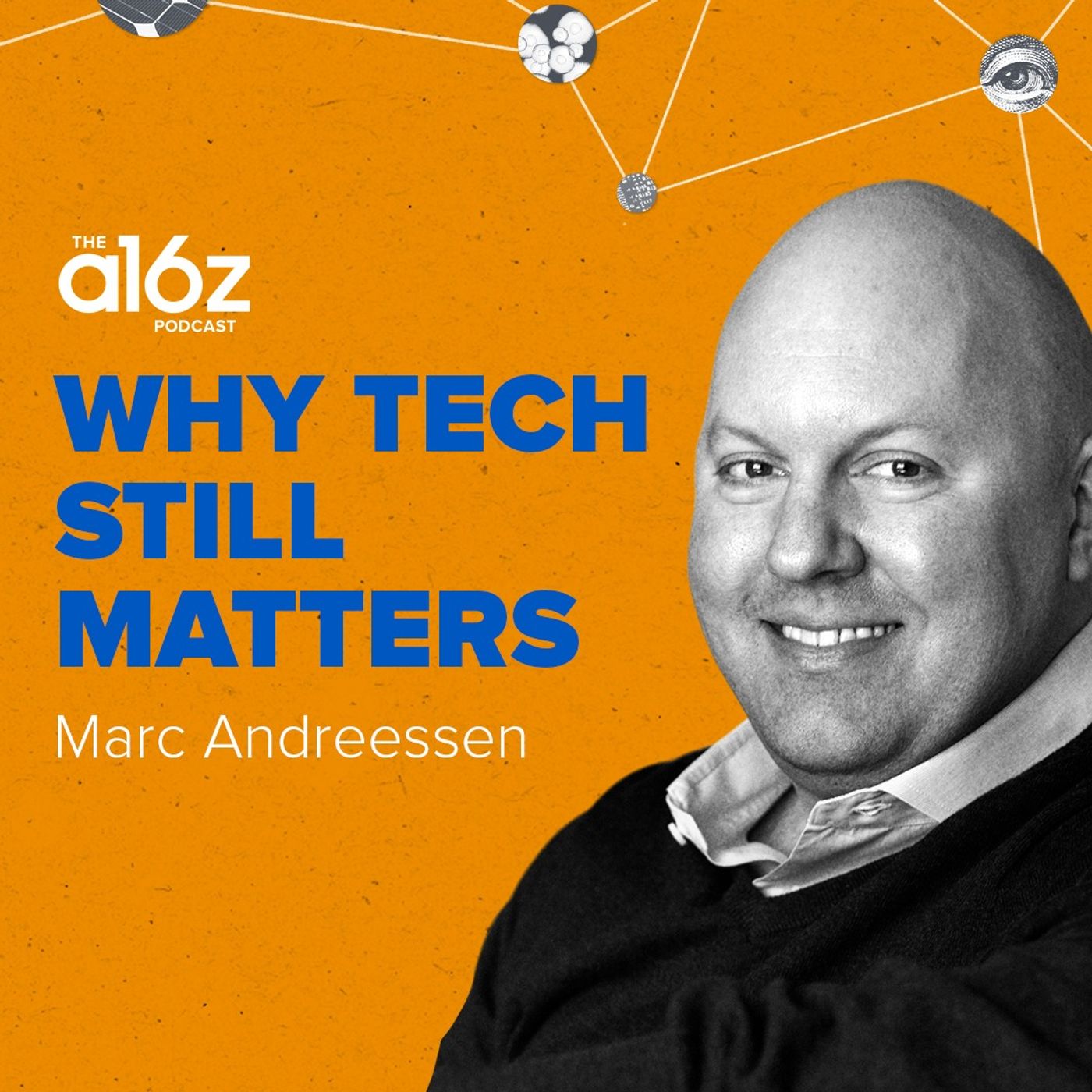
Ep 682Why Technology Still Matters with Marc Andreessen
With much coverage of technology lined with pessimism, the a16z Podcast returns to highlight the bright side of technology, alongside the founders building it. But before featuring the solutions in progress, we wanted to explore why building the future is still so important.And who better to traverse this ground than a16z’s own cofounder Marc Andreessen, who has built and invested in the future time and time again, especially when it wasn't the obvious thing to do.Together with Marc, this episode explores technology through the lens of history – including the three stages of human psychology as we encounter new technologies, how that process often manifests in regulation, when to change your mind, the Cambrian explosion of opportunity coming from distributed work, the importance of founder-led companies, and perhaps most importantly, we examine why there's still much reason for optimism.Timestamps: 00:00 - Welcome back!02:19 - The importance of tech today05:25 - Historical negativity toward technology9:40 - The invention of the bicycle13:16 - Innovation vs status in society20:45 - Automobile moral panic and red flag laws24:52 - Balaji’s arc on social networking27:44 - Surfacing signal from noise34:06 - The role of timing in innovation37:39 - Today’s major unlocks44:59 - Remote work and society reshuffling49:49 - Changing your mind54:06 - Retaining a lens of optimism1:04:25 - What Marc’s excited about1:08:41 - Bourgeois vs managerial capitalism1:17:32 - Reform vs starting anew Resources:Marc on Twitter: https://twitter.com/pmarcaPessimist’s Archive: https://pessimistsarchive.org/ Stay Updated: Find us on Twitter: https://twitter.com/a16zFind us on LinkedIn: https://www.linkedin.com/company/a16zSubscribe on your favorite podcast app: https://a16z.com/podcastsFollow our host: https://twitter.com/stephsmithioPlease note that the content here is for informational purposes only; should NOT be taken as legal, business, tax, or investment advice or be used to evaluate any investment or security; and is not directed at any investors or potential investors in any a16z fund. For more details please see a16z.com/disclosures. Stay Updated:Find a16z on YouTube: YouTubeFind a16z on XFind a16z on LinkedInListen to the a16z Show on SpotifyListen to the a16z Show on Apple PodcastsFollow our host: https://twitter.com/eriktorenberg Please note that the content here is for informational purposes only; should NOT be taken as legal, business, tax, or investment advice or be used to evaluate any investment or security; and is not directed at any investors or potential investors in any a16z fund. a16z and its affiliates may maintain investments in the companies discussed. For more details please see a16z.com/disclosures. Hosted by Simplecast, an AdsWizz company. See pcm.adswizz.com for information about our collection and use of personal data for advertising.
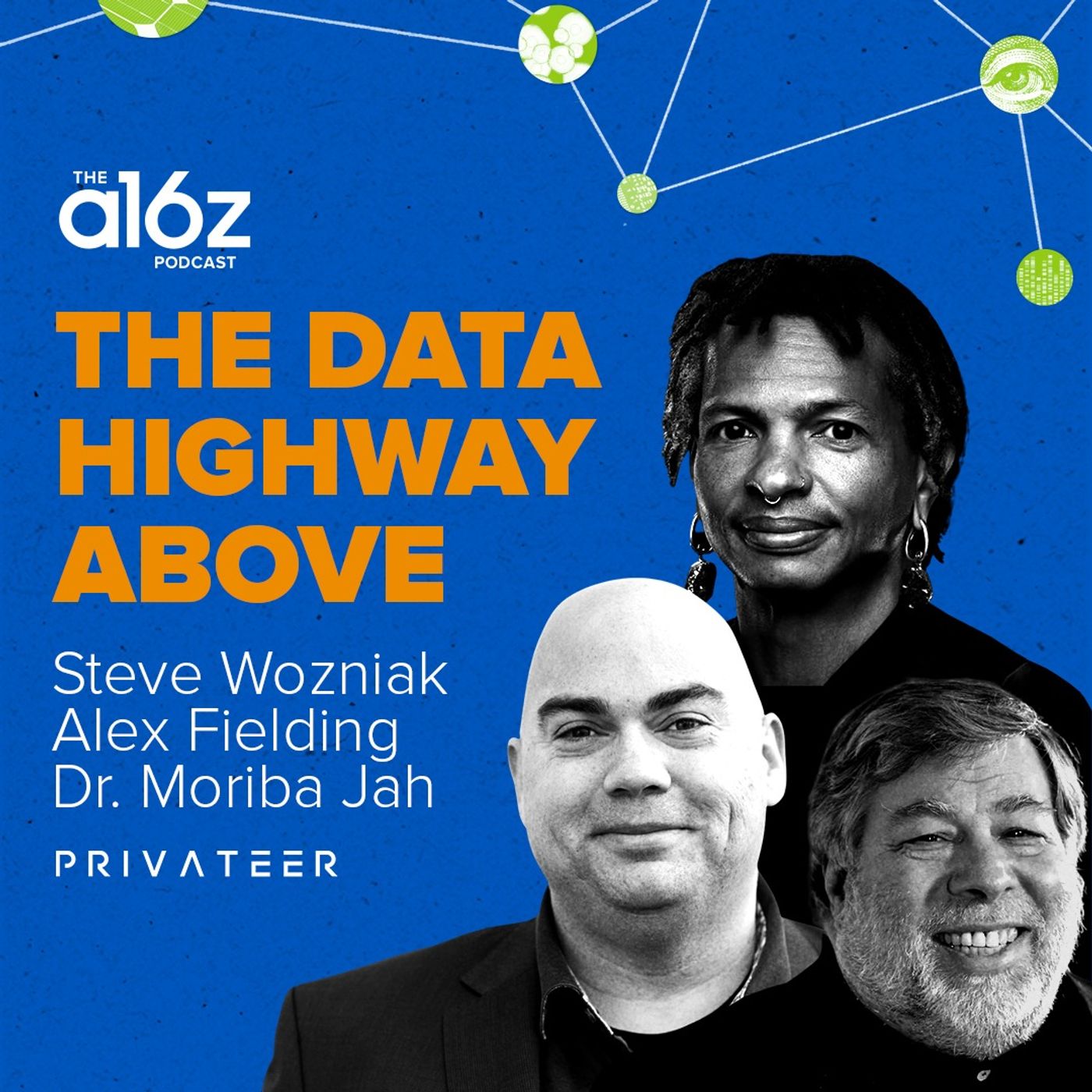
Ep 684The Data Highway Above with Privateer’s Steve Wozniak, Alex Fielding, and Dr. Moriba Jah
Many people consider space to be the next frontier and equally an infinite horizon to explore. But the reality is that not all “space” is the same and there are strategic zones that don’t only matter up there – but down here on Earth. Lower Earth Orbit (LEO) is one of those regions – a zone filled with satellites that support life on Earth, from agriculture to climate to navigation to defense. Unfortunately, these live satellites are not alone in our space highways. LEO is getting increasingly clogged with space debris; we’re polluting our skies just like we’re polluting our land. In this episode, we have the pleasure of speaking with all three cofounders of Privateer – Steve Wozniak, Alex Fielding, and Dr. Moriba Jah, as they explore just how much junk is up there, how this challenge is expected to progress with time due to lower launch costs, and ultimately, what infrastructure is missing in this fragile ecosystem – from tracking to global treaties to a sharing economy of satellites.By the end of the episode, listeners should be more equipped to understand how our infrastructure in space vastly impacts life on Earth, how the preservation of this ecosystem is crucial, and how Privateer is providing the map to better understand and fix the issue.Timestamps: With Steve Wozniak00:00 - Intro3:24 - Why space and why now?8:55 - The changing perception around space13:29 - Exponential technologies and thinking different16:32 - Inventors vs engineers vs visionaries18:46 - Early days at Apple and moving towards the future20:53 - Steve’s personal fascinations23:58 - How vocabulary drives awareness1:21:55 - Woz returns!With Alex Fielding and Dr. Moriba Jah24:43 - Is space really an infinite void?25:55 - The growing pollution in space29:14 - The impact of space down on Earth30:34 - The challenge of space policy and governance38:27 - Orbital highways and carrying capacities41:05 - Dependence on space infrastructure and its fragility45:14 - Privateer’s role in the evolving ecosystem46:52 - Democratizing space through data sharing49:45 - Can we undo the damage that’s been done?52:01 - Determining intent in space58:17 - Talent needed in the space industry1:01:04 - Privateer’s biggest challenges1:09:22 - Space stewardship and Hawaii’s kuleana1:15:19 - Who inspires Alex? Resources: Privateer’s website: https://mission.privateer.com/Privateer’s Wayfinder tool: https://mission.privateer.com/Privateer on Twitter: https://twitter.com/PrivateerSpaceSteve Wozniak on Twitter: https://twitter.com/stevewozAlex Fielding on Twitter: https://twitter.com/Alex__FieldingDr. Moriba Jah on Twitter: https://twitter.com/moribajah Stay Updated: Find us on Twitter: https://twitter.com/a16zFind us on LinkedIn: https://www.linkedin.com/company/a16zSubscribe on your favorite podcast app: https://a16z.com/podcastsFollow our host: https://twitter.com/stephsmithioPlease note that the content here is for informational purposes only; should NOT be taken as legal, business, tax, or investment advice or be used to evaluate any investment or security; and is not directed at any investors or potential investors in any a16z fund. For more details please see a16z.com/disclosures. Stay Updated:Find a16z on YouTube: YouTubeFind a16z on XFind a16z on LinkedInListen to the a16z Show on SpotifyListen to the a16z Show on Apple PodcastsFollow our host: https://twitter.com/eriktorenberg Please note that the content here is for informational purposes only; should NOT be taken as legal, business, tax, or investment advice or be used to evaluate any investment or security; and is not directed at any investors or potential investors in any a16z fund. a16z and its affiliates may maintain investments in the companies discussed. For more details please see a16z.com/disclosures. Hosted by Simplecast, an AdsWizz company. See pcm.adswizz.com for information about our collection and use of personal data for advertising.
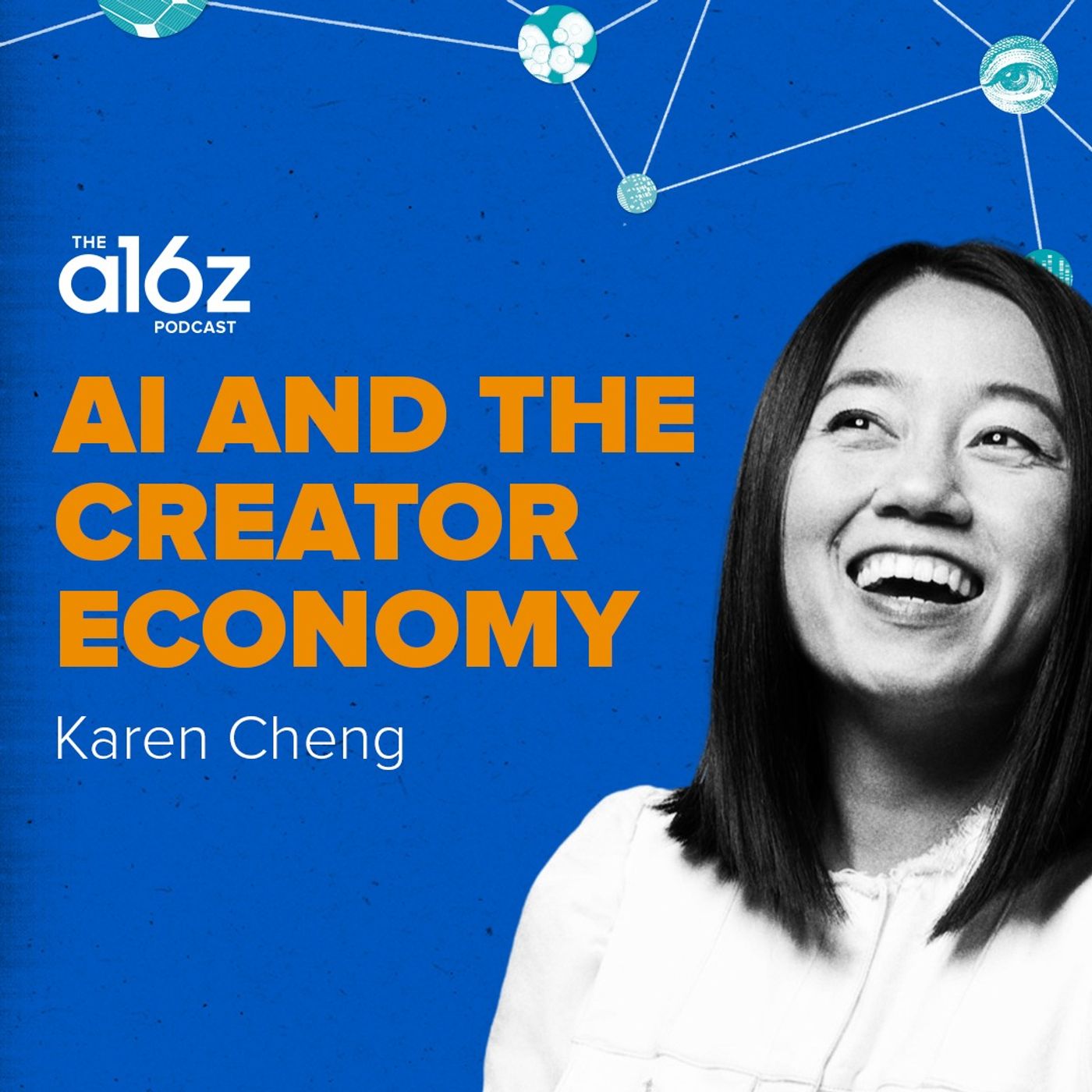
Ep 683AI and the Creator Economy with Karen X Cheng
Generative AI tools like DALL-E, Midjourney, and Stable Diffusion have taken the world by storm in recent months, wowing the masses with their uncanny ability to produce images via text prompts. In this interview, we’ll chat with Karen Cheng about how she’s leveraged these tools among others, with a focus on how this new paradigm is reshaping the creator landscape. You’ll get to hear the behind the scenes of many of her viral works, including a video of her becoming a lawnmower, her AI-generated Cosmo magazine cover, her DALL-E fashion show, her transforming iconic art into 3D museums to explore, and much, much more. By the end of this episode, listeners should have a better understanding of the new tools at their fingertips (literally!), how AI can indeed enhance the creative process, and the second-order effects of these innovations, like how creators are paid.Since we’re just at the beginning of the AI era, this is just the beginning of our coverage as well.Timestamps: 00:00 - Intro02:59 - Karen’s journey to content creator06:32 - Creative unlocks for viral content09:28 - The changing social media landscape12:08 - Innovating with AI14:59 - Unique AI tools available today17:52 - How AI tools might differentiate21:04 - Cosmo’s first AI-generated magazine cover24:19 - Inpainting, outpainting, and the fungibility of artists31:54 - AI enhancing the creative process32:39 - The virality of optimism vs pessimism38:19 - Turning attention into business43:13 - IP and ownership in the age of AI46:18 - The downward pricing pressure of AI47:21 - Is generative AI still a gimmick?53:32 - The adaptiveness of humans58:26 - The importance of AI ethics Resources:Karen’s TED TalkKaren’s Instagram accountKaren’s websiteCosmo magazine cover and tutorialDALL-E fashion show and tutorialDALL-E outpainting announcementI spent $15 in DALL·E 2 credits creating this AI image Stay Updated: Find us on Twitter: https://twitter.com/a16zFind us on LinkedIn: https://www.linkedin.com/company/a16zSubscribe on your favorite podcast app: https://a16z.com/podcastsFollow our host: https://twitter.com/stephsmithioPlease note that the content here is for informational purposes only; should NOT be taken as legal, business, tax, or investment advice or be used to evaluate any investment or security; and is not directed at any investors or potential investors in any a16z fund. For more details please see a16z.com/disclosures. Stay Updated:Find a16z on YouTube: YouTubeFind a16z on XFind a16z on LinkedInListen to the a16z Show on SpotifyListen to the a16z Show on Apple PodcastsFollow our host: https://twitter.com/eriktorenberg Please note that the content here is for informational purposes only; should NOT be taken as legal, business, tax, or investment advice or be used to evaluate any investment or security; and is not directed at any investors or potential investors in any a16z fund. a16z and its affiliates may maintain investments in the companies discussed. For more details please see a16z.com/disclosures. Hosted by Simplecast, an AdsWizz company. See pcm.adswizz.com for information about our collection and use of personal data for advertising.
The a16z Podcast Returns
trailerThe long-standing (and chart-topping) a16z Podcast returns to cover the most important topics within the world of technology. Brought to you by the minds at Andreessen Horowitz (a16z) and hosted by Steph Smith, each episode goes beyond headlines, giving listeners insider access to the edge of innovation.Subscribe to be the first to receive upcoming episodes featuring industry leaders like Steve Wozniak, Marc Andreessen, Balaji Srinivasan, and Neal Stephenson, and covering a range of topics, from AI to space to the metaverse to genomics, and beyond. Find us on Twitter: https://twitter.com/a16zFind us on LinkedIn: https://www.linkedin.com/company/a16zSubscribe on your favorite podcast app: https://a16z.com/podcastsFollow our host: https://twitter.com/stephsmithioPlease note that the content here is for informational purposes only; should NOT be taken as legal, business, tax, or investment advice or be used to evaluate any investment or security; and is not directed at any investors or potential investors in any a16z fund. For more details please see a16z.com/disclosures. Stay Updated:Find a16z on YouTube: YouTubeFind a16z on XFind a16z on LinkedInListen to the a16z Show on SpotifyListen to the a16z Show on Apple PodcastsFollow our host: https://twitter.com/eriktorenberg Please note that the content here is for informational purposes only; should NOT be taken as legal, business, tax, or investment advice or be used to evaluate any investment or security; and is not directed at any investors or potential investors in any a16z fund. a16z and its affiliates may maintain investments in the companies discussed. For more details please see a16z.com/disclosures. Hosted by Simplecast, an AdsWizz company. See pcm.adswizz.com for information about our collection and use of personal data for advertising.
Ep 680Is a Fun, Therapeutic Game Possible?
In this special episode from a16z’s Bio Eats World podcast, general partners Vijay Pande and Jon Lai join bio editorial lead Olivia Webb to discuss the intersection of games and health, including: what constitutes a game, the “healthy dessert” problem, and the challenge of building a game that’s both fun and therapeutic.You can subscribe to Bio Eats World wherever you get your podcasts. Stay Updated:Find a16z on YouTube: YouTubeFind a16z on XFind a16z on LinkedInListen to the a16z Show on SpotifyListen to the a16z Show on Apple PodcastsFollow our host: https://twitter.com/eriktorenberg Please note that the content here is for informational purposes only; should NOT be taken as legal, business, tax, or investment advice or be used to evaluate any investment or security; and is not directed at any investors or potential investors in any a16z fund. a16z and its affiliates may maintain investments in the companies discussed. For more details please see a16z.com/disclosures. Hosted by Simplecast, an AdsWizz company. See pcm.adswizz.com for information about our collection and use of personal data for advertising.
Ep 679Cycles of Computing, Now and Next
EThis week, we have a special episode for you, from our newest podcast, "web3 with a16z" . This episode features Chris Dixon – founding general partner of a16z crypto and former entrepreneur himself – and Kevin Rose – the co-founder of Proof Collective, as well as co-founder of Digg, former investor at GV, and longtime entrepreneur and podcaster.In this wide-ranging hallway-style conversation from web3 with a16z, these two veterans of both web2 and web3 movements go long on tech trends both in web3 and beyond, including NFTs and art; AI; the evolving roles of modding, copying, and copyrights on the internet; tech’s expansion from Silicon Valley to LA and New York; and more. Their discussion is not just a journey through time (long cycles of computing, web2 to web3) and place (LA, SF, NYC), but into "the age of wonders". Are we at the end of (computing) history, or the beginning?For more on the latest in web3 trends, be sure to subscribe to our podcast “web3 with a16z” (which is hosted by Sonal Choksi, the longtime former showrunner of this show) wherever you listen to your pods. Stay Updated:Find a16z on YouTube: YouTubeFind a16z on XFind a16z on LinkedInListen to the a16z Show on SpotifyListen to the a16z Show on Apple PodcastsFollow our host: https://twitter.com/eriktorenberg Please note that the content here is for informational purposes only; should NOT be taken as legal, business, tax, or investment advice or be used to evaluate any investment or security; and is not directed at any investors or potential investors in any a16z fund. a16z and its affiliates may maintain investments in the companies discussed. For more details please see a16z.com/disclosures. Hosted by Simplecast, an AdsWizz company. See pcm.adswizz.com for information about our collection and use of personal data for advertising.
Ep 678The Future of Audio
Audio is no longer just audio anymore -- podcasts now pull from new video platforms like TikTok and older ones like radio, user experience is growing and changing, and it's easier than ever to create audio content. Where do all these mediums converge and where do they diverge -- when it comes to user experience, product design, recommendations, discovery, and more?In this episode from October 2020, a16z general partner Connie Chan and Spotify’s chief R&D officer Gustav Söderström join host Sonal Choksi to discuss the past, present and future of audio. They dig into everything from what the past in radio can tell us about the future, what audio can and will borrow from mediums like video and platforms like TikTok, the role for more interactivity and increased use of tools like machine learning and AI, and more. Stay Updated:Find a16z on YouTube: YouTubeFind a16z on XFind a16z on LinkedInListen to the a16z Show on SpotifyListen to the a16z Show on Apple PodcastsFollow our host: https://twitter.com/eriktorenberg Please note that the content here is for informational purposes only; should NOT be taken as legal, business, tax, or investment advice or be used to evaluate any investment or security; and is not directed at any investors or potential investors in any a16z fund. a16z and its affiliates may maintain investments in the companies discussed. For more details please see a16z.com/disclosures. Hosted by Simplecast, an AdsWizz company. See pcm.adswizz.com for information about our collection and use of personal data for advertising.
Ep 677Culture as Code
While building and shaping culture is as relevant as ever for startups and companies today, leaders have sought the answers to these questions for hundreds of years – and there is practical advice to be had by examining different cultures across time and around the globe.In this episode from December 2019, a16z co-founder Ben Horowitz sits down with host Sonal Choksi to talk about what actually makes up culture, whether in a company or any organization or team, as based on Ben’s best-selling book, What You Do is Who You Are. They discuss the idea of culture as code, the nuances of setting and changing a culture, and how to apply the principles of his book to startups, the tech industry and any company today. Stay Updated:Find a16z on YouTube: YouTubeFind a16z on XFind a16z on LinkedInListen to the a16z Show on SpotifyListen to the a16z Show on Apple PodcastsFollow our host: https://twitter.com/eriktorenberg Please note that the content here is for informational purposes only; should NOT be taken as legal, business, tax, or investment advice or be used to evaluate any investment or security; and is not directed at any investors or potential investors in any a16z fund. a16z and its affiliates may maintain investments in the companies discussed. For more details please see a16z.com/disclosures. Hosted by Simplecast, an AdsWizz company. See pcm.adswizz.com for information about our collection and use of personal data for advertising.
Ep 676On Mentorship and Leadership
Behind many great leaders, you’ll usually find a great mentor. The mentor-mentee relationship is often one of the most important and most fulfilling relationships people have, in both their careers and in their lives. So how do you find a mentor? What are different kinds of mentorship? And how can it help you break into an industry – or help others break in themselves?In this episode from July 2018, a16z co-founder Ben Horowitz discusses mentorship with his mentor, Silicon Valley pioneer Ken Coleman, and Ben’s mentee, Michel Feaster, founder of Usermind and now Chief Product Officer at Qualtrics. They begin with their personal journeys and share advice and frameworks for mentorship, leadership, and growing as a founder. Stay Updated:Find a16z on YouTube: YouTubeFind a16z on XFind a16z on LinkedInListen to the a16z Show on SpotifyListen to the a16z Show on Apple PodcastsFollow our host: https://twitter.com/eriktorenberg Please note that the content here is for informational purposes only; should NOT be taken as legal, business, tax, or investment advice or be used to evaluate any investment or security; and is not directed at any investors or potential investors in any a16z fund. a16z and its affiliates may maintain investments in the companies discussed. For more details please see a16z.com/disclosures. Hosted by Simplecast, an AdsWizz company. See pcm.adswizz.com for information about our collection and use of personal data for advertising.
Ep 675Cloud Wars, Company Wars, and Innovating Through Change
In this episode from October 2021, Michael Dell, founder and CEO of Dell Technologies and one of the longest serving founder-CEOs in the technology industry, joins a16z general partner Martin Casado, a16z co-founder Marc Andreessen, and host Sonal Choksi on the occasion of Michael’s book, Play Nice to Win: A CEO’s Journey from Founder to Leader. There are lots of challenges in being public while trying to innovate, and limits to being a private company as well; but it's rare to see a company go public then private then back to public again. As is the case with Dell Technologies, one of the largest tech companies -- which went private 2012-2013 and then also pulled off one of the most epic mergers of all time with Dell + EMC + VMWare 2015-2016 (and which we wrote about here at the time).Is there a method to the madness? How does one not just start, but keep, and transform, their company and business? Michael, Marc, Martin and Sonal debate these questions, as well as the impact of the cloud wars, how innovation happens when a company is private and when its public (something Michael knows well, having taken Dell public to private to back to public again), whether you can actually play nice to win as a leader, and more. Stay Updated:Find a16z on YouTube: YouTubeFind a16z on XFind a16z on LinkedInListen to the a16z Show on SpotifyListen to the a16z Show on Apple PodcastsFollow our host: https://twitter.com/eriktorenberg Please note that the content here is for informational purposes only; should NOT be taken as legal, business, tax, or investment advice or be used to evaluate any investment or security; and is not directed at any investors or potential investors in any a16z fund. a16z and its affiliates may maintain investments in the companies discussed. For more details please see a16z.com/disclosures. Hosted by Simplecast, an AdsWizz company. See pcm.adswizz.com for information about our collection and use of personal data for advertising.
Ep 674How to Find Product-Market-Sales Fit
EIn this episode from February 2019, Jyoti Bansal, founding CEO of AppDynamics and co-founder of Unusual Ventures, joins a16z general partner Peter Levine, a16z partner Sateesh Talluri, and host Sonal Choksi to discuss how product and sales evolve together for enterprise go-to-market, including key milestones for both product development and marketing, frameworks for how to think about pre- to post-product market fit, the role of additional levers like services or pricing, and more.For the show transcript, you can go here. Stay Updated:Find a16z on YouTube: YouTubeFind a16z on XFind a16z on LinkedInListen to the a16z Show on SpotifyListen to the a16z Show on Apple PodcastsFollow our host: https://twitter.com/eriktorenberg Please note that the content here is for informational purposes only; should NOT be taken as legal, business, tax, or investment advice or be used to evaluate any investment or security; and is not directed at any investors or potential investors in any a16z fund. a16z and its affiliates may maintain investments in the companies discussed. For more details please see a16z.com/disclosures. Hosted by Simplecast, an AdsWizz company. See pcm.adswizz.com for information about our collection and use of personal data for advertising.
Ep 673The Fintech Opportunity for Students and Gen Z
This week, student loans are back in the news, with the administration's announcement of a plan to forgive student loan debt for certain kinds of borrowers. Outside of the specific policies, though, student loans are often the first of many big financial decisions that young people make as they begin to build credit history and join the labor force. So what role can technology play in serving this demographic's particular needs, now and into the future?In this episode from October 2020, Amira Yahyaoui, the founder and CEO of Mos, a platform that helps students with their banking needs, like getting financial aid for college, joins a16z general partner Anish Acharya, partner Seema Amble, and host Lauren Murrow to discuss fintech for Gen Z and millenials. They dig into some of the issues around student loans today, the underserved banking needs of this group, and how fintech can help younger consumers today as well as set them up for a better financial future. Stay Updated:Find a16z on YouTube: YouTubeFind a16z on XFind a16z on LinkedInListen to the a16z Show on SpotifyListen to the a16z Show on Apple PodcastsFollow our host: https://twitter.com/eriktorenberg Please note that the content here is for informational purposes only; should NOT be taken as legal, business, tax, or investment advice or be used to evaluate any investment or security; and is not directed at any investors or potential investors in any a16z fund. a16z and its affiliates may maintain investments in the companies discussed. For more details please see a16z.com/disclosures. Hosted by Simplecast, an AdsWizz company. See pcm.adswizz.com for information about our collection and use of personal data for advertising.
Ep 672How to Make Better Decisions
Can you get better at decision-making with practice? Many founders, investors, and builders must make many critical decisions, big and small, every day, and improving the quality of your decision-making process can become a big competitive advantage. In this episode from October 2020, expert decision strategist, author and professional poker player, Annie Duke, joins a16z managing partner Jeff Jordan, to discuss some of the frameworks, strategies, and tactics for better decision-making by both individuals and organizations that she outlines in her second book, How to Decide. This was Annie’s second appearance on the podcast – she first joined a16z co-founder Marc Andreessen and host Sonal Chokshi to discuss her first book, Thinking in Bets, where they went deep into how to frame taking risks and placing bets, especially in the context of innovation. You can read the full transcript of this episode here, and you can read the transcript of Annie's first episode on the a16z Podcast with Marc Andreessen here. Stay Updated:Find a16z on YouTube: YouTubeFind a16z on XFind a16z on LinkedInListen to the a16z Show on SpotifyListen to the a16z Show on Apple PodcastsFollow our host: https://twitter.com/eriktorenberg Please note that the content here is for informational purposes only; should NOT be taken as legal, business, tax, or investment advice or be used to evaluate any investment or security; and is not directed at any investors or potential investors in any a16z fund. a16z and its affiliates may maintain investments in the companies discussed. For more details please see a16z.com/disclosures. Hosted by Simplecast, an AdsWizz company. See pcm.adswizz.com for information about our collection and use of personal data for advertising.
Ep 671Learning from Open Source Communities
What can we learn from the evolution of open source communities and how might they be applied to online communities and the creator economy today? Author Nadia Asparouhova joins host Sonal Choksi to talk about Asparouhova's book, Working in Public: The Making and Maintenance of Open Source Software, from Stripe Press.They start with a a taxonomy for communities, and then dig into how open source has changed over time, which learnings from open source do and don’t apply to new communities online, how communities intersect with the growing desire for more "high-shared context" groups and spaces (including even podcasts and newsletters), and more. Stay Updated:Find a16z on YouTube: YouTubeFind a16z on XFind a16z on LinkedInListen to the a16z Show on SpotifyListen to the a16z Show on Apple PodcastsFollow our host: https://twitter.com/eriktorenberg Please note that the content here is for informational purposes only; should NOT be taken as legal, business, tax, or investment advice or be used to evaluate any investment or security; and is not directed at any investors or potential investors in any a16z fund. a16z and its affiliates may maintain investments in the companies discussed. For more details please see a16z.com/disclosures. Hosted by Simplecast, an AdsWizz company. See pcm.adswizz.com for information about our collection and use of personal data for advertising.
Ep 670The Art and Science of Moderating Discussions
Whether it’s moderating a live panel discussion, managing your (virtual) All Hands meeting, or even guiding a cross-functional team to a decision in an important meeting, mastering the art of helping a group communicate is a critical skill for many of us.In this episode from November 2020, expert communications and presentations coach Matt Abrahams, who is also a lecturer at Stanford’s Graduate School of Business, sits down with Sonal Choksi to share frameworks, strategies and many concrete tips for how anyone can become a better moderator and facilitator. They cover everything from how to approach prep work (like, can you be too prepared?) and how to handle disruptions on the fly to the subtle differences between in-person and virtual events, the ways our own ticks can manifest before an audience, and more. Stay Updated:Find a16z on YouTube: YouTubeFind a16z on XFind a16z on LinkedInListen to the a16z Show on SpotifyListen to the a16z Show on Apple PodcastsFollow our host: https://twitter.com/eriktorenberg Please note that the content here is for informational purposes only; should NOT be taken as legal, business, tax, or investment advice or be used to evaluate any investment or security; and is not directed at any investors or potential investors in any a16z fund. a16z and its affiliates may maintain investments in the companies discussed. For more details please see a16z.com/disclosures. Hosted by Simplecast, an AdsWizz company. See pcm.adswizz.com for information about our collection and use of personal data for advertising.
Ep 669Tiktok's Algorithm and Creativity Network Effects
What does the success of TikTok's algorithmically-driven product tell us about the future of creators and the creator economy, product design, and innovation within video?In this cross-over archive episode from our tech news podcast, 16 Minutes on the News, we go deep into the what, why, and how of TikTok's algorithm, which lies at the heart of the product and drives its "creativity network effects." The conversation features Eugene Wei (former head of product at Hulu, Flipboard, and video at Oculus), in conversation with host Sonal Choksi. This episode originally aired in September 2020, when there was talk of U.S. ownership/partnership for the American version of TikTok, which is from Chinese company ByteDance. Stay Updated:Find a16z on YouTube: YouTubeFind a16z on XFind a16z on LinkedInListen to the a16z Show on SpotifyListen to the a16z Show on Apple PodcastsFollow our host: https://twitter.com/eriktorenberg Please note that the content here is for informational purposes only; should NOT be taken as legal, business, tax, or investment advice or be used to evaluate any investment or security; and is not directed at any investors or potential investors in any a16z fund. a16z and its affiliates may maintain investments in the companies discussed. For more details please see a16z.com/disclosures. Hosted by Simplecast, an AdsWizz company. See pcm.adswizz.com for information about our collection and use of personal data for advertising.
Ep 668From Research to Startup, There and Back Again
In this episode from December 2018, Hennessy, currently the chairman of Alphabet as well as Turing Award-winning computer scientist, joins a16z co-founder Marc Andreessen, a16z general partner Martin Casado, and host Sonal Choksi for a wide-ranging conversation about moving from academia to startups, the history of Silicon Valley, the “Stanford model”, how to build enduring organizations, and more.Hennessy also co-founded startups, including one based on pioneering microprocessor architecture used in 99% of devices today (for which he and his collaborator won the prestigious Turing Award)... so what did it take to go from research/idea to industry/implementation? And how has the overall relationship and "divide" between academia and industry shifted, especially as the tech industry itself has changed? Finally, in his book, Leading Matters, Hennessy shares some of the leadership principles he's learned, offering nuanced takes on topics like humility (needs ambition), empathy (without contravening fairness and reason), and others. What does it take to build not just tech, but a successful organization? Stay Updated:Find a16z on YouTube: YouTubeFind a16z on XFind a16z on LinkedInListen to the a16z Show on SpotifyListen to the a16z Show on Apple PodcastsFollow our host: https://twitter.com/eriktorenberg Please note that the content here is for informational purposes only; should NOT be taken as legal, business, tax, or investment advice or be used to evaluate any investment or security; and is not directed at any investors or potential investors in any a16z fund. a16z and its affiliates may maintain investments in the companies discussed. For more details please see a16z.com/disclosures. Hosted by Simplecast, an AdsWizz company. See pcm.adswizz.com for information about our collection and use of personal data for advertising.
Ep 667Crisis Communications 101
In this hallway-style conversation with a16z's Margit Wennmachers, longtime operating partner for Marketing, and Kim Milosevich, CMO for a16z crypto, open up the black box of crisis communications with Sonal Choksi and explore the process and mindsets before, during, and after a crisis.They discuss common FAQs like: What constitutes a crisis? Can someone inside a company "call it" early and prevent a crisis from becoming a bigger deal? How do you respond when there's a lag or too much time between acknowledging the issue and finding out all the facts? Who should be in the (war) room ? Should you share the off-the-record background story with reporters? How do you know when a crisis begins and ends -- or that you're ready for a "comeback" story? We explore all this and more. Stay Updated:Find a16z on YouTube: YouTubeFind a16z on XFind a16z on LinkedInListen to the a16z Show on SpotifyListen to the a16z Show on Apple PodcastsFollow our host: https://twitter.com/eriktorenberg Please note that the content here is for informational purposes only; should NOT be taken as legal, business, tax, or investment advice or be used to evaluate any investment or security; and is not directed at any investors or potential investors in any a16z fund. a16z and its affiliates may maintain investments in the companies discussed. For more details please see a16z.com/disclosures. Hosted by Simplecast, an AdsWizz company. See pcm.adswizz.com for information about our collection and use of personal data for advertising.
Ep 666All About Synthetic Biology
Over the last 20 years, the idea of “designing biology” has gone from science fiction to just science, as the field of synthetic biology has exploded, with applications from therapeutics to manufacturing and more. In this episode from January 2019, one of the pioneers in the field, professor James J. Collins of MIT, joins a16z general partner on the Bio + Health fund, Vijay Pande, and editorial partner Hanne Winarsky, to discuss the origins of synthetic biology or "synbio", to what "engineering and designing" biology really looks like in action and the disciplinary differences between how biologists and engineers see the world. Stay Updated:Find a16z on YouTube: YouTubeFind a16z on XFind a16z on LinkedInListen to the a16z Show on SpotifyListen to the a16z Show on Apple PodcastsFollow our host: https://twitter.com/eriktorenberg Please note that the content here is for informational purposes only; should NOT be taken as legal, business, tax, or investment advice or be used to evaluate any investment or security; and is not directed at any investors or potential investors in any a16z fund. a16z and its affiliates may maintain investments in the companies discussed. For more details please see a16z.com/disclosures. Hosted by Simplecast, an AdsWizz company. See pcm.adswizz.com for information about our collection and use of personal data for advertising.
Ep 665Mining the Data for Cobalt
In this episode from July 2019, Kurt House, CEO and co-founder of Kobold Metals, John Thompson, professor of earth and geosciences at Cornell; and Connie Chan, a16z general partner for consumer, talk with editorial partner Hanne Winarsky about the way technology is transforming how we find cobalt, and the mining industry as a whole, as well as the science behind why cobalt is so critical for batteries, the data and knowledge behind mining today vs the past, and more. Stay Updated:Find a16z on YouTube: YouTubeFind a16z on XFind a16z on LinkedInListen to the a16z Show on SpotifyListen to the a16z Show on Apple PodcastsFollow our host: https://twitter.com/eriktorenberg Please note that the content here is for informational purposes only; should NOT be taken as legal, business, tax, or investment advice or be used to evaluate any investment or security; and is not directed at any investors or potential investors in any a16z fund. a16z and its affiliates may maintain investments in the companies discussed. For more details please see a16z.com/disclosures. Hosted by Simplecast, an AdsWizz company. See pcm.adswizz.com for information about our collection and use of personal data for advertising.
Ep 664Applying AI in B2B
In this episode from October 2019, People.AI founder and CEO Oleg Rogynskyy and a16z partner Peter Lauten discuss with Das Rush about what the rise of AI in B2B means for enterprises, workers, and startups. They explain why AI provides a strong first mover advantage to enterprises that adopt it early; how it can automate lower level tasks, maximize our focus, and, ultimately, make our work more meaningful; and for startups, they provide a playbook for seizing the next AI opportunity.To learn more about the latest in AI, ML, data, and how enterprise are working with these technologies, go to future.com/data. Stay Updated:Find a16z on YouTube: YouTubeFind a16z on XFind a16z on LinkedInListen to the a16z Show on SpotifyListen to the a16z Show on Apple PodcastsFollow our host: https://twitter.com/eriktorenberg Please note that the content here is for informational purposes only; should NOT be taken as legal, business, tax, or investment advice or be used to evaluate any investment or security; and is not directed at any investors or potential investors in any a16z fund. a16z and its affiliates may maintain investments in the companies discussed. For more details please see a16z.com/disclosures. Hosted by Simplecast, an AdsWizz company. See pcm.adswizz.com for information about our collection and use of personal data for advertising.