PLAY PODCASTS
Talking Out Your Glass podcast

Talking Out Your Glass podcast

Shawn Waggoner

294 episodesENserial

Show overview

Talking Out Your Glass podcast has been publishing since 2016, and across the 10 years since has built a catalogue of 294 episodes. That works out to roughly 310 hours of audio in total. Releases follow a fortnightly cadence, with the show now in its 11th season.

Episodes typically run an hour to ninety minutes — most land between 52 min and 1h 12m — though episode length varies meaningfully from one episode to the next. It is catalogued as a EN-language Arts show.

The show is actively publishing — the most recent episode landed 1 weeks ago, with 9 episodes already out so far this year. The busiest year was 2021, with 39 episodes published. Published by Shawn Waggoner.

Episodes
294
Running
2016–2026 · 10y
Median length
1h 1m
Cadence
Fortnightly

From the publisher

Former editor of Glass Art magazine Shawn Waggoner interviews internationally respected artists and experts in hot, warm and cold glass. For questions or comments [email protected]

Latest Episodes

View all 294 episodes

Documenting Laura Donefer's Glass Fashion Show

May 6, 20261h 11m

Jen Elek: Reflecting, Magnifying and Representing Bold Color in Hot Glass

Apr 22, 20261h 21m

Ariana Makau and Nzilani Glass Conservation: At the Intersection of Equity, Preservation and Art

Apr 15, 20261h 12m

S11 Ep 6Susan Stinsmuehlen-Amend: Stretching Concepts and Pushing Processes of Traditional Glass

Susan Stinsmuehlen-Amend is an artist for whom ideas have always been more important than media, and possibly more integral to her work. It's interesting then that her art has been consistently viewed through the lens of glass. In the creation of her early X series to more recent Calendar Notations, she has pioneered techniques such as non-traditional, unfired painting on glass, mixing glass with other media, and presenting painted, decorated glass on the wall in reflected light. Throughout her career, the artist distilled her own life experiences in the creation of progressive and experimental work. While studying Fine Arts at the University of Texas, Austin, in 1973, Stinsmuehlen-Amend was serendipitously introduced to glass and went on to become partner with Rodney Smith and designer of Renaissance Glass, an architectural glass studio. Beyond teaching and employing 14 artists, she built a creative hub that included studio space, glass supplies, a hot glass studio, education and exhibitions. Understanding the cutting edge in the field, Stinsmuehlen-Amend invited luminaries in the Studio Glass movement such as Dale Chihuly, Paul Marioni, William Morris, and Narcissus Quagliata, among others, to lecture and teach in the early 1980s. The studio became the center for contemporary glass in Texas from 1973 to 1987. While balancing single motherhood, donating time to the arts, and running her business, she became the Glass Art Society's first woman president (1984 – '86). Concurrent with designing stained glass commissions, Stinsmuehlen-Amend was determined to make the craft form a means for personal expression. Through experimentation and rebellion and influenced by the local punk scene, her radical fashion designer best friend, Pattern & Decoration and Neo-Expressionism in art, as well as innovations in the world of craft, her work became unrestrained, kinetic, glittery, and jarring—defiantly not "tasteful" or functional. Combining mixed media with glass was a new idea at the time. For Stinsmuehlen-Amend, the shifting qualities of glass itself—its capacity to reveal, obscure, reflect, and distort—became integral to how meaning unfolds. Rooted in stained glass's narrative tradition, her story emerged through her everyday stream of consciousness rooted in the surreal logic of dreams. In 1987, Stinsmuehlen-Amend relocated to Los Angeles, where she became a full-time artist; solo exhibitions and dynamic public art commissions followed. She was the lead artist on the Hollywood Demonstration Project in Hollywood, completing a precast concrete crosswalk with inlaid glass and bronze and an adjunct wrought iron public space. In 1994, she completed leaded glass for the AT&T corporate headquarters and The Jewish Museum, both in in New York City. Throughout these decades, she maintained her commitment to teaching, returning to Pilchuck Glass School repeatedly (1980 to 2019) and serving as a visiting artist at RISD, RIT, Tyler School of Art, California College of the Arts, and numerous other institutions. Stinsmuehlen-Amend's work is included in major collections including the Los Angeles County Museum of Art, Detroit Institute of the Arts, Oakland Museum of California, Corning Museum of Glass, Tacoma Museum of Glass, and Museum of Art and Design. She has received two National Endowment for the Arts Fellowships, two Pilchuck Hauberg Fellowships, and the 2007 Brychtová Libenský Award. The artist served 14 years on Pilchuck's Board of Directors and is a Trustee Emeritus of The American Craft Council and an Honorary Life Member of the Glass Art Society. She was recently awarded by the American Craft Council with the biennial College of Fellows honor for contributions to the craft ecosystem. Opening on May 16, 2026, at the Corning Museum of Glass, Tough Stuff: Women in the American Glass Studio will feature Stinsmuehlen-Amend's work. This new exhibition celebrates the female artists who revolutionized American Studio glass. The artist states: "Many artists found my loose and inclusive approach to working with glass inspirational because I was continually violating preconceived notions about craft and glass specifically."

Mar 13, 20261h 57m

S11 Ep 5Nadine Saylor: Telling Stories Behind the Objects, Places, and Lives They Touch

Recently, Nadine Saylor has been creating a series of gas and oil cans featuring imagery of her local surroundings. These more "masculine" objects remind her of the things her grandfather had in his shed. In thinking about gender and how it relates to the objects with which we surround ourselves, she investigates what role gender plays in our world writ large. Assistant Professor of Glass and Sculpture at University of Nebraska, Kearney, Saylor is originally from Hershey, Pennsylvania. She received her BFA in Photography from the University of the Arts in Philadelphia and her MFA in Glass from Alfred University in upstate New York. Since then, she has taught at Bowling Green State University in Ohio, Harrisburg Area Community College in Pennsylvania, and at Southern Illinois University in Carbondale. In addition to teaching at the collegiate level, she has taught many workshops internationally including The Studio at the Corning Museum of Glass and Penland School of Craft in North Carolina. She has also given demonstrations nationally and lectured internationally. Saylor has exhibited in many exhibitions across the country including the Cafesjian Art Trust, in Shoreview, MN, Toyama's International Glass Exhibition 2024 in Japan and has shown at SOFA Chicago. She recently completed a commission of two works Carrie Oilcan and Copper Kettle Nebraska for the Federal Reserve Board Gallery to be on display in Washington, DC, and to compliment her works commemorating American industry that were purchased in 2024. Derivative of her childhood, Saylor's works are instilled with love of Americana and history along with an interest in the stories behind the objects, the places, and the lives they have touched. For example, Saylor's series of pincushions began with the familiar Tomato and Strawberry forms. In researching the history of these objects, the artist learned the pincushion was placed on the mantle to ward off evil spirits. When tomatoes were out of season, women made them out of fabric and used them as voodoo dolls. "I enjoy these kinds of historical narratives and use them as a vantage point in my work," she says. Imagery tells a story on the surface of many Saylor works. For example, Foggy Morning in the Black Swamp is a replica of an antique coffee pot she found in an antique store. The imagery on the surface is inspired by the artist's bike rides on the old railroad trail bike path through the Black Swamp. She states: "My surroundings continue to affect the imagery on my glass as I lived on a farm in Southern Illinois with an array of chickens, goats and horses. This nostalgic life took me back to traveling to my grandmother's house in the countryside of rural Pennsylvania. Not only does my current rural life in Nebraska play a part in my glasswork, but I am also interested in the memories sparked by certain objects and what roles they play in our lives."

Feb 27, 202651 min

S11 Ep 4Rick Beck: Casting Large-Scale Industrial Objects and Figural Forms in Glass

Rick Beck's modern cast and carved figurative glass sculptures are inspired by industrial and architectural works as well as the human form, with an emphasis on formal aspects. Interested in playing the volumes of mass against the rhythm of the lines, Beck enjoys the interplay of the visual versus the verbal, creating art that challenges the eye as well as the mind. Beck states: "My wife, Valerie, got me a book about the competitive relationship between Picasso and Matisse. Their artistic dialogue about the figure has fired my imagination, especially the way they shared and borrowed images and ideas from one another, as well as from history and literature. Between this book and visits to the Art Institute of Chicago, I've been inspired by the use of shape, form, and mass to create something more universal than the literal subject." A studio artist who was based in Spruce Pine, North Carolina, for 30 years before moving to Hawaii in 2020, Beck began working in glass at Hastings College in Nebraska, where he received his BA. The artist received his MFA from Southern Illinois University, where he studied with Bill Boysen. He was awarded residencies at the Appalachian Center for Crafts 1989 to 1991, and in 1994 received a Visual Arts Fellowship from the North Carolina Arts Council, followed by a National Endowment for the Arts regional Visual Arts Fellowship from the Southern Arts Federation in 1995. A student of the Studio Glass movement, Beck has assisted at Pilchuck Glass School, assisting artists Curtiss Brock and Jan Mares, as well as at the Penland School of Craft. Beck currently shares a studio with wife Valerie Thomas Beck in Hakalau, Hawaii. Valerie has been a designer and co-conspirator to Rick since 1984. Both artists have been artists-in-residence at Penland School of Crafts, North Carolina, (1991-94) and have also been instructors there. Their blown glass work consists mainly of vessels – canvasses for imagery based on dreams and experiences ranging from the sublime to the ridiculous. These vessels document their lives while providing beauty and pleasure. Since moving to the Big Island, Beck's challenge in making glass work is two-fold. First, to create work without using fossil fuels or adding to the demand for capacity on the electrical grid. Their new studio is powered by a solar/photo voltaic and battery system. Second, to create work that excites and challenges his concepts of art inside these new energy parameters. For him, formal aspects are crucial. Beck stretches and manipulates common shapes and objects, reducing the objects to pattern and geometry. Currently, he is producing work focusing on the geometry of life, plant, and human forms. Beck's work will be on view in 2026 at Blue Print Gallery, Dallas, Texas, opening February 26; at Hidell Brooks Gallery, Charlotte, North Carolina, in May; at Blue Spiral 1 group show, Asheville, North Carolina; and at Ken Saunders, Chicago, Illinois. His work is also represented by Raven Gallery, Aspen, Colorado.

Feb 12, 202650 min

S11 Ep 3The Pain and Pleasure of Karisa Gregorio's Stained Glass

Karisa Gregorio's autonomous stained glass panels explore themes of sex, death, God, the Devil, pleasure, temptation, intimacy, love, lust, and indulgence. The relationship between glass and light in stained glass allows her to create works that feel alive. Using traditional processes as well as techniques developed by modern stained glass master Judith Schaechter, the depth and intimacy of Gregorio's materials create a world in which the pleasures of the flesh and emotions of the heart are equally illuminated and illuminating. Having received her BFA in Craft + Material studies, with a major in glass and minor in figurative illustration from the University of the Arts in 2016, Gregorio was named a 2025 MacPherson-Wortley Emerging Artist and received the Glass Art Society (GAS) Emerging Artist Award. Generously funded by Nancy and Roger MacPherson and Barbara and Richard Wortley, the MacPherson-Wortley Emerging Artist Award is presented annually to three exemplary emerging artists in the glass community. This prestigious juried award includes a cash prize, a special lecture slot at the annual GAS Conference, a digital exhibition catalog, and a residency at the Chrysler Museum of Art Perry Glass Studio. "We are honored by the MacPhersons and Wortleys' visionary commitment to emerging artists. Their support allows us to expand what our Emerging Artist Awardees receive; a larger cash prize and a residency can be remarkable opportunities for emerging artists as they seek to expand their practice," said Brandi P. Clark, GAS executive director. In 2024, Gregorio's work was featured in a solo exhibition Worldly Pleasures at Rick Prigg's Gallery 26 in Philadelphia. Serving as adjunct professor in glass at The Crefeld School as well as coldworker at John Pomp Studios, TA for Glenn Carter Assemblage at Pilchuck Glass School, studio assistant for Judith Schaechter, and TA for Wes Valdez and David King, Gregorio has been the owner of Thirst Glass since 2020. Gregorio aims to one day create a cathedral in which enlightenment comes from the experiences in life that, in her opinion, make life worth living. She seeks to create an environment in which relationships between the viewer and work, and the relationships between people, are not limited, but allowed to be felt and fully indulged in.
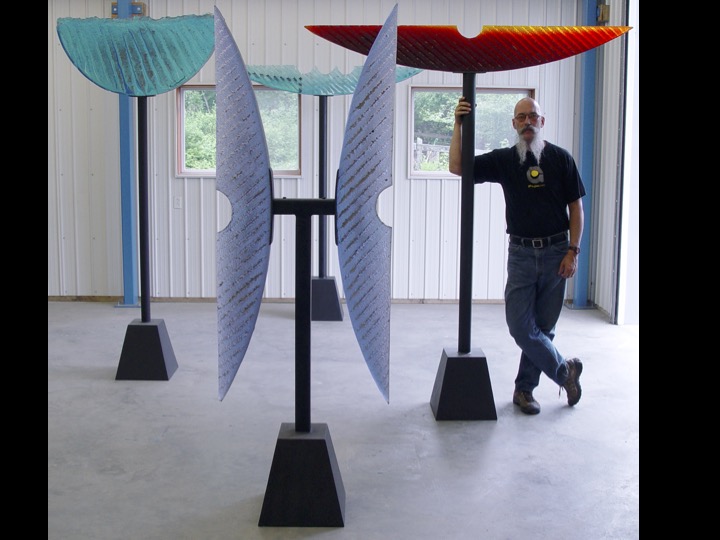
Feb 7, 202639 min

S11 Ep 2Stephen Dee Edwards: Studio Glass Pioneer, Glass Caster, Educator

Jan 22, 20261h 10m

S11 Ep 1Derek Hunt: Inspiring the Next Generation of Stained Glass Artists

Derek Hunt is an award-winning glass artist and educator, a Fellow of the British Society of Master Glass Painters, a Fellow of the Royal Society of Arts and an accredited stained glass conservator. He designs and makes glass artworks for public spaces, private homes and churches using methods to include traditional stained glass as well as working with new techniques such as screen and digital printing to push the creative boundaries of the medium. In addition to creating and restoring stained glass works, Hunt hosts specialist Master Classes throughout the year at his studio in Leicestershire, teaching adults glass painting methods and techniques. Additionally, he runs a popular YouTube channel making inspirational videos and tutorials as well as podcasts with his favorite stained glass artists. His Instagram is part promotion and part inspiration for anyone interested in the medieval art and craft of stained glass. Says Hunt: "My ambition is to ensure new stained glass not only survives but thrives in the 21st Century, and the very best way to do that is to inspire the next generation." Born in 1962, Hunt is a mentor for stained glass artists on the BBC series Make it at Market. He earned his B.A. (Hons) Degree in Art and Design from Edinburgh Art School, 1980 – '84. He established his studio, Limelight Studios Ltd., in 1985. The artist won a Guildford Design Award for his 9-panel memorial window at St. Martin's Church, East Horsley, Guildford in 2025. Other notable Hunt works include a new north aisle window for St. Mary's Church , Melton Mowbray in memory of John Plumb, a major church benefactor. The Tree of Life includes the coat of arms for Melton Borough Council and Melton Mowbray Town Estate. Other local references include a pork pie and Stilton cheese, and a dove with a brush dipped in red paint. This refers to an 1837 incident in which a drunk Marquis of Waterford and friends painted Melton Mowbray's toll-bar and other buildings red. For John Rylands University Library Manchester, Hunt created an 11-meter-tall glass sculpture entitled Totem, situated in the new extension to the Manchester University Library. Using a combination of digital printing and bonded handmade antique glass, the sculpture is back lit with an arrangement of LED lights. The design includes various visual references to the library's archive collections of important first edition books. Hunt has also undertaken stained glass conservation work on a number of notable buildings including Glasgow Cathedral, Coventry Cathedral, Kenilworth Castle Warwickshire, Oscott College Birmingham, Staveley Hall Derbyshire, Ayscoughfee Hall Lincolnshire, Manor Lodge Sheffield and Nevill Holt Hall Leicestershire. Says Hunt: "I help artists build their skills, confidence and creative style in stained glass. If you want to learn all about creating beautiful stained glass you've come to the right place. I'll help you navigate your creative journey, giving you the confidence to create. It's safe to say I've got lots of experience on everything to do with designing, making and conserving stained glass. Every project is unique, with a focus on collaboration and community engagement being at the heart of my many commissions."

Jan 8, 20261h 22m

S10 Ep 25Gemma Hollister: Narrative Structure and Divine Light

Upon graduation from the Tyler School of Art and Architecture with a BFA in glass, Gemma Hollister was awarded the Windgate-Lamar fellowship from the Center for Craft, which allowed her and her partner to start a small studio in Philadelphia, Antolini Glass Co. While balancing her personal artistic practice and work as a production glassblower, the artist recently appeared on Netflix's Blown Away: Extreme Heat. The show inspired new work, which she made both in her own studio and during a residency at Monterey Glassworks. States Hollister: "Blown Away gave me a chance to challenge myself and level up my skills in glassmaking. It isn't very often that you are given such specific parameters and a time crunch to make your work. I gained so much confidence in myself as a gaffer and an artist. Looking back, it was also very special to me to be able to represent a younger generation of glassblowers, especially female glassblowers, on such a big stage." A 2023 Saxe Emerging Artist nominee, Hollister developed a practice that involves creating fantastical objects, sculptures, and installations that center around themes of imagination and control, manifesting as both literal and abstract sculpture. For her, working with glass is an exercise in the belief that her own actions directly affect change. She works to further understand the material so that she can control its outcomes by working with direction and intention. She says: "The act of creating glass, as in many crafts, is a protest against an unresolved and rapidly evolving technological world. Glass historically has proven the power to educate, inspire, and call to action those who observe it. In my practice, I manipulate traditional associations with both blown and stained glass — its narrative structure and divine light — by addressing contemporary issues that I want viewers to reflect upon." Hollister has traveled the country as a student and teaching assistant at institutions such as the Corning Museum of Glass (CMoG) and Pilchuck Glass School. She received a partial workshop scholarship from CMoG in 2024 and a Pilchuck Glass School Summer Staff Scholarship in 2023. She has been a teaching assistant to both hot glass and stained glass greats such as Martin Janecký, Jason McDonald, Bill Gudenrath, Aya Oki and Judith Schaechter. Hollister participated in Blown Away Season 4 Group Exhibition at CMoG in 2024, an exhibition with Karen Willenbrink Johnsen and Morgan Peterson at Traver Gallery, and a solo exhibition titled Heaven Is Full Of Junk in 2022. She will teach in 2026 at CMoG August 9 through 22 with her partner Tate Newfield.

Dec 19, 202554 min

S10 Ep 24Hana Hastings, Sand and Fire Works: Using Social Networks to Successfully Market Stained Glass Patterns, Classes and Artwork

Using Etsy for pattern sales, Patreon for teaching classes and Instagram for promoting her artwork, Hana Hastings, Sand and Fire Works, Grimsby, Ontario, Canada, has acquired a substantial following for her offerings in stained glass. Wanting to differentiate herself from the more traditional glass designs and commonly seen pattern work, Hastings brought nature and natural subjects into the homes of her patrons by experimenting with 3D sculpture and unique textures and colors of glass. Mastering her marketing efforts on social media, the artist grew a following significant enough to dedicate full-time hours to her craft and begin teaching her techniques online to other budding glass artists. Says Hastings: "I've only been a full-time glass artist for five months after nearly two decades of being a hobbyist and in business for six years total. In 2026, I hope to focus less on producing work for sale and more on artistic exploration in my chosen semi-sculptural approach to the Tiffany technique. I'm also absolutely fixated on sustainability in glass art and am working towards being a fully no waste studio." Inspired by nature and her "dangerously vast" collection of houseplants, Hastings developed a series of 3D sculptures in rarely seen textures and colors of glass. She made a name for herself via this unusual and modern take on design in the local glass scene as well as the online sphere. Her new work sells out on Instagram in as little as six minutes on release. With over 270K followers on that platform, Hastings is one of the most followed glass crafters of today. Hastings' work is deeply personal, a connection with glass rooted in the artisan legacy of her grandfather and teacher, Seamus. They spent countless hours of her childhood working together, and those moments shaped her love of glass and knowledge of the craft. Two decades later, the artist channels that heritage into her own practice, designing original work and small sculptures inspired by the forms, geometry and textures found in the natural world.

Dec 11, 202559 min

S10 Ep 23Michael Meilahn: An Artist Farmer's Focus on Corn and GMOs

Michael (Mick) Meilahn's body of work, which includes glass sculpture and large glass and multi-media installations, intertwines the artist's investigation into agriculture, crop production, genetic food modification, and the ancient history of corn. Primordial Shift, a quintessential example of Meilahn's later installations, consisted of 32 hand-blown glass ears of corn averaging 4-feet high, suspended on stalks of cord with leaves of cast bronze on a backdrop of video projected to create an illusion of gentle swaying in the breeze and surround-sound audio that included the chirping of birds and rustling of leaves. Since 2022, Meilahn's Primordial Shift exhibition has been touring the U.S. with stops at Bergstrom-Mahler Museum of Glass (Neenah, Wis.), The John P. McGovern Museum of Health & Medical Science (Houston, Texas), South Dakota Art Museum at South Dakota State University (Brookings, S.D.) and the Rochester Art Center (Rochester, Minn.) from June 1 through September 30, 2025. Primordial Shift is a work of art. But underlying Meilahn's aesthetic is an agnostic, if not ambivalent, philosophy concerning agronomy or the crop science and the application of that science by horticulturists to plant production for the enhancement and improvement of nature for human and animal life. In that sense, Primordial Shift, along with most of the artist's other installations, are not agents for or of change, but artworks that illuminate the pros and cons of genetic modification. States Meilahn: "With today's sophisticated technology and global positioning, a 24-row corn planter can plant 1,000 acres a day with laser accuracy, 35,000 plants per acre with placement exactly 6" apart, and 1 3⁄4" deep. The instant the seed hits the ground, germination begins. That germination is as primal as it gets. It's everywhere! Just look. The shift part is engineered; with results that are all so convenient. Is this shift good? You decide." Meilahn (b. 1945) grew up on a family farm near Pickett, in Central Wisconsin. After graduating in 1964 from high school in Ripon where he excelled in art, he entered the University of Wisconsin-River Falls to study agriculture. He subsequently switched his major to art, after he realized agri-business was not his passion. At UW River Falls he took his first course in glass, and in 1966 he started blowing glass. At this time, Harvey Littleton was running the studio glass program at UW Madison, made famous by a slew of glass graduates, the most famous being Dale Chihuly. As an undergraduate, Meilahn spent a quarter abroad working with glass legend Erwin Eisch in Frauenau, Germany, on the Bavaria/Czech border, an area with a rich tradition of glass making. After graduation in 1971, he spent a year in Bolivia as an idealistic Peace Corp volunteer intent on helping people in South America by sharing knowledge he'd learned from farming. Subsequently, he enrolled at Illinois State University, Normal, where Joel Philip Myers had begun a glass program and earned his Masters degree in art. Ultimately, Meilahn's roots drew him back to his family's farm in 1975 where he and his wife, Jane, raised their children, and where he alternately operated the family farm and the hot glass studio he built. In time, his passion for art and farming became one-in-the-same as a form of creative expression. Since 1996, when he turned 50 and began planting genetic seed, Meilahn's artwork has focused on genetic modification, which has symbiotically shaped his life and work, both as an artist and a farmer. His installations afford viewers the opportunity to view and contemplate the production of corn from the dual perspective of an artist who knows the subject from life. For the past 15 years or so, this convergence has been the basis for a number of important works. Meilahn served as the President of The Board of Directors of the Bergstrom-Mahler Museum of Glass in Neenah, Wisconsin. He has taught at Penland School of Craft in North Carolina and The Archie Bray Foundation in Montana. His work has been exhibited in the traveling museum exhibitions, Wisconsin's Glass Masters and Environmental Impact, produced by David J. Wagner, L.L.C., the annual Smithsonian Craft Show, and at The Corning Museum of Glass, which has also featured the artist's work in its New Glass Review for over four decades. Meilahn says: "An ear of corn is the point of convergence for my dual careers in farming and art. Corn is not a typical subject in art. But for me, the lines, rows, numbers, higher prices, lower prices, color spectrums, mapping, information technology, air masses, and species have all combined to have unwittingly become a catalyst for my art."

Dec 5, 20251h 19m

S10 Ep 22Austin Stern - 111325 3.40PM

Austin Stern's Little Monsters series is a body of work where cartoon-like creatures interact with physical manifestations of their own anxieties. These worries which assail the monsters, gleefully weighing down their minds and bodies, are simultaneously sinister and comical representations of our daily setbacks and stumbling blocks. By approaching this subject matter from a playful perspective, the viewer is invited to find the humor in the small battles we fight daily to find positivity, peace, and happiness. States Stern: "I am inspired by the bright and highly saturated colors found in the toys and cartoons of my childhood, and the patterns found in both nature and the world of fashion. My current work explores interpersonal relationships and mental health. The ways in which we support each other, take care of ourselves, and how we cope with various anxieties and fears are all concepts my work explores through a cheerful lens of brightly colored playful creatures." Blowing glass since the age of 14, Stern attended high school in Palo Alto, California. After earning a degree in glassblowing from Emporia State University in Kansas, the artist moved to Seattle to develop his own artistic practice in the vibrant glassblowing community of the Pacific Northwest. Stern exhibits his work nationally and internationally, and has been a resident artist and instructor in the United States, Thailand, and Sweden. His work is in private collections around the world and in the permanent collections of The Corning Museum of Glass, The Fort Wayne Museum of Art, The Bangkok Glass Company, and the Samcheok City Public Art Collection in South Korea. He was selected as one of 100 artists included in New Glass Now, a Corning Museum of Glass global survey of contemporary glass that travelled to the Renwick Gallery of Smithsonian Art Museum. In 2026, Stern's work will be exhibited in June at Klüber Gallery in Weinheim, Germany, and he will teach a summer workshop at the Corning Museum of Glass.

Nov 21, 20251h 6m

S10 Ep 21Michael Endo: Using Kiln Formed Glass to Explore the Spaces in Between

An abandoned, dilapidated swimming pool in the forest. A pile of trash smoldering in a secluded backyard. A dark and deserted highway flanked by an unexplained light. Michael Endo's kiln formed glass is about the potential of empty spaces and how people inhabit the subliminal area between the civilized world and wilderness. It begs the question: Is our world real or manufactured? Says Endo: "Locked in a loop of familiarity and strangeness, my gestural paintings, drawings, glasswork and sculptures exist in a moment of tension. By depicting the boundary between a wild space and the city, I present scenes where my interest in alternative communities, the relationship between space and psychology, occult knowledge, eschatology, ecology and the uncanny converge." To reveal and examine the experiences people tend to gloss over is Endo's primary aesthetic goal. He states: "Some people get turned off by what they perceive as a darkness to the work. But it doesn't bother me. They are entitled to their own opinion, and I don't consider it while I am making the work. I don't think the work is exclusively dark. People read that into it, but I am interested in exploring these marginal spaces and experiences and bringing them forward." Endo's work is currently on view in What Remains, the fourth exhibition at The Byre, a centuries-old stone barn turned into an exhibition space by Bullseye Projects in Caithness, the northern-most county in mainland Scotland. What Remains features site-specific installations and works by Celia Dowson, Katharine Dowson, Endo, and April Surgent that reflect on stories and experiences reconstructed from fleeting shadows in memory and the earthed-over remnants found in the landscape. The show will remain on view until March 2026. Born in Portland, Oregon, in 1979, Endo received an MFA in painting from Cranbrook Academy of Art, Michigan, in 2009 and a BA from Portland State University, Oregon, in 2005. His studio work has been included in national and international exhibitions at venues such as The National Glass Centre (Sunderland, UK), Disjecta (Portland, Oregon), Yuan Yuan Art Center (Jinan, China), and Bullseye Projects (Portland, Oregon and Mamaroneck, New York). Endo is currently the curatorial consultant at Bullseye Projects, organizing exhibitions at The Byre and assisting with traveling exhibitions and art fairs. In 2019, he moved to Yucca Valley, California, where he founded High Desert Observatory with his partner Emily Endo. Michael is currently the Artistic Director at Pilchuck Glass School. This year was "a banner year" for both interest in and enrollment at Pilchuck, says Endo, who sites the school's successful casting conference and upcoming design conference as high points. Enjoy this conversation with the artist about his studio practice and the balance he maintains between curation, administration, and studio as well as the role Pilchuck plays in glass education around the world.

Nov 11, 20251h 27m

S10 Ep 20Ethan Stern: The Revealing Quality of Glass Carving

Ethan Stern's work is rooted in traditional craftsmanship, contemporary design, and a deep connection to the natural environment. As a glass artist, he draws inspiration from historic craft traditions such as cut crystal and classical ceramic design, while reinterpreting these forms through a modern lens. His practice seeks to explore the interplay between utility, beauty, and narrative, bridging the realms of functional objects and sculptural expression. Stern states: "Central to my approach is the concept of light as a dynamic medium. Glass, with its inherent ability to refract, reflect, and transmit light, becomes a canvas through which I explore optical phenomena and color. I am particularly drawn to the ways in which light interacts with texture, pattern, and form, creating ever-changing visual experiences that invite viewers to engage with my work in a multisensory manner. This exploration pushes the boundaries of materiality, transforming functional objects and sculptural forms into vessels of light." Pushing form beyond the expected anatomy of the vessel, Stern uses glass to investigate the emotive potential of objects. Each piece begins with the creation of a blown, geometric form composed of multiple layers of color and pattern. After the piece has cooled, he carves into the surface, creating patterns and textures through engraving. This process, while reductive, allows him to shift the glass's inherent reflective qualities, creating a richer, more luminous effect. The engraved marks, like the stroke of a paintbrush on canvas, leave evidence of the artist's hand and create a sense of motion, rhythm, weight, and depth. The act of carving—removing material—demands careful consideration, and each choice shapes the relationship between the surface and form, adding an emotional resonance to the work. Stern began examining the effects he could achieve through engraving in 1999 while at the Pilchuck Glass School. Carving the surface of the glass allowed him to pull together elements of color, form, pattern and texture to express his unique voice through the material. In 2010, he received the Best Emerging Artist award from the Museum of Glass in Tacoma, WA. His work has been featured in solo and group exhibitions across the United States and is featured in the collections of The Eboltoft Glass Museum in Denmark, The Corning Museum, and The Lowe Museum of Art. He has taught at The Studio of the Corning Museum of Glass, Pilchuck Glass School, Pratt Fine Arts Center, Penland School of Craft, The Pittsburgh Glass Center, and The Appalachian Center for Craft. In January 2026, Stern will teach Beyond Battuto – Advanced Coldworking Techniques at the Corning Museum of Glass Studio, Corning, New York. Says Stern: "In addition to creating art, I am committed to sharing the craft of glassblowing through teaching and community engagement. Ultimately, my work is an ongoing exploration of the intersections between design, craft, and the natural world. It is a dialogue between tradition and innovation, utility and beauty, light and form. By creating pieces that resonate both functionally and emotionally, I hope to inspire reflection, curiosity, and connection to the larger world around us." Born in Ithaca, New York, Stern resides in the Frogtown neighborhood of Los Angeles, California, where he runs a glass studio alongside his wife and creative partner, Amanda McDonald Stern. Their studio specializes in sculpture, design, education and glass fabrication fostering a sense of community around glass. Ethan obtained his Associates degree in Ceramics from TAFE College in Brisbane, Australia, and his BFA in Sculpture and Glass from Alfred University. Of his work, Stern states: "The natural environment offers rich inspiration, from the organic forms and colors of coastlines to the shifting hues of the sky. Through glass, I aim to evoke a sense of interconnectedness, using the material's elemental relationship to earth and fire to bridge the natural and the man-made. While my work draws from history and nature, it is forward-looking, blending traditional techniques with contemporary approaches."

Nov 4, 20251h 15m

S10 Ep 19Chaiah Sullivan: The Cactus Guy

Chaiah (pronounced 'Kaya') Sullivan has been impressing the glass world and Instagram followers with his beautiful and intricate cactus-inspired functional glass to the tune of a 94K following and growing. He came upon the cactus after a friend mistakenly referred to another plant pipe he had created as a cactus and decided to give making a realistic cactus pipe a try. "I never really expected to be the cactus guy," Sullivan says. Growing up in Paonia, a small town on the Western Slope of Colorado, Sullivan first discovered flameworking in 2005 at age 14. Two years later, he started working as an assistant at a local hotshop, North Rim Glass LLC. He practiced as a hobbyist while finishing high school, then put all his focus into glass. In 2010, he attended Penland School of Crafts, located in the Blue Ridge Mountains of North Carolina. There he studied with Janis Miltenberger, a Washington-based artist who works with borosilicate glass to create large-scale narrative sculpture. Like Sullivan, much of Miltenberger's glass art is inspired by botanical elements found in nature such as leaves and flowers. In 2013, Sullivan took a series of collaborative classes at Glasscraft in Golden, Colorado, where he had the chance to learn from artists such as Salt and Robert Mickelsen, from whom he learned the hollow sculpting technique he uses today. Says Sullivan: "The inside of my pieces have the same contour as the outside. I put all my ridges in and then along each ridge I add dots; once those are all melted in, I pluck each spike out individually. Sometimes I do get a little sick of plucking thousands of spikes over and over and over again. But once you see all your work come to fruition, it makes it all worth it. There's something about making it functional on top of it being a beautiful art piece that really pushes me." After learning many different styles and techniques, Sullivan explored and experimented to develop his own style of work under the name Unparalleled Glass. He was awarded Dr. Dabber Glass Masters 1st Place in 2023; the Puffco Glass Open 1st Place in 2022; and Champs' Emerging Artist 1st Place in May 2017. Enjoy this conversation about the progression of Sullivan's cactus designs, the device attachments he's been developing and his recently released foot pedals and oxygen systems. He also discusses recent lighting and installation pieces as well as some fun projects in the works.

Oct 24, 202553 min

S10 Ep 18Zachary Layhew and Hoseok Youn: Rise of the Tradition

At the Glass Art Society's (GAS) 2025 conference, Trailblazing New Traditions, held in May in Arlington and Fort Worth, Texas, Zachary Layhew and Hoseok Youn presented a unique collaborative glassblowing demonstration where Youn's Venetian fantasy vessels intersected with the baroque, cubist influences of Layhew's practice. The artists shared their unique approaches to traditional techniques and designs, both makers transforming the context of tradition through the lens of their original personalities. The result was a figurative sculpture constructed from historical goblets and decorative stemware, combined with the line patterns of cane. Goblets and cane are common and popular in the glass tradition, but this demonstration showed the community a creative and innovative way to elevate those methods to new frontiers while paying respect to their origins. Layhew started his glass career at the age of 14 by taking an introductory intensive at the Pittsburgh Glass Center (PGC) called Teen Bootcamp. He quickly fell in love with the material and the community surrounding it. Through the years, the artist has focused on his technical skills in glass and developing his personal voice through sculpture. His work revolves around a combination of glassblowing, cold working, and then further reheating, manipulating, and assembling the pieces. Working as an artist and instructor at PGC, Layhew assists other Pittsburgh artists in his spare time. He will teach Lines, Rings, and Patterned Things at Foci, the Minnesota Center for Glass Arts, from November 12 through 16. In December, the artist has a residency at Keystone College, Factoryville, Pennsylvania, and through the rest of 2025 and 2026, he will teach eight-week classes at PGC. Additionally, Layhew creates production work that is sold online and in person. A South Korean glass artist specializing in glassblowing, Youn holds a BFA degree in glass and ceramics from Namseoul University, Cheon Ahn, Korea, and earned an MFA in glass from Southern Illinois University Carbondale, Illinois. He has taught at Bowling Green State University as an adjunct professor, was a studio artist at Toledo Museum of Art and a studio lead at Belger Arts in Kansas City, Missouri. Youn's artistic practice focuses on Venetian traditional glass, figurative sculptures, and photography. He is inspired by heroes and villains based on pop culture and toys. His work reflects the image of his ideal successful self, combining crystal clear glass, elaborate vessel forms, intricate stemware, and abundant details. In 2026, he will teach a workshop at Pilchuck Glass School, session 7. Click this link for details https://www.pilchuck.org/programs/sessions/lost-and-found Enjoy this conversation with Layhew and Youn about their individual work in glass as well as their groundbreaking collaborative demo at the 2025 GAS conference.

Aug 28, 202558 min

S10 Ep 17Richard Prigg: Celebrating the Textures, Colors, Voices of his Materials

Author and architectural glass artist Robert Sowers wrote that lead should be considered a design element and not just a matrix to hold stained glass. That idea spoke to Richard Prigg, who has developed a body of work that celebrates lead and solder as much as it does breathtakingly beautiful glass. Though historically stained glass windows conveyed the teachings of the church, Prigg's work intentionally tells no stories, but rather impacts the viewer by combining more expressive lead work with various light-modulating elements of and beyond the window itself. States Prigg: "I have an aversion to storytelling. I feel that it can often move the viewer away from the work so that instead of observing and considering what is in front of them, they fly off to the never-never land where the story takes them. Of course, I recognize that storytelling is an integral part of being human. We tell stories to one another to help define our identities. The stories in our culture give us a we that can guide our ways of living. But there is a dark side of storytelling, and it is intrinsic to the spoken word. It is our human tendency to use story to deceive. So, I am distrustful of art with a story, because a story can be a lie. I am distrustful of religion with a story, too. Religion and art – they are such good friends." A graduate of the Pennsylvania Academy of Fine Arts, Prigg started his career at Beyer Stained Glass, Philadelphia, Pennsylvania. He later joined Willet Hauser Architectural Glass, the largest stained glass studio in the US, where he served as General Manager from 1999 to 2011. There, he oversaw challenging projects such as restoration of the Alcuin and Charlemagne and The Death of Sir Philip Sidney windows, which included re-creating missing plates for areas of the windows where the glass had chemically decomposed. He also oversaw the creation of $3.5 million of gothic stained glass fabricated by Willet Hauser for St. Martin's Episcopal Church in Houston. It was huge job that took 2.5 years to finish. Says Prigg: "I worked closely with Crosby Willet, who was incredibly generous to me and taught me a lot about stained glass. He introduced me to everyone in the business more or less. That included Charlie Lawrence who became a mentor and friend as well." In December of 1999, Prigg left Willet Hauser and opened Sycamore Studios with his wife Ellen Lustgarten, where in addition to repair, restoration and new work, he developed a unique body of personal work featuring mouthblown antique sheet glass in conjunction with calligraphic lead lines built up with lead came. These works include Spin for a Western Light and Two Circles and a Dot. Later, he began to explore concrete as a matrix, resulting in works such as Blue Moon, Tossed and his recent Tower series. Prigg also uses his Lansdowne studio to showcase the work of young artists who often can't get into galleries. Prigg is a member of the Stained Glass Association of America and has served on the board of directors of the American Glass Guild (AGG). He is the recipient of two AGG AGNX Awards for Excellence in the Art of Stained Glass. In 2025, he presented From Artist To Artisan To Artist: How I Painted Myself Into a Corner and Escaped through a Stained Glass Window at the AGG conference. Recent exhibitions of his work include: 2025 at the AGG AGNX Show, Mesa Contemporary Art Museum, Mesa, Arizona; 2025, Juried Show: Vibrance at the Aston Mills Art Center, Aston PA; and the 2023 Juried Show: 100 Skulls, Aston Mills Arts Center. His work can be found in private collections in Philadelphia as well as at the Center for Emerging Visual Artists. Says Prigg, about goals for his personal work: "When I began working with glass, I was so in love with these materials – lead and glass – that I just wanted to find ways to show people what delighted me. I wanted people to be presented with these materials in a way so that they would be engaged in the textures, the colors, the voices of the materials."

Aug 13, 20251h 51m

S10 Ep 16Jason Christian: Modern Simplicity Meets Classical Venetian

Jason Christian's work pushes the boundaries of his craft, combining the delicate complexity of reticello with intricate detailing inspired by Fabergé eggs. Through series such as his Bumbershoots and Yo-Yos that reflect classic Venetian technique to more sculptural works including Dragons and Volpe, Christian's art is deeply influenced by his family, personal experiences, and the nostalgia of growing up in the Pacific Northwest. A renowned glass artist based in the Seattle area, Christian was born in 1976 on Whidbey Island, Washington, to a metal fabricator and a cardiac nurse. His artistic journey began at the age of 21 when he was introduced to glassblowing as a factory charger, where he gradually developed his skills and knowledge through hands-on experience. His formal education in glassblowing includes workshops and classes with notable artists such as Pino Signoretto, Jeff Mack, Janusz Pozniak and Preston Singletary. Throughout his career, Christian has worked with numerous well-known artists in the Seattle glass community, including Martin Blank, Preston Singletary, James Mongrain and Nancy Callan. Since 2008, Christian has been an integral member of Dale Chihuly's Boathouse team, working with international artists like Pino Signoretto. He has also served as a glassblowing assistant to Lino Tagliapietra since 2014 and worked as a fabricator for Lindsey Adelman from 2014 to 2016. Says Christian: "I still don't know if I chose glassblowing or if it chose me. I just knew that the moment I walked into that studio and saw what was being created I had to be a part of it. Finding glassblowing felt magical, like I was made for it. It provided something I lacked in my younger years – the urge to create, grow, and express myself through my work. To witness a person handle molten glass, manipulate it, and form it as if it were water was amazing to me. I knew that I had to be a part of it." Christian has participated in numerous artist residencies, including: FOCI, Minneapolis, MI (2019); Corning Museum of Glass, Corning, NY (2019); Pilchuck Glass School, Stanwood, WA (multiple years); Museum of Glass, Tacoma, WA (2016 and 2008); University of Texas at Arlington (2015); and the University of Wisconsin-Steven's Point (2015). He was Auction Centerpiece Designer at Schack Art Center, Everett, WA, in 2016 and 2010. His work is featured in several notable collections including the Hauberg collection, the Elton John collection, the Ben Bridge collection and many more private collections in the United States and Canada. With a desire to share his expertise through teaching and demonstrations, Christian has conducted workshops at various institutions including Penland School of Craft (2019); Pittsburgh Glass Center (2019); Pratt Fine Arts Center (2018); Pilchuck Glass School (2017); Urban Glass (2016); and Seattle Glassblowing Studio (2010-2013); He has also been a demonstrating artist in Turkey (2015) and Finland (2009). Christian states: "Beyond my relationship with glass, the camaraderie within the industry enticed me to grow beyond myself, always looking for what was within and turning that into something I could only see in my mind. It created an environment of growth and exploration, pushing me to be a better artist." Upcoming Christian workshops include Penland School of Craft, August 10 – 15; Hilltop @ Pilchuck, September 28; and Neusole Glassworks, Forest Park, Ohio, November 17.

Jul 24, 202558 min

S10 Ep 15Beth Lipman: Tracking Deep Time and the Anthropocene through Still Life Assemblage

Beth Lipman is an American artist whose sculptural practice generates from the Still Life genre, symbolically representing the splendor and excess of the Anthropocene and the stratigraphic layer humanity will leave on earth. Assemblages of inanimate objects and domestic interiors, inspired by private spaces and public collections, propose portraits of individuals, institutions, and societies. Through works in glass, wood, metal, photography, and video, Lipman presents a meditation on our relationship to Deep Time, a monumental time scale based on geologic events that minimizes human lives. Each installation is a reimagining of history, created by placing cycles often separated by millenia in proximity, from the ancient botanical to the cultural. The incorporation of prehistoric flora alludes to the impermanence of the present and the persistence of life. The ephemera of the Anthropocene becomes a symbol of fragility as the human species is placed on a continuum where time eradicates hierarchy. Lipman has exhibited her work internationally at such institutions as the Ringling Museum of Art (FL), ICA/MECA (ME), RISD Museum (RI), Milwaukee Art Museum (WI), Gustavsbergs Konsthall(Sweden) and the Renwick Gallery of the Smithsonian American Art Museum (DC). Her work has been acquired by numerous museums including the North Carolina Museum of Art, Brooklyn Museum of Art (NY), Kemper Museum for Contemporary Art (MO), Smithsonian American Art Museum (DC), Jewish Museum (NY), Norton Museum of Art, (FL), and the Corning Museum of Glass (NY). Lipman has received numerous awards including a USA Berman Bloch Fellowship, Pollock Krasner Grant, Virginia Groot Foundation Grant, and a Louis Comfort Tiffany Foundation Grant. She has been an Artist in Residence at the Alturas Foundation, the John Michael Kohler Arts Center's Arts/Industry Program, and the Smithsonian Artist Research Fellowship. Recent works include Living History, a large-scale site-specific commission for the Wichita Art Museum (KS) that investigates the nature of time and place and Belonging(s), a sculptural response to the life of Abigail Levy Franks for the Crystal Bridges Museum of American Art (AR). Lipman's work is on view now in three independent installations including: Hive Mind at Iowa State University, Ames, Iowa; ReGift at the Toledo Museum of Art (TMA), Toledo, Ohio; and the permanent installation One's-Self I Sing at theMuskegon Museum of Art (MMA), Muskegon, Michigan. To celebrate the official unveiling of One's-Self I Sing, the MMA is hosting an Artist Talk and Unveiling Reception this Thursday, July 17 at 7 p.m. The event is open to the public and free to attend. Find out more at www.muskegonartmuseum.org Suspended in the museum's central atrium, the sculpture explores the interconnectedness of time, culture, and nature through materials such as glass, wood, metal and gypsum. Measuring approximately 240 x 120 x 60 inches, One's-Self I Sing functions as an "exploded" still life – an expansive, suspended constellation of objects that invites viewers to reflect on humanity's place within Deep Time and the Anthropocene. Says Lipman: "The marriage of transparent and opaque forms alludes to what is seen and known juxtaposed with what is concealed and lost over time." The sculpture spans both floors of the museum, encouraging viewers to encounter it from multiple vantage points. Braided suspension cables carry the piece vertically through space, suggesting both ascent and descent, growth and entropy. Lipman incorporates subtle visual references to the Muskegon Museum of Art's permanent collection, binding the sculpture to the museum's history while extending its meaning outward across time. "One's Self I Sing is a showstopping first impression when visitors walk into the museum," says Kirk Hallman, Executive Director of the Muskegon Museum of Art. "It's a powerful and visually stunning complement to the museum's new Bennett Schmidt Pavilion and a bold reflection of the MMA's ongoing commitment to celebrating women artists." Enjoy this conversation with Lipman about current installations, artistic motivations and the behind the scenes challenges of creating site-specific work that communicates to viewers.

Jul 16, 20251h 14m
Shawn Waggoner