
Statecraft
79 episodes — Page 1 of 2
How to Build a Policy School
How to Build an Authoritarian Regime
The James C. Scott Memorial Episode
Merit vs. Tenure: Reforming Federal Firing
"The Strongman Presidency"
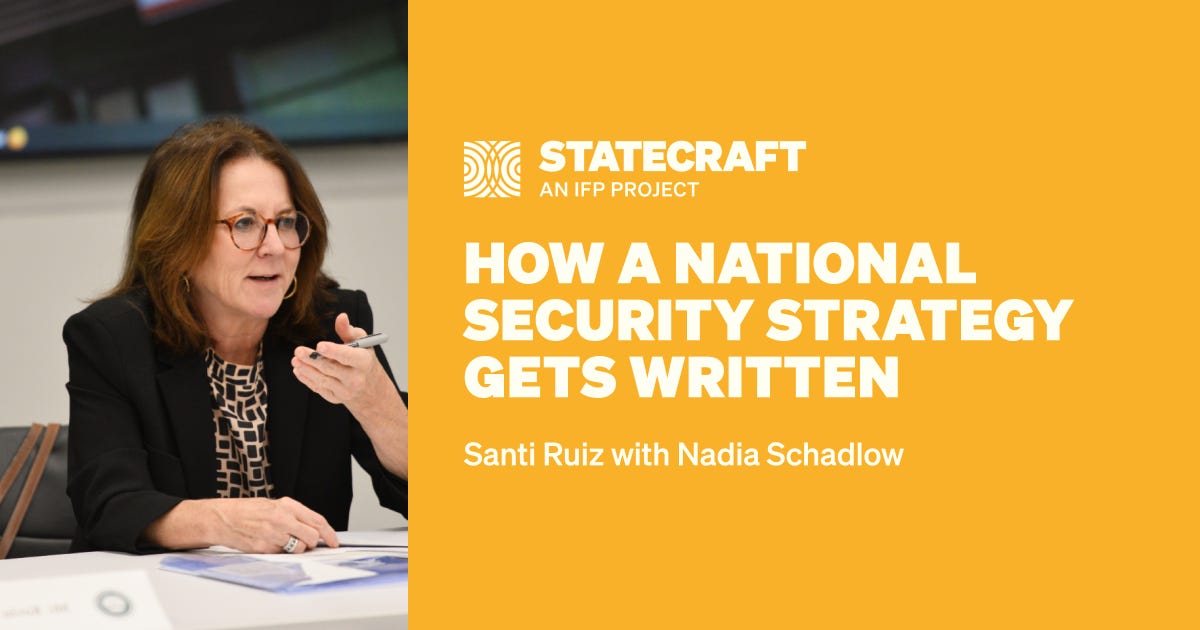
How the National Security Strategy Gets Made
In the last six months, we’ve been covering big strategic documents published by the executive branch. We’ve interviewed Dean Ball, the principal author of the Trump administration’s AI Action Plan. We’ve also spoken with Judd Devermont, who authored the Biden administration’s Strategy Toward Sub-Saharan Africa. We’re continuing the trend today, but at a higher strategic register.I’m joined by Nadia Schadlow, the former Deputy National Security Advisor for Strategy in the first Trump administration and lead architect of the 2017 National Security Strategy. Currently, Nadia is a senior fellow at the Hudson Institute where she focuses on strategy, national security, and industrial policy.We discuss:* The process of drafting the National Security Strategy* The differences between the 2017 and 2025 strategies* Why time is an underappreciated element of strategy* What to read to understand Russia betterFor the full transcript of this conversation, go to www.statecraft.pub. This is a public episode. If you would like to discuss this with other subscribers or get access to bonus episodes, visit www.statecraft.pub

Ten Thoughts on Government Data
Government data often underpins policy debates. Nevertheless, those who work with it will know how uniquely frustrating it can be. Relative to the private sector, government systems collect data in idiosyncratic ways. They prioritize continuity and legality over ease-of-use, in anticipation of a narrow set of users. As a result, these datasets can feel impenetrable.In October 2024, I was trying to understand how international students enter the US workforce: where they move for work, how many of them use programs like Optional Practical Training, and whether they stay in the US after graduating. So, I opened up a dataset from the Department of Homeland Security’s Student and Exchange Visitor Information System (SEVIS). Today this data is available on the OPT Observatory; it’s the most granular public resource available to answer these questions. But it took me over a year to produce. The process of getting there taught me as much about government data as it did anything else.For the full transcript of this conversation, go to www.statecraft.pub. This is a public episode. If you would like to discuss this with other subscribers or get access to bonus episodes, visit www.statecraft.pub

When FAFSA Broke, They Called This Guy
Jeremy Singer is the President of College Board, which he has led for over a decade. In that role, he oversees the SAT, AP, and other core elements of the U.S. college access ecosystem, and he’s previously had leadership roles at Kaplan and McGraw Hill Education.Why is Jeremy on Statecraft today? After the failed redesign of FAFSA in 2023, he spent six months at the Department of Education helping to ensure the 2024 launch was successful. The revised application form meant 1.7 million students were eligible for maximum Pell Grants in the 2025-26 application cycle.We discuss:* Why attempts to simplify FAFSA went so badly wrong* The problems caused by precise drafting in Congress* How Singer got FAFSA back on track* What politicians and GAO don’t understand about developing softwareThe full transcript for this conversation is at www.statecraft.pub. This is a public episode. If you would like to discuss this with other subscribers or get access to bonus episodes, visit www.statecraft.pub

How a Congressional Office Actually Works
Baillee Brown is Head of Government and External Affairs at Inclusive Abundance, which works to help members of Congress get more interested in abundance-policy areas, principally housing, energy, science, innovation, and good governance.She worked on Capitol Hill for 10 years, for Congressman Scott Peters from San Diego. She began as scheduler, moved to the legislative team, and was most recently his chief of staff in the DC office.For the full transcript of this conversation, go to www.statecraft.pub. This is a public episode. If you would like to discuss this with other subscribers or get access to bonus episodes, visit www.statecraft.pub

How to Rewire City Hall
James Anderson leads the Government Innovation Program at Bloomberg Philanthropies, the umbrella for the charitable giving of billionaire and former three-term New York City Mayor Michael Bloomberg.He was Mayor Bloomberg’s communications director, leading on the design of NYC Service and on public engagement for a number of Bloomberg reforms.James has paid more attention than almost anyone to how cities work, and how they learn from each other. But is the Bloomberg model for making cities better “technocratic”? What can it do, and what can’t it do? And should mayors be “innovative”? Or are the best practices, at the end of the day, pretty straightforward? We get into these questions and more.Read this conversation transcript at www.statecraft.pub. This is a public episode. If you would like to discuss this with other subscribers or get access to bonus episodes, visit www.statecraft.pub
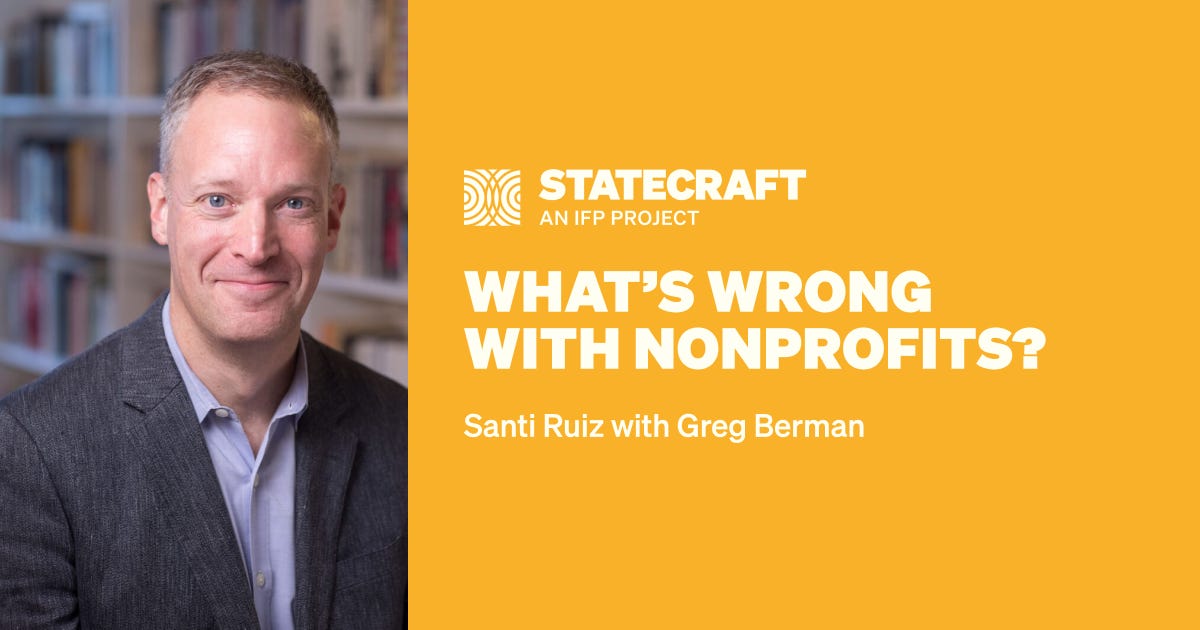
What’s Wrong with Nonprofits?
Today’s guest is Greg Berman, and we talk about nonprofits — Non-Governmental Organizations, or NGOs. Greg’s got a new book out called The Nonprofit Crisis: Leadership Through the Culture Wars, which I enjoyed. I asked him to explain his diagnosis of the nonprofit sector. What’s happened to nonprofits this century? What’s happened to how people perceive nonprofits? And are “NGOs the bad guys”? As critics from both ends of the political spectrum will argue.Greg was part of the founding team responsible for creating the Center for Justice Innovation, serving as Director from 2002 to 2020, and helping to guide it from a start-up to an org with an annual budget of more than $80 million. Alongside that, he:* Has written multiple books, mostly on reducing mass incarceration, including Trial and Error in Criminal Justice Reform and Good Courts: The Case for Problem-Solving Justice.* Has been at the center of left-liberal attempts to do criminal justice reform, especially in New York City, over the past two decades.* Was on the Board of Correction for Mayor Michael Bloomberg, and the public safety transition team for Mayor Bill de Blasio and Manhattan District Attorney Cy Vance.* Is the co-editor of a publication called Vital City, which I enjoy — it’s one part New York journalism, one part policy journal.* Is the Distinguished Fellow of Practice at the Harry Frank Guggenheim Foundation, investigating various topics related to violence.Thanks to Charles Lehman, Sean Sullivan, Oliver Traldi, Park MacDougald, Rafa Mangual, Ari Schulman, and many others for their contributions to my thinking on this piece.We discuss:* Why nonprofits matter to government service delivery* Critiques of nonprofits from the left, the right, and both sides* How the Center for Justice Innovation reduced incarceration, and why funding that work got harder* What nonprofits should do to regain public trustThe full transcript for this conversation is at www.statecraft.pub. This is a public episode. If you would like to discuss this with other subscribers or get access to bonus episodes, visit www.statecraft.pub
One Year of Trump’s Economic Statecraft
When I got this episode on the calendar a month ago, my vision was, “Let’s get three of the smartest, most thoughtful liberals I can find on the topic of economic statecraft, and we’ll do a full assessment of the first year of Trump’s second term.” The idea was to take each of the domains — tariffs and the trade war, export controls, industrial policy — and do two things: get an accurate picture of what’s actually happened, and hear how Biden admin insiders and Democratic thinkers see them. Where are there continuities between administrations? Where have their expectations been overturned? And what lessons are they incorporating into their own worldviews?Then, in a totally novel example of economic statecraft, we grabbed Maduro and seized Venezuelan oil; we had to discuss that too.As a result, we’re doing a lot in this episode, and we leave some important questions out: the legal challenges to the current tariff regime, for example. But I think readers will come away from this episode with a clear view of the old and new tools of US policy in the realm of economic statecraft.Our guestsDaleep Singh is an economist who served in two separate periods in the Biden Administration as Deputy National Security Advisor for International Economics.Peter Harrell served as Senior Director for International Economics at the White House, jointly appointed to the National Security Council and the National Economic Council.My colleague, Arnab Datta is Director of Policy Implementation at IFP. He’s also the Managing Director of Policy Implementation at Employ America.We cover a lot of ground in this episode. Here’s our table of contents:We discuss* What is economic statecraft?* Venezuela* China and tariffs* Trade deals* Industrial policy* Lessons learnedThe full transcript for this conversation is at www.statecraft.pub This is a public episode. If you would like to discuss this with other subscribers or get access to bonus episodes, visit www.statecraft.pub

What’s Wrong with NIH Grants?
Mike Lauer is the former Deputy Director for Extramural Research at the National Institutes of Health. A cardiologist and researcher, he joined the NIH’s National Heart, Lung, and Blood Institute in 2007 as the Director of the Division of Prevention and Population Science. From 2015, he oversaw the NIH’s $32 billion funding program for external research. Since leaving NIH in 2025, he has become an outspoken advocate for fundamental reform in how the federal government supports biomedical research.We discuss:* Why the NIH used to fund 60% of grant applications — and now funds just 10%* How “soft money” forces researchers to fund their own salaries* How distributing lots of small grants wastes everyone’s time* How block grants could fund more breakthrough science* Why researchers don’t get their first independent award until their mid-40sThe full transcript for this conversation is at www.statecraft.pub This is a public episode. If you would like to discuss this with other subscribers or get access to bonus episodes, visit www.statecraft.pub

99.8% of Federal Employees Get Good Performance Reviews. Why?
Today we’re joined by Scott Kupor, Director of the Office of Personnel Management. I think of it as the federal HR department — he makes a compelling case that it’s really the government’s talent management organization.Scott manages talent for an organization of 2+ million people with a $7 trillion budget. We discuss:* How DOGE cut federal headcount — and what comes next?* Why agencies rehired employees they had just laid off* How few federal employees get fired for poor performance* What OPM can do without congressional helpFor the full transcript of this conversation, go to www.statecraft.pub. This is a public episode. If you would like to discuss this with other subscribers or get access to bonus episodes, visit www.statecraft.pub
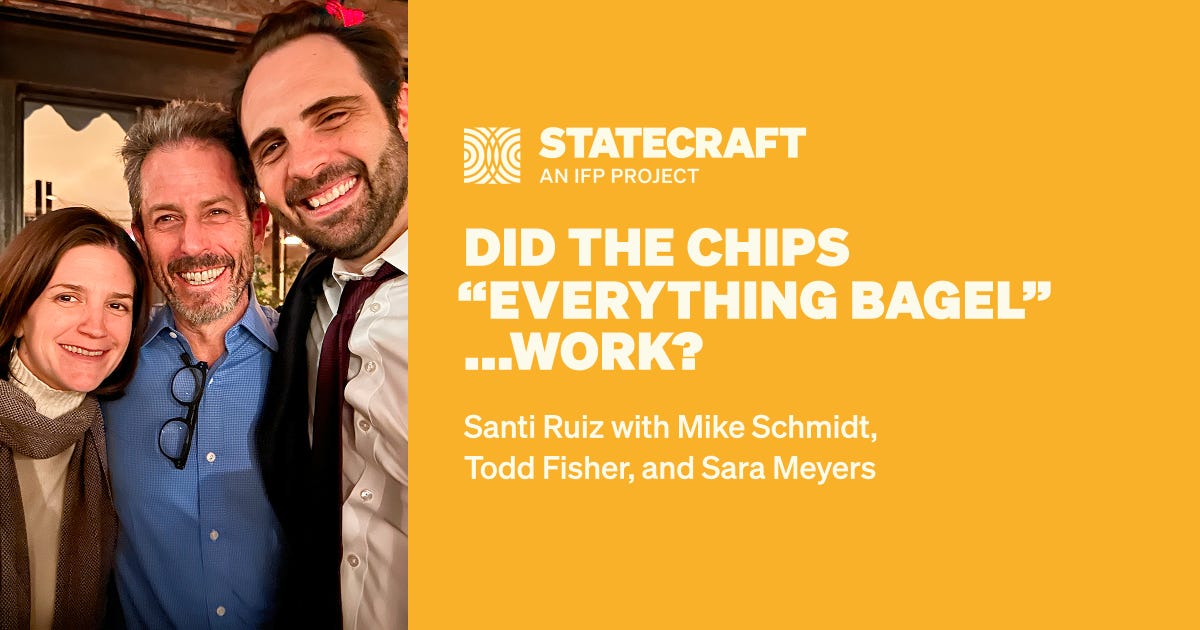
Did the CHIPS "Everything Bagel"...Work?
CHIPS, the Creating Helpful Incentives to Produce Semiconductors Act, is another. It spurred a massive investment boom in semiconductors on American soil, led by the CHIPS Program Office (CPO) at the Department of Commerce. The CPO had to decide how to allocate $39 billion in manufacturing incentives—and then negotiate the details with some of the world's biggest companies.Today, I’m lucky to have on three of the founding members of the CHIPS Program Office team:* Mike Schmidt, the inaugural Director,* Todd Fisher, the Chief Investment Officer, and* Sara Meyers, Chief of Staff and Chief Operating Officer.Mike, Todd, and Sara have a clear sense of what went right for them, what went wrong, and what they’d do differently the next time. In a new project for IFP called Factory Settings, they describe what they learned.The full transcript for this conversation is at www.statecraft.pub. This is a public episode. If you would like to discuss this with other subscribers or get access to bonus episodes, visit www.statecraft.pub

How to Save Science Funding
If you’re a scientist, and you apply for federal research funding, you’ll ask for a specific dollar amount. Let’s say you’re asking for a million-dollar grant. Your grant covers the direct costs, things like the salaries of the researchers that you’re paying. If you get that grant, your university might get an extra $500,000. That money is called “indirect costs,” but think of it as overhead: that money goes to lab space, to shared equipment, and so on.This is the system we’ve used to fund American research infrastructure for more than 60 years. But earlier this year, the Trump administration proposed capping these payments at just 15% of direct costs, way lower than current indirect cost rates. There are legal questions about whether the admin can do that. But if it does, it would force universities to fundamentally rethink how they do science.The indirect costs system is pretty opaque from the outside. Is the admin right to try and slash these indirect costs? Where does all that money go? And if we want to change how we fund research overhead, what are the alternatives? How do you design a research system to incentivize the research you actually wanna see in the world?I’m joined today by Pierre Azoulay from MIT Sloan and Dan Gross from Duke’s Fuqua School of Business. Together with Bhaven Sampat at Johns Hopkins, they conducted the first comprehensive empirical study of how indirect costs actually work. Earlier this year, I worked with them to write up that study as a more accessible policy brief for IFP. They’ve assembled data on over 350 research institutions, and they found some striking results. While negotiated rates often exceed 50-60%, universities actually receive much less, due to built-in caps and exclusions.Moreover, the institutions that would be hit hardest by proposed cuts are those whose research most often leads to new drugs and commercial breakthroughs.Thanks to Katerina Barton, Harry Fletcher-Wood, and Inder Lohla for their help with this episode, to Matt Esche and Caleb Watney for their work on the graphs, and to Beez for her help translating this topic to a general audience.For a printable PDF of this interview, click here:Let’s say I’m a researcher at a university and I apply for a federal grant. I’m looking at cancer cells in mice. It will cost me $1 million to do that research — to pay grad students, to buy mice and test tubes. I apply for a grant from the National Institutes of Health, or NIH. Where do indirect costs come in?Dan Gross: Research generally incurs two categories of costs, much as business operations do.* Direct or variable costs are typically project-specific; they include salaries and consumable supplies.* Indirect or fixed costs are not as easily assigned to any particular project. [They include] things like lab space, data and computing resources, biosecurity, keeping the lights on and the buildings cooled and heated — even complying with the regulatory requirements the federal government imposes on researchers. They are the overhead costs of doing research.Pierre Azoulay: You will use those grad students, mice, and test tubes, the direct costs. But you’re also using the lab space. You may be using a shared facility where the mice are kept and fed. Pieces of large equipment are shared by many other people to conduct experiments. So those are fixed costs from the standpoint of your research project.Dan: Indirect Cost Recovery (ICR) is how the federal government has been paying for the fixed cost of research for the past 60 years. This has been done by paying universities institution-specific fixed percentages on top of the direct cost of the research. That’s the indirect cost rate. That rate is negotiated by institutions, typically every two to four years, supported by several hundred pages of documentation around its incurred costs over the recent funding cycle.The idea is to compensate federally funded researchers for the investments, infrastructure, and overhead expenses related to the research they perform for the government. Without that funding, universities would have to pay those costs out of pocket and, frankly, many would not be interested or able to do the science the government is funding them to do.Imagine I’m doing my mouse cancer science at MIT, Pierre’s parent institution. Some time in the last four years, MIT had this negotiation with the National Institutes of Health to figure out what the MIT reimbursable rate is. But as a researcher, I don’t have to worry about what indirect costs are reimbursable. I’m all mouse research, all day.Dan: These rates are as much of a mystery to the researchers as it is to the public. When I was junior faculty, I applied for an external grant from the National Science Foundation (NSF) — you can look up awards folks have won in the award search portal. It doesn’t break down indirect and direct cost shares of each grant. You see the total and say, “Wow, this person got $300,000.” Then you go to write your own grant and
Should the Feds Bail Out Chicago?
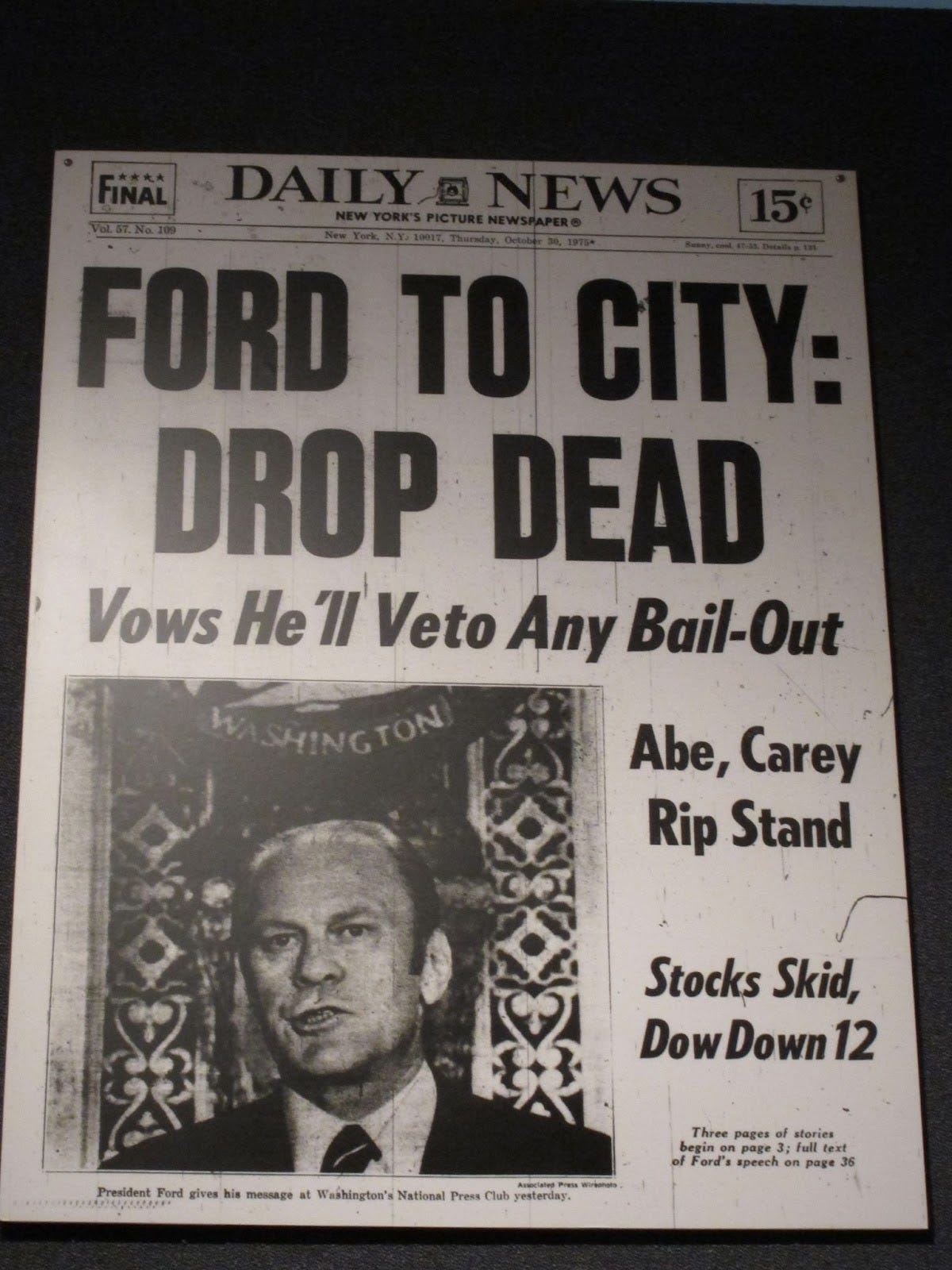
The full transcript for this conversation and many others can be found at www.statecraft.pub.Today we’re joined by David Schleicher. David is Professor of Property and Urban Law at Yale Law School, and an expert in local government law, land use, finance, and urban development.I found David’s book, In a Bad State: Responding to State and Local Budget Crises, a fascinating and readable primer on municipal debt: what it is, how it grows, and how cities can face up to it.Municipal pension funding may not sound like the most fascinating topic. I hope this conversation illustrates two things. First, how our pension systems work matters to all of us — whether or not we are enrolled in a municipal pension. Second, these questions go to the heart of how our cities are run, why they fail, and how they can be improved.We discuss:* Why are so many municipal pension funds in debt?* Why New York City went bankrupt and Chicago didn’t* Moral hazard in municipal credit* The practice of "universal log rolls"* How the federal government should respond to local bankruptcies This is a public episode. If you would like to discuss this with other subscribers or get access to bonus episodes, visit www.statecraft.pub

How Diplomacy Works in Africa
Today we’re joined by Judd Devermont, one of the most experienced Africa policy hands in Washington. He spent 16 years as an intelligence analyst, serving in both the Obama and Biden administrations. Most recently, he was Senior Director for African Affairs at the National Security Council. He authored the Biden administration’s Strategy Toward Sub-Saharan Africa. Since leaving government in early 2024, he writes a newsletter called Post Strategy, reflecting on what works and what doesn’t in US policy toward Africa.We discuss* What “care and feeding” means in diplomacy* What went wrong with the relationships with Niger* The problem with envoys* Whether the NSC has been neutered under Trump* Why most intelligence analysis doesn’t cut it anymoreThe full transcript for this conversation is at www.statecraft.pub. This is a public episode. If you would like to discuss this with other subscribers or get access to bonus episodes, visit www.statecraft.pub

How to Run New York City
You can find the full transcript of this conversation at www.statecraft.pub.The likely next mayor of New York City is Zohran Mamdani, if polling is anywhere close to being correct. Much of the conversation has revolved around the day-to-day administration of City Hall. If Mamdani wins, does he have what it takes to run the city’s government?Today’s guest is still active in NYC political life, and it was clear I would not get an answer to that particular question. Instead, I took this opportunity to investigate how City Hall actually runs, and how the past three mayors have structured their administrations. But if you read between the lines, you can treat this conversation as a guide about what has worked in New York’s governance over the last 20 years, and the likely stumbling blocks for an ambitious new administration.Maria Torres-Springer moved to New York City a week before 9/11, and spent most of the following 20 years in city government — first as a top appointee in the Bloomberg administration, then in several high-powered roles under Bill de Blasio, and eventually as second-in-command for Eric Adams. Her most recent role was as first deputy mayor: functionally the Chief Operating Officer of New York City. Torres-Springer resigned in February 2025 (she was not implicated in the overlapping Eric Adams corruption scandals).To put it lightly, Torres-Springer has fans. In November 2024, City & State New York wrote a cover story titled, “The Vibe at City Hall is Thank God for Maria Torres-Springer.” It quotes political figures from the far left, center left, and right, calling Torres-Springer “a phenomenal leader,” “a very classy, charismatic, knowledgeable individual,” and, “a serial overachiever in a good way.” When Adams appointed her as first deputy mayor, he said, “She has the ability of landing the plane.”Torres-Springer is widely described as one of the most effective political operators in New York City, and she’s been linked in media stories as a potential official in the next mayoral administration (although she recently took a role as President of the Revson Foundation, a NYC-based philanthropic organization). She’s maybe the best possible guest to talk about steering City Hall.Given constraints on what Torres-Springer could discuss, I wanted to get into two big topics. One is process. What does it take to run City Hall? How have different mayors done it differently? The other is outcomes. Torres-Springer was one of the champions of City of Yes, the Adams-backed initiative to build 500,000 new housing units in the city over the next 10 years. I wanted to better understand City of Yes, what she’s most excited about, what didn’t make the cut, and how it all came together politically.We discuss:* What it takes to succeed working for three very different mayors* How Bloomberg, de Blasio, and Adams governed differently* How to work effectively under constant pressure* The political coalitions that made City of Yes possible* Why it takes over a year to turn over a NYCHA apartment* How to fix the plumbing of government* What the next mayor should prioritize to keep New York thrivingThanks to Harry Fletcher-Wood, Eamonn Ives, and Katerina Barton for their judicious audio and transcript edits for length and clarity. This is a public episode. If you would like to discuss this with other subscribers or get access to bonus episodes, visit www.statecraft.pub

A Statecraft Fall Roundup
This episode was originally recorded on October 18th at the Progress Conference in Berkeley. Because of the federal shutdown, Director Kratsios called in virtually.Michael Kratsios is Director of the White House Office of Science and Technology Policy, and the president’s top science and technology advisor. In the first Trump administration, Kratsios was US Chief Technology Officer, and later acting Under Secretary of Defense for Research and Engineering, where he championed emerging tech like AI, quantum, and autonomous systems in defense.Given constraints in the topics Kratsios could speak on, my questions focused on understanding the administration’s AI and science policy. We talked about the recent AI Action Plan: what AI can do for America and the world, and how the administration plans to ensure US leadership. We discuss the administration’s vision for gold standard science, and whether the structures we use to fund science need to change. We also touched on how the second Trump administration differs from the first, and Kratsios’s take on AI safety.Thanks to Harry Fletcher-Wood and Katerina Barton for their light edits for length and clarity in the transcript and audio, respectively, and for a tight turnaround. The White House has not yet cleared the full video for publication, but we’ll share it here if it is cleared.The full transcript for this conversation and many others is available at www.statecraft.pub. This is a public episode. If you would like to discuss this with other subscribers or get access to bonus episodes, visit www.statecraft.pub
Is the Senate Fixing Housing Policy?
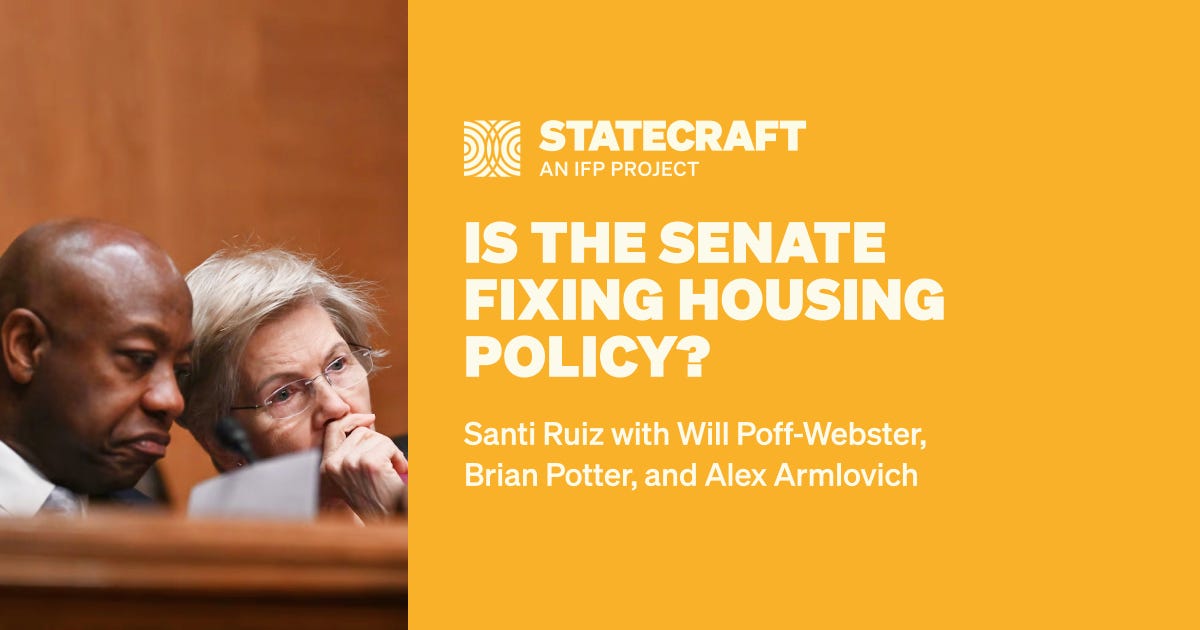
Today we’re talking about housing. The ROAD to Housing Act passed the Senate Banking, Housing, and Urban Affairs Committee 24-0 in late July. Last week — despite the shutdown — it cleared the Senate. It’s a package of 27 pieces of legislation to boost housing supply, improve affordability, reduce regulatory roadblocks, and reduce homelessness.When you zoom out a bit, what’s happened here is pretty surprising. The chair of the committee, Republican Tim Scott, and the Ranking Member, Elizabeth Warren, a Democrat, co-sponsored the bill. The bill is the committee’s first bipartisan housing markup in over a decade. Passing through committee unanimously doesn’t happen often for serious bills of this sort. I wanted to understand how this bill happened, and came to have a serious shot at passing. And I also wanted to get a better sense of what’s actually in the bill, and why it matters for housing. If you’re like me, most of the debates you hear about housing policy focus on zoning, which is a local issue — very little federal say. So what are all these pieces of legislation? Do they matter?Joining me is an unorthodox trio:* Will Poff-Webster was legislative counsel for Senator Brian Schatz, a Democrat from Hawaii. He’s our inside guy today: he worked on the bill within the Senate. And today, he covers housing policy here at IFP.* Alex Armlovich is Senior Housing Policy Analyst at the Niskanen Center. He has been working on housing issues for a long time, and his fingerprints are on parts of this bill package. He’s my advocate from the outside.* Brian Potter is Senior Infrastructure Fellow at IFP and author of Construction Physics, which I very much enjoy editing. If I can make one newsletter recommendation to you besides Statecraft, it’s Construction Physics. He has a background in private-sector home building. And has written about several of the proposals in this package.Table of contents:* What’s the federal role in housing policy?* What’s in the bill?* Regulatory reform* Technical assistance plus incentives* Funding and financing reform* A brief sidebar on manufactured home chassis* Will the bill matter?* How did the bill happen, politically speaking?* The policy wonk success storyThank you to Harry Fletcher-Wood and Katerina Barton for their judicious transcript and audio edits.For the full transcript of this conversation, go to www.statecraft.pub. This is a public episode. If you would like to discuss this with other subscribers or get access to bonus episodes, visit www.statecraft.pub

Why We Don't Build Apartments for Families
Today, we’re joined by Bobby Fijan. He’s a co-founder of the American Housing Corporation, a startup building housing for families in cities. A burning question motivates his work: How do you make cities places where families can live and thrive? He has a new report out with the Institute of Family Studies looking at what families really want from their apartments.This is a pretty self-indulgent episode for me. I live in Brooklyn with my wife and two-year-old, and we’re expecting our second kid. We want to stay in the city — it’s where our life and community are, and where we’ve put down roots. But the classic route for people like us is to move out to the suburbs once the family grows. I hoped talking to Bobby would help me avoid that fate.Bobby argues that the best ideas for family-friendly housing aren’t new. Pre-war apartments in American cities look a lot like what he’s advocating for. We’ve done this before, and we could do it again.We discuss:* How the financial crisis fuelled a boom in studio apartments* Why did apartments get so much smaller after 2008?* Why are most two-bedroom apartments designed for roommates?* What do families actually want in a floor plan, and why don’t developers build it?* Whether upzoning can helpThanks to Harry Fletcher-Wood and Katerina Barton for their judicious transcript and audio edits.The full transcript to this conversation and many others is available at www.statecraft.pub. This is a public episode. If you would like to discuss this with other subscribers or get access to bonus episodes, visit www.statecraft.pub
How to Bring Down Healthcare Costs
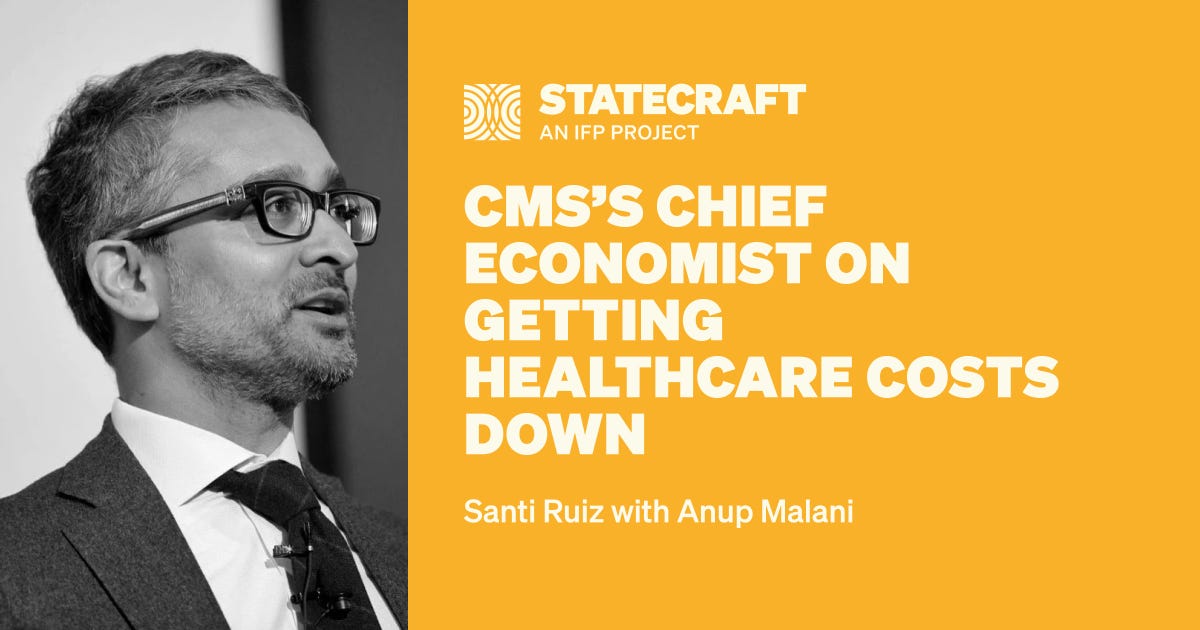
Today, I’m joined by Anup Malani. He’s a professor of law at the University of Chicago, currently on leave, serving as the first Chief Economist at the Centers for Medicare & Medicaid Services. This means he oversees economic analysis for the agency managing $2 trillion in annual healthcare spending — 23% of the entire federal budget. CMS runs Medicare for 70 million elderly Americans, Medicaid for low-income families, and the health insurance exchanges where millions buy coverage.Malani answers a lot of questions I have about American healthcare policy:* The US spends 20% of GDP on healthcare. Why is our life expectancy so bad?* How do you crack down on Medicare fraud without hurting patients who need care?* What incentives do private insurers like UnitedHealth have to make patients look sicker than they are?* What do academic economists get wrong about policy?The full transcript for this conversation is at www.statecraft.pub. This is a public episode. If you would like to discuss this with other subscribers or get access to bonus episodes, visit www.statecraft.pub

What Is America’s Infrastructure Cost Problem?
This episode was originally recorded on September 4th at the Abundance Conference in DC."Zach Liscow, my guest today, is a professor of law at Yale Law School. In 2022-2023, he was the Chief Economist at the Office of Management and Budget. He's also now my colleague at IFP, as a non-resident senior fellow.I have a bit of a problem today, which is that while Zach may not be a national household name, he might as well be in this audience. As most of you are aware, Zach has worked on many interesting economic topics, but especially on infrastructure costs: why it costs so much to build in the US, what the inputs are, and cross-cutting comparisons.The challenge for me today as an interviewer is that, in part because of Zach’s work, everyone here now knows that infrastructure in the US costs a huge amount to build. I recently reviewed some submissions for a project on transit at IFP, and every other submission referenced the fact that the cost per mile to build a subway in New York is something like eight times more than the equivalent project in Paris.These stylized facts are now embedded in our discourse. And my problem is that this makes it a little hard to figure out how to have a conversation that isn't just all of us nodding in agreement. I'm going to try to tackle that problem, but I just want to lay my cards on the table. This is my fear, and we’ll try to avoid it."The full transcript for this conversation and many others is at www.statecraft.pub. This is a public episode. If you would like to discuss this with other subscribers or get access to bonus episodes, visit www.statecraft.pub
How to Write the AI Action Plan
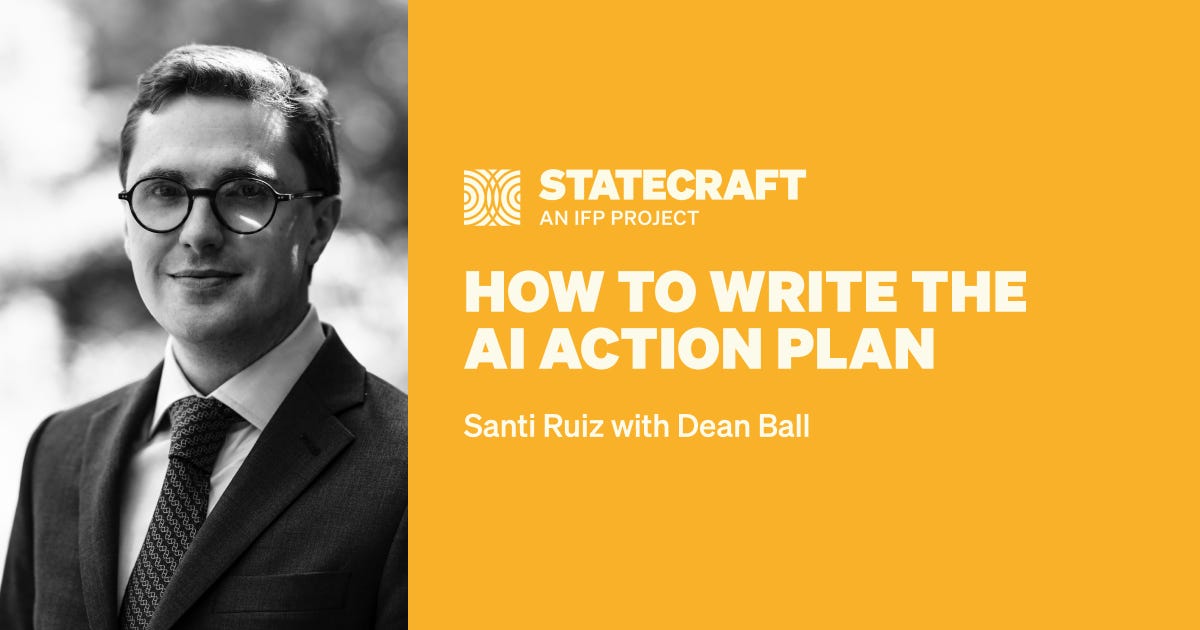
The full transcript for this conversation is at www.statecraft.pub. When I started this podcast a couple years ago, the idea was more constrained than it is today. We wanted to do exit interviews with civil servants, who were newly free to speak about their experiences and their learnings. The project has expanded: we talk to political scientists, economists, DC wonks, elected officials and people currently in government. But the core value of this project is in that original idea of getting a hold of people as they're leaving the government, pinning them to the wall, and making them reveal their secrets.Today's guest is in that mold. His name is Dean Ball. If you follow AI policy, you already know who he is. Until a couple of weeks ago, Dean was a senior policy advisor for artificial intelligence and emerging technology at the White House Office of Science and Technology Policy (OSTP).Dean and I go back a little while. Most notably, we’ve serve together on one of the most dominant trivia teams DC has seen. But that's not why Dean's important. Dean's had a whirlwind tour over the past few months in the federal government. During that time, he was the organizing author of the Administration's AI Action Plan, a comprehensive roadmap from the White House on federal AI policy.Today, we caught up to talk about that Action Plan, what it takes to write a strategy document for the federal government, and the challenges of implementing that strategy in the face of political, personal, and bureaucratic opposition.I've said in the past that Dean thinks more clearly about the near-term future than most people. I still think that's true, though I don't agree with him on everything here. He's an incredibly sharp thinker and I benefit from talking to him.We discuss:* How to gain influence in the White House* Navigating the interagency process efficiently* Whether the deep state is real* The AI Action Plan* How to implement change across the federal government* The complexities of export controls on AI Chips* Why Dean left the White House after six monthsThanks to Harry Fletcher-Wood for his transcript edits, and to Katerina Barton for her audio edits. This is a public episode. If you would like to discuss this with other subscribers or get access to bonus episodes, visit www.statecraft.pub
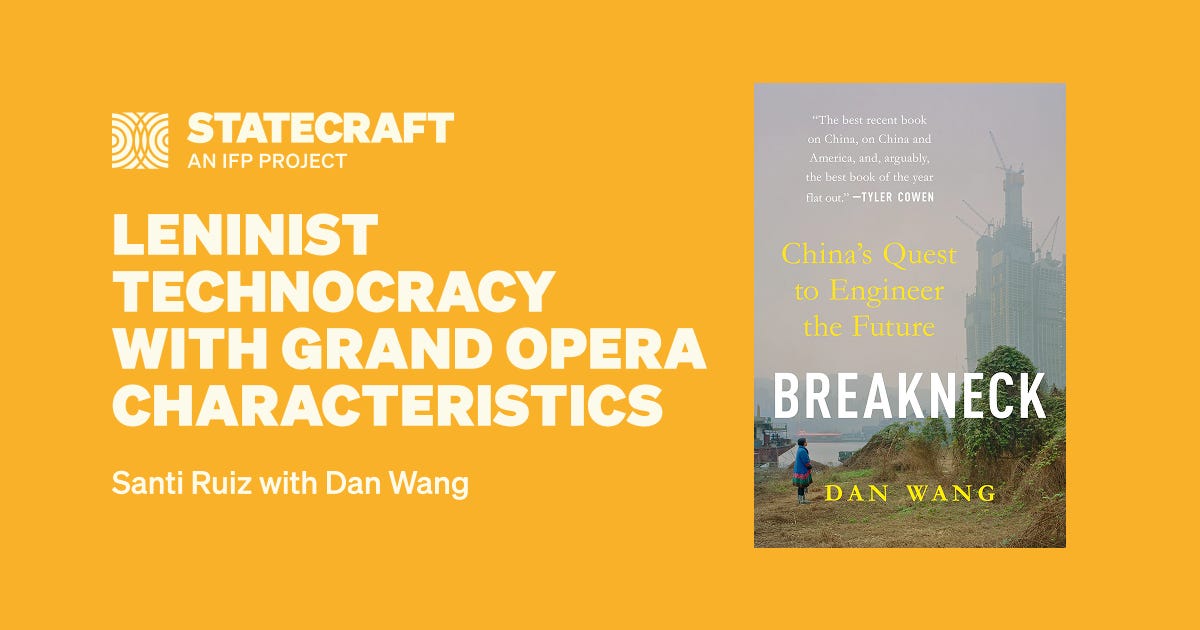
Leninist Technocracy with Grand Opera Characteristics
Today I'm talking to Dan Wang. He has a great new book, Breakneck: China's Quest to Engineer the Future. Dan spent the better part of the last decade in China and published a yearly letter summarizing his thoughts, explorations, and eating.Breakneck is like those letters: it goes all over the place, as does our conversation. Topics include:* America's overabundance of lawyers* Whether our ruling class should be all economists* Stylish propaganda* The book collections of Yale professors* iPhone manufacturing* Forced sterilization* Planting cassavaOne of the things I like most about Dan's work is that he's comfortable looking at China through multiple, very different lenses. Parts of Breakneck explicitly use China as a lens to think about the US and its political culture and institutions. Other parts of the book try very hard to take China on its own terms, without reading our own culture into it. It’s that mix that made the book so enjoyable for me, and I hope you enjoy it too.Thank you to Harry Fletcher-Wood for his judicious transcript edits, and to Katerina Barton for her audio edits. You can find the full, annotated transcript to this conversation at www.statecraft.pub. This is a public episode. If you would like to discuss this with other subscribers or get access to bonus episodes, visit www.statecraft.pub
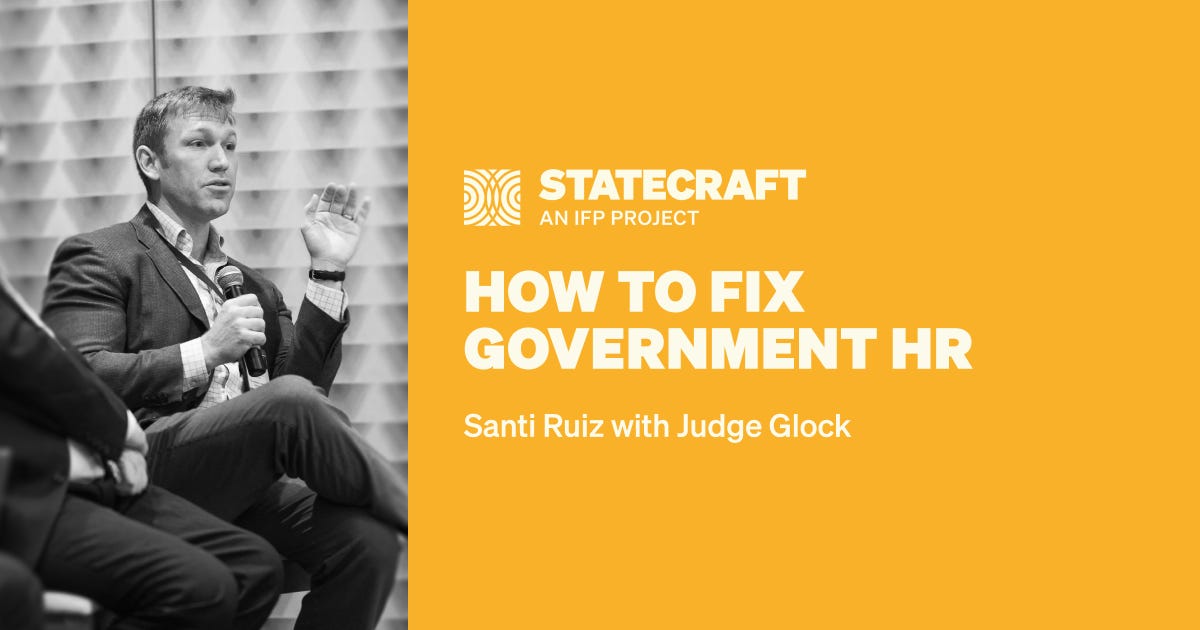
Four Ways to Fix Government HR
Today I'm talking to economic historian Judge Glock, Director of Research at the Manhattan Institute. Judge works on a lot of topics: if you enjoy this episode, I'd encourage you to read some of his work on housing markets and the Environmental Protection Agency. But I cornered him today to talk about civil service reform.Since the 1990s, over 20 red and blue states have made radical changes to how they hire and fire government employees — changes that would be completely outside the Overton window at the federal level. A paper by Judge and Renu Mukherjee lists four reforms made by states like Texas, Florida, and Georgia: * At-will employment for state workers* The elimination of collective bargaining agreements* Giving managers much more discretion to hire* Giving managers much more discretion in how they pay employeesJudge finds decent evidence that the reforms have improved the effectiveness of state governments, and little evidence of the politicization that federal reformers fear. Meanwhile, in Washington, managers can’t see applicants’ resumes, keyword searches determine who gets hired, and firing a bad performer can take years. But almost none of these ideas are on the table in Washington.Thanks to Harry Fletcher-Wood for his judicious transcript edits and fact-checking, and to Katerina Barton for audio edits.For a printable transcript of this interview, click here:Judge, you have a paper out about lessons for civil service reform from the states. Since the ‘90s, red and blue states have made big changes to how they hire and fire people. Walk through those changes for me.I was born and grew up in Washington DC, heard a lot about civil service throughout my childhood, and began to research it as an adult. But I knew almost nothing about the state civil service systems. When I began working in the states — mainly across the Sunbelt, including in Texas, Kansas, Arizona — I was surprised to learn that their civil service systems were reformed to an absolutely radical extent relative to anything proposed at the federal level, let alone implemented.Starting in the 1990s, several states went to complete at-will employment. That means there were no official civil service protections for any state employees. Some managers were authorized to hire people off the street, just like you could in the private sector. A manager meets someone in a coffee shop, they say, "I'm looking for exactly your role. Why don't you come on board?" At the federal level, with its stultified hiring process, it seemed absurd to even suggest something like that.You had states that got rid of any collective bargaining agreements with their public employee unions. You also had states that did a lot more broadbanding [creating wider pay bands] for employee pay: a lot more discretion for managers to reward or penalize their employees depending on their performance.These major reforms in these states were, from the perspective of DC, incredibly radical. Literally nobody at the federal level proposes anything approximating what has been in place for decades in the states. That should be more commonly known, and should infiltrate the debate on civil service reform in DC.Even though the evidence is not absolutely airtight, on the whole these reforms have been positive. A lot of the evidence is surveys asking managers and operators in these states how they think it works. They've generally been positive. We know these states operate pretty well: Places like Texas, Florida, and Arizona rank well on state capacity metrics in terms of cost of government, time for permitting, and other issues.Finally, to me the most surprising thing is the dog that didn't bark. The argument in the federal government against civil service reform is, “If you do this, we will open up the gates of hell and return to the 19th-century patronage system, where spoilsmen come and go depending on elected officials, and the government is overrun with political appointees who don't care about the civil service.” That has simply not happened. We have very few reports of any concrete examples of politicization at the state level. In surveys, state employees and managers can almost never remember any example of political preferences influencing hiring or firing.One of the surveys you cited asked, “Can you think of a time someone said that they thought that the political preferences were a factor in civil service hiring?” and it was something like 5%.It was in that 5-10% range. I don't think you'd find a dissimilar number of people who would say that even in an official civil service system. Politics is not completely excluded even from a formal civil service system.A few weeks ago, you and I talked to our mutual friend, Don Moynihan, who's a scholar of public administration. He's more skeptical about the evidence that civil service reform would be positive at the federal level.One of your points is, “We don't have strong negative evidence from the states. Productivity didn’t crat
How to Be a Good Intelligence Analyst
Today we're joined by Dr. Rob Johnston. He's an anthropologist, an intelligence community veteran, and author of the cult classic Analytic Culture in the US Intelligence Community, a book so influential that it's required reading at DARPA. But first and foremost, Johnston is an ethnographer. His focus in that book is on how analysts actually produce intelligence analysis.Johnston answers a lot of questions I've had for a while about intelligence and spying, such as:* Why do we seem to get big predictions wrong so consistently?* Why can't the CIA find analysts who speak the language of the country they're analyzing?* Why do we prioritize expensive satellites over human intelligence?We also discuss a meta-question I always come back to on Statecraft: is being good at this stuff an art or a science? By “this stuff,” I’m referring to intelligence analysis, but I think that the question generalizes across policymaking. Would more formalizing and systematizing make our spies, diplomats, and EPA bureaucrats better? Or would it lead to more bureaucracy, more paper, and worse outcomes? How do you build processes in the government that actually make you better at your job?You can find the full transcript for this conversation at www.statecraft.pub. This is a public episode. If you would like to discuss this with other subscribers or get access to bonus episodes, visit www.statecraft.pub

How to Fix Foreign Aid
We’ve covered the US Agency for International Development, or USAID, pretty consistently on Statecraft, since our first interview on PEPFAR, the flagship anti-AIDS program, in 2023. When DOGE came to USAID, I was extremely critical of the cuts to lifesaving aid, and the abrupt, pointlessly harmful ways in which they were enacted. In March, I wrote, “The DOGE team has axed the most effective and efficient programs at USAID, and forced out the chief economist, who was brought in to oversee a more aggressive push toward efficiency.”Today, we’re talking to that forced-out chief economist, Dean Karlan. Dean spent two and a half years at the helm of the first-ever Office of the Chief Economist at USAID. In that role, he tried to help USAID get better value from its foreign aid spending. His office shifted $1.7 billion of spending towards programs with stronger evidence of effectiveness. He explains how he achieved this, building a start-up within a massive bureaucracy. I should note that Dean is one of the titans of development economics, leading some of the most important initiatives in the field (I won’t list them, but see here for details), and I think there’s a plausible case he deserves a Nobel.Throughout this conversation, Dean makes a point much better than I could: the status quo at USAID needed a lot of improvement. The same political mechanisms that get foreign aid funded by Congress also created major vulnerabilities for foreign aid, vulnerabilities that DOGE seized on. Dean believes foreign aid is hugely valuable, a good thing for us to spend our time, money, and resources on. But there's a lot USAID could do differently to make its marginal dollar spent more efficient.DOGE could have made USAID much more accountable and efficient by listening to people like Dean, and reformers of foreign aid should think carefully about Dean’s criticisms of USAID, and his points for how to make foreign aid not just resilient but politically popular in the long term.We discuss* What does the Chief Economist do?* Why does 170% percent of USAID funds come already earmarked by Congress?* Why is evaluating program effectiveness institutionally difficult?* Why don’t we just do cash transfers for everything?* Why institutions like USAID have trouble prioritizing* Should USAID get rid of gender/environment/fairness in procurement rules?* Did it rely too much on a small group of contractors?* What’s changed in development economics over the last 20 years?* Should USAID spend more on governance and less on other forms of aid? * How DOGE killed USAID — and how to bring it back better* Is depoliticizing foreign aid even possible?* Did USAID build “soft power” for the United States?This is a long conversation: you can jump to a specific section with the index above. If you just want to hear about Dean’s experience with DOGE, you can click here or go to the 45-minute mark in the audio. And if you want my abbreviated summary of the conversation, see these two Twitter threads. But I think the full conversation is enlightening, especially if you want to understand the American foreign aid system. Thanks to Harry Fletcher-Wood for his judicious edits.Our past coverage of USAIDFor a printable transcript of this interview, click here:Dean, I'm curious about the limits of your authority. What can the Chief Economist of USAID do? What can they make people do?There had never been an Office of the Chief Economist before. In a sense, I was running a startup, within a 13,000-employee agency that had fairly baked-in, decentralized processes for doing things.Congress would say, "This is how much to spend on this sector and these countries." What you actually fund was decided by missions in the individual countries. It was exciting to have that purview across the world and across many areas, not just economic development, but also education, social protection, agriculture. But the reality is, we were running a consulting unit within USAID, trying to advise others on how to use evidence more effectively in order to maximize impact for every dollar spent.We were able to make some institutional changes, focused on basically a two-pronged strategy. One, what are the institutional enablers — the rules and the processes for how things get done — that are changeable? And two, let's get our hands dirty working with the budget holders who say, "I would love to use the evidence that's out there, please help guide us to be more effective with what we're doing."There were a lot of willing and eager people within USAID. We did not lack support to make that happen. We never would've achieved anything, had there not been an eager workforce who heard our mission and knocked on our door to say, "Please come help us do that."What do you mean when you say USAID has decentralized processes for doing things?Earmarks and directives come down from Congress. [Some are] about sector: $1 billion dollars to spend on primary school education to improve children's learning

How Cheaply Could We Build High-Speed Rail?
At the end of April, the Transit Costs Project released a report: it’s called How to Build High-Speed Rail on the Northeast Corridor. As the name suggests, the authors of the report had a simple goal: the stretch of the US from DC and Baltimore through Philadelphia to New York and up to Boston, the densest stretch of the country. It’s an ideal location for high-speed rail. How could you actually build it — trains that get you from DC to NYC in two hours, or NYC to Boston in two hours — without breaking the bank?That last part is pretty important. The authors think you could do it for under $20 billion dollars. That’s a lot of money, but it’s about five times less than the budget Amtrak says it would require. What’s the difference? How is it that when Amtrak gets asked to price out high-speed rail, it gives a quote that much higher?We brought in Alon Levy, transit guru and the lead author of the report, to answer the question, and to explain a bunch of transit facts to a layman like me. Is this project actually technically feasible? And, if it is, could it actually work politically?* How to cut time off the Northeast Corridor* Operations coordination as a time-saver* The move away from the Mad Men commuter* Was our episode on the Green Line extension wrong?The full transcript for this conversation is at www.statecraft.pub. This is a public episode. If you would like to discuss this with other subscribers or get access to bonus episodes, visit www.statecraft.pub
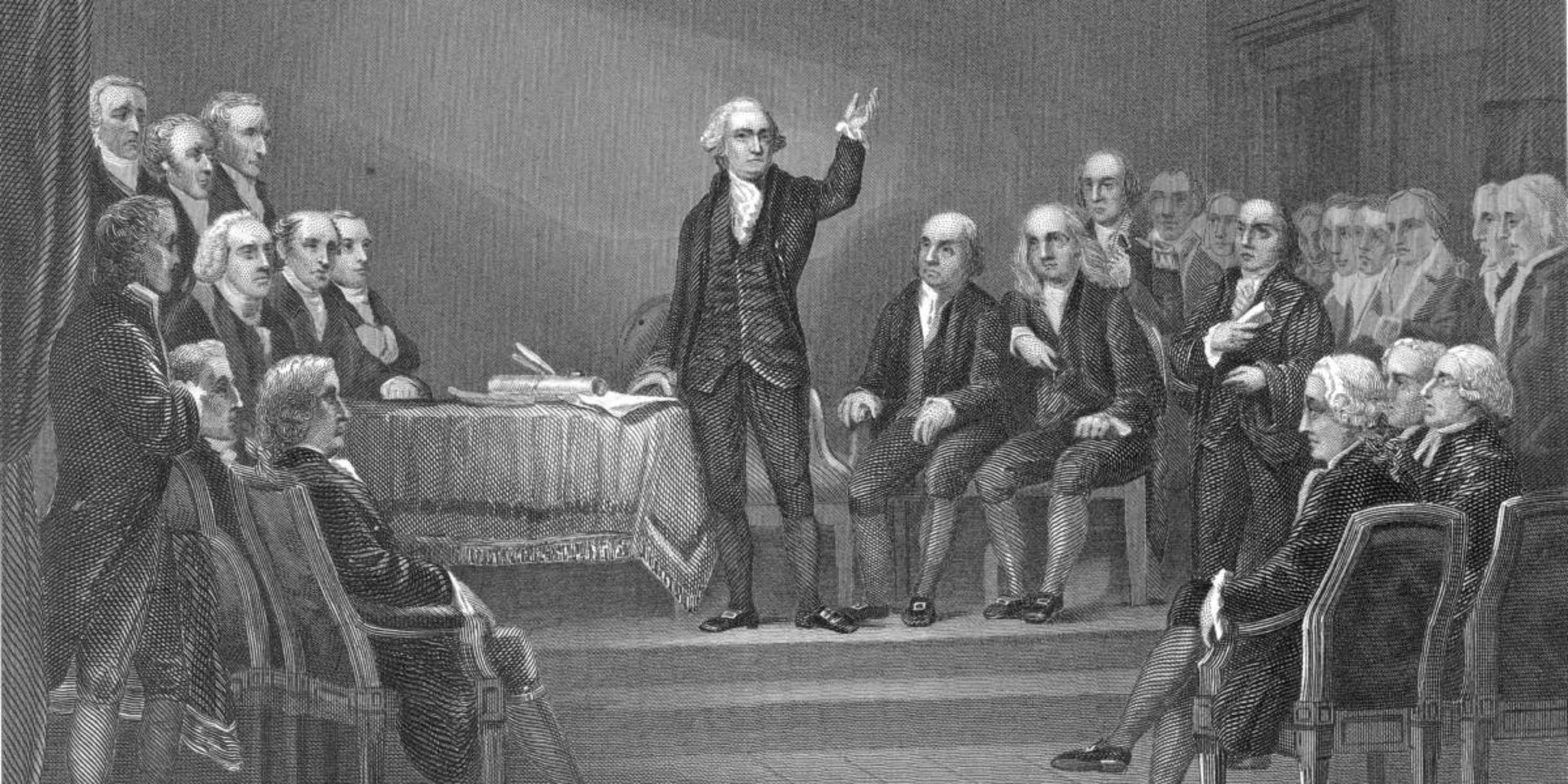
Governance Lessons from the Constitutional Convention
Happy Fourth of July! I’m attending a wedding today, so this episode is from the vault, in a way, although it’s its first time on Statecraft. I originally published this essay in January of 2022 on Mirror, shortly after my wife had joined the core team of a DAO that was attempting to acquire a first-edition copy of the US Constitution. I had been reading a history of the constitutional convention, and it seemed fitting to write about it on a thematic site. Yes, July 4th is about the Declaration of Independence, not the Constitution. Cut me some slack, please!You can find the transcript for this episode and many others at www.statecraft.pub. This is a public episode. If you would like to discuss this with other subscribers or get access to bonus episodes, visit www.statecraft.pub
How to Predict the Future
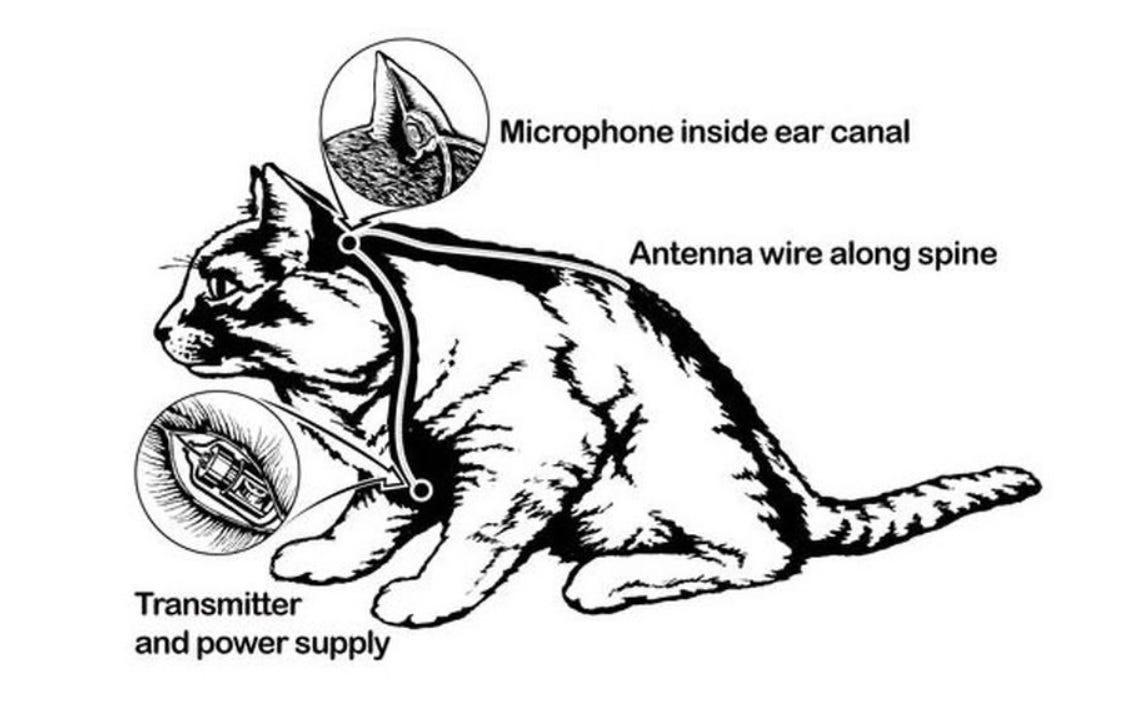
The decisions that humans make can be extraordinarily costly. The wars in Iraq and Afghanistan were multi-trillion-dollar decisions. If you can improve the accuracy of forecasting individual strategies by just a percentage point, that would be worth tens of billions of dollars. Yet society does not invest tens of billions of dollars in figuring out how to improve the accuracy of human judgment. That seems really odd.That’s a quote from today’s interviewee, who has made his career helping the intelligence community predict the future better. In this interview, we discuss:* Which prediction methods perform the best?* How does IARPA create tech for American spies?* What technologies give democracies an advantage over autocracies?* Could the Internet have been designed better?Our interviewee, Jason Matheny, championed research into human judgment and forecasting at the R&D lab for the intelligence community: the Intelligence Advanced Research Projects Activity, or IARPA, which he directed from 2015-2018.[This interview was originally published in 2023, at this link, without the audio: Statecraft was still transcript-only then.]You can find the transcript for this conversation at www.statecraft.pub. This is a public episode. If you would like to discuss this with other subscribers or get access to bonus episodes, visit www.statecraft.pub

How UK Biobank Was Built
There are many forces in policymaking (and in our lives generally) that push us towards the short term. Many of the most important measurements in political life are on extremely tight timelines: election cycles, monthly unemployment reports, even the President's daily intelligence briefing. The pressure to get results — and to show results — on a tight turnaround is incredible.One of my questions on Statecraft for a while has been: How do you build a machine to get long-term results? Whether it's a new agency or a new initiative, how do you set up a structure to work toward a goal that's 10, or 20, or 50 years away? And how do you protect that structure from short-term political pressures?Today's interviewee is Sir Rory Collins. Sir Rory has spent a full 20 years building and leading one of the most important scientific resources in the world: the UK Biobank.The Biobank represents a fascinating case study in long-term thinking. It's a database of half a million British participants whose health is being tracked longitudinally for the next 30 years. The Biobank was established with the knowledge that the upfront work, and the spending required, would only really start to pay off 15 years later. When Sir Rory went in for the 10-year review with funders, they asked what had been achieved so far. He said, “Nothing.”But today, UK Biobank is paying massive dividends: It's democratized access to population-scale data for researchers worldwide, and it's already yielding amazing insights into the causes of and cures for disease. I wanted to understand how he built the UK Biobank, and, just as importantly, how he managed to sustain it over a long period of time.We discussed* How to create long-term value in research* How to recruit half a million research subjects* Why the Biobank deferred so many decisions* How other countries’ prospective studies are learning from the UK BiobankThe transcript for this conversation and many others is at www.statecraft.pub. This is a public episode. If you would like to discuss this with other subscribers or get access to bonus episodes, visit www.statecraft.pub

What Can We Learn from Estonia?
What can we learn from Estonia? It’s not a question you hear often — the nation of under two million residents doesn’t mean much to many. But for good governance advocates, it’s long been a touchpoint for its “e-government” model. The New Yorker wrote in 2017 that, “apart from transfers of physical property, such as buying a house, all bureaucratic processes can be done online.” Wired called Estonia “the world's most digitally advanced society.” On its “e-Estonia” site, the country itself brags, in a mod font, “We have built a digital society and we can show you how.”The Estonian model has a lot going for it from the perspective of a citizen. For example: Taxes take a few minutes to file, you can see every time the government looks at your data, and you never have to give the government a piece of information more than once. And it makes governance easier: the bureaucracy is leaner, information is shared across agencies, and data is more secure.But how much of this model could be adopted here in the US, or in the rest of the West? And how much is reliant on a cultural and societal context we just don’t have here? To get answers, I talked to Joel Burke, author of the new book Rebooting a Nation: The Incredible Rise of Estonia, E-Government and the Startup Revolution. Joel is an American who worked with the Estonian government, and I learned a lot from his book.For the full transcript of this conversation and others, visit www.statecraft.pub. This is a public episode. If you would like to discuss this with other subscribers or get access to bonus episodes, visit www.statecraft.pub
How to Save DC's Metro
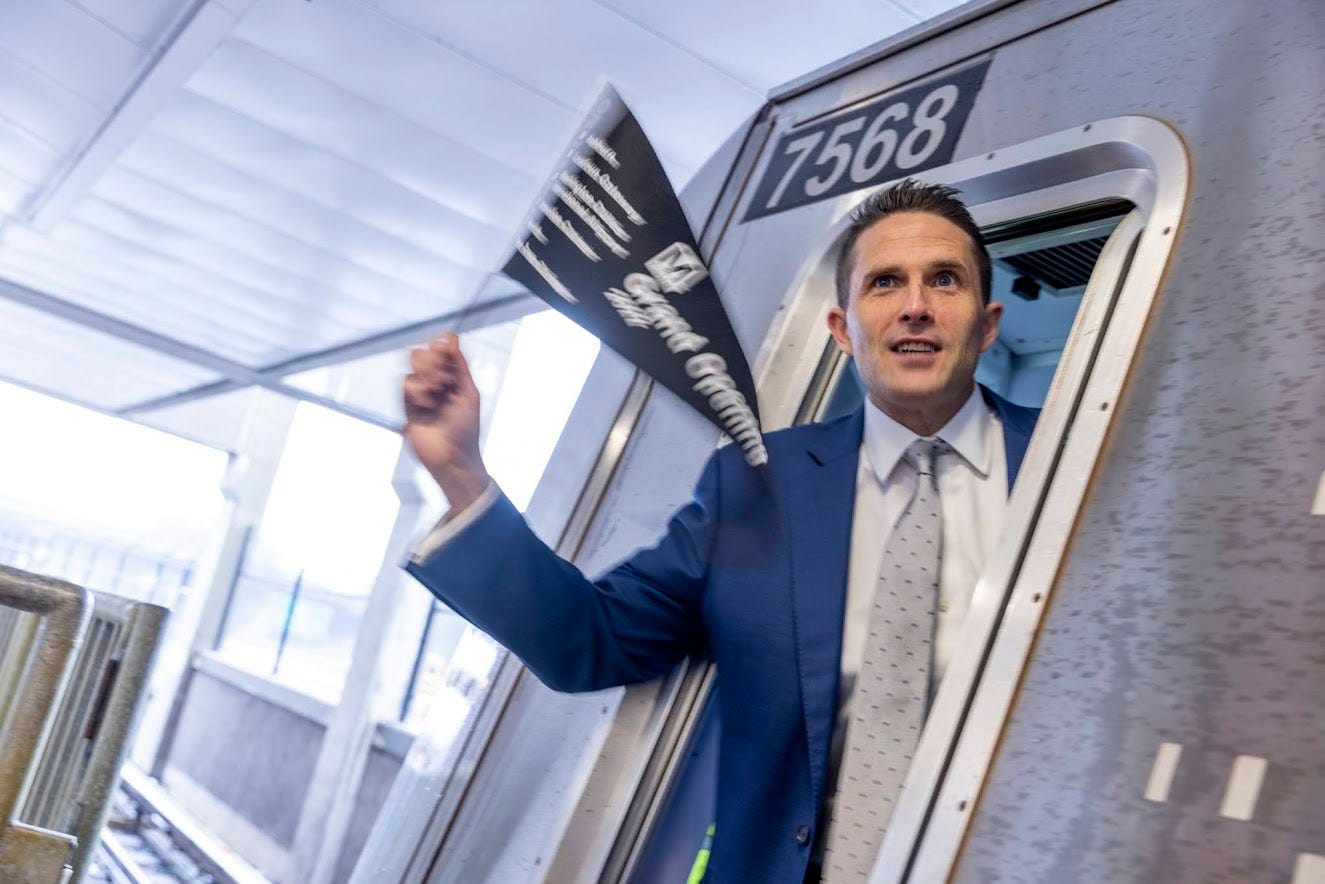
Today we talked to Randy Clarke, the head of DC’s Metro system, WMATA. If you’re a transit nerd, you probably know about Clarke — he’s become something of a celebrity for his public presence and disciplined improvement of a transit system that was facing disaster in the aftermath of COVID (and the decision to allow large swathes of federal employees to work from home).I’ve been a regular WMATA rider for long periods of my life, and what Clarke has done over the last three years has been pretty remarkable. We’ll get into some of the details here, but what stands out to me — and why I so wanted to record this conversation — is that Clarke’s managed to advance a bunch of his priorities at once. From the outside, it can seem like he hasn’t had to make any tradeoffs at all: between safety and speed, catching fare evaders and keeping costs down, etc. How has he pulled it off?You can read the transcript for this conversation (and others) at www.statecraft.pub. This is a public episode. If you would like to discuss this with other subscribers or get access to bonus episodes, visit www.statecraft.pub

How to Run the Treasury Department
Santi: Hi, this is a special episode of Statecraft. I've got a wonderful guest host with me today. Kyla Scanlon: Hey, I’m Kyla Scanlon! I'm the author of a book called In This Economy and an economic commentator. Santi: Kyla has joined me today for a couple reasons. One, I'm a big fan of her newsletter: it's about economics, among many other things. She had a great piece recently on what we can learn from C.S. Lewis’s The Screwtape Letters, which is a favorite book of mine.Kyla’s also on today because we're interviewing Wally Adeyemo, who was the Deputy Secretary of the Treasury in the Biden administration. We figured we each had questions we wanted answered.Kyla: Yeah, I've had the opportunity to interview Wally a couple times during the Biden administration, and I wanted to see where he thinks things are at now. He played a key role in implementing the Inflation Reduction Act, financial sanctions on Russia, and a whole bunch of other things.Santi: For my part, I'm stuck on Wally's role in setting up the IRS’s Direct File program, where you can file your taxes for free directly through the IRS instead of paying TurboTax a hundred bucks to do it. “Good governance types” tend to love Direct File, but the current admin is thinking of killing it. I wanted to understand how the program got rolled out, how Wally would respond to criticisms of the program, and what he learned from building something in government, which now may disappear.Kyla, you've talked to Wally before. How did that conversation go? Kyla: I actually was able to go to his office in D.C., and I talked to a couple of key people in the Biden administration: Jared Bernstein, the former chair of the CEA, and Daniel Hornung, who was at the National Economic Council.We're talking to Wally on the day that the House passed the one big beautiful bill. There's also so much happening financially, like the bond market is totally rebelling against the US government right now. I'm really curious how he thinks things are, as a key player in the last administration.For a printable transcript of this interview, click here:Santi: Wally, you've spent most of your career in Democratic Party institutions. You worked on the Kerry presidential campaign in 2004. You served in the Obama admin. You were the first chief of staff to the CFPB, the president of the Obama Foundation, and, most recently, Deputy Treasury Secretary in the Biden admin.30,000ft question: How do you see the Democratic Party today?My view is that we continue to be the party that cares deeply about working-class people, but we haven't done a good job of communicating that to people, especially when it comes to the things that matter most to them. From my standpoint, it's costs: things in America cost too much for a working-class family.I want to make sure I define working class: I think about people who make under $100,000 a year, many of whom don't own homes on the coast or don’t own a significant amount of stocks (which means they haven't seen the asset appreciation that's led to a great deal of wealth creation over the last several decades). When you define it that way, 81% of Americans sit in that category of people. Despite the fact that they've seen their median incomes rise 5-10% over the last five years, they've seen the cost of the things they care about rise even faster.We haven't had a clear-cut agenda focused on the standard of living, which I think is the thing that matters most to Americans today.Santi: There are folks who would say the problem for Democrats wasn't that they couldn't communicate clearly, or that they didn't have a governing agenda, but that they couldn't execute their agenda the way they hoped to in the time available to them. Would you say there's truth to that claim?Most people talk about a communications issue, but I don't think it's a communications issue. There are two issues. One is an implementation issue, and the second is an issue of the actual substance and policy at the Treasury Department. I was the deputy secretary, but I was also the Chief Operating Officer, which meant that I was in charge of execution. The two most significant domestic things I had to execute were the American Rescue Plan, where $1.9 trillion flowed through the Treasury Department, and the Inflation Reduction Act. The challenge with execution in the government is that we don't spend a lot on our systems, on making execution as easy as possible.For example, the Advanced Child Tax Credit was intended to give people money to help with each of their children during the pandemic. What Congress called on us to do was to pay people on a monthly basis. In the IRS system, you pay your taxes mostly on an annual basis, which meant that most of our systems weren't set up to pay a monthly check to Americans. It took us a great deal of work to figure out a way to recreate a system just to do that.We've underinvested in the systems that the IRS works on. The last time we made a significant investment

How to Build the '90s DOGE
Today, we’re taking a look at a predecessor to DOGE: The Reinventing Government project (officially known as the NPR, for National Partnership for Reinventing Government). The NPR ran for almost the full duration of President Bill Clinton’s two terms, and led to the elimination of over 100 programs and over 250,000 federal jobs.Both NPR and DOGE are case studies in a long history of government reform efforts — some more successful than others. Our guest is John Kamensky, who served as Vice President Al Gore's deputy for the National Performance Review (NPR) for eight years. Kamensky was colloquially known as “Mr. Checklist” for his work organizing the Reinventing Government initiative.Kamensky is a clear-eyed observer, and he doesn’t hedge about NPR’s failures and missed opportunities. In some ways, the Reinventing Government Initiative was a once-in-a-lifetime opportunity to cut headcount, spending, and regulation at the end of the Cold War and change the way the government operated.We discuss:* Did the NPR actually work?* What was the Board of Tea Experts?* Why was the federal government subsidizing mohair?* NPR made the federal workforce older. Was that bad?* What doesn’t Elon understand about the federal government?You can find the transcript for this conversation at www.statecraft.pub. This is a public episode. If you would like to discuss this with other subscribers or get access to bonus episodes, visit www.statecraft.pub

How the Federal Transit Administration Works
Last week, we talked to Stephanie Pollack about salvaging a transit project in danger of failure — it was the first in a set of interviews we’re running on transit. Today, we’re zooming out further, and looking at how the federal government funds local transit.Peter Rogoff spent 22 years as a staffer on the most powerful Senate committee, the Appropriations Committee (on the Democratic side). “Approps” determines discretionary spending for agencies, and for most of his time there, Rogoff was the most senior Dem staffer.Rogoff worked on three transportation reauthorization bills (in ‘95, ‘98, and ‘05), the bills that determine how money will be distributed to transit agencies across the country. In 2008, Rogoff was a key player in introducing the idea of making new funding available to “multi-modal” transportation projects — projects that benefit multiple types of transportation. The next transportation reauthorization process is coming up in 2026, and I thought it’d be valuable to better understand how that bill comes together.But Rogoff doesn’t just have experience budgeting: the following year, Rogoff was appointed as head of the Federal Transit Administration (FTA), where he served for five years. More recently, he’s been the CEO of Sound Transit, the Seattle transit agency.I didn’t agree with Peter on everything in this conversation (which was recorded in February), and he’s taken his fair share of criticism, but it’s hard to find a figure in American life who has spent more time thinking about federal transit policy.We discussed:* What does the FTA do?* Why don’t transit agencies control their spending?* How do you win Senate funding fights?* Why are streetcars terrible?The full transcript is available at www.statecraft.pub. This is a public episode. If you would like to discuss this with other subscribers or get access to bonus episodes, visit www.statecraft.pub

How to Salvage a Transit Project
This conversation, with transit guru Stephanie Pollack, is one of my favorite conversations we’ve recorded on here. For one, I had a blast recording — Stephanie’s funny, and she’s got a killer Boston accent. For another, she explains some of the ideas I care about incredibly well — how well-intentioned regulations turn bad, how political pressures make simple things hard to pull off, why building in the real world is so hard. She taught me a huge amount about building transit. And she’s a great storyteller.For context, Pollack was the deputy administrator of the Federal Highway Administration for the first half of the Biden admin. Before that, she served as the secretary of the Massachusetts Department of Transportation (DOT). And a while before that, before she was in the business of building stuff, she was an environmental activist who sued the the Massachusetts DOT for building stuff. We get into that evolution in her career here.This conversation is one of a series of conversations over the coming months about transit: why it’s gotten so hard to build, who fights over it, and what it takes to build something people love.We discuss:(00:00) Introduction (00:54) Federal vs. State Transit Funding Structure (02:58) Transit vs. Highway Agency Operational Differences (04:58) Stephanie’s Career and Perspective Changes(10:39) The Massachusetts Big Dig Project (11:34) Cost Overruns and Project Estimates (17:04) Inflation in Infrastructure Projects(18:28) The Four Ps of Project Delays (23:50) NEPA and Environmental Review(34:19) The Green Line Extension Project (43:39) Project Redesign and Procurement Innovation(58:20) Advice for Secretary DuffyThanks to Sofia Scarlat and Emma Hilbert for their audio and transcript edits. This is a public episode. If you would like to discuss this with other subscribers or get access to bonus episodes, visit www.statecraft.pub

How to Run a $5 Trillion Payment System
At the end of January, the Trump administration pushed out a top Treasury department official after he refused to give DOGE access to the government's vast payment system. We're talking to him today. It's one of his first public interviews since leaving the civil service.David Lebryk was the highest ranking civil servant in the Treasury Department, and one of the most senior civil servants in the federal government. He was responsible for overseeing the Bureau of the Fiscal Service, which. Puts out more than 90% of federal payments every year, more than a billion transactions, more than $5 trillion.One note for listeners: Lebryk did not want to go into the blow by blow of his leaving the administration early this year. Instead, we talk about a bunch of other things that I think you'll find highly relevant, how the Bureau of the Fiscal Service works, how it should work, and why Lebryk thinks DOGE’s plans for it won't work out the way they intend. This is a public episode. If you would like to discuss this with other subscribers or get access to bonus episodes, visit www.statecraft.pub

How to Fix Risk Assessment in Child Welfare
Today we talked to Alex Jutca; he leads analytics and technology at the Allegheny County Department of Human Services, where his team’s mission is to build the country’s leading R&D lab for local government. Allegheny County is known for having the best integrated data of any state and local system in the country, and they’ve applied it effectively, like using predictive algorithms in child welfare.We discussed:* What issues are consistent across Pittsburgh, Philly, and Baltimore?* How does a local CPS actually work?* When shouldn’t you involuntarily commit people with severe mental disorders?* Why has anti-addiction drug development stalled out? This is a public episode. If you would like to discuss this with other subscribers or get access to bonus episodes, visit www.statecraft.pub

How to Fix a Department's Funding Tools
Today’s guest is Narayan Subramanian. Under the Biden administration, he was a legal advisor, and then an advisor to the Secretary at the Department of Energy (DOE). Later, he was the Director for Energy Transition at the White House National Security Council.We’ve talked to previous guests about how to ensure government money flows fast and effectively. At the DOE, Subramanian helped ensure that a big influx of money could best be used to support innovative energy projects. If you’ve followed Statecraft a while, you know we’re very interested in how to actually deploy taxpayer dollars most effectively. Narayan played a key role in making sure that DOE could do just that.We Discuss:* How the DOE took its modern form* Why don’t tools for funding R&D work for funding deployment?* Does the federal interest in IP stop banks from supporting new tech?* What kinds of technologies can you support with “other transactions authority”?The full transcript is available at www.statecraft.pub. This is a public episode. If you would like to discuss this with other subscribers or get access to bonus episodes, visit www.statecraft.pub

How to Beat Crime in New York City
Today’s guest is Peter Moskos, a professor at John Jay College of Criminal Justice. He spent two years as a police officer in Baltimore. I asked him to come on and talk about his new book, Back from the Brink, Inside the NYPD and New York City's Extraordinary 1990s Crime Drop. It’s one of my favorite books I’ve read this year (and it was one of my three book recommendations on Ezra Klein’s show last week).Peter spoke with hundreds of police officers and NYC officials to understand and describe exactly how the city’s leaders in the early 1990s managed to drive down crime so successfully.We discussed:* How bad did things get in the 1970s?* Why did processing an arrest take so long?* What did Bill Bratton and other key leaders do differently?* How did police get rid of the squeegee men?I’ve included my reading list at the bottom of this piece. Thanks to Harry Fletcher-Wood for his judicious transcript edits.Subscribe for one new interview a week.For a printable transcript of this interview, click here:Peter, how would you describe yourself?I would say I'm a criminologist: my background is sociology, but I am not in the sociology department. I'm not so big on theory, and sociology has a lot of theory. I was a grad student at Harvard in sociology and worked as a police officer [in Baltimore] and that became my dissertation and first book, Cop in the Hood. I’ve somewhat banked my career on those 20 months in the police department.Not a lot of sociologists spend a couple of years working a police beat.It's generally frowned upon, both for methodological reasons and issues of bias. But there is also an ideological opposition in a lot of academia to policing. It's seen as going to the dark side and something to be condemned, not understood.Sociologists said crime can't go down unless we fix society first. It’s caused by poverty, racism, unemployment, and social and economic factors — they’re called the root causes. But they don't seem to have a great impact on crime, as important as they are. When I'm in grad school, murders dropped 30-40% in New York City. At the same time, Mayor Giuliani is slashing social spending, and poverty is increasing. The whole academic field is just wrong. I thought it an interesting field to get into.We're going to talk about your new book, which is called Back from the Brink, Inside the NYPD and New York City's Extraordinary 1990s Crime Drop. I had a blast reading it. Tell me about the process of writing it.A lot of this is oral history, basically. But supposedly people don’t like buying books that are called oral histories. It is told entirely from the perspective of police officers who were on the job at the time. I would not pretend I talked to everyone, because there were 30,000+ cops around, but I spoke to many cops and to all the major players involved in the 1990s crime drop in New York City.I was born in the ‘90s, and I had no idea about a crazy statistic you cite: 25% of the entire national crime decline was attributable to New York City's crime decline.In one year, yeah. One of the things people say to diminish the role of policing is that the crime drop happened everywhere — and it did end up happening almost everywhere. But I think that is partly because what happened in New York City was a lot of hard work, but it wasn't that complicated. It was very easy to propagate, and people came to New York to find out what was going on. You could see results, literally in a matter of months.It happened first in New York City. Really, it happened first in the subways and that's interesting, because if crime goes down in the subways [which, at the time, fell under the separate New York City Transit Police] and not in the rest of the city, you say, “What is going on in the subways that is unique?” It was the exact same strategies and leadership that later transformed the NYPD [New York Police Department].Set the scene: What was the state of crime and disorder in New York in the ‘70s and into the ‘80s?Long story short, it was bad. Crime in New York was a big problem from the late ‘60s up to the mid ‘90s, and the ‘70s is when the people who became the leaders started their careers. So these were defining moments. The city was almost bankrupt in 1975 and laid off 5,000 cops; 3,000 for a long period of time. That was arguably the nadir. It scarred the police department and the city.Eventually, the city got its finances in order and came to the realization that “we've got a big crime problem too.” That crime problem really came to a head with crack cocaine. Robberies peaked in New York City in 1980. There were above 100,000 robberies in 1981, and those are just reported robberies. A lot of people get robbed and just say, “It's not worth it to report,” or, “I'm going to work,” or, “Cops aren't going to do anything.” The number of robberies and car thefts was amazingly high. The trauma, the impact on the city and on urban space, and people's perception of fear, all comes from that. If you're a
50 Thoughts on DOGE
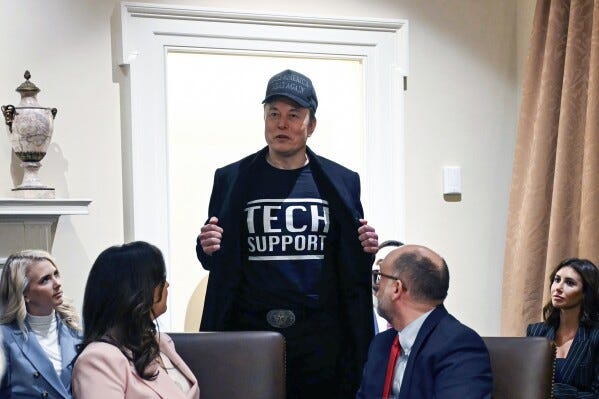
DOGE is the most interesting story in state capacity right now. Yet although we’ve talked around it on Statecraft, I haven’t covered it directly since the beginning of the administration. In part, that’s because of the whirlwind pace of news, but also because of the sense I get in talking to other DOGE watchers, that we’re like blind men feeling different parts of the elephant. And, frankly, because it’s the most polarizing issue in public discourse right now.But we’re far enough into the administration that some things are clear, and I think it’s relevant for Statecraft readers to hear how I’m personally modeling DOGE. We’re also far enough along that it’s worth taking stock of what we expected and forecasted about DOGE, and where we were wrong. So here are 50 thoughts on DOGE, as concisely as possible. You can read the full thing, as always, at www.statecraft.pub. This is a public episode. If you would like to discuss this with other subscribers or get access to bonus episodes, visit www.statecraft.pub

How to Run a Private Military Company
Today’s guest is John Lechner, a writer and researcher. He's here today to talk about his new book about the Wagner Group, a Russian state-funded private military group, or PMC. The book is called Death Is Our Business: Russian Mercenaries and the New Era of Private Warfare, and is out March 4th (you can preorder it here). It’s a crazy read, and draws on multiple trips John took to frontlines in Ukraine, Syria, Libya, the Central African Republic, and Mali. As a mutual friend told me, “John knows more about the Wagner Group than anyone not in the Wagner Group.” I asked John to help me better understand how state capacity works, through the lens of private military companies.Some questions I came into our conversation with:* How does a private military company (PMC) work? What’s the bureaucratic structure of a PMC?* How does a successful PMC operate? How does it scale?* How does a state like Russia use a PMC for its own ends (and how do PMCs use states for their own ends)?* How do Russian PMCs like Wagner compare to American PMCs like Blackwater?Read the full transcript of this episode at www.statecraft.pub. This is a public episode. If you would like to discuss this with other subscribers or get access to bonus episodes, visit www.statecraft.pub

There Are Too Many Judicial Injunctions
Friend-of-the-pod Nick Bagley joined us to explain judicial review: why it's not as confusing as it sounds, and why it's at the center of a political firestorm.Bagley is an expert in administrative law who served as special counsel and chief legal counsel to Democratic Michigan Governor Gretchen Whitmer. We've had him on a couple times for conversations on how bureaucracy is breaking government and whether the courts broke environmental review with a recent decision.You can read the full transcript for this conversation and many others at www.statecraft.pub. This is a public episode. If you would like to discuss this with other subscribers or get access to bonus episodes, visit www.statecraft.pub

How to Beat Megafires
What happened in LA last month? On that, basically everyone agrees: devastating wildfires that killed at least 29 people and cost at least $100 billion.But why did those fires burn so intensely for so long? I had my own view, but I don’t follow fires closely. So I talked to Matt Weiner, CEO and founder of Megafire Action.We discuss:* California knows it has a fire problem. Why can’t it control it?* Where does mechanical thinning work, and where doesn’t it?* What tools from the Department of Defense should we be using in firefighting?* Do we need more money to fight fires?* Why do the country’s biggest environmental groups oppose fire mitigation?For the full transcript of this conversation and others, visit www.statecraft.pub. This is a public episode. If you would like to discuss this with other subscribers or get access to bonus episodes, visit www.statecraft.pub

Why the Two Parties Operate Differently
Today I'm talking with Jo Freeman: a founding member of the women’s liberation movement in the 1960s, a civil rights campaigner, an attendee to every Democratic party convention since 1964, and a political scientist. She’s not the most typical Statecraft guest. But her work on how the two parties work - not just what they believe, but how they operate organizationally - is incredibly insightful. In this conversation, we dig into:* Why do the two parties fight so differently?* What makes someone powerful in each party?* How did the women's movement transform the Democratic Party?* What happened to convention caucuses? Did they stop mattering?* What does it mean when a movement starts "trashing" its own leaders?Reading list:Who You Know Versus Who You Represent: Feminist Influence in the Democratic and Republican PartiesThe Political Culture of the Democratic and Republican PartiesWhy Republican Party Leaders Matter More Than Democratic Ones (by Tanner Greer)Trashing: The Dark Side of SisterhoodThe Tyranny of Structurelessness This is a public episode. If you would like to discuss this with other subscribers or get access to bonus episodes, visit www.statecraft.pub

How to Budget for the SEC
This is the second in a two-part series with my dad, Diego Ruiz. In the first episode, we discussed his time helping run a political campaign in Nicaragua, and later his time staffing California Representative Chris Cox. Today, we jump ahead to his time as executive director of the Securities and Exchange Commission (SEC) during the 2008 financial crisis.In this episode, we discuss:* Why the SEC can’t fund itself* What not to say to congressional appropriators* How the SEC missed the Bernie Madoff scandal* Why it’s so hard to staff up an agency* What agency rulemaking will look like in the futureRead the full transcript at www.statecraft.pub. This is a public episode. If you would like to discuss this with other subscribers or get access to bonus episodes, visit www.statecraft.pub

How to Win an Election Against the Communists
Today's guest is near and dear to my heart. It's my dad, Diego Ruiz. We recorded this in person, and we both had the same cold, which you may be able to hear. At some point, you may also hear my son in the background, which makes three generations of Ruizes on the podcast.Diego has helped win elections in the US and Central America, served as Executive Director of the Securities and Exchange Commission (SEC), was a senior advisor in the House of Representatives, and was Deputy Chief for Strategy and Policy at the Federal Communications Commission (FCC), managing a multidisciplinary “in-house think tank.”In this episode, we discuss:* How to win a congressional election in Miami* What “burrowing in” to the civil service means* How to win a presidential election in communist Nicaragua* How the Sandinistas used Michael Keaton and Mike Tyson to dampen voter turnout* Why the Base Realignment and Closure Commission may be a model for DOGEYou can find the full transcript at www.statecraft.pub. This is a public episode. If you would like to discuss this with other subscribers or get access to bonus episodes, visit www.statecraft.pub