Software Engineering Daily
2,221 episodes — Page 39 of 45

Ep 372Slack Security with Ryan Huber
Security for the popular chat application Slack is a major focus for the company. A corporate Slack account is as valuable to a hacker as a corporate email account. In today’s episode, Ryan Huber and I talk through Slack’s approach to security–from philosophical discussions of how to company approaches security to the technical practices of logging and monitoring, and why Slack has a separate Amazon Web Services account just for the security team. Ryan works on security at Slack and has written a Medium post called Distributed Security Alerting, that I recommend checking out. If you haven’t heard it, you might also like the previous episode we did about Slack’s Architecture, with Keith Adams from Slack.

Ep 371Tech Leadership with Jeff Norris
The role of “tech lead” is a combination of a software engineer, a project manager, and an architect. A tech lead might spend 30% of her time coding and 70% managing a project, resolving conflicts, and planning. In today’s episode, we discuss the structure of software teams, and when it might make sense to have a tech lead on your team, in contrast to the more common team structure of project managers, engineers, and engineering managers. Jeff Norris, an engineer from ThoughtWorks joins the show to discuss the idea of the tech lead. This is a great show for anyone in management who is looking for alternative team structures, and this episode might also appeal to engineers who are looking to transition to a role with more variety.

Ep 370Devoxx4Kids with Arun Gupta
Devoxx4Kids is an organization that is inspiring children through robotics, programming, and engineering. Kids who attend a Devoxx4Kids workshop are exposed to entertaining and educational activities, such as writing a Minecraft mod or programming an Arduino. Arun Gupta is a software engineer and the president of the board for Devoxx4Kids USA. In this episode we discuss coding education for kids, and what happens at a Devoxx4Kids workshop. If you have a kid who you want to expose to technology, this episode has some great suggestions for how to do that.

Ep 369Cloud Clients with Jon Skeet
Google builds cloud services for developers, such as PubSub, Cloud Storage, BigQuery, and Cloud DataStore. On Software Engineering Daily, we’ve done lots of shows about how these types of services are built. In this episode, we are zooming in on the interaction between the developer using a cloud service and the design and engineering of the client APIs. To build a useful cloud service, Google has to make a common way of interacting with that service from any programming language on any device. Jon Skeet is a longtime engineer at Google, and he joins the show to explain how Google uses generated code to make the creation of those APIs more streamlined. We talk about gRPC, protocol buffers, C#, and lots of other topics.

Ep 368Electronic Frontier Foundation with Nate Cardozo
When the US government hacks its own citizens, The Electronic Frontier Foundation is often the best source of reporting to find out what laws the government has broken. When a change to the privacy policy of Google or Facebook is made, the Electronic Frontier Foundation is the best place to find out how that change in privacy exploits users. The Electronic Frontier Foundation provides legal defense and editorialism at the intersection of law and technology. Nate Cardozo joins the show today to discuss the mission of the EFF and his work at the organization. We have a wide ranging conversation, ranging from governments to corporations to Stuxnet to how the internal discussions at the EFF lead to the stances taken by the EFF.

Ep 367Cloud Dataflow with Eric Anderson
Batch and stream processing systems have been evolving for the past decade. From MapReduce to Apache Storm to Dataflow, the best practices for large volume data processing have become more sophisticated as the industry and open source communities have iterated on them. Dataflow and Apache Beam are projects that present a unified batch and stream processing system. A previous episode with Frances Perry discussed how they work in detail. In today’s episode, Eric Anderson discusses Cloud Dataflow, a service from Google that lets users manage their data processing pipelines without having to spin up individual servers to run them on. Cloud Dataflow–like the “serverless” movement we have done several shows on–represents a growing shift towards cloud providers offering services that abstract away the operational challenges of managing compute nodes. If you have suggestions for topics in this area, please do send me an email.

Ep 366Commodity Discussion with Preethi Kasireddy
A previous episode of Software Engineering Daily called “You Are Not A Commodity” received a lot of feedback, both negative and positive. The episode was a monologue I wrote about why engineers should build products on their own as a default career path, rather than work at a large corporation as a default career path. A reddit thread about the episode was almost entirely negative. Most of the emails I received about the episode were very positive. Other regular listeners wrote in and said they had mixed feelings. One of those listeners was Preethi Kasireddy, a previous guest of the show. In this episode, Preethi gives some counterarguments and questions the ideas that were presented in the “You Are Not A Commodity” episode. This will be a useful discussion for anyone who is thinking about their career path, and whether to go work for a company or do something on their own.

Ep 365Unikernels with Idit Levine
Unikernels allow us to specify the minimum features of an operating system we need to deploy our applications. We’ve had many shows about containers, which allow you to deploy your application on top of a segregated portion of an operating system. Unikernels are different because they can be deployed directly to bare metal or to a hypervisor. Idit Levine works on Unikernels at EMC. We had an interview a few weeks ago with her colleague Scott Weiss, and today’s conversation goes deeper into the motivations for Unikernels, the problems they solve, and the project she is leading called Unik, which seeks to add the degree of usability and adoption to Unikernels that Docker brought to containers.

Ep 364Microsoft Antitrust with Harry First
Microsoft was the dominant technology company in the 1990’s, until it came under fire for anticompetitive practices. Internet Explorer was tightly coupled to the Windows operating system, which prevented Netscape Navigator–a competing browser–from reaching users on the dominant platform. This episode is about antitrust–what businesses can and cannot do in the name of competition, what the impact of Microsoft’s legal battles in the late 90’s was, and how the law might respond to potential technology monopolies in the near future–such as Facebook, Google, and Uber. Our guest Harry First is a professor of law at New York University School of Law. He wrote a textbook called “The Microsoft Antitrust Cases: Competition Policy for the Twenty-First Century”.Sponsors

Ep 363Slack’s Architecture with Keith Adams
Slack is a chat application that is rapidly growing in popularity. The focus of Slack is to create a polished, responsive tool for productivity that cuts down on the emailing, context switching, and useless meetings that take place at a typical enterprise. Keith Adams, the chief architect at Slack, joins the show to explain how those high level principles translate into engineering decisions. Keith previously worked for 7 years at Facebook, contributing heavily to the tools that make PHP easier to develop with at scale. Slack’s core product is also built with PHP, and Keith discusses the similarities and differences between scaling Facebook and Slack.

Ep 362Uber’s Postgres Problems with Evan Klitzke
When a company switches the relational database it uses, you wouldn’t expect the news of the switch to go viral. Most engineers are not interested in the subtle differences between MySQL and Postgres, right? Uber recently switched from having Postgres as its main relational database to using MySQL. Evan Klitzke wrote a detailed blog post about the migration, and post got very popular for at least three reasons: If you are even slightly interested in distributed systems or databases, I recommend reading Evan’s blog post in detail.

Ep 361Relational Databases with Craig Kerstiens
Relational databases are used by most applications. MySQL, Postgres, Microsoft SQL Server, and other products implement the core features of a relational database in different ways. A developer who has never studied this space in detail may not know the differences between these databases, and in this episode we describe some tradeoffs that relational databases can make. Craig Kerstiens is an engineer at Citus Data, a company that makes scalable Postgres. We talk about the requirements for a relational database, ACID compliance, how different databases handle different distributed systems problems, and the recent blog post from Uber about the company’s switch from Postgres to MySQL.

Ep 360The Recurse Center with Nick Bergson-Shilcock
Learning to program is about self-driven exploration. Universities help guide you, coding boot camps provide a rigorous environment to work in, and online coding courses provide content for you to study. But none of this will turn you into a great programmer unless you have the drive to improve and the curiosity to explore. The Recurse Center is a place where people can come to become better programmers. Nick Bergson-Shilcock is a founder of The Recurse Center and he joins the show to discuss how it works and why he started it. This episode is a continuation of our exploration of coding boot camps, online courses, and universities, which are the pillars of programming education. The Recurse Center presents another unique model for improving as a programmer.

Ep 359Facebook Relationship Algorithms with Jon Kleinberg
Facebook users provide lots of information about the structure of their relationship graph. Facebook uses that information to provide content and services that are expected to be important to users. If Facebook knows who the most important people in my life are, Facebook can use that knowledge to serve me content that is more relevant to me. Jon Kleinberg studied Facebook network structures together with Lars Backstrom, creating a paper called “Romantic Partnerships and the Dispersion of Social Ties: A Network Analysis of Relationship Status on Facebook”. The goal of this study was to find a metric that could help rank the strength of relationships on Facebook, and the results have implications for sociology as well as the way that we think about building social networks. Jon is a professor of Computer Science at Cornell, and wrote the textbook “Algorithm Design” which I used in college, so it was a privilege to get to talk to him.

Ep 358Drones with Buddy Michini
Drones will become a central part of our lives. Drones are delivering packages, surveying cell phone towers, providing wi-fi, or fertilizing crops. Drones are assisting humans in dangerous work, and serving as an entirely new computing platform, providing services that were previously nonexistent. Airware is a company that is building a full-stack drone platform. In this episode, Buddy Michini takes us through the software architecture of a drone. Airware’s drones have two operating systems–one for the real-time flight critical aspects and one for application developers who want to build their own software for drones.

Ep 357Music Deep Learning with Feynman Liang
Machine learning can be used to generate music. In the case of Feynman Liang’s research project BachBot, the machine learning model is seeded with the music of famous composer Bach. The music that BachBot creates sounds remarkably similar to Bach, although it has been generated by an algorithm, not by a human. BachBot is a research project on computational creativity. Feynman Liang created BachBot using Python machine learning tools to build a long-short term memory model. Our conversation explores artificial intelligence, music, and his approach to this research project.

Ep 356Automated Content with Robbie Allen
You have probably read a news article that was written by a machine. When earnings reports come out, or a series of sports events like the Olympics occurs, there are so many small stories that need to be written that a news organization like the Associated Press would have to use all of its resources to write enough content to cover it all. Wordsmith is a tool for automated content generation, and today’s guest Robbie Allen is the CEO of Automated Insights, the company that makes Wordsmith. He talks today about the wide range of uses for automated content, as well as how to engineer a product that takes data from a spreadsheet and turns it into a human-readable sentence. Robbie is also speaking at the O’Reilly Artificial Intelligence Conference in New York, September 26-27.

Ep 355Haskell in Production with Carl Baatz
The Haskell programming language is often thought of as an academic tool, useful for teaching students about monads and functors, but not much else. But there are advantages to using Haskell as a production backend language. Better is a company built with Haskell on the backend, and Carl Baatz wrote a blog post detailing his experiences using Haskell. He joins the show to give a detailed explanation of why a company might want to use Haskell on the backend, from software architecture, to testing, to hiring.

Ep 354CoreOS with Brandon Philips
Google’s infrastructure has been the source inspiration for research papers, software projects, and entire companies. Google pioneered the idea that we care less about the individual machines we are running our applications on, and more about the applications themselves. Containers are the abstraction we use to separate the concerns of the application from those of the underlying hardware. CoreOS is an operating system built with this paradigm shift in mind. In a data center, the main job of the operating system is to be a platform for containers to run smoothly on. Brandon Philips is the CTO of CoreOS and he joins the show to explain what CoreOS does differently to power the applications that get deployed on top of it.

Ep 353Artificial Intelligence with Oren Etzioni
Research in artificial intelligence takes place mostly at universities and large corporations, but both of these types of institutions have constraints that cause the research to proceed a certain way. In a university, basic research might be hindered by lack of funding. At a big corporation, the researcher might be encouraged to study a domain that is not squarely in the interest of public good–such as targeted advertising. Oren Etzioni is the CEO of the Allen Institute for Artificial Intelligence, and in this episode we discuss AI research–from the doomful premonitions of Nick Bostrom to the unbridled optimism of Ray Kurzweil, as well as the realities of how AI research actually proceeds. Projects at the Allen Institute are defined and structured to solve problems in an intelligent, scalable fashion, so that engineering can proceed steadily from the local maxima of a problem domain to the global maxima. The Allen Institute seeks to bridge the gap by providing ample funding for open source AI research for the common good. Oren is also speaking at the O’Reilly Artificial Intelligence Conference in New York, September 26-27.

Ep 352Uber’s Ringpop with Jeff Wolski
Uber has a software architecture with unique requirements. Uber does not have the firehose of user engagement data that Twitter or Facebook has, but each transaction on Uber is both high value and time-sensitive. Users are paying for transportation that they expect to be available and reasonably close by. When Uber’s system is trying to match a rider with a driver, availability is favored over consistency. It is important that the rider can always get some driver, even if it is not the best driver. Ringpop is a system built at Uber to provide scalable, fault-tolerant, application layer sharding. Ringpop consists of a membership protocol, consistent hashing, and forwarding capabilities. Jeff Wolski is a software engineer at Uber working in Ringpop, and he joins the show to explain how Ringpop brings coordination to distributed applications.

Ep 351Kubernetes Migration with Sheriff Mohamed
Kubernetes is a cluster management tool open sourced by Google. On Software Engineering Daily, we’ve done numerous shows on how Kubernetes works in theory. Today’s episode is a case study in how to deploy Kubernetes to production at a company with existing infrastructure. GolfNow is a fifteen year-old application written in C# .NET. It is a successful, growing business that is a division of NBC Sports. As GolfNow has grown, it has encountered scalability issues, and the engineering team at GolfNow decided to move its entire monolithic infrastructure to microservices running in Docker containers, managed by Kubernetes. Sheriff Mohamed joins the show today to discuss migrating his company’s application to Kubernetes. It’s a great show for anyone who is moving a large team to Kubernetes, or considering the technology for their application.
Ep 350Distributed Tracing with Reshmi Krishna
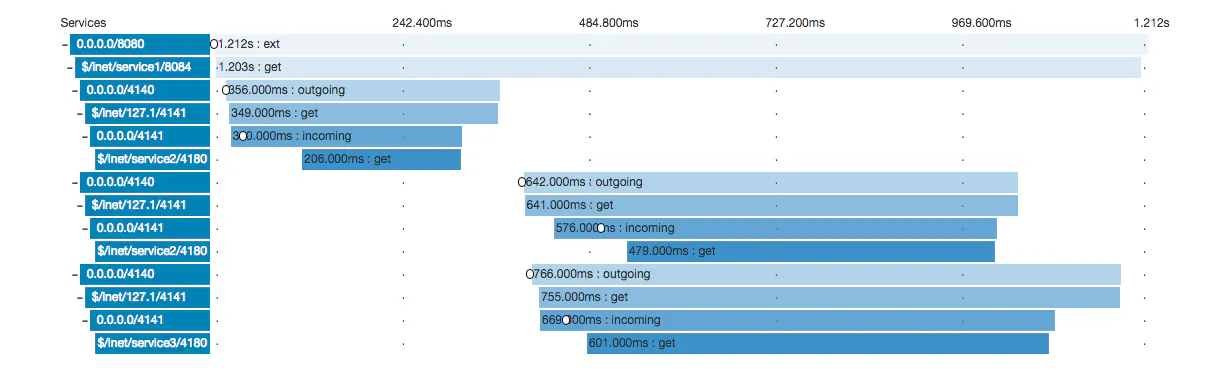
In a microservices architecture, a user request will often make its way through several different services before it returns a result to the end user. If a user experiences a failed request, the root cause could be in any of the services along that request path. Even more problematic is the challenge of debugging latency in this kind of request chain. Reshmi Krishna joins the show today to discuss distributed tracing, the process of tracking the path of a request through multiple services in order to determine the root cause of latency or errors. A popular tool for distributed tracing is Zipkin, which is largely based off of a paper published by Google called “Dapper”. Reshmi is also speaking at the upcoming O’Reilly Velocity Conference in New York, September 20-22, so check that out if you are interested in web performance, continuous delivery, or anything else related to web and mobile development.

Ep 349Serverless Architecture with Mike Roberts
“Serverless” usually refers to an architectural pattern where the server side logic is run in stateless compute containers that are event-triggered and ephemeral. Mike Roberts has written a series of articles about serverless computing, in which he discusses theories and patterns around serverless architecture. In this episode, Mike and I discuss how to reimagine our software architecture using functions-as-a-service. We go into the costs, benefits, and modern limitations of current serverless platforms like AWS Lambda.

Ep 348Akka Reactive Streams with Konrad Malawski
Akka is a toolkit for building concurrent, distributed, message-driven applications on the JVM. Akka provides an implementation of the actor model of concurrency, which simplifies concurrency by adding a lighter weight abstraction than threads and thread pools. Konrad Malawski joins the show today to discuss Akka and reactive streams. Reactive streams is an initiative to provide a standard for asynchronous stream processing. This show goes deep into modern concurrent programming and is a great companion to some of the shows we have done about reactive programming.

Ep 347Apache Beam with Frances Perry
Unbounded data streams create difficult challenges for our application architectures. The data never stops coming, and we are forced to assume that we will never know if or when we have seen all of our data. Some streaming systems give us the tools to deal partially with unbounded data streams, but we have to complement those streaming systems with batch processing, in a technique known as the Lambda Architecture. Apache Beam is a unified model for defining and executing data processing workflows, and Frances Perry joins the show to explain how Beam provides a way for us to model our data processing, agnostic of whether we choose to run those workflows on Spark, Flink, or Google’s Dataflow.

Ep 346TensorFlow in Practice with Rajat Monga
TensorFlow is Google’s open source machine learning library. Rajat Monga is the engineering director for TensorFlow. In this episode, we cover how to use TensorFlow, including an example of how to build a machine learning model to identify whether a picture contains a cat or not. TensorFlow was built with the mission of simplifying the process of deploying a machine learning model from research to production, so we also talk about that, as well as how TensorFlow can be used effectively in combination with Google’s open-source cluster manager, Kubernetes.

Ep 345Data Validation with Dan Morris
Data Validation is the process of ensuring that data is accurate. In many software domains, an application is pulling in large quantities of data from external sources. That data will eventually be exposed to users, and it needs to be correct. Radius Intelligence is a company that aggregates data on small businesses. In order to ensure that business addresses and phone numbers are correct, Radius uses human data validation to ensure that their machine-gathered data is correct. On today’s episode, Srini Kadamati interviews Dan Morris about human data validation, and how it fits into a machine learning pipeline.

Ep 344Machine Learning for Sales with Per Harald Borgen
Machine learning has become simplified. Similar to how Ruby on Rails made web development approachable, scikit-learn takes away much of the frustrating aspects of machine learning, and lets the developer focus on building functionality with high-level APIs. Per Harald Borgen is a developer at Xeneta. He started programming fairly recently, but has already built a machine learning application that cuts down on the time his sales team has to spend qualifying leads. What I found most interesting about this episode was that machine learning gets used by a single developer to solve a simple business problem and deliver solid value. This is in contrast to how many of us think about machine learning–as an intimidating domain that requires a large team to build anything meaningful.

Ep 343Flexport Engineering with Amos Elliston
Flexport is a technology company that makes logistics, supply chain management, and freight forwarding software. Shipping freight across the world requires container ships, airplanes, trains, warehouses, and trucks. Flexport’s software integrates with many of these different shipping companies, and provides a dashboard for the end user to understand how their products are being shipped around the world. Amos Elliston is the CTO of Flexport, and he joins the show to discuss building software for the global supply chain.
Ep 342Data Breaches with Troy Hunt
When you hear about massive data breaches like the recent ones from LinkedIn, MySpace, or Ashley Madison, how can you find out whether your own data was compromised? Troy Hunt created the website HaveIBeenPwned.com to answer this question. When a major data breach occurs, Troy acquires a copy of the stolen data and provides a safe way for individuals to check if their credentials have been stolen. Troy is an expert on data breaches, and he works as a regional director at Microsoft. Our conversation explores passwords, IoT security, Stuxnet, and the dark, bizarre world of data breaches.

Ep 341unikernels and unik with Scott Weiss
The Linux kernel of many popular operating system distributions contains 200-500 million lines of code. The average user never touches many of the libraries that are contained in these operating system distributions. For example, if you spin up a virtual machine on a cloud service provider, the virtual machine will have a USB driver. This is wasted space, because you can’t even interact with the USB port on a virtual machine. Unikernels are a way to rethink our usage of operating systems. A unikernel uses a stripped down operating system called a library operating system–it contains only the libraries you need for the applications you are running. Today’s guest Scott Weiss joins the show to talk about unikernels, and a project he is working on called UniK, a tool for compiling application sources into unikernels.

Ep 340Prometheus Monitoring with Brian Brazil
Prometheus is a tool for monitoring our distributed applications. It allows us to focus on the services we are deploying rather than the individual machines that make up instances of that service. The monitoring service itself is a portion of a distributed system that is treated differently than the services we are monitoring. We don’t want to use a consensus-based tool like Zookeeper or Consul because we can’t afford the strong consistency. Brian Brazil’s company Robust Perception is built around Prometheus, and he joins the show to discuss why and how to use Prometheus.

Ep 339Podcast Infrastructure with Mikael Emtinger
The technology underlying podcasts is simple–a podcaster publishes mp3 files to an RSS feed, and the listener subscribes to that feed, receiving mp3s whenever the feed is updated. Unfortunately, the simplicity of podcasts makes it difficult to build automated advertising infrastructure on top of that simple RSS model. This lack of rich automated advertising has kept podcasting from flourishing. aCast is a company that is trying to change that by providing a better podcast experience for both the publisher and the listener. Today’s guest Mikael Emtinger is a creative technologist at aCast, and we discuss the infrastructure around podcasts, and how aCast is trying to improve it.

Ep 338GraphQL as a Service with Scaphold.io
GraphQL was open sourced out of Facebook, and gave developers a way to unify their different data sources into a single endpoint. Although the promise of GraphQL is appealing, the process of setting up a GraphQL server that can communicate with each disparate data source can prove to be complex. Scaphold.io provides GraphQL as a service, and today’s guests are the creators of Scaphold, Vince Ning and Michael Paris. Scaphold.io lets developers configure their schema, and hosts their data. Vince and Michael explain the basics of GraphQL, and also discuss how they are building a GraphQL as a service platform.Sponsors
You Are Not A Commodity

Ep 336Industries of the Future with Alec Ross
Alec Ross worked in the White House as a Senior Policy Advisor to Hillary Clinton. His book Industries of the Future explores the biggest technological opportunities and threats to our society. The industries addressed in his book include robotics, genetics, and cybersecurity. Technological familiarity is increasingly correlated with an individual’s optimism. Cyberwarfare presents attack vectors that are difficult to insulate against. Arguments about surveillance center disproportionately on governmental surveillance rather than that of the private sector. In our conversation, Alec discusses these topics and others.

Ep 335Clojure with Alex Miller
Clojure is a dynamically typed functional language that runs on the JVM. Today’s guest Alex Miller gives us an overview of Clojure’s core functionality. Alex is a developer of Cognitect, and a founder of the the Strange Loop conference. We discuss the data structures, garbage collection, and concurrency support. How does Clojure compare to other JVM languages like Scala and Groovy? How does Clojure copy immutable data structures without copying all of the data? How does a Clojure program get evaluated and converted to Java bytecode? These questions, and many others are discussed in this episode.

Ep 334Odd Networks with Kris Walker
Odd Networks is building a platform for anyone to launch their own over-the-top streaming video service. With Odd Networks, you can deploy your own video channel using a Roku, Amazon Fire TV, Apple TV, and other services. Creating a streaming video service with interoperability between these different platforms presents numerous technical challenges, and today’s guest Kris Walker explains how Odd Networks is addressing those challenges. We discuss the open source projects of Odd Networks, including oddworks, which encompases the SDKs, stores, services, and middleware, and the event bus, called oddcast.Sponsors

Ep 333Mobycraft with Aditya Gupta
MobyCraft is a client-side Minecraft mod to manage and visualize Docker containers. MobyCraft was created by Aditya Gupta. I met him at DockerCon, where he gave a presentation about his project. He also discussed his interaction with the Netflix team, who integrated MobyCraft with their container management tool called Titus. You can watch a video online of Titus managing hundreds of 3-D containers within MineCraft. In this episode, we discuss how and why Aditya built MobyCraft, and how he got started programming at such a young age.

Ep 332Prometheus with Julius Volz
Prometheus is an open-source monitoring tool built at SoundCloud. It can be used to produce detailed time-series data about a distributed architecture. Prometheus is based on the monitoring system inside Google’s infrastructure, called Borgmon. Julius Volz is the creator of Prometheus, and he joins the show to explain why he built Prometheus and how it differs from previous monitoring tools. Prometheus is widely used to monitor Kubernetes clusters, just like Google uses Borgmon to monitor its Borg clusters.
The Art of Monitoring with James Turnbull

Ep 330Fintech Hiring with Ed Donner
Financial technology has changed significantly in the last decade, and companies both new and old are adapting to that change. Newer companies like TransferWise and Stripe are often called “fintech” companies–short for “financial technology”. Established companies like banks may not refer to themselves as fintech companies, but the way that they do business is changing, due to technological advances like blockchain. Ed Donner is the CEO of untapt, a hiring platform for fintech companies, and he joins the show to talk about the fundamental changes that are causing so many new fintech companies to be created. Before starting untapt, Ed worked at JP Morgan Chase, where he spent much of his time leading engineers and hiring engineers, which makes him well-equipped to build a platform for hiring software engineers into fintech companies, driven by machine intelligence.

Ep 329Scaling github with Sam Lambert
github has grown to have 10 million users and 30 million repositories. Getting to this scale has required innovation in many places–github has significantly altered the code for git itself, and has built unique infrastructure and written low level code to architect for git repository management at scale. Despite the need for cutting-edge technologies to support github, the development culture at github values tried and true technologies, and today’s guest Sam Lambert explains the value of maintaining a Rails monolith as the frontend of github, and the other battle-tested tools that github uses.

Ep 328Pixar in a Box with Kitt Hirasaki
Pixar has made some of the most successful movies of all time: Toy Story, WALL-E, Monsters Inc, and many others. These movies are made with cutting-edge computer animation techniques that Pixar often has to invent in order to tell the story it wants to tell. Pixar has teamed up with Khan Academy to teach anyone who wants to learn the basics of computer animation–Pixar-style. The collaboration with Khan Academy is called “Pixar in a Box”, and Kitt Hirasaki joins the show to talk about it. Kitt has worked two stints at Pixar, starting in 1996 and again in 2008, and today he works at Khan Academy–so we also get into his experiences at Pixar, and how the software engineering at Pixar works.

Ep 327Open Source Culture with Rachel Roumeliotis
Open source software has become the rule for how software is written rather than the exception. OSCON is O’Reilly’s open source conference, where companies and individuals talk about where the open-source world is going. Rachel Roumeliotis is the chair of OSCON, and she joins the show today to talk about the state of open source, and how the conference has developed since she started working at O’Reilly. We are giving away a free ticket to O’Reilly’s Velocity 2016 conference in New York. If you want to be entered to win that ticket, send a tweet about your favorite SE Daily episode about dev ops or web performance, and tag software_daily, as well as #velocityconf.

Ep 326Android on iPhone with Nick Lee
Finally–the Android operating system has been put on an iPhone, and today’s guest is Nick Lee, who accomplished that feat. Nick works at Tendigi, a design and engineering firm. In the past, Nick has put Windows 95 on an Apple Watch. Why would you do something like this? In today’s interview with Nick, we talk about the technical challenges of bringing Nick’s bizarre sense of technological irony into reality.
Kubernetes Origins with Craig Mcluckie
Ep 324Container Platforms with Darren Shepherd
Container management systems like Kubernetes and Docker Swarm give us a higher level management tool for architectures built out of distributed containers. Container platforms like Rancher provide a higher layer of usability, and today’s guest Darren Shepherd of Rancher Labs takes us through what a container platform is. This interview is part of our continued coverage of Kubernetes, Docker, and the other components of the growing container ecosystem.