Singularity.FM
337 episodes — Page 2 of 7
ReWriting the Human Story - Chapter 12
"Never has our future been more unpredictable, never have we depended so much on political forces that cannot be trusted to follow the rules of common sense and self-interest – forces that look like sheer insanity, if judged by the standards of other centuries." Hannah Arendt, The Origins of Totalitarianism "Power over the rules is real power. That’s why lobbyists congregate when Congress writes laws, and why the Supreme Court, which interprets and delineates the Constitution — the rules for writing the rules — has even more power than Congress. If you want to understand the deepest malfunctions of systems, pay attention to the rules and to who has power over them." Donella H. Meadows, Thinking in Systems Politics is the story of rules. The rules of how we live and do things together. It frames and regulates the relationships among people. It is the foundation on which we transcend being individuals and become a community, a tribe, a nation, or a civilization. It is what allows humanity to be more than the sum of its parts. That is why we might get all other stories right but if we get politics wrong we are unlikely to survive as a civilization, perhaps even as a species. And sooner or later all stories become political. Take technology. Technology drives change. And, by definition, change turns the world upside down. So it takes a blue-blood nobleman and turns him into a pauper. It takes a king and makes him a ceremonial figurehead with no real power. It takes a shepherd and makes him a laborer, a member of the middle-class, or, occasionally, a capitalist. And so, in the end, technology, as a bringer of change, is about politics. Read the rest here: https://www.singularityweblog.com/politics-story/
ReWriting the Human Story - Chapter 11
"Computer Science is no more about computers than astronomy is about telescopes." Edsger Dijkstra "When looms weave by themselves, man’s slavery will end." Aristotle "Within thirty years, we will have the technological means to create superhuman intelligence. Shortly after, the human era will be ended." Vernor Vinge, 1993 Today we are entirely dependent on machines. So much so, that, if we were to turn off machines invented since the Industrial Revolution, billions of people will die and civilization will collapse. Therefore, ours is already a civilization of machines and technology because they have become indispensable. The question is: What is the outcome of that process? Is it freedom and transcendence or slavery and extinction? Our present situation is no surprise for it was in the relatively low-tech 19th century when Samuel Butler wrote Darwin among the Machines. There he combined his observations of the rapid technological progress of the Industrial Revolution and Darwin’s theory of evolution. That synthesis led Butler to conclude that intelligent machines are likely to be the next step in evolution: "…it appears to us that we are ourselves creating our own successors; we are daily adding to the beauty and delicacy of their physical organisation; we are daily giving them greater power and supplying by all sorts of ingenious contrivances that self-regulating, self-acting power which will be to them what intellect has been to the human race. In the course of ages we shall find ourselves the inferior race." Samuel Butler developed further his ideas in Erewhon, which was published in 1872: "There is no security against the ultimate development of mechanical consciousness, in the fact of machines possessing little consciousness now. A mollusk has not much consciousness. Reflect upon the extraordinary advance which machines have made during the last few hundred years, and note how slowly the animal and vegetable kingdoms are advancing. The more highly organized machines are creatures not so much of yesterday, as of the last five minutes, so to speak, in comparison with past time." Similarly to Samuel Butler, the source of Ted Kaczynski’s technophobia was his fear that: "… the human race might easily permit itself to drift into a position of such dependence on the machines that it would have no practical choice but to accept all of the machines decisions. As society and the problems that face it become more and more complex and machines become more and more intelligent, people will let machines make more of their decisions for them, simply because machine-made decisions will bring better result than man-made ones. Eventually a stage may be reached at which the decisions necessary to keep the system running will be so complex that human beings will be incapable of making them intelligently. At that stage the machines will be in effective control. People won’t be able to just turn the machines off, because they will be so dependent on them that turning them off would amount to suicide." The Unibomber Manifesto As noted at the beginning of this chapter, humanity has already reached the machine dependence that Kaczynski was worried about. Contemporary experts may disagree on when artificial intelligence will equal human intelligence but most believe that in time it likely will. And there is no reason why AI will stop there. What happens next depends on both the human story and the AI story. Read the rest here: https://www.singularityweblog.com/ai-story/
ReWriting the Human Story - Chapter 10
…by directing that industry in such a manner as its produce may be of the greatest value, he intends only his own gain, and he is in this, as in many other cases, led by an invisible hand to promote an end which was no part of his intention. Nor is it always the worse for the society that it was no part of it. By pursuing his own interest he frequently promotes that of the society more effectually than when he really intends to promote it. Adam Smith The human mind (mine too) loves narratives. Stories. Stories are illusion. They are so powerful they invite delusion. Stewart Brand The stories of science, technology, and progress are practically inseparable from the story of capitalism. And Capitalism is simply a relatively modern story told by great storytellers – be it Adam Smith or Milton Friedman. So, if money is the most popular story, then capitalism is likely the 2nd most popular one. And if we are to capture its story in a single word it is growth. But the key point is that capitalism requires growth not to deliver progress but to survive. So, if we halt growth capitalism won’t just halt – it will collapse. Therefore growth is the goal and progress is, at best, a byproduct. There are many reasons why capitalism requires growth to survive – competition, demographics, unemployment, inequality, credit, mass production, energy consumption, etc. Fundamentally, however, capitalists go into business to make a profit. This means that if someone invests 100 dollars of capital they expect to receive back more than 100. And they are happy to repeat this process over and over again for as long as they can. Hence we call it capitalism – a self-sustaining system where capital gives birth to more and more capital. But if you start with 100 and end up with more than 100 we have growth because it measures the differences between your starting capital and what you end up with. That growth – or surplus, is the return on capital investment. If there is no return on investment there is no incentive to invest. So investment ends and the system collapses. Read the rest here: https://www.singularityweblog.com/capitalism/
Technology Reveals Who We Are, Not the Future
I recorded this virtual keynote for a corporate client about 10 days ago and decided to share it publicly. Hope you enjoy it 😉 Technology is a Mirror, Not a Crystal Ball; It Reveals Who We Are, Not the Future The 1st atomic bomb was nicknamed “gadget.” Does this say something about who we are? Or does it say something about the nature of technology and the power to do good or evil? Today we live in a universe of ever-more-powerful gadgets and humanity has never wielded more technological power because we live in the most scientifically advanced century in the history of our civilization. The paradox, however, is that ours is also the most dangerous century not only for countless other species going extinct but also for our own existence. But how can that be? Isn’t technology good both for us and the world in general? And, most importantly, what can we do about this? Those are the questions I want to focus on today. But I want to begin by sharing a personal story. In 2016, my wife Julie and I took a road trip through California. Needless to say, Los Angeles and San Francisco were among our points of interest. Now, if you were going by car as we were, chances are that the very first thing you will see upon entering LA is those makeshift camps of tens of thousands of homeless Americans. Well, 2 years before our trip, Peter Diamandis published his best-seller “Abundance” and told us that the future is better than we think. In it, Diamandis claimed that we can solve all of humanity’s grand challenges with enough capital, technology, and “the right people” – whom Peter titled the new Technophilantropists. And, yet, there we were, in his hometown, in the one place in the world with probably the highest concentration of all of the above, and we witnessed shocking poverty, high rates of crime and homelessness, severe drought, environmental destruction, and crumbling infrastructure. I got so shocked that I decided to do some research. Only to get even more shocked in discovering that if you calculate the cost of living the “Golden State” of California, is, in fact, America’s poorest, because perhaps 1 out of 4 live at or below the poverty line. So while California has the 5th largest economy in the world and the largest in the US, according to McKinsey’s, it ranks 46th among the states for opportunity, 43rd for fiscal stability, and dead last for quality of life. This paradoxical situation raises many important questions. For example: How is it that poorer countries such as Canada, which have less access to advanced technology and much fewer billionaires, somehow end up having a happier, healthier, and longer-living population, free health care, lower crime rates, and lower degree of homelessness? Peter claims his 3 requirements for abundance will help us solve humanity’s grand challenges but the current COVID19 challenge provides more shocking evidence against his claim. Because the United States has 2 ½ times the Canadian death rate. And this leads us to the 3 most popular myths about technology: The 1st myth is the myth of Tech Utopia or what Diamandis calls Abundance. That the future is better than we think. Read the rest here: https://www.singularityweblog.com/technology-reveals/
How to be a Futurist
Famous physicist Sir Isaac Newton saw our universe as a pool table. Given that everything follows the laws of nature, Newton argued, if one knows the direction and the force behind each billiard ball, or each particle in the universe, one will be able to predict the future and what comes next. Needless to say, this is a pretty deterministic view that leaves no space for personal freedom, not to mention that it turns us all into mere billiard balls. So, in a way, it is not surprising that the most common question people ask as soon as they find out I am a futurist is to predict the future and what comes next? Well, today we live in the age of Google. So answers are free. Good questions, however, can be priceless because the better the question that we ask the better the answer that we are going to get. So the value is moving away from the answers and towards the questions. Therefore, the question about predicting the future and what’s next, popular as it is, needs to be put into proper context so that we can see if it is the right question to ask in the first place. In quantum physics, there is this phenomenon called the “observer effect” also known as “the measurement problem.” It refers to the impact that the act of observing produces on a phenomenon thereby highlighting the inextricable dynamic relationship between the “subject” and the “object.” In essence, the observer effect leads to a rejection of Newtonian determinism because it shows that we live in a universe whose present is not simply “the effect of the past” or “the cause of its future.” So Quantum mechanics tells us that nothing can be measured or observed without disturbing it. Furthermore, quantum physics annihilates the possibility of a strict dualism between the subject and the object, presenting them in a dynamic relationship where each is relational and reciprocally constituting the other. I believe the same points hold true about the present and the future: The present and the future do not follow a simple deterministic path. They are not simply the cause and effect of each other but are liable to exhibit the observer effect so they are influenced by us. They don’t have a dualistic relationship of simple opposites but share a dynamic relationship where each is relational and constituting the other. So we can’t really put a hard line between the present and the future. And, thus, to paraphrase Albert Einstein in our current context, there is spooky action from the distance of our present and well into the future. Now, some have called the future a chaos system. And we know that there are 2 types of chaotic systems: Level 1 chaos does not react to predictions about it. The best example of level 1 is the weather. It is an extremely complex type of chaotic system but we can model it, make computer simulations and then come up with predictions about the weather in a particular location at a particular time in the future. And, right or wrong, the weather itself will not be influenced by our prediction, one way or another. The future in general, however, is what is called a Level 2 chaotic system. And the problem with level 2 chaos is that it reacts to predictions and therefore can never be predicted fully. One example of that is the stock market. Read the rest here: https://www.singularityweblog.com/futurist/
ReWriting the Human Story - Chapter 9
"Technology improves the lives of people who can avoid being dominated by it and forced into debilitating addictions to it." Frank Kaufmann The 1st atomic bomb was nicknamed “gadget.” Does this fact say something about who we are? Or does it say something about the nature of technology and the power to do good or evil? I will begin this chapter by looking at the most popular myths about technology. I will then look at the etymological origins as well as several definitions of the term. Finally, I will conclude by arguing that story is the core technology of our civilization. Perhaps the most popular and maybe even the most dangerous myth about technology is the myth that technology allows us to see the future. “Come and see this amazing new technology,” we often hear, “And you will see the future.” I call this “the Crystal Ball” myth because I grew up with the witches and wizards’ fairy tales where magic crystal balls gave them the ability to see the future. Of course, Arthur C. Clarke’s famous 3rd law states that “Any sufficiently advanced technology is indistinguishable from magic.” And so perhaps we shouldn’t be surprised that modern technology has become synonymous with the crystal ball from our old fairy tales. But the Crystal Ball perception of technology is not only a myth. It is also dangerous. To evaluate the crystal ball metaphor, we have to first understand the etymology of the word technology – what it means and stands for, or at least what it used to mean and stand for. Then we can judge whether the etymological meaning of the word supports the above metaphor or some alternatives that I will propose. The word technology comes from two Greek words – techne and logos. Techne means art, skill, craft, or the way, manner, or means by which a thing is gained. Logos means word, the utterance by which inward thought is expressed, a saying, or an expression. So, technology means words or discourse or a conversation about the way things are gained. In other words, technology is merely “how” we do things and not “what” we want or “why” we do them. Because it is not an end-in-itself. Instead, technology is merely a means-to-an-end, a tool. That is why I want to propose a better metaphor: technology is a magnifying mirror. It doesn’t show us the future but merely reflects the present and, more importantly, it reflects who we are. Technology is a mirror because it reflects the engineers, designers, entrepreneurs, and users who create and use it. But it is also a mirror to humanity in general and our collective dreams, hopes and fears, our knowledge and our ignorance, our privileges and our responsibilities, our strengths, and our weaknesses, our good, and our evil. But it is not a usual kind of mirror because technology magnifies and amplifies things, and hence it brings its own biases. Thus it always has unforeseen consequences. And the critical point here is that technology reflects our essence. So, in a way, the story of technology is the story of humanity. [Just like the story of humanity is often told as the story of technology – e.g., the claim that we are a “tool-maker.”] Now, why do I claim that the crystal ball metaphor is dangerous? Read the rest here: https://www.singularityweblog.com/technology-story/
ReWriting the Human Story - Chapter 8
"The universe is made of stories, not atoms." Muriel Rukeyser *** About 13.5 billion years ago, matter, energy, time and space came into being in what is known as the Big Bang. The story of these fundamental features of our universe is called physics. About 300,000 years after their first appearance, matter and energy started to coalesce into complex structures, called atoms, which then combined into molecules. The story of atoms, molecules and their interactions is called chemistry. About 3.8 billion years ago, on a planet called Earth, certain molecules combined to form particularly large and intricate structures called organisms. The story of organisms is called biology. About 70,000 years ago, organisms belonging to the species Homo Sapiens started to form even more elaborate structures called cultures. The subsequent development of these human cultures is called history." [Yuval Harari, Sapiens p. 3] After Benjamin Franklin disarmed the Gods by inventing the lightning rod, science has been the means by which humanity has first dethroned and then replaced God altogether. Today, breakthroughs in big data, AI, synthetic biology, genetic engineering, and neuroscience are all pushing us closer to Godhood. Many scientists are confident that defeating aging, creating mind uploads, AI, GMO humans, and radically new engineered organisms are simply a question of “when”, not “if”. This is why Stewart Brand noted that we are already Gods so we might as well start behaving as such. And so we have. Humanity has never wielded more power for we live in the most scientifically advanced century in the history of our civilization. Paradoxically, it is also the most dangerous century not only for countless species going extinct but also for our own existence. But how can that be? Isn’t science good both for us and the world in general? Read the rest here: https://www.singularityweblog.com/science-story/
ReWriting the Human Story - Chapter 7
"The Earth does not belong to man; man belongs to Earth. Man did not weave the web of life; he is merely a strand in it. Whatever he does to the web, he does to himself." Chief Seattle We are story-telling animals. And all of history is the human story, our story. So, if today we are at the precipice of the singularly most disruptive change in how we live, how we organize ourselves collectively, and how we relate to the rest of the world, then we were led to this point by the story we have told ourselves – about who we are, where we’re coming from, where we are going and what is our proper place in the universe. This story takes many forms and shapes – religious, secular, scientific, economic, literally, and artistic. But all tell of humanity’s “transcendence” of our animal origin, our growing mastery over “nature” [because it belongs to us, not the other way around] and a future of “abundance” [that is “better than we think”]. It is the teleological story of civilization, progress, humanism, and, most of all, a species whose manifest destiny is to become God. What makes it dangerous is that we have forgotten it is a story. Because it has been told so many times by those who see themselves as rationalists or scientists, objective and impartial, true and good. Up until the 20th century, all human civilizations took nature for granted. It seemed gargantuan and we never imagined we could damage, let alone threaten it. Today we are no longer so humble. Worse than that, even if progress in science and technology is a fact, progress in humanity is, at best, lagging. Because intellectually, technologically, economically, and scientifically humanity has progressed immensely. But psychologically or spiritually we have not moved that far. [As noted by Robinson Jeffers, human nature has no more changed in the last 10,000 years than the beaks of eagles.] And, unfortunately, while we have learned a lot about the birds, bees, fish, and oceans that doesn’t mean we’ll save, rather than destroy them all. [Ourselves included.] Especially since our current story tells us that the universe is ours for the taking and we are free to do with it as we please. In fact, all of our current crises are self-created. If we look carefully at all the problems we are facing today we would realize that they are all the same. Things like nuclear proliferation, global warming, environmental degradation, and species extinction, even pandemics are all actually the same thing playing itself over and over again in different realms. Namely, humanity’s technological power far surpassing our wisdom to use it in a safe, productive, non-homicidal, and non-suicidal manner. Yuval Harari notes that we jumped from the middle of the food chain, where we spent more than 2 million years, to the top only within the last 100,000 years. But because of our meteoric rise, we are ill-adapted to our current position of power and supremacy. And many of the calamities that followed – be it wars against other humans or the way we treat the environment, are due to that fact. Bears, wolves, lions, and sharks all evolved to be at the top of the food chain over many millions of years. And they are evolved to be in balance with each other and the world around them. We are not. This is why Harari argues that “Armed sheep are far more dangerous than armed wolves because they are not used to be in a position of power.” We also moved from a view where “mother nature” was the all-powerful giver and taker to a view where we could and should “master” or “conquer” her. So now we are the wise giver and taker of life. And it is right and proper it is so. Because we are Homo Sapiens – the “wise man.” [A Freudian Oedipus complex at the scale of our civilization?!] And that is also a result of the myth that humanity isn’t a part of nature, but apart from it. Read the rest here: https://www.singularityweblog.com/human-story/
ReWriting the Human Story - Part II - Our Story
"Gods always behave like the people who make them." Zora Neale Hurston, Tell My Horse Before we have a story, any story, we must first have a storyteller. Therefore, the most important story, that which all other stories are derived from, the story-of-all-stories, is the story of the storyteller: the human story. The human story has been written and rewritten several times already. The last time was somewhere between the Enlightenment and the Industrial Revolution when we dethroned God as the central authority in the Universe and took his place instead. Since then our story has spread the myth of the supremacy and centrality of the human being – of how we are the pinnacle of evolution, the supreme intelligence, and the masters of nature. And everything we have done since then, together with everything we are likely to do in the future, will stem from that story – the story of who we are, what’s our place in the universe, what we are here for, and where we are going. It is, therefore, this story that is the cornerstone of our stunning progress and fantastic accomplishments. It is also the same story that underpins our failures and current predicaments – be it climate change, environmental destruction and species extinction, nuclear war, terrorism, pandemics, or even artificial intelligence. For it is this story that gave us Auschwitz and took us to the Moon, Mars, and beyond. And it is this story that will likely determine if we are going to go extinct like the dinosaurs, or if and how we might populate the universe. Our modern challenges are not only new but also self-created. And exponential technologies – such as genetic engineering, artificial intelligence, big data, synthetic biology, 3D printing, crypto blockchains, and nanotechnology, are already causing both negative and positive change. But new kinds of challenges require new kinds of thinking. And self-created problems require first acknowledging and then learning from past mistakes. Finally, since we think in and are ruled by stories, we must rewrite the human story yet again. Because our current story is facing many new challenges. And recent events have shown it is starting to fall apart. But before we can write a new story we must understand how the current story came to be, what are its main elements and what has been its impact. Only then can we hope to write a better story. This is not just a philosophical exercise but a question of survival for all life on our planet. Viktor Frankl, a Nazi Holocaust survivor, said it best: "Since Auschwitz we know what man is capable of. And since Hiroshima we know what is at stake."
ReWriting the Human Story - Chapter 6
"Most people believe the mind to be a mirror, more or less accurately reflecting the world outside them, not realizing the contrary that the mind is itself the principle element of creation." Rabindranath Tagore It is arguable whether it is proper for us to be classified as Homo Sapiens because it is arguable as per how wise we actually are. But, in this chapter, I will claim it is much less arguable that we are proper Homo Narrative. Because even before the time humans started to huddle around campfires, even before we were able to speak, story was at the core of what is human. Human biology has evolved around and wired for 2 main types of stories: The first one is the story our human brain tells us about the world and who we are in it. Because our brain has evolved to produce a single story of “reality”. And that story isn’t strictly true, comprehensive, or accurate. Rather it is a story designed to make sense to us. Because our brain is able to perceive only a tiny fraction of the universe around us. It has evolved to filter out a number of crucial details and take shortcuts into creating the story of the outside world inside our heads. And we have developed a variety of evolutionary, physiological, and psychological biases. Thus, according to neuroscientist Anil Seth, our brain’s story is a single, unreal, “hallucinated” story. And, since we are all hallucinating all the time, Dr. Seth claims that “reality is just a hallucination majority of people agree upon.” In other words, reality is a story. A story that a sufficient number of people accept as true. Furthermore, we don’t just passively experience the world but we actively generate it. So it comes as much from within as it comes from without. Finally, story is the natural way in which the mind takes in data from the outside world and then processes it so that we can make sense of it. The second type is the story we tell and hear from others. Because we are evolutionarily selected for being good storytellers and good listeners. This is due to the fact that story is the best way of communicating information, especially when we had no writing. So people who told the most captivating stories usually had the most crowded campfire and rarely went hungry. Those who remembered well the stories about the migration of the herds, the seasons of the year, the best ways of securing water, food, shelter, and fire, had the best chance of survival. Those who didn’t were less likely to survive and pass down their genes. So whether it is perceiving and processing the world inside our heads, or sharing practical information with others, story is critical to human survival. And, in biology, things that provide benefit to survival get selected for. Read the rest here: https://www.singularityweblog.com/biology-of-story/
ReWriting the Human Story - Chapter 5
Chapter 5: The Importance of Story "It’s like everyone tells a story about themselves inside their own head. Always. All the time. That story makes you what you are. We build ourselves out of that story." Patrick Rothfuss Stories are not just stories. Stories matter. Because, to paraphrase Friedrich Nietzsche, if one has a sufficiently strong “why” one can endure any “how.” And the “why” comes not from facts or events. It comes from the story we attach to them. This desire for meaning is often stronger than our desire for survival because meaning provides motivation or indifference, even apathy. That’s how important story is. For example, if one is suffering greatly one can decide that it is meaningless to go on and give up on life. Or, like Viktor Frankl, one can choose a story that attaches positive meaning to their suffering and thus be motivated to endure even the living hell of Auschwitz. This is true for individuals as well as larger groups of people, such as corporations, religions, or nations. As Frankl said: "Between stimulus and response there is a space. In that space is our power to choose our response. In our response lies our growth and our freedom." In other words, we are free to choose our story even when we are not free to choose our circumstances. Because the story is our “why” while the circumstances are merely our “how.” And the story is what ultimately makes the difference. Because a story is something that helps us feel connected to a reason and, more importantly, to a purpose. Let’s look at some examples at both the individual and the collective level. The Japanese island of Okinawa is home to some of the longest-living people in the world. One often-quoted reason behind Okinawan longevity is their concept of Ikigai. Ikigai comes from 2 words: iki – which means “to live,” and gai – which means “a reason.” So, literally, ikigai translates as a “reason to live”, “something that makes life worth living”, “a meaning for/to life”. Furthermore, Ikigai is pretty close to the French concept of raison d’etre. It is a sense of a personal mission and it is commonly believed that if one loses their Ikigai one dies. [A claim strongly supported by Victor Frankl’s own observations in Nazi concentration camps. See Man’s Search for Meaning] Every great leader has a great story. For example, if you’re Socrates your story is: “I know that I don’t know.” If you are Buddha your story is “life is suffering”. If you are Mohamed your story is “there is only one God and his name is Allah.” If you are Martin Luther your story is “reformation.” If you’re Galileo your story is “And yet it moves.” If you’re Martin Luther King Jr. your story is “I have a dream”. If you’re the Beatles your story is “all you need is love”. If you are John Lennon your story is “Imagine all the people”. If you’re President Kennedy your story is “We shall put a man on the moon”. If you’re Steve Jobs your story is “think different”. If you’re President Bill Clinton your story is “It’s the economy, stupid.” If you’re President Obama your story is “Yes, we can.” If you are President Trump your story is “Let’s make America great again.” In the case of larger groups of people – such as corporations, story is the glue that brings everyone together and motivates them to cooperate and overcome obstacles. And so, in the past couple of decades, the most successful organizations have come up with what’s been called a Massively Transformative Purpose [MTP]. [Salim Ismail, Exponential Organizations, page 53] Read the rest here: https://www.singularityweblog.com/importance-of-story/
ReWriting the Human Story - Chapter 4
ReWriting the Human Story - Chapter 4: The Power of the Storyteller The most powerful person in the world is the storyteller. The storyteller sets the vision, values and agenda of an entire generation that is to come. Steve Jobs. Before we have a story, any story, we must first have a storyteller. And that storyteller is a god, because within their narrative they are all-powerful, almighty and omnipotent. That’s why religion is among the most powerful stories of our civilization. And, the storyteller of such a popular story is, of course, a god. Or the son of God. Or the prophet of God. Or in the image of God. He sets the rules and the laws, what is good and evil, what is right and wrong, what is and what is not possible. He tells us how to dress, what to eat, how to live, how to relate to each other, who must marry whom, how to bring up our children, where we are coming from, why we are here, what is the purpose of life and where we go after death. If we believe his story, we are going to not only listen to but also obey his “commandments.” It is for this reason that nations and even corporations are also made by mythical stories. Because myth-making is team-building is nation-building is world-making – stories told on a different scale. The myth helps us make sense of the world as well as establish our proper place in it – whether as individuals, corporations or nations. It gives us both meaning and purpose. So, as long as we all believe in the same story, we will cooperate. And we are likely to obey the people who tell those stories. This is true not only in religion and politics but also in business, entertainment, music, art, science, etc. Because those who tell the most popular stories are the most powerful people. And ultimate success in telling a story grants access to ultimate power. Up until now, it was humans who told stories. Naturally, those stories end up with humans being the central entity. But let us examine how our place in the story has changed through time. Read the rest here: https://www.singularityweblog.com/storyteller/
ReWriting the Human Story - Chapter 3
Chapter 3: The Power of Story We suffer not from the events in our lives but from our stories about them. Epictetus The most powerful stories are stories about things that don’t exist. Because our fictive language gave birth to legal fictions, social constructs and imagined realities. So much so that today imagined things are more powerful than real things. Trees, rivers, fish, animals and even the climate depend on our imaginary constructs for their future survival. There is no money, law, justice, inalienable human rights, religion, love, friendship, capitalism, corporations, nations or humanity outside of our common imagination. Never-the-less it is such fictitious entities that will decide the fate of the world, ourselves included. The more fictitious a story is, the more powerful that story is, provided it has a large enough number of people embracing it. Because stories that spread don’t just win – they change the world. This is true of Christianity, Islam, Hinduism, and Buddhism as much as it is true of Communism, Capitalism, Humanism, Nationalism, Feminism, Trumpism, Black Lives Matter, Brexit, MeToo or human rights. For example, the most popular story on our planet is money. Because almost everyone accepts and therefore believes in money. But money, regardless of its form – be it gold, bitcoin or paper money like the dollar, is basically trust. Trust in a story, which in the case of bitcoin, doesn’t even have a physical representation but is entirely digital – i.e. fictitious. In human civilization, not only everything but also everyone is a story. And that is true at every level we can think of – individually, collectively or globally, because each of those levels requires a story. The same person can embrace many different stories that give her meaning, which also set the spectrum of what is and what is not possible for her. For example, someone can be a mother, daughter, vegetarian, lesbian, police officer, Muslim, black and American – all at once. And each of those stories provides such powerful meaning that the person may be willing to kill, live or die for it. Thus, while our identities are little more than a hodge-podge of often contradictory stories, they determine our actions. But if we change our story we change our identity. And if we change our identity we change our actions, and therefore we change our future. Conversely, people who have not embraced or have lost their personal story feel lonely, unmotivated, lack meaning, feel depressed and are at risk of suicide. But people who have discovered their “calling” have basically found a compelling story and decided to embrace it as their own. When many people embrace the same story we can have large-scale cooperation among millions of humans, who are otherwise all strangers to each other. Thus, the power of our civilization is built on the power of our stories – our belief in them, our desire to spread them and our willingness to live or die by them. Read the rest here: https://www.singularityweblog.com/the-power-of-story/
ReWriting the Human Story - Chapter 2
Chapter 2: The Story of Story "The limits of my language means the limits of my world." Ludwig Wittgenstein Humanity has searched for meaning since its beginning. And we find it in story. The story that we tell ourselves. Thus, a world devoid of meaning becomes meaningful. But this meaning is given by and designed for us. And it is created in language. The truly unique feature of human language is not its ability to transmit practical information about animals, rivers, stones, and trees. This feature is present in the languages of many other species such as whales, dolphins, apes, elephants, birds and bats, even bees. What makes human language unique is its ability to transmit information about things that don’t exist in the physical world at all – like gods, money, law, ethics, corporations, and so on. In other words, what makes our language unique is its ability to tell fictional stories. That is why ours is a fictive language. And this fact is very important for the two key features of our civilization: 1. Large-scale cooperation: Neanderthals and Cro-Magnons rarely cooperated in groups larger than 150 [Dunbar’s number]. This placed a rather low upper limit on what they could accomplish. Homo Sapiens, however, when given a powerful enough story, can exhibit cooperation among millions of strangers working towards the same goal. And what we can accomplish is of unlimited scale. Both positive and negative examples abound in history from wars and genocides through sports events, religious rituals, social movements, construction projects such as the Great Wall of China, or technological and scientific ones such as the Large Hadron Collider and space exploration. 2. Fast [cultural] evolution: What this means is that when we change the story, we change the culture. When enough people switch the story they believe in we have a revolution. For example, in 1789 the population of France switched almost overnight from the story of the divine right of the king to the story of the sovereignty of the people. [“Liberté, égalité, fraternité.”] Now known as the French Revolution, this phenomenon shows how cultural revolutions, in contrast to genetic revolutions, are very fast. This is the main reason why humanity has outstripped all other species in evolutionary terms – because we are using culture, not genes, to evolve faster. Every revolutionary paradigm switch – be it the French Revolution or the Scientific Revolution or the Industrial Revolution, is accompanied by a respective cultural switch in story about what the paradigm could or should be. That new story is in turn told by coining new language about political or legal rights, scientific concepts, or business terms. Because new stories require new language. So the expansion of story necessitates the expansion of language and the expansion of language creates opportunities for new stories. In short, without our fictive language, we can’t have a story. And without a human story, our human civilization will not exist. So, the story of story is the story of our language. Keneth Burke said it best: "Language does our thinking for us."
ReWriting the Human Story - Chapter 1
We started our thought experiment with Kenneth Burke’s definition of story as “equipment for living.” Burke offers a great start but it is Jeff DeChambeau who really brings all the essential elements together in defining story as “information processing technology.” And, whether we realize it or not, it is among the oldest, most powerful, and longest-lasting technologies we have. But let us break it apart and take a closer look to see how and why DeChambeau’s definition works so well. The first thing we ought to note is that story is about information. It started around the Cognitive Revolution 70,000 years ago when we had no writing and story was the vehicle that carried information from one person to another, one generation to another. Then we invented writing and moved from the oral to the written word. Story got even more powerful because we could suddenly send information both across space and time. Even today, in the age of 24-hour-news, social media, YouTube videos, and audio podcasts, the most popular and powerful memes still come wrapped in some kind of story. Because story was and continues to be the best vehicle for capturing, carrying, and transmitting information. The second is that story is about processing – i.e. organizing said information in a way that provides new insight we did not have before. In other words, a story can take data and make sense of it. So it turns information into knowledge. Because there is a point to using story, a lesson to be learned. It is for this reason that Walter Benjamin notes: “The value of information does not survive the moment in which it was new. It lives only at that moment; it has to surrender to it completely and explain itself to it without losing any time. A story is different. It does not expend itself. It preserves and concentrates its strength and is capable of releasing it even after a long time.” The third part is that it is technology because story is a conceptual tool created by Homo Sapiens. For example, Kevin Kelly defines technology as “anything useful invented by a mind”. For Angus Fletcher “technology is any human-made thing that helps to solve a problem.” As any good tool, we can apply story to many a problem to help us understand, make sense of and deal with it. No story, no way to organize information, no way to process it, no way to make sense of, remember, or understand. Because story is ultimately about understanding and solving problems. [More on that in Chapters 6, 7, and 9.] Story also has very specific features, characteristics, and structure that make it both powerful and unique. And it is neither simple narrative nor mere propaganda. For example, story is different from narrative just like chronicles are different from history. Because chronicles and annals are simply a sequence of random chronological occurrences, without any connection, common theme, or thread. This is why they are so boring, tedious, hard to follow, and hard to remember. To turn a narrative into a story we need a unifying theme, a greater point of view, a moral, a lesson, a vision or a promise that will allow us to not only remember and organize but also process and understand what has occurred, why, and what could or should be next. That is why Hayden White argued that the moment we brought story to narrative is the moment we gave birth to history. In the words of David Campbell “history proper requires the narration of events so that they are ‘revealed as possessing a structure, an order of meaning, that they do not possess as a mere sequence.” For both White and Campbell, it is only after embracing a meaningful structure that history proper breaks from the ranks of the ancient annals and chronicles, and claims its modern-day place among the other sciences. Read more here: https://www.singularityweblog.com/chapter-1-the-definition-of-story/
ReWriting The Human Story - Part 1 - Story
ReWriting the Human Story: How Our Story Determines Our Future an alternative thought experiment by Nikola Danaylov Part I: Story People always find it easier to be a result of the past rather than a cause of the future. Unknown Are we just billiard balls in a predetermined cosmic game of pool? Or are we free to choose our future? My thesis in this book is that our future is indeed determined. But not by some unbreakable and deterministic law of nature. No. Our future is determined by a story that we have created. Because ours is a civilization of story. And we are Homo Narrative – a species of story. So much so that today humanity lives and dies not by facts but by and for our stories. And this has gone so far that at present the fate of actual, non-fictional entities – such as animals, rivers, trees, mountains, oceans, and even our planet, is determined by stories – such as money, religion, law, corporations, nations, and international organizations. In other words, in our civilization, what is real and we can touch, see, feel and smell, is ruled by what is fictional and doesn’t necessarily exist outside of the shared human imagination. All future possibilities – what is and what is not possible, are not determined by past events or facts on the ground. They are determined by the stories we attach to those because we are story-telling animals. And that is true for us individually – as persons, or collectively – as organizations, businesses, nations, and even for our civilization. We all build our future upon the story we tell ourselves about the past. You can read the rest of the piece here: https://www.singularityweblog.com/part-i-story/
ReWriting the Human Story: Foreword
It is harder and harder to make sense of life. Everything is changing, all the time, at a faster and faster pace. Our civilization is struggling to keep up with exponential technology and disruptive change. Our age-old institutions, politics, economics, ethics, religion and laws, even our environment, are so fundamentally challenged, that we risk collapse. Our stories have gotten so divorced from reality, so divisive, so inflexible and so inept to adapt to and explain our present, let alone guide us towards a better future, that we often feel like helpless passengers on a Titanic spaceship Earth. No wonder Aristotle observed that “When the storytelling goes bad in a society, the result is decadence.” But why is this the case? And, perhaps more importantly, how is it that bad storytelling can keep, if not bring, a whole society down? Is that not simply overstating the power of story? Literary theorist Kenneth Burke famously noted: “Stories are equipment for living. Human beings need storytelling in order to make certain sense out of life.” If that is true then our equipment for living has gone obsolete. And unless we upgrade it we are going to go obsolete too. It was this process that Fred Polak had in mind in 1961 while observing: “Any student of the rise and fall of cultures cannot fail to be impressed by the role played in this historical succession by the image of the future. The rise and fall of images precede or accompany the rise and fall of cultures. As long as a society’s image is positive and flourishing, the flower of culture is in full bloom. Once the image begins to decay and lose its vitality, however, the culture does not long survive.” (Polak, 1961) That is why we desperately need a new story. A story that will not only help us make sense of the world today but also unite us as a species of human beings. A story that will motivate us to stop bickering and resolve our common problems. A story that will inspire us to achieve our common goals and guide us towards a better future for all sentient beings on our planet. We have to rewrite the story. Our story. The human story. Because the old stories that brought us thus far are no longer useful. They’ve lost their vision and grandeur. They’ve become petty and short-sighted. They’re stuck in a past that never was at the expense of a future that can be. They divide us and keep us bickering while our civilization is facing unprecedented diversity and depth of existential challenges. Those stories are not simply our history. They are now our chains. And unless we break them, they will be our death sentence. So, if it is true that old stories or bad stories can bring us down, then, it is worth exploring if or how new stories, good stories can bring us up. The human story that brought us into the 21st century was written and rewritten several times. The latest major update was perhaps during the industrial revolution. It is time to rewrite it again. We need a new story. A brave story. An unreasonable story. A story that can inspire, unite and motivate us to break free from the past and create the best possible future. This is what this book is about. It will examine how the current human story came to be, how it works, what’s its impact and importance, and why we are currently witnessing it fall apart – politically, economically, philosophically, ecologically, and even socially. It will then argue that to survive and thrive in a world of exponential technology and disruptive change, we must rewrite our human story – individually, collectively, and globally. Finally, it will end by proposing a framework for as well as several possible new versions of our human story. To read the end of this book foreword go here: https://www.singularityweblog.com/rewriting-the-human-story-how-our-story-determines-our-future/
Gus Hosein on Privacy: We’ve been well meaning but stupid
Dr. Gus Hosein is a 20+year-veteran of Privacy International. So to say that he knows a lot about privacy will be an understatement. But his knowledge is not merely academic. Gus and his scrappy team of privacy crusaders have fought the long and hard war for privacy by putting everything on the line, over and over again. A war where on a good day you might feel like a David facing off a Goliath. And yet, time and time again, Privacy International has taken on seemingly lost battles and scored victories from the jaws of defeat. I don’t know about you but to me, these are the kinds of people I want to hang out around, talk to, model, and learn from. The kind of people I want to interview. And Dr. Hosein is as good an example of the kind as I can ever think of. So I hope you enjoy and learn from our conversation as much as I did. During this 2-hour interview with Gus Hosein, we cover a variety of interesting topics such as: why he’s a failed mathematician with an interest in cryptography; how he ended up in policy; figuring out the role that tech plays in our life and the future; good timing, gumption and [stoic] fate; the mission and funding of Privacy International; why progress is made of partial victories; the definition of privacy and why we should care about it; the importance of being able to tell your own story; surveillance, national monitoring centers, and IMSI catchers; 5G, quantum encryption and the weakest link of the system; my persistent attempt to get to a new place or reach a new insight during my Singularity.FM interviews; the boring projection of our better selves and the benefits of struggle; why people should be free to be human – i.e. imperfect. My favorite quote that I will take away from this conversation with Gus Hosein is his raw and off-the-cuff unique definition of privacy: [Privacy is] The ability to establish the conditions by which we are seen, perceived, understood, and how we project ourselves. As always you can listen to or download the audio file above or scroll down and watch the video interview in full. To show your support you can write a review on iTunes, make a direct donation, or become a patron on Patreon: https://www.patreon.com/singularityfm
Francesca Ferrando on Philosophical Posthumanism
Though admittedly posthumanist, Francesca Ferrando‘s Philosophical Posthumanism is the best book on transhumanism that I have read so far. I believe that it is a must-read for transhumanists and non-transhumanists alike. In fact, one can argue that Ferrando’s book ranks right up there with the very best not only on the transhuman, but also on the human and the posthuman. The reason for that is simple: Philosophical Posthumanism cracks open, deconstructs, and demystifies all the major historical -isms. Furthermore, it not only lays bare words such as technology but also shows us how all the puzzle pieces fit together in the historical, ideological, theological, philosophical, etymological, scientific and decidedly political realms, like nothing else that I have read before. I hope you enjoy my conversation with Dr. Ferrando and invest the time and the effort to read her book. During this 2-hour interview with Francesca Ferrando, we cover a variety of interesting topics such as: why I believe Philosophical Posthumanism is a must-read; why the etymological and other roots of a movement matter; child sociology and social mythology; our shared love for Ancient Greek mythology; the definitions of humanism, transhumanism, and posthumanism; why post-modernism is like the Quantum Mechanics of the humanities; the false distinction between human and transhuman; why the Hedonistic Imperative is merely a new version of the White Man’s Burden; theism and techno-solutionism; Martin Heidegger and the definition, poiesis and ontological power of technology. As always you can listen to or download the audio file above or scroll down and watch the video interview in full. To show your support you can write a review on iTunes, make a direct donation, or become a patron on Patreon: https://www.patreon.com/singularityfm
Kim Stanley Robinson on Climate Change and the Ministry for the Future
Kim Stanley Robinson has an asteroid named after him. The reason for that is simple: Stan, as he’s often known among people who know him, is one of the best known contemporary authors of classic [hard] science fiction. He has written 20 books that have been translated into 25 languages and has won pretty much all literary awards in his genre that you can think of. His latest novel is The Ministry for the Future and it deals with global warming – arguably the main challenge that humanity is facing today. I can keep going but I hope you agreed with me the moment you read his name – Stan is a perfect guest for my podcast. During this 2 1/2-hour interview with Kim Stanley Robinson, we cover a variety of interesting topics such as: how he fell in love with literature after reading Huckleberry Finn; being Mr. Mom as well as an avid hiker in the Sierra Nevada mountains; the biggest threat humanity is facing today; the literary image of non-human animals in his books; nuclear weapons and AI; the definition of science fiction; the Emeritus syndrome; why AI is science and why it needs philosophy; climate change, the anti-narrative and the importance of story; why the future discount rate is a philosophical and not a scientific argument; how we can still make a good Anthropocene; The Ministry for the Future as an example of resisting dystopia; Maria Farrel as a living prototype of his main protagonist; political violence and eco-terrorism; Steven Pinker and the narcissism of small differences; humanity’s Manifest Destiny and Transhumanism; futurism and Peter Turchin’s cliodynamics; veganism and rapid decarbonization. My favorite quote that I will take away from this conversation with Kim Stanley Robinson is: Science needs judicious, humane and philosophical direction As always you can listen to or download the audio file above or scroll down and watch the video interview in full. To show your support you can write a review on iTunes, make a direct donation, or become a patron on Patreon: https://www.patreon.com/singularityfm
Matthew Cole on Vegan Sociology, Ethics, Transhumanism and Technology
Dr. Matthew Cole is the only vegan sociologist that I know of. His unique point of view on veganism, especially its implications with respect to ethics, transhumanism, and the application of technology, has already left a mark on the way I perceive the small challenges of being vegan as an opportunity for personal discipline and growth. I have learned a lot from him and I hope you take this interview as an opportunity to challenge and reconsider your personal choices with respect to non-human animals. Alternatively, if you are dead-set that you are a predator and consuming animals is the only conceivable alternative that is compatible with your identity then perhaps you ought to skip this one altogether. Sadly, I believe it would be a missed opportunity but, at the end of the day, you should make your own choices. During this 2-hour interview with Dr. Matthew Cole, we cover a variety of interesting topics such as: the story of how he became a vegan sociologist; unemployment and basic income; playing guitar in a thrash metal band; the original vegan society definition of veganism; breaching experiments and social norms; the media representation and image of veganism; Dr. Who and my 6 reasons why I went vegan; transhumanism, nature and human exceptionalism; David Pearce’s Hedonistic Imperative; the importance of social structures and personal humility in everything we do; Matthew’s free open course on why non-human animals are victims of harm. My favorite quote that I will take away from this conversation with Dr. Matthew Cole is: Coming up with technical fixes rather than ethical reform, revolution, rebellion . . . Every time that technology tries to stand in for ethics, we do ourselves a disservice, […] we deny ourselves the opportunity for growth. Sex Robots and Vegan Meat, Page 298 As always you can listen to or download the audio file above or scroll down and watch the video interview in full. To show your support you can write a review on iTunes, make a direct donation, or become a patron on Patreon: https://www.patreon.com/singularityfm
Thomas Homer-Dixon on Climate Change and Commanding Hope
Thomas Homer-Dixon is one of Canada’s most celebrated intellectuals. Luckily, he was also one of my Professors at the University of Toronto whose class on complexity has left an indelible mark on me. So when I heard that after a long break Homer-Dixon is publishing a new book on climate change I simply had to ask him for an interview. Commanding Hope: The power we have to renew a world in peril is an absolute must-read, especially if you care about the future health of our biosphere and find yourself losing hope or totally despairing. I have to admit that for many years now I have felt quite depressed about the severity and speed of climate change, not to mention the lack of any meaningful actions to limit, if not reverse it. Turns out that Tad’s book was just the medicine I needed. During this 1.5-hour interview with Thomas Homer-Dixon, we cover a variety of interesting topics such as: my stand-out undergraduate lesson on complexity; why he is a curious person concerned about the world his children will inherit; The Ingenuity Gap and The Upside of Down; why he goes by Tad and not Thomas; his reputation as Dr. Doom; Commanding Hope, defining it and the different types thereof; epistemic fragmentation and the biggest threats to humanity; mass violence and attacking the rules of the game; artificial intelligence and human stupidity; the inspiring story of Stephanie May; Greta Thunberg as an example of the adjacent possible; Tolkien’s distinction between Amdir and Estel. My favorite quote that I will take away from this conversation with Prof. Homer-Dixon is: Despair is only for those who know the future without any doubt. We do not. As always you can listen to or download the audio file above or scroll down and watch the video interview in full. To show your support you can write a review on iTunes, make a direct donation, or become a patron on Patreon: https://www.patreon.com/singularityfm
Maria Farrell on Technology, Ethics, Stories and the Prodigal Techbro
Maria Farrell is the author of some of my most favorite op-ed pieces of 2020. She is very smart, gutsy, genuine, feisty, generous, and Irish. Her writing is sharper, it penetrates deeper and she’s not afraid to go further than most others. I have already learned a lot from her and have become a total fan. So it was a blast to have her on my podcast and I hope you enjoy our conversation as much as I did. During this 2.5-hour interview with Maria Farrell, we cover a variety of interesting topics such as: why she is a reader who eventually became a writer for crooked timber and elsewhere; the image and mythology of Conor McGregor as the Fighting Irish; the biggest issues that humanity is facing today; stories as tools we think with; futurism as an interest of those happy with the present; what Feminism can teach us about our smartphones; how China is selling Autocracy as a service; why the internet must be more than Facebook; whether technology is a magnifying mirror; the importance and impact of story; why I wasn’t welcome at Google and CISCO; Francis Fukuyama’s The End of History; why the Agrarian Revolution is history’s greatest fraud; the Prodical Techbro phenomenon; my interview with Tristan Harris; the Tragedy of the Commons as a false narrative; why no one is coming to save us from ourselves. As always you can listen to or download the audio file above or scroll down and watch the video interview in full. To show your support you can write a review on iTunes, make a direct donation, or become a patron on Patreon: https://www.patreon.com/singularityfm
Futurist.COM Founder Glen Hiemstra on 40 Years of Futurism
Glen Hiemstra has been a futurist for close to 40 years. But if you think his specialty is forecasting the future then you’d be wrong. No. Hiemstra’s focus has not been on the most probable, or even the possible future. Instead, Glen has chosen to focus consistently on what he calls “the preferred future.” This is also what he’s been advising his clients to do. And shouldn’t we all do just that – be it individually – as humans, professionals, and citizens, or collectively – as corporations, organizations, nations, and even as a civilization? Because as Hiemstra often says “the future creates the present.” During this 2-hour interview with Glen Hiemstra, we cover a variety of interesting topics such as: what being a futurist means; major failures of futurism such as the collapse of the USSR; Francis Fukuyama’s The End of History and Peter Turchin’s cliodynamics; the probable, possible and preferred future; science fiction as Greg Bear’s sugar-coated pill; why science helps us live more comfortable lives but the humanities give us reasons to live for; genius and stupidity as roommates; collective decision making as the #1 problem we are facing today; the Fermi paradox and the McDonald’s theory of peace; declaring wars and other national emergencies as a way of maintaining power; Barbara Marx’s futurist vision; compassion as the way for diminishing polarization; Ray Kurzweil’s concept of the singularity; technological unemployment and a guaranteed minimum income. My favorite thought that I will take away from this interview with Glen Hiemstra is: The Future is something we do! As always you can listen to or download the audio file above or scroll down and watch the video interview in full. To show your support you can write a review on iTunes, make a direct donation, or become a patron on Patreon.
Laura Major and Julie Shah on What to Expect When You’re Expecting Robots
Hans Moravec famously claimed that robots will be our (mind) children. If true, then, it is natural to wonder What to Expect When You’re Expecting Robots? This is the question that Laura Major and Julie Shah – two expert robot engineers, are addressing in their new book. Given the subject of robots and AI as well as the fact that both Julie and Laura have experience in the aerospace, military, robotics, and self-driving car industries, I thought that they’d make great guests on my podcast. I hope you enjoy our conversation as much as I did. During this 90 min interview with Laura Major and Julie Shah, we cover a variety of interesting topics such as: the biggest issues within AI and Robotics; why humans and robots should be teammates, not competitors; whether we ought to focus more on the human as a weak link in the system; what happens when technology works as designed and exceeds our expectations; problems in defining driverless (or self-driving) car, AI and robot; why, ultimately, technology is not enough; whether the aerospace industry is a good role model or not. As always you can listen to or download the audio file above or scroll down and watch the video interview in full. To show your support you can write a review on iTunes, make a direct donation, or become a patron on Patreon: https://www.patreon.com/singularityfm
Juan Enriquez on Right/Wrong: How Technology Transforms Our Ethics
Juan Enriquez is a bestselling author, TED All-Star with 9 TED Talks, and countless TEDx talks. Juan is an angel investor and Managing Director of Excel Venture Management. He has sailed around the world on an expedition that increased the number of known genes a hundredfold and was part of the peace commission that negotiated the cease-fire with the Zapatistas in Mexico. Most recently, Enriquez is the author of Right/Wrong: How Technology Transforms Our Ethics. During this 90 min interview with Juan Enriquez, we cover a variety of interesting topics such as: why he is a very curious and optimistic Cromagnon; his work as a venture capitalist at Excel Venture Management; the difference between the price and the cost of health and education; the story of how science, technology, ethics, and angel investment came into his life; his work with Ed Boyden; Catholic ethics and certainty in what’s right and wrong; the importance of humility and forgiveness; why those who can make you believe absurdities can make you commit atrocities; intelligent design, homo evolutis, and transhumanism; his latest book Right/Wrong; veganism, techno-solutionism and personal development; the Abrahamic religions and adaptation; AI and the technological singularity. My favorite quote that I will take away from this interview with Juan Enriquez is: Just do it and enjoy the ride! As always you can listen to or download the audio file above or scroll down and watch the video interview in full. To show your support you can write a review on iTunes, make a direct donation or become a patron on Patreon: https://www.patreon.com/singularityfm
Chris Hables Gray: Make the News You Want to See
Chris Hables Gray foresaw the current global pandemic in 2013 during our 1st interview, which has been perhaps the most undervalued conversation I have had on my podcast. But, despite the fact that he has not been as appreciated by the public as he deserves to be, I have always been a fan of his books. And so, when he asked me to contribute a couple of articles for his latest book – Modified: Living as a Cyborg, I was very happy to do that. I was even happier to have him back on the podcast and hope you enjoy this conversation as much as I did. During this 2-hour interview with Chris Hables Gray, we cover a variety of interesting topics such as: his 2013 foreseeing, if not outright predicting of the current global pandemic; the role of technology is the many current on-going crises; the Cory Doctorow vs Shoshana Zuboff debate on surveillance capitalism; existential threats, artificial intelligence, and artificial stupidity; the technological singularity – likelihood and timeline; why he is a pessimist of the intellect and an optimist of the will; his latest book Modified: Living as a Cyborg; populism, democracy, Trump and the next US elections. My favorite quote that I will take away from this interview with Chris Hables Gray is: Make the news you want to see! As always you can listen to or download the audio file above or scroll down and watch the video interview in full. To show your support you can write a review on iTunes, make a direct donation or become a patron on Patreon: https://www.patreon.com/singularityfm
Debora Spar on Work, Mate, Marry, Love: How Machines Shape Our Human Destiny
Debora Spar is a Professor of Business Administration at Harvard Business School and Senior Associate Dean of Harvard Business School Online. Her research focuses on issues of gender and technology as well as the interplay between technological change and broader social structures. Prof. Spar tackles some of these issues in her recent book Work Mate Marry Love: How Machines Shape Our Human Destiny. During this 90 min interview with Debora Spar, we cover a variety of interesting topics such as: whether we can predict the future by looking at the past; the story of how she started with an interest in foreign service, went into studying Soviet Military Studies and ended teaching in Harvard Business School; the interplay between technology, social structures, and gender; prioritizing questions such as why and so what before how; the cyber-punk dream of the internet and why self-regulation doesn’t work; whether technology changes the world; why Work Mate Marry Love has a Marxist lens of analysis; John Maynard Keynes’ The Economic Possibilities for Our Grandchildren; male/female identity and professional vocation; technological unemployment and story-telling; Prof. Benanav’s argument about the causes of unemployment; sex and relationships in the age of Tinder; how the plow and the pill shifted power between men and women. My favorite quote that I will take away from this conversation with Debora Spar is: It’s important to look at technology with the broadest lens. Not only in its engineering, its machinery, but as a crucial input to our societies. As always you can listen to or download the audio file above or scroll down and watch the video interview in full. To show your support you can write a review on iTunes, make a direct donation or become a patron on Patreon: https://www.patreon.com/singularityfm
Melanie Mitchell on AI: Intelligence is a Complex Phenomenon
Melanie Mitchell is the Davis Professor of Complexity at the Santa Fe Institute, and Professor of Computer Science at Portland State University. Prof. Mitchell is the author of a number of interesting books such as Complexity: A Guided Tour and Artificial Intelligence: A Guide for Thinking Humans. One interesting detail of her academic bio is that Douglas Hofstadter was her Ph.D. supervisor. During this 90 min interview with Melanie Mitchell, we cover a variety of interesting topics such as: how she started in physics, went into math, and ended up in Computer Science; how Douglas Hofstadter became her Ph.D. supervisor; the biggest issues that humanity is facing today; my predictions of the biggest challenges of the next 100 days of the COVID19 pandemic; how to remain hopeful when it is hard to be optimistic; the problems in defining AI, thinking and human; the Turing Test and Ray Kurzweil’s bet with Mitchell Kapor; the Technological Singularity and its possible timeline; the Fallacy of First Steps and the Collapse of AI; Marvin Minsky’s denial of progress towards AGI; Hofstadter’s fear that intelligence may turn out to be a set of “cheap tricks”; the importance of learning and interacting with the world; the [hard] problem of consciousness; why it is us who need to sort ourselves out and not rely on God or AI; complexity, the future and why living in “Uncertain Times” is an unprecented opportunity. My favorite quote that I will take away from this conversation with Melanie Mitchell is: Intelligence is a very complex phenomenon and we should study it as such. It’s not the sum of a bunch of narrow intelligences but something much bigger. As always you can listen to or download the audio file above or scroll down and watch the video interview in full. To show your support you can write a review on iTunes, make a direct donation or become a patron on Patreon: https://www.patreon.com/singularityfm
Jenny Kleeman on Sex Robots & Vegan Meat
Jenny Kleeman is a journalist who covers award-winning true stories in print, audio, and video. Most recently Kleeman is the author of a meticulously researched and extremely well-written book titled Sex Robots and Vegan Meat: Adventures at the Frontiers of Birth, Food, Sex and Death. Given that birth, food, sex, and death encompass the human condition I thought that Jenny would make a perfect guest on my podcast. I learned a lot from her book and enjoyed talking to her immensely. Hopefully, you feel the same way and check out her book. During this 90 min interview with Jenny Kleeman, we cover a variety of interesting topics such as: why Jenny is first and foremost an investigative journalist and documentarian; how she measures success; how birth, food, sex, and death define the human condition; pros and cons of sex robots; whether vegan meat is or should be the future; meat, masculinity and being human; the impact of exo/ectogenesis and bio bags; the perfect death, the right to die and 3d printable death machines. My favorite quote that I will take away from this conversation with Jenny Kleeman is: Be wary of the stories that we’d like to tell. As always you can listen to or download the audio file above or scroll down and watch the video interview in full. To show your support you can write a review on iTunes, make a direct donation or become a patron on Patreon: https://www.patreon.com/singularityfm
Jacinta González on ICE, Palantir, Big Tech and Surveillance
Jacinta González is not an angel or venture capitalist. She is not a scientist or a technologist. She doesn’t have a Ph.D. in AI or quantum mechanics. She is not an entrepreneur who founded the next unicorn startup. Yet Jacinta’s decade-long first-hand experience of surveillance, and the system and technology that supports it, is as eye-opening as any expert’s. A point of view that is much needed to take us out of our often utopian tech-bubbles dominated mostly by narratives created in the marketing departments of Silicon Valley. That is why I was very happy to have Jacinta González on Singularity.FM. I hope you find her as interesting, illuminating, and informative as I did. During this 2h interview with Jacinta González, we cover a variety of interesting topics such as: the inception story behind her activism; how military technology gets normalized for domestic use; ICE – its purpose and modus operandi; how I almost didn’t make it to singularity university; Palantir and why it is “mission-critical” to ICE; how Microsoft, Amazon, Google and other Big Tech companies sell and profit from surveillance; the role of data-brokers such as Thompson-Reuters; Peter Thiel as the founding father of the modern surveillance industry; Sean Gourley and the Nobody Speak documentary; why we should all care about surveillance; search engines and intelligence gathering; why algorithms are Weapons of Math Destruction; Clearview.AI as the most callous and blatant appropriation of personal data for surveillance purposes; Immigration Nation Netflix documentary; what tech workers and people, in general, can do to oppose the system; Mijente and NoTechForIce. My favorite quote that I will take away from this conversation with Jacinta González is: Organizing is the key to transforming the system. As always you can listen to or download the audio file above or scroll down and watch the video interview in full. To show your support you can write a review on iTunes, make a direct donation or become a patron on Patreon:https://www.patreon.com/singularityfm
Johan Steyn Interviews Nikola Danaylov on Artificial Intelligence
Last month I did an interview for Johan Steyn. It was a great 45 min conversation where we covered a variety of topics such as: the definition of the singularity; whether we are making progress towards Artificial General Intelligence (AGI); open vs closed systems; the importance of consciousness; my Amazon bestseller Conversations with the Future; how I started blogging and podcasting; the process of preparing for each interview that I do; ReWriting the Human Story: How Our Story Determines Our Future. I enjoyed talking to Johan and I believe he has created an interesting podcast with a number of great episodes that are very much worth watching. Furthermore, thanks to him I already interviewed one and have booked a second upcoming Singularity.FM interview with a fantastic guest. So check out Johan Steyn’s website and subscribe to Johan’s YouTube channel.
Renée Cummings on AI Ethics and Racism
Renée Cummings is a criminologist, criminal psychologist, and an AI ethicist who, among other things, specializes in best-practice criminal justice interventions and implicit bias. Given the global Black Lives Matter movement and the fact that there have been numerous examples where technological solutions have been proven to exhibit a biased or even racist predisposition, I thought it is about time to bring this conversation to Singularity.FM. During this 85 min interview with Renée Cummings, we cover a variety of interesting topics such as: the lack of diversity among my podcast guests; her journey from rehabilitating substance abuse and criminal psychology to criminology and AI ethics; the role of AI in treating addiction; #BLM and systemic racism in the US police; overt and covert racism; the American, Canadian and Scandinavian model of policing; the racist bias of predictive policing, criminal justice, insurance, and banking algorithms; ways of challenging the status quo; what defunding the police means and the example of Camden, NJ; Urban AI and it’s mission statement; why and how women of color ought to get involved in AI; why most digital personal assistants like Alexa are female and what it says about sexism. As always you can listen to or download the audio file above or scroll down and watch the video interview in full. To show your support you can write a review on iTunes, make a direct donation or become a patron on Patreon: https://www.patreon.com/singularityfm
Ada Palmer on Viking Ethics, Laws of History, Partial Victories, and Terra Ignota
Ada Palmer is a Professor in History researching the history of science, religion, progress, culture, and many other fascinating topics. She is also a science fiction author of the award-winning Terra Ignota series beginning with Too Like the Lightning, which explores a twenty-fifth civilization of voluntary citizenship and borderless nations. Now, this interview is over 3-hours-long and requires a lot of time and effort. However, just like her books, I believe that it is very much worth it. During this 3h 7 min interview with Prof. Ada Palmer, we cover a variety of interesting topics such as: the 7 languages she reads or speaks; theodicy, Viking music, mythology, ethics, and metaphysics; Cosmos, the Inquisition and popular (mis)representation of history; the rejection of the presumptive authority of the past; Laws of History and Peter Urchin’s cliodynamics; if the United States is approaching a civil war; Ada’s Terra Ignota trilogy of four books; the role of the individual in history and the future; the lessons from reenacting the papal election of 1492. My favorite quotes that I will take away from this conversation with Ada Palmer are: We do have the power, and therefore the responsibility to act. But we don’t have control over the outcome. Almost all victories are partial but partial victories are victories. [And progress is made of partial victories.] Your choices aren’t: keep the world I have or make a better one. Your choices are let the world change towards the entrenchment of power […] or work to shape that change. As always you can listen to or download the audio file above or scroll down and watch the video interview in full. To show your support you can write a review on iTunes, make a direct donation or become a patron on Patreon: patreon.com/singularityfm
Aaron Benanav on Automation and Technological Unemployment
Prof. Aaron Benanav has devoted his life to studying unemployment. Given that automation, technological unemployment, and universal basic income have become hot political and economic issues across the world, it was about time to have a podcast episode exclusively on those topics. I hope you enjoy it and learn as much from Aaron as I did. During this near 2-hour-long interview with Aaron Benanav, we cover a variety of interesting topics such as: why he is a historian of unemployment; the biggest issues humanity is facing today; why we should all care about unemployment and the problems of defining and measuring it; the relationship between automation, jobs, productivity, and output; why the term technological unemployment is inaccurate and misleading; productivity growth, job churning, labor demand and economic growth; the capitalist incentive to replace rather than to enhance and empower; technological unemployment and universal basic income [UBI] from the left and the right; oversupply of capital, undersupply of investment opportunities and secular stagnation; John Maynard Keynes and the Economic Possibilities of Our Grand Children; modern monetary policy, post-scarcity, and capitalism. My favorite quote that I will take away from this conversation with Aaron Benanav is: Don’t fear technological unemployment but long term tendency for stagnation. As always you can listen to or download the audio file above or scroll down and watch the video interview in full. To show your support you can write a review on iTunes, make a direct donation or become a patron on Patreon: https://www.patreon.com/singularityfm
Futurist Karl Schroeder on Foresight and Strangemaking COVID19
Karl Schroeder is not only a great science fiction writer but also a professional futurist who has mastered both the art and science. I invited Schroeder back on my podcast for a brief discussion of foresight in the context of the on-going COVID19 global pandemic. If you have not seen our previous 2 interviews you can see those here and here. During this 70 min interview with Karl Schroeder, we cover a variety of interesting topics such as: fundamentals of futurism and foresight; Isaac Asimov’s equations of history; change, our default future and why prediction is impossible; the new normal, or lack thereof; the impact of foresight on Alberta’s Oil Industry; strangemaking – i.e. learning to make the familiar strange; wild-card scenarios, COVID19 and the importance of story. My favorite quote that I will take away from this conversation with Karl Schroeder is: Recognize the power of imagination and the unlimited possibilities ahead of us. […] Strangemake the world for yourself. As always you can listen to or download the audio file above or scroll down and watch the video interview in full. To show your support you can write a review on iTunes, make a direct donation or become a patron on Patreon https://www.patreon.com/singularityfm
Nikola Danaylov on Transhumanism, the Singularity, AI and Threats to Democracy
A couple of weeks ago I was interviewed by James Bickerton of the Daily Express. We discussed transhumanism, the Singularity, AI, and the threats to democracy, among other things. Here is the description from James Bickerton’s YouTube channel: I interview Nikola Danaylov (@singularityblog), founder of the Singularity Weblog and author of Conversations with the Future: 21 Visions for the 21st Century. We discuss advances in AI, the singularity, whether western political leaders appreciate how fast technology is evolving and the global transhumanist movement.
Prof. Ada Palmer on Pandemics, Progress, History, Teleology and the Singularity
Ada Palmer is a Professor in History researching the history of science, religion, progress, culture and many other fascinating topics. She is also a science fiction author of the award-winning Terra Ignota series beginning with Too Like the Lightning, which explores a twenty-fifth civilization of voluntary citizenship and borderless nations. During this 2h 45 min interview with Prof. Ada Palmer, we cover a variety of interesting topics such as: why she is first and foremost someone who studies how cultures change over time; why there is nothing more similar to the future than the past; the Black Death and COVID-19; the Renaissance and the myth of the Golden Age; the invention, definition, and trajectory of progress; why Francis Bacon thought that being a scientist was the best kind of Christian charity; Ada’s take on transhumanism and Ray Kurzweil’s 6 epochs of the singularity; the birth of atheism; whether more intelligence and better technology make us better; the usefulness of useless knowledge; her award-winning science fiction novel Too Like the Lightning, how cantaloupe brought about the French Revolution. My favorite quotes that I will take away from this conversation with Ada Palmer are: The problem with teleological narratives is that they make us ignore the fact that a huge portion of real change is made by people who didn’t intend that change to happen. Science Fiction fights our ethical battles before we have to fight them. Teamwork: The small things that we are achieving that feel small are the way that the civilization-wide big things happen. The more I look at history and zoom in the less it is the geniuses and the people whose names we know that made the world shift and the more it is, in fact, the microscopic – from a historical standpoint, teamwork of everybody. So never feel that the stuff you’re doing isn’t important. As always you can listen to or download the audio file above or scroll down and watch the video interview in full. To show your support you can write a review on iTunes, make a direct donation or become a patron on Patreon. You can see the full video recording here: https://www.singularityweblog.com/ada-palmer/
Massimo Pigliucci: Accompany science and technology with philosophy
I have previously interviewed a few fantastic scientists and philosophers but rare are those strange birds who manage to combine together both deep academic training and the living ethos of those separate disciplines. Prof. Massimo Pigliucci is one of those very rare and strange people. He has 3 Ph.D.’s – Genetics, Evolutionary Biology, and Philosophy, and is also the author of 165 technical papers in both science and philosophy as well as a number of books on Stoic Philosophy, including the best selling How to Be A Stoic: Using Ancient Philosophy to Live a Modern Life. During this 80 min interview with Massimo Pigliucci, we cover a variety of interesting topics such as: why Massimo is first and foremost a philosopher and not a scientist; the midlife crisis that pushed him to switch careers; stoicism, [virtue] ethics and becoming a better person; moral relativism vs moral realism; the meaning of being human; what are the biggest issues humanity is facing today; why technology is not enough; consciousness, mind uploading and the technological singularity; why technology is the how not the why or what; teleology, transhumanism and Ray Kurzweil’s six epochs of the singularity; scientism and the philosophy of the Big Bang Theory. As always you can listen to or download the audio file above or scroll down and watch the video interview in full. To show your support you can write a review on iTunes, make a direct donation or become a patron on Patreon. https://www.patreon.com/singularityfm
Dr. Alex Jadad on Making Longer Life Worth Living
Way back in 2011 I had the incredible pleasure of hearing Dr. Alex Jadad speak at Singularity University GSP'11. Dr. Jadad spoke on Making Longer Life Worth Living and I have to admit that it was perhaps the most moving lecture that we have had so far. Furthermore, as attested by the standing ovation at the end of his presentation, it seems that all of us felt the same way. Alex pulled no punches and did not fail to shock and awe his audience with all kinds of profoundly philosophical, personal and emotional questions. However, the main point of his presentation was a simple yet crucial question aimed at alleviating human suffering that sits at the heart of his work: “We are putting more years into out lives, but how can we put more life into our years?” Hope you enjoy it as much as we did!
SciFi Great Karl Schroeder: We’re living in a moment of creative possibility
People often ask me about my most favorite interview I have ever done. And my usual reply is that interviews are like children, even if we have our favorites it is not wise to express that outwardly because all kinds of problems will follow. And yet, after having published nearly 250 episodes of my podcast, I can hardly remember one that has had a greater impact on me than my 1st interview with science fiction author and futurist Karl Schroeder. So if you haven’t seen it yet please go and watch it because I will try not to repeat any of the questions I asked Karl last time. During this 2 hour interview with Karl Schroeder, we cover a variety of interesting topics such as: the major shifts or changes since our last conversation 8 years ago; whether it is harder and harder to write near-term science fiction; the collapse of our past grand narratives; alternative facts and natural selection; why we live in a moment of divergence; Lady of Mazes, the culture of technology and technology of culture; why the best way to become more creative is to have constraints; freedom, limits and infinite possibilities; Ross Ashby’s Law of Requisite Variety; Stealing Worlds, strange-making, tool consciousness, and identity; why Karl thinks that AI is a bit of a red herring; complex systems and predictability; why Global Warming is not a problem to be solved but a constraint to work within; pre-apocalyptic moments as a possibility to create something new; why code is law and technology is a value; transition design as a way to steer rather than control the future. My favorite quote that I will take away from this conversation with Karl Schroeder is: What beautiful thing are we going to be forced to make in the next 100 years? You can watch the full video of the interview here: https://www.singularityweblog.com/karl-schroeder/
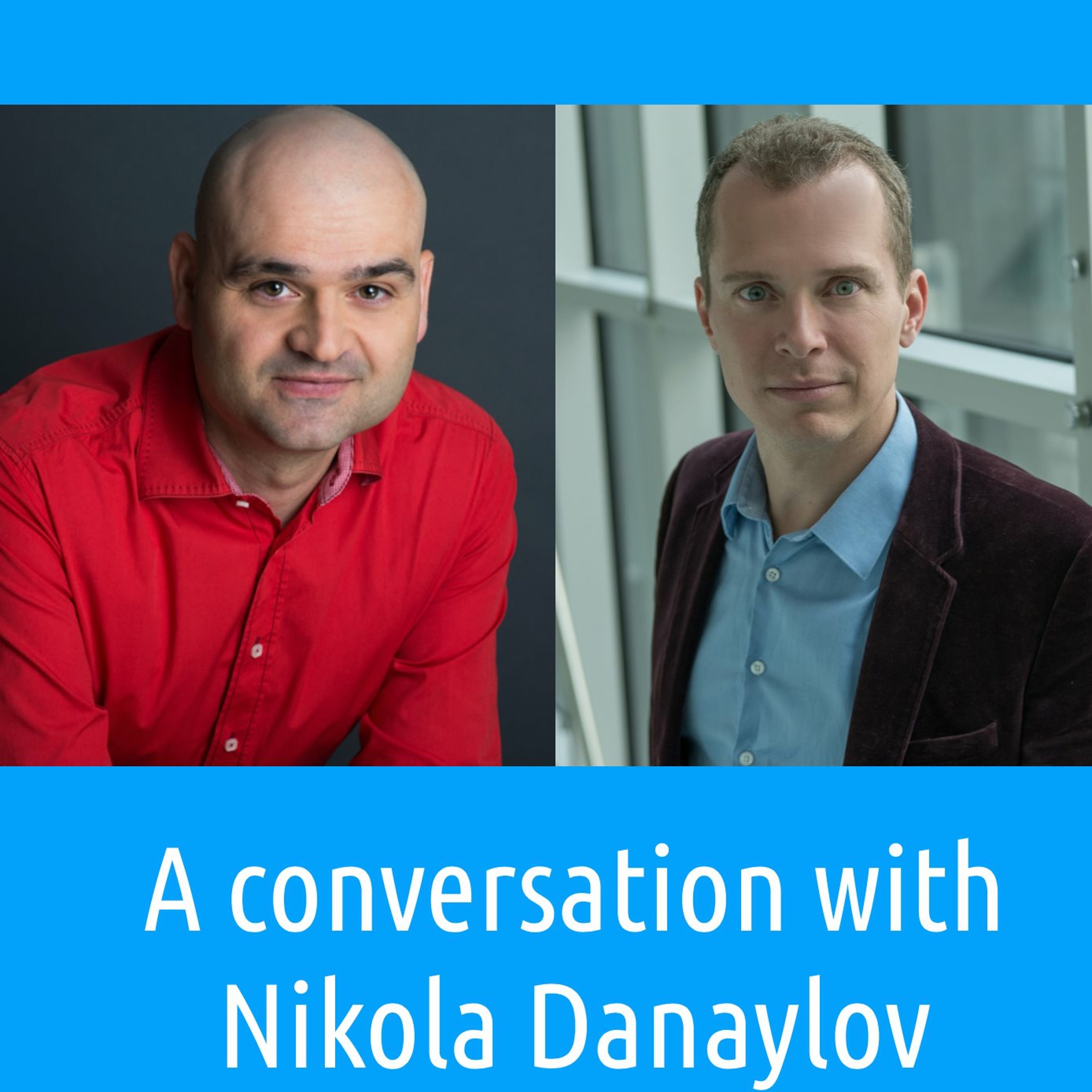
The Happy Ways Podcast with Jon Nielsen: Nikola Danaylov on COVID-19
Two days ago I was interviewed by Jon Nielsen of the fantastic Happy Ways Podcast. During this 50 min interview with Jon Nielsen, we cover a variety of interesting topics such as: why the world is not upside down yet and what are the most productive attitudes towards the current COVID-19 crisis; why the journey – i.e. how we are going somewhere, is perhaps as important as the destination – i.e. where we are going; examples of global, American and Canadian hoarding and what they say about who we are and where we are going; the distinction between what is urgent versus what is important; why we should beware the promises of shortcuts which often take double the time, money and effort while doing collateral damage; whether there could there be a silver lining to the current COVID-19 outbreak; Bill Gates’ seminal 2014 TED Talk about why we are not ready for a pandemic; why, as Mr. Rogers used to say, we should seek the helpers; why the world is one and old nationalist narratives are falling short; why it is crucial to live in neither denial nor panic. Find out more about Jon Nielsen on his podcasts: English: The HappyWays podcast, episode 33 For danish listeners: Podcasten RevolutJon!, episode 16 As always you can listen to or download the audio file above or scroll down and watch the video interview in full. To show your support you can write a review on iTunes, make a direct donation or become a patron on Patreon.
Former Commissioner Dr. Ann Cavoukian: Never give up on privacy!
Dr. Ann Cavoukian was Ontario’s Privacy Commissioner for unprecedented 17 years and held the position during 3 different provincial governments. About 7 years ago, while still in office, I interviewed Ann Cavoukian on her original concept of Privacy by Design. [PbD] So if you haven’t seen it yet it may be best to start by watching our previous conversation first because I will try not to repeat any of the questions that I asked last time. In the meantime, Cavoukian’s PbD has gone global and has been translated into 40 languages and implemented in the European GDPR legislation. During this 45 min interview with Dr. Ann Cavoukian, we cover a variety of interesting topics such as: the growth in understanding of the importance of privacy coinciding with the growth of surveillance; the moving story of how art saved the lives of her family during the Armenian genocide; the coronavirus pandemic, surveillance, privacy, and democracy; the racist and sexist false positives of facial recognition; the benefits of GDPR; Waterfront Toronto, Sidewalk Labs, and Toronto’s Smart City; the importance of data de-identification at source; upgrading the privacy laws in Canada; smart speakers such as Amazon’s Alexa; cryptography, software backdoors, and the keys-under-doormats campaign; PbD and AI Ethics. You can watch the full video interview here: https://www.singularityweblog.com/ann-cavoukian/
James W. Clement on the Switch: Longevity, Fasting, Protein Cycling and Keto
James W. Clement is a longevity researcher who was the 12th person on the planet to have his DNA sequenced. In 2010 James launched his Supercentenarian Research Study, which he started in 2010 with Professor George M. Church of Harvard Medical School. Since then Clement has read 20,000 medical research papers on longevity and has acquired one of the largest DNA databases of supercentenarians, the youngest of whom is 106 years old. Most recently James W. Clement is the author of the Switch: Ignite your metabolism with intermittent fasting, protein cycling, and keto. Finally, I know James personally and have gone to visit his previous research lab in Apple Valley, California, so I can honestly say that he is among the most humble humans and the hardest-working longevity researchers that I have ever seen. I have learned a lot from Clement and I hope you do too. During this 2 hour interview with James W. Clement, we cover a variety of interesting topics such as: Clement’s journey from being a lawyer to becoming a full-time longevity researcher; the name and story behind Better Humans; why James is a transhumanist; why we have to first make it to 100 before we start taking “magic pills”; the switch between mTOR and autophagy; the importance of intermittent fasting, its time and duration; the connection between gut bacteria and dopamine; why the biggest problem of our diet is the overconsumption of both dairy and meat; protein cycling and why we can’t sustain autophagy indefinitely; the dangers of coconut oil; why all centenarian blue zones in the world eat high-carb diets and why we should try keto. My favorite quote that I will take away from this interview with James W. Clement is: Activate the switch and cycle back and forth between mTOR and autophagy. And I have already started doing that in the past 2 days while editing the interview. As always you can listen to or download the audio file above or scroll down and watch the video interview in full. To show your support you can write a review on iTunes, make a direct donation or become a patron on Patreon. You can see the full video here: https://www.singularityweblog.com/james-w-clement-the-switch/
Nikola Danaylov at Dark Futures: NeoTechnocracy – The Future is Worse than You Think
This is the short closing speech I delivered at the 2019 Dark Futures meetup in Toronto. Not my finest speech but, since event organizer and futurist Nikolas Badminton kindly gave me a video of my keynote, I thought it may be good to share it publicly and get your critical feedback. Feel free to post your comments below. Title: NeoTechnocracy: The Future is Worse than You Think Description: Technology is the new religion, Silicon Valley is the new chosen land and entrepreneurs are the new chosen people. They promise a future that is better than we think – a techno-heaven of abundance and, naturally, immortality. And we are all believers now. But are we the masters, or are we the tools of our tools? Are we exhibiting religious fetishism for technological objects? Are we creating personality-cults around techno-prophets? Are we falling for new techno-religions – such as dataism? Is power in the hands of those behind, or those in front of the screen? If you want to read the full text of my speech or if you want to watch the video recording then go here: https://www.singularityweblog.com/neotechnocracy/
Former IBM Watson Team Leader David Ferrucci on AI and Elemental Cognition
Dr. David Ferrucci is one of the few people who have created a benchmark in the history of AI because when IBM Watson won Jeopardy we reached a milestone many thought impossible. I was very privileged to have Ferrucci on my podcast in early 2012 when we spent an hour on Watson’s intricacies and importance. Well, it’s been almost 8 years since our original conversation and it was time to catch up with David to talk about the things that have happened in the world of AI, the things that didn’t happen but were supposed to, our present as well as our future in relation to Artificial Intelligence. All in all, I was super excited to have Ferrucci back on my podcast and hope you enjoy our conversation as much as I did. During this 90 min interview with David Ferffucci, we cover a variety of interesting topics such as: his perspective on IBM Watson; AI, hype and human cognition; benchmarks on the singularity timeline; his move away from IBM to the biggest hedge fund in the world; Elemental Cognition and its goals, mission and architecture; Noam Chomsky and Marvin Minsky‘s skepticism of Watson; deductive, inductive and abductive learning; leading and managing from the architecture down; Black Box vs Open Box AI; CLARA – Collaborative Learning and Reading Agent and the best and worst applications thereof; the importance of meaning and whether AI can be the source of it; whether AI is the greatest danger humanity is facing today; why technology is a magnifying mirror; why the world is transformed by asking questions. My favorite quotes that I will take away from this conversation with David Ferrucci is: Let our imagination drive the expectation for what AI is and what it does for us! As always you can listen to or download the audio file above or scroll down and watch the video interview in full. To show your support you can write a review on iTunes, make a direct donation or become a patron on Patreon. You can watch the full video interview here: https://www.singularityweblog.com/david-ferrucci/
Katy Cook on The Psychology of Silicon Valley
Katy Cook‘s recent book the Psychology of Silicon Valley: Ethical Threats and Emotional Unintelligence in the Tech Industry is a must-read for anyone interested in understanding the conflicting motivations, mythologies, identities and inherent tensions within Silicon Valley. It offers a unique understanding as per why we have seen the magic, manic and monstrous trajectory of Big Tech, it catalogs what the impact has been, and it offers a way forward. All in all, I learned a ton from Katy Cook and loved having her on my podcast. In fact, I honestly feel that I didn’t do justice to how absolutely fantastic her book is so I highly recommend that you simply go and grab a free copy of the Psychology of Silicon Valley and judge for yourselves. During this 1 h 40 min interview with Katy Cook, we cover a variety of interesting topics such as: her original interest in the mental health effects of tech; her journey from being a counselor to studying psychology, sociology, the psychology of progress and ending up in ethics in tech; the relationship between power and empathy; her fantastic book the Psychology of Silicon Valley; the importance of socializing oneself without the mediation of a computer; emotional intelligence as a foundation for ethics; how origin stories and culture shape tech companies; why intelligence is a gift but compassion is a choice; why Katy decided to give away the electronic version of her book as a free open access; the treatment of workers by Big Tech such as Amazon; inequality as the best predictor for revolution; the importance of diversity; why Instagram is the most depressed and depressing platform; the vulnerability of young adults and children to social media; the Center for Technology Awareness that Katy co-founded.
Cathy O’Neil on Weapons of Math Destruction: How Big Data Threatens Democracy
Cathy O’Neil is a math Ph. D. from Harvard and a data-scientist who hopes to someday have a better answer to the question, “what can a non-academic mathematician do that makes the world a better place?” In the meantime, she wrote a seminal book titled Weapons of Math Destruction: how big data increases inequality and threatens democracy. In my view, this is a must-read book for anyone who thinks that algorithms are by definition a fair and unbiased way to produce a given result. As O’Neil notes in her TED Talk: “the era of blind faith in big data must end.” (Yuval Harari calls this religious belief a new techno religion – aka dataism.) During this 90 min interview with Cathy O’Neil, we cover a variety of interesting topics such as: Cathy’s path to and love of Math; Manifest Destiny, American Exceptionalism and why we don’t count the dead With God On Our Side; how and why she became a hedge-fund quant; trusting and fearing the authority of math; why her book is titled Weapons of Math Destruction; Andrew “Boz” Bosworth’s ugly memo that Facebook’s actions were ‘de facto good’ – even if they led to deaths; Mark Zuckerberg’s good for the world but not good for Facebook email; the inherent biases and flaws of PredPol and other Minority Report type of predictive software; AI and the singularity; why intelligence is more than information retrieval; techno-solutionism and why technology is not enough; ethics and accountability; a Hippocratic oath for data scientists and engineers; why I believe that Instagram is among the worst weapons of math destruction; why technology is a magnifying mirror. My favorite quotes that I will take away from Cathy O’Neil’s Weapons of Math Destruction are: “Algorithms are opinions embedded in code” “Big Data processes codify the past. They do not invent the future. Doing that requires moral imagination. And that’s something only humans can provide.” As always you can listen to or download the audio file above or scroll down and watch the video interview in full. To show your support you can write a review on iTunes, make a direct donation or become a patron on Patreon. You can watch the full video here: https://www.singularityweblog.com/weapons-of-math-destruction/
Technology is a Magnifying Mirror, Not a Crystal Ball
The most popular myth about technology is perhaps the myth that technology is a crystal ball. A crystal ball because it allegedly allows us to see the future. And to evaluate if that is indeed true, or not, we have to understand the etymology of the word technology – what it means and stands for, or at least what it used to mean and stand for. The word technology comes from two Greek words – techne and logos. Techne means art, skill, craft, or the way, manner, or means by which a thing is gained. Logos means word, the utterance by which inward thought is expressed, a saying, or an expression. So, literally, technology means words or discourse about the way things are gained. In other words, technology is merely “how” we do things and not “why” we do them or “what” we should be doing. Because it is not an end in itself but rather merely a means to an end. So technology is not a crystal ball because it does not help us see the future. Instead, technology is a magnifying mirror because it merely reflects our present and, more importantly, who we are. Technology is a mirror because it reflects the engineers, designers, and programmers who make it. But it is also a mirror to humanity in general and all of our collective dreams, hopes and fears, our knowledge and our ignorance, our strengths, and weaknesses, our good, and our evil. But it is not a normal kind of mirror because technology magnifies and amplifies things – so it always has unforeseen consequences. And the key point here is that technology doesn’t have an essence of its own because it merely reflects our own essence. So, instead of focusing exclusively on polishing the mirror – i.e. improving technology, we might want to invest some time and resources on improving the image we ourselves project in it – i.e. who we are being, what we are doing and why we are doing it. Therefore, ultimately, it is not about technology. It’s about us. Read the rest here: https://www.singularityweblog.com/technology-is-a-magnifying-mirror/
Gary Marcus on Rebooting AI: Building Artificial Intelligence We Can Trust
It’s been 7 years since my first interview with Gary Marcus and I felt it’s time to catch up with him. Gary is the youngest Professor Emeritus at NYU and I wanted to get his contrarian views on the major things that have happened in AI as well as those that haven’t happened. Prof. Marcus is an interesting interviewee not only because he is an expert in the field but also because he is a skeptic on the current approaches to and progress towards Artificial General Intelligence but an optimist that we will eventually figure it all out. During this 90 min interview with Gary Marcus we cover a variety of interesting topics such as: Gary’s interest in the human mind, natural and artificial intelligence; Deep Mind’s victory in Go and what it does and doesn’t mean for AGI; the need for Rebooting AI; trusting AI and the AI chasms; Asimov’s Laws and Bostrom’s paper-clip-maximizing AI; the Turing Test and Ray Kurzweil’s singularity timeline; Mastering Go Without Human Knowledge; closed vs open systems; Chomsky, Minsky and Ferrucci on AGI; the limits of deep learning and the myth of the master algorithm; the problem of defining (artificial) intelligence; human and machine consciousness; the team behind and the mission of Robust AI. As always you can listen to or download the audio file above or scroll down and watch the video interview in full. To show your support you can write a review on iTunes, make a direct donation or become a patron on Patreon.