Singularity.FM
Singularity.FM is the first and best known singul…
Nikola Danaylov · Singularity.FM
Show overview
Singularity.FM has been publishing since 2015, and across the 11 years since has built a catalogue of 337 episodes. That works out to roughly 380 hours of audio in total. Releases follow a fortnightly cadence.
Episodes typically run an hour to ninety minutes — most land between 45 min and 1h 27m — though episode length varies meaningfully from one episode to the next. None of the episodes are flagged explicit by the publisher. It is catalogued as a EN-language Technology show.
The show is actively publishing — the most recent episode landed 3 weeks ago, with 8 episodes already out so far this year. The busiest year was 2015, with 183 episodes published.
From the publisher
Singularity.FM is the first and best known singularity podcast - the place where we interview the future. Singularity.FM is a series of singularity podcast interviews with the best scientists, writers, entrepreneurs, film-makers, philosophers and artists, debating issues such as the technological singularity, transhumanism, artificial intelligence, life-extension and ethics. Past guests of this singularity podcast include people such as Ray Kurzweil, Peter Diamandis, Noam Chomsky, Stuart Hameroff, Marvin Minsky, Aubrey de Grey, Max More, Michio Kaku, Vernor Vinge, Cory Doctorow, Charles Stross and many, many others.
Latest Episodes
View all 337 episodesJulia Lampert on Becoming AI Native
The Singularity Is a Story, Not a Prison: My Philosophy Portal Interview with Cadell Last
The Great Progression: Peter Leyden on AI, Trump and the Next 25 Years
Steven Kotler on We Are As Gods

We Don’t Need More. We Need Better: Intelligence Scales. Wisdom Does Not.
We don’t need more AI. We need a better why for our AI. We are told the why is obvious — cure everything, fix everything, transcend everything. But “solve everything” is not a philosophy. It is an assumption. Even the most powerful intelligence cannot erase moral disagreement or competing visions of justice. Because without a why, intelligence becomes acceleration without direction. It helps us get lost faster. Technology amplifies intention. It does not supply it. It is a magnifying mirror, not a moral compass. If we don’t know our destination, no wind is favorable. We don’t need more innovation. We need better reflection. Innovation without reflection is just motion. And motion is not progress. We have mastered the art of building; we have neglected the discipline of asking whether what we build serves us — or enslaves us. We don’t need more power. We need more discipline in how we apply it. Every generation believes it deserves its tools. Few ask whether they deserve the consequences. Power scales impact. It does not scale wisdom. We don’t need more data. We need better judgment. Data tells us what is. Wisdom asks what ought to be. The distance between the two is where civilizations mature — or collapse. We don’t need more influencers. We need better thinkers. Noise is easy. Leadership is rare. Influence chases attention. Thinking demands responsibility. We don’t need more. We need to do better — with less. Less distraction. Less ego. Less blind acceleration. And perhaps most importantly: We don’t need fewer problems. We need to become better people. Problems are inevitable. Character is optional. We don’t need to live forever. We need to live better — to do better, be better, give better, and listen better. Longevity without meaning is extended entropy. The real question is not how long we live but whether our lives compound into something worth extending. The future will not be decided by how much we can build. It will be decided by who we become while building it. Intelligence scales. Wisdom does not. More is inevitable. Better is a choice.

Why I Cancelled ChatGPT and Switched to Claude, And Why You Should Too
I cancelled my ChatGPT paid subscription and switched to Claude. Not because of the technology. Because of the values — or the lack thereof. On February 27, 2026, Anthropic — the company behind Claude — refused to give the Pentagon unrestricted access to its AI for mass surveillance and autonomous killer weapons. Anthropic's CEO Dario Amodei said plainly that he "cannot in good conscience" accede to a deal that would remove safeguards against domestic mass surveillance and fully autonomous weapons systems. Within hours, OpenAI's Sam Altman swooped in and took the deal. Let that sink in. One company held the line. The other sprinted to cross it. And just like that, the two biggest players in AI revealed exactly who they are. I've spent the last 17 years interviewing the world's leading thinkers on artificial intelligence on Singularity.FM — scientists, philosophers, entrepreneurs, artists, writers — brilliant people wrestling with the most consequential questions of our time. One question has always haunted every conversation: What kind of future are we actually building? Not the future we're promising. Not the future we're marketing. The future we're actually building — through our choices, our partnerships, our deals, the things we do, and the things we refuse to do. Well, here's your answer. This isn't just about one deal. It's about a pattern. OpenAI's president Greg Brockman and his wife donated $25 million to Trump's Super PAC, MAGA Inc — making them the single largest donors in the most recent report. OpenAI is the top spender behind a $125 million AI Super PAC that attacks anyone who threatens to regulate them. Meanwhile, psychiatrists are documenting "AI psychosis" — users losing touch with reality after extended chatbot interactions. And now, OpenAI is preparing to add advertisements to ChatGPT. What was once a mission-driven organization, founded as a nonprofit to develop AI for the benefit of all humanity, has abandoned that founding purpose to pursue money, political power, and Pentagon contracts. Over 1.5 million people have already cancelled or stopped using ChatGPT as part of the growing #QuitGPT movement. Claude is now the number 1 download on the App Store. OpenAI is already losing three times as much money as it earns. ChatGPT's dominance is not inevitable. It is fragile. And fragile systems respond to pressure. Cancel your ChatGPT subscription. Switch to Claude. And join the movement at https://quitgpt.org The question has never been whether AI will change the world. The question is who gets to decide how. Right now, you have a vote. Use it.
Ada Palmer on Inventing the Renaissance: How Golden & Dark Ages Are Constructed and Why They Matter
Was the Renaissance truly a Golden Age? Or was it something far more powerful — and far more revealing? In my third conversation with Ada Palmer, we dive into her new book, Inventing the Renaissance: Myths of a Golden Age, and dismantle one of the most enduring myths in Western history: that civilization moves cleanly from darkness to light. This is our third long-form discussion. If you’re new to our conversations, I highly recommend revisiting our earlier interviews here and here, which lay the groundwork for this one. But this episode isn’t really about the Renaissance. It’s about how societies construct Golden Ages and Dark Ages — and how those narratives shape power, legitimacy, and the future. The Renaissance Was Framed, Not Found “Renaissance” means rebirth. But rebirth implies death. To celebrate a Golden Age, you must first invent a Dark Age. As Ada explains, these labels were not objective descriptions. They were rhetorical tools — created by Petrarch, humanists, political actors, and later historians to legitimize their present by reshaping the past. Golden Ages are not natural phenomena. They are narratives. And narratives confer power. Why This Still Matters We do this today. We speak of: The Age of AI The End of Democracy Civilizational Collapse The Fourth Industrial Revolution Utopia and dystopia are modern versions of Golden and Dark Ages. In my essay Ignorance Is the Greatest Evil, I argue that certainty fused with power is more dangerous than malice. Golden Age narratives often operate with precisely that certainty — simplifying complexity into moral clarity. But history is rarely simple. The Renaissance itself was violent, unstable, and deeply unequal — even as it produced extraordinary art and ideas. It was neither purely Golden nor purely Dark. It was human. Manifestos, Dilemmas, and the Future Years ago, I wrote a transhumanist manifesto. It was confident, clear, and certain. Later, I returned to doubt. In Transhumanist Manifestos and Dilemmas, I reflected on how manifestos mobilize action but often erase complexity. Golden Age narratives function the same way: they inspire and legitimize — but they also oversimplify. Ada’s work does not replace one myth with another. It teaches us to question every myth — including the one we may believe we are living in now. The Real Question Are we progressing? Or are we narrating progress? Is AI our Renaissance — or will future historians label this era differently? Golden and Dark Ages are not objective states of civilization. They are constructed lenses. And once those lenses become embedded in institutions, technologies, and political movements, they stop being stories and start shaping reality. That is why they matter. Listen to our full 3-hour conversation. Then ask yourself: Who is framing our present as a Golden Age — or a Dark Age — and to what end? You can watch the full video here: https://www.singularityweblog.com/ada-palmer-inventing-the-renaissance/
Graham Priest on Dialetheism, True Contradictions, the Liar Paradox & Why Classical Logic Isn’t Enough
What if some contradictions are not mistakes — but truths? For over 2,500 years, Western philosophy has treated contradiction as catastrophic. From Aristotle’s law of non-contradiction to modern formal systems, logic has operated under one sacred assumption: a statement cannot be both true and false. But what if that assumption is wrong? In this deep, wide-ranging conversation, I sit down with Graham Priest, one of the world’s most influential philosophers of logic and the leading defender of dialetheism — the view that some contradictions are true. We explore: What dialetheism really means Why the liar paradox still unsettles logicians How paraconsistent logic blocks “explosion” (the idea that from a contradiction, anything follows) Whether classical logic is incomplete rather than universal What Buddhist philosophy and Nāgārjuna understood about contradiction And whether AI systems may eventually require non-classical logics to model human reasoning Far from being an abstract puzzle, the liar paradox exposes deep tensions in how we understand truth, self-reference, and rationality itself. If contradictions can be true, then the foundations of logic, mathematics, metaphysics — and even artificial intelligence — may need rethinking. We also move beyond formal systems into lived philosophy: Graham’s journey from Christianity to atheism His engagement with Buddhist thought The limits of decision theory The discipline of karate as a philosophical practice This is not merely a discussion of symbolic logic. It is a conversation about the limits of reason. About what happens when our most trusted intellectual tools reach their breaking point. And about whether embracing contradiction might expand — rather than destroy — rational inquiry. If your background is in technology, computer science, AI, or engineering, this episode may challenge assumptions you didn’t even realize you were making. If your background is in philosophy, it may unsettle what you thought was settled. And if you care about the future of thought itself, this conversation is essential. You can see the original video recording here: https://www.singularityweblog.com/graham-priest-dialetheism/ As always, you can listen to or download the audio file above or scroll down and watch the video interview in full. To show your support, you can write a review on iTunes, make a direct donation, or become a patron on Patreon.
Breaking: Did Integral AI’s Jad Tarifi Just Announce AGI?
In my latest Singularity.FM conversation with Dr. Jad Tarifi, CEO of Integral AI, I heard something I don’t say lightly: a credible claim that AGI may have just arrived — or at least the foundation of it. I don’t often say “Wow” during interviews, but in this one I simply couldn’t stop. Tarifi describes a new AGI-capable model built on an architecture and learning paradigm fundamentally different from today’s large language models, and he argues it can scale toward artificial general intelligence at human-level energy efficiency. If you haven’t seen our first interview, I strongly recommend watching it first — it provides the context that makes this one hit even harder. At the heart of Tarifi’s announcement is a shift from prediction-only LLMs to an abstraction-first world model designed explicitly for AGI. Instead of cramming benchmarks, his system compresses knowledge into deep conceptual structures and then re-derives understanding when needed — a hallmark of genuine general intelligence. Layered on top is a new Interactive Learning loop: planning, taking action, generating its own training data, “dreaming” to consolidate memories, and continually updating its own weights without catastrophic forgetting. According to Tarifi, this is what allows the model to actually learn — not just infer — the way a true AGI must. Tarifi also introduces a concrete approach to AGI alignment, grounded not in rules or filters but in maximizing collective agency — freedom — for individuals and the whole. The AGI evaluates simulated futures and chooses actions that increase our ability to know, choose, act, and renew ourselves. This becomes the moral foundation for what he calls the Alignment Economy, where value is tied to how much an action increases or decreases absolute human freedom. All of this feeds into a larger AGI-driven vision: the Supernet, a global network of embodied AGI agents coordinating factories, robots, labs, homes, and infrastructure to turn human intentions into real-world outcomes. In Tarifi’s view, AGI isn’t just a digital mind — it’s an embodied, operational intelligence capable of reshaping how we work, build, learn, and create. Whether you believe this is the moment AGI truly begins or simply the start of a new chapter in the race toward artificial general intelligence, one thing is certain: Tarifi’s announcement represents a serious, technically grounded break from the “just scale LLMs harder” era. If you’re interested in AGI, this is one conversation you don’t want to miss. As always, you can listen to or download the audio file above or scroll down and watch the video interview in full. To show your support, you can write a review on iTunes, make a direct donation, or become a patron on Patreon.
Jacob Ward on The Loop, AI, and a World Without Real Choices
What happens to free will in a world where AI tells us what to watch, buy, believe, and even who to love? In this new episode of Singularity.FM, I sit down with Jacob Ward — veteran technology journalist and author of The Loop: How AI Is Creating a World Without Choices and How to Fight Back — to ask a deceptively simple question: what is a choice, and what happens when we quietly hand that power to machines? Jake argues that AI is doing to our decision-making what Google Maps did to our sense of direction: turning a hard-won human capacity into a service layer we outsource by default. Drawing on decades of reporting from Silicon Valley, behavioral science labs, addiction research, and the front lines of “decision technology,” he shows how our brains are shortcut engines that love to offload hard thinking — and how AI, optimized for engagement and profit, exploits that instinct to narrow our options, dull our skills, and automate even our moral judgments. We dig into the psychology that makes us so hackable, the business models that reward “decision outsourcing,” and the cult-like belief that adding AI to anything automatically makes it better. But we also talk about what we can still do — culturally, politically, and personally — to defend human autonomy, preserve difficult choices, and protect the “friction” that makes life meaningful rather than merely efficient. In this conversation with Jacob Ward, we explore: Who Jacob Ward is and how a tech reporter became obsessed with the psychology of choice and AI The core thesis of The Loop: how AI and decision-shaping tech are shrinking the space in which real human choice lives What a “choice” actually is, why it’s rare, and how much of our lives run on unconscious autopilot The brain as a shortcut machine: why we naturally try to offload heavy cognitive work — and how apps, platforms, and algorithms weaponize that Story as both poison and cure: how narrative explains our addictions, identities, and blind spots The chilling dinner with addiction scientists hired to make consumer apps as addictive as possible Why we outsource hard moral decisions (hiring, lending, welfare, bail, custody) to opaque algorithms we don’t understand Google Maps, Spotify, Netflix & co: from convenience to skill-loss and dependency ChatGPT and the new AI wave: why Jake thought he was early, and why the cult of AI “solutionism” worries him more than the tech itself “AI will fix everything” as the ultimate cop-out: from politics and climate to governance and war Great ideas we shouldn’t pursue: the missing virtue of restraint in tech culture Stoicism, free will, and “loving fate” versus outsourcing it to machines Cultural resistance: kids calling AI “clankers,” the return of film cameras, and the hunger for authentic creativity Legal and regulatory pushback: psychological harm, AI distortion, and why insurers are already nervous How we can still fight back: defending autonomy, re-valuing effort and difficulty, and protecting the best parts of being human If you care about AI, ethics, free will, and the future of human agency, this conversation with Jacob Ward is a bracing reality check — and a reminder that protecting our ability to choose may be the most important design problem of the 21st century.
Robot Souls & Junk Code Dr. Eve Poole on Programming Humanity into AI
Robot Souls & Junk Code Dr. Eve Poole on Programming Humanity into AI by Nikola Danaylov
Petter Törnberg: Algorithmic Tyranny & Digital Modernity
What do Facebook, Google, and TikTok really see when they look at us — and what do they miss? In this episode of Singularity.FM, Nikola Danaylov (aka Socrates) interviews Petter Törnberg, Assistant Professor of Computational Social Science at the University of Amsterdam and co-author of Seeing Like a Platform: An Inquiry into the Condition of Digital Modernity. Together they explore: How platforms have become the new eyes of power Why algorithms don’t just mirror society — they reshape it The dangers of algorithmic tyranny and invisible control The shift from industrial modernity to digital modernity Why self-organization often hides new forms of hierarchy Whether AI will become the ultimate platform of platforms How citizens, activists, and policymakers can still resist 📘 Petter’s books: Seeing Like a Platform (2025) Intimate Communities of Hate (2024) You can watch the full video recording here: https://www.singularityweblog.com/petter-tornberg/
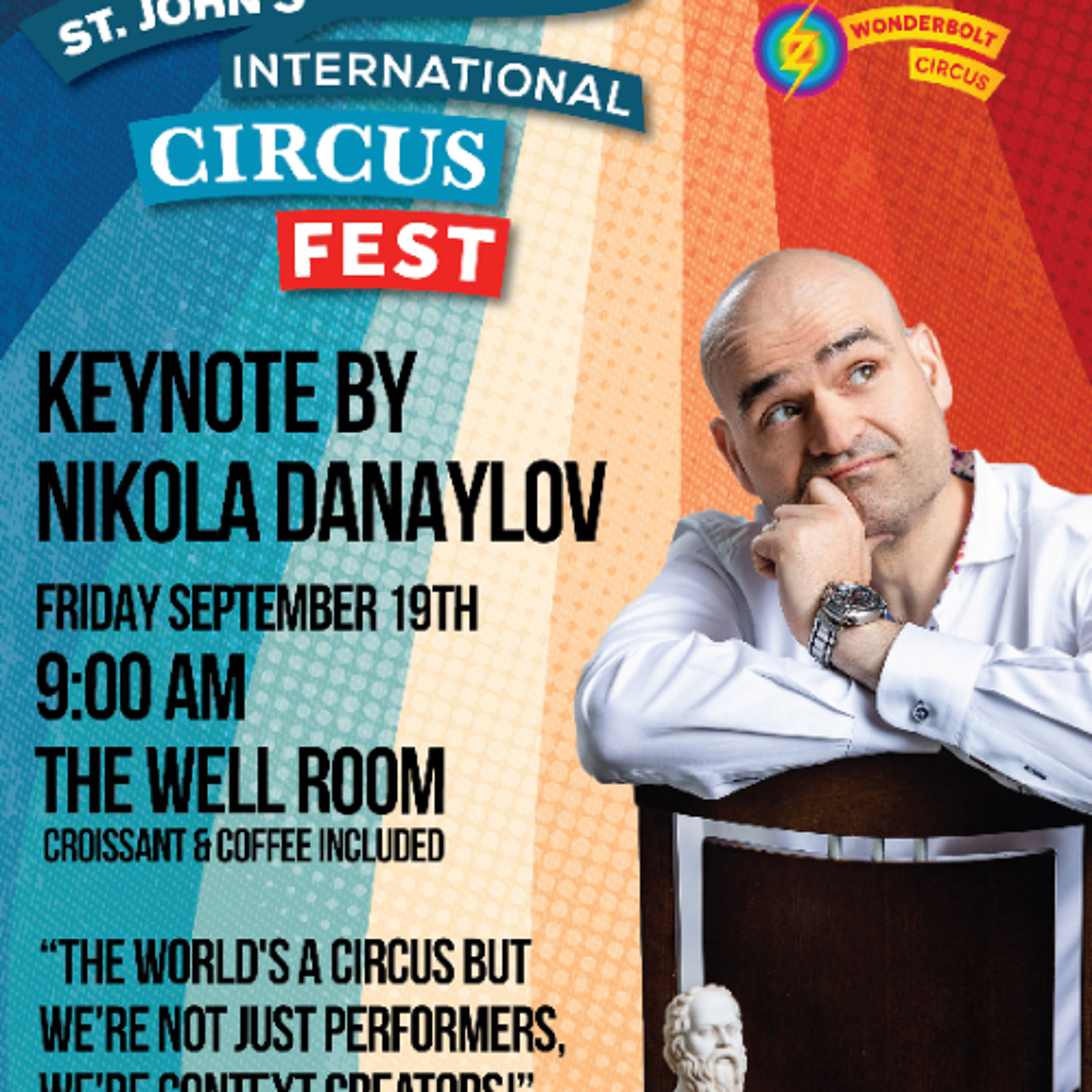
The World’s a Circus | Nikola Danaylov Keynote at St. John’s Circus Fest 2025
What if the world isn’t just a stage… but a circus? 🎪 In this opening keynote at St. John’s International Circus Fest 2025, futurist and philosopher Nikola Danaylov (aka Socrates) explores why context is more powerful than content — and why those who create context don’t just win attention, they shape the future. 👉 Themes you’ll hear in this talk: Content vs. Context — why meaning, not information, defines value. STEAM over STEM — reuniting science with the arts and humanities. AI & Human Flourishing — why technology is the how, not the why. The Circus Metaphor — resilience, artistry, and transformation as lenses for our times. From Performer to Context Creator — how we can reframe the future together. 📍 Recorded live at The Well Room, St. John’s, NL on September 19, 2025. The World’s a Circus but We’re Not Just Performers, We’re Context Creators! In an age of AI-generated content, infinite data, and algorithmic noise, what truly sets us apart as human beings? In this powerful, playful, and thought-provoking keynote, futurist and bestselling author Nikola Danaylov argues that the answer is not more content—but better context. Through storytelling, neuroscience, history, and circus arts, Nikola reveals how context is the invisible force that shapes perception, meaning, and ultimately, the future. Drawing on everything from Renaissance humanism and McLuhan’s media theory to personal stories and plastic horse heads, this keynote challenges the myth that “content is king.” Instead, Nikola shows why meaning—not data—is our greatest asset. And circus? It’s not just performance. It’s a living metaphor for risk, awe, vulnerability, and transformation. You’ll walk away seeing circus—and your own work—not as entertainment or output, but as a vehicle for reframing reality itself. Because when you change the context, you change the story. And when you change the story… you change the future.
Adam Becker on More Everything Forever and Big Tech’s Future Myths
Adam Becker is a science journalist with a PhD in astrophysics and the author of the provocative new book More Everything Forever: AI Overlords, Space Empires, and Silicon Valley’s Crusade to Control the Fate of Humanity. I reached out to Adam because I found his book sharp, timely, and necessary — a long-overdue reality check to the fantasies of techno-utopianism flooding our culture. In More Everything Forever, Becker dissects the dominant visions of the future being sold by Silicon Valley’s billionaire elite: godlike AI, digital immortality, interstellar empires, and a future populated by trillions of posthuman minds. His thesis? These aren’t scientific forecasts. They’re billionaire fever dreams—ideological weapons dressed up as inevitabilities. Drawing on over fifteen years as a science communicator and journalist, Becker traces how a fringe worldview — steeped in misunderstood sci-fi, hubris, and colonialist logic — has moved from the internet’s margins into university labs, government hearings, and mainstream media. We discuss why these ideas aren’t just wrong; they’re dangerous distractions from the real crises we face: war, climate change, inequality, and a fraying shared reality. So, if you’ve ever questioned the hype around AI overlords, Mars colonies, or techno-salvation, this conversation is for you. I hope you enjoy my interview with Adam Becker as much as I did. My favorite quotes from this conversation with Adam Becker are: Silicon Valley has confused science fiction with science — and science with branding. We are solving imaginary future problems while the world burns right in front of us. AI overlords, Mars colonies, and posthuman utopias aren’t visions of the future. They’re distractions from the present. See the video here: https://www.singularityweblog.com/adam-becker/
Angus Fletcher on Storythinking and Primal Intelligence
In his second appearance on Singularity.FM, Professor Angus Fletcher returns to dive even deeper into the story of human intelligence. [See the first interview here.] Fletcher is no ordinary guest. A rare hybrid of neuroscientist and Shakespearean scholar, he has advised DARPA, Hollywood, and the U.S. Army, where his narrative-based research earned him the Commendation Medal for groundbreaking work with Special Operations. In this wide-ranging conversation, we explore the core ideas behind his bestselling book “Storythinking” and his upcoming book “Primal Intelligence” (Penguin, 2025) — and why story is not just for telling, but for thinking. We unpack how story rewires our brains, restores purpose, and can even help individuals — and entire nations — reclaim their agency in an increasingly automated world. You’ll learn: Why narrative, not logic, is humanity’s true superpower. How imagination, intuition, emotion, and common sense form a “primal intelligence” that Angus believes AI will never replicate. Why content isn’t king — context is. How “plot twists” can transform trauma into growth — individually and collectively. What happens when the U.S. military tests ancient storytelling theories on modern warriors. From ancient wisdom literature to cutting-edge neuroscience, from baking bread with ChatGPT to surviving in war zones, this conversation doesn’t just span disciplines — it connects the dots that matter most to our future. This interview is not about AI. It is about being human in the age of AI.
Donald J. Robertson on How to Think Like Socrates in the Age of AI
In this episode of Singularity.FM, I sit down with renowned author and philosopher Donald J. Robertson to explore his latest book, How to Think Like Socrates. As we navigate the crossroads of ancient wisdom and modern challenges, Donald shares timeless insights from Socrates that remain profoundly relevant in today’s age of rapid technological transformation and AI. We dive into the art of critical thinking, the value of questioning assumptions, and the ethical considerations of integrating philosophy with cutting-edge innovation. About halfway through our conversation, Donald turns the tables and starts asking me some Socratic questions, sparking a dynamic and thought-provoking exchange that takes the discussion to new depths. Together, we tackle big questions: What can Socrates teach us about living wisely in a world dominated by AI? How do we balance our pursuit of knowledge with the necessity of wisdom? And how do ancient philosophical techniques help us confront the uncertainties of our time? Whether you’re a fan of philosophy, curious about the future, or looking to deepen your understanding of critical thinking in the digital age, this episode offers a rich dialogue packed with insights and practical takeaways. Join us as we explore the enduring legacy of Socrates and its implications for humanity’s evolving relationship with technology. You can watch the full video interview here: https://www.singularityweblog.com/donald-j-robertson/
Near Futurist Neil Redding on Co-Creating Reality
In this episode of Singularity.FM, Neil Redding, a near futurist and innovation architect, joins Nikola Danaylov for an insightful exploration into the intersections of technology, ecosystems, and human agency. With over 30 years of experience unlocking the transformative power of emerging technologies, Neil offers a fresh perspective on what it means to co-create reality in an increasingly interconnected world. Throughout the conversation, Neil discusses his journey from studying computer science and philosophy to becoming a thought leader in near futurism. He explains how his work bridges the possible and the practical, helping brands and individuals adapt to the rapid pace of technological change. Topics covered include the implications of spatial computing, the convergence of digital and physical ecosystems, and the role of AI in shaping our collective future. Neil also delves into the ethical dimensions of innovation, emphasizing the need for ecosystem-centered thinking and responsible co-creation. Together, Nikola and Neil examine humanity’s greatest challenges, from polarization to sustainability, offering actionable insights on how to navigate the accelerating future. Don’t miss this compelling dialogue that challenges conventional thinking and invites us all to participate in shaping the future. Tune in for an engaging and thought-provoking episode. If you want to see the full video interview, click here: https://www.singularityweblog.com/neil-redding
Dr. Jad Tarifi of Integral AI: “We Now Have All the Ingredients for AGI”
In this thought-provoking episode of Singularity.FM, I sit down with Dr. Jad Tarifi, CEO and co-founder of Integral AI, to explore the cutting-edge developments at the intersection of artificial intelligence and human potential. Dr. Tarifi shares insights into Integral AI’s mission to create foundation world models for real-world applications and the profound implications of achieving artificial general intelligence (AGI). Our conversation delves into a wide array of topics, including: The essence of intelligence and its evolution into artificial and general forms. The challenges of AGI alignment and the importance of fostering collective human wisdom. Dr. Tarifi’s personal journey from growing up in war-torn Lebanon to becoming a pioneer in AI. The philosophical and practical dimensions of art, science, and technology as co-authors of our shared reality. Why Integral AI believes we now have all the components necessary to achieve AGI—and what that means for humanity’s future. Dr. Tarifi’s perspective is not only informed by his extensive academic and professional background but also deeply rooted in his lifelong curiosity about the nature of reality. He emphasizes that AGI is not the endpoint but a new beginning for humanity, offering unprecedented opportunities and risks. Join us for a compelling discussion that challenges conventional thinking and illuminates the path toward a future shaped by the convergence of intelligence, creativity, and freedom. You can see the full video interview here: https://www.singularityweblog.com/jad-tarifi/
Jamelle Lindo on Emotional Intelligence in the Age of AI: Harness the Power of Emotion
In this episode of Singularity FM, I speak with emotional intelligence (EQ) expert, executive coach, and keynote speaker Jamelle Lindo about the evolving role of EQ in our age of rapidly advancing artificial intelligence. While much of today’s discourse around AI focuses on technical prowess, data-driven decision-making, and automation, Jamelle highlights why understanding our inner emotional landscapes—and those of others—may be more critical now than ever. We begin by tracing Jamelle’s personal journey, from his early struggles with social anxiety and insecurity to discovering the power of emotional literacy. Rather than seeing emotions as messy obstacles, he learned to view them as valuable sources of data about our values, needs, and mental states. That realization informed his personal development and later became the cornerstone of his approach to leadership coaching. Throughout our conversation, Jamelle demystifies emotional intelligence, why it’s trainable, and how it can provide a critical edge for those navigating the complexity and uncertainty of the 21st century workplace. As technological tools—from AI-assisted apps to predictive analytics—reshape every industry, leaders who cultivate empathy, self-awareness, and emotional resilience will stand apart. Jamelle explains that EQ isn’t a “soft” or “nice-to-have” skill; it’s a strategic capability that underpins effective communication, talent development, organizational culture, and business outcomes. We also discuss how AI might both challenge and enhance our EQ. On the one hand, automated systems can handle routine tasks and provide objective data, freeing up humans to focus on what we do uniquely well: build trust, inspire teams, and tackle nuanced ethical dilemmas. Conversely, the potential rise of “emotionally intelligent” AI agents forces us to ask: what does it mean to be human in an era where technology can mimic and sometimes surpass our cognitive and emotional capabilities? Join us as we explore how to cultivate deeper emotional intelligence amid exponential change, what it takes to show up authentically as a leader, and how EQ might help us maintain a truly human edge in a future where humans and AI increasingly work side by side. You can see the full video interview here: https://www.singularityweblog.com/jamelle-lindo/

Transhumanist Manifestos and Dilemmas: A Decade and a Half of Reflection
Fifteen years ago, I penned the first versions of Hamlet’s Transhumanist Dilemma and A Transhumanist Manifesto. Much has changed since then, including my perspective. I began with a question inspired by Hamlet: Will technology replace biology? At the time, I believed this to be the modern iteration of Shakespeare’s existential query: to be or not to be. Since death is a tragedy, I believed technology was our only escape. Yet, I feared choosing technology over biology might exact a heavy toll—a Faustian bargain. I worried that transitioning from human to transhuman—or cyborg—might cost us something precious and unique, something not worth trading even for immortality. Hence, I titled the piece Hamlet’s Transhumanist Dilemma, believing there was no definitive answer and that each person must determine their own path. A few months later, convinced I had found the answer, I dove headfirst into transhumanism. Everything seemed straightforward—black and white. As Transhumanist Party Chairman Gennady Stolyarov II succinctly put it: “Death is wrong, and life is right.” Right. The issue with dilemmas is their lack of clear answers. They are uncomfortable and excellent at posing questions but poor at providing solutions. In contrast, manifestos leave no room for doubt. They are straightforward calls to action, confident in their solutions. Immersed in the transhumanist narrative, I wrote my manifesto, urging my fellow transhumanists to unite and break the ‘chains of biology and death.’ Fifteen years later, I find myself almost back where I began. [I guess, at least in some ways, life is a circle.] Yes, it is still true that dilemmas may not offer clear guidance, but they are authentic, raw, and honest. They reflect the complexity of our world—a world without a GPS to guide us into the future, where answers are often free, but good questions are priceless. Dilemmas call for introspection, while manifestos call for action. Manifestos are idealistic, romantic and convenient. Worse, they are often naïve, simplistic, and utopian—dangerously so. They inspire focus and action but frequently lack introspection and justification. Perhaps I’m getting old, but lately, I see much action taken without much introspection. The kind of action that is ready to use violence to build a new world on the ruins of the current one. Yet, the world is never as simple as manifestos suggest, especially after the revolutionary (i.e., destructive) phase is over, and we must eventually build something. And so I’ve returned to dilemmas as a better way to face the future. Because the world is transformed by asking questions. And because, as Richard Feynman noticed, it is better to have questions we have no answers for than answers we can’t question. So, I’m back to Hamlet. Back to doubt, uncertainty, paradox, and the possibility of being wrong. What about you? Are you up for revolution or introspection? Do you embrace the paradox or prefer clear answers? See the original video here: https://www.singularityweblog.com/on-manifestos-and-dilemmas/ Hamlet’s Transhumanist Dilemma: Will Technology Replace Biology? [Redux] https://www.singularityweblog.com/hamlet-transhumanist-dilemma-will-technology-replace-biology/ A Transhumanist Manifesto [Redux] https://www.singularityweblog.com/a-transhumanist-manifesto/