Scaling DevTools
200 episodes — Page 3 of 4
Ep 99Customer support for DevTools, with Nick Gomez from InKeep
Nick Gomez is the co-founder and CEO of InKeep. InKeep is an AI customer support tool focused on Developer Tools.They discuss the importance of understanding developer needs, the role of AI in technical support, and how community engagement can enhance support efforts. What we discussAI support for developer tools is different from traditional B2B SaaS support.Developers often seek help through documentation and community forums.Scaling technical support requires understanding the developer's tech stack.Clear communication channels can improve support efficiency.AI solutions must prioritize quality to build trust with users.Community engagement can help crowdsource support efforts.Support teams should continuously improve documentation based on user inquiries.24/7 support can be achieved through AI tools.Investing in customer relationships can lead to valuable insights and support.Innovative tools are changing the landscape of developer support.Links:Nick Gomez's Twitter https://x.com/nickgomezcInKeep https://inkeep.com/ KeywordsAI support, developer tools, technical support, community engagement, customer investment, quality assurance, support team structure, 24/7 support, innovations in development
Ep 98The Developer Tools playbook, with Adam Frankl - VP of 4 DevTools unicorns
Adam Frankl has been VP at four Developer Tools unicorns, including JFrog, Neo4J and Sourcegraph.Adam is the author of the Developer Facing Startup and recently launched the Developer Facing Startup Founders Academy: a program that helps founders launch and grow their developer tools. In this conversation, Adam Frankl discusses the critical role of a Technical Advisory Board (TAB) in the success of developer-facing startups. He emphasizes the importance of understanding developer needs, effective interviewing techniques, and the necessity of building credibility and community. Adam outlines a structured approach to gathering insights from developers. He also highlights the significance of storytelling in marketing and the need for founders to engage deeply with their user base to discover and address their problems effectively.Takeaways:A Technical Advisory Board is essential for startup success.Founders must prioritize understanding developer needs.Effective interviews should focus on the problem, not the product.Social proof is crucial for building credibility.Developers are influenced by their peers and community.The 'Dream Sequence' outlines the developer adoption process.Storytelling is key to engaging potential users.Founders should continuously engage with their user base.Identifying key personas is vital for targeted outreach.Developers are not leads; they require a different approach.Links:Developer Facing Startup Founders Academy https://developer-facing-founders-network.mn.co/Adam Frankl's LinkedIn https://www.linkedin.com/in/adamfrankl/The Developer Facing Startup https://www.amazon.co.uk/Developer-Facing-Startup-market-developer-facing/dp/B0D4KJNSPPKeywords:Technical Advisory Board, Developer Startups, User Research, Developer Needs, Social Proof, Community Building, Founder Responsibilities, Developer Adoption, Interview Techniques, Startup Success
Ep 97Michael Grinich - founder & CEO of WorkOS
In this conversation, with Michael Grinich - founder and CEO of WorkOS. WorkOS helps you start selling to enterprise customers with just a few lines of code. We discuss the challenges and strategies of navigating tough conversations in a startup environment, the importance of understanding engineering leadership, and the role of empathy in user experience. The conversation covers the significance of conferences for startups, the necessity of articulating the 'why' behind a business, and the challenges faced by solo founders. The discussion also touches on decision-making processes, handling competition, and the future direction of WorkOS.If a conversation scares you, it's probably necessary.Engineering leaders focus on business goals, not just technology.Conferences can be a great way to connect with potential customers.Building relationships at events can lead to long-term success.Frameworks can be constraining; focus on user empathy instead.Understanding user needs is crucial for product development.Articulating the 'why' can enhance customer connection.Maintaining focus on your mission is key to success.Finding a deeper mission can drive your startup forward.The journey of building a startup is often unclear at the beginning.Links:WorkOS https://workos.com/Michael's Twitter https://x.com/grinich ELC https://sfelc.com/ Crossing the Enterprise Chasm Podcast https://workos.com/podcastStart With Why https://simonsinek.com/books/start-with-why/AWS reinvent https://reinvent.awsevents.com/
Ep 96Clerk's Hockey Stick growth, with Colin Sidoti
In this episode, we're joined by returning guest Colin Sidoti - the cofounder and CEO of Clerk.Clerk is a comprehensive user management platform. What we cover:- The origin story and South Park Commons- Clerk's dramatic growth since the first episode - what changed? What did they do right?- 7% growth per week- Tiny details that improve the developer experience- How to you know if a change is better - watching people's faces as they try it - The difficulties of bringing new joiners up to speed in a very high context environment- Obsessions of founders- Zuckerberg's obsession and South Park Commons talk- Nick Parsons appreciation: why it's hard to hire good developer marketing people - The uniqueness of marketing developer tools- Buying a van and parking it outside YC- Local marketing campaigns in San FranciscoLinks:- Clerk https://clerk.com/- Colin's Twitter https://x.com/tweetsbycolin- Nick Parsons' Twitter https://x.com/nickparsons- Jakob's tweet https://x.com/jakeplusev/status/1827791946380877828- Malte Ubl's blog https://www.industrialempathy.com/- Zuck's talk at South Park Commons https://www.youtube.com/watch?v=02fBBoZa9l4
Ep 95David Mytton - Arcjet and console.dev
David is the CEO of Arcjet. Arcjet is a tool that helps developers protect their apps once they go into production. It offers Bot detection, rate limiting, email validation, attack protection, data redaction.David is also the creator of the console.dev newsletter and podcast. It's where thousands of developers discover developer tools. In this episode we discuss how David thinks about creating content. Why he believes go-to-market is more difficult than product and how he works on creating great developer experience. Links:- Arcjet https://arcjet.com/- David Mytton - https://davidmytton.blog/ - Console https://console.dev/AI DevTools hackathon this weekend in SF:- Event page https://lu.ma/devtools-hackathon- More info https://www.devtoolshackathon.com/
Ep 94Vlad Matsiiako - cofounder of Infisical
Vlad Matsiiako is the CEO and co-founder of Infisical. Infisical is an Open Source Secret Management tool.What we discuss:- The story of Infisical- How the team has made Infisical easy to adopt- How being open source helps you with trust at the beginning stages- How do enterprises adopt Infisical- How do developers at enterprises discover tools like Infisical- The different mini-games at various stages of a startup (Dalton Caldwell) LinksVlad - https://www.linkedin.com/in/vmatsiiako/Infisical - https://infisical.com/
Ep 93Always be dogfooding, with Andrew Lisowski of devtools.fm
Andrew Lisowski is the cohost of devtools.fm. In this episode we talk about why Andrew started devtools.fm and what he's learned along the way. Life as an open source maintainer.How the JavaScript ecosystem is different to other developer ecosystems.The importance of dogfooding.The power of DHH.Why obsessing over one problem eventually leads to great resultsShould DevTools start podcasts and how?Links:devtools.fm - https://www.devtools.fm/Andrew's Twitter - https://x.com/HipsterSmoothiedevtools.fm Twitter - https://x.com/DevtoolsFMInterview with DHH https://www.youtube.com/watch?v=rEZNbM4MUdoInterview with Evan You https://www.youtube.com/watch?v=ycuYlzuBqcAInterview with Richard Harris https://www.devtools.fm/episode/15
Ep 92Investing in Open Source Startups with Robby (Amanda Robson)
Robby (Amanda Robson) is the co-host of Open Source Startup Podcast (with Tim Chen).In this episode we discuss:There are many ways to open source successWhen open source is a good strategy and when it isn'tWhy open source projects usually need time to brewHow to know if your project is venture scaleWhy Robby believes in the Open Source modelRobby is working on a highly mysterious new thing 👀Links:- Robby's Twitter/X https://x.com/amanda_robs?lang=en- Open Source Startup Podcast https://oss-startup-podcast.launchnotes.io/- Interview with Paul from Supabase https://oss-startup-podcast.launchnotes.io/announcements/episode-43-building-supabase-the-open-source-firebase-alternative- Interview with Leyland from Mobile Dev https://oss-startup-podcast.launchnotes.io/announcements/episode-63-mobile-dev-s-new-mobile-testing-framework-maestro - mobile dev https://www.mobile.dev/- Tim's Twitter/X https://x.com/tnachen
Ep 91Hamzah Chaudhary from Lightdash: bringing developer tools to Business Intelligence
Hamzah Chaudhary is the cofounder of Lightdash, an open source, self-serve BI tool. In this episode, Hamzah shares:Their initial plan to build a consultancy and how it morphed into a product to solve their customer's needsHow open source works as a strategyBringing software engineering tools to the BI domainHow they reach their usersHow they partner with bigger organizationsLinks:Lightdash https://www.lightdash.com/Lightdash GitHub https://github.com/lightdash/lightdashHamzah's Twitter https://x.com/hamzahc1
Ep 90Great documentation with Han Wang from Mintlify
Han Wang is co-founder of Mintlify - modern, out the box documentation.In this episode, Han shares the story of Mintlify and how to make great docs.We even talk about the time Paul Graham told them to change their name.What we cover:- the origin story of Mintlify- what is good documentation- the process of documentation- how AI is affecting documentation- why PG told them to change their nameLinks:- Han https://han.dev/- Mintlify https://mintlify.com/
Ep 89Frontend Developers: the Newest New Kingmakers with Kate Holterhoff from RedMonk
Kate Holterhoff - an analyst from RedMonk - shares why frontend developers are increasingly dictating the adoption of new developer tools.Kate shares specific examples, including Supabase. Links:Frontend Developers: the Newest New Kingmakers https://redmonk.com/kholterhoff/2024/02/15/frontend-developers-the-newest-new-kingmakers/Kate's website https://www.kateholterhoff.com/RedMonk https://redmonk.com/Kate's Twitter/X https://x.com/KateHolterhoff
Ep 88Vivian Dufour - co-founder of Meterian - enterprise sales for startups
Vivian Dufour is the CEO and co-founder of Meterian.Meterian is an open source vulnerability scanner.In this episode we talk about topics like:Selling to enterprisesWhy you need to make your product easy to testHiring and managing salespeopleLinks:Meterian: https://www.meterian.io/Vivian Dufour - https://www.linkedin.com/in/viviandufour/
Ep 87Ellen Chisa - Partner at Boldstart Ventures
Ellen Chisa is a partner at Boldstart Ventures. Prior to Boldstart, Ellen founded Darklang - a programming language. Before Darklang, Ellen worked in product. What we discussed: Startups should focus on building one SDK and doing it well, rather than trying to build multiple SDKs at once.North Star metricsDeveloper tooling companies can learn from consumer-facing companies in terms of marketing and creating an identity for their product.Being authentic as a founder and actively engaging with the community can help establish a strong brand and attract users. Recognize and leverage your unique strengths and skills.Busy work can be valuableThe importance of segmenting your messageLinks:Ellen's Twitter/X https://x.com/ellenchisa?lang=enBoldstart Ventures https://boldstart.vc/darklang https://darklang.com/
Ep 86Developer quick-start guides with Amit Jotwani
How do you write a developer quick start guide that they will love?That's what we talk about with Amit Jotwani. Amit is the founder of HelloDX and previously worked in developer experience at Retool and Amazon Alexa.This came about because I was reading Amit's fantastic guide on EveryDeveloper. Links:Amit's website https://ajot.me/HelloDX https://hellodx.co/Craft Quick Start Guides That Developers Will Love https://everydeveloper.com/quick-start-guides/Amit's Twitter/X https://x.com/amitThis episode is sponsored by WorkOS. If you're thinking about selling to enterprise customers, WorkOS can help you add enterprise features like Single Sign On and audit logs.
Ep 85James Hawkins - co-founder & CEO of PostHog
James Hawkins is the cofounder and CEO of PostHog. PostHog is a platform to analyze, test, observe, and deploy new features.This is the second time James has been on and the episode is mostly about how they run PostHog.It's a pretty unconventional approach - probably because James thinks very deeply about how organizations should operate. What we discuss:How PostHog hireHis approach to one-on-one meetingsThe role of engineers in product developmentThe impact of open source projects on PostHog's successA surprising secret to success (fun)Importance of listening to developersLinks:James's Twitter https://x.com/james406PostHog https://posthog.com/The Mental Workload of Hoovering https://jefhawkins.com/blog/mental-workload-of-hooveringRay Dalio's Principles https://www.principles.com/ James's first interview https://podcast.scalingdevtools.com/episodes/working-with-enterprise-clients-with-james-hawkins This episode is sponsored by WorkOS. If you're thinking about selling to enterprise customers, WorkOS can help you add enterprise features like Single Sign On and audit logs.
Ep 84Buying Developer Tools Companies with Greg and Matt from Polychrome
Greg Lazarus and Matt Althauser are two of the cofounders of Polychrome - a company that buys small to medium sized B2B software businesses: with a focus on Developer Tools. Their portfolio includes the feature flagging tool Flagsmith (we recorded an episode with them last week) and the browser automation tool Browserless.In this episode we cover the ins and outs of buying developer tools. Links:- Polychrome https://www.polychrome.com/- Matt Althauser https://x.com/malthauser?lang=en - Greg Lazarus https://x.com/greglaz5This episode is sponsored by WorkOS. If you're thinking about selling to enterprise customers, WorkOS can help you add enterprise features like Single Sign On and audit logs.
Ep 83Bootstrapping Flagsmith to $3m ARR
Ben Rometsch is the founder of Flagsmith. Flagsmith is a Feature Flag & Remote Config Service that recently reached $3m ARR.Ben candidly shares exactly how they started, how they got enterprise customers and how they worked with Polychrome to take Flagsmith to the next level.Links:Ben's Twitter https://x.com/dabeeeensterFlagsmith https://www.flagsmith.com/Polychrome https://polychrome.com/This episode is sponsored by WorkOS. If you're thinking about selling to enterprise customers, WorkOS can help you add enterprise features like Single Sign On and audit logs.
Ep 82Aaron Francis - how to make videos developers want to watch
Aaron Francis is someone who needs little introduction. Especially if you've ever used Laravel or MySQL. Aaron built up the highly acclaimed PlanetScale YouTube channel and now publishes content on his own channel and founded Try Hard Studios to help developer tools make amazing video content.Here are some quotes from Aaron's viewers:hey man your videos kick ass and i cannot thank you enough for your approach with these. your videos can be watched once and understood... every single one of them... i don't know how you do it, but the way you have picked to teach anything you teach is incredible. you freaking rock! thank you!Great stuff! Love that you mix in a bit of fun with the content, it's what got me to subscribe!I have been working with MySQL for last 17 years and I never use cursor but your video helped me to understand MySQL cursor. Thank youiterally laughing out loud several times. absolute gold.(partner's like "what are you watching?!" "a guy seeding a database!"In this episode, we take a deep dive into how Aaron makes videos and what you can learn from his approach.This episode is sponsored by WorkOS. If you're thinking about selling to enterprise customers, WorkOS can help you add enterprise features like Single Sign On and audit logs.Links:Aaron's channel: https://www.youtube.com/@aarondfrancisAaron's Twitter https://x.com/aarondfrancisMostly Technical Podcast - https://mostlytechnical.com/ Try Hard Studios: https://tryhardstudios.com/Aaron's Handwriting robots - https://x.com/aarondfrancis/status/1438888219471491074?lang=en
Ep 81What does your company brand promise? Dani Grant from Jam.dev
Dani Grant is the founder of Jam.dev - bug reporting that developers love.In this episode we discuss:Product development & user retentionIterating to product market fitBranding - what it is/why it mattersPrioritising product features based on feedbackAI powered debuggingLinks:Jam.dev https://jam.dev/ Dani’s Twitter https://twitter.com/thedanigrant This episode is sponsored by WorkOS. If you're thinking about selling to enterprise customers, WorkOS can help you add enterprise features like Single Sign On and audit logs.
Ep 80Designing APIs with Chris Bell from Knock.app
Chris Bell is the founder of Knock.app - flexible, reliable notifications infrastructure.In this episode we discuss:Designing APIsThe importance of champions when selling to enterpriseHow do you justify cost of a developer tool?Selling to platform teamsLinks:Knock https://knock.app/Twitter https://twitter.com/cjbell_This episode is sponsored by WorkOS. If you're thinking about selling to enterprise customers, WorkOS can help you add enterprise features like Single Sign On and audit logs.
Ep 793 BILLION searches per month without VC funding - Jason Bosco from Typesense
Jason Bosco is the founder of Typesense. Typesense is the Open Source alternative to Algolia. Typesense is a batteries-included Search API.We discuss how Jason built Typesense to be a hugely successful company without VC funding. We talk about what revenue-funding means and why it should be considered as a viable option for founders.This episode is sponsored by WorkOS. If you're thinking about selling to enterprise customers, WorkOS can help you add enterprise features like Single Sign On and audit logs.Links:- Jason's Twitter: https://twitter.com/jasonbosco- Typesense https://typesense.org/
Ep 78Digger.dev - Pivoting four times, OpenTofu & ThePrimeagen
An interview with Igor Zalutski & Utpal Nadiger from Digger.dev.Digger is an Open Source Infrastructure as Code management tool that helps orchestrate Terraform and OpenTofu within your CI/CD system.We talk about:What changed since Jack worked with DiggerHow they pivoted four times to find PMFHow do you know you have somethingOpenTofu & ThePrimeagenThis episode is sponsored by WorkOS. If you're thinking about selling to enterprise customers, WorkOS can help you add enterprise features like Single Sign On and audit logs.Links:https://digger.dev/Igor - https://twitter.com/igorzijUtpal - https://twitter.com/NadigerUtpal
Ep 77Dana Oshiro - General Partner at Heavybit
Dana Oshiro is a General Partner at Heavybit. Heavybit is a VC that invests exclusively in developer-first startups.What we discuss:One sharp thing. Finding an addressable chunk of a bigger opportunity. Thinking big & smallAre 5 people seriously going to support our migration from DataDog? At Facebook you had a lot of support people/systems you're forgettingFinding the sidedoorStepping up as a founderFear of hitting up the people you respect.Best founders build for themselvesDo founders get better at putting themselves out there? Speaking in front of people to make change - "there's a new approach. We deserve better!"MovementsDevOps & JamStackDon't try to control the movementJoining into other movementsLinksDana Oshiro https://twitter.com/danaoshiroHeavybit https://heavybit.com/Thanks to Adam DuVander from https://everydeveloper.com/ for introducing us.This episode is sponsored by WorkOS. If you're thinking about selling to enterprise customers, WorkOS can help you add enterprise features like Single Sign On and audit logs.
Ep 76Alex Bouchard from Hookdeck. Competition is a good sign
Alex Bouchard is the cofounder of Hookdeck. Hookdeck is an event gateway for asynchronous applications.What we discuss:- What is Hookdeck?- Category vs pivot- Gartner categoriesLinks:- Alex: https://twitter.com/AlexBouchardd- Hookdeck https://hookdeck.com/ This episode is sponsored by WorkOS. If you're thinking about selling to enterprise customers, WorkOS can help you add enterprise features like Single Sign On and audit logs.
Ep 75Glauber Costa from Turso
Glauber Costa is the founder of Turso - a fully managed SQLite database platform.Glauber shares how to make great CLIs, the story of Turso's pivot. Their pricing. And the importance of moving fast. Links:Turso - https://turso.tech/Glauber's Twitter - https://twitter.com/glcstThis episode is sponsored by WorkOS. If you're thinking about selling to enterprise customers, WorkOS can help you add enterprise features like Single Sign On and audit logs.
Ep 74Making mobile apps for developers, with Anders Borum - creator of the most popular git client, Working Copy
Anders Borum shares how he created the number 1 git app in the app store - Working Copy.What we talk about:The origins of Working CopyWord of mouth vs App Store OptimisationOne time vs recurring subscriptionLinks:Anders - https://twitter.com/palminWorking Copy - https://workingcopy.app/Rauno https://twitter.com/OvalSoftware This episode is sponsored by WorkOS. If you're thinking about selling to enterprise customers, WorkOS can help you add enterprise features like Single Sign On and audit logs.
Ep 73Why developers trust Resend, with Zeno Rocha
Zeno Rocha is the founder of Resend. Zeno is also the founder of React Email. Resend is a simple-to-use email API built for developers. Previously Zeno was the VP of DX at WorkOS and the creator of the popular Dracula VS Code theme as well as the popular open source project Clipboard js. This episode is sponsored by WorkOS. If you're thinking about selling to enterprise customers, WorkOS can help you add enterprise features like Single Sign On and audit logs.What we talk aboutBuilding trust and a great developer experienceCreating a successful open-source project (Clipboardjs)The importance of storytelling and a coherent (launching react email and Resend)The importance of a great readmePrioritization, descoping and making something worthy of being shared by Guillermo RauchLinks:Zeno's Twitter Rocha - https://twitter.com/zenorochaResend - https://resend.com/React email - https://github.com/resend/react-emailDracula theme https://draculatheme.com/visual-studio-code Clipboardjs - https://clipboardjs.com/WorkOS - https://workos.com/
Ep 72Startups don't need DevRel. A debate.
Stefan Avram recently tweeted that "You shouldn't have devrels. Your customers should be your devrels"So I invited Stefan on to debate this with one of the industry's most respected DevRels Dan Moore from Fusion Auth. This is episode is sponsored by WorkOS. If you're thinking about selling to enterprise customers, WorkOS can help you add enterprise features like Single Sign On and audit logs.Links:Stefan's tweet https://twitter.com/StefanTMD/status/1735022106822295920Dan Moore https://twitter.com/mooreds Fusion Auth https://fusionauth.io/Wundergraph https://wundergraph.com/
Ep 71Getting Your first Enterprise Customers - Michael Grinich from WorkOS
Michael is the founder of WorkOS. WorkOS helps startups cross the enterprise chasm - it's a bit like the Stripe of Enterprise features. In this episode, we focus on selling to enterprises: the features you need, the team you need (e.g. sales!) and the common pitfalls Michael has seen. We also talk about things like: what even is an enterprise customer?This episode is sponsored by WorkOS. Thanks so much for supporting us as our first ever sponsor Michael and WorkOS. If you're thinking about selling to enterprise customers, WorkOS can help you add enterprise features like Single Sign On and audit logs. Links:- https://workos.com/- https://x.com/grinich- Crossing the Enterprise Chasm https://www.youtube.com/watch?v=IR2QZQrzoiA&t=368s&ab_channel=BriKimmel
Ep 70How to launch on Product Hunt with Flo Merian
Flo Merian is a developer marketer who has run successful Product Hunt launches for numerous developer tools.Flo is also a maintainer of the Developer Marketing community and curates LaunchWeek.devFlo is a Product Marketer at Clerk - a user management tool Links:https://twitter.com/fmerianhttps://marketingto.dev/https://launchweek.dev/https://github.com/fmerian/awesome-product-hunt
Ep 69Make it real: Show the whole process - Lu Wilson from tldraw
Lu Wilson AKA todepond is one of the people behind tldraw, the infinite canvas for the internet.Lu also has a youtube channel, todepond.Lu also built the [hilarious] programming language dreamberd Lu is also a researcher with Ink & Switch - an independent research labIn this episode Lu shares how tldraw went viral again and again and again this year.My biggest takeaways were to share your whole process and default to visual communication. Links:- https://www.todepond.com/- https://www.youtube.com/@TodePond- https://github.com/TodePond/DreamBerd- https://www.tldraw.com/- https://www.inkandswitch.com/
Ep 68Exiting to Apple - Dennis Pilarinos from Unblocked
Dennis Pilarinos is the founder of Unblocked. Unblocked allows lets you talk to your code base.Dennis previously founded Buddybuild - a CI/CD tool for mobile developers. In 2018, Buddybuild was acquired by Apple, and Dennis became a director in Development Technologies at Apple. Some topics we cover:- The story of Buddybuild and the Apple acquisition- Why did Apple buy Buddybuild?- Segmenting when building a tool for everyoneLinks:- Dennis' Twitter - https://twitter.com/dennispilarinos- Buddybuild acquisition - http://tcrn.ch/2CG9s4G- Unblocked - https://getunblocked.com/
Ep 67OpenAI want to build the best developer product ever - OpenAI's first DevRel, Logan Kilpatrick
Guest: Logan Kilpatrick, member of OpenAI’s developer advocacy team, often described as OpenAI’s first DevRel.Highlights:Challenges and Growth: Logan discusses the evolution of developer engagement from GPT 3.5 to the explosive growth following ChatGPT's success. Initially faced with the challenge of generating developer interest, the release of ChatGPT marked a significant shift, highlighting the shift from awareness to scaling and improving developer experience amidst high demand and compute-intensive operations.Developer Experience Focus: Logan emphasizes the focus on developer experience, detailing the balance between improving platform features and releasing new models and APIs. Despite past trade-offs, the goal remains to enhance core platform functionalities and developer-friendly features.Decision Making and Prioritization: Logan shares insights into the dynamic and fast-paced environment at OpenAI, which requires flexibility in planning and prioritization. Key focus areas include documentation, product improvements, direct developer interactions, internal coordination, and supporting launches, especially the GPT Store.Impact of Documentation: Underscoring the critical role of documentation, Logan points out that effective documentation is paramount for developer success, guiding the use of OpenAI's API and models. Efforts are underway to improve documentation quality and support various user personas beyond developers.Developer Community Engagement: Lessons from engaging with the developer community include the need for diverse content formats and accommodating various user personas. Logan acknowledges the challenge of keeping documentation and resources updated in a rapidly evolving API landscape.Building a Superior Developer Experience: Logan stresses the importance of OpenAI's mission to benefit everyone and the role of the API in achieving widespread impact. The commitment to providing the best tools for developers is seen as a differentiator in the competitive landscape of AI model providers.Managing Attention and Feedback: Despite the challenges of being a public figure within the developer community, Logan values direct feedback for continuous improvement. Balancing public engagement with deep work, especially on documentation and launch support, is highlighted.Community Questions and Answers: Logan addresses questions from the community, touching on the desire for innovative applications of OpenAI technology, plans for global events, prioritizing documentation, addressing developer concerns about scaling, and sharing personal preferences for deep dish pizza in Chicago.Rapid Fire Community Q&A:Innovative Applications: Logan hopes to see development of multiplayer, multimodal text-first AI assistants.Global Events: OpenAI is expanding its presence, including hiring in London and considering events in cities like Atlanta.DevRel Strategy for 2024: Focus on creating excellent documentation.Developer Concerns: Addressing challenges around freedom to scale and capacity constraints.Personal Time: Logan plans to take vacation during the end-of-year code freeze in 2024.Chicago Deep Dish Recommendation: Lou Malnati's and Paradise Park are Logan's picks for the best deep dish pizza.Links:Logan's Twitter - https://x.com/OfficialLoganKRomain's Twitter https://twitter.com/romainhuetOpenAI https://platform.openai.com/tlDraw https://www.tldraw.com/Bloop https://bloop.ai/ Joyfill https://joyfill.io/https://portkey.ai/Stripe docs https://stripe.com/docs This episode provides a behind-the-scenes look at OpenAI's efforts to enhance developer engagement, the challenges of balancing innovation with platform stability, and the importance of community feedback in shaping the future of AI development tools.Show notes generated with gpt4 (using a blog post I wrote)
Ep 66Scaling a developer conference to 5,000 attendees with Ivan Burazin of Daytona
Ivan Burazin is the cofounder of DaytonaWhat we cover:- Scaling a 5,000 attendee conference- How to drive change in big organizations- Top down vs bottoms up approaches to growthDaytona is an enterprise-grade GitHub Codespaces alternative for managing self-hosted, secure and standardized development environments.Ivan Burazin - https://twitter.com/ivanburazinDaytona - https://www.daytona.io/
Ep 65Pivoting a million dollar startup - DevCycle (Jonathan Norris, Brad Van Vugt & Andrew MacLean)
DevCycle is a feature flag management tool.DevCycle was founded in 2014 originally as Taplytics (an A/B testing tool) by Jonathan Norris, Aaron Glazer, Andrew Norris and Cobi Druxeman, raising $7.8m. Despite creating a million dollar business, in 2022, they raised $5m and pivoted to DevCycle.In this episode, we cover their pivot and how they think about developer experience.
Ep 64Erik Bernhardsson from Modal Labs
Erik Bernhardsson is the founder of Modal Labs. Modal Labs is a tool to run generative AI models, large-scale batch jobs, job queues, and much more.Links:- https://twitter.com/bernhardsson- https://erikbern.com/- https://modal.com/
Ep 63The hard things about dev tools with Felix Magedanz from Hanko
Felix is the founder of Hanko. Hanko is the Open source auth and passkey infrastructure for developers.We talk about:- The challenges of pivoting- Layoffs- The intangible goal of developer loveCheck out Hanko: https://www.hanko.io/
Ep 62A bootstrapper's story with Julien Danjou, founder of Mergify
Julien Danjou is the founder of Mergify - a tool that helps merge code safer and faster. Summary (auto-generated):How do you split your time between work and marketing? 0:00Julian splits 50% of his time between building the product and the other 50% doing marketing and bringing people to the product.Julian talks about mergerfi.Where do you start with product development? 1:23The goal is to solve a problem for an engineer. They co-founded Mirchi Fi with Mary and wrote their own tool.The role of time is a lot of time.The importance of doing demos and showing the product around to the team, and how that has changed over time.How the product is simple and there are a lot of viable options around it, but it's hard to think about all the tiny details.How did they get started? 5:08They both started with a full-time job and moved from a platform to get up. They felt naked without any of their tools. They wanted to build their own tools.They found a first rate customer, pitch.com, and then found more startups willing to use a merge request tool.One of the challenges of being a bootstrapped company is that they only have two hours per week to work on the tool.It is easy to not get good at making decisions when you can do everything, but in air quotes, do everything.How long did it take to write the first dashboard? 10:07Before people started using it internally, they did most of the grunt work of writing the first version. The first version was a mvp.The first dashboard they wrote was like HTML and the bootstrap framework, which was pretty bad, but it was good enough.The first version of the product is the only thing that is going to be out in front of users or customers.The importance of being an entrepreneur-minded person.When they found the first customers, they decided not to build a company right away, but to focus on building a few hours a week into bots.The real trap.Marketing and getting the word out. 16:00The root problem is that nobody knows about you because you are not doing marketing. You have to go with the event if you have a competitor or inspire something.It is easy to build the things for a year or so, especially when you are a developer.Not everything works, but what works well is open source projects. For example, amazon is using lodgify on their open source project.One of their biggest customers was using one of the engineer's projects on github.com, and they talk to their manager about it.Marketing and marketing budget. 20:30Marketing is a lot of different channels that they can use, and they have tried almost everything to see if it works, and if it doesn't work, they try to future-harm.They try to provide value for free to open source users and projects and are happy to do that.Adding value in open source is about saving time and giving time to most open source projects using a merge tool.If a company is new to open source, they need a tool to help them with a workflow tool, marketing, etc.How did you find out about rescue? 25:36The number of people using rescue is small. There are very small projects with just one or two people mentioning it to project being run by 50 or 100 person behind.The main goal is to actually work on the open source projects, not start a new one.Redhat was working on an open source project with Eddie when they started. Redhat is a great leverage for building a company.One takeaway for a dev tool founder, be strict about splitting 50% of your time between building the product and doing the fun stuff.
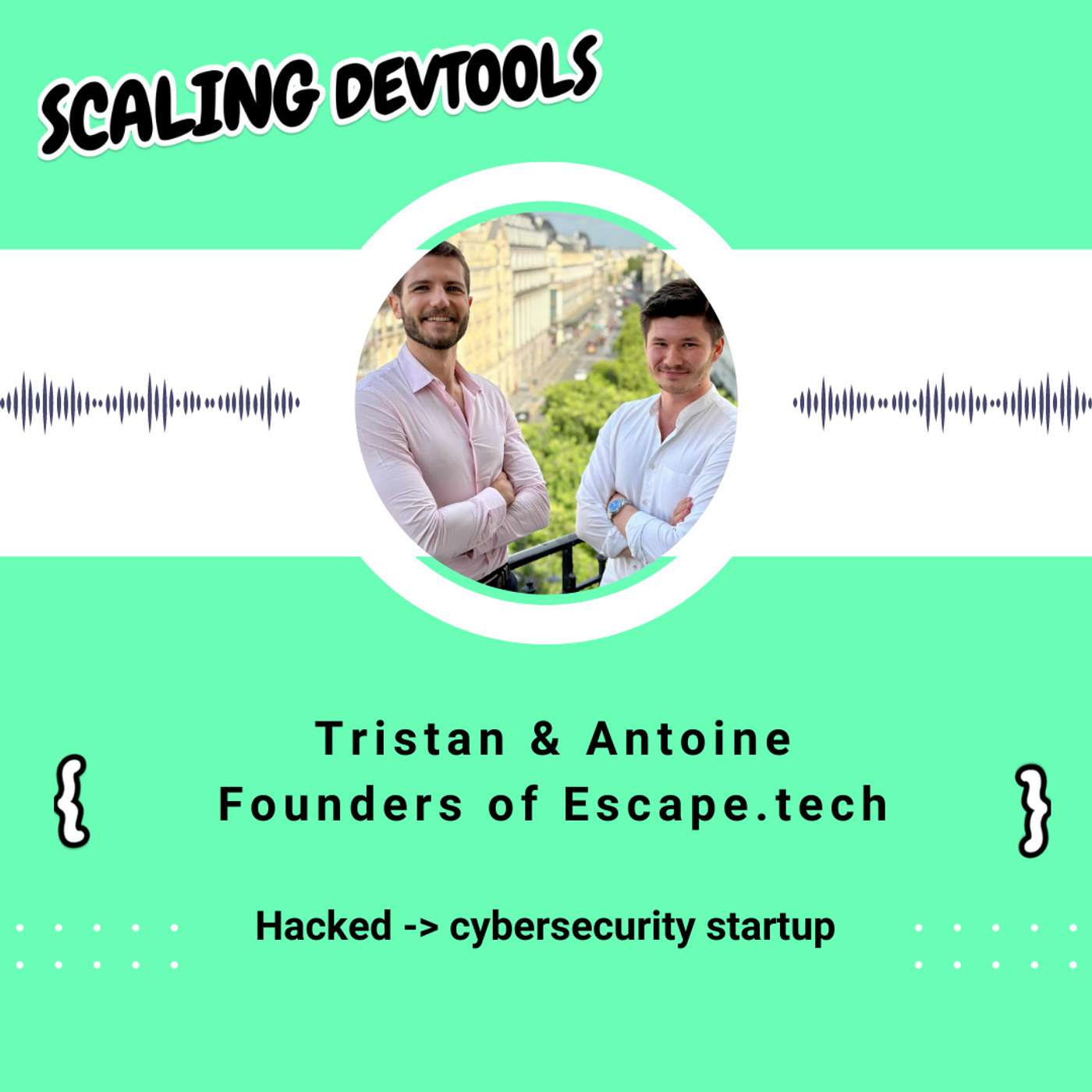
Ep 61From getting hacked to cybersecurity founders with Antoine Carossio and Tristan Kalos from Escape.tech
Escape helps you Find and fix GraphQL security flaws at scale within your DevSecOps processIntroduction to Tristan and Antoine. 0:00How did they get started in cybersecurity? 4:35How did you get your first few customers? 9:49Challenges from a product and tech point of view. 13:57Challenges of integration into the development process. 18:10How to find the right team? 22:55Links:Escape.tech https://escape.tech/?utm_source=youtube&utm_medium=social&utm_campaign=devtools-podcastTristan's Twitter - https://twitter.com/TristanKalosAntoine's Twitter - https://twitter.com/iCarossio
Ep 60Developer copywriting mistakes to avoid, with Zach Goldie
Zach Goldie is a DevTools messaging consultantShip code faster is an empty statement. 0:00How do you position yourself against the competition? 1:56The problem with free monitoring tools. 6:43Explain why fast is a good thing. 11:44Curse of knowledge and how to overcome it. 16:42The problem with copy length and word count. 21:37How do you know if a page is good? 27:05Pitching self-serve to users. 32:42Links:- Zach's Twitter https://twitter.com/DitchingData- Zach's site https://www.zachgoldie.com/ - Benefit layers https://dx.tips/benefit-layers
Ep 59Building a developer social network with Steve Krouse from Val Town
Steve Krouse is the founder of Val.town - a social website where you can write and run code.Introduction to Val.Town's vision 0:00How long it took Github to make money on SteveVal Town is a social website where you can write and run javascript or typescript, run the code on servers, and see the results.Knocking down friction points 2:12Val Town is making it so that programmers can create cool stuff without having to go through the pain of sending an email.Zapier for developers is another kind of tagline that has been seen other people that you've interviewed on this podcast.Categorising use cases on the website. 4:45Val Town recently made a list of favourite use cases and categorised them on the website. The challenge is explaining to people what it is and what it can be used for.What can be made with Val.town sectionHow to get people to make cool things with your tool 15:51People hear about Val Town because other people are using it. The more people sign up, the more people are signing up for it.Val Town has a smaller number of people who are excited about it and use it a lot, but it's not a mythical product market fit.Every Thursday, the team is not allowed to work on the product. They all have to try and make Vals to go viral, which is a really fun creative day.The last one that went viral was hacker news follow, which was branded as an installable script.How do you think about notifications? 24:30Val Town is perfect for programmatic customization of notification emails, so that installing those into your account will be part of the tutorial.Val is passionate about education, and it feels like that's a big challenge because there's lots of new stuff with val.Medium-term ambition, build a learn to code interactive course on top of Val Town. Long term ambition is to have hundreds or thousands of Learn to Code courses on Val Town, embedded in the product.Future of coding meetups. 29:36An interview with Brian Dougie, early at Github, and how he helped with bootcamps and how to run code with Netlify.Future of coding meetup in london.Managing a community is a funny thing. The people who start and manage communities are often weird people.Date Me Docs 35:33Some people are looking for a unique snowflake, while others are sensitive and don't want attention on their date me docs.The future of dating is a great exercise to go through to get clear in words about who you are and what you're looking for.Links:- Val Town - https://www.val.town/- Steve's Twitter - https://twitter.com/stevekrouse
Ep 58Dax from SST - content that has nothing to do with your tool can still convert
Dax Raad is building SST - an open-source framework that makes it easy to build serverless apps.What Is SST? 0:00The theory in January was to make content that has nothing to do with SST and still convert people. Dax validated the theory within the first hour.Dax tells us a little bit about SST, a framework for building applications on AWS, and how it works.The importance of marketing and content. 2:42The focus now has to be on marketing. The top of the funnel is when someone has no idea who you are.Pitching the idea to his boss. 5:16Dax pitched the idea and Fred Schott was immediately down. He spent a day just watching every single episode of Between Two Ferns and wrote down all the patterns of jokes.He learned a lot from the first one, and is doing another one today at 230.How much goes into the show? 8:04The original show is fully done and edits, and that is true of the one that video was made. The video was not close to what actually happened, but it was his response to the video.The original is very specific and it's funny how specific the jokes are.The importance of having a unique angle. 10:40For most companies, announcing an integration is not the most exciting thing to announce.The bar is incredibly low, and the expectations are super low.Invest more in marketing and content. 12:35They are looking to hire a comedian or someone who makes good content on YouTube.They are planning a series A, and are looking for people who are talented and can help them.Educational vs entertaining content. 14:57The only way to capture someone like you is through a different angle.The theory in January was to make content that has nothing to do with SST and still convert people into trying out SST.Finding an angle that is genuine for yourself.How he got over the hump of clickbait. 17:54He went through the same hump that everyone goes through when trying to publish content on youtube.He was sent a video by a guy who was very successful on youtube and he was explaining why he does what he does.The importance of having a good content. 20:51Youtube is an amazing place. People will watch it if it's good.Marketing is a huge lever. 23:20They are a very small company. They are able to do a lot given their small size and they are going to continue to be a small company, so they need to find ways to find leverage anywhere they can.They are excited about what they can invest in.Dax would love to work with someone who is good at filmmaking and editing to keep it engaging and keep it fun. He also thinks about shows that are authentic.Key takeaways for anyone listening, remember that if you're building a company you do need to do marketing.Links:- SST https://sst.dev/- Dax's twitter https://twitter.com/thdxr- Between Two Nerds https://www.youtube.com/watch?v=-I2Xep0GTQY&ab_channel=SST
Ep 57From mobile app to mobile developer tool with Gabriel Savit from Runway
Gabriel Savit is the founder and CEO of Runway - a tool to coordinate and automate mobile app releases.Introductions 0:00Introduction to GabeUnderlying themes of runway mobile release management.What’s it like to work with mobile teams? 2:19Challenges for mobile teams to keep tabs on.The third party ecosystem problem.The origin story of the team.The process of running a release was something that resonated immediately. Different teams set this up differently. 8:23What was the next step after you gathered the feedback? 10:38The first round of interviews to validate the problem space.How the interviews were conducted.The feedback loop is not always closed.The next step after gathering the feedback.How do you get an MVP out quickly? 15:31Starting with one integration, one part of the process.The first few pilots.How did you get your first customer to buy in? 18:24Onboarding the first customer or first user.Getting the first cohort involved.Aligning with the overall vision of the platform.What is the go to market motion? 33:14Go-to-market motion, demo, sync, sign up, demo.Self-service, keeping the entry point open.What’s the future direction of the platform? 36:18Links:- https://twitter.com/gabrielsavit- https://runway.team/
Ep 56Hire engineers who don't mind talking, with Brian Douglas from OpenSauced
Brian Douglas - or bdougie - is the founder of OpenSauced - an open source intelligence tool. Brian was previously Developer Experience Lead at Netlify and Director of Developer Advocacy at GitHubSummaryEvery engineer is an advocate. 0:00Joining GitHub with a 30/60/90 plan. 1:17What was the goal when you joined Netlify? 3:16How to get started with bootcamps. 7:53What are the top projects in open source? 10:52The bottom up strategy for adoption at GitHub. 15:22Netlify’s Aha moment. 21:19How do you get started in reaching out to community and consistently? 25:57Links:https://opensauced.pizza/ https://twitter.com/bdougieYO
Ep 55Building ambitious developer tools with Ruben Fiszel from Windmill
Ruben is the founder of Windmill https://www.windmill.dev/ which helps you turn scripts into workflows and UIs in minutes Some of the things we talk about:Getting to the threshold of being useful.Speed is the key to success.The second mover advantageGetting early users of the product.Why infra is an interesting market for him.The challenges of being a solo founder.The recipe for a digital startup is to be really passionate about the project.Advice for founders who are building ambitious projects.Doing everything that no one wants to do.You can find Ruben at https://twitter.com/rubenfiszel
Ep 54Killing features with Josh Twist, founder of Zuplo
Josh Twist is the founder of Zuplo, an API gatewayIntroducing Josh Twist, the founder of Zuplo. 0:00Zuplo vs Azure API management.How do you make this fit into the developer workflow? 3:06How Zuplo fits into the development workflow.How to democratize API management and make it something every business wants to use.Best practices for implementing API key authentication.Stripe quality API out of the box.The power of removing friction in creating a better experience. 8:58The power of removing friction from the process.How do you create a product that is easy for beginners but still has a powerful experience? 11:31Loom is a great example of a product that exists only because it removes friction.Building a product is like building a video game.How to keep both the developer and the customer experience in mind.The formula one analogy for designing a product from scratch.What’s going to go into the next generation of Zuplo? 17:27How Zuplo keeps things simple and makes decisions.Why you have to have a lot of customer empathy and invest in tools. 19:39The importance of customer empathy.Why Josh made the decision to switch over to OpenAPI.Killing features can be hard as a business-to-business company.One chart to think about.The importance of partnerships and content. 24:29Making videos for supabase customers.Partnerships with other small businesses.How Zuplo got their first customers.Zuplo rate limiting feature. 28:02Rate limiting in Zuplo and Supabase.Developers who are small-scale loving ZuploMaking videosRemoving friction and building an 11-star experience.Zuplo - https://zuplo.com/Josh Twist - https://twitter.com/joshtwist
Ep 53Forums vs Slack with Dan Moore from FusionAuth
Dan is head of DevRel at FusionAuth - Auth Built for Devs, by DevsFusionAuth’s journey from moderation to auth provider.Introduction to Dan Moore, head of DevRel at fusion.Fusion's journeyFree to use for many users, but also a cloud offering.Synchronous communication vs asynchronous communication.Synchronous communication vs asynchronous communication.10% of their traffic is coming from forum pages.No one ever searches on Stack Overflow.What are some of the experiments that have gone well? Efforts to promote community feel.Community stories, finding out user pain points and wins.The importance of getting your community to know each other.Getting 20 or 30 blog posts on the blog.Dan's experience on Screaming into the cloud.Dan's Twitter - https://twitter.com/mooredsFusionAuth - https://fusionauth.io/
Ep 52Building computer vision tooling with Niko from Rerun
Nikolaus West is the founder of Rerun.io - Visualize computer vision.What we discuss:Finding a problem to work on What are some of the features that will be free and open source?What’s the difference between a commercial and a free service?The most important thing is that we’re building something that will be usefulHow to get into the minds of computer vision developersWhy build in RustRerun - https://www.rerun.io/Niko's Twitter - https://twitter.com/NikolausWest
Ep 51Developer onboarding with Kilian from Polypane
How do you do onboarding in a way developers actually like?Kilian is the founder of Polypane - The browser for ambitious web developers https://polypane.app/Kilian's Twitter - https://twitter.com/kilianvalkhof
Ep 50From VC to DevTools with Karl Clement, founder of CODEOWNERS
Karl Clement is the founder of https://codeowners.com/ CODEOWNERS is the single source of truth for code ownership.SummaryIntroducing Karl Code ownershipWhat are the types of people that are implementing code Code OwnershipHow to find and reach platform engineers.What are some of the key metrics that organisations are looking for to measure the value of their tooling?Dora metricsMean time to resolution, MTTRWhat is Backstage and how has it been used?Improving the developer experience with Backstage.Backstage implementation is essentially a signal that a company is willing to invest in the organisation but the developer experience as a whole, which is greatBackstage implementation is a signal of investment in the organisation.How venture capital can help with product development.If you’re building a product in a space that no one else is in, you are reducing your odds