
Question of the Week, from the Naked Scientists
Answering the unanswerable: the Naked Scientists Question of the Week
Dr Chris Smith
Show overview
Question of the Week, from the Naked Scientists has been publishing since 2008, and across the 17 years since has built a catalogue of 637 episodes. That works out to roughly 45 hours of audio in total. Releases follow a fortnightly cadence.
Episodes typically run under ten minutes — most land between 4 min and 5 min — and the run-time is fairly consistent across the catalogue. None of the episodes are flagged explicit by the publisher. It is catalogued as a EN-language Science show.
There hasn’t been a new episode in the last ninety days; the most recent episode landed 11 months ago. The busiest year was 2024, with 50 episodes published. Published by Dr Chris Smith.
From the publisher
Each week we set out to solve one of the world's weirdest, wackiest, funniest and funkiest scientific puzzles. And along with the answer there's a brand new question to think about for next time...
Latest Episodes
View all 637 episodes
Ep 637Is 10,000 steps a one-goal-fits-all?
John writes in wondering whether the 10,000 steps rule applies eqully to everyone, given the range of body types and fitness among the population. James Tytko wondered where the 10,000 number came from in the first place, and sought an answer to John's question with the help of Dr Raj Amarnani, Consultant in Sport, Exercise and Muscoskeletel Medicine... Like this podcast? Please help us by supporting the Naked Scientists

Ep 636Why can't I do that 11th press-up?
This time on Question of the Week, James Tytko is being given a mental work-out thanks to this listener question on muscle fatigue. We learn about the biological reactions which govern intense exercise from Andy Jones, Professor of Applied Physiology at the University of Exeter... Like this podcast? Please help us by supporting the Naked Scientists

Ep 635How does the UV filter in sun cream work?
Listener Krzysztof has written in to ask how skin is protected from potentially harmful UV radiation by sun cream products. To help him with the answer, James Tytko put in a call to Antony Young, Emeritus Professor of Experimental Photobiology at King's College London... Like this podcast? Please help us by supporting the Naked Scientists

Ep 634Will heat pumps make cities cooler?
Ian from Stockport has had a thought. If heat pumps transfer thermal energy from outside into our homes, will they counteract the relative heat of urban areas compared to the countryside? To get to the bottom of this energy enquiry, James Tytko asked for the expertise of Professor Bob Critoph, from the University of Warwick's School of Engineering. Like this podcast? Please help us by supporting the Naked Scientists

Ep 633What leads a guided missile to its target?
Bhavesh wants to know how guided missiles find their target. James Tytko took on his question with help from Dr David Galvao Wall, Head of the Air Platforms and Weapons Group at Cranfield University... Like this podcast? Please help us by supporting the Naked Scientists

Ep 632How do gravitational waves keep their energy?
In response to our programme celebrating 10 years since the first detection of gravitational waves, listeners got in touch with fascinating questions. Here, James Tytko takes on a couple, with help from Ben Allanach, Professor of Theoretical Physics at the University of Cambridge... Like this podcast? Please help us by supporting the Naked Scientists

Ep 631Why do leaves change colour at different rates?
Trent wants to know why trees of the same species, in the same geography, seem to change the colour of their leaves at different rates. He's even noticed differences on branches of the same tree! James Tytko sought to provide an answer, with help from Charles Shi, botanical horticulturalist at the Royal Botanic Gardens, Kew. Like this podcast? Please help us by supporting the Naked Scientists

Ep 630Are snakes tamed by breast milk?
Sva writes in, asking whether stories of snakes being tamed by human milk have any grounding in science. James Tytko took on the question with the help of herpetologist Fortunate Mafeta Phaka, and Angela Julian of the Amphibian and Reptiles Group of the UK. Like this podcast? Please help us by supporting the Naked Scientists

Ep 629What happens to celebratory bullets?
In some parts of the world, some groups will fire guns directly into the air in celebration. Mike wants to know what happens to these bullets, and if they have the potential to be dangerous. To help answer this question, James Tytko spoke with neurologists Yousef Hayder and Luis Rafael Moscote-Salazar... Like this podcast? Please help us by supporting the Naked Scientists
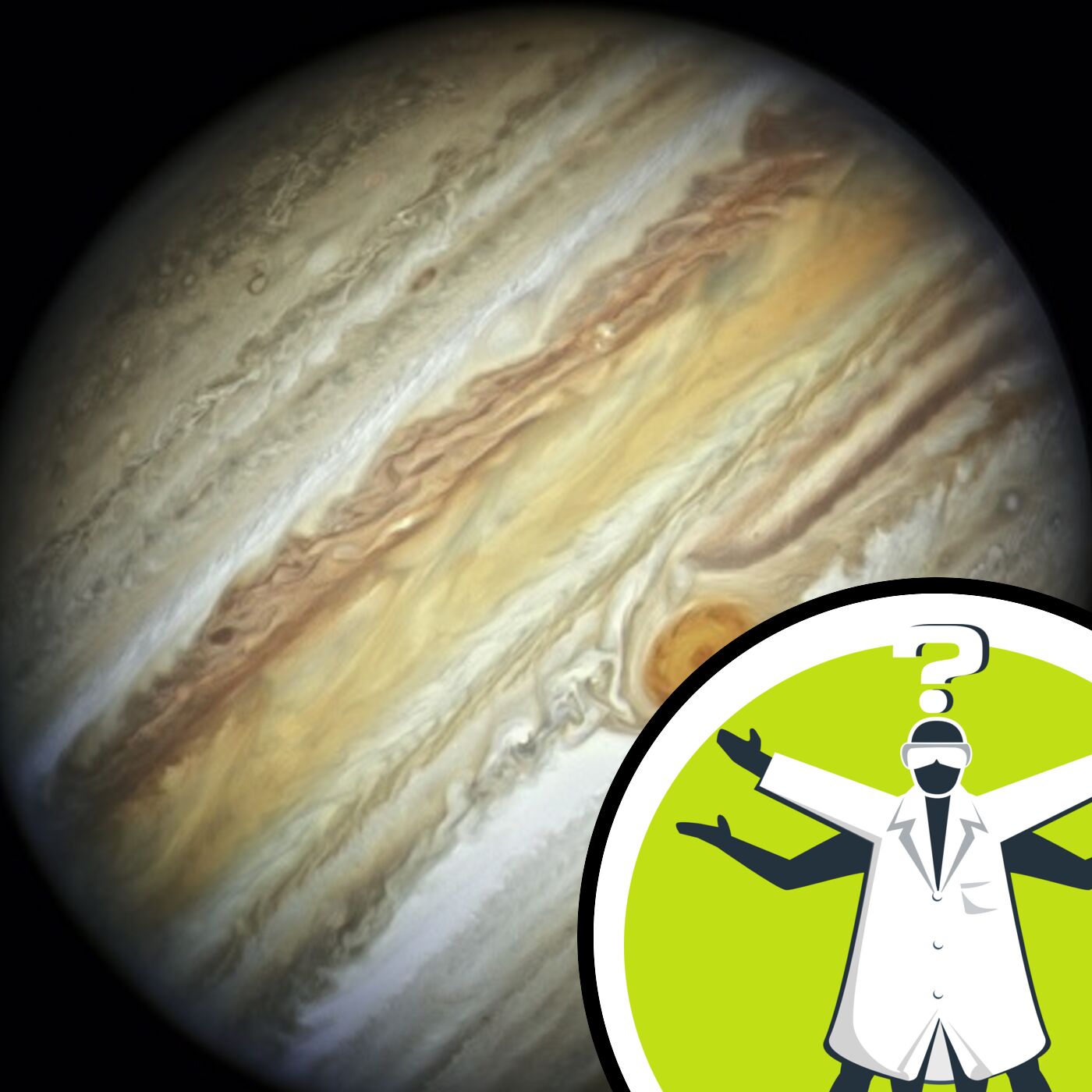
Ep 628What would you find at the centre of Saturn or Jupiter?
Maddie wants to know what a daring adventurer might find if they journeyed to the centre of one of our Solar System's gas giants: Juptier and Saturn. James Tytko took on her question, with the help of University of Cambridge astrophysicist, Xander Byrne. Like this podcast? Please help us by supporting the Naked Scientists

Ep 627Do recent experiments prove a quantum interpretation?
Iain wants to know whether recent experiments have gotten us any closer to deciding which interpretation of quantum mechanics is most likely. This branch of physics describes the as yet unexplained interactions of very small particles. Here to help Rowan Berkley explore Iain's question is Maria Violaris, quantum research scientist and science communicator... Like this podcast? Please help us by supporting the Naked Scientists

Ep 626Can a dog and a fox produce viable offspring?
Girts sends a question about which animals can mate to produce viable offspring. How is it that different breeds of dogs can come together to produce puppies, but add a different animal into the equation and you don't get the same result? Like this podcast? Please help us by supporting the Naked Scientists

Ep 625How are our cells different at the genetic level?
Jon wants to know, how do the cells in the human body, in all their variety, differ at the genetic level? James Tytko took his query on... Like this podcast? Please help us by supporting the Naked Scientists

Ep 624Will AI help to reduce environmental harms?
Geoff has written in asking whether AI will offset its vast energy appetite by facilitating environmentally conscious initiatives. James Tytko took on the challenge of finding out, with help from researchers at the University of Cambridge... Like this podcast? Please help us by supporting the Naked Scientists

Ep 623Can nuclear reactors power Mars missions and our towns?
Laurie writes in, wanting to know whether the nuclear reactions which power Mars rovers means small nuclear reactors could power our towns and cities. Diving into this atomic adventure, James Tytko sought help from research associate at the energy policy group at Cambridge University, Simon Taylor... Like this podcast? Please help us by supporting the Naked Scientists

Ep 622How do you catch Lyme disease?
Leonard is asking how one acquires Lyme disease, and how doctors diagnose it. James Tytko asked Jack Lambert, Professor and Consultant in Infectious Diseases at Mater Misericordiae University Hospital, for help to find an answer. Like this podcast? Please help us by supporting the Naked Scientists

Ep 621Will green technology stop climate change?
Simon wants to know, since we saw a dip in greenhouse gas emissions during the pandemic, why haven't we seen climate change slow down? Is green technology part of the problem? James Tytko took on his question with the help of Shaun Fitzgerald, Director of the Centre for Climate Repair at the University of Cambridge... Like this podcast? Please help us by supporting the Naked Scientists

Ep 620How long does a lap of the water cycle take?
Thanks to Jess Neumann for the answer! Like this podcast? Please help us by supporting the Naked Scientists

Ep 619Why do clouds move in a different direction to the wind?
When Tony is cycling around, he notices that the clouds above him are not always moving in the same direction as he feels the wind blowing him down on the ground. Why might this be? James Tytko took on the question with help from Paul Williams, Professor of Atmospheric Science at the University of Reading... Like this podcast? Please help us by supporting the Naked Scientists

Ep 618Do photons have a size?
Donald wants to know, 'how big is a photon?' Marushka Soobben took on his query with help from Ben Allanach, professor of theoretical physics at the University of Cambridge... Like this podcast? Please help us by supporting the Naked Scientists