
Pulling The Thread with Elise Loehnen
317 episodes — Page 4 of 7
Coming Soon: Special Series on Growing Up
Hi, It’s Elise, host of Pulling the Thread. Starting next Monday, I’m doing another special series—this one is about growing up, and no, it’s definitely not just for parents. It’s mostly about re-parenting, or understanding the driving factors of how we all come to understand the world. You’ll hear from four very different voices about childhood, social programming, and development. Two are pioneers in gender development: One of my all-time heroes, developmental psychologist Carol Gilligan, who I write about in my Substack all-the-time who wrote In a Different Voice in the ‘80s, is joining me on the show, and so is Niobe Way, who does for boys what Carol Gilligan does for girls. I’m also talking with legendary pediatrician Harvey Karp, creator of The Happiest Baby on the Block, the founder of the Snoo, and an ardent and early environmentalist—and Carissa Schumacher, a full-body psychic medium and dear friend who is going to talk to us about what it’s like to raise and be a highly empathic and intuitive person—and how you can retain and develop those abilities. Or shut them down. It will be a great series, coming every Monday for the next month. I’ll see you every Thursday for a regular episode. Learn more about your ad choices. Visit podcastchoices.com/adchoicesSee omnystudio.com/listener for privacy information.
Working With Your Energy System (Prune Harris)
Prune Harris has been able to see, study, and shift energy fields since she was born—a gift she didn’t fully realize she didn’t share with everyone else. Prune is an incredible teacher—I’ve been lucky enough to work with her—because can take esoteric and complex energy systems and distill them into metaphors, concepts, and practices that are both easy to understand and easy to do. She has taught me so many simple holds and gestures that have had a direct impact on helping me calm myself down and feel more contained and grounded. She’s the author of a great guidebook, Your Radiant Soul: Understand Your Energy to Transform Your World, and she has an incredibly comprehensive Youtube channel where she teaches simple practices. She’s wonderful. In today’s conversation we cover a lot of ground—from basic holds and energy systems to why most of us need to also ground up. We also discuss the auric membrane and what happens when it gets punctured, by other people, the energy of the world, and psychedelics.MORE FROM PRUNE HARRIS:Your Radiant Soul: Understand Your Energy to Transform Your WorldPrune’s WebsiteFollow Prune on YouTubeFollow Prune on Instagram Learn more about your ad choices. Visit podcastchoices.com/adchoicesSee omnystudio.com/listener for privacy information.
Where the Brain and Mind Meet (Karl Deisseroth, M.D., PhD)
Karl Deisseroth is a psychiatrist, neuroscientist and bioengineering professor at Stanford. Karl is also the author of Projections: The New Science of Human Emotion, which is a beautiful revisitation and exploration of his time as a psychiatry resident, where he encountered all sorts of people who didn’t quite understand what was happening to their brains—and by extension their minds.In the book—and in our conversation today—Karl explores mania, autism spectrum disorder, eating disorders, borderline personality disorder, psychopathy, and dementia, all in gorgeous prose. Karl runs a lab at Stanford that focuses on optogenetics, mind-blowing science that can pinpoint where adaptive and maladaptive behaviors begin in the brain. He’s won the Kyoto Prize and Heineken Prize for his research, which is not surprising—it just might change the entire world of psychiatry.Today’s conversation is far-ranging and it’s also surprising, including a conversation about how some of these disorders—like eating disorders, which can be deadly, can also be strangely adaptive. Please stick with us. MORE FROM KARL DEISSEROTH, M.D., PhD:Projections: The New Science of Human EmotionFollow Karl Deisseroth on Twitter Learn more about your ad choices. Visit podcastchoices.com/adchoicesSee omnystudio.com/listener for privacy information.
To Transcend and Include (Ken Wilber)
Ken Wilber's work and intellect is difficult to describe. Throughout a long career—and the authoring of 20 books, including A Brief History of Everything, Grace and Grit, Sex, Ecology, Spirituality, and The Religion of Tomorrow, Wilber has put together what is essentially a synthesis of every psychological model of development. In fact, he locked himself away for years, writing every model down on pieces of yellow legal paper, and then knit them all together. I’ve written about Wilber’s work at length in my newsletter, which is also called Pulling the Thread—I’ll put links in the show notes—and I talk about his work on this show as well. Most recently, I talked about Ken Wilber with Nicole Churchill in our conversation about Spiral Dynamics. Wilber is a Spiral Dynamics wizard, though he uses it in aggregate with the work of other developmental thinkers, integrating the work of luminaries like Carol Gilligan, Robert Kegan, and others. In today’s conversation, we talk about Wilber’s brand new book, Finding Radical Wholeness, which explores the five big processes we all undertake in our lives. In today’s conversation, we mostly talked about two: Waking Up and Growing Up, which are often conflated. Wilber makes the case for why they are unrelated processes—and the essential nature of the latter. While Waking Up, or having a Satori experience is wonderful—and something that 60% of people report—we all need to grow up. Wilber and I spend most of today’s conversation talking about our political environment from the standpoint of developmental psychology: Why we’re so fractured, and what it will look like when the Integral Stage becomes the leading edge of culture and we learn how to include and transcend. I think this is fascinating, and reassuring, and excellent context for a moment that feels so out-of-control.MORE FROM KEN WILBER:Finding Radical WholenessA Brief History of EverythingSex, Ecology SpiritualityTrump and a Post-Truth WorldThe Religion of TomorrowGrace and GritMore books from Ken WilberMore from Pulling the Thread Podcast:“The Basics of Spiral Dynamics” with Nicole Churchill“Our Collective Psychological Development” with John ChurchillMore from Pulling the Thread Newsletter:Transcend and IncludeEmbracing Nondual ThinkingRight DoingAscending and DescendingStates vs. Stages Learn more about your ad choices. Visit podcastchoices.com/adchoicesSee omnystudio.com/listener for privacy information.
Working with the Divine (Nicole Avant)
Nicole Avant is a philanthropist, filmmaker, and former diplomat. In her recent memoir, Think You’ll Be Happy, Nicole describes attending to the grief and shock of her mother’s unthinkable murder—she was shot in the back by a home intruder in 2021—by creating a living legacy in her honor. Her mom, Jacqueline Avant, had turned her Los Angeles home into a refuge for artists, politicians, and world-changers as the partner to Nicole’s father, entertainment mogul Clarence Avant, who is the subject of Nicole’s beautiful documentary,The Black Godfather. Nicole grew up sitting at the feet of extraordinary artists like Bill Withers, Oprah Winfrey, Quincy Jones, Sidney Poitier watching as her parents navigated the world to make it better for future generations. In today’s conversation, we talk about that legacy—as well as Nicole’s relationship to the divine. Like her parents, she is a master connector—putting people together to see what unfolds.MORE FROM NICOLE AVANT:Think You’ll Be Happy: Moving Through Grief with Grit, Grace, and GratitudeThe Black Godfather, on NetflixFollow Nicole on Instagram Learn more about your ad choices. Visit podcastchoices.com/adchoicesSee omnystudio.com/listener for privacy information.
Recovering Our Ability to Feel (Prentis Hemphill): TRAUMA
“I think we need each other. I say this all the time, there are some things that are too big to feel in one body. You need a collective body to move them through. And I think that's what we need. We need to come together in spaces to heal, not just to consume together or to watch a movie together, but to feel together and to have human emotion in real life, in public and act from the place of a feeling body, to choose action from a feeling body and not just a reactive or a numb body, but a body that feels, a body that can connect. What kind of actions do you take in the world from that kind of body? I think it's different.”So says Prentis Hemphill, therapist, embodiment facilitator, and author of the just-released, What it Takes to Heal: How Transforming Ourselves Can Change the World. In today’s conversation—the final in a four-part series—we explore a path to putting ourselves, and the collective, back together, and how this begins with a visioning…but a visioning born from getting back in touch with how we actually feel. I loved their book—just by reading along with Prentis’s own path to re-embodiment, I found myself finding similar sensations in my chest, back and heart. In today’s conversation, we talk about somatics, yes, but also about conflict—and what it looks like to become more adept with our emotions in hard times. This is one of my favorite conversations I’ve had to date on Pulling the Thread—I hope you enjoy it too.MORE FROM PRENTIS HEMPHILL:What it Takes to Heal: How Transforming Ourselves Can Change the WorldPrentis’s WebsiteThe Embodiment InstituteFollow Prentis on InstagramRELATED EPISODES:PART 1: James Gordon, M.D., “A Toolkit for Working with Trauma”PART 2: Peter Levine, Ph.D, “Where Trauma Lives in the Body”PART 3: Resmaa Menakem, “Finding Fear in the Body (TRAUMA)”Thomas Hubl: “Feeling into the Collective Presence”Gabor Maté, M.D.: “When Stress Becomes Illness”Galit Atlas, PhD: “Understanding Emotional Inheritance”Thomas Hubl: “Processing Our Collective Past”Richard Schwartz, PhD: “Recovering Every Part of Ourselves” Learn more about your ad choices. Visit podcastchoices.com/adchoicesSee omnystudio.com/listener for privacy information.
The Myth of Resilience (Soraya Chemaly)
“This is the richness of the traditional wife explosion, right? There's this simple idea that you get to choose. Now you're choosing to emulate a situation that's a fiction in that those women didn't choose anything. They had to dress like that. They had to live like that. They had to be nice to the men like that, because they had no bank accounts. They had no cars. They had no licenses. They had no income. They had no security. So, don't equate these two things because you're just kind of living a dignified version of something that was pretty egregiously harmful, you know. And it's the difference, I think, in knowing that you have an option.”So says Soraya Chemaly, an award-winning writer, journalist and activist whose work has been at the center of mine. Her now-classic, Rage Becomes Her: The Power of Women’s Anger lit me on fire—not only for the deftness of her arguments but also because she is a meticulous researcher. What she gave air to in the pages of that book blew me away. She figures prominently in the endnotes of On Our Best Behavior.Her new book, The Resilience Myth: New Thinking on Grit, Strength, and Growth After Trauma, follows a similar path. Soraya takes something we’ve been served as an ideal—develop resilience—and flips it on its head, both widening and undermining this definition. She challenges our cultural myths about this concept and urges us all to shift and expand our perspective on the trait, moving from prioritizing the role of the individual to overcome and conquer to focusing on what’s really at work, which is collective care and connections with our communities. As she proves in these pages, resilience is always relational. MORE FROM SORAYA CHEMALY:The Resilience Myth: New Thinking on Grit, Strength, and Growth After TraumaRage Becomes Her: The Power of Women’s AngerFollow Soraya on InstagramSoraya’s Website Learn more about your ad choices. Visit podcastchoices.com/adchoicesSee omnystudio.com/listener for privacy information.
Finding Fear in the Body (Resmaa Menakem): TRAUMA
“Here's what I would say: peace will happen when people invest in cultivating peace as opposed to war. Peace will happen. And one thing I know, for me, I know peace, I know I will never see it, but maybe I can put something in place to where I leave something here and my children's, children's, children's grandchildren can nibble off of and feed on what I've left here the same way I feed off of Frederick Douglass's stuff.”So says therapist and social worker Resmaa Menakem, author of the New York Times bestseller My Grandmother’s Hands: Racialized Trauma and the Pathway to Mending our Hearts and Bodies and originator of the Somatic Abolitionist movement. I met Resmaa many years ago, when he was one of the few voices in this space—Resmaa calls himself a communal provocateur and this is true, as his work challenges all of us to recognize and acknowledge that we’re scared. And that much of this fear is ancient. We were supposed to talk today about trauma in relationships, but our time together took a different turn—Resmaa jumped at the opportunity to put me in my familial and familiar fear. It’s hard, or at least it was for me, but hopefully you’ll stick with us to see how this works. This is the third part of a series on trauma, and it won’t surprise you to hear that Resmaa also trained with Peter Levine.MORE FROM RESMAA MENAKEM:My Grandmother’s Hands: Racialized Trauma and the Pathway to Mending our Hearts and BodiesMonsters in Love: Why Your Partner Sometimes Drives You Crazy—And What You Can Do About ItThe Quaking of America: An Embodied Guide to Navigating Our Nation’s Upheaval and Racial ReckoningResmaa’s WebsiteFollow Resmaa on InstagramRELATED EPISODES:PART 1: James Gordon, M.D., “A Toolkit for Working with Trauma”PART 2: Peter Levine, Ph.D, “Where Trauma Lives in the Body”Thomas Hubl: “Feeling into the Collective Presence”Gabor Maté, M.D.: “When Stress Becomes Illness”Galit Atlas, PhD: “Understanding Emotional Inheritance”Thomas Hubl: “Processing Our Collective Past”Richard Schwartz, PhD: “Recovering Every Part of Ourselves” Learn more about your ad choices. Visit podcastchoices.com/adchoicesSee omnystudio.com/listener for privacy information.
Take Back Your Brain (Kara Loewentheil)
“There are studies showing that, once your basic needs are met, and you're not worried about losing your house, losing your health care, increases in money don't significantly increase happiness, right? So I think, you know, money helps alleviate the very real biological primitive fear of you're gonna die if you don't have shelter and food and in our society, healthcare, but when it comes to things beyond that, I think that we have been sold the lie that money creates security and it's a natural conflation because at a certain point for securing the necessities,and it makes other problems easier to solve also clearly, but emotionally, money is not the solution to an emotional problem any more than food or having a certain kind of body or being married or not married.” So says Kara Loewentheil, author of Take Back Your Brain: How a Sexist Society Gets in Your Head—and How to Get it Out. While Kara and I went to college together, I first met her when she was gracious enough to have me on her hugely successful podcast, UnF*ck Your Brain, where I obviously fell in love with…her brain. Kara is theoretically an unlikely life coach—she graduated from Harvard Law School, litigated reproductive rights, and ran a think tank at Columbia University before deciding that she wanted to go upstream and rewire our culture’s brain instead. Kara is fixated on what she calls the “Brain Gap” in women—the thought patterns so natural to women that keep us feeling anxious and disempowered. It’s in that “Brain Gap” that we continue to both unconsciously support and re-enact a culture that doesn’t do great things for women. My work and Kara’s work are very aligned. In fact, Take Back Your Brain: How a Sexist Society Gets in Your Head—and How to Get it Out is a cousin to On Our Best Behavior—one that’s written with actionable insights, by a life coach, for getting to the root of the problem.MORE FROM KARA LOEWENTHEIL:Take Back Your Brain: How a Sexist Society Gets in Your Head—and How to Get it OutKara’s Website: The New School of Feminist ThoughtKara’s Book WebsiteKara’s Podcast: UnF*ck Your BrainFollow Kara on Instagram Learn more about your ad choices. Visit podcastchoices.com/adchoicesSee omnystudio.com/listener for privacy information.
Where Trauma Begins (Peter Levine, Ph.D): TRAUMA
“There are therapies where the person is made to relive their traumas over and over and over again. It's called flooding. And that's the one type of therapy that I do not agree with. I think it, not all the time, but it can be harmful, again, in somatic experiencing, we titrate the experience, we touch into a sensation in our bodies that have to do with the trauma, but just touch into it, and then notice the shift to a higher level of order, a higher level of coherence, a higher, greater level of flow. To go from trauma to awakening and flow is really, I think, what healing is all about."So says Peter Levine, PhD. If you’ve read or heard anything about trauma, you likely know Peter’s name, as he’s the father of Somatic Experiencing, a body-awareness approach to healing trauma that’s informed the practice of almost every trauma-worker today. Levine is a prolific writer—his international best seller, Waking the Tiger, has been translated into twenty-two languages—though much of his work has been for fellow academics and teachers. He’s just published a new book, An Autobiography of Trauma: A Healing Journey, which is highly accessible for all of us. It’s a beautiful book that recounts how he came to understand the somatic experience of trauma through an event in his own childhood—and the scientists and cultures he encountered along the way that informed what ultimately became a world-changing protocol. Today’s conversation explores all of this—including some very surprising appearances by Einstein.MORE FROM PETER LEVINE, PHD:An Autobiography of Trauma: A Healing JourneyWaking the Tiger: The Innate Capacity to Transform Overwhelming ExperiencesTrauma & Memory: Brain and Body in a Search for the Living PastIn an Unspoken Voice: How the Body Releases Trauma and Restores GoodnessSomatic Experiencing InternationalRELATED EPISODES:PART 1: James Gordon, “TRAUMA/Tools for Transforming Trauma”Thomas Hubl: “Feeling into the Collective Presence”Gabor Maté, M.D.: “When Stress Becomes Illness”Galit Atlas, PhD: “Understanding Emotional Inheritance”Thomas Hubl: “Processing Our Collective Past”Richard Schwartz, PhD: “Recovering Every Part of Ourselves” Learn more about your ad choices. Visit podcastchoices.com/adchoicesSee omnystudio.com/listener for privacy information.
Choosing Wholeness Over Wokeness (Africa Brooke)
“In writing my book, I wanted to bring it back to the self because being online allows us to have this inappropriate level of audacity. And I think audacity is a very beautiful thing, but it gets so inappropriate online where you can go into Elise's messages and say, “by the way, I saw you liked this, you should be liking this, prove yourself to me”-- when the same person is probably not even able to have a conversation with their own partner in their home, but they can go online and demand people to say certain things, but in your home, are you that courageous to have a difficult conversation? Are you that courageous to have that same level of audacity in your day to day life. And I just worry that we're performing this very shadowy version of ourselves, especially online, without making any kind of effort in our everyday life to cultivate a strong sense of self, where you're able to handle conflict, where you're able to express disappointment to someone face to face and have a dialogue.”So says Africa Brooke, coach and author of The Third Perspective: Brave Expression in the Age of Intolerance. I’ve been smitten with Africa for years, after I was one of the 12 million-odd people who read her Instagram manifesto, “Why I’m Leaving the Cult of Wokeness” in 2020. There, Africa gave voice to being part of a culture that was supposed to be tented around diversity and inclusion, and yet, she found herself sounding and behaving in an increasingly intolerant way, a way that resisted diversity of thought. Originally from Zimbabwe, Africa lives in the U.K. and had already amassed a following for documenting her path to sobriety online—a path that anticipated the sober curious movement that’s become more mainstream today. She’s well-versed in spotting patterns and recognizing the way culture was working both on her and in her, in ways that were separating her from herself. I loved this conversation, a conversation I was very excited to have—it’s a vulnerable one. I’m grateful to Africa for saying what needs to be said and conscious that more of us need to join her. As she explains, people quickly finger her as far-right—and the far-right would love nothing more than to co-opt her—but she’s more of a social justice advocate than ever. She needs people in the center, and people on the left to join her in pointing out how our cancel culture is, to use her term, actually “collective sabotage.” And how we abandon our highest principles when we turn on each other so quickly and make each other “wrong.” I think this conversation speaks for itself.MORE FROM AFRICA BROOKE:The Third Perspective: Brave Expression in the Age of Intolerance“Why I’m leaving the cult of wokeness”Africa’s WebsiteFollow Africa on InstagramAfrica’s Podcast: “Beyond the Self”Loretta Ross’s Episode: “Calling in the Call-Out Culture” Learn more about your ad choices. Visit podcastchoices.com/adchoicesSee omnystudio.com/listener for privacy information.
A Toolkit for Working with Your Trauma (James Gordon, M.D.): TRAUMA
“Now the tragedy, in one sense is a tragedy, that often people only become open when they've suffered horribly when that is both the tragedy of trauma, but also the promise. It's one thing to be trauma informed. It's another thing to inform our experience of trauma with some kind of courage and some kind of hopefulness for profound change. That's what's got to happen. If that can happen, then maybe out of all this contentiousness that is present in our 21st century United States, maybe something really good can happen, but we've got to pay attention, we've got to act on it, and take responsibility.”So says Dr. James Gordon, a Harvard-educated psychiatrist, former researcher at the National Institute of Mental Health and Chairman of the White House Commission on Complementary and Alternative Medicine Policy, and a clinical professor of psychiatry and family medicine at Georgetown Medical School. He’s also the founder and executive director of The Center for Mind-Body Medicine and a prolific writer on trauma. This is because he’s spent the last several decades traveling the globe and healing population-wide psychological trauma. He and 130 international faculty have brought this program to populations as diverse as refugees from wars in the Balkans, the Middle East, and Africa; firefighters and U.S. military personnel and their families; student/parent/teacher school shooting survivors; and more.I met Jim many years ago, and he’s become a constant resource for me in my own life and work, particularly because he packages so many of the exercises that work in global groups into his book Transforming Trauma: The Path to Hope and Healing. We talk about some of those exercises today—soft belly breathing, shaking and dancing, drawing—along with why it’s so important to address and complete the trauma cycle in areas of crisis. This is the first part of a four-part series, and James does an excellent job of setting the stage.MORE FROM JAMES GORDON, M.D.:Transforming Trauma: The Path to Hope and HealingThe Center for Mind-Body MedicineFollow Jim on InstagramRELATED EPISODES:Thomas Hubl: “Feeling into the Collective Presence”Gabor Maté, M.D.: “When Stress Becomes Illness”Galit Atlas, PhD: “Understanding Emotional Inheritance”Thomas Hubl: “Processing Our Collective Past”Richard Schwartz, PhD: “Recovering Every Part of Ourselves” Learn more about your ad choices. Visit podcastchoices.com/adchoicesSee omnystudio.com/listener for privacy information.
The Complexity of Weight Loss Drugs (Johann Hari)
“I realized I think there's a few things that are in our heads that are so deep in the culture. One of them is the idea that being overweight is a sin. It goes right back to if you look at Pope Gregory I in the 6th century when he first formulates the seven deadly sins, gluttony is there, it's always depicted with some fat person who looks monstrous, overeating. And how do we think about sin? If being overweight is a sin, we think sin requires punishment before you get to redemption. The only forms of weight loss that we admire are where you suffer horribly, right? You think about The Biggest Loser, that horrid, disgusting game show. If you go through agony, if you starve yourself, if you do extreme forms of exercise that devastate your body, then we'll go, he suffered. We forgive you. Well done. We'll let you be thin now, right?”So says Johann Hari, author of many bestselling books—Stolen Focus, Lost Connections, and Chasing the Scream. Johann is a fellow cultural psychic and his latest book—the subject of today’s conversation—bears this out. He takes on drugs like Ozempic and Mounjaro in Magic Pill: The Extraordinary Benefits and Disturbing Risks of the New Weight-Loss Drugs. He also writes about his own relationship to these drugs, as Johann is taking them. His book is a subtle and sensitive navigation of what is a tightly bound convergence of health and culture—and every page of his book anticipates and precedes the conversation. (As a disclaimer, I’m in it.) We talk about all of it in today’s conversation, along with what would have happened if a woman had written this book first.MORE FROM JOHANN HARI:Magic Pill: The Extraordinary Benefits and Disturbing Risks of the New Weight-Loss DrugsStolen Focus: Why You Can’t Pay Attention—and How to Think Deeply AgainLost Connections: Why You’re Depressed and How to Find HopeChasing the Scream: The First and Last Days of the War on DrugsJohann’s WebsiteFollow Johann on Instagram Learn more about your ad choices. Visit podcastchoices.com/adchoicesSee omnystudio.com/listener for privacy information.
Coming Soon: Special Series on Trauma
Hi, It’s Elise, host of Pulling the Thread. Starting next Monday, I’m doing another special series—this set is about trauma, specifically trauma and the body. You’ll hear from four important voices in the space. We’re going to start with Dr. James Gordon, who works with groups all over the world who are in crisis, helping them move their experiences through the body before it gets stuck. Next, we’ll turn to the father of Somatic Experiencing, Peter Levine, who has a new autobiography about a horrific trauma from his childhood that led him to the formation of his practice, from which we all benefit today. Next, I’m joined by my friend Resmaa Menakem, author of My Grandmother’s Hands, the creator of the somatic abolitionist movement who works with me directly to illustrate how we all carry fear. And finally, Prentis Hemphill is taking us home: Their stunning new book, What it Takes to Heal, explores finding our calcified feelings and patterns of behavior in our bodies and navigating conflict without projecting our pain. In the show notes, you’ll find related episodes from years past, including guests like Galit Atlas, Gabor Maté, Thomas Hubl, and Richard Schwartz. I’ll see you this Thursday for a regular episode—though it’s Johann Hari, so there’s nothing regular about it.RELATED EPISODES:Thomas Hubl: “Feeling into the Collective Presence”Gabor Maté, M.D.: “When Stress Becomes Illness”Galit Atlas, PhD: “Understanding Emotional Inheritance”Thomas Hubl: “Processing Our Collective Past”Richard Schwartz, PhD: “Recovering Every Part of Ourselves” Learn more about your ad choices. Visit podcastchoices.com/adchoicesSee omnystudio.com/listener for privacy information.
Loving the End (Alua Arthur)
“When we can pause for a moment and rifle through all that noise to figure out what the root of the fear is, then we can be with it in a meaningful way, rather than just let it run our lives. And a little bit of fear of death and a little bit of death anxiety is totally normal, for all of us. I mean, it's that thing inside that tells you not to keep walking when you get to the edge of a cliff, and even to like drink water, you know, hydrate, stay alive. It's in us. It's in our DNA. It's rooted in there. And so the goal is never to get over it entirely, but rather to learn from it, to be with it, to not let it run our lives, but rather to let it fuel our lives.”So says Alua Arthur, a death doula and recovering attorney who is the author of Briefly, Perfectly, Human, which is a guidebook for both how to live and also how to die. Alua is the founder of Going with Grace, a death doula training and end-of-life planning organization. In today’s conversation, we talk about what it would look like to get our death phobic culture a little closer to the end, why people fear dying, and what can be gained when we recognize the priceless gifts that come when our lives come to a close. Let’s get to our conversation.MORE FROM ALUA ARTHUR:Briefly, Perfectly, HumanFollow Alua on InstagramGoing with Grace WebsiteRELATED EPISODES:B.J. Miller: “Struggle is Real—Suffering is Optional”Roshi Joan Halifax: “Standing at the Edge”Frank Oswaseski: “Accepting the Invitation” Learn more about your ad choices. Visit podcastchoices.com/adchoicesSee omnystudio.com/listener for privacy information.
On Telling The Truth (Nell Irvin Painter)
“But one thing the whole “Karen” thing did, which I think was very good, was that it pointed out the existence of spaces Ostensibly open to everyone, but not, and then patrolled often by white women saying you don't belong here. And she got a name, and people with that name wince and rightfully so, but without that wince-worthy kind of situation, I don't think large numbers of Americans would realize that there really is a sort of silent apartheid in our public spaces.”So says Nell Irvin Painter, who Henry Louis Gates Jr. refers to as “one of the towering Black intellects of the last century.” I first heard Nell on Scene On Radio with John Biewen in his series “Seeing White,” and have been biding my time for an opportunity to interview her ever since. I got my chance, with her latest endeavor, an essay collection called I Just Keep Talking, which is a collection of her writing from the past several decades, about art, politics, and race along with many pieces of her own art.Now retired, Nell is a New York Times bestseller and was the Edwards Professor of American History Emerita at Princeton, where she published many, many books about the evolution of Black political thought and race as a concept. She’s one of the preeminent scholars on the life of Sojourner Truth—and is working on another book about her right now—and is also the author of The History of White People. Today’s conversation touches on everything from Sojourner Truth—and how she actually never said “Ain’t I a Woman?”—to the capitalization of Black and White. MORE FROM NELL IRVIN PAINTER:I Just Keep Talking: A Life in EssaysThe History of White PeopleOld in Art SchoolNell’s WebsiteFollow Nell on InstagramScene On Radio: “Seeing White” Learn more about your ad choices. Visit podcastchoices.com/adchoicesSee omnystudio.com/listener for privacy information.
When it's Time to Leave (Joy Sullivan)
“What is that instinct that might be asking me to do something really unadvisable or radical or leap outside the bounds of my own life? And that's the space by which I think we move forward in life. And that's the space in which I think we move forward honestly on the page and in writing. And I tell people, you know, what is it that you want to explore in your writing? Like the page is this beautiful opportunity to start taking some big risks, whether it's persona poetry, where you're literally writing in a different voice, or you're naming something that cannot be held in any other space available to you, or you're testing out just an idea that you're not ready to say out loud. The page is this really beautiful field that gives us a lot of courage to then apply that, I think, to our actual lives.”So says Joy Sullivan, the author of Instructions for Traveling West, which is a guidebook of poems for letting your life fall apart and remake itself as something new. In our conversation, Joy and I explore her early life: how she grew up in Africa, the child of medical missionaries, bound tight by evangelicalism and purity culture—and her relationship to religion and faith now that she’s left that behind. Eve is a central figure in Joy’s poetry, and you will hear why. MORE FROM JOY SULLIVAN:Instructions for Traveling WestFollow Joy on InstagramJoy’s Newsletter, “Necessary Salt”Joy’s Website Learn more about your ad choices. Visit podcastchoices.com/adchoicesSee omnystudio.com/listener for privacy information.
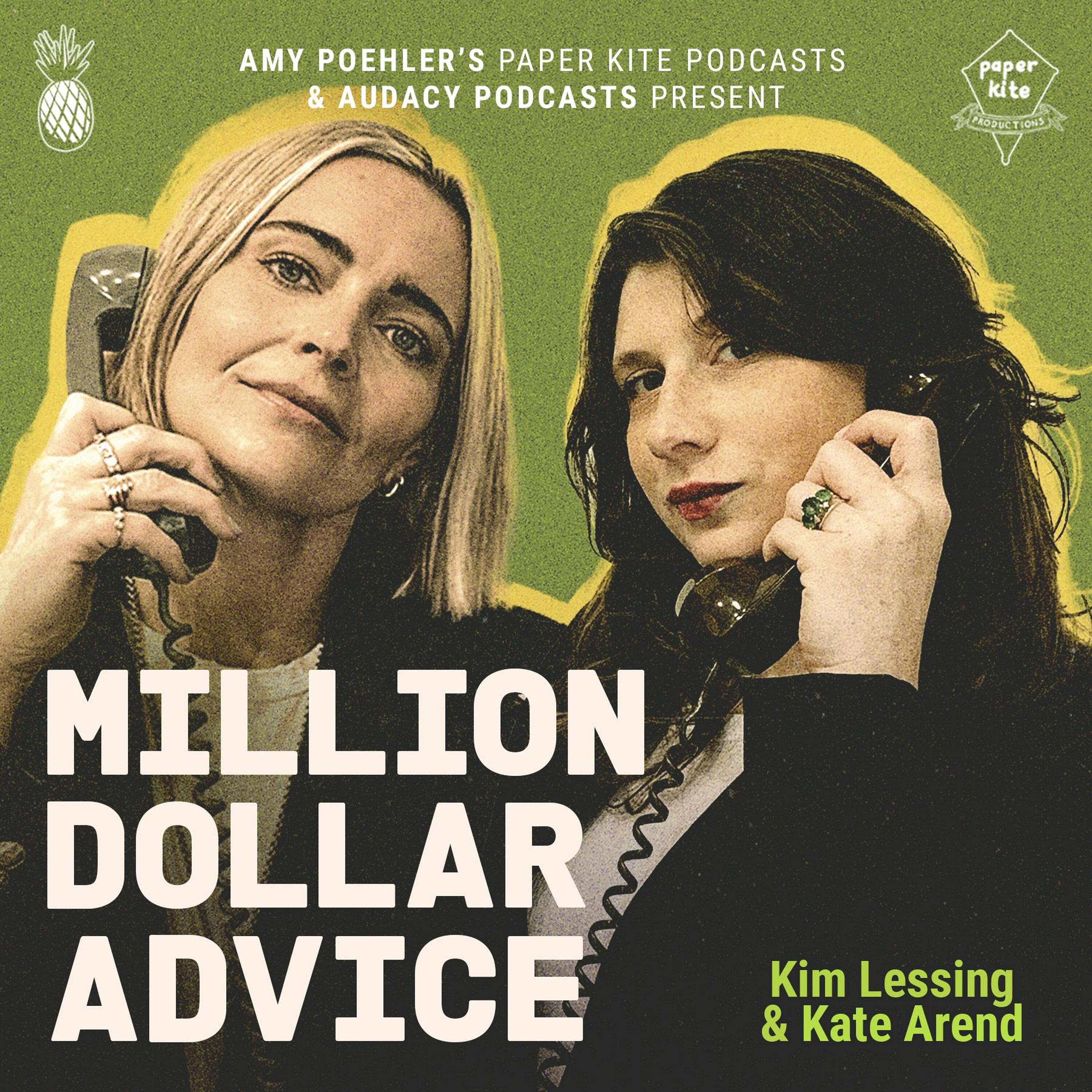
Introducing: Million Dollar Advice
Million Dollar Advice is a work and career advice podcast hosted by friends and colleagues Kim Lessing and Kate Arend. Together Kim and Kate run Amy Poehler’s Paper Kite Productions and are very cool and good at their jobs. Each week, they help live callers with their work-related dilemmas. Whether you have a question or you just like listening to other people’s problems, this show will change your life. If you have a problem at work or a career question big or small, write in to [email protected] or leave a message on the Million Dollar Advice Hotline (888) 799-6327. Kim and Kate can’t wait to give you some Million Dollar Advice! Learn more about your ad choices. Visit podcastchoices.com/adchoicesSee omnystudio.com/listener for privacy information.
When Love Feels Unbearable (Anne Lamott)
“You want to find yourself? Give. We're not hungry for what we're not getting. We're hungry for what we're not giving. And then at the same time, you watch this old pattern of guarding what you have and of watching your mother take the leftovers and your mother taking leftover food and taking the piece of cake that broke in half while it was being served and taking the lesser car and taking whatever time is left for her to get her needs met. And so, you know, all truth is a paradox. And that's really what I believe is that I really, really give, but because I'm healing the codependence, I'm healing the self doubt, I'm giving from a place that is abundant because I live in gratitude. I notice how much I have been poured into, crazy love from a number of different directions. And I give that away. I don't give from my place of deprivation.”So says Anne Lamott, the eternally wise, prescient, and deeply human writer so many of us wish we could call in times of need. Anne is the author of 20 books—yes 20—including the New York Times bestsellers, Help, Thanks, Wow; Dusk, Night, Dawn; Traveling Mercies; and Bird by Bird, which is essential reading for every writer. I refer to and cite her advice all the time. Anne is also a Guggenheim Fellow. Her latest book—and the subject of today’s conversation is Somehow: Thoughts on Love that revolves around the William Blake line: We are here to learn to endure the beams of love—and how hard this is. MORE FROM ANNE LAMOTT:Somehow: Thoughts on LoveBird by Bird: Some Instructions on Writing and LifeDusk, Night, Dawn: On Revival & CourageHelp, Thanks, Wow: The Three Essential PrayersTraveling Mercies: Some Thoughts on FaithFollow Anne on Instagram Learn more about your ad choices. Visit podcastchoices.com/adchoicesSee omnystudio.com/listener for privacy information.
Understanding the Drama Triangle (Courtney Smith)
“From my perspective, one of the reasons we tell stories is it helps give us a sense of who we are, we use stories to affirm our identity. And that's part of the reason why we don't actually like to call them stories, because if we call them stories, and we begin to see that the self is actually rooted in construction, made up interpreted reality, it can be very threatening to us and to our sense of who would I be without this story. And so that's one of the things that I really love about this is you can begin to see that my sense of self has to change, if I'm willing to look at my stories, what is going to happen is my sense of who I am is going to change.”So says Courtney Smith, a coach, facilitator, and dear friend who is schooled and trained in many different modalities: Conscious Leadership Group, Byron Katie’s work, the Alexander Technique, and the Enneagram. She is one of my favorite thought partners because of the range of her intelligence and the structure of her mind: She was a math econ major who happens to have a J.D. from Yale and a masters in public health from NYU. Before taking a turn toward the mystical, she was a McKinsey consultant. So in short, she’s a multi-hyphenate Renaissance woman whose bookshelf looks much like mine. You might remember Courtney from our conversation on Pulling the Thread about the Enneagram—if you missed it, there’s a link in the show notes—but today, we’re going to talk about Stephen Karpman’s Drama Triangle: What it is, how to know when you’re in it, and how to move past it…while recognizing that you’ll be in another one soon enough. We also do a little bit of live coaching and role-playing, so you all will really get a sense of how this powerful tool works. Meanwhile, if you want to work with me and Courtney, together, we’re hosting a workshop from May 17-19 at the Art of Living Retreat Center in Boone, North Carolina. It’s called “Choosing Wholeness Over Goodness” and will be a combination of On Our Best Behavior and Courtney’s techniques. Honestly, I can’t wait—I hope you’ll all join us. The link to sign up is also in the episode page, or the link in bio on my Instagram account, @ eliseloehnen. MORE FROM COURTNEY SMITH:My Workshop with Courtney at AOLRC: “Choosing Wholeness Over Goodness”First Pulling the Thread episode: “The Practical Magic of the Enneagram”Courtney’s WebsiteALSO MENTIONED:The 15 Commitments of Conscious LeadersElise’s Substack Newsletters:Ending the ManelThe Perception (and Reality) of ScarcityWho Gets to Be an Expert? Learn more about your ad choices. Visit podcastchoices.com/adchoicesSee omnystudio.com/listener for privacy information.
The Power of Girls (Mattie Kahn)
“I think historically we have always seen that intergenerational partnership is the way that movements grow and expand and the way people feel resilient about what they're trying to accomplish. The first defeat as a young person, when you feel your morals are on the line, your sense of justice is on the line, that is such a devastating blow and you really need people who've been doing this work for a long time to say, yeah, you're right. That's how that feels. It sucks. It hurts so bad. And this is how, when it happened to me, I got up again and I kept fighting. There is no future for progress without that kind of perspective. You need the fiery engagement of young people and you need the sense of history and the sense of perspective that older people can provide.”So says Mattie Kahn, a prolific writer whose work has appeared in The Atlantic, The Washington Post, The New York Times, and more. Mattie was also the culture director at Glamour and a staff editor at Elle. Today, she joins me to talk about her book, Young and Restless: The Girls Who Sparked America’s Revolutions, which is a much-needed survey of young female voices who were and are often at the heart of political movements, whether it was bus boycotts, strikes at mills, or the environmental movement unfolding today. This isn’t just a book about ensuring that the names of these girls are preserved by history, though, this is an examination of why girls are frequently so central to social change, and what it is about their often-precocious voices that can capture the attention of the nation. This, of course, is a double-edged sword, as Mattie’s work explores how quickly we dump these girls, or move on, once they turn into angry women. Today, we also talk about what’s happening on campuses and what a container might look like to hold dialogue, debate, and discourse.MORE FROM MATTIE KAHN:Young and Restless: The Girls Who Sparked America’s RevolutionsMattie’s WebsiteFollow Mattie on Instagram Learn more about your ad choices. Visit podcastchoices.com/adchoicesSee omnystudio.com/listener for privacy information.
Breaking Family Patterns (Vienna Pharaon)
“Part of middle life is that hopefully there's a little bit of wisdom there. And I think that is part of what we gain as we go through this journey of life is that there is wisdom that's accrued, which allows us to exist a little bit more in the complexity and nuance of things. I believe so much of this work is that we have to hold grace and compassion. And we also have to hold ownership and accountability and responsibility. And I feel that way, right? It's like, okay, if there's something that happened in our childhood or something happened in our teenage years, something that happened in our twenties, right? It's hard to process those things really early on. And especially when we're younger and really immature, because the lens is so narrow. I think as we grow and hopefully as we get wiser, that the lens opens.”So says Vienna Pharaon, a therapist whose practice centers around helping individuals—and couples—identify old patterns, patterns that often belong to the family system, that have them by the throat. And then, of course, she helps people break them and find new stories for how they show up in the world. Vienna is the host of the podcast, This Keeps Happening and the author of the national bestseller The Origins of You: How Breaking Family Patterns Can Liberate the Way We Live and Love, where she outlines the main themes that she sees in her practice. There is much in these pages to which we can all relate, as she articulates five core, original wounds that revolve around worthiness, belonging, trust, safety, and prioritization. Sound familiar? MORE FROM VIENNA PHARAON:The Origins of You: How Breaking Family Patterns Can Liberate the Way We Live and LoveVienna’s WebsiteVienna’s Podcast: “This Keeps Happening”Follow Vienna on Instagram Learn more about your ad choices. Visit podcastchoices.com/adchoicesSee omnystudio.com/listener for privacy information.
The Upsides of Menopause (Lisa Mosconi, PhD)
Neuroscientist Lisa Mosconi, PhD currently has 11 grants—including four from the NIH—to study Alzheimers, menopause, and the female brain. Dr. Mosconi is an Associate Professor of Neuroscience in Neurology and Radiology at Weill Cornell Medicine (WCM), and the Director of the Alzheimer’s Prevention Program at WCM/NewYork-Presbyterian Hospital. The program includes the Women’s Brain Initiative, the Alzheimer’s Prevention Clinic, and the Alzheimer’s Prevention Clinical Trials Unit. There are many things to love about Dr. Mosconi and her work—one, that she’s focused on an underserved group, i.e. women, but also because her insights dramatically expand the way we’ve been conditioned to understand these hormonal shifts in our lives. The picture she paints of the female brain is not only fascinating, but it’s inspiring: As we age and move through stages, our brains continually remodel, becoming leaner, meaner, and more empathic. The female brain is…formidable. There are also many things we can do to make these turbulent transitions slightly smoother sailing, which we dive into throughout our conversation. Let’s turn to it now.MORE FROM LISA MOSCONI, PhD:The Menopause Brain: New Science Empowers Women to Navigate the Pivotal Transition with Knowledge and PowerThe XX Brain: The Groundbreaking Science Empowering Women to Maximize Cognitive Health and Prevent Alzheimer’s DiseaseBrain Food: The Surprising Science of Eating for Cognitive PowerLisa’s WebsiteFollow Lisa on Instagram Learn more about your ad choices. Visit podcastchoices.com/adchoicesSee omnystudio.com/listener for privacy information.
When Spirituality and Science are the Same (Jeffrey Kripal)
“Historically, there's no such thing as a pure tradition. And I also think as human beings, we transcend these religions and we transcend these cultures. And so the cherry picking is an affirmation of our transcendence. It's like, no, you are more than your religious tradition. You are more than your culture. You are more than your body. And you are also your body and your religion and your culture. Yes, yes, yes, all that. But you are also more. So I think, again, the power of the modern period is that we're all so super connected and in communication with everything that we know that, we know that in a way that we didn't know that, you know, four or five-hundred years ago.”So says Jeffrey Kripal, who holds the J. Newton Rayzor Chair in Philosophy and Religious Thought at Rice University. Jeff is the author of many, many, many books that span a massive academic career—books on Kali, books on Gnosticism, and books on supernatural phenomena. He’s also the author of a short and immensely readable book called The Flip: Who You Really Are and Why it Matters, which is the focus of our conversation today. As an academic and historian of comparative religion, Jeff writes and speaks beautifully about the way that we’re losing our collective stories, and the way that we’re splitting ourselves apart, divided between the sciences and the humanities. In The Flip, Jeff recounts how both science and spirituality are using different languages to explain and explore the same experiences, and what emerges when “The Flip” happens, those often mystical moments when the minds of scientists across time have cracked open to see the world in a different way. I loved this book and I love Jeff’s wide-ranging and yet imminently approachable and kind mind—I hope you enjoy listening to this conversation as much as I enjoyed having it.MORE FROM JEFFREY KRIPAL:The Flip: Who You Really Are and Why it MattersThe Superhumanities: Historical Precedents, Moral Objections, New RealitiesJeff’s Website Learn more about your ad choices. Visit podcastchoices.com/adchoicesSee omnystudio.com/listener for privacy information.
Five Things I’m Thinking About: The Creative Process, Pricing Your Work, Inspiration vs. Discernment, Insanity, and the Etymology of Should
Hi, it’s Elise Loehnen, host of PULLING THE THREAD. Today, it’s just me. I’m sharing five things I’ve been thinking about a lot—from understanding how to quantify and charge for one’s time, what to consider before starting a new creative project, and the art of a gentle no. I’m also answering some of your questions—about judgment, sanity, and the etymology of “should.”THINGS I REFERENCE: “Your vibration must be higher than what you create, otherwise you cannot manage it.” “The Construct of Time” The Matter With Things, by Iain McGilchrist Practicing the Gentle No What is Intuition? MORE FROM ME:On Our Best Behavior: The Seven Deadly Sins and the Price Women Pay to Be GoodMy Substack NewsletterMy InstagramSolo Episode 1: What We’re AfterSolo Episode 2: Five Things I’ve Learned This Year Learn more about your ad choices. Visit podcastchoices.com/adchoicesSee omnystudio.com/listener for privacy information.
The Basics of Spiral Dynamics (Nicole Churchill)
“Turquoise is looking for how do we bring back the village? How do we live in community again? Why are we living in these separate houses? We're not sharing resources. Everyone on the street has a snowblower, a lawnmower, you know, like the design isn't elegant, it's not an elegant design. And so I think the mind of yellow joins into turquoise and as it has studied systems, it contributes to that and we are looking for more holistic, elegant solutions to give birth to a new culture. It's like we can no longer continue down the path. And at turquoise, we are going to have to sacrifice for the whole.”For those of you who follow me on Instagram or read my newsletter on Substack, you’ll know that I’ve been quite obsessed with Spiral Dynamics of late, and see it as one way to explain our current cultural and political dilemmas, along with so much of our internalized anxiety. It was first developed by the late professor Clare Graves, who was a contemporary and colleague of Abraham Maslow, and then advanced by professor Don Beck, who worked on post-Apartheid South Africa with Nelson Mandela and F.W. de Klerk, and then further pushed by integral philosopher Ken Wilber. Spiral Dynamics can be heady stuff, and so I was thrilled when Nicole Churchill, a wonderfully grounded therapist and expert in Spiral Dynamics, offered to talk through the system with me for the podcast. Nicole and her husband John Churchill, who has also been a guest on Pulling the Thread, studied with Ken Wilber, and both apply it in their therapy work with both individuals and organizations.If you all end up loving Spiral Dynamics as much as I do, Nicole has offered to come back and explore how she uses it in therapy—please pass this episode on to any friends who you think might enjoy. I’m convinced that there are some keys here that can help us see the world and ourselves more clearly. In the show notes, you’ll find ways to go deeper as well. MORE FROM NICOLE CHURCHILL:Nicole’s websites: Samadhi Institute and Karuna MandelaJohn Churchill’s episode on Pulling the Thread: “Our Collective Psychological Development”MORE ON SPIRAL DYNAMICS:My Substack Newsletter: “Finding Ourselves on the Spiral”Spiral Dynamics Integral, by Don BeckIntegral Psychology: Consciousness, Spirit, Psychology, Therapy, by Ken WilberSpiral Dynamics, by Don Beck and Chris CowanTrump and a Post-Truth World, by Ken Wilber Learn more about your ad choices. Visit podcastchoices.com/adchoicesSee omnystudio.com/listener for privacy information.
On Being Basic (Kate Kennedy)
“When I went back and looked at some of these shows that I loved, I noticed that the writer's room was all adult men with the exception of one or two episodes in Saved by the Bell's case. And I just thought, wow, it is so interesting that we talk about diversity and representation, like yes, of course, who's on the screen matters, but who's in the writer's room and who's telling the stories really matters too, because that's where stereotypes abound. Because those men were not writing Jesse Spano as an example of an actual feminist. She was written as a character from an adult male's response to like second wave feminist stereotypes. And they found that type of woman irritating, so they wrote Jessie as an irritating character. And it just was an interesting thing for me to explore the way I internalized themes from pop culture thinking about who was writing this and when did it contribute to a stereotype versus when did it communicate an authentic experience.”So says Kate Kennedy, a brilliantly astute historian of millennial culture, which she explores, in depth in One in a Millenial: On Friendship, Feelings, Fangirls, and Fitting in, a bestselling book that’s part memoir, but really a love letter and a critique of the culture so many of us grew up in.As part of my book tour I went on Kate’s podcast, Be There in Five, where I was immediately taken by her intelligence and deep, deep knowledge of the programming that shaped our consciousness, from Jessie Spano’s feminism in Saved by the Bell—and the laugh track it inspired—to the way so many women and girls were taught that our interests were dumb, shallow, and silly. Or, to use the parlance of the day: Basic. In One in a Millenial, Kennedy points to this long tradition of the veneration of action figures, Marvel, and football—and the deprecation of pretty much anything that girls and women value, whether it’s romance novels, the Spice Girls, or American Girl Dolls. While her point is not new—and certainly aligned with our summer of the Barbie movie, Taylor Swift, and Beyoncé—her exploration of how it shaped her own mind in childhood, and the way she experiences herself now as a result of it, is revelatory, and something we explore in today’s conversation.MORE FROM KATE KENNEDY:One in a Millenial: On Friendship, Feelings, Fangirls, and Fitting inBe There in Five PodcastKate’s WebsiteInstagram: Follow Kate and Be there in Five Learn more about your ad choices. Visit podcastchoices.com/adchoicesSee omnystudio.com/listener for privacy information.
On Maintaining Desire (Emily Nagoski, PhD)
“The deal is your bodies are going to change over time and people can stay attracted to somebody's body over time, even though it is unrecognizable from what it was like when they first met because that body is the home of a human they adore our attraction to a person's body can be just like superficial something like your toenails are gross, or it can be here is the human whose life I have shared in our home for all these years and like their belly and their bum and their varicose veins and their scar from the surgery that saved their life all of it is so fucking hot because this is my person.”So says Emily Nagoski, one of the most exceptional minds at work today on the science—and she would add, art—of sexual connection, intimacy, and arousal. Emily is brilliant and she’s also deeply human, using her own experiences in the world as the foundational ground for exploring relationship: This means that she’s not full of heady theory and diagnoses, but focused on what actually works to fuel desire—and bring it to fruition.She’s the author of the mega bestselling Come as You Are, as well as a book called Burnout about the stress cycle that she co-authored with her twin sister, and now she brings us Come Together: The Science (and Art!) of Creating Lasting Sexual Connections, which is the natural evolution. While Come as You Are is a primer on how we all function as sexual creatures, Come Together explores what happens when you bring that into relationship—and try to establish and maintain a connection that can endure through seasons of, well, low interest. She is full of ideas, principles, and methods for getting it going—including a core blueprint for determining what rooms are adjacent to your desire. I loved this book, I love Emily, and I loved our conversation.MORE FROM THE EMILY NAGOSKI:Come Together: The Science (and Art!) of Creating Lasting Sexual ConnectionsBurnout: The Secret to Unlocking the Stress CycleCome as You Are: The Surprising New Science that Will Transform Your Sex LifeWatch Emily’s TED TalkEmily’s WebsiteFollow Emily on Instagram Learn more about your ad choices. Visit podcastchoices.com/adchoicesSee omnystudio.com/listener for privacy information.
Why Conflict is Critical (John & Julie Gottman, PhDs)
“Every single human being is a pack animal. That's what we are biologically. We would die if we didn't depend on each other. Saying what you need is a form of connecting with your partner and saying, let's be a team. Can you serve me in this way? Can I trust you to have my back? Because I've got yours. And I want to be there for you. The other thing that people don't realize is that when they ask their partner for something they need, what they're doing is saying to the partner, you are my chosen one. You are my confidant. You are the person I trust more than anybody to be there for me. And the other person may feel very honored by that, actually. What that person is saying is you are trustworthy. You are the person that I know has the strength and the resources to be there for me.”Doctors John and Julie Gottman are two of the most famous and popular couples therapists in the world—not only because of their ability to impart relationship-saving and relationship-strengthening advice, but because of John Gottman’s decades of reearch in the so called “Love Lab,” where he observed couples over time and could predict—with a dizzying level of success—who was destined to divorce.In short, the Gottmans are the world’s leading relationship scientists, having gathered data on thousands of couples—they then use those findings to train clinicians and create simple principles for couples around the world.In their latest book, Fight Right, they explore conflict—something we’re all trained to avoid at all costs. Their point though, which their research supports, is that conflict is essential for healthy relationships, clearing out the brush of stagnant resentments and deepening bonds.In today’s conversation, we explore everything from fighting styles—there’s avoiders, validators, and volatiles—along with our tendency to start conflict harshly because we feel like we need a lot of ammo to justify the rupture and make our point. And then we move to modes and paths of repair, along with what their latest research can tell us about infidelity and its root cause. I loved this conversation, which we’ll turn to now.MORE FROM JOHN & JULIE GOTTMAN:Fight Right: How Successful Couples Turn Conflict into ConnectionThe Love Prescription: Seven Days to More Intimacy, Connection, and JoyThe Seven Principles for Making Marriage WorkThe Gottman Institute: A Research-Based Approach to RelationshipsGottman Relationship Quiz: How Well Do You Know Your Partner?Find a Gottman Trained TherapistFollow the Gottman Institute on Twitter and Instagram Learn more about your ad choices. Visit podcastchoices.com/adchoicesSee omnystudio.com/listener for privacy information.
Where Does Fatphobia Come From? (Kate Manne)
“I think there's a lot of assumptions in play here that a good body is a thin one, a thin body is achievable, a thin body is achievable for everyone, and that you will be fully in control of your health and your mortality if you're thin, which is also just of course a myth. There are plenty of fat, healthy, happy people, and there are plenty of sadly unhealthy, thin people who should not be regarded as any more or less worthy than a fat person who suffers from a similar health condition. These people should be receiving, in most cases, just the same treatment. And yet, for the fat person who suffers from the same health condition, the prescription is weight loss, whereas for the thin person, they're given often closer to adequate medical care.”So says, moral philosopher and Cornell professor Kate Manne, one of those brilliant and insightful observers of culture working today. She’s the author of two incredible books about misogyny—Entitled: How Male Privilege Hurts Women and Down Girl: The Logic of Misogyny—and has coined mainstream terms like “himpathy,” her word for the way we afford our sympathy to the male aggressor rather than the female victim. The example she uses is the trial of Brock Turner, the Stanford swimmer who sexually assaulted Chanel Miller, and the way the judge and the media seemed more concerned about Turner’s sullied future than Miller’s experience and recovery.Her newest book is just as essential: It’s called Unshrinking: How to Face Fatphobia and it explores Manne’s own experience of being a fat woman in our unabiding culture. If you read the Gluttony chapter of On Our Best Behavior, some of the material she explores will be familiar—but in Kate Manne style, she drives it all the way home. I love this conversation, which we’ll turn to now.MORE FROM KATE MANNE:Unshrinking: How to Face FatphobiaEntitled: How Male Privilege Hurts WomenDown Girl: The Logic of MisogynyFollow Kate Manne on TwitterKate WebsiteKate’s Newsletter Learn more about your ad choices. Visit podcastchoices.com/adchoicesSee omnystudio.com/listener for privacy information.
On Self-Regulation (Aliza Pressman, PhD)
“I think that with regulation, the funny thing is that it's either I want to control the weather around my children, or I want to control my children, but regulation is very much a self thing for adults and a co regulation thing between you and other, especially you and a young person whose brain isn't fully able to self regulate. But if you're so focused on controlling all these outside things that you can't, like the weather, then you get to let yourself off the hook of getting into the much harder, but more possible work of self regulation and of figuring out your own stuff. And all of that has much bigger benefits to your kids, of course, than making the weather perfect around them, but it just is harder. Even though it shouldn't be so easy to change the weather, but it does appear that is what happens, right?” So says Aliza Pressman, development psychologist and Assistant Clinical Professor in the Division of Behavioral Health Department of Pediatrics at the Icahn School of Medicine at Mount Sinai Hospital where she is co-founding director of The Mount Sinai Parenting Center. Aliza is also the host of the hit podcast, Raising Good Humans, and the author of The Five Principles of Parenting: Your Essential Guide to Raising Good Humans.I love Aliza for many reasons: Yes, we all want friends who are developmental psychologists on speed-dial, but she’s also different in the way she delivers advice. For one, she cuts right to the point, reminding and reaffirming that while yes, every family has its own complicating factors, the basic tenets of raising good humans are simple. You don’t need your own PhD in parenting to do the job, nor do you need a PhD to re-parent yourself, you need to focus on the elements she outlines in The Five Principles of Parenting: Your Essential Guide to Raising Good Humans: Relationship, Reflection, Regulation, Rules, and Repair. As she explains, through practice and normalizing imperfection, along the way you’ll discover the person you’re ultimately raising is yourself. By becoming more intentional people, we become better parents. By becoming better parents, we become better people.In today’s conversation, we touch on these tenets while also exploring the particular social world we find ourselves in, one in which there seems to be an expectation that we can and should control the weather for our kids. MORE FROM ALIZA PRESSMAN, PhD:The Five Principles of Parenting: Your Essential Guide to Raising Good HumansRaising Good Humans PodcastAliza’s WebsiteFollow Aliza on InstagramAliza’s Newsletter Learn more about your ad choices. Visit podcastchoices.com/adchoicesSee omnystudio.com/listener for privacy information.
Seeing Each Other’s Pain (Rabbi Sharon Brous)
"How do we center the voices that traditionally and historically we know existed, but were only marginalized in the tradition? And that does feel like holy work. And for me, in part, when I encountered a tradition that was so driven by male stories and male voices, I felt so alienated by it when I first began to encounter it. And I had this moment, which I think lots of women faith leaders have, which is maybe this just isn't for me. I mean, I'm not intended to ever even read these texts, let alone teach these texts. And then I had an awakening where I realized, not only is it meant for me, but I have an obligation. It was waiting for me. It's waiting for me and for so many more people because there's a void until our voices enter this space."So says Rabbi Sharon Brous, a wise and wonderful friend, and the founder and senior rabbi of IKAR, a Jewish community founded to attend to critical questions. As Rabbi Brous writes in her beautiful new book The Amen Effect: Ancient Wisdom to Mend Our Broken Hearts and World , “How can our Jewish tradition help us live lives of meaning and purpose? And: Given our faith and history, who are we called to be in this time of moral crisis? We launched IKAR—our best attempt to address those questions—on a hope and a prayer, with no funding, no space, and no business plan. What we had was a shared conviction that faith communities needed to be spiritually alive and morally courageous at the same time.” I read Sharon’s beautiful book last summer, and could not wait to talk to her about it. So we recorded our conversation early, before the Jewish High Holidays, at the beginning of August, months before October 7th. Rabbi Brous’s work in general is highly prophetic and brave—she has been a fierce and vocal critic of the increasingly right wing Israeli government, even as many Rabbis try to steer clear of politics. This conversation, which is not about Israel, is also highly prophetic and brave: It’s about the dire need for interfaith conversation, for chipping away at the calcified belief structures of religions that don’t fully serve our broken world, and for being with each other, particularly on our most painful days. This, in fact, is the theme of The Amen Effect, which is about an ancient mishnah, or overlooked piece of Jewish law that instructs us on the sacred act of circling—and tending, face-to-face, to each other’s agony and grief. In today’s conversation Sharon and I also talk about social justice and responsibility, a conversation that I’m hoping to pick back up with her in the new year, as so many of us feel a little lost and confused. While Rabbi Brous and I thought about doing a second episode as a fast follow, we decided to wait a beat—if you want to hear her talk about Israel and Gaza, I highly recommend you listen to her conversation with Ezra Klein, where the two talk about how some of Israel’s actions are indefensible even as Israel itself must be defended. Her sermons are also stunning, and available on the IKAR website. I think Rabbi Brous is incredible, and I’m not alone. She offered the blessing at both Biden and Obama’s inaugurations, and led Hannukah at the White House this year. She manages to teach and model what so many of us need to learn how to do: We must learn how to hold each other close even through disagreement, disappointment, and despair. The Amen Effect offers some ideas for how this work might begin.MORE FROM RABBI SHARON BROUS:The Amen Effect: Ancient Wisdom to Mend Our Broken Hearts and World IKAR’s Website Learn more about your ad choices. Visit podcastchoices.com/adchoicesSee omnystudio.com/listener for privacy information.
Embracing the Shadow (Connie Zweig, PhD)
“If you have a reaction to a stranger or someone in the media or someone in politics or someone who's just providing this kind of blank slate because you don't really know him or her, then it's a projection. And yes, there's often a sensation in the body that's negative. It could be fear, it could be distrust, it could be disgust, right? And then there's the flip side. There's positive projection, which happens in the spiritual universe a lot. When someone is looking for a charismatic leader, then they're going to project their own awakening, their own compassion, their own wisdom onto the leader, the clergy person. So the content of the projection can be anything, what we view as negative, what we view as positive.”So says Connie Zweig, a Jungian therapist and author who has focused much of her career exploring and teasing out the implications of the shadow, which is how Carl Jung referred to the unconscious. Chances are that you’ve been hearing more and more about shadow work—it’s having a moment—in part, I’m convinced, because it’s a concept whose time has come. As I’ve written about a lot in my Substack newsletter, we are swimming in collective shadow, unable and unwilling to process our share of it. When we don’t take on this unconscious material, or darkness, our tendency is to project it onto other people and groups, to get away from it as quickly as possible. But, of course, it doesn’t work like that—our shadow is ours. It’s our blind spot. When we’re willing to face our shadow, to access it, to allow it to emerge, we often find that it’s full of gold. In fact, Jung believed that the shadow is the source of all of our energy, the main mechanism for growth—ask anyone who has gone through hard or dark times and they will likely tell you that the experience propelled them forward in unexpected ways, often for the better. Connie and I explore all of these concepts and then some, as she’s one of the most prodigious writers in the space. She co-authored Meeting the Shadow and Romancing the Shadow, which are essential anthologies and texts, and then more recently wrote Meeting the Shadow on the Spiritual Path, which explores what happens when the shadow, or darkness, is unresolved in spiritual and religious communities. She’s also the author of The Inner Work of Age: Shifting from Role to Soul, which is an exploration of the shadow of aging in our ageist culture. I’m hoping she comes back to the podcast soon so we can discuss that book at length. MORE FROM CONNIE ZWEIG, PHD:The Inner Work of Age: Shifting from Role to SoulMeeting the Shadow on the Spiritual Path: The Dance of Darkness and Light in Our Search for AwakeningRomancing the Shadow: A Guide to Soul Work for a Vital, Authentic LifeMeeting the Shadow: The Hidden Power of the Dark Side of Human NatureA Moth to the Flame: The Life of the Sufi Poet RumiConnie Zweig’s Website Learn more about your ad choices. Visit podcastchoices.com/adchoicesSee omnystudio.com/listener for privacy information.
Five Things I’ve Learned this Year
Today, it’s just me. I thought I’d round out the year by trying something different, and offering five big things I’ve learned this year.THINGS I REFERENCE: Owning Our Wanting, Wants vs. Needs Transactional Relationships & Shadow Vows Undoing the Drama Triangle, Are You Victim, Villain, or Hero? Facts vs. Stories Transcend and Include Learn more about your ad choices. Visit podcastchoices.com/adchoicesSee omnystudio.com/listener for privacy information.
What Actually Motivates Change? (Carrie Wilkens, PhD): ADDICTION
“Nobody wants to be somebody with a serious substance use problem. Nobody wants to be addicted to a substance. I mean, it doesn't feel good. Dependency doesn't feel good. And we end up in there anyway, right? So I think if we can bring compassion and understanding to, wow, it must really be working in a way that's really powerful for them to keep pursuing it. And then you've got the physical effects of substances, right? So then our bodies physically get dependent, you know, so it starts out as like, it's probably working for an emotional or something in our life and then we become physically dependent on it. And then it's a whole nother host of things in terms of how do you stop it? And people don't fully understand treatment in terms of there's medications available.”So says Carrie Wilkens, PhD, a psychologist who is attempting to change the way we think about and address recovery and treatment—specifically by simply presenting evidence for what motivates change. AFter all, she is the co-president and CEO of CMC: Foundation for Change, a not-for-profit with the mission of improving the dissemination of evidence-based ideas and strategies to professionals and loved ones of persons struggling with substance use. As you’ll hear in this conversation—and throughout the entire series—we have not collectively been served by the mono-myth of addiction, that it’s only solved through harsh intervention and confrontation, that addicted people must hit rock-bottom, and that any involvement from concerned family and friends is inherently co-dependent or enabling.As Dr. Wilkins explains, this simply isn’t true: In fact, evidence overwhelmingly suggests that harsh confrontation and intervention works AGAINST recovery, and that there is a very specific and meaningful role for family to play in what can often feel like a family illness.The CMC:FFC team’s Invitation to Change approach is an accessible set of understandings and practices that empower families to remain engaged and be effective in helping their struggling loved one make positive changes. The approach has been widely used across the country and is utilized in trainings with laypeople and professionals. She is co-author of the award-winning book Beyond Addiction: How Science and Kindness Help People Change, a practical guide for families dealing with addiction and substance problems in a loved one based on principles of Community Reinforcement and Family Training (CRAFT), and co-author of The Beyond Addiction Workbook for Family and Friends: Evidence-Based Skills to Help a Loved-One Make Positive Change.Dr. Wilkens is also the Co-Founder and Clinical Director of the Center for Motivation and Change, a group of clinicians serving all ages in NYC, Long Island, Washington, DC, San Diego, CA, and CMC:Berkshires, a private, inpatient/residential program for adults.Dr. Wilkens has been a Project Director on a large federally-funded Substance Abuse and Mental Health Services Administration (SAMHSA) grant addressing the problems associated with binge drinking among college students. And she is a member of the Association for Behavioral and Cognitive Therapies and the American Association of Addiction Psychiatrists.MORE FROM CARRIE WILKINS:Beyond Addiction: How Science and Kindness Help People ChangeThe Beyond Addiction Workbook for Family & FriendsCMC: Foundation for ChangeFurther Listening on Pulling the Thread:PART 1: Holly Whitaker, “Reimagining Recovery”PART 2: Carl Erik Fisher, M.D., “Breaking the Addiction Binary”PART 3: Maia Szalavitz, “When Abstinence-Only Approaches Fail”ADDICTION: Anna Lembke, M.D., “Navigating an Addictive Culture”TRAUMA: Gabor Maté, M.D., “When Stress Becomes Illness”BINGE EATING DISORDER: Susan Burton, “Whose Pain Counts?” Learn more about your ad choices. Visit podcastchoices.com/adchoicesSee omnystudio.com/listener for privacy information.
How Story Can Heal (Akiva Goldsman)
“I think what's interesting about healing, psychological healing, is there's always a narrative that helps. So sometimes when you go to therapy, and you tell a story, and in the story, you locate your despair, and it's a knot, and then with the therapist, you work through the knot, you feel better. And was all the pain really attendant to that knot? Or did you just kind of load up that knot with some of the despair that comes from being alive and then you kind of work through it and that story helps you live life better. And I think that's true also this idea of how we look at the different personality states and we can name them and we can give them ages and it's a story that helps us understand ourselves.”So says Akiva Goldsman, an Oscar, Golden Globe, and WGA-Award winning screenwriter whose credits include A Beautiful Mind, The Client, Batman Forever, A Time to Kill, Practical Magic, Cinderella Man, I Am Legend, The Da Vinci Code, Angels & Demons, Insurgent, and I, Robot. He’s on Pulling the Thread today, though, to talk about Apple TV+’s The Crowded Room, a psychological thriller starring Tom Holland and Amanda Seyfried on which he was both the writer and the showrunner.So first, some warnings: Yes, there are spoilers, though in my opinion, nothing that will markedly change your experience of watching the show. In fact, knowing the back story made it easier for me to get through the first, very stressful episode. (It gets easier, and by episode three, I was riveted.) And also, a trigger warning: The Crowded Room and our conversation today explore childhood sexual abuse, which is also part of Akiva’s personal history.MORE FROM AKIVA GOLDSMAN:“The Crowded Room” on Apple TV+ Learn more about your ad choices. Visit podcastchoices.com/adchoicesSee omnystudio.com/listener for privacy information.
On Reducing Harm & Saving Lives (Maia Szalavitz): ADDICTION
“I think it's really important for, you know, people to realize that you can totally be an absolutely excellent parent of a traumatized child and the trauma had nothing to do with you and you couldn't possibly have prevented it. So I think, you know, assuming that there is trauma in somebody's addiction history, which is not always the case, but if there is, you should not immediately assume that it was bad parenting because sure, that could be the case sometimes, but again, there's so many different ways that people can be traumatized by so many different people. And it's also the case that so much of addiction has to do with people's temperament that will set them up for things. So, if you are incredibly sensitive to stimuli, something that wouldn't traumatize someone else might traumatize you. And again, that's not your parents fault. That's just how you were born.”So says Maia Szalavitz, a contributing opinion writer for the New York Times and author of two fantastic books about addiction. Her New York Times bestseller, Unbroken Brain, tells the story of her own heroin and cocaine addiction as a student at Columbia University in the ‘80s—she was expelled for dealing and barely escaped prison time—woven together with the decades of work she’s done as a journalist in the addiction space after entering recovery in her early ‘20s. In it, Maia offers a compelling case for why addiction should be thought of as a learning disability, in part because so many people “grow out of it.” Maia’s latest book—Undoing Drugs: The Untold Story of Harm Reduction and the Future of Addiction—taught me so much and challenged so many of the stories about addiction I was holding onto. Ultimately, it’s an optimistic book in the face of what feels like an overwhelming cultural challenge, a challenge that only seems to get worse every month—Maia explains why we’re trending in this direction, and more importantly, what we can do to shift our collective fate toward recovery. And what an expanded idea of recovery might mean. MORE FROM MAIA SZALAVITZ:Undoing Drugs: How Harm Reduction is Changing the Future of Drugs and AddictionUnbroken Brain: A Revolutionary Way of Understanding AddictionThe Boy Who Was Raised as a DogRead Maia on The New York TimesMaia’s WebsiteFollow Maia on XFurther Listening on Pulling the Thread:PART 1: Holly Whitaker, “Reimagining Recovery”PART 2: Carl Erik Fisher, M.D., “Breaking the Addiction Binary”ADDICTION: Anna Lembke, M.D., “Navigating an Addictive Culture”TRAUMA: Gabor Maté, M.D., “When Stress Becomes Illness”BINGE EATING DISORDER: Susan Burton, “Whose Pain Counts?” Learn more about your ad choices. Visit podcastchoices.com/adchoicesSee omnystudio.com/listener for privacy information.
The Malleability of the Brain (David Eagleman)
“As you grow older, your brain is able to keep rewiring all the time. And so we have this impression that the flexibility of the brain decreases as you get older. But in fact, it's just because your brain's job is just to figure out how to get by in the world and do a good job in the world. And once you've figured most things out, like, oh, these are different kinds of personalities, and this is how I need to do something at work, and this is how I use email and phone and whatever, then your brain does less changing only because it has successfully done its job, and it doesn't need to keep changing. The brain changes when there's surprise, when there's something that happened that it wasn't expecting, then it changes up. So, you still have plenty of plasticity even when you're 90 years old. It's just that most people aren't using it at that point because they say, Oh, I got it. I know how things work.”So says David Eagleman, renowned neuroscientist, podcast host, and the author of many bestselling books about consciousness and the brain—along with more than 120 academic publications. Besides his perch as a neuroscientist at Stanford University, David is the co-founder of two venture-backed companies, including Neosensory, which is a pioneering wrist device that enables the deaf to hear. Yep, that’s right.David is fascinating, and hopefully this conversation lives up to his capacity: We discuss the malleability of the brain to adjust to its inputs, the roots of synesthesia, how those who are born blind and deaf can now use touch to see and hear, and why we dream. Ultimately, we explore just how it happens that a brain trapped in a dark vault can create the vibrancy of our existence.David is a TED speaker, a Guggenheim Fellow, and serves on several boards, including the American Brain Foundation and the The Long Now Foundation. He is the Chief Scientific Advisor for the Mind Science Foundation, and the winner of Claude Shannon Luminary Award from Bell Labs and the McGovern Award for Excellence in Biomedical Communication.What’s cooler? He has served as the scientific advisor to several television shows (including Westworld and Perception).Ironically—considering we both host podcasts and David is a neuroscientist—we had some technical difficulties during our conversation, but the hope is that this is not perceptible to you! MORE FROM DAVID EAGLEMAN:Livewired: The Inside Story of the Ever-Changing BrainThe Brain: The Story of YouSum: Forty Tales from the AfterlivesDavid’s Podcast: “Inner Cosmos”David’s WebsiteFollow David on InstagramDavid’s Company: Neosensory Learn more about your ad choices. Visit podcastchoices.com/adchoicesSee omnystudio.com/listener for privacy information.
Breaking the Addiction Binary (Carl Erik Fisher, M.D.): ADDICTION
“I want to say that it's not just some idea about suffering, it's also a function of social and economic systems that are deliberately weaponizing an individualized view of suffering as a technique, as a strategy. I found across eras and eras and eras in the book is that addiction supply industries, which is what one scholar calls them, like the alcohol industry, the tobacco industry, they constantly come back to this hyper individualization in saying, you know, like, the problem is not in the bottle, the problems in the person. If so many people can drink, quote unquote normally, that means the problem is really with these sick people over here. And that happened with tobacco. And then very directly and deliberately, things like the processed food industry and other modern addiction supply industries have used the same language.”So says Carl Erik Fisher, an addiction psychiatrist, bioethics scholar, author, and person in recovery. Carl is also an assistant professor of clinical psychiatry at Columbia University, where he teaches law, ethics, and policy relating to psychiatry and neuroscience, particularly where they converge with substance use disorders and other addictive behaviors. He hosts a podcast called Flourishing After Addiction and is launching a Substack, where he’ll organize his thinking around treatment paths and modalities. Most pertinent to our conversation today, he’s the author of The Urge: Our History of Addiction, which is a fascinating deep dive into our long cultural fascination with addictive substances, interlaced with his own story, and stories from his practice: In fact, the book opens in Bellevue where Carl is not functioning as a doctor—in this case, he’s the patient, after suffering an addiction-induced manic episode that put him into recovery. Carl is brilliant and kind, and also fluent in all the prevailing science about addictive behavior…science that hasn’t really ruled the day until recent years. Instead, the addiction space has been one of binaries—you’re compulsive, or you exercise choice; you’re normal, or an addict; you have no control to stop, or you have all the control and refuse to use it; and on and on and on. MORE FROM CARL ERIK FISHER:The Urge: Our History of AddictionCarl’s Podcast: Flourishing After AddictionCarl’s WebsiteFollow Carl on InstagramCarl’s NewsletterCarl’s SubstackFurther Listening on Pulling the Thread:PART 1: Holly Whitaker, “Reimagining Recovery”ADDICTION: Anna Lembke, M.D., “Navigating an Addictive Culture”TRAUMA: Gabor Maté, M.D., “When Stress Becomes Illness”BINGE EATING DISORDER: Susan Burton, “Whose Pain Counts?” Learn more about your ad choices. Visit podcastchoices.com/adchoicesSee omnystudio.com/listener for privacy information.
The Gordian Knot of Mental Illness (Rachel Aviv)
“I think what one of the things that's interesting to me is like when we think about what causes distress and a life that goes awry, there's so much attention to different causes, but the way that the story, or the diagnosis, or the treatment interacts with our identity, I think, is not thought about as much. Like, the way that the very intervention itself changes our sense of who we are feels like it gets neglected. There's this sense that, you know, the diagnosis is describing something that is always solid and real and less thought given to like, well, how does that diagnosis interact with a mind? And how does the mind change knowing that the mind has been characterized this way?”You might recognize Rachel Aviv’s name from The New Yorker, where she’s been a staff writer for a decade, covering subjects like medical ethics, psychiatry, criminal justice, and education. She’s been a finalist for the National Magazine Awards twice, and in 2022 she won one for profile writing. In 2022, she also published Strangers to Ourselves: Unsettled Minds and the Stories That Make Us, a recipient of the Whiting Creative Nonfiction Grant and named by The New York Times as one of the ten best books of the year. In It, Aviv tells the story of four people and the treatment they underwent—or not—for their mental illness. It’s a gorgeously told, layered exploration of all that we don’t know about the brain and the mind, and how various treatment modalities restructure our lives—including the stories we tell about who we are. Okay, let’s get to our conversation.MORE FROM RACHEL AVIV:Strangers to Ourselves: Unsettled Minds and the Stories That Make UsRead Rachel in The New YorkerFollow Rachel on X Learn more about your ad choices. Visit podcastchoices.com/adchoicesSee omnystudio.com/listener for privacy information.
Reimagining Recovery (Holly Whitaker): ADDICTION
“For years, I was asking myself whether or not I was an alcoholic versus really asking myself whether or not alcohol was actually providing any benefit to me. And for me, it was just like, This realization when I stopped drinking that I had been asking the wrong question for my whole drinking career and like, why are we not asking the question? We're just like, we're drinking, it's compulsory in our society. It's exceptional if you don't drink. And then it's also this very addictive drug that's marketed to us in a way that totally overrides our ability to like make rational choices around it. It's like the most socially accepted drug that you can use and like, we just don't have meaningful conversations or informed consent or any, you know, so for me, a huge part of me quitting drinking, which I did in 2013, it was this realization of Intellectually understanding I had been asking the wrong question which for me was a huge empowerment and part of the reason I was able to quit.”So says Holly Whitaker, author of the New York Times bestselling Quit Like a Woman: The Radical Choice to Not Drink in a Culture Obsessed with Alcohol. I had heard about Holly long before I met her, primarily because she was disrupting recovery culture and many people did not like this. But the more I learned about her, the more I spoke to her, the more I witnessed her impact on culture, the more I was completely taken by both her brilliance and her willingness to say the things. Be warned: If you read her book, you’ll never think about alcohol again. In its pages, she recontextualizes the way we’ve been trained to normalize booze—and also the way the current recovery scene is shaped for the consciousness, and egos, of men. She’s created companies in the vein of a feminine-centered recovery, and it feels like she’s just getting started in the way we talk about addictive substances—and addiction. Those who struggle will find a lot of relief in her words, and I understand why. MORE FROM HOLLY WHITAKER:Quit Like a Woman: The Radical Choice to Not Drink in a Culture Obsessed with AlcoholHolly’s NewsletterHolly’s WebsiteHolly’s PodcastFollow Holly on InstagramFurther Listening on Pulling the Thread:ADDICTION: Anna Lembke, M.D., “Navigating an Addictive Culture”TRAUMA: Gabor Maté, M.D., “When Stress Becomes Illness”BINGE EATING DISORDER: Susan Burton, “Whose Pain Counts?” Learn more about your ad choices. Visit podcastchoices.com/adchoicesSee omnystudio.com/listener for privacy information.
Grappling with Part X (Phil Stutz)
“If there is this part of you that you think is inferior, the weak spot, something you're ashamed of, etc., it's one of these things where if you believe it's true, there's a part of the human soul, we call it part X. It doesn't want you to have any kind of forward motion, doesn't like it, it wants to render your life failure. It wants you to never re change your potentials. And it wants you to hate yourself, which is the biggest thing. So, the genesis of the tools came from the idea, we have to be active about dealing with this.”So says Phil Stutz, the creator of the Tools. You might know Phil from his bestselling book of the same name, or its sequel Coming Alive. Or you might know him from the Netflix documentary Stutz, which is a profile of him as a beloved psychotherapist who doesn’t practice in a particularly traditional way. What you might not know is that Phil is actually a psychiatrist—he received his MD from NYU and then abandoned the standard approach, feeling like he wasn’t helping patients at all. He created The Tools for exactly that: To provide practices for people to move through life’s obstacles, rather than just listening to them talk about them. Ad nauseum. One of the things that I love most about Phil’s approach is the way in which he uses the spiritual, or what he calls “Higher Forces.” Foundationally, he believes that a beneficent universe will move in as soon as you put yourself in motion, unlocking creativity and growth. His latest book, Lessons for Living: What Only Adversity Can Teach You, is a beautiful collection of essays about aging, hard times, and obstacles. It’s equal parts moving and practical, much like Phil himself. MORE FROM PHIL STUTZ:Lessons for Living: What Only Adversity Can Teach YouThe Tools: Five Tools to Help You Find Courage, Creativity, and Willpower—and Inspire You To Live Life in Forward MotionComing Alive: Four Tools to Defeat Your Inner Enemy, Ignite Creative Expression & Unleash Your Soul’s Expression“Stutz” on NetflixThe Tools Website Learn more about your ad choices. Visit podcastchoices.com/adchoicesSee omnystudio.com/listener for privacy information.
Coming Soon: Special Series on Addiction
Starting next Monday, I’m doing another special series—this set is about addiction. You’ll hear from four distinct voices in the space, covering harm reduction, new paths to recovery, codependency, and the shape of addiction in our culture. This is just scratching the surface, but hopefully the beginning of conversations in our own lives, as addiction touches us all, in its myriad forms. While this set is focused on substance, we'll be back with more in this space—and if you want to get started, you’ll find links to two previous episodes on this theme. Dr. Gabor Maté, who spent much of his career working in the most addicted corner of North America, explains why trauma is central to understanding addiction, and Dr. Anna Lembke, explores the role of dopamine and the delicate balance between pleasure and pain. You can find those links in the show notes—and I’ll see you on Thursday for a regular episode of Pulling the Thread, and Monday for the beginning of this special episode.SHOW NOTES:ADDICTION: Anna Lembke, M.D., “Navigating an Addictive Culture”TRAUMA: Gabor Maté, M.D., “When Stress Becomes Illness” Learn more about your ad choices. Visit podcastchoices.com/adchoicesSee omnystudio.com/listener for privacy information.
On Cultivating Creativity & Abundance (Richard Christiansen)
“I’m grateful for seasons. I'm so happy that there can be a winter and there can be a spring and there can be a summer, that it can't always be summer, can't always be bright and happy. And, you know, my book is a bit about that. In winter, the stone fruit loses its leaves and it falls down and it saves its energy for spring. It's okay to sleep. I feel like when life served me a winter and I dropped my leaves for a bit, I came back stronger in spring. I'm just grateful for that idea of that constant change, not just in the world, but in ourselves, and how exciting that has been. And that's given me a whole new fresh perspective. I keep saying a lot, I want to ripen like a peach. I'm okay for my skin to get wrinkled and my flesh to get soft. I really just want to get really sweet and juicy on the inside and and enjoy that process.”I met Richard Christiansen more than a decade ago, though we didn’t become very close friends until very recently, when strange fates brought us together. We have spent the past three-and-half years birthing new versions of ourselves: We kept each other as close company as I wrote my book and launched this podcast, while Richard left the world of advertising to launch a beautiful brand called Flamingo Estate. You’ve likely seen Flamingo Estate in magazines or on Instagram—it’s Richard’s home, and garden, and also the inspiration point for a range of products like, oh I don’t know, honey made from the bees in Lebron James’ backyard, to Terrazzo bars of soap, to the best olive oil I’ve ever tasted. I’ve never met anyone like Richard, to be honest, who has both a fantastical imagination and incredible design aesthetic with his feet firmly planted in the soil. Richard grew up on a farm in Australia—from a whole family of farmers—and being in the garden is his first home. He has a deep and unabiding reverence for the natural world—Jane Goodall is one of his close friends, after all—which is part of the reason why its the foundation of his brand. He calls nature the last great luxury house, and he sees no reason why a gorgeous tomato shouldn’t get the same photographic consideration as a handbag. We had a wide-ranging conversation about creativity, abundance, pleasure, and fantasy for this special friendsgiving episode.MORE FROM RICHARD CHRISTIANSEN:Flamingo EstateFollow Flamingo Estate on Instagram Learn more about your ad choices. Visit podcastchoices.com/adchoicesSee omnystudio.com/listener for privacy information.
The Risk It Takes To Bloom (Raquel Willis)
“Well, the interesting thing is, I guess some of this came from writing the book too, but all of those versions of me live inside of me, right? Even the kid that was, you know, forced to kind of navigate the world as a boy and all of these different things, like that kid is still inside of me, right? The teenager slash young adult who was gay, just like regular gay, boring gay, boring gay now, it wasn't boring gay then, lives inside of me. That trans woman, at the start of my adulthood who felt like she had to live up to so many of these ideals of womanhood, you know, she lives inside of me too.”So says Raquel Willis, a Black trans activist who just released a debut memoir, The Risk it Takes to Bloom: On Life and Liberation. Her book traces her evolution—from her childhood in Georgia, through her multiple coming out experiences, or unfoldings, as the title of her book suggests. Willis has served as the director of communications for Ms. Foundation for Women, executive editor of Out Magazine, and a national organizer for Transgender Law Center. She also co-founded Transgender Week of Visibility and Action and currently serves as an executive producer for iHeartMedia's Outspoken and the president of the Solutions Not Punishments Collaborative’s executive board, and is a WNBA Social Justice Council member. Our conversation today isn’t really about her accolades, it is, to quote her, more existential: We explore whether our souls are gendered, what it means to perform or play with femininity, and why sexual violence against women and girls affects us all. Let’s turn to our conversation now.MORE FROM RAQUEL WILLIS:The Risk it Takes to Bloom: On Life and LiberationRaquel’s WebsiteFollow Raquel on Instagram Learn more about your ad choices. Visit podcastchoices.com/adchoicesSee omnystudio.com/listener for privacy information.
Human Design as a Road Map to the Soul (Chetan & Carola): MYSTICAL SYSTEMS
Chetan: “The human design chart, is basically a match to your unique particular frequency, whether it's partially ancestral, whether it's partly what you've come to live out consciously in this lifetime. But it's there. It's all on a page. It's all on a chart. And you start recognizing how this chart works and you start going along with your type and your authority and you recognize your profile and who you naturally attract and get along with so easily and how other people see you. And all these things just can't start getting more and more distilled in your life. Describing it as a karma chart, things that have to be resolved, you start living true to your design, then all of these things just go click, click, click.Carola: You start attracting the situations or the people the opportunities to resolve those things.Chetan: And you're not in resistance. You're in acceptance to life.” Human Design has a wild origin story—and so does Chetan Parkyn, who studied with Osho in India and read palms and faces before coming to Human Design, which he’s been working with for three decades. His partner, Carola Eastwood, came to Human Design through Astrology and counseling after her own dark night of the soul. The duo are steeped in the system, having performed thousands of readings and written multiple books, including Human Design: Discover the Person You Were Born to Be, The Book of Lines, and The Book of Destinies. If you’re new to Human Design, it’s a fascinating and complex system—I’d recommend going to their site, Evolutionary Human Design and quickly generating a free chart. You’ll need your birth date and time. If you’re familiar, these two will turn new pages for you. MORE FROM CHETAN & CAROLA:Human Design: Discover the Person You Were Born to BeThe Book of LinesThe Book of Destinies: Discover the Life You Were Born to LiveEvolutionary Human DesignGet Your Human Design ReportFurther Listening on Pulling the Thread:PART 1, ENNEAGRAM: Courtney Smith “The Practical Magic of the Enneagram”PART 2, ASTERIAN ASTROLOGY: Jade Luna “The Secret Astrological System”PART 3, TAROT + KABBALAH: Mark Horn “The Mystical Roots of Tarot” ASTROLOGY: Jennifer Freed “A Map To Your Soul”ENNEAGRAM: Susan Olesek “The Power of the Enneagram” Learn more about your ad choices. Visit podcastchoices.com/adchoicesSee omnystudio.com/listener for privacy information.
Does Love Require Complete Acceptance? (Jedidiah Jenkins)
“Nature, the universe, speaks in metaphor, and one of its truest things is paradox, is holding two things that are both true at once. I remember laying in bed, I was probably 12 and before I go to bed, I'm thinking about the universe because my brain suddenly works and I'm like, how can space be infinite? Infinity makes no sense to my mind. So then I'm imagining space expand, expand, expand. And then I hit a wall, which is the edge of space. And then I go, okay, so let's say if space isn't infinite, well, if you get to the edge of space to the wall, what's on the other side of the wall? There has to be something on the other side of the wall. There can't be nothing. And so I remember thinking in that moment, those two scenarios are both impossible, but then also finiteness is impossible because there must be something on the other side of the wall. And I remember laying there being like, oh, I actually think the computer brain that we have is not designed to understand the wholeness of reality. We're stuck in a partial understanding.”It’s likely fate that Jedidiah Jenkins is a writer—a New York Times bestseller at that. After all, his parents sold more than 12 million books in the early years of their writing careers, when they were still married, and a duo—they wrote a series of books about walking, yep walking, across America. In Jedidiah’s latest book—Mother, Nature—he retraces their journey by car, with his mother riding shotgun. He suggested this trip to his mother because he wanted to see the world through her eyes—to understand who she is by accessing who she was—and also because of a chasm that keeps them apart. See, Jedidiah is gay, while his mother believes—ardently—that homosexuality is a sin. And a choice. Mother, Nature is a beautiful and tender love story between a mother and a son that revolves around one of Jedidiah’s foundational beliefs: That he cannot excommunicate his mother, even if she might not come to his eventual marriage to a man. MORE FROM JEDIDIAH JENKINS:Mother, Nature: A 5,000-Mile Journey to See if a Mother and Son Can Survive Their DifferencesTo Shake the Sleeping Self: A Journey from Oregon to Patagonia, and a Quest for a Life with No RegretLife Streams to the Ocean: Notes on Ego, Love, and the Things That Make Us Who We AreJedidiah’s WebsiteFollow Jedidiah on Instagram Learn more about your ad choices. Visit podcastchoices.com/adchoicesSee omnystudio.com/listener for privacy information.
The Mystical Roots of Tarot (Mark Horn): MYSTICAL SYSTEMS
“One of the things that we do on Yom Kippur is we read the story of Jonah, the prophet who ran away saying, no, no, I don't want to do this job, find somebody else to do it. And I connect this to the card, the king of cups, because in the distance behind the king, you can see the seas are in the middle of a storm and there's a storm tossed ship. And there's also a great fish that has come out of the sea which reminds me of the whale that swallows Jonah, or as they say in the Bible, a great fish, and then you see the king who is on a platform in the middle of this roiling sea, and he is like a surfer. He is not being tossed and turned. He knows how to ride the wave. And I talk about the way in which we run from our destiny or what we think is our destiny, what we're afraid of in the future. We see storms coming and we try and run from them when really what we need is the knowledge to surf them and how to learn how to use the energy of the challenges in our lives to move us forward rather than to crash us into the sand.”This is the third part in our special series on Mystical Systems—last Monday, we heard from Asterian astrologist Jade Luna, and the Monday before we heard from Courtney Smith on the Enneagram. Next week, we’ll learn about Human Design. That voice you just heard is Mark Horn, who jokes that he might be the only person who has taught at both the Jewish Theological Seminary and the Readers Studio International Tarot Conference. Yep, that’s right: Mark Horn is an Kabbalah academic who also reads Tarot—though the most remarkable point about this combination is that the two actually go together, and are indelibly linked throughout time. In Tarot readings with Mark—full disclosure, I’ve had two—you settle on a specific question, and he does your hand through the Sephirot, which is the Kabbalistic symbol for the Tree of Life. These readings are fascinating, not only for their ability to respond to the question, but also because Mark decodes the cards through stories from the Kabbalah, making it an entirely different, wholly mystical experience. Okay, lets get to our conversation.MORE FROM MARK HORN:Tarot and the Gates of Light: A Kabbalistic Path to EnlightenmentMark Horn’s WebsiteFollow Mark on InstagramFurther Listening on Pulling the Thread:PART 1, ENNEAGRAM: Courtney Smith “The Practical Magic of the Enneagram”PART 2, ASTERIAN ASTROLOGY: Jade Luna “The Secret Astrological System”ASTROLOGY: Jennifer Freed “A Map To Your Soul”ENNEAGRAM: Susan Olesek “The Power of the Enneagram” Learn more about your ad choices. Visit podcastchoices.com/adchoicesSee omnystudio.com/listener for privacy information.
Whose Pain Counts? (Susan Burton)
“I mean, I do think that I have an abiding interest in women's bodies. In how our bodies can be determinative, how they can suggest certain identities, how they can preclude certain identities, how our bodies can, you know, hold lots of possibilities. Like, I noticed I just said the negative parts first, I think because it took me until I was in my mid forties when I finished this book and published it, to understand the possibilities of a body, the transformative possibilities of living in and living from a body and taking pleasure in my body in a way that it's not that I had never taken pleasure in it. There were certainly things I did that gave me pleasure, but there was a lot of self loathing directed at my form. So, I think that we have a lot of stories about living in these bodies as women.”So says Susan Burton, whose voice you might recognize from the incredible New York Times and Serial podcast, The Retrievals, which explores the experience of women who underwent egg retrieval at the Yale Fertility Center with saline in lieu of fentanyl—because a nurse named Donna was replacing the drugs in service of her addiction. The series is a beautiful exploration of whose pain matters, and the type of medical gaslighting that’s far too common in the lives of women. Susan is a veteran staff member at “This American Life,” and the author of the stunning memoir, Empty, which explores her own uneasy relationship with her body. Though she’s in recovery now—a description she holds lightly—Susan spent the first few decades of her life struggling with binge eating disorder. We explore all of this in our conversation, which I’ll take you to now.MORE FROM SUSAN BURTON:Empty: A MemoirThe Retrievals PodcastSusan Burton’s WebsiteFollow Susan on Instagram Learn more about your ad choices. Visit podcastchoices.com/adchoicesSee omnystudio.com/listener for privacy information.
The Secret Astrological System (Jade Luna): MYSTICAL SYSTEMS
“The more we let go of, the more we receive. I feel that I live in that light. I believe that consciously. I'm not trying to control what the universe brings to me. I believe it knows exactly what's right for me. I'm an astrologer, so I believe in the cosmos. I believe it's a conscious, not an unconscious entity, which I believe a lot of new age thinking is treating the universe like it's unconscious and doesn't really know what it's doing. I think we're still dealing with fear then. We're still collectively, I want to control things because I'm afraid of what's going on. So I view a lot of new age beliefs as being clout in that fear.” This is the second part in our special series on Mystical Systems—last Monday, we heard from Courtney Smith on the Enneagram. Next week, we’ll learn about Tarot and Kabbalah, and the following week about Human Design. That voice you just heard is Jade Luna, who studies what he calls Asterian Astrology—he claims to be the first Westerner to reconstruct Hindu astrology into a Greco-Roman format. As you’ll hear, there are parts of the system that are familiar, and others that are wholly different—though his readings will align with what you might have heard in the past…and then some. My reading with Jade was quite wild and very specific, down to health tendencies and the structure of my brain. Our conversation today goes way beyond astrology though: Jade and I talk about our fear of darkness, why waking up from what can sometimes feel like a collective nightmare is part of the point, and the confluence of seeds that have been planted in the past that are pushing us toward responsibility. We even get into global warming and predestiny. It’s a fascinating one. Just wanted to note that Jade and I recorded this episode at the end of August, during the Los Angeles Hurricane, and before the Israel / Hamas war.MORE FROM JADE LUNA:Follow Jade on InstagramJade’s WebsiteFurther Listening on Pulling the Thread:PART 1, ENNEAGRAM: Courtney Smith “The Practical Magic of the Enneagram”ASTROLOGY: Jennifer Freed “A Map To Your Soul”ENNEAGRAM: Susan Olesek “The Power of the Enneagram” Learn more about your ad choices. Visit podcastchoices.com/adchoicesSee omnystudio.com/listener for privacy information.