
Psychedelics Today
778 episodes — Page 1 of 16
PT 660 - Josh Lipson & Roman Palitsky: Psychedelic Harms and the Post-Psychedelic Challenges Study
PT 659 - Megan Bowers & Mikayla Hellwich
PT 658 - Mareesa Stertz – Sphinx Gate Beyond Burning Man: Psychedelic Healing Without Psychedelics
PT 657 - Rachel Turetzky PhD & Douglas S. Wingate DTCM: The Eight-Circuit Model, Metaprogramming, and Psychedelic Therapy
PT 656 - Travis Tyler Fluck: Denver Mushroom Decriminalization, Mutual Aid, and the Future of Psychedelic Culture
PT 655 - Martha Hammel and Tasia Poinsatte - Aspen Psychedelic Symposium
PT 654 - Erica Rex - Seeing What Is There
PT 653 - Dr. Michael Alpert and Peter Alberding - ALS, Existential Distress, and Ketamine Therapy

Ep 652PT 652 - Esme Dark - Psychedelics, Somatics and the Shadow
Dr. Esme Dark joins Kyle Buller for a conversation on psychedelic therapy, somatic psychotherapy, and shadow work. Based in Australia, Dark is a clinical psychologist, somatic psychotherapist, and psychedelic therapist. She shares her perspective on Australia's authorized prescriber model, the role of psychotherapy in psychedelic care, and what it means to work with the body before, during, and after a psychedelic experience. The discussion stays practical. Dark draws on her work in research settings, including psilocybin-assisted psychotherapy for generalized anxiety disorder at Monash University. She explains that Australia has not decriminalized psychedelics. Instead, psilocybin and MDMA can be prescribed in limited cases through a psychiatrist-led system. That distinction matters, especially as public discussion often moves faster than the actual clinical infrastructure. Kyle and Dark also explore what happens in the therapy room. They talk about nervous system activation, body-based awareness, co-therapy, breathwork, and the challenge of knowing when to intervene and when to stay out of the way. The episode also turns toward creativity, self-expression, and the parts of the self that often remain split off or underdeveloped.

Ep 651PT 651 - Betty Aldworth & Ismail Ali: MAPS Co-Executive Directors on Leadership, Research, and the Future of Psychedelics
MAPS co-executive directors Betty Aldworth and Ismail Ali join Psychedelics Today to talk about leading one of the most visible organizations in the psychedelic field during a period of transition. The conversation covers their move into permanent leadership, how they work together, and how MAPS is thinking about research, education, policy, and movement strategy after a difficult period for the organization and the broader field.

Ep 650PT 650 - Joe Moore Psychedelics Today on Leadership, Integration, and the Psychedelic Landscape
Jen Davenport joins Psychedelics Today to interview co-founder Joe Moore about the growth of Psychedelics Today, the broader psychedelic ecosystem, and how professionals are beginning to engage with psychedelic ideas. Davenport is the founder of Iron Thread Partners and a graduate of the Vital psychedelic training program. Her work focuses on executive leadership, decision making, and organizational development. In this conversation she asks Moore about the evolution of Psychedelics Today and the changes he has witnessed across the psychedelic field over the past decade. Moore explains that Psychedelics Today began as a podcast exploring psychedelic research, therapy, and culture. Over time the project expanded into a media and education platform covering psychedelic science, harm reduction, and professional training. The organization now produces podcasts, journalism, courses, and public conversations about psychedelics and their place in modern society. A central part of the discussion is psychedelic integration. Moore notes that insight during a psychedelic experience does not automatically lead to lasting change. The integration process often requires continued work through journaling, meditation, therapy, and community support. These practices help people translate insights into stable changes in behavior and perspective. The conversation also explores policy changes in the United States. Colorado's Natural Medicine framework is creating a regulated system for psychedelic services while the state also maintains a broader decriminalization approach. Moore discusses the tension between regulated access and grassroots psychedelic culture, as well as the questions around accessibility, pricing, and corporate participation. Davenport asks how executives and professionals are approaching psychedelics. In some circles psychedelics are framed as tools for creativity or performance. Moore cautions against this framing. Psychedelics often open difficult personal material and should be approached with care rather than treated as productivity tools. Education remains a recurring theme throughout the episode. As public interest grows, Moore stresses the importance of studying the legal landscape, understanding the scientific literature, and developing responsible practices for preparation and integration. The conversation offers a grounded look at how Psychedelics Today approaches the psychedelic resurgence. Rather than focusing on hype, Moore emphasizes education, safety, and thoughtful engagement with psychedelic experiences.

Ep 649PT 649 - Melissa Lavasani and Jay Kopelman
Melissa Lavasani & Jay Kopelman join our podcast to discuss how psychedelic policy is actually moving in Washington, DC. Lavasani leads Psychedelic Medicine Coalition, a DC-based advocacy organization focused on educating federal officials and advancing legislation around psychedelic medicine. Kopelman is CEO of Mission Within Foundation, which provides scholarships for veterans and first responders seeking psychedelic-assisted therapy retreats, often outside the United States. The conversation centers on veterans, the VA, and why that system may be the first realistic federal pathway for psychedelic care. Early Themes Lavasani describes PMC's work on Capitol Hill, including hosting events that bring lawmakers, staffers, and advocates into the same room. Her focus is steady engagement. In DC, progress often happens through repeated conversations, not headlines. Kopelman shares his background as a Marine and how his own psychedelic-assisted therapy experience led him to Mission Within. The foundation has funded more than 250 scholarships for veterans and first responders seeking treatment for PTSD, mild traumatic brain injury, depression, and addiction. They connect this work to pending veteran-focused legislation and explain why the VA matters. As a closed health system, the VA can pilot programs, gather data, and refine protocols without the pressures of private healthcare markets. Core Insights A recent Capitol Hill gathering, For Veteran Society, brought together members of Congress and leaders from the psychedelic caucus. Lavasani describes candid feedback from lawmakers. The message was clear: coordinate messaging, avoid fragmentation, and move while bipartisan interest remains. Veteran healthcare is not framed as the final goal. It is a starting point. If psychedelic therapies can demonstrate safety and effectiveness within the VA, broader adoption becomes more plausible. Kopelman raises operational realities that must be addressed: Standardized safety protocols across providers Integration support, not medication alone Clear training pathways for clinicians Real-world data beyond tightly screened clinical trials They also address recent negative headlines involving ibogaine treatment abroad. Kopelman emphasizes the need for shared learning across providers, especially when adverse events occur. Lavasani argues that inconsistency within the ecosystem can slow federal confidence. Later Discussion and Takeaways The discussion widens to federal momentum around addiction and mental health. Lavasani notes that new funding initiatives signal growing openness to innovative treatment models, even if psychedelics are not named explicitly in every announcement. Both guests stress that policy moves slowly by design. Meetings, follow-ups, and relationship building often matter more than public statements. For clinicians, researchers, operators, and advocates, the takeaways are direct: Veterans are likely the first federal pathway Public education remains essential Safety standards must be shared and transparent Integration and workforce development need attention now If psychedelic medicine enters federal systems, infrastructure will determine success. Frequently Asked Questions What do Melissa Lavasani & Jay Kopelman say about VA psychedelic policy? They argue that veteran-focused legislation offers a realistic first federal pathway for psychedelic-assisted care. Is ibogaine currently available through the VA? No. They discuss ibogaine in the context of private retreats and future possibilities, not an existing VA program. Why do Melissa Lavasani & Jay Kopelman emphasize coordination? Lawmakers respond more positively when advocates present aligned messaging and clear priorities. What safety issues are discussed by Melissa Lavasani & Jay Kopelman? They highlight the need for standardized screening, monitoring, integration support, and transparent review of adverse events. Closing Melissa Lavasani & Jay Kopelman provide a grounded look at how psychedelic policy develops inside federal systems. Their message is practical: veterans may be the first lane, but long-term success depends on coordination, safety standards, and sustained engagement. Closing This episode captures a real-time view of how federal policy could shape the next phase of the psychedelic resurgence, especially through veteran-facing legislation and VA infrastructure. Melissa Lavasani & Jay Kopelman argue that coordination, public education, and shared safety standards will shape whether access expands with credibility and care. Transcript Joe Moore: [00:00:00] Hello everybody. Welcome back to Psychedelics Today. Today we have two guests, um, got Melissa Sani from Psychedelic Medicine Coalition. We got Jake Pelman from Mission Within Foundation. We're gonna talk about I bga I became policy on a recent, uh, set of meetings in Washington, DC and, uh, all sorts of other things I'm sure. Joe Moore: But thank you both for joining me. Melissa Lavasani:
Ep 648PT 648 - Enamory - Couples Therapy with Ketamine
Enamory is a clinical practice, training institute, and nonprofit research organization focused on psychedelic assisted couples therapy. In this episode, clinical psychologists Chandra Kian and Kayla Knopp discuss their work integrating ketamine assisted psychotherapy with evidence based couples therapy models. Both guests trained as academic researchers at the University of California San Diego Veterans Affairs system, where they worked on large scale couples based PTSD trials. They later co founded Enamory to continue clinical work, train therapists, and conduct research focused specifically on relationships. Early Themes in Enamory and Couples Therapy The conversation begins with Dr. Kian and Dr. Knopp describing their background in couples based PTSD research and how that work shaped their clinical approach. They explain how existing couples therapy models often stall when partners cannot soften, access vulnerability, or understand each other's internal experience. Their early exposure to MDMA assisted therapy research highlighted how psychedelic states can temporarily reduce defensiveness and rigid narratives.
Ep 647PT 647 - Joshua White: Fireside Project and Lucy, an AI Training Simulator for Psychedelic Support
Fireside Project is a nonprofit that helps reduce the risks of psychedelic experiences through a free support line, coaching, education, and research. In this episode, Joshua White speaks with Psychedelics Today about why real-time support matters, what it takes to run a national hotline, and what Fireside learned after more than 30,000 conversations since launch. White shares how his background as a lawyer and his early hotline volunteering shaped Fireside's model. He also describes how festival harm reduction work, including lessons from Zendo-style support spaces, revealed a major gap: people often need help during an experience and after it ends. A major focus of the conversation is Lucy, Fireside's new voice-to-voice role-play simulator designed to improve psychedelic support skills through low-stakes practice. Early Themes With Fireside Project Joshua White introduces Fireside Project as an accessible safety net for people who are actively having psychedelic experiences or processing past ones. The support line launched on April 14, 2021, and relies on trained community volunteers who commit to a year of service. White explains why anonymity matters. He argues that a phone-based container can make it easier for callers to share vulnerable material without fear of judgment. He also frames service as a key part of integration for volunteers who want to give back or prepare for work in the psychedelic field. Core Insights From Fireside Project White describes the early difficulty of building Fireside from scratch, including legal design, insurance hurdles, training development, and fundraising. He credits seed support from David Bronner and Dr. Bronner's for helping Fireside prove that people would actually use a psychedelic support line. He also explains a key harm reduction point: calling emergency services during a non-medical psychedelic crisis can escalate risk. Fireside aims to help people regulate, re-orient, and stay safer when panic or fear shows up. Key concepts discussed include: The thin line between healing and traumatizing during high-intensity psychedelic states Why callers often need connection, not rescue How volunteer capacity and call volume shape how long conversations run The difference between support during an experience and longer-term coaching support Later Discussion and Takeaways With Fireside Project The conversation then turns to Lucy, a training tool White describes as a "flight simulator" for psychedelic practitioners. Lucy is not part of the live support line. Instead, it offers emotionally responsive role-play scenarios so trainees can practice staying grounded, tracking consent and boundaries, and responding to crisis cues. White also addresses recording and consent. He argues Fireside needs strong training feedback loops to improve safety and quality. He describes an anonymization approach designed to remove phone numbers, strip identifying details, and distort voices while preserving emotional tone. He also explains the post-call option for callers to delete their recorded conversation. Practical takeaways include: Simulation can help trainees stay regulated when intense material emerges Better training can reduce unnecessary diversion to emergency rooms Clear consent language and easy deletion workflows matter for trust Coaching can expand the continuum of psychedelic support beyond therapy

Ep 646PT 646 - Manvir Singh: Shamanism the Timeless Religion
Manvir Singh joins Psychedelics Today to unpack what shamanism means and why the term matters now. Singh is an anthropologist and author of Shamanism: The Timeless Religion. He argues that shamanism is not limited to "remote" societies or the past. Instead, it reliably reappears because it helps humans manage uncertainty, illness, and the unknown. This episode is relevant for the psychedelic community because "shaman" often gets used loosely, or avoided entirely. Singh offers a clear framework for talking about shamanic practice without leaning on romantic myths, drug-centered assumptions, or rigid definitions that do not fit the cross-cultural record. Early Themes With Manvir Singh Early in the conversation, Manvir Singh explains why many classic definitions of shamanism break down when tested across cultures, including in Siberia where the term originated. He discusses how popular images of shamanism often center "soul flight" and fixed cosmologies. However, ethnography shows more variation, including possession, spirit proximity, and different ways practitioners describe altered experience. Singh also traces his path into anthropology, including long-term fieldwork with the Mentawai people off the west coast of Sumatra. There, he studied ritual specialists known as kerei and saw how central they are to healing, ceremony, and community life. Core Insights From Manvir Singh At the center of the episode, Manvir Singh offers a practical three-part definition. He emphasizes these shared traits as the "beating heart" of shamanism across many settings: A non-ordinary state (trance, ecstasy, or another altered mode) Engagement with unseen beings or realities (spirits, gods, ancestors, witches, ghosts) Services such as healing and divination Singh also explores taboo, restriction, and "otherness." He explains how shamans often cultivate social and psychological distance through initiations, deprivation, and visible markers. This helps communities experience the practitioner as different in kind, which increases credibility when the practitioner claims access to hidden forces. Later Discussion and Takeaways With Manvir Singh Later, Manvir Singh challenges common psychedelic narratives that treat psychedelics as the universal engine of religion or shamanism. He notes that many shamanic traditions do not rely on psychedelics at all, and that rhythmic music, drumming, dance, and social ritual can reliably produce trance states. He also clarifies a key mismatch in many contemporary "ayahuasca tourism" settings: in many traditional contexts, the specialist takes the substance to work on behalf of the patient, rather than turning the participant into the primary visionary practitioner. Practical takeaways for the psychedelic field include: Use definitions that fit cross-cultural evidence, not marketing language. Avoid assuming psychedelics are required for mystical experience. Notice how authority gets built through ritual, training, and otherness, not only through pharmacology.
Ep 645PT 645 - Oli Genn-Bash: Functional Mushrooms, Hype Cycles, and Mycelial Thinking
Oli Genn-Bash (Brighton, UK) joins Joe Moore for a grounded conversation on the boom in functional mushrooms and why the category may be moving too quickly. As the founder of The Fungi Consultant, Oli works with consumers and brands to demystify functional mushrooms, with a focus on education, traceability, and realistic expectations. The conversation begins with a critique of wellness hype cycles. Oli explains how consumer desperation for help with anxiety, sleep, stress, and cognition can create an opening for a rapid wave of products that are not always grounded in careful sourcing or clear science. Using lion's mane as a case study, he contrasts popular cognitive claims with traditional use, arguing that the most useful path forward is to slow down, get more literate about mechanisms, and build a market that can sustain trust over time. Systems and Culture Oli describes how individual health is inseparable from community realities, including food access, class dynamics, and what wellness advice can sound like when it lands from a place of privilege. They discuss mycelial thinking as a practical framework for collaboration and resource-sharing, and why mushrooms tend to attract unusually generous "teach everyone" communities. They also explore the role of mushrooms in meaning-making and consciousness. Oli shares personal reflections on mushrooms as allies, the felt sense of "agency" in psychedelic experiences, and how those experiences can encourage behavioral change without forcing it. The conversation touches on alcohol culture in the UK and the possibility of non-alcoholic alternatives, including how functional mushrooms, microdosing, and other botanicals can support social confidence and energy for some people. Finally, they look ahead at fungal innovation beyond supplements: materials, soil health, regenerative approaches, bioremediation, and what the broader psychedelic movement might learn from fungi's patience, symbiosis, and balance. Key themes and takeaways 1) Why functional mushrooms feel "too fast" right now Oli argues that functional mushrooms have accelerated into a high-pressure wellness marketplace, with brands rushing products to market and consumers struggling to determine what is legitimate, traceable, and effective. He draws parallels to the UK CBD market, describing how oversaturation and inconsistent quality can erode trust and collapse prices. 2) Lion's mane, tradition, and mechanism Lion's mane is a useful example of how modern marketing can outrun nuance. Oli notes the gap between popular cognitive claims and traditional use, and points toward the gut-brain axis as one plausible bridge that requires more careful explanation and patience. 3) "Functional mushrooms" as a frame Oli prefers the term functional mushrooms over medicinal mushrooms, emphasizing systems-level support rather than a pharmaceutical model. He describes a view of health that starts on the cellular level and asks what supports function, resilience, and prevention. 4) Health is individual and collective Oli speaks candidly about barriers to wellness in the UK, including food poverty, access to education about cooking, and how class dynamics shape what health messaging sounds like. The broader point is structural: it is difficult to talk about supplements without considering the baseline conditions of daily life. 5) Mycelial thinking, futures work, and collaboration The conversation highlights "mycelial thinking" as more than a metaphor. Oli describes collaborations in futures-oriented communities and how fungal logic can inform collaboration, non-zero-sum outcomes, and resource sharing. 6) Mushroom culture and the instinct to share Joe notes how strikingly generous mushroom communities can be, especially around cultivation and identification. Oli agrees and adds a provocative angle: the possibility of "agency" in fungi and a sense that mushrooms invite humans into relationship, curiosity, and participation. 7) Alcohol culture and alternatives Oli reflects on nearly three years without alcohol and describes how functional mushrooms and other botanicals can support mood, energy, and social confidence for some people. They also discuss the realities of events culture, including the need for more inclusive non-alcoholic options and sensitivity to addiction histories. 8) The next 10 years of fungi They look at the expansion of fungi into materials, fashion, regenerative agriculture, soil health, and bioremediation. Oli emphasizes balance: fungal innovations are promising, but scaling and real-world constraints matter. 9) What the psychedelic movement can learn from fungi Oli critiques extractive, capital-driven dynamics in the psychedelic ecosystem and suggests fungi offer a different ethic: patience, humility, symbiosis, and realism about parasitism and imbalance.
Ep 644PT 644 - Tricia Eastman: Seeding Consciousness, Ancestral Wisdom, and Psychedelic Initiation
In this live episode, Tricia Eastman joins to discuss Seeding Consciousness: Plant Medicine, Ancestral Wisdom, Psychedelic Initiation. She explains why many Indigenous initiatory systems begin with consultation and careful assessment of the person, often using divination and lineage-based diagnostic methods before anyone enters ceremony. Eastman contrasts that with modern frameworks that can move fast, rely on short trainings, or treat the medicine as a stand-alone intervention. Early Themes: Ritual, Preparation, and the Loss of Container Eastman describes her background, including ancestral roots in Mexico and her later work at Crossroads Ibogaine in Mexico, where she supported early ibogaine work with veterans. She frames her broader work as cultural bridging that seeks respect rather than fetishization, and assimilation into modern context rather than appropriation. Early discussion focuses on: Why initiatory traditions emphasize purification, preparation, and long timelines Why consultation matters before any high-intensity medicine work How decades of training shaped traditional initiation roles Why people can get harmed when they treat medicine as plug and play Core Insights: Alchemy, Shadow, and Doing the Work A major throughline is Eastman's critique of the belief that a psychedelic alone will erase trauma. She argues that shadow work remains part of the human condition, and that healing is less about a one-time fix and more about building capacity for relationship with the unconscious. Using alchemical language, she describes "nigredo" as fuel for the creative process, not as something to eliminate forever. Key insights include: Psychedelics are tools, not saviors You cannot outsource responsibility to a pill, a modality, or a facilitator Progress requires practice, discipline, and honest engagement with what arises "Healing" often shows up as obstacles encountered while trying to live and create Later Discussion and Takeaways: Iboga, Ethics, and Biocultural Stewardship Joe and Tricia move into a practical and ethically complex discussion about iboga supply chains, demand pressure, and the risks of amplifying interest without matching it with harm reduction and reciprocity. Eastman emphasizes medical screening, responsible messaging, and supporting Indigenous-led stewardship efforts. She also warns that harm can come from both under-trained modern facilitators and irresponsible people claiming traditional legitimacy. Concrete takeaways include: Treat iboga and ibogaine as high-responsibility work that demands safety protocols Avoid casual marketing that encourages risky self-administration Support Indigenous-led biocultural stewardship and reciprocity efforts Give lineage carriers a meaningful seat at the table in modern policy and clinical conversations Frequently Asked Questions Who is Tricia Eastman? Tricia Eastman is an author, facilitator, and founder of Ancestral Heart. Her work focuses on cultural bridging, initiation frameworks, and Indigenous-led stewardship. What is Seeding Consciousness about? The book examines plant medicine through initiatory traditions, emphasizing consultation, ritual, preparation, and integration rather than reductionistic models. Why does Tricia Eastman critique modern psychedelic models? She argues that many models remove the ritual container and long-form preparation that reduce risk and support deeper integration. Is iboga or ibogaine safe? With the right oversite, yes. Eastman stresses that safety depends on cardiac screening, careful protocols, and experienced oversight. She warns against informal or self-guided use. How can people support reciprocity and stewardship? She encourages donating or supporting Indigenous-led biocultural stewardship initiatives like Ancestral Heart and aligning public messaging with harm reduction. Closing Thoughts This episode makes a clear case that Tricia Eastman Seeding Consciousness is not only a book about psychedelics, but a critique of how the field is developing. Eastman argues that a successful future depends on mature containers, serious safety culture, and respectful partnership with lineage carriers, especially as interest in iboga and ibogaine accelerates. Links https://www.ancestralheart.com https://www.innertraditions.com/author/tricia-eastman Transcript Joe Moore Hello, everybody. Welcome back. Joe Moore with you again from Psychedelics Today, joined today by Tricia Eastman. Tricia, you just wrote a book called Seeding Consciousness. We're going to get into that a bunch today, but how are you today? [00:00:16.07] - Tricia Eastman I'm so good. It's exciting to be live. A lot of the podcasts I do are offline, and so it's like we're being witnessed and feels like just can feel the energy behind It's great. [00:00:31.11] - Joe Moore It's fun. It's a totally different energy than maybe this will come out in four months. This is real, and there's people all over the world watching in real-time. And we'll get some comments
Ep 643PT 643 - Logan Davidson - American Ibogaine, State Strategy, and the Future of Psychedelic Policy
Logan Davidson joins the show to talk about the fast-moving world of Ibogaine in American and why state-based leadership is shaping the future of psychedelic reform. Davidson is the executive director of Texans for Greater Mental Health, the legislative director at VETS, and a key strategist behind Texas' landmark interest in ibogaine research. He also advises for Americans for Ibogaine. His work sits at the intersection of science, policy, and lived experience, and this conversation offers a clear look into what is happening right now. Early Themes: The Rise of State Advocacy Davidson explains how he entered politics at nineteen and how his professional path merged with psychedelic policy work during the 2021 Texas legislative session. Through that first bill, he saw how science, bipartisan cooperation, and strong local leadership could advance major reform. Early discussion focuses on: How Texas became the first state to pass a major psychedelic research bill Why ibogaine became a central focus How the special operations community helped shift political momentum The personal mental health stories that shaped Davidson's commitment This section also highlights how Americans for Ibogaine entered the conversation through veterans, researchers, and state lawmakers who felt the urgency of the opioid crisis and traumatic brain injury. Core Insights: Ibogaine, Risk, and the New Research Model In the middle portion of the episode, Davidson breaks down the strategy, challenges, and promise behind ibogaine research and state-based policy innovation. Key insights include: The unique bipartisan environment in Texas Why stories from veterans and spouses moved lawmakers The importance of medical screening for cardiac risk Why research is essential for safety How states can use funding, revenue sharing, and public health goals to shape future access What policymakers are watching right now Effectiveness for opioid use disorder Data from traumatic brain injury studies Cardiac safety protocols The risk of untreated depression and addiction The national security implications of forcing service members to seek illegal care Davidson also explains why removing the psychedelic experience from the molecule remains controversial and why many researchers believe the full experience matters. Later Discussion and Takeaways: The Road Ahead for American Ibogaine In the final part of the conversation, Davidson speaks about the future of American Ibogaine and the broader psychedelic field. He outlines why local leadership matters, why federal funding, like what Psychedelic Medicine Coalition is supporting, could be the next major tipping point, and how big pharmaceutical companies may eventually enter the space through acquisitions or proprietary molecule development. Concrete takeaways include: States should expect clear benefits: lower-cost treatments, shared revenue, and local control Community leaders, not outsiders, often drive legislative wins The need for long-term safety data remains National security concerns highlight why regulated access must expand Federal research money could radically transform the pace and scale of studies He also encourages listeners to join or build local organizations, since nearly every major win comes from people who live in the state pushing from the ground up. Frequently Asked Questions Is Ibogaine safe? Ibogaine has cardiac risks that require medical screening and careful monitoring. Researchers stress that safety improves with proper protocols and more clinical data. Why is Ibogaine important for veterans? Many special operations veterans report major benefits for traumatic brain injury, PTSD, and addiction. Their stories have driven political momentum. How are states involved in Ibogaine research? States like Texas are funding clinical trials, drug development, shaping policy, and exploring revenue and access models to support long-term public health benefits. Will Ibogaine become federally supported in America? New federal interest, including major grants and bipartisan discussions, suggests that broader support may be coming in the next few years. Closing Thoughts This episode shows why the work of Logan Davidson sits at the center of today's psychedelic resurgence. It highlights a complex but hopeful moment where science, policy, and lived experience are beginning to align. As American Ibogaine research expands, state leaders, clinicians, veterans, and advocates all have a role in shaping a safer and more effective future for these treatments.

Ep 642PT 642 - Michael Sapiro PhD - Truth Medicine, Psychedelics, and Living Your Truth
In this episode, Michael Sapiro joins Kyle Buller to explore truth, healing, and psychedelic-assisted psychotherapy through the lens of his new book, Truth Medicine. A clinical psychologist, ordained Zen Buddhist monk, retreat leader, and fellow at the Institute of Noetic Sciences, he blends Buddhist psychology, trauma work, and consciousness studies. The discussion focuses on how people discover and live their truth, and why that truth becomes the core medicine in healing. Early in the Podcast with Michael Sapiro Michael describes how years of clinical work and retreat facilitation shaped his understanding of healing. Real transformation happens when people speak truths they have never allowed themselves to say out loud. These truths often relate to childhood experiences, identity, and how people learned to stay safe. Key early themes include insight into: • Truth as a physical and emotional "ring" in the body • Personas formed in childhood to avoid rejection • Depression and anxiety caused by living from those personas The conversation explores how frightening it can be to challenge old roles and family narratives, yet how necessary it is for authentic healing. Core Insights from Michael Sapiro Michael outlines his model of preparation, psychedelic sessions, and integration, especially in ketamine-assisted psychotherapy. Preparation often includes discovering what he calls the "heart of the hurt" and building trust for the internal process. Core insights include: • Tracing patterns back to their origins in early experience • Using guided imagery, breathwork, and somatic awareness to practice surrender • Understanding healing as applying love to wounded parts • Understanding growth as becoming who you would be without old limits Additional points: • Medicine sessions create real practice in letting go • Defenses should be engaged with, not fought • Sensations in the body offer essential guidance Later Discussion and Takeaways with Michael Sapiro Michael compares one-on-one psychotherapy with retreat work. In group settings he holds space and supports safety, while in individual sessions he uses a blend of silence and active therapeutic guidance. He also shares personal truth work, including embracing his own "bigness," understanding ethics as part of spirituality, and learning to endure anxiety without falling into shame. Listeners gain practical guidance for nurturing wounded parts, developing the ability to endure challenging states, and allowing their strengths to emerge. Frequently Asked Questions Who is Michael Sapiro? Michael Sapiro is a clinical psychologist, ordained Zen Buddhist monk, psychedelic psychotherapist, retreat leader, and research fellow at the Institute of Noetic Sciences. What is the main idea of Truth Medicine by Michael Sapiro? Truth Medicine teaches that discovering and living one's personal truth is the core of healing, with psychedelics serving as a tool that helps reveal and embody that truth. How does Michael Sapiro use ketamine in therapy? He uses ketamine within a structured model involving preparation, supportive dosing sessions, and integration focused on compassion, endurance, and meaningful change. Does he only work in group settings? No. He leads retreats, but much of his work is individual psychedelic psychotherapy focused on trauma, personal truth, and growth. What can clinicians learn from his approach? Clinicians can learn how to balance guided intervention with open space, work directly with defenses, and support healing as both love and action. Closing Thoughts This conversation with Michael Sapiro offers a grounded, practical view of how truth, compassion, and psychedelic-assisted psychotherapy can support real change in the current psychedelic resurgence. By blending body awareness, ethical clarity, and personal growth, this episode provides useful guidance for therapists, guides, and seekers who want to bring more truth medicine into their lives and communities. https://www.michaelsapiro.com
Ep 641PT 641 - Joe Moore & Kyle Buller - Holotropic Breathwork, Somatics, and Foundations for Psychedelic Work
Holotropic Breathwork sits at the center of this wide ranging conversation between Psychedelics Today co-founders Joe Moore and Kyle Buller. Drawing from decades of personal practice and assorted types of breathwork facilitation, they explore how breathwork methods from the Grof lineage including Dreamshadow Breathwork can prepare people for psychedelic work, support difficult journeys, and deepen integration over time. Kyle shares how his near death experience, somatic training, and breathwork facilitation shaped this new course on breathwork foundations, while Joe reflects on how reading Dr Stanislav Grof and years of experience in Holotropic Breathwork changed how he approaches psychedelics. Early Themes: Roots, Lineages, and First Encounters The episode opens with how each of them first found breathwork. Joe discovered Grof's writing in college, then traveled to Dreamshadow workshops long before he worked seriously with psychedelics. Kyle came to Holotropic style breathwork while studying transpersonal psychology at Burlington College, arriving as a skeptic who assumed people were exaggerating until his first session opened into a full psychedelic level process. They trace the roots of breathwork in modern psychology back to Wilhelm Reich, character armor, and early somatic approaches, then follow that thread into Grof's work and later branches. Joe and Kyle map out the different schools that emerged, including Grof Transpersonal Training, Grof Legacy Training, and Dreamshadow, and explain why the term "breathwork" has become a huge umbrella that covers everything from Wim Hof to short online sessions that are not actually Holotropic Breathwork. Core Insights: Breath, Nervous System, and Working the Edges In the middle of the episode they move into what this new foundations course actually covers and why it matters now. Rather than promising quick fixes, Kyle frames breath as a flexible tool for: Preparation before psychedelic sessions Navigation during intense or destabilizing moments Integration and nervous system support afterward They discuss window of tolerance, fight flight freeze responses, and how fast, deep breathing can open powerful experiences but also risk overwhelm if there is no somatic literacy. Kyle shares a vivid story from a ketamine training where his near death trauma was reactivated and how simple breath awareness, slow belly breathing, and body based skills kept him from panicking or fleeing. Throughout, they return to a key point: Holotropic Breathwork and related practices can restore agency. The breather chooses when to intensify, when to slow down, and how far to go, which can be deeply reparative for people whose trauma involved a loss of control. Later Discussion and Takeaways: Holotropic Breathwork as Foundation, Not Shortcut Later in the conversation, Joe and Kyle caution against "keeping up with the Joneses" in psychedelic culture. They talk about people chasing ever bigger doses, accruing trauma, and then needing years of therapy to sort it out. Breathwork, including Holotropic Breathwork in a well held group setting, is offered as a slower, more grounded way to explore non ordinary states while building skills that transfer into medicine work. They outline the core components of Grof lineage breathwork: intensified breathing, evocative music, focused body support, expressive art, and group sharing in a safe container. Joe highlights how group process, mandala drawing, and simply being witnessed can be as healing as the inner journey itself. They also flag practical next steps: Kyle's self paced breathwork foundations course at the Psychedelic Education Center, upcoming live online sessions, and in person weekend workshops in places like Breckenridge. Frequently Asked Questions What is Holotropic Breathwork? Holotropic Breathwork is a structured group process developed by Stan and Christina Grof that uses accelerated breathing, evocative music, supportive bodywork, art, and integration sharing to access non ordinary states of consciousness without substances. Is Holotropic Breathwork as intense as psychedelics? For some people, yes. Joe and Kyle both describe Holotropic Breathwork sessions that matched the depth of powerful LSD or ayahuasca journeys, while also noting that some sessions are quiet, restful, and focused on simple nervous system regulation. Can I do Holotropic Breathwork alone at home? They strongly suggest caution. Gentle breath practices can be explored solo, but Holotropic Breathwork as taught in the Grof lineages is designed for a trained facilitation team and a group container to reduce risk and support intense emotional or somatic processes. How does Holotropic Breathwork help with psychedelic preparation and integration? Breathwork helps people learn their own nervous system, practice staying with difficult material, and build trust in inner process. These skills often translate into more resilience, flexibility, and agency before, during, and after
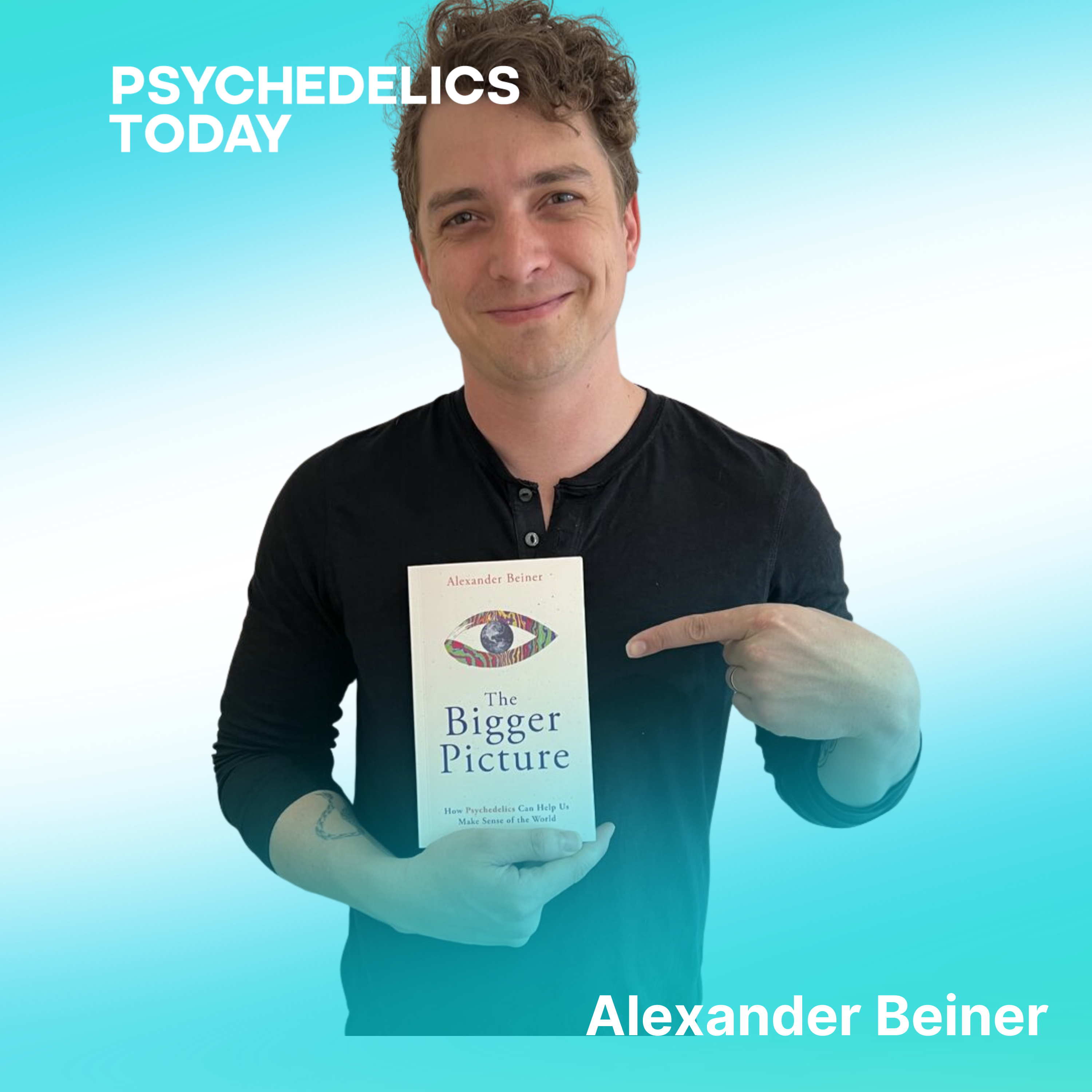
Ep 640PT 640 - Alexander Beiner - Psychedelics, Culture, and the Games We Play
Alexander Beiner joins Psychedelics Today to explore how psychedelics, culture, and power shape each other. A writer, facilitator, and co founder of the conference Breaking Convention and the media platform KAINOS, he has spent years thinking about how psychedelic experiences ripple into politics, economics, conflict, and community. In this episode, he and Joe trace the path from early internet forums to today's psychedelic renaissance, and ask what it would mean to bring a truly psychedelic perspective into our institutions. Beiner is less interested in psychedelics as a niche medical tool and more interested in how they can help us see through destructive cultural "games," reconnect to our bodies, and relate across deep divides. Early themes with Alexander Beiner The conversation starts with Beiner's origin story. He describes formative psychedelic experiences as a teenager, and how early access to thinkers like Terence McKenna, Timothy Leary, and the Shulgins led him onto the Grow Report forum and its associated podcasts. From there he launched his own visionary art podcast and eventually co founded Rebel Wisdom, where he focused more broadly on culture, systems, and meaning rather than only on psychedelics. He explains that most of his writing has not been about psychedelic substances, but about a "psychedelic approach" to reality. That means paying attention to complexity, paradox, and relationship, and asking what a psychedelic form of education, politics, or media might look like. He also touches on his documentary "Leviathan," which looks at breakdowns of trust, disembodiment, and the social forces that pull us away from what is real and relational. Core insights from this conversation In the middle of the episode, the discussion moves into concrete tensions in the current psychedelic resurgence. Topics include: How medicalization can both help and constrain access Cognitive liberty and the right to alter one's own consciousness Psychedelic capitalism and the "Moloch" problem of destructive competitive games The risks and potential of psychedelic religions and new spiritual communities Beiner highlights work on ayahuasca circles for Israelis and Palestinians, noting how "we are all one" language can sometimes block necessary truth telling about power and harm. He returns often to embodiment as a key corrective. When people slow down, feel their bodies, and notice what is actually happening in their nervous systems, they can hold disagreement without dehumanizing each other. He also points to emerging work on psychedelics for creativity and problem solving, including stories where psychedelic insights contributed to breakthroughs in science and complex systems thinking. For him, this is one of the most exciting frontiers, because it shifts the story from "fixing a deficit" to "creating something new." Later discussion and takeaways with Alexander Beiner Later in the episode, Alexander Beiner and Joe talk about cult dynamics, religious freedom, and the need for better checks and balances in emerging psychedelic communities. Beiner stresses that humans are naturally drawn into strong groups and narratives, so the key is not to eliminate "cults" but to spot harmful patterns early and build better accountability. They explore how double binds and mixed messages can create mental distress, and how psychedelics can sometimes resolve these binds by adding new context and perspectives. From there, the conversation turns to third spaces, communitas, and the urgent need for more embodied, in person culture beyond screens, work, and home. Practical takeaways include: Work with psychedelics in ways that reconnect you to your body, not just your ideas Treat medicalization as one path among many, not the only legitimate route Pay attention to group dynamics, power, and accountability in any psychedelic setting Look for ways to bring "psychedelic virtues" like flexibility, curiosity, and compassion into your workplace, family, and community Frequently Asked Questions Who is Alexander Beiner? Alexander Beiner is a writer, facilitator, and co founder of the psychedelic conference Breaking Convention and the media platform Kinos. His work focuses on culture, systems, and how psychedelic perspectives can reshape society. What is Alexander Beiner's book about? His recent book (discussed in this episode) looks at how psychedelics interact with politics, capitalism, and culture, and asks whether they can help us navigate multiple crises without getting captured by the same destructive games. How does Alexander Beiner view psychedelic medicalization? He sees medicalization as useful but limited. He supports access for people who need it, but worries that a purely medical frame reinforces class divides and hands too much power to psychiatry, instead of centering cognitive liberty and community based use. What is Leviathan in Alexander Beiner's work? "Leviathan" is his documentary on the breakdown of trust, disembodiment, an
Ep 639PT 639 - Evelyn Eddy Shoop PMHNP-BC: Lived Experience, Qualitative Data, and the Future of Psychedelic Care
Overview Evelyn Eddy Shoop PMHNP-BC joins Psychedelics Today to share her journey from Division I athlete to psychiatric mental health nurse practitioner and psilocybin research participant. In this conversation, she explains how sports injuries, OCD, and intensive treatment led her into psychiatry and eventually into a psilocybin clinical trial at Yale. Her story weaves together lived experience, clinical training, and a call for more humane systems of care and better qualitative data in psychedelic science. Early Themes: Injury, OCD, and Choosing Psychiatry Early in the episode, Evelyn Eddy Shoop PMHNP-BC describes how multiple season ending injuries in college and serious mental health stressors in her family pushed her to rethink her life path. Originally pre vet, she stepped away from veterinary medicine after realizing she could not tolerate that environment. During a semester off for surgery and mental health, she completed intensive outpatient treatment and family therapy. That time showed her how powerful psychological work could be. It also reawakened a long standing curiosity about the brain, consciousness, and human experience. This led her to switch her major to psychology and later pursue psychiatric mental health nurse practitioner training at the University of Pennsylvania. At Penn, she felt supported academically and personally. Her interest in psychedelics grew as she realized that standard OCD treatments and high dose SSRIs were not giving her the level of functioning or happiness she knew was possible. Core Insights: Psilocybin Trials, Qualitative Data, and Clinical Skepticism In the middle of the episode, Eddy shares the story of finding a psilocybin trial on ClinicalTrials.gov just as she was about to start ketamine therapy. She received placebo first, then open label psilocybin, and describes the dosing day as one of the hardest days of her life, with benefits that emerged slowly over months through integration. She uses her experience to highlight why qualitative data matters. Numbers alone cannot capture the depth of a psychedelic journey or the slow unfolding of meaning over time. She argues that subjective stories, even difficult ones, are essential for clinicians, researchers, and policymakers. Key themes include: The central role of integration support in turning a crisis level session into lasting growth How trial environments on inpatient psychiatric units can feel like prison instead of healing spaces The limits of double blind placebo trials when participants become desperate for active treatment The need for more nuanced language around psychosis and psychedelic harms Eddy also addresses skepticism in psychiatry. Many providers fear substance induced psychosis and feel uneasy with medicines whose mechanisms are not fully understood. She suggests that more lived experience stories and careful education can help bridge that gap. Later Discussion and Takeaways In the later part of the episode, Eddy and Joe discuss harm reduction, ketamine risks, and how poorly designed systems can create harm even when the medicine itself is helpful. Eddy describes being treated as "just another psych patient" once the research team left for the day, including being denied basic comforts like headache relief after an emotionally intense session. She calls for: More humane hospital and research environments Required psychedelic education in psychiatric training Honest, nonjudgmental conversations about substance use with patients Stronger public education for students and festival communities Eddy also invites listeners in Wilmington, Delaware and nearby regions to connect if they need a psychiatric mental health nurse practitioner for psychedelic related research. She hopes to bring her lived experience and clinical skills into the emerging field as psilocybin and other treatments move toward approval. Frequently Asked Questions Who is Evelyn Eddy Shoop PMHNP-BC? She is a psychiatric mental health nurse practitioner trained at the University of Pennsylvania, a former Division I athlete, and a psilocybin trial participant who now advocates for more humane and data informed psychedelic care. What did Eddy learn from her psilocybin clinical trial experience? She learned that the hardest sessions can lead to deep change when integration support is strong and when there is time to unpack insights, rather than rushing to rate symptoms on a scale. Why does she care so much about qualitative data in psychedelic research? Eddy believes that numbers cannot capture the full human impact of psychedelic therapy. Stories show how people actually live with their disorders and integrate change, which is vital for ethical practice and policy. How does she view psychedelic harms and psychosis risk? She acknowledges real risks, especially for people with certain histories, but also notes that some psychotic experiences are not distressing. She calls for more precise language, better containers, and honest harm r
Ep 638PT 638 - Dr Jason Konner - Psychedelic Oncologist
In this episode, Joe Moore sits down with Dr. Jason Konner, a longtime oncologist who recently left his full-time clinical role at Memorial Sloan Kettering to devote himself to the emerging intersection of cancer care and psychedelics. Dr Konner shares how, after more than two decades treating people, he hit a wall. The accumulated grief, constant exposure to death, and intensity of oncology left him deeply burned out, though he didn't have that language for it at the time. A chance moment in a yoga class, overhearing someone say "ayahuasca retreat" just before he was scheduled for hernia surgery, became the turning point. Within a week, he was in the jungle. That first week with ayahuasca, followed later by work with mushrooms, "absolutely transformed" his life. His fear of death lifted. The burnout he hadn't even recognized in himself was both revealed and relieved. When he returned to his practice, Konner describes feeling like he suddenly had a "superpower": he could stay present, connected, and compassionate with patients facing advanced disease without collapsing under the emotional weight. He and Joe explore what this third path looks like: not the classic binary between either hardening and distancing as self-protection, or staying open-hearted and getting shattered. Instead, psychedelics helped him hold deep relationship with patients and families while maintaining inner stability and meaning. This opened space for authentic conversations about spirituality, fear, grief, and what it means to live with (or die from) cancer. From there, Dr Konner zooms out to critique the broader oncology system: The lack of training and support for oncologists around their own emotional and existential load, How little space there is for relational work even though it's central to healing, Why many support groups and standard psychiatric approaches (like reflexively prescribing SSRIs) often miss the mark for people dealing with cancer, How caregivers, partners, family members, and others are deeply affected but rarely truly supported. Joe and Jason then dig into psychedelics and oncology as a frontier: easing existential distress in patients with terminal cancer, the neglected suffering of caregivers, the potential role of psychedelics in helping people relate differently to death, and what it might mean for ICU use, aggressive end-of-life interventions, and overall healthcare costs if more people could make decisions from a place of peace rather than terror. Dr Konner also shares a striking ovarian cancer case that hinted at powerful immune changes after shamanic work, and why he believes we need new research paradigms that can honor the integrity of retreat and ceremonial settings while still learning from them. Finally, he talks about his early-stage project, Psychedelic Oncology, and his hope that the first wave of change starts with clinicians themselves becoming more psychedelic-literate—and, where appropriate, doing their own inner work—so better options can eventually reach the people who need them most. Learn more - https://psychedeliconcology.com/
Ep 637PT 637 - Genesee Herzberg — Ketamine Truths, MDMA Hopes, and the Work of Integration
Clinical psychologist Dr. Genesee Herzberg joins Kyle to reflect on two decades in trauma work and 15 years inside the psychedelic ecosystem—from early MAPS conferences to running Sage Integrative Health. She traces how personal psychedelic experiences set her on a path of service, research at CIIS on MDMA-assisted therapy, and hands-on roles with MAPS: Zendo Project harm reduction, adherence rating, and ultimately serving as an MDMA therapist in clinical trials. Today she leads Sage, an integrative clinic (psychotherapy, psychiatry, bodywork, acupuncture, and functional nutrition) focused on ketamine-assisted therapy while preparing for MDMA's eventual approval. She also co-founded a sliding-scale KAP nonprofit (now Alchemy Community Therapy Center), co-edited Integral Psychedelic Therapy, and is helping to launch the International Alliance of MDMA Practitioners. In this episode From counterculture to mainstream: What's been gained—and lost—as psychedelics scaled. Accessibility vs. corporatization: Why cutting corners (prep/integration, therapeutic time) undermines outcomes and safety. "Myth of the magic pill": Psychedelics can catalyze change, but healing is an ongoing process anchored by integration. What good care looks like: Preparation → medicine sessions → robust integration, individualized cadence, and adding bodywork and functional medicine to address gut-brain links, mineral status, sleep, and somatic tension. Ketamine realities: Differences between psycholytic (talk-forward) and psychedelic (eyes-closed, inner-directed) dosing; why some need multiple sessions to build relationship with the medicine; risks of mail-order models (high dosing, poor screening/support), daily prescribing, addiction potential, cystitis, and safety concerns. Sitting, not guiding: The therapist's task is to follow the client's process; intervene sparingly and with consent—especially in trauma work where attuned co-regulation is essential. Multiple access pathways: Support for regulated clinical care and community, peer, and ceremonial models—paired with education and harm reduction (Zendo's SIT peer training and new crisis-responder training). The MDMA pause: Initial devastation at the FDA decision gave way to seeing benefits: time to strengthen ethics, accountability, training standards, and to temper hype-driven investment. Pace and ethics: Lessons from burnout; moving at the speed of trust; exploring "psychedelic business models" (stakeholder focus, distributed decision-making, employee ownership, public benefit structures). Resources & organizations mentioned Sage Integrative Health Alchemy Community Therapy Center (sliding-scale KAP) International Alliance of MDMA Practitioners Integral Psychedelic Therapy (edited by Genesee Herzberg, Jason Butler, Richard Miller) Takeaway: Thoughtful preparation, right-sized dosing, and committed integration—held within ethical, community-minded systems—turn powerful experiences into durable change.
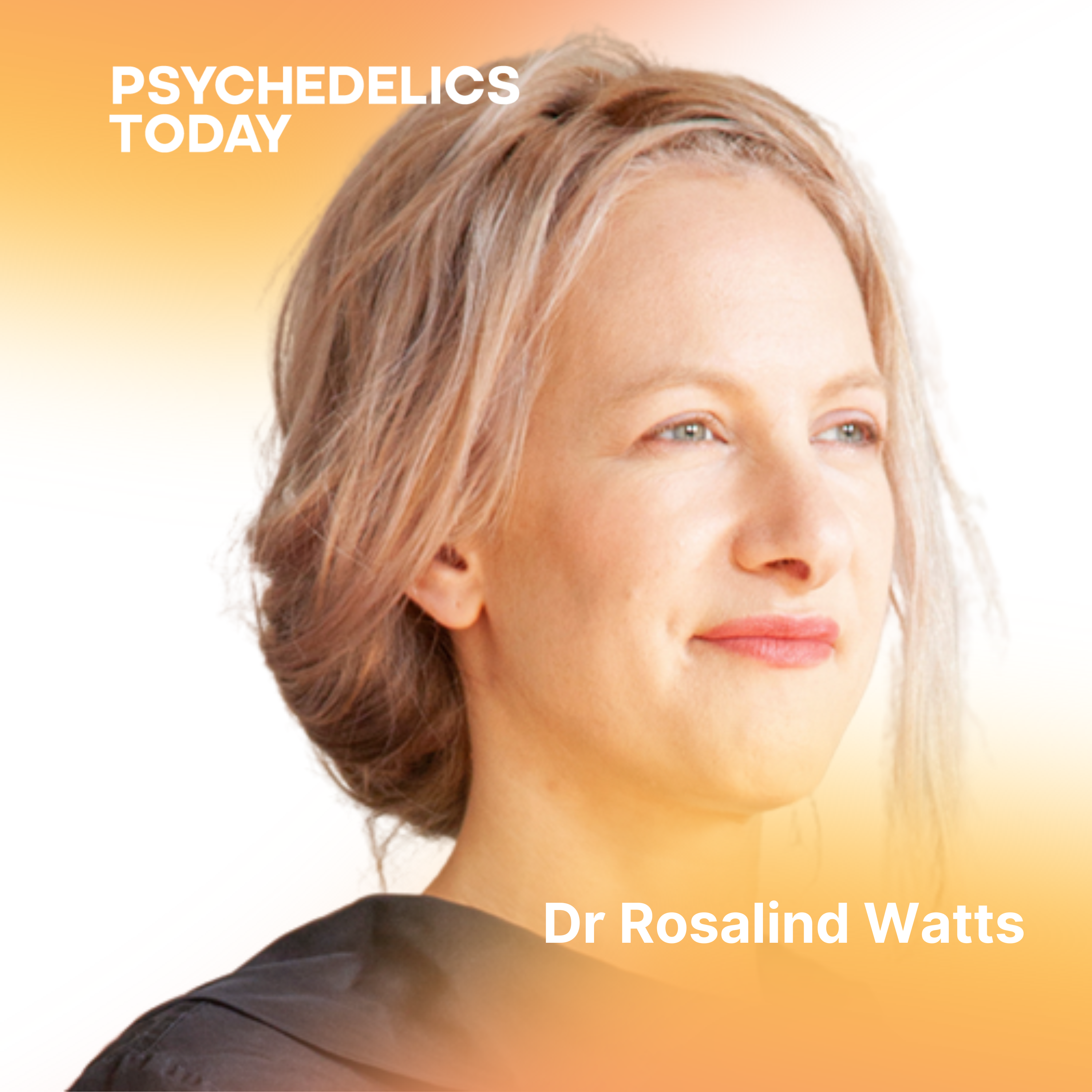
Ep 636PT 636 - Dr. Ros Watts – Building Communities and Connection
Clinical psychologist Dr. Ros Watts joins Psychedelics Today to share insights from her decade of work with psilocybin therapy and her evolving focus on community-based integration. As the former Clinical Lead for Imperial College London's landmark psilocybin-for-depression trial, Dr. Watts witnessed how psychedelic experiences can foster profound feelings of connection— to self, others, and nature — yet also how that connection can fade without ongoing support. In this conversation, she reflects on what years of research have taught her about connectedness as both a healing mechanism and a human need. She explores how integration work can transform fleeting psychedelic breakthroughs into lasting change, and why community is not just a "nice-to-have," but a core part of psychological and ecological resilience. Dr. Ros Watts also discusses her "Twelve Trees" framework — a nature-inspired model for personal and collective growth that helps participants translate insight into action through values, embodiment, and mutual care. Her current project, ACER Integration (Accept, Connect, Embody, Restore), is a 13-month, co-created journey that guides people in weaving psychedelic insights into everyday life while deepening relationships with self, others, and the living world. Named among the Top 50 Most Influential People in Psychedelics and Top 16 Women Shaping the Future of Psychedelics, Dr. Watts continues to advocate for integration, harm-reduction, and inclusion in the psychedelic space. Together, we explore what sustainable healing really means, how organizations can embody the same principles they teach, and how the psychedelic movement can root itself in care, connection, and community. Learn more about ACER Integration: https://acerintegration.com Find Dr Ros Watt's webpage here. https://www.drrosalindwatts.com/

Ep 635PT 635 - Jennifer Espenscheid — Art as a Practice, Psychedelics as a Teacher
Artist, builder, and podcast host Jennifer Espenscheid joins Joe Moore for a rich conversation on creativity, process, and the spiritual dimensions of making art. Drawing from her South Dakota roots and large-scale works like Luciferia, Jennifer reflects on the blend of grit, intuition, and trust that guides her artistic life. She discusses how psychedelics have served as a tool for clarity and healing rather than direct creation of art, helping her dissolve patterns and reconnect to innate creativity. They explore how events like Burning Man catalyze inspiration, why intention and integration matter as much as vision, and the discipline of "earning your dopamine"—staying self-motivated instead of chasing external highs. Jennifer shares lessons about gestation, patience, and protecting early ideas before they're ready to be seen. Together they examine creativity as a human birthright and art as a daily practice of attention and renewal. "By being human, you are intrinsically creative. Psychedelics help me clear the noise so I can actually hear and honor that." Links The Soma Show - Main website Podcast on YouTube Jennifer on LinkedIn
Ep 634PT 634 - Brad Adams - LAMPS
Brad Adams — LAMPS (Los Angeles Psychedelic Society) joins Kyle to trace his path from PhD researcher to community builder. Brad shares how early work in AIDS, Alzheimer's, gerontology, and cancer research primed him to notice Harbor-UCLA's psilocybin pilot for stage-4 cancer patients with death anxiety—where the strongest mystical experiences correlated with profound death acceptance. Teaming with Dennis McKenna, he ran an ayahuasca pilot in Peru and presented findings at Psychedelic Science 2017. From there, Brad founded LAMPS: first as research meetups at UCLA, then as a thriving hub hosting speakers and, ultimately, an L.A. psychedelic conference. He previews the November 1 event at Above the Block in West L.A.: daytime panels on cannabis, preparation/integration, and music & psychedelics; a vendor hall; and a "Healing Lounge" with bodywork, astrology, human design, and more—closing with a late-night dance party featuring David Starfire. Brad offers grounded advice for starting local communities (begin small, meet regularly, curate safe dialogue, and moderate firmly), and reflects on platform friction around psychedelics. The conversation widens to DMTx (extended-state DMT), entity encounters, and what humble, relational curiosity can reveal—then to Wetiko, IFS, and the hero's journey as frames for keeping hope alive in turbulent times. A candid and practical tour of research, resilience, and real-world community building.
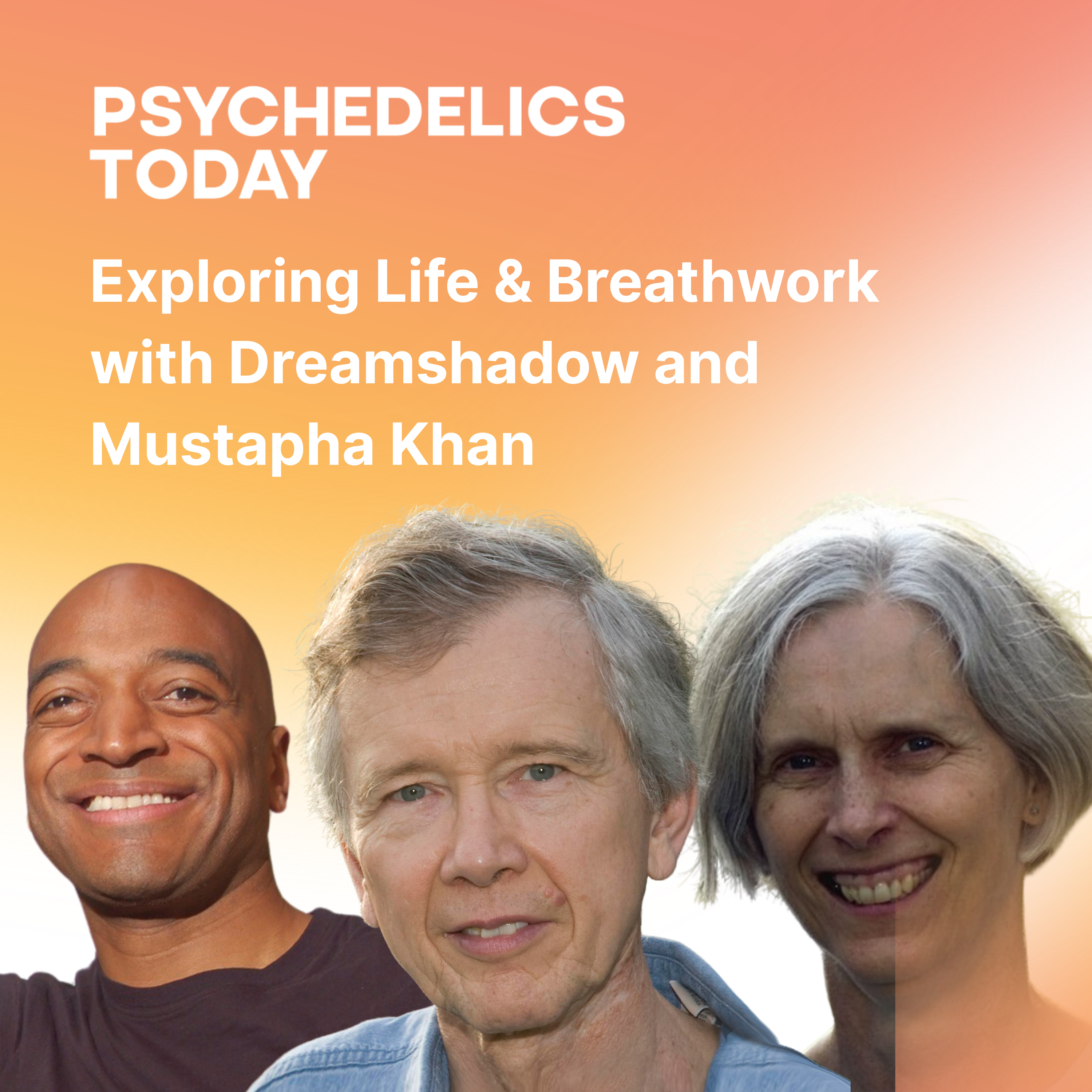
Ep 633PT 633 - Dreamshadow - Life and Breath
In this episode, Kyle and Joe sit down with filmmaker Mustapha Khan and Dreamshadow's Elizabeth & Lenny Gibson to explore Life and Breath—a new documentary immersing viewers in the experience and community of Holotropic Breathwork. We talk about why Mustapha was drawn to Dreamshadow, the film's cinéma vérité approach that places you "in the room," and how years of facilitation informed what became both an archival record and a living portrait of transformation. Elizabeth and Lenny reflect on 35+ years of holding space, the role of curiosity over agenda, and why genuine community—not just catharsis—is central to lasting growth. Kyle and Joe share personal reactions from a Breckenridge screening, the emotions it stirred, and how this work has shaped Psychedelics Today. We close on hope, relationship, and the power of gathering to remember who we are. Keep an eye out for upcoming screenings and Q&As with the team behind Life and Breath. Dreamshadow Life and Breath won first place at the Psychedelic Film and Music Festival!
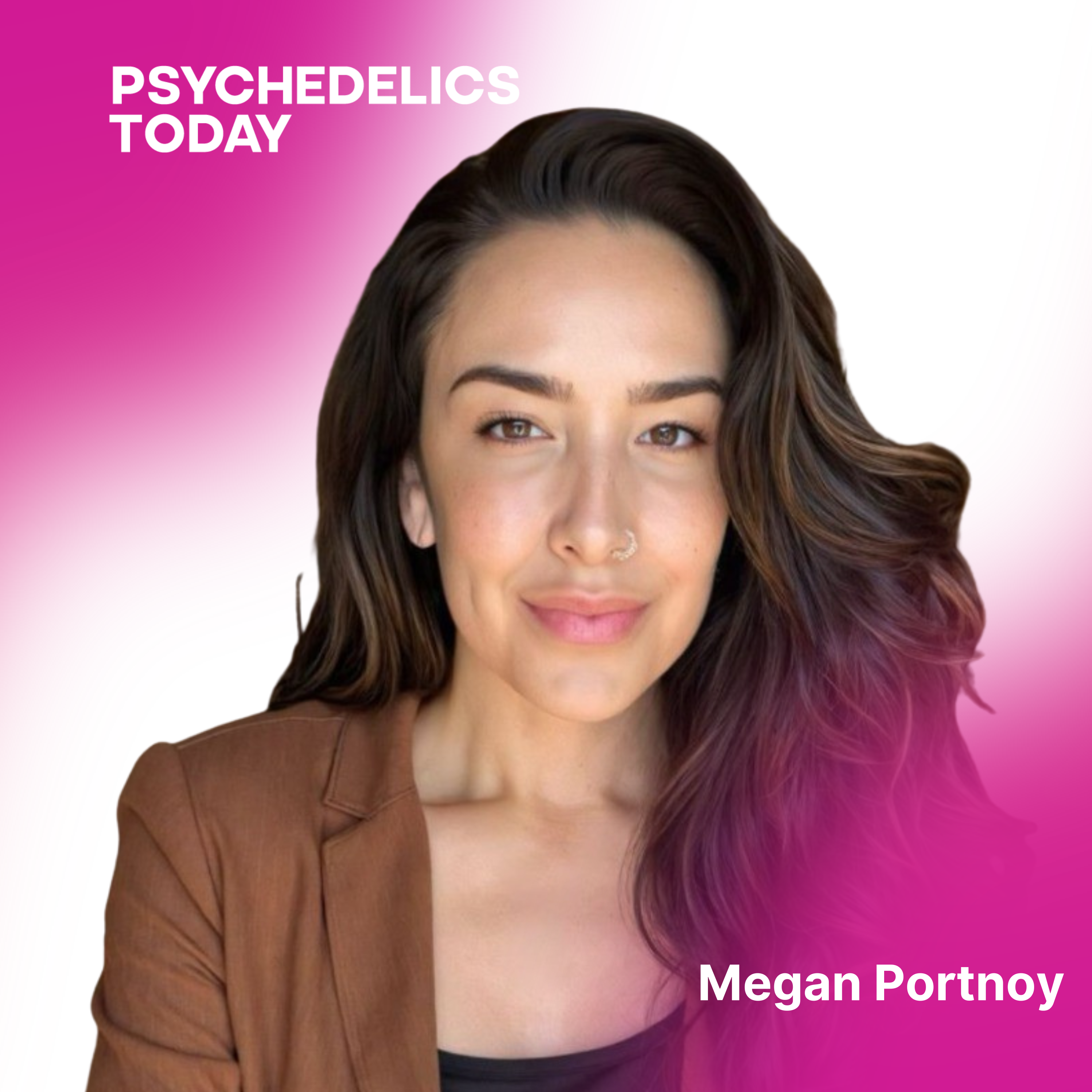
Ep 632PT 632 - Megan Portnoy MS - Ontological Design, Psychedelic Spaces, and Integrating Rigor
In this episode, Joe Moore talks with Megan Portnoy, a doctoral candidate in clinical psychology at Antioch University New England, about how ontological design can reshape the environments used in psychedelic-assisted therapy. Megan explains how physical space is not just a backdrop but an active participant in the therapeutic process, influencing emotion, cognition, and healing. She recently won an award for her presentation on this topic at PsychedelX. They explore how design principles that foster awe, play, and flexibility can deepen integration and expand what's possible in clinical settings. The conversation also examines how psychedelic communities can balance openness with discernment, apply more psychological rigor, and avoid falling into ungrounded or high-demand group dynamics. This rich discussion bridges psychology, philosophy, design, and culture—inviting us to think critically about not only how we use psychedelics, but the spaces, systems, and stories that shape our collective evolution.
Ep 631PT 631 - Kyle Buller and Joe Moore - Breathwork, Community, Bodywork and more!
Joe and Kyle open with reflections from their first r/psychonaut AMA, then pivot to why they're building Navigators—our off-social community with book/film clubs, early ad-free episodes, mentorship, and an expanding education library. The core discussion explores touch and bodywork in breathwork and psychedelic contexts: why defaulting to "no touch" and moving slowly matters; informed consent; reading nonverbals; and keeping client agency central. They unpack trauma-informed concepts like the window of tolerance, polyvagal‐adjacent ideas (and critiques), and the ethics of avoiding re-traumatization or facilitator-driven interventions ("WAIT: Why am I Talking/Treating/Touching?"). The duo emphasize that bodywork requires specialized training and careful framing—supportive, not performative. Plus: updates on upcoming offerings—Advanced Shadow Work with Dr. Ido Cohen (starts Oct 20), music for sessions, digital security for practitioners, spiritual emergence, somatics/trauma, and inner-work integration. Join Navigators to learn in community and help shape future conversations.
Ep 630PT 630 - TK Wonder and Cipriana Quann
Interviewers: Joe Moore & Anne Philippi Guests: TK Wonder & Cipriana Quann (The Quann Sisters) Recorded: June 18 during MAPS PS 2025 Content note: This episode discusses childhood sexual, physical, and emotional abuse, suicidal ideation, disordered eating, and recovery. Identical twins, writers, and culture-shapers TK Wonder and Cipriana Quann join Joe and Anne for a frank, generous conversation about identity, resilience, and the long arc of healing. Cipriana recounts launching Urban Bush Babes in 2011 to center women of color in beauty and fashion—work that led to a Vogue "day-in-the-life" feature and collaborations with couture houses. TK shares the parallel path of her music career (opening for artists from Sting and Nas to Erykah Badu and Queens of the Stone Age) and the sisters' ongoing writing, public speaking, and mental-health advocacy. They reflect on the fashion industry's policing of natural hair, how those daily microaggressions erode self-worth, and why legal protections like the CROWN Act matter. The heart of the episode is their survival story: a decade of abuse by their father, endured separately yet witnessed together. Seeing one another live through it—"a physical manifestation of survival," as they put it—kept them alive. As adults, daily check-ins remain their core practice. Psychedelics entered their lives years later. With careful set and setting, education, and professional support, psychedelic sessions—especially ibogaine—helped surface grief, release shame, and reframe entrenched coping strategies. Cipriana's first extended session unlocked tears she'd been forced to suppress as a child; TK describes a transformative ibogaine experience that catalyzed a decisive shift away from refined sugar and ultra-processed foods toward sustained movement, earlier mornings, and mindful nourishment. Both emphasize that psychedelics are not "magic pills" in isolation: integration, therapy, community, and lifestyle design make insights durable. The conversation also tackles safety and access. The sisters stress working with experienced facilitators and medical oversight, naming that these modalities aren't for everyone. They call for more affordability and BIPOC representation in a field that can still feel exclusionary, while holding a wide tent vision—everyone deserves the chance to heal. They note how narratives are changing (from early-2000s panic to mainstream book-club conversations), and how stories alongside science move culture and policy. Highlights Fashion, hair politics, and the CROWN Act's importance. Sisterhood as lifeline; daily check-ins as grown-up therapy. First sessions: somatic release, grief, and reframing shame. Ibogaine's role in behavior change; why integration is the bridge. Safety, access, and representation: making healing containers truly welcoming. If you're exploring this work: educate deeply, choose qualified support, prioritize integration, and remember—your past is a chapter, not your whole story.
Ep 629PT 629 - Ivar Goksøyr - MDMA Therapy for Therapists
In this candid, practice-focused conversation, Joe is joined by Norwegian psychologist and researcher Ivar Goksøyr to explore how therapists' own healing journeys can measurably improve client outcomes—and why MDMA-assisted experiences, used thoughtfully, may be a uniquely powerful catalyst for professional development. Ivar shares lessons from Norway's psychedelic research team (PTSD and the world's first MDMA-for-depression trial), his clinic Psykologvirke in Oslo, and his online course, "The Wounded Healer," which uses authentic footage from his FDA-approved MAPS volunteer MDMA sessions to illuminate real clinical processes, countertransference, and the "inner healing intelligence" as a working metaphor rather than dogma. The discussion ranges from implementation realities (laws, ethics, and conservative regulatory cultures) to the pragmatic: how an MDMA experience helped Ivar resolve chronic anxiety reactions in the therapy chair, reduced burn-out, increased receptivity, and improved attunement—changes he believes many clinicians can cultivate when personal growth is prioritized alongside methods training. He outlines a developing collaboration with the University of Oslo on Empathogen-Assisted Therapies Development—not to "dose for certification," but to support therapists' self-awareness and resilience in legally sanctioned research contexts. They also compare compounds: why MDMA may be easier to integrate into mainstream psychiatry than classic tryptamines (fewer projective processes, more biographical focus, smoother affect regulation), while acknowledging the immense promise—and higher demands—of psilocybin and other psychedelics. Throughout, they emphasize humility, guardrails, and the need to keep learning as the field scales (with frank reflections on ketamine's mixed rollout and avoiding idealization/devaluation cycles). Highlights Why therapist factors often outweigh modality—and how personal work translates into better outcomes. Using real session video (with Ivar as participant) to normalize vulnerability, illuminate process, and train pattern recognition. Regulatory and ethical nuances of self-experience in training; building consensus before policy change. Inner healing intelligence as a clinical metaphor aligned with Rogers, Rank, and psychodynamic concepts (unconscious therapeutic alliance). MDMA vs. classic psychedelics for implementation; sequencing with ketamine in public systems. Global classroom: 270+ clinicians from every continent; course structure centered on reflection, discussion, and live analysis.
Ep 628PT 628 - Kyle Buller and Joe Moore - Breathwork, Community, Creativity, and Fresh Psychedelic Research
Joe and Kyle debrief a hometown Dreamshadow Transpersonal Breathwork weekend in Breckenridge, then sketch the next chapter for Psychedelics Today: a community-centric model (Navigators) that bundles education, live streams, book and film clubs, and small-group access. They kick around the big "creativity + psychedelics" question, contrast subjective "I feel creative" with objective task performance, and highlight new research—from DMT's potential in stroke recovery to breathwork's measurable effects. They wrap with quick hits on MAPS leadership, state policy moves, and what's coming up at PT this fall. Highlights & takeaways Breathwork > substance? A reminder that profound states are accessible without drugs; benefits of facilitating at home (rested facilitators = safer, better containers). What is "shamanism," really? A functional frame: non-ordinary states, interaction with the unseen, and service (healing/divination). Community > one-off courses: PT is shifting toward a monthly membership model to keep prices accessible, deepen relationships, and sustain more free content. Creativity debate: Double-blind study (DMT + harmine vs harmine vs placebo) suggests impaired convergent thinking despite increased felt creativity; how to define and measure "creativity" fairly, and other research outcomes might tell a different story. Whitehead & novelty: A quick tour through Alfred North Whitehead's notion of "creativity" as the principle of novelty—useful language for mapping psychedelic insight to real-world change. Neuro + clinical frontiers: DMT for stroke (animal models): BBB stabilization and reduced neuroinflammation signal a promising adjunct to current care. Cluster headaches: Emerging reports on short-acting DMT for rapidly aborting cluster cycles; more data coming soon. Breathwork science: New imaging work associates music-supported hyperventilatory breathwork with blissful affect and shifts in blood flow. News & culture mentioned MAPS leadership: Betty Aldworth & Ismail (Izzy) Ali named permanent Co-Executive Directors. Policy snapshots: Colorado Natural Medicine Board recommending ibogaine (with Nagoya-compliance requirement); Alaska signature gathering; Massachusetts activity. Media & scene: Hamilton's recent appearances; contamination concerns in some "psilocybin" products; "psychedelics tick far more neurons than expected" paper; mixed findings for postpartum depression.
Ep 627PT 627 - Mary Carreon — Censorship, Psychedelic Media & Policy Crosscurrents
Episode summary Joe and Mary dive into how platform censorship and shifting algorithms have reshaped psychedelic media, why DoubleBlind moved to a "newsletter-first" model, and what that's revealed about true audience engagement. They reflect on the post-2024 MDMA decision headwinds, state-level policy moves (wins and losses), and how funding, politics, and culture continue to reconfigure the field. They also explore alternatives to alcohol, chronic pain research, reciprocity around iboga/ibogaine, and lessons from PS25 (MAPS' Psychedelic Science 2025). Highlights & themes From platforms to inboxes: Social and search suppression (IG/FB/Google) throttled harm-reduction journalism; DoubleBlind's pivot to email dramatically improved reach and engagement. Post-MDMA decision reality: Investment cooled; Mary frames it as painful but necessary growth—an ecosystem "airing out" rather than a catastrophic pop. Policy pulse: Mixed year—some state measures stalled (e.g., MA), others advanced (e.g., NM; ongoing Colorado process). Rescheduling cannabis may add complexity more than clarity. Censorship paradox: Suppressing education makes use less safe; independent outlets need community support to keep harm-reduction info visible. Chronic pain & long COVID: Emerging overlaps and training efforts (e.g., Psychedelics & Pain communities) point beyond a psychiatry-only frame. Alcohol alternatives: Low-dose or occasional psychedelic use can shift habits for some; Mary stresses individual context and support beyond any single substance. Reciprocity & iboga: Rising interest (including from right-leaning funders) must include Indigenous consultation and fair benefit-sharing; pace of capitalism vs. community care is an active tension. PS25 field notes: Smaller, more manageable vibe than 2023; fewer "gold-rush" expectations; in-person dialogue beats online flame wars. Notable mentions DoubleBlind: Newsletter-first publishing; nurturing new writers and reported stories. Psychedelics & Pain Association / Clusterbusters: Community-driven models informing care and research (cluster headache protocols history). Books & media: Body Autonomy (Synergetic Press anthology); Joanna Kempner's work on cluster headaches - Psychedelic Outlaws; Lucy Walker's forthcoming iboga film. Compounds to watch: LSD (under-studied relative to MDMA), 2C-B, 5-MeO-DMT (synthetic focus), and broader Shulgin-inspired families. Mary Carreon: [00:00:00] Okay, I'm gonna send it to my dad because he wants to know. Here Joe Moore: we go. Yeah, send it over. So, hi everybody. We're live Joe here with Mary Anne, how you doing today? Mary Carreon: I'm great Joe. How are you? Joe Moore: Lovely. I actually never asked you how to pronounce your last name does say it right? Mary Carreon: Yes, you did. You said it perfectly Joe Moore: lovely. Joe Moore: Um, great. So it's been a bit, um, we are streaming on LinkedIn, YouTube, Twitch X and Kick, I guess. Yeah. Kick meta. Meta doesn't let me play anymore. Um, Mary Carreon: you're in forever. Timeout. I got it. I got it. Yeah. Joe Moore: Yeah. I think they found a post the other day from 2017. They didn't like, I'm like, oh cool. Like neat, you Mary Carreon: know, you know. Mary Carreon: Yeah. That happened to me recently, actually. Uh, I had a post taken down from 2018 about, uh, mushroom gummies and yeah, it was taken down and I have strikes on my account now. So Joe Moore: Do you get the thing where they ask you if you're okay? Mary Carreon: Yes, with, but like with my searches though, [00:01:00] like if I search something or, or someone's account that has, uh, like mushroom or psychedelic or LSD or something in it, they'll be like, mm-hmm are you okay? Mary Carreon: And then it recommends getting help. So Joe Moore: it's like, to be fair, I don't know if I'm okay, but Yeah, you're like, probably not. I don't really want your help. Meta. Yeah. Mary Carreon: You're like, I actually do need help, but not from you. Thanks. Yeah, Joe Moore: yeah, yeah. Mary Carreon: So not from the techno fascists. Joe Moore: Oh, good lord. Yeah. Uh, we'll go there. Joe Moore: I'm sure. Mary Carreon: I know. I just like really dove right there. Sorry. Yeah. All right, so let's, Joe Moore: um, before we go, let's give people like a bit of, you know, high kicks on, on who is Mary, where you working these days and what are you doing? Mary Carreon: Yeah, thank you. My name is Mary Carryon and I am forever and first and foremost a journalist. Mary Carreon: I have been covering, I say the plant legalization spaces for the past decade. It's, it's been nine and a half years. Uh, on January 3rd it will be [00:02:00] 10 years. And I got my start covering cannabis, uh, at OC Weekly. And from there went to High Times, and from there went to Mary Jane, worked for Snoop Dogg. And then, uh, I am now. Mary Carreon: Double blind. And I have become recently, as of this year, the editor in chief of Double Blind, and that's where I have been currently sinking my tee
Ep 626PT 626 - Kyle & Joe Catch-Up: Vital Cohort 4, Breathwork, Community & a Psychedelic News Roundup
Joe and Kyle celebrate Vital Cohort 4 and reflect on why Vital is more than a 12-month psychedelic-informed training—it's a living community (alumni webinars, discussion groups, cross-cohort meetups). Many grads aren't rushing to facilitate; they're choosing integration, harm reduction, education, and local community building. Next cohort dates are TBD —applications and email sign-ups are open. Breathwork in Breckenridge (this weekend) Dreamshadow Transpersonal Breathwork returns Fri–Sun. The last workshop reinforced how powerful the format is for bonding, somatic processing, and ongoing peer support. Music & tech: fail-safe playbook Keep redundant sources: primary laptop with WAV/FLAC (VLC/Mixxx), secondary device/phone, and a small Bluetooth speaker as last resort. Redundant mixers/interfaces, tested cables, simple signal flow. Pre-flight the exact rig; monitor for digital artifacts/grounding noise. Use offline playlists + Do Not Disturb (actually test it). Why community matters now With AI accelerating "dead-internet" dynamics, trusted human networks—book clubs, film clubs, local meetups—are essential. Skills for the moment: digital security hygiene and discernment (evaluating claims, sources, and inner signals). News & trends Alaska: statewide psilocybin initiative begins signature gathering. New Mexico: momentum toward group psilocybin care (cost-cutting models; ~2-year horizon). TBI & psychedelics: expanding research interest (ibogaine/5-MeO imaging work; anti-inflammatory angles). Colorado & iboga: advisory board backs therapeutic use and encourages Nagoya Protocol reciprocity; federal import/legal nuances remain. Harm-reduction notes Beware gas-station/head-shop "psychedelic" edibles labeled as "proprietary blends." Ask for COAs and clear ingredients; understand test-kit limits (chocolates are tricky). For injections (even "legal" clinics), ask about sterile technique, water, dosing, and sourcing. Get involved Navigators: join our membership for exclusive livestreams, book/film clubs, courses, and meetups. Vital: apply or join the interest list—dates announced soon.
Ep 625PT 625 Greg Shanken — Collaborence, Community Access & Ethical Growth in Psychedelics
Joe Moore sits down with Greg Shanken (Colorado Psychedelic Society, Collaborence Psychedelic Business Association; founder, Higher Frequency Network) for a wide-ranging conversation about building community infrastructure, navigating censorship, and creating accessible, ethical pathways into psychedelic healing. Greg shares his personal arc from lifelong depression to ayahuasca, ketamine, and Bufo; why he launched a vetted affiliate/partner network for our space; and how Oregon–Colorado collaboration can widen access while honoring reciprocity and conservation. Key themes Collaborence: a two-day CO/OR event (online + in-person) connecting facilitators, professionals, and the public with pay-what-you-can access options. Access & affordability: how to widen entry points (microdosing, breathwork, scholarships/funds) within and beyond regulated service/healing centers. Censorship & platform risk: why repeated Meta account shutdowns pushed Greg to build community-based distribution outside big ad networks. Personal journey: depression, SSRIs/SNRIs/ADHD meds → ayahuasca (two-night initiation), IM ketamine, and later Bufo/5-MeO-DMT. Ethics & ecology: "blood toad," conservation, and the case for synthetic 5-MeO-DMT over toad-sourced material; parallels with peyote/mescaline carve-outs. Leadership & culture: bringing heart-centered leadership, breathwork, and microdosing into companies; moving from transactional to mutual-aid ecosystems. Regulated vs. underground: costs, insurance realities, sliding-scale models, and the role each plays in a healthy landscape.
Ep 624PT 624 - Dr. Cat Meyer - Sex, Love, Psychedelics
In this episode of Psychedelics Today, Joe Moore sits down with Dr. Cat Meyer, licensed psychotherapist, sex therapist, and host of Sex, Love, Psychedelics. Together, they explore the deep intersections of sexuality, trauma healing, psychedelics, and the role of play in human connection. Dr. Meyer shares her journey from growing up in rural Missouri and navigating early trauma to becoming a leading voice in sex therapy and psychedelic integration. She opens up about her personal healing path, her work with ketamine-assisted therapy, and how tantra, BDSM, and art have shaped her approach to erotic wellness. Topics Covered Defining the Erotic: Beyond sex, eroticism as vibrancy, life force, and connection to the senses. Personal Story: Dr. Meyer's early struggles, academic path in marriage and family therapy, and her discovery of tantra and BDSM as transformative practices. Psychedelics and Healing: Her first experiences with MDMA-assisted therapy, ketamine retreats for women, and how these tools can reconnect people with pleasure and embodiment. The Power of Play: Why play is essential for healing, relationships, and cultural transformation—ranging from improv and art to Burning Man experiments. Navigating Power Dynamics: How erotic transference, facilitation, and unconscious needs can shape therapy, sex, and psychedelic work—and why self-awareness is crucial. Feral Mysticism: Rewilding the body, reclaiming personal authority, and embracing vibrancy outside of cultural repression. Pleasure and Illness: How Dr. Meyer works with clients facing chronic pain, fatigue, or illness to maintain erotic connection through presence and small practices. Key Quotes "Eroticism is the connection to vibrancy, to life—it's how we engage with the world through pleasure." "Feeling is power. A discerning human who can feel is a powerful human." "Psychedelics help us come back into right relationship with our body and with pleasure." "Play gives us the freedom to experiment, to try, to be vulnerable, and to learn without attaching our worth to the outcome."

Ep 623PT 623 - Dee Dee Goldpaugh - Embracing Pleasure
Joe Moore interviews Dee Dee Goldpaugh, LCSW about their new book Embrace Pleasure: How Psychedelics Can Heal Our Sexuality. The discussion covers the book's reception, critiques of over-medicalization, personal healing experiences, definitions of erotic energy and pleasure, historical repression of substances, and contemporary ethical concerns. Key topics Conversion therapy: historical use of psychedelics in conversion practices, risks today, and need for professional consensus to ban psychedelic-assisted conversion therapy. Motivation: reaction to dominance of the clinical/medical model in psychedelics. Author background: clinical social worker, ketamine-assisted therapy provider, sexual abuse survivor, early psychedelic integration work. Personal healing: ayahuasca and San Pedro (Wachuma) experiences leading to embodied healing and pleasure. Concepts defined: erotic energy as life force; distinction between healing pleasure and leisure. Political framing: pleasure as anti-capitalist resistance; sustaining community and activism. Links https://www.deedeegoldpaugh.com Embrace Pleasure: How Psychedelics Can Heal Our Sexuality
Ep 622PT 622 - Matt Xavier - The Psychedelic DJ
From the Rave Scene to Psychedelic Therapy In this episode, Kyle Buller speaks with Matt Xavier, DJ, therapist, and author. The conversation took place live at Psychedelic Science. Matt recalls his early years in the rave culture of 1990s New York. He ran record labels, hosted psychedelic trance events, and lived through the intensity of that scene. Why Music Is Medicine Matt believes music should be treated as medicine. He explains how playlists can align with the stages of a psychedelic journey—onset, climb, peak, and descent. He encourages people to listen with intention and to categorize tracks by emotion, energy, and therapeutic impact. Psychedelic Soundtracking Instead of relying only on fixed playlists, Matt performs live mixing during sessions. This method keeps him fully engaged and responsive. He calls the approach "psychedelic soundtracking." In his view, the guide becomes a tuning fork, adjusting the soundscape to match the client's process. Key Themes in the Conversation The evolution from rave DJ to therapist and author How music amplifies psychedelics, and why it matters Matching music with each stage of a journey Differences between psilocybin, MDMA, and ketamine work The value of silence, long-form tracks, and harmonic mixing Why buying music supports artists and protects creativity from AI Practical tips for building playlists and rediscovering a love of listening Supporting Artists and Building Community Matt highlights the artists who inspire his work, from ambient pioneers to contemporary sound designers. He urges practitioners to support independent musicians by purchasing their music. In his words, keeping human creativity alive is essential for meaningful psychedelic work. Writing, Mixing, and the Future Matt also discusses his new book and the curated four-hour DJ protocol mix he designed for therapy sessions. He explains how this project grew into a collaborative effort and why writing became a spiritual journey for him. Looking ahead, he hopes to create a training program for others interested in weaving music into psychedelic practice. 🎶 Whether you are a therapist, a DJ, or simply a music lover, this episode shows how sound can transform the psychedelic experience.
Ep 621PT 621 - Dr Case Newsom - Zendo Project
In this episode, Joe Moore sits down with Dr. Case Newsom, an emergency room physician in Denver and Medical Director for both Zendo Project and Stadium Medical. They explore how psychedelic harm reduction is merging with event medicine at concerts, festivals, and large-scale gatherings. Dr. Newsom shares his path from osteopathic medical training to bridging emergency medicine with psychedelic peer support. He explains how the Zendo Project has expanded beyond Burning Man, and why collaboration with medical teams matters. The discussion highlights new triage protocols, cultural shifts in Colorado, and the legal challenges that still stand in the way of safer events. Topics Covered The role of the Zendo Project: Peer support, harm reduction, and creating grounded spaces in chaotic environments. Stadium Medical's model: Covering Denver's biggest venues and connecting emergency care with psychedelic peer support. Developing medical triage protocols: A simple system that reduces unnecessary ER transports while ensuring sitter and guest safety. Colorado as a hub: Why Denver and Red Rocks are central to psychedelic culture and harm reduction innovation. Legal and regulatory challenges: The impact of the RAVE Act and limits on drug checking services. Research and data collection: Building stronger studies to show venues and first responders the value of harm reduction. Future concerns: Ibogaine's cardiotoxic risks, the rise of AI-designed drugs, and why medical involvement is urgent. Ketamine in the ER: How ketamine provides pain relief and can create meaningful patient experiences when used with care.
Ep 620PT 620 - Kat Murti – Students for Sensible Drug Policy, Meta Censorship, and the Fight for Science
In this episode, Joe Moore is joined by Kat Murti, Executive Director of Students for Sensible Drug Policy (SSDP), the largest youth-led network working to end the war on drugs. SSDP organizes at the campus, local, state, federal, and international levels, with more than 100 chapters across the U.S. and sister organizations worldwide. Kat shares her personal journey into drug policy reform, from witnessing DEA raids on AIDS patients in the 1990s to fighting for civil liberties as a student at UC Berkeley. She explains how SSDP empowers young people to challenge outdated laws and promote policies rooted in compassion, scientific evidence, and human rights. Topics Discussed The War on Drugs as a War on Us: Kat's early realizations about the drug war's racism, injustice, and destruction of civil liberties. Her Path to SSDP: From working on California's Prop 19 cannabis campaign to serving on SSDP's board and eventually becoming Executive Director. Meta Censorship Campaign: Why Meta's restrictions on drug education and harm reduction content harm communities, and how SSDP is organizing public pressure to protect freedom of information online. Forced Institutionalization & Executive Orders: Kat critiques recent federal moves to expand forced treatment, cuts to naloxone training programs, and the misguided use of tariffs as "solutions" to the overdose crisis. The Fight Against DEA Scheduling of DOI & DOC: Why these research chemicals are vital to neuroscience and medicine, how SSDP challenged the DEA in court, and what's at stake for future research. Illogical Drug Policy & Careerism: How prohibition persists due to political incentives, propaganda, and entrenched bureaucratic interests. Building a Better Future: Realigning incentive structures, embracing harm reduction, and supporting community-based solutions to drug use. Key Takeaways The war on drugs is deeply racist, anti-science, and erodes civil liberties. Meta's censorship of harm reduction information actively endangers lives. Forced treatment doesn't work—addressing social conditions and providing safe housing does. DOI and DOC, rarely if ever used recreationally, are critical to medical research, and scheduling them would halt decades of progress. Real reform means both ending prohibition and creating environments where people feel supported, connected, and empowered. Links & Resources Students for Sensible Drug Policy (SSDP): ssdp.org Kat Murti on Twitter/X: @KatMurti Kat Murti on Instagram: @KittyRevolution SSDP Petition against Meta Censorship: ssdp.org

Ep 619PT 619 - Sphinx Gate with Mareesa Stertz and Tania Abdul
In this episode, Joe Moore is joined by Mareesa Stertz and Tania Abdul, the visionaries behind Sphinx Gate, one of Burning Man 2025's most ambitious and mythic art installations. Inspired by The NeverEnding Story, Sphinx Gate features two towering 34-foot sphinxes and a fully immersive, transformative art experience designed to help participants gain a deeper understanding of themselves. The trio explores how art and play can catalyze personal and collective transformation—without the need for psychedelics—by helping people reframe inner challenges as quests for growth. They discuss the project's mythic inspiration, how it has evolved into a "transmersive" self-discovery journey, and how community co-creation has made this dream real. With rituals, interactive stations, laser-eyed sphinxes, and an oracle offering personalized missions, Sphinx Gate blends storytelling, inner work, and spectacle. They also touch on the deeper intention: shifting culture by normalizing integration, peer support, and emotional exploration—through joy. From honoring Indigenous land stewards to designing future traveling versions and permanent "Museums of Self-Exploration," this project is just the beginning. Topics Covered: What Sphinx Gate is and how it works The archetypal and cultural roots of sphinxes How The NeverEnding Story inspired the vision Designing integration spaces without psychedelics Co-creation, community magic, and scaling big dreams The emotional and mystical potential of participatory art Fantasia Fridays, Black Rock Philharmonic, and more playa programming Vision for life beyond Burning Man Support Sphinx Gate: Help bring this mythic experience to life and fund its future by donating at TheSphinxGate.com Follow: IG: @thesphinxgate www.thesphinxgate.com
Ep 618PT 618 - Chad Charles - Integrating 5-MeO-DMT: Therapy, Harm Reduction, and Best Practices
In this episode of Psychedelics Today, Joe Moore sits down with Chad Charles — educator, mentor, and practitioner specializing in 5-MeO-DMT therapy. Chad shares his decade-long journey working with 5-MeO-DMT, emphasizing the importance of: Practitioner training and mentorship Personalized, therapeutic alliances The nuanced understanding of dissociative states Ethics in standardized clinical dosing A trauma-informed approach to psychedelic care He also introduces his upcoming research project, analyzing 500+ one-on-one sessions to illuminate best practices and ethical frameworks in the 5-MeO-DMT space. This is a must-listen for anyone passionate about harm reduction, responsible facilitation, and the future of psychedelic therapy. 🕒 Episode Breakdown 00:00 – Introduction and Guest Welcome 00:41 – Chad Charles' Background and Work 02:18 – Defining 5-MeO-DMT 05:28 – Breathwork and Therapy 09:22 – First Experiences with 5-MeO-DMT 18:00 – Training and Ethical Considerations 30:41 – Conscious Surrender vs. Submission Experience 31:18 – Ethical Considerations in Psychedelic Research 32:02 – Understanding Dissociative Doses 33:26 – Empowering Individuals Through Therapeutic Alliance 34:26 – Challenges in Contemporary Science 38:02 – Good Practice vs. Malpractice in Psychedelic Therapy 41:51 – Personal Experience and Practitioner Responsibility 46:52 – Addressing Malpractice and Corrective Experiences 01:00:11 – Physical Health Considerations in Psychedelic Therapy 01:02:21 – Future Directions and Research in Psychedelic Therapy 01:05:43 – Conclusion and Contact Information

Ep 617PT 617 - Alan Davis - Psychedelic Research and Patient Safety at Ohio State & Exploring Ibogaine's Potential
In this episode of Psychedelics Today, Joe Moore sits down with Alan Davis, Associate Professor at Ohio State University, to explore the evolving landscape of Ibogaine research and its therapeutic potential. Alan offers a deep dive into the Iboga Patient Survey, a groundbreaking initiative collecting real-world data on the safety and efficacy of Ibogaine—particularly for those struggling with substance use disorders and mental health challenges. The conversation sheds light on the need for rigorous, community-informed research that could pave the way toward FDA approval and increased access for patients, including veterans dealing with trauma. They also discuss the complexities of clinical trials, the tension between state and federal regulations, and the growing influence of corporate interests in psychedelic research. Alan emphasizes the importance of ethical transparency, community collaboration, and maintaining scientific integrity as the field grows. If you're curious about the intersection of psychedelic medicine, clinical research, and patient safety, this is a must-listen episode. Topics Covered 00:00 – Introduction and Guest Welcome 00:53 – Reflecting on COVID-19's Psychological Impact 01:29 – Introducing the Iboga Patient Survey 01:46 – History and Goals of Ibogaine Research 02:41 – Challenges in Conducting Clinical Trials 03:14 – Importance of Real-World Safety Data 06:55 – Personal Interest in Ibogaine 08:56 – Veterans and Trauma: A Personal Connection 10:53 – Reintegration and Emotional Processing 15:29 – Survey Participation and Accessibility 18:25 – Building Partnerships and Overcoming Challenges 21:06 – Ensuring Safety and Transparency 31:49 – Community and Academic Collaboration 33:06 – Survey Design and Future Research Directions 36:50 – Momentum in Psychedelic Research 37:48 – State vs. Federal Regulation 39:23 – Challenges in Psychedelic Treatment 43:01 – Corporate Interests and Scientific Objectivity 47:20 – Ketamine and Collaborative Research 51:56 – Ibogaine Patient Survey 57:55 – Psychedelics and Pain Research 01:07:22 – Conclusion and Future Directions

Ep 616PT 616 - Karina Bashir on Psychedelics, Islam, and Human Rights
In this engaging episode of the Psychedelics Today podcast, host Joe Moore sits down with Karina Bashir, an attorney working at the intersection of law, business ethics, and psychedelics. Karina, of counsel with Antithesis Law and an active member of the psychedelic community, shares her unique journey from human rights advocacy into the evolving field of psychedelic law. The conversation explores her presentation at Harvard on psychedelics and monotheistic religions, and her efforts to bridge the gap between Islamic communities and psychedelic-assisted healing. She discusses the legal frameworks she navigates to support clients in the psychedelic ecosystem, the spiritual depth of Sufism, and the expansive tradition of Islamic philosophy and mysticism. If you're intrigued by the intersections of religion, law, and psychedelic healing, this episode offers deep insights and hopeful perspectives. 📌 Episode Highlights 00:00 – Introduction and Guest Welcome 00:19 – Meeting at the Psychedelic Safety Institute 01:04 – Karina's Legal Work and Background 04:03 – Human Rights and Migration Work 07:30 – Psychedelics as a Human Rights Issue 18:01 – Legal Challenges in the Psychedelic Space 23:03 – Islam and Psychedelics 28:15 – The Fatwa Process and Islamic Scholars 28:57 – Building Momentum in the Muslim Community 29:08 – Islamic Law and Psychedelics 29:30 – Engaging Muslim Scholars and Community 33:45 – Sufism and Islamic Mysticism 35:09 – Access to Psychedelic Medicine for Muslims 36:49 – Positive Responses and Growing Interest 39:17 – Sufism's Rich Traditions and Practices 40:51 – Intersection of Sufism and Psychedelics 44:14 – Islamic Cosmology and Psychedelic Experiences 51:26 – Concluding Thoughts and Future Directions Attorney, Ethics Advocate, and Program Director at North Star Project Karina Bashir is an accomplished attorney and thought leader working at the intersection of law, ethics, and psychedelics to support a new paradigm of care and equity. She serves as Of Counsel with Antithesis Law, PC, advising clients on corporate formation, risk mitigation, compliance, and ethical best practices. As Program Director at the North Star Project, she advocates for values-driven growth in the psychedelic field through the development of dynamic ethical guidelines. Karina also sits on the Board of Directors of the Psychedelic Bar Association and serves as a steward of its Religious Use Committee. Her work also bridges Islamic thought and psychedelic healing, exploring how spiritual traditions—particularly Sufism—can inform modern approaches to wellness and therapeutic care. She is passionate about increasing access and cultural understanding within Muslim communities engaging with psychedelics. A Fulbright and Gates Cambridge Scholar, Karina holds a JD from UC Berkeley, an MPhil in International Relations from the University of Cambridge, and a BA from the University of Michigan.
Ep 615PT 615 - Kristen Nash and Erica Siegel on Risk Reduction and Psychedelic Safety
In this deeply important episode of Psychedelics Today, Joe Moore is joined by Kristen Nash, MPH, and returning guest Erica Siegel, LCSW, for a nuanced conversation about risk reduction, harm prevention, and ethical education in the psychedelic space. Kristen shares the powerful and heartbreaking story of losing her 21-year-old son after a tragic psychedelic-related incident. Motivated by this loss and her background in public health, she founded the Coalition for Psychedelic Safety and Education and launched the Before You Trip campaign—an educational initiative piloting in Colorado aimed at helping Gen Z users assess their readiness and safety before engaging with psychedelics. Erica contributes her extensive experience from Nest Harm Reduction and Shine Collective, emphasizing the need for peer-based support, non-abstinence frameworks, and trauma-informed approaches. She highlights common pitfalls such as untrained facilitators, predatory behavior, and the pervasive issue of gaslighting in psychedelic communities. Together, they explore the gaps in current education efforts, the dangers of glorifying substances without context, and the moral injuries that can occur when people are harmed or dismissed by the very communities meant to support them. The conversation calls for broader public funding, lived-experience-informed leadership, and transparency around psychological and relational risks—not just physiological harm. The episode also touches on poly-substance use, the limitations of existing drug harm scales, and the importance of setting, support, and intention. With a shared commitment to saving lives and empowering users, Kristen and Erica offer actionable insights and heartfelt reflections on making this space safer for everyone. Listeners are encouraged to follow and support both Before You Trip and Shine Collective to help expand harm reduction education and survivor advocacy.
Ep 614PT 614 - Erica Rex: Scientific Integrity, Psychedelic Research, and the Religious Leader Study
In this episode, Joe Moore speaks with award-winning science journalist Erica Rex about her personal experience participating in psychedelic research, her upcoming book Seeing What Is There: My Search for Sanity in the Psychedelic Era, and the complex story behind the recently published Religious Leader Psilocybin Study from Johns Hopkins and NYU. They examine: Erica's firsthand experience as a participant in the original 2012 study that helped launch Roland Griffiths' prominence in psychedelic science. The goals and outcomes of the Religious Leader Study, which sought to explore how psilocybin might impact religious leaders' effectiveness and connection to their communities. The methodological and ethical problems that plagued the study. The influence of perennialist frameworks and the limitations of measures like the Mystical Experience Questionnaire (MEQ). Broader concerns about the infiltration of religious ideology and lack of rigor in psychedelic science. A deep critique of the institutional systems that allowed flawed research processes to go unchecked — and how these patterns risk repeating the mistakes of the 1960s psychedelic wave. Joe and Erica also dive into how modern psychedelic science struggles to reconcile subjective experience, spirituality, and the reductionist standards of academic research. They discuss Matt Johnson's paper critiquing "psychedelic consciousness" framing and explore whether our current scientific tools are capable of capturing the depth of psychedelic experience. Erica's forthcoming book, slated for release in January 2026, blends memoir, neuroscience, and social critique. It offers a critical insider's view of the psychedelic renaissance—its promise, pitfalls, and the ways it mirrors broader systemic issues in science and culture.
Ep 613PT 613 - Daniel Pinchbeck - From Cultural Catalyst to Capitalist Co-optation: Reflections on Psychedelic Science, AI, and Idealist Monism
In this expansive episode of Psychedelics Today, Joe Moore sits down with author and cultural theorist Daniel Pinchbeck to explore the evolving—and increasingly contested—role of psychedelics in society. From the hopeful spirit of transformation that animated earlier psychedelic movements to the sobering reality of biotech, branding, and political entanglement, Daniel offers a candid diagnosis of where we are—and where we might be headed. Reflecting on Psychedelic Science 2025, Daniel discusses the event's stark shift toward commercialization and industry influence. He contrasts this with his earlier work on Evolver, a movement that sought to integrate psychedelics with permaculture, alternative economics, and cultural awakening. Together, Joe and Daniel examine how the field's idealistic origins have been increasingly subjected to capitalist co-option. They also dive into deeper philosophical terrain—discussing monistic idealism, Rudolf Steiner, and the suppression of mystical and paranormal dimensions in the push to medicalize and sanitize psychedelics for mainstream acceptance. Daniel warns of the dangers of ignoring the shadow, including psychic fragmentation and what he calls "entity attachment" from ungrounded use. The conversation ranges from tech billionaires on ketamine to the geopolitical threat of authoritarianism, the weaponization of AI, and the quiet complicity of many in the psychedelic space who avoid political engagement. Daniel shares his current projects, including his Substack newsletter and a new seminar, Breaking the AI Barrier. This is a timely, unflinching exploration of psychedelics as both medicine and mirror—revealing the best and worst of our collective intentions. Can we reclaim the visionary potential of these tools from the grip of capital and control?

Ep 612PT 612 - Mattha Busby: Power, Pleasure, and the Psychedelic Movement's Reckoning
In this wide-ranging conversation, journalist Mattha Busby joins Joe Moore to reflect on the shifting tone of the psychedelic movement in the wake of Psychedelic Science 2025. Based in Vancouver, Mattha has written for The Guardian, VICE, Esquire, TIME, and Wired, bringing a uniquely embedded yet critical lens to the space. They discuss the post-conference mood and the sense that the industry is sobering up—less hype, more introspection. Mattha reflects on the growing division between underground practitioners, activists, and biotech startups, and the importance of vision, ethics, and scrutiny in the midst of this cultural moment. Other topics include: Ketamine overuse and dependence, especially in social and parenting contexts The future of psychedelic nightlife, harm reduction, and mocktail bars Gender and sexual fluidity as uncovered through psychedelics Questions of IP, underground wisdom, and psychedelic ownership Psychedelics as tools for peacebuilding, especially in conflict zones The shadow side of spiritual experiences and how to spot bad actors The value of pleasure, intimacy, and human connection in the psychedelic journey Joe and Mattha also reflect on the resurgence of psychedelic use in Texas, the legacy of the Stark Club, and how Christian libertarianism and military trauma might influence unexpected policy changes. This conversation is bold, honest, funny, and thoughtful—exactly the kind of cultural critique the movement needs right now. Find Mattha on Instagram at @matthamundo and on LinkedIn at Mattha Busby. His new pocketbook on drug policy is available now.
Ep 611PT 611 - Dylan Beynon - Mindbloom
Dylan Beynon: At-Home Ketamine Therapy, Big Pharma Pushback, and the Future of Psychedelic Accessibility In this episode, Joe Moore welcomes Dylan Beynon, CEO and Founder of Mindbloom, one of the largest providers of legal, at-home ketamine therapy in the U.S. Dylan shares the deeply personal story that led him to psychedelic medicine—including the tragic loss of his mother and sister to addiction and mental illness—and how these experiences continue to fuel his mission to make psychedelic therapy affordable and accessible for all. Mindbloom has now facilitated over 654,000 sessions across 38 states, offering both sublingual and subcutaneous (injectable) ketamine in a comprehensive treatment program that includes preparation, integration, music, journaling, and even generative AI art. The conversation dives into common criticisms of at-home ketamine, the benefits of guided treatment over IV infusions, and the disturbing influence of Big Pharma in media narratives—especially the growing PR push behind SPRAVATO. Dylan also breaks down what makes Mindbloom's outcomes stand out, why they recently added injectable ketamine, and how their safety data challenges popular misconceptions. Joe and Dylan also touch on the potential future of at-home MDMA therapy, regulatory hurdles, and what it will take to scale these powerful treatments to millions of people in need. If you're in the psychedelic field, considering ketamine therapy, or curious about the ethics and economics of psychedelic medicine, this episode offers a powerful look behind the curtain. Resources: Mindbloom.com Vital Psychedelic Training