Politics Politics Politics
450 episodes — Page 4 of 9
Joe Biden Has Cancer
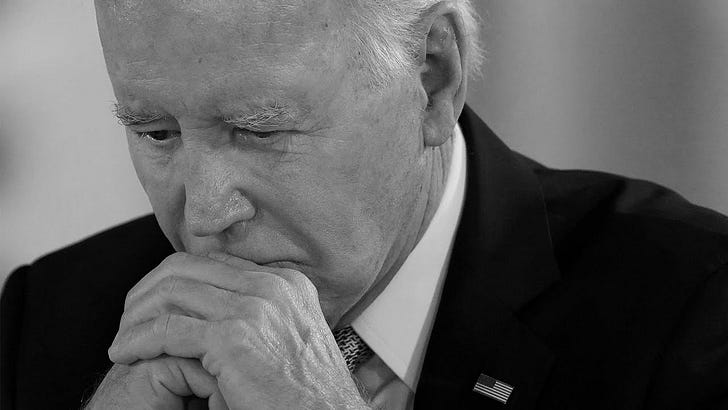
Joe Biden has aggressive prostate cancer. That news dropped as we were getting ready to record today’s show, and it immediately redefined everything I had planned for this episode. The White House says he found out late last week. But after everything we’ve seen — after everything we now know — I just don’t buy it. Not on its face. Not without skepticism. And certainly not from a team that has serially misled the public about this president’s health.This isn’t partisan. This isn’t about political advantage. It’s about trust. And the Biden White House has burned every ounce of trust it ever had on the question of Joe Biden’s mental and physical condition. We were told he was sharp. We were told he was healthy. We were told the only concerns were conspiracy theories. Now we’re told he has bone-level prostate cancer and just found out a few days ago. The story does not add up.We’ve known — not speculated, but known — that Biden’s team actively suppressed signs of his decline. It’s the core premise of the new book Original Sin by Alex Thompson and Jake Tapper. In it, we learn the White House doctor predicted Biden would be wheelchair-bound in a second term. We hear about the memory lapses, the failures to recognize people close to him, the moments that were carefully hidden or brushed aside. The story isn’t new — it’s just finally being told with names attached. And that’s the part that stings.Because for those of us who were watching this unfold in real time, the media’s about-face is galling. Take Jake Tapper. He’s now co-author of the book and the face of its rollout — doing long, self-congratulatory segments on CNN about the secrets he’s finally exposing. But these weren’t secrets to people who were paying attention. Fox News ran segments on Biden’s decline all throughout 2023 and 2024. Clips went viral. The press dismissed them as “cheap fakes.” And now Tapper’s shocked — shocked — to find out the emperor has no clothes?That’s what grates. Not just the cover-up, but the theater around its unmasking. The same people who waved it away are now acting like they cracked the case. And worse, they’re treating the rest of us like we weren’t there watching them do it. CNN actually responded to a viral clip reel of Tapper’s past dismissals by calling it “disingenuously edited.” The same playbook they criticized the White House for using. You can’t gaslight people and then write a book about how gaslighting is wrong.And now we get to the real question: what did they know, and when did they know it? Did Biden already have this diagnosis when he decided to run for reelection? Did his inner circle? Did the press? These aren’t cynical questions — they’re essential ones. Because if the answer is yes, then everything about 2024 shifts. Every calculation, every debate, every moment the press refused to ask harder questions — it all changes. Because this wasn’t about a stutter or a slip of the tongue. This was about a man with a potentially terminal illness running for the most demanding job on the planet.The cleanest way for Biden to bow out was always going to be health-related. I said it on this show more than once. If he ever had to step aside, cancer would be the story. Not scandal, not defeat — just a body failing a man who still wanted to fight. I didn’t think he’d actually get cancer. But now that he has, the question isn’t whether he should drop out. The question is whether he was ever in the race honestly to begin with.We deserve the truth. Not just out of respect for the office, but because the American people shouldn’t be the last to know that their president is unwell. And certainly not after being lied to for years about how well he was.Chapters00:00 - Intro01:26 - Joe Biden’s Cancer Diagnosis13:04 - Jake Tapper’s CNN Broadcast27:17 - Wrap-up This is a public episode. If you'd like to discuss this with other subscribers or get access to bonus episodes, visit www.politicspoliticspolitics.com/subscribe

Is The Big Beautiful Bill Just One Big Mess? David Hogg's DNC Debacle (with Bill Scher)
The Big Beautiful Bill is finally past the quiet phase. The behind-the-scenes negotiations have spilled into the open, and now we’re in the bloodletting. Speaker Mike Johnson wants this out of the House by Memorial Day, which means committee votes need to happen, and fast. But right now, the Budget Committee is a problem. Hardliners are balking — Ralph Norman, Josh Brecheen, and Chip Roy are all leaning no. They’re not satisfied with the Congressional Budget Office’s timeline for a cost estimate, and they’re worried the Medicaid changes could pressure red states into expanding coverage.Mike Lawler and Marjorie Taylor Greene are fighting on Twitter over SALT deductions — state and local tax breaks — and that fight is not going away. There’s talk of raising the cap from $30,000 to $40,000 or adjusting the phase-out thresholds. But this is exactly why they’re doing one big bill instead of multiple smaller ones. Everyone knew it was going to be painful. Nobody wanted to go through this kind of battle again and again for every policy item.Politics Politics Politics is a reader-supported publication. To receive new posts and support my work, consider becoming a free or paid subscriber.Still, I’m bullish. It’s ugly right now, but that doesn’t mean it’s doomed. The usual sign of failure — a flood of press conferences from members declaring the bill dead — hasn’t happened. Republicans aren’t holding cameras. They’re texting reporters. They’re venting in group chats. But they’re not going on record saying they’ll tank Trump’s agenda. That’s a big difference. This isn’t like other bills I’ve seen die. It still feels like something they’re going to get through — just barely.The key players are all doing what they need to do. Trump is overseas for now, but his influence is still real. He got Johnson the speaker’s gavel. He’s kept this whole thing moving. When he’s back, the pressure campaign ramps up. Meanwhile, JD Vance is already starting his Senate charm offensive to get reconciliation done once it clears the House. They know they’ll lose a few senators, but they’re planning for that. The goal is to get something — anything — through.And here’s what’s actually in it: no tax on tips, no tax on overtime, and no tax on Social Security for anyone making under $150,000. Yes, those provisions sunset in four years, but let’s be honest — once they go into effect, they’re not going anywhere. Nobody’s going to vote to take those benefits away from working people. Republicans used to hate that logic — the “give a mouse a cookie” approach to entitlements — but now they’re writing the cookies themselves. And they’re going to love running on them.This bill is messy. It’s jammed with contradictions. It’s being held together with string and prayers. But I still think it passes. And if it does, the Trump administration gets to claim a huge legislative win — not just a headline, but real, sticky policy that people will feel in their paychecks. That’s the ballgame.Chapters00:00:00 - Intro00:03:52 - Big Beautiful Bill Progress00:15:51 - Interview with Bill Scher00:39:39 - Update00:40:23 - Inflation00:43:36 - Supreme Court Birthright Citizenship00:45:44 - Iran Nuclear Deal, "Sort Of"00:47:57 - The News Sheriff00:53:03 - Interview with Bill Scher (con't)01:18:02 - Wrap-up This is a public episode. If you'd like to discuss this with other subscribers or get access to bonus episodes, visit www.politicspoliticspolitics.com/subscribe

Is Trump's Qatari Plane Deal Brazen Corruption or a Non-Story? Exploring the Big Beautiful Bill (with Matt Laslo)
Donald Trump is rumored to have a plan to receive a $400 million plane from Qatar, retrofitted to serve as Air Force One. On its face, it’s a straightforward diplomatic gift to the United States, meant to replace aging presidential aircraft. But the controversy kicked into overdrive with reports that this plane could eventually end up in Trump’s hands personally, via his presidential library. That’s where things get murky.Let’s start with facts. The two current Air Force One planes have been flying since the George H.W. Bush era. They’re overdue for replacement, and Boeing was contracted to deliver new ones. But Boeing’s been a mess—delays, scandals, technical issues. Trump, frustrated with the pace, toured a Qatari 747-8 already fitted for luxury use. This plane is 13 years old, but still valued around $400 million.Politics Politics Politics is a reader-supported publication. To receive new posts and support my work, consider becoming a free or paid subscriber.Now, Qatar is a massive buyer of American military hardware. We’re talking $26 billion in purchases over the past decade. In that context, a $400 million jet as a gesture of goodwill isn’t shocking. What makes this different is the personal angle. According to ABC’s original report, Trump’s library would receive the plane by January 1, 2029 — before Trump’s successor takes office, and potentially before Boeing’s replacements are ready. If true, that would mean Trump gets to keep a retrofitted Air Force One for personal use, while the next president is stuck with the old models.For me, that’s the red line. If Trump forces his successor to downgrade because he took the new plane for himself, that’s blatant self-dealing. If the plane stays in the rotation until Boeing delivers, and only then moves to his library, it becomes more of a vanity project — still unusual, but not unprecedented. Reagan’s old Air Force One is parked at his library, after all. You can even see it in some of Trump’s old debates, the ones held at the Ronald Reagan Presidential Library.But Reagan’s plane wasn’t transferred to him personally right after his presidency. It stayed in service until Clinton’s term ended before being disassembled and reassembled in Simi Valley. Trump’s timeline — if ABC’s reporting holds — would be far more aggressive, and far more self-serving.The frustrating part is how little clarity we’ve gotten. Most coverage fixates on whether it’s “appropriate” for Qatar to give the U.S. a plane. That’s not the interesting question. The real issue is when Trump plans to take personal control of it. That’s what determines whether this is normal diplomatic horse-trading — or brazen corruption.Until we get a straight answer on that, this story stays in limbo. Potential scandal or overblown noise — we just don’t know yet.Chapters00:00:00 - Intro00:03:55 - Qatari Plane Deal00:18:10 - Update00:21:19 - John Fetterman00:24:52 - David Hogg00:27:13 - Inflation00:31:11 - Interview with Matt Laslo01:17:52 - Wrap-up This is a public episode. If you'd like to discuss this with other subscribers or get access to bonus episodes, visit www.politicspoliticspolitics.com/subscribe

Brian Kemp Is Out! Sci-Fi Revolution And The Consumerization Of Voting (with Aubrey Sitterson)
Brian Kemp is out. No Senate run in 2026, and that shifts the entire field. Kemp was the Republican Party’s best shot at flipping the Georgia seat currently held by Jon Ossoff — and he knew it. He didn’t just flirt with the idea. He let it hang out there long enough for donors, strategists, and journalists to start treating it as likely. So when he made it official this weekend, it sent shockwaves through the Georgia GOP and national Republicans hoping for a clean, high-profile pickup in a battleground state.Let’s be clear: Kemp would’ve been a problem for Ossoff. He’s a two-term governor with a reputation for competency, no Trump baggage, and enough distance from the MAGA wing to appeal to suburban voters. He beat Stacey Abrams twice. He stared down Trump in 2020 and walked away stronger. There are few Republicans who can claim that kind of profile. Without him, the bench gets thin — and fast.Ossoff is already pulling in national dollars, and now he doesn’t have to spend the next 12 months preparing for a Kemp-style challenge. That gives him time to build narrative, define the race early, and lock down coalitions that might’ve been vulnerable in a high-turnout, split-ticket election. Democrats don’t have to win Georgia by a landslide — they just need to hold it. And in a cycle that’s already looking rough for Republicans in other swing states, the GOP needed Georgia to be easy. It’s not.Now the question becomes whether Republicans want to rally around a moderate and play defense, or roll the dice with a firebrand and try to rally the base. Either option carries risk. A moderate might not excite anyone. A MAGA pick might turn the whole race into a referendum on January 6 or Trump loyalty. And the problem with a crowded primary isn’t just messaging — it’s money. Ossoff gets to hoard his resources while Republicans knife each other in the dark.It’s early, but the GOP just lost its best card. And unless something big changes — a surprise retirement, a shocking recruit, a sudden scandal — this race has quietly shifted from “toss-up” to “lean blue.” Not because Ossoff is invincible. But because the Republican bench is looking thin, the calendar is ticking, and Brian Kemp just said, “No thanks.” Heck, if Marjorie Taylor-Greene steps in, it might just be Ossoff +7. And it will not be for lack of news coverage.Chapters00:00:00 - Intro00:02:48 - Brian Kemp Not Running for Senate00:06:18 - Interview with Aubrey Sitterson01:14:20 - Wrap-up This is a public episode. If you'd like to discuss this with other subscribers or get access to bonus episodes, visit www.politicspoliticspolitics.com/subscribe
Worst State Party Draft! Will May Be the Most Pivotal Month of Trump’s Presidency? (with Evan Scrimshaw and Ryan Jakubowski)
May 2025 might go down as the most pivotal month of Donald Trump’s second presidency. The post-Liberation Day disruption gave him room to play the chaos card — but that only lasts so long. Now it’s time to deliver. And according to what the White House is telling Congress behind closed doors, a lot is in motion. Sixty countries are either actively negotiating trade terms or exchanging paperwork with the administration. Congress is being told these deals won’t require their approval, which Congress, for the record, does not agree with. But this is Trump we’re talking about — when has he ever waited for a vote?Still, the big names you’d expect — China, Canada, Mexico — aren’t in the mix. China’s radio silent, Mexico and Canada are being folded into existing USMCA renegotiations. That leaves three countries reportedly close to a deal: the United Kingdom, Australia, and most importantly, India. India isn’t just geopolitically important — it’s the key to rewriting how America competes with China. A deal there could shift the entire narrative.Why India Matters More Than You ThinkIndia is the crown jewel of this effort. There's personal chemistry between Trump and Modi, which helps. JD Vance just visited India, and his family ties only reinforce the good vibes. But this isn’t just a soft power thing. India offers cheap manufacturing, which Trump badly needs to offset Chinese trade disruption. If you’re going to tell a story about reindustrializing America and cutting reliance on Beijing, India is where you start.There’s also the intellectual property angle. India doesn’t have the same IP hang-ups as China, which means Trump could insert protections into this deal and claim it as a model for future negotiations — including, eventually, with China. It’s the kind of pivot that’s both symbolic and real. Add in niche export wins — like bourbon or Harley-Davidsons, which have demand in India but face big trade hurdles — and suddenly you’ve got tangible proof of progress.Fast Deals, Reversible WinsHere’s the catch: none of these deals are expected to go through Congress. They’re handshake deals. That means they can be reversed at any moment — by Trump himself. And that’s kind of the point. Trump wants to touch every single part of the negotiation. No detail moves without his approval. That gives him the power to declare victory on anything, even if the actual text doesn’t amount to much.So the real question isn’t whether Trump can get a deal. It’s whether he can get one that’s meaningful — and fast. Because right now, the administration needs wins. Not headlines. Not vibes. Wins. The stock market is shaky, the trade war with China is frozen, and the White House knows it’s currently heading into the midterms with a record that still feels unsettled. India might be the win they’ve been waiting for. But if it doesn’t land soon, the window to define this presidency might close a lot faster than anyone expects.Chapters00:00:00 - Intro00:00:15 - Tariff Negotiations00:10:11 - Worst State Party Draft, part one00:41:37 - Update00:42:36 - Mike Waltz Goes to the U.N.00:44:48 - Alien Enemies Act Ruling00:48:55 - Ukraine Mineral Deal00:51:55 - Worst State Party Draft, part two01:34:53 - Wrap-up This is a public episode. If you'd like to discuss this with other subscribers or get access to bonus episodes, visit www.politicspoliticspolitics.com/subscribe

Canadian Conservatives Collapse! Talking the Pope and Catholicism (with Kevin Ryan)
Late last night, the news finally came in: the Liberal Party of Canada pulled off the upset and held onto parliamentary power. It wasn’t pretty. It wasn’t dominant. But they survived — and a few months ago, that seemed almost impossible. They had everything working against them: more than a decade in power, a deeply unpopular former prime minister they had to jettison, and an electorate that looked ready for change. Yet when the votes were counted, the Liberals were still standing.And you can’t tell this story without talking about Donald Trump. Trump has been a thorn in Canada’s side since his first term — publicly antagonizing Justin Trudeau, calling Canada the "51st state," and slapping brutal tariffs on Canadian goods. That lingering resentment became part of the political terrain in Canada. The Liberal candidate, Mark Carney, didn’t just have to run against Peter Poilievre and the Conservative Party — he got to run against the memory of Trump, and against the uncertainty that conservatives couldn't fully distance themselves from.Poilievre never figured out how to adapt. He spent too much time running a traditional opposition campaign and not enough time answering the deeper question a lot of Canadian voters were asking: would a Conservative government just invite more chaos with Trump? Carney seized on that. He didn’t have to make it the centerpiece of his campaign, but it was always there in the background. Steady hand versus risk. Familiarity versus volatility.And while some Conservatives are already spinning this as a "moral victory" because of how tight the race was, that’s not how elections work. A win is a win. In a parliamentary system, survival is everything. The Liberals get to control the agenda, pick the cabinet, and frame the narrative going into the next few years. That’s not moral victory — that’s real, tangible power. And for a party that looked like it was about to lose everything, it’s a remarkable political save.Now, the Liberals may still need a coalition with the NDP to govern effectively. It’s razor-thin. But that’s a separate conversation. The scoreboard is the scoreboard. And right now, the score says the Liberals survived. Trump’s shadow loomed large over this race — and in the end, it helped save the very people he’s spent years antagonizing.Chapters00:00:00 - Intro00:01:28 - WHCA Substack Party00:11:27 - Interview with Kevin Ryan00:28:46 - Update00:29:08 - Canadian Election Results00:31:38 - Big Beautiful Bill’s July 4th Deadline00:35:46 - Interview with Kevin Ryan, con’t00:57:28 - Wrap-up This is a public episode. If you'd like to discuss this with other subscribers or get access to bonus episodes, visit www.politicspoliticspolitics.com/subscribe

What Is Going On At The DNC? Breaking Down The State Dept.'s Shake-up (with Gabe Kaminsky)
David Hogg, the vice chair of the Democratic National Committee, announced he’s spending $20 million through his group, Leaders We Deserve, to primary sitting Democratic incumbents. He’s targeting safe-seat veterans, mostly older members, and it’s kicking off a full-blown internal fight.DNC chair Ken Martin isn’t having it. He’s proposing a rule that would ban DNC leaders from participating in partisan primaries — meaning Hogg would either have to step down or drop the activist role. The rule’s set to be debated at the DNC’s August meeting, and Hogg’s already digging in, saying he’ll fight to stay. Martin’s also announced a $1 million-a-month allocation to state parties, saying the DNC needs to decentralize. The real translation? Tension is so high they’re trying to buy unity.But here’s the thing — I actually think Hogg is right. The Democratic Party would benefit from some turnover. There are plenty of incumbents who have grown comfortable, complacent, and maybe even a little out of step. At the same time, that’s only half the issue. Because the problem with tossing out incumbents is you need to replace them with winners. These older Democrats have won election after election, and that’s not something you just replicate by parachuting in a 24-year-old with a TikTok following and a podcast. Safe seats aren’t invincible. Primaries can backfire. And while I’m all for change, I’m also for winning.The larger problem here is that you can’t be both the referee and the quarterback. If you’re helping to write the rules for how the party operates, you don’t get to break them for your own political goals. It’s not about silencing voices — it's about basic conflict of interest. If the DNC is supposed to be the governing body that creates a level playing field, its leaders can’t be in the middle of bloodying that field themselves.Hogg was already a controversial pick. He’s got detractors inside and outside the party. He’s drawn criticism not just from Republicans or centrists, but even from fellow gun control activists. The fact that this move feels more like a campaign than a strategic plan doesn’t help. It feels loud. It feels disruptive. And in a moment when Democrats are trying to project unity — especially heading into an election where every House seat could make or break their control — it feels reckless.The reality is that American politics is in a narrow-band era. Gerrymandering, polarization, and party-line voting mean that major swings are less likely. Which makes every seat even more valuable. We’re not in a 60-seat blowout environment anymore. We’re in a +5, -5, maybe +15 cycle. That means replacing a proven vote-getter with someone untested — even in a “safe” district — can be dangerous.So yeah, I think Hogg is right that the party needs to evolve. But I also think he’s wrong to do it this way. Because if it leads to chaos, to even a few avoidable losses, he’s not just risking some outdated Democrats — he’s risking the whole agenda. And if he’s not willing to see that, then maybe Ken Martin’s rule isn’t such a bad idea after all.Check out Gabe’s reporting at The Free Press!Chapters00:00:00 - Intro00:01:55 - DNC Confusion00:05:43 - Interview with Gabe Kaminsky00:25:39 - Update00:25:58 - Ukraine Peace Deal00:29:42 - Voter ID00:31:24 - Canadian Election00:36:40 - Interview with Gabe Kaminsky, continued01:03:33 - Wrap-up This is a public episode. If you'd like to discuss this with other subscribers or get access to bonus episodes, visit www.politicspoliticspolitics.com/subscribe
MAGA's Secret Civil War! Is This The Year Congress Gets Serious About Stocks? (with Dave Levinthal)
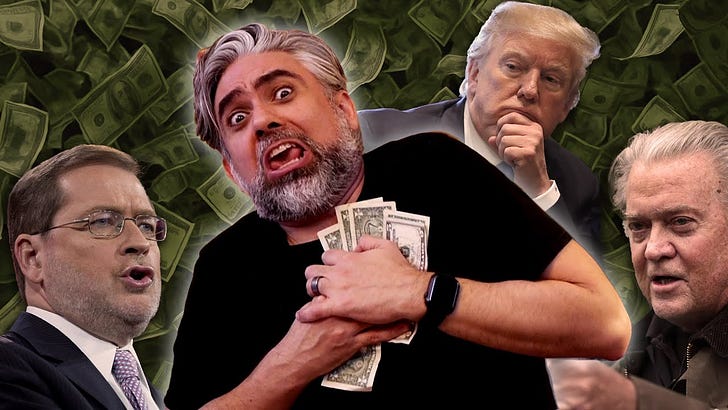
There’s a civil war happening inside the MAGA coalition, and unless you’re really in the weeds, you probably haven’t heard much about it. It’s not being covered seriously, either by the traditional media or the independent press. And that’s a shame — because it pits two foundational visions of conservatism against each other. On one side, you have Grover Norquist and his ironclad “no new taxes” pledge. On the other, you have Steve Bannon and his populist charge to eat the rich.Norquist has spent decades making sure no Republican dares raise taxes. His philosophy is clear: low taxes are good for everyone, rich or poor, and raising them is political suicide. He’s survived every GOP iteration — from neocon war hawks to MAGA populists — by keeping that line firm. But now, Trump’s “one big, beautiful bill” may include a tax hike on the wealthy. Norquist is sounding the alarm, warning that breaking this promise would be as foolish as George H.W. Bush’s infamous “read my lips” moment.Meanwhile, Bannon doesn’t just want to raise taxes — he wants to send a message. He sees MAGA as a working-class movement, and taxing the rich is part of proving that Wall Street, Silicon Valley, and the GOP’s old donor class no longer control the party. It’s the clearest philosophical fault line we’ve seen on the right in years. If the GOP embraces even a modest tax hike on the wealthy, it could mark the end of a Reagan-era consensus that has defined Republican politics for half a century.Politics Politics Politics is a reader-supported publication. To receive new posts and support my work, consider becoming a free or paid subscriber.And yet, barely anyone is talking about it. Not because it isn’t interesting, not because it isn’t important, but because media — mainstream and independent — is stuck on one setting: “trouble for Trump.” It’s a framing device. Every Trump story must either confirm that he’s a danger to democracy or a bumbling fool. Anything else? Not interesting enough to cover.Steve Bannon, who’s all over mainstream shows like Real Time with Bill Maher and Stephen A. Smith’s podcast, is out here advocating a radical repositioning of the Republican tax platform — and the headlines are all about whether Trump should run for a third term. And I get it, that’s the clickier angle. But it’s also lazy. We’re watching tectonic plates shift, and we’re still playing with bumper stickers.That’s not just a mainstream media problem, by the way. It’s an independent media problem too. There are great voices on Substack and elsewhere that have done real work to break free from traditional narratives. And yet, over the last few weeks, I’ve seen far too much content boil down to one question: “Is this an outrage? Yes or no?” And when the answer is always “yes,” you’re not informing anymore — you’re reinforcing.My goal isn’t to register my opinion on every current thing. My goal is to give you something that still feels relevant five years from now. Something you can remember discovering here before it hit the mainstream. I’m not always going to say the thing that fits into someone’s ideological slot. That’s going to disappoint people sometimes. I get that. But I hope the tradeoff is worth it. Because if you’re giving me your time and maybe even your money, I owe you something rare. Something original.Something honest.Chapters00:00:00 - Intro00:01:58 - MAGA’s Secret Civil War00:19:35 - Update00:21:05 - Signalgate 2.000:27:14 - Pope Francis00:30:51 - Student Loan Debt Collection00:34:50 - Interview with Dave Leventhal01:13:34 - Canadian Election with Evan Scrimshaw01:27:11 - Wrap-up This is a public episode. If you'd like to discuss this with other subscribers or get access to bonus episodes, visit www.politicspoliticspolitics.com/subscribe
How Should We Describe Trump's First 100 Days? (with Gabe Fleisher)
In a recent Oval Office meeting, Italian Prime Minister Giorgia Meloni sat across from Donald Trump as part of a European Union effort to navigate the ongoing trade turbulence. The meeting was cordial enough. Meloni emphasized transatlantic unity and expressed hope for deeper economic collaboration. Trump, however, was unmoved. He praised Meloni personally, but made his stance clear: the U.S. is not in a rush to finalize trade deals. According to him, tariffs are “making the United States rich,” and other countries want deals more than he does.This exchange happened during the 90-day pause in Trump’s Liberation Day tariffs — a moment intended, at least in theory, to give global leaders time to negotiate. But what the meeting really signaled is that Trump views this pause as leverage, not compromise. Yes, he did lower EU import tariffs from 20% to 10%, but that move was largely a reaction to bond market jitters. When it comes to negotiating with Europe, he’s staying firm.Meloni’s presence is notable. She’s a controversial figure in Europe — once derided by the American press as a far-right nationalist and compared to Mussolini. But in this moment, she’s being positioned as the EU’s Trump whisperer. She attended Trump’s inauguration. He’s reportedly fond of her. He even accepted an invitation to visit Rome. But none of that moved the needle in this meeting.What Trump wants is access to European markets. But in European politics, protectionism isn’t just a policy — it’s a survival tactic. Leaders there know that anything perceived as selling out local interests could cost them their jobs. Italy, for example, has a trade surplus with the U.S., not because of anything shady, but because Americans genuinely love Italian exports: high-end fashion, food, luxury goods. We buy a lot from them. They don’t buy much from us. That’s not an imbalance that tariffs alone can fix.So the real question is: what happens next? Trump has all but said he’s happy to wait everyone out. That leaves European economies in a holding pattern. It leaves small and medium U.S. businesses — especially those tangled up in international supply chains — in limbo. And it leaves Meloni with the unenviable job of being the friendly face of a negotiation that isn’t really moving.Chapters00:00:00 - Intro00:03:13 - Interview with Gabe Fleisher00:23:00 - Update00:23:36 - Italian Prime Minister Giorgia Meloni’s Visit00:27:44 - Birthright Citizenship Arguments00:30:05 - FSU Shooting00:31:47 - Interview with Gabe Fleisher, con’t00:59:13 - Wrap-up This is a public episode. If you'd like to discuss this with other subscribers or get access to bonus episodes, visit www.politicspoliticspolitics.com/subscribe
The "Peasant" Problem: US-China Trade War Gets Personal. Will Meta Prevail Against The FTC? (with Tom Merritt)
It was just last week when the Trump administration hit pause on its Liberation Day tariffs — except when it came to China. Not only were they excluded from the pause, they got slapped with additional hikes, escalating what had already started to look like an all-out trade war. Then came Saturday morning’s Customs and Border Patrol announcement, which seemed to undercut all of that: nearly 60% of Chinese exports, including smartphones, laptops, and semiconductors, were apparently exempt from the new tariffs.So, what happened? Did the White House backtrack? Was this a walk-back in disguise? The administration scrambled to clarify. Their explanation: those goods are being set aside into their own “buckets” — alongside other key industries like cars and steel — for future, tougher action. These aren’t exemptions, they insist, just part of a long-term plan. The reason for the sudden PR push? According to Axios’ Mark Caputo, Trump simply doesn’t like the words “exemption” or “exception.” He felt too many were granted in his first term and didn’t want the headline suggesting he’d lost his edge.But let’s be honest: This is hair-splitting. Whether you call them buckets or carveouts, the reality is a significant chunk of Chinese goods aren’t being hit right now, and the market knows it. The real question is whether the administration is buying time, recalibrating, or trying to thread the needle between tough-on-China optics and economic stability.Saber Rattling, Delistings, and Peasant TalkIn the meantime, tensions are ramping up. The U.S. is now considering delisting nearly 300 Chinese companies from American stock exchanges — a move that’s part economic pressure, part political theater. The legal foundation? The Holding Foreign Companies Accountable Act, which requires financial transparency from foreign firms. Treasury Secretary Scott Bessent and Senator Rick Scott are reportedly behind the push, with Trump expected to lean on executive orders to expedite the process if necessary.Naturally, China isn’t taking this lightly. In response, they’ve begun blocking deliveries of Boeing jets, and the rhetoric has turned acidic. China's Hong Kong and Macau Affairs Office issued a statement saying, in part, “Let those peasants in the United States wail in front of five thousand years of Chinese civilization.” That’s not diplomatic posturing — that’s a full-throated nationalist flare-up, made more surreal by the fact that JD Vance himself had recently referred to Chinese laborers as “peasants” on Fox News.And through all of this, both sides are playing the “we’re open to talks, but we won’t be the first to call” game. It’s juvenile, it’s geopolitical theater, and it’s exactly the kind of posture that leaves markets — and companies — dangling.What Happens Next?Here's where I land: I don’t think we’re going back to “normal” with China anytime soon. The issues the U.S. wants addressed — IP theft, forced joint ventures, restricted market access — aren’t things China’s going to give up easily, if at all. So yes, the tariffs might eventually get reshuffled or reduced. But the era of posturing, of economic nationalism, of strategic decoupling? That’s here to stay.The polling shows Americans are broadly in favor of being tougher on China — until, of course, it hits them in the wallet. That’s where this whole thing could flip. For now, though, the administration seems fine dragging this out. Tariffs, carveouts, buckets, delistings — it’s all part of the same dance. And we’re still in the first few steps.At least that’s this peasant’s opinion.Chapters00:00 - Intro02:14 - US-China Trade War Continues11:45 - Update13:13 - AOC Fundraising Record15:15 - Andrew Cuomo NYC Race17:22 - Brian Kemp’s Senate Potential22:22 - Interview with Tom Merritt49:59 - Wrap-up This is a public episode. If you'd like to discuss this with other subscribers or get access to bonus episodes, visit www.politicspoliticspolitics.com/subscribe
Lessons From Liberation Week. The Book That Explains Donald Trump 2024 (with Alex Isenstadt)
Liberation Week has come and gone, and now we’re in the pause phase. The tariffs? Temporarily stalled. The market? Down, then up, then down again. We’re in a holding pattern — with one major exception: the trade war with China is not only still on, it’s intensifying.So what did we learn from all this? The answer starts and ends with Trump. The Democrats have branded him the “chaos president,” and they might not be wrong — but maybe not in the way they think. I don’t believe Trump sees chaos as a liability. I think he sees it as a strength. When the world is spinning, he can sit back, watch the options unfold, and pick the off-ramp that benefits him most.This isn't about 4D chess or reckless stumbling. It’s about comfort in disorder. Trump’s not detail-oriented. He doesn’t care if the tariffs were slapped together or if mixed messages were coming out of his administration. That’s not the game he’s playing. He thrives in the swirl, in the noise, and when the moment is right, he chooses a direction — and makes a deal.This matters politically. If the economy craters, Trump owns his executive-order recession. But if it doesn’t? If this all just amounts to turbulence before stabilization? Then Democrats are stuck.Because for all the clumsiness and confusion, Trump did a thing. And that matters. In a political world where voters are constantly begging politicians to just do something, Trump did. Democrats will struggle to cut through that with a message if the damage doesn’t materialize — or worse, if voters feel like they’re seeing results.Which brings us to the working class, to the labor unions, to voters in Ohio, Michigan, and Pennsylvania. Does a falling stock market hurt them the way it hurts Wall Street? Or are they more focused on jobs, reshoring, and seeing a president at least pretend to care about their industries?That’s the gamble Democrats are walking into. Now they have to figure out how to respond to it.The Trump Campaign, RewrittenIf you’re like me, you probably went into 2024 expecting another messy, chaotic Trump campaign — full of infighting, wild pivots, and, frankly, incompetence. But Revenge by Alex Isenstadt tells a very different story. It’s the first real deep dive into what made Trump’s third run for the White House so much more stable and effective, and honestly, I think it’s a must-read.This book doesn’t just explain how the campaign functioned — it shows how Trump evolved. He may still be the same bombastic figure, but the operation around him was leaner, smarter, and built to survive the spotlight. The team of Suzy Wiles and Chris LaCivita comes off as professional, savvy, and above all, in control. They’re not drama-free, but they’re competent — and that’s a big departure from past cycles. Trumpworld has often been defined by volatility. This time, it was defined by cohesion.One of the most compelling parts of the book is how it tracks Trump’s own evolution over two pivotal moments: when it became clear he could go to jail, and when he nearly died. Those aren’t just plot points — they’re moments that reshape how a person approaches power. Isenstadt paints a picture of a Trump who, while still instinct-driven, begins to understand the stakes in a deeper, more self-preserving way. It doesn't make him less Trump, but it does add a new layer to how he maneuvers.Winners, Losers, and the Veep PickThe behind-the-scenes of the VP selection process is where the book truly shines. JD Vance and his team played the long game masterfully. They activated the right surrogates, moved in sync with the campaign’s tone, and created a role that added tangible value to the ticket. Isenstadt captures not just the strategy but the discipline, something we hadn’t really seen in previous iterations of MAGA campaign staffing. It feels like a glimpse into the next phase of the movement, where operatives are less bomb-throwers and more builders.Then there are the losers. Corey Lewandowski is treated with near-universal disdain by sources — portrayed as an unstable, self-interested distraction. Natalie Harp, known as the “human printer” for how closely she follows Trump, is mocked for her over-the-top loyalty. These aren’t random asides — they're repeated themes, echoed by multiple voices, and they speak to a Trump operation that’s becoming more discerning about who actually adds value versus who just adds noise.A Must-Read for 2024 Watchers — and BeyondWhat makes Revenge stand out is that it’s not breathless or fawning. It’s sober, well-sourced, and focused. It reads like a campaign post-mortem, but for a campaign that’s still alive and well. And in doing so, it provides a roadmap — not just for how Trump won again, but for how the infrastructure around him is solidifying into something more lasting. If you’re trying to understand where MAGA goes from here, this is the text you start with.If you're following this stuff closely — whether as a political junkie, strategist, or just someone trying to make sense of
Are The Trump Tariffs Real? Or A Negotiation Tactic? (with Big Jim and J.D. Durkin)
After several days of panic in the markets, the Dow Jones Industrial average is rebounding. Why? It seems as if the Liberation Day tariffs may be leading to new trade deals.The market swoon and lack of clarity has put the Trump administration in the wilderness. Is the goal to really bring all trade deficits to zero? Do we want our children screwing together iPhones as a career? Or is this just a set up for Trump to schedule a month long rose garden signing ceremony where world leaders line up single file to welcome American exports?Today, we talk to our logistics expert Big Jim and check in with J.D. Durkin to figure out whether Trump’s tariffs mark a shift toward isolation, or just a high-stakes negotiating move. Is this a reset of global trade, or just a pause before the next deal? We’re on the clock, because by the time this drops, the whole game might have changed.Chapters00:00:00 - Intro00:02:44 - Interview with Big Jim00:43:02 - Update00:45:09 - Supreme Court Decision Over Alien Enemies Act00:48:30 - June 14th Military Parade00:49:54 - House Democrat Seat Targets00:52:34 - Interview with J.D. Durkin01:35:18 - Wrap-up This is a public episode. If you'd like to discuss this with other subscribers or get access to bonus episodes, visit www.politicspoliticspolitics.com/subscribe
Sorting Through Liberation Day. Do Democrats Owe Us An Explanation For Shifting Ideology? (with Karol Markowicz)
“Liberation Day” has come and gone. The massive tariff announcement from the White House that landed just after markets closed on Wednesday. It’s a sweeping 10% universal tariff on all goods, effective Saturday, April 5th, with even higher rates for countries like China (34%), the EU (20%), Japan (24%), and an eyebrow-raising 46% for Vietnam. Cars assembled abroad? They’re getting hit with a 25% tariff starting May 3rd.Put simply, the market didn’t take kindly to this. It’s been a financial bloodbath: the Dow fell 1,400 points (around 3.8%), with the S&P and NASDAQ down even more. Apple and Nvidia alone lost a combined $470 billion in value, and the dollar hit a six-month low. Investors are clearly spooked by what could be the beginning of a global trade war. I’m not an economist, and I plan to have some real-deal experts on the show next week to discuss this in more detail, but from where I sit, this feels like a high-stakes gamble.Politically, this is an all-in move by Trump. If his critics are right, this could usher in financial ruin. But if the market recovers, prices stabilize, and jobs return, then maybe — just maybe — he’s onto something. The key indicators to watch: inflation and jobs. If grocery bills soar, he’s in trouble. If not, and if some manufacturing jobs make their way back to the U.S., this could be a paradigm shift.We’re witnessing something that happens maybe once in a generation — one of America’s major political parties changing its stance on a foundational economic principle. The GOP, long champions of free trade, are now planting their flag in protectionist soil. I grew up associating tariffs with progressive, union-backed economic arguments. Yet here we are, with a Republican president pushing a policy that would’ve made progressives cheer in decades past.Trump’s economic approach would have been seen as left-wing populism not too long ago. The idea that tariffs can be used to protect American jobs is not new, but seeing it come from the right is a dramatic turn. It makes this moment politically fascinating, even if it brings financial risk.The big question remains: who’s right? Every economist I’ve ever read has warned against tariffs, citing global market efficiencies and the cost to consumers. But Trump is betting on a different equation — one where protecting American industries and reducing the trade deficit leads to long-term gains.As I look at this from my seat, the numbers make me queasy. A 46% tariff on Vietnam because of a trade deficit calculation? That feels arbitrary at best. Aiming for a zero trade deficit with every nation doesn’t necessarily reflect economic reality. We’ll see how this unfolds, but for now, it’s a major inflection point in both economic policy and political identity.Chapters00:00:00 - Intro and Tariff Thoughts00:09:29 - Interview with Karol Markowicz00:25:00 - Update00:26:39 - Eric Adams Goes Independent00:30:10 - NSC Firings00:33:11 - Senate Republican’s Budget Plan00:37:28 - Interview with Karol Markowicz, continued01:06:13 - Wrap-up This is a public episode. If you'd like to discuss this with other subscribers or get access to bonus episodes, visit www.politicspoliticspolitics.com/subscribe
The 2024 Election Madness Within “Fight” (with Jonathan Allen and Amie Parnes)
Fight: Inside the Wildest Battle for the White House is a detailed account of the unraveling within the Democratic Party, and it starts with a shocking reality: Co-authors Jonathan Allen and Amie Parnes didn’t originally intend to write this book. The result is a work that skips over primaries but captures, in vivid detail, the implosion of Joe Biden’s re-election effort as 2024’s political battles came to a head.Reading it, I was stunned at the depth of denial w ithin the Biden White House. The President’s mental decline — obvious in isolated public moments — was a constant behind the scenes. Everything from oversized fonts on cue cards to aides using Day-Glo tape to guide his steps in the White House painted a troubling picture. And no one, not even his closest confidants or family, could convince him to step aside.Politics Politics Politics is a reader-supported publication. To receive two bonus episodes a week, consider becoming a paid subscriber.What emerges from Fight is a picture of a campaign built on delusion. Aides and strategists twisted themselves into knots to compensate for a candidate who was no longer capable of meeting the demands of the presidency. Biden's infamous “Where’s Jackie?” moment, where he searched for a deceased congresswoman, is only one of many jarring anecdotes.Eventually, the dam broke. Chuck Schumer’s blunt conversation with Biden about waning Senate support coincided with Trump being shot in Butler — two seismic events on the same day. For all the chaos that defined the Biden campaign, that moment marked a pivot.Kamala's Rise and the GOP MachineKamala Harris’s takeover of the Democratic ticket happened with surprising efficiency. Despite opposition from heavyweights like Nancy Pelosi and Barack Obama, who preferred Gretchen Whitmer and wanted a mini-primary, Harris’s team moved quickly to shut down all challengers. They outmaneuvered everyone, including J.B. Pritzker’s billions, and solidified her position.Still, old habits died hard. Many of the Biden-era staffers, including campaign manager Jen O’Malley Dillon, were kept on. It was a costly mistake. The same strategic paralysis that haunted Biden’s run persisted. One of the most telling moments? The botched attempt to land Kamala on Joe Rogan’s podcast — a micromanaged mess that ended with Trump getting the coveted spot instead.In stark contrast, the Trump campaign is depicted as ruthlessly efficient. They knew their weaknesses (Trump’s tendency to force headlines) and their strengths (his appeal on unconventional platforms like Theo Von’s podcast). Susie Wiles and Chris LaCivita emerge as the stars — people who knew how to play the game and win. Even a brief internal hiccup involving Corey Lewandowski was swiftly handled without much in the way of fallout.The Scorecard: Who Rose, Who FellFight functions as a political report card as much as a narrative. On the Democratic side, it's a tale of lost influence. Jen O'Malley Dillon, once considered a top operative, is portrayed as a non-responsive, bunker-minded leader. Barack Obama, too, takes a hit. Despite pulling the strings to push Biden off the ticket, he couldn’t get his preferred successor in place or move the needle on the campaign trail.And that may be the most sobering takeaway. Obama, once the undisputed leader of the Democratic Party, couldn’t rally it. His influence is clearly waning — and the next Democratic president might not treat him with the reverence millennials once did.Meanwhile, on the Republican side, the power players are clear. Wiles and LaCivita are now kingmakers. Tony Fabrizio’s polling proved consistently accurate. Alex Bruesewitz reinvented Trump’s online presence for a younger generation. If Trumpism persists, these are the architects.I strongly recommend Fight. Whether you’re a political junkie or just trying to make sense of how the 2024 election unfolded, it’s essential reading. Parnes and Allen provide not just insider details but clarity in the chaos.Read it yourself. Then let me know what you think.Chapters00:00:00 - Intro00:01:20 - Fight Book Report and Analysis00:28:13 - Update00:29:35 - Marine Le Pen Sentenced, Fined, and Barred from Politics in France00:32:37 - Tuesday Special Elections Preview00:37:26 - Interview with Fight’s Jonathan Allen and Amie Parnes01:11:43 - Wrap-up This is a public episode. If you'd like to discuss this with other subscribers or get access to bonus episodes, visit www.politicspoliticspolitics.com/subscribe

Elise Stefanik Withdraws! How AI Will Affect Future Campaigns (with Michael Cohen)
Elise Stefanik, once considered a front-runner for Donald Trump’s vice presidential slot and more recently tapped as the next U.S. Ambassador to the United Nations, has been asked to withdraw from the nomination. The directive came directly from Donald Trump, urging her to return to the House of Representatives — a move that has left many observers puzzled, especially since Stefanik had already begun a farewell tour of her district.This surprise reversal raises questions about the strategic reasoning behind Trump’s decision. The timing, the political stakes, and the looming legislative calendar all appear to be key components in a much larger game of congressional chess.A central concern appears to be a special election in Florida. Polling data from Fabrizio Ward — helmed by Trump’s trusted pollster Tony Fabrizio — shows the Republican candidate with only a three-point lead in a district that Trump carried by 30 points in the last election. The narrowing margin is attributed not just to candidate quality, but also a significant financial disparity: Democrats have outspent Republicans by over $8 million. This disparity has translated into heavier air traffic and visibility for the Democratic challenger.Speculation suggests Trump may be trying to protect the Republican majority in the House, fearing it could be further weakened by Stefanik’s departure. But some political watchers — myself included — argue that this explanation is too simplistic and out of step with Trump’s usual political instincts.A more intricate and possibly more compelling reason involves legislative mechanics in New York. Stefanik has not officially resigned from the House. If she had, Governor Kathy Hochul — who, as a Democrat, has little incentive to rush — would have 90 days to call a special election. Starting that clock now would push any vote into late June, possibly beyond the key reconciliation package deadline. That seat, currently held by Stefanik, could be unavailable during crucial legislative moments.Further complicating the issue, a proposed bill in the New York State legislature would allow the governor to delay special elections until the next general election. If passed, this would effectively remove Stefanik’s seat from the House until 2026, robbing Republicans of a vote not only for the rest of this year but most of next year as well.This development underscores how thin the Republican majority truly is. Stefanik stepping away — even temporarily — represents a potentially significant loss in the vote count. With both the House and Senate reportedly aligning this week on legislative priorities, every vote counts more than ever.Stefanik, having exited Republican leadership and publicly prepared for her transition to the UN role, now finds herself in a politically awkward position. She will likely need a face-saving path back into House leadership — an effort that could trigger even more internal headaches for the GOP.Whether this pivot was prompted by a cold read of Florida polling numbers or a strategic maneuver to preserve legislative power, the consequences are clear: political timing and control of congressional votes are dictating decisions at the highest levels of Republican leadership.Chapters00:00:00 - Intro00:00:20 - Elise Stefanik Asked to Withdraw00:08:03 - Interview with Michael Cohen00:25:41 - Update00:27:28 - Student Visa Deportations00:30:11 - HHS Job Cuts00:31:48 - MS-13 Leader Arrested00:35:47 - Interview with Michael Cohen, cont.01:19:12 - Wrap-up This is a public episode. If you'd like to discuss this with other subscribers or get access to bonus episodes, visit www.politicspoliticspolitics.com/subscribe
The Signal Scandal! Where We'll Be In Six Months and Hollywood Donor Blues (with Kirk Bado and Matthew Frank)
This week, something truly surreal happened — or was revealed to have happened — thanks to, of all people and places, Jeffrey Goldberg of The Atlantic. He was added to a Signal group chat that included essentially all of the national security members from Donald Trump’s cabinet. It’s one of the most Veep-like scandals we've seen in a long time. I even saw one joke online that the person who added him must have thought he was Jonah from Veep.Now, I’ve got one big point to make, and then a few smaller ones. Here’s the big one upfront: Mike Waltz screwed up. Badly. This isn’t just an oopsie — you don’t create a Signal group discussing bombing the Houthis in Yemen and accidentally add someone like Jeffrey Goldberg. You don’t add your mom. You don’t add your college roommate. And you absolutely do not add Jeffrey Goldberg.If you’re not familiar with Goldberg, he’s a longtime media figure who played a pretty colorful role in the lead-up to the Iraq War and has since become one of the most vocal Trump antagonists in mainstream media. The Atlantic — once a home for serious feature writing — is now almost entirely a laundering house for anti-Republican takes. So when you add that guy to your Signal group, you should never be trusted with a phone again. Seriously.That’s the main takeaway. But I’ve got three smaller points that I think are worth diving into.First, let’s talk about Jeffrey Goldberg himself. If you’ve ever felt misled in the lead-up to the Iraq War, you might want to revisit some of his early work — he was one of the people laying down those breadcrumbs. And in this latest piece for The Atlantic, where he reveals the Signal chat — including screen grabs of Pete Hegseth, JD Vance, Tulsi Gabbard, Scott Bessent, Stephen Miller, and others — he goes dark on the details when it comes to what he describes as military plans.He claims they discussed confidential strategies about striking the Houthis in Yemen, and if this had come from anyone else, I might believe it. But it’s Jeffrey Goldberg. So, I don’t know. The fact that it was him added to the group is what gives the Trump camp’s defense — that there was no classified info shared — any credibility. Still, how does this even happen? And if someone was dumb enough to add Goldberg, were they also dumb enough to drop classified intel in an unsecured chat? Possibly.Second, let’s talk about Signal. It’s an encrypted messaging app, popular with journalists and hackers for a reason. It’s end-to-end encrypted, meaning messages are harder to intercept. But security depends on the user. MG, an InfoSec expert and a listener of this show, had a great thread on X explaining how to actually use Signal securely. It involves checking secure keys to verify identities — something that clearly wasn’t done here.Then there’s Ryan McBeth, who made a solid point in a recent video: secure systems are only as effective as the people using them. If secure lines are too clunky or inconvenient, people won’t use them correctly. His take? Issue secure smartphones to everyone dealing with national secrets. Using consumer apps like Signal just isn’t enough.Lastly, and this is the closest thing to original reporting I have on this: Signal is the app of choice for Trump-world. Everyone I know who’s interacted with the Trump campaign or administration did so over Signal. So it’s no surprise that this chat happened there.That’s what I’ve got on this whole Signal debacle. We’ll see where it all goes from here.Chapters00:00:00 - The Signal Scandal00:12:40 - Intro and Florida’s Special Election00:17:52 - Interview with Kirk Bado00:22:16 - Interview with Kirk Bado (post-sports talk)01:01:43 - Update01:02:34 - Congressional Republicans Facing Budget Standoff01:04:19 - Russia and Ukraine Navigational Agreements01:06:28 - Direction of USA Poll01:10:18 - Interview with Matthew Frank01:40:09 - Wrap-up This is a public episode. If you'd like to discuss this with other subscribers or get access to bonus episodes, visit www.politicspoliticspolitics.com/subscribe
Trump's Court Chaos! One Week After The Continuing Resolution Vote (with Katy Stech Ferek)
The biggest political story in America right now isn’t about a campaign, a scandal, or even a vote. It’s something far more fundamental: Donald Trump’s clash with the judiciary.It’s the kind of confrontation that doesn’t just make headlines — it shifts the tectonic plates of our democracy. It forces us to look hard at the limits of executive power, the independence of the courts, and whether the guardrails of our system are holding up or giving way.At the center of it all: Trump’s use of the Alien Enemies Act to deport alleged members of the Tren de Aragua gang, sending them to a supermax prison in El Salvador. One flight, carrying deportees, was already in the air when a judge ruled the move illegal. That flight didn’t turn around.That was the spark.Suddenly, it wasn’t just another Trump-era controversy. It was a constitutional crisis.What Happens When Trump Defies a Judge?The reaction was swift and furious. The noise from the media, legal scholars, activists, and political commentators reached a full roar. Was Trump defying the courts? Were judges overreaching their authority? Were we witnessing the collapse of the basic balance of powers in real time?Some folks lost their minds.And honestly, I get it. If you squint hard enough, this looks like the beginning of a genuine authoritarian slide. You’ve got Trump, once again, taking an aggressive stance on immigration — and this time, ignoring a judicial ruling in mid-flight. It feels dramatic. It feels dangerous.It also feels... familiar.Because this is a recurring theme of the Trump presidency: bold, legally provocative action, followed by legal pushback, followed by public outrage, followed by months of litigation.The difference now? Trump’s not just promising things. He’s delivering — aggressively.The Two Simplest TakesLet’s be real. There are two clean, simple, headline-ready narratives here.Narrative One: Trump is a lawless authoritarian. He’s ignoring the courts, trampling over civil liberties, and pushing the country toward dictatorship. Bannon’s out here musing about a third term. The plane that didn’t turn around? That’s not just a flight — it’s a red flag.Narrative Two: Trump is finally doing what America has been demanding for years. He’s cleaning up the streets, deporting violent criminals, and living up to his campaign promises. And if that pisses off elite judges or cable news pundits, so be it.Either of these takes will get you clicks. They’ll fire up your base. But both are missing the point.Here’s where I land. I don’t have a hot take. I don’t have a screed. I have some questions, some caution, and a long view.Let’s start with this:Even if you think these deportations are justified, you want due process. There’s a guy who says he was just a soccer player with tattoos, mistaken for a gang member and deported without a fair hearing. Maybe that’s a fluke. Maybe it’s not. But when you're using a rarely-invoked 18th-century law to fast-track deportations, you better be damn sure you’re right.At the same time, it’s impossible to ignore what’s happening politically.Trump is doing something that’s rarely seen in American politics: actually fulfilling campaign promises. That’s shocking. And for a lot of Americans — particularly in the Spanish-speaking communities that have been targeted by the Tren de Aragua gang — this isn’t authoritarianism. This is action.It also helps explain why Trump gained ground with minority voters in 2024. When crime is real, when gangs are active in your neighborhood, when you feel like no one is protecting you, then a president who acts decisively (even if controversially) doesn’t feel scary. He feels necessary.No One Should Be Too Certain Right NowSo where does this go? Honestly, we don’t know yet.Trump is pushing hard. The courts are pushing back. He says he’ll comply, but also defend his position tooth and nail. This is what the process looks like in a functioning democracy. The key word there is “process.”And if you’re one of the people passionately demanding that we respect the judiciary? I agree. But I’d also remind you: the Supreme Court has the final say. And this is the same Supreme Court that many on the left have called illegitimate. So if you’re praising judicial power now, be prepared to keep that same energy when the ruling comes down, because it may not go your way.For now? I'm watching. I'm waiting. And I’m staying cautious.Because what we’re witnessing isn’t just a legal fight or a partisan squabble. It’s a realignment. It’s a redefinition of how power is used, challenged, and ultimately judged in 21st-century America.And while the takes are hot, the only thing I know for sure is this:I got nothing.Chapters00:00:00 - Intro00:01:44 - Trump and the Courts00:11:41 - Update00:12:34 - Israel-Hamas Attacks Heating Up00:14:26 - Trump’s Dept. of Education Executive Order00:17:58 - George Glezmann’s Release from Taliban00:19:25 - Interview with Katy Stech Ferek00:58:39 - Wrap-up This is a public episode. If you'd l
Schumer In Hot Water! Maintaining A Healthy Media Diet And What's Happening Inside The White House (with Isaac Saul and Tara Palmeri)
Chuck Schumer is in hot water with progressives after supporting a GOP stopgap funding bill aimed at preventing a government shutdown. Many on the left see this as a strategic blunder, arguing that he surrendered leverage to Trump. Progressive groups like Indivisible have publicly called for Schumer’s resignation, and moderate Democrats, such as Charlotte Clymer, have led donor boycotts, amassing over 25,000 signatures.Schumer’s defense? He argues that preventing a shutdown was the "lesser of two evils," protecting the party from greater damage under Trump. However, his attempts to quell the outrage — including appearances on CBS Morning News and The View — have done little to shift the narrative. His decision to cancel book tour events amid protests underscores just how serious the backlash has become.Politics Politics Politics is a reader-supported publication. To receive new posts and support my work, consider becoming a free or paid subscriber.The biggest problem? His critics don’t appear to have a clear plan for what comes next. If Democrats truly want Schumer out, they must follow through — otherwise, they risk looking weak and divided at a critical political moment.Polling numbers paint a bleak picture for Democrats. Both CNN and NBC report that the party’s approval rating sits between 27% and 29%, a stark decline from previous cycles. With about 40% of the country identifying as Democrats, that means at least 11-13% of them are unhappy with their own party.Data analyst David Shor’s research further complicates the narrative. His analysis of the 2024 election challenges the idea that low voter turnout hurt Democrats. Instead, Shor suggests that even with maximum turnout, Trump still would have won by nearly five points — a sobering reality for the left.The party’s problems are multifaceted: Independents aren’t sold on the Democratic agenda, progressives feel sidelined, and moderates are frustrated with leadership. Right now, the party’s best hope appears to be waiting for Trump to wear out his welcome with the American public. But that’s not a strategy — it’s wishful thinking.The most surprising shift in this political moment? Donald Trump’s growing appeal to economic progressives. Recent discussions in leftist circles highlight Trump’s stances on issues like the carried interest loophole (a tax policy long criticized by progressives), trade protectionism and tariffs, and economic populism.Journalist Batya Ungar-Sargon even went on Bill Maher to declare herself a “MAGA leftist,” arguing that Trump has done more for the progressive economic agenda than Democratic politicians have. While many on the left may dismiss this claim, the fact remains: Trump is successfully appealing to disaffected progressives, a major threat to Democrats who rely on that voter base.Meanwhile, JD Vance, a key figure in Trump’s political circle, is emerging as an heir apparent, pushing an even more economically populist agenda. If Democrats don’t reclaim these issues, they risk ceding major ground in 2026 and beyond.At the heart of this moment is a clear message: Democrats must decide whether they are serious about their internal fights. Whether it’s Schumer’s leadership or a broader strategic pivot, they can’t afford half-measures. If they challenge Schumer, they must see it through. If they oppose Trump’s growing influence, they must present a compelling alternative — not just react to him.Every second spent in an intra-party squabble is a moment not spent rallying the country behind a clear vision. And as Democrats bicker, the house is on fire.Chapters00:00:00 - Intro00:02:03 - Schumer Facing Backlash and the Future of the Democratic Party00:03:55 - Interview with Isaac Saul00:50:53 - Update00:53:16 - Justice Roberts’ Comments on Trump00:56:00 - Trump and Putin’s Meeting01:01:00 - JFK Files To Be Released01:02:55 - Interview with Tara Palmeri01:25:53 - Wrap-up This is a public episode. If you'd like to discuss this with other subscribers or get access to bonus episodes, visit www.politicspoliticspolitics.com/subscribe
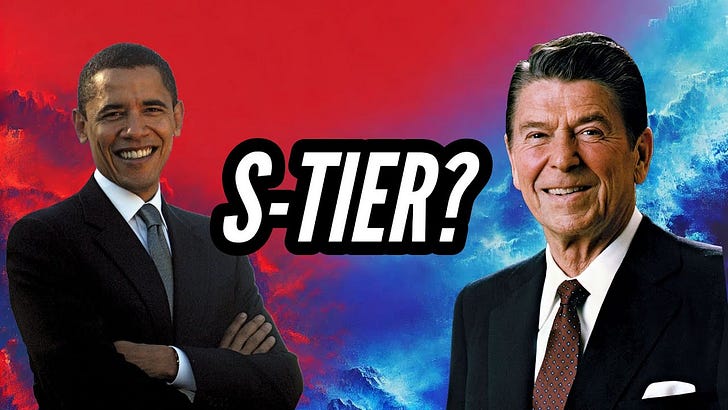
Schumer Blinks! Ranking Winning Presidential Campaigns (with Ettingermentum)
Schumer blinked. House Democrats are furious. But there will be more on that tomorrow.While the dust settles, I’m joined by returning guest ettingermentum to dive deep into the best and worst winning presidential campaigns. We rank every campaign from 1964 to 2024: Who ran the best campaigns, who completely fumbled, and which elections had the biggest long-term impact. Ettingermentum previously put together a two-part series ranking these campaigns, and I, naturally, had to make his own. So, we go back and forth, comparing notes, debating rankings, and making the case for why certain campaigns deserve more credit (or less).Justin’s RankingsS-Tier:* 2008 (Obama)* 1984 (Reagan)A-Tier:* 1992 (Clinton)* 2024 (Trump)B-Tier:* 1972 (Nixon)* 1996 (Clinton)C-Tier:* 1968 (Nixon)* 1980 (Reagan)* 1976 (Carter)* 2000 (Bush)D-Tier:* 1964 (Johnson)* 1988 (Bush)* 2004 (Bush)* 2012 (Obama)F-Tier:* 2016 (Trump)* 2020 (Biden)Chapters00:00:00 - Intro00:01:04 - Schumer Won’t Block Spending Bill00:03:43 - Ranking Winning Political Campaigns, Part 100:48:26 - Update00:49:21 - Mayor Pete Not Running For Senate00:52:45 - Probationary Federal Employees Rehired, Judge Says00:54:56 - Birthright Citizenship Battle00:59:00 - Ranking Winning Political Campaigns, Part 201:36:49 - Wrap-up This is a public episode. If you'd like to discuss this with other subscribers or get access to bonus episodes, visit www.politicspoliticspolitics.com/subscribe
The Unraveling Of ActBlue. House Republicans Avoid A Shutdown (with Matt Laslo and Jen Briney)
In the intersection of politics and technology, few innovations have had as significant an impact as online donation platforms. ActBlue, the Democratic Party's premiere fundraising tool, has revolutionized small-dollar contributions since its inception in 2004. However, recent internal turmoil at the organization is raising serious questions about both its future and about the broader landscape of political donations.A Game-Changer for DemocratsActBlue was an early pioneer in digital fundraising, allowing Democratic candidates and progressive causes to tap into small-dollar donors efficiently. Through gamification and mobile accessibility, the platform made it easy for supporters to donate with just a few clicks, contributing billions of dollars to campaigns over the years.By 2024, ActBlue played a crucial role in helping President Biden and Vice President Kamala Harris amass over $1.5 billion in campaign funds, outpacing the Republican counterpart, WinRed, which raised $900 million for Donald Trump. The platform also helped Democrats dominate small-dollar fundraising in Senate races, with candidates like Sherrod Brown (Ohio) and John Tester (Montana) outraising their Republican opponents, despite ultimately losing their races.A Leadership Exodus and Rising ConcernsDespite its success, ActBlue is now facing a crisis. In February 2025, seven senior staff members resigned suddenly, including the organization’s chief legal officer, vice president for customer service, and a technical expert with 14 years of experience. This mass departure was alarming enough that two employee unions publicly voiced concerns, warning that confidence in the organization’s stability was eroding.This followed a December 2024 letter from over 140 political stakeholders — consultants, campaign staff, donors, and academics — urging ActBlue to implement stronger safeguards to prevent donor exploitation.One particularly cryptic development came when a newly appointed technical leader at ActBlue reminded employees of whistleblower protections, a warning that suggests internal concerns about potential misconduct.Allegations of Financial MisconductWhile ActBlue’s success has been attributed to its superior technology and network effect, some critics argue that there may be fraudulent activity behind its fundraising dominance.A GOP strategist, Mark Block, filed a racketeering lawsuit against ActBlue, alleging that his identity was stolen to make 385 fraudulent donations totaling $884. He claims that these small donations — each under $200 — were used to exploit a loophole in Federal Election Commission (FEC) reporting requirements.This practice, known as “smurfing,” is a form of money laundering that involves breaking large donations into smaller, untraceable amounts to avoid detection. Block’s lawsuit cites donation receipts from an old campaign email account, showing repeated micro-donations averaging just $3.24 each, many of which he did not authorize.Additionally, there have been reports of:* Elderly individuals discovering numerous small donations in their names without their knowledge.* Foreign nationals using surrogates to funnel money into U.S. elections, a violation of campaign finance laws.These allegations, combined with the sudden staff exodus, suggest that ActBlue could be facing a major financial scandal.The Potential FalloutIf these accusations are substantiated, the implications for ActBlue — and Democratic fundraising — could be severe:* Small donors may hesitate to contribute if concerns about fraud persist, resulting in a loss of trust in one or both parties.* The FEC or other watchdogs may launch formal investigations, leading to stricter oversight.* With ActBlue in turmoil, Democrats may struggle to replicate their past fundraising successes in upcoming elections.There is also speculation that WinRed, the Republican alternative, could face similar scrutiny. If both major fundraising platforms are found to have engaged in unethical practices, the entire online political donation system could be upended.Looking Ahead to 2028ActBlue’s situation is still unfolding, but one thing is clear: The Democratic Party’s dominant fundraising machine is in serious jeopardy. If ActBlue collapses or loses credibility, Democrats will need to quickly find an alternative — something that won’t be easy given the platform’s deep integration with campaign operations.With the 2026 midterms and the 2028 presidential race on the horizon, the future of small-dollar political fundraising is more uncertain than ever.Chapters00:00:00 - Intro00:01:05 - Interview with Matt Laslo00:21:00 - ActBlue Chaos00:32:22 - Update00:33:46 - US/Canadian Tariffs00:35:29 - Ukraine Ceasefire00:37:35 - Mahmoud Khalil’s Arrest00:40:17 - Interview with Jen Briney01:15:08 - Wrap-up This is a public episode. If you'd like to discuss this with other subscribers or get access to bonus episodes, visit www.politicspoliticspolitics.com/subscribe
Has DOGE Been Leashed? How the Stock Market is Reacting to Trump's Tariffs (with J.D. Durkin)
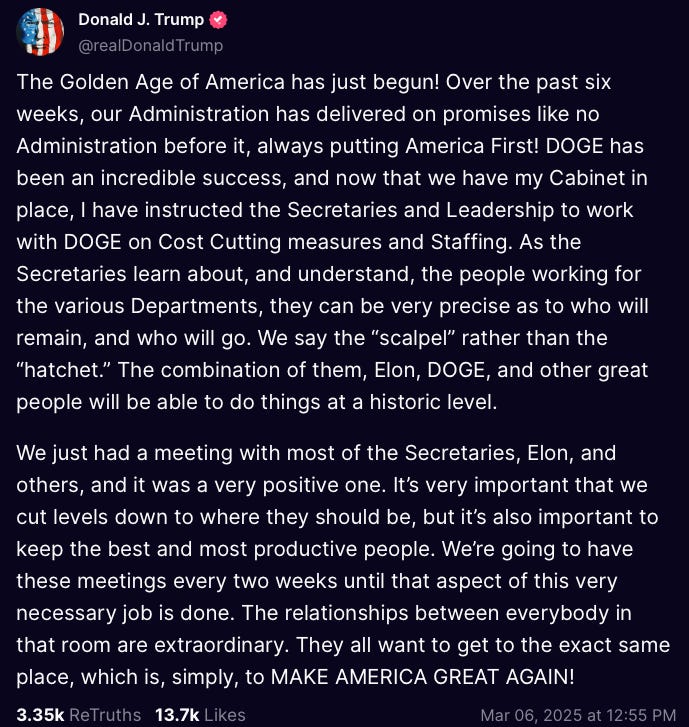
In a Truth Social post on Thursday, President Donald Trump declared that "the golden age of America has just begun." He touted his administration’s early successes and emphasized that his newly assembled cabinet is focused on cost-cutting measures and staffing decisions, with the Department of Government Efficiency — colloquially known as "DOGE" — playing a central role.According to Trump, his administration will take a "scalpel rather than the hatchet" approach to reducing government waste. He praised Elon Musk and DOGE for their efforts in streamlining operations, stating that his team would be conducting biweekly meetings to assess and refine their approach.However, the speed and aggressiveness of the administration’s restructuring efforts have not gone unnoticed. Over the past 48 hours, there has been a discernible shift — a brake pumping, if you will — on the administration’s initial velocity. Reports suggest that Attorney General Pam Bondi recently presented Trump with binders labeled Epstein files, only for him to realize that most of the information was already publicly available. The implication? There may be an effort to control the chaotic rollout of these reforms.Behind the scenes, Chief of Staff Suzy Wiles appears to be taking on a stabilizing role. She remains largely unquoted in the press, but her influence is evident. While no one can dictate Trump’s decisions, if there is anyone capable of channeling his impulses into a more structured path, it is likely Wiles.The Challenge of Government ReformPolling data presents mixed signals for the administration’s strategy. While government reform remains broadly popular, Elon Musk himself does not poll particularly well. Moreover, while fiscal responsibility is a winning message, mass firings are unpopular, especially when they disrupt essential services.Some of the layoffs initiated by DOGE have drawn minimal public sympathy, such as the widely ridiculed case of a Yosemite employee responsible for bathroom keys. But other cuts have raised alarm, like the reported downsizing at the National Weather Service. This agency is crucial not only for routine weather forecasts but also for emergency alerts, particularly with tornado and hurricane seasons approaching in the coming months.If the administration is now signaling a more measured approach, it may be an acknowledgment that they have tested the limits of public tolerance for aggressive government downsizing. Silicon Valley's ethos values rapid iteration, but that approach does not always translate well to governance. In the tech world, listing a feature that doesn't yet exist isn’t necessarily misleading if it eventually becomes reality. However, in government, making sweeping announcements without a clear plan can create the perception of recklessness rather than innovation.This shift in tone suggests that the administration is attempting to move away from the narrative that it is slashing government with reckless abandon. Instead, the messaging now emphasizes precision: cutting waste while retaining key personnel and essential services. Whether this recalibration is enough to change the public perception is a question for another day.One clear indication of this shift is a new push in Congress. Senate Republicans are urging legislative action to codify DOGE’s spending cuts, following a court ruling that limits the department’s unilateral authority. While some lawmakers have praised Musk’s efforts, others, including Senator Rand Paul, have cautioned that major spending cuts should be handled through Congress rather than executive fiat. Senator Lindsey Graham, a supporter of DOGE, has acknowledged its flaws and has encouraged a more structured approach through legislative rescission.The Coming Battle Over RescissionOne term that is about to become more prominent in political discourse is rescission. While it may sound similar to reconciliation, the two are entirely different budgetary mechanisms. Rescission allows the president to formally request that Congress cancel previously approved federal spending.Here’s how the process works:* The president submits a rescission proposal to Congress, specifying funds to be cut.* Congress has 45 days of continuous session to approve the request. Importantly, approval only requires a simple majority in both chambers, meaning it bypasses the 60-vote Senate filibuster.* If Congress approves, the specified funds are canceled, preventing the executive branch from spending them. If Congress rejects or ignores the proposal, the funds remain intact.The significance of this approach is that it moves beyond the constitutional gray area of unilateral executive spending cuts. Instead of DOGE simply slashing budgets at the departmental level, rescission would put the matter before Congress, potentially giving the cuts more permanence.According to reports, Musk was convinced to support this approach after Lindsey Graham pointed out that any cuts made solely at the department
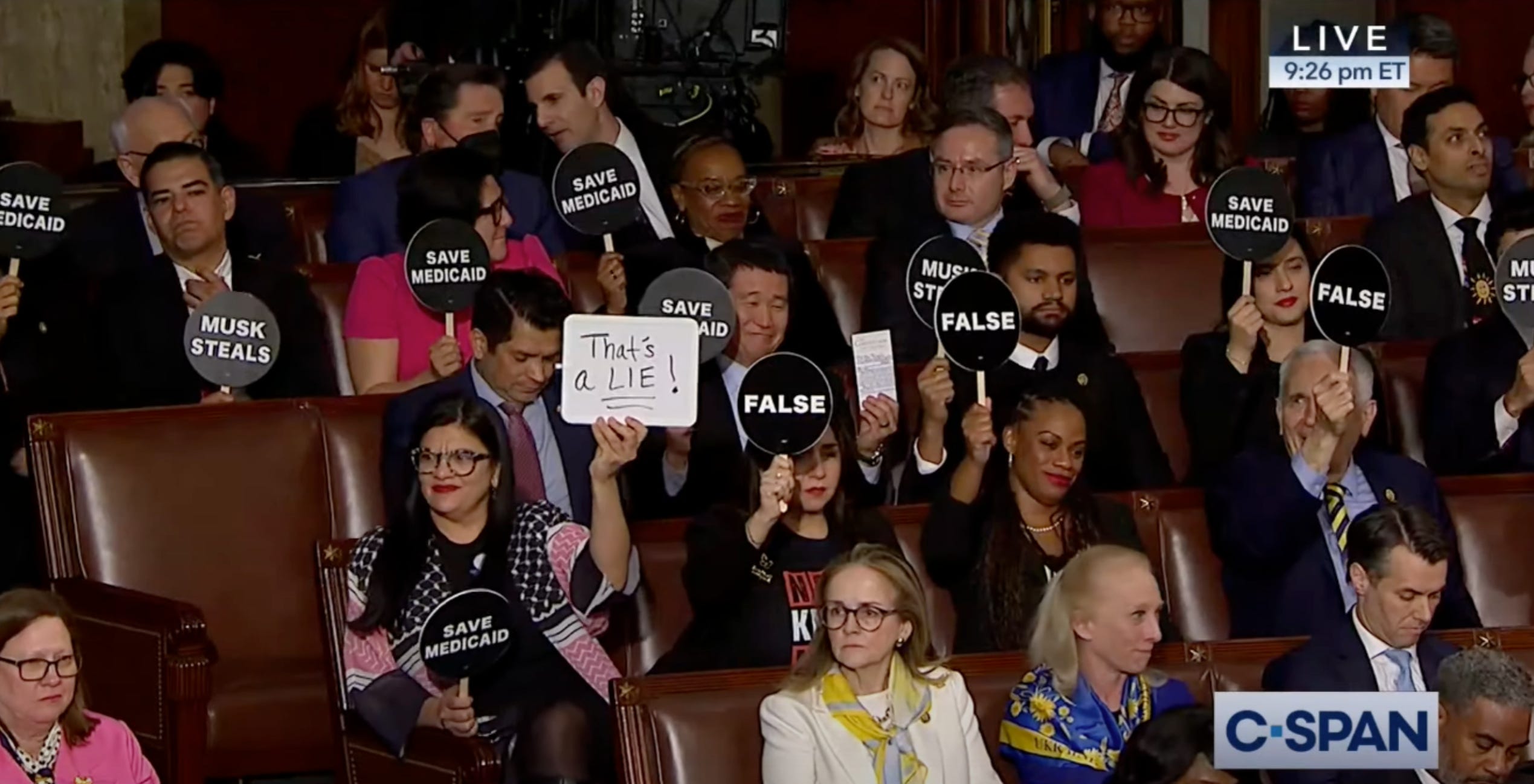
Trump's Made-For-TV Address to Congress
Last night, Donald Trump delivered a speech that, while technically a joint address to Congress, carried all the hallmarks of a campaign-style event filled with made-for-TV moments, emotional appeals, and strategic messaging. Let’s break down what happened.Trump’s Optimistic Tone: A Departure from "American Carnage"One of the most surprising takeaways from the speech was Trump's notably optimistic tone. Historically, Trump has thrived on highlighting crises, framing America as a nation in peril, in need of his leadership to "fix it." This time, however, there was a shift. He painted a picture of a country that was on the verge of a new golden era, offering solutions rather than just grievances.While still aggressive in his direct call-outs — pointing at specific politicians and criticizing their policies — Trump's rhetoric was more forward-facing. Whether one believes his words or not, the tone of his message was clear: We’re going to be okay, and here’s why.The Democrats' Disjointed StrategyIf Trump’s address was an exercise in tight, focused messaging, the Democratic response was anything but. There appeared to be an internal divide on how to handle the moment. Leadership suggested a visual strategy, having members bring a “plus one,” specifically fired federal workers, to highlight job losses under Trump. But instead of a powerful display, the execution was lackluster.What Democrats mostly did was hold up small signs with messages like “False”, “Protect Medicaid”, and “Fire Musk.” These signs echoed previous protest tactics, like Rashida Tlaib’s “War Criminal” sign when Netanyahu spoke. However, instead of appearing unified and strong, it made them look like they were following a playbook set by a single faction of the party rather than presenting a broad, compelling counterargument.Al Green’s Yelling and the Optics BattleThe lack of a coherent Democratic strategy was further highlighted when Rep. Al Green (D-TX) stood up mid-speech and began yelling, though it was unclear what he was yelling about. The 77-year-old congressman was eventually escorted out, but the visual of an elderly man angrily shouting and then leaving quietly did little to make an impact.Trump, anticipating resistance, built a line into his speech about how Democrats would refuse to stand or cheer for anything he said. True to form, many Democrats remained seated during moments that, at least on camera, appeared universally positive. The optics of the party looking grumpy and disengaged while Trump supporters clapped and cheered was, at best, a missed opportunity.Policy Highlights: Inflation, Tariffs, and Open BordersTrump’s speech hit several key policy points, starting with inflation, a topic polling shows as a top voter concern. His approach? Blame Biden and promise that lowering fuel costs through increased drilling would lower overall prices.He also reaffirmed his stance on tariffs, arguing that protectionist policies would bring jobs back to America. However, as Justin pointed out, this messaging could be tricky. If tariffs are seen as inflationary, they could directly contradict his economic promises.Immigration was another focus, with Trump highlighting border security as one of his administration’s major successes. While migration levels have significantly decreased, he took full credit for the decline, presenting it as a unilateral victory.The Made-for-TV MomentsThis address will likely be remembered more for its emotional and strategic moments than for its policy substance. Trump repeatedly leaned into personal stories, putting everyday Americans in the spotlight. Among the most notable:* A Mother of a Murdered 12-Year-Old – Trump honored a grieving mother whose son was killed by gang members, announcing the renaming of an animal sanctuary in her child’s honor.* A Young Female Athlete and Transgender Sports Debate – He highlighted a female volleyball player who suffered a head injury from a transgender opponent, a move that played directly into the right’s ongoing cultural battles over women's sports.* A Cancer Survivor Turned Secret Service Member – In a surprise moment, Trump announced that a 13-year-old pediatric cancer survivor was being made an honorary Secret Service agent, prompting an emotional response.* A Military Legacy Continues – A young man from a military family was told, on stage, that he was being accepted into West Point — yet another moment of surprise designed for maximum emotional impact.* Afghanistan and ISIS-K – Perhaps the biggest bombshell was Trump’s announcement that the mastermind behind the ISIS-K attack that killed 13 U.S. service members in Afghanistan had been captured and was being extradited.Polling and Public PerceptionIn the immediate aftermath, polling suggested the speech played well. A CNN snap poll showed 69% of speech watchers viewed it positively. A CBS YouGov poll reported that 68% of respondents felt “hopeful” after the speech, while only 16% felt “angry.” These numbers suggest th

Trump's Trade War! How The Internet Collided With Politics (with Bill Scher and Katie Harbath)
The United States has officially imposed broad tariffs on two of its largest trading partners, Canada and Mexico, marking one of the most aggressive trade measures in recent history. With potential economic fallout looming, world leaders, economists, and businesses are scrambling to assess the impact of President Donald Trump’s latest move.From Trade Deals to Trade Wars: How We Got HereDuring Trump’s first term, his administration took a mixed approach to tariffs. While he aggressively targeted China with import duties — many of which remain under President Biden — his strategy with Canada and Mexico was more nuanced. Initial tariffs on specific industries such as lumber, steel, and aluminum eventually gave way to the U.S.-Mexico-Canada Agreement (USMCA), a revised version of NAFTA that stabilized trade relations.However, with Trump back in the White House, he has revived concerns over trade imbalances, particularly with Canada and Mexico. On January 20th, Inauguration Day, Trump signed an executive order launching a review of USMCA, with findings due in April. But before that process could unfold, he moved forward with major tariff increases.On February 1st, Trump announced two executive orders imposing sweeping tariffs. Canadian imports now face a 25% tariff, with a lower 10% tariff on energy exports like oil and gas. Mexico has been hit with a flat 25% tariff on all imports. Though negotiations initially delayed the tariffs by 30 days, they have now gone into full effect, shaking up a $1.3 trillion annual trade relationship.To justify the tariffs, Trump invoked the International Emergency Economic Powers Act, a legal framework typically used for sanctions. He linked the move to national security concerns, specifically citing fentanyl trafficking and illegal immigration.Sweeping Tariffs Hit North America HardThe response from Canada and Mexico has been swift and severe. Canadian Prime Minister Justin Trudeau condemned the tariffs as "absolutely unacceptable" and unveiled a $30 billion retaliatory tariff package, with plans for an additional $125 billion in tariffs within 21 days if the dispute is not resolved. Several Canadian provinces have announced bans on U.S. products, pulling American wine, beer, and liquor off store shelves.In Mexico, President Claudia Sheinbaum issued a sharp protest but has not yet outlined a formal retaliation. However, Mexican officials have signaled that they may target key U.S. industries, including soybeans, pork, and beef exports.Domestically, the tariff decision has sparked significant economic concern. Stock markets tumbled following the announcement, and major retailers like Target and Best Buy have warned that prices on imported goods will rise sharply, with businesses passing the cost onto consumers.Economists overwhelmingly predict inflationary pressure, warning that tariffs could lead to a U.S. recession and further damage trade relations. The automotive industry is expected to see major price hikes, as will sectors reliant on steel and aluminum, energy resources, agriculture, and consumer goods such as electronics, clothing, and household appliances.Trump’s Endgame: Tough Negotiation or Economic Gamble?These tariffs will likely be felt most harshly by Canada and Mexico, as the United States is their largest export market. Seventy-five percent of Canadian exports go to the U.S., while for Mexico, that number is even higher at 80%. By limiting these exports, Trump is exerting maximum pressure on both countries, but the strategy raises significant questions.Is he using tariffs as leverage to renegotiate USMCA? Does he expect Canada and Mexico to cave under economic strain? Or is this a broader shift toward economic protectionism, despite warnings from economists?Trump’s decision could make or break his administration. While his supporters may see the move as a strong stance against unfair trade practices, rising prices and economic downturns could alienate voters — especially those who supported him for his stance on inflation control. The coming months will reveal whether these tariffs are a negotiation tool or a long-term policy shift. For now, both the U.S. and its North American neighbors brace for an economic showdown.Chapters* 00:00:00 - Introduction* 00:02:39 - Ukraine Mineral Deal Fallout* 00:06:35 - The Impact of Tariffs on Trade Relations* 00:17:22 - Consequences of Tariffs on the Economy* 00:22:15 - Interview with Bill Scher* 00:58:09 - Update introduction* 01:00:13 - J.D. Vance’s European Controversy* 01:03:02 - GOP Government Funding Bill* 01:04:48 - Democrats’ Plans to Protest Trump’s Speech* 01:08:00 - Interview with Katie Harbath* 01:45:25 - Outro This is a public episode. If you'd like to discuss this with other subscribers or get access to bonus episodes, visit www.politicspoliticspolitics.com/subscribe
Fallout from the Oval Office Debacle: What Happened and What’s Next for Ukraine and the US?
In a dramatic turn of events last Friday, an Oval Office press conference meant to signal unity between the U.S. and Ukraine spiraled into an unanticipated disaster. What was supposed to be a step toward solidifying a peace negotiation framework with Russia instead resulted in the unraveling of a crucial minerals-for-aid deal. The fallout has raised pressing questions about the future of U.S.-Ukraine relations, President Trump’s foreign policy, and Ukraine’s ability to sustain its war efforts.The Lead-Up: A Fragile PartnershipTo understand the significance of last Friday’s debacle, it’s essential to examine the events leading up to it. Ukrainian President Volodymyr Zelenskyy, a seasoned political operator, has long been reliant on U.S. support. Despite initial tensions, particularly regarding Biden’s approval of the Nord Stream 2 pipeline, the Ukraine-U.S. relationship strengthened in the wake of Russia’s full-scale invasion. The Biden administration’s vocal support and military aid were critical in keeping Ukraine afloat.However, Zelenskyy has never shied away from playing hardball in the American political arena, a strategy that has at times put him at odds with U.S. leaders. His aggressive advocacy for Ukraine, including his willingness to publicly challenge U.S. decisions, set the stage for what would become a deeply consequential clash with the Trump administration.The Minerals-for-Aid Deal: A Shaky FoundationOne of the most underreported aspects of Friday’s breakdown was the origins of the proposed minerals-for-aid agreement. Contrary to some portrayals, this wasn’t a Trump-led shakedown—it was an idea first floated by Zelenskyy himself in October 2024. His proposal sought to leverage Ukraine’s vast rare-earth mineral reserves, essential for advanced technology and defense systems, in exchange for long-term U.S. and European support.The Trump administration seized on this idea, seeing it as a way to justify continued investment in Ukraine while securing critical materials. However, negotiations faltered. Treasury Secretary Scott Bessent and a delegation, including Senator JD Vance and Marco Rubio, attempted to finalize the agreement in multiple rounds of talks. Zelenskyy, at one point, appeared ready to sign—only to later insist on additional approvals from Ukraine’s parliament, frustrating Trump and his team.The Press Conference MeltdownThe diplomatic strain reached its breaking point at the White House. The stage was set for Zelenskyy and Trump to present a united front and sign the minerals deal. Instead, what followed was an unexpectedly confrontational exchange that unraveled months of negotiation.The first warning signs appeared when Zelenskyy openly bristled at Trump’s references to Russian casualties, signaling an underlying frustration with the framing of the discussion. Tensions escalated when Zelenskyy, rather than using the platform to solidify the agreement, engaged in an impromptu challenge to JD Vance regarding U.S. support for Ukraine.Key moments included:* Trump’s unexpected commitments: Despite accusations that his administration is soft on Russia, Trump pledged continued arms shipments to Ukraine and even left the door open for U.S. troops participating in a peacekeeping force.* Zelenskyy’s misstep: His attempt to push for additional reparations from Russia, while politically sound, was ill-timed given the fragile state of negotiations.* The breaking point: A contentious back-and-forth between Zelenskyy and Vance, initiated by Zelenskyy, derailed the proceedings. Within hours, the deal was dead.The Fallout: A Win for Moscow?The failure to secure an agreement is a major setback for Ukraine. Without a clear U.S. commitment, European nations may hesitate to maintain their full-throated support, wary of straining relations with Washington. Meanwhile, Russia stands to benefit from any cracks in the Western alliance’s stance on Ukraine.For Trump, the incident may not be the political liability that critics assume. Polling suggests that a majority of Americans remain skeptical of prolonged foreign military commitments. His stance, which aligns with a broader shift toward isolationism within the Republican Party, is unlikely to cost him significant political capital.What Happens Next?Despite the disastrous turn of events, all hope is not lost. The underlying incentives for a deal remain strong—Ukraine needs U.S. support, and the U.S. has a strategic interest in securing rare-earth minerals.* Will Zelenskyy make amends? His best course of action may be to reopen negotiations, perhaps even making a direct appeal to Trump at Mar-a-Lago.* Can Europe fill the gap? In the immediate term, European leaders, including France and the UK, are trying to reassure Ukraine, but their ability to replace U.S. support remains in question.* Will the Trump administration re-engage? The White House has signaled that the door is not entirely closed. Treasury Secretary Bessent has expressed confidence that an agr

Stephen A. Smith For President? CPAC and America's Strained Relationship with Europe (with Claire Meynial)
U.S. Attorney General Pam Bondi recently released a set of documents titled the Epstein Files: Phase One, which were expected to shed new light on the late financier and convicted sex offender Jeffrey Epstein’s extensive network and illicit activities. However, the heavily redacted documents primarily contained information already available to the public, leading to significant criticism.Following the document release, Bondi sent a stern letter to FBI Director Kash Patel, accusing the FBI’s New York field office of withholding thousands of pages of additional records related to the Epstein investigation. She stated that despite assurances that all Epstein-related files had been provided, she quickly learned of the existence of more material.Bondi demanded the release of all remaining records—documents, audio, and video—by 8 a.m. on February 28th. Additionally, she announced an internal investigation into the handling of these files and instructed Patel to propose personnel action within two weeks.The document release quickly turned into a social media firestorm. Several influencers, including Libs of TikTok owner Chaya Raichik, Mike Cernovich, Jessica Reed Kraus of House Inhabit, and Chad Prather, were photographed at the White House holding binders labeled Epstein Files Phase One.This sparked outrage, with many questioning why these influencers had early access to the files while they were not made publicly available online. Others, particularly those who have long followed the Epstein case, downplayed the release, arguing that these files contained little new information.The controversy extended beyond social media, as members of Congress expressed frustration over the handling of the files. The House Judiciary Committee mocked the situation by posting a fake link to the Epstein files—only to rickroll their audience. Meanwhile, Rep. Anna Paulina Luna, who is involved in declassifying public secrets, stated that she had not been provided access to the documents before their release, raising concerns about poor coordination within the Justice Department.The release of Phase One has left more questions than answers. While Bondi insists that additional documents exist and must be made public, the disorganized rollout has fueled skepticism. Some remain hopeful that new, previously unknown details about Epstein's network will eventually surface. For now, the public is left with confusing and frustrating news—but potentially more revelations on the horizon.Chapters* 00:00:00 - Introduction* 00:03:00 - Stephen A. Smith’s Potential Presidential Run* 00:16:12 - Keir Starmer* 00:19:51 - The Epstein Files Debacle* 00:24:10 - USAID Fallout* 00:25:55 - Interview with Claire Meynial on CPAC, Europe, and Ukraine* 01:02:09 - Wrap-up This is a public episode. If you'd like to discuss this with other subscribers or get access to bonus episodes, visit www.politicspoliticspolitics.com/subscribe

What Can the Tea Party Teach Us About Today’s Democratic Opposition? Ukraine's War of Attrition (with Brian Sack)
Sixteen years ago, CNBC commentator Rick Santelli stood on the floor of the Chicago Mercantile Exchange and delivered an impassioned rant against federal plans to bail out struggling homeowners. “Do we really want to subsidize the losers’ mortgages?” he shouted, calling for a “Chicago Tea Party” to protest government intervention.That moment became the rallying cry for a movement that would reshape conservative politics, define opposition to the Obama presidency, and eventually evolve into the MAGA movement that has since won the White House twice.Lately, the Tea Party has been on my mind because of the way political movements are often dismissed by their opponents. In liberal circles, one word was frequently used to wave off the Tea Party: astroturf.“This isn’t a grassroots movement,” critics insisted. “It’s funded by billionaires to look like a populist uprising.” After all, it started on CNBC—hardly a blue-collar favorite.But that’s not the whole story. And now, in 2024, astroturfing accusations are being hurled in the opposite direction.Last week, Republican Rep. Rich McCormick of Georgia faced a hostile crowd at a town hall in Roswell. The moment (captured in a widely circulated video) showed Democrats in his district voicing their frustration, pushing back forcefully against GOP policies.In response, conservatives dismissed the backlash as manufactured outrage, a coordinated effort by the so-called “deep state” to rattle the Republican establishment.Sound familiar?To understand whether today’s Democratic anger is real or manufactured, it’s worth looking back at how the Tea Party took shape.While Santelli’s on-air rant is widely credited with sparking the Tea Party, grassroots opposition to Obama’s policies had already begun. Keli Carender, a blogger in Seattle, organized an anti-stimulus protest even before Santelli’s speech. Her February 2009 demonstration—dubbed the “Porkulus Protest”—drew about 100 people.But once Santelli’s rant went viral, Tea Party protests exploded across the country. Social media platforms like Facebook and Twitter helped coordinate events, and by April’s Tax Day, an estimated quarter-million people took to the streets in organized demonstrations. Conservative media played a crucial role in amplifying the movement. Fox News hosts like Glenn Beck and Sean Hannity championed Tea Party causes, helping grow its ranks. Soon, prominent Republican figures lent their support, though the movement remained largely decentralized.By the summer of 2009, as Obamacare made its way through Congress, Tea Party activists shifted their strategy. Instead of street protests, they flooded town halls, confronting Democratic lawmakers with fiery opposition. Videos of these clashes—angry constituents challenging their representatives—became a defining image of the movement.And electorally, the Tea Party had teeth. While it failed to topple the Republican establishment entirely (Mitt Romney still won the 2012 nomination), it helped flip House seats and push the GOP further to the right.What does the Tea Party teach us about today’s Democratic opposition?* It’s never too early to be angry. Santelli’s rant came barely a month after Obama took office. Right now, Trump’s disapproval ratings are rising, but Democrats haven’t yet rallied around a singular issue.* Movements can make an impact—especially in the House. The Tea Party didn’t need to control the White House to change the political landscape. A handful of flipped seats can shift the balance of power.* Dismissing protests as ‘astroturf’ is risky. If the same kind of town hall showdowns seen in McCormick’s district begin happening elsewhere, they could turn into a trend.The Tea Party was fueled by a raw, pent-up anger over fiscal conservatism. Many conservatives felt betrayed by their own party—George W. Bush had campaigned on balanced budgets, only to expand deficits through wars and bailouts. Obama’s presidency, with its ambitious government programs, only amplified those frustrations.The question for Democrats now is: What’s their version of that anger?If it’s simply opposition to Trump, that’s not enough. Even figures like Elon Musk—despised by many progressives—aren’t sustainable political villains. “Musk sent another email” isn’t a battle cry that will mobilize voters in the long run.That’s why Democratic strategists should be tickled by what just happened in the House. They (impressively) passed a budget that, while avoiding direct mention of Medicaid, includes $880 billion in cuts overseen by the Energy and Commerce Committee—which just happens to control Medicaid.Why the cuts? Because fiscal hawks in the House need a way to offset the Trump tax cuts.For Democrats, that’s a classic, politically potent message: Republicans are cutting your Medicaid to give tax cuts to the rich.If they can harness that into a movement—one that gets people angry enough to show up at town halls, knock on doors, and vote—then history might just be repeating itself
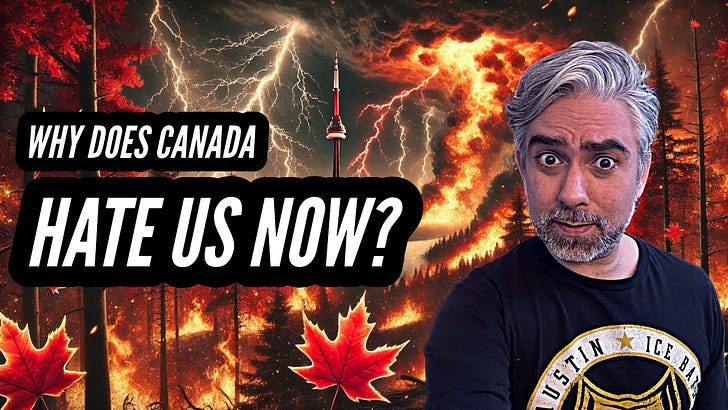
Why Does Canada Hate Us Now? Trump Month One Vibe Check. Trump and Zelenskyy Reconcile? (with Evan Scrimshaw and Kevin Ryan)
One down, 47 to go.With Donald Trump’s first month in office coming to a close, we are seeing something that feels a bit more familiar. According to three recent polls, his approval rating is now underwater—meaning more people disapprove of him than approve. This is still essentially the same conversation we were having before. There are deeply entrenched beliefs on both sides, with some convinced he is doing a terrible job and others believing he is performing tremendously.Keep Politics Politics Politics alive! Get two bonus episodes each week! Upgrade to paid!The numbers reflect this divide. A CNN SSRS poll shows Trump’s approval at 47% with 52% disapproving. Similarly, a Reuters Ipsos poll reports 44% approval and 51% disapproval, while Gallup’s latest survey records a 45% approval and 51% disapproval. I have seen other numbers where he remains above 50% and in net positive territory, but the general trend suggests that the more people hear his name, the less they seem to like him.Sound familiar?At the heart of this, however, is the same issue that contributed to Joe Biden’s defeat: the economy. Economic fears and anxieties remain high, and now that people are reminded of both the speed and the sheer volume—both in quantity and loudness—of the Trump administration, there’s a sense of, “Ah, okay, here we go again.” If the economy rebounds, Trump could find himself in a very strong position. But if it does not, whatever mandate he might have had will quickly evaporate.It’s worth noting that we still have the majority of Trump’s first 100 days ahead of us, though you’d be forgiven for forgetting that as it feels like he’s been in office for six months. Chapters02:06 - Trump Approval Rating Down04:46 - Evan Scrimshaw on Why Canada Hates The US51:53 - Mitch McConnell Retirement54:05 - Kash Patel Confirmed57:37 - Zelenskyy To Sign Mineral Deal With US01:03:12 - Kevin Ryan This is a public episode. If you'd like to discuss this with other subscribers or get access to bonus episodes, visit www.politicspoliticspolitics.com/subscribe

The One Weird Trick That Could Avoid A Shutdown (with Gabe Fleisher and John Teasdale)
Wait, what? What just happened? To who? When? And it just flipped when it landed? A 13th kid with a fourth woman? Does that have anything to do with the other thing? You know, the one that just happened. Or maybe that was last week… The first month of Trump 47 has felt more like 47 weeks than it has four, with a relentless barrage of executive orders, personnel decisions, and, let’s say, charitably unconventional accounting procedures that have kicked ant piles both foreign and domestic. And with all of that, much of what you read on social media, Substack, or in your podcast feed is likely very, very hyperbolic—or, if you’re on the conservative side of the aisle, particularly gleeful. My goal, however, is to ask a simple question every day: What actually matters? On this episode of the show, we’re going to talk to two people with vastly different perspectives on the political system. First, we have Gabe Fleisher, who writes the Wake Up to Politics newsletter and, even as a fresh college graduate, has probably forgotten more about political history and minutiae than the average voter has ever cared to learn. On the other end of the spectrum, we have John Teasdale, an entrepreneur and co-creator of The Contender card game, who intentionally disconnected himself from politics for the past year and has only just returned stateside.“Sure, Justin, I’ll enjoy both of those conversations. But what about me? What does that give me as a framework to understand what’s happening right now?” Well, to help with that, I want to dust off something that doesn’t usually get brought out in the political realm, but given the breakneck pace of news, I think it’s worth it. In 2013, WNYC’s On the Media program put out a helpful infographic titled the Breaking News Consumer Handbook. You’ve probably seen it during major events like shootings or tragedies, but with the flood of headlines right now, I think it’s worth revisiting its five core tenets and applying them to this moment.In the immediate aftermath of any major event, most news outlets will get it wrong. This is crucial to remember because, amid the deluge of information, you owe it to yourself to slow down. Wait a few days, maybe even a week, before getting worked up about something. Half-truths, gossip, and rumor fly out of every orifice in Washington, and with time, further context often clarifies the situation—or at least reveals whether it’s even newsworthy. Don’t you deserve the full set of facts before being led around by the nose by the outrage machine? I think you do. Don’t trust anonymous sources. Case in point: as I was recording, a story broke from NBC News stating that U.S. intelligence indicates Vladimir Putin isn’t interested in a real peace deal. The sources? Four anonymous sources—two congressional aides and two intel sources, presumably provided by those aides. The article essentially asserts that while Putin may negotiate with Trump, he’s not deterred from taking Ukraine in the long run. To which I say: da-doi. Unless you genuinely believed that Putin was going to apologize for invading Ukraine and promise never to do it again, this “news” adds no value. It doesn’t outline the parameters of a peace deal, Russia’s red lines, or any concrete details. It simply reiterates that Putin remains an authoritarian thug, which, let’s be real, even MAGA supporters acknowledge. The end of war is not a morality play—it’s about making decisions that stop people from dying. This story is calorie free by making a stupid point and not even using named sources to do it.Don’t trust stories that cite other media outlets as sources. This is a favorite trick of churn-media articles, particularly those designed to game Facebook’s algorithm. If you mostly get your news from social media, you’re consuming content optimized for engagement, not accuracy. These outlets often regurgitate information from elsewhere, making their legitimacy dubious at best. Fourth, and this one is more relevant to shootings, but still applicable…There is almost never a second shooter. In a broader sense, Occam’s razor applies—sometimes the simplest explanation is the correct one. While plenty of conspiracy theories have turned out to be true (COVID lab leak, Hunter Biden’s laptop, etc.), not everything that pops up on social media is exactly what it seems, especially when it comes to government spending. Right now, people are combing through federal expenditures, uncovering what might appear to be scandals. Give it time. Wait a few days before reacting and hitting retweet.Pay attention to the language the media uses. Phrases like “we are getting reports” could mean anything. “We are seeking confirmation” means they don’t have confirmation. “The news outlet has learned” means they have a scoop or are going out on a limb. Stick to fundamental journalism: a compelling lead, a nut graph that clearly outlines the news, and at least three on-the-record sources directly involved in the situation. If those el

Will The GOP Congress Get Anything Done? The Secret Lobbying Effort To Stop Deportations. (with Dave Levinthal and Matt Laslo)
I can think of no more romantic way for you to spend a quiet moment alone with your partner on this Valentine's Day than drawing a warm bath, throwing in some scented oils, and reading aloud the latest Politics, Politics, Politics post. "Great point, Justin," you can say to each other as you make longing eye contact and renew your commitment to one another. But it is in that spirit of passion that I tell you: somebody's gonna get f***ed — either the House or the Senate. This is a Republican problem, and we are in strange days. Normally, the People's House, which has a far higher headcount, operates with majorities of 10, 15, 20, maybe even 30 seats, at least in a bygone, un-gerrymandered era. In those situations, you could craft policy where some members of your own coalition wouldn't have to vote for it. The Republicans don’t have that luxury.Right now, the House majority is two. Two people. And reinforcements aren’t coming until April with the Florida special elections. We have no idea when the New York special election to replace Elise Stefanik will happen. The House wants to pass one big, beautiful bill with all of Donald Trump's agenda in it. The Senate doesn't want that. They would rather pass two bills. Over the last few days, as Lindsey Graham moved a budget bill out of the Senate, the message has been clear: if the House can't act, the Senate will. Meanwhile, the House, constantly scrapping for power because of its easily divided nature, is saying, "No, we're sending you one bill. You figure it out." And here’s the inside sauce on it: the reason the House wants one bill, many House Republicans don't like massive bills crammed with everything at once. They prefer voting on things individually. But Republicans can't afford to do that right now. They need members to vote against what they’ve pledged to vote for, and the only way they believe they can achieve that is by bundling multiple things together including some things that fussy members can’t not vote for.For example? Budget hawks who won’t raise the debt by one penny… are you not going to vote for border funding? Same for Border Warriors who want every illegal migrant out tomorrow along with their whole family… are you going to be an all-or-nothing puritan and not green light the tax cuts?The Senate sending two bills to the House is a problem for Republicans. The first bill, likely the border package, would pass easily. But when the second bill—probably tax cuts—comes around, budget hawks will balk. And if the House, Senate, and White House are all in Republican hands but fail to pass Trump's legislative agenda, that would be a disaster. The Senate's noise has some in the White House thinking the House is a lost cause. Yesterday, the House finally released a budget, and sources inside the chamber are unhappy. “The numbers are bad, campaign promises are broken, and member priorities are ignored,” As one source put it. "We need a speaker with big balls. In fact, I’d take (Elon’s) Big Balls over Mike Johnson’s any day."Which brings us to Speaker Johnson, the Hudsucker Proxy speaker. If you’ve never seen that movie, Tim Robbins plays a mailroom worker who gets unexpectedly elevated to CEO by a scheming board looking for a patsy. The movie ends with Robbins proving himself to be an exceptional CEO. Johnson would love for that to be his story. But the speakership in this situation is an impossible job. He can only afford to lose two votes, and one of them is already Thomas Massie. He got this job because, after Kevin McCarthy was ousted, every other candidate had at least four enemies. Johnson? He was just well-liked enough to slip through. Now, he's at the center of the storm.The House budget committee has angered members, and things are bleak. This doesn't mean the end, but it does mean they might have to split into two bills. If that happens, tax cuts might take a long time—or not happen at all. That’s a problem because tax cuts are a kitchen table issue. If Trump’s cuts aren’t in place by next year, it would be a massive failure. The number one reason people voted for Trump was to get inflation under control. If taxes go up, it’s a disaster.And the issue here is that there is no legislative North Star. Paul Ryan isn’t walking through that door. He was a legislative guy, a wonk. Right now, there’s no one like that in the House. And there’s certainly no one like that in the White House. And that’s where we land now. The big question? Considering all the noise that has been made by DOGE, does the idea of those savings factor into any of these budget talks?If not, then get ready for a bumpy ride with the first test being the expiration of government funding on March 14th. Chapters:- 00:00:00 - Introduction and Overview- 00:00:50 - Valentine's Day Special Opening- 00:01:19 - Discussion on House vs. Senate Republican Strategies- 00:02:38 - The House's Push for a Single Comprehensive Bill- 00:04:38 - Challenges in Passing Trump's Legislative Agenda- 00:
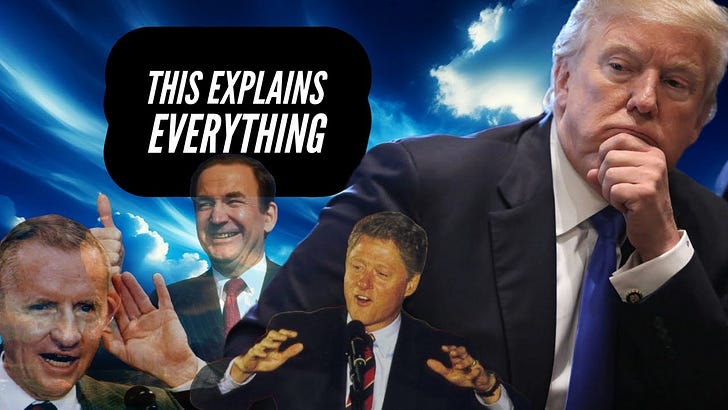
Trump Historical Comparisons. What Is Going On With Nancy Mace? (with Kirk Bado)
Donald Trump's second term does not look like his first. In his Super Bowl interview with Brett Baier, Trump admitted that back in 2017, he was a New York guy, a novice to Washington, D.C., and all but confessed that he stepped on every rake in sight. He appointed the wrong people, got caught up in the wrong traps, and was unable to effectively govern. To the casual observer, it may seem like not much has changed—Trump was causing chaos then, and he's causing chaos now. But this show understands the difference: Previously, chaos happened to him; now, he is the one orchestrating it. His agenda is taking direct aim at the centers of government he believes he was sent back to reform. Agencies long targeted by conservatives are now being affected—slashed, possibly shuttered. This is a direct assault on the structure of the federal government as it has been known, something many have promised but only Trump has aggressively pursued.If we can’t compare what we’ve seen over the last month to any prior sitting president, what historical precedents can we look to? I submit to you the year 1992 and three figures whose political strategies echo what we see in Trump today: Pat Buchanan, Ross Perot, and Bill Clinton.First, Buchanan. No one brought the conversation about immigration into the modern presidential sphere quite like him. Though his 1992 challenge to incumbent George H.W. Bush was short-lived, his influence endured. Buchanan’s rhetoric on immigration laid the groundwork for the hardline stance Trump would take in 2016. One of his biggest issues was the interpretation of the 14th Amendment regarding birthright citizenship, arguing that the phrase "under the jurisdiction thereof" meant only legal citizens should have offspring automatically granted citizenship. Now, Trump is doing something Buchanan only talked about: actively challenging birthright citizenship.Next, Ross Perot. If there is one historical figure whose message about government size and spending echoes through Trump’s current actions, it is Perot. Running as an independent in 1992, Perot famously railed against the national debt, which then stood at $4 trillion—a fraction of today’s $34 trillion. His colorful metaphors, like calling the debt a "crazy aunt we keep in the basement," helped him connect with voters who felt Washington was bloated and inefficient. He championed the idea of running the government like a business—sound familiar? Both men also shared a deep distrust of federal agencies. Perot famously quit his campaign in 1992, alleging that the CIA had infiltrated his operation, convinced that President George H.W. Bush, a former CIA director, was behind it. One can only imagine a President Perot would have pursued intelligence reforms as aggressively as Trump is now targeting the Justice Department and FBI.Perot, however, never won. Nor did Buchanan. But one man did in 1992: Bill Clinton. Initially, I planned to focus on just Buchanan and Perot, but our friend Michael Cohen recently made a compelling case for why Trump’s current approach also parallels Clinton. While Clinton focused on large-scale economic policies, he also knew how to capture public attention with wedge issues—ones that were more symbolic than substantive but extremely popular. In 1996, he championed the V-chip, a device to block violent content on TV, and pushed for school uniforms to combat youth violence. Neither policy had a significant impact, but they polled above 70%, making them politically beneficial.Trump is using a similar playbook. His recent executive orders—banning men from women’s sports and bringing back plastic straws—affect relatively few people in practical terms, yet they are wildly popular. These 70-30 issues serve as the sugar that makes the medicine go down, keeping the public engaged while larger, more complex reforms take shape. They also bait his political opponents into fighting battles where he holds the high ground— Obi-Wan style.At its core, Trump’s approach today mirrors Clinton’s in how it connects emotionally with voters. Is there really much of a difference between “Make America Great Again” and “I feel your pain”?Chapters00:00:00 – Intro00:02:17 – Trump's Second Term: Chaos or Competence?00:04:12 – 1992 as a Parallel to Trump’s 47th Presidency00:15:30 – Update00:17:53 – Judicial Roadblocks Against Trump’s Agenda00:21:31 – International News: Ukraine and Gaza Updates00:26:12 – Guest Interview: Kirk Bado from National Journal 00:31:36 – The Looming Government Shutdown00:39:52 – The Media’s Role and Chilling Effects00:46:07 – Nancy Mace: Political Calculations or Genuine Outcry?01:16:45 – Closing Remarks This is a public episode. If you'd like to discuss this with other subscribers or get access to bonus episodes, visit www.politicspoliticspolitics.com/subscribe

Let's Talk About DOGE. Florida GOP Infighting (with Jen Briney and Karol Markowicz)
It’s a DOGE-eat-DOGE world.Before I get into my thoughts on DOGE—and I have quite a few—the reason I haven’t written much about it (we did touch on USAID in Wednesday’s update) is that I’m still wrapping my head around it.There’s a lot of noise surrounding DOGE, and beyond the clatter, it’s unclear exactly what’s happening. Meanwhile, the Democratic Party is in the valley. They lost a big election, have no effective power in government for at least the next two years, and have been throwing a lot of spaghetti at the wall. Chuck Schumer was parading around with a Corona and lime when it looked like we were going to hit Mexico with 25% tariffs, and now, the focus of the last 72 hours has been Elon Musk and DOGE.Because DOGE sits at the center of a political noise machine, I tend to be cautious about jumping in while everything is still in motion.That being said, DOGE is a significant development. What they’re doing is something every Republican candidate in my lifetime has promised—and it may very well be illegal. We don’t know if they’re actually cutting the budget in the way they claim, nor do we know if anything they’re doing is truly unlawful. But the fact that both of those questions exist simultaneously is reason enough to take a deeper look.Elon Musk’s Department of Government Efficiency—DOGE—was conceived during Donald Trump’s 2024 campaign and made official on January 20, 2025, the first day of Trump’s second term. However, it is not a formal cabinet department. Instead, it began under the U.S. Digital Service, which was rebranded as the U.S. DOGE Service, before being placed under the Chief of Staff’s office—likely to avoid transparency requirements. The stated goal of DOGE is to modernize federal technology and software to maximize government efficiency, with Musk claiming they aim to cut $2 trillion from the federal budget. Musk has admitted that if they say $2 trillion, they might actually cut $1 trillion, but the ambition remains.DOGE operates out of the Eisenhower Executive Building next to the White House with a small headquarters of about 20 people. Rather than a traditional hierarchy, it functions as a task force embedded across government agencies, with small teams of DOGE operatives placed inside agencies to audit systems and pursue efficiency measures. Musk himself serves as a special government employee, a temporary advisory role that grants him broad access while allowing him to bypass disclosure requirements that apply to full-time officials. This is especially notable given Musk’s extensive business interests in China—something so controversial that a bipartisan group of lawmakers banned TikTok last year.Key figures in DOGE include Steve Davis, CEO of The Boring Company and a longtime Musk confidant, who allegedly leads day-to-day operations. Then there are the so-called “DOGE Kids”—young adults, typically aged 19 to 24, from elite universities with backgrounds in Musk companies or the Peter Thiel machine. Some, like Luke Farritor, gained fame for achievements like using AI to decode ancient Roman scrolls. Others, like Marko Elez, have already faced controversy. Ellis resigned after the Wall Street Journal uncovered racist posts he made in 2024, including advocating for eugenic immigration policies and saying he would never marry outside his ethnicity.In its first 80 hours, Musk tweeted that DOGE had canceled $420 million worth of federal contracts. Get it. The issue? DOGE doesn’t technically have the authority to cancel contracts. That power belongs to Congress and the departments that administer the funds. So the real question is whether DOGE is canceling these contracts or simply recommending their termination, with the speed of the Trump administration making it appear as though they’re acting unilaterally.DOGE’s aggressive approach has already ruffled feathers. On inauguration day, Musk’s team assumed control of the Office of Personnel Management (OPM) headquarters, installing sofa beds in the director’s office and working around the clock. Within days, they cut off career OPM staff from internal systems, effectively giving Musk’s team exclusive control over federal HR records. Two OPM employees filed a lawsuit in late January, alleging that DOGE unlawfully installed a private server on the agency’s network.Things escalated further when DOGE turned its attention to the U.S. Treasury Department’s payment system, which processes $5 trillion annually, handling everything from Social Security checks to federal salaries. When David Liebrich, a top Treasury official, refused to grant DOGE access, he was reportedly forced out. By January 31, Trump’s new Treasury Secretary, Scott Bessent, approved DOGE’s access. Soon after, a DOGE tech aide obtained unrestricted access to the payment system’s code base and began making changes with minimal supervision—an alarming development that has raised red flags in Congress.And then there’s USAID. Musk tweeted, “We’re shutting it down,” referring to
How Tulsi and RFK Jr. Survived and Advanced. Mainstream Media Melts. (with Chris Cillizza)
Trump might get his cabinet after all.It was never going to be easy, many of them pulled from the Deep MAGA reserves doomed to offend the old guard who are developing carpel tunnel holding their nose through Trump’s second administration. Others are lifelong Democrats who helped over the finish line but still inspire a stink eye from lifelong Republicans.Some confirmations were easy—Elise Stefanik sailed through, and Marco Rubio was unanimous. Others more controversial, like Pete Hegseth, who barely squeaked by. But throughout it all, two nominees had the lowest odds of making it through, Tulsi Gabbard and RFK Jr. That’s because neither of them are Republicans, and in a Senate where the GOP holds a 53-47 edge, blocking a nomination means peeling off Republican votes, not relying on Democratic opposition. The Democrats could stomp their feet all they wanted—it didn’t matter. But on this Tuesday, both have made it out of committee, thanks to key endorsements from influential figures within the GOP they both look to be on a narrow but assured path to the executive branch where they will serve at the pleasure of the president.Politics Politics Politics is free twice a week. Does it LOOK like news is only breaking twice a week? C’mon dude, get the two bonus episodes.Tulsi GabbardHer confirmation was boosted by Susan Collins, a senator unafraid to buck the Trump administration. Representing Maine—a state that's far from a deep-red stronghold—Collins' support was critical. It was enough to push Gabbard through committee on strict party lines. Beyond Collins, outreach from newly installed CIA Director John Radcliffe and Senator J.D. Vance helped smooth over concerns that arose during her confirmation hearing. The main sticking point? Her stance on Edward Snowden. Gabbard made it clear that she viewed Snowden as a criminal and would not recommend a pardon, but she stopped short of calling him a traitor. This led to a bizarre debate over whether she was sufficiently condemning Snowden, as some seemed to argue that unless she said the magic “traitor” word she was unqualified. Gabbard's confirmation has brought together one of the strangest coalitions I’ve seen on the right—far-right Republicans like Tom Cotton, staunch Never Trumpers like Meghan McCain, and figures like TuringPoint’s Charlie Kirk. McCain even appeared on Kirk’s radio show Monday to announce they’d team up to primary anyone who voted against Gabbard. That looks like it might not be necessary.RFK Jr. Unlike Gabbard, his confirmation hearing was messier. While Gabbard kept her composure, RFK Jr. approached it like a Kennedy: arrogantly. Democrats took their best shot, mostly by hammering him on vaccines, though their efforts were, frankly, ineffective. They made a lot of noise but didn’t seem genuinely committed to blocking him. In the end, Bill Cassidy of Louisiana, a Republican who voted to impeach Trump, decided he was comfortable enough with RFK Jr. to push him through committee.With that, Trump's cabinet is nearly complete. There’s one more potential hurdle: a labor secretary nominee who previously supported the PRO Act and has drawn skepticism from Republicans. But compared to Tulsi and RFK, this is a much lower-profile battle.At the end of the day, this confirmation process has been tougher than what Trump faced in his first term, but his team has handled it deftly. The Democrats? They put up almost no real defense.Was that on purpose? I don’t know. I suspect they don’t either.Chapters00:00 Intro02:50 Tulsi and RFK safe?12:42 USAID21:04 Waffle House Raises Egg Prices25:46 Senate Takes Charge on Reconciliation Bills32:38 Chris Cillizza This is a public episode. If you'd like to discuss this with other subscribers or get access to bonus episodes, visit www.politicspoliticspolitics.com/subscribe

Tulsi Teetering, RFK Jr. Rattled, Kash Kruising in Confirmation Hearings (featuring Michael Tracey)
The ongoing confirmation hearings for RFK Jr., Kash Patel, and Tulsi Gabbard have been largely predictable. But as always, the real story isn’t the grandstanding—it’s in the quiet calculations happening behind the scenes.This was RFK Jr.'s second day facing the Senate, and the discussion largely revolved around his past statements on vaccines. But if you’re looking for movement in the room, there wasn’t much. Coverage focused on explosive exchanges between Democrats and the nominees, but that’s irrelevant. The Democrats can all vote no, and it won’t change a thing. What matters is what Republicans are saying—and there’s little indication that they are going to vote against RFK Jr.RFK Jr. remains politically resilient for two reasons:* The Kennedy name still holds value with a broad swath of Americans.* His skepticism of Big Pharma and Big Agriculture resonates with a coalition that includes both libertarians and "crunchy moms"The main Republican angle of attack was always going to be abortion. RFK Jr. has been pro-choice his entire life, but now he’s taking orders from a pro-life president. How does that play out? He faced questions about the abortion pill but gave answers that were lukewarm at best.My assumption: He’s moving forward.Kash Patel’s hearing was predictably contentious, with heated exchanges involving Adam Schiff and Amy Klobuchar. But, again, those don’t matter. He also had solid support from Republican lawmakers, which means his confirmation is essentially a done deal.If Matt Gaetz was a non-starter because of his long list of enemies, Patel should have had similar problems—he’s burned plenty of bridges. The difference? Patel has a history in law enforcement, whereas Gaetz does not. That seems to be enough to push him through.This is where things get interesting. Unlike RFK Jr., Tulsi Gabbard doesn’t have the built-in advantage of a famous name. Unlike Patel, she lacks a Republican establishment safety net. And unlike both of them, she has a real opposition force: the intelligence community.Tulsi has been one of the most vocal critics of the intelligence agencies, particularly regarding FISA Section 702, which she argues enables domestic surveillance. She’s also expressed support for Edward Snowden—a major red flag for the very institutions she’d be overseeing as Director of National Intelligence.Her hearing featured a bipartisan focus on one specific issue: Would she call Snowden a traitor?She wouldn’t.She acknowledged that Snowden broke the law, that there were other ways he could have exposed government overreach. But she refused to use the word “traitor.” And that, oddly enough, might be the line that sinks her.It speaks to a deeper issue of symbolic politics. It wasn’t enough to condemn Snowden’s actions—she needed to emotionally brand him as a traitor. Her refusal to do so is revealing because it suggests that there are Republicans who may see her as too much of a risk to intelligence operations.Looking at prediction markets like Polymarket:* Kash Patel is sitting comfortably at 95%.* RFK Jr. has dipped slightly from 78% to 75%, but still strong.* Tulsi Gabbard is now underwater at 44%.That’s not a good place to be.Gabbard’s nomination has created one of the strangest coalitions in modern politics—hardcore MAGA figures lining up alongside Tom Cotton and Meghan McCain. But if Trump’s team is going to throw its weight behind any nominee, it’ll likely be her. The next 72 hours will tell us if she has the votes or if this is where the process stalls.Not a ton of surprises overall, but one question remains: Will the Trump administration go all in on Tulsi?We’ll see.In this episode we also have a great chat with Michael Tracey who makes his Px3 debut. I wanted to talk to him about current events but we wound up spending the whole hour rehashing the 2024 campaign. Chapters00:00 Intro02:30 Confirmation Hearing Chaos: Tulsi Looks Wounded14:17 UPDATE: Potomac Crash and Vivek Monster Ohio Numbers23:34 Michael Tracey This is a public episode. If you'd like to discuss this with other subscribers or get access to bonus episodes, visit www.politicspoliticspolitics.com/subscribe

Will Tulsi Gabbard and RFK Jr. Survive Their Hearings? (with Jen Briney)
The wolves are out for two of the Trump administration’s most unconventional cabinet picks. Can Tulsi Gabbard and Robert F. Kennedy Jr. survive their hearings this week?Let’s start with Bobby.Caroline Kennedy has publicly stated her opposition to RFK Jr.‘s appointment. Caroline is deeply embedded in the power structure of the modern Democratic Party—she has served multiple times as an ambassador and was one of the first major endorsers of Barack Obama back in 2008. So, make of that what you will. RFK Jr., the black sheep of the family, is now stepping into a Republican administration, a move that surely raises eyebrows. Though, if we’re speculating, old Joe Kennedy probably wouldn’t have had much of a problem with it. Then there’s Tulsi Gabbard. A recent New York Times article titled “A Vatican Meeting Added Scrutiny of Tulsi Gabbard’s Foreign Travels” befuddled me. If you remember Gabbard’s complaints about being placed on a TSA watch list, this article confirms it—but oddly enough, it doesn’t treat that as the headline. Instead, the focus is on why she was put on the list, with government sources leaking that it stemmed from her attendance at a Vatican conference organized by a man who was reportedly on a terror watch list.The Times knows this man’s name but chose not to publish it because they couldn’t verify why he was on the list. Essentially, the government gave the reporters a briefing, naming this individual as the reason Gabbard was flagged, but when pressed on why he was on the list, they refused to elaborate. And yet, the Times still ran with the story.The article tacks on another odd claim—an intelligence briefing reportedly revealed that two Hezbollah members once mentioned Gabbard in a conversation that was passed on to US intelligence. During Gabbard’s controversial trip to meet with Bashar al-Assad she also met with “the big guy,” according to the Hezbollah fighters. My first thought? She met with Joe Biden? No, apparently, “the big guy” in this case was either a Hezbollah leader or a Lebanese government official with ties to Hezbollah, which, given the region, isn’t exactly uncommon.But what’s the real takeaway here? The way this story is framed makes little sense. If the government comes to you with information about a public figure, I understand reporting on it. But why not fold it into a larger piece digging deeper into the actual process behind it? Why not talk to Gabbard directly? Why not investigate the TSA’s reasoning in more detail? Instead, this piece presents her as suspicious without providing substantial evidence.And knowing now that the government proactively brought this information to the Times, it only raises more red flags. That’s a weak justification for placing a high-profile critic of the current administration on a TSA watch list. It’s probably a bad thing to do in general. It’s even worse that they felt the need to leak it to the media. But, of course, the real motive is clear—they don’t want her confirmed. There’s no other reason for the government to hand this story to the Times unless they’re trying to sink her nomination.Chapters00:00 Introduction01:34 Why didn’t I Cover The J6 Pardons More?17:02 UPDATE: MI Senate Race Heats Up, Trump Funding Pauses, Buyouts?34:23 Previewing Tulsi Gabbard and RFK Jr. Hearings with Jen Briney This is a public episode. If you'd like to discuss this with other subscribers or get access to bonus episodes, visit www.politicspoliticspolitics.com/subscribe
January 6th Pardons Explained (with Claire Meynial)
President Donald Trump, on his first day back in office, issued pardons and commutations to over 1,500 individuals involved in the January 6, 2021 Capitol attack. This action nullified the efforts of the Justice Department’s extensive investigation and prosecution of the events. The clemency measures included full pardons for the majority of those convicted, effectively erasing their criminal records. Additionally, sentences for 14 prominent figures, such as Proud Boys leader Enrique Tarrio and Oath Keepers founder Stewart Rhodes, were commuted to time served, leading to their immediate release. La Pointe reporter Claire Meynial has been covering the trials and incarcerations of many of these cases and joins us to talk about the reality of the cases and we guess about the political fallout. Also: * The vibe inside congress during the indoor inauguration. * A plea for digital services like YouTubeTV to carry C-SPANChapters * (00:00:01) Introduction* (00:01:22) The Battle for C-SPAN’s Future* (00:07:06) Update: Hegseth Secured? Ratcliffe Confirmed. JFK Files Declassified* (00:15:57) Claire Meynial on J6 and Inauguration This is a public episode. If you'd like to discuss this with other subscribers or get access to bonus episodes, visit www.politicspoliticspolitics.com/subscribe
Donald Trump Inaugurated. Biden Passes Out Nixon Pardons. (with Jen Briney)
Donald Trump is the president of these United States again. And with it comes a flurry of executive orders that could reshape America.It’s officially Joe-ver for Biden. But before it was over he reshaped the concept of American presidential pardon power. We discuss all of it LIVE from Washington DC with Jen Briney.Politics Politics Politics relies entirely on your donations to travel the country and cover national politics. Join us, won’t you? This is a public episode. If you'd like to discuss this with other subscribers or get access to bonus episodes, visit www.politicspoliticspolitics.com/subscribe
Jimmy Carter Remembered (with Ricardo Fernandez)
Very happy to be joined on the show today by Ricardo Fernandez a doctor from Chicago who happened to become close friends with former President Jimmy Carter.We discuss:* Life after the presidency * Obama’s campaign refusing to let him speak at the 2008 DNC* How he reacted to his grandson recording Mitt Romney’s “47%” quoteAnd much more! Politics Politics Politics is a good show. Subscribe for free right here or upgrade to paid!Episode Chapters* [00:00:01] Opening Remarks* [00:01:19] Introduction to Jimmy Carter Special* [00:02:00] Ricardo Fernandez* [00:23:03] TikTok Ban News* [00:24:46] Joe Biden's Farewell Address* [00:29:57] Midterm Polling and Other News* [00:39:59] Jimmy Carter's Final Days This is a public episode. If you'd like to discuss this with other subscribers or get access to bonus episodes, visit www.politicspoliticspolitics.com/subscribe

Dems Bumble Hegseth Hearing. Kamala Harris 24 is STILL Fundraising? (with Jen Briney and Dave Levinthal)
Pete Hegseth is your next Secretary of Defense. Nothing from Tuesday’s contentious hearing will likely pluck GOP votes away from him. If anything the histrionics of the Democrats on the panel will make it harder for skeptical Republicans to stray. The way you collapse a nominee when you are in the minority is you give them enough rope to hang themselves. Ask cordial questions that elevate in complexity and hope they screw something up. That is the most likely possibility with Trump’s slate who are being painted as unready and unprepared.They did not do that.Instead we got screeds on Hegseth’s personal history, financial management and his opinion of women. What standing does a Republican Senator have if he is on the side of Sen. Tim Kaine taking the moral high road on infidelity? That being said, even if the Democrats had played a more strategic hand it looks like the GOP had effectively closed ranks. The lynchpin of a potential washout was Iowa’s Joni Ernst and she spent the first portion of her time discussing the importance of a Pentagon audit (the upside of finding someone from outside the traditional drafting grounds for SecDef since DoD has routinely failed audits) and then played home run derby pitcher on the subject of women in the military. Yesterday, Hegseth was the most vulnerable of Trump’s nominees. Today, betting markets pin that honor on Robert F. Kennedy Jr. and Tulsi Gabbard.But if the Republicans are on the same page the Democrats are going to take this seriously, then I would bet on the full slate sailing through. Also, on the this podcast…Jen Briney, host of Congressional Dish, joins to discuss the stakes of these hearings and the ideological divides within Trump’s coalition. Dave Levinthal, the money man, is back to discuss Kamala Harris 24 continuing to charge donors months after losing.Chapters* 00:00:00 - Episode Introduction and Live Show Announcement* 00:01:35 - Pete Hegseth's Confirmation Hearing Analysis* 00:10:17 - Breakdown of Trump’s Coalition Cabinet* 00:21:00 - Marco Rubio’s Focus on Foreign Policy* 00:30:00 - Tulsi Gabbard and Kash Patel: Challenges and Prospects* 00:43:10 - Upcoming Events and Political Updates* 00:52:49 - Dave Levinthal This is a public episode. If you'd like to discuss this with other subscribers or get access to bonus episodes, visit www.politicspoliticspolitics.com/subscribe
The Emerging Democratic Lanes. What If Trump 2.0 Is Competent? (with Jeff Maurer and Kirk Bado)
Best I can tell there are two emerging Democratic Lanes in our post-Obama era world…Progressive + Border Hawk In a bygone era, Bernie Sanders got an “A” rating from the NRA and believed increased immigration was a corporatist scheme to drive down union wages. While, he has yet to reload on his 2A cred, he is now back to beating the drum on the economic costs of immigration. I would suspect that progressives will feel more comfortable consciously uncoupling from positions and groups calling for a decriminalized border. New Blue DogsArf! Arf! John Fetterman sees a lot of Trump signs when he drives through the state of Pennsylvania. So why should he fight tooth and nail to keep Pete Hegseth from the Pentagon? If he wants to keep his seat in a state that is trending rightward then maybe picking and choosing his battles with the MAGA agenda is smarter than diametric opposition. Maybe it makes more sense to make face in Mar-A-Lago than to march in defiance. —Either way we have a lot of spaghetti being thrown at the wall and our friend Jeff Maurer is here to help make sense of it. Including whatever the hell Chris Murphy is up to. Chapters4:30 Jeff Maurer35:05 UPDATE - Carter Funeral, Fetterman to MAL, Trump First Executive Orders48:51 Kirk Bado This is a public episode. If you'd like to discuss this with other subscribers or get access to bonus episodes, visit www.politicspoliticspolitics.com/subscribe
Wait, Why Did Justin Trudeau Resign? Meta Ends Fact Check Era (with Evan Scrimshaw and Tom Merritt)
Justin Trudeau, Canada’s long-standing Prime Minister, announced his resignation this week, marking a seismic shift in the nation’s political landscape. Trudeau’s departure comes after nearly a decade as Prime Minister and thirteen years as leader of the Liberal Party. His resignation was not entirely unexpected but has sparked a wave of introspection within Canadian politics.Here is what you need to know if you don’t care about Canada unless they’re playing hockey or changing heads of state as told to us this episode by Evan Scrimshaw.The Breaking Point: Why Trudeau ResignedTrudeau’s decision to step down was a culmination of mounting pressure from within his party and worsening public opinion. In recent months, his leadership faced escalating dissent. A pivotal moment was the resignation of the finance minister, which signaled deep fractures within the Liberal Party. Over the holiday season, Trudeau faced an ultimatum from his caucus—resign or face a vote of no confidence.Several factors contributed to Trudeau’s plummeting support:* Declining Poll Numbers: Trudeau’s approval ratings had been steadily eroding, with the Liberal Party polling over 20 points behind the opposition Conservative Party.* Special Election Defeats: Losing in traditionally strong Liberal ridings signaled waning public support.* Policy Disconnect: While many of Trudeau’s policies were popular in principle, his personal brand had become a liability. Voters who liked Liberal initiatives often dismissed them outright when they were linked to Trudeau.Trudeau’s tenure will be remembered as one of bold progressive initiatives juxtaposed with ethical controversies. On the positive side, his government achieved significant reductions in child poverty, lowered carbon emissions, and introduced affordable childcare programs. Yet, his administration was marred by scandals, including:* Ethics Violations: Pressure on the attorney general to favor a Quebec-based company, SNC-Lavalin, during a corruption probe.* Conflicts of Interest: Controversies surrounding contracts awarded to organizations with personal ties to Trudeau’s family.* Housing Crisis: Critics argue Trudeau’s inaction exacerbated Canada’s housing affordability crisis, with rents and mortgage rates soaring during his leadership.As Scrimshaw put it, Trudeau’s administration embodied “reckless disregard” for ethical boundaries. While these issues might have been survivable individually, collectively, they eroded trust in his leadership.Trudeau’s resignation has thrown the Liberal Party into a leadership race. He will remain interim Prime Minister until March, with no parliamentary sittings until then. Key contenders for his replacement include:* Chrystia Freeland, the current finance minister and one of Trudeau’s closest allies.* Mark Carney, former Bank of Canada and Bank of England Governor.* Anita Anand, Minister of National Defence.* Other candidates, including Francois-Philippe Champagne, Dominic LeBlanc, and former B.C. Premier Christy Clark.The party faces a critical choice: selecting a leader who can halt its decline and prepare it for the next general election. Scrimshaw warns that without decisive leadership, the Liberal Party risks being overtaken by the New Democratic Party (NDP) or marginalized altogether, as seen historically with the UK’s Liberal Party being replaced by Labour.As Trudeau exits, the Conservative Party, led by Pierre Poilievre, appears poised to seize power in the next election. Poilievre, a pragmatic and relatively moderate conservative, has maintained focus on fiscal discipline while distancing himself from extreme social conservatism. The scale of the Conservative victory—whether narrow or overwhelming—will shape the trajectory of Canadian politics for years to come.Trudeau’s political obituary is one of contrasts. He entered office as a symbol of youthful energy and progressive ideals, but over time, his administration became a cautionary tale of hubris and ethical lapses. His departure offers an opportunity for renewal within the Liberal Party and Canadian politics at large. Yet, the path forward is fraught with challenges, as the party grapples with its identity and viability in a rapidly shifting political landscape.ChaptersOpening and Introduction (00:00:00–00:00:45)General overview of topics, including Trudeau’s resignation, Zuckerberg’s changes at Meta, and upcoming political discussions.The Revival of Government (00:00:45–00:01:25)Commentary on the return of political activity in the House and the Trump administration’s cabinet hearings.Justin Trudeau Resigns (00:01:25–00:08:45)A detailed discussion of Trudeau’s resignation, his legacy, and the future of the Liberal Party.Global Political Trends and Liberal Party Risks (00:08:45–00:12:15)Insights into parallels between Canadian and UK politics, the Liberal Party’s identity crisis, and risks of being overtaken by the NDP.Future Leadership of the Liberal Party (00:12:15–00:14:22)Breakdown of potenti
One Trick Pony From A One Party State: Campaign Undertaker Claims Harris '24 (with Andrew Heaton)
Kamala Harris is the American High Speed Rail candidate.Very expensive. Popular with liberal city dwellers. But ultimately a lot of hype that leads to very little.While she isn't necessarily a poor candidate in every context, she struggled twice on the national stage with median voters first within and then outside of her party. I’m not going to do a blow by blow of her campaign because this is a eulogy and eulogies are broad. So let’s start here:Kamala Harris is from California. Not a bygone version of California. Not Ronald Regan’s California. Not Roger Rabbit’s California. The California over the last two decades. One that saw the rise of San Francisco as a financial and cultural hub AND post-pandemic has become synonymous with progressive failure.That California. If you are a California politician the first decision you need to make when explaining yourself to the nation is: does California suck right now or not?If you say it sucks, then you explain how your beloved home state has fallen victim to the plight of the modern world. Blame capitalism, blame a lack of morals, decry the spread of drugs… if you want to get spicy, blame local or state government. Or you can decide California is great actually, blame the media for spreading a distorted image. Kamala Harris did neither. The only time she mentioned California was in her backstory. Oakland was a prop. But for Presidential candidates, your past is your governing philsophy. And I don’t mean the bullet points she’d recite, (did you know she prosecuted trans-national gangs?) I mean your leadership. Are you a head cracker? Are you a unifier? Are you a turnaround artist? Are you a technocrat? With Kamala, we got a little bit of everything. Which means we got nothing. And I’ll give credit to her campaign staff, who I didn’t think did a great job, because I don’t know that they had much to work with.Kamala Harris lacks dynamism and appeals to a limited audience. She is a highly-touted college quarterback who underperforms in the pros. Based on their initial promise they get a second shot on another team only to be terrible there too. Why do we think the third time is the charm?She emerged from her tenure as San Francisco Attorney General as a let’s-enforce-the-laws liberal and was lauded for it. By the time she became California AG she had liberal wins to notch including legalizing gay marriage. Her election to Senate from the one-party state while impressive for her resume is not indicative of someone with political skill or campaign savvy. Her early wins say more about her than anything that came after because California was on the ascendancy after that. The nation was begining to agree with positions California had taken in the last century: specifically on marijuana and LGBT freedoms. The tide rose and her boat with it. But to be clear: she’s a system product. An assembly line politico. Sleek and shiny but quite possibly purposeless.We saw this when she leaned into progressive messaging while running for president in 2020, it backfired. Some blamed this on her embracing "woke" politics or poor advisers, but the real issue was deeper: she's never had to dig deep and find a compelling version of herself before. She certainly didn’t find it in 2019.True authenticity emerges when voters believe in a politician's core identity—even if they disagree with their views. They sense an underlying worldview driving the candidate forward. Bill Clinton, Barack Obama, and Donald Trump all possessed this quality. Harris notably lacked it, exemplifying a broader Democratic Party tendency to believe messaging alone can solve fundamental problems. No amount of messaging could separate Harris from her identity as a politician from America's most progressive state. And she can’t explain it as a stregth or distance herself from it as a weakness.She's not a poor speaker— just uninspiring. Unlike George W. Bush, who wasn't particularly dynamic but clearly stood for something, Harris never conveyed a sense of deep conviction.Without conviction, you can't win. You need to spark something in swing voters or motivate your likely supporters to actually turn out. Without that spark, you have nothing. This is all compounded by the fact that she was dealt a tough hand. This is the second visit the Campaign Undetarker has made to the Democratic Party this cycle. President Joe Biden drops out before the convention, admitting to America that they’d reject him and the job he’d done as president. And in the late summer, Kamala faced a tricky choice. How do you handle Joe? She decided not to. Okay, allow me one bit of back seat driving for the campaign. In my opinion, her only viable path forward would have been resigning the Vice Presidency. She could have done this gracefully—simply stating she wanted to pursue her own vision of government. Would it have left the Biden Administration scandalized? Yes. But that’s happening anyway. Why tie yourself to the mast of a sinking ship when you hav
2024 Year In Review (with Kevin Ryan)
JanuaryAlec Baldwin was indicted on January 19th for involuntary manslaughter following the 2021 shooting on the set of Rust that killed cinematographer Halyna Hutchins. Although later cleared due to prosecutorial errors, Baldwin returned to public life, including participating in Saturday Night Live.FebruaryMitch McConnell announced on February 28th that he would step down as Senate Republican leader, marking the end of the longest tenure in modern history for that role. This transition sets him up for a two-year lame-duck period as a regular senator while John Thune steps in to assume leadership .MarchVladimir Putin was reelected for a fifth term as Russia’s president during elections held from March 15th to March 17th. The election results, claiming an implausible 110% turnout, highlighted the pervasive control and propaganda of his regime .AprilThe total solar eclipse on April 8th captivated viewers across its path of totality, including in Austin, Texas, where a last-minute clearing of clouds created a breathtaking experience. For many, it was a rare opportunity to witness such a celestial event in perfect conditions .MayThe historic coronation of King Charles III took place on May 6th, marking the first such event in 70 years since Queen Elizabeth II. This regal ceremony was watched worldwide, emphasizing the continuation of Britain’s monarchy .JuneThe 80th anniversary of D-Day was commemorated on June 6th with major ceremonies in the UK and France, celebrating the historic Allied invasion of Normandy during World War II. The event was marked by political controversies, including UK Prime Minister Rishi Sunak leaving early to campaign, and a tense moment where President Joe Biden faced direct questions about his family .JulySenator Bob Menendez was convicted in July, involving allegations of accepting gold bars and money from Egyptian sources. His case highlighted corruption scandals and attracted significant media attention .August and SeptemberWe skipped to discuss God.OctoberFormer President Jimmy Carter celebrated his 100th birthday in October, marking a historic milestone for the elder statesman. His centennial was widely celebrated, highlighting his long-standing contributions to public service and humanitarian efforts .NovemberThe U.S. election dominated November, alongside a significant ceasefire agreement between Israel and Hezbollah. Both events marked critical geopolitical and political moments in a year filled with transformative events . This is a public episode. If you'd like to discuss this with other subscribers or get access to bonus episodes, visit www.politicspoliticspolitics.com/subscribe
Everything I Know About The Shutdown Vote. Trudeau Days Numbered? The Demographic That Won 2024. (with Evan Scrimshaw and Musa al-Gharbi)
We are getting a government shutdown for Christmas! Or Hanukkah! Here’s what happened and what might come next. On Thursday night, a vote on a continuing resolution was taken, which some viewed as 1) a stunning rebuke to Donald Trump 2) raising fears of a shutdown.The first claim is almost certainly incorrect, and the second is possibly wrong. Last minute gift idea! Get yourself a subscription.The root of the conflict lies in the Republican House conference’s inability to unite behind ANY Continuing Resolution to fund the government. There are a handful of Reps that simply don’t vote for them. Ever. For anyone. This is not a problem for the Democrats who do not have fiscal hawks in their ranks. It’s just a part of the game. But Speaker Mike Johnson needs to pass a CR. So he has no choice but to negotiate with Democrats. But they know that he knows that they know he needed their support. Sensing leverage, Democrats demanded extensive concessions, transforming a slim resolution into a sprawling 1,500-page bill resembling an omnibus. Republican leaders, frustrated by being excluded from these negotiations, learned details of the bill from lobbyists who had inside knowledge.The situation intensified when media narratives blamed Trump and Elon Musk for killing the bill. In reality, internal GOP dissension doomed the Quasibus CR as soon as the text hit the internet. It would have died when it went to a vote.Did Trump and Musk accelerate its collapse and prevent a vote? Sure. But it woke up dead. It was never happening.Trump’s Truth Social missives did set a new course, advocating for a clean continuing resolution with disaster relief and other GOP priorities while proposing a two-year suspension of the debt ceiling—a strategic move to avoid draining political capital on recurring debt ceiling battles. Specifically the Trump tax cuts which are a top priority in 2025.House conservatives, especially fiscal hawks like Ralph Norman, Chip Roy, and Thomas Massie oppose eliminating the debt ceiling (a key Republican cudgel when Dems run things) unless there are other massive spending cuts to go along with them. Their resistance in the Rules Committee prevented the bill from advancing traditionally, forcing a long-shot vote requiring a two-thirds majority on Thursday night, which was never realistic. GOP leadership permitted the vote anyway to gauge opposition and explore potential concessions.To put simpler, the bill that failed last night was always meant to fail. The question was by how much and who would vote no. One GOP House staffer expressed to me that more rock ribbed conservatives that talk a big game about government spending voted to suspend the debt ceiling than he would have guessed.Looking ahead, the bill will likely shrink more, possibly making the debt ceiling provision more palatable. If Johnson can flip one of the three hardliners on the Rules Committee, a party-line vote might succeed. Alternatively, a few Democrats might cross over, given the approaching holidays and the general desire to avoid a government shutdown.However, if the government does shut down, the practical impact could be limited since most federal employees would still receive holiday paychecks. Political fallout, however, would be inevitable, with intensified pressure to strike a deal after the new year.Despite the chaos, some GOP insiders view the vote as more promising than expected. Though 33 Republicans voted against the resolution, party leaders seem cautiously optimistic. If Trump and key Senate allies like J.D. Vance begin actively whipping votes, a slimmed-down resolution could pass. The next steps remain uncertain, hinging on whether enough conservatives can be persuaded to compromise in the days ahead.Or we shut down and reload for the new year as Trump 2 begins as Trump 1 ended: messy.Chapters & Timecodes* [00:00:00] Introduction and Upcoming Topics* [00:01:59] U.S. Government Shutdown and Congressional Infighting* [00:12:02] Trudeau’s Political Crisis in Canada* [00:49:19] Musa Al-Gharbi on U.S. Electoral Trends This is a public episode. If you'd like to discuss this with other subscribers or get access to bonus episodes, visit www.politicspoliticspolitics.com/subscribe

Is Kamala Harris a Favorite for 2028? (with Bill Scher)
I don’t think Kamala Harris will ever be president. I don’t think she has a connection with Americans beyond a core Democratic base who can be easily woo’d by another shiny object. I think she would do best in the one-party state she came from and run for governor of California where she might even pass for the centrist she positioned herself as nationally.But I may well be wrong. If I am Bill Scher will have told me otherwise. He believes she enters our four-year cycle to select the next president as the most well positioned Vice President loser in recent American history. Damning with faint praise? Maybe. We discuss 2028 and everything we got wrong about the election in this chat!Chapters:00:00:00 - Introduction and Overview00:03:06 - Bill Scher on 2024 Election Insights00:15:01 - Trump’s Continued Popularity00:40:02 - Trump’s Lawsuit Against Iowa Pollsters00:45:02 - House GOP Budget Standoff00:46:47 - AOC’s Leadership Challenge in Congress00:50:09 Handicapping 2028 Contenders This is a public episode. If you'd like to discuss this with other subscribers or get access to bonus episodes, visit www.politicspoliticspolitics.com/subscribe

Hunter DeButts Mystery SOLVED? Media, Ego and Trump 2.0 (with Chris Cillizza)
I’m diving deeper into DeButts. Yes friends, there’s been a crack in the DeButts case. To recap, on December 3rd, Anna Navarro tweeted that Hunter DeButts, the brother-in-law of Woodrow Wilson, was pardoned. This is not true. There is no historical record of a Hunter DeButts connected to Woodrow Wilson, and Wilson certainly did not pardon him. Navarro later admitted this was incorrect, blaming a ChatGPT search result. However, nobody could recreate the exact hallucination she posted, and the citation icons in her screenshot resembled an outdated ChatGPT interface.Curious, I discussed this with Andrew Mayne, my co-host on The Attention Mechanism, a podcast about AI. I also asked listeners to try replicating Navarro’s prompt in ChatGPT. Shortly after, I received an email from a listener named Bret, who provided screenshots showing that while he got the same initial answers Navarro referenced—Bill Clinton pardoning Roger Clinton and Donald Trump pardoning Charles Kushner—Hunter DeButts was nowhere to be found.Brett’s search led to a site called living.alot.com, which featured a listicle titled “Five Presidents and Governors Who Have Pardoned Family Members.” Interestingly, this article was last edited on the same day Navarro tweeted. My next move was to contact the article’s supposed author, Ron Winkler. However, the author photo appeared unmistakably AI-generated, suggesting the entire article was likely created by a generative AI model.Investigating further, I found that living.alot.com is owned by Inuvo.com, an ad-tech company specializing in AI-driven marketing solutions. This suggested that the hallucination might not have come from ChatGPT itself but from living.alot.com, an AI-generated listicle site, possibly due to SEO optimization targeting AI-driven search engines. If ChatGPT search pulled from this listicle, it would explain the strange result Navarro saw.Speculating further, it seems plausible that Inuvo.com, focused on generating ad revenue, might have tweaked its content after seeing traffic driven by the controversy to avoid being de-ranked or blacklisted by search algorithms. Bret’s recreation of almost the exact same search result strengthens this theory.If anyone at OpenAI working on ChatGPT Search is reading, I recommend a hard look at de-ranking or blacklisting the alot.com suite of sites. The credibility of search-powered AI depends on filtering out such low-quality content. In the end, the mystery of Hunter DeButts appears to be a hallucination generated by an ad-tech company leveraging AI-driven SEO tactics. Navarro’s strange ChatGPT result wasn’t directly ChatGPT’s fault—it was fed a falsehood generated by a content-churning AI. And with that, the Hunter DeButts saga is solved. All’s well that ends well.Chapters & Time Codes* (00:00:00) Introduction: Media, Politics & New Ventures* (00:01:20) Unmasking the Hunter DeButts Hoax* (00:15:01) Political Shifts: Murkowski and Ocasio-Cortez* (00:17:27) Government Shutdown Negotiations* (00:20:26) Chris Cillizza This is a public episode. If you'd like to discuss this with other subscribers or get access to bonus episodes, visit www.politicspoliticspolitics.com/subscribe

What Happened In Syria and What Happens Next. The Hunt for Hunter DeButts. (with Andrew Mayne and Ryan McBeth)
This episode includes a serious, hour-long discussion with Ryan McBeth on Syria, Iran, Lebanon, Israel and everything in between. ANDWe dive deep into this tweet…Of course, on December 24, 1917, President Woodrow Wilson issued the controversial pardon for his brother-in-law, Hunter DeButts, convicted of arms smuggling during World War I. DeButts, married to Wilson’s sister-in-law, Alice, was sentenced to 15 years after British intelligence exposed his fraudulent shipping scheme. Though furious, Wilson faced mounting political pressure amid war preparations. The White House cited new evidence suggesting DeButts was manipulated by foreign spies, and critics accused Wilson of nepotism, while supporters framed the pardon as holiday clemency. After his release, DeButts vanished from public life, reportedly living quietly in Cuba until his death in 1933.Except. Wait a minute. What you just read, isn’t true. I fabricated it by directing ChatGPT using Model 4o with the Mac app to make up a fictional reason why Hunter DeButts received a pardon from Woodrow Wilson. Because Hunter DeButts never received a pardon from Woodrow Wilson. Hunter DeButts did not marry Wilson’s sister. Nor did he receive a pardon. There are other Hunter DeButts involved with Wilson or that time in history.And yet, Anna Navarro tweeted about it. Upon a simple Google search Navarro wound up getting serially dunked on as people realized very quickly something wasn’t accurate.And so Anna Navarro posted the following explanation:She blamed ChatGPT’s hallucinations.Oh, well. We’ve all been there. But have we? While conservatives dunked on Navarro even further for believing ChatGPT, I am here to tell you, as a reporter through and through, I don’t know if ChatGPT hallucinated this. And really, I am following the research of my friend, Andrew Mayne, who first sent this to me and said, he could not replicate the Hunter DeButts answer on any ChatGPT model. Not 4o, not any model that is available, and specifically was available to Navarro on December 2nd.Now, here’s something that you guys might not know about large language models: they are fairly replicable. You can get similar answers based on similar questions. It’s not exact, but a hallucination is something that you should be able to recreate. It would be odd if you couldn’t.And my friend Andrew should know. He worked at OpenAI. He was a science communicator. He made a lot of videos that demonstrated OpenAI products up to and including ChatGPT itself and is known as the first prompt engineer for that company. He spent a lot of time with these models.And with that, I went down my own reporting rabbit hole. Because one of the other things is that the screen grab that Anna Navarro showed was a ChatGPT search that had web results.See those little brackets with quotes in between them. Those would be annotations. Theoretically, you could click on them and they would bring you to a webpage that would show you where ChatGPT got this information.What’s odd about it is that those are not the annotations that ChatGPT uses now. And they certainly were not used on December 2nd when Anna Navarro said that she did this search.So where’d she get it? What version of ChatGPT is she using? And what large language model is going to be the origin story of dear sweet DeButts?I had a theory. Let’s say you’re not particularly tech-savvy, if you don’t know exactly what ChatGPT is or OpenAI is, then it is very easy, as ChatGPT has become more and more popular, to just go into the iOS app store and find a lot of — I’m going to call them copycats.What they really are are other apps that are using the ChatGPT API, but they do a skin on top of it and they often charge you a subscription service. Do not use them. But I did because my theory was that Ana Navarro was using one of these apps, one of these apps that are not using similar if not exact user interface the official ChatGPT app is. Maybe they are using those old annotations?All is revealed!We get to the bottom of DeButts, on this episode of the Politics Politics Politics. This is a public episode. If you'd like to discuss this with other subscribers or get access to bonus episodes, visit www.politicspoliticspolitics.com/subscribe
The Self-Pity of the Harris Campaign Interview. Future of Pro Choice Movement. Where Do Dems Go From Here? (with Ettingermentum and Alice Ollstein)
If I could change one thing about the Democratic Party it would be this:Stop demanding blind loyalty to the One True Message. Yes, coalition building is hard. Yes, your most passionate members will be the loudest.Yes, things could go wrong. But the alternative is what you’ve had and that is what you are about to hear from the Harris-Walz campaign leadership in this episode. We invented a totally implausible and frankly laughable narrative and then were frustrated when progressives, the media and voters didn’t buy it. They are to blame! Not the candidate. Not the message. Certainly not the brilliant team that put this in motion. It would have been easy if everyone just blindly repeated that Kamala Harris is a bi-partisan deal maker who understands the best ideas come from beyond the beltway. Sure, it’s plain to see that she’s a Democratic stalwart from the most iconic liberal state in the union. But if you keep repeating the first one, the dumbs will believe it! We discuss the Democratic obsession with messaging with ettingermentum.Also, Alice Miranda Ollstein of Politico on the future of the Pro Choice movement.It’s a warm, expansive Px3 for a winter weekend. Chapters2:26 Pod Save America Breakdown1:00:00 Update: Musk, Hegseth1:09:17 Future of Pro Choice Movement w/ Alice Ollstein1:31:28 Ettingermentum This is a public episode. If you'd like to discuss this with other subscribers or get access to bonus episodes, visit www.politicspoliticspolitics.com/subscribe
Hunter and Joe Brought This All On Themselves
Hunter Biden brought all of this on himself.Joe Biden has damaged his legacy.All of this can and should get worse for both of them.Two Things I Don’t Want to Hear in Response to This Argument:* TrumpDonald Trump is his own conversation. Not everything related to any Democratic politician needs to be held in contrast to him. It’s lazy at best and corrosive at worst.* AddictionI don’t often play this card, but I am the son of an alcoholic and was raised by a problem gambler. Both went to 12-step programs for their issues. Addiction is a multi-faceted problem that deserves sophisticated empathy, but it is NOT an enchantment shielding you from the consequences of your actions. Quite the opposite: the 12-step program is designed to rebuild your sense of responsibility by repairing the damage you caused while afflicted.The pardon not only reveals the 46th president as a craven cardboard cutout of a decent man, but it also expands the bounds of presidential pardons in a uniquely selfish direction under the sickening guise of loyalty to family.But no one should be surprised if you’ve followed this story from the beginning. It is one unforced error after the next. One hapless mistake after another defended by unhinged self-indulgence. Let’s walk the timeline that led us to the most recent crimes:* Hunter Biden’s LaptopHunter leaves a laptop at a computer repair shop and forgets it. The shop owner realizes who owns it and turns it over to the FBI. After nothing is done and Joe Biden’s campaign makes statements the shop owner knows to be false, the laptop is leaked to the press.* Joe Biden’s ResponseHis campaign denies fault, deflects blame, and hides behind Hunter’s addiction.* 51 intelligence experts sign a letter calling it Russian disinformation.* Biden repeats this during a debate.* Twitter and Facebook are pressured to suppress links to coverage.The laptop is later proven real.* Tax InvestigationIn 2020, Hunter announces he is being investigated for tax fraud (ongoing since 2018).In 2023, a plea deal is reached. Hunter agrees to plead guilty to two misdemeanor tax charges and enters a pretrial diversion program for a felony firearm offense (illegal possession of a gun while using drugs). The deal is expected to avoid jail time.* IRS WhistleblowersTwo IRS whistleblowers testify before Congress, alleging misconduct and interference in the Hunter Biden investigation. They claim their efforts to pursue charges were stymied by higher-ups in the Justice Department.* The Plea Deal CollapsesDuring a court hearing, U.S. District Judge Maryellen Noreika raises concerns about the plea deal's scope, particularly its immunity from future charges. Hunter pleads not guilty.* Specifically, the deal reportedly included an agreement not to prosecute Hunter for any federal crimes going forward:"The United States agrees not to criminally prosecute Biden, outside of the terms of this Agreement, for any federal crimes encompassed."* Hunter’s MemoirThe gun charge stems from Hunter’s own admissions in his memoir, Beautiful Things, where he describes active crack cocaine addiction during the period he purchased the firearm.* Quote: “I used my superpower—finding crack anytime, anywhere.”* Despite knowing his addiction, he lied on ATF Form 4473 when purchasing the gun.Hunter sabotaged his own sweetheart plea deal by overreaching for immunity. He was the star witness for his own prosecution because he had to write a book about his new found sobriety.But if Joe just commuted Hunter’s sentencing for these crimes, it wouldn’t be as big of a deal. Sure he’d be a hypocrite but what’s the real world damage? Hunter didn’t spend a month in prison? He avoided probation?But that’s not what Joe did. He did something far greater and no one should forget it.Joe Biden granted his son a blanket pardon for any and all crimes committed from 2014 to 2024—an unprecedented eleven years.This goes beyond Hunter’s tax crimes and gun charge, extending into the period when Hunter joined the board of Burisma—the focal point of influence-peddling allegations against the Biden family.For context:* Ford’s pardon of Nixon aimed to move the country past Watergate.* Biden’s pardon serves his own family and raises fresh suspicions about influence peddling.The White House’s defense: the incoming Justice Department might weaponize its authority to target the Biden family on exaggerated charges.I would say for the forever power hunger Joe, that same logic fueled Trump’s resurgence from a pariah to a potential two-term president. Maybe they should have let it happen.Instead, this pardon undermines Biden’s credibility, damages the perception of the presidency, and sets a dangerous precedent for self-serving executive overreach.So let’s get to the “But Trump…” of it all. Trump issued two pardons that are similar to this one.* Kodak BlackTrump pardoned the rapper after serving a year of a 46-month sentence for lying on a federal gun form.* Charles KushnerConvicted and served tim
Turkey Hunt: What We Got Wrong In 2024 (with Tom LoBianco and Michael Cohen)
Happy Thanksgiving! For your travel Px3 is happy to present to you the only political conversation you will want to hear. Our old friends Tom LoBiano and Michael Cohen breaking down what we have learned in the weeks since the election. This is a public episode. If you'd like to discuss this with other subscribers or get access to bonus episodes, visit www.politicspoliticspolitics.com/subscribe
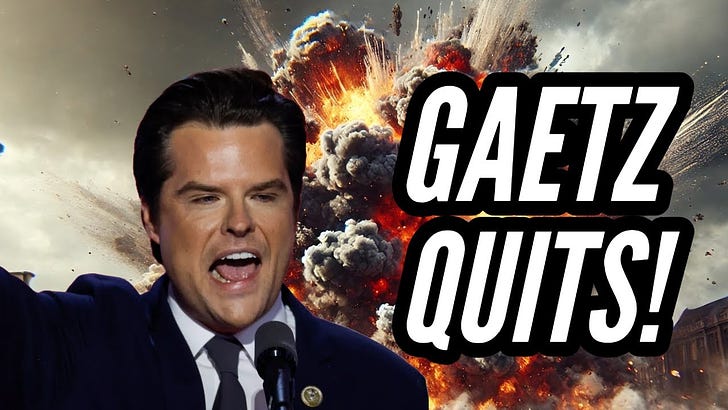
EMERGENCY: Matt Gaetz DROPS Run For Attorney General (with Kimberly Leonard)
BREAKING:Former Congressman Matt Gaetz has withdrawn his nomination for U.S. Attorney General, citing concerns that his confirmation process was becoming a distraction for the Trump-Vance transition team. Gaetz, a staunch ally of former President Donald Trump, had faced intense scrutiny since his nomination due to allegations of sexual misconduct.The allegations, which include claims that Gaetz paid women for sex and had inappropriate encounters with a minor, have been the subject of investigations by the Department of Justice and the House Ethics Committee. Reports suggest the House Ethics Committee may release a detailed report on these allegations, though its jurisdiction ended when Gaetz resigned from Congress shortly after his nomination.Gaetz’s decision to step aside marks the end of a short-lived bid for the top legal post in the Trump administration. The move comes amid ongoing investigations and growing political pressure. It remains unclear what impact this development will have on Gaetz’s future in public life, as he continues to face scrutiny over the allegations.The Trump-Vance team has yet to announce a replacement for the role.We discuss this and other Florida political stories with Kimberly Leonard of Politico. This is a public episode. If you'd like to discuss this with other subscribers or get access to bonus episodes, visit www.politicspoliticspolitics.com/subscribe