PLAY PODCASTS
Parents: Is Your Teen College Ready?

Parents: Is Your Teen College Ready?

Shellee Howard

144 episodesEN

Show overview

Parents: Is Your Teen College Ready? has been publishing since 2022, and across the 4 years since has built a catalogue of 144 episodes. That works out to roughly 65 hours of audio in total. Releases follow a fortnightly cadence.

Episodes typically run twenty to thirty-five minutes — most land between 23 min and 29 min — and the run-time is fairly consistent across the catalogue. None of the episodes are flagged explicit by the publisher. It is catalogued as a EN-language Education show.

The show is actively publishing — the most recent episode landed 3 days ago, with 13 episodes already out so far this year. Published by Shellee Howard.

Episodes
144
Running
2022–2026 · 4y
Median length
26 min
Cadence
Fortnightly

From the publisher

Your teen is in middle school or high school, and college is on the horizon! Do you know where to begin? It can be overwhelming! Which college will be a good fit? Can you afford it? What is my teen passionate about? This can be an exciting time, but a stressful one! College admission is at an all time high in both competitiveness and cost. How do you navigate this? Your host Shellee Howard with College Ready has helped countless families in the college admissions process while saving them thousands of dollars in tuition! In her podcast, she sits down with new and past clients to share their experiences with College Ready, along with financial advisors and other experts who understand the importance of financial awareness when it comes to graduating from college debt free. This year's College Ready seniors earned over 17 million dollars in scholarships and grants! The information you hear on this show is priceless, you really can’t afford to not tune in!

Latest Episodes

View all 144 episodes

How to Raise Financially Smart Kids with Darla Bishop | College Planning Without Debt

May 14, 202630 min

Helping Students Ace Math with AI: Dong Zhang on Personalized Learning, SAT Prep, and Confidence

Apr 30, 202624 min

From Athlete to Admissions Leader: John Frost on College Costs, Scholarships & Student Success
Apr 28, 202623 min

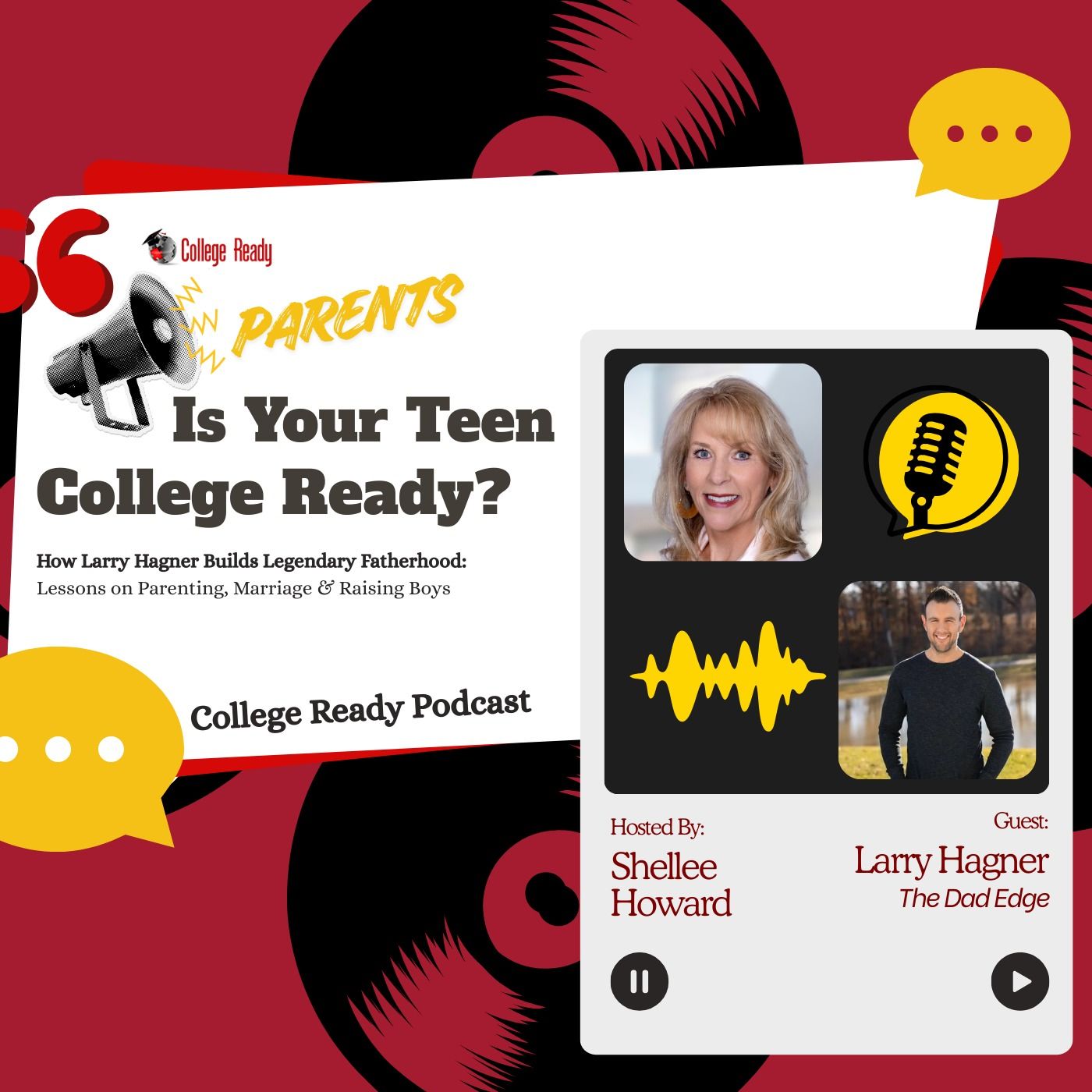
Ep 137How Larry Hagner Builds Legendary Fatherhood: Lessons on Parenting, Marriage & Raising Boys

Larry Hagner’s early life and path to fatherhood 🎓 Transition from psychology to health management and medical sales 💊 Lessons learned in sales and leadership that shaped his parenting philosophy 🤝 Fatherhood journey: raising four boys with curiosity, collaboration, and respect 👦👦👦👦 Team Hagner principles: Responsibility, Everyone, Action, Manage, Sacrifice (T.E.A.M.S.) 🏠 Strategies for parenting teens with different personalities and interests 🎮📚 Navigating marriage and alignment with your spouse 💑 Larry’s book Pursuit of Legendary Fatherhood: inspiration, process, and structure 📖 Bonus courses with book purchase: Creating More Patience & Creating Extraordinary Marriage 🎁 Key takeaway: Parenting, marriage, and leadership are skills you can learn, not just figure out by chance 🎯 🎁 Episode Gift & Contact 🎓 College Planning Support for ParentsWant help organizing next steps and avoiding costly college mistakes? 📘 Workbook Gift:https://go.collegereadyplan.com/podcast-gift-workbook 🤝 Interested in Collaborating with College Ready?Email Julienne at [email protected]

Mar 19, 202631 min

Ep 136How to Help Your Teen Ace AP Exams: Predictable 4s & 5s with Dr. Joe Sebestyen

Key Takeaways: AP exams are skill-based, not just memorization—students need practice in analysis, application, and evaluation. Grades in class do not always reflect AP exam readiness. A student with an A may still struggle without proper exam strategies. Starting preparation even a few weeks before the exam can still be effective if a structured plan is in place. Developing critical thinking and timed practice strategies is essential for predictable 4s and 5s. AP scores impact college admissions, scholarships, and earning college credit. The importance of a balanced approach: academic preparation, mental readiness, and healthy support at home. Dr. Joe emphasizes accountability, feedback, and consistent practice over last-minute cramming. Parents play a crucial role by supporting focus, providing structure, and helping teens manage distractions. 🎁 Episode Gift & Contact 🎓 College Planning Support for ParentsWant help organizing next steps and avoiding costly college mistakes? 📘 Workbook Gift:https://go.collegereadyplan.com/podcast-gift-workbook 🤝 Interested in Collaborating with College Ready?Email Julienne at [email protected]

Mar 4, 202626 min

Ep 135Student Spotlight: Turning Volunteering, Business, and Leadership Into a Standout College Application

How purpose-driven volunteering strengthens college applicationsUsing entrepreneurship to create real-world impactThe role of Empower Education as a catalyst for leadershipBuilding a focused academic narrative around business and economicsWhy exploration before choosing a major mattersTurning interests into action through nonprofits and fundraisingLessons learned from competitive entrepreneurship programsThe power of mentors, collaboration, and networkingWhy LinkedIn matters — even for high school studentsApplying strategically to programs, internships, and opportunitiesHow College Ready supports students through college lists, essays, and strategyAdvice for freshmen, sophomores, and juniors who don’t know where to startBalancing academics, mental health, and passion projectsWhat colleges really look for beyond grades and prestige 🎁 Episode Gift & Contact 🎓 College Planning Support for ParentsWant help organizing next steps and avoiding costly college mistakes? 📘 Workbook Gift:https://go.collegereadyplan.com/podcast-gift-workbook 🤝 Interested in Collaborating with College Ready?Email Julienne at [email protected]

Feb 19, 202619 min

Ep 129Raising Resilient Teens with Sarah Morgan

In this enlightening conversation on the "Parents is Your Teen College Ready?" show, Shellee Howard interviews Sarah Morgan, a former corporate trainer turned school assembly speaker who focuses on teaching students about emotional resilience and recovery. Sarah shares her compelling personal story of a horseback riding accident that nearly left her quadriplegic, highlighting how her mindset and belief system played a crucial role in her recovery. She emphasizes the importance of understanding emotions through Dr. Albert Ellis’s ABC theory, which explains how our beliefs mediate emotional responses rather than the activating events themselves. Sarah discusses the challenges students face today, including bullying, rigid expectations, and the emotional toll of social media and AI, offering practical advice for parents to help their children build emotional resilience. She advocates for leveraging school counselors and educational resources to support teens and encourages parents to foster healthy belief systems in their children to prepare them for college and life beyond. HighlightsSarah Morgan transitioned from corporate leadership training to inspiring teenagers nationwide on emotional resilience.The ABC theory of emotions (Activating event, Belief system, Consequence) is key to managing emotional responses.Sarah’s personal story of a near-quadriplegic horseback riding accident underscores the power of mindset in recovery.Addressing bullying and social challenges is central to Sarah’s school assemblies, focusing on resilience rather than victimhood.Social media and AI amplify rigid expectations and comparison, increasing anxiety and anger among teens.Parents are encouraged to collaborate with school counselors and use available resources to support their child’s emotional health.Embracing failure as a learning tool is critical for long-term success and emotional strength.Key InsightsResilience is a skill that can be taught and cultivated: Sarah’s shift from corporate training to youth education reflects a growing recognition that resilience and emotional literacy are essential life skills for young people. By addressing real-life challenges and emotional management, she equips students to navigate uncertainties, setbacks, and social pressures. This proactive approach contrasts with traditional academic focus and prepares teens for holistic success.The ABC model reframes emotional reactions: Sarah highlights Dr. Albert Ellis’s ABC theory to illustrate that emotions do not directly result from external events but from the interpretation or belief about those events. This insight is empowering, encouraging students (and adults) to examine and adjust their belief systems, reducing emotional distress and promoting healthier responses. For parents, this model offers a practical framework to help children understand their feelings and reactions constructively.Personal adversity as a teaching tool enhances authenticity: Sarah’s detailed recounting of her accident and recovery lends credibility and emotional weight to her message. Her experience illustrates how controlled decisions, like accepting help (helmet use) and maintaining a calm belief system, can dramatically influence outcomes. This personal narrative resonates deeply with students, making the abstract concept of resilience tangible and relatable.Bullying and social challenges are symptoms of broader emotional struggles: Sarah addresses bullying not just as isolated social conflict but as part of the larger emotional resilience framework. She encourages students to recognize their power over their reactions and belief systems rather than letting negative social interactions define their emotional state. This shift from victimhood to empowerment is crucial in creating a supportive school environment.The pervasive influence of social media creates rigid expectations and emotional distress: Sarah points out how constant exposure to curated lives online raises unrealistic standards, fostering anxiety and anger, both manifestations of rigidity in thinking. She teaches the importance of flexible thinking and “lightly held desires,” helping teens manage disappointment and uncertainty in a healthier way. This insight is vital as parents and educators seek to mitigate the negative psychological impacts of digital culture.Failure is an unavoidable and necessary part of growth: Drawing on Dr. Henry Cloud’s advice, Sarah stresses that learning to fail and recover is more valuable than avoiding failure altogether. This mindset prepares teens for real-world challenges by building endurance and adaptability. For parents, this means supporting children through setbacks and helping them see failure as a stepping stone to resilience rather than a catastrophe.Parental involvement combined with school resources strengthens emotional support: Sarah urges parents to engage with school counselors and make use of educational materials to foster emotional awareness at home. She

Feb 17, 202622 min

Ep 134Inside the Admissions Office: What Colleges Really Look For—and How Parents Can Help Without Hurting

Key Insights from the Episode:Most U.S. colleges admit more than half of applicants—elite schools are the exception, not the ruleAdmissions officers are looking for fit, not perfectionApplications are reviewed holistically by trained teams using rubrics—not randomlyEssays should tell a small story in a meaningful way, not trauma-dumpAuthentic explanations for academic dips help admissions officers understand contextOptional essays are rarely “optional” if students want to stand outMental health topics should focus on growth, insight, and recovery—not the lowest pointSenior-year grades still matter after acceptanceParents play a vital role—but too much control can increase stressThe college experience builds critical thinking, communication, teamwork, and resilience beyond academicsParent Takeaway:Your job isn’t to manage the process for your student—it’s to model confidence, curiosity, and calm while allowing them to own their journey. 🎁 Episode Gift & Contact 🎓 College Planning Support for ParentsWant help organizing next steps and avoiding costly college mistakes? 📘 Workbook Gift:https://go.collegereadyplan.com/podcast-gift-workbook 🤝 Interested in Collaborating with College Ready?Email Julienne at [email protected]

Feb 12, 202641 min

Ep 133Is Your Teen’s College Financially Safe? What Parents Must Know About College Closures and Risk

Key Takeaways for Parents:Many colleges — especially small, private, non-urban schools — are under significant financial strainSome colleges have closed with little warning, leaving students scramblingGraduation rates below 50% are a major red flag“Merit scholarships” are often tuition discounts, not actual awarded fundsLow-enrollment majors may be at risk of being eliminated mid-degreeTeach-out agreements exist but may transfer students to similarly struggling institutionsFinancial health should be the first checkpoint when building a college list 🎁 Episode Gift & Contact 🎓 College Planning Support for ParentsWant help organizing next steps and avoiding costly college mistakes? 📘 Workbook Gift:https://go.collegereadyplan.com/podcast-gift-workbook 🤝 Interested in Collaborating with College Ready?Email Julienne at [email protected]

Feb 10, 202621 min

Ep 133Think Outside the U.S.: How Studying in the UK Can Save Time, Money, and Stress

College doesn’t have to follow the traditional U.S. path to be successful, affordable, or fulfilling. In this episode, Shellee Howard welcomes Jackie, founder of The UK Study Expert, to discuss how American students can earn degrees in the UK — often in less time and at a lower cost — while gaining independence, global perspective, and career-ready skills. Jackie explains how the UK education system differs from the U.S., which students are the best fit for international study, and how families can navigate concerns around safety, healthcare, housing, and academics. They also break down how majors like law, engineering, international relations, and creative fields translate back to careers in the U.S. This episode is a must-listen for parents who want more options, less stress, and a smarter strategy for helping their teen become truly college ready. 🎁 Episode Gift & Contact 🎓 College Planning Support for Parents Want help organizing next steps and avoiding costly college mistakes? 📘 Workbook Gift: https://go.collegereadyplan.com/podcast-gift-workbook 🤝 Interested in Collaborating with College Ready? Email Julienne at [email protected]

Feb 6, 202633 min

Ep 132Rethinking College Readiness: Helping Teens Find Their Strengths in an AI-Driven World

Mark Smith’s personal story growing up with undiagnosed dyslexia and feeling academically inferiorWhy traditional education systems often fail students who learn differentlyDiscovering strengths vs fixing weaknesses and how this mindset changes career outcomesThe importance of helping teens identify how they learn bestWhy teens do not need to have their lives figured out by age 17Reframing success as adaptability, curiosity, and lifelong learningHow parents can support undecided or multi-talented students without adding pressureThe role of tools like CliftonStrengths (StrengthsFinder) in guiding students and professionalsPreparing teens for an AI-driven future without losing intellectual curiosityWhy AI should be used to augment learning, not replace thinkingBuilding a digital footprint and portfolio in a world where AI screens résumésHelping teens align education, purpose, and long-term fulfillment beyond just moneyMark’s advice for parents who want to guide rather than control their teen’s future 🎁 Episode Gift & Contact 🎓 College Planning Support for ParentsWant help organizing next steps and avoiding costly college mistakes? 📘 Workbook Gift:https://go.collegereadyplan.com/podcast-gift-workbook 🤝 Interested in Collaborating with College Ready?Email Julienne at [email protected]

Jan 28, 202626 min

Ep 131How Strategic Planning Led One Student to His Dream College

Ever wonder how some students confidently land their dream schools? In this episode, Shellee Howard chats with Ryan Obanoff, a UC Santa Barbara freshman, about his journey from high school to college success. Ryan shares how strategic planning, smart class choices, and personalized guidance from College Ready helped him maximize his GPA, craft standout essays, and navigate the college admissions process with confidence. 🎓 Learn how early planning, targeted extracurriculars, and the right support can make all the difference — and what parents can do now to set their teens up for success. Perfect for parents of high school students who want to turn college dreams into reality without stress. 🎁 Episode Gift & Contact 🎓 College Planning Support for Parents Want help organizing next steps and avoiding costly college mistakes? 📘 Workbook Gift: https://go.collegereadyplan.com/podcast-gift-workbook 🤝 Interested in Collaborating with College Ready? Email Julienne at [email protected]

Jan 9, 202620 min

Ep 130Is It Ever Too Early to Start Preparing for College? | A Real Student’s College Ready Journey

What does the college admissions process really look like from a student’s perspective? In this episode of the College Ready Podcast, Founder & CEO Shellee Howard sits down with College Ready student Vidarth to unpack his journey—from discovering engineering, conducting advanced research, and presenting to professionals, to managing senior-year stress and finding balance through music. Vidarth shares: When he actually started thinking about college How passion (not pressure) shaped his activities Why reaching out for help changed everything The confidence he gained beyond college admissions Advice he would give his freshman-year self This conversation is a must-watch for parents and students who want clarity, perspective, and reassurance during the college planning process. 🎓 Learn more about College Ready and how early planning creates confident students through https://collegereadyplan.info/ 🎁 Episode Gift & Contact 🎓 College Planning Support for Parents Want help organizing next steps and avoiding costly college mistakes? 📘 Workbook Gift: https://go.collegereadyplan.com/podcast-gift-workbook 🤝 Interested in Collaborating with College Ready? Email Julienne at [email protected]

Jan 8, 202623 min

Ep 128College on the Brink: What Parents Need to Know About Student Debt and Financially At-Risk Schools

In this insightful discussion, Shellee Howard interviews Gary Stocker, an expert on college financial health and viability, to shed light on the often-overlooked financial challenges facing many colleges today. Gary, originally trained as a medical laboratory scientist, transitioned into higher education administration and research, focusing on the financial stability of colleges, especially smaller private institutions. He reveals alarming trends, such as the closure of private colleges at an unprecedented rate, with one closing per week in early 2024. Despite the public perception of wealthy, stable institutions, many colleges, particularly small, rural, and non-urban private colleges, are struggling financially, often keeping these struggles hidden from prospective students and parents.Gary explains how colleges mask the reality of their financial trouble by offering significant tuition discounts, which are often misrepresented as scholarships, to attract students. He warns parents to be cautious and to prioritize evaluating a college’s financial health before considering other factors like campus beauty or program offerings. Gary introduces tools he developed at College Viability, including a free report platform (mycollegeviability.com) that allows families to assess the financial health of over 1,400 private colleges and a college majors completion app that tracks graduation numbers in specific majors to help identify programs at risk of closure.He highlights the risks students face if a college closes mid-education, emphasizing the importance of teach-out agreements that transfer students to other institutions, though these partner colleges may themselves be financially unstable. Gary also discusses the differences between public and private institutions, noting that while public colleges have similar low graduation rates, they rarely close due to government funding. He underscores the importance of transparency and independent analysis for families navigating college choices in a financially volatile higher education landscape. HighlightsOver 50% of private colleges graduate less than half their students on time, signaling systemic issues in higher education. Small, rural private colleges are most at risk of financial instability and closure, often without public warning. Tuition "scholarships" are frequently just discounts, not additional funds, misleading families about the true cost. Parents should make financial health the first criterion when evaluating colleges, not just campus appeal or programs. Teach-out agreements help students finish degrees if their college closes, but quality and stability of partner schools vary. Gary’s tools (mycollegeviability.com and the majors completion app) provide critical data for assessing college viability and program strength. Public colleges rarely close due to state funding but share similar challenges with graduation rates and funding cuts. Key InsightsFinancial Health is the New Priority in College Selection: Gary stresses that parents and students must prioritize the financial stability of colleges over traditional factors like campus tours or program variety. This shift in focus is crucial because financially unstable colleges may cut programs, reduce quality, or close outright, disrupting students' education and costing families time and money. Rapid Rise in College Closures Indicates a Crisis: The fact that one private college closed every week in the first half of 2024 (though the rate has slowed) reveals a deep financial crisis in higher education, particularly among smaller and private institutions. This trend underscores the urgent need for transparency and proactive financial assessment tools for families. Tuition Discounts Mask True Costs and Financial Realities: Colleges use high sticker prices with large discounts framed as scholarships to attract students and impress families. This marketing tactic hides the actual financial challenges colleges face and can create false expectations for families about the value and sustainability of a college education at these institutions. Teach-Out Agreements Are a Safety Net but Not a Guarantee of Quality: When colleges close, teach-out agreements can transfer students to other schools to complete their degrees. However, Gary highlights that many receiving institutions may themselves be financially fragile or unable to provide the same educational quality, potentially compromising students’ outcomes despite the transfer. Data-Driven Decisions Empower Families: Gary’s development of tools like mycollegeviability.com and the majors completion app equips families with objective information about college financial health and program viability. These tools help identify risks such as low graduation rates, declining enrollments, and majors at risk of being cut, enabling informed decision-making rather than relying solely on marketing or reputation. Small Colleges Face Unique Challenges: Small, non-urban privat

Oct 29, 202523 min

Ep 127How to Prepare for College in High School: Building Resilient, Confident Teens

In this insightful and candid conversation, Shellee Howard and Laura Ollinger delve into the complexities of supporting teenagers and parents through the challenges of adolescence, particularly as it relates to mental health, identity, communication, and preparing for college. Laura, a certified teen and parent well-being coach and mother of four teens, combines life coaching and health coaching to help families thrive by building resilience and tackling obstacles. Drawing on personal tragedy, professional training, and real-life experience, Laura emphasizes the importance of proactive coaching versus reactive therapy, fostering healthy parent-teen communication, guiding teens in self-discovery, and managing the impact of social media. The discussion also highlights the balance parents must strike between setting boundaries and nurturing independence, the value of allowing teens to fail safely to build confidence, and practical strategies for families to establish healthy technology habits. Laura provides actionable tools, such as character strength assessments and values identification, to help teens articulate their identity—a crucial step in the college application process. The conversation encourages parents to engage with their teens compassionately and proactively and offers hope and resources for navigating this pivotal stage successfully. Highlights Laura Ollinger blends life and health coaching to support teens and parents in building resilience and overcoming challenges.Coaching differs from therapy by being proactive and goal-oriented rather than reactive to crises.Effective parent-teen communication involves finding a balance between warmth and boundaries, ideally through an authoritative parenting style.Allowing teens to fail safely is essential for developing confidence, calmness, and resilience.Social media’s impact on teens can be managed through balanced, collaborative family agreements rather than strict bans.Tools like the VIA Character Strengths assessment help teens discover their core strengths and values, aiding self-identity and college essay development.Positive psychology and NLP techniques empower teens to leverage their strengths in pursuit of their goals. Key Insights The Proactive Power of Coaching Versus Therapy: Laura clarifies that therapy is often reactive, addressing significant mental health crises, while coaching is proactive, helping teens set and achieve goals before problems escalate. This distinction empowers families to seek help early, preventing more serious issues and fostering growth rather than just coping. Coaching’s focus on strengths and accountability helps teens develop self-management skills essential for college and adult life. Parenting Styles and Communication Dynamics: The discussion around parenting styles—helicopter, avoidant, authoritarian, and authoritative—illuminates how different approaches affect teen development. Laura advocates for the authoritative style, balancing high warmth with clear boundaries. This style fosters autonomy and resilience in teens, but requires parents to self-reflect on their inherited patterns and consciously choose how to support their children’s independence while maintaining connection. The Importance of Allowing Failure: Laura stresses that failure is not just inevitable but necessary for teens to build resilience and self-confidence. Parents’ natural instinct to protect can unintentionally hinder growth. Embracing “failing forward” teaches teens that setbacks are opportunities for learning and personal development, which directly correlates with their ability to handle college pressures and life’s uncertainties. Identity Formation as a Foundation for College Readiness: Helping teens articulate their identity beyond surface facts is critical for college admissions essays and self-understanding. Laura’s recommendation to use tools like the VIA Character Strengths assessment and values card sort helps teens uncover their core traits and motivations. This process assists teens in finding authentic passions and goals, reducing anxiety over choosing a college major prematurely and promoting confidence in their own path. Navigating Social Media with Nuance and Empathy: Social media is a double-edged sword, offering connection but also risks such as anxiety, low self-esteem, and distraction. Laura advises against extremes of outright bans or laissez-faire attitudes. Instead, she promotes family conversations that establish mutual understanding and compromise, acknowledging teens’ need for social interaction while monitoring harmful content. Integrating social media use into positive family activities models balanced technology habits. Using Strengths-Based, Positive Psychology Approaches: Laura’s coaching leverages positive psychology and NLP to focus on what is right with teens rather than what is wrong. This strengths-based approach enables teens to creatively engage with their challenges, tailoring solutions that reson

Sep 11, 202531 min

Ep 126Plan for College, Grow at Home: The Parent Whisperer Podcast with Shellee Howard and Richard Ramos

When it comes to helping families thrive, few voices are as authentic and powerful as Richard R. Ramos. Raised in Northeast Los Angeles by a single mother as the youngest of five, Richard grew up surrounded by domestic violence and gang activity. Those early experiences gave him a deep understanding of at-risk youth and the challenges they face. But over time, he realized that focusing only on mentoring students was not enough—the real transformation began at home.As a junior high at-risk counselor responsible for 50 high-risk students, Richard saw firsthand that progress in school often crumbled under the weight of dysfunction at home. That realization sparked a major shift: instead of pouring all his energy into helping kids cope, he began mentoring parents. His belief was simple but profound: strengthen the family foundation, and the children will grow stronger too.Richard uses the metaphor of “gardeners and flowers” to describe this approach. Children are the flowers, but parents are the gardeners. A flower can only bloom if the gardener tends to it with care. That’s why his program, Parents on a Mission, is designed not for “bad” parents, but for good parents who want to get better. The program helps moms and dads work on themselves—building emotional maturity, repairing relationships, and leading with humility—so their kids can flourish.The curriculum is practical and universal. Whether in schools, churches, prisons, or nonprofits, the principles adapt to any setting. Ramos and his team also certify staff members, ensuring the message reaches far beyond his own voice. The core philosophy emphasizes parental behavior: instead of reacting to children’s mistakes, parents are urged to model resilience, humility, and emotional control.Blended families are not forgotten. Stepparents, Richard teaches, should focus on helping stepchildren feel seen, heard, and included—without trying to replace biological parents. The absence of favoritism and the presence of emotional maturity create trust in families that often face unique challenges.Richard also warns about the influence of social media. With influencers shaping kids’ self-worth and motivation, parents must lead with strength at home, equipping teens for success not only in school but in college and life. He champions the idea of “failing forward”—teaching children that mistakes are part of growth, and that resilience is the true key to long-term success.For parents ready to take the next step, Richard offers the Parent Whisperer Podcast, free resources on his website, and an upcoming online course to make the curriculum more accessible than ever. His message is clear: parents don’t need to “fix” their kids—they need to grow themselves into the gardeners their children deserve.HighlightsFrom counselor to parent mentor: Richard Ramos shifted focus from helping students cope to equipping parents to lead.The “gardener vs. flowers” metaphor: kids thrive when parents invest in their own growth and maturity.Parents on a Mission: designed for good parents who want to get better, with curriculum adaptable across schools, churches, prisons, and nonprofits.Focus areas: relationship repair, communication, emotional maturity, and family leadership.Emphasis on resilience: teaching parents (and kids) how to “fail forward” and bounce back from mistakes.Stepparent guidance: build inclusion without trying to replace biological parents.Social media warning: influencers compete for kids’ attention—strong family leadership is the antidote.Key InsightParenting is not about fixing your kids—it’s about fixing yourself. Children will grow into whatever environment their parents create.Emotional maturity is leadership. Owning mistakes, practicing humility, and reconciling quickly builds trust and loyalty in the home.Failing forward is a family skill. When parents model resilience, kids learn that setbacks aren’t the end—they’re the pathway to growth.Social media won’t disappear. But parents who nurture self-worth and strong family connections prepare teens to resist its negative pull.Connect with Shellee Howard: WebsiteYouTubeInstagram LinkedIn Connect with Richard Ramos: WebsiteFacebookLinkedInInstagramLinkedIn 🎁 Episode Gift & Contact 🎓 College Planning Support for ParentsWant help organizing next steps and avoiding costly college mistakes? 📘 Workbook Gift:https://go.collegereadyplan.com/podcast-gift-workbook 🤝 Interested in Collaborating with College Ready?Email Julienne at [email protected]

Sep 3, 202518 min

Ep 125Preparing for College: Coaching Teens Through Chaos to Confidence

When it comes to preparing teens for college and life beyond the classroom, two unique perspectives come together in a powerful way. Shelley Howard, host of Parents: Is Your Teen College Ready?, sat down with former student turned coach Hunter Thompson to explore the challenges today’s students face and how intentional coaching can make all the difference. Shelley focuses primarily on the college prep process—applications, essays, and everything that helps students get admitted to the right schools. Hunter, on the other hand, works with young people on the deeper skills: resilience, self-awareness, and character development that sustain success long after the acceptance letter arrives.Hunter’s story is both relatable and inspiring. A star golfer in high school, he went on to play college golf in Florida, even serving as team captain. But by his sophomore year, he realized that golf was not a sustainable career path. This realization triggered an identity crisis, forcing him to ask tough questions about who he was outside of sports. His curiosity led him into philosophy and finance, and eventually to one of his greatest breakthroughs: overcoming a fear of public speaking in a college speech class. That moment of facing his fears lit a spark. Within three years, Hunter founded the Thompson Coaching Company, delivered a TEDx talk, hosted live events, and built a growing practice centered on helping students navigate their own journeys.The challenges students face today are uniquely complex. From limitless choices and information overload to constant comparison on social media, many young people struggle with overwhelm, anxiety, and even depression. Add in the generational disconnect—parents raised in a pre-smartphone world guiding kids who live with 24/7 digital access—and the gap only widens. Hunter points out that one of the biggest missing pieces is accessible accountability partners who truly understand the pressures of this generation.Hunter’s coaching philosophy centers on resilience and self-discovery. He believes that voluntarily facing hard things builds the mental and emotional muscle to overcome future challenges. His work with students isn’t about handing out answers; instead, he guides them with questions, helping them uncover their own values, strengths, weaknesses, and aspirations. The goal is for students to build confidence and sustainable habits while parents stay informed and supported through regular updates and collaboration.But how do you know if a student might benefit from coaching? Often, the signs show up in everyday conflicts: resistance to basic routines, parent-child arguments, missed assignments, or disengagement. Parents’ intuition is key, especially in recognizing that today’s stressors are unlike those of past generations.Hunter structures his programs with flexibility, offering three-, six-, and nine-month options depending on a student’s readiness and goals. Sessions are highly personalized—sometimes starting with something as simple as creating a consistent morning routine, other times focusing on helping athletes reframe how they process feedback. Parents are included in the journey, and tools like personality assessments may be used to align coaching strategies with student needs.To illustrate, Hunter shared a few common coaching scenarios. For the overwhelmed student, narrowing focus and reducing decision fatigue helps strengthen commitment. For disengaged students, identifying intrinsic interests and connecting tasks to a personal “why” reignites motivation. And for students struggling with feedback, he reframes critiques as opportunities, guiding them through targeted practice to rebuild confidence.Shelley and Hunter’s conversation highlights a powerful truth: preparing teens for the future isn’t just about academics or college acceptance. It’s about equipping them with the mindset, habits, and resilience to thrive in an unpredictable world. Coaching, when done right, becomes not just guidance for the student—but a partnership that uplifts the whole family.HighlightsTwo experts, two perspectives: Shelley Howard guides families through the college prep process, while Hunter Thompson helps students build life skills, resilience, and character.Hunter’s personal transformation: From college golf captain to facing an identity crisis, overcoming fear of public speaking, and ultimately launching a thriving coaching company.Modern student struggles: Overwhelm, anxiety, depression, identity confusion, and the generational disconnect with parents raised in a pre-digital era.Coaching approach: Resilience through hard tasks, guided self-discovery, and collaborative support for both students and parents.Program design: Personalized one-on-one coaching, available in 3-, 6-, and 9-month formats, tailored to individual needs and readiness.Key InsightsFacing fears builds resilience – Hunter’s journey shows that growth often comes from stepping directly into discomfort.Students need acco

Aug 26, 202525 min

Ep 124Preparing Students for College: A Parent’s Guide to Raising Future-Ready Kids

SummaryIn this episode, Shellee from *Parents: Is Your Teen College Ready?* emphasizes the critical importance of early and strategic college planning for families. She highlights that while many families plan for major life events such as marriage, buying a home, or retirement, few develop a concrete plan for their child’s post-secondary education. Shellee categorizes families into four groups based on their approach to college planning: denial, avoidance, DIY efforts, or hiring an expert. She advocates starting the college readiness conversation as early as preschool by encouraging children to explore their interests and dreams, without necessarily focusing on college itself, but rather on their future options.Shellee explains how middle school and particularly eighth grade serve as a pivotal time to begin intentional planning, including course selection and extracurricular activities that nurture leadership, service, and language skills. She stresses the importance of summer engagement between middle and high school to discover passions and explore potential careers. The college application process, she asserts, essentially begins once a child completes eighth grade.Drawing from her 18 years of experience as a strategic college admissions counselor and her own family’s diverse college journeys, Shellee illustrates various paths to success—demonstrating that every child’s route to higher education is unique and that early planning can lead to graduating debt-free. She underscores the evolving complexity and competitiveness of college admissions today, cautioning parents not to rely solely on high schools or internet searches for guidance. Instead, she encourages proactive, collaborative planning between parents and teens, including early financial conversations.Shellee offers resources and support to parents aiming to create effective, personalized college plans and stresses that the investment of time and effort into this process will pay off significantly. Her overarching message is that thoughtful preparation and informed decision-making empower families to navigate the college admissions landscape with confidence and minimize financial strain. HighlightsEarly college planning should start as soon as preschool by discussing children’s interests and future options.Middle school, especially 8th grade, is a critical time to set academic and extracurricular foundations for high school success.Summer after 8th grade is underutilized but ideal for exploring passions and potential careers.Each child’s college journey is unique—personalized planning leads to debt-free graduation and fulfilling outcomes.Parents must have early, open conversations about college financing to avoid surprises.The college admissions process is more competitive and complex than ever—don’t rely on assumptions or incomplete information.Expert guidance can be invaluable in creating and executing a strategic college plan tailored to your child’s strengths.Key Insights🎓 Start Planning Early to Empower Choices: Shellee’s approach of initiating conversations about the future during preschool years underscores the value of fostering autonomy and curiosity in children. By focusing on what they enjoy and their strengths rather than pushing college decisions prematurely, parents can help kids develop a sense of control and motivation, which is essential for long-term success.🏫 Eighth Grade Is the Real Starting Point for College Readiness: The emphasis on 8th grade as a pivotal moment reflects the academic reality that course selections and extracurricular involvement at this stage heavily influence high school trajectories. Choosing challenging classes and engaging in leadership or service roles early builds both skill and confidence, which are critical for competitive college applications.💡 Summer Engagement Can Spark Passion and Direction: Shellee highlights that the summer after middle school is often overlooked but presents a prime opportunity for students to explore interests, volunteer, and research careers. This proactive exploration helps clarify goals, making high school years more purposeful and aligned with future college and career plans.🎯 Tailored Plans Reflect Individuality and Foster Success: The diverse experiences of Shellee’s own children demonstrate that there is no one-size-fits-all plan. Whether aiming for Ivy League schools, state universities, or international education, each student’s unique talents and ambitions require customized strategies. This flexibility also enables families to minimize debt through thoughtful financial planning and scholarship alignment.💰 Financial Planning Is Essential and Should Be Transparent: Addressing money early in the discussion helps demystify college costs and prevents last-minute stress. Shellee’s stress on having honest conversations about affordability and funding options helps families make realistic choices and ensures that financial concerns do not overshadow educational goal

Aug 12, 202516 min

Ep 123The College Preparedness: Building a Future Without Debt

Summary In this insightful episode, Shellee from *Parents: Is Your Teen College Ready?* emphasizes the critical importance of early and strategic planning for college, advocating that families begin this process well before high school—ideally from preschool. She highlights that while families commonly plan for major life events like marriage, children, or retirement, very few have a clear plan for their child's educational future. Shellee categorizes families into four groups regarding college planning attitudes: denial, avoidance, do-it-yourself, or hiring an expert, urging parents to recognize their current stance and take action. Shellee shares her personal experience raising her children with a strong emphasis on exploring interests and building foundational skills from an early age, exposing them to various environments, and encouraging leadership, service, and resilience. She stresses that middle school, particularly 8th grade, is the pivotal time to start serious academic and extracurricular planning since it sets the trajectory for high school success and college readiness. The episode also covers the evolving landscape of college admissions, which has become more competitive and costly, making an informed and deliberate approach essential. Through detailed examples from her own family, Shellee illustrates that each child may follow a unique path, but with proper planning, all can graduate debt-free and find success aligned with their goals. Lastly, she warns parents against common misconceptions—such as relying solely on schools, teenagers, or Google for college prep—and encourages early financial conversations and accountability. Shellee offers support through free resources and discovery calls, aiming to empower parents to confidently guide their children through the college planning process. Highlights Early planning for college should start as early as preschool, focusing on children's interests and future options rather than immediate college choices. Middle school, especially 8th grade, is a critical period for academic and extracurricular decisions that impact high school and college readiness. Each child’s college journey is unique; a one-size-fits-all approach rarely works, but strategic, personalized planning leads to debt-free success. Avoid common pitfalls: don’t assume schools, teens, or the internet can handle college planning alone. Parental involvement is crucial. Financial planning and early money conversations are essential to avoid surprises and ensure college affordability. Exposure to diverse experiences like college visits, leadership, languages, and community service cultivates well-rounded, confident students. The college admissions process has dramatically changed; it is now more competitive, expensive, and complex, requiring expert guidance. Key Insights 🧠 The Power of Early Exposure: Starting college-related conversations in preschool, by focusing on what children enjoy and where their interests lie, helps children develop a sense of control and awareness about their future options. This early exposure demystifies college and frames it as a realistic and attainable goal rather than an abstract concept. It encourages children to think broadly about their futures, including non-college pathways, fostering autonomy and motivation. This foundational mindset is crucial for long-term academic and career success. 📅 Middle School as the Strategic Planning Window: Shellee identifies middle school, particularly 8th grade, as the optimal time to begin serious planning. The courses students choose in 8th grade influence their high school trajectory and college options. Engaging in leadership, foreign languages, and challenging academics at this stage builds confidence and resilience. Utilizing tutors and summer programs enhances skill development and helps students find their passions. This stage is not just about academics but also about personal growth, which critically shapes college readiness. 🎯 Customized Plans for Unique Paths: The episode powerfully illustrates that no single path fits all students. Through her own family’s diverse experiences—from Ivy League acceptance to international study—Shellee shows that tailored plans aligned with individual interests and strengths lead to successful, debt-free graduations. This insight challenges the traditional "one right way" mindset about college and encourages families to embrace flexibility and creativity in planning. It also highlights that success is multidimensional and individualized. 💸 The Financial Reality of College Today: The rising cost of college and the complexity of the admissions process make financial planning indispensable. Shellee’s emphasis on graduating debt-free underscores the importance of early financial conversations and strategic scholarship or funding plans. Families who start late or remain uninformed face unnecessary stress and financial hardship. This insight calls for transparency, budgeting, and

Aug 7, 202512 min

Ep 122College Ready: Smart Ways to Pay for College Without Loans

Shellee Howard, founder and CEO of College Ready and host of the Parents is Your Teen College Ready podcast, shares insights from her best-selling book The College Admissions Plan Simplified. Her primary focus is on parents, acknowledging that college admissions guidance is often geared toward students, while parents play a critical but under-supported role. Shellee empathizes with the exhaustion and emotional toll parents experience while helping their children navigate the complex and often overwhelming college admissions process. She stresses the importance of parental involvement, understanding adolescent brain development, and providing emotional and strategic support during this pivotal life transition.Shellee discusses the escalating costs of college tuition, citing Vanderbilt University’s tuition exceeding $100,000 annually as an example of rising financial pressures. She contrasts this with her personal success using strategic planning to help her children and many other students gain admission to top-tier colleges with substantial scholarships, allowing them to graduate debt-free. Her approach emphasizes individualized strategies tailored to each student’s strengths, including test preparation, community service, leadership, and securing strong letters of recommendation.The College Ready Plan has helped thousands of families secure scholarships from various sources—institutional, independent, and need-based—highlighting that scholarships are available to any family willing to invest the necessary effort, not just those with financial need. Shellee encourages parents to take an active role in the college planning and financial aid processes rather than leaving these decisions to their teenagers, who often lack awareness of the long-term impact of student debt.Finally, she invites parents feeling overwhelmed or uncertain about college admissions to reach out for guidance, offering a complimentary 30-minute discovery call to discuss personalized strategies for getting their child into their best-fit college while minimizing debt.Highlights🎓 Shellee Howard emphasizes the crucial role of parents in college admissions, often overlooked in favor of student-focused advice.💰 College tuition costs are soaring, with Vanderbilt exceeding $100,000 annually, highlighting the importance of scholarship strategies.🎯 Personalized strategies tailored to each student’s strengths can secure full-ride scholarships and debt-free graduation.📚 Scholarships are available from multiple sources and are accessible to families willing to work for them, not only those in financial need.🧠 Understanding adolescent brain development is essential to supporting teens through college prep and life transitions.🏆 Shellee’s own children’s success stories prove that strategic planning can lead to top college admissions and financial freedom.📞 Parents are encouraged to seek professional guidance rather than leaving college planning solely to their teens.Key Insights🧩 Parental involvement is indispensable in college admissions: Shellee highlights that while much advice targets students, parents are the backbone of the process. Their support, guidance, and advocacy can greatly influence outcomes. This insight is critical because many teens lack the maturity or knowledge to navigate admissions and financial aid independently, making parental engagement a key success factor.💸 Rising tuition costs demand proactive financial strategies: The example of Vanderbilt’s tuition soaring above $100,000 annually illustrates the escalating financial burden of higher education. Families must prioritize scholarship acquisition and financial planning early to mitigate debt burdens, especially as traditional funding sources like FAFSA may not cover all costs.🎯 Customized strategies maximize scholarship opportunities: Shellee’s method involves assessing each student’s unique skills and interests to develop a tailored plan encompassing testing, community service, leadership, and essay writing. This strategic approach not only boosts admission chances but also unlocks significant financial aid, underscoring the value of targeted preparation over a one-size-fits-all approach.🎓 Scholarships are universally accessible with effort and knowledge: Contrary to popular belief, scholarships are not limited to those with financial need. Billions of dollars are awarded annually through institutional, independent, and need-based scholarships. Families who invest time and effort into researching and applying can access these funds and substantially reduce college costs. This insight empowers parents to actively seek funding rather than resigning to high tuition payments.🧠 Understanding teen brain development improves support: Recognizing that adolescent brains continue developing well into their mid-20s allows parents to better understand their teens’ emotional volatility and decision-making processes during college prep. This awareness fosters patience, empathy

Jul 30, 202511 min
2022- Shellee Howard/Parents: Is Your Teen College Ready?