One Knight in Product
276 episodes — Page 3 of 6
S1 Ep 175Moving to Customer-Led Growth by Forgetting the Funnel (with Georgiana Laudi & Claire Suellentrop, Founders @ Forget the Funnel)
EGeorgiana (Gia) Laudi and Claire Suellentrop are both experienced SaaS product marketing leaders who spotted the same things again and again whilst trying to help companies grow. They decided it was time to join forces and persuade marketers around the world that the sales funnel is dead, and we need to try a different approach. They founded Forget the Funnel, a consultancy aiming to help people do just that, and have recently launched their new book of the same name. A message from this episode's sponsor - My Mentor Path This episode is sponsored by My Mentor Path. I'm a passionate advocate for mentoring and believe it to be one of the highest-leverage activities you can undertake to get ahead in your career. I try to do my part but am but one man, so I helped set up this FREE mentoring community to try to help out at scale. Sign up now as a mentor, a mentee, or both! Episode highlights: 1. The Funnel is no longer fit for purpose Marketers have been trying to cram leads into the top of the funnel for 100 years but it doesn't serve the needs of modern marketers in recurring revenue SaaS businesses. We need to consider the customer journey pre and post-acquisition 2. Forgetting the Funnel is a company mindset shift Business leaders can lose sight of the market & the product vision as companies evolve. They need to forget the funnel & empower their marketing teams to do the same & focus relentlessly on customers, not inward-facing metrics. 3. You're going to need to pay off your Revenue Debt As companies evolve, they can end up with a very fragmented set of customers that don't form a coherent ICP. To succeed with customer-led growth you need to work out who your best customers are and optimise for them. 4. Companies often have remarkably similar marketing problems How these problems manifest themselves may be different, but there's generally some low-hanging fruit that can be picked straight away. Progress on harder problems can be stymied by unclear ownership or responsibility 5. There's no point spending a dime on marketing until you've fixed your fundamentals If you don't focus your marketing on your best-fit customers and optimise everything to speak to them, you're just throwing your money away trying to scale marketing up. Fix the basics first! Buy "Forget the Funnel" "Your product is great. So why is marketing it so hard? Many SaaS companies struggle with marketing. Teams try everything they can to drive more traffic, leads, and signups. Yet revenue growth remains... lumpy. Slow. Frustratingly inconsistent. If this sounds familiar, the problem isn’t you or your ideas; it’s that you’re guessing at what resonates with your target customers. In Forget the Funnel, Georgiana Laudi and Claire Suellentrop share the Customer-Led Growth Framework they've developed to help companies of all sizes solve their product marketing struggles and hit ambitious targets. This framework helps you get inside your customers’ heads, map and measure your customers’ experience, and uncover which tactics will actually move the needle for your company." Check it out on Amazon. You can also check out the book website Contact Gia & Claire You can catch up with Gia and Claire on Twitter (Claire, Gia), LinkedIn (Claire, Gia) or visit their website, Forget the Funnel.
S1 Ep 174Embracing Change to Innovate in Product Management (with Greg Coticchia, CEO @ Sopheon)
Greg Coticchia is the CEO of Sopheon, an innovation management platform aiming to help companies innovate at scale. Greg has been in product management since the 80s and seen it all, and also helped Carnegie Mellon University create the first degree programme in product management. He's passionate about all things innovation and believes that we all need to get comfortable with managing change. He also shared some insights from his many years in product management. A message from this episode's sponsor - One Knight Consulting This episode is sponsored by One Knight Consulting. Yes, yes, that's me. As you probably know, I've moved into freelance coaching and consulting for B2B product companies. I want to help your company, your team and your... well, you, get better at product management. If you want to chat to me about what I can do for you, why not head over to book a call with me and we can discuss your needs and how I can help. Episode highlights: 1. You don't need a degree to be a product manager Greg worked with Carnegie Mellon University to create a degree in product management, but it's important to realise that any learning is the start of a journey... you need to get punched in the face by a real job a few times. 2. Having big early successes is a double-edged sword It's common for PMs to learn from failure, but it's possible to go too far the other way and treat early success as The One Way to future success. You need to remain humble and never stop learning & adapting. 3. The hardest organisation to get to change is a successful organisation. It's easy to use Kodak or Blockbuster as cautionary tales but these were successful organisations making a boatload of money. They needed to embrace change, but it's not surprising that they didn't. 4. The best way for big companies to innovate is to make small companies Big companies are inherently resistant to change. If they want to stay ahead, they need to create or acquire small companies without baggage and leave them to it rather than try to make them fit in. 5. Innovation is about more than just shiny new tech It's easy to get excited about new tech, but we should get equally excited about repositioning existing products or building new business models to serve novel segments. Everything should always be focused on the users! Contact Greg You can catch up with Greg on LinkedIn. You can try out Sopheon on sopheon.com
S1 Ep 173Achieving Product Excellence with the Product Operations Manifesto (with Antonia Landi, Product Ops Consultant & Co-Author ”Product Operations Manifesto”)
Antonia Landi is a freelance Product Operations consultant and coach who fell into Product Operations thanks to LinkedIn recommending a strange new job title to her, and thinking "that's me!". She's now a passionate advocate for the value that Product Operations can bring to organisations and has co-authored the Product Operations Manifesto to help frame it with product teams and company leadership. A message from this episode's sponsor - One Knight Consulting This episode is sponsored by One Knight Consulting. Yes, yes, that's me. As you probably know, I've moved into freelance coaching and consulting for B2B product companies. I want to help your company, your team and your... well, you, get better at product management. If you want to chat to me about what I can do for you, why not head over to book a call with me and we can discuss your needs and how I can help. Episode highlights: 1. Product Ops is about achieving product excellence at an organisational level It's difficult to pin down as problems are different in every company. Maybe it's data analysis, organising processes or building communities of practice. You're there to remove blockers to being product-led. 2. You might not need a Product Ops team... yet Many Product Ops tasks already existed before Product Ops. How much you need a dedicated team depends on how much pain are you willing to tolerate. What's slipping through the cracks? Product Ops helps you scale sustainably. 3. Product Ops is not the revenge of project managers & "process people" There are some crossovers with agile coaching, project & programme management but we should also reclaim the word "process"… process isn’t always bad - it just needs to serve you, not the other way around. 4. The Product Ops manifesto was necessary to give people something to rally behind There’s so much ambiguity & a need to move past the "what is it" question. They came up with a document to help product teams to understand the parameters (and prerequisites) of the function. 5. About those prerequisites... The most important is the ability to affect change - without this, Product Ops people just become process people or team assistants. On the other hand, these prerequisites are 100% valid for just generally being a good product company. Check out the Product Operations Manifesto "Product Operations empowers product organizations to collectively, effectively and efficiently drive the most meaningful outcomes for customers" Check out the Product Operations Manifesto and feel free to add your name to the list! Contact Antonia You can connect with Antonia on LinkedIn.

S1 Ep 172Is Product-Led Growth Really For You? (with Leah Tharin, Product-Led Growth Guru & Head of Product @ Jua)
ELeah Tharin is a product leader, content creator, advisor and startup founder. Leah is now reinventing weather forecasting with Jua and is a well-known advocate for product-led growth. We went deep into her content creation process, how to work out if product-led growth is for you, and some of the steps you might take to get started. A message from this episode's sponsor - My Mentor Path This episode is sponsored by My Mentor Path. I'm a passionate advocate for mentoring and believe it to be one of the highest-leverage activities you can undertake to get ahead in your career. I try to do my part but am but one man, so I helped set up this FREE mentoring community to try to help out at scale. Sign up now as a mentor, a mentee, or both! Episode highlights: 1. Product-Led Growth is all about "Show, don't Tell" It's not necessarily a free trial/freemium, but it's more important than ever to let people understand the value they're getting from your product rather than hiding behind (possibly auto-generated!) marketing content. 2. Product-led growth does not replace sales-led growth PLG just addresses a different segment in a better way than sales-led. For bigger deals, you still need a sales team, but product-led sales mean getting better quality leads by demonstrating the value upfront. 3. Product-led growth might not be for you... yet There are some segments where PLG might not make sense. If people don't know they have the problem you solve, if they won't proactively search you out or recommend you or if your solution is super-innovative, maybe try PLG later. 4. Ignore the "product" word - this is a company initiative The product management team doesn't own PLG. The whole organisation needs to align around what "success" looks like for a customer and optimise all incentives towards achieving that. 5. You need to objectively measure team success People can't just rely on "product sense" to tell if they're being successful with PLG. Product organisations need to have good quantitative data & measure product satisfaction. Data should be tracked per team, not per user. Contact Leah You can connect with Leah on LinkedIn, on Twitter, or check out all of her lovely content on Leah’s ProducTea.

S1 Ep 171(Don’t) Scream If You Want To Go Faster - How to Accelerate Product Development (with Ed Biden, Founder @ Hustle Badger)
Ed Biden is a product leader and passionate educator who has recently set up Hustle Badger, a product management education resource centre. When he was the CPO at FutureLearn, he helped to prove a new business model and he did it... quickly. I spoke to Ed about some of the principles he lives by when trying to accelerate product initiatives and deliver value faster. A message from this episode's sponsor - My Mentor Path This episode is sponsored by My Mentor Path. I'm a passionate advocate for mentoring and believe it to be one of the highest-leverage activities you can undertake to get ahead in your career. I try to do my part but am but one man, so I helped set up this FREE mentoring community to try to help out at scale. Sign up now as a mentor, a mentee, or both! Episode highlights: 1. Executing fast means delivering more impact The faster you're shipping, the more you're learning, and the faster you're going to understand what you should be doing. It's better to embrace inevitable uncertainty, get something out in the world and see how people react to it. 2. "Fast" is relative - you need to be as fast as you need Not everyone needs to deploy 1,000 times a day. What fast means for you depends on your customers and their appetite for change, alongside internal factors that might impact it. Find the right fast for you. 3. Speed is always about trade-offs You can't just go faster by ordering people to work faster - it's not sustainable. You need to work out what levers you can pull, what shortcuts are acceptable, and what's in and out of scope. You need to be willing to trade to get speed. 4. Radical transparency can help get away from "Go faster" execs CEOs and business leaders often complain about speed and wish everything could be faster. It's important to be transparent with them, let them know the trade-offs & give them a stake in the decision so they buy in. 5. Watch where you spend your time Often, teams spend a large proportion of their time on BAU and fighting fires. Keep track of this, because if you're spending 50% of your time not executing your strategy you're not going as fast as you can (and the results will reflect this). Contact Ed You can connect with Ed on LinkedIn, or check out Hustle Badger.
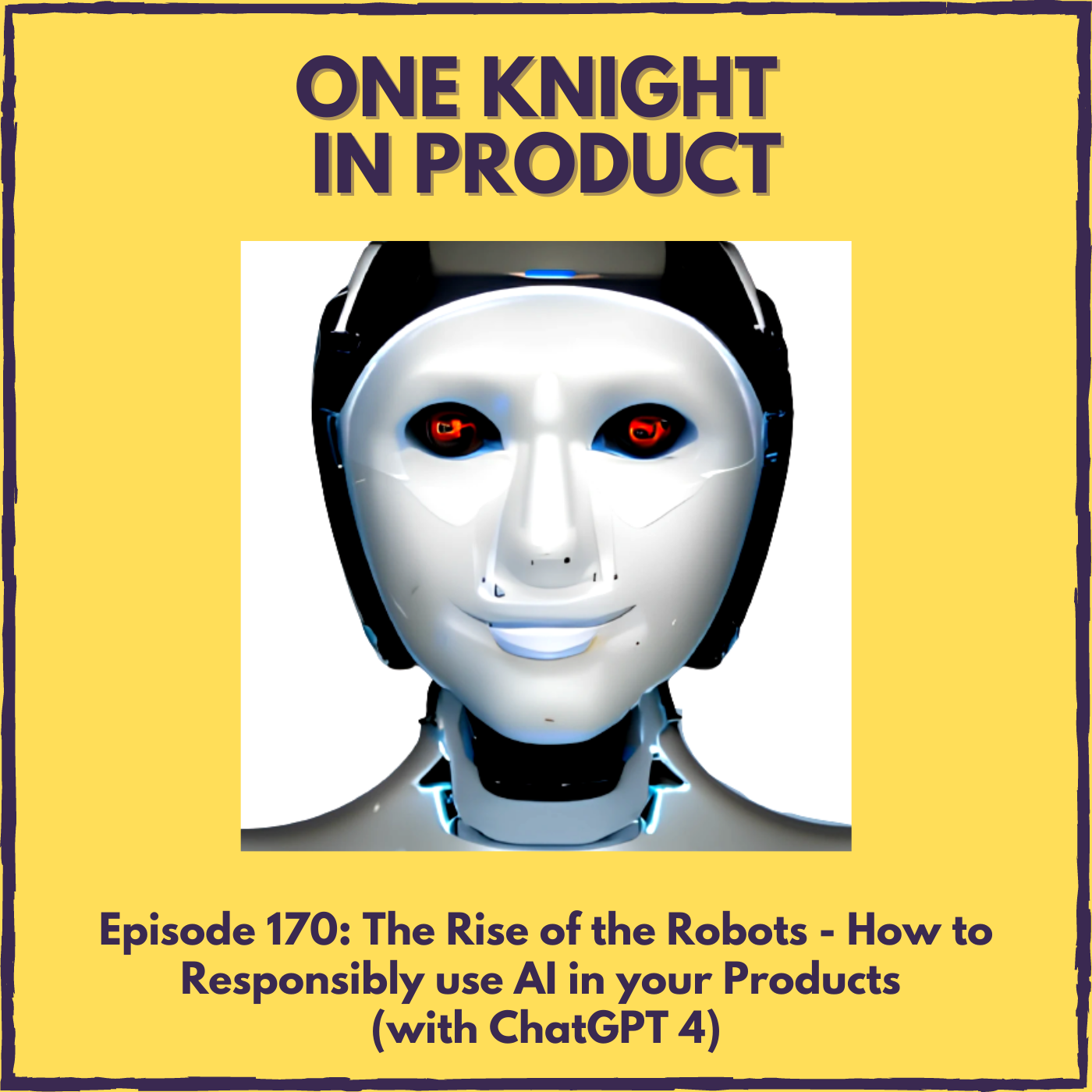
S1 Ep 170The Rise of the Robots - How to Responsibly use AI in your Products (with ChatGPT 4, Cutting-edge language model @ OpenAI)
And now for something a little different. I recently purchased a ChatGPT pro license and got access to ChatGPT 4, the groundbreaking new model from OpenAI. Social media is on fire at the moment, with people talking about all the cool stuff it can do. So, I thought "who better to speak to about AI Product Management"? A few hours later, and here's the result; the full One Knight in Product experience, a wide-ranging discussion with some terrible jokes from both sides thrown in for good measure. A message from this episode's sponsor - Skiplevel This episode is sponsored by Skiplevel. Do you struggle with communicating with dev teams and understanding technical terminology and concepts? On episode 98, I hosted Irene Yu, founder of Skiplevel, an on-demand training program that helps professionals and teams become more technical in just 5 weeks... All without learning to code. Learn the knowledge and skills you need to better communicate with devs and become more confident in your day-to-day role with the Skiplevel program. You can use referral code OKIP to support this podcast! Episode highlights: 1. It's natural to be concerned about AI taking over the world We've all seen the movies, the books and the horror stories. But there's also an incredible opportunity to change the world for the better. We need to be vigilant, and confront the concerns head-on. 2. Product Managers can benefit from putting AI in their products But don't just go in blindly - you need to assess that adding AI capabilities to your product actually solves a real problem and isn't just cool tech. In short, you need to be a product manager! 3. You don't need to be a data scientist to be an "AI Product Manager" Having technical skills and being capable of understanding AI on a high level is helpful, but only to help you have good conversations with your colleagues. As a PM, your job remains to manage the product! 4. It can be hard to persuade traditional industries to use AI solutions Not everyone is cutting edge and there can be barriers to adoption. There are multiple ways to prove the solution and integrate gradually to show the benefits and remove the fear of change. 5. Explainability of AI is crucial AI is often seen as a black box, but there are ways to help explain what it's doing and justify its decisions. This is especially important when considering the impact of bias, and ensuring an ethical solution. Check out ChatGPT You can chat to ChatGPT on the ChatGPT website or visit the Open AI website.
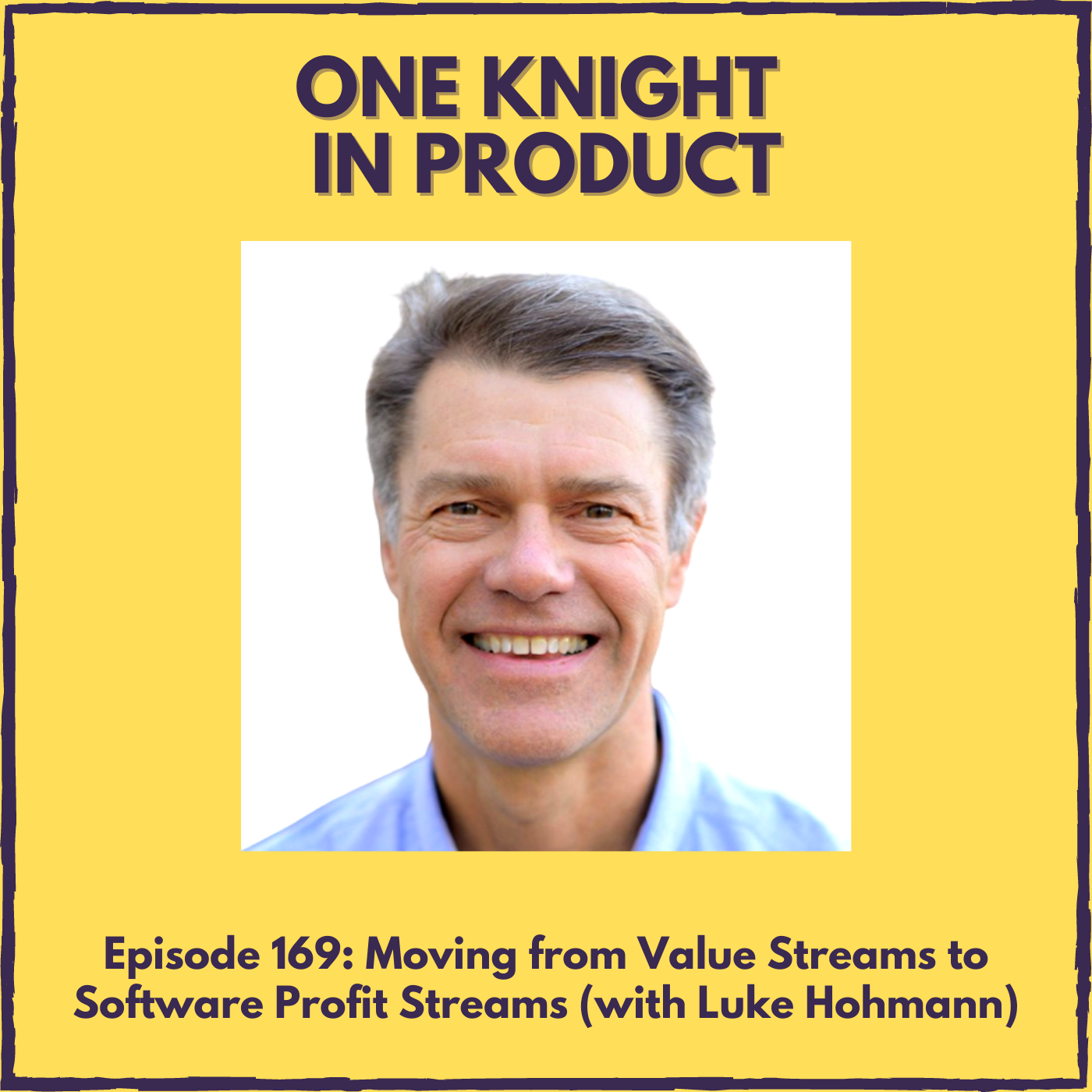
S1 Ep 169Moving from Value Streams to Software Profit Streams (with Luke Hohmann, Co-author ”Software Profit Streams” & former SAFe® Framework Contributor)
ELuke Hohmann is a startup founder, consultant, SAFe framework contributor and co-author of the upcoming book "Software Value Streams". Luke wants to help agile teams connect their own value delivery with profit, the value that the leadership team really cares about, and set up whole organisations for success. We chatted about some themes from the book, with a gentle detour into Scaled Agile territory for good measure. A message from this episode's sponsor - Skiplevel This episode is sponsored by Skiplevel. Do you struggle with communicating with dev teams and understanding technical terminology and concepts? On episode 98, I hosted Irene Yu, founder of Skiplevel, an on-demand training program that helps professionals and teams become more technical in just 5 weeks... All without learning to code. Learn the knowledge and skills you need to better communicate with devs and become more confident in your day-to-day role with the Skiplevel program. You can use referral code OKIP to support this podcast! Episode highlights: 1. A software profit stream is the necessary evolution of a value stream Agile folk talk about value all the time but how does that map to company priorities? There are structures & systems we need to use to turn "value" into profit & meet the company’s financial goals. 2. Most books about pricing & licensing are old school and written for boomers - few of them cover software Pricing is not a number, it’s a system, and it's a team sport. Your software solution's pricing & packaging should evolve over the product lifecycle. 3. Value is a set of relationships between nodes that impact each other Value doesn’t occur in isolation; consider the system. if you’re building a solution to improve thing A in a positive way, but it negatively impacts thing B then the solution is intrinsically less valuable 4. Customers don’t care about your profits... ... but they do care about your ability to sustainably serve them a solution they need. But, beware! It’s possible to build too much quality and provide more than your customers are prepared to pay for. 5. Product management is an infinite game We play games for leisure until they’re boring. At work, we serve our customers until it’s boring to the business. If we play the game well we don’t win the game, we simply win the right to play again. Coming soon! Buy "Software Profit Streams" "Profit is your key to survival. Without profit, you cannot maintain or grow your business. Without profit, you cannot serve your customers or provide benefits to your employees. Without profit, investors have no reason to invest. Without profit, the goals of the business are unattainable. In Software Profit Streams, serial entrepreneurs Jason Tanner and Luke Hohmann unveil the essential tools and processes for creating profitable software-enabled solutions that have long-term impact." Book link coming soon! Check out Luke's article on startup SAFe Not convinced by SAFe in startups? Luke wants you to think again. Check the article out here. Contact Luke You can catch up with Luke on his website. You can also connect with him on LinkedIn.
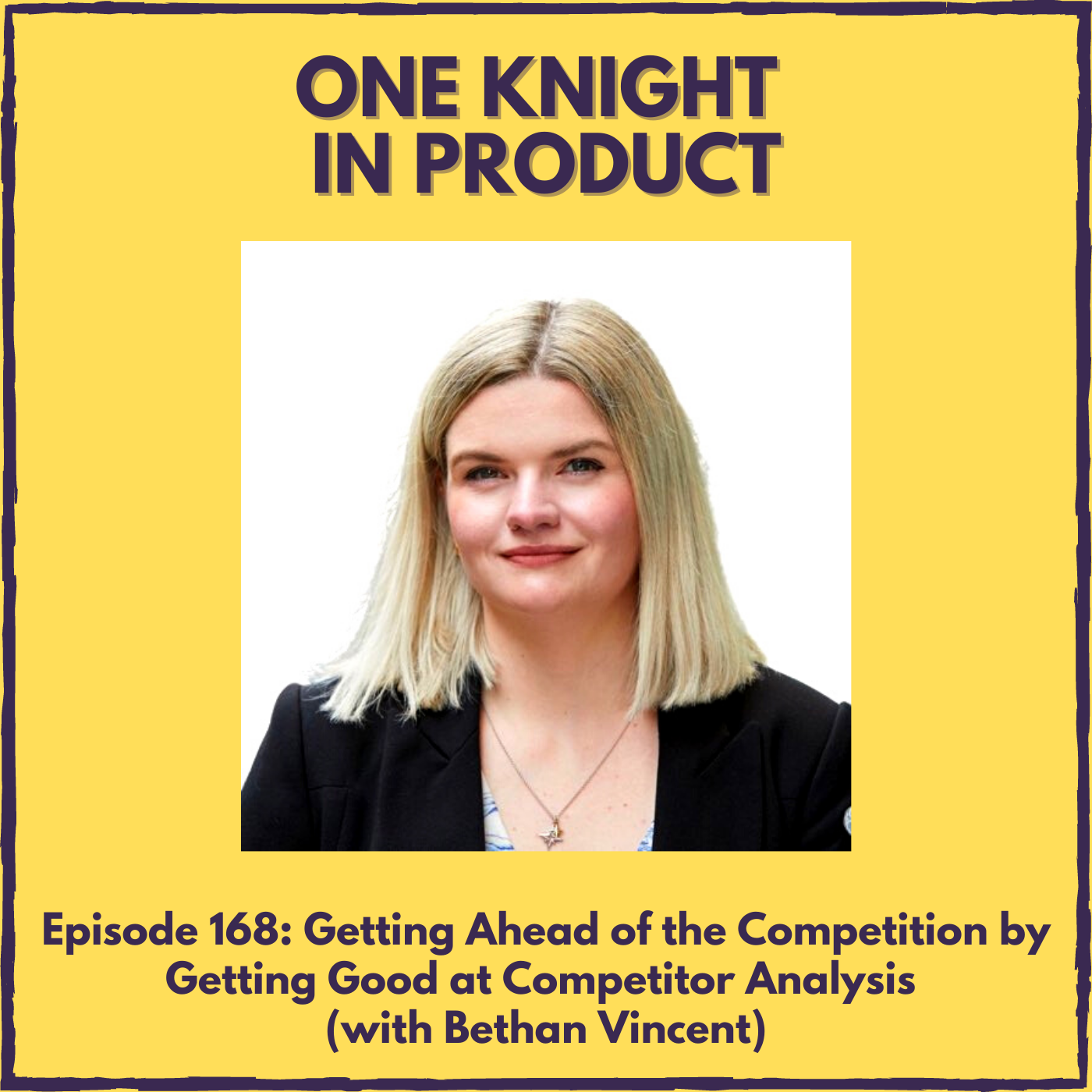
S1 Ep 168Getting Ahead of the Competition by Getting Good at Competitor Analysis (with Bethan Vincent, Managing Partner @ Open Velocity)
Bethan Vincent is an experienced marketer who has worked with a variety of firms in B2B SaaS and B2B Services and has now started marketing agency Open Velocity. Bethan believes in good competitor analysis and how we might get ahead of our competition by going out and finding out what's going on. We spoke about the joys of fractional marketing leadership, and some of the ways to get competitive analysis done. A message from this episode's sponsor - Skiplevel This episode is sponsored by Skiplevel. Do you struggle with communicating with dev teams and understanding technical terminology and concepts? On episode 98, I hosted Irene Yu, founder of Skiplevel, an on-demand training program that helps professionals and teams become more technical in just 5 weeks... All without learning to code. Learn the knowledge and skills you need to better communicate with devs and become more confident in your day-to-day role with the Skiplevel program. You can use referral code OKIP to support this podcast! Episode highlights: 1. Competitor Analysis is a simple concept, but doing it is hard Your competitors are out there and, in many cases, there'll be interesting stuff on their websites but you need to use a variety of techniques to really get to the bottom of what they're doing. 2. You need to know your own target market & positioning before evaluating others It may be Marketing 101, but it's important to understand the space you're playing in, the audience you're going after & who your direct & indirect competitors are before doing competitor research 3. It's important to have a hypothesis you want to test for your competitors There are many tools and approaches you can use, but you need to know what question you're trying to answer. Just finding interesting "stuff" is... interesting, but maybe not particularly useful. 4. Just because a competitor is doing something doesn't mean they're being rational Be aware of what competitors are up to, but blindly copying them is not a good strategy. You need to be in charge of your own destiny, be a leader and do things others can't replicate. 5. Product management should be considered a subset of marketing 🔥 "Product" is one of the many "Ps" in marketing. Product managers should care about packaging, positioning, pricing, promotions and all the rest. It's not just about what you build or how you build it. Contact Bethan You can catch up with Bethan on LinkedIn or Twitter as well as apparently TikTok if you're into that sort of thing. Make sure to check out Open Velocity too.
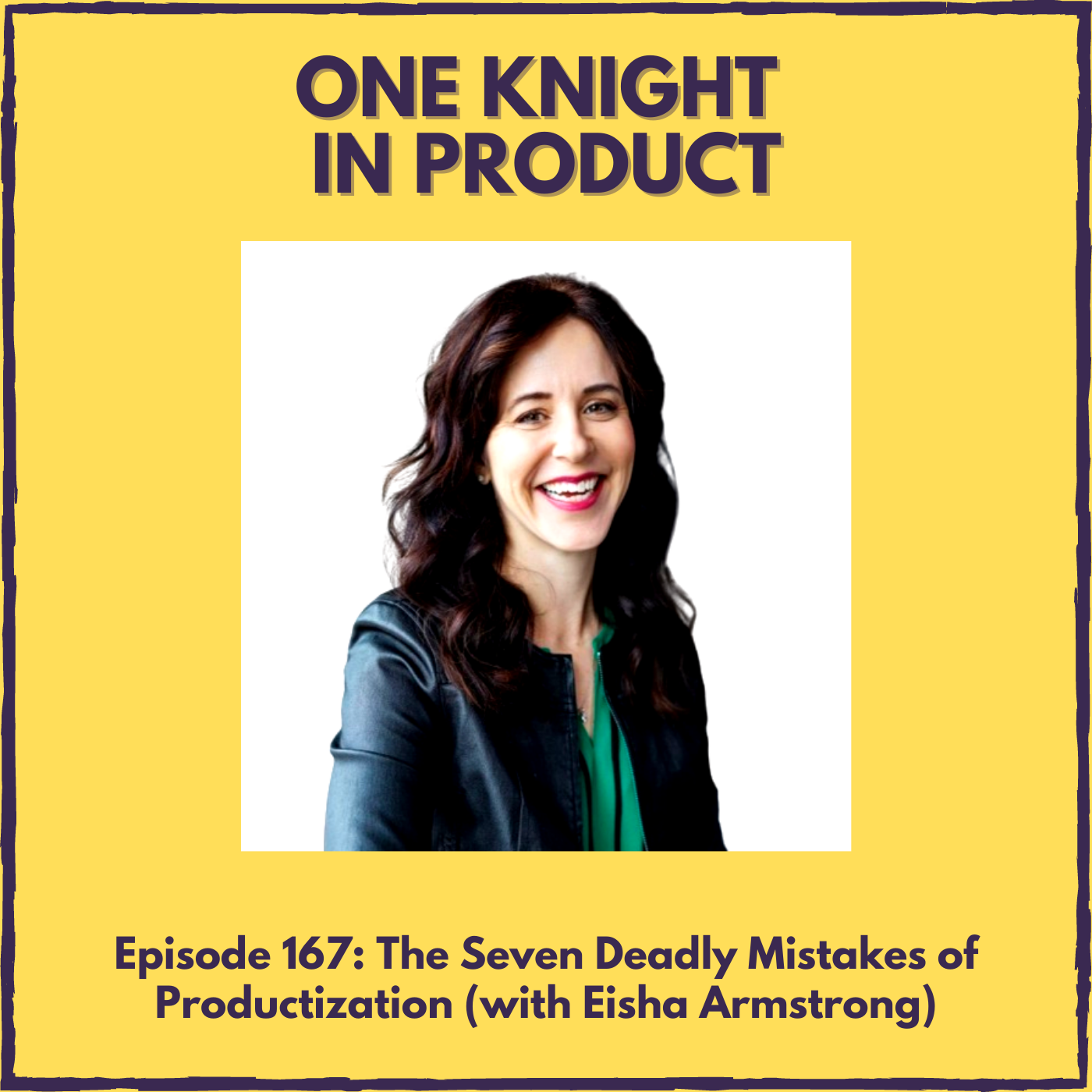
S1 Ep 167The Seven Deadly Mistakes of Productization (with Eisha Armstrong, Co-founder @ Vecteris & Author ”Productize”)
Eisha Armstrong is a company founder, digital transformation consultant and author of 2021's "Productize", a book that aims to help service-based companies move away from scaling via people and embrace repeatable product revenue. We spoke about some themes from the book, as well as the fear that stops companies from transforming. A message from this episode's sponsor - Skiplevel This episode is sponsored by Skiplevel. Do you struggle with communicating with dev teams and understanding technical terminology and concepts? On episode 98, I hosted Irene Yu, founder of Skiplevel, an on-demand training program that helps professionals and teams become more technical in just 5 weeks... All without learning to code. Learn the knowledge and skills you need to better communicate with devs and become more confident in your day-to-day role with the Skiplevel program. You can use referral code OKIP to support this podcast! Episode highlights: 1. Digital transformation gets you away from "arms and legs" There's nothing wrong with being a service company, but there are very attractive reasons to productise. Growth, higher margins, higher exit value and getting away from having to add headcount. 2. The three biggest barriers to transformation are fear, fear and fear It's natural for leaders and employees to feel fear of the unknown or of change. But fear is the enemy of growth. Yes, things could go wrong, but think of what could go right! 3. Transformation should be a full-time job Productisation has to be done right... it can't be an afterthought. The company needs to devote people and financial support to the effort otherwise it will inevitably fail and you might as well not start. 4. "The more narrow the niche is, the greater the riches" Service companies can make good money selling to all comers, but product companies necessarily need to niche down. The company likely doesn't have a strong history in ICPs & segmentation but it needs to develop those skills. 5. Productisation is awesome, but life is in the grey Plenty of companies offer a product/services mix and there is nothing wrong with this. What matters is that you productise thoughtfully & disrupt yourself before getting disrupted by someone else. You need to want to change. Buy "Productize" "More and more traditional professional services firms are turning to "productization" as a strategy to grow, improve valuations, and to fend off new digital-first competitors. However, many of them will fail and waste a lot of money in the process. Productize first outlines the "Seven Deadly Productization Mistakes" made when pursuing a product strategy, then provides the blueprint for overcoming each of these missteps. It is designed to be a practical playbook for any leader of a professional services business who wants to successfully accelerate growth." Check it out on Amazon. You can also check out the book website Contact Eisha You can catch up with Eisha on LinkedIn.
Ep 166How to Move Fast Without Breaking Things (with Dani Grant, Co-founder & CEO @ Jam)
Dani Grant is a former product manager turned VC who decided to go back to building products and setting up her own company, Jam. Jam aims to take the pain away from bug reporting, and to deliver Dani's dream of shipping awesome software fast. We spoke about the story behind her company, as well as some hints & tips from her time working with early-stage startups as a VC. A message from this episode's sponsor - Skiplevel This episode is sponsored by Skiplevel. Do you struggle with communicating with dev teams and understanding technical terminology and concepts? On episode 98, I hosted Irene Yu, founder of Skiplevel, an on-demand training program that helps professionals and teams become more technical in just 5 weeks... All without learning to code. Learn the knowledge and skills you need to better communicate with devs and become more confident in your day-to-day role with the Skiplevel program. You can use referral code OKIP to support this podcast! Episode highlights: Starting a company is a big adventure Dani went from PM to VC but felt the call of entrepreneurship irresistible. She found a problem that she was passionate about solving and wanted to do something meaningful for herself, her users and her team. Startups can be force multipliers for people making their own impact in the world The impact of a startup is felt not only by your users but your users' users. If you can save people time, effort, or both, then you can contribute to changing the world one company at a time. There's an approach to getting your first funding round As a founder, you're in the business of delivering a great meeting & making it easy to shine. For early-stage companies, VCs care less about the detail than the team and the vision. They know the execution will change. "Move fast and break things" is so 10 years ago First impressions count. If you're building productivity tools, you can't make people's lives harder. You need to ship something that works - moving fast and breaking things was a valid strategy only before people knew better Every PM & founder's job is to support their teams moving fast & shipping awesome stuff Devs have a big role here, but the whole company needs to come together around quality, define enough detail up front, and keep the scope small to help deliver a quality product. Contact Dani You can catch up with Dani on LinkedIn or on Twitter You can try out Jam on jam.dev Here's the VC video that Dani recommended: How to Nail Your Startup Pitch Deck - Rebecca Kaden
S1 Ep 165From High-Frequency Trader to Investor in Good Ideas (with Pooja Parthasarathy, Head of Product @ AbstractOps)
EPooja Parthasarathy is a product leader who started out her career in the high-pressure, high-volume world of high-frequency trading. She took some time out with me to reflect on her unconventional career journey, what it taught her, and how to make an impact as a product leader. A message from this episode's sponsor - My Mentor Path This episode is sponsored by My Mentor Path. I'm a passionate advocate for mentoring and believe it to be one of the highest-leverage activities you can undertake to get ahead in your career. I try to do my part but am but one man, so I helped set up this FREE mentoring community to try to help out at scale. Sign up now as a mentor, a mentee, or both! Episode highlights: High-frequency trading is as stressful as you'd imagine, but it has lessons for early-stage product managers Working with traders teaches you to think on your feet in volatile environments, think three steps ahead & build a thick skin. These are all valuable traits for PMs. We should all be comfortable asking basic questions Working in a variety of jobs has helped her get comfortable with first-principles thinking and asking even the most basic questions. It's important to model this behaviour for your team. Be kind to yourself and the stories you tell yourself Pooja was hard on herself after her first child and wondered if she could make a success of work after going back. She learned to appreciate the job she was doing and be her own champion. The job of a product person is to be an investor in good ideas A PM's job is not to have all the answers or all the best ideas, but to be the Socratic Police Officer and ask good questions to get those around you to bring their own insight to the table for you to tie together The CEO & CPO relationship is the most important in the company It's important to create leverage with the CEO, by having the right motivations, setting clear expectations about who owns what for what time horizon, and being comfortable delegating to other leaders. Contact Pooja You can catch up with Pooja on LinkedIn, although she's about to have a baby so maybe wait a bit!
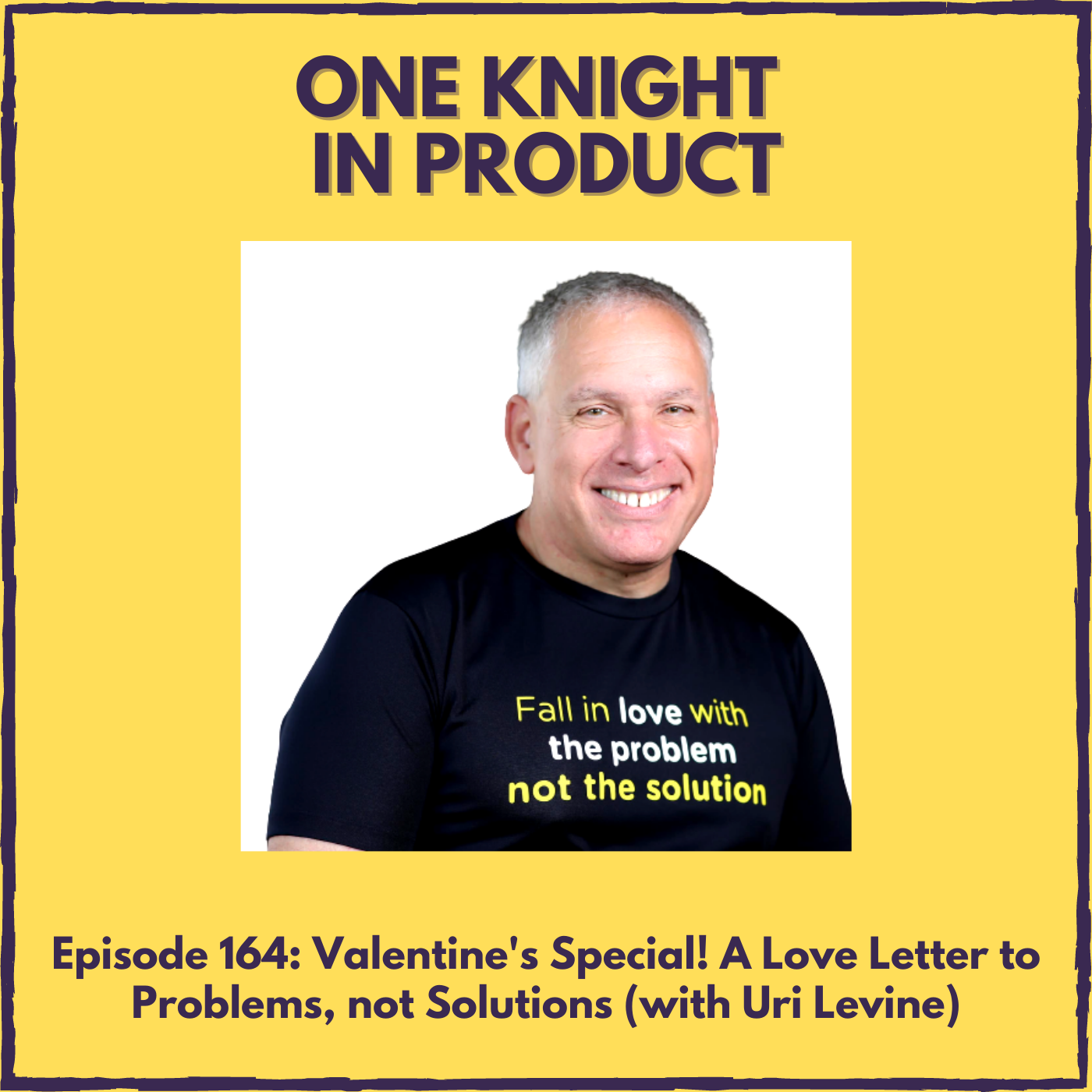
S1 Ep 164Valentine’s Special! A Love Letter to Problems, not Solutions (with Uri Levine, Founder @ Waze & Author ”Fall in Love with the Problem, not the Solution”)
Uri Levine is a 2x 'Unicorn' Builder (Duocorn) who co-founded Waze and is a former investor and board member in Moovit. Uri recently published his book, "Fall in Love with the Problem, Not the Solution". We talk about some of the themes from the book as well as some stories from his own career. A message from this episode's sponsor - My Mentor Path This episode is sponsored by My Mentor Path. I'm a passionate advocate for mentoring and believe it to be one of the highest-leverage activities you can undertake to get ahead in your career. I try to do my part, but am but one man, so I helped set up this FREE mentoring community to try to help out at scale. Sign up now as a mentor, a mentee, or both! Episode highlights: There are no right or wrong decisions, only the decision you make right now Uri is often asked if selling Waze was the right decision, but you can only make decisions based on the information you have. It's more important to make a decision than wait for the perfect decision. Find a problem you care about, but you are a sample of one You should be passionate about the problem you're solving, but don't assume that anyone else cares as much as you do or wants to solve it the way you want to. You have to get out & speak to people who have the problem If you're afraid to fail then, in reality, you already failed When you're building something no one has built before, you never know if it'll work. You need to experiment, fail fast and have multiple shots on goal. The faster you fail, the sooner you can have another shot. Product/Market Fit does exist & it is measurable If you're not creating value, people won't come back. Retention is the most important way to measure P/MF & make sure that the solution to your users' problem is actually valuable. Getting people to value quickly is essential. B2B & B2C product management share the same goals You might have different customers who care about different features, but they all care about something. The metrics might differ, but the ultimate goal is to deliver value & solve a real pain for all these different people. Buy "Fall in Love with the Problem, Not the Solution" "Fall in Love with the Problem, Not the Solution offers mentorship in a book from one of the world's most successful entrepreneurs, and empowers you to build a successful business by identifying your consumers' biggest problems and disrupting the inefficient markets that currently serve them." Check it out on Amazon. Contact Uri You can visit Uri at his website UriLevine.com or follow him on Twitter.
S1 Ep 163Adam & Jason Talk All About Product Strategy (with Adam Thomas & Me, Two Product Management Talking Heads)
EAnd now... for something completely different. The other day, I did an experimental webinar with my former podcast guest Adam Thomas where we talked about some audience-submitted questions about product strategy. I think it went pretty well and wanted to share the audio with a larger crowd. So here we are! Please do let me know if you like the format. A message from this episode's sponsor - My Mentor Path This episode is sponsored by My Mentor Path. I'm a passionate advocate for mentoring, and believe it to be one of the highest-leverage activities you can undertake to get ahead in your career. I try to do my part, but am but one man, so I helped set up this FREE mentoring community to try to help out at scale. Sign up now as a mentor, a mentee, or both! The questions we answered: What are the pillars of an effective product strategy? How do you know a strategy is working or not? What do you do when there is no product strategy? Check out Adam's previous interview I interviewed Adam back in 2021 about Survival Metrics. Check the episode out here. Contact Adam You can find Adam on Twitter. He's also got a Substack mailing list and his website is theadamthomas.com
S1 Ep 162The Power of Storytelling for Cross-Functional Alignment (with Ronke Majekodunmi, Director of Product Management @ Promevo)
About the Episode Ronke Majekodunmi is a product leader and featured Product School speaker who is passionate about using the power of storytelling to help drive cross-functional alignment. We spoke about storytelling, as well as some stories from her own career. A message from this episode's sponsor - My Mentor Path This episode is sponsored by My Mentor Path. I'm a passionate advocate for mentoring, and believe it to be one of the highest-leverage activities you can undertake to get ahead in your career. I try to do my part, but am but one man, so I helped set up this FREE mentoring community to try to help out at scale. Sign up now as a mentor, a mentee, or both! Episode highlights: You can't just walk into a new leadership job & trash the old team's work It doesn't matter where you worked before - there's always context and a reason for old decisions. Take time to understand them. Oh, and make sure you leave a clean audit trail when you move on! When looking at a new job, work out your non-negotiable questions Ronke has moved jobs for the wrong reason before and this has inspired her to make a list of questions she must have satisfactory answers to before moving. Create your own list and don't get buyer's regret. Product leaders should be Chief Storytelling Officers Storytelling is one of the best ways to drive cross-functional alignment and get everyone in the company on the same page. You should craft an inspirational story and ensure that everyone from top to bottom knows it. Creating stories collaboratively drives alignment Don't just go off into your ivory tower and write something yourself. Build shared ownership by getting the team to collaborate. This means you can start to let go, not need to be in every meeting, and empower the teams. It's important to be in control of your own story Ronke has had some bad work experiences in the past and this has inspired her to "run her race her own way", be her authentic self and give back to the community. We can all make a positive difference to other people's lives. Contact Ronke You can catch up with Ronke at her website. You can also connect with her on LinkedIn or Twitter .
S1 Ep 161OKRs: The Gateway Drug to Agility & Good Product Management (with Jeff Gothelf, Product Management Consultant & Co-author ”Lean UX” )
About the Episode Jeff Gothelf is a product coach, author, speaker and trainer who is currently trying to get companies to work with outcomes, not outputs. He's written two classic books: Sense & Respond, and Lean UX, as well as a variety of other books covering various aspects of product management and design thinking. A message from this episode's sponsor - My Mentor Path This episode is sponsored by My Mentor Path. I'm a passionate advocate for mentoring, and believe it to be one of the highest-leverage activities you can undertake to get ahead in your career. I try to do my part, but am but one man, so I helped set up this FREE mentoring community to try to help out at scale. Sign up now as a mentor, a mentee, or both! Episode highlights: Lean, Agile & Design Thinking can get along These came from different places, but the philosophies that underlie all of these ideas are the same: understanding our customers, working in shorter cycles, making decisions based on evidence, and continuously improving. Managing for outcomes is the hinge that everything else pivots from There are many principles of good product management, but moving away from output enables focus on the change in behaviour you want to see & have the humility to accept you don't have all the answers upfront OKRs are the gateway drug to agility and good product management OKRs are easy to explain, but difficult to implement. Used right, they can empower teams to make measurable impact towards an aspirational goal, without micromanagement or deciding on a fixed plan upfront. OKRs are for teams, not individuals OKRs enable teams to focus on impact, changing customer behaviour in a way that matters to their business & knowing whether they've succeeded. Cramming individual task lists into the OKR format doesn't achieve anything. Change is scary & might not work the first time Some people start with OKRs by mistake or give it a quarter & then give up. Using OKRs well takes work. If it's not working, make sure you have open & honest retros to understand whether it's fixable & whether you can try again. Buy "Lean UX" "Lean UX is synonymous with modern product design and development. By combining human-centric design, agile ways of working, and a strong business sense, designers, product managers, developers, and scrum masters around the world are making Lean UX the leading approach for digital product teams today In the third edition of this award-winning book, authors Jeff Gothelf and Josh Seiden help you focus on the product experience rather than deliverables." Check it out on Amazon. Buy "Lean vs. Agile vs. Design Thinking" "As companies evolve to adopt, integrate, and leverage software as the defining element of their success in the 21st century, a rash of processes and methodologies are vying for their product teams' attention. In the worst of cases, each discipline on these teams -- product management, design, and software engineering -- learns a different model. This short, tactical book reconciles the perceived differences in Lean Startup, Design Thinking, and Agile software development by focusing not on rituals and practices but on the values that underpin all three methods." Check it out on Amazon. Check out Jeff's courses Jeff is running some self-paced courses on OKRs, including in Spanish! Check them out here. Contact Jeff You can catch up with Jeff on his website. You can also connect with him on LinkedIn.

S1 Ep 160Getting the GIST of Evidence-Guided Product Development (with Itamar Gilad, Product Management coach, speaker and author)
About the Episode Itamar Gilad is a product coach, consultant and regular content author who's worked at IBM, Microsoft and Google. Nowadays, he's trying to help companies get away from the feature factory and into the world of evidence-based product development with the GIST framework. A message from this episode's sponsor - Skiplevel This episode is sponsored by Skiplevel. Do you struggle with communicating with dev teams and understanding technical terminology and concepts? On episode 98, I hosted Irene Yu, founder of Skiplevel, an on-demand training program that helps professionals and teams become more technical in just 5 weeks... All without learning to code. Learn the knowledge and skills you need to better communicate with devs and become more confident in your day-to-day role with the Skiplevel program. You can use referral code OKIP to support this podcast! Episode highlights: Big Tech firms aren't exemplars of how to "do product" We look to these firms for guidance, but they all build products differently & have created processes that work for them. What they do have are principles. We should copy the principles but work the way that works for us. Prioritisation frameworks have a place but aren't going to create your roadmap The numbers are guesses but are useful to start conversations & make sure you're asking the right questions. It's important to revisit scores over time to see what's changing as you learn new things. Confidence is a logarithmic scale Itamar uses the Confidence Meter to describe the different levels of confidence. This brings to life what you are describing when talking about confidence & shows it's not linear; the best evidence is substantially better than the weakest. Refocusing on goals gets you away from rigid roadmaps Itamar uses the GIST framework (Goals/Ideas/Steps/Tasks) to break down opportunities, prioritise for impact & get away from the feature factory. It's important not to kill ideas too quickly, and continuously revisit them. Product management is about principles The principles are customer focus, evidence-guided decision-making, adaptive planning & empowering teams. These are the cornerstones of product management. Customer focus is still the most important & everything else can flow from there. Contact Itamar You can catch up with Itamar on his website, where you can sign up to his mailing list and get access to his tools. You can also connect with him on LinkedIn or Twitter.
S1 Ep 159Practice Makes Perfect: Embracing the Messy Reality of Product Management (with Matt LeMay, Product Management Consultant & Author ”Product Management in Practice”)
EMatt LeMay is a product management consultant, coach and author of "Product Management in Practice", a book that aims to demystify product management and give you a practical, tactical guide for every day of your career. The book's recently had a 2nd edition released, and we spoke about some of the themes from the book. A message from this episode's sponsor - Skiplevel This episode is sponsored by Skiplevel. Do you struggle with communicating with dev teams and understanding technical terminology and concepts? On episode 98, I hosted Irene Yu, founder of Skiplevel, an on-demand training program that helps professionals and teams become more technical in just 5 weeks... All without learning to code. Learn the knowledge and skills you need to better communicate with devs and become more confident in your day-to-day role with the Skiplevel program. You can use referral code OKIP to support this podcast! Episode highlights: 1. You should read all the PM books, but question them Books have to take a position, and they're always going to be simplified versions of reality. It's positive to disagree with what you find in these books, but you can learn something useful from just about any book. 2. It doesn't matter how Agile you are, or what framework you use Getting into holy wars about frameworks is not constructive. Not everything works in all contexts, and if it doesn't work you're not a "bad" product manager. Concentrate on delivering value the best way you can. 3. Product managers have a CORE set of skills There's no one standard job description for a product management role, but Matt likes to boil it down to CORE: Communication, Organisation, Research and Execution. Depending on the company, there might be additional important skills. 4. PMs need to make peace with not always being the decision-makers PMs need to concentrate on enabling good decisions. PMs are not "CEOs of Product" & may not be able to influence senior stakeholders all the time. There may be reasons for decisions outside of their control 5. PMs need to stop being defensive If you find yourself in a defensive posture, you're already behind. Often, the harder you try, the worse you can make things. Do what you can to affect change, but try to avoid fighting with your leadership & concentrate on helping your users. Buy "Product Management in Practice" "Updated for the era of remote and hybrid work, this book provides actionable answers to product management's most persistent and confounding questions, starting with: What exactly am I supposed to do all day?" Check it out on Amazon. Contact Matt You can connect with Matt on LinkedIn or visit his website.
S1 Ep 158Going Global! When and How to Take your Product International (with Chui Chui Tan, International Growth Adviser & Director @ Beyō Global)
Chui Chui Tan is an International Growth Adviser and Culturalisation Strategist who has worked with big brands like Spotify to ensure they have successful market expansions. I spoke to her about some important issues around internationalisation, global market expansion, and some of the pros & cons of different approaches. A message of support I recently found out that my former leadership coach has been diagnosed with terminal cancer. Tracy helped me through some tough times, and helped me improve in various areas. I'm grateful to her to this day. Tracy's friends are trying to raise funds so that she can enjoy some final experiences with her family, and leave behind fond memories for after she's gone. If you'd like to donate anything at all, please visit the link here. Episode highlights: 1. You should start thinking about international growth before you're ready for it You don't need to overengineer from the start, but you do need to make sure you have flexible building blocks in place so that you're not starting from scratch when you do want to expand. 2. It's not good enough to just translate text - you have to understand the cultural context Countries aren't defined solely by their languages - they have different currencies, different date formats, and different norms - you can't just do "International Spanish" and be done. 3. There's a framework to help you choose the best markets You can map potential market size & return on investment against efforts required & ease of entry to help you decide where to prioritise. You'll be working off imperfect information but it's important to think it through. 4. There are two main ways to go into other markets and both have pros and cons You can sell to local companies with global offices counterparts or you can set up an organisation/partner in other countries. They both have pros and cons and it's important to be intentional. 5. Going into unpromising markets is OK but start small Sometimes, big whale customers or globally-minded investors will heavily encourage you to get into a market you don't really want to go into. This is OK, but it's important to take an MVP approach rather than go all in. Contact Chui Chui You can connect with Chui Chui on LinkedIn or visit Beyō Global's website.
S1 Ep 157Helping Tech Teams Get Closer to ”The Business” with Effective Conversations (with Douglas Squirrel, Founder @ Squirrel Squared & Co-Author ”Agile Conversations”)
Douglas Squirrel, or Squirrel to his friends, is a long-time tech and agile consultant who claims to have been fired from every CTO job he's ever had. He's here to try to get tech teams closer to "the business", promote constructive tension to make better decisions, and have effective conversations across the organisation. He's also the co-author of a practical playbook on the same topics, "Agile Conversations". A message from this episode's sponsor - One Knight Consulting This episode is sponsored by One Knight Consulting. Spoiler alert, that’s me! I started One Knight Consulting because I have seen variations of the same problems plaguing product companies and I’ve seen them again and again. If you’re looking to get an independent diagnosis of your business with actionable next steps, trying to hire product people or coaching the ones you’ve already got, you can book a call with me. We can discuss your needs and how I can help. Episode highlights: Tech teams need to get closer to "the business" and care about profit Companies hire expensive engineers then get them into endless discussions about nothing, and lock them into backlogs. If engineers are given full business context, they can help to change the world. Leaders need to get used to less control to get more productivty Teams need to stop planning. It's less like a fire-and-forget rocket ride to a predetermined destination, and more like being on the Enterprise and responding to interesting signals from nearby planets. We can increase trust with stakeholders with "Test Driven Development for People" You can structure conversations with sceptical stakeholders like a series of tests and follow a process to build trust outside of the technology organisation. There's a method and it works. It's important for teams to be accountable, but not to be held accountable "Accountability" is often used as a stick to hit teams with by untrusting managers looking to maintain control. Teams can work with stakeholders to maintain buy-in and engagement. Everyone can do something to improve their situation It's no good complaining about your company or stakeholders, blaming them for everything & having a defeatist attitude. By having constructive conversations, everyone has a chance of affecting the change they want to see. Buy "Agile Conversations" "Agile Conversations brings a practical, step-by-step guide to using the human power of conversation to build effective, high-performing teams to achieve truly Agile results. Consultants Douglas Squirrel and Jeffrey Fredrick show readers how to utilize the Five Conversations to help teams build trust, alleviate fear, answer the “whys,” define commitments, and hold everyone accountable. These five conversations give teams everything they need to reach peak performance, and they are exactly what’s missing from too many teams today. " Check it out on Amazon. Join the Squirrel Squadron If you want to join a free community of tech & non-tech execs who are all learning from each other, check out Squirrel Squadron. Contact Squirrel You can connect with Squirrel on LinkedIn or visit his website.
Ep 156The Five Dysfunctions of Product Management Teams (with Saeed Khan, Founder @ Transformation Labs)
Saeed Khan is a product consultant, coach, speaker and founder who wants to give all of us product managers some tough love. In a long career, he's seen the same five dysfunctions across multiple product organisations and wants us to all be honest with ourselves so that we can have a chance to fix them. I actually interviewed Saeed in one of my first podcast episodes. It has a certain "Simpsons Season 1" quality about it but, if you're curious, feel free to check it out! A message from this episode's sponsor - One Knight Consulting This episode is sponsored by One Knight Consulting. Yes, yes, that's me. But listen up. I started One Knight Consulting because I have seen variations of the same problems plaguing growing startups, scale-ups and larger, digitally transforming companies again & again. These problems can cause friction between teams, slow product development, lacklustre sales, and ultimately lead to constrained growth. If you're scaling your product organisation, struggling with cross-team alignment or having trouble executing your product strategy to support your business goals, book a call with me and we can discuss your needs and how I can help. Episode highlights: It's important to be honest about the state of product management It's not about being negative or blaming "bad product managers" for everything. But, there are repeated dysfunctions across a large number of companies and we can't fix them if we ignore them. Product managers suffer from poor job definitions, which makes it hard to succeed Bad job specs are a symptom of a deeper truth: Not many people outside product management really understand it, or what "cross-functional" working means at all. We should avoid being "glue". There are lots of smart product managers out there but they don't all have the skills they need Product management is the ultimate "school of hard knocks" trade & many people practising it speak only in the theoretical/struggle in different contexts. PMs need good coaching. "Process" is too often seen as a dirty word. You don't need too much but you need some There needs to be some level of rigour within PM teams to help set them up for success. Doing everything ad hoc gives you ad hoc results. Don't overegg it, but don't underegg it either. Our objectives are often unclear, and we need to do our best to connect to the company's goals We need to be able to define leading measures of success and connect our efforts to actual business success. PMs need to have a far higher level of interest in business outcomes. Product leadership is often weak & is needed to fix all of the dysfunctions It's better to have a former PM and coach them into a leader than to have a non-product businessperson brought in. Someone with good pattern recognition who can bring everything together is essential. Check out the blog article "The 5 Dysfunctions of Product Management Teams" You can read the article that inspired this interview right here. Contact Saeed You can connect with Saeed on Twitter, LinkedIn, Mastodon or check out Transformation Labs.
S1 Ep 155OKIP LIVE! Is Product/Market Fit Really Dead, or Just Resting? (with Andrea Saez & Dave Martin, Right To Left)
My good friends Andrea Saez and David Martin recently put a whitepaper out called "Product-Market Fit is Dead", and we decided to have a chat about it. Our original plan was a Twitter Space with audience interaction but it turns out that Twitter Spaces is awful. Undeterred, we did an "as live" session, uncut and unedited, to get as much of the live feel as possible. Check it out! Contact Dave & Andrea You can reach out to Andrea on LinkedIn or on Twitter. You can catch up with Dave on LinkedIn or Twitter Find out more about Right to Left at their website: https://www.righttoleft.io. You can also grab the white paper "Product-Market Fit is Dead" and browse the rest of their free content.
S1 Ep 154Learning the Bedrock Skills of Innovators & Entrepreneurs (with Bob Moesta, Co-creator of the Jobs to be Done Framework & Author ”Learning to Build”)
Bob Moesta is the co-creator of the Jobs to be Done Framework, a now-ubiquitous methodology to identify "struggling moments" and understand the driving forces behind customer demand. He worked on this with the legendary Clayton Christensen to take it out the world and followed it up with books about demand-side sales and, now, how to use the principles of the greatest innovators to help you succeed as an entrepreneur. A message from this episode's sponsor - One Knight Consulting This episode is sponsored by One Knight Consulting. Yes, yes, that's me. But listen up. I started One Knight Consulting because I have seen variations of the same problems plaguing growing startups, scale-ups and larger, digitally transforming companies again & again. These problems can cause friction between teams, slow product development, lacklustre sales, and ultimately lead to constrained growth. If you're scaling your product organisation, struggling with cross-team alignment or having trouble executing your product strategy to support your business goals, book a call with me and we can discuss your needs and how I can help. Episode highlights: Bob is dyslexic, and Jobs to be Done was his hack to understand the world Bob has trouble reading and writing, and this forced him to admit what he didn't know and find ways to get customer insight that didn't involve reading reports. Jobs to be Done was the result. Clayton Christensen helped him turn his hack into a framework Bob's hack became an indispensable framework to identify customer motivation, with applications through sales, product, design... even religion & HR! The importance of uncovering "struggling moments" is universal. Bob is passionate about mentorship and paying it forward Bob has had great mentors throughout his life: Clayton Christensen, W. Edwards Deming, Willie Moore & Genichi Taguchi. They poured so much into him, all in different ways, & he feels obliged to pay forward what he learned In many organisations, there's more energy spent arguing between functions than serving customers Product, marketing, sales & customer success need to stop shouting at each other and concentrate on helping their customers make progress. We're all on the same side! All the best innovators in the world have a core set of skills The 5 bedrock skills of innovation are: Empathetic Perspective, Uncovering Demand, Causal Structures, Prototyping & Trade-offs. To have the best chance of success you must master them all or find people to help. Buy "Learning to Build" "This journey of entrepreneurship and innovation shouldn’t be a solo trip. If you’re missing something, struggling to begin, or have reached a plateau, fellow entrepreneur and innovator Bob Moesta knows your next steps because he’s been there himself. Now, in Learning to Build, Bob helps you develop the five fundamental skills every successful innovator practices to be their best. He provides you with the resources you need to learn these skills, grow through experience, and adapt your mindset." Check it out on Amazon. Buy "Demand-Side Sales" "For a lot of us, selling feels icky. Our stomachs tighten at the thought of reciting features and benefits, or pressuring customers into purchasing. It's really not our fault. We weren't taught how to sell, plus we've been sold before, leaving us with a bitter taste. Here's the truth: sales does not have to feel icky for you or your customers. In fact, with the right approach, sales can be an empowering experience for all.." Check it out on Amazon. Contact Bob You can connect with Bob on Twitter, LinkedIn or check out The Re-Wired Group.
S1 Ep 153Using The Power of Community to Help you Thrive in a Generalist World (with Milly Tamati, Founder @ Generalist World)
Milly Tamati is a former "Director of Miscellaneous" who travelled the world before settling in a tiny island off the coast of Scotland with 170 residents, a castle and a distillery. She's always been a generalist at heart and is now looking to support a global community of like-minded professionals with Generalist World. A message from this episode's sponsor - One Knight Consulting This episode is sponsored by One Knight Consulting. Yes, yes, that's me. But listen up. I started One Knight Consulting because I have seen variations of the same problems plaguing growing startups, scale-ups and larger, digitally transforming companies again & again. These problems can cause friction between teams, slow product development, lacklustre sales, and ultimately lead to constrained growth. If you're scaling your product organisation, struggling with cross-team alignment or having trouble executing your product strategy to support your business goals, book a call with me and we can discuss your needs and how I can help. Episode highlights: Not everyone needs to be a specialist, you could be a generalist! Do you not fit neatly in a box? Do you consider yourself a jack of all trades/someone who wears many hats? You might be a generalist & there are lots of generalists out there. Embrace it and find your people! The generalist sweet spot is in smaller companies & startups All companies could benefit from good people, but startups especially need people to be the connectors, tie things together and solve whatever problems arise whatever the domain. Generalism is a superpower here. If you've got a product that makes people's eyes light up then you're onto something Milly started Generalist World by speaking to a few people, but every single person's eyes lit up & they were all super-passionate. This is a perfect signal that you're doing something right! Applying a "Jobs to be Done" mentality to recruitment could be a step change in hiring practices We can make hiring less transactional & more human by not just talking about job roles, but problems that you need to solve and the skills you need to solve them. Milly believes in communities but believes 9 out of 10 will fail It's just so easy to create a community these days. Companies & brands are jumping on board, doing the bare basics & leaving a ghost town behind. Companies need to be strategic & intentional to be successful. Contact Milly You can connect with Milly on Twitter, LinkedIn or check out Generalist World.
S1 Ep 152Making Sure you REALLY Know your Customers and Pulling out of Growth Stalls (with Adrienne Barnes, Founder @ Best Buyer Persona)
Adrienne Barnes started out working to help people with their user personas but found that her work pointed to an even bigger problem - companies entering growth stalls and unable to recover. She is now here to tell us all how we might maintain our flightworthiness and get back onto the path of sustainable growth. A message from this episode's sponsor - Product People This episode is sponsored by Product People. If you’re a company founder or product leader who needs to get a product management team up and running quickly or cover parental leave check out Product People. They’ve got a thriving community and 40 in-house product managers, product ops pros, and product leaders. They onboard fast, align teams and deliver outcomes. Check out Product People to book a free intro chat and quote code OKIP to get a 5% discount. Episode highlights: Growth Stalls can happen to anyone and often happen after really strong growth Companies can be growing, growing, growing and then all of a sudden just stall. There are factors that influence this, but if they're not addressed then growth stalls can last for years or decades There are some red flags that indicate growth stalls and leaders need to listen Too many leaders believe in themselves too much that they miss the signs of a growth stall & fail to address them. Status quo bias and ignoring dissenting opinions can impede efforts to fix it. The earlier you catch a growth stall the better but it's never too late Identifying stalls early naturally helps, but if you catch it late then you can still turn it around as long as you're realistic about what "turning it around" means and adjust your expectations. Growth comes from understanding your customers & too many companies don't If teams have different user personas defined, no one has user personas defined. There needs to be a concerted effort to understand your ideal customers and it should be a top-down, aligned effort. Alignment is crucial for any of this stuff to work The top reasons for growth stalls are: Not understanding your customers, Not understanding your positioning, Knowledge gaps & misalignments between teams. You need everyone to know the same stuff & pull in the same direction! Contact Adrienne You can connect with Adrienne on LinkedIn, Twitter or check her website, AdrienneNakohl.com.
S1 Ep 151Team Change is Inevitable - What’s Important is How we Respond to It (with Heidi Helfand, Author ”Dynamic Reteaming”)
Heidi Helfand is an engineering leader, consultant, coach, speaker and author who says that we need to "make the most of the time we have with people". Throughout her career she's noted how team change is inevitable and wanted to help companies navigate it with her book "Dynamic Reteaming". A message from this episode's sponsor - Product People This episode is sponsored by Product People. If you’re a company founder or product leader who needs to get a product management team up and running quickly or cover parental leave check out Product People. They’ve got a thriving community and 40 in-house product managers, product ops pros, and product leaders. They onboard fast, align teams and deliver outcomes. Check out Product People to book a free intro chat and quote code OKIP to get a 5% discount. Episode highlights: Team change is inevitable but what's important is how you deal with it Even if you're going for long-lived mission-based teams, they're still going to change through attrition, company growth, lay-offs or mergers. It's important to manage this change effectively. Dynamic Reteaming helps you however you decide to set up your teams Books like Team Topologies tell you how to set up your teams to deliver value effectively. Dynamic Reteaming can work hand in hand with that approach and help you get there. Team members don't always get to choose what happens Sometimes people & teams will get moved around & sometimes this change will come top-down. It's ideal for team members to have a say, but ultimately it's important for the leadership to communicate, communicate. communicate Bottom-up reteaming can work but your mileage might vary Some companies allow people to decide what teams they work on, but your mileage may vary and, ultimately, in many companies, it's important to mix grassroots and executive input to get true success Dynamic Reteaming offers a playbook for different types of team changes The patterns within Dynamic Reteaming include people-focused approaches to use before and after team changes. The most important principles are to be kind, thoughtful and to treat people with respect. Buy "Dynamic Reteaming" "Your team will change whether you like it or not. People will come and go. Your company might double in size or even be acquired. In this practical book, author Heidi Helfand shares techniques for reteaming effectively. Engineering leaders will learn how to catalyze team change to reduce the risk of attrition, learning and career stagnation, and the development of knowledge silos. Based on research into well-known software companies, the patterns in this book help CTOs and team managers effectively integrate new hires into an existing team, manage a team that has lost members, or deal with unexpected change" Check it out on Amazon. You can also check out the book website Contact Heidi You can connect with Heidi on LinkedIn.

S1 Ep 150The Trouble with Product Management Onboarding and How to Get it Right (with Mirela Mus, Founder & CPO @ Product People)
EMirela Mus is a product manager, product leader, mentor, coach, advisor and company founder who wanted to solve a problem that she kept seeing when she spoke to company leaders; the need to spin up product teams to cover hiring gaps and parental leave. She's doing this with her firm Product People. A message from this episode's sponsor - Product People This episode is sponsored by Product People. If you’re a company founder or product leader who needs to get a product management team up and running quickly or cover parental leave check out Product People. They’ve got a thriving community and 40 in-house product managers, product ops pros, and product leaders. They onboard fast, align teams and deliver outcomes. Check out Product People to book a free intro chat and quote code OKIP to get a 5% discount. Episode highlights: It's important to support promising new product managers Mirela is committed to bringing talent into product management with the Product People operating model which gives APMs real-world product experience whilst maintaining quality for clients You don't have to start a SaaS startup to be an entrepreneur Mirela wasn't excited by building a SaaS product to solve everyday problems, and she found lots of problems through her own consulting which showed her the real problem and why a product agency is needed Companies can be pretty bad at onboarding in general But it's not always the case that good onboarding = a good experience. There are plenty of examples of great onboarding into poor company culture and bad onboarding into a great culture. It's the culture that's important! Onboarding for product managers is harder than for most roles Product managers are at the centre of everything and the requirements of the role can be really ambiguous depending on the company. The product culture is often underdeveloped which can drag product managers down. There's a playbook for this stuff and a structured approach that PMs can take You need to come up with a plan. There are things you can ask for in advance, stakeholders to map and sensitive topics to uncover. These can help you work out where you need to focus to be successful. Contact Mirela You can check out Mirela's blog post, Blazing Fast Onboarding for Product Managers. You can connect with Mirela on LinkedIn.
S1 Ep 149Using Tech to Change Culture and Un-f**king the Design Industry (with Mackenzie Daisley, CEO & Founder at Brieft)
EMackenzie Daisley is a former designer & design account executive who has decided that the design industry is totally f**ked. She's started her own company, Brieft, to un-f**k it and she's not afraid to use expletives along the way. A message from this episode's sponsor - Product People This episode is sponsored by Product People. If you’re a company founder or product leader who needs to get a product management team up and running quickly or cover parental leave check out Product People. They’ve got a thriving community and 40 in-house product managers, product ops pros, and product leaders. They onboard fast, align teams and deliver outcomes. Check out Product People to book a free intro chat and quote code OKIP to get a 5% discount. Episode highlights: The Design Industry is F**cked In Australia, staff turnover in design agencies is around 30%, and she's seen similar patterns around the world. A big part of the problem is around communication & collaboration, both internally & externally, and she wanted to fix that Swearing and Cursing in your Mission Statement attracts the right kind of people Mackenzie has had negative pushback from industry figures about her mission to "un-f**ck the design industry" but also a lot of positivity from innovators & disruptors who know exactly how f**cked it is. When you're super early it's all about staying close to customers & not being afraid to pivot Mackenzie has had feedback that has led her to pivot, or entirely rewrite parts of the application, and she's been able to get really strong signals of Product/Market Fit early. You need persistence in the face of adversity Mackenzie went to a pitch event without knowing it was a pitch event, fluffed her first pitch, and got blanked by the judge. She regrouped, came back, and won the event. Don't give up! You need to be honest, and sometimes vulnerable, to start a company Mackenzie had never started a company before and she has learned on the job. She's found it helpful to be a straight-shooter & direct, but there remains a pressure for women to act differently to men Contact Mackenzie You can connect with Mackenzie on Twitter, or check out Brieft.
S1 Ep 148Getting the Narrative Right and Taking Web3 Products Mainstream (with Rachael Sacks, Crypto Storyteller & Founder @ Narrativ3)
ERachael Sacks is a passionate advocate for crypto and Web3 who found fame when she popped up on the cover of the New York Post under the headline "Mean Little Rich Girl". She's now trying to demystify Web3 for curious users and traditional companies trying to get into the space. A message from this episode's sponsor - Product People This episode is sponsored by Product People. If you’re a company founder or product leader who needs to get a product management team up and running quickly or cover parental leave check out Product People. They’ve got a thriving community and 40 in-house product managers, product ops pros, and product leaders. They onboard fast, align teams and deliver outcomes. Check out Product People to book a free intro chat and quote code OKIP to get a 5% discount. Episode highlights: Getting onto the cover of the NY Post was hell but taught her so much Being misrepresented taught her how things can be taken out of context, how to get better at writing & connecting with people outside of her bubble. This has proven helpful when writing about crypto. Web3 is the natural progression of where the web is going "If it ain't broke don't fix it" won't cut it. It is broken and it needs fixing. Web3 offers a chance of a future where everything is decentralised and you aren't owned by banks or corporations. Web3 can be incomprehensible to newcomers & especially companies trying to get in Rachael's trying to use her writing & communication skills to make Web3 accessible. She wants to avoid companies hiring clueless consultants and help companies make a real impact. VCs and institutional investors are sniffing around Web3 but they need to be authentic The same old Web2 investors have sensed a gold rush and are coming in to try to make money, but there's a strong sense of community and inauthentic people will quickly be sniffed out. It's mass adoption or bust now There's a lot of work going on to bring a proper consumer-grade experience to Web3 apps, which has been lacking but is getting better. There is also work going on to make people feel secure and that they won't lose all their money to hacks. Contact Rachael You can connect with Rachael on Twitter, or check out Narrativ3.

S1 Ep 147The Importance of Messaging & ROARing Your Way to Product/Message Fit (with Diane Wiredu, Founder & Messaging Strategist @ Lion Words)
Diane Wiredu is the founder of Lion Words, a brand messaging strategy consultancy with which she aims to stop you from sounding like everybody else. She wants to make sure you have product/message fit and a strategy to save you from drowning in a "sea of sameness". A message from this episode's sponsor - Product People This episode is sponsored by Product People. If you’re a company founder or product leader who needs to get a product management team up and running quickly or cover parental leave check out Product People. They’ve got a thriving community and 40 in-house product managers, product ops pros, and product leaders. They onboard fast, align teams and deliver outcomes. Check out Product People to book a free intro chat and quote code OKIP to get a 5% discount. Episode highlights: It's hard to see the label when you're stuck in the jar People within a company often can't see the wood for the trees. They know too much and don't understand how complex their messaging has become. Having an independent audit can help to understand what doesn't work. Messaging is WHAT you say about your product, copywriting and brand voice is HOW you say it Messaging is more than just words. It's a strategy informed by company values, overall positioning & ideal customers. It helps people understand why they should care about your product Successful messaging strategy looks different for each company but there are some things they have in common: ✅ Clarity - Everyone should know what you do consistently ✅ Ease - Don't try to say too much or confuse people ✅ Relevance - Resonates with your audience's needs There's a framework to help with this stuff, but much of the value is intangible Diane has her ROAR (Research, Opportunity, Assembly, Review) framework, which of course has hard outputs. But so much of the benefit is the clarity & alignment you get through going through it. Messaging strategy is a top-down effort and not just marketing fairy dust Messaging is based on some of the fundamentals of the company, including its mission, vision & strategy. It needs deep leadership involvement as well as a cross-functional group from around the company Contact Diane You can connect with Diane on LinkedIn, or check out Lion Words.

S1 Ep 146Supporting Mental Health & Wellbeing for Product Managers (with Jacquelyn Guderley, Product Manager @ OVO & Co-Founder @ Product Mind)
EJacquelyn Guderley is passionate about product management and mental health, and has thrown herself into both with gusto. She's a product manager for UK energy firm OVO, as well as the co-founder of Product Mind and impending book author with the in-progress "My Sketchy Head". Here are some highlights from the episode: "The best paths are never linear. The stumble and fall isn't important; it's how you get back up" Jacs had a variety of roles before product management, a role she didn't know existed (even though she had been doing it). Her varied experiences helped to round her out as a PM. A passion for mental health & product management combined with intense demand to create Product Mind Jacs was unsure whether her social media content was resonating, so asked her followers and got incredible interest from PMs looking for support with their wellbeing. Product Management is tough, and it's also lonely Product management can be great, but it's also a tough role due to being at the centre of everything, with nowhere to hide & you're often an easy target for blame. PMs often lack people to tell them what's OK & what's not. Idealised social media content is a double-edged sword There's a lot of boring, reductive, cookie-cutter content out there which feels almost philosophically anti-product management. But, on the other hand, the power and support of the PM community is amazing. Bringing up mental health issues at work is never easy It's not easy to talk to your boss in all companies & often it's easier not to try. Companies can make it easier by taking an active interest in your well-being. Sharing your experiences can help others share theirs. Check out Product Mind If you are interested in getting support from like-minded product people, check out Product Mind, or find them on Twitter or LinkedIn. Contact Jacs You can connect with Jacs on Twitter, or check out My Sketchy Head.
S1 Ep 145Taking Recruitment into the Future with AI and Embracing the Metaverse (with Shaun Smith-Taylor, Co-Founder @ MyProductPath)
Shaun Smith-Taylor is a self-described Product Geek and BBQ enthusiast who got so frustrated with the state of product management recruiting that he set up his own company to fix it. He's keen on AI, the metaverse and the possibilities of using them to bring technological advancement to recruitment and beyond. Here are some highlights from the episode: There's still a problem with the quality of product job specs Half the time, companies don't seem to know what to ask for. This means they confuse candidates and get the wrong people applying for the jobs. A mixture of technology & human consulting is needed to fix this. But there's also a problem with product management CVs PMs talk about outcomes all the time but need to focus on outcomes in their CVs. Candidates stuff every single thing they've done into their CVs, with little connection to real results & often badly formatted or overlong. Candidates are still paranoid about Applicant Tracking Systems It's common for people to blame the ATS for all of their problems, but ATS systems always involve humans and aren't using as much fancy AI as some might claim. They're not perfect, but nothing is. The people the AI is trained on can be just as biased as the AI All people have unconscious biases, and some are downright prejudiced. We should always do what we can to limit the chance of bias, and doing so isn't a personal attack on the hiring manager. There are metaverse applications for recruitment In a world of remote working & different working preferences in general, the metaverse may open up opportunities around in-person assessments as well as remote working. But we've got a long way to go before we get there. A message from my sponsor - me! I'm currently looking at consulting opportunities. If you'd like to speak to me about how I can help you build great products, or the teams that build great products, check out One Knight Consulting and book a free, no-commitment call to chat about your needs. Contact Shaun You can hit Shaun up on LinkedIn, or check out MyProductPath.
S1 Ep 144Beyond the Challenger Sale Part 2: Focus on Value & Make your Product Easy to Buy (with Brent Adamson, Author ”The Challenger Sale” & ”The Challenger Customer”)
Brent Adamson is a former Harvard professor turned Wall Street Journal award-winning author and sales researcher. He co-authored "The Challenger Sale" and "The Challenger Customer" with my former guest Matt Dixon, and these days is challenging us to concentrate on making products easy to buy, not easy to sell. Here are some of the highlights of our discussion: 1. The Challenger Sale shook up the world of sales, but The Challenger Customer was the inevitable follow up They did further research after the first book and identified a new protagonist, the "Mobilizer", who can be your best advocate within the company (but not a champion!) 2. It takes 5.4 people within an organisation to make a purchase decision & the number's rising It's getting more & more complicated selling into organisations, and the buying journey has become like spaghetti. Finding the "economic buyer" is no longer enough to land the sale. 3. There's a difference between emerging demand and established demand If you're going after established demand and known solutions you're going to get dragged into a price-based bake-off. Challengers find unknown pains, challenge the status quo & break the frame 4. Some customers don't even know how to buy any solution, let alone your solution Buyer journeys are complex & some customers can be surprised when things get held up. But you're not, you've seen it all before! Give them the info they need to help close the sale from their side. 5. It's not good enough to just be insightful anymore, The smartness arms race ended in a draw Being really insightful is table stakes. You need to be able to help your customers frame their decision and give them confidence in the decisions they're making for their company. .. And much more! Check out Matt's episode I interviewed Brent's co-author and co-conspirator Matt Dixon about his work and how customer indecision is a critical problem for B2B sales. Check out the episode here. Buy "The Challenger Sale" "The need to understand what top-performing reps are doing that their average performing colleagues are not drove Matthew Dixon, Brent Adamson, and their colleagues at Corporate Executive Board to investigate the skills, behaviors, knowledge, and attitudes that matter most for high performance. And what they discovered may be the biggest shock to conventional sales wisdom in decades." Check it out on Amazon. Buy "The Challenger Customer" "In The Challenger Sale, Matthew Dixon and Brent Adamson overturned decades of conventional wisdom with a bold new approach to sales. Now they reveal something even more surprising: the highest-performing sales teams don't focus on friendly, attentive customers. Instead, they target challenger customers. Challenger customers are sceptical, less interested in meeting and ultimately indifferent as to who wins the deal. But they also have the credibility, persuasive skill and will to challenge the status quo that will get a deal to the finish line far more often than customers who are easier to connect with." Check it out on Amazon. Contact Brent You can hit Brent up on LinkedIn.
S1 Ep 143Beyond the Challenger Sale Part 1: JOLTING Customers out of ”No Decision” (with Matt Dixon, Author ”The Challenger Sale” & ”The JOLT Effect”)
Matt Dixon is a Wall Street Journal award-winning author and renowned researcher in the world of sales and customer success. He co-authored "The Challenger Sale" in 2011 which turned the world of B2B sales on its head, and encouraged salespeople around the world to take control of the customer conversation. He's now back with "The JOLT Effect" which tells us that our biggest problem with closing sales isn't losing to a competitor but losing to no decision at all. Here are some of the highlights of our discussion: There was a big gap in data-based, factual research on sales and it needed filling There are great sales books out there, but many of them are based on opinion and "what worked for me". Matt and his team took an outsiders' data-based approach and uncovered the surprising truth The Challenger Sale divided the sales community but resonated with founders Matt is not a salesman. This led some people to doubt his findings, but the data speaks for itself. The Challenger approach specifically resonated with startup founders who are natural challengers! All our assumptions about what makes good salespeople are wrong Sales have traditionally been taught to be relationship builders but in today's world of information overload, it's not enough to have a cosy conversation. Buyers need to be challenged, debated & given insight Up to 60% of Sales are lost not to a competitor, but to "no decision" & traditional approaches make it worse It's not enough to defeat the status quo. Buyers can be afraid to make a decision whatever the status quo. Traditional sales approaches make the problem worse. Customers are stuck and we need to JOLT them into action There's a playbook to defeat customer indecision that helps to take risk off the table & make buyers understand they're making a great decision. Product teams are crucial partners in helping sales teams do this. Buy "The JOLT Effect" "In sales, the worst thing you can hear from a customer isn’t “no.” It’s “I need to think about it.” When this happens, deeply entrenched business advice says to double down on your efforts to sell a buyer on all the ways they might win by choosing you and your business. But this approach backfires dramatically. Why? Because it completely gets wrong the primary driver behind purchasing decision-making: once purchase intent is established, customers no longer care about succeeding. What they really care about is not failing." Check it out on Amazon. You can also check out the book website. Buy "The Challenger Sale" "The need to understand what top-performing reps are doing that their average performing colleagues are not drove Matthew Dixon, Brent Adamson, and their colleagues at Corporate Executive Board to investigate the skills, behaviors, knowledge, and attitudes that matter most for high performance. And what they discovered may be the biggest shock to conventional sales wisdom in decades." Check it out on Amazon. Make sure you check out "The Challenger Customer" and "The Effortless Experience" too! Contact Matt You can hit Matt up on LinkedIn.
S1 Ep 142Survive the Feature Factory by Applying Product Thinking to Product Thinking (with John Cutler, Product Evangelist & Coach @ Amplitude)
EJohn Cutler is a product evangelist for Amplitude, and a leading voice in the product management community. As a systems overthinker and "on second thoughts" leader, he's an anomaly in this world of quick-fire bubblegum takes. John's hypothesis is simple - product management is messy and he loves nothing more than thinking about it and drawing lots of complicated diagrams to explain it. Here are some of John's weighty thoughts: There's a lot of variety in product content out there and that's good John can get pretty in-depth, but there's plenty of room for targeted, optimised, "just do this" takes out there. As long as they're reducing the gatekeeping around product management not increasing it. Working in the "ideal" product way isn't the be-all and end-all There are lots of great teams out there not working as per the books. There are also great Big Tech-style practitioners who can only thrive in certain environments and would flounder anywhere else. We should all be thinking in systems Systems thinking is important for product managers trying to make sense of their product or organisation. Nothing is linear, everything is composed of self-reinforcing loops. Think you're a change agent? You're part of the system too! Product people need to be able to translate their thinking Systems thinking or otherwise, product people can have complicated messages that could sound esoteric or theoretical to non-product folks. It's important to find a way to land your message with your target audience. He coined the term "Feature Factory" as a joke and his thinking has evolved Sometimes you're going to have to build a feature & it might even be the best move! Work with your CEO, not against them, when they ask for a feature & make sure you know what game you're playing. Surviving a feature factory is possible with this 5-step plan John has an actionable 5-step plan (containing 6 steps) which enables you to work out what you want, what your colleagues want, demonstrate the value of product practices and, if all else fails, when to leave. Contact John You can hit John up on Twitter, or sign up to his mailing list The Beautiful Mess.

S1 Ep 141Data-Informed Decision Making and the Three Cs of Product Management (with Roger Snyder, VP of Products & Services @ 280 Group)
Roger Snyder is the VP of Products & Services at the 280 Group, a leading training & consultancy firm in Silicon Valley. He's passionate about product management and wants to help you get better at the craft and put some data into your decision making. Here are some of Roger's insights: Product management frameworks & methodologies are good starting points But you can't be a slave to them. Use these frameworks as a baseline to help you ask the right questions about your business, then use what you need for the situation you're in. Training isn't going to make you an amazing PM on your own Even the best training can't do it all, but it can be an accelerant. Training, certificates & certifications all have their place as part of your journey but you need to get rear-ended a couple of times. Don't be data-driven, be data-informed There's so much data out there that can help you make great decisions but don't just consume it blindly! You need to make sense of it to have the greatest impact, work out what metrics really matter & work out when "what matters" changes More teams are data-informed than ever but there are still challenges Many teams are still unable to make data-informed decisions due to lack of access, lack of tooling or stakeholder gatekeeping. Learn to tell stories about why it's important and ensure you explain the WIFM. Use data to inform your product vision It's important to set up a fact base for your product vision and populate it with the three Cs of product management: Company, Competitors and (of course!) Customers. You can then use all of that data to inform a compelling vision. Listen to the episode for this and more! Contact Roger You can reach out to Roger by email, or check out the 280 Group website.
S1 Ep 140The Role of Product Management on Truly Agile Development Teams (with Allen Holub, Software Architect, Consultant & Outspoken Twitter Agilist)
Allen Holub is a software development and agile consultant who wants to help you build better software and build software better. He's also not shy when it comes to telling the world what he thinks about product development via Twitter. Here are some of Allen's spicy takes: Making true organisational change requires C-level buy-in It's easy to get hired by the engineering team to help them learn how to make sausages better but the better goal is to work out if you want to make sausages, and you need top-level buy in for this There are too many people walking on eggshells on Twitter You should be able to share your version of the truth in an open, direct way. If people don't like it, they can listen to someone else! Context is important, but it's not ivory tower thinking to try to change a system. Empowering people to be agile doesn't mean leaving them to it Removing organisational blockers and waterfall thinking is important, but you can't just leave them to it and not support them. They need support to become a learning organisation. Scrum is, at best, mostly harmless, but only in good teams You don't need backlogs, you don't need scrum masters, you don't need Sprints. You don't need any of it. Scrum was just a way to make agile acceptable to bureaucratic micromanagers. But all frameworks fly against agile thinking. Product managers do essential work that developers won't do if left to their own devices, but.. It's important that they're part of the development team, that they're not a silo, they aren't the boss or decision maker for the team & they aren't a replacement for the customer JIRA is actively contributing to poor development behaviours We don't need big long complicated specs, we don't need backlogs, estimates, story points or velocity charts. We'd be better off with index cards stuck to a wall (or Miro!) Listen to the episode for this and more! Follow the progress of Allen's book: Allen is writing a book! Check out the progress of the book here. Go to Allen's User Story workshop If you want to go to Allen's upcoming class on User Stories, check out the details here. Contact Allen You can reach out to Allen on Twitter, or book a chat with him.
S1 Ep 139Banishing Cynicism and Empowering Yourself as a Product Leader (with Claire Vo, CPO @ Color & Impending TikTok Influencer)
Claire Vo is a product & technology executive leader, startup founder and future Queen of TechTok, who believes that cynicism and a negative mindset is product and career-limiting, and that people need to stop asking permission to do their jobs. Here are some of Claire's insights about her career and approach to work: A worthy mission is attractive, but an exceptional team is important Claire moved to HealthTech because the opportunity was right. It's great to join a worthy company but you need a team you can work with, a problem you can contribute to & a company that needs your skills. CPTOs can work well in the right context There are a lot of benefits of having clear, joined up leadership between tech & product but it has to work for your organisation & you need a strong leader that ultimately supports the business and not one or other of the functions. Frameworks alone aren't going to build a great product Use frameworks as conversation starters and mechanisms to help you along but you still need to do the hard work of product management to actually make a difference in the world. Frameworks won't help you win on their own. You can bring your whole self to the table & still be credible It's possible for leaders to be credible & professional and have a sense of humour. It's important to bring your full self to work & to social media as long as you are respectful to your colleagues and customers. Optimism trumps cynicism every time Just because work can be hard doesn't mean you should have a negative mindset. It's important to be realistic & critical but mix this with a sense of optimism, "how might we" attitude and empower yourself as a product manager or leader. There's still a lot to do to get proper inclusion at work There continues to be bias against women & mothers at work. Women have to live up to expectations that men don't. Claire beat the system by refusing to ask for permission to do her job, and you should too. Listen to the episode for this and more! Contact Claire You can reach out to Claire on Twitter, find her on LinkedIn, or most importantly on TikTok!
S1 Ep 138From Product Leadership to CEO and Saving the World from Stupid Smart Stuff (with Yana Welinder, CEO & Co-Founder @ Kraftful)
About the Episode Whatever her job, Yana Welinder has always had a passion for improving broken experiences. She did this as Product Lead at Wikimedia, she did this as Head of Product at If This Then That, and now she's here as CEO of her own IoT firm, Kraftful. Here are some of Yana's insights on IoT & startups: Usability in IoT is broken & someone needed to fix it Yana was Head of Product at IFTTT & they have an important mission - to make IoT devices interoperable. Yana wanted to solve an even greater pain - how to make them work well at all. She started a company to do this The IoT space is full of passionate early adopters & moving to the mainstream is hard Early adopters have very technical needs & want more features. Mainstream users want good quality & ease of use. Early adopters are your biggest champions but you need a plan to scale past them Fundraising for IoT was hard, even more so because she's a woman Many investors have been burned by hardware projects and people want to knock you down. Also, not everyone is Adam Neumann - underrepresented founders can barely raise off the back of successes, let alone failures. It's important to have an eye on product misuse AirTags have been in the news for stalking, but Apple have at least made an effort to fix that. Not everyone has their resources, but it's important to at least keep an eye on digital rights groups and try to stay clean The most important thing as a founder is to validate you have an actual problem Don't just throw yourself into something cool - make sure there's appetite for what you're building, go as lean as possible to start with and leverage No Code tools to help you get started quick Listen to the episode for this and more! Contact Yana You can reach out to Yana on Twitter.
S1 Ep 137Closing the Gender Pay Gap and Hiring Diverse Product Teams (with Chris Mason, Co-Founder @ Intelligent People)
An interview with Chris Mason. Chris is an executive recruitment consultant who started his agency Intelligent People over 20 years ago. Chris is passionate about diversity & inclusion in recruitment, as well as helping product leaders in general land their next job. We speak about a lot, including: The state of the product hiring market today and how product management recruitment has changed over the last 20 years How product management has moved from IT to a strategic partner for product-led companies and when companies should hire a CPO Whether we're seeing more product practitioners getting a seat at the top table and how there are two main types of product leadership job Why you should be careful which job you wish for, and how to know when to stop trying to climb the career ladder Whether product job titles are getting more consistent and whether it's true that job titles don't matter Why women should consider not divulging their current salary as it can help to perpetuate gender biased salary and whether the gender pay gap is getting better or worse What hiring companies can do to make sure they're developing a diverse talent pipeline and the importance of hiring for "not fit" rather than culture fit And much more! Contact Chris You can find Chris at Intelligent People or check him out on LinkedIn.

S1 Ep 136Treating Your Career as a Product and Landing that Next Big Job (with Sarah Doody, founder @ Career Strategy Lab)
An interview with Sarah Doody. Sarah is a former UX practitioner and leader who started out trying to help UX pros with their portfolios before realising there's an even bigger problem to solve; how to help designers & product managers optimise for success and give themselves the best chance of getting that next career move. We speak about a lot, including: The origin story behind Career Strategy Lab, how they can help you get a new job, and whether it's just designers or everyone in the product trio That chicken & egg scenario when you can't get a job without experience, but you can't get experience without a job, and whether this is just something that affects PMs or hits designers too Whether UX job descriptions are any better than Product Management job descriptions and some of the reasons we have poor job specs and poor interviewing process How job specs are really just wish lists and the importance of actually reading them rather than just clicking "Quick Apply" to anything with a matching job title The importance of customising resumes, CVs and cover letters, why this sounds controversial, and how to make it scale Why it might be OK to interview for jobs that you don't actually want to get some practice, and the benefits of taking an MVP approach to your job application Whether ATS systems are really the gatekeeping problem that some people make them out to be, and the importance of making personal connections where you can And much more! A brief interruption from my sponsor - me! I'm terrible at asking for money but if you would like to throw any spare change at me to prevent me having to read out tiresome generic podcast ads, you can buy me a coffee. If not, I love you all anyway! Contact Sarah You can find Sarah on her personal website or check out Career Strategy Lab. Sarah is also active on Twitter.
S1 Ep 135Measurably Improving Managers to Help People do Great Work... and be Totally Psyched Doing It (with Russ Laraway, author ”When They Win, You Win”)
EAn interview with Russ Laraway. Russ was a Company Commander in the US Marines before entering Big Tech at Google, Twitter & Qualtrics. He also co-founded Radical Candor LLC with Kim Scott, and believes that anyone can be trained to be a good manager with the right approach. He wrote about this approach in his new book "When They Win, You Win". We speak about a lot, including: Why the world needs doesn't need another person's opinion on what makes a good manager, and how he wants to move away from opinions and move to data driven, measurable results How the US Marines set the stage for him to be a good manager, what moving to Big Tech taught him about focusing on results, and how the military can teach Big Tech a thing or two about Commander's Intent Why it was important to simplify the mission to make managers better, because most people aren't getting better and some are getting worse because there's so much conflicting information out there Why companies are so bad at developing managers, and how his STAC (Select, Teach, Assess, Coach) approach might help get us away from the best Individual Contributor getting thrown into the pit with no support How everyone wants to do great work & be totally psyched whilst doing it, and why people's direct managers are ultimately the key to making that happen The big three of Direction, Coaching, Career, how they can help managers thrive and the importance of helping managers not just concentrating on the stuff they're best at Whether managers are born or bred, and whether introverts or extrovert make the best managers And much more! A brief interruption from my sponsor - me! I'm terrible at asking for money but if you would like to throw any spare change at me to prevent me having to read out tiresome generic podcast ads, you can buy me a coffee. If not, I love you all anyway! Buy "When They Win, You Win" "Businesses everywhere are plagued by managers who seem to think that keeping their staff miserable is the best way to deliver profits. This is a failure of leadership that also hurts the bottom line; research has shown that maintaining a happy, engaged workforce consistently drives measurably better business results across the board." Check the book out wherever you get your books, or check it out on Amazon or the book website. Check out my interview with Kim Scott I spoke to Russ's former colleague Kim Scott last year on the podcast about her book "Just Work" - it was a fantastic conversation and you can check it out here. Contact Russ You can find Russ on his website or check him out on LinkedIn or Twitter
S1 Ep 134Getting Customers to LOVE your Product with Great Product Marketing (with Martina Lauchengco, author ”Loved”)
About the Episode An interview with Martina Lauchengco. Martina is a product marketing guru who once worked on MS Office before a glittering career in a variety of tech companies led her into partnerships with SVPG and Costanoa Ventures. She's recently released her new book, "Loved" to try to help product managers & founders get good at product marketing. We speak about a lot, including: Why she wanted to write a book to help early stage founders and product managers understand how to market their products to make sure they make a difference How most tech companies are getting their marketing wrong, what it looks like when they do, and what they should be doing instead The problems companies can have using traditional marketing approaches led by traditional market folks, and how any initial successes inevitably fade out Whether you need to go all in and drink the Product Marketing Kool Aid or can iterate your way to product marketing success Some of the traits of a good product marketer, how they are similar to product managers, whether you need specialised product marketers or it's just a mindset issue How soon you need product marketers and whether there's value in fractional roles helping you out when you're early Top tips for product managers who want to work effectively with their product marketing team, and treat them as equal partners in their product success And much more! A brief interruption from my sponsor - me! I'm terrible at asking for money but if you would like to throw any spare change at me to prevent me having to read out tiresome generic podcast ads, you can buy me a coffee. If not, I love you all anyway! Buy "Loved" "The best products can still lose in the marketplace. Why? They are beaten by products with stronger product marketing. Good product marketing is the difference between “also-ran” products versus products that lead. And yet, product marketing is widely misunderstood. Although it includes segmenting customers, positioning your product, creating product collateral, and supporting sales teams, great product marketing achieves much more. It directs the best way to bring your product to market. It shapes what the world thinks about your product and category. It inspires others to tell your product’s story." Check the book out wherever you get your books, or check it out on Amazon or the book website. Contact Martina You can find Martina on her personal website. Also, if you bought a copy of her book, you can send your receipt to [email protected] for a free chat!

S1 Ep 133Build Products Businesses Want with the Lean B2B Pyramid (with Étienne Garbugli, Author ”Lean B2B”, ”Find your Market” and ”Solving Product”)
An interview with Étienne Garbugli. Étienne is the lead instructor and CEO of Lean B2B, and a three-time startup founder. He's the author of three books: "Find your Market", "Solving Product" and "Lean B2B". The latter book is out for a second edition, and we decided to talk all about it. We speak about a lot, including: How the second edition has gone down, why there's a second edition at all and why this book matters to B2B entrepreneurs & product managers How the book can help both non-technical, subject matter expert startup founders as well as tech-first founders with little to no B2B experience The Lean B2B methodology, represented by its handy pyramid and key considerations at the various levels Vision: How to systematise your product vision, where to get started, and whether you need a Eureka moment Market: Working out who your target market is, the perils of going too wide, and how many people don't even really know what a market is Jury: Getting your buyers, approvers, users and even veto-ers together to ensure there's a good reception for your proposition Needs: The merits of good customer discovery and why we need to understand our buyers and sellers Offer: How to factor in risks, associated costs to your value proposition, and why it's important to separate the value from the specific solution Solution: How to get your MVP into the hands of early adopters, and whether all types of B2B customer are ready for MVPs What happens after the pyramid once you've validated your solution, and what product/market fit really means in a B2B sense And much more! A brief interruption from my sponsor - me! I'm terrible at asking for money but if you would like to throw any spare change at me to prevent me having to read out tiresome generic podcast ads, you can buy me a coffee. If not, I love you all anyway! Buy "Lean B2B" "The second edition of Lean B2B is the result of years of research into B2B entrepreneurship. It builds off the unique Lean B2B Methodology, which has already helped thousands of entrepreneurs and innovators around the world build successful businesses. " Visit The Book Website for more info, and links to Étienne's other books. Contact Étienne You can find Étienne on LinkedIn, Twitter or visit his website.

S1 Ep 132Coming Out as Transgender at Work and How We Can All Be Better Allies (with Saielle DaSilva, Director of User Experience @ Cazoo)
EAbout the Episode An interview with Saielle DaSilva. Saielle is Director of User Experience at Cazoo, an online car marketplace. Saielle believes in "putting the soft back into software", is a well regarded conference speaker, and also came out as a transgender woman to her friends & colleagues a few months ago. We speak about a lot, including: Her work at Cazoo, helping to transform a traditional industry for the good of users & the planet, and what "putting the soft into software" really means The start of her journey, how long she's known she's a woman and how no one chooses to be transgender for fun or because of peer pressure Her disappointment with celebrities that she used to admire or support, how transgender people are unfairly labelled by people with zero knowledge, and how everyone should be humble enough to do the work and learn to be better The transition roadmap - how she got ready, the step-by-step approach she took, how she was happy to find people were generally supportive and not as hateful as the mainstream media often portray The letter she wrote to her colleagues when she came out at work, the level of detail she went into, types of inappropriate questions transgender women get and her desire to avoid living "reality TV" transgender How troublesome the "Hugh Grant" style bumbling apology for misgendering your colleagues can be, and why you should just apologise and move on What we can all do, both through our company culture and our own actions to ensure we foster a diverse, welcoming workplace and help our transgender colleagues feel accepted & safe And much more! Donate to Saielle's fundraiser Saielle is undergoing further surgery to help with her transition. If you would like to donate, please check out Saielle's fundraiser. Donate to gender diverse charities If you want to donate to charities that support gender diverse charities, check out Mermaids in the UK, or The Trevor Project in the US. Contact Saielle You can reach out to Saielle on Twitter or visit her blog.

S1 Ep 131Your Product is a Joke - How to use Improv Comedy Principles in Product Management (with Amogh Sarda, Co-founder @ Eesel)
About the Episode An interview with Amogh Sarda. Amogh is a former Atlassian and Intercom product manager turned company founder with Eesel, a company that aims to take the pain away from managing your documents. He's also a keen improv comedian, and believes there are similarities between how you create an improv skit and how you make a winning product. We speak about a lot, including: The story behind founding Eesel, how they're trying to make finding your own documents as easy as finding President Obama's shoe size, and whether they can save us from Slack thread hell The pros & cons of starting a company with a founder who lives 10 hours' time difference away, and how to make it work for you The jump from big structured product company to startup life, how you have to identify your ground truths as well as accept the layers of uncertainty that will evolve as you go and making sure you don't change everything all the time How you should bring nuance to product principles, what this means and why sometimes it's worth spending some time in the solution space and working back to the problems His love of improv comedy, how he got into it, and how it maps to product management practices more than you might think: The base reality - working out where you're at and the unarguable truths of your situation The game - the key insights or ways that you can affect the base reality The funny scene / a great product - executing and bringing it all home The importance of keeping it simple, not getting sidetracked or going after everything you could And much more! A brief interruption from my sponsor - me! I'm terrible at asking for money but if you would like to throw any spare change at me to prevent me having to read out tiresome generic podcast ads, you can buy me a coffee. If not, I love you all anyway! Contact Amogh You can find Amogh on Twitter or check his blog, The Paperclip.

S1 Ep 130Diving into the Deep End as a Woman in Product (with Darby Maloney, Product Manager @ Divvy & Occasional Swimming Pool User)
An interview with Darby Maloney. Darby is a product manager and an avid TikToker who made an innocuous video about product management for her non tech friends and was all of a sudden centre stage for tech bros across TikTok and Twitter, getting criticised for being a woman in tech, for being a woman in a pool, for being a product manager and just about everything else. We talk about a lot, including: How she made the move into product management from customer support, got that tricky first product management job by putting extra hours in on top of her day job, and the importance of finding good mentors to help you along the way The story behind that video, why she was making a video about product management with a laptop in a swimming pool in the first place, and whether she stands behind her (and her colleague's) description of product management The three main types of criticism she got after the video went viral, how much of that was about her being a woman, how much was about her being a product manager and the crass double standards it exposed The effect of the abuse on her mental & emotional state, and how she started to worry about her job and the credibility that she had to work so hard for How young women in general have to work extra hard, in a way that young men don't tend to have to do, to prove that they're intelligent, reliable and good at their job How she tried to give due credit to engineers & designers for doing the "impressive" work and it why it was disappointing to be attacked in return The supportive comments that she got after the hate, how much this meant to her and how some people got in touch to admit wrongdoing and that they'd changed their minds Whether she's going to double down on tech videos in future, and if she does whether she'll do the next ones in a serious looking room with lots of books behind her And much more! A brief interruption from my sponsor - me! I'm terrible at asking for money but if you would like to throw any spare change at me to prevent me having to read out tiresome generic podcast ads, buy me a coffee. If not, I love you all anyway! The infamous swimming pool video and the rebuttals Here's the original video that started it all off. The swimming pool video Darby also posted two follow up videos: Rebuttal 1 Rebuttal 2 Contact Darby You can find Darby on TikTok or Instagram. We're also trying to get her to spend more time on Twitter!

S1 Ep 129Mapping your Way to B2B Product Success (with Daniel Elizalde, author ”The B2B Innovator’s Map”)
An interview with Daniel Elizalde. Daniel is a Product Advisor to ClimateTech product teams and long time IoT guru. He's also recently decided to tackle some of the problems B2B product managers have getting their ideas to market. He's tackling this with his own podcast as well as new book "The B2B Innovator's Map". We speak about a lot, including: Why he decided to write his new book now, and how he tried to make it actionable and fresh with numerous real world examples from his own career and long experience consulting with B2B firms How the vast majority of B2B innovations fail, how his book aims to offer a solution to this and give a process to enable B2B product leaders to get from zero to their first ten customers (and who those ten customers should be) How his experience in Climate Tech has helped him come up with recommendations on how to frame seemingly esoteric B2B products in ways that resonate with those customers' real problems and drawing a line back to real world ROI The six stages of the B2B Innovators' Map (Strategic Alignment, Market Discovery, User Discovery, Solution Planning, Prototyping, Early Adopters), what they involve and when to double back The importance of cutting your losses with Early Adopters, and not succumbing to the temptation to do absolutely anything to keep a customer on board if you've proved it doesn't make sense for you in the wider context of your product The risks of coming to the end of the process with a niche product for a limited audience, and how to make sure that the things you're building are made generic for an entire market What comes after the B2B Innovator's Map and the importance of aligning next steps with your leadership team to take your learnings to the big time And much more! Buy "The B2B Innovator's Map" "Most new enterprise software products fail to generate a profit. They fail not because of technical challenges, lack of funding, or market conditions. Instead, new products fail because most companies build products that don’t satisfy a market need, so customers don’t buy them. The B2B Innovator’s Map is your practical guide to taming uncertainty and discovering opportunities to develop products your customers will be eager to buy." Visit The Book Website for more info. Contact Daniel You can find Daniel on LinkedIn or DanielElizalde.com.

S1 Ep 128Betting on the Value of Product Design at the Organisational Poker Table (with Andy Budd, Executive & Design Leadership Coach & Founder @ Clearleft)
A message from our sponsor Do you struggle with communicating with dev teams and understanding technical terminology and concepts? On episode 98, I hosted Irene Yu, founder of Skiplevel, an on-demand training program that helps professionals and teams become more technical in just 5 weeks... All without learning to code. Learn the knowledge and skills you need to better communicate with devs and become more confident in your day-to-day role with the Skiplevel program. Go to Skiplevel.co and use code OKIP75 to get $75 off the program by 15th June, 2022. About this Episode An interview with Andy Budd. Andy is the founder of Clearleft, one of the UK's original design consultancies. He's now an in demand speaker, thought leader and advisor on the topics of design & entrepreneurship. We speak about a lot, including: The story behind his departure from day-to-day operations at Clearleft, how he believes that startup founders have a shelf life as CEO, and the importance of bringing new blood into the company as you scale The problems with getting design practices changed in established companies and why he's focusing now on going back to basics with early stage startups and working with founders to instill good design practices from the beginning Why it's important to get design into the startup as early as possible to apply structure and rigour, but how many founders have done more product discovery than we give them credit for How early product managers in founder-run startups are often brought in as the equivalent of short order chefs and the folly of trying to turn McDonalds in to a Michelin starred restaurant The common situation when early founders being people into the company to help apply process, get frustrated when everything slows down but how it's fair enough for founders to feel this since it's ultimately their business on the line How most companies should probably do more research but how most product designers should be more pragmatic and realise that ultimately they can help to sustain the business with less-than-perfect designs The trouble that product & design people can have getting to the top table, the things they might need to do to get there and how product & design teams are playing chess while the rest of the leadership team are playing poker And much more! Contact Andy You can find Andy on Twitter or check out andybudd.com
S1 Ep 127Solving the Innovator’s Dilemma with Compassion Driven Innovation (with Nicole Reineke, VP Innovation @ Iron Mountain & Co-Author ”Compassion Driven Innovation”)
A message from our sponsor Do you struggle with communicating with dev teams and understanding technical terminology and concepts? On episode 98, I hosted Irene Yu, founder of Skiplevel, an on-demand training program that helps professionals and teams become more technical in just 5 weeks... All without learning to code. Learn the knowledge and skills you need to better communicate with devs and become more confident in your day-to-day role with the Skiplevel program. Go to Skiplevel.co and use code OKIP75 to get $75 off the program by 15th June, 2022. About this Episode An interview with Nicole Reineke. Nicole is a strategist and author with 75 patents to her name. She wanted to help others unlock the innovator within them and wrote "Compassion Driven Innovation" with a cross-functional group of co-authors. The book aims to give business owners and product leaders a proven methodology to defeat the Innovator's Dilemma and get the best innovation results. We speak about a lot, including: Some of the early reception for her book, how people have started to adopt it and use in within their organisations, and how she wrote it very cross-functionally with 2 co-authors from different fields Why she needed to "write the book she needed to read" after having been granted 75 patents and realising that there was a method to drive true innovation How she started off researching a number of companies to work out the four core root causes of innovation failure: Exclusivity, Missing the most pressing challenges, Overestimated value and Unsupported moon shots How this book tackles some of the gaps left behind by the classic Innovator's Dilemma and offers innovators a way to solve it The tale behind the compassion driven innovation methodology, how can it help mitigate the 4 different types of innovation failure, and the 4 stages of the compassion driven innovation process: Include, Discover, Enlighten & Activate. The importance of transparency and openness, using artifacts to ensure everyone knows why decisions are being made, and having political nous to make sure you get buy in and nip dissent in the bud Why it's essential to be able to pivot based on new information or data throughout the innovation cycle, not falling in love with your ideas and the perils of discovery theatre And much more! Buy Compassion Driven Innovation "This book is for pathfinders— product, services, business, and nonprofit managers searching for ways to reach beyond the artificial barriers that constrain innovation and make “work” harder. Inspired by real life trailblazers and their own experiences, the authors decode the secrets of achieving breakthrough success at both organizational and interpersonal levels. Learn to use their methodology with the help of checklists and detailed examples that will transform your thinking and skills." Visit the book website or check it out on Amazon or Goodreads. Contact Nicole You can find Nicole on Twitter or LinkedIn
S1 Ep 126Moving Beyond Survival and Paying Off Your Vision Debt (with Radhika Dutt, author ”Radical Product Thinking”)
EA message from our sponsor Do you struggle with communicating with dev teams and understanding technical terminology and concepts? On episode 98, I hosted Irene Yu, founder of Skiplevel, an on-demand training program that helps professionals and teams become more technical in just 5 weeks... All without learning to code. Learn the knowledge and skills you need to better communicate with devs and become more confident in your day-to-day role with the Skiplevel program. Go to Skiplevel.co and use code OKIP75 to get $75 off the program in the next 30 days. About this Episode An interview with Radhika Dutt. Radhika is a product leader, consultant & author of "Radical Product Thinking". This is actually the third time I've spoken to Radhika about some of the themes from her book, and product vision in general and on this episode we go deep on vision vs survival. We speak about a lot, including: How the book's going international these days into various markets, how it's going down there and whether she has plan for world domination Why she's not making the mistake of some product companies and avoiding getting seduced by expanding market share or increasing revenue by going to international markets unprepared Why revenue can never be your North Star or part of your vision at all, and how product companies need to learn to prioritise vision against survival The concept of vision debt where you just build stuff to survive, how much vision debt is healthy and how you're always going to have to pay it back The importance of storytelling when trying to sell the benefits of a vision-led approach and a lesson from the different strategic approaches Marvel & DC took with their films The idea of an ethical line in the sand which product people don't want to cross but how easy it is to accidentally cross it, not with one big mistake but many small ones Why you should examine your personal vision and survival metrics, make sure you stay true to yourself and take an ethical stand where you can And much more! Buy Radical Product Thinking "Iteration rules product development, but it isn't enough to produce dramatic results. This book champions Radical Product Thinking, a systematic methodology for building visionary, game-changing products." Visit the book website or check it out on Amazon or Goodreads. Listen to Radhika's other episodes We covered some of the broader themes from Radhika's book in our first episode Episode 82 - Curing Product Diseases with a Radical Product Vision or our second episode Episode 92 - Digital Pollution & The Product Hippocratic Oath. Contact Radhika You can find Radhika on Twitter or LinkedIn