One Knight in Product
276 episodes — Page 2 of 6
S1 Ep 225Jas Shah's Hot Take - Product Management isn't as Glamorous as People Think (with Jas Shah, Fintech Product Consultant)
Jas Shah is a fintech product consultant based in London who helps small startups and management services organizations build winning products, whilst keeping his pulse on the fintech scene. His hot take? That product management is one of the least glamorous functions in an organisation. It's often portrayed as a sexy role where you're the "CEO of the product" with autonomy and responsibility, but for most product managers, the role is arduous and grating, involving invisible work like coordinating between teams, dealing with competing interests, and working with less authority than expected. Find Jas on LinkedIn or check out his newsletter, Fintech R&R. If you'd like to appear on Hot Takes, please grab a time! Related episodes you should like: Survive the Feature Factory by Applying Product Thinking to Product Thinking (John Cutler, Product Evangelist & Coach @ Amplitude) John Cutler's Hot Take - The Instagram-ification of Product Management is Driving us Crazy (John Cutler, Product Educator & Author @ The Beautiful Mess) The Five Dysfunctions of Product Management Teams (Saeed Khan, Founder @ Transformation Labs) Practice Makes Perfect: Embracing the Messy Reality of Product Management (Matt LeMay, Product Management Consultant & Author "Product Management in Practice") Applying Product Management Principles to Life (Miloš Belčević, Author "Build Your Way") Dean Peters' Hot Take - There's More to be Said About the Instagram-ification of Product Management (Dean Peters, Principal Consultant & Trainer @ Productside) May Wong's Hot Take - Product Management is a Team Sport (May Wong, Product Operations Consultant & Coach) Chris Butler's Hot Take - Product Managers DON'T Need to be Technical (Chris Butler, Staff Product Operations Manager @ GitHub)

S1 Ep 224Victoria Sakal's Hot Take - You're Either Paying the Research Tax or the Stupid Tax (with Victoria Sakal, Growth, Strategy, & Research Leader)
Victoria Sakal is a growth and go-to-market expert who loves to turn customer, market and competitor insight in product, brand and business growth strategies. Her hot take? That companies are either paying the "research tax" - spending too much time and money on research and never making a move - or the "stupid tax" - making decisions based purely on gut feel and no evidence. Both of these taxes can get your organisation in trouble, and the best path is to strike the right balance of speed and quality. Find Victoria on LinkedIn. If you'd like to appear on Hot Takes, please grab a time! Related episodes you should like: Standing up for User Research... and User Researchers (Debbie Levitt, CXO @ DeltaCX and Author "Customers Know You Suck") Getting into the Habit of Continuous Discovery (Teresa Torres, Author "Continuous Discovery Habits") Making Sure You Make an Impact through User Research (Steve Portigal, User Research Consultant & Author "Interviewing Users") Product Leadership Principles for Tumultuous Times (Giff Constable, Author "Talking with Humans" & "Testing with Humans") How to Deploy Empathy to Truly Understand User Needs (Michele Hansen, Author "Deploy Empathy") Chinese Startup Culture & Putting the Minimum into MVP (Carlos Lastres, Creative & Marketing Director @ Kaiyan Medical) Reducing Waste by Only Spending Time on Really Good Ideas (Julia Shalet, Author "The Really Good Idea Test") Retail Product Management in a Global Pandemic (Rhiana Matthew, Senior Product Manager @ Publicis Sapient)

S1 Ep 223Boluwaji Alepaye's Hot Take - Western Product Teaching Doesn't Work in Nigeria (with Boluwaji Alepaye, Product Manager @ Moniepoint)
Boluwaji Alepaye is a product manager who works for Moniepoint, a Nigerian fintech firm that aims to power financial dreams in emerging markets. He's also an active mentor, aiming to help Nigerian product managers thrive. His hot take? That the classic product management advice that comes out of the US and Western Europe just doesn't apply to Nigeria, where market dynamics mean that you have to make very different product decisions, and even the local training courses are dominated by Western voices. Find Boluwaji on LinkedIn. If you'd like to appear on Hot Takes, please grab a time! Related episodes you should like: Supporting Product Managers & Standing Up for the Value of Product Management (Princess Akari, Founder "People in Product") Building Disruptive Products by Harnessing Power Users (Moustapha Seck, Founder @ Fluid) Making our Product Teams Stronger through Building Communities of Practice (Petra Wille, Author "Strong Product People" and "Strong Product Communities") From Physiotherapist to Product Manager (Samuel Ogunkoya, Product Manager @ ProducteevTech) Challenges & Opportunities for Africans Making Products for Africans (Abisoye Falabi, Senior Product Manager @ TradeDepot) Product Management in Africa & Dreams of an African Silicon Valley (Layo Ogunbanwo, Founder @ Practical Product) Product Processes & the Importance of Work / Life Balance (Busayomi Omotosho, Product Manager @ Softcom) Transforming your Organisation to the Product Operating Model (Marty Cagan, Author "Inspired", "Empowered" and "Transformed")
S1 Ep 222How to Present Yourself (And Why You Should) (with Danielle Barnes & Christina Wodtke, Authors of "Present Yourself")
Christina Wodtke and Danielle Barnes join me to talk about their new book "Present Yourself" and their work with Women Talk Design, an organisation aimed at increasing diversity in public speaking. We went deep on public speaking, the importance of authenticity, storytelling, and finding your unique voice as a speaker. We also talked about the value of diverse perspectives in public speaking and the power of sharing personal stories to connect with audiences. Key takeaways: 1. It's important to embrace your unique voice Don't try to fit a stereotypical mould of a "good speaker" - authenticity resonates more with audiences. 2. Before you start speaking, make sure you know your "why" Everyone has their own motivation for public speaking, and anyone can fall in love with it if they're doing it for a reason they care about. 3. Share your unique perspective with the world Even if you feel that other people are already talking about your topic, or that it's all been said before, go and say it anyway. You're the only you. 4. Humans are hardwired to respond to stories You can make your presentations more engaging and memorable by incorporating stories, even in stuffy business settings. Your audience will thank you for it. 5. It doesn't matter if you're talking to a big crowd, as long as you're talking to the right crowd You don't need to be a big name to make a big impact. You just need to find the people who need to hear what you have to say. You can still make a difference. 6. Everyone has a bad talk but this is fine as long as you learn from the experience Every speaking opportunity is a learning experience. Some of them will go great, some of them will go terribly, but you can learn something from all of them. Check out "Present Yourself" "Present Yourself is for everyone who has ever fought for an equal shot at the spotlight. Christina Wodtke, Danielle Barnes, and a diverse group of accomplished speakers share stories that will inspire you to communicate with authority. This self-guided, step-by-step framework features practical, actionable advice for authentic and effective public speaking." Check it out on Amazon or the book website. Contact Danielle & Christina Catch up with Danielle on LinkedIn or check out Women Talk Design. Catch up with Christina on LinkedIn or check out Elegant Hack for details of all the other books she's written. Related episodes you should like: Diving into the Deep End as a Woman in Product (Darby Maloney, Product Manager @ Divvy & Occasional Swimming Pool User) Closing the Gender Pay Gap and Hiring Diverse Product Teams (Chris Mason, Co-Founder @ Intelligent People) Standing Up for Diversity & Inclusion When No One Looks Like You (Merina Khanom, Product Manager @ BBC iPlayer) Maintaining a Collaborative & Inclusive Product Culture at Scale (Anna Curzon, CPO @ Xero) Defeating Bias, Prejudice and Bullying in the Workplace (Kim Scott, Author "Radical Candor" & "Just Work") Building Your Product Muscles & Developing Strong Product Teams (Petra Wille, Product Leadership Coach) Product Management in Africa & Dreams of an African Silicon Valley (Layo Ogunbanwo, Founder @ Practical Product) Building Data Driven Products & Dodging Unsolicited Advice (Emily Reid, Product Manager @ FCT)
S1 Ep 221Mark Gray's Hot Take - We Shouldn't Be Prioritising By Effort (with Mark Gray, Senior Product Manager @ Nexford University)
Mark Gray is a product manager with nearly 12 years of experience across various roles in the UK and Europe. He has worked in both B2B and B2C sectors, progressing from delivery-focused product owner roles to more strategic product management and leadership positions. His hot take? Product managers should stop defaulting to prioritisation through value divided by effort, which he argues can stifle innovation. Value and effort aren't unimportant, but they're just part of the puzzle. He believes the path to deciding what to build next should emerge from discussions with smart, diverse teams, focusing on the desired outcomes and business goals. Find Mark on LinkedIn. If you'd like to appear on Hot Takes, please grab a time! Related episodes you should like: OKRs: The Gateway Drug to Agility & Good Product Management (Jeff Gothelf, Product Management Consultant & Co-author "Lean UX" ) Adventures in Product Management (Dan Olsen, Author "The Lean Product Playbook") Fighting Fires in B2B Product Management (Rich Mironov, Author "The Art of Product Management") Your Product is a Joke - How to use Improv Comedy Principles in Product Management (Amogh Sarda, Co-founder @ Eesel) Putting Customers at the Heart of your Product Decisions (Hubert Palan, Founder @ Productboard) Servitising Product Management & Setting Up Product Teams For Success (Jas Shah, Product Consultant) Jordan Dalladay's Hot Take - We Should Build Roadmaps Of Risks, Not Features (Jordan Dalladay, Product Consultant @ inherent ventures) Build Better Products at Scale with Product Operations (Melissa Perri & Denise Tilles, Product Consultants & Co-authors "Product Operations")
S1 Ep 220Jordan Dalladay's Hot Take - We Should Build Roadmaps Of Risks, Not Features (with Jordan Dalladay, Product Consultant @ inherent ventures)
Jordan Dalladay is a product strategist and leader who works with startup founders to help them turn ambitious ideas into market successes. He specializes in "dragging a vision kicking and screaming into reality" with his consultancy, inherent ventures. His hot take? We should invert our approach to product roadmapping. Instead of listing features to build, create a "risk-based product strategy" that outlines all the assumptions and potential pitfalls that could prevent success. This approach helps teams prioritize learning and experimentation, validating their riskiest assumptions first and dragging their vision into reality more effectively. Find Jordan on LinkedIn and you can check out his firm, inherent ventures. If you'd like to appear on Hot Takes, please grab a time! Related episodes you should like: OKRs: The Gateway Drug to Agility & Good Product Management (Jeff Gothelf, Product Management Consultant & Co-author "Lean UX" ) Adventures in Product Management (Dan Olsen, Author "The Lean Product Playbook") Fighting Fires in B2B Product Management (Rich Mironov, Author "The Art of Product Management") Your Product is a Joke - How to use Improv Comedy Principles in Product Management (Amogh Sarda, Co-founder @ Eesel) Putting Customers at the Heart of your Product Decisions (Hubert Palan, Founder @ Productboard) Servitising Product Management & Setting Up Product Teams For Success (Jas Shah, Product Consultant) Build What Matters with Vision-Led Product Management (Rajesh Nerlikar, Author "Build What Matters") Build Better Products at Scale with Product Operations (Melissa Perri & Denise Tilles, Product Consultants & Co-authors "Product Operations")
S1 Ep 219Chris Butler's Hot Take - Product Managers DON'T Need to be Technical (with Chris Butler, Staff Product Operations Manager @ GitHub)
Chris Butler is a "Chaotic Good Product Manager" who has worked for companies like Microsoft, Google and Facebook. He's currently Staff Product Operations Manager at GitHub, and current running an online course on AI Product Design Patterns. His hot take? That product managers don't need to be technical and that it might even be a net negative to their relationship with the engineering team. Find Chris on LinkedIn and remember to check out his AI product course, "AI Product Design Patterns" . If you'd like to appear on Hot Takes, please grab a time! A message from this episode's sponsor - Leadfeeder This episode is sponsored by Leadfeeder. No more not knowing who’s coming to your website, convert more leads and get a free trial at Leadfeeder.com: Check out Leadfeeder here. Related episodes you should like: Survive the Feature Factory by Applying Product Thinking to Product Thinking (John Cutler, Product Evangelist & Coach @ Amplitude) The Five Dysfunctions of Product Management Teams (Saeed Khan, Founder @ Transformation Labs) Practice Makes Perfect: Embracing the Messy Reality of Product Management (Matt LeMay, Product Management Consultant & Author "Product Management in Practice") May Wong's Hot Take - Product Management is a Team Sport (May Wong, Product Operations Consultant & Coach) Dean Peters' Hot Take - There's More to be Said About the Instagram-ification of Product Management (Dean Peters, Principal Consultant & Trainer @ Productside) Applying Product Management Principles to Life (Miloš Belčević, Author "Build Your Way") Product Processes & the Importance of Work / Life Balance (Busayomi Omotosho, Product Manager @ Softcom) Jeremy Kirouac's Hot Take - Founders Need Product Management Training (Jeremy Kirouac, Fractional Product Leader)
S1 Ep 218Jeremy Kirouac's Hot Take - Founders Need Product Management Training (with Jeremy Kirouac, Fractional Product Leader)
Jeremy Kirouac is a "Pan-Canadian" product leader and former startup founder who has thrown himself headlong into the world of fractional product leadership, as well as helping advise companies in all things product-related. His hot take? That startup founders live in information bubbles that concentrate solely on revenue and don't spend enough time teaching them good product management fundamentals. This impacts their chances of building a good product company and impacts their relationship with product management teams as they scale. Find Jeremy all over Canada, or on LinkedIn. If you'd like to appear on Hot Takes, please grab a time! Related episodes you should like: Moving Beyond Founder-Led Product Development & Setting PMs up for Success (Jennifer Yang-Wong, VP of Product @ Contrary) Build Products Businesses Want with the Lean B2B Pyramid (Étienne Garbugli, Author "Lean B2B", "Find your Market" and "Solving Product") Your Product is a Joke - How to use Improv Comedy Principles in Product Management (Amogh Sarda, Co-founder @ Eesel) Chris Locke's Hot Take - Product Leaders Need to Adopt a VC Mindset (Chris Locke, CEO @ Aspire) Upping Your Odds of BEATING the LinkedIn Algorithm (Ivana Todorovic, CEO @ AuthoredUp) Greg Prickril's Hot Take - AI is going to change everything for Product Managers (Greg Prickril, B2B Product Management Coach, Consultant & Trainer) May Wong's Hot Take - Product Management is a Team Sport (May Wong, Product Operations Consultant & Coach) Dean Peters' Hot Take - There's More to be Said About the Instagram-ification of Product Management (Dean Peters, Principal Consultant & Trainer @ Productside)
S1 Ep 217Chris Locke's Hot Take - Product Leaders Need to Adopt a VC Mindset (with Chris Locke, CEO @ Aspire)
Chris Locke is a long-time product leader who has taken his passion for educating product managers into his agency, Aspire, with which he aims to help product teams bridge the skills gap and equip them with the skills and resources to build products customers love. His hot take? That product leaders need to adopt the mindset of Venture Capitalists to truly drive growth through their product initiatives; placing a series of bets, backed by data, with clear stage gates for decision-making and adopting a portfolio approach to product prioritisation. Find Chris on LinkedIn and remember to check out his training company, Aspire. If you'd like to appear on Hot Takes, please grab a time! A message from this episode's sponsor - Leadfeeder This episode is sponsored by Leadfeeder. No more not knowing who’s coming to your website, convert more leads and get a free trial at Leadfeeder.com: Check out Leadfeeder here. Related episodes you should like: Moving Beyond Founder-Led Product Development & Setting PMs up for Success (Jennifer Yang-Wong, VP of Product @ Contrary) Paying Off Your Organisation's Human Debt Through Agility & Psychological Safety (Duena Blomstrom, Founder & CEO @ People Not Tech) Fearlessly Defeating the Four Horsemen of a Product-Friendly Culture (Eisha Armstrong, Co-founder @ Vecteris & Author "Productize" & "Fearless") Greg Prickril's Hot Take - AI is going to change everything for Product Managers (Greg Prickril, B2B Product Management Coach, Consultant & Trainer) May Wong's Hot Take - Product Management is a Team Sport (May Wong, Product Operations Consultant & Coach) Dean Peters' Hot Take - There's More to be Said About the Instagram-ification of Product Management (Dean Peters, Principal Consultant & Trainer @ Productside) Build Better Products at Scale with Product Operations (Melissa Perri & Denise Tilles, Product Consultants & Co-authors "Product Operations") Applying Product Management Principles to Life (Miloš Belčević, Author "Build Your Way")

S1 Ep 216Upping Your Odds of BEATING the LinkedIn Algorithm (with Ivana Todorovic, CEO @ AuthoredUp)
Ivana Todorovic is the co-founder of AuthoredUp, the "Ultimate LinkedIn Content Creation & Analytics Tool", and wants to help YOU get better at standing out from the crowd and beating the LinkedIn algorithm. We spoke about all things LinkedIn, including the dangers of "engagement pods", whether it matters where you put your links in the post, how to engage with larger accounts, the power of secondary comments, and much, much more. We also spoke about her startup journey, the pros and cons of being reliant on a larger platform, and why she's so happy she bootstrapped rather than seeking VC funding. Check the episode out now! A message from this episode's sponsor - Leadfeeder This episode is sponsored by Leadfeeder. No more not knowing who’s coming to your website, convert more leads and get a free trial at Leadfeeder.com: Check out Leadfeeder here. Episode highlights: 1. There's no "Quick Fix" for your LinkedIn profile Beware snake oil salespeople who claim to be making millions off of their LinkedIn content and are trying to sell you frameworks to be just like them. There's no cookie-cutter approach, the algorithm is changing all the time, and the majority of these people are basically lying about the results you will get and laughing their way to the bank. 2. It's Important to Soft Sell on LinkedIn Direct sales pitches underperform compared to content that offers value with a subtle call to action. Posts with a soft sell, focusing on the audience’s needs and delivering value without the CTA, perform better. You can't just keep selling things or trying to get people to click links... LinkedIn hates you leaving the platform and they will de-boost your posts. 3. The Pros and Cons of "Link in Comments" Posts with external links often get down-boosted because LinkedIn wants to keep users on the platform. Adding links in the comments or at the very end of the post is a better strategy, though even this approach reduces post impressions. 4. LinkedIn doesn't want your posts to go viral However it might look, LinkedIn explicitly prioritises real conversations and interactions rather than people mindlessly sharing clickbait. Concentrate on having real conversations, replying to comments, and replying to the comments on comments. This will boost your own impressions. 5. LinkedIn Blue and Gold Badges are Statistically Meaningless There's no statistically significant impact on having either of these badges. The badges are just there to make you feel special and keep you coming back to LinkedIn so that they can keep advertising to you. People with blue badges don't obviously have better content than those without, and people with gold badges are just being rewarded for feeding the AI-training hamster wheel. 6. Beware Engagement Pods Engagement Pods are private groups of people who share their posts with each other so they can game engagement and try to defeat the dreaded algorithm. However, these are super-easy to detect and they show up quickly even to external analysis. There are better ways to win at LinkedIn than paying exorbitant fees to snake oil salespeople. Contact Ivana You can catch up with Ivana on LinkedIn or check out AuthoredUp. Related episodes you should like: How to Move Fast Without Breaking Things (Dani Grant, Co-founder & CEO @ Jam) Valentine's Special! A Love Letter to Problems, not Solutions (Uri Levine, Founder @ Waze & Author "Fall in Love with the Problem, not the Solution") Moving Beyond Founder-Led Product Development & Setting PMs up for Success (Jennifer Yang-Wong, VP of Product @ Contrary) The Big Pivot to Reinvent Product Management (Yana Welinder, Founder & CEO @ Kraftful) Nailing your Product/Market Fit Strategy by Focusing on the Mission Critical (Maja Voje, Growth Strategy Expert & Author "Go-To-Market Strategist") Nailing your Brand Marketing by Embracing your Zone of Genius (Orly Zeewy, Brand Strategy Consultant & Author "Ready, Launch, Brand") Helping Superhero Startup Founders Stay Away from their Kryptonite (Richard Blundell, Founder @ Vencha & Co-author "The Go To Market Handbook for B2B SaaS Leaders") Building Great Companies through Community-Led Growth (Lloyed Lobo, Author "From Grassroots to Greatness")
S1 Ep 215Jenny Wanger's Hot Take - Training Courses Are Useless If You Don't Engage Your Team Afterwards (with Jenny Wanger, Product Consultant & Coach)
Jenny Wanger is a product consultant and coach who loves to educate PMs around the world and is doing just that with her product operations course on Reforge. Her hot take? Product leaders send their teams off for training but then don't do anything when they come back, and nothing changes. This leads them to question the value of the training, but it's almost never the quality of the training that's at fault, it's what they (don't) do with it. Find Jenny on LinkedIn and remember to check out her course on Reforge. If you'd like to appear on Hot Takes, please grab a time! A message from this episode's sponsor - Leadfeeder This episode is sponsored by Leadfeeder. No more not knowing who’s coming to your website, convert more leads and get a free trial at Leadfeeder.com: Check out Leadfeeder here. Related episodes you should like: The Role of Product Management on Truly Agile Development Teams (Allen Holub, Software Architect, Consultant & Outspoken Twitter Agilist) Survive the Feature Factory by Applying Product Thinking to Product Thinking (John Cutler, Product Evangelist & Coach @ Amplitude) Escaping the Build Trap with Product Operations and Strong CPOs (Melissa Perri, Product Management Leader, Educator & Author "Escaping the Build Trap") OKRs: The Gateway Drug to Agility & Good Product Management (Jeff Gothelf, Product Management Consultant & Co-author "Lean UX" ) The Five Dysfunctions of Product Management Teams (Saeed Khan, Founder @ Transformation Labs) Going Beyond the Dreaded Product Demo and Creating the Perfect Sales Pitch (April Dunford, Author "Obviously Awesome" and "Sales Pitch") Enabling Strategic Product Decisions through Product Operations and Portfolio Management (Becky Flint, CEO of Dragonboat) Transforming your Organisation to the Product Operating Model (Marty Cagan, Author "Inspired", "Empowered" and "Transformed")
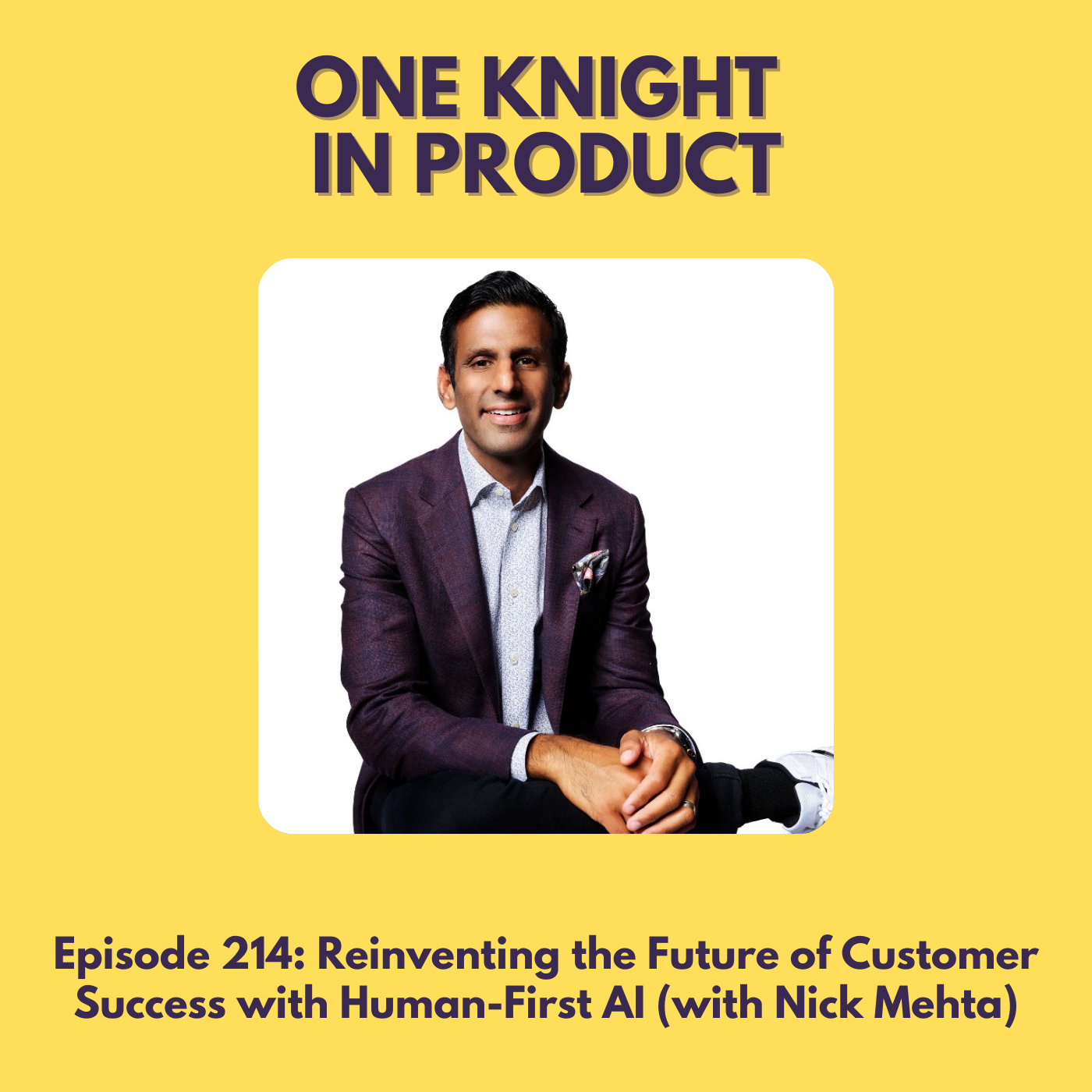
S1 Ep 214Reinventing the Future of Customer Success with Human-First AI (with Nick Mehta, CEO @ Gainsight)
ENick Mehta is the CEO of Gainsight, a leading customer and product experience platform that aims to be the operating system for your customer journeys. He's a passionate advocate for Customer Success as a function and as a business strategy, an author of several books on the topic, and recently super-excited about the future of Customer Success in an AI world. We talked about all of these topics and much more. A message from this episode's sponsor - Leadfeeder This episode is sponsored by Leadfeeder. No more not knowing who’s coming to your website, convert more leads and get a free trial at Leadfeeder.com: Check out Leadfeeder here. Episode highlights: 1. Customer Success is not the same as Customer Support Yes, they both have the same "CS" initials, and this can confuse people, but it's not the same role. Customer Success conceptually sits somewhere in between Sales and Customer Support and drives customer value and retention. Customer Success is also more than a role, it's a company strategy. It's also part of the product you sell. 2. The end of the zero-interest-rate climate has had a profound impact on Customer Success These days, CEOs and investors value profit today over profit tomorrow. Retention is a huge driver of pure profit, and it's one of the highest-leverage activities you can invest in for a recurring revenue business. On the flip side, leaders are looking to become as efficient as possible and reduce the human effort to drive this retention, leading to a requirement for digital customer success strategies. 3. Yes, you probably do need a Customer Success team in your organisation Chris Degnan (CRO at Snowflake) recently opined on the 20VC podcast that he sees no use for Customer Success teams and would immediately get rid of them. That doesn't work for everyone though, and there are many companies that legitimately need Customer Success teams. It's fair enough to say "Customer Success is a strategy" but someone needs to wake up thinking about this and having it as their biggest priority. Customer expectations are rising all the time, and not all products can look after themselves. 4. Product teams and Customer Success teams need to have a good relationship Too many teams have almost no relationship, or only speak when there's an escalation. Both teams have a legitimate claim to own the customer experience, but they should own it together. The best Customer Success teams don't just bring escalations, or even the "What" but the "Who" and the "Why". This makes the relationship strategic and helps build a great product. 5. AI is going to change everything, but it has to be human-first If you're not keeping up with AI you're going to be left behind. It's important to focus on the evolutionary and revolutionary changes that you can bring to your product. There need to be guardrails in your product to ensure that the customer experience doesn't degrade, and you need to be sensitive to the fears and paranoia of internal teams that might feel threatened... but it's going to happen so you need a strategy to survive and thrive in the AI-powered future. Check out "Digital Customer Success" "In Digital Customer Success: The Next Frontier, a team of trailblazing Customer Success professionals and digital entrepreneurs delivers an insightful discussion of the next stage in Customer Success management. In the book, you'll discover how to design and deploy touchless and automated digital interventions that help your software users learn and grow as they use your product and unlock the value trapped within it — without ever needing to reach out to a live Customer Success Manager. " Check it out on Amazon. Contact Nick You can catch up with Nick on LinkedIn or check out Gainsight. You can also check out the blog post that Nick mentions, The One Thing Billionaire Frank Slootman Got Wrong. Related episodes you should like: Is Product-Led Growth Really For You? (Leah Tharin, Product-Led Growth Guru & Head of Product @ Jua) Embracing Change to Innovate in Product Management (Greg Coticchia, CEO @ Sopheon) The Big Pivot to Reinvent Product Management (Yana Welinder, Founder & CEO @ Kraftful) Helping Superhero Startup Founders Stay Away from their Kryptonite (Richard Blundell, Founder @ Vencha & Co-author "The Go To Market Handbook for B2B SaaS Leaders") Andy Walters' Hot Take - We’re Soon Going to be Living in an AI-Assistant-First World (Andy Walters, CEO @ Emerge Haus & Generative AI Expert) Bjarte Rettedal's Hot Take - AI Models Should Be Under Public Ownership or Completely Transparent (Bjarte Rettedal, UX Designer) Greg Prickril's Hot Take - AI is going to change everything for Product Managers (Greg Prickril, B2B Product Management Coach, Consultant & Trainer) Debbie Levitt's Hot Take - Democratising our Work means AI is Going to Steal all our Jobs Sooner (Debbie Levitt, CXO @ DeltaCX and Author "Customers Know You Suck")
S1 Ep 213Rina Alexin's Hot Take - Our Stakeholders Are Just Doing Their Jobs & Product Managers Need To Understand Them Better (with Rina Alexin, CEO @ Productside)
Rina Alexin is the CEO of Productside, a leading product training and consulting company (formerly known as The 280 Group). Rina is passionate about furthering the craft of product management around the world. Her hot take? Product managers complain about stakeholders, but they're just doing their jobs and we need to spend some of our energy on understanding them and properly collaborating rather than treating them as annoyances. Find Rina on LinkedIn or check out Productside If you'd like to appear on Hot Takes, please grab a time! A message from this episode's sponsor - Leadfeeder This episode is sponsored by Leadfeeder. No more not knowing who’s coming to your website, convert more leads and get a free trial at Leadfeeder.com: Check out Leadfeeder here. Related episodes you should like: May Wong's Hot Take - Product Management is a Team Sport (May Wong, Product Operations Consultant & Coach) Untrapping Product Teams and Getting Rid of Bullsh*t Management (David Pereira, Author "Untrapping Product Teams") Dean Peters' Hot Take - There's More to be Said About the Instagram-ification of Product Management (Dean Peters, Principal Consultant & Trainer @ Productside) John Cutler's Hot Take - The Instagram-ification of Product Management is Driving us Crazy (John Cutler, Product Educator & Author @ The Beautiful Mess) Build Better Products at Scale with Product Operations (Melissa Perri & Denise Tilles, Product Consultants & Co-authors "Product Operations") Knowing your Customers, Seeking Evidence and Sticking up for Continuous Discovery (Hope Gurion, Product Leader and Team Coach @ Fearless Product) Transforming your Organisation to the Product Operating Model (Marty Cagan, Author "Inspired", "Empowered" and "Transformed") Applying Product Management Principles to Life (Miloš Belčević, Author "Build Your Way")

S1 Ep 212Andy Walters' Hot Take - We’re Soon Going to be Living in an AI-Assistant-First World (with Andy Walters, CEO @ Emerge Haus & Generative AI Expert)
Andy Walters is a long-time consultant who has recently focused his consulting work on supporting companies with GenAI adoption with his new firm, Emerge Haus. His hot take? Within the next few years, we're going to be moving to an AI-assistant-first operating model, and we can't stop it. There are too many financial incentives, but it might actually be better for users too; as consumers, but also potentially for their private lives too. Find Andy on LinkedIn or check out Emerge Haus If you'd like to appear on Hot Takes, please grab a time!

S1 Ep 211Bjarte Rettedal's Hot Take - AI Models Should Be Under Public Ownership or Completely Transparent (with Bjarte Rettedal, UX Designer)
Bjarte Rettedal is a photographer-turned looking to take his interest in behavioural economics and systems thinking and pursue a career in UX design. His hot take? AI models should be under public ownership or at the very least fully transparent. We don't let people release supplements or medicines without extensive testing, so why are we OK with something as potentially high-impact as AI models? Find Bjarte on LinkedIn or bjarterettedal.com If you'd like to appear on Hot Takes, please grab a time!
S1 Ep 210Greg Prickril's Hot Take - AI is going to change everything for Product Managers (with Greg Prickril, B2B Product Management Coach, Consultant & Trainer)
Greg Prickril is a B2B Product Management coach, consultant and trainer who has gone all-in on AI and is bullish about the impact that he thinks it'll have on product management. His hot take? AI is going to change everything about product management. It's going to mean fewer jobs are required to deliver products, but it also opens up opportunities for business-focused product managers to make a real impact in their jobs, and accelerate them in doing so. Find Greg on LinkedIn, Prickril.com or https://www.coachpms.com/ If you'd like to appear on Hot Takes, please grab a time! A message from this episode's sponsor - Leadfeeder This episode is sponsored by Leadfeeder. No more not knowing who’s coming to your website, convert more leads and get a free trial at Leadfeeder.com: Check out Leadfeeder here.
S1 Ep 209May Wong's Hot Take - Product Management is a Team Sport (with May Wong, Product Operations Consultant & Coach)
May Wong is a product operations consultant and coach who also runs ProductTO, an in-person product management meetup in Toronto. Her hot take? Product management is a team sport, and too much product management literature focuses on what the product manager should do, not what the team should do. If you'd like to appear on Hot Takes, please grab a time! A message from this episode's sponsor - Leadfeeder This episode is sponsored by Leadfeeder. No more not knowing who’s coming to your website, convert more leads and get a free trial at Leadfeeder.com: Check out Leadfeeder here.

S1 Ep 208Untrapping Product Teams and Getting Rid of Bullsh*t Management (with David Pereira, Author "Untrapping Product Teams")
EDavid Pereira is a product leader, speaker and regular blogger who loves to contribute to the wider Agile and Product communities with insights from his own career, including some of the mistakes he's made and not just the successes. David was recently tempted into writing a book, the newly released "Untrapping Product Teams" where he provocatively rails against "bullshit management" and tries to inspire us all to affect change in our organisations (but step-by-step). We talked all about themes from the book, as well as what it meant to have an endorsement from Marty Cagan. Episode highlights: 1. When someone starts doing something differently and delivering value, people get curious Sometimes it can seem almost impossible to change things yourself, but you don't have to change it all at once. If you can start showing the impact of smaller changes that deliver value then you can get both interest and buy-in from stakeholders. This gives you permission to try more things. 2. The more bullshit you handle the less value you create David coined the term "bullshit management" to represent the work you have to do in many low-performing product companies. Bullshit management is where you spend all your time working on the work around the work, prioritising requirements with no context and being actively prevented from delivering value to your users, and it has to stop. 3. Collaborative flow trumps coordinative flow Coordinative flow is when you spend more time in meetings about the work and struggle to align people than you do actually doing the work. It's focused on outputs and gives you someone to blame when it goes wrong. Collaborative flow is when teams come together to work on problems... collaboratively and use what they know to uncover what they don't know. 4. You don't need to die on every hill Sometimes you have to hold your nose and do things in ways that you don't believe are effective, or actively destructive. This is part and parcel of the job and something you have to get used to. As long as you can find small ways to make an impact in some areas, you can give way in other areas. Rome wasn't built in a day. 5. If you really want to make an impact, ask more questions than you give answers We're all primed to look clever and give answers as quickly as we can but product people need to think deeper than that and ask good questions. Why do we really need that? What does success really look like? What don't we know? Check out "Untrapping Product Teams" "Untrapping Product Teams guides you to simplify what gets unintentionally complicated and equips you to overcome dangerous traps while steadily driving customer and business value. This isn't just another book about product management. It's a thought-provoking guide filled with simplicity, encouraging you to act today for a better tomorrow." Check it out on Amazon. Contact David You can catch up with David on LinkedIn or check out his website. Related episodes you should like: Survive the Feature Factory by Applying Product Thinking to Product Thinking (John Cutler, Product Evangelist & Coach @ Amplitude) Build High Growth Products by Following the Product Science Success Path (Holly Hester-Reilly, Founder @ H2R Product Science) Pragmatic Digital Transformation in Traditional Industries (Dan Chapman, Director, Product Line Leader @ Merck) Optimising Product Planning with the Quartz Open Framework (Steve Johnson, Product Coach) Servitising Product Management & Setting Up Product Teams For Success (Jas Shah, Product Consultant) Surviving a Lack of Product Thinking & Riding the Product Maturity Curve (Nis Frome, VP Product @ Feedback Loop) Is this Seriously Game Over for Scrum? (David Pereira, Editor @ Serious Scrum) Transforming your Organisation to the Product Operating Model (Marty Cagan, Author "Inspired", "Empowered" and "Transformed")

S1 Ep 207Dean Peters' Hot Take - There's More to be Said About the Instagram-ification of Product Management (with Dean Peters, Principal Consultant & Trainer @ Productside)
Dean Peters is a former opera singer turned product management leader, coach and educator who works with Productside to uplevel teams. His hot take? That there's more to say about the Instagram-ification of product management, the root causes and contributory factors. If you'd like to appear on Hot Takes, please grab a time! A message from this episode's sponsor - June This episode is sponsored by June. June is a user retention hub for early-stage B2B SaaS companies that enables early-stage B2B SaaS companies to understand and act on their product usage, dig into activation, churn and key feature usage. Check out June here. Related episodes you should like: Survive the Feature Factory by Applying Product Thinking to Product Thinking (John Cutler, Product Evangelist & Coach @ Amplitude) The Five Dysfunctions of Product Management Teams (Saeed Khan, Founder @ Transformation Labs) Practice Makes Perfect: Embracing the Messy Reality of Product Management (Matt LeMay, Product Management Consultant & Author "Product Management in Practice") John Cutler's Hot Take - The Instagram-ification of Product Management is Driving us Crazy (John Cutler, Product Educator & Author @ The Beautiful Mess) Applying Product Management Principles to Life (Miloš Belčević, Author "Build Your Way") Nils Davis's Hot Take - Product Managers Need to Tell Better Stories on their Resumes (Nils Davis, Resume Coach & Go-to-Market Consultant @ Confidence & Impact LLC) Debbie Levitt's Hot Take - Democratising our Work means AI is Going to Steal all our Jobs Sooner (Debbie Levitt, CXO @ DeltaCX and Author "Customers Know You Suck") Build Better Products at Scale with Product Operations (Melissa Perri & Denise Tilles, Product Consultants & Co-authors "Product Operations")
S1 Ep 206Accelerating Your Product Leadership Job Hunt (with Aakash Gupta, Author "Product Growth" Newsletter)
Aakash Gupta is a product leader turned author and professional newsletter writer, with a huge following on LinkedIn and Twitter. He writes regularly on product management principles, and personal and career growth and recently put out an article about nailing the product leadership job search. We also recently collaborated on an article about fractional product leadership! In this interview, I spoke to Aakash about his journey into full-time content creation and some of the lessons he learned about the product leadership job search. Episode highlights: 1. The product leadership job market is slowly coming back to life It's been tough out there, and loads of amazing people have been laid off and struggled to find new roles. Some might doubt they'll ever get another job again! But there are good and great jobs available if you know where to look. 2. Many of the best jobs aren't advertised in public and relationshps are everything There's a "dark web" of networking and personal relationships, without which you might struggle to get introduced to some of the jobs. At the highest level, the majority of jobs are not posted publicly. Whether you like it or not, you need to play the game and build strategic relationships with boutique recruiters and especially investors. 3. You need to prioritise the type of job you want and it's not all about money Most people are trying to optimise for something in their new job. Maybe it's a big pay packet. Maybe it's a mission they believe in. Maybe it's the stage of company, influence and impact. There's no wrong answer, but make sure you know what you're getting yourself into and what success looks like. 4. Try to make your career look linear to land the role you want Many of us have squiggly careers and we've bounced between industries or types of company. This is fine, but if you're looking to get a job in a particular niche then you need to optimise your career narrative to tell a story about why YOU are the person for that niche. 5. Many leaders are still biased towards Big Tech employees, but you can beat the odds Some founders or business leaders will always prioritise someone with a stellar name on their CV, and this can leave people who have worked for lesser-known companies feeling adrift. However, you can take a strategic view of your job search, outwork and outsmart your competition. Contact Aakash You can catch up with Aakash on LinkedIn, or Twitter or check out his newsletter. Related episodes you should like: Connecting Product Management to Business Goals by Mastering your Product Strategy (Gabrielle Bufrem, Product Leadership Coach & Advisor) Moving Beyond Founder-Led Product Development & Setting PMs up for Success (Jennifer Yang-Wong, VP of Product @ Contrary) How to Build Products when the Founder IS the Product (Saagar Bains, Fractional Product Leader & Former Head of Product @ The Body Coach) Landing That Perfect Role by Finding Your Inevitable Edge (Erika Klics, Job Search Strategist & Founder @ ErikaKlics.com) Supporting the Next Generation of Female Product Managers with Women in Product UK (Namrata Sarmah, Founder @ Women in Product UK & CPO @ INTO) Making our Product Teams Stronger through Building Communities of Practice (Petra Wille, Author "Strong Product People" and "Strong Product Communities") Nils Davis's Hot Take - Product Managers Need to Tell Better Stories on Their Resumes (Nils Davis, Resume Coach & Go-to-Market Consultant @ Confidence & Impact LLC) Transforming your Organisation to the Product Operating Model (Marty Cagan, Author "Inspired", "Empowered" and "Transformed")
S1 Ep 205Nils Davis's Hot Take - Product Managers Need to Tell Better Stories on their Resumes (with Nils Davis, Resume Coach & Go-to-Market Consultant @ Confidence & Impact LLC)
Nils Davis is a resume coach who wants product managers to realise they're AMAZING, and help others realise it too. His hot take? That the majority of product managers are doing themselves a disservice by producing resumes that simply list a bunch of tasks that pretty much all product managers have done. If you'd like to appear on Hot Takes, please grab a time at https://www.oneknightinproduct.com/hot Visit Nils's site: https://perfectpmresume.com/ Nils on LinkedIn: https://www.linkedin.com/in/nilsdavis/
S1 Ep 204John Cutler's Hot Take - The Instagram-ification of Product Management is Driving us Crazy (with John Cutler, Product Educator & Author @ The Beautiful Mess)
EJohn Cutler is a systems overthinker, product educator and author of "The Beautiful Mess" newsletter. His hot take? That the Instagram-ification of product management sets unrealistic standards, and is driving us all crazy. If you'd like to appear on Hot Takes, please grab a time!

S1 Ep 203Debbie Levitt's Hot Take - Democratising our Work means AI is Going to Steal all our Jobs Sooner (with Debbie Levitt, CXO @ DeltaCX and Author "Customers Know You Suck")
Debbie Levitt is a UX and CX consultant, the author of a few books, including "Customers Know You Suck" and runs a thriving community of UX professionals. Her hot take? That if we are all fine doing each other's jobs (and maybe not doing them well) then AI can do all of our jobs today. Also available on YouTube: https://www.youtube.com/watch?v=lT5IBKsIE-E&ab_channel=OneKnightinProduct
S1 Ep 202Build Better Products at Scale with Product Operations (with Melissa Perri & Denise Tilles, Product Consultants & Co-authors "Product Operations")
EMelissa Perri is the renowned author of "Escaping the Build Trap" and a well-known product consultant and educator. She has worked for a long time with Denise Tilles, another seasoned product leader, with whom she has been evangelising Product Operations to help scale product companies effectively. They recently collaborated on a book, coincidentally called "Product Operations", and we spoke all about the story behind the book and the themes within it. Saeed Khan and I are planning a new course - please give us your feedback! The relationship between product management and sales teams is traditionally tricky, and a common complaint from B2B PMs. Saeed Khan and I are looking to help with this with an online course and we'd love your feedback on your relationship with sales. This will help shape the course and, if you want to take part when the course is ready, we'll give you a special discount. Please fill in the survey here. Thanks! Episode highlights: 1. Product Operations is about helping product managers make faster, better-quality decisions It's important to dispel the myth of multi-armed product managers who can just do everything. There's too much for everyone to do! This creates barriers to doing great product management work and pulls product managers away from doing the real, value-add product management work that they're judged on. 2. There are three pillars of product operations... The three pillars are ways to think about how to organise enablement. They are "Business & Data Insights", "Customer & Market Insights" and "Process and Practices". They are all the foundation of good product decision-making, and all companies will have a certain level of maturity already. 3. ... But you don't need to build all the pillars all at once You don't need to fix everything at once. If you already have good capabilities in one or more areas, fix the ones that you don't have good capabilities in! You don't need to boil the ocean, just find the biggest gaps and opportunities to improve, and start to work on them. 4. Process shouldn't be seen as a dirty word There's such a thing as too much process but, even if you don't call it process or try to define it, all work involves a process. It's important to have people to oversee the process at scale, prevent duplication or rework, and make sure that process is right-sized rather than ever-expanding. 5. The first step is being honest about your current state There are plenty of ways to go with product operations as you scale, but the most important thing is being really honest with yourself about what your most important limiting factors are, what your product managers are spending time on and what's going to work for you. Check out "Product Operations" "Many companies want to reap the benefits of economies of scale that comes with being a product-led company. As our businesses change shape to focus more on software, so do our ways of working. We need to make sure we’re breaking down these silos of information and capabilities that arise at scale. To react quickly and set great Product Strategies, leaders and team members alike need access to high-quality data and a process to implement their decisions." Check it out on Amazon or the book website. Check out "Escaping the Build Trap" "To stay competitive in today’s market, organizations need to adopt a culture of customer-centric practices that focus on outcomes rather than outputs. Companies that live and die by outputs often fall into the "build trap," cranking out features to meet their schedule rather than the customer’s needs. In this book, Melissa Perri explains how laying the foundation for great product management can help companies solve real customer problems while achieving business goals. " Check it out on Amazon. Contact Melissa & Denise You can catch up with Melissa at melissaperri.com, check out https://productinstitute.com or follow her on LinkedIn. You can catch up with Denise at denisetilles.com or follow her on LinkedIn. Escaping the Build Trap with Product Operations and Strong CPOs (Melissa Perri, Product Management Leader, Educator & Author "Escaping the Build Trap") OKRs: The Gateway Drug to Agility & Good Product Management (Jeff Gothelf, Product Management Consultant & Co-author "Lean UX" ) Achieving Product Excellence with the Product Operations Manifesto (Antonia Landi, Product Ops Consultant & Co-Author "Product Operations Manifesto") Adventures in Product Management (Dan Olsen, Author "The Lean Product Playbook") Going Global! When and How to Take your Product International (Chui Chui Tan, International Growth Adviser & Director @ Beyō Global) Your Product is a Joke - How to use Improv Comedy Principles in Product Management (Amogh Sarda, Co-founder @ Eesel) Leading & Evolving Product Teams Through Hyperscale (Brian Shen, Product Director @ ClickUp) Optimising Product Planning with the Quartz Open Framework (Steve Johnson, Product Coach)

S1 Ep 201Knowing your Customers, Seeking Evidence and Sticking up for Continuous Discovery (with Hope Gurion, Product Leader and Team Coach @ Fearless Product)
Hope Gurion is a seasoned product coach and one of Marty Cagan's recommendations from his new book, "Transformed". Hope also works closely with Teresa Torres, teaching continuous discovery, as well as working directly with incoming product leaders to help them make an impact in their organisations. We spoke all about knowing your customers, gathering evidence, and whether continuous discovery is really a threat to user researchers. Episode highlights: 1. Product coaching is more than just being there to ask good questions When working with incoming product leaders, potentially without a product background at all, it's important to have a coach who has product experience who can help you identify your weaknesses, assess the state of play and provide actionable advice. Ultimately, it's important to empower the coachee. 2. It's really hard to make decisions if you have no idea who your customers are It's important to define who your target customer is and what are their key attributes. This could be demographics, firmographics or whatever characteristics you need to know who you most need to learn from to calibrate your decisions as a product team. But, too many product teams end up resorting to proxies in other functions who "know the customers". 3. Many leaders are overconfident, but evidence is everything Some people are just naturally confident about everything and can react badly if their ideas are challenged. But, as product people, we absolutely need to look beyond innate confidence and work out what informed the perspective. Which customers are we basing it on? Can I speak to some of those customers? It's not about trashing people's ideas but moving forward with confidence. 4. It's important to get comfortable with making bets and understanding the difference between one-way and two-way-door decisions Sometimes teams get stuck into cycles of trying to do "perfect research", possibly because they're afraid that they're only going to get one shot at it. This means that they end up not making any moves at all, and everyone ends up getting frustrated at the amount of time product teams take to do anything. 5. Continuous discovery is about removing as many blind spots as possible and probably isn't responsible for mass user research lay-offs All teams have an imperfect understanding of their product, the pain points associated with their product and their customers. Continuous discovery helps address this by removing blind spots but doesn't aim for perfection - simply evidence about how to make your next move. Is it contributing to user researcher lay-offs? It feels difficult to argue this when it feels like the majority of companies don't do any user research in the first place. User researchers and continuous discovery can co-exist. Contact Hope You can catch up with Hope at Fearless Product or follow her on LinkedIn. Related episodes you should like: Data-Informed Decision Making and the Three Cs of Product Management (Roger Snyder, VP of Products & Services @ 280 Group) Adventures in Product Management (Dan Olsen, Author "The Lean Product Playbook") Getting into the Habit of Continuous Discovery (Teresa Torres, Author "Continuous Discovery Habits") Build High Growth Products by Following the Product Science Success Path (Holly Hester-Reilly, Founder @ H2R Product Science) Selling Product Thinking by Influencing Companies at the Right Time (Anthony Marter, Product Coach) Putting Customers at the Heart of your Product Decisions (Hubert Palan, Founder @ Productboard) Servitising Product Management & Setting Up Product Teams For Success (Jas Shah, Product Consultant) Build What Matters with Vision-Led Product Management (Rajesh Nerlikar, Author "Build What Matters")

S1 Ep 200Transforming your Organisation to the Product Operating Model (with Marty Cagan, Author "Inspired", "Empowered" and "Transformed")
EMarty Cagan is the founder and a partner at Silicon Valley Product Group, a leading product consultancy that aims to get companies to work "the way that the best companies work". He is the author of two desk references for product managers: "Inspired", aimed at product teams, and "Empowered", aimed at product leaders. He has since come to realise that "the way the best companies work" is too vague a term, and also that many companies have no idea where to get started. He's now back with "Transformed", a book that aims to get companies to adopt the Product Operating Model. A message from this episode's sponsor - New York Product Conference Join hundreds of other product people in New York City on April 18th 2024 for the New York Product Conference! You'll learn from some of the best minds in product today — including Dennis Crowley (Founder of Foursquare), Sahil Lavingia (Founder of Gumroad), April Dunford (product positioning expert and bestselling author) and so many others through masterclass keynotes, interactive working sessions, small group discussions and more. Topics covered include Product Strategy, Product Leadership, AI for Product Managers, Customer Research, and more. Pricing increases on the first of the month, so you'll want to register soon. Plus, use the code OneKnightInProduct and save another $50 when you register! Episode highlights: 1. It was finally important to give the Product Operating Model a name Whilst Marty doesn't like to unnecessarily label things, or have any sniff of "process" for the sake of process, he started to realise that just saying "the way the best companies work" was too vague and handwavy. However, the core principles of great product companies and product teams have not changed, and this isn't a framework. 2. Marty and SVPG didn't invent any of this stuff, and you shouldn't listen to him (or anyone) uncritically These days, it's fashionable to beat up product "thought leaders" and complain that they're being too dogmatic, idealistic, or unrealistic. But, SVPG didn't invent any of these principles, they just observed them in the best-performing product companies. It's still important to apply critical thinking and make sure they make sense to you and your organisation. 3. Product managers and product leaders have more power and more responsibility than they realise It's not always easy to transform, and there are limits to how far you can go bottoms-up, but you can generally make progress one step at a time. There's an incredible amount of onus on product leaders to evangelise and champion this change and, if they can't (or won't) do it, they shouldn't be product leaders. 4. Not everyone in an organisation will understand why it's transforming, or want to be transformed It's easy to see this as something that just affects product teams, but the whole organisation needs to buy into the change. Reading bits of "Inspired" at them, or talking about the number of experiments you've done this week, is unlikely to sway them, You need to show business results and real impact and make them care about it on their terms. 5. There are four key competencies for a successful transformation, and they need investing in The competencies remain the same... Product Managers, Product Leaders, "proper" Product Designers (not just pixel pushers) and Tech Leads who care as much about what they're building as how they're building it. If you just expect to get results with a disengaged, outsourced engineering team, graphic designers and product owners, you're going to be disappointed. 6. Sometimes you need help to know what good looks like It's easy for people like us to sit there and talk about the benefits of product transformation and how we should all definitely do it but, for some people, this is all alien. In cases like this, a good product coach can be the difference between success and failure. But, there are so many product coaches these days, so make sure you get a good one. Check out "Transformed" "The most common question after reading INSPIRED and EMPOWERED has been: "Yes, we want to work this way, but the way we work today is so different, and so deeply ingrained, is it even possible for a company like ours to transform to the product model?" TRANSFORMED was written to bridge the gap between where most companies are right now and where they need to be. The leaders of these companies know they must transform to compete in an era of rapidly changing enabling technology, but most of them have never operated this way before. " Check it out on Amazon. Check out "Empowered" "Most people think it’s because these companies are somehow able to find and attract a level of talent that makes this innovation possible. But the real advantage these companies have is not so much who they hire, but rather how they enable their people to work together to solve hard problems and create extraordinary products. The goal of EMPOWERED is to provide you, as a leader of product management, product de
S1 Ep 199Applying Product Management Principles to Life (with Miloš Belčević, Author "Build Your Way")
Miloš Belčević is a product manager and author who believes that product management principles are powerful not only when managing products, but also when managing the ultimate product; your life itself. He has written a book on the subject, "Build Your Way: Applying Product Management to Life". We spoke about the book as well as some of the lessons inside. Episode highlights: 1. We can apply product management principles to life We can apply product management principles to one's life, beyond just professional settings. This includes using prioritisation frameworks to manage personal goals and tasks, and considering whether there's a "North-Star metric" that can help guide personal growth and decision-making. 2. Context switching can be hell at home as well as work Whether we're switching contexts between different roles in our careers or having to balance multiple responsibilities, we can apply product management strategies to help us prioritise our time and manage our mental bandwidth. 3. We can define "Value" for our life as well as our products There's no magic formula for "value", but it's important to understand the deeper meaning of the concept of value, whether delivering value to customers or identifying what brings value to one's life. 4. Our time is limited and we need to prioritise what's most important to us We don't have to use prioritisation frameworks for everything, but applying product management prioritisation techniques can help us focus on what is most important. If we practice enough, we can get into the habit, and it even becomes somewhat intuitive to our life decisions. 5. Product discovery techniques can foster better interactions and conversations in life We can use our empathic and discovery mindset to help solicit genuine feedback and dig into people's motivations in conversations. This offers the tantalising prospect of being able to bridge ideological divides and improve the quality of our interactions with society as a whole. Check out "Build Your Way" "Perhaps you have heard about product management. Maybe you use it in your work. If that’s the case, chances are high that you know that product management is full of useful frameworks, principles, and tools that focus on prioritization and maximizing value, better planning, agile delivery, and more. But what if you want to use these tools in your personal life? How would you do that in a way that will make sure you will live a better, happier, and more fulfilled life? In this book, author Miloš Belčević will show you how." Check it out on Amazon. Contact Miloš You can catch up with Miloš on LinkedIn or check out his website. Related episodes you should like: Survive the Feature Factory by Applying Product Thinking to Product Thinking (John Cutler, Product Evangelist & Coach @ Amplitude) Practice Makes Perfect: Embracing the Messy Reality of Product Management (Matt LeMay, Product Management Consultant & Author "Product Management in Practice") The Seven Deadly Mistakes of Productization (Eisha Armstrong, Co-founder @ Vecteris & Author "Productize") Achieving Product Excellence with the Product Operations Manifesto (Antonia Landi, Product Ops Consultant & Co-Author "Product Operations Manifesto") Paying Off Your Organisation's Human Debt Through Agility & Psychological Safety (Duena Blomstrom, Founder & CEO @ People Not Tech) Embracing Change to Innovate in Product Management (Greg Coticchia, CEO @ Sopheon) Fearlessly Defeating the Four Horsemen of a Product-Friendly Culture (Eisha Armstrong, Co-founder @ Vecteris & Author "Productize" & "Fearless") Pragmatic Digital Transformation in Traditional Industries (Dan Chapman, Director, Product Line Leader @ Merck)
S1 Ep 198Standing up for User Research... and User Researchers (with Debbie Levitt, CXO @ DeltaCX and Author "Customers Know You Suck")
EDebbie Levitt is a long-time UX and CX consultant who wants us all to get better at putting our users at the centre of the conversation, rather than paying lip service. She's the author of a few books, including "Customers Know You Suck" and runs a thriving community of UX professionals. Some of the stories from that community have concerned her, alongside the general perceived decline of the strategic role of UX, and she recently came out all guns blazing against continuous discovery, PM-led research, and one particular author who champions it. We spoke about the role of UX and CX in organisations, what's happening to user researchers, and whether PMs are really to blame for it. Episode highlights: 1. User Experience and Customer Experience used to be the same thing, and they can be again In these digital days, it seems like most people think UX people are just there in the corner to colour in people's ideas, but UX should be a strategic role that enables user and customer-focused decision-making and makes sure we always balance our business's needs with those of our users. 2. We prize and prioritise speed over quality - we just have to get it done We've been moving fast and breaking things for long enough now to realise how often it doesn't work. User research feels unconscionably slow to some people, but it doesn't have to be slow, and doing good user research (whoever does it) is an investment in trying to get things right. 3. No matter how much product managers feel they're disempowered, they're still the Golden Children of the company Back in the old days, product managers were hiding in the corner with the UX people, as agilists and engineers rode through the company calling all the shots. Now the UX people are hiding with the engineers whilst the PM makes all of the decisions. There's a power imbalance, and it's not a true "trio". 4. User researchers are getting laid off, some of the jobs are gone for good and, at least in some cases, this is because leaders think they can just hand the work off to PMs It's not fair or reasonable to lay all of this at the doors of PM thought leaders championing certain approaches. There are plenty of UX thought leaders who champion them too. But, people are getting laid off and at least some of them are blaming PM-led product discovery as the root cause. 5. We should be able to look at books and take what works from them, but apply critical thinking and ensure that we don't follow any message blindly Most books have something useful in them, and all approaches can work in some contexts. Debbie has her approach, others have their approaches, and there's no one "right way". But, it's important to make sure that approaches can be challenged, expanded upon, and that the approaches and techniques are described clearly and without room for interpretation. Check out "Customers Know You Suck" "Customers Know You Suck is the how-to manual for customer-centric product-market fit. Its highly actionable models, maps, and processes empower everyone to improve the Customer Experience (CX). Learn how to investigate, diagnose, and act on what's blocking teams. Gather the evidence and data that better inform decisions, leading to increased satisfaction, conversion, and loyalty. Use our governance model for implementing and monitoring the progress, success, and failure of internal process changes and experiments." Check it out on Amazon or pay what you want. Check out how to use a Knowledge Quadrant Debbie is a fan of doing good discovery, naturally. Here's a video of an approach she recommends called the Knowledge Quadrant: Workshop: Discovery Phase - Knowledge Quadrant Contact Debbie You can catch up with Debbie on LinkedIn or check out Delta CX. Related episodes you should like: Using Solution Tests to Make Sure You're Building Products Users Want (Jim Morris, Founder @ Product Discovery Group) Getting into the Habit of Continuous Discovery (Teresa Torres, Author "Continuous Discovery Habits") We're All Responsible For Accessible Product Design (Holly Schroeder, Senior UX Researcher & Accessibility Advocate) Making Sure You Make an Impact through User Research (Steve Portigal, User Research Consultant & Author "Interviewing Users") Product Leadership Principles for Tumultuous Times (Giff Constable, Author "Talking with Humans" & "Testing with Humans") How to Deploy Empathy to Truly Understand User Needs (Michele Hansen, Author "Deploy Empathy") Chinese Startup Culture & Putting the Minimum into MVP (Carlos Lastres, Creative & Marketing Director @ Kaiyan Medical) Building a Culture of Continuous Discovery (Cindy Alvarez, Author "Lean Customer Development")

S1 Ep 197Building Great Companies through Community-Led Growth (with Lloyed Lobo, Author "From Grassroots to Greatness")
ELloyed Lobo got his first understanding of the power of community when visiting his grandparents in the Mumbai slums, and watching people come together in his childhood during the Gulf War. He has since turned this into an entrepreneurial superpower and used community-building to catapult his bootstrapped startup into the big time. He's since written a book about all of this stuff called "From Grassroots to Greatness: 13 Rules to Build Iconic Brands with Community-Led Growth". We spoke about the book and many of the topics within. Episode highlights: 1. Community is a company strategy, not a marketing strategy It's not enough to just sit there and layer "community" on top of your existing marketing and expect it to pay back instantly. It has to be part of your company's DNA, something that your customers and your employees can be inspired and motivated by. Attribution is hard, but the results will come. 2. You need to show up for your community or they won't show up for you You cannot take your community for granted. You need to provide them with constant, consistent value with no immediate expectation of reward. They will keep coming for the value, and you are engineering serendipity for future conversations. 3. Don't be afraid to have the sales conversations That said, if you don't ask, you don't get. You cannot be afraid of trying to offer paid value to your community, even if it feels uncomfortable to ask. If you are providing value then people will be happy to talk to you. Not everyone will become a customer, but some will. Use the reciprocity bias to your advantage. 4. There is power in finding your niche and sticking to it Don't try to go too wide chasing vanity metrics. You will get more value out of a smaller community of people who share your exact passions than out of a generic sea of people who couldn't care less. Make sure you identify your people, show up for them, and own your white space. 5. Community can be as much of a moat as technology or industry expertise There are more communities and products to solve problems for communities than ever before but, if you have the right community, you can use it to your advantage. Having an engaged, passionate community can help prevent your company from becoming a commodity. Check out "From Grassroots to Greatness" "In a world where traditional marketing is losing its edge and products are struggling to stand out, a thriving community is your biggest asset. Recognizing that true success lies not in products or technologies, but in the power of people, author Lloyed Lobo explores the intricate art of harnessing the community's strength as your ultimate acquisition channel, brand differentiator, feedback source, retention lever, and catalyst for transformative change." Check it out on Amazon. Contact Lloyed You can catch up with Lloyed on LinkedIn or Instagram.

S1 Ep 196Harnessing Generative AI to Reimagine the Future of Product Management (with Shyvee Shi, Product Lead @ LinkedIn & Author "Reimagined: Building Products with Generative AI")
Shyvee Shi is a Product Lead at LinkedIn, a community-builder, content creator and educator. She's been making waves through her online courses but she's now co-authored a book, "Reimagined: Building Products with Generative AI", which aims to help all of us survive and thrive in the new normal of AI-powered products. We talked about some of the themes from the book, and why it was important for her to write it. Episode highlights: 1. Now is the time for product managers to get into generative AI Whether you're experimenting with putting it in your own products or using it to turbocharge your product management duties, you need to check out generative AI if you want to stay ahead of the curve. It's not going to replace product managers any time soon, but it can help us dream bigger. 2. If your competitors can use AI to serve your customers better than you, your business could disappear overnight 75% of CEOs are terrified that generative AI will kill their business. It's like the Kodak story on steroids, and it's not even about tankers getting outmanoeuvred by speedboats anymore. Big companies are also getting in on the game and you need to have a response. 3. PMs have a responsibility to concentrate on the problem, not the technology It's as important as ever for product managers to focus on solving real user problems, no matter what the tech. We can't just slap ChatGPT onto everything and call it a success. Generative AI can help us and our customers in new and interesting ways but we must concentrate on solving their real problems. 4. It can be hard to craft a workable go-to-market plan for AI products This could be down to falling in love with the technology, struggles with pricing or quality, lack of explainability or poor understanding of your customers' most important jobs to be done. Make sure you're intentional about your go-to-market plan to avoid failure. 5. It can be hard to create moats when using generative AI solutions So many of these solutions are built on the same back-end, and there are de facto default LLMs. In some cases, startups building on top of things like ChatGPT end up disappearing overnight because OpenAI has developed a new feature of its own. It is possible to create moats through proprietary data, excellent UX and good old-fashioned verticalisation. Make sure you create a moat! Buy "Reimagined" "Did you know that incorporating AI into products is now a pivotal strategy for businesses worldwide? According to a 2023 study from Accenture, a staggering 75% of C-suite executives agree that failure to integrate AI effectively in the next five years could lead to business obsolescence. "Reimagined: Building Products with Generative AI" is your essential guide in this transformative journey. It's not just about understanding AI and Generative AI technologies; it's about strategically harnessing them to drive innovation, team efficiency, and market success. Check it out on Amazon. Contact Shyvee You can catch up with Shyvee on LinkedIn or check out Product Management Reimagined.

S1 Ep 195Enabling Strategic Product Decisions through Product Operations and Portfolio Management (with Becky Flint, CEO of Dragonboat)
Becky Flint started her career at Paypal and helped build out their portfolio management and product operations functions before product ops was a thing. She's since moved through a variety of startups and larger companies before forming her own firm, Dragonboat, through which she hopes to provide tools to help companies manage product portfolios at scale. Episode highlights: 1. Even if you have one product, you might still have a portfolio People tend to think about a product portfolio, they think about a massive web of products, but even one-product companies may have multiple product managers working on different aspects of the product and these may well still need to be traded off against each other. 2. It's not enough to make strategic decisions, you need to be able to explain them We're always told to create visions, strategies and roadmaps, but you need to be able to lay these out for a variety of stakeholders and explain them in ways that resonate with them. 3. As soon as you have product management, you have product operations You may not have a Product Ops team, but someone is doing the product ops work. When you have a small team, maybe you can handle the work but, eventually, you'll need a team to ensure the product teams deliver. 4. All product operations professionals should be comfortable with portfolio management Going further, product ops professionals who aren't comfortable with managing a portfolio shouldn't be in the job. Product ops people aren't babysitters for the product management team, they're senior, strategic partners. 5. ROI isn't enough to make good strategic decisions for your portfolio Sometimes, you might not make big, strategic bets with unclear payoffs if you only use financial ROI metrics. You may also make bad resourcing decisions if you don't consider which teams are available when, and not taking account of bundles of value when making trade-offs. Contact Becky You can connect with Becky on LinkedIn. You can also check out Dragonboat. Alongside their SaaS software, they also have a bunch of available resources.

S1 Ep 194Nailing your Brand Marketing by Embracing your Zone of Genius (with Orly Zeewy, Brand Strategy Consultant & Author ”Ready, Launch, Brand”)
Orly Zeewy is an experienced marketer who "makes the fuzzy clear". She's passionate about helping startup founders get their branding right, and enabling them to identify their own "zones of genius" where they win. She does this through her consultancy, Zeewy Brands, as well as her book, "Ready, Launch, Brand". We spoke all about the ins and outs of branding, and why startup founders need to rethink marketing. A message from this episode's sponsor This episode is sponsored by Succeeding in B2B Product Management, a cohort-based, live course that Saeed Khan and I are launching on Maven in January. If you're a B2B product manager struggling to make an impact, a B2B product leader looking to promote healthy product practices, or a B2B founder looking to get your teams to be true business partners, check the course out here. You can use discount code OKIP to get $100 off the price of admission. Episode highlights: 1. Branding is not just a fancy logo and a cool company name The true definition of a brand is that it is the sum of all experiences that customers have with an organisation over time. Brands don't live in the minds of the company, or its founders. They live in the minds of their customers. 2. Marketing is not just a widget, it's a fundamental cost of running your business, and results take time Some startup founders either don't bother with marketing at all, or they give up as soon as the first thing they try doesn't work. But, you need to start early and invest for the long term. There are so many brands competing for mindshare and you need to make sure that you remain part of that in an attention-poor market. 3. Your company website is your front door, and you need to explain clearly why people should care about you It can be pretty common for companies to either ignore their website entirely or try to cram as much information as possible on there and overwhelm potential customers. Your website is likely to be the first touchpoint that a potential customer has with your brand, and you need to clearly and concisely explain why they should care about you. 4. Not everyone has done this work upfront, but it's important to meet people where they are Yes, it's easier to intercept avoidable problems before they occur, but there are plenty of good conversations you can have whatever the situation within the company. It's never too late to try to make a difference, and you can find that the entire company will get energised and rally to the cause once you've put the work in to define what the cause really is. 5. People, and organisations, have Zones of Genius and they should focus and stay in their lane It can be really common for founders and solopreneurs to try to solve every problem for everyone because they're interested in everything and they think that it will increase their chances of success. But, if you can find the thing you're uniquely good at and focus your efforts there then you have a much higher chance of sticking in someone's mind and being their go-to solution for that specific problem. Buy "Ready, Launch, Brand" "You may be familiar with the Silicon Valley expression about the iterative approach to software development, "We’re learning to fly the plane while we’re building it." If so, think of a startup―with all its moving parts, phases, and personalities―as flying a plane, while you’re building it, booking passengers, marketing the airline, interviewing co-pilots, and serving coffee. In this book, Orly Zeewy navigates the turbulence and provides a flight plan so you know when you’ve landed in the right airport." Check it out on Amazon. Contact Orly You can catch up with Orly on LinkedIn or visit Zeewy Brands.
S1 Ep 193Making Sure You Make an Impact through User Research (with Steve Portigal, User Research Consultant & Author ”Interviewing Users”)
Steve Portigal is an experienced user researcher and author of two books, "Interviewing Users" and "Doorbells Danger, and Dead Batteries". Steve is a passionate advocate for the value of user research, and ensuring that people can find out compelling insights from their users. He's recently re-released a 10th-anniversary edition of "Interviewing Users", and we spoke about some themes from the book and how to make an impact with user research. Episode highlights: 1. Some people are still wary of user research, or think they don't need it, but it remains as important as ever It can be tempting for founders to think they know exactly what they need, rely on feedback from customer-facing teams, or not speak to anyone until they've already built the thing they want to build. Feedback from sales teams and founders is an incredibly important vector, but should only be the start of the discussion never the end. 2. Continuous discovery and point-in-time research both have a place in a researcher's armoury There are methodological constraints to continuous research, alongside the difficulty of finding the time and buy-in to do it but, on the other hand, it can be incredibly impactful to have rapid research tightly coupled to the product team. On the other hand, well-planned up-front research can still help you to find truly disruptive insights for your company. Do both! 3. We all have cognitive biases - we should accept that and be honest with ourselves about their effects People look at the word "bias" and worry about the negative connotations, but "bias" just represents how our brains are wired. Cognitive biases will affect how we interview people, and we should do our best to counteract their effect and improve on getting better (even if we're not perfect). 4. The best research has a tangible impact rather than being research for research's sake It can be a heavy burden to bear if all of your well-planned and well-executed research ends up having no effect on decision-making at all. It's important not to get downhearted, and work out ways to build actionable, accessible repositories to enable your stakeholders to make the best decisions possible. 5. There are a lot of similarities between good user research and improv We don't need to be able to create 45-minute plays off the cuff, and knowing when to stick to our interview plans and when to deviate from the script, enables us to get to the real generative insights that we need from our users and find out what we don't know we don't know. Buy "Interviewing Users (2nd edition)" "Interviewing people is a skill that most professionals who do research assume they already possess. But not everyone knows how to ask questions well. Expert researcher Steve Portigal updates his classic Interviewing Users to provide fresh guidance on interviewing techniques, as well as new content. This edition includes a new foreword by Jamika D. Burge and features two new chapters: one about analysis and synthesis and sharing research results, and another about ensuring that your user research efforts will have an impact on your organization. There are seven new short essays (we call them sidebars) from guest contributors. Plus, you’ll find updated examples, stories, and tips for leading interviews, and new sections about bias, remote research, ResearchOps, planning research, and research logistics. You’ll move from simply gathering data to uncovering powerful insights about people." My listeners can get 20% off with promo code KNIGHT on the Rosenfeld Media website. This code is valid until 21st December, 2023. Alternatively, check it out on Amazon. Contact Steve You can catch up with Steve on LinkedIn or visit Portigal.com.

S1 Ep 192Helping Superhero Startup Founders Stay Away from their Kryptonite (with Richard Blundell, Founder @ Vencha & Co-author ”The Go To Market Handbook for B2B SaaS Leaders”)
Richard Blundell is a serial entrepreneur and startup advisor who helps B2B startups win by getting them uncomfortably narrow and solving critical problems. He also believes that startup founders are heroes, and recently published a book trying to help them avoid common mistakes and have the best chance of putting a dent in the universe. We discussed his approach, and what on Earth he's got against product managers. A message from this episode's sponsor - SuperProduct This episode is sponsored by SuperProduct. Have you ever wished you could simplify competitive research, and reduce time commitment and effort but still get extraordinary insights? Well, have I got news for you! You can try SuperProduct's new course which teaches you how to unlock the potential of AI-powered insights about your competitors and about your market. This course demystifies AI and teaches you how to be the mega prompt maestro that will transform ChatGPT into your personal research assistant. Check the course out here, and make sure to use code KNIGHT to support this podcast. Episode highlights: 1. Your best chance to win in B2B is to get "uncomfortably narrow" and solve a visceral problem Startup founders often start off spraying and praying, hoping to get any traction at all and start to build their revenue. This is understandable, but generally a mistake. It's important to start off way more narrow than feels comfortable and have a really solid plan to get your next 25 customers. Everything else can follow. 2. It's easy to get misaligned and lose sight of your core value proposition Even when organisations start off with a solid value proposition, this can change over time. But, in any case, one of the main problems with startups slowing down (or failing to scale up) is often not a lack of sales ability, but a lack of fundamental GTM narrative. You need to fix it upstream. 3. Startup founders are heroes... Startup founders put everything on the line to bring a sometimes impossible-seeming vision to fruition. It's easy to criticise them when things are going wrong, but no one has invested more time and effort into their startup than them. 4. ... but even heroes have weaknesses It's important for founders to be self-reflective and understand their own weak spots. In some cases, this is the first leadership position they've ever held. In other cases, they'll have glaring gaps based on their own past experience. It's OK to have gaps! But, it's important to be honest about the gaps and get the right people to help you. 5. Your first hire at a B2B startup shouldn't be a Head of Sales (or a Product Manager!) It's tempting to get a seasoned seller into the business to get the numbers in but, actually, there's an even more crucial role that you need to hire first. Listen to the episode to find out who, but it's not a product manager - this can come later after you've got a foothold in the market and the founder can no longer scale. Buy "The Go To Market Handbook for B2B SaaS Leaders" "There are few people we admire more than the Founders and Leaders of software companies who have the courage, determination and, some might say, sheer madness to put their livelihoods and reputation on the line, to leave their own ‘dent in the universe’. It's a day to day, up at dawn, pride swallowing siege to lead such a business. And we know this for a fact because we’ve walked in your shoes many times. Over the last 25 years, we’ve been involved in the start-up, scale up and exit of several successful technology businesses, that between them have realized close to billion dollars of shareholder value. But along the way we've also had more than our fair share of disappointments and have the mental scars and bruising to prove it. We’ve made mistakes and fallen in what felt like bottomless pits. But fascinatingly enough, we learned as much from the ones that didn’t work, as we did from the successes. It’s these lessons which we thought we'd share in this book." Check it out on Amazon. Contact Richard You can catch up with Richard on LinkedIn or visit Vencha.
S1 Ep 191Making our Product Teams Stronger through Building Communities of Practice (with Petra Wille, Author ”Strong Product People” and ”Strong Product Communities”)
Petra Wille is a product leadership coach and the author of "Strong Product People" and "Strong Product Communities". Petra is passionate about helping product teams excel and found that some of the best companies she's worked with use "Communities of Practice" to support product manager growth. We spoke all about this, and how people can get started. A message from this episode's sponsor - SuperProduct This episode is sponsored by SuperProduct. Have you ever wished you could simplify competitive research, reduce time commitment and effort but still get extraordinary insights? Well, have I got news for you! You can try SuperProduct's new course which teaches you how to unlock the potential of AI-powered insights about your competitors and about your market. This course demystifies AI and teaches you how to be the mega prompt maestro that will transform ChatGPT into your personal research assistant. Check the course out here, and make sure to use code KNIGHT to support this podcast. Episode highlights: 1. Product managers forming communities of practice leads to great outcomes. Organisations where product teams form bottoms-up communities of practice are more up to date in their knowledge and thinking, work more closely together and break down silos. Forming these communities makes better product work easier. 2. No two communities of practice are the same (but they're all valuable) Sometimes, it's just a peer learning group. Sometimes, it's a book club. Sometimes it's just a bunch of people going to conferences together. Sometimes it's just a way to share updates with each other. The precise format of a community, and the rituals it observes, are less important than that it exists. 3. You need to get a rhythm going earlier to build the muscle memory of a community It's easy to see community engagement as something that will atrophy over time, and this is possible, but it's relatively straightforward to build an early rhythm to bed in practices and build muscle memory to make sure that the community sticks. 4. The best way to get started is to focus on human-to-human connections, not canvasses, for your minimum viable community It's important to focus your community on solving real problems that the team has, rather than the philosophical concept of "learning", which is valuable, but not tangible enough. Find things that matter, and get people together around those things. 5. Even if you're in a small company, there are still communities there for you. You might think that communities of practice are just for bigger companies and, to some extent, they are. However, there are always communities out there that will help you; either communities of people with a specific interest or just general meetup communities where you can chat with peers. Buy "Strong Product Communities" "STRONG Product Communities is a comprehensive guide that empowers product people, product leaders, HR, and Learning & Development professionals to develop and nurture successful product Communities of Practice (CoP). The book offers valuable insights gathered from survey data, interviews with CoP leaders, and the author’s hands-on experience." Check it out on Amazon. Buy "Strong Product People" "Are you a product leader looking for advice on how to be certain that every product manager on your team lives up to their full potential? Do you want to make sure your product people are competent, empowered, and inspired, and would you like to know how you can best help them on this journey? If you answered “yes” to any of these questions, then this book is for you!" Check it out on Amazon. Contact Petra You can connect with Petra on LinkedIn. You can also check out Strong Product People, or Petra's coaching website.
S1 Ep 190Going Beyond the Dreaded Product Demo and Creating the Perfect Sales Pitch (with April Dunford, Author ”Obviously Awesome” and ”Sales Pitch”)
April Dunford is a world-renowned expert in product positioning who wrote the bestselling "Obviously Awesome" to help us all nail our product positioning. She then realised that companies were having trouble translating this positioning into a sales pitch that worked in the field, so she's back now with "Sales Pitch", a step-by-step process to craft a winning pitch. We spoke about the story behind the book and some of the themes within it. Episode highlights: 1. All companies have a sales pitch, but most people don't seem to know where it came from There hasn't been a standard sales pitch approach since forever and, most of the time, it seems that companies just hand the same document down from sales rep to sales rep without ever really considering what it says, or even who owns it. But, there's a method to create one that wins. 2. The sales pitch should be grounded in your positioning It's really important to move beyond just a big list of features with some marketing slides at the front and back, and have a sales deck that tells a story about your differentiated value, your view on the market, and why you are uniquely positioned to solve the problems that market has. 3. Your product demo should be done upfront, but not all features are equal so you don't need to demo them all You need to organise your product demos around your differentiated value and take prospects on a journey rather than clicking through every single button and tab in the product. You need to show them why the features you have matter, not just that you have them. 4. You need to call out your competitors because your customers are already thinking about them It's natural to want to talk about yourself, and not mention your competitors at all. But, if you don't position yourself against your competitors then you allow your competitors to position themselves against you. Prospects want help navigating alternatives, and that means not just concentrating on yourself. 5. There are always potential objections to your sales pitch, so get in front of these objections Again, it's natural to try to avoid calling out perceived weaknesses in your product, but good salespeople already handle these in the field. It's worth getting ahead of these objections so you can answer them upfront because prospects aren't always going to mention them explicitly. Buy "Sales Pitch" "World-renowned product positioning and marketing expert April Dunford knows that standing out in a crowded market is the key to getting sales. In Sales Pitch, she shows entrepreneurs, salespeople, marketers, and business leaders how they can achieve success by building a narrative that clearly communicates how your product is different and better than anything else on the market. Using a simple step-by-step method and compelling case stories, the author of Obviously Awesome guides you through a solid sales pitch structure that helps customers make confident buying decisions, while positioning you to clearly win in the market." Check it out on Amazon. Buy "Obviously Awesome" "You know your product is awesome — but does anybody else? Forget everything you thought you knew about positioning. Successfully connecting your product with consumers isn’t a matter of following trends, comparing yourself to the competition or trying to attract the widest customer base. So what is it? April Dunford, positioning guru and tech exec, will enlighten you." Check it out on Amazon. Contact April You can catch up with April on LinkedIn. You can also check her podcast, Positioning with April Dunford or her newsletter, also called Positioning with April Dunford.
S1 Ep 189Nailing your Product/Market Fit Strategy by Focusing on the Mission Critical (with Maja Voje, Growth Strategy Expert & Author ”Go-To-Market Strategist”)
EMaja Voje is a growth strategy expert who has worked with some of the largest tech companies in the world. Through her consulting, she realised that there was a problem holding companies back from product/market fit. Unable to find a playbook to guide companies to the promised land, she decided to research and write one herself. We chatted about the book and some of the themes within it. Episode highlights: 1. 95% of startups will not survive, but you can work together to beat the odds It's not normally a bad product that's the problem. There are a zillion reasons for startup failure, but beating the odds is not a product management or a sales or marketing problem. We have to work cross-functionally, join forces and work together to align the company around success. 2. Product/market fit is more than just delivering value, but being able to build a sustainable business Traditional definitions of product/market fit focus on whether you can deliver value to a specific market segment, but it's important to bring other dimensions into play, such as the most effective business model and people's willingness to pay. You have to capture enough value to build a sustainable business. 3. It's essential to pick a niche, define your ideal customers, and stick to the plan It's really easy for early startup founders to try to go wide and fix everyone's problems, but this is generally a mistake. It's important to maintain discipline, be strategic, and realise that not all opportunities are created equal. You don't have to make a sale at all costs. 4. You're probably not charging enough for your solution, but your customers aren't going to price it for you Founders sometimes fall prey to product imposter syndrome, where they fail to extract fair value from their customers because they're not sure the product is good enough, or feel bad asking for money. We need money! But, don't expect your customers to just tell you a fair price. It's important to do decent pricing research. 5. We can learn a lot from "special ops" thinking Business science has matured over the last couple of hundred years, but there are timeless principles from military strategy that can help us succeed. Pitting small resources against larger competition, being nimble, responding to change and executing fast can help us succeed in a crowded marketplace. Check out "Go-To-Market Strategist" "In Growth and Marketing, we were taught how the “big tech” companies grew to their heights more than a decade ago. They had bigger budgets, teams, and global talent. Markets were less saturated. Customers were more excited about innovation. You need a different playbook for GTM. One that applies to bootstrap startups, clever leaders in innovative companies, and independent innovators. So I went on a journey. I devoted a year of my life to interviewing 54 experts from companies such as: Hubspot, Miro, Figma, Metabase, CXL, and many more to ask them to share their “go to market” advice that will most securely and successfully guide you to product-market fit." Check out the book website. Contact Maja You can catch up with Maja on LinkedIn.
S1 Ep 188Fearlessly Defeating the Four Horsemen of a Product-Friendly Culture (with Eisha Armstrong, Co-founder @ Vecteris & Author ”Productize” & ”Fearless”)
Eisha Armstrong is a company founder, digital transformation consultant and author of "Productize" and new book "Fearless". This new book goes deep on the cultural underpinnings of productisation, and how company leader can align their teams and quell their own fears. Episode highlights: 1. Many leaders are afraid of productisation... Leaders want the benefits of productisation, but are afraid to jump in because of the investment required, and whether the bets are going to pay off. 2. ... But their employees are afraid too Employees are afraid that they are going to lose their jobs, that their skills and knowledge will become less valuable, or that the client they have invested time in will reject the new model. 3. It's important to sell the vision and the "why" behind productisation It's no surprise that products need a vision, but it's even more important to explain the "why" of productisation, and to connect an aspirational vision to the hard business metrics and KPIs that resonate with a service-mindset organisation. 4. The hallmarks of a successful services firm can kill a product-friendly culture Eisha talks about the four horsemen of product-friendly culture: Knowing, Perfectionism, Scarcity Mindset and Individual Heroics. Productisation changes the game and these traits can sink productisation efforts. The company needs to shift mindset and probably needs to bring in new expertise. 5. Product leaders in service-mindset organisations have to be different Product leaders in transforming organisations are not the same as product leaders in tech-first product organisations. Technical chops are secondary, and they need to have much better stakeholder management and communication skills to succeed. They need to ensure there is no tissue rejection by an organisation that just doesn't understand. Buy "Fearless" "Transforming a B2B services business model to a more scalable, profitable, productized company can have many points of failure - but the biggest and most underserved is the cultural transformation required to support successful productization. The encore book from Eisha Armstrong and her team at Vecteris, Fearless tackles this frequent point of failure and dives deep on the change management required to build a Product-Friendly Culture." Check it out on Amazon. You can also check out the book website Buy "Productize" "More and more traditional professional services firms are turning to "productization" as a strategy to grow, improve valuations, and to fend off new digital-first competitors. However, many of them will fail and waste a lot of money in the process. Productize first outlines the "Seven Deadly Productization Mistakes" made when pursuing a product strategy, then provides the blueprint for overcoming each of these missteps. It is designed to be a practical playbook for any leader of a professional services business who wants to successfully accelerate growth." Check it out on Amazon. You can also check out the book website Contact Eisha You can catch up with Eisha on LinkedIn.
S1 Ep 187How to Build Products when the Founder IS the Product (with Saagar Bains, Fractional Product Leader & Former Head of Product @ The Body Coach)
ESaagar Bains is a fractional product leader and product advisor who started out digitally transforming his family's wholesale business and launching its e-commerce site before moving into consulting and into startups. One of those startups was The Body Coach, started by celebrity fitness guru Joe Wicks, where Saagar had the job of translating their vision into scalable reality. For this episode, we travelled to Saagar's hometown of Birmingham for a LIVE interview and Q&A about the pros and cons of building for celebrity creators. Episode highlights: 1. Being an early entrepreneur can really help your product management game Product managers often get tied up in the craft of product management and the latest frameworks, but Saagar started out working for his family business and had to work out everything as he went. This gave him an incredible bias for action, to do things that don't scale and to get scrappy where needed. These are traits that many PMs should develop rather than getting precious about process. 2. Product Management is all about the "Why" Saagar spent some time working for Deloitte Digital and, in many cases, building stuff without being told why it was being built. This left him feeling unsatisfied, and like he wasn't doing "Proper Product". Luckily, even though The Body Coach started building with an external agency, the "why" was so strong from the founders that Saagar could take over something that made sense. 3. Creator-led businesses have a built-in audience, which means that "move fast and break things" doesn't work If you have millions of users with a direct relationship with the brand upfront, you can't just throw anything out the door. There's an incredible amount of brand equity and trust that needs to be satisfied, and there is a higher quality bar. That said, you still have to pick your battles, and there's still good product prioritisation work to be done. 4. All founders are going to come with feature requests, and smart PMs are going to do some of them When you have an incredibly well-respected founder who lives and breathes the product, you're going to get requests. Some of them will even make sense. But, product people who don't have evidence against the requests, or a better plan in general, are going to get overridden and they only have themselves to blame. That said, it's important not to rail against feature requests just because they're from a founder. 5. Building proper, trusting relationships with the founders is incredibly important When working with creators with a massive following, who have invested so much of themselves into a company, the worst thing you can do is just walk in expecting them to bend to the awesome power of product management. Saagar spent several hours walking and talking with the founders before even getting the job, to understand their motivations and forge a bond. This ultimately helped him be more successful. Contact Saagar You can connect with Saagar on LinkedIn.

S1 Ep 186Supporting the Next Generation of Female Product Managers with Women in Product UK (with Namrata Sarmah, Founder @ Women in Product UK & CPO @ INTO)
Namrata (Nam) Sarmah is CPO at INTO University Partnerships and the founder of Women in Product UK, a community through which she hopes to build a pipeline of female product management talent and finally put to bed the excuses that hiring managers currently fall back on when challenged on their female talent acquisition. She's also passionate about making sure we get more product people into the C-suite, and will soon be launching the CPO Track community to support this. We chatted about all this, and much more. Episode highlights: 1. You don't need an MBA to get into product, but it's not unhelpful There's a lot of controversy about the merits (or lack of) of MBAs in product management. MBAs are not essential, but they can be helpful when trying to crack the C-suite as you've already spent a lot of time working on your business sense. There are other ways to get this though; the most important thing is to develop that business sense one way or another. 2. Just because you're great a product management, doesn't mean you'll be a great CPO It's hard to land a Chief Product Officer job, and even harder to stay in there. You require a mix of skills, and just being the best at product management doesn't help. It requires a mix of business acumen, executive presence (sad, but true) and the ability to tell a story in terms that resonate with your leadership peers. 3. Building a community is hard, but you can treat it like a product Community-building is not an easy skill to teach someone; it requires a certain mindset and certain instincts. There are different types of people in the world, and some of them are natural "connectors" who just know how to join the dots and get people together. 4. Women in Product UK is its own thing, and its superpower is diversity There are various communities around the world that support product managers, or female product managers specifically, but a lot of them have quite a narrow focus on certain job levels or roles. Having top female CPOs available for free in a community is a superpower. 5. The name of the game is pipeline building, and allies are welcome Some sad sacks will sit and grumble about having a "women in product" group rather than just a generic "people in product" group. but the numbers don't lie. Women are still underrepresented in senior positions, and it's easy for companies to blame "pipeline problems". So let's all build the pipeline, so they don't have an excuse anymore. Contact Nam You can connect with Nam on LinkedIn or check out Women in Product UK, where you can interact with the community and get onto the WhatsApp group.

S1 Ep 185Paying Off Your Organisation’s Human Debt Through Agility & Psychological Safety (with Duena Blomstrom, Founder & CEO @ People Not Tech)
EDuena Blomstrom is a renowned fintech thought leader who got tired of seeing the same problems in the workplace and decided to go out and try to solve them. Duena took on banking culture with "Emotional Banking" before moving onto wider organisational change with "People Before Tech". We spoke about some of the common problems faced within organisations, how to try to solve them, and some of the reasons why companies resist those solutions. Episode highlights: 1. Santa Claus is not going to come and "puke a generative culture on your enterprise" There are no magic bullets to organisational transformation, but it's also simpler than it sounds. You need to take a number of smaller, measurable steps that move the needle. And teams have a lot more power to affect change than they think - they don't need to await permission. 2. We're not fixing it because we get in our own way We let the status quo persist because we don't challenge ourselves, and think this is just the way business works. There's too much fear in the workplace and it's holding us back. 3. Impression Management is a big problem at work People are afraid of looking incompetent, intrusive or troublesome at work. This is natural, but it limits us in the workplace. Start noticing when you exhibit these behaviours, and they'll start to go away automatically. It's important to speak up. 4. All companies have some level of Human Debt As with tech debt, all companies accrue Human Debt as they grow. Human Debt is the result of all the abandoned initiatives and missed opportunities to affect change. It adds up and the interest repayments can start to cripple you. 5. You don't need to pay all the Human Debt off at once Some bad behaviours will eventually naturally expire. As a society, we've gotten better at standing up for what's right (although there's still plenty of work to do). But, ultimately, you should pay the most burdensome Human Debt off first. Buy "People Before Tech" "Built upon fascinating research and an international array of case studies, People Before Tech is an incisive examination of how organizations through their digital transformations become stranded with unoptimised teams and disenfranchised employees. Duena highlights that it is vital not just to implement technology, but also to integrate it into the existing organizational culture and structure, before providing practical guidance and advice on how business leaders and HR professionals can heighten efficiency and effectiveness of workplace teams through collaborative and innovative initiatives." Check it out on Amazon. Contact Duena You can connect with Duena on LinkedIn or on her website DuenaBlomstrom.com, where you can find links to all her various endeavours!
S1 Ep 184Moving Beyond Founder-Led Product Development & Setting PMs up for Success (with Jennifer Yang-Wong, VP of Product @ Contrary)
Jennifer Yang-Wong is a product leader who formerly worked at Uber, before moving into the rarified heights of Venture Capital. But, not as an investor but as the VP of Product for a tech-led VC firm. We spoke about why a VC firm needs a VP of Product as well as numerous reflections on the trouble that we can have when trying to apply product thinking and move beyond founder-led decision-making. Episode highlights: 1. There's no one way to do product management, and no one's doing it "right". There's no one way to do product management, and no one's doing it "right". It all depends on what you need for your stage of company, and whether you're sales-y, ops-y, or product-y in mindset. 2. There's no "number" or formula you can apply to decide whether to blow up your roadmap. In a sales-led organisation, it's common for big deals to torpedo the best-laid plans. Your appetite to do this work will vary, but it's not as simple as saying "X% of revenue and we do it!" But, whatever the number is, it should be really, really high. 3. It can be tricky to know when to bring on the first product hire and move away from founder-led product management One of the founders is generally the de facto "head of product", often with no specific product training. They do many of the same things that the product team would do, but not necessarily in the same way, and with less process. This can cause clashes when the first PM comes in. 4. Getting a super process-oriented PM in as the first PM might exacerbate the issue You do need some rigour from the PM you bring in, otherwise, what's the point of bringing them in? But, if you bring someone in who is too dogmatic or has worked for much larger organisations, you may find a cultural mismatch and inevitable clash when everything they do seems to slow you down. 5. In some companies, it might be the second "first product manager" that succeeds Founders may mis-hire if they don't have a strong understanding of what product managers bring to the table, or how they want to work. It's unpleasant to think of, but sometimes the first PM takes the hits, moves on and is replaced by a second PM who can start to make progress since the founders have a better idea of what they'll get the second time around. Contact Jennifer You can connect with Jennifer on Twitter or on LinkedIn.
S1 Ep 183Connecting Product Management to Business Goals by Mastering your Product Strategy (with Gabrielle Bufrem, Product Leadership Coach & Advisor)
Gabrielle Bufrem is a product leader and product coach who comes highly recommended by Sir Marty Cagan himself. She's passionate about developing product managers and product leaders, as well as helping them be true strategic partners to the business. We spoke about product vision, what to do when it's not there, the importance of product principles and much more. A quick message from Saeed Khan and me. My former podcast guest, Saeed Khan and I are thinking of putting together a B2B Product Management cohort course on Maven. Our goal is to help B2B PMs make peace with the differences between B2B product management and much of the classic product literature, and enable them to be true business partners rather than stuck in a remorseless feature factory. We're assessing interest right now, so if this sounds good, please fill in our course questionnaire. Thanks! Episode highlights: 1. A product strategy is the highest leverage artefact any product leader can have But it's also one of the hardest to do. It's serious, serious work, which is why so many product teams just end up with a list of tasks, or a "pizza strategy" (pepperoni! chicken! M&Ms!) 2. A lot of problems stem from being people pleasers No one wants to say "no" and people can suffer from the fear of missing out. People can be afraid to take a stance. But, it's essential to narrow your focus to the absolute essentials if you want to make any progress at all. 3. It's hard to push back on pre-agreed feature requests if you don't have a plan Product leaders need a deep understanding of their users and customers, but also of the wider business context. You need to be conscious of what the company (and the board) wants. 4. Sometimes companies don't have strategies either It's easy to get dragged into a neverending feature list, prioritising whatever the next thing is. Product leaders need to work with wider leadership to identify broad goals, how they can get there & what the 3-5 year plan is. 5. Product managers are there to represent the business UX designers are there to look after the users and the engineering team is there to look after the tech. It's absolutely essential for PMs to be trusted business partners if they want to make a big impact. Contact Gabrielle You can connect with Gabi on Twitter or on LinkedIn. Or, check out her website.
S1 Ep 182Taking Control of your Career with Life-Changing Conversations (with Julie Starr, Author ”The Coaching Manual”, ”The Mentoring Manual” & ”Brilliant Coaching”)
Julie Starr is a renowned coach and mentor, and author of several books on the topics. We had a deep and meaningful chat about the differences between coaching and mentoring, what it takes to be a good coach or mentor, and the impact of AI on coaching. Episode highlights: 1. The expectations we have of leaders have changed We're slowly moving away from Taylorist, resource-focused management to a less-directive style of leadership. Not all companies are there yet, but even laggards are seeing what other organisations are doing and the benefits it brings. 2. Coaching is a 1:1 relationship focused squarely on the person being coached Coaches facilitate conversations of inquiry and aim to support their clients to take action, evolve and, ultimately, empower them to be the change they want to see in themselves. 3. Coaches do not need to be functional experts At the heart of coaching is the art of coaching, not reflecting your own biases and life story onto people. A good coach can use fundamental coaching skills to coach anyone, whatever their life situation or career niche. 4. Mentoring is not the same as coaching, but it's also not binary It's less useful to look at the specific behaviours and more at the dynamics of a mentoring relationship; that of benevolence from and respect for a more senior practitioner who has seen your situation before. 5. Not everything that counts can be measured It's traditionally hard to attribute specific metrics to coaching or mentoring relationships, but that doesn't mean the effect isn't there. It's not always easy, but we can use qualitative data to show the impact of our efforts. Buy Julie's Books "Julie Starr’s books on coaching and mentoring are recommended reading on development programmes around the world." Check out all three books at Starr Coaching, or wherever you get your books. Check out Julie's free resources Julie has a huge amount of free resources at LearnStarr (free registration required). Make sure to check it out. Contact Julie You can connect with Julie on LinkedIn. You can also check out the Starr Coaching website.

S1 Ep 181Designing Conversations that Matter with the Conversation OS Canvas (with Daniel Stillman, Executive Coach & Conversation Designer @ The Conversation Factory)
EDaniel Stillman is a former industrial designer turned conversation designer, who wants to help leadership teams and entire organisations stop wasting their time having ineffective conversations. We spoke about the concept of Conversation Design, the Conversation OS Canvas, and the perils of "Sheep Dip" organisational transformations. Episode highlights: 1. Sheep-dip organisational transformation doesn't work You can't send everyone on a 1-hour course, not talk about it afterwards or have any kind of follow-up, yet somehow expect to sustain organisational change. Transformation takes sustained effort & you need to keep talking. 2. All conversations are inherently designed, even the ones that aren't There's an implicit design in any conversation. You should use whatever works for you, but being aware of what isn't working allows you to re-design the conversations that don't work and get better results. 3. Leadership is the ability to create the conditions for a transformational conversation If everyone's stuck, leaders can help people get unstuck by getting people to ask the right question to offer the right insight in service of what we want to create more of in the world. 4. We all have a mental OS running on a mental CPU And, like all software, and all CPUs, there could be problems with clock speed, or bugs in the system that prevent us from getting to where we want to go. Thoughtfully designing conversations allows us to iron out the bugs. 5. Active Listening is a great hack to help design conversations Getting away from the desire to respond within 200ms, not tuning people out because you're formulating your next thought & playing back people's words can really help change your conversations for the better. Buy "Good Talk" "Life is built one conversation at a time. Learn which conversations matter, how to transform those conversations, and balance them all while leading change. Human beings are conversational animals. Every day we're in constant communication with ourselves, other people and the world around us, and while not all conversations may seem important, they all have the potential to transform our personal, professional and cultural lives for the better. This book explains how conversations work and offers practical advice on how to improve the quality of our exchanges." Check it out on Amazon. Contact Daniel You can catch up with Andres on LinkedIn, or visit his website or The Conversation Factory.
S1 Ep 180Product Managing APIs - What’s Different and What’s the Same? (with Deepa Goyal, Product Strategy Lead @ Postman & Author of ”API Analytics for Product Managers”)
Deepa Goyal got excited when she saw her first API product and has been working in API products ever since. She's worked for companies like Twilio and Paypal and is now Product Strategy Lead for Postman. She was disappointed at the lack of PM-specific resources, so decided to solve this with her new book "API Analytics for Product Managers". We spoke about API product management in general, and what it takes to be successful with API products. Episode highlights: 1. APIs are technical but there's a user-centric way to explain them APIs at their heart are simply the way that different applications talk to each other. For example, Uber talking to Google Maps or talking to PayPal. They enable seamless integration of a product ecosystem. 2. Yes, APIs need Product Managers (even internal APIs) It's important to have a customer-centric approach & strategy for APIs. You need to make sure that they're discoverable, useful & provide value. This is also true for internal APIs... internal users are your customers too! 3. There are definitely differences when managing API products For example, you can't track people's user journeys as easily. You often don't have the same visibility. It can also take a long time to go from initial discovery to actually receiving value from your product. 4. It's important to define API product value and measure it Sometimes value is obvious and sometimes it's not, but it's important to define what "value" means for your users (it's probably not just "number of API calls") and work out ways to measure that so you can optimise it. 5. There are differences in API product management, but your basic job is the same You're still speaking to users, focusing on their use cases & delivering value. The way that you express this may be different but, ultimately, an API product manager is still a product manager! Buy "API Analytics for Product Managers" "API Analytics for Product Managers takes you through the benefits of efficient researching, strategizing, marketing, and continuously measuring the effectiveness of your APIs to help grow both B2B and B2C SaaS companies. Once you've been introduced to the concept of an API as a product, this fast-paced guide will show you how to establish metrics for activation, retention, engagement, and usage of your API products, as well as metrics to measure the reach and effectiveness of documentation—an often-overlooked aspect of development." Check it out on Amazon. Contact Deepa You can connect with Deepa on Twitter or on LinkedIn.
S1 Ep 179Build Better Products Faster by Embracing Continuous Delivery (with Dave Farley, Consultant & Co-author of ”Continuous Delivery”)
Dave Farley is a consultant and renowned thought leader in the software development world, and a strong advocate for ensuring that our software is always releasable. He's co-authored a book and runs a popular YouTube channel, both called "Continuous Delivery". We spoke about what continuous delivery is, why it's important, the barriers to implementing it, and how product managers can help. Episode highlights: 1. Continuous delivery is what the best software organisations in the world do It's unambiguous. It's backed by data. It's the best way to build quality products. Applying these techniques means your software is always releasable, and every change is safe 2. But, this doesn't mean you need genius developers Any team can adopt continuous delivery. It's not a factor of 10x "rock star" developers, but empowered teams of developers working together, collaborating and *talking* to each other. 3. You build quality software by going fast Continuous feedback based on small changes, constantly validated, ensures high-quality products. You don't want to go back & fix it later. You can't inspect quality into a system at the end of a development cycle. Build it in upfront. 4. Just because you can release continuously doesn't mean you have to What you release to customers is a business decision. This isn't about throwing half-finished features at users but having software that you know works. You can use feature flags to manage availability. 5. Many product managers need to check themselves We need to move away from PMs giving developers human-language representations of code and telling them to convert it for a computer. The best devs are problem solvers and should be involved in working out the best solution. Buy "Continuous Delivery" "Getting software released to users is often a painful, risky, and time-consuming process.This groundbreaking new book sets out the principles and technical practices that enable rapid, incremental delivery of high quality, valuable new functionality to users. Through automation of the build, deployment, and testing process, and improved collaboration between developers, testers, and operations, delivery teams can get changes released in a matter of hours―sometimes even minutes–no matter what the size of a project or the complexity of its code base." Check it out on Amazon. Check out Dave's course Dave has a course out that helps people get good at all the stuff we talked about in the podcast. If you're interested, check the course out here. Dave also mentioned a talk by his co-author Jez Humble. I'm not 100% sure if this is the one, but it looks pretty good anyway. Check it out. Contact Dave You can connect with Dave on Twitter. You can also check out the Continuous Delivery YouTube channel.

S1 Ep 178The Big Pivot to Reinvent Product Management (with Yana Welinder, Founder & CEO @ Kraftful)
Yana Welinder is the CEO of Kraftful. We spoke a year ago on this podcast about her mission to help solve usability in IoT startups, but she's since gone all-in with a hard pivot to build an AI-powered product co-pilot. The company's growing like crazy and we caught up to talk about what's changed since our last interview. Episode highlights: 1. Pivoting was hard but the time (and tech) was right Yana was solving a problem she deeply cared about, but when ChatGPT hit primetime she realised she could solve an even more important problem. She dreaded sending the email to existing users, but everyone was super-positive. 2. It's important to validate your pivot ahead of time Yana did some background research by stealthily positioning herself at conferences as the founder of a startup solving the new problem. People were super-keen to share feedback and this gave her confidence in the pivot. 3. Kraftful will replace a lot of PM tasks, but not PMs There's still plenty of room for product managers in an AI-powered world. The best PMs will use smart technology to automate away necessary, but ultimately lower leverage tasks, and enable PMs to concentrate on strategy. 4. There is a possibility of dependency on AI-powered tools, but that's OK Is there a danger that people forget how to do PM work without AI tools? Sure, but Yana likens the situation to using Google Maps. How many people know how to get where they're going without assistance? 5. Hallucinations are going away soon There are well-known issues with inaccurate text coming out of LLMs, but the tech is developing fast. It's possible to mitigate the worst of the effects by including deep context & narrowing focus rather than using LLMs as a Swiss Army Knife. Contact Yana You can catch up with Yana on Twitter or check out Kraftul at Kraftful.com.

S1 Ep 177Landing That Perfect Role by Finding Your Inevitable Edge (with Erika Klics, Job Search Strategist & Founder @ ErikaKlics.com)
EErika Klics is a former talent manager who worked for companies like Snap Inc and Zapier to help them build their teams. She started to see certain patterns in recruiting that made her realise that there was a bigger problem to solve on the candidate side and started her own consultancy to help goal-driven professionals achieve their career aims. We spoke about her work, and some general do's and don'ts of job hunting. Episode highlights: 1. Everyone has an Inevitable Edge Your Inevitable Edge is the thing that makes you unique. No one else brings it to the table. Everyone has a juxtaposition of skills & experiences that makes them unique. It's important to identify & leverage it to be successful when job hunting. 2. Be intentional with your job search criteria Don't just make a list of literally every job that matches a search term & scroll through it one by one. You need to understand what company profiles are truly a fit for you and avoid spraying and praying. 3. Get your story straight It's all about positioning - we should be good at this! Being able to tell your unique story is important, but make sure you pitch it at the right level, set appropriate context & don't go too deep on interesting, but ultimately irrelevant, stories. 4. Companies don't hire people, humans do You need to make a human connection with everyone you meet during the interview process. Build empathy with them and work out what they care about, why they're asking the questions they're asking and listen between the lines. 5. Don't "settle" for a job you don't want When times are hard, it's easy to cast your net out for unsuitable/too-junior jobs. You'll get interviews because they're curious, but you won't get hired. This will knock your confidence. If you do get the job, you'll probably hate it. Contact Erika You can catch up with Erika on LinkedIn or visit her website, ErikaKlics.com.
S1 Ep 176Doing the Splits to Accelerate your Product Growth (with Andres Glusman, CEO @ DoWhatWorks & A/B Test Enthusiast)
Andres Glusman is the Cofounder and CEO of DoWhatWorks. Prior to DoWhatWorks he led product and growth at Meetup where he was a pioneer in the lean startup movement. He has been running tests online since the late 1990s and is passionate about human behaviour. We spoke about the power of split testing, when you can do it, and when you can't. Episode highlights: 1. Split tests are a great way to work out how to grow Otherwise known as A/B tests, split testing involves systematically varying a user experience for different groups of users & then comparing the end result to see how those changes impacted behaviour for better (or worse). 2. Four out of five split tests fail to move the needle These are terrible odds, but the good news is that terrible odds aren't hard to make a little better. It's important to get as much signal from as many sources as possible upfront so you have the best chance of success. 3. These signals can come from anywhere Split-testing is a great way to learn, but it's not the only way to learn. Make sure you use a mixture of experiments, surveys, qualitative inputs, feedback and any other data source you can get your hands on. It's all signal. 4. There's only so much juice you can squeeze from a lemon You need to be careful that you're going overboard. It's possible to test too much & get caught in eternal loops. It comes down to fear of mistakes but, unless you're putting medicine in someone, you can make a mistake. 5. Yes, B2B people can do split-tests too You don't have to have a mass-market B2C app to get good tests going. There's scope to experiment in B2B but you need to do your homework, get as much data as you can upfront & make sure you put your chips on the right part of the table. Contact Andres You can catch up with Andres on LinkedIn.