
Off the Page: A Columbia University Press Podcast
499 episodes — Page 3 of 10
Ep 226Andreas E. Feldmann, "Repertoires of Terrorism: Organizational Identity and Violence in Colombia's Civil War" (Columbia UP, 2024)
Why do armed groups employ terrorism in markedly different ways during civil wars? Drawing on more than a decade of fieldwork, Dr. Andreas E. Feldmann examines the disparate behaviour of actors including guerrilla groups, state security forces, and paramilitaries during Colombia’s long and bloody civil war. Analysing the varieties of violence in this conflict, he develops a new theory of the dynamics of terrorism in civil wars. In Repertoires of Terrorism: Organizational Identity and Violence in Colombia's Civil War (Columbia University Press, 2024) Dr. Feldmann argues that armed groups’ distinct uses—repertoires—of terrorism arise from their particular organisational identities, the central and enduring attributes that distinguish one faction from other warring parties. He investigates a range of groups that took part in the Colombian conflict over the course of its evolution from ideological to criminal warfare, demonstrating that organisational identity plays a critical role in producing and rationalising violence. Armed parties employ their unique repertoires as a means of communication to assert their relevance and territorial presence and to differentiate themselves from enemies and rivals. Repertoires of Terrorism is based on an extensive data set covering thousands of incidents, as well as interviews, archival research, and testimony. It sheds new light on both armed groups’ use of violence in Colombia’s civil war and the factors that shape terrorist activity in other conflicts. This interview was conducted by Dr. Miranda Melcher whose new book focuses on post-conflict military integration, understanding treaty negotiation and implementation in civil war contexts, with qualitative analysis of the Angolan and Mozambican civil wars.
Ep 232Immigration Realities: Challenging Common Misperceptions
Today’s book is: Immigration Realities: Challenging Common Misperceptions (Columbia UP, 2024), by Ernesto Castaneda and Carina Cione, which is a practical, evidence-based primer on immigrants and immigration. Each chapter debunks a frequently encountered claim and answers common questions. Presenting the latest findings and decades of interdisciplinary research in an accessible way, Dr. Castañeda and Carina Cione emphasize the expert consensus that immigration is vital to the United States and many other countries around the world. Featuring original insights from research conducted in El Paso, Texas, Immigration Realities considers a wide range of places, ethnic groups, and historical eras. It provides the key data and context to understand how immigration affects economies, crime rates, and social welfare systems, and it sheds light on contentious issues such as the safety of the U.S.-Mexico border and the consequences of Brexit. This book is an indispensable guide for all readers who want to counter false claims about immigration and are interested in what the research shows. Our guest is: Dr. Ernesto Castañeda, who is the director of the Immigration Lab and the Center for Latin American and Latino Studies at American University. His books include A Place to Call Home: Immigrant Exclusion and Urban Belonging in New York, Paris, and Barcelona (2018); Building Walls: Excluding Latin People in the United States (2019); and Reunited: Family Separation and Central American Youth Migration (2024). The Immigration Realities co-author is: Carina Cione, who is a sociologist and writer based out of Baltimore. Their work has been featured by the International Journal of Environmental Research and Public Health, Trauma Care, El Paso News, and American University’s Center for Latin American & Latino Studies Working Paper Series. Our host is: Dr. Christina Gessler, who is the producer of the Academic Life podcast. Listeners may enjoy this playlist: We Are Not Dreamers: Undocumented Scholars Theorize Undocumented Life in the United States We Take Our Cities With Us Secret Harvests The Ungrateful Refugee The Translator's Daughter Where Is Home? Who Gets Believed: When the Truth Isn't Enough Welcome to Academic Life, the podcast for your academic journey—and beyond! You can support the show by posting, assigning and sharing episodes. Join us again to learn from more experts inside and outside the academy, and around the world. Missed any of the 225+ Academic Life episodes? Find them here. And thank you for listening!
Ep 213Sheri Chinen Biesen, "Through a Noir Lens: Adapting Film Noir Visual Style" (Columbia UP, 2024)
Shadows. Smoke. Dark alleys. Rain-slicked city streets. These are iconic elements of film noir visual style. Long after its 1940s heyday, noir hallmarks continue to appear in a variety of new media forms and styles. What has made the noir aesthetic at once enduring and adaptable? Sheri Chinen Biesen's Through a Noir Lens: Adapting Film Noir Visual Style (Columbia UP, 2024) explores how the dark cinematic noir style has evolved across eras, from classic Hollywood to present-day streaming services. Examining both aesthetics and material production conditions, she demonstrates how technological and industrial changes have influenced the imagery of film noir. Biesen considers the persistence of the noir legacy, discussing how neo-noirs reimagine iconic imagery and why noir style has become a touchstone in the streaming era. Drawing on a wealth of archival research, she provides insightful analyses of a wide range of works, from masterpieces directed by Billy Wilder and Alfred Hitchcock to New Hollywood neo-noirs, the Coen brothers' revisionist films, and recent HBO and Netflix series.
Ep 99Uluğ Kuzuoğlu, "Codes of Modernity: Chinese Scripts in the Global Information Age" (Columbia UP, 2023)
In the late nineteenth century, Chinese reformers and revolutionaries believed that there was something fundamentally wrong with the Chinese writing system. The Chinese characters, they argued, were too cumbersome to learn, blocking the channels of communication, obstructing mass literacy, and impeding scientific progress. What had sustained a civilization for more than two millennia was suddenly recast as the root cause of an ongoing cultural suicide. China needed a new script to survive in the modern world. Codes of Modernity: Chinese Scripts in the Global Information Age (Columbia UP, 2023) explores the global history of Chinese script reforms--efforts to alphabetize or simplify the writing system--from the 1890s to the 1980s. Examining the material conditions and political economy underlying attempts to modernize scripts, Uluğ Kuzuoğlu argues that these reforms were at the forefront of an emergent information age. Faced with new communications technologies and infrastructures as well as industrial, educational, and bureaucratic pressures for information management, reformers engineered scripts as tools to increase labor efficiency and create alternate political futures. Kuzuoğlu considers dozens of proposed scripts, including phonetic alphabets, syllabaries, character simplification schemes, latinization, and pinyin. Situating them in a transnational framework, he stretches the geographical boundaries of Chinese script reforms to include American behavioral psychologists, Soviet revolutionaries, and Central Asian typographers, who were all devising new scripts in pursuit of informational efficiency. Codes of Modernity brings these experiments together to offer new ways to understand scripts and rethink the shared experiences of a global information age.
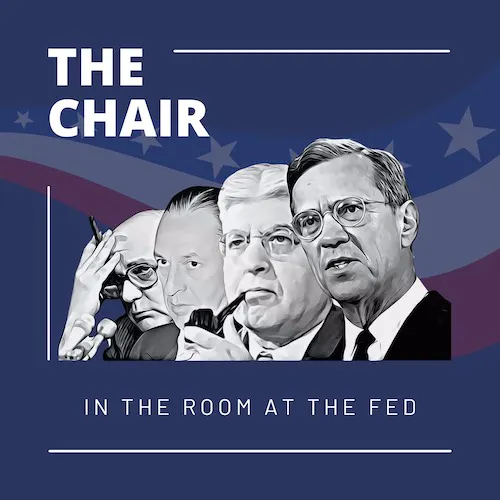
Ep 157Arthur Burns: “The smartest guy in the room”
More than any other global institution, the US Federal Reserve’s decisions and communications drive capital markets and alter financial conditions everywhere from Seattle to Seoul. While its interest rate are set by an expert committee, for almost a century, the Fed’s core philosophy and operational approach have been moulded by one person: the Chair of the Board of Governors. In this podcast series, Tim Gwynn Jones - a veteran central bank "watcher" - talks to authors of books about the Fed's most influential Chairs, starting with Marriner Eccles, Bill Martin, Arthur Burns, and Paul Volcker. In this third episode, he talks to Wyatt Wells – author of Economist in an Uncertain World – Arthur F. Burns and The Federal Reserve, 1970–1978 (Columbia University Press, 1994). Burns has had a bad press - so bad that Chris Hughes, one of Facebook's founders, was moved to rehabilitate him. Leading the Fed from 1970 to 1978 when inflation averaged 9%, Burns was an accomplished business-cycle economist but also a politically partisan Chair intensely loyal to Richard Nixon and Gerald Ford. Going far beyond his remit as a central banker, Burns oversaw government efforts to control prices and wages as an alternative to monetary policy. “If you couple an incomes policy with a tight fiscal and monetary policy, it can work. The problem is that it often becomes an excuse for not doing that,” says Wells. “Burns found himself trapped in this position where he felt he couldn't raise interest rates without wrecking the controls programme and possibly his own career – his own position at the Fed. It's clear in ‘73, he knows interest rates need to go up. They're trying to raise them but he's got these political concessions and he's doing this sort of dance, trying to square the circle … And of course: ‘I'm the smartest guy in the room. Therefore, I should play a key role in this effort to balance everything’. I think there are very few Federal Reserve chairmen who have elbowed their way into other areas in the way that Burns did. Maybe none”. An economic historian, Wyatt Wells has been Professor of History at Auburn University, Montgomery, since 1997.
Ep 345D. E. Osto, "Paranormal States: Psychic Abilities in Buddhist Convert Communities" (Columbia UP, 2024)
A number of converts to Buddhism report paranormal experiences. Their accounts describe psychic abilities like clairvoyance and precognition, out-of-body experiences, near-death experiences, and encounters with other beings such as ghosts and deities, and they often interpret these events through a specifically Buddhist lens. Paranormal States: Psychic Abilities in Buddhist Convert Communities (Columbia UP, 2024) is a groundbreaking exploration of these phenomena and their implications for both humanistic and scientific study of the paranormal. D. E. Osto examines accounts of paranormal phenomena experienced by convert Buddhists from around the world collected through an online survey and interviews, placing them in the context of Indian Buddhist sources and recent scientific research. They focus in detail on the life stories of two interviewees and the important role the paranormal has played in their lives. These contemporary first-person narratives demonstrate the continued importance of the psychic and paranormal within the Buddhist tradition, and they can be interpreted as a living Buddhist folklore. Osto considers the limitations of both traditional religious views and Western scientific studies of the paranormal and proposes instead a new Buddhist phenomenological approach. Ultimately, Paranormal States contends, these deeply mysterious and extraordinary experiences exceed current understandings--and they can help bridge the gap between religious and scientific worldviews.
Ep 472Bernard E. Harcourt. "Cooperation: A Political, Economic, and Social Theory" (Columbia UP, 2023)
Liberal democracy is in crisis around the world, unable to address pressing problems such as climate change. There is, however, another path—cooperation democracy. From consumer co-ops to credit unions, worker cooperatives to insurance mutuals, nonprofits to mutual aid, countless examples prove that people working together can extend the ideals of participatory democracy and sustainability into every aspect of their lives. These forms of cooperation do not depend on electoral politics. Instead, they harness the longstanding practices and values of cooperatives: self-determination, democratic participation, equity, solidarity, and respect for the environment. Bernard E. Harcourt develops a transformative theory and practice that builds on worldwide models of successful cooperation. He identifies the most promising forms of cooperative initiatives and then distills their lessons into an integrated framework: Coöperism. This is a political theory grounded on recognition of our interdependence. It is an economic theory that can ensure equitable distribution of wealth. Finally, it is a social theory that replaces the punishment paradigm with a cooperation paradigm. A creative work of normative critical theory, Cooperation: A Political, Economic, and Social Theory (Columbia UP, 2023) provides a positive vision for addressing our most urgent challenges today. Harcourt shows that by drawing on the core values of cooperation and the power of people working together, a new world of cooperation democracy is within our grasp. Bernard E. Harcourt is the Isidor and Seville Sulzbacher Professor of Law and professor of political science at Columbia University and a chaired professor at the École des Hautes Études en Sciences Sociales in Paris. An editor of Michel Foucault’s work in French and English, Harcourt is the author of several books, including Critique and Praxis (Columbia, 2020). He is a social-justice litigator and the recipient of the 2019 Norman Redlich Capital Defense Distinguished Service Award from the New York City Bar Association for his longtime representation of death row prisoners. Morteza Hajizadeh is a Ph.D. graduate in English from the University of Auckland in New Zealand. His research interests are Cultural Studies; Critical Theory; Environmental History; Medieval (Intellectual) History; Gothic Studies; 18th and 19th Century British Literature. YouTube channel. Twitter.
Ep 539Matthew H. Sommer, "The Fox Spirit, the Stone Maiden, and Other Transgender Histories from Late Imperial China" (Columbia UP, 2024)
The Fox Spirit, the Stone Maiden, and Other Transgender Histories from Late Imperial China (Columbia University Press, 2024) is a fascinating study of transgender lives and practices in late imperial China. This book takes as its core subject matter six court cases from Qing China that involve people who moved away from the gender they were assigned at birth. Focusing on this movement, Matthew H. Sommer looks at the transgender paradigms and literary tropes through which gender-transing was understood, ultimately revealing how acts of gender-crossing and gender boundaries were perceived. This book is an effortless blend of social, legal, and cultural history, and it is filled with captivating legal cases involving forgery and impersonation, fox-spirit mediums, midwives, and those living on the margins of late imperial China. This is definitely a must-read for those interested in Chinese history and gender history, as well as any scholars who need inspiration for what can be done with interesting sources that don't quite fit in existing projects. To find out more about Matthew Sommer’s work, head to his website, or you can listen to his previous appearance on the New Books Network here.
Ep 184Christopher T. Fan, "Asian American Fiction After 1965: Transnational Fantasies of Economic Mobility" (Columbia UP, 2024)
After the 1965 Immigration and Nationality Act loosened discriminatory restrictions, people from Northeast Asian countries such as South Korea, Taiwan, Japan, and eventually China immigrated to the United States in large numbers. Highly skilled Asian immigrants flocked to professional-managerial occupations, especially in science, technology, engineering, and math. Asian American literature is now overwhelmingly defined by this generation’s children, who often struggled with parental and social expectations that they would pursue lucrative careers on their way to becoming writers. In Asian American Fiction After 1965: Transnational Fantasies of Economic Mobility (Columbia UP, 2024), Christopher T. Fan offers a new way to understand Asian American fiction through the lens of the class and race formations that shaped its authors both in the United States and in Northeast Asia. In readings of writers including Ted Chiang, Chang-rae Lee, Ken Liu, Ling Ma, Ruth Ozeki, Kathy Wang, and Charles Yu, he examines how Asian American fiction maps the immigrant narrative of intergenerational conflict onto the “two cultures” conflict between the arts and sciences. Fan argues that the self-consciousness found in these writers’ works is a legacy of Japanese and American modernization projects that emphasized technical and scientific skills in service of rapid industrialization. He considers Asian American writers’ attraction to science fiction, the figure of the engineer and notions of the “postracial,” modernization theory and time travel, and what happens when the dream of a stable professional identity encounters the realities of deprofessionalization and proletarianization. Through a transnational and historical-materialist approach, this groundbreaking book illuminates what makes texts and authors “Asian American.” Christopher T. Fan is an assistant professor at the University of California, Irvine, in the Departments of English, Asian American Studies, and East Asian Studies. He is a cofounder and senior editor of Hyphen magazine.
Ep 281Austin Knuppe, "Surviving the Islamic State: Contention, Cooperation, and Neutrality in Wartime Iraq" (Columbia UP, 2024)
How did ordinary Iraqis survive the occupation of their communities by the Islamic State? How did they decide whether to stay or flee, to cooperate or resist? Based on an original survey from Baghdad alongside key interviews in the field Surviving the Islamic State: Contention, Cooperation, and Neutrality in Wartime Iraq (Columbia University Press, 2024) offers an insightful account of how Iraqis in different areas of the country responded to the rise and fall of the Islamic State. Dr. Austin J. Knuppe argues that people adopt survival repertoires—a variety of social practices, tools, organized routines, symbols, and rhetorical strategies—to navigate wartime violence and detect threats. He traces how repertoires varied among different communities over the course of the conflict. In areas insulated from insurgent control, such as cosmopolitan Baghdad, local residents had the flexibility to support coalition forces while also voicing opposition to government policies. For Iraqis in rural communities confronting insurgent control, collaboration and resistance entailed significant risks. In Sunni-majority communities in the western desert, passive acquiescence and active cooperation temporarily insulated Iraqis from insurgent victimization. For ethnic and religious minorities in the north, however, flight or resistance proved the only viable options. In many communities, local residents mobilized neighborhood self-defense groups and militias loosely aligned with coalition forces once the tides turned against the Islamic State. Beyond contributing to academic and policy debates about civilian protection during wartime, Surviving the Islamic State foregrounds everyday people’s experiences while modeling an ethical approach for conducting field research in conflict-affected communities. This interview was conducted by Dr. Miranda Melcher whose new book focuses on post-conflict military integration, understanding treaty negotiation and implementation in civil war contexts, with qualitative analysis of the Angolan and Mozambican civil wars.
Ep 311Hannah Freed-Thall, "Modernism at the Beach: Queer Ecologies and the Coastal Commons" (Columbia UP, 2023)
Departing from the conventional association of modernism with the city, Hannah Freed-Thall's Modernism at the Beach: Queer Ecologies and the Coastal Commons (Columbia University Press, 2023) makes a case for the coastal zone as a surprisingly generative setting for twentieth-century literature and art. An unruly and elusive confluence of human and more-than-human forces, the seashore is also a space of performance--a stage for loosely scripted, improvisatory forms of embodiment and togetherness. The beach, Hannah Freed-Thall argues, was to the modernist imagination what mountains were to Romanticism: a space not merely of anthropogenic conquest but of vital elemental and creaturely connection. With an eye to the peripheries of capitalist leisure, Freed-Thall recasts familiar seaside practices--including tide-pooling, beachcombing, gambling, and sunbathing--as radical experiments in perception and sociability. Close readings of works by Marcel Proust, Virginia Woolf, Claude McKay, Samuel Beckett, Rachel Carson, and Gordon Matta-Clark, among others, explore the modernist beach as a queer refuge, a precarious commons, a scene of collective exhaustion and endurance, and a visionary threshold at the end of the world. Interweaving environmental humanities, queer and feminist theory, and cultural history, Modernism at the Beach offers new ways of understanding twentieth-century literature and its relation to ecological thought. About the guest: Hannah Freed-Thall is an Associate Professor of French Literature, Thought and Culture at NYU About the host: Tatiana Klepikova is a postdoctoral researcher at the University of Regensburg, where she leads a research group on queer literatures and cultures under socialism.
Ep 158Yanagawa Seigan, "The Same Moon Shines on All: The Lives and Selected Poems of Yanagawa Seigan and Kōran" (Columbia UP, 2024)
Yanagawa Seigan (1789–1858) and his wife Kōran (1804–79) were two of the great poets of nineteenth-century Japan. They practiced the art of traditional Sinitic poetry—works written in literary Sinitic, or classical Chinese, a language of enduring importance far beyond China’s borders. Together, they led itinerant lives, traveling around Japan teaching poetry and selling calligraphy. Seigan established Edo-period Japan’s largest poetry society and attained nationwide renown as a literary figure, as well as taking part in stealthy political activities in the years before the Meiji Restoration. Kōran was one of the most accomplished female composers of Sinitic poetry in Japanese history. After her husband’s death, she was arrested and imprisoned for six months as part of a crackdown on political reform. Seigan and Kōran’s works at once display mastery of a poetic tradition and depict Japan on the brink of monumental change. The Same Moon Shines on All: The Lives and Selected Poems of Yanagawa Seigan and Kōran (Columbia UP, 2024) explores the world of Seigan and Kōran, pairing an in-depth account of their lives and times with an inviting selection of their poetry. The book features eminent Sinologist Jonathan Chaves’s translations of more than 130 poems by Seigan and more than 50 by Kōran, each annotated and followed by the original Chinese text. An introduction by Matthew Fraleigh, a specialist in Japan’s Sinitic literature, offers insight into the historical and literary context as well as the poems themselves. Approachable and delightful, this book makes the riches of Japanese Sinitic poetry available to a range of readers.
Ep 73Arie Perliger, "American Zealots: Inside Right-Wing Domestic Terrorism" (Columbia UP, 2020)
In an unsettling time in American history, the outbreak of right-wing violence is among the most disturbing developments. In recent years, attacks originating from the far right of American politics have targeted religious and ethnic minorities, with a series of antigovernment militants, religious extremists, and lone-wolf mass shooters inspired by right-wing ideologies. The need to understand the nature and danger of far-right violence is greater than ever. In American Zealots: Inside Right-Wing Domestic Terrorism by Arie Perliger (Columbia University Press, 2020), Arie Perliger provides a wide-ranging and rigorously researched overview of right-wing domestic terrorism. He analyzes its historical roots, characteristics, tactics, rhetoric, and organization, assessing the current and future trajectory of the use of violence by the far right. Perliger draws on a comprehensive dataset of more than 5,000 attacks and their perpetrators from 1990 through 2017 in order to explore key trends in American right-wing terrorism. He describes the entire ideological spectrum of the American far right, including today’s white supremacists, antigovernment groups, and antiabortion fundamentalists, as well as the histories of the KKK, skinheads, and neo-Nazis. Based on these findings, Perliger suggests counterterrorism policies that can respond effectively to the far-right threat. A groundbreaking examination of violence spawned from right-wing ideologies, American Zealots is essential reading for everyone seeking to understand the transformation of domestic terrorism.
Ep 30Kevin Loughran, "Parks for Profit: Selling Nature in the City" (Columbia UP, 2022)
A new kind of city park has emerged in the early twenty-first century. Postindustrial parks transform the derelict remnants of an urban past into distinctive public spaces that meld repurposed infrastructure, wild-looking green space, and landscape architecture. For their proponents, they present an opportunity to turn disused areas into neighborhood anchors, with a host of environmental and community benefits. Yet there are clear economic motives as well—successful parks have helped generate billions of dollars of city tax revenues and real estate development. In Parks for Profit: Selling Nature in the City (Columbia University Press, 2022) Dr. Kevin Loughran explores the High Line in New York, the Bloomingdale Trail/606 in Chicago, and Buffalo Bayou Park in Houston to offer a critical perspective on the rise of the postindustrial park. He reveals how elites deploy the popularity and seemingly benign nature of parks to achieve their cultural, political, and economic goals. As urban economies have become restructured around finance, real estate, tourism, and cultural consumption, parks serve as civic shields for elite-oriented investment. Tracing changing ideas about cities and nature and underscoring the centrality of race and class, Dr. Loughran argues that postindustrial parks aestheticize past disinvestment while serving as green engines of gentrification. A wide-ranging investigation of the political, cultural, and economic forces shaping park development, Parks for Profit reveals the social inequalities at the heart of today’s new urban landscape. This interview was conducted by Dr. Miranda Melcher whose new book focuses on post-conflict military integration, understanding treaty negotiation and implementation in civil war contexts, with qualitative analysis of the Angolan and Mozambican civil wars.
Ep 98Ying Qian, "Revolutionary Becomings: Documentary Media in Twentieth-Century China" (Columbia UP, 2023)
Welcome to another episode of New Books in Chinese Studies. Today, I will be talking to Columbia University professor Ying Qian about her new book, Revolutionary Becomings: Documentary Media in Twentieth-Century China (Columbia UP, 2023). The volume enriches our understanding of media’s role in China’s revolutionary history by turning to documentary. Qian guides readers through early documentary practice, left- and right-wing Republican documentary, and documentary as it functioned in the socialist and early postsocialist periods. In reference to socialist documentary, she writes, “As the vanguard of cinema, documentary in the Mao era meant, in principle, to facilitate the dialectical relationship between the masses and the party, not only to aid in their mutual constitution, but also to facilitate a collective formation of knowledge and priorities to direct the unfolding of the revolution” (249). In our interview, we will discover how crucial this understudied genre has been in the 20th century and learn how the mutually constitutive dialectic between documentary form and revolution worked in practice.
Ep 156Anri Yasuda, "Beauty Matters: Modern Japanese Literature and the Question of Aesthetics, 1890-1930" (Columbia UP, 2024)
The notion of beauty is inherently elusive: aesthetic judgments are at once subjective and felt to be universally valid. In Beauty Matters: Modern Japanese Literature and the Question of Aesthetics, 1890-1930 (Columbia UP, 2024), Anri Yasuda demonstrates that by exploring the often conflicting yet powerful pull of aesthetic sentiments, major authors of the late Meiji (1868–1912) and Taishō (1912–1926) periods illuminated themes and perspectives that resonated broadly in modern Japanese society. This approach presents an alternative to conventional accounts in which Japanese literature before the modernist turn of the 1920s has tended to be defined by an insular focus on subjective representation and autobiographical realism. Yasuda investigates how Natsume Sōseki, Mori Ogai, Mushanokōji Saneatsu and his peers at Shirakaba magazine, and Akutagawa Ryūnosuke sought to identify the aesthetic properties of literature through comparisons with the visual arts. They also considered the position of Japanese cultural sensibilities within the Eurocentric imperial world order. Their stories featuring painters and paintings weigh the fundamental challenge of representing anything when the conditions of knowledge are in flux, and their stories about cross-cultural encounters display both hope and ambivalence about the prospect of cosmopolitanism. Yasuda shows how thinking about beauty and art enabled these authors to surpass purely “literary” concerns. By tracing the wide-reaching significance of aesthetic affect in literary thought, Beauty Matters destabilizes received conceptions of literature’s parameters and affirms literature’s continued potential to intervene in cultural discourses in Japan and beyond.
Ep 46Catherine Tan, "Spaces on the Spectrum: How Autism Movements Resist Experts and Create Knowledge" (Columbia UP, 2024)
Movements that take issue with conventional understandings of autism spectrum disorder, a developmental disability, have become increasingly visible. Drawing on more than three years of ethnographic fieldwork and interviews with participants, Dr. Catherine Tan investigates two autism-focused movements, shedding new light on how members contest expert authority. Examining their separate struggles to gain legitimacy and represent autistic people, she develops a new account of the importance of social movements as spaces for constructing knowledge that aims to challenge dominant frameworks. Spaces on the Spectrum: How Autism Movements Resist Experts and Create Knowledge (Columbia University Press, 2024) examines the autistic rights and alternative biomedical movements, which reimagine autism in different and conflicting ways: as a difference to be accepted or as a sickness to treat. Both, however, provide a window into how ideas that conflict with dominant beliefs develop, take hold, and persist. The autistic rights movement is composed primarily of autistic adults who contend that autism is a natural human variation, not a disorder, and advocate for social and cultural inclusion and policy changes. The alternative biomedical movement, in contrast, is dominated by parents and practitioners who believe in the disproven idea that vaccines trigger autism and seek to reverse it with scientifically unsupported treatments. Both movements position themselves in opposition to researchers, professionals, and parents outside their communities. Spaces on the Spectrum offers timely insights into the roles of shared identity and communal networks in movements that question scientific and medical authority. This interview was conducted by Dr. Miranda Melcher whose new book focuses on post-conflict military integration, understanding treaty negotiation and implementation in civil war contexts, with qualitative analysis of the Angolan and Mozambican civil wars.
Ep 227Natasha L. Mikles, "Shattered Grief: How the Pandemic Transformed the Spirituality of Death in America" (Columbia UP, 2024)
The COVID-19 pandemic left millions grieving their loved ones without the consolation of traditional ways of mourning. Patients were admitted to hospitals and never seen again. Social distancing often meant conventional funerals could not be held. Religious communities of all kinds were disrupted at the exact moment mourners turned to them for support. These unprecedented circumstances caused dramatic transformations of not only communal rituals but also how people make meaning after the losses of loved ones. Shattered Grief: How the Pandemic Transformed the Spirituality of Death in America (Columbia UP, 2024) is an intimate portrait of how COVID-19 changed the ways Americans approach, understand, and mourn death. Based on extensive interviews incorporating a multitude of perspectives—including funerary and medical professionals, religious leaders, grief counselors, death doulas, spirit mediums, community organizers, and those who lost loved ones—it provides a snapshot of how people renegotiated spiritual and religious traditions, worldviews, identities, and communities during the deadliest pandemic in a century. Through these diverse and powerful voices, Natasha L. Mikles tells the story of spiritual innovation, religious change, and the struggle to achieve personal and national self-understanding against the backdrop of mass casualties. Compelling and accessible, Shattered Grief is an essential book for a range of readers interested in how we make sense of death and dying. Natasha L. Mikles is an assistant professor at Texas State University. Her research interests revolve around lived interpretations of death, mourning, and the afterlife in diverse religious traditions ranging from contemporary American spirituality to nineteenth-century Tibetan Buddhism. She has written on topics like the Tibetan Gesar epics, contemporary Tibetan religion, spiritual mediums during the pandemic, and pedagogical reflections on teaching religion. She is also the editor of Journal of Gods and Monsters, and the co-editor of The Religion Matters Reader.
Ep 525Jonathan Judaken, "Critical Theories of Anti-Semitism" (Columbia UP, 2024)
Despite its persistence and viciousness, anti-Semitism remains undertheorized in comparison with other forms of racism and discrimination. How should anti-Semitism be defined? What are its underlying causes? Why do anti-Semites target Jews? In what ways has Judeophobia changed over time? What are the continuities and disconnects between mediaeval anti-Judaism and the Holocaust? How does criticism of the state of Israel relate to anti-Semitism? And how can social theory illuminate the upsurge in attacks on Jews today? Considering these questions and many more, Critical Theories of Anti-Semitism (Columbia University Press, 2024) by Dr. Jonathan Judaken is at once a philosophical reflection on key problems in the analysis of anti-Semitism and a history of its leading theories and theorists. Jonathan Judaken explores the methodological and conceptual issues that have vexed the study of Judeophobia and calls for a reconsideration of the definitions, categories, and narratives that underpin overarching explanations. He traces how a range of thinkers have wrestled with these challenges, examining the theories of Jean-Paul Sartre, the Frankfurt School, Hannah Arendt, and Jean-François Lyotard, alongside the works of sociologists Talcott Parsons and Zygmunt Bauman and historians Léon Poliakov and George Mosse. Dr. Judaken argues against claims about the uniqueness of Judeophobia, demonstrating how it is entangled with other racisms: Islamophobia, Negrophobia, and xenophobia. Critical Theories of Anti-Semitism not only urges readers to question how they think about Judeophobia but also draws them into conversation with a range of leading thinkers whose insights are sorely needed in this perilous moment. This interview was conducted by Dr. Miranda Melcher whose new book focuses on post-conflict military integration, understanding treaty negotiation and implementation in civil war contexts, with qualitative analysis of the Angolan and Mozambican civil wars.
Ep 130Neena Mahadev, "Karma and Grace: Religious Difference in Millennial Sri Lanka" (Columbia UP, 2023)
Around the turn of the millennium, Pentecostal churches began to pepper majority-Buddhist Sri Lanka, setting off a sense of alarm among Buddhists who saw Christianity as a neocolonial threat to the nation. Rumors of foul play in the death of a Buddhist monk, as well as allegations of proselytizing in the aftermath of the 2004 tsunami and during the final stages of civil war, spurred nationalist anxieties, moral panics, and even episodes of violence by Buddhists against Christians suspected of facilitating “unethical” conversions. Through vivid ethnography and keen observations of media events, Karma and Grace: Religious Difference in Millennial Sri Lanka (Columbia UP, 2023) illuminates disputes over religious freedom and pluralism amid the rise of charismatic Christianity in Sri Lanka. Neena Mahadev explores the dueling efforts of Buddhist nationalists and Christian evangelists to reshape Sri Lanka’s religious, economic, and political landscapes. She considers theological and political impasses between Buddhism’s vast timescales of karma and Christians’ promises of the immediacy of their God’s salvific grace. While Christian missions spread “the Good News,” subsets of Buddhists produced bad press, sting operations, and disparaging media to impede born-again churches from taking root. In gripping detail, Mahadev recounts how modernist and traditionalist Theravāda Buddhists, Pentecostal newcomers, long-established Christian denominations, local deity and spirit cults, and the innovations of mavericks intermingle in a multireligious public sphere. Even amid trenchant conflicts, Karma and Grace demonstrates that social proximity between rivals is also conducive to religious experimentation and the ambiguities of identity that allow Sri Lankans to live with difference. Neena Mahadev is an assistant professor of anthropology at Yale-NUS College and holds a courtesy appointment with the National University of Singapore.
Ep 26Pierre Sokolsky, "Clock in the Sun: How We Came to Understand Our Nearest Star" (Columbia UP, 2024)
On the surface of the Sun, spots appear and fade in a predictable cycle, like a great clock in the sky. In medieval Russia, China, and Korea, monks and court astronomers recorded the appearance of these dark shapes, interpreting them as omens of things to come. In Western Europe, by contrast, where a cosmology originating with Aristotle prevailed, the Sun was regarded as part of the unchanging celestial realm, and it took observations through telescopes by Galileo and others to establish the reality of solar imperfections. In the nineteenth century, amateur astronomers discovered that sunspots ebb and flow about every eleven years—spurring speculation about their influence on the weather and even the stock market. Exploring these and many other crucial developments, Pierre Sokolsky provides a history of knowledge of the Sun through the lens of sunspots and the solar cycle. He ranges widely across cultures and throughout history, from the earliest recorded observations of sunspots in Chinese annals to satellites orbiting the Sun today, and from worship of the Sun as a deity in ancient times to present-day scientific understandings of stars and their magnetic fields. Considering how various thinkers sought to solve the puzzle of sunspots, Sokolsky sheds new light on key discoveries and the people who made them, as well as their historical and cultural contexts. Fast-paced, comprehensive, and learned, Clock in the Sun: How We Came to Understand Our Nearest Star (Columbia UP, 2024) shows readers our closest star from many new angles. Garima Garg is a New Delhi based journalist and author.
Ep 370Amanda McMillan Lequieu, "Who We Are Is Where We Are: Making Home in the American Rust Belt" (Columbia UP, 2024)
Half a century ago, deindustrialization gutted blue-collar jobs in the American Midwest. But today, these places are not ghost towns. People still call these communities home, even as they struggle with unemployment, poverty, and other social and economic crises. Why do people remain in declining areas through difficult circumstances? What do their choices tell us about rootedness in a time of flux? Through the cases of the former steel manufacturing hub of southeast Chicago and a shuttered mining community in Iron County, Wisconsin, Amanda McMillan Lequieu traces the power and shifting meanings of the notion of home for people who live in troubled places. Building from on-the-ground observations of community life, archival research, and interviews with long-term residents, she shows how inhabitants of deindustrialized communities balance material constraints with deeply felt identities. McMillan Lequieu maps how the concept of home has been constructed and the ways it has been reshaped as these communities have changed. She considers how long-term residents navigate the tensions around belonging and making ends meet long after the departure of their community’s founding industry. In Who We Are Is Where We Are: Making Home in the American Rust Belt (Columbia UP, 2024), Amanda McMillan Lequieu links the past and the present, rural and urban, to shed new light on life in postindustrial communities. Beyond a story of Midwestern deindustrialization, this timely book provides broader insight into the capacious idea of home—how and where it is made, threatened, and renegotiated in a world fraught with change. Michael O. Johnston, Ph.D. is a Assistant Professor of Sociology at William Penn University. He is the author of The Social Construction of a Cultural Spectacle: Floatzilla (Lexington Books, 2023) and Community Media Representations of Place and Identity at Tug Fest: Reconstructing the Mississippi River (Lexington Books, 2022). His general area of study is in the areas of social construction of experience, identity, and place. He is currently conducting research for his next project that looks at nightlife and the emotional labor that is performed by employees of bars and nightclubs. To learn more about Michael O. Johnston you can go to his website, Google Scholar, Twitter @ProfessorJohnst, or by email at [email protected].
Ep 276Sonja Mejcher-Atassi, "An Impossible Friendship: Group Portrait, Jerusalem Before and After 1948" (Columbia UP, 2024)
In Jerusalem, as World War II was coming to an end, an extraordinary circle of friends began to meet at the bar of the King David Hotel. This group of aspiring artists, writers, and intellectuals—among them Wolfgang Hildesheimer, Jabra Ibrahim Jabra, Sally Kassab, Walid Khalidi, and Rasha Salam, some of whom would go on to become acclaimed authors, scholars, and critics—came together across religious lines in a fleeting moment of possibility within a troubled history. What brought these Muslim, Jewish, and Christian friends together, and what became of them in the aftermath of 1948, the year of the creation of the State of Israel and the Palestinian Nakba? Sonja Mejcher-Atassi tells the story of this unlikely friendship and in so doing offers an intimate cultural and social history of Palestine in the critical postwar period. She vividly reconstructs the vanished social world of these protagonists, tracing the connections between the specificity of individual lives and the larger contexts in which they are embedded. In exploring this ecumenical friendship and its artistic, literary, and intellectual legacies, Mejcher-Atassi demonstrates how social biography can provide a picture of the past that is at once more inclusive and more personal. This group portrait, she argues, allows us to glimpse alternative possibilities that exist within and alongside the fraught history of Israel/Palestine. Bringing a remarkable era to life through archival research and nuanced interdisciplinary scholarship, An Impossible Friendship: Group Portrait, Jerusalem Before and After 1948 (Columbia UP, 2024) unearths prospects for historical reconciliation, solidarity, and justice. Sonja Mejcher-Atassi is a professor of Arabic and comparative literature at the American University of Beirut. She is the author of Reading Across Modern Arabic Literature and Art (2012), as well as coeditor of The Theatre of Sa’dallah Wannous: A Critical Study of the Syrian Playwright and Public Intellectual (2021), Rafa Nasiri: Artist Books (2016), and Archives, Museums, and Collecting Practices in the Modern Arab World (2012).
Ep 75Trish Kahle on the Labor History of Energy Systems
Peoples & Things host, Lee Vinsel, talks to Trish Kahle, Assistant Professor of History at Georgetown University-Qatar, about Kahle's new project, "Power Up: A Social History of American Electricity," which focuses especially on the labor history of both constructing and maintaining the electricity grid. They also talk about Kahle's forthcoming book, Energy Citizenship: Coal and Democracy in the American Century (Columbia UP, 2024), which "traces how modern U.S. social citizenship has been shaped by coal miners and the fuel they extracted." The pair also discuss the emerging field of the "energy humanities" and what it means to take a labor-centered approach to energy history.
Ep 466Adrian Johnston, "Infinite Greed: The Inhuman Selfishness of Capital" (Columbia UP, 2024)
Marxism and psychoanalysis have a rich and complicated relationship to one another, with countless figures and books written on the possible intersection of the two. Our guest today, Adrian Johnston, returns to NBN to discuss his own latest entry into the genre, Infinite Greed: The Inhuman Selfishness of Capital (Columbia UP, 2024). While the book does retread some already-covered territory, Johnston’s book stands out as a unique entry in a crowded field by emphasizing the theoretical overlap of psychoanalytic concepts with the economic core of Marx’s thinking. Libidinal economics are turned into, well, economics and vice-versa in this detailed and rigorously written study that deserves to become one of the canonical texts in the Freudo-Marxist tradition. Adrian Johnston is Distinguished Professor of Philosophy at the University of New Mexico and a faculty member of the Emory Psychoanalytic Institute. He is the author of numerous books, including three previously discussed on this podcast; A New German Idealism: Hegel, Zizek and Dialectical Materialism, and Prolegomena to Any Future Materialism volumes one and two. He is also the coeditor, with Slavoj Zizek and Todd McGowan of the book series Diaeresis.
Ep 92Allison Elias, "The Rise of Corporate Feminism: Women in the American Office, 1960-1990" (Columbia UP, 2022)
From the 1960s through the 1990s, the most common job for women in the United States was clerical work. Even as college-educated women obtained greater opportunities for career advancement, occupational segregation by gender remained entrenched. How did feminism in corporate America come to represent the individual success of the executive woman and not the collective success of the secretary? Allison Elias argues that feminist goals of advancing equal opportunity and promoting meritocracy unintentionally undercut the status and prospects of so-called "pink-collar" workers. In the 1960s, ideas about sex equality spurred some clerical workers to organize, demanding "raises and respect," while others pushed for professionalization through credentialing. This cross-class alliance pushed a feminist agenda that included unionizing some clerical workers and advancing others who had college degrees into management. But these efforts diverged in the 1980s, when corporations adopted measures to move qualified women into their upper ranks. By the 1990s, corporate support for professional women resulted in an individualistic feminism that focused on the needs of those at the top. Meanwhile, as many white, college-educated women advanced up the corporate ladder, clerical work became a job for lower-socioeconomic-status women of all races. The Rise of Corporate Feminism: Women in the American Office, 1960-1990 (Columbia UP, 2022) considers changes in the workplace surrounding affirmative action, human resource management, automation, and unionization by groups such as 9to5. At the intersection of history, gender, and management studies, this book spotlights the secretaries, clerks, receptionists, typists, and bookkeepers whose career trajectories remained remarkably similar despite sweeping social and legal change. Jane Scimeca is Professor of History at Brookdale Community College. @JaneScimeca1
Ep 367Alex V. Barnard, "Conservatorship: Inside California's System of Coercion and Care for Mental Illness" (Columbia UP, 2023)
Is involuntary psychiatric treatment the solution to the intertwined crises of untreated mental illness, homelessness, and addiction? In recent years, politicians and advocates have sought to expand the use of conservatorships, a legal tool used to force someone deemed “gravely disabled,” or unable to meet their needs for food, clothing, or shelter as a result of mental illness, to take medication and be placed in a locked facility. At the same time, civil liberties and disability rights groups have seized on cases like that of Britney Spears to argue that conservatorships are inherently abusive. Conservatorship: Inside California's System of Coercion and Care for Mental Illness (Columbia UP, 2023) is an incisive and compelling portrait of the functioning—and failings—of California’s conservatorship system. Drawing on hundreds of interviews with professionals, policy makers, families, and conservatees, Alex V. Barnard takes readers to the streets where police encounter homeless people in crisis, the locked wards where people receiving treatment are confined, and the courtrooms where judges decide on conservatorship petitions. As he shows, California’s state government has abdicated authority over this system, leaving the question of who receives compassionate care and who faces coercion dependent on the financial incentives of for-profit facilities, the constraints of underresourced clinicians, and the desperate struggles of families to obtain treatment for their loved ones. This book offers a timely warning: reforms to expand conservatorship will lead to more coercion but little transformative care until government assumes accountability for ensuring the health and dignity of its most vulnerable citizens. Michael O. Johnston, Ph.D. is a Assistant Professor of Sociology at William Penn University. He is the author of The Social Construction of a Cultural Spectacle: Floatzilla (Lexington Books, 2023) and Community Media Representations of Place and Identity at Tug Fest: Reconstructing the Mississippi River (Lexington Books, 2022). His general area of study is in the areas of social construction of experience, identity, and place. He is currently conducting research for his next project that looks at nightlife and the emotional labor that is performed by employees of bars and nightclubs. To learn more about Michael O. Johnston you can go to his website, Google Scholar, Twitter @ProfessorJohnst, or by email at [email protected].
Ep 238Lisa M. P. Munoz, "Women in Science Now: Stories and Strategies for Achieving Equity" (Columbia UP, 2023)
Women working in the sciences face obstacles at virtually every step along their career paths. From subtle slights to blatant biases, deep systemic problems block women from advancing or push them out of science and technology entirely. Women in Science Now: Stories and Strategies for Achieving Equity (Columbia UP, 2023) examines solutions to this persistent gender gap, offering new perspectives on how to make science more equitable and inclusive for all. This book shares stories and insights of women from a range of backgrounds working in various disciplines, illustrating the journeys that brought them to the sciences, the challenges they faced along the way, and the important contributions they have made to their fields. Lisa M. P. Munoz combines these narratives with a wealth of data to illuminate the size and scope of the challenges women scientists face, while highlighting research-based solutions to help overcome these obstacles. She presents groundbreaking studies in social psychology and organizational behavior that are informing novel approaches for combating historic and ongoing inequities. Through a combined focus on personal experiences and social-science research, this timely book provides both a path toward greater gender equity and an inspiring vision of science and scientists.
Ep 189Tessa Hill and Eric Simons, "At Every Depth: Our Growing Knowledge of the Changing Oceans" (Columbia UP, 2024)
At Every Depth: Our Growing Knowledge of the Changing Oceans (Columbia UP, 2024) takes readers on a journey from California tidepools to Antarctic poles, showcasing myriad efforts to research and protect marine environments. Through insightful interviews, oceanographer Tessa Hill and science journalist Eric Simons offer a compelling exploration of humanity's relationship with the ocean. They shed light on research methodologies, the ocean's importance, and the vital role of indigenous peoples in ocean stewardship. Tune in to their interview with the New Books Network, where they share stories from how the research came together, how COVID affected their investigation, and what people can do today to build closer relationships with the ocean.
Ep 190Timothy Morton, "Hell: In Search of a Christian Ecology" (Columbia UP, 2024)
Hell on earth is real. The toxic fusion of big oil, Evangelical Christianity, and white supremacy has ignited a worldwide inferno, more phantasmagoric than anything William Blake could dream up and more cataclysmic than we can fathom. Escaping global warming hell, this revelatory book shows, requires a radical, mystical marriage of Christianity and biology that awakens a future beyond white male savagery. In Hell: In Search of a Christian Ecology (Columbia University Press, 2024) Dr. Timothy Morton argues that there is an unexpected yet profound relationship between religion and ecology that can guide a planet-scale response to the climate crisis. Spiritual and mystical feelings have a deep resonance with ecological thinking, and together they provide the resources environmentalism desperately needs in this time of climate emergency. Morton finds solutions in a radical revaluation of Christianity, furnishing ecological politics with a language of mercy and forgiveness that draws from Christian traditions without bringing along their baggage. They call for a global environmental movement that fuses ecology and mysticism and puts race and gender front and centre. This nonviolent resistance can stage an all-out assault on the ultimate Satanic mill: the concept of master and slave, manifesting today in white supremacy, patriarchy, and environmental destruction. Passionate, erudite, and playful, Hell takes readers on a full-colour journey into the contemporary underworld—and offers a surprising vision of salvation. This interview was conducted by Dr. Miranda Melcher whose new book focuses on post-conflict military integration, understanding treaty negotiation and implementation in civil war contexts, with qualitative analysis of the Angolan and Mozambican civil wars.
Ep 104Thomas Larkin, "The China Firm: American Elites and the Making of British Colonial Society" (Columbia UP, 2024)
What roles did Americans play in the expanding global empires of the nineteenth century? In The China Firm: American Elites and the Making of British Colonial Society (Columbia University Press, 2024), Thomas M. Larkin examines the Hong Kong–based Augustine Heard & Company, the most prominent American trading firm in treaty-port China, to explore the ways American elites at once made and were made by British colonial society. Following the Heard brothers throughout their firm’s rise and decline, The China Firm reveals how nineteenth-century China’s American elite adapted to colonial culture, helped entrench social and racial hierarchies, and exploited the British imperial project for their own profit as they became increasingly invested in its political affairs and commercial networks. Through the central narrative of Augustine Heard & Co., Larkin disentangles the ties that bound the United States to China and the British Empire in the nineteenth century. Drawing on a vast range of archival material from Hong Kong, China, Boston, and London, he weaves the local and the global together to trace how Americans gained acceptance into and contributed to the making of colonial societies and world-spanning empires. Uncovering the transimperial lives of these American traders and the complex ways extraimperial communities interacted with British colonialism, The China Firm makes a vital contribution to global histories of nineteenth-century Asia and provides an alternative narrative of British empire. Thomas Larkin in Assistant Professor of History at the University of Prince Edward Island. Twitter. Website. Brian Hamilton is chair of the Department of History and Social Science at Deerfield Academy. Twitter. Website.
Ep 231Nicholas Tampio, ed., "Democracy and Education" (Columbia UP, 2024)
John Dewey's Democracy and Education (1916) transformed how people around the world view the purposes of schooling. This new edition makes Dewey's ideas come alive for a new generation of readers. Nicholas Tampio is a professor of political science at Fordham University. He is the author of Teaching Political Theory: A Pluralistic Approach (2022) and Common Core: National Education Standards and the Threat to Democracy (2018). Max Jacobs is a PhD student in education at Rutgers University. He currently sits on the Graduate Student Council for the History of Education Society.
Ep 361Nicholas Hoover Wilson and Damon Mayrl, "After Positivism: New Approaches to Comparison in Historical Sociology" (Columbia UP, 2024)
The scientific method that aspiring social scientists are taught in graduate school seems pretty straightforward: you start with a hypothesis, figure our how you’re going to operationalize and measure your variables, pick cases that provide a tough test of your hypothesis, then collect your data, analyze it, and report your findings. However, for comparative-historical social scientists, things are rarely so cut-and-dried: it takes a lot of ‘soaking and poking’ before you can answer relatively straightforward questions like “what is this a case of?” and “what is your dependent variable?” Moreover, the entire idea of trying to impose a template developed for experimental studies on comparative and historical data by arbitrarily slicing an integrated reality up into variables and trying to isolate one-directional causal effects doesn’t seem appropriate for the dynamism and complexity of social reality. Today, I’m talking to the Nicholas Hoover Wilson and Damon Mayrl, the editors of a new edited volume that charts a different path. The contributors to After Positivism: New Approaches to Comparison in Historical Sociology (Columbia UP, 2024) provide new ways of thinking about the purposes of comparison in historical social science, what the ‘units’ of historical analysis are, and how historically-oriented social scientists should go about conducting comparisons. Nicholas Wilson is an associate professor of sociology at Stony Brook University, and the author of Modernity’s Corruption: Empire and Morality in the Making of British India (Columbia 2023). Damon Mayrl is associate professor of sociology at Colby College, and the author of Secular Conversions: Political Institutions and Religious Education in the United States and Australia, 1800-2000.
Ep 58Laura Helton, "Scattered and Fugitive Things: How Black Collectors Created Archives and Remade History" (Columbia UP, 2024)
During the first half of the twentieth century, a group of collectors and creators dedicated themselves to documenting the history of African American life. At a time when dominant institutions cast doubt on the value or even the idea of Black history, these bibliophiles, scrapbookers, and librarians created an enduring set of African diasporic archives. In building these institutions and amassing abundant archival material, they also reshaped Black public culture, animating inquiry into the nature and meaning of Black history. In Scattered and Fugitive Things: How Black Collectors Created Archives and Remade History (Columbia UP, 2024), Laura E. Helton tells the stories of these Black collectors, traveling from the parlors of the urban north to HBCU reading rooms and branch libraries in the Jim Crow south. Helton chronicles the work of six key figures: bibliophile Arturo Schomburg, scrapbook maker Alexander Gumby, librarians Virginia Lee and Vivian Harsh, curator Dorothy Porter, and historian L. D. Reddick. Drawing on overlooked sources such as book lists and card catalogs, she reveals the risks collectors took to create Black archives. This book also explores the social life of collecting, highlighting the communities that used these collections from the South Side of Chicago to Roanoke, Virginia. In each case, Helton argues, archiving was alive in the present, a site of intellectual experiment, creative abundance, and political possibility. Offering new ways to understand Black intellectual and literary history, Scattered and Fugitive Things reveals Black collecting as a radical critical tradition that reimagines past, present, and future. Jen Hoyer is Technical Services and Electronic Resources Librarian at CUNY New York City College of Technology. Jen edits for Partnership Journal and organizes with the TPS Collective. She is co-author of What Primary Sources Teach: Lessons for Every Classroom and The Social Movement Archive.
Ep 301Timothy P. A. Cooper, "Moral Atmospheres: Islam and Media in a Pakistani Marketplace" (Columbia UP, 2024)
Lahore's Hall Road is the largest electronics market in Pakistan. Once the center of film and media piracy in South Asia, it now specializes in smartphones and accessories. For Hall Road's traders, conflicts between the economic promises and the moral dangers of film loom large. To reconcile their secular trade with their responsibilities as devoted Muslims, they often look to adjudicate the good or bad moral "atmosphere" (mahaul) that can cling to film and media. In Moral Atmospheres: Islam and Media in a Pakistani Marketplace (Columbia UP, 2024),Timothy P. A. Cooper examines the diverse and coexisting moral atmospheres that surround media in Pakistan, tracing public understandings of ethical life and showing how they influence economic behavior. Drawing on extensive ethnographic work among traders, consumers, collectors, archivists, cinephiles, and cinephobes, Moral Atmospheres explores varied views on what the relationship between film and faith should look, sound, and feel like for Pakistan's Muslim-majority public. Cooper considers the preservation and censorship of film in and outside of the state bureaucracy, contestations surrounding heritage and urban infrastructure, and the production and circulation of sound and video recordings among the country's religious minorities. He argues that a focus on atmosphere provides ways of seeing moral thresholds as mutable and affective, rather than as fixed ethical standpoints. At once a vivid ethnography of a market street and a generative theorization of atmosphere, this book offers fresh perspectives on moral experience and the relationship between religion and media.
Ep 127Wei Wu, "Esoteric Buddhism in China: Engaging Japanese and Tibetan Traditions, 1912–1949" (Columbia UP, 2023)
During the Republican period (1912–1949) and after, many Chinese Buddhists sought inspiration from non-Chinese Buddhist traditions, showing a particular interest in esoteric teachings. What made these Buddhists dissatisfied with Chinese Buddhism, and what did they think other Buddhist traditions could offer? Which elements did they choose to follow, and which ones did they disregard? And how do their experiences recast the wider story of twentieth-century pan-Asian Buddhist reform movements? Based on a wide range of previously unexplored Chinese sources, Esoteric Buddhism in China: Engaging Japanese and Tibetan Traditions, 1912–1949 (Columbia UP, 2023) explores how esoteric Buddhist traditions have shaped the Chinese religious landscape. Wei Wu examines cross-cultural religious transmission of ideas from Japanese and Tibetan traditions, considering the various esoteric currents within Chinese Buddhist communities and how Chinese individuals and groups engaged with newly translated ideas and practices. She argues that Chinese Buddhists’ assimilation of doctrinal, ritual, and institutional elements of Tibetan and Japanese esoteric Buddhism was not a simple replication but an active process of creating new meanings. Their visions of Buddhism in the modern world, as well as early twentieth-century discourses of nation building and religious reform, shaped the reception of esoteric traditions. By analyzing the Chinese interpretation and strategic adaptations of esoteric Buddhism, this book sheds new light on the intellectual development, ritual performances, and institutional formations of Chinese Buddhism in the twentieth century. To understand the broader forces that shaped the debates about esoteric Buddhism in modern China, please also check Wu Wei's article, "Buddhism and Superstition: Buddhist Apologetics in the Anti-Superstition Campaigns in Modern China," which is open access and can be found here.
Ep 214At Every Depth: Our Growing Knowledge of the Changing Oceans
Today’s book is: At Every Depth: Our Growing Knowledge of the Changing Oceans (Columbia UP, 2024), by Tessa Hill and Eric Simons, which takes readers beneath the waves and along the coasts, to explore how climate change and environmental degradation have spurred the most radical transformations in human history. The world’s oceans are changing at a drastic pace. In response, the people who know the ocean most intimately are taking action for the sake of our shared future. Community scientists track species in California tidepools. Researchers dive into the waters around Sydney to replant kelp forests. Scientists and First Nations communities collaborate to restore clam gardens in the Pacific Northwest. In At Every Depth, the oceanographer Dr. Tessa Hill and the science journalist Eric Simons profile these and other efforts to understand and protect marine environments, taking readers to habitats from shallow tidepools to the deep sea. By sharing the stories of scientists, coastal community members, Indigenous people, shellfish farmers, and fisheries workers, At Every Depth brings together varied viewpoints, showing how scientists’ research and local and Indigenous knowledge can all complement each other to inform a more sustainable future. Our guest is: Dr. Tessa Hill, who is a professor in the Earth and Planetary Sciences Department at the University of California, Davis. She teaches and researches oceanography and climate change. She is a recipient of the Presidential Early Career Award for Scientists and Engineers and a fellow of the American Association for the Advancement of Science, and she was awarded the Rachel Carson Lecture by the American Geophysical Union. Our host is: Dr. Christina Gessler, the producer of the Academic Life podcast. She holds a PhD in history, which she uses to explore what stories we tell and what happens to those we never tell. Listeners may also enjoy these episodes with women in science: Climate Change Explained Women in Shark Sciences This conversation with Dr. Ware about dragonflies The surprising world of wasps When Dr. Martin was considering whether to stay or drop out Welcome to Academic Life, the podcast for your academic journey—and beyond! Join us again to learn from more experts inside and outside the academy, and around the world.
Ep 457Courtney Thorsson, "The Sisterhood: How a Network of Black Women Writers Changed American Culture" (Columbia UP, 2023)
The Sisterhood: How a Network of Black Women Writers Changed American Culture (Columbia University Press, 2023) explores how an incredible group of Black women writers, including Alice Walker, June Jordan, Toni Morrison, Ntozake Shange, Audre Lorde, and writers and intellectuals convened an informal group called “The Sisterhood” and how they transformed American writing and cultural and educational institutions in the decades that followed. Thorsson traces the personal, professional, and political connections that led to the group’s emergence and explores the remarkable legacy. While focusing on the organizing, networking, and community building that nurtured Black women’s writing, The Sisterhood provides an impactful model of Black feminist collaboration.
Ep 152Zahra Ayubi, "Gendered Morality: Classical Islamic Ethics of the Self, Family, and Society" (Columbia UP, 2019)
How are notions of justice and equality constructed in Islamic virtue ethics (akhlaq)? How are Islamic virtue ethics gendered, despite their venture into perennial concerns of how best to live a good and ethical life? These are the questions that Zahra Ayubi, an assistant professor of religion at Dartmouth college, examines in her new book Gendered Morality: Classical Islamic Ethics of the Self, Family, and Society (Columbia University Press, 2019). Using akhlaq literature by al-Ghazali, Davani and Tusi, Ayubi closely studies the ways in which these male Muslim scholars constructed ideas of the self (nafs), particularly in relation to the family and the society. Despite the ethicists’ differing sectarian and theological orientations in Islam, they still concluded that the status of a perfect ethical human was only achievable by a male elite. Meaning that the capacity to utilize rational faculty, which is central to self-refinement, was deemed not accessible to females, slaves, and non-elite males. In unpacking these gendered and hierarchical dynamics around ethics and comportment, Aybui masterfully applies feminist and gender analysis to deconstruct ethical texts. In light of her findings, she calls for a “philosophical turn” that must employ critical gender analysis when reading these texts not only in the context of Islamic philosophy, but broadly in the study of Islam. The book is a must read for scholars and students interested in Islamic philosophy and gender and Islamic studies. M. Shobhana Xavier is an Assistant Professor of Religion at Queen’s University. Her research areas are on contemporary Sufism in North America and South Asia. She is the author of Sacred Spaces and Transnational Networks in American Sufism(Bloombsury Press, 2018) and a co-author of Contemporary Sufism: Piety, Politics, and Popular Culture (Routledge, 2017). More details about her research and scholarship may be found on here and here. She may be reached at [email protected].
Ep 88Leigh Gilmore, "The #MeToo Effect: What Happens When We Believe Women" (Columbia UP, 2023)
The #MeToo movement inspired millions to testify to the widespread experience of sexual violence. More broadly, it shifted the deeply ingrained response to women’s accounts of sexual violence from doubting all of them to believing some of them. What changed? In The #MeToo Effect: What Happens When We Believe Women (Columbia UP, 2023), Leigh Gilmore provides a new account of #MeToo that reveals how storytelling by survivors propelled the call for sexual justice beyond courts and high-profile cases. At a time when the cultural conversation was fixated on appeals to legal and bureaucratic systems, narrative activism— storytelling in the service of social change—elevated survivors as authorities. Their testimony fused credibility and accountability into the #MeToo effect: uniting millions of separate accounts into an existential demand for sexual justice and the right to be heard. Gilmore reframes #MeToo as a breakthrough moment within a longer history of feminist thought and activism. She analyzes the centrality of autobiographical storytelling in intersectional and antirape activism and traces how literary representations of sexual violence dating from antiquity intertwine with cultural notions of doubt, obligation, and agency. By focusing on the intersectional prehistory of #MeToo, Gilmore sheds light on how survivors have used narrative to frame sexual violence as an urgent problem requiring structural solutions in diverse global contexts. Considering the roles of literature and literary criticism in movements for social change, The #MeToo Effect demonstrates how “reading like a survivor” provides resources for activism. Jane Scimeca is Professor of History at Brookdale Community College. @JaneScimeca1
Ep 75Andrea Wenzel, "Antiracist Journalism: The Challenge of Creating Equitable Local News" (Columbia UP, 2023)
Journalists have a long history of covering race and racism in the United States, telling stories that shed light on protest, activism, institutional turmoil, and policy change. Especially in recent years, though, the racial politics of journalism has very often become the story itself. Newsrooms across the country have had to grapple with big questions about diversity, inclusion, power, and professional standards in the media industry. What have these debates looked like up close? In what ways have newsrooms evolved? And what does this all mean for the stories we tell about our communities, our country, and the world at large? In Antiracist Journalism: The Challenge of Creating Equitable Local News (Columbia UP, 2023), Andrea Wenzel provides a critical look at how local media organizations in the Philadelphia area are attempting to address structural racism. She focuses on two established, majority-white newsrooms, the Philadelphia Inquirer and the public radio station WHYY, and two start-ups where at least half the staff identify as Black, Indigenous, or people of color (BIPOC), Resolve Philly and Kensington Voice. Drawing on more than five years of field research, Wenzel charts how these outlets have pursued a range of interventions—such as tracking the diversity of sources, examining reporting and editing practices, and working with community members to gain input—to varying degrees of success. Wenzel argues that institutional and systemic transformation will be possible only through the establishment of structures that facilitate holding those with more power responsible for listening to and addressing the needs and concerns of those with less. Andrea Wenzel is an associate professor in Temple University’s Department of Journalism and a member of the Klein College of Media and Communication graduate faculty. Her research focuses on initiatives to create more connected and equitable communities and newsrooms. She is the author of Community-Centered Journalism: Engaging People, Exploring Solutions, and Building Trust (University of Illinois Press, 2020) and of Antiracist Journalism: The Challenge of Creating Equitable Local News (Columbia University Press, 2024). Prior to academia, Andrea worked for 15 years as a public radio producer, editor, and media development consultant. She managed projects and trained media makers in Afghanistan, Sri Lanka, Iraq and India for media development organizations such as BBC Media Garrett Broad is Associate Professor of Communication Studies in Rowan University’s Edelman College of Communication & Creative Arts, where he also serves as Provost’s Fellow in the Catalysts for Sustainability Initiative. His research and teaching explores the connections between contemporary social movements, food systems, and digital media technology. He is the author of More Than Just Food: Food Justice and Community Change, as well as a variety of articles on food's relationship to environmental sustainability, economic equity, and the health of humans and nonhuman animals.
Ep 522Robin Visser, "Questioning Borders: Ecoliteratures of China and Taiwan" (Columbia UP, 2023)
Indigenous knowledge of local ecosystems often challenges settler-colonial cosmologies that naturalize resource extraction and the relocation of nomadic, hunting, foraging, or fishing peoples. Questioning Borders: Ecoliteratures of China and Taiwan (Columbia UP, 2023) explores recent ecoliterature by Han and non-Han Indigenous writers of China and Taiwan, analyzing relations among humans, animals, ecosystems, and the cosmos in search of alternative possibilities for creativity and consciousness. Informed by extensive field research, Robin Visser compares literary works by Bai, Bunun, Kazakh, Mongol, Tao, Tibetan, Uyghur, Wa, Yi, and Han Chinese writers set in Xinjiang, Tibet, Inner Mongolia, Southwest China, and Taiwan, sites of extensive development, migration, and climate change impacts. Visser contrasts the dominant Han Chinese cosmology of center and periphery that informs what she calls “Beijing Westerns” with Indigenous and hybridized ways of relating to the world that challenge borders, binaries, and hierarchies. By centering Indigenous cosmologies, this book aims to decolonize approaches to ecocriticism, comparative literature, and Chinese and Sinophone studies as well as to inspire new modes of sustainable flourishing in the Anthropocene. Robin Visser is professor and associate chair of the Department of Asian and Middle Eastern Studies at the University of North Carolina at Chapel Hill. She is the author of Cities Surround the Countryside: Urban Aesthetics in Postsocialist China (2010). Li-Ping Chen is a teaching fellow in the Department of East Asian Languages and Cultures at the University of Southern California. Her research interests include literary translingualism, diaspora, and nativism in Sinophone, inter-Asian, and transpacific contexts.
Ep 149Adam Kabat, "The River Imp and the Stinky Jewel and Other Tales: Monster Comics from Edo Japan" (Columbia UP, 2023)
Adam Kabat’s The River Imp and the Stinky Jewel and Other Tales: Monster Comics from Edo Japan (Columbia UP, 2023) is an in-depth introduction to the rich and ribald world of kibyōshi, a short-lived (1778-1807) subgenre of books combining text and illustration on the same page, much like comic books and manga today. This book presents a selection of five kibyōshi in which monsters play central roles. Each of these short books is reproduced in its entirety, accompanied by Kabat’s translations and commentary. Kabat’s selection of tales communicates the entertainment value and thematic variety of these stories, as well as their deep web of interconnections with contemporary culture and the urban economy. The book will be of interest not only to scholars of premodern history and literature, but also to a larger audience including the growing ranks of manga and anime fans.
Ep 86Maggie Hennefeld, "Death by Laughter: Female Hysteria and Early Cinema" (Columbia UP, 2024)
Can you really die from laughing too hard? Between 1870 and 1920, hundreds of women suffered such a fate—or so a slew of sensationalist obituaries would have us believe. How could laughter be fatal, and what do these reports of women’s risible deaths tell us about the politics of female joy? In Death by Laughter: Female Hysteria and Early Cinema (Columbia University Press, 2024), Dr. Maggie Hennefeld reveals the forgotten histories of “hysterical laughter,” exploring how women’s amusement has been theorised and demonised, suppressed and exploited. In nineteenth-century medicine and culture, hysteria was an ailment that afflicted unruly women on the cusp of emotional or nervous breakdown. Cinema, Hennefeld argues, made it possible for women to laugh outrageously as never before, with irreversible social and political consequences. As female enjoyment became a surefire promise of profitability, alarmist tales of women laughing themselves to death epitomised the tension between subversive pleasure and its violent repression. Dr. Hennefeld traces the social politics of women’s laughter from the heyday of nineteenth-century sentimentalism to the collective euphoria of early film spectatorship, traversing contagious dancing outbreaks, hysteria photography, madwomen’s cackling, cinematic close-ups, and screenings of slapstick movies in mental asylums. Placing little-known silent films and an archive of remarkable, often unusual texts in conversation with affect theory, comedy studies, and feminist film theory, this book makes a timely case for the power of hysterical laughter to change the world. This interview was conducted by Dr. Miranda Melcher whose forthcoming book focuses on post-conflict military integration, understanding treaty negotiation and implementation in civil war contexts, with qualitative analysis of the Angolan and Mozambican civil wars.
Ep 325SherAli Tareen, "Perilous Intimacies: Debating Hindu-Muslim Friendship After Empire" (Columbia UP, 2023)
Friendship—particularly interreligious friendship—offers both promise and peril. After the end of Muslim political sovereignty in South Asia, how did Muslim scholars grapple with the possibilities and dangers of Hindu-Muslim friendship? How did they negotiate the incongruities between foundational texts and attitudes toward non-Muslims that were informed by the premodern context of Muslim empire and the realities of British colonialism, which rendered South Asian Muslims a political minority? In Perilous Intimacies: Debating Hindu-Muslim Friendship After Empire (Columbia University Press, 2023), SherAli Tareen, Associate Professor of Religious Studies at Franklin & Marshall College, explores how leading South Asian Muslim thinkers imagined and contested the boundaries of Hindu-Muslim friendship from the late eighteenth to the mid-twentieth centuries. He argues that often what was at stake in Muslim scholarly debates on Hindu-Muslim friendship were unresolved tensions over the meaning of Islam in the modern world. Tareen’s framework also provides a timely perspective on the historical roots of present-day Hindu-Muslim relations, considering how to overcome thorny legacies and open new horizons for interreligious friendship. In our conversation we discussed Muslim scholarly translations of Hinduism, Hindu-Muslim theological polemics, intra-Muslim debates on cow sacrifice, and debates on emulating Hindu customs and habits.
Ep 285Amy Paeth, "The American Poet Laureate" A History of U.S. Poetry and the State" (Columbia UP, 2023)
The American Poet Laureate: A History of U.S. Poetry and the State (Columbia University Press, 2023) by Dr. Amy Paeth shows how the state has been the silent centre of poetic production in the United States since World War II. It is the first history of the national poetry office, the U.S. poet laureate, highlighting the careers of Elizabeth Bishop, Robert Frost, Gwendolyn Brooks, Robert Pinsky, Tracy K. Smith, Juan Felipe Herrera, and Joy Harjo at the nation’s Capitol. It is also a history of how these state poets participated in national arts programming during the Cold War. Drawing on previously unexplored archival materials at the Library of Congress and materials at the John F. Kennedy Presidential Library, Dr. Paeth describes the interactions of federal bodies, including the Central Intelligence Agency, the State Department, and the National Endowment for the Arts, with literary organisations and with private patrons, including “Prozac heiress” Ruth Lilly. The consolidation of public and private interests is crucial to the development of state verse culture, recognizable at the first National Poetry Festival in 1962, which followed Robert Frost’s “Mission to Moscow,” and which became dominant in the late 1990s and early 2000s. The American Poet Laureate contributes to a growing body of institutional and sociological approaches to U.S. literary production in the postwar era and demonstrates how poetry has played a uniquely important, and largely underacknowledged, role in the cultural front of the Cold War. This interview was conducted by Dr. Miranda Melcher whose forthcoming book focuses on post-conflict military integration, understanding treaty negotiation and implementation in civil war contexts, with qualitative analysis of the Angolan and Mozambican civil wars.
Ep 177Terry Williams, "Life Underground: Encounters with People Below the Streets of New York" (Columbia UP, 2024)
Aboveground, Manhattan’s Riverside Park provides open space for the densely populated Upper West Side. Beneath its surface run railroad tunnels, disused for decades, where over the years unhoused people have taken shelter. The sociologist Terry Williams ventured into the tunnel residents’ world, seeking to understand life on the margins and out of sight. He visited the tunnels between West Seventy-Second and West Ninety-Sixth Streets hundreds of times from 1991 to 1996, when authorities cleared them out to make way for Amtrak passenger service, and again between 2000 and 2020. Life Underground: Encounters with People Below the Streets of New York (Columbia UP, 2024) explores this society below the surface and the varieties of experience among unhoused people. Bringing together anecdotal material, field observations, photographs, transcribed conversations with residents, and excerpts from personal journals, Williams provides a vivid ethnographic portrait of individual people, day-to-day activities, and the social world of the underground and their engagement with the world above, which they call “topside.” He shows how marginalized people strive to make a place for themselves amid neglect and isolation as they struggle for dignity. Featuring Williams’s distinctive ethnographic eye and deep empathy for those on the margins, Life Underground shines a unique light on a vanished subterranean community.
Ep 114Sandra Fahy, "Dying for Rights: Putting North Korea’s Human Rights Abuses on the Record" (Columbia UP, 2019)
“The things that are happening to North Korea are happening to all of us…they are part of the human community. To say that this is just a problem for North Korea is to say that North Koreans are not part of the human community.” In her new book, Dying for Rights: Putting North Korea’s Human Rights Abuses on the Record (Columbia University Press, 2019), Sandra Fahy gives a thorough and compelling analysis of testimonies and reports on North Korea. Fahy explores the United Nation’s report as well as North Korea’s response to the report. The book also tackles issues of famine and hunger, information control, movement within the country and outside it, in addition to other pertinent issues. The book is full of detailed reporting on the issues but is still written in an accessible way in order to help readers understand more about North Korea and its people. Sarah E. Patterson is a Postdoctoral Fellow at the University of Michigan.
Ep 250Christopher J. Devine, "I’m Here to Ask for Your Vote: How Presidential Campaign Visits Influence Voters" (Columbia UP, 2023)
During presidential campaigns, candidates crisscross the country nonstop—visiting swing states, their home turf, and enemy territory. But do all those campaign visits make a difference when Election Day comes? If so, how and under what conditions? Do they mobilise the partisan faithful or persuade undecided voters? What do campaigns try to achieve through campaign visits—and when do they succeed? I’m Here to Ask for Your Vote: How Presidential Campaign Visits Influence Voters (Columbia University Press, 2023) by Dr. Christopher J. Devine is a comprehensive and compelling examination of the strategy and effectiveness of presidential campaign visits. Dr. Devine uses an original database of presidential and vice-presidential campaign visits from 2008 through 2020 to estimate the effects of visits on vote choice and turnout, both among individual voters and within counties. He finds that campaign visits do not usually influence voting behaviour, but when they do, most often it is by persuading undecided voters—as was the case for John McCain in 2008 and even Donald Trump in 2020. Challenging the recent emphasis on candidates playing to their base, this book suggests that persuasion is still a viable campaign strategy, in which candidate visits may play a major role. This interview was conducted by Dr. Miranda Melcher whose forthcoming book focuses on post-conflict military integration, understanding treaty negotiation and implementation in civil war contexts, with qualitative analysis of the Angolan and Mozambican civil wars.
Ep 435Imani D. Owens, "Turn the World Upside Down: Empire and Unruly Forms of Black Folk Culture in the U.S. and Caribbean" (Columbia UP, 2023)
In the first half of the twentieth century, Black hemispheric culture grappled with the legacies of colonialism, U.S. empire, and Jim Crow. As writers and performers sought to convey the terror and the beauty of Black life under oppressive conditions, they increasingly turned to the labor, movement, speech, sound, and ritual of everyday “folk.” Many critics have perceived these representations of folk culture as efforts to reclaim an authentic past. Imani D. Owens recasts Black creators’ relationship to folk culture, emphasizing their formal and stylistic innovations and experiments in self-invention that reach beyond the local to the world. Turn the World Upside Down: Empire and Unruly Forms of Black Folk Culture in the U.S. and Caribbean (Columbia UP, 2023) explores how Black writers and performers reimagined folk forms through the lens of the unruly―that which cannot be easily governed, disciplined, or managed. Drawing on a transnational and multilingual archive―from Harlem to Havana, from the Panama Canal Zone to Port-au-Prince―Owens considers the short stories of Eric Walrond and Jean Toomer; the ethnographies of Zora Neale Hurston and Jean Price-Mars; the recited poetry of Langston Hughes, Nicolás Guillén, and Eusebia Cosme; and the essays, dance work, and radio plays of Sylvia Wynter. Owens shows how these figures depict folk culture―and Blackness itself―as a site of disruption, ambiguity, and flux. Their works reveal how Black people contribute to the stirrings of modernity while being excluded from its promises. Ultimately, these works do not seek to render folk culture more knowable or worthy of assimilation, but instead provide new forms of radical world-making. Omari Averette-Phillips is a doctoral student in the Department of History at UC Davis. He can be reached at [email protected].