
Oakland Report Podcast
Oakland Report provides reasoned, evidence-based analyses and critiques of the policies, actions, and inactions of our city, county, and state governments.
Oakland Report
Show overview
Oakland Report Podcast has been publishing since 2024, and across the 2 years since has built a catalogue of 10 episodes. That works out to roughly 1 hours of audio in total. Releases follow a roughly quarterly cadence.
Episodes typically run under ten minutes — most land between 6 min and 12 min — though episode length varies meaningfully from one episode to the next. None of the episodes are flagged explicit by the publisher. It is catalogued as a EN-language News show.
There hasn’t been a new episode in the last ninety days; the most recent episode landed 4 months ago. The busiest year was 2026, with 6 episodes published. Published by Oakland Report.
From the publisher
Oakland Report provides reasoned, evidence-based analyses and critiques of the policies, actions, and inactions of our city, county, and state governments. www.oaklandreport.org
Latest Episodes
'Our babies are drinking lead and we wonder why they’re fighting at First Friday'
Oakland city union warns of a strike if city council does not approve pay raises, other demands
'We have a spending plan... that is a plan.' Mayor Barbara Lee, public unions hold a rally for Measure E
‘Oakland needs to get its act together’: city to spend another $1.1 million on illegal dumping
'Where is my tax money going?': KTVU 2 News interviews Oakland Report

Oakland's surplus mirage sets the stage for a $34 million tax increase
This six-minute video explainer is based on our parcel tax exposé, “44% of Oakland’s proposed $34 million tax increase would go to union payouts,” published on February 22. We invite you to check it out, and share your thoughts.A full transcript of the video is also provided below.Thank you.— Oakland Report editorial boardYou can read the full text and primary source evidence in our exposé here:Video transcriptWelcome to the explainer.Today we are digging into a really puzzling situation unfolding in Oakland, California. It’s a story about a city surplus that, well, might not be what it appears to be, and it involves a new tax that could hit every single homeowner.All right, let’s just jump right into the heart of the matter, because this is the paradox we need to unpack.How on earth can the city of Oakland be telling its residents two completely opposite stories about its finances at the exact same time? It just doesn’t add up.So on one side, you have this big announcement back in February of a $73.6 million surplus. Sounds great right?But on the other side, the city is still operating under an official declaration of “extreme fiscal necessity.”A surplus and a state of emergency at the same time? You have to ask yourself what is actually going on with the city’s money?To really get this, we’ve got to go back a bit to the union contracts that were signed in September of 2025. This right here is where the whole thing kicks off.So right out of the gate, those contracts handed out over $10 million in cash bonuses to union employees. And that money, it came directly from taxpayers. But believe me, that was just the start.Now, here is the real kicker. An even more substantial amount of money. We’re talking almost $15 million in raises was also put on the table, but this one had a catch.This payout was contingent. It would only get triggered if and only if the city officially declared a budget surplus at the end of the fiscal year on June 30th.And that brings us right back to our big question: The city’s been forecasting deficits. So how did they suddenly conjure up a surplus just in time to maybe trigger these raises?Well, the evidence in the public records suggests it’s not because the economy is booming. It’s because of some very clever financial engineering.So take a look at this breakdown because it’s pretty revealing. This surplus wasn’t built on things like growing tax revenue. No, a full 60% of it came from one time cash infusions and another 31%? That came from raiding restricted funds, something the city is only allowed to do because it’s declared that state of “extreme fiscal necessity.”You see, the emergency itself is what lets them move money around to create this surplus on paper.This timeline really lays it all out, doesn’t it? You can see the dominoes falling one by one:The contracts in September create the need for a surplus. The ongoing emergency gives them the tool to create it. Then boom! A new parcel tax campaign launches. And if that passes in June, it basically locks in the surplus and pulls the trigger on that $14.9 million in raises.So that leads to a pretty obvious question, right?If the city needs more tax money, why are public employee unions spending their own money to get this tax measure on the ballot? Why wouldn’t the city just run the campaign itself? Well, the answer seems to be a very handy loophole in California law.See, if the City Council puts a special tax on the ballot. It needs a two-thirds supermajority to pass. That’s a really high hurdle.But if it’s run as a “citizen-sponsored” initiative, it only needs a simple majority: 50% plus one vote.That is a much, much easier target to hit.Okay, let’s do what you’re supposed to do in these situations: Let’s follow the money. We’ll start with who’s paying for all this, and then we’ll see who stands to profit.First up, who is funding this “citizen-sponsored” tax campaign? The campaign finance records are crystal clear. Public employee unions have already poured over $400,000 into this thing. And who’s the biggest donor? SEIU Local 1021, which wrote a check for $200,000.Now have a look at this.This chart shows who gets the money if that surplus trigger is pulled. And would you look at that? SEIU Local 1021, the top donor to the tax campaign is also set to get the biggest pay raises, by far: $12.5 million in raises for its members.You see the same pattern with the other major donors.The campaign is also being pretty slick with its wording to sell this to voters. The ballot measure literally claims it will result in lower taxes for most homeowners. But text of the measure suggests a disingenuous rhetorical sleight of hand because even though it fiddles with an existing tax, the bottom line is still a major new property tax for homeowners.So let’s cut to the chase. What’s the real cost here? If this whole thing passes in June, what’s the final price tag for the taxpayers in Oakland?And here it is.This is the bottom line: of the $34 mi

PODCAST: Oakland leaders perpetuate misinformation to justify public safety cuts
This is a podcast summary and discussion of our recent article:Podcast generated with Goggle Notebook LM and edited by Oakland Report for accuracy. This is a public episode. If you would like to discuss this with other subscribers or get access to bonus episodes, visit www.oaklandreport.org
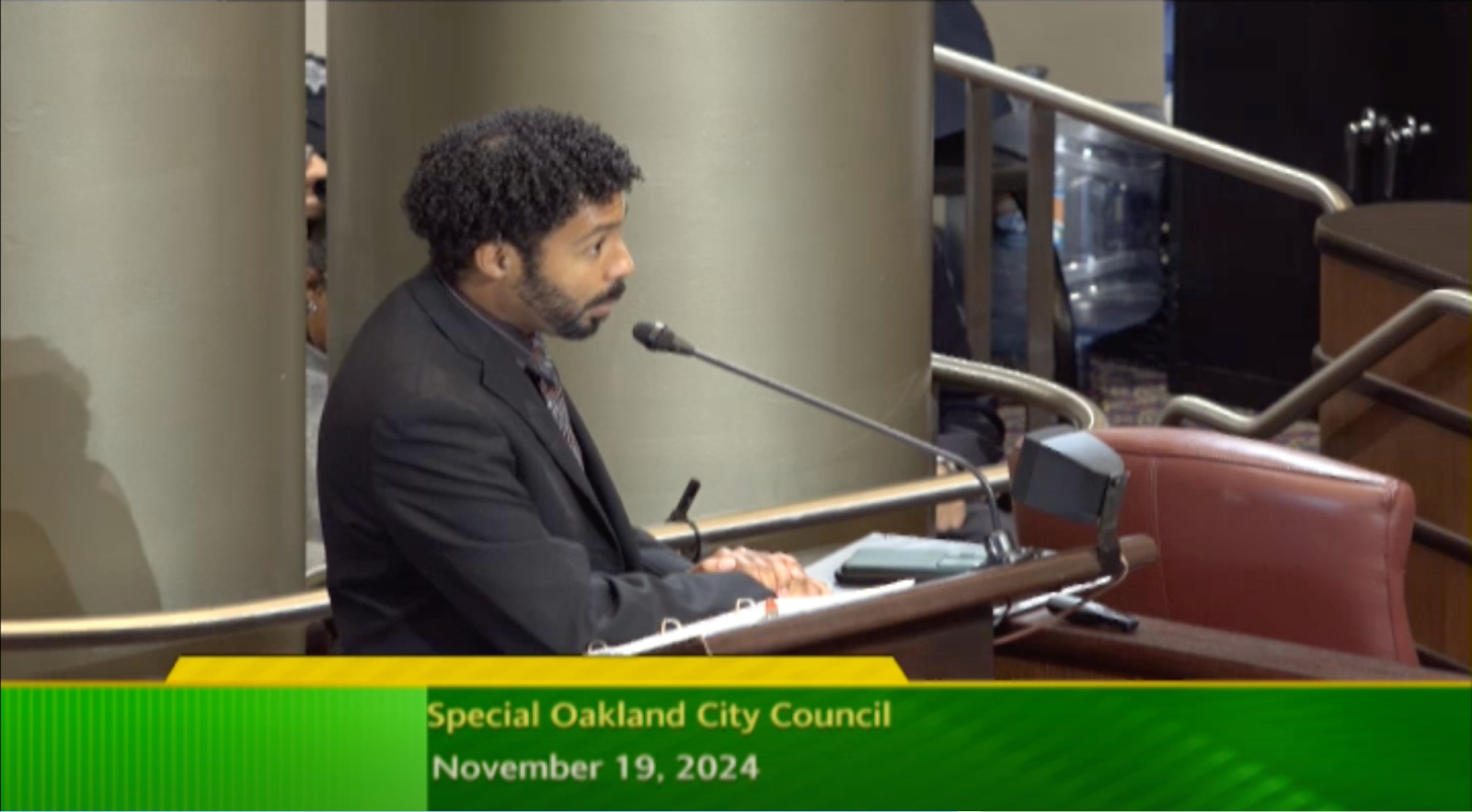
“If we do not change course, we will be roughly $115 million negative. We have already breached into our emergency reserve.”
This is a complete transcript and audio recording (12 minutes) of the presentation by Budget Administrator Bradley Johnson at yesterday’s special meeting of the Oakland City Council. Mr. Johnson summarized the state of the city’s finances and urgent actions required to address the fiscal crisis. He notes that $115M must be cut from spending this year, and $140M from next year’s (FY25-26) budget to avoid insolvency.Thank you. Director Roseman, Brad Johnson, budget administrator.The report contains detailed information on our projected expenditures in the General Purpose Fund for city departments. In total, the General Purpose Fund is expected to exceed its now-adjusted budget by $93.4 million, which is 12% higher than that adjusted budget number.The largest contributors to that overspending, and the two largest departments in your General Purpose Fund, are your Fire Department, which is projected to overspend by $34.5 million, or 21% of its budget, and your Police Department, which is expected to overspend by $51.9 million, or 16% of its budget.Again, overspending in total is $93.4 million. Detailed information on those departments is available in the report. I would recommend everyone, as opposed to looking at the screen, look at the detailed report for that information, and information on all other departments is noted.Discussing where we are projected to end the current fiscal year: we ended last fiscal year in a negative position. This is one of the first times ever we have seen this actually happen. That negative position last year was driven by an operating deficit of $80 million, meaning that last year we took in $80 million less in the General Purpose Fund than we outlaid.This year, we are projecting our operating deficit to be $93 million. So, consistent with that last year's $80 million operating deficit, we are seeing a $93 million operating deficit this year.After we note some excess fund balance coming back from our equipment fund and reserves required amounts for legal settlements and the expended, already carried forward allocations, we are projecting to end at roughly $115 million in the negative at the end of this fiscal year, if no action is taken.I want to be clear about what this number means. These are trends based on your actuals. This already incorporates the fact that we have many positions in the General Purpose Fund vacant. It already incorporates the revenue trends that Director Roseman mentioned. It already incorporates the reimbursable reimbursements for OPD overtime that was mentioned at the Finance Committee earlier.Based on our current trend, if we do not change course, we will be roughly $115 million negative.We mentioned we ended last year in the negative position. That negative position was substantial enough that the city is now, when combining its undesignated fund balance in the General Purpose Fund—this is still an unaudited number—we have effectively tapped into our mandated emergency reserve under the Consolidated Fiscal Policy.We have negatives. We have reserves also for OMERS, as required by that resolution for a closed retirement system, and we have a small cash balance that's due to interest in our Vital Services Stabilization Fund. But the highlight here is we have already breached into our emergency reserve.This is, again, based on transactions that occurred last fiscal year, not ones that are forthcoming, but what we've already seen. And, again, this is the first time we've ever seen this occur since we've had this policy. I will note that this is all governed by your Consolidated Fiscal Policy.Other funds are noted in this report. There are positive fund balances in some of these funds. These positive balances are due to prior years' overspending. They may be due to delayed expenditures. Certainly, in some of our capital funds, we have ongoing and delayed projects. However, some of these funds are also negative, and the cost pressures facing the General Purpose Fund are also facing these funds as well.To summarize where we sit as an organization: we have a general negative General Purpose Fund balance that's accumulated from FY23-24. We are projecting overspending this year by $93 million, and we have limited time by which to take corrective action.That corrective action is required to happen before December 31 of this year. It must happen this calendar year if the action is going to have sufficient time to effectuate change over the course of the remaining six months of the fiscal year. The resources that we need to bring in, the actions we need to take, need to be immediate.We are limited in what we can do. We must consider existing resources that we have on hand, unrestricting them and making them available to help balance the General Purpose Fund. We need to consider any revenues which can absolutely be recognized this fiscal year, but that precludes revenues that would be liens because those liens will take effect after the next tax roll, which is after t

PODCAST: We can balance Oakland’s budget without selling the future
An 8 minute podcast summary of our most recent post. You can also read the full article here, with more details on the numbers and sources. Podcast was generated by Google NotebookLM and reviewed by Oakland Report for accuracy. Mispronunciations are solely owned by Google. :) This is a public episode. If you would like to discuss this with other subscribers or get access to bonus episodes, visit www.oaklandreport.org

Podcast: Oakland's Pension Debt Problem
Last month we published a deep dive on Oakland’s pension debt problems which are costing the city $450M a year. It’s a 30-60 minute read. And that’s a blocker for most folks with little free time.So we’re trying out a new format—one friendly to driving and dog walks. It’s a short podcast that distills the article’s key findings into a 12 minute conversation.Podcast generated by Google NotebookLM. Reviewed by Oakland Report for accuracy. This is a public episode. If you would like to discuss this with other subscribers or get access to bonus episodes, visit www.oaklandreport.org