
NucleCast
287 episodes — Page 5 of 6
S1 Ep 87Carl Rhodes, Ph.D. - Australia's Defense Strategic Review
Carl Rhodes Ph.D. is the founder of Robust Policy, a Canberra-based business that provides evidence-based analysis on defense topics. Carl worked at RAND Corporation from 1997-2021, including four years as director of RAND Australia. Prior to moving to Australia, Carl spent twenty years as a researcher and manager in RAND’s Project AIR FORCE. His research portfolio has covered topics including long-range strike, ISR, sovereign weapons, nuclear deterrence, unmanned systems, and stressors facing 20th Air Force.EPISODE NOTES:Follow NucleCast on Twitter at @NucleCastEmail comments and story suggestions to [email protected] to NucleCast podcastRate the show
S1 Ep 86Wendy Baca - From the Manhattan Project to Present: Preserving and Transferring Knowledge to the Newest Generation
Wendy Baca started her career in 1987 with the Department of Energy in what was then known as the Albuquerque Operations Office. She was hired to fill the W87-1 Small Inter-continental Ballistic Missile (SICBM) Program Engineer position where one of her first tasks was to issue the Phase 3, Development Engineering, authorization to the DOE Nuclear Weapons Complex. Although the program was canceled a short time later, she continued to work in numerous Federal Program Manager roles for the next 25 years. The majority of Wendy’s work focused on the ICBM programs where she was also the Director of the DOE’s and later, the National Nuclear Security Administration’s (NNSA’s), ICBM Division for 9 years. During that time, her primary focus was the First Production Unit through completion of the W87 Alt 342, which was also referred to as the W87 Life Extension Program. Wendy’s other Federal Program Manager positions included the Pantex Stage Right Program, the AT-400A Pit Container, the DOE/NNSA Dismantlement Program, Plutonium Sustainment, and the Modernization Programs.After retiring from DOE/NNSA in 2012, Wendy worked at the Los Alamos National Laboratory (LANL) as an Executive Advisor in the Principal Associate Directorate for the Weapons Program. In 2015, Wendy became the Director of the Integrated Program Management Office in the Plutonium Science and Manufacturing Division where she focused on the ongoing LANL Production Agency efforts to include plutonium pits.Wendy worked at Sandia National Laboratories (SNL) from February 2017 until October 2022. She started in the Military Liaison Department as the W80-1/W84 Field Engineer and she finished her SNL career as the Manager of the Accident Response Group and Legacy Hardware Laboratory Department.In 2021, Wendy joined TechSource Inc’s Weapons Knowledge Preservation and Transfer Program where she works with the team to develop and deliver instructional modules for new and mid-career employees across the Nuclear Security Enterprise. As a Subject-Matter-Expert, Wendy provides lessons learned, experiences, and perspectives regarding the NNSA’s Weapons Acquisition Process that she has gained over the past 35 years.Since November 2022, Wendy has also been a consultant with MELE Associates where she is part of the NNSA’s Office of Counterterrorism and Counterproliferation “Reserve Force” which is a cadre of retired employees that provides expertise and support to the NNSA’s Nuclear Emergency Support Team.EPISODE NOTES:Follow NucleCast on Twitter at @NucleCastEmail comments and story suggestions to [email protected] to NucleCast podcastRate the show
S1 Ep 85Bradley T. Gericke, Ph.D. Major General, U.S. Army, Ret. - The Role of the Army in the Asia Pacific Region
Brad is an accomplished senior leader who enjoys a reputation for original thinking and strategic acumen coupled with an affirmative leadership approach. He holds a doctorate from Vanderbilt University and is a graduate of the National War College. Most recently Brad served as the Army’s longest-tenured Senior Strategist and Chief of Plans, Brad exercised wide-ranging and global responsibilities across the Army. With his enterprise-wide authorities Brad directly advised Army executives as he led the Army’s formal outreach to international military partners to fashion agreements that enhanced the readiness of the Army through better-value investment and effective basing of high demand logistics and equipment footprints. The programs Bradinitiated delivered capabilities in the form of innovative solutions that leveraged current Army force designs with emerging technologies, new concepts, and effective alignment of institutional priorities.Charged by Army leaders to “own the future” Brad built new structure models validated through scenario-driven experiments to maximize Army capabilities and operations. He refashioned planning and training methods to improve the Army’s counter-WMD readiness; wrote orders for Army-wide implementation; and regularly advised senior leaders regarding emerging trends affecting national defense, international affairs, and security policy.Brad led the Pentagon’s primary planning and force posture forums. He regularly consulted with senior DoD civilian and military leaders across defense organizations to build DoD’s first and unique worldwide plans that integrated the DoD’s crisis responses to cross-domain challenges posed by disruptive technologies and the rapid global transfer of information.In addition to his strategy and leadership experience, Brad served as a special assistant to multiple senior executives. An accomplished writer, he published capstone Army documents and has written numerous professional essays, three college instructor resource manuals, two urban warfare anthologies, and a military biography. He continues to work as a senior mentor to the Army and as an executive consultant.EPISODE NOTES:Follow NucleCast on Twitter at @NucleCastEmail comments and guest nominations to [email protected] to NucleCast podcastRate the show on Apple Podcasts
S1 Ep 84Juan Vitali, Ph.D. - The Importance of Advancing Nuclear Energy
Juan Vitali is the Assistant Director Nuclear Energy Innovation at the Office of Science and Technology Policy, The White House. Previously, he was the Army’s Nuclear Engineer and Chief of the Nuclear Power Branch where he led a team of engineers to shape conditions for the adoption of nuclear power by the Army. He was the chief concept architect for the development of mobile nuclear power plant for ground operations. He was the Senior Advisor to the Chief of Engineers on Nuclear Power Matters. Juan was Principal Research Faculty for eight years at Georgia Tech Research Institute and was Director of the Washington Office for the Electro-Optics Environment and Materials Laboratory.Throughout his career, Juan has maintained a dedication to excellence not only in science and technology but, in general, quietly effecting change through increasing leadership roles. In 2000, his work in halon replacements earned him the International US-EPA Stratospheric Ozone Protection Award. Juan completed studies at National Defense University/Eisenhower Schooland obtained a master’s degree in National Security Studies and Resource Strategy in 2013. Juan is a Harvard University Senior Executive Fellow. Juan holds a Doctorate in Engineering Physics/Nuclear Engineering(1992), a Master of Engineering (1987) and a bachelor’s degree Cum Laude in Engineering Physics/Nuclear Engineering (1984), all from the University of Florida. Juan is married to the former Kathryn Bowler of Needham, MA.EPISODE NOTES:Follow NucleCast on Twitter at @NucleCastEmail comments and guest nominations to [email protected] to NucleCast podcastRate the show on Apple Podcasts
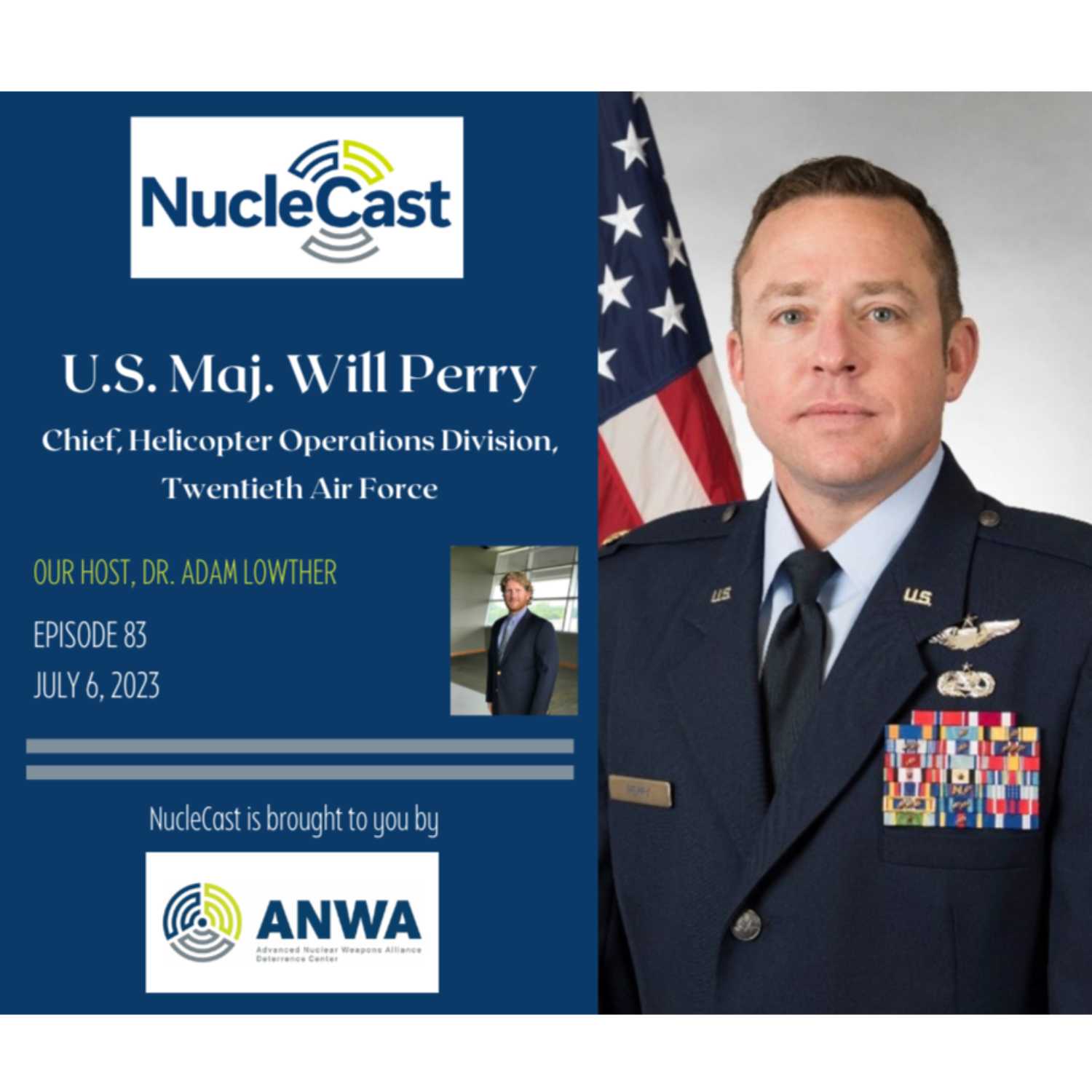
S1 Ep 83Major Frank W. Perry, Jr. - Helos in the Missile Field
Major Frank W. Perry, Jr. is the Chief, Helicopter Operations Division, Twentieth Air Force. In this position Major Perry advises the Commander, Twentieth Air Force on operational and administrative issues for the Air Force’s sole Helicopter Group. He leads planning, coordination, and Operational Plan support for three operational helicopter squadrons, integrating USSTRATCOM and USNORTHCOM missions for over 400 personnel.Prior to this assignment, Major Perry was a student at Air Command and Staff College in Air University. There he performed studies as part of the Russia Research Task Force, garnering the Thomas “Dutch” Miller Award for most relevant research in his field.Major Perry enlisted in the Air Force as a Ground Radio Technician in 2004, receiving his commission through Officer Training School in 2009. Following graduation, he has served in a variety of operational assignments as a UH-1N instructor pilot, and subsequently as a Mi-17 instructor and evaluator pilot. Major Perry has deployed in support of Operations IRAQI FREEDOM, ENDURING FREEDOM, and FREEDOM’S SENTINEL.EPISODE NOTES:Follow NucleCast on Twitter at @NucleCastEmail comments and guest nominations to [email protected] to NucleCast podcastRate the show on Apple Podcasts

S1 Ep 82Independence Day Special
The ANWA Deterrence Center wishes you a safe and happy 4th of July.EPISODE NOTES:Follow NucleCast on Twitter at @NucleCastEmail comments and guest nominations to [email protected] to NucleCast podcastRate the show on Apple Podcasts
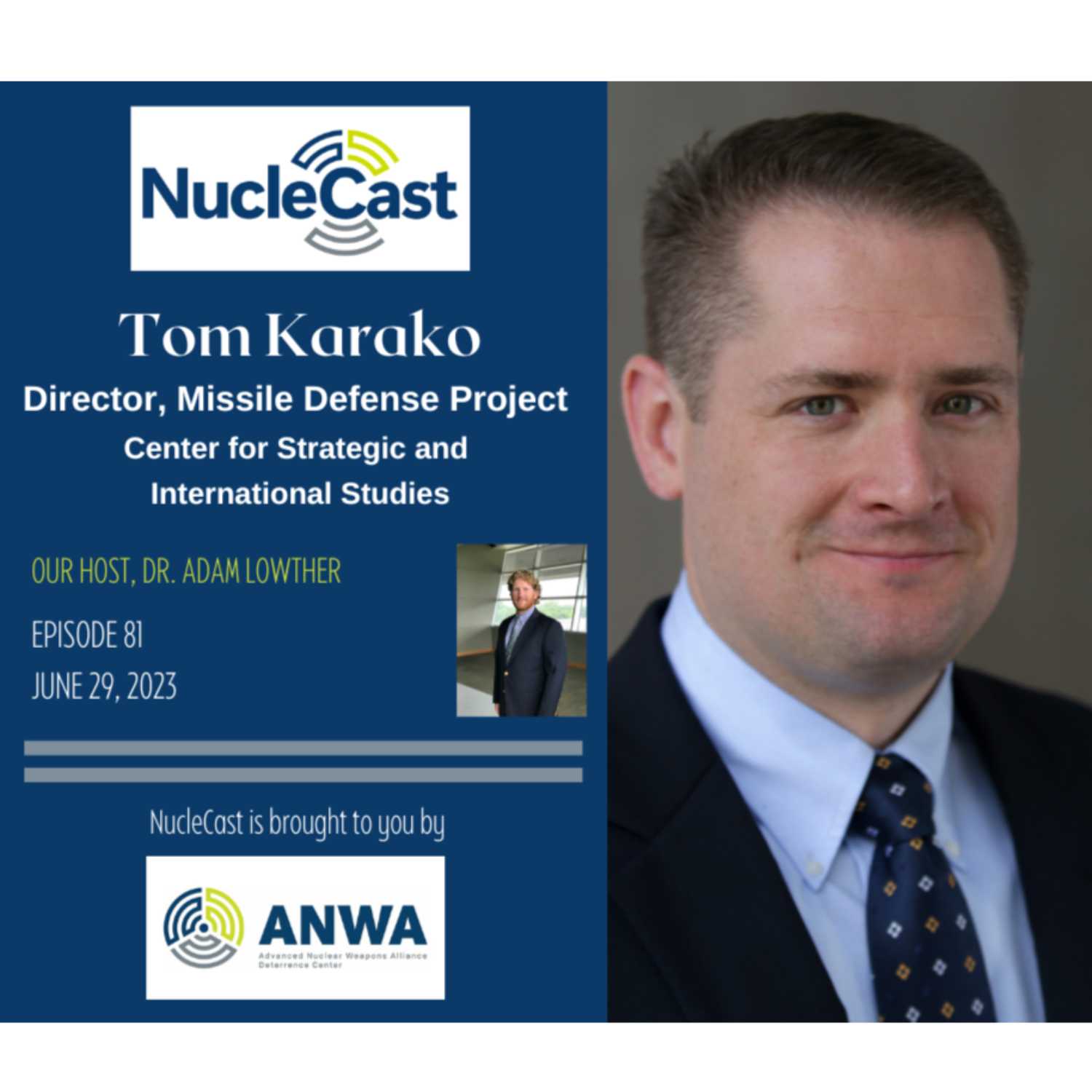
S1 Ep 81Tom Karako - Filling in the Gaps of Missile Defense
Thomas Karako is a senior fellow with the International Security Program and the director of the Missile Defense Project at the Center for Strategic and International Studies (CSIS), where he arrived in 2014. His research focuses on national security, missile defense, nuclear deterrence, and public law. In 2010–2011, he was an American Political Science Association congressional fellow, working with the professional staff of the House Armed Services Committee and the Subcommittee on Strategic Forces on U.S. strategic forces policy, nonproliferation, and NATO. Dr. Karako is also currently a fellow with the Institute for Politics and Strategy of Carnegie Mellon University. He received his PhD from Claremont Graduate University and his BA from the University of Dallas.EPISODE NOTES:Follow NucleCast on Twitter at @NucleCastEmail comments and guest nominations to [email protected] to NucleCast podcastRate the show on Apple Podcasts
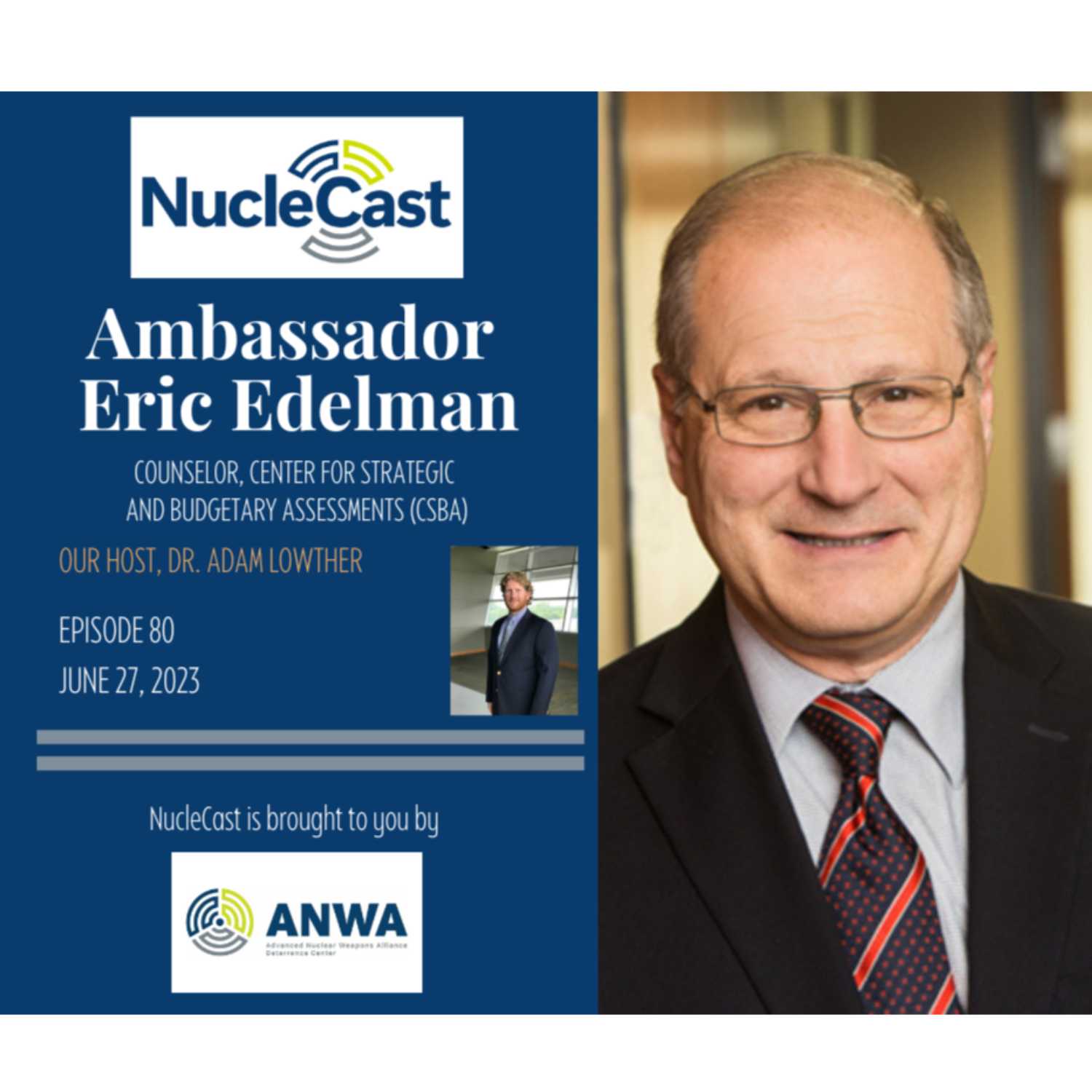
S1 Ep 80Eric Edelman - The New Makers of Modern Strategy and the Future of Strategic Deterrence
Ambassador Eric S. Edelman is Counselor at the Center for Strategic and Budgetary Assessments. He retired as a career minister from the U.S. Foreign Service on May 1, 2009. He has served in senior positions at the Departments of State and Defense as well as the White House, where he led organizations providing analysis, strategy, policy development, security services, trade advocacy, public outreach, citizen services, and congressional relations. As undersecretary of defense for policy (August 2005-January 2009), he was DoD's senior policy official, overseeing strategy development with global responsibility for bilateral defense relations, war plans, special operations forces, homeland defense, missile defense, nuclear weapons and arms control policies, counterproliferation, counternarcotics, counterterrorism, arms sales, and defense trade controls.He served as U.S. ambassador to Finland in the Clinton administration and Turkey in the Bush administration and was Vice President Cheney's principal deputy assistant for national security affairs. He was chief of staff to Deputy Secretary of State Strobe Talbott, special assistant to Undersecretary of State for Political Affairs Robert Kimmitt, and special assistant to Secretary of State George Shultz.His other assignments included the State Department Operations Center, Prague, Moscow, and Tel Aviv, where he was a member of the U.S. Middle East delegation to the West Bank/Gaza autonomy talks.Ambassador Edelman has been awarded the Department of Defense Medal for Distinguished Public Service, the Chairman of the Joint Chiefs of Staff Joint Distinguished Civilian Service Award, the Presidential Distinguished Service Award, and several Department of State Superior Honor Awards. In 2010, he was named a knight of the French National Order of the Legion of Honor.Ambassador Edelman serves as the Chair of the National Defense Strategy Commission and on the bipartisan board of directors of the United States Institute of Peace.EPISODE NOTES:Follow NucleCast on Twitter at @NucleCastEmail comments and guest nominations to [email protected] to NucleCast podcastRate the show on Apple Podcasts
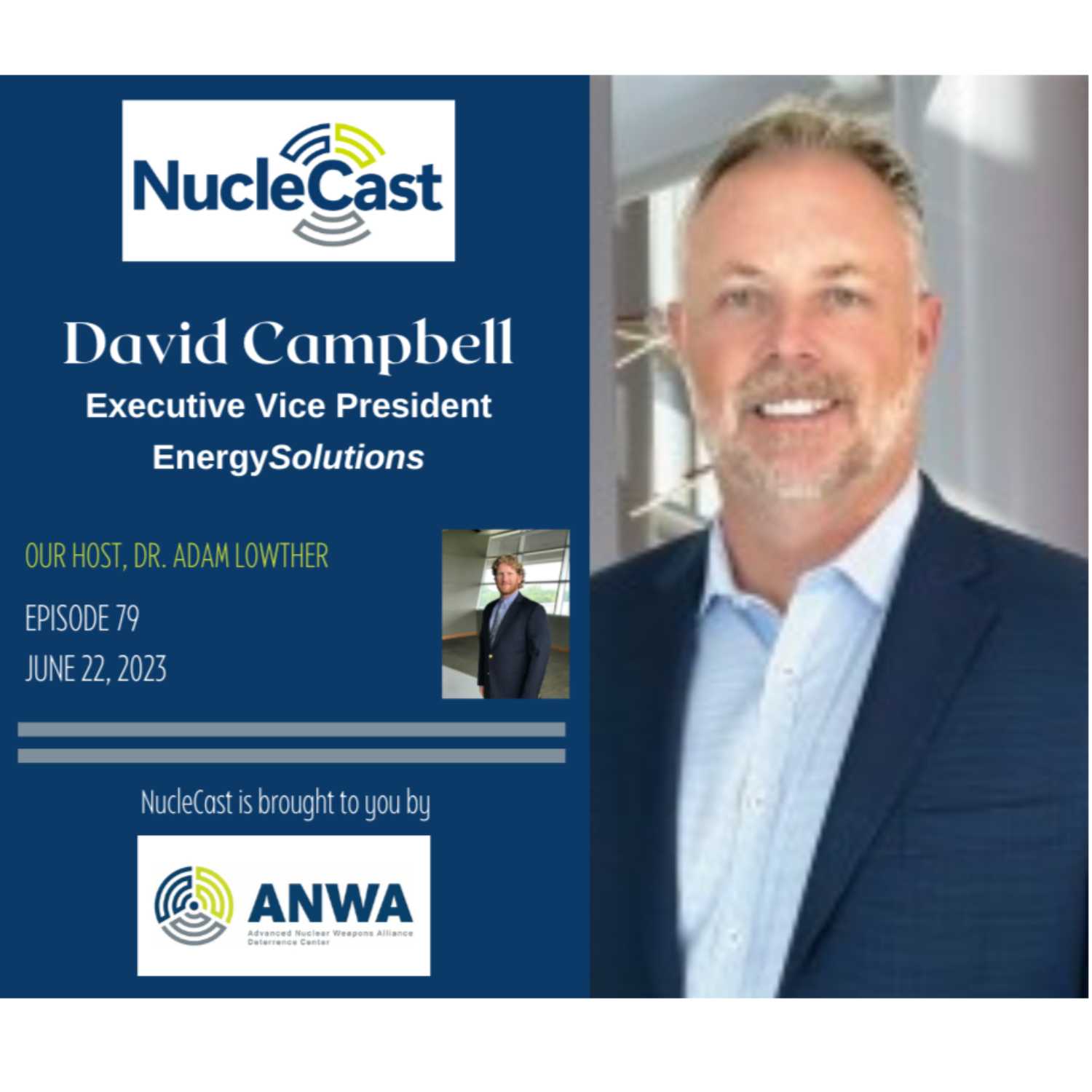
S1 Ep 79David Campbell - Questions on Nuclear Waste Clean-Up
David Campbell is the Executive Vice President, EnergySolutions and previously served as the Associate Administrator, Office of Congressional, Intergovernmental & Public Affairs at the U.S. National Nuclear Security Administration (NNSA).As the Executive Vice President at EnergySolutions, Mr. Campbell is responsible for all aspects of business development and implementing the company’s growth strategies across the utility, commercial, federal, and international sectors. In addition to his experience as a senior executive in private industry as well as within the US government, he brings a unique experience of over thirty years across the nuclear, defense and environmental markets helping companies break into and grow in existing and new markets. David’s expertise in managing and implementing government, corporate, and commercial business development, marketing, and communications programs across North America and internationally is a key factor in EnergySolutions push to grow across all our sectors. David resides in the Washington DC area and holds a BS in Political Science and Economics from James Madison University and a MA in International Relations and National Security from George Washington University.EPISODE NOTES:Follow NucleCast on Twitter at @NucleCastEmail comments and guest nominations to [email protected] to NucleCast podcastRate the show on Apple Podcasts
S1 Ep 78Carl Rehberg - Missile Defense and Challenges in the Pacific
Dr. Carl Rehberg is a Non-resident Senior Fellow at the Center for Strategic and Budgetary Assessments. Carl was founder and director of the Headquarters Air Force Asia-Pacific Cell, which played a pivotal role in the development of Air Force strategy, force development, planning, analysis and warfighting concepts supporting initiatives related to Asia-Pacific and the DoD Third Offset Strategy. Carl spearheaded the establishment of the China Aerospace Studies Institute (CASI) and led the development of innovative concepts and capability proposals to improve DoD’s joint resiliency and integrated air and missile defenses. Prior to this assignment, he was the Assistant Associate Director for AF Strategic Planning and Director, Analysis Division in the AF QDR organization, leading multiple assessments of future capabilities and force structure.EPISODE NOTES:Follow NucleCast on Twitter at @NucleCastEmail comments and guest nominations to [email protected] to NucleCast podcastRate the show on Apple Podcasts
S1 Ep 77Lani Kass, Ph.D. - Thoughts from a career in National Security
Dr. Lani Kass is Strategic Advisor for Cyber Reliant Corporation, focused on advancing Cyber Reliant’s National Security & Justice presence and stature in the U.S. national security sector, as well as enhancing and expanding key client and industry relationships. From December 2011 to January 2021, Dr. Kass served the CEO and Executive Chairman of the Board at CACI, as the Senior Vice President and Corporate Strategic Advisor for a $5.7B mission and enterprise technology company whose expertise plays a vital role in national security, safeguarding US troops, and enabling the federal government to deliver cost-effective, high-quality support for all Americans.Prior to 2012, Dr. Kass served as Senior Policy Advisor to the Chairman of the Joint Chiefs of Staff (CJCS). She was responsible for the high-level assessments and analyses necessary to render the best military advice and execute the integrated strategies, programs, and plans essential to America’s security. Her contributions were recognized by both the Secretary of Defense and CJCS. She received the Joint Distinguished Civilian Service Award – the highest award granted to U.S. Government civilian employees.Dr. Kass also served as the Special Assistant to the Chief of Staff of the U.S. Air Force (CSAF), Senior Mentor to USAF Project CHECKMATE, and Director of the Cyber Task Force. She developed the intellectual concepts that led to the establishment of the U.S. Cyber Command and continue to underpin U.S. cyber strategy. She was awarded the prestigious Decoration for Exceptional Civilian Service by both the Secretary of the Air Force and CSAF.EPISODE NOTES:Follow NucleCast on Twitter at @NucleCastEmail comments and guest nominations to [email protected] NucleCast podcastRate the show
S1 Ep 76Michael Shoults: The U.S. Air Force Integration in the Nuclear Enterprise
Michael R. Shoults, a member of the Senior Executive Service, is the Acting Deputy Chief of Staff for Strategic Deterrence and Nuclear Integration, Headquarters U.S. Air Force, the Pentagon, Arlington, Virginia. Mr. Shoults assists in the oversight of the Air Force’s Nuclear Deterrence Operations, Countering Weapons of Mass Destruction efforts, Nuclear Command Control and Communication portfolios and international treaties and arms control agreements.Mr. Shoults was commissioned as a second lieutenant in the U.S. Air Force upon graduation from Parks College of St. Louis University in 1982. He has an extensive background in Air Force operations, amassing more than 3,000 hours in the B-52H Stratofortress and B-1B Lancer. In addition, he has held several key operational and staff positions at the squadron, wing, numbered Air Force and Headquarters, U.S. Air Force levels. After more than 27 years of active-duty service in the Air Force, Mr. Shoults retired as a colonel and was appointed to the Senior Executive Service in 2013.EPISODE NOTES:Follow NucleCast on Twitter at @NucleCastEmail comments and guest nominations to [email protected] to NucleCast podcastRate the show
S1 Ep 75David Jonas, Esq. - Presidential Authority on Imminent Attack
David S. Jonas is a partner at the law firm of Fluet, Huber & Hoang (FH+H). His practice includes corporate transactions, employment law, government contracts, trial and appellate litigation, international law, administrative/regulatory compliance and investigations. He has extensive experience in national security issues and is recognized as one of a handful of experts worldwide in nuclear nonproliferation law. He was a career member of the Senior Executive Service and served as General Counsel of the National Nuclear Security Administration (NNSA) where he negotiated numerous multilateral and bilateral international agreements to include the U.S. – India Civil Nuclear Agreement. He also served as General Counsel of the Defense Nuclear Facilities Safety Board.Prior to his civilian service, he was a career Marine Corps officer where he held a wide variety of command and staff billets. He served as nuclear nonproliferation planner for the Joint Chiefs of Staff negotiating multiple international agreements and has worked extensively with the International Atomic Energy Agency, the Conference on Disarmament, and the United Nations. He is one of the only judge advocates to have commanded two units, including a company in an infantry regiment, the 5th Marines.He argued the case of Davis v. United States, 512, U.S. 452 (1994) at the U.S. Supreme Court becoming the first judge advocate in the history of the Army, Navy, Marine Corps and Air Force to do so. He received the U.S. Court of Appeals for the Armed Forces Award for Excellence in Legal Writing and was selected as the Outstanding Career Judge Advocate in the Marine Corps. He concluded his military service as a lieutenant colonel. He is currently an adjunct professor at Georgetown University Law Center and George Washington (GW) University Law School and has also taught at the U.S. Naval War College.EPISODE NOTES:Follow NucleCast on Twitter at @NucleCastEmail comments and guest nominations to [email protected] to NucleCast podcastRate the show on Apple Podcasts
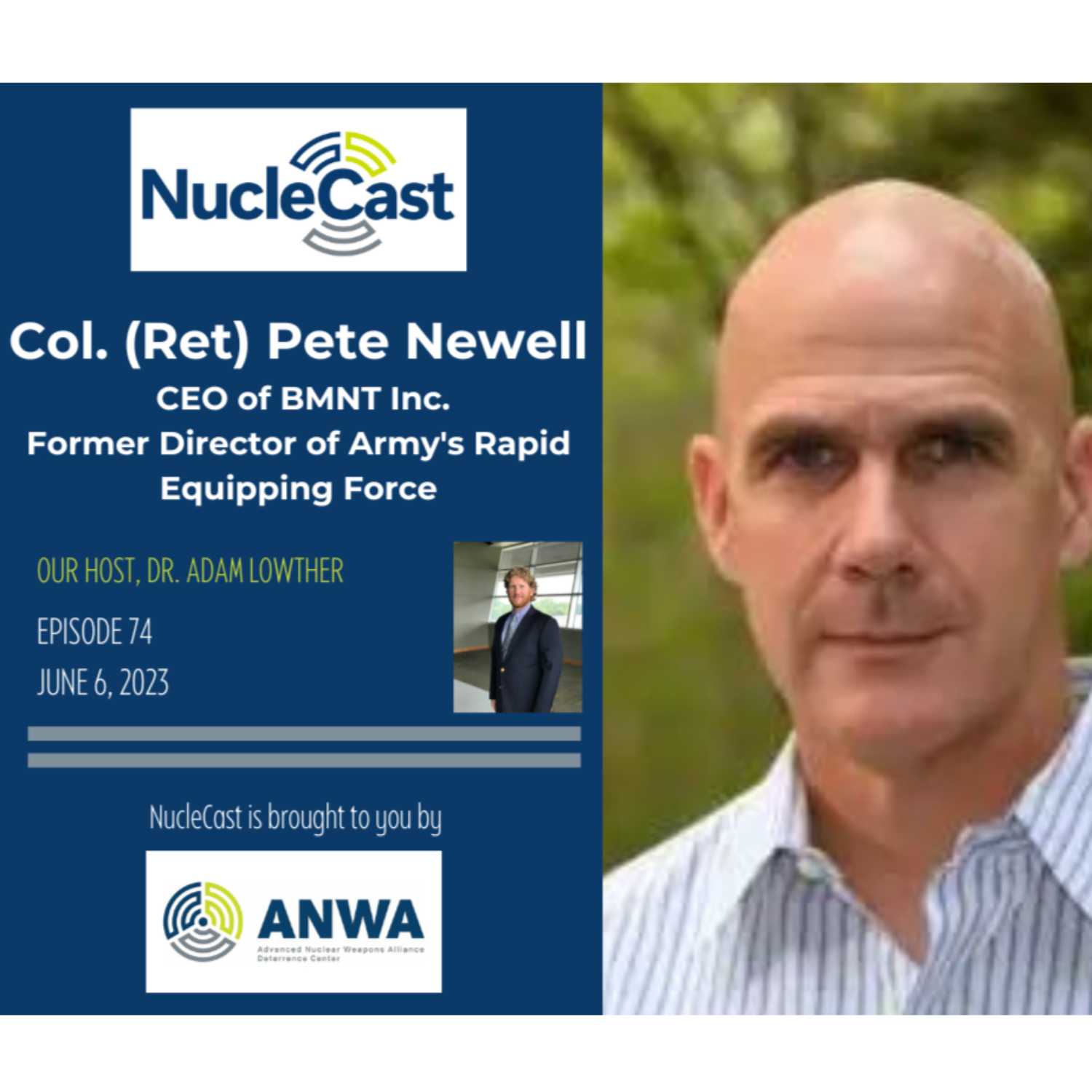
S1 Ep 74Pete Newell - Mission Acceleration and Innovation in Risk Adverse America
Pete Newell is a nationally recognized innovation expert whose work is transforming how the government and other large organizations compete and drive growth. A retired Army Colonel and former director of the Army’s Rapid Equipping Force, he is the CEO of BMNT Inc., an internationally recognized innovation consultancy and early-stage enterprise accelerator that helps solve some of the hardest real-world problems in national security, state and local governments, and beyond.Together with Lean Startup founder Steve Blank and Joe Felter, the retired Army Colonel and former US Deputy Assistant Secretary of Defense for South and Southeast Asia; Pete is also founder and co-author of Hacking for Defense (H4D)®, an academic program taught at 50+ universities in the U.S., as the UK and Australia, that has created a national security innovation pipeline as it solves critical national security problems at startup speed.EPISODE NOTES:Follow NucleCast on Twitter at @NucleCastEmail comments and guest nominations to [email protected] to NucleCast podcastRate the show on Apple Podcasts
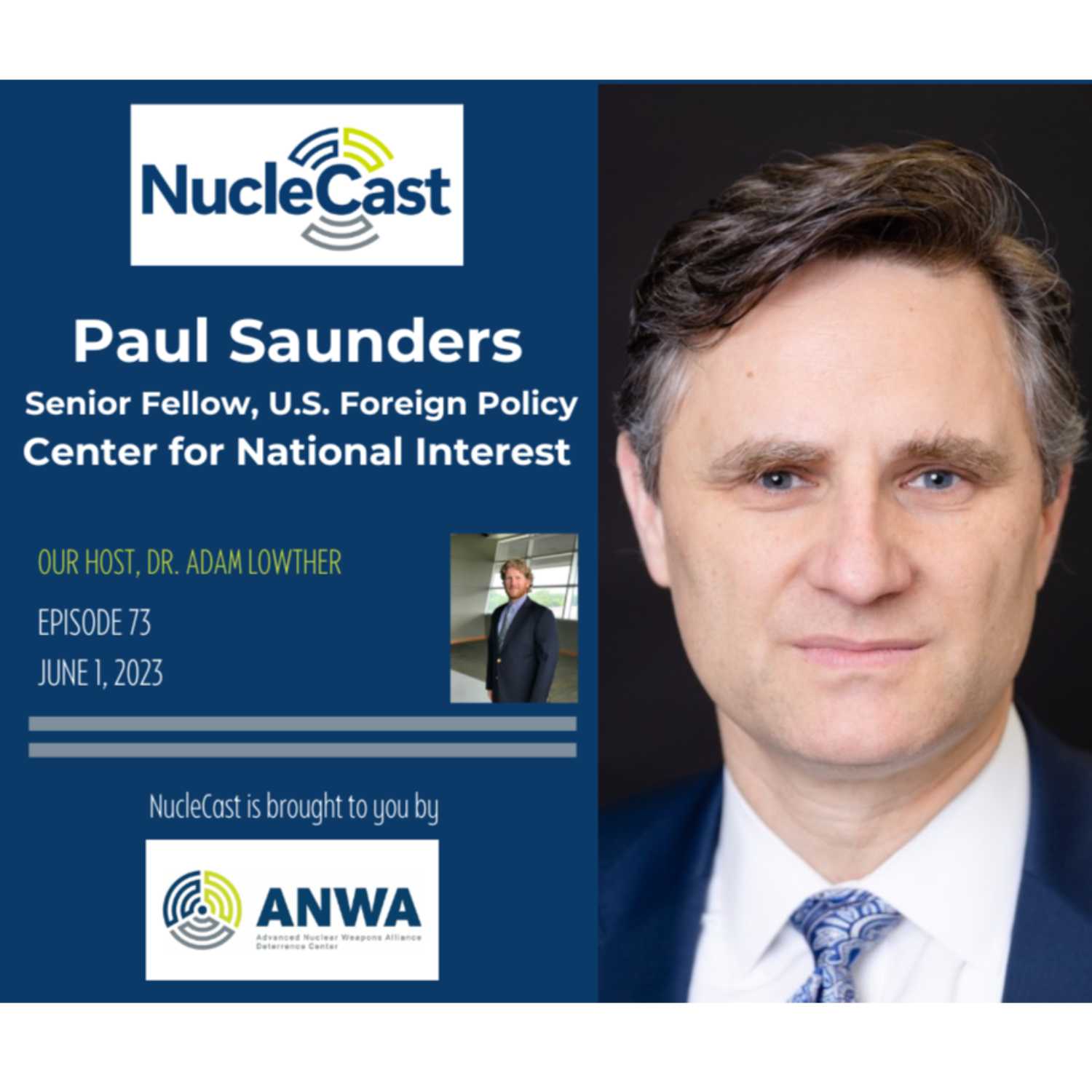
S1 Ep 73Paul Saunders - Ukraine, Vladimir Putin, and War Crimes
Paul J. Saunders was previously Executive Director of the Center for the National Interest (CFTNI) and remains a member of the Center’s Board of Directors and a Senior Fellow in U.S. Foreign Policy at CFTNI. He was the Center’s Chief Operating Officer and directed its U.S. - Russian Relations Program in addition to leading projects on other issues, including energy and climate change and U.S.-Japan relations. He was also Associate Publisher of the foreign policy magazine The National Interest, published bi-monthly by the Center for the National Interest.Mr. Saunders served in the Bush Administration from 2003 to 2005 as Senior Advisor to the Under Secretary of State for Global Affairs. In that capacity, he worked on a broad range of transnational issues, including energy and climate change as well as a variety of regional issues. Earlier, Mr. Saunders served as Director of CFTNI from 1997 to 2003 and was Assistant Director from its founding in 1994 until 1997. In 2000, he was a Senior Policy Advisor to the Speaker’s Advisory Group on Russia, established by the Republican Policy Committee of the U.S. House of Representatives.EPISODE NOTES:Follow NucleCast on Twitter at @NucleCastEmail comments and guest nominations to [email protected] to NucleCast podcastRate the show on Apple Podcasts
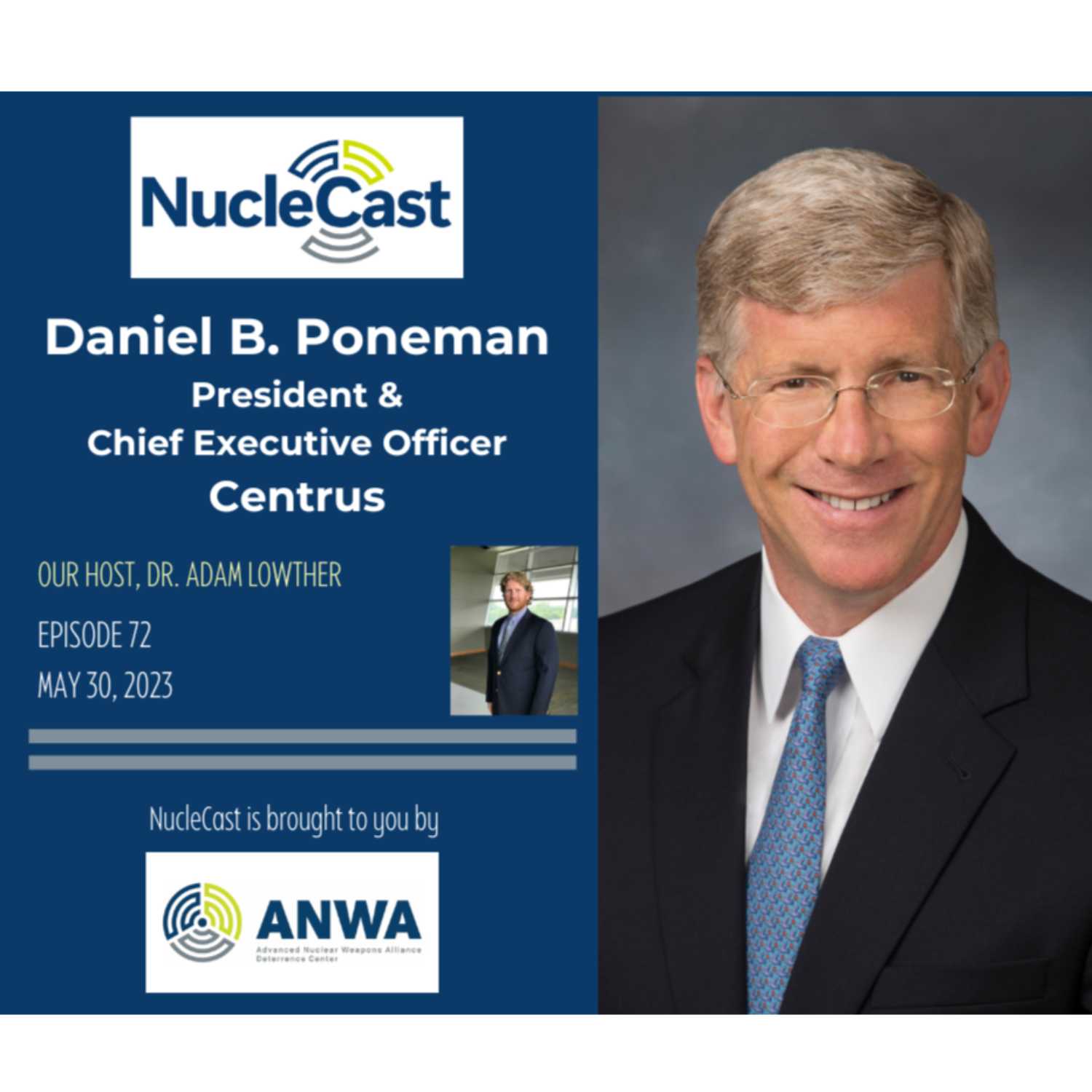
S1 Ep 72Daniel Poneman - Reconstituting our Ability to Enrich Uranium
Daniel B. Poneman is president and chief executive officer of Centrus Energy Corp. He also serves on the company’s board of directors. From 2009 to 2014, Mr. Poneman was the Deputy Secretary of Energy, also serving as the chief operating officer of the U.S. Department of Energy. His responsibilities spanned the range of U.S. energy policies and programs – hydrocarbons, renewables, nuclear, and efficiency – including cybersecurity, project management, national security, and international cooperation. He was also responsible for the Department’s efforts on resilience and emergency response, in cases ranging from Fukushima to Hurricane Sandy.Between April 23, 2013, and May 21, 2013, Mr. Poneman served as Acting Secretary of Energy. In prior tours in government, Mr. Poneman served as a White House Fellow and as Director of Defense Policy and Arms Control for the National Security Council. From 1993 through 1996 he was Special Assistant to the President and Senior Director for Nonproliferation and Export Controls at the National Security Council. His responsibilities included the development and implementation of U.S. policy in such areas as peaceful nuclear cooperation, missile technology, space-launch activities, sanctions determinations, chemical and biological arms control efforts, and conventional arms transfer policy.EPISODE NOTES:Follow NucleCast on Twitter at @NucleCastEmail comments and guest nominations to [email protected] to NucleCast podcastRate the show on Apple Podcasts
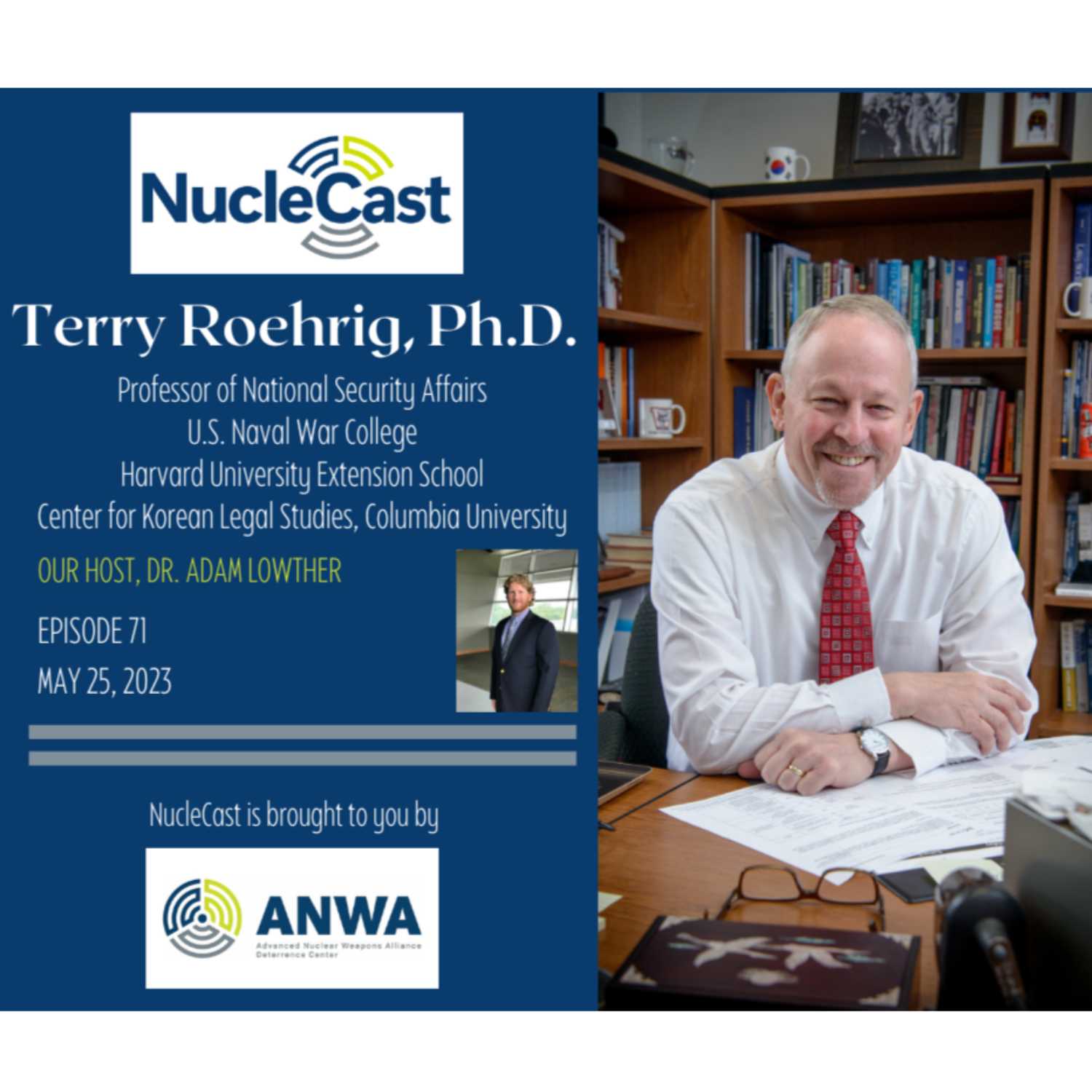
S1 Ep 71Terry Roehrig, Ph.D. - Current Events on the Korean Peninsula
Dr. Roehrig is Professor of National Security Affairs at the U.S. Naval War College. In addition, he is an adjunct professor at the Harvard University Extension School and a non-resident expert with the Center for Korean Legal Studies at Columbia University. He was a Research Fellow at the Kennedy School at Harvard University and a past President of the Association of Korean Political Studies.Roehrig has written numerous books, articles and book chapters on Korean and East Asian security issues, North Korea’s nuclear weapons program, the Northern Limit Line dispute, the South Korean Navy, deterrence theory and the U.S.-South Korea alliance. His books include Japan, South Korea, and the U.S. Nuclear Umbrella: Deterrence After the Cold War (Columbia University Press) and The Evolution of the South Korea-United States Alliance (Cambridge University Press), co-authored with Uk Heo. He has interviewed with and written for many news organizations including BBC, Bloomberg, Bulletin of Atomic Scientists, CNN, CTV (Canada), Fortune, Korea Times, National Interest, Newsweek, NK News, NPR, Reuters, The Hill, UPI and Voice of America. Dr. Roehrig received his Ph.D. from the University of Wisconsin-Madison and an M.A. from Marquette University, both in political science.EPISODE NOTES:Follow NucleCast on Twitter at @NucleCastEmail comments and guest nominations to [email protected] to NucleCast podcastRate the show
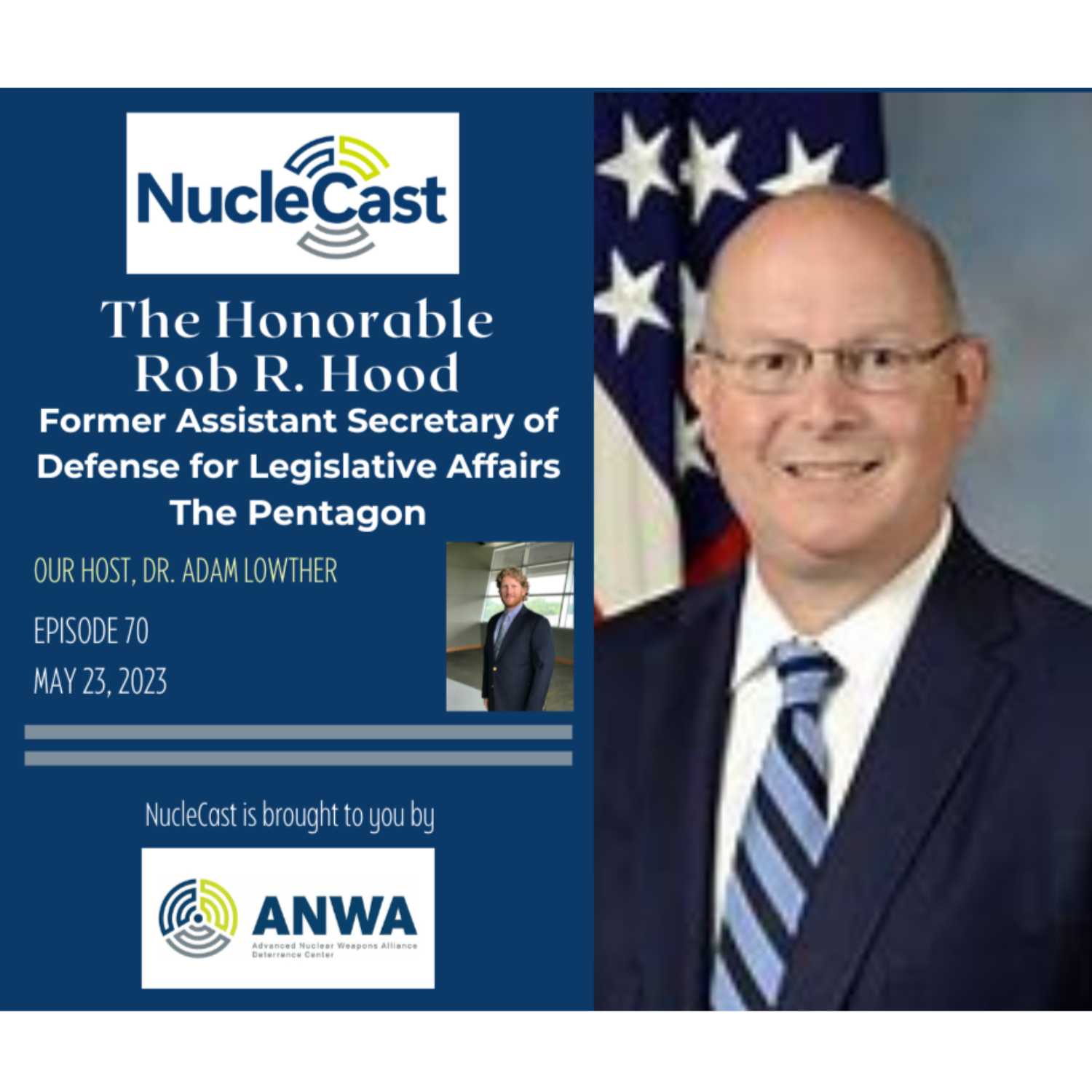
S1 Ep 70The Honorable Rob R. Hood - The History of the NNSA and Where are We Now?
The Honorable Robert R. Hood served as the Assistant Secretary of Defense for Legislative Affairs at the Pentagon. In this role, he supported the Secretary of Defense and the Department's other senior leaders by promoting the policies, strategies, and budget of the Department of Defense (DOD) to the United States Congress.Prior to being confirmed as an Assistant Secretary, Rob served as the Vice President for Government Affairs at CH2M HILL, a fortune 500 engineering company. Rob previously served in the White House as a Special Assistant to President George W. Bush in the Office of Legislative Affairs. Before working on the White House staff, Rob served at the DOD as the Principal Deputy Assistant Secretary of Defense for Legislative Affairs and as the Deputy Under Secretary of Defense (Comptroller) for Budget and Appropriations Affairs. Prior to the Pentagon, Rob served as the Director of Congressional Affairs for the National Nuclear Security Administration (NNSA), a semi-autonomous agency within the Department of Energy responsible for maintaining the nation's nuclear weapon stockpile and nonproliferation efforts.EPISODE NOTES:Follow NucleCast on Twitter at @NucleCastEmail comments and guest nominations to [email protected] to NucleCast podcastRate the show
S1 Ep 69Lt Col Raymundo Vann Jr. and Capt Gabriella Graham - It’s a Family Affair: U.S. Air Force
LT COLONEL RAYMUNDO M. VANN JR. is the Deputy Commander of the 90th Operations Group at Francis E. Warren Air Force Base (AFB), Wyoming. The group he serves operates fifteen Missile Alert Facilities and one hundred and fifty Intercontinental Ballistic Missiles (ICBMs), a third of the nation’s ICBM nuclear alert force, which stand on alert and are constantly ready to launch at the direction of the President of the United States. Lt Col Vann graduated and was commissioned from Texas State University, San Marcos, Texas through the Air Force ROTC program in May 2003. He has been qualified in the Minuteman III weapon system. Lt Col Vann has deployed in support of Operation Southern Watch.CAPT GABRIELLA C. GRAHAM is the Wing Executive officer at Francis E. Warren Air Force Base (AFB), Wyoming. She plans, performs, and manages executive support functions, programs, and policies for the wing commander and assists with administration of over 42 units and wing staff. She is accountable to the President, SECDEF, and DUSSTRATCOM for critical launch actions of 150 ICBMs upon direction. Capt Graham graduated and was commissioned from the University of Wyoming, Laramie, Wyoming through the Air Force ROTC program in May 2016. She has been qualified in the Minuteman III weapon system.EPISODE NOTES:Follow NucleCast on Twitter at @NucleCastEmail comments and guest nominations to [email protected] to NucleCast podcastRate the show
S1 Ep 68The Honorable Frank Miller - All Things Nuclear
The Honorable Franklin Miller is a principal at the Scowcroft Group. He dealt extensively with nuclear policy and nuclear arms control issues during his 31-year government career, which included senior positions in the Defense Department and on the NSC staff. He was directly in charge of US nuclear deterrence and targeting policy from 1985 to 2001 and also chaired NATO’s senior nuclear policy committee, the High-Level Group, from 1997 to 2001. He is a member of the Strategic Command Advisory Board and served on the Defense Policy Board from 2008-2020. He served on the 2008 Secretary of Defense Task Force on DoD Nuclear Weapons Management (Schlesinger Task Force), on the 2013-2014 Congressional Advisory Panel on the Nuclear Security Enterprise (Mies-Augustine Panel), and is currently a member of the on-going Congressional Commission on Strategic Posture.EPISODE NOTES:Follow NucleCast on Twitter at @NucleCastEmail comments and guest nominations to [email protected] to NucleCast podcastRate the show
S1 Ep 67BG (Ret.) Gregory S. Bowen 2 - The New Role of U.S. Air and Missile Defense
Greg’s 36-year military career culminated as the Deputy Director of Global Operations at U.S. Strategic Command, where he was responsible for Department of Defense space activities, ballistic missile defense, cyber operations, strategic deterrence, and nuclear command and control. He was part of the executive leadership team overseeing the operations of 162,000 people, billions of dollars’ worth of equipment, and our nation’s nuclear arsenal.In addition to his normal duties, Greg was certified as an Airborne Emergency Actions Officer and Designated Command Alternate; in those roles, he was one of a handful of officers certified to brief the President of the United States on nuclear response options.Greg was selected for Major General (2-star), but elected to retire from active duty to pursue other interests.Greg is a recognized expert in space and missile defense operations, and has been a sought-after speaker on those topics as well as strategic deterrence. He has extensive experience in classified, highly sensitive programs operated by the Department of Defense and others. He has a current TS/SCI clearance with CI Poly.EPISODE NOTES:Follow NucleCast on Twitter at @NucleCastEmail comments and guest nominations to [email protected] to NucleCast podcastRate the show
S1 Ep 66Steve Blank - Innovation in the Nuclear Enterprise
Steve Blank is an adjunct professor at Stanford and a co-founder of the Gordian Knot Center for National Security Innovation. Steve consults for the National Security establishment on innovation methods, processes, policies, and doctrine.His book The Four Steps to the Epiphany is credited with launching the Lean Startup movement. He created the curriculum for the National Science Foundation Innovation Corps.At Stanford he co-created the Department of Defense Hacking for Defense and Department of State Hacking for Diplomacy curriculums. His follow-on book The Startup Owner’s Manual described a process for turning ideas into scale and his Harvard Business Review cover story redefined how large organizations can innovate at speed. Steve's latest class at Stanford, Technology, Innovation, and Great Power Competition, is providing crucial insight on how technology will shape all the elements of national power.EPISODE NOTES:Follow NucleCast on Twitter at @NucleCast Email comments and guest nominations to [email protected] to NucleCast podcast Rate the show
S1 Ep 65Col., USAF (Ret.) Mike Guillot - Sharing Expertise in the Nuclear Enterprise Through Writing
Mike Guillot, Colonel, USAF, (Retired) is the former editor of Strategic Studies Quarterly, a position he held for over 11 years (2009-20). As SSQ editor, he produced the first ever special editions covering Cyber, Space, Asia-Pacific, CMR, Austere Defense, Deterrence, and Emerging Technology. During his thirty-year Air Force career, he flew five major weapons systems including the B-52H, KC-10A, VC-137B/C, KC-135R, and EC135N/Y.Mike spent two years on the ACSC faculty (91-93) and over four years on the Air War College faculty (00-04). He is a former operations officer, squadron commander, US Army joint planner, and former US Air Attaché to France.In 2007 Mike became the first Educational Support Squadron commander, the Director of International Officer School, and Director of AU International Affairs. He earned a Master’s degree in national security strategy from the National War College (98) and holds an MBA degree from the University of South Dakota (83).EPISODE NOTES:Follow NucleCast on Twitter at @NucleCast Email comments and guest nominations to [email protected] to NucleCast podcast Rate the show
S1 Ep 64B.G. John Weidner - Weapons Effects, Modernization, and Policy
Brigadier General John W. Weidner assumed the duties as Deputy Director, Plans and Policy, United States Strategic Command (USSTRATCOM), on May 4, 2020. General Weidner was commissioned a second lieutenant in 1991 upon graduation from the Army ROTC program at St. John’s University, Collegeville, Minnesota, where he earned a Bachelor of Science degree in physics.He completed a Ph.D. in medical physics from the University of Wisconsin-Madison in 2012, and holds Master of Science degrees in medical physics, nuclear engineering, engineering management, and strategic studies. His military education includes the Engineer Officer Basic and Advanced Courses, the Combined Arms Services Staff School, the Command and General Staff College, and the Army War College. He is also a registered Professional Engineer in the state of Wisconsin. General Weidner most recently served as the Director of the US Army Nuclear and Countering WMD Agency at Fort Belvoir, Virginia, where he led the Army's capability to integrate nuclear weapon effects into conventional operations, and supported Army service component commands with nuclear and countering WMD expertise.General Weidner previously served as the Director of the USSTRATCOM Commander Action Group; Director for Strategic Capabilities Policy in the Defense Policy and Strategy Directorate on the National Security Council staff; Executive Director for the Office of Major Modernization Programs, National Nuclear Security Administration, Department of Energy; assistant professor in the Department of Engineering Physics at the Air Force Institute of Technology; stockpile associate for the Defense Threat Reduction Agency (DTRA) at Los Alamos National Laboratory, New Mexico; consequence management advisory team leader for DTRA at Kirtland Air Force Base, New Mexico; assistant professor in the Department of Physics at the United States Military Academy at West Point; and Deputy District Engineer for the St. Paul District, U.S. Army Corps of Engineers. He commanded B Company, 52nd Engineer Battalion at Fort Carson, Colorado and served as an Engineer Platoon Leader at Fort Riley, Kansas and in the Republic of Korea.EPISODE NOTES:Follow NucleCast on Twitter at @NucleCast Email comments and guest nominations to [email protected] to NucleCast podcast Rate the show
S1 Ep 63Christine M. Leah, PhD - Where Does Australia Stand on the U.S. Extended Deterrence
Christine is a fellow with the National Institute for Deterrence Studies. She has worked in government, she was a visiting fellow at CISS Pakistan, a Postdoctoral Fellow with the Grand Strategy Program at Yale University, a Stanton Postdoctoral Fellow in Nuclear Security at MIT, a visiting fellow at the Rajaratnam School of International Studies, a journalist for Karen News on the Thai-Burma border, a summer research fellow at RAND, and a research intern at IISS-Asia, the Australian Strategic Policy Institute, and IISS-London.EPISODE NOTES:Follow NucleCast on Twitter at @NucleCast Email comments and guest nominations to [email protected] to NucleCast podcast Rate the show
S1 Ep 62Eric Wollerman - Manufacturing and Supply Chain in the Nuclear Enterprise
Eric Wollerman is President of Honeywell Federal Manufacturing & Technologies (FM&T). FM&T manages and operates the U.S. Department of Energy’s Kansas City National Security Campus (KCNSC). With nearly 6,500 employees in Kansas City and Albuquerque, the KCNSC provides national security through their diverse engineering, manufacturing, and secure supply chain management activities.As Honeywell FM&T president, Wollerman is responsible for applying best-in-class commercial standards in managing operations and delivering outstanding mission results with a $1.8B annual operations budget. Since joining FM&T in April 2020,Wollerman has been leading KCNSC’s strategies, including: delivering operational excellence in nuclear weapons and national security missions with a focus on quality, early design engagement and delivery requirements; embracing digital transformation tools and technologies to enhance our mission; strategic planning for KCNSC’s infrastructure; supply base and workforce needs for today and the future; and, unlocking the value of our people and processes while enhancing the organization’s Inclusion, Diversity, Equity & Acceptance (IDEA) strategies.EPISODE NOTES:Follow NucleCast on Twitter at @NucleCast Email comments and guest nominations to [email protected] to NucleCast podcast Rate the show
S1 Ep 61Dr. Kerry M. Kartchner - Arms Control and Russia’s Objectives
Retired in 2018 from a career in the U.S. Department of State and the Defense Department, where he was primarily responsible for nuclear weapons policy and nonproliferation issues. During his career, he negotiated nuclear arms control agreements with Russia, Belarus, Kazakhstan, and Ukraine, he participated in several inspections of Russian nuclear weapon facilities, and was the State Department’s representative to the ABM Treaty commission when the U.S. withdrew from that treaty. Dr. Kartchner led the team that drafted the 2004 joint Secretary of State and Secretary of Defense statement on the need for strategic nuclear modernization. He was the State Department representative to the 2009 congressionally charted Strategic Posture Review Commission, chaired by former Secretaries of Defense William J. Perry and James R. Schlesinger. As senior foreign policy advisor at the Defense Threat Reduction Agency, he organized and participated in nuclear dialogues with numerous countries. He is the co-editor and contributor to several books on U.S. national security. His co-edited 2014 book, On Limited Nuclear War in the 21st Century is widely read today in the strategic nuclear community, and has been translated into Korean for use in the South Korean senior officer’s education program. His MA and PhD in international relations are from the University of Southern California, and his BA is from Brigham Young University.
S1 Ep 60Dr. Mark Herrmann and Dr. Charles Nakhleh - U.S. National Laboratories, Stockpile Stewardship and Workforce
Mark C. Herrmann, Ph.D. Program Director for the Weapon Physics and Design within Weapons and Complex Integration Directorate Lawrence Livermore National Laboratory. Dr. Herrmann leads LLNL’s efforts to strengthen our nation’s nuclear deterrent by advancing our understanding of nuclear weapons physics and design. This includes the physics design, assessment, and certification efforts for the enduring LLNL systems (W80, B83, W87), the W80-4 Life Extension Program, and the W87-1 Modification program. He also leads weapon science research and development, including focused experiments, integral hydrodynamic and subcritical experiments, high-energy-density (HED) experiments at the National Ignition Facility (NIF), and modeling and simulation using NNSA’s high performance computing capabilities. Dr. Herrmann has been in this role since January 2022. Charles W. Nakhleh, Ph.D. Associate Laboratory Director for Weapons Physics (ALDX) Los Alamos National Laboratory. In this role, Dr. Nakhleh has line responsibility for the nuclear weapons designers and simulation code architects at the Laboratory, as well as program responsibility for the NA-11 weapons science, computing, and technology maturation portfolio. Prior to taking on his current role, he was the Executive Officer to the Deputy Director for Weapons (DDW), where he was responsible to the DDW for integrating and aligning activities across the weapons program.
S1 Ep 59Sarah Mineiro - Acquisition Reform in the Nuclear Enterprise/Embedding AI in NC3
Sarah Mineiro is the founder and CEO of Tanagra Enterprises, a defense, intelligence, space, science and technology consulting firm based in the national capital region. Previously, Sarah was the Senior Director of Space Strategy for Anduril Industries. Sarah was the Staff Lead for the Strategic Forces Subcommittee for the House Armed Service Committee (HASC). She led the Subcommittee’s legislative and oversight activities of all Department of Defense and Military Intelligence Program space programs, U.S. nuclear weapons, missile defense, directed energy, and hypersonic systems. Sarah was the senior legislative advisor to Chairman Mac Thornberryon all strategic force's issues. In this role she was the primary drafter and negotiator of the Space Force and Space Commandlegislation for the House Republicans.Prior to joining the HASC, Sarah served in the Office of the Under Secretary of Defense for Policy (OSDP) , the Office of the Under Secretary of the Air Force for International Affairs (SAF/IA) and she started her career as an intelligence analyst for the National Air and Space Intelligence Center in Dayton, Ohio. She was the lead employment analyst on foreign counterspace systems including space situational awareness sensors, directed energy, and kinetic kill vehicle systems.Sarah is a board member of the Space Force Association and National Defense University Foundation. She has been awarded the Secretary of Defense Medal for Exceptional Civil Service. She has served on the Defense Innovation Board. She is an Executive Mentor with the Zed Factor fellowship. Sarah is also a Senior Fellow with the Potomac Institute for Policy Studies as well as an adjunct senior fellow with the Aerospace Security Project at CSIS.
S1 Ep 58Stephen Blank, PhD - Russia and Ukraine, A Historical Perspective
Dr. Blank is an internationally recognized expert on Russian foreign and defense policies and international relations across the former Soviet Union. He is also a leading expert on European and Asian security, including energy issues.Since 2020 he has been a Senior Fellow at the Foreign Policy Research Institute. In 2020-21 he also was a Senior Expert for Russia at the U.S. Institute of Peace and Senior Fellow at the American Foreign Policy Council. From 1989-2013 he was a Professor of Russian National Security Studies at the Strategic Studies Institute of the U.S. Army War College in Pennsylvania.Dr. Blank has consulted for the CIA, major think tanks and foundations, chaired major international conferences in the USA and abroad In Florence, Prague, and London, and has been a commentator on foreign affairs in the media in the United States and abroad. He has also advised major corporations on investing in Russia and is a consultant for the Gerson Lehrmann Group.He has published over 1300 articles and monographs on Soviet/Russian, U.S., Asian, and European military and foreign policies, including publishing or editing 15 books, testified frequently before Congress on Russia, China, and Central Asia for business, government, and professional think tanks here and abroad on these issues. He has also appeared on CNN, BBC, Deutsche Welle, CNBC Asia, and is a regular guest on VOA.Prior to his appointment at the Army War College in 1989 Dr. Blank was Associate Professor for Soviet Studies at the Center for Aerospace Doctrine, Research, and Education of Air University at Maxwell AFB. He also held the position of 1980-86: Assistant Professor of Russian History, University of Texas, San Antonio, 1980-86, and Visiting Assistant Professor of Russian history, University of California, Riverside, 1979-80.
S1 Ep 57Samuel S. Stanton, Jr., PhD - Theories of International Relations
Dr. Stanton is a graduate of Arkansas State University(1996 BA, 1998 MA). Dr. Stanton earned his PhD in Political Science at Texas Tech University (2004). Dr. Stanton is currently a professor of Political Science at Grove City College and Senior Fellow at National Institute for Deterrence Studies. His research focuses on foreign policy, conflict processes and national security, Dr. Stanton’s publications include articles, chapters, books, and conference papers on security issues in the South China Sea, Chinese foreign policy, renewable natural resources as a cause of ethnic conflict, terrorist financing through gray and black markets, domains of cyberterrorism and cyberwarfare, and religious extremism in relation to separatist and terrorist violence levels.
S1 Ep 56Lt. Col. Derek Williams - Keeping ICBM force on Alert and the Doctrine of "Launch on Warning"
Lt Col Derek Williams is the Commander of the 803d Operations Support Squadron. He received his commission through the ROTC program at Virginia Polytechnic Institute and State University in 2005. Following completion of Combat System Officer and B-52 Initial Qualification Training as a Distinguished Graduate, He began his career as a B-52 Navigator with the 23d Bomb Squadron at Minot AFB, North Dakota. During his time at Minot, he upgraded to Radar Navigator, Instructor and Evaluator along with deploying twice in support of the Pacific Continuous Bomber Presencemission. In 2011, he transitioned to Barksdale AFB, Louisiana, to attend the United States Air Force Weapons School. Upon graduation, Lieutenant Colonel Williams served as the Flight Commander for the Conventional and Nuclear Operations and Plans Flights in the 2d Operations Support Squadron. Later, he served as the Chief of Bomber Operations and Programs at Headquarter Air Force Global Strike Command where he advised both the Commander and Vice Commander on nuclear force improvement issues and programs with Secretary of Defense and Secretary of the Air Force visibility. He also authored the curriculum and founded the School of Advanced Nuclear Deterrence Studies. Lieutenant Colonel Williams is a graduated Air Force Fellow from Sandia National Laboratories, where he completed their Weapon Intern Program, studying the historical development of nuclear weapons technologies to inform current and future stockpile activities, deterrence strategies, and the growing body of work on United States nuclear policy. After completing his time as an Air Force Fellow, he served as the Deputy Branch Chief for International Treaties and Agreements, as a Speechwriter to the Deputy Chief of Staff for Strategic Deterrence and Nuclear Integration, and as the Branch Chief for Stockpile Science and Technology on the Air Staff.EPISODE NOTES:Follow NucleCast on Twitter at @NucleCast Email comments and story suggestions to [email protected] to NucleCast podcast Rate the show
S1 Ep 55Maj. Gen. USAF (Ret.) Richard Evans 2 - Airborne Leg of Nuclear Command, Control, and Communications (NC3)
Major General, USAF (Ret.) Richard J. Evans III (Rick) serves as the Executive Director for the National Strategic Research Institute (NSRI), a national security-focused research institute created by the University of Nebraska. Before joining NSRI, he served more than 35 years in the U.S. Air Force and Air National Guard, retiring at the rank of Major General in October, 2019. He was previously the Director of Reserve Forces and Mobilization Assistant to the Commander, U.S. Strategic Command, Offutt Air Force Base, Nebraska. He served as the principal advisor to the Commander on reserve component matters related to the command's diverse missions, including strategic deterrence, nuclear operations and command, control and communications, space and cyberspace operations, full-spectrum global strike, integrated missile defense, joint electromagnetic spectrum operations and joint warfare analysis.
S1 Ep 54Brig. Gen. Ty Neuman - The Role of Nuclear Weapons in the Air Force Future Concepts
Brig. Gen. Ty Neuman serves as the Director, Concepts and Strategy, Deputy Chief of Staff for Air Force Futures, Headquarters U.S. Air Force, the Pentagon, Arlington, Virginia. He assists with developing and synchronizing Air Force strategy, global posture and the alignment of Air Force planning efforts with Department of Defense strategic guidance. He supports the Air Force Chief of Staff with strategy development and assessments alongside the formulation and execution of several Air Force Chief of Staff Title 10 wargames.Prior to his current assignment, Brig. Gen. Neuman was the Director for Strategic Capabilities, National Security Council, Executive Office of the President, Washington, D.C. He assisted and advised the president and National Security Advisor on nuclear matters, while developing and coordinating national policies concerning the nuclear enterprise and missile defense policies for the United States.
S1 Ep 53Bob Peters 2 - The Future of Arms Control
Mr. Robert J. Peters is a Senior Fellow with the National Institute for Deterrence Studies. Formerly, he was the Chief within the Strategic Integration Directorate of the Strategic Trends and Effects Department (STED) at the Defense Threat Reduction Agency. Prior to joining DTRA, Mr. Peters served as a Senior Research Fellow at National Defense University's Center for the Study of Weapons of Mass Destruction.
S1 Ep 52Robyn Hutchins - Recruiting and Retaining Young Talent in Our Nuclear Enterprise
Ms. Robyn Hutchins is currently a doctoral candidate in the Nuclear Engineering department at Kansas State University studying radiation detection under the direction of Professor Douglas McGregor. Within her DTRA funded doctoral work, Ms. Hutchins has successfully designed, fabricated, and characterized many types of radiation detectors that allow for overt or covert monitoring by soldiers and emergency responders. Past work performed by Ms. Hutchins at The Idaho National Laboratory has led to the development of an artificially intelligent radiation spectroscopy system that is currently deployed on the international space station
S1 Ep 51Dr. Donald Gooch: How Do We Measure Deterrence?
Donald M. Gooch is an Associate Professor of Political Science in the Department of Government at Stephen F. Austin State University. He is also a Fellow at the National Institute for Deterrence Studies. He received his M.A. in political science from the University of Arkansas, Fayetteville in 2002 and his Ph.D. in political science from the University of Missouri-Columbia in 2009. He was appointed to the SFA faculty in August of 2012 and received his M.S. in Statistics in December, 2022 from SFA.Dr. Gooch is a statistical and research consultant. He has worked on varied projects, including with Gooch Consulting on weather performance reliability for PepCo and with LTI on performance assessment for the USAF.
S1 Ep 50Dr. James Petrosky 2 - Electromagnetic Pulse and the Power Grid
Dr. James C. Petrosky is the President of the National Institute for Deterrence Studies (NIDS). He holds a Ph.D. and M.S. from Rensselaer Polytechnic Institute in Engineering Physics where he developed experimental techniques for the prediction of damage to electronic devices and materials. He has substantial technical expertise in pulsed radiation effects and nuclear weapon survivability, with an emphasis on radiation effects on electronics and electromagnetic pulse.Previously, Dr. Petrosky served at the Air Force Institute of Technology (AFIT) where he achieved the academic rank of Professor of Nuclear Engineering. At AFIT he sustained an ABET accredited Nuclear Engineering program serving the unique military and civilian advanced education requirements for the DoD.Dr. Petrosky has published in 96 public and government classified peer-reviewed journals. He retired from the U.S. Army in 2004 as a Lieutenant Colonel, after serving as an Engineer Officer and Nuclear Research Officer.
S1 Ep 49Dr. Robert Smith - Workforce, Recruitment and the Changing Demographics
Dr. Rob Smith is Amentum’s Vice President of Diversity, Equity, and Inclusion. In this role, he is responsible for leading the company’s diversity, equity and inclusion vision and strategy by developing and implementing programs and initiatives that advances Amentum’s business objectives and reinforces the organization’s culture. Previously, Dr. Smith served as BAE Systems’ Intelligence and Security Sector Director of Talent Acquisition and Diversity and Inclusion (D&I). He also served in the U.S. Coast Guard (USCG) for 28 years, retiring at the rank of Captain/O-6. In his final assignment he served as Commanding Officer, Coast Guard Recruiting Command in Washington, DC.
S1 Ep 48Peter Huessy 2 - Russia Ceases to Comply with New START
Peter Huessy is a senior fellow at Hudson Institute, where he focuses on nuclear deterrence and modernization, arms control, and defense policy. Mr. Huessy has spent the past four decades laying out the requirements for nuclear deterrence and modernization, arms control, and defense policy, as well as the companion efforts on missile defense, space, non- and counterproliferation, particularly using public diplomacy to further US policy. His work has also focused on the threats from Russia, China, North Korea, and Iran.
S1 Ep 47Dr. John Laudun - How to Craft Your Narrative of Deterrence
John Laudun is on the faculty at the University of Louisiana, where his research focuses on computational models of discourse, especially narratives, and how they cascade through socio-cultural networks both online and off. His work has appeared in a variety of academic journals and edited volumes, and he has been cited or interviewed in newspapers and documentaries. He has been a Jacob K. Javits Fellow, a MacArthur Scholar, and a senior researcher at UCLA’s Institute for Pure and Applied Mathematics.
S1 Ep 46BRIG GEN. USAF (RET) Rob Spalding - Chinese Strategy, Active Defense and EMPs
US Air Force Brigadier General (ret) Rob Spalding is the former White House National Security Council senior director for strategic planning and served in senior positions of strategy and diplomacy within the Defense and State Departmentsfor more than 26 years. Rob is the founder and CEO of SEMPRE, the only technology company created to protect and secure our most critical resource: data.
S1 Ep 45Zachary Kallenborn 2 - Chinese Spy Balloons, Drones and Growing Concerns
Zachary is a Policy Fellow at the Schar School of Policy and Government, a Fellow at the National Institute for Deterrence Studies, a Research Affiliate with the Unconventional Weapons and Technology Division of the National Consortium for the Study of Terrorism and Responses to Terrorism (START), an officially proclaimed U.S. Army "Mad Scientist," and Senior Consultant at ABS Group.He has published over 50 articles on autonomous weapons, weapons of mass destruction, and apocalyptic terrorism in a wide range of peer-reviewed, wonky, and popular outlets, including the Brookings Institution, Foreign Policy, Slate, Terrorism and Political Violence, and Parameters. Journalists have written about and shared that research in the New York Times, NPR, Forbes, the New Scientist, WIRED, and the BBC, among dozens of others in dozens of languages.
S1 Ep 44Dr. Mark Peters - Battelle & National Laboratories - Their Role in Nonproliferation and Clean Energy
Mark Peters is the Executive Vice President for National Laboratory Management and Operations at Battelle Memorial Institute with responsibilities for governance and oversight of U.S. Department of Energy (DOE) and U.S. Department of Homeland Security national laboratories for which Battelle has a significant lab management role. Previously, he was the director of Idaho National Laboratory and president of Battelle Energy Alliance, LLC.
S1 Ep 43Rebekah Koffler - Ukraine, Russia and Putin’s Playbook
Rebekah Koffler is a Russian-born, former Defense Intelligence Agency (DIA) officer and specialist in Putin and Russian Doctrine & Strategy. She is also a communism survivor. Working with the DIA and CIA’s National Clandestine Service, Rebekah has led “red” teams during wargames and briefed the Pentagon, the White House, and NATO on Russian Doctrine & Strategy. U.S. military commanders have called her a “national asset,” and she received the National Intelligence Professional Award. As a top intelligence officer on the Russia target, Ms. Koffler has delivered classified briefings to top U.S. military commanders, NATO ministers, the directors of the CIA and DIA, the National Security Council, and senior congressional staff. Rebekah’s new book, Putin’s Playbook: Russia’s Secret Plan to Defeat America, describes Moscow’s strategic ambitions, including the Kremlin’s master plan to reconstitute a USSR-like alliance and also to transform the United States, through ideological subversion, from a free capitalist society into a totalitarian socialist state.
S1 Ep 42U.S. Rep. Mac Thornberry - The Ebb and Flow of Today’s Nuclear Issues in Congress
Since leaving Congress after 26 years, which included service as Chairman of the House Armed Services Committee, Mac continues to work at the intersection of technology and national security with various companies and organizations.Mac led in creating the National Nuclear Security Administration to improve management of the nation’s nuclear weapons complex; establishing the Department of Homeland Security (introducing a bill to do so six months before the attacks of 9/11); preparing the military to defend the nation in new domains of warfare such as space and cyber; and improving DOD’s innovation and acquisition efforts.In addition to serving on the House Armed Services Committee throughout his time in Congress, Mac also served on the House Intelligence Committee for 14 years. He has written widely on defense matters and appeared on all major television channels providing insight on national security-related issues.
S1 Ep 41Curtis McGiffin Part 2 - Integrated Deterrence
Curtis McGiffin is currently a Visiting Professor with the Department of Defense and Strategic Studies at Missouri State University where he teaches graduate and doctorate courses on deterrence and grand strategy. Previously, he was the Associate Dean of the School of Strategic Force Studies at the Air Force Institute of Technology, where he led a robust portfolio of USAF professional continuing education programs supporting the AF nuclear enterprise. He also has ~27 years of experience in the USAF as an aviator, commander, staff officer, and educator, most of which was supporting the USAF’s nuclear enterprise
S1 Ep 40Dr. Chris Yeaw - Ultra-Low Yield Weapons - Why does Russia have so Many?
Dr. Christopher Yeaw is the Associate Executive Director for Strategic Deterrence and Nuclear Programs at the National Strategic Research Institute, U.S. Strategic Command’s University Affiliated Research Center (UARC). An integral component of the University of Nebraska, NSRI leads and leverages collaborative efforts with other academic institutions, National laboratories, FFRDCs, UARCs, and non-profit organizations. NSRI’s responsively and enduringly supports the US government in successfully executing the strategic deterrence, nuclear and counter WMD missions with world class research and analysis. The Strategic Deterrence and Nuclear Programs Department leads thought and collaborates across the entire range of strategic and nuclear issues: deterrence policy, threat analysis, weapon design, strategic materials, NC3, wargaming, nonproliferation, counter-terrorism, and education.
S1 Ep 39Dr. Jonathan Trexel Part 2
Dr. Jonathan Trexel is a faculty member with Missouri State University’s Defense and Strategic Studies graduate program. He teaches on the topics of nuclear strategy, nuclear deterrence, deterrence theory, and arms control. He also consults as a contractor for the US Department of Defense on nuclear deterrence and related topics, a position he has held for over 20 years. Dr. Trexel is a military veteran having served over 21 years in the U.S. Air Force as an enlisted all-source intelligence analyst. He holds a Master's Degree in Strategic Intelligence from the Defense Intelligence Agency and a PhD in political science from the University of Nebraska-Lincoln specializing in international relations.
S1 Ep 38David Craig - Make Your Voice Heard: Effective Writing Strategies to Support and Educate on Deterrence and More
David Craig is Editor, Real Clear Defense at Real Clear Politics. He was a U.S. Marine for 20 years, serving in Operation Desert Fox (Iraq), Operation Iraqi Freedom (2006-2009 three tours), and Operation Enduring Freedom (Afghanistan for all of 2011) and became assistant editor of RealClearDefense in 2015 and editor in 2016. A majority of his time in the Marine Corps was as an intelligence analyst, but also advisor and part of a Battalion Training Team in Fallujah in 2006. Craig completed his Masters of Science in Strategic Intelligence at the Defense Intelligence College (2010) now the National Intelligence University.